Review

A Literature Review on Challenges and Solutions for Smart and Sustainable Urban Mobility

by
Antonio Verde
1,2,
Miguel Meléndez-Useros
2 and
Fernando Viadero-Monasterio
2,*
1
Mechanical Engineering Department, Università degli Studi della Campania “Luigi Vanvitelli”, Via Roma 29, 81031 Aversa, CE, Italy
2
Mechanical Engineering Department, Advanced Vehicle Dynamics and Mechatronic Systems (VEDYMEC), Universidad Carlos III de Madrid, Avda. de la Universidad 30, 28911 Leganes, Spain
*
Author to whom correspondence should be addressed.
Urban Sci. 2026, 10(6), 326; https://doi.org/10.3390/urbansci10060326
Submission received: 7 May 2026 / Revised: 8 June 2026 / Accepted: 9 June 2026 / Published: 11 June 2026
(This article belongs to the Special Issue Smart Cities—Urban Planning, Technology and Future Infrastructures)

Abstract

Urban mobility is undergoing a rapid transition driven by digitalization, electrification, and automation. However, current research remains largely fragmented across specific technological domains, obscuring the interactions required for city-scale deployment. To address this gap, we conducted a literature review (2018–2026) adhering to the PRISMA 2020 guidelines. Using Google Scholar as an aggregate search engine, we screened and synthesized 162 peer-reviewed studies across four foundational pillars: intelligent transportation systems, resilient infrastructure, electric mobility, and autonomous/connected vehicles. The methodological evaluation of the literature reveals a prevalent overreliance on simulation models compared to large-scale field trials. Through a narrative synthesis of the selected studies, we derive a comprehensive five-layer conceptual framework that integrates the infrastructure, mobility, energy, digital, and governance layers. The findings indicate that scaling smart mobility is frequently constrained by institutional fragmentation and infrastructure rigidity, which often act as bottlenecks equal to or greater than technological capability. The review concludes by outlining targeted research priorities to guide the integration of sustainable urban mobility.

1. Introduction

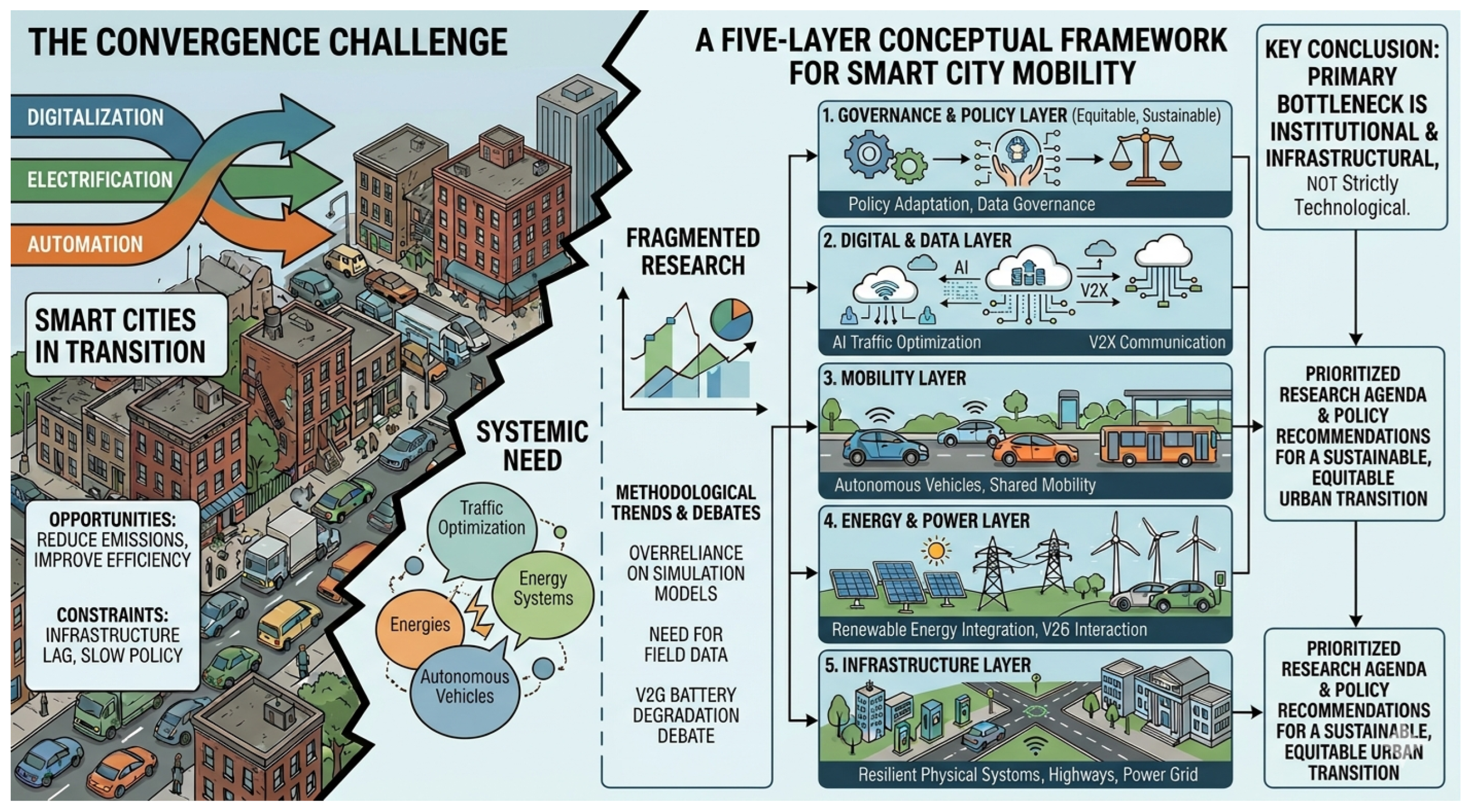
The convergence of digitalization, electrification, and automation is fundamentally reshaping urban mobility [1,2,3]. While these transformations offer important opportunities to reduce emissions, improve traffic efficiency and enhance accessibility [4], they also place significant pressure on transport systems that were originally designed for a very different technological and institutional context, as shown in Figure 1. Traditional urban planning, shaped by long investment cycles and hardware-oriented infrastructures, often struggles to accommodate the speed and flexibility required by contemporary digital and energy transitions.
A growing body of literature highlights substantial progress in specific technical domains. Artificial intelligence [5] is increasingly used to optimize traffic flow [6,7]; vehicle-to-grid (V2G) [8] and related energy–mobility models [9] explore new forms of interaction between electric vehicles and power systems [10]; and vehicle-to-everything (V2X) communications [11] continue to support the development of connected and autonomous mobility [12]. Yet much of this research remains fragmented across separate disciplinary silos. Studies often focus narrowly on traffic optimization, energy management, autonomous vehicles, or infrastructure resilience, without sufficiently addressing the systemic interactions that emerge when these technologies are deployed together at city scale. As a result, important questions related to infrastructure readiness, data integration, governance, and policy adaptation remain only partially answered.
To address this gap, this paper conducts a systematic review of recent literature published between 2018 and 2026. The analysis is organized around four core pillars: intelligent transportation systems (ITS) [13,14], sustainable and resilient infrastructure [15,16], renewable energy integration and electric mobility [17], and autonomous and connected mobility [18,19]. On this basis, the paper proposes a five-layer conceptual framework that integrates the infrastructure, mobility, energy, digital, and governance layers, with the aim of offering a more coherent interpretation of the interdependencies that shape smart city mobility [20,21,22,23]. In the context of this framework, “sustainable mobility” is explicitly defined as the integration of electrified transport with renewable energy grids to minimize urban carbon emissions and optimize resource efficiency. In parallel, a “resilient” mobility network is operationalized as an infrastructure capable of dynamically absorbing, adapting to, and rapidly recovering from systemic disruptions, such as severe meteorological events, traffic anomalies, or cyber–physical threats, thereby ensuring continuous service availability.
The selection of the 2018–2026 timeframe is deliberately designed to capture the critical surge in large-scale machine learning applications for intelligent transportation and the accelerated standardization of 5G/V2X communication protocols. Similarly, the four foundational pillars were selected because they represent the fundamental, interdependent layers strictly required to operationalize the energy–mobility nexus at a city scale.
Furthermore, while existing review papers extensively cover these domains in isolation, frequently focusing solely on V2G optimization algorithms or AI-driven traffic models, this manuscript addresses the structural frictions occurring at their intersections. As recently demonstrated in the context of digital supply chains and complex ecosystems [24], interconnected technological systems suffer from severe empirical fragmentation, coordination barriers, and data-driven integration issues. Aligning with these findings on multidisciplinary convergence, our review highlights that overcoming institutional silos and establishing cohesive data governance are just as critical as technological advancement for scaling smart mobility.
Beyond structuring the existing knowledge, this review critically evaluates prevailing methodological trends, noting a persistent overreliance on simulation models at the expense of standardized, large-scale field data. We also navigate diverging hypotheses within the field, such as the ongoing debate regarding the long-term impact of Vehicle-to-Grid (V2G) [25] operations on battery degradation [26,27]. Ultimately, our synthesis yields a clear overarching conclusion: scaling smart mobility is deeply constrained by institutional and infrastructural bottlenecks, which present challenges just as formidable as those in the technological domain. By identifying these barriers, this article outlines a prioritized research agenda and offers actionable policy recommendations to help urban planners, utilities, and researchers in driving the transition toward equitable and sustainable urban mobility [28].

2. Methodology

This study employs a review methodology adhering to the PRISMA 2020 guidelines to examine the energy–mobility–infrastructure nexus. Literature searches were conducted primarily using Google Scholar as an aggregate search engine to identify and retrieve articles published across major academic databases (including Scopus, Web of Science, IEEE Xplore, ScienceDirect, and SpringerLink), focusing on publications from 2018 to 2026 to capture the most current developments in smart mobility and urban energy systems. To ensure reproducibility, literature searches were executed using formulated search strings constructed with Boolean operators (e.g., (“intelligent transportation systems” OR “autonomous vehicles”) AND (“vehicle-to-grid” OR “renewable energy EV charging”) AND “urban resilience”) that combined core keywords relevant to the four pillars of this study. This primary search was supplemented by backward and forward snowballing from key review articles to capture any relevant literature initially missed.
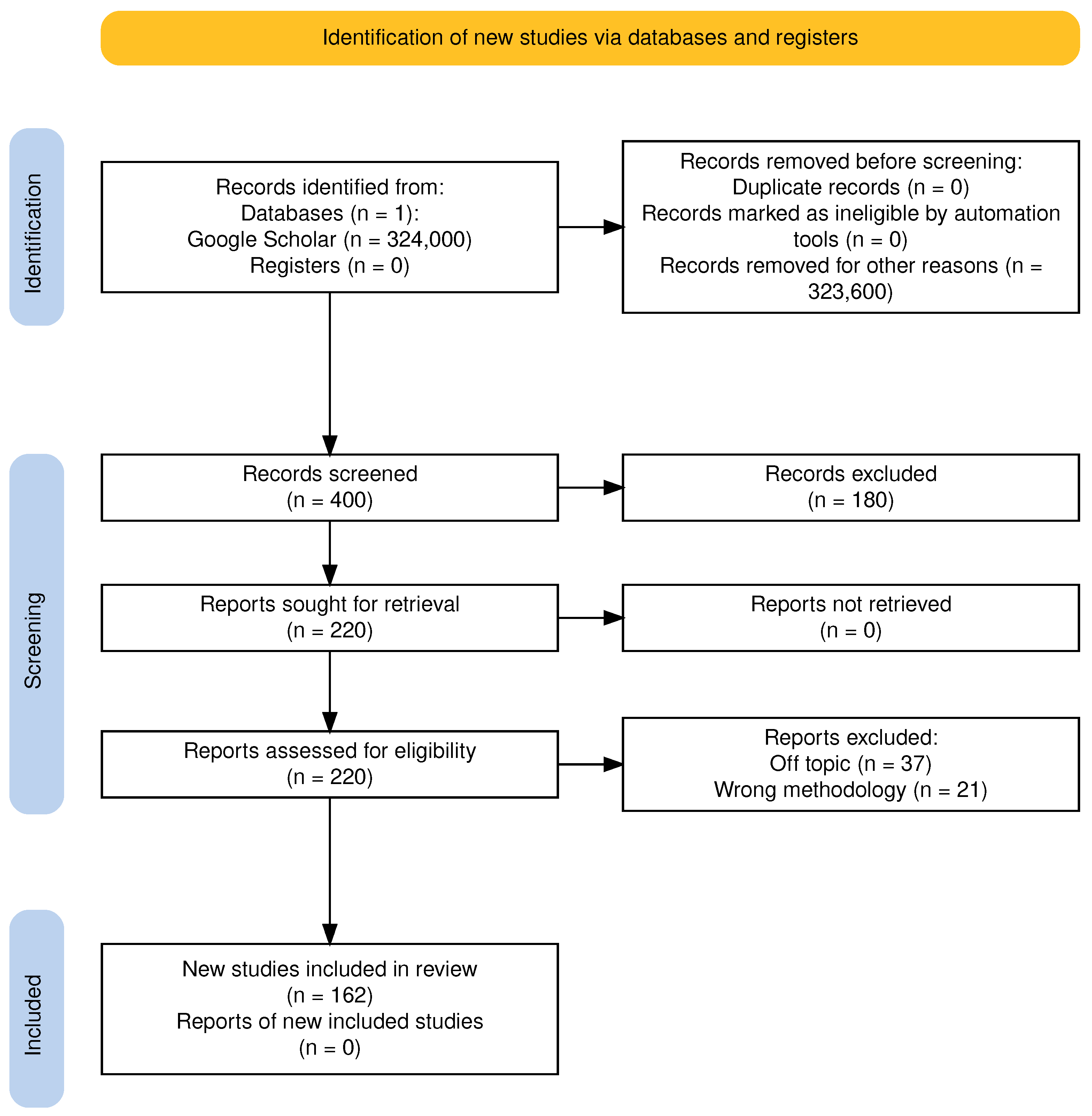
The initial database searches yielded an estimated 324,000 records. This high volume was inherently driven by the use of the aggregate search engine Google Scholar, which indexes vast amounts of literature across the aforementioned publisher databases (e.g., IEEE Xplore, ScienceDirect, MDPI). Following standard practices for managing exceptionally high-volume returns from aggregate databases, the screening process was restricted to the 400 most relevant records identified by the search algorithms, removing the remaining 323,600 results prior to the manual screening phase.
Inclusion criteria were strictly restricted to peer-reviewed journal articles, conference proceedings, and empirical or simulation studies explicitly addressing urban mobility, infrastructure, or energy integration. We excluded non-English publications, opinion pieces lacking empirical data, and component-level engineering studies without clear urban applications. We acknowledge that the exclusion of non-English publications represents a limitation of this study, potentially leading to the underrepresentation of critical advancements from global leaders in smart mobility, such as China, South Korea, and Singapore. Future reviews should incorporate multilingual databases to ensure a more globally representative synthesis.
Of the 400 records manually screened by title and abstract, 180 were excluded. The remaining 220 reports were successfully retrieved as full texts and thoroughly assessed for eligibility. During this full-text assessment, 58 records were excluded based on the established criteria (e.g., 37 were deemed off-topic and 21 lacked an appropriate methodological framework for urban applications). Consequently, 162 studies met all criteria and were included in the final review. A formal PRISMA flow diagram visually mapping the complete study selection process is provided in Figure 2.
While the literature search was conducted systematically, the subsequent analysis employs a narrative and interpretive synthesis to map the convergence of these themes, rather than a formal quantitative meta-analysis of barrier severity.

3. Systematic Challenges in Smart and Sustainable Urban Mobility

The transition toward sustainable smart mobility is hindered by a complex web of interrelated bottlenecks [29]. Rather than stemming from a lack of technological innovation, these barriers are deeply systemic, spanning physical, digital, and institutional dimensions. To provide a structured and comprehensive analysis of these obstacles [30,31], the current literature has been synthesized and categorized into five critical areas. Section 3.1 examines the physical constraints and the temporal mismatch between rapid technological cycles and legacy infrastructure. Section 3.2 explores the technical and socio-economic complexities of integrating electric vehicle fleets with urban energy grids. Section 3.3 addresses digital limitations, specifically focusing on data fragmentation and the difficulty of scaling Intelligent Transportation Systems (ITS). Section 3.4 highlights the operational data requirements and security challenges introduced by connected and communicating vehicles. Finally, Section 3.5 discusses the overarching governance and institutional barriers that frequently dictate the success or failure of these deployments. Together, these subsections outline the multifaceted challenges cities must face before achieving smart mobility throughout the city [32,33].

3.1. Infrastructure Rigidity and Lifecycle Mismatch

A fundamental barrier to smart urban mobility is the timing mismatch between rapid technological innovation and long-term infrastructure investment. While digital technologies, artificial intelligence, and autonomous systems evolve in cycles of months or a few years, urban transport infrastructure [34,35] (like roads and bridges) is built to last for decades. This creates a “temporal asymmetry” that makes it extremely difficult for cities to adapt to new mobility paradigms [36]. Traditional road networks, parking spaces, and energy grids [37,38] were designed for conventional internal combustion vehicles and centralized power models. Today, the shift toward electrification, vehicle automation, and vehicle-to-grid (V2G) integration demands digital and functional layers that these existing structures simply do not have. Upgrading or retrofitting these physical assets is not just expensive; it involves immense regulatory complexity and technical uncertainty [39].
This physical rigidity is made worse by organizational “silos”. Transportation, energy, and urban planning departments [40] usually operate under entirely different governance structures, funding mechanisms, and timelines. For instance, a city might have the technology for advanced smart-charging networks, but deployment stalls because the transport department and the local energy utility do not share the same strategic plan. As a result, a structural inertia slows down the diffusion of innovation. The primary challenge is not a lack of new technology, but the physical and institutional conservatism of the environments where this technology must operate. Addressing this requires a shift toward modular infrastructure design, flexible regulations, and investment strategies that can handle technological uncertainty [36]. In this context, additive manufacturing (3D printing) [41] is emerging as a critical enabler for next-generation smart infrastructure, offering unprecedented design flexibility to redefine the constructed environment’s adaptability. By employing modularity and prefabricated components, 3D printing can significantly reduce construction time and labor costs while promoting sustainability through the use of recycled concrete and bio-based polymers [42].
Furthermore, this technology allows for the rapid fabrication and direct integration of customized, monolithic sensors into infrastructure components, facilitating data-driven urban planning and robust Internet of Things (IoT) [43] applications. However, despite these conceptual advantages, fully overcoming physical rigidity remains technically challenging. Current 3D printing systems struggle with multi-material fabrication [44], particularly in achieving structurally sound bonding between materials with vastly different mechanical or thermal properties. For example, embedding conductive materials within concrete for the real-time monitoring of structural integrity remains largely theoretical due to unresolved adhesion and long-term durability concerns [42].
To synthesize these challenges, Table 1 outlines the main contributions and limitations identified in the key literature regarding the physical infrastructure layer.

3.2. Energy–Mobility Integration Complexity

The electrification of transport [48], ranging from private electric vehicles (EVs) to shared fleets and electric buses, offers a clear opportunity to reduce urban emissions and improve air quality [49,50]. However, integrating massive numbers of EVs into the urban energy system [51] introduces deep technical, economic, and organizational complexities. A prominent example of this complexity is the electrification of public transit. In large-scale electric bus depots, simultaneous charging operations generate significant localized load peaks; if these aggregate loads exceed the capacity of local substations, costly new infrastructure investments become unavoidable [52]. To mitigate these impacts, operators must employ sophisticated charging management strategies aimed at load peak minimization, energy cost reduction, and battery lifetime optimization. This involves generating predictive charging schedules based on forecasted energy consumption [53], often supported by quasi-real-time co-simulation tools, such as “Bus Depot Simulators”, that factor in dynamic variables like traffic delays, ambient temperature, and varying arrival times to continuously monitor and adjust the depot’s load profile [52].
Beyond centralized fleets, at the core of the broader city-wide integration problem is a fundamental shift: mobility is no longer merely an energy consumer, but a potential energy resource. Under the right conditions, EV batteries can act as mobile storage systems that feed power back to the grid (Vehicle-to-Grid, or V2G) or function as flexible loads [54]. While V2G technology offers significant benefits for grid flexibility and renewable energy integration, concerns regarding battery degradation [55,56] remain an important consideration. While the long-term impact of V2G operations remains a subject of ongoing debate, some recent modelling studies offer optimistic projections, suggesting that participation in V2G services may increase battery degradation by approximately 9–14% over a ten-year period, with specific estimates of around 0.3% per year in capacity loss under controlled conditions [57]. However, it is crucial to note that these figures are highly sensitive to specific charging patterns, participation intensity, and battery chemistry, and therefore should be interpreted as illustrative scenarios rather than a definitive consensus. These findings indicate that, when properly managed through smart charging strategies and battery management systems, V2G participation can be integrated without causing substantial reductions in battery lifespan.
From a systems perspective, three interdependent challenges emerge from this transition:
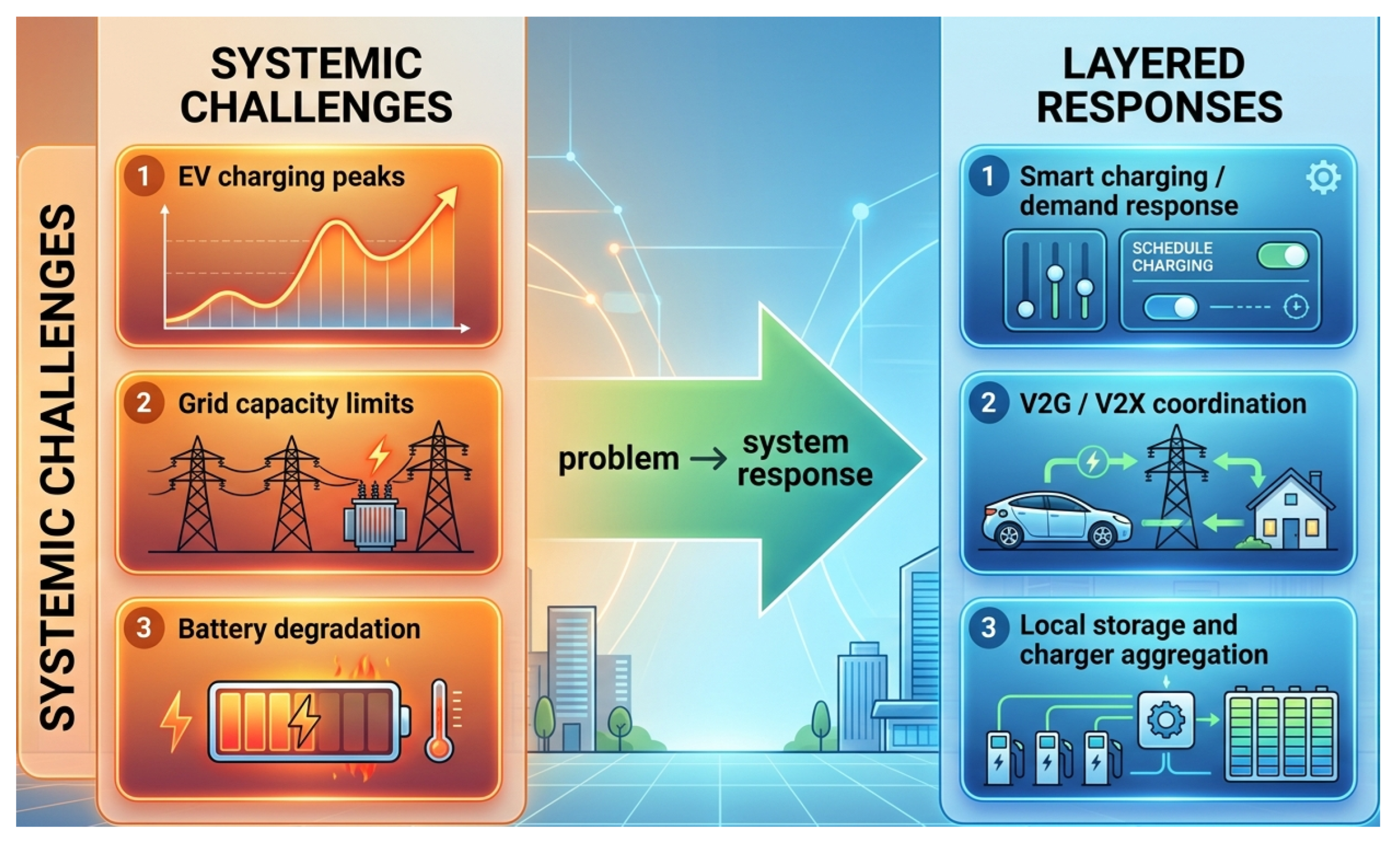
  • Variability and peak demand: Charging patterns are highly heterogeneous. Many users prefer to charge after work, concentrating demand into a few evening hours and creating new load peaks that local distribution networks were not sized for. Unmanaged, these peaks can lead to grid instability and accelerated asset aging. Simultaneously, the growing penetration of intermittent renewable energy (such as solar and wind) means that low-carbon energy is variable. As smart grids integrate these fluctuating sources to reduce CO2 emissions [58], traditional energy flows are fundamentally modified, often changing direction suddenly. Furthermore, the replacement of traditional synchronous generators with these distributed systems removes inherent inertial responses, exacerbating grid stability issues related to voltage control and load flows [59]. While matching EV charging to times of high renewable generation is technically attractive, it remains operationally complex.
  • Grid capacity and hardware limits [60]: Traditional distribution networks (transformers, low-voltage lines) were designed for one-way electricity flows from the grid to the consumer. Two emerging trends complicate this legacy architecture: the bidirectional flows required by V2G and the clustering of EV chargers at public hubs or depots. Enabling V2G requires specialized bidirectional Electric Vehicle Supply Equipment (EVSE) and advanced control systems to regulate electricity flow [61,62]. Furthermore, repeated battery cycling for grid services risks accelerating battery degradation, creating economic disincentives for vehicle owners.
  • Coordination and business models: A critical barrier is determining who controls the charging schedules: utilities, charging operators, mobility platforms, or the users themselves. Currently, incentives are misaligned. Drivers prioritize convenience and low costs; in particular, overcoming “range anxiety” [63] is paramount for V2G adoption [64]. Studies indicate that guaranteeing a “minimum range” for drivers is a far more critical factor for their participation than financial remuneration. Utilities need to flatten demand peaks to stabilize voltage, and cities aim for equitable access and low emissions. While emerging theoretical concepts like Mobile-Energy-as-a-Service (MEaaS) [39,65] offer promising frameworks to coordinate these actors, they currently lack large-scale empirical validation. Furthermore, regulatory frameworks, tariffs, and commercial contracts severely lag behind these conceptual technological capabilities. This regulatory lag, alongside an insufficiently developed charging infrastructure, currently hinders the widespread application of otherwise mature V2G technologies [66].
To overcome this inertia and move toward scalable integration, the literature suggests several actionable pathways:
  • Smart charging and demand response: Implementing intelligent charging protocols [67] can dynamically adjust charging rates based on grid conditions. By leveraging real-time monitoring and automation [68], these systems can lower system costs and allow EVs to absorb excess renewable energy as distributed storage [59].
  • Local storage and charger aggregation: Deploying off-grid or hybrid charging stations equipped with local renewable generation (e.g., solar canopies) and stationary battery storage can buffer the grid from sudden peak demands caused by fast-charging clusters [49].
  • Time-of-use tariffs and incentive design: Creating dynamic pricing mechanisms and incentive-based coordination schemes is essential to align user behavior with grid needs, encouraging off-peak charging or discharging. While conceptual models such as the MEaaS framework propose viable theoretical pathways for this coordination, their practical efficacy remains to be rigorously tested and validated in real-world deployment settings.
  • Standards and interoperability: A fragmented hardware and software landscape prevents seamless integration. Adopting universal communication protocols and robust, multi-layer security frameworks (such as the NIST cybersecurity framework) is critical to protect bidirectional energy networks from vulnerabilities and ensure network security [59].
  • Pilot projects and staged upgrades: Given the high costs of grid upgrades, cities must transition from purely simulation-based planning to real-world, large-scale field trials. Staged infrastructure rollouts, tailored to specific city archetypes, can help municipalities test viability before committing to massive capital investments [69].
To synthesize the complex dynamics of energy–mobility integration discussed above, Figure 3 provides a conceptual visual summary.
Beyond technical integration challenges, the electrification of urban mobility raises important social and distributional considerations. Access to charging infrastructure is often unevenly distributed across urban areas, reflecting existing socio-economic disparities. Households without private parking or residing in peripheral districts face higher barriers to EV adoption due to the limited availability of public charging points. Furthermore, while dynamic pricing mechanisms and smart charging strategies are technically efficient, they may disproportionately affect users with limited flexibility in their daily mobility patterns. Therefore, energy–mobility integration strategies must incorporate equity-oriented planning principles and community involvement to ensure that the transition toward sustainable mobility does not reinforce existing urban inequalities [70]. In summary, the integration of energy and mobility systems represents not merely a technical upgrade, but a systemic socio-technical transformation deeply embedded within the broader concept of the Smart City [59,71]. It requires coordinated infrastructure planning, intelligent control mechanisms, regulatory alignment, and socially inclusive policy design [72]. Without such integrated governance, large-scale electrification risks introducing new structural stresses rather than delivering its full environmental, economic, and societal benefits.
Table 2 summarizes the core contributions and systemic limitations identified in the literature regarding these physical, mobility, and energy domains.

3.3. Data Fragmentation and ITS Scaling Limits

While energy–mobility integration highlights physical and infrastructural constraints, the digital layer introduces a different but equally critical set of systemic limitations. Digital technologies and data analytics are often presented as the “brains” of smart mobility. Internet of Things (IoT) devices [74,75], including an array of sensors and actuators, are critical for continuously monitoring urban environments and executing automated responses [76]. These devices, alongside vehicle telematics and mobile apps [77], generate huge amounts of information about traffic flows, energy use, vehicle location, and travel demand. When used well, these data enable faster decisions, smoother traffic, better public transport planning, and adaptive services that respond to real-time conditions [78].
However, realizing these benefits is heavily constrained by data fragmentation. Data are typically scattered across municipalities, energy utilities, private mobility companies, and individual vehicles and stored in proprietary formats. Each entity processes information within its own closed system, preventing the seamless data sharing required for city-wide optimization. For example, a traffic control center [79] might have live counts from road sensors but lack access to charging station availability or transit occupancy data, making coordinated energy and mobility decisions nearly impossible.
A second, related problem is scaling [80,81]. What works in a controlled pilot environment does not automatically translate into reliable performance at a metropolitan scale. Many ITS solutions [82] perform well in lab tests or pilot projects, but they often fail to deliver the same benefits when scaled across cities. Reasons include inconsistent data quality, network latency in communication, interoperability gaps between vendors, and insufficient sensor density. The latter is largely an economic barrier. Real-time data from roadside infrastructure is essential for intelligent vehicles to obtain external references and enhance the safety of automated driving systems [83]. However, establishing and operating highly accurate sensors, such as LiDAR, is cost-intensive [84]. Consequently, cities often face trade-offs: utilizing cheaper alternative sensors (like thermal cameras or radar [85]) can reduce installation costs but simultaneously impact data quality, thereby limiting the addressable user groups and the overall reliability of the automated system. Small pilots can be tightly managed and tailored; city-wide rollouts must work across many neighborhoods, types of roads, and user behaviors, which increases complexity dramatically.
There are practical ways to reduce fragmentation and enable scaling. Common standards and open data formats allow different systems to “speak the same language”. To achieve true interoperability for data exchange across heterogeneous service domains, systems must align at the interface, syntactic, and semantic levels. Interface-level interoperability, for instance, can be successfully achieved using common APIs and middleware that connect legacy systems without replacing them wholesale [86]. Building on these technical foundations, advanced solutions like the “Mobility Data Space” [87,88] are emerging. This concept involves creating an open, horizontal data space that links existing proprietary platforms, offering secure access to real-time and sensitive mobility data on a national level. Participation in such secure data spaces, facilitated by standardized technical connector components, provides intelligent systems with sufficient information to optimize traffic flows, increase safety, and protect the environment [89]. Furthermore, these platforms can evolve into “data marketplaces”, acting as enablers that allow data producers (like municipalities or private fleets) to securely provide or sell their data, while consumers can find and utilize datasets tailored to their specific analytical needs [86]. Finally, staged scaling, starting with district-level pilots, building common interfaces, and progressively adding services, reduces risk and produces learning that improves later deployments [90].
Greater data sharing and the integration of AI raise legitimate concerns regarding privacy, cybersecurity, and surveillance [91]. Connected and autonomous vehicles represent one of the most significant sources of real-time mobility data [92] within smart city ecosystems. Through Vehicle-to-Everything (V2X) communication [93], vehicles continuously exchange information with other vehicles, road infrastructure, and digital platforms. While this connectivity can greatly enhance traffic management and safety, it also amplifies challenges related to data interoperability, cybersecurity, and system governance. Connected and autonomous vehicles are vulnerable to malicious attacks, raising significant data security and certification concerns [94,95]. In this sense, data are not scarce in smart mobility systems; rather, they are insufficiently integrated. The core challenge lies in building coordinated architectures, shared standards, and institutional trust mechanisms that allow data to operate as a systemic resource. Without these enabling conditions, digitalization risks remaining fragmented and underutilized, limiting its transformative potential at urban scale.
Another critical challenge concerns the transparency and fairness of algorithmic decision-making within smart mobility systems. Artificial intelligence and machine learning models are increasingly used to optimise traffic signals, allocate mobility resources [96], and manage urban transportation flows. However, these systems may unintentionally reproduce or amplify existing spatial inequalities and raise significant ethical concerns regarding algorithmic bias [90]. For example, traffic optimisation algorithms trained primarily on data from high-traffic commercial districts may prioritise congestion reduction in economically central areas while neglecting peripheral or residential neighbourhoods. This can limit equitable access to transportation services for marginalized populations. As a result, travel times and service accessibility in less monitored districts may deteriorate despite overall improvements in network efficiency. To synthesize these hurdles, Table 3 outlines the main contributions and technological limitations identified in the key literature concerning the digital layer and data-driven mobility ecosystems.
To address these risks, recent research highlights the importance of algorithmic transparency, explainable AI (XAI), and regular auditing procedures to evaluate potential biases in data-driven mobility management systems. Future implementations must prioritize these ethical frameworks and explainability to ensure the equitable deployment of AI for sustainable transportation [98]. In this context, connected vehicles represent a crucial extension of intelligent transportation systems, as they transform vehicles into mobile data nodes capable of continuously interacting with infrastructure, other vehicles, and urban digital platforms.

3.4. Connected and Automated Vehicles

An additional layer of complexity in smart mobility systems arises from the evolution of vehicles into connected, communicating entities. Modern vehicles increasingly engage in continuous data collection, processing, and transmission across a network of connected objects, acting as the foundation for the Internet of Vehicles (IoV) paradigm. The IoV essentially serves as a customized convergence of the broader Internet of Things (IoT) and the mobile Internet, enabling independent devices (Internet of Autonomous Things, IoAT) to function autonomously and improve data collection across urban environments [99].
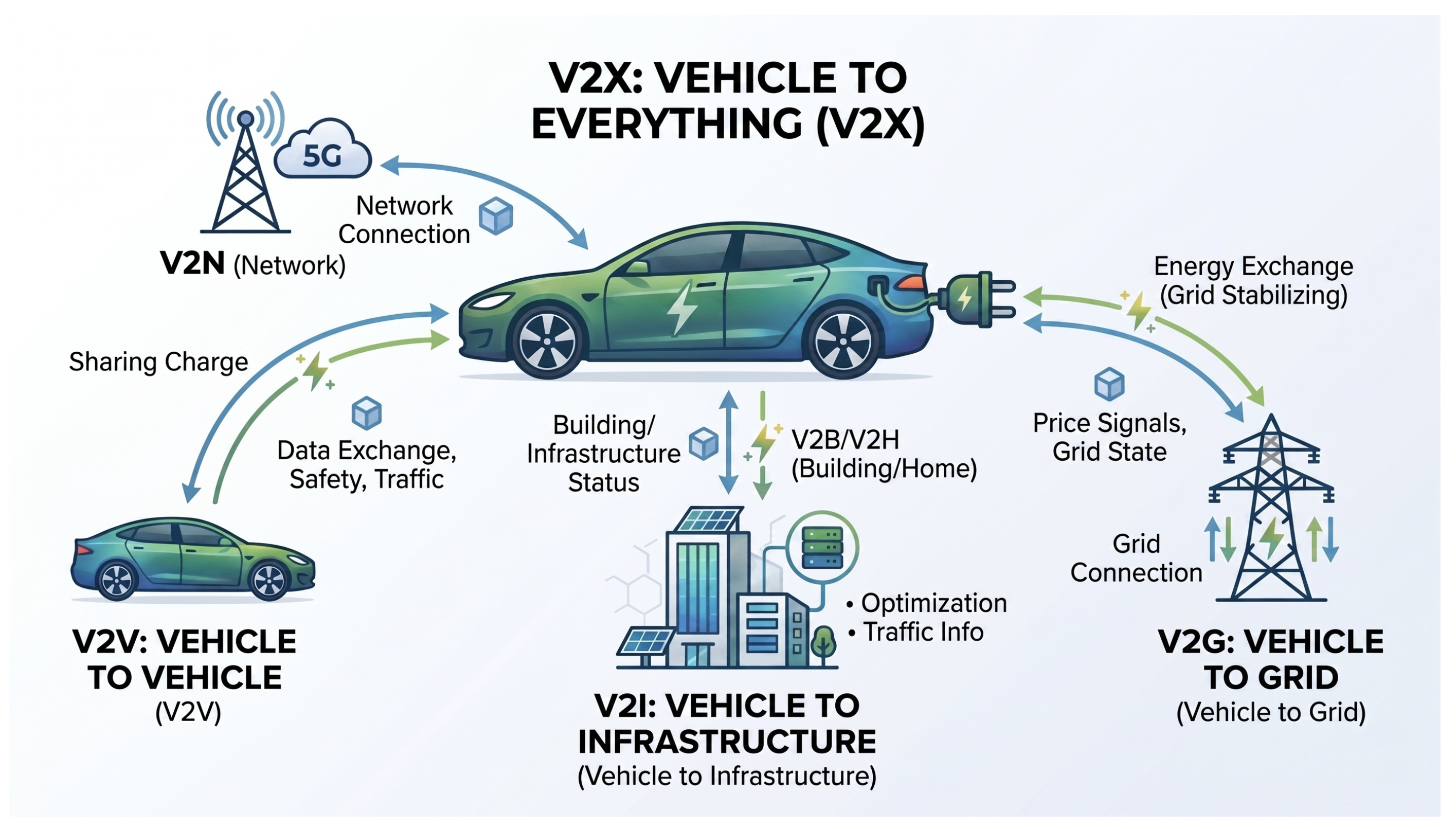
These interactions are often described under the umbrella concept of Vehicle-to-Everything (V2X) communication, which encompasses several complementary communication modes [78]. As depicted in Figure 4, this V2X ecosystem transforms the connected vehicle into an active node capable of bidirectional data and energy exchange across multiple domains. The Vehicle-to-Vehicle (V2V) exchange facilitates cooperative driving and significantly reduces chain collision risks by alerting drivers to sudden braking ahead [78,90]. Beyond that, the literature identifies several crucial V2X sub-categories:
  • Vehicle-to-Infrastructure (V2I): Connects vehicles with elements like smart traffic signals. The integration of V2I with big data analytics has demonstrated tangible results in optimizing traffic flow; for example, data-driven synchronization of traffic lights has been shown to reduce gas emissions and wait times by up to 20%, while real-time predictive models in cities like Vienna successfully manage parking occupancy [78,100].
  • Vehicle-to-Grid (V2G): Allows EV batteries to safely supply electricity back to the grid, helping to balance peak renewable energy loads without compromising mobility [54]. Standardized protocols, such as ISO 15118, are crucial in this context to ensure smooth, automated interactions between the vehicle and the energy network during smart charging events [99].
  • Vehicle-to-Pedestrian (V2P) and Vehicle-to-Network (V2N): V2P systems detect vulnerable road users to provide collision warnings, while V2N connects vehicles to cloud services for remote diagnostics and advanced routing [100].
Figure 4. The connected vehicle as an active node within the smart mobility ecosystem. The diagram highlights the bidirectional flows of both information (V2X communication, supporting intelligent transportation) and electricity (including V2G, V2B, and V2H integration, supporting grid flexibility, resilience, and local energy management).
Urbansci 10 00326 g004
Enabling this complex web of interactions requires robust technical foundations. The literature emphasizes that Cellular Vehicle-to-Everything (C-V2X) chipsets, fully compatible with 5G networks, are foundational for seamless integration with Advanced Driver Assistance Systems (ADAS) [100]. Furthermore, establishing unified architecture and communication standards, such as IEEE 802.11p for cooperative systems and ISO 21217 for ITS connectivity, is an absolute prerequisite. In post-crash scenarios, standards like ISO 15628 drastically expedite emergency response interventions [99]. To navigate these complex environments intelligently, vehicles also rely on a sophisticated hardware sensor suite, including LiDAR, RADAR, and GNSS, to share real-time spatial data and dynamically adapt to urban traffic disruptions [101,102].
However, beyond these operational benefits, the transition to full IoV and autonomy [103] introduces profound vulnerabilities and temporal constraints. As vehicles evolve into sophisticated mobile computing platforms, they face significant security challenges across their multi-layered architecture [104]. The deep integration of information and communication technologies (ICT) means that the power grid components and utility servers of a smart city are increasingly susceptible to malware attacks originating from the connected EVs themselves. Furthermore, critical infrastructure, such as public charging stations, can be hacked, potentially leading to catastrophic damage to the city’s broader energy management systems [105]. These threats range from passive cyberattacks, where attackers gain unauthorized access to sensitive user information without actively disrupting normal operations, to active malicious interventions that compromise physical vehicle safety and data integrity [104,105,106]. Although tools like Deep Learning (DL) [107,108] are being developed to protect against these threats [99], establishing robust, multi-layered cybersecurity mechanisms remains a daunting and critical prerequisite for safe deployment [104].
Beyond digital threats, physical and behavioral challenges persist. Achieving Level 5 autonomy remains highly constrained by unpredictable environmental factors and adverse weather conditions [101]. Consequently, expectations regarding the rapid deployment of these technologies must be tempered. While timeline projections vary widely across the literature, some estimates indicate that the complete market penetration of Autonomous Vehicles (AVs) and the realization of associated benefits may not be fully realized until the late 2050s or 2060s [109]. These dates remain speculative and highly dependent on overcoming the regulatory, safety, and infrastructural hurdles.
Ultimately, while V2X technologies hold significant potential for improving safety, efficiency, and sustainability [100], their effectiveness depends heavily on interoperability standards, communication reliability, strict cybersecurity protections, and coordinated governance frameworks [90]. In this sense, connected vehicles must not be viewed merely as standalone technological innovations, but as highly vulnerable active nodes that require secure integration into both transportation infrastructure and urban energy networks. Building on these vulnerabilities, Table 4 outlines the critical challenges and technological limitations associated with the digital layer and connected vehicle ecosystems.

3.5. Governance and Institutional Barriers

A successful smart-mobility transition [110] does not depend on hardware or software alone: it is fundamentally a governance challenge. While Section 3.1, Section 3.2, Section 3.3 and Section 3.4 detailed the physical, energy, digital, and cybersecurity constraints, this section examines the institutional and policy conditions that determine whether technical solutions can be effectively deployed, scaled, and maintained to deliver public value. Governance shapes who decides, who pays, who benefits, and who bears the risks; a misalignment in any of these dimensions can effectively block otherwise promising innovations.
A primary barrier is regulatory lag. Lawmaking and standards development move inherently slower than rapid technology cycles. New business models (e.g., mobility platforms, charging aggregators) and technical capabilities (V2G, real-time traffic control, automated driving) [111] often arrive long before the legal frameworks governing safety, liability, data protection, and commercial operations are firmly in place. This uncertainty discourages investment, leading to cautious, localized pilots rather than bold, city-wide deployments. Consequently, governments face a difficult dilemma: act too early and risk locking in suboptimal standards, or act too late and cede control entirely to market actors [36].
A closely related barrier is the persistent lack of cross-departmental coordination. Responsibility for mobility, energy, and digital infrastructure is typically dispersed across multiple isolated agencies, transport departments, utilities, planning offices, regulators, and private operators, each operating with its own objectives, budgets, and timelines. This siloed structure generates enormous coordination costs. For instance, the deployment of electric vehicle charging stations requires grid reinforcement managed by utilities, yet the physical locations are planned by urban mobility teams [112]. Without formal coordination mechanisms and shared targets, investments remain piecemeal [113].
Misaligned incentives and conflicting business models present another recurring obstacle. Utilities, municipalities, mobility operators, and users all respond to different price signals and regulatory incentives. A utility may prefer “time of use” pricing to smooth peak demand [114,115], whereas a mobility operator prioritizes service reliability and customer convenience. Meanwhile, private EV owners often prioritize fast charging, even if it exacerbates grid stress. Designing tariffs, subsidies, and contracting arrangements that balance these competing interests is technically and politically fraught. New intermediary roles, such as aggregators and Virtual Power Plant (VPP) operators [116], can help bridge these gaps, but they require clear rules and stable market designs to emerge at scale [39].
Furthermore, traditional financing and procurement practices actively hamper digital transformation. Standard infrastructure procurement favors large, one-off capital contracts focused on physical assets with long lifecycles. In contrast, smart mobility requires iterative investment: continuous software upgrades, data platform maintenance, and ongoing service management. Rigid procurement rules and risk-averse financing mean that cities struggle to fund experimentation or build the internal staff capacity needed to oversee complex, adaptive contracts [36].
Finally, governance challenges are highly context-dependent. The literature emphasizes that optimal investments vary significantly by city archetype, classifications typically defined by the complex interaction between urban form, public transit density, and infrastructural layout [117]. A policy or market design that succeeds in a dense “High-Compact Middleweight” city (e.g., Berlin) may fail entirely in a sprawling “Car-Centric Giant” (e.g., Detroit). This operational divergence occurs because the physical characteristics and localized traffic dynamics of a city fundamentally dictate its resilience to disruptions. Recent methodological advances demonstrate that structural topology alone cannot accurately capture a transportation network’s vulnerability without integrating specific, context-dependent operational attributes, such as localized volume-to-capacity ratios and travel times [118]. Because networks degrade differently based on these unique urban characteristics, this underscores the absolute necessity for locally adapted governance and infrastructure strategies rather than generic, one-size-fits-all solutions [117,118].
Alongside local adaptation, public legitimacy and social acceptance cannot be underestimated. Decisions regarding where charging stations are deployed, how sensitive data are utilized, and which neighborhoods receive automated services directly impact daily life and urban equity. If residents feel excluded from decision-making or perceive that benefits accrue only to affluent populations, public opposition can stall critical projects. Transparent decision processes, participatory planning, and clear accountability over data governance are essential to secure the “social license to operate” and ensure equitable access.
The institutional architecture frequently determines whether technological solutions translate into lasting public value. Tackling governance and institutional barriers is therefore just as critical as solving technical engineering problems; both must advance simultaneously to achieve an equitable, resilient, and sustainable smart mobility transition.
While our interpretive synthesis highlights these governance challenges, quantifying their exact severity relative to technical barriers requires structured analytical approaches. The literature on socio-political barriers to smart mobility adoption has developed methodologies for comparative barrier assessment, such as the TISM-MICMAC approach [31]. Future research should engage with these methodological precedents to formally measure and compare the causal weight of institutional versus technical constraints.
To address and systematically overcome the institutional and regulatory bottlenecks diagnosed above, the literature points to several actionable policy directions. Rather than isolating them here, these operational solutions are directly integrated into the Governance Layer of our proposed conceptual framework, detailed in Section 4.5.
Table 5 outlines the main contributions and limitations identified in the key literature regarding governance and institutional barriers.

4. Integrated Smart Mobility Solutions

Traditional urban transport systems are increasingly strained by congestion, air pollution, and inefficient resource utilization, necessitating a paradigm shift rather than mere incremental improvements [120]. Consequently, smart mobility has evolved into a central pillar of smart city development, aiming to enhance transportation efficiency, sustainability, and accessibility through coordinated planning. Rather than focusing solely on physical infrastructure expansion, the literature emphasizes a transition toward interconnected, data-driven mobility ecosystems [121].
In these emerging ecosystems, technologies such as artificial intelligence, big data analytics, and the Internet of Things (IoT) fundamentally transform urban transportation. IoT infrastructures facilitate continuous communication between vehicles, users, and the built environment, while AI-driven systems enable real-time traffic optimization and predictive analytics [122].
From a system-level perspective, this integration blurs the distinction between individual transport modes, increasingly delivering mobility as a unified, multimodal service. The progressive deployment of autonomous vehicles further accelerates this transformation by profoundly altering operational dynamics and information management within transport networks [123]. Despite these advancements, significant hurdles persist. Advanced mobility networks introduce critical vulnerabilities, including data privacy concerns, cybersecurity risks, and the potential exacerbation of social inequalities if access to these services is not equitably distributed.
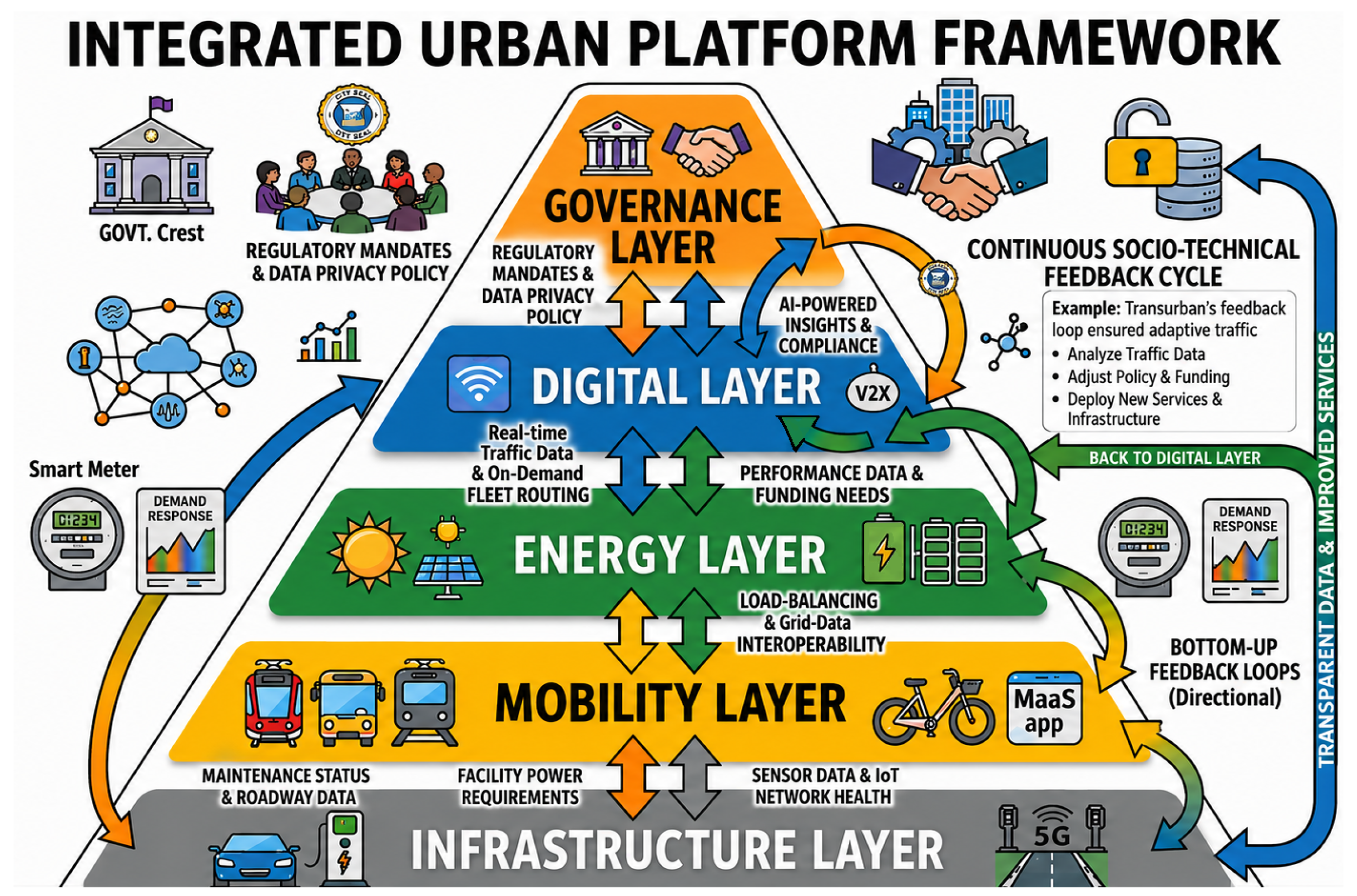
The analysis of the literature reveals that addressing these challenges and transforming urban mobility within smart cities cannot rely on isolated technological solutions. Instead, the reviewed studies consistently highlight the need for integrated approaches that combine intelligent transportation systems [124], electrification, digital infrastructure, and coordinated governance frameworks. Building on these findings, this study proposes a comprehensive five-layer conceptual framework to align these interdependent elements. While recent literature proposed frameworks such as models coupling road network robustness with environmental stressors (e.g., sea-level rise) and adaptation governance [125], these antecedent models predominantly isolate physical transport systems from the broader electrical and digital ecosystems. The framework proposed in this study explicitly positions itself beyond these prior models by formally integrating the Energy and Digital layers as foundational pillars. Vehicle-to-Grid (V2G) dynamics and real-time data interoperability must be treated as core structural components rather than external variables, thereby offering a more comprehensive architectural model for smart city mobility.
It must be acknowledged that this five-layer framework is primarily calibrated for highly digitized, well-resourced urban environments. In cities lacking basic digital infrastructure or mature regulatory capacity, particularly in developing or lower-income contexts, the adoption dynamics of shared and electric mobility differ substantially. In such settings, the framework should not be viewed as an immediate operational blueprint, but rather as a progressive target state. For these municipalities, initial efforts must prioritize capacity building within the foundational Governance and Infrastructure layers before advanced digital and automated integration can be successfully realized.
To ensure the framework does not worsen existing urban inequalities, equity must be a core principle guiding all five layers. For the infrastructure layer, EV charging networks and mobility hubs must be actively planned to serve lower-income neighborhoods, rather than focusing only on wealthy areas. For the digital layer, algorithms used for route optimization and dynamic pricing must be audited to prevent unfair costs or reduced access for vulnerable groups. Finally, within the governance layer, cities must implement inclusive policies and subsidies to ensure that smart mobility benefits all residents equally.
As illustrated in Figure 5, this model maps the essential structural interdependence between the foundational physical infrastructure, mobility services, energy networks, and digital data systems, all operating under a cohesive governance umbrella. While visualized hierarchically for expository clarity, it is crucial to emphasize that the interactions between these five layers are fundamentally bidirectional. For instance, while physical infrastructure supports mobility, top-down governance decisions directly dictate infrastructure funding, and energy layer dynamics continuously feed back into infrastructure planning priorities. To accurately reflect these complex sociotechnical feedback loops, the framework operates as a continuous cycle where influence, regulatory constraints, and data flow dynamically across all levels.
When operationalizing this framework, it is imperative to distinguish the varying levels of technological readiness across the domains. For instance, while algorithmic traffic signal optimization (Digital Layer) represents a mature, commercially deployed technology, large-scale bidirectional V2G integration (Energy Layer) remains an emerging paradigm hindered by regulatory uncertainty. Furthermore, advanced conceptual models such as Mobile-Energy-as-a-Service (MEaaS) must currently be classified as speculative future concepts, requiring extensive controlled trials before city-scale implementation.

4.1. The Infrastructure Layer

The foundation of the smart mobility ecosystem is the physical infrastructure, encompassing road networks, parking facilities, and hardware installations. Existing built environments, primarily designed for conventional internal combustion vehicles, face significant lifecycle mismatches when adapting to new paradigms. Overcoming this physical inertia requires a fundamental digital transformation, shifting traditional, product-oriented road networks toward systems that inherently incorporate digital products and integrated mobility services [36]. This infrastructural transformation can be conceptualized through a multi-tier evolution, moving from legacy systems to digitalized networks, and ultimately to “Mobility 4.0” [46], which features intelligent, autonomous systems capable of self-decision-making with minimal human intervention [46].
Achieving this highest tier of smartness relies on intelligent infrastructure that merges physical assets with virtual capabilities. By leveraging artificial intelligence, inexpensive cloud computing, and ubiquitous sensors, city authorities can continuously collect and analyze transport-related data, allowing the built environment to learn and adapt to the cognitive and physical states of its users [45]. Upgrading this foundational layer, such as installing bidirectional chargers, adaptive traffic signals, and edge computing nodes, is capital-intensive but strictly necessary. These physical upgrades form the backbone of Intelligent Transportation Systems (ITS), which link vehicles directly to network infrastructure to foster cost-effective and environmentally friendly urban transport [126].
A critical component of this ecosystem is Vehicle-to-Infrastructure (V2I) [127] communication, enabling vehicles to exchange real-time data with traffic lights, road signs, and decentralized roadside ITS stations [45,126]. To support the vast data requirements of comprehensive Vehicle-to-Everything (V2X) communication [128], infrastructure must be equipped with exceptionally high computing power and robust connectivity [45]. As infrastructure becomes deeply interconnected, ensuring security, privacy, and data integrity is paramount. Decentralized technologies, particularly “Directed Acyclic Graph” (DAG) [129], offer the scalability and low latency required for real-time mobility applications, such as autonomous vehicle coordination, decentralized traffic management, and rapid microtransactions for EV charging and ride-sharing. Concurrently, the physical maintenance and operation of this infrastructure are evolving through robotics; drone swarms [130] and automated vehicles are increasingly deployed for infrastructure monitoring, aerial logistics, and public transport efficiency [131].
Ultimately, while the integration of digital capabilities is transformative, it must be matched by comprehensive urban planning. As evidenced by large-scale deployments, such as the Riyadh Metro project, massive infrastructure investments equipped with central traffic monitoring, automated electrification, and extensive surveillance can still struggle to resolve foundational traffic congestion if broader systemic integration is lacking [45]. Therefore, these intelligent infrastructure investments must be carefully coordinated to support and enable the operational mobility systems described in the following layer.

4.2. The Mobility Layer

Operating upon the physical infrastructure is the mobility layer, characterized by the integration of connected, autonomous, and shared vehicles [18]. This convergence articulates a new paradigm for road transportation, representing not merely a series of technical innovations, but a comprehensive socio-technical and economic transition [36]. In this framework, vehicles are no longer isolated transport devices but active nodes within a broader ecosystem. At the core of this transition are intelligent vehicles equipped with computerized control systems that enable autonomous navigation, allowing them to make real-time route decisions and carry passengers or goods without human interference [45]. Operating in varying autonomy levels, going from no automation (Level 0) to full automation (Level 5) as defined by the National Highway Traffic Safety Administration, these vehicles rely on an extensive array of embedded sensors. This hardware suite typically includes Light Detection and Ranging (LiDAR) [132], Radio Detection and Ranging (RADAR) [133], ultrasonic sensors, infrared cameras, and Global Navigation Satellite Systems (GNSS) [134]. Despite these profound advancements, achieving full Level 5 autonomy remains highly challenging, primarily due to unpredictable environmental factors and weather-related constraints that limit operational capabilities [101].
To overcome these operational limitations and ensure safe navigation, intelligent vehicles must continuously interact with their surroundings through Vehicle-to-Everything (V2X) communication protocols. Technologies such as Dedicated Short-Range Communication (DSRC) [135,136] and Vehicle-to-Infrastructure (V2I) [137] links are expected to play a critical role in this dynamic data exchange [101]. This highly connected environment is essential because traditional urban transport networks are inherently vulnerable to a wide range of disruptions, including traffic congestion, severe weather conditions, accidents, and natural disasters [102]. By functioning as interconnected nodes that share real-time spatial and environmental data, connected and autonomous vehicles can dynamically adapt to these disruptions, thereby enhancing the overall resilience, safety, and efficiency of the urban mobility network [45,102].
Beyond the hardware and communication protocols, the fast-paced development of Information and Communication Technology (ICT) has catalyzed the evolution of Shared Mobility and Mobility as a Service (MaaS). With tens of thousands of travel applications currently available, the complexity of navigating urban transit has driven the need to “servicize” mobility, integrating diverse transport modes into a single, unified digital environment [138]. MaaS aims to turn travelers into mobility consumers by combining traditional collective transportation with emerging shared services, creating a highly attractive alternative to private car ownership [73]. For MaaS providers, capturing the heterogeneous travel needs of users and seamlessly integrating strategic planning, fleet sizing, fare structures, and user interfaces across multi-modal systems remains a critical research and operational challenge [73,139].
The operational success of these shared services heavily relies on understanding user behavior and spatial requirements. Research indicates that travel choices are strongly dictated by distance categories: walking and bike-sharing are predominantly favored for short trips (under two km), while car-sharing and taxis serve middle to long-distance routes. By integrating these complementary systems, cities can cater to diverse mobility demands [140]. Urban environments that already possess a robust public transport backbone alongside a proliferation of diverse shared mobility services, such as Madrid, which exhibits high levels of both public and non-motorised transport use, serve as ideal candidates for successful MaaS deployment [138].
However, the transition toward MaaS and Mobility-on-Demand (MOD) [70,141] introduces complex environmental and socio-economic dynamics. On one hand, effective MaaS implementation has demonstrated the potential to substantially reduce private car usage, increase public transport ridership, and lower greenhouse gas (GHG) emissions, provided the system is sufficiently attractive to users [73,139]. For instance, a six-month field test in Gothenburg revealed that users provided with integrated monthly mobility credits actively shifted away from individual car use and overestimated their prior travel demand. On the other hand, ecological and social impacts remain highly context-dependent. While bike-sharing can reduce emissions in car-centric cities [142], it might paradoxically increase them in transit-oriented areas [73].
Furthermore, MOD services can introduce profound spatial justice issues. These services often compete directly with bus and rail systems in city centers, leading to severe user inequality; for example, data from New York City indicates that a vast majority of ride-hailing services are monopolized by a small fraction of wealthy residents, leaving the rest of the population underserved [70]. Finally, external systemic shocks have highlighted the fragility of shared models. During the COVID-19 pandemic, the need for physical distancing and safety temporarily drove user preferences back toward private vehicle ownership, underscoring the ongoing challenges in maintaining sustainable shared mobility habits [139].

4.3. The Energy Layer

The widespread adoption of electric mobility introduces new pressures on electricity grids, tightly coupling the mobility layer to the urban energy network [143]. As global initiatives, such as the International Energy Agency’s (IEA) net-zero emissions by 2050 scenario, push countries to re-evaluate their renewable energy targets, the gradual replacement of fossil-fueled automobiles with electric vehicles (EVs) will inevitably increase both the range of operating conditions and the peak demand on power systems [47,144].
Within the proposed framework, the Energy Layer acts as the critical bridge between the urban power grid and the mobility ecosystem. To resolve the challenges of variability, grid capacity limits, and peak demand identified in Section 3.2, this layer employs several integrated strategies designed to transform electric vehicles from a potential burden into flexible, decentralized storage assets. Modern urban areas rely on smart grids: advanced electricity networks utilizing digital technology, automation, and real-time data, to execute these strategies and optimize energy distribution [145].
A primary function of the energy layer is managing the bidirectional flow of electricity. Technologies such as smart charging and vehicle-to-grid (V2G) systems enable electric vehicles to function as distributed and mobile energy storage units [144]. While unidirectional Grid-to-Vehicle (G2V) systems simply charge the vehicles, the implementation of V2G, Vehicle-to-Building (V2B), and Vehicle-to-Home (V2H), collectively referred to as V2X technologies, allows EVs to return power to various entities [146,147]. Consequently, electric vehicles act as flexible assets capable of supporting grid stability and renewable energy integration. For instance, EV batteries can store excess photovoltaic (PV) [148] or renewable energy during periods of high generation, absorbing extra energy to reduce curtailment, and redistribute it during peak demand or grid failures, providing essential resilience [144,146].
Since the deployment of the first V2G unit in the UK in 2015, the environmental and economic benefits of this technology have become evident, offering strategies to decrease the impact of renewable energy fluctuations and reduce reliance on fossil fuels [47]. However, the integration of EVs into smart microgrids that are small, independent power systems capable of operating in both grid-connected and islanded modes, presents several operational challenges [146]. These include the availability of charging stations, charging times, the high cost of the communication chips required to control power streams between the EV and the grid, and the impact of EV operations on overall grid reliability [47].
A particularly critical issue in V2X systems is accelerated battery degradation caused by frequent charging and discharging cycles [147]. To overcome these highly complex, nonlinear optimization problems, the integration of Artificial Intelligence (AI) and Machine Learning (ML) approaches is becoming crucial for enhancing scalability, data processing, and automation within smart grids [149,150]. Metaheuristic algorithms, such as Artificial Bee Colony Optimization (ABCO), have emerged as powerful tools to manage energy exchange. By exploring potential solutions for State of Charge (SoC) [151] levels and charging/discharging schedules, ABCO can minimize battery degradation, maximize revenue from energy trading, and enforce constraints (e.g., maintaining 20% ≤ SoC ≤ 80%), ensuring that EVs remain sufficiently charged for user mobility needs [147].
Ultimately, ensuring that the best available technologies are used for engine design, alternative fuels, and renewable energy is a fundamental pillar of the sustainable mobility paradigm. Yet, technological advancements alone are insufficient. Achieving true sustainability requires overcoming significant socioeconomic barriers, such as the high costs of insurance and the deep-rooted symbolism of private car ownership, while simultaneously promoting active and healthy transport. A comprehensive approach to the energy and mobility layers must therefore parallel strong political and social actions, such as the creation of exclusive routes for pedestrians and cyclists, and the promotion of structured travel plans for schools and businesses to effectively separate people from vehicular traffic [152].

4.4. The Digital Layer

Within the proposed framework, the Digital Layer acts as the “central nervous system”, serving as a critical enabling infrastructure that transforms raw data from the physical world into actionable intelligence and automated processes. To resolve the challenges of data fragmentation, scaling, and algorithmic bias identified in Section 3.3, this layer fulfills its role along two main operational lines:
  • Resource Integration and Automation (ITS Perspective): In the context of Intelligent Transportation Systems, the digital layer serves as a centralized collector for information from physical infrastructure, such as cameras, IoT sensors, and traffic lights. By fueling technologies such as artificial intelligence and the Urban Digital Twin [97], this layer enables autonomous traffic optimization and predictive emergency management, effectively overcoming the limitations and potential errors associated with human intervention alone. Functioning as a dynamic virtual mirror of the physical environment, a digital twin fuses real-time telemetry, simulation algorithms, and analytical tools to facilitate urban forecasting and decision-making [153].
  • Resilience and Predictive Urban Planning (Smart City Perspective): At a more advanced level of maturity, the digital layer relies on layered digital architectures that include 5G networks, big data analytics, and edge-to-cloud computing [154,155] to enable distributed processing and real-time decision-making. Far exceeding the capabilities of a static digital replica, it establishes a multidimensional testing ground where city authorities can evaluate complex planning strategies, across various temporal and spatial scales, prior to physical deployment. This systemic maturity makes the digital layer a true predictive urban planning tool, giving cities the resilience needed to adapt and rapidly redeploy resources during crises, pandemics, or infrastructure disasters [156].
Rather than treating digital tools as an encyclopedic list, scaling smart mobility requires prioritizing three critical, interacting systems: AI-enabled Digital Twins, V2X communication, and Edge-to-Cloud architectures. Because Digital Twins demand massive IoT data, often causing severe network latency, Edge computing is essential to process data locally, transmitting only critical insights to the Cloud. Similarly, V2X networks depend on low-latency 5G for real-time operations. Other promising technologies, like blockchain, remain secondary until these foundational connectivity bottlenecks are resolved.
Finally, to counteract the risks of spatial inequality and algorithmic bias, the digital layer must be governed by robust ethical frameworks. Establishing algorithmic transparency, integrating explainable AI (XAI), and mandating regular bias audits are indispensable prerequisites for equitable governance [98]. Ultimately, the metric of success for digital twins extends beyond raw computational efficiency; it hinges on their human-centric application. Sustainable digital innovation must actively bridge the digital divide and elevate urban inclusivity, prioritizing genuine quality-of-life improvements over pure economic optimization [157].

4.5. The Governance Layer

Responding directly to the regulatory lag, institutional silos, and procurement rigidity diagnosed in Section 3.5, the Governance Layer dictates how policies, stakeholders, and decision-making mechanisms must converge to systematically overcome these barriers and foster innovation. Transitioning away from rigid, top-down regulation, modern urban governance demands highly collaborative, multi-stakeholder frameworks. A core mandate of this layer is systematically embedding innovation into the urban planning fabric. As evidenced by metrics like the Urban Mobility Innovation Index (UMii) [158], successful transitions require multidimensional strategies that seamlessly integrate regulatory reforms, infrastructure planning, and data-driven service delivery [119].
Executing this vision depends heavily on the municipality’s financial and organizational agility. Pioneering cities actively underwrite experimentation, such as first and last mile autonomous vehicle pilots, thereby absorbing the inherent risks of failure to iteratively scale viable solutions. This capacity for institutional trial-and-error necessitates the creation of regulatory sandboxes and flexible procurement protocols, without which the broader smart mobility ecosystem cannot operate. Simultaneously, effective governance must actively dismantle the institutional silos that fragment the urban mobility landscape. Aligning diverse public and private actors requires rigorous standardization and interoperability mandates [122]. To this end, open digital platforms are increasingly functioning as vital governance instruments; by establishing shared data environments, they provide an objective, real-time baseline for collaborative policy formulation and iterative stakeholder engagement [159].
To move beyond conceptual models, these governance tools must be grounded in real-world practice. A prominent example is Singapore’s tiered Autonomous Vehicle (AV) regulatory sandbox [160]. This framework operates through a strict progression from enclosed private testing to complex public road trials, further supported by the “Sandbox Plus” initiative [161], which provides rapid approvals and funding to foster a collaborative public–private ecosystem. Similarly, Amsterdam demonstrates effective cross-sector governance through network organizations like “Amsterdam InChange”. By actively coordinating disparate municipal departments, academia, and NGOs, this collaborative infrastructure co-produces pilot projects that balance technological innovation with civic needs [162]. These empirical examples demonstrate how agile governance moves beyond theoretical concepts to deliver actionable urban integration.
Above all, institutional frameworks must guarantee that technological deployment remains socially inclusive. Forward-looking policies must actively dismantle spatial inequalities, ensuring that next-generation transit solutions are universally accessible. Integrating citizens and non-traditional stakeholders throughout the conceptualization phase is therefore paramount to align technical trajectories with authentic community needs [119,122]. Ultimately, navigating the transition toward sustainable, connected mobility relies on a sustained commitment to regulatory adaptability, transparent data stewardship, and deeply participatory urban planning.
While this review approaches the energy–mobility nexus from a macroscopic and institutional perspective, it must be explicitly acknowledged that the practical deployment of the proposed five-layer framework is entirely contingent upon resolving severe micro-level engineering constraints. As highlighted in specialized literature, the technical feasibility of autonomous mobility and dynamic V2G integration requires overcoming critical bottlenecks related to data latency in V2X communications, the computational burden of real-time AI optimization, and the seamless integration of edge-to-cloud architectures. Furthermore, establishing zero-trust cybersecurity frameworks and ensuring grid stability under dense urban charging scenarios remain non-negotiable prerequisites. Future localized techno-economic assessments must explicitly evaluate these hardware and software parameters to translate this conceptual integration into operational reality.

5. Conclusions

This review has systematically navigated the complex intersection of intelligent transportation systems, resilient urban infrastructure, renewable-powered electromobility, and connected autonomous vehicles. While the literature showcases remarkable leaps in isolated technologies, ranging from AI-driven traffic optimization and Mobility-as-a-Service (MaaS) models to advanced V2G applications, our synthesis exposes a critical reality: the smart city paradigm is stalling not due to a lack of technical innovation, but because of profound systemic fragmentation.
As explored throughout this study, the true bottlenecks to scalable deployment are the temporal asymmetry in infrastructure lifecycles, a lack of data interoperability across proprietary platforms, and deeply entrenched institutional silos. Furthermore, the prevailing reliance on simulation models over real-world, large-scale field trials continues to obscure these practical friction points.
To move beyond these fragmented, sector-based approaches, this paper proposed a comprehensive five-layer conceptual framework. This model illustrates that simply superimposing digital tools onto legacy road networks is insufficient. Technological advancement must evolve in strict parallel with infrastructure adaptation and collaborative institutional redesign.
Ultimately, the transition toward sustainable, equitable, and resilient urban mobility is fundamentally a governance challenge. Coordinating the physical, mobility, energy, and digital layers requires courageous policymaking, adaptive procurement, and transparent data sharing. Only by aligning these integrated components under a cohesive institutional framework can cities transform the theoretical promise of smart mobility into lasting, tangible public value.

5.1. Limitations of the Study

While this review provides a comprehensive synthesis of the energy–mobility nexus, several methodological and conceptual limitations must be explicitly acknowledged. First, the reliance on a narrative and interpretive synthesis, rather than a formal quantitative meta-analysis, inherently introduces a degree of subjectivity in the thematic categorization. Second, although the systematic search utilized comprehensive Boolean strings, managing exceptionally high-volume returns by restricting screening to the most relevant records from aggregate search engines (e.g., Google Scholar) may introduce algorithmic selection bias and limit absolute reproducibility. Third, as previously noted, the proposed five-layer framework operates as a conceptual diagnostic tool and currently lacks experimental or urban-scale validation. Consequently, the “solutions” presented in this review, specifically the five-layer framework, should be interpreted as strategic and architectural pathways to guide policy and research, rather than immediately deployable engineering fixes. Finally, the findings are highly sensitive to regional variability, being primarily calibrated for well-resourced municipalities, and are inevitably subject to the rapid obsolescence characteristic of the constantly evolving technological landscape. Recognizing these boundaries is essential for properly contextualizing the proposed framework and accurately guiding future empirical research.
Furthermore, much of the reviewed literature relies heavily on simulation-based modeling rather than real-world field trials. While simulations are invaluable for architectural design, they inherently abstract away unpredictable human behaviors, physical infrastructure failures, and complex political frictions. Consequently, simulation-heavy studies may overestimate system efficiency, underscoring the urgent need for real-world pilot testing. Recognizing these boundaries is essential for properly contextualizing the proposed framework and accurately guiding future empirical research.

5.2. Future Works

To guide future academic inquiry and assist policymakers, the dispersed research gaps identified in this review are consolidated below, structured according to the five-layer framework:
  • Infrastructure Layer: Future research must focus on modular and adaptive construction techniques (e.g., 3D printing of infrastructure) and evaluate strategies for retrofitting legacy road networks to support bidirectional V2I communications.
  • Mobility Layer: There is a critical need for empirical studies assessing the spatial equity of Mobility-as-a-Service (MaaS) and Mobility-on-Demand (MOD) deployments, ensuring that algorithmic routing does not systematically marginalize peripheral urban districts.
  • Energy Layer: Research priorities include large-scale field validations of Mobile-Energy-as-a-Service (MEaaS) concepts and the optimization of V2G charging schedules to definitively quantify and mitigate long-term battery degradation.
  • Digital Layer: Practitioners must prioritize the development of open, interoperable “Mobility Data Spaces” to overcome proprietary silos, alongside the implementation of Explainable AI (XAI) and rigorous bias audits in traffic optimization algorithms.
  • Governance Layer: Future studies should employ structured analytical approaches (e.g., TISM-MICMAC) to formally quantify the severity of institutional barriers. Additionally, research must explore agile procurement models and regulatory sandboxes capable of accommodating rapid software lifecycles.

Author Contributions

Conceptualization, A.V., M.M.-U. and F.V.-M.; methodology, A.V., M.M.-U. and F.V.-M.; formal analysis, A.V., M.M.-U. and F.V.-M.; investigation, A.V., M.M.-U. and F.V.-M.; resources, A.V., M.M.-U. and F.V.-M.; data curation, A.V. and F.V.-M.; writing—original draft preparation, A.V., M.M.-U. and F.V.-M.; writing—review and editing, A.V., M.M.-U. and F.V.-M.; visualization, A.V., M.M.-U. and F.V.-M.; supervision, F.V.-M.; project administration, F.V.-M. All authors have read and agreed to the published version of the manuscript.

Funding

This research received no external funding.

Institutional Review Board Statement

Not applicable.

Informed Consent Statement

Not applicable.

Data Availability Statement

Data is contained within the article.

Acknowledgments

During the preparation of this manuscript, the authors used Gemini Pro 3.1 (Google LLC, Mountain View, CA, USA) to revise the English text. Furthermore, the same generative AI tool was utilized to assist in the visual rendering and graphical enhancement of the figures, based entirely on the conceptual architectures designed by the authors. In accordance with the tool’s terms of service, Google does not claim ownership over the generated content; consequently, the authors retain full responsibility for the use and sharing of these visuals, have fully reviewed all final outputs, and take full responsibility for the technical accuracy and integrity of this publication.

Conflicts of Interest

The authors declare no conflicts of interest.

Abbreviations

The following abbreviations are used in this manuscript:
ABCOArtificial Bee Colony Optimization
AIArtificial Intelligence
APIApplication Programming Interface
AVAutonomous Vehicle
DAGDirected Acyclic Graph
DLDeep Learning
DSRCDedicated Short-Range Communication
EVElectric Vehicle
EVSEElectric Vehicle Supply Equipment
G2VGrid-to-Vehicle
GHGGreenhouse Gas
GNSSGlobal Navigation Satellite Systems
ICTInformation and Communication Technology
IEAInternational Energy Agency
IoTInternet of Things
IoVInternet of Vehicles
ITSIntelligent Transportation Systems
KPIKey Performance Indicator
LiDARLight Detection and Ranging
MaaSMobility as a Service
MEaaSMobile-Energy-as-a-Service
MLMachine Learning
MODMobility-on-Demand
NISTNational Institute of Standards and Technology
PVPhotovoltaic
RADARRadio Detection and Ranging
SoCState of Charge
UMiiUrban Mobility Innovation Index
V2BVehicle-to-Building
V2GVehicle-to-Grid
V2HVehicle-to-Home
V2IVehicle-to-Infrastructure
V2VVehicle-to-Vehicle
V2XVehicle-to-Everything
VPPVirtual Power Plant
XAIExplainable AI

References

  1. Jaller, M.; Otero-Palencia, C.; Pahwa, A. Automation, electrification, and shared mobility in urban freight: Opportunities and challenges. Transp. Res. Procedia 2020, 46, 13–20. [Google Scholar] [CrossRef]
  2. Butler, L.; Yigitcanlar, T.; Paz, A. Smart Urban Mobility Innovations: A Comprehensive Review and Evaluation. IEEE Access 2020, 8, 196034–196049. [Google Scholar] [CrossRef]
  3. Iqbal, A.; Nazir, H.; Qazi, A.W. Exploring the 15-Minutes City Concept: Global Challenges and Opportunities in Diverse Urban Contexts. Urban Sci. 2025, 9, 252. [Google Scholar] [CrossRef]
  4. Zhang, L.; Long, R.; Li, W.; Wei, J. Potential for reducing carbon emissions from urban traffic based on the carbon emission satisfaction: Case study in Shanghai. J. Transp. Geogr. 2020, 85, 102733. [Google Scholar] [CrossRef]
  5. Andrei, N.; Scarlat, C. AI-Driven Urban Mobility Solutions: Shaping Bucharest as a Smart City. Urban Sci. 2025, 9, 335. [Google Scholar] [CrossRef]
  6. Sayed, S.A.; Abdel-Hamid, Y.; Hefny, H.A. Artificial intelligence-based traffic flow prediction: A comprehensive review. J. Electr. Syst. Inf. Technol. 2023, 10, 13. [Google Scholar] [CrossRef]
  7. Viadero-Monasterio, F.; Meléndez-Useros, M.; Jiménez-Salas, M.; Boada, M.J.L. Fault-Tolerant Robust Output-Feedback Control of a Vehicle Platoon Considering Measurement Noise and Road Disturbances. IET Intell. Transp. Syst. 2025, 19, e70007. [Google Scholar] [CrossRef]
  8. Ru, J.; Gillott, M.; Shipman, R. Vehicle-to-Grid (V2G) Research: A Decade of Progress, Achievements, and Future Directions. Energies 2025, 18, 6148. [Google Scholar] [CrossRef]
  9. Ruggieri, R.; Ruggeri, M.; Vinci, G.; Poponi, S. Electric Mobility in a Smart City: European Overview. Energies 2021, 14, 315. [Google Scholar] [CrossRef]
  10. Mojumder, M.R.H.; Ahmed Antara, F.; Hasanuzzaman, M.; Alamri, B.; Alsharef, M. Electric Vehicle-to-Grid (V2G) Technologies: Impact on the Power Grid and Battery. Sustainability 2022, 14, 13856. [Google Scholar] [CrossRef]
  11. Viadero-Monasterio, F.; Meléndez-Useros, M.; Zhang, N.; Zhang, H.; Boada, B.L.; Boada, M.J.L. Motion Planning and Robust Output-Feedback Trajectory Tracking Control for Multiple Intelligent and Connected Vehicles in Unsignalized Intersections. IEEE Trans. Veh. Technol. 2025, 74, 18543–18555. [Google Scholar] [CrossRef]
  12. Wang, J.; Shao, Y.; Ge, Y.; Yu, R. A Survey of Vehicle to Everything (V2X) Testing. Sensors 2019, 19, 334. [Google Scholar] [CrossRef]
  13. Viadero-Monasterio, F.; Nguyen, A.T.; Lauber, J.; Boada, M.J.L.; Boada, B.L. Event-Triggered Robust Path Tracking Control Considering Roll Stability Under Network-Induced Delays for Autonomous Vehicles. IEEE Trans. Intell. Transp. Syst. 2023, 24, 14743–14756. [Google Scholar] [CrossRef]
  14. Viadero-Monasterio, F.; Meléndez-Useros, M.; Boada, B.L.; Boada, M.J.L. Static Output-Feedback LQR Control for Predecessor-Leader Following Vehicle Platooning With Energy Efficiency Analysis via Aerodynamic Drag Reduction. IEEE Open J. Intell. Transp. Syst. 2026, 7, 1329–1340. [Google Scholar] [CrossRef]
  15. Aziz, K.M.A.; Daoud, A.O.; Singh, A.K.; Alhusban, M. Integrating digital mapping technologies in urban development: Advancing sustainable and resilient infrastructure for SDG 9 achievement—A systematic review. Alex. Eng. J. 2025, 116, 512–524. [Google Scholar] [CrossRef]
  16. Ganin, A.A.; Mersky, A.C.; Jin, A.S.; Kitsak, M.; Keisler, J.M.; Linkov, I. Resilience in Intelligent Transportation Systems (ITS). Transp. Res. Part C Emerg. Technol. 2019, 100, 318–329. [Google Scholar] [CrossRef]
  17. Ramkumar, G.; Kannan, S.; Mohanavel, V.; Karthikeyan, S.; Titus, A. The future of green mobility: A review exploring renewable energy systems integration in electric vehicles. Results Eng. 2025, 27, 105647. [Google Scholar] [CrossRef]
  18. Alam, M.S.; Georgakis, P. The State of the Art of Cooperative and Connected Autonomous Vehicles from the Future Mobility Management Perspective: A Systematic Review. Future Transp. 2022, 2, 589–604. [Google Scholar] [CrossRef]
  19. Viadero-Monasterio, F.; Meléndez-Useros, M.; Jiménez-Salas, M.; Boada, B.L. Robust Adaptive Heterogeneous Vehicle Platoon Control Based on Disturbances Estimation and Compensation. IEEE Access 2024, 12, 96924–96935. [Google Scholar] [CrossRef]
  20. Maldonado Silveira Alonso Munhoz, P.A.; da Costa Dias, F.; Kowal Chinelli, C.; Azevedo Guedes, A.L.; Neves dos Santos, J.A.; da Silveira e Silva, W.; Pereira Soares, C.A. Smart Mobility: The Main Drivers for Increasing the Intelligence of Urban Mobility. Sustainability 2020, 12, 10675. [Google Scholar] [CrossRef]
  21. Wawer, M.; Grzesiuk, K.; Jegorow, D. Smart Mobility in a Smart City in the Context of Generation Z Sustainability, Use of ICT, and Participation. Energies 2022, 15, 4651. [Google Scholar] [CrossRef]
  22. Patel, A.R.; Ahuja, R.; Roscia, M. Facilitating Citizen Engagement in Smart City Mobility. In Proceedings of the 2024 IEEE 4th International Conference on Sustainable Energy and Future Electric Transportation (SEFET), Hyderabad, India, 31 July–3 August 2024; pp. 1–6. [Google Scholar] [CrossRef]
  23. Borruso, G.; Balletto, G. The Image of the Smart City: New Challenges. Urban Sci. 2022, 6, 5. [Google Scholar] [CrossRef]
  24. Dixit, V.K.; Malviya, R.K.; Patil, S.K.; Prajapati, H.; Agarwal, A. Analysing the empirical research in digital supply chain: A state of art literature review and future research directions. Oper. Res. 2026, 26, 17. [Google Scholar] [CrossRef]
  25. Yang, Y.; Wang, W.; Qin, J.; Wang, M.; Ma, Q.; Zhong, Y. Review of vehicle to grid integration to support power grid security. Energy Rep. 2024, 12, 2786–2800. [Google Scholar] [CrossRef]
  26. Leippi, A.; Fleschutz, M.; Murphy, M.D. A Review of EV Battery Utilization in Demand Response Considering Battery Degradation in Non-Residential Vehicle-to-Grid Scenarios. Energies 2022, 15, 3227. [Google Scholar] [CrossRef]
  27. Ginigeme, K.; Wang, Z. Distributed Optimal Vehicle-To-Grid Approaches With Consideration of Battery Degradation Cost Under Real-Time Pricing. IEEE Access 2020, 8, 5225–5235. [Google Scholar] [CrossRef]
  28. Mavlutova, I.; Atstaja, D.; Grasis, J.; Kuzmina, J.; Uvarova, I.; Roga, D. Urban Transportation Concept and Sustainable Urban Mobility in Smart Cities: A Review. Energies 2023, 16, 3585. [Google Scholar] [CrossRef]
  29. Paiva, S.; Ahad, M.A.; Tripathi, G.; Feroz, N.; Casalino, G. Enabling Technologies for Urban Smart Mobility: Recent Trends, Opportunities and Challenges. Sensors 2021, 21, 2143. [Google Scholar] [CrossRef]
  30. Wolniak, R.; Stecuła, K. Artificial Intelligence in Smart Cities—Applications, Barriers, and Future Directions: A Review. Smart Cities 2024, 7, 1346–1389. [Google Scholar] [CrossRef]
  31. Mitieka, D.; Luke, R.; Twinomurinzi, H.; Mageto, J. Mapping the Institutional and Socio-Political Barriers to Smart Mobility Adoption: A TISM-MICMAC Approach. Smart Cities 2025, 8, 182. [Google Scholar] [CrossRef]
  32. Jørgensen, B.N.; Ma, Z.G. Impact of EU Regulations on AI Adoption in Smart City Solutions: A Review of Regulatory Barriers, Technological Challenges, and Societal Benefits. Information 2025, 16, 568. [Google Scholar] [CrossRef]
  33. Razmjoo, A.; Østergaard, P.A.; Denaï, M.; Nezhad, M.M.; Mirjalili, S. Effective policies to overcome barriers in the development of smart cities. Energy Res. Soc. Sci. 2021, 79, 102175. [Google Scholar] [CrossRef]
  34. Wang, A.; Wang, J.; Zhang, R.; Cao, S.J. Mitigating urban heat and air pollution considering green and transportation infrastructure. Transp. Res. Part A Policy Pract. 2024, 184, 104079. [Google Scholar] [CrossRef]
  35. Xie, R.; Fang, J.; Liu, C. The effects of transportation infrastructure on urban carbon emissions. Appl. Energy 2017, 196, 199–207. [Google Scholar] [CrossRef]
  36. Kussl, S.; Wald, A. Smart Mobility and its Implications for Road Infrastructure Provision: A Systematic Literature Review. Sustainability 2023, 15, 210. [Google Scholar] [CrossRef]
  37. Katontoka, M.; Orsi, F.; Bakker, M.; Hocks, B. Toward sustainable transportation: A systematic review of EV charging station locations. Int. J. Sustain. Transp. 2025, 19, 881–893. [Google Scholar] [CrossRef]
  38. Aguilar-Jiménez, J.A.; Hernández-Callejo, L.; Suástegui-Macías, J.A.; Alonso Gómez, V.; García-Álvaro, A.; Maján-Navalón, R.; Obregón, L.J. Energy and Economic Analysis of Renewable Energy-Based Isolated Microgrids with AGM and Lithium Battery Energy Storage: Case Study Bigene, Guinea-Bissau. Urban Sci. 2023, 7, 66. [Google Scholar] [CrossRef]
  39. Vilathgamuwa, M.; Mishra, Y.; Yigitcanlar, T.; Bhaskar, A.; Wilson, C. Mobile-Energy-as-a-Service (MEaaS): Sustainable Electromobility via Integrated Energy–Transport–Urban Infrastructure. Sustainability 2022, 14, 2796. [Google Scholar] [CrossRef]
  40. Saunders, M.J.; Kuhnimhof, T.; Chlond, B.; da Silva, A.N.R. Incorporating transport energy into urban planning. Transp. Res. Part A Policy Pract. 2008, 42, 874–882. [Google Scholar] [CrossRef]
  41. Prasittisopin, L. How 3D Printing Technology Makes Cities Smarter: A Review, Thematic Analysis, and Perspectives. Smart Cities 2024, 7, 3458–3488. [Google Scholar] [CrossRef]
  42. Kantaros, A.; Zacharia, P.; Drosos, C.; Papoutsidakis, M.; Pallis, E.; Ganetsos, T. Smart Infrastructure and Additive Manufacturing: Synergies, Advantages, and Limitations. Appl. Sci. 2025, 15, 3719. [Google Scholar] [CrossRef]
  43. Bresciani, S.; Ferraris, A.; Del Giudice, M. The management of organizational ambidexterity through alliances in a new context of analysis: Internet of Things (IoT) smart city projects. Technol. Forecast. Soc. Chang. 2018, 136, 331–338. [Google Scholar] [CrossRef]
  44. Kantaros, A.; Petrescu, F.I.T.; Brachos, K.; Ganetsos, T.; Petrescu, N. Leveraging 3D Printing for Resilient Disaster Management in Smart Cities. Smart Cities 2024, 7, 3705–3726. [Google Scholar] [CrossRef]
  45. Alanazi, F. Development of Smart Mobility Infrastructure in Saudi Arabia: A Benchmarking Approach. Sustainability 2023, 15, 3158. [Google Scholar] [CrossRef]
  46. Inac, H.; Oztemel, E. An Assessment Framework for the Transformation of Mobility 4.0 in Smart Cities. Systems 2022, 10, 1. [Google Scholar] [CrossRef]
  47. Oad, A.; Ahmad, H.G.; Talpur, M.S.H.; Zhao, C.; Pervez, A. Green smart grid predictive analysis to integrate sustainable energy of emerging V2G in smart city technologies. Optik 2023, 272, 170146. [Google Scholar] [CrossRef]
  48. Szpilko, D.; Fernando, X.; Nica, E.; Budna, K.; Rzepka, A.; Lăzăroiu, G. Energy in Smart Cities: Technological Trends and Prospects. Energies 2024, 17, 6439. [Google Scholar] [CrossRef]
  49. Al-Thani, H.; Koç, M.; Isaifan, R.J.; Bicer, Y. A Review of the Integrated Renewable Energy Systems for Sustainable Urban Mobility. Sustainability 2022, 14, 10517. [Google Scholar] [CrossRef]
  50. Viadero-Monasterio, F.; Meléndez-Useros, M.; Zhang, H.; Boada, B.L.; Boada, M.J.L. Signalized Traffic Management Optimizing Energy Efficiency Under Driver Preferences for Vehicles With Heterogeneous Powertrains. IEEE Trans. Consum. Electron. 2025, 71, 3454–3464. [Google Scholar] [CrossRef]
  51. Silva, W.N.; Bitencourt, L.D.A.; Bandória, L.H.T.; Ramos, P.V.B.; Dias, B.H.; De Almeida, M.C. Structuring Smart Cities From an Electrical Perspective: An Integrative Framework. IEEE Access 2025, 13, 183184–183199. [Google Scholar] [CrossRef]
  52. Jahic, A.; Eskander, M.; Schulz, D. Charging Schedule for Load Peak Minimization on Large-Scale Electric Bus Depots. Appl. Sci. 2019, 9, 1748. [Google Scholar] [CrossRef]
  53. Jahic, A.; Heider, F.; Plenz, M.; Schulz, D. Flexibility Quantification and the Potential for Its Usage in the Case of Electric Bus Depots with Unidirectional Charging. Energies 2022, 15, 3639. [Google Scholar] [CrossRef]
  54. Rao, S.P.; Olusegun, T.S.; Ranganathan, P.; Kose, U.; Goveas, N. Vehicle-to-Grid technology: Opportunities, challenges, and future prospects for sustainable transportation. J. Energy Storage 2025, 110, 114927. [Google Scholar] [CrossRef]
  55. Ou, S. Estimate long-term impact on battery degradation by considering electric vehicle real-world end-use factors. J. Power Sources 2023, 573, 233133. [Google Scholar] [CrossRef]
  56. Saldaña, G.; San Martin, J.I.; Zamora, I.; Asensio, F.J.; Oñederra, O. Electric Vehicle into the Grid: Charging Methodologies Aimed at Providing Ancillary Services Considering Battery Degradation. Energies 2019, 12, 2443. [Google Scholar] [CrossRef]
  57. Etxandi-Santolaya, M.; Mora-Pous, A.; Canals Casals, L.; Corchero, C.; Eichman, J. Quantifying the Impact of Battery Degradation in Electric Vehicle Driving through Key Performance Indicators. Batteries 2024, 10, 103. [Google Scholar] [CrossRef]
  58. Prakash, S.N.; Kumarappan, N. Renewable Energy Sources and Electric Vehicle for Optimal Energy Management of Micro Grids with the Aim of CO2 Emission Reduction. In Proceedings of the 2022 International Conference on Electronic Systems and Intelligent Computing (ICESIC), Chennai, India, 22–23 April 2022; pp. 382–386. [Google Scholar] [CrossRef]
  59. Silva, N.S.e.; Castro, R.; Ferrão, P. Smart Grids in the Context of Smart Cities: A Literature Review and Gap Analysis. Energies 2025, 18, 1186. [Google Scholar] [CrossRef]
  60. van Sambeek, H.L.; Zweistra, M.; Hoogsteen, G.; Varenhorst, I.A.M.; Janssen, S. GridShield—Optimizing the Use of Grid Capacity during Increased EV Adoption. World Electr. Veh. J. 2023, 14, 68. [Google Scholar] [CrossRef]
  61. Chu, X.; Ge, Y.; Zhou, X.; Li, L.; Yang, D. Modeling and Analysis of Electric Vehicle-Power Grid-Manufacturing Facility (EPM) Energy Sharing System under Time-of-Use Electricity Tariff. Sustainability 2020, 12, 4836. [Google Scholar] [CrossRef]
  62. Nelson, K.; Mohammadi, J.; Chen, Y.; Blasch, E.; Aved, A.; Ferris, D.; Cruz, E.A.; Morrone, P. Electric Vehicle Aggregation Review: Benefits and Vulnerabilities of Managing a Growing Fleet. In Proceedings of the 2024 IEEE Texas Power and Energy Conference (TPEC), College Station, TX, USA, 12–13 February 2024; pp. 1–6. [Google Scholar] [CrossRef]
  63. Esmaili, M.; Shafiee, H.; Aghaei, J. Range anxiety of electric vehicles in energy management of microgrids with controllable loads. J. Energy Storage 2018, 20, 57–66. [Google Scholar] [CrossRef]
  64. Lu, C.F.; Liu, G.P.; Yu, Y.; Cui, J. A Coordinated Model Predictive Control-Based Approach for Vehicle-to-Grid Scheduling Considering Range Anxiety and Battery Degradation. IEEE Trans. Transp. Electrif. 2025, 11, 5688–5699. [Google Scholar] [CrossRef]
  65. Yigitcanlar, T. Towards Smart and Sustainable Urban Electromobility: An Editorial Commentary. Sustainability 2022, 14, 2264. [Google Scholar] [CrossRef]
  66. Geske, J.; Schumann, D. Willing to participate in vehicle-to-grid (V2G)? Why not! Energy Policy 2018, 120, 392–401. [Google Scholar] [CrossRef]
  67. Baharom, R.; Hayroman, M.H. A Comprehensive Review on Advancements in Battery Charger Technologies for Electric Vehicles. In Proceedings of the 2024 IEEE Industrial Electronics and Applications Conference (IEACon), Kuala Lumpur, Malaysia, 4–5 November 2024; pp. 190–195. [Google Scholar] [CrossRef]
  68. Li, X.; Wang, H.; Zhang, B. Coordinated Optimization of Distributed Energy Resources in Virtual Power Plants Considering Electric Vehicle Penetration. In Proceedings of the 2024 IEEE 8th Conference on Energy Internet and Energy System Integration (EI2), Shenyang, China, 29 November–2 December 2024; pp. 629–636. [Google Scholar] [CrossRef]
  69. Wang, C.; Xie, Y.; Huang, H.; Liu, P. A review of surrogate safety measures and their applications in connected and automated vehicles safety modeling. Accid. Anal. Prev. 2021, 157, 106157. [Google Scholar] [CrossRef] [PubMed]
  70. Qiao, S.; Yeh, A.G.O. Mobility-on-demand public transport toward spatial justice: Shared mobility or Mobility as a Service. Transp. Res. Part D Transp. Environ. 2023, 123, 103916. [Google Scholar] [CrossRef]
  71. Karger, E.; Rothweiler, A.; Brée, T.; Ahlemann, F. Building the Smart City of Tomorrow: A Bibliometric Analysis of Artificial Intelligence in Urbanization. Urban Sci. 2025, 9, 132. [Google Scholar] [CrossRef]
  72. Almulhim, A.I.; Aina, Y.A. Achieving Human-Centered Smart City Development in Saudi Arabia. Urban Sci. 2025, 9, 393. [Google Scholar] [CrossRef]
  73. Becker, H.; Balac, M.; Ciari, F.; Axhausen, K.W. Assessing the welfare impacts of Shared Mobility and Mobility as a Service (MaaS). Transp. Res. Part A Policy Pract. 2020, 131, 228–243. [Google Scholar] [CrossRef]
  74. Tang, S.; Shelden, D.R.; Eastman, C.M.; Pishdad-Bozorgi, P.; Gao, X. A review of building information modeling (BIM) and the internet of things (IoT) devices integration: Present status and future trends. Autom. Constr. 2019, 101, 127–139. [Google Scholar] [CrossRef]
  75. Viadero-Monasterio, F.; García, J.; Meléndez-Useros, M.; Jiménez-Salas, M.; Boada, B.L.; López Boada, M.J. Simultaneous Estimation of Vehicle Sideslip and Roll Angles Using an Event-Triggered-Based IoT Architecture. Machines 2024, 12, 53. [Google Scholar] [CrossRef]
  76. Goumopoulos, C. Smart City Middleware: A Survey and a Conceptual Framework. IEEE Access 2024, 12, 4015–4047. [Google Scholar] [CrossRef]
  77. binti Mohamad Noor, M.; Hassan, W.H. Current research on Internet of Things (IoT) security: A survey. Comput. Netw. 2019, 148, 283–294. [Google Scholar] [CrossRef]
  78. Mahrez, Z.; Sabir, E.; Badidi, E.; Saad, W.; Sadik, M. Smart Urban Mobility: When Mobility Systems Meet Smart Data. IEEE Trans. Intell. Transp. Syst. 2022, 23, 6222–6239. [Google Scholar] [CrossRef]
  79. Yang, D.H.; Choi, S.S.; Kang, Y.S. Modeling of Traffic Information and Services for the Traffic Control Center in Autonomous Vehicle-Mixed Traffic Situations. Appl. Sci. 2023, 13, 10719. [Google Scholar] [CrossRef]
  80. Cordoș, N.; Duma, I.; Moldovanu, D.; Todoruț, A.; Barabás, I. An Overview of Intelligent Transportation Systems in Europe. World Electr. Veh. J. 2025, 16, 387. [Google Scholar] [CrossRef]
  81. Tripathi, P.S.M.; Kumar, A.; Chandra, A. An Overview of Intelligent Transport System (ITS) and its Applications. J. Mob. Multimed. 2021, 17, 79–114. [Google Scholar] [CrossRef]
  82. Avcı, I.; Koca, M. Intelligent Transportation System Technologies, Challenges and Security. Appl. Sci. 2024, 14, 4646. [Google Scholar] [CrossRef]
  83. Zhang, N.; Viadero-Monasterio, F.; Chen, J.; Zhang, H. On-Line Distributed Model Predictive Scheduling for Multi-Vehicle Routing Problems With Lane-Change and Platoon Maneuvers. IEEE Trans. Intell. Transp. Syst. 2026, 27, 5988–6001. [Google Scholar] [CrossRef]
  84. Kloeker, L.; Joeken, G.; Eckstein, L. Economic Analysis of Smart Roadside Infrastructure Sensors for Connected and Automated Mobility. In Proceedings of the 2023 IEEE 26th International Conference on Intelligent Transportation Systems (ITSC), Bilbao, Spain, 24–28 September 2023; pp. 2331–2336. [Google Scholar] [CrossRef]
  85. Viadero-Monasterio, F.; Alonso-Rentería, L.; Pérez-Oria, J.; Viadero-Rueda, F. Radar-Based Pedestrian and Vehicle Detection and Identification for Driving Assistance. Vehicles 2024, 6, 1185–1199. [Google Scholar] [CrossRef]
  86. Jeong, S.; Kim, S.; Kim, J. City Data Hub: Implementation of Standard-Based Smart City Data Platform for Interoperability. Sensors 2020, 20, 7000. [Google Scholar] [CrossRef]
  87. Bellini, P.; Bilotta, S.; Collini, E.; Fanfani, M.; Nesi, P. Data Sources and Models for Integrated Mobility and Transport Solutions. Sensors 2024, 24, 441. [Google Scholar] [CrossRef]
  88. Vellinga, N.E.; Hailevich, E. The legal framework for sharing mobility data: On the road to an EU mobility data space. Comput. Law. Secur. Rev. 2025, 58, 106188. [Google Scholar] [CrossRef]
  89. Pretzsch, S.; Drees, H.; Rittershaus, L. Mobility Data Space. In Designing Data Spaces: The Ecosystem Approach to Competitive Advantage; Springer International Publishing: Cham, Switzerland, 2022; pp. 343–361. [Google Scholar] [CrossRef]
  90. Ji, B.; Zhang, X.; Mumtaz, S.; Han, C.; Li, C.; Wen, H.; Wang, D. Survey on the Internet of Vehicles: Network Architectures and Applications. IEEE Commun. Stand. Mag. 2020, 4, 34–41. [Google Scholar] [CrossRef]
  91. Kashem, M.A.; Shamsuddoha, M.; Nasir, T. Digitalization in Sustainable Transportation Operations: A Systematic Review of AI, IoT, and Blockchain Applications for Future Mobility. Future Transp. 2025, 5, 157. [Google Scholar] [CrossRef]
  92. Mostardinha, T.; Gameiro, J.; Valente, P.; Rito, P.; Raposo, D.; Sargento, S.; Marques, C.; Mesquita, M.; Pinto, F. Perception Offloading for Autonomous Mobility in a Beyond-5G Edge-enabled Environment. In Proceedings of the 2025 IEEE Future Networks World Forum (FNWF), Bangalore, India, 10–12 November 2025; pp. 1–7. [Google Scholar] [CrossRef]
  93. Hasan, M.; Mohan, S.; Shimizu, T.; Lu, H. Securing Vehicle-to-Everything (V2X) Communication Platforms. IEEE Trans. Intell. Veh. 2020, 5, 693–713. [Google Scholar] [CrossRef]
  94. Gupta, S.; Maple, C.; Passerone, R. An Investigation of Cyber-Attacks and Security Mechanisms for Connected and Autonomous Vehicles. IEEE Access 2023, 11, 90641–90669. [Google Scholar] [CrossRef]
  95. Viadero-Monasterio, F.; Meléndez-Useros, M.; Jiménez-Salas, M.; López Boada, B.; Jesús López Boada, M. Key influencing factors in vehicle platoons: A systematic study and review. Evol. Syst. 2025, 16, 116. [Google Scholar] [CrossRef]
  96. Mkhitaryan, K.; Sanamyan, A.; Mnatsakanyan, M.; Kirakosyan, E.; Ratner, S. Integrating AI and Geospatial Technologies for Sustainable Smart City Development: A Case Study of Yerevan. Urban Sci. 2025, 9, 389. [Google Scholar] [CrossRef]
  97. Rudskoy, A.; Ilin, I.; Prokhorov, A. Digital Twins in the Intelligent Transport Systems. Transp. Res. Procedia 2021, 54, 927–935. [Google Scholar] [CrossRef]
  98. Mirindi, D.; Khang, A.; Mirindi, F. Artificial Intelligence (AI) and Automation for Driving Green Transportation Systems: A Comprehensive Review. In Driving Green Transportation System Through Artificial Intelligence and Automation: Approaches, Technologies and Applications; Springer Nature: Cham, Switzerland, 2025; pp. 1–19. [Google Scholar] [CrossRef]
  99. Mishra, P.; Singh, G. Internet of Vehicles for Sustainable Smart Cities: Opportunities, Issues, and Challenges. Smart Cities 2025, 8, 93. [Google Scholar] [CrossRef]
  100. Sharma, G. SecureV2X: Overview of Secure Cellular based Vehicle-to-Everything Communication in Intelligent Transportation System. In Proceedings of the 2024 12th International Conference on Internet of Everything, Microwave, Embedded, Communication and Networks (IEMECON), Jaipur, India, 24–26 October 2024; pp. 1–6. [Google Scholar] [CrossRef]
  101. Alkaabi, K.; Sarrau, J. Modeling sea level rise scenarios and their effects on smart mobility infrastructure using GIS. Transp. Res. Interdiscip. Perspect. 2025, 34, 101667. [Google Scholar] [CrossRef]
  102. Yang, Z.; Barroca, B.; Bony-Dandrieux, A.; Dolidon, H. Resilience Indicator of Urban Transport Infrastructure: A Review on Current Approaches. Infrastructures 2022, 7, 33. [Google Scholar] [CrossRef]
  103. Taslimasa, H.; Dadkhah, S.; Neto, E.C.P.; Xiong, P.; Ray, S.; Ghorbani, A.A. Security issues in Internet of Vehicles (IoV): A comprehensive survey. Internet Things 2023, 22, 100809. [Google Scholar] [CrossRef]
  104. Loussaief, I.; Ksibi, S.; Jaidi, F.; Nouri, K. A Comprehensive Multi-Layered Cybersecurity Framework for Internet of Vehicles: Securing Vulnerable Nodes of V2X Communication Systems. In Proceedings of the 2025 International Wireless Communications and Mobile Computing (IWCMC), Abu Dhabi, United Arab Emirates, 12–16 May 2025; pp. 1597–1603. [Google Scholar] [CrossRef]
  105. Apata, O.; Bokoro, P.N.; Sharma, G. The Risks and Challenges of Electric Vehicle Integration into Smart Cities. Energies 2023, 16, 5274. [Google Scholar] [CrossRef]
  106. Viadero-Monasterio, F.; Meléndez-Useros, M.; Jiménez-Salas, M.; Boada, B.L. Robust Adaptive Control of Heterogeneous Vehicle Platoons in the Presence of Network Disconnections With a Novel String Stability Guarantee. IEEE Trans. Intell. Veh. 2026, 11, 63–75. [Google Scholar] [CrossRef]
  107. Alladi, T.; Kohli, V.; Chamola, V.; Yu, F.R. Securing the Internet of Vehicles: A Deep Learning-Based Classification Framework. IEEE Netw. Lett. 2021, 3, 94–97. [Google Scholar] [CrossRef]
  108. Ahmed, I.; Jeon, G.; Ahmad, A. Deep Learning-Based Intrusion Detection System for Internet of Vehicles. IEEE Consum. Electron. Mag. 2023, 12, 117–123. [Google Scholar] [CrossRef]
  109. Ahmed, H.U.; Huang, Y.; Lu, P.; Bridgelall, R. Technology Developments and Impacts of Connected and Autonomous Vehicles: An Overview. Smart Cities 2022, 5, 382–404. [Google Scholar] [CrossRef]
  110. Docherty, I.; Marsden, G.; Anable, J. The governance of smart mobility. Transp. Res. Part A Policy Pract. 2018, 115, 114–125. [Google Scholar] [CrossRef]
  111. Yoon, G.; Choi, M.i.; Cho, K.; Kim, S.; Lee, A.; Park, S. Enabling Low-Carbon Transportation: Resilient Energy Governance via Intelligent VPP and Mobile Energy Storage-Driven V2G Solutions. Buildings 2025, 15, 2045. [Google Scholar] [CrossRef]
  112. Chen, M.; Peng, P.; Li, Y.; Deng, C.; Yang, X.; He, J. Investment Benefit Evaluation Model of New Electric Vehicle Charging Station in Old Town. In Proceedings of the 2020 IEEE Sustainable Power and Energy Conference (iSPEC), Chengdu, China, 23–25 November 2020; pp. 2097–2103. [Google Scholar] [CrossRef]
  113. Chiradeja, P.; Yoomak, S.; Sottiyaphai, C.; Ngaopitakkul, A.; Klomjit, J.; Ananwattanaporn, S. Analysis of Investment Feasibility for EV Charging Stations in Residential Buildings. Appl. Sci. 2025, 15, 9716. [Google Scholar] [CrossRef]
  114. Vuelvas, J.; Ruiz, F.; Gruosso, G. A time-of-use pricing strategy for managing electric vehicle clusters. Sustain. Energy Grids Netw. 2021, 25, 100411. [Google Scholar] [CrossRef]
  115. Kucuksari, S.; Erdogan, N. EV Specific Time-of-use Rates Analysis for Workplace Charging. In Proceedings of the 2021 IEEE Transportation Electrification Conference & Expo (ITEC), Chicago, IL, USA, 21–25 June 2021; pp. 783–788. [Google Scholar] [CrossRef]
  116. Ruan, G.; Qiu, D.; Sivaranjani, S.; Awad, A.S.; Strbac, G. Data-driven energy management of virtual power plants: A review. Adv. Appl. Energy 2024, 14, 100170. [Google Scholar] [CrossRef]
  117. Richter, M.A.; Hagenmaier, M.; Bandte, O.; Parida, V.; Wincent, J. Smart cities, urban mobility and autonomous vehicles: How different cities needs different sustainable investment strategies. Technol. Forecast. Soc. Chang. 2022, 184, 121857. [Google Scholar] [CrossRef]
  118. Marian, A.R.; Serdar, M.Z.; Masad, E. Developing enhanced road network vulnerability assessment using simulation-informed weighted graphs. Transp. Res. Interdiscip. Perspect. 2025, 34, 101726. [Google Scholar] [CrossRef]
  119. Georgouli, C.; Cornet, Y.; Petrov, T.; Malichová, E.; Števárová, L.; Yiangou, G.; Sbirrazzuoli, K.; Kováčiková, T. Sustainable and smart: The paradoxes of urban mobility innovations. Transp. Res. Procedia 2023, 72, 4239–4246. [Google Scholar] [CrossRef]
  120. Colvile, R.; Kaur, S.; Britter, R.; Robins, A.; Bell, M.; Shallcross, D.; Belcher, S. Sustainable development of urban transport systems and human exposure to air pollution. Sci. Total Environ. 2004, 334–335, 481–487. [Google Scholar] [CrossRef] [PubMed]
  121. Bıyık, C.; Abareshi, A.; Paz, A.; Ruiz, R.A.; Battarra, R.; Rogers, C.D.F.; Lizarraga, C. Smart Mobility Adoption: A Review of the Literature. J. Open Innov. Technol. Mark. Complex. 2021, 7, 146. [Google Scholar] [CrossRef]
  122. Mitieka, D.; Luke, R.; Twinomurinzi, H.; Mageto, J. Smart Mobility in Urban Areas: A Bibliometric Review and Research Agenda. Sustainability 2023, 15, 6754. [Google Scholar] [CrossRef]
  123. Földes, D.; Csiszár, C. Conception of future integrated smart mobility. In Proceedings of the 2016 Smart Cities Symposium Prague (SCSP), Prague, Czech Republic, 26–27 May 2016; pp. 1–6. [Google Scholar] [CrossRef]
  124. Dimitrakopoulos, G.; Demestichas, P. Intelligent Transportation Systems. IEEE Veh. Technol. Mag. 2010, 5, 77–84. [Google Scholar] [CrossRef]
  125. Serdar, M.Z.; Marian, A.R.; Masad, E. A multi-strategy percolation framework for road network robustness under projected sea-level rise. J. Environ. Manag. 2026, 403, 129196. [Google Scholar] [CrossRef]
  126. Das, D.; Banerjee, S.; Chatterjee, P.; Ghosh, U.; Biswas, U. Blockchain for Intelligent Transportation Systems: Applications, Challenges, and Opportunities. IEEE Internet Things J. 2023, 10, 18961–18970. [Google Scholar] [CrossRef]
  127. Malik, R.Q.; Ramli, K.N.; Kareem, Z.H.; Habelalmatee, M.I.; Abbas, H. A Review on Vehicle-to-Infrastructure Communication System: Requirement and Applications. In Proceedings of the 2020 3rd International Conference on Engineering Technology and its Applications (IICETA), Najaf, Iraq, 6–7 September 2020; pp. 159–163. [Google Scholar] [CrossRef]
  128. Rainer, B.; Petscharnig, S. Challenges and Opportunities of Named Data Networking in Vehicle-To-Everything Communication: A Review. Information 2018, 9, 264. [Google Scholar] [CrossRef]
  129. Mutoki, S.M.M.a.; Al-sharhanee, K.; Faisal, N.; Alkhayyat, A.; Abbas, F.H. Mobility Based Improved Q-Learning Approach for RPL Routing Based Vehicular Adhoc Networks. In Proceedings of the 2023 6th International Conference on Engineering Technology and its Applications (IICETA), Al-Najaf, Iraq, 15–16 July 2023; pp. 623–628. [Google Scholar] [CrossRef]
  130. Fedorovich, O.; Lukhanin, M.; Krytskyi, D.; Prokhorov, O. Modeling Strategies for Conducting Wave Surveillance Using a Swarm of Security Drones. Computation 2025, 13, 193. [Google Scholar] [CrossRef]
  131. Bai, Y.; Lee, S.; Seo, S.H. A Survey on Directed Acyclic Graph-Based Blockchain in Smart Mobility. Sensors 2025, 25, 1108. [Google Scholar] [CrossRef]
  132. Rivai, M.; Purwanto, D.; Razak, A.; Hutabarat, D.; Aulia, D. Implementation of Light Detection and Ranging in Vehicle Braking System. In Proceedings of the 2021 International Seminar on Intelligent Technology and Its Applications (ISITIA), Surabaya, Indonesia, 21–22 July 2021; pp. 256–260. [Google Scholar] [CrossRef]
  133. Sliwa, B.; Piatkowski, N.; Wietfeld, C. The Channel as a Traffic Sensor: Vehicle Detection and Classification Based on Radio Fingerprinting. IEEE Internet Things J. 2020, 7, 7392–7406. [Google Scholar] [CrossRef]
  134. Stefanov, S.; Markova, V.; Markov, M. Evaluating Global Navigation Satellite System (GNSS) Performance for Autonomous Vehicle Navigation in Urban Environments. In Proceedings of the 2025 6th International Conference on Communications, Information, Electronic and Energy Systems (CIEES), Ruse, Bulgaria, 26–28 November 2025; pp. 1–6. [Google Scholar] [CrossRef]
  135. Zadobrischi, E. Traffic and Vehicle Management in Roundabouts Through Systems Based on Dedicated Short-Range Communications and Visible Light Communications. Electronics 2025, 14, 317. [Google Scholar] [CrossRef]
  136. Kavitha, Y.; Satyanarayana, P.; Mirza, S.S. Sensor based traffic signal pre-emption for emergency vehicles using efficient short-range communication network. Meas. Sens. 2023, 28, 100830. [Google Scholar] [CrossRef]
  137. Kanthavel, D.; Sangeetha, S.; Keerthana, K. An empirical study of vehicle to infrastructure communications—An intense learning of smart infrastructure for safety and mobility. Int. J. Intell. Netw. 2021, 2, 77–82. [Google Scholar] [CrossRef]
  138. Arias-Molinares, D.; Carlos García-Palomares, J. Shared mobility development as key for prompting mobility as a service (MaaS) in urban areas: The case of Madrid. Case Stud. Transp. Policy 2020, 8, 846–859. [Google Scholar] [CrossRef]
  139. Hsieh, F.S. Emerging Research Issues and Directions on MaaS, Sustainability and Shared Mobility in Smart Cities with Multi-Modal Transport Systems. Appl. Sci. 2025, 15, 5709. [Google Scholar] [CrossRef]
  140. Narayanan, S.; Antoniou, C. Shared mobility services towards Mobility as a Service (MaaS): What, who and when? Transp. Res. Part A Policy Pract. 2023, 168, 103581. [Google Scholar] [CrossRef]
  141. Viadero-Monasterio, F.; Meléndez-Useros, M.; Zhang, H.; Boada, B.L.; Boada, M.J.L. Low-Cost vehicle rebalancing control for an autonomous mobility on demand system. J. Frankl. Inst. 2026, 363, 108333. [Google Scholar] [CrossRef]
  142. Hua, M.; Zhang, X.; Chen, J.; Yang, Z.; Zhong, G.; Chen, X. Bike-sharing demand estimation and supply allocation under the MaaS platform establishment: Case study in Nanjing. Case Stud. Transp. Policy 2026, 24, 101801. [Google Scholar] [CrossRef]
  143. Brennenstuhl, M.; Elangovan, P.K.; Pietruschka, D.; Otto, R. Investigating the Impact of E-Mobility on Distribution Grids in Rural Communities: A Case Study. Energies 2025, 18, 5819. [Google Scholar] [CrossRef]
  144. Doğan, Y.; Ünlü, R. Machine Learning for V2X-Enabled Microgrids: A Bibliometric and Thematic Review of Intelligent Energy Management Applications. Arab. J. Sci. Eng. 2026, 51, 10429–10465. [Google Scholar] [CrossRef]
  145. Zinoviev, V.; Koeva, D.; Ivanova, Z. Charging Infrastructure and E-mobility Integration: Economic and Energy Benefits for Sustainable Grid Management. In Proceedings of the 2024 5th International Conference on Communications, Information, Electronic and Energy Systems (CIEES), Veliko Tarnovo, Bulgaria, 20–22 November 2024; pp. 1–4. [Google Scholar] [CrossRef]
  146. Bonfiglio, A.; Minetti, M.; Loggia, R.; Mascioli, L.F.; Golino, A.; Moscatiello, C.; Martirano, L. Integrated Vehicle-to-Building and Vehicle-to-Home Services for Residential and Worksite Microgrids. Smart Cities 2025, 8, 101. [Google Scholar] [CrossRef]
  147. Finecomess, S.A.; Gebresenbet, G.; Zada, W.Y.; Mulugeta, Y.; Addisie, A. Optimization of Vehicle-to-Grid, Grid-to-Vehicle, and Vehicle-to-Everything Systems Using Artificial Bee Colony Optimization. Energies 2025, 18, 2046. [Google Scholar] [CrossRef]
  148. Farook, S.; Sai Thrinath, B.; Lakshmi, U.R.; Likhitha, N. An Integrated Vehicle-To-Grid And Solar System For Energy Management And Optimization. In Proceedings of the 2024 Second International Conference on Smart Technologies for Power and Renewable Energy (SPECon), Ernakulam, India, 2–4 April 2024; pp. 1–6. [Google Scholar] [CrossRef]
  149. Khosrojerdi, F.; Akhigbe, O.; Gagnon, S.; Ramirez, A.; Richards, G. Integrating artificial intelligence and analytics in smart grids: A systematic literature review. Int. J. Energy Sect. Manag. 2021, 16, 318–338. [Google Scholar] [CrossRef]
  150. Entezari, A.; Aslani, A.; Zahedi, R.; Noorollahi, Y. Artificial intelligence and machine learning in energy systems: A bibliographic perspective. Energy Strategy Rev. 2023, 45, 101017. [Google Scholar] [CrossRef]
  151. Jumah, S.; Elezab, A.; Zayed, O.; Ahmed, R.; Narimani, M.; Emadi, A. State of Charge Estimation for EV Batteries Using Support Vector Regression. In Proceedings of the 2022 IEEE/AIAA Transportation Electrification Conference and Electric Aircraft Technologies Symposium (ITEC+EATS), Anaheim, CA, USA, 15–17 June 2022; pp. 964–969. [Google Scholar] [CrossRef]
  152. Philip, A.O.; Saravanaguru, R. Blockchain based Framework for Investigating Pedestrian and Cyclist Hit and Run Cases in the Internet of Vehicles Era. In Proceedings of the 2021 Fifth International Conference on I-SMAC (IoT in Social, Mobile, Analytics and Cloud) (I-SMAC), Palladam, India, 11–13 November 2021; pp. 110–118. [Google Scholar] [CrossRef]
  153. Deng, T.; Zhang, K.; Shen, Z.J.M. A systematic review of a digital twin city: A new pattern of urban governance toward smart cities. J. Manag. Sci. Eng. 2021, 6, 125–134. [Google Scholar] [CrossRef]
  154. Domazetovska Markovska, S.; Gavriloski, V.; Pecioski, D.; Anachkova, M.; Shishkovski, D.; Angjusheva Ignjatovska, A. Urban Sound Classification for IoT Devices in Smart City Infrastructures. Urban Sci. 2025, 9, 517. [Google Scholar] [CrossRef]
  155. Agbo, B.; Al-Aqrabi, H.; Hill, R.; Alsboui, T. Missing Data Imputation in the Internet of Things Sensor Networks. Future Internet 2022, 14, 143. [Google Scholar] [CrossRef]
  156. Kalfas, D.; Kalogiannidis, S.; Spinthiropoulos, K.; Chatzitheodoridis, F.; Ziouziou, E. Enhancing Predictive Urban Planning in European Smart Cities Through AI-Driven Digital Twin Technology: A Case Study of Greece. Urban Sci. 2025, 9, 267. [Google Scholar] [CrossRef]
  157. Dembski, F.; Wössner, U.; Letzgus, M.; Ruddat, M.; Yamu, C. Urban Digital Twins for Smart Cities and Citizens: The Case Study of Herrenberg, Germany. Sustainability 2020, 12, 2307. [Google Scholar] [CrossRef]
  158. Fian, T.; Hauger, G. Developing a Mobility as a Service Status Index: A Quantitative Approach Using Mobility Market and Macroeconomic Metrics. Future Transp. 2024, 4, 1247–1265. [Google Scholar] [CrossRef]
  159. Rehm, S.V.; McLoughlin, S.; Maccani, G. Experimentation Platforms as Bridges to Urban Sustainability. Smart Cities 2021, 4, 569–587. [Google Scholar] [CrossRef]
  160. Chen, G.K.H.; Taeihagh, A. Designing regulatory sandboxes: A comprehensive framework for aligning functionalities and objectives. Policy Des. Pract. 2026, 9, 1–15. [Google Scholar] [CrossRef]
  161. Stazi, A.; Jovine, R. A Comparative Analysis of Regulatory Sandboxes: Models, Evolution, and Strategic Implications in the UAE and Singapore. Riv. Dirit. Dei Media 2026. [Google Scholar] [CrossRef]
  162. Ebe-Güzgü, P.; Cammers-Goodwin, S. What roadblocks prevent realizing the smart city for all? An Amsterdam case study. Cities 2026, 173, 107003. [Google Scholar] [CrossRef]
Figure 1. The convergence challenge of digitalization, electrification and automation in urban mobility.
Urbansci 10 00326 g001
Figure 2. PRISMA 2020 flow diagram detailing the literature search and study selection process. The diagram illustrates the progressive phases of identification, manual screening, and full-text eligibility assessment, culminating in the final inclusion of 162 peer-reviewed articles. Note: In the identification phase, the 323,600 records categorized as “Removed for other reasons” represent those algorithmically pre-filtered by aggregate search engine relevance prior to the manual screening phase.
Urbansci 10 00326 g002
Figure 3. A conceptual mapping of the systemic challenges inherent in energy–mobility integration to their corresponding layered operational responses.
Urbansci 10 00326 g003
Figure 5. The five layers conceptual framework for integrated smart mobility. The model illustrates the essential interdependence between foundational physical infrastructure, mobility services, energy networks, and digital data systems, all operating under a comprehensive governance and institutional umbrella.
Urbansci 10 00326 g005
Table 1. Summary of key literature addressing systemic challenges, physical upgrades, and temporal asymmetry in the infrastructure layer.
AuthorIntersecting LayerMain ContributionKey Limitation
F. Alanazi [45]Infrastructure and Digital LayersHighlights the need for physical upgrades (e.g., bidirectional chargers, adaptive signals) and evaluates large scale ITS implementations like the Riyadh Metro.Capital intensive upgrades face structural inertia; massive infrastructure alone struggles to solve congestion without systemic integration.
H. Inac et al. [46]Infrastructure and Mobility LayersProposes a 4 tier conceptual framework tracking the evolution from traditional road networks to fully autonomous “Mobility 4.0” systems.Limited by a significant lifecycle mismatch (temporal asymmetry) between rapidly evolving technologies and long-lived physical infrastructures.
A. Oad et al. [47]Infrastructure and Energy LayersAnalyzes the operational prerequisites for smart microgrids, focusing on the physical availability and deployment challenges of public charging stations.The massive physical rollout of charging infrastructure faces severe logistical bottlenecks and hardware limitations within legacy distribution networks.
Table 2. Summary of key literature addressing systemic challenges in the mobility and energy layers.
AuthorIntersecting LayerMain ContributionLimitation
H. Becker et al. [73]Mobility LayerDemonstrates that integrated MaaS credits reduce private car usage and adjust travel demand.Highlights context-dependent ecological impacts but lacks a comprehensive life-cycle assessment to quantify the exact net emission changes.
S. Qiao; A.G.O. Yeh [70]Mobility and Governance LayersExposes spatial justice issues in Mobility-on-Demand (MOD), showing how shared services directly compete with public transit in urban centers.Identifies severe user inequality in core areas but fails to empirically model the exact transit accessibility gaps in underserved peripheral districts.
N.S.e. Silva et al. [59]Energy and Digital LayersAnalyzes power system modernization via ICT and distributed EV storage to absorb fluctuating renewable energy.Replacement of synchronous generators removes inertial response, exacerbating grid stability, voltage control, and bidirectional flow issues.
J. Geske et al. [66]Energy and Mobility LayersIdentifies that guaranteeing a “minimum range” is a stronger driver for V2G user participation.Low penetration rates of EVs and insufficiently developed charging infrastructure currently hinder widespread V2G application.
Table 3. Summary of key literature addressing systemic challenges, data integration, and algorithmic vulnerabilities in the digital layer.
AuthorIntersecting LayerMain ContributionKey Limitation
L. Kloeker et al. [84]Digital and Infrastructure LayersEvaluates economic trade-offs of roadside ITS sensors (LiDAR vs. thermal/radar) for automated driving.Evaluates hardware trade-offs without empirically quantifying the specific impact of degraded data on overall system reliability.
S. Pretzsch et al. [89]Digital and Governance LayersProposes the “Mobility Data Space” framework for secure, national-level data sharing.Presents a conceptual architecture but lacks a quantitative assessment of the latency required for real-time data exchange.
Z. Mahrez et al. [78]Digital and Mobility LayersDemonstrates V2I big data applications achieving tangible emission and wait-time reductions.Models rely heavily on high-density pre-existing digital infrastructure.
A. Rudskoy et al. [97]Digital LayerConceptualizes the Urban Digital Twin integrating real-time telemetry and simulation.Remains highly conceptual; does not provide empirical frameworks to resolve interoperability issues across vendor-specific legacy systems.
D. Mirindi et al. [98]Digital and Governance LayersIdentifies algorithmic bias risks in AI-driven traffic optimization models on affluent district data.Diagnoses spatial inequality risks but does not empirically validate a specific XAI methodology to audit these biases.
Table 4. Summary of key literature addressing systemic challenges and cyber–physical vulnerabilities in connected and autonomous vehicles domains.
AuthorIntersecting LayerMain ContributionKey Limitation
O. Apata et al. [105]Digital and Energy LayersIdentifies EVs as potential malware vectors for utility servers.Lacks quantitative risk assessment for cascading grid failures originating from public EVSE nodes.
K. Alkaabi; J. Sarrau [101]Digital and Mobility LayersMaps hardware sensor suites (LiDAR, RADAR) to V2X navigation protocols.Relies on idealized sensor performance; fails to empirically model data degradation under adverse meteorological conditions.
B. Ji et al. [90]Digital and Mobility LayersDemonstrates V2V data exchange effectiveness in reducing chain collision risks.Strict interoperability standards, communication reliability, and robust cybersecurity.
Z. Yang et al. [102]Mobility and Infrastructure LayersFrames autonomous vehicles as active nodes for dynamic traffic disruption adaptation.Focuses on conceptual network topology without providing empirical stress-testing for legacy infrastructure integration.
P. Mishra; G. Singh [99]Digital and Governance LayersHighlights IEEE/ISO protocols for interoperability and emergency response management.Underestimates the computational overhead and latency introduced by DL-based security architectures on edge devices.
G. Sharma [100]Digital and Infrastructure LayersClassifies V2X spectrums and highlights the necessity of 5G C-V2X chipsets for ADAS.Overlooks network fallback strategies and latency mitigation during 5G coverage dropouts in peri-urban zones.
Table 5. Summary of key literature addressing systemic challenges in governance, regulatory frameworks, and institutional barriers.
AuthorIntersecting LayerMain ContributionKey Limitation
I. Docherty et al. [110]Governance LayerIdentifies the smart-mobility transition as a governance challenge driven by the lag between lawmaking and technology cycles.Outlines the regulatory timing paradox but lacks a quantitative policy-evaluation framework to determine the optimal intervention window.
S. Kussl; A. Wald [36]Governance and Infrastructure LayersHighlights how rigid infrastructure procurement practices hamper digital transformation, advocating for performance-based investments.Diagnoses municipal financing barriers but does not empirically test a specific agile procurement model to overcome risk aversion.
M.A. Richter et al. [117]Governance and Mobility LayersDemonstrates that optimal smart mobility investments are context-dependent and vary by specific city archetypes.Generic, one-size-fits-all policy solutions frequently fail; strategies must be strictly localized, complicating the broad, standardized scaling of smart technologies.
C. Georgouli et al. [119]Governance LayerAdvocates for innovation into urban planning via active citizen participation.Emphasizes collaborative frameworks but fails to provide a standardized, reproducible metric to quantify the impact of public legitimacy on policy success.
Disclaimer/Publisher’s Note: The statements, opinions and data contained in all publications are solely those of the individual author(s) and contributor(s) and not of MDPI and/or the editor(s). MDPI and/or the editor(s) disclaim responsibility for any injury to people or property resulting from any ideas, methods, instructions or products referred to in the content.