Article

Spascapes as Relational Constructs: A Model-Based Framework for Comparative Spa Settlement Analysis


by
Aleksandra Milovanović
1,*,
Mladen Pešić
1,
Stefan Janković
2,
Milica Milojević
1,
Jelena Ristić Trajković
1,
Verica Krstić
1,
Ana Nikezić
1 and
Vladan Djokić
1
1
Faculty of Architecture, University of Belgrade, 11120 Belgrade, Serbia
2
Faculty of Philosophy, University of Belgrade, 11000 Belgrade, Serbia
*
Author to whom correspondence should be addressed.
Urban Sci. 2026, 10(6), 311; https://doi.org/10.3390/urbansci10060311
Submission received: 30 March 2026 / Revised: 19 May 2026 / Accepted: 22 May 2026 / Published: 2 June 2026

Abstract

This study investigates whether spa settlements can be analytically interpreted through a relational spascape framework that reveals structural and configurational patterns beyond conventional typological classifications. In the context of increasing interest in therapeutic landscapes and heritage-sensitive development, spa settlements represent complex spatial systems shaped by the interplay of natural resources, urban form, and socio-cultural practices, yet they remain insufficiently understood through existing analytical models. The methodology is based on a structured analytical design combining three urbanization dimensions (material transformation, territorial regulation, and everyday life) with six thematic fields, operationalized through graded cross-affiliation scoring. The empirical research is conducted on a sample of 12 spa settlements in Serbia, selected to reflect diverse geographical, morphological, and developmental conditions. Statistical calibration was performed using Principal Component Analysis (PCA) and hierarchical clustering to identify underlying structural relationships and configurational groupings. The results indicate that spa settlements operate as multi-affiliated relational entities rather than fixed typologies, exhibiting dimension-specific structural logics and forming distinct configurational families depending on the analytical perspective applied. PCA reveals differentiated internal structures across dimensions, while clustering confirms the absence of a single stable typology. The findings support a relational understanding of spa settlements as dynamic spatial systems characterized by shifting alignments of material, regulatory, and experiential factors. Beyond the Serbian context, the study offers a transferable methodological framework that connects qualitative urban interpretation with quantitative spatial analysis, contributing to heritage-sensitive planning, territorial governance, and the management of spa systems as relational clusters.

1. Introduction

1.1. Motivation for the Study: Spa Settlements as Complex Urban Systems

Spa settlements represent a distinctive category of urban environments shaped by the long-term co-evolution of therapeutic natural resources, architectural typologies, institutional frameworks, and cultural practices related to health and leisure [1]. Historically, thermal and mineral waters have acted as primary spatial catalysts, influencing settlement location, morphological structure, and functional organization from antiquity to contemporary wellness-oriented development [2,3]. Rather than emerging through unified planning concepts, spa settlements typically develop through layered and incremental processes, in which successive socio-political regimes [4], medical paradigms [5], and tourism economies [6] leave distinct spatial and architectural imprints.
Beyond their strong European historical articulation [7], spa settlements represent a globally recognizable urban typology, manifested across diverse cultural, climatic, and institutional contexts. While terminologies, architectural expressions, and therapeutic practices vary, a shared spatial logic can be identified in the recurring association between healing waters, landscape settings, and built urban structures. Research on ancient and early healing settlements highlights the Roman thermae as foundational infrastructural and urban devices, integrating bathing complexes and civic life into cohesive urban ensembles [8,9,10]. In the Germanic and Central European context, the Kurstadt and Bad tradition further institutionalized spa settlements as regulated urban environments centered on promenades, kurhaus buildings, and medical supervision, establishing enduring planning and architectural conventions [11]. Parallel traditions can be traced in the francophone station thermale, where spa settlements such as Vichy [12] exemplify the close integration of state health policy, urban design, and landscape representation, as well as in the Ibero-American balneario model, which reflects hybrid colonial legacies with localized therapeutic practices [13]. In the Anglo-American context, nineteenth-century mineral spring settlements have been developed as seasonal health resorts and leisure destinations, combining medical narratives with emerging tourism infrastructures and strategies [14]. Outside the Western tradition, Japanese onsen settlements demonstrate a culturally distinct yet structurally comparable integration of geothermal resources with ritualized bathing practices, emphasizing continuity between landscape, everyday life, and therapeutic culture [15]. In the South-East European context, particularly the Balkan context, the term banja denotes a persistent spa settlement tradition, in which Roman, Ottoman, socialist, and post-socialist layers coexist within compact urban forms structured around thermal resources and public space networks [1,16]. Within this globally diverse yet structurally comparable field of spa urbanism, international heritage frameworks have played a key role in formalizing the recognition of spa towns as complex urban ensembles. The UNESCO designation of the Great Spa Towns of Europe conceptualizes spa towns as integrated urban systems composed of therapeutic facilities, promenades, parks, cultural institutions, and representative architecture, developed primarily between the eighteenth and early twentieth centuries [7].
Spa settlements are also characterized by a stratified urban experience shaped by successive historical layers and interplay between the resource and heritage buildings [17]. Research on therapeutic landscapes and spa environments highlights how healing effects are spatially mediated through walking practices, sensory experience, and environmental perception [18,19], while recent syntheses further emphasize the multisensory, culturally embedded, and evidence-based nature of spa landscapes as complex healing environments emerging at the intersection of environmental psychology, health geography, and wellness research [20]. From this perspective, landscape is not a passive backdrop, but an active component of urban structure and everyday life, shaping both spatial organization and experiential quality. Despite this complexity, existing research on spa settlements often remains fragmented along disciplinary boundaries. Studies focusing on adaptive reuse [21] and urban revitalization strategies [22] tend to emphasize heritage buildings and strategic redevelopment processes, frequently treating spa settlements as laboratories for innovation. Heritage-oriented research provides detailed accounts of architectural conservation and restoration practices [23], assessing methodologies [23] and Research-through-Design methodologies [24], yet often isolates buildings from broader urban and socio-spatial dynamics. Similarly, planning and tourism studies frequently concentrate on competitiveness of spa resorts [25], enhancement of spa attractiveness [26], or economic development strategies [27], addressing spa settlements primarily as destinations rather than as complex urban systems [28,29]. Parallel to these strands, architectural and landscape research has contributed valuable insights into therapeutic environments, wellness architecture, and health-oriented design. However, these contributions often operate at the scale of individual buildings or designed spaces, leaving their integration into broader urban and territorial structures underexplored. Building on these insights, this paper adopts the position that spa settlements cannot be adequately understood through singular typologies, sectoral analyses, or isolated case studies. Instead, they should be approached as composite urban systems, in which multiple spatial, programmatic, landscape, and therapeutic logics coexist and interact. The challenge, therefore, lies not only in documenting individual characteristics but in developing analytical frameworks capable of tracing relational patterns and shared logics across heterogeneous contexts.

1.2. Research Challenges: From Fragmented Readings to Relational Models

Despite the growing international interest in spa settlements and thermal heritage, existing research approaches remain largely fragmented in both scope and methodology. The dominant analytical mode continues to rely on case study-based investigations, often focused on individual towns, sites, or architectural ensembles. While such studies provide valuable in-depth knowledge, they tend to produce isolated readings that are difficult to compare across contexts or to translate into transferable analytical frameworks. This fragmentation is particularly evident in research strands that privilege either archaeological documentation, heritage conservation, tourism development, or architectural typology as primary lenses of interpretation. Typological approaches to spa settlements do exist, yet they are most often formal, historically bounded, and weakly applicable to contemporary transformation processes. Architectural typologies frequently concentrate on specific building genres—such as thermal buildings [30], modernist sanatoria [31,32], mass healing and rehabilitation centres [33] or recreational buildings [34]—without sufficiently addressing their embeddedness within broader urban and landscape systems. Similarly, heritage-led classifications [35] tend to stabilize spa settlements within particular historical periods or stylistic frameworks, implicitly framing them as completed or static entities rather than as evolving urban systems subject to ongoing social, environmental, and institutional change.
A number of contemporary international initiatives and research networks have significantly advanced the documentation and recognition of spa and thermal heritage. However, they often continue to frame this heritage within sector-specific perspectives. The European Historic Thermal Towns Association (EHTTA) [36], together with initiatives such as Healing Places [37] and Historic Spa Sites as a Cultural, Urban and Landscape-forming Phenomenon (domestic project at Institute of History of the Czech Academy of Sciences), has played a key role in promoting spa settlements as shared European heritage and cultural landscapes. Research programs such as THERMASCAPE (the thermal landscape in Hispania and the role of thermal spas in the Iberian Peninsula since the Roman Age) and Healing Spas in Antiquity focus on Roman thermalism through architectonical, functional, and infrastructural analysis and further illustrate the tendency towards comparative analytical modeling, providing detailed reconstructions of ancient spa systems across the Iberian Peninsula [38]. Similarly, site-specific projects like BAL-SAOVICENTE [10] investigate individual Roman healing spas through meticulous documentation of built structures and their historical interpretation. While these studies are indispensable for understanding the origins and material specificity of thermal settlements, their analytical scope remains largely confined to singular sites or periods, limiting their applicability to multi-layered contemporary spa towns. Parallel heritage and landscape-oriented initiatives, such as rurAllure [38], GreenSPAS (Interreg Europe Programme), and climate-oriented heritage research networks (such as Cultural Heritage and Climate Change: the case of the European Spa at Amsterdam School for Regional, Transnational and European Studies), expand the field by addressing rural heritage routes, environmental sustainability, adaptive reuse, and climate resilience. These projects successfully frame spa and thermal sites within broader territorial, ecological, and cultural systems, often supported by digital platforms and interdisciplinary collaboration. However, they typically approach spa settlements as components within larger heritage or tourism strategies, rather than as internally complex urban systems whose spatial logics can be comparatively modeled across cases.
Taken together, these strands of research reveal a clear gap between the richness of existing knowledge and the lack of methodological instruments for relational analysis. What remains underdeveloped is an approach that can move beyond isolated case studies and historically closed typologies, toward analytical models that capture how spa settlements operate as composite and co-evolving urban systems. Addressing this gap requires methodological frameworks that are capable of synthesizing contextual specificity while simultaneously enabling comparison, abstraction, and relational reading across multiple cases. It is precisely this gap that the present study seeks to address through the development of model construction and cross-affiliation mapping as a methodological response to fragmented readings of spa urbanism. At the same time, the need for such methodological frameworks becomes particularly evident when spa settlements are considered within the broader international research landscape [39], where increasingly diversified approaches continue to expand the understanding of thermal heritage, therapeutic environments, and spa urbanism. Positioning the present study within this wider context therefore helps clarify both the specificity of the Serbian case and the broader methodological relevance of the proposed analytical framework.

1.3. International Research Context and Positioning of the Serbian Case

Contemporary research on spa and thermal settlements has developed along multiple, partially overlapping trajectories, collectively reframing these environments as complex socio-spatial systems rather than isolated heritage enclaves. Within this diversified field, a strong line of inquiry focuses on the integration of heritage, landscape, and development strategies, positioning thermal settlements as active agents of urban transformation rather than passive cultural assets [21,24]. Complementary perspectives further expand this analytical scope through structured thematic lenses, including ecological design principles [40,41], architectural identity formation [42], stratigraphic and resource-based heritage analysis [17], green system morphology [43], climate resilience frameworks [43], and holistic regeneration strategies [44]. At the same time, socio-spatial and ethnographic approaches reveal tensions between planned transformation and lived spatial practices, highlighting the instability and redefinition of thermal identity under contemporary pressures [45]. Beyond the European paradigm, comparative studies introduce alternative spatial and cultural models of thermal environments, from therapeutic landscapes embedded in health practices and community life [15] to distributed bathing infrastructures integrated within broader urban systems [46], thereby challenging universalized interpretations of spa settlements.
Within this diversified research landscape, this study introduces the context of Serbia not as an isolated empirical case but as a systematically structured observatory through which the proposed methodological framework is developed and demonstrated. The Serbian spa system, encompassing a wide spectrum of morphologies, landscape conditions, and development trajectories, enables the simultaneous reading of spatial, programmatic, and governance-related dynamics across multiple scales [16]. In addition, recent contributions addressing pedagogical frameworks [47], as well as the emerging conceptualization of spascapes [1], further reinforce the analytical depth and transfer potential of this context. In this sense, the Serbian case functions as a testing ground for the operationalization of a transferable analytical model, where local specificities are not treated as limiting conditions, but as generative inputs for constructing a framework applicable to diverse thermal settlement contexts. The transferability of the proposed approach thus lies not in the direct replication of empirical conditions, but in the methodological capacity to decode, structure, and compare spa settlements as complex, context-dependent systems.

1.4. Research Outline

The overarching aim of this paper is to examine spa settlements in Serbia as relational urban systems by developing and empirically testing a multidimensional analytical framework grounded in material transformation, territorial regulation, and everyday life. Rather than treating spa settlements as fixed typological entities, the study seeks to conceptualize them as configurational fields structured through interacting spatial, institutional, and experiential logics. To operationalize this aim, the study addresses the following research questions:
  • RQ1—Methodological–Relational Question: How can spa settlements be analytically reconstructed through a relational model system structured across three urban dimensions (material transformation, territorial regulation, and everyday life), and what methodological advantages does such a relational framework provide compared with static typological classification?
  • RQ2—Structural Question (Models): What latent structural gradients emerge among the constructed spa models within each urban dimension, and how do principal component structures reveal internal coherence, divergence, and degrees of independence among models?
  • RQ3—Configurational Question (Settlements): Based on the calibrated relational model affiliations, what settlement configurations emerge across the three dimensions, and how do clustering patterns differentiate spa settlements according to their dominant structural logics?
Together, these questions allow the study to move from methodological construction (RQ1) to internal structural validation (RQ2) and finally to configurational settlement grouping (RQ3), forming a coherent analytical progression that is revisited in the concluding section.
The paper is organized into six main sections, reflecting the sequential analytical logic of the research. Following the Introduction, Section 2 develops the theoretical grounding of the concept of spascapes, moving from conventional understandings of spa settlements toward a relational spatial ontology. This section establishes the conceptual shift that frames spa settlements as socio-historical morphologies embedded within ecological and urban relational fields, and positions “scapes” as an analytical lens for comparative urbanization research. Section 3 presents the research design and methodological procedure. It outlines the three-phase analytical sequence: (1) contextual analysis of twelve spa settlements across three urban dimensions and six thematic fields, (2) construction of empirically grounded thematic spa models, and (3) cross-affiliation mapping followed by statistical reading through Principal Component Analysis (PCA) and clustering. This section clarifies how relational datasets are constructed and calibrated prior to structural and configurational analysis. Section 4 presents the Results. Each subsection (Section 4.1, Section 4.2, Section 4.3, Section 4.4, Section 4.5 and Section 4.6) corresponds to one analytical theme and introduces the set of models abstracted within that thematic field, forming the relational model system that serves as the basis for subsequent statistical interpretation. Section 5 discusses structural and configurational patterns emerging from the statistical reading. First, the relational structure of models is examined through PCA, identifying latent gradients and degrees of internal coherence within each urban dimension. Second, hierarchical clustering reveals emergent settlement configurations based on validated relational affiliations. Finally, the section includes a concise discussion of research limitations and directions for future work. The paper concludes in Section 6 by revisiting the research questions and reflecting on the implications of a relational spascape framework for comparative urban studies and heritage-sensitive development.

2. Towards the Definition of Spascapes

2.1. From “Spa Settlements” to Relational Spatial Ontology

As previously observed, being grounded in the conception of “spa settlements,” dominant research trajectories remain caught in a discrepancy between the extensive body of knowledge on spas and the lack of methodological approaches capable of grasping them as relational and dynamic urban formations. The assumption that a “settlement” constitutes a self-contained analytical unit relies on a long tradition of late nineteenth- and early twentieth-century cartographic and statistical methods [48], which presupposed the territorial congruence of activities, infrastructures, and administrative regimes. However, from Lefebvre [49] onward [50,51], such a spatial ontology has been fundamentally questioned, as space came to be understood as socially produced, historically layered, and inseparable from relations of power, practices, and material dispositifs [52,53]. In this sense, classical planning and functionalist approaches appear particularly problematic insofar as they take for granted the epistemological assumption of spatial stability. This concerns not only the treatment of space as an ontologically prior and relatively stable category—iconically depicted in earlier critiques as a “container” into which social relations are simply “inscribed”—but also the sharpening of the thesis that urban processes can no longer be reliably tied to clearly delimited spatial units such as cities or settlements [48,54,55,56]. Traditional cartographic criteria (such as density, population, or zones of intensified activity) are, in fact, theoretical and statistical artifacts that artificially homogenize heterogeneous and relationally produced spatial configurations, a condition that becomes particularly evident under contemporary urbanization. The latter is marked by the shifting of spatial interventions, the emergence of megaregions, the blurring of boundaries between the urban, suburban, and rural, and the increasing incorporation of urban regions into planetary socio-ecological and infrastructural metabolic processes [48,57,58,59]. Therefore, in order to understand this distortion, it is necessary to abandon the epistemology of spatial stability embedded in the concept of spa settlements and instead adopt a relational understanding in which spas are defined as spaces produced through the long-term intertwining of natural resources, technological systems, institutional regimes, and social practices.
A relational understanding of space nevertheless requires several clarifications. Despite its apparent self-evidence, the widespread popularization of the concept of “relations” in scientific discourse has led not only to the overlooking of significant theoretical variations in its interpretation [52,60,61,62,63,64,65], but also to the omission of important critical reflections: from the rejection of the concept of scale [66], through the reconsideration of the analytical reach of relationality [67], to non-relationality as an analytical alternative [68]. First, in understanding space as an equally emergent and contingent effect of relations, many of these relational approaches depart from a similar premise—the radical rejection of the idea of space as an ontologically given framework. While this constitutes a point of theoretical convergence, differences in the emphasis placed on social practices, material arrangements, symbolic orders, or technical dispositifs generate substantially different understandings of relationality. These differences indicate that relationality does not merely denote the processual character of space, but also entails distinct ontological assumptions about how spatial configurations stabilize and change—whether through social practices or through heterogeneous material assemblages [69,70,71,72]. At the same time, critiques emerging from non-relational ontologies warn that relations cannot fully exhaust entities, insisting on their partial autonomy and withdrawal from the relations they enter into [68,73]. It is precisely these tensions that render the relational approach productive, while simultaneously requiring careful positioning of its analytical application.

2.2. Spascapes as Socio-Historical Morphologies and Ecological Framework

The introduction of the concept of spascapes builds directly upon this relational ontology of space, while further deepening it. The invocation of the suffix -scapes inevitably recalls Arjun Appadurai’s work [74], in which -scapes function primarily as a heuristic framework for analyzing global flows of people, capital, technologies, and imaginaries. Here, however, the term is employed in a different theoretical register. Over recent decades, the concept of -scapes has been expanded and reinterpreted across various strands of the social sciences—from cultural geography and anthropology to landscape studies and spatial theory [75,76,77]. Landscapes are thus understood as relational, historically constituted, and materially mediated formations. In this study, this perspective is further extended. Spascapes are not used as a metaphor for circulation nor merely as an analytical lens for reading flows, but as an ontological–spatial category that captures materially saturated spatial configurations. Specifically, spascapes are understood as having emerged through the long-term historical sedimentation of relations among people, waters, technologies, architectures, regulatory regimes, and everyday practices.
Drawing on contemporary landscape theory, landscape is approached here even more broadly than as a relational field. For Malpas [78], landscape does not function as a network of interacting actors, but as an ontological framework of place-appearance, within which space, time, and experience do not relate externally, but co-constitute one another through a topological structure of emplacement. In this sense, spascapes designate socio-historical morphologies that are not merely analytical constructs, but cumulative outcomes of long-term interactions between natural entities and socio-technical interventions, whose boundaries remain inherently unstable and open to ongoing negotiation. Spascapes are therefore understood as socio-historical morphologies produced through prolonged co-evolutionary processes between natural resources, techno-scientific regimes, and social forms of life—above all as the ontological scenography within which these processes appear and take place. Their boundaries are intrinsically unstable, continuously intersecting with broader ecological dynamics, economic pressures, shifting governance regimes and, above all, dynamic relations between social actors. Precisely for this reason, the concept of spascapes carries a distinct epistemological value. Rather than serving as yet another typological apparatus, landscape as a methodological tool enables the analysis of space through patterns of relations, historical stratification, and morphological transformation.
At the same time, this conceptual shift supports an effort to position planning and design as holistic and anticipatory in their engagement with the environment, recognizing the interdependencies that are crucial for an ecological approach. Spascapes are thus constructed as open and unpredictable systems. As Yeang [79] suggests, in analysing the relationship between any system and its environment, there is in principle no limit to the number of variables that may be included in the analysis or in the description of a programmatic brief; consequently, a complete explanation can never be fully achieved. What is therefore required is a simple and generalized framework capable of structuring the entire set of ecological interactions between a designed system and the Earth’s ecosystems and resources. Such a framework thus must be conceived not only as a tool for identifying those impacts that are undesirable and that must be minimized or transformed in the design process, but also as engagement with societal dynamics being deeply rooted in planetary mobilities [80]. In this sense, the construct of spascapes serves to identify and trace the relations and interdependencies through which spa settlements are recognized as components of a broader, open system.
The concept of ecological aesthetics, as Goodbun [81] argues, is central to urban political ecology and to the understanding of socio-economic–ecological systems in relation to social justice. Ecological processes can inspire forms of urban settlement that are efficient, economical, locally recognizable, and minimally consumptive. Hester [82] (p. 7) locates the foundation for radically new forms of settlement not in “extravagant architecture”, but in the linkage between systems of direct democracy and applied ecology—an ecological democracy grounded in the pursuit of a satisfying quality of life. As interpreted by Blagojević and Ćorović [83], the metamorphosis of the urban landscape and human settlements unfolds through the application of forms that connect ecology and democracy—forms that Hester [82] defines as enabling, flexible, and generative. This, they conclude, is paradigmatic for defining the domain in which the premises of ecological architecture and urbanism are shaped today [83]. For these reasons, the term spascapes transcends both the form of the spa settlement and the image of its landscape as objects of typological classification. Through this relational construct, spa settlements are unified into a single yet open system—one that points toward radically new forms of cohabitation grounded in ecological interdependence, historical layering, and socio-spatial negotiation.

2.3. Scapes as an Analytical Framework: Relational Urbanization and Comparative Generalization

The very rethinking of the concept of scapes in the context of contemporary urban transformations and extensive theoretical debates on new forms of urbanization cannot, by any means, be initiated in isolation. As part of broader epistemological and methodological impulses aimed at circumventing, above all, established modes of thinking about urban space, as well as stable analytical units, the rethinking of landscape similarly represents a turn toward processual, relational, and trans-scalar understandings of space, in which spatial configurations are observed as historically produced and continuously reshaped assemblages of relations. In this light, the planetary epistemology of urbanization represents a significant theoretical leap and offers fertile ground for discussion, providing a framework for understanding processes that exceed the territorial boundaries of the city and encompass operational landscapes, infrastructural networks, and socio-metabolic flows that connect distant spaces [54,55,59]. However, the key question is not how to “apply” planetary epistemology; after all, its applications have demonstrated a variety of urbanization scenarios precisely through this distinctive methodological optic [84]. More broadly, the question is how, beyond merely delineating typologies, to articulate an analytical apparatus—both to achieve an appropriate organization of empirical materials and to attain an adequate level of generalization. In this respect, landscape as an analytical unit retains the material and historical density of space, yet through the lens of divergent temporalities. Therefore, scapes here do not signify a metaphor of flows, but landscape formations—ontological–spatial configurations through which relations stabilize, intertwine, and transform.
In this sense, the analytical rethinking of landscape inevitably draws upon a multidimensional understanding of urbanization [84]. In order to encompass diverse urban outcomes and their historical variations, a sophisticated framework that traces a triple articulation of space is proposed including (1) material transformation, (2) territorial regulation, and (3) everyday life. These three dimensions primarily constitute a problem-oriented framework for understanding how urban landscapes are produced and stabilized. Material transformation encompasses, first and foremost, architectural and infrastructural interventions, and subsequently planetary metabolic processes that connect cities to water, energy, materials, and labor, whereby architecture and the built environment emerge as nodes within a broader socio-technical and ecological network [85,86,87]. Territorial regulation, in turn, is understood as a complex web of governing rationalities, legal regimes, and techniques of power. These do not merely organize space, but actively produce, delimit, and differentiate it [55,88,89]. Finally, the dimension of everyday life does not treat experience as a secondary layer of urbanization, but as a constitutive element of spatial production: the body, routine, practice, and affect become the media through which material and regulatory orders are both reinforced and contested [49,90,91]. These dimensions are not analytically separable; rather, they intertwine within landscape as relational yet ontologically dense spatial formations.
Tracing these dimensions in technical terms remains a lesser challenge than that of generalization. Over the past several years, the question of generalization has acquired significant methodological weight, particularly with the expansion of debates on the comparative method [54,92,93,94,95,96,97,98,99]. While strongly rejecting rigid analytical categories, these debates simultaneously insist on a transductive strategy that establishes a link between theory and empirics through a comparative approach. Rather than proceeding from predefined cases or universal models, each empirical variation must be treated as divergence and interconnection of urban processes—as an epistemological resource. In this way, comparative urbanism shifts from classification toward a generative theoretical practice, while maintaining constant awareness of its limitations, hierarchies, and political implications. However, the principal risk that emerges here concerns the constitution of the cases under analysis—both in qualitative and quantitative terms—as well as the question of how to identify patterns and produce generalizations. Although the application of the three-dimensional model [54] offers numerous analytical advantages, its epistemic scope often remains confined to in-depth, situated analyses of individual cases. As numerous authors [93,100] have noted, this strategy carries the risk of epistemological fragmentation, in which comparison remains implicit and generalization insufficiently articulated.
The dilemma, therefore, is not whether to compare or not, but how to establish comparability without reintroducing hierarchies, typologies, or normative frameworks, and instead through the consistent application of a transductive strategy and the in situ construction of models. It is precisely here that the concept of scapes offers an important shift. By allowing generalizations to avoid reliance on closed entities, landscapes remain open to sequences of variations and in-depth investigation, making it possible to discern patterns of relations, morphological processes, and historical sedimentations that intersect across different spatial contexts. In this way, comparison is prevented from being reduced to formal or functional equivalence; rather, it becomes analytical in orientation, directing attention to similarities and differences in the modes of landscape production. Finally, for scapes to function effectively as a research apparatus, it is necessary to open the question of data sources and the technical precision of analysis. Relational landscape configurations cannot be grasped solely through planning documents or morphological descriptions; they require the combination of heterogeneous data: archival sources, infrastructural maps, regulatory arrangements, ethnographic insights, as well as contemporary digital traces. The heterogeneity of the required empirical material, however, raises further methodological questions: (1) how to code and connect different types of data, (2) how to maintain analytical consistency under conditions of their incomparability, and (3) how to construct a valid basis for comparison without reducing complexity. In this sense, landscapes demand continuous methodological reflection and experimentation, sustained through a productive tension between empirical density and the need for analytical synthesis.

3. Materials and Methods

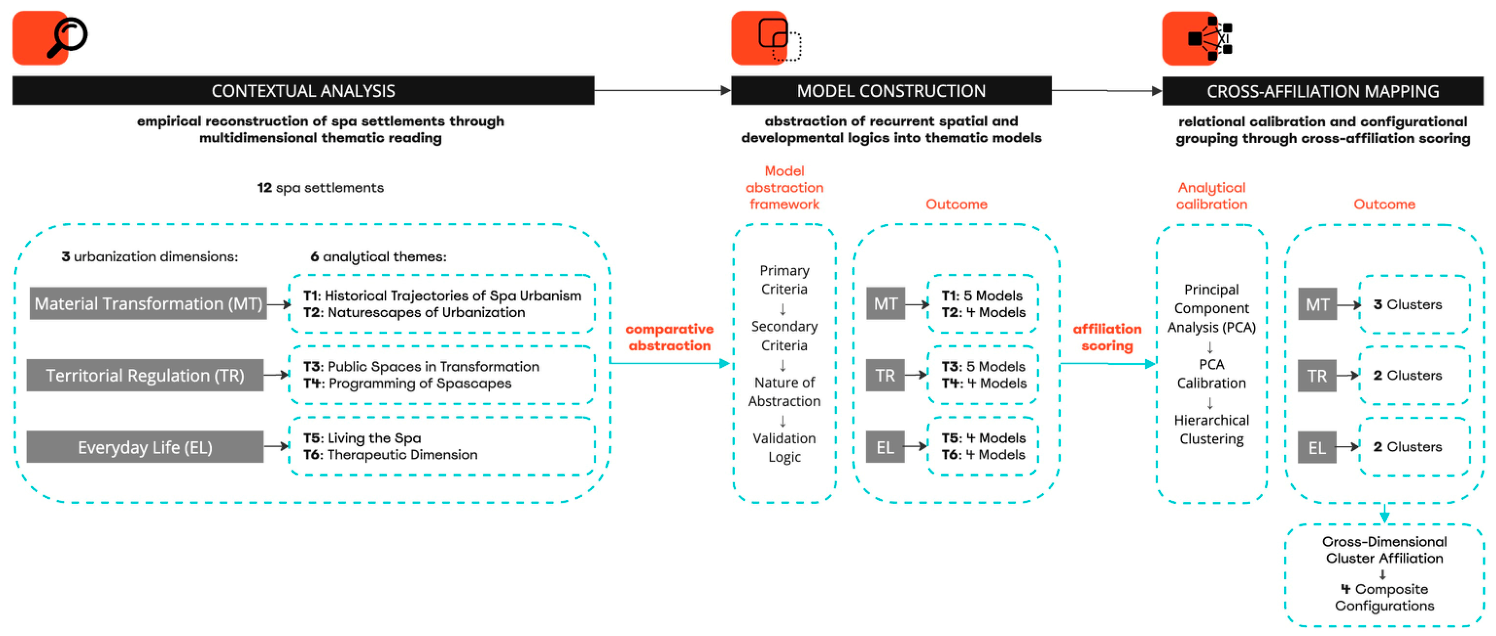
This study adopts a structured, three-phase methodological approach developed to examine spa settlements as complex urban and spatial constructs, rather than as isolated case studies. The research builds upon the analytical framework established through the Compendium of Spa Settlements [1], which serves as a systematically organized empirical corpus derived from the comparative analysis of twelve role-model spa settlements in Serbia. The methodological design combines qualitative contextual reading with model-based abstraction and quantitative relational analysis, enabling a multi-layered interpretation of spa urbanization processes.
The first phase of the research is based on a contextual analysis of each spa settlement, conducted across three dimensions of urbanization and six associated thematic fields. In the second phase, the results of the contextual analysis are synthesized through the construction of thematic spa models, understood as abstracted yet empirically grounded representations of dominant urban and spatial logics. The third phase introduces a cross-affiliation mapping procedure, in which the identified models are systematically related back to all examined spa settlements, allowing for multiple and graded affiliations. These relational datasets are subsequently subjected to exploratory multivariate examination through PCA and hierarchical clustering, enabling the detection of latent structural alignments among models and the identification of empirically grounded settlement configurations. The overall methodological workflow and the relationships between the three analytical phases are illustrated in Figure 1.

3.1. Contextual Analysis of Spa Settlements

The first phase of the research is based on a contextual analysis of spa settlements, designed to capture their spatial, historical, programmatic, and experiential complexity within a coherent comparative framework. This phase establishes the empirical and analytical foundation for subsequent model construction by combining a carefully curated sample of spa settlements with a structured set of analytical dimensions and thematic fields. Rather than aiming to identify exemplary or normative development paths, the contextual analysis is intentionally oriented toward heterogeneity, allowing diverse urban trajectories, spatial configurations, and therapeutic profiles to be examined in parallel.

3.1.1. Empirical Material: 12 Role Models of Spa Settlements in Serbia

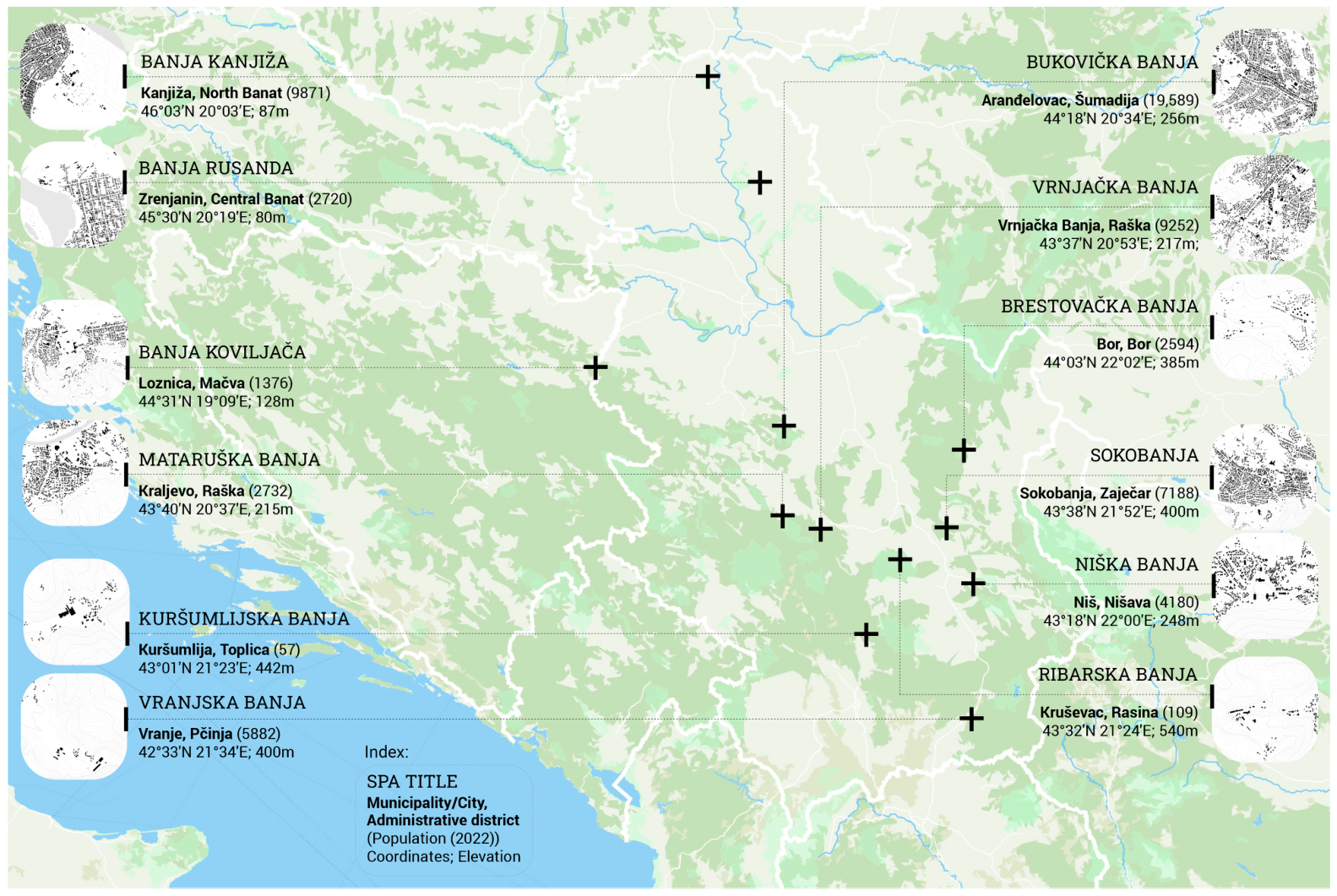
The empirical basis of the study consists of twelve spa settlements selected as role models for contextual and comparative analysis. In this research, the term role model does not imply best practice, optimal development, or normative success. Instead, it denotes analytically representative cases chosen to form a heterogeneous and differentiated sample of spa urbanization patterns. The selected spa settlements differ significantly in their (1) topographic settings, ranging from enclosed valley systems to lowland and riverine contexts, as well as in their (2) degree of urban consolidation, spatial dispersion, and landscape integration. They also reflect varied historical layers, including early spa formations, royal and bourgeois development phases, socialist institutional expansion, and post-socialist transformations. This temporal diversity enables the examination of spa urbanism across multiple socio-political and economic periods, ensuring that the sample captures both continuity and rupture in development patterns. As such, the selected cases (Figure 2) form a relevant empirical sample for comparative analysis rather than a curated collection of exemplary outcomes.

3.1.2. Analytical Dimensions and Thematic Structure

The contextual analysis is organized around three analytical dimensions of spa urbanization [55,84], each further operationalized through two thematic fields, resulting in a total of six thematic areas (Table 1). These dimensions are not treated as isolated layers, but as interrelated perspectives through which spa settlements are examined as dynamic socio-spatial systems. Together, they allow the study to address both material and immaterial aspects of spa environments. Across all three dimensions, each thematic field is systematically defined through a consistent set of analytical components, including (1) thematic focus, (2) research question, (3) analytical approach, (4) key indicators, and (5) methodological sources. By organizing the contextual analysis in this way, the study establishes a transferable analytical foundation from which spa models are subsequently abstracted and relationally examined.
The first analytical dimension addresses the temporal and environmental foundations of spa settlements. It comprises the themes Historical Trajectories of Spa Urbanism (T1) and Naturescapes of Urbanization (T2), focusing on the evolution of spatial structures over time and their embeddedness within natural and ecological systems. This dimension operates primarily at the settlement scale and employs periodization, typological sequencing, and morphogenetic landscape reading to identify recurring urbanization trajectories and terrain-related spatial logics. The second dimension examines the spatial and institutional structuring of spa environments through the themes of Public Spaces in Transformation (T3) and Programming of Spascapes (T4). Here, the focus shifts to the public realm, urban morphology, planning frameworks, and governance mechanisms that shape movement, social interaction, and functional organization. Analytical attention is given to the constitutive role of public spaces, zoning and regulatory instruments, and the coherence between spatial form and institutional intent. This dimension operates across urban and territorial scales and combines morphological analysis with critical examination of planning and policy documents. The third analytical dimension explores the lived and therapeutic qualities of spa settlements through the themes Living the Spa (T5) and Therapeutic Dimension (T6). This dimension foregrounds human experience, socio-spatial rhythms, and multisensory healing environments. It addresses how spa spaces are inhabited, perceived, and appropriated by different user groups, and how therapeutic value is spatially embedded through climate, water, movement, and sensory markers. Operating at human, behavioral, and micro-spatial scales, this dimension integrates ethnographic observation, experiential mapping, and typological analysis of therapeutic infrastructures.

3.2. Model Construction

Following the contextual analysis, the second phase of the research focuses on the construction of thematic spa models through a process of typological abstraction. This phase represents a methodological transition from case-based interpretation toward conceptual synthesis, allowing recurring spatial and urban logics to be identified beyond the specificity of individual spa settlements. Rather than producing exhaustive classifications or fixed categories, model construction serves as an intermediate analytical step that captures dominant tendencies, relational patterns, and structural configurations emerging across multiple cases. In this study, the concept of a model is deliberately distinguished from that of a type. While typology traditionally refers to relatively stable, formalized categories based on recurring morphological or functional characteristics [101], the model is understood as a more flexible and relational construct [102]. Models do not aim to describe complete or closed entities, nor do they presume internal homogeneity. Instead, they operate as analytical abstractions that synthesize multiple attributes into recognizable configurations that may appear in varying intensities across different spa settlements. In this sense, model construction enables the identification of shared urban logics without reducing the complexity or hybridity of real-world cases.
The construction of spa models is organized in direct correspondence with the six thematic fields defined in the contextual analysis (T1–T6). For each thematic field, a limited number of models is derived through comparative cross-reading of all twelve spa settlements. Thematic specificity is preserved, meaning that each model is constructed within a clearly defined analytical focus (Table 2). The criteria for model construction are defined in a systematic and consistent manner across all six thematic fields, ensuring methodological coherence and analytical comparability. Rather than relying on a single dominant parameter, model definition is based on a multi-criteria framework reflecting the inherent complexity of spa settlements and avoids reductionist interpretations based solely on formal or programmatic attributes. As a result, models are not interchangeable across themes but remain anchored within their respective analytical domains.
Models are constructed only when the identified characteristics demonstrate sufficient recurrence, internal coherence, and analytical clarity across multiple spa settlements. Recurrence is understood not as identical manifestation, but as the repeated presence of a recognizable spatial, organizational, or experiential logic expressed through context-specific variations. On this basis, each proposed model is subjected to iterative comparative validation, whereby its analytical relevance is tested against all twelve spa settlements, extending beyond the cases from which it initially emerged. Features that remain singular, exceptional, or highly idiosyncratic are systematically documented within the contextual analysis but are not elevated to the level of model abstraction. Within each thematic field, overlaps and distinctions between models are critically examined to avoid redundancy and to clarify conceptual boundaries, ensuring internal consistency and analytical robustness. This validation process prioritizes conceptual coherence rather than statistical confirmation at this stage of the research. Importantly, the resulting models are not assigned exclusively to individual spa settlements; instead, they function as transferable analytical units that may coexist within a single case or appear across multiple cases with varying degrees of prominence. This non-exclusive logic of model attribution directly enables subsequent cross-affiliation mapping and relational analysis in the next phase.

3.3. Cross-Affiliation Mapping and Statistical Reading

The third phase of the research introduces a cross-affiliation mapping procedure designed to examine the relational presence of constructed spa models across all twelve spa settlements. This phase operationalizes the non-exclusive logic of model attribution established in the previous section by translating qualitative model–case relationships into a structured, comparable dataset. By doing so, it enables both interpretative synthesis and subsequent statistical reading, without reducing the analytical richness of the models themselves.

3.3.1. Scoring Affiliation

To capture the varying degrees to which individual spa models are manifested within each spa settlement, a graded affiliation scoring system was developed. Rather than treating model presence as a binary condition, the scoring system reflects the intensity and clarity with which a given model is expressed in relation to a specific case. The affiliation scale is based on a five-level structure (1–5), designed to distinguish between absence, marginal presence, secondary relevance, dominant manifestation, and exemplary or defining expression of a model within a given spa settlement (Table 3).
The use of a five-level ordinal scale supports inter-researcher consistency while allowing a differentiated reading of model clarity. Affiliation scores are therefore understood as calibrated interpretative judgments derived from contextual and comparative analysis, rather than as absolute quantitative measurements. The scoring procedure was structured in three consecutive methodological steps: (1) intersubjective validation, (2) reflexive calibration, and (3) explicit treatment of hybrid and borderline cases.
Intersubjective validation was ensured through an independent expert-based assessment. Each researcher (author of the manuscript) evaluated model–case affiliations individually using predefined criteria, grounding each score in empirical material. Reflexive calibration followed in the form of structured collaborative review sessions (Table 4). During these sessions, individual scoring matrices were comparatively examined, discrepancies were identified, and affiliations were re-evaluated through iterative discussion and re-examination of contextual evidence. One researcher assumed a coordinating and validation role to systematize the process and document reasoning. The objective was not statistical agreement, but reasoned analytical convergence based on shared criteria and explicit justification. The third step involved the explicit treatment of hybrid and borderline cases. Rather than forcing singular model assignments, the sessions allowed for the recognition of overlapping affiliations and transitional conditions. Particular attention was given to cases exhibiting near-equal scores across models or strong secondary associations, which were interpreted as indicators of structural hybridity or layered development. This step reinforced the interpretative depth of the matrix and prevented reductive classification. The resulting cross-affiliation matrix systematically maps all constructed models against the twelve spa settlements, allowing multiple models to be affiliated with a single case and enabling variation in affiliation intensity. The matrix thus serves as the primary input for subsequent statistical reading and operates as a critical bridge between qualitative model construction and quantitative relational analysis (Supplementary Material S1).

3.3.2. Analytical Framework

To examine both the internal relational structure of the model system and the emergent configurational groupings of spa settlements, a two-step analytical framework was implemented in JASP (version 0.96.0). The procedure combined Principal Component Analysis (PCA) and hierarchical clustering, applied separately to the three overarching urban dimensions: (1) material transformation, (2) territorial regulation, and (3) everyday life. Within each dimension, models were operationalized as ordinal-scaled numeric variables derived from the five-level (1–5) affiliation scoring system. Although ordinal in nature, the five-point scale allows for approximate treatment as continuous in exploratory multivariate analysis, particularly when the objective is relational structure detection rather than parametric inference. Conceptually, the two-step procedure distinguishes between the relational structure of models (PCA) and the positional configuration of spa settlements within that relational field (clustering). Thus, PCA establishes the internal structural logic of each urban dimension, while hierarchical clustering identifies emergent settlement constellations within that calibrated relational space.
The dimensional structure of variables was organized as follows: (1) Material Transformation (9 variables)—five models of historical trajectories and four models of landscape embedding, (2) Territorial Regulation (9 variables)—five models of public spaces in transformation and four models of programming spascapes, and (3) Everyday Life (8 variables)—four models of living the spa and four models of therapeutic spatial logic.
In the first step, PCA based on correlation matrices was conducted separately for each dimension to identify latent structural alignments among models. The number of components retained was determined using parallel analysis (principal components extraction). Given the theoretical assumption that models may be interrelated rather than orthogonal, oblique rotation (Promax) was applied. Component loadings ≥ 0.40 were considered analytically meaningful. The purpose of PCA was not confirmatory latent modelling but relational calibration. Specifically, it served to: (1) detect internal correlation structures within each dimension, and (2) identify variables exhibiting insufficient shared variance (e.g., high uniqueness or weak loadings), which would not meaningfully contribute to subsequent clustering. Given the relatively small sample size (N = 12 spa settlements), PCA results are interpreted as exploratory structural readings rather than statistically generalizable constructs.
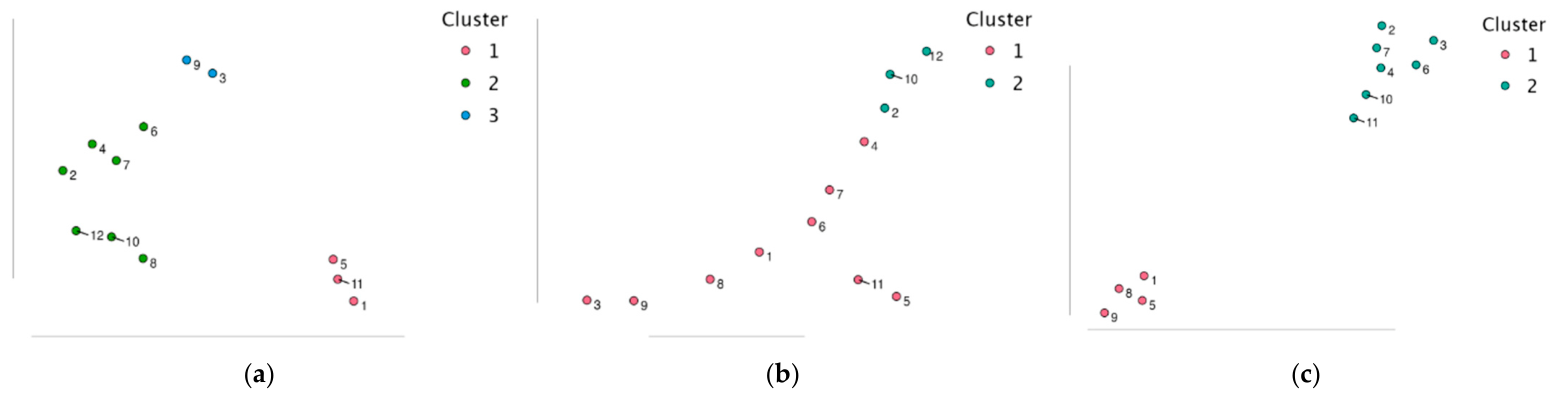
In the second step, hierarchical clustering analysis was performed within each urban dimension using the subset of variables retained after PCA calibration. Clustering was conducted in the Machine Learning module, employing Euclidean distance and average linkage, with feature scaling applied to ensure comparability across variables. Hierarchical clustering was selected because it preserves relational proximity among cases without imposing predefined group boundaries. The number of clusters was determined through optimization using the Bayesian Information Criterion (BIC), allowing settlement groupings to emerge from internal structural regularities rather than being fixed a priori. In a final step, the resulting cluster memberships across the three urban dimensions were synthesized through a cross-affiliation matrix, enabling the identification of recurrent settlement alignments and composite configurational patterns beyond single-dimensional clustering results.
Given the relatively small sample size (N = 12) and the proportion between cases and variables, an additional calibration step was incorporated into the analytical procedure. In this context, PCA was used not only to identify latent structural relationships among models, but also to evaluate their empirical relevance by detecting variables with low shared variance (high uniqueness and weak or unstable loadings). Such variables were excluded prior to clustering in order to reduce the risk of overfitting and to ensure that the grouping of settlements is based on structurally consistent dimensions. Accordingly, the sequential PCA–clustering approach functions as an internal validation procedure, whereby clustering is performed on a refined subset of variables that exhibit stable relational patterns within the dataset. The resulting clusters are therefore interpreted as indicative relational configurations, rather than as outcomes driven by variable redundancy or statistical noise.

4. Results

The Results section presents the outcomes of the model construction process derived from the contextual analysis of twelve spa settlements. The findings are organized thematically, following the six analytical fields defined in the methodological framework. For each analytical theme, the identified spa models are systematically presented, described, and structured, allowing for transparent comparison across themes and cases. Rather than reporting results on a case-by-case basis, the Results section is model-oriented. Each subsection (Section 4.1, Section 4.2, Section 4.3, Section 4.4, Section 4.5 and Section 4.6) corresponds to one analytical theme and introduces the set of models abstracted within that thematic field. In this way, the Results section establishes a clear analytical inventory of models, while the Discussion addresses their relational significance and higher-order configurations.

4.1. Historical Trajectories of Spa Urbanism (T1)

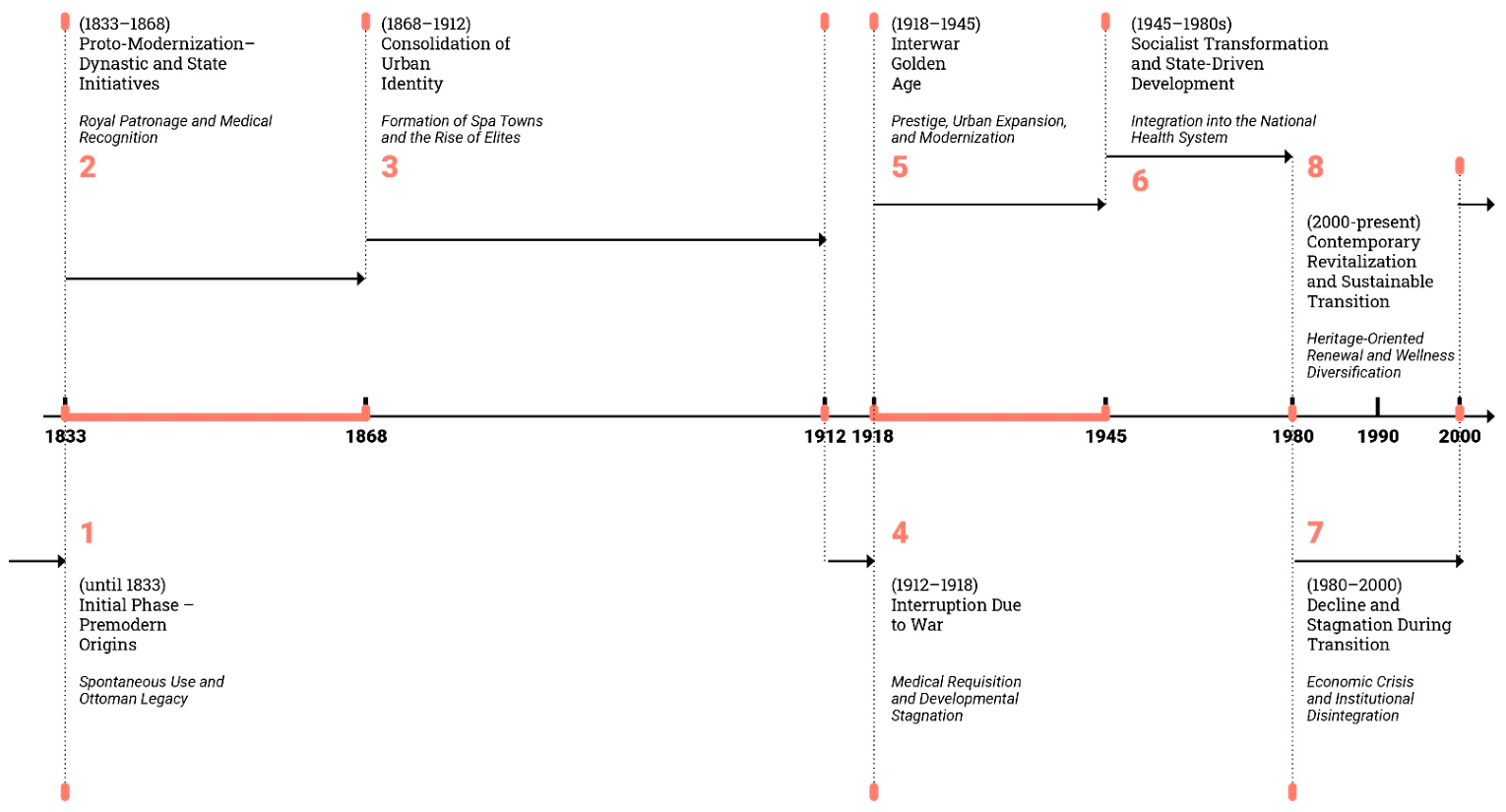
The analysis of historical development trajectories across the examined spa settlements focuses on identifying recurrent logics of formation, transformation, and institutional embedding. Rather than reconstructing a linear historical narrative, the aim is to detect structurally comparable patterns that shape spa urbanism across different temporal contexts. To support this analytical step, a chronological synthesis of spa development was constructed (Figure 3), mapping key phases of urbanization: from premodern origins and early institutionalization to periods of expansion, interruption, decline, and contemporary revitalization. This timeline serves as a validation framework by demonstrating that similar developmental configurations recur across different historical periods and spa settlements.
Building upon this temporal validation, the identified phases are not interpreted as fixed chronological stages, but as recurring structuring logics that can be abstracted into analytical models. The timeline reveals that similar configurations of political patronage, medical legitimization, and spatial organization reappear across different periods, thereby justifying their translation into a system of relational models.
The analysis of historical development trajectories across the examined spa settlements resulted in the identification of five distinct models of spa urbanism. These models reflect differentiated modes of formation, expansion, and institutional embedding, shaped by varying configurations of political patronage, medical legitimation, socio-economic investment, and infrastructural development. Rather than representing linear historical phases, the models capture dominant historical logics that recur across cases and structure spa settlements at different moments of their development. The identified models range from ceremonially founded spa cores linked to royal authority and early scientific validation, through interwar bourgeois spa towns characterized by cosmopolitan leisure culture, to socialist-era spa settlements integrated into national healthcare systems. Additional trajectories include spas shaped by long-term peripheralization and administrative discontinuity, as well as pragmatically developed settlements driven by functional medical research and local initiatives. Together, these models reveal a spectrum of historical conditions through which spa settlements have been produced, transformed, and reinterpreted over time. Importantly, individual spa settlements often exhibit hybrid or transitional characteristics, reflecting overlaps between multiple historical logics. Such hybridity underscores the non-exclusive nature of the models and supports their use as analytical constructs rather than fixed categories. The full set of identified historical development models and their defining attributes is systematized in Table 5.

4.2. Naturescapes of Urbanization (T2)

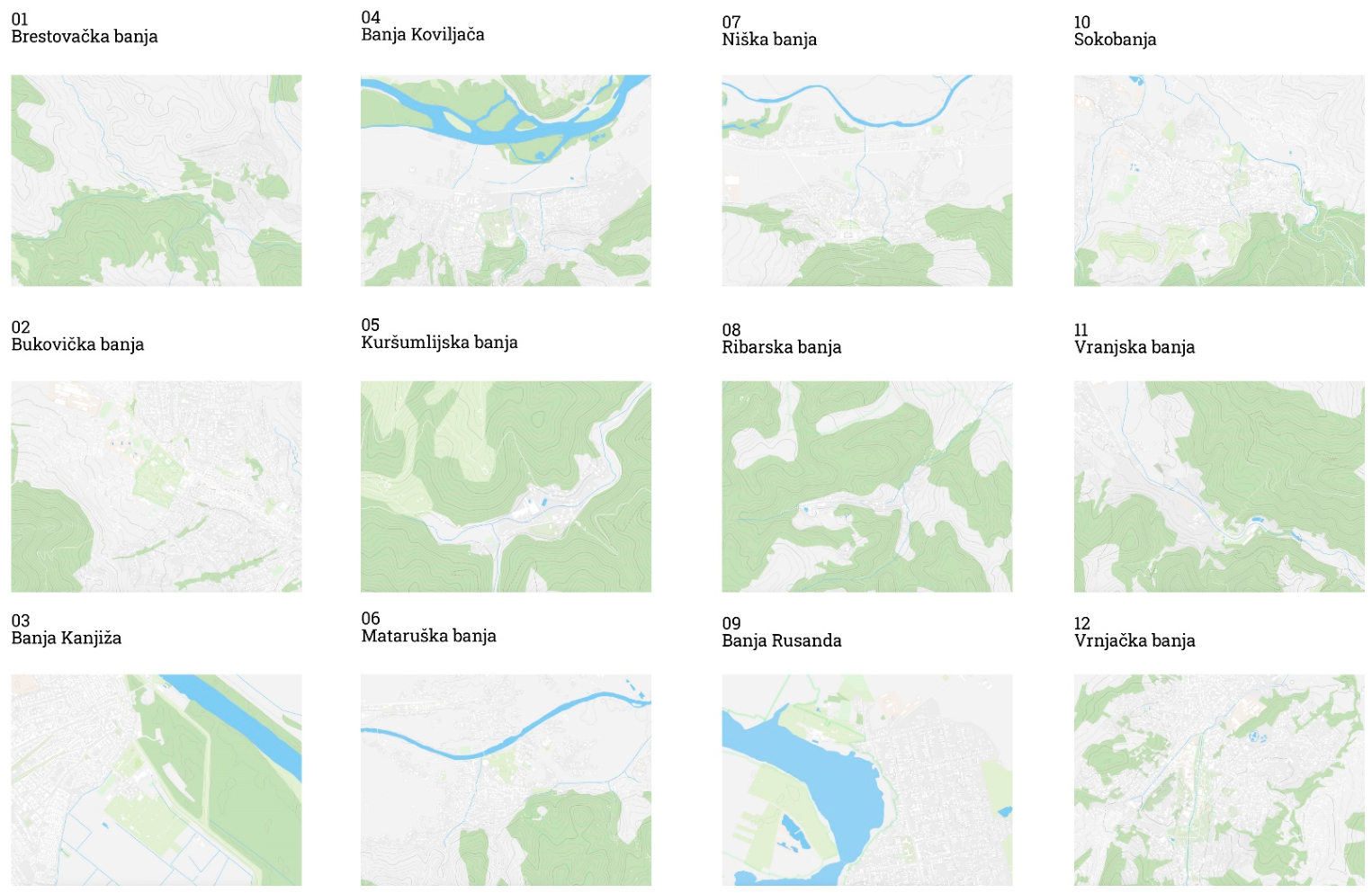
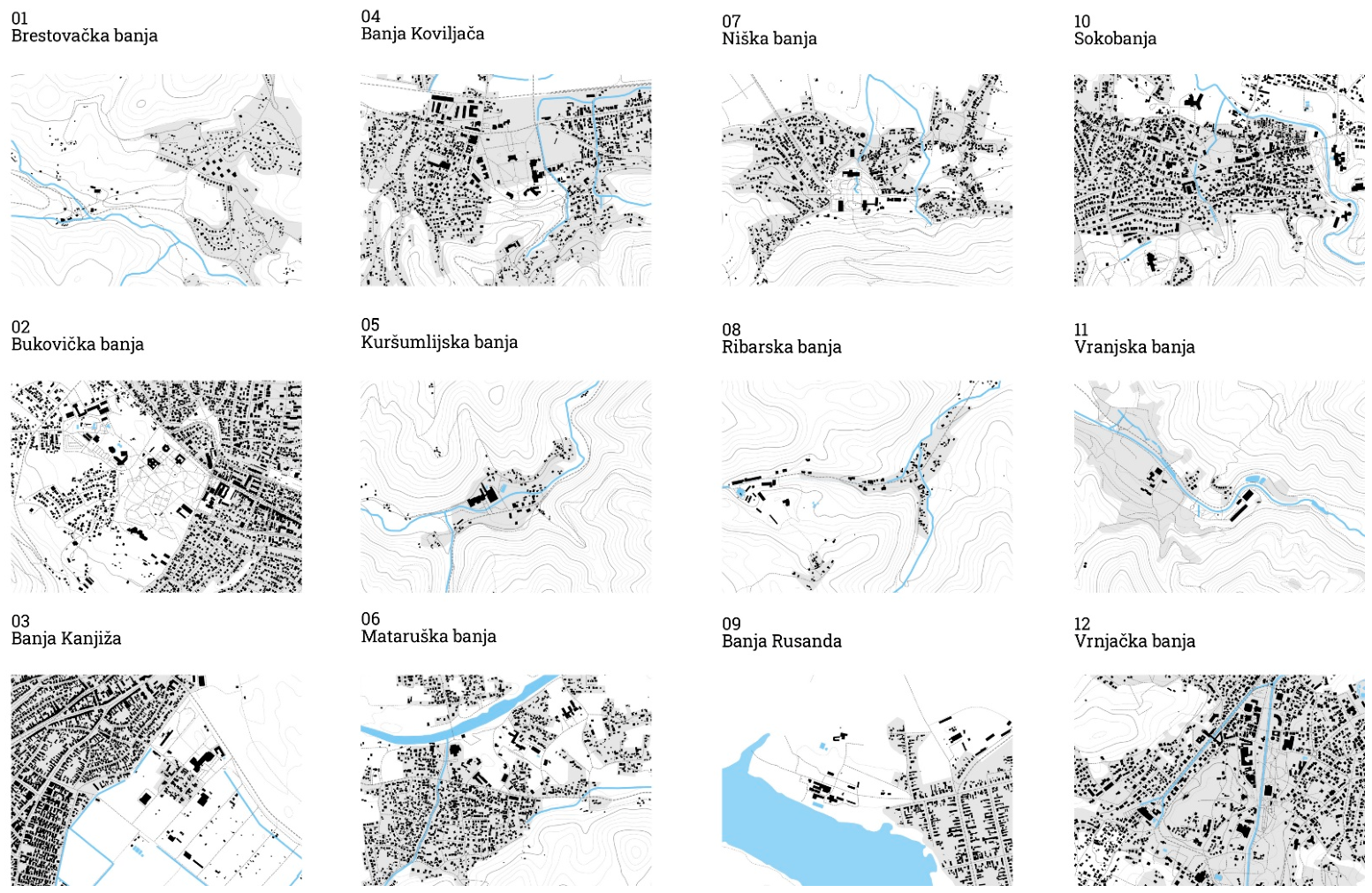
The analysis of landscape embedding across the examined spa settlements focuses on identifying recurrent spatial relationships between terrain configuration, urban form, and therapeutic structuring. Rather than treating landscape as a passive environmental backdrop, this step examines how geomorphological conditions actively participate in shaping the spatial logic of spa urbanization. To support this analytical step, a comparative spatial overview of all twelve spa settlements was constructed (Figure 4), mapping their topographic context, hydrographic systems, and urban footprints. This figure serves as a validation framework by enabling direct visual comparison of terrain–urban relationships, revealing recurring configurations of enclosure, dispersion, centrality, and integration across cases.
Building upon this spatial validation, the observed configurations are interpreted not as isolated site-specific conditions, but as recurring spatial logics that can be abstracted into analytical models. The comparative reading reveals consistent patterns in how terrain constraints, hydrological features, and urban development co-align, thereby justifying their translation into a system of relational typo-morphological models.
The analysis of landscape embedding and spatial logic across the examined spa settlements resulted in the identification of four typo-morphological models. These models articulate distinct relationships between terrain configuration, urban form, and therapeutic function, demonstrating how environmental context actively co-produces spa urbanism rather than merely framing it. Moving beyond the notion of landscape as a background condition, the identified models emphasize its formative role in shaping spatial organization, experiential sequencing, and therapeutic atmospheres. The four models highlight a spectrum of landscape–urban relationships, ranging from topographically enclosed valley systems with linear spatial logic, through dispersed hill-contact morphologies characterized by decentralized therapeutic niches, to lowland spa settlements structured around central water matrices, and finally to balanced urban–landscape systems integrating formalized green infrastructures within coherent urban fabrics. The full set of identified models and their defining attributes is systematized in Table 6.

4.3. Public Spaces in Transformation (T3)

The analysis of public spaces in spa settlements focuses on the identification of recurrent spatial structures through which spa urbanism is organized, experienced, and transformed over time. This step examines its role as a primary structuring system that organizes movement, centrality, and the relationship between therapeutic, urban, and landscape elements. To support this analytical step, a comparative morphological overview of public space configurations across all twelve spa settlements was constructed (Figure 5). The figure maps the spatial distribution of built structures, open public spaces, and hydrographic systems, enabling direct comparison of patterns of centrality, linearity, enclosure, and dispersion. This visual synthesis functions as a validation framework by revealing consistent spatial organizations that recur across cases.
Building upon this morphological validation, the observed configurations are interpreted as recurring spatial logics through which public space structures spa settlements. The comparative reading highlights consistent relationships between spatial continuity, nodal concentration, and landscape integration, thereby enabling the abstraction of distinct models of public space organization. These models do not correspond to specific historical periods or planning regimes, but to formalized spatial patterns that organize movement, access to therapeutic resources, and the articulation of spa identity. The analysis of public spaces in spa settlements, conducted through comparative morphological reading, resulted in the identification of five models that articulate how public space structures spa urbanism over time. These models are derived from cartographic surveys and analytical matrices, focusing on the spatial configuration of spa nuclei, the distribution and hierarchy of public spaces, and the relationship between the built fabric and surrounding landscape. Rather than relying on administrative status or touristic categorization, the identified models are grounded in formal and spatial logics that shape movement, centrality, enclosure, and landscape integration. Public spaces are understood here as constitutive elements of spa settlements through which healing infrastructure, architectural identity, and environmental systems intersect. The five models capture a spectrum of public space morphologies, ranging from linear and axial structures to concentric cores, enclave-based configurations, fully integrated urban fabrics, and territorially dispersed pavilion landscapes. The identified models and their defining characteristics are systematized in Table 7.

4.4. Programming of Spascapes (T4)

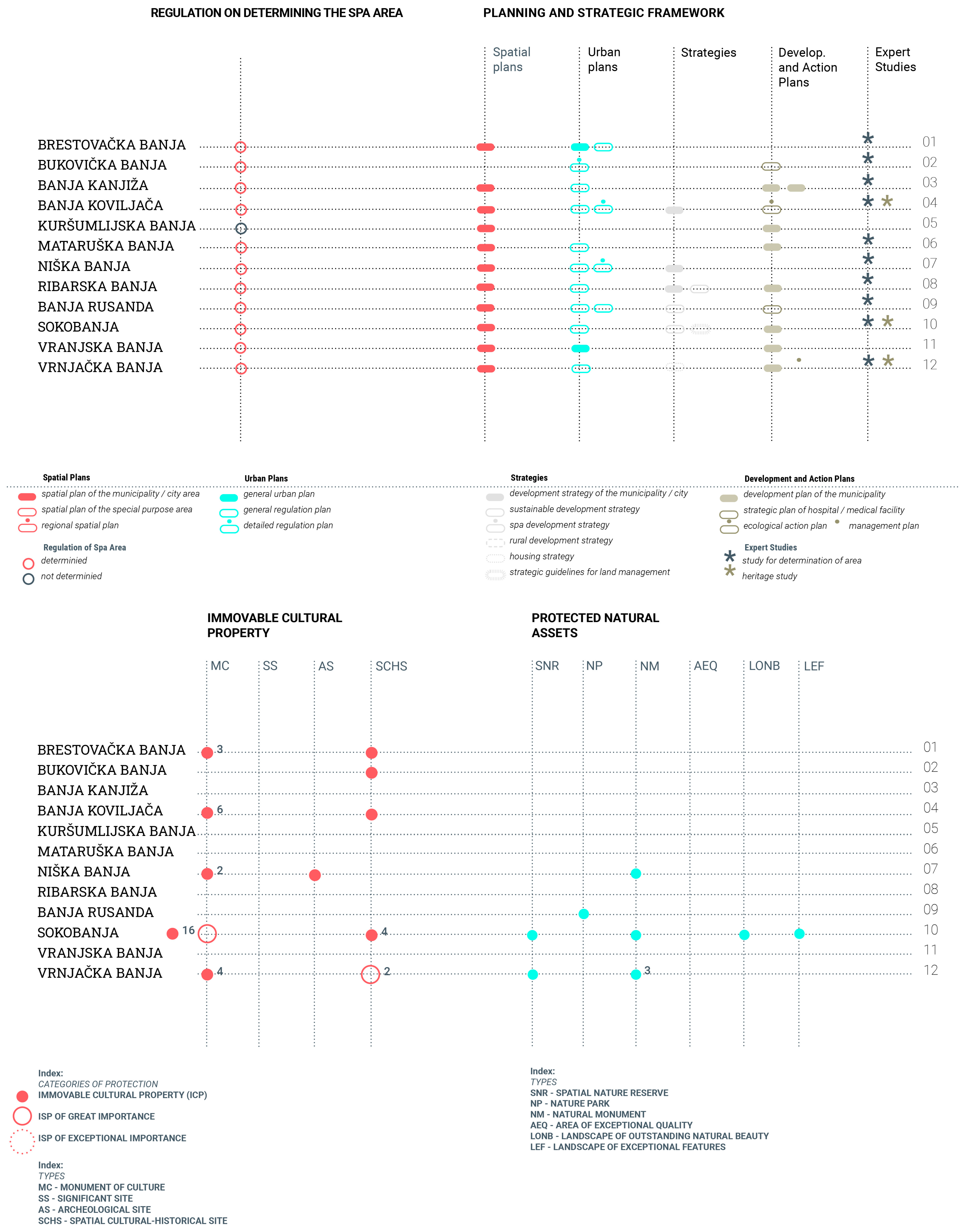
The analysis of development programming in spa settlements focuses on identifying recurrent institutional and regulatory configurations through which spatial development is directed, stabilized, or transformed over time. Rather than interpreting development as a linear outcome of planning decisions, this step examines how planning instruments, governance continuity, and the integration of cultural and natural assets collectively structure the evolution of spa settlements. To support this analytical step, a comparative matrix of planning frameworks and heritage–nature regulation across all twelve spa settlements was constructed (Figure 6). The figure synthesizes the presence and alignment of spatial and urban plans, strategic documents, development instruments, expert studies, as well as cultural protection regimes and natural asset designations. This matrix serves as a validation framework by revealing consistent patterns of institutional configuration, regulatory coherence, and asset integration across cases.
Building upon this institutional validation, the observed configurations are interpreted as recurring programming logics that structure spa development beyond individual planning documents. The comparative reading highlights differences in governance continuity, strategic coordination, and the degree of integration between spatial planning and heritage–nature protection systems. These patterns enable the abstraction of distinct programming models, understood as relational configurations of institutional performance rather than formal planning categories. The analysis of development programming in spa settlements reveals differentiated logics through which spatial form, institutional frameworks, and economic strategies are coordinated over time. Based on an inductive synthesis of empirical data and regulatory mappings conducted in the contextual analysis, four programming models were identified. Rather than representing normative development pathways, the identified models capture recurring configurations of institutional performance and spatial regulation that condition how spa settlements evolve, stagnate, or transform. The results demonstrate that development outcomes are not solely dependent on economic capital or planning quality, but are fundamentally shaped by governance continuity, regulatory coherence, and the degree to which cultural and natural assets are integrated into development frameworks. The models range from heritage-driven hybrid programming, through rehabilitation-centered stability and market-led speculative reprogramming, to conditions of decline and transitional ambiguity. The identified programming models and their defining attributes are systematized in Table 8.

4.5. Living the Spa (T5)

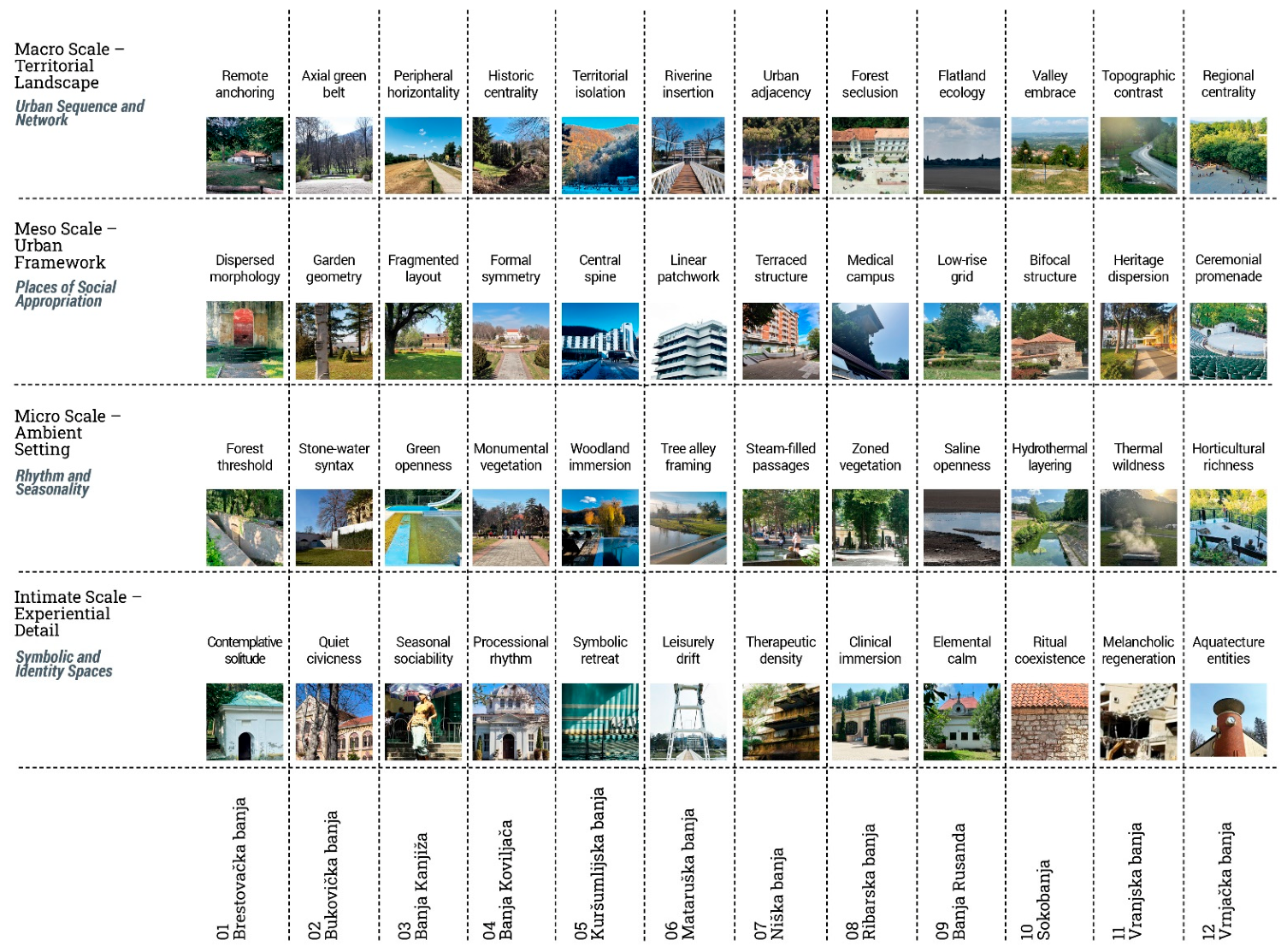
The analysis of lived experience in spa settlements focuses on how therapeutic environments are inhabited, perceived, and socially appropriated across different spatial scales. To support this interpretative layer, a multiscale photo-essay analysis was conducted across all twelve spa settlements (Figure 7). The figure organizes empirical observations across four interrelated spatial scales: (1) macro (territorial landscape), (2) meso (urban framework), (3) micro (ambient setting), and (4) intimate (experiential detail). This multilevel reading serves as a validation framework by revealing consistent experiential patterns that transcend individual cases and support the abstraction of lived-experience models.
Building upon this multiscale reading, the observed experiential conditions are interpreted as recurring modes of inhabitation that structure everyday life in spa environments. The analysis reveals that lived experience is not reducible to a single spatial layer, but emerges through the alignment or tension between territorial positioning, urban organization, ambient qualities, and symbolic or ritual practices. These recurring alignments enable the identification of distinct experiential models.
The analysis of lived experience in spa settlements resulted in the identification of four experiential models that articulate how spas are inhabited, practiced, and socially appropriated. Unlike models derived primarily from formal, morphological, or regulatory parameters, these models are grounded in the interpretation of everyday spatial use, sensory atmosphere, and patterns of movement. The identified models reflect predominant modes of inhabitation rather than fixed spatial types. They range from highly ceremonial and civic spa environments, through introverted therapeutic enclaves and polycentric urban conditions, to informal and recreation-oriented spa landscapes. These models highlight how spatial coherence, cultural memory, and environmental qualities are translated into lived practices and everyday routines. As with previous thematic results, individual spa settlements may exhibit overlapping characteristics or transitional conditions, underscoring the interpretative and non-exclusive nature of the models. The full set of experiential models and their defining attributes is systematized in Table 9.

4.6. Therapeutic Dimension (T6)

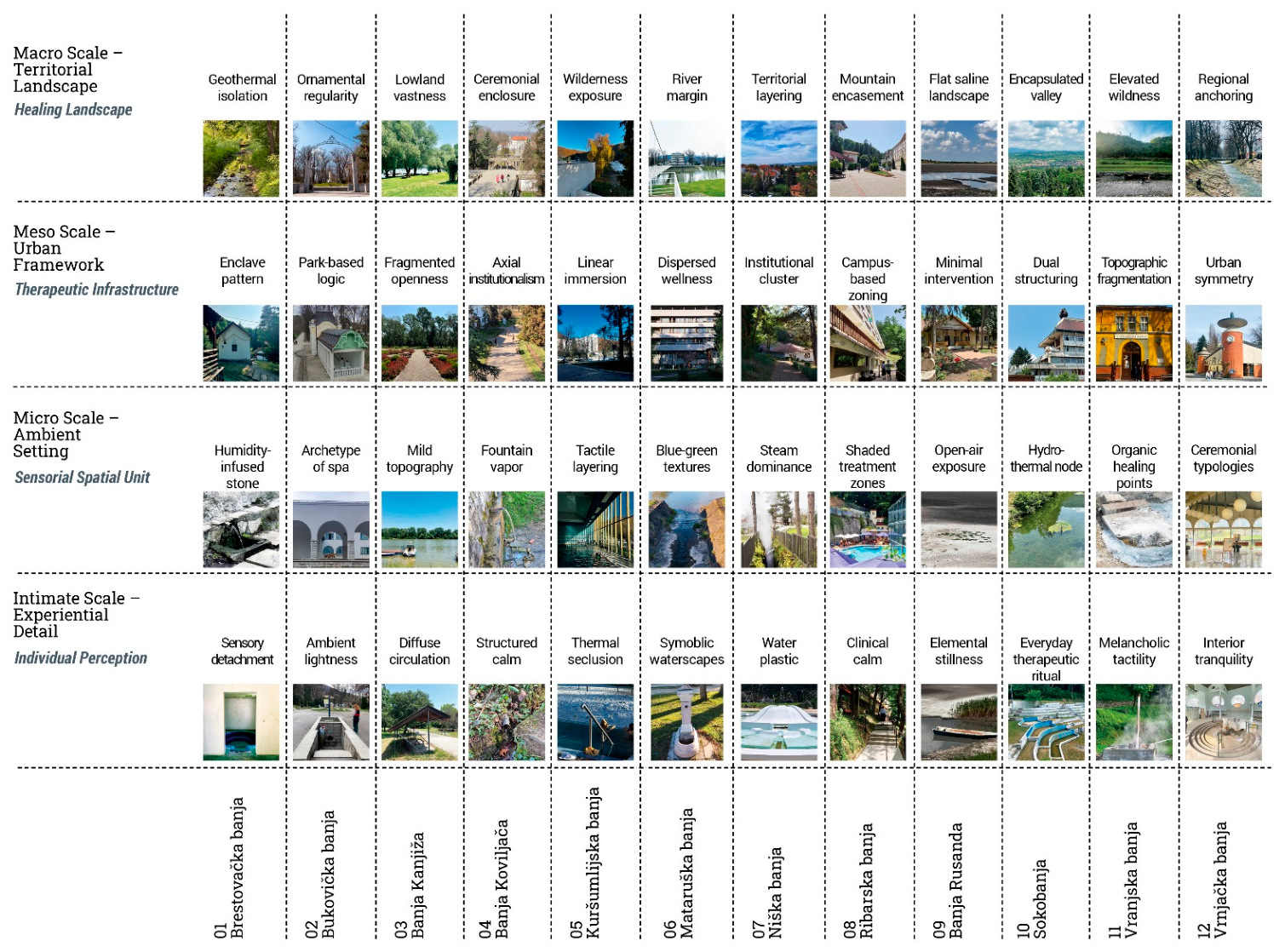
The analysis of the therapeutic dimension examines how healing intentions are spatially articulated, perceived, and experienced across spa settlements, moving beyond functional classifications toward the relational construction of therapeutic environments. To ground this interpretative layer, a multiscale photo-essay analysis was conducted (Figure 8), focusing specifically on healing landscapes, therapeutic infrastructures, sensory spatial units, and individual experiential conditions. Organized across four observational scales: (1) macro (territorial landscape), (2) meso (therapeutic infrastructure), (3) micro (sensorial spatial unit), and (4) intimate (individual perception). This multilevel validation reveals consistent alignments between environmental conditions, spatial structuring, and experiential effects, providing an empirical basis for the abstraction of therapeutic models.
Building upon this multiscale and multisensory reading, therapeutic environments are interpreted as relational constructs emerging from the alignment of landscape conditions, infrastructural organization, and embodied experience. The analysis demonstrates that healing is not tied to a single spatial type, but is produced through recurring configurations of spatial, environmental, and perceptual factors. The analysis of the therapeutic dimension across the examined spa settlements resulted in the identification of four models that articulate how healing intentions are spatially translated into lived therapeutic environments. Rather than grouping spa settlements according to functional classifications or ecological settings alone, these models capture recurring spatial–sensory logics through which therapeutic atmospheres are produced. They emerge from the intersection of natural healing affordances, spatial programming, sensory experience, and psychological reception, as revealed through the combined multiscale photo-essay analysis and the evaluative criteria framework. The identified models reflect differentiated modes of therapeutic spatialization, ranging from landscape-based healing environments to institutionally mediated urban–medical settings, vernacular and culturally embedded therapeutic spaces, and modest wellness-oriented peripheries. Each model encompasses multiple spa settlements exhibiting congruent patterns of spatial–sensory healing, while individual cases may display hybrid or transitional conditions. The full set of therapeutic models and their defining attributes is systematized in Table 10.

5. Discussion of Structural and Configurational Patterns

This section synthesizes the two analytical layers of the study, relational structure and configurational grouping, in order to clarify how spa settlements organize across three urban dimensions (material transformation, territorial regulation, and everyday life). While the first step identifies latent structural gradients among models, the second step examines how these gradients materialize as empirically coherent settlement configurations. Together, the analyses shift the discussion from isolated model descriptions toward a systemic reading of spa settlements as differentiated yet internally structured urban formations.

5.1. Relational Structure of Models

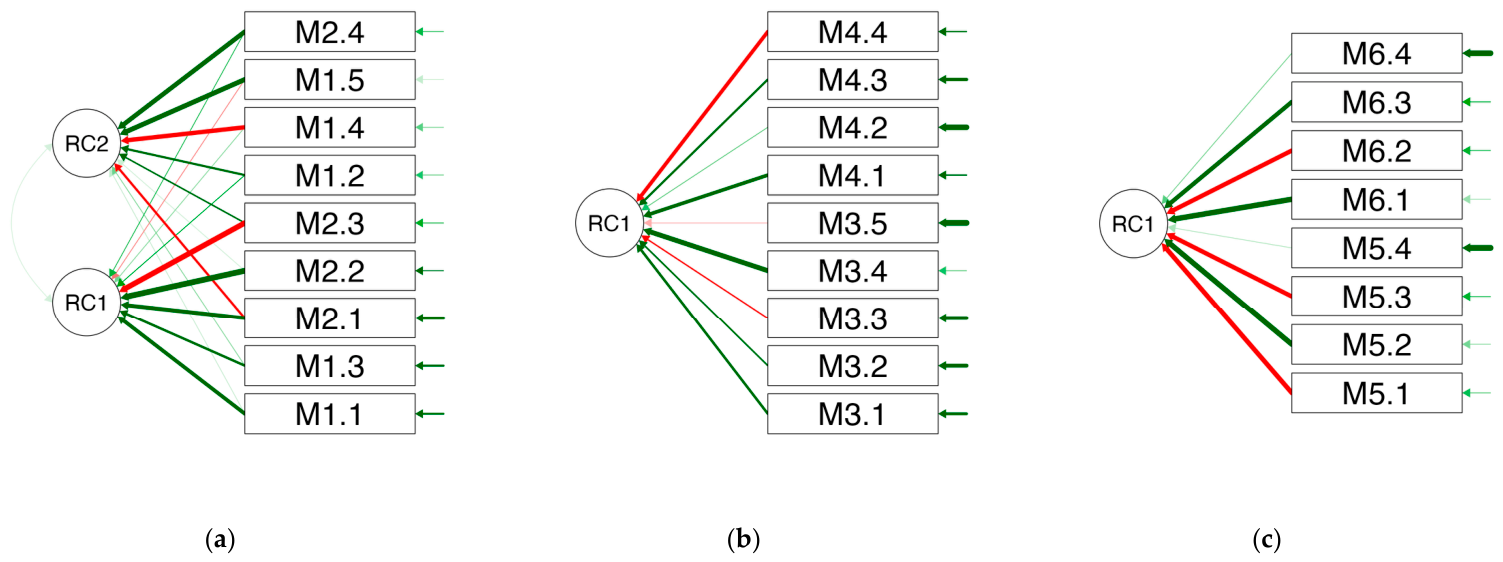
This section presents the relational structural reading of the model system within each of the three urban dimensions. Rather than treating models as predefined typological categories, the analysis examines how they align, diverge, and co-vary within the empirical dataset. By identifying structural gradients and degrees of internal coherence, this step clarifies how (a) material transformation, (b) territorial regulation, and (c) everyday life operate as differentiated but internally organized relational fields. The path diagrams for all three urban dimensions are presented in Figure 9, illustrating the principal structural relationships identified through PCA. The subsequent text provides a detailed interpretative discussion of the component structures. All additional PCA outputs are provided in Supplementary Material S2.
Within the scope of material transformation, parallel analysis suggested a two-component solution explaining 64.5% of total variance. The rotated solution revealed two structurally distinct and largely independent axes (r = 0.057), indicating minimal overlap between the two principal structuring logics. The first component (RC1) is defined by strong positive loadings of the Diffuse Hill-Contact Spa Settlements (M2.2), Spa Settlements in Enclosed Valley Systems (M2.1), the Royal–Scientific Founding Model (M1.1), and the Socialist Institutional Integration Model (M1.3), while exhibiting a strong negative loading for the Lowland Spa Settlements with Central Water Matrices (M2.3). RC1 thus differentiates terrain-conditioned and institutionally consolidated spa formations from horizontally structured lowland configurations organized around dominant water matrices. This axis may therefore be interpreted as a topographic–institutional structuring dimension, capturing the interplay between geomorphological containment and historically embedded governance consolidation. The second component (RC2) is primarily structured by strong positive loadings of the Functional–Medical Pragmatic Model (M1.5) and Spa Settlements with Balanced Urban–Landscape Matrices (M2.4), alongside the Interwar Bourgeois–Urban Model (M1.2), while the Peripheral Repositioning Model (M1.4) loads negatively. RC2 therefore reflects a distinct structural gradient between integrative adaptive consolidation and processes of spatial fragmentation. The near-orthogonality of components suggests that material transformation in Serbian spa settlements unfolds along two relatively independent structural trajectories: (1) one primarily morphological–topographic, and (2) the other organizational–institutional.
Within the scope of territorial regulation, parallel analysis indicated the retention of a single principal component, explaining 33.9% of total variance. Unlike material transformation, which revealed two relatively independent structural axes, territorial regulation condensed into a unified regulatory continuum. The component is defined by strong positive loadings of the Integrated Urban-Core Model (M3.4), the Heritage-Driven Hybrid Development Model (M4.1), the Linear–Transversal Public Space Model (M3.1), the Speculative Private-Led Resort Model (M4.3), and the Concentric–Centralized Model (M3.2). These models share a structurally articulated and institutionally mediated spatial logic, characterized by consolidated governance frameworks and spatial formalization. In contrast, negative loadings of the Decline and Transitional Ambiguity Model (M4.4) and the Enclave–Topographic Model (M3.3) indicate regulatory fragmentation with weak spatial articulation. The emergence of a single dominant component suggests that territorial regulation operates as a coherent structural field in which public space organization and spascapes programming co-evolve under shared governance rationalities, rather than forming distinct analytical sub-dimensions.
Within the scope of everyday life, parallel analysis indicated a single-component solution explaining 56.4% of total variance. The rotated solution confirmed a strong and internally coherent structural axis, suggesting that lived experience in spa settlements is organized along a dominant relational gradient rather than multiple independent trajectories. The component is defined by strong positive loadings of the Engaging Therapeutic Landscapes (M6.1), the Vernacular–Reflective Spa (M6.3), and the Therapeutic–Enclave Spa (M5.2). These models share a common structural logic of organized and spatially articulated everyday life, where therapeutic practices are embedded within civic structure, institutional mediation, and clearly defined public frameworks. In contrast, strong negative loadings are associated with the Civic–Ceremonial Spa (M5.1), the Polycentric–Civic Spa (M5.3), and the Urban–Medical Hybrid (M6.2), as well as the Informal–Recreational Spa (M5.4) to a lesser extent. These models privilege immersion, informality, peripheral positioning, or culturally embedded experiential logics over formalized spatial organization and institutional structuring. The component can therefore be interpreted as a gradient between institutionalized–civic structuring of therapeutic life and informal experiential modalities of healing. Rather than distinguishing separate subsystems, everyday life in Serbian spa settlements appears to unfold along a single dominant axis that differentiates degrees of spatial formalization and institutional mediation. The high explanatory power of this single component suggests that lived experience and therapeutic spatial logic are deeply intertwined, forming a unified experiential structure in which everyday practices and healing modalities co-produce one another rather than operating as analytically separable domains.
Taken together, the three PCA results clarify the internal structural coherence of the model system and justify its further analytical use. Rather than imposing predefined typological hierarchies, the analysis demonstrates how correlations emerge from the relational configuration of models themselves. Material transformation unfolds along two relatively independent axes, territorial regulation condenses into a single regulatory continuum, while everyday life exhibits a strong integrative gradient. This differentiated pattern across dimensions confirms that the models do not operate as fixed classificatory units, but as relational variables whose internal alignments vary depending on the analytical field in which they are examined. In methodological terms, PCA functions here not as a reductive tool, but as a calibration mechanism.
Based on the PCA results across the three urban dimensions, variables exhibiting consistently high uniqueness values (above 0.90) and low or structurally insignificant loadings were excluded from the subsequent clustering analysis. Such variables do not meaningfully contribute to shared variance within their respective dimensions and therefore do not support the identification of relational settlement groupings. Within territorial regulation, the Dispersed Pavilion Model (M3.5) and the Institutionalized Rehabilitation-Oriented Model (M4.2) demonstrated extremely high uniqueness values (0.982 and 0.949, respectively), indicating minimal integration within the dominant regulatory continuum. Similarly, within everyday life, the Informal–Recreational Spa and Modest Wellness Periphery models (M5.4 and M6.4) exhibited uniqueness values above 0.95, reflecting their peripheral and non-structural positioning relative to the principal experiential gradient. These models were therefore excluded from clustering, as their inclusion would introduce noise rather than contribute to the detection of coherent settlement clusters. Importantly, exclusion here does not imply theoretical irrelevance; rather, it reflects limited empirical covariance within the analyzed dataset. The retained variables thus represent structurally validated relational dimensions suitable for subsequent comparative grouping.

5.2. Settlement Configuration Clustering

To examine emergent settlement configurations within each urban dimension, hierarchical clustering was conducted based on the variables retained after PCA calibration. The clustering procedure was applied separately to (a) material transformation, (b) territorial regulation, and (c) everyday life, allowing settlement groupings to emerge from the internal relational structure of each analytical field. Figure 10 presents the spatial projection of cluster affiliation for all three dimensions, illustrating the relative proximity and separation of settlements within each structural domain. Detailed numerical outputs of the clustering procedure are provided in Supplementary Materials S3.
Hierarchical clustering within the material transformation dimension resulted in a three-cluster solution optimized according to the BIC criterion (R2 = 0.575; silhouette = 0.360). The clusters reveal differentiated configurational profiles structured around historical trajectories and landscape embedding logics. Cluster 1 (N = 3) comprises Kuršumlijska Banja, Vranjska Banja, and Brestovačka Banja. This group is characterized by higher affiliation with the Peripheral Repositioning Model (M1.4) and valley-conditioned spatial structures (M2.1), alongside weaker alignment with the Functional–Medical Pragmatic Model (M1.5) and Socialist Institutional Integration (M1.3). These settlements exhibit terrain-embedded morphologies combined with processes of institutional weakening or fragmented transformation, reflecting a structurally constrained yet historically destabilized material evolution. Cluster 2 (N = 7) includes Bukovička Banja, Banja Koviljača, Mataruška Banja, Niška Banja, Sokobanja, Ribarska Banja, and Vrnjačka Banja. This largest cluster demonstrates strong alignment with cumulative historical trajectories, particularly the Royal–Scientific Founding (M1.1), Interwar Bourgeois–Urban (M1.2), and Socialist Institutional Integration (M1.3) models, alongside moderated hill-contact landscape embedding (M2.2). The group represents historically layered and institutionally consolidated spa formations, where material transformation reflects gradual integration rather than abrupt restructuring. Cluster 3 (N = 2) consists of Banja Kanjiža and Banja Rusanda. These settlements display pronounced affiliation with the Lowland Spa Settlements with Central Water Matrices (M2.3) and comparatively lower alignment with historically sedimented development models (M1.1–M1.3). Structurally, they represent horizontally organized spa formations dominated by central hydro-spatial matrices, with reduced terrain conditioning and less cumulative institutional layering. Taken together, the three clusters correspond closely to the principal structural gradients identified through PCA: a differentiation between terrain-conditioned versus horizontally structured morphologies, and between consolidated historical integration and peripheral repositioning. Rather than forming typological categories, the clusters articulate emergent configurational families within the material transformation dimension.
Hierarchical clustering within the territorial regulation dimension produced a two-cluster solution optimized according to the BIC criterion (R2 = 0.332; silhouette = 0.260). The partition reveals a structural differentiation between territorially embedded regulatory continuity and strategically consolidated governance configurations. Cluster 1 (N = 9) includes Brestovačka Banja, Banja Kanjiža, Banja Koviljača, Kuršumlijska Banja, Mataruška Banja, Niška Banja, Ribarska Banja, Banja Rusanda, and Vranjska Banja. This cluster is characterized by comparatively lower mean values in the Incremental Regulatory Consolidation Model (M3.1) and the Strategic Territorial Integration Model (M3.4), alongside weaker alignment with the Centralized Planning Reinforcement Model (M4.1) and the Institutional–Strategic Alignment Model (M4.3). Moderate dispersion is visible in the Adaptive Zoning Adjustment Model (M3.2) and the Fragmented Regulatory Response Model (M3.3), suggesting internal variation without dominant strategic intensification. Overall, this profile reflects territorially embedded governance continuity, where regulatory frameworks evolve through gradual adjustment rather than through strong, top-down territorial restructuring. Cluster 2 (N = 3) comprises Bukovička Banja, Sokobanja, and Vrnjačka Banja. These settlements display consistently higher positive values in the Incremental Regulatory Consolidation Model (M3.1) and the Strategic Territorial Integration Model (M3.4), combined with strong alignment with the Centralized Planning Reinforcement Model (M4.1) and the Institutional–Strategic Alignment Model (M4.3), and comparatively lower affiliation with the Peripheral Regulatory Diffusion Model (M4.4). This configuration indicates a more consolidated and strategically articulated territorial regime, where planning instruments exert a clearer and more centralized structural imprint on spatial organization. The compact distribution of this cluster in projection space further confirms its internal coherence. Taken together, the two clusters correspond to a principal gradient between territorially adaptive regulatory continuity (Cluster 1) and strategically consolidated territorial structuring (Cluster 2), reinforcing the structural tendencies previously identified in the relational PCA configuration of the territorial regulation dimension.
Hierarchical clustering within the everyday life dimension resulted in a two-cluster solution optimized according to the BIC criterion (R2 = 0.591; silhouette = 0.470). The relatively high explanatory power and the strongest silhouette value among the three dimensions indicate a clearly differentiated experiential structure. Cluster (N = 4) groups settlements characterized by elevated scores on the Therapeutic–Enclave Spa (M5.2), Civic–Ceremonial Spa (M5.1), Institutionalized Rehabilitation-Oriented Model (M6.1), and Urban–Medical Hybrid (M6.2), reflecting a strongly institutionalized and spatially formalized structuring of everyday therapeutic life. This cluster includes Brestovačka Banja, Ribarska Banja, Banja Rusanda, and Kuršumlijska Banja. The second cluster (N = 7) comprises settlements with higher values on the Polycentric–Civic Spa (M5.3), Vernacular–Reflective Spa (M6.3), and more distributed experiential configurations, including Niška Banja, Sokobanja, Banja Koviljača, Bukovička Banja, Mataruška Banja, Vranjska Banja, and Banja Kanjiža. This grouping reflects a more polycentric and socially diversified structuring of everyday life, where therapeutic practice is embedded within broader civic and landscape-mediated spatial dynamics. Notably, Vrnjačka Banja is not assigned to any cluster in this configuration, despite not being directly associated with the excluded models (M5.4 and M6.4). This outcome can be interpreted as a methodological effect of PCA-based variable calibration, whereby the removal of low-variance or weakly integrated variables reduces the dimensional space through which certain settlements are differentiated. In this reduced feature space, Vrnjačka Banja exhibits a relatively balanced and non-extreme profile across the retained variables, resulting in insufficient proximity to any single cluster centroid under the applied distance-based clustering procedure. Rather than indicating analytical inconsistency, this behavior suggests a structurally intermediate or highly integrated experiential configuration that does not strongly align with either of the dominant cluster poles. The clear separation between clusters suggests that everyday life constitutes the most internally coherent analytical dimension within the study, forming a structured experiential gradient between institutionalized–rehabilitative configurations and polycentric therapeutic environments.
Finally, the cross-affiliation table (Table 11) enables a synthetic reading of settlement configurations across the three urban dimensions. By examining the co-occurrence of cluster memberships, several consistent relational groupings can be identified. A first group, which may be interpreted as an integrative stratified–polycentric configuration, comprises Bukovička Banja, Banja Koviljača, Mataruška Banja, Niška Banja, while Vrnjačka Banja can be considered as proximally aligned with this group based on its material transformation and territorial regulation profiles, but without a clearly assigned cluster in the everyday life dimension. This grouping is characterized by the alignment of (1) historically layered material transformation, (2) territorially embedded regulatory continuity, and (3) polycentric everyday life structures, indicating a high degree of structural integration across dimensions. A second, more compact group, including Kuršumlijska Banja and Ribarska Banja, can be understood as a transformational terrain–institutional configuration, combining (1) terrain-conditioned material structures, (2) relatively stable territorial regulation, and (3) institutionalized everyday life. This configuration reflects conditions in which spatial constraints and institutional frameworks co-produce more internally consolidated but less diversified spa environments. Brestovačka Banja occupies an intermediate position within this spectrum, sharing the regulatory and experiential profile of this group while retaining a material structure closer to the integrative configuration, thus representing a transitional hybrid condition. A distinct configuration is observed in Banja Kanjiža and Banja Rusanda, which may be described as a lowland hybrid configuration, characterized by (1) horizontally structured material systems organized around water matrices, combined with (2) regulatory and experiential patterns aligned with more institutionalized spa environments. This suggests a partial decoupling between material structure and governance–experiential logics. Finally, Sokobanja and Vranjska Banja emerge as more heterogeneous cases that can be interpreted as critical or disarticulated configurations, diverging primarily in the territorial regulation dimension and indicating fragmented or non-aligned relationships between material, regulatory, and experiential structures. Taken together, these groupings suggest that spa settlements can be understood not only within individual analytical dimensions, but also through recurring cross-dimensional alignments. The introduction of interpretative configuration labels does not imply fixed typologies but rather supports the identification of composite relational patterns that cut across material, regulatory, and experiential structures.
Beyond their configurational role, these recurrent cross-dimensional alignments may also be understood as the basis for what can be described as “spa personalities”. The term is used here not to imply a fixed identity or branding category, but rather to denote an emergent relational character arising from the interaction of material spatial structures, territorial-regulatory frameworks, and lived experiential dimensions. In this sense, spa personalities are not treated as isolated attributes of individual settlements, but as relational expressions of how urban systems organize and communicate themselves through recurring configurations. Such an understanding aligns with broader interpretations of urban personality [103,104] as an outcome of the interplay between spatial form, institutional structures, and experiential meaning-making within urban environments.

5.3. Limitations and Directions for Future Research

The analytical framework developed in this study is grounded in a deliberately selected set of twelve spa settlements, structured to capture internal diversity rather than statistical representativeness. Such an approach enables a refined reconstruction of relational configurations, but at the same time narrows the scope of generalization beyond the examined cases. The construction of thematic models and their cross-affiliation mapping further relies on the translation of complex spatial, historical, and programmatic conditions into a comparable analytical structure. Although this procedure is systematically calibrated, it inevitably involves a degree of reduction through which certain contextual specificities remain only partially articulated. This becomes particularly evident in the question of comparability itself, as the heterogeneity of spa settlements resists full standardization without compromising their relational complexity. In addition, the statistical reading is bounded by the structure of the constructed dataset, meaning that the detected patterns reflect the internal logic of the model system rather than an exhaustive account of all possible spatial configurations. Finally, the analysis is primarily based on structured interpretative material, without incorporating additional data layers that could extend the reading toward temporal dynamics or user-based perspectives.
These constraints open a set of directions for further research that build directly on the current framework. Expanding the empirical base toward a broader set of spa settlements would allow the testing of relational patterns under more varied conditions, while maintaining sensitivity to contextual differences. At the same time, the integration of heterogeneous data sources, ranging from archival and georeferenced datasets to more dynamic forms of spatial information, offers a way to deepen the analytical resolution of the model system. A particularly relevant step would involve introducing a longitudinal perspective, through which the identified configurations could be traced across different phases of urban transformation. Finally, the further development of this framework within a digital environment points toward its potential not only as an analytical tool, but also as an operational platform capable of supporting comparative interpretation, visualization, and informed decision-making in the context of spa settlement development.

6. Concluding Remarks

This study set out to examine whether spa settlements can be analytically understood through a relational spascape framework and whether such a framework can reveal latent structural and configurational patterns beyond descriptive typologies. The concluding remarks revisit the three guiding research questions and reflect on the broader implications of the findings.
Methodological Remarks (RQ1): The results confirm that a relational operationalization of urban dimensions provides a coherent and empirically productive methodological structure. By organizing the analysis across three urban dimensions and six thematic fields, and by introducing graded cross-affiliation scoring, the research demonstrates that spa settlements cannot be adequately captured through singular typological assignment. Instead, they emerge as multi-affiliated relational entities positioned within structured analytical fields. The cross-affiliation mapping procedure proved particularly valuable in allowing overlapping model alignment without collapsing settlements into mutually exclusive categories. Rather than producing rigid typologies, the method generates calibrated relational datasets that retain internal variability while enabling comparative reading.
Structural Remarks (RQ2): PCA revealed differentiated structural logics across the three urban dimensions. Material transformation unfolds along two relatively independent axes, indicating a dual structuring logic combining topographic–morphological embedding and institutional–organizational trajectories. Territorial regulation condenses into a single regulatory continuum, suggesting that governance rationalities operate as a coherent field rather than fragmented sub-dimensions. Everyday life exhibits the strongest internal coherence, forming a dominant experiential gradient between institutionalized–civic structuring and informal therapeutic modalities. These findings confirm that the thematic models do not function as isolated constructs but as relational variables whose alignments vary across analytical domains. PCA thus operated as a calibration mechanism, identifying structurally validated relational dimensions and filtering out variables with high uniqueness that did not contribute to shared variance. A methodological limitation concerns sample size. With twelve settlements, PCA serves here as a structural reading tool rather than a basis for predictive generalization. The results should therefore be interpreted as exploratory structural diagnostics rather than definitive statistical classifications.
Configurational Remarks (RQ3): Hierarchical clustering demonstrated that spa settlements do not aggregate into a single stable typology but instead form dimension-specific configurational families. Material transformation produced three clusters corresponding to distinct historical–morphological trajectories. Territorial regulation revealed a dual differentiation between adaptive regulatory continuity and strategically consolidated governance regimes. Everyday life produced the most internally coherent clustering, distinguishing institutionalized–rehabilitative configurations from polycentric experiential environments. Importantly, these clusters are not fixed settlement types but emergent relational constellations that vary depending on the analytical dimension applied. This confirms the central hypothesis of the study: spa settlements are not typological units but relationally structured spatial configurations whose internal alignments shift across thematic fields.
Beyond the specific case of Serbian spa settlements, the research contributes a transferable analytical procedure. Positioned within an increasingly diversified international research landscape on thermal heritage and spa urbanism, the Serbian case is approached here not as a representative model but as an observatory context through which the methodological framework is developed and demonstrated. The spascape framework demonstrates how complex settlement systems can be operationalized through: (1) contextual dimensional structuring, (2) model abstraction grounded in empirical material, (3) graded cross-affiliation mapping, and (4) structural and configurational statistical calibration. This methodological sequence is not limited to spa settlements. It may be applied to other settlement types characterized by layered socio-historical, ecological, and institutional processes. In this sense, transferability does not imply direct generalization of empirical findings, but the applicability of the analytical logic to other contexts with comparable relational complexity. The key contribution lies not in producing a new typology, but in demonstrating how relational urban ontology can be translated into a structured, replicable analytical design. By combining qualitative abstraction with calibrated statistical reading, the framework bridges interpretative urban morphology and comparative spatial analytics.
Importantly, such an approach also carries direct implications for the governance and management of spa settlements. Rather than treating individual spas as isolated entities or reducing them to a single heritage or tourism-based category, the framework enables their understanding as relational clusters of settlements exhibiting ontological affinity. These affinities reveal shared structural logics and developmental potentials, allowing spa settlements to be approached as interconnected urban systems rather than discrete cases. Within such clusters, settlements can be recognized as developing distinct yet related spa identities, so-called “spa personalities”, that emerge from the interplay of material, regulatory, and experiential configurations. This perspective opens the possibility for cluster-based strategies of planning, heritage management, and territorial development, grounded in relational similarity rather than administrative or typological classification. In this sense, the spascapes approach positions spa settlements not as isolated heritage enclaves, but as analytically legible relational systems capable of informing broader debates on heritage-sensitive development, territorial governance, and the structuring of lived therapeutic environments.

Supplementary Materials

The following supporting information can be downloaded at: https://www.mdpi.com/article/10.3390/urbansci10060311/s1, Supplementary Material S1: Cross-affiliation scoring metrics for settlement models; Supplementary Material S2: Detailed numerical outputs of the principal component analysis (PCA); Supplementary Material S3: Detailed numerical outputs of the hierarchical clustering analysis.

Author Contributions

Conceptualization, all authors; methodology, A.M., M.P. and S.J.; software, A.M.; validation, A.M., M.P. and J.R.T.; formal analysis, A.M., M.P. and S.J.; investigation, J.R.T., M.M., V.K. and A.N.; data curation, A.M.; writing—original draft preparation, A.M., M.P. and S.J.; writing—review and editing, J.R.T., M.M., A.N. and V.K.; visualization, A.M.; project administration, V.D. All authors have read and agreed to the published version of the manuscript.

Funding

This research was supported by the Science Fund of the Republic of Serbia, Grant No. 7408, Future Heritage of Spa Settlements: Digital Platform for Advancing Knowledge and Innovation in Urban Morphology Approach for Environmentally Sensitive Development in Serbia—SPATTERN (https://spattern.org/, accessed on 29 March 2026).

Institutional Review Board Statement

Not applicable.

Informed Consent Statement

Not applicable.

Data Availability Statement

All datasets generated and analysed during the current study are included within the article. No copyrighted or restricted data have been shared.

Acknowledgments

The authors have reviewed and edited the output and taken full responsibility for the content of this publication.

Conflicts of Interest

The authors declare no conflicts of interest. The Science Fund of the Republic of Serbia had no role in the design of the study, in the collection, analyses, or interpretation of data, in the writing of the manuscript, or in the decision to publish the results.

Abbreviations

The following abbreviations are used in this manuscript:
PCAPrincipal Component Analysis
MTMaterial Transformation
TRTerritorial Regulation
ELEveryday Life

References

  1. Milovanović, A.; Pešić, M.; Janković, S.; Krstić, V.; Ristić Trajković, J.; Milojević, M.P.; Nikezić, A.; Đokić, V. Compendium of Spascapes: Personalities, Form and Development, 1st ed.; University of Belgrade—Faculty of Architecture: Belgrade, Serbia, 2026. [Google Scholar]
  2. Boekstein, M. From Illness to Wellness-has Thermal Spring Health Tourism Reached a New Turning Point? Afr. J. Hosp. Tour. Leis. 2014, 3, 1–11. [Google Scholar]
  3. McIntosh, J.; Marques, B.; Fairbrother, K. Architecture of Geothermal Places: Socially and Culturally Responsive Therapeutic Landscapes. J. Cult. Geogr. 2021, 38, 28–49. [Google Scholar] [CrossRef]
  4. Borș, S.-C. Reshaping Waters. A History of Political Interference in the Rise and Fall of the Romanian Spa-Towns—Case Study: Sângeorz-Băi. Stud. UBB Geogr. 2020, 64, 51–72. [Google Scholar] [CrossRef]
  5. Gesler, W.M. Therapeutic Landscapes: Medical Issues in Light of the New Cultural Geography. Soc. Sci. Med. 1992, 34, 735–746. [Google Scholar] [CrossRef]
  6. Salamaga, M.; Dryglas, D. Therapeutic Landscape as Value Added in the Structure Ofthe Destination-Specific Therapeutic Tourism Product: The Case Study of Polish Spa Resorts. Tour. Int. Interdiscip. J. 2023, 71, 782–797. [Google Scholar] [CrossRef]
  7. UNESCO. Nomination of the Great Spas of Europe for Inclusion on the World Heritage List; UNESCO: Paris, France, 2021. [Google Scholar]
  8. Kontokosta, A.H. Building the Thermae Agrippae: Private Life, Public Space, and the Politics of Bathing in Early Imperial Rome. Am. J. Archaeol. 2019, 123, 45–77. [Google Scholar] [CrossRef]
  9. Bassani, M.; Bolder-Boos, M.; Fusco, U. (Eds.) Rethinking the Concept of ‘Healing Settlements’: Water, Cults, Constructions and Contexts in the Ancient World; Archaeopress Publishing Ltd.: Bicester, UK, 2019; ISBN 978-1-78969-038-5. [Google Scholar]
  10. Soeiro, T.; Soutelo, S.G.; Bernardo, H.; Sampaio, J. The Roman Healing Spa of Termas de São Vicente (Penafiel, Portugal) and Its Surroundings in Roman Times and Late Antiquity. In Thermalism in the Roman Provinces; Archaeopress: Bicester, UK, 2024; Volume 169, pp. 169–188. [Google Scholar]
  11. Lotz-Heumann, U. The German Spa in the Long Eighteenth Century: A Cultural History, 1st ed.; Routledge: New York, NY, USA, 2021; ISBN 978-1-003-00752-4. [Google Scholar]
  12. Jarrassé, D. Stations thermales et villes d’eaux à la mode en France au XIXe siècle. In Europäische Kurstädte und Modebäder des 19. Jahrhunderts: Internationale Fachtagung des Deutschen Nationalkomitees von ICOMOS, des Landesamtes für Denkmalpflege Baden-Württemberg im Regierungspräsidium Stuttgart und der Stadt Baden-Baden, Baden-Baden, 25–27 November 2010 = European Health Resorts and Fashionable Spas of the 19th Century = Stations Thermales et Villes d’eaux Européennes à la mode au 19e Siècle; Arbeitsheft/Regierungspräsidium Stuttgart, Landesamt für Denkmalpflege; Heidelberg University Library: Heidelberg, Germany, 2012; pp. 119–129. ISBN 978-3-8062-2729-1. [Google Scholar]
  13. Pinos-Navarrete, A.; Toro-Sánchez, F.J. “Healing Ourselves, Healing Nature”: Holistic Thermalism in Spain as a Mutually Enriching Practice? J. Outdoor Recreat. Tour. 2025, 49, 100860. [Google Scholar] [CrossRef]
  14. Foley, R.; Wheeler, A.; Kearns, R. Selling the Colonial Spa Town: The Contested Therapeutic Landscapes of Lisdoonvarna and Te Aroha. Ir. Geogr. 2011, 44, 151–172. [Google Scholar] [CrossRef]
  15. Serbulea, M.; Payyappallimana, U. Onsen (Hot Springs) in Japan—Transforming Terrain into Healing Landscapes. Health Place 2012, 18, 1366–1373. [Google Scholar] [CrossRef]
  16. Milovanović, A.; Pešić, M.; Janković, S.; Krstić, V.; Ristić Trajković, J.; Milojević, M.P.; Nikezić, A.; Đokić, V. Decoder of Spascapes: Rulebook for Patterns Definition, 1st ed.; University of Belgrade—Faculty of Architecture: Belgrade, Serbia, 2026. [Google Scholar]
  17. Spânu, S. The Balneary Resource, a Generator of Built Heritage. The Stratigraphic Features of Herculane Baths. In Air and Water Components of the Environement; Cluj University Press: Cluj-Napoca, Romania, 2012; pp. 236–243. [Google Scholar]
  18. Jakobsson, A. Experiencing Landscape While Walking: On the Interplay Between Garden Design, Sensory Experience and Medical Spa Philosophy at Ronneby Spa; Department of Landscape Architecture, Swedish University of Agricultural Sciences: Alnarp, Sweden, 2009. [Google Scholar]
  19. Vanyolos, E. Healing Water: Greenway Strategy and Landscape Perspective Shaping the Urban Revival of Historical Spa Resort Towns in Transylvania; University of Massachusetts Amherst Libraries: Amherst, MA, USA, 2025; Volume 8. [Google Scholar]
  20. Walterová, J.; Vylita, T.; Huseynli, A. Revisiting Therapeutic Landscapes in the Spa Context: Toward a Multisensory, Evidence-Based Framework for Healing Environments. Int. J. Biometeorol. 2026, 70, 50. [Google Scholar] [CrossRef]
  21. Fabi, V.; Vettori, M.P.; Faroldi, E. Adaptive Reuse Practices and Sustainable Urban Development: Perspectives of Innovation for European Historic Spa Towns. Sustainability 2021, 13, 5531. [Google Scholar] [CrossRef]
  22. Vos, K.; Rulle, M.; Jansen-Verbeke, M. Cultural Heritage and the Rejuvenation of Spa Towns: Evidence from Four European Cities. In Cultural Resources for Tourism: Patterns, Processes and Policies; Nova Science Publishers, Inc.: New York, NY, USA, 2008; pp. 215–230. [Google Scholar]
  23. Faroldi, E.; Fabi, V.; Vettori, M.P.; Gola, M.; Brambilla, A.; Capolongo, S. Health Tourism and Thermal Heritage: Assessing Italian Spas with Innovative Multidisciplinary Tools. Tour. Anal. 2019, 24, 405–419. [Google Scholar] [CrossRef]
  24. Lux, M.S.; Tzortzi, J.N. From Thermal City to Well-Being Landscape: A Proposal for the UNESCO Heritage Site of Pineta Park in Montecatini Terme. Heritage 2025, 8, 123. [Google Scholar] [CrossRef]
  25. Bacsi, Z.; Kovács, E.; Lőke, Z. The Tourism Performance of Spa Destinations during Crises in Central and Eastern Europe: An Adjusted RCA Index. Heliyon 2024, 10, e38257. [Google Scholar] [CrossRef]
  26. Chrobak-Žuffová, A.; Miśkiewicz, K.; Krąż, P. Geoproducts in Health Spa Resorts: A Sustainable Market for Polish Spas. Sustainability 2025, 18, 66. [Google Scholar] [CrossRef]
  27. Bakucz, M.; Pótó, Z.; Köbli, A. The Competitiveness of Settlements with SPAS in Some Central European Regions. Acta Univ. Danub. Acon. 2016, 12, 228–254. [Google Scholar]
  28. Chrobak, A.; Ugolini, F.; Pearlmutter, D.; Raschi, A. Thermal Tourism and Geoheritage: Examining Visitor Motivations and Perceptions. Resources 2020, 9, 58. [Google Scholar] [CrossRef]
  29. Suhud, U.; Allan, M.; Fauzi, A.A.; Kurniawan, R. Tourists’ Intentions to Revisit a Geothermal Site: The Case of Kawah Putih. Geoheritage 2023, 15, 44. [Google Scholar] [CrossRef]
  30. Crecente Maseda, M.; Simons, P.; Förderer, A. Thermal Architecture (European Thermal Heritage Day Booklet); European Historic Thermal Towns Association: Baden-Baden, Germany, 2020. [Google Scholar]
  31. Doğan, H.A.; Grazuleviciute-Vileniske, I.; Liočaitė-Raubickienė, M. Understanding Heritage of Early Modernist Sanatorium Architecture: Salutogenic Design, Healing Effects of Nature, Memory, and Impact on the Spirit of Place. Landsc. Archit. Art 2023, 22, 32–43. [Google Scholar] [CrossRef]
  32. Gronostajska-Kadecka, J.A. Spa and Wellness Zones in Contemporary Hotels in Europe: Typologies. Buildings 2025, 15, 952. [Google Scholar] [CrossRef]
  33. Pallini, C.; Batkova, Y.; Lazda, L.N. Architectural Giants in Baltic Spa Towns: Druskinkai, Jurmala, and Pärnu. In Architecture in the Baltic States; Routledge: Abingdon-on-Thames, UK, 2025; pp. 187–202. [Google Scholar]
  34. Robak, B.; Kobylarczyk, J. Leisure Architecture of the 1960s and 1970s as an Example of Post-War Modernism. Int. J. Conserv. Sci. 2026, 17, 181–192. [Google Scholar] [CrossRef]
  35. Durydiwka, M. Cultural Heritage and Its Diversification in Spa Towns in Poland. In Enhancing Competitiveness of V4 Historic cities to Develop Tourism. Aspects of Cultural Heritage; University of Debrecen: Krakow, Poland; Debrecen, Hungary, 2014; pp. 37–62. [Google Scholar]
  36. Crecente, M.; González, S.; Simons, P. Thermal Tourism and Spa Heritage in Europe: The Case of EHTTA; European Historic Thermal Towns Association: Spa, Belgium, 2018. [Google Scholar]
  37. HealingPlaces Project. Integrated Strategy for Sustainable Management of Spas Natural Resources; PP10 LAMORO Development Agency: Asti, Italy, 2022. [Google Scholar]
  38. González Soutelo, S.; Matilla Séiquer, G. (Eds.) Termalismo Antiguo En Hispania: Un Análisis Del Tejido Balneario En Época Romana y Tardorromana En La Península Ibérica; Anejos de Archivo español de arqueología; Consejo Superior de Investigaciones Científicas: Madrid, Spain, 2017; ISBN 978-84-00-10225-8. [Google Scholar]
  39. Milovanovic, A.; Pesic, M. (Eds.) SPATTERN Webinar: Book of Abstracts + Projects; University of Belgrade—Faculty of Architecture: Belgrade, Serbia, 2026; ISBN 978-86-7924-403-1. [Google Scholar]
  40. Özen, N.; Kürüm Varolgüneş, F. Assessment of Thermal Tourism Facilities (TTFS) from the Perspective of Ecological Architecture—The Case of Eastern of Turkey. Online J. Art Des. 2018, 6, 360–380. [Google Scholar]
  41. Luo, Y. Study on the Ecological Urban Design in Hot Spring Resort. In Proceedings of the International Conference on Advances in Energy, Environment and Chemical Engineering; Atlantis Press: Changsha, China, 2015. [Google Scholar]
  42. Aköz Çevrimli, A.B.; Beyhan, Ş.G. Termal Turizm Yapıları Özelinde Mimari Kimlik Analizi ve Etkileşim Şemasının Oluşturulması: Pamukkale—Karahayıt Örneği. J. Adv. Res. Nat. Appl. Sci. 2020, 6, 283–302. [Google Scholar] [CrossRef]
  43. Balik, K.; Lisowska, M. Historyczny System Publicznych Terenów Zieleni—Niewykorzystany Potencjał Miast—Na Przykładzie Ciechocinka. Prot. Cult. Herit. 2023, 15, 81–106. [Google Scholar] [CrossRef]
  44. Tsakiri, E.; Vrasida, M. Reinventing Loutra Aidipsos: Strategies and concepts for a holistic sustainable development of thermal settlements. Sustain. Dev. Cult. Tradit. J. 2024, 2024, 17–33. [Google Scholar] [CrossRef]
  45. Ganguly, D.; Reudenbach, A. Spa Tourism and Urban Transformation: The (Re)Imagination of Montecatini Terme. Urbanities-J. Urban Ethnogr. 2025, 15, 54–60. [Google Scholar]
  46. Šabanović, N.; Numan, I. Cultural Heritage Related to the Water Case Study: Hammams in Bosnia and Herzegovina. SAR J. 2019, 2, 68–76. [Google Scholar]
  47. Milovanović, A.; Pešić, M.; Ristić Trajković, J.; Milojević, M.; Krstić, V.; Nikezić, A.; Đokić, V. Learning from the Existing: Spa Settlements as a Pedagogical Framework for Environmentally Sensitive Spatial Futures. EAAE Annu. Conf. Proc. 2025. [Google Scholar] [CrossRef]
  48. Brenner, N.; Schmid, C. The ‘Urban Age’ in Question. Int. J. Urban Reg. Res. 2014, 38, 731–755. [Google Scholar] [CrossRef]
  49. Lefebvre, H. The Production of Space; Blackwell: Oxford, UK, 1991. [Google Scholar]
  50. Harvey, D. Social Justice and the City; Edward Arnold: London, UK, 1973; ISBN 978-0-7131-5687-4. [Google Scholar]
  51. Castells, M. The Urban Question: A Marxist Approach; Social structure and social change; MIT Press: Cambridge, MA, USA, 1977; ISBN 978-0-262-03063-2. [Google Scholar]
  52. Massey, D.B. For Space; SAGE: London, UK; Thousand Oaks, CA, USA, 2005; ISBN 978-1-4129-0361-5. [Google Scholar]
  53. Thrift, N.J. Non-Representational Theory: Space, Politics, Affect; International Library of Sociology; Routledge: Milton Park, Abingdon, UK; New York, NY, USA, 2008; ISBN 978-0-415-39320-1. [Google Scholar]
  54. Brenner, N.; Schmid, C. Towards a New Epistemology of the Urban? City 2015, 19, 151–182. [Google Scholar] [CrossRef]
  55. Schmid, C.; Karaman, O.; Hanakata, N.C.; Kallenberger, P.; Kockelkorn, A.; Sawyer, L.; Streule, M.; Wong, K.P. Towards a New Vocabulary of Urbanisation Processes: A Comparative Approach. Urban Stud. 2018, 55, 19–52. [Google Scholar] [CrossRef]
  56. Schmid, C. The Trouble with Henri: Urban Research and the Theory of the Production of Space. In Critical Planning and Design; Perrone, C., Ed.; The Urban Book Series; Springer International Publishing: Cham, Switzerland, 2022; pp. 219–239. ISBN 978-3-030-93106-3. [Google Scholar]
  57. Nüssli, R.; Schmid, C. Beyond the Urban–Suburban Divide: Urbanization and the Production of the Urban in Zurich North. Int. J. Urban Reg. Res. 2016, 40, 679–701. [Google Scholar] [CrossRef]
  58. Merrifield, A. The Urban Question under Planetary Urbanization. Int. J. Urban Reg. Res. 2013, 37, 909–922. [Google Scholar] [CrossRef]
  59. Brenner, N.; Katsikis, N. Operational Landscapes: Hinterlands of the Capitalocene. Archit. Des. 2020, 90, 22–31. [Google Scholar] [CrossRef]
  60. Allen, J. Topologies of Power: Beyond Territory and Networks ; Culture, economy and the social; Routledge: London, UK, 2016; ISBN 978-1-136-23765-2. [Google Scholar]
  61. Amin, A.; Thrift, N.J. Seeing Like a City; Polity Press: Cambridge, UK; Malden, MA, USA, 2016; ISBN 978-1-5095-1561-5. [Google Scholar]
  62. Amin, A. Regions Unbound: Towards a New Politics of Place. Geogr. Ann. Ser. B Hum. Geogr. 2004, 86, 33–44. [Google Scholar] [CrossRef]
  63. Löw, M. The Sociology of Space: Materiality, Social Structures, and Action; Cultural Sociology; Palgrave Macmillan US: New York, NY, USA, 2016; ISBN 978-1-137-48771-1. [Google Scholar]
  64. Sack, R.D. Homo Geographicus: A Framework for Action, Awareness, and Moral Concern; Johns Hopkins University Press: Baltimore, MD, USA, 1997; ISBN 978-0-8018-5552-8. [Google Scholar]
  65. Shields, R. Spatial Questions: Cultural Topologies and Social Spatialisations; SAGE: Los Angeles, CA, USA, 2013; ISBN 978-1-84860-664-7. [Google Scholar]
  66. Marston, S.A.; Jones, J.P.; Woodward, K. Human Geography without Scale. Trans. Inst. Br. Geogr. 2005, 30, 416–432. [Google Scholar] [CrossRef]
  67. Jones, M. Phase Space: Geography, Relational Thinking, and Beyond. Prog. Hum. Geogr. 2009, 33, 487–506. [Google Scholar] [CrossRef]
  68. Harman, G. Object-Oriented Ontology: A New Theory of Everything; Pelican book; Pelican Books: London, UK, 2018; ISBN 978-0-241-26915-2. [Google Scholar]
  69. Schatzki, T.R. (Ed.) The Site of the Social: A Philosophical Account of the Constitution of Social Life and Change; Pennsylvania State University Press: University Park, TX, USA, 2002; ISBN 978-0-271-02292-5. [Google Scholar]
  70. Reckwitz, A. Toward a Theory of Social Practices: A Development in Culturalist Theorizing. Eur. J. Soc. Theory 2002, 5, 243–263. [Google Scholar] [CrossRef]
  71. Law, J. Objects and Spaces. Theory Cult. Soc. 2002, 19, 91–105. [Google Scholar] [CrossRef]
  72. De Landa, M. A New Philosophy of Society: Assemblage Theory and Social Complexity; Continuum: London, UK; New York, NY, USA, 2006; ISBN 978-1-4411-1448-8. [Google Scholar]
  73. Morton, T. Hyperobjects: Philosophy and Ecology After the End of the World; Posthumanities; University of Minnesota Press: Minneapolis, MN, USA, 2013; ISBN 978-0-8166-8922-4. [Google Scholar]
  74. Appadurai, A. Modernity at Large: Cultural Dimensions of Globalization; Public worlds; University of Minnesota Press: Minneapolis, MN, USA, 1996; ISBN 978-0-8166-2792-9. [Google Scholar]
  75. Cosgrove, D.E. Social Formation and Symbolic Landscape; University of Wisconsin Press: Madison, WI, USA, 1998; ISBN 978-0-299-15514-8. [Google Scholar]
  76. Wylie, J. Landscape; Key ideas in geography; Routledge: London, UK; New York, NY, USA, 2007; ISBN 978-0-415-34143-1. [Google Scholar]
  77. Olwig, K. The Meanings of Landscape: Essays on Place, Space, Environment and Justice; Routledge: Abingdon, UK; New York, NY, USA, 2019; ISBN 978-1-351-05353-2. [Google Scholar]
  78. Malpas, J. Place and Experience: A Philosophical Topography, 2nd ed.; Routledge: New York, NY, USA, 2018; ISBN 978-1-138-29143-0. [Google Scholar]
  79. Yeang, K. Organic and Mechanical. In Rethinking Technology. A Reader in Architectural Theory; Routledge: New York, NY, USA, 2007; pp. 321–333. [Google Scholar]
  80. Clark, N.; Szerszynski, B. Planetary Social Thought: The Anthropocene Challenge to the Social Sciences; Polity Press: Cambridge, UK; Medford, MA, USA, 2021; ISBN 978-1-5095-2634-5. [Google Scholar]
  81. Goodbun, J. Gregory Bateson’s Ecological Aesthetics—An Addendum to Urban Political Ecology. Field 2010, 4, 35–46. [Google Scholar]
  82. Hester, R.T. Design for Ecological Democracy; MIT Press: Cambridge, MA, USA, 2006; ISBN 978-0-262-51500-9. [Google Scholar]
  83. Blagojević, L.; Ćorović, D. Klimatske promene i estetika savremene arhitekture. In Uticaj Klimatskih Promena na Planiranje i Projektovanje; University of Belgrade—Faculty of Architecture: Belgrade, Serbia, 2011; pp. 19–33. [Google Scholar]
  84. Schmid, C.; Streule, M. (Eds.) Vocabularies for an Urbanising Planet: Theory Building Through Comparison; Birkhäuser: Basel, Switzerland, 2023; ISBN 978-3-0356-2298-0. [Google Scholar]
  85. Clark, N. Planetary Cities: Fluid Rock Foundations of Civilization. Theory Cult. Soc. 2022, 39, 177–196. [Google Scholar] [CrossRef]
  86. Swyngedouw, E. Metabolic Urbanization: The Making of Cyborg Cities. In In the Nature of Cities; Routledge: London, UK, 2006; pp. 21–40. [Google Scholar]
  87. Heynen, N.; Kaika, M.; Swyngedouw, E. (Eds.) In the Nature of Cities: Urban Political Ecology and the Politics of Urban Metabolism; Questioning cities series; Routledge: London, UK; New York, NY, USA, 2006; ISBN 978-0-415-36827-8. [Google Scholar]
  88. Brenner, N. New State Spaces; Oxford University Press: Oxford, UK, 2004; ISBN 978-0-19-927005-7. [Google Scholar]
  89. Senellart, M.; Ewald, F.; Fontana, A. (Eds.) Security, Territory, Population; Palgrave Macmillan UK: London, UK, 2009; ISBN 978-1-4039-8653-5. [Google Scholar]
  90. Certeau, M.d. The Practice of Everyday Life; University of California Press: Berkeley, CA, USA, 2013; ISBN 978-0-520-27145-6. [Google Scholar]
  91. Simonsen, K. Bodies, Sensations, Space and Time: The Contribution from Henri Lefebvre. Geogr. Ann. Ser. B Hum. Geogr. 2005, 87, 1–14. [Google Scholar] [CrossRef]
  92. Robinson, J. Ordinary Cities: Between Modernity and Development; Questioning cities; Routledge: London, UK; New York, NY, USA, 2006; ISBN 978-0-415-30487-0. [Google Scholar]
  93. Robinson, J. Cities in a World of Cities: The Comparative Gesture: Cities in a World of Cities Compared. Int. J. Urban Reg. Res. 2011, 35, 1–23. [Google Scholar] [CrossRef]
  94. Robinson, J. Thinking Cities through Elsewhere: Comparative Tactics for a More Global Urban Studies. Prog. Hum. Geogr. 2016, 40, 3–29. [Google Scholar] [CrossRef]
  95. Robinson, J. Introduction: Generating Concepts of ‘the Urban’ through Comparative Practice. Urban Stud. 2022, 59, 1521–1535. [Google Scholar] [CrossRef]
  96. Mcfarlane, C. The Comparative City: Knowledge, Learning, Urbanism. Int. J. Urban Reg. Res. 2010, 34, 725–742. [Google Scholar] [CrossRef]
  97. Roy, A.; Ong, A. (Eds.) Worlding Cities: Asian Experiments and the Art of Being Global; Studies in urban and social change; Wiley-Blackwell: Chichester, UK; Malden, MA, USA, 2011; ISBN 978-1-4051-9277-4. [Google Scholar]
  98. Sheppard, E.; Leitner, H.; Maringanti, A. Provincializing Global Urbanism: A Manifesto. Urban Geogr. 2013, 34, 893–900. [Google Scholar] [CrossRef]
  99. Schindler, S.; Silver, J. Florida in the Global South: How Eurocentrism Obscures Global Urban Challenges—And What We Can Do about It. Int. J. Urban Reg. Res. 2019, 43, 794–805. [Google Scholar] [CrossRef]
  100. Peck, J. Cities beyond Compare? Reg. Stud. 2015, 49, 160–182. [Google Scholar] [CrossRef]
  101. Oliveira, V. Urban Morphology: An Introduction to the Study of the Physical Form of Cities, 2nd ed.; Springer: Cham, Switzerland, 2022. [Google Scholar]
  102. Cottineau, C.; Batty, M.; Benenson, I.; Delloye, J.; Hatna, E.; Pumain, D.; Sarkar, S.; Tannier, C.; Ubarevičienė, R. The Role of Analytical Models and Their Circulation in Urban Studies and Policy. Urban Stud. 2024, 61, 2370–2398. [Google Scholar] [CrossRef]
  103. Jaššo, M. The City as a Personality and Its Projection in Urban Semiotics. Contemp. Sociol. 1988, 17, 346–348. [Google Scholar]
  104. Vinogradova, A.I.; Gorodishcheva, A.N.; Fomina, Y.V.; Uskova, S.V. City Identity As A Personality Identity Parameter. In European Proceedings of Social and Behavioural Sciences; European Publisher: London, UK, 2020; pp. 1578–1587. [Google Scholar]
Figure 1. Three-phase methodological framework for the analysis of spa settlements. Source: Authors.
Urbansci 10 00311 g001
Figure 2. Spatial distribution and morphological overview of the selected case studies (12 spa settlements in Serbia). Black crosses indicate the geographic location of each spa settlement, while the accompanying circular inserts present simplified morphological patterns of their urban structure. Each case is labeled with basic contextual information (municipality/city, administrative district, population, coordinates, and elevation). The figure provides a spatial and morphological reference baseline for the subsequent comparative analysis. Source: Authors.
Urbansci 10 00311 g002
Figure 3. Chronological validation framework of historical development trajectories in spa settlements. The timeline synthesizes key phases of spa urbanization, ranging from premodern origins to contemporary revitalization, as identified across the analyzed cases. Numbered segments (1–8) indicate recurrent development logics that form the empirical basis for the abstraction of historical trajectory models (T1). Arrows represent temporal continuities and transitional shifts between phases, highlighting the non-linear and layered nature of spa development processes. Source: Authors.
Urbansci 10 00311 g003
Figure 4. Comparative spatial validation of landscape embedding models (T2) across the analyzed spa settlements (1–12). The figure presents standardized topographic and urban configurations for each case, enabling a comparative reading of relationships between terrain morphology, hydrological systems, and settlement structure. Particular attention is given to patterns of valley enclosure, hill-contact dispersion, lowland water-based organization, and balanced urban–landscape integration, which form the basis for the abstraction of naturescape models. Source: Authors.
Urbansci 10 00311 g004
Figure 5. Comparative morphological validation of public space structures in spa settlements. The figure presents spatial configurations of built fabric, public spaces, and hydrographic systems across the twelve analyzed spa settlements (1–12). Variations in linear, axial, concentric, enclave-based, and dispersed spatial organizations provide the empirical basis for the abstraction of public space models in spa urbanism. Source: Authors.
Urbansci 10 00311 g005
Figure 6. Comparative validation of programming frameworks in spa settlements. The matrix presents the alignment of planning instruments, strategic documents, development plans, expert studies, and systems of cultural and natural protection across the twelve analyzed spa settlements. Variations in institutional completeness, regulatory coherence, and integration of heritage and environmental assets provide the empirical basis for the abstraction of programming models in spa urbanism.
Urbansci 10 00311 g006
Figure 7. Multiscale experiential validation of spa environments. The photo-essay presents recurring spatial and atmospheric conditions across four observational scales (territorial landscape, urban framework, ambient setting, and intimate experiential detail) identified in the twelve analyzed spa settlements. Source: Authors.
Urbansci 10 00311 g007
Figure 8. Multiscale validation of therapeutic spatial configurations. The photo-essay presents recurring healing-related spatial and sensory conditions across four scales (territorial landscape, therapeutic infrastructure, sensorial spatial unit, and individual experiential perception) identified in the twelve analyzed spa settlements. Source: Authors.
Urbansci 10 00311 g008
Figure 9. PCA path diagrams for the three urban dimensions: (a) material transformation, (b) territorial regulation, and (c) everyday life. Rectangles represent models and circles represent retained principal components. Arrow colour indicates direction of loading (green = positive, red = negative), while arrow thickness reflects loading magnitude.
Urbansci 10 00311 g009
Figure 10. Hierarchical clustering results across the three urban dimensions: (a) Material transformation, (b) Territorial regulation, and (c) Everyday life. Each point represents one of the twelve analyzed spa settlements (numerically coded as follows: 1. Brestovačka banja; 2. Bukovička banja; 3. Banja Kanjiža; 4. Banja Koviljača; 5. Kuršumlijska banja; 6. Mataruška banja; 7. Niška banja; 8. Ribarska banja; 9. Banja Rusanda; 10. Sokobanja; 11. Vranjska banja; 12. Vrnjačka banja, positioned according to standardized model affiliations and colored by cluster membership. Spatial proximity indicates higher structural similarity within the respective analytical dimension, while separation reflects divergence in model configuration.
Urbansci 10 00311 g010
Table 1. Analytical dimensions and thematic structure of contextual analysis.
Urbanization
Dimensions
Analytical Theme
(Index)
Thematic
Focus
Research
Question
Analytical
Approach
Key
Indicators
Methodological Sources/Data
Material
Transformation
Historical
Trajectories of
Spa Urbanism (T1)
Temporal layers of urban development and socio-political drivers of transformationHow have historical processes shaped the spatial structure and institutional identity of spa settlements?Periodization, typological sequencing, development phase mappingHistorical cores, architectural typologies, development phases, turning pointsArchival documents, historical plans, postcards, secondary literature
Naturescapes of
Urbanization (T2)
Terrain- and ecology-based formation of spa spatialityHow does the natural landscape influence spatial organization and therapeutic functionality?Morphogenetic landscape reading, comparative topographic analysisTopography, hydrography, vegetation, visual opennessTopographic plans, landscape mappings, field sketches
Territorial
Regulation
Public Spaces in Transformation (T3)Morphological and experiential role of public spacesHow do public spaces structure movement, healing, and social use in spa settlements?Morphological and spatial-phenomenological analysisPromenades, parks, circulation axes, public nodesOn-site mapping, spatial analysis, planning layouts
Programming of Spascapes (T4)Institutional, regulatory, and developmental frameworksHow do planning and governance tools shape spa functionalities and spatial logic?Cross-scalar policy analysis, zoning–function overlayZoning regimes, planning instruments, governance modelsSpatial and general plans, legal documents, institutional records
Everyday
Life
Living
the Spa (T5)
Socio-spatial rhythms, everyday practices, and place attachmentHow is spa space lived, perceived, and appropriated by different user groups?Narrative-ethnographic, experiential mappingDaily routines, walking practices, social interaction, seasonal useField diaries, photo documentation, observation notes
Therapeutic
Dimension (T6)
Spatial embedding of therapeutic functions and multisensory experienceHow is therapeutic value embedded in space, environment, and spatial sequencing?Typological–experiential analysis, sensory mappingHealing circuits, water infrastructure, climate, sensory markersField observations, medical–spa documentation, experiential mapping
Table 2. Criteria for model construction across analytical themes.
Analytical Theme
(Index)
Primary CriteriaSecondary CriteriaNature of AbstractionValidation Logic
Historical
Trajectories of
Spa Urbanism (T1)
Recurring development phases, dominant historical–morphological patternsInstitutional shifts,
socio-political drivers
Temporal–typological
abstraction
Presence across multiple historical periods and settlements
Naturescapes of
Urbanization (T2)
Topographic logic, landscape–settlement relationshipHydrographic systems,
ecological integration
Morphogenetic landscape
abstraction
Recurrence of terrain-based spatial logic
Public Spaces in Transformation (T3)Public space structure, spatial hierarchyMovement patterns,
experiential continuity
Morphological–relational
abstraction
Structural role of public space across cases
Programming of Spascapes (T4)Governance frameworks, zoning and functional distributionDevelopment strategies,
planning instruments
Institutional–programmatic
abstraction
Consistency between regulatory logic and spatial form
Living
the Spa (T5)
Patterns of everyday use, socio-spatial rhythmsPlace attachment,
informal practices
Experiential–behavioral
abstraction
Recurrent modes of appropriation and use
Therapeutic
Dimension (T6)
Spatial sequencing of therapy, integration of healing resourcesSensory markers,
microclimatic conditions
Functional–sensory
abstraction
Coherence between space, function, and therapeutic experience
Table 3. Affiliation Scoring Framework.
ScoreAffiliation LevelDescription
1No AffiliationModel is not present or analytically relevant in relation to the given spa settlement
2Contextual TraceA weak, fragmentary, or implicit presence of the model, identifiable only through isolated spatial features, historical remnants, or peripheral programmatic elements, without a coherent or structuring role
3Secondary AssociationModel is clearly recognizable and analytically relevant, yet functions as a secondary or supportive logic rather than as the dominant organizational principle of the settlement
4Primary AffiliationModel represents a dominant, structuring, or constitutive logic, significantly shaping the spatial organization, development trajectory, or experiential identity of the spa settlement
5Exemplary AffiliationModel is expressed in a particularly clear, coherent, and comprehensive manner, functioning as a reference or archetypal example of the given model within the overall sample
Table 4. Structure of Reflexive Calibration Sessions.
Session Analytical FocusActivities ConductedRole of CoordinatorOutput
Comparative
Review
Identification of
scoring discrepancies
Side-by-side comparison of individual scoring matrices followed by detection of divergent affiliations and intensity gapsSystematized discrepancies and
grouped them by model–case pair
List of contested
affiliations
Contextual
Re-examination
Evidence-based
reassessment
Re-analysis of empirical data related to contested scoresEnsured reference to predefined criteria and empirical groundingRevised provisional scores with
justification
Iterative
Discussion
Interpretive
alignment
Structured discussion of borderline and hybrid cases followed by clarification of scale thresholds (e.g., distinction between scores 3 and 4)Moderated discussion and
documented reasoning
Consensus-based
calibrated affiliation
Documentation and
Consolidation
Matrix
stabilization
Final validation of agreed scores and update of cross-affiliation matrixFormalized final matrix versionCalibrated dataset for statistical analysis
Table 5. Models of Historical Development in Spa Settlements (T1).
Model CodeModel NameCore Spatial LogicKey Defining CharacteristicsInterpretative Notes
M1.1Royal–Scientific
Founding Model
Ceremonial and symbolically structured spa coreRoyal patronage, early scientific validation of healing resources, representative architecture, planned park systemsStrong symbolic layering with foundation logic tied to nation-building and elite culture
M1.2Interwar Bourgeois–
Urban Model
Spa town as cosmopolitan leisure and health destinationBourgeois investment, kursalons and promenades, cultural events, architectural refinement, tourism-oriented expansionHybrid health–leisure identity with strong European referential models
M1.3Socialist Institutional
Integration Model
Spa as component of national healthcare systemState-led development, sanatoria and rehabilitation centers, standardized spatial layouts, universal access logicFunctional efficiency prioritized over morphological diversity
M1.4Peripheral
Repositioning Model
Fragmented and discontinuous urban developmentLong-term disinvestment, administrative discontinuity, partial abandonment, heritage fragmentsPeripheralization as formative historical condition
M1.5Functional–Medical
Pragmatic Model
Spa development structured around functional medical infrastructure and therapeutic operationsFocus on medical treatment and research facilities, limited representational architecture, programmatic prioritization over formal spatial compositionPragmatic and operational identity with minimal symbolic layering
Table 6. Models of Landscape Embedding and Spatial Logic in Spa Settlements (T2).
Model CodeModel NameCore Spatial LogicKey Defining CharacteristicsInterpretative Notes
M2.1Spa Settlements in
Enclosed Valley Systems
Linear spatial organization dictated by valley morphologyEnclosed topography, axial development along rivers or thermal corridors, visual containment, microclimatic specificityTerrain acts as primary structuring element and experiential driver
M2.2Diffuse Hill-Contact
Spa Settlements
Dispersed morphology adapting to slopes and forest edgesFragmented layout, decentralized therapeutic micro-ambiences, strong terrain sensitivity, limited spatial openness Emphasis on intimacy, seclusion, and localized healing niches
M2.3Lowland Spa Settlements with Central Water
Matrices
Horizontal spatial logic organized around a dominant water featureFlat terrain, central to the rivers or lakes, water as symbolic and spatial nucleus, visual openness, modular and peripheral architectural placementWater matrix structures identity, orientation, and therapeutic experience
M2.4Spa Settlements with
Balanced Urban–
Landscape Matrices
Harmonized integration of urban fabric and public spacesFormal park systems, regulated river corridors, promenades, high visual permeability, coexistence of urban vitality and ecological infrastructureHybrid urban–ecological systems with strong landscape affiliation
Table 7. Models of Public Space Structure in Spa Settlements (T3).
Model CodeModel NameCore Spatial LogicKey Defining CharacteristicsInterpretative Notes
M3.1Linear–Transversal ModelAxial organization along a longitudinal natural or infrastructural spineLinear promenades, rhythmic distribution of springs and facilities, strong directionality, sequenced movement, phased parallel extensionsPublic space acts as primary
structuring spine
M3.2Concentric–Centralized ModelStrong central nucleus organizing settlement structureCentral park, pavilion architecture, radial layering of functions, representational spatial hierarchyCentrality as both symbolic and functional organizer
M3.3Enclave–Topographic ModelOrganic adaptation to complex terrainSpatial containment, dispersed buildings, informal public spaces, forest paths and natural amphitheatres, weak hierarchyLandscape integration prioritized over urban clarity
M3.4Integrated Urban-Core ModelSpa functions assimilated into general urban fabricNo distinct spa nucleus, mixed-use public spaces, diluted therapeutic identity, continuity with city gridSpa identity relies on symbolic and programmatic features
M3.5Dispersed Pavilion ModelLow-density, non-hierarchical spatial configurationAutonomous pavilion buildings, proximity to water without spatial articulation, open parkland or flat terrain, weak orientationAmbiental rather than structural role of landscape elements
Table 8. Models of Development Programming in Spa Settlements (T4).
Model CodeModel NameCore Spatial LogicKey Defining CharacteristicsInterpretative Notes
M4.1Heritage-Driven Hybrid Development ModelIntegrated heritage conservation and contemporary wellness developmentStrong planning control, protected historical cores, adaptive reuse, diversified tourism programmingHigh institutional continuity, identity retention alongside market adaptation
M4.2Institutionalized
Rehabilitation-Oriented Model
Medical and rehabilitation functions prioritized over commodificationState or public healthcare governance, monofunctional zoning, ecological restraint, limited tourism expansionFunctional resilience with limited symbolic or spatial diversification
M4.3Speculative and
Private-Led Resort
Model
Market-led redevelopment driven by tourism and real estate dynamicsPrivate capital influx, resort zoning, accelerated construction, selective regulatory enforcementRapid transformation with weak heritage and sustainability integration
M4.4Decline and
Transitional Ambiguity Model
Fragmented or stalled development under governance uncertaintyInstitutional voids, unresolved privatization, weak planning enforcement, infrastructure degradationHigh risk of irreversible decline, latent spatial and heritage potential
Table 9. Models of Lived Experience in Spa Settlements (T5).
Model CodeModel NameCore Spatial LogicKey Defining CharacteristicsInterpretative Notes
M5.1Civic–Ceremonial SpaSpa as civic stage and symbolic
public realm
Strong spatial centrality, axial promenades, collective rituals, high legibility, continuity of heritage useWellness intertwined with civic identity and cultural memory
M5.2Therapeutic–Enclave SpaIntroverted healing through retreatMinimal urban fabric, inward-oriented movement, sensory silence, medical or retreat focusHealing prioritized over public display or urban integration
M5.3Polycentric–Civic SpaHybrid everyday urbanism with therapeutic layeringMultiple spatial nodes, secondary axes, pedestrian connectivity, social appropriation, cultural layeringResilient and adaptable lived condition
M5.4Informal–Recreational SpaLeisure-driven, seasonal, and fluid spa inhabitationFragmented built form, soft green matrices, horizontal walking logic, informal use, seasonal rhythmsExperience prioritized over formal spatial coherence
Table 10. Models of Therapeutic Spatial Logic in Spa Settlements (T6).
Model CodeModel NameCore Spatial LogicKey Defining CharacteristicsInterpretative Notes
M6.1Engaging Therapeutic LandscapesHealing through direct engagement in natural environmentsStrong ecological and topographical features, minimal built intervention, sensory exposure to terrain, vegetation, wind, and waterTherapeutic effect grounded in calm, introspection, and spatial humility
M6.2Urban–Medical
Hybrid
Institutionalized healing mediated by architecture and infrastructureCentralized medical facilities, planned public spaces, formal promenades, framed natural elementsHealing offered as spatial practice and organized service
M6.3Vernacular–Reflective SpaCulturally embedded and experiential healingFamiliar scales, informal routines, multisensory layering, strong local narrativesAuthenticity and memory as therapeutic agents
M6.4Modest Wellness
Periphery
Informal, low-threshold wellness experiencePeripheral location, modest infrastructure, seasonal or recreational use, emphasis on leisurePsychological release prioritized over intensive therapy
Table 11. Cross-Dimensional Cluster Affiliation of Spa Settlements.
Urbanization DimensionClusterSpa Settlements *
123456789101112
Material
Transformation
Cluster 1 + + +
Cluster 2++ + ++ + +
Cluster 3 + +
Territorial
Regulation
Cluster 1+ +++++++ +
Cluster 2 + + +
Everyday
Life
Cluster 1+ + ++
Cluster 2 +++ ++ ++
N/A to cluster +
* Numerically coded as follows: 1. Brestovačka banja; 2. Bukovička banja; 3. Banja Kanjiža; 4. Banja Koviljača; 5. Kuršumlijska banja; 6. Mataruška banja; 7. Niška banja; 8. Ribarska banja; 9. Banja Rusanda; 10. Sokobanja; 11. Vranjska banja; 12. Vrnjačka banja.
Disclaimer/Publisher’s Note: The statements, opinions and data contained in all publications are solely those of the individual author(s) and contributor(s) and not of MDPI and/or the editor(s). MDPI and/or the editor(s) disclaim responsibility for any injury to people or property resulting from any ideas, methods, instructions or products referred to in the content.