
Article

Evidence-Based Policy for Urban Environmental Health: A Cross-Sectional Stakeholder Survey in Bulgaria


by
Kostadin Kostadinov
1,2,3,*,
Angel M. Dzhambov
1,2,
Angel Burov
1,2,4,
Marco Helbich
1,2,5,
Iana Markevych
1,2,6,
Mark J. Nieuwenhuijsen
7,8,9 and
Donka Dimitrova
1,2,10,*
1
Health and Quality of Life in a Green and Sustainable Environment Research Group, Strategic Research and Innovation Program for the Development of Medical University of Plovdiv, Medical University of Plovdiv, 4002 Plovdiv, Bulgaria
2
Environmental Health Division, Research Institute at Medical University of Plovdiv, Medical University of Plovdiv, 4002 Plovdiv, Bulgaria
3
Department of Social Medicine and Public Health, Faculty of Public Health, Medical University of Plovdiv, 4002 Plovdiv, Bulgaria
4
Department of Urban Planning, Faculty of Architecture, University of Architecture, Civil Engineering and Geodesy, 1164 Sofia, Bulgaria
5
Department of Human Geography and Spatial Planning, Faculty of Geosciences, Utrecht University, 3584 CS Utrecht, The Netherlands
6
Institute of Psychology, Jagiellonian University, 30-060 Krakow, Poland
7
Barcelona Institute for Global Health, 08003 Barcelona, Spain
8
Department of Experimental and Health Sciences, Universitat Pompeu Fabra, 08003 Barcelona, Spain
9
Centro de Investigación Biomédica en Red de Epidemiología y Salud Pública (CIBERESP), 28029 Madrid, Spain
10
Department of Health Management and Health Economics, Faculty of Public Health, Medical University of Plovdiv, 4002 Plovdiv, Bulgaria
*
Authors to whom correspondence should be addressed.
Urban Sci. 2026, 10(6), 312; https://doi.org/10.3390/urbansci10060312
Submission received: 23 March 2026 / Revised: 10 May 2026 / Accepted: 22 May 2026 / Published: 2 June 2026
(This article belongs to the Section Urban Governance for Health and Well-Being)

Abstract

Background: Translating urban environmental health evidence into actionable policies remains challenging in South-Eastern Europe, where environmental epidemiology has yet to reach maturity and institutional capacity and cross-sector coordination are suboptimal. This study assessed stakeholders’ awareness, perceived roles, and prioritization of urban health challenges, alongside the barriers and evidence needs related to healthy and sustainable urban development. Methods: A cross-sectional online survey was conducted between March and May 2025 among 108 stakeholders identified through a collaborative evaluation process. Participants represented national institutions, municipal actors, academia, non-governmental organizations, business, and citizens. They reported on their role and influence, and were asked to identify priority urban health problems, relevant policies and actions, perceived barriers to decision-making, and expected benefits of addressing priority problems. Results: Most respondents reported limited or moderate influence on urban decision-making. Priority problems clustered around air pollution, traffic, and land-use pressures, with climate change and heat also frequently cited. Dominant barriers included lack of coordination and policy continuity, insufficient political support, and limited funding and institutional capacity. Anticipated gains centered on improved public health, cleaner air, and citizen satisfaction, with broader quality-of-life and economic co-benefits also identified. Conclusions: Prioritized urban environmental problems are largely consistent with scientific evidence on their health impacts, though certain risk factors remain underestimated. Access to specific, actionable scientific evidence and the co-production of solutions with broad stakeholder representation are essential prerequisites for effective urban health policy and practice.

1. Introduction

The built, natural, and social environments in populated areas exert profound effects on population health [1,2,3,4]. Evidence demonstrates that characteristics of the living environment, access to services, patterns of land use, and availability of amenities shape human behaviour and health outcomes [5,6,7,8]. Mechanistic pathways linking urban environmental exposures to health operate through multiple pathways, including physical activity behaviour, psychosocial stress, social cohesion, and direct physiological effects of environmental pollutants [9,10,11]. Urban greenspace, for instance, influences cardiovascular and metabolic health through provision of opportunities for physical activity, mitigation of air pollution and urban heat island effects, and psychological restoration [12,13,14,15]. Conversely, exposure to traffic-related air pollution and noise contributes to cardiovascular disease, respiratory morbidity, metabolic disorders, poor mental health, and adverse birth outcomes through oxidative stress, systemic inflammation, and autonomic nervous system dysregulation [16,17,18,19]. Changes to the living environment affect not only individuals but extend to the general population through cumulative and collective choices. However, urban policies capable of supporting health-enhancing behaviours, reducing exposure to urban stressors, and building resilience to harmful influences are often driven by arguments spanning ecological agendas, social acceptance, economic rationale, transport pressures, and political tradeoffs. These arguments frequently fail to explicitly incorporate expected changes in public health parameters resulting from modifications to urban form, design, and transport planning [20,21].
Within the European context, substantial heterogeneity exists in both urban environmental quality and capacity for evidence-informed urban health policies [22]. Western and Northern European cities have generally achieved greater integration of health considerations into urban planning frameworks compared to South-Eastern European cities, reflecting differences in institutional capacity, regulatory frameworks, and resource availability [23,24,25]. Progress towards better integration in Bulgaria, a South-Eastern European country, has been constrained by the paucity of large-scale, population-based studies examining the joint effects of urban built and natural environments on behaviour, health, and quality of life [26,27,28,29]. Compared to Western European countries, Bulgaria has a relatively lower socioeconomic position, faces multiple public health challenges, and exhibits clustered patterns of unfavorable urban development and environmental hazards across major cities. Bulgarian cities experience elevated levels of fine particulate matter and nitrogen dioxide exceeding air quality standards of the World Health Organisation (WHO), limited urban greenspace access for substantial proportions of the population, and high traffic noise exposure in residential areas [30,31,32]. Socioeconomic disparities in exposure to adverse environmental conditions typically compound these challenges, with lower-income populations typically being disproportionately affected by poor environmental quality [33,34,35], though those observations may not be directly transferable to Bulgarian cities [26,36]. Within this context, locally generated evidence on environmental impact on health could inform recommendations and practice-oriented urban planning tools that navigate optimal and feasible policy interventions to reduce disease burden and support quality of life [29,37].
While the importance of modelling environmental impacts of urban development scenarios is well understood and routinely employed by exposure scientists and planners, health impact assessment (HIA) instruments remain underutilized in Bulgaria [29]. HIA constitutes a structured framework that integrates scientific evidence, expert assessments, and stakeholder consultations to identify and evaluate the potential or actual public health impacts of proposed actions, plans, and policies within a given population. Based on such assessments, interventions can be implemented to mitigate adverse health impacts and optimize benefits of planned solutions [38]. HIA can serve as an instrument for guiding urban areas’ transition toward healthier, more liveable, and sustainable habitats through implementation of changes in land use and enhancement of transport planning [10]. The HIA framework comprises several fundamental steps including screening, scoping, appraisal, reporting, and monitoring [38], with stakeholder engagement representing a critical component throughout process [39]. Stakeholder involvement spans definition of relevant issues, assessment of expected health effects of proposed actions and alternatives, deliberation on distributional consequences and equity implications, implementation, and feedback on proposed actions, plans, and policies [40]. Effective stakeholder engagement enhances the legitimacy, relevance, and uptake of HIA findings while incorporating diverse perspectives and local knowledge that may not be captured through technical analysis alone [41,42].
Contemporary frameworks for stakeholder engagement in environmental health research and HIAs emphasize the importance of identifying stakeholder groups, understanding power dynamics and competing interests, and establishing mechanisms for meaningful participation throughout the research process [43]. Stakeholders in urban health contexts typically include municipal authorities responsible for planning and public health, professional associations representing urban planners and architects, civil society organizations advocating for environmental quality and health equity, private sector actors involved in urban development, and residents whose health and quality of life are directly affected by urban environmental conditions [44,45]. Each stakeholder group brings distinct perspectives, priorities, and forms of knowledge that can contribute to comprehensive understanding of health impacts and feasible pathways for intervention [40,46]. However, stakeholder engagement processes must navigate challenges including resource constraints, competing priorities across sectors, differential power relations, and potential conflicts between economic development objectives and health protection [47].
To address pertinent knowledge gaps in Bulgaria and facilitate stakeholder engagement as a foundational component of the HIA methodology, this article presents results from stakeholder consultations. The ‘Bulgarian Healthy Urban Environment Study’ investigates combined effects of urban environmental factors on health, well-being, and quality of life in the five largest Bulgarian cities: Sofia, Plovdiv, Varna, Burgas, and Ruse [48]. These cities collectively account for more than one-third of the national population, and exhibit diverse geographic, economic, and environmental characteristics [49]. Environmental data were used to model urban exposures including air pollution, traffic noise, greenspace, bluespace, light pollution, and walkability, with subsequent linkage to individual-level data from about 4600 adults on their sociodemographic characteristics, health behaviours, health status, and housing conditions. The resulting research outputs comprise high-resolution exposure surfaces and measurements [32], geographic information system (GIS) resources enabling spatial analysis, exposure-response functions derived from epidemiological evidence [29], standardized HIA methodologies adapted for Bulgarian urban contexts [26], and guidelines tailored for different user groups, all to be deployed through a dedicated web-based platform. This online platform is an interactive website that presents project results through exposure maps, data summaries, and an HIA calculator. It is being designed to promote and support evidence-informed decision-making processes related to urban planning and development of Bulgarian cities while building capacity for sustained use of HIA approaches beyond the project lifetime. Stakeholder engagement was identified as essential for ensuring practical relevance, contextual appropriateness, and sustainability of the research outputs.
The present exploratory study aimed to elicit insights into the level and extent of specific knowledge, influence, interests, and priorities of stakeholders defined as institutions, professionals, non-governmental organizations, businesses, and individuals who identified themselves as active citizens and who can influence or are affected by urban development decisions. The specific objectives were to: (i) characterize stakeholders’ current knowledge and perceptions regarding the relationships between urban environmental quality and population health; (ii) identify priority domains for intervention and research from diverse stakeholder perspectives; and (iii) understand perceived barriers and facilitators for evidence-informed urban planning.

2. Materials and Methods

2.1. Study Design and Stakeholder Selection

The present study constitutes the first phase of a sequential mixed-methods stakeholder engagement design within the broader ‘Bulgarian Healthy Urban Environment Study’. The exploratory online survey reported here was designed to provide a structured quantitative mapping of stakeholder profiles, perceived priorities, policy preferences, and barriers across a broad and heterogeneous respondent pool, thereby identifying patterns to inform the design and sampling of a subsequent qualitative phase. Semi-structured key informant interviews with a purposively selected subsample, described later in this section, are planned as the complementary qualitative component, with the explicit aim of triangulating and contextualizing the survey findings. Focus group discussions were not included in the present phase because the project’s stakeholder population is geographically dispersed across the five largest Bulgarian cities and includes actors whose institutional positions made the synchronous group format administratively impractical for the broad first-phase mapping. Key informant interviews were judged the more feasible and appropriate qualitative format and are reserved for the second phase.
This cross-sectional online survey was conducted from March to May 2025 among stakeholder representatives from the cities of Sofia, Plovdiv, Varna, Burgas, and Ruse. Stakeholder identification and selection followed Freeman’s definition [50], which conceptualizes stakeholders as individuals or groups capable of influencing organizational decisions or being affected by their outcomes. This approach has been successfully applied in urban development projects [51] and health services research [52] and is particularly relevant for understanding stakeholder perceptions in nature-based urban interventions [53].
The identification and prioritization of potential participants employed an iterative consensus-building procedure within the multidisciplinary research team, which comprised experts in public health, environmental epidemiology, urban planning, human geography, social sciences, and economics. The team systematically reviewed stakeholders engaged in comparable projects, consulted publicly accessible institutional directories and stakeholder lists from comparable Bulgarian and international urban health projects, and drew on professional networks to compile an initial list of candidate participants; consultation of public registries was undertaken specifically to reduce reliance on personal contacts alone. Each candidate was evaluated and ranked against four operationalized criteria, each with explicit indicators specified prior to candidate evaluation: (i) demonstrated awareness and knowledge of urban environmental health issues, assessed through verifiable outputs such as publications, public statements, or documented participation in relevant initiatives; (ii) capacity to influence relevant policy and decision-making processes, determined by formal institutional authority or advisory roles; (iii) organizational or professional position within institutions with direct or indirect responsibility for urban planning, public health, or environmental policy, confirmed through publicly accessible institutional registries; and (iv) documented engagement with sustainable urban development initiatives, evidenced by project involvement, policy contributions, or advocacy activities. Candidates meeting at least two of the four criteria were retained for consideration. Ranking decisions were reached through structured discussion sessions within the multidisciplinary team, with disagreements resolved through consensus. Local-authority candidates were identified from publicly accessible municipal directories and official websites of the five study cities (Sofia, Plovdiv, Varna, Burgas, and Ruse), with target roles spanning urban planning departments, environmental and public health units within municipal administrations, and elected officials with portfolio responsibilities relevant to urban development and environmental quality.
This process yielded a consensus list of 354 individuals representing diverse institutional and organizational contexts across national, regional, and local levels. A total of 108 responses were received. Due to the optional anonymity afforded to participants and the possibility that invitation emails were forwarded to additional stakeholder representatives beyond the initial sampling frame, a precise response rate cannot be calculated; assuming no forwarding, the nominal response rate was 30.5%.
The qualitative second phase, the design of which has been informed by the survey results reported here, will consist of semi-structured key informant interviews with a purposively selected subsample of approximately 30 respondents. Selection criteria for the subsample prioritize individuals with significant influence on urban environmental policy, regional or local expertise, demonstrated knowledge of urban environment health impacts, prior experience with scientific data, and strong personal engagement with urban issues, in order to ensure representation across the principal stakeholder categories and alignment with the project’s objectives for developing an interactive platform for sustainable and health-focused urban development. The interview protocol covers (i) ranked-preference elicitation across the principal priority problems, policy directions, and barriers identified in the present survey; (ii) stakeholder reasoning about effectiveness along disaggregated dimensions; (iii) city-specific elicitation of priorities, policies, and barriers across the five study cities; and (iv) feedback on the working version of the dissemination platform, including data accessibility, visualization features, and practical applications. The platform itself will present exposure data in formats tailored to different user groups, including GIS–based exposure surfaces for technical users, infographics and visual representations for public communication, and a HIA calculator enabling estimation of morbidity and mortality attributable to different exposure levels.

2.2. Data Collection Procedures

Survey invitations containing information on the project objectives and a direct link to the online questionnaire were disseminated via email to institutional addresses retrieved from official websites or provided by stakeholder representatives with existing professional connections to the research team. A single reminder email was sent four weeks after the initial invitation to maximize response rates prior to survey closure. The survey was administered exclusively online (using the Tally platform, https://tally.so, accessed on 21 May 2026) with no in-person or telephone alternative. All items were presented in a fixed sequential order without adaptive branching. Participation was voluntary and anonymous, and respondents could withdraw at any point without consequence. The median completion time was approximately 8 min, based on platform-recorded session durations.
All data collection procedures adhered to the General Data Protection Regulation (GDPR) of 2018. Ethical approval was obtained from the Scientific Research Ethics Commission of Medical University-Plovdiv (Opinion No. P-KHE-12/14.04.2025; Protocol No. 2/27.02.2025).

2.3. Questionnaire

The questionnaire was developed by adapting items and thematic domains from prior stakeholder surveys on urban environmental health and HIA [52,53] to the Bulgarian institutional and policy context. Item wording was developed iteratively by the multidisciplinary research team, drawing on domain expertise in public health, environmental epidemiology, urban planning, and social sciences. Prior to deployment, the questionnaire was reviewed for face validity, content coverage, and comprehensibility by independent experts not involved in the study, and minor wording revisions were implemented based on their feedback. A small-scale pilot of the online instrument was conducted with three respondents drawn from the research team’s professional networks to verify technical functionality of the survey platform, item comprehension, and completion time. The substantive responses obtained from the pilot were not included in the analytic sample. The instrument was administered in Bulgarian. No formal psychometric validation (e.g., test–retest reliability, internal consistency of multi-item constructs, or factor-analytic confirmation of latent structure) was conducted, consistent with the exploratory and consultative aim of the survey, the use of single-item indicators for most constructs, and the absence of latent-variable modelling in the analytic strategy. Post hoc validation of the survey findings will be undertaken in the second phase of the sequential mixed-methods design (Section 4.3) through key informant interviews with a purposively selected subsample, providing both triangulation of the quantitative findings and identification of substantive gaps for further investigation.
The survey comprised three main sections. The first addressed the respondent’s professional and institutional profile, including job position, organizational affiliation, primary professional functions (policy development, policy enforcement, research, teaching, urban planning, media and information dissemination, health promotion, or other), self-assessed influence on urban environmental policy, and perceived ability to influence decisions in each of the five study cities. The second elicited substantive views on urban environmental health, including the most pressing priority problems (selected from a predefined list of 21 items), preferred policy directions (10 items), institutional actors perceived as most likely to contribute to sustainable urban development (8 items), perceived barriers to implementation (9 items), and expected immediate benefits of addressing priority problems (10 items). The item on institutional actors asked respondents to identify which actors’ engagement they considered most consequential for outcomes. It did not specify a single dimension of effectiveness (e.g., cost, reach, political feasibility, or expected health impact), so as to capture stakeholders’ overall perceptions rather than constrain the response to a particular evaluative criterion. The third section assessed knowledge and engagement with the field, including familiarity with the urban environment of each study city, level of engagement with healthy and sustainable urban development at global, national, and local scales, awareness of the health impacts of urban environments, prior use of scientific data, and the personal salience of urban environmental issues.
For clarity, the following operational definitions were applied throughout the questionnaire and are used consistently in the Results section. Public health indicators refer to standard population-level health measures, including morbidity (incidence and prevalence of disease), mortality (all-cause and cause-specific death rates), and self-reported health status. Quality of life refers to subjective and functional well-being across physical, psychological, and social domains, consistent with the WHO definition. Urban environmental quality refers to the cumulative state of the built, natural, and social conditions in residential and public urban spaces, encompassing ambient air pollution, traffic noise, access to greenspace, walkability, and related exposures. Stakeholders are defined per Freeman [50] as individuals or groups capable of influencing or being affected by urban policy and development decisions. These definitions were not provided to respondents directly, rather the items used everyday Bulgarian wording rather than technical terminology to maximize comprehensibility. Question phrasing was reviewed by independent experts during the face-validity check described above.
The questionnaire combined closed-format items (single-choice, multiple-response, and ordinal scales) with optional open-ended fields permitting elaboration on selected responses. Participants’ ability to influence decisions related to the impact of the urban environment on health was assessed with a single ordinal item. The questionnaire concluded with an optional free-text comment field and a checkbox indicating willingness to be contacted for follow-up qualitative interviews. The full questionnaire, Bulgarian original with English translation is provided as Supplementary File S3.

2.4. Data Processing and Statistical Analysis

Raw data exported from the survey platform underwent systematic validation, including logical consistency checks, inspection and management of missing values, and harmonization of categorical variables. For survey items permitting multiple responses, each response option was recorded as a separate binary indicator variable to enable appropriate summarization and comparison across respondents. Open-ended responses were analysed using thematic content analysis techniques, through which recurrent themes, keywords, and expressions reflecting stakeholder priorities, concerns, and perspectives on urban environmental health were identified [54,55].
Consistent with the sequential mixed-methods design described above, the present phase relies exclusively on quantitative survey data. Complementary qualitative methods such as focus group discussions or key informant interviews were not employed within this phase, and within-phase triangulation was therefore not undertaken. Substantive validation and contextualization of the findings are deferred to the planned qualitative second phase, which will use purposively selected key informant interviews to triangulate the survey results and probe substantive reasoning that single-item indicators cannot capture. The descriptive and inferential analyses reported here are accordingly bounded by what the survey instrument can support and are interpreted as hypothesis-generating rather than confirmatory.
Descriptive statistics were calculated for all variables, with categorical data summarized as absolute frequencies and proportions. Bivariate associations between stakeholder category and endorsement of priority problems, preferred policy directions, and perceived barriers were examined using Fisher’s exact tests with Monte Carlo simulated p-values (10,000 replicates), in view of the expected sparse cells across the seven-level stakeholder factor. Associations between ordinal self-assessed influence and ordinal awareness level and endorsement of the most frequently cited priority problems were estimated using binomial logistic regression, with predictors entered as ordinal scores. To account for multiple comparisons, p-values within each domain (priorities, policies, barriers) were adjusted using the Benjamini-Hochberg (B-H) procedure, implemented via the ‘p.adjust()’ function in base R (Version 5.1, stats package), to control the false discovery rate at 5%. The corresponding policy direction was quantified using Cohen’s κ, computed using the psych package [56]. All inferential analyses were interpreted with caution given the limited sample size, the non-probability sampling design, and the exploratory aim of the study. All data processing and statistical analyses were conducted using R (v. 4.5.2) statistical software [57].
Within-phase triangulation through complementary qualitative methods such as focus group discussions or key informant interviews was not undertaken in the present analysis. As described in Section 2.1, the survey was designed as the broad first-phase quantitative-mapping component of a sequential mixed-methods stakeholder engagement design, and qualitative triangulation is reserved for the second phase through purposively selected key informant interviews (Section 4.3). The descriptive and bivariate inferential analyses reported here are accordingly bounded by what the survey instrument can support and are interpreted as hypothesis-generating, with substantive validation deferred to the qualitative phase.

3. Results

3.1. Stakeholders’ Profile

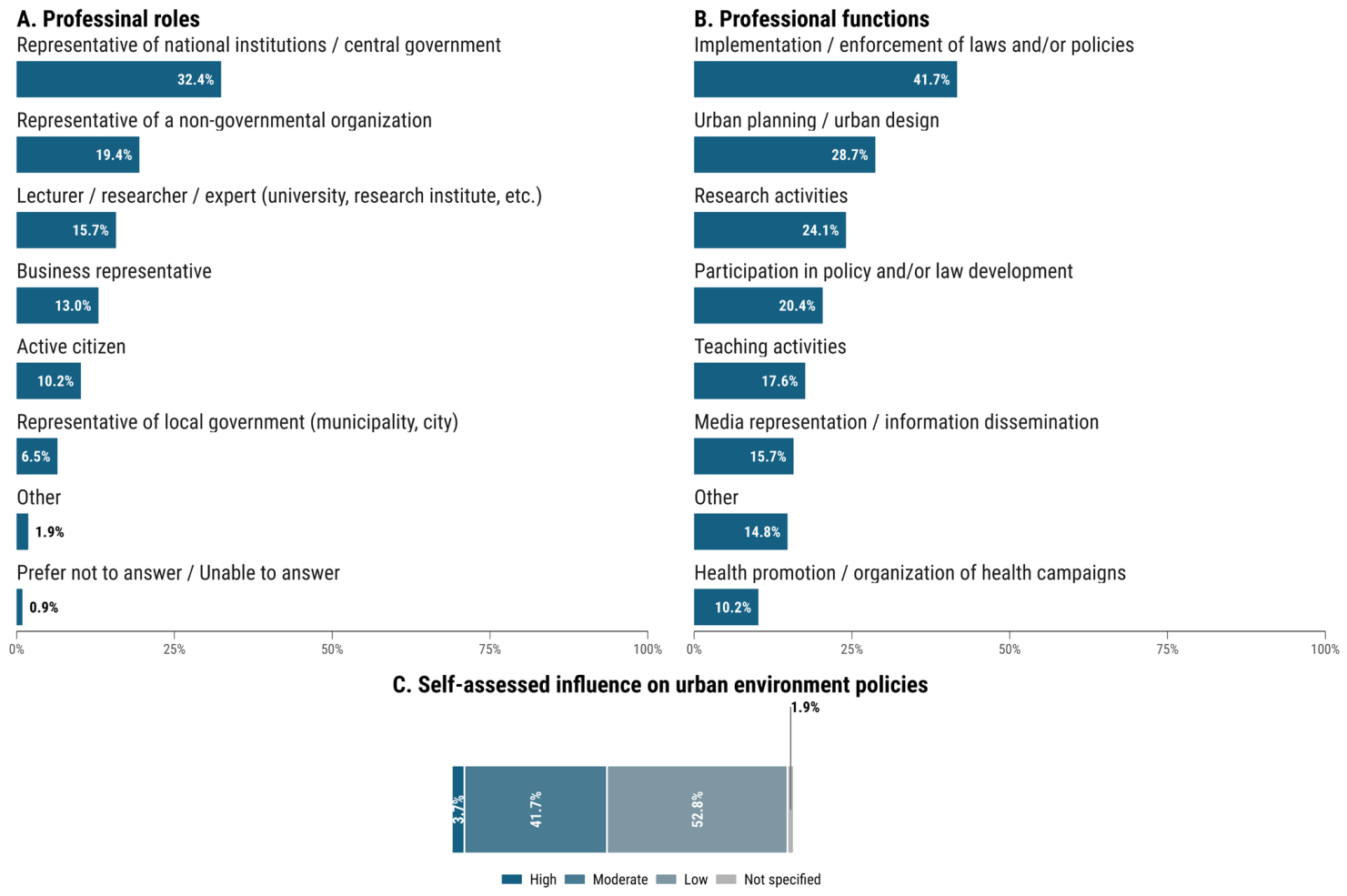
A total of 108 participants completed the survey. The largest share was held by representatives of national institutions/central government/national agency (n = 28, 25.9%), followed by those related to non-governmental organizations (NGOs) (n = 19, 17.6%) and representatives of the academic and scientific community (n = 18, 16.7%), and business representatives (n = 11, 10.2%) (see Figure 1). Local government representatives comprised 9.3% (n = 10), while active citizens represented 8.3% (n = 9). One in ten participants identified themselves as active citizens, despite some participants also indicating their affiliation with an organization. This could be indicative of individuals expressing opinions that differ from those of their organizations they represented or assuming various roles and/or organizations. Most participants preferred to remain anonymous and did not indicate their specific organization. The professional roles of the participants primarily entailed the implementation and oversight of policies at the regional and local levels.
More than half of the participants (56.5%, n = 61) reported having limited opportunities to influence urban health decisions or actions. Additionally, 41.7% (n = 45) of the participants rated their influence as “moderate,” while only 1.9% (n = 2) reported having “significant” influence. Regarding geographic scope of influence, about 66.0% (n = 61) indicated that they could exert influence in Sofia, while 25.0% (n = 23) and 24.3% (n = 22) were in the position to influence decisions for the development of Plovdiv and Burgas, respectively. Fewer stakeholders reported influence in Varna (9.7%, n = 9) and Ruse (7.6%, n = 7).

3.2. Expertise and Knowledge

Most participants reported having knowledge and experience in sustainable urban development at the regional/local (55.0%, n = 59) and national (26.0%, n = 28) levels. Participants indicated familiarity with more than one settlement. The highest percentage of individuals familiar with the urban environment was in Sofia (79.0%, n = 85), followed by Plovdiv (48.0%, n = 52) and Burgas (40.0%, n = 43). The percentages were significantly lower in Varna (30.0%, n = 32) and Ruse (13.0%, n = 14). Nine percent (n = 10) of participants indicated that they were familiar with the environment of another city (outside the ones listed).
Regarding the impact of urban environments on health, approximately 44.4% (n = 48) of the participants identified themselves as having expert knowledge, while 42.6% (n = 46) possessed only general knowledge. Eleven percent (n = 10) of participants had limited knowledge, and those who were not aware or did not respond accounted for less than 3.0% (n = 3). More than half of participants (57.0%, n = 61) reported being personally affected by urban environmental problems “a lot”. Additionally, 47.0% (n = 51) of the participants reported having previous experience with the utilization of scientific data in various contexts, including project and research activities, as well as in relation to indicators of public health, quality of life, urban planning and mobility, climatic effects, and other domains. These participants reported that they relied on both national and international sources of information. Some analyzed data on mobility, air quality, public spaces, green space access, traffic, pedestrian comfort, sustainability models, and Smart City initiatives, leveraging statistical, sociological, and health data.

3.3. Priority Problems

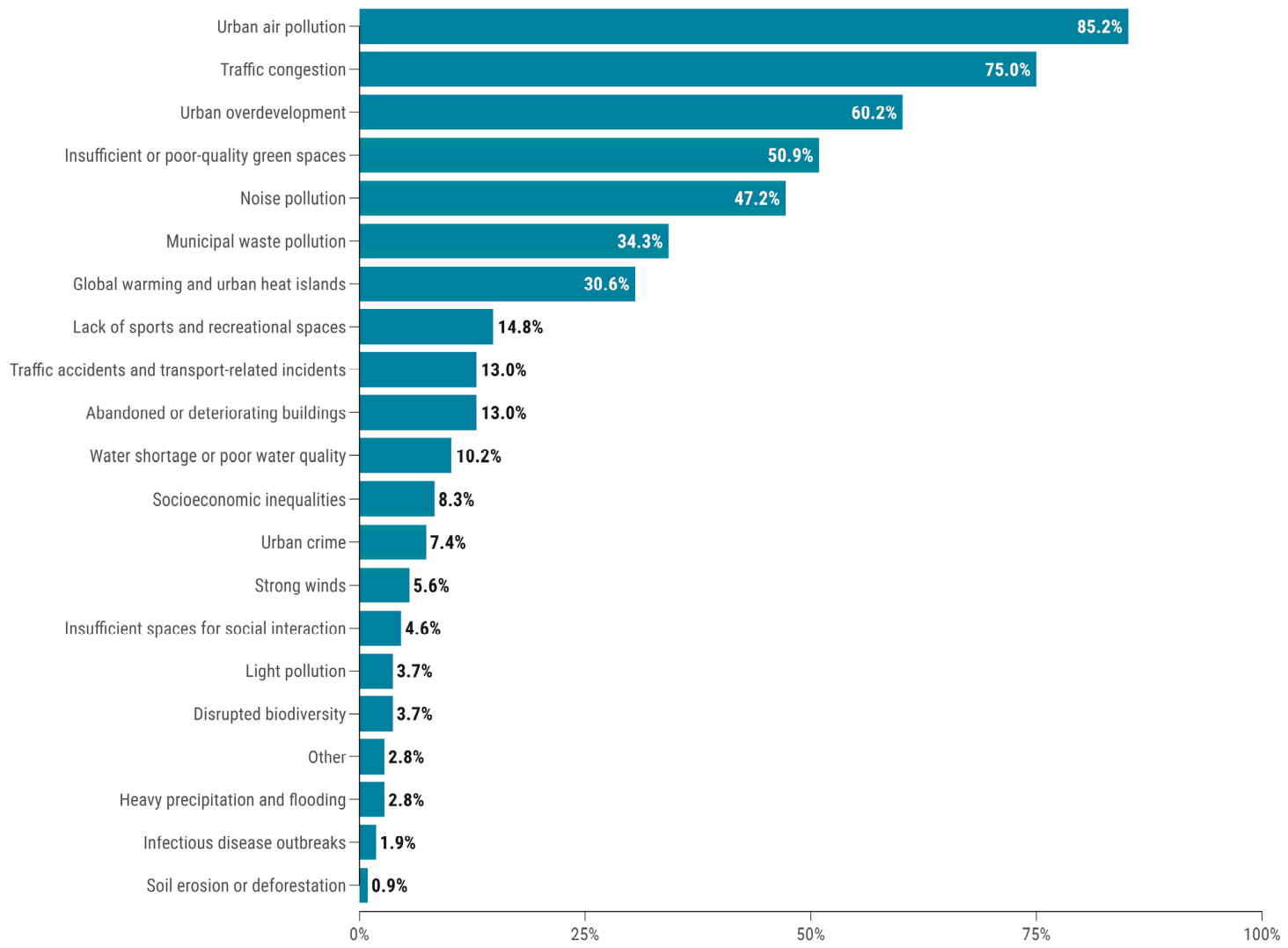
Participants were presented with a preselected list of urban environmental features and asked to select up to five with the most negative impact on the quality of life in the cities they knew (see Figure 2). The most frequently endorsed priority problems were heavy traffic (70.4%, n = 76), air pollution (68.5%, n = 74), and insufficient or poor-quality green spaces (63.0%, n = 68). Other commonly cited problems included global warming and urban heat island formation (49.1%, n = 53), noise pollution (38.0%, n = 41), and over-construction (23.1%, n = 25). Less frequently mentioned problems included crime (16.7%, n = 18), accidents and traffic incidents (15.7%, n = 17), and water quality issues (14.8%, n = 16). Problems related to light pollution, biodiversity, flooding, wind, waste management, shortages of recreation places, and social inequalities were each endorsed by fewer than 10 respondents.
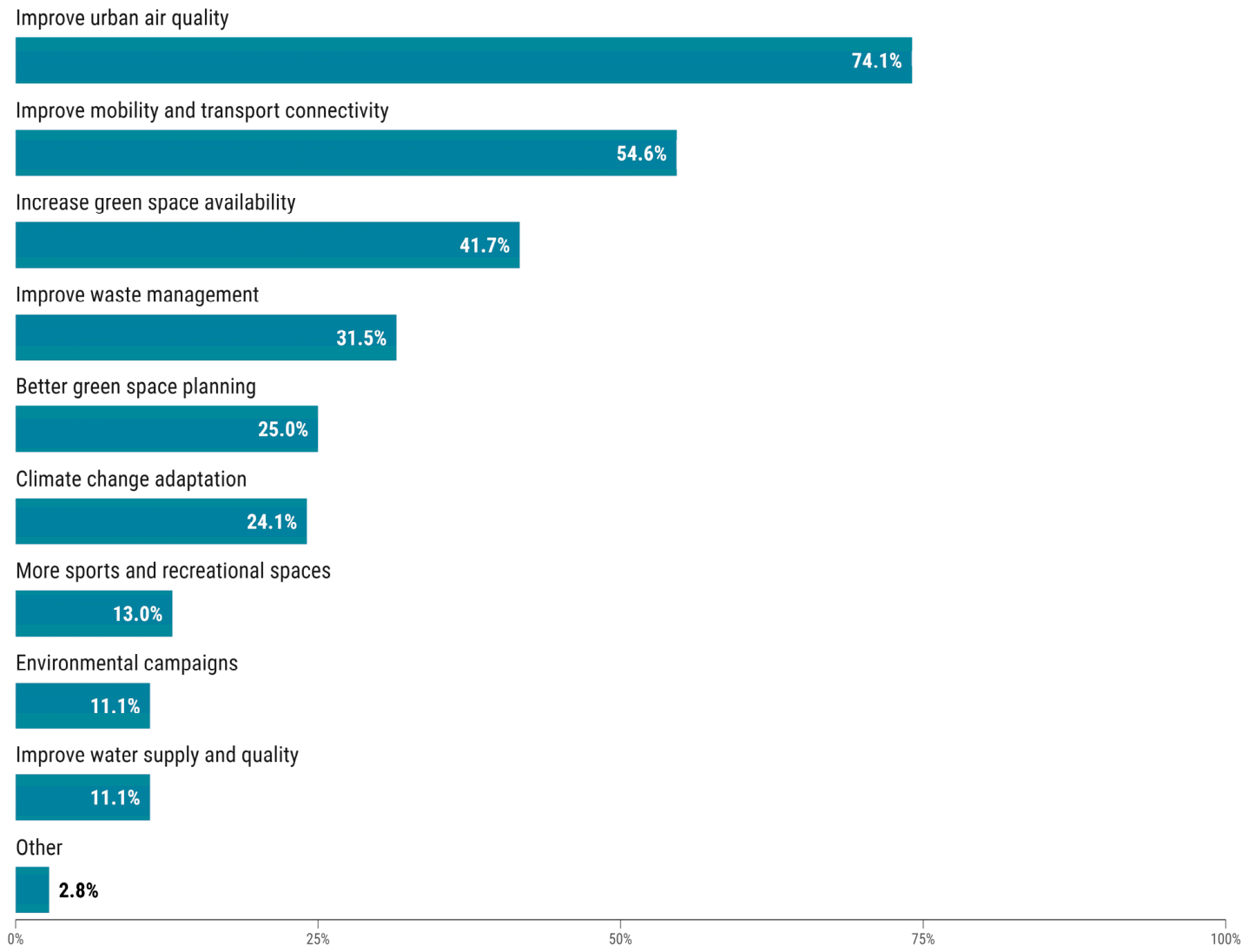
Priority policy directions for urban development largely mirrored stakeholder priorities regarding problems (Figure 3). Improving mobility (68.5%, n = 74) was the most frequently selected policy direction, closely followed by increasing green spaces or improving their quality (68.5%, n = 74) and improving air quality (65.7%, n = 71). Adapting to climate change was selected by 49.1% (n = 53) of respondents, creating places for sports and recreation by 26.9% (n = 29), and improving water supply or quality by 22.2% (n = 24). Waste management received somewhat less emphasis (19.4%, n = 21), while conducting ecological information and educational campaigns was selected by 14.8% (n = 16) of participants.
Bivariate examination of priority endorsement across stakeholder categories indicated heterogeneous patterns for most of the 21 priority items (see Table 1 and Table S1). After B-H adjustment, endorsement of urban socioeconomic inequalities differed significantly across stakeholder categories (Fisher’s exact p = 0.0001; BH-adjusted p = 0.002), although this finding rests on a small absolute number of endorsers (n = 9) and should be interpreted accordingly. Two further priorities reached nominal significance but did not survive correction: insufficient or poor-quality green spaces (raw p = 0.034; BH-adjusted p = 0.283) and the residual “other” priority (raw p = 0.041; BH-adjusted p = 0.283). For the most frequently endorsed problems: air pollution, traffic congestion, and overbuilding, endorsement did not vary significantly across stakeholder groups, suggesting broad convergence on these issues regardless of institutional affiliation. Neither ordinal self-assessed influence nor ordinal awareness level was significantly associated with endorsement of any of the six most frequently cited priorities after B-H adjustment (all BH-adjusted p ≥ 0.59), although the positive association between awareness level and endorsement of climate-related pressures approached nominal significance (OR per ordinal level = 1.69, 95% CI 0.93–3.27, raw p = 0.099).
Concordance between problem prioritization and endorsement of the corresponding policy direction was moderate for air pollution and air-quality improvement (κ = 0.50), insufficient green space and green-space quality (κ = 0.41), and climate-related pressures and climate change adaptation (κ = 0.42). In contrast, concordance was only slight for traffic congestion and improved mobility (κ = 0.11).
A descriptive sensitivity analysis stratified by city familiarity (Table S4) indicated that the five most frequently endorsed priorities: air pollution, traffic congestion, insufficient or poor-quality green spaces, urban overbuilding, and noise pollution, occupied the top tier in all five study cities. Spearman rank correlations between city-specific frequency orderings of all 21 priority items were uniformly high (ρ = 0.83–0.97), reflecting the degree to which the relative importance assigned to each problem was consistent across cities regardless of which subgroup of familiar respondents was considered. Because respondents could report familiarity with more than one city, subgroups overlap and the analysis should be interpreted as an internal consistency check rather than a city-stratified comparison.

3.4. Key Barriers and Expected Benefits

Participants identified local authorities (62.0%, n = 67), citizens (55.6%, n = 60), and central government institutions (52.8%, n = 57) as the actors whose engagement they perceived as most consequential for achieving healthy and sustainable urban development. Academic and scientific communities were named by 36.1% (n = 39) of respondents, while non-governmental organizations (23.1%, n = 25) and private companies (21.3%, n = 23) were named less frequently. Because the item did not specify a single dimension of effectiveness (cost, reach, political feasibility, or expected health impact), these proportions reflect overall perceptions of actor importance rather than judgments on any specific evaluative criterion.
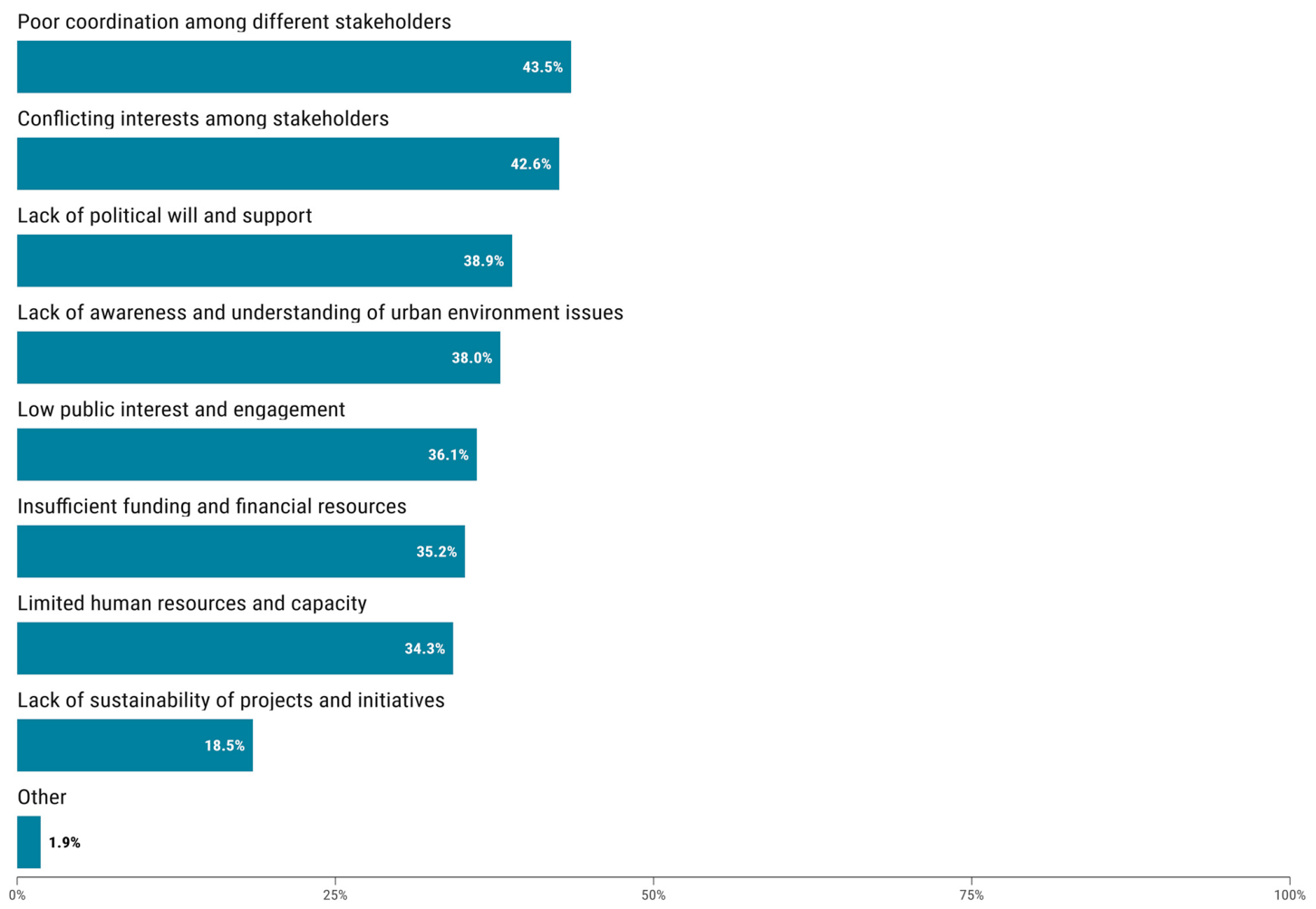
Perceived barriers to implementing programs and policies for healthy and sustainable urban development were clustered into several categories (see Figure 4). Poor coordination among stakeholders was identified by 43.5% (n = 47) of respondents, followed by conflicting stakeholder interests (42.6%, n = 46). Lack of political support was reported by 38.9% (n = 42), and insufficient awareness or understanding of urban environmental issues by 38.0% (n = 41). Low public interest and engagement was indicated by 36.1% (n = 39), insufficient funding and financial resources by 35.2% (n = 38), and human resource and capacity limitations by 34.3% (n = 37). Lack of sustainability of projects and initiatives was mentioned by 18.5% (n = 20), while other barriers were reported only rarely (1.9%, n = 2).
Open-ended responses regarding solutions to overcome barriers were grouped into thematic categories. The most frequently mentioned were legislative changes (n = 28, 26%), public engagement and awareness raising directed at the general population (n = 25, 23%), and the use of evidence-based approaches in decision-making (n = 18, 16%). Further suggestions concerned improved coordination among institutional actors (n = 12, 11%), funding mechanisms and incentives (n = 10, 9.3%), broader stakeholder engagement involving organizational and professional actors beyond the general public (n = 8, 7.4%), and training and capacity building (n = 6, 5.5%). Public engagement and stakeholder engagement are reported as separate categories because the respondents’ open-ended formulations consistently distinguished between activation of the general public on one hand and coordinated involvement of institutional, professional, and organizational actors on the other; the categories are conceptually nested but reflect different specific referents in the respondents’ reasoning.
Immediate benefits from addressing priority urban environmental problems were widely recognized. The most frequently cited expected benefits were cleaner air (62.0%, n = 67), improved public health indicators, defined in the questionnaire as standard population-level health measures including morbidity, mortality, and self-reported health status (Section 2.3)—(61.1%, n = 66), and increased citizen satisfaction (56.5%, n = 61).
Additional benefits identified by participants encompassed increased physical activity (41.7%, n = 45), reduced noise (35.2%, n = 38), better sleep quality (25.0%, n = 27), reduced social inequalities with increased social cohesion (21.3%, n = 23), improved socioeconomic status (17.6%, n = 19), and increased property values (15.7%, n = 17).
Stakeholders expressed needs for research evidence on green spaces (28.7%, n = 31), air quality (25.9%, n = 28), climate change (22.2%, n = 24), noise (16.7%, n = 18), traffic (13.9%, n = 15), light pollution (6.5%, n = 7), overbuilding (5.6%, n = 6), and regulations (4.6%, n = 5). Additional needs reported in open-ended questions and comments concerned architectural solutions for nature–city integration (10.2%, n = 11), natural processes as urban challenges (7.4%, n = 8), park air quality (5.6%, n = 6), the role of vegetation in temperature and air regulation (4.6%, n = 5), heat-island mitigation (3.7%, n = 4), the social impacts of green zones (2.8%, n = 3), and the economic benefits of sustainable design (1.9%, n = 2). Percentages are computed against the total sample (n = 108).
Differences in barrier endorsement across stakeholder categories were assessed using Fisher’s exact tests. Lack of political support (raw p = 0.018) and the residual “other” barrier category (raw p = 0.013) reached nominal significance, but neither survived B-H adjustment (BH-adjusted p = 0.083 for both). Endorsement of the remaining barriers, including poor coordination, conflicting interests, insufficient funding, and limited human resources, did not differ significantly across stakeholder groups, indicating broad convergence on the perceived structural impediments to healthy and sustainable urban development (see Tables S2 and S3 for full distributions).

4. Discussion

4.1. Key Findings

The survey explored the profiles and perceptions of a sample of Bulgarian stakeholders regarding urban environmental health problems and their impacts. Participants were purposively included based on their professional background, institutional affiliation, expertise, and level of engagement with the topic. The respondent group was composed primarily of representatives of national-level administrations responsible for regulation and legal oversight, together with members of non-governmental organizations and academic institutions. By contrast, stakeholders directly involved in the practical implementation of urban planning were less visible in the final respondent pool. Representatives of municipal authorities and private-sector actors engaged in urban development were comparatively limited, indicating a lower degree of participation from actors operating closest to the operational and investment levels of urban policy implementation.
Central to stakeholder analysis are the concepts of influence and power, which are commonly used as criteria for prioritization [58]. These concepts are interpreted in terms of the ability to mobilize or withdraw social, political, economic, and other resources or support. Few survey participants considered their influence over urban policies and actions to be high, with only a few of them reporting significant influence capacity. Perceived knowledge and experience in sustainable urban development and the health impacts of urban environments were unevenly distributed across spatial scales and stakeholder groups, with more than half the sample reporting expert or general knowledge of environmental health impacts.
Recent applications of the salience framework in health priority-setting have shown that stakeholder salience is not a stable attribute but varies with the type of decision, the nature of the health issue, and the actor who tables it, with politicians frequently emerging as the most salient stakeholders even where the policy domain requires technical or community input [59]. The present finding that self-assessed influence and awareness were not robustly associated with priority endorsement is consistent with the perspective that priorities appear to reflect institutional positioning and contextual mandate rather than personal expertise or perceived capacity to influence outcomes.
Among other notable insights, stakeholders perceived air pollution and traffic, the imbalance between built-up and greenspace, and climate-related pressures as leading environmental quality problems. These perceptions largely align with the scientific consensus regarding their health implications. Air pollution has been identified as the most pressing environmental health concern, as supported by scientific evidence [60,61]. Noise pollution, by contrast, occupied a comparatively lower position in the stakeholder ranking, notwithstanding the substantial body of evidence linking environmental noise exposure to cardiovascular morbidity, sleep disturbance, and impaired quality of life [31]. The endorsement rate is non-trivial in absolute terms, but the gap between the empirical health burden of noise and its ranking relative to other priorities suggests that this exposure remains comparatively underrecognized as an actionable urban environmental health problem in the Bulgarian context. Social aspects of land use distribution and environmental injustices related to exposure to urban stressors were less frequently mentioned, even though they critically affect vulnerable populations and contribute to widening social inequalities, thereby undermining quality of life [26]. The pattern of expected benefits endorsed by stakeholders reflects the multidimensional nature of urban environmental health gains, spanning physical health, psychosocial well-being, and economic considerations. The prominence of cleaner air, improved public health indicators, and citizen satisfaction is consistent with the parallel prominence of air pollution and traffic among the perceived priority problems. On the other hand, the lower endorsement of co-benefits such as reduced social inequality and improved socioeconomic status mirrors the comparatively limited recognition of environmental justice as a priority concern. Even lower priority was ascribed on factors such as overcrowding, crime rates, and urban aesthetics, despite scientific evidence indicating their role as major determinants of outdoor physical activity and mental well-being [62,63].
Several plausible mechanisms may account for this divergence between stakeholder priorities and the established health-evidence base. First, the respondent pool overrepresented national-level institutional and academic actors and underrepresented municipal authorities and private-sector implementers (Section 4.2). The underemphasized exposures, environmental injustice, overcrowding, crime, and urban aesthetics, operate most visibly at the neighbourhood scale and may be more salient to actors closer to operational implementation than to those engaged primarily with regulatory and advocacy functions. Second, the dominant Bulgarian urban-policy vocabulary is organized around technical-regulatory categories (air quality, traffic, land use) for which monitoring data and EU-level reporting obligations exist, while the social and perceptual dimensions of the urban environment have less institutional traction and are not embedded in standard administrative reporting. Third, exposures perceived as readily modifiable through familiar policy levers, air quality through emissions regulation, traffic through mobility planning, green space through urban greening, may be more easily nominated as priorities than diffuse and structurally embedded exposures such as socioeconomic inequality or urban aesthetics, for which the policy levers are less obvious and the responsibility is more distributed. Fourth, the disciplinary distance between the environmental health evidence base and the operational training of urban professionals in Bulgaria may translate into asymmetric awareness, with classical pollution exposures more familiar than the social and perceptual determinants that have entered the international health literature more recently. These are only hypothetical explanations, since the present data do not permit their direct testing. The planned qualitative second phase will probe stakeholder reasoning about these underemphasized exposures explicitly. These four mechanisms map onto themes recurrent in the implementation-science and the science-policy interface literature on urban environmental health, where the absence of suitable boundary objects between scientific evidence and operational planning instruments, weak knowledge co-production processes, and asymmetric institutional capacity have been identified as the principal barriers to translating environmental health evidence into local policy [40,64].
Finally, poor coordination among stakeholders, inconsistency of actions, conflicting interests, lack of subject matter expertise, and limited incentives and funding were identified as the main barriers to implementing programmes and policies for healthy and sustainable urban development. This pattern closely mirrors findings from implementation-research applications of the Consolidated Framework for Implementation Research to local-government policy-making for healthy environments. In a recent in-depth case study of a high-performing Australian municipality, sustained leadership, partnerships across institutional levels, and access to scientific evidence were identified as the central facilitators, while competing stakeholder interests and prohibitive higher-level policy were the dominant impeders [65]. The convergence of barrier patterns across high-, middle- and lower-resource contexts suggests that the structural impediments observed in Bulgaria are not idiosyncratic but reflect generic features of cross-sectoral health-policy implementation.
Bivariate inferential analyses indicated that the most prominent priority problems and barriers were endorsed at similar rates across stakeholder categories, supporting the interpretation of broad convergence on the principal urban environmental concerns. The clearest exception concerned urban socioeconomic inequalities, which were endorsed differentially across stakeholder groups, although the small number of endorsers warrants caution in interpretation. The notably low concordance between traffic congestion as a perceived problem and improved mobility as a preferred policy is informative as it indicates that stakeholders converge in identifying traffic as a major urban issue but differ in the policy levers they prefer for addressing it. Self-assessed influence and awareness level were not clearly associated with priority endorsement, suggesting that perceived priorities reflect institutional and contextual position rather than self-rated expertise or capacity to influence.
Many participants reported having knowledge and experience with scientific data use, with almost half having previously worked with scientific evidence. Nevertheless, the integration of scientific outputs into everyday urban planning practice varies considerably. Among notable examples in Bulgaria, the National Institute of Meteorology and Hydrology (NIMH) provides data for modelling the spatial distribution of air pollution and generating short-term air-quality forecasts, which inform municipal preventive measures aimed at reducing population exposure and traffic-related pollution. NIMH also recognizes healthcare practitioners as key stakeholders, consulting them regarding data needs for forecasting pollutants such as pollen and sand dust [66]. Simulation models are also employed by major municipalities to predict air-pollutant dispersion and develop strategies to improve air quality [67]. Another example of research translation is the collaboration between The Big Data for Smart Society Institute (GATE) and Sofia Municipality, which integrates digital-twin modelling and forecasting to examine the effects of air pollution, weather and climate, and neighbourhood walkability on citizens [68].
However, these initiatives do not draw on or involve a comprehensive HIA. In Bulgaria, public health consequences of environmental exposures are generally evaluated through health risk assessment rather than quantitative HIA. Health risk assessment emphasizes tolerable exposure levels rather than estimating population-level health outcomes, does not address combined exposures that may respond differently to interventions, and focuses primarily on adverse effects without incorporating potential benefits, quality of life, or trade-offs between them [69,70].
Although some form of HIA is legally required for investment proposals, governmental and municipal strategies, and implementation plans aimed at improving environmental quality (e.g., air quality, climate adaptation, sustainable mobility), it is typically conducted qualitatively [71]. Expert assessments based on existing scientific evidence and consensus are used to infer the direction of change for specific health endpoints [67,68,72]. While the environmental component (e.g., reductions in air pollution) is often modelled quantitatively [71,73,74,75,76], the downstream health impact is not. Consequently, health arguments derived from qualitative HIA remain non-specific and provide limited support for cost-benefit analyses, detailed resource allocation, or projections of healthcare system burden [77]. Progress monitoring therefore relies largely on environmental indicators, such as air-quality monitoring data, rather than measurable public-health outcomes.
Evidence from urban interventions indicates that simulation modelling and quantitative HIA are important for guiding urban design decisions and communicating expected benefits to decision-makers. The exemplar experience with the Superblock urban design model and “green axis” pedestrianization in Barcelona show that small-scale evaluations may underestimate impacts, whereas city-wide modelling can reveal substantial health and environmental gains [78]. Furthermore, research suggests that isolated measures are unlikely to be effective. Successful implementation requires coordinated packages of interventions, including traffic reduction, low-emission zones, cycling infrastructure, improvements in public transport, and speed management. Political agendas and change in priorities, however, can affect progress that has already gained momentum [79]. A recent comparative analysis of urban heat policy across Japan, Germany, the United States, Hong Kong, and Singapore reaches a structurally similar conclusion: the gap between scientific understanding of urban environmental risks and actionable urban-design responses is closed not by isolated instruments but by iterative co-production, simple and planner-friendly decision tools, and institutionally embedded science-policy interfaces [64]. Many of the enabling and impeding conditions identified in that analysis are recognisable in the Bulgarian context.
Taken together, the present findings echo the conclusion of international comparative work on local-government environmental health policy: the binding constraint is rarely the absence of scientific evidence but the absence of institutional structures that translate evidence into the operational vocabulary of municipal authorities and private-sector implementers [64,80]. Stakeholder opinions in the present sample point in the same direction, identifying suboptimal coordination, competing interests, and limited capacity rather than knowledge deficits as the dominant impediments. Developing evidence-translation tools and engagement mechanisms tailored to these actors is therefore not an addendum to the project’s outputs but a central design requirement.

4.2. Limitations

Several limitations should be considered when interpreting these findings. The most consequential concerns sampling and representation. Participants were selected purposively through a structured, expert-led process that prioritized influence, expertise, and engagement with urban environmental health to inform platform development rather than to achieve representativeness. The non-probability sample limits external validity and precludes generalization to the full stakeholder population, and it does not ensure balanced coverage across stakeholder categories. To mitigate these constraints, the selection procedure described in Section 2.1 incorporated four explicit safeguards. First, candidate stakeholders were ranked against four operationalized inclusion criteria: demonstrated awareness of urban environmental health issues, capacity to influence policy and decision-making, organisational position within institutions with direct or indirect responsibility for urban planning, public health, or environmental policy, and documented engagement with sustainable urban development initiatives, with retention conditional on meeting at least two of the four. Second, ranking decisions were reached through iterative consensus discussions within a multidisciplinary research team spanning public health, environmental epidemiology, urban planning, social sciences, and economics, reducing reliance on the judgement of any single discipline. Third, candidates were identified through systematic consultation of publicly accessible institutional directories and stakeholder lists from comparable Bulgarian and international urban health projects, reducing reliance on personal contacts alone. Fourth, the candidate list explicitly targeted representation across national, regional, and local levels and across the institutional, academic, non-governmental, business, and citizen sectors. These measures were intended to broaden the candidate pool and to make the selection process replicable, but they cannot eliminate selection bias entirely, particularly the systematic non-response observed among municipal authorities and private-sector actors discussed below.
Stakeholders central to implementation were notably underrepresented. Municipal authorities, with direct responsibility for urban planning decisions, land-use regulation, and environmental interventions, participated less frequently than expected, suggesting systematic non-response potentially related to institutional culture, limited administrative capacity, or low perceived relevance of the research to immediate operational priorities; private-sector actors involved in urban development were also only marginally represented despite their substantial influence on the built environment. Conversely, national-level institutions and non-governmental organizations were comparatively more represented, which may have emphasized regulatory and advocacy perspectives over practical municipal and market constraints, and may have influenced the prioritization patterns observed in the aggregate findings. A large proportion of respondents chose anonymity, and the survey could have been forwarded beyond the initial sampling frame; while anonymity likely facilitated candid responses, the absence of demographic, political affiliation and organizational identifiers prevented stratified analyses by institutional type, seniority, or professional background and limited the assessment of differential response patterns.
Other limitations relate to the survey instrument itself. No formal psychometric validation (test-retest reliability, internal consistency of multi-item constructs, or factor-analytic confirmation of latent structure) was conducted, although the questionnaire underwent expert review for face validity prior to deployment, the absence of empirical validation limits confidence in the precision of individual item responses. Several substantive items, including the question on which institutional actors are most consequential for healthy and sustainable urban development, did not specify a single dimension of effectiveness (cost, political feasibility, reach, or health impact). This permitted breadth of interpretation but limited the precision with which stakeholder views on effectiveness can be characterized. Future instruments would benefit from disaggregated items eliciting perceived effectiveness along each dimension separately. The response format used for the priority, policy, and barrier items asked respondents to select up to a fixed maximum of options from each list (five for priorities, with analogous caps for the other domains) without ranking the selected items in order of importance. This format reduced respondent burden and maintained comparability with prior stakeholder surveys [52,53], but precluded analyses such as Borda counts, rank correlation across stakeholder groups, and weighted prioritization indices that would have provided a finer-grained characterization of stakeholder preferences.
The analytical scope of the present manuscript is bounded by the absence of complementary qualitative data within this phase, which precludes within-phase triangulation of the quantitative findings. This limitation is structural to the sequential mixed-methods design and is partially mitigated by the planned qualitative second phase, in which key informant interviews with a purposively selected subsample will triangulate the survey results, probe substantive reasoning that single-item indicators cannot capture, and elicit ranked preferences across the principal priority problems, policy directions, and barriers. Formal data-reduction techniques such as principal component analysis were considered but not applied, as classical PCA is inappropriate for binary multiple-response items and the sample size (n = 108) is below the conventional case-to-variable ratio for stable component extraction with the present number of items. The substantive interpretation of the findings does not depend on dimensional reduction, since the priority, policy, and barrier items were designed as a list of distinct policy-relevant categories rather than as reflective indicators of underlying latent constructs.
The cross-sectional design and reliance on self-reported perceptions restrict causal interpretation. Responses reflect priorities at a specific time and may be influenced by ongoing policy debates or contextual factors. Stated influence does not necessarily correspond to actual decision-making power, and expressed priorities may differ from behaviour in real policy processes. Longitudinal or mixed-methods approaches incorporating repeated measurements, observational data, and qualitative validation are needed to assess the stability of stakeholder views and their translation into policy action.
The bivariate inferential analyses should be interpreted in light of the limited sample size, the non-probability stakeholder selection procedure, and the resulting sparse cells in cross-tabulations. Although Fisher’s exact tests with simulated p-values and B-H adjustment for multiple comparisons were applied to mitigate these issues, statistical power for detecting associations of small to moderate magnitude was limited, and the absence of statistically significant associations should not be interpreted as evidence of no association. Conversely, isolated significant findings, particularly those involving small numbers of endorsers, should be regarded as hypothesis-generating and require confirmation in larger samples.

4.3. Implications for Future Stakeholder Engagement

The findings of this survey carry implications for the design of subsequent stakeholder engagement within the project and for similar studies in comparable settings. The observed underrepresentation of municipal authorities and private-sector actors, combined with broad cross-stakeholder convergence on the most prominent priorities and barriers, suggests that future engagement formats should be structured around the operational and investment cycles of implementation actors rather than around general consultation, consistent with evidence that participation is most effective when tailored to the institutional context and role of each actor type [43,81]. The decoupling between perceived priority problems and the corresponding policy levers, particularly in the domain of mobility, indicates that engagement should explicitly elicit stakeholder reasoning about policy mechanisms rather than only the priority status of problems. The analytical limitations identified in Section 4.2, absence of ranked-preference elicitation, undifferentiated framing of effectiveness, and the inability to stratify by city, point to specific design improvements for the planned qualitative second phase (Section 2.1) and for any subsequent quantitative survey, including the addition of pretested ranked-preference items, disaggregated effectiveness items, and city-specific elicitation. More generally, the study illustrates the value of complementing quantitative stakeholder mapping with qualitative validation in settings where the stakeholder population is heterogeneous, dispersed, and partially engaged with the topic, and where the policy infrastructure for evidence-informed urban environmental health remains under development.

5. Conclusions

Stakeholders consistently identified air pollution, traffic congestion, overdevelopment, and lack of green space as the main urban environmental health challenges in Bulgaria’s largest cities, alongside barriers such as weak coordination, conflicting interests, and limited political and financial support. Broad agreement across stakeholder groups suggests a shared understanding that could enable coordinated action. However, lower prioritisation of issues like noise, environmental injustice, and social determinants indicates gaps in awareness that require targeted communication and capacity-building.
Concordance analysis shows that recognising problems does not always translate into support for corresponding policy solutions. In particular, traffic congestion is widely acknowledged, but not strongly linked to mobility policy measures, suggesting a need to expand policy framing toward demand-side interventions. In contrast, stronger alignment for air quality, green space, and climate adaptation suggests more favourable conditions for policy action in these areas.
At the city level, three implications emerge: strengthening Health Impact Assessment capacity with quantitative methods; improving engagement with key implementation actors, especially municipalities and the private sector; and developing integrated decision-support tools that link evidence to concrete policy instruments. Together, these steps can enhance the practical impact of urban environmental health policies in Bulgaria.

Supplementary Materials

The following supporting information can be downloaded at: https://www.mdpi.com/article/10.3390/urbansci10060312/s1, Supplementary File S1: Table S1: Endorsement of priority urban environmental problems by stakeholder category; Table S2: Preferred policy directions by stakeholder category; Table S3: Perceived barriers to healthy and sustainable urban development by stakeholder category; Table S4: Spearman rank correlation of priority orderings across cities, Supplementary File S2: R script, Supplementary File S3: Questionary form in Bulgarian and English.

Author Contributions

Conceptualization: A.M.D. and D.D.; Methodology: A.M.D., D.D. and A.B.; Investigation: A.M.D., D.D., K.K. and A.B.; Data curation: A.M.D., D.D., K.K. and A.B.; Formal analysis: D.D., K.K. and A.M.D.; Visualization: K.K.; Resources: A.M.D., A.B. and D.D.; Validation: A.M.D., D.D., M.H., I.M. and M.J.N.; Supervision: A.M.D., D.D. and M.J.N.; Project administration: A.M.D.; Funding acquisition: A.M.D.; Writing—original draft: A.M.D., D.D., K.K. and A.B.; Writing—review and editing: K.K., A.M.D., A.B., D.D., M.H., I.M. and M.J.N. All authors have read and agreed to the published version of the manuscript.

Funding

The research leading to this work and the authors’ time on this publication were funded by the “Strategic research and innovation program for the development of Medical University—Plovdiv” No. BG-RRP-2.004-0007-C01, Establishment of a network of research higher schools, National plan for recovery and resilience, financed by the European Union—NextGenerationEU. All authors are affiliated with project No. BG-RRP-2.004-0007-C01. The funder did not influence the study design, data collection and analysis, interpretation, or article drafting. All authors had data access.

Institutional Review Board Statement

The study was conducted in accordance with the Declaration of Helsinki, and approved by the Scientific Research Ethics Commission of Medical University of Plovdiv (Opinion No. P-KHE-12/14.04.2025; Protocol No. 2/27.02.2025; approved on 10 March 2025).

Informed Consent Statement

Informed consent was obtained from all subjects involved in the study.

Data Availability Statement

The data presented in this study are available upon reasonable request from the corresponding author due to privacy and ethical restrictions. The survey data contain potentially identifying information about stakeholder organizations and individual participants, and access is therefore restricted to protect participant confidentiality.

Acknowledgments

During the preparation of this manuscript, the authors used ChatGPT (OpenAI, GPT-5 series) and QuillBot for the purposes of language editing, improving clarity, coherence, readability, and overall flow of the text. The use of these tools was limited to language enhancement and did not involve the generation, manipulation, or interpretation of research data, analyses, results, or conclusions. The authors have reviewed and edited the output and take full responsibility for the content of this publication.

Conflicts of Interest

The authors declare that they have no known competing financial interests or personal relationships that could have appeared to influence the work reported in this paper.

Abbreviations

The following abbreviations are used in this manuscript:
GATEBig Data for Smart Society Institute
GDPRGeneral Data Protection Regulation
GISGeographic Information System
HIAHealth Impact Assessment
NGONon-Governmental Organization
NIMHNational Institute of Meteorology and Hydrology
WHOWorld Health Organization

References

  1. Bird, C. The built environment and health. Perspect. Public Health 2012, 132, 105. [Google Scholar] [CrossRef] [PubMed]
  2. Montana, F.; Mueller, N.; Barboza, E.P.; Khomenko, S.; Iungman, T.; Cirach, M.; Daher, C.; Chakraborty, T.; de Hoogh, K.; Battiston, A.; et al. Building a healthy urban design index (HUDI): How to promote health and sustainability in European cities. Lancet Planet. Health 2025, 9, e511–e526. [Google Scholar] [CrossRef] [PubMed]
  3. Khomenko, S.; Cirach, M.; Barrera-Gómez, J.; Pereira-Barboza, E.; Iungman, T.; Mueller, N.; Foraster, M.; Tonne, C.; Thondoo, M.; Jephcote, C.; et al. Impact of road traffic noise on annoyance and preventable mortality in european cities: A health impact assessment. Environ. Int. 2022, 162, 107160. [Google Scholar] [CrossRef]
  4. Münzel, T.; Sørensen, M.; Lelieveld, J.; Hahad, O.; Al-Kindi, S.; Nieuwenhuijsen, M.; Giles-Corti, B.; Daiber, A.; Rajagopalan, S. Heart healthy cities: Genetics loads the gun but the environment pulls the trigger. Eur. Heart J. 2021, 42, 2422–2438. [Google Scholar] [CrossRef] [PubMed]
  5. Barton, H. Land use planning and health and well-being. Land Use Policy 2009, 26, S115–S123. [Google Scholar] [CrossRef]
  6. Rydin, Y.; Bleahu, A.; Davies, M.; Dávila, J.D.; Friel, S.; De Grandis, G.; Groce, N.; Hallal, P.C.; Hamilton, I.; Howden-Chapman, P.; et al. Shaping cities for health: Complexity and the planning of urban environments in the 21st century. Lancet 2012, 379, 2079–2108. [Google Scholar] [CrossRef]
  7. Kobal Grum, D. Interactions between human behaviour and the built environment in terms of facility management. Facilities 2018, 36, 2–12. [Google Scholar] [CrossRef]
  8. Altschuler, A.; Somkin, C.P.; Adler, N.E. Local services and amenities, neighborhood social capital, and health. Soc. Sci. Med. 2004, 59, 1219–1229. [Google Scholar] [CrossRef]
  9. Liu, Y.; Wang, R.; Xiao, Y.; Huang, B.; Chen, H.; Li, Z. Exploring the linkage between greenness exposure and depression among chinese people: Mediating roles of physical activity, stress and social cohesion and moderating role of urbanicity. Health Place 2019, 58, 102168. [Google Scholar] [CrossRef] [PubMed]
  10. Nieuwenhuijsen, M.J. Urban and transport planning pathways to carbon neutral, liveable and healthy cities; a review of the current evidence. Environ. Int. 2020, 140, 105661. [Google Scholar] [CrossRef]
  11. Rajagopalan, S.; Vergara-Martel, A.; Zhong, J.; Khraishah, H.; Kosiborod, M.; Neeland, I.J.; Dazard, J.-E.; Chen, Z.; Munzel, T.; Brook, R.D.; et al. The urban environment and cardiometabolic health. Circulation 2024, 149, 1298–1314. [Google Scholar] [CrossRef]
  12. Nieuwenhuijsen, M.J. New urban models for more sustainable, liveable and healthier cities post covid19; reducing air pollution, noise and heat island effects and increasing green space and physical activity. Environ. Int. 2021, 157, 106850. [Google Scholar] [CrossRef]
  13. Arriazu-Ramos, A.; Santamaría, J.M.; Monge-Barrio, A.; Bes-Rastrollo, M.; Gabriel, S.G.; Frias, N.B.; Sánchez-Ostiz, A. Health impacts of urban environmental parameters: A review of air pollution, heat, noise, green spaces and mobility. Sustainability 2025, 17, 4336. [Google Scholar] [CrossRef]
  14. Markevych, I.; Schoierer, J.; Hartig, T.; Chudnovsky, A.; Hystad, P.; Dzhambov, A.M.; de Vries, S.; Triguero-Mas, M.; Brauer, M.; Nieuwenhuijsen, M.J.; et al. Exploring pathways linking greenspace to health: Theoretical and methodological guidance. Environ. Res. 2017, 158, 301–317. [Google Scholar] [CrossRef]
  15. Marselle, M.R.; Hartig, T.; Cox, D.T.; de Bell, S.; Knapp, S.; Lindley, S.; Triguero-Mas, M.; Böhning-Gaese, K.; Braubach, M.; Cook, P.A.; et al. Pathways linking biodiversity to human health: A conceptual framework. Environ. Int. 2021, 150, 106420. [Google Scholar] [CrossRef] [PubMed]
  16. Münzel, T.; Schmidt, F.P.; Steven, S.; Herzog, J.; Daiber, A.; Sørensen, M. Environmental noise and the cardiovascular system. J. Am. Coll. Cardiol. 2018, 71, 688–697. [Google Scholar] [CrossRef]
  17. Landrigan, P.J.; Fuller, R.; Acosta, N.J.R.; Adeyi, O.; Arnold, R.; Basu, N.; Baldé, A.B.; Bertollini, R.; Bose-O’Reilly, S.; Boufford, J.I.; et al. The Lancet commission on pollution and health. Lancet 2018, 391, 462–512. [Google Scholar] [CrossRef] [PubMed]
  18. Thurston, G.D.; Kipen, H.; Annesi-Maesano, I.; Balmes, J.; Brook, R.D.; Cromar, K.; De Matteis, S.; Forastiere, F.; Forsberg, B.; Frampton, M.W.; et al. A joint ERS/ATS policy statement: What constitutes an adverse health effect of air pollution? An analytical framework. Eur. Respir. J. 2016, 49, 1600419. [Google Scholar] [CrossRef] [PubMed]
  19. European Environment Agency. Environmental Noise in Europe: 2025; Publications Office: Luxembourg, 2025. Available online: https://www.eea.europa.eu/en/analysis/publications/environmental-noise-in-europe-2025 (accessed on 23 March 2026).
  20. Berke, E.M.; Vernez-Moudon, A. Built environment change: A framework to support health-enhancing behaviour through environmental policy and health research. J. Epidemiol. Community Health 2014, 68, 586–590. [Google Scholar] [CrossRef]
  21. Racine, A.N.; Van Hoye, A.; Boyd, A.; Jackson, F.; Garbarino, J.-M.; Massiera, B.; Kahlmeier, S.; Sandu, P.; Vuillemin, A. A scoping review of published research on local government policies promoting health-enhancing physical activity. Int. J. Sport Policy Polit. 2020, 12, 747–763. [Google Scholar] [CrossRef]
  22. Ramirez-Rubio, O.; Daher, C.; Fanjul, G.; Gascon, M.; Mueller, N.; Pajín, L.; Plasencia, A.; Rojas-Rueda, D.; Thondoo, M.; Nieuwenhuijsen, M.J. Urban health: An example of a “health in all policies” approach in the context of SDGs implementation. Glob. Health 2019, 15, 87. [Google Scholar] [CrossRef]
  23. Barton, H.; Grant, M. Urban planning for healthy cities. J. Urban Health 2013, 90, 129–141. [Google Scholar] [CrossRef]
  24. Tsenkova, S. Urban planning and informal cities in southeast Europe. J. Archit. Plan. Res. 2012, 29, 292–305. [Google Scholar]
  25. Barton, H.; Mitcham, C.; Tsourou, C. Healthy Urban Planning in Practice: Experience of European Cities: Report of the WHO City Action Group on Healthy Urban Planning; World Health Organization, Regional Office for Europe: Copenhagen, Denmark, 2003. [Google Scholar]
  26. Khomenko, S.; Burov, A.; Dzhambov, A.M.; de Hoogh, K.; Helbich, M.; Mijling, B.; Hlebarov, I.; Popov, I.; Dimitrova, D.; Dimitrova, R.; et al. Health burden and inequities of urban environmental stressors in Sofia, Bulgaria. Environ. Res. 2025, 279, 121782. [Google Scholar] [CrossRef]
  27. Iungman, T.; Khomenko, S.; Barboza, E.P.; Cirach, M.; Gonçalves, K.; Petrone, P.; Erbertseder, T.; Taubenböck, H.; Chakraborty, T.; Nieuwenhuijsen, M. The impact of urban configuration types on urban heat islands, air pollution, CO2 emissions, and mortality in europe: A data science approach. Lancet Planet. Health 2024, 8, e489–e505. [Google Scholar] [CrossRef] [PubMed]
  28. Burov, A.; Madzhirski, V.; Yolova, M.; Mutafchiiska, I. The implementation of an “urban standard” for monitoring and evaluation of the urban environment. In Annual of the University of Architecture, Civil Engineering and Geodesy Sofia; 2023; Volume 56. Available online: https://annual.uacg.bg/article/2023_56_2_13 (accessed on 23 March 2026).
  29. Dzhambov, A.M.; Dimitrova, D.D.; Burov, A.P.; Nieuwenhuijsen, M.J.; Markevych, I.; Helbich, M. Epidemiologiya na Zamarsyavaneto na Vazduha i Zdraveto [Epidemiology of Air Pollution and Health]; Avto Print: Plovdiv, Bulgaria, 2025. [Google Scholar]
  30. Andersen, Z.J.; Badyda, A.; Tzivian, L.; Dzhambov, A.M.; Paunovic, K.; Savic, S.; Jacquemin, B.; Dragic, N. Air pollution inequalities in Europe: A deeper understating of challenges in eastern Europe and pathways forward towards closing the gap between east and west. Environ. Epidemiol. 2025, 9, e383. [Google Scholar] [CrossRef]
  31. Paunović, K.; Ristovska, G.; Argalasova, L.; Dzhambov, A.M.; Andersen, Z.J. How are eastern European countries addressing environmental noise issues? A post-conference expert discussion. Noise Health 2025, 27, 201–202. [Google Scholar] [CrossRef] [PubMed]
  32. Helbich, M.; Hagenauer, J.; Burov, A.; Dzhambov, A.M. Traffic noise assessment in urban Bulgaria using explainable machine learning. Sustain. Cities Soc. 2025, 120, 106169. [Google Scholar] [CrossRef]
  33. Corburn, J. Concepts for studying urban environmental justice. Curr. Environ. Health Rep. 2017, 4, 61–67. [Google Scholar] [CrossRef]
  34. Hajat, A.; Hsia, C.; O’Neill, M.S. Socioeconomic disparities and air pollution exposure: A global review. Curr. Environ. Health Rep. 2015, 2, 440–450. [Google Scholar] [CrossRef]
  35. Trudeau, C.; King, N.; Guastavino, C. Investigating sonic injustice: A review of published research. Soc. Sci. Med. 2023, 326, 115919. [Google Scholar] [CrossRef]
  36. Helbich, M.; Burov, A.; Dimitrova, D.; Markevych, I.; Nieuwenhuijsen, M.J.; Dzhambov, A.M. Sociodemographic inequalities in residential nighttime light pollution in urban Bulgaria: An environmental justice analysis. Environ. Res. 2024, 262, 119803. [Google Scholar] [CrossRef] [PubMed]
  37. Dyer, G.M.; Khomenko, S.; Adlakha, D.; Anenberg, S.; Behnisch, M.; Boeing, G.; Esperon-Rodriguez, M.; Gasparrini, A.; Khreis, H.; Kondo, M.C.; et al. Exploring the nexus of urban form, transport, environment and health in large-scale urban studies: A state-of-the-art scoping review. Environ. Res. 2024, 257, 119324. [Google Scholar] [CrossRef] [PubMed]
  38. National Academy of Sciences. Improving Health in the United States: The Role of Health Impact Assessment; National Academy of Sciences Press: Washington, DC, USA, 2011. [Google Scholar]
  39. Negev, M.; Davidovitch, N.; Garb, Y.; Tal, A. Stakeholder participation in health impact assessment: A multicultural approach. Environ. Impact Assess. Rev. 2013, 43, 112–120. [Google Scholar] [CrossRef]
  40. Nieuwenhuijsen, M.J.; Khreis, H.; Verlinghieri, E.; Mueller, N.; Rojas-Rueda, D. Participatory quantitative health impact assessment of urban and transport planning in cities: A review and research needs. Environ. Int. 2017, 103, 61–72. [Google Scholar] [CrossRef] [PubMed]
  41. Jones, J.; Nix, N.A.; Snyder, E.H. Local perspectives of the ability of HIA stakeholder engagement to capture and reflect factors that impact Alaska native health. Int. J. Circumpolar Health 2014, 73, 24411. [Google Scholar] [CrossRef]
  42. Negev, M. Knowledge, data and interests: Challenges in participation of diverse stakeholders in HIA. Environ. Impact Assess. Rev. 2012, 33, 48–54. [Google Scholar] [CrossRef]
  43. Reed, M.S.; Vella, S.; Challies, E.; De Vente, J.; Frewer, L.; Hohenwallner-Ries, D.; Huber, T.; Neumann, R.K.; Oughton, E.A.; Del Ceno, J.S.; et al. A theory of participation: What makes stakeholder and public engagement in environmental management work? Restor. Ecol. 2018, 26, S7–S17. [Google Scholar] [CrossRef]
  44. Katz, A.S.; Cheff, R.M.; O’Campo, P. Bringing stakeholders together for urban health equity: Hallmarks of a compromised process. Int. J. Equity Health 2015, 14, 138. [Google Scholar] [CrossRef]
  45. Zengarini, N.; Pilutti, S.; Marra, M.; Scavarda, A.; Stroscia, M.; Di Monaco, R.; Beccaria, F.; Costa, G. Focusing urban policies on health equity: The role of evidence in stakeholder engagement in an Italian urban setting. Cities Health 2022, 6, 937–949. [Google Scholar] [CrossRef]
  46. Black, D.; Bates, G. Stakeholder analysis in urban-planetary health research: The key group approach. Front. Public Health 2025, 13, 1629249. [Google Scholar] [CrossRef]
  47. Nonet, G.A.-H.; Gössling, T.; Van Tulder, R.; Bryson, J.M. Multi-stakeholder engagement for the sustainable development goals: Introduction to the special issue. J. Bus. Ethics 2022, 180, 945–957. [Google Scholar] [CrossRef]
  48. Dzhambov, A.M.; Dimitrova, D.; Burov, A.; Helbich, M.; Markevych, I.; Nieuwenhuijsen, M.J. Physical urban environment and cardiometabolic diseases in the five largest Bulgarian cities. Int. J. Hyg. Environ. Health 2025, 264, 114512. [Google Scholar] [CrossRef]
  49. National Statistical Institute. Population as of September 7, 2021; National Statistical Institute: Sofia, Bulgaria, 2022; Available online: https://www.nsi.bg/sites/default/files/files/pressreleases/Census2021_population_en.pdf (accessed on 23 March 2026).
  50. Freeman, R.E. Strategic Management: A Stakeholder Approach; Pitman Publishing Inc.: Marshfield, MA, USA, 1984. [Google Scholar]
  51. Gustavsson, T.K.; Hallin, A.; Dobers, P. Stakeholder involvement in distributed projects: A performative approach to large scale urban sustainable development projects and the case of stockholm royal seaport. Constr. Manag. Econ. 2024, 42, 146–161. [Google Scholar] [CrossRef]
  52. Guise, V.; Chambers, M.; Bø Lyng, H.; Haraldseid-Driftland, C.; Ree, E.; Husebø, S.W. Identifying, categorising, and mapping actors involved in resilience in healthcare: A qualitative stakeholder analysis. BMC Health Serv. Res. 2024, 24, 230. [Google Scholar] [CrossRef]
  53. Ferreira, V.; Barreira, A.P.; Loures, L.; Antunes, D.; Panagopoulos, T. Stakeholders’ perceptions of appropriate nature-based solutions in the urban context. J. Environ. Manag. 2021, 298, 113502. [Google Scholar] [CrossRef]
  54. Vaismoradi, M.; Jones, J.; Turunen, H.; Snelgrove, S. Theme development in qualitative content analysis and thematic analysis. J. Nurs. Educ. Pract. 2016, 6, 100. [Google Scholar] [CrossRef]
  55. Ahmed, S.K.; Mohammed, R.A.; Nashwan, A.J.; Ibrahim, R.H.; Abdalla, A.Q.; Ameen, B.M.M.; Khdhir, R.M. Using thematic analysis in qualitative research. J. Med. Surg. Public Health 2025, 6, 100198. [Google Scholar] [CrossRef]
  56. Revelle, W. psych: Procedures for Psychological, Psychometric, and Personality Research. R Package Version 2.4.x. 2024. Available online: https://CRAN.R-project.org/package=psych (accessed on 23 March 2026).
  57. R Core Team. R: A Language and Environment for Statistical Computing; R Foundation for Statistical Computing: Vienna, Austria, 2021; Available online: https://www.R-project.org/ (accessed on 23 March 2026).
  58. Mitchell, R.K.; Agle, B.R.; Wood, D.J. Toward a theory of stakeholder identification and salience: Defining the principle of who and what really counts. Acad. Manag. Rev. 1997, 22, 853. [Google Scholar] [CrossRef]
  59. Kapiriri, L.; Donya Razavi, S. Salient Stakeholders: Using the Salience Stakeholder Model to Assess Stakeholders’ Influence in Healthcare Priority Setting. Health Policy OPEN 2021, 2, 100048. [Google Scholar] [CrossRef] [PubMed]
  60. Health Effects Institute. State of Global Air 2025: A Report on Air Pollution and Its Role in the World’s Leading Causes of Death; Health Effects Institute: Boston, MA, USA, 2025; Available online: https://www.stateofglobalair.org/resources/report/state-global-air-report-2025 (accessed on 23 March 2026).
  61. Health Effects Institute. State of Global Air: The European Union—A Regional Air Quality Snapshot; Health Effects Institute: Boston, MA, USA, 2023; Available online: https://www.stateofglobalair.org/resources/factsheet/european-union-regional-air-quality-snapshot (accessed on 23 March 2026).
  62. Smith, M.; Hosking, J.; Woodward, A.; Witten, K.; MacMillan, A.; Field, A.; Baas, P.; Mackie, H. Systematic literature review of built environment effects on physical activity and active transport—An update and new findings on health equity. Int. J. Behav. Nutr. Phys. Act. 2017, 14, 158. [Google Scholar] [CrossRef]
  63. Misiak, B.; Karska, J.; Kowalski, S.; Courtet, P.; Volpe, U.; Schouler-Ocak, M.; Destoop, M.; Adorjan, K.; Kraxner, F.; Buwalda, V.J.A.; et al. Urban mental health: A position paper of the European psychiatric association. Eur. Psychiatry 2025, 68, e127. [Google Scholar] [CrossRef] [PubMed]
  64. Lau, K.; Yuan, C.; Ng, E. Urban Heat Island Adaptation and Mitigation in Practice: Lessons from Policy Implementation in Five Cities. Phil. Trans. R. Soc. A 2025, 383, 20240581. [Google Scholar] [CrossRef]
  65. Barbour, L.R.; Woods, J.L.; Brimblecombe, J.K. Perseverance, Partnerships and Passion: Ingredients for Successful Local Government Policy to Promote Healthy and Sustainable Diets. BMC Public Health 2023, 23, 1762. [Google Scholar] [CrossRef] [PubMed]
  66. National Institute of Meteorology and Hydrology. CAMS2_72BG_bis (2025–2028): Project Under the Copernicus Atmosphere Monitoring Service National Collaboration Programme. 2025. Available online: https://airquality.meteo.bg/about_the_project (accessed on 23 March 2026).
  67. Municipality of Plovdiv. Programa za Podobryavane na Kachestvoto na Atmosferniya Vazduh na Teritoriata na Obshtina Plovdiv za Perioda 2025–2029 g. [Programme for Improvement of Ambient Air Quality in the Territory of the Municipality of Plovdiv for the Period 2025–2029]; Municipality of Plovdiv: Plovdiv, Bulgaria, 2025; Available online: https://www.plovdiv.bg/kav-2025-2029/ (accessed on 23 March 2026).
  68. GATE Institute. Sofia Digital Twin: Concept for an Urban Digital Twin. 2024. Available online: https://city.gate-ai.eu/ (accessed on 23 March 2026).
  69. Chen, X.; Hoek, G.; Frijters, P.; Dyer, G.M.C.; Gössling, S.; Khomenko, S.; Khreis, H.; Kolb, E.; Mueller, N.; Staatsen, B.; et al. Toward integrating subjective well-being in environmental health impact assessments for healthy urban living: A conceptual and methodological exploration. Environ. Int. 2026, 208, 110067. [Google Scholar] [CrossRef]
  70. Woodcock, J.; Tatah, L.; Anciaes, P.; Andersen, Z.; Bardhan, R.; Chen, X.; de Nazelle, A.; Gehring, U.; Gössling, S.; Helbich, M.; et al. Quantitative health impact assessment of environmental exposures linked to urban transport and land use in Europe: State of research and research agenda. Curr. Environ. Health Rep. 2025, 12, 38. [Google Scholar] [CrossRef]
  71. Ministry of Environment and Water of the Republic of Bulgaria; Executive Environment Agency. National Report on the State and Protection of the Environment in the Republic of Bulgaria for 2023; Ministry of Environment and Water of the Republic of Bulgaria: Sofia, Bulgaria, 2025. Available online: https://eea.government.bg/soer-25 (accessed on 23 March 2026).
  72. Council of Ministers of the Republic of Bulgaria. Ordinance on the Conditions and Procedure for Carrying Out Environmental Impact Assessment. 2003. Available online: https://www.moew.government.bg/bg/naredba-za-usloviyata-i-reda-za-izvurshvane-na-ocenka-na-vuzdejstvieto-vurhu-okolnata-sreda/ (accessed on 23 March 2026).
  73. Sofia Municipality. Green City Action Plan; Sofia Municipality: Sofia, Bulgaria, 2020. Available online: https://www.sofia.bg/climat (accessed on 23 March 2026).
  74. Sofia Municipality. Programme for Improvement of Ambient Air Quality in the Territory of Sofia Municipality for the Period 2021–2026; Sofia Municipality: Sofia, Bulgaria, 2022. Available online: https://www.sofia.bg/w/programa-za-podobravane-kacestvoto-na-atmosfernia-v-zduh-na-teritoriata-na-stolicna-obsina-za-perioda-2021-2026 (accessed on 23 March 2026).
  75. Atanassov, D.; Petrov, A.; Kirova-Galabova, H.; Maneva-Petrova, V.; Neykova, R.; Tsenova, B.; Kolarova, M.; Nikolov, V.; Velchev, K. Effect of Cultural Shift in Transport on Air Quality. 2023. Available online: https://innoair-sofia.eu/images/documents/documents-bg/D6_4_4_Effect_p.pdf (accessed on 23 March 2026).
  76. Sofia Municipality. Comprehensive Programme for Improving the Quality of Atmospheric Air in the Territory of Sofia Municipality for the Period 2021–2026; Sofia Municipality: Sofia, Bulgaria, 2020. Available online: https://www.sofia.bg/w/komponenti-okolna-sre-2 (accessed on 23 March 2026).
  77. Atanassov, D.; Petrov, A.; Kirova-Galabova, H.; Maneva-Petrova, V.; Neykova, N.; Hristova, E.; Tsenova, B. Development of Possible Scenarios on Cultural Shift in Transportation on Air Quality. 2022. Available online: https://innoair-sofia.eu/images/documents/documents-bg/D643_Scenarios-p.pdf (accessed on 23 March 2026).
  78. Nieuwenhuijsen, M.; de Nazelle, A.; Pradas, M.C.; Daher, C.; Dzhambov, A.M.; Echave, C.; Gössling, S.; Iungman, T.; Khreis, H.; Kirby, N.; et al. The superblock model: A review of an innovative urban model for sustainability, liveability, health and well-being. Environ. Res. 2024, 251, 118550. [Google Scholar] [CrossRef]
  79. INNOAIR Project. White Book on the Introduction and Effective Operation of Low-Emission Zones for Motor Vehicles on the Territory of the Metropolitan Municipality. 2022. Available online: https://innoair-sofia.eu/images/documents/documents-bg/04_2_1_White_Book_V4_m.pdf (accessed on 23 March 2026).
  80. Bijlani, C.; Vrinten, C.; Junghans, C.; Chang, K.; Lewis, E.; Mulla, U.; Seferidi, P.; Laverty, A.A.; Vamos, E.P. Changes in Diet and Physical Activity Following a Community-Wide Pilot Intervention to Tackle Childhood Obesity in a Deprived Inner-London Ward. BMC Public Health 2024, 24, 800. [Google Scholar] [CrossRef]
  81. Carmichael, L.; Townshend, T.G.; Fischer, T.B.; Lock, K.; Petrokofsky, C.; Sheppard, A.; Sweeting, D.; Ogilvie, F. Urban planning as an enabler of urban health: Challenges and good practice in England following the 2012 planning and public health reforms. Land Use Policy 2019, 84, 154–162. [Google Scholar] [CrossRef]
Figure 1. Respondent characteristics and perceived policy influence. (A) Professional roles of participants. (B) Reported professional functions related to urban environmental policy. (C) Self-assessed influence on urban environmental policy.
Urbansci 10 00312 g001
Figure 2. Priority problems for healthy and sustainable urban development.
Urbansci 10 00312 g002
Figure 3. Priority policy directions for healthy and sustainable urban development.
Urbansci 10 00312 g003
Figure 4. Perceived barriers/constraints to the implementation of programs and policies for healthy and sustainable urban development.
Urbansci 10 00312 g004
Table 1. Associations of self-assessed influence and awareness with endorsement of the most frequently cited priority problems.
PriorityOR * (95% CI)p (Raw)p (BH-Adj.)
Self-assessed influence (per ordinal level)
Urban air pollution1.13 (0.44–3.17)0.8070.807
Traffic congestion0.54 (0.25–1.17)0.1180.593
Insufficient/poor-quality green spaces1.34 (0.69–2.67)0.3960.593
Global warming/urban heat1.59 (0.78–3.29)0.2020.593
Noise pollution1.12 (0.57–2.21)0.7330.807
Urban overbuilding0.70 (0.35–1.38)0.2980.593
Awareness level (per ordinal level)
Urban air pollution1.09 (0.50–2.23)0.8110.811
Traffic congestion0.82 (0.42–1.51)0.5410.811
Insufficient/poor-quality green spaces1.33 (0.79–2.29)0.2870.811
Global warming/urban heat1.69 (0.93–3.27)0.0990.594
Noise pollution0.89 (0.52–1.49)0.6460.811
Urban overbuilding1.07 (0.63–1.83)0.7960.811
* Binomial logistic regression with ordinal predictor; OR = odds ratio per one-level increase in the ordinal predictor.
Disclaimer/Publisher’s Note: The statements, opinions and data contained in all publications are solely those of the individual author(s) and contributor(s) and not of MDPI and/or the editor(s). MDPI and/or the editor(s) disclaim responsibility for any injury to people or property resulting from any ideas, methods, instructions or products referred to in the content.