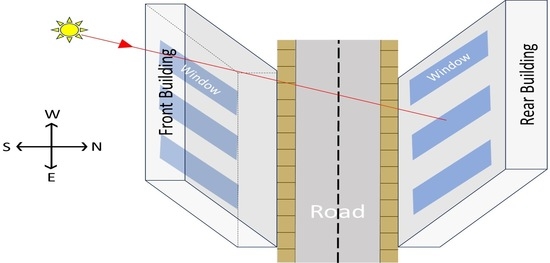
Article

Analytical Modeling of Solar Radiation Distribution on Vertical PV Facades in Urban Settings

School of Electrical Engineering, Tel Aviv University, Tel Aviv-Yafo 6997801, Israel
*
Author to whom correspondence should be addressed.
Urban Sci. 2026, 10(5), 258; https://doi.org/10.3390/urbansci10050258
Submission received: 29 March 2026 / Revised: 29 April 2026 / Accepted: 30 April 2026 / Published: 8 May 2026
(This article belongs to the Topic Sustainable Energy Systems)

Abstract

With the need for increasing energy demand due to population growth in cities, and advancements in the efficiency of semi-transparent photovoltaic (ST-PV) technology, the integration of ST-PV modules into building windows has become feasible. This manuscript presents a novel analytical methodology for estimating incident solar energy on vertical PV modules integrated into building facades in an urban environment, emphasizing shade caused by nearby buildings. Monthly and annual direct-beam, diffusion, and global energies are calculated for different wall heights, building separation, and orientation. In addition, the distribution of the incident energy along the height of the wall is evaluated, indicating a non-uniform distribution. The incident diffusion energy is compared between isotropic and anisotropic models. The anisotropic model predicts higher diffusion energy by 3.5% to 14.5%, depending on the building separation. The incident energy on building facades is calculated for locations at low-mid ( 32 ° 6   N ) and at high-mid ( 52.2 °   N ) latitudes. The results show, for example, that both the front side of a front-building wall and the front side of a rear-building wall receive the same amount of annual global energy— 913   k W h / m 2 —for a separation of 25 m between the buildings. Decreasing the distance from 25 m to 10 m decreases the annual incident global energy on a rear-building wall by 15%.

Graphical Abstract

1. Introduction

The deployment of solar photovoltaic (PV) systems on rooftops, building walls, and building windows in urban environments is designed to utilize potential land area for electricity generation. This approach also matches the need for the increasing demand for energy due to population growth in cities. In addition, electric energy generated at the site where the energy is demanded may avoid long and expensive transmission lines from electric power stations to urban areas. Buildings located in highly urbanized areas have not been considered in the past for PV deployments due to limitation of ground and rooftop space [1]. Presently, PV modules integrated into walls and windows are becoming a prospective technology for the reasons mentioned above. PV opaque modules may be deployed on building walls, and semi-transparent PV (ST-PV) modules may be deployed on building windows. Mono-facial PV modules are a well-established technology, whereas ST-PV technologies, including organic, dye-synthesized, polymer- and perovskite-based solar cells, are still under development [2]. The authors in [3] compared three technologies (c-Si, CIS, and CdTe) for building applications under tropical weather conditions by employing the PVGIS tool. EU projects [4] have researched PV building facades and building-integrated photovoltaics (BIPV) for the intelligent management of buildings to ensure adequate living comfort. The present article on PV collectors on building walls in urban environments fits well with the EU projects. While reference [4] is more of a holistic approach, the present work is a computer simulation study presenting an analytical methodology for determining numerically the incident solar energy on PV vertical modules deployed on building walls/windows and obscured by nearby buildings. Reference [5] provides a literature review of the developments in urban energy modeling to predict the effect of PV systems on indoor and outdoor environments. The authors in [6] developed a solar 3D urban model for the calculation and visualization of the solar energy potential of roofs and facades in buildings. The distance from a building object to the PV array was calculated in reference [7] based on the Solo Pro software simulation tool; however, no mathematical expressions for shade were specified. The authors in [8] developed mathematical expressions for the distance between PV arrays on horizontal and sloping grounds facing in north–south and east–west directions. The study in [9] focused on self-shade losses regarding the distance between collector rows. Testing and simulation results of a module’s partial shade were reported in [10]. The paper in [11] investigated the impact of partial shade on poly and mono-crystalline PV modules.
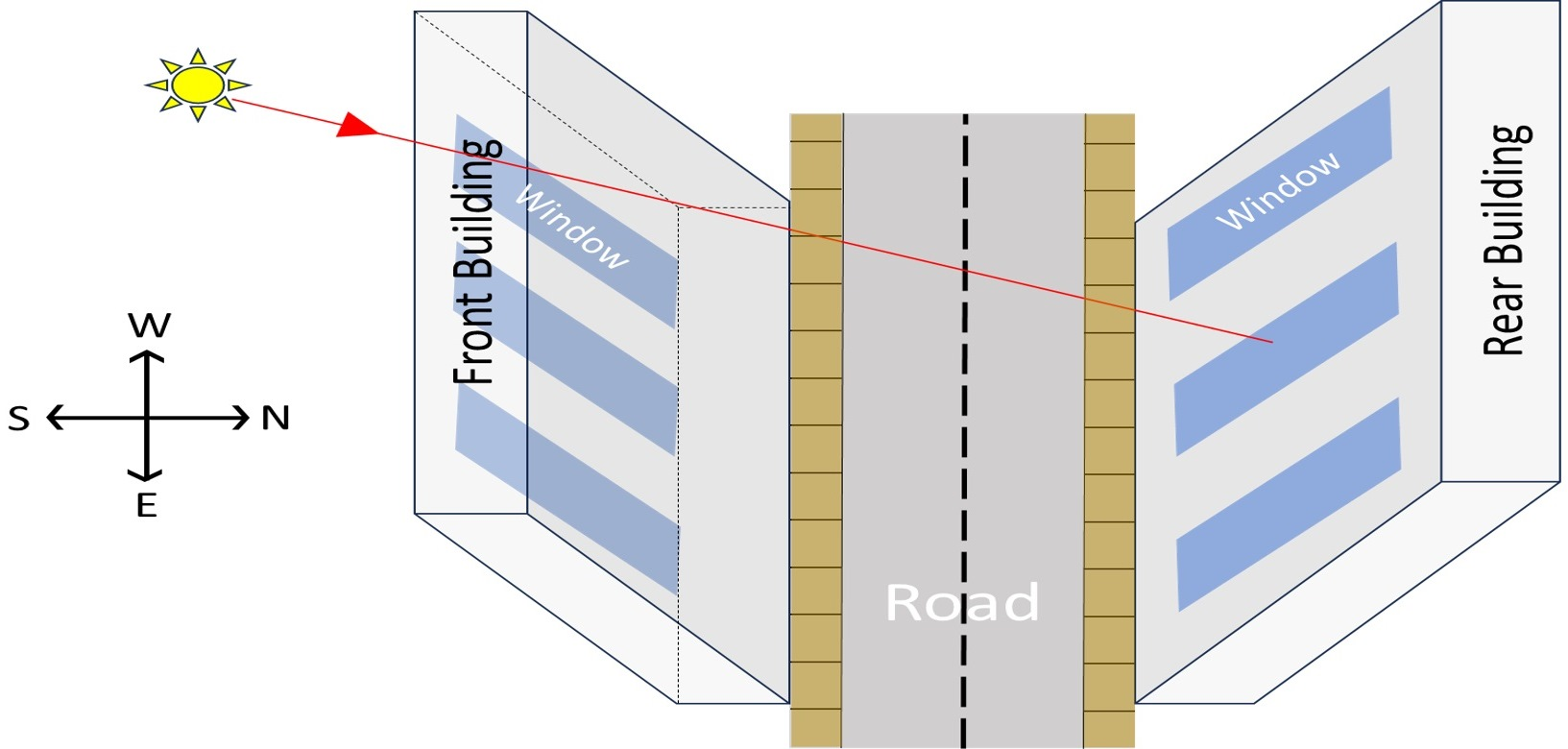
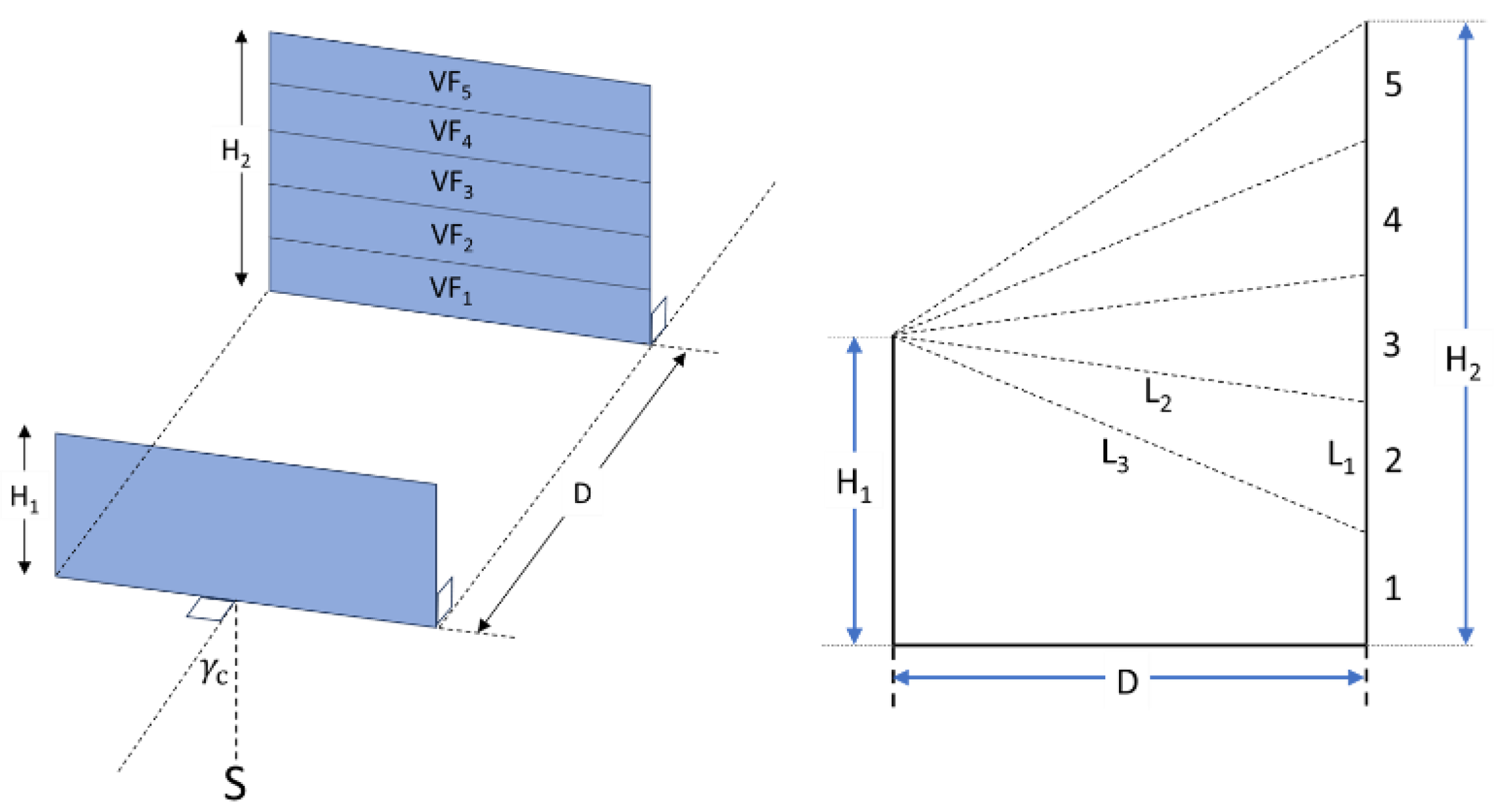
The present study deals with two vertical buildings separated by a road and facing south. As the purpose is to calculate the incident solar radiation on PV vertical modules, no distinction is made between walls and windows. The monthly and annual incident direct-beam, diffusion (ground reflection ignored), and global energies are determined on a front unshaded building wall and on an obscured rear shaded building wall, for different building heights, separations, and orientations. The non-uniformity of the incident solar energy on the PV modules along the height of the obscured building wall is numerically demonstrated for the first time. The non-uniformity stems basically from the incident diffusion radiation rather than from the mutual building. The term “wall” means a building wall. Front wall or unshaded wall means the building wall on the left, and rear wall or shaded wall means the building wall on the right; see Figure 1. The article also calculates the incident energies on building walls oriented with azimuth angle γ C = 30 ° , compares the energies between isotropic and anisotropic diffusion radiation models, and calculates the energies for a location at high-mid latitude.

2. Methods and Materials

Figure 1 depicts window PV collectors, positioned on vertical ( β = 90 ° ) walls of two buildings and separated by a road, as a representative street canyon archetype in an urban environment. The building walls of length L   are erected in an east–west direction and face south. The height of the front (left) and rear (right) walls are H 1 and H 2 , respectively. Because the walls are assumed to be relatively long with respect to the PV module dimensions, Hottel’s “cross-string rule” [12] is used to evaluate the view factor of the walls to sky. Monthly and annual incident direct-beam, diffusion, and global energies on the front and rear-building walls are calculated based on equations reported in the literature (listed in this section) and are applicable for quick engineering estimations of the incident energy on walls of various heights, separations, and orientations. In addition, the distribution of the incident energy along the height of the rear-building wall is evaluated, indicating a non-uniform distribution. The input parameters are the building height and length, building separation, and building orientation γ C .

2.1. Incident Direct-Beam Radiation

As the buildings are facing south, the wall on the left side of the front building is exposed to open space, and therefore is not subject to shade. The wall of the front side of the rear building is subject to shade by the front building. In addition, the sky-view factor of the front-building wall is larger than that of the rear-building wall. These differences are expressed in the calculated results of the incident energies on the front and rear walls.

2.1.1. Left Wall

The incident direct-beam radiation G b e a m on the front wall is given by
G b e a m = G b cos θ × H 1 × L
where G b is the direct-beam irradiance, θ is the angle between solar rays and the normal to the wall surface. Angle θ is given by:
cos θ = cos β sin α + sin β cos α cos ( γ S γ C )
where γ C is the wall azimuth angle ( γ C = 0 ° walls facing due south), γ S is the solar azimuth angle ( γ S = 0 ° —noon), and β is the collector tilt angle (vertical collector— β = 90 ° ).

2.1.2. Right Wall

The incident direct-beam radiation G beam on the right wall is given by
G b e a m = G b cos θ × ( H 2 × L S s h )
The shade height H 2 , s h and length L 2 , s h on the right wall H 2 caused by the front wall H 1 is given by the following [13]:
H 2 , sh = H 1 × ( 1 D + H 1 × cos β H 1 × cos β + H 1 × sin β cos   ( γ S γ C ) / tan α )
L 2 , sh = L ( D + H 1 × cos β ) sin β sin ( γ S γ C / tan α cos β + sin β cos   ( γ S γ C ) / tan α
where S s h is the wall shaded area, S s h = H 2 , s h × L 2 , s h .
For a vertical wall β = 90 ° , Equations (4) and (5) reduce to
H 2 , sh = H 1 × ( 1 D H 1 × cos   ( γ S γ C ) / tan α )
L 2 , sh = L D × sin ( γ S γ C / tan α cos   ( γ S γ C ) / tan α
and Equation (2) becomes
cos θ = cos α cos ( γ S γ C )
The incident solar energy on a wall is integrated for the duration of the solar rays falling on the wall, and depends on the sunrise and sunset hour angles and on the tilt angle β of the collector. The hour angle for which the sun starts climbing on the wall (wall rise) ω c r and leaving the wall (wall set) ω c s is given by [14]
ω c r = cos 1 x y x 2 y 2 + 1 x 2 + 1 ,   if   γ C 0 °
ω c r = cos 1 tan δ × tan ( ϕ β ) ,   if   γ C = 0 °
ω c s = cos 1 x y ± x 2 y 2 + 1 x 2 + 1 ,   if   γ C 0 °
ω c r = cos 1 tan δ × tan ( ϕ β ) ,   if   γ C = 0 °
The upper sign is valid for eastward-oriented walls, and the lower sign for westward-oriented walls, where
x = cos ϕ sin γ C tan β + sin ϕ tan γ C ,   y = tan δ sin ϕ sin γ C tan β cos ϕ tan γ C
For the collector tilt angle β = 90 ° , Equation (13) reduces to
x = sin ϕ tan γ C ,   y = tan δ cos ϕ tan γ C
The sunrise and sunset hour angles ω s r , ω s s , respectively [11], are given by
ω s r = cos 1 ( tan δ tan ϕ ) ,   ω s s = cos 1 ( tan δ tan ϕ )
The sunrise and sunset hour angles on an inclined plane β denoted by ω c r (wall rise) and ω c s (wall set) are as follows:
ω c r = cos 1 [ tan δ tan ( ϕ β ) ] ,   ω c s = cos 1 [ tan δ tan ( ϕ β ) ]
and for β = 90 ° ,
ω c r = cos 1 [ tan δ / tan ϕ ] ,   ω c s = cos 1 [ tan δ / tan ϕ ]
Therefore, the sunrise and sunset hours on a wall are thus determined by
ω c r = min ( ω s r , ω c r ) ,   ω c s = min ( ω s s , ω c s )

2.2. Incident Diffuse Radiation

The incident diffusion radiation on a front wall, for the isotropic diffusion radiation model, is given by
G d = V F W f r o n t × G d h
where V F W f r o n t is the sky-view factor of the front wall and G d h is the diffusion radiation on a horizontal plane. The sky-view factor of an inclined wall β in open space (front-building wall; see Figure 1) is [15]
V F W f r o n t = ( 1 + cos β ) / 2
and for β = 90 ° , V F W f r o n t = 0.5 .
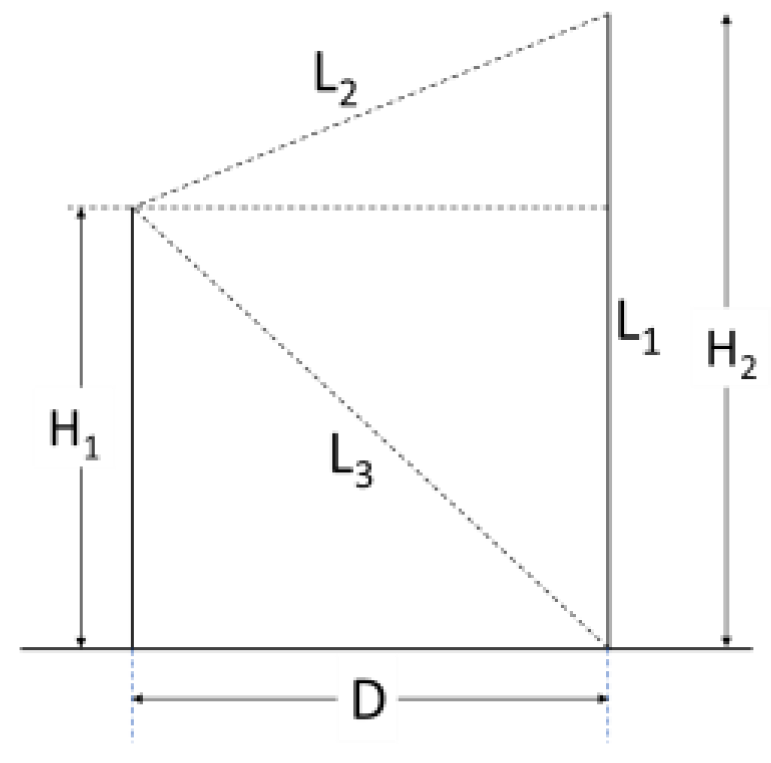
The sky-view factor of a vertical wall, H 2 , deployed behind a front wall (see Figure 1) is given by [12] (see Figure 2):
V F W r e a r = ( L 1 + L 2 L 3 ) / 2 L 1
i.e.,
V F W r e a r = H 2 + [ ( H 2 H 1 ) 2 + D 2 ] 1 / 2 [ H 1 2 + D 2 ] 1 / 2 2 H 2

2.3. Local Sky-View Factor

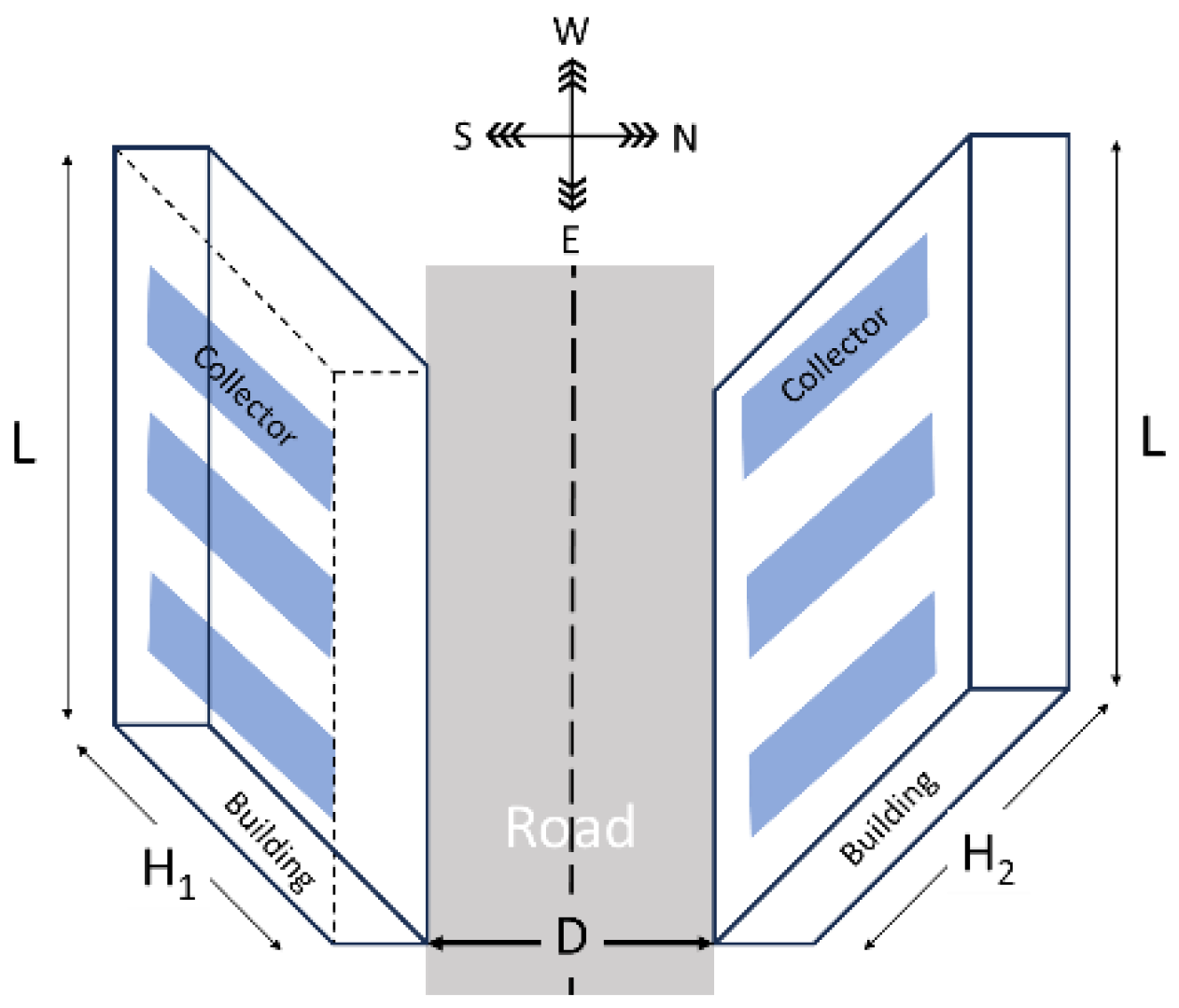
The view factor of a collector (wall) to the sky is an “average” view factor of the entire collector (wall) to the sky. However, the sky-view factor of an element on the wall varies with the distance along the height H 2 of the wall, denoted as the “local” sky-view factor. PV collectors on the rear-building wall comprise modules forming parallel segments/stripes along the wall height. Each segment sees the sky with a different angle, hence a different local sky-view factor is attached to each segment, V F 1 ,   V F 2 ; see Figure 3. The local sky-view factors, V F i , based on Equation (21) and Figure 3, are determined for N parallel segments i = 1 , N by:
V F i = Δ + [ D 2 + ( H 1 i Δ ) 2 ] 1 / 2 [ D 2 + ( H 1 ( i 1 ) Δ ) 2 ] 1 / 2 2 Δ , i = 1 , N ,
where Δ = H 2 / N .
As the diffusion incident irradiance is connected to the sky-view factor (see Equation (19)), the incident diffusion irradiance on wall H 2 becomes non-uniform.

3. Results

The monthly and the annual energies, in k W h / m 2 , of the incident direct-beam, diffusion, and global radiation on collectors deployed on building walls, were analyzed for different wall heights, distances between the building walls, and wall orientations, including the non-uniformity of the energies along the wall height H 2 . The incident solar radiation on the walls is based on 10-min solar radiation data (direct beam—DNI) and diffusion radiation (DHI), average data for the years 2014–2023 in Beit Dagan, Israel Meteorological Service(IMS) for Tel Aviv, latitude ϕ = 32 ° 6   N , longitude 34 ° 51   E .

3.1. Distance Between Walls, H 1 < H 2 (Front Wall Lower than Rear Wall), γ C = 0 °

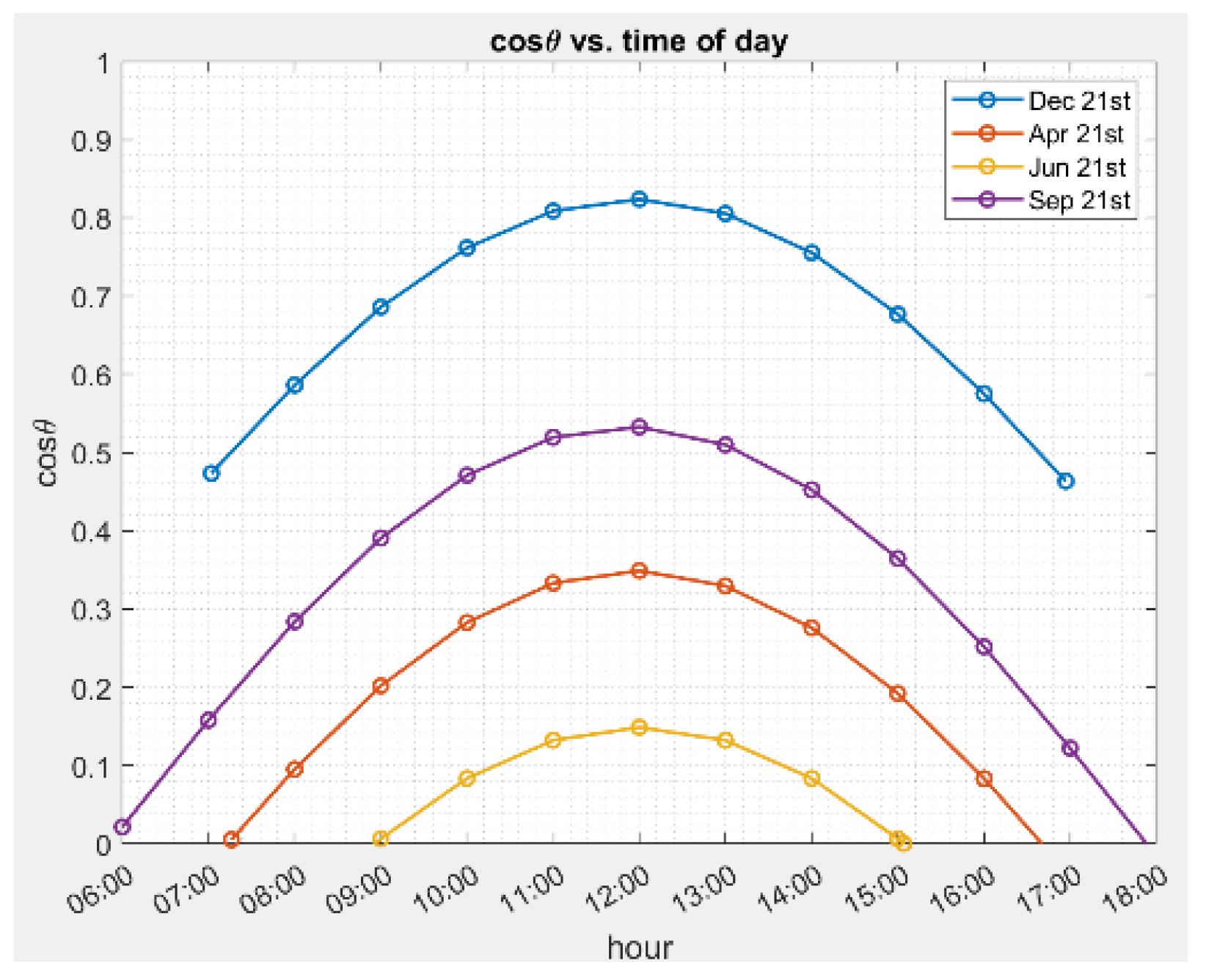
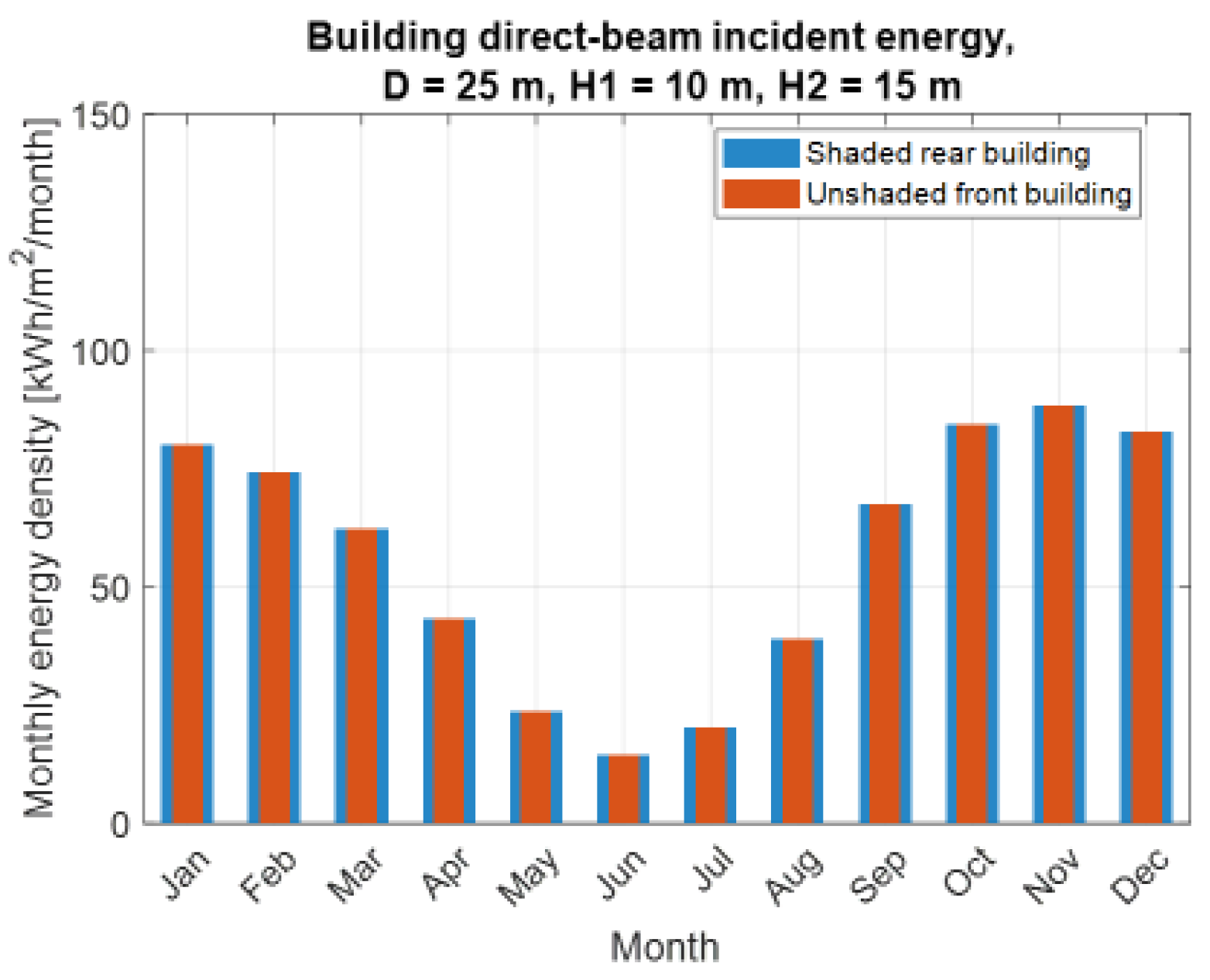
The incident direct-beam radiation depends strongly on the cosine angle θ between solar rays and the normal to the wall surface; see Equation (2). Figure 4 depicts the variation of cos θ with time of the day for the four months of 21st December, April, June, and September, for a vertical wall β = 90 ° , and considering the times that sunbeams fall on the collector (see Equation (18)). The figure clearly shows that the lowest value of cos θ is in June. Consequently, Figure 5 shows the monthly incident direct-beam energy on the walls, front (left) wall—unshaded in red—and rear (right) wall—shaded in blue—based on Equations (1) and (3), for parameter H 1 = 10   m ,   H 2 = 15   m ,   L = 30   m ,   D = 25   m , and buildings facing the south γ C = 0 ° (see Figure 1). Lower energies are obtained in summer months as the effect of cos θ dominates the resulting energies; see Equations (1) and (3) and Figure 4. Figure 5 also shows that for a relatively large distance D = 25   m between building walls, no shade occurs on the rear-building wall caused by the front building, i.e., both building walls receive the same amount of direct-beam energy.
Figure 5 shows additionally that the monthly incident direct-beam energy on building walls oriented south is relatively low in the summer months, thus may save cooling energy in buildings in a hot climate. The opposite can be observed in the winter months, where the incident direct-beam energy on building walls is higher, and thus may save heating energy in buildings in cold climates.
The monthly incident energy density E m o n t h is (see Equation (3)):
E m o n t h = i 12 N i T c r T c s G b cos θ × H 2 × L S s h H 2 × L × Δ T
where T c r is the time the sunbeam starts to climb the wall, T c s is the time the sunbeam leaves the wall, N i is the number of days in month i , Δ T is the time interval between two solar data measurements.
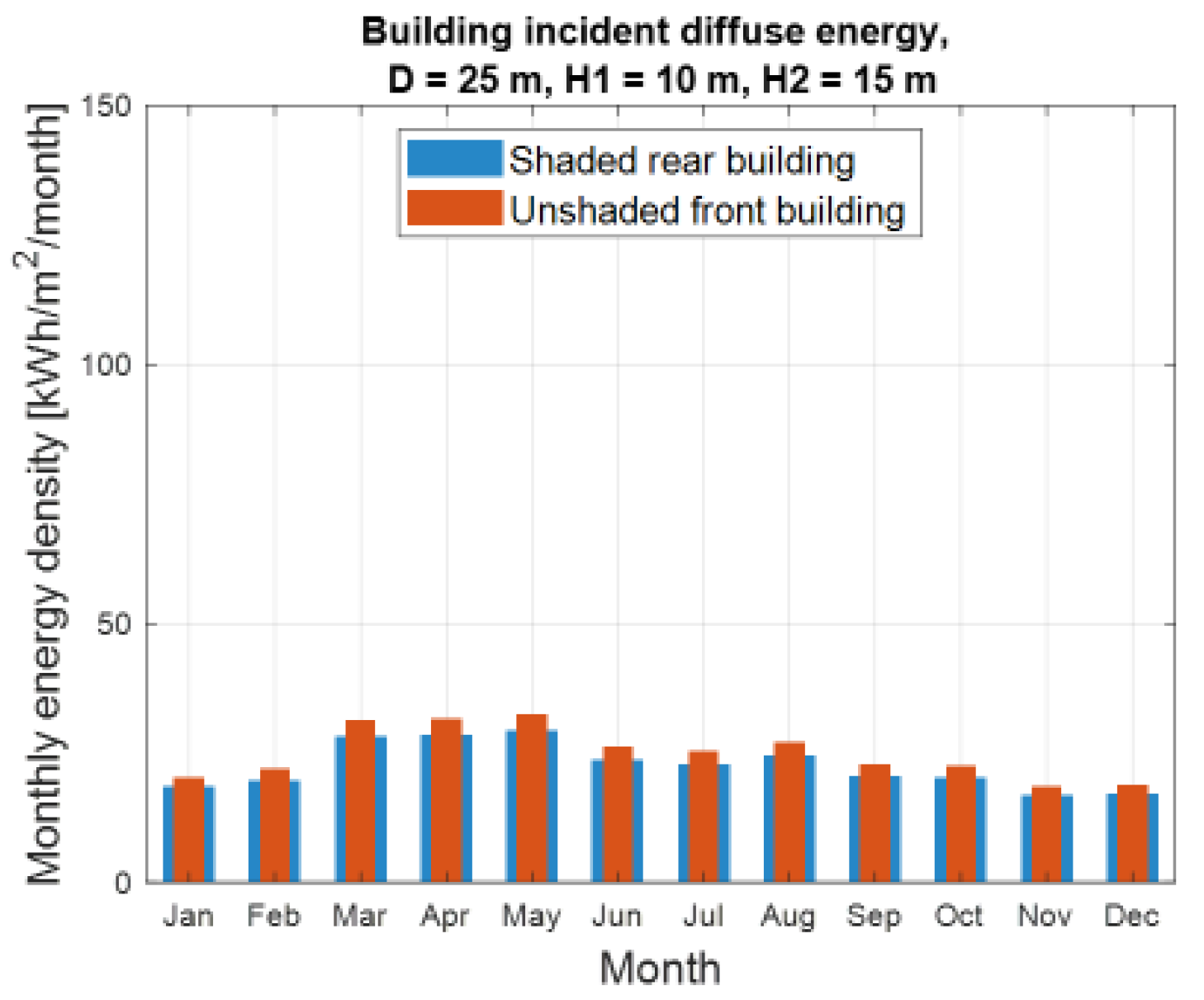
Figure 6 depicts the monthly incident diffusion energy on the front (left) wall, in red, and on the rear (right) wall, in blue, for parameters H 1 = 10   m , H 2 = 15   m , L = 30   m , D = 25   m ,   γ C = 0 ° (see Figure 1).
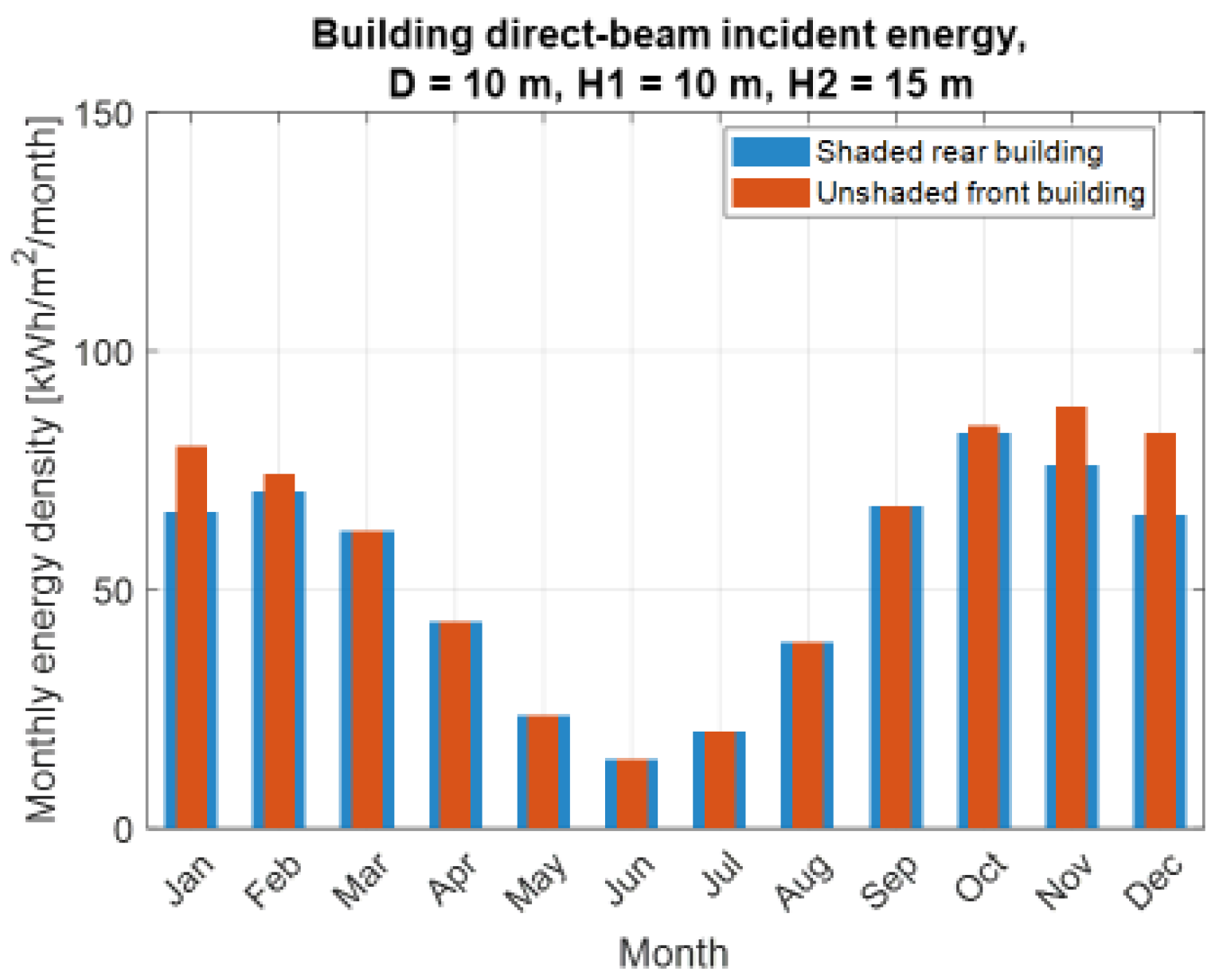
The sky-view factor of the front-building wall is larger than the sky-view factor of the rear-building wall (see Equations (20) and (22)), and accordingly, is the incident diffusion energy. The monthly incident diffusion energy is higher on the front wall (unshaded) than on the rear wall (shaded). The monthly incident global energy is the sum of the direct-beam and the diffusion energy. Decreasing the distance between the buildings from D = 25   m to D = 10   m causes shade on the rear-building wall by the front building. This is shown in Figure 7 by the incident direct-beam energy on the shaded rear wall.
Table 1 shows the annual incident direct-beam, diffusion, and global energies, in k W h / m 2 , on the front and rear-building walls for different distances D between the buildings. Both the front and rear walls receive the same amount of annual direct-beam energy 673   k W h / m 2 for distance D = 25   m . However, the diffusion and global energies on the rear wall are less by 19.19% and 5.88%, respectively. Decreasing distance D from 25 m to 10 m decreases the annual incident direct-beam, diffusion, and global energies on the rear wall by 10.55%, 27.5%, and 15.5%, respectively. The percentage of the diffusion energy on the front wall is 30.6% and 22.4% on the rear wall for D = 10   m , both with respect to the global energy.

3.2. Distance Between Building Walls, H 1 > H 2 (Front Building Higher than Rear Building), γ C = 0 °

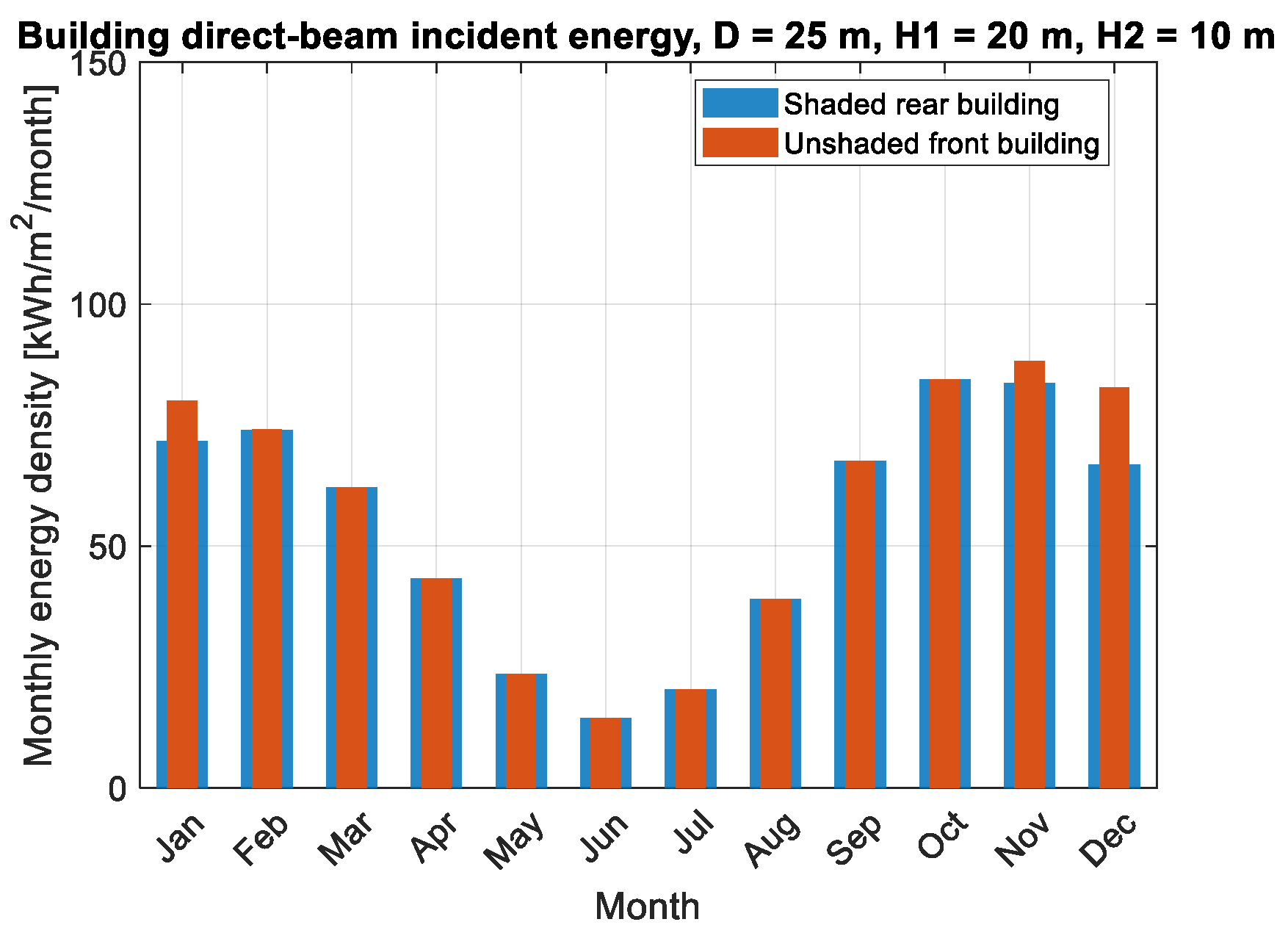
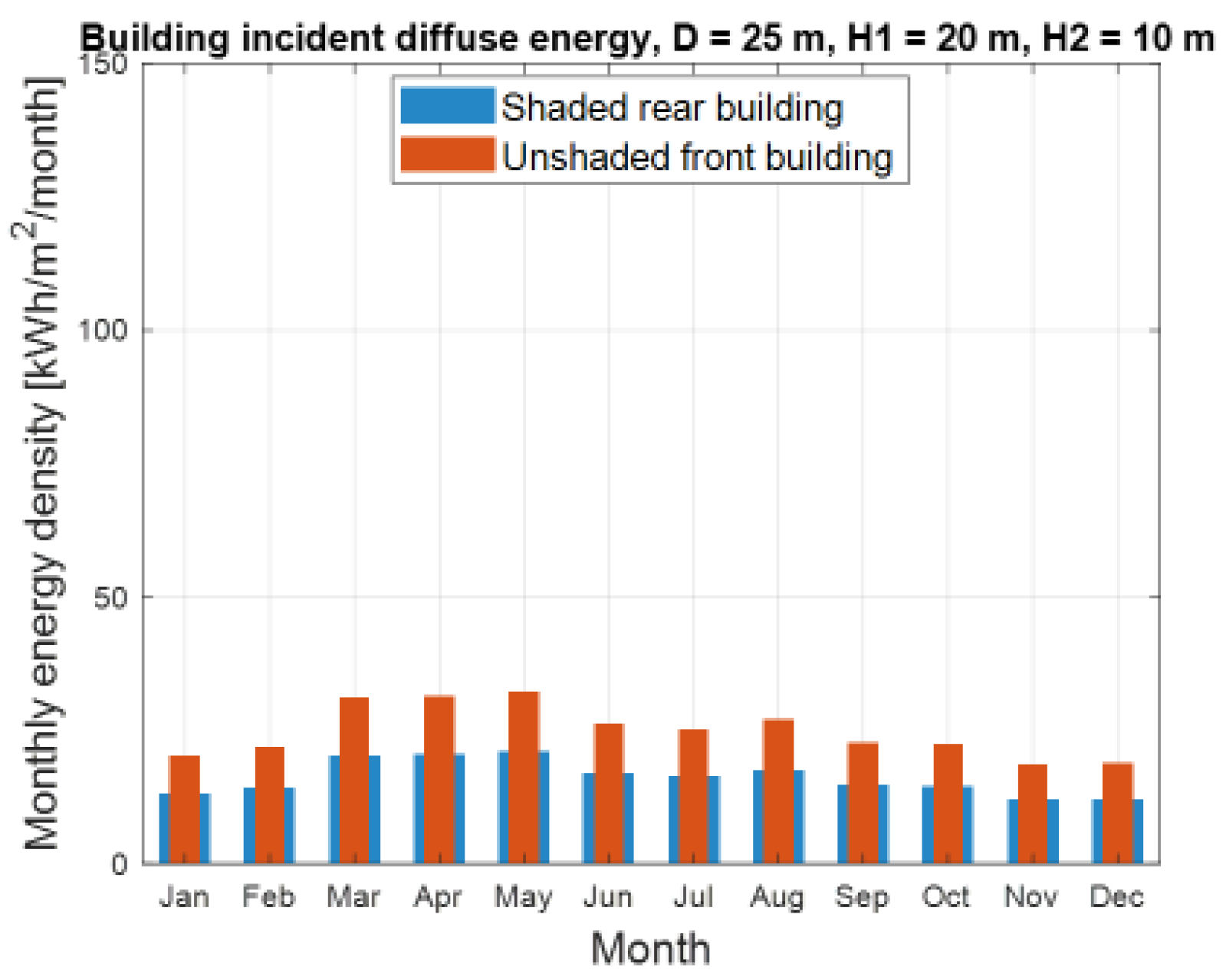
Figure 8 depicts the monthly incident direct-beam energy on the front (unshaded) and on the rear (shaded) wall, for parameters H 1 = 20   m , H 2 = 10   m , L = 30   m , D = 25   m ,   γ C = 0 ° (see Figure 1). The rear-building wall experiences shade in January, November, and December only. Figure 9 depicts the monthly incident diffusion energies. The masking losses (diffusion radiation losses) of the rear wall are more noticeable than the front wall, resulting from the difference in the sky-view factors.
Table 2 shows the annual incident direct-beam, diffusion, and global energies on the front and rear-building walls for wall height H 1 = 15   m and H 1 = 20   m , both for H 2 = 10   m and for D = 25   m ,   γ C = 0 ° . The front and rear walls receive the same amount of annual direct-beam energy 680   k W h / m 2 for H 1 = 15   m ,   H 2 = 10   m . However, the diffusion and global energies on the rear wall are less by 36.58% and 11.25%, respectively. Increasing the wall height H 1 to 20   m decreases the annual incident direct-beam, diffusion, and global energies on the rear wall by 4.26%, 50.67%, and 18.40%, respectively.

3.3. Building Walls Oriented with Azimuth Angle γ C = 30 °

Buildings may be constructed with any azimuth angle with respect to the south. This section deals with the incident monthly and annual energies on building walls oriented with azimuth angle γ C = 30 ° , as compared to walls with γ C = 0 ° (Table 1). The results are shown in Table 3. Values H 1 and H 2 remain the same, and the distances between the buildings are: D = 25   m ,   15   m ,   10   m .
The global energy on the rear wall is less than on the front wall by 7.07% for D = 25   m . Decreasing distance D from 25 m to 10 m decreases the annual incident direct-beam, diffusion, and global energies on the rear wall by 15.72%, 27.5%, and 18.71%, respectively. Comparing Table 1 ( γ C = 0 ° ) and Table 3 ( γ C = 30 ° ) for D = 25   m shows that the global energies on the rear wall are less than on the front wall by 5.88% ( γ C = 0 ° ) and 7.07% ( γ C = 30 ° ).

3.4. Local Sky-View Factor Results

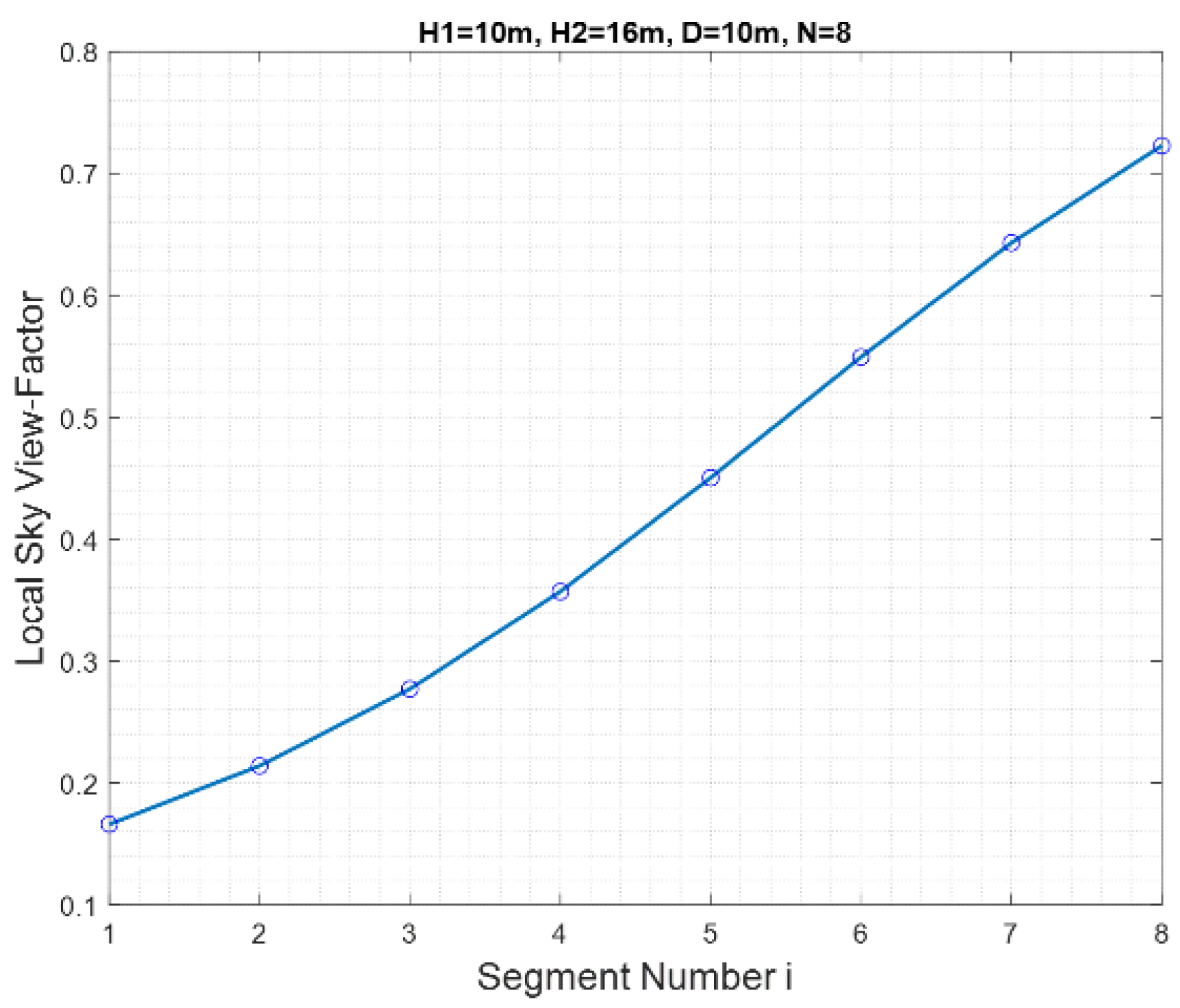
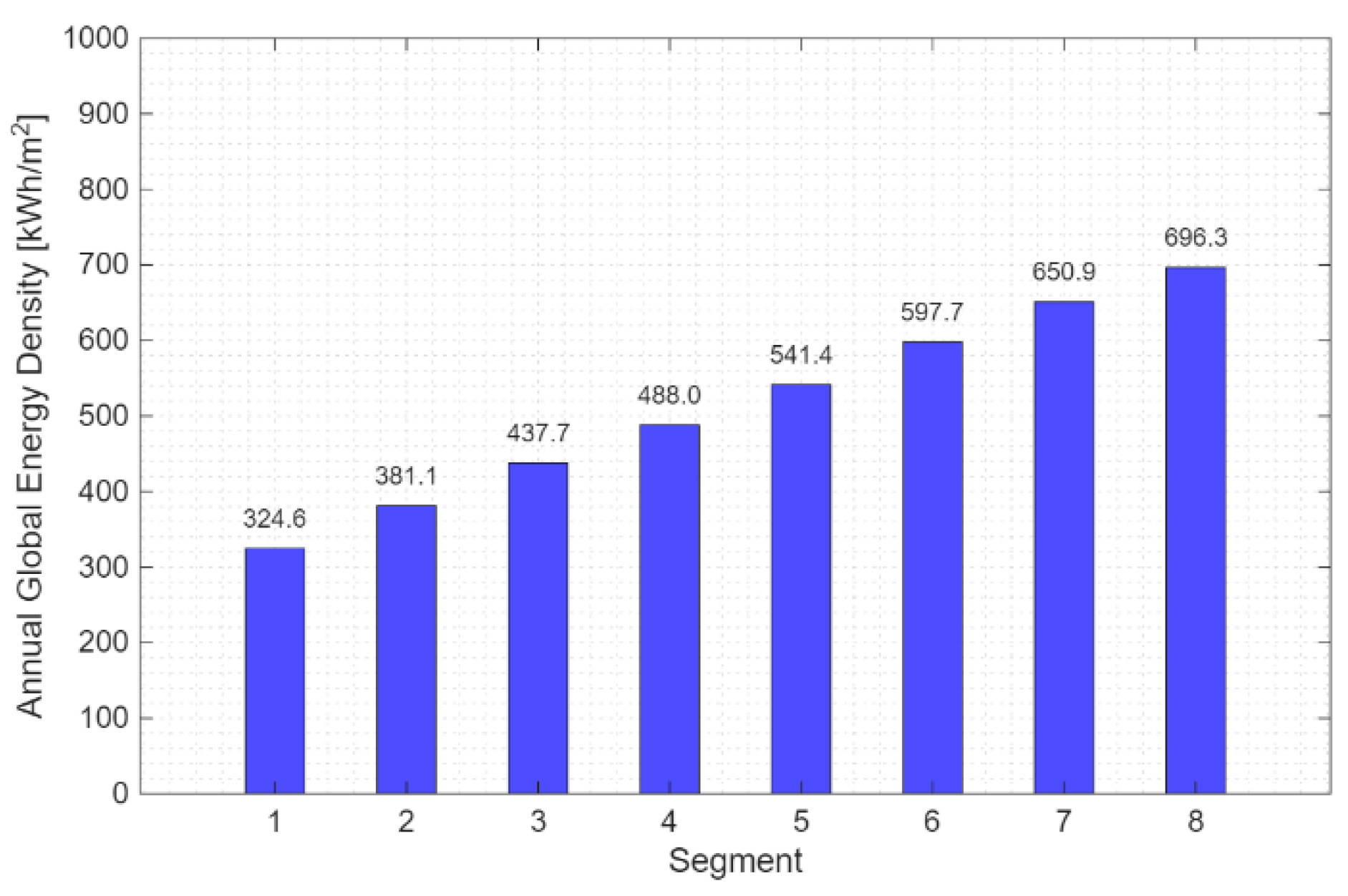
The sky-view factor varies with the distance along the height H 2 of the building wall (see Section 2.3). The wall height H 2 is divided into N segments (strips) corresponding to the PV module height. The sky-view factor of each segment, denoted by “local sky-view factor”, varies with wall height H 2 . Figure 10 shows the variation of the local sky-view factor with segment number i for H 1 = 10   m ,   H 2 = 16   m ,   D = 10   m ,   N = 8 , as an example. The segment height is Δ = H 2 / N = 16   m / 8 = 2   m . As the diffusion incident irradiance is associated with sky-view factor (see Equation (19)), the distribution of the incident diffusion energy on the segments becomes noticeably non-uniform. Table 4 shows the distribution of the monthly direct-beam energy on the segments of H 2 for parameters H 1 = 10   m ,   H 2 = 16   m ,   D = 10   m , γ C = 0 ° and building length L = 30   m .
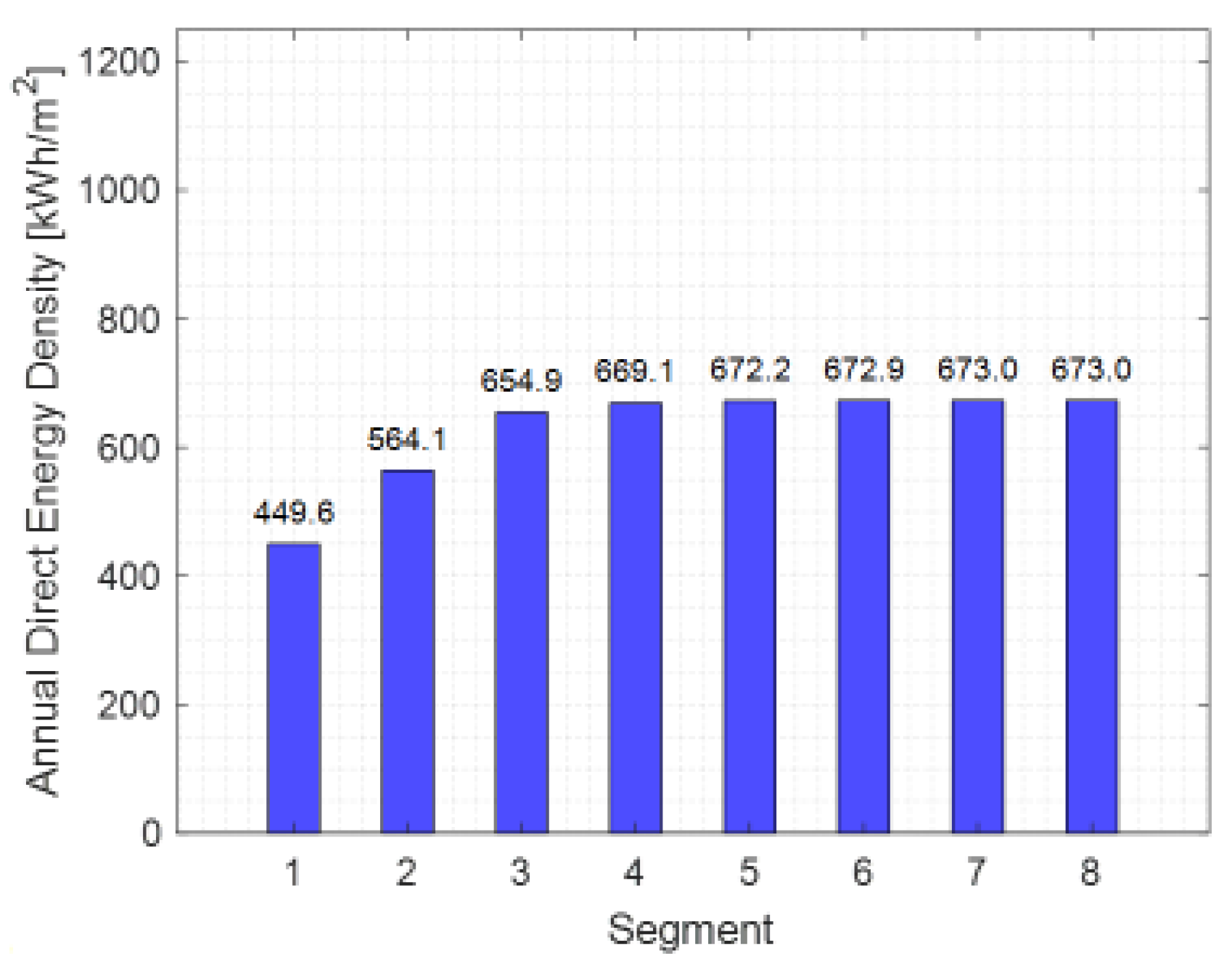
The darker areas in Table 4 indicate that shade occurred on the segments in the winter months; for example, in December, the shade height reached Segment 6. The total annual direct-beam energy on each segment is listed in the last row (Total), and its distribution is depicted in Figure 11, indicating that Segments 1 and 2 (both of height 2 m), located at the bottom of the right wall, experience substantial shade.
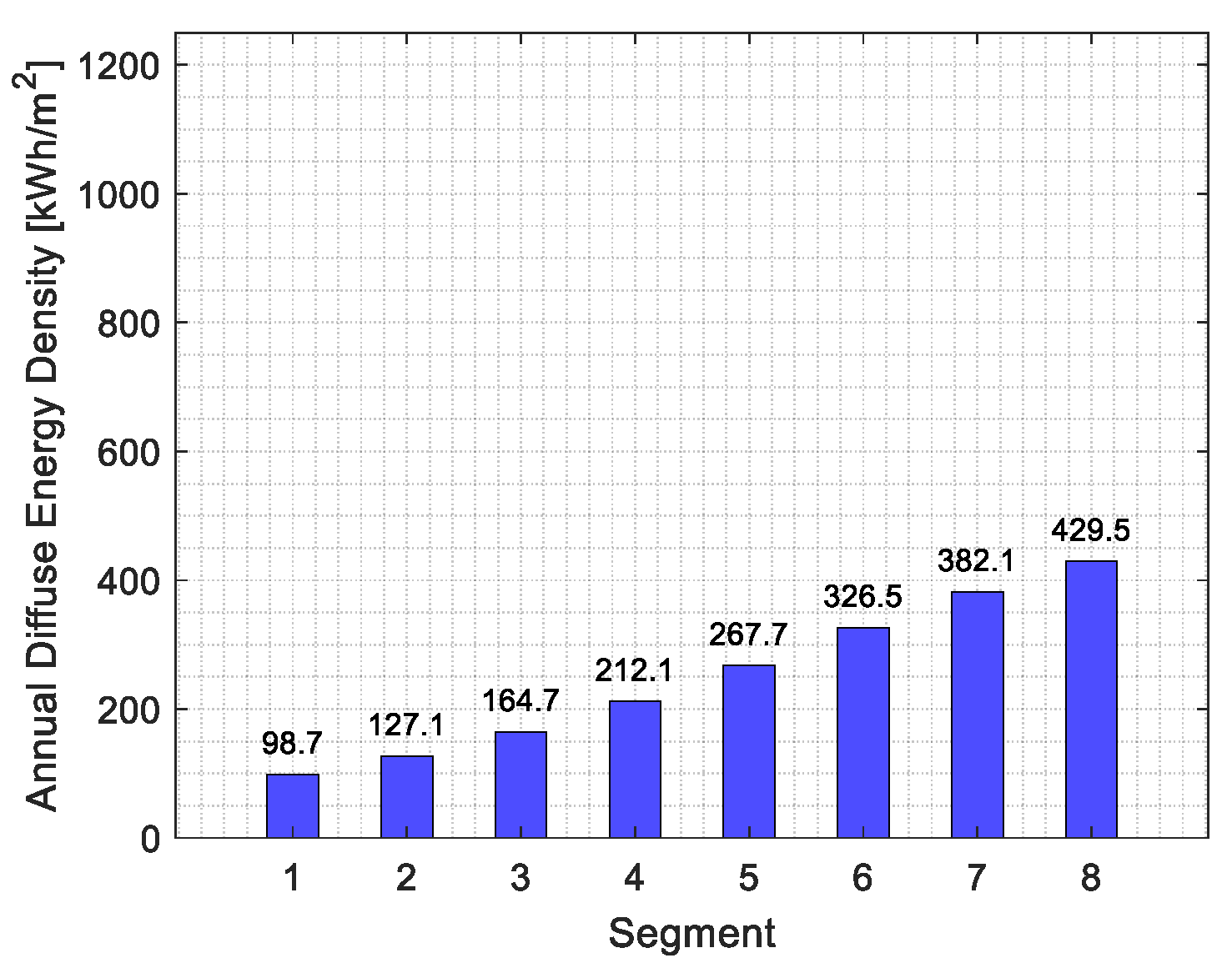
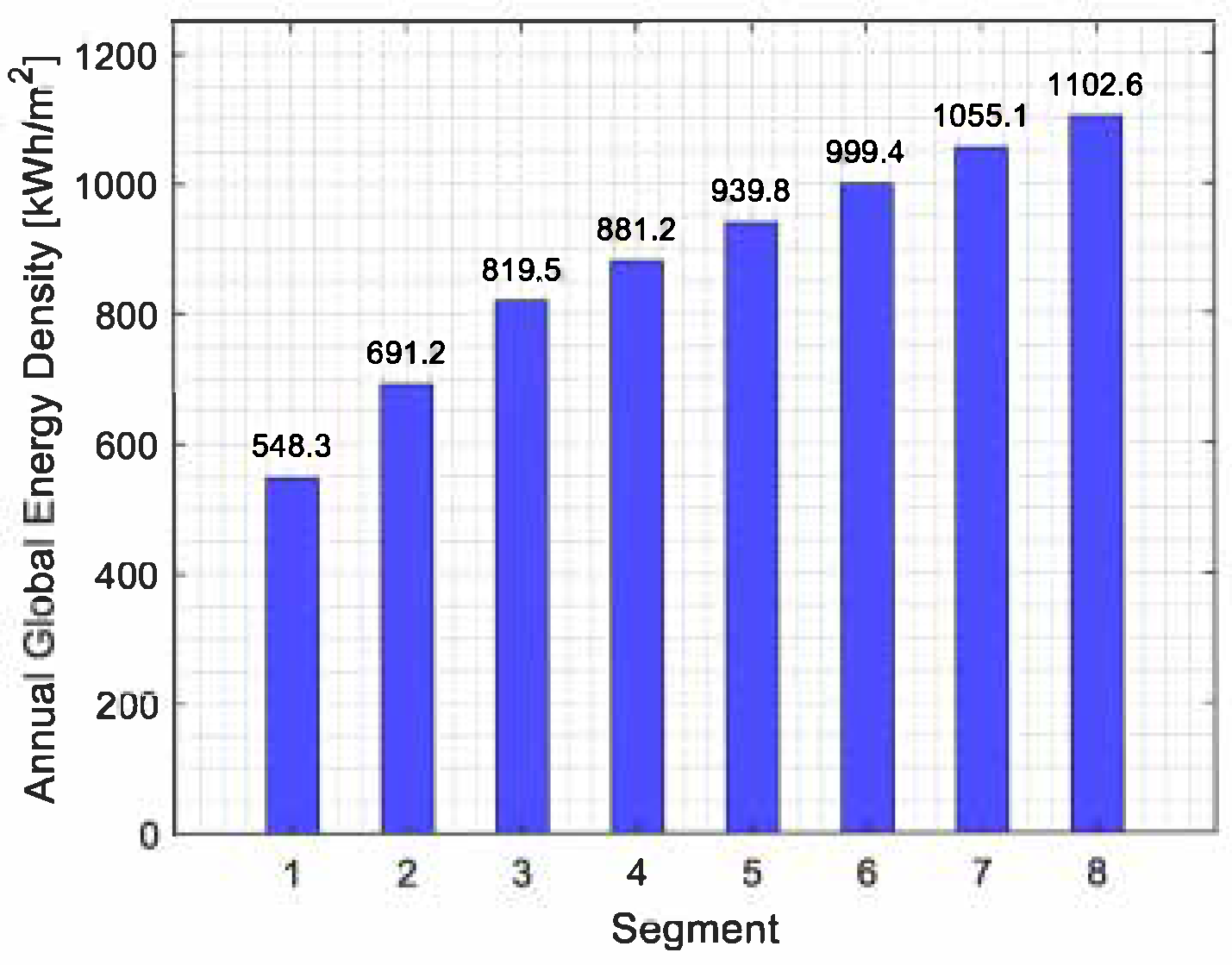
The distribution of the annual incident diffusion energy on the segments is depicted in Figure 12, indicating a broad and uneven distribution of diffusion energy on the segments, stemming from the large variation of the local sky-view factors; see Figure 10. The distribution of the annual incident global energy on the segments is depicted in Figure 13, affected mainly by the diffusion radiation. The difference in the annual incident global energy between the first and eighth segments is about 50%. Based on the wide distribution of the annual global incident energy, it is sensible not to deploy PV modules on lower segments of the wall, for economic, practical, and other reasons.
The results presented so far in this section pertain to the solar radiation data for latitude ϕ = 32 ° 6   N and longitude 34 ° 51   E . Different results may be obtained for different climate zones; however, the local sky-view factor of the different segments dictates the non-uniformity of the global incident energy on the wall. Mismatch losses affect the generated electric energy of PV modules due to non-uniform irradiance, both for opaque and semi-transparent PV modules, although amorphous silicon modules often handle partial shade better than crystalline silicon. Experimental results of shade on the I-V characteristics of PV modules are reported in [16]. The authors in [17] modeled the shading of amorphous silicon models.
With the distribution of the annual global incident energy on different segments on walls with γ C = 30 ° (see Section 3.3), see Figure 14, it is interesting to compare with walls with γ C = 0 ° for parameters H 1 = 10   m ,   H 2 = 16   m ,   D = 10   m ,   N = 8 . The difference in the annual global incident energy between the first and eighth segments is about 53% for γ C = 30 ° compared to about 50% for γ C = 0 ° .

3.5. Incident Solar Energy on Building Walls at a Different Location and Using a Different Source of Solar Radiation Data

The sensitivity of the incident solar energy on PV collectors deployed on building walls in urban environments to site location and to a source of solar radiation data is shown in Table 5 and Table 6. Location: Sede-Boker, Israel, latitude ϕ = 30 °   N , longitude 34 ° 46   E . Solar data source IMS, Israel, and solar data source BSRN—https://dataportals.pangaea.de/bsrn/?q=LR1300, accessed on 29 April 2026, Lindenberg, Germany. By comparing the global energies in Table 5 and Table 6, a difference of about 1% to 2% is obtained, showing reliable results.

3.6. Anisotropic Diffuse Radiation

The results reported for the incident diffusion radiation in the preceding sections refer to isotropic sky. It is interesting to compare the results to an anisotropic sky. The Klucher anisotropic diffusion radiation model [18] is used for the comparison. The incident solar energy on PV collectors deployed on building walls is shown in Table 7, comparing the incident diffusion and global energies between the isotropic and the anisotropic diffusion radiation models. As expected, the anisotropic model predicts higher diffusion energy by 3.4% ( D = 10   m ) to 14.5% ( D = 30   m ) for the front wall, and higher global energy by 1% ( D = 10   m ) to 4.4% ( D = 30   m ).

3.7. Incident Solar Energy on Building Walls in High-Mid Latitude, Lindenberg, Germany, Latitude ϕ = 52.2 °   N , Longitude 14.1 °   E , TMY, Hourly Samples (Monitoring Station, BSRN—https://dataportals.pangaea.de/bsrn/?q=LR1300, Accessed on 29 April 2026)

The incident energies on the front and rear-building walls facing south γ C = 0 ° for the climate in Lindenberg are tabulated in Table 8. The isotropic diffusion radiation model is used to determine the diffusion energy. The global energy on the front wall is 61.5% at Lindenberg, Germany, compared to Beit Dagan, Israel; see Table 1. Both the front and rear walls receive the same amount of annual direct-beam energy 313   k W h / m 2 for distances D = 15   m and D = 25   m , meaning that no shade occurred during the year on the rear wall. The percentage of the diffusion energy on the front wall is 47.6% and 35.9% on the rear wall for D = 10   m , both with respect to the global energy. The percentage of the annual diffusion and global energies on the rear wall is less by 19% and 9%, respectively, with respect to the front wall for the distance D = 25   m .
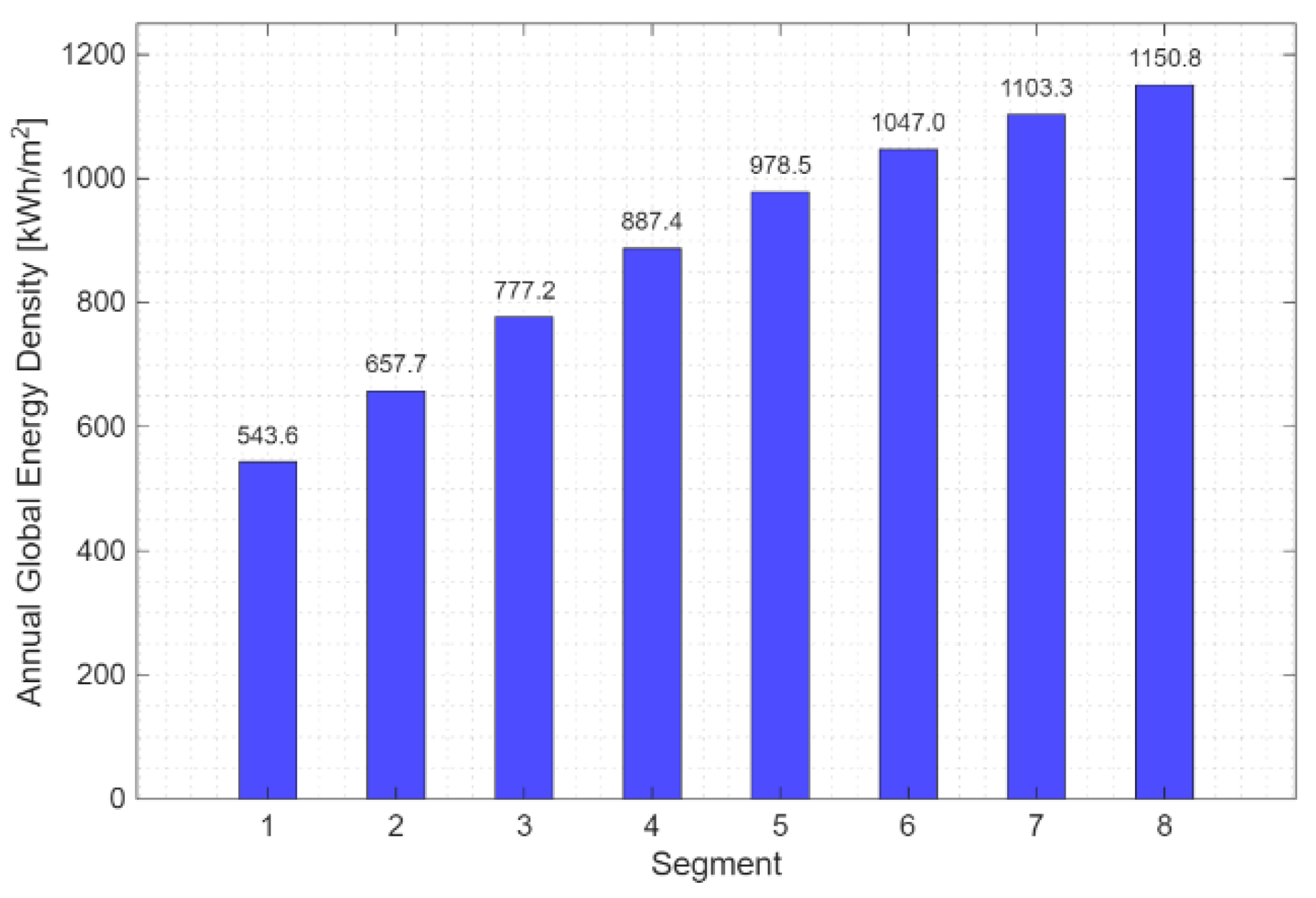
The distribution of the annual incident global energy on different segments of the rear wall for γ C = 0 ° is depicted in Figure 15 for H 1 = 10   m ,   H 2 = 16   m ,   D = 10   m ,   N = 8 . The non-uniformity of the energy among the segments is projected, resulting mainly from the diffusion radiation component, as for the other cases. The difference in the annual incident global energy between the first and eighth segments is about 53%.

4. Discussion

The manuscript presents a novel analytical methodology for estimating incident solar energy on vertical PV modules integrated into building facades in urban environments, emphasizing shade and masking caused by nearby buildings. The approach in the literature to PV deployment on building facades is generally holistic [4]. The present article deals with a specific aspect of estimating the incident solar radiation on vertical PV modules and introduces an analytical methodology based on equations reported in the literature. In addition, the distribution of the incident energy along the height of an obscured building wall is numerically evaluated, indicating a non-uniform distribution of the energy on the PV modules—an important finding for designing PV systems. Existing facade irradiance models do not address the particular topic of the present study. The introduced methodology for estimating the incident energy on facades may be applied to different building configurations in urban environments. Monthly and annual direct-beam, diffusion, and global energies are calculated on a wall and on a nearby second obscured wall for different wall heights, building separations, and orientations. The presented results pertain to building walls oriented due south ( γ C = 0 ° ) to obtain maximum energies; therefore, for comparison, the incident energies were also calculated for building facades oriented with an azimuth angle γ C = 30 ° . The deviation of the building facades from the south up to 30° results in a non-significant energy difference. The incident diffusion energy on facades is compared between isotropic and anisotropic models. The presented results pertain to sites of relatively low-mid latitudes ( ϕ = 32 ° 6   N ); therefore, for comparison, the incident energy on building facades is also calculated for a location at high-mid latitude ( ϕ = 52.2 °   N ). The incident energy on the lower segments of the wall is significantly lower than on the upper segments. Therefore, one may consider only the upper segments for PV module deployment.

5. Conclusions

The deployment of solar photovoltaic (PV) modules on building walls and windows in urban environments is designed to utilize potential area for electricity generation, to alleviate the need for the increasing demand for energy, due to population growth in cities. Buildings located in highly urbanized areas have not been considered, in the past, for PV deployment on walls due to the limitation of ground and rooftop space. Presently, PV vertical modules integrated into walls and windows have become a prospective technology due to the increase in PV module efficiency. The present article proposes a novel methodology for calculating the incident solar energy on PV vertical modules deployed on a building wall obscured by a nearby building in front. The simulation study is based on mathematical expressions in the literature, and calculates for the first time the incident energy and its distribution along the height of an obscuring building wall. Monthly and annual direct-beam, diffusion, and global energies are calculated for different wall heights, building separations, and orientations. The results show, for example, that both the front and rear-building walls receive the same amount of annual global energy 913   k W h / m 2 for a distance of 25 m between the buildings. Decreasing the distance from 25 m to 10 m decreases the annual incident global energy on the rear obscured wall by 15%. These results pertain to the solar radiation data at latitude ϕ = 32 ° 6   N and longitude 34 ° 51   E , building height, and separation used in the study, for the isotropic diffusion radiation model. The results show that the solar energy on walls facing south is relatively low in summer months, and in winter, the solar energy on the walls is higher.
Comparing the incident diffusion and global energies on PV modules deployed on building walls using isotropic and anisotropic diffusion radiation models reveals that the anisotropic model predicts higher diffusion energy by 3.4% to 14.5%, and higher global energy by 1% to 4.4% for the parameters used in the study. Results are also obtained for a different climate zone, namely high-mid latitude at Lindenberg, Germany, in comparison to a low-mid latitude in Israel. An important finding is the non-uniform distribution of the incident energy on the obscured building wall segments, a difference of about 53% between the first and eighth segments. The non-uniformity has economic and practical implications. To verify the simulation results, two sources of solar radiation data are used in the study. Future work may investigate the placement of PV modules on high-rise building facades in densely populated areas to justify the height placement of PV modules on building walls economically. The potential applications of the findings lie in the feasibility of utilizing building facades for electric energy generation.

Author Contributions

J.A.—conceptualization, methodology, A.P.—software, validation. All authors have read and agreed to the published version of the manuscript.

Funding

This research received no external funding.

Data Availability Statement

The data presented in this study are available on request from the corresponding author due to privacy concerns.

Conflicts of Interest

The authors declare no conflicts of interest.

Nomenclature

G b Direct-beam irradiance—W/m2
G b e a m Incident direct-beam radiation—W/m2
G d h Diffusion radiation on a horizontal plane—W/m2
E m o n t h Monthly incident energy density—kWh/m2
H 1 Front-building wall height—m
H 2 Rear-building wall height—m
H 2 , sh Shade height on rear wall—m
L Wall length—m
L 2 , sh Shade length on rear wall—m
N i Number of days in month i
T c r Time collector rise
T c s Time collector set
Δ T Time interval
S s h Wall shade area—m2
V F W f r o n t Sky-view factor of front wall
V F W r e a r Sky-view factor of rear wall
α Solar altitude angle—deg.
β Collector tilt angle—deg.
δ Sun declination angle—deg.
ϕ Collector latitude, deg.
γ C Collector azimuth angle γ C —deg. ( γ C = 0 ° walls facing due south),
γ S Solar azimuth angle-deg. γ S = 0 ° (noon), γ S < 0 ° forenoon γ S > 0 ° afternoon
θ Angle between solar rays and the normal to wall surface—deg.
θ Z Solar zenith angle—deg.
ω s r Sunrise hour angles—deg.
ω s s Sunset hour angle—deg.
ω c r Wall rise hour angle—deg.
ω c s Wall set hour angle—deg.

References

  1. Panagiotidou, M.; Brito, M.C.; Hamza, K.; Jasieniak, J.J.; Zhou, J. Prospects of photovoltaic rooftops, walls and windows at a city building scale. Sol. Energy 2021, 230, 675–687. [Google Scholar] [CrossRef]
  2. Lee, K.; Um, H.-D.; Choi, D.; Park, J.; Kim, N.; Kim, H.; Seo, K. The development of transparent photovoltaics. Cell Rep. Phys. Sci. 2020, 1, 100143. [Google Scholar] [CrossRef]
  3. Kumar, N.M.; Sudhakar, K.; Samykano, M. Performance comparison of BAPV and BIPV systems with c-Si, CIS and CdTe photovoltaic technologies under tropical weather conditions. Case Stud. Therm. Eng. 2019, 13, 100374. [Google Scholar] [CrossRef]
  4. Korkas, C.; Dimara, A.; Michailidis, I.; Krinidis, S.; Marin-Perez, R.; García, A.I.M.; Skarmeta, A.; Kitsikoudis, K.; Kosmatopoulos, E.; Anagnostopoulos, C.-N.; et al. Integration and Verification of PLUG-N-HARVEST ICT Platform for Intelligent Management of Buildings. Energies 2022, 15, 2610. [Google Scholar] [CrossRef]
  5. Rodrigues, A.; Oliveira, A.C.; Palmero-Marrero, A.I. Integration of PV Systems into the Urban Environment: A Review of Their Effects and Energy Models. Urban Sci. 2024, 8, 215. [Google Scholar] [CrossRef]
  6. Redweik, P.; Catita, C.; Brito, M. Solar energy potential on roofs and facades in an urban landscape. Sol. Energy 2013, 97, 332–341. [Google Scholar] [CrossRef]
  7. Annathurai, V.; Gan, C.K.; Baharin, K.A.; Ghani, M.R. Shading analysis for the siting of solar PV power plant. APRN J. Eng. Appl. Sci. 2016, 11, 5021–5027. [Google Scholar]
  8. Ma, X.S.; Yao, G.H.; Ye, L.J.; Zhi, X.F.; Zhang, S.M. Distance calculation between photovoltaic arrays fixed on sloping ground. J. Comput. Methods Sci. Eng. 2015, 15, 107–116. [Google Scholar] [CrossRef]
  9. Brecl, K.; Topic, M. Self-shading losses of fixed free-standing PV arrays. Renew. Energy 2011, 38, 3211–3216. [Google Scholar] [CrossRef]
  10. Giyantara, A.; Wisyahyadi; Rizqullah, R.B.; Priyanto, Y.T.K. Analysis of partial shading effect on solar panel power output. J. Phys. Conf. Ser. 2021, 1726, 012022. [Google Scholar] [CrossRef]
  11. Dolora, A.; Lazaroiub, G.C.; Levaa, S.; Manzolini, G. Experimental investigation of partial shading scenarios on PV (photovoltaic) modules. Energy 2013, 55, 466–475. [Google Scholar] [CrossRef]
  12. Hottel, H.C.; Sarofin, A.F. Radiative Transfer; McGraw-Hill: New York, NY, USA, 1967; pp. 31–39. [Google Scholar]
  13. Bany, J.; Appelbaum, J. The effect of shading on the design of a field of solar collectors. Sol. Cells 1987, 20, 201–228. [Google Scholar] [CrossRef]
  14. Duffie, J.A.; Beckman, W.A. Solar Engineering of Thermal Processes; Wiley: London, UK, 1974. [Google Scholar]
  15. Liu, B.Y.H.; Jordan, R.C. The long-term average performance of flat-plate solar energy collectors. Sol. Energy 1963, 7, 53–74. [Google Scholar] [CrossRef]
  16. Sun, Y.; Li, X.; Hong, R.; Shen, H. Analysis on the Effect of Shading on the Characteristics of Large-scale on-grid PV System in China. Energy Power Eng. 2013, 5, 215–218. [Google Scholar] [CrossRef]
  17. Johansson, A.; Gottschalg, R.; Infield, D.G. Modelling shading on amorphous silicon single and double junction models. In Proceedings of the 3rd World Conference on Photovoltaic Energy Conversion, Osaka, Japan, 11–18 May 2003; pp. 1934–1937. [Google Scholar]
  18. Appelbaum, J.; Peled, A. Anisotropic Diffuse Radiation Model of Photovoltaic Systems. Prog. Photovolt. Res. Appl. 2026, 1–7. [Google Scholar] [CrossRef]
Figure 1. Window PV modules in an urban environment.
Urbansci 10 00258 g001
Figure 2. Sky-view factor V F W r e a r , Equation (22).
Urbansci 10 00258 g002
Figure 3. Local view factors.
Urbansci 10 00258 g003
Figure 4. Variation of cos θ with time of day for 21st December, April, June, and September, γ C = 0 ° , H 1 = 10   m ,   H 2 = 15   m ,   L = 30   m ,   D = 25   m .
Urbansci 10 00258 g004
Figure 5. Monthly incident direct-beam energy for H 1 = 10   m , H 2 = 15   m , L = 30   m , D = 25   m ,   γ C = 0 ° .
Urbansci 10 00258 g005
Figure 6. Monthly incident diffuse energy for H 1 = 10   m , H 2 = 15   m , L = 30   m , D = 25   m ,   γ C = 0 ° .
Urbansci 10 00258 g006
Figure 7. Monthly incident direct-beam energy for H 1 = 10   m , H 2 = 15   m , L = 30   m , D = 10   m ,   γ C = 0 ° .
Urbansci 10 00258 g007
Figure 8. Monthly incident direct-beam energy for H 1 = 20   m , H 2 = 10   m , L = 30   m , D = 25   m ,   γ C = 0 ° .
Urbansci 10 00258 g008
Figure 9. Monthly incident diffusion energy for H 1 = 20   m , H 2 = 10   m , L = 30   m , D = 25   m ,   γ C = 0 ° .
Urbansci 10 00258 g009
Figure 10. Variation of local sky-view factor with segment number i , Equation (23), for H 1 = 10   m ,   H 2 = 16   m ,   D = 10   m ,   N = 8 .
Urbansci 10 00258 g010
Figure 11. Distribution of annual incident direct-beam energy on segments. H 1 = 10   m ,   H 2 = 16   m ,   D = 10   m ,   N = 8 , γ C = 0 ° .
Urbansci 10 00258 g011
Figure 12. Distribution of annual incident diffusion energy on segments. H 1 = 10   m ,   H 2 = 16   m ,   D = 10   m ,   N = 8 , γ C = 0 ° .
Urbansci 10 00258 g012
Figure 13. Distribution of annual incident global energy on segments. H 1 = 10   m ,   H 2 = 16   m ,   D = 10   m ,   N = 8 , γ C = 0 ° .
Urbansci 10 00258 g013
Figure 14. Distribution of annual incident global energy on the segments. H 1 = 10   m ,   H 2 = 16   m ,   D = 10   m ,   N = 8 , γ C = 30 ° .
Urbansci 10 00258 g014
Figure 15. Distribution of annual incident global energy on segment. H 1 = 10   m ,   H 2 = 16   m ,   D = 10   m ,   N = 8 , γ C = 0 ° , Lindenberg, Germany.
Urbansci 10 00258 g015
Table 1. Direct-beam, diffusion, global energies—variation in distance between buildings.
Annual Incident Energies
γ C = 0 °
Beam
[kWh/m2/Year]
Diffuse
[kWh/m2/Year]
Global
[kWh/m2/Year]
Rear collectors, H1 = 10 m, H2 = 15 m, D = 25 m673240913
Rear collectors, H1 = 10 m, H2 = 15 m, D = 15 m666207873
Rear collectors, H1 = 10 m, H2 = 15 m, D = 10 m602174776
Front collectors, H1 = 10 m, H2 = 15 m, D = 25 m673297970
Front collectors, H1 = 10 m, H2 = 15 m, D = 15 m673297970
Front collectors, H1 = 10 m, H2 = 15 m, D = 10 m673297970
Table 2. Direct-beam, diffusion, and global energies—variation in wall height.
Annual Incident Energies
γ C = 0 °
Beam
[kWh/m2/Year]
Diffuse
[kWh/m2/Year]
Global
[kWh/m2/Year]
Rear building, H1 = 15 m, H2 = 10 m, D = 25 m680189868
Rear building, H1 = 20 m, H2 = 10 m, D = 25 m651147798
Front building, H1 = 15 m, H2 = 10 m, D = 25 m680298978
Front building, H1 = 20 m, H2 = 10 m, D = 25 m680298978
Table 3. Direct-beam, diffusion, and global energies—variation in distances between buildings.
Annual Incident Energies
γ C = 30 °
Beam
[kWh/m2/Year]
Diffuse
[kWh/m2/Year]
Global
[kWh/m2/Year]
Rear building, H1 = 10 m, H2 = 15 m, D = 25 m706240946
Rear building, H1 = 10 m, H2 = 15 m, D = 15 m665207872
Rear building, H1 = 10 m, H2 = 15 m, D = 10 m595174769
Front building, H1 = 10 m, H2 = 15 m, D = 25 m7212971018
Front building, H1 = 10 m, H2 = 15 m, D = 15 m7212971018
Front building, H1 = 10 m, H2 = 15 m, D = 10 m7212971018
Table 4. Direct-beam energy on segments along H 2 .
MonthSegment 1 [kWh/m2/
Month]
Segment 2
[kWh/m2/
Month]
Segment 3
[kWh/m2/
Month]
Segment 4
[kWh/m2/
Month]
Segment 5
[kWh/m2/
Month]
Segment 6
[kWh/m2/
Month]
Segment 7
[kWh/m2/
Month]
Segment 8
[kWh/m2/
Month]
116.6246.5172.9077.4578.1578.4878.4878.48
250.6369.3072.3272.7472.9072.9072.9072.90
361.8061.8561.8561.8561.8561.8561.8561.85
443.0043.0043.0043.0043.0043.0043.0043.00
523.2323.2323.2323.2323.2323.2323.2323.23
614.3114.3114.3114.3114.3114.3114.3114.31
720.0320.0320.0320.0320.0320.0320.0320.03
838.7338.7338.7338.7338.7338.7338.7338.73
967.3667.3667.3667.3667.3667.3667.3667.36
1074.1382.6983.9484.1184.1184.1184.1184.11
1124.6564.8183.6486.7887.3487.4687.5187.51
1215.1532.3073.5679.4881.1481.4681.5381.53
Total449.65564.13654.87669.08672.16672.93673.05673.05
Table 5. Direct-beam, diffusion, and global energies—variation in distance between buildings. IMS station, 2004, Sede-Boker, Israel, hourly data.
Annual Incident Energies
γ C = 0 °
Beam
[kWh/m2/Year]
Diffuse
[kWh/m2/Year]
Global
[kWh/m2/Year]
Rear collectors, H1 = 10 m, H2 = 15 m, D = 25 m724181905
Rear collectors, H1 = 10 m, H2 = 15 m, D = 15 m670147816
Rear collectors, H1 = 10 m, H2 = 15 m, D = 10 m575117692
Front collectors, H1 = 10 m, H2 = 15 m, D = 25 m724251975
Front collectors, H1 = 10 m, H2 = 15 m, D = 15 m724251975
Front collectors, H1 = 10 m, H2 = 15 m, D = 10 m724251975
Table 6. Direct-beam, diffusion, and global energies—variation in distance between buildings. BSRN, Lindenberg, Germany, Sede-Boker, Israel, 2004 hourly data.
Annual Incident Energies
γ C = 0 °
Beam
[kWh/m2/Year]
Diffuse
[kWh/m2/Year]
Global
[kWh/m2/Year]
Rear collectors, H1 = 10 m, H2 = 15 m, D = 25 m702188891
Rear collectors, H1 = 10 m, H2 = 15 m, D = 15 m644153796
Rear collectors, H1 = 10 m, H2 = 15 m, D = 10 m549121670
Front collectors, H1 = 10 m, H2 = 15 m, D = 25 m703261964
Front collectors, H1 = 10 m, H2 = 15 m, D = 15 m703261964
Front collectors, H1 = 10 m, H2 = 15 m, D = 10 m703261964
Table 7. Direct-beam, diffusion, and global energies—variation in distance between buildings, isotropic and anisotropic diffusion radiation models, IMS station, hourly data.
Annual Incident Energies
γ C = 0 °
Beam [kWh/m2/Year]Diffuse Isotropic
[kWh/m2/Year]
Diffuse Anisotropic
[kWh/m2/Year]
Global Isotropic
[kWh/m2/Year]
Global
Anisotropic
[kWh/m2/Year]
Rear collectors, H1 = 10 m, H2 = 15 m, D = 25 m673240274913947
Rear collectors, H1 = 10 m,
H2 = 15 m, D = 15 m
666207229873895
Rear collectors, H1 = 10 m,
H2 = 15 m, D = 10 m
602174180776782
Front collectors, H1 = 10 m,
H2 = 15 m, D = 25 m
6732973409701013
Front collectors, H1 = 10 m,
H2 = 15 m, D = 15 m
6732973299701002
Front collectors, H1 = 10 m,
H2 = 15 m, D = 10 m
673297307970980
Table 8. Direct-beam, diffusion, and global energies—variation in distance between buildings. Lindenberg, Germany ϕ = 52.2 °   N .
Annual Incident Energies
γ C = 0 °
Beam [kWh/m2/Year]Diffuse [kWh/m2/Year]Global
[kWh/m2/Year]
Rear building (H1 = 10 m, H2 = 15 m, D = 25 m)313230543
Rear building (H1 = 10 m, H2 = 15 m, D = 15 m)313198511
Rear building (H1 = 10 m, H2 = 15 m, D = 10 m)298167465
Front building (H1 = 10 m, H2 = 15 m, D = 25 m)313284597
Front building (H1 = 10 m, H2 = 15 m, D = 15 m)313284597
Front building (H1 = 10 m, H2 = 15 m, D = 10 m)313284597
Disclaimer/Publisher’s Note: The statements, opinions and data contained in all publications are solely those of the individual author(s) and contributor(s) and not of MDPI and/or the editor(s). MDPI and/or the editor(s) disclaim responsibility for any injury to people or property resulting from any ideas, methods, instructions or products referred to in the content.