1. Introduction
The extensive city sprawl dominated by motor vehicles has caused a low-density, decentralized, and disorderly pattern, creating a vicious cycle of “sprawl-dependence” [
1] and a series of urban ailments (i.e., intensified environmental pollution, public health risks, and imbalanced social equity). The concept of “15-min walkable neighborhoods” has therefore emerged. This idea originated from Japan’s “Teijuken” (residential zone), aiming to fulfill diverse living needs within an individual’s immediate environment [
2,
3]. Formally proposed by Carlos Moreno in 2016, this concept emphasizes the arrangement of basic services along with public spaces and social venues within a 15-min walking distance for reducing unnecessary motor vehicle trips and improving life quality [
4].
Practical research initiatives in cities worldwide primarily concentrate on delineating spatial units, aligning service resources, and mitigating environmental constraints. In Shanghai, behavioral clusters among residents are identified based on the intensity of supply–demand interactions to scientifically define spatial units within community life circles [
5]. Jinan lessens high-frequency daily needs of elderly and children in aging communities through targeted retrofitting of facilities at street and neighborhood levels [
6]. Chongqing vertically integrates public services, transportation systems, and open spaces to overcome accessibility barriers by its mountainous terrain [
7]. In Paris, streets surrounding schools are transformed and playgrounds are shared during designated time slots to create child-friendly neighborhood environments [
8,
9]. Singapore integrates social vulnerability indices with digital mobility platforms to enhance public service accessibility for disadvantaged groups [
10]. Barcelona has converted vehicular lanes into green spaces and markets while reconfiguring pedestrian service networks within car-free zones [
11]. Melbourne extends coverage using flexible bus services, ensure accessible essential services within a 20-min travel time for low-density suburban areas [
12].
The concept of “15-min walkable neighborhoods” is fundamentally driven by regenerating stock space and transformation towards low-carbon transit systems. The combination of neighborhood centers with community self-governance achieve functional diversity and social integration. This paper highlights a three-tier circle standardization method alongside policy-quantification strategies to promote urban transformation through road-space reallocation and innovative governance practices. Hong et al. [
13] conducted their analysis from spatial considerations and delineated living-circle boundaries using a 15-min walking scale with population density characteristics based on demand-adapted spatial structures. Zhang et al. [
14] selected sample communities to define “living circles” according to a set of multi-criteria standards. Wei et al. [
15] dynamically outlined living circles by aligning population density with spatial demands. Current methodologies for mapping 15-min walkable neighborhoods frequently result in scale distortions due to their reliance on rigid distance thresholds. The fundamental reason why such rigid thresholds fail in high-density environments is that they neglect the interplay among spatial morphology, functional mix, and behavioral response. Fine-grained street networks and small block sizes cause residents‘ actual walking distances to fall short of planning standards. High-intensity mixed-use development compresses necessary travel distances. Meanwhile, the nonlinear decay of walking willingness with distance further reduces the likelihood of longer trips. Consequently, uniform-radius methods cannot accurately capture real service coverage. Beyond this threshold issue, existing approaches typically overlook leisure facilities that support resilience, fail to consider road-network morphology adequately, lack quantitative evidence regarding behavioral comfort levels, and draw upon limited behavioral data sets.
Previous life cycle delineation based on trajectory analysis utilized mobile phone signaling data as their primary source. However, sparse and irregular temporal records and unprocessed data entail significant deviations, overestimating actual activity spaces while failing to accurately identify true activity centers.
The concept of “walkability” first emerged in U.S. transportation research during the late 1990s. This concept encompasses physical conditions of the built environment that facilitate walking, and subjective perceptions of pedestrians towards walking-network spaces [
16,
17,
18,
19,
20]. Measurement methodologies encompass sophisticated and equity-oriented evaluation systems based on multi-source big data, micro-scale environmental analysis of sidewalk networks, and behavioral scenarios pertaining into vulnerable groups [
21,
22,
23,
24]. In neighborhoods characterized by a 15-min walkable radius, the connotation of walking vitality should be aligned with daily community life scenarios.
To more accurately delineate neighborhood boundaries based on authentic pedestrian behavior, this study proposed an integrated verification methodology that dynamically couples street network configuration with multi-source behavioral data to better capture spatial structure and alleviate limitations in activity recognition in conventional mobile signaling data. Moving beyond the assumption of “population density homogenization,” this work prioritized actual walking preferences of residents to ensure that derived neighborhood boundaries align with empirically observed pedestrian accessibility patterns. The analytical framework comprises four key components. First, static neighborhood boundaries were initially delineated using public service points of interest (POIs) and street network data. Second, mobile signaling trajectories were extracted and subjected to overlay analysis. Third, behavioral validation was conducted to optimize the 15-min walking perimeter. Finally, a comprehensive vitality assessment integrated POI distribution with weighted pedestrian stay metrics. This methodology aims to establish a coherent framework for neighborhood delineation and vitality evaluation aligned with real-world walking patterns, laying a theoretical and practical basis for the concept of “15-min neighborhood”. Furthermore, this research presents a replicable analytical protocol to define and evaluate walkable neighborhoods, offering transferable technical guidance for pedestrian-oriented urban regeneration.
2. Literature Review
2.1. 15-Minute Neighborhood Units and the 15-Minute City
The concept of living sphere originated from Japan’s “Rural Living Environment Improvement Plan” and was further refined through three National Comprehensive Development Plans between 1965 and 1977 [
2,
25]. Living sphere refers to the spatial range encompassing daily activities required by residents to sustain their lives [
26]. Japanese academia primarily focuses on space utilization, facilities provision, and behavioral patterns in living spheres. Suzuki Eitaro proposed the “Three-Level Living Area Theory,” consisting of neighborhood sphere, daily living sphere, and regional sphere [
27]. The settlement sphere of Kumamoto City encompasses entire area and facilitates cross-district sharing of facilities through bus-connected nodes [
28,
29]. Facilities are categorized into daily use and periodic types based on their frequency of use. To ensure effective walking coverage within an optimal distance of 800 m in residential areas, the density of commercial facilities should reach between three to 5 units/km
2 [
30]. Japan’s Regional Cohesive Society Policy in 2016 mandated the integration of elderly care services with childcare and disability support within living spheres to reduce care costs [
31]. Research increasingly integrates on living spheres with facility allocation planning by analyzing travel behaviors of residents alongside patterns of facility utilization [
32,
33].
Europe dominates neighborhood studies, owing to its early initiatives in urban regeneration and challenges posed by population aging and climate objectives. The region has sequentially introduced various concepts such as “compact city,” “20-min neighborhood,” and “ultra-short commute community” [
34]. In 2016, Professor Carlos Moreno from Sorbonne University proposed the innovative model of “15-min city”, advocating for spatial reorganization for 6 essential needs—housing, employment, food access, healthcare, education, and cultural leisure—within a sustainable walking or biking distance of 15 min. Its implementation framework is predicated on a comprehensive seven-principle framework incorporating flexibility, connectivity, and equity in subsequent research [
4]. This concept aims to address three common issues in traditional urban environments: extended commutes, diminished quality of life, and environmental degradation. In 2020, Mayor Anne Hidalgo of Paris promoted Carlos Moreno’s ideas with practical applications, highlighting the coordination of “carbon reduction with livability”—effectively reducing emissions through shorter commutes while improving quality of life and accommodating remote work arrangements [
4,
35,
36].
China has introduced the concept of the “15-min community life circle”, [
2,
37], emphasizing the precise allocation of spatial resources and aims to improve the overall livability. Sun et al. [
37] established a four-level hierarchical system for life circle planning. Chai et al. [
2] developed a framework for functional classification. Lyu et al. [
6] proposed a delineation method based on travel behavior supported by multi-dimensional elements and full-life-cycle management strategies.
In Japan, the seikatsu-ken (daily life sphere) adheres to a four-tier spatial system featuring quantitatively classified facilities alongside nationally integrated services. In Europe, the “15-min city” model underscores density, proximity, diversity, and digitalization as key components to reduce car dependency and promote low-carbon living environments, ultimately enhancing neighborhood livability [
4]. China’s approach integrates elements from various academic models by employing dynamic resource allocation guided by multi-dimensional strategies and comprehensive lifecycle management practices, where municipal governments figure prominently in facility enhancement and spatial transformation [
6] (
Table 1).
2.2. 15-Minute Walkable Neighborhoods: Dynamic Delineation and Vitality Measurement
International experience demonstrates three consistent traits in the operationalization of 15-min walkable neighborhoods. First, age-sensitive design. In Barcelona, access to education and green spaces varies significantly across different age groups, prioritizing the needs of elderly fosters greater inclusivity [
38]. Second, a pedestrian-oriented morphology. Studies from Bogotá confirm that walking constitutes the primary mode of daily transportation [
39]. Third, social sustainability can be enhanced by integrating social needs through measures such as restricting car usage, providing mixed-use services, and creating local employment opportunities [
40].
The 15-min walkable neighborhood is best conceptualized as a sustainable urban governance paradigm, re-scaling urban functions to align more closely with humans, and integrating social, environmental, and economic objectives [
9]. In China, Sun et al. [
37] categorized four types of living circles utilizing a “time-distance” perspective with household surveys. Li [
41] assessed demand across different age cohorts and advocated for age-specific facility allocation through mobile phone signaling trajectory data from Shanghai. Guo et al. [
42] highlighted that constraints in walkability can shape the boundaries of these circles. Through field surveys, they delineated 15-min walkable neighborhoods based on four dimensions: pedestrian-level road network density and POI accessibility of public service facilities (
Table 2).
Barcelona incorporates this concept into its Urban Mobility Plan and superblock policy without enforcing a rigid single-radius rule [
43]. Similarly, Paris integrates it within the Paris Climate Plan and the Local Urban Plan (PLU), stipulating that residents should have access to workplaces, commerce centers, cultural venues, and public services within a 15-min walk or bicycle ride while ensuring spatial equity [
44]. In contrast, the majority of Chinese municipalities establish an 800–1000 m Static Service Catchment in their local standards (
Table 3).
In older urban areas, high population density combined with restricted developable space exacerbates the ongoing shortage of public service facilities. New urban districts frequently experience premature infrastructure development due to inadequate population influx, leading to low utilization rates. Rigid administrative boundaries intensify service fragmentation by hindering the integration of public resources across streets and townships, complicating efforts to create cohesive pedestrian-friendly networks. It is therefore essential to establish a dynamically adjustable mechanism to define life circle boundaries.
Table 2.
Methods and bases for spatial delimitation of 15-min walkable neighborhoods.
Table 2.
Methods and bases for spatial delimitation of 15-min walkable neighborhoods.
| Method | Metric | Data Source | References |
|---|
| Multidimensional spatial analysis | Administrative boundary adjustment parameters | GIS spatial analysis data | [41] |
| Resident perception survey | Effective pedestrian network ratio | 23,000 questionnaires GPS behavioral tracking data | [40] |
| Street network density calculation | Calibrated network density value | OpenStreetMap data, Field verification data | [45] |
| Safety perception assessment | • Crime fear index
• Nighttime lighting coverage
• Public facility ratio | • Crime statistics
• Lighting infrastructure
• POI public facilities | [39] |
| Age-stratified demand analysis | Tolerance thresholds:
• Elderly: Healthcare access
• Youth: Recreation access | Online survey data | [40,44] |
| Dual-dimension coupling modeling | Facility allocation suitability | GPS pedestrian trajectories (elderly) | [20] |
Table 3.
Summary of 15-min walkable neighborhoods guidelines/standards.
Table 3.
Summary of 15-min walkable neighborhoods guidelines/standards.
| Guideline/Standard | Spatial Scale (km2) | Population
(×104 Residents) | Service Radius (m) |
|---|
| Shanghai 15-Minute Community Life Circle Planning Guide | 3 | 5–10 | 800–1000 |
| Urban Residential Area Planning Standard | Not Specified | 5–10 | 500–1000 |
| Hefei 15-Minute Life Circle Technical Guide (DB34T4712-2024) [46] | 3 | 5–10 | 800–1000 |
| Jinan 15-Minute Community Life Circle Plan | Old urban area: 2–4
New urban area: 4–8 | 5–10 | 500–1000 |
| Sanya Community Life Circle Planning Guide | 3–8 | 3–10 | 1000–1500 |
| Nanjing 15-Minute Community Life Circle Planning Guide | Not Specified | 3–10 | 800–1000 |
| Chengdu Territorial Spatial Master Plan (2021–2035) | Not Specified | 5–10 | 1000–1500 |
| Tianjin Binhai New Area Life Circle Planning Guide | Old urban area: 3–5
New urban area: 4–8 | 5–10 | Old urban: 800–1000
New urban: 1000–1500 |
| Chongqing 15-Minute Life Circle Guide (YGZB08-2024) [47] | 3–5 | 3–10 | 800–1000 |
2.3. Vitality Measurement of 15-Minute Walkable Neighborhoods
Research on urban vitality has progressed to integrate spatial configuration with the intensity of human activity [
48]. As Kevin Lynch observed in *The Image of the City*, vitality serves as a fundamental criterion for evaluating urban spaces, reflecting the environment’s ability to support biodiversity and promote human health [
49]. Considerations regarding local variations in built environment characteristics and cultural backgrounds count when applying these methodologies targeting evaluate pedestrian environments in different national contexts [
50]. In China, Walk Score method in high-density built environments may lead to inaccuracies. For example, narrow lanes (longtang) in Shanghai’s historic districts may yield ideal accessibility scores, and their confined dimensions typically result in diminished pedestrian comfort [
51].
European studies corroborate that walkable neighborhoods can enhance walking conditions and reduce mortality rates alongside non-communicable diseases. Therefore, the vitality of 15-min walkable neighborhoods has emerged as a key indicator of planning effectiveness and resident satisfaction [
52]. Recent scholarship evaluates the concept of vitality targeting resident behavior, community environment, and socioeconomic factors. Ref. [
53] identified “core” and “flexible” activity spaces using mobile phone signaling trajectories to elucidate the spatial and time occupation by various cohorts, providing a human-centered benchmark for vitality measurement. Similarly, Zhang et al. [
14] conducted a more nuanced assessment of the pedestrian environment through big data, and evaluated low-carbon travel within residential life circles, while not clarifying the impact of the built environment on walking vitality.
2.4. Research Gaps and Contributions
Despite the extensive extant research on 15-min walkable neighborhoods reviewed in the preceding sections, several critical knowledge gaps remain unaddressed. First, existing delineation methods predominantly rely on fixed distance thresholds (e.g., 800–1000 m radii), which cannot accurately capture actual pedestrian walking behavior in high-density urban contexts characterized by fine-grained street networks and highly mixed land use. Second, most existing studies delineate 15-min living circles solely based on either facility supply or population distribution, and rarely integrate both dimensions in a dynamic framework. Third, existing vitality assessments generally treat facility accessibility and pedestrian activity as two independent dimensions, lacking a unified framework that can simultaneously measure both indicators and explicitly identify service–demand mismatches (e.g., areas with sufficient facility provision but low population vitality, or vice versa). Fourth, the majority of existing empirical studies are limited to a single city or region, and few have generated transferable insights that can inform research and practice in other high-density urban contexts.
This study aims to address these identified knowledge gaps through three core contributions. Methodologically, this study proposes a dynamic-static dual-layer coupling approach that calibrates static service catchments using anonymized mobile signaling data, thereby effectively overcoming the limitations imposed by rigid distance thresholds. Operationally, this study develops a transparent two-tier weighting system based on a two-round Delphi expert scoring procedure, ensuring the replicability of the proposed method. Analytically, this study constructs a composite Vitality Index (VI) that integrates the Facility Vitality Index (FVI) and the Population Vitality Index (PVI), enabling the explicit identification of mismatch typologies to inform targeted urban renewal strategies. Based on a case study of Baohe District in Hefei, this research provides replicable empirical evidence and standardized analytical procedures that can serve as a reference for other high-density Chinese cities facing similar development challenges.
3. Methods
This study developed a replicable framework for “dynamic-static integrated 15-min walkable neighborhoods” based on the interplay between facility supply, resident behavior, and spatial governance. First, static life circles were delineated using ArcGIS Network Analyst with five POI categories—education, dining and commerce, culture and sports, healthcare, and public services—and pedestrian road networks. Next, dynamic life circles were derived from anonymized mobile signaling data by analyzing trip origins and population stay patterns within a 15-min walking threshold. Static and dynamic boundaries were then aligned with administrative units—streets, towns, communities, and economic zones—to define final life circles. Each was classified by dominant function and spatial pattern. Using POI proportions, life circles were grouped into five types: commercial-residential, industrial-residential, academic-residential, residential-dominated, and public-service-oriented; others were labeled “unclassified.” A two-dimensional evaluation system—Facility Vitality Index (FVI) and Population Vitality Index (PVI)—was established. A composite Vitality Index (VI) was created by normalizing and combining both indices, with each life circle assigned a vitality level based on its VI score.
3.1. Study Area
This study focused on Baohe District in Hefei as its empirical case, an area situated in the southeastern section of core urban zone along the northern shore of Chaohu Lake, with a total administrative area of 316 km
2. As of early 2025, the district has a permanent population of approximately 1.342 million (as reported by the Hefei Baohe District 2024 Statistical Bulletin on National Economic and Social Development), with an urbanization rate of 99.89%. The registered population stands at 825,500, resulting in a considerable population density of around 4241 individuals per km
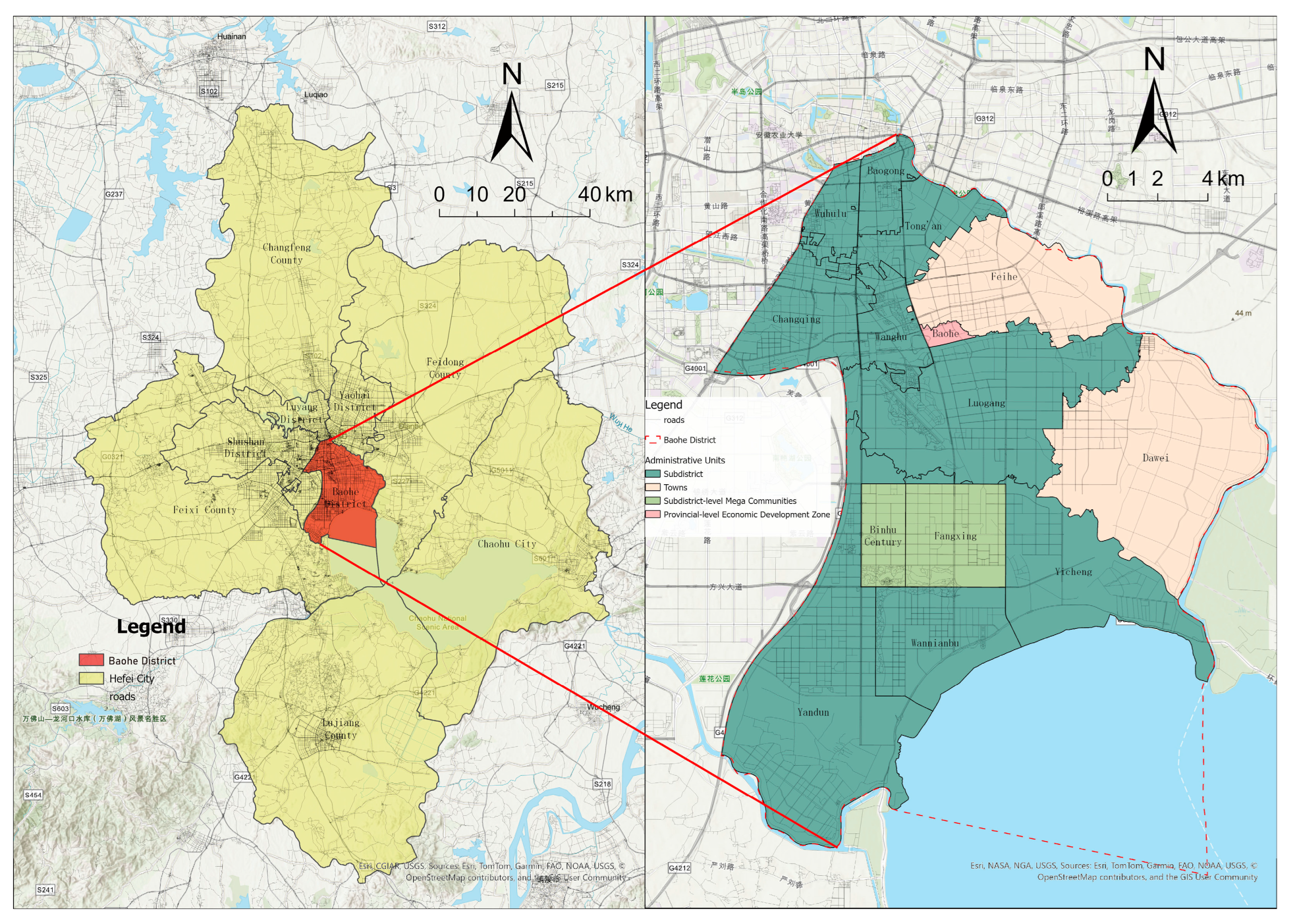
2—the highest within the city. Baohe serves as a central urban district within Hefei and encompasses 9 subdistricts, 2 towns, 2 large community-level subdistricts, and 1 provincial economic development zone (see
Figure 1). Its spatial composition includes both newly developed areas and mature urban zones, representing a comprehensive cross-section of various phases of urban growth that enables comparative assessments of life cycle typologies. The elevated population density further intensifies challenges related to public service delivery. These characteristics collectively position Baohe District as a relevant and insightful case for this research.
From the perspectives of administrative division and functional positioning, Baohe District can be categorized into four distinct sub-regions. The northern old urban core encompasses Baohe Sub-district, Wuhu Road Sub-district, Tong’an Sub-district, and Sipaitang Sub-district. This area acts as the historical, administrative, and commercial center of the district, characterized by high population density, mature residential neighborhoods, and multiple cultural landmarks including Bao Park, Ningguo Road Snack Street, and Hefei University of Technology. The central hub and industrial zone encompasses Wanghu Sub-district, Luogang Sub-district, Fangxing Sub-district, Baohe Economic Development Zone, and Feihe Town. This sub-region is dominated by Hefei South Railway Station and high-tech industrial clusters covering intelligent connected vehicles and biomedicine, featuring a mixed development pattern of transit-oriented development and manufacturing activities. The southern Binhu core area includes Yicheng Sub-district, Yandun Sub-district, Wannianbu Sub-district, Binhu Century Community, and Fangxing Community. This area functions as the provincial administrative center and Binhu Science City, featuring modern public amenities, financial back-office bases, and extensive lakeside ecological zones including Binhu Wetland Forest Park and Tangxi River Park. The eastern ecological and agricultural zone comprises Dawei Town and the eastern part of Feihe Town. This zone is characterized by urban agriculture, eco-tourism, and rural leisure, with representative sites including Dawei Ecological Agriculture Park and the Chaohu Lake shoreline. This overall functional diversity enables comparative analysis of how different urban morphologies influence the vitality of urban living circles.
3.2. 15-Minute Walkable Neighborhoods Delineation Method
This study integrated the accessibility of facility supplies, travel demands of residents, and spatial distribution patterns to delineate 15-min walkable neighborhoods. Public service facilities—essential components of these neighborhoods—significantly affect the daily life convenience and equity experienced by residents. In accordance with national standards such as the Standard for Planning and Design of Urban Residential Areas (GB 50180-2018) [
54] and the Code for Planning of Urban Public Facilities (GB 50442-2008) [
55] issued by the Ministry of Housing and Urban-Rural Development, along with local guidelines from cities such as Beijing and Shanghai, threshold service radii and facility weights were established for hierarchically categorized public services. Based on this framework, weight intervals were assigned to five major categories of facilities. Sub-category weights were then refined through a two-round Delphi process involving five domain experts, who independently evaluated each sub-category against three criteria: demand urgency, service radius constraints, and functional irreplaceability. Resulting composite scores were linearly normalized to a 1.0–2.0 scale, ensuring proportional differentiation while preserving ordinal relationships. This normalization was cross-validated against the benchmark weights in
Table 4. The Delphi process was conducted as follows. Five experts in urban planning and public facility management independently rated each sub-category on a 1–5 scale (1 = very unimportant, 5 = very important) based on three criteria: demand urgency (frequency of daily use), service radius constraints (proximity requirements), and functional irreplaceability (availability of alternatives). The composite score for each sub-category was calculated as the arithmetic mean of the three criterion scores. After the second round, expert consensus was achieved (Kendall’s W = 0.85). The composite scores were linearly mapped to a target weight range of 1.0–2.0 using min-max normalization. For example, kindergartens received a composite score of 4.7, mapped to 1.8; primary schools scored 4.9, mapped to 2.0; secondary schools scored 3.8, mapped to 1.6. The resulting weights were cross-validated against the national and local standards listed in
Table 4.
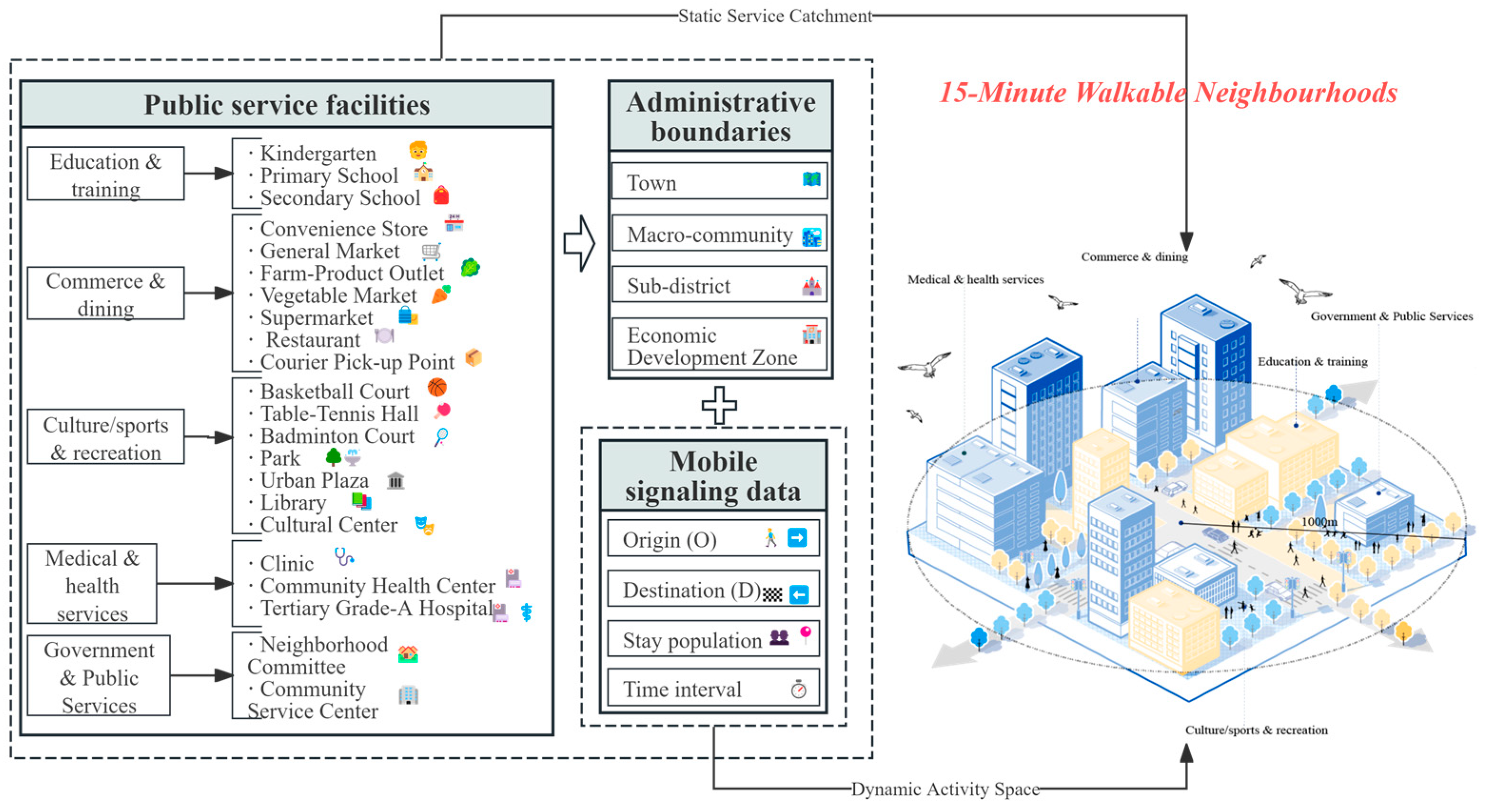
Figure 2 illustrates the step-by-step delimitation process. A foundational urban functional spatial framework was established by integrating various types of public-service facility Point of Interest (POI) data with road network data using ArcGIS Network Analyst. This framework was then intersected with legal boundaries of four administrative divisions in Baohe District—specifically subdistricts, towns, large subdistrict-level communities, and a provincial economic development zone—to generate static service catchments. Subsequently, mobile phone signaling data were incorporated to develop dynamic living circles. A network analysis spatially overlayed origin-destination (OD) point-path accessibility onto the predefined static facility coverage areas. By combining dynamic and static spatial units, living circles were synthesized based on two components: (i) static facility coverage intensity (weight = 0.6) and (ii) dynamic demand heat (weight = 0.4). The weights assigned to static facility coverage (0.6) and dynamic demand (0.4) reflect the differential contributions of infrastructure supply and population mobility to living circle vitality. Prior research has examined the 15-min living circle predominantly from either the supply side—focusing on facility distribution and accessibility [
15,
51]—or the demand side—emphasizing spatiotemporal patterns of population flow [
15]—but rarely in an integrated manner. This study bridges that gap by jointly modeling both dimensions within a unified evaluative framework. The weight allocation follows a theoretically grounded rationale: static facility distribution represents the foundational, spatially fixed component of service capacity; it is a prerequisite for service provision and determines the upper bound of potential accessibility. In contrast, population flow—characterized by pronounced temporal fluctuations (e.g., weekday–weekend disparities and hourly peaks)—serves as an indicator of actual usage intensity rather than inherent service availability. Crucially, residents’ daily mobility decisions presuppose the prior existence and spatial accessibility of facilities; without adequate facility supply, population activity cannot translate into sustained living circle vitality. Empirical evidence and urban functional logic thus support assigning greater relative importance to facility supply—hence the 6:4 weighting—over transient demand signals, as it better captures the structural determinants of urban livability. Finally, neighborhoods that can be traversed within a 15-min walking threshold—indicating complete coverage—were delineated. Finally, neighborhoods that can be traversed within a 15-min walking threshold—indicating complete coverage—were delineated.
3.3. Typology of 15-Minute Walkable Neighborhoods
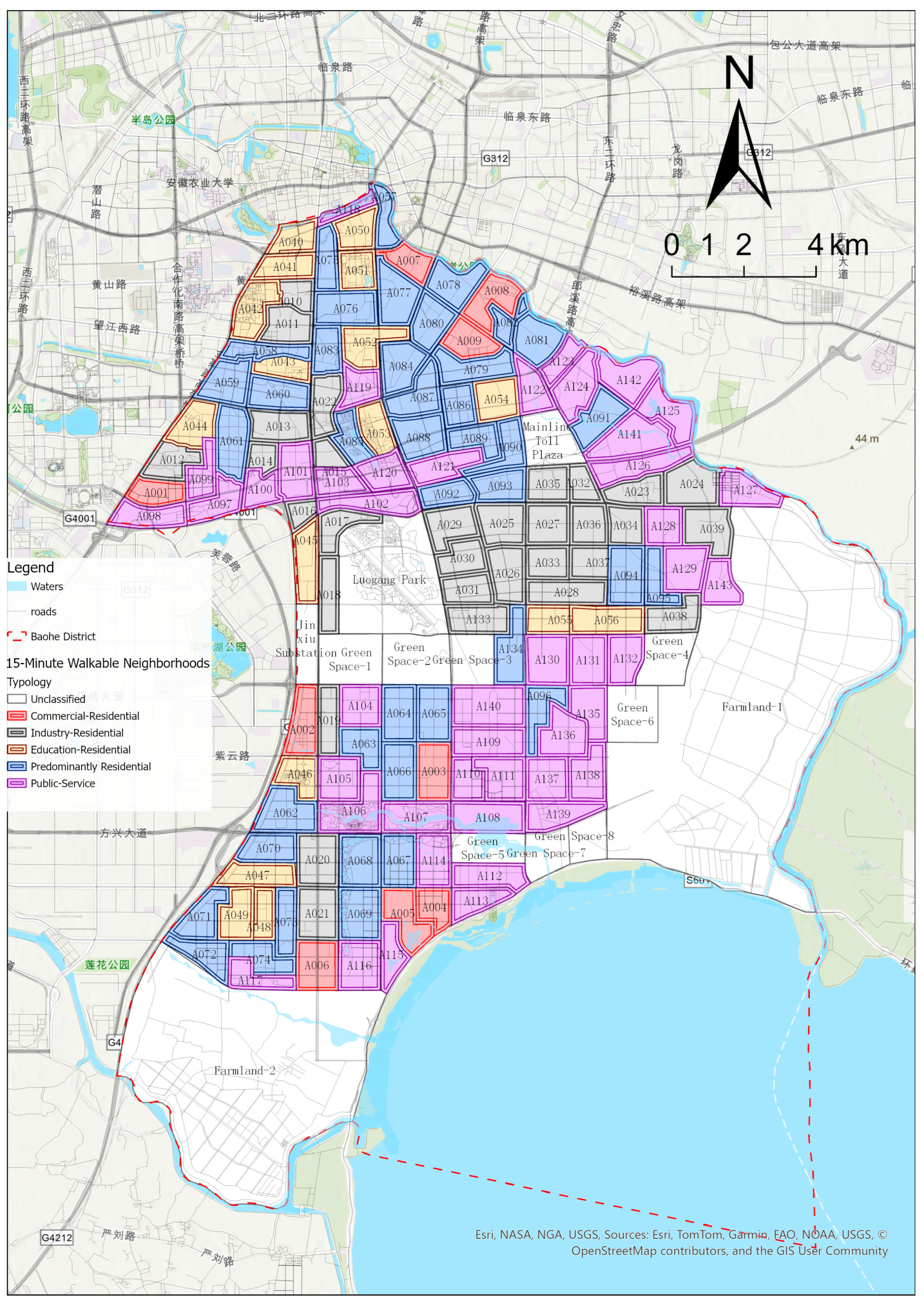
Drawing upon national codes and the pertinent literature, this study employed a function-oriented typology to delineate five mutually exclusive categories: commercial-residential, industry-residential, education-residential, predominantly residential, and public-service (
Table 5). The identification process was conducted in two phases. First, the proportion of dominant facility points of interest (POIs) was assessed against a predetermined density threshold. Subsequently, the spatial arrangement of these POIs was analyzed to verify functional coherence. Areas unsatisfied to both criteria were designated as “unclassified” in accordance with the Urban Design Guidelines for Territorial Spatial Planning (TD/T 1065-2021) [
57] (
Figure 3).
3.4. Measuring Vitality in 15-Minute Walkable Neighborhood
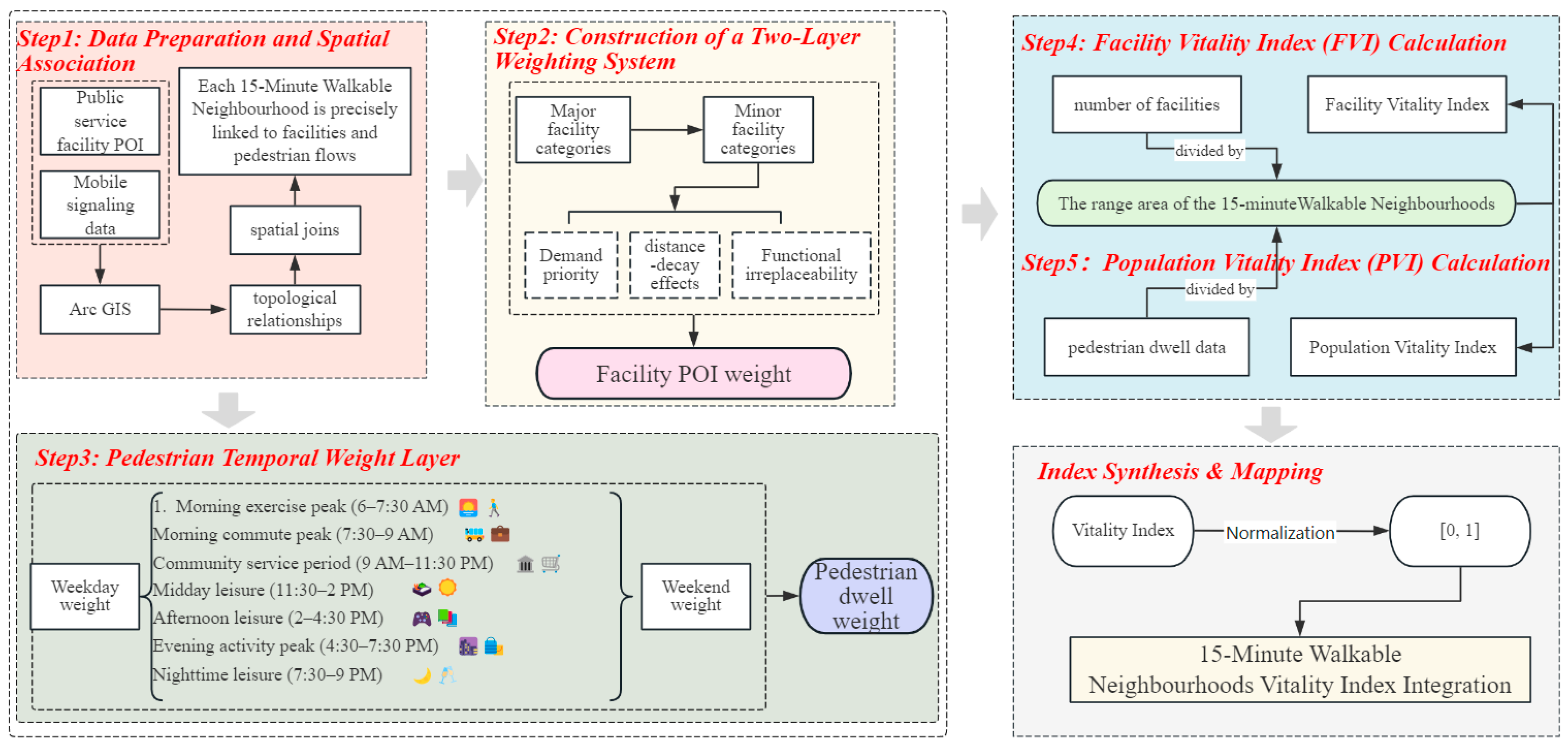
Driven by the intensity of facility supply and observed pedestrian activity patterns, this study developed an integrated model to assess vitality within 15-min walkable neighborhoods, yielding a composite Vitality Index (VI) scaled from 0 to 1. The findings were visualized through a synthesized pedestrian vitality map (
Figure 4). The analytical process is structured into five steps. First, facility Point of Interest (POI) data and mobile phone signaling data were integrated into a Geographic Information System (GIS) environment. Spatial joins and topological relationships were established to accurately associate each neighborhood (coded A001–A143) with its corresponding distribution of facilities and metrics concerning pedestrian flow. Second, a dual-level weighting system was constructed. Informed by the national Standard for Urban Residential Area Planning and Design and the Technical Guidelines for Urban Physical Examination, public service facilities are classified into five categories—healthcare, education, administration, commerce, and culture/sports—with further delineation into subcategories. Weights are assigned based on three criteria: demand priority, decay associated with service radius, and functional irreplaceability. Thirdly, a time-varying pedestrian activity layer was developed. The daily timeframe from 06:00 to 21:00 is divided into seven intervals: morning exercise; morning peak; community service hours; midday; afternoon; evening peak; and nighttime. Distinct weighting schemes were employed for weekdays versus weekends to capture temporal variations in activity patterns. Fourthly, the Facility Vitality Index (FVI) was calculated as the weighted sum of facility counts per unit area within each neighborhood. Lastly, the Population Vitality Index (PVI) was derived from mobile signaling data by aggregating stay population counts adjusted for temporal weights, which are also normalized by area. Both indices experienced min-max normalization prior to the combination using weighted linear integration, and were subsequently classified into distinct tiers and represented cartographically.
3.4.1. Construction of Public Service Facilities Weight System and Calculation Method of Vitality Index
Following the Standard for Urban Residential Area Planning and Design (GB 50180-2018) [
54], a two-tier weighting scheme was developed to evaluate 15-min walkable neighborhoods. The first tier classifies facilities into five categories and establishes weight intervals that reflect resident urgency. Healthcare facilities weights ranging from 1.5 to 2.0, while public administration services receive weights between 0.8 and 1.2. The second tier introduces distance-decay weights applied to specific sub-types of facilities. A kindergarten located within 300 m weights 1.8, whereas a middle school situated within 1000 m weights 1.6. Basic support functions are ascribed higher ratings than amenity functions. Therefore, a community health center weights 2.0, compared with a cultural palace which weights 1.1. All point-of-interest (POI) facility data were imported into Geographic Information System (GIS) software, version number ArcMap 10.2 (ESRI), undergoing topology verification and scoring based on the established weighting table. Overlapping service radii were identified and rectified accordingly. A walkable network analysis was conducted, resulting in the delineation of 156 neighborhoods; among these, 143 were designated with codes A001 to A143 while the remaining neighborhoods were labeled separately for differentiation purposes. Spatial joins facilitated the linking of each facility with its corresponding neighborhood, and the Facility Vitality Index was computed as the weighted sum of facilities present within each unit.
The specific procedures are outlined as follows. First, the total weighted value of facilities was calculated. For each 15-min walkable neighborhood unit, the weighted contributions of all public service facilities within that area were aggregated through a spatial join. The contribution value of the k-th type of facility is determined as follows:
where N
k is the number of facilities of type k within the neighborhood, and W
k is the weight assigned to that facility type. The total weighted value V
total for the neighborhood is then obtained by summing the contributions of all facility categories:
Second, spatial standardization was applied. To eliminate the impact of variation in neighborhood area on comparability, the FVI is defined as the ratio of the total weighted value to the area of the unit:
where S
Ai denotes the area of neighborhood Ai in hectares, reflecting the comprehensive efficiency intensity of facility services per unit area. Its value is a non-negative real number, with a higher value indicating stronger vitality.
Finally, result classification and labeling were performed. FVI values were output and spatially linked to the 143 standard neighborhood units (A001–A143) included in the evaluation system. Uncovered areas, such as green spaces, large parks, and farmland, were labeled separately by name, with FVI values retained for record but excluded from the core analysis.
3.4.2. Population Vitality Index
Data utilized in this study were sourced from pedestrian mobility big data within the Baohe District from 13 May to 19 May 2024, encompassing daily records collected between 06:00 and 21:00 across timestamps, coordinates of origins and destinations, and the number of individuals present at each location. Spatial units employed were consistent with those used in FVI. In accordance with activity patterns observed among residents of Baohe District, a distinction was made between weekdays and weekends. Additionally, varying weights were assigned to different time intervals to develop a comprehensive weighting system.
PVI assesses activity intensity within urban neighborhoods that can be traversed by walking within 15 min, with calculation as follows:
The physical meaning and computational specifications of each symbol in the formula are defined as follows. PVI
Ai represents the Population Vitality Index of the 15-min walkable neighborhood A
i, with a unit of persons per hectare per week, reflecting the intensity of population activity per unit area within the neighborhood. Its value is non-negative, and a higher value indicates stronger vitality (
Table 6).
SAi denotes the spatial area of neighborhood Ai, measured in hectares. The geometric boundaries of each neighborhood were obtained using a GIS platform, and the planar projected area was calculated with a required precision of 0.01 ha.
The variable serves as a day index, ranging from 1 to 7, where each value corresponds to a specific day within the weekly cycle. For instance, =1 indicates Monday, =2 Tuesday, and so forth up to =7 for Sunday.
The variable represents the time period index, ranging from 1 to 7 and corresponding to seven characteristic periods aligned with urban activity rhythms. Specifically, =1 for the morning exercise period (06:00–07:30), =2 for the morning commute peak (07:30–09:00), through to =7 for the evening leisure period (19:30–21:00). The function defines time-period-specific weights that capture variations in activity intensity across different types of days, expressed as follows:
where P
i,t,d indicates the total number of staying individuals within neighborhood A
i on day d during time period t, measured in persons, and computed as follows:
This value is obtained by spatially joining pedestrian points to the neighborhood and summing all observations within its boundaries.
The variable pj refers to the number of staying individuals at spatial point j, expressed as an integer from raw observation data, representing the number of pedestrians staying within that spatial unit during a specific time window.
3.4.3. Vitality Index Integration
The integrated Vitality Index (VI) was computed using the following formula:
where α and β represent weights assigned to each indicator. In accordance with the Urban Physical Examination Assessment Regulation TD/T 1063-2021 [
58], the values were set as α = 0.6 and β = 0.4.
The standardization process was carried out using min-max normalization, defined as
where X denotes the original value, X
min and X
max refer to the minimum and maximum values in the dataset, respectively. This normalization method transforms the original data into the range [0, 1], facilitating comparison and integration.
4. Results
4.1. Typology of Living Circles
Based on the previously described classification method, this study delineated 156 fifteen-minute walkable neighborhoods within Baohe District, predominantly ranging between 75 and 125 ha, below the recommended lower threshold of 3 km
2 (approximately 300 ha) as specified in the Chinese Urban Residential Area Planning and Design Standard (GB 50180-2018) [
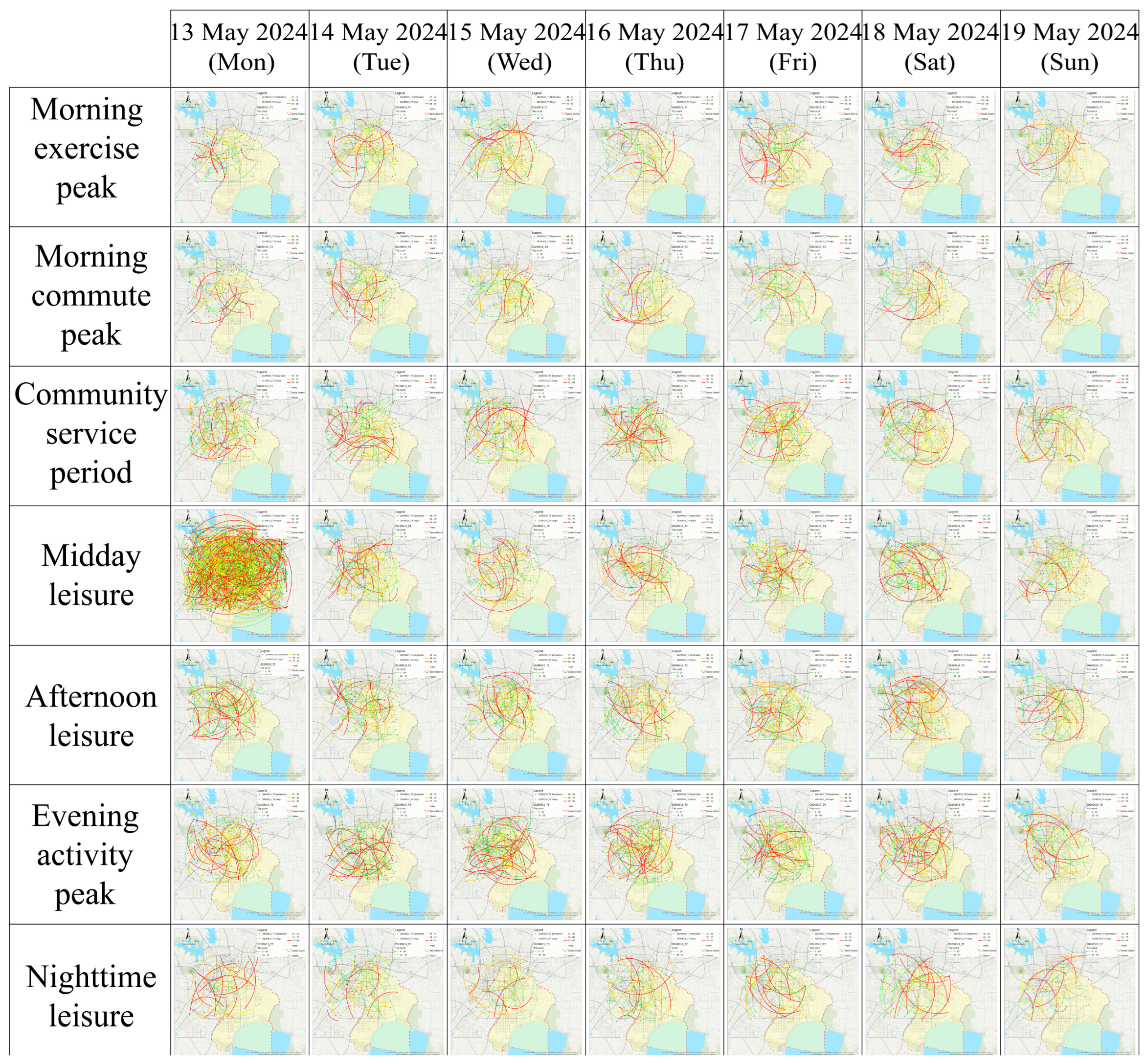
54] and aligning with the lower bound of service radius guidelines (approximately 200–315 ha) adopted by cities such as Shanghai and Jinan. These delineated areas are significantly smaller than typical international empirical ranges for the concept of “a 15-min city”, specifically, around 200–250 ha in Paris and up to 500 ha in Melbourne. Consistent with pedestrian-oriented planning approaches exemplified by Bogotá’s 15-min city model, the spatial scale of these neighborhoods adheres to established normative standards. High population density fosters finer land subdivision, denser street networks, and decreased spacing between nodes, enabling residents to meet high-frequency daily needs within a smaller geographical footprint and objectively reducing the effective neighborhood radius. Empirical behavioral data derived from mobile signaling (
Figure 5) indicate that actual walking distances tend to be shorter than those presumed by conventional planning standards; An increased facility density further minimizes pedestrian travel distance. Data driven by dynamic demand reinforces the delineation of more compact neighborhoods. In older urban districts and Binhu New District, the combination of high public service facility density and a significant degree of functional mixing endows residents with the access to essential services within a radius of just 600 to 800 m, promoting the organic emergence of compact and efficient walkable units.
This reduced neighborhood scale represents both a planning success and a consequence of extreme population density. On one hand, high-density development facilitates efficient service provision within compact areas, indicating that Chinese cities have effectively concentrated amenities within walkable distances—aligning with the “proximity” principle of the 15-min city. On the other hand, this constrained scale is also driven by land scarcity and elevated real estate prices, which necessitate finer-grained parcel subdivision and higher residential densities. To disentangle these factors, we compared old and new urban neighborhoods with comparable population densities. The results demonstrate that historical street network patterns and mixed-use development—independent of density—significantly influence neighborhood scale. Consequently, the observed compactness should be interpreted as a synthesis of density-driven necessity and deliberate planning strategies. While the smaller scale in older urban areas reflects organic growth and fine-grained land use, the larger scale in new developments results from modern superblock planning. Nevertheless, both remain below international benchmarks, confirming that high-density Chinese cities can function effectively within a reduced radius.
Within the newly developed urban areas, 23 neighborhoods are classified as residential-dominated, comprising 25.6% of the total, with a general eastward shift and predominant distribution in the eastern sector. There are 29 public service-oriented neighborhoods, representing 32.5%, which are primarily concentrated within the core zones dedicated to production-residential mixed types, especially east of Luogang Park. A total of 20 neighborhoods are identified as production-residential mixed with a proportion of 22.5%, forming contiguous high-tech zones located to the east of Luogang Park while displaying a more dispersed distribution towards the west. A total of 10 academy-residential integrated neighborhoods account for 11.4%, clustered within or along the peripheries of industrial areas in response to heightened demand for skilled talent. Furthermore, 6 commercial-residential neighborhoods make up 6.8%, centered around Rongchuang Cultural Tourism City and emerging commercial hubs near major transportation interchanges. Additionally, 12 unclassified neighborhoods occupy 13.5%, broadly distributed along the outer edges of these new urban areas (
Table 7 and
Table 8,
Figure 6).
4.2. Measurement Results of Neighborhood Vitality
This study developed a Vitality Index (VI) for each 15-min walkable neighborhood by integrating Facility Vitality Index (FVI) and Population Vitality Index (PVI). The raw data were normalized using min-max scaling and spatial autocorrelation analysis, complemented by visualization techniques to elucidate spatial distribution patterns.
4.2.1. Validation of Spatial Autocorrelation
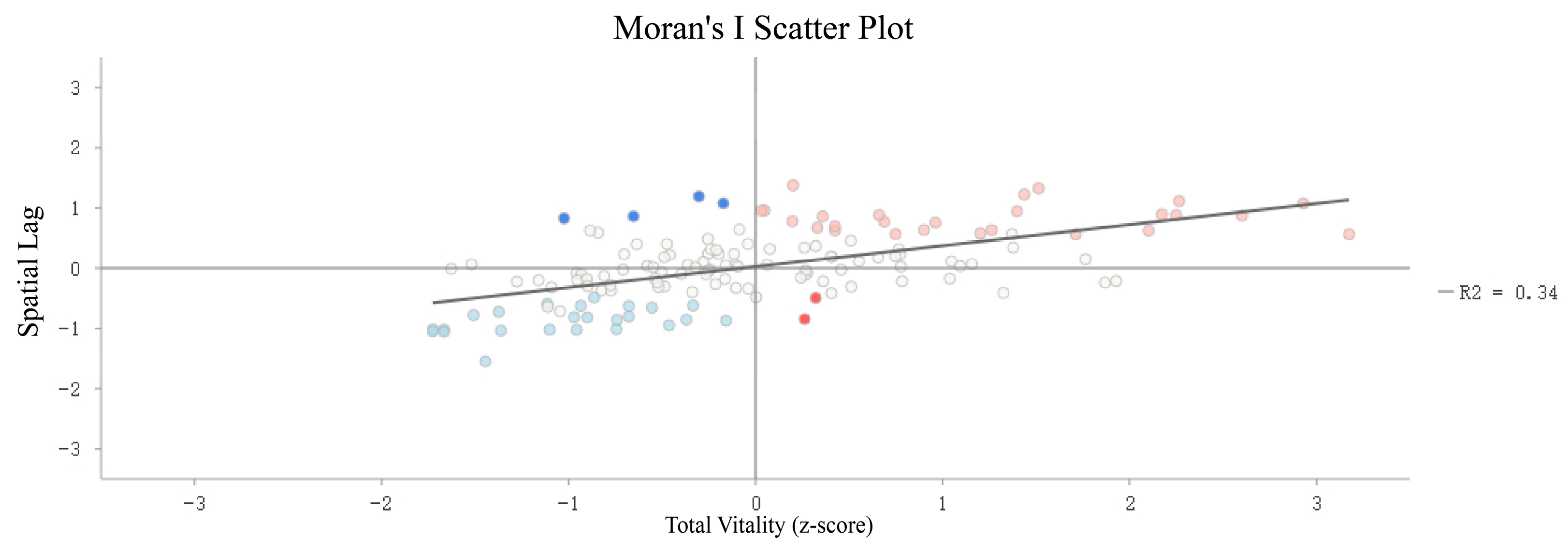
The Moran’s I scatterplot (
Figure 7) reveals a significant positive correlation between total vitality (expressed in z-scores) and its spatial lag (R
2 = 0.34). VI demonstrates moderate spatial autocorrelation (
p < 0.01), indicating a tendency of geographical clustering in areas with high or low vitality, rejecting the null hypothesis of random distribution (
Figure 7).
4.2.2. Cluster Pattern
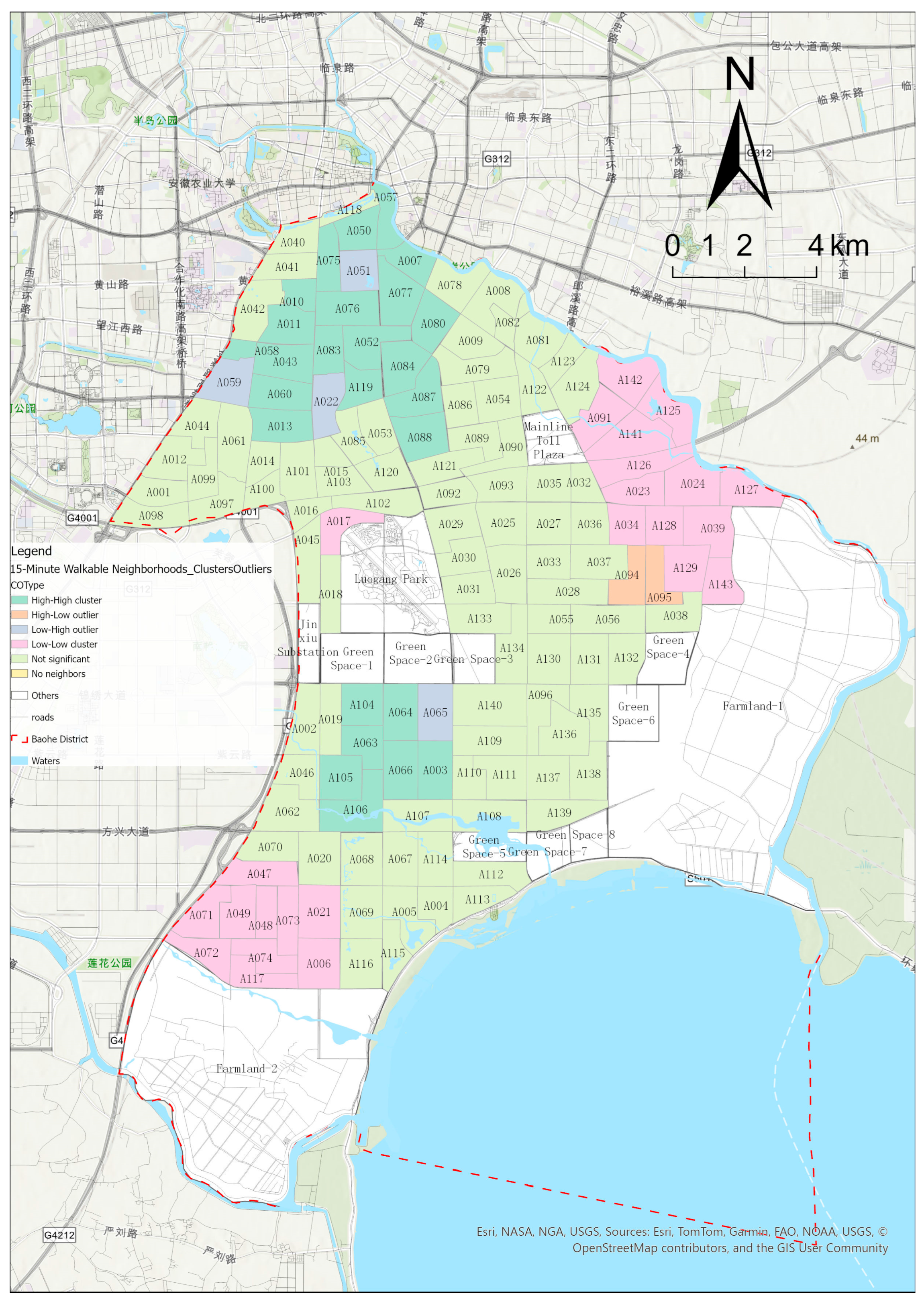
The results of cluster pattern identification (
Figure 8) reveal distinct spatial agglomeration characteristics in the vitality distribution of 15-min walkable neighborhoods within Baohe District. High-High (HH) clusters are predominantly concentrated in central and southern regions of older urban areas, typically encompassing urban core commercial and residential zones characterized by abundant commercial resources and well-developed infrastructure. In contrast, Low-Low (LL) clusters are generally located in peripheral areas of the city, with relatively scarce commercial enterprises and public service facilities due to their distance from the urban core. The identification of spatial outliers underscores several noteworthy cases. High-Low (HL) outliers frequently occur along the peripheries of high-vitality zones. Despite moderate vitality, these areas underperform relative to their highly vibrant surroundings. Regardless of the situation within low-vitality regions, Low-High (LH) outliers can be distinguished by particular attractive facilities or services making them stand out amidst a less dynamic context. Regions classified as not significant indicate a relatively uniform distribution of vitality without pronounced clustering or identifiable outlier patterns. In addition to potential adequate internal amenities and favorable environmental conditions, these areas still warrant ongoing attention and research to monitor future trends in vitality distribution.
4.2.3. Spatial Differentiation
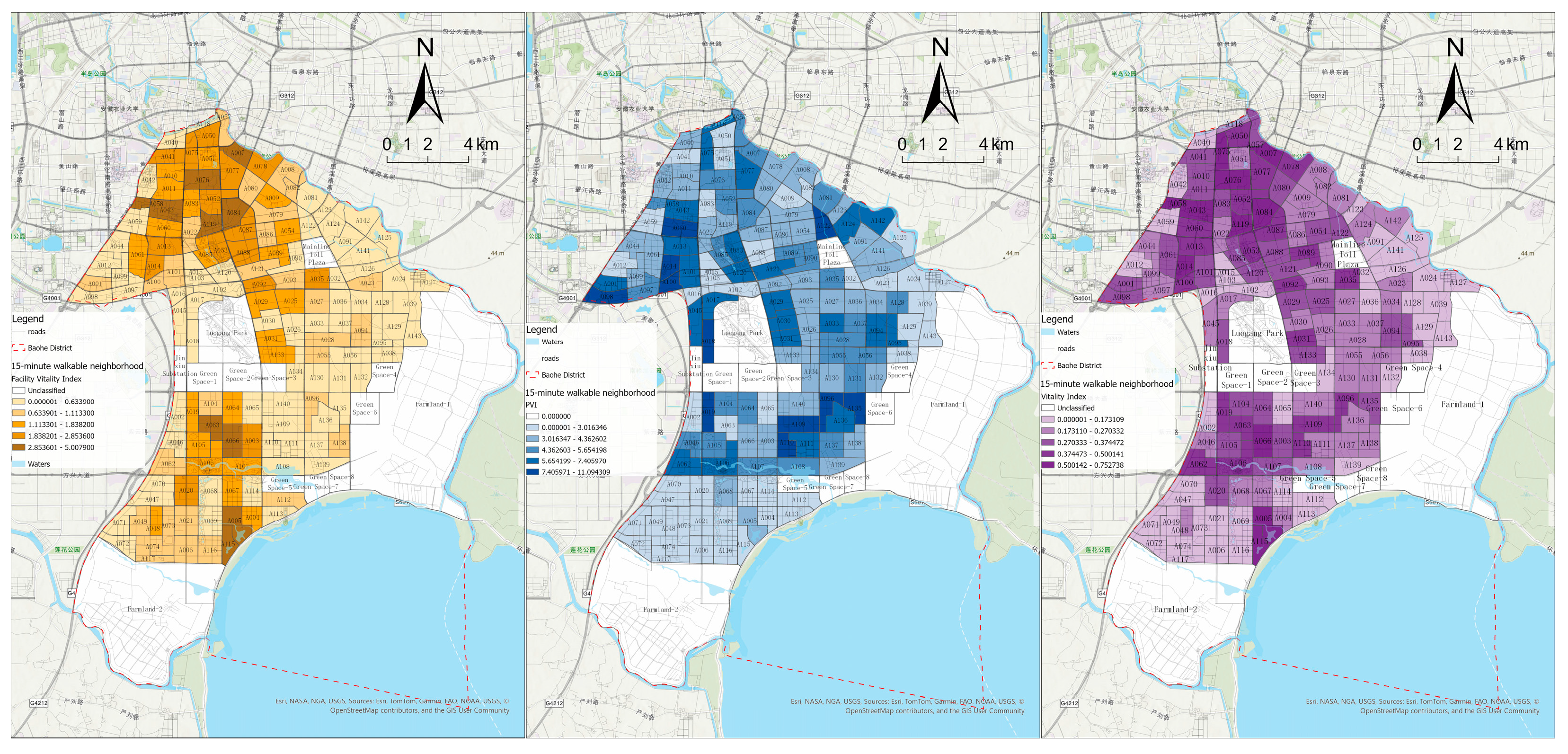
Based on a comprehensive cross-analysis of Facility Vitality Index (FVI) and Population Vitality Index (PVI) (
Table 9), significant spatial heterogeneity was observed among the 15-min walkable neighborhoods in Hefei. Out of the analyzed 156 neighborhoods, 143 valid units were retained after excluding 13 due to missing data. Classified statistics and spatial overlay analysis of FVI and PVI reveal a distinct spatial pattern characterized by both mismatch and partial coupling between these two indices. As illustrated in
Table 8, the sample is predominantly composed of neighborhoods with low to medium-low vitality values. Specifically, 67 neighborhoods (46.9%) exhibit an FVI < 0.633900, while 83 neighborhoods (58.0%) has a PVI of 4.362602. In contrast, high-value segments are notably scarce; Only 10 neighborhoods (7.0%) present an FVI > 2.853601, and merely 12 (8.4%) display a PVI > 7.405971, indicating rare high-vitality spaces predominantly concentrated at the top tier. Spatial overlay analysis of FVI and PVI shows that a total of 39 neighborhoods (27.3% of the sample) exhibit either consistently high or consistently low vitality values. Among these, nine high-high units, namely A013, A053, A064, A075, A077, A085, A089, A105, and A107, are clustered along the Huizhou Avenue-Binhu New District axis, which corresponds with areas featuring concentrated municipal government functions and establishments such as Binhu Convention Center and upscale commercial complexes. In contrast, 30 low-low units are primarily situated near Feinan Industrial Park, Hefei South Railway Station, and Guan Zhen Happiness Plaza, all share the characteristic trait of concurrently low facility and population density, forming clear cold spots within their respective regions.
According to the vitality tier classification of 15-min walkable neighborhoods (
Table 10), a total of 19 units (13.3%) are categorized as very high vitality or high vitality. These areas spatially correspond with high-high overlapping units, with notable examples including the Wanghu Plaza-Jinzhonghuan Plaza region and the Wanda Yinzuo-Rongchuang Mao vicinity, reflecting a model characterized by an integration of high-density public services and significant population agglomeration. A total of 36 neighborhoods (25.2%) are classified as medium vitality, predominantly situated in transition zones between the old urban area and Binhu New District, exhibiting outdated facilities yet maintaining relatively high population densities. A total of 88 neighborhoods (61.5%) fall into low or very low vitality categories, creating a “vitality depression” that encircles the outer periphery of both the old city and industrial functional areas. Among these, Hefei South Railway Station consistently demonstrates low vitality indices (below 0.15), primarily due to short pedestrian dwell times. Feinan Industrial Park is adversely affected by monofunctional land use coupled with inadequate service facilities, resulting in pronounced spatial gradient differentiations.
In summary, as
Figure 9 illustrates, the vitality structure of 15-min walkable neighborhoods in Hefei reveals a core-periphery differentiation pattern. High-vitality regions cluster along the Binhu New District axis, while low-vitality areas are dispersed around peripheral industrial zones and transport hubs. Such current heterogeneous pattern is shaped by both mismatches and synergies between facility provision and population activity.
5. Discussion
This study validates its hypothesis by integrating static facility data with mobile signaling data, revealing critical limitations in traditional 15-min neighborhood delineation methods that rely on fixed radii and assumptions of population homogeneity. The findings underscore two key dimensions. First, in terms of spatial delineation, the data indicate that only 27.3% of neighborhoods exhibit high synergy between facilities and population distribution, demonstrating that rigid threshold-based approaches often result in spatially imbalanced service areas. Following dynamic recalibration, neighborhood sizes were refined to a range of 75–125 ha. This reduced scale—smaller than many international benchmarks—is better aligned with the compact urban fabric characteristic of high-density Chinese cities. Second, the study proposes a Facility Vitality Index (FVI) and Population Vitality Index (PVI) framework, which effectively captures the drivers of urban vitality differentiation. Older urban districts display constrained vitality due to inadequate local amenities, whereas newly developed areas reveal a disconnection between pedestrian movement patterns and facility availability. These insights directly address the research question posed in the introduction regarding the measurement of actual walking behavior and real-world accessibility preferences.
The research supports the shift toward a dynamic governance paradigm, leveraging mobile data to transition from static land-use planning to adaptive, data-informed urban management, thereby overcoming previous constraints in capturing real-time population dynamics. Analysis identified dual-high vitality clusters along the Binhu New District corridor, reinforcing the argument that walkable urban forms depend on fine-grained street networks and mixed-use development. Furthermore, the findings emphasize that Chinese cities must enhance facility integration in aging neighborhoods and promote functional diversity in emerging developments. Based on Hefei’s Baohe District—a representative case of coexisting old and new urban fabrics—the study provides transferable insights for other high-density urban contexts in China and East Asia. Furthermore, the findings highlight that the high proportion of low-vitality neighborhoods (61.5%) carries significant socioeconomic implications: in industrial zones such as Feinan Industrial Park, limited service access likely increases car dependency and travel costs, disproportionately affecting low-income households; whereas the low vitality of transport hubs like Hefei South Railway Station simply reflects their functional role as transit nodes with short pedestrian dwell times, rather than service deficiencies. In response to these spatial differences, urban renewal in historic districts should prioritize micro-scale facility deployment to expand service coverage, drawing lessons from successful interventions such as those in Hongkou District, Shanghai. Optimization of new towns should adhere to transit-oriented development (TOD) principles to synchronize pedestrian flows with facility locations, exemplified by Rongchuang Cultural Tourism City’s integration with metro infrastructure. Industrial zones such as Feinan Industrial Park could benefit from introducing community-serving functions, inspired by intergenerational mixed-use models observed in Nagasaki. Based on Hefei’s Baohe District—a representative case of coexisting old and new urban fabrics—the study provides transferable insights for other high-density urban contexts in China and East Asia. However, adaptations such as lowering FVI thresholds would be necessary when applying this model to lower-density cities like Melbourne. A notable limitation lies in the insufficient representation of vulnerable groups’ walking behaviors and accessibility needs. Future studies should incorporate equity-sensitive pedestrian modeling.
6. Conclusions
This study establishes a “dynamic-static dual-layer coupling” framework for delineating and evaluating 15-minute walkable neighborhoods in Hefei’s Baohe District, innovatively combining mobile signaling data with POI datasets. Key findings are twofold. First, the methodological advancement in spatial delineation moves beyond conventional fixed-radius models. The 143 dynamically delineated neighborhoods (75–125 ha) align more closely with observed pedestrian travel distances (600–800 m), indicating that higher facility density enables smaller, more efficient functional neighborhood scales in dense urban environments. Second, significant disparities in neighborhood vitality are evident: only 9 neighborhoods (6.3%) achieve high vitality across both facility and population dimensions, predominantly clustered along the Huizhou Avenue–Binhu New District corridor. In contrast, the majority of low-vitality neighborhoods (61.5%) are located near industrial zones and major transportation hubs, underscoring a pronounced mismatch between facility provision and resident needs.
Based on these results, differentiated governance strategies are recommended. Commercial-residential nodes such as Rongchuang Cultural Tourism City should increase commercial intensity around transit points. Production-residential areas like Feinan Industrial Park require enhanced community services to support livability. Residential-dominant neighborhoods, particularly in older urban cores, need improved service access through targeted deployment of micro-scale facilities. Together, these strategies offer a replicable technical approach—integrating dynamic boundary delineation with multidimensional vitality assessment—that enables high-density cities to evolve from static planning frameworks toward adaptive, responsive governance. At the policy level, this study advocates for revising current urban planning standards to include behaviorally informed, flexible mechanisms for adjusting neighborhood boundaries, thereby enhancing both scientific validity and operational adaptability. At the policy level, this study advocates for revising the Standard for Planning and Design of Urban Residential Areas (GB 50180-2018) [
54] to incorporate behaviorally informed, flexible mechanisms for adjusting neighborhood boundaries. Future research should focus on integrating mobility data from vulnerable populations to evaluate equity in walkable neighborhood access and on strengthening pedestrian environment resilience against external stressors such as climate change.
Author Contributions
C.Y.: Writing—review and editing, Writing—original draft, Visualization, Validation, Methodology, Formal analysis, Data curation, Conceptualization. M.Z.: Writing—review and editing, Validation, Supervision, Methodology, Investigation, Data curation, Conceptualization. H.W.: Writing—review and editing, Validation, Supervision, Resources, Project administration, Methodology, Investigation, Funding acquisition, Formal analysis, Data curation, Conceptualization. C.D.: Writing—review and editing, Visualization, Validation, Investigation. All authors have read and agreed to the published version of the manuscript.
Funding
This research was supported by the National Natural Science Foundation of China (No. 52408045), the financial support of Scientific Research Funds of Anhui Jianzhu University under Grant 2023QDZ08, the Anhui Province University Outstanding Scientific Research and Innovation Team (2022AH010021), Anhui Provincial Engineering Research Center for Regional Environmental Health and Spatial Intelligent Perception.
Institutional Review Board Statement
Not applicable.
Informed Consent Statement
Not applicable.
Data Availability Statement
Some or all data, models, or code that support the findings of this study are available from the corresponding author upon reasonable request. (Tables of spatial syntax data for the 52 neighborhood samples, categorized by type).
Conflicts of Interest
The authors declare no conflicts of interest.
References
- Wang, Y.; Wang, Y. Temporality and urbanity: Concepts, strategies and issues in contemporary urban design. Urban Plan. Forum 2019, 5, 12–20. [Google Scholar]
- Chai, Y.; Zhang, X.; Sun, D. Planning urban life circles based on space-time behavior: A case study of Beijing. Urban Plan. Forum 2015, 3, 61–69. [Google Scholar]
- Wu, L.; Niu, Q.; Ainiwaer, A.; Xi, Y. Exploration of Online and Offline Community Life Circle with Virtuality-Reality Fusion: Theoretical Advances and Planning Practices. Urban Plan. Forum 2024, 2, 25–33. [Google Scholar] [CrossRef]
- Moreno, C.; Allam, Z.; Chabaud, D.; Gall, C.; Pratlong, F. Introducing the “15-minute city”: Sustainability, resilience and place identity in future post-pandemic cities. Smart Cities 2021, 4, 93–111. [Google Scholar] [CrossRef]
- Yang, C.; Zhu, M. Delimitation, characteristic identification and planning strategies of O2O community life circles: A case study of Hongkou District, Shanghai. Planners 2023, 60–66, 76. [Google Scholar]
- Lyu, D. Planning Jinan’s “15-minute community life circle” based on element supply. City Plan. Rev. 2023, 4, 56–62. [Google Scholar]
- Huang, L.; Luo, J.; Song, C.; Zhao, C.; Li, Q.; Zhou, M. Community-homeland system planning under the community life-circle concept: The Cuiyun area in Chongqing Liangjiang New District. Urban Plan. Forum 2021, 2, 50–57. [Google Scholar]
- Yang, C.; Tang, M. “15-Minute City”: Exploration and Implications for French Urban Renewal in the Post-Pandemic Era. Beijing Plan. Rev. 2023, 6, 38–43. [Google Scholar]
- Pozoukidou, G.; Angelidou, M. Urban planning in the 15-minute city: Revisited under sustainable and smart city developments until 2030. Smart Cities 2022, 5, 1356–1375. [Google Scholar] [CrossRef]
- Yuen, B.; Bhuyan, M.R.; Ho, D.; Joyce, S.C. Redefining active mobility from spatial to social in Singapore. J. Transp. Health 2024, 38, 101869. [Google Scholar] [CrossRef]
- Rueda, S. Les superilles per al disseny de noves ciutats i la renovació de les existents. Barc. Pap. Rev. Sociol. 2017, 59, 78–93. [Google Scholar]
- Pozoukidou, G.; Chatziyiannaki, Z. 15-Minute City: Decomposing the New Urban Planning Eutopia. Sustainability 2021, 13, 928. [Google Scholar] [CrossRef]
- Hong, M.; Wei, W.; Xia, J. “Physical Examination and Regeneration” Oriented Community Life Circle Planning. Planners 2022, 38, 52–59. [Google Scholar]
- Zhang, Y.; Chen, Y.; Jiang, Y.; Zhang, W.; Gu, P.; Huang, W. Low-carbon Transport Environment Evaluation for Community Life Circles and Planning Enlightenment: A Case Study of Beijing, Shanghai, Shenzhen, and Haikou. Shanghai Urban Plan. Rev. 2024, 4, 24–30. [Google Scholar]
- Wei, W.; Hong, M.; Xie, B. Delimitation and spatial optimization of Wuhan’s 15-minute life circle based on supply–demand matching. Planners 2019, 35, 11–17. [Google Scholar]
- Zuniga-Teran, A.A.; Orr, B.J.; Gimblett, R.H.; Chalfoun, N.V.; Marsh, S.E.; Guertin, D.P.; Going, S.B. Designing healthy communities: Testing the walkability model. Front. Archit. Res. 2017, 6, 63–73. [Google Scholar] [CrossRef]
- Ito, Y.; Takayama, Y.; Morimoto, A. Walkability and its application in Japan: A case study of the area around Takadanobaba Station using a desire-stage model of walking behavior. City Plan. Inst. Jpn. 2021, 56, 811–818. [Google Scholar] [CrossRef]
- Yin, L.; Patterson, K.; Silverman, R.; Wu, L.; Zhang, H. Neighbourhood accessibility and walkability of subsidised housing in shrinking US cities. Urban Stud. 2022, 59, 323–340. [Google Scholar] [CrossRef]
- Liu, B. Decoding Walkable City: Creating Vibrant Downtowns to Save America—A Review. Urban Transp. China 2022, 20, 1–6. [Google Scholar]
- Jiang, Z.; Wu, C.; Chung, H. The 15-minute community life circle for older people: Walkability measurement based on service accessibility and street-level built environment—A case study of Suzhou, China. Cities 2025, 157, 105587. [Google Scholar] [CrossRef]
- Ferrer-Ortiz, C.; Marquet, O.; Mojica, L.; Vich, G. Barcelona under the 15-minute city lens: Mapping the accessibility and proximity potential based on pedestrian travel times. Smart Cities 2022, 5, 146–161. [Google Scholar] [CrossRef]
- Ali, M.; Ali, T.; Gawai, R.; Elaksher, A. Fifteen-, ten-, or five minute city? walkability to services assessment: Case of Dubai, UAE. Sustainability 2023, 15, 15176. [Google Scholar] [CrossRef]
- Murgante, B.; Patimisco, L.; Annunziata, A. Developing a 15-minute city: A comparative study of four Italian cities—Cagliari, Perugia, Pisa, and Trieste. Cities 2024, 146, 104765. [Google Scholar] [CrossRef]
- Rhoads, D.; Solé-Ribalta, A.; Borge-Holthoefer, J. The inclusive 15-minute city: Walkability analysis with sidewalk networks. Comput. Environ. Urban Syst. 2023, 100, 101936. [Google Scholar] [CrossRef]
- Yu, Y. From traditional residential area planning to community life-circle planning. City Plan. Rev. 2019, 43, 17–22. [Google Scholar]
- Chai, Y.; Li, C. Urban life-circle planning: From research to practice. City Plan. Rev. 2019, 43, 9–16. [Google Scholar]
- Feng, X. Seamless Linked National Space Uniting Regional Forces: Review on the Japan’s 8th National Spatial Planning. Urban Plan. 2024. Available online: https://kns.cnki.net/kcms2/article/abstract?v=7DtDJWciuTIykaW_3Zjm47W2ruJLbsfx9maxyQZgjGBTPwwPJP0eaDyEdjUin8_7RACnM4_NjUulHmDFgyiKoD7wt3H7SdSryiSpsMzQZO70JxZ2EtKNcLqsMJGAhGzBL-ycb3CW5d8W9edh4UZS8RN0jCxuORWgYKOgjL4T9JNIS_mnQOnH_w==&uniplatform=NZKPT&language=CHS (accessed on 17 March 2026).
- Sun, D.; Chai, Y. Review and implications of life-circle studies in Japan. Urban Archit. 2018, 36, 13–16. [Google Scholar]
- Shen, Z.; Lin, X.; Ma, Y. On the Combination of Japanese Urban Master Plan and “Life Circle” Concept in Recent Years. Urban Rural Plan. 2018, 6, 74–87. [Google Scholar] [CrossRef]
- Shen, Z. Japan’s urban planning system and spatial regulation. Urban Rural Plan. 2019. [Google Scholar]
- Huang, Y.; Ling, C.; Yang, J.; Zeng, E. Inclusive Home-Based Community Elderly Care Services: Implication of the Japan’s “Retail Facility + Elderly Care” Model. Urban Plan. 2025. [Google Scholar] [CrossRef]
- Shao, L.; Lu, Y. Disaster prevention and medical care in daily life circles: A case study of Fukuoka, Japan. Urban Hous. 2020, 27, 60–63. [Google Scholar]
- Song, L.; Kong, X.; Cheng, P. Supply-demand matching assessment of the public service facilities in 15-minute community life circle based on residents’ behaviors. Cities 2024, 144, 104637. [Google Scholar] [CrossRef]
- Allam, Z.; Bibri, S.E.; Jones, D.S.; Chabaud, D.; Moreno, C. Unpacking the “15-minute city” via 6G, IoT, and digital twins: Towards a new narrative for increasing urban efficiency, resilience, and sustainability. Sensors 2022, 22, 1369. [Google Scholar] [CrossRef] [PubMed]
- Papadopoulos, E.; Sdoukopoulos, A.; Politis, I. Measuring compliance with the 15-minute city concept: State-of-the-art, major components and further requirements. Sustain. Cities Soc. 2023, 99, 104875. [Google Scholar] [CrossRef]
- Wang, H.; Tsoi, K.H.; Loo, B.P.Y. An assessment framework for 15-minute cities: Progress worldwide and the impact of urban form. Transp. Res. Part A Policy Pract. 2025, 199, 104583. [Google Scholar] [CrossRef]
- Sun, D.; Shen, S.; Wu, T. Life Circle Theory Based County Public Service Distribution: Jiangsu Pizhou Case. Planners 2012, 28, 68–72. [Google Scholar]
- Plaza-Herrera, D.; Mercadé-Aloy, J. Inclusive 15-minute cities: An age-sensitive assessment of active accessibility in the metropolitan area of Barcelona. Cities 2025, 165, 106091. [Google Scholar] [CrossRef]
- Guzman, L.A.; Arellana, J.; Castro, W.F. Desirable streets for pedestrians: Using a street-level index to assess walkability. Transp. Res. Part D Transp. Environ. 2022, 111, 103462. [Google Scholar] [CrossRef]
- Guzman, L.A.; Oviedo, D.; Cantillo-Garcia, V.A. Is proximity enough? A critical analysis of a 15-minute city considering individual perceptions. Cities 2024, 148, 104882. [Google Scholar] [CrossRef]
- Li, M. Planning strategies for the 15-minute community life circle based on residents’ behavioral needs. Urban Plan. Forum 2017, 1, 111–118. [Google Scholar]
- Guo, R.; Li, Y.; Huang, M. Delimitation and pedestrian network optimization of Harbin’s 15-minute community life circle. Planners 2019, 35, 18–24. [Google Scholar]
- Zografos, C.; Klause, K.A.; Connolly, J.J.T.; Anguelovski, I. The everyday politics of urban transformational adaptation: Struggles for authority and the Barcelona superblock project. Cities 2020, 99, 102613. [Google Scholar] [CrossRef]
- Khavarian-Garmsir, A.R.; Sharifi, A.; Sadeghi, A. The 15-minute city: Urban planning and design efforts toward creating sustainable neighborhoods. Cities 2023, 132, 104101. [Google Scholar] [CrossRef]
- Zhou, Y.; Li, G. Evaluation and comparison of the convenience index of 15-minute walking circles in central Chengdu. Shanghai Urban Plan. Rev. 2018, 5, 78–82. [Google Scholar]
- DB34/T 4712-2024; Hefei 15-Minute Life Circle Technical Guide. Anhui Provincial Administration for Market Regulation: Hefei, China, 2024.
- YGZB08-2024; Chongqing 15-Minute Life Circle Guide. Chongqing Municipal Administration for Market Regulation: Chongqing, China, 2024.
- Lian, H.; Li, X.; Zhou, W.; Zhang, J.; Li, H. Pedestrian vitality characteristics in pedestrianized commercial streets—Considering temporal, spatial, and built environment factors. Front. Archit. Res. 2025, 14, 630–653. [Google Scholar] [CrossRef]
- Lynch, K. Good City Form; MIT Press: Cambridge, MA, USA, 1984. [Google Scholar]
- Carr, L.J.; Dunsiger, S.I.; Marcus, B.H. Walk Score® and its potential contribution to the study of active transport and walkability: A critical and systematic review. Transp. Res. Part D Transp. Environ. 2018, 61, 310–324. [Google Scholar]
- Long, Y.; Li, L.; Li, S.; Chen, L.; Pan, Z.; Yao, Y.; Chen, M.; Wang, Y.; Quan, J.; Zhang, L.; et al. Measurment of Street Walking Environment Index for Urban Vitality Centers in Chinese Cities. South Archit. 2021, 2021, 114–120. [Google Scholar]
- Westenhofer, J.; Nouri, E.; Reschke, M.L.; Seebach, F.; Buchcik, J. Walkability and urban built environments: A systematic review of health impact assessments (HIA). BMC Public Health 2023, 23, 518. [Google Scholar] [CrossRef] [PubMed]
- Zou, S.; Zhang, S.; Zhen, F. Measuring community daily activity space and vitality determinants based on residents’ spatio-temporal behavior: A case study of Shazhou and Nanyuan Sub-districts, Nanjing. Urban Plan. Forum 2021, 40, 580–596. [Google Scholar]
- GB 50180-2018; Standard for Planning and Design of Urban Residential Areas. Ministry of Housing and Urban-Rural Development of the People’s Republic of China: Beijing, China, 2018.
- GB 50442-2008; Code for Planning of Urban Public Facilities. Ministry of Housing and Urban-Rural Development of the People’s Republic of China: Beijing, China, 2008.
- GB/T 45581-2025; Guidelines for Complete Community Facilities. Standardization Administration of China (SAC): Beijing, China, 2025.
- TD/T 1065-2021; Urban Design Guidelines for Territorial Spatial Planning. Ministry of Natural Resources of the People’s Republic of China: Beijing, China, 2021.
- TD/T 1063-2021; Urban Physical Examination Assessment Regulation. Ministry of Natural Resources of the People’s Republic of China: Beijing, China, 2021.
Figure 1.
Administrative unit distribution map of Baohe District. Note: Chinese characters in this figure are embedded in the base map and are provided for geographical context only; they are not discussed in the analysis.
Figure 1.
Administrative unit distribution map of Baohe District. Note: Chinese characters in this figure are embedded in the base map and are provided for geographical context only; they are not discussed in the analysis.
Figure 2.
Delimitation process flowchart of 15-min walkable neighborhoods.
Figure 2.
Delimitation process flowchart of 15-min walkable neighborhoods.
Figure 3.
Classification process flowchart of 15-min walkable neighborhoods.
Figure 3.
Classification process flowchart of 15-min walkable neighborhoods.
Figure 4.
Vitality measurement process flowchart of 15-min walkable neighborhoods.
Figure 4.
Vitality measurement process flowchart of 15-min walkable neighborhoods.
Figure 5.
OD map of residents’ walking activities within 15-min walkable neighborhoods in Baohe District.
Figure 5.
OD map of residents’ walking activities within 15-min walkable neighborhoods in Baohe District.
Figure 6.
Classification map of 15-min walkable neighborhoods types. Note: Chinese characters in this figure are embedded in the base map and are provided for geographical context only; they are not discussed in the analysis.
Figure 6.
Classification map of 15-min walkable neighborhoods types. Note: Chinese characters in this figure are embedded in the base map and are provided for geographical context only; they are not discussed in the analysis.
Figure 7.
Moran’s Index Scatter Plot.
Figure 7.
Moran’s Index Scatter Plot.
Figure 8.
Local Moran’s I cluster vitality map of 15-min walkable neighborhoods. Note: Chinese characters in this figure are embedded in the base map and are provided for geographical context only; they are not discussed in the analysis.
Figure 8.
Local Moran’s I cluster vitality map of 15-min walkable neighborhoods. Note: Chinese characters in this figure are embedded in the base map and are provided for geographical context only; they are not discussed in the analysis.
Figure 9.
Distribution of graded spatial units of facility and population Vitality Index and the Vitality Map of 15-min walkable neighborhoods. Note: Chinese characters in this figure are embedded in the base map and are provided for geographical context only; they are not discussed in the analysis.
Figure 9.
Distribution of graded spatial units of facility and population Vitality Index and the Vitality Map of 15-min walkable neighborhoods. Note: Chinese characters in this figure are embedded in the base map and are provided for geographical context only; they are not discussed in the analysis.
Table 1.
Comparative table of 15-min walkable neighborhoods and related concept systems.
Table 1.
Comparative table of 15-min walkable neighborhoods and related concept systems.
| Concept | Origin and Development | Structural Framework | Planning Characteristics | Implementation Cases | Core Objectives |
|---|
| Japan Life Sphere | 1960s Rural Living Environment Improvement Plan; refined over decades. | Four-tier spheres:Neighborhood Sphere (Clinic/Daily Shopping). Daily Life Sphere (Elementary School/Supermarket). Regional Sphere (Hospital). Wide-area Sphere (Inter-municipal).
| Categorization and Quantification:Daily type (e.g., Grocery Market). Periodic-type (e.g., Shopping Mall). Commercial density: 3–5 units/km2.
| National Mandatory Integration Case (2016):
Nagasaki’s “Takaioshu Ishii-ke”(Intergenerational Adjacency Model for Integrated Elderly/Childcare/Disability Services) | Refinement of daily living spaces. |
| 15-Minute City | Proposed by Carlos Moreno [4] | Non-hierarchical structure. | Four Foundational Dimensions: Density, Proximity, Diversity, Digitalization. | Urban Practice: 2020 Paris Mayor-led Case: Paris Center District Transformation. | Synergy of low-carbon and livability goals. |
| 15-Minute Life Circle (China) | Proposed based on Japanese experience. | Frameworks:Sun et al. [ 37]: Four-tier system. Chai et al. [ 2]: Four functional types. Lyu et al. [ 6]: Unit division by population mobility traits.
| Multi-factor guidance + Full-life cycle management. | Local Specialized Planning: Municipal governments (e.g., Shanghai, Beijing, Guangzhou) formulated plans defining community spatial units and service standards. | Transition from” production-oriented” to” life-oriented” urban development; Precise spatial resource allocation and enhanced resident living quality. |
| Common Features | | Operates within a 15-min walking radius. | Includes essential public services (e.g., healthcare, education). | Government-led planning and implementation. | Aims to enhance quality of life. |
Table 4.
Facility configuration and weight indicator system for 15-min walkable neighborhoods.
Table 4.
Facility configuration and weight indicator system for 15-min walkable neighborhoods.
| Facility Category | Cat. Weight Range | Facility Type | Count | Service Radius
(m) | Weight | Reference Standard |
|---|
| Education and Training | 1.4–1.9 | Kindergarten | 198 | 300 | 1.8 | Urban Residential Area Planning Standard (GB50180-2018) [54] |
| Primary School | 63 | 500 | 2.0 |
| Secondary School | 50 | 1000 | 1.6 |
| Retail and Dining | 1.2–1.9 | Convenience Store | 502 | 500 | 1.7 | Urban Residential Area Planning Standard (GB50180-2018) [54] |
| General Market | 79 | 1000 | 1.5 |
| Farm-Product Outlet | 360 | 300 | 1.9 |
| Vegetable Market | 68 | 500 | 1.8 |
| Supermarket | 334 | 1000 | 1.4 |
| Restaurant | 7416 | 300 | 1.3 |
| Courier Pick-up Point | 497 | 500 | 1.5 |
| Cultural and Recreation | 1.0–1.5 | Basketball Court | 53 | 1000 | 1.4 | Urban Residential Area Planning Standard (GB50180-2018) [54] |
| Table Tennis Hall | 35 | 1000 | 1.2 |
| Badminton Court | 28 | 1000 | 1.3 |
| Park | 66 | 500 | 1.7 |
| Urban Plaza | 42 | 500 | 1.5 |
| Library | 19 | 2500 | 1.2 |
| Cultural Center | 8 | 2500 | 1.1 |
| Healthcare | 1.5–2.0 | Clinics | 235 | 300 | 1.9 | Public Facility Planning Code (GB50442-2008) [55] |
| Community Health Center | 35 | 500–1000 | 2.0 |
| Tertiary Grade-A Hospital | 5 | 2000 | 1.5 |
| Civic Services | 0.8–1.2 | Neighborhood Committee | 113 | 300 | 1.1 | Guidelines for Complete Community Facilities (GB/T 45581-2025) [56] |
| Community Service Center | 215 | 800 | 1.2 |
Table 5.
Classification of Living Circle Types.
Table 5.
Classification of Living Circle Types.
| Type | Dominant Function Criteria | Spatial Pattern | POI Proportion Threshold |
|---|
| Commercial-Residential | Highest density of commercial/dining facilities | Linear residential distribution along commercial corridors | ≥45% |
| Industry-Residential | Highest density of industrial/tech facilities | Homogeneous residential clustering around industrial parks | ≥40% |
| Education-Residential | Highest education facility coverage | Residential gradient diffusion to school service boundaries | ≥40% |
| Predominantly Residential | Residential density > other facilities | Support facilities clustered at neighborhood centers | ≥65% |
| Public-Service | Highest density of civic/transport/park/hospital facilities | Residential sparsely embedded in public service cores | ≥50% |
Table 6.
Time period weight assignment.
Table 6.
Time period weight assignment.
| Time Period Names | Time Period | Weekday Multiplier | Weekend Multiplier | Empirical Basis in Baohe District |
|---|
| Morning exercise peak | 6:00–7:30 | 0.9 | 1.0 | Elevated pedestrian flows: Wuhu Road/Baohe Park morning exercise |
| Morning commute peak | 7:30–9:00 | 1.4 | 0.7 | Metro Line 1 overcapacity (40% above standard) during AM peak |
| Community service period | 9:00–11:30 | 1.0 | 0.7 | Peak service demand at community health stations |
| Midday leisure | 11:30–14:00 | 0.8 | 1.1 | Higher midday patronage in Ningguo Road dining precinct vs. evening |
| Afternoon leisure | 14:00–16:30 | 1.1 | 1.3 | Peak activity periods at community centers and senior universities |
| Evening activity peak | 16:30–19:30 | 1.5 | 1.8 | Maximum daily pedestrian volume: Lei Street evening market |
| Nighttime leisure | 19:30–21:00 | 1.1 | 1.4 | Sustained high flows: Wanda commercial pedestrian street |
Table 7.
Distribution and quantity of 15-min walkable neighborhoods.
Table 7.
Distribution and quantity of 15-min walkable neighborhoods.
| Count | Commercial-Residential | Industry-Residential | Education-Residential | Predominantly Residential | Public-Service | Unclassified |
|---|
| Old urban | 3 | 9 | 8 | 18 | 17 | 1 |
| New urban | 6 | 21 | 9 | 23 | 29 | 12 |
Table 8.
Spatial differentiation patterns of 15-min walkable neighborhoods types.
Table 8.
Spatial differentiation patterns of 15-min walkable neighborhoods types.
| Type | Count in the Old Urban
(Units) | Count in the New Urban
(Units) | Spatial Distribution Characteristics |
|---|
| Commercial-Residential | 18 | 23 | Old Town Center and South: Discrete clusters with multiple independent nuclei |
| Industry-Residential | 17 | 30 | Old Town NW/SE and Urban Fringe: Transition zones interfacing with Yaohai District; New Town East: Contiguous industrial-residential core east of Luogang |
| Education-Residential | 9 | 20 | Old Town NE: Traditional industrial precinct; New Town: Consolidated east of Luogang, fragmented western sectors |
| Predominantly Residential | 8 | 10 | Old Town West: Higher education concentrations; New Town: Small-scale clusters within/adjacent to industrial zones |
| Public-Service | 3 | 6 | Old Town: Commercial centers along key transportation arteries; New Town: Integrated around Rongchuang Cultural Tourism Hub and transit junctions |
| Unclassified | 1 | 11 | New Town Periphery: Dispersed settlements requiring further boundary refinement |
Table 9.
Statistical distribution of the number of graded spatial units of facility and population Vitality Index.
Table 9.
Statistical distribution of the number of graded spatial units of facility and population Vitality Index.
| FVI Range | FVI Units | PVI Range | PVI Units | Overlapping Count | Corresponding Neighborhood Units |
|---|
| Unclassified | 13 | Unclassified | 13 | 13 | 13 unclassified neighborhoods |
| 0.000001–0.633900 | 67 | 0.000001–3.016346 | 45 | 22 | Statistically insignificant vitality |
| 0.633901–1.113300 | 29 | 3.016347–4.362602 | 38 | 8 | A008, A022, A027, A079, A080, A086, A093, A138 |
| 1.113301–1.838200 | 22 | 4.362603–5.654198 | 24 | 5 | A064, A085, A089, A105, A107 |
| 1.838201–2.853600 | 15 | 5.654199–7.405970 | 24 | 4 | A013, A053, A075, A077 |
| 2.853601–5.007900 | 10 | 7.405971–11.094309 | 12 | 0 | None identified |
Table 10.
Vitality Index of 15-min walkable neighborhoods.
Table 10.
Vitality Index of 15-min walkable neighborhoods.
| Vitality Tier | Index Range | Unit Count | Exemplary Areas |
|---|
| Highest Vitality | [0.60, 0.75] | 6 | Zhuguang Kindergarten, Huashan Road Preschool, Hefei Binhu Shouchun Middle School, Anhui Women Cadres School, Anhui Radio and TV University, Wanghu Plaza, Jinzhonghuan Plaza, Zhougudui Wholesale Market, Wanghu Police Station |
| High Vitality | [0.45, 0.60] | 13 | Hefei Experimental School (Baohe Campus), Wuli Primary School, Fuguan Tower, Jinbao Hefei Center, Wanda Silver Tower, Ningbo Vacuum Forming Factory, Wenchang Food Market, Rongchuang Mall, Rongchuang Bar Street, Baolin Jewelry Plaza, Binshui Park, Zuóàn Park, Bashang Street Market |
| Medium Vitality | [0.30, 0.45] | 36 | Baohe Wanda Plaza, Hefei Experimental School (Xining Road Campus), Baida Xinyue City, Binhu Guogou Center, Hefei Sixth People’s Hospital, Jiantou Tower, Anhui Food & Drug Control Institute, Tangxi River Park |
| Low Vitality | [0.15, 0.30] | 56 | Anhui Provincial Library, Hefei Fourth High School, Jindou Kindergarten, Haifu Plaza, Yaogong Food Market |
| Lowest Vitality | [0.01, 0.15] | 32 | Hefei No.61 Middle School, Anhui Provincial Hospital Infectious Disease Branch, Feinan Industrial Park, Hefei South Railway Station, Guanzhen Happiness Plaza |
| Disclaimer/Publisher’s Note: The statements, opinions and data contained in all publications are solely those of the individual author(s) and contributor(s) and not of MDPI and/or the editor(s). MDPI and/or the editor(s) disclaim responsibility for any injury to people or property resulting from any ideas, methods, instructions or products referred to in the content. |