
Article

Understanding Electric Vehicle Adoption Across User Segments in Thailand: Integrating Technology Acceptance, Planned Behavior, and Environmental Psychology


by
Dissakoon Chonsalasin
1,
Thanapong Champahom
2,*,
Nilubon Wirotthitiyawong
2,
Sajjakaj Jomnonkwao
3,
Rattanaporn Kasemsri
4,
Buratin Khampirat
5 and
Vatanavongs Ratanavaraha
3
1
Department of Transportation, Faculty of Railway Systems and Transportation, Rajamangala University of Technology Isan, Nakhon Ratchasima 30000, Thailand
2
Department of Management, Faculty of Business Administration, Rajamangala University of Technology Isan, Nakhon Ratchasima 30000, Thailand
3
School of Transportation Engineering, Institute of Engineering, Suranaree University of Technology, Nakhon Ratchasima 30000, Thailand
4
School of Civil Engineering, Institute of Engineering, Suranaree University of Technology, Nakhon Ratchasima 30000, Thailand
5
Institute of Social Technology, Suranaree University of Technology, Nakhon Ratchasima 30000, Thailand
*
Author to whom correspondence should be addressed.
Urban Sci. 2026, 10(5), 232; https://doi.org/10.3390/urbansci10050232
Submission received: 13 February 2026 / Revised: 24 April 2026 / Accepted: 25 April 2026 / Published: 28 April 2026

Abstract

Electric vehicle (EV) adoption remains critically low in Thailand despite government initiatives, with limited understanding of how adoption factors vary across different user segments. This study investigates the determinants of EV adoption intentions across three distinct groups—internal combustion engine (ICE) users, hybrid electric vehicle (HEV/PHEV) users, and current EV users—to develop targeted adoption strategies. Data were collected from 3794 Thai vehicle users through on-site administered questionnaires and analyzed using multi-group structural equation modeling, integrating the Technology Acceptance Model, Theory of Planned Behavior, and environmental psychology constructs. Results reveal significant differences in adoption pathways across groups: ICE users show the strongest sensitivity to perceived ease of use, indicating technology apprehension as the primary barrier; HEV/PHEV users demonstrate transitional characteristics with the highest experience-usefulness relationship, while current EV users exhibit stronger influence from environmental identity and social norms. All 14 hypotheses were supported, though with varying effect magnitudes across groups. Surprisingly, the attitude-intention relationship was consistently weak across all segments, suggesting unmeasured cultural or contextual factors. This study contributes the first empirical evidence of segmented adoption patterns in an emerging market, revealing a progression pathway from technology-focused concerns (ICE) through balanced considerations (HEV/PHEV) to identity-driven adoption (EV). Findings provide actionable insights for policymakers to design segment-specific interventions: technology familiarization for ICE users, transition facilitation for hybrid users, and community-building for EV users.

1. Introduction

1.1. Research Background

The global shift toward electric vehicles (EVs) is a critical component of environmental sustainability efforts, with countries implementing varied strategies to accelerate adoption [1,2,3]. International experiences demonstrate that this transition follows context-specific dynamics shaped by local conditions: in Southeast Asia, studies have examined electric motorcycle adoption and travel behavior changes in Indonesia [4] and EV adoption determinants in Malaysia [5,6], while research in other emerging economies has explored battery electric vehicle ownership growth modeling [7], and the role of charging infrastructure and income in adoption patterns [8]—underscore that the transition to electric mobility is a global phenomenon with context-specific dynamics. Reducing reliance on non-renewable energy sources and mitigating greenhouse gas emissions through EV adoption represent shared objectives across these varied contexts [9,10,11,12], making national-level implementation strategies essential for translating global ambitions into local outcomes. The imperative for EV adoption is directly linked to the United Nations’ Sustainable Development Goals [13], particularly Goal 7 (Affordable and Clean Energy), Goal 11 (Sustainable Cities and Communities), and Goal 13 (Climate Action), as well as commitments under the Paris Agreement to decarbonize the transport sector [14,15,16]. Within this global framework, national contexts shape how the transition unfolds, as illustrated by Thailand’s experience.
In Thailand, the government has implemented a comprehensive strategy to promote electric vehicle (EV) adoption, aligning with its ambitious environmental targets and the broader goal of reducing greenhouse gas emissions by 30% by 2030 [17]. The National EV Policy Committee, established in 2015, has spearheaded these efforts through a multi-faceted approach. Key initiatives include substantial tax incentives for both EV manufacturers and consumers, with excise tax reductions ranging from 2% to 8% for Battery Electric Vehicles (BEVs) and tax exemptions for imported EVs and critical components [18]. Furthermore, the government has committed to significant investments in charging infrastructure, aiming to expand from approximately 3700 public charging stations as of 2023 to over 12,000 by 2030, and has implemented long-term strategies to phase out internal combustion engine vehicles [17]. Despite these efforts, the current proportion of EVs in Thailand remains relatively low compared to traditional vehicles. As of 2022, EVs accounted for approximately 3.5% of new vehicle registrations, with BEVs comprising only 1.2% of this share [19]. However, there is a notable acceleration in adoption rates. The Electric Vehicle Association of Thailand projects that by 2030, EVs will constitute approximately 30% of new vehicle registrations, with an estimated 725,000 EVs on Thai roads [20]. This forecast indicates a nascent but promising shift towards electric mobility in the country’s transportation landscape. The Thai government’s “30@30” EV production policy, which aims for 30% of total auto production to be EVs by 2030, further underscores this commitment [21]. However, challenges remain, including limited model availability, concerns about battery longevity in Thailand’s tropical climate, and the need for more extensive charging infrastructure, particularly in rural areas [22]. Despite these obstacles, the convergence of government support, improving technology, and growing environmental awareness among consumers suggests a potentially transformative period for Thailand’s automotive sector in the coming decade.
Regarding current market composition, Thailand’s automotive market remains dominated by internal combustion engine (ICE) vehicles, though the landscape is gradually shifting toward electrification. As of early 2023, electric vehicles represented only 2.4% of the Southeast Asian market share, with Thailand being an early promoter of EV technology despite this relatively low market penetration [23]. The Thai government has demonstrated strong commitment to vehicle electrification through ambitious policy initiatives, including the aforementioned 30@30 initiative and a planned ban on new internal combustion engine vehicle sales by 2035 [24,25].
The transition toward electric mobility in Thailand follows a typical technology adoption pattern, with hybrid electric vehicles (HEVs) and plug-in hybrid electric vehicles (PHEVs) serving as intermediate technologies between conventional ICE vehicles and full battery electric vehicles (BEVs). This transitional phase is particularly important in the Thai context, where vehicle ownership is projected to reach between 338 and 382 vehicles per thousand population by 2040, depending on economic growth scenarios [24]. The growing vehicle ownership rates, combined with increasing environmental awareness and government support, create both opportunities and challenges for EV adoption [26].
Current market dynamics show that while ICE vehicles continue to dominate new vehicle sales, there is growing interest in electrified options. Approximately 60% of the targeted population expressed interest in purchasing a vehicle within three years, presenting a critical window for policy implementation and market transformation [27]. The distribution across vehicle types reflects different stages of technology acceptance [28], with ICE vehicle owners representing the largest segment, followed by a growing number of HEV/PHEV adopters who may be more receptive to transitioning to full electric vehicles [29], and a smaller but increasing segment of early EV adopters who have already made the transition [30].
Despite government initiatives including tax exemptions, subsidies, and infrastructure development plans [21], several factors continue to influence the current vehicle market composition. The transition is affected by technical and infrastructural factors, including safety concerns, limited driving range, long charging time, and improper distribution of charging stations [31]. These challenges particularly impact consumer decisions when choosing between ICE, HEV, and full EV options, making it essential to understand the different perspectives and motivations of each user group to facilitate the transition toward sustainable transportation. Understanding these differential perspectives requires theoretical approaches that extend beyond traditional technology acceptance frameworks to incorporate insights from environmental psychology, which examines how individuals’ environmental beliefs, identities, and values shape behavioral decisions [32,33].
While policy frameworks and market conditions establish the structural context for vehicle electrification, individual adoption decisions are ultimately driven by psychological and behavioral factors that vary across consumer segments [34]. Despite growing government support and improving market conditions, the persistence of low EV adoption rates suggests that understanding the consumer perspective—particularly how perceptions, attitudes, and social influences differ among users at various stages of the technology transition—is essential for designing effective interventions [35]. This behavioral dimension motivates the theoretical approaches adopted in this study.

1.2. Theoretical Approaches

The Theory of Planned Behavior, developed by Ajzen [36], postulates that individual behavior is driven by behavioral intentions where attitudes, subjective norms, and perceived behavioral control converge [37]. While some research has identified potential gaps between intention and actual behavior in technology adoption contexts [38], TPB remains valuable for understanding the psychological underpinnings of adoption decisions, particularly in emerging markets where actual adoption opportunities may be constrained by external factors such as limited availability [39,40]. In the context of EV adoption, TPB translates to a consumer’s positive or negative evaluation of EV use (attitude), the perceived social pressure to use EVs (subjective norms), and the perceived ease or difficulty of transitioning to EVs (perceived behavioral control). TPB has been successfully applied in various environmentally conscious behavior studies, including recycling, energy conservation, and sustainable transportation choices [41]. Its strength lies in its consideration of social influences and personal agency, which are particularly relevant in the collectivist culture of Thailand, where decision-making often involves family and community considerations [42].
The Technology Acceptance Model, introduced by Davis et al. [43], complements TPB by focusing specifically on the adoption of new technologies. TAM suggests that two specific beliefs, perceived usefulness and perceived ease of use, are fundamental determinants of technology acceptance and usage intention. Within this study, perceived usefulness encompasses the tangible benefits of EVs, such as cost savings, performance, and environmental impact, while perceived ease of use refers to the user-friendliness of EV technology, including aspects like charging processes and vehicle operation [29]. TAM has been widely applied in information systems research and has shown strong predictive power in explaining technology adoption across various cultures and contexts [44].
The integration of TPB and TAM in this study is not merely additive but strategically complementary, as each framework addresses distinct dimensions of the EV adoption decision that the other cannot fully capture. TAM excels at explaining technology-specific evaluations—how consumers assess the functional attributes of EVs—but lacks mechanisms for incorporating social influence and personal agency in adoption decisions [44]. Conversely, TPB captures the broader decision-making context through subjective norms and perceived behavioral control but does not differentiate between the specific cognitive appraisals of technology characteristics that distinguish EV adoption from other behavioral decisions [37]. Their integration creates a framework where TAM constructs (perceived usefulness and perceived ease of use) serve as cognitive antecedents that feed into TPB’s attitudinal and intentional pathways, thereby linking technology-specific evaluations with broader behavioral decision-making processes [45].
The incorporation of two environmental psychology constructs—Perceived Environmental Friendliness (PEF) and Environmental Identity (ENI)—addresses a further limitation that neither TAM nor TPB was originally designed to capture: the role of value-driven and identity-based motivations in sustainable technology adoption. Unlike utilitarian assessments captured by TAM or social pressures reflected in TPB’s subjective norms, environmental identity represents an internalized self-concept that operates as an independent motivational force [46,47]. This three-pillar integration thus captures the full spectrum of adoption influences: technology evaluation (TAM), behavioral decision-making (TPB), and value-identity alignment (environmental psychology), providing a more comprehensive analytical lens than any single or dual-framework approach. This integrated architecture is particularly suited for multi-group comparison, as it enables examination of whether the relative dominance of technology-driven, socially driven, or identity-driven pathways shifts across the ICE-HEV-EV continuum [48].
The transition from internal combustion engine vehicles to electric vehicles represents a complex technological progression that typically follows a pathway through intermediate hybrid technologies. This progression reflects varying degrees of consumer acceptance and adaptation to new automotive technologies, with each stage presenting distinct psychological and practical considerations for adoption decisions.
The theoretical frameworks of TAM and TPB demonstrate differential relevance across the ICE-HEV-EV continuum. ICE users evaluating unfamiliar powertrains are expected to be most influenced by perceived usefulness and ease of use, while HEV/PHEV users, having accepted partial electrification, may show reduced resistance to further advancement [49,50]. Environmental identity and subjective norms are expected to play increasingly important roles as consumers progress along the adoption pathway [44]. It is important to note that the ICE-HEV-EV framework adopted in this study reflects a cross-sectional comparison of distinct user segments rather than an established longitudinal progression within individuals. While the ordering from ICE through HEV/PHEV to EV suggests a potential adoption pathway, these groups may also represent permanently distinct consumer segments with different socioeconomic profiles, preferences, and values [32]. The present cross-sectional design cannot determine whether individual consumers progress sequentially through these stages or whether each group constitutes a fundamentally different market segment. Throughout this manuscript, references to a “continuum” or “progression” describe the analytical framework for comparing groups ordered by electrification experience, not a confirmed individual-level trajectory.
Hybrid electric vehicle adoption represents an intermediate stage where consumers maintain some familiarity with conventional fuel systems while experiencing electric propulsion benefits [32]. This transitional technology serves as a bridge, reducing the psychological distance between ICE and full EV adoption [51]. HEV users demonstrate different adoption patterns, as they have already accepted some level of automotive electrification, suggesting lower resistance to further technological advancement [50,52]. The experience with hybrid technology can strengthen personal norms toward environmental behavior and reduce compensatory beliefs—whereby individuals justify environmentally harmful behaviors by citing other pro-environmental actions [52,53,54]—that might otherwise inhibit full EV adoption.
The progression through these technology stages is influenced by evolving consumer motivations and barriers. While ICE users may prioritize instrumental attributes such as purchase cost and operational convenience, consumers who have transitioned to HEVs often demonstrate increased environmental consciousness and openness to innovation [38]. This shift in priorities suggests that experience with intermediate technologies facilitates the development of pro-environmental attitudes and reduces perceived barriers to full electrification [55].
Environmental identity and subjective norms play increasingly important roles as consumers progress along the technology adoption pathway. Initial adopters of HEVs often exhibit stronger environmental self-identity compared to ICE users, which subsequently influences their intention to adopt full EVs [48]. Social influence mechanisms also evolve across stages, with early HEV and EV adopters potentially serving as reference points for later adopters, thereby strengthening subjective norms within social networks [56].
The theoretical application across these stages reveals that different constructs hold varying weights of influence depending on the consumer’s current position in the technology transition. For instance, facilitating conditions and charging infrastructure concerns may be minimal for HEV consideration but become paramount when transitioning to full EVs [57]. Understanding these stage-specific influences is essential for developing targeted strategies that facilitate progression through the vehicle technology continuum, ultimately supporting the broader transition toward sustainable transportation systems.

1.3. Research Gap

Despite the global surge in EV adoption research, there remains a significant gap in understanding the complex interplay of factors influencing EV adoption in developing countries, particularly in Southeast Asia. While studies have explored EV adoption in Western contexts [58] and some Asian countries like China and India [59,60], research specific to Thailand’s unique socio-economic and cultural landscape is notably scarce. This gap is particularly pronounced given Thailand’s ambitious EV policies and its position as a major automotive manufacturing hub in the region [24]. Existing literature on EV adoption has predominantly focused on economic factors, policy impacts, and infrastructure development [61,62]. However, these studies often overlook the nuanced psychological and social factors that drive individual decision-making in adopting new technologies, especially in culturally distinct contexts like Thailand. The few studies conducted in Thailand have primarily centered on technical and economic aspects of EV adoption [21,42,63], leaving a significant gap in understanding the behavioral and attitudinal dimensions of this transition.
Existing research on vehicle electrification adoption has predominantly treated potential EV adopters as a homogeneous group, overlooking the distinct perspectives and motivations of consumers at different stages of the technology transition journey [8]. This approach fails to capture the nuanced differences between ICE users contemplating their first step toward electrification, HEV users who have already embraced partial electrification, and current EV users who have fully committed to electric mobility [64]. The absence of segmented analysis limits understanding of how adoption factors evolve across the technology continuum and prevents the development of targeted strategies for each user group [65].
The literature reveals that adoption barriers and motivators vary significantly depending on consumers’ current vehicle technology experience. While studies have identified general factors influencing EV adoption, such as performance expectancy, social influence, and environmental concerns [38,66], few have systematically compared how these factors differ in importance across ICE, HEV, and EV user segments. This gap is particularly problematic as evidence suggests that consumers who have experienced intermediate technologies like HEVs demonstrate different adoption patterns and reduced resistance to full electrification [67]. Understanding these segment-specific differences is crucial for designing effective interventions that facilitate progression along the ICE-HEV-EV pathway.
Furthermore, the psychological and practical considerations for adoption decisions differ markedly between user groups [28]. ICE users face the highest psychological distance from full electrification and may prioritize different attributes compared to HEV users who have already accepted some level of automotive electrification [68,69]. Current EV users, having overcome initial adoption barriers, provide valuable insights into the factors that ultimately drove their transition, yet their perspectives are often conflated with those still considering adoption. This lack of differentiation prevents researchers and policymakers from understanding the specific triggers and barriers relevant to each stage of the adoption journey [48].

1.4. Research Objectives and Contributions

The primary objective of this research is to systematically compare how EV adoption determinants manifest differently across three distinct vehicle user groups—ICE, HEV/PHEV, and EV users—within Thailand’s automotive landscape. By integrating the TPB, TAM, and environmental psychology constructs (Perceived Environmental Friendliness and Environmental Identity) alongside external variables (Perceived Innovation and Electric Vehicle User Experience) through multi-group structural equation modeling with measurement invariance testing, this study examines both direct and indirect effects on adoption intentions while revealing how their relative importance shifts across user segments. The analysis identifies which factors remain consistently important across all stages versus those that gain or lose significance as users advance toward full electrification, providing segmented insights for policymakers, manufacturers, and marketers to develop differentiated strategies addressing each group’s specific concerns and motivations. Beyond the Thai context, the multi-group analytical framework offers a replicable methodology applicable to other emerging economies where consumers at various stages of technology adoption coexist.
This study offers three distinct contributions to the EV adoption literature. The first is empirical: providing the first segmented evidence of how adoption determinants shift across the ICE-HEV-EV continuum within a single emerging market, moving beyond the homogeneous-adopter assumption that characterizes most prior research. The second is theoretical: demonstrating that the relative dominance of technology-driven, socially driven, and identity-driven adoption pathways varies systematically with adoption stage, suggesting that EV adoption is better conceptualized as a staged transition with qualitatively different motivational structures rather than a uniform decision process. The third is methodological: the progressive measurement invariance pattern across experientially defined groups provides empirical evidence that established adoption constructs (perceived usefulness, perceived ease of use) carry different connotations at different stages of the electrification continuum, with implications for the design and interpretation of future multi-group studies in technology adoption research [40,70].
The remainder of this paper is organized as follows. Section 2 reviews the theoretical foundations of the study, integrating the Theory of Planned Behavior, the Technology Acceptance Model, and environmental psychology constructs, and develops the fourteen hypotheses tested in the empirical analysis. Section 3 describes the research methodology, including questionnaire design, the dual-purpose fuel/charging station sampling strategy, the demographic composition of the 3794 respondents, and the multi-group structural equation modeling procedure with measurement invariance testing. Section 4 presents the empirical results, beginning with a robustness analysis (nested model comparison, bootstrap mediation verification, alternative model specification, and predictive validity assessment), followed by descriptive statistics, the measurement model, measurement invariance results, and the structural model outcomes across the ICE, HEV/PHEV, and EV user groups. Section 5 discusses the hypothesis-level findings, reflects critically on the statistical sample, synthesizes group-specific adoption patterns, and derives policy implications as well as implications for smart-city mobility systems. Section 6 concludes by summarizing the principal contributions, acknowledging the limitations of the cross-sectional design, and proposing directions for future longitudinal and cross-national research on segmented EV adoption in emerging economies.

2. Literature Review

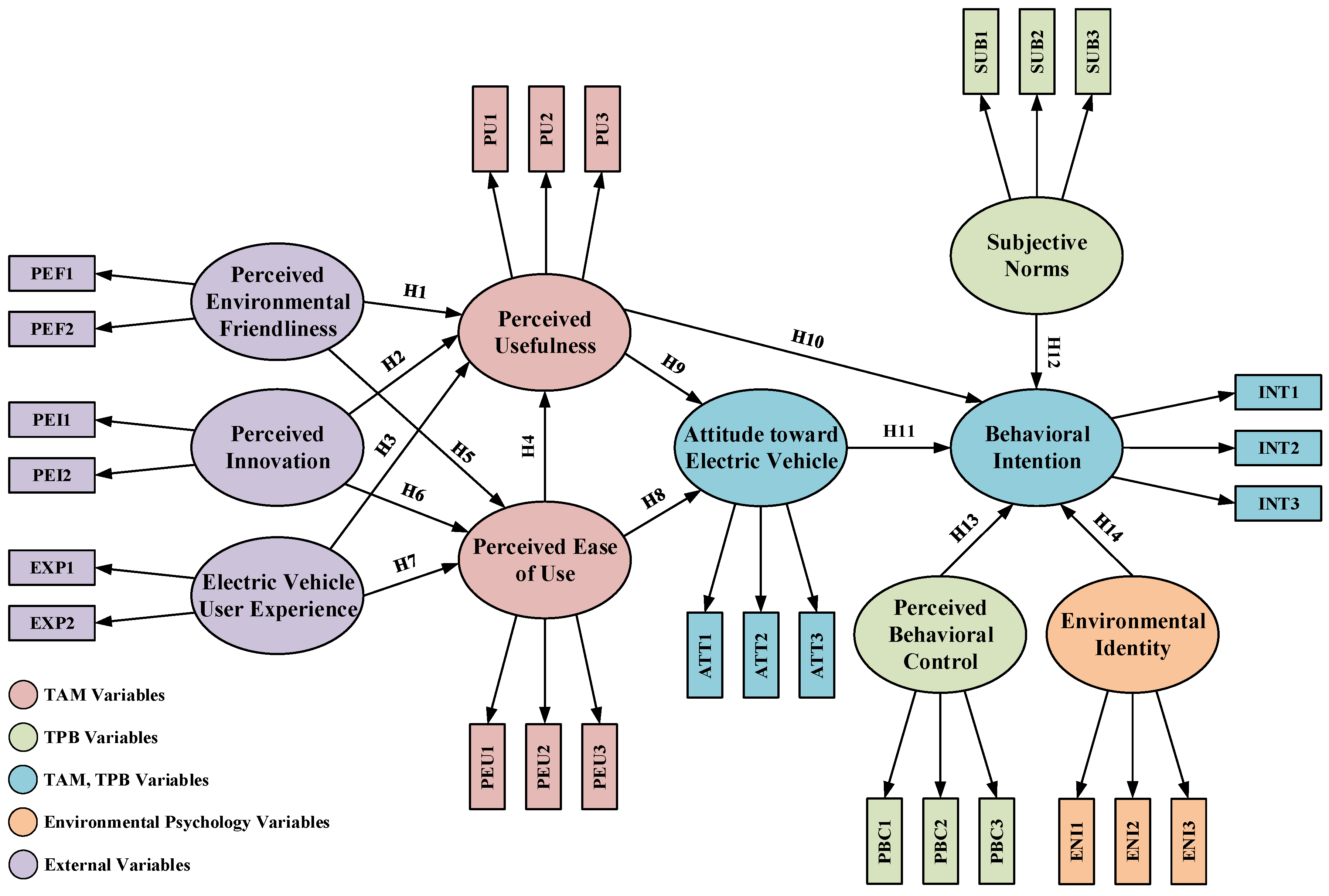
This literature review elucidates how the TAM and TPB frameworks, enhanced by constructs of environmental consciousness and innovation, provide a robust theoretical basis for understanding the factors influencing the intention to adopt EVs. This approach not only aligns with the current environmental and technological context but also reflects the unique characteristics and considerations of potential EV consumers. The hypothesized relationships are presented in Table 1 and Figure 1.

2.1. Theory of Planned Behavior (TPB)

As outlined in Section 1.2, the TPB posits that behavioral intention is shaped by attitudes, subjective norms, and perceived behavioral control. In the EV adoption literature, empirical evidence supports each of these pathways. The attitude-intention relationship has been confirmed across multiple EV contexts [44], while subjective norms have shown significant influence on adoption intentions, particularly in collectivist cultural settings where family and community opinions carry substantial weight [78]. Perceived behavioral control, reflecting individuals’ confidence in their ability to manage EV ownership including resource availability and anticipated obstacles, has been identified as a significant predictor of EV adoption intention [79]. These three TPB pathways correspond to hypotheses H11, H12, and H13, respectively.

2.2. Technology Acceptance Model (TAM)

Building on the TAM framework introduced in Section 1.2, empirical studies in the EV domain consistently confirm that both perceived usefulness and perceived ease of use are significant determinants of adoption intentions [74]. The relationship between perceived ease of use and perceived usefulness (H4) has been particularly robust, with ease of use serving as an antecedent to usefulness evaluations in automotive technology contexts [65]. Regarding attitude formation, both perceived ease of use (H8) and perceived usefulness (H9) have demonstrated positive effects on attitudes toward EVs [80]. The direct influence of perceived usefulness on behavioral intention (H10) has been supported across diverse market contexts [40,81], suggesting that functional benefit perceptions remain central to adoption decisions regardless of cultural setting.

2.3. Theoretical Framework: Integrating TPB, TAM, and Environmental Psychology Constructs

Perceived Environmental Friendliness (PEF) is a construct that reflects the belief that the use of EVs is beneficial for the environment. This aligns with the increasing consumer trend towards environmentally sustainable products and services. It is expected to influence PU and PEU, as a greener image of EVs can enhance their perceived benefits and reduce any perceived effort associated with their use due to a positive attitude towards environmentally friendly behavior [82]. The integration of PEF with the TAM and TPB reflects the growing concern for sustainable consumption and its effect on perceived technology usefulness and ease of use. PEF has been empirically shown to affect both PU (H1) and PEU (H5), influencing attitudes and BI towards EVs [41]
Perceived Innovation (PEI) refers to the degree to which an individual perceives EVs as a novel and advanced technology. This perception can lead to a positive assessment of the usefulness and ease of use of EVs, as innovations are often associated with increased efficiency and better performance outcomes [83]. PEI, representing the perceived novelty and advanced features of EVs, contributes to both PU (H2) and PEU (H6), suggesting that innovative attributes of EVs enhance their appeal [71,75].
Electric Vehicle User Experience (EXP) encompasses past direct experiences with EVs, which can significantly influence an individual’s perceptions of EVs’ usefulness and ease of use. The hands-on interaction with EV technology can either reinforce or mitigate concerns related to the operation and benefits of EVs [78]. Direct Electric EXP also plays a critical role, as actual interaction with EVs can clarify perceptions of usefulness and ease, affecting attitudes and intentions towards adoption (H3 and H7; Mican et al. [72], Al Qudah et al. [73]). It should be noted that the EXP construct captures a spectrum of exposure ranging from no direct experience to extensive ownership experience, as reflected in the measurement items (EXP1: “I have driven or used an electric vehicle before”; EXP2: “I have experience with the infrastructure for charging electric vehicles”). For ICE users, who reported lower mean scores on these items, the responses reflect varying degrees of incidental exposure—such as test drives, passenger experiences, or interactions with EV-owning acquaintances—rather than sustained ownership. The moderate rather than minimal scores suggest that many ICE respondents had encountered EV technology to some degree, consistent with the sampling strategy at dual-purpose fuel/charging stations where incidental exposure is likely. The relatively weak but significant experience-to-usefulness path among ICE users is theoretically coherent: limited exposure provides modest but meaningful input into usefulness evaluations, whereas sustained hybrid ownership experience offers substantially richer information for assessing full EV benefits.
Environmental Identity (ENI) is the extent to which individuals view themselves as environmentally responsible. When individuals have a strong environmental identity, they are more likely to adopt behaviors that they perceive to be consistent with this self-concept, such as the use of EVs [47]. The ENI, which encapsulates an individual’s alignment of self-concept with environmental values, is a significant predictor of BI to use EVs (H14, Simsekoglu et al. [46]), suggesting that a personal commitment to environmental responsibility can drive technology adoption. Collectively, the Perceived Environmental Friendliness and Environmental Identity constructs represent the environmental psychology dimension of the integrated framework, capturing value-driven and identity-based motivations that complement the cognitive evaluations modeled through TAM and the social-behavioral mechanisms addressed by TPB.

2.4. Hypotheses Development and Potential Differences Across Vehicle Groups

Based on the integrated TPB-TAM framework and additional context-specific constructs, fourteen hypotheses are proposed to examine the relationships between key factors influencing EV adoption intention (Table 1). While these hypotheses apply across all three vehicle user groups, the strength and significance of relationships are expected to vary based on users’ current position in the vehicle technology continuum.
The core TAM relationships posit that perceived environmental friendliness (H1; Gelaidan et al. [41]), perceived innovation (H2; Huang et al. [71]), prior EV experience (H3; Mican et al. [72], Al Qudah et al. [73]), and perceived ease of use (H4; Wu et al. [74]) positively influence perceived usefulness. Similarly, environmental friendliness (H5; Wu et al. [74]), innovation awareness (H6; Caffaro et al. [75]), and experience (H7; Al Mican et al. [72], Al Qudah et al. [73], Bhat and Verma [84]) are expected to enhance perceived ease of use. These antecedent relationships are anticipated to strengthen progressively from ICE to EV users, as familiarity with electrification technology enables consumers to better recognize how environmental design and innovations enhance usability.
Regarding attitude formation, both perceived ease of use (H8) and perceived usefulness (H9) are hypothesized to positively influence attitude toward EVs [76]. ICE users may prioritize ease of use in attitude formation due to concerns about adaptation, while HEV/PHEV users, already comfortable with electrification, may place greater emphasis on usefulness.
For behavioral intention determinants, perceived usefulness is expected to directly influence adoption intention (H10; [85,86,87]), potentially most strongly among ICE users who must overcome status quo bias. Positive attitudes toward EVs (H11; Jaiswal et al. [35], Gupta [88]), subjective norms (H12; Singh et al. [66], Liu et al. [89]), and perceived behavioral control (H13; Prabpayak et al. [79], Bąk et al. [90]) are also hypothesized to positively influence behavioral intention. Social influence effects may be strongest for ICE users considering departure from conventional choices, while perceived control is expected to be crucial for those facing uncertainty about managing EV ownership.
Finally, environmental identity is hypothesized to positively influence behavioral intention (H14; Roemer and Henseler [91], Rye and Sintov [92]), with anticipated increasing importance from ICE to EV users. This progression reflects the self-selection of environmentally conscious consumers into more sustainable vehicle options and suggests that environmental identity not only influences adoption but is reinforced through the adoption process itself [46].
The multi-group analysis is expected to reveal systematic differences across the ICE-HEV-EV continuum, with ICE users showing stronger effects for factors addressing uncertainty and unfamiliarity, while EV users demonstrate stronger relationships for value-based factors. HEV/PHEV users, occupying an intermediate position, provide insights into which factors facilitate progression toward full electrification.
In summary, the 14 hypotheses constitute a coherent theoretical model organized around three interconnected layers. Hypotheses H1–H7 address the antecedent conditions that shape technology perceptions, capturing how environmental friendliness, innovation awareness, and prior experience feed into perceived usefulness and ease of use. Hypotheses H8–H9 model the attitude formation process through which these technology perceptions translate into evaluative judgments. Hypotheses H10–H14 examine the determinants of behavioral intention, integrating TAM-based cognitive evaluations (H10), TPB-based attitudinal, social, and control factors (H11–H13), and the environmental psychology dimension of identity-driven motivation (H14). This specific configuration was selected because it captures three theoretically distinct adoption mechanisms—technology evaluation, social-behavioral decision-making, and value-identity alignment—whose relative importance is expected to shift across the ICE-HEV-EV segments. The multi-group SEM framework enables simultaneous testing of whether these 14 relationships hold across all three groups while identifying where effect magnitudes diverge, thereby revealing segment-specific adoption dynamics that a single-group analysis would obscure.

3. Method

3.1. Questionnaire Design and Data Collection

The research employed a structured two-section survey instrument designed to capture comprehensive data on factors influencing electric vehicle adoption across different user groups. The first section collected demographic information and vehicle ownership characteristics, including current vehicle type (ICE, HEV/PHEV, or EV), driving patterns, and residential location. This section enabled the segmentation of respondents into three distinct groups for comparative analysis. The second section measured core TPB-TAM constructs, environmental psychology constructs (PEF and ENI), external variables (PEI and EXP), and behavioral intentions using established scales adapted from previous literature (Table A1).
All attitudinal and perceptual variables were measured using a 7-point Likert scale ranging from 1 (strongly disagree) to 7 (strongly agree), following standard practice in technology adoption research [93,94]. This scaling approach provides sufficient granularity to capture nuanced differences in respondent attitudes while maintaining ease of comprehension across diverse educational backgrounds. The questionnaire items were adapted from validated scales in existing literature, with modifications to ensure relevance to the Thai context and vehicle electrification specifically. For instance, items measuring perceived environmental friendliness were contextualized to reflect local environmental concerns, while technology acceptance items were tailored to address specific features of electric vehicles relevant to Thai consumers.
The sampling design centered on fuel stations that had been retrofitted with EV charging points, a setting selected specifically because it brings together drivers of all three vehicle types within a single physical location. Such dual-service facilities attract conventional motorists arriving to refuel alongside EV owners arriving to charge, and this natural mixing of user populations offered an opportunity to recruit ICE, HEV/PHEV, and EV respondents through the same sampling frame. Relying exclusively on dedicated EV charging points would have skewed recruitment toward existing adopters, whereas surveying only traditional petrol stations would have underrepresented the EV segment; the combined-service venues addressed both concerns simultaneously.
Site selection prioritized locations where charging infrastructure had already reached meaningful density, reflecting the established association between infrastructure availability and local EV uptake. Fieldwork was scheduled during periods of heaviest customer flow—weekday morning (7:00–9:00 AM) and evening (5:00–7:00 PM) commuting windows, supplemented by weekend midday hours (10:00 AM–2:00 PM)—to broaden the diversity of respondents encountered. Research assistants, trained in advance on the survey protocol, approached drivers engaged in refueling or charging, briefly introduced the purpose of the study, and invited participation on a voluntary basis.
Fieldwork was distributed across all five major regions of Thailand—the North, Northeast, Central, East, and South—with an approximate total of 5800 drivers invited to participate. Approximately 1200 of those approached either declined to participate or failed to meet the eligibility requirements (minimum age of 18, possession of a valid driver’s license, and status as a current vehicle owner or primary driver). A further 600 individuals initially agreed to participate but did not complete the questionnaire. From the 4000 completed questionnaires, data cleaning removed 146 incomplete responses (missing more than 10% of items) and 60 cases identified as multivariate outliers through Mahalanobis distance exceeding the critical chi-square value at p < 0.001, yielding 3794 valid responses [95]. The completion rate among those who began the questionnaire was 94.85%, while the overall participation rate among eligible individuals approached was approximately 69%. The removed outlier cases were examined individually and determined to reflect response patterns inconsistent with engaged participation (e.g., identical responses across all items, completion times under two minutes) rather than genuine extreme views, which were retained in the dataset to preserve the full range of behavioral responses. Allocation of sampling effort across regions was weighted according to two indicators—provincial EV registration figures and the extent of local charging network buildout—so that the resulting sample would mirror the uneven but evolving pattern of electrification across Thailand.
The specific provinces chosen for data collection were those where charging networks had reached an operational scale sufficient to attract EV drivers in meaningful numbers. In the Central region, Bangkok and Pathum Thani were included as the metropolitan core where early adopters are most densely concentrated. The Northern sites comprised Chiang Mai and Lampang, two urban centers where interest in EVs has been steadily building. In the Northeast, Nakhon Ratchasima and Khon Kaen were selected to represent provinces in which charging infrastructure is still at an earlier stage of development. Chonburi and Chanthaburi served as the Eastern sites, chosen in part for their industrial character and the corporate fleet activity associated with it. The Southern sample was drawn from Phuket and Nakhon Si Thammarat, reflecting the influence of tourism on vehicle use in that part of the country.
While the dual-purpose facility approach provides unique access to all three vehicle user groups within a single sampling frame, this strategy introduces potential selection bias that must be acknowledged. Respondents frequenting gas stations equipped with EV charging infrastructure are inherently more likely to reside in or travel through areas with relatively developed transportation networks, potentially underrepresenting vehicle users in remote or infrastructure-limited regions where EV charging facilities remain sparse. This bias is partially mitigated by several design features. First, the geographical distribution across all five major regions of Thailand, including the Northeastern and Southern regions where EV infrastructure development is still emerging, ensured that the sample captured varying levels of infrastructure accessibility. Second, the inclusion of conventional fuel customers at these dual-purpose stations captured ICE users who may have had no prior intention to interact with EV technology, broadening the sample beyond infrastructure-oriented consumers. Third, the final sample included substantial rural representation across groups (ICE: 38.7%; HEV/PHEV: 25.8%; EV: 40.3%), suggesting that the sampling locations were not exclusively urban-centric. Nevertheless, vehicle users in areas entirely lacking EV charging infrastructure—particularly in remote provinces of the Northern and Northeastern regions—are likely underrepresented, and the findings should be interpreted accordingly. The adoption patterns identified may therefore reflect dynamics among infrastructure-accessible populations rather than the full spectrum of Thai vehicle users. Additionally, the restriction of data collection to peak commuting hours (7:00–9:00 AM and 5:00–7:00 PM on weekdays, 10:00 AM–2:00 PM on weekends) may introduce time-of-day sampling bias by overrepresenting regular commuters and underrepresenting vehicle users with non-standard schedules, such as shift workers, retirees, or those who refuel during off-peak periods. These populations may hold different adoption motivations and face distinct practical constraints that are not fully captured in the current sample.
Eligibility for inclusion in the study rested on three conditions: respondents had to have reached the age of 18, hold a valid Thai driver’s license, and either own their current vehicle outright or serve as its primary driver while residing in one of the country’s five main regions. Beyond these threshold criteria, the recruitment approach actively sought heterogeneity within the pool of eligible drivers. Age was allowed to span the full adult range, from drivers in the early stages of their careers through to retirees; both male and female drivers were actively recruited to avoid gender skew; educational attainment was permitted to vary widely, with respondents ranging from those whose schooling ended at the primary level to those holding doctoral qualifications; and prior contact with EV technology was treated as a dimension of variation in its own right, encompassing drivers who had never encountered an EV as well as those currently operating one.
To ensure adequate representation of each vehicle group, quotas were established based on current vehicle ownership patterns in Thailand, with adjustments to oversample HEV and EV users given their smaller population proportions. This stratified approach resulted in the final sample composition of 1839 ICE users (48.5%), 907 HEV/PHEV users (23.9%), and 1048 EV users (27.6%), providing sufficient statistical power for multi-group comparisons. The higher-than-market proportion of HEV and EV users was intentional, ensuring robust analysis of these emerging segments while maintaining the ICE group as the largest segment, reflecting market reality.

3.2. Data Analysis

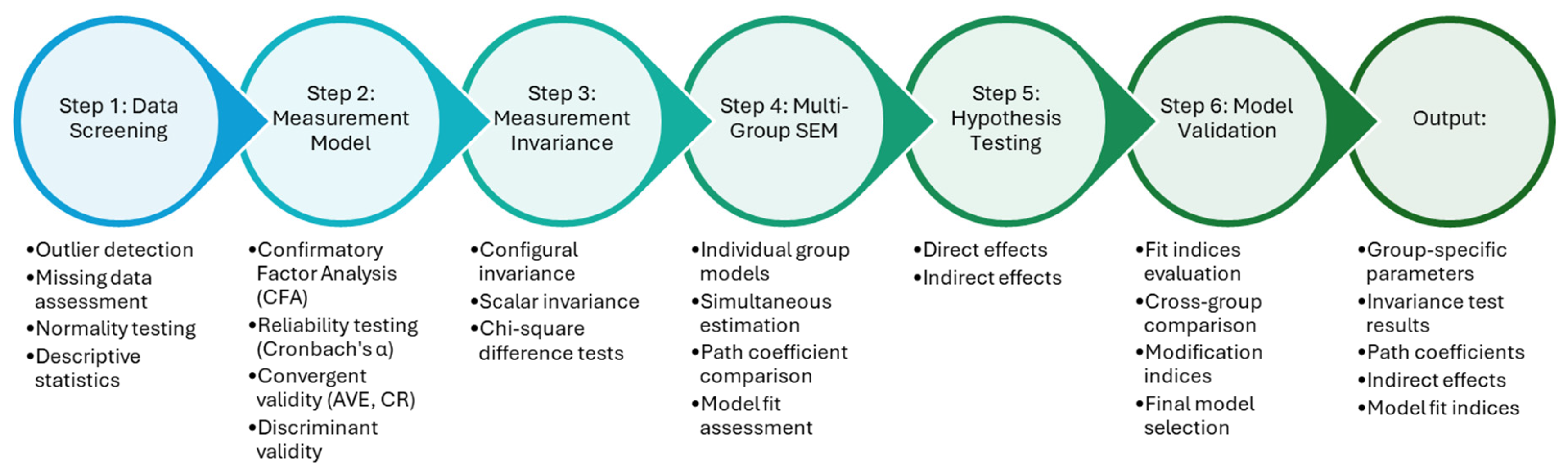
Figure 2 illustrates the systematic six-step analytical pipeline employed to examine differential adoption factors across three vehicle user groups. The analysis begins with comprehensive data screening procedures to ensure data quality and statistical assumptions are met for the 3794 respondents segmented into ICE (n = 1839), HEV/PHEV (n = 907), and EV (n = 1048) groups. The second step establishes measurement model validity through confirmatory factor analysis, ensuring that all constructs demonstrate adequate reliability and validity within each group. The critical third step tests measurement invariance across groups, determining whether constructs maintain equivalent meaning across the vehicle technology continuum. This invariance testing is essential for valid group comparisons and revealed partial metric invariance, indicating that while constructs are conceptually similar, their manifestations differ across groups. The fourth step implements multi-group structural equation modeling using Mplus 7.0, enabling simultaneous estimation of relationships while testing for statistical differences between groups. Hypothesis testing in step five examines both direct and indirect effects, with bootstrap procedures providing robust confidence intervals for mediation pathways. The final validation step ensures model adequacy through multiple fit indices and cross-validation procedures.
While discrete choice modeling approaches have been employed in some EV adoption studies to analyze specific choice scenarios and predict adoption based on attributes and alternatives [96,97]. However, Rye et al. [92] employed structural equation modeling (SEM) to examine the psychological mechanisms underlying adoption intentions. This methodological choice enables the exploration of complex, simultaneous relationships between multiple psychological constructs, which is particularly valuable for understanding the direct and indirect effects of various perceptions on behavioral intentions in the Thai context. Rather than focusing on discrete choices between vehicle alternatives, this research aims to understand the broader psychological factors that shape adoption readiness in an emerging EV market. The following gaps are identified specifically regarding the segmented nature of EV adoption research and the limited application of integrated behavioral frameworks in emerging market contexts.
The data analysis employed structural equation modeling (SEM) using maximum likelihood estimation to examine the complex relationships between latent constructs influencing EV adoption intention across different vehicle user groups. SEM was selected as the primary analytical technique due to its capability to simultaneously assess multiple dependent relationships while accounting for measurement error in latent constructs. This approach enables comprehensive evaluation of both the measurement model (relationships between latent constructs and their indicators) and the structural model (relationships among latent constructs), providing a robust framework for testing the integrated TPB-TAM model with additional context-specific variables.
A multi-group SEM approach was implemented to systematically compare the proposed relationships across three distinct vehicle user segments: ICE (n = 1839), HEV/PHEV (n = 907), and EV users (n = 1048). This analytical strategy enables simultaneous estimation of model parameters across groups while testing for statistical differences in path coefficients. The multi-group approach addresses the central research objective of understanding how adoption factors vary in strength and significance across different stages of the vehicle electrification continuum.
The analysis proceeded in stages, beginning with separate model estimation for each group to establish baseline fit and identify group-specific patterns. Subsequently, simultaneous multi-group models were estimated to enable formal statistical comparisons of structural paths across groups. This approach allows for examination of both within-group relationships and between-group differences in the structural model.
Prior to conducting substantive group comparisons, measurement invariance testing was performed to ensure the validity of cross-group comparisons. Measurement invariance testing verifies that the measurement instruments operate equivalently across groups, ensuring that observed differences reflect true variations in relationships rather than measurement artifacts. The testing followed a hierarchical approach examining increasingly restrictive forms of invariance.
The invariance testing sequence began with configural invariance, establishing that the same factor structure holds across all three groups. This was followed by metric invariance testing, which constrains factor loadings to equality across groups, and scalar invariance testing, which additionally constrains intercepts. The chi-square difference test was used to evaluate the statistical significance of constraints at each level.
Maximum likelihood (ML) estimation was employed for all SEM analyses, as it provides efficient and unbiased parameter estimates under multivariate normality assumptions. Prior to ML estimation, data screening procedures were conducted to verify statistical assumptions. Examination of univariate distributions assessed skewness and kurtosis values across all variables and groups, with acceptable thresholds of |3| for skewness and |10| for kurtosis applied to determine appropriateness of ML estimation.
Missing data were handled using full information maximum likelihood (FIML), which provides unbiased parameter estimates under the missing-at-random assumption. Multivariate outliers were identified using Mahalanobis distance and examined for potential data entry errors or legitimate extreme responses [95,98]. The final analysis retained all valid responses to maintain sample representativeness.
Given that all data were collected through a single self-report survey instrument, common method bias (CMB) was assessed using multiple procedures. Harman’s single-factor test was conducted, and the results indicated that no single factor accounted for the majority of variance, with the first unrotated factor explaining 29.435% of total variance (Table A1), well below the 50% threshold commonly used to indicate CMB concerns [99]. Additionally, the confirmatory factor analysis results demonstrated that the hypothesized multi-factor model exhibited substantially better fit than a single-factor alternative across all three groups, providing further evidence against CMB. The marker variable technique was also considered; however, as no theoretically unrelated marker variable was included in the survey design, this approach could not be implemented. While these procedures reduce CMB concerns, they cannot entirely eliminate the possibility, and this limitation is acknowledged.
Model fit was evaluated using multiple indices to provide comprehensive assessment of model-data correspondence. The evaluation employed both absolute and incremental fit indices to assess different aspects of model performance. Absolute fit was assessed using the standardized root mean square residual (SRMR), with values below 0.08 indicating acceptable fit, and the root mean square error of approximation (RMSEA), with values below 0.06 indicating good fit and below 0.08 indicating acceptable fit, reported with 90% confidence intervals. Incremental fit was evaluated using the Comparative Fit Index (CFI) and Tucker–Lewis Index (TLI), with values above 0.95 indicating excellent fit and above 0.90 indicating acceptable fit. The chi-square statistic was reported along with its degrees of freedom, though interpretation considered its sensitivity to large sample sizes. The normed chi-square (χ2/df) was calculated, with values below 5.0 indicating acceptable fit and below 3.0 indicating good fit. Model fit indices were evaluated for individual group models as well as for the simultaneous multi-group models. The assessment included examination of modification indices and standardized residuals to identify potential areas of model misspecification, though model modifications were made only when theoretically justified [99,100].
All analyses were conducted using Mplus 7.0 (Muthén & Muthén, Los Angeles, CA, USA). While more recent versions are available (current version 8.11/9.0), Mplus 7.0 fully supports the analytical techniques employed in this study, including maximum likelihood estimation, multi-group structural equation modeling, measurement invariance testing, and bootstrap procedures for indirect effects [101]. The methodological improvements introduced in subsequent versions primarily concern Bayesian estimation, mixture modeling, and intensive longitudinal data analysis, none of which are utilized in the present research. The core ML-based SEM algorithms and multi-group comparison procedures remain consistent across versions. The analysis followed a two-step approach, first establishing the measurement model through confirmatory factor analysis, then testing the structural relationships. This sequential approach ensures that conclusions about structural relationships are not confounded by measurement issues.

4. Results

4.1. Robustness Analysis

To verify the stability of the structural findings, four robustness procedures were conducted: nested model comparison, bootstrap mediation verification, alternative model specification testing, and predictive validity assessment.

4.1.1. Nested Model Comparison

The overall measurement invariance analysis stablished that constraining factor loadings, intercepts, and structural paths to equality across groups resulted in significant model fit deterioration (Δχ2 = 1656.348, Δdf = 88, p < 0.001), confirming that the measurement and structural parameters differ meaningfully across the three vehicle user groups. To identify which specific structural paths contributed most to group differences beyond measurement-level variation, sequential path-by-path constraint tests were conducted (Table A4). Each test constrained a single structural path to equality across the three groups while leaving all other paths and measurement parameters freely estimated.
The path-by-path analysis revealed a clear bifurcation of structural relationships into group-variant and group-invariant pathways. Seven paths showed statistically significant deterioration when constrained to equality across groups. The largest difference emerged for the perceived ease of use → perceived usefulness path (H4: Δχ2 = 116.619, p < 0.001), followed by perceived innovation → perceived ease of use (H6: Δχ2 = 69.583, p < 0.001), electric vehicle user experience → perceived ease of use (H7: Δχ2 = 69.230, p < 0.001), perceived usefulness → attitude (H9: Δχ2 = 56.273, p < 0.001), perceived environmental friendliness → perceived ease of use (H5: Δχ2 = 55.544, p < 0.001), perceived ease of use → attitude (H8: Δχ2 = 30.849, p < 0.001), and perceived usefulness → behavioral intention (H10: Δχ2 = 21.187, p < 0.001).
Conversely, seven paths showed no significant cross-group differences: the three antecedent paths to perceived usefulness (H1: PEF → PU, p = 0.712; H2: PEI → PU, p = 0.552; H3: EXP → PU, p = 0.137) and four of the five direct predictors of behavioral intention (H11: ATT → INT, p = 0.470; H12: SUB → INT, p = 0.200; H13: PBC → INT, p = 0.739; H14: ENI → INT, p = 0.244).
This bifurcation reveals a theoretically meaningful pattern: group differences are concentrated in the perceived ease of use pathway and attitude formation processes (H4–H9), while the pathways feeding into perceived usefulness (H1–H3) and the direct determinants of behavioral intention (H11–H14) operate with similar strength across all vehicle user groups. This finding suggests that the technology adoption continuum from ICE through HEV/PHEV to EV primarily alters how usability perceptions are formed and how they translate into attitudes, rather than changing how usefulness is evaluated or how attitudes, norms, control, and identity drive intentions. The invariance of the intention formation pathways (H11–H14) implies that once attitudes, social norms, perceived control, and environmental identity are established—regardless of how they were formed—their translation into behavioral intentions follows a similar process across all groups. The practical implication is that segment-specific interventions should target the upstream formation of ease-of-use perceptions and attitudes (where group differences are concentrated) rather than the downstream intention formation process (where mechanisms are universal).

4.1.2. Bootstrap Mediation Verification

Indirect effects reported in Table A3 were verified using bias-corrected bootstrap confidence intervals with 5000 resamples (Table A5). All indirect effects that were significant under the standard delta method approach remained significant under bootstrapping, with 95% bias-corrected confidence intervals excluding zero across all paths and groups, confirming the robustness of the mediation findings to potential non-normality in the sampling distribution of indirect effects.
Among the key indirect pathways, the experience-to-intention mediation (EXP → PU → INT) demonstrated the strongest bootstrap-verified effect for HEV/PHEV users (β = 0.108, 95% BC-CI: 0.099 to 0.116), confirming that partial electrification experience robustly enhances full EV adoption intentions through perceived usefulness. The innovation-to-intention mediation (PEI → PU → INT) was strongest for HEV/PHEV users (β = 0.096, 95% BC-CI: 0.088 to 0.102) and weakest for EV users (β = 0.074, 95% BC-CI: 0.055 to 0.089), with the EV group exhibiting wider confidence intervals reflecting greater heterogeneity in this experienced user population. The environmental friendliness-to-intention mediation through perceived usefulness (PEF → PU → INT) showed comparable magnitudes across groups (ICE: β = 0.067; HEV/PHEV: β = 0.064; EV: β = 0.057), consistent with the invariant PEF → PU path identified in the nested model comparison (Table A4, H1: p = 0.712).

4.1.3. Alternative Model Specification

To assess whether the hypothesized model provides superior fit compared to theoretically plausible alternatives, two competing models were tested across all three groups (Table A6). Alternative Model 1 added a direct path from environmental identity to attitude toward electric vehicles, based on the theoretical argument that environmental self-concept may shape evaluative judgments independently of its effect on behavioral intention [102]. Alternative Model 2 re-specified perceived behavioral control as a moderator of the attitude-intention relationship rather than a direct predictor of intention, following recent reconceptualizations in the TPB literature [103].
Neither alternative model demonstrated improved CFI across any group. For both alternatives, ΔCFI = 0.000 for all three groups, indicating that neither the addition of the ENI → ATT path nor the re-specification of PBC as a moderator meaningfully improved model-data correspondence. While RMSEA values showed some variation across specifications (e.g., Alternative 1 yielded lower RMSEA for ICE: 0.029 vs. 0.040, and HEV/PHEV: 0.028 vs. 0.042), the unchanged CFI values indicate that these RMSEA improvements reflect the penalty adjustment for model parsimony rather than substantive fit improvement. Following the established criterion that ΔCFI > −0.01 supports retention of the more parsimonious model [104], the hypothesized model specification was retained as the optimal representation of the data. These results confirm that the structural relationships specified in the hypothesized model adequately capture the adoption dynamics across all three vehicle user groups without requiring additional pathways or interaction specifications.

4.1.4. Predictive Validity

The proportion of variance explained (R2) in endogenous constructs was examined across groups to assess predictive validity (Table A7). The model demonstrated strong explanatory power for the ICE and HEV/PHEV groups, with behavioral intention R2 values of 0.820 and 0.790 respectively, substantially exceeding the benchmark range of 0.35–0.55 reported in comparable multi-group EV adoption studies [105]. The EV group showed more moderate explanatory power (R2 = 0.342 for behavioral intention), falling at the lower boundary of the benchmark range.
The progressive decline in R2 from ICE (0.820) through HEV/PHEV (0.790) to EV users (0.342) is theoretically coherent. The integrated TPB-TAM framework was primarily designed to explain pre-adoption technology acceptance decisions, and its strongest explanatory power is expectedly observed among ICE users contemplating initial adoption. For current EV users, continued-use intentions are increasingly shaped by post-adoption experiential factors—including ownership satisfaction, perceived value confirmation, battery performance over time, and maintenance experience—that fall outside the scope of the pre-adoption framework [105]. Rather than indicating model inadequacy, this declining pattern highlights a meaningful boundary condition: pre-adoption frameworks progressively lose explanatory power as populations move further along the adoption continuum, suggesting that future research on established EV user segments should incorporate post-adoption constructs such as technology continuance factors and perceived value confirmation [2,70].
The R2 values for attitude toward electric vehicles showed a particularly striking cross-group pattern. The ICE group exhibited strong explained variance (R2 = 0.817), reflecting the dominant role of the PEU → ATT pathway (β = 0.805). The HEV/PHEV group showed comparable explained variance (R2 = 0.778), driven primarily by the exceptionally strong PEU → ATT pathway (β = 0.915). Conversely, the EV group showed substantially lower attitude R2 (R2 = 0.200), indicating that post-adoption attitudes are shaped by factors beyond the TAM constructs, such as ownership experience quality, brand loyalty, and community belonging. For perceived usefulness, R2 values followed a similar declining pattern (ICE: 0.838; HEV/PHEV: 0.741; EV: 0.383), with the ICE model’s strong PEU → PU pathway (β = 0.516) accounting for the highest explained variance. Perceived ease of use showed the most dramatic decline (ICE: 0.882; HEV/PHEV: 0.781; EV: 0.238), with the EV group falling below the benchmark range, reflecting the diminished role of innovation perceptions (β = 0.240) compared to the ICE group (β = 0.748) in driving ease-of-use evaluations.
Collectively, the four robustness procedures confirm the stability of the primary structural findings while revealing additional analytical insights. The nested model comparison (Table A4) identifies a clear bifurcation between group-variant pathways (concentrated in ease-of-use and attitude formation, H4–H10) and group-invariant pathways (usefulness antecedents H1–H3 and intention determinants H11–H14), providing a more nuanced understanding of where segment-specific dynamics operate. The bootstrap verification (Table A5) confirms that all mediation pathways are robust to distributional assumptions, with all confidence intervals excluding zero. The alternative model tests (Table A6) support the hypothesized specification over theoretically plausible alternatives, with ΔCFI = 0.000 across all comparisons. The predictive validity assessment (Table A7) demonstrates excellent explanatory power for ICE and HEV/PHEV groups (R2 = 0.790–0.882 across constructs) while identifying meaningful boundary conditions for the EV group (R2 = 0.200–0.383), reinforcing the theoretical argument that pre-adoption frameworks require augmentation with post-adoption constructs when applied to established user populations.

4.2. Demographic Characteristics

The demographic distribution across the three vehicle user groups revealed distinct patterns reflecting different stages of technology adoption (Table 2). Male respondents predominated across all groups but showed increasing representation from ICE (58.8%) through HEV/PHEV (60.7%) to EV users (66.2%). Age distributions indicated that HEV/PHEV and EV users concentrated in the 25–54 age range (91.9% and 89.9% respectively), while ICE users showed broader age distribution including more younger drivers under 25 (13.0%). Educational attainment displayed similar patterns across groups, with bachelor’s degrees being most common, though vocational education showed higher prevalence among EV users (31.0%) compared to ICE users (22.9%). Occupationally, government employees and business owners showed higher representation among HEV/PHEV and EV users compared to ICE users, suggesting economic factors in adoption patterns. Urban residence predominated for HEV/PHEV users (74.2%), while ICE and EV users showed more balanced urban-rural distribution.

4.3. Descriptive Statistics and Reliability

Statistical summaries revealed systematic differences in construct means across groups (Table 3). ICE and HEV/PHEV users reported higher scores for perceived environmental friendliness (M = 5.471 and M = 5.377 respectively) compared to EV users (M = 4.940), suggesting actual experience may moderate initial environmental expectations. Conversely, EV users demonstrated higher perceived ease of use scores (M = 5.146) compared to ICE (M = 4.641) and HEV/PHEV users (M = 4.670), reflecting experiential learning effects. Behavioral intention showed progressive increase from ICE (M = 4.461) through HEV/PHEV (M = 4.488) to EV users (M = 5.198), validating the group segmentation approach. Reliability analysis confirmed strong internal consistency across all constructs and groups, with Cronbach’s alpha values ranging from 0.771 to 0.960, exceeding the 0.70 threshold for acceptable reliability.

4.4. Measurement Model

The measurement model demonstrated strong psychometric properties across all three groups with variations reflecting group-specific characteristics (Table 4). Factor loadings exceeded 0.70 for most indicators across groups, with t-values significant at p < 0.001, confirming indicator reliability. Notable differences emerged in factor loading patterns: ICE users showed highest loadings for perceived usefulness items (λ = 0.957–0.967), suggesting usefulness perceptions dominate their evaluation framework. HEV/PHEV users exhibited strong loadings for experience-related items (λ = 0.938–0.957), indicating the salience of hands-on exposure. EV users displayed more balanced loadings across constructs, reflecting comprehensive evaluation based on actual ownership experience.
Convergent validity was established through average variance extracted (AVE) values exceeding 0.50 across all constructs and groups. ICE users showed particularly high AVE values for perceived usefulness (0.927) and perceived behavioral control (0.879), while HEV/PHEV users demonstrated strong convergent validity for experience (0.898) and perceived usefulness (0.878). EV users exhibited more moderate but acceptable AVE values across constructs, suggesting greater response variability within this experienced user group. Composite reliability (CR) values exceeded 0.70 for all constructs, with most surpassing 0.85, confirming construct reliability. Discriminant validity was confirmed through the Fornell-Larcker criterion, with square roots of AVE values exceeding inter-construct correlations for all groups (Appendix A Table A2).

4.5. Measurement Invariance

Measurement invariance testing revealed partial invariance across groups, with important implications for cross-group comparisons (Table 5). The configural invariance model demonstrated good fit (χ2/df = 2.380, CFI = 0.993, RMSEA = 0.033), confirming that the basic factor structure holds across all three groups. However, metric invariance testing, which constrained factor loadings equal across groups, showed significant deterioration in model fit (Δχ2 = 1656.348, p < 0.0001), indicating that constructs manifest differently across groups. Pairwise comparisons revealed the largest invariance violations between ICE and EV groups (Δχ2 = 993.903), moderate violations between HEV/PHEV and EV groups (Δχ2 = 848.396), and smallest between ICE and HEV/PHEV groups (Δχ2 = 551.675), suggesting progressive changes in construct meanings along the technology adoption continuum. These findings indicate that while conceptual frameworks apply across groups, the relative importance and interpretation of constructs vary significantly, supporting the multi-group analytical approach.
The finding of partial metric invariance has important implications for cross-group comparisons that must be carefully considered. Full metric invariance, which would indicate that factor loadings are equivalent across groups, was not achieved, meaning that latent constructs are not measured with identical scaling properties across the ICE, HEV/PHEV, and EV groups. This outcome is consistent with the theoretical expectation that constructs such as perceived usefulness and perceived ease of use carry different connotations for consumers at different stages of the electrification continuum. For instance, perceived usefulness may emphasize anticipated cost savings for ICE users while reflecting confirmed operational benefits for EV users. Under partial metric invariance, direct comparison of unstandardized path coefficients across groups requires caution, as differences may partly reflect measurement differences rather than purely structural differences [100]. However, several considerations support the validity of the comparative analysis conducted in this study. First, configural invariance was firmly established (χ2/df = 2.380, CFI = 0.993, RMSEA = 0.033), confirming that the same factor structure holds across all three groups. Second, the standardized path coefficients reported in this study are less sensitive to metric non-invariance than unstandardized estimates, as standardization partially accounts for group-specific scaling differences [99]. Third, methodological literature on multi-group SEM increasingly recognizes that full metric invariance is rarely achieved in practice, particularly when comparing groups with substantially different experience levels, and that partial invariance provides a sufficient basis for meaningful group comparisons provided that configural invariance is established and the pattern of non-invariance is theoretically interpretable [94]. In the present study, the progressive pattern of invariance violations—smallest between ICE and HEV/PHEV groups (Δχ2 = 551.675), moderate between HEV/PHEV and EV groups (Δχ2 = 848.396), and largest between ICE and EV groups (Δχ2 = 993.903)—is theoretically coherent, reflecting increasing divergence in construct interpretation as the experiential distance between groups widens.

4.6. Structural Model and Hypothesis Testing

Hypothesis testing revealed both consistent patterns and important group differences in structural relationships (Table 6). All fourteen hypotheses received support across the three groups, though with varying effect sizes. The influence of perceived ease of use on perceived usefulness (H4) showed strongest effects for ICE users (β = 0.516) compared to HEV/PHEV (β = 0.427) and EV users (β = 0.476), highlighting the importance of usability concerns for those unfamiliar with EV technology. Conversely, the experience-usefulness relationship (H3) strengthened from ICE (β = 0.113) through HEV/PHEV (β = 0.219) to EV users (β = 0.177), demonstrating the growing role of hands-on experience.
The most striking cross-group differential emerged in the perceived ease of use to attitude pathway (H8). HEV/PHEV users exhibited the strongest effect (β = 0.915), followed by ICE users (β = 0.805), while EV users showed a dramatically weaker relationship (β = 0.254)—a more than three-fold reduction compared to the other groups. This pattern indicates that ease-of-use perceptions are central to attitude formation for users who have not yet fully adopted EVs, but become substantially less important once full adoption has occurred and direct ownership experience replaces usability concerns as the basis for attitudinal evaluation. This finding represents the largest single cross-group differential in the entire structural model and carries important implications for segment-specific intervention design.
Environmental factors showed interesting patterns across groups. The effect of environmental friendliness on ease of use (H5) was weakest for ICE users (β = 0.164) but strongest for EV users (β = 0.242), suggesting environmental considerations become more salient with adoption experience. Innovation’s impact on ease of use (H6) decreased dramatically from ICE users (β = 0.748) to EV users (β = 0.240), indicating that technological novelty matters most for non-adopters. The attitude-intention relationship (H11) showed relatively consistent effects across groups (β = 0.105–0.165), while subjective norms (H12) and environmental identity (H14) showed stronger effects for EV users (β = 0.206 and β = 0.196) compared to ICE users (β = 0.179 and β = 0.148), suggesting value-based factors gain importance with adoption.
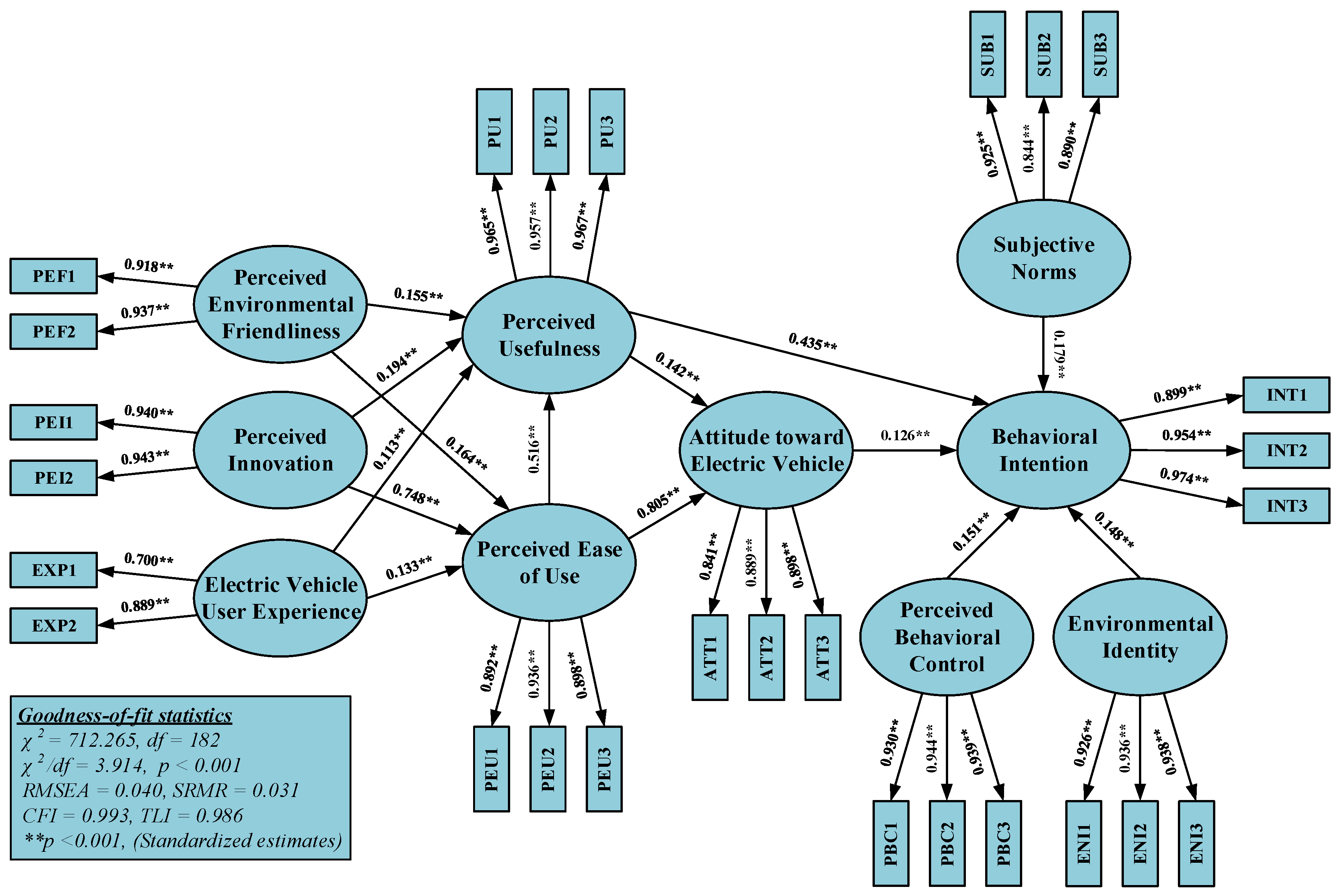
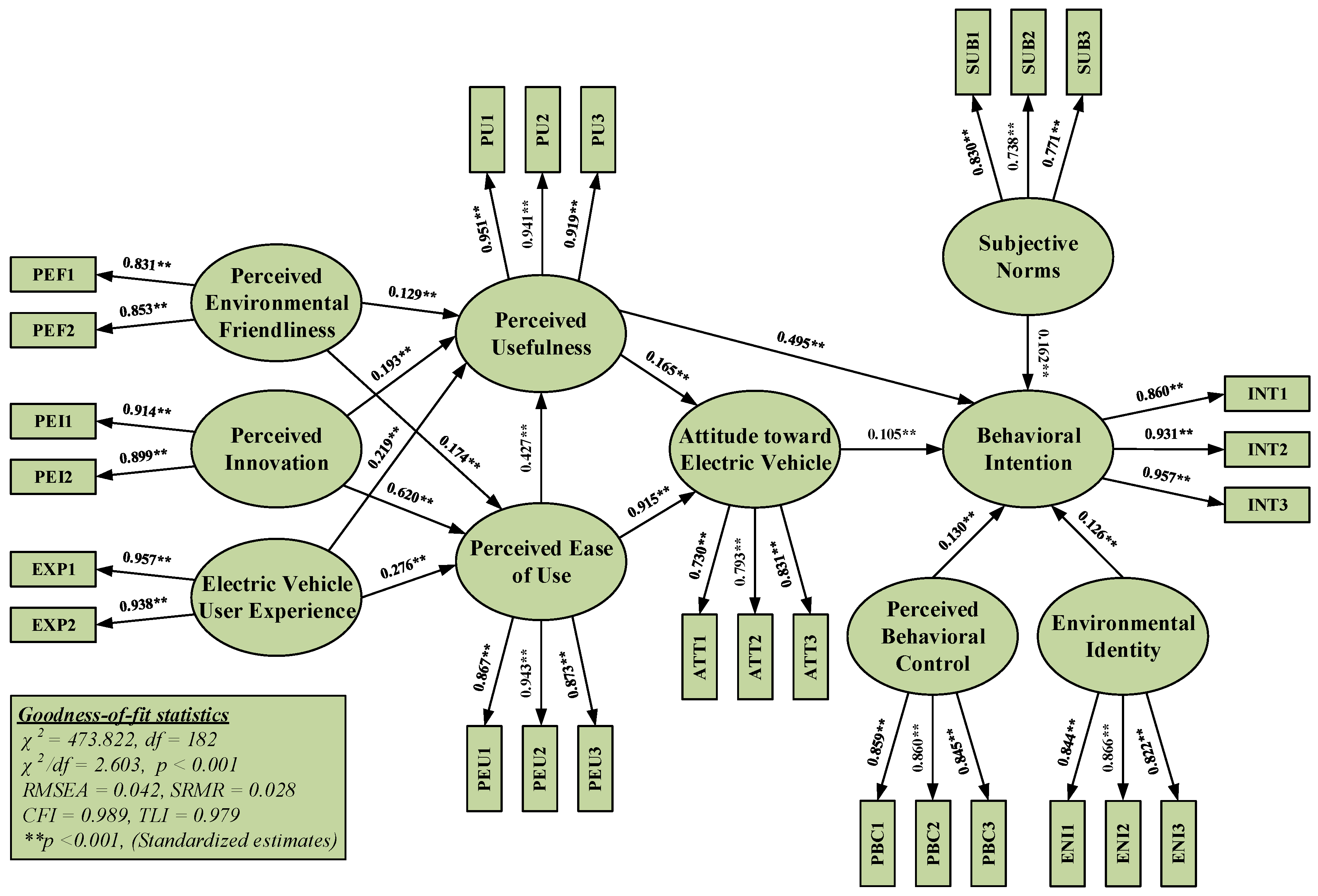
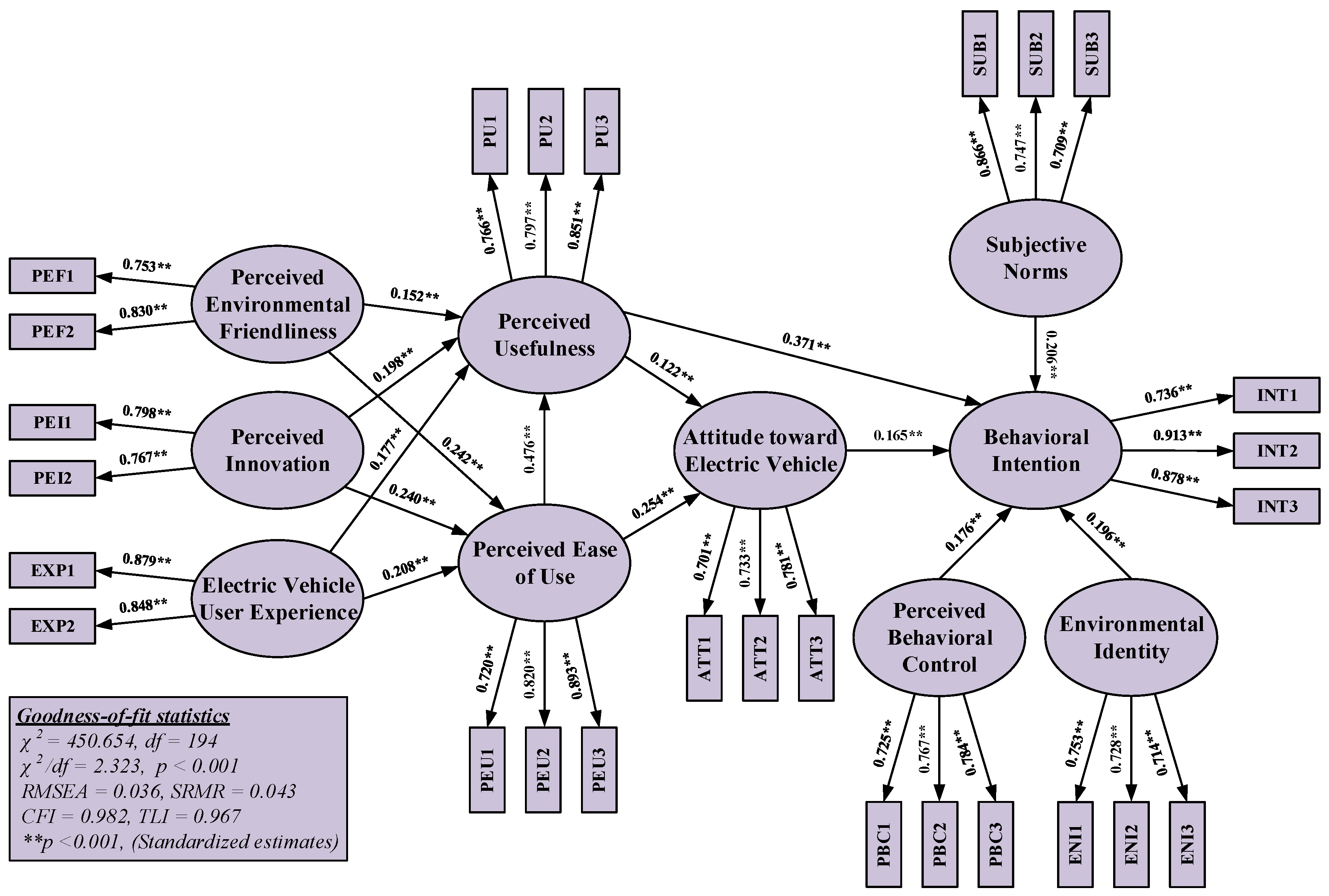
Individual structural models demonstrated excellent fit across all three groups, supporting the theoretical framework’s applicability while revealing group-specific patterns. The ICE model (Figure 3) achieved strong fit indices (χ2/df = 3.914, CFI = 0.993, TLI = 0.986, RMSEA = 0.040, SRMR = 0.031), with the visual representation highlighting the dominant role of perceived innovation and ease of use in shaping adoption intentions. The HEV/PHEV model (Figure 4) showed even better fit (χ2/df = 2.603, CFI = 0.989, TLI = 0.979, RMSEA = 0.042, SRMR = 0.028), with pathways indicating balanced influences across technological and environmental factors. The EV model (Figure 5) demonstrated good fit (χ2/df = 2.323, CFI = 0.982, TLI = 0.967, RMSEA = 0.036, SRMR = 0.043), with structural paths revealing the prominence of environmental and experiential factors in reinforcing adoption decisions.
The difference in degrees of freedom between the ICE and HEV/PHEV models (df = 182) and the EV model (df = 194) reflects minor specification differences necessitated by the EV group’s data characteristics. Specifically, 12 additional equality constraints were imposed on error covariance parameters in the EV model to achieve adequate model identification, as several indicator pairs exhibited near-zero residual covariances that permitted these parsimonious constraints without substantive impact on model fit or parameter estimates.

4.7. Mediation Analysis

Mediation analysis uncovered important indirect pathways that varied systematically across groups (Table A3). Perceived ease of use showed strongest indirect effects on behavioral intention for ICE users (β = 0.102) compared to HEV/PHEV (β = 0.096) and EV users (β = 0.042), primarily mediated through perceived usefulness and attitude formation. Environmental friendliness demonstrated multiple indirect pathways to intention, with total indirect effects increasing from ICE (β = 0.087) to HEV/PHEV (β = 0.083) to EV users (β = 0.070), though operating through different mechanisms. For ICE users, the primary pathway operated through perceived usefulness, while for EV users, both ease of use and attitude pathways contributed significantly. Experience showed strongest indirect effects for HEV/PHEV users (β = 0.108), suggesting this group leverages their partial electrification experience when evaluating full EV adoption. Innovation’s indirect effects were most pronounced for ICE users (β = 0.084), operating primarily through perceived usefulness, while showing weaker indirect influences for experienced EV users, indicating that technological novelty’s motivational power diminishes with familiarity.

5. Discussion

5.1. Discussion of Hypotheses

Hypothesis 1 (H1):
Environmental friendliness → Perceived usefulness. The positive relationship between environmental friendliness and perceived usefulness was confirmed across all three groups (ICE: β = 0.155; HEV/PHEV: β = 0.129; EV: β = 0.152), supporting previous findings by Gelaidan et al. [41]. This consistency aligns with research demonstrating that environmental benefits enhance perceived utility of EVs across different markets. However, the relatively modest coefficients suggest that environmental considerations alone may not be the primary driver of usefulness perceptions in the Thai context, contrasting with studies from more environmentally conscious markets where this relationship is typically stronger [49].
The counterintuitive finding that EV users reported lower perceived environmental friendliness scores (M = 4.940) compared to ICE users (M = 5.471) and HEV/PHEV users (M = 5.377) warrants careful interpretation, as this pattern contradicts the expectation that environmentally motivated consumers would gravitate toward full electrification. Several explanations may account for this finding. First, an expectation-recalibration effect likely operates among experienced EV users, who through daily ownership encounter the full lifecycle environmental complexities of electric vehicles—including battery production impacts, electricity source considerations, and disposal concerns—leading to more tempered environmental assessments compared to non-adopters who may hold idealized perceptions [94]. This interpretation is consistent with research demonstrating that direct product experience moderates initial expectations, often resulting in more realistic rather than more positive evaluations [72,73]. Second, the measurement items for perceived environmental friendliness (PEF1: “I believe that using electric vehicles is environmentally friendly”; PEF2: “I believe that driving electric vehicles can help improve the environment”) capture general beliefs about EV environmental benefits rather than personal environmental motivation. ICE and HEV/PHEV users, who have not yet confronted the practical environmental trade-offs of EV ownership, may respond to these items with aspirational idealism, whereas EV users respond based on informed experience. Third, response scale anchoring may differ across groups; EV users with higher baseline environmental knowledge may apply stricter evaluative criteria when assessing environmental friendliness, effectively raising their internal threshold for agreement. This finding does not diminish the role of environmental considerations in EV adoption but rather suggests that environmental perceptions undergo recalibration through ownership experience, shifting from generalized beliefs to nuanced assessments.
Hypothesis 2 (H2):
Perceived innovation → Perceived usefulness. The significant positive effect of perceived innovation on usefulness (ICE: β = 0.194; HEV/PHEV: β = 0.193; EV: β = 0.198) corroborates Huang et al. [71], Huang and Qian [106]’s findings. The remarkably consistent coefficients across groups suggest that technological advancement perceptions universally enhance usefulness evaluations, regardless of current vehicle ownership. This finding parallels research from other emerging markets where technological features strongly influence adoption intentions [107].
Hypothesis 3 (H3):
Experience → Perceived usefulness. The varying effects of experience across groups (ICE: β = 0.113; HEV/PHEV: β = 0.219; EV: β = 0.177) provide nuanced support for Mican et al. [72], Al Qudah et al. [73]. The strongest effect among HEV/PHEV users suggests that partial electrification experience particularly enhances appreciation of full EV benefits, a finding not previously documented in the literature. This graduated experience effect offers new insights into the adoption pathway.
Hypothesis 4 (H4):
Perceived ease of use → Perceived usefulness. The strong positive relationship (ICE: β = 0.516; HEV/PHEV: β = 0.427; EV: β = 0.476) strongly supports Wu et al.’s (2022) [74] findings. The highest coefficient among ICE users indicates that usability concerns are particularly critical for those unfamiliar with EV technology, consistent with technology acceptance theory but showing stronger effects than typically reported in developed markets [108,109].
Hypothesis 5 (H5)Hypothesis 7 (H7):
Antecedents of perceived ease of use. The environmental friendliness effect on ease of use (H5) showed increasing strength across groups (ICE: β = 0.164; HEV/PHEV: β = 0.174; EV: β = 0.242), partially supporting Wu et al. [74] while revealing a novel progression pattern. The innovation effect (H6) was strongest for ICE users (β = 0.748), substantially exceeding effects typically reported in EV adoption studies from developed markets [110,111], suggesting heightened technology concerns among Thai ICE users who face greater unfamiliarity with electrification technology in an emerging market context. Experience effects (H7) aligned with previous studies but showed group-specific variations not previously documented [112].
Hypothesis 8 (H8)Hypothesis 9 (H9):
Attitude formation. The exceptionally strong effect of ease of use on attitude for HEV/PHEV users (β = 0.915) substantially exceeds findings by Tu and Yang (2019) [76], while the relatively weak effect for EV users (β = 0.254) represents a novel finding. The usefulness-attitude relationship (H9) remained consistently modest across groups, contrasting with stronger effects typically found in Western markets [113,114].
Hypothesis 10 (H10)Hypothesis 11 (H11):
Behavioral intention drivers. The usefulness-intention relationship (H10) varied notably (ICE: β = 0.435; HEV/PHEV: β = 0.495; EV: β = 0.371), with the weakest effect among current EV users contradicting expectations from Majhi et al. [22], Zhang et al. [77]. The attitude-intention relationship (H11) showed surprisingly weak effects across all groups compared to Deka et al. [78], suggesting that positive attitudes may not translate as directly to intentions in the Thai context.
Hypothesis 12 (H12)Hypothesis 14 (H14):
Social and environmental psychology factors. Subjective norms (H12) showed stronger influence among EV users (β = 0.206) than other groups, partially supporting Hull et al. [55] while revealing group-specific variations. Perceived behavioral control (H13) effects aligned with Simsekoglu et al. [46], though coefficients were generally lower. Environmental identity (H14) showed the strongest effect among EV users (β = 0.196), extending Limpasirisuwan et al. [105]’s findings by demonstrating how identity factors strengthen post-adoption.
The multi-group analysis revealed systematic differences challenging the assumption of homogeneous adoption processes. ICE users demonstrated heightened sensitivity to technological factors, with innovation perceptions exerting nearly three times the influence on ease of use compared to EV users. This gradient effect suggests that adoption barriers diminish with electrification experience, though not linearly. HEV/PHEV users unexpectedly showed the strongest ease of use concerns despite their electrification experience, possibly reflecting awareness of both benefits and limitations. Their transitional status manifests in balanced responses to multiple factors, neither showing the strong technology concerns of ICE users nor the identity-driven patterns of EV users. This intermediate position supports conceptualizing hybrid ownership as a distinct adoption stage rather than simply a compromise choice [94]. Current EV users demonstrated qualitatively different influence patterns, with social and environmental factors gaining prominence while functional concerns receded. The weaker direct effects of usefulness on intention among this group suggest that continued EV adoption may require different motivational strategies than initial adoption, a distinction not adequately addressed in previous single-group studies.
The Thai cultural context introduces theoretically important considerations that may explain several findings that diverge from Western-based adoption studies. The consistently weak attitude-intention relationship across all groups (β = 0.105–0.165) is substantially below the meta-analytic average of 0.30–0.40 typically reported in TPB studies [115]. This gap may be partially attributable to the Thai cultural concept a deeply ingrained norm of deference and consideration for others’ feelings that moderates the translation of personal attitudes into behavioral commitments [94]. In collectivist societies such as Thailand, individual attitudes toward a major purchase decision like vehicle acquisition must navigate family consensus processes, hierarchical approval structures, and community expectations before crystallizing into concrete intentions [50]. This interpretation is supported by the stronger subjective norm effects observed across all groups (β = 0.162–0.206) compared to studies conducted in individualist cultures, where subjective norm coefficients for EV adoption typically range from 0.05 to 0.15 [116].
The dramatic decline of the innovation-to-ease-of-use pathway from ICE users (β = 0.748) to EV users (β = 0.240) represents a theoretically significant finding that extends the technology acceptance literature. This gradient effect is consistent with the “uncertainty reduction” mechanism proposed in innovation diffusion theory [117], whereby perceived innovation serves primarily as a cognitive heuristic for evaluating unfamiliar technologies. As direct experience accumulates through the ICE-HEV-EV progression, this heuristic is replaced by experiential knowledge, reducing innovation’s role as a proxy for ease-of-use assessment. The magnitude of this decline (a 68% reduction) substantially exceeds the modest decreases reported in longitudinal TAM studies in other technology domains [28], suggesting that the physical, experiential nature of vehicle technology amplifies the substitution effect compared to digital technologies where innovation perceptions may persist longer.
The finding that HEV/PHEV users exhibit the strongest ease-of-use-to-attitude pathway (β = 0.915)—exceeding even ICE users (β = 0.805)—challenges the linear assumption that technology familiarity uniformly reduces usability concerns. This pattern is better explained through a “informed sensitivity” mechanism: HEV/PHEV users possess sufficient electrification experience to recognize specific usability challenges (charging logistics, range management, dual-powertrain complexity) that ICE users cannot yet articulate and that EV users have already resolved through adaptation. This intermediate-stage sensitivity has not been previously documented in the EV adoption literature and suggests that the transition from hybrid to full EV ownership represents a qualitatively distinct decision point requiring targeted intervention rather than merely continued exposure.
Economic factors specific to Thailand’s middle-income status manifest in the strong perceived usefulness patterns across groups. Unlike developed markets where environmental benefits may sufficiently motivate adoption, the Thai context requires careful balancing of functional, economic, and environmental value propositions. The education level effects, with higher education associated with HEV/PHEV adoption, suggest that information accessibility and processing capacity remain important moderators in this market. These findings underscore that TAM and TPB, as frameworks developed in Western industrialized contexts, require substantive reinterpretation when applied to Southeast Asian emerging economies where collective decision-making norms, infrastructure heterogeneity, and economic constraints jointly shape technology adoption processes [48].

5.2. Critical Reflection on the Statistical Sample

The interpretation of findings must be situated within the context of the sample’s demographic composition, which shapes both the strength and boundaries of the conclusions drawn. While the overall sample size (N = 3794) provides robust statistical power for multi-group SEM analysis, several characteristics of the sample warrant critical examination regarding how they may influence the observed adoption patterns.
The age distribution across groups reveals a pronounced concentration in the 25–54 range, particularly for HEV/PHEV users (91.9%) and EV users (89.9%). This concentration means that the adoption pathways identified—particularly the strong experience-to-usefulness relationship among HEV/PHEV users (β = 0.219) and the identity-driven patterns among EV users (β = 0.196 for environmental identity)—predominantly reflect the motivational structures of middle-aged, economically active professionals. Younger drivers under 25, who represented only 3.8% of HEV/PHEV respondents and 7.5% of EV respondents, may exhibit fundamentally different adoption dynamics driven by digital nativeness, different financial constraints, and distinct environmental value formation processes [105]. Similarly, drivers over 55, comprising only 4.3% and 2.5% of HEV/PHEV and EV groups respectively, may prioritize different factors such as simplicity, reliability, and long-term ownership cost considerations that are not adequately represented in the current findings.
The educational profile of respondents also introduces interpretive considerations. With bachelor’s degree holders constituting the largest single category across all groups (ICE: 39.5%; HEV/PHEV: 43.6%; EV: 33.8%), the sample overrepresents higher-educated individuals relative to the general Thai population. Education level likely moderates several key relationships identified in this study. The strong innovation-to-ease-of-use pathway among ICE users (β = 0.748) may be partially attributable to the sample’s higher educational attainment, as university-educated respondents may be better equipped to process and evaluate technological innovation information. Among populations with lower educational attainment, this pathway could be weaker if innovation-related information is less accessible or interpretable, potentially amplifying rather than reducing technology apprehension [105].
The occupational composition further shapes the findings. Government employees and business owners showed higher representation among HEV/PHEV and EV users compared to ICE users, suggesting that the identified adoption patterns may partly reflect the financial capacity and occupational stability associated with these professions rather than purely attitudinal or perceptual factors. The strong perceived usefulness-to-intention pathway among HEV/PHEV users (β = 0.495) may be reinforced by economic circumstances that reduce financial barriers, a dynamic that would operate differently among general employees or agriculturists who face tighter budget constraints.
The geographical distribution, while spanning all five regions of Thailand, reflects an urban emphasis particularly evident in the HEV/PHEV group (74.2% urban). This urban concentration likely influences multiple findings. The relatively strong subjective norm effects observed across groups may partly reflect the denser social networks and greater visibility of EV adoption in urban settings, where peer influence operates more intensely. In rural or small-town contexts, where EV visibility is lower and social networks may prioritize different values, the subjective norm pathways could function differently. The surprising rural representation among EV users (40.3%) should be interpreted cautiously, as these respondents were captured at infrastructure-equipped locations and may represent a distinct subset of rural residents who regularly travel to infrastructure-accessible areas rather than the broader rural population.
These sample characteristics do not invalidate the study’s findings but rather define their applicability boundaries. The identified adoption pathways and group-specific patterns are most directly relevant to urban and peri-urban, middle-aged, moderately educated vehicle owners in Thailand—a population segment that, while not fully representative of all Thai drivers, constitutes the primary current and near-future market for vehicle electrification. The segmented insights remain valuable for targeting this core market, while acknowledging that extending these strategies to broader populations requires additional investigation.

5.3. Key Findings by Group

The ICE user group demonstrated the strongest structural relationships in the adoption model, revealing critical barriers and facilitators for potential EV adopters. Among all three groups, ICE users showed the highest path coefficient for perceived ease of use on attitude toward EVs (β = 0.805, p < 0.001), indicating that simplicity and user-friendliness are paramount concerns for those unfamiliar with EV technology. This finding aligns with previous research suggesting that technological apprehension remains a significant barrier for conventional vehicle users [48]. The role of perceived innovation proved particularly influential for ICE users (β = 0.748 on perceived ease of use), suggesting that awareness and understanding of EV technological advancements strongly shape their perceptions of usability. This relationship was notably stronger than in the other groups, indicating that ICE users require more comprehensive information about EV innovations to overcome adoption barriers [118,119]. The environmental friendliness factor, while significant (β = 0.155 on perceived usefulness), showed a relatively modest direct effect, suggesting that environmental benefits alone may not be sufficient to motivate ICE users toward EV adoption. Interestingly, ICE users demonstrated the lowest direct effect of perceived usefulness on behavioral intention (β = 0.435) compared to HEV/PHEV users (β = 0.495), indicating that even when ICE users recognize EVs as useful, this recognition translates less strongly into actual adoption intentions. This gap highlights the presence of additional psychological or practical barriers that need addressing through targeted interventions.
The HEV/PHEV user group exhibited unique influence patterns that position them as crucial transitional adopters in the electrification journey. These users showed the strongest effect of experience on perceived usefulness (β = 0.219) among all groups, suggesting that their hands-on familiarity with partial electrification significantly enhances their appreciation of full EV benefits. This finding supports the notion that HEVs and PHEVs serve as important stepping stones toward complete electrification [120]. Notably, HEV/PHEV users demonstrated the highest path coefficient from perceived ease of use to attitude (β = 0.915), even surpassing ICE users. This unexpected finding suggests that despite their experience with electrified vehicles, these users remain highly sensitive to usability concerns, possibly due to their awareness of both the benefits and challenges of electric powertrains. Their moderate position between ICE and full EV adoption is further evidenced by their balanced response to both technological factors (β = 0.620 for innovation on ease of use) and environmental considerations (β = 0.174 for environmental friendliness on ease of use). The transitional nature of this group is also reflected in their demographic profile, with a higher concentration in urban areas (74.2%) and higher education levels (43.6% with bachelor’s degrees), suggesting they represent an important early-adopter segment that can influence broader market acceptance. Their willingness to adopt hybrid technology demonstrates openness to change while maintaining some connection to conventional vehicle attributes, making them ideal candidates for targeted full-EV promotion campaigns.
Current EV users displayed distinct patterns that both confirm and challenge existing adoption theories. These users showed the most balanced influence of multiple factors on behavioral intention, with environmental identity (β = 0.196) and subjective norms (β = 0.206) playing stronger roles compared to the other groups. This suggests that for actual EV adopters, the decision extends beyond functional considerations to encompass identity and social dimensions [92,121]. EV users showed the weakest direct effect of perceived ease of use on attitude (β = 0.254), indicating that once users have adopted EVs, ease of use becomes less critical to their attitudes. This finding suggests a shift in priority post-adoption, where other factors such as environmental benefits and social image become more salient. The relatively lower factor loadings across several constructs in the EV group also indicate greater heterogeneity in this population, reflecting diverse motivations and experiences among actual adopters. The confirmation of adoption factors among EV users validates the theoretical model while revealing important nuances. Environmental friendliness showed a stronger effect on perceived ease of use for EV users (β = 0.242) compared to ICE users (β = 0.164), suggesting that environmental consciousness and usability perceptions become more intertwined with actual EV experience. Additionally, the stronger influence of perceived behavioral control (β = 0.176) and subjective norms (β = 0.206) on behavioral intentions for EV users indicates that continued EV use and potential repeat purchase decisions are more socially and contextually driven than initial adoption decisions. The demographic characteristics of EV users, including their distribution across rural (45.7%) and urban (54.3%) areas, challenge assumptions about EV adoption being primarily an urban phenomenon. This finding suggests that with appropriate infrastructure and support, EV adoption can extend beyond traditional urban early-adopter markets, though different strategies may be needed for different geographical contexts [96,105].

5.4. Policy Implications

The segmented findings suggest that policy interventions should be tailored to address the distinct barriers and motivations characterizing each vehicle user group, rather than applying uniform approaches across all potential adopters. The following policy recommendations are formulated specifically for Thailand’s institutional and policy context, drawing directly on existing Thai government instruments discussed in Section 1.1. However, the underlying principle—that segment-specific interventions aligned with empirically identified adoption barriers outperform uniform approaches—is potentially transferable to other emerging economies with similar characteristics, as elaborated at the end of this section.
Policy interventions for ICE users should directly target the dominant barriers identified in the structural model. The exceptionally strong innovation-to-ease-of-use pathway (β = 0.748, the highest single path coefficient in the ICE model) indicates that technology apprehension is the primary obstacle, suggesting that awareness campaigns alone are insufficient without hands-on demonstration opportunities. Government agencies should collaborate with dealerships to establish EV experience centers offering risk-free test drives and technology demonstrations. The strong ease-of-use-to-usefulness relationship (β = 0.516) further suggests that once ICE users perceive EVs as manageable, their appreciation of functional benefits increases substantially, supporting subsidized short-term EV rental programs that allow extended exposure rather than brief encounters. Provincial governments could implement such programs following successful models from other markets [122]. Additionally, the relatively low usefulness-to-intention conversion among ICE users (β = 0.435, compared to β = 0.495 for HEV/PHEV users) reveals that recognizing EV benefits does not automatically translate into adoption intentions for this group, indicating that existing financial incentives require strengthening for this segment. The current excise tax reductions of 2–8% for BEVs introduced under the EV 3.5 policy [18] could be supplemented with additional first-time adopter incentives specifically targeting ICE-to-EV transitions, such as enhanced import duty exemptions and preferential loan rates through state banks (Figure 6).
HEV/PHEV owners represent the most strategically important segment for full electrification, as evidenced by their highest experience-to-usefulness coefficient (β = 0.219) and strongest ease-of-use-to-attitude relationship (β = 0.915). The former indicates that their partial electrification experience significantly enhances appreciation of full EV benefits, while the latter reveals persistent usability sensitivity that must be addressed for successful transition. The government should introduce trade-up programs offering guaranteed residual values for hybrid vehicles when purchasing full EVs, directly leveraging the strong usefulness-to-intention pathway (β = 0.495, the highest among all groups). Given the persistent ease-of-use concerns, the government’s charging infrastructure expansion plan—targeting over 12,000 public stations by 2030 [63]—should prioritize deployment in areas with high HEV/PHEV concentration, with premium membership benefits for converting owners including guaranteed charging availability and dedicated fast-charging access. The 30@30 policy’s production targets could be complemented with demand-side trade-up programs that leverage the existing excise tax framework to offer enhanced reductions specifically for HEV/PHEV owners transitioning to full BEVs. The high urban concentration of this group (74.2%) supports geographically targeted interventions aligned with Thailand’s smart-city pilot programs in cities such as Phuket, Chiang Mai, and Khon Kaen [123], where local governments could establish preferential zones offering exclusive benefits for full EVs such as free parking, bus lane access, and traffic restriction exemptions.
Current EV users require strategies that leverage their distinct motivational profile, characterized by the strongest environmental identity effect (β = 0.196, compared to β = 0.148 for ICE users) and highest subjective norm influence (β = 0.206) on behavioral intention. These coefficients indicate that continued adoption and advocacy among this group are driven primarily by identity alignment and social dynamics rather than functional considerations. Government agencies should establish ambassador programs that capitalize on the strong environmental identity pathway, where participating owners receive benefits in exchange for community outreach and experience sharing with potential adopters. The prominent role of subjective norms suggests that peer influence mechanisms are particularly effective for this segment; provincial authorities should create officially recognized EV owner associations with consultation roles in local transport planning, providing platforms for community building while amplifying social influence effects. Loyalty incentives should emphasize identity-reinforcing benefits rather than functional support, including reduced electricity rates for home charging, battery warranty extensions, and environmental impact recognition through carbon reduction certificates, directly reinforcing the identity-driven motivations that distinguish this segment from ICE and HEV/PHEV users.
The segment-specific findings from Thailand offer transferable insights for other emerging economies in Southeast Asia and beyond that share similar characteristics: rapid motorization growth, government-led EV promotion initiatives, collectivist cultural norms influencing purchase decisions, and coexistence of consumers at different stages of electrification experience. The analytical approach—applying multi-group SEM across experientially defined segments with measurement invariance testing—provides a replicable framework that can be adapted to local contexts. For instance, the finding that technology apprehension dominates ICE users’ adoption barriers is likely relevant to other markets where EV infrastructure remains nascent, while the identity-driven adoption patterns among EV users may generalize to contexts where environmental consciousness is emerging among early adopters. However, the specific effect magnitudes and relative importance of pathways will likely vary across countries due to differences in policy environments, infrastructure maturity, cultural values, and economic conditions [124,125,126]. Future cross-national studies applying this segmented framework would help establish which adoption patterns are context-specific and which represent generalizable phenomena across the electrification transition in developing economies.

5.5. Implications for Smart-City Mobility Systems

The following implications are grounded in Thailand’s specific urban development context, including designated smart-city pilot programs and existing charging infrastructure plans. While the specific implementation details reflect Thai institutional arrangements, the broader analytical approach—using segmented behavioral data to inform spatially differentiated infrastructure deployment and digital platform design—offers a transferable framework for smart-city mobility planning in other rapidly urbanizing economies facing similar electrification transitions. The extent to which specific findings generalize will depend on local infrastructure maturity, digital platform penetration, and urban spatial structures, which vary considerably across Southeast Asian and other emerging market cities.
The segmented adoption patterns identified in this study carry direct implications for smart-city mobility planning and data-driven transport policy development in Thailand’s urban centers. The finding that HEV/PHEV users concentrate predominantly in urban areas (74.2%) while EV users demonstrate surprisingly balanced urban-rural distribution (54.3% urban, 45.7% rural) provides critical spatial intelligence for planning charging infrastructure deployment. Smart-city planners should leverage such user segmentation data to optimize charging station placement, prioritizing high-density fast-charging hubs in urban centers where HEV/PHEV-to-EV conversion potential is highest, while developing distributed charging networks along intercity corridors to support the rural EV user base. The differential adoption pathways across groups further inform coordinated transport strategies within smart-city frameworks. The strong innovation-to-ease-of-use pathway among ICE users (β = 0.748) suggests that smart-city digital platforms—such as mobile applications providing real-time charging station availability, route planning with charging stop optimization, and virtual EV experience simulations—could substantially reduce technology apprehension for this largest potential adopter segment. For HEV/PHEV users whose persistent usability concerns dominate attitude formation (β = 0.915), integrated mobility-as-a-service platforms that seamlessly coordinate EV charging scheduling with daily travel patterns could address practical barriers while facilitating the transition to full electrification [127].
From a data-driven policy perspective, the multi-group analytical approach demonstrated in this study provides a replicable framework for municipal authorities to monitor and evaluate the effectiveness of EV promotion strategies across different user segments. Smart-city data collection systems—including charging station usage analytics, vehicle registration databases, and mobility pattern tracking—could be integrated with behavioral survey data to create dynamic adoption models that inform real-time policy adjustments. For instance, the weak attitude-intention relationship identified across all groups (β = 0.105–0.165) suggests that traditional awareness campaigns may be insufficient, and that smart-city interventions providing tangible experiential touchpoints, such as EV-sharing programs integrated into public transit networks or workplace charging incentives coordinated through municipal employer partnerships, may be more effective in converting positive attitudes into actual adoption behavior [40]. Thailand’s ongoing development of smart-city initiatives, particularly in designated pilot cities such as Phuket, Chiang Mai, and Khon Kaen [105], presents opportunities to implement and evaluate these segment-specific strategies within controlled urban environments before scaling nationally. The integration of EV adoption promotion into broader smart-city mobility ecosystems—encompassing public transit optimization, shared mobility services, and intelligent traffic management—would create synergistic effects that accelerate the transition toward sustainable urban transportation systems across the country.

6. Conclusions

6.1. Summary of Findings

This study investigated the determinants of electric vehicle adoption intentions across ICE, HEV/PHEV, and EV user groups in Thailand (N = 3794) using an integrated TPB-TAM framework augmented with environmental psychology constructs. The multi-group structural equation modeling analysis yielded three principal contributions to the EV adoption literature.
First, the study provides empirical evidence that EV adoption is not a uniform process but follows a segmented pathway characterized by shifting motivational drivers. ICE users are primarily constrained by technology apprehension, with perceived innovation exerting the strongest influence on ease-of-use perceptions (β = 0.748) among any group-path combination. HEV/PHEV users occupy a distinct transitional stage where accumulated electrification experience most strongly enhances usefulness perceptions (β = 0.219), yet persistent usability sensitivity remains (β = 0.915 for ease-of-use on attitude). EV users demonstrate a qualitative shift toward identity-driven and socially influenced adoption, with environmental identity (β = 0.196) and subjective norms (β = 0.206) playing the most prominent roles among all groups.
Second, the consistently weak attitude-intention relationship across all segments (β = 0.105–0.165) challenges the conventional assumption in TAM and TPB research that positive attitudes translate proportionally into behavioral intentions. This finding suggests that unmeasured contextual factors—potentially including cultural collective decision-making norms, infrastructure constraints, and policy uncertainty—intervene between attitude formation and intention crystallization in the Thai market.
Third, the measurement invariance analysis revealed progressive divergence in construct interpretation along the ICE-HEV-EV continuum, with the largest invariance violations occurring between the most experientially distant groups. This finding has methodological implications for future multi-group EV adoption research, underscoring the necessity of invariance testing before conducting cross-group comparisons.
These findings collectively demonstrate that effective promotion of vehicle electrification requires differentiated strategies aligned with each segment’s position along the adoption continuum, rather than uniform interventions that assume homogeneous motivational structures across the driving population.

6.2. Limitations and Future Research

The most critical limitation of this study concerns the unexpectedly weak attitude-intention relationship across all user groups, particularly among ICE users where attitude toward EVs explained only 12.6% of the variance in behavioral intention (β = 0.126, p < 0.001). This finding, substantially lower than typical TAM/TPB studies reporting coefficients exceeding 0.30–0.40, suggests the presence of unmeasured moderating or mediating variables that disrupt the attitude-behavior link in the Thai EV adoption context. The consistently weak attitude-intention relationships across all three groups (ICE: β = 0.126; HEV/PHEV: β = 0.105; EV: β = 0.165) indicate a systematic measurement or conceptual issue rather than random variation.
The uniform statistical significance of all hypotheses across groups warrants careful interpretation. The large sample sizes within each group (ICE: n = 1839; HEV/PHEV: n = 907; EV: n = 1048) provide considerable statistical power, meaning that even small effect sizes achieve significance at p < 0.001. This is consistent with established SEM guidelines noting that significance testing becomes less informative with large samples, and that practical significance through effect size comparison becomes more meaningful. The more substantive finding is not that all paths are significant but rather the considerable variation in effect magnitudes across groups, which reflects genuine differences in adoption dynamics. Furthermore, the theoretical model was specified based on well-established relationships in the TAM and TPB literature, reducing the risk of atheoretical model specification. However, it is acknowledged that the reliance on cross-sectional self-report data introduces the possibility that common method variance may have inflated path estimates uniformly across groups. Future research should consider incorporating objective behavioral measures, temporal separation of predictor and criterion variables, or multi-method designs to further mitigate CMB concerns [28,128].
This limitation may stem from the cross-sectional design’s inability to capture temporal dynamics in attitude formation and intention development. Attitudes measured at a single point may not adequately reflect the complex, evolving nature of EV adoption decisions, particularly in a rapidly changing market with frequent policy announcements and infrastructure developments. Cultural factors specific to Thailand, such as collective decision-making processes and high uncertainty avoidance, may introduce additional complexity not captured by Western-developed scales, causing attitudes to translate poorly into individual behavioral intentions.
A further conceptual limitation concerns the interpretation of the three vehicle user groups as representing stages along an adoption continuum. The cross-sectional design cannot establish whether ICE users will eventually transition to HEVs and subsequently to EVs, or whether these groups reflect structurally distinct consumer segments with fundamentally different characteristics. Longitudinal tracking studies following individual consumers over time are needed to determine whether the group differences identified here reflect a sequential adoption pathway or permanent market segmentation.
Future research should employ longitudinal panel designs that track the same respondents through specific policy milestones—particularly Thailand’s 30@30 target year of 2030 and the planned 2035 ICE sales ban—to determine whether the weak attitude-intention relationship (β = 0.105–0.165) strengthens as charging infrastructure expands toward the 12,000-station target and model availability increases. Such designs would reveal whether the attitude-intention gap identified in this study reflects a temporary infrastructure-constrained phenomenon that resolves as external conditions improve, or a persistent cultural characteristic of Thai collective decision-making processes that requires fundamentally different intervention approaches. Complementary qualitative studies employing in-depth interviews with respondents who report positive EV attitudes but low adoption intentions could identify the specific intervening factors—such as family consensus requirements, concerns about government incentive permanence, or perceived inadequacy of local charging networks—that disrupt the attitude-behavior link in the Thai context.
The sampling strategy, while innovative in capturing all three vehicle user groups within a single sampling frame, introduces selection bias toward infrastructure-accessible populations. The reliance on gas stations equipped with EV charging facilities as primary survey locations means that vehicle users in areas without such infrastructure—predominantly rural provinces with limited charging networks—are underrepresented in the sample. This limitation is particularly relevant for interpreting the ICE user group findings, as ICE users in infrastructure-limited areas may face fundamentally different adoption considerations, including more pronounced range anxiety and charging accessibility concerns, than those captured in this study. The relatively high rural representation among EV users (40.3%) should also be interpreted cautiously, as these respondents were encountered at infrastructure-equipped locations and may not represent the broader rural population’s EV adoption potential. Future research should supplement facility-based sampling with household surveys or online panels specifically targeting populations in infrastructure-limited areas to capture the full range of adoption barriers. Additionally, comparative studies between infrastructure-accessible and infrastructure-limited populations within the same market would provide valuable insights into how charging network availability moderates the adoption pathways identified in this study [8,129].

Author Contributions

Conceptualization, D.C. and T.C.; methodology, D.C. and T.C.; software, S.J. and V.R.; validation, N.W. and B.K.; formal analysis, D.C.; investigation, N.W. and R.K.; resources, V.R.; data curation, T.C.; writing—original draft preparation, T.C.; writing—review and editing, T.C. and D.C.; visualization, D.C.; supervision, R.K. and V.R.; project administration, V.R. and B.K.; funding acquisition, T.C. All authors have read and agreed to the published version of the manuscript.

Funding

This research project is supported by Science Research and Innovation Fund [Agreement No. FF67/P1-021].

Institutional Review Board Statement

This research was approved by the Ethics Committee for Research Involving Human Subjects, Rajamangala University of Technology Isan (Protocol ID: HEC-01-66-075, date: 21 December 2023).

Informed Consent Statement

Informed consent was obtained from all participants involved in the study.

Data Availability Statement

The data presented in this study are available on request from the corresponding author due to privacy.

Conflicts of Interest

The authors declare no conflicts of interest.

Appendix A

Table A1. Results of Exploratory Factor Analysis.
CodeItemsF1F2F3F4F5F6F7F8F9F10
PEF1I believe that using electric vehicles is environmentally friendly.0.869
PEF2I believe that driving electric vehicles can help improve the environment.0.842
PEI1I am familiar with the features and benefits of electric vehicles 0.550
PEI2I keep up with information about the technological developments of electric vehicles. 0.542
EXP1I have driven or used an electric vehicle before 0.909
EXP2I have experience with the infrastructure for charging electric vehicles. 0.757
PEU1Learning to use an electric vehicle will be easy for me. 0.746
PEU2I believe that using an electric vehicle will require minimal effort from me. 0.722
PEU3The process of charging and using an electric vehicle seems easy to me 0.750
PU1Using an electric vehicle will enhance my overall travel experience. 0.786
PU2I believe that using an electric vehicle will be beneficial for my daily travel needs. 0.808
PU3Using an electric vehicle will be a good option to meet my travel needs. 0.799
ATT1I have a positive attitude towards using electric vehicles. 0.640
ATT2Using electric vehicles aligns with my personal values. 0.655
ATT3I see using electric vehicles as a viable option. 0.636
SUB1Important people in my life think I should use an electric vehicle. 0.614
SUB2I feel pressured by friends and family to use an electric vehicle. 0.794
SUB3I believe that others who are important to me will agree with my choice to use an electric vehicle. 0.521
PBC1I feel confident in my ability to use an electric vehicle. 0.643
PBC2I believe I have control over my decision to use an electric vehicle. 0.666
PBC3I feel that using an electric vehicle is completely within my control. 0.616
ENI1Being responsible for the environment is part of my identity. 0.754
ENI2I considerably consider environmental impacts when making decisions. 0.768
ENI3I act to reduce the impact of greenhouse gas emissions. 0.737
INT1I intend to use an electric vehicle in the future. 0.827
INT2It is likely that I will regularly use an electric vehicle. 0.826
INT3I am likely to consider using an electric vehicle to meet my travel needs. 0.821
Eigenvalues0.7090.3540.5320.3440.3050.4121.3980.6162.04317.407
% of variance explained9.5643.2518.7821.6041.4364.2109.9469.29011.82029.435
Reliability (Cronbach’s alpha)0.8800.9260.8840.9320.9480.9080.8850.9380.9270.951
Measure of sampling adequacy (KMO)0.975
Table A2. Correlation matrix of latent variables.
ICE Engine User Groups
PEFPEIEXPPEUPUATTSUBPBCENIINT
PEF0.9270.4780.4450.5810.5330.6510.5040.6630.7420.472
PEI 0.941−0.0330.8220.7710.8310.9300.8590.7420.846
EXP 0.8000.7350.6840.6880.8410.7570.6710.758
PEU 0.9090.9170.8960.8420.8520.7290.877
PU 0.9630.8880.8100.7930.7100.884
ATT 0.8770.7920.9380.8460.899
SUB 0.8870.8520.7580.868
PBC 0.9380.8130.786
ENI 0.9330.685
INT 0.943
HEVs and PHEVs Engine User Groups
PEFPEIEXPPEUPUATTSUBPBCENIINT
PEF0.8420.3620.1570.4420.4050.6910.5210.6210.7100.350
PEI 0.9070.3780.7880.7550.8460.9520.8800.7200.821
EXP 0.9480.6590.6160.7050.8630.7400.5800.715
PEU 0.8950.8430.8770.7690.8580.7010.810
PU 0.9370.8890.7860.7790.6570.872
ATT 0.7850.8330.9850.9290.899
SUB 0.7800.8610.8240.819
PBC 0.8550.8440.791
ENI 0.8440.635
INT 0.917
EVs Engine User Groups
PEFPEIEXPPEUPUATTSUBPBCENIINT
PEF0.7930.2250.1770.3330.3380.4000.1620.3700.3420.369
PEI 0.7830.1440.3250.3060.2830.3140.5820.3820.403
EXP 0.8630.3330.3110.1220.2800.4160.3460.354
PEU 0.8140.5960.4320.1990.3160.4150.478
PU 0.8060.3980.1340.3960.3870.619
ATT 0.7390.0670.6020.3650.507
SUB 0.7770.2420.2860.099
PBC 0.7590.4480.400
ENI 0.7320.313
INT 0.846
Note: Perceived environmental friendliness (PEF), Perceived Innovation (PEI), Electric vehicle user experience (EXP), Perceived ease of use (PEU), Perceived usefulness (PU), Attitude toward electric vehicles (ATT), Subjective norm (SUB), Perceived behavioral control (PBC), Environmental identity (ENI), and Behavioral intention (INT). The bold text elements represent the square root of the variance shared between the factors and their measures (average variance extracted).
Table A3. Indirect Effect.
Hypothesis PathStandardized Estimate (β)Standard Errort-Value
Indirect Effect (ICE)
a Perceived usefulness → Behavioral intention0.0180.00057.615 **
b Perceived ease of use → Behavioral intention0.1020.00426.257 **
c Perceived environmental friendliness → Behavioral intention0.0030.00040.152 **
d Perceived environmental friendliness → Behavioral intention0.0670.00231.302 **
e Perceived environmental friendliness → Behavioral intention0.0170.0028.247 **
f Perceived innovation → Behavioral intention0.0840.00332.748 **
g Electric vehicle user experience → Behavioral intention0.0490.00225.833 **
Indirect Effect (HEVs and PHEVs)
a Perceived usefulness → Behavioral intention0.0170.00035.343 **
b Perceived ease of use → Behavioral intention0.0960.00713.579 **
c Perceived environmental friendliness → Behavioral intention0.0020.00022.840 **
d Perceived environmental friendliness → Behavioral intention0.0640.00319.996 **
e Perceived environmental friendliness → Behavioral intention0.0170.0035.577 **
f Perceived innovation → Behavioral intention0.0960.00423.585 **
g Electric vehicle user experience → Behavioral intention0.1080.00522.755 **
Indirect Effect (EVs)
a Perceived usefulness → Behavioral intention0.0200.00117.333 **
b Perceived ease of use → Behavioral intention0.0420.0076.354 **
c Perceived environmental friendliness → Behavioral intention0.0030.00016.377 **
d Perceived environmental friendliness → Behavioral intention0.0570.0078.445 **
e Perceived environmental friendliness → Behavioral intention0.0100.0024.471 **
f Perceived innovation → Behavioral intention0.0740.0098.529 **
g Electric vehicle user experience → Behavioral intention0.0660.0088.718 **
Note: ** significant at p < 0.001. a Perceived usefulness has an indirect contribution to behavioral intention through attitude toward electric vehicles as mediators. b Perceived ease of use has an indirect contribution to behavioral intention through attitude toward electric vehicles as mediators. c Perceived environmental friendliness has an indirect contribution to behavioral intention through perceived usefulness, and attitude toward electric vehicles as mediators. d Perceived environmental friendliness has an indirect contribution to behavioral intention through perceived usefulness as mediators. e Perceived environmental friendliness has an indirect contribution to behavioral intention through Perceived ease of use, and attitude toward electric vehicles as mediators. f Perceived innovation has an indirect contribution to behavioral intention through perceived usefulness as mediators. g Electric vehicle user experience has an indirect contribution to behavioral intention through perceived usefulness as mediators.
Table A4. Sequential Path-by-Path Constraint Tests for Multi-Group Invariance.
Constrained PathΔχ2Δdfp-Value
H1: PEF → PU0.67920.712
H2: PEI → PU1.18920.552
H3: EXP → PU3.97220.137
H4: PEU → PU116.6192p < 0.001
H5: PEF → PEU55.5442p < 0.001
H6: PEI → PEU69.5832p < 0.001
H7: EXP → PEU69.232p < 0.001
H8: PEU → ATT30.8492p < 0.001
H9: PU → ATT56.2732p < 0.001
H10: PU → INT21.1872p < 0.001
H11: ATT → INT1.51220.470
H12: SUB → INT3.21920.200
H13: PBC → INT0.60620.739
H14: ENI → INT2.81820.244
Note: Each row tests whether constraining that specific path to equality across three groups significantly worsens model fit compared to the unconstrained model. Δdf = 2 for each test (3 groups − 1 = 2 constraints per path). Overall measurement invariance results are reported in Table 5. PEF = Perceived Environmental Friendliness; PEI = Perceived Innovation; EXP = Electric Vehicle User Experience; PEU = Perceived Ease of Use; PU = Perceived Usefulness; ATT = Attitude toward Electric Vehicles; SUB = Subjective Norm; PBC = Perceived Behavioral Control; ENI = Environmental Identity; INT = Behavioral Intention.
Table A5. Bootstrap Verification of Indirect Effects (5000 Resamples).
Indirect PathGroupβSE (Bootstrap)95% BC-CI Lower95% BC-CI Upper
PU → ATT → INT (a)ICE0.0180.0000.0170.018
HEV/PHEV0.0170.0000.0160.018
EV0.0200.0010.0180.022
PEU → PU → ATT → INT (b)ICE0.0090.0000.0090.010
HEV/PHEV0.0070.0000.0070.008
EV0.0100.0010.0080.011
PEF → PU → ATT → INT (c)ICE0.0030.0000.0030.003
HEV/PHEV0.0020.0000.0020.002
EV0.0030.0000.0030.003
PEF → PU → INT (d)ICE0.0670.0020.0640.071
HEV/PHEV0.0640.0030.0580.069
EV0.0570.0070.0430.068
PEF → PEU → ATT → INT (e)ICE0.0170.0020.0120.021
HEV/PHEV0.0170.0030.0120.022
EV0.0100.0030.0050.015
PEI → PU → INT (f)ICE0.0840.0030.0790.088
HEV/PHEV0.0960.0040.0880.102
EV0.0740.0010.0550.089
EXP → PU → INT (g)ICE0.0490.0020.0450.052
HEV/PHEV0.1080.0050.0990.116
EV0.0660.0080.0500.079
Note: β = Standardized indirect effect estimate. SE (Bootstrap) = Standard error from 5000 bootstrap resamples. 95% BC-CI = 95% bias-corrected bootstrap confidence interval. All confidence intervals exclude zero, confirming significance of all indirect effects. Labels (a) through (g) correspond to indirect effect descriptions in Table A3.
Table A6. Alternative Model Specification Comparison.
Panel A: Model Fit Indices
ModelICE HEV/PHEV EV
CFIRMSEACFIRMSEACFIRMSEA
Hypothesized model0.9930.040.9890.0420.9820.036
Alternative 1: Added ENI → ATT0.9930.0290.9890.0280.9840.035
Alternative 2: PBC moderates ATT → INT0.9930.0310.9890.0280.9820.043
Panel B: Model Comparison (ΔCFI)
Model comparisonICEHEV/PHEVEVConclusion
Hypothesized vs. Alternative 1000Hypothesized preferred
Hypothesized vs. Alternative 2000Hypothesized preferred
Note: Alternative 1 adds a direct path from Environmental Identity (ENI) to Attitude toward Electric Vehicles (ATT). Alternative 2 re-specifies Perceived Behavioral Control (PBC) as a moderator of the ATT → INT relationship. ΔCFI > −0.01 indicates the more parsimonious model is preferred [130].
Table A7. Predictive Validity: Variance Explained (R2) for Endogenous Constructs.
Endogenous ConstructICE (R2)HEV/PHEV (R2)EV (R2)Benchmark Range
Perceived Ease of Use0.8820.7810.2380.25–0.55
Perceived Usefulness0.8380.7410.3830.30–0.65
Attitude toward EV0.8170.7780.2000.35–0.70
Behavioral Intention0.8200.7900.3420.35–0.55
Note: R2 represents the proportion of variance explained by the structural model for each endogenous construct within each group. Benchmark range derived from comparable multi-group EV adoption studies employing integrated TAM-TPB frameworks [56,57].

References

  1. Lodhia, S.K.; Rice, J.; Rice, B.; Martin, N. Assessment of electric vehicle adoption policies and practices in Australia: Stakeholder perspectives. J. Clean. Product. 2024, 446, 141300. [Google Scholar] [CrossRef]
  2. Hidayat, H.R.; Irawan, M.Z.; Rizki, M.; Aurarisa, I. Exploring the determinants of electric motorcycle adoption and changes in travel behavior: Insights from Indonesia. Travel Behav. Soc. 2026, 42, 101121. [Google Scholar] [CrossRef]
  3. Cao, J.; Chen, X.; Qiu, R.; Hou, S. Electric vehicle industry sustainable development with a stakeholder engagement system. Technol. Soc. 2021, 67, 101771. [Google Scholar] [CrossRef]
  4. Gunawan, I.; Redi, A.A.N.P.; Santosa, A.A.; Maghfiroh, M.F.N.; Pandyaswargo, A.H.; Kurniawan, A.C. Determinants of Customer Intentions to Use Electric Vehicle in Indonesia: An Integrated Model Analysis. Sustainability 2022, 14, 1972. [Google Scholar] [CrossRef]
  5. Vafaei-Zadeh, A.; Wong, T.-K.; Hanifah, H.; Teoh, A.P.; Nawaser, K. Modelling electric vehicle purchase intention among generation Y consumers in Malaysia. Res. Transp. Bus. Manag. 2022, 43, 100784. [Google Scholar] [CrossRef]
  6. Asadi, S.; Nilashi, M.; Iranmanesh, M.; Ghobakhloo, M.; Samad, S.; Alghamdi, A.; Almulihi, A.; Mohd, S. Drivers and barriers of electric vehicle usage in Malaysia: A DEMATEL approach. Resour. Conserv. Recycl. 2022, 177, 105965. [Google Scholar] [CrossRef]
  7. Samawi, G.A.; Bwaliez, O.M.; Jreissat, M.; Kandas, A. Advancing Sustainable Development in Jordan: A Business and Economic Analysis of Electric Vehicle Adoption in the Transportation Sector. World Electr. Veh. J. 2025, 16, 45. [Google Scholar] [CrossRef]
  8. Gifford, T.; Barbier, E. The role of charging infrastructure and income on electric vehicle adoption. Energy Policy 2026, 211, 115098. [Google Scholar] [CrossRef]
  9. Zhao, X.; Hu, H.; Yuan, H.; Chu, X. How does adoption of electric vehicles reduce carbon emissions? Evidence from China. Heliyon 2023, 9, e20296. [Google Scholar] [CrossRef]
  10. Veza, I.; Asy’ari, M.Z.; Idris, M.; Epin, V.; Rizwanul Fattah, I.M.; Spraggon, M. Electric vehicle (EV) and driving towards sustainability: Comparison between EV, HEV, PHEV, and ICE vehicles to achieve net zero emissions by 2050 from EV. Alex. Eng. J. 2023, 82, 459–467. [Google Scholar] [CrossRef]
  11. Onat, N.C.; Kucukvar, M. A systematic review on sustainability assessment of electric vehicles: Knowledge gaps and future perspectives. Environ. Impact Assess. Rev. 2022, 97, 106867. [Google Scholar] [CrossRef]
  12. Wang, Y.; Witlox, F. Global trends in electric vehicle adoption and the impact of environmental awareness, user attributes, and barriers. Energy Rep. 2025, 13, 1125–1137. [Google Scholar] [CrossRef]
  13. Hasselqvist, H.; Hesselgren, M. Bridging citizen and stakeholder perspectives of sustainable mobility through practice-oriented design. Sustain. Sci. Pract. Policy 2019, 15, 1–14. [Google Scholar] [CrossRef]
  14. Kumar, P.; Singh, R.K.; Paul, J.; Sinha, O. Analyzing challenges for sustainable supply chain of electric vehicle batteries using a hybrid approach of Delphi and Best-Worst Method. Resour. Conserv. Recycl. 2021, 175, 105879. [Google Scholar] [CrossRef]
  15. Kumar, R.R.; Raj, A.; Ajith Kumar, J. The energy efficiency paradox in electric vehicle adoption: Estimating the internal discount rate and the influences of behavioural factors. Transp. Res. Part A 2025, 192, 104367. [Google Scholar] [CrossRef]
  16. UN. Sustainable Development Goals. Available online: https://www.un.org/sustainabledevelopment/cities/ (accessed on 1 October 2021).
  17. Energy Policy and Planning Office. Guidelines for Promoting Electric Vehicles (EV) in Thailand. Available online: https://www.eppo.go.th/index.php/en/component/k2/item/17415-ev-charging-221064-04 (accessed on 4 May 2024).
  18. The Board of Investment of Thailand. EV 3.5 Policy. Available online: https://www.boi.go.th/upload/content/EV%203.5ENG.pdf (accessed on 4 May 2024).
  19. Department of Land Transport. Thailand Number of Registered Vehicles. Available online: https://web.dlt.go.th/statistics/ (accessed on 8 August 2024).
  20. Janhuaton, T.; Ratanavaraha, V.; Jomnonkwao, S. Forecasting Thailand’s Transportation CO2 Emissions: A Comparison among Artificial Intelligent Models. Forecasting 2024, 6, 462–484. [Google Scholar] [CrossRef]
  21. Chonsalasin, D.; Champahom, T.; Jomnonkwao, S.; Karoonsoontawong, A.; Runkawee, N.; Ratanavaraha, V. Exploring the Influence of Thai Government Policy Perceptions on Electric Vehicle Adoption: A Measurement Model and Empirical Analysis. Smart Cities 2024, 7, 2258–2282. [Google Scholar] [CrossRef]
  22. Majhi, R.C.; Ranjitkar, P.; Sheng, M.S. Analyzing electric vehicle users’ intention to use dynamic wireless charging facilities: A study from New Zealand. Transp. Res. Part F 2024, 102, 125–141. [Google Scholar] [CrossRef]
  23. Mashahadi, F.; Mahmod, R.; Saidon, J. Development in Electric Vehicle Intention and Adoption: Integrating the Extended Unified Theory of Acceptance and Use of Technology (UTAUT) and Religiosity. Inf. Manag. Bus. Rev. 2023, 15, 173–182. [Google Scholar] [CrossRef]
  24. Paudel, A.; Pinthurat, W.; Marungsri, B. Impact of Large-Scale Electric Vehicles’ Promotion in Thailand Considering Energy Mix, Peak Load, and Greenhouse Gas Emissions. Smart Cities 2023, 6, 2619–2638. [Google Scholar] [CrossRef]
  25. Nakapreecha, N.; Wangjiraniran, W.; Pongthanaisawan, J. Implications of the Growing Deployment of Electric Vehicles in Thailand and Strategic Adaptation of the Fuel Supply Chain. Int. J. Energy Econ. Policy 2026, 16, 703. [Google Scholar] [CrossRef]
  26. Figueiredo, V.; Baptista, G. Electric Vehicles Sustainability and Adoption Factors. Urban Sci. 2025, 9, 311. [Google Scholar] [CrossRef]
  27. Alyamani, R.; Pappelis, D.; Kamargianni, M. Modelling the determinants of electrical vehicles adoption in Riyadh, Saudi Arabia. Energy Policy 2024, 188, 114072. [Google Scholar] [CrossRef]
  28. Champahom, T.; Wisutwattanasak, P.; Chonsalasin, D.; Se, C.; Jomnonkwao, S.; Ratanavaraha, V. Comparing Electric Vehicle Adoption Intentions Across Vehicle Types in Thailand: An Extended UTAUT2 Model with Government Participation. Transp. Policy 2025, 163, 408–435. [Google Scholar] [CrossRef]
  29. Singh, K.; Singh, A. Behavioural modelling for personal and societal benefits of V2G/V2H integration on EV adoption. Appl. Energy 2022, 319, 119265. [Google Scholar] [CrossRef]
  30. Adnan, N.; Nordin, S.M.; Rahman, I.; Amini, M.H. A market modeling review study on predicting Malaysian consumer behavior towards widespread adoption of PHEV/EV. Environ. Sci. Pollut. Res. 2017, 24, 17955–17975. [Google Scholar] [CrossRef]
  31. Shen, L.; Chen, Z.; Dou, X.; Xu, X.; Cao, Z.; Liao, S. Restricting factors for promoting electric vehicles: Evidence from China. Transp. Policy 2024, 148, 234–245. [Google Scholar] [CrossRef]
  32. Iogansen, X.; Wang, K.; Bunch, D.; Matson, G.; Circella, G. Deciphering the factors associated with adoption of alternative fuel vehicles in California: An investigation of latent attitudes, socio-demographics, and neighborhood effects. Transp. Res. Part A 2023, 168, 103535. [Google Scholar] [CrossRef]
  33. Zhou, M.; Huang, J.; Wu, K.; Huang, X.; Kong, N.; Campy, K.S. Characterizing Chinese consumers’ intention to use live e-commerce shopping. Tech. Soc. 2021, 67, 101767. [Google Scholar] [CrossRef]
  34. Tripathi, S.K.; Kant, R.; Shankar, R. Investigating the Electric Vehicle Adoption Initiatives for Achieving Sustainable Development Goals. Sustain. Futures 2025, 9, 100469. [Google Scholar] [CrossRef]
  35. Jaiswal, D.; Kant, R.; Mehta, B. Consumer adoption of battery electric cars: Analyzing techno-psychological perception-attitude-intention linkage perspective and gender effects. Int. J. Energy Sect. Manag. 2024, 19, 820–840. [Google Scholar] [CrossRef]
  36. Ajzen, I. The theory of planned behavior. Organ. Behav. Hum. Decis. Process. 1991, 50, 179–211. [Google Scholar] [CrossRef]
  37. Champahom, T.; Jomnonkwao, S.; Satiennam, T.; Suesat, N.; Ratanavaraha, V. Modeling of safety helmet use intention among students in urban and rural Thailand based on the theory of planned behavior and Locus of Control. Soc. Sci. J. 2020, 57, 508–529. [Google Scholar] [CrossRef]
  38. Ahmad, S.; Chaveeesuk, S.; Chaiyasoonthorn, W. The adoption of electric vehicle in Thailand with the moderating role of charging infrastructure: An extension of a UTAUT. Int. J. Sustain. Energy 2024, 43, 2387908. [Google Scholar] [CrossRef]
  39. Jain, N.K.; Bhaskar, K.; Jain, S. What drives adoption intention of electric vehicles in India? An integrated UTAUT model with environmental concerns, perceived risk and government support. Res. Transp. Bus. Manag. 2022, 42, 100730. [Google Scholar] [CrossRef]
  40. Putri, W.H.; Kresnanto, N.C. Gender differences in sustainable mobility decisions: Extending TAM with economic and technological factors for electric vehicle adoption. Case Stud. Transp. Policy 2026, 24, 101769. [Google Scholar] [CrossRef]
  41. Gelaidan, H.; Al-Swidi, A.; Hafeez, M. Studying the Joint Effects of Perceived Service Quality, Perceived Benefits, and Environmental Concerns in Sustainable Travel Behavior: Extending the TPB. Sustainability 2023, 15, 11266. [Google Scholar] [CrossRef]
  42. Kongklaew, C.; Phoungthong, K.; Prabpayak, C.; Chowdhury, M.S.; Khan, I.; Yuangyai, N.; Yuangyai, C.; Techato, K. Barriers to Electric Vehicle Adoption in Thailand. Sustainability 2021, 13, 12839. [Google Scholar] [CrossRef]
  43. Davis, F.D.; Bagozzi, R.P.; Warshaw, P.R. User Acceptance of Computer Technology: A Comparison of Two Theoretical Models. Manag. Sci. 1989, 35, 982–1003. [Google Scholar] [CrossRef]
  44. Rahman, M.M.; Lesch, M.F.; Horrey, W.J.; Strawderman, L. Assessing the utility of TAM, TPB, and UTAUT for advanced driver assistance systems. Accid. Anal. Prev. 2017, 108, 361–373. [Google Scholar] [CrossRef]
  45. Min, Y.; Lee, H.W.; Hurvitz, P.M. Clean energy justice: Different adoption characteristics of underserved communities in rooftop solar and electric vehicle chargers in Seattle. Energy Res. Soc. Sci. 2023, 96, 102931. [Google Scholar] [CrossRef]
  46. Simsekoglu, Ö.; Nayum, A. Predictors of intention to buy a battery electric vehicle among conventional car drivers. Transp. Res. Part F 2019, 60, 1–10. [Google Scholar] [CrossRef]
  47. Herziger, A.; Sintov, N.D. Give it a Try! How electric vehicle test drives influence symbolism perceptions and adoption intent. J. Environ. Psychol. 2023, 85, 101907. [Google Scholar] [CrossRef]
  48. Champahom, T.; Chonsalasin, D.; Jomnonkwao, S.; Phupatt, C.; Ratanavaraha, V. Comparative Analysis of barriers to Battery electric vehicle adoption between BEV and ICE Users: A case study of Thailand. Transp. Res. Interdiscip. Perspect. 2024, 28, 101264. [Google Scholar] [CrossRef]
  49. Singh, V.; Singh, H.; Dhiman, B.; Kumar, N.; Singh, T. Analyzing bibliometric and thematic patterns in the transition to sustainable transportation: Uncovering the influences on electric vehicle adoption. Res. Transp. Bus. Manag. 2023, 50, 101033. [Google Scholar] [CrossRef]
  50. Chen, P.; Yang, X.; Hao, F.; Tao, R. Decoding electric vehicle adoption using XGBoost and SHAP analysis. Travel Behav. Soc. 2026, 42, 101125. [Google Scholar] [CrossRef]
  51. Archsmith, J.; Muehlegger, E.; Rapson, D.S. Future Paths of Electric Vehicle Adoption in the United States: Predictable Determinants, Obstacles, and Opportunities. Environ. Energy Policy Econ. 2022, 3, 71–110. [Google Scholar] [CrossRef] [PubMed]
  52. Nayum, A.; Thøgersen, J. I did my bit! The impact of electric vehicle adoption on compensatory beliefs and norms in Norway. Energy Res. Soc. Sci. 2022, 89, 102541. [Google Scholar] [CrossRef]
  53. Barbarossa, C.; De Pelsmacker, P.; Moons, I. Personal Values, Green Self-identity and Electric Car Adoption. Ecol. Econ. 2017, 140, 190–200. [Google Scholar] [CrossRef]
  54. Sovacool, B.K. Experts, theories, and electric mobility transitions: Toward an integrated conceptual framework for the adoption of electric vehicles. Energy Res. Soc. Sci. 2017, 27, 78–95. [Google Scholar] [CrossRef]
  55. Hull, C.; Giliomee, J.H.; Visser, M.; Booysen, M.J. Electric vehicle adoption intention among paratransit owners and drivers in South Africa. Transp. Policy 2024, 146, 137–149. [Google Scholar] [CrossRef]
  56. Wang, D.; Ozden, M.; Tsang, Y.P. The impact of facilitating conditions on electric vehicle adoption intention in China: An integrated unified theory of acceptance and use of technology model. Int. J. Eng. Bus. Manag. 2024, 15, 18479790231224715. [Google Scholar] [CrossRef]
  57. Manutworakit, P.; Choocharukul, K. Factors Influencing Battery Electric Vehicle Adoption in Thailand—Expanding the Unified Theory of Acceptance and Use of Technology’s Variables. Sustainability 2022, 14, 8482. [Google Scholar] [CrossRef]
  58. Peng, R.; Tang, J.H.C.G.; Yang, X.; Meng, M.; Zhang, J.; Zhuge, C. Investigating the factors influencing the electric vehicle market share: A comparative study of the European Union and United States. Appl. Energy 2024, 355, 122327. [Google Scholar] [CrossRef]
  59. Li, G.; Walls, W.D.; Zheng, X. Differential license plate pricing and electric vehicle adoption in Shanghai, China. Transp. Res. Part A 2023, 172, 103672. [Google Scholar] [CrossRef]
  60. Chhikara, R.; Garg, R.; Chhabra, S.; Karnatak, U.; Agrawal, G. Factors affecting adoption of electric vehicles in India: An exploratory study. Transp. Res. Part D 2021, 100, 103084. [Google Scholar] [CrossRef]
  61. Sierzchula, W.; Bakker, S.; Maat, K.; van Wee, B. The influence of financial incentives and other socio-economic factors on electric vehicle adoption. Energy Policy 2014, 68, 183–194. [Google Scholar] [CrossRef]
  62. Liu, J.; Li, L.; He, L.; Ma, X.; Yuan, H. Consumers or infrastructure firms? Who should the government subsidize to promote electric vehicle adoption when considering the indirect network and herd effects. Transp. Policy 2024, 149, 163–176. [Google Scholar] [CrossRef]
  63. Thananusak, T.; Punnakitikashem, P.; Tanthasith, S.; Kongarchapatara, B. The Development of Electric Vehicle Charging Stations in Thailand: Policies, Players, and Key Issues (2015–2020). World Electr. Veh. J. 2020, 12, 2. [Google Scholar] [CrossRef]
  64. Kandpal, R.; Trencher, G. Pursuing electric mobility in India: Regional disparities and strategic gaps in sub-national electric vehicle policies. Energy Res. Soc. Sci. 2025, 125, 104113. [Google Scholar] [CrossRef]
  65. Irawan, M.Z.; Rizki, M.; Belgiawan, P.F.; Joewono, T.B.; Kato, H. Transition to electric motorcycle-based ride-hailing: User heterogeneity, perception, and pro-environmental habits. Travel Behav. Soc. 2026, 43, 101180. [Google Scholar] [CrossRef]
  66. Singh, H.; Singh, V.; Singh, T.; Higueras-Castillo, E. Electric vehicle adoption intention in the Himalayan region using UTAUT2—NAM model. Case Stud. Transp. Policy 2023, 11, 100946. [Google Scholar] [CrossRef]
  67. Albatayneh, A.; Juaidi, A.; Abdallah, R.; Jeguirim, M. Preparing for the EV revolution: Petrol stations profitability in Jordan. Energy Sustain. Dev. 2024, 79, 101412. [Google Scholar] [CrossRef]
  68. Schulthoff, M.; Anstett, P.; Lange, J.; Arend, D.; Gencer, E.; Kaltschmitt, M. Federal Transformation costs of e-mobility in Germany: Effectiveness and efficiency of EV incentives between 2015 and 2023. Transp. Res. Interdiscip. Perspect. 2025, 31, 101435. [Google Scholar] [CrossRef]
  69. Neves, S.A.; Marques, A.C. What has driven the adoption of BEV and PHEV in the EU? Res. Transp. Bus. Manag. 2025, 60, 101331. [Google Scholar] [CrossRef]
  70. Wali, B. The Future on Wheels: A joint heterogeneous model of automated vehicle adoption and perceived employment and economic impacts. Transp. Res. Part A 2026, 207, 104941. [Google Scholar] [CrossRef]
  71. Huang, X.; Lin, Y.; Lim, M.K.; Tseng, M.-L.; Zhou, F. The influence of knowledge management on adoption intention of electric vehicles: Perspective on technological knowledge. Ind. Manag. Data Syst. 2021, 121, 1481–1495. [Google Scholar] [CrossRef]
  72. Mican, D.; Sitar-Tăut, D.-A.; Moisescu, O.-I. Perceived usefulness: A silver bullet to assure user data availability for online recommendation systems. Decis. Support Syst. 2020, 139, 113420. [Google Scholar] [CrossRef]
  73. Al Qudah, D.A.; Al-Shboul, B.; Al-Zoubi, A.; Al-Sayyed, R.; Cristea, A.I. Investigating users’ experience on social media ads: Perceptions of young users. Heliyon 2020, 6, e04378. [Google Scholar] [CrossRef] [PubMed]
  74. Wu, W.; Lin, Y.; Liu, R.; Jin, W. The multi-depot electric vehicle scheduling problem with power grid characteristics. Transp. Res. Part B 2022, 155, 322–347. [Google Scholar] [CrossRef]
  75. Caffaro, F.; Micheletti Cremasco, M.; Roccato, M.; Cavallo, E. Drivers of farmers’ intention to adopt technological innovations in Italy: The role of information sources, perceived usefulness, and perceived ease of use. J. Rural Stud. 2020, 76, 264–271. [Google Scholar] [CrossRef]
  76. Tu, J.-C.; Yang, C. Key Factors Influencing Consumers’ Purchase of Electric Vehicles. Sustainability 2019, 11, 3863. [Google Scholar] [CrossRef]
  77. Zhang, L.; Tong, H.; Liang, Y.; Qin, Q. Consumer purchase intention of new energy vehicles with an extended technology acceptance model: The role of attitudinal ambivalence. Transp. Res. Part A 2023, 174, 103742. [Google Scholar] [CrossRef]
  78. Deka, C.; Dutta, M.K.; Yazdanpanah, M.; Komendantova, N. Can gain motivation induce Indians to adopt electric vehicles? Application of an extended theory of Planned Behavior to map EV adoption intention. Energy Policy 2023, 182, 113724. [Google Scholar] [CrossRef]
  79. Prabpayak, C.; Boonchoo, T.; Jingjit, S. Motivators and Environmental Awareness for Electric Vehicle Adoption in Thailand. World Electr. Veh. J. 2025, 16, 132. [Google Scholar] [CrossRef]
  80. Choi, H.; Koo, Y. Do I have to buy it now? A vehicle replacement model considering strategic consumer behavior. Transp. Res. Part D. 2019, 73, 318–337. [Google Scholar] [CrossRef]
  81. Secinaro, S.; Calandra, D.; Lanzalonga, F.; Ferraris, A. Electric vehicles’ consumer behaviours: Mapping the field and providing a research agenda. J. Bus. Res. 2022, 150, 399–416. [Google Scholar] [CrossRef]
  82. Jiang, H.; Xu, H.; Liu, Q.; Ma, L.; Song, J. An urban planning perspective on enhancing electric vehicle (EV) adoption: Evidence from Beijing. Travel Behav. Soc. 2024, 34, 100712. [Google Scholar] [CrossRef]
  83. Ju, N.; Hun Kim, S. Electric vehicle resistance from Korean and American millennials: Environmental concerns and perception. Transp. Res. Part D 2022, 109, 103387. [Google Scholar] [CrossRef]
  84. Bhat, F.A.; Verma, A. What drives the adoption of electric four-wheelers in India? An investigation of the reasons for and against. Travel Behav. Soc. 2025, 40, 101016. [Google Scholar] [CrossRef]
  85. Alzoubi, H.M.; Alshurideh, M.T.; Al-Gharaibeh, S.M.; Al-Shyaab, K.O.M.; Al Kurdi, B.; Al-Sulaiti, I.; Ahmed, G.; Bataineh, A.Q.; Alquqa, E.K. Assessing Economic and Infrastructure Constraints on Electric Vehicle Purchase Decisions: A Demographic-Moderated Analysis in Emerging Markets. Int. J. Energy Econ. Policy 2025, 15, 471–485. [Google Scholar] [CrossRef]
  86. Ajao, Q.; Prio, M.H.; Sadeeq, L. Analysis of factors influencing electric vehicle adoption in Sub-Saharan Africa using a modified UTAUT framework. Discov. Electron. 2025, 2, 4. [Google Scholar] [CrossRef]
  87. Yildiz, B.; Çiğdem, Ş.; Meidutė-Kavaliauskienė, I. Sustainable mobility and electric vehicle adoption: A study on the impact of perceived benefits and risks. Transport 2024, 39, 129–145. [Google Scholar] [CrossRef]
  88. Gupta, A.k. Environmental concerns, technological factors, total cost of ownership, and charging infrastructure accelerate intention to electric vehicle adoption: A non-linear value-attitude-intention model. Res. Transp. Bus. Manag. 2025, 63, 101504. [Google Scholar] [CrossRef]
  89. Liu, S.; Gong, H.; Zheng, C. Are you an energy saver? Investigating consumers’ energy saving intention during vehicle usage by extending the Norm Activation Model. Transp. Res. Part F 2025, 115, 103335. [Google Scholar] [CrossRef]
  90. Bąk, M.; Borkowski, P.; Suchanek, M. Effect of beliefs and attitudes on public transport users’ choices. The moderating role of perceived intermodal connectivity. Transp. Policy 2024, 159, 120–129. [Google Scholar] [CrossRef]
  91. Roemer, E.; Henseler, J. The dynamics of electric vehicle acceptance in corporate fleets: Evidence from Germany. Tech. Soc. 2022, 68, 101938. [Google Scholar] [CrossRef]
  92. Rye, J.; Sintov, N.D. Predictors of electric vehicle adoption intent in rideshare drivers relative to commuters. Transp. Res. Part A 2024, 179, 103943. [Google Scholar] [CrossRef]
  93. Wang, C.; Yao, X.; Sinha, P.N.; Su, H.; Lee, Y.-K. Why do government policy and environmental awareness matter in predicting NEVs purchase intention? Moderating role of education level. Cities 2022, 131, 103904. [Google Scholar] [CrossRef]
  94. Limpasirisuwan, N.; Champahom, T.; Jomnonkwao, S.; Ratanavaraha, V. Promoting Sustainable Transportation: Factors Influencing Battery Electric Vehicle Adoption Across Age Groups in Thailand. Sustainability 2024, 16, 9273. [Google Scholar] [CrossRef]
  95. Ghorbani, H. Mahalanobis distance and its application for detecting multivariate outliers. Facta Univ. Ser. Math. Inform. 2019, 34, 583–595. [Google Scholar] [CrossRef]
  96. Zhao, D.; Liu, Y.; Zhu, S.; Chi, J. Determinants of mini-electric vehicle adoption: Insights from early-adopters in China. Transp. Policy 2025, 163, 298–309. [Google Scholar] [CrossRef]
  97. Wong, D.W.S.; Zhang, F.; Siddiki, S.N.; Yang, C. Spatial variabilities in factors affecting electric vehicle adoption across Virginia: A county-level analysis. Appl. Geogr. 2025, 178, 103600. [Google Scholar] [CrossRef]
  98. Prakhar, P.; Jaiswal, R.; Gupta, S.; Gupta, S.K. Decoding tourist perceptions and behavioral intentions to use electric vehicles for sustainable tourism with the lens of technology continuance theory. Int. J. Tour. Cities 2024, 11, 155–174. [Google Scholar] [CrossRef]
  99. Hair, J.; Black, B.; Babin, B.; Anderson, R. Multivariate Data Analysis, 7th ed.; Pearson Prentice Hall: Saddle River, NJ, USA, 2010. [Google Scholar]
  100. Kline, R.B. Principles and Practice of Structural Equation Modeling; Guilford publications: New York, NY, USA, 2015. [Google Scholar]
  101. Muthén, L.K.; Muthén, B. Mplus User’s Guide: Statistical Analysis with Latent Variables, User’s Guide; Muthén & Muthén: Los Angeles, CA, USA, 2017. [Google Scholar]
  102. Oh, H.; Lee, M. Self-concept and theory of planned behaviour for pro-environmental behaviour. Curr. Issues Tour. 2025, 1–20. [Google Scholar] [CrossRef]
  103. Tuu, H.H. Attitude, social norms, perceived behavioral control, past behavior, and habit in explaining intention to consume fish in Vietnam. J. Econ. Dev. 2015, 22, 102–122. [Google Scholar] [CrossRef]
  104. Oamen, T.E.; Lawal, B.M. Exploring and validating performance measurement domains of community pharmacists using structural equation modeling: Implications and recommendations for research. J. Sci. Res. Rep. 2023, 29, 38–47. [Google Scholar] [CrossRef]
  105. Limpasirisuwan, N.; Champahom, T.; Jomnonkwao, S.; Ratanavaraha, V. An integrated environmental awareness, UTAUT2 model, and image concern framework for early BEV adopters in Thailand: The moderating effects of individual characteristics. Res. Transp. Bus. Manag. 2025, 62, 101464. [Google Scholar] [CrossRef]
  106. Huang, Y.; Qian, L. Consumer adoption of electric vehicles in alternative business models. Energy Policy 2021, 155, 112338. [Google Scholar] [CrossRef]
  107. Huang, X.; Lin, Y.; Zhou, F.; Lim, M.K.; Chen, S. Agent-based modelling for market acceptance of electric vehicles: Evidence from China. Sustain. Prod. Consum. 2021, 28, 206–217. [Google Scholar] [CrossRef]
  108. Broadbent, G.H.; Allen, C.I.; Wiedmann, T.; Metternicht, G.I. Accelerating electric vehicle uptake: Modelling public policy options on prices and infrastructure. Transp. Res. Part A 2022, 162, 155–174. [Google Scholar] [CrossRef]
  109. Cai, L.; Yuen, K.F.; Xie, D.; Fang, M.; Wang, X. Consumer’s usage of logistics technologies: Integration of habit into the unified theory of acceptance and use of technology. Tech. Soc. 2021, 67, 101789. [Google Scholar] [CrossRef]
  110. Adnan, N.; Nordin, S.M.; Rahman, I.; Vasant, P.M.; Noor, A. A comprehensive review on theoretical framework-based electric vehicle consumer adoption research. Int. J. Energy Res. 2017, 41, 317–335. [Google Scholar] [CrossRef]
  111. Egbue, O.; Long, S. Barriers to widespread adoption of electric vehicles: An analysis of consumer attitudes and perceptions. Energy Policy 2012, 48, 717–729. [Google Scholar] [CrossRef]
  112. Behera, R.K.; Bala, P.K.; Rana, N.P. Assessing factors influencing consumers’ non-adoption intention: Exploring the dark sides of mobile payment. Inf. Technol. People 2022, 36, 2941–2976. [Google Scholar] [CrossRef]
  113. Brückmann, G.; Willibald, F.; Blanco, V. Battery Electric Vehicle adoption in regions without strong policies. Transp. Res. Part D 2021, 90, 102615. [Google Scholar] [CrossRef]
  114. Wolff, S.; Madlener, R. Driven by change: Commercial drivers’ acceptance and efficiency perceptions of light-duty electric vehicle usage in Germany. Transp. Res. Part C 2019, 105, 262–282. [Google Scholar] [CrossRef]
  115. Chonsalasin, D.; Champahom, T.; Limpasirisuwan, N.; Jomnonkwao, S.; Ratanavaraha, V. Urban-Rural Differences in Electric Vehicle Adoption Intentions: Integrated TAM, TPB, UTAUT with Environmental Identity. Civil. Eng. J. 2025, 11, 1891–1923. [Google Scholar] [CrossRef]
  116. Pamidimukkala, A.; Kermanshachi, S.; Michael Rosenberger, J.; Hladik, G. Utilizing Extended Theory of Planned Behavior to Evaluate Consumers’ Adoption Intention of Electric Vehicles. Green Energy Int. Transp. 2025, 4, 100258. [Google Scholar] [CrossRef]
  117. Wani, T.A.; Ali, S.W. Innovation Diffusion Theory. J. Gen. Manag. Res. 2015, 3, 101–118. [Google Scholar]
  118. Egbue, O.; Long, S.; Samaranayake, V.A. Mass deployment of sustainable transportation: Evaluation of factors that influence electric vehicle adoption. Clean Tech. Environ. Policy 2017, 19, 1927–1939. [Google Scholar] [CrossRef]
  119. Singh, V.; Singh, V.; Vaibhav, S. A review and simple meta-analysis of factors influencing adoption of electric vehicles. Transp. Res. Part D. 2020, 86, 102436. [Google Scholar] [CrossRef]
  120. Neves, C.; Oliveira, T.; Cruz-Jesus, F.; Venkatesh, V. Extending the unified theory of acceptance and use of technology for sustainable technologies context. Int. J. Inf. Manag. 2025, 80, 102838. [Google Scholar] [CrossRef]
  121. Champahom, T.; Se, C.; Laphrom, W.; Jomnonkwao, S.; Karoonsoontawong, A.; Ratanavaraha, V. Modeling User Intentions for Electric Vehicle Adoption in Thailand: Incorporating Multilayer Preference Heterogeneity. Logistics 2024, 8, 83. [Google Scholar] [CrossRef]
  122. Mersky, A.C.; Sprei, F.; Samaras, C.; Qian, Z. Effectiveness of incentives on electric vehicle adoption in Norway. Transp. Res. Part D 2016, 46, 56–68. [Google Scholar] [CrossRef]
  123. The World Bank. Thailand Rural Income Diagnostic. Available online: https://documents1.worldbank.org/curated/en/099005010202299399/pdf/P1775991e5f180ee130cf14572184e61f60735628d80.pdf (accessed on 14 March 2025).
  124. Kuo, K.-C.; Yu, H.-Y.; Lu, W.-M.; Le, T.-T. Sustainability and Corporate Performance: Moderating Role of Environmental, Social, and Governance Investments in the Transportation Sector. Sustainability 2022, 14, 4095. [Google Scholar] [CrossRef]
  125. Dall-Orsoletta, A.; Oosthuizen, R.; Dranka, G.G.; Ferreira, P. A quantitative modeling approach to energy justice in electric vehicle adoption. Energy 2025, 322, 135676. [Google Scholar] [CrossRef]
  126. Prolo, S.; Pellegrini, A.; Junior, W.K.; Coelho, A.H.; Rose, J.M. Estimating gasoline demand and electric vehicle adoption: A spatial model for Brazil. Res. Transp. Econ. 2025, 113, 101623. [Google Scholar] [CrossRef]
  127. Hao, F. Impact of electric vehicle charging demand on clean energy regional power grid control. Energy Inform. 2025, 8, 83. [Google Scholar] [CrossRef]
  128. Barbarossa, C.; Beckmann, S.C.; De Pelsmacker, P.; Moons, I.; Gwozdz, W. A self-identity based model of electric car adoption intention: A cross-cultural comparative study. J. Environ. Psychol. 2015, 42, 149–160. [Google Scholar] [CrossRef]
  129. Shao, J.; Cui, Y.; Jiang, C.; Li, H. The role of charging fee regulation in the adoption of electric vehicles. Transp. Res. Part A 2025, 200, 104641. [Google Scholar] [CrossRef]
  130. Sharif-Nia, H.; Marôco, J.; Jackson, A.C.; Salehi, S.; Kaveh, O.; Miraghai, F.; Hosseini, S.H. Evaluation of the psychometric properties of the cardiac distress inventory in Iranian patients with heart disease. Sci. Rep. 2025, 15, 17011. [Google Scholar] [CrossRef]
Figure 1. Hypothesized model.
Urbansci 10 00232 g001
Figure 2. Data Analysis Steps.
Urbansci 10 00232 g002
Figure 3. Standardized structural model for ICE user groups.
Urbansci 10 00232 g003
Figure 4. Standardized structural model for HEVs and PHEVs user groups.
Urbansci 10 00232 g004
Figure 5. Standardized structural model for EVs user groups.
Urbansci 10 00232 g005
Figure 6. Targeted Strategies.
Urbansci 10 00232 g006
Table 1. Hypothesized relationships.
HypothesesReference
H1: Consumers’ perception of EVs as environmentally friendly positively influences their perceived usefulness of EVs in the Thai context.Gelaidan et al. [41]
H2: Consumers’ awareness of EV innovations and technological advancements positively influences their perceived usefulness of EVs.Huang et al. [71]
H3: Prior experience with electric vehicles positively influences consumers’ perception of EV usefulness.Mican et al. [72], Al Qudah et al. [73]
H4: Consumers’ perception that EVs are easy to use positively influences their perceived usefulness of EVs in the automotive market.Wu et al. [74]
H5: Consumers’ perception of EVs as environmentally friendly positively influences their perceived ease of using EVs.Wu et al. [74]
H6: Consumers’ awareness of EV innovations and technological advancements positively influences their perceived ease of using EVs.Caffaro et al. [75]
H7: Prior experience with electric vehicles positively influences consumers’ perception of EV ease of use.Mican et al. [72], Al Qudah et al. [73]
H8: Consumers’ perception that EVs are easy to use positively influences their attitude toward adopting EVs.Tu and Yang [76]
H9: Consumers’ perception of EV usefulness positively influences their attitude toward adopting EVs.Tu et al. [76]
H10: Consumers’ perception of EV usefulness positively influences their behavioral intention to adopt EVs.Majhi et al. [22], Hull et al. [55], Wu et al. [74], Zhang et al. [77]
H11: Positive attitude toward electric vehicles positively influences consumers’ behavioral intention to adopt EVs.Tu et al. [76], Deka et al. [78]
H12: Social pressure and influence from important others positively affects consumers’ behavioral intention to adopt EVs.Hull et al. [55], Tu et al. [76], Deka et al. [78]
H13: Consumers’ perceived control over using EVs positively influences their behavioral intention to adopt EVs.Simsekoglu et al. [46]
H14: Consumers’ environmental self-identity positively influences their behavioral intention to adopt EVs.Simsekoglu et al. [46]
Table 2. Demographic data.
ICE (N = 1839)HEVs and PHEVs (N = 907)EVs (N = 1048)
CharacteristicsCategoryFrequencyPercentageFrequencyPercentageFrequencyPercentage
GenderMale108258.8%55160.7%69466.2%
Female75741.2%35639.3%35433.8%
Age<25 years old23913.0%353.8%797.5%
25–34 years old65735.8%28131.0%34332.7%
35–44 years old42723.2%27129.9%22221.2%
45–54 years old39821.6%28131.0%37836.1%
Over 55 years old1186.4%394.3%262.5%
EducationPrimary School1608.7%616.7%757.1%
High School32117.5%11312.5%15414.7%
Vocational education42122.9%24627.1%32531.0%
Bachelor’s Degree72739.5%39543.6%35433.8%
Master’s Degree19810.8%909.9%13613.0%
Doctoral Degree120.6%20.2%40.4%
OccupationGovernment Employee19010.3%19521.5%23422.3%
Private Employee58031.5%28231.1%30128.7%
Business Owners48826.5%29832.9%36534.8%
Agriculturist1357.4%444.8%636.0%
Student1558.4%131.4%101.0%
General Employee27214.8%697.6%696.6%
Other191.1%60.7%60.6%
Resident zoneRural71138.7%23425.8%42240.3%
Urban112861.3%67374.2%62659.7%
Are you always driver? No50127.2%17119.9%17616.8%
Yes133872.8%73681.1%87283.2%
Vehicle TypePick-up truck51427.9%768.4%1019.7%
Car112761.3%56161.8%40939.0%
Sport Utility Vehicle (SUV)1437.8%22124.4%44042.0%
Pick-up Passenger Vehicle (PPV)553.0%495.4%989.3%
Most used driving areasUrban125768.4%64571.1%56954.3%
Rural58231.6%26228.9%47945.7%
Note: N = 3794.
Table 3. Statistical summary.
ItemICE (N = 1839)HEVs and PHEVs (n = 907)EVs (n = 1048)
MSDSKKUMSDSKKUMSDSKKU
Perceived environmental friendliness (Cronbach’s α = 0.880)
PEF15.4911.540−1.0750.5755.4601.184−0.528−0.0714.9630.847−0.364−0.428
PEF25.4511.545−1.0590.5565.2931.260−0.360−0.4724.9160.9030.166−0.199
Perceived Innovation (Cronbach’s α = 0.926)
PEI14.3531.783−0.177−1.2024.5901.573−0.438−0.5374.8561.0400.2290.213
PEI24.4011.857−0.249−1.1664.6051.556−0.548−0.2974.8831.0090.0580.314
Electric vehicle user experience (Cronbach’s α = 0.884)
EXP14.5011.567−0.125−1.0744.2811.891−0.464−0.9494.9970.937−0.5390.016
EXP24.2081.7120.049−1.0194.3201.890−0.481−0.8784.8790.980−0.042−0.547
Perceived ease of use (Cronbach’s α = 0.932)
PEU14.7121.832−0.519−0.7714.7661.515−0.311−0.5445.2211.1090.073−0.451
PEU24.6081.928−0.458−0.9514.5451.758−0.325−0.8565.1161.0380.187−0.435
PEU34.6031.799−0.503−0.7224.6991.482−0.358−0.3645.1001.0030.2310.244
Perceived usefulness (Cronbach’s α = 0.948)
PU14.6151.797−0.484−0.8494.6551.564−0.347−0.6265.0291.0980.294−0.412
PU24.7071.871−0.497−0.9354.7661.606−0.377−0.6535.1461.0740.022−0.134
PU34.6701.925−0.480−0.9644.7031.644−0.356−0.7555.1171.109−0.018−0.203
Attitude toward electric vehicles (Cronbach’s α = 0.908)
ATT14.8921.507−0.618−0.1085.0671.273−0.364−0.3284.8460.9940.376−0.118
ATT24.6941.736−0.521−0.6764.9611.402−0.466−0.2934.7550.9470.6890.464
ATT34.7161.704−0.578−0.7135.1471.588−0.315−0.9714.5730.9940.8690.687
Subjective norm (Cronbach’s α = 0.885)
SUB14.4611.881−0.405−1.0404.6761.711−0.424−0.6564.6771.003−0.0810.176
SUB24.1321.956−0.200−1.2194.4841.807−0.615−0.5794.5751.033−0.1111.834
SUB34.5241.784−0.394−0.8734.8731.362−0.332−0.4304.7580.965−0.0820.401
Perceived behavioral control (Cronbach’s α = 0.938)
PBC14.7771.630−0.524−0.4924.9471.327−0.420−0.2874.9151.0390.1550.130
PBC24.7171.636−0.501−0.5364.9711.279−0.448−0.0734.8461.0550.2120.157
PBC34.7011.677−0.434−0.6474.8531.312−0.192−0.4474.8671.0750.141−0.035
Environmental identity (Cronbach’s α = 0.927)
ENI15.0231.604−0.747−0.1004.8891.314−0.236−0.4744.7681.0970.217−0.300
ENI25.0021.600−0.773−0.0024.9691.222−0.334−0.0784.8451.0270.2490.173
ENI34.9911.628−0.707−0.2164.9391.231−0.272−0.3544.7831.0370.3130.009
Behavioral intention (Cronbach’s α = 0.951)
INT14.4112.060−0.330−1.2294.4641.937−0.558−0.8155.2951.098−0.4301.115
INT24.4632.010−0.359−1.1754.4431.748−0.300−0.9835.1511.1020.0160.258
INT34.5101.994−0.397−1.1534.5561.617−0.308−0.7705.1491.1150.072−0.166
Note: M denotes Mean, SD denotes Standard deviation, SK denotes Skewness and KU denotes Kurtosis.
Table 4. Parameter estimation of measurement model in SEM.
ICE (N = 1839)HEVs and PHEVs (N = 907)EVs (N = 1048)
Constructs and Indicatorsλt-ValueR2λt-ValueR2λt-ValueR2
Perceived environmental friendliness(AVE = 0.860, CR = 0.925)(AVE = 0.709, CR = 0.830)(AVE = 0.628, CR = 0.771)
PEF10.918141.479 **0.8430.83153.865 **0.6910.75326.249 **0.567
PEF20.937152.608 **0.8790.85357.794 **0.7280.83028.083 **0.689
Perceived Innovation(AVE = 0.886, CR = 0.940)(AVE = 0.822, CR = 0.902)(AVE = 0.613, CR = 0.760)
PEI10.940248.165 **0.8840.914118.959 **0.8350.79835.168 **0.637
PEI20.943253.914 **0.8890.899108.916 **0.8080.76732.824 **0.588
Electric vehicle user experience(AVE = 0.640, CR = 0.778)(AVE = 0.898, CR = 0.946)(AVE = 0.745, CR = 0.854)
EXP10.70046.399 **0.4900.957121.178 **0.9150.87938.130 **0.773
EXP20.88968.282 **0.7910.938112.791 **0.8810.84737.387 **0.717
Perceived ease of use(AVE = 0.826, CR = 0.934)(AVE = 0.801, CR = 0.923)(AVE = 0.663, CR = 0.854)
PEU10.89279.715 **0.7950.86735.715 **0.7510.72028.890 **0.519
PEU20.936102.761 **0.8760.94347.987 **0.8890.82042.090 **0.673
PEU30.89879.743 **0.8060.87336.368 **0.7610.89344.865 **0.797
Perceived usefulness(AVE = 0.927, CR = 0.975)(AVE = 0.878, CR = 0.956)(AVE = 0.649, CR = 0.847)
PU10.965198.951 **0.9320.95193.588 **0.9040.76624.104 **0.587
PU20.957314.327 **0.9160.941145.348 **0.8850.79741.722 **0.635
PU30.967347.285 **0.9350.919124.886 **0.8440.85145.986 **0.723
Attitude toward electric vehicles(AVE = 0.768, CR = 0.908)(AVE = 0.617, CR = 0.828)(AVE = 0.546, CR = 0.783)
ATT10.841103.326 **0.7080.73041.773 **0.5330.70126.775 **0.491
ATT20.889135.949 **0.7900.79355.635 **0.6280.73321.803 **0.537
ATT30.898151.069 **0.8070.83164.333 **0.6910.78130.688 **0.610
Subjective norm(AVE = 0.787, CR = 0.917)(AVE = 0.609, CR = 0.824)(AVE = 0.604, CR = 0.819)
SUB10.925191.290 **0.8560.83062.722 **0.6880.86619.259 **0.750
SUB20.844102.216 **0.7120.73840.382 **0.5450.74717.468 **0.558
SUB30.890150.169 **0.7920.77150.218 **0.5950.70918.554 **0.502
Perceived behavioral control(AVE = 0.879, CR = 0.956)(AVE = 0.731, CR = 0.890)(AVE = 0.576, CR = 0.803)
PBC10.930214.997 **0.8650.85978.778 **0.7380.72533.168 **0.526
PBC20.944256.013 **0.8910.86078.117 **0.7400.76738.389 **0.588
PBC30.939256.093 **0.8820.84576.779 **0.7150.78442.575 **0.615
Environmental identity(AVE = 0.871, CR = 0.953)(AVE = 0.713, CR = 0.881)(AVE = 0.536, CR = 0.776)
ENI10.926186.942 **0.8570.84463.566 **0.7120.75326.493 **0.567
ENI20.936206.779 **0.8770.86669.321 **0.7490.72826.290 **0.530
ENI30.938221.861 **0.8810.82263.105 **0.6750.71427.717 **0.510
Behavioral intention(AVE = 0.889, CR = 0.960)(AVE = 0.841, CR = 0.940)(AVE = 0.715, CR = 0.882)
INT10.899172.694 **0.8080.86083.336 **0.7400.73636.224 **0.541
INT20.954206.865 **0.9100.93195.122 **0.8670.91329.988 **0.833
INT30.974276.706 **0.9490.957127.084 **0.9160.87837.965 **0.771
Note: ** significant at p < 0.001. Standardized loading (λ).
Table 5. Model fit indices for invariance test (ICE, HEVs and PHEVs, EVs).
Description (ICE vs. HEVs and PHEVs vs. EVs)χ2dfχ2/dfCFITLISRMRRMSEA (90% CI)Δχ2Δdfp
Individual groups:
Model 1: ICE712.2651823.9140.9930.9860.0310.040 (0.037–0.043)
Model 2: HEVs and PHEVs473.8221822.6030.9890.9790.0280.042 (0.037–0.047)
Model 3: EVs450.6541942.3230.9820.9670.0430.036 (0.031–0.040)
Measurement of invariance:
Model 3: Simultaneous model1313.8385522.3800.9930.9870.0200.033 (0.031–0.035)
Model 4: Factor loading, intercepts, structural paths held equal across groups2970.1866404.6410.9790.9660.0660.054 (0.052–0.056)1656.34888<0.0001
Description (ICE vs. HEVs and PHEVs)χ2dfχ2/dfCFITLISRMRRMSEA (90% CI)Δχ2Δdfp
Measurement of invariance:
Model 3: Simultaneous model960.9283682.6110.9940.9890.0180.034 (0.032–0.037)
Model 4: Factor loading, intercepts, structural paths held equal across groups1512.6034123.6710.9890.9810.0360.044 (0.042–0.047)551.67544<0.0001
Description (ICE vs. EVs)χ2dfχ2/dfCFITLISRMRRMSEA (90% CI)Δχ2Δdfp
Measurement of invariance:
Model 3: Simultaneous model967.5363702.6150.9930.9870.0230.033 (0.031–0.036)
Model 4: Factor loading, intercepts, structural paths held equal across groups1961.4394144.7380.9820.9690.0540.051 (0.049–0.053)993.90344<0.0001
Description (HEVs and PHEVs vs. EVs)χ2dfχ2/dfCFITLISRMRRMSEA (90% CI)Δχ2Δdfp
Measurement of invariance:
Model 3: Simultaneous model786.0873682.1360.9900.9810.0220.034 (0.031–0.037)
Model 4: Factor loading, intercepts, structural paths held equal across groups1634.4834123.9670.9700.9490.0500.055 (0.052–0.058)848.39644<0.0001
Table 6. The results of structural model.
Hypothesis PathICEHEVs and PHEVsEVs
βt-Valueβt-Valueβt-Value
H1: Perceived environmental friendliness → Perceived usefulness0.15543.081 **0.12924.121 **0.15214.713 **
H2: Perceived innovation → Perceived usefulness0.19452.369 **0.19332.314 **0.19816.345 **
H3: Electric vehicle user experience → Perceived usefulness0.11330.560 **0.21930.338 **0.17716.862 **
H4: Perceived ease of use → Perceived usefulness0.51648.644 **0.42724.010 **0.47613.030 **
H5: Perceived environmental friendliness → Perceived ease of use0.1649.220 **0.1746.505 **0.2426.387 **
H6: Perceived innovation → Perceived ease of use0.74838.846 **0.62019.993 **0.2404.196 **
H7: Electric vehicle user experience → Perceived ease of use0.13328.923 **0.27624.576 **0.20817.043 **
H8: Perceived ease of use → Attitude toward electric vehicle0.80537.617 **0.91518.208 **0.2547.146 **
H9: Perceived usefulness → Attitude toward electric vehicle0.14244.920 **0.16524.401 **0.12214.651 **
H10: Perceived usefulness → Behavioral intention0.43538.257 **0.49529.191 **0.3719.496 **
H11: Attitude toward electric vehicle → Behavioral intention0.12643.585 **0.10523.834 **0.16517.049 **
H12: Subjective norm → Behavioral intention0.17953.272 **0.16228.273 **0.20614.615 **
H13: Perceived behavioral control → Behavioral intention0.15150.935 **0.13029.363 **0.17619.041 **
H14: Environmental identity → Behavioral intention0.14846.401 **0.12626.111 **0.19617.084 **
Note: → = regression on, ** significant at p < 0.001. β indicated Standardized estimate. All Hypotheses were supported.
Disclaimer/Publisher’s Note: The statements, opinions and data contained in all publications are solely those of the individual author(s) and contributor(s) and not of MDPI and/or the editor(s). MDPI and/or the editor(s) disclaim responsibility for any injury to people or property resulting from any ideas, methods, instructions or products referred to in the content.