Article

Spatiotemporal Dynamic and Influencing Factors of Urban Innovation Space: A Case Study of Guangzhou, China

School of Architecture and Planning, Fujian University of Technology, Fuzhou 350118, China
*
Author to whom correspondence should be addressed.
Urban Sci. 2026, 10(5), 231; https://doi.org/10.3390/urbansci10050231
Submission received: 18 March 2026 / Revised: 22 April 2026 / Accepted: 24 April 2026 / Published: 28 April 2026

Abstract

Urban innovation spaces are crucial to stimulate innovative thinking and facilitate the integration of science, technology, and humanities. On the one hand, existing research on urban innovation spaces focuses on spatial patterns, associated networks, and spillover effects. They are limited to the macro scale and lack of innovation subject perspective. On the other hand, few studies have explored factors influencing the distribution by examining the needs of innovative talent. This study aimed to identify the evolution mechanism of urban innovation spaces. In total, 36,519 high-tech enterprises in Guangzhou from 2008 to 2023 were selected to represent urban innovation spaces. Spatial analysis methods and statistical methods were employed to investigate the spatiotemporal dynamic characteristics. Furthermore, employing multiscale geographically weighted regression, the study identifies multiple factors influencing the development of innovation spaces from the dual perspectives of the innovation environment and services. The results indicated that characterized by a southeast-northwest orientation, the urban innovation spaces of Guangzhou have displayed an apparent point–axis–face structural evolution, expanding from the central district into sparsely distributed in the suburbs. The factors influencing the distribution of urban innovation spaces, ranked by their degree of impact, were as follows: vehicle carrying, research institutions, public park, living convenience, university resources, business hotel, industrial structure height, and metro station. These findings facilitated the understanding of urban innovation space development and grasped the influencing factors and their functioning mechanisms. They provided references for innovation space planning amidst urban stock development.

1. Introduction

Innovation is the driving force of high-quality economic growth [1]. Scientific and technological innovation has become a powerful engine for urban development as China advances its strategy for innovation-driven development. Globally, urban spaces rich in intellectual resources (e.g., Silicon Alley in New York and Zhongguancun in Beijing) have emerged [2]. Urban innovation space, pivotal to the new economy, is the core unit for executing national strategies and has become a hot topic in academic research [3,4]. Their spatiotemporal dynamics and influencing factors are essential to promote innovation elements and innovation space planning.
Interest in innovation research has surged since Schumpeter first integrated innovation theory into economic discourse [5]. The topic of innovation space has become a focal point across various disciplines and dimensions and yielded rich insights as spatial developments in humanities and social sciences progress. The concept of innovation space is not well-defined, with varying perspectives ranging from narrow to broad. In a narrow sense, it refers to the geographic location for innovative activities [6,7]. In a broad sense, innovation space is a composite urban area that supports innovation activities, encompassing innovation subjects, innovation services, innovation talents, and innovation environment [8,9]. This study adopts a broad perspective in understanding urban innovation spaces. In this framework, innovation subjects are the entities engaged in innovation activities. The innovation environment encompasses natural resources, collaborative, and industrial infrastructure that provide external support to innovation subjects. Innovation services provide auxiliary services to innovation subjects (e.g., catering, accommodation, and transport services).
Previous research mainly focuses on four aspects: (1) Innovation space patterns characterized by different carriers. Researchers examined these carriers within urban contexts, focusing on micro-level elements, including universities [10,11], companies [12], and science parks [13,14]. The majority of researchers use innovation inputs and outputs, such as R&D expenditures, patent applications or authorizations, the number of research papers published [15,16,17], and the spatial distribution of innovative subjects (e.g., scientific research institutions, universities, and enterprises) to delineate innovation spaces [18,19]. Statistical tools like the Gini coefficient, kernel density estimation, and spatial autocorrelation are applied to analyze the spatial pattern at various scales, from countries to regions (e.g., countries, urban agglomerations, metropolitan areas, and inter-provinces) across various scales. (2) Spatial relations and networks in innovative activities. Prior studies developed index systems from a regional economics viewpoint and applied spatial measurement models to assess the intensity of innovation relationships and examine innovation network structures [20,21]. Recent research integrates green development and innovation, incorporating ecological indices to analyze green innovation spaces in line with China’s ecological civilization goals [22,23]. (3) Spillover effects of innovation spaces. Traditional measurement models exclusively reflect regional average effects and neglect spatial autocorrelation and heterogeneity, which skews results [24]. Researchers use spatial measurement models, like spatial autoregression (SAR), spatial errors model (SEM), and spatial Durbin model (SDM), to investigate the spillover effects of innovation spaces [25,26]. (4) Influencing factors and formation mechanisms of innovation space differences. Researchers typically considered economic and social perspectives (e.g., policies, foreign investment, economic level, and industrial clusters). Nonetheless, the personal needs of innovative individuals, who are the architects of these spaces, are often overlooked [27,28,29].
Accordingly, we argue that four research gaps in the existing innovation spaces literature should be addressed. Firstly, these studies have focused mainly on macro scales with insufficient precision and have neglected the internal scale within cities. Secondly, dynamic spatiotemporal evolution has received less attention. Innovation spaces do not start with inherent innovation capabilities; instead, these abilities evolve. Thus, studying the evolutionary characteristics of innovation spaces unveils their developmental trends. Input and output data are commonly used to describe the innovation space pattern due to the difficulty in obtaining innovation statistics. This approach neglects the innovative subject. Numerous factors influencing innovation spaces have been identified in research, but understanding them from a spatial heterogeneity perspective remains challenging.
Meanwhile, innovation subjects are at the core of innovation spaces. Enterprises operate at the forefront of the market; they play a pivotal role in integrating new technologies and ideas into products and services, making them the most prevalent, market-savvy, and dynamic innovation subjects. Specifically, high-tech enterprises, with their advanced knowledge technology and rigorous certification standards, mirror the state of urban innovation space [30,31]. Previous studies have also examined high-tech enterprises in the context of innovation, further validating the feasibility of this study [32,33].
This study broadly delineated the concept of urban innovation space through high-tech enterprises based on the internal scales of cities, with a focus on Guangzhou as a case. Specific objectives include: (1) Analyze the spatiotemporal dynamic patterns of Guangzhou’s urban innovation spaces to identify primary agglomeration areas. (2) Analyze factors influencing the distribution of innovation spaces and their spatial heterogeneity using the multiscale geographically weighted regression (MGWR) model. The results can facilitate a deep understanding of the evolution of urban innovation spaces and their action mechanism, providing research support for innovation space planning amidst ongoing development.

2. Materials and Methods

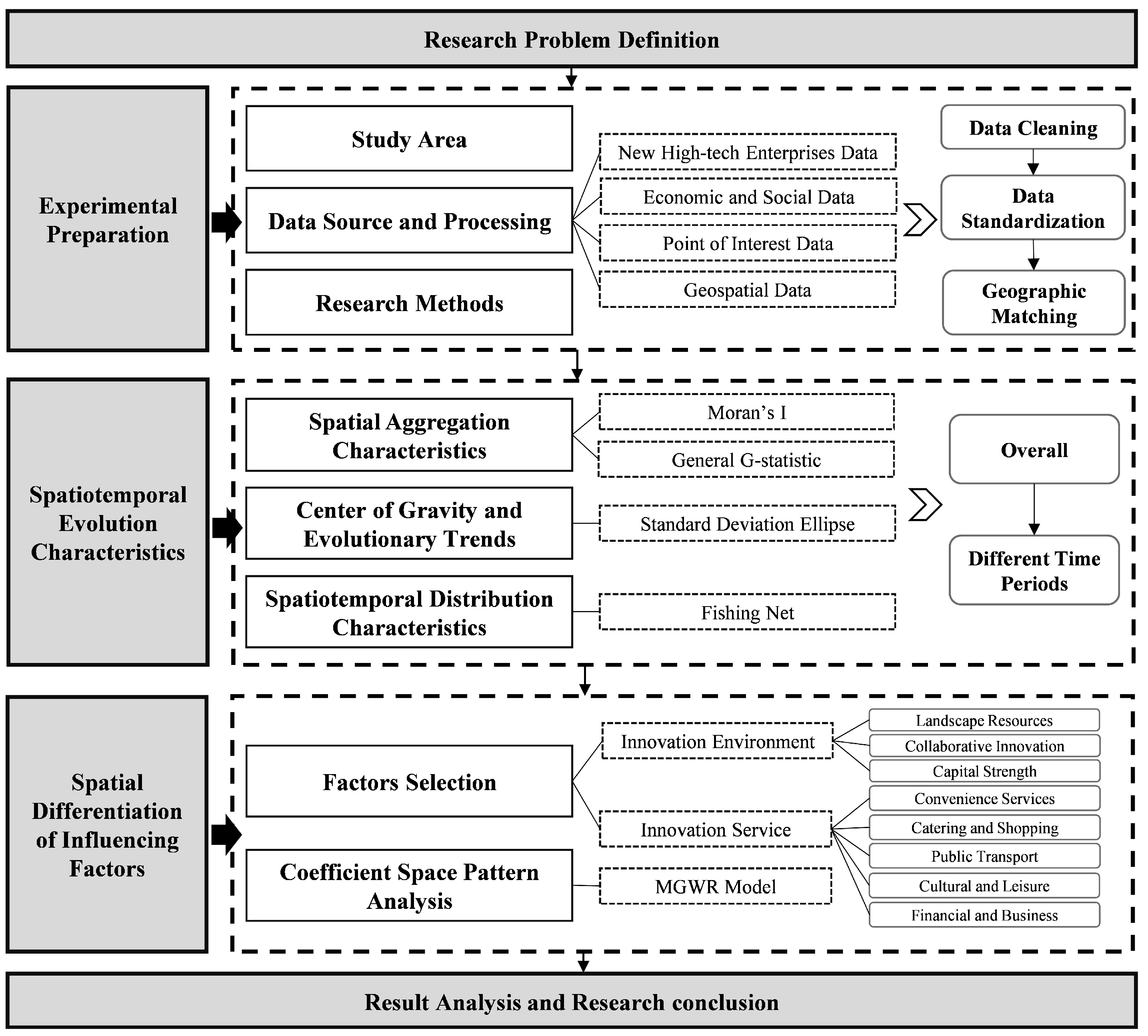
This study explored the spatiotemporal dynamic characteristics and the influencing factors by using raw data obtained from multivariate big data. Figure 1 describes the research design steps of this study.

2.1. Study Area

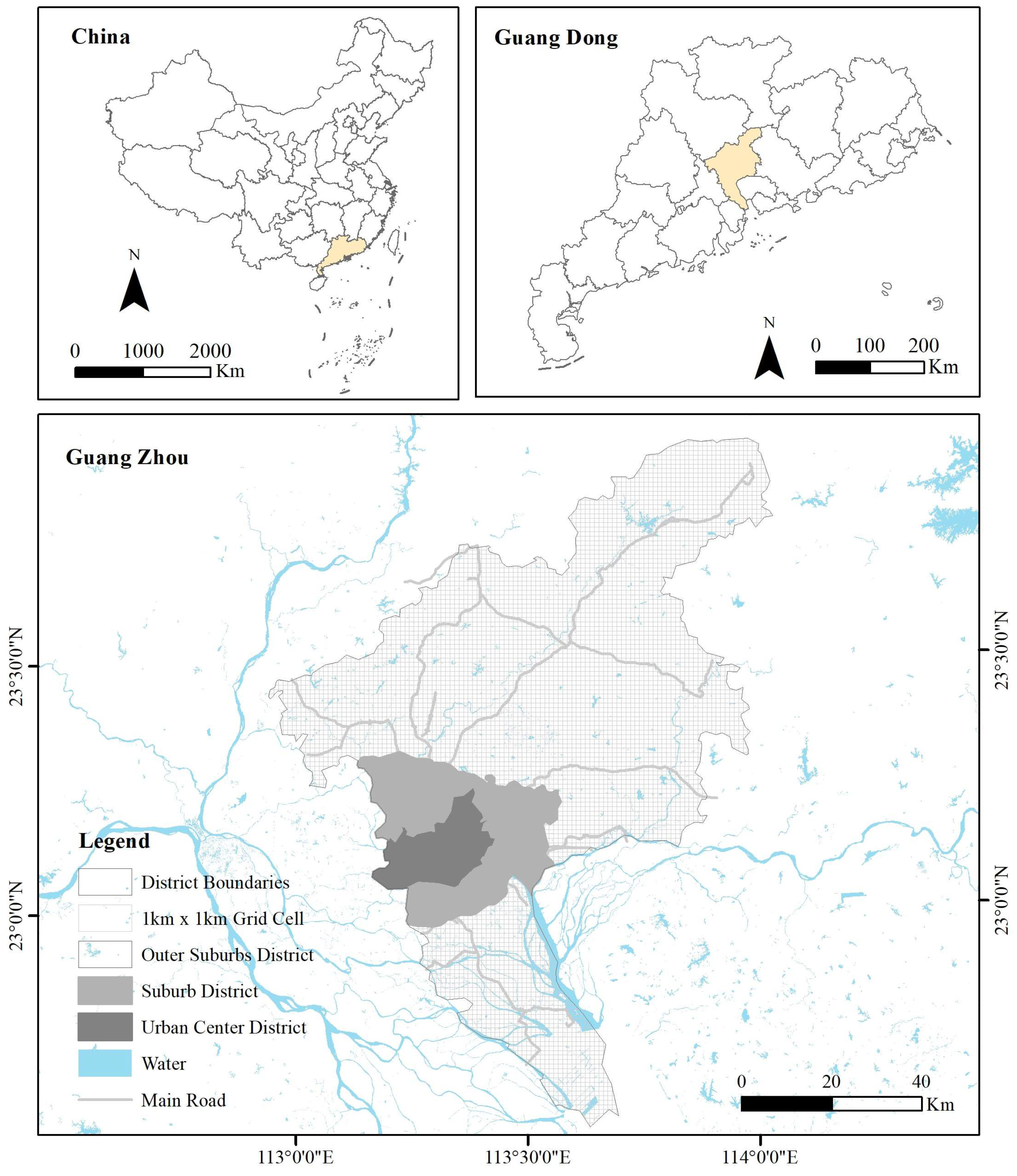
The study area is Guangzhou, which is a national center city serving as a pivotal hub for politics, economy, military, culture, science, and education in South China. The city is rich in scientific and technological talents and boasts numerous urban innovation spaces. There are over 12,300 high-tech enterprises and more than 16,700 science and technology-based small- and medium-sized enterprises in Guangzhou, according to the Office of Science and Technology [34]. Notably, 116 out of 153 domestic-listed companies are high-tech enterprises, underscoring the formidable strength of Guangzhou’s high-tech sector. Guangzhou was divided into the central district, suburbs, and outer suburbs based on the Guangzhou Master Plan (2017–2035) [35]. Meanwhile, a grid system was used to segment the administrative districts of Guangzhou, which facilitated data integration during the adjustment of administrative divisions and analyzed the internal structure of the city. Considering sample size and data availability, the administrative districts of Guangzhou were divided by a grid scale of 1000 × 1000 m. The basic units for spatial analysis were determined, totaling 7822 (Figure 2).

2.2. Data Source and Processing

This study adopted the industrial and commercial registration data of high-tech enterprises from 2008 to 2023, published by the Department of Science and Technology of Guangdong Province, to explore the evolution of innovation spaces. In the analysis of influencing factors, the study focuses on high-tech enterprises that were actually in operation in 2023. In order to avoid the endogenous problem of the model, the economic and social development data and POI data of 2022 were adopted, which were mainly obtained from Guangzhou Statistical Yearbook and Autonavi map. Geospatial data came from the Guangzhou map in the Tianditu system of the National Geographic Information Public Platform (Figure number: GS (2024) 0650) [36]. In addition, we verified and supplemented the road network and river information using OpenStreetMap dataset.
The validity period for high-tech enterprise status was three years, according to Administrative Measures for the Certification of High-tech Enterprises from the Ministry of Science and Technology in 2008. Enterprises must reapply for certification before their status expires to ensure uninterrupted renewal. Therefore, three years was deemed as the update cycle for these enterprises. The study mapped urban innovation spaces by selecting the actual certificated high-tech enterprises in Guangzhou from 2008 to 2023. Years 2008, 2011, 2014, 2017, 2020, and 2023 were chosen for research at intervals of three years. For instance, new high-tech enterprises in 2023 were certified and reviewed between 2021 and 2023, with similar patterns applying to the other years. Qichacha Limited was used to bulk collect company names, addresses, establishment dates, and industries. Spatial locations were determined using Amap geocoding technology based on company addresses after data cleaning and integration. A total of 36,519 valid data points were processed by the WGS1984 geographic coordinate system and the UTM-projected coordinate system. The number of high-tech enterprises actually existing within the grid of 1 km2 in 2023 was chosen as the dependent variable. Independent variables included the built environment and the service environment. This research considered 8 subtypes and 17 variables in total (Table 1).

2.3. Research Methods

2.3.1. Standard Deviation Ellipse

The standard deviation ellipse (SDE) is used to analyze the overall distribution of Guangzhou’s urban innovation spaces. The spatial scope and direction of the main body of innovation spaces are uncovered by determining the central position and orientation of distribution. The calculation formula is as follows:
S D E x = i = 1 n ( x i x ¯ ) 2 n
S D E y = i = 1 n ( y i y ¯ ) 2 n
The angle of rotation is calculated as follows:
tan θ = ( i = 1 n x i ~ 2 j = 1 n y j ~ 2 ) + ( i = 1 n x i ~ 2 i = 1 n y i ~ 2 ) 2 + 4 ( i = 1 n x i ~ y i ~ ) 2 2 i = 1 n x i ~ y i ~
The standard deviation is calculated as follows:
σ x = 2 i = 1 n ( x i ~ cos θ y i ~ sin θ ) 2 n
σ y = 2 i = 1 n ( x i ~ cos θ + y i ~ sin θ ) 2 n
In the formula, S D E x and S D E y are the variances of the ellipse in the direction of x-axis and y-axis; x i and y i are the spatial location coordinates of the i-th high-tech enterprises; x ¯ and y ¯ are the arithmetic mean centers of all the high-tech enterprises; n is the number of the high-tech enterprises; θ refers to the angle of rotation of the ellipse; and x ~ and y ~ are the deviations between the coordinates of the spatial location of the high-tech enterprises and the mean center.

2.3.2. Spatial Autocorrelation Model

Spatial autocorrelation, encompassing global and local aspects, is a data analysis and visualization method to assess spatial correlation based on spatial dependence and heterogeneity. Global and local spatial autocorrelations are utilized to identify the correlation and variations in Guangzhou’s innovation spaces, which accurately depict the clustering intensity of these spaces. Moran’s I is commonly used for measurement. The calculation formula is as follows:
I = n i = 1 n j = 1 n ( X i X ¯ ) ( X j X ¯ ) i = 1 n j = 1 n W i j i = 1 n ( X i X ¯ ) 2
In the formula, n is the number of high-tech enterprises; X i and X j are the data of high-tech enterprises in units i and j , respectively; X ¯ is the sample average; and W i j is the spatial weight matrix of units   i and j .

2.3.3. General G-Statistic

The General G statistic is employed to quantify and assess spatial autocorrelation resulting from high-value or low-value clustering. A higher G value indicates that the attribute values of the units in the study area exhibit a high-value clustering, whereas a lower G value indicates low-value clustering. The calculation formula is as follows:
G = i 1 n j 1 n W i j X i X j i = 1 n j = 1 n X i X j
In the formula, n is the number of units (grid cells); X i and X j are the data of high-tech enterprises in units i and   j , respectively; and W i j is the spatial weight matrix of units i and j .

2.3.4. MGWR Model

The MGWR model is a local linear regression method elucidating the spatial relationship between independent and dependent variables by modeling spatial variability [37]. Each factor in the MGWR model has a specific bandwidth to analyze the differentiation of different independent variables, in contrast to ordinary least squares (OLS) and geographically weighted regression (GWR). The MGWR model reveals the varying influences due to spatial heterogeneity and manifests the uneven spatial distribution of these influences [38]. This study used the MGWR model to explore the factors influencing the distribution of urban innovation spaces. The calculation formula is as follows:
Y i = j = 1 k β b w j ( u i , v i ) X i j + ε i
In the formula, Y i is the number of high-tech enterprises in the grid of 1 km2; X i j is the factor influencing the spatial distribution of high-tech enterprises; β b w j is the regression coefficient of the j-th influencing factor; the plus and minus of the coefficient represent the positive and negative correlations between the parameter and the spatial position, respectively; the numerical magnitude indicates the correlation degree; subscript b w j is the bandwidth applicable to the regression coefficient of the j-th influencing factor; and ( u i , v i ) is the center-of-mass coordinate of the grid.

3. Results

3.1. Spatiotemporal Dynamic Characteristics

3.1.1. Spatial Aggregation Characteristics

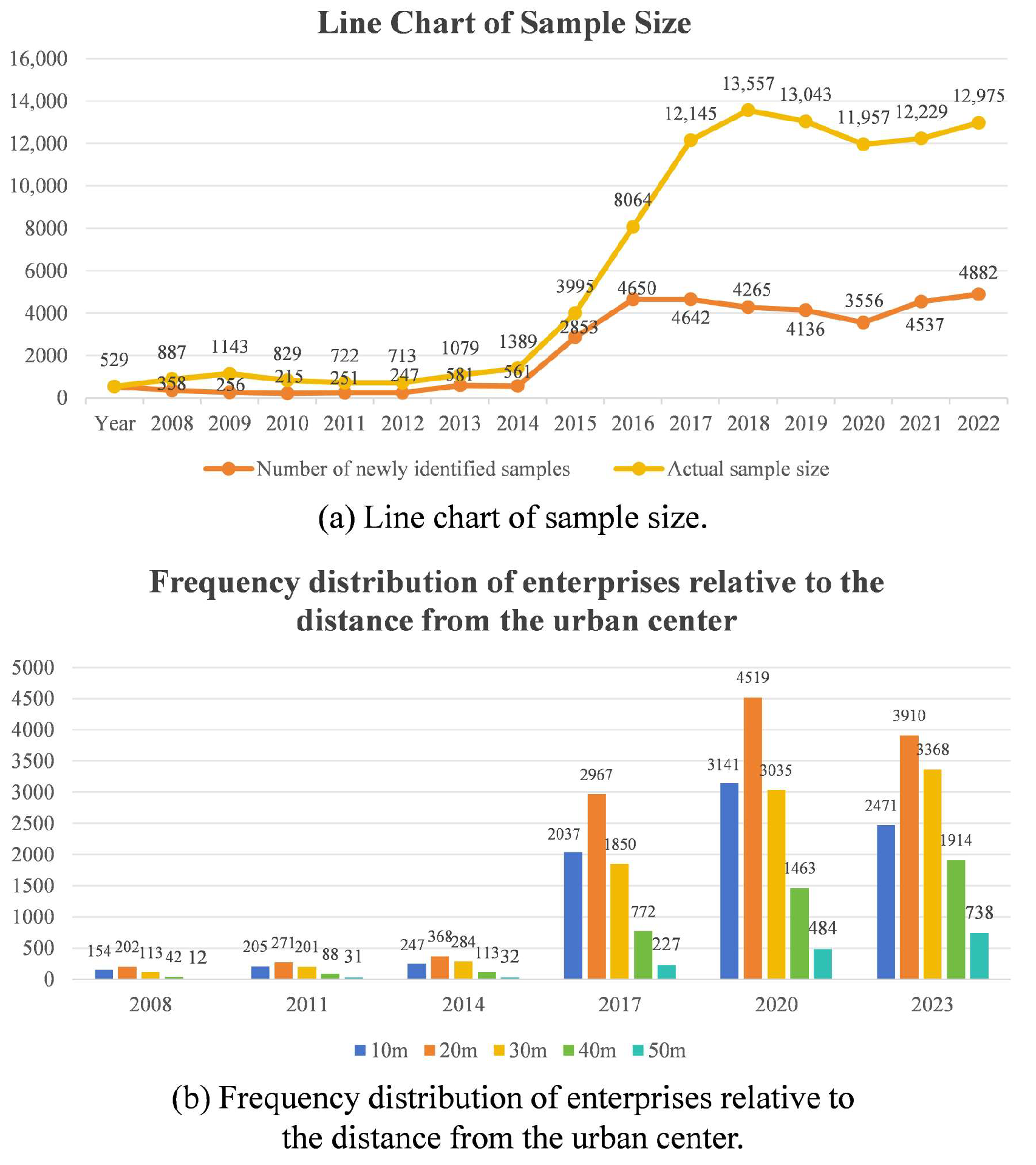
As shown in Figure 3a, the number of newly identified high-tech enterprises in Guangzhou exhibits a distinct two-phase shift. From 2008 to 2015, the annual increase remained at a relatively low and stable level. But after 2016, it experienced explosive growth. This is linked to adjustments in Guangzhou’s policies regarding the designation of high-tech enterprises. Meanwhile, the number of high-tech enterprises was counted within a 10 km radius centered on the Guangzhou Municipal Government. The data reveal that innovation spaces are not only highly concentrated in the city center but also exhibit a significant peak within the 10–20 km range, indicating a gradual outward diffusion (Figure 3b).
The spatial distribution of high-tech enterprises is affected by the surrounding environment, demonstrating spatial autocorrelation. Moran’s I > 0 and p < 0.01, as indicated by the measurement of index I (Table 2), reveal that the distribution of Guangzhou’s urban innovation spaces exhibited a significant positive spatial correlation. Specifically, there was a significant agglomeration effect that intensified annually. Moran’s I rose from 2008 and peaked in 2020, indicating that the agglomeration of innovation spaces accelerated and the correlation increased. Following this peak, the index experienced a slight decline, signaling a deceleration in the agglomeration rate and the onset of a new developmental phase. The fluctuations in Moran’s I reflected the complex evolution of the distribution of innovation spaces in Guangzhou.
However, while Moran’s I highlights the presence of spatial clustering, it does not distinguish between high-value and low-value clusters. In contrast, the General G index, which decreased from 0.150 × 10⁻⁴ to 0.06 × 10⁻⁴, with Z > 0 and p < 0.01, confirms the presence of significant high-value clustering. The fluctuations in both Moran’s I and the General G index reflect a weakening in the intensity of high-value clustering, yet the distribution of innovation spaces in Guangzhou remains a characteristic of significant spatial agglomeration.
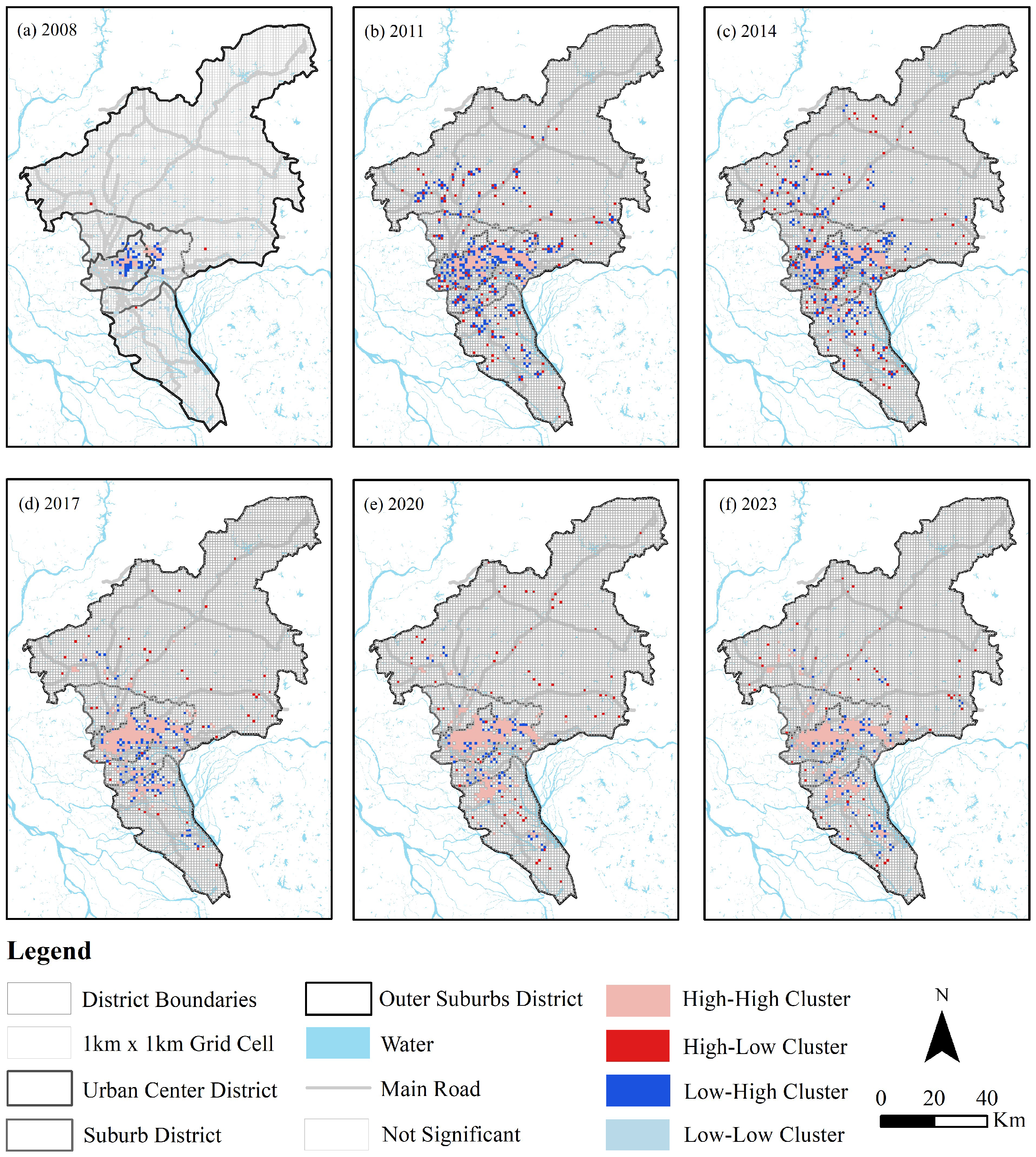
As illustrated in Figure 4, local indicators of spatial association (LISA) cluster maps are employed to identify the agglomeration locations of innovation spaces. It can be found that high-high (H-H) clusters of urban innovation spaces are concentrated in the central district and suburb district, with these central districts intensifying over time and expanding their overall agglomeration scope. Low-high (L-H) clusters areas were circularly around these H-H clusters. Besides, the number of L-H clusters has decreased since 2017. Low-low (L-L) clusters are prevalent in the district boundaries, where industrial activities are scarce. The overall extent of agglomerations expanded, indicating the characteristics of central-district agglomeration—suburban sparsity.

3.1.2. Center of Gravity and Evolutionary Trends

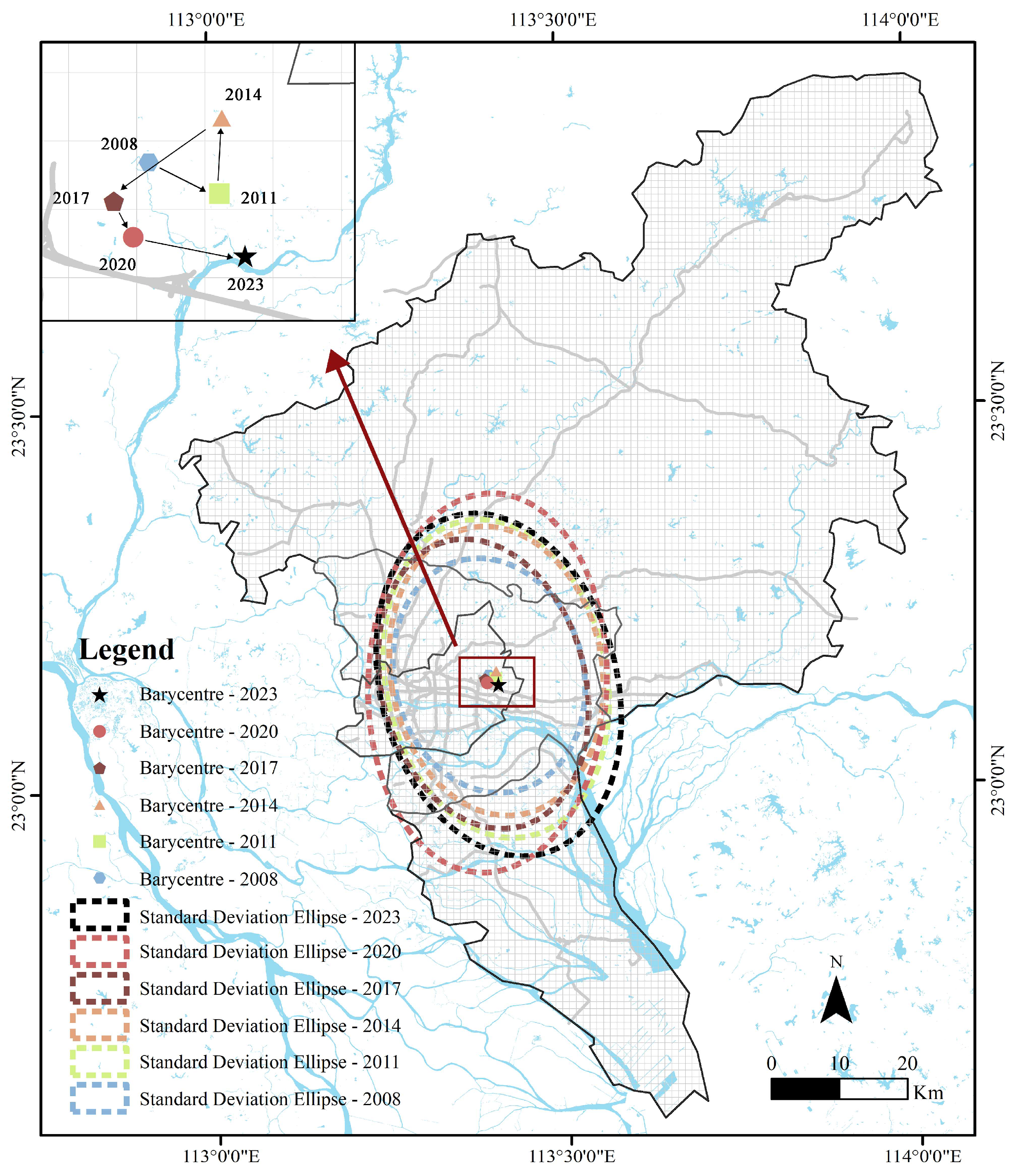
The ArcGIS 10.6.1 software was used to obtain the SDE of urban innovation spaces distribution (Figure 5). The center of the ellipse remained situated in the Huanshi East Road—Tianhe Road area, with a slightly circumferential shift. The coverage consistently encompassed the urban center district and suburb district, indicating a strong association between innovation spaces and the regional economic center. Typically, industries closer to the central district benefit from the spillover effects of platform advantages, scientific manpower, and broad markets. In terms of the evolutionary trend, the ellipse maintained a direction of approximately 25° north by west with a low degree of oblateness. Thus, the distribution of innovation spaces showed a southeast-northwest development orientation, which spatially aligned with Guangzhou’s strategy of eastward advancement and southward expansion.

3.1.3. Spatiotemporal Distribution Characteristics

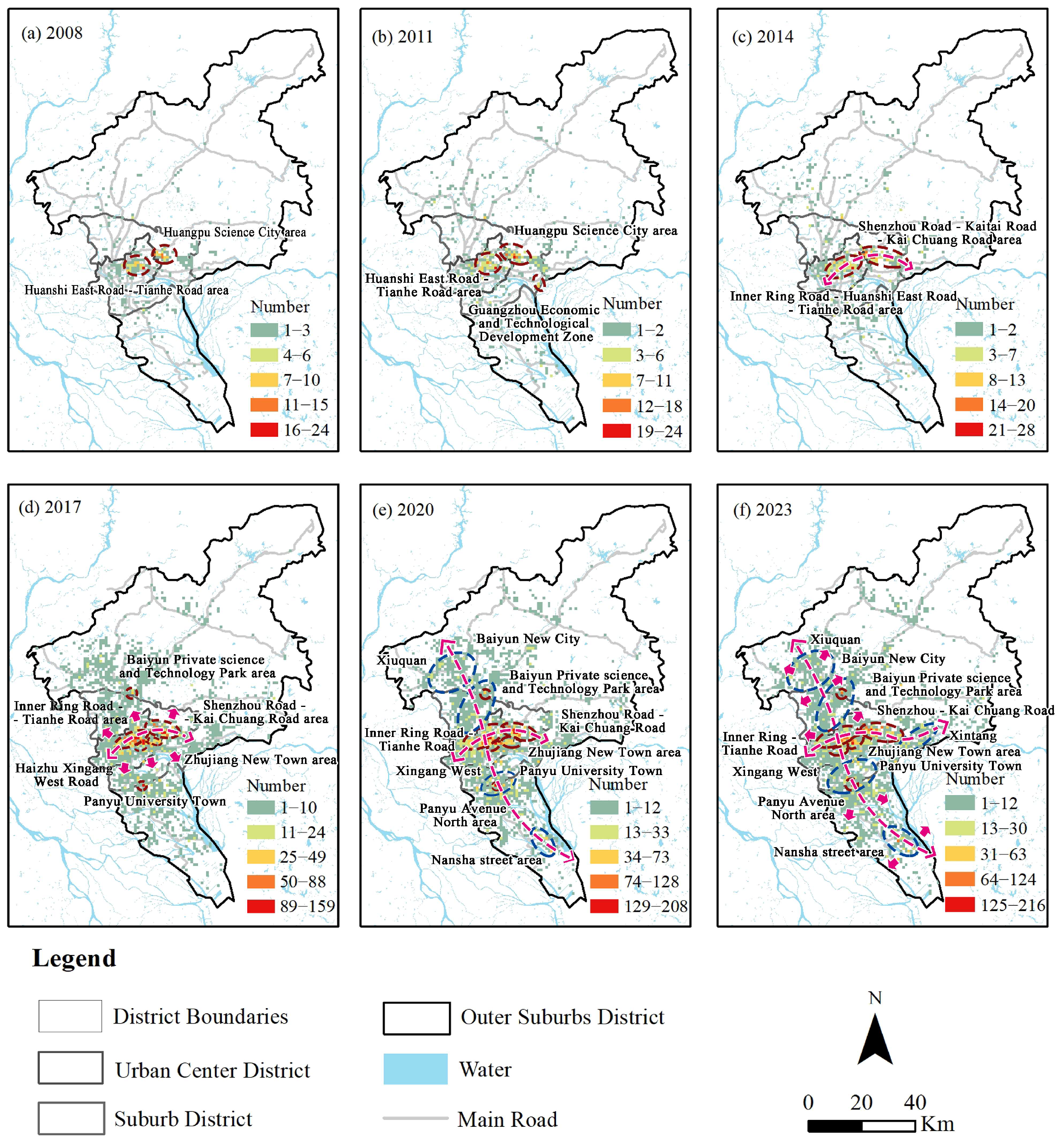
The number of high-tech enterprises from 2008 to 2023 was assigned to each grid to map enterprise distribution, showing distinct point–axis–plane structural evolution (Figure 6).
Year 2008–2011: point-shaped expansion. Urban innovation spaces were clustered in the Huanshi East Road–Tianhe Road area and the Huangpu Science City area in 2008, forming point-shaped cores. The rest of the area was sporadically scattered with innovation spaces, which expanded from those two cores. The Huancheng East Road–Tianhe Road area was formed due to its proximity to the Guangzhou Huanshi East Business Circle and the Tianhecheng Business Circle in the west. Additionally, the area was near the Wushan–Shipai Higher Education Park in the east, which facilitated knowledge spillovers through institutions of higher learning (e.g., South China University of Technology and Guangdong University of Technology). The Huangpu Science City area was concentrated at the administrative boundary of the Huangpu and Tianhe Districts. The government prioritized innovation cultivation in the industry development zone. This manifested the efficacy of policies in shaping the core of innovation spaces. These spaces remained concentrated in a dot-like core with small-scale expansion in 2011 because innovation entities did not disperse due to the post-financial crisis recovery of financial resources and talent [39].
Year 2011–2017: axial distribution. Innovation spaces showed axial distribution, with most areas expanding upon the previous stage in alignment with Guangzhou’s strategy. Some areas extended eastward with the eastern development zone to create a cohesive unit from the core of Huangpu Science City. Consequently, an innovation corridor of Shenzhou Road–Kaitai Avenue–Kaichuang Avenue was formed. The Huanshi East Road–Tianhe Road area expanded southward beyond the Inner Ring Road and reached out to other universities and scientific research institutions. Peripheral regions exhibited innovation spaces due to axial spread, indicating the outward expansion of innovation activities across broader areas.
Year 2017–2023: agglomerations in plane. Innovation spaces in this stage spread on both sides of the axis into the city’s peripheral regions based on the axial distribution in 2017. Notable expansion and contiguous zones of innovation spaces emerged in Baiyun and Huadu Districts on the northern periphery, as well as in Panyu and Nansha Districts in the south. However, innovation sub-centers did not appear. Zengcheng and Conghua District exhibited increased innovation spaces, thanks to policy support and transportation improvement. Besides, peripheral regions boasted robust innovative vitality. The distribution of innovation spaces reached unprecedented levels in 2023. Innovation activities expanded from the central district to encompass the entire city, which resulted in multiple primary and secondary core areas covering the urban and key peripheral regions. Nansha, Panyu, and Conghua District displayed significantly increased innovation activities, indicating remarkable advancements in Guangzhou’s innovation-driven development.

3.2. Spatial Differentiation of Influencing Factors

3.2.1. Comparison of Models

As shown in Table 3, although the central district accounts for only 4.3% of the total number of grid cells, its average density is 37.48 establishments per grid cell, which is significantly higher than the average (1.66). Meanwhile, the quartiles for both the outlying districts and the overall sample are 0, further confirming that the distribution of innovation spaces in Guangzhou exhibits significant heterogeneity. Based on the previous analysis, a significant agglomeration trend was observed in Guangzhou’s central district and suburbs, which were chosen for the analysis of factors influencing this trend.
To focus on this agglomeration trend and avoid statistical bias caused by zero-value grids, the sample for regression analysis was refined to 673 grid cells, and 7803 high-tech enterprises within the area were identified, with an average of 11.59 per cell. The data met the convergence criteria for Gaussian distribution, making the MGWR model applicable. The SPSS 26 software was used to standardize data and conduct multicollinearity tests. The variance inflation factor (VIF) of the model was below 10, which satisfied the criteria for using the MGWR model and eliminated the influence of variable collinearity [35]. Meanwhile, compared to OLS and GWR model, the MGWR model had a higher goodness of fit (0.521) (Table 4). Besides, it also had a lower AICc and residual sum of squares, which made it the optimal choice for regression analysis.

3.2.2. Analysis of the Coefficient Spatial Pattern

Factors influencing the distribution of Guangzhou’s innovation spaces exhibit spatial heterogeneity at different scales. The bandwidth in MGWR represents the spatial scale of each variable’s influence. In this study, an adaptive kernel was used, where the bandwidth unit is the number of neighbor grids. The bandwidth of the OLS model is 673, indicating global fitting. Thus, the OLS model cannot reflect spatial differences (Table 5). The GWR model has an optimal bandwidth of 283, which covers 42% of the sample size. In contrast, the bandwidth of the MGWR model falls in [47,672], which allows the model to reflect the differentiation of different variables and determine the specific coefficient for the spatial sample unit. Bandwidths are classified into local and global categories. Locally, the industrial structure altitude, living convenience, capacity to accommodate vehicles, and the number of subway stations have specific bandwidths of 47, 116, 168, and 49, respectively. These factors exhibit significant spatial heterogeneity in influencing the distribution of innovation spaces. On the near-global and global scales, 13 variables (e.g., landscape resources and distances to public parks, universities, and scientific research institutions) have bandwidths close to 672, suggesting insignificant spatial heterogeneity. The distribution of innovation spaces is less affected by these factors. Additionally, the p-value tests for nine influencing factors (e.g., landscape resources and industrial parks) are insignificant, so they are not further elaborated in this study.
Built environment. The built environment is key to the agglomeration of innovation spaces. Factors influencing the distribution of innovation spaces, ranked by their mean absolute value of impact strength, are as follows: RI (0.225) > PP (0.126) > UR (0.094) > ISH (0.077) (Table 5).
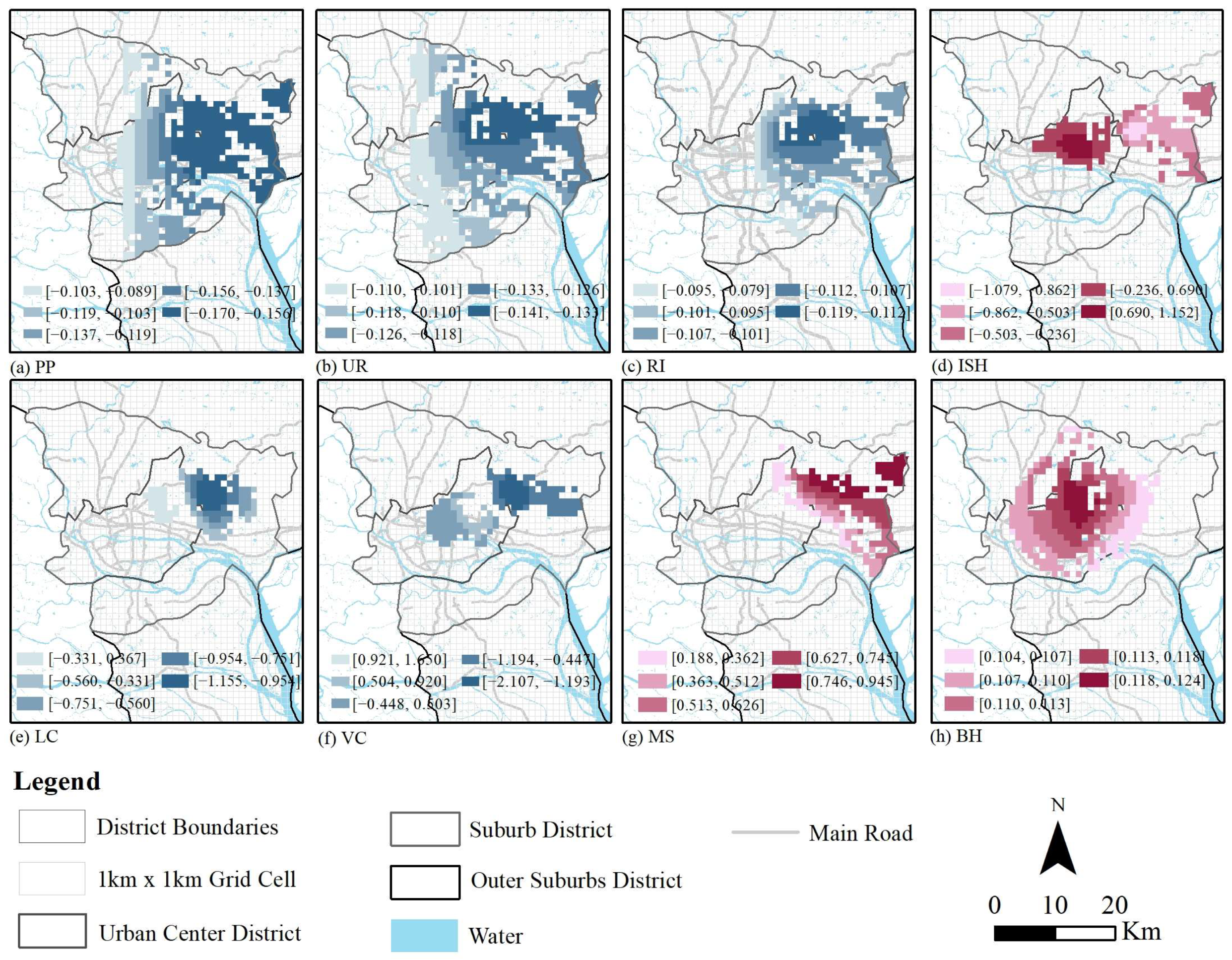
Negative related influencing factors include distances from the center of the grid to the nearest public park, university, and scientific research institution. Urban innovation spaces are more prevalent near public parks, as their distribution inversely correlates with the distance to these areas. The distance to public parks exhibits insignificant spatial heterogeneity with a bandwidth of 629, nearly on a global scale. Figure 7a shows the spatial distribution of the regression coefficient for this distance. The coefficient decreases from west to east in [−0.399, 0.027]. Places with abundant landscape resources attract skilled professionals and enterprises thanks to their pleasant working environments. This attraction indirectly boosts the development of innovation spaces. The significance of a superior ecological setting in drawing talent to an area is well-documented in previous research [40,41]. Meanwhile, innovation spaces are also more likely to be found near universities and scientific research institutions. Figure 7b,c illustrates the distribution of the regression coefficients for these distances. Coefficients decrease from west to east in [−0.516, 0.173] and [−0.659, −0.001], respectively. Both factors have a bandwidth of 672, indicating a global scale with limited spatial heterogeneity. Proximity to universities and scientific institutions enables resource sharing and technology transfer and reduces operating costs, making these areas more attractive to innovators [42]. The industrial structure height is positively correlated with innovation space agglomeration, showing significant spatial heterogeneity with a bandwidth of 47. Figure 7d depicts the coefficient decreases from west to east in [−0.069, 0.015].
The industrial structure positively influences the agglomeration of innovation spaces, mainly in the central district. The dominance of the tertiary industry in the structure often reflects robust regional economic development and strength, as well as the ability to attract innovative resources. Innovative activities tend to concentrate in economically developed areas for greater agglomeration effects.
Service environment. The service environment provides comprehensive services for innovative subjects, catering to the needs of innovative talents in terms of residence, food, cultural recreation, public transportation, and financial services. Factors influencing the spatial distribution of urban innovation, ranked by the mean absolute value of their impact strength, are as follows: VC (0.300) > LC (0.109) > BH (0.084) > MET (0.003) (Table 5).
Negative related influencing factors include the number of residential communities and metro stations. Living convenience has a bandwidth of 116 with medium spatial heterogeneity. Figure 7e shows the coefficient decreases from west to east in [−1.045, 0.401]. Residential communities in over half of the regions negatively correlate with the distribution of urban innovation spaces, while a few regions show a positive correlation. A farther distance to most residential communities indicates a high concentration of innovation spaces. Modern cities feature zoning that separates residential, commercial, and industrial functions. This zoning diminishes interactions between functional activities. The number of metro stations, with significant spatial heterogeneity, has a bandwidth of 49. Figure 7f shows that the coefficient decreases from west to east. This factor positively correlates with innovation spaces in the central district and shows a negative correlation in the suburbs, a trend related to the distribution of metro stations. The central district features a dense and uniform distribution of metro stations, while these stations are fewer in the suburbs.
Positive related influencing factors include the number of parking lots and distances from the center of the grid to the nearest hotel. More urban innovation spaces emerge near parking lots, as they positively correlate with the number of parking lots. The vehicle carrying, with medium spatial heterogeneity, has a bandwidth of 168. Figure 7g shows the coefficient decreases from east to west in [−0.191, 1.553]. Parking lots are usually located in the transportation hubs of cities or commercial centers, boosting robust transportation links [43]. Innovation spaces need to attract people from different regions for business cooperation, especially for those arriving by car. Urban innovation spaces are more prevalent in areas distant from business hotels, indicating a positive correlation with the distance to such hotels. This distance has a bandwidth of 672 and exhibits insignificant spatial heterogeneity on a near-global scale. Figure 7h shows the coefficient decreases from the city center to surrounding areas in [−0.133, 0.317]. Business hotels typically reside in commercial centers or scenic spots. These areas bustle with people and commercial activities. However, high-tech enterprises usually opt for locations away from commercial and tourist hotspots for more land resources and lower rents.

4. Discussion

4.1. Research Contributions

This study systematically analyzes the spatiotemporal dynamic characteristics and influencing factors of urban innovation spaces through spatial analysis methods and statistical methods. It contributes to the existing literature as follows: (1) This study used high-tech enterprises to delineate urban innovation spaces and focused on the internal areas of the city, thereby addressing the current research gap characterized by a limitation to the macro scale and a lack of innovation subject perspective. (2) Based on the analysis of the evolution mechanism of urban innovation spaces, this study focused on the needs of innovative talent. An indicator system influencing the distribution of urban innovation spaces is constructed from the dual perspectives of innovation environment and innovation services. These two aspects constitute the uniqueness of this study.
Specifically, through the analysis of Moran’s I index and the General G index, it is evident that the spatial distribution of urban innovation in Guangzhou exhibits an obvious pattern of spatial agglomeration, particularly in the central districts. This finding emphasizes the concentration of innovation activities in economically developed cities or urban central districts. This is consistent with prior research [44,45]. Generally, innovative enterprises tend to gather in the urban fringe or even in the outer suburbs (e.g., Silicon Alley and Boston Highway 128). However, innovation space is often closer to the central district for more benefit from the spillover effects of platform advantages, scientific manpower, and broad markets [46] in order to obtain more scientific and technological resources. In the future urban planning, diversified space supply should be increased, not only to provide storage space for the innovation space in the city center for functional renewal, but also to provide incremental space to meet the needs of the innovation space’s outward development.
Additionally, significant spatial and temporal differences exist in the evolutionary characteristics of Guangzhou’s urban innovation spaces from point-shaped cores in 2008 to a plane-like distribution by 2023. Meanwhile, the innovation space within Guangzhou presents a core-edge structure, with the central district as primary node and the suburbs gradually integrated into the innovation network due to the improvement of infrastructure and policy support. Duan et al. confirmed that similar trends have been observed in Shanghai and Beijing, with Shanghai expanding outward from a few core areas to multi-core, eventually evolving into multi-axis strip corridor, while Beijing consistently presents a core-edge structure [47]. Multi-center [48], multi-group [49], ribbon axis [50], core-edge [51], and other structures have been confirmed by different scholars in different urban innovative space research, which conform to the theoretical paradigms of urban planning.
Regarding the factors influencing the distribution of urban innovation spaces, the MGWR model identifies several key factors influencing the distribution of urban innovation spaces, which exhibit varying degrees of spatial heterogeneity. It also provides indirect evidence for the “slow down” and “speed up” of agglomeration. High sensitivity to influencing factors reveals the acceleration effect caused by agglomeration economies, while low sensitivity indicates that high density slows the emergence of enterprises, thereby driving the diffusion of innovation spillover effects toward suburban and even exurban areas.
The built environment, particularly proximity to universities, research institutions, and public parks, plays a crucial role in attracting innovation activities. This finding highlights the importance of knowledge spillovers and collaborative environments in innovation. Universities and scientific research institutions are the main sources of knowledge and technology. Thus, the proximity of innovation spaces to these places enables resource sharing and technology transfer. Besides, shared infrastructure and talent resources reduce operating costs and boost efficiency [52]. Meanwhile, the landscape resources environment has a significant impact on innovation space, which is consistent with the findings of Li et al. [40] and Gu et al. [41]. They found that places with abundant landscape resources can attract top enterprises and talents. Accordingly, future planning and development should take more consideration of the needs of innovative groups.
Due to limitations in accessing policy and land rent data, these factors were not incorporated into the model for analysis. Policies and land rents, as key considerations in the built environment, contribute to the formation of innovation spaces [53,54]. In terms of administrative measures and planning policies, as noted above, Guangzhou’s innovation spaces have evolved along a southeast–northwest axis, which aligns closely with the “Eastward Expansion and Southward Extension” urban development strategy and the Guangzhou–Shenzhen–Hong Kong–Macao Science and Technology Innovation Corridor plan. In particular, the government often uses various forms of spatial planning (e.g., designating specific industrial parks, development zones, and high-tech zones) to guide innovation activities. The establishment of the Guangzhou High-Tech Industrial Development Zone, Huangpu Science City, and Nansha Science City has led to a noticeable concentration of innovation spaces. In addition, tax incentives, research and development subsidies, and talent policies have effectively fostered the concentration of innovation spaces [55]. In terms of land prices, Guangzhou’s innovation spaces are often located in areas with high environmental benefits and high land values. This suggests that the talent attraction generated by a high-quality environment may outweigh the displacement effect caused by high rents. However, some studies suggest that high-tech enterprises are highly sensitive to land costs, and cost differences drive their spatial optimization [56]. Local governments employ flexible spatial governance strategies (e.g., pricing policies and the manipulation of land supply mechanisms through land use rights) [57]. This is the key to attracting innovation spaces. Future research should focus on integrating rental data to further quantify this variable.
The innovation service, metro stations in some regions, have no significant impact on innovation space agglomeration, which is in line with Ma et al. study on the influencing factors of innovation agglomeration [51]. This phenomenon may be related to the wide coverage of urban public transportation systems in Guangzhou and Shanghai or urban zoning. Therefore, the characteristics and influence degree of service elements should be considered in planning innovation space distribution to optimize the allocation and utilization of innovation resources.
Surprisingly, the study finds that innovation spaces are likely to be located away from business hotels. Business hotels typically reside in commercial centers or scenic spots. These areas bustle with people and commercial activities. In other words, the innovation space is far from the central area of economic prosperity. This finding is in sharp contrast to our above observation that innovation spaces are mostly distributed in central areas. However, we believe that this is caused by different types of innovation spaces. Production-oriented or small innovation spaces will choose places with cheap land, while R&D-oriented innovation spaces will have a high dependence on abundant knowledge and technology elements [28]. This also provides a foundation for the systematic classification of innovation spaces in future research, thereby enhancing the comprehension of all kinds of innovation spaces.
Unlike traditional service and retail enterprises that are less innovative, the location choices of high-tech enterprises follow an innovation-driven logic. Retail and services are primarily driven by “market-oriented” and “population-oriented” factors [56,58]. These enterprises prioritize market coverage to attract consumers and achieve operational goals by maximizing foot traffic. This leads them to choose prime locations in central urban areas that are easily accessible, close to customers despite high rents, which align with central place theory [59]. In contrast, the innovation spaces represented by high-tech enterprises exhibit significant “knowledge spillover” characteristics. They tend to cluster near areas of knowledge concentration, such as universities and research institutions (e.g., Wushan area in Tianhe district). This geographical proximity facilitates informal face-to-face interactions and the dissemination of tacit knowledge, promoting technological exchange and collaboration among industry, academia, and research institutions. Consequently, it effectively reduces innovation costs and accelerates technology transfer.

4.2. Limitations and Prospects

This study suffers from several limitations. First, urban innovation spaces were mapped using high-tech enterprises, which were constrained to a limited, single-dimensional view of innovation subjects. It may not fully capture the diversity of innovation activities. Future research should broaden this scope by offering a more holistic description of these spaces and examining their spatial distribution patterns across various innovation subjects.
Second, funds, science, and technology resources are crucial to the study of the distribution of innovation space. In this study, in order to consider the location choice of innovative talents as much as possible, we adopt external environmental factors as the variables. Relying solely on the external environmental factors to evaluate the influencing factors may introduce selection bias. Additionally, innovation spaces and their influencing factors may vary in different cities. Thus, additional dimensions should be explored to develop a nuanced system of influencing factors, with specific indices based on internal knowledge, technology, and external environmental services. Meanwhile, we analyzed the influencing factors using cross-sectional data. The spatiotemporal mapping in this study reveals a clear pattern of contiguous expansion, but the results of the MGWR model only account for the effects at the cross-sectional time point and cannot explain variations across other time periods, leading to a temporal mismatch. Future research could utilize long-term panel data or models capable of addressing temporal heterogeneity (e.g., multiscale geographically and temporally weighted regression model and spatial Durbin model) to further elucidate neighborhood dependencies and the dynamic interaction processes among the urban built environment, service facilities, and innovation spaces.
Besides, MGWR model has good performance, and its results are more diverse than OLS and GWR models. Some scholars compared MGWR model with the three machine learning methods (decision tree, logistic regression, and random forest) in the study of the influencing factors of flood risk management; the MGWR model still performed better and was limited by the number of trained samples [52]. However, the MGWR model may not be able to fully capture the spatial heterogeneity of all variables. Future studies may also consider combining with other models to explore in order to improve the performance of the model, enrich the explanatory power of the model, and fully explore the influencing factors.
Furthermore, the internal spatial functions of cities will face a new phase of transformation with the rapid advancement of intelligent informatization. Future research should focus on whether the collaborative development with neighboring cities will impact the distribution of urban innovation spaces.

5. Conclusions

Cities, the spatial carrier for innovation activities and growth, should promote the high-quality development of urban innovation spaces by integrating innovation elements and optimizing built and service environments. This study used 36,519 high-tech enterprises in Guangzhou from 2008 to 2023 to delineate urban innovation spaces, utilizing spatial analysis methods such as standard deviation ellipse, spatial autocorrelation model, and General G statistic to indicate these spaces based on the spatial grid unit of 1000 × 1000 m. Spatial analysis methods and statistical methods were employed to investigate the spatiotemporal dynamic characteristics of urban innovation spaces. Furthermore, employing MGWR model, the study identifies multiple factors influencing the development of innovation spaces from the dual perspectives of the innovation environment and services. The key findings are as follows:
The layout of Guangzhou’s urban innovation spaces exhibited a significant spatial positive correlation. These spaces were concentrated in the central district and sparsely scattered in the suburbs. This trend echoed previous research findings on the agglomeration of innovation spaces [60,61]. The spatial distribution of these spaces followed a southeast-northwest development trajectory, which spatially corresponded to the development of Guangzhou during the study period. Besides, the structural evolution of innovation spaces varied across different stages, primarily showing a dot–axis–plane agglomeration trend.
The research used the MGWR model to analyze factors affecting the distribution of urban innovation spaces, focusing on innovative talents and subjects. An index system was developed based on the built and service environments for innovation. Factors affecting this distribution, ranked by their impact based on the mean absolute value of the MGWR regression coefficient, were as follows: vehicle carrying; distances to scientific research institutions, public parks, residential communities, universities, and business hotels; industrial structure height; and the number of metro stations. Innovation spaces decreased with the increase in distances to scientific research institutions, universities, and public parks, as well as the number of residential communities and metro stations. These spaces increased with the increase in the distance to business hotels, the number of public parks, and the height of the industrial structure.
Through the analysis of the evolutionary characteristics of Guangzhou’s innovation spaces, this study reveals the spatial structures and agglomeration patterns across different periods and identifies influencing factors from two major dimensions. Future research could broaden the scope of innovation subjects and integrate internal knowledge indicators to construct a more comprehensive evaluation system. Moreover, subsequent research could employ machine learning and other methodologies for deeper exploration and extend the analysis to the regional scale, specifically examining how collaborative development with neighboring cities drives the revitalization and upgrading of urban innovation spaces.

Author Contributions

Conceptualization, M.K. and H.X.; methodology, M.K. and H.X.; formal analysis, H.X.; data curation, H.X.; writing—original draft preparation, M.K. and H.X.; writing—review and editing, M.K., X.C. and B.C.; visualization, H.X.; supervision, M.K., X.C. and B.C.; project administration, M.K.; funding acquisition, M.K. All authors have read and agreed to the published version of the manuscript.

Funding

This research was funded by the Natural Science Foundation of Fujian Province under grant number 2023J01942 and the Scientific Research Foundation of Fujian University of Technology under grant number GY-Z21179.

Institutional Review Board Statement

Not applicable.

Informed Consent Statement

Not applicable.

Data Availability Statement

The main data comes from the Department of Science and Technology of Guangdong Province (http://gdstc.gd.gov.cn/gkmlpt/mindex?jump=true, accessed on 8 September 2024) and the geographic data based on the standard map with review number GS (2024) 0650 downloaded from the website of Standard Map Service of the Ministry of Natural Resources of China (http://bzdt.ch.mnr.gov.cn/, accessed on 10 March 2025) under the Guangdong geographic information public service platform (https://guangdong.tianditu.gov.cn/, accessed on 10 March 2025), with no modification of the base map. Socioeconomic data comes from statistical bulletins and government work reports published on official government websites, which can be searched or accessed through the internet.

Conflicts of Interest

The authors declare no conflicts of interest.

References

  1. Romer, P.M. Endogenous technological change. J. Political Econ. 1990, 98, S71–S102. [Google Scholar] [CrossRef]
  2. Deng, Z.; Chen, Y. Research on place-making in innovation districts. City Plan. Rev. 2020, 44, 22–30. [Google Scholar]
  3. Li, Y. The measurement and evolution characteristics of spatial structure of urban innovation: The perspective of innovation activity distribution. Urban Plan. Forum 2022, 74–80. [Google Scholar] [CrossRef]
  4. Goetz, S.J.; Han, Y. Latent innovation in local economies. Res. Policy 2020, 49, 103909. [Google Scholar] [CrossRef]
  5. Schumpeter, J.A.; Swedberg, R. The theory of economic development. Routledge 2021. [Google Scholar]
  6. Tao, C.; Wu, L. Coordination Planning of Innovation Space in Nanjing. Planners 2018, 34, 124–128. [Google Scholar] [CrossRef]
  7. Zeng, P. The Research of Urban Innovation Space Theory and the Development Mode. Ph.D. Thesis, Tianjin University, Tianjin, China, 2009. [Google Scholar]
  8. Adler, P.; Florida, R.; King, K.; Mellander, C. The city and high-tech startups: The spatial organization of Schumpeterian entrepreneurship. Cities 2019, 87, 121–130. [Google Scholar] [CrossRef]
  9. Chen, Q.; Qian, Q.; Yao, Z. Spatial patterns and regional organizational modes of urban innovation: Case studies of Beijing, Shenzhen, and Shanghai. City Plan Rev. 2022, 46, 25–38. [Google Scholar]
  10. Pancholi, S.; Yigitcanlar, T.; Guaralda, M. Public space design of knowledge and innovation spaces: Learnings from Kelvin Grove Urban Village, Brisbane. J. Open Innov. Technol. Mark. Complex. 2015, 1, 1–17. [Google Scholar] [CrossRef]
  11. Díez-Vial, I.; Montoro-Sánchez, Á. How knowledge links with universities may foster innovation: The case of a science park. Technovation 2016, 50, 41–52. [Google Scholar] [CrossRef]
  12. Zhu, K.; Zhang, F.; Wu, F. Creating a state strategic innovation space: The development of the Zhangjiang Science City in Shanghai. Int. J. Urban Sci. 2023, 27, 599–621. [Google Scholar] [CrossRef]
  13. Habibi, S.S.; Tousi, S.N.; Aram, F.; Mosavi, A. Spatial preferences of small and medium knowledge based enterprises in Tehran new business area. J. Urban Manag. 2024, 13, 16–32. [Google Scholar] [CrossRef]
  14. Ženka, J.; Slach, O.; Ivan, I. Spatial patterns of knowledge-intensive business services in cities of various sizes, morphologies and economies. Sustainability 2020, 12, 1845. [Google Scholar] [CrossRef]
  15. Wang, Q.; Cheng, Y.; Xu, K. Temporal-spatial evolution characteristics and its enlightenment on policy of innovation space in Shanghai. Shanghai Urban Plan. Rev. 2023, 40, 116–124. [Google Scholar]
  16. Wang, W.; Zhu, X.; Liang, X. Evolution of innovation spatial patterns and analysis of influencing factors in Guangdong-Hong Kong-Macao Greater Bay Area. Urban Dev. Stud. 2020, 27, 16–24. [Google Scholar]
  17. Duan, D.; Du, D.; Liu, C.; Grimes, S. Spatio-temporal evolution of urban innovation structure based on zip code geodatabase: An empirical study from Shanghai and Beijing. J. Geogr. Sci. 2016, 26, 1707–1724. [Google Scholar] [CrossRef]
  18. Liu, C.; Wang, Z.; Li, X.; Zhou, J.; Jiang, J.; Hou, H. Spatial pattern evolution and location choice of internet startups: A case study of Hangzhou. Econ. Geogr. 2021, 41, 107–115. [Google Scholar] [CrossRef]
  19. Xu, W.; Wang, X.; Chen, Q. Interactions between the migration of manufacturing firms and the pattern of urban innovation: An empirical study of 51 Shenzhen enterprises. Urban Plan. Forum 2023, 42, 92–99. [Google Scholar] [CrossRef]
  20. Zhu, K.; Gu, Z.; Li, J. Analysis of the China’s interprovincial innovation connection network based on modified gravity model. Land 2023, 12, 1091. [Google Scholar] [CrossRef]
  21. Zhu, W.; Yue, Z.; He, N.; Luan, K.; Ye, L.; Qian, C. Analysis of China’s urban innovation connection network evolution: A case study of Henan Province. Sustainability 2022, 14, 1089. [Google Scholar] [CrossRef]
  22. Zhao, L.; Gao, X.; Wu, D. Spatial correlation network and influencing factors of green technology innovation in Yellow River Basin. Hum. Geogr. 2023, 38, 102–111. [Google Scholar] [CrossRef]
  23. Dong, S.; Ren, G.; Xue, Y.; Liu, K. Urban green innovation’s spatial association networks in China and their mechanisms. Sustain. Cities Soc. 2023, 93, 104536. [Google Scholar] [CrossRef]
  24. Anselin, L.; Varga, A.; Acs, Z. Geographical spillovers and university research: A spatial econometricperspective. Growth Change 2000, 31, 501–515. [Google Scholar] [CrossRef]
  25. Peng, W.; Yin, Y.; Wen, Z.; Kuang, J. Spatial spillover effect of green innovation on economic development quality in China: Evidence from a panel data of 270 prefecture-level and above cities. Sustain. Cities Soc. 2021, 69, 102863. [Google Scholar] [CrossRef]
  26. Wang, S.; Wang, J.; Wang, Y.; Wang, X. Spillover and re-spillover in China’s collaborative innovation. Int. Reg. Sci. Rev. 2023, 46, 38–68. [Google Scholar] [CrossRef]
  27. Wu, J.; Xie, D.; Fang, Y. Spatial-Temporal Evolution Characteristics and Influencing Factors of Urban Innovation Space Development: Based on the Analysis of 50981 High-Tech Enterprises. Urban Dev. Stud. 2022, 29, 34–40. [Google Scholar] [CrossRef]
  28. Guan, M.; Sun, S. Agglomeration characteristics and influencing factors of urban innovation space: A case study of Nanjing Main City. Urban Plan 2023, 47, 21–31. [Google Scholar]
  29. Esmaeilpoorarabi, N.; Yigitcanlar, T.; Guaralda, M.; Kamruzzaman, M. Does place quality matter for innovation districts? Determining the essential place characteristics from Brisbane’s knowledge precincts. Land Use Policy 2018, 79, 734–747. [Google Scholar] [CrossRef]
  30. Zandiatashbar, A.; Hamidi, S.; Foster, N. High-tech business location, transportation accessibility, and implications for sustainability: Evaluating the differences between high-tech specializations using empirical evidence from US booming regions. Sustain. Cities Soc. 2019, 50, 101648. [Google Scholar] [CrossRef]
  31. Tang, Y.; Tang, J.; Xiong, J. Spatial-Temporal Evolution Characteristics and Endogenous Logic of Urban Innovation Space Development: Based on the Analysis of 2827 High-Tech Enterprises in Wuhan. Econ. Geogr. 2021, 41, 58–65. [Google Scholar] [CrossRef]
  32. Tu, W.; Zhang, L.; Sun, D.; Mao, W. Evaluating high-tech industries’ technological innovation capability and spatial pattern evolution characteristics: Evidence from China. J. Innov. Knowl. 2023, 8, 100287. [Google Scholar] [CrossRef]
  33. Tang, S.; Zhang, J.; Niu, F. Spatial-Temporal Evolution Characteristics and Countermeasures of Urban Innovation Space Distribution: An Empirical Study Based on Data of Nanjing High-Tech Enterprises. Complexity 2020, 2020, 2905482. [Google Scholar] [CrossRef]
  34. Guangzhou Daily. Guangzhou City Innovation Index Report (2022) Released Guangzhou’s R&D Investment “8 Consecutive rises”. Available online: https://www.gz.gov.cn/zt/qzzggcdcl100zn/fdbnl/gzhsjd/content/post_8900862.html (accessed on 23 October 2023).
  35. Guangzhou Municipal People’s Government. Draft of Guangzhou Master Plan (2017–2035). 2018. Available online: http://www.insmartcity.org/index.php/article/show/id/384.html (accessed on 18 March 2025).
  36. Map World Guangdong. Available online: https://guangdong.tianditu.gov.cn/ (accessed on 10 March 2025).
  37. Oshan, T.M.; Li, Z.; Kang, W.; Wolf, L.J.; Fotheringham, A.S. mgwr: A Python implementation of multiscale geographically weighted regression for investigating process spatial heterogeneity and scale. ISPRS Int. J. Geo-Inf. 2019, 8, 269. [Google Scholar] [CrossRef]
  38. Fotheringham, A.S.; Yang, W.; Kang, W. Multiscale geographically weighted regression (MGWR). Ann. Am. Assoc. Geogr. 2017, 107, 1247–1265. [Google Scholar] [CrossRef]
  39. Fan, X.; Ren, J.; Wu, M.; Liu, T.; Fu, W. The spatiotemporal evolution and the influence mechanism of high-tech enterprise locations in China during the twenty-first century. Econ. Geogr. 2018, 38, 27–35. [Google Scholar]
  40. Li, L.; Luo, Y.; Zhang, X. Research on Urban Sci-tech Innovation Space Development, Influential Factors and Planning Countermeasures: A Case Study of Shanghai Science and Technology Innovation Center. Shanghai Urban Plan. Rev. 2021, 38, 72–76. [Google Scholar]
  41. Gu, H.; Shen, T. Spatio-temporal evolution mechanism of China’s internal skilled migration. Acta Geogr. Sin. 2022, 77, 2457–2473. [Google Scholar] [CrossRef]
  42. Zhu, M.; Zhai, G. Spatiotemporal Differentiation and Influencing Factors of High-tech Enterprises in New Towns: A Case Study of Shanghai’s Five New Towns. Shanghai Urban Plan. Rev. 2021, 38, 134–144. [Google Scholar]
  43. Tan, Y.; Qian, Q.; Chen, X. Empirical Evaluation of the Impact of Informal Communication Space Quality on Innovation in Innovation Districts. Sustainability 2023, 15, 5761. [Google Scholar] [CrossRef]
  44. Balland, P.A.; Jara-Figueroa, C.; Petralia, S.G.; Steijn, M.P.; Rigby, D.L.; Hidalgo, C.A. Complex economic activities concentrate in large cities. Nat. Hum. Behav. 2020, 4, 248–254. [Google Scholar] [CrossRef]
  45. Warf, B. (Ed.) Encyclopedia of Human Geography; Sage: London, UK, 2006. [Google Scholar] [CrossRef]
  46. Broekel, T.; Lazzeretti, L.; Capone, F.; Hassink, R. Rethinking the role of local knowledge networks in territorial innovation models. Ind. Innov. 2021, 28, 805–814. [Google Scholar] [CrossRef]
  47. Duan, D.; Du, D.; Liu, C. Spatial-temporal evolution mode of urban innovation spatial structure: A case study of Shanghai and Beijing. Acta Geogr. Sin. 2015, 70, 1911–1925. [Google Scholar] [CrossRef]
  48. Nie, J. Evolution of Innovation Spatial Structure in Beijing from the Polycentric Perspective. Econ. Geogr. 2024, 44, 72–81. [Google Scholar]
  49. Wu, S.; Li, B.; Xu, D. Agglomeration Characteristics and Influencing Factors of Urban Innovation Spaces Based on the Distribution Data of High-Tech Enterprises in Harbin. Buildings 2024, 14, 1615. [Google Scholar] [CrossRef]
  50. Wang, B.; Xie, J.; Wang, L. Evolution of Urban Innovation Space and Influencing of Innovation Environment Elements on Innovation Outputs: Evidence from Shenzhen. Econ. Geogr. 2024, 44, 84–90. [Google Scholar]
  51. Ma, S.; Zeng, G. Spatial Structure, Influencing Factors and Spillover Effect of Innovation Agglomeration in Shanghai. Urban Dev. Stud. 2020, 27, 19–25. [Google Scholar] [CrossRef]
  52. Liang, L.; Chen, Y.; Gong, A.; Sun, H. A modified geographical weighted regression model for better flood risk assessment and management of immovable cultural heritage sites at large spatial scales. J. Cult. Herit. 2024, 68, 276–286. [Google Scholar] [CrossRef]
  53. He, H.; Zhang, J. Spatial Governance and Planning Innovation to Innovation-Oriented Economy Demand; Southeast University Press: Nanjing, China, 2024. [Google Scholar]
  54. Cui, L.; Shen, J.; Mai, Z.; Lin, C.; Wang, S. Spatial Distribution and Location Determinants of High-Tech Firms in Shenzhen, a Chinese National Innovative City. Land 2024, 13, 1355. [Google Scholar] [CrossRef]
  55. Fang, Y.; Peng, T.; Liu, Z.; Dai, G. Identification and optimization suggestions of innovation space in Guangzhou based on the agglomeration of innovation elements. Planners 2025, 41, 49–58. [Google Scholar]
  56. Li, C.; Zhou, Y.L.; Zhang, K.H. Study on the impact of land resource misallocation on the entry of high-tech enterprises. Urban Dev. Stud. 2025, 32, 134–140. [Google Scholar]
  57. Zhang, E.; Wang, G.; Zhou, Y. Spatial-temporal distribution characteristics and influencing factors of new retail stores: A case study of Freshippo stores in Shanghai. Humanit. Soc. Sci. Commun. 2025, 12, 1541. [Google Scholar] [CrossRef]
  58. Huang, L.; Huang, Y.; Lv, X.; Montagna, S.; Yoshida, Y.; Long, Y. Disparities in access to sustainable dining options across the Tokyo Metropolis. Nat. Cities 2025, 2, 387–399. [Google Scholar] [CrossRef]
  59. Gao, F.; Liao, S.; Jiao, Z.; Hu, Z.; Liu, Y.; Li, H.; Li, G. Location differs between traditional and new retail: A comparison analysis of Starbucks and Luckin Coffee in China using machine learning. Cities 2025, 158, 105668. [Google Scholar] [CrossRef]
  60. Audretsch, B. Agglomeration and the location of innovative activity. Oxf. Rev. Econ. Policy 1998, 14, 18–29. [Google Scholar] [CrossRef]
  61. Carlino, G.; Kerr, W.R. Agglomeration and innovation. Handb. Reg. Urban Econ. 2015, 5, 349–404. [Google Scholar] [CrossRef]
Figure 1. Research flowchart.
Urbansci 10 00231 g001
Figure 2. 1000 m × 1000 m grid scale of Guangzhou city area.
Urbansci 10 00231 g002
Figure 3. Characteristics of the number of high-tech enterprises in Guangzhou.
Urbansci 10 00231 g003
Figure 4. LISA agglomeration maps of urban innovation space in Guangzhou.
Urbansci 10 00231 g004
Figure 5. Standard deviational ellipse of urban innovation space in Guangzhou.
Urbansci 10 00231 g005
Figure 6. Spatiotemporal evolution process of urban innovation space in Guangzhou.
Urbansci 10 00231 g006
Figure 7. Spatial distribution of regression coefficients of the MGWR model.
Urbansci 10 00231 g007
Table 1. Influencing factors of the spatial distribution of urban innovation.
Influence FactorVariableUnitVariable Interpretation
Innovation
Environment
Landscape
Resources
Scenic Resources (SR)kmDistance from the center of the grid to the nearest scenic spot
Public Park (PP)kmDistance from the center of the grid to the nearest public park
Collaborative InnovationUniversity
Resources (UR)
kmDistance from the center of the grid to the nearest university
Research Institutions (RI)kmDistance from the center of the grid to the nearest scientific research institution
Industrial Park (IP)kmDistance from the center of the grid to the nearest industrial park
Capital
Strength
Industrial Structure Height (ISH)%Share of tertiary production value in GDP of each administrative district in the grid
Degree of Economic
Development (DOED)
10,000 yuanPer capita GDP of each administrative district within the grid
Innovation
Service
Convenience ServicesLiving Convenience (LC)pieceNumber of residential communities within the grid
Vehicle Carrying (VC)pieceNumber of parking lots in the grid
Catering and ShoppingCatering and Food (CAF)pieceNumber of catering facilities in the grid
Shopping and
Consumption (SAC)
pieceNumber of supermarkets and shopping centers in the grid
Public
Transport
Bus Stops (BS)pieceNumber of bus stops in the grid
Metro Stations (MS)pieceNumber of metro stations within the grid
Cultural and LeisureScience, Education, and Culture (SEAC)kmDistance from the center of the grid to the nearest science, education, and cultural facilities, such as libraries, museums, and exhibition centers
Leisure
Entertainment (LE)
kmDistance from the center of the grid to the nearest leisure and entertainment facilities, such as cinema, theatre, KTV, and bar
Financial and BusinessBusiness Hotel (BH)kmDistance from the center of the grid to the nearest hotel
Financial
Consulting (FC)
kmDistance from the center of the grid to the nearest bank, investment, and insurance facility
Table 2. Moran’s I index of urban innovation spaces in Guangzhou, 2008–2023.
YearThe Moran’s I IndexThe General G Index
ValuesZ-Scorep-ValueValuesZ-Scorep-Value
20080.33542.4080.0000.150 × 10−442.3780.000
20110.37846.9450.0000.100 × 10−446.9020.000
20140.40150.4020.0000.110 × 10−450.3460.000
20170.45956.9500.0000.080 × 10−456.8470.000
20200.46257.1160.0000.070 × 10−456.9940.000
20230.46156.6660.0000.060 × 10−456.5120.000
Table 3. Descriptive statistics of the sample.
AreaNumber of Grid CellsNumber of High-Tech Enterprises
NumberPercentageMinMaxMeanQuartiles
(25%, 50%, 75%)
Central District3394.33%015237.480,1,4
Suburb District88811.35%02164.650,1,4
Outer Suburb District659584.31%01460.790,0,0
Total7822100.00%02161.660,0,0
Table 4. Comparison of OLS, GWR and MGWR model indicators.
Model IndexesSum of Squares of ResidualsAICcR2Adjusted R2
OLS571.2891838.7830.1510.129
GWR430.8251816.5080.3600.263
MGWR322.2291622.4180.5210.448
Table 5. Statistical description of MGWR regression coefficient.
VariableBandwidthModel CoefficientProportion (%)
MGWRGWRMeanStandard DeviationMinMaxp < 0.05+
Intercept672.000283.000−0.0900.3912.5040.661100.0000.000100.000
SR672.000283.0000.0560.0810.0850.2220.0000.0000.000
PP629.000283.000−0.1260.1190.3990.02765.3790.000100.000
UR672.000283.000−0.0940.1230.5160.17373.8480.000100.000
RI672.000283.000−0.2250.1920.659−0.00144.8870.000100.000
IP671.000283.000−0.0590.0900.2940.1040.0000.0000.000
ISH47.000283.0000.0770.3920.5672.91426.30058.10041.900
DOED672.000283.0000.1010.1991.3260.4220.0000.0000.000
LC116.000283.000−0.1090.3461.0450.40116.34555.13044.870
VC168.000283.0000.3000.4260.1911.55324.96389.45010.550
CAF672.000283.0000.0650.2150.3750.6750.0000.0000.000
SAC672.000283.000−0.1460.1340.4510.0590.0000.0000.000
BS667.000283.0000.0050.0980.1560.3640.0000.0000.000
MS49.000283.000−0.0030.2260.5180.34921.54576.67023.330
SEAC672.000283.0000.0140.0340.0960.1240.0000.0000.000
LE672.000283.0000.0220.1100.1420.3390.0000.0000.000
BH672.000283.0000.0840.0970.1330.31744.131100.0000.000
FC672.000283.0000.0240.1120.1160.4640.0000.0000.000
Note: Bandwidth indicates the number of nearest neighbor grid cells. The symbol “+” indicates a significant positive coefficient relative to all significant coefficients, while the symbol “−” indicates a significant negative coefficient relative to all significant coefficients.
Disclaimer/Publisher’s Note: The statements, opinions and data contained in all publications are solely those of the individual author(s) and contributor(s) and not of MDPI and/or the editor(s). MDPI and/or the editor(s) disclaim responsibility for any injury to people or property resulting from any ideas, methods, instructions or products referred to in the content.