Article

Greening Urban Planning: A Multi-Level Methodological Framework for Mapping the Educational Greenscape at the University of Belgrade


1
Faculty of Architecture, University of Belgrade, Bulevar Kralja Aleksandra 73/2, 11000 Belgrade, Serbia
2
Faculty of Transport and Traffic Engineering, University of Belgrade, Vojvode Stepe 305, 11000 Belgrade, Serbia
*
Author to whom correspondence should be addressed.
Urban Sci. 2026, 10(5), 225; https://doi.org/10.3390/urbansci10050225
Submission received: 25 February 2026 / Revised: 13 March 2026 / Accepted: 22 March 2026 / Published: 24 April 2026

Abstract

Greening, as a concept, is becoming an essential component of contemporary urban planning worldwide, and universities have begun adopting green policies. While there are numerous studies on climate change, green infrastructure, ecology, and sustainability in planning practice, limited scientific research explores how these concepts are embedded within the educational landscape. This paper aims to develop a methodological framework for mapping the “educational greenscape” by evaluating three levels of higher education in a top-down manner: (01) university, (02) faculty, and (03) subject. The research methodology relies on: an extensive literature review and content analysis; a multi-level case study of the University of Belgrade, focusing on an expert survey based on the European University Association framework; curriculum content evaluation at the Faculty of Architecture, using predefined keywords; and the identification of green interventions and their implementation within the subject “Sustainable Territorial Development,” at the Faculty of Architecture. The specific findings indicate that green activities at the institutional level lack resources, communication, and governance. At the faculty level, there is an apparent need for a more even distribution of green urban planning approaches across different faculty courses. However, subject-level assessment showed the successful implementation of the green urban planning concept into teaching and learning methodologies, with it showing transformative potential and providing a universally applicable methodological framework for mapping the educational greenscape.

1. Introduction

Since the early ideas of urban greening more than a century ago (Garden Cities, City Beautiful, etc.) [1,2], the desire to make the living environment greener has persisted and strengthened in the theory and practice of urban planning and urban design. Making cities greener has become imperative in research and practice, regardless of scale and local specificities, as it can help reduce the effects of climate change, regulate water, and provide green and blue infrastructure services [3,4,5]. Numerous international rganizorganizations have recognized the role of public green spaces in preserving ecosystems and enhancing the quality of life. Moreover, they emphasize the importance of integrating green and blue networks into urban planning at all levels [6,7,8,9,10].
According to various international green agendas [11,12], urban functions and activities must also become greener, which involves introducing greenery [13,14] and making urban processes more sustainable and environmentally friendly.
For the purposes of this research, the term educational greenscape is used, as it combines the greening concept and urban planning in higher education, which are this study’s key topics, although this term is not widely used in the scientific literature. More particularly, the term educational greenscape, which is introduced, represents a combination of three established concepts in the literature: the greenscape/urban greenscape, the educational landscape/learning environment, and education for sustainable development.
Urban planning, which plays an integrative role in cities, should help to unify various green actions in urban spaces and develop diverse green instruments. Such an urban planning concept relies on ecosystem services and green infrastructure to minimize energy consumption [15,16]. Although a relatively common theme in various research papers, green urban planning has not yet thoroughly permeated planning practice and the implementation of planning solutions [17]. This is partly due to the challenge of quantifying the direct benefits of green spaces in urban areas, and partly due to the lack of practical knowledge during higher education. It is essential to understand the value of green spaces across environmental, economic, and social dimensions, as well as from the perspectives of various stakeholders involved in the planning process [17].
As a part of the Global Education 2030 Agenda, it is important to mention the UNESCO strategy “Greening curriculum guidance_Teaching and learning for climate change”, the main goal of which is 90% of countries to have a green national curriculum by 2030 [18]. This strategy aims to change perspectives and encourage action on climate change through both formal and informal education, and identifies the main principles for greening all levels of education: action-oriented, justice-promoting, quality content, and comprehensive and relevant. Often, the biggest issue with green educational strategies and urban planning in general is the operationalization and implementation of the goals and principles they present. This, therefore, constitutes one of the main documents worldwide regarding green education at present. Although Section 2 of the UNESCO strategy contains general strategies related to climate change awareness in general, in Section 4, the ten concrete steps for the implementation of the green curriculum are explained, where the first step is: “Review existing education policies for footholds and rationales for strengthening the presence of greening education in the curriculum” [18].
At the same time, there is an urge to implement greening initiatives in higher education so that the green agenda becomes part of many universities’ programs. Therefore, higher education has an enormous responsibility to take an active role in leading this greenscaping process. The UN Climate Change Conference (COP 28, 2023 [19]), entitled “Greening higher education: Transforming competencies and practices”, emphasized the role of universities in greening the higher educational landscape, as well as their potential and responsibility in achieving the Sustainable Development Goals, especially Goal 13. The conference also provided an opportunity to define a process for integrating sustainability competencies into all study programs, knowledge exchange, scientific research, and innovation transfer at the higher education level.
This paper equally emphasizes the role of greening in urban planning and higher education. The European Green Deal [11], the Green Cities Accord—a European Commission initiative to make cities greener, cleaner, and healthier [20], the Urban Nature Platform [12], greening in European higher education institutions [21] and the UNESCO strategy discussed previously [18] serve as platforms for making urban planning and higher education greener, as well as tools to assess the feasibility of implementing these policies.
Although various theoretical works and international green strategies exist for urban planning and higher education, concrete guidance on teaching green urban planning is scarce. Furthermore, the connection between greening urban planning practice and the educational process has not yet been sufficiently established or elaborated upon. This research gap serves as the foundation for this study.

Paper Outline

According to the aforementioned research gap, the idea that initiated this study was the first step of the implementation process proposed by the UNESCO strategy: to assess the current state of greening in education [18].
The overall research goal is to contribute to improving pedagogy and the learning process in higher education in urban planning, with a focus on implementing the green agenda. In order to achieve this, the more specific research goals are:
(a)
To address the gap between theoretical findings on green urban planning, urban planning practice, and the educational greenscape.
(b)
To evaluate data on the current state of greening higher education at the institutional level, such as a university, with a focus on future improvement possibilities.
(c)
To evaluate the implementation of green strategies by analyzing the curriculum at the faculty level.
(d)
To identify opportunities to improve the actual educational process at the subject level of urban planning.
Based on these goals, the specific research questions are:
(i).
How can we develop a methodological framework for the adequate evaluation of the educational greenscape?
(ii).
How can we operationalize and implement green strategies into pedagogical courses?
From this point, this research proceeds by reflecting on similar previous studies and the theoretical framework, followed by an explanation of the methodology for the three phases of this research. This study introduces a multi-level analytical framework connecting institutional university governance, faculty curriculum structure, and subject-level pedagogy in urban planning education. The results are also divided into three phases. The first-phase survey is based on the set of criteria defined by the European University Association (EUA) [22] to evaluate the level of “greenness” in EU higher education institutions at the University of Belgrade (UB). Special emphasis is placed on the “greening” of curricula at the University of Belgrade—Faculty of Architecture (UBFA), especially in urban planning subjects. The third research direction explores the methods and types of green urban planning interventions that can be integrated into specific educational processes, presenting a case study and the results obtained during the master’s-level urban planning course “Sustainable Territorial Development” (STED). The discussion of this paper focuses on understanding the research findings in the context of previous research, states this study’s limitations, and outlines possible future research based on these findings. The concluding remarks seek to answer the research questions and assess whether the research goals have been achieved.

2. Background Research

2.1. Green Urban Planning

One of the most effective ways for cities to address these problems and difficulties is through green urban planning. Although the notion of green urban planning has been used in both academia and planning practice, the main differences between traditional and green urban planning have not been emphasized enough. While traditional urban planning mainly focuses on economic development, land use, traffic, and infrastructure, green urban planning prioritizes environmental protection, resilience, and the preservation of green areas, aiming to create eco-friendly, healthy cities and communities [23,24]. Green urban plans may focus more on long-term sustainability, adaptability, and development, while traditional planning may seem more problem-solving and mid-term. Additionally, while traditional urban planning relies more on conventional traffic and communal infrastructure without integrating green elements, a green urban plan combines grey and green, or green and blue, infrastructure, promoting renewable energy, water conservation, and energy efficiency [25].
The new urban planning shapes green infrastructure components [4], thereby influencing the typology and distribution of ecosystem services across the city. Nature-based solutions and green infrastructure, as new concepts, are being integrated into contemporary planning practices, especially in the EU [26]. As a consequence, such planning strategies have become more prevalent among municipal planners [27,28]. However, the impact of planning choices on ecosystem services and green planning actions is infrequently examined in the academic literature [29]. Some studies focus on how modifications to green infrastructure affect planning scenarios [30], but they still do not examine the specific impacts on land use, urban growth, and related factors. Green infrastructure, ecosystem services, and green planning are among the most important indicators of the quality of urban plans [5] and, more importantly, of their ability to implement strategic initiatives aimed at creating more sustainable and resilient urban environments [31]. Nonetheless, researchers indicate that the integration of ecosystem services and green infrastructure into planning practices remains limited [32].
Green urban planning not only enhances environmental quality but also improves residents’ quality of life, health, and biodiversity and supports the city’s development [17]. Sustainability (including social equality and economic sustainability), resilience, community involvement, and connectivity are core principles of green urban planning. It should also incorporate the mixed-use principle, striving to conserve land and resources while minimizing the need for long-distance travel within a city.
Support for the implementation of green planning ideas should also be provided by: (a) efficient and environmentally friendly public transport, (b) safe bicycle and pedestrian infrastructure that contributes to improving health, (c) the planning of parks, green belts and roofs that provide recreation opportunities, improve air quality and support biodiversity, (d) energy-efficient construction and renewable energy, (e) water management, which includes water protection and management of excessive stormwater, (f) and urban agriculture that represents an additional green incentive with the possibility of local food cultivation [12,13,15,16,20]. In this way, it is possible to create a symbiotic relationship between natural systems, the urban environment, traffic, and social elements, ensuring resilient, healthy, and attractive urban communities [14].
The European Green Deal established a framework for “green action” through 2030, aiming for 2050 [11]. This new EU growth strategy aims to transform the EU into a prosperous and fair community with a competitive, resource-efficient economy, with no harmful gas emissions by 2050. This involves creating a set of profoundly transformed policies: (a) Setting climate-related goals through 2050; (b) Supplying clean and affordable energy; (c) Mobilizing industry toward a clean and circular economy; (d) Constructing in an energy- and resource-efficient manner; (e) Promoting sustainable and smart mobility; (f) Developing a fair, healthy, and ecological food system; (g) Preserving and restoring ecosystems and biodiversity; (h) Achieving zero pollution; (i) Encouraging green financing and investments; (j) Mobilizing research and innovation; and (k) Activating education and training.
The green transition, as outlined in the European Green Deal, seeks to incorporate universities’ scientific, educational, and institutional roles, and its implementation has started. The EUA’s Green Deal roadmap outlines strategies and actions to strengthen universities’ influence and visibility in their efforts to create a climate-neutral, ecologically sustainable, and socially just Europe, enabling them to make an impactful contribution. One of the priorities of the European Green Deal [11] is for universities to engage with the broader community to support a successful green transition and to develop knowledge and skills related to climate change and sustainable development.
At the same time, green urban planning principles are integrated into the planning policies of other sectors through different programs, mainly focused on city development. The Urban Nature Platform 2024 [12] provides guidance and knowledge to help cities foster urban nature and biodiversity through Urban Nature Plans, aiming to bring nature back into cities. The measures include all forms of nature’s inclusion, such as urban forests, gardens, parks, green roofs and walls, treelined streets, and urban hedges. The Urban Nature Plans should be made in collaboration with local authorities, stakeholders, and citizens, while overcoming the cross-departmental barriers and integrating other aspects of urban development, such as mobility, health, energy, and climate adaptation. Similarly, the Green Cities Accord, an initiative of the European Commission [20], creates a network of EU cities striving to become greener, cleaner, and healthier. Simultaneously, EU cities within this network will gain EU recognition and access to funding opportunities, increased transparency and accountability within the local community, and tailored support and capacity-building. The urban green transition under the Green Cities Accord addresses five policy areas: air quality, water management, nature and biodiversity, the circular economy and waste management, and noise reduction. Furthermore, the Green Agenda for the Western Balkans [33] is designed to support the region in achieving a green transition and aligning environmental regulations with the EU.

The Possibilities of Greening Urban Planning Through Urban Planning Interventions

Urban planning offers opportunities to advance the green agenda and long-term sustainability at the regional, city, and local levels. Findings indicate that numerous studies worldwide, especially in the EU, address the relationship and potential integration between urban green and traditional urban plans [13,32,34]. On the other hand, many studies discuss the greening of urban planning in a more general, conceptual way, rather than defining concrete green measures, focusing only on strategic goals and concepts.
For the purposes of this chapter’s research, an in-depth analysis was conducted of over 20 theoretical studies on green and sustainable urban planning, in search of concrete, operational green urban planning measures, and most of them did not address such measures (for example, [13,15,16,27,28,30,32,34,35,36,37]). The research was then narrowed to the six most appropriate studies, which must include concrete green urban planning interventions that can be used to assess the curriculum of the selected urban planning subject at UBFA, Belgrade, Serbia. In that sense, the relevant studies and findings address integrated green urban planning measures at the operational level.
In a study of urban greening and local urban planning in Italy [38], the authors provide a comparative analysis of the urban plans for Torino, Bolzano, Prato, and Bologna. As a precondition for integrating urban greening into local planning, the authors recognize the need for a regulatory framework and more urban planning instruments that establish a knowledge base and clarify priorities and actions for the public and private sectors involved. Similarly, a study by Ronchi et al. for the Municipality of Milano presents a method for integrating ecosystem services, green infrastructure, and nature-based solutions into planning, aiming to overcome the limitations of traditional quantitative planning models [23]. Research by Di Marino et al. examines how the concept of greening is understood by analyzing the ideas used in Oslo and Helsinki and by reviewing their existing master and regional plans, using both quantitative and qualitative methods [25]. The results reveal a diverse range of green concepts, with both regions establishing frameworks for multifunctionality. In their assessment of ecosystem services for resilience planning and management, T. McPhearson et al. examine the current understanding of urban ecosystem services in New York City and how these services are governed, planned, and managed [29].
An example of successful planning at the regional and urban levels in Beijing [14] demonstrates the feasibility of introducing urban forest belts and green “buffer” zones to preserve ecological quality and ecosystems. At the same time, a green network comprising green wedges, parks, and corridors is being planned at the city level to limit the city’s growth, improve environmental quality, and create microhabitats and bird migration routes. At the local level, open green and recreational spaces are created near residents’ homes, such as parks, vertical greening integrated into the built fabric, and a system of green extensions along rivers and roads. The Beijing General Plan also proposed introducing new urban forests and urban agriculture, implementing a three-level integrated green infrastructure system, and improving the urban environment, quality of life, and health conditions for residents [14].
Esmail et al. [3] provide the most detailed and operational overview of green urban interventions, based on an analysis of 31 scientific articles by relevant authors and supported by analyses of urban plans for Stockholm. The most common green–blue elements mentioned in their research are parks and semi-natural green urban areas (including golf courses and urban forests), followed by blue areas—rivers, lakes, and wetlands. Also, a frequently used intervention involves green–grey corridors (linear street greenery, gardens next to residential houses on their plots, green playgrounds, and cemeteries). The role of these areas is essential due to their representation in the total urban area (18–20%). A relatively smaller number of forests and agricultural areas are included at the metropolitan area level. Community gardens are a relatively neglected category.
Table 1 provides an overview of the green urban planning criteria and interventions, as presented in six relevant studies.

2.2. Greening Higher Educational Scape—Identifying the Gap Between Theory and Practice

Theoretical research on the educational greenscape is mainly comprehensive and general, whereas fewer studies focus on concrete measures and implementation. Some authors, like Popowska [39], examine key pillars of sustainability in higher education institutions, including education, research, and campus development, but emphasize the role of social responsibility, while others single out the role of students in the greening process, through local initiatives [35] or through the students’ health perception and awareness [40]. Contrary to comprehensive approaches, other authors advocate a tailor-made green strategy [41] for each higher education program, which would better address local academic specifics. Very few available literature resources explicitly address the role of greening higher education in urban planning [42], and even among those that do, some do not address greening specifically but rather the sustainability framework [43].
The UNESCO strategy proposes six key concepts regarding learning outcomes: (01) Climate science, with the focus on avoiding pollution and renewable energy; (02) Ecosystems and biodiversity, with the focus on human relation to natural environments; (03) Climate justice, with the focus on social, political and economic determinants; (04) Resilience-building, with the focus on community actions; (05) Post-carbon economies, with the focus on the circular economy, energy consumption and carbon emissions; and (06) Sustainable lifestyles, with the focus on living spaces, mobility and health [18].
Education for sustainable development is also embedded in Target 4.7 of SDG 4 [44], which aims to ensure that all learners acquire the competencies, such as knowledge and skills, needed to promote sustainable development. In view of this, education is intrinsically intertwined with sustainability at all levels, with competencies embedded throughout the curriculum. Furthermore, the UNESCO Education for Sustainable Development program (ESD) [45,46], which provides the global framework for integrating sustainability into curricula, is further deepened through UNESCO’s 2017 guide, Education for Sustainable Development Goals: Learning Objectives [47], which provides concrete pedagogical strategies and competencies. The framework for the future is outlined in UNESCO’s ESD for 2030 program (2020) [48], which emphasizes a whole-institution and whole-society approach, encouraging governments, universities, and communities to embed sustainability into policies, curricula, and everyday practices.
The success of a sustainable and green edu-scape depends not only on the strategy’s principles and participants but also on the educational institution’s framework. As previously mentioned, the UN Climate Change Conference (COP 28, 2023 [19]) emphasized the crucial role of universities in relation to achieving the objectives of the Paris Agreement (Paris Agreement, UN, 2015 [49]), calling on higher education to transform and innovate its approaches to education toward sustainability. Additionally, the United Nations Framework Convention on Climate Change [50] and Action for Climate Empowerment (ACE) [51] called on governments to educate and engage parties, including universities, in climate change policies and activities. Within the European Union (European Commission, 2022), the European Strategy for Universities [52] emphasizes universities’ role as actors in the combined green and digital transition. In the field of greening higher education, the following objectives have been highlighted: (a) emphasizing the role, responsibility, and potential of higher education in promoting the Sustainable Development Goals (SDGs), with a focus on Goal 13; (b) defining the process of integrating sustainability competencies in all levels of higher education; (c) exchanging best practices, future actions, and challenges in the greening process of higher education, that should be implemented by UN agencies, civil society, private and public sectors, students, and the academic community.
In its response to the Green Deal, the European University Association (EUA) outlined how to strengthen the policy framework by leveraging knowledge-based resources from core university domains: research, education, and innovation [53]. It advocates supporting universities as providers of knowledge and skills and as co-creators of solutions for Europe’s green initiatives [54]. In response to the escalating climate crisis [55,56], numerous universities have focused on integrating environmental sustainability into their plans and initiatives [56,57], despite the considerable financial difficulties this poses for many institutions.
The EUA survey [21], which focuses on greening higher education institutions, is the first-ever survey conducted among institutions in the European Higher Education Area (EHEA) and beyond, specifically addressing greening and environmental sustainability. The EUA, in addition to collecting information on the state of green innovation at universities across Europe, builds on ongoing efforts to highlight the crucial role universities play in innovation ecosystems, especially amid growing societal challenges and the heightened importance of knowledge in developing new solutions [58]. Finally, the efforts to green higher education are tested through various EUA and other international projects [59], such as the Public Funding Observatory, the DEFINE initiative, the NEWLEAD report, and Horizon 2020 research, among others. For example, ECF4CLIM [60]—a European competence framework for a low-carbon economy and sustainability through education, outlining key competencies and strategies integrated into educational institutions, promotes a participatory approach through bodies formed to design targeted, tailor-made sustainable interventions for each institution. Beyond the European Higher Education Area (EHEA), the European Commission supports universities in developing their green agendas in the Western Balkans, neighboring Eastern and Southern countries, and the Central Asia region, by assessing the extent to which these countries have actively taken measures to combat climate change [61].
The international documents address greening universities as a whole through different aspects rather than within a specific scientific area. Likewise, although the findings on greening higher education are resourceful, they rarely address it within urban planning.
In a general sense, greening higher education refers to the transformation of (a) education and curricula, (b) knowledge production (research and innovation), and (c) its role in society, while within higher education management, significant infrastructural and organizational aspects are also important [62]. The most effective approach to achieving such a green change is the “whole institution” approach, which includes all areas of activity: teaching and learning, management, research, infrastructure and facilities, along with the involvement of students, teaching and non-teaching staff, as well as local and broader communities.
According to research by the European University Association (EUA) [29] from 2021, which draws on key EU policies and strategies for greening higher education, higher education institutions in the EU address greening through a wide range of measures and activities. The criteria and indicators of greening higher education are grouped into several key themes: 1/.Green mobility (e.g., distance learning, providing digital tools for work and education, teleconferencing, low-carbon transport for teachers and students, etc.); 2. Teaching and education (special programs at various levels, specific elective subjects, curriculum reforms, interdisciplinary modules, etc.); 3. Research and innovation (thematic research, specific funding for innovative “green” research, etc.); 4. Green campus (recycling, sustainable construction and materials, energy consumption, physical greening of the campus, etc.); 5. Engagement and communication (partnerships with other higher education institutions, student organizations, contributions to national or local policies, local engagement, and the like); 6. Strategies; 7. Management; and 8. Monitoring.
Higher education institutions can derive actual and potential benefits from green activities—from improved quality of life and work on campus [56] to research and energy efficiency. Despite the lack of such research on higher education institutions in Serbia, one can say that significant progress has been made, at least in education and research. Likewise, the University of Belgrade, through its Green Initiatives program [63], recognizes its role in shaping a greener future and is committed to environmental projects and sustainable practices.

3. Methods and Materials

This research focuses on two domains, urban planning and higher education, as the main determinants of further methodology development [36]. This study presents a case study of the University of Belgrade in Serbia, and is conducted using both qualitative and quantitative methods.
In the preliminary stages of this research, a focused literature review was conducted on the main research topics: green urban planning, urban planning interventions, and greening higher education. Both primary and secondary sources were used, including similar prior studies, green urban planning policies, urban strategies, educational strategies, and specific data gathered from UB and its faculties in Belgrade, Serbia.
The UB case study is used to showcase the three-level analysis. The methodology adopts a multi-phase hierarchical approach to comprehensively examine the selected educational structures. The first phase involves an overall analysis at the university level conducted at the UB, the most significant and complex higher education institution in Serbia, allowing for the identification of general concepts, ideas, policies, and overarching strategic objectives within higher education, with a focus on the exploratory survey of greening aspects. The second phase narrows the focus to the Faculty of Architecture, providing a more detailed perspective on faculty courses and academic curricula. This intermediate level enables an in-depth understanding of the contextual factors influencing educational outcomes within a concentrated academic unit. The third phase focuses on a particular subject. In this study, the subject represents one educational unit at the UBFA. Sustainable territorial development (STED) from the Department of Urbanism was chosen, offering a more detailed presentation and evaluation of pedagogical methods, student works, and subject-specific strategies and outcomes. Presenting the phases sequentially and following the structure of higher education enables a comprehensive analysis that connects broad institutional policies to specific educational practices. This structured approach ensures that the findings can be contextualized at multiple levels, providing a layered understanding of the vast educational landscape.
In selecting the appropriate focus for this study, the criteria were based on the intersection of two primary concepts: green urban planning and higher education. It was chosen for its inherent connection to both and for examining the best way to address the complexity of greening higher education. The subject “Sustainable territorial planning” was selected based on the results of the second-phase analysis and, additionally, for its focus on green urban planning, which aligns perfectly with this research’s thematic focus.
Considering the three-phase research, a mixed-methods approach is applied, combining: (01) the expert opinion-observation method for quantitative data collection, used for the survey in the first phase of this research [64], (02) the method of multicriteria content analysis through collecting, clustering and analyzing the qualitative data, used in the second phase and (03) expert observation, multicriteria content analysis and evaluation for the third research phase [65].

3.1. The First Phase Methodology—UB Level

The research survey and questionnaire rely on the European University Association (EUA) survey and study [22]. The survey aimed to gather evidence on EU higher education institutions’ approaches and results in greening and sustainable education. There are several reasons the EUA survey and research were used as guidance in this research. Firstly, the survey is comprehensive, covers all relevant aspects and activities, and is well-structured. Additionally, although universities in Serbia are members of the EUA, they did not participate in the EUA-conducted surveys or research. Therefore, this study represents a geographical continuation of the EU study. Using the adapted EUA survey questionnaire, the first-phase analysis employed the expert opinion method to assess the extent of greening implementation at UB.
Through official academic e-mails, experts/professors were invited to participate in this research and were introduced to the objectives of the EUA research. The intention of Phase 1 of this research was not to provide a statistically representative quantitative assessment, but rather to obtain exploratory expert insights into the current context of greening initiatives at the institutional UB level. All participants were carefully selected as representatives of the selected faculties and UB, who, first, could have adequate insight into the current state of UB-level greening, and second, could make positive changes and transformations at the institutional level. They were given access to a questionnaire (see Table A1 in Appendix A) with a total of 20 questions within specific four sections referring to: (01) Greening activities (greening measurements, green campus, communication and engagement, green mobility, learning and teaching, research and innovation, greening networks and working groups, etc.); (02) Strategies, governance and implementation (specific institutional green strategies and policies), (03) Drivers (institution’s engagement in greening concepts), and (04) Benefits, obstacles and enablers (barriers and potentials regarding the implementation of greening measures) [22,66].
Based on the responses, the authors evaluated and presented the results in descriptive text and graphs and conducted a comparative analysis in the discussion. All responses were automatically recorded in Google Forms, facilitating secure storage, systematic organization, and subsequent data analysis. In this part of the research, qualitative data were collected on the state/level of greening at UB, as well as on awareness and perceptions of sustainability practices at UB.

3.2. The Second Phase Methodology—UBFA Level

The second-phase research focuses on the University of Belgrade’s Faculty of Architecture and analyzes its specific courses to assess the extent to which the green urban planning concept is implemented in the curricula of these subjects. The outcome of this research phase is the selection of one representative subject in urban planning for further analysis in the third phase.
In total, three courses on different levels of study were included in the evaluation: one bachelor-level course (01) UASA—Undergraduate Academic Studies of Architecture, and two master-level courses (02) MASA IU Master Academic Studies of Architecture-Integral Urbanism and (03) MASA—Master Academic Studies of Architecture. They were examined using a multicriteria content analysis method.
All of the courses’ curricula were subjected to the three-step method: data collection, clustering, and analysis. This method used a predefined set of keywords to provide a structured, evidence-based approach to researching faculty course curricula grounded in existing academic practice. The analysis is based on two predefined sets of keywords, totaling nine keywords, aligned with the two key research aspects and selected key concepts from the UNESCO strategy. The analysis is conducted and presented for each course individually, in the same manner, aiming to evaluate each course’s level of greening concept and to identify and further analyze the subject with the highest percentage share of the predefined keywords.
The first set of keywords used for clustering was based on (a) the greening concept (GC), which refers to the main scope of this research. This keyword set included the following words: (01) ”sustainable”, (02) “eco/ecological”, (03) “nature/natural”, (04) “natural environment/natural landscape”, (05) “green/greenery”, and (06) “greening concept”. The second keyword set referred to the topic of (b) urban planning (UP), including the following words: (07) “urban planning”, (08) “strategic planning”, and (09) “planning policies”.
For each course, data collection involved analyzing the course curricula in the official Books of Courses [67,68], using the Find tool in Microsoft Word and Adobe Acrobat, respectively in the files to search for a predefined set of keywords. The Book of Courses includes information on each subject, including the title, main aims, expected outcomes, and literature review. It is important to note that all curricula were taken from the aforementioned official Book of Courses, which presented all subjects in the same template, in the same manner, and with the same length of curricula. The focus was on identifying keywords in the curriculum content, excluding those that appeared in the literature titles.
Choosing one subject with the highest representation of the predefined keywords for further analysis was done using two criteria (primary and secondary) through clustering. Clustering involved identifying the total number of specific subjects that contained predefined keywords from both the GC and UP sets within the curriculum. The primary criterion is the percentage of used predefined keywords in relation to each set, and the secondary criterion is the total number of keyword repetitions. A curriculum that incorporates a broader set of predefined keywords from both GC and UP sets is considered more diverse and more aligned with the study objectives. For example, in one subject curriculum, a single word from the set “sustainability” may be repeated 20 times, whereas in another curriculum, each word from the set could be used once, totaling nine occurrences. However, the latter is considered more adequate because it achieves 100% utilization of the set keywords, whereas the former reaches only 17%.
Based on the primary criteria, the percentage of representation for each keyword set is calculated individually (i.e., set utilization). For the GC set, which consists of six predefined words, the possible percentages of keywords utilization in curricula are as follows: 17% (for one keyword used), 33% (for two keywords used), 50% (for three keywords used), 67% (for four keywords used), 83% (for five keywords used) and 100% (for all six keywords used). Regarding the UP set, which consists of three predefined words, the percentages of keyword utilization are as follows: 33% (one keyword used), 67% (two keywords used), and 100% (all three keywords used). The mean value (average utilization) for the aforementioned percentages is calculated for each subject in both the GC and UP sets. As for the secondary criteria, the number of keyword repetitions in a single curriculum serves as a tiebreaker when the representation percentages between two curricula are identical; in such cases, the subject with the higher number of repeated words is chosen.
Using the presented methodology, one subject per course was identified as a candidate for further analysis based on the primary and secondary criteria. These three subjects were then compared, and the most appropriate one was selected and presented in the following section regarding the third, and final phase of this research.

3.3. The Third Phase Methodology—Subject Sustainable Territorial Development (STED)

After an initial in-depth analysis of 20 theoretical and applied research papers on green and sustainable urban planning, the research field was narrowed to the six most significant studies. The prerequisite for selecting studies was that they specifically address green urban planning interventions, as presented in the Section 2. Concrete measures and green urban planning interventions were used to assess the curriculum, guidelines, and students’ projects for the selected subject at UBFA. In that sense, the relevant studies and findings address integrated green urban planning at the operational level. These chosen studies [3,14,23,25,29,38] analyze diverse green urban planning measures: urban planning criteria (more qualitative, less operational) and urban planning interventions (more quantitative, more operational). The most significant study is “A literature review on the uptake of concepts and methods in Stockholm” [3], which provides an overview of green urban interventions based on an analysis of 31 scientific articles by relevant authors and of urban plans for Stockholm. After in-depth analysis of the six studies, a total of 32 Green urban planning criteria (GUPC) and 43 Green urban planning interventions (GUPI) were identified (excluding those that were very similar or the same across the studies).
The evaluation of the success of incorporating green urban planning criteria and interventions into the educational process, exemplified by the representative course Sustainable territorial development (STED), was conducted by analyzing the course’s curriculum [69], the working materials, guidelines, and manuals presented to students, and students’ projects/planning solutions and overall outcomes. GUPC was used to evaluate the course’s curriculum [69] and the aforementioned working materials for students, while both GUPC and GUPI were used to assess students’ projects. The in-depth content analysis and multicriteria analysis served as assessment methods to evaluate the presence of the mentioned criteria and instruments/interventions. The evaluation consisted of detecting the total number of GUPC and GUPI. The complete lists of GUPC and GUPI are provided in Section 4.3, while the students’ projects are available via the Zenodo platform, using the DOI: https://doi.org/10.5281/zenodo.18734298 (accessed on 22 February 2026).
The comparative analysis of the evaluation results is presented in comprehensive tables: one table referring to the working materials and two tables presenting the organization of students’ project evaluations by working phases. The highest-quality student projects and the best-graded ones were selected across three generations, including school years 2021/22, 2022/23, and 2023/24.

4. Results

4.1. The First Phase Methodology—UB Level

4.1.1. UB—Survey Results

The first phase of the evaluation concerns the level of greening achieved at the UB level. The University of Belgrade is a state university, the oldest and largest in Serbia, founded in 1808 and formally established as a university in 1905 [69]. Nowadays, it is the largest and most significant academic institution in the country, with over 89,600 students, employing 4600 academic staff and 3700 administrative staff. It is a comprehensive (multidisciplinary) university, comprising 31 faculties, 11 research institutes, and a university library. The UB is ranked among the top 350–400 universities worldwide, placing it within the top 1–2% globally [70,71,72].
According to available sources, the UB is not a signatory to any specific international environmental charter, strategy, or other international declarations focused exclusively on ecology and green policies. However, the UB is committed to sustainable and green practices through its Green Initiatives program, the Environmental Protection Committee (which advises university management on sustainability), Circle U. Eco U (an international project within the EUA), and other ecological projects and activities [63].
The research survey and questionnaire draw on the EUA survey and study, as mentioned earlier in Section 3 [21,22]. Covering around 800 universities and in line with the EU Green Deal and the SDGs, EUA examined, for the first time, the level of “greenness” and environmental sustainability among EU higher education institutions. The research was conducted in September 2021, with 372 higher education institutions participating, but the UB did not. This research survey includes all relevant questions from the EUA survey, excluding those on COVID-19 measures (see Table A1 in Appendix A) [66].
Twenty targeted participants—professors at the UB—took part in the survey and questionnaire. Their current position and experience guaranteed the most reliable responses regarding the UB as a whole. A wide range of academic workers, from assistant professors to full professors, from 8 faculties participated in the survey: the Faculty of Architecture (FA), the Faculty of Geography, the Faculty of Forestry, the Faculty of Economics, the Faculty of Transport and Traffic Engineering, the Faculty of Mechanical Engineering, the Faculty of Medicine, and the Faculty of Philosophy. Several participants hold important positions at the UB or within their faculties: the vice rector, the University manager, the Project Coordinator at the Rectorate, vice deans at UBFA, the Head of the department at UBFA, and the Head of the study program at UBFA. The survey questions are provided in Table A1 of Appendix A. Experts/professors were invited to participate in this research and were introduced to the objectives of the EUA research via official academic e-mails. They were given access to a questionnaire with 20 questions across four sections, concerning the UB: (01) Greening activities; (02) Strategies, governance, and implementation; (03) Drivers; and (04) Benefits, obstacles, and enablers. The results are in the following sub-chapters.

4.1.2. Greening Activities

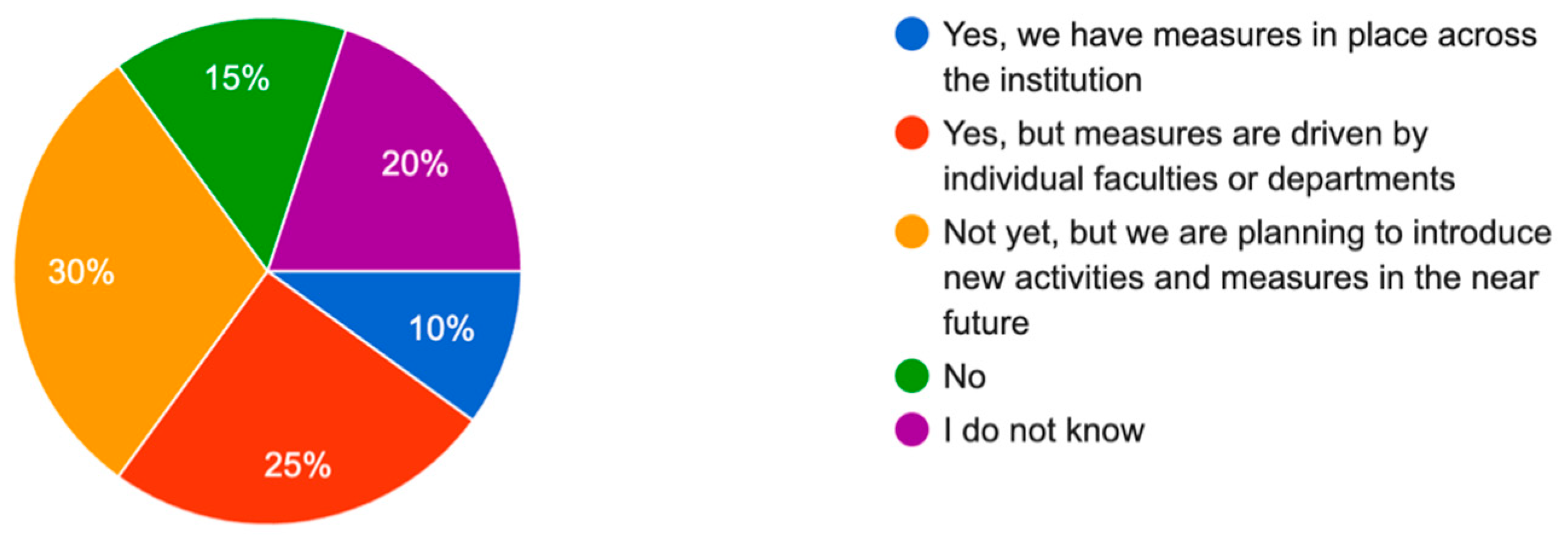
To the question “Does your institution have any greening measures in place?”, the majority of participants (30%) responded that there are no specific greening measures yet, but there are plans to introduce new activities and measures in the near future; 25% answered that there are greening measures, but these are driven by individual faculties or departments. Unfortunately, only 2 participants (10%) reported having measures in place across the institution (see Figure 1). The survey subsection on ongoing green activities and measures at the institutions contains eight questions.
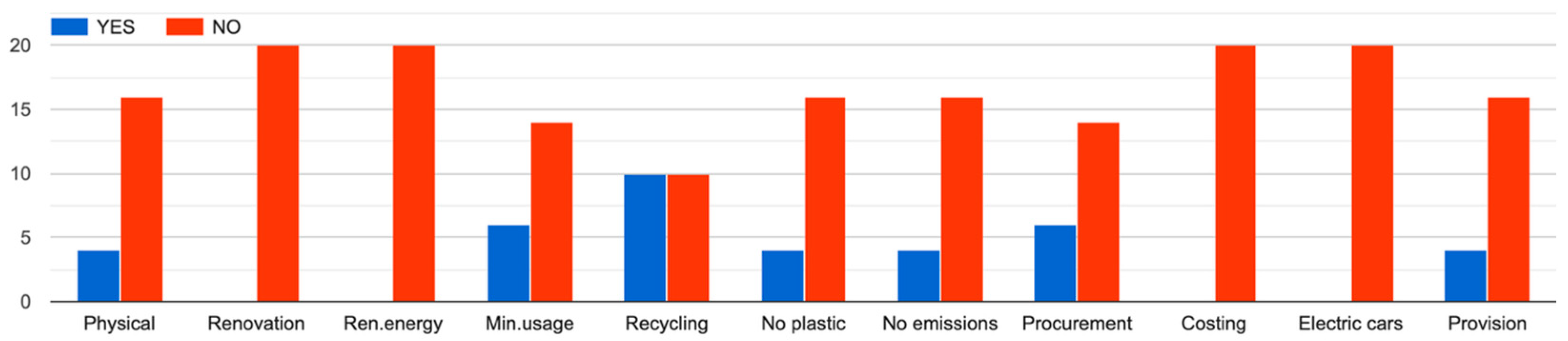
Regarding the question on a green/sustainable campus, the majority of participants responded NO to almost every criterion (see Figure A1 in Appendix B.1). Most of the participants (16, or 80%) who responded YES to the communication and engagement-related question did so because of the criterion of partnership with other higher institutions (see Figure A2 in Appendix B.1).
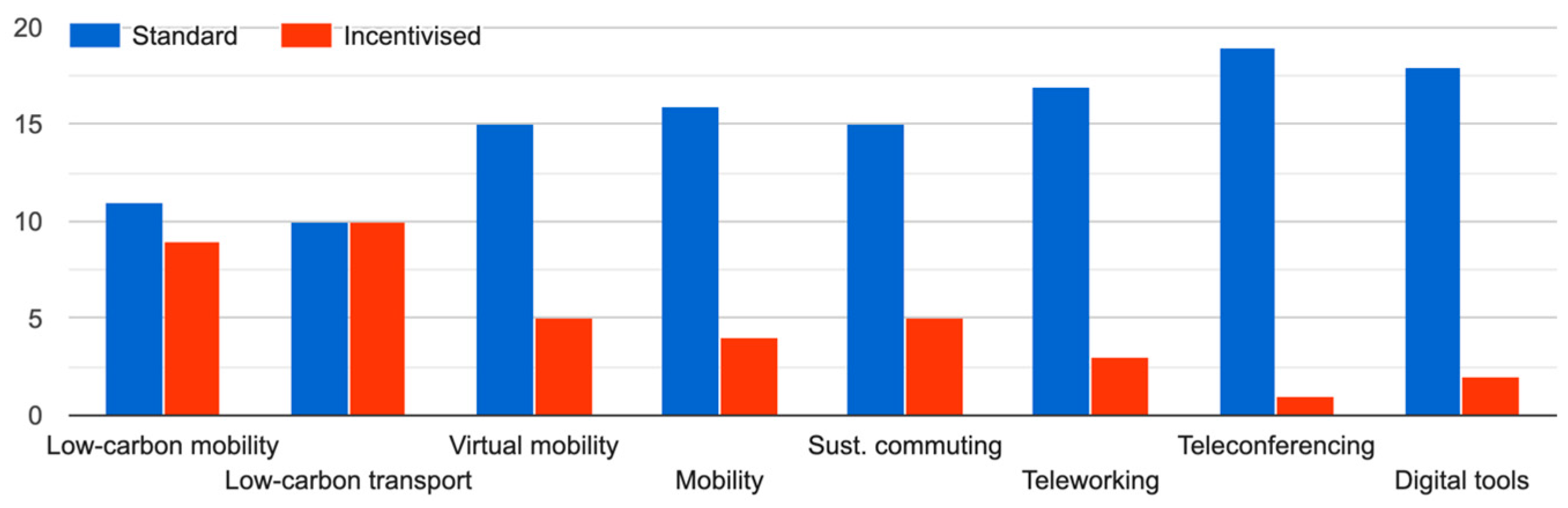
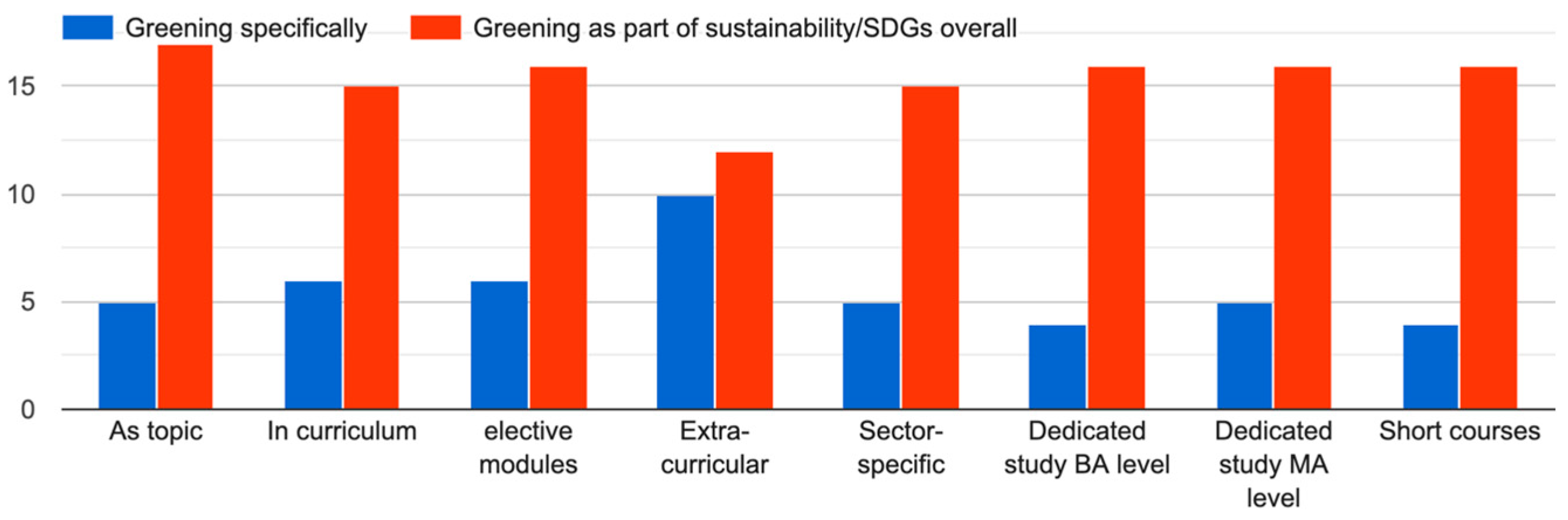
Regarding the question about mobility, most participants responded STANDARD (to be present, to take a trip, not to be part of an online event) across almost all criteria (see Figure 2). The response regarding the learning and teaching process indicates that greening is mostly perceived within the sustainability and SDG frameworks across almost all criteria (see Figure 3).
According to participants’ responses, the research and innovation process is predominantly not green or eco-friendly, as almost all participants responded NO to nearly all criteria (see Figure A3 in Appendix B.1).
Regarding other activities in their institutions (Q 2.6), 40% of all the participants responded that there are no specific additional greening measures, while the rest reported various initiatives ranging from ecological education and energy management to nature-based solutions and sustainable procurement. The results indicate that individual significant green measures at UB are effective, but they are sporadic and non-systematic.
Participants were asked to provide examples of the most successful greening activities/measures of their institution (Q 2.7) and the majority of them (70%) from several faculties and UB reported initiatives spanning curriculum greening, student workshops on green urban planning, specialist studies in green architecture and energy efficiency, waste management, and campus biodiversity improvements including the Green Academic Park. Similar to the previous comments, there are diverse results across the UB, but they are not the result of a systemic green strategy or program.
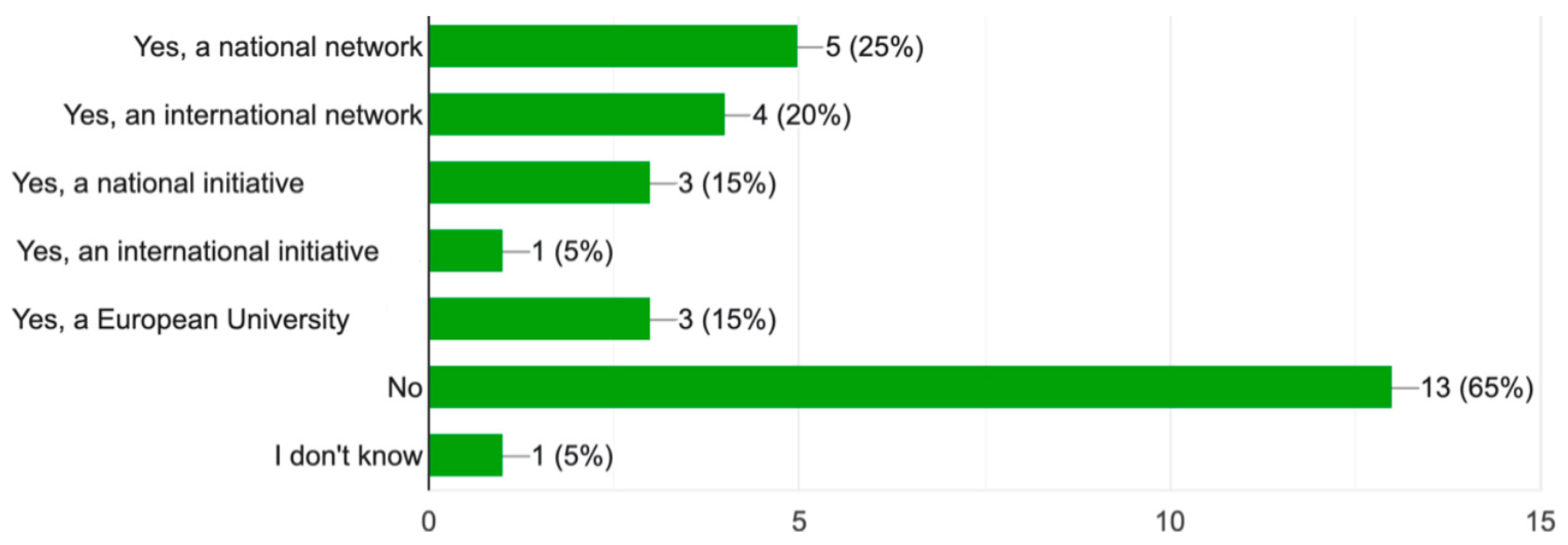
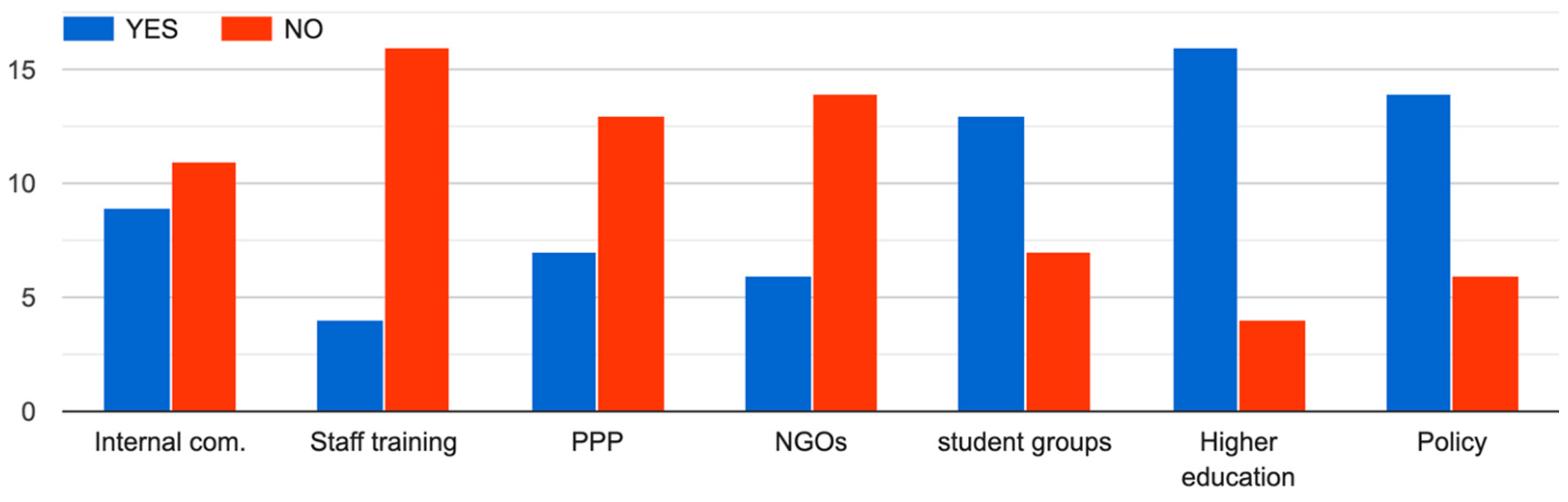
Although the majority of participants (65%) stated they are not part of any networks or working groups on greening, the remaining participants combined stated they are part of different national or international networks/initiatives (see Figure 4).

4.1.3. Strategies, Governance, and Implementation

The survey subsection on Strategies, governance, and implementation contains six questions.
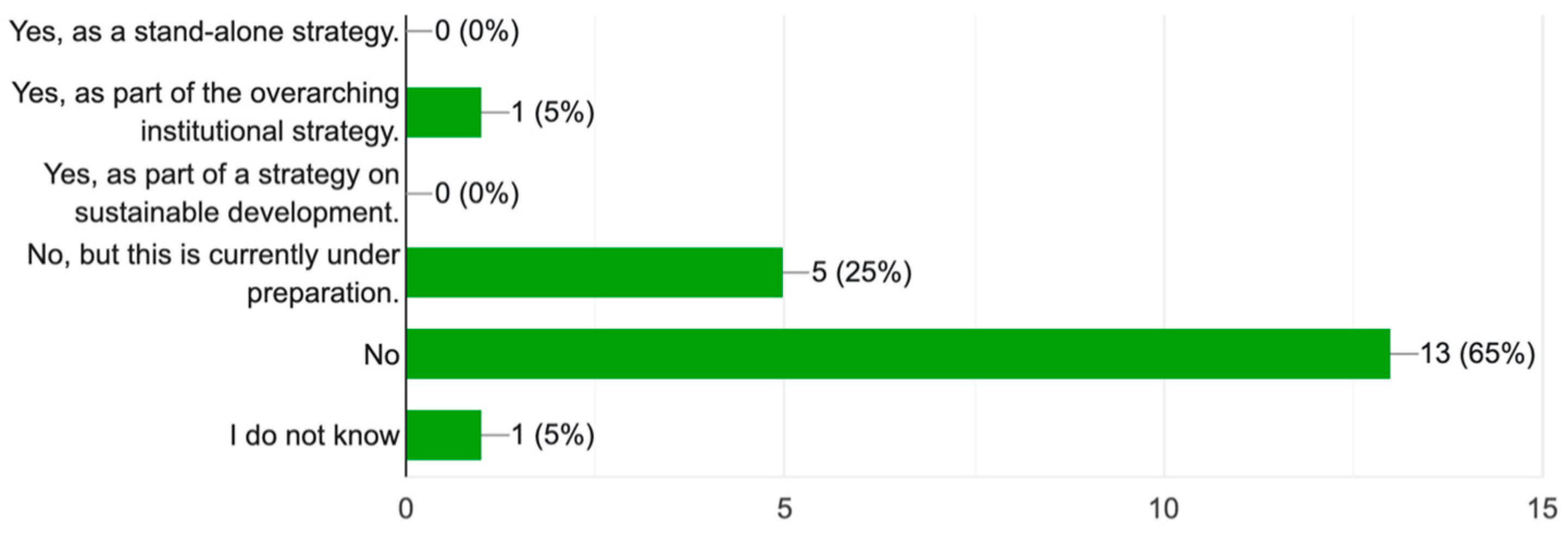
Although the majority of participants (65%) responded that there are no strategies for greening in their institution, 25% stated that similar documents are under preparation (see Figure 5).
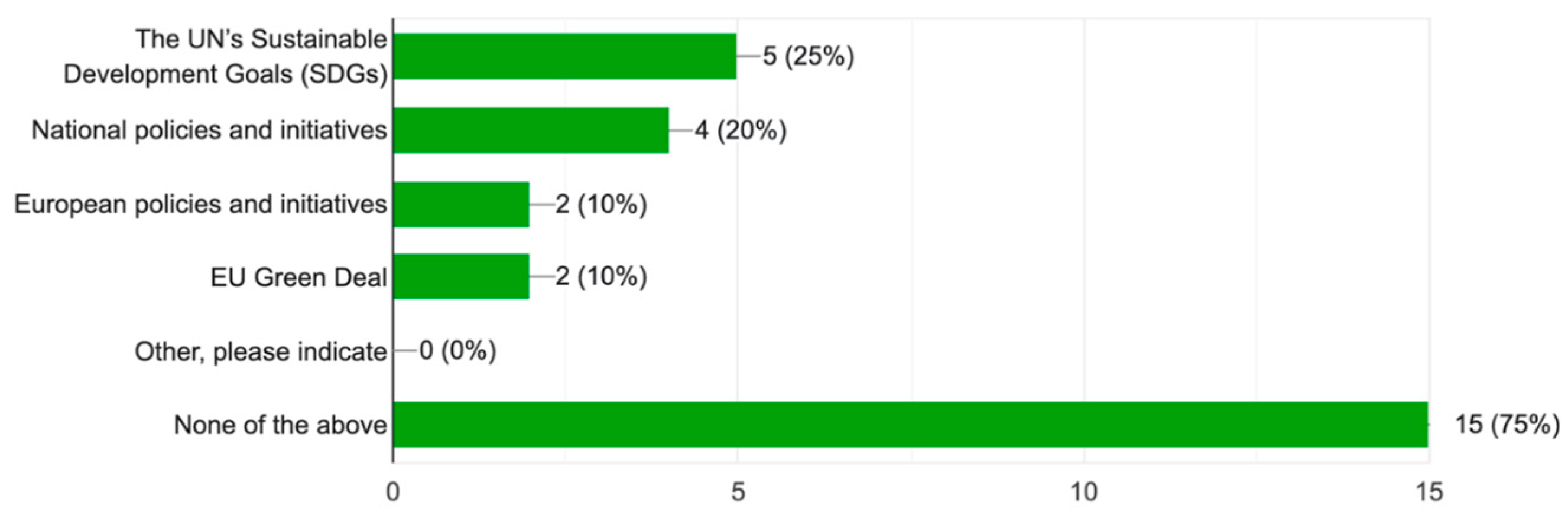
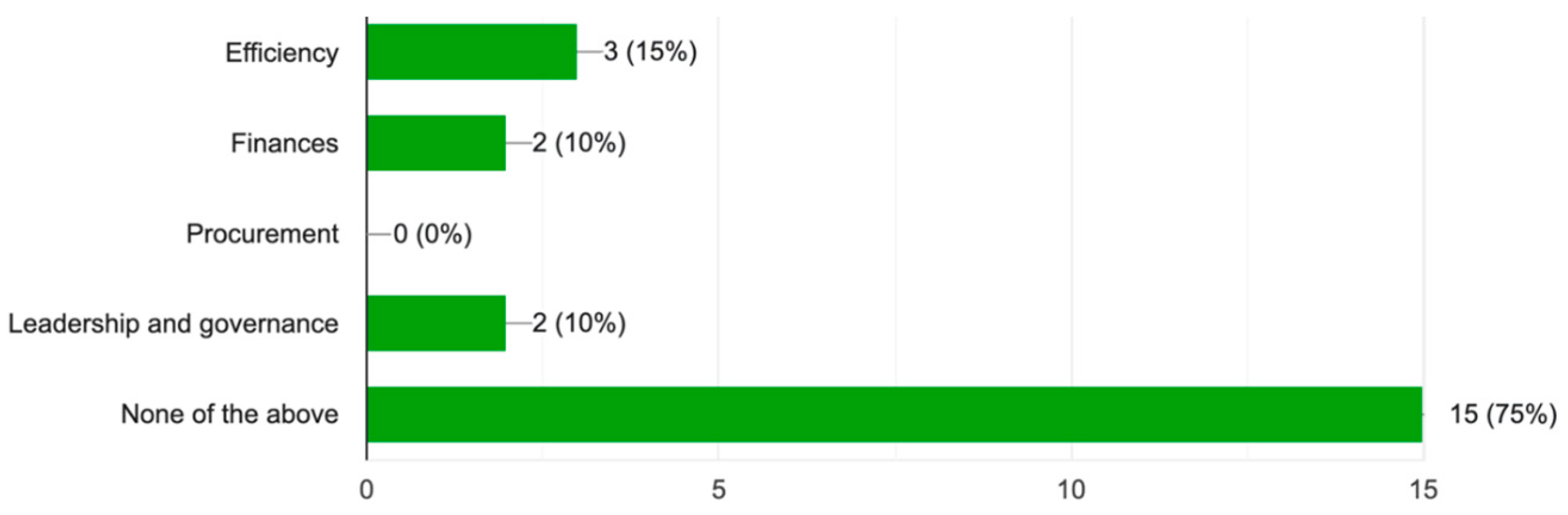
The majority of participants (75%) reported that the greening strategies in their institution were not aligned with globally or EU-important strategies and goals. The remaining 25% indicated a connection to the UN SDGs, while 20% reported a connection to national policies and initiatives, and 10% to EU policies, initiatives, and the EU Green Deal (see Figure 6). Most participants (75%) reported that the greening strategies at their institution were not related to any specific institutional aspects. The remaining 25% indicated a connection to efficiency (15%), finances (10%), and leadership and governance (10%) (see Figure 7).
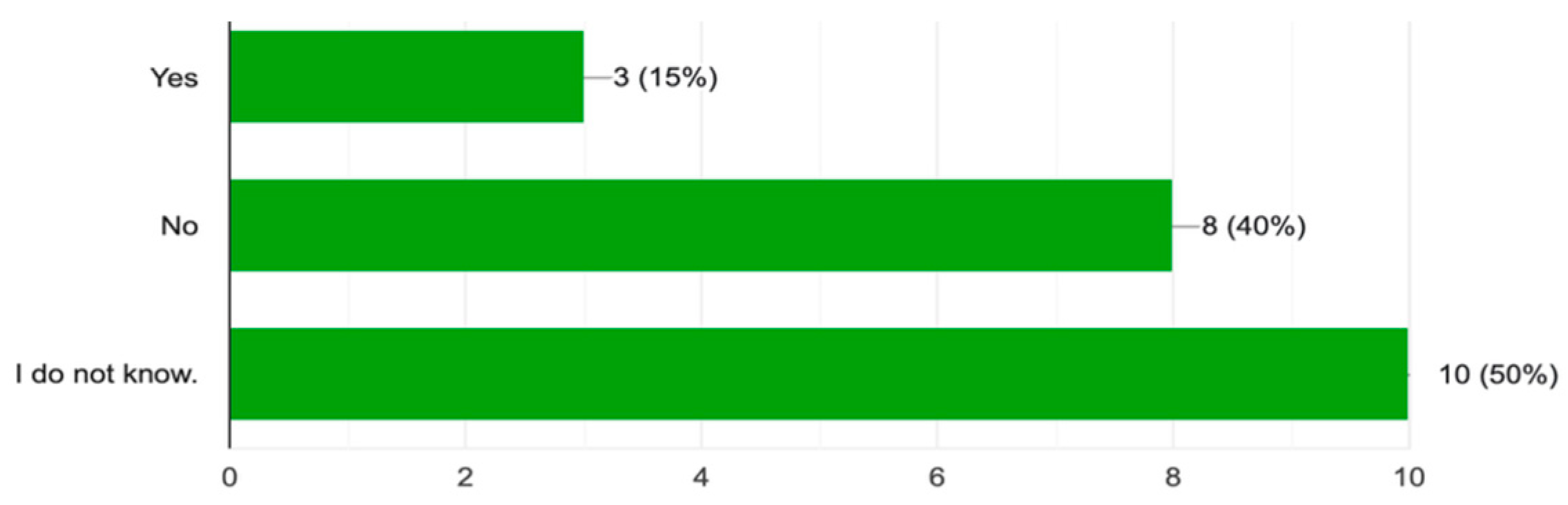
Half of the participants (50%) are unaware whether their institution’s strategic greening documents include concrete goals, targets, indicators, or timelines, while 40% confirm no such elements exist, and only 15% report their presence. (see Figure A4 in Appendix B.2).
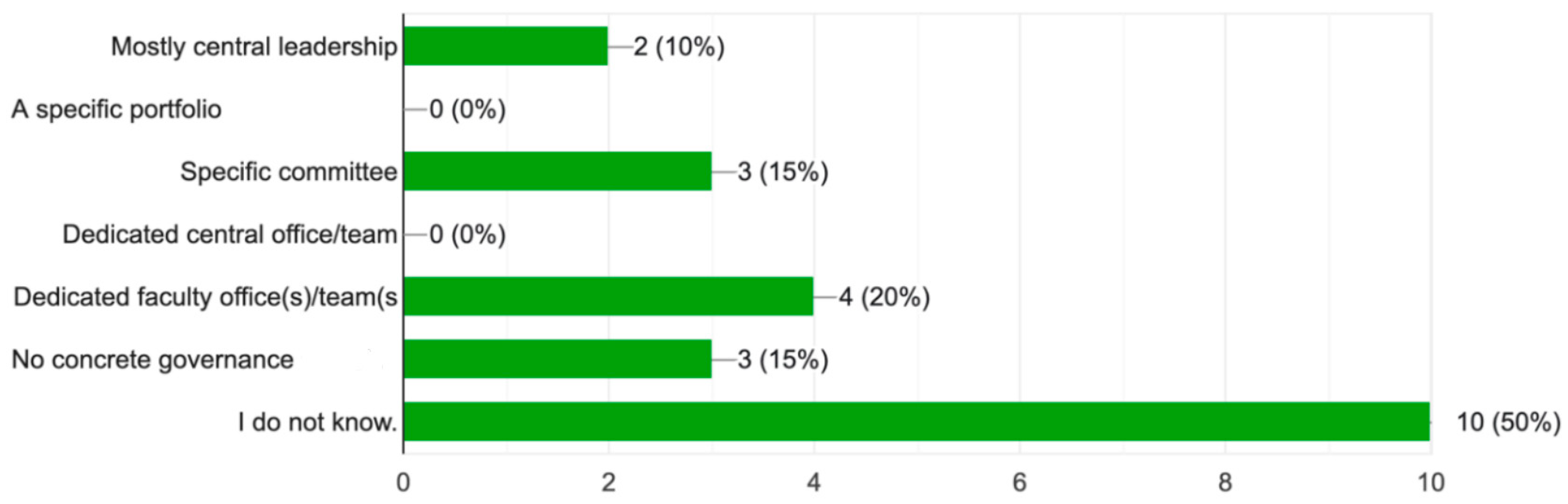
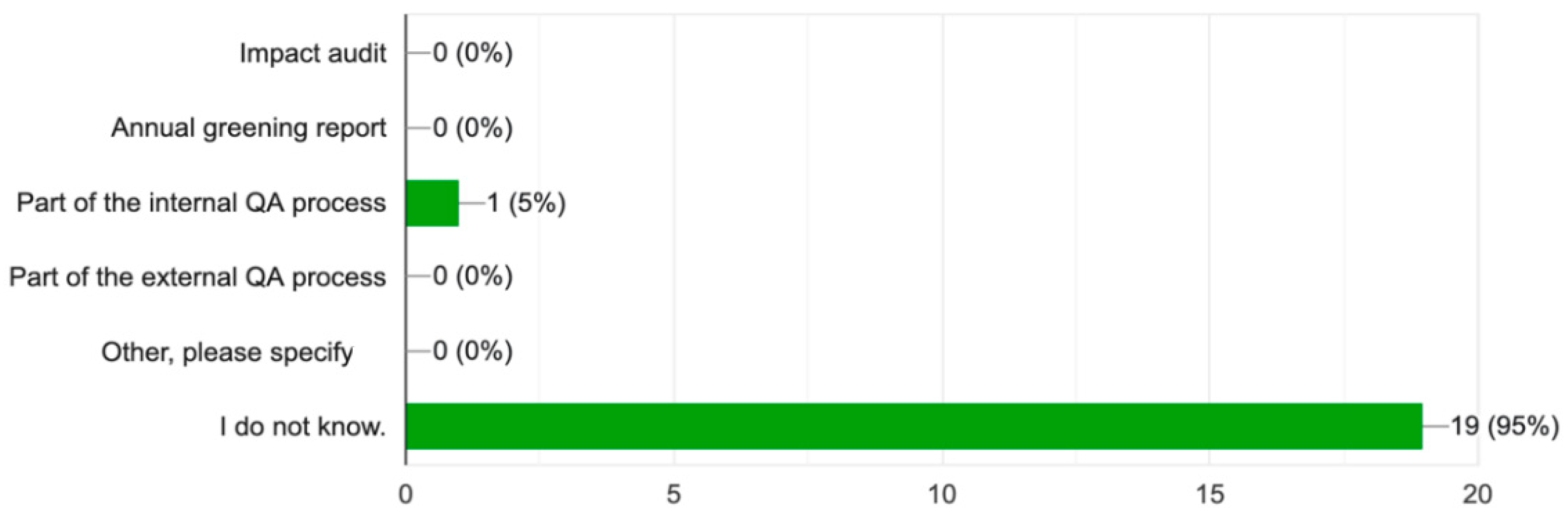
Almost all participants (95%) report not knowing how concrete goals, targets, or indicators are measured (see Figure A5 in the Appendix B.2). Similarly, many participants (50%) report that they do not know who is in charge of governing and steering the greening measures (see Figure 8).

4.1.4. Drivers

The fourth subsection contains only one question about aspects driving the institutions’ engagement in greening. The majority of users (60%) stated that the essential criteria for advancing the institution’s greening engagement are international and European funding (see Figure A6, Appendix B.3).

4.1.5. Benefits, Obstacles, and Enablers

The last subsection contains three questions. Regarding the impact/benefits of the institution’s greening activities, most users (45%) report receiving no benefits from these activities across any realm. The most substantial impact is on stimulating research (30%), increasing awareness (25%), and changing students’ behaviour (15%). Respondents also state that such activities can partly help create “real-life” learning opportunities for students (see Figure A7 in Appendix B.4).
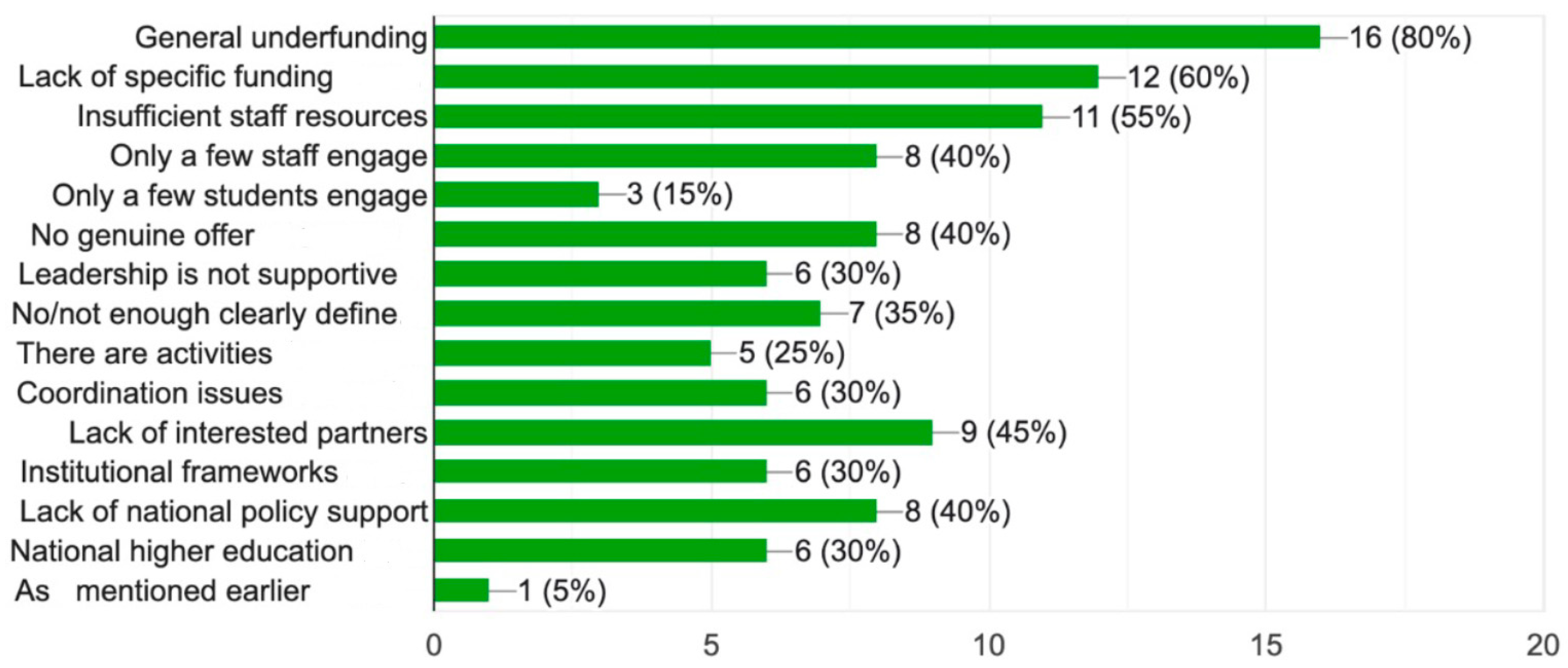
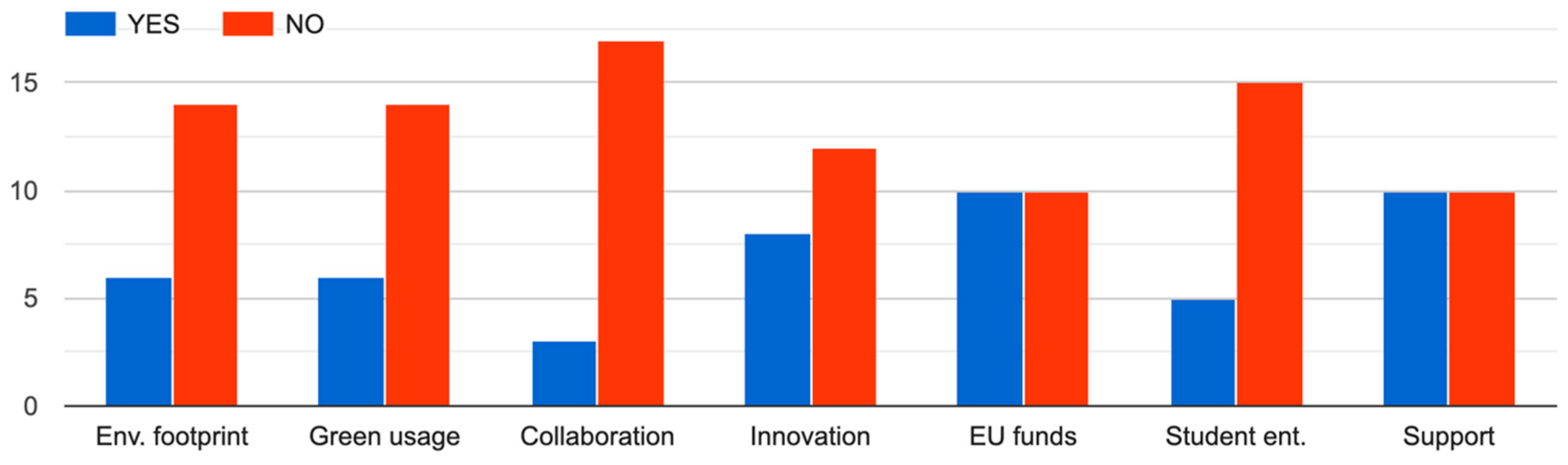
The majority of participants cite under-funding (80%) and lack of specific funding (60%) as the main barriers to implementing greening measures, followed by insufficient staff resources, lack of stakeholder interest and engagement, and absence of national policy support (each reported by 40–50% of participants). (see Figure 9).
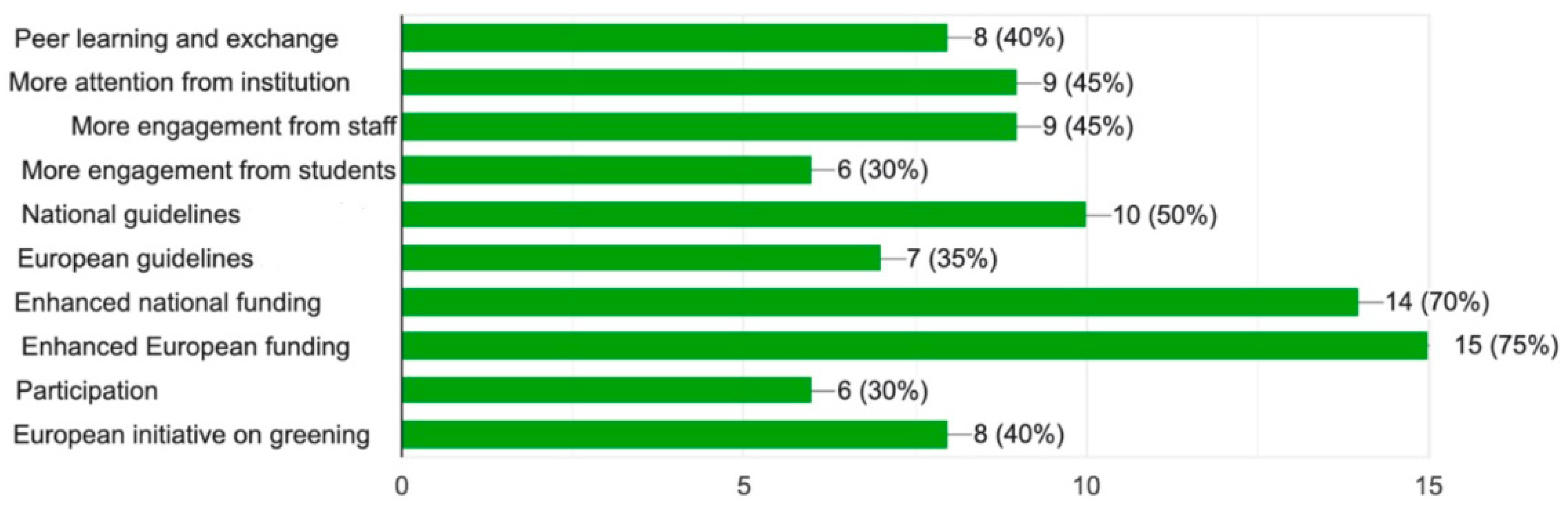
The majority of participants state that future greening activities at their institution would be most supported by national (70%) or European funding (75%). Around half of them (45–50%) state that progress would also be enabled by greater attention from institutional leadership, increased staff engagement, and national guidelines on specific aspects of higher education (see Figure 10).

4.2. The Second Phase Methodology—UBFA Level

4.2.1. Background

The second-phase evaluation refers to the University of Belgrade—Faculty of Architecture level and assesses the degree of implementation of the green urban planning concept by analyzing subjects’ curricula, students’ projects, and other materials. The UBFA, founded around 170 years ago, is a leading academic institution in architecture, urbanism, and related disciplines in Southeast Europe [73]. The UBFA is dedicated to advancing architectural knowledge, promoting sustainable urban and spatial development, and encouraging creativity and innovation in design. The UBFA offers all three levels of higher education: undergraduate (Bachelor), graduate (Master), and Doctoral studies, and is structured into four Departments: Architecture, Urbanism, Architectural Technologies, and History and Theory of Architecture and Art [74]. Through active participation in European and global networks, the faculty maintains strong international visibility, with students and staff engaging in academic exchange programs, joint research projects, and international competitions [75]. The UBFA organizes exhibitions, conferences, workshops, and other events to promote new ideas and innovative practice, and establish institutional and professional links with the international community. It also collaborates with many national (Ministry of Construction, Transport and Infrastructure, Ministry of Culture, etc.) and international institutions and organizations (RIBA—Royal Institute of British Architects, Goethe Institute, British Council, French Institute, Italian Institute for Culture, Embassy of the People’s Republic of China, and many others). The UBFA leads or partners on many international projects, including Erasmus+, COST, INTERREG, and more.
Aiming to evaluate the greening level in subjects’ curricula, three of five active courses at the UBFA were selected for this research phase: 1. Undergraduate Academic Studies of Architecture (bachelor’s studies) (UASA), 2. Master Academic Studies of Architecture—Integral Urbanism (MASA IU), and 3. Master Academic Studies of Architecture (MASA). These courses best represent the field of urban planning, since the remaining two courses include no urban planning subjects at all, or include them only minimally. The outcome of this evaluation is the selection of a representative subject in urban planning at the UBFA for further analysis in the third phase.
Two sets of keywords were used—greening concept (GC) (consisting of the following words: (01) sustainable, (02) eco/ecological, (03) nature/natural, (04) natural environment/natural landscape, (05) green/greenery, and (06) greening concept), and urban planning (UP) (consisting of the following words: (07) urban planning, (08) strategic planning, and (09) planning policies).

4.2.2. A (01) Undergraduate Academic Studies of Architecture, Bachelor’s Studies (UASA)

The UASA study program comprises 52 subjects across six semesters [67]. The representation of the predefined keywords sets—GC and UP is as follows: 50% of the total number of subjects (26 of them) contain predefined keywords (GC only, UP only, and from both sets, GC + UP) (see Table A2 and Table A3 in the Appendix B.4). Table A4 in the Appendix B.4 shows the representation of six predefined keywords from the GC set and three predefined keywords from the UP set for each UASA subject that contains at least one predefined keyword.
Regarding the GC set of predefined keywords, 22 subjects include predefined words from this set, which is almost half (42%) of the total 52 subjects in the UASA course. Regarding these 22 subjects, which include predefined words from the GC set, the majority (86%) use one or two of the six predefined words.
Two subjects (9%) use three of six words from the GC set, while only one (4.5%) uses four words, and no subjects use five or six predefined words in the UASA course. All six of the predefined words from the GC set are represented/mentioned a total of 80 times in the 22 subjects of the UASA course combined. The word “sustainable” is the most represented (57.5%), followed by words “nature/natural” (20%) and “green/greenery” (14%). The word “eco/ecological” is the least represented (8.5%). The terms “natural environment/natural landscape” and “greening concept” are not included in the course curricula.
Regarding the UP set of predefined keywords, 10 subjects include predefined words from this set, which is 19% of the total 52 subjects in the UASA course. From the total of three predefined words of the UP set, all 10 subjects use just one of the words.
All three predefined words from the UP set are mentioned a total of 16 times across the 10 subjects in the UASA course. The keyword “planning policies” is the most frequently used (69%), followed by “urban planning” (31%). The keyword “strategic planning” is not included within the subjects of this course.
The representation of predefined keywords from both the GC and UP sets in the UASA course is as follows: 6 of 52 subjects include keywords from both sets; only 11.5% of the UASA course could be considered positive from the perspective of greening higher education. More specific data on the six subjects are presented in Table 2 below.
The subject with the most diverse curriculum in the UASA Bachelor course is “SHAPING OF OPEN URBAN SPACES” with the mean value of 41.5% for set utilization and a total of 9 repetitions of words. Subject “STUDIO 01-b URBAN DESIGN OF RESIDENTIAL AREAS” has the same mean value of set utilization. Still, this subject contains eight words (one word less), so this difference serves as a corrective factor. Hence, the above-mentioned subject “SHAPING OF OPEN URBAN SPACES” is chosen as the most diverse subject for the next phase of identification of one representative subject from all three courses.

4.2.3. B (02) Master Academic Studies of Architecture, Integral Urbanism (MASA IU)

The MASA IU course contains 79 subjects [68]. The representation of the predefined keyword sets of GC and UP words is as follows: 50.5% of the total number of subjects (40 of them) contain predefined (GC only, UP only, and from both sets, GC + UP) (see Table A5 and Table A6 in Appendix B.5).
Table A7 in Appendix B.5 shows the representation of six predefined keywords from the GC set, and three predefined keywords from the UP set for each MASA IU subject that contains predefined words.
Regarding the GC set of predefined keywords, 29 subjects contain predefined words from this set, which is 37% of the total of 79 subjects in the MASA IU. Regarding these 29 subjects, which include predefined words from the GC set, the majority (76%) use one or two of the six predefined words.
Seven subjects (24%) used two of the predefined words from this set. No subjects use three or more predefined words from the GC set. All of the predefined words from the GC set are mentioned a total of 65 times across 29 subjects in the MASA IU course. The word “sustainable” is the most represented (85%), followed by the word “eco/ecological” (12.5%). The words “natural environment/natural landscape” and “greening concept” both have a small presence (1.5%). The words “nature/natural” and “green/greenery” are not included within the curricula of this course.
Regarding the UP set of predefined keywords, 26 subjects contain predefined words from this set, which is 33% of the total of 79 subjects in the MASA IU course. Considering these 26 subjects, which include words of the UP set, from the total of three predefined words, 61.5% use just one, and 38.5% use two of them.
No subjects use all three predefined words from the UP set. All of the predefined words from the UP set are mentioned a total of 57 times in 26 subjects of the MASA IU course. The term “urban planning” is the most represented, at 60%, followed by “planning policies,” at 38.5%. The word “strategic planning” is included in only one of this course’s curricula (1.5%).
The representation of predefined keywords from both GC and UP sets in the MASA IU course is as follows. In the case of the MASA IU course, 14 of the total 79 subjects are keywords from both the GC and UP sets. Only 18% of the MASA IU course could be considered positive from the perspective of greening higher education. More specific data for 14 subjects are presented in Table 3 below.
The subject with the most diverse curriculum in the MASA IU course is “INTEGRAL DEVELOPMENT OF TERRITORY-1” with the mean value of 50% for set utilization and a total of 7 repetitions of words. Subjects “INTEGRAL STRATEGIC PROJECTS-2” and “ECOPOLIS: ECOLOGICAL RESILIENCE OF THE CITY—CONCEPTS” have the same mean value of set utilization, but the corrective factor is lower; hence, the above-mentioned subject “INTEGRAL DEVELOPMENT OF TERRITORY-1” is chosen as the most diverse, for the next phase of identification of one representative subject from all three courses.

4.2.4. C (03) Master Academic Studies of Architecture (MASA)

Concerning the MASA—Master Academic Studies of Architecture, there are 300 subjects across four modules: A/Architecture, U/Urbanism, AT/Architectural Technology, and AE/Architectural Engineering [69]. A total of 26% of the total number of subjects (79 of them) contain predefined keywords (GC only, UP only, and from both sets, GC + UP) (see Table A8 and Table A9 in Appendix B.6).
Table A10 in Appendix B.6 shows the representation of six predefined GC keywords and three predefined UP keywords for each MASA subject that contains predefined words.
Regarding the GC set of predefined keywords, 74 subjects (25% of the 300 subjects in the MASA) contain at least one predefined word from this set. Among these 74 subjects, which include predefined words from the GC set, the majority, 89%, use one or two of the six predefined keywords.
Six subjects (8%) use three of the six words from the GC set, while two subjects (3%) use four words, and no subjects use five or six predefined words in the MASA course. All of the predefined words from the GC set are represented a total of 209 times in the 74 subjects of the MASA course combined. The word “sustainable” is the most represented (42%), followed by words “nature/natural” (31.5%) and “eco/ecological” (16%). Less presented are words “green/greenery” (7.5%) and “natural environment/natural landscape” (3%). The term “greening concept” is not included in this course’s curricula.
Regarding the UP set of predefined keywords, 20 subjects contain predefined words from this set, which is 7% of the total of 300 subjects in the MASA course. Among the 20 subjects that include words from the UP set, 81% of the subjects use only one of the three predefined terms, and 19% use two. No subjects use all three predefined words in this set. All of the predefined words from the UP set are represented a total of 31 times in the 20 subjects of the MASA course. The words “planning policies” and “urban planning” are almost evenly distributed, with the former slightly more common (55%) than the latter (45%). There are no uses of the word “strategic planning” within this course’s curriculum.
The representation of predefined keywords from both the GC and UP sets in the MASA course is as follows: 15 of the total 300 subjects include keywords from both sets. Only 5% of MASA subjects could be considered positive from the perspective of greening higher education. More specific data regarding the 15 courses are presented in Table 4 below.
The subject with the most diverse curriculum in the MASA course is the compulsory subject “STUDIO M03_SUSTAINABLE TERRITORIAL DEVELOPMENT” with the highest mean value of 67% for set utilization and a total of 25 repetitions of words. This subject is chosen as the most diverse, regarding both primary and secondary criteria.

4.2.5. D Selection of the Subject from the UASA, MAS IU, and MASA Courses, Based on the Primary and Secondary Criteria

Among the three most diverse subjects from all three courses, the subject “STUDIO M03_SUSTAINABLE TERRITORIAL DEVELOPMENT” of the MASA program is identified as the most representative subject in the field of urban planning for subsequent research (Table 5). Its mean value is 67% for set utilization/the primary criteria for choosing. Since the subject has the highest mean value, there is no need to include the “corrective factor” (the secondary criterion). Nevertheless, the selected subject also shows the highest number of repeated keywords across a curriculum.

4.3. The Subject-Level Case Study and Results

The third, subject-level case study relies on multicriteria content analysis to derive green urban planning criteria and interventions from the literature review. The compiled list of crucial green urban planning criteria (GUPC) and green urban planning interventions (GUPI) serves as a tool for evaluating the subject’s level of greening. The methodology of deriving the GUPC and GUPI is presented in Section 3.3. This part of the research aims to enhance the integration of green urban planning measures into the higher education process and to improve the methodology of applicative urban planning subjects to promote greening.
Based on the evaluation in Section 4.2, the course “Sustainable territorial development” in the second year of the MASA program at the UBFA is identified as the most representative subject in green urban planning for subsequent research. This urban planning studio includes a theoretical and applicative part, along with a case study of a characteristic natural protected area. Nature-based solutions and the protection and improvement of green areas are the main pillars of this course, which focuses on green, sustainable, ecological development and urban planning in the natural environment. The specific features of the protected green areas form the backbone of the course.
The methodology of the urban planning studio is based on three educative units: (a) The Urban planning studio, which is project-based and leans on the “learning-by-doing “method; (b) The Seminar, which is focused on the theoretical background related to the green urban planning approach and ecological sustainability, and (c) The Workshop, which involves field research in cooperation with the local community. This educational corpus is designed so that all three types of teaching are complementary and interconnected from the beginning to the end of the course. The course’s main objectives are: (a) understanding the complex relationships between the natural and built environment, (b) implementing the principles of integrative, green, and sustainable planning, and the application of theoretical models (green urbanism, healthy city/healthy landscape, sustainable rural development, cultural landscape, agritourism, and the like), and (c) developing creative approaches to existing, realistic planning problems and tasks. The urban planning studio STED is the only subject at UBFA that addresses natural protected areas through its program, and it is the only course that assigns students to address large urban, rural, or suburban areas. Working in such an urban planning studio enables the development and design of new activities and physical structures in conjunction with the natural environment and local needs, interests, potentials, and limitations. Students develop an integrative approach to the application skills for treating complex natural areas. The results so far have shown a high degree of diversity in ecologically sustainable ideas that successfully integrate new activities into untouched natural areas without endangering them, while also redefining the existing built environment for the local community and visitors. Over several years of the course, various urban, rural, and non-urban areas were researched, each with unique natural characteristics.
Although it lasts one semester, the STED course carries 12 ECTS credits [76] and is the largest subject in the third semester of the MASA program. The students’ assignment consists of several phases: (a) the research part (analysis and assessment of the existing situation in the research area, with an emphasis on detailed research of natural factors), with planning and regulatory framework, and field research; (b) creating goals and objectives, along with the development concept; (c) elaboration of detailed planning solutions, and (d) developing the urban design projects for characteristic smaller areas.
As mentioned in Section 3.3, Green urban planning criteria (GUPC) and Green urban planning interventions (GUPI) were chosen as evaluation tools at the third level. After an in-depth analysis of the literature, aiming to select resources that directly address green urban planning criteria and interventions (see Section 2), 32 GUPCs and 43 GUPIs have been identified. GUPCs were used to assess the extended curriculum, guidelines and manuals, and lectures and presentations available to students, while both GUPCs and GUPIs were used to evaluate students’ projects. The GUPCs tend to be more qualitative and less operational, while GUPIs are more quantitative/measurable and more operational. The evaluation consists of counting the total number of GUPCs and GUPIs mentioned. The list of GUPCs and their representation in working materials for students is presented in Table 6, with a summary in Table 7. The representation of GUPCs in students’ projects is presented in Table 8, with a summary in Table 9. The list of GUPIs and their representation in students’ projects is given in Table 10, with a summary in Table 11.
Each generation of students was expected to create a complex project for a larger territory (a part of the city or a peri-urban area), consisting of several phases: defining goals and objectives, conceptualizing, developing planning solutions, and designing urban design projects for a smaller area. With the exception of the 2021/22 generation, the common “ground” for all assigned territories is that they are within protected natural areas. The city of Beirut, through the international Inspireli students’ contest [77], was assigned territory for the 2021/22 generation, while the assignments for the 2022/23 and 2023/24 generations were Zvezdara Forest, Belgrade, Serbia. The assignments are designed for group work andeach group consisted of 3–4 students. The evaluated students’ projects were chosen as the best in each generation (they achieved the best marks, 10/10). Although the subject Urban planning studio STED has been taught for more than 10 years, the most recent generations of students were selected, except for the 2024/25 generation. The 2024/25 generation was not included in the evaluation process due to the complex situation at the universities in Serbia and the atypical process of teaching and evaluating students’ projects during the 2024/25 school year, related to institutional and organizational circumstances involving a serious student strike that lasted for more than eight months and involved all the faculties from the UB. We presume that, given recent developments in green urban planning, evaluating the projects of the selected generations of students will likely yield results that include more green urban planning elements.
The evaluation of the working materials (guidelines, presentations, and manuals) for the subject urban planning studio STED, presented to students, is shown in Table 6 and Table 7. The Green urban planning criteria (GUPC) are derived from the literature, as explicated in Section 3.3. They are treated equally, so the order of the criteria is irrelevant.
GUPC’s representation in the extended curricula is 9 of 32 (28%), while its share in presentations and lectures is 12 of 32, for a total of 37.5%. The best result is achieved for the mentioned GUPC in manuals and guidelines, 20 of 32, for a percentage of 62%. Across all the materials prepared for students, the total number of mentions of different GUPCs is 23 out of 32, representing almost 72%.
The evaluation of students’ projects is shown in Table 8, Table 9, Table 10 and Table 11. The assessment is conducted in two ways: using the Green urban planning criteria (GUPC) and Green urban interventions (GUPI), both derived from the literature, as explicated in Section 3.3. They are treated equally, so the order of the criteria is of no importance. The presence of GUPC and GUPI is provided for each students’ project and for each analyzed school year/generation of students.
The representation of GUPC in G&O is lower in 2021/22 than in the other two generations (50% and 75%, respectively). The same holds for the Conceptualization phase: the representation of GUPC in C for the 2021/22 generation is much lower (37.5%) than in 2022/23 (78.1%) and in 2023/24 (75%). For the PS phase, the difference between generations is minor; the presence of GUPC in PS is 53.1% for the 2021/22 generation, 75% for the 2022/23 generation, and 71.9% for the last generation. The representation of GUPC in the UDP phase is similar across generations: 53.1% in the first generation, and 56.2% and 59.4% in the 2022/23 and 2023/24 generations, respectively. Generally, the representation of GUPC is much higher in the 2022/23 and 2023/24 generations than in the first generation. For the 2022/23 and 2023/24 generations, all the results are above 50%. It is worth noting that only 3 out of the 32 GUPCs are not registered in any students’ projects across all generations. That means 29 of 32 (90%) of all GUPCs are mentioned. Students’ projects from the 2021/22 generation did not mention 10 of 32 GUPCs (31.2%) in any phase (GUPCs no. 6, 12, 13, 14, 16, 20, 23, 24, 28, and 31). Students’ projects from the 2022/23 and 2023/24 generations did not mention 6 of 32 GUPCs (almost 19%).
The representation of GUPI in the chosen students’ projects across three generations follows a pattern of fewer mentions in the phases G&O and UDP, while showing a higher number of mentions in the phases of conceptualization (C) and Planning solutions (PS). Generally, the 2021/22 generation has a smaller presence of GUPI across all phases than in subsequent students’ projects in other generations. For the G&O phase, there is steady growth of the mentioned GUPI (25.6%, 30.2%, 37.2%). At the same time, for the remaining phases, the students’ projects from the 2022/23 generation show the highest values for the mentioned GUPI (74.4% in the C phase, almost 70% in the PS phase, and nearly 42% in the UDP phase). Across generations and the students’ project phases, only 7 of the total 43 GUPIs were not mentioned, indicating that 36 of 43 (almost 84%) were used. The 2021/22 generation omitted 13 of 43 GUPIs (30%), while the 2022/23 and 2023/24 generations omitted the same number of GUPIs-11 (25.6%).
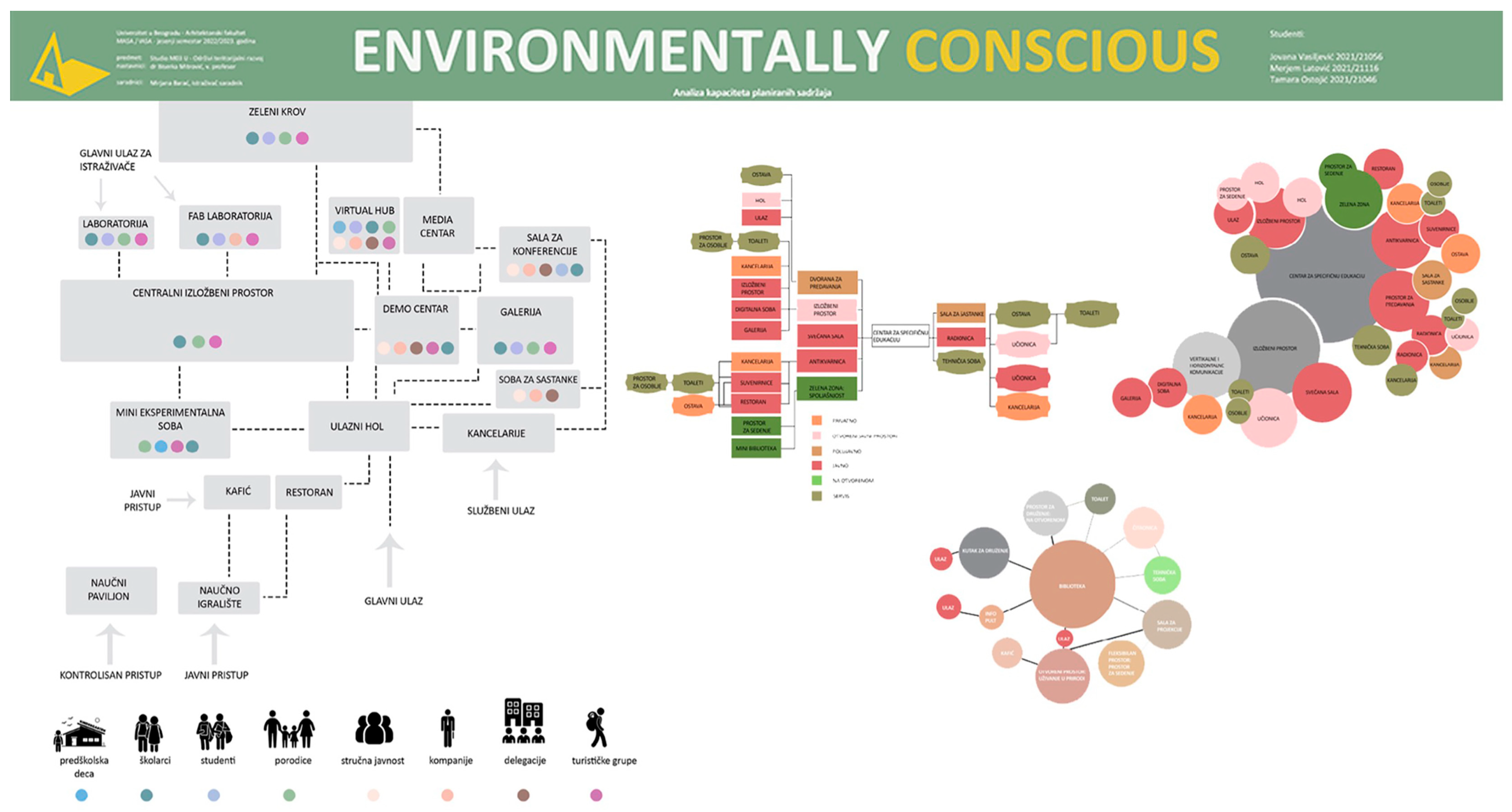
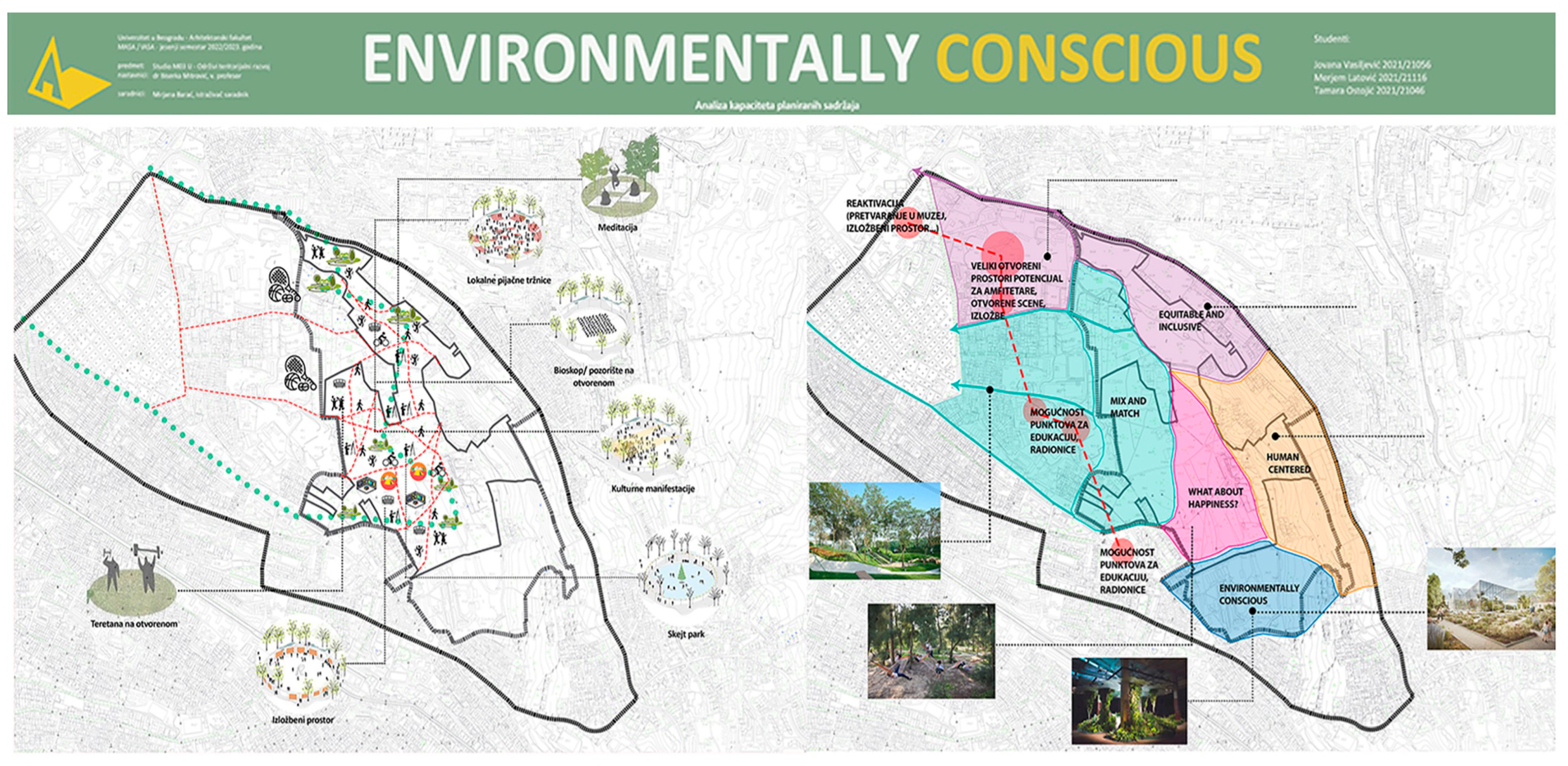
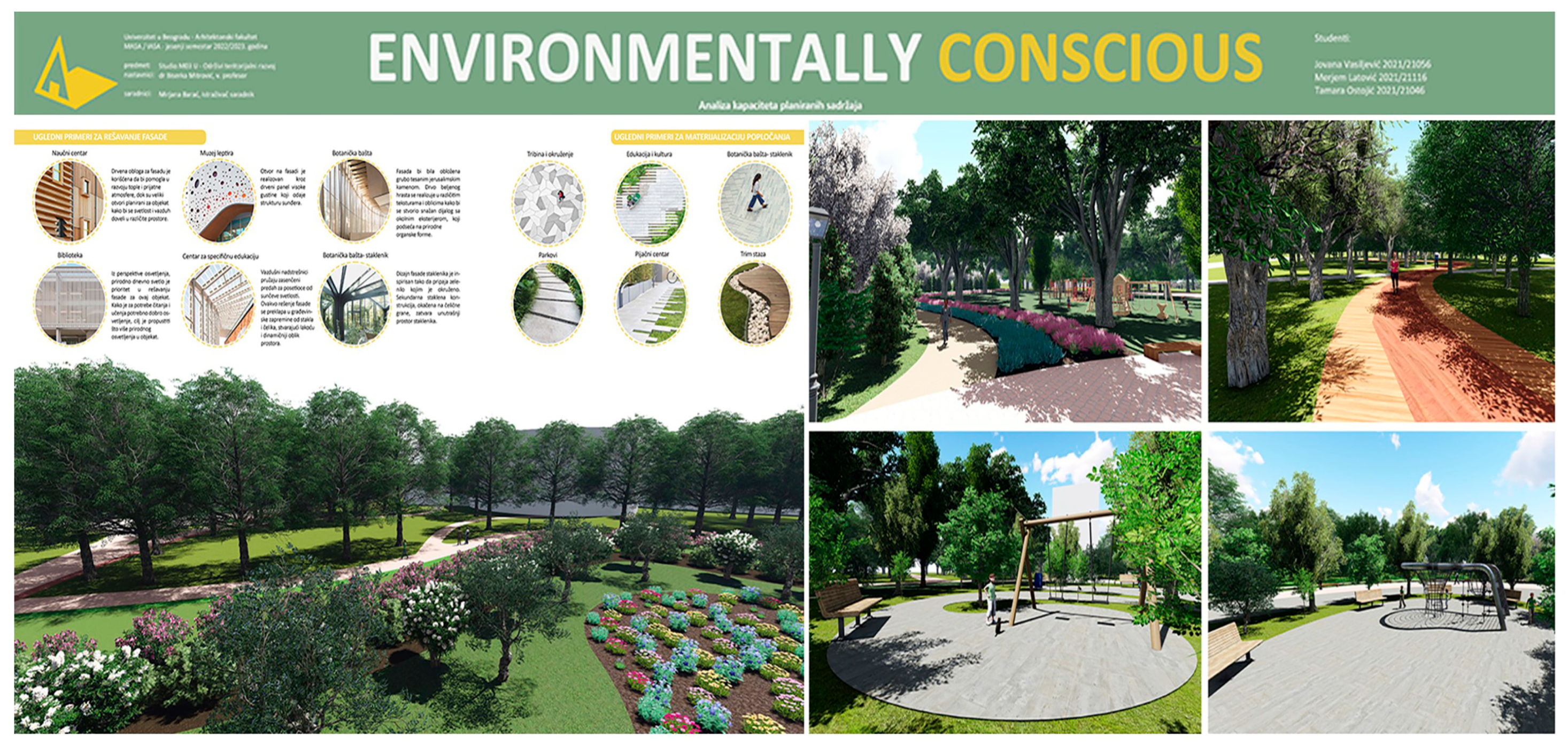
It is important to note that students’ works use terms that are not mentioned in either GUPC or GUPI, but are significant for the development of the idea of green urban planning in education (natural values, protected natural areas, sustainable tourism, sustainable transport and traffic, mixed-use, and landscape with special natural features). As an illustrative display of student work, three working posters are enclosed, which represent segments of their projects (Figure 11, Figure 12 and Figure 13).

5. Discussion

Assigning the “green” attribute is imperative across all activities to improve environmental quality and reduce the negative impacts of climate change. Numerous international and European agendas, documents, and research activities are dedicated to the global activity of “greening”. The EU has created a “green action” platform, i.e., a basis for transforming development policies, in which green higher education and green urban planning occupy a prominent place. UNESCO’s strategy proposed basic principles and specific key aspects to greening the educational curricula [18]. However, unlike the study findings, the UNESCO strategy is mainly focused on climate change mitigation, while this research covered topics regarding desirable green urban interventions at different levels of planning and implementation of green solutions in urban space. Ranging from comprehensive, general approaches to partial, singular, bottom-up approaches, previous scientific studies hardly address the specific role of the educational greenscape regarding urban planning [42,78].

5.1. University-Level Greening: Governance and Strategic Implications

The EUA criteria used in the UB survey proved useful as a questionnaire for evaluating the current state of greening at the UB. Findings from the first research phase at the institutional level are only partially consistent with prior research studies. In contrast to the aforementioned previous studies [3,23,25] and similar research, which analyze the greening concept either from the green urban planning aspect or the higher educational aspect, this study has a multi-level methodological framework that combines institutional governance level (UB), different course curricula (UBFA), and particular subject’s pedagogical practice and outcomes. Considering prevailing European trends in higher education (EUA survey), greening as a concept is well integrated into governance structures and strategies that are state-funded, top-down, organized, and adequately resourced. Compared with these EU trends, the UB survey results show mostly a fragmented, individualized, bottom-up approach to greening implementation. 65% of the survey participants stated they are not part of any networks or working groups on greening at the UB level.
From a more positive perspective, the survey results showed that academic staff are aware of the significance that greening measures and strategies can have on the institutional level, and individual, externally funded projects, initiatives, and actions exist. For example, a significant number of participants (40%) stated that many diverse activities are related to curriculum improvement, ’green’ workshops, internationally funded projects on nature-based solutions, energy management, sustainable procurement policies, and the like.
However, one issue is limited coordination among institutions at the UB level; this is consistent with similar studies that identify institutional leadership and resource allocation as the main objectives for university-level sustainability and greening upgrades. It is concerning that the majority of participants reported receiving no clear guidance, goals, or methodology for potential greening strategies at UB institutions. Furthermore, the majority of participants (80%) stated that general underfunding and the lack of specific funding are the most significant barriers to implementing greening measures, while almost half of them find the insufficient staff resources and a lack of genuine engagement opportunities for students and staff to be a constraint. This situation is partly due to the chronic lack of interdisciplinary approaches and communication. Still, the main issue is the general lack of funding for higher education, including for greening and sustainable strategies. This is common in non-EU and transitional countries such as Serbia.
The survey responses strongly indicate that individual institutional strategies are insufficient [79] and that operationalizing them through predefined guidelines is required to transform strategies into measurable methods and techniques that could lead to significant improvements in greening initiatives at the institutional level. This indicates that greening at the UB level has not yet been institutionalized. In addition, the strong reliance on international EU funding further supports these findings. According to several EU surveys, strategy development is either complete or in progress, and the real issue is the effective implementation of these strategies at the local pedagogical level. This is also the case at the UB; therefore, the second phase of this research focuses on a single faculty. Given the main research topic, which combines greening, urban planning, and higher education, the faculty selected for further research is UBFA.

5.2. Faculty-Level Greening: Curriculum Evaluation and Conceptual Gaps

The second phase of this research was conducted through a curriculum analysis of three courses at the bachelor’s and master’s levels at UBFA, involving a total of 300 subjects. Main observations concern the overall representation of the greening concept and urban planning, evaluated by the presence of predefined keywords from both GC and UP sets, and differences among courses, regulated by the nature of subjects and the level of study. Keywords from the GC set are proportionally more present in subjects across all three courses compared to keywords from the UP set. Specifically, the UASA and MASA courses, which are more design-oriented, show a significant difference in the presence of GC versus UP set keywords, while the MASA IU course, which focuses on urban planning and urban design, has approximately similar percentages of usage of keywords from both sets. Due to the massive integration of the sustainability concept in architectural education in the last 20 years the word “sustainable” is the most represented in all three courses (85% MASA IU, 57.5% UASA and 42% MASA), followed by words “nature/natural” (31.5% MASA, 20% UASA), “eco/ecological” (16% MASA, 12.5% MASA IU and 8.5% UASA) and “green/greenery” (14% UASA and 7.5% MASA). Regarding the UP set of predefined keywords, the word “planning policies” is the most represented, followed by “urban planning”, while “strategic planning” has a small presence in MASA IU (1.5%) and is not included in UASA or MASA courses.
These differences certainly indicate a disproportionate disparity between pedagogical approaches across courses and in how GC is perceived relative to UP. This research showed that subjects who connect GC and UP are implementing greening as a concept in a more substantive rather than just a symbolic manner. Similar discrepancies between declarative commitments and operational implementation have been identified in planning practice in Serbia, and research indicates that such gaps are also visible within the educational process. In contrast to good-practice examples from Italy, Stockholm, and Beijing, the subjects at the UBFA lack institutional mechanisms and overall awareness that would enable curricular greening, as the percentage of subjects that do not contain keywords from either set is quite high. 50% of the UASA course, 49.5% of the MASA IU course, and 74% of the MASA course subjects show no correlation with green urban planning initiatives, potentially limiting future architecture and urbanism experts’ ability to operationalize green planning concepts. This shows a significant gap between the serious theoretical approach to green urban planning [3,5,32] and the rather selective and fragmented pedagogical approach within the UBFA.
However, a certain number of subjects (11.5% of UASA subjects, 18% of MASA IU subjects, and 5% of MASA subjects) contain keywords from both sets, and these can be regarded as positively aligned with greening higher education objectives in studio-based learning environments. However, the small percentage of these subjects within the broader curricular structure suggests a lack of interdisciplinarity and opportunities for dissemination. This observation aligns with findings from international case studies in urban planning education and the EUA “whole institution approach”, which emphasize the importance of the top-down approach and resources for curriculum coordination in achieving long-term positive changes in greening higher education.

5.3. Subject-Level Greening: Pedagogical Implementation

Although various theoretical works and international green strategies exist for urban planning and higher education, there are few results regarding the actual learning process in green urban planning, as presented in the subject-level analysis in this study.
In the third research phase, based on evaluation results for the curricula of one undergraduate and two master courses at the UBFA, among the diverse subjects from all three courses, the most representative subject selected for subsequent research was urban planning Studio: STEDs, from the MASA course. This project-based studio has the highest percentage of predefined words (67% across both word sets), with a total of 25 occurrences.
The third phase of research, based on the STED analysis, aimed to fill the gap by connecting and integrating the greening concept, theory, planning practice, and higher education in urban planning. The numerous theoretical studies on greening urban planning and green strategies in general [4,5,10,15,16] mostly focus on how to integrate their findings into planning practice, aiming to reach the operational level for implementation. The second group of theoretical findings seeks to link the internationally adopted green policies and planning practice [13,32,37], while the third group focuses on learning from the urban planning practice [5,14,23,24,25,27]. It can be argued that scientific findings provide a significant foundation for teaching and learning, but the real implementation into higher education has not yet been established, and the connection between greening urban planning practice and the educational process has not yet been sufficiently elaborated. Previously, after an in-depth literature review in Section 2 and using the methods elaborated in Section 3.3, a list of GUPCs and GUPIs was established, linking green urban planning criteria and green interventions. The result is beneficial for both connecting planning practice to higher education in urban planning and for introducing more operational green tools into the educational process. Several factors led to the conclusion that the subject STED involved more predefined words in the curriculum and, consequently, a greater presence of green elements (GUPC, GUPI) in working materials. Combined, the extended curriculum, presentations and lectures, manuals, and guidelines for students accounted for almost 72% of GUPC and GUPI. Simultaneously, students’ projects accounted for almost 90% of all GUPCs across students’ generations. Firstly, the nature of the subject—the urban planning studio, which includes a theoretical and applicative part and leans on the ‘learning by doing’ method, enables a deeper understanding and adequate application of acquired knowledge and skills. Secondly, the subject’s position in the second year of the master’s program indicates the students’ maturity in their approach to learning, critical observation, and problem-solving. Students’ work showed that this approach can lead to original and creative project proposals that serve as valuable examples of urban planning interventions aligned with the green concept and nature-based solutions, which are evidently lacking at the University or Faculty level. Finally, the subject’s title (Sustainable territorial development) and its orientation toward case studies of characteristic natural protected areas create more opportunities to implement green policies and planning solutions and to incorporate green urban planning criteria and interventions. Students’ outcomes can serve as both pedagogical outputs, as they reveal how theoretical concepts are translated into real context-specific interventions, and as an effective, empirical platform for evaluating the teaching methodology.
Regarding methodology, here are some additional considerations regarding the geographical transferability of the GUPC and GUPI. One of the aforementioned studies [3] provides a detailed list of planning interventions based on the Stockholm case study. The GUPC and GUPI lists presented in the paper were based on a broader set of studies covering different geographical contexts, including Europe, China, the United States, and others. This diversity of studies further reinforces the international applicability of this study across different urban and educational contexts. Therefore, the methodological framework and study outcomes should be considered adaptable across different geo-scenarios.

5.4. Study Limitations and Future Research

There were multiple limitations throughout this study. In the first research phase, the single-institution case study (UB) left no room for comparison between different institutions. Also, not all the institutions/faculties were able to participate in the UB survey. Another major limitation of this study at the UB level is the small sample size (20 participants), which indicates the results should not be interpreted as a statistically representative assessment but rather as an exploratory expert insight.
Regarding the second phase of this study, due to the large number of subjects analyzed, the main limitation was that the curricular analysis using predefined keywords considered only the available course titles and short descriptions, which do not necessarily reflect the actual learning process, materials, or outcomes. In addition, multi-criteria analysis and expert observation in the specific subject analysis often include subjectivity. Finally, working in a studio-based learning environment requires close collaboration among mentors and students, and it is often hard to evaluate the originality of students’ projects. However, given the available resources and limitations, this study’s main goals were achieved.
Among many possibilities for future research that rely on each of the three phases of this study, and also as a solution for the aforementioned limitations. Firstly, future studies should compare different institutions at the university level to gather more usable data and findings applicable across institutions and to integrate greening concepts more efficiently by developing greening strategies with a clear implementation process. Secondly, the state of greening higher education at UBFA cannot be conclusively determined only from the three courses included in this study. Further research should extend this methodology to all faculty courses and subjects or conduct a deeper analysis of more than one selected course, to compare results and improve not only curricula but also teaching methodology and outcomes. Regarding the educational greenscape, the curricula should focus on investigating the tools and measures for greening most subjects, bearing in mind that, in the MASA course only, 15 of a total of 300 subjects include desirable predefined ‘greening’ words. The small number of subjects that include greening in the teaching process calls for immediate action in both scientific research and programs that advance the quality of higher education (e.g., accreditation processes). Broader analyses of the results fall outside this study’s scope but are strongly recommended to advance teaching methods and techniques in green urban planning.

6. Conclusions

This paper presents a multilevel methodological framework for further reflection and evaluation of the educational greenscape, and, more specifically, of teaching green urban planning, highlighting the key roles of universities and faculties in developing green agendas and implementing them.
It should be noted that all the findings presented in this study are based on a three-level case study of the UB and the UBFA, which could serve as an empirical basis for similar research.
Concluding remarks are based on the research goals and questions presented in Section 1paper outline”. This study directly contributed to a better understanding of the importance of improving the educational greenscape in higher education:
  • Section 2 is dedicated to presenting the theoretical basis for green urban planning, greening higher education, and educational strategies, while in Section 4, the identified research gap between theoretical findings and the educational greenscape is emphasized. Teaching green urban planning should move beyond traditional urban greening actions, which are still widely represented in both planning practice and higher education. Such an approach should be based on long-term strategic green planning that fosters multifunctional green infrastructure, biodiversity, climate adaptation, resilience, and social inclusion [13,18]. To improve existing patterns of ad hoc green planning, it is necessary to educate future generations of architects and urban planners. Therefore, a first step toward improving green planning and green awareness is the evaluation of the educational greenscape.
  • Evaluation of the UB on the institutional level showed that in order to lead the green transformation and upgrade the educational greenscape firstly, universities should implement green initiatives and measures, ranging from green mobility, pollution mitigation, and climate change to green public procurement. Many of them require systemic and financial support, as well as political consensus for long-term green agendas, with a strong will for their realization. However, in Serbia, given the unfavorable circumstances, enhancing the educational greenscape may be limited to greening existing curricula, in the buttom-up manner.
  • Evaluation of greenness in the curriculum at the UBFA level showed inconsistency in both representation and frequency of green concept and urban planning keywords, which indicates low level of greening implementation. However, there were a few positive exceptions.
  • This study proved it is possible to improve the actual educational process at subject level of urban planning, on the good practice example of the STED at UBFA, by implementing urban interventions into subject material, curriculum and lectures.
Besides the goals that were achieved, there are several important contributions of this study, connected to the research questions in Section 1paper outline”:
(i).
Following the context of the educational greenscape in Belgrade, this study developed and demonstrated complex, multi-level methodological approach that could be universally applicable for evaluation of the educational greenscape of higher education in different institutions on the international level.
(ii).
One of the ways to operationalize and implement green strategies into pedagogical courses is by adapting the extended list of selected operational urban greening interventions and criteria GUPC and GUPI given in Table 1, Section 2.1 ”The Possibilities of Greening Urban Planning Through Urban Planning Interventions” and used in third research phase in Section 4.3.
Based on the whole presented study, several main operational recommendations can be defined: (01) institutional monitoring of green and sustainable education; (02) formal and operational integration of green-related concepts into the curricula; (03) create interdisciplinary teaching methods based on the collaboration on the institutional level and (04) collaboration with local urban planning institutions and including experts from practice into the educational processes.
Greening higher education requires well-organized, structured strategies with a defined set of actions across institutional governance, curriculum development, and pedagogical practice to enable successful implementation. Without such alignment, the transformative potential of the educational greenscape is limited.

Author Contributions

Conceptualization, B.M. and J.M.; methodology, J.M., B.M. and R.G.; software, J.M.; validation, R.G., B.M. and J.M.; formal analysis, R.G. and B.M.; investigation, R.G. and B.M.; resources, B.M. and R.G.; data curation, R.G.; writing—original draft preparation, B.M. and J.M.; writing—review and editing B.M., J.M. and R.G.; visualization, J.M., B.M. and R.G.; supervision, J.M., B.M. and R.G.; project administration, B.M., R.G. and J.M. All authors have read and agreed to the published version of the manuscript.

Funding

This research received no external funding.

Institutional Review Board Statement

Ethical review and approval were waived for this study by the Program Board of the Research Centre, Faculty of Architecture, University of Belgrade (Number: 02-362/1) on 4 March 2026, as it involves minimal risk to participants and the collection of non-sensitive, anonymized data for academic research purposes.

Informed Consent Statement

Informed consent was obtained from all subjects involved in this study.

Data Availability Statement

No copyrighted or restricted data have been included. All of the material necessary for understanding the study is available at https://doi.org/10.5281/zenodo.18734298 (accessed on 22 February 2026), Student projects of “Methodological framework for mapping educational green-scape in urban planning”.

Conflicts of Interest

The authors declare no conflicts of interest.

Abbreviations

The following abbreviations are used in this manuscript:
HEHigher education
HEIHigher education institutions
UBUniversity of Belgrade
UBFAUniversity of Belgrade—Faculty of Architecture
EUAEuropean University Association
GCgreening concept
UPurban planning
UASAUndergraduate Academic Studies of Architecture, bachelor’s studies
MASA IUMaster Academic Studies of Architecture—Integral Urbanism
MASAMaster Academic Studies of Architecture
STEDSustainable Territorial Development
GUPCGreen urban planning criteria
GUPIGreen urban planning interventions
EUEuropean Union
G&OGoals and objectives
CConceptualization
PSPlanning solutions
UDPUrban design projects

Appendix A

Additional material within “3. Methods and Materials”.

The UB Level (Within “3.1. The First Phase Methodology”)

Table A1. University of Belgrade EUA survey, Questionnaire [65].
1/Background
1.1. Please indicate your job title/function.
2/Greening activities
2.1. Does your institution have any greening measures in place? Please select one option.
• Yes, we have measures in place across the institution.
• Yes, but measures are driven by individual faculties or departments.
• Not yet, but we are planning to introduce new activities and measures in the near future.
• No, but we would be interested in establishing them.
• No.
• I do not know
2.2. Which of the following activities and measures take place at your institution?
Please select all that apply in the following categories.
2.2.1. Green/sustainable campusYes/no
Physical greening of the campus
Sustainable construction/renovation
Prioritizing sustainable, renewable energy sources
Minimising the use of energy, water, or other resources
Recycling and waste management
Reducing the use of single-use plastics and other disposable items
Reducing (harmful) emissions
Sustainable procurement across the institution
Whole life cycle costing
Replacing university-owned cars with electric/hydrogen-based ones
Provision of charging facilities for electric cars
2.2.2. Communication and engagementYes/no
Internal communication, support, and guidance about responsible consumption and production
Staff training on greening and its relevance to their role
Community engagement and outreach activities on greening
Partnerships with employers/enterprises
Partnerships with NGOs
Partnerships with student groups/organizations
Partnerships with other higher education institutions
Contribution to local or national policy initiatives and debates
2.2.3 MobilityStandard
(mark with x)
Incentivised
(mark with x)
Low-carbon forms of transportation for student mobility
Low-carbon forms of transportation for staff mobility and meetings
Offer of virtual mobility as a replacement for some of the physical mobility for students
Offer of virtual mobility as a replacement for some of the physical mobility for staff
Sustainable commuting
Teleworking or condensed working
Teleconferencing and hybrid conferencing over business trips and face-to-face events
Provision of digital tools for teleworking, teleconferencing, and virtual mobility
2.2.4. Learning and teachingGreening
Specifically
(mark with x)
Greening as part of sustainability/SDGs overall (mark, x)
Included as a topic in almost all/most
study programs
Considered in curriculum reform
Dedicated elective modules are available
to almost all/most students.
Extra-curricular activities
Embedding sector-specific modules across disciplines
Dedicated study programs at the BA level
Dedicated study programs at the MA level
Short courses, micro-credentials
2.2.5. Research and innovationYes/no
• Reducing the environmental footprint of laboratory research
• Fostering green use of own or shared research infrastructures
• Auditing research collaborations with carbon-intensive industries
• Research and innovation on greening through living labs
• Incentives/specific funding for thematic research and innovation activities on greening
• Knowledge valorization activities related to greening
• Integrating institutional greening objectives into EU-funded smart specialization strategies
• Greening-related challenges to student entrepreneurs
• Seeking support for applied greening solutions via EU initiatives
2.2.6. Other activities, please indicate here
2.2.7. Please provide examples of the most successful greening activities/measures of your institution, including weblinks, if applicable.
2.2.8. Are you part of any networks or working groups on greening? Please select all that apply
• Yes, a national network
• Yes, an international network
• Yes, a national initiative to award or accredit greening measures
• Yes, an international initiative to award or accredit greening measures
• Yes, a European University Alliance with a specific focus on greening and/or sustainability.
• No
• Other, please elaborate here. _____
3/Strategies, governance, and implementation
3.1. Does your institution have a strategy or a similar document that refers
to greening explicitly?
• Yes, as a stand-alone strategy.
• Yes, as part of the overarching institutional strategy.
• Yes, as part of a strategy on sustainable development.
• No, but this is currently under preparation.
• No
• I do not know.
3.2. If yes [strategy], does your strategy explicitly relate to any of the following?
• The UN’s Sustainable Development Goals (SDGs)
• National policies and initiatives
• European policies and initiatives
• EU Green Deal
• Other, please indicate
• None of the above
3.3. If yes [strategy], does your strategy explicitly connect to any of the
following institutional aspects?
• Efficiency
• Finances
• Procurement
• Leadership and governance
• None of the above
3.4. If yes [strategy], does the strategic document include concrete goals, targets, indicators, and/or timelines?
• Yes
• No
• I do not know.
3.5. If yes [targets], how are they measured?
• Impact audit
• Annual greening report
• Part of the internal QA process
• Part of the external QA process
• Other, please specify.
• I do not know.
3.6. Who is in charge of the governance and steering of your greening measures?
Please select all that apply.
• Mostly central leadership
• A specific portfolio in the leadership team (vice rector or similar)
• Specific committee
• Dedicated central office/team
• Dedicated faculty office(s)/team(s)
• No concrete governance and steering responsibilities
• Other, please specify here__
• I do not know.
4/Drivers
4.1. Please rate how important the following aspects are in driving forward your institution’s engagement in greening.Very
important
(mark, x)
Important
(mark, x)
Less
important
(mark with x)
Not
important
(mark, x)
Our institutional values
The institution’s third mission and its wider community
Leadership engagement
Student engagement/initiatives
Staff engagement
Efficiency across the institution
Local and regional context
Collaboration with industry
System-level policies and guidelines
System-level benchmarking
or the use of indicators
Targeted public funding
European policy objectives/guidelines
(e.g., as signatory of the Erasmus Charter)
European funding
International funding
5/Benefits, obstacles, and enablers
5.1. How would you rate the impact/benefits of your institution’s greening activities?
The activities have ..
Strongly…Partly…Slightly..Not…
..improved quality of life on campus.
..helped create “real-life” learning opportunities for students.
..stimulated research.
... made our institution more attractive and helped with staff and student recruitment.
..enhanced students’ awareness and changed their behaviour.
..enhanced awareness and changed behaviour of staff.
..had a positive impact on our surrounding community (outside of the institution).
..had a positive impact on some of our partnerships.
..helped to build our reputation as a leader through example.
... had economic benefits, reducing some costs.
5.2. Which barriers does the implementation of greening measures face at your institution?
Please select up to five barriers.
• General underfunding
• Lack of specific funding incentives
• Insufficient staff resources
• Only a few staff members engage
• Only a few students engage
• No genuine offer of engagement opportunities for students/staff
• Leadership is not supportive (enough)
• No/not enough clearly defined targets and monitoring
• There are activities, but they are not sufficiently strategized
• Coordination issues across the institution
• Lack of interested partners
• Institutional frameworks and regulations are not supportive. Please elaborate__
• Lack of national policy support
• National higher education frameworks and regulations are not supportive.
• Other__
5.3. What would be helpful for the future advancement of greening activities
at your institution? Please select up to five enablers.
• Peer learning and exchange with other institutions on this topic
• More attention from institutional leadership
• More engagement from staff
• More engagement from students
• National guidelines on specific aspects of greening higher education, pls elaborate here__
• European guidelines on specific aspects of greening higher education, pls elaborate here__
• Enhanced national funding support
• Enhanced European funding support
• Participation in a dedicated network
• European initiative on greening higher education institutions
• Other

Appendix B

Additional material within “4. Results”.

Appendix B.1. The UB Level (Within “4.1.2. Greening Activities”)

Figure A1. Results: Q 2.1. Does your institution have any greening measures in place?
Urbansci 10 00225 g0a1
Figure A2. Results: Q 2.2. Communication and engagement?
Urbansci 10 00225 g0a2
Figure A3. Results: Q 2.5. Research and innovation.
Urbansci 10 00225 g0a3

Appendix B.2. The UB Level (Within “4.1.3. Strategies, Governance, and Implementation”)

Figure A4. Results: Q 3.4. If yes [strategy], does the strategic document include concrete goals, targets, indicators, and/or timelines?
Urbansci 10 00225 g0a4
Figure A5. Results: Q 3.5. If yes [targets], how are they measured?
Urbansci 10 00225 g0a5

Appendix B.3. The UB Level (Within “4.1.4. Drivers”)

Figure A6. Results: Q 4.1. Rate the importance of the following aspects in driving forward your institution’s engagement in greening.
Urbansci 10 00225 g0a6

Appendix B.4. The UB Level (Within “4.1.5. Benefits, Obstacles, and Enablers”)

Figure A7. Results: Q 5.1. How would you rate the impact/benefits of your institution’s greening activities?
Urbansci 10 00225 g0a7

Appendix B.5. The Level (Within “4.2.2. A (01) UASA”)

Table A2. UASA—Undergraduate Academic Studies of Architecture, bachelor’s study program—ARCHITECTURE [68], in numbers.
SemesterNumber of SubjectsNumber of Subjects with the Predefined WordsPercentage %
In total
UASA, Bachelor
52 (100%)2650%
Table A3. UASA—Undergraduate Academic Studies of Architecture, bachelor’s study program—Architecture_List of subjects with the predefined words, out of 52 subjects (Sets GC and UP).
SubjectSet
1ARCHITECTURAL DESIGNGC
2THE CITY: FORMS AND PROCESSESGC
3ARCHITECTURAL CONSTRUCTION 1GC
4MATERIALS AND BUILDINGS’ PHYSICSGC
5HISTORY OF MODERN ARCHITECTURE AND URBANISMGC
6URBAN MORPHOLOGYUP
7ARCHITECTURAL CONSTRUCTION 2GC
8MECHANICS AND STRENGTH OF MATERIALSGC
9HOUSINGGC
10SHAPING OF OPEN URBAN SPACESGC & UP
11STUDIO 01-a FAMILY/multifamily HOUSINGGC
12STUDIO 01-b URBAN DESIGN OF RESIDENTIAL AREASGC & UP
13FINE ART REPRESENTATION IN ARCHITECTUREGC
14ARCHITECTURAL PROGRAMS AND TECTONICS 1GC
15URBAN DESIGN: MOBILITY AND PUBLIC SERVICESGC & UP
16SUSTAINABLE URBAN COMMUNITIES—Design projectGC
17ARCHITECTURAL PROGRAMS AND TECTONICS 2GC
18CONTEMPORARY ARCHITECTURE AND ARTUP
19PLANNING AND MANAGEMENT OF URBAN DEVELOPMENTGC & UP
20STUDIO 03-a—Project developmentGC
21DESIGN STUDIO 03B/COMPLEMENTARY CONTENTGC
22ELECTIVE COURSE—SUSTAINABILITYGC
23URBAN RENEWALGC & UP
24LEGISLATIONUP
25STUDIO 04—SYNTHESISGC & UP
26VOCATIONAL PRACTICEUP
Table A4. Representation of predefined keywords for GC and UP per UASA subjects *.
GC Predefined KeywordsUP Predefined Keywords
Subj
No.
SustainableEco
/Ecological
Nature
/Natural
Natural
Environment
/Natural Landscape
Green
/Greenery
Greening ConceptUrban PlanningStrategic PlanningPlanning Policies
1 1
21 1
32
42
51
6 1
72
8 1
91
102 4 1 2
111
122 3 1 2
13 1
141
156 5
1610
171
18 1
19 1 1
202
211
22754 9
2322 1
24 1
252 1
26 1
Total4671601105011
GC 80 (100%)UP 16 (100%)
* see Table A3 in Appendix B for the subject’s title.

Appendix B.6. The Level (Within “4.2.3. B (02) MASA IU”)

Table A5. MASA—Master Academic Studies of Architecture, study program: Integral Urbanism [69], in numbers.
SemesterNumber of SubjectsNumber of Subjects with the Predefined WordsPercentage %
In total
MASA IU
79 (100)%4050.5%
Table A6. MASA IU—Master Academic Studies of Architecture, study program: Integral Urbanism_List of subjects with the predefined words, out of 79 subjects (Sets GC and UP).
SubjectSet
1PUBLIC SPACE AS PUBLIC GOODUP
2THEORY OF URBAN DESIGNGC
3ECONOMY IN URBANISMUP
4PLANNING THEORYUP
5URBAN LEGISLATIONGC & UP
6CONTEMPORARY URBAN CONCEPTSGC & UP
7INTEGRATED URBAN DEVELOPMENT STRATEGYGC
8PLANNING METHODOLOGYGC & UP
9COMMUNICATION AND COOPERATION IN THE PARTICIPATIVE PROCESS OF URBAN PLANNINGUP
10A SUSTAINABLE CITY 1—TRANSFORMATIONSGC & UP
11A SUSTAINABLE CITY 2—SPACE UNITSGC & UP
12A SUSTAINABLE CITY 3—INSTRUMENTS OF TERRITORIAL MANAGEMENTGC
13CONTEMPORARY URBAN PHENOMENAUP
14A CITY THROUGHOUT HISTORYUP
15CITY MANAGEMENT—URBAN MANAGEMENTUP
16ARCHITECTURE OF TERRITORYGC
17MEDIEVAL FORTIFIED TOWNS IN SERBIAGC
18PUBLIC ART AND PUBLIC SPACEGC & UP
19URBAN POLICIESGC & UP
20URBAN MANAGEMENTUP
21URBAN RECREATIONUP
22CONTINUITY IN URBAN DEVELOPMENTUP
23SPATIAL COMPOSITIONUP
24INFORMAL URBAN GROWTHUP
25URBAN CENTERSGC
26ARCHITECTS AND CIVIC INITIATIVES FOR SUSTAINABLE DEVELOPMENTGC & UP
27URBAN INFRASTRUCTUREGC & UP
28ECOPOLIS: ECOLOGICAL RESILIENCE OF THE CITY—CONCEGC & UP
29CITY EXPERIMENTGC & UP
30URBAN OASISGC
31EVALUATION OF ENVIRONMENTAL CHARACTERISTICS OF BUILDINGSGC
32PLACES OF IDLENESS IN THE CONTEMPORARY CITY: OPEN PUBLIC SPACESGC
33LIVING ENVIRONMENTS AESTHETICS IN ARCHITECTURE AND DESIGNGC
34BUILDINGS RENOVATION IN THE CONTEXT OF SUSTAINABLE ARCHITECTUREGC
35INTEGRAL DEVELOPMENT OF TERRITORY-1GC & UP
36INTEGRAL DEVELOPMENT OF TERRITORY-2GC
37INTEGRAL URBAN DESIGN-1GC
38INTEGRAL URBAN DESIGN-2GC
39INTEGRAL STRATEGIC PROJECTS-16GC & UP
40INTEGRAL STRATEGIC PROJECTS-2GC & UP
Table A7. Representation of predefined keywords for GC and UP per MASA IU subjects *.
GC Predefined Keywords UP Predefined Keywords
Subj.
No
SustainableEco
/Ecologi-
cal
Nature
/Natural
Natural Environment
/Natural Landscape
Green
/Greenery
Greening ConceptUrban PlanningStrategic PlanningPlanning Policies
1 4
2 1
3 1
4 2
51 1
611 1
71
82 2
9 1
101 1
111 1
123
13 3 1
14 1 1
15 2
16 1
171
181 1 1
193 1 7
20 1
21 1
22 2 1
23 1 1
241 1
253
265 1
273 4
281 12 1
29 1 1 1
3011
313
321
332 1
344
3541 11
3641
371
381
393 3
4031 1 1
totalGC 65 (100%)UP 57 (100%)
* see Table A6 in Appendix B for the subject’s title.

Appendix B.7. The Level (Within “4.2.4. C (03) MASA”)

Table A8. MASA—Master Academic Studies, study program: Architecture [69], in numbers.
SemesterNumber of SubjectsNumber of Subjects with the Predefined WordsPercentage %
In total
MASA
300 (100)%7926%
Table A9. MASA—Master Academic Studies, study program: Architecture_List of subjects with the predefined words, out of 300 subjects (Sets GC and UP).
SubjectSet
1INDIVIDUAL METHODOLOGIES—Design TheoriesGC
2VOCATIONAL PRACTICE AUP
3A SUSTAINABLE CITY 1—TRANSFORMATIONSGC & UP
4STUDIO M01 U—DESIGN PROJECT_ECOLOGICAL URBAN DESIGNGC
5STUDIO M01 U—SEMINAR_ECOLOGICAL URBAN DESIGNGC & UP
6A SUSTAINABLE CITY 2—SPACE UNITSGC & UP
7STUDIO M02 U—DESIGN PROJECT_PARTICIPATIVE URBAN DESIGNGC & UP
8STUDIO M02 U—SEMINAR_PARTICIPATIVE URBAN DESIGNGC & UP
9A SUSTAINABLE CITY 3/INSTRUMENTS OF TERRITORIAL MANAGEMENTGC
10STUDIO M03 U_SUSTAINABLE TERRITORIAL DEVELOPMENTGC & UP
11STUDIO M01 AE—DESIGN PROJECT_SPATIAL STRUCTURESGC
12STUDIO M02 AE—DESIGN PROJECT_DESIGNING HIGH BUILDINGGC
13A CITY THROUGHOUT HISTORYUP
14THE ARCHITECTURE OF THE EXHIBITION SPACEGC
15ARCHITECTURE OF TERRITORYGC
16MEDIEVAL FORTIFIED TOWNS IN SERBIAGC
17CONTEXTUAL ARCHITECTUREGC
18CONTEMPORARY URBAN PHENOMENAUP
19PUBLIC ART AND PUBLIC SPACEGC & UP
20URBAN LEGISLATIONGC & UP
21URBAN POLICIESGC & UP
22CONTINUITY IN URBAN DEVELOPMENTUP
23THEORY OF URBAN DESIGNGC
24EVOLUTION OF CONSTRUCTION PRINCIPLES AND CONSTRUCTION TECHNIQUESGC
25INTEGRATED URBAN DEVELOPMENT STRATEGYGC
26SPATIAL COMPOSITIONGC
27INFORMAL URBAN GROWTHGC & UP
28URBAN CENTERSGC
29ARCHITECTS AND CIVIC INITIATIVES FOR SUSTAINABLE DEVELOPMENTGC & UP
30URBAN INFRASTRUCTUREGC & UP
31ECOPOLIS: ECOLOGICAL RESILIENCE OF THE CITY—CONCEPTSGC & UP
32GREEN CONSTRUCTION—LESSONS FROM THE PASTGC
33URBAN OASISGC
34LIGHTING IN ARCHITECTUREGC
35EVALUATION OF ENVIRONMENTAL CHARACTERISTICS OF BUILDINGSGC
36ARCHITECTURE: DESIGN, BUILDING, DETAILGC
37DESIGN OF CONCRETE STRUCTURESGC
38PREFABRICATED CONCRETE STRUCTURES DESIGNGC
39SMART RECYCLING—recycled material housesGC
40ARCHITECTURE OF CONTEMPORARY STEEL STRUCTURESGC
41RELIGION AND ARCHITECTUREGC
42VISUAL CULTURE IN ARCHITECTURAL THEORY AND PRACTICEGC
43USE OF HERITAGE IN CONTEMPORARY ARCHITECTUREGC
44PLANNING THEORYGC & UP
45THEORETICAL FRAMEWORK OF SUSTAINABLE DEVELOPMENTGC & UP
46INNOVATIVE ELEMENTS AND ASSEMBLIES IN ARCHITECTUREGC
47INTEGRATED STRUCTURAL DESIGNGC
48PLACES OF IDLENESS IN THE CONTEMPORARY CITY: OPEN PUBLIC SPACESGC
49ARCHITECT—THE SKILL OF PRESENTATIONGC
50LIVING ENVIRONMENTS AESTHETICS IN ARCHITECTURE AND DESIGNGC
51VISUAL COMMUNICATIONSGC
52BUILDINGS RENOVATION IN THE CONTEXT OF SUSTAINABLE ARCHITECTUREGC
53LEED AND WELL SYSTEMS AND DESIGN PROCESSGC
54RECONSTRUCTION AND REHABILITATION OF BUILDINGSGC
55OPTIMIZATION OF STRUCTURAL SYSTEMS GC
56STUDIO M01 A—DESIGN PROJECT/STUDIO 05 A—DESIGN PROJECT-01GC
57STUDIO M01 A—DESIGN PROJECT/STUDIO 05 A—DESIGN PROJECT-02GC
58STUDIO M01 A—DESIGN PROJECT/STUDIO 05 A—DESIGN PROJECT-03GC
59STUDIO M01 A—DESIGN PROJECT/STUDIO 05 A—DESIGN PROJECT-04GC
60STUDIO M01 A—DESIGN PROJECT/STUDIO 05 A—DESIGN PROJECT-05GC
61STUDIO M01 A—DESIGN PROJECT/STUDIO 05 A—DESIGN PROJECT-06GC
62STUDIO M01 A—DESIGN PROJECT/STUDIO 05 A—DESIGN PROJECT-07GC
63STUDIO M01 A—DESIGN PROJECT/STUDIO 05 A—DESIGN PROJECT-08GC
64STUDIO M01 A—DESIGN PROJECT/STUDIO 05 A—DESIGN PROJECT-09GC
65STUDIO M01 A—DESIGN PROJECT/STUDIO 05 A—DESIGN PROJECT-10GC
66STUDIO M01 A—DESIGN PROJECT/STUDIO 05 A—DESIGN PROJECT-11GC
67STUDIO M02A—DESIGN PROJECT-01GC
68STUDIO M02A—DESIGN PROJECT-02GC
69STUDIO M02A—DESIGN PROJECT-03GC
70STUDIO M02A—DESIGN PROJECT-04GC
71STUDIO M02A—DESIGN PROJECT-05GC
72STUDIO M02A—DESIGN PROJECT-06GC
73STUDIO M02A—DESIGN PROJECT-07GC
74STUDIO 01 AT—Seminar-02GC
75STUDIO M02AT—Design Project-01GC
76STUDIO M02AT—Design Project-02GC
77STUDIO M02 AT—Seminar-01GC
78STUDIO M02 AT—Seminar-02GC
79STUDIO M03AT—Design Project-01GC
Table A10. Representation of predefined keywords for GC and UP per MASA subjects *.
GC Predefined KeywordsUP Predefined Keywords
Subj.
No
SustainableEco
/Ecological
Nature
/Natural
Natural Environment
/Natural Landscape
Green
/Greenery
Greening ConceptUrban PlanningStrategic PlanningPlanning Policies
1 1
2 1
31 1
4 114
5393 1
61 1
7112 1 1
8 1 1 1
93
1052103 4 1
111
121 1
13 1
14 1
15 1
161
17 1
18 1
191 1
201 1 1
213 1 1
22 1
23 15
241
251
26 1
271 1
282 3
295 3 1
302 2
31 2 1
323 9
33112
34 1
351
362 1
371 1
38 1
39 22
40 1
411
421
431
44 1 2 1
455 1 1
4611
4712
481
49 1
50 31
511 1
523
53211 1
54 1
55 1
561
571
581
591
601
611
621
631
641
651
661
671
681
691
701
711
721
731
74113
75 6
763 2
772
785 1 2
79 112
totalGC 209 (100%)UP 31 (100%)
* see Table A9 in Appendix B for the subject’s title.

References

  1. Rutherford, S. Garden Cities; Shire Publications Ltd.: London, UK, 2014. [Google Scholar]
  2. Grant, J.L. Garden City Movement. In Encyclopedia of Quality of Life and Well-Being Research; Michalos, A.C., Ed.; Springer: Dordrecht, The Netherlands, 2014. [Google Scholar]
  3. Adem Esmail, B.; Cortinovis, C.; Suleiman, L.; Albert, C.; Geneletti, D.; Mörtberg, U. Greening cities through urban planning: A literature review on the uptake of concepts and methods in Stockholm. Urban For. Urban Green. 2022, 72, 127584. [Google Scholar] [CrossRef]
  4. Cortinovis, C.; Geneletti, D. A framework to explore the effects of urban planning decisions on regulating ecosystem services in cities. Ecosyst. Serv. 2019, 38, 100946. [Google Scholar] [CrossRef]
  5. Cortinovis, C.; Geneletti, D. Ecosystem services in urban plans: What is there, and what is still needed for better decisions. Land Use Policy 2018, 70, 298–312. [Google Scholar] [CrossRef]
  6. EUR-Lex, European Commission. Communication from the Commission to the European Parliament, the Council, the European Economic and Social Committee and the Committee of the Regions EU Biodiversity Strategy for 2030 Bringing Nature back into our Lives. 2020. Available online: https://eur-lex.europa.eu/legal-content/EN/TXT/?uri=CELEX:52020DC0380 (accessed on 20 February 2026).
  7. European Environment Agency. Ensuring Quality of Life in Europe’s Cities and Towns, EEA Report. 2009. Available online: https://www.eea.europa.eu/en/analysis/publications/quality-of-life-in-europes-cities-and-towns (accessed on 20 February 2026).
  8. OECD. Compact City Policies: A Comparative Assessment; OECD Publishing: Paris, France, 2012. [Google Scholar] [CrossRef]
  9. UN-Habitat. The New Urban Agenda Illustrated. 2020. Available online: https://unhabitat.org/the-new-urban-agenda-illustrated (accessed on 20 February 2026).
  10. Albert, C.; Furst, C.; Ring, I.; Sandstrom, C. Research note: Spatial planning in Europe and Central Asia—Enhancing the consideration of biodiversity and ecosystem services. Landsc. Urban Plan. 2020, 196, 103741. [Google Scholar] [CrossRef]
  11. European Commission. The European Green Deal, Brussels. 2024. Available online: https://eur-lex.europa.eu/legal-content/EN/TXT/PDF/?uri=CELEX:52024DC0123 (accessed on 20 February 2026).
  12. European Commission. Urban Nature Platform. 2024. Available online: https://environment.ec.europa.eu/topics/urban-environment/urban-nature-platform_en (accessed on 20 February 2026).
  13. Costadone, L.; Vierikko, K. Are traditional urban greening actions compliant with the European Greening Plan guidance? Urban For. Urban Green. 2023, 90, 128131. [Google Scholar] [CrossRef]
  14. Li, F.; Wang, R.; Paulussen, J.; Liu, X. Comprehensive concept planning of urban greening based on ecological principles: A case study in Beijing, China. Landsc. Urban Plan. 2005, 72, 325–336. [Google Scholar] [CrossRef]
  15. Tirla, L.; Manea, G.; Vıjulıe, I.; Matei, E.; Cocos, O. Green Cities—Urban Planning Models For The Future. In Cities in the Globalising Worlds and Turkey: A Theoretical and Empirical Perspective; Atasoy, E., Ed.; St. Kliment Ohridski University Press: Sofia, Bulgaria, 2014; Available online: https://www.researchgate.net/publication/294580768_Green_Cities_-_Urban_Planning_Models_for_the_Future (accessed on 20 February 2026).
  16. Cilliers, E.J.; Diemont, E.; Stobbelaar, D.J.; Timmermans, W. Sustainable green urban planning: The Green Credit Tool. J. Place Manag. Dev. 2010, 3, 57–66. [Google Scholar] [CrossRef]
  17. Cilliers, E.J.; Diemont, E.; Stobbelaar, D.J.; Timmermans, W. Sustainable green urban planning: The workbench spatial quality method. J. Place Manag. Dev. 2011, 4, 214–224. [Google Scholar] [CrossRef]
  18. UNESCO. Greening Curriculum Guidance: Teaching and Learning for Climate Action; UNESCO: Paris, France, 2024; Available online: https://www.unesco.org/sites/default/files/medias/fichiers/2024/09/Greening%20curriculum%20guidance%20Teaching%20and%20learning%20for%20climate%20action.pdf (accessed on 13 March 2026).
  19. UN Climate Change Website. UN Climate Change Conference Greening Higher Education: Transforming Competences and Practices COP 28, Dubai. 2023. Available online: https://unfccc.int/cop28 (accessed on 13 March 2026).
  20. European Commission. Green Cities Accord—A European Commission Initiative to Make Cities Greener, Cleaner and Healthier, 2024. Available online: https://environment.ec.europa.eu/topics/urban-environment/green-city-accord_en (accessed on 20 February 2026).
  21. Stöber, H.; Gaebel, M.; Morrisroe, A. Greening in European higher Education Institutions; The European University Association (EUA): Geneva, Switzerland, 2021; Available online: https://eua.eu/downloads/publications/greening%20report.pdf (accessed on 20 February 2026).
  22. EUA Survey: Greening at Higher Education Institutions, Survey Preview. Available online: https://www.eua.eu/downloads/content/survey%20on%20greening_preview.pdf (accessed on 20 February 2026).
  23. Ronchi, S.; Arcidiacono, A.; Pogliani, L. Integrating green infrastructure into spatial planning regulations to improve the performance of urban ecosystems. Insights from an Italian case study. Sustain. Cities Soc. 2020, 53, 101907. [Google Scholar] [CrossRef]
  24. Islam, S. Traditional Urban Planning Approaches and Sustainable City. Open House Int. 2011, 36, 15–23. [Google Scholar] [CrossRef]
  25. Di Marino, M.; Tiitu, M.; Saglie, I.L.; Lapintie, K. Conceptualizing ‘green’ in urban and regional planning—The cases of Oslo and Helsinki. Eur. Plan. Stud. 2023, 32, 1187–1209. [Google Scholar] [CrossRef]
  26. EUR-Lex, European Commission. Green Infrastructure (GI)—Enhancing Europe’s Natural Capital (COM/2013/0249 final). 2013. Available online: https://eur-lex.europa.eu/procedure/EN/2013_249 (accessed on 20 February 2026).
  27. Kabisch, N. Ecosystem service implementation and governance challenges in urban green space planning—The case of Berlin, Germany. Land Use Policy 2015, 42, 557–567. [Google Scholar] [CrossRef]
  28. Mascarenhas, A.; Ramos, T.B.; Haase, D.; Santos, R. Integration of ecosystem services in spatial planning: A survey on regional planners’ views. Landsc. Ecol. 2014, 29, 1287–1300. [Google Scholar] [CrossRef]
  29. McPhearson, T.; Hamstead, Z.A.; Kremer, P. Urban ecosystem services for resilience planning and management in New York City. Ambio 2014, 43, 502–515. [Google Scholar] [CrossRef]
  30. Mascarenhas, A.; Haase, D.; Ramos, T.B.; Santos, R. Pathways of demographic and urban development and their effects on land take and ecosystem services: The case of Lisbon Metropolitan Area, Portugal. Land Use Policy 2019, 82, 181–194. [Google Scholar] [CrossRef]
  31. Frantzeskaki, N.; Kabisch, N.; McPhearson, T. Advancing urban environmental governance: Understanding theories, practices and processes shaping urban sustainability and resilience Environ. Sci. Policy 2016, 62, 1–6. [Google Scholar] [CrossRef]
  32. Geneletti, D.; Zardo, L. Ecosystem-based adaptation in cities: An analysis of European urban climate adaptation plans. Land Use Policy 2016, 50, 38–47. [Google Scholar] [CrossRef]
  33. UNDP Serbia Website. EU for Green Agenda in Serbia. Available online: https://www.undp.org/serbia/projects/eu-green-agenda-serbia (accessed on 20 February 2026).
  34. Calderón-Argelich, A.; Anguelovski, I.; Connolly, J.J.; Baró, F. Greening plans as (re)presentation of the city: Toward an inclusive and gender-sensitive approach to urban greenspaces. Urban For. Urban Green. 2023, 86, 127984. [Google Scholar] [CrossRef]
  35. Stobbelaar, D.J. Impact of Student Interventions on Urban Greening Processes. Sustainability 2019, 12, 5451. [Google Scholar] [CrossRef]
  36. Giannico, V.; Spano, G.; Elia, M.; D’Este, M.; Sanesi, G.; Lafortezza, R. Green spaces, quality of life, and citizen perception in European cities. Environ Res. 2021, 196, 110922. [Google Scholar] [CrossRef]
  37. Bellè, B.M.; Deserti, A. Urban Greening Plans: A Potential Device towards a Sustainable and Co-Produced Future. Sustainability 2024, 16, 5033. [Google Scholar] [CrossRef]
  38. D’Onofrio, R.; Bocca, A.; Camaioni, C. Urban Greening and Local Planning in Italy: A Comparative Study Exploring the Possibility of Sustainable Integration Between Urban Plans. Sustainability 2025, 17, 3227. [Google Scholar] [CrossRef]
  39. Popowska, M. Greening Higher Education in Europe; Routledge: London, UK, 2024. [Google Scholar]
  40. Lingos, A.; Zapanti, G.; Klioumis, N.; Karaevangelou, P.; Skanavis, C. From Awareness to Action: How Urban Greening and Climate Change Shape Student Health Perceptions in Higher Education. Sustainability 2024, 17, 4807. [Google Scholar] [CrossRef]
  41. Korobar, V.P.; Siljanoska, J. Challenges of teaching sustainable urbanism. Energy Build. 2016, 115, 121–130. [Google Scholar] [CrossRef]
  42. Filho, W.L.; Brandli, L.L.; Dinis, M.A.P.; Vidal, D.G.; Paço, A.; Levesque, V.; Salvia, A.L.; Kozlova, V.; Ávila, L.V.; Fritzen, B.; et al. International trends on transformative learning for urban sustainability. Discov. Sustain. 2023, 4, 31. [Google Scholar] [CrossRef]
  43. Karadeniz, B.; Barut, M.; Ünlü Öztürk, C.; Tatli, P. Sustainability in Urban and Regional Planning Education in Turkey. Eurasian J. Educ. Res. 2021, 92, 41–46. [Google Scholar] [CrossRef]
  44. UN Website. Take Action for the Sustainable Development Goals. Available online: https://www.un.org/sustainabledevelopment/sustainable-development-goals/ (accessed on 20 February 2026).
  45. UNESCO Website. Education for Sustainable Development (ESD) Program. Available online: https://www.unesco.org/en/sustainable-development/education (accessed on 13 March 2026).
  46. UNESCO Website. ESD for 2030 Global Network. Available online: https://www.unesco.org/en/sustainable-development/education/esd-net (accessed on 13 March 2026).
  47. UNESCO. Education for Sustainable Development Goals: Learning Objectives; UNESCO: Paris, France, 2017; ISBN 978-92-3-100209-0. Available online: https://www.unesco.at/fileadmin/Redaktion/Publikationen/Publikations-Dokumente/2017_Education_for_SDG.pdf (accessed on 13 March 2026).
  48. UNESCO. Education for Sustainable Development: A Roadmap; UNESCO: Paris, France, 2020; ISBN 978-92-3-100394-3. Available online: https://www.mext.go.jp/content/20210511-mxt_koktou01-000014826_1.pdf (accessed on 13 March 2026).
  49. UN Website. The Paris Agreement 2015. United Nations Climate Action. Available online: https://www.un.org/en/climatechange/paris-agreement (accessed on 20 February 2026).
  50. UN Climate Change Website. United Nations Framework Convention on Climate Change—UNFCCC (2022) COP 27 Agenda. Available online: https://unfccc.int/documents/621869 (accessed on 20 February 2026).
  51. UN Climate Change Website. UNCC (United Nations for Climate Change) (2024) Action for Climate Empowerment. Available online: https://unfccc.int/topics/education-and-youth/big-picture/ACE (accessed on 20 February 2026).
  52. European Commission. Communication from the Commission on a European Strategy for Universities 2022. Available online: https://bit.ly/4bZYCsV (accessed on 20 February 2026).
  53. European University Association. A University Vision for the European Green Deal, EUA. 2022. Available online: https://www.eua.eu/images/a_university_vision_for_the_european_green_deal.pdf (accessed on 20 February 2026).
  54. European Commission: Directorate-General for Research and Innovation. Green Deal Projects Success Stories—Co-Designing Sustainability Solutions in the Education Sector; Publications Office of the European Union: Luxembourg, 2024; Available online: https://data.europa.eu/doi/10.2777/805929 (accessed on 20 February 2026).
  55. European University Association. Europe’s Universities Shaping the Future: 2023 Review Addendum to EUA’s Strategic Plan, EUA, 2023. Available online: https://bit.ly/4tTL60z (accessed on 20 February 2026).
  56. Działek, J.; Jarecka-Bidzińska, E.; Staniewska, A.; Téoule, F. (Re)greening transition of academic green spaces as a response to social and environmental challenges: The role of bottom-up initiatives. Urban For. Urban Green. 2025, 105, 128692. [Google Scholar] [CrossRef]
  57. Bunescu, L.; Estermann, T. Greening in European Higher Education Institutions—A Governance, Funding and Efficiency Perspective, EUA, 2021. Available online: https://eua.eu/downloads/publications/gaf%20greening_final.pdf (accessed on 20 February 2026).
  58. Kozirog, K.; Lucaci, S.-M.; Berghmans, S. Universities as Key Drivers of Sustainable Innovation Ecosystems—Results of the EUA Survey on Universities and Innovation, EUA. 2022. Available online: https://bit.ly/4cDNH8o (accessed on 20 February 2026).
  59. European Commission: Directorate-General for Education, Youth, Sport and Culture, The Green Deal Highlights the Crucial role of Education and Training in Empowering and Engaging People for Environmental Sustainability and Boosting the Skills and Competencies Needed for the Green Transition, Publications Office of the European Union. 2022. Available online: https://data.europa.eu/doi/10.2766/615529 (accessed on 20 February 2026).
  60. ECF4CLIM—A European Competence Framework for a Low Carbon Economy and Sustainability through Education European Union’s Horizon. 2020 Research and Innovation Programme Under Grant Agreement No. 101036505. Available online: https://cordis.europa.eu/project/id/101036505/results (accessed on 20 February 2026).
  61. European Commission. European Education and Culture Executive Agency, The Greening of Higher Education in the Western Balkans, Neighbourhood East and South, and Central Asia Regions—Strategies, Perspectives, Actions; Publications Office of the European Union: Luxembourg, 2024; Available online: https://data.europa.eu/doi/10.2797/8616424 (accessed on 20 February 2026).
  62. Website of State Administration od Republic of Slovenia. eGuide to the Greening of Higher Education. Available online: https://www.gov.si/en/registries/projects/e-vodnik-za-ozelenitev-visokega-solstva/ (accessed on 20 February 2026).
  63. University of Belgrade, Website. Supporting Green Initiatives. Available online: https://www.bg.ac.rs/green-initiatives/ (accessed on 20 February 2026).
  64. Iriste, S.; Katane, I. Expertise as a Research Method in Education. Rural Environ. Educ. Personal. 2018, 11, 74–80. [Google Scholar] [CrossRef]
  65. Dowler, E.; Green, J.; Bauer, M.; Gasperoni, G. Assessing public perceptions: Issues and methods. In Health, Hazard and Public Debate: Lessons for Risk Communication from the BSE/CJD Saga; Carlos, D., Ed.; World Health Organization: Geneva, Switzerland, 2006; pp. 40–60. Available online: https://www.academia.edu/29849853/Assessing_public_perceptions_issues_and_methods (accessed on 20 February 2026).
  66. Survey Website. University of Belgrade EUA (European University Association) Online Survey. Available online: https://bit.ly/4aJq3Vs (accessed on 20 February 2026).
  67. University of Belgrade, Faculty of Architecture. UASA—Undergraduate Academic Studies of Architecture, Study Programme Structure—Courses. Available online: https://www.arh.bg.ac.rs/wp-content/uploads/2022/12/2022-UB-FA_Presentation-OASA_EN.pdf (accessed on 20 February 2026).
  68. University of Belgrade, Faculty of Architecture. Master Academic Studies of Architecture-Integral Urbanism, Book of Courses. Available online: https://www.arh.bg.ac.rs/wp-content/uploads/201718_docs/201718_MASIU_MArch_Book_Of_Courses.pdf (accessed on 20 February 2026).
  69. University of Belgrade, Website. Available online: https://www.bg.ac.rs/ (accessed on 20 February 2026).
  70. Shanghai Ranking, University of Belgrade. Available online: https://www.shanghairanking.com/institution/University-of-Belgrade (accessed on 20 February 2026).
  71. Times Higher Education—THE Ranking, University of Belgrade. Available online: https://www.timeshighereducation.com/cn/world-university-rankings/university-belgrade (accessed on 20 February 2026).
  72. EDU Rank, University of Belgrade: Rankings. Available online: https://edurank.org/uni/university-of-belgrade/rankings/ (accessed on 20 February 2026).
  73. University of Belgrade—Faculty of Architecture, Website. Available online: https://www.arh.bg.ac.rs/en/ (accessed on 20 February 2026).
  74. Study in Serbia: A Database of Learning Opportunities in Serbia. Available online: https://www.bazaobrazovanja.rs/en/in/university-of-belgrade-faculty-of-architecture (accessed on 20 February 2026).
  75. European Association for Architectural Education, Website. Available online: https://www.eaae.eu/members/full-members/university-of-belgrade (accessed on 20 February 2026).
  76. European Credit Transfer and Accumulation System (ECTS). Available online: https://bit.ly/4ruv5MU (accessed on 20 February 2026).
  77. INSPIRELI AWARDS, Website. Available online: https://www.inspireli.com/en/awards/about (accessed on 20 February 2026).
  78. Dimitrova, E. The ‘sustainable development’ concept in urban planning education: Lessons learned on a Bulgarian path. J. Clean. Prod. 2014, 62, 120–127. [Google Scholar] [CrossRef]
  79. Sterling, S. Higher Education, Sustainability, and the Role of Systemic Learning. In Higher Education and the Challenge of Sustainability; Corcoran, P.B., Wals, A.E.J., Eds.; Springer: Dordrecht, The Netherlands, 2004; pp. 49–70. [Google Scholar]
Figure 1. Results: Q 1. Does your institution have any greening measures in place?
Urbansci 10 00225 g001
Figure 2. Results: Q 2.3. Mobility.
Urbansci 10 00225 g002
Figure 3. Results: Q 2.4. Learning and teaching.
Urbansci 10 00225 g003
Figure 4. Results: Q 2.8. Are you part of any networks or working groups on greening?
Urbansci 10 00225 g004
Figure 5. Results: Q 3.1. Does your institution have a strategy or a similar document that refers to greening explicitly?
Urbansci 10 00225 g005
Figure 6. Results: Q 3.2. If yes [strategy], does your strategy explicitly relate to any of the following?
Urbansci 10 00225 g006
Figure 7. Results: Q 3.3. If yes [strategy], does your strategy explicitly connect to any of the following institutional aspects?
Urbansci 10 00225 g007
Figure 8. Results: Q 3.6. Who is in charge of the governance and steering of your greening measures?
Urbansci 10 00225 g008
Figure 9. Results: Q 5.2. Which barriers does the implementation of greening measures face at your institution?
Urbansci 10 00225 g009
Figure 10. Results: Q 5.3 What would be helpful for the future advancement of greening activities at your institution?
Urbansci 10 00225 g010
Figure 11. Organizational schemes for the UDP phase students’ project 2022/23. Students: J. Vasiljević, M. Latović, T. Ostojić. The full design projects are provided in Student projects of “Methodological framework for mapping educational green-scape in urban planning”, via Zenodo platform, using DOI: https://doi.org/10.5281/zenodo.18734298 (accessed on 22 February 2026).
Urbansci 10 00225 g011
Figure 12. Future focal points, activities, and zoning plan. PS phase students’ project 2022/23. Students: J. Vasiljević, M. Latović, T. Ostojić. The full design projects are provided in Student projects of “Methodological framework for mapping educational green-scape in urban planning” via Zenodo platform, using DOI: https://doi.org/10.5281/zenodo.18734298 (accessed on 22 February 2026).
Urbansci 10 00225 g012
Figure 13. Green landscape and ambience details/Agriculture and eco-educational centre. UDP phase students’ project 2022/23. Students: J. Vasiljević, M. Latović, T. Ostojićč. The full design projects are provided in Student projects of “Methodological framework for mapping educational green-scape in urban planning, via Zenodo platform, using DOI: https://doi.org/10.5281/zenodo.18734298 (accessed on 22 February 2026).
Urbansci 10 00225 g013
Table 1. Overview of the green urban planning criteria and interventions.
Study and AuthorsGreen Urban Planning Criteria (GUPC)
/Green Urban Planning Interventions (GUPI)
(2025) Urban Greening and Local Planning in Italy: A Comparative Study Exploring the Possibility of Sustainable Integration Between Urban Plans
D’Onofrio, R.; Bocca, A.; Camaioni, C. [38]
(GUPC) Restoration of natural environments; limitation of land consumption; renaturalization; reintegration of green spaces into the urban fabric; enhancement of the green spaces’ network; biodiversity preservation.
(GUPI) Urban forest; urban agriculture; sponge city; biodiversity; park; Green Ring; Ring Promenade around the urban area; tree-lined avenues; naturalization of open urban and peri-urban ditches and canals; multi-functional green network; green spaces fostering social interaction, reduction of the climate change impacts; green and blue infrastructure networks; re-naturalization of built-up surfaces; urban gardens; peri-urban agricultural gulfs and large parks, urban demineralization, agricultural belt park); urban forestry.
(2020) Integrating green infrastructure into spatial planning regulations to improve the performance of urban ecosystems. Insights from an Italian case study
Ronchi S.; Arcidiacono, A.; Pogliani, L. [23]
(GUPC) integration of grey-green infrastructure; multifunctionality: green infrastructure includes ecological, social, economic, and cultural functions; connectivity between green spaces; a multiscale approach that includes all parcels, from the individual to the regional; a multi-object approach that includes diverse types of (urban) green and blue space.
(GUPI) not proposed.
(2023) Conceptualizing ‘green’ in urban and regional planning—the cases of Oslo and Helsinki.
Di Marino, M.; Tiitu, M.; Saglie, I.L.; Lapintie, K. [25]
(GUPC) A green structure must be an integral part of all master plans, including stormwater regulation and flood protection.
(GUPI) urban woodland; parks; park trails; streams and pounds; urban agriculture; blue-green structure; green border; coastlines; riversides; green areas for walking; landscape diversity; ecological connectivity; cultural landscape; green area network; recreation area; green connection; nature conservation area; green ring; nature values; green finger; urban forest; green area network; nationally valuable landscape; meadow network; playgrounds.
(2014) Urban ecosystem services for resilience planning and management in New York City
McPhearson, T.; Hamstead, Z.A.; Kremer, P. [29]
(GUPC) urban biodiversity conservation; promoting human–nature interactions in cities; highlighting the value of ecosystems to promote livable, resilient cities; integrating green infrastructure into its stormwater management system; connecting communities to land and other resources to increase the supply of healthy and affordable food.
(GUPI) private gardens; lakes, rivers, wetlands; watershed forest; urban forest; pocket parks, neighborhood parks, destination parks, regional parks; urban gardens; urban farms; green streets, porous concrete-paved parking lots.
(2005) Comprehensive concept planning of urban greening based on ecological principles: A case study in Beijing, China
Li, F., Wang, R.; Paulussen, J.; Liu, X. [14]
(GUPC) enhance ecosystem services; improve specific conditions for endangered species; link fragmented habitats; public parks close to high-density residential areas; bridge separating elements; interlink the main attractions and recreation areas with high-quality public transport; integration of existing elements: water, woods, small parks.
(GUPI) semi-natural forest area; ecological buffer belt; green wedges; green corridors; riverside greenway; road greenway; vertical greening; urban parks; forestry; agriculture; inner greenbelt; outer greenbelt; shelterbelts against sandstorms; forest patches; wetlands; roof gardens.
(2022) Greening cities through urban planning: A literature review on the uptake of concepts and methods in Stockholm
Adem Esmail, B.; Cortinovis, C.; Suleiman, L.; Albert, C.; Geneletti, D.; Mörtberg, U. [3]
(GUPC) green core with green connections/green studs to ensure continuity; support for biodiversity on behalf of local users; recreation, which does not threaten biodiversity; biodiversity GIS modelling; incorporating ecological processes into local urban planning: development of the Urban Nature Scenario; solving the conflict between ecological connection and land use management; prioritization of ecological criteria before indicators of urban land use efficiency; transition to urban agriculture, which creates the landscape and includes local inhabitants and users; redefinition of peri-urban areas as separate functional landscapes and as areas of integration of a bottom-up approach in urban planning; creation of the green network for environmental and social needs at two levels: the city and local community levels; controlling the growth of the city, aiming to reduce emissions; densification in the suburbs with a very low population density.
(GUPI) national urban park; landscape ecological zone; oak forests which generate the ecosystem; urban ecosystems in urban areas; wetland projects with lakes and plants that process wastewater; private gardens on the lots; green cores sufficient to sustain particular plant/animal species, connected to green corridors; increasing the share of coniferous forests; conservation of functional ecosystems of “old forests” (old oak, old pine) to preserve biodiversity; physical connection of planned parks with public space and urban functions; strengthening of green belts along the water, in combination with public cultural activities; introducing green corridors, which connect dense business districts with water and larger green areas; improving the attractiveness of the parks and other green land use; introducing green–blue elements into the urban structure at a 10 min distance.
Incorporating the mentioned green measures into standard urban planning practices and curricula for urban planning subjects would significantly help reduce the negative impacts of climate change and support the implementation of adopted international green policies.
Table 2. Subjects representing predefined keywords from both GC and UP sets in the UASA Bachelor, by primary and secondary criteria.
Primary Criteria
/SETS UTILIZATION
Secondary Criteria
/REPETITIVE KEYWORDS
Subjects No. and the Title *1 GC/No of
Used Words (%)
2 UP/No of
Used Words (%)
Mean
Value
%
Serves as
Corrective Factor
(GC + UP)
10SHAPING OF OPEN URBAN SPACES3 (50%)1 (33%)41.5(7 + 2) 9
12STUDIO 01-b URBAN DESIGN OF RESIDENTIAL AREAS3 (50%)1 (33%)41.5(6 + 2) 8
15URBAN DESIGN: MOBILITY AND PUBLIC SERVICES1 (17%)1 (33%)25(6 + 5) 11
19PLANNING AND MANAGEMENT OF URBAN DEVELOPMENT1 (17%)1 (33%)25(1 + 1) 2
23URBAN RENEWAL2 (33%)1 (33%)33(4 + 1) 5
25STUDIO 04—SYNTHESIS1 (17%)1 (33%)25(2 + 1) 3
1 GC total: six words; 2 UP total: three words; * see Table A3 in Appendix B.4.
Table 3. Subjects representing predefined keywords from both GC and UP sets in the MASA IU course by primary and secondary criteria.
Primary Criteria
/SETS UTILIZATION
Secondary Criteria
/REPETITIVE KEYWORDS
Subjects No. and the Title *1 GC/No of
Used Words (%)
2 UP/No of
Used Words (%)
Mean
Value
%
Serves as
Corrective Factor
(GC + UP)
5URBAN LEGISLATION1 (17%)1 (33%)25(1 + 1) 2
6CONTEMPORARY URBAN CONCEPTS2 (33%)1 (33%)33(1 + 1) 2
8PLANNING METHODOLOGY 1 (17%)1 (33%)25(2 + 2) 4
10SUSTAINABLE CITY 1—TRANSFORMATIONS1 (17%)1 (33%)25(1 + 1) 2
11SUSTAINABLE CITY 2—SPACE UNITS1 (17%)1 (33%)25(1 + 1) 2
18PUBLIC ART AND PUBLIC SPACE 1 (17%)2 (67%)42(1 + 2) 3
19URBAN POLICIES1 (17%)2 (67%)42(3 + 8) 11
26ARCHITECTS AND CIVIC INITIATIVES FOR SD1 (17%)1 (33%)25(5 + 1) 6
27URBAN INFRASTRUCTURE 1 (17%)1 (33%)25(3 + 4) 7
28ECOPOLIS: ECOLOGICAL RESILIENCE OF THE CITY—CONCEPTS2 (33%)2 (67%)50(2 + 3) 5
29CITY EXPERIMENT1 (17%)2 (67%)42(1 + 2) 3
35INTEGRAL DEVELOPMENT OF TERRITORY-12 (33%)2 (67%)50(5 + 2) 7
39INTEGRAL STRATEGIC PROJECTS-11 (17%)1 (33%)25(3 + 3) 6
40INTEGRAL STRATEGIC PROJECTS-22 (33%)2 (67%)50(4 + 2) 6
1 GC total: six words; 2 UP total: three words; * see Table A6 in the Appendix B.5.
Table 4. Subjects representing predefined keywords from both GC and UP sets in the MASA course by primary and secondary criteria.
Primary Criteria
/SETS UTILIZATION
Secondary Criteria
/REPETITIVE KEYWORDS
Subjects No. and the Title *1 GC/No of
Used Words (%)
2 UP/No of
Used Words (%)
Mean
Value
%
Serves as
Corrective Factor
(GC + UP)
3A SUSTAINABLE CITY 1-TRANSFORMATIONS1 (17%)1 (33%)25(1 + 1) 2
5STUDIO M01—SEMINAR _ECOLOGICAL URBAN DESIGN3 (50%)1 (33%)41.5(15 + 1) 16
6A SUSTAINABLE CITY 2
SPACE UNITS
1 (17%)1 (33%)25(1 + 1) 2
7STUDIO M02—DESIGN PROJECT _PARTICIPATIVE URBAN DESIGN3 (50%)2 (67%)58.5(4 + 2) 6
8STUDIO M02—SEMINAR
_PARTICIPATIVE URBAN DESIGN
1 (17%)2 (67%)42(1 + 2) 3
10STUDIO M03_SUSTAINABLE TERRITORIAL DEVELOPMENT4 (67%)2 (67%)67(20 + 5) 25
19PUBLIC ART AND PUBLIC SPACE1 (17%)1 (33%)25(1 + 1) 2
20URBAN LEGISLATION2 (33%)1 (33%)33(2 + 1) 3
21URBAN POLICIES1 (17%)2 (67%)42(3 + 2) 5
27INFORMAL URBAN GROWTH1 (17%)1 (33%)25(1 + 1) 2
29ARCHITECTS AND CIVIC INITIATIVES FOR SD2 (33%)1 (33%)33(8 + 1) 9
30URBAN INFRASTRUCTURE1 (17%)1 (33%)25(2 + 2) 4
31ECOPOLIS: ECOLOGICAL RESILIENCE OF THE CITY—CONCEPTS1 (17%)1 (33%)25(2 + 1) 3
44PLANNING THEORY1 (17%)2 (67%)42(1 + 3) 4
45THEORETICAL FRAMEWORK OF SUSTAINABLE DEVELOPMENT2 (33%)1 (33%)33(6 + 1) 7
1 GC total: six words; 2 UP total: three words; * see Table A9 in the Appendix B.6.
Table 5. Selection of the subject for subsequent research by primary and secondary criteria.
Primary Criteria
/SETS UTILIZATION
Secondary Criteria
/REPETITIVE KEYWORDS
Subjects No. and the Title1 GC/No of
Used Words (%)
2 UP/No of
Used Words (%)
Mean
Value
%
Serves as
Corrective Factor
(GC + UP)
MASA 3
10STUDIO M03_SUSTAINABLE TERRITORIAL DEVELOPMENT4 (67%)2 (67%)67(20 + 5) 25
MASA IU 4
35INTEGRAL DEVELOPMENT OF TERRITORY-12 (33%)2 (67%)50(5 + 2) 7
UASA 5
10SHAPING OF OPEN URBAN SPACES3 (50%)1 (33%)41.5(7 + 2) 9
1 GC total: six words; 2 UP total: three words; 3 see Table A9 in the Appendix B.6; 4 see Table A6 in the Appendix B.5; 5 see Table A3 in Appendix B.4.
Table 6. Green urban planning criteria (GUPC) and their representation in working materials for students—subject: urban planning studio STED.
GUPC/Working MaterialsPresentations/
Lectures
Manuals and GuidelinesCurriculum
Extended
1. Restoration of natural environments ++
2. Limitation of land consumption +
3. Renaturalization +
4. Reintegration of green spaces into urban fabrics +
5. Enhancement of the green spaces’ network +
6. Urban biodiversity preservation++
7. Integration of grey-green infrastructure+ +
8. Multifunctionality: green infrastructure includes ecological, social, economic, and cultural functions+++
9. Connectivity between green spaces +
10. Multi-object approach that includes diverse types of (urban) green and blue space +
11. Promoting human–nature interactions in cities +
12. Highlighting the value of ecosystems to promote livable, resilient cities ++
13. Integrating green infrastructure into its stormwater management system
14. Connecting communities to land to increase the supply of healthy and affordable food +
15. Green core with green connections/studs to ensure continuity++
16. Support for biodiversity on behalf of local users
17. Incorporating ecological processes into local urban planning: development of the Urban Nature Scenario+++
18. Solving the conflict between eco. connection and land use management+++
19. Prioritization of eco. criteria before indicators of urban land use efficiency ++
20. Transition to urban agriculture, which creates the landscape and includes local inhabitants and users++
21. Redefinition of peri-urban areas as separate functional landscapes
22. Controlling the growth of the city by green belts and rings++
23. Improve specific conditions for endangered species
24. Link fragmented habitats
25. Bridge separating elements
26. Interlink the main attractions and recreation areas with high-quality public transport++
27. Integration of existing elements: water, woods, small parks++
28. Introducing green–blue elements into the urban structure at a 10 min distance
29. Landscape diversity++
30. Increasing the share of coniferous forests
31. Conservation of functional ecosystems of “old forests” (old oak, old pine) to preserve biodiversity
32. Improving the attractiveness of the parks and other green land use++
Total12209
NOTE: The “+” mark in table indicates the presence of the GUPC.
Table 7. The presence of GUPC in working materials—summary and percentage share.
Type of MaterialNumber of GUPC Included/Number of Total GUPCPercentage
Presentations/Lectures12/3237.5%
Manuals and guidelines20/3262%
Curriculum extended9/3228%
Table 8. Green urban planning criteria (GUPC) and their representation in students’ projects (shown by projects’ phases)—subject: urban planning studio STED.
GUPC/Students’ Projects2021/222022/232023/24
G&OCPSUDPG&OCPSUDPG&OCPSUDP
1. Restoration of natural environments+ +++++++++
2. Limitation of land consumption++++++++++++
3. Renaturalization ++++ ++++
4. Reintegration of green spaces into urban fabrics++++++++++++
5. Enhancement of the green spaces’ network++++++++++++
6. Urban biodiversity preservation ++++++
7. Integration of grey-green infrastructure+++++++++++
8. Multifunctionality: green infrastructure includes ecological, social, economic, and cultural functions+ ++++++++++
9. Connectivity between green spaces+ ++++++++++
10. Multi-object approach that includes diverse types of (urban) green and blue space+ + ++++
11. Promoting human–nature interactions in cities +++++++++
12. Highlighting the value of ecosystems to promote livable, resilient cities +++
13. Integrating green infrastructure into its stormwater management system
14. Connecting communities to land to increase the supply of healthy and affordable food ++++++++
15. Green core with green connections/studs to ensure continuity++++++++++++
16. Support for biodiversity on behalf of local users ++++
17. Incorporating ecological processes into local urban planning: development of the Urban Nature Scenario+ + ++ ++++
18. Solving the conflict between ecological connection and land use management++++++++++++
19. Prioritization of ecological criteria before indicators of urban land use efficiency++++++++++++
20. Transition to urban agriculture, which creates the landscape and includes local inhabitants and users +++ ++++
21. Redefinition of peri-urban areas as separate functional landscapes+
22. Controlling the growth of the city by green belts and rings ++
23. Improve specific conditions for endangered species ++ ++
24. Link fragmented habitats
25. Bridge separating elements ++ ++++
26. Interlink the main attractions and recreation areas with high-quality public transport++++++++++++
27. Integration of existing elements: water, woods, small parks +++++++++++
28. Introducing green–blue elements into the urban structure at a 10 min distance
29. Landscape diversity++++++++++++
30. Increasing the share of coniferous forests +++ +++
31. Conservation of functional ecosystems of “old forests” (old oak, old pine) to preserve biodiversity ++ +
32. Improving the attractiveness of the parks and other green land use++++++++++++
TOTAL161217172425241824242319
Goals and objectives—G&O, Conceptualization—C, Planning solutions—PS, Urban design projects—UDP. NOTE: The “+” mark in table indicates the presence of the GUPC.
Table 9. The presence of GUPC in students’ projects—summary and percentage share.
Phases/Students’ Projects and School YearsNumber of GUPC Included/Number of Total GUPCPercentage
2021/222022/232023/242021/222022/232023/24
Goals and objectives16/3224/3224/3250%75%75%
Conceptualization12/3225/3224/3237.5%78.1%75%
Planning solutions17/3224/3223/3253.1%75%71.9%
Urban design projects17/3218/3219/3253.1%56.2%59.4%
Table 10. Green urban planning interventions (GUPI) and their representation in students’ projects (shown by projects’ phases)—subject: urban planning studio STED.
GUPC/Students’ Projects2021/222022/232023/24
G&OCPSUDPG&OCPSUDPG&OCPSUDP
1. Urban forest ++ ++++ +++
2. Urban agriculture, urban farms + ++++
3. Sponge City +
4. Green Ring+++ ++ ++
5. Ring Promenade around the urban area ++ +++ ++
6. Tree-lined avenues +++ +++ +++
7. Naturalization of open urban and peri-urban ditches and canals
8. Multi-functional green network++++++++++++
9. Green spaces fostering social interaction and reducing the climate change impacts++++++++++++
10. Green and blue infrastructure network
11. Re-naturalization of built-up surfaces ++ +++ +++
12. Urban gardens ++ ++ ++++
13. Peri-urban agricultural gulfs, agricultural belt park
14. Public parks close to high-density residential areas+++ ++++++++
15. Urban woodland ++++ ++
16. Park trails and green areas for walking++++++++ +++
17. Streams and pounds +
18. Green border+++ ++ ++
19. Cultural landscape++++ ++++++
20. Physical connection of planned parks with public space and urban functions++++++++++++
21. Nature conservation area +++++++
22. Oak forests, which generate the ecosystem ++ ++
23. Wetland projects with lakes and plants that process wastewater
24. Strengthening of green belts along the water in combination with public cultural activities.++++
25. Green corridors which connected dense business districts with water and larger green areas++++ ++++++
26. Green cores sufficient to sustain particular plant/animal species connected to green corridors++++ +++++++
27. Roof gardens + ++ ++
28. Private gardens + ++ ++
29. Inner (buffer) greenbelt ++ ++ +++
30. Outer (buffer) greenbelt ++ ++ +++
31. Shelterbelts against sandstorms
32. Pocket parks/neighborhood parks +++++++ ++
33. Destination parks +++++++++++
34. Road greenway +++++++ ++
35. Riverside greenway +++
36. Green wedges
37. Green finger +++ ++ ++
38. Green streets +++ +++++++
39. Semi-natural forest area +++ ++++
40. Vertical greening ++ +
41. Porous concrete-paved parking lots
42. National urban park/nationally valuable landscape +++ +++
43. Playgrounds ++ ++ ++
TOTAL112827151332301816313115
NOTE: The “+” mark in table indicates the presence of the GUPI.
Table 11. The presence of GUPI in students’ projects—summary and percentage share.
Phases/Students’ Projects and School YearsNumber of GUPI Included/Number of Total GUPIPercentage
2021/222022/232023/242021/222022/232023/24
Goals and objectives11/4313/4316/4325.6%30.2%37.2%
Conceptualization28/4332/4331/4365.1%74.4%72.1%
Planning solutions27/4330/4331/4362.8%69.8%72.1%
Urban design projects15/4318/4315/4334.9%41.9%34.9%
Disclaimer/Publisher’s Note: The statements, opinions and data contained in all publications are solely those of the individual author(s) and contributor(s) and not of MDPI and/or the editor(s). MDPI and/or the editor(s) disclaim responsibility for any injury to people or property resulting from any ideas, methods, instructions or products referred to in the content.