1. Introduction
The accelerating impacts of climate change [
1]—manifested through rising temperatures, recurrent heatwaves, and increased environmental instability—pose substantial challenges to urban systems worldwide. Densely populated cities are particularly vulnerable due to the combined effects of the urban heat island (UHI) phenomenon [
2,
3], high energy consumption, and deteriorating air quality [
4,
5]. These conditions intensify thermal stress, reduce overall livability, and place additional strain on urban energy infrastructures. As global climate scenarios predict more frequent and severe heat events in the coming decades [
6], developing sustainable pathways for climate adaptation has become a fundamental priority for urban research and policy [
7,
8].
Conventional responses to extreme heat have typically centered on technological and infrastructural solutions such as green building designs, energy-saving tactics, and urban ventilation enhancements [
9,
10]. While green infrastructure improves microclimates locally, its large-scale implementation is slow and capital-intensive. Also, the use of HVAC cooling systems leads to a vicious cycle: they produce thermal comfort indoors but generate heat outdoors and high energy consumption [
11], which in turn exacerbates greenhouse gas emissions and reinforces long-term climatic pressures [
12]. Consequently, there is growing interest in complementary approaches that integrate low-carbon, human-centered adaptation strategies into broader urban resilience frameworks [
13].
In this context, seasonal urban exodus—the temporary relocation of residents from overheated urban environments to cooler rural or mountain regions—emerges as a behavioral adaptation with the potential to ease thermal stress while reducing energy consumption during peak summer periods [
14,
15]. Historically linked to cultural practices, tourism patterns, or agricultural traditions, this form of seasonal mobility is gaining renewed attention as a pragmatic response to climate-induced discomfort. With their cooler microclimates, lower pollution levels, and increasingly robust digital connectivity, rural and mountain areas present viable alternatives for temporary residence, particularly for populations engaged in hybrid or remote work arrangements [
16,
17].
Despite its potential relevance, seasonal urban exodus remains understudied as an adaptive strategy within contemporary urban climate research [
18]. Existing literature has largely focused on infrastructural or technological resilience, leaving limited empirical evidence regarding the social, behavioral, and perceptual factors that may drive residents to adopt seasonal relocation as a climate response [
19]. This gap is particularly evident in Eastern European contexts, where climatic contrasts, urban morphology, socio-economic conditions, and cultural mobility patterns may shape unique forms of adaptive behavior [
20].
This study addresses this gap by conducting an empirical, survey-based examination of seasonal relocation intentions among urban residents in Romania. Using a comprehensive sociological instrument, the Seasonal Urban Exodus toward Mountain and Rural Areas during Summer questionnaire—the research captures a wide array of variables, including demographic characteristics, thermal comfort experience, environmental attitudes, household energy use, and digital work capabilities. The resulting dataset enables a multilevel analysis of the psychological, economic, and environmental predictors associated with willingness to relocate during heatwaves.
To complement this social assessment, the study integrates insights from smart urban adaptation and renewable energy considerations. This interdisciplinary approach acknowledges that behavioral adaptation does not occur in isolation but interacts with technological innovations and environmental conditions. By combining survey data with environmental monitoring, the study underscores how real-time information systems and smart infrastructures can support informed decision-making and enhance adaptive capacity at both individual and community levels.
Overall, this research contributes to the growing discourse on climate-resilient cities by investigating the potential of behavioral mobility patterns as a complementary adaptation strategy. While our findings highlight the relevance of this approach, we emphasize that its environmental efficacy is contingent upon the broader life-cycle context, including energy infrastructure and travel-related emissions, which remain critical areas for future assessment. The findings demonstrate that seasonal urban exodus is shaped by a complex interplay of thermal discomfort, energy constraints, environmental values, and the enabling role of digital technologies. By exploring this underexamined form of adaptive mobility, the study provides new insights into how cities can integrate human behavior, smart systems, and sustainable planning to enhance resilience in an era of escalating climatic stress.
The paper is structured as follows:
Section 2 examines Related Work and Literature Review, while
Section 3 delves into the Materials and Methods. This section describes the study design and research approach, the development of the questionnaire, the content and structure of the research instrument, the ethical considerations, and the data collection procedure.
Section 4 presents the Results which reports the sample characteristics, behavioral and mobility patterns, perceived environmental stressors, sustainability attitudes, relocation intentions, and environmental monitoring outcomes. In
Section 5 the results are discussed considering the statistical analysis, multiple linear regression, and machine learning models, followed by an examination of the study’s limitations and directions for future research. Finally,
Section 6 draws conclusions.
3. Materials and Methods
3.1. Study Design and Research Approach
This study refers to seasonal urban exodus, which is a concept defined as the temporary relocation of residents from the city to the countryside or to mountainous or less populated areas during the summer months, migration generated in particular by the need to avoid urban heat stress and benefiting from the possibility of having a flexible job.
Seasonal urban exodus generates short-term and long-term effects. The short-term effects are at a personal level, namely thermal comfort, reducing stress generated by urban agglomerations and avoiding energy costs for artificial cooling.
This study employed a quantitative, survey-based research design to investigate the behavioral, environmental, and socio-economic factors influencing the seasonal relocation of urban residents toward mountain or rural areas during summer heatwaves. The approach combines descriptive analysis with predictive modeling of relocation intention, focusing on the relationship between thermal discomfort, environmental attitudes, energy consumption, and socio-demographic variables. The study specifically addresses urban climate adaptation, seasonal mobility aligning with the broader research themes of urban resilience.
The research was conducted as part of a broader investigation into alternative strategies for mitigating climate-related stressors in densely populated urban environments under extreme heat events.
Romania was selected for this study due to several climatic, cultural and technological factors. Climatically, Romania has a temperate-continental climate that is increasingly exposed to severe and prolonged heat waves during the summer. The capital (Bucharest) as well as other urban centers face the urban heat island effect, amplified by the dense post-communist residential infrastructure that traps heat. Climate projections indicate a continuous increase in both the frequency and intensity of these thermal extremes.
From a contextual and historical point of view, Romania offers a welcoming environment for this type of mobility. From a cultural point of view, there is a strong, historically rooted tradition of maintaining family ties in rural areas (called “returning to grandparents”, “returning to the village” or “country house” during the summer). Historically, urban elites and middle-class people frequently retreated to rural areas in the Carpathian Mountains to avoid the summer heat of the plains of the South. Today, this migration is supported by a modern technological catalyst: Romania has one of the fastest internet infrastructures in Europe, even in rural and mountainous areas. This makes the country a good case study to see the evolution of climate stress avoidance behavior through seasonal adaptation.
3.2. Questionnaire Development
A comprehensive questionnaire was developed to evaluate the determinants of seasonal urban exodus and the perceived benefits of temporary relocation to rural or mountain regions. The questionnaire was designed following best practices in social science survey methodology and urban behavioral research.
The selection of questions and the thematic stratification of this survey were strategically designed to capture the complex interplay between environmental stressors, individual agency, and technological readiness. By beginning with demographic profiles, the study establishes a baseline for identifying vulnerability and mobility patterns across different social strata. The subsequent focus on urban thermal comfort and summer behaviors serves to quantify the “push factors”—specifically, how the lived experience of the Urban Heat Island effect translates into a concrete desire for relocation. Furthermore, the inclusion of sustainability attitudes and smart technology adoption sections is critical for evaluating whether seasonal exodus is merely a comfort-seeking behavior. This holistic approach ensures that the data collected not only documents current trends but also provides predictive insights into how digital infrastructure and escalating climate risks will reshape future urban–rural mobility.
Within the context of this survey-based study, the term ‘IoT’ (Internet of Things) is utilized strictly as an exploratory construct to evaluate respondents’ self-reported familiarity, interest, and intended adoption of smart technologies and digital infrastructure. It is important to explicitly clarify that this research measures the social perception and behavioral readiness toward such technologies in the context of climate adaptation. The inclusion of IoT-related items in the questionnaire aims to capture human attitudes and does not imply the deployment of physical sensor networks, empirical environmental monitoring, or primary microclimate data collection by the research team.
3.3. Content and Structure of the Instrument
The instrument was designed to capture both descriptive and predictive dimensions. The final version of the questionnaire consisted of 31 items grouped into thematic sections addressing: demographic characteristics, summer behavioral patterns, perceptions of urban environmental stressors, sustainability practices, openness toward technological support systems, general observations and perceived barriers, relocation intentions, and climate-change-related future scenarios. Items included multiple-choice questions, five-point Likert scales, and optional open-ended prompts for qualitative input. The questionnaire was introduced with a comprehensive informed-consent statement ensuring anonymity, confidentiality, voluntary participation, and exclusive use of the data for scientific research. Participants were required to explicitly confirm their agreement before proceeding with the survey. The survey instrument, available in
Appendix A, was developed and deployed using the Google Forms platform to ensure accessibility and streamlined data collection.
To provide a comprehensive overview of the behavioral and environmental perceptions, the main factors are categorized into the following key aspects.
Demographic section: Collected variables include age, gender, household size, dwelling type, and city of residence. These served as predictors for stratified analysis and were used to identify population segments more inclined toward seasonal relocation.
Behavioral and environmental perception sections: Participants were asked about: vacation habits, preferred destination types, duration of stays, motivations for leaving the city, perceived thermal comfort, environmental stressors (heat, air pollution, noise, traffic), energy consumption concerns. These items provided insight into how urban conditions influence mobility patterns during extreme heat episodes.
Sustainability and technology adoption section: Questions addressed: willingness to reduce carbon emissions, openness to sustainable infrastructure, interest in smart technology adoption perceived value of renewable energy, digital connectivity, and green transport.
Predictive intention section: A set of items measured the intention to relocate seasonally in the next 1–3 years, influenced by: heat intensity, energy costs, infrastructural improvements, ability to work remotely, environmental attitudes, anticipated climate change scenarios. These items enable predictive statistical modeling (e.g., logistic or ordinal regression, machine learning classifiers) to estimate the probability of future relocation behavior.
3.4. Ethical Considerations
Prior to participation, respondents were presented with an informed consent statement, explicitly stating voluntary participation, complete anonymity, confidentiality of responses, and exclusive use of data for scientific analysis. No identifying information (name, email, address) was collected. Participants could withdraw at any moment. The study complied with general ethical principles for human-subject research and the data protection norms relevant to anonymous surveys.
3.5. Data Collection Procedure
Regarding the distribution methodology, the survey was disseminated using a non-probability purposive sampling technique, specifically targeting the active population. This demographic was prioritized due to its higher degree of professional flexibility and potential for remote work, factors which are instrumental in facilitating seasonal relocation. The digital questionnaire was distributed through professional networks, social media platforms, and community groups, ensuring a broad reach among working-age residents who are most impacted by urban thermal stress and digital infrastructure availability. The data collection process was carried out over a period of approximately four weeks. To ensure data validity, respondents were required to confirm their seasonal mobility status through initial screening questions, thereby aligning the final sample with our research criteria of periodic residential shifts.
The online format facilitated rapid dissemination and allowed for broad demographic diversity, although the voluntary nature of participation introduced inherent self-selection biases. Respondents were required to complete all sections except the final open-ended questions, which remained optional.
Ethical participation was ensured through an initial informed consent screening. A total of 164 responses were recorded; however, one respondent declined to provide consent. Following data cleaning protocols, this entry was excluded, resulting in a final validated sample of 163 participants who actively consented to the study and completed the questionnaire.
Upon closure of the data collection period, all responses were exported, cleaned for incomplete entries, and screened for inconsistencies. Numerical coding schemes were assigned to closed-ended items to support quantitative analysis, while open-ended responses underwent thematic qualitative coding.
The methodological design also included a scenario-based component, whereby participants assessed their hypothetical future behavior under climate change projections, including scenarios involving increased heat intensity or improved rural digital and service infrastructure. These scenario-based responses served to explore behavioral elasticity and the potential long-term evolution of seasonal mobility patterns in response to climatic and infrastructural shifts.
4. Results
The Seasonal Urban Exodus Questionnaire contains 8 sections: demographic characteristics, summer behavioral patterns, perceptions of urban environ-mental stressors, sustainability practices, openness toward technological support systems, general observations and perceived barriers, relocation intentions, and cli-mate-change-related future scenarios (see in
Appendix A). A total of 163 participants completed the Seasonal Urban Exodus Questionnaire.
4.1. Sample Characteristics
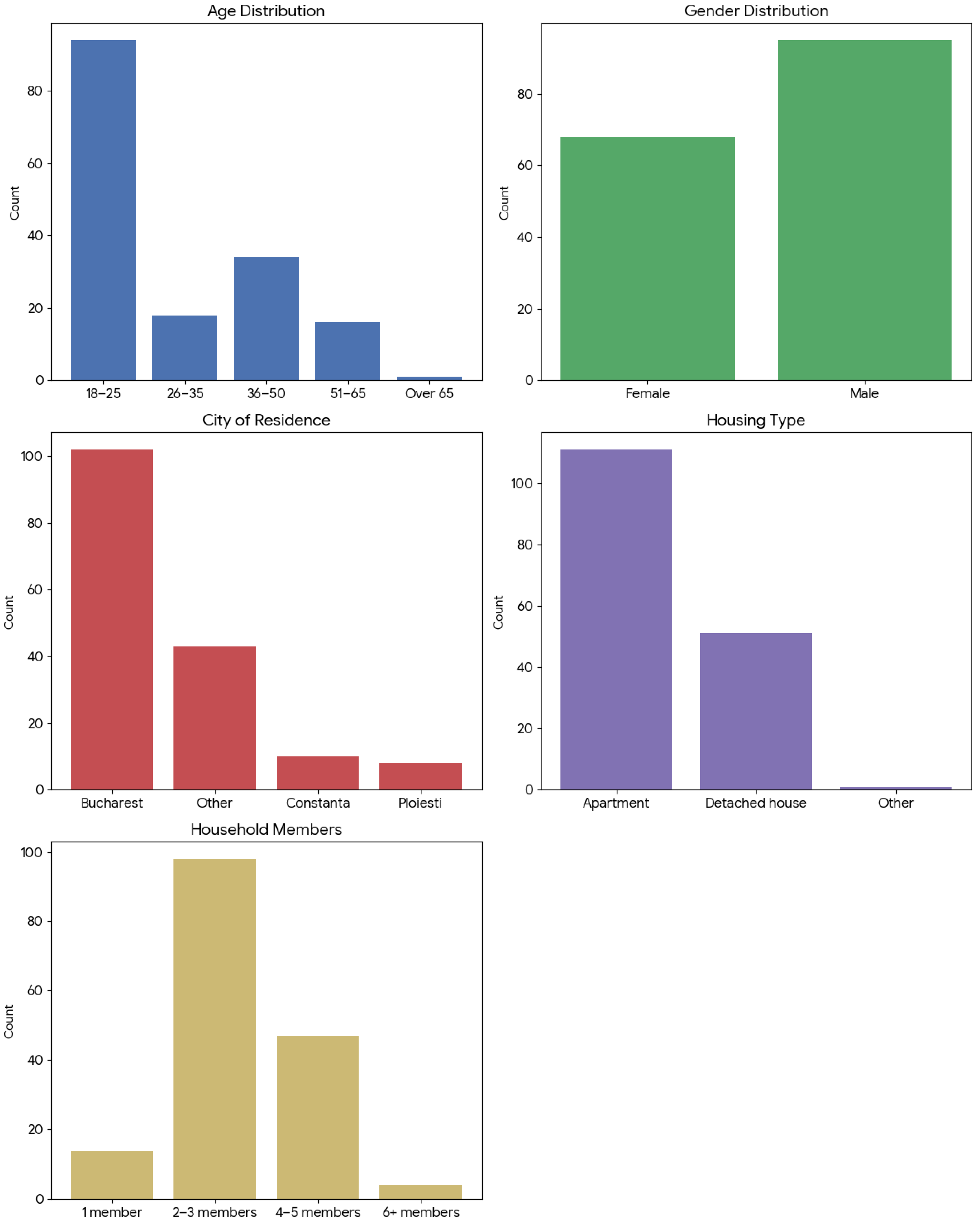
The demographic distribution showed a balanced representation across age categories, with the majority of respondents aged 18–50, reflecting the dominant working-age population in major Romanian cities. Gender distribution was approximately proportional, while respondents originated primarily from large urban centers such as Bucharest. Most participants reported living in apartment buildings with 2–3 household members, consistent with typical urban housing patterns in Romania.
In the Demographic characteristics section (Demographics) there were 5 questions, about age, gender, city of residence, housing type, household members. The demographic characteristics of the participants are summarized in
Figure 1, illustrating a sample predominantly composed of young adults residing in urban centers.
The demographic profile of the 163 participants highlights an active, urbanized population vulnerable to summer thermal stress. Most respondents belong to the 18–25 (n = 94) and 36–50 (n = 34) age cohorts, indicating a workforce with remote-work flexibility. The sample comprises 95 males and 68 females. Geographically, 62% reside in Bucharest (n = 102). Furthermore, 68% live in apartment buildings (n = 111) typically comprising 2 to 3 household members (n = 98), underscoring their high susceptibility to indoor overheating and the Urban Heat Island effect.
4.2. Summer Behavioral Patterns and Mobility Tendencies
Analysis of summer behavioral patterns reveals a structural shift away from permanent urban residency during the hottest months. Rather than engaging in brief, episodic tourism, a significant portion of the active urban population demonstrates a profound need for seasonal displacement. Specifically, over half of the respondents (55.8%) actively de-urbanize their summer routines—either by maintaining a balanced urban-non-urban lifestyle or by relocating entirely outside the city—while a marginal 8.6% remain strictly urban. This outward mobility is characterized by substantial time commitments: a combined 59.5% of the sample engages in relocations lasting between one and more than two weeks, underscoring the establishment of temporary secondary residences rather than mere weekend escapes.
The spatial distribution and underlying motivations of this exodus highlight the critical role of climate-resilient geographies. While traditional seaside holidays remain highly prevalent, the mountain and rural territories collectively form a massive adaptive corridor for thermal relief. The drivers behind this extended mobility extend far beyond standard leisure. Although recreation and social interactions represent the expected baseline motivations, a prominent cluster of climate and well-being factors explicitly dictates these movements. Nearly half of the respondents are directly catalyzed by the need for better air quality (49.1%), the avoidance of severe urban heat (44.2%), and stress reduction (42.3%). Conversely, economic motivations such as direct energy savings are virtually entirely disconnected from this mobility decision (1.8%), confirming that the seasonal urban exodus is fundamentally a pursuit of physiological comfort and environmental quality rather than financial optimization.
4.3. Perceived Urban Environmental Stressors
The evaluation of urban environmental stressors reveals a profound crisis in summer livability, positioning urban heat as a primary ‘push factor’ rather than a mere seasonal inconvenience. A striking majority of the respondents (77.9%) report experiencing severe or moderate thermal discomfort within their cities during the summer months. This pervasive hostility directly translates into behavioral action: nearly 90% of the surveyed population acknowledges that extreme urban temperatures actively dictate their mobility decisions, ranging from moderate influence to being the absolute driver of their seasonal relocation. Consequently, escaping the city is conceptualized as a reactive adaptation strategy to restore physiological comfort.
When unpacking the specific dimensions of this urban dissatisfaction, environmental toxicity drastically overshadows infrastructural inconveniences. Extreme heat (82.8%) and severe air pollution (74.2%) form a dominant cluster of critical stressors that render the summer city intolerable for the majority. While structural deficits such as heavy traffic (50.9%) and the lack of accessible green spaces (50.3%) further degrade the urban experience, they act as secondary exacerbating factors rather than primary catalysts for leaving. Notably, economic burdens such as high energy costs for cooling (14.7%) remain a marginal concern. This hierarchy of stressors reinforces the conclusion that seasonal relocation is fundamentally driven by the urgent need for physical and environmental well-being, rather than financial optimization or simple leisure.
4.4. Sustainability Attitudes and Technological Adoption
Analysis of sustainability practices and technological readiness reveals a complex intersection between environmental consciousness and the demand for urban comfort. While a substantial majority of the respondents (over 75%) report a moderate to high concern regarding their personal carbon footprint, this awareness does not uniformly translate into eco-driven mobility. The sample is highly polarized when evaluating relocation strictly for ecological reasons, such as reducing energy consumption: while 45.4% express a definitive or probable willingness to relocate for sustainability, over half of the population remains hesitant or entirely resistant.
Crucially, the data demonstrates that this climate-driven mobility is entirely conditional upon replicating urban standards of living at the destination. When prioritizing required infrastructure for a seasonal exodus, modern conveniences decisively outweigh green initiatives. High-speed digital connectivity (77.9%), sports and recreational facilities (71.8%), and modern housing standards (66.3%) act as absolute prerequisites. In stark contrast, sustainable amenities such as green transport alternatives (38.7%) and renewable energy sources (34.4%) are treated as secondary, optional benefits. This dichotomy indicates that the seasonal urban exodus is fundamentally a pursuit of physiological comfort rather than an exercise in ecological sacrifice.
Despite this prioritization of traditional comfort over green infrastructure, there is a robust societal readiness for digital integration as an adaptive tool. Technological adoption emerges as a crucial enabler for this mobility model. An overwhelming majority of the active population (81.0%) demonstrates strong interest in utilizing smart applications for environmental and energy monitoring. Furthermore, respondents hold highly optimistic views regarding the integration of IoT technologies, with the vast majority acknowledging their positive impact on overall quality of life. This high digital receptivity suggests that while residents demand urban-level comfort in their refuge destinations, they are highly open to deploying smart technologies to manage and optimize these adaptive environments.
4.5. Intention to Relocate: Predictive Factors
The research establishes a strong correlation between digital infrastructure, remote work capabilities, and the feasibility of seasonal climate-induced mobility. Rather than economic factors like escalating cooling costs—which emerged as a surprisingly weak primary motivator (selected by only 20.2% of respondents)—the dominant drivers for seasonal exodus are distinctly environmental: deteriorating air quality (65.6%) and extreme urban heat (62.6%). This environmental “push” is effectively operationalized by the “pull” of remote work flexibility and robust digital connectivity, which function as fundamental enablers for what would otherwise be constrained mobility.
Predictive modeling based on respondent intentions indicates a structural shift toward consistent, medium-term relocation (typically 1–2 months). Over 65% of the surveyed working-age demographics report a high likelihood of leaving the city during summer over the next three years. This propensity is highly sensitive to climate exacerbation. Evaluating past behavior, urban heat has already significantly influenced mobility decisions; looking forward, anticipated increases in heatwave frequency drastically elevate the probability of future temporary migration. Under a specific climate scenario projecting a 2 °C increase in average summer temperatures, proactive adaptation becomes the dominant response: nearly half the sample (47.9%) would commit to seasonal relocation, while a notable subset (13.5%) would consider permanent out-migration, leaving only a small minority willing to endure the increased urban heat.
Crucially, the translation of this relocation intent into actual mobility is contingent upon infrastructural equality. The study reveals that a hypothetical scenario of “rural parity”—the equalization of modern infrastructure and digital services between destination areas and urban centers—acts as a massive catalyst for adaptation. Under this condition, hesitation drops to marginal levels, with over 70% of respondents expressing definitive or probable willingness to move. This projection confirms that destination infrastructure is the primary bottleneck for unlocking adaptive seasonal mobility.
Finally, the emergence of this climate-driven mobility underscores a critical gap in current urban and regional administration. Respondents demonstrated an awareness of the ecological implications of their mobility, cautiously associating it with potential carbon dioxide emission reductions. Consequently, there is a systemic demand for an institutional framework. An overwhelming majority (over 87% cumulatively) identify the development of dedicated public policies for structural seasonal mobility as necessary, signaling that this phenomenon has outgrown individual reactive measures and now requires organized institutional support.
4.6. Environmental Monitoring Results
The feedback systems reveal a significant paradigm shift in how seasonal relocation is perceived: it functions not merely as a thermal refuge, but as a comprehensive strategy for physical and psychological recuperation. When assessing the pull factors of rural or mountainous destinations, respondents overwhelmingly prioritize holistic well-being over direct economic incentives. The necessity for environmental and psychological relief is nearly universal, evidenced by the dominant demand for access to fresh air (91.4%, n = 149), stress reduction (81.0%, n = 132), and the physiological comfort of lower temperatures (77.3%, n = 126). This strong drive to reconnect with nature (62.6%, n = 102) vastly overshadows marginal economic pull factors, such as destination-based energy savings (14.1%, n = 23), confirming that quality of life improvements are the primary catalysts for this mobility.
However, the translation of these strong motivations into actual seasonal exodus is heavily hindered by a matrix of socioeconomic and structural frictions. The primary bottlenecks preventing urban departure are tied to resource scarcity rather than a lack of desire. “Time poverty,” largely driven by rigid professional and educational schedules (63.8%, n = 104), alongside direct financial limitations (58.3%, n = 95), constitute the most severe personal barriers to relocation. Furthermore, systemic deficits significantly compound these frictions; a lack of adequate modern infrastructure at the destination (39.9%, n = 65) and transportation difficulties (27.0%, n = 44) act as major structural hurdles. This dichotomy demonstrates that while the intrinsic motivation for climate-adaptive mobility is exceptionally high, its realization remains fundamentally constrained by logistical and economic realities.
The results indicate that the integration of environmental sensors into smart city platforms can effectively support behavioral awareness, allowing residents to make data-driven decisions about when and where to relocate to mitigate climate-induced stress (
Table 2).
5. Discussion
The findings of this study highlight a significant and growing interest in seasonal urban-to-rural relocation during summer months as an adaptive response to climate-induced urban heat stress. Participants reported considerable discomfort associated with high temperatures in urban environments, consistent with previous research on the intensification of urban heat islands in Eastern Europe. This discomfort, compounded by air pollution, traffic density, and rising energy costs, appears to be driving behavioral changes that may represent early forms of climate adaptation. While our findings regarding the seasonal exodus align with the broader neo-ruralism literature [
57] they suggest a distinct departure from the traditional Mediterranean migration models. Whereas Mediterranean case studies frequently emphasize agricultural land abandonment and rural landscape transformation, often linked to climate and socio-economic pressures, comparatively fewer studies focus on systematic evaluation tools for climate adaptation in urban public spaces, such as the Quality Urban Label (QUL) [
56,
58,
59,
60], our sample highlights a ‘hybrid’ model driven by professional flexibility and the search for high-end digital infrastructure in rural settings. This suggests that the ‘neo-rural’ identity is evolving it is no longer solely about retreating from urban life, but about extending urban lifestyle expectations into non-urban territories—a phenomenon we term ‘urban comfort in nature’ [
61]. This shift mirrors broader transitions in ‘counter-urbanization’ where the rural landscape is increasingly valued not for its primary production, but as a site for ‘digital-enabled resilience’ [
62].
The results provide valuable insights into urban climate resilience but some limitations regarding the demographic sample must be acknowledged. The sample is largely dominated by respondents from Bucharest and the 18–25 age group (58%). This demographic specificity is likely the result of the online questionnaire distribution method and the high level of digital literacy of younger urban populations. Thus, the results predominantly reflect the perspectives, mobility patterns and technological readiness of young adults living in Romania’s largest metropolitan area. This limits the generalizability of the results to older demographics or to residents of smaller cities. They have a different vulnerability to climate change and a different capacity for a “seasonal urban exodus”. It is noteworthy, however, that this specific demographic profile is highly relevant for the study’s focus on “smart adaptation”. Young adults in a capital city like Bucharest, the front line facing significant urban heat island effects, are typically early adopters of smart technologies and often have more flexible lifestyles (e.g., remote work, university schedules) that facilitate seasonal mobility. Future research should aim to include a more age-diverse and geographically diverse sample to capture a broader spectrum of climate resilience strategies.
A key insight from this study is that seasonal relocation is not solely recreational but increasingly motivated by environmental and health considerations. The predictive relationship between thermal discomfort and relocation intention suggests that climatic stressors are becoming central determinants of summer mobility. Moreover, the role of remote-work flexibility—as both a facilitator and predictor—indicates that digitalization has become a structural enabler of new seasonal mobility patterns. This aligns with emerging literature describing the rise of “climate nomadism” and temporary ecological migration driven by heat avoidance.
The relevance of infrastructure quality in rural and mountain areas is also noteworthy. Respondents expressed a clear preference for locations offering reliable internet connectivity, sustainable energy solutions, and basic smart services. This suggests that rural modernization, coupled with digital infrastructure advancements, could accelerate the adoption of seasonal relocation as a normalized, structured practice. It further indicates a potential avenue for regional development policies aimed at balancing population density and reducing pressure on overheated urban centers.
Smart technology components such as those presented in [
63,
64] can play an important role in raising awareness of health hazards that may occur in personal homes during periods of heat or cold. Smart building technologies can simultaneously monitor both indoor air quality and thermal comfort, equivalent to assessing health risks, and energy consumption during periods of extreme weather, thus assessing the sustainability balance during periods of extreme weather.
We emphasize that although this study is done for Romania, the concept of seasonal urban exodus is not limited to countries with a temperate or cold climate that are affected by abnormal heat waves, on the contrary this adaptation model is replicable and perhaps even more important in countries with hot climates, such as the Mediterranean basin, the Middle East or the Global South. The mechanism that generates this exodus is the contrast between the urban heat island effect and accessible cooler geographic refuges (at higher altitudes or in coastal areas), coupled with digital connectivity. As long as a region is affected by urban thermal stress and has a functional digital infrastructure in areas with thermal comfort, this mobility model can be replicated globally.
Overall, the results point to the emergence of a behavioral trend with implications for urban sustainability, public health, and climate adaptation policy. Seasonal urban exodus could serve as a complementary strategy to traditional infrastructural responses to heatwaves, such as cooling centers or increased green space. However, its feasibility and scalability depend on supportive policies, the development of rural digital infrastructure, and careful management to prevent overtourism or environmental degradation in receiving regions.
Future research should expand this study through longitudinal tracking of relocation intentions, integration of larger geographic samples, and modeling of long-term energy and emission impacts associated with seasonal mobility. Despite its limitations, this study provides a foundation for understanding how behavioral adaptation, digital transformation, and rural revitalization intersect within the broader context of climate resilience.
5.1. Considerations Resulting from Statistical Analysis
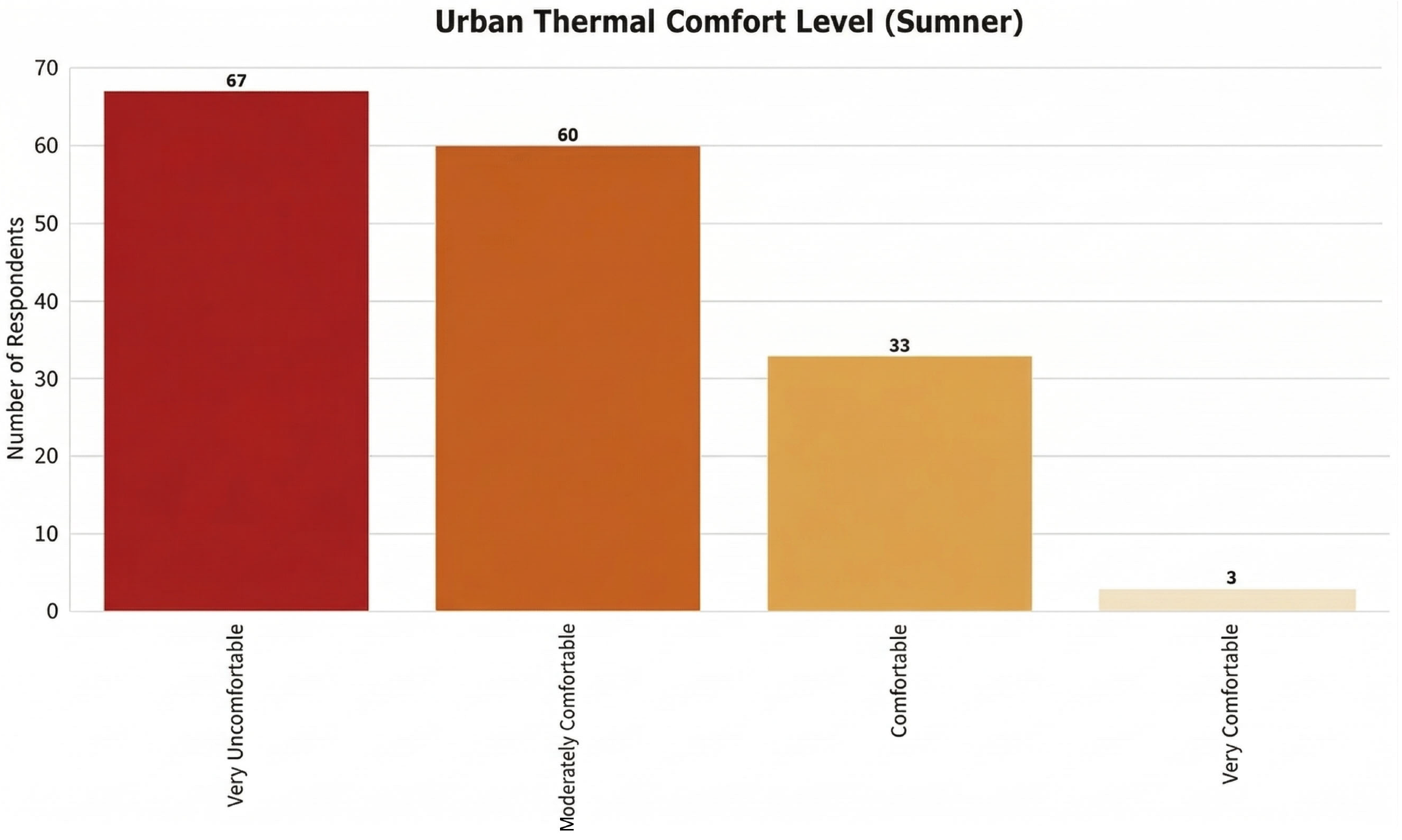
The total number of responses is 163. The majority (58%) of respondents belong to the young segment (18–25 years old) which suggests a perspective oriented towards the future, mobility and technology. Regarding gender, there is a relative balance between respondents (58% male vs. 42% female). The responses show that heat is a real problem for city dwellers, 41% of respondents declare that they feel a “very uncomfortable” level of comfort in summer (and approximately 50% of people say that high temperatures in the city influence their vacation plans “a lot” or “very much” (
Figure 2).
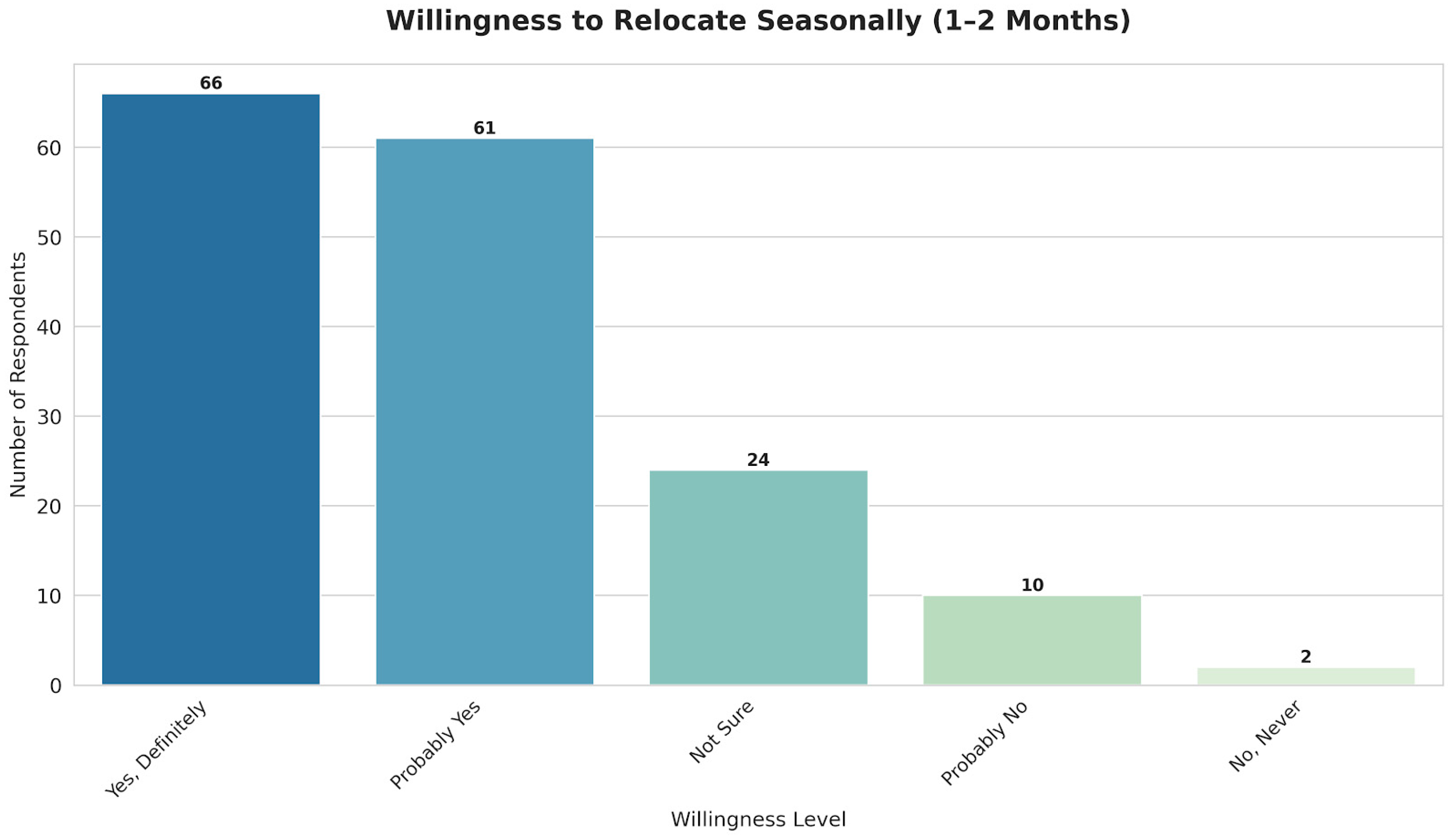
A surprisingly openness towards the concept of “seasonal nomad” can be identified. Over 77% of respondents stated that they would be willing (definitely or probably) to spend 1–2 months per year in a mountainous or rural area if they had the necessary conditions (
Figure 3). This indicates that in addition to avoiding the heat, people are looking for fresh air and a reduction in urban pressure.
In the case of a scenario of increasing temperatures over the next 10 years, 46% of respondents say they would temporarily leave the city every summer and only 8.6% say they would stay in the city regardless of the conditions. This indicates a climate milestone. An increase of just 2 degrees would transform seasonal relocation from an option into a survival strategy for almost half of the population surveyed.
Furthermore, there is a consistent level of awareness among respondents regarding the link between the high costs of indoor air conditioning during the summer and their personal environmental footprint. Specifically, 77.9% would be willing to move to a rural area for 1–2 months if sustainable solutions were implemented there (e.g., renewable energy, green transport), and 41.7% declare that they are “A lot” or “Very much” motivated to leave the city to avoid high urban energy costs. From a behavioral standpoint, relocation is conceptualized by the respondents as a method of personal cost optimization. In the public perception, escaping to the natural shade of a mountainous area is viewed as a more cost-effective and environmentally friendly alternative to artificially cooling an urban apartment, even though, as previously noted, the actual net carbon balance of this mobility remains to be objectively quantified.
These findings align with and extend recent studies in Southern Europe indicating a growing trend of climate-driven neo-ruralism. For example, research on Mediterranean populations has shown similar patterns where city dwellers retreat during heat waves to homes built in mountainous or coastal areas. Our quantitative results, in particular the fact that 77.9% of respondents want to move seasonally if infrastructure allows, demonstrate that this behavior is no longer associated with luxury but is simply an adaptation of those who can work remotely. Furthermore, our ML (Random Forest)-based analysis, which identified “heat impact” and “air quality” as top predictors over “temperature degrees”, integrates with international research suggesting that human mobility is driven by the degradation of urban quality of life rather than absolute meteorological values taken separately.
One of the most important findings from the primary statistical analysis of the survey results is provided by the answers given to the last question in the questionnaire. 74.2% of respondents would consider permanent seasonal relocation if mountain/rural areas offered similar facilities to urban ones (Internet, Health, Services) and 36.2% are absolutely convinced (“Yes, definitely”).
The primary statistical analysis reveals that the desire for seasonal relocation is supported by a direct correlation between high thermal discomfort (78%) and the need for digital infrastructure (74%). The data suggests that the urban population (especially the 18–35 age group) is ready for temporary climate migration, being motivated by a mix of personal comfort, financial savings (41%) and environmental responsibility.
5.2. Considerations Resulting from Analysis Based on Multiple Linear Regression
To better assess the respondents’ intention to temporarily move, an analysis based on multiple regression modeling was conducted to understand how much each factor contributes to increasing the intention to move. For the purpose of regression analysis, 5-point Likert scale items were treated as interval data, a common and accepted practice in social science literature.
Prior to interpreting the multiple linear regression model, comprehensive diagnostic checks were conducted to verify the fundamental Ordinary Least Squares (OLS) assumptions. The assumption of linearity was confirmed through visual inspection of the residuals versus fitted values plot, which displayed a random dispersion without distinct non-linear patterns. The normality of the residuals was assessed analytically using the Shapiro–Wilk test (W = 0.974, p = 0.003) and visually via Q-Q plots. Although the p-value indicates a slight deviation from a mathematically perfect normal distribution—a common artifact of the test’s high sensitivity in sample sizes exceeding 100—the exceptionally high W statistic demonstrates that the distribution closely approximates normality. Supported by the Central Limit Theorem given the sample size (n = 163), this minor deviation does not compromise the validity of the OLS estimators. Finally, the assumption of homoscedasticity was evaluated using the Breusch–Pagan test (LM = 1.448, p = 0.836). While the results clearly indicated constant variance, the final regression model was nevertheless fitted using heteroscedasticity-consistent robust standard errors (HC3) to proactively ensure the utmost reliability of the reported p-values and confidence intervals, as is best practice for cross-sectional survey data.
Thermal comfort, the impact of the heat wave, and challenges related to costs and transportation were evaluated as factors that contribute to changing the intention to move. Within the analysis, the specific coefficients R Square (R
2) and
p-values were evaluated to evaluate the statistical significance of each parameter as well as the Mean Squared Error to evaluate how accurate the model is (
Table 3).
As can be seen in
Table 3, all VIF (Variance Inflation Factor) values were below 5, indicating the absence of multicollinearity. The analysis resulted in an R
2 value of 0.109, which means that the model explains 10.9% of the variation in the desire to move. Even if this score is modest, it is normal for a social study. It indicates that although the factors analyzed (heat, costs, transportation) are important, there are other factors (89.1%) that you did not include in this specific model (probably psychological factors, family ties or job stability).
Among the factors with p-values below 0.050 (statistically significant), the impact of heat stands out (p = 0.009) with a coefficient of 0.249, which means that for each additional level of impact felt by a person, their intention to move increases by a quarter of the level of intention to move. The motivational accessibility related to transportation (p = 0.016) has the strongest positive factor in the model (0.432), meaning that those who consider transportation a problem has a higher intention to move. Surprisingly, thermal comfort (p = 0.514) does not influence the intention to move. The simple state of “comfort” or “discomfort” (how warm it is in your home) does not predict moving as well as the general impact (how the heat affects you in your daily activities). Costs (p = 0.533) are another variable that does not have a linear influence on the decision to move, we cannot say that “if it is more expensive, the desire decreases uniformly”. Rather, cost acts as a wall for some and not at all for others, which makes the relationship not a perfect straight line.
The linear regression model has an F-statistic of 0.001 (less than 0.050) which statistically validates that even if only to the extent of 10%, the results are real and not just statistical coincidences. The Durbin–Watson coefficient is 2.116 (greater than 2) so there are no correlation errors between the data (the data is clean).
In conclusion, the multiple linear regression model validates the hypothesis that the perceived impact of heat and transportation accessibility are the main statistical predictors of the intention to move. Interestingly, the subjective perception of thermal discomfort did not prove to be a significant predictor on its own, suggesting that the decision to seasonally relocate is more a reaction to the way in which the heat wave disrupts urban logistics and the general quality of life, rather than a simple reaction to the temperature in the home.
A critical finding of our analysis is the strong positive relationship between transportation accessibility and the intention to relocate. While previously conceptualized merely as a logistical barrier, high transportation accessibility actually acts as the primary catalyst for seasonal mobility. From a socio-spatial perspective, this positive correlation highlights the risk of “involuntary immobility” (or trapped populations) within urban heat islands. The data suggests that the desire to escape urban heat is widespread, but the actualization of this intent is a climate privilege heavily dependent on personal or public mobility networks. Consequently, urban residents with lower transportation accessibility are disproportionately forced to endure extreme urban temperatures. This underscores the urgent need for integrated public transport policies, ensuring that climate-driven seasonal relocation does not become an exclusive adaptation strategy available only to highly mobile demographics.
5.3. Considerations Results Using Machine Learning Algorithms
To enrich the analysis of the questionnaire responses, two machine learning algorithms were used to discover other variables (decisive factors) that influence the decision to temporarily migrate (Random Forest algorithm) and to highlight prominent profiles in the survey (K-Means Clustering algorithm). Running the Random Forest algorithm (
Table 4) shows that the impact of heat (0.133) and air quality (0.093) are the most important factors in the decision to temporarily move during the summer. Thermal comfort (0.064) has lower importance, which means that respondents are fleeing not from the degrees on the thermometer but from the side effects of heat: unbreathable air, dust, odors.
To ensure the robustness and generalizability of the machine learning models, rigorous validation protocols were implemented. For the Random Forest classifier predicting relocation intention (classified as a binary outcome), the dataset was split into an 80% training set and a 20% testing set. To mitigate overfitting, a 5-fold cross-validation approach was applied to the training data. In addition, hyperparameter tuning was performed using an exhaustive grid search strategy, optimizing the number of trees and the maximum depth of trees to account for the sample size. For the unsupervised learning phase, K-Means clustering was applied to segment respondents. To quantitatively assess the structural validity and internal cohesion of the resulting clusters, the Silhouette Score was calculated.
The implementation of the Grid Search algorithm identified the optimal hyperparameters for the Random Forest model as n_estimators = 200 and max_depth = 3. Configured with these parameters, the model achieved a 5-fold cross-validation accuracy of 56.2% and a final hold-out test accuracy of 60.6%. This moderate predictive performance aligns with the variance explained by the OLS regression, reaffirming that seasonal urban exodus is an extremely complex phenomenon, influenced by multiple unmeasured factors. Regarding market segmentation, the K-Means algorithm (k = 3) generated a Silhouette score of 0.556. This value indicates a moderate to strong cluster structure, confirming that the three identified respondent profiles are sufficiently distinct and internally cohesive.
If we add the importance of the factors stress reduction (0.068) and Time with family (0.080), we get a score of 0.148, surpassing the most important individual factor. The urban exodus is seen as an opportunity to reconnect, not just as an emergency evacuation. People are looking for mental refuge, where the drop in temperature is just the setting that allows for relaxation. High costs (0.078) and Accessibility transportation (0.066) have a cumulative score of almost 0.150. There is a critical mass of people who want to leave (have the motivation) but are stopped by the price and accessibility threshold. There is a possibility of a growing trend in the desire to move temporarily if there were “budget” solutions or easier transportation to lesser known (but cheaper) mountain areas. The fact that respondents’ location in the largest city in the study (Bucharest) has an importance of 0.074 (higher than the desire to avoid extreme heat itself) is crucial. Living in Bucharest is a better predictor of stress than perceived temperature. The “urban heat island” phenomenon combined with crowding makes Bucharest residents much more determined to leave than residents of other cities, even if the temperatures were the same.
The K-Means Clustering algorithm mathematically confirms that there are 3 major groups of respondents (
Table 5). Group 0 (determined escapees) suffer from maximum discomfort (5) and have a high intention to move (3.597). These are the people for whom the heat is unbearable and who already have a plan to leave. They represent the active demand in the market. For them, moving is not an option, but a necessity. Group 2 (resilient or dreamers of a secluded area) have a low discomfort (1.914) and almost maximum intention to leave (4.457). These people feel comfortable in the city but still have a very high desire to move! This demonstrates that their desire to leave is not reactive (escape from the heat), but proactive (seeking nature, socializing). Group 1 (the undecided or city prisoners) has an average discomfort (2.000) and an average desire to leave (2.360). Although they suffer from the heat, something keeps them in place. Correlating with your previous data, this is where the barriers of cost and transportation facilities come into play. This group needs “subsidization” solutions or facilities that reduce the effort of moving. They would like to but cannot and for this reason they do not want to.
5.4. Study Limitations and Future Research
Although the present study offers substantial insight into the emerging phenomenon of seasonal urban-to-rural relocation as climate-adaptive behavior, several methodological and contextual limitations must be considered when interpreting the findings.
First, the sampling strategy was non-probabilistic, relying primarily on convenience and snowball distribution. As a result, the responses may not fully represent the demographic or socio-economic diversity of the broader urban population, and the results should be interpreted as indicative tendencies rather than generalizable conclusions.
A second limitation arises from the exclusive use of self-reported data. Variables such as thermal discomfort, environmental attitudes, relocation motivations, and behavioral intentions are inherently subjective and may be influenced by perception bias or social desirability. While these constructs are valuable for understanding psychological drivers of adaptive behavior, they do not necessarily reflect actual long-term actions. Furthermore, the timing of data collection—conducted during an extended heatwave—improves ecological validity but also introduces the risk that short-term weather anomalies may have amplified respondents’ stated intentions.
The geographical and socio-cultural specificity of the study represents an additional constraint. Data were collected predominantly from residents of Romanian urban centers, whose climate exposure, technological readiness, and mobility opportunities may differ substantially from those in other global regions. Consequently, extrapolation to broader international contexts should be undertaken with caution. Another limitation lies in the cross-sectional nature of the research, which captures intentions at a single moment rather than tracking behavioral evolution over multiple seasons. Without longitudinal follow-up, it is difficult to determine the stability of relocation intentions or the extent to which they translate into actual mobility patterns.
A richer understanding of seasonal relocation dynamics could be achieved through triangulation with behavioral mobility data, qualitative inquiry, or experimental research designs. These limitations do not detract from the study’s contribution but indicate opportunities for methodological refinement and expansion.
Looking ahead, several directions emerge for future research. Longitudinal panel studies would allow researchers to observe how intentions evolve over time and how extreme heat events influence successive years of decision-making. Cross-national comparative studies would help clarify the extent to which seasonal relocation can be understood as a global adaptation strategy rather than a context-dependent phenomenon. Integrating objective mobility tracking—through mobile applications, GPS logging, or anonymized telecommunications metadata—would enhance measurement accuracy and help distinguish between intentions and enacted behavior.
Future studies would also benefit from mixed-method approaches that combine quantitative behavioral modeling with qualitative interviews or participatory workshops, capturing not only the statistical determinants of relocation but also the lived experience of climate-induced mobility. Additionally, agent-based modeling or urban planning simulations could help evaluate the potential impact of widespread seasonal relocation on urban energy demand, carbon emissions, and infrastructure resilience. Expanding the environmental monitoring network to include multiple altitudes and microclimates would allow for a finer-grained comparison between urban and rural climatic environments, better supporting the analysis of environmental drivers behind relocation. Collectively, these avenues for future research can deepen the understanding of seasonal mobility as a promising behavioral adaptation to climate change and inform policy strategies for more resilient urban systems.
While this study identifies a clear behavioral intention toward seasonal urban exodus driven by climate discomfort, a critical limitation must be acknowledged regarding its actual environmental impact. Currently, the concept of low-carbon seasonal mobility remains a theoretical framework rather than an empirically proven outcome. The net carbon balance of such a phenomenon is highly complex and cannot be definitively assessed without comprehensive travel emission calculations and a rigorous evaluation of rural energy systems. For instance, the emissions generated by transportation to destination areas, coupled with potentially lower energy efficiencies in rural housing or grid infrastructure, could offset the energy saved from reduced urban cooling demands. Therefore, the findings of this survey-based study reflect the social readiness for adaptation, rather than confirming a net environmental benefit. Future interdisciplinary research must employ quantitative life-cycle assessments and net carbon balance modeling to determine under what specific infrastructural conditions seasonal migration truly qualifies as a sustainable, low-carbon practice.
6. Conclusions
The multidimensional analysis of the collected data reveals that the phenomenon of urban–rural seasonal migration is not a simple physiological reaction to high temperatures, but a complex decision-making process, governed by socio-economic and technological factors. The study refutes the hypothesis of a simple linear correlation between discomfort and departure, revealing a stratified and infrastructure-conditioned market.
Multiple Linear Regression modeling demonstrated a subtle but fundamental distinction. Since the regression model explains only 10.9% of the variance, it is clear that seasonal urban exodus is an extremely complex phenomenon, influenced by multiple unmeasured socio-economic variables. However, the identified predictors remain statistically significant and provide valuable information on adaptive behaviors. The mere state of thermal discomfort (house temperature) is not a statistically significant predictor (p = 0.514) of the decision to move. Instead, the perceived impact of heat on daily activities (p = 0.009) is decisive. People are not just looking for a lower temperature, but for a restoration of the functionality of their lives. They leave when the city blocks their ability to work, sleep, and socialize, not just when the thermometer rises.
The application of the K-Means Clustering algorithm identified three distinct profiles of respondents, dismantling the idea of a “universal customer”. The “Decided Escapees” group (Cluster 0): The ideal segment, with maximum discomfort and high intention, ready for action. The “dreamers” group (Cluster 2), which is a surprising segment, want to leave although they do not feel major thermal discomfort. For them, motivation is proactive (seeking experience, nature, socializing), validating migration as a lifestyle upgrade, not as an escape. The “Urban Prisoners” group (Cluster 1): The critical segment, characterized by medium discomfort but also immobility. They are blocked by structural barriers, representing a huge latent demand that cannot be activated without external intervention.
The Random Forest (Feature Importance) analysis clearly established the priorities. Although heat initiates desire, infrastructure dictates possibility. Digital Connectivity and Job act as eliminatory factors. In the absence of a stable internet, the intention to move decreases drastically, regardless of the severity of the heat wave. Statistical regression highlights transport difficulties and poor accessibility as primary hurdles, pointing to an urgent requirement for high-speed transit links connecting to rural regions. Interestingly, while costs are often cited as a deterrent, their impact is non-linear: the market shows a clear willingness to pay, provided that the residential package incorporates amenities necessary for maintaining professional productivity.
Geographical positioning—specifically residency in Bucharest—consistently stood out in our algorithms. This highlights how capital dwellers are forced to navigate a compounding array of stressors, including pollution, the heat island effect, and daily congestion. Consequently, this demographic has become the primary source for seasonal, long-term tourism migrations.
In conclusion, this study suggests we can stop viewing seasonal relocation as a mere extended holiday. Instead, we should categorize it as a hybrid housing model—an emerging form of climate and social adaptation. While this shift promises a path toward more resilient and energy-conscious living, its environmental benefits are not guaranteed. Success hinges less on climatic conditions and more on our capacity to upgrade rural infrastructure, effectively blurring the lines between urban-grade convenience and the natural setting.
While this research provides a baseline for understanding such behavioral shifts, the sustainability of this model remains an open question. Future multidisciplinary studies must now focus on quantifying the net impact of this lifestyle. A critical next step will involve comprehensive life-cycle assessments that account for the full carbon balance—balancing the maintenance of two homes, the emissions generated by transit, and the actual energy performance of rural developments. Ultimately, as we transition toward these new forms of mobility, balancing human comfort with ecological responsibility remains the critical challenge for the future.