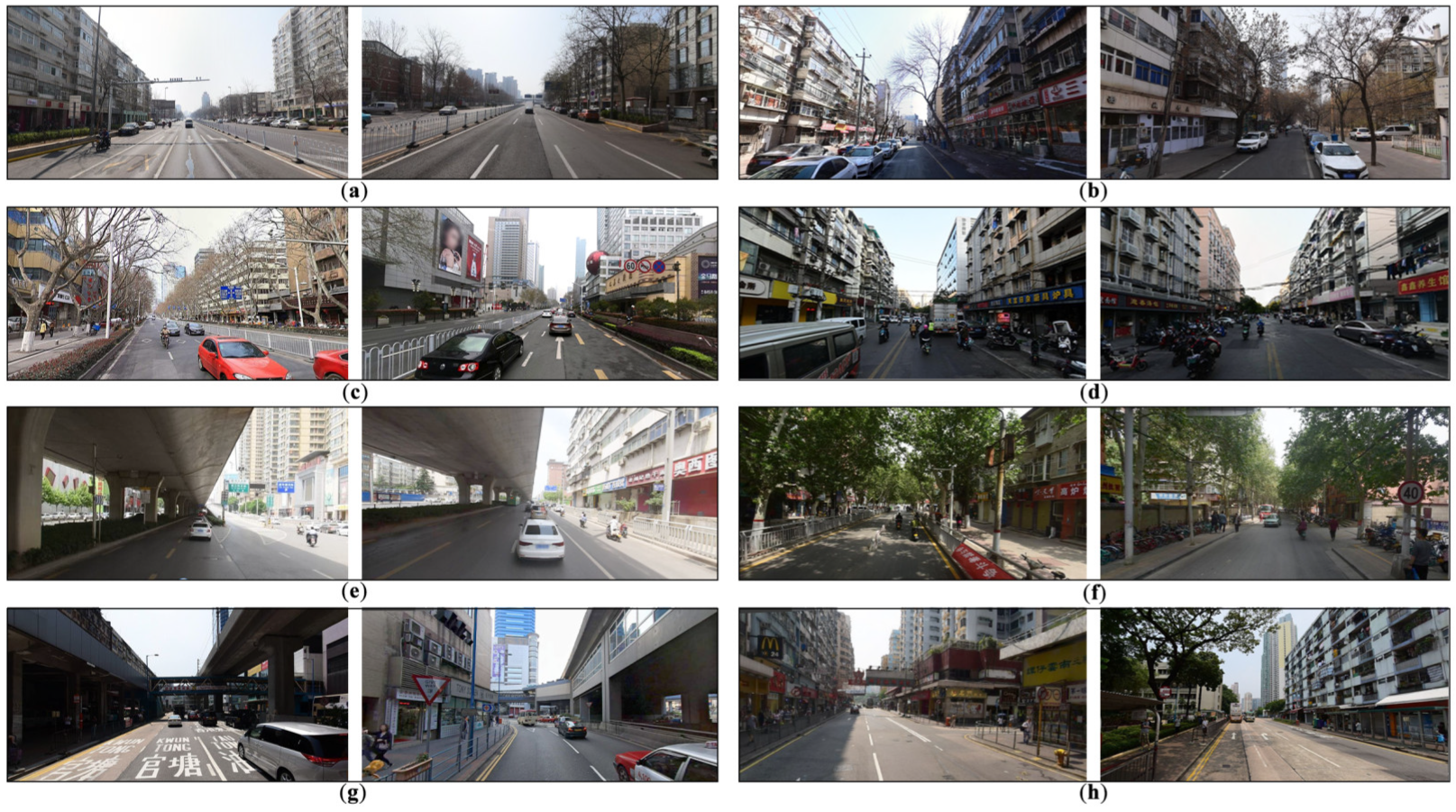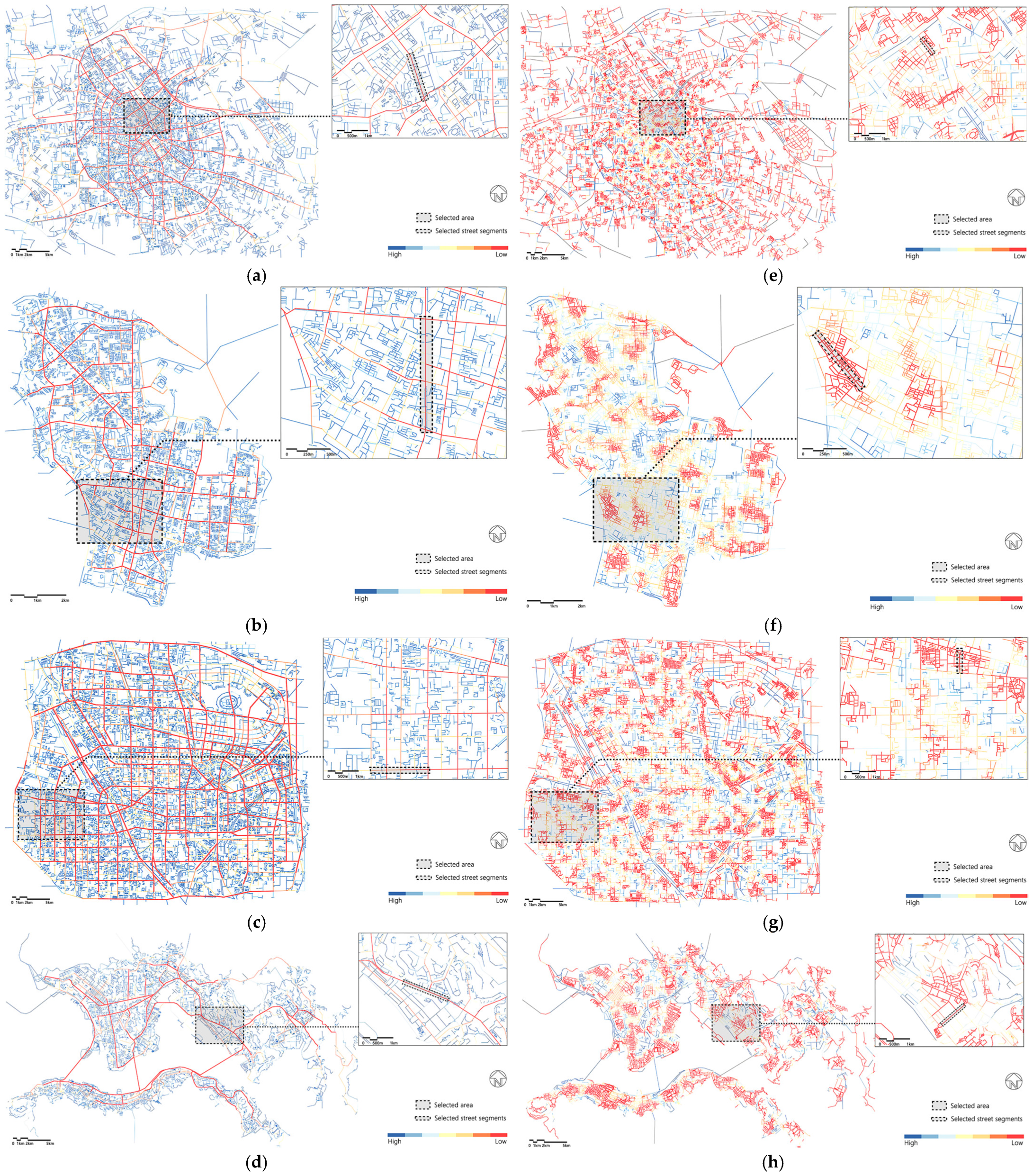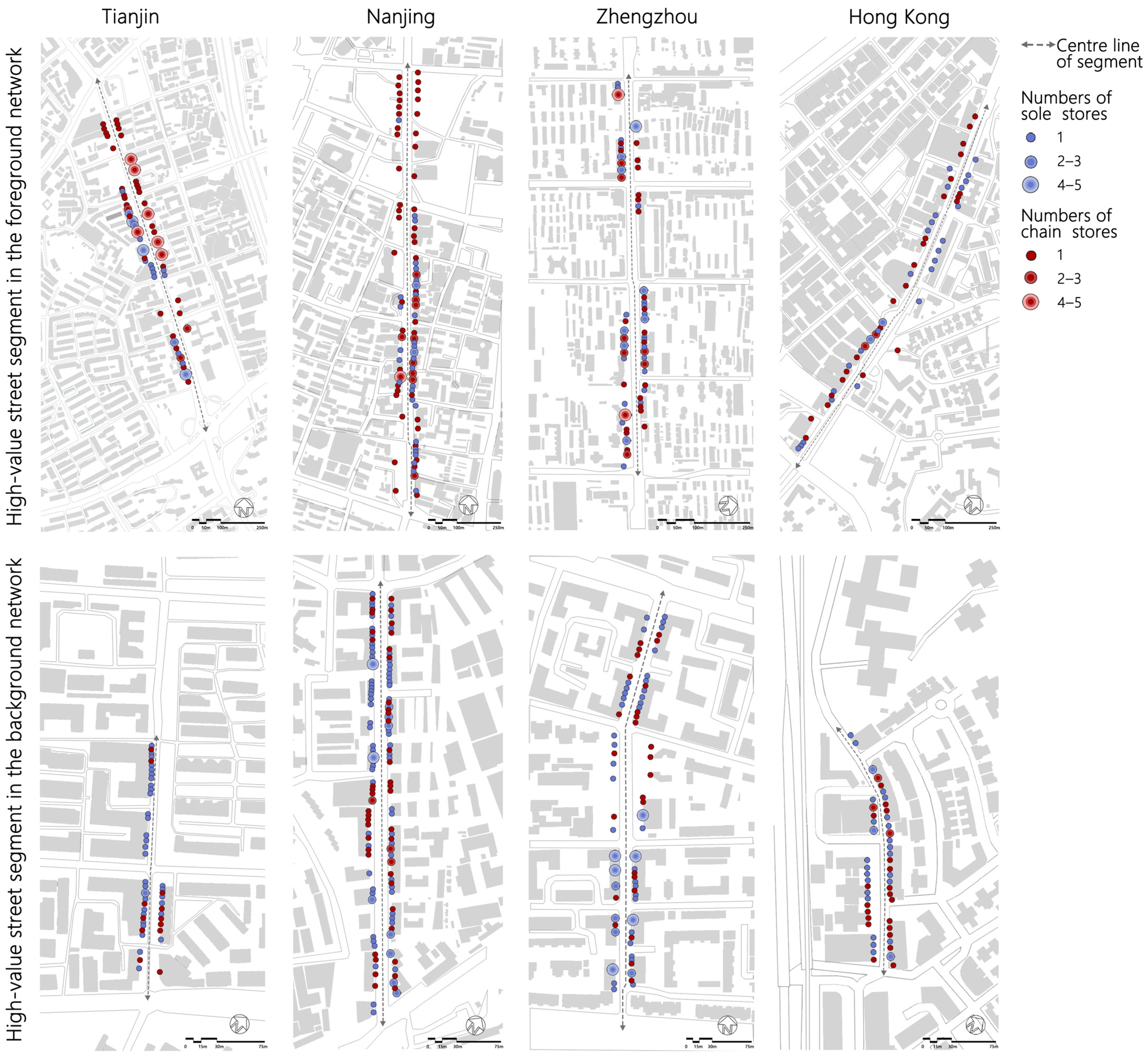

Street Store Spatial Configurations as Indicators of Socio-Economic Embeddedness: A Dual-Network Analysis in Chinese Cities

Abstract
1. Introduction
2. Research Principles
2.1. Theoretical Basis: The Dual Network Logic of Space Syntax
2.2. Research Perspective: Street–Store Spatial Configuration Under a Dual-Network Logic
3. Methods
3.1. Street Network Identification
3.2. Sample Selection and Data Collection
3.3. Comparative Analysis of the Spatial Configuration of Street Stores
3.3.1. Measurement and Classification of Operation Methods
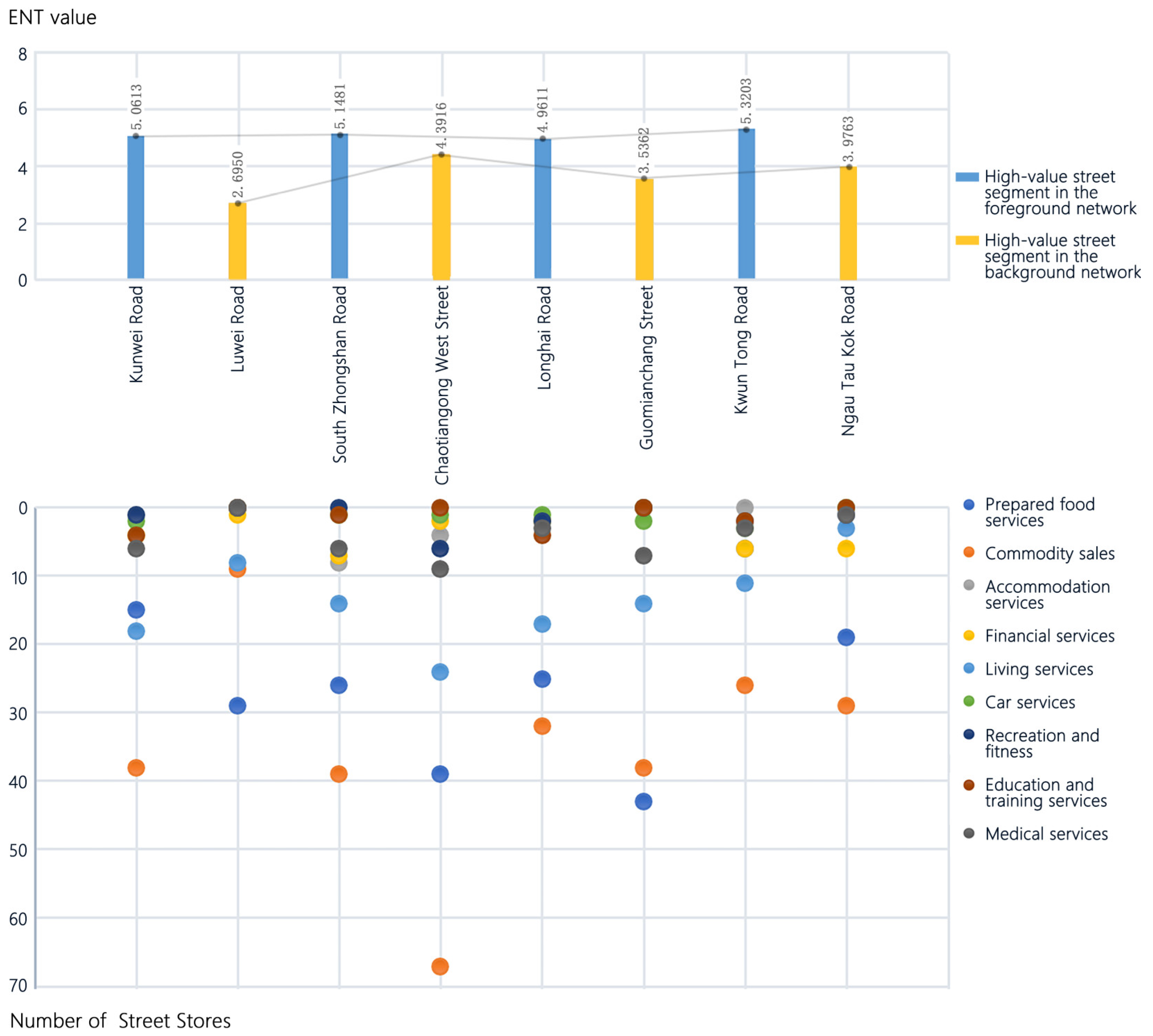
3.3.2. Calculation of Functional Diversity Metrics
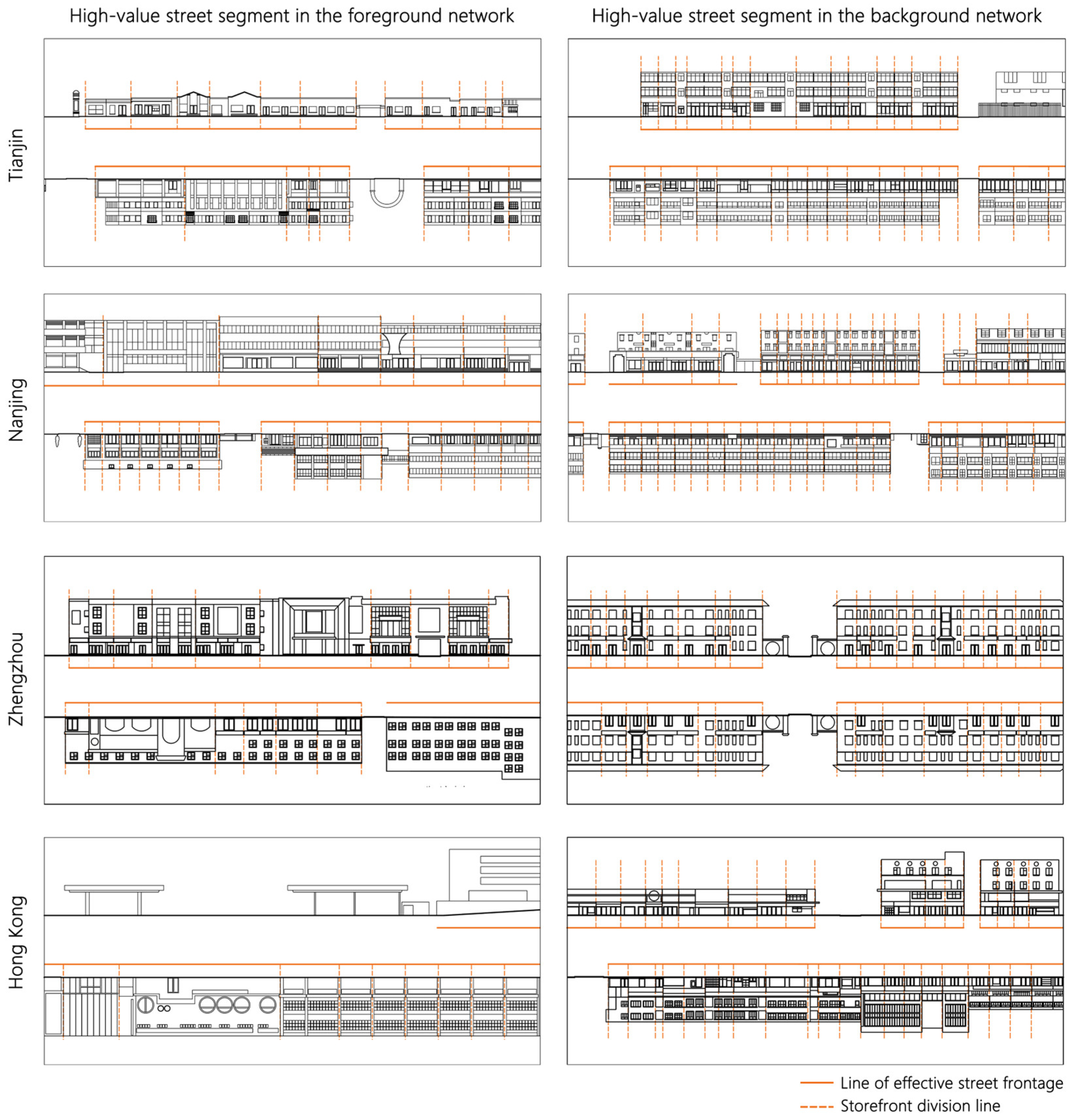
3.3.3. Measurement Protocol and Calculation of 100-Meter Density
- (1)
- Operational Definition and Coding Protocol: the effective street frontage length (L) is operationally defined as the sum of continuous lengths of building façade facing the street segment that is available for hosting stores. For the purpose of obtaining objective and reproducible measurements, all data was collected from high-resolution 2019 street view imagery (source: Baidu Map Street View) by its built-in distance measurement tool. The specific determination of length adheres to a pre-established standardized coding protocol (Table 2), which provides precise geometric and functional definitions for various non-commercial interfaces to be excluded.
- (2)
- Inter-Rater Reliability Assessment Design: To assess the consistency of the coding protocol and measurement procedure, two researchers independently measured all eight street segments according to the specifications outlined in Table 2. The reliability of the measurements was assessed through the intraclass correlation coefficient (ICC) for absolute agreement (model ICC (3, 1)). The result of the specific calculation is given in Section 4.3.
- (3)
- Sensitivity Analysis Design: Two sensitivity analyses were designed and conducted to test the robustness to key measurement parameter settings. First, the intersection buffer distance was adjusted to 5 m (lenient) and 15 m (strict). Second, street frontage within 3 m of other potential openings not defined in Table 2 such as minor passages and alley entrances was excluded. The numerical calculations under these various rule sets contribute to the density found in Section 4.3, which helps assess how robust the patterns are.
4. Results
4.1. Operation Methods
4.2. Functional Diversity
4.3. 100-m Density
5. Discussion
5.1. Operation Methods: The Spatial Imprint of Standardized Economy and Local Socio-Culture
5.2. Functional Diversity: The Tension Between Universal Supply and Local Demand
5.3. 100-m Density: The Response to Spatial Efficiency and Social Intensity
5.4. Research Boundaries and Theoretical Advancement
6. Conclusions
Author Contributions
Funding
Institutional Review Board Statement
Informed Consent Statement
Data Availability Statement
Acknowledgments
Conflicts of Interest
References
- Hillier, B. Space is the Machine: A Configurational Theory of Architecture; Space Syntax: London, UK, 2007. [Google Scholar]
- Sharifi, A. Resilient urban forms: A review of literature on streets and street networks. Build. Environ. 2019, 147, 171–187. [Google Scholar] [CrossRef]
- Lakshmanan, T.R. The broader economic consequences of transport infrastructure investments. J. Transp. Geogr. 2011, 19, 1–12. [Google Scholar] [CrossRef]
- LOBsang, T.; Zhen, F.; Zhang, S. Can urban street network characteristics indicate economic development level? Evidence from Chinese cities. ISPRS Int. J. Geo-Inf. 2019, 9, 3. [Google Scholar] [CrossRef]
- Tüzemen, A.L.A. Türkiye’deki Ulaştirma Altyapilarinin Ekonomik Büyümeye Etkisi: Ardl Sinir Testi Yaklaşimi. Soc. Sci. Stud. J. 2024, 4, 5935–5941. [Google Scholar] [CrossRef]
- Silver, D.A.; Clark, T.N. Scenescapes: How Qualities of Place Shape Social Life, 1st ed.; University of Chicago Press: Chicago, IL, USA, 2016; Volume 57734. [Google Scholar]
- Jacobs, J. The Death and Life of Great American Cities; Vintage Books: New York, NY, USA, 1961. [Google Scholar]
- Mehta, V. The Street: A Quintessential Social Public Space; Routledge: New York, NY, USA, 2013. [Google Scholar]
- Gao, L.; Ma, Z.; Wei, D. Research on the influence mechanism of spatial distribution of urban commercial facilities. China Real Estate 2023, 6, 30–40. (In Chinese) [Google Scholar] [CrossRef]
- Tavakoli, N.; Rafieian, M.; Amirjani, R.; Shahinrad, M. Women’s recreational walking preferences in urban streets: A structural equation modeling approach. Cities 2026, 171, 106721. [Google Scholar] [CrossRef]
- Yamu, C.; Van Nes, A.; Garau, C. Bill Hillier’s legacy: Space syntax—A synopsis of basic concepts, measures, and empirical application. Sustainability 2021, 13, 3394. [Google Scholar] [CrossRef]
- Tsou, K.-W.; Cheng, H.-T. The effect of multiple urban network structures on retail patterns–A case study in Taipei, Taiwan. Cities 2013, 32, 13–23. [Google Scholar] [CrossRef]
- Wang, F.; Chen, C.; Xiu, C.; Zhang, P. Location analysis of retail stores in Changchun, China: A street centrality perspective. Cities 2014, 41, 54–63. [Google Scholar] [CrossRef]
- Porta, S.; Strano, E.; Iacoviello, V.; Messora, R.; Latora, V.; Cardillo, A.; Wang, F.; Scellato, S. Street centrality and densities of retail and services in Bologna, Italy. Environ. Plan. B Plan. Des. 2009, 36, 450–465. [Google Scholar] [CrossRef]
- van Nes, A. The impact of the ring roads on the location pattern of shops in town and city centres. A space syntax approach. Sustainability 2021, 13, 3927. [Google Scholar] [CrossRef]
- Hillier, B. Centrality as a process: Accounting for attraction inequalities in deformed grids. Urban Des. Int. 1999, 4, 107–127. [Google Scholar] [CrossRef]
- Carpio-Pinedo, J.; Gutiérrez, J. Consumption and symbolic capital in the metropolitan space: Integrating ‘old’ retail data sources with social big data. Cities 2020, 106, 102859. [Google Scholar] [CrossRef]
- Vandell, K.; Carter, C. Retail store location and market analysis: A review of the research. J. Real Estate Lit. 1994, 2, 13–45. [Google Scholar] [CrossRef]
- Ling, X. Evolution of spatial structure of commerce center in global city-region: A dynamic agent-based simulation. Procedia-Soc. Behav. Sci. 2013, 77, 308–321. [Google Scholar] [CrossRef][Green Version]
- Kopczewska, K.; Kubara, M.; Kopyt, M. Population density as the attractor of business to the place. Sci. Rep. 2024, 14, 22234. [Google Scholar] [CrossRef]
- Hao, F.; Yang, Y.; Wang, S. Patterns of location and other determinants of retail stores in urban commercial districts in Changchun, China. Complexity 2021, 2021, 8873374. [Google Scholar] [CrossRef]
- Szumilas, A.; Pach, P. Commercial buildings in town. The influence of discount shops on the trade structure of a small town. Buildings 2021, 11, 585. [Google Scholar] [CrossRef]
- Saraiva, M.; Pinho, P. Spatial modelling of commercial spaces in medium-sized cities. GeoJournal 2017, 82, 433–454. [Google Scholar] [CrossRef]
- Benoit, D.; Clarke, G.P. Assessing GIS for retail location planning. J. Retail. Consum. Serv. 1997, 4, 239–258. [Google Scholar] [CrossRef]
- Yoshimura, Y.; Kumakoshi, Y.; Fan, Y.; Milardo, S.; Koizumi, H.; Santi, P.; Arias, J.M.; Zheng, S.; Ratti, C. Street pedestrianization in urban districts: Economic impacts in Spanish cities. Cities 2022, 120, 103468. [Google Scholar] [CrossRef]
- Lin, G.; Chen, X.; Liang, Y. The location of retail stores and street centrality in Guangzhou, China. Appl. Geogr. 2018, 100, 12–20. [Google Scholar] [CrossRef]
- Hallsworth, A.G.; Coca-Stefaniak, J.A. National high street retail and town centre policy at a cross roads in England and Wales. Cities 2018, 79, 134–140. [Google Scholar] [CrossRef]
- Kang, C.-D. Spatial access to pedestrians and retail sales in Seoul, Korea. Habitat Int. 2016, 57, 110–120. [Google Scholar] [CrossRef]
- Chih-Lin, T.; Yinuo, W.; Sanwei, H.; Fat-Iam, L. Spatial heterogeneity analysis between street network configurations and various service activities: Evidence from the Wuhan metropolitan area. Comput. Urban Sci. 2024, 4, 39. [Google Scholar] [CrossRef]
- Hillier, W.; Yang, T.; Turner, A. Normalising least angle choice in Depthmap-and how it opens up new perspectives on the global and local analysis of city space. J. Space Syntax 2012, 3, 155–193. [Google Scholar]
- Sayed, K.; Turner, A.; Hillier, B.; Iida, S.; Penn, A.; Shibo, G.; Yang, T. Segment Analysis & Advanced Axial and Segment Analysis: Chapter 5 & 6 of Space Syntax Methodology: A Teaching Companion. Urban Des. 2016, 1, 32–35. [Google Scholar]
- Lebendiger, Y.; Lerman, Y. Applying space syntax for surface rapid transit planning. Transp. Res. Part A Policy Pract. 2019, 128, 59–72. [Google Scholar] [CrossRef]
- Hidayati, I.; Yamu, C.; Tan, W. You have to drive: Impacts of planning policies on urban form and mobility behavior in Kuala Lumpur, Malaysia. J. Urban Manag. 2021, 10, 69–83. [Google Scholar] [CrossRef]
- Li, J.; Guo, Q. Dynamic evolution analysis of urban land use structure based on information entropy. Resour. Environ. Yangtze River Basin 2002, 5, 393–398. (In Chinese) [Google Scholar]
- Shen, L. From market allocation to government guidance: Reflections on the planning and management of urban commercial service facilities. Urban Plan. Forum 2019, 3, 74–80. (In Chinese) [Google Scholar] [CrossRef]
- Ge, Y.; Qi, Y.; Tang, W.; Liu, M. Street revival: Practice and reflection onthe compilation of Demand-oriented street design guidelines. Urban Plan. Forum 2019, 90–98. [Google Scholar] [CrossRef]
- Ekström, K.M.; Jönsson, H. Orchestrating retail in small cities. J. Retail. Consum. Serv. 2022, 68, 103008. (In Chinese) [Google Scholar] [CrossRef]
- Mohamed, A.A.; Van Ham, M. Street network and home-based business patterns in Cairo’s informal areas. Land Use Policy 2022, 115, 106010. [Google Scholar] [CrossRef]
- Rao, F.; Pafka, E. Shopping morphologies of urban transit station areas: A comparative study of central city station catchments in Toronto, San Francisco, and Melbourne. J. Transp. Geogr. 2021, 96, 103156. [Google Scholar] [CrossRef]
- Hahm, Y.; Yoon, H.; Choi, Y. The effect of built environments on the walking and shopping behaviors of pedestrians; A study with GPS experiment in Sinchon retail district in Seoul, South Korea. Cities 2019, 89, 1–13. [Google Scholar] [CrossRef]
- Scoppa, M.D.; Peponis, J. Distributed attraction: The effects of street network connectivity upon the distribution of retail frontage in the City of Buenos Aires. Environ. Plan. B Plan. Des. 2015, 42, 354–378. [Google Scholar] [CrossRef]
- Hillier, B. The genetic code for cities: Is it simpler than we think? In Complexity Theories of Cities Have Come of Age: An Overview with Implications to Urban Planning and Design; Springer Science & Business Media: Berlin/Heidelberg, Germany, 2011; pp. 129–152. [Google Scholar]
- Zhou, L.; Tian, L.; Zhang, Z.; Li, W. The evolution of street network in the old city of Beijing since the Republic of China based on the perspective of space syntax. Acta Geogr. Sin. 2018, 73, 1433–1448. (In Chinese) [Google Scholar] [CrossRef]
- Van Nes, A.; Yamu, C. Exploring challenges in space syntax theory building: The use of positivist and hermeneutic explanatory models. Sustainability 2020, 12, 7133. [Google Scholar] [CrossRef]
- Hillier, B. The hidden geometry of deformed grids: Or, why space syntax works, when it looks as though it shouldn’t. Environ. Plan. B Plan. Des. 1999, 26, 169–191. [Google Scholar] [CrossRef]
- Saarloos, D.; Joh, C.-H.; Zhang, J.; Fujiwara, A. A segmentation study of pedestrian weekend activity patterns in a central business district. J. Retail. Consum. Serv. 2010, 17, 119–129. [Google Scholar] [CrossRef]
- Schmitz, A.; Scully, J.Y. Creating Walkable Places: Compact Mixed-Use Solutions; ULI—The Urban Land Institute: Washington, DC, USA, 2006. [Google Scholar]
- Alonso, W. Location and Land Use: Toward a General Theory of Land Rent; Harvard University Press: Cambridge, MA, USA, 1964. [Google Scholar]
- Sung, H. Estimating the spatial impact of neighboring physical environments on retail sales. Cities 2022, 123, 103579. [Google Scholar] [CrossRef]
- Hillier, B.; Vaughan, L. The city as one thing. Prog. Plan. 2007, 67, 205–230. [Google Scholar] [CrossRef]
- Wang, S. Overview of foreign business planning process and content. Int. Urban Plan. 2014, 29, 8–14. (In Chinese) [Google Scholar]
- Zheng, W. Competitiveness of Business Chains: Economic Analysis. Res. Financ. Econ. Issues 2002, 8, 75–78. (In Chinese) [Google Scholar] [CrossRef]
- Hu, D.; Zhou, X. Construction and evaluation of vitality index system of commercial center in Wuhan based on multiple big data. Urban Rural. Plan. 2021, 5, 108–116. (In Chinese) [Google Scholar] [CrossRef]
- Dewa, D.D.; Buchori, I.; Sejati, A.W.; Liu, Y. Shannon Entropy-based urban spatial fragmentation to ensure sustainable development of the urban coastal city: A case study of Semarang, Indonesia. Remote Sens. Appl. Soc. Environ. 2022, 28, 100839. [Google Scholar] [CrossRef]
- Zhou, T.; Li, Y.; Liu, Q. Influencing factors of spatial distribution of block-type commercial outlets: A case study of Jiangnan area of Chongqing. Urban Issues 2019, 282, 48–54. (In Chinese) [Google Scholar] [CrossRef]
- Swoboda, B.; Berg, B.; Schramm-Klein, H.; Foscht, T. The importance of retail brand equity and store accessibility for store loyalty in local competition. J. Retail. Consum. Serv. 2013, 20, 251–262. [Google Scholar] [CrossRef]
- Cliquet, G.; Guillo, P.-A. Retail network spatial expansion: An application of the percolation theory to hard discounters. J. Retail. Consum. Serv. 2013, 20, 173–181. [Google Scholar] [CrossRef]
- Koo, T.K.; Li, M.Y. A guideline of selecting and reporting intraclass correlation coefficients for reliability research. J. Chiropr. Med. 2016, 15, 155–163. [Google Scholar] [CrossRef]
- Hillier, B. Cities as movement economies. In Intelligent Environments; Elsevier: Amsterdam, The Netherlands, 1997; pp. 295–344. [Google Scholar]
- Helgesen, Ø.; Håvold, J.I.; Nesset, E. Impacts of store and chain images on the “quality–satisfaction–loyalty process” in petrol retailing. J. Retail. Consum. Serv. 2010, 17, 109–118. [Google Scholar] [CrossRef]
- Ossokina, I.V.; Svitak, J.; Teulings, C.N. The urban economics of retail. Reg. Sci. Urban Econ. 2024, 108, 104026. [Google Scholar] [CrossRef]
- Zhang, S.; van Duijn, M.; van der Vlist, A.J. Tenant mix and retail rents in high street shopping districts. J. Real. Estate Financ. Econ. 2023, 67, 72–107. [Google Scholar] [CrossRef]
- Luo, X.; Che Rose, R.A.; Awang, A. The evolution of retail outlet distribution: A systematic review of spatial patterns, drivers, and implications for urban development and economic growth. Front. Sustain. Cities 2025, 7, 1628137. [Google Scholar] [CrossRef]
- McGreal, S.; Kupke, V. The spatial dynamic of retail planning and retail investment: Evidence from Australian cities. Urban Policy Res. 2014, 32, 253–269. [Google Scholar] [CrossRef]
- Zhang, J.; Song, J.; Fan, Z. The Study of Historical Progression in the Distribution of Urban Commercial Space Locations—Example of Paris. Sustainability 2023, 15, 14499. [Google Scholar] [CrossRef]
- Hillier, B.; Penn, A.; Hanson, J.; Grajewski, T.; Xu, J. Natural movement: Or, configuration and attraction in urban pedestrian movement. Environ. Plan. B Plan. Des. 1993, 20, 29–66. [Google Scholar] [CrossRef]



| Type of Store | Store Function |
|---|---|
| Prepared food services | Restaurants, fast food restaurants, snack bars, coffee shops, cafes, etc. |
| Commodity sales | Shopping malls, supermarkets, vegetable markets, convenience stores, small stores, etc. |
| Accommodation services | Hotels, inns, and other facilities that mainly provide medium and short-term accommodation services, excluding apartments |
| Financial services | Banking business halls, insurance stores, etc., excluding the entrances of financial office buildings on the ground floor of the streets, etc. |
| Living services | Barbershops, dry cleaners, beauty parlours, telecommunication service stores, etc. |
| Car services | Gas stations and establishments providing car washes, repairs, maintenance and other services. |
| Recreation and fitness | Cinemas, bars, KTVs, swimming pools, game rooms, etc., excluding outdoor spaces such as sports fields |
| Education and training services | All kinds of training services, excluding facilities such as schools, kindergartens, and culture palaces |
| Medical services | Clinics, pharmacies, medical device stores, etc., excluding hospitals at all levels |
| Exclusion Category | Operational Definition (Image-Based) | Buffer Distance/Rule | Rationale |
|---|---|---|---|
| Road Intersection Influence Zone | Measured from the intersection point of the extended curb lines | Within 10 m | This zone experiences disrupted pedestrian flow and visual continuity, resulting in lower commercial value. |
| Non-Commercial Primary Access Points | Independent openings without commercial signage, intended solely for vehicle or pedestrian entry/exit. | The opening itself and 5 m on each side | Functionally unsuitable for commercial activity. |
| Continuous Non-Commercial Facades | Uninterrupted solid walls, perimeter walls, or permanent barriers without shop doors, display windows, or signage. | Entire length of the facade | Physically incapable of serving as a commercial interface. |
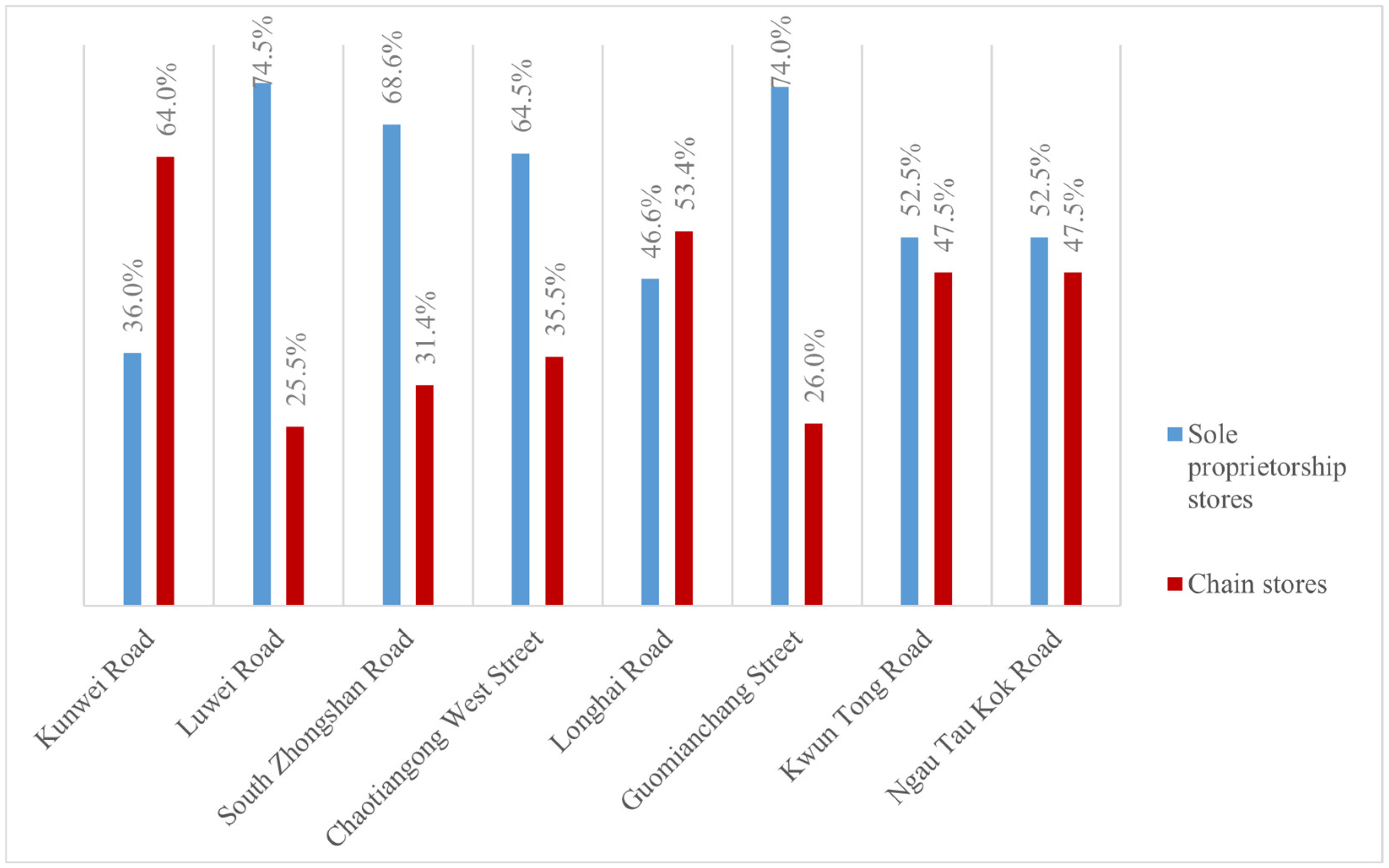
| City | Network Type | Segment | Total Number of Stores | Type of Store | Quantity | Proportion |
|---|---|---|---|---|---|---|
| Tianjin | High-value street segment of foreground network | Kunwei Road | 89 | Sole stores | 32 | 36.0% |
| Chain stores | 57 | 64.0% | ||||
| High-value street segment of background network | Luwei Road | 47 | Sole stores | 35 | 74.5% | |
| Chain stores | 12 | 25.5% | ||||
| Nanjing | High-value street segment of foreground network | South Zhongshan Road | 102 | Sole stores | 70 | 68.6% |
| Chain stores | 32 | 31.4% | ||||
| High-value street segment of background network | Chaotiangong West Street | 152 | Sole stores | 98 | 64.5% | |
| Chain stores | 54 | 35.5% | ||||
| Zhengzhou | High-value street segment of foreground network | Longhai Road | 88 | Sole stores | 41 | 46.6% |
| Chain stores | 47 | 53.4% | ||||
| High-value street segment of background network | Guomianchang Street | 104 | Sole stores | 77 | 74.0% | |
| Chain stores | 27 | 26.0% | ||||
| Hong Kong | High-value street segment of foreground network | Kwun Tong Road | 59 | Sole stores | 31 | 52.5% |
| Chain stores | 28 | 47.5% | ||||
| High-value street segment of background network | Ngau Tau Kok Road | 59 | Sole stores | 31 | 52.5% | |
| Chain stores | 28 | 47.5% |
| Service Type | Tianjin | Nanjing | Zhengzhou | Hong Kong | ||||
|---|---|---|---|---|---|---|---|---|
| Kunwei Road | Luwei Road | South Zhongshan Road | Chaotiangong West Street | Longhai Road | Guomianchang Street | Kwun Tong Road | Ngau Tau Kok Road | |
| Prepared food services | 15 | 29 | 26 | 39 | 25 | 43 | 6 | 19 |
| Commodity sales | 38 | 9 | 39 | 67 | 32 | 38 | 26 | 29 |
| Accommodation services | 1 | 0 | 8 | 4 | 2 | 0 | 0 | 0 |
| Financial services | 4 | 1 | 7 | 2 | 2 | 0 | 6 | 6 |
| Living services | 18 | 8 | 14 | 24 | 17 | 14 | 11 | 3 |
| Car services | 2 | 0 | 1 | 1 | 1 | 2 | 3 | 0 |
| Recreation and fitness | 1 | 0 | 0 | 6 | 2 | 0 | 2 | 1 |
| Education and training services | 4 | 0 | 1 | 0 | 4 | 0 | 2 | 0 |
| Medical services | 6 | 0 | 6 | 9 | 3 | 7 | 3 | 1 |
| City | Type | Name of Street Segment | Total Number of Stores | Effective Street Frontage Length (m) | 100-m Density (Stores/100 m) |
|---|---|---|---|---|---|
| Tianjin | High-value street segment of foreground network | Kunwei Road | 89 | 1112 | 8.01 |
| High-value street segment of background network | Luwei Road | 47 | 418 | 11.25 | |
| Nanjing | High-value street segment of foreground network | South Zhongshan Road | 102 | 2019 | 5.05 |
| High-value street segment of background network | Chaotiangong West Street | 152 | 906 | 16.78 | |
| Zhengzhou | High-value street segment of foreground network | Longhai Road | 88 | 1400 | 6.29 |
| High-value street segment of background network | Guomianchang Street | 104 | 615 | 16.92 | |
| Hong Kong | High-value street segment of foreground network | Kwun Tong Road | 59 | 1365 | 4.32 |
| High-value street segment of background network | Ngau Tau Kok Road | 59 | 359 | 16.40 |
| Analysis Scenario | Foreground Network Median | Background Network Median | Paired Ratio (Geometric Mean) |
|---|---|---|---|
| Baseline Rule (10 m buffer) | 5.67 | 16.59 | 2.59 |
| Lenient Rule (5 m buffer) | 5.68 | 15.61 | 2.60 |
| Strict Rule (15 m buffer) | 6.61 | 18.43 | 2.56 |
Disclaimer/Publisher’s Note: The statements, opinions and data contained in all publications are solely those of the individual author(s) and contributor(s) and not of MDPI and/or the editor(s). MDPI and/or the editor(s) disclaim responsibility for any injury to people or property resulting from any ideas, methods, instructions or products referred to in the content. |
© 2026 by the authors. Licensee MDPI, Basel, Switzerland. This article is an open access article distributed under the terms and conditions of the Creative Commons Attribution (CC BY) license.
Share and Cite
Jia, X.; Ren, Y.; Li, X.; Huang, J.; Zhong, G. Street Store Spatial Configurations as Indicators of Socio-Economic Embeddedness: A Dual-Network Analysis in Chinese Cities. Urban Sci. 2026, 10, 78. https://doi.org/10.3390/urbansci10020078
Jia X, Ren Y, Li X, Huang J, Zhong G. Street Store Spatial Configurations as Indicators of Socio-Economic Embeddedness: A Dual-Network Analysis in Chinese Cities. Urban Science. 2026; 10(2):78. https://doi.org/10.3390/urbansci10020078
Chicago/Turabian StyleJia, Xinfeng, Yingfei Ren, Xuhui Li, Jing Huang, and Guocheng Zhong. 2026. "Street Store Spatial Configurations as Indicators of Socio-Economic Embeddedness: A Dual-Network Analysis in Chinese Cities" Urban Science 10, no. 2: 78. https://doi.org/10.3390/urbansci10020078
APA StyleJia, X., Ren, Y., Li, X., Huang, J., & Zhong, G. (2026). Street Store Spatial Configurations as Indicators of Socio-Economic Embeddedness: A Dual-Network Analysis in Chinese Cities. Urban Science, 10(2), 78. https://doi.org/10.3390/urbansci10020078