
Article

Assessing Accessibility to Regional Hubs Through Integrated DRT–Rail Services: Evidence from a Case Study in Southern Italy

Department of Engineering and Architecture, University of Enna Kore, Cittadella Universitaria, 94100 Enna, Italy
*
Author to whom correspondence should be addressed.
Urban Sci. 2026, 10(3), 174; https://doi.org/10.3390/urbansci10030174
Submission received: 7 January 2026 / Revised: 1 February 2026 / Accepted: 10 February 2026 / Published: 23 March 2026

Abstract

Demand-responsive transport (DRT) services are increasingly recognised as an effective solution for enhancing accessibility, particularly in low-demand and peripheral areas. Existing scientific research has investigated DRT as a feeder service to modal interchange nodes, with a specific focus on railway hubs. In this study, an accessibility indicator is developed to compare direct road-based access to regional hubs with multimodal access combining road and rail, enabled by DRT services. The indicator is derived from a detailed analysis of road travel times and scheduled rail services and is applied within a regional-scale framework. Under the hypothesis that travel originates in the centre of each municipality in the area under consideration, two travel times are calculated: the time for the road alternative, based on the characteristics of the road network, and the time for the combined alternative, based on the attributes of the rail network. The resulting indicator allows for identification of the alternative that is more time-competitive for medium-distance travel on a regional scale and for mapping accessibility to attraction centres on a municipal basis. The methodology is applied to a case study in Sicily, Southern Italy. The analysis considers trips from all Sicilian municipalities to the metropolitan areas of Palermo, Catania, and Messina, assessing both the current situation and future scenarios based on planned railway infrastructure upgrades. The results indicate that, while direct road access remains the most efficient option for a large share of municipalities, the multimodal DRT–rail alternative becomes competitive in areas located near railway stations, particularly under scenarios that include major rail interventions, such as the upgrading and speed enhancement of the Palermo–Catania railway corridor.

1. Introduction

The United Nations’ 2030 Agenda for Sustainable Development Goals (SDGs) [1] emphasises the importance of accessibility to public transport systems. Goal 11, related to “Sustainable Cities and Communities”, and indicator 11.a, which measures the share of the population with equitable access to public transport, explicitly addresses this issue. Similarly, Goal 9 stresses the need to invest in sustainable infrastructure [2]. The problem of accessibility to public transport is especially critical in contexts characterised by infrastructural deprivation and low-demand areas, where conventional public transport (PT) systems—based on fixed routes and scheduled timetables—often fail to achieve an adequate trade-off between efficiency (economic sustainability) and effectiveness (social sustainability) [3]. The relationship between service accessibility and public transport provision has therefore gained increasing relevance in the literature [4,5]. With the growing diffusion of Mobility-as-a-Service (MaaS) systems [6,7,8,9,10], the importance of public transport accessibility for the elderly and vulnerable groups [11], and the growing interest in integrating passenger-freight transport in urban and rural areas [12], awareness of transport as a flexible, user-centred service has become increasingly consolidated. Within this context, demand-responsive transport (DRT) services offer solutions capable of addressing these challenges. DRT is a form of collective, on-demand public transport characterised by a higher degree of operational flexibility compared to conventional PT services [13]. Several typologies of DRT services exist, exhibiting different levels of rigidity. Depending on their relationship with conventional public transport, DRT services may either substitute PT in areas where it is absent or economically unsustainable or complement existing PT services [14]. In the latter case, DRT services may integrate conventional PT temporally, by covering time periods not served by scheduled services, or spatially, by acting as feeders to other public transport systems (e.g., rail or air transport). The role of DRT as a feeder service to the railway system has been extensively examined in the literature [15].
As a result, such services may contribute to promoting a modal shift from private vehicles towards rail-based transport.
The research question addressed in this paper, therefore, focuses on the possibility of deriving, at a regional scale, synthetic indicators capable of highlighting the potential applicability of DRT services for accessing a regional railway system serving major metropolitan centres. The aim of the paper is to understand several elements related to the integration of DRT with the railway network: the extent to which demand-responsive transport services can improve accessibility to regional railway systems when compared with direct road-based access to metropolitan centres; the spatial and infrastructural conditions under which the integration of DRT and rail transport becomes time-competitive at a regional scale; and the impact of planned railway infrastructure upgrades on the potential effectiveness of DRT as a first-mile access solution.
The paper aims to jointly assess the applicability of DRT services at the NUTS-2 (Nomenclature of Territorial Units for Statistics) spatial scale [16] by simultaneously analysing accessibility to railway stations and travel times along the rail network. The objective is to identify territories where the implementation of DRT services is potentially feasible and where such services are time-competitive. To this end, the paper proposes an integrated analysis of DRT and rail transport, considering metropolitan areas within the region as destination poles. This paper evaluates the application of the methodology to a regional case in Italy, the Sicilian Region. In the Sicilian regional context, accessibility disparities represent a long-standing and structurally embedded issue. Despite being the fifth most populous Italian region, Sicily exhibits some of the highest levels of automobile dependency in the country. At a regional level, the adoption of private motor vehicles was estimated at 74.4% in 2015, the base year for the development of the latest Regional Transport Plan, and this value is expected to decrease to 66.9% by 2030, the first year of the plan’s project scenario [17], compared with a railway public transport adoption rate of less than 1%. This low adoption can be analysed by considering the rail travel time disparities; for example, trips between major regional centres such as Palermo and Catania still require over three hours under current operating conditions, despite a road distance of approximately 210 km, resulting in limited competitiveness of rail-based solutions. These accessibility constraints disproportionately affect inland and peripheral municipalities, where reduced access to metropolitan centres is associated with population decline [18]. Some Sicilian cities have high average car density values. In 2024, the average value for the city of Catania was 815 cars per 1000 inhabitants, compared to the Italian national average of 694 cars per 1000 inhabitants and the European average of 571 cars per 1000 inhabitants [19].
From a regional and urban perspective, accessibility to major urban areas on a regional scale is a key dimension of spatial equity and territorial cohesion, especially in areas characterised by strong urban–rural disparities. In this context, transportation systems are a strategic planning instrument that shapes relationships between territories, linking main hubs and peripheral areas. The proposed framework may contribute as a planning tool to strengthening polycentric regional structures, reducing car dependency, and improving access to metropolitan opportunities. Linking transport system analysis to spatial structure, the study addresses key themes within urban science, including centre–periphery relationship and medium-distance regional accessibility.
The contribution of this study spans multiple domains. It is primarily relevant to three target groups: transport, urban, and regional planners, by providing insights into urban accessibility through public transport; public transport operators and managers, by identifying potential areas for service development; and researchers, by supporting the advancement of new transport choice modelling approaches that explicitly incorporate accessibility.
The remainder of the paper is structured as follows. Section 2 reviews the main contributions on DRT, outlining the state of the art on the integration of DRT with rail transport. Section 3 describes the mathematical models and the indicators employed in the analysis. Section 4 presents the study area, Sicily, a region in Southern Italy characterised by a well-established rail system and several ongoing infrastructure projects aimed at improving its performance, as well as by a “basin-based” transport system structure organised around the metropolitan areas of Palermo, Catania, and Messina. Section 5 discusses the results, while the final section presents conclusions and directions for future research.

2. Literature Review/Background

2.1. Accessibility to Railway Stations and Major Centres on a Regional Scale

The topic of accessibility can be introduced starting from the definition introduced by [20] as “a measurement of the spatial distribution of activities about a point, adjusted for the ability and the desire of people or firms to overcome spatial separation”. With reference to the transport dimension, it is also useful to recall [21], in which the authors define accessibility as the extent to which land-use and transport systems enable individuals or groups of individuals to reach activities or destinations by means of a transport mode or a combination of transport modes. Four components of accessibility are defined:
  • The land-use component, which refers to the opportunities and their distribution and demand in the territory.
  • The transportation component, which generally refers to the disutility for users associated with the generic mode of transport.
  • The temporal component, which refers to the different distribution of opportunities over time.
  • The individual component, which refers to how the individual characteristics of users can influence accessibility.
Four types of indicators are defined—infrastructure, location, person, and utility—based on the system components analysed and the application areas considered [21].
Recently, several working papers have emphasised the need for an accessibility assessment within transport systems. For example, ref. [22] underlines that “the current practice of transport appraisal can be improved if a broader perspective on accessibility measurement and valuation is adopted and existing comprehensive modelling tools are better utilised, including land-use/transport interaction models.” Furthermore, the International Transport Forum’s 2024 report highlights the need for a stronger focus on the sustainability dimension when planning accessibility alongside the transport system [23].
Sustainability and equity, from both social and territorial perspectives, are therefore crucial in the analysis of accessibility to the transport system. As already emphasised in Section 1, these elements are unevenly distributed across territories.
Accessibility can be defined as either active or passive, as summarised by [24]. Active accessibility refers to the ease with which a subject located in each area can carry out activities, that is, the ability to reach other areas from a defined location. Conversely, passive accessibility refers to the ease with which an activity located in a specific area can be reached by potential users. Accessibility can therefore be interpreted both as a user’s potential to move from a place and as the potential of a place or activity to be reached.
Inequities in access to services consequently lead to their uneven spatial distribution. At the regional scale, such disparities may refer to differences between large and medium-sized urban areas—typically characterised by a concentration of activities and services—and small cities, villages, and rural areas, where populations and activities are more sparsely distributed. Regarding access to services located in regionally significant urban centres, it is therefore necessary to analyse both the passive accessibility of cities and the active accessibility of centres.
In [25], access to regional centres is explicitly defined by adopting a territorial perspective at the municipal scale, based on the distance to the nearest regional centre. The evaluation is conducted by considering minimum travel times by road and public transport to the nearest urban centre.
Interest in the accessibility of urban centres is also reflected in [26], which assesses populations within catchment areas of the nearest railway station, based on a NUTS-3 territorial division in Europe. This focus is further confirmed by [27], which evaluates accessibility to the railway system—considering combined access and rail journeys—within the Rhine–Alpine corridor, one of the corridors of the Trans-European Transport Network [28]. Long-distance accessibility by rail is also examined in [29], where accessibility to Italian cities is measured using a generalised cost function.
Recent research has focused on the definition and development of accessibility and performance measures capable of capturing efficiency and equity dimensions within transport systems. Data envelopment analysis (DEA) and artificial intelligence techniques have been proposed to evaluate the performance of public transport origin–destination pairs by considering service efficiency [30]. Multi-criteria decision-making (MCDM) techniques have been applied to assess public transport systems by integrating structural and operational components, supporting evidence-based planning and policy evaluation [31]. Recent contributions have focused on the identification of key quality indicators using methods to support practitioners in monitoring system performance [32]. Emerging research emphasises multidimensional equity metrics that integrate service accessibility with temporal performance and quality attributes, illustrating how performance assessment increasingly seeks to account for real-world service experiences and equity outcomes [33].
The research topic is growing, and accessibility indicators are increasingly interpreted not only as measures of transport performance but also as proxies for regional equity, transport disadvantage, and territorial cohesion. The present study contributes to the literature by proposing a compact, time-based accessibility indicator designed for regional-scale applications, integrating first-mile on-demand services and scheduled rail transport within a unified analytical framework.

2.2. Adoption of DRT for Access to Railway Stations

The topic of using DRT for access to railway stations has been well researched in the literature, with different thematic areas being analysed. Since the 1990s, there have been various cases analysed in the literature which highlight how the use of DRT as a feeder of the railway system is the first choice for a service [34]. Access to stations is one of the six market niches studied by [35]. It is defined how DRT could be useful to match the increase in the price of car parking in railway stations; similarly, the construction of car parking could represent a critical element for companies, due to the high investments required. The possibility of providing a service that allows users not to miss the booked train represents, according to the authors, the real selling point of DRT for access to railway stations. As the main characteristic of a DRT service, the authors assume an average journey length to the station of 10 miles, and at 30 mph, it takes 20 min. In [36], the integration between a DRT service and the pre-existing public transport network is addressed through a data-driven approach. The application, carried out in the province of Catania and in the municipality of Acireale in Southern Italy, highlights how DRT can effectively serve access to railway stations and bus terminals, increasing access to opportunities on a provincial scale. The authors of [37] propose a new DRT planning strategy for the integration of DRT with the pre-existing public transport system, aimed at reducing accessibility inequalities on an urban scale.
One element investigated is the use of DRT to increase the accessibility of railway stations in areas with low demand. In [38], the focus is on shared first-and-last-mile transit systems, with reference to sparsely populated areas. The authors developed a framework that allows for enhancing the accessibility and efficiency of regional and national rail networks.
The authors of [39] highlighted how, in the study area of Tokigawa in Japan, a critical element of the public transport system investigated was precisely the weakness of the connections between the city centre and the stations located in areas outside the city. The pilot service proposed and analysed in [40] also plans the connection between some suburban areas connected to the nearest station within the metropolitan area of Palermo in Southern Italy. The advantages of a demand-responsive service in this area have been highlighted in [41].
In [42], several indicators are proposed and evaluated in a case study in Arnhem–Nijmegen in the Netherlands. One of them is the “% trips of DRT as access or egress leg”; the study indicates that, in the service studied, a significant share (approximately 20% of trips) used the railway station as the place of origin or destination of a journey made via DRT. The authors of [43] highlight that, in the case of Ragusa, Southern Italy, modal interchange hubs such as railway stations represent one of the main attractors for travel using on-demand transport services.
Several contributions highlight how, within the analysis of access to the railway system, railway timetables should also be considered, thus indicating the need for a joint analysis of access time to the railway station plus travel time, especially where the railway transport system is schedule-based and not frequency-based. It is the case of [44,45], in which a model is proposed for optimising total time at the train station, considering pedestrian access to bus stops and vehicle time.
Punctuality and the need to reach stations within a time window that allows one not to miss the train are central elements of the research [46]. Optimising access service to a main metro line is also a topic analysed in [47,48], which compared two different types of feeder services for a mass rapid transit service—fixed route and DRT—using an agent-based model. The paper highlights that DRT feeders are preferred when demand is spatially concentrated close to the mass rapid transit station or when station spacing is quite high (e.g., a regional railway service), thus supporting the use of DRT for regional-scale connections. Also, ref. [49] used an agent-based model to examine the impact of DRT, considering different scenarios, including the scenario in which DRT represents a feeder of the conventional transport system (bus and rail), causing a modal shift.
Among the other elements investigated in the literature, the role of penalties associated with the change in mode between the feeder and the main transport mode is notable, explicitly impacting the choice of the DRT–railway service combination. This is the case in [50], which highlights how first/last mile services appear more relevant in rural areas or for connections to (sub)urban high-speed public transport such as rail or bus rapid transit, while there are fewer cases of these types of services used as feeders within cities.
Technological innovations are considered within the scope of the study. Automated DRTs for access to railway stations are an element of research in [51,52].
The effectiveness of DRT as a tool for accessing train stations is widely recognised. Numerous studies emphasise that these services are more effective in rural or sparsely populated areas, where demand is low, and conventional PT services are inefficient. The literature has also highlighted the role DRT plays in ensuring punctuality; the flexibility of the on-demand service allows users to reach the station when needed and avoid the risk of missing their train.
Studies in the literature focus primarily on station access; there are no combined studies of access time and rail transit time to a destination. This type of analysis is particularly useful on a regional scale, where intercity rail travel could make it possible to reach large, and therefore particularly attractive, population centres. This paper aims to analyse this specific area of research, focusing on DRT–railway travel on a regional scale.

3. Methodology

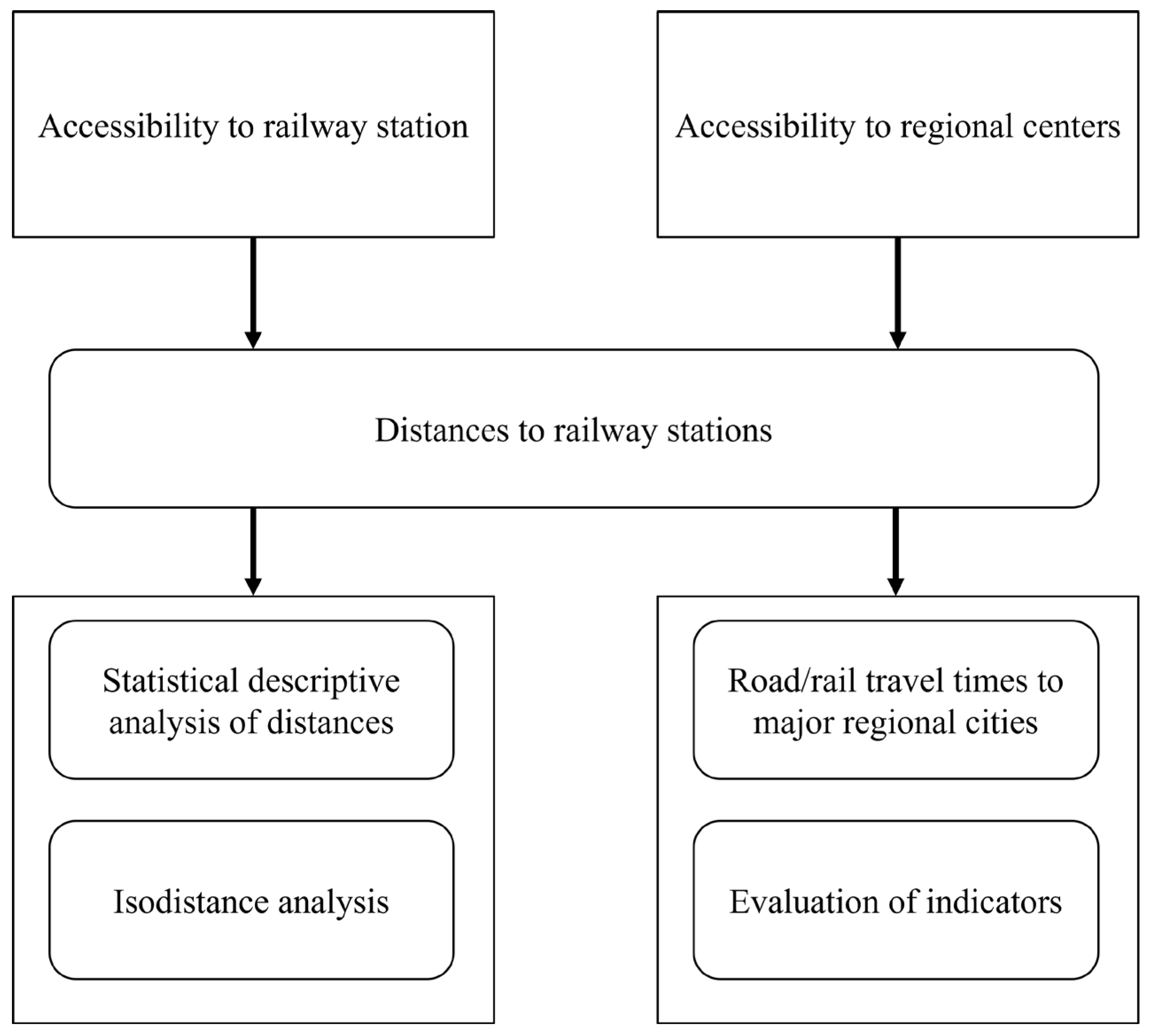
The contribution is divided into two main methodological steps. The first step studies the accessibility of railway stations in the NUTS-2 area. The second step proposes indicators for assessing the applicability of the service, starting with a comparison between road access and integrated road–rail access.
Figure 1 presents the proposed scheme with the two macro-areas and their main components.
A transportation system modelling (TSM) approach is used, schematising the supply of the individual road and railway systems, as well as of the overall integrated system through graph theory [53,54,55].
The first step of the contribution is represented by the study of accessibility to the railway system. Referring to [35], the average distance to access the rail stations is 10 miles. This distance is compatible with regional travel. The distance is identified for a primarily urban-scale journey, for a context different from the one analysed. To be more conservative, a minimum distance of 20 km, approximately 12.4 miles, is adopted below.
Given the generic municipality M i , with i = 1 , 2 , , N and N being the number of municipalities. To evaluate accessibility to the railway system for regional-scale trips, it is appropriate to refer to an average value of the access time, evaluated considering the distribution of potential users in the territory.
Let C i be the number of areas into which the municipality M i is divided, and let j = 1 , 2 , , C i j be the generic component area of a municipality. Each area j of the generic municipality M i is characterised by a population P i j and a centroid with coordinates ( x i j , y i j ) . The population of the municipality M i is given by P i = j P i j .
The origin of the trips (of users on a regional scale) is considered in the centroid, defined, for each municipality M i , by the coordinates
x i = j P i j x i j j P i j , y i = j P i j y i j j P i j i
Let S k , k = 1 , 2 , , K be the generic railway station with coordinates ( x k , y k ) . It is possible to define D i k as the minimum road distance between the origin node of the movements of the generic municipality M i and the generic station S k .
It is possible to define, for each municipality M i , the distance from the closest S k station, defined as S k * :
D i , k * = min j ( D i , k )
Distances are evaluated on the graph G r o a d = ( V r o a d , E r o a d ) , where V r o a d are the nodes of the graph, E r o a d are the links of the road graph. The generic road link e r o a d is characterised by a set of attributes.
The centres of the municipalities with coordinates ( x i , y i ) and the railway stations S k are part of the V r o a d set.
Given the generic station k , it is possible to obtain l k , the isochrones of range from station k . All the isochrones l k can be dissolved, obtaining l , the isochrone of range from the nearest station. Figure 2 represents the flowchart of the first methodological step.
To develop the second step, it is necessary to define the railway graph G r a i l = ( V r a i l , E r a i l ) with V r a i l and E r a i l , respectively, representing the nodes and links of the railway graph. The S k stations are part of the V r a i l set. Each e r a i l link is characterised by a set of attributes (travel time).
S z , z = 1 , 2 , , Z , are defined as potential destination stations for trips. S z represents the destination hubs for trips on a regional scale and is associated with the metropolitan city’s railway stations, forming part of both the railway and road networks.
It is possible to define the travel time T R ( M i , S k ) as the total travel time between the municipality M i and the generic station S k . The time is calculated as:
T R M i , S k = d 1 , i k v 1 + d 2 , i k v 2 + d 3 , i k v 3
where
  • d 1 , i k , d 2 , i k , d 3 , i k are the minimum travel distances between the municipality M i and the station S k travelled, respectively, on road arcs classified as motorways, main roads and secondary roads.
  • v 1 , v 2 , v 3 are the speeds, assumed constant, on highways, main roads, and secondary roads.
In the same way, T R M i , S z refers to the road distance between the generic municipality M i and the railway station located in destination city z .
T T ( S k , S z ) is defined as the train time required, on G r a i l , to reach station S z from station S k . The time T T ( S k , S z ) is equivalent to the scheduled time if a direct service exists. In the case of a service interchange is needed, a term is introduced to represent a penalty for each service change required to reach S z from S k .
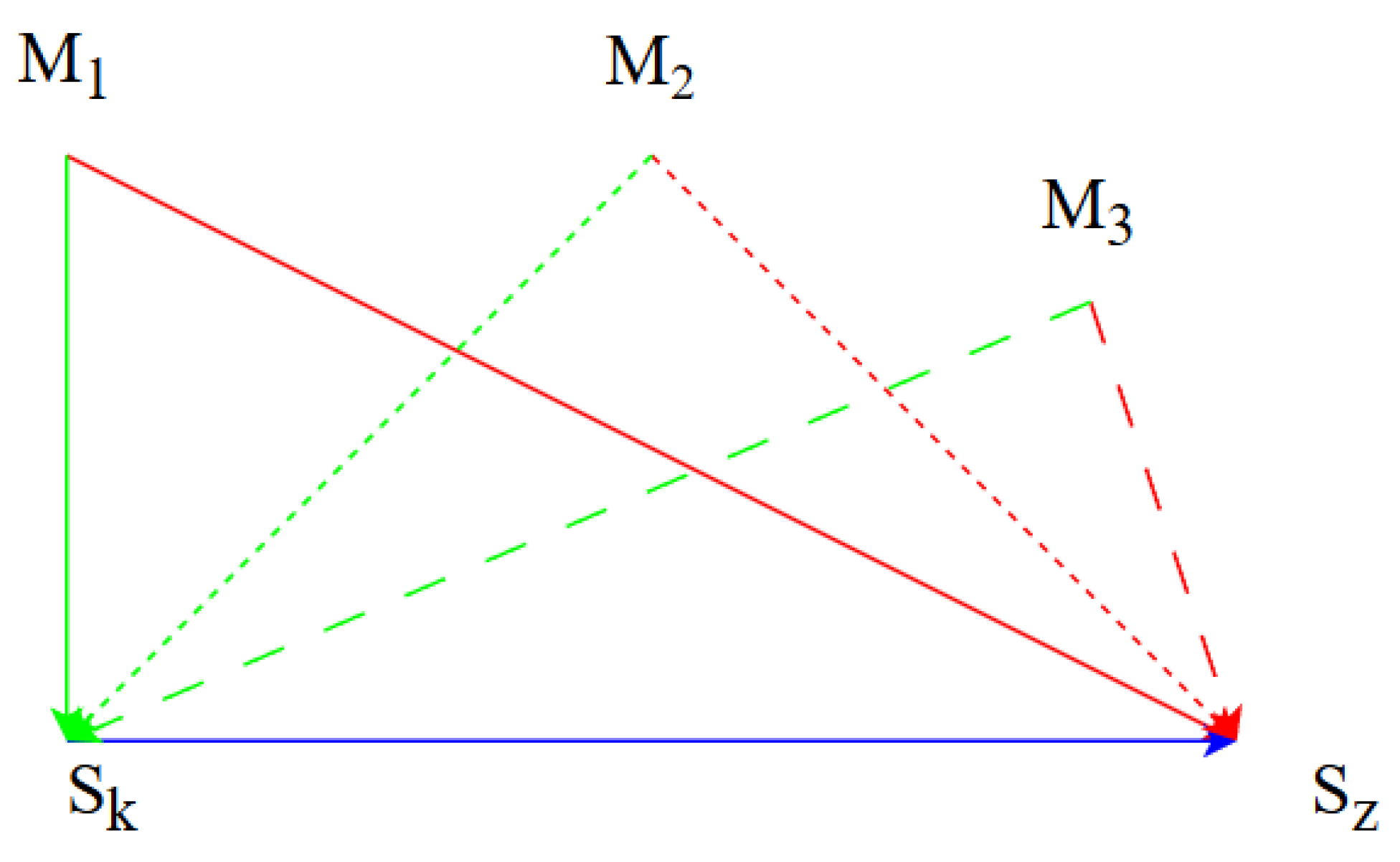
Access to the destination station S z is defined according to the scheme shown in Figure 3.
Given a generic municipality M i , the minimum combined time to reach station S z is
T * M i , S z = min k ( T R M i , S k + T T S k , S z )
Under the conditions
( 1 ) ( 2 ) D i , k * Q D z , k
where D z , k is the road distance between the destination hub z and the generic station k , and Δ is a fixed quantity that expresses a maximum threshold at which a DRT service can operate.
The first constraint expresses the condition whereby access to the station is evaluated only if the road distance is less than a certain value Δ .
The second constraint allows us to avoid distortions such as access to station S k in the immediate vicinity of the destination station S z , in which Q is the minimum road distance allowed between S k and S z .
The comparison between T * , which refers to the integrated time, and T R , which refers to road time, makes it possible to calculate an accessibility indicator to regional centres from individual municipalities as
I ( i , z ) = T * M i , S z T R M i , S z
As the value of I ( i , z ) varies, three main patterns can be distinguished:
  • I i , z 1 indicates a clear predominance of the combined DRT + train alternative over the road alternative. In this context, the implementation of DRT services can be crucial to exploit the time advantage offered by an efficient rail system or a deficient road system.
  • I i , z 1 indicates the two times are approximately equal. In this context, a DRT service for station access is desirable and can exploit the similarity in travel times compared to an all-road alternative.
  • I i , z 1 indicates a condition in which the rail system has a disadvantageous configuration compared to the road system, so a DRT service cannot exploit time as a determining attribute.
The indicator I ( i , z ) is a useful element for quantifying active accessibility from the various municipalities to the reference attraction centres. Studying the distribution of I ( i , z ) allows the evaluation of the number of municipalities within certain ranges. In this way, it is possible to define, out of the total number of municipalities, the percentage of those found in a range in which the integrated mode is competitive with the road alternative. Given indicator I ( i , z ) , N number of municipalities and z destination, it is possible to define the range of indicator [ I i , z m i n , I i , z m a x ] , which is divided into W contiguous classes B 1 , , B w , , B W . For each destination z it is possible to describe the absolute frequency of the number of municipalities by counting the number of municipalities whose indicator value falls within the generic B w .
H w z = i : I i , z B w
And the relative frequency of the number of municipalities
h w z = H w z N
The indicator allows for an evaluation linked to modal characteristics but treats individual municipalities as homogeneous structures. It is possible to broaden the role of I ( i , z ) by introducing, within the distribution evaluation, the population of each municipality. Population is the main demand attribute of accessibility. If I ( i , z ) with respect to the municipality i allows us to define the percentage of municipalities within a specific range of potential rail–road competition, I ( i , z ) with respect to P i population allows us to further verify the impact of each class of the indicator on the total population that can access the destination z . Given I ( i , z ) , N , z , and range [ I i , z m i n , I i , z m a x ] , divided into W contiguous classes B 1 , , B w , , B W . The population-weighted absolute frequency for the class B k was computed for each destination z city as
H w P z = i : I ( i , z ) B w P i
And the corresponding relative frequency as
h w P z = H w P z P
With P being the total population of the study area.
The schematisation of the accessibility analysis is proposed in Figure 4.
The evaluation can also be conducted by considering a project graph G r a i l , in which some interventions for the improvement of infrastructure or services in the railway system are hypothesised.
The aim is to define whether it is possible to increase the scope of convenience of the services for access to railway stations by improving the railway system. Once G r a i l , is defined, it is possible to evaluate I i , z starting from Equation (6) by introducing the new T T times relating to the design conditions of the railway system, thus defining
I = I i , z I i , z I i , z
Which allows to evaluate the increase in the value of the indicator considered.
The final step is schematised in Figure 5.

4. Results

4.1. Case Study Details

The case study analysed is Sicily. In Italy, the NUTS-2 distribution coincides with the administrative extension of the regions. Sicily has 4.8 million inhabitants [56], making it the fifth most populous Italian region. It is the southernmost region in Italy and one of the southernmost in Europe. It is separated from the Italian peninsula by the Strait of Messina, approximately 3 km wide at its narrowest point. This makes it a fully insular region because it is geographically separated by sea from the rest of the continent but, at the same time, characterised by some typical elements of terrestrial territorial continuity, such as the existence of rail transport services that connect the main centres of the island with Rome, crossing the Strait by means of ferry.
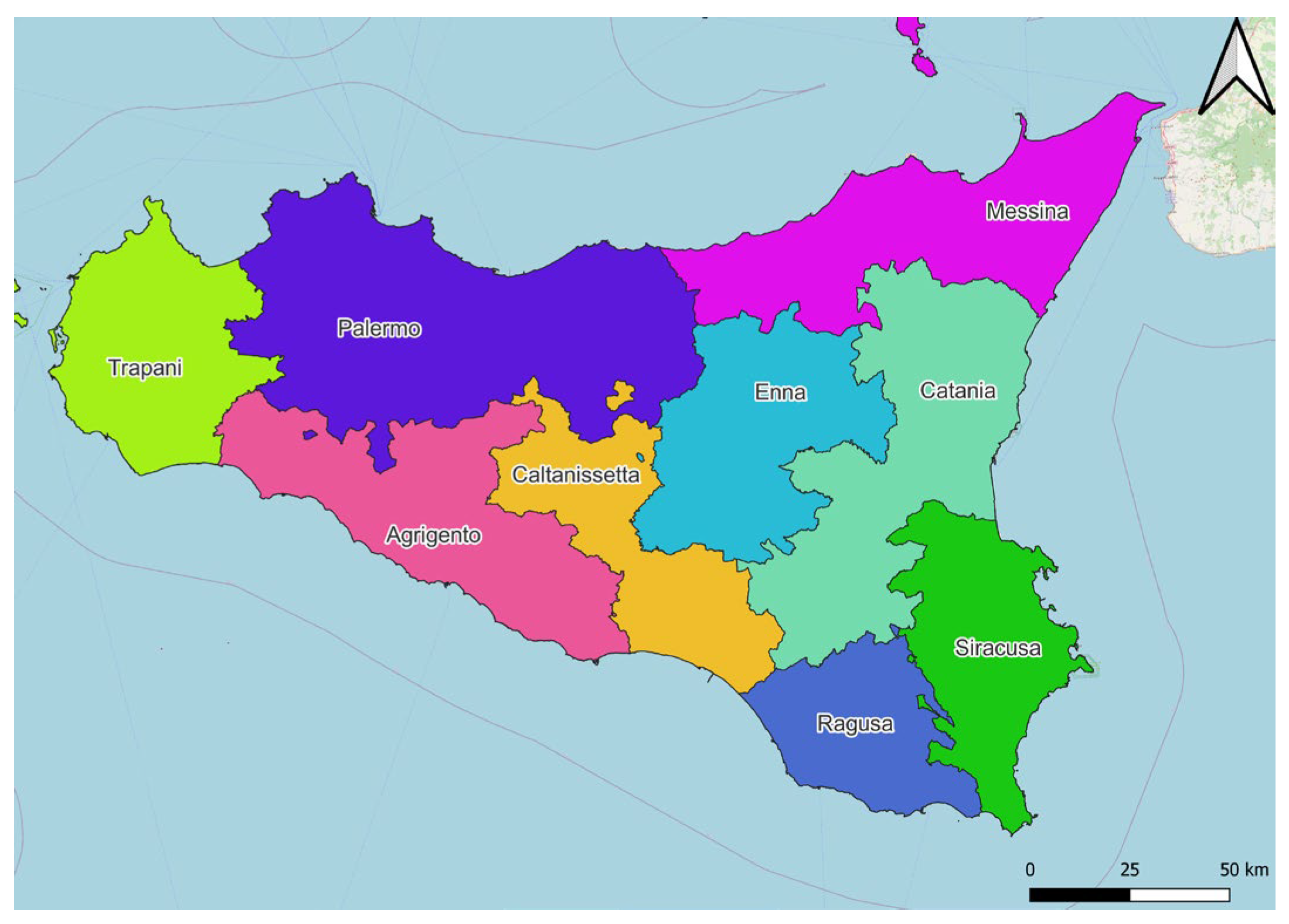
The region’s territory has the following administrative divisions. With reference to the LAU-2 classification of local administrative units (LAUs), the region is divided into 391 municipalities, which represent the local classification. At the intermediate level between the municipal and regional levels, reference is made to the NUTS-3 classification, which divides Sicily into nine zones, previously called provinces, now classified as six free municipal consortia and three metropolitan cities (Figure 6).
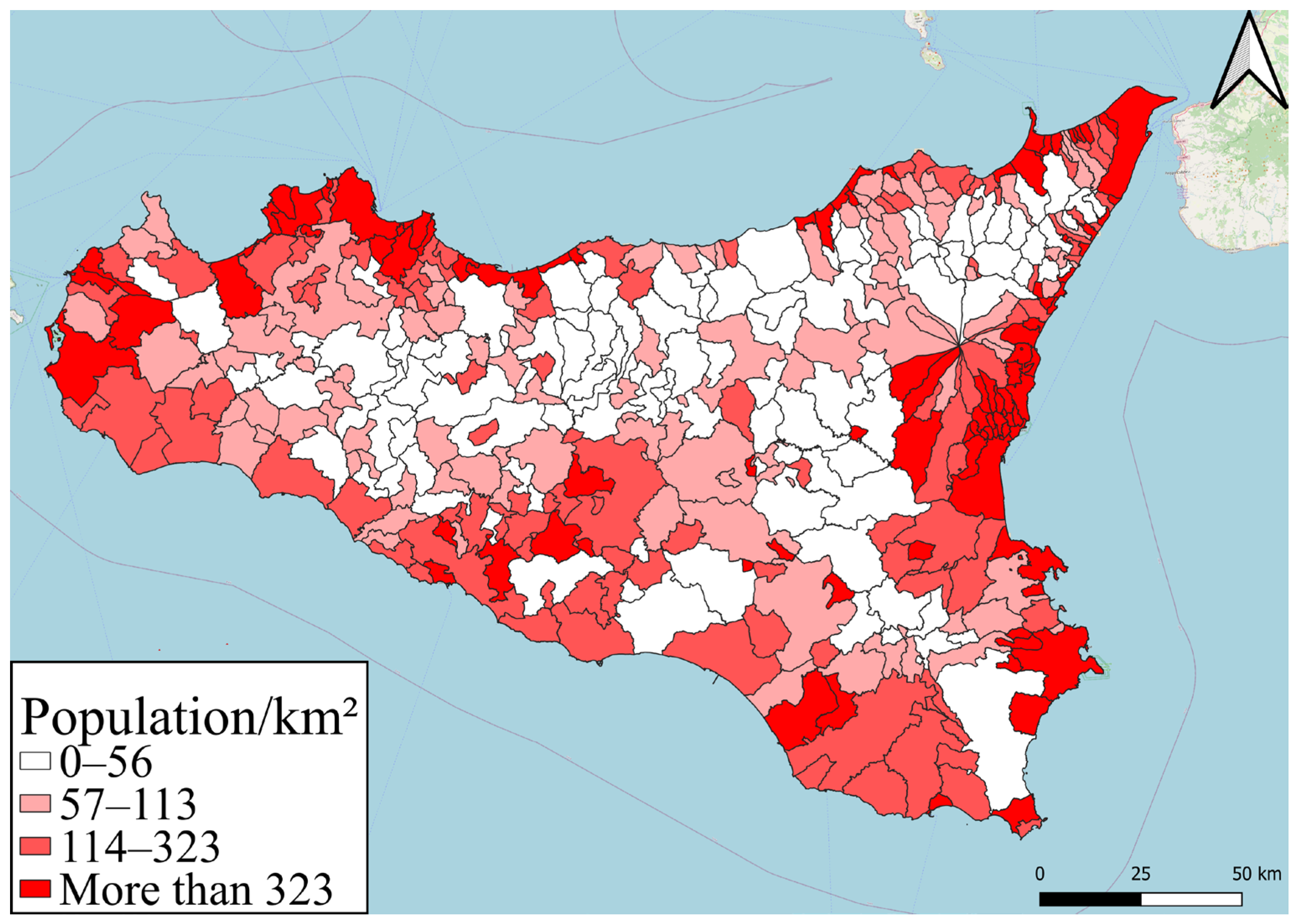
Approximately a quarter of the island’s resident population is concentrated in the municipalities of Palermo (regional capital, 625,956 inhabitants), Catania (largest city in the eastern part of the island, 297,517 inhabitants), and Messina (216,918 inhabitants), which are the capitals of the three respective metropolitan cities [57]. The distribution of the population in the regional territory, as highlighted in Figure 7, is uneven and tends to concentrate in coastal cities, giving rise to imbalances in population density between coastal and internal areas.
The region is characterised by a railway network managed by Rete Ferroviaria Italiana (RFI), the national railway operator in Italy. Overall, the standard gauge network has a length of 1370 km, of which 227 km are double track [59].
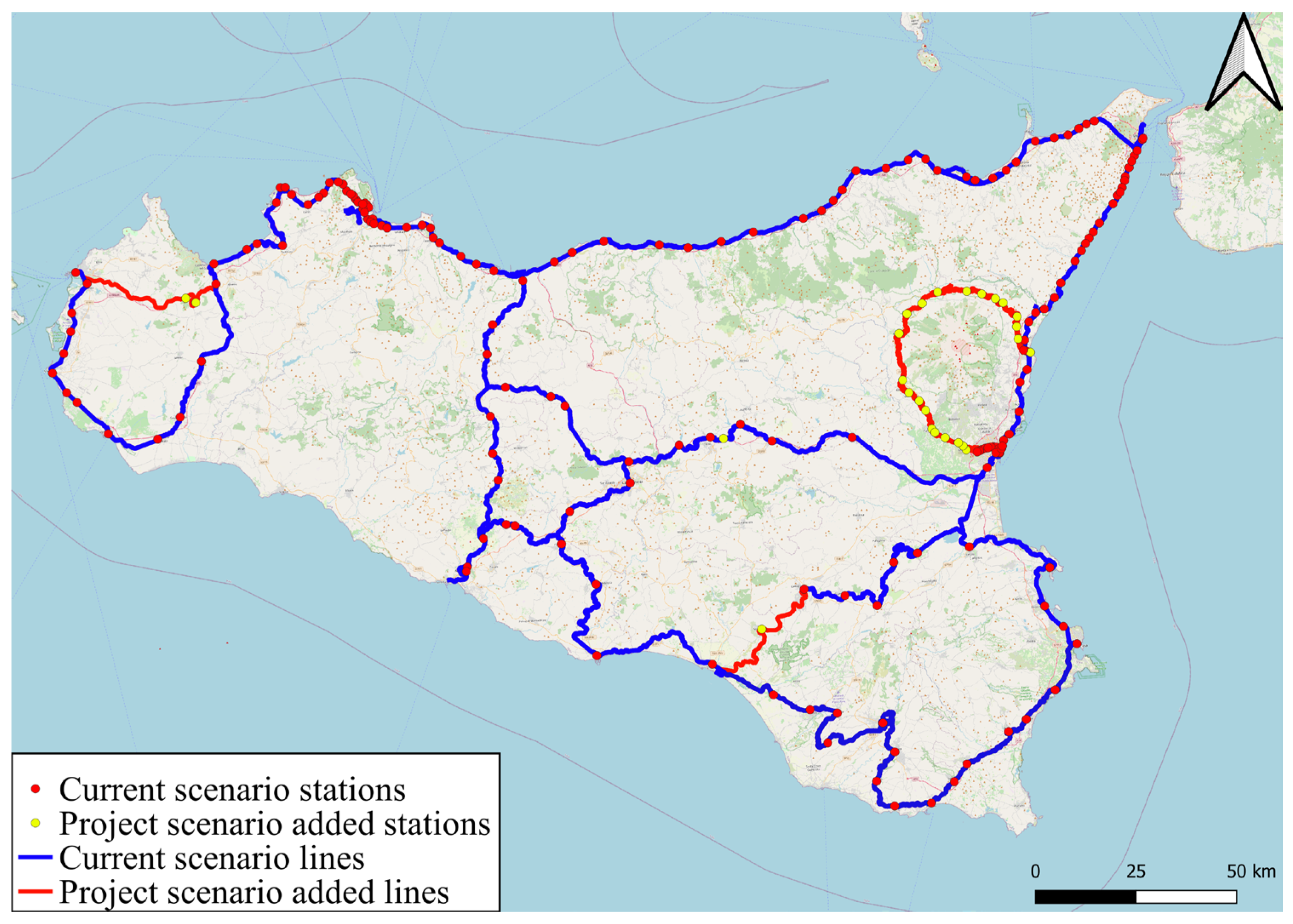
The network, represented in Figure 8, connects the main centres of the island. In addition to the RFI network, there is the Circumetnea railway, operated by the company of the same name. It is a narrow-gauge network that connects the city of Catania with Giarre, on the eastern coast, through the municipalities located on the perimeter of the Etna volcano [60], with a total length of 107.4 km. The same company also manages the line of the Catania metro system, with a total length of 8.7 km.
The Sicilian motorway network is organised as follows:
  • Approximately 400 km operated by ANAS, a public national society, which manages the main road section between Catania and Palermo [61].
  • Approximately 320 km are operated by CAS, a public regional society, which manages the route between Catania and Messina and between Messina and Palermo [62].

4.2. Data Acquisition

This work identifies the destinations considered for regional trips. The geographical division of the island based on the airport system identifies two traffic basins: Palermo and Catania; the subdivision based on ports identifies three Port System Authorities (Western Sicily Sea, Eastern Sicily Sea, and Strait of Messina). As previously noted, the administrative division identifies three metropolitan cities (Messina, Palermo, and Catania). Palermo and Catania are the main hubs of attraction in the western and eastern parts of the island, respectively. Messina attracts systematic travel in the northeastern part of the island and represents the connection hub with the mainland. The S z destinations are therefore identified as the stations of Palermo Centrale, Catania Centrale, and Messina Centrale.
The points of origin of the trips from each of the municipalities M i are determined by considering the centre of each census parcel weighted with respect to the population, as defined in Section 3, Equation (1). The data on the extension of the census parcels and on the population were obtained from ISTAT [58].
The Sicilian road network was obtained from OpenStreetMap [63]. To determine travel speeds on the road network, average speeds of 100 km/h on motorways (primary), 60 km/h on national and provincial roads (secondary), and 30 km/h on urban roads (tertiary) were assumed.
Regarding the railway network, in the current scenario and in the project scenario, reference was made to the travel times declared by the railway service operators, Trenitalia and FCE, in their respective timetables. In the current scenario, the network is assumed to operate according to the conditions defined in November 2025. Therefore, all stations of the RFI network are considered operational at the end of 2025, with travel times defined starting from the Trenitalia timetable [64].
The time considered is the shortest of those declared within an origin–destination pair; if there is no direct service, a transfer time of 15 min is assumed, following what is defined in Section 3. The FCE railway network in November 2025 is not considered in the study of the current scenario. The network is disconnected from the urban nodes crossed by the main network due to modernisation works [65,66].
The project scenario considers several improvements to the network in parts operated by both RFI/Trenitalia and FCE. The interventions referred to are the completion of the Catania metro on the section up to Paternò (FCE); resumption of regular rail traffic on the entire Circumetnea line (FCE); reopening of the RFI Alcamo Diramazione–Trapani section; reopening of the RFI Gela–Caltagirone section; and speeding up the Palermo–Catania line [67]. The interventions on the FCE network would allow the two systems to be integrated, except for a hypothesised transfer time of 15 min. Figure 8 shows the railway networks in the current scenario and in the project scenario.

4.3. Analysis

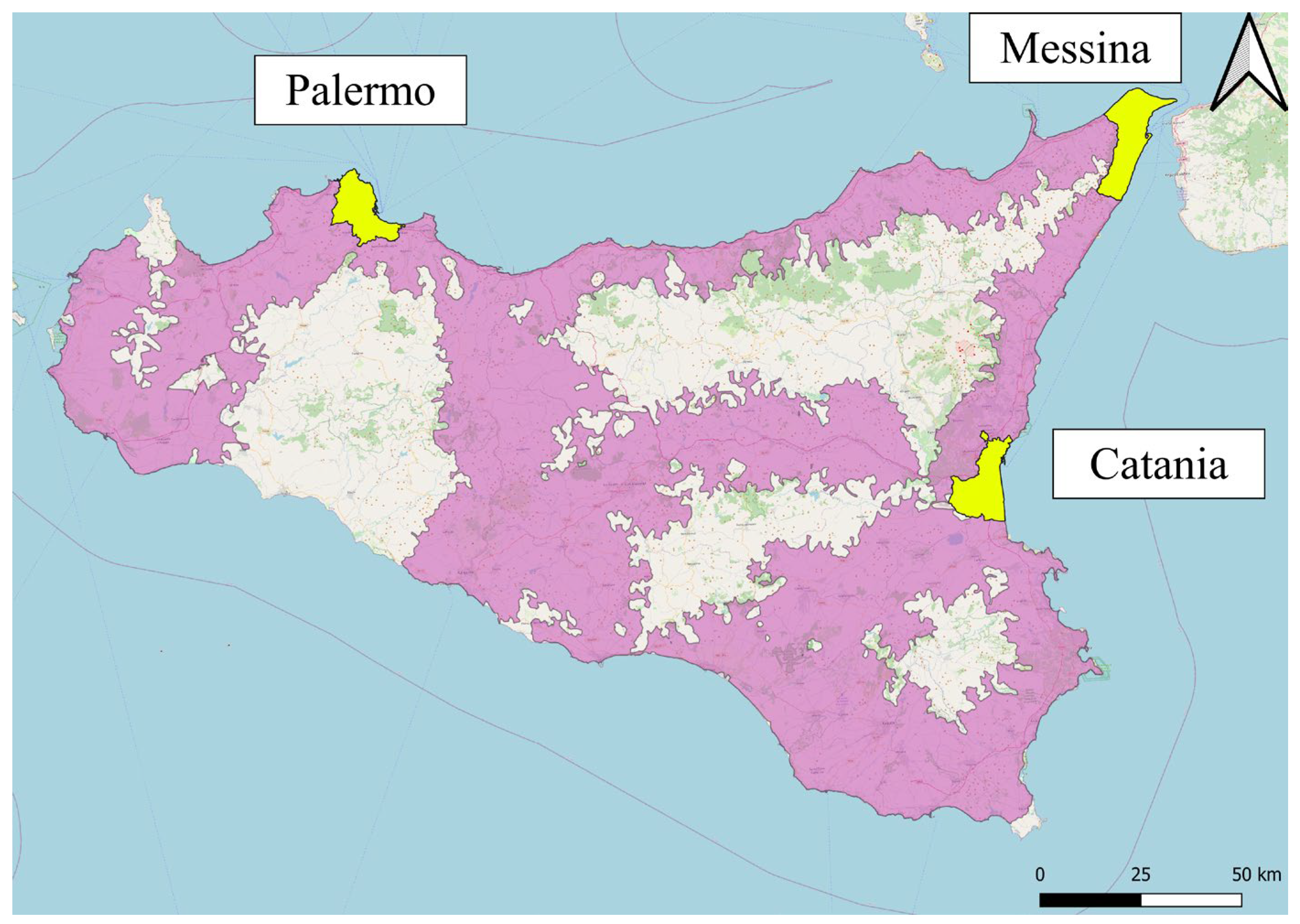
The analysis was conducted in accordance with the definitions introduced above, and the main results are presented below. Figure 9 depicts the 20 km isodistance from operating railway stations under the current scenario highlighting four areas that fall outside this threshold and are consequently characterised by territorial exclusion: a northern area marked by the presence of several mountain ranges; a southern area between the provinces of Syracuse and Ragusa; the area spanning the provinces of Palermo, Trapani, and Agrigento; and the area located between the provinces of Enna, Caltanissetta, and Catania. Furthermore, the analysis considers the subset of stations examined in November 2025 for the purposes of this study, namely those serving the cities of Catania, Palermo, and Messina. Stations along the Circumetnea railway are excluded at this stage of the analysis for the reasons discussed in Section 4.2.
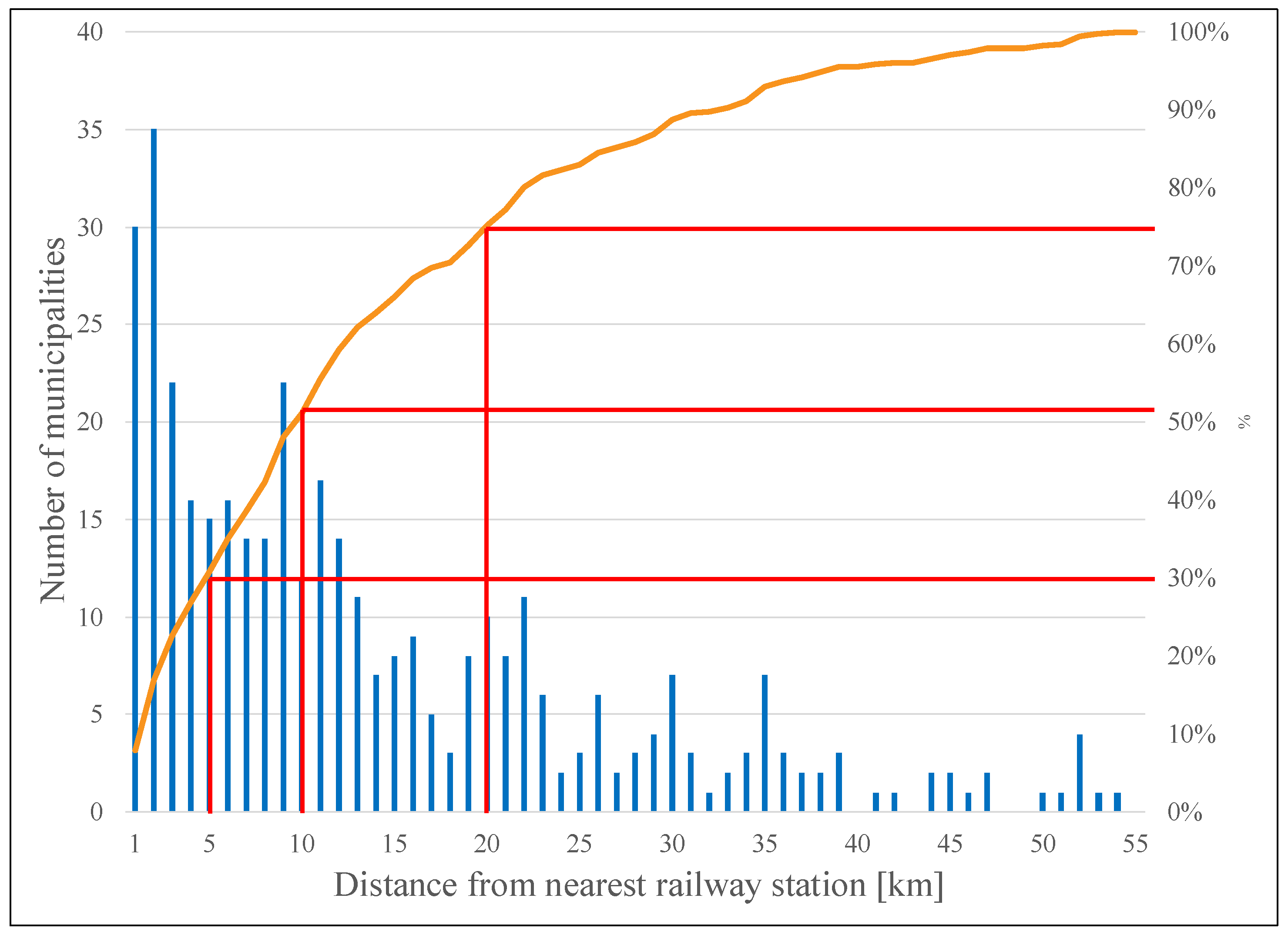
Figure 10 illustrates the distribution of municipalities by distance class from the nearest railway station, using the population centroid as a reference. The distribution follows a negative exponential trend, with more than 50% of municipalities located within 10 km of a station and approximately 75% within 20 km; the latter are therefore included in the analysis.
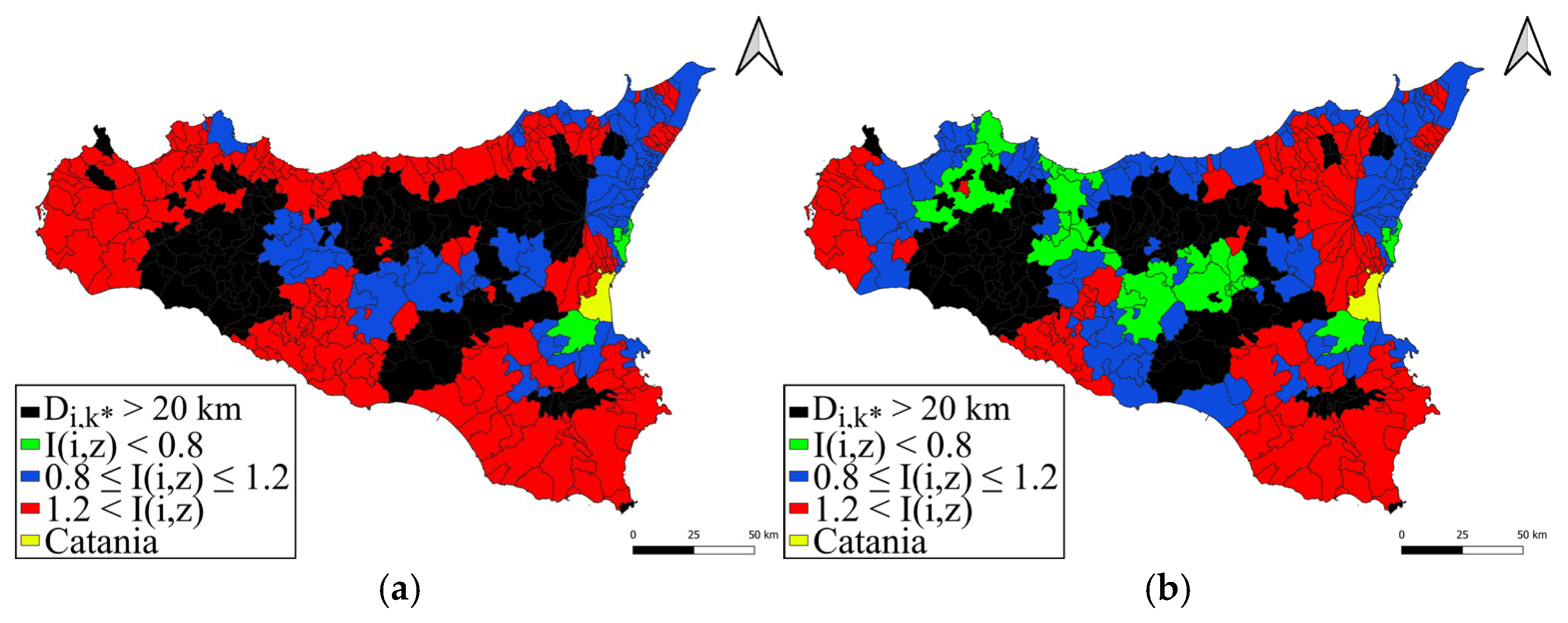
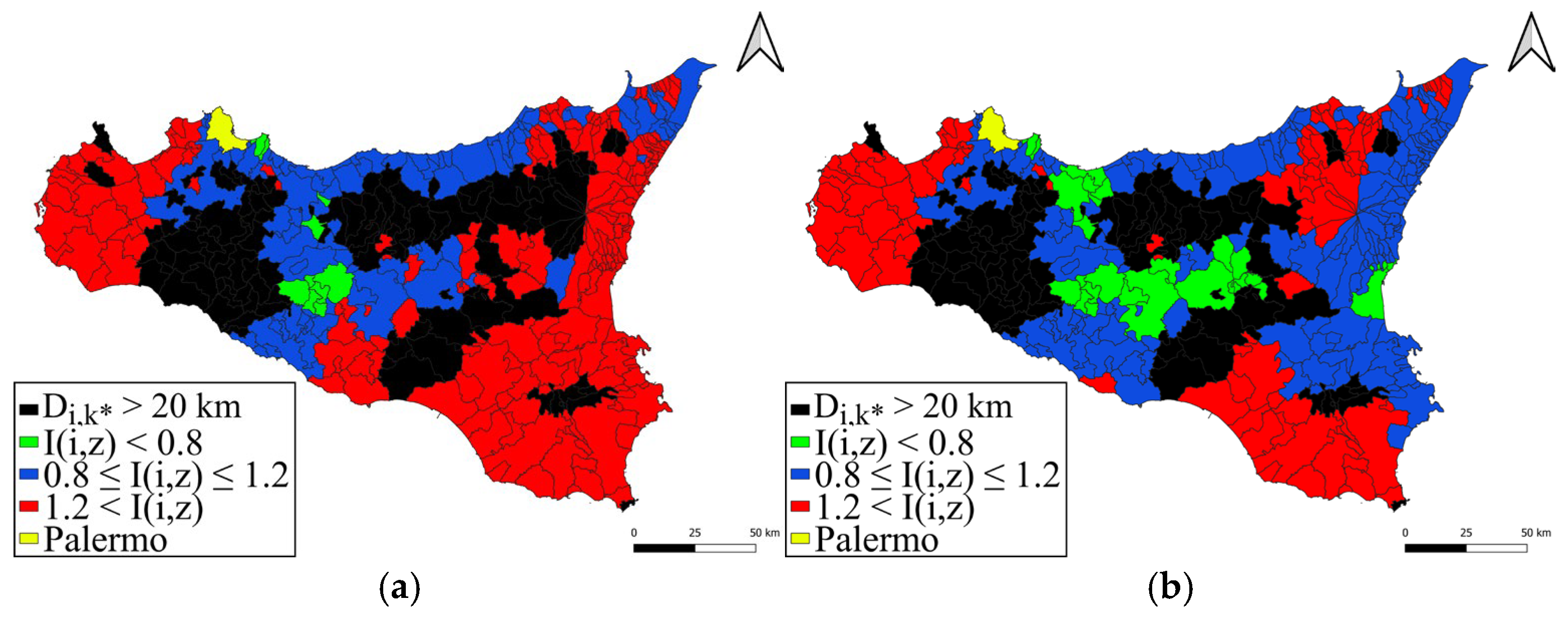
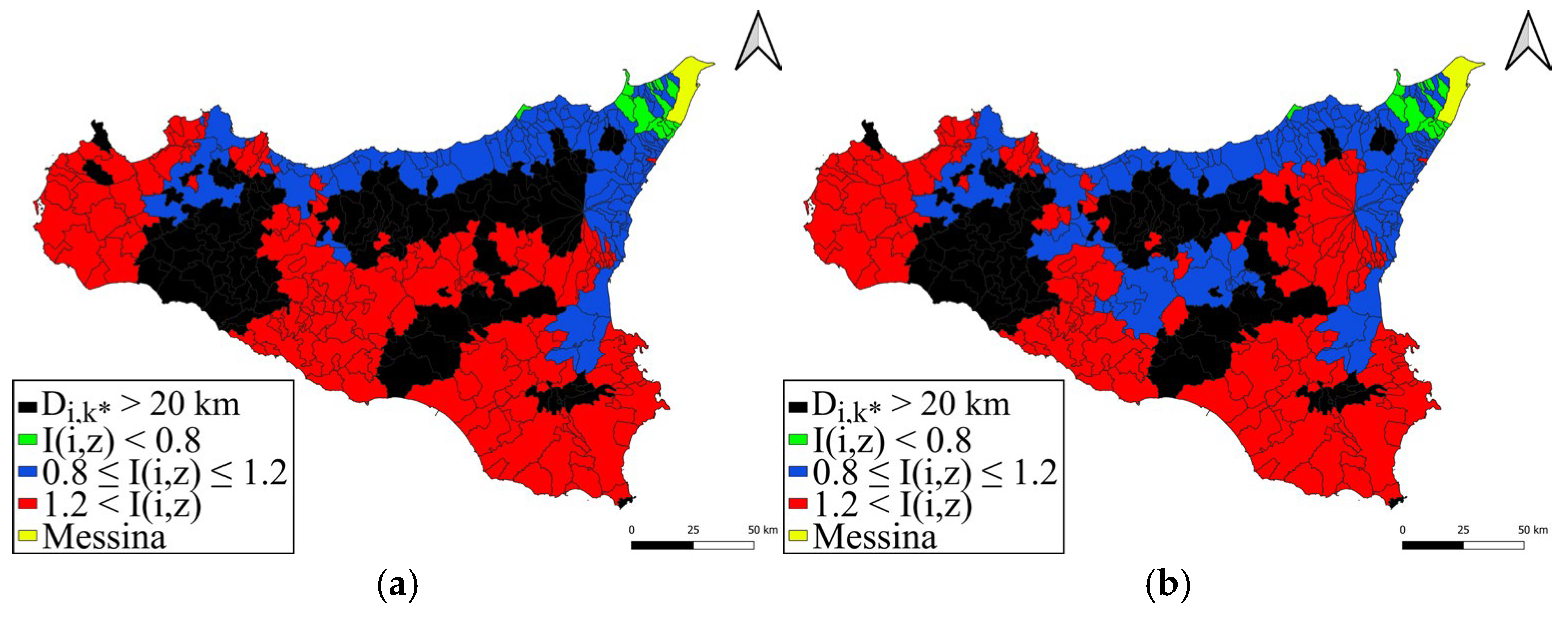
Figure 11, Figure 12 and Figure 13 show the distribution of I ( i , z ) for Catania, Palermo, and Messina on a territorial basis. The first significant overall result concerns the aggregate comparison between the current situation and that with the enhanced railway system. The opening of new railway lines has led to an increase in the number of municipalities less than 20 km apart, as can be seen in the three figures relating to the project scenario.
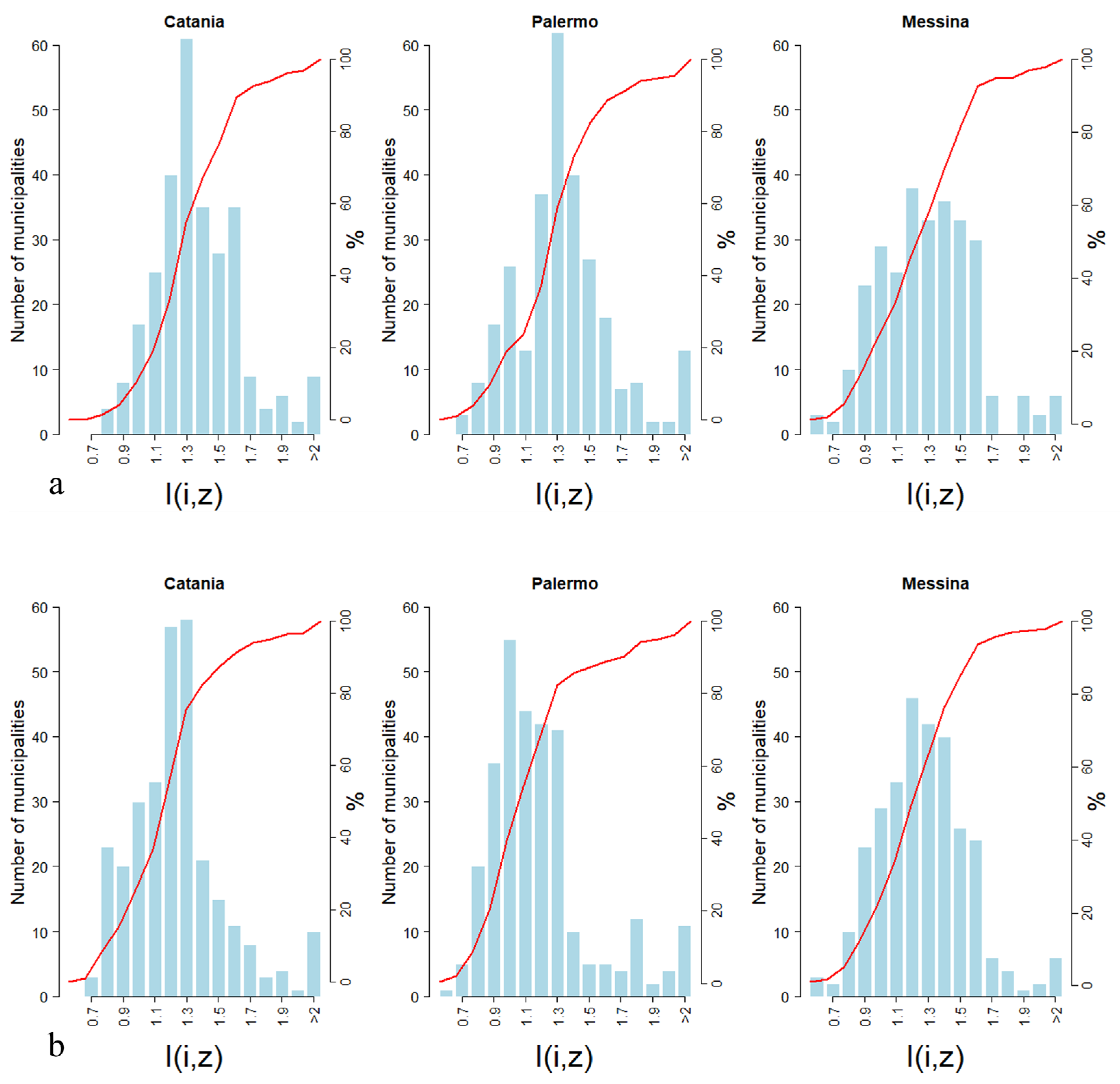
Considering Equations (7) and (8), the distributions of I ( i , z ) for the three possible destinations in the current and project scenarios are shown in Figure 14, together with the cumulative distribution, indicated by the red curve. In the proposed graphs, the municipality hosting the destination station has not been included in the respective graphs.
The aggregate results for the three cities are as follows:
  • Palermo and Catania, in the current scenario, have a steeper curve than Messina; Messina shows a more homogeneous distribution of municipalities between the two sides.
  • In the project scenario, the improvements mainly concern Palermo and Catania and less of Messina.
In the current scenario (Figure 14a), there is a difference in behaviour between the graphs for Palermo and Catania, with central peaks corresponding to the value of I ( i , z ) = 1.3 , and the graph for Messina, which shows a more homogeneous distribution. This difference in behaviour is explained by the characteristics of the supply system: Messina has two lines (the Palermo–Messina line and the Messina–Catania–Siracusa line) that already have better operating conditions; the line connecting Palermo and Catania, however, is subject to improvements. A significant leftward shift of the cumulative curve can be identified in the three project scenario diagrams (Figure 14b), indicating a general improvement in accessibility.
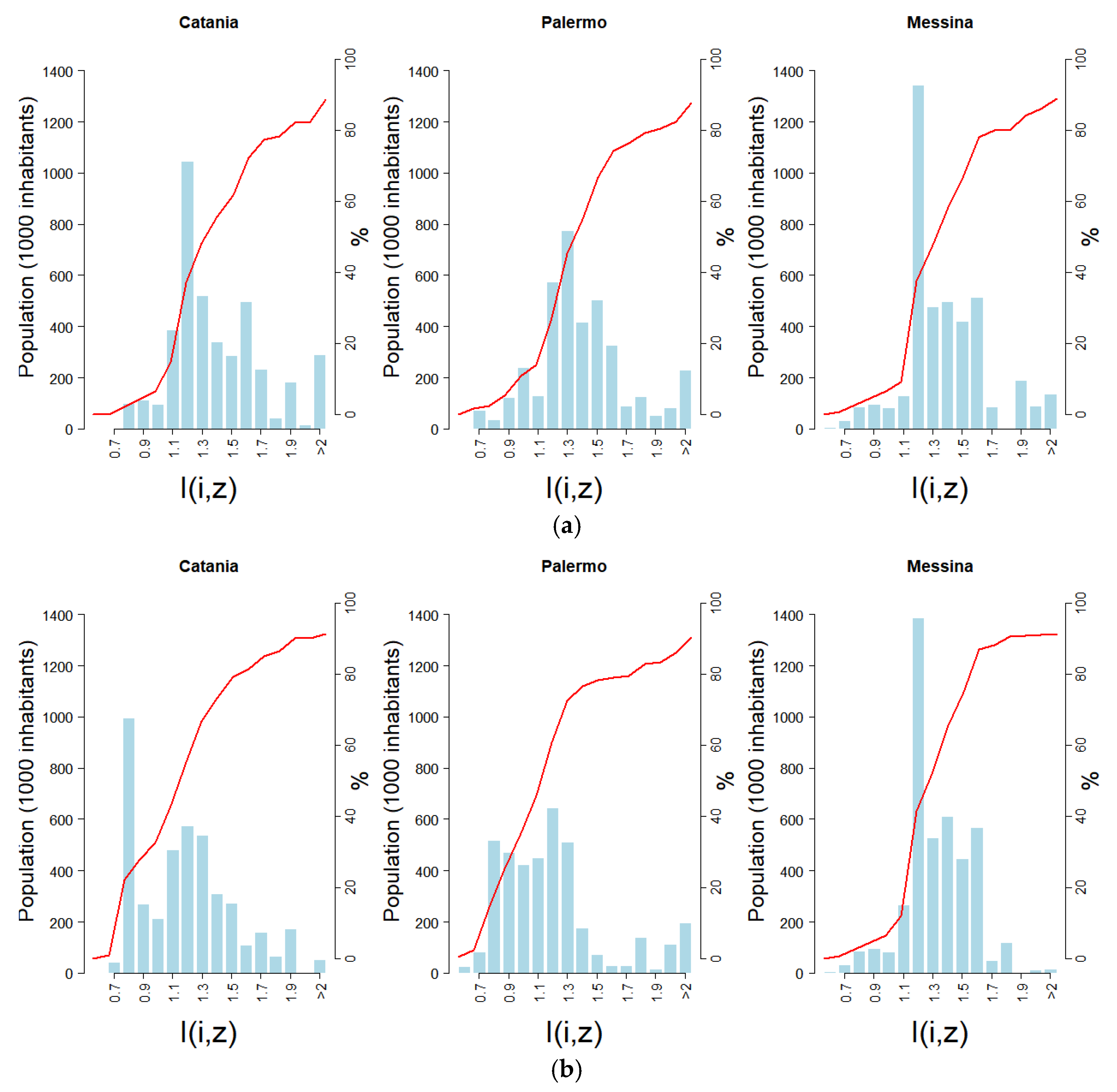
The most disaggregated results concern population distribution with respect to the variations in the indicators. Considering Equations (9) and (10), Figure 15 was drawn to represent the distribution of the population living in municipality i compared to the ranges of indicator I ( i , z ) . Figure 15 shows the population distribution by I ( I , z ) class, with respect to the three destinations, in the current and project scenarios.
The peaks present in the current scenario diagram (Figure 15a) are connected to the presence of the large cities that most influence the trend. In particular, in the Catania case, the municipality of Palermo, the most populous in the region, has a value of I ( i , z ) between 1.1 and 1.2, determining the population peak within this range. Similarly, I ( i , z ) falls within the same range, even when considering the accessibility of the city of Palermo from Messina. The diagram for Palermo does not show a comparable peak, since the population of the other two centres combined is lower than the population of the city. Note how the curves shift significantly to the left for all three destinations in the project scenario (Figure 15b).
Since the population considered varies (increasing the number of stations), to make the project and current graphs directly comparable, the total for each destination was calculated based on the total population of the island minus the population of the destination municipality z being considered.
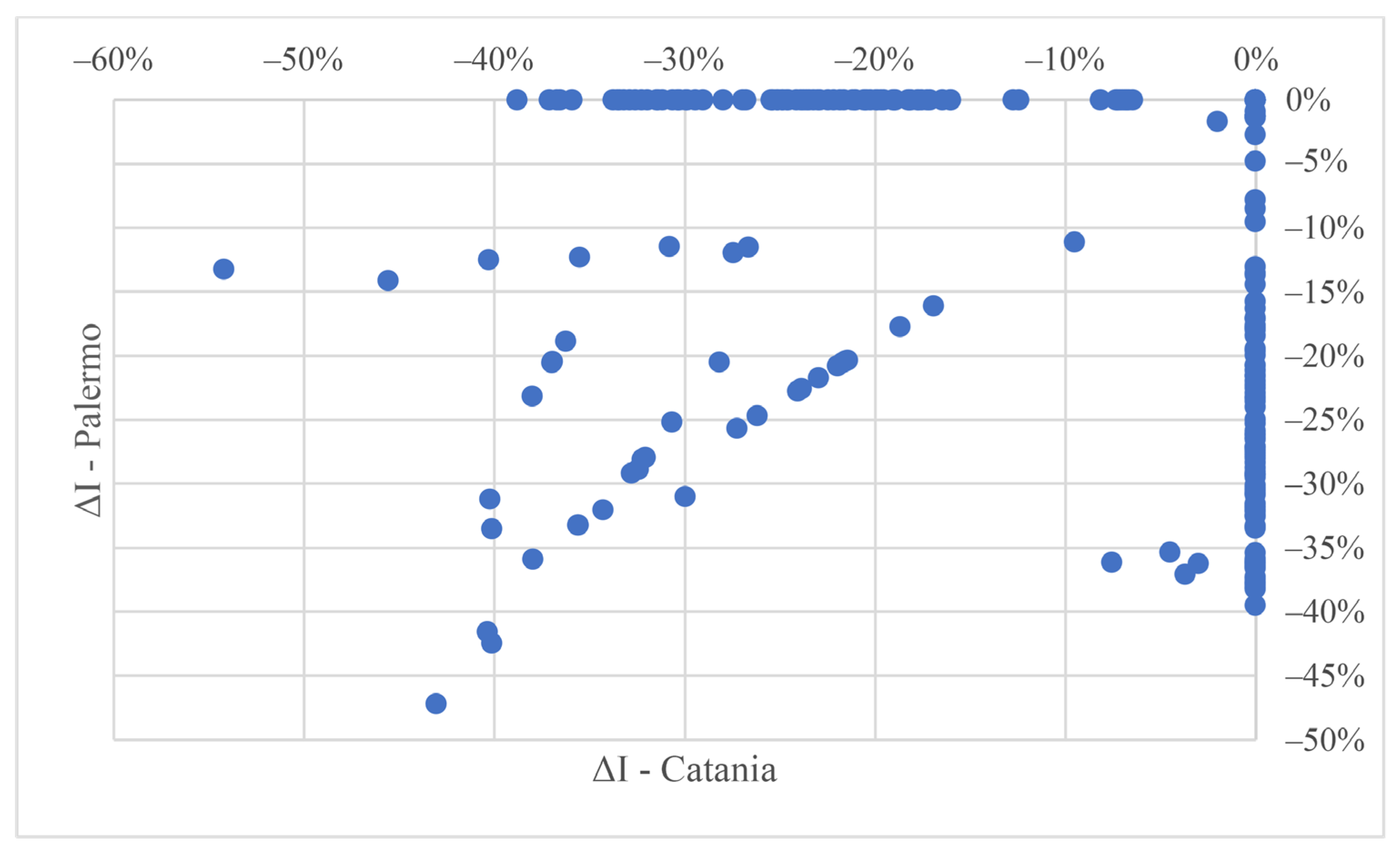
From the previous figures, it emerges that the most significant variation between the current and project scenarios concerns Catania and Palermo, where the infrastructure improvement interventions are concentrated. The distribution of the variation of I ( i , z ) and Δ I for Catania and Palermo is compared in Figure 16. The diagram in Figure 16 shows how municipalities follow specific patterns, which will be further discussed in the next section.
To characterise the geography of the results, the average values of I ( i , z ) for the three cases are studied by comparing them to some territorial characteristics of the indicated municipalities. With reference to the Italian classification [70], changes in the average value are evaluated, considering three attributes. The first attribute is the distinction between coastal zones (municipalities located on the coast or with at least 50% of their surface area within 10 km of the sea) and non-coastal zones. The second attribute is the geographical characterisation of the area according to the average altitude and, simultaneously, the impact of the sea, divided into 1 = Inland Mountain Area; 2 = Coastal Mountain Area; 3 = Inland Hill Area; 4 = Coastal Hill Area; and 5 = Plain. Finally, in accordance with the relevant legislation, the level of urbanisation is distinguished: 1 = “Cities” or “Densely populated areas”; 2 = “Small towns and suburbs” or “Areas with intermediate population density”; 3 = “Rural areas” or “Sparsely populated areas”.
Since I ( i , z ) has been defined only for the municipalities in which D i , k * 20   k m , the first distinction between the municipalities according to the distance from the stations and the geographical characteristics is characterised in Table 1, distinguishing the 382 regional municipalities not located on smaller islands
There is a significant discrepancy in access to stations between coastal and non-coastal municipalities; most coastal municipalities are less than 20 km from the nearest station, consistent with the railway network’s predominantly coastal layout. This division is also evident in the distinction between Coastal Mountain and Hill areas and Inner Mountain and Hill Areas, while inland mountainous areas are further from stations (10% versus 5% within 20 km of the nearest station). All municipalities classified as “Cities” fall within 20 km (in addition to the three metropolitan cities, there are only six cities). While most municipalities classified as suburbs fall within 20 km (40% of the total), compared to 7% outside this range, the percentage changes significantly for rural areas, approximately 20% of which fall outside this range. Overall, 100 municipalities out of a total of 383 (equal to 27.3%, or just under a third) are not included in the evaluation of I ( i , z ) .
The evaluation of the average value of I ( i , z ) divided by the geographical classes identified, before and after the interventions, is reported in Table 2.
A general decrease in the average value is observed for all geographic characteristics and for the three major attraction poles. In some cases, this decrease is significant, as in the case of the cities attribute. As previously defined, there are a few cities, and therefore, the specific weight of each of them is higher than average. Some cities, such as Ragusa and Gela in the south of the island, are not connected by direct rail services and require at least one transfer, despite the existence of fast road connections. Both Catania and Palermo show significant decreases for all categories; the reductions for Messina are less evident, linked to the current conditions, which see shorter travel times on the two routes that pass through the Strait. The relatively low value for the Coastal Mountain category, which includes most of the municipalities on the Tyrrhenian coast, is worth noting.

5. Discussion

The analysis conducted based on minimum-distance measurements shows that approximately 75% of municipalities are located at less than or within 20 km from the nearest railway station considered in the case study. This result indicates a good level of accessibility to the rail system for most Sicilian municipalities within the distance threshold adopted for the analysis. However, for the remaining 25%, the situation is particularly critical, as these municipalities are characterised by settlements located far from railway infrastructure, often with low population levels, where geographical and infrastructural marginality frequently coincide with social marginalisation. In these areas, the application of DRT services under the operating assumptions proposed in this contribution would face significant limitations.
Where intervention is most needed, and where demand-responsive mobility becomes crucial, is in the identification of intermediate, non-rail transfer nodes aimed at improving access to these territories by strengthening the integration between on-demand mobility and the existing extra-urban public transport network. As shown by the representation of the 20 km isodistance from railway stations, this condition of infrastructural criticality primarily affects four areas. The first area is in the northern part of the island and mainly concerns the almost continuous mountainous belt across the provinces of Messina and Palermo, namely the Peloritani, Nebrodi, and Madonie mountain ranges. The second affected area is the core of the province of Ragusa and the inland portion of the province of Syracuse, both characterised by the presence of a mountainous area, the Iblei Mountains. The third area is located at the boundary between the provinces of Enna, Caltanissetta, and Catania, an area characterised by hilly terrain and low population density. Finally, the last affected area corresponds to the inland zones of the provinces of Trapani and Palermo and the north-western part of the province of Agrigento, an area characterised by a substantial extent of decommissioned narrow-gauge railway infrastructure.
The analysis of the current scenario for the three metropolitan cities considered as destinations reveals a set of common patterns. In general, for each of the three metropolitan areas, the following elements can be identified:
  • An inner ring of immediately adjacent municipalities, where the value of I ( i , z ) is very low, thus indicating a high potential competitiveness of integrated rail transport. These trips are characterised by short distances, in the order of 15–20 km for extra-urban movements. This result highlights that, in the proximity of metropolitan cores, rail services exhibit good performance in terms of travel time. This condition mainly affects neighbouring municipalities that are strongly functionally interdependent with the metropolitan core cities. This is the case, for example, for Acireale, Bagheria, and Milazzo—three medium-sized municipalities whose local economies are integrated with those of Catania, Palermo, and Messina, respectively. The relatively low values of I ( i , z ) observed for these relations, therefore, suggest the feasibility of integrating on-demand services to provide access to railway stations in these municipalities for trips towards the three metropolitan cities. Moreover, in the case of Palermo, several municipalities located along the Palermo–Agrigento corridor also fall within this category; these municipalities are characterised by long road distances but lie along railway corridors served by direct services to Palermo or to local rail hubs.
  • An outer belt of municipalities, where I ( i , z ) assumes values between 0.8 and 1.2, corresponding to the defined competitiveness interval. For the three metropolitan cities, these municipalities are generally located along the three main corridors of the Sicilian rail system: the Ionian corridor from Catania to Messina, the Tyrrhenian corridor from Messina to Palermo, and the inland Catania–Palermo corridor. In the case of Catania, this group includes almost all coastal municipalities along the Ionian corridor, additional municipalities along the Catania–Palermo axis, and several municipalities in the southern part of the province of Catania. For Palermo, it includes most municipalities along the Tyrrhenian Palermo–Messina corridor—excluding the easternmost municipalities not served by direct rail services to Palermo—as well as several municipalities in the Agrigento area. For Messina, this group encompasses all coastal municipalities along both the Tyrrhenian and Ionian corridors. This finding confirms that rail accessibility is generally higher along the three main corridors, with coastal corridors outperforming the inland ones. In these municipalities, it is therefore reasonable to hypothesise the introduction of demand-responsive services operating as feeders to the rail system, integrated with the existing local public transport services.
  • A set of municipalities exhibiting the most penalised accessibility to metropolitan cities by rail. These municipalities, which generally show high values of I ( i , z ) for all three destinations, are in peripheral areas where rail infrastructure exists but is either inadequately served by time-competitive services or outperformed by road alternatives. A notable example is the relationship between several municipalities in the province of Ragusa and the city of Catania: while the rail connection follows the southern coastal route, the extra-urban road connection runs through the inland areas of the province. This spatial mismatch, combined with long rail travel times and the temporary closure of the Gela–Catania railway line, has determined a greater adoption of road transport modes over rail. A similar situation is observed for several municipalities in the province of Trapani, due to high rail travel times and the closure of the Alcamo Diramazione–Trapani line.
The project scenario, as defined in Section 4.2, identifies four main interventions: the upgrading of the Catania–Palermo railway line; the reopening of rail services on the Gela–Catania and Alcamo Diramazione–Trapani lines; the extension of the Catania metro system to Paternò; and the completion of works on the Circumetnea railway. The introduction of new rail links increases the number of municipalities located within 20 km of the nearest railway station and leads to substantial improvements in the values of I ( i , z ) for many origin–destination relations. For Catania and Palermo, the area in which the rail system exhibits the highest competitiveness extends to numerous inland municipalities along the Palermo–Catania corridor. This outcome may encourage public transport operators and planners to identify feeder services connecting municipalities along this corridor to railway stations. A relevant example is Enna, where the new railway station is located at a considerable distance from the urban centre.
A different pattern emerges for Messina, where overall improvements are less pronounced, given that the interventions included in the project scenario do not directly affect rail lines serving the city. This result also reflects the comparatively higher quality of rail services along the two coastal corridors converging on Messina. The peripheral areas of Trapani and Ragusa, despite experiencing a general improvement due to the reopening of the respective lines, remain marginal, as road transport continues to offer lower travel times. The full operation of the Circumetnea railway and the extension of the Catania metro would enable full integration of municipalities on the western slopes of Mount Etna into the regional rail network.
Figure 14 illustrates the distribution of municipalities across classes of I ( i , z ) . With respect to the city of Catania, 50% of municipalities exhibit values of I ( i , z ) 1.3 , corresponding (Figure 15) to slightly less than 50% of the island’s total population residing outside the municipality of Catania. The distribution of I ( i , z ) for Catania is therefore approximately symmetric around I ( i , z ) = 1.3 , although the population distribution differs. A pronounced peak is observed in the 1.2–1.3 interval, corresponding to the Catania–Messina and Palermo–Catania relations. Several highly populated municipalities exhibit very high values of I ( i , z ) with respect to Catania, particularly in the southern part of the island (e.g., Ragusa and Vittoria). More than 6% of the population residing outside the municipality of Catania lives in municipalities where I ( i , z ) > 2 , indicating average rail travel times more than twice those of road transport. Similar patterns are observed for Palermo.
By contrast, for Messina, the distribution shown in Figure 14 is the only one exhibiting a more homogeneous pattern across classes, confirming a more uniform accessibility distribution, with no pronounced peaks as observed for the other two metropolitan cities.
Finally, the comparison between the current and project scenarios highlights a systematic improvement in the class corresponding to the 50th percentile in the project scenario relative to the current one, as summarised in Table 3.
For the Palermo project scenario, it emerges that 50% of the values of I ( i , z ) fall within the class I ( i , z ) = 1 , indicating that half of the municipalities exhibit a theoretical combined travel time to Palermo that is lower than the corresponding road travel time. This result, therefore, clearly highlights an overall improvement of the network in terms of accessibility to the regional capital.
It is also important to examine how variations in I ( i , z ) with respect to Catania and Palermo evolve between the two scenarios. As illustrated in Figure 16, these variations may reach values of up to 50%, effectively halving rail travel times for certain origin–destination relations. Five homogeneous areas can be identified in Figure 16:
  • The first area consists of points located along the x-axis. These points represent municipalities characterised by no reduction in I ( i , z ) with respect to Palermo and a generic reduction with respect to Catania. This group includes many municipalities within the metropolitan area of Palermo and several municipalities in the Trapani area, which are not directly affected by the new infrastructure interventions but nonetheless experience improved accessibility to Catania due to the introduction of the new Palermo–Catania railway line.
  • The second area, which shows a behaviour quasi-symmetrical to the first one, includes municipalities exhibiting no reduction with respect to Catania and a generic reduction with respect to Palermo. These are primarily municipalities in the metropolitan area of Catania and in the province of Syracuse. Several municipalities in the province of Messina also belong to this group; in particular, municipalities along the eastern coast benefit from the upgrading of the Palermo–Catania line.
  • The third area comprises points characterised by a reduction of approximately 10% with respect to Palermo and a generic reduction with respect to Catania. These points are approximately aligned along a straight line parallel to the x-axis, with a y-intercept of about −10%. The municipalities in this group share a similar reduction in accessibility to Palermo, with only minor variations. They include all municipalities in the former province of Ragusa, as well as two municipalities in the southern part of the former province of Caltanissetta (Niscemi and Gela), which benefit from reduced travel times to both Catania and Palermo following the reopening of the railway line.
  • The fourth area is identified by a cluster of points exhibiting a modest reduction in I ( i , z ) with respect to Catania (5–10%) and a substantial reduction with respect to Palermo (35–40%). This group includes several municipalities in the province of Catania that experience improved accessibility to the nearby metropolitan centre due to the extension of the Catania metro system (Belpasso, Camporotondo Etneo, Misterbianco, Motta Sant’Anastasia) while simultaneously achieving significant gains in accessibility to Palermo because of the upgrading of the Palermo–Catania railway line.
  • The fifth area is represented by points for which both reductions exceed 15%. Most of these municipalities are distributed along the main diagonal, indicating reductions of a similar magnitude towards both Palermo and Catania. They are mainly located in the provinces of Enna, Caltanissetta, and Agrigento, which benefit from the new railway line, as well as in several municipalities in the province of Trapani, owing to the reopening of the Alcamo–Trapani line.
The study does not aim to define a structured optimal investment strategy. However, it is possible to define a prioritisation framework starting from the definition of I ( I , z ) and I . By jointly considering the indicator and its variation in response to railway system improvements, municipalities can be classified according to their potential responsiveness to integrated DRT–rail policies. Municipalities with a high I ( i , z ) value define a priority area, in which the implementation of an on-demand station access service allows them to exploit their time-competitive position, and in which improving the first mile branch allows for improved connections to the relevant urban centre. In this context, a high Δ I value may indicate a further prioritisation component, requiring, during the implementation phase of a hypothetical access service, verification of the railway’s operating conditions after the implementation of the railway project scenario. Municipalities with a low I ( i , z ) value but a high I value represent a scenario of conditional opportunity, in which, under the current scenario, trains are not competitive with roads, so competitiveness with respect to time must be assessed based on the characteristics of the project scenario. Finally, a condition in which I ( I , z ) is high and Δ I is low or zero implies that the criteria for the possible implementation of a DRT must be shifted to other attributes, and that competitiveness with respect to time cannot be achieved.
The proposed results must be interpreted within the time horizon defined by the current and planned railway infrastructure scenarios. Changes to rail service characteristics were not incorporated into the study beyond those expressly indicated in the planned scenario. Minor changes, such as the introduction of new direct services within the planned scenario, were not implemented. Nevertheless, the methodology itself remains valid as a long-term planning support tool, as it can be updated as new infrastructure or service data becomes available. The main benefit of analysing this case study is related to the structure of the railway network, which is connected to the island nature of the region. The network lacks connections with other regions, apart from a few long-distance connections from the main cities to Rome, due to the lack of a stable system crossing the Strait of Messina. This allows it to be considered an isolated case. Among the limitations of this case study, it must also be considered that, due to the orographic nature of the island, many towns, even medium-sized ones, fall outside the 20 km range used as the cutoff value; therefore, they were excluded from the analysis.

6. Conclusions

Accessibility to the public transport system has become a critical issue due to its social and environmental externalities. This paper introduces a quantitative indicator for the assessment of accessibility to major urban centres at the regional scale (NUTS-2). The indicator is based on a comparative evaluation of travel times between an integrated demand-responsive transport (DRT) + rail system—defined as the sum of station access time and in-vehicle rail travel time—and equivalent road travel times. This comparison enables the identification of spatial domains within which differentiated policy and service interventions can be effectively implemented.
The proposed modelling framework allows transport planners to detect areas where the introduction of on-demand services may be time-competitive with respect to private road transport. Application of the model to the case study results in the identification of three spatial typologies surrounding the reference cities. The first typology corresponds to areas where rail-based travel times make the integrated DRT–rail mode potentially competitive; these areas typically include interactions between large metropolitan centres and major municipalities in their immediate hinterland. The second typology encompasses locations where rail transport remains potentially competitive, generally consisting of urban centres located along primary rail corridors. The third typology includes peripheral corridors and areas served by the rail network where service levels are insufficient, or comparatively less efficient than the road network for the same origin–destination pairs.
The analysis has been extended to a project scenario, assuming targeted investments in rail infrastructure and service enhancements aimed at reducing combined travel times. This scenario-based approach enables the calibration of on-demand service deployment as a function of the temporal performance of the rail supply over a defined planning horizon. The methodology was applied to a regional case study (NUTS-2) in Southern Italy. The study provides a methodological framework for the integrated analysis of rail and DRT systems in ensuring access to regional centres, supporting the formulation of deployment strategies for DRT services based on the values of the proposed accessibility indicators. The contribution is innovative in that it proposes compact, synthetic indicators capable of aggregating regional-scale rail transport performance, embedding station accessibility within a destination-oriented framework rather than treating it as an independent attribute.
Several limitations require consideration and provide directions for future research. A primary limitation concerns the spatial scale of analysis. At the regional level, origin–destination distances exhibit substantial heterogeneity, with relationships differing by up to an order of magnitude. For short-range trips, such as those between large cities and adjacent municipalities, station access time represents a higher share of total combined travel time than for longer regional trips. This characteristic may constrain the modelling assumption adopted in this study, namely the use of the shortest-path distance between municipal centroids and railway stations. Such an assumption may be inconsistent with the operational characteristics of DRT services, which are inherently non-fixed and may deviate from minimum-path routing. While this limitation is intrinsic to the need for a uniformly defined regional-scale indicator, future work should investigate the development of indicators that explicitly account for access-route variability by reducing the spatial resolution to the provincial scale (NUTS-3). A further limitation lies in the exclusive use of travel time as the explanatory attribute. For DRT services, additional attributes—such as service reliability, waiting time, cost, and comfort—may significantly influence user choice behaviour and should be incorporated in subsequent modelling efforts; furthermore, attributes such as car damage and theft, fuel costs, and difficulty finding parking are all elements that could discourage people from using private cars to access train stations and must be considered in more specific modelling.
The paper contributes to multiple disciplinary domains. Within spatial and transport planning, it bridges urban- and regional-scale mobility analysis by providing decision-support tools applicable to both planning levels. The findings support transport planners in the formulation and appraisal of mobility policies and are also relevant for public transport authorities and operators in identifying potential areas for service enhancement and network development. From an academic perspective, the study offers methodological insights for the advancement of modal choice and accessibility modelling, contributing to a rapidly evolving research field that increasingly integrates accessibility as an endogenous component of transport system analysis. Beyond its academic contribution, the study provides relevant scientific and social insights. It advances accessibility-based approaches by jointly considering DRT services and rail network performance at a regional scale. From a social perspective, the results highlight the potential role of demand-responsive transport in reducing accessibility gaps between metropolitan centres and peripheral or inland municipalities, thus contributing to more equitable access to essential services and opportunities.

Author Contributions

Conceptualisation, A.R.; methodology, A.R.; software, A.R.; validation, A.R., T.C. and G.T.; formal analysis, A.R.; investigation, A.R. and T.C.; resources, A.R.; data curation, A.R.; writing—original draft preparation, A.R.; writing—review and editing, T.C. and G.T.; visualisation, T.C.; supervision, G.T.; project administration, G.T.; funding acquisition, A.R. and T.C. All authors have read and agreed to the published version of the manuscript.

Funding

This research received no external funding.

Institutional Review Board Statement

Not applicable.

Informed Consent Statement

Not applicable.

Data Availability Statement

Data are available upon reasonable request.

Acknowledgments

The authors would like to acknowledge the support provided by the MUR (Italian Ministry of University and Research) through SMART3R-FLITS: SMART Transport for Travellers and Freight Logistics Integration Toward Sustainability (Project protocol: 2022J38SR9_03, CUP Code: J53D23009330008), linked to the PRIN 2022 (Research Projects of National Relevance) programme.

Conflicts of Interest

The authors declare no conflicts of interest.

References

  1. United Nations. Transforming Our World: The 2030 Agenda for Sustainable Development. 2015. Available online: https://sustainabledevelopment.un.org/post2015/transformingourworld/publication (accessed on 10 December 2025).
  2. United Nations. Global Indicator Framework for the Sustainable Development Goals and Targets of the 2030 Agenda for Sustainable Development; United Nations: New York, NY, USA, 2018; pp. 1–21. Available online: https://unstats.un.org/sdgs/indicators/Global%20Indicator%20Framework%20after%202020%20review_Eng.pdf (accessed on 29 December 2025).
  3. Brake, J.; Nelson, J.D.; Wright, S. Demand responsive transport: Towards the emergence of a new market segment. J. Transp. Geogr. 2004, 12, 323–337. [Google Scholar] [CrossRef]
  4. Olsson, L.E.; Friman, M.; Lättman, K. Accessibility barriers and perceived accessibility: Implications for public transport. Urban Sci. 2021, 5, 63. [Google Scholar] [CrossRef]
  5. Kühnel, F.; Schrömbges, M.; Braun, N.; Kuhnimhof, T. Public Transport Accessibility and Its Effect on Mode Choice. Urban Sci. 2025, 9, 49. [Google Scholar] [CrossRef]
  6. Hensher, D.A.; Mulley, C.; Ho, C.; Wong, Y.; Smith, G.; Nelson, J.D. Understanding Mobility as a Service (MaaS): Past, Present and Future; Elsevier: Amsterdam, The Netherlands, 2020. [Google Scholar]
  7. Musolino, G. Sustainable Mobility as a Service: Demand analysis and case studies. Information 2022, 13, 376. [Google Scholar] [CrossRef]
  8. Rindone, C. Sustainable mobility as a service: Supply analysis and test cases. Information 2022, 13, 351. [Google Scholar] [CrossRef]
  9. Vitetta, A. Sustainable mobility as a service: Framework and transport system models. Information 2022, 13, 346. [Google Scholar] [CrossRef]
  10. Comi, A.; Cirianni, F.M.; Cabras, L. Sustainable Mobility as a Service: A Scientometric Review in the Context of Agenda 2030. Information 2024, 15, 637. [Google Scholar] [CrossRef]
  11. Russo, A.; Campisi, T.; Tesoriere, G.; Spadaro, C.; Torrao, G. DRT and Social Exclusion: A Literature Review on Gender, Age and Income Impact. In International Conference on Computational Science and Its Applications; Springer: Cham, Switzerland, 2026; pp. 157–174. [Google Scholar]
  12. Cavallaro, F.; Nocera, S. Integration of passenger and freight transport: A concept-centric literature review. Res. Transp. Bus. Manag. 2022, 43, 100718. [Google Scholar] [CrossRef]
  13. Campisi, T.; Russo, A.; Spadaro, C.; Tesoriere, G.; Torrao, G. Time slot choice analysis for Demand-Responsive Transport service: Evidence from Ragusa province, Italy. Arch. Transp. 2025, 74, 157–177. [Google Scholar] [CrossRef]
  14. Campisi, T.; Spadaro, C.; Russo, A.; Tesoriere, G.; Torrao, G. The Development of Integrated Public Transport and on Demand Services (PTs-DRTs) for Greater Flexibility and Complementarity of Transport Mode Choices. In International Conference on Computational Science and Its Applications; Springer Nature: Cham, Switzerland, 2025; pp. 48–64. [Google Scholar]
  15. Perera, S.; Ho, C.; Hensher, D. Resurgence of demand responsive transit services–Insights from BRIDJ trials in inner west of Sydney, Australia. Res. Transp. Econ. 2020, 83, 100904. [Google Scholar] [CrossRef]
  16. Eurostat. NUTS—Nomenclature of Territorial Units for Statistics—Overview. 2025. Available online: https://ec.europa.eu/eurostat/web/nuts (accessed on 10 December 2025).
  17. Regione Siciliana. Piano Integrato Delle Infrastrutture e Della Mobilità. [Integrated Infrastructure and Mobility Plan]. 2024. Available online: https://www.regione.sicilia.it/sites/default/files/2024-04/PIIM%20Aggiornamento%20Ott%202022%20-%20REV%20CE%20def%284%29.pdf (accessed on 20 December 2025).
  18. Campolo, M.G.; Cava, A.; Mucciardi, M.; Pizzimenti, D.M. Between staying and leaving: Understanding depopulation in Sicily’s inner areas. Cities 2026, 169, 106567. [Google Scholar] [CrossRef]
  19. Istat. Sempre Più Automobili Nelle Città Italiane, Transizione Energetica Lenta per la Mobilità [More and More Cars in Italian Cities, Slow Energy Transition for Mobility]. 2024. Available online: https://www.istat.it/wp-content/uploads/2024/12/Statistica-today-parco-veicolare-DEF.pdf (accessed on 20 December 2025).
  20. Hansen, W.G. How accessibility shapes land use. J. Am. Inst. Plan. 1959, 25, 73–76. [Google Scholar] [CrossRef]
  21. Geurs, K.T.; Van Wee, B. Accessibility evaluation of land-use and transport strategies: Review and research directions. J. Transp. Geogr. 2004, 12, 127–140. [Google Scholar] [CrossRef]
  22. Guers, K. Accessibility and Transport Appraisal: Approaches and Limitations; International Transport Forum Discussion Papers, No. 2020/22; OECD Publishing: Paris, France, 2020. [Google Scholar]
  23. International Transport Forum. Sustainable Accessibility for All; OECD Publishing: Paris, France, 2024. [Google Scholar] [CrossRef]
  24. Cascetta, E.; Cartenì, A.; Montanino, M. A new measure of accessibility based on perceived opportunities. Procedia-Soc. Behav. Sci. 2013, 87, 117–132. [Google Scholar] [CrossRef]
  25. Spiekermann, K.; Wegener, M.; Květoň, V.; Marada, M.; Schürmann, C.; Biosca, O.; Ulied Seguí, A.; Antikainen, H.; Kotavaara, O.; Rusanen, J.; et al. Transport Accessibility at Regional/Local Scale and Patterns in Europe (TRACC)—Final Report; ESPON/S&W Urban & Regional Research: Dortmund, Germany, 2015; Available online: https://archive.espon.eu/sites/default/files/attachments/TRACC_FR_Volume1_ExS-MainReport.pdf (accessed on 30 November 2025).
  26. European Commission: Directorate-General for Regional and Urban Policy, Passenger Rail Performance in Europe—Regional and Territorial Accessibility Indicators for Passenger Rail, Publications Office of the European Union. 2021. Available online: https://ec.europa.eu/regional_policy/en/information/publications/working-papers/2022/passenger-rail-performance-in-europe-regional-and-territorial-accessibility-indicators-for-passenger-rail (accessed on 30 November 2025).
  27. Otsuka, N.; Welsch, J.; Delmastro, T.; Delpiano, R.; Pensa, S. Beyond start and end points: Accessibility of railway stations on a multi-spatial scale. Transp. Res. Rec. 2022, 2676, 468–484. [Google Scholar] [CrossRef]
  28. European Union. Regulation (EU) No 1316/2013 of the European Parliament and of the Council of 11: Establishing the Connecting Europe Facility, amending Regulation (EU) No 913/2010 and repealing Regulations (EC) No 680/2007 and (EC) No 67/2010. Off. J. Eur. Union 2013, 348, 129–171. [Google Scholar]
  29. Beria, P.; Debernardi, A.; Ferrara, E. Measuring the long-distance accessibility of Italian cities. J. Transp. Geogr. 2017, 62, 66–79. [Google Scholar] [CrossRef]
  30. Lee, E.H. eXplainable DEA approach for evaluating performance of public transport origin-destination pairs. Res. Transp. Econ. 2024, 108, 101491. [Google Scholar] [CrossRef]
  31. Hou, Z.F.; Lee, K.M.; Keung, K.L.; Huang, J.Y. A Novel Multi-Criteria Decision-Making Framework of Vehicle Structural Factor Evaluation for Public Transportation Safety. Appl. Sci. 2025, 15, 3045. [Google Scholar] [CrossRef]
  32. Barabino, B.; Conversano, C.; Cabras, N.A.; Fantola, M. Selecting key quality indicators in public transport systems using a robust method. WIT Trans. Built Environ. 2019, 182, 73–84. [Google Scholar]
  33. Ma, M.; Bian, Z.; Gao, J.; Yang, H.; Chow, J.Y.; Ozbay, K. A multi-dimension and high-granularity equity measurement for transportation services through accessibility and reliability. Transp. Res. Part A Policy Pract. 2026, 203, 104729. [Google Scholar] [CrossRef]
  34. Enoch, M.; Potter, S.; Parkhurst, G.; Smith, M. Why do demand responsive transport systems fail? In Proceedings of the Transportation Research Board 85th Annual Meeting, Washington, DC, USA, 22–26 January 2006. [Google Scholar]
  35. Ryley, T.J.; Stanley, P.A.; Enoch, M.P.; Zanni, A.M.; Quddus, M.A. Investigating the contribution of Demand Responsive Transport to a sustainable local public transport system. Res. Transp. Econ. 2014, 48, 364–372. [Google Scholar] [CrossRef]
  36. Leonardi, P.; Torrisi, V.; Araldo, A.; Ignaccolo, M. Data-Driven Computation of the Accessibility Provided by Demand-Responsive Transport. arXiv 2025, arXiv:2501.01898. [Google Scholar] [CrossRef]
  37. Wang, D.; Araldo, A.; Yacoubi, M.A.E. AccEq-DRT: Planning Demand-Responsive Transit to reduce inequality of accessibility. arXiv 2023, arXiv:2310.04348. [Google Scholar]
  38. Sabinik Pecherski, O.; Raviv, T.; Bar-Gera, H. Service design of shared first-and last-mile transit systems. Public Transp. 2025, 1–41. [Google Scholar] [CrossRef]
  39. Yajima, M.; Sakamoto, K.; Kubota, H. Efficacy of bus service reorganization utilizing a hub-and-spoke topology and DRT to meet community needs: A case study of Tokigawa town. IATSS Res. 2013, 37, 49–60. [Google Scholar] [CrossRef][Green Version]
  40. D’Orso, G.; Torrisi, V.; Leonardi, P.; Migliore, M.; Ignaccolo, M.; D’Angelo, R. Transforming travel experience in low density areas: Evidence from a DRT pilot study and simulation model. Transp. Res. Procedia 2025, 90, 895–902. [Google Scholar] [CrossRef]
  41. Capodici, A.E.; Citrano, M.; D’Orso, G.; Migliore, M.; Ignaccolo, M.; Leonardi, P.; Torrisi, V. Designing microtransit services in suburban areas: A case study in Palermo, Italy. Res. Transp. Bus. Manag. 2024, 56, 101191. [Google Scholar] [CrossRef]
  42. Alonso-González, M.J.; Liu, T.; Cats, O.; Van Oort, N.; Hoogendoorn, S. The potential of demand-responsive transport as a complement to public transport: An assessment framework and an empirical evaluation. Transp. Res. Rec. 2018, 2672, 879–889. [Google Scholar] [CrossRef]
  43. Russo, A.; Campisi, T.; Spadaro, C.; Torrao, G.; Tesoriere, G. A Logit Approach to Study the Attractiveness of DRT Stops Location: The Case Study of Ragusa, Italy. Future Transp. 2025, 5, 156. [Google Scholar] [CrossRef]
  44. Tan, Y.; Sun, B.; Guo, L.; Jing, B. Novel model for integrated demand-responsive transit service considering rail transit schedule. Math. Biosci. Eng. 2022, 19, 12371–12386. [Google Scholar] [CrossRef]
  45. Sun, B.; Wei, M.; Yang, C.; Xu, Z.; Wang, H. Personalised and coordinated demand-responsive feeder transit service design: A genetic algorithms approach. Future Internet 2018, 10, 61. [Google Scholar] [CrossRef]
  46. Kim, T.W.; Chae, M.; Yu, J.W. Optimization and Implementation Framework for Connected Demand Responsive Transit (DRT) Considering Punctuality. Sustainability 2025, 17, 1079. [Google Scholar] [CrossRef]
  47. Nickkar, A.; Lee, Y.J. Dynamic Demand-Responsive Feeder Bus Network Design for a Short Headway Trunk Line. Algorithms 2023, 16, 506. [Google Scholar] [CrossRef]
  48. Calabrò, G.; Le Pira, M.; Giuffrida, N.; Inturri, G.; Ignaccolo, M.; Correia, G.H.D.A. Fixed-Route vs. Demand-Responsive Transport Feeder Services: An Exploratory Study Using an Agent-Based Model. J. Adv. Transp. 2022, 2022, 8382754. [Google Scholar] [CrossRef]
  49. Höing, N.; Burla, P.; Louen, C.; Böhnen, C.; Kuhnimhof, T. Integrating demand-responsive services into public transport networks–Results from agent-based simulation of demand-responsive transport scenarios for the city of Aachen. J. Public Transp. 2025, 27, 100143. [Google Scholar] [CrossRef]
  50. Reck, D.J.; Axhausen, K.W. Ridesourcing for the first/last mile: How do transfer penalties impact travel time savings? In International Scientific Conference on Mobility and Transport (Mobil. TUM 2019) Conference Proceedings; Technische Universität München: Munich, Germany, 2019; p. 6058. [Google Scholar]
  51. Winter, K.; Cats, O.; Correia, G.H.D.A.; Van Arem, B. Designing an automated demand-responsive transport system: Fleet size and performance analysis for a campus–train station service. Transp. Res. Rec. 2016, 2542, 75–83. [Google Scholar] [CrossRef]
  52. Scheltes, A.; de Almeida Correia, G.H. Exploring the use of automated vehicles as last mile connection of train trips through an agent-based simulation model: An application to Delft, Netherlands. Int. J. Transp. Sci. Technol. 2017, 6, 28–41. [Google Scholar] [CrossRef]
  53. Cascetta, E. Transportation Systems Engineering: Theory and Methods; Springer Science & Business Media: Berlin/Heidelberg, Germany, 2013; Volume 49. [Google Scholar]
  54. Cantarella, G.E.; Watling, D.; De Luca, S.; Di Pace, R. Dynamics and Stochasticity in Transportation Systems: Tools for Transportation Network Modelling; Elsevier: Amsterdam, The Netherlands, 2019. [Google Scholar]
  55. de Dios Ortúzar, J.; Willumsen, L.G. Modelling Transport; John Wiley & Sons: Hoboken, NJ, USA, 2024. [Google Scholar]
  56. Istat. Il Censimento Permanente Della Popolazione in Sicilia—Anno 2023 [The Permanent Census of the Population of Sicily—Year 2023]. 2025. Available online: https://www.istat.it/wp-content/uploads/2025/04/Censimento-permanente-popolazione_Anno-2023_Sicilia.pdf (accessed on 13 December 2025).
  57. Istat. Demo—Demografia in Cifre. [Demographics in Numbers]. 2025. Available online: https://demo.istat.it/?l=it (accessed on 13 December 2025).
  58. Istat. Basi Territoriali e Variabili Censuarie. [Territorial Bases and Census Variables]. 2025. Available online: https://www.istat.it/notizia/basi-territoriali-e-variabili-censuarie/ (accessed on 13 December 2025).
  59. Rete Ferroviaria Italiana. La Rete Oggi Regione per Regione—Sicilia. [The Network Today, Region by Region—Sicily]. 2025. Available online: https://www.rfi.it/it/rete/la-rete-oggi/La_rete_oggi_regione_per_regione/sicilia.html (accessed on 13 December 2025).
  60. Ferrovia Circumetnea. Official Site. 2025. Available online: https://www.circumetnea.it/ (accessed on 13 December 2025).
  61. ANAS. Itinerari Siciliani. [Sicilian Routes]. 2025. Available online: https://www.stradeanas.it/it/itinerari-siciliani (accessed on 13 December 2025).
  62. Autostrade Siciliane. Official Site. 2025. Available online: https://www.autostradesiciliane.it/ (accessed on 13 December 2025).
  63. OpenStreetMap: About OpenStreetMap. 2025. Available online: https://wiki.openstreetmap.org/wiki/About_OpenStreetMap (accessed on 13 December 2025).
  64. Trenitalia. Regionale Calabria—Sicilia: Orario Digitale. 2025–2026. Edizione Invernale. [Calabria-Sicily Regional: Digital Timetable. 2025–2026. Winter Edition.]. 2025. Available online: https://www.trenitalia.com/content/dam/trenitalia/allegati/info/orario-digitale/orari-regionali/Regionale_Calabria_Sicilia.pdf (accessed on 13 December 2025).
  65. Ferrovia Circumetnea. Aggiornamento Orari Autolinee dal 6 Novembre 2025. [Bus Timetable Update from 6 November 2025]. 2025. Available online: https://www.circumetnea.it/aggiornamento-orari-autolinee-dal-6-novembre-2025/ (accessed on 13 December 2025).
  66. Ferrovia Circumetnea. Come Utilizzare la Linea Ferroviaria Partendo da Catania. [How to Use the Train Line from Catania]. 2025. Available online: https://www.circumetnea.it/come-utilizzare-la-linea-ferroviaria-partendo-da-catania/ (accessed on 13 December 2025).
  67. Rete Ferroviaria Italiana. I Piani di Sviluppo Dell’Infrastruttura: I Principali Interventi per Regione e i Lavori Programmati Sicilia. [Infrastructure Development Plans: The Main Interventions by Region and the Planned Works in Sicily]. 2025. Available online: https://www.rfi.it/it/rete/i-nostri-progetti/I-nostri-progetti-regione-per-regione/sicilia.html (accessed on 13 December 2025).
  68. QGIS Association. QGIS Geographic Information System. 2026. Available online: http://www.qgis.org (accessed on 13 December 2025).
  69. Openrouteservice. 2026. Available online: https://openrouteservice.org/ (accessed on 13 December 2025).
  70. Istat. Principali Statistiche Geografiche sui Comuni [Main Geographical Statistics on Municipalities]. 2024. Available online: https://www.istat.it/classificazione/principali-statistiche-geografiche-sui-comuni/ (accessed on 13 December 2025).
Figure 1. Methodology flowchart.
Urbansci 10 00174 g001
Figure 2. Step 1 flowchart.
Urbansci 10 00174 g002
Figure 3. Access to destination S z from municipalities M 1 , M 2 and M 3 through the station S k (red: all-road trip; green: road access to station trip D i k ; blue: rail trip D i z ).
Urbansci 10 00174 g003
Figure 4. Step 2 flowchart.
Urbansci 10 00174 g004
Figure 5. Final comparison flowchart.
Urbansci 10 00174 g005
Figure 6. Sicilian administrative division (NUTS-3).
Urbansci 10 00174 g006
Figure 7. Population density per municipality, excluding insular municipalities (authors’ elaboration starting from [58]).
Urbansci 10 00174 g007
Figure 8. Sicily railway.
Urbansci 10 00174 g008
Figure 9. 20 km isochrone from the railway station. Source: authors’ elaboration on [63,68,69].
Urbansci 10 00174 g009
Figure 10. Distribution of distances from the nearest station. The cumulative data is shown in orange. The percentage of municipalities corresponding to a distance of at most 5, 10, and 20 km is highlighted.
Urbansci 10 00174 g010
Figure 11. I ( i , z ) evaluated for S z = Catania Centrale in (a) current scenario and (b) project scenario.
Urbansci 10 00174 g011
Figure 12. I ( i , z ) evaluated for S z = Palermo Centrale in (a) current scenario and (b) project scenario.
Urbansci 10 00174 g012
Figure 13. I ( i , z ) evaluated for S z = Messina Centrale in (a) current scenario and (b) project scenario.
Urbansci 10 00174 g013
Figure 14. Distribution of number of municipalities by I ( i , z ) class: (a) current scenario; (b) project scenario. The cumulative is represented in red.
Urbansci 10 00174 g014
Figure 15. Distribution of population by I ( i , z ) class: (a) current scenario; (b) project scenario. The cumulative is represented in red.
Urbansci 10 00174 g015
Figure 16. Δ I Palermo vs. Δ I Catania.
Urbansci 10 00174 g016
Table 1. Geography of municipalities vs. distance from nearest station, current scenario.
D i , k * > 20   km D i , k * 20   km
Coastal area3%45%
Non-coastal area24%28%
Inner Mountain Area10%5%
Coastal Mountain Area1%9%
Inner Hill Area13%21%
Coastal Hill Area2%29%
Plain1%9%
Cities0%2%
Small cities and suburbs7%40%
Rural areas20%31%
Total27%73%
Table 2. Average I ( i , z ) for different geographic attributes of municipalities (C = current scenario vs. P = project scenario).
Geographic AttributeCataniaPalermoMessina
CPCPCP
Coastal area1.3291.1731.3081.1411.1661.135
Non-coastal area1.3141.1251.2851.0781.3681.275
Inner Mountain1.2321.1761.1451.0631.1091.079
Coastal Mountain1.1951.1511.2061.0340.9410.941
Inner Hill Area1.3261.0651.31.1121.4141.303
Coastal Hill Area1.3011.1761.2661.0951.1591.134
Plain1.5871.2921.6111.3211.51.409
Cities1.4481.1261.451.1351.4651.33
Small cities and suburbs1.3491.1681.3571.131.2891.232
Rural areas1.2821.141.2151.0981.1711.123
Table 3. Class of I ( i , z ) containing the 50th percentile.
I ( i , z ) CurrentProject
Catania1.31.1
Palermo1.31
Messina1.31.1
Catania (population)1.41.1
Palermo (population)1.41.1
Messina (population)1.41.2
Disclaimer/Publisher’s Note: The statements, opinions and data contained in all publications are solely those of the individual author(s) and contributor(s) and not of MDPI and/or the editor(s). MDPI and/or the editor(s) disclaim responsibility for any injury to people or property resulting from any ideas, methods, instructions or products referred to in the content.