
Article

Public Transport Accessibility Level and Public Perceptions: A Framework for Urban Mobility Analysis

by
Adelina Camelia Tarko
1,†,
Marius Lupșa Matichescu
2,*,†,
Maria-Raluca Răducan
3,† and
Alexandru Dragan
1,*,†
1
Department of Geography, West University of Timișoara, 300223 Timișoara, Romania
2
Department of Sociology, West University of Timișoara, 300223 Timișoara, Romania
3
Department of Psychology, West University of Timișoara, 300223 Timișoara, Romania
*
Authors to whom correspondence should be addressed.
These authors contributed equally to this work.
Urban Sci. 2026, 10(2), 122; https://doi.org/10.3390/urbansci10020122
Submission received: 20 January 2026 / Revised: 13 February 2026 / Accepted: 14 February 2026 / Published: 21 February 2026

Abstract

This study investigates the influence of public transport on the quality of urban life through a combined approach that includes both an objective and a subjective assessment. The objective quality of the public transport network in Timișoara was measured using the Public Transport Accessibility Level (PTAL) index, whose values were recalibrated to better fit the context of an Eastern European post-communist city, while citizens’ perceptions were analyzed based on a public opinion survey in Timișoara, conducted over 5 years on 9490 respondents. The research methods used combine cartography and statistics, with tools such as ArcGIS Pro, IBM SPSS Statistics v27, and R v4.5.2. The results highlight a correlation between accessibility levels and user satisfaction, emphasizing spatial disparities between the city center, which enjoys excellent accessibility, and the periphery, where accessibility is much lower. The integration of these two dimensions provides a holistic perspective on urban mobility and makes relevant contributions to sustainable planning strategies and the development of smart city initiatives.

1. Introduction

Over the last decade, numerous studies have attempted to demonstrate the factors that influence satisfaction with urban public transport [1] and whether satisfaction or dissatisfaction with this dimension affects quality of life [2,3]. Although these studies have provided valuable insights into the perception of public transport, fewer studies have investigated the interaction between its objective quality and the subjective perceptions of users, especially in an urban context.
Quality of life, as a multidimensional concept, involves both an objective assessment of its dimensions and an (self-)evaluation of one’s own life by individuals [4,5]. Objective measures usually involve quantifiable aspects of life and are influenced by the actual quality of the components of an individual’s living environment, while subjective measures focus on personal perceptions and individuals’ satisfaction with different aspects of life, which are strongly influenced by personal feelings, self-esteem, and the emotional balance of the person in question [6,7,8].
In recent years, both public authorities and academia have identified problems related to traffic congestion in large cities [9], as well as the effects of this phenomenon on the urban mobility of citizens. Various methods have been tried to remedy this problem, one of the solutions being the widespread use of public transport instead of private cars [10] for residents’ daily commutes. Over time, numerous studies have been conducted to improve the quality and efficiency of public transport, primarily highlighting infrastructural elements, while often overlooking the importance of users’ perceptions of these aspects [11,12]. The travel experiences of people who use public transport influence both their personal perceptions and those of the people around them regarding this urban service [13]. In this context, the aim of this article is to analyze the relationship between the objective and perceived quality of public transport, as well as their impact on the quality of life of citizens in Timișoara.
Another gap in the literature, addressed in the present study, concerns the lack of longitudinal research that highlights how users’ perceptions of urban public transport quality have evolved over time. Understanding these changes is essential for designing policies and interventions that truly respond to users’ needs and expectations [14,15].
Our contribution is linked to understanding these interactions in order to improve public policies and urban planning strategies so that public transport better meets the needs and expectations of users and non-users. The article continues with a section dedicated to the discussion of the specialized literature, along with a description of the research methods and means used. Next, the results are presented, followed by conclusions, discussions, recommendations for local authorities, and directions for future research.

2. Concepts and Literature

Due to rapid urbanization, globalization, and the increasingly intensive use of private cars, there have been major changes in the perspective on urban mobility in recent decades, with the aim of making it increasingly digitized and sustainable in order to meet economic, political, social, and cultural challenges at the local, national, and even global levels [16,17,18]. With this in mind, there has been a desire to implement sustainable and smart urban mobility, which refers to the ability to meet society’s needs for free movement and interaction without compromising other essential values, including the time allocated to performing various tasks, whether related to work, recreation, family life, or other activities [16]. Creating and/or improving such urban mobility can be done by understanding how it interacts with users, so that authorities know how specific elements can increase their efficiency [19].
With regard to mobility in large cities, the literature focuses on an intermodal approach to urban public transport systems, with the link between satisfaction with the quality of public transport attributes and their use [18] being very important. Public transport is a complex system consisting of vehicles shared by citizens, operating at fixed times and on fixed routes, which can provide users with a good connection between their place of origin and their destination [10,20]. Public transport is all the more important because, on the one hand, it increases sustainability by reducing environmental pollution caused by greenhouse gas emissions, and, on the other hand, reduces social isolation and marginalization, making the city more accessible to its citizens, regardless of the social or spatial characteristics of the individual [21,22,23].
The widespread use of public transport instead of private cars is crucial to contributing to sustainable and equitable development, but also to improving urban mobility [24]. Thus, encouraging this behavior among citizens must first and foremost seek to understand how each attribute of public transport influences citizens’ satisfaction with it [25], public transport being an essential cornerstone in the territorial planning of a city’s infrastructure [26].
There are numerous factors that make up and influence the quality of public transport, as well as passengers’ willingness to use it, and their relevance varies depending on the transport models associated with it, the city in which the system operates, market segments, and the social characteristics of individuals [27,28,29]. Disparities in satisfaction with urban public transport occur at the global or continental level, as well as at the regional or even local level. For example, Americans place more emphasis on user satisfaction, while Europeans place more emphasis on the objective, more technical side. At the intra-urban level, it can be said that users in the suburbs have lower levels of satisfaction than those in central areas when it comes to public transport [29].
In recent years, public transport has been recovering gradually from the significant downturn caused by the COVID-19 pandemic [30,31,32,33]. Private car usage has been rising in many cities worldwide. Digitalisation and service innovation in public transport have been rising in recent years. IT systems and service innovation in public transport have been rising in recent years [34,35]. Sustainability is a dominant trend in public transport today. Sustainability has been a dominant trend in public transport in recent years [36]. At the same time, issues of inequality and resilience have come to prominence in recent years. Disadvantaged and minority groups are highly dependent on public transport in many cities worldwide [32,37,38].
One of the concepts that is closely associated with the digitalization of public transport is Mobility as a Service (MaaS), which is the use of digital platforms that combine public, shared, and private transportation into one integrated service, that lets people plan, book and pay for multiple modes of transport through a single interface or “mobility wallet” [39,40,41]. The concept of MaaS is viewed as an important enabler of more sustainable and user-centric mobility, although its large-scale, commercially viable deployment remains limited [42,43].
Other concepts worth mentioning refer to Transport System Models (TSM), that simulate network performance, and Technology Acceptance Models (TAM), that examine users’ adoption of transport innovations. In other words, TAM focuses on the “human-behavioral” aspect (what users think about MaaS), while TSM focuses on the “systemic and transport modeling” aspect in order to test scenarios for implementing the MaaS service [44]. Building on the concept of mobility as a system, both approaches face limitations: TSMs often overlook user perceptions and equity [45], whereas TAMs emphasize perceived usefulness and ease of use, ignoring infrastructural and policy constraints [46,47]. These gaps highlight the need for integrated approaches that combine objective system performance with subjective user experience.
It is also worth mentioning the link between the objective quality of the public transport system and subjective perception, with the literature affirming the strong link and influence between the two [48], the perceived quality of a service being the most important mediator between the objective and subjective quality of public transport [49].
Satisfaction is a complex process that represents the emotional reaction generated by the comparison between perceived performance and user expectations [50], and when we refer to the tertiary sector, satisfaction is determined by the efficiency of service delivery [51]. Satisfaction can vary depending on several factors, being the result of a dynamic interaction between expectations, preferences, and personal values, previous experiences, emotional context, and qualitative perception of how a particular service was delivered [52]. Satisfaction with a service can lead to loyalty in its use, while dissatisfaction, as a result of unmet consumer expectations, can have the opposite effect [50]. Moreover, using a service that does not bring satisfaction can increase citizens’ stress levels, and poor quality services can lead to reduced levels of well-being and happiness, ultimately diminishing the quality of life [2].
Satisfaction with urban public transport has been studied since the 1960s [53], and in almost all customer surveys in this field, the following quality criteria have been highlighted in terms of satisfaction with public transport: network coverage, operating hours, frequency, punctuality, travel time, fare, comfort of the bus, stations, and waiting conditions, safety, security, walking distance and quality of the environment for pedestrians, accessibility for people with disabilities, driver or conductor behavior, cleanliness, and passenger information [28]. Overall, users report moderate to high satisfaction when services are frequent, accessible, and affordable. Positive perceptions are primarily driven by reliability, frequency, safety, comfort, and accessibility, while dissatisfaction is linked to crowding, long waiting times, safety concerns (especially for women and minorities), and inadequate first- and last-mile connections [54,55,56,57].
Their ranking in order of importance varies from place to place and from time to time. For example, at the beginning of the millennium, the most relevant factors were considered to be cleanliness, reliability, frequency, travel time, cost, and interaction with staff [58]. As we approach the present day, it seems that users are taking more factors into account when assessing the quality of public transport, with attributes related to perceived comfort, number of seats and their availability, and ease of purchasing tickets also coming into play [59]. From a spatial perspective, in the European Union, the emphasis is on distance to the station and ticket cost [60], while in North America, the most relevant attributes relate to safety and the time and comfort of transfers between modes of transport [61]. However, there is research suggesting that users value the reliability of public transport services more than any other variable [62]. This characteristic refers to the predictability offered by the service and experienced by passengers, with an emphasis on adherence to the published timetable, the optimal interval between vehicles and reducing delays [63,64,65,66]. A reliable means of transport is also a resilient one, able to quickly return to its initial state following unplanned incidents [67,68].
Perhaps the first attribute that comes to mind when people think about transport services in general, and public transport in particular, is accessibility. Territorial accessibility is a central concept in urban and regional planning which generally refer to how easily people in a given territory can reach key activities and services using available transport and infrastructure [69]. Territorial accessibility guide where to locate new infrastructure or services and evaluate policy impacts on equity and cohesion [70,71]. Its measurement methods include distance or travel-time metrics, gravity/potential indices, catchment-area approaches (e.g., 2SFCA), and GIS-based service-area tools [72,73,74,75].
Many studies have classified these attributes into categories such as “central/peripheral”, “physical/perceived”, or “technical/functional” [1]. A particularly effective approach applies Maslow’s hierarchy of needs, placing reliability and safety at the base and customer service and comfort at the top [27].
In the field of public transport, the concepts of service quality and satisfaction are perceived as distinct. The analysis of specific service characteristics serves as a benchmark for assessing quality, while user satisfaction is shaped by emotional reactions, such as feelings of contentment, degree of delight, or the overall attractiveness of the experience offered [76,77]. Thus, for a correct assessment of public transport, a combination of subjective and objective dimensions is necessary, as user perceptions can be influenced by subjective factors, such as their personality or the moment when the assessment is made, while measurements of objective aspects, such as frequency of service, operating hours, or occupancy rates, are rigid and do not capture all the factors that lead to a positive experience in using public transport, and are therefore incomplete [78,79]. For this reason, this study aims to analyze the quality of urban transport services using both types of measurements and comparing the results obtained.

3. Research Design and Methods

To achieve the aim of the study, we used two research methods, namely the cartographic method and the statistical method, in order to highlight the difference between the objective quality of the urban public transport network and the quality perceived by users.
The cartographic method focused on the objective quality of Timișoara’s public transport infrastructure, using the PTAL (Public Transport Accessibility Level) indicator, used for the first time in London, which provides a framework for understanding and evaluating the accessibility of public transport in an urban context by identifying areas with different levels of accessibility, with applicability in strategic investment planning and transport integration with land use [80,81]. In other words, PTAL indicates how well a particular area is connected to public transport services [82]. Studying the PTAL index is an essential pillar in the development of a smart city, as it allows authorities to identify the levels of accessibility of each area in the city, and following the measures applied to correct the differences, it can increase the level of urban inclusiveness and equity [83].
The program used to conduct this study was ArcGIS Pro version 3.4. The steps followed to calculate this index were:
(1)
Digitizing public transport stations and listing in the attribute table the number of buses arriving at the station between 8 and 9 a.m. (frequency), this being considered the busiest time slot for traffic in the city of Timișoara;
(2)
Dividing the city area into smaller, square-shaped areas with sides measuring 400 m. The size of the square grid was chosen to correspond to the optimal walking distance to the nearest station;
(3)
Finding the centroid of the squares and considering it as a point of interest (POI);
(4)
Calculating the distances from the centroid to public transport stations (SAP) using the “Near” function, keeping only those distances that did not exceed 400 m; for the latter, calculating the walking time (WT) by dividing the above-mentioned distance by 80, as it is considered that the average walking speed of an individual is 80 m/min;
(5)
Calculation of the standard waiting time (SWT) as half the interval between service arrivals at SAPs;
(6)
Calculation of the average waiting time (AWT) as the sum of SWT and the reliability factor K, accounted for potential delays caused by traffic unpredictability and non-compliance with traffic rules, which is 2 min for buses and minibuses, and 0.75 min for trams, which was same as provided by the Assessing Transport Connectivity in London [82];
(7)
Calculate the total access time (TAT) as the sum of WT and AWT;
(8)
Calculation of the equivalent frequency (EDF) as the ratio between 60 and TAT [81].
Finally, each square was assigned a color code based on the EDF value. The higher the value, the higher the accessibility, which shows us that the walking distance to the station is short, the waiting time at the station is short, and that the station is served by several public transport lines [82].
PTAL is simple and widely used for mapping local access to the transit network, but it has some important conceptual and technical limitations. PTAL measures network access rather than actual destinations and is static, location-based, and coarsely categorized, often omitting service-quality factors like capacity, reliability, crowding, and competing car accessibility. It may also ignore alternative stations that users prefer due to better connectivity to key destinations [84,85,86]. Given these limitations, PTAL should be complemented with methods that capture person-based, destination-oriented, and temporal aspects of accessibility, which we have attempted to address using subjective data, to be presented in the following sections.
The quality perceived by users of public transport in Timișoara was measured through a public opinion survey conducted by the authors, which aims to identify the main problems of the municipality, but also to offer a macro-perspective on the quality of life of Timișoara residents. The sociological survey was conducted annually, in November–December of the period 2019–2023, using a questionnaire that was administered both physically (in 60% of cases) and online. For the physical application of the questionnaire, the city’s streets were sampled according to their rank and in proportion to the number of inhabitants. Nevertheless, data were collected across all major urban areas of Timișoara to ensure geographic representativeness. Furthermore, residents were surveyed using the Pas method. The demographic characteristics of the respondents were compared with the official demographic characteristics (gender, age, level of education), the sample being statistically representative. Respondents were selected to cover a balanced mix of age groups, genders, and transport usage patterns, and weighting adjustments were applied where necessary to minimize sampling bias. This is evidenced by the well-balanced proportions of respondents in terms of gender (masculine—49.4%, feminine—50.6%), age (18–24 years—14.5%, 15–34 years—20.4%, 35–44 years—21.5%, 45–54 years—17%, 55–64 years—12.3% and >65 years—14.2%), and educational level (Highschool education or less—42%, Higher education—56.9%). We did not collect personal data, as respondents could not be personally identified afterwards, and the entire methodological approach was validated by the Scientific Council for Research and University Creation of our University.
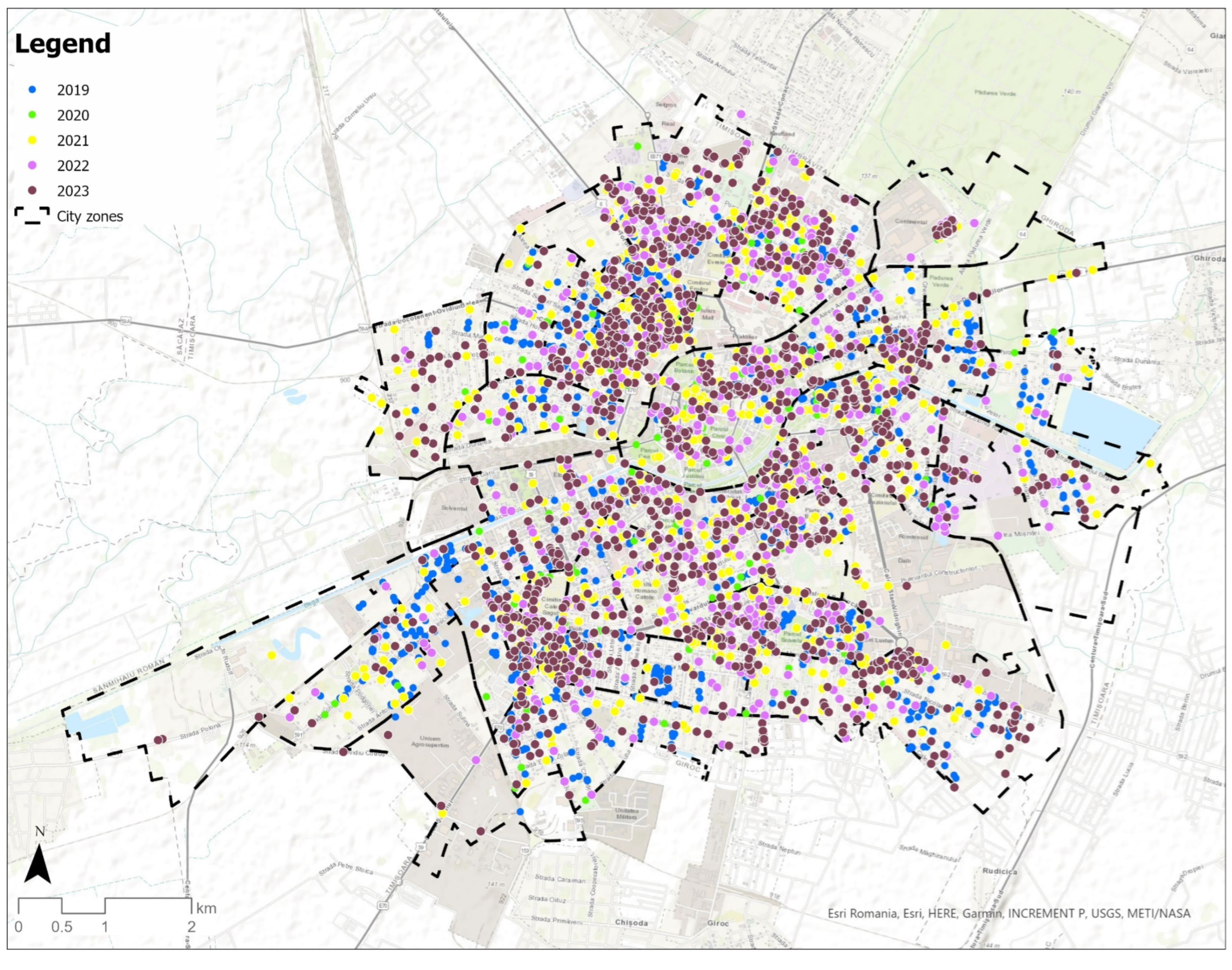
After cleaning the database (i.e., eliminating non-responses or incomplete questionnaires), the number of respondents included in this analysis was 9490 (Figure 1). However, the consistency of the study is not necessarily given by their number, but rather by their spatial distribution, as respondents from all inhabited neighborhoods of Timișoara were taken into account, the only areas left uncovered being industrial, commercial, or those where spontaneous vegetation predominates over buildings.
In addition to other dimensions of quality of life addressed in this questionnaire, the analysis of the mobility dimension was also very important, with an emphasis on the type of transport commonly used by citizens throughout the day, but also on characteristics strictly related to public transport, such as: price, safety, accessibility, frequency, comfort, cleanliness, and reliability. Subsequently, these aspects of public transport can be correlated with data on the characteristics of the respondents (gender, age, marital status, educational and occupational level, religion, ethnicity) and their spatiality (place of residence, type of housing, neighborhood where they live).
Therefore, we used spatial notes to better see the disparities in the degree of satisfaction of Timișoara residents with regard to public transport in the city, through a series of maps that capture the spatial distribution of the responses given by the respondents to the public opinion survey. The responses were geolocated based on the addresses provided by the respondents, and then transposed onto the map in the form of points, which were then assigned to the same 400 × 400 meter squares. Very important at this stage was the attribute table and the way in which the respondents’ answers were coded, namely the dissatisfied ones received the value 1, and those who were satisfied were given a value of 2, so that by using the “Summarize Within” function, we were able to calculate an average satisfaction score for each square, which can take values from 1 for the lowest levels to 2 for the highest levels. At the same time, in order to observe the areas where satisfaction or dissatisfaction remained constant over the four years analyzed, we multiplied all the previous annual maps after converting them to raster format using the “Raster Calculator” function. Finally, a specific symbolization was created using a color palette, with shades ranging from light blue for the most dissatisfied to dark blue for the most satisfied.
To ensure the statistical comprehensiveness of the present study, multilevel modeling using linear mixed-effects models (LMM) was performed in R version 4.4.1 [87]. To import the data, we used the readxl package from R [88]. Multivariate imputation by chained equations (MICE) was employed to handle missing data using the mice package [89]. Logistic regression (“logreg”) was used for binary categorical variables (gender, education, and public transport usage behavior), predictive mean matching (“pmm”) was applied to continuous numerical variables (age, distance to nearest station, and distance to city center), and proportional odds logistic regression (“polr”) was used for ordinal variables and Likert scales (income, price, safety, proximity, frequency, punctuality, and public transport satisfaction). Mixed-effects models were estimated using the lme4 package [90]. The sjPlot package [91] from R was employed to create tables of model results.

4. Study Area

Timișoara, with over 300,000 inhabitants, is the largest and most representative city in western Romania, notable not only for its considerable cultural and historical heritage, but also for its location at the intersection of important national and European routes, making it a strategic transport hub in the western region of the country [92,93]. The city has a long tradition of public transport, being the first city in Romania to introduce horse-drawn trams in 1869 and one of the first to electrify its public transport network at the beginning of the 20th century [94]. Moreover, Timișoara also stands out for its alternative means of transport, being the first municipality in Romania to introduce public transport by boat on the Bega Canal, but also the first city to introduce a bike-sharing system, offering citizens the opportunity to use bicycles as their main means of daily transport [93].
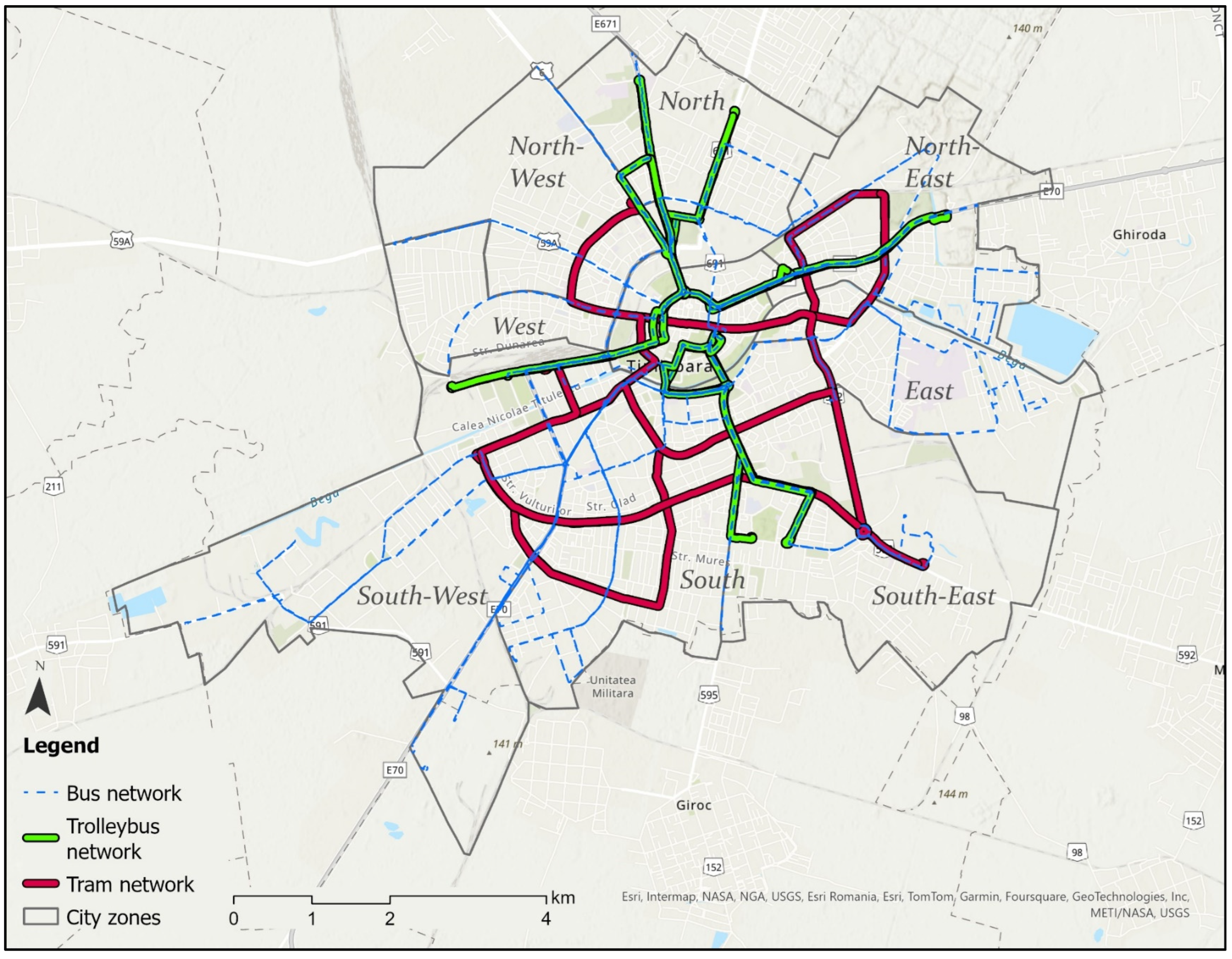
Currently, Timișoara’s urban public transport system comprises 17 bus lines, 6 trolleybus lines, and 8 tram lines, in addition to an extensive network of metropolitan buses connecting the city to suburban areas, as well as a multitude of school buses that take children to and from school, and other alternative means of transport, some of which operate only seasonally, such as water transport, due to unfavorable weather conditions in winter. In this article, we will exclude metropolitan, school, and vaporetto transport lines, as they either operate outside the study area or operate intermittently. On the other hand, bus, tram, and trolley action lines can be said to have a relatively balanced distribution within the city, with the central area being one of the best-served areas (Figure 2).

5. Findings

The main results of the study focused on the relationship between the objective quality of the Timișoara public transport system and the subjective perception of its characteristics by the city’s citizens. These findings, in turn, structure the next section of the paper, on the basis of which recommendations for improving public transport can be made. The present analysis is useful for urban planning, allowing authorities to identify areas where investment is needed for fairer and more efficient public transport.
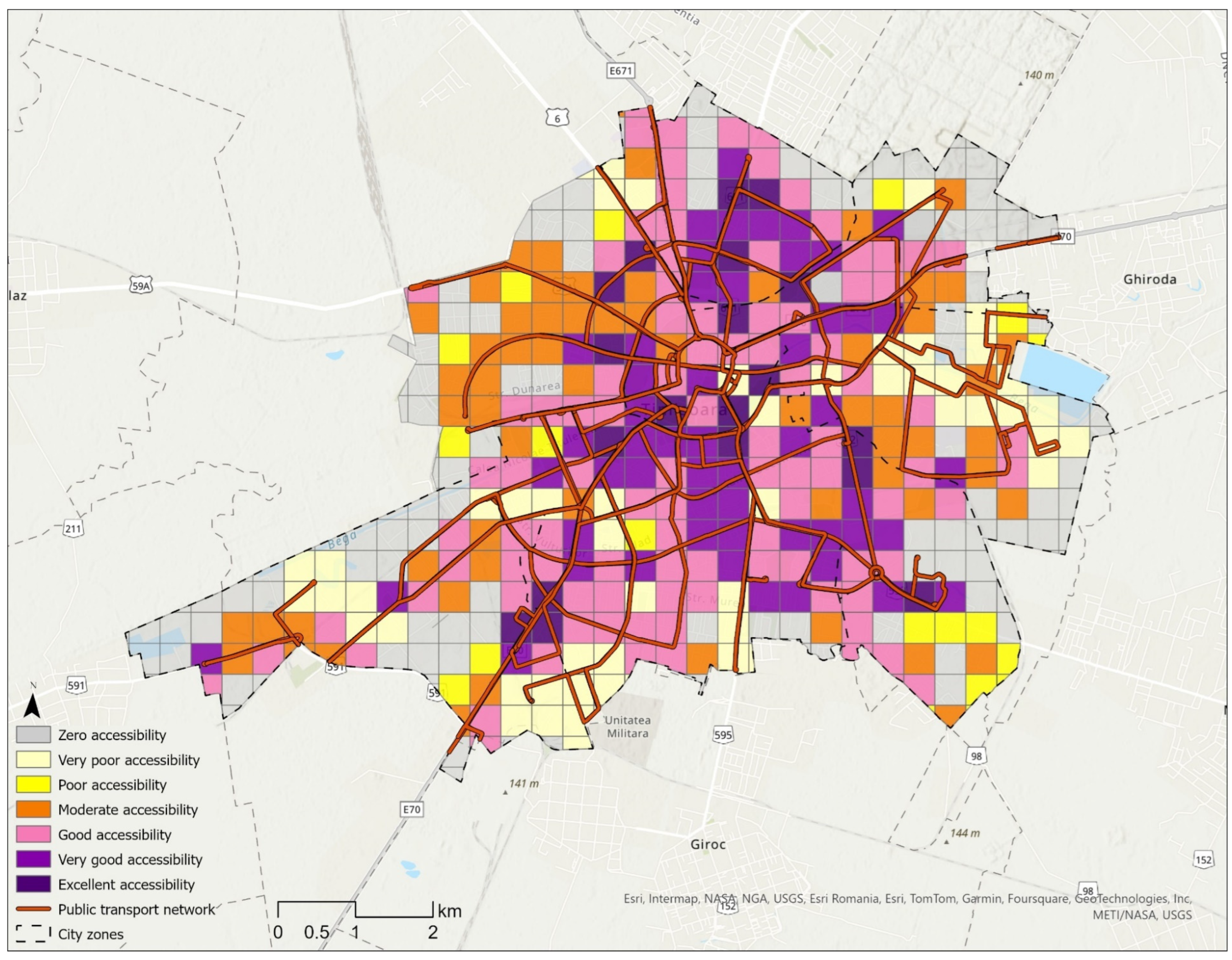
First, the objective quality of the public transport network was highlighted using the PTAL index. Originally applied in London, PTAL index values are divided into 9 classes, ranging from 0 (“very poor accessibility”) to over 40 (“excellent”). However, some studies recalibrate these values to better reflect local conditions. A more concise version of the index proposes merging classes 1a and 1b, as well as 6a and 6b, resulting in a total of six accessibility classes, ranging from 0 (“very poor accessibility”) to over 25 (“excellent accessibility”), to which is added a class for values below 0, representing no accessibility at all (“zero accessibility”). If we apply our analysis to the city of Timișoara, it appears that it has a very low degree of accessibility, with index values falling only into the categories “very poor” (between 0 and 5) and “poor” (between 5 and 8.39). Therefore, we considered it necessary to recalibrate the PTAL values in order to adjust the measurement scale so that it better corresponds to the specific context of the case study. This resulted in six accessibility classes (Table 1).
The PTAL index was calculated using ArcGIS Pro, based on square areas of 400 × 400 m. Following the reclassifications and symbolizations performed in this program, the six accessibility classes detailed above emerged. It can be seen that the central area has the highest PTAL values, benefiting from a high density of stations and high frequencies of transport. Also, the main axes of the city, together with areas well connected to the tram and bus network, have a good degree of accessibility.
In contrast, the peripheral neighborhoods, the industrial areas in the east, south, and southwest of the city, and the areas near the exit from Timișoara have a low level of accessibility to public transport, which may limit the mobility of residents and their access to urban services. These disparities are influenced by the distribution of transport infrastructure and the demand for mobility. A particular situation is represented by a block located in the central area, which has a low objective quality of public transport, resulting from the numerous pedestrian areas in the city center. Thus, although the area appears to be well-served by the service in question, the long distance that residents have to walk to the nearest station poses an accessibility problem.
In other words, this analysis highlighted the asymmetry between the center and the periphery in terms of equitable service provision to city residents with public transport services, in line with recent findings in the literature. Moreover, the contrast between the center and the outskirts of Timișoara is also highlighted by the presence of 137 areas in the marginal zone where accessibility is non-existent, as they are not served by public transport lines (Figure 3).
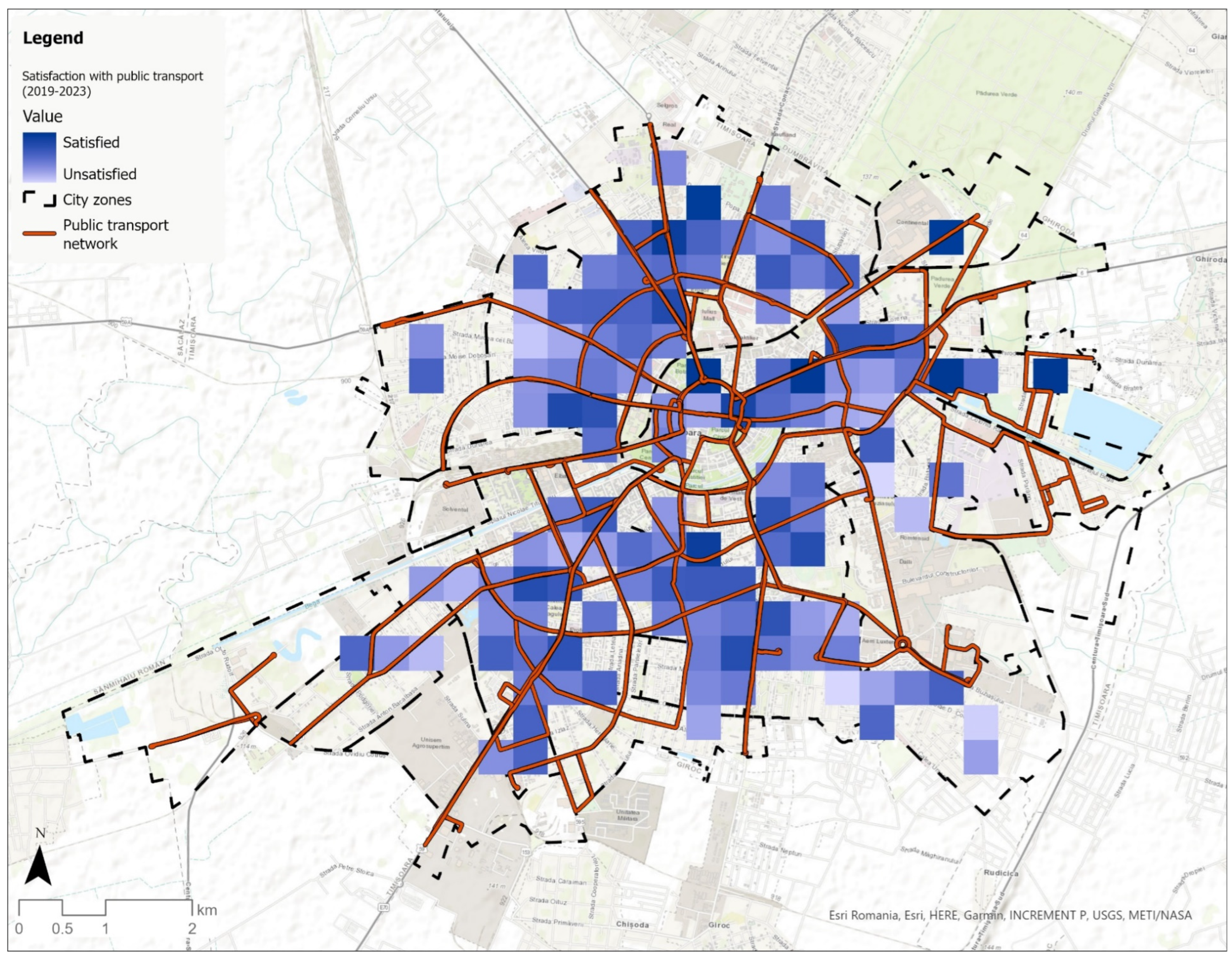
In the second part of the study, we aimed to find out whether the previously noted disparities in accessibility were reported by respondents to the public opinion survey on the quality of life in Timișoara during the period 2019–2023. In the first stage, we analyzed the spatial evolution of the level of satisfaction felt by respondents regarding public transport in the city. At first glance, it can be said that satisfaction varies considerably from one year to another, but if we analyze the issue in more detail, we could conclude that the highest levels of satisfaction are found in the central and peri-central areas, along with the most important boulevards in Timișoara, where the number of lines and means of transport arriving per hour is higher. At the opposite end of the spectrum are the marginal areas of Timișoara, along with neighborhoods that do not benefit from such a rich public transport infrastructure. There are also areas not covered by satisfaction squares, which are squares where no concrete response regarding satisfaction with public transport was recorded at least once during the 5 years of analysis. Receiving a zero value, the final multiplication of the Boolean maps led to the creation of this situation (see Appendix A).
Moreover, the evolution of the level of satisfaction with public transport in Timișoara confirms the above, as it can be seen that in places where the bus, trolleybus, and tram network is denser, the level of satisfaction with this urban dimension remains higher. Therefore, it can be concluded that residents of the central area of the city are the most satisfied with public transport, while residents in the southeast and southwest of the city show lower levels of satisfaction. Please note that industrial areas, parks, and uninhabited spaces have been excluded from the map (Figure 4).
Linear mixed-effects models were employed to assess whether satisfaction with public transportation varies as a function of demographic characteristics (e.g., sex, income, education, age, public transport usage behavior), subjective satisfaction with specific public transport characteristics (e.g., price, safety, proximity, frequency, punctuality) and objective spatial data (distance to the nearest station and distance to the city center) and whether these three levels influence each other. Random intercepts and random slopes were specified to account for year variations and year-to-year fluctuations in public transport satisfaction. Fixed effects, interaction terms, and random effects are presented in the table from the Appendix A of this paper.
The fixed effect of income on satisfaction with public transport follows a curvilinear (inverted U-shaped) pattern, suggesting that satisfaction with public transport might slightly increase with income up to a certain point, whereupon it starts to decline, with a slight decrease at very high-income individuals (β = − 0.022, p = 0.021). The fixed effect of age on satisfaction with public transport follows a linear pattern, suggesting that satisfaction with public transport might slightly increase with age (β = 0.001, p < 0.001). Other fixed effects suggest satisfaction with public transport decreases for individuals with higher education (β = −0.081. p < 0.001) and increases for individuals using public transit (β = 0.036, p = 0.003).
The fixed effects of subjective satisfaction with specific public transport characteristics suggest satisfaction with public transport increases as satisfaction with ticket price (β = 0.112, p < 0.001), safety (β = 0.114, p < 0.001), proximity to home of public transit stations (β = 0.115, p < 0.001), frequency (β = 0.148, p < 0.001), and punctuality of public transport means (β = 0.282, p < 0.001) increase, the most prominent effects being punctuality and frequency. The interaction terms between individual characteristics and subjective satisfaction with specific public transport characteristics suggest that satisfaction with punctuality has a stronger effect on satisfaction with public transport for men than women (β = −0.027, p = 0.034), for people with secondary education than people with higher education (β = −0.042, p = 0.001) and for people using public transit than those not using public transport (β = 0.027, p = 0.035). Satisfaction with proximity has a stronger effect on women’s satisfaction with public transport than men’s (β = 0.028, p = 0.049). Satisfaction with price has a stronger effect on satisfaction with public transport for people with higher education than people with secondary education (β = 0.028, p = 0.041) and for people using public transit than those not using public transport (β = 0.04, p = 0.005). Price also has a marginally stronger effect on women’s satisfaction with public transport than men’s (β = 0.023, p = 0.089). Satisfaction with frequency has a stronger effect on satisfaction with public transport for people with higher education than people with secondary education (β = 0.043, p = 0.003). The effect of frequency on satisfaction with public transport gets weaker as people get older (β = −0.001, p = 0.005).
The fixed effects of objective spatial data suggest that as distance to the city center increases, satisfaction with public transport slightly decreases (β = −0.0000156, p = 0.004, p < 0.01); interestingly enough, as distance to the nearest station decreases, satisfaction with public transport also decreases (β = 0.0000972, p = 0.035, p < 0.05). This pattern can be explained by the interaction terms, which are of particular interest. More specifically, distance to the nearest station significantly moderates the fixed effect of punctuality on satisfaction with public transport (β = −0.0001421, p = 0.023). As the distance to the nearest station decreases, the impact of punctuality on public transport satisfaction increases. The closer users live to a bus stop, the lower their satisfaction with public transport, as they tend to arrive on time and must wait for delayed buses, making them more sensitive to punctuality. In contrast, those living farther from the stop are less affected by delays and may even perceive minor lateness positively, since it allows them to catch the bus without rushing. This is evidenced by the fact that users’ perceptions of punctuality moderate this seemingly counterintuitive relationship between objective distance and satisfaction with public transport. This suggests that individuals living closer to public transit stations are more sensitive to delays in schedule and punctuality issues. This is even more interesting considering that satisfaction with punctuality has the greatest fixed effect on satisfaction with public transport. Other significant interaction terms between demographic characteristics and objective spatial data suggest that the distance to the city center has a slightly stronger effect on satisfaction with public transport as people get older (β = 0.0000017, p < 0.001) and income increases (β = 0.0000282, p = 0.059).

6. Discussions and Conclusions

Quality of life is a complex construct, consisting of numerous dimensions, which requires both objective and subjective assessments to be fully understood. While objective measures provide a quantifiable perspective on living conditions, subjective measures provide information about individual satisfaction and well-being. The interaction between these dimensions is nuanced, influenced by various factors, which highlights the need for a comprehensive approach to assessing quality of life.
This study considered how public transport and its characteristics influence quality of life. In this regard, the objective quality of the Timișoara public transport system was highlighted using the PTAL index, and subjective quality was analyzed using data from a public opinion survey conducted by the authors in Timișoara. From a spatial point of view, the main observation made in this article refers to center–periphery spatial disparities. More specifically, the objective quality of the urban public transport system decreases from the city center to its outskirts, which is reinforced by the perceived quality of the dimension in question, with the responses provided by citizens over the five years analyzed providing clear evidence that the center is better connected and better served by public transport than the outskirts of the city.
UQoL (urban quality of life) has four dimensions—physical, social, economic, and welfare, with public transport being a central element of the mobility subdomain within welfare [8]. Our LMM results demonstrate that public transport quality is not unitary but rather a dynamic interplay between objective spatial conditions, subjective service evaluations, and individual sociodemographic characteristics (e.g., age, income, education, gender). Public transport users are predominantly women, either very young (18–24 years) or elderly (over 65), with secondary or post-secondary vocational education. Satisfaction with public transport is also higher among women under 35 or over 65, holding secondary or post-secondary vocational qualifications, with the exception of the years 2021 and 2022.
Satisfaction with public transport is inherently multidimensional, being closely dependent on subjective dimensions, such as affordability, safety, proximity, frequency, and punctuality. Among these, punctuality and frequency emerged as the most influential determinants. The interactions between socio-demographic characteristics and satisfaction with specific service attributes (e.g., punctuality, proximity, safety, ticket price, and frequency) provide evidence that subjective evaluations of public transport are stratified based on sociodemographic attributes. Punctuality proved to be more salient for men, individuals with secondary education, and those who regularly use public transport. Proximity was strongly salient for women. Affordability proved to be more salient for individuals with higher educational attainment, women, and active users of public transport. Frequency was particularly salient for individuals with higher education and for younger cohorts. In other words, the findings show that the determinants of public transport satisfaction are subjectively oriented, meaning they are dependent on punctuality and the frequency of the public transport service, and the influence of these factors is dependent on the population’s demographic characteristics and spatial proximity. These results support the idea that each social group has different needs and expectations regarding mobility and public transport [8]. Indeed, effective strategies for improving the level of satisfaction should take both optimisation issues into account and aspects related to the diversity of users’ needs. The negative association between distance to the city center and satisfaction with public transport is consistent with the idea that central urban locations are typically associated with greater urban quality of life (UQoL) and higher satisfaction with urban services and infrastructure, further supporting the idea that spatial distribution gives rise to welfare clusters [8]. Regarding objective spatial data and sociodemographic interactions, we found that distance to the city center is extremely salient for older cohorts, who probably depend more on public transport to reach the city center. These results suggest that subjective evaluations of service dimensions are not uniformly distributed across the population but filtered through sociodemographic lenses, based on individual mobility experiences. These individual experiences shape differentiated mobility needs and expectations across population subgroups [8]. The interaction between distance to the nearest station and punctuality indicates that individuals residing closer to public transportation stations appear to be more directly exposed to the day-to-day functioning of the system and therefore more sensitive to delays in schedule, as they tend to arrive on time and must wait for delayed buses. In contrast, those living farther from the stop are less affected by delays and may even perceive minor lateness positively, since it allows them to catch the bus without rushing. This aligns with the broader theoretical argument that direct exposure to physical elements such as public transport and mobility infrastructure strengthens the correlation between subjective and objective measures [8].
The discussion on PTAL recalibration can be further expanded by considering several aspects. First, it is important to reflect on the implications of recalibration for the comparability of results with other cities, as modifying the index may affect cross-city analyses. Second, recalibration may provide a more accurate representation of actual differences in transport quality between Timișoara and the cities for which the original PTAL scale was developed, primarily London. Finally, establishing clear guidelines on when and how other cities should consider recalibrating PTAL could support more consistent and context-sensitive applications of the index in diverse urban settings. For instance, recalibration should be considered when local transport conditions differ substantially from the original context, when empirical data on travel times and frequencies are available, and when the goal is to improve the index’s relevance for local planning and policy evaluation.
While the PTAL framework is generally transferable, its application requires careful contextual adaptation. It is important to clarify the conditions under which the standard PTAL methodology can be applied directly versus those that necessitate modifications, particularly when local transport systems differ from the original context. Specific characteristics of Timișoara—such as its city size, the stage of transport network development, and local cultural and mobility patterns—may limit the generalisability of standard PTAL results. To support other cities in applying a similar methodology, practical guidelines could be proposed, including recommendations on recalibrating class thresholds, accounting for local service frequencies, and integrating complementary data sources to capture person-based and destination-oriented accessibility.
Based on the results obtained in this study, a series of policy recommendations have been outlined to support local authorities in adopting effective measures to improve public transport in Timișoara. These could refer to: expanding the transport network, improving the frequency of transport, creating more stations to shorten walking distances, creating more hubs to make it easier to change from one transport line to another, displaying accurate waiting times at stations, improving the attributes of transport vehicles, etc. Of course, in peripheral areas with zero accessibility, characterized by the absence of tram, bus, or trolleybus stations, the expansion of the public transport system represents the first step toward improving urban mobility. The more the city administration extends this network, the more the preference for private car use is likely to decrease, as the long distances people must travel daily to reach their workplaces or other activities often force them to rely on cars, contributing to traffic congestion, particularly in the city center. Furthermore, as PTAL provides objective evidence for targeted investments in public transport infrastructure, ensuring the efficient allocation of resources to maximize accessibility and support sustainable mobility, this indicator could be integrated into digital platforms for real-time analysis and decision-making, complementing broader smart city initiatives and supporting the development of holistic, data-driven urban management systems.
Although this study provides valuable insights into the relationship between the actual and perceived quality of public transport, certain limitations that may influence the interpretation and applicability of the results should be noted. One of these limitations concerns the PTAL index, which focuses primarily on proximity to stations and the principle of shortest distance. However, it does not take into account situations where there is another station in the immediate vicinity of the station being evaluated, sometimes only a few meters away, which benefits from better connectivity and a greater number of transport options. The index also measures how easy it is to get to a public transport station, but does not take into account the actual connectivity to essential places such as schools, hospitals, institutions, nor does it include the assessment of factors such as comfort, congestion, or reliability of services.
Another limitation concerned the use of Boolean maps to analyze the evolution of satisfaction with public transport during the reference period, as multiplying by values of 0, even where they appeared in only one year, led to zero values in several squares. Refining these indicators would lead to a better interpretation of situations and a better understanding of contexts.
Future studies could focus on refining the PTAL index in the case of objective variables and on collecting more responses to the quality-of-life questionnaire or including more questions on several attributes of urban public transport in the case of subjective variables. Another improvement could be achieved through the inclusion of service quality indicators (comfort, congestion, reliability, cleanliness, etc.) that could enrich the analysis. Future studies could also consider extending these analyses to other areas, whether in Romania or abroad.
In light of the close correlation between the objective and subjective quality of public transport, it is recommended that local authorities consult transport specialists with a view to enhancing the urban public transport system. The overarching aims of this initiative are twofold: firstly, to reduce disparities in accessibility; and secondly, to reduce dissatisfaction with this aspect of quality of life. The ultimate objective is to increase the number of users. In essence, communities must be situated at the core of urban planning deliberations concerning mobility, with due consideration for the broad spectrum of geographical contexts in which they undertake their quotidian activities.

Author Contributions

Conceptualization, M.L.M., A.C.T. and A.D.; methodology, M.L.M., A.C.T. and A.D.; software, A.C.T.; validation, A.D. and M.L.M.; formal analysis, A.C.T. and M.-R.R.; investigation, M.L.M. and A.D.; resources, M.L.M. and A.D.; data curation, A.C.T. and M.-R.R.; writing—original draft preparation, A.C.T. and M.-R.R.; writing—review and editing, A.C.T., A.D. and M.L.M.; visualization, A.C.T.; supervision, A.D. and M.L.M.; project administration, M.L.M. All authors have read and agreed to the published version of the manuscript and contributed equally to this work.

Funding

This research received no external funding.

Institutional Review Board Statement

The study was conducted in accordance with the Declaration of Helsinki, and the protocol was approved by the Scientific Council for Research and University Creation of the West University of Timișoara (26870) on 28 April 2025.

Informed Consent Statement

Informed consent for participation was obtained from all subjects involved in the study.

Data Availability Statement

The original contributions presented in this study are included in the Appendix A. Further inquiries can be directed to the corresponding authors.

Acknowledgments

We would like to thank all anonymous respondents and Timișoara City Hall for their support in conducting the opinion survey. We would also like to thank Livia Onici for their valuable insights into the analysis of sociological data. During the preparation of this manuscript, the authors used Grammarly for the purposes of language editing. The authors have reviewed and edited the output and take full responsibility for the content of this publication.

Conflicts of Interest

The authors declare no conflicts of interest.

Appendix A

Public Transport Satisfaction
PredictorsEstimatesstd. ErrorCIStatisticpdf
(Intercept)0.35286400.14977770.0592676–0.64646052.35591800.0189474.0000000
Sex [Female]0.01249660.0116335−0.0103076–0.03530071.07418740.2839474.0000000
Income [linear]−0.00707970.0122650−0.0311217–0.0169622−0.57723300.5649474.0000000
Income [quadratic]−0.02213380.0095716−0.0408962–−0.0033713−2.31243340.0219474.0000000
Education [Higher education]−0.08131150.0127122−0.1062301–−0.0563928−6.3963322<0.0019474.0000000
Usage Behavior [Use public transport]0.03671530.01217670.0128464–0.06058433.01521110.0039474.0000000
Age (years old)0.00124910.00035530.0005527–0.00194563.5157299<0.0019474.0000000
Price0.11215040.00701320.0984029–0.125897815.9912259<0.0019474.0000000
Safety0.11452380.00711390.1005790–0.128468616.0985612<0.0019474.0000000
Proximity0.11504960.00763070.1000918–0.130007415.0772125<0.0019474.0000000
Frequency0.14810940.00767180.1330710–0.163147719.3057214<0.0019474.0000000
Punctuality0.28221900.00909420.2643924–0.300045731.0327791<0.0019474.0000000
Distance Station0.00009720.00004610.0000069–0.00018752.11090890.0359474.0000000
Distance City Center−0.00001560.0000054−0.0000263–−0.0000049−2.85964180.0049474.0000000
Sex [Female] × Price0.02371150.0139443−0.0036224–0.05104541.70044070.0899476.0000000
Sex [Female] × Proximity0.02855590.01448630.0001596–0.05695231.97123100.0499426.0000000
Sex [Female] × Punctuality−0.02741510.0129588−0.0528172–−0.0020130−2.11555560.0349476.0000000
Education [Higher education] × Price0.02871030.01403170.0012052–0.05621542.04610650.0419476.0000000
Education [Higher education] × Frequency0.04365950.01475790.0147308–0.07258812.95837910.0039476.0000000
Education [Higher education] × Punctuality−0.04221570.0129163−0.0675344–−0.0168969−3.26839330.0019476.0000000
Usage Behavior [Use public transport] × Price0.04014060.01425330.0122011–0.06808022.81623110.0059426.0000000
Usage Behavior [Use public transport] × Punctuality0.02775460.01313690.0020035–0.05350572.11272460.0359476.0000000
Age × Frequency−0.00121290.0004359−0.0020673–−0.0003584−2.78252520.0059476.0000000
Punctuality × Distance Station−0.00014210.0000623−0.0002642–−0.0000200−2.28097760.0239465.0000000
Random Effects
σ20.31
τ00 Year0.11
ICC0.26
N Year5
Observations9490
Marginal R2/Conditional R20.416/0.566
Public Transport Satisfaction
PredictorsEstimatesstd. ErrorCIStatisticpdf
(Intercept)0.35286400.14977770.0592676–0.64646052.35591800.019474.000000
Gender [Female]0.010.0116335−0.0103076–0.03530071.07418709474.0000000
Income [linear]−0.00707970.012265−0.0311217–0.0169622−0.57723300.5649474.0000000
Income [quadratic]−0.02213380.0095716−0.0408962–−0.0033713−2.312433409474.000000
Education [Higher education]-0.0127122−0.1062301–−0.0563928−6.3963322<0.0019474.000000
Usage Behavior [Use public transport]0.03670.012170.0128464–0.06058433.01521109474.000000
Age (years old)0.0010.00035530.0005527–0.00194563.5157299<0.0019474.000000
Price0.11215040.00701320.0984029–0.125897815.9912259<0.0019474.000000
Safety0.11452380.00711390.1005790–0.128468616.0985612<0.0019474.000000
Proximity0.11504960.00763070.1000918–0.130007415.0772125<0.0019474.000000
Frequency0.14810940.00767180.1330710–0.163147719.3057214<0.0019474.000000
Punctuality0.2820.00909420.2643924–0.300045731.0327791<0.0019474.000000
Distance Station0.00009720.00004610.0000069–0.00018752.110908909474.00
Distance from city center−0.00001560.0000054−0.0000263–−0.0000049−2.859641809474.000000
Gender [Female] × Price0.02371150.0139443−0.0036224–0.05104541.700440709476.000000
Gender [Female] × Proximity00.0.0001596–0.05695231.971231009426.000000
Gender [Female] × Punctuality−0.02741510.0129588−0.0528172–−0.0020130−2.115555609476.0000000
Education [Higher education] × Price0.028700.0012052–0.05621542.046106509476.000000
Education [Higher education] × Frequency000.0147308–0.07258812.958379109476.000000
Education [Higher education] × Punctuality−0.04221570.012−0.0675344–−0.0168969−3.26839309476.000000
Usage Behavior [Use public transport] × Price00.0142530.0122011–0.06808022.816231109426.000000
Usage Behavior [Use public transport] × Punctuality0.02770.010.0020035–0.05350572.112709476.000000
Age × Frequency−0.00121290.0004359−0.0020673–−0.0003584−2.782525209476.000000
Punctuality × Distance Station−0.00014210.−0.0002642–−0.0000200−2.280977609465.000000
Random Effects
σ20.31
τ00Year0.11
ICC0.26
N Year5
Observations9490
Marginal R2/Conditional R20.416/0.566

References

  1. De Oña, J.; Estévez, E.; De Oña, R. Public transport users versus private vehicle users: Differences about quality of service, satisfaction and attitudes toward public transport in Madrid (Spain). Travel Behav. Soc. 2021, 23, 76–85. [Google Scholar] [CrossRef]
  2. Putra, K.E.; Sitanggang, J.M. The effect of public transport services on quality of life in Medan city. Procedia-Soc. Behav. Sci. 2016, 234, 383–389. [Google Scholar] [CrossRef]
  3. Gądek, M.; Miśko, R. Impact of Urban Transport Innovation on the Quality of Life: What Do Passengers Say? Department of Operations Research and Business Intelligence: Wroclaw, Poland, 2020. [Google Scholar]
  4. Țoc, S. Cercetarea calității vieții în România. O analiză a studiilor publicate în Revista “Calitatea vieții” în intervalul 1990−2020. Calitatea Vieţii 2021, 32, 259–283. [Google Scholar] [CrossRef]
  5. Mărginean, I. Calitatea vieţii în România: Prezent şi perspective. Calitatea Vieţii 2010, 21, 231–237. [Google Scholar]
  6. Guliyeva, A. Measuring quality of life: A system of indicators. Econ. Polit. Stud. 2021, 10, 476–491. [Google Scholar] [CrossRef]
  7. Janicki, W.; Dłużewska, A. Subjectively felt and objectively measured: Wellbeing in the context of globalization. Appl. Psychol. Health Well-Being 2022, 14, 1429–1447. [Google Scholar] [CrossRef]
  8. Răducan, R.; Lozsa, J.; Vîrga, D.; Matichescu, M. New Integrative Model of the Quality of Urban Life: A Systematic Review. Soc. Indic. Res. 2025, 179, 895–921. [Google Scholar] [CrossRef]
  9. Chang, Y.S.; Lee, Y.J.; Choi, S.S.B. Is there more traffic congestion in larger cities?-Scaling analysis of the 101 largest US urban centers. Transp. Policy 2017, 59, 54–63. [Google Scholar] [CrossRef]
  10. Ceder, A. Urban mobility and public transport: Future perspectives and review. Int. J. Urban Sci. 2021, 25, 455–479. [Google Scholar] [CrossRef]
  11. de Oña, J. Understanding the mediator role of satisfaction in public transport: A cross-country analysis. Transp. Policy 2021, 100, 129–149. [Google Scholar] [CrossRef]
  12. Chica-Olmo, J.; Gachs-Sánchez, H.M.; Lizárraga, C. Route effect on the perception of public transport services quality. Transp. Policy 2018, 67, 40–48. [Google Scholar] [CrossRef]
  13. Steele, W. Infrastructures of care. Plan. News 2017, 43, 14. [Google Scholar]
  14. Flores, L.; Ong, A.; Roque, R.A.; Palad, T.M.; Concepcion, J.D.; Aguas, R. Assessment of Service Quality and Trust of E-Public Transportation in Doha Qatar. World Electr. Veh. J. 2025, 16, 174. [Google Scholar] [CrossRef]
  15. Shbeeb, L. How Users Perceive Infrastructure Development Affects Their Transport Mode Choice. J. Transp. Technol. 2023, 13, 545–598. [Google Scholar] [CrossRef]
  16. Costa, P.B.; Neto, G.C.M.; Bertolde, A.I. Urban mobility indexes: A brief review of the literature. Transp. Res. Procedia 2017, 25, 3645–3655. [Google Scholar] [CrossRef]
  17. Butler, L.; Yigitcanlar, T.; Paz, A. Smart urban mobility innovations: A comprehensive review and evaluation. IEEE Access 2020, 8, 196034–196049. [Google Scholar] [CrossRef]
  18. Mugion, R.G.; Toni, M.; Raharjo, H.; Di Pietro, L.; Sebathu, S.P. Does the service quality of urban public transport enhance sustainable mobility? J. Clean. Prod. 2018, 174, 1566–1587. [Google Scholar] [CrossRef]
  19. Savastano, M.; Suciu, M.-C.; Gorelova, I.; Stativă, G.-A. How smart is mobility in smart cities? An analysis of citizens’ value perceptions through ICT applications. Cities 2023, 132, 104071. [Google Scholar] [CrossRef]
  20. Saif, M.A.; Zefreh, M.M.; Torok, A. Public transport accessibility: A literature review. Period. Polytech. Transp. Eng. 2019, 47, 36–43. [Google Scholar] [CrossRef]
  21. Gałka, P.; Grzelec, K.; Hebel, K.; Judge, E.; Wyszomirski, O. Urban public transport as a tool of sustainable mobility policy—The example of Poland. Electron. Mark. 2020, 31, 154–184. [Google Scholar] [CrossRef]
  22. Wimbadi, R.W.; Djalante, R.; Mori, A. Urban experiments with public transport for low carbon mobility transitions in cities: A systematic literature review (1990–2020). Sustain. Cities Soc. 2021, 72, 103023. [Google Scholar] [CrossRef]
  23. Allen, J.; Farber, S. Planning transport for social inclusion: An accessibility-activity participation approach. Transp. Res. Part D Transp. Environ. 2020, 78, 102212. [Google Scholar] [CrossRef]
  24. Vicente, P.; Suleman, A.; Reis, E. Index of Satisfaction with Public Transport: A Fuzzy Clustering Approach. Sustainability 2020, 12, 9759. [Google Scholar] [CrossRef]
  25. Zhang, X.; Liu, H.; Xu, M.; Mao, C.; Shi, J.; Meng, G.; Wu, J. Evaluation of passenger satisfaction of urban multi-mode public transport. PLoS ONE 2020, 15, e0241004. [Google Scholar] [CrossRef] [PubMed]
  26. Ismael, K.; Duleba, S. Investigation of the Relationship between the Perceived Public Transport Service Quality and Satisfaction: A PLS-SEM Technique. Sustainability 2021, 13, 13018. [Google Scholar] [CrossRef]
  27. Allen, J.; Muñoz, J.C.; de Dios Ortúzar, J. Understanding public transport satisfaction: Using Maslow’s hierarchy of (transit) needs. Transp. Policy 2019, 81, 75–94. [Google Scholar] [CrossRef]
  28. Ngoc, A.M.; Hung, K.V.; Tuan, V.A. Towards the development of quality standards for public transport service in developing countries: Analysis of public transport users’ behavior. Transp. Res. Procedia 2017, 25, 4560–4579. [Google Scholar] [CrossRef]
  29. Cordera, R.; Nogués, S.; González-González, E.; Dell’Olio, L. Intra-urban spatial disparities in user satisfaction with public transport services. Sustainability 2019, 11, 5829. [Google Scholar] [CrossRef]
  30. Celio, D.; Jose, P.M.P. Changing urban mobility habits in Sao Paulo: An analysis from 2017 to 2022. In Proceedings of the 2nd International Conference on Future Challenges in Sustainable Urban Planning & Territorial Management, SUPTM 2024, Online, 29–31 January 2024. [Google Scholar] [CrossRef]
  31. Ziedan, A.; Brakewood, C.; Watkins, K. Will transit recover? A retrospective study of nationwide ridership in the United States during the COVID-19 pandemic. J. Public Transp. 2023, 25, 100046. [Google Scholar] [CrossRef]
  32. Magassy, T.; Batur, I.; Mondal, A.; Asmussen, K.; Bhat, C.; Salon, D.; Bhagat-Conway, M.; Javadinasr, M.; Chauhan, R.; Mohammadian, A.; et al. Evolution of Mode Use During the COVID-19 Pandemic in the United States: Implications for the Future of Transit. Transp. Res. Rec. 2023, 2678, 567–579. [Google Scholar] [CrossRef]
  33. Gao, Y.; Zhao, P. Tracing long-term commute mode choice shifts in Beijing: Four years after the COVID-19 pandemic. Humanit. Soc. Sci. Commun. 2024, 11, 1566. [Google Scholar] [CrossRef]
  34. Filippi, C.; Guastaroba, G.; Peirano, L.; Speranza, M. Trends in passenger transport optimisation. Int. Trans. Oper. Res. 2023, 30, 3057–3086. [Google Scholar] [CrossRef]
  35. Jurczak, M. Digital public transport in New Economy—Contemporary mobility trends. Res. Pap. Econ. Financ. 2023, 7, 44–62. [Google Scholar] [CrossRef]
  36. Verano-Tacoronte, D.; Flores-Ureba, S.; Mesa-Mendoza, M.; Llorente-Muñoz, V. Evolution of scientific production on urban passenger transport: A bibliometric analysis. Eur. Res. Manag. Bus. Econ. 2024, 30, 100239. [Google Scholar] [CrossRef]
  37. Zakharov, D. Analysis of the state and development prospects of urban public transport in Ukraine. Econ. Scope 2024, 191, 178–184. [Google Scholar] [CrossRef]
  38. Nalin, A.; Lantieri, C.; Vignali, V.; Simone, A. Assessing the evolution of Public Transportation demand over time based on real data through survival analysis in Bologna, Italy. Transportation 2024. [Google Scholar] [CrossRef]
  39. Cruz, C.; Sarmento, J. “Mobility as a Service” Platforms: A Critical Path towards Increasing the Sustainability of Transportation Systems. Sustainability 2020, 12, 6368. [Google Scholar] [CrossRef]
  40. Musolino, G.; Rindone, C.; Vitetta, A. Models for Supporting Mobility as a Service (MaaS) Design. Smart Cities 2022, 5, 206–222. [Google Scholar] [CrossRef]
  41. Chmiel, B.; Pawłowska, B.; Szmelter-Jarosz, A. Mobility-As-A-Service as a Catalyst for Urban Transport Integration in Conditions of Uncertainty. Energies 2023, 16, 1828. [Google Scholar] [CrossRef]
  42. Hensher, D.; Hietanen, S. Mobility as a feature (MaaF): Rethinking the focus of the second generation of mobility as a service (MaaS). Transp. Rev. 2022, 43, 325–329. [Google Scholar] [CrossRef]
  43. Hensher, D.; Nelson, J. Do Integrated Mobility Services have a Future? The neglected role of Non-Mobility Service Providers: Challenges, and opportunities to extract sustainable transport outcomes. Transp. Policy 2025, 163, 348–357. [Google Scholar] [CrossRef]
  44. Rindone, C.; Vitetta, A. Measuring Potential People’s Acceptance of Mobility as a Service: Evidence from Pilot Surveys. Information 2024, 15, 333. [Google Scholar] [CrossRef]
  45. Hutchins, N.; Hook, L. Technology acceptance model for safety critical autonomous transportation systems. In Proceedings of the 2017 IEEE/AIAA 36th Digital Avionics Systems Conference (DASC), St. Petersburg, FL, USA, 17-21 September 2017; IEEE: New York, NY, USA, 2017; pp. 1–5. [Google Scholar] [CrossRef]
  46. Marangunić, N.; Granić, A. Technology acceptance model: A literature review from 1986 to 2013. Univers. Access Inf. Soc. 2015, 14, 81–95. [Google Scholar] [CrossRef]
  47. Taherdoost, H. A review of technology acceptance and adoption models and theories. Procedia Manuf. 2018, 22, 960–967. [Google Scholar] [CrossRef]
  48. Friman, M.; Lättman, K.; Olsson, L. Public Transport Quality, Safety, and Perceived Accessibility. Sustainability 2020, 12, 3563. [Google Scholar] [CrossRef]
  49. Alomari, A.; Khedaywi, T.; Jadah, A.; Marian, A.R. Evaluation of Public Transport among University Commuters in Rural Areas. Sustainability 2022, 5, 312. [Google Scholar] [CrossRef]
  50. Subedi, S. Trust in Governance System (TGS) in the Hotel Context: Scale Development and Validation. Ph.D. Thesis, University of South Carolina, Columbia, SC, USA, 2024. [Google Scholar]
  51. Bucy, T.; Mulcahy, J.; Shippee, T.; Fashaw-Walters, S.; Dahal, R.; Duan, Y.; Jutkowitz, E. Examining Satisfaction and Quality in Home- and Community-Based Service Programs in the United States: A Scoping Review. Gerontologist 2023, 63, 1437–1455. [Google Scholar] [CrossRef]
  52. Ballart, X.; Hernandez, E.; Esteve, M. Enhancing satisfaction with public services: The effect of recalling personal experiences. Int. Public Manag. J. 2024, 27, 284–301. [Google Scholar] [CrossRef]
  53. Van Lierop, D.; Badami, M.G.; El-Geneidy, A.M. What influences satisfaction and loyalty in public transport? A review of the literature. Transp. Rev. 2018, 38, 52–72. [Google Scholar] [CrossRef]
  54. Meesala, R.K.; Raju, M. A comprehensive examination of public transport user satisfaction in Indian megacities. Trans. Transp. Sci. 2025, 16, 28. [Google Scholar] [CrossRef]
  55. Sogbe, E.; Susilawati, S.; Pin, T.C. Scaling up public transport usage: A systematic literature review of service quality, satisfaction and attitude towards bus transport systems in developing countries. Public Transp. 2024, 17, 1–44. [Google Scholar] [CrossRef]
  56. Alonso, F.; Esteban, C.; Faus, M.; Useche, S. Public transportation means as seen by citizens: Approaching the case of the Dominican Republic. Heliyon 2024, 10, e32363. [Google Scholar] [CrossRef] [PubMed]
  57. Gómez-Ortega, A.; Flores-Ureba, S.; Gelashvili, V.; Jalón, M. Users’ perception for innovation and sustainability management: Evidence from public transport. Rev. Manag. Sci. 2023, 18, 859–882. [Google Scholar] [CrossRef]
  58. Stuart, K.R.; Mednick, M.; Bockman, J. Structural equation model of customer satisfaction for the New York City subway system. Transp. Res. Rec. 2000, 1735, 133–137. [Google Scholar] [CrossRef]
  59. Mouwen, A. Drivers of customer satisfaction with public transport services. Transp. Res. Part A Policy Pract. 2015, 78, 1–20. [Google Scholar] [CrossRef]
  60. Minelgaitė, A.; Dagiliūtė, R.; Liobikienė, G. The Usage of Public Transport and Impact of Satisfaction in the European Union. Sustainability 2020, 12, 9154. [Google Scholar] [CrossRef]
  61. Park, K.; Farb, A.; Chen, S. First-/last-mile experience matters: The influence of the built environment on satisfaction and loyalty among public transit riders. Transp. Policy 2021, 112, 32–42. [Google Scholar] [CrossRef]
  62. Soza-Parra, J.; Raveau, S.; Muñoz, J.C.; Cats, O. The underlying effect of public transport reliability on users’ satisfaction. Transp. Res. Part A Policy Pract. 2019, 126, 83–93. [Google Scholar] [CrossRef]
  63. Soza-Parra, J.; Raveau, S.; Muñoz, J. Public transport reliability across preferences, modes, and space. Transportation 2021, 49, 621–640. [Google Scholar] [CrossRef]
  64. Muñoz, J.; Soza-Parra, J.; Raveau, S. A comprehensive perspective of unreliable public transport services’ costs. Transp. A Transp. Sci. 2020, 16, 734–748. [Google Scholar] [CrossRef]
  65. Berggren, U.; D’Agostino, C.; Svensson, H.; Brundell-Freij, K. Intrapersonal variability in public transport path choice due to changes in service reliability. Transportation 2021, 49, 1517–1547. [Google Scholar] [CrossRef]
  66. Gaschi-Uciecha, A. The Problem of Reliability in Public Transport for the Metropolis GMZ Area-Pilots Studies. Sustainability 2023, 15, 3199. [Google Scholar] [CrossRef]
  67. Mahdavi, S.; Bhouri, N. A synthetic indicator for structuring resilient public transport operation. Sustain. Resilient Infrastruct. 2024, 9, 640–666. [Google Scholar] [CrossRef]
  68. Fei, M.; Shi, W.; Yuen, K.F.; Sun, Q.; Xu, X.; Wang, Y.; Wang, Z. Exploring the robustness of public transportation for sustainable cities: A double-layered network perspective. J. Clean. Prod. 2020, 265, 121747. [Google Scholar] [CrossRef]
  69. Geurs, K.T.; van Wee, B. Accessibility evaluation of land-use and transport strategies: Review and research directions. J. Transp. Geogr. 2004, 12, 127–140. [Google Scholar] [CrossRef]
  70. Espejo, A.; Escobar, D.; Moncada, C. Territorial accessibility analysis for urban infrastructure facility location: A case study in villavicencio, colombia. Geoj. Tour. Geosites 2024, 52, 323–330. [Google Scholar] [CrossRef]
  71. Marques, T.; Saraiva, M.; Ribeiro, D.; Amante, A.; Silva, D.; Melo, P. Accessibility to services of general interest in polycentric urban system planning: The case of Portugal. Eur. Plan. Stud. 2019, 28, 1068–1094. [Google Scholar] [CrossRef]
  72. Geurs, K.; Montis, A.; Reggiani, A. Recent advances and applications in accessibility modelling. Comput. Environ. Urban Syst. 2015, 49, 82–85. [Google Scholar] [CrossRef]
  73. Mazzulla, G.; Pirrone, C.G. Accessibility Measures: From a Literature Review to a Classification Framework. ISPRS Int. J. Geo Inf. 2024, 13, 450. [Google Scholar] [CrossRef]
  74. Järv, O.; Tenkanen, H.; Salonen, M.; Ahas, R.; Toivonen, T. Dynamic cities: Location-based accessibility modelling as a function of time. Appl. Geogr. 2018, 95, 101–110. [Google Scholar] [CrossRef]
  75. Wood, S.; Alston, L.; Beks, H.; Namara, K.M.; Coffee, N.; Clark, R.; Shee, W.; Versace, V. The application of spatial measures to analyse health service accessibility in Australia: A systematic review and recommendations for future practice. BMC Health Serv. Res. 2023, 23, 330. [Google Scholar] [CrossRef]
  76. de Oña, J. Service quality, satisfaction and behavioral intentions towards public transport from the point of view of private ve-hicle users. Transportation 2022, 49(1), 237–269. [Google Scholar] [CrossRef]
  77. Dragan, A.; Crețan, R.; Triponescu, A. Mental maps, generational insights and symbols of urban spaces in a Romanian context. GeoJournal 2025, 90, 64. [Google Scholar] [CrossRef]
  78. Deb, S.; Ahmed, M.A. Quality assessment of city bus service based on subjective and objective service quality dimensions. Benchmarking Int. J. 2019, 26, 567–589. [Google Scholar] [CrossRef]
  79. Esheti, S.A.; Emagnu, Y.; Haylemariam, B.D.; Melaku, R.S. Comparative Analysis of Public Transportation Comfort in Addis Ababa: Objective and Subjective Performance Metrics. Model. Simul. Eng. 2024, 2024, 2279130. [Google Scholar] [CrossRef]
  80. Adhvaryu, B.; Chopde, A.; Dashora, L. Mapping public transport accessibility levels (PTAL) in India and its applications: A case study of Surat. Case Stud. Transp. Policy 2019, 7, 293–300. [Google Scholar] [CrossRef]
  81. Yadav, M.; Mepparambath, R.M.; Patil, G.R. An enhanced transit accessibility evaluation framework by integrating Public Transport Accessibility Levels (PTAL) and transit gap. J. Transp. Geogr. 2024, 121, 104013. [Google Scholar] [CrossRef]
  82. Transport for London. Assessing Transport Connectivity in London; Transport for London: London, UK, 2015. Available online: https://content.tfl.gov.uk/connectivity-assessment-guide.pdf (accessed on 16 November 2025).
  83. Adhvaryu, B.; Kumar, S. Public transport accessibility mapping and its policy applications: A case study of Lucknow, India. Case Stud. Transp. Policy 2021, 9, 1503–1517. [Google Scholar] [CrossRef]
  84. Su, H.; Li, M.; Zhong, X.; Zhang, K.; Wang, J. Estimating Public Transportation Accessibility in Metropolitan Areas: A Case Study and Comparative Analysis. Sustainability 2023, 15, 12873. [Google Scholar] [CrossRef]
  85. Adhvaryu, B.; Mudhol, S. Visualising public transport accessibility to inform urban planning policy in Hubli-Dharwad, India. GeoJournal 2021, 87, 485–509. [Google Scholar] [CrossRef]
  86. Fransen, K.; Neutens, T.; Farber, S.; Maeyer, P.; Deruyter, G.; Witlox, F. Identifying public transport gaps using time-dependent accessibility levels. J. Transp. Geogr. 2015, 48, 176–187. [Google Scholar] [CrossRef]
  87. The R Core Team. R: A Language and Environment for Statistical Computing, R Foundation for Statistical, Version 4.5.2; R Foundation for Statistical Computing: Vienna, Austria, 2020.
  88. Wickham, H.; Bryan, J. R Packages; O’Reilly Media, Inc.: Sebastopol, CA, USA, 2023. [Google Scholar]
  89. Van Buuren, S.; Groothuis-Oudshoorn, K. mice: Multivariate imputation by chained equations in R. J. Stat. Softw. 2011, 45, 1–67. [Google Scholar] [CrossRef]
  90. Bates, D.; Mächler, M.; Bolker, B.; Walker, S. Fitting linear mixed-effects models using lme4. J. Stat. Softw. 2015, 67, 1–48. [Google Scholar] [CrossRef]
  91. Lüdecke, D. sjPlot; Data Visualization for Statistics in Social Science, Version 2.6.2; CERN Data Centre & InvenioRDM: Meyrin, Switzerland, 2018. [CrossRef]
  92. Tuță, A.C.; Dragan, A.; Crețan, R.; Dincă, M. Stakeholders’ perspectives, placemaking and tactical urbanism on the spatial reconfiguration of urban schools in Timişoara, Romania. Humanit. Soc. Sci. Commun. 2025, 12, 1–20. [Google Scholar] [CrossRef]
  93. Gontean, A. Smart City Initiatives in Timisoara. Plans and Actions. In Proceedings of the Magyar Jövô Internet Konferencia; Smartpolis: Budapest, Hungary, 2016. [Google Scholar]
  94. Lingvay, I.; Csuziz, I.; Lingvay, C. Transportul electric urban pe şine. 1. Aspecte energetice şi impactul asupra structurilor metalice adiacente căilor de rulare. Electroteh. Electron. Autom. 2010, 58, 26. [Google Scholar]
Figure 1. Spatial distribution of respondents to the public opinion survey, 2019–2023.
Urbansci 10 00122 g001
Figure 2. Public transport network in Timișoara.
Urbansci 10 00122 g002
Figure 3. PTAL index in Timișoara.
Urbansci 10 00122 g003
Figure 4. Respondents’ satisfaction with public transportation in Timișoara for the period 2019–2023.
Urbansci 10 00122 g004
Table 1. Recalibration of PTAL index classes according to the specific context of the city of Timișoara.
PTALAccessibility ClassOriginal Class Limit ValuesRecalibrated Class Limit ValuesColor Used to Represent It on the MapDescription of Accessibility Level
0Zero accessibility≤0≤0grayareas with zero accessibility, where public transport is completely absent
1a & 1bVery poor accessibility≤5≤2light yellowVery low accessibility, with few transport connections
2Poor accessibility≤10≤3dark yellowReduced accessibility, indicating limited coverage
3Moderate accessibility≤15≤4orangemoderate accessibility, with an acceptable degree of connectivity
4Good accessibility≤20≤5pinkGood accessibility, where public transport is relatively efficient
5Very good accessibility≤25≤6light purplevery good accessibility, with high frequency and multiple connections
6a & 6bExcellent accessibility≥258.389009 *darkExcellent accessibility, specific to well-served areas with numerous transport hubs
* The last class includes the maximum value of the data.
Disclaimer/Publisher’s Note: The statements, opinions and data contained in all publications are solely those of the individual author(s) and contributor(s) and not of MDPI and/or the editor(s). MDPI and/or the editor(s) disclaim responsibility for any injury to people or property resulting from any ideas, methods, instructions or products referred to in the content.