Urban Adaptation to Climate Change: Climate Refuge Networks as a Strategy to Mitigate Thermal Stress

 ,
,  and
and
Abstract
1. Introduction
1.1. Theoretical Framework
1.1.1. Urban Climate Refuges as a Health-Protective Urban System
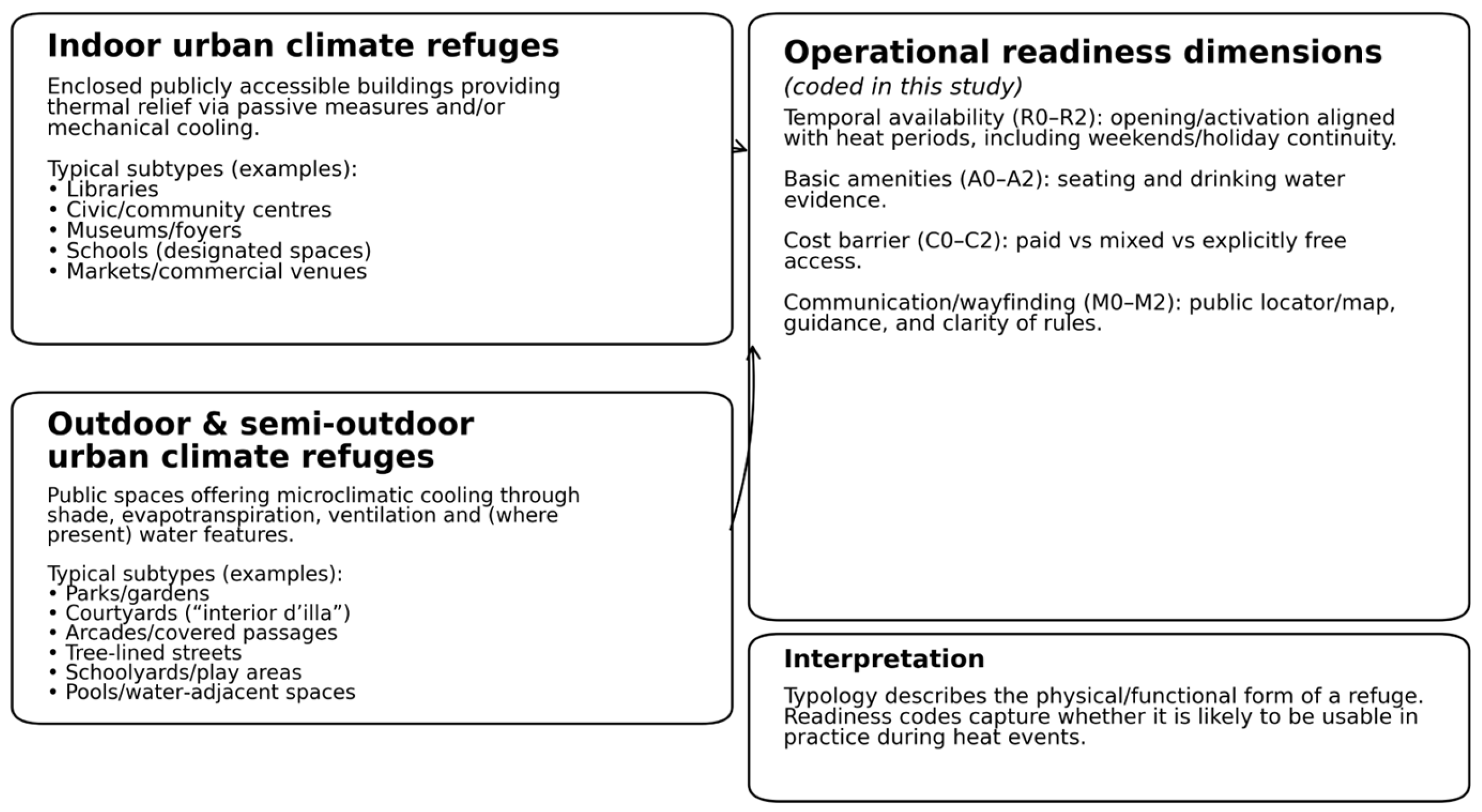
1.1.2. Definition and Typology: Establishing Consistent Terminology
1.1.3. Climate Justice, Vulnerability, and Equitable Access as Evaluative Dimensions
1.1.4. Blue–Green Infrastructure and Measurable Cooling Outcomes
1.1.5. Methodological Challenges in Evaluating Refuge Network Effectiveness
1.1.6. Analytical Lens: Why SWOT–CAME Is Appropriate for Refuge Networks
2. Materials and Methods
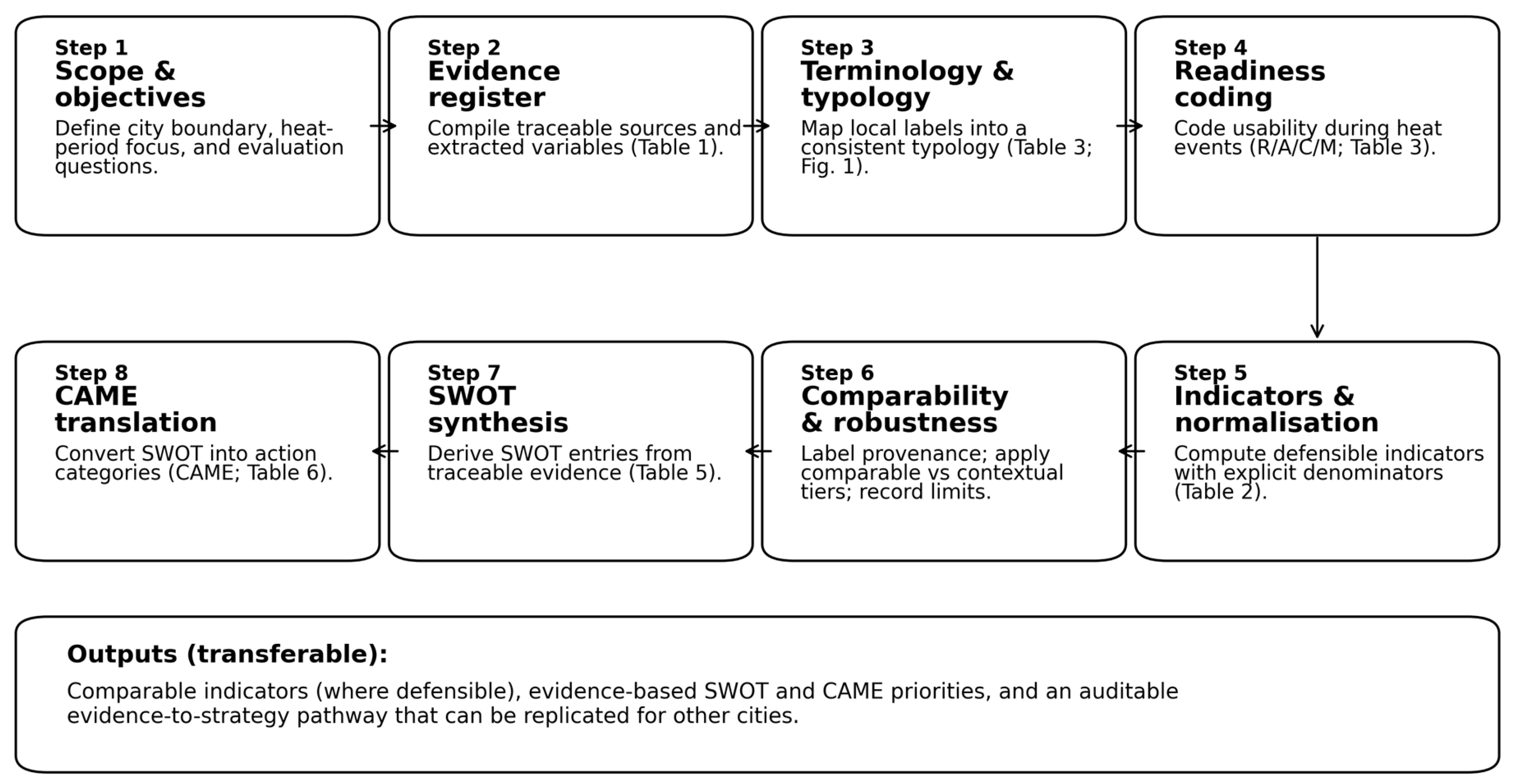
2.1. Study Design

| City | Source Type | Source/Owner | Variables Extracted (Examples) |
|---|---|---|---|
| Barcelona | Municipal news/programme page | Ajuntament de Barcelona (Info Barcelona) [8] | Network size (353), coverage shares (98% ≤10 min; 68% ≤5 min), examples of indoor/outdoor typologies, eligibility framing |
| Barcelona | Municipal policy/SDG page | Ajuntament de Barcelona (2030 Agenda) [9] | Network scale (~400), comfort set-points (26 °C summer indoors/21 °C winter indoors), typology list, August opening counts, micro-shelter initiative |
| Barcelona | Open data catalogue entry | https://opendata-ajuntament.barcelona.cat/en/api-cataleg (accessed on 17 December 2025) | Existence of published inventory dataset and update frequency |
| Barcelona | Academic PDF | https://www.uab.cat/web/uab-mobility-plan-1345796334967.html (accessed on 17 December 2025) | Stated municipal target: universal ≤5-min access by 2030 (as reported) |
| Amsterdam | Municipal heat plan/health governance docs | Municipality of Amsterdam. Amsterdams Hitteplan 2024 (Amsterdam Heat Plan 2024, PDF) [10] | Heat alert protocols, refuge/cooling centre typologies, vulnerable group targeting, coordination mechanisms |
| Amsterdam | Project record/web tool (cool places) | Open Research Amsterdam. ‘Find Your Cool’ map (Koele Plekken Checker) [20] | Cooling-place typologies, user-facing access logic, tool-based guidance |
| Copenhagen | Municipal climate adaptation/heat guidance | City of Copenhagen. Copenhagen Climate Adaptation Plan—Short Version (2011, PDF) [21] | Heat island framing; cooling measures (water, shade, air circulation); planning precautions |
| Copenhagen | Municipal committee record | City of Copenhagen (Teknik-og Miljøudvalget). Indsats mod varmeøer i København (meeting record) [22] | Monitoring/data gaps; integration into strategies; mapping/monitoring roadmap |
| Domain | Indicator | Definition | Unit | Normalisation Rule (Required) | Data Inputs | Comparable Across Cities? |
|---|---|---|---|---|---|---|
| Supply | Refuge provision (population-adjusted) | Number of designated refuges relative to resident population | refuges/100,000 residents | Divide by population; report year of population baseline | Inventory count; population | Yes (if counts & population available) |
| Supply | Refuge provision (area-adjusted) | Number of designated refuges relative to municipal area | refuges/km2 | Divide by area within comparable boundary definition | Inventory count; area | Yes (if boundary definitions align) |
| Access | Walking-time coverage | Share of residents within a stated walking-time threshold to nearest refuge | % residents | Use identical threshold definition (e.g., 10-min walk); avoid mixing thresholds | Published coverage metric or computed isochrones | Conditional (only if same threshold published/computable) |
| Equity | Vulnerability-weighted access | Access metric weighted by vulnerability proxy | index or % | Weight access by vulnerability layer; report layer definition | Vulnerability dataset; access | Conditional (data availability) |
| Typology | Typology mix | Share of refuges by typology class (indoor/outdoor; subtypes) | % of refuges | Use consistent typology dictionary (Table 3) | Inventory with labels | Conditional |
| Readiness | Availability index | Composite of opening alignment, basic amenities, and cost barrier | ordinal or score | Apply identical scoring rubric (Table 3) | Opening rules; amenities; cost | Yes (if evidence available) |
| Seasonal robustness | August/weekend continuity | Share of refuges open at weekends and/or August | % refuges | Report same seasonal window and days | Opening schedules | Conditional |
| Dimension | Codes | Operational definition | Minimum evidence required | |||
| Typology (primary) | Indoor refuge | Enclosed public/private-access space intended to provide thermal relief during heat events (passive and/or mechanically cooled) | Official designation + address/location | |||
| Typology (primary) | Outdoor/semi-outdoor refuge | Shaded or cooled public space (parks, courtyards, arcades, schoolyards) where microclimate reduces heat exposure | Official designation + location | |||
| Typology (secondary examples) | Library; civic/community centre; museum foyer; market; shopping centre; school facility; park/garden; courtyard (“interior d’illa”); play-area cooling space; pool | Subtype assigned when explicitly stated in source | Explicit typology label in source | |||
| Readiness: temporal | R0–R2 | R0: no clear opening information; R1: opening times published but not aligned with heat periods/weekends; R2: explicitly aligned with heat season/alerts and includes weekends or extended hours | Public opening times and/or activation protocol | |||
| Readiness: amenities | A0–A2 | A0: no evidence of seating/water; A1: partial (either seating or water); A2: both seating and drinking water confirmed | Programme description or facility info | |||
| Readiness: cost barrier | C0–C2 | C0: paid access; C1: mixed/conditional; C2: free access (explicit) | Fee policy statement | |||
| Readiness: communication | M0–M2 | M0: no public locator/wayfinding; M1: list exists but limited; M2: public map/locator and basic guidance available | Public-facing map/website and guidance | |||
| Dimension | Codes | Operational Definition | Minimum Evidence Required |
|---|---|---|---|
| Typology (primary) | Indoor refuge | Enclosed public/private-access space intended to provide thermal relief during heat events (passive and/or mechanically cooled) | Official designation + address/location |
| Typology (primary) | Outdoor/semi-outdoor refuge | Shaded or cooled public space (parks, courtyards, arcades, schoolyards) where microclimate reduces heat exposure | Official designation + location |
| Typology (secondary examples) | Library; civic/community centre; museum foyer; market; shopping centre; school facility; park/garden; courtyard (“interior d’illa”); play-area cooling space; pool | Subtype assigned when explicitly stated in source | Explicit typology label in source |
| Readiness: temporal | R0–R2 | R0: no clear opening information; R1: opening times published but not aligned with heat periods/weekends; R2: explicitly aligned with heat season/alerts and includes weekends or extended hours | Public opening times and/or activation protocol |
| Readiness: amenities | A0–A2 | A0: no evidence of seating/water; A1: partial (either seating or water); A2: both seating and drinking water confirmed | Programme description or facility info |
| Readiness: cost barrier | C0–C2 | C0: paid access; C1: mixed/conditional; C2: free access (explicit) | Fee policy statement |
| Readiness: communication | M0–M2 | M0: no public locator/wayfinding; M1: list exists but limited; M2: public map/locator and basic guidance available | Public-facing map/website and guidance |
2.2. Case Selection and Climatic Context
2.3. Data Sources and Evidence Extraction
2.4. Refuge Typology Classification and Terminology Control
2.5. Operational Readiness and Usability Coding
2.6. Indicator Framework and Normalisation Logic
Multi-Source Dataset Uncertainty and Uncertainty Propagation
2.7. SWOT–CAME Procedure
2.8. Reliability Checks and Limitations
3. Results
3.1. Evidence Base, Traceability, and Comparability Rules
3.2. Barcelona: Programme Scale, Access Coverage, Temporal Robustness, and Equity Signals
- 20.6 refuges per 100,000 residents, and
- 3.48 refuges per km2.
3.3. Amsterdam: Governance Maturity, Activation Logic, and Tool-Based Cooling Guidance
3.4. Copenhagen: Structural Cooling Paradigm and a Documented Monitoring Gap
3.5. Cross-Case Comparison Using Traceable, Non-Misleading Indicators
3.6. SWOT Results Grounded in Evidence
3.7. CAME Results (Strategy Translation)
3.8. Summary of Key Comparative Findings
- (i)
- (ii)
- Amsterdam provides the most explicit governance activation maturity (roles, triggers, annual evaluation), even if the refuge network is not published as a consolidated inventory in the reviewed material [10].
- (iii)
- Copenhagen highlights a critical evidence/monitoring constraint, positioning mapping and monitoring as the prerequisite for targeted UHI action and integration into strategies [22].
3.9. Sensitivity and Robustness Checks
4. Discussion
5. Conclusions
Policy Recommendations
- Guarantee temporal continuity during peak-risk periods by aligning refuge opening hours with heat alerts (including weekends/holiday weeks) and establishing contingency staffing for closures. (Correct/Address—Barcelona) [26].
- Implement shared data governance for heat protection services, ensuring that municipal departments, public health bodies and community organisations use a common evidence register and update cycle. (Address/Maintain—Amsterdam) [10].
- Institutionalise vulnerability-weighted access targets (not only population-wide averages) and use them to prioritise investment in high-risk neighbourhoods. (Exploit—Barcelona) [27].
- Embed cooling standards into renewal and public-space projects (shade, ventilation, blue–green assets), treating them as baseline cooling infrastructure rather than optional greening. (Maintain/Exploit—Copenhagen) [21].
- Treat UHI mapping and monitoring as enabling infrastructure, with citywide datasets and repeatable evaluation protocols to target interventions and demonstrate effects over time. (Correct/Exploit—Copenhagen) [22].
- Standardise indicator provenance and comparability labelling (“municipality-reported” vs. “computed”) and avoid benchmarking based on absolute counts or incompatible heatwave definitions. (Address—cross-case) [28].
Author Contributions
Funding
Institutional Review Board Statement
Informed Consent Statement
Data Availability Statement
Acknowledgments
Conflicts of Interest
References
- Copernicus Climate Change Service (C3S); World Meteorological Organization (WMO). European State of the Climate 2024; Copernicus Climate Change Service (C3S); World Meteorological Organization (WMO): Reading, UK, 2025. [Google Scholar] [CrossRef]
- Intergovernmental Panel on Climate Change (IPCC). AR6 WGII Fact Sheet—Human Settlements; IPCC: Geneva, Switzerland, 2022. [Google Scholar]
- Ballester, J.; Quijal-Zamorano, M.; Méndez Turrubiates, R.F.; Pegenaute, F.; Herrmann, F.R.; Robine, J.M.; Basagaña, X.; Tonne, C.; Antó, J.M.; Achebak, H. Heat-related mortality in Europe during the summer of 2022. Nat. Med. 2023, 29, 1857–1866. [Google Scholar] [CrossRef] [PubMed]
- Gallo, E.; Quijal-Zamorano, M.; Méndez Turrubiates, R.F.; Tonne, C.; Basagaña, X.; Achebak, H.; Ballester, J. Heat-related mortality in Europe during 2023 and the role of adaptation in protecting health. Nat. Med. 2024, 30, 3101–3105. [Google Scholar] [CrossRef] [PubMed]
- Vicedo-Cabrera, A.M.; Scovronick, N.; Sera, F.; Royé, D.; Schneider, R.; Tobias, A.; Astrom, C.; Guo, Y.; Honda, Y.; Hondula, D.M.; et al. The burden of heat-related mortality attributable to recent human-induced climate change. Nat. Clim. Change 2021, 11, 492–500. [Google Scholar] [CrossRef] [PubMed]
- Betgen, C.D.; Boekhold, S.; Boomsma, C.; van Dijk, A.; Hall, E.F.; Hagens, W.; Limaheluw, J.; Ruyssenaars, P.; van der Ree, J.; Versteeg-de Jong, A. Health Effects of Climate Change. In An Update of the Current Risks of Climate Change for Health (RIVM Letter Report 2024-0102); National Institute for Public Health and the Environment (RIVM): Bilthoven, The Netherlands, 2024. [Google Scholar] [CrossRef]
- Amorim-Maia, A.T.; Anguelovski, I.; Connolly, J.J.T.; Chu, E.C. Seeking refuge? The potential of urban climate shelters to address intersecting vulnerabilities. Landsc. Urban Plan. 2023, 238, 104836. [Google Scholar] [CrossRef]
- Barcelona City Council (Ajuntament de Barcelona). Over 350 Climate Shelters Open to Help Beat the Heat. 17 June 2024. Available online: https://www.barcelona.cat/infobarcelona/en/mes-de-350-refugis-climatics-oberts-a-la-ciutadania-per-fer-front-a-la-calor_1410886.html (accessed on 17 December 2025).
- Barcelona City Council (Ajuntament de Barcelona). Climate Shelters Network. Available online: https://www.barcelona.cat/barcelona-pel-clima/en/specific-actions/climate-shelters-network (accessed on 17 December 2025).
- Municipality of Amsterdam. Amsterdams Hitteplan 2024 (Amsterdam Heat Plan 2024, PDF). 2024. Available online: https://weerproof.nl/app/uploads/2024/06/Amsterdam_Hitteplan_2024_DEF.pdf (accessed on 17 December 2025).
- Dearman, C.; Adams, N.; Brooks, K.; Sousa, A.; Pearce-Smith, N.; Petrokofsky, C. Public health effectiveness of cooling centres during periods of adverse hot weather: A systematic literature review. Oxf. Open Clim. Change 2025, 5, kgaf020. [Google Scholar] [CrossRef]
- European Environment Agency (EEA). The Impacts of Heat on Health: Surveillance and Preparedness in Europe; EEA Briefing, 27 November 2024; EEA: Copenhagen, Denmark, 2024.
- Peel, M.C.; Finlayson, B.L.; McMahon, T.A. Updated world map of the Köppen–Geiger climate classification. Hydrol. Earth Syst. Sci. 2007, 11, 1633–1644. [Google Scholar] [CrossRef]
- Matthies, F.; Bickler, G.; Cardeñosa Marín, N.; Hales, S. (Eds.) Heat–Health Action Plans: Guidance; WHO Regional Office for Europe: Copenhagen, Denmark, 2008. [Google Scholar]
- Soltanifard, H.; Amani-Beni, M. The cooling effect of urban green spaces as nature-based solutions for mitigating urban heat: Insights from a decade-long systematic review. Clim. Risk Manag. 2025, 49, 100731. [Google Scholar] [CrossRef]
- Anguelovski, I.; Kotsila, P.; Lees, L.; Triguero-Mas, M.; Calderón-Argelich, A. From heat racism and heat gentrification to urban heat justice in the USA and Europe. Nat. Cities 2024, 2, 8–16. [Google Scholar] [CrossRef]
- European Environment Agency (EEA). Towards “Just Resilience”: Leaving No One Behind When Adapting to Climate Change; EEA Briefing, 2022; EEA: Copenhagen, Denmark, 2022.
- Gürel, E.; Tat, M. SWOT analysis: A theoretical review. J. Int. Soc. Res. 2017, 10, 994–1006. [Google Scholar] [CrossRef]
- Guilabert, M.; Sánchez-García, A.; Asencio, A.; Marrades, F.; García, M.; Mira, J.J. Challenges and strategies to recover and dynamize primary care: SWOT-CAME analysis in a Health Department. Aten. Primaria 2024, 56, 102809. [Google Scholar] [CrossRef] [PubMed]
- Open Research Amsterdam. ‘Find Your Cool’ Map (Koele Plekken Checker). 28 June 2023. Available online: https://openresearch.amsterdam/en/page/98162/find-your-cool-map (accessed on 17 December 2025).
- City of Copenhagen. Copenhagen Climate Adaptation Plan—Short Version (PDF). 2011. Available online: https://international.kk.dk/sites/default/files/2021-09/Copenhagen%20Climate%20Adaptation%20Plan%20-%202011%20-%20short%20version.pdf (accessed on 17 December 2025).
- City of Copenhagen (Teknik- og Miljøudvalget). Indsats Mod Varmeøer i København (Meeting Record, 19 August 2024). Available online: https://www.kk.dk/dagsordener-og-referater/Teknik-%20og%20Milj%C3%B8udvalget/m%C3%B8de-19082024/referat/punkt-5 (accessed on 17 December 2025).
- Barcelona City Council (Ajuntament de Barcelona). Over 200 Climate Shelters to Beat the Heat in the City. 10 July 2023. Available online: https://ajuntament.barcelona.cat/relacionsinternacionalsicooperacio/en/noticies/over-200-climate-shelters-to-beat-the-heat-in-the-city-1302979 (accessed on 17 December 2025).
- AMS Institute. A Map that Shows Where to ‘Find Your Cool’ During Heatwaves in Amsterdam. 12 August 2020. Available online: https://www.ams-institute.org/news/a-map-that-shows-where-to-keep-your-cool-during-heatwaves-in-amsterdam/ (accessed on 17 December 2025).
- Idescat. El Municipi en Xifres: Barcelona (Barcelonès) (Population and Surface Area). Available online: https://www.idescat.cat/emex/?id=080193 (accessed on 17 December 2025).
- Catalan News. Barcelona to Offer 350 Climate Shelters this Summer, 120 More than Last Year. 17 June 2024. Available online: https://www.catalannews.com/society-science/item/barcelona-to-have-350-climate-shelters-this-summer-120-more-than-last-year (accessed on 17 December 2025).
- Barcelona Supercomputing Center (BSC). Barcelona Climate Shelters: Are Barcelona’s Climate Shelters Accessible to Populations Vulnerable to Heat? (Slides). Available online: https://shelters.vcity.dataviz.bsc.es/slides/en (accessed on 17 December 2025).
- National Institute for Public Health and the Environment (RIVM). National Heatwave Plan (Definition and Distinction from Plan Activation). Available online: https://www.rivm.nl/en/heat/national-heatwave-plan (accessed on 17 December 2025).


| Dimension | Barcelona | Amsterdam | Copenhagen |
|---|---|---|---|
| Institutionalisation form | Climate shelters programme with published access metrics [8,23] | Heat Plan with specified roles/triggers and annual cycle [10] | Adaptation plan frames UHI + committee flags integration/data gap [21,22] |
| Published proximity coverage | 98% ≤10 min; 68% ≤5 min (2024) [8] | Not published as unified refuge-network coverage in reviewed core sources [20,24] | Not published as refuge-network coverage metric [22] |
| Headline network size | 353 shelters (summer 2024) [8] | Not consolidated as a refuge inventory in reviewed sources | Not consolidated as a refuge inventory |
| Normalised supply (computed) | 20.6/100 k; 3.48/km2 (computed from official baseline) [25] | Not computable without consolidated inventory | Not computable without consolidated inventory |
| Temporal robustness signal | Sunday/August 10-min access drops to 89% [26] | Governance cycle supports preparedness/learning [10] | Monitoring/data barrier explicitly stated [22] |
| City | Strengths | Weaknesses | Opportunities | Threats |
|---|---|---|---|---|
| Barcelona | Published proximity coverage and measurable access framing; mixed indoor–outdoor typologies [8,9,23] | Nominal vs. open-network gap during peak-risk periods (weekends/holiday season) [26] | Formalise vulnerability-weighted access reporting and prioritisation methods [27] | Reduced access during closures may disproportionately affect vulnerable residents [26] |
| Amsterdam | High governance readiness: triggers, roles, annual review cycle, target groups [10] | Lack of a single consolidated refuge inventory in reviewed sources limits spatial benchmarking [20,24] | Convert tool-based “cool places” into a transparent, typology-coded refuge layer aligned with the Heat Plan [10,20] | Comparability pitfalls if national heatwave definitions are treated as equivalent [28] |
| Copenhagen | Structural cooling paradigm (water/shade/air circulation) embedded in adaptation framing [21] | Data resolution and strategy integration gap explicitly documented [22] | Implement citywide mapping/monitoring enabling targeted interventions [22] | Rising heat risk may outpace evidence capacity if monitoring is delayed [22] |
| City | Correct | Address | Maintain | Exploit |
|---|---|---|---|---|
| Barcelona | Correct the open-network gap by strengthening weekend/holiday opening protocols and contingency staffing [26] | Address seasonal inequity risk by ensuring continuity in high-vulnerability areas during August/weekends [26,27] | Maintain measurable proximity targets and mixed typologies (indoor + outdoor) [8,23] | Exploit equity-oriented reporting by institutionalising vulnerability-weighted indicators for investment decisions [27] |
| Amsterdam | Correct evaluation/benchmarking limits by publishing a consolidated refuge layer (typology + access rules) under Heat Plan governance [10,20,24] | Address fragmentation by creating shared data governance across actors for heat protection services [10] | Maintain clear triggers, roles and annual learning cycle [10] | Exploit existing tools to integrate indoor refuges and targeted routes for vulnerable groups during alerts [20,24] |
| Copenhagen | Correct the evidence deficit through fine-resolution mapping/monitoring and citywide analysis [22] | Address strategy integration by embedding heat-island action into municipal plans with measurable indicators and accountability [22] | Maintain structural cooling emphasis (water/shade/air circulation) in renewal and public-space design [21] | Exploit monitoring roadmap to evaluate pilots and scale effective interventions [22] |
Disclaimer/Publisher’s Note: The statements, opinions and data contained in all publications are solely those of the individual author(s) and contributor(s) and not of MDPI and/or the editor(s). MDPI and/or the editor(s) disclaim responsibility for any injury to people or property resulting from any ideas, methods, instructions or products referred to in the content. |
© 2026 by the authors. Licensee MDPI, Basel, Switzerland. This article is an open access article distributed under the terms and conditions of the Creative Commons Attribution (CC BY) license.
Share and Cite
Díaz-López, C.; Mora-Esteban, R.; Conejo-Arrabal, F.; Castro-Bonaño, J.M. Urban Adaptation to Climate Change: Climate Refuge Networks as a Strategy to Mitigate Thermal Stress. Urban Sci. 2026, 10, 100. https://doi.org/10.3390/urbansci10020100
Díaz-López C, Mora-Esteban R, Conejo-Arrabal F, Castro-Bonaño JM. Urban Adaptation to Climate Change: Climate Refuge Networks as a Strategy to Mitigate Thermal Stress. Urban Science. 2026; 10(2):100. https://doi.org/10.3390/urbansci10020100
Chicago/Turabian StyleDíaz-López, Carmen, Rubén Mora-Esteban, Francisco Conejo-Arrabal, and Juan Marcos Castro-Bonaño. 2026. "Urban Adaptation to Climate Change: Climate Refuge Networks as a Strategy to Mitigate Thermal Stress" Urban Science 10, no. 2: 100. https://doi.org/10.3390/urbansci10020100
APA StyleDíaz-López, C., Mora-Esteban, R., Conejo-Arrabal, F., & Castro-Bonaño, J. M. (2026). Urban Adaptation to Climate Change: Climate Refuge Networks as a Strategy to Mitigate Thermal Stress. Urban Science, 10(2), 100. https://doi.org/10.3390/urbansci10020100