
Article

When Smoke Enters the City: Challenges for HVAC Filters in Resilient Buildings

Metalmark Innovations, PBC, Cambridge, MA 02138, USA
*
Author to whom correspondence should be addressed.
Urban Sci. 2026, 10(2), 99; https://doi.org/10.3390/urbansci10020099
Submission received: 1 December 2025 / Revised: 8 January 2026 / Accepted: 17 January 2026 / Published: 4 February 2026

Abstract

Climate-driven increases in wildfire activity threaten urban air quality both through long-range smoke transport from rural fires and direct exposure as the wildland–urban interface expands. Filters installed in Heating Ventilation and Air Conditioning (HVAC) systems represent a critical first barrier for limiting indoor exposure to smoke-derived particulate matter. In this study, we evaluated the smoke filtration performance of more than seventeen commercially available HVAC filter media spanning efficiency ratings from 10 to 15 (Minimum Efficiency Reporting Value, MERV) using pine needle combustion aerosols as a wildfire smoke proxy, quantifying size-resolved filtration efficiency, pressure drop, and temporal performance changes. The results show that charged polymer media across all tested MERV classes exhibited pronounced and rapid losses in smoke removal efficiency under exposure, despite minimal changes in airflow resistance. In contrast, mechanical media demonstrated greater stability in filtration efficiency over time but experienced considerable increases in pressure drop. Scanning electron microscopy revealed distinct smoke deposition morphologies on filter fibers, providing insight into mechanisms underlying performance degradation. Collectively, these findings indicate that filtration performance under wildfire smoke conditions is not adequately captured by current standards based on inorganic test aerosols. The results underscore the importance of advancing filter material evaluation and developing smoke-relevant testing approaches to better support indoor air quality, energy-aware building operation, and urban resilience under climate-driven wildfire smoke exposure.

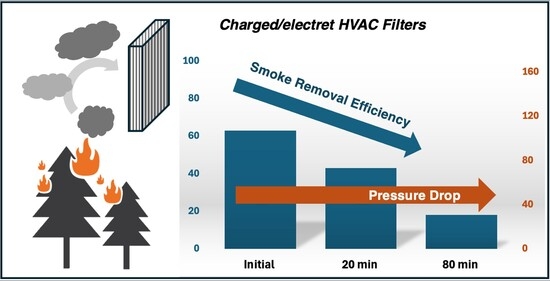
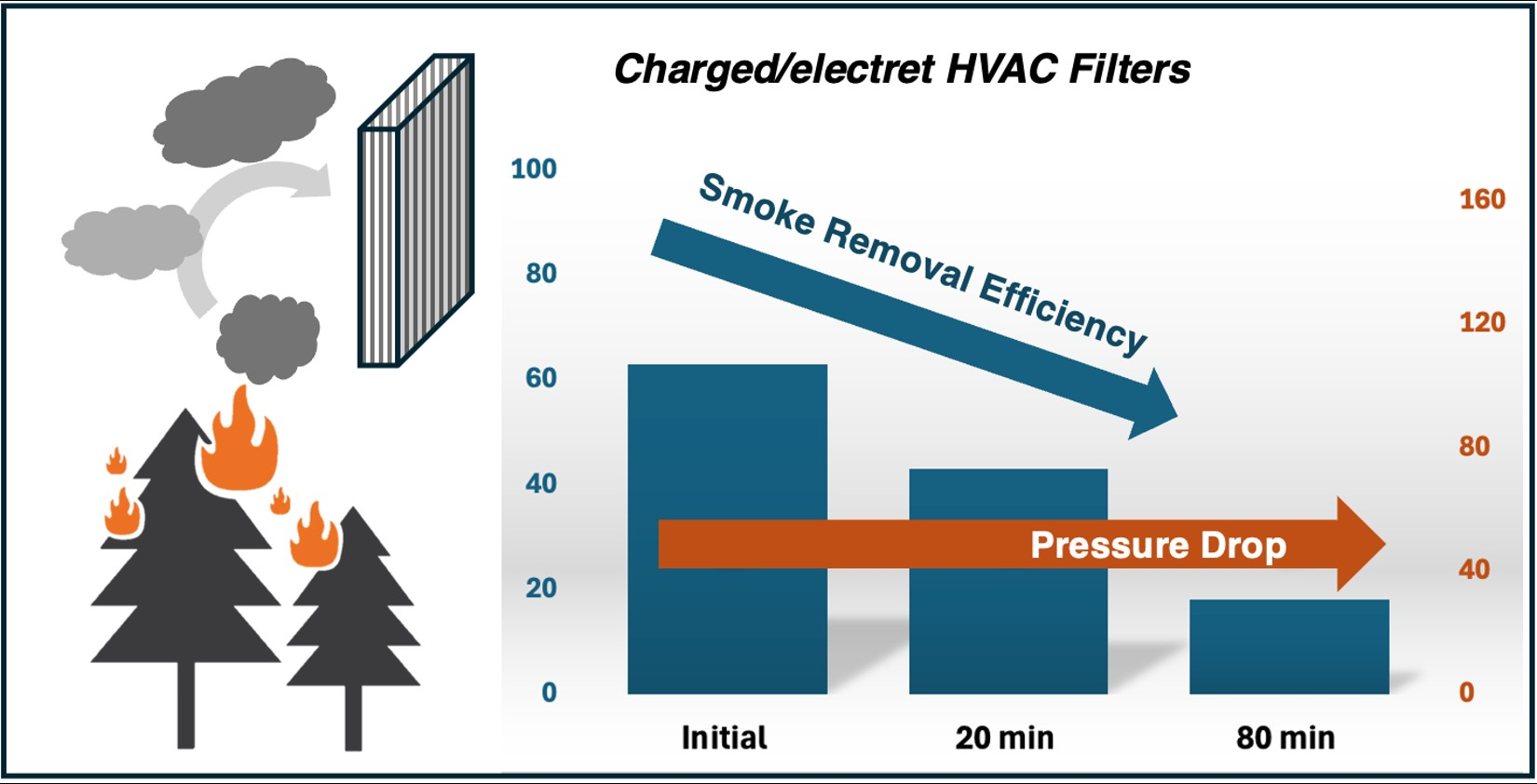
Graphical Abstract

1. Introduction

Over the past several decades, wildfire activity has intensified in both frequency and severity in the western United States, Canada, and many other regions worldwide, leading to escalating environmental, health, societal, and economic impacts [1,2,3,4]. Wildfire smoke can be transported over continental scales, influencing air quality, visibility, and atmospheric chemistry far from its source [5,6]. For example, smoke from prolonged Canadian wildfires in 2023 and again in 2025 not only spread across the eastern United States, degrading urban air quality, but also crossed the Atlantic to Europe, where it impacted several major cities [7,8]. Wildfire smoke is increasingly recognized not only as an air quality and health threat but also as a critical challenge for urban resilience and sustainable building design. In the United States alone, the wildland–urban interface includes nearly 50 million homes, with continued growth of approximately one million homes every three years [4]. Globally, the wildland–urban interface accounts for just 4.7% of land area yet houses nearly half of the world’s population—about 3.5 billion people. This expansion heightens risks, as illustrated by the 2025 Los Angeles wildfires, which forced school closures, disrupted transportation, and severely degraded indoor air quality across the city. Similar vulnerabilities are evident in Europe, where recent wildfires near Madrid, Marseille, and across Southern Europe during the 2025 heatwave shut down airports, schools, and train services, triggered mass evacuations, and forced residents indoors due to heavy smoke. These events demonstrate that wildfire impacts now extend well beyond traditionally fire-prone rural regions, increasingly disrupting urban centers and critical infrastructure.
Wildfires emit a wide range of pollutants, including fine particulate matter (PM) and volatile organic compounds (VOCs), with studies showing that most wildfire PM is sub-micron and composed primarily of organic compounds (over 90%), along with elemental carbon and other inorganic elements [6,9,10,11,12]. Fires at the wildland–urban interface generate even more toxic emissions as buildings and vehicles burn [13,14]. Existing guidance for wildfire smoke exposure is largely framed around fine PM, specifically particles with diameters of 2.5 µm or smaller (PM2.5), with pollution levels typically reported on a mass concentration basis (μg/m3). The US Environmental Protection Agency’s (EPA) National Emissions Inventory estimates that wildland fires are the largest U.S. source of PM2.5, contributing ~30% nationally and up to half in the West, compared with ~9% from transportation [2,9]. These emissions can travel long distances and push PM2.5 far beyond safe thresholds, with daily values reported near 800 μg/m3 versus EPA standards of 9 μg/m3 (annual) and 35 μg/m3 (24-h) [15].
Exposure to wildfire smoke poses serious health risks, particularly for respiratory and cardiac conditions, with hospital visits spiking during smoke events [16,17]. Recent studies suggest that wildfire smoke PM2.5 is linked to a 21% increased risk of developing dementia, more so than other air pollutants [18]. It may also impact cognition, leading to lower test scores and reduced future income [19]. Evidence shows that wildfire PM is often more harmful to respiratory health than PM from other sources, with toxicological studies linking its organic- and reactive-rich composition to greater oxidative stress and inflammation than typical urban particles [20].
Buildings are viewed as safe shelters from smoke; however, due to their size, smoke PM can infiltrate indoors via HVAC systems and building envelopes [21,22,23,24]. Ensuring safe indoor environments is crucial for climate resilience, making HVAC filters essential for removing PM in residential and commercial spaces [25].
Most common HVAC filters in use today have a Minimum Efficiency Reporting Value (MERV) of 8–10, per ASHRAE Standard 52.2, chosen based on building mechanical system design parameters, HVAC system configurations, and energy considerations [26]. Current approaches to mitigating wildfire smoke exposure in buildings rely primarily on operational guidance rather than materials-specific performance data. Public health agencies and professional organizations commonly recommend remaining indoors and reducing outdoor air intake. Recently, ASHRAE released Guideline 44-2024, Protecting Building Occupants from Smoke During Wildfire and Prescribed Burn Events, which provides comprehensive recommendations for building design and operation during smoke events, including adjusting ventilation strategies, upgrading HVAC filtration to MERV 13, and supplementing with portable air cleaners during smoke events [27]. These recommendations are largely based on PM2.5 mass concentration as the exposure metric and on nominal filter ratings derived from standardized testing with inorganic particles. As a result, wildfire smoke mitigation in buildings is often addressed through system-level or behavioral interventions, while the performance and aging behavior of filter media under realistic smoke loading conditions remain largely uncharacterized. This disconnect between guidance-driven practice and material-level performance data represents a critical gap in the current state of the art.
Most HVAC filters are either mechanical or charged/electret. Increasingly, charged media are being adopted due to their low cost and energy-saving advantages associated with low airflow resistance [28]. Despite their growing adoption, comparatively few studies have systematically evaluated the filtration efficiency, stability, and aging behavior of charged HVAC filter media under realistic smoke exposure conditions [29].
Related research has examined submicron particle removal using mechanical and electret media in laboratory settings or full-scale HVAC test ducts, typically employing inorganic salts, dioctyl phthalate, or other surrogate aerosols [30,31]. Other studies have focused on charged media degradation using cigarette smoke or artificial discharge methods (e.g., with isopropyl alcohol), often in the context of portable air cleaners and short-term performance metrics such as CADR [32]. While these approaches provide valuable insight into general filtration behavior and aging mechanisms, they do not represent the physicochemical properties or sustained exposure conditions associated with wildfire smoke. Wildfire smoke particles are predominantly submicron, typically in the range of 200–400 nm, and are enriched in organic and carbonaceous components, characteristics that can strongly influence filtration efficiency and media aging [9,10]. Relatively few studies have systematically evaluated how wildfire smoke affects HVAC filter performance, and many aspects of this behavior remain poorly understood [29,33]. For example, Holder et al. found that the CADR of air cleaners with charged filters dropped by 95% with only a 7% increase in pressure after just 10 mg of pine needle (PN) smoke deposition [29].
Our prior investigation evaluated the impact of PN smoke on the filtration behavior of charged and fiberglass media rated at an efficiency level of MERV 11 [33]. In this study, we expanded our assessment to include 17 types of commercially available filter media, covering both charged (electret) and non-charged (mechanical) polymeric, as well as fiberglass media, with MERV ratings from 10 to 15. We measured the filtration efficiency of media samples after various durations of smoke deposition and analyzed time-dependent changes in filter media morphology using Scanning Electron Microscopy (SEM). These observations underscore the performance challenges of common HVAC filters in protecting against wildfire smoke and aid in developing more appropriate smoke testing methods for filter media and filters. Equally important, they suggest more studies are needed to ensure comprehensive public health recommendations for preserving indoor air quality and protecting human occupants during wildfire events.
Following controlled smoke deposition over varying exposure durations, we examined time-dependent changes in filter media morphology using scanning electron microscopy. These observations underscore the challenges common HVAC filter media face when exposed to wildfire smoke and inform the development of more representative smoke-testing approaches.

2. Materials and Methods

2.1. Filter Media

Filter media evaluated in this study were obtained directly from four internationally established manufacturers. In this paper, we refer to them as Manufacturer A, Manufacturer B, and so forth, in no particular order and without revealing their specific origins. We tested 17 different filter media types, including charged (electret) polymer, uncharged polymer, and fiberglass media. Detailed specifications for each media type are provided in Table 1. The MERV values were in the range of 10 to 15 based on the manufacturer’s specifications. All filtration efficiency measurements were performed using new, unused media samples. At least three samples of each type were measured.

2.2. Filtration Efficiency Test Setup

The benchtop smoke filtration testing setup was custom-built, and its details are described in Supplementary Materials (Figure S1). Particle size distributions and number concentrations were measured using a combination of optical and mobility-based particle counters, including an optical particle sizer (OPS 3330, TSI Inc., Shoreview, MN, USA) and a scanning mobility particle sizer (SMPS 3910, TSI Inc., Shoreview, MN, USA). The OPS measured particles with diameters between 365 nm and 10 µm at concentrations up to 3000 particles/cm3, while the SMPS measured particles in the 10–365 nm range at concentrations up to 1 × 10⁶ particles/cm3. The system operates in the range of 2–15 LPM or 5.5–40 cm/s across a ~5 cm2 flow exposed sample area with a corresponding pressure drop range of 40–500 Pa, depending on the media type. Temperature and relative humidity within the smoke chamber were continuously monitored (SEN55, Sensirion, Stäfa, Switzerland) and maintained within 24–28 °C and 45–65%, respectively. The setup’s design incorporates programmable automated switching between the four conduit arms (samples and bypass), enabling a rapid test throughput, precision, and accuracy that helped to establish robust testing procedures for PN smoke removal efficiency.

2.3. Experimental Procedure, Data Collection, and Analysis

For each experiment, circular specimens with a diameter of approximately 5 cm (~2 inches) were prepared from the filter media and mounted in custom sample holders. The exposed cross-sectional area subjected to airflow was approximately 5 cm2 (Figure S1D, brown circle. For each experimental run, a predetermined mass of pine needle material was cut into ~1 cm segments and combusted using a portable smoke infuser connected directly to the smoke chamber (Figure S1C). Approximately 125 mg of PN was used per run, producing a challenge aerosol concentration of ~4 × 10⁵ particles/cm3 (≈1500 μg/m3) within the 60–380 nm size range, with a median particle diameter of ~160 nm. Following smoke generation, the chamber was allowed to equilibrate for approximately 15 min to stabilize particle concentrations, during which the benchtop system operated in bypass mode. This was followed by a filtration efficiency test, during which air was passed through the first sample (channel 1) for 2 min, followed by another 2 min in bypass mode. This cycle was repeated for another two samples (channels 2 and 3). During this experiment, the air was continuously analyzed with the particle counter instruments. All filter media were evaluated at a volumetric flow rate of 10 L/min, corresponding to a face velocity of approximately 33 cm/s (~60 feet per minute). This velocity lies within the range typically encountered across the cross-section of pleated HVAC filters in practical building applications [34,35]. For smoke deposition experiments, the smoke was allowed to pass through the samples for a predetermined amount of time (e.g., 20 min, 80 min) and then the filtration efficiency test was repeated. A more detailed description of the test procedure is provided in Supplementary Materials (Figure S2). Filtration efficiency was calculated according to Equation (1), where Cfilter denotes the average signal obtained during filtration mode and Cbypass denotes the average measured in the bypass mode bracketing the filtration period.
E F % = ( 1 C f i l t e r C b y p a s s ) × 100 %

2.4. Filter Media Characterization (SEM)

Filter media morphology was examined using field-emission scanning electron microscopy (FE-SEM; Gemini 360, Zeiss, Oberkochen, Baden-Württemberg, Germany). For imaging, representative portions of the filter media were sectioned into approximately 0.5 × 0.5 cm pieces and mounted on SEM sample holders prior to analysis.

3. Results and Discussion

3.1. Smoke Generation and Characterization

PN smoke has been adopted in laboratory studies as a representative surrogate for wildfire smoke. It has been employed in experimental investigations by researchers at the U.S. Environmental Protection Agency and by other groups to simulate wildfire-related particulate emissions under controlled conditions [29,36]. It is a challenging analyte characterized by complex composition and a highly dynamic particle size distribution that depends on combustion temperature, concentration, and aging. At present, no standardized test method exists for evaluating the filtration efficiency of filter media when challenged with PN smoke. Our criteria for selecting the appropriate conditions included ensuring the stability of the particle size distribution and PM concentration within the instrument’s sensitivity range over the experiment duration. No particles larger than 400 nm were detected using a combination of OPS and SMPS. Hence, only SMPS was used in filtration efficiency experiments (Figure S3A). Varying the weight of PN (from 30 to 350 mg) had little impact on the PM size distribution after the equilibration period, consistently showing a mono-modal size distribution between 50–400 nm, with a median diameter ranging from 100 to 160 nm. For this study, we opted to use 125 mg of PNs, which produces around 400,000 counts/cm3 (~1500 μg/m3) of particles within the 60–380 nm range, with a median diameter of ~160 nm (Figure S3B,C). This size range is consistent with real-world conditions. Under atmospheric aging, wildfire smoke plumes undergo chemical and physical transformations that shift particle size distributions toward the submicron range, with reported modal diameters commonly between 100 and 300 nm [6,10,11,12,37,38]. After the equilibration period in the present experiments, the smoke particle size distribution remained relatively stable for approximately one hour (Figure S3C).

3.2. Filtration Efficiency and Pressure Drop

Seventeen types of filter media with MERV ratings ranging from 10 to 15, sourced from four different manufacturers (designated as Manufacturer A, B, C, and D), were used to test the temporal filtration efficiency of PN smoke and changes to pressure drop (PD). The detailed information for each of the filter media samples is provided in Table 1 above. Their filtration efficiency across different smoke deposition periods was analyzed by averaging the size-resolved efficiency over particle sizes between 116 and 365 nm, as the efficiency followed an almost linear trend across this size range (Figures S4–S6 and Table S1).
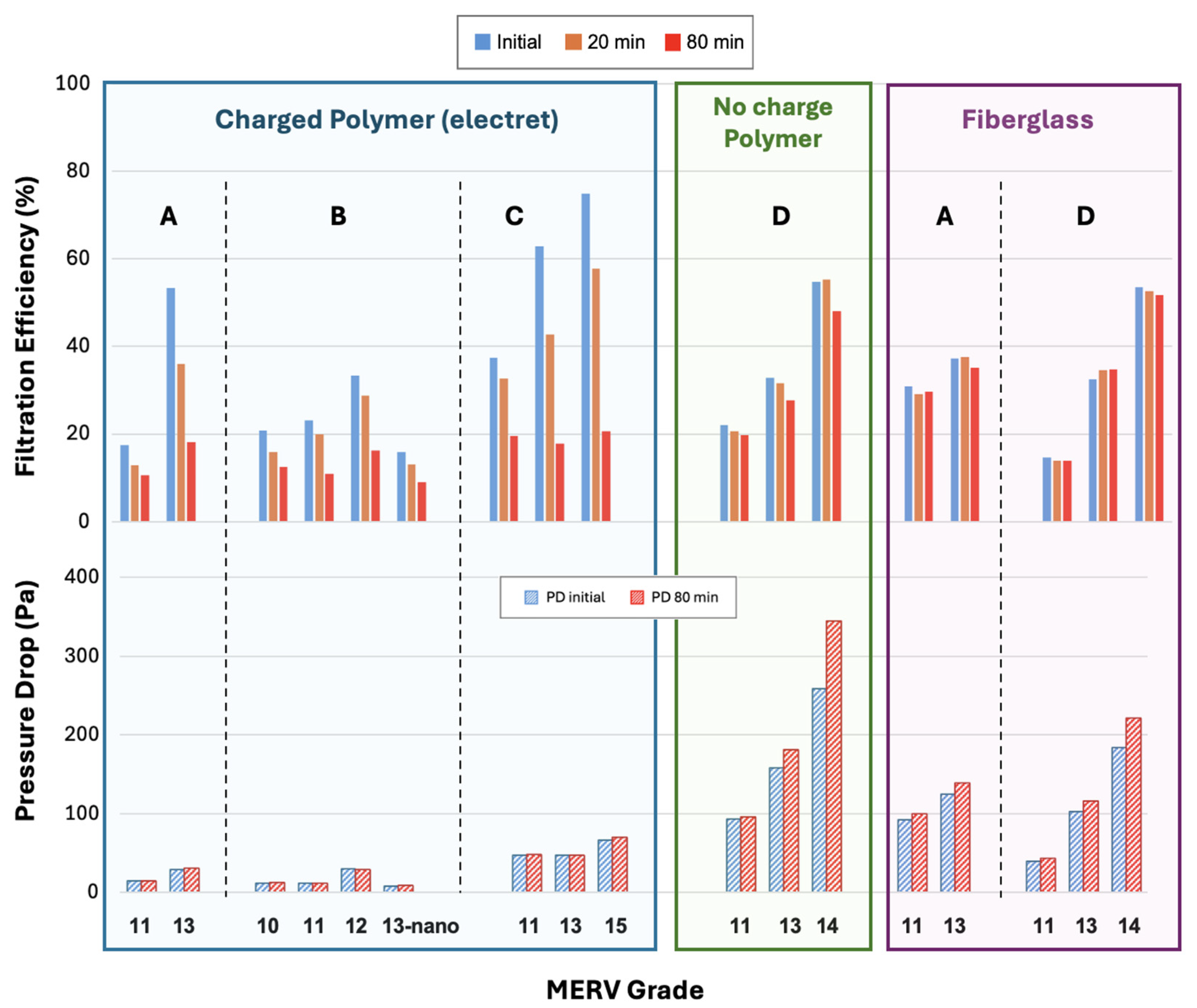
The summary of the effects of smoke deposition on filtration efficiency per the associated MERV rating, media type, and manufacturer is shown in Figure 1 and summarized in Table 2. In general, initial filtration efficiencies (~5 min of smoke deposition) of PN smoke of charged media were in agreement with the efficiencies as represented by the manufacturer-provided MERV ratings, while mechanical media demonstrated lower PN removal efficiency than their MERV ratings suggest (Table 1). Since PN smoke particles are smaller than 1 micron, only the PM1.0 size removal efficiency associated with the MERV rating requirements is shown in the table, as it is the most relevant PM size category for smoke filtration. Noticeable variations in initial filtration efficiency were observed among media with the same MERV grade from different manufacturers, likely due to differences in fabrication processes and media structure [33]. The most conspicuous difference was observed for Manufacturer B’s MERV 13 filter media (13-nano), which exhibited a steep decline in efficiency after a short period of smoke deposition (Figure 1).
This filter media features a composite structure with nano- and micrometer fibers. Composite media incorporating nanofibers are widely recognized for providing high filtration efficiency at low pressure drop, which has contributed to their growing use in new filter designs [39]. However, this benefit may not fully extend to smoke filtration, indicating that additional studies are needed to better understand their performance with this relatively new media type. Notably, the media showed an immediate and precipitous drop in efficiency, likely due to complex interactions between the smoke and nanofibers, which will be explored further below. On the other hand, charged synthetic media demonstrated higher initial removal efficiency of PN smoke than mechanical media of the same grade. As previously noted, the initial efficiency of mechanical media was generally lower than expected based on their MERV ratings, which are determined using the most penetrating particle size (MPPS). In our study, the face velocity (~33 cm/s) was about six times higher than the velocity commonly used in ASHRAE 52.2–based flat media tests (~5.3 cm/s). For inorganic particles near the most penetrating particle size (~0.3 µm), mechanical media often show increasing collection efficiency with increasing face velocity, as interception and inertial impaction become more significant, consistent with established fibrous filtration behavior [40]. However, this relationship did not hold for wildfire smoke particles: we observed the opposite trend, with higher face velocities resulting in lower smoke filtration efficiency. The initial PD of charged media was significantly lower than that of mechanical media. As expected, the PD increases with the MERV rating of media, while higher filtration efficiency is also observed in the media (Table 2).
Filter media samples were subjected to continuous PN smoke deposition for varying durations, and their changes in filtration efficiency and pressure drop were assessed after specific time intervals of smoke exposure, including after 20 and 80 min (Figure 1, orange and red bars, respectively, and Table 2). The PN smoke removal efficiency of charged synthetic media deteriorates rapidly with continuous deposition of PN smoke. For instance, the efficiency of MERV 13 and MERV 15 media from Manufacturer C, which initially showed the highest filtration efficiency, decreased by 72% after 80 min. In contrast, mechanical media, both uncharged polymer (synthetic) and fiberglass, demonstrated much higher stability toward PN smoke deposition in terms of filtration efficiency. For most mechanical media samples, the decrease in efficiency was less than 10% after 80 min of continuous deposition. The change in PD was insignificant for charged synthetic media regardless of the deposition time. Mechanical media, on the other hand, showed a PD increase proportional to the MERV rating, with the highest being a 33% increase for the MERV 14 uncharged polymer (Manufacturer D). As generally recognized, mechanical filter media exhibit a significantly higher initial pressure drop than charged media at a given MERV rating, consistent with the trends shown in Table 2 and Figure 1. Although this higher and more stable filtration performance under wildfire smoke exposure supports resilience, the associated increase in airflow resistance can lead to higher fan energy consumption and, in some cases, require upgrades to more energy-intensive or higher-capacity HVAC systems to maintain design airflow.
It is generally believed that upgrading HVAC filters to higher MERV ratings improves protection against wildfire smoke. However, this does not apply to charged media. To summarize, regardless of their MERV ratings, (1) charged media’s smoke removal efficiency dropped below 20% quickly; (2) post continuous smoke deposition, only a slight increase in PD was observed (PD remained nearly unchanged after 80 min, except for the 13-nano sample, which saw a 13% increase).

3.3. Fiber Morphology After Smoke Deposition

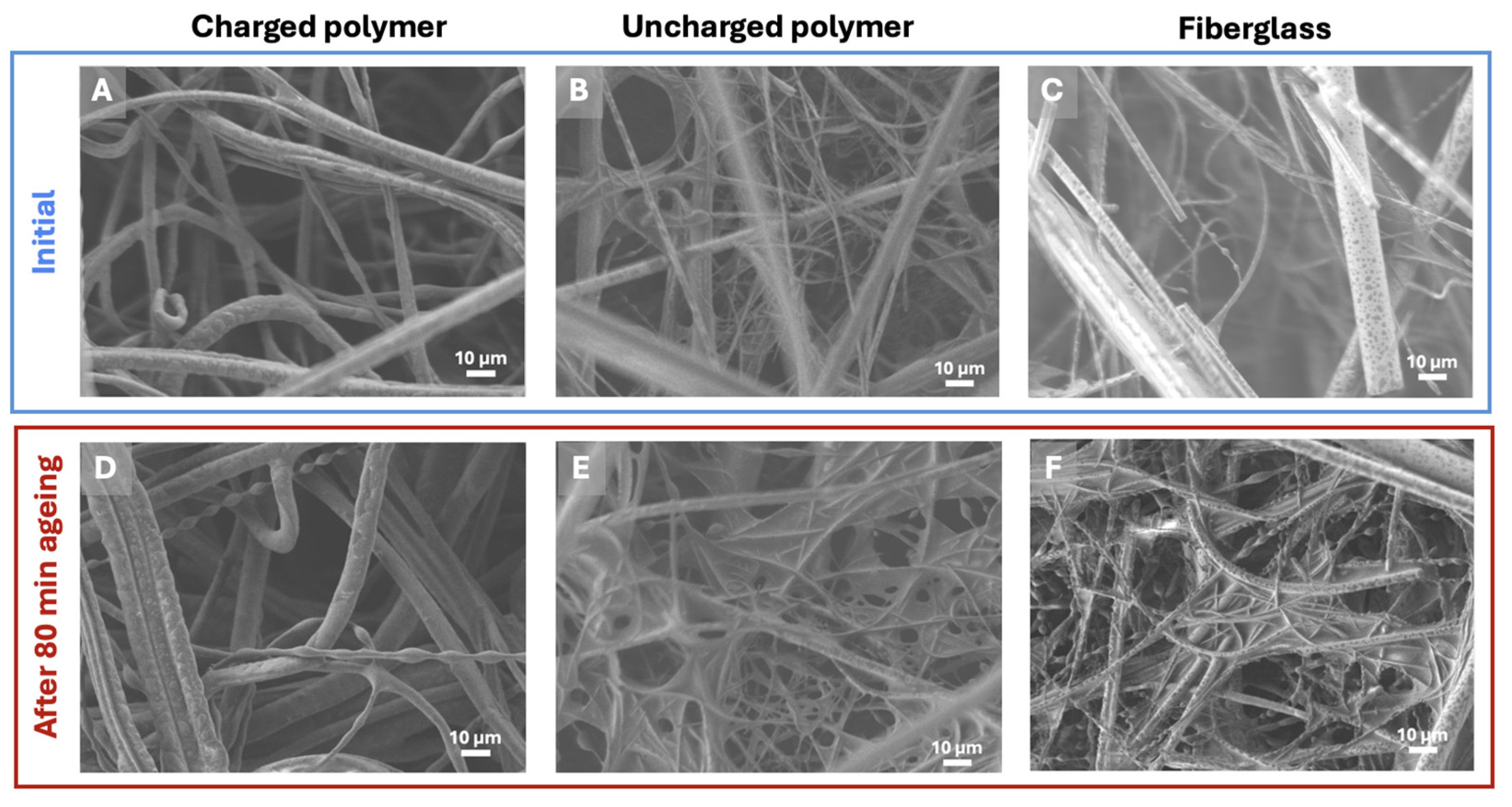
Most studies have focused on the filtration efficiency of single-composition particles, such as solid inorganic particles or oil aerosols like dioctyl phthalate (DOP), resulting in a poor appreciation of the deposition behavior of mixed particles such as wildfire smoke particles. Understanding the interactions between smoke particulates and filter media fibers, including their deposition behaviors and resulting fiber morphology, is crucial for assessing the overall performance of air filters. However, relatively few studies have applied electron microscopy to examine air filter surfaces after exposure to challenge aerosols [33,41,42]. To better assess the influence of PN smoke on filter media morphology, three representative media types were selected for SEM analysis. Figure 2 shows SEM images of charged synthetic and mechanical media (uncharged synthetic and fiberglass) from Manufacturers C and D, respectively, after various smoke deposition periods. All clean samples exhibit a smooth fiber surface morphology. However, after a brief period of initial filtration, deposits or film-like coatings appear on the fiber surfaces of all sample types, with charged media showing notably more coverage. After 80 min of deposition, all samples display droplet-like deposits resembling a “beads on a string” morphology on their surfaces. This phenomenon was also noted in our previous studies of PN smoke filtration [33]. The morphology of smoke particles on the fibers differs significantly from that of inorganic salt particles (e.g., KCl), which are characterized by dendritic structures. While droplet-like morphologies have also been reported in several studies focusing on liquid-phase organic aerosols, it is important to remember that filtration efficiency and pressure drop for mixed particles such as wildfire smoke depend on factors like particle size, charge, and composition [36,37]. The “beading” effect appears in all types of media that contain thin fibers with sub-micron diameters, and it forms even at the early stages of deposition. This effect is observed across all media types, including both charged and uncharged materials, indicating that bead formation is not uniquely associated with electrostatic effects. Instead, the results suggest that fiber geometry, particularly high aspect ratio and small fiber diameter, plays a dominant role in governing smoke particle accumulation and agglomeration on fibers. For example, in the case of composite media incorporating nanofibers (13-nano, Manufacturer B), the most extensive beading among all samples was observed even after a short deposition period (Figure S7). As mentioned previously, this media demonstrated an immediate drop in the removal efficiency to below 10% within the first few minutes of smoke filtration (Figure 1, Table 2).
While the beads-on-string morphology is primarily governed by fiber geometry and occurs independent of charge state, the extent of beading and fiber coverage appears to be influenced by electrostatic effects; charged media exhibited more extensive coverage than mechanical, uncharged media, and the accumulation of carbonaceous and organic smoke material on charged fibers may additionally contribute to electrostatic screening or partial charge neutralization, thereby accelerating filtration efficiency loss. The relative contributions of geometric deposition effects and electrostatic degradation cannot be decoupled based on the present data and necessitate further systematic investigation.
The long-term performance of charged/electret filters can degrade due to humidity, chemical exposure, dust loading, or elevated temperature. There are three suggested mechanisms for the reduction of filtration efficiency for the charged air filters: (1) neutralization of charge by oppositely charged particles, (2) screening of the fiber charge by the captured particles, and (3) disruption of charge by dissolution or some chemical reaction taking place on the surface of the fiber [28,43,44]. Wildfire smoke aerosols comprising a mixture of solid carbonaceous particles and liquid or semi-volatile organic components present unique challenges. Their mixed-phase composition, combined with evidence that smoke particles can themselves carry charge, makes them particularly effective at degrading electret performance [29,33,45]. While the magnitude of efficiency loss observed under wildfire smoke exposure is qualitatively comparable to that reported for electret discharge induced by chemical vapors or other aging protocols, the underlying mechanisms are not yet fully understood and may involve electrostatic, chemical, and/or physical masking effects that differ from conventional dust loading or vapor-based discharge tests.
In summary, the effect of PN smoke on temporal filtration efficiency and the resulting PD on charged filter media differs significantly from that of inorganic particle loading. Smoke filtration’s unique characteristics stem from specific interactions between PM smoke particles and media fibers, leading to distinct morphological features. Smoke deposition does not dramatically increase airflow resistance in any media types tested, a stark contrast to inorganic particle loading, indicating that an increase in PD may not be an effective diagnostic for recommending filter changes during wildfire smoke events. In addition, filters from different manufacturers with the same MERV rating can have varying smoke removal efficiencies, and in the case of charged media, higher MERV grades correlate with faster efficiency decay, necessitating frequent, unsustainable filter changes. A conclusion consistent with our previously published findings is that the standard recommendation to upgrade HVAC filters with higher MERV grades as a wildfire smoke mitigation strategy may not be effective. Mechanical filters, while demonstrating substantially greater performance stability for PN smoke filtration, are associated with higher pressure drop, especially at higher MERV ratings. From a resilient building perspective, this highlights a fundamental trade-off between filtration stability under wildfire smoke exposure and HVAC energy performance, as elevated pressure drop can increase energy use, impact equipment lifetime, and limit applicability in existing buildings without system upgrades.
While small-scale laboratory testing of flat filter media offers valuable insights, testing larger flat-sheet and pleated filters at relevant flow rates is also critical, as the form factor and geometry can significantly affect smoke filtration performance. More broadly, our results highlight the need to develop and validate smoke-relevant filtration test methods, potentially as extensions or updates to existing standards such as ASHRAE 52.2, which are currently based on inorganic aerosols and may not reflect wildfire smoke behavior. Even more importantly, testing under real-world or field-representative conditions. Given the focus of many IAQ policies on HVAC filters, testing filters with smoke aerosols in real-world conditions should be a top priority to ensure public safety, enhance sustainability, and drive innovation in filtration. Together, these findings demonstrate that air filtration performance must be integrated into material selection and system design for resilient buildings, particularly as urban areas face increasing exposure to wildfire smoke under a changing climate.

Supplementary Materials

The following supporting information can be downloaded at https://www.mdpi.com/article/10.3390/urbansci10020099/s1. Figure S1: (A) Schematics of smoke filtration testing setup: (1) Manifold; (2) 4 automated valves for switching between samples and bypass channels and 4 sanitary tubes (bypass, channels 1,2,3) with samples holders; (3) Mass Flow Controller (MFC); (4) Peristaltic pump; (5) Probing vessel with particles counter (Nanoscan SMPS Model 3910, TSI). (B) Photograph of the experimental setup for testing filter media performance indicating the setup’s key components. (C) Infuser actively combusts PNs to introduce smoke into the smoke chamber. (D) Photograph of a typical filter media sample after smoke deposition. The brown circle indicates the area that was exposed to the air stream. The system operates in the range of 2–15 LPM or 5.5–40 cm/s for ~5 cm2 flow exposed sample area and corresponding pressure drop range of 40-500 Pa, depending on the media type. Figure S2: Representative ~70 min test (one smoke injection) with dotted lines indicating the sequential steps of the test. Top panel: arms valve states indicating the airflow through channels and bypass. The switching between states is automated and based on the software developed in-house using Arduino monitored on an InfluxDB dashboard. Middle panel: pressure drop measurements. Bottom panel: PM counts recorded by the SMPS 3910 for selected channels. Different colors correspond to the different PM sizes (nm) as indicated above the graph. Figure S3: (A) PM size distribution in pine needle smoke recorded by TSI Nanoscan SMPS 3910 and TSI OPS 3330 (stitched signal to cover the entire range). (B) Size distributions of PM particles resulting from combusting various weights of PN and recorded by TSI Nanoscan SMPS 3910. (C) Size distribution of PM in pine needle smoke measured with TSI Nanoscan SMPS 3910 at various time points following smoke generation in the course of a typical filtration efficiency test (~1 h) under experimental conditions. Figure S4: Filtration efficiencies of PN smoke of various charged (electret) polymer media as a function of smoke deposition time. Figure S5: Filtration efficiencies of PN smoke of various not-charged polymer media as a function of smoke deposition time. Figure S6: Filtration efficiencies of PN smoke of various fiberglass polymer media as a function of smoke deposition time. Table S1: Summary of filtration efficiency and pressure drop measurements. Figure S7: Representative SEM images of MERV 13 electret media (13-nano, Manufacturer B) after ~10 min of smoke deposition.

Author Contributions

Conceptualization, T.S. and S.L.; Methodology, T.S. and H.Z.; Writing—original draft preparation, T.S.; Data analysis T.S. and H.Z.; Characterization T.S.; Data Curation, T.S.; writing—review and editing, T.S. and S.L. All authors have read and agreed to the published version of the manuscript.

Funding

This work was performed in part at the Harvard University Center for Nanoscale Systems (CNS), a member of the National Nanotechnology Coordinated Infrastructure Network (NNCI), which is supported by the National Science Foundation under NSF award no. ECCS-2025158. This research was funded by the EPA SBIR Phase I Grant Number 68HERC24C0016.

Institutional Review Board Statement

Not applicable.

Informed Consent Statement

Not applicable.

Data Availability Statement

The data presented in this study are available upon request from the corresponding author. All relevant data used to support the findings (Section 3.1, Section 3.2 and Section 3.3) are summarized in figures and tables and presented in the article and in the Supporting Information. The electron microscopy characterization data are not posted publicly due to their file sizes and operating system requirements but can be shared upon request.

Acknowledgments

We thank Elijah Shirman for his help with the initial experimental setup.

Conflicts of Interest

Authors Tanya Shirman, Hediyeh Zamani, and Sissi Liu are employed by the company Metalmark Innovations. The authors declare that the research was conducted in the absence of any commercial or financial relationships that could be construed as a potential conflict of interest.

Abbreviations

The following abbreviations are used in this manuscript:
ASHRAEAmerican Society of Heating, Refrigerating and Air-Conditioning Engineers
BCBlack Carbon
CADRClean Air Delivery Rate
DMADifferential Mobility Analyzer
DOPDioctyl Phthalate
HEPAHigh-Efficiency Particulate Air
HVACHeating, Ventilation, and Air Conditioning
IAQIndoor Air Quality
MPPSMost Penetrating Particle Size
MERVMinimum Efficiency Reporting Value
OPSOptical Particle Sizer
PMParticulate Matter
PM2.5Particulate Matter with aerodynamic diameter ≤ 2.5 µm
PNPine Needle (smoke)
SEMScanning Electron Microscopy
SMPSScanning Mobility Particle Sizer
SVOCsSemi-Volatile Organic Compounds
WUIWildland–Urban Interface

References

  1. Wilmot, T.Y.; Hallar, A.G.; Lin, J.C.; Mallia, D.V. Expanding number of Western US urban centers face declining summertime air quality due to enhanced wildland fire activity. Environ. Res. Lett. 2021, 16, 054036. [Google Scholar] [CrossRef]
  2. Yang, C.E.; Fu, J.S.; Liu, Y.; Dong, X.; Liu, Y. Projections of future wildfires impacts on air pollutants and air toxics in a changing climate over the western United States. Environ. Pollut. 2022, 304, 119213. [Google Scholar] [CrossRef] [PubMed]
  3. Abatzoglou, J.T.; Battisti, D.S.; Williams, A.P.; Hansen, W.D.; Harvey, B.J.; Kolden, C.A. Projected Increases in Western US Forest Fire Despite Growing Fuel Constraints. Commun. Earth Environ. 2021, 2, 227. [Google Scholar] [CrossRef]
  4. Burke, M.; Driscoll, A.; Heft-Neal, S.; Xue, J.; Burney, J.; Wara, M. The Changing Risk and Burden of Wildfire in the United States. Proc. Natl. Acad. Sci. USA 2021, 118, e2011048118. [Google Scholar] [CrossRef] [PubMed]
  5. Laing, J.R.; Jaffe, D.A.; Hee, J.R. Physical and optical properties of aged biomass burning aerosol from wildfires in Siberia and the Western USA at the Mt. Bachelor Observatory. Atmos. Chem. Phys. 2016, 16, 15185–15197. [Google Scholar] [CrossRef]
  6. Joo, T.; Rogers, M.J.; Soong, C.; Hass-Mitchell, T.; Heo, S.; Bell, M.L.; Ng, N.L.; Gentner, D.R. Aged and Obscured Wildfire Smoke Associated with Downwind Health Risks. Environ. Sci. Technol. Lett. 2024, 11, 1340–1347. [Google Scholar] [CrossRef] [PubMed]
  7. Evgenieva, T.; Dosev, S.; Gurdev, L.; Vulkova, L.; Peshev, Z.; Toncheva, E.; Popov, L.; Vankov, O.; Dreischuh, T. Canadian Wildfire Smoke Episode over Europe in October 2023: Lidar, Sun-Photometer, and Model Characterization of Smoke Layers Observed Above Sofia, Bulgaria. Remote Sens. 2025, 17, 2899. [Google Scholar] [CrossRef]
  8. Masoom, A.; Kazadzis, S.; Modini, R.L.; Gysel-Beer, M.; Gröbner, J.; Collaud Coen, M.; Navas-Guzman, F.; Kouremeti, N.; Brem, B.T.; Nowak, N.K.; et al. Long-Range Transport of Canadian Wildfire Smoke to Europe in Fall 2023: Aerosol Properties and Spectral Features of Smoke Particles. EGUsphere 2025. preprint. [Google Scholar]
  9. Aurell, J.; Gullett, B.K. Emission Factors from Aerial and Ground Measurements of Field and Laboratory Forest Burns in the Southeastern U.S.: PM2.5, Black and Brown Carbon, VOC, and PCDD/PCDF. Environ. Sci. Technol. 2013, 47, 8443–8452. [Google Scholar] [CrossRef]
  10. Janhäll, S.; Andreae, M.O.; Pöschl, U. Biomass Burning Aerosol Emissions from Vegetation Fires: Particle Number and Mass Emission Factors and Size Distributions. Atmos. Chem. Phys. 2010, 10, 1427–1439. [Google Scholar] [CrossRef]
  11. Wu, Z.; Zheng, J.; Wang, Y.; Shang, D.; Du, Z.; Zhang, Y.; Hu, M. Chemical and Physical Properties of Biomass Burning Aerosols and Their CCN Activity: A Case Study in Beijing, China. Sci. Total Environ. 2017, 579, 1260–1268. [Google Scholar] [CrossRef] [PubMed]
  12. June, N.A.; Hodshire, A.L.; Wiggins, E.B.; Winstead, E.L.; Robinson, C.E.; Thornhill, K.L.; Sanchez, K.J.; Moore, R.H.; Pagonis, D.; Guo, H.; et al. Aerosol Size Distribution Changes in FIREX-AQ Biomass-Burning Plumes: The Impact of Plume Concentration on Coagulation and OA Condensation/Evaporation. Atmos. Chem. Phys. 2022, 22, 12803–12825. [Google Scholar] [CrossRef]
  13. National Academies of Sciences, Engineering, and Medicine. The Chemistry of Fires at the Wildland–Urban Interface; The National Academies Press: Washington, DC, USA, 2022. [Google Scholar]
  14. Holder, A.L.; Herring, A.M.; Jaffe, D.A.; O’Neill, S.M.; Larkin, N.K. Hazardous Air Pollutant Emissions Estimates from Wildfires in the Wildland–Urban Interface. Environ. Sci. Technol. 2022, 56, 6608–6618. [Google Scholar] [CrossRef]
  15. Revised Air Quality Standards for Particle Pollution and Updates to the Air Quality Index (Aqi). Available online: https://www.federalregister.gov/documents/2024/12/19/2024-29223/reconsideration-of-the-national-ambient-air-quality-standards-for-particulate-matter-correction (accessed on 16 January 2026).
  16. Krittanawong, C.; Qadeer, Y.K.; Hayes, R.B.; Wang, Z.; Thurston, G.D.; Virani, S.; Lavie, C.J. PM2.5 and cardiovascular diseases: State-of-the-Art review. Int. J. Cardiol. Cardiovasc. Risk Prev. 2023, 19, 200217. [Google Scholar] [CrossRef]
  17. Meek, H.C.; Aydin-Ghormoz, H.; Bush, K.; Muscatello, N.; McArdle, C.E.; Weng, C.X.; Hoefer, D.; Hsu, W.-H.; Rosenberg, E.S. Asthma-Associated Emergency Department Visits During a Wildfire Smoke Event—New York, June 2023. MMWR Morb. Mortal. Wkly. Rep. 2023, 72, 1349–1351. [Google Scholar] [CrossRef]
  18. Elser, H.C.; Frankland, T.B.; Tartof, S.Y.; Mayeda, E.R.; Manly, J.J.; Torres, J.M.; Northrop, A.J.; Benmarhnia, T.; Chen, C.; Casey, J.A. Long-Term Wildfire Smoke Exposure and Incident Dementia in a Large California Cohort. Alzheimer’s Dement. 2025, 20, e086179. [Google Scholar] [CrossRef]
  19. Wen, J.; Burke, M. Lower Test Scores from Wildfire Smoke Exposure. Nat. Sustain. 2022, 5, 947–955. [Google Scholar] [CrossRef]
  20. Aguilera, R.; Corringham, T.; Gershunov, A.; Benmarhnia, T. Wildfire Smoke Impacts Respiratory Health More than Fine Particles from Other Sources: Observational Evidence from Southern California. Nat. Commun. 2021, 12, 5111. [Google Scholar] [CrossRef]
  21. Liang, Y.; Sengupta, D.; Campmier, M.J.; Lunderberg, D.M.; Apte, J.S.; Goldstein, A.H. Wildfire smoke impacts on indoor air quality assessed using crowdsourced data in California. Proc. Natl. Acad. Sci. USA 2021, 118, e2106478118. [Google Scholar] [CrossRef] [PubMed]
  22. Li, J.; Mayer, K.J.; Martin, A.B.; Zimmerman, S.M.; Poppendieck, D.G.; Vance, M.E.; Farmer, D.K. Particle Transport and Building Ventilation Limit Indoor Air Cleaner Performance during Wildfire Smoke Events. Environ. Sci. Technol. Lett. 2025, 12, 573–579. [Google Scholar] [CrossRef]
  23. Messier, K.P.; Tidwell, L.G.; Ghetu, C.C.; Rohlman, D.; Scott, R.P.; Bramer, L.M.; Dixon, H.M.; Waters, K.M.; Anderson, K.A. Indoor versus Outdoor Air Quality during Wildfires. Environ. Sci. Technol. Lett. 2024, 11, 1060–1066. [Google Scholar] [CrossRef]
  24. Xiang, J.; Huang, C.-H.; Shirai, J.; Liu, Y.; Carmona, N.; Zuidema, C.; Austin, E.; Gould, T.; Larson, T.; Seto, E. Field measurements of PM2.5 infiltration factor and portable air cleaner effectiveness during wildfire episodes in US residences. Sci. Total Environ. 2021, 773, 145642. [Google Scholar] [CrossRef] [PubMed]
  25. Reisen, F.; Powell, J.C.; Dennekamp, M.; Johnston, F.H.; Wheeler, A.J. Is remaining indoors an effective way of reducing exposure to fine particulate matter during biomass burning events? J. Air Waste Manag. Assoc. 2019, 69, 611–622. [Google Scholar] [CrossRef]
  26. ANSI/ASHRAE Standard 52.2–2017 (with Addenda); Method of Testing General Ventilation Air-Cleaning Devices for Removal Efficiency by Particle Size. American Society of Heating, Refrigerating and Air-Conditioning Engineers: Atlanta, GA, USA, 2017.
  27. ASHRAE. Guideline 44-2024: Protecting Building Occupants from Smoke During Wildfire and Prescribed Burn Events; American Society of Heating, Refrigerating and Air-Conditioning Engineers: Atlanta, GA, USA, 2024; Available online: https://store.accuristech.com/ashrae/standards/guideline-44-2024-protecting-building-occupants-from-smoke-during-wildfire-and-prescribed-burn-events?product_id=2923808&srsltid=AfmBOorKj1O1HsfjFZ_SkwpLVdeHGfEQzscUdqvM-eGv420F8ByF42IX&utm_source=chatgpt.co (accessed on 5 December 2025).
  28. Thakur, R.; Das, D.; Das, A. Electret Air Filters. J. Text. Inst. 2013, 104, 87–129. [Google Scholar] [CrossRef]
  29. Holder, A.L.; Halliday, H.S.; Virtaranta, L. Impact of do-it-yourself air cleaner design on the reduction of simulated wildfire smoke in a controlled chamber environment. Indoor Air 2022, 32, e13163. [Google Scholar] [CrossRef]
  30. Japuntich, D.A.; Franklin, L.M.; Pui, D.Y.; Kuehn, T.H.; Kim, S.C.; Viner, A.S. A comparison of two nano-sized particle air filtration tests in the diameter range of 10 to 400 nanometers. J. Nanoparticle Res. 2007, 9, 93–107. [Google Scholar] [CrossRef]
  31. Fazli, T.; Zeng, Y.; Stephens, B. Fine and ultrafine particle removal efficiency of new residential HVAC filters. Indoor Air 2019, 29, 656–669. [Google Scholar] [CrossRef]
  32. Heo, K.J.; Lee, G.D.; Doh, S.J.; Jung, J.H. Effect of cigarette smoke on the lifetime of electret air filters. Sci. Total Environ. 2022, 807, 150754. [Google Scholar] [CrossRef]
  33. Shirman, T.; Shirman, E.; Liu, S. Evaluation of Filtration Efficiency of Various Filter Media in Addressing Wildfire Smoke in Indoor Environments: Importance of Particle Size and Composition. Atmosphere 2023, 14, 1729. [Google Scholar] [CrossRef]
  34. Hanley, J.T.; Ensor, D.S.; Smith, D.D.; Sparks, L.E. Fractional Aerosol Filtration Efficiency of In-Duct Ventilation Air Cleaners. Indoor Air 1994, 4, 169–178. [Google Scholar] [CrossRef]
  35. Rivers, R.D., Jr. Air filter performance under variable air volume conditions. ASHRAE Trans. 2000, 106, 4380. [Google Scholar]
  36. Kim, Y.H.; Warren, S.H.; Krantz, T.; King, C.; Jaskot, R.; Preston, W.T.; George, B.J.; Hays, M.D.; Landis, M.S.; Higuchi, M.; et al. Mutagenicity and Lung Toxicity of Smoldering vs. Flaming Emissions from Various Biomass Fuels: Implications for Health Effects from Wildland Fires. Environ Health Perspect 2018, 126, 017011. [Google Scholar] [CrossRef] [PubMed]
  37. Kondo, Y.; Kobayashi, S.; Mochida, M.; Miyazaki, Y.; Takegawa, N.; Miyakawa, T.; Weber, R.J.; Jimenez, J.L.; Zhang, Q.; Hu, M.; et al. Emissions of Black Carbon, Organic, and Inorganic Aerosols from Biomass Burning in North America and Asia in 2008. J. Geophys. Res. Atmos. 2011, 116, D08204. [Google Scholar] [CrossRef]
  38. Sakamoto, K.M.; Allan, J.D.; Coe, H.; Taylor, J.W.; Duck, T.J.; Pierce, J.R. Aged Boreal Biomass-Burning Aerosol Size Distributions from BORTAS 2011. Atmos. Chem. Phys. 2015, 15, 1633–1646. [Google Scholar] [CrossRef]
  39. Zhou, Y.; Liu, Y.; Zhang, M.; Feng, Z.; Yu, D.-G.; Wang, K. Electrospun Nanofiber Membranes for Air Filtration: A Review. Nanomaterials 2022, 12, 1077. [Google Scholar] [CrossRef]
  40. Brown, R.C. Air Filtration: An Integrated Approach to the Theory and Applications of Fibrous Filters, 1st ed.; Pergamon: Oxford, UK, 1993. [Google Scholar]
  41. Kamiński, M.; Gac, J.M.; Sobiech, P.; Kozikowski, P.; Jakubiak, S.; Jankowski, T. Filtration of Submicron Soot Particles, Oil Droplets, and their Mixtures on Single- and Multi-layer Fibrous Filters. Aerosol Air Qual. Res. 2022, 22, 210258. [Google Scholar] [CrossRef]
  42. Straube, C.; Meyer, J.; Dittler, A. Identification of Deposited Oil Structures on Thin Porous Oil Mist Filter Media Applying µ-CT Imaging Technique. Separations 2021, 8, 193. [Google Scholar] [CrossRef]
  43. Brown, R.C. The behavior of fibrous filter media in dust respirators. Ann. Occup. Hyg. 1980, 23, 367–380. [Google Scholar]
  44. Lee, J.; Park, S.; Hwang, J. Material Properties Influencing the Charge Decay of Electret Filters and Their Effects on Filtration Performance. Polymers 2020, 12, 721. [Google Scholar] [CrossRef]
  45. Schumacher, S.; Spiegelhoff, D.; Schneiderwind, U.; Finger, H.; Asbach, C. Performance of New and Artificially Aged Electret Filters in Indoor Air Cleaners. Chem. Eng. Technol. 2018, 41, 27–34. [Google Scholar] [CrossRef]
Figure 1. Summary of temporal filtration efficiency and pressure drop (PD) of various filter media measured during pine needle (PN) smoke deposition. Letters A–D designate different filter media manufacturers. (Top panel): filtration efficiency of PN smoke measured after ~5 (initial, blue bars), 20 (orange bars), and 80 min (red bars) of continuous smoke deposition as measured using SMPS. (Bottom panel): pressure drop measured across various samples after ~5 (initial, patterned blue bars) and 80 min (patterned red bars) of continuous smoke deposition. Experiments: flow rate 10 L/min; at least three samples of each type were tested; the filtration efficiency is calculated based on an average over 5 particle size bins: 116, 154, 205, 274, 365 nm (See Supplementary Materials for more details).
Urbansci 10 00099 g001
Figure 2. Representative Scanning Electron Microscopy (SEM) images of different media types rated MERV 13, captured after approximately 5 min (top row) and 80 min (bottom row) of smoke filtration. (A,D) Charged synthetic (polymer), Manufacturer C; (B,E) Uncharged synthetic (polymer), Manufacturer D; and (C,F) Fiberglass, Manufacturer D.
Urbansci 10 00099 g002
Table 1. Specifications of filter media as provided by the manufacturer and corresponding MERV ratings.
Media TypeManufacturerMERV 1PD 2
(Pa)
Air
Permeability
(L/m2/s)
Efficiency 3
(%)
Thickness
(mm)
Basis Weight
(g/m2)
MERV Efficiency Range for PM1 4
(%)
Polymer
charged
(electret)
A1112600250.7012020–34
1352100700.7012050–74
B10NR 52540411.5768-
11NR2260433.5610220–34
12NR1140560.9911035–49
13NR1054511.655650–74
C118.81234780.6110020–34
1381364880.719850–74
1510991950.8010585–94
Polymer
uncharged
D11NR570NR0.526520–34
13NR350NR0.506550–74
14NR210NR0.486575–85
FiberglassA1115NR300.407820–34
1320NR450.407850–74
D119NR200.376820–34
1322NR450.356850–74
1443NR660.346875–85
1 Minimum Efficiency Reporting Value (MERV); 2 Pressure Drop/Airflow resistance measured at 5.32 cm/s (10.5 fpm); 3 Particles of 0.3 µm removal efficiency measured at 5.32 cm/s (10.5 fpm) of airflow; 4 ASHRAE 52.2 MERV Efficiency Range for PM1 (0.3–1.0 µm); 5 Not Reported.
Table 2. Comparison of initial filtration efficiency, pressure drop of various samples, and their smoke deposition effect. Summary of the measured PN smoke filtration efficiency after various deposition periods, corresponding to the pressure drop (PD). Experimental conditions: 125 mg of PN, PM total counts ~400,000 #/cm3 (~1500 μg/m3), flow ~10 LPM, ~33 cm/s, filtration efficiency averaged over 50–300 nm PM size range.
M 1MERV 2Pressure Drop, PD (Pa)Increase in PD (%)Filtration Efficiency, FE 3 (%)Decrease in FE (%)MERV Efficiency Range for PM1.0 4
(%)
Initial80 minInitial80 min
Charge Polymer (electret)
A111515017.510.54020–34
132931753.318.16650–74
B101213820.812.540NA
111212023.110.95320–34
123029−333.316.35135–49
13-nano891315.89.04350–74
C114748237.519.74720–34
134747062.917.87250–74
156670674.820.67285–94
Non-charged Polymer
D11939622219.71020–34
131581811532.227.71450–74
142593453354.748.11275–85
Fiberglass
A1192100630.829.6420–34
131251391137.235.2550–74
D114043814.613.9520–34
131031161332.434.7−750–74
141842212053.551.8375–85
1 Manufacturer (M). 2 Minimum Efficiency Reporting Value (MERV). 3 Smoke particles removal efficiency measured at 33 cm/s (60 fpm) of airflow. 4 ASHRAE 52.2 MERV Efficiency Range for PM1.0 (0.3–1.0 µm).
Disclaimer/Publisher’s Note: The statements, opinions and data contained in all publications are solely those of the individual author(s) and contributor(s) and not of MDPI and/or the editor(s). MDPI and/or the editor(s) disclaim responsibility for any injury to people or property resulting from any ideas, methods, instructions or products referred to in the content.