1. Introduction
With the acceleration of urbanization and people’s rising demand for natural green spaces in urban areas, greenways not only provide recreational spaces for various activities, such as exercising, sightseeing, and social interaction, but they also purify the hazardous matter in the city air, creating an eco-friendly environment. The greenway connects natural and artificial landscapes, such as forests, wetland parks, mountains, and cultural plazas; it provides a linear space for people to be with nature and satisfy different activity needs [
1,
2,
3]. Connected natural areas decrease the density of particulate matter, providing natural solutions for improving the air quality of greenways [
4,
5]. Plazas are important nodes along a linear greenway; they are spaces where people can rest and carry out leisure activities along the greenway. Many studies revealed the restoration effects of such plazas—those that had a high percentage of green vegetation and sky visibility, coupled with natural sounds, such as birds and wind, induced restoration in people and promoted recreational behaviors [
6,
7,
8]. However, a thermal evaluation significantly influenced the above effect, especially during the hot summer climate, which led to negative environmental satisfaction and prevented people from participating in activities. In contrast, an increasing number of studies started to focus on the integrated effect of physical environments, such as the effect of spatial openness on visual, acoustic, and thermal evaluation, and users’ behaviors in greenway plazas.
Previous studies found that spatial openness had a significant effect on the physical environment, subjective evaluation, and emotional response. The spatial openness of a greenway was defined as the visibility of landscape elements—such as water, sky, and vegetation—as well as whether it was affected by surrounding green or grey infrastructures—like trees and facilities. It was proven that spatial openness influenced visual, acoustic, and thermal evaluations; different perspectives of the above evaluations also influenced each other as multisensory evaluations. For visual and acoustic perceptions, the densities of trees and enclosing vegetation influenced spatial openness and sound pressure levels, which further influenced people’s tranquility and overall comfort [
9,
10,
11]. The users of greenways, including cyclists and walkers, preferred views with high levels of openness. Cyclists were also affected by changing patterns in the landscape when moving positions [
12,
13,
14,
15,
16]. On the other hand, water and bird sounds, coupled with high openness and natural views, made people feel at ease more easily, compared to the effect of traffic noise [
17,
18]. As for acoustic and thermal perceptions, cyclists and walkers both felt annoyed by traffic noise in spaces with high openness and felt relieved by natural sounds, such as water and bird sounds, in greenways [
19,
20]. Traffic noise with high sound pressure levels resulted in high thermal sensitivity, while the natural soundscape reduced the impact of traffic noise and enhanced thermal comfort [
21,
22]. Therefore, the spatial openness of greenways influenced the percentage of natural views, sound pressure levels, and other physical indicators, leading to varying multisensory evaluations. However, fewer studies deeply analyzed the feature of multisensory evaluations at greenway plazas with different levels of spatial openness and the relationship between spatial openness and multisensory evaluations.
In the process of spatial openness affecting multisensory evaluations, the interactive effect between each evaluation also plays an important role by influencing the overall satisfaction of the environment. For visual and acoustic evaluations, previous studies indicated that high openness views of natural greenways with attractive elements could improve the landscape aesthetic, thus enhancing the soundscape pleasantness and harmonization [
23,
24,
25]. Conversely, the enclosed spaces of greenways improved tranquility and relieved mental stress [
26,
27,
28]. Regarding visual and thermal evaluations, high openness and a high percentage of green coverage were beneficial for visual comfort and decreasing thermal sensitivity, which further improved the overall comfort [
29,
30]. From the perspective of acoustic and thermal evaluations, the annoyance of traffic noise in the open space of greenways resulted in high thermal sensitivity, while the natural soundscape reduced the negative impact of traffic noise [
31,
32,
33]. Overall, the open natural space of greenways assisted people in generating positive feelings; in addition, to endure the impact of high temperatures and traffic noise, the enclosed space of greenways provided a tranquil space for people with less soundscape eventfulness. However, fewer studies focused on the overall interactive effect between visual, acoustic, and thermal evaluations as multisensory interactions at different levels of spatial openness of greenway plazas.
While the spatial openness of greenway plazas affects the interaction effect of multisensory evaluations, it further influences users’ behaviors. In terms of visual and acoustic perceptions, previous studies revealed that a high openness view coupled with natural sounds, such as bird sounds, significantly improved the pleasantness and acoustic comfort of people, which further increased the proportion of people participating in social activities [
34,
35]. Other studies indicated that exercisers preferred natural views along greenways, while visitors to greenways preferred to stay at public facilities and enjoy the lake view [
36,
37]. For thermal and acoustic evaluations, an open space with a high level of traffic noise and low density of trees reduced the walking speed of visitors, while bird sounds with pleasantness attracted people to head in the direction of sound sources [
38,
39]. Overall, current studies mainly focused on investigating the impact of visual, acoustic, and thermal perceptions on users’ behaviors separately, and fewer studies paid attention to analyzing the effect of multisensory interactions on their behaviors at different levels of spatial openness of greenway plazas.
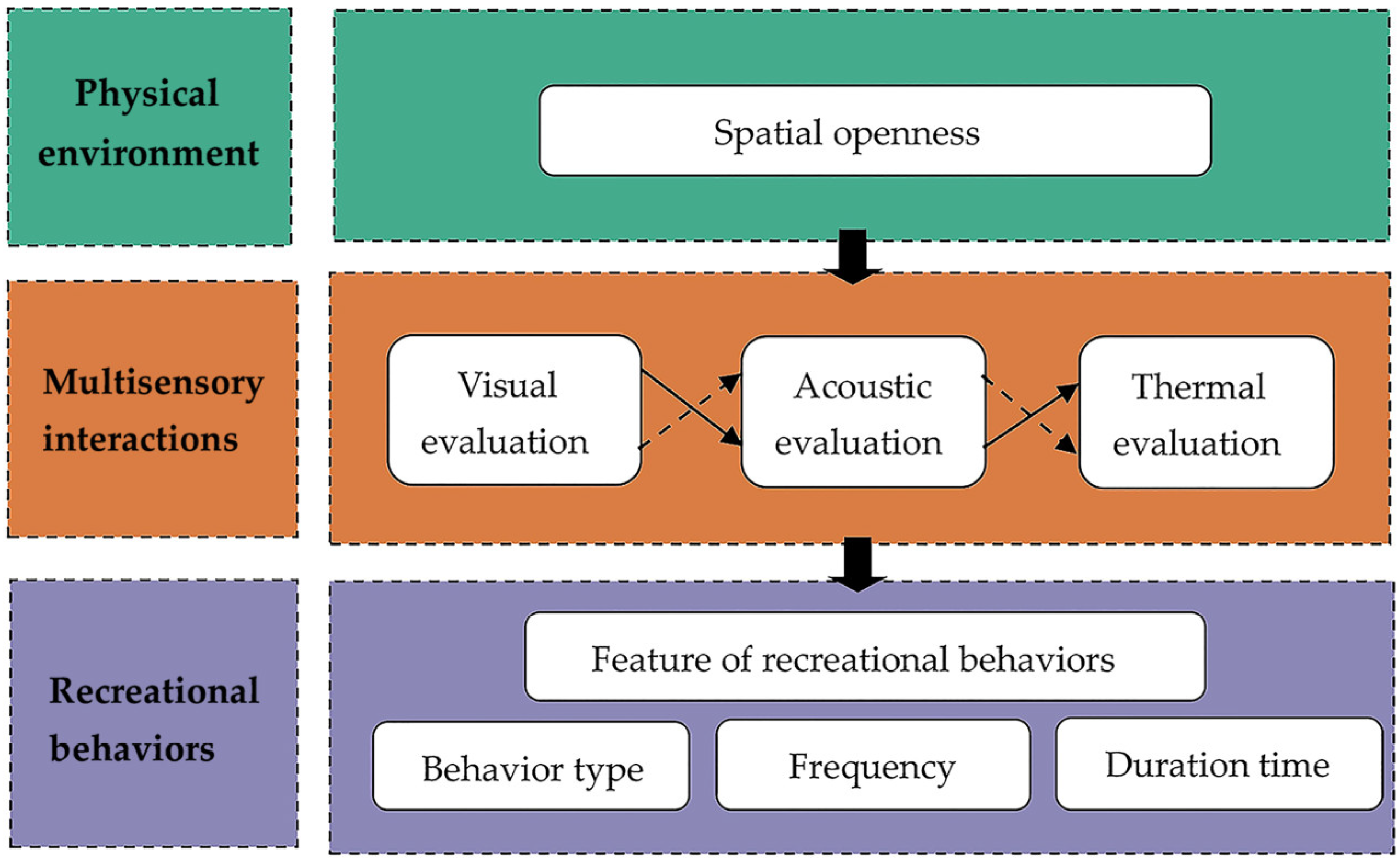
In summary, the spatial openness of greenway plazas affected multisensory evaluations, interactions between multisensory evaluations from visual, acoustic, and thermal perceptions, and users’ behaviors. Fewer studies comprehensively investigate the above process (
Figure 1). In order to bridge these gaps, this study aimed to explore the interactive effect between spatial openness, multisensory interactions, and recreational behaviors in greenway plazas. To achieve this goal, this study put forward two key scientific questions:
Research Question 1 (RQ1): What are the characteristics of the physical environment, multisensory interactions of visual, acoustic, and thermal perceptions, and users’ behaviors at greenway plazas with different levels of spatial openness?
Research Question 2 (RQ2): How do the spatial openness and multisensory interactions of greenway plazas influence users’ behaviors?
To answer these questions, this study selected the East Lake greenway, Wuhan, China, with a typical hot summer climate as the study area. Three types of spatial openness (enclosed, semi-enclosed, and open) of the greenway plazas were chosen to compare the differences in the interaction effect of visual, acoustic, and thermal perceptions, as well as investigate the effect of multisensory interactions on users’ behaviors. Overall, this study provided data support and strategies for designing the landscape, soundscape, and thermal environment of the greenway plaza while enhancing recreational experiences and positive user behaviors.
2. Materials and Methods
2.1. Studied Area
Wuhan has a typical summer-hot and winter-cold climate with extreme hot temperatures of up to 40.5 °C lasting 50 days in the central districts. With the acceleration of urbanization in Wuhan, the landscape of Wuhan is facing challenges, such as a lack of specificity and degradation of biological diversity. To address the rising demand for natural and green spaces and cope with high temperatures, governments have constructed 29 various types of greenway walking routes, connecting different types of landscape spaces, including wetland parks, forests, water bodies, and mountains. Each walking route has a unique topic with specific landscape elements and changing patterns, such as mountain forest lines and forests attached to lake lines. The natural and artificial elements, such as trees, plants, rocks, historical buildings, and pavilions, vary according to the type of land. Moreover, the natural parks, forests, and wetlands along greenways are rich in natural sound sources, while squares and historic parks are dominated by the sound of human activities. Since bikes and electronic cars are available on the main greenway, traffic noise, such as honking and braking, affects the acoustic environment of the total greenway.
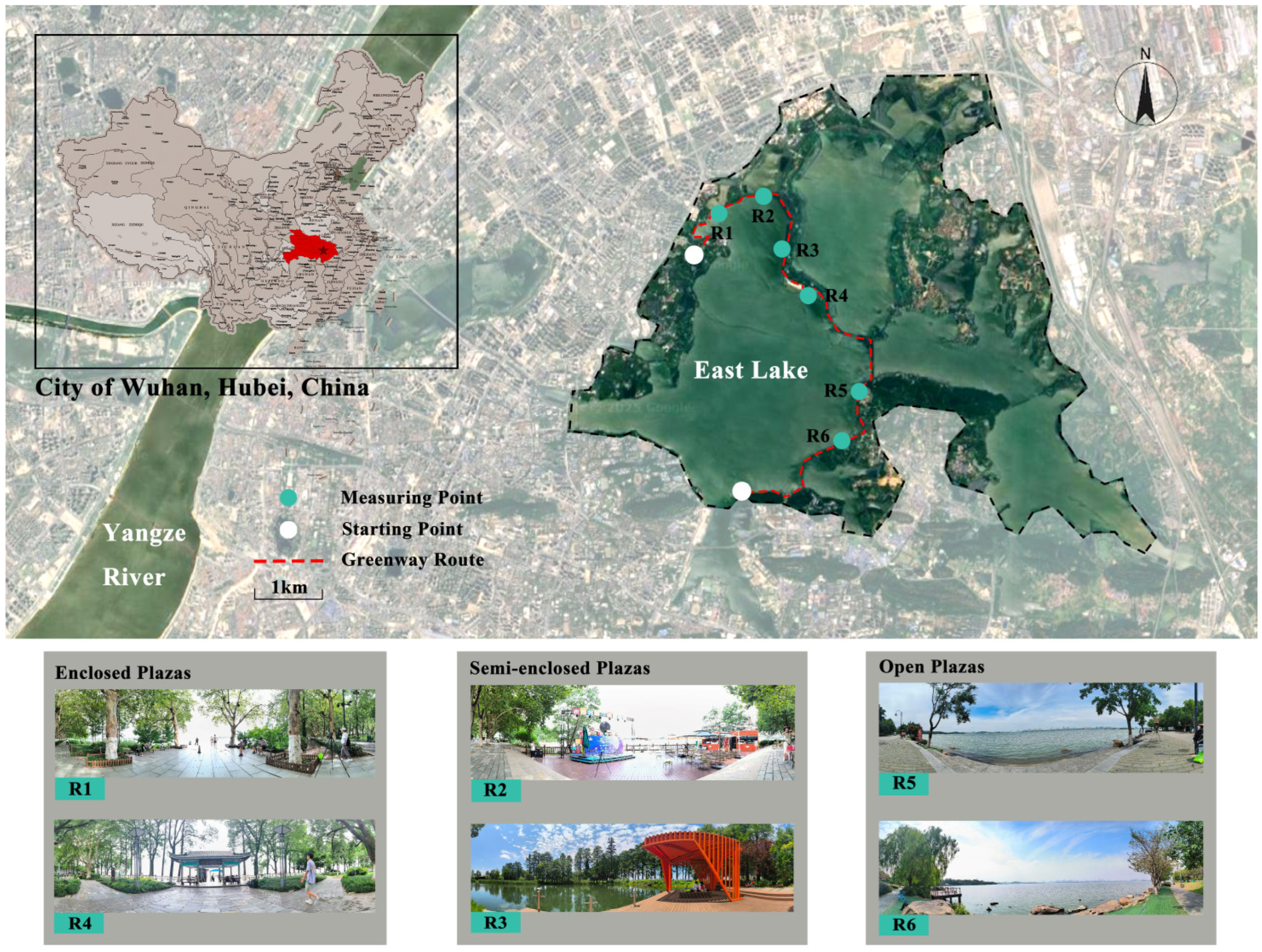
As illustrated in
Figure 2, this study selected the walking route from the north entrance (Liyuan Square) to the south exit (Yikeshu) of the greenway as the studied route with a high density of people, according to their walking patterns and favorable lines. According to previous studies, the spatial openness of the greenway plaza could be classified according to the percentage of the sky visibility ratio [
40]. The measuring points in greenway plazas were selected based on the spatial openness and the type of enclosure structure. Six measuring points were chosen and divided into three categories (enclosed, semi-enclosed, and open). Measuring points R1 and R4 were enclosed plazas with the largest amount of green vegetation and historical buildings. People usually stayed and enjoyed the tranquil and historical atmosphere. Measuring points R2 and R3 were semi-enclosed plazas surrounded by modern structures and natural elements, such as trees, shrubs, and flowers. People gathered here to listen to concerts or catch fish. Regarding points R5 and R6, the plazas were open plazas with a broad view and less green vegetation. People might stay for a while to enjoy the lake view.
2.2. In Situ Measurement of the Feature of the Visual, Acoustic, and Thermal Environment
As the urban densification in Wuhan accelerated, the average air temperature increased by 1.3 degrees from 2008 to 2018 [
41]. In order to objectively evaluate the physical environment, the percentage of visual elements, L
Aeq_5min, air temperature, and relative humidity were selected as the physical parameters in this study. For the visual environment, panoramic images were taken by a digital camera (Sony Alpha 7R V, Sony, Tokyo, Japan) at a height of 1.5 m above ground in the time period of 09:00–10:00 a.m. to identify the spatial openness of each measuring point. The shooting point was at the center of the sample square, where people gathered for activities. Then, the percentage of sky elements was calculated based on the panoramic images using the following equation:
where P
s represents the area coverage of sky elements in the panoramic image, P indicates the whole visibility area in the panoramic image, and S
i shows the percentage of sky elements in the whole visibility area of human beings as the spatial openness. After the calculation, the spatial openness was divided into three categories: enclosed (up to 20%), semi-enclosed (20–40%), and open (more than 40%) ranges (
Table 1).
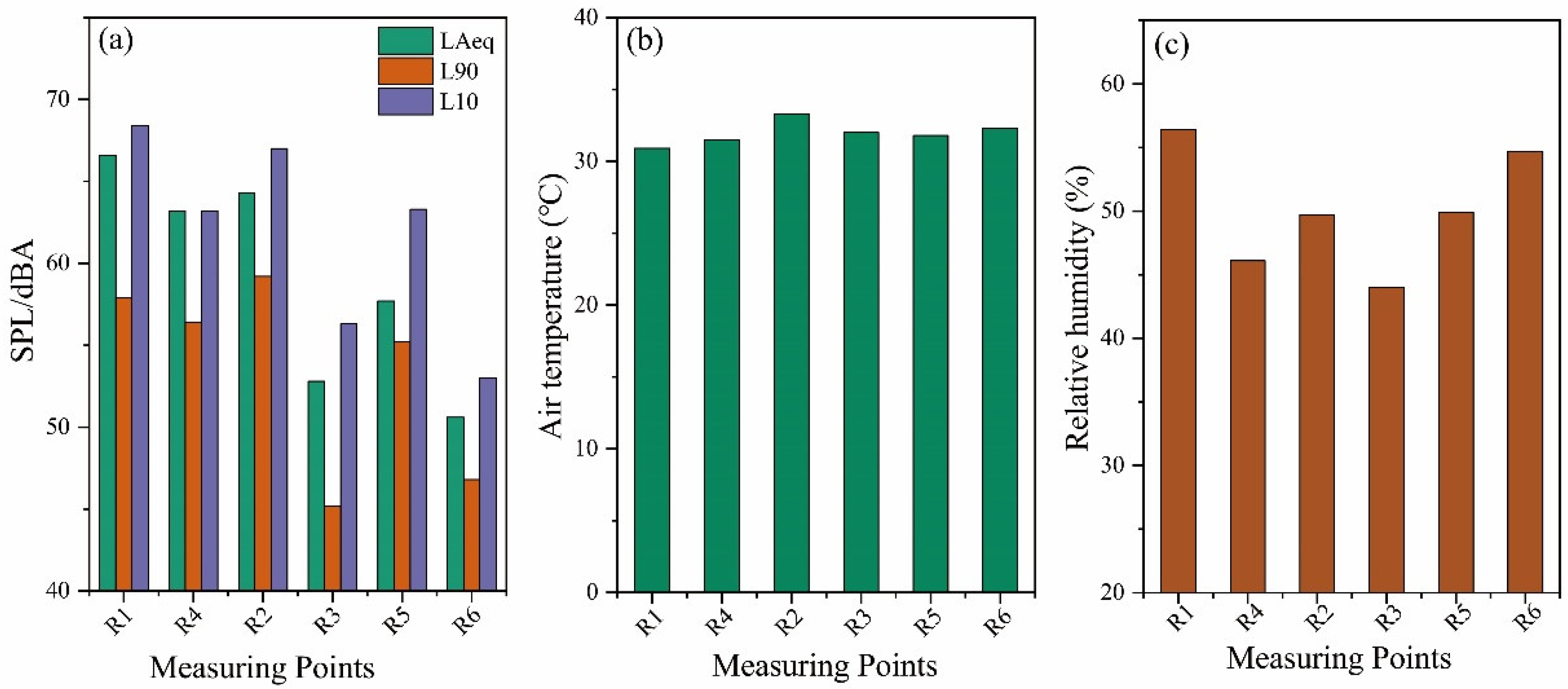
For the acoustic environment, L
Aeq_5min was measured by an Aihua AWA 6228+ sound level meter (Hangzhou Aihua Intelligent Technology, Hangzhou, China) at a distance of 1.2 m away from the reflecting surface continuously for 5 min. The sound level meter measured the instant sound pressure level at each second, and L
Aeq_5min was calculated using the equation:
where L
A,i represents the instant sound pressure level at each second. N shows the number of times that L
A,i was measured. L
Aeq,T indicates the equivalent sound pressure level when T is 5 min. During the measurement, the ambient sound of each measuring point was also recorded by a Sony PCM D100 (Sony, Tokyo, Japan). In terms of the thermal environment, air temperature (Ta) and relative humidity (RH) were measured for 5 min. The weather conditions were clear, and the wind speed was less than 5 m/s when measuring these physical parameters. All parameters were measured during people’s activity times from morning (8:00–12:00 a.m.) to afternoon (2:00–6:00 p.m.).
2.3. Data Collection of Visual, Acoustic, and Thermal Evaluation
The questionnaire design referred to previous studies on the investigation of visual landscapes, soundscapes, and thermal environments, consisting of 4 parts, including demographic information, visual, acoustic, and thermal evaluation (
Appendix A) [
42,
43]. In terms of demographic information, participants were required to list their age, gender, and educational level. Except for the above information, the subjective evaluation used a 5-point Likert scale. The visual evaluation part intended to explore the spatial openness and landscape elements perceived by people, including the percentage of natural elements and color richness. On the other hand, the soundscape evaluation investigated the soundscape pleasantness, tranquility, and comfort of the acoustic environment, while the soundscape pleasantness and tranquility were essential for acoustic comfort. As for thermal perception, the thermal sensitivity, sensitivity to solar radiation, and comfort vote were selected as the indicators.
For the visual landscape, previous studies indicated that the openness of natural green spaces, percentage of natural elements, and color richness significantly affected the landscape attraction and overall comfort [
44]. Therefore, the subjective evaluation of the visual environment was conducted using spatial openness (from 1 = extremely enclosed to 5 = extremely open), landscape naturalness (from 1 = extremely low to 5 = extremely high), and color richness (from 1 = very homogeneous to 5 = very diverse).
For the soundscape evaluation, in order to analyze the subjective evaluation of the acoustic environment, the soundscape part of the questionnaire was designed following the suggestion of ISO/TS 12913-2:2018 [
45]. Acoustic comfort was evaluated from the perspective of pleasantness (from 1= extremely annoyed to 5 = extremely pleasant), tranquility (from 1= extremely noisy to 5 = extremely tranquil), and comfort (from 1 = very uncomfortable to 5 = very comfortable).
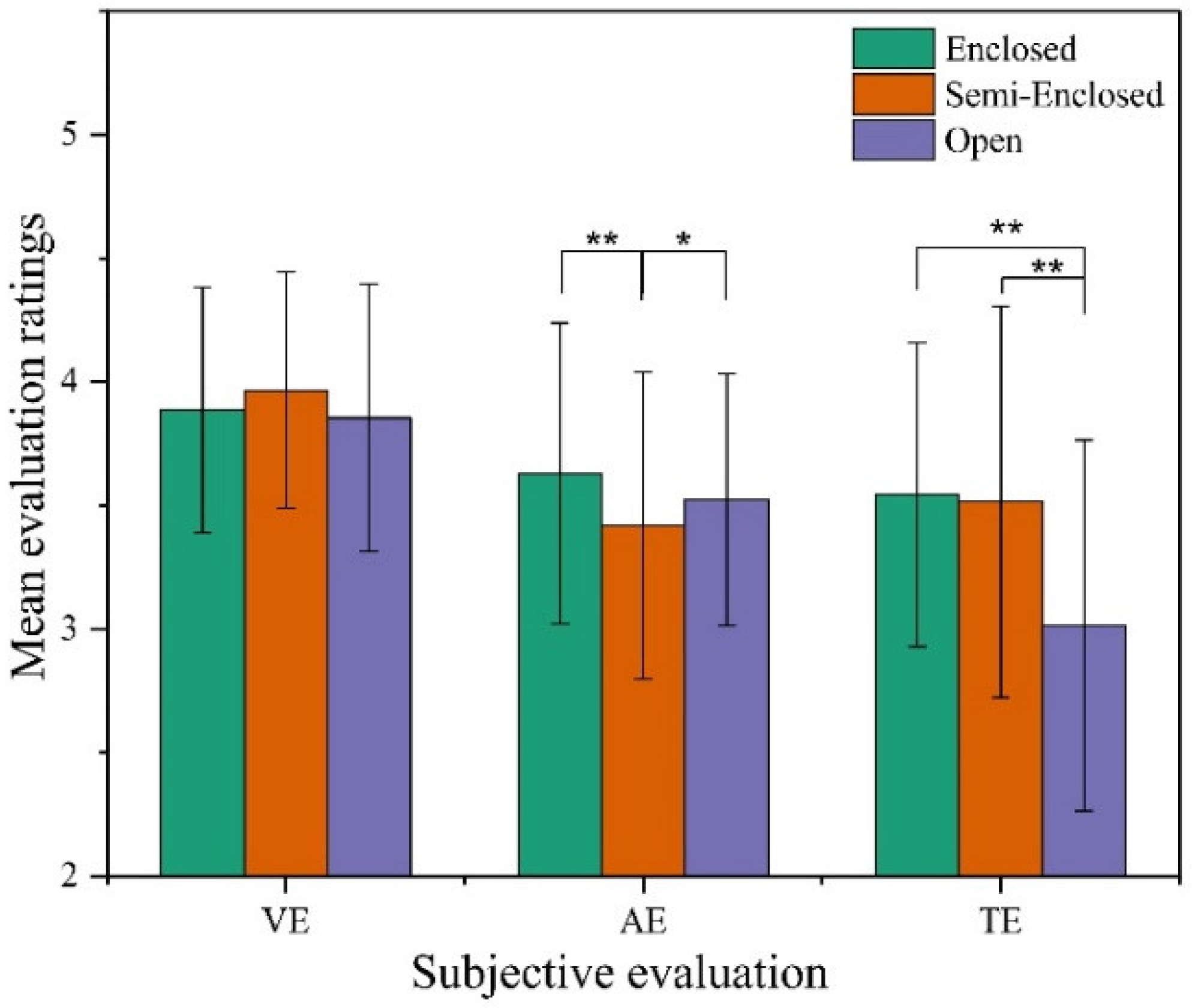
Regarding the thermal evaluation, previous studies revealed that thermal sensitivity and sensitivity to solar radiation significantly affected thermal comfort. Therefore, the thermal evaluation was based on thermal sensitivity (from 1 = extremely hot to 5 = extremely cool), sensitivity to solar radiation (from 1 = very obvious to 5 = very sparse), and thermal comfort (from 1 = extremely uncomfortable to 5 = extremely comfortable). Overall, a principal component analysis (PCA) was performed to abstract indicators with high contributions to the visual landscape evaluation (VE), soundscape evaluation (AE), and thermal evaluation (TE). The scores of VE, AE, and TE were then calculated as the mean value of the above indicators. Finally, a total of 587 questionnaires were distributed at the six measuring points of the greenway plazas, and 554 valid questionnaires were collected. Participants were dominated by teenagers (15–24 years) and young people (25–65 years), at 37.5% and 49.8%. The number of females participating in the questionnaire was slightly more than the number of males (53.8% vs. 46.2%). Meanwhile, most participants had an educational level of high school, secondary school, and university, accounting for 80.9% of the total number.
2.4. Behavioral Observation
The users’ behaviors on the greenway plaza were recorded with a hidden camera to prevent the influence of the recording process on the crowds’ activities. The video recording was used to identify their behaviors using three variables, including the behavior type, frequency of users’ behaviors, and proportion of duration time on their behaviors. All variables were calculated by Behavioral Observation Interactive Software (BORIS, v.2.95, University of Torino, Torino, Italy). Each recording lasted 20 min at each measuring plaza, divided into four segments. Once the behavior of a person lasted more than 10 s, the behavior type was determined based on the number of people, interpersonal distance (IPD), duration time, and activity purposes (
Table 2). Single-person behaviors were identified as sitting, exercising, and taking photos based on posture and duration time. A one-to-one person behavior was noted if the IPD was 45–120 cm more than 10 s, while multi-person behavior was identified if the IPD was 129–365 cm more than 10 s based on posture [
46]. The start and end times of each type of behavior were also recorded to determine the mean frequency and proportion of duration time of the behaviors.
2.5. Data Analysis
The experimental results were analyzed in two parts using Statistical Package for Social Scientists (SPSS 22.0, IBM). The first part aimed to identify the features of the visual, acoustic, and thermal environments with different spatial openness, as well as the subjective evaluation. A comparative analysis was further conducted to analyze the difference between those variables and their interactive effect. The second part aimed to explore the relationship between the interaction of the subjective evaluation and users’ behaviors. These analyses helped us to identify the overall characteristics of the subjective evaluation and investigate the impact of those evaluations on their behaviors.
For the first part, descriptive analysis was used to calculate the mean and variance of the physical parameters and the visual, acoustic, and thermal evaluation ratings. Secondly, principal component analysis (PCA) was used to extract the main influencing factors of those subjective ratings. The mean value of landscape openness, landscape naturalness, color and richness; soundscape pleasantness, soundscape tranquility, and soundscape comfort; and thermal sensitivity, sensitivity to solar radiation, and thermal comfort were input into the PCA to decide and calculate the VE, AE, and TE. Any factor load that was below 0.6 was removed from the PCA. Then, the Kruskal–Wallis test was used to examine the significant differences between those influencing factors at each greenway plaza with different spatial openness. Based on the result of the one-way Kolmogorov–Smirnov test, Spearman’s correlation coefficients r and p were used to identify the relationship between visual, acoustic, thermal evaluation, and behavior indicators, where a p less than 0.05 represented significant results. For the second part, a multiple linear regression model was established to further explore the relationship between the subjective evaluation and users’ behaviors. Adjusted R2 and βcoefficients were used to assess the quality of the model. Variables meeting p < 0.05 and VIF < 2 were retained in the model.



 ,
, 
 8–14 years