Urban Heat and Cooling Demand: Tree Canopy Targets for Equitable Energy Planning in Baltimore


Abstract
1. Introduction
Related Literature and Hypotheses
- How do tree canopy, impervious surfaces, local climate, and land cover fraction influence cooling-season electricity demand at the CBG scale in Baltimore City and County?
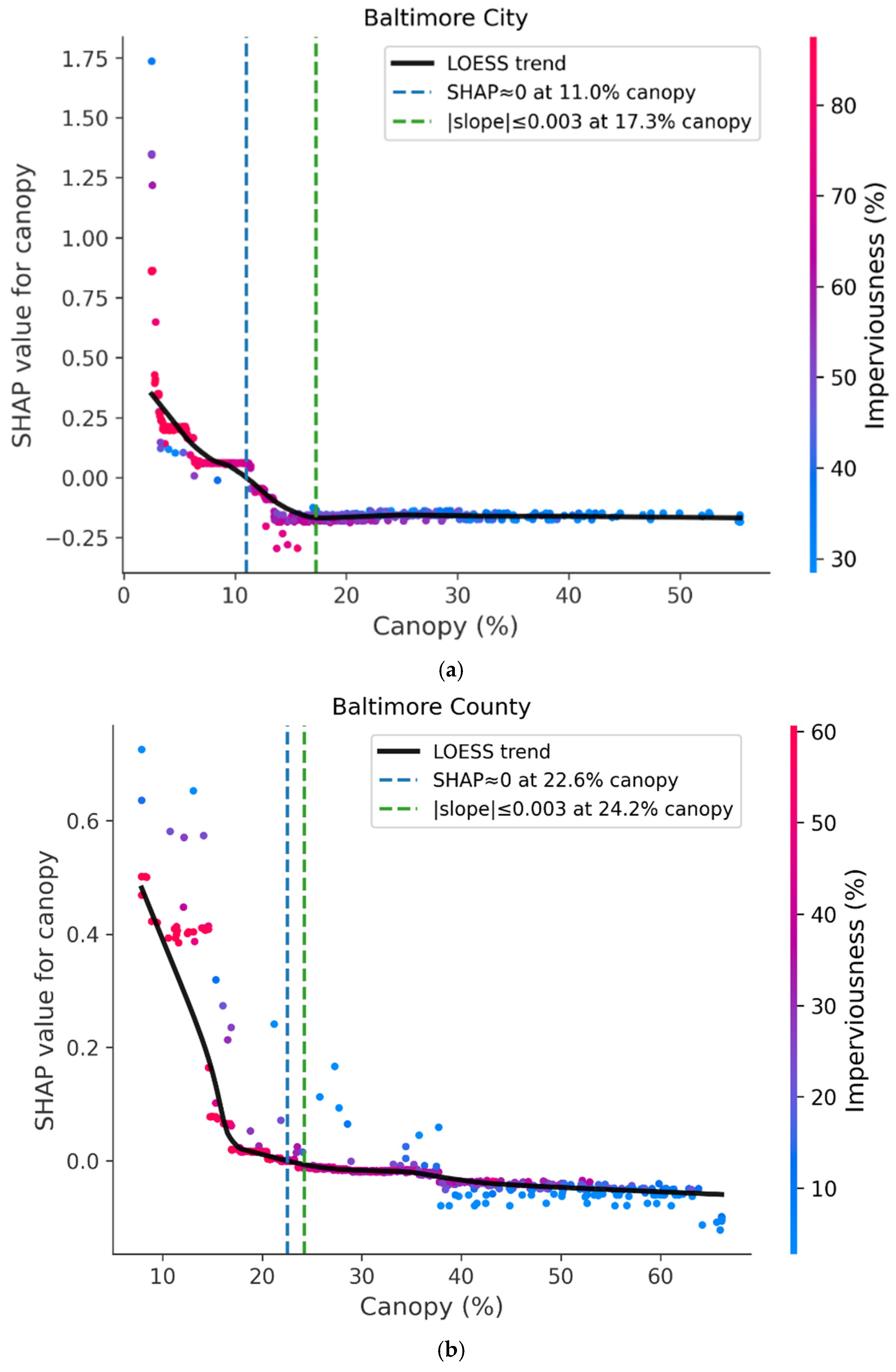
- What are the canopy cover thresholds at which cooling demand begins to decline, and marginal benefits diminish, controlling for built surfaces?
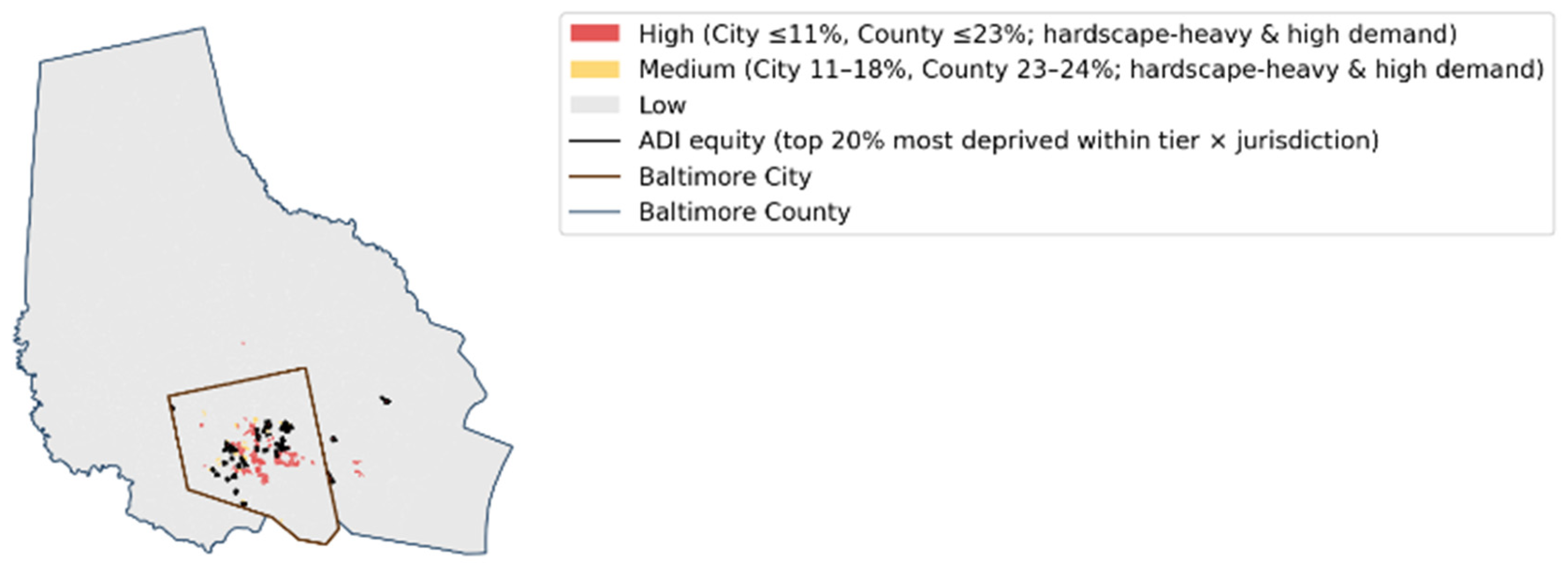
- Which CBGs, characterized by low canopy, high imperviousness, and high development, should be prioritized for interventions to maximize energy relief and heat equity?
2. Materials and Methods
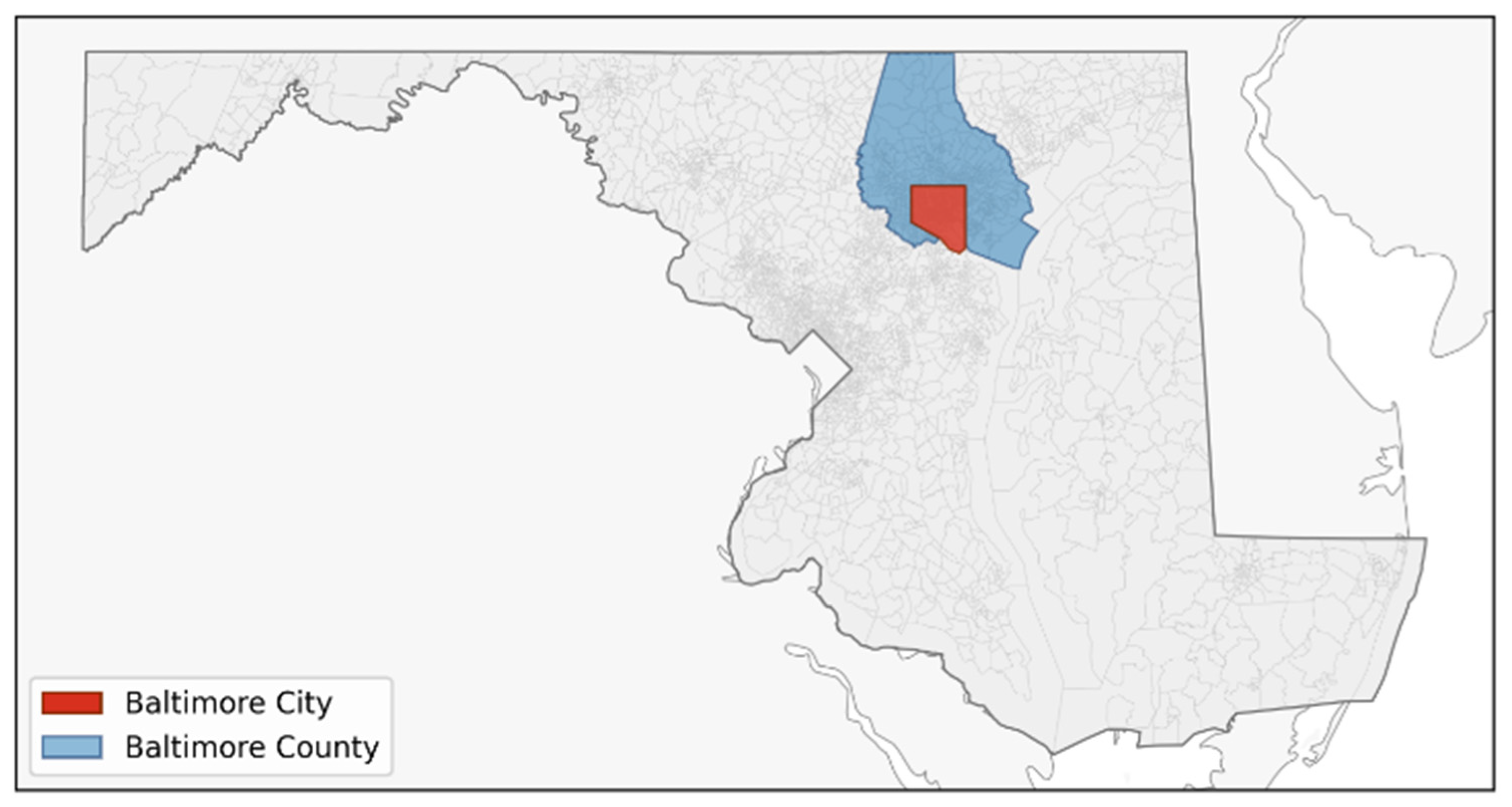
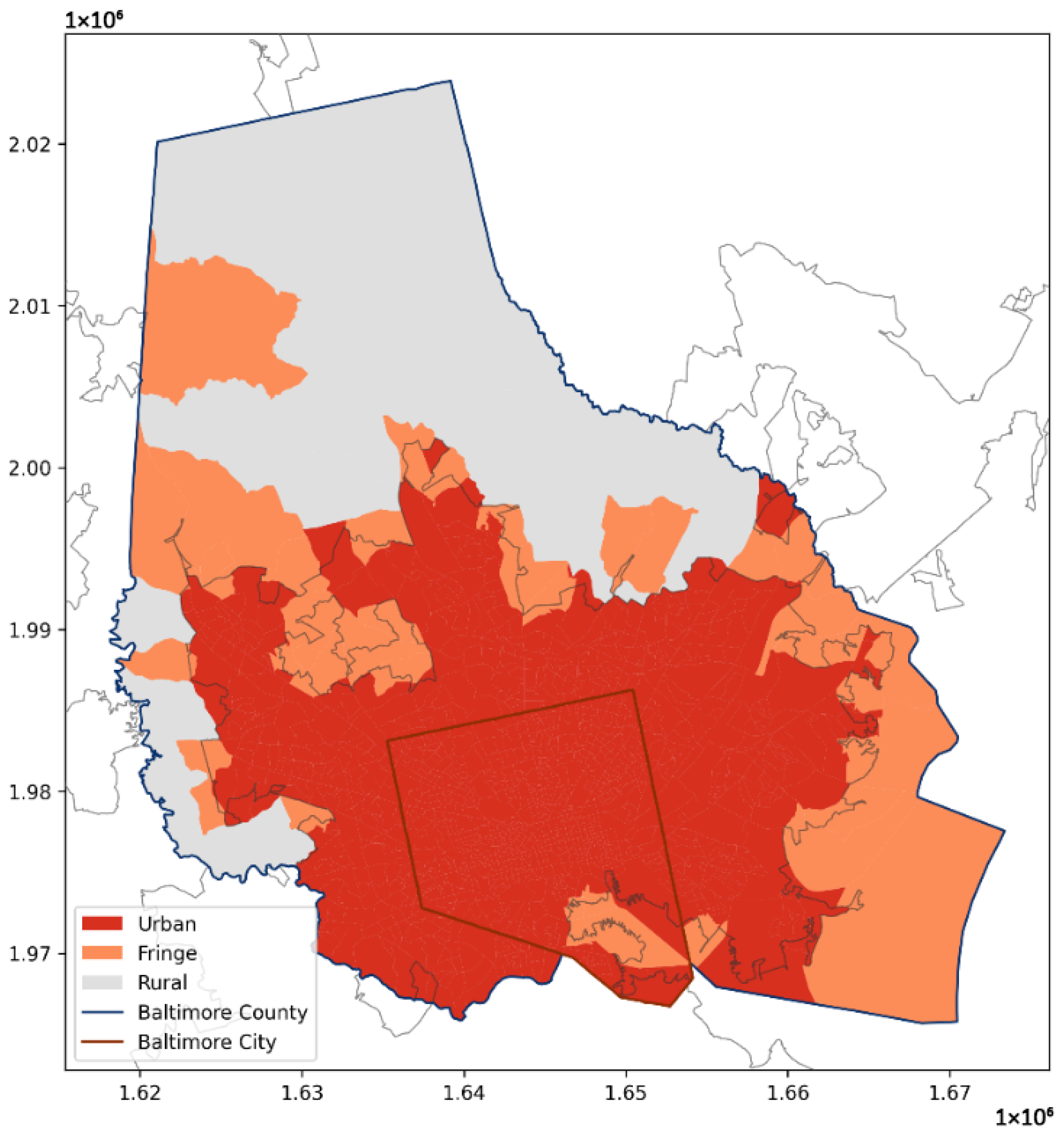
2.1. Study Area and Units of Analysis
2.2. Data
2.3. Method
2.3.1. Research Workflow
- Units and harmonization: Define CBGs for Baltimore City and County (TIGER/Line version 2024), compute land area (equal-area projection), and harmonize all datasets to the CBG scale.
- Cooling-demand reconstruction: Convert ACS monthly electricity bill brackets to kWh using rate P (Equations (1)–(3)), estimate AC saturation from RECS using CBG housing mix (Equation (4)), scale cooling share using local CDD (Equations (5)–(7)), and compute annual and summer (JJA) cooling demand and intensity (Equations (6)–(9)).
- Sensitivity and system check: Evaluate uncertainty by varying cooling-share assumptions and bracket edges and perform a system-level sanity check against an independent residential cooling benchmark (Equation (8)).
- Model canopy effects (explainable ML): Fit monotone-constrained XGBoost models (version 3.0.0) separately for the City and County to predict log cooling intensity from canopy and hardscape controls, apply spatially blocked cross-validation, and interpret canopy effects using SHAP dependence curves to extract policy-relevant thresholds.
- Intervention tiers and equity overlay: Combine SHAP-derived thresholds with demand and hardscape screens to define High/Medium/Low tiers and apply the ADI overlay to highlight equity-priority locations.
2.3.2. Cooling Demand Construction from ACS Bills
2.3.3. AC Saturation (RECS 2020)
2.3.4. Cooling Fraction with City–County CDD Scaling
2.3.5. Sensitivity Analysis and System Check
2.3.6. Outcome Normalization and Controls
2.4. Priority CBG Identification and Tiers
Modeling and Explainability
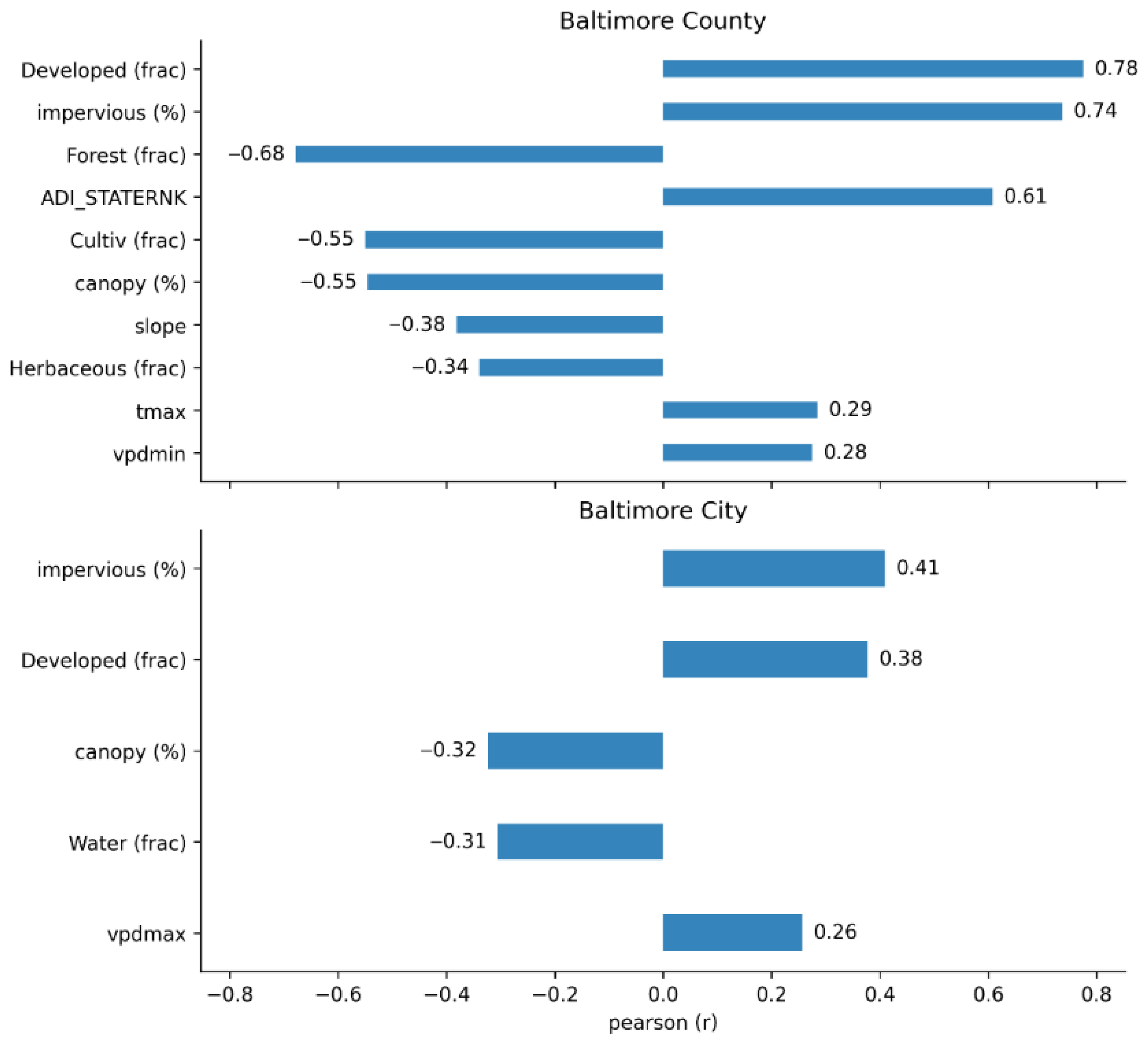
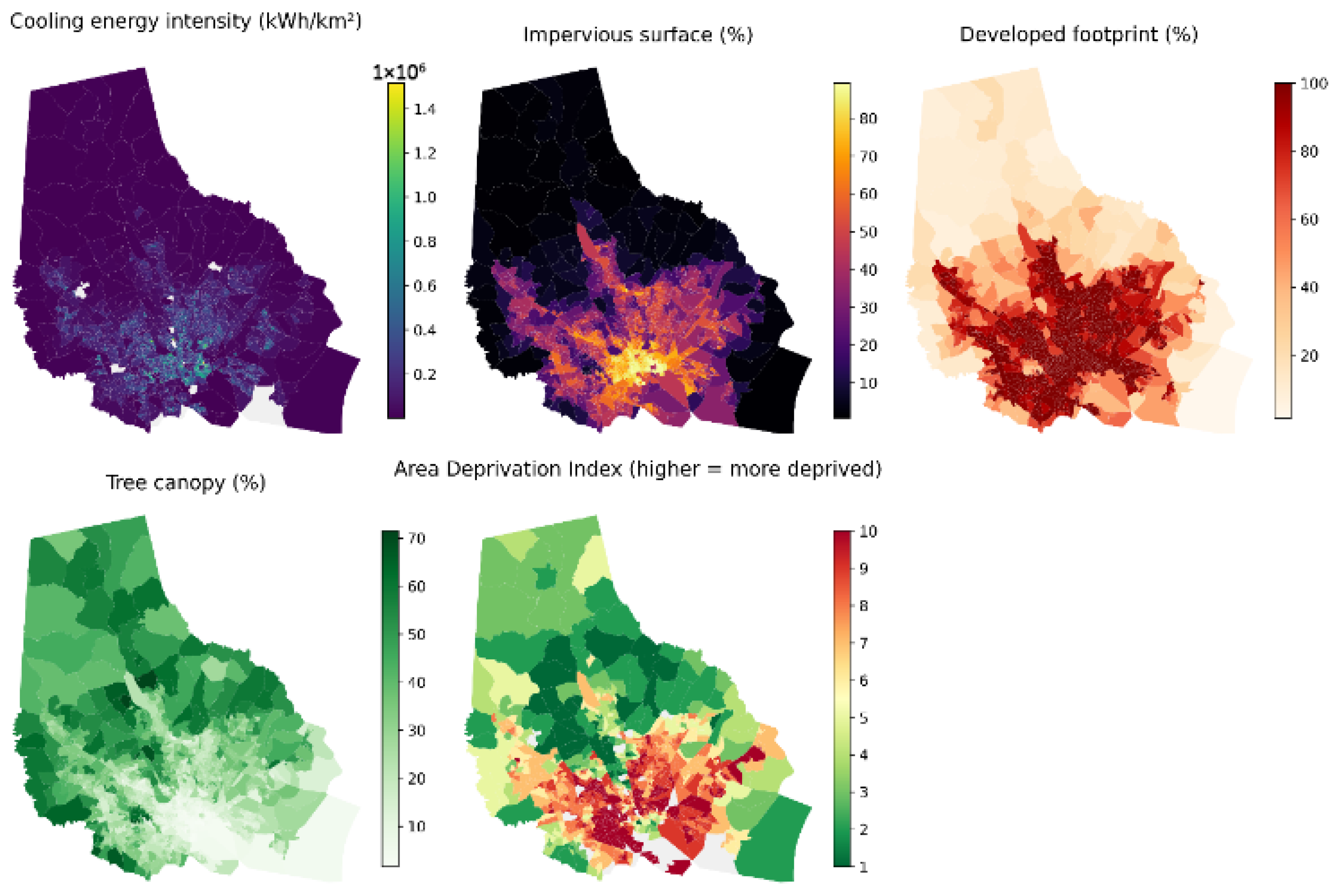
3. Results
4. Discussion
4.1. What Is New Relative to Prior Research?
4.2. Why Do Thresholds Differ Between City and County?
4.3. Social, Environmental, and Economic “Security” Implications
4.4. Practical Recommendations for Implementation
4.5. Limitations and Future Work
5. Conclusions
5.1. Contribution to Theory and Practice
5.2. Recommendations
Author Contributions
Funding
Institutional Review Board Statement
Informed Consent Statement
Data Availability Statement
Conflicts of Interest
References
- Li, H.; Zhao, Y.; Bardhan, R.; Chan, P.W.; Derome, D.; Luo, Z.; Ürge-Vorsatz, D.; Carmeliet, J.C. Relating three-decade surge in space cooling demand to urban warming. Environ. Res. Lett. 2023, 18, 124033. [Google Scholar] [CrossRef]
- Abdollahzadeh, N.; Biloria, N. Urban microclimate and energy consumption: A multi-objective parametric urban design approach for dense subtropical cities. Front. Archit. Res. 2022, 11, 453–465. [Google Scholar] [CrossRef]
- Harish, S.; Singh, N.; Tongia, R. Impact of temperature on electricity demand: Evidence from Delhi and Indian states. Energy Policy 2020, 140, 111445. [Google Scholar] [CrossRef]
- Joshi, K.; Khan, A.; Anand, P.; Sen, J. Understanding the synergy between heat waves and the built environment: A three-decade systematic review informing policies for mitigating urban heat island in cities. Sustain. Earth Rev. 2024, 7, 25. [Google Scholar] [CrossRef]
- Golden, J.S. The built environment induced urban heat island effect in rapidly urbanizing arid regions–a sustainable urban engineering complexity. Environ. Sci. 2004, 1, 321–349. [Google Scholar] [CrossRef]
- Chuang, W.C.; Boone, C.G.; Locke, D.H.; Grove, J.M.; Whitmer, A.; Buckley, G.; Zhang, S. Tree canopy change and neighborhood stability: A comparative analysis of Washington, DC and Baltimore, MD. Urban For. Urban Green. 2017, 27, 363–372. [Google Scholar] [CrossRef]
- Locke, D.H.; Hall, B.; Grove, J.M.; Pickett, S.T.A.; Ogden, L.A.; Aoki, C.; Boone, C.G.; O’nEil-Dunne, J.P.M. Residential housing segregation and urban tree canopy in 37 US Cities. Npj Urban Sustain. 2021, 1, 15. [Google Scholar] [CrossRef]
- Ibebuchi, C.C.; Lee, C.C.; Sheridan, S.C. Recent trends in extreme temperature events across the contiguous United States. Int. J. Climatol. 2025, 45, e8693. [Google Scholar] [CrossRef]
- Croft, D.P.; Lee, A.; Nordgren, T.M.; Jackson, C.L.; Bayram, H.; Balmes, J.R.; Nassikas, N.; Ewart, G.; Rice, M.B.; Benmarhnia, T.; et al. Climate Change and Respiratory Health: Opportunities to Contribute to Environmental Justice: An Official American Thoracic Society Workshop Report. Ann. Am. Thorac. Soc. 2025, 22, 631–650. [Google Scholar] [CrossRef] [PubMed]
- Yin, Y.; Li, S.; Xing, X.; Zhou, X.; Kang, Y.; Hu, Q.; Li, Y. Cooling benefits of urban tree canopy: A systematic review. Sustainability 2024, 16, 4955. [Google Scholar] [CrossRef]
- Locke, D.H.; Baker, M.; Alonzo, M.; Yang, Y.; Ziter, C.D.; Murphy-Dunning, C.; O’Neil-Dunne, J.P. Variation the in relationship between urban tree canopy and air temperature reduction under a range of daily weather conditions. Heliyon 2024, 10, e25041. [Google Scholar] [CrossRef]
- U.S. Environmental Protection Agency. Reducing Urban Heat Islands: Compendium of Strategies. Draft. 2008. Available online: https://www.epa.gov/heat-islands/heat-island-compendium (accessed on 14 January 2025).
- Shickman, K.; Rogers, M. Capturing the true value of trees, cool roofs, and other urban heat island mitigation strategies for utilities. Energy Effic. 2020, 13, 407–418. [Google Scholar] [CrossRef]
- Ralls, C.; Polyakov, A.Y.; Shandas, V. Scale-Dependent Effects of Urban Canopy Cover, Canopy Volume, and Impervious Surfaces on Near-Surface Air Temperature in a Mid-Sized City. Land 2024, 13, 1741. [Google Scholar] [CrossRef]
- Wachs, L.; Singh, S. Projecting the urban energy demand for Indiana, USA, in 2050 and 2080. Clim. Change 2020, 163, 1949–1966. [Google Scholar] [CrossRef]
- Tamaskani Esfehankalateh, A.; Ngarambe, J.; Yun, G.Y. Influence of tree canopy coverage and leaf area density on urban heat island mitigation. Sustainability 2021, 13, 7496. [Google Scholar] [CrossRef]
- Grove, J.M.; Locke, D. Urban Tree Canopy Prioritization (UTC): Experience from Baltimore. Nat. Preced. 2011, 1. [Google Scholar] [CrossRef]
- Alonzo, M.; Baker, M.E.; Gao, Y.; Shandas, V. Spatial configuration and time of day impact the magnitude of urban tree canopy cooling. Environ. Res. Lett. 2021, 16, 084028. [Google Scholar] [CrossRef]
- Wilkening, J.V.; Feng, X. Canopy temperature reveals disparities in urban tree benefits. AGU Adv. 2025, 6, e2024AV001438. [Google Scholar] [CrossRef]
- Nazish, A.; Abbas, K.; Sattar, E. Health impact of urban green spaces: A systematic review of heat-related morbidity and mortality. BMJ Open 2024, 14, e081632. [Google Scholar] [CrossRef]
- Nath, B.; Ni-Meister, W.; Özdoğan, M. Fine-scale urban heat patterns in New York city measured by ASTER satellite—The role of complex spatial structures. Remote Sens. 2021, 13, 3797. [Google Scholar] [CrossRef]
- Wilson, B.; Kashem, S.B.; Slonim, L. Modeling the relationship between urban tree canopy, landscape heterogeneity, and land surface temperature: A machine learning approach. Environ. Plan. B Urban Anal. City Sci. 2024, 51, 1895–1912. [Google Scholar] [CrossRef]
- Chomać-Pierzecka, E. Economic, Environmental and Social Security in accordance with the Concept of Sustainable Development. Stud. Adm. Bezpiecz 2025, 18, 257–272. [Google Scholar] [CrossRef]
- Bowers Ashley, A.; Gilder-Busatti Amy, L.; Lautar Katherine, J. Preservation, Regulations, and Policy to Protect and Grow Baltimore’s Forests. Cities Environ. (CATE) 2020, 13, 22. [Google Scholar] [CrossRef]
- Roberts, A. Urban Street Tree Priorities for Baltimore City’s Watershed 263. 2008. Available online: http://jhir.library.jhu.edu/handle/1774.2/34158 (accessed on 14 January 2025).
- Anderson, E.C.; Avolio, M.L.; Sonti, N.F.; LaDeau, S.L. More than green: Tree structure and biodiversity patterns differ across canopy change regimes in Baltimore’s urban forest. Urban For. Urban Green. 2021, 65, 127365. [Google Scholar] [CrossRef]
- U.S. Census Bureau. American Community Survey 5-Year Estimates, 2019–2023; U.S. Department of Commerce: Washington, DC, USA, 2024. Available online: https://data.census.gov/ (accessed on 28 May 2025).
- U.S. Energy Information Administration. Residential Energy Consumption Survey (RECS) 2020: Air Conditioning Prevalence by Housing Type and Region; U.S. Department of Energy: Washington, DC, USA, 2022. Available online: https://www.eia.gov/consumption/residential/ (accessed on 14 January 2025).
- National Oceanic and Atmospheric Administration. Climate at a Glance: County Mapping—Cooling Degree Days, January–August 2025; National Centers for Environmental Information: Washington, DC, USA, 2025. Available online: https://www.ncei.noaa.gov/access/monitoring/climate-at-a-glance/county/mapping (accessed on 28 May 2025).
- U.S. Energy Information Administration. Electric Power Monthly: Table 5.6.A—Average Retail Price of Electricity to Ultimate Customers by End-Use Sector; U.S. Department of Energy: Washington, DC, USA, 2025. Available online: https://www.eia.gov/electricity/monthly/ (accessed on 28 May 2025).
- U.S. Geological Survey. National Land Cover Database (NLCD) 2023 Tree Canopy Cover; U.S. Department of the Interior: Washington, DC, USA, 2024. Available online: https://www.mrlc.gov/data (accessed on 14 April 2025).
- U.S. Geological Survey. National Land Cover Database (NLCD) 2023 Land Cover; U.S. Department of the Interior: Washington, DC, USA, 2024. Available online: https://www.mrlc.gov/data (accessed on 14 April 2025).
- U.S. Geological Survey. NLCD 2023 Impervious Surface; U.S. Department of the Interior: Washington, DC, USA, 2024. Available online: https://www.mrlc.gov/data (accessed on 28 May 2025).
- NASA JPL. SRTM Global 1 Arc-Second Elevation Data; NASA Jet Propulsion Laboratory: Pasadena, CA, USA, 2023. Available online: https://earthexplorer.usgs.gov/ (accessed on 28 May 2025).
- PRISM Climate Group. PRISM 30-Year Climate Normals (1991–2020); Oregon State University: Corvallis, OR, USA, 2024; Available online: https://prism.oregonstate.edu (accessed on 28 May 2025).
- Ibebuchi, C.C. Day-Ahead Energy Price Forecasting with Machine Learning: Role of Endogenous Predictors. Forecasting 2025, 7, 18. [Google Scholar] [CrossRef]
- Kind, A.J.H.; Buckingham, W.R. Making neighborhood-disadvantage metrics accessible—The Neighborhood Atlas. N. Engl. J. Med. 2018, 378, 2456–2458. [Google Scholar] [CrossRef] [PubMed]
- Akbari, H. Energy Saving Potentials and Air Quality Benefits of Urban Heat Island Mitigation; Lawrence Berkeley National Laboratory (LBNL-58285), U.S. Department of Energy: Berkeley, CA, USA, 2005.
- Simpson, J.R.; McPherson, E.G. Potential of tree shade for reducing residential energy use in California. J. Arboric. 1996, 22, 10–18. [Google Scholar] [CrossRef]
- Meili, N.; Zheng, X.; Takane, Y.; Nakajima, K.; Yamaguchi, K.; Chi, D.; Zhu, Y.; Wang, J.; Qiu, Y.; Paschalis, A. Modeling the effect of trees on energy demand for indoor cooling and dehumidification across cities and climates. J. Adv. Model. Earth Syst. 2025, 17, E2024MS004590. [Google Scholar] [CrossRef]
- Venter, Z.S.; Krog, N.H.; Barton, D.N. Linking green infrastructure to urban heat and human health risk mitigation in Oslo, Norway. Sci. Total Environ. 2020, 709, 136193. [Google Scholar] [CrossRef]
- Ibebuchi, C.C.; Abu, I.-O. Threefold Environmental Inequality: Canopy Cover, Deprivation, and Cancer-Risk Burdens Across Baltimore Neighborhoods. World 2026, 7, 6. [Google Scholar] [CrossRef]
- Jesdale, B.M.; Morello-Frosch, R.; Cushing, L. The racial/ethnic distribution of heat risk–related land cover in relation to residential segregation. Environ. Health Perspect. 2013, 121, 811–817. [Google Scholar] [CrossRef]
- Xu, M.; Ding, L. Ecosystem Service Assessment of Campus Street Trees for Urban Resilience: A Case Study from Guangxi Arts University. Forests 2025, 16, 1465. [Google Scholar] [CrossRef]
- Roeland, S.; Moretti, M.; Amorim, J.H.; Branquinho, C.; Fares, S.; Morelli, F.; Niinemets, Ü.; Paoletti, E.; Pinho, P.; Sgrigna, G.; et al. Towards an integrative approach to evaluate the environmental ecosystem services provided by urban forest. J. For. Res. 2019, 30, 1981–1996. [Google Scholar] [CrossRef]
- Akbari, H.; Matthews, H.D. Global cooling updates: Reflective roofs and pavements. Energy Build. 2012, 55, 2–6. [Google Scholar] [CrossRef]
- Wang, C.; Wang, Z.H.; Kaloush, K.E.; Shacat, J. Cool pavements for urban heat island mitigation: A synthetic review. Renew. Sustain. Energy Rev. 2021, 146, 111171. [Google Scholar] [CrossRef]
- Ibebuchi, C.C. Uncertainty in machine learning feature importance for climate science: A comparative analysis of SHAP, PDP, and gain-based methods. Theor. Appl. Climatol. 2025, 156, 476. [Google Scholar] [CrossRef]


Disclaimer/Publisher’s Note: The statements, opinions and data contained in all publications are solely those of the individual author(s) and contributor(s) and not of MDPI and/or the editor(s). MDPI and/or the editor(s) disclaim responsibility for any injury to people or property resulting from any ideas, methods, instructions or products referred to in the content. |
© 2026 by the authors. Licensee MDPI, Basel, Switzerland. This article is an open access article distributed under the terms and conditions of the Creative Commons Attribution (CC BY) license.
Share and Cite
Ibebuchi, C.C.; Nyamekye, C. Urban Heat and Cooling Demand: Tree Canopy Targets for Equitable Energy Planning in Baltimore. Urban Sci. 2026, 10, 61. https://doi.org/10.3390/urbansci10010061
Ibebuchi CC, Nyamekye C. Urban Heat and Cooling Demand: Tree Canopy Targets for Equitable Energy Planning in Baltimore. Urban Science. 2026; 10(1):61. https://doi.org/10.3390/urbansci10010061
Chicago/Turabian StyleIbebuchi, Chibuike Chiedozie, and Clement Nyamekye. 2026. "Urban Heat and Cooling Demand: Tree Canopy Targets for Equitable Energy Planning in Baltimore" Urban Science 10, no. 1: 61. https://doi.org/10.3390/urbansci10010061
APA StyleIbebuchi, C. C., & Nyamekye, C. (2026). Urban Heat and Cooling Demand: Tree Canopy Targets for Equitable Energy Planning in Baltimore. Urban Science, 10(1), 61. https://doi.org/10.3390/urbansci10010061