
Article

Dynamic Walkability Index (DWI)—Enhancing Walking Equity for the City of Čačak, Serbia
1
Faculty of Transport and Traffic Engineering, University of Belgrade, Vojvode Stepe 305, 11000 Belgrade, Serbia
2
Public Company “Gradac”, 32000 Čačak, Serbia
*
Author to whom correspondence should be addressed.
Urban Sci. 2026, 10(1), 59; https://doi.org/10.3390/urbansci10010059
Submission received: 6 December 2025 / Revised: 12 January 2026 / Accepted: 15 January 2026 / Published: 18 January 2026
(This article belongs to the Special Issue Sustainable Transportation and Urban Environments-Public Health)

Abstract

Walkability for non-motorized users is crucial for fostering inclusive, healthy, and sustainable communities. By prioritizing modern human-centered design principles, social equality is promoted for all categories of users, regardless of physical abilities or socio-economic status. Despite the importance of this indicator, a series of inconsistencies that produce inadequate and inaccessible urban space can still be observed in cities. The aim of this paper is to present the methodology for the calculation of the walkability index at the local level. This new methodological procedure considers walkability for pedestrians, with a special focus on people with reduced mobility. Based on specifically defined criteria, initial calculations were performed and integrated into the dynamic walkability index (DWI). One of the main advantages of this index is that it includes the dynamic component of the share of different categories of users in the total sample, which enables simple time modification without repeating the entire procedure. The developed methodology can be used as a tool for ranking existing street segments according to the urgency of reconstruction, while on the other hand promoting equality and inclusion of all categories of users in decision-making processes, thus creating more comfortable and safer environments.

1. Introduction

In urban planning and infrastructure design, ensuring walkability for pedestrians is of the utmost importance for fostering inclusive and equitable communities. Walkability does not only refer to the physical ability to traverse sidewalks, paths, and intersections; it also includes the usability of these spaces for specific groups of individuals such as children, older people, people with disabilities, or generally people with temporary or permanent reduced mobility.
This paper addresses the topic of walkability, combining the most important traffic and environmental factors defined by users and experts. In this way, a more comprehensive approach is enabled, for the walkability analysis of a certain area. Hence, the goal of this paper is to create a methodology that includes the dynamic (time-varying) component of the share of different categories of users in the process of the walkability audits.
For the purpose of this paper, one of the largest cities in Serbia, Čačak, was chosen as the territory for analysis. According to the latest census from 2022, it has a population of just over 105,000 inhabitants [1]. Until now, there has been no similar research in Čačak, but there is an initiative to improve the general level of walkability in the city, which is the reason for conducting this research.
The contributions of this paper are multiple and are reflected in the following:
  • A methodological procedure for the formation of a dynamic walkability index (DWI) is proposed, which enables its modification and time correction without repeating the entire procedure and recalculating the index from the beginning.
  • The proposed index, in contrast to most previous studies, considers two categories of pedestrians: pedestrians without any movement limitations and pedestrians with limited mobility. In this way, this approach promotes and enables an inclusive, sustainable, and suitable environment for all users equally.
  • The proposed methodology is very intuitive and easy to apply, and without major changes it can be used for any other area or city.
The paper consists of four sections. The first, introductory section gives a brief overview of the paper structure and conducted research. The second section includes Materials and Methods: a literature review and the applied methodological procedure described in detail. The third section includes a presentation of the results and a brief discussion. The fourth section provides concluding remarks, with special reference to the limitations of the study and future research.

Dynamic Walkabilty Index (DWI) Versus Dynamic Accessibility Index (DAI): Definitions and Notion

While accessibility is an essential factor in walkability studies, it has a much longer history and more extensive coverage in the professional and theoretical literature (in terms of number of publications/studies), which makes it important to understand their relationship. The concepts of walkability and accessibility are directly connected to the contemporary interpretation of urban space through the needs of achieving and maintaining certain specific qualities. Among numerous qualities, those related to transport/mobility are permeability, mixed-use, availability and connectivity, accessibility, safety, efficiency and reliability, comfort, and ecological sustainability [2].
The notion of walkability is essentially connected with health issues and its foundation lies in understanding the relationship between urban design and physical activities [3]. The DWI evaluates the walkability of an area during specific time periods (time of day, season, street activity, etc.). The focus is on the pedestrian experience of comfort and safety (the pleasantness and safety of walking in a given area).
For accessibility, the focus is on the ability to reach a destination. The DAI is a value that takes into account temporal and contextual factors related to assessing arrival at a specified destination. The focus is on determining how easily a destination can be reached, regardless of the mode of transport, or more precisely, by each mode of transport, making it possible to interpret pedestrian accessibility, cycling accessibility, public transport accessibility, etc. [4].
Thus, the assessment of walkability quality includes evaluations of terrain topography, network quality, network permeability, presence of amenities, and infrastructure quality (surface conditions such as sidewalk state, ramps, etc.). The assessment of accessibility quality, on the other hand, includes evaluations of distance from key targeted locations (for residential areas these include schools, daily shopping facilities, kindergartens, clinics, etc.), distance to public transport stops, travel time by different modes of transport, economic affordability of transport, and available mobility options (walking, cycling, car, public transport) [5].
Finally, the comparison between accessibility and walkability can be summarized as follows: while the DWI focuses on the quality of the pedestrian environment, the DAI focuses on distance to destinations. The main objective of the DWI is walking comfort, whereas the main objective of the DAI is the ability to reach a given destination in the shortest possible time. Consequently, the DWI is oriented towards the micro-level (street, street segment, sidewalk), while the DAI encompasses all spatial levels—from micro through meso to macro—depending on the mode of transport through which accessibility is achieved (pedestrian, bicycle, or automobile) [2,3,4,5].
This highlights key differences in approach: the DAI encompasses the assessment of travel time, distance to destinations, frequency, traffic network capacity, and transport costs. DWI experts, beyond analyzing traffic requirements, focus significantly on urban design issues—ranging from natural factors such as terrain, to network quality and amenities, to the presence of greenery and esthetic components—and through these analyses necessarily address accessibility issues at the pedestrian scale.
It can be concluded that the DWI is essentially a broader concept that incorporates the DAI. Accessibility is a factor that, among others, affects walkability and is therefore necessarily incorporated into walkability considerations, which are more relevant for defining concrete urban design and planning interventions at the local scale.

2. Materials and Methods

2.1. Literature Review

Regarding the genesis of pedestrian movement issues in cities, in general, assessments of the quality of life in urban areas are associated with the end of the twentieth century and correspond to a phase in which the adverse consequences of previous unsustainable development became apparent [6].
Accordingly, assessments of pedestrian quality emerged in the 1970s and especially in the 1980s. These traditional methods are capacity-based. Level of Service (LOS) is considered a pioneering method, primarily focused on capacity and flow rather than the broader quality of experience, and is based on pedestrian speed, the ability to pass slower pedestrians, and two-way flows. Fruin introduced this method in his 1971 article [7].
Quality-based models are associated with the period from the late 1990s to the early 2000s. The focus of the assessment is on user perception, safety, comfort, esthetics, and environmental quality [8].
Contemporary performance-based models (emerging in the 2010s) measure how well an intervention achieves desired objectives, such as reducing car traffic, increasing public transport use, improving health outcomes, etc. Contemporary approaches are also characterized by a temporal dimension, which includes travel time, time of day, day of the week variations, seasonal variations, and long-term trends. All of this is enabled by modern Big Data tools for continuous monitoring, sensors, mobile telephony, and machine learning [9].
Numerous studies and papers have addressed the subject of urban networks/infrastructure walkability. This issue can be examined from two perspectives: the categories of users, such as pedestrians, cyclists, and people with limited mobility; and the factors involved in the calculation of the walkability index. Most studies predominantly examine one category of users, usually focusing exclusively on pedestrians among non-motorized users [10,11,12,13], which initially restricts the applicability of the proposed index. Within this category of users, various authors have identified specific classifications, usually organized by gender [12] and/or age (e.g., children’s walkability near schools [14]). Such studies establish a solid foundation by focusing on a specific demographic group, thus specifying the scope of the intervention, which allows for a more detailed examination of the characteristics of the group and the adaptation of the design to their demands. Conversely, this approach further restricts the focus, complicating the broader applicability of the proposed walkability index.
Examining the characteristics within the walkability index reveals a wide range of criteria that are influenced by the comprehensiveness of the index, the user categories, and the selected area, among other factors. Numerous authors have addressed this issue by examining the criteria broadly at the macro-level. These typically include factors such as content density, connectivity, spatial configuration, distance, and walking duration [15,16,17]. This research typically offers insights into the comprehensive characteristics of an urban area, which is useful for analyzing a broader spatial scale, such as an entire city or a larger region. In contrast, such studies often fail to examine the micro-level in detail, where specific aspects of the infrastructure and items that directly hinder the area’s walkability would be assessed.
Various authors have addressed the walkability index at the meso- and micro-levels, which provides a certain level of information necessary for understanding and effectively designing infrastructure for non-motorized users. For instance, the most commonly examined factors include transportation infrastructure: sidewalks and their attributes, vehicle lanes, infrastructure maintenance, slope, various obstacles, etc. [18,19,20], street furniture [12], traffic characteristics: vehicle speed, traffic flow and noise [21], user safety and comfort [14].
In addition to general criteria, some authors have additionally examined user behavior (motor vehicle drivers) and conflicts between traffic participants in order to assess the walkability of a certain area [22]. The analysis of thermal comfort, beside the previously listed basic criteria, is significant due to its impact on the walkability index [23]. This paper also analyzes ramps for people with limited mobility, so this additional and important aspect of the urban environment is being considered.
It is crucial to highlight that the above-mentioned studies have predominantly focused on a singular user group, specifically pedestrians, without distinguishing between other subcategories within this category. For instance, the analysis of accessibility for people with limited mobility usually focuses on access to various services, public transport, parks, and similar facilities [24].
There are two studies providing an excellent foundation for the systematic investigation of many criteria and user types in the development of the walkability index in the study conducted in Bogotá [21] and the accessibility index in the study conducted in Athens [4]. The two studies established a foundational concept for the creation of the dynamic walkability index discussed in this paper, considering the criteria outlined in the first study and the user categories from the second study. In this way, an index is provided that evaluates the chosen area with the requisite level of detail, facilitating the necessary/potential network redesign.
The study conducted in Athens provides a methodological framework for assessing and monitoring accessibility in urban areas, by proposing an infrastructure-based and distance-based approach. Research interest is focused on macroscale features, but also on microscale features, investigating various user types: walking users (including people with disabilities), cycling users, and micromobility users. This study aims to improve accessibility levels at the local level. It utilizes three tools: an infrastructure audit, a user survey of travel preferences, and GIS, for developing two indices for monitoring and enhancing accessibility at the local level. The accessibility indices may be integrated or used individually. These indices are the Infrastructure Accessibility Index (IAI), which uses an infrastructure-based approach, and the Opportunity Accessibility Index (OAI), which uses a distance-based approach. The Infrastructure Accessibility Index (IAI) measures and illustrates existing infrastructure for each road segment—the suitability of sidewalks, crosswalks (destined to pedestrians and peopled with disabilities), bikeways (destined to cyclists) and public transport stops (refers to public transport users). The Opportunity Accessibility Index is a destination-based measure integrating a spatial interaction model with the tendency to travel to different destinations. The overall accessibility index is used as a measure of the accessibility level that integrates micro and macroscale features for assessing districts and neighborhoods. This model is feasible to evaluate the accessibility of various infrastructure parts for distinct user categories.
The study presented in this paper deals with Walkability at the microscale level, (the mentioned study deals with Accessibility, combining macro and microscale features), which means analyzing the pedestrian infrastructure. It takes into account pedestrians without problems in mobility and pedestrians with limited mobility. The pedestrian infrastructure in Čačak is in a bad condition, and it also differs through segments. There is a tendency towards walking in the city, due to the size of the city, the structure of the network, and the distribution of functions.
The main goal of the study conducted in Bogotá [21] was to develop a meso- and microscale walkability assessment framework through a ranking survey, including pedestrian socioeconomic characteristics and built environment attributes, in order to support more walkable environments. The study explains the situation in the existing literature where walkability measures rely mostly on mesoscale attributes because of their ease of measurement, and usually omit microscale attributes and pedestrian perceptions of the built environment, and that is why walkability indices that combine built environment mesoscale and microscale characteristics are relatively new, and still not applied to entire cities. The analysis identified significant effects of combining meso- and microscale variables for walking decisions. The study emphasizes that an essential step toward more desirable streets is understanding the factors that influence walkability and whether this behavior is driven by observable components (e.g., built environment) or non-observable factors (e.g., perceptions) on different scales and according to pedestrian characteristics. The study investigated five primary groupings of factors. The proposed walkability index (WI) is composed of non-observable factors (perceptions) and their corresponding components (observable attributes) [21]. It is formulated as a weighted additive function that incorporates meso and microscale variables. This index estimates the walkability level by street segment and includes socioeconomic characteristics (pedestrian profile).
The observable factors are categorized into pedestrian infrastructure robustness, road safety, personal security, destination access, and comfort. Every group comprises multiple sub-criteria. It is noteworthy that specific clusters of sub-factors were derived from user perception, which is crucial in developing a user-centric walkability index. The limitation of this research lies in the examination of solely one category of users. Only pedestrians were examined, specifically individuals without any mobility impairments. The suggested next study directions involve the inclusion of individuals with limited mobility and other specific user groups.
The dynamic walkability index formed in the study presented in this paper, aiming to support more walkable environments through microscale considerations, can reflect a pattern of temporal variations. The basic idea behind the dynamic changes in this index is the temporal (natural) changes in the population movement: people with limited mobility and people without mobility difficulties. A scale of the level of the dynamic index of walkability was formed, obtained from the survey results, field research, and the existing literature.
Bogotá is a densely populated, big city, where 36% of daily trips are made on foot, and there are significant differences in areas within the city in relation to income levels. In this city, walking is very prevalent (both among the richer and poorer classes), and the pedestrian infrastructure is poor. The results of the study showed that about 60% of the infrastructure does not meet the needs for walkability: poor quality pedestrian infrastructure and unfair distribution of quality segments in space, as well as low safety.
The method proposed in this paper integrates characteristics of the previously mentioned quality-based and performance-based models. It aligns with quality-based approaches by focusing on the quality of pedestrian infrastructure, intersections, bus stops, and the urban environment. At the same time, it represents a contemporary performance-based approach by incorporating temporal variations and the inclusion of people with limited mobility, thereby emphasizing health outcomes. It should also be emphasized that previous walkability studies have predominantly focused on meso- and macro-levels, and the focus on the micro-level emphasized in this research represents an important part of the innovative contributions to the field.
Although macro-level factors such as traffic safety, air pollution, and noise are widely recognized as important determinants of walkability, the proposed DWI intentionally focuses on microscale, infrastructure-related criteria that can be directly observed, audited, and addressed through street/segment-level interventions. Macroscale environmental and safety indicators were therefore excluded from the index formulation, in order to maintain methodological consistency and practical applicability for infrastructure redesign.

2.2. Research Methodology

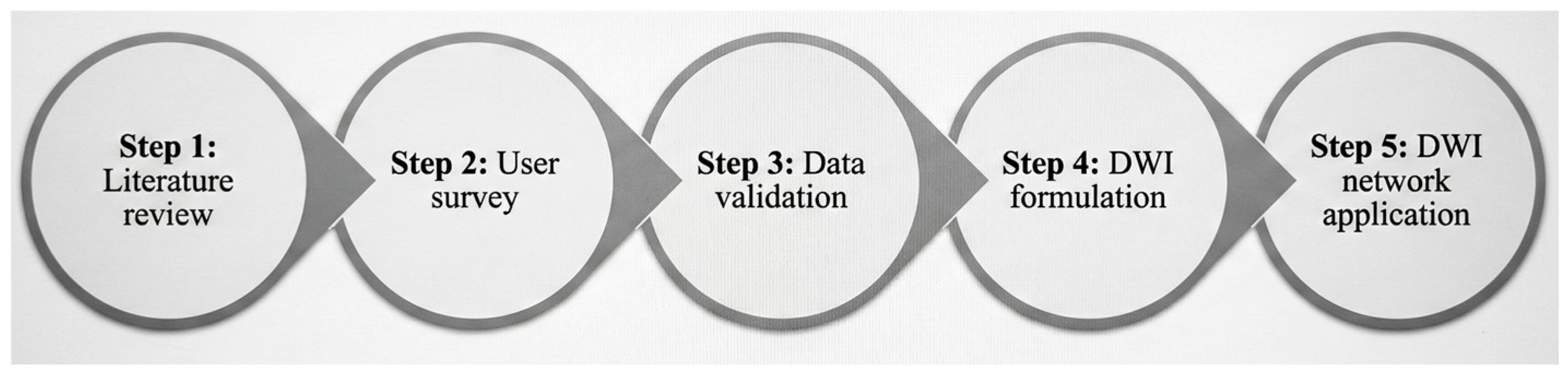
The methodology of this research consists of five interconnected steps that are illustrated in Figure 1. The first step includes a literature review, which was conducted through an analysis of relevant scientific research. The research was conducted by reviewing available databases of scientific papers by key words that include walkability index, walking, walkability for people with limited mobility, etc.
The aim of this step was to review the existing methodological procedures for the calculation of the walkability index and to determine the criteria that are most commonly used for this purpose. Based on the literature review, the initial set of criteria that will appear in our walkability index was defined, and the basic settings for the formulation of the dynamic walkability index were set.
The remaining steps are explained in the following subsections.

2.2.1. User Survey

For the purposes of this research, users were surveyed through a specially prepared questionnaire (see Table 1). The goal of this part of the research was to determine the relative importance and weight of each individual criterion for defined groups of users.
Accordingly, the respondents were divided into two groups: the first group—people who do not have difficulties while walking—and the second group—people with limited mobility (immobile, deaf, visually impaired, blind people, etc.). The total number of people surveyed was 489, of which 457 respondents belonged to the group of people without mobility difficulties, while 32 respondents belonged to the group of people with limited mobility. The ratio between the two groups in the survey corresponds to the actual ratio between the groups in the city of Čačak. The survey was conducted in person, during June and July 2023, with the presence (if needed) of a guardian, family member, or support staff, for people with limited mobility. The questionnaire consisted of several questions, which are part of the local development project for the city of Čačak, of which only some of the most important issues are highlighted. In Table 1, only questions relevant for this paper/research are presented.
The Likert scale ratings were averaged separately for each user group. The obtained mean values were normalized within each factor group to derive relative weights. Weighting was performed per user group, ensuring that the normalized weights within each group summed to one.

2.2.2. Data Validation

In this step of the research, an expert crosscheck of the obtained results and their possible adaptation to local conditions was carried out. The experts who participated in the data verification are traffic and civil engineers, taking into account the nature of the collected data. The validation process included the following steps:
  • Logical Validation (consistency check)—ensuring that all the answers make sense in relation to each other.
  • Range validation—verifying that numerical answers fall within the expected ranges. For example, if asking about the age, the age range is between 0 and 100.
  • Format Validation—verifying that there is no placeholder text (e.g., “okdbr”) in the open-ended questions.
  • Cross-validation—In this step, question 5 (Table 1) was considered separately, where the inconsistency in the answers was analyzed. For example, if the respondent said that the existence of the pedestrian infrastructure was “completely unimportant”, but stated that its condition was “very important”, this could potentially be considered a contradiction, so such responses, if any, would be excluded from the analysis. During the entire data validation process no significant changes were made.
The primary purpose of the survey was weight elicitation rather than psychometric scale construction. Accordingly, the validation process focused on logical consistency, range verification, and cross-checking of responses to ensure the interpretability of the collected data. More advanced statistical reliability testing, such as Cronbach’s alpha, could further strengthen future applications of the model and is identified as a direction for future research.

2.2.3. DWI Formulation

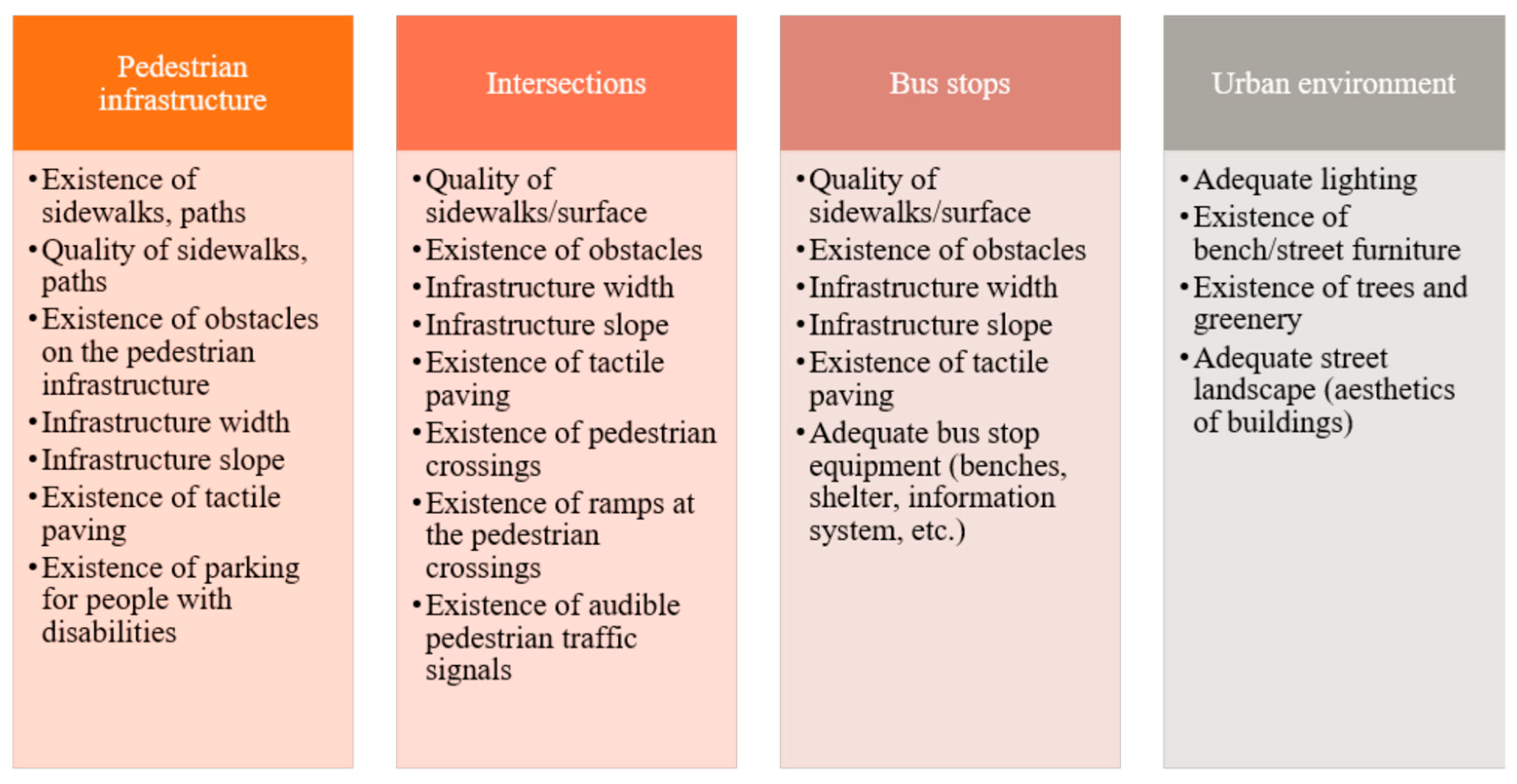
In this section, the mathematical interpretation of the dynamic walkability index is given and explained in detail. In order to simplify the formula, the criteria are divided into four groups of influencing factors, namely, pedestrian infrastructure, intersections, bus stops, and urban environment. Each of the four factors contains criteria that have been analyzed in the field and whose aggregation results in the dynamic index of walkability (Figure 2).
The formula that describes this index is shown by Equation (1).
D W I s ( t ) = i = 1 k w i ( j = 1 n i x s i j [ p p n l m ( t ) w p n l m , i j + p p l m ( t )   w p l m , i j ] )
where
s—street segment to be evaluated (segments are used because characteristics can vary within a street);
i ∈ {1,…,k}—index of factor group (in this study k = 4, pedestrian infrastructure, intersections, bus stops, urban environment);
k—number of factor groups (here k = 4);
j ∈ {1,…,ni}—index of a criterion inside factor group I;
ni—number of criteria in factor group i;
xsij ∈ [0,1]—normalized field/audit value of criterion j from group i for segment s (values are defined on a 0–1 scale, where values closer to 1 indicate better walkability);
ppnlm(t) ∈ [0,1]—share of people without mobility difficulties in average daily movements at time t;
pplm(t) ∈ [0,1]—share of people with limited mobility in average daily movements at time t,
Constraint on shares: ppnlm(t) + pplm(t) = 1;
wpnlm,ij—weight (relative importance) of criterion j in group i for people without mobility difficulties, obtained from the user survey;
wplm,ij—weight (relative importance) of criterion j in group i for people with limited mobility, obtained from the user survey;
Wi—group-specific weight for factor group i (controls the contribution of each factor group to the final index).
The normalized criterion weights, within each factor group, are defined according to the following equation:
w g , i j = r ¯ g , i j m = 1 n i r ¯ g , i j   so   that   j = 1 n i w g , i j = 1
where
r ¯ g , i j is the mean survey rating (Likert scale 1–5) for user group g ∈ {Pnlm,Plm} for criterion j in group i.
The group weights, between factor groups, are defined according to Equation (3):
W i = 1 k   for   all   i = 1 , , k ,   where   i = 1 k W i = 1
Equation (1) calculates a weighted sum of the normalized criterion values xsij within each factor group i, where the criterion weights are user-group specific, and combined using time-varying population shares.
Although criterion-level importance was defined separately for each user group (Table 1), group-level weights Wi were not independently ranked in the survey. To preserve reproducibility and avoid introducing unverifiable assumptions on inter-group dominance, we applied an equal weighting scheme. This approach ensures the index remains deterministic, directly implementable, and modular for future upgrades where inter-group weighting can be re-estimated or optimized.
A dynamic walkability index formed in this way can reflect a pattern of temporal variations. The proposed analytical framework can be applied at both the user and the system level, it can support urban and transport planning, and it can promote social equality and inclusion. The basic idea behind the dynamic changes in this index is the temporal (natural) changes in the population movement: people with reduced mobility and people without mobility difficulties. If the index were to take into account only pedestrians without mobility difficulties, it would mean that the infrastructure would be completely unsuitable for people with limited mobility. Taking into account this category of users, the model indicates all the elements of the urban environment that should be improved. By improving them, the environment adapts to the needs of vulnerable categories of road participants in accordance with their participation in daily movements.
In this way, the convenience of the environment is increased, attracting and enabling a greater number of vulnerable users to participate in traffic, which increases their share in daily movements, and gives them more “importance” in the proposed model. In this way, a self-sustaining system of redevelopment and improvement of urban space is created by means of a dynamic walkability index, which can be a suitable tool for decision makers and engineers.
Based on national and local standards, technical documents [25,26,27], and field research, a range of values from 0 to 1 was defined for each of the criteria (Table 2), where a value closer to 1 is better for walkability. The mentioned documents contain detailed recommendations on the design and dimensioning of all elements of the street/segment profile, which were used in the formulation of the criteria in Table 2.

2.2.4. DWI Network Application

In the final, fifth step of the methodology, the application of the DWI to the urban network of the city of Čačak was carried out. More about the obtained results, as well as a discussion of the results, is given in a separate section, Results and Discussion.
Equipment and Data Collection
Data collection is a time-consuming process that can be accomplished with a variety of tools. The most common are audits and Geographic Information Systems (GIS databases). Audit-based indices provide a time-consuming option, especially for large areas, but they provide a detailed assessment of the existing infrastructure that can also be used for monitoring and making decisions about new projects. Consequently, one part of the data was obtained using publicly available GIS databases for the city of Čačak, while the other part of the data was obtained using the Google maps service and field research.
A mobile device and camera were used during the field research and audit. Photo documentation of the existing condition was created with more than 300 photos via a mobile device and 250 photos using the Insta360 Pro camera(manufacturer: Arashi Vision Inc., Shenzhen, China).After collecting photo documentation and filed audits, a database of the characteristics of each individual street/segment was created in Excel software (Google Sheets (web-based version, accessed January 2026), where the data was processed.

3. Results and Discussion

3.1. Research Area

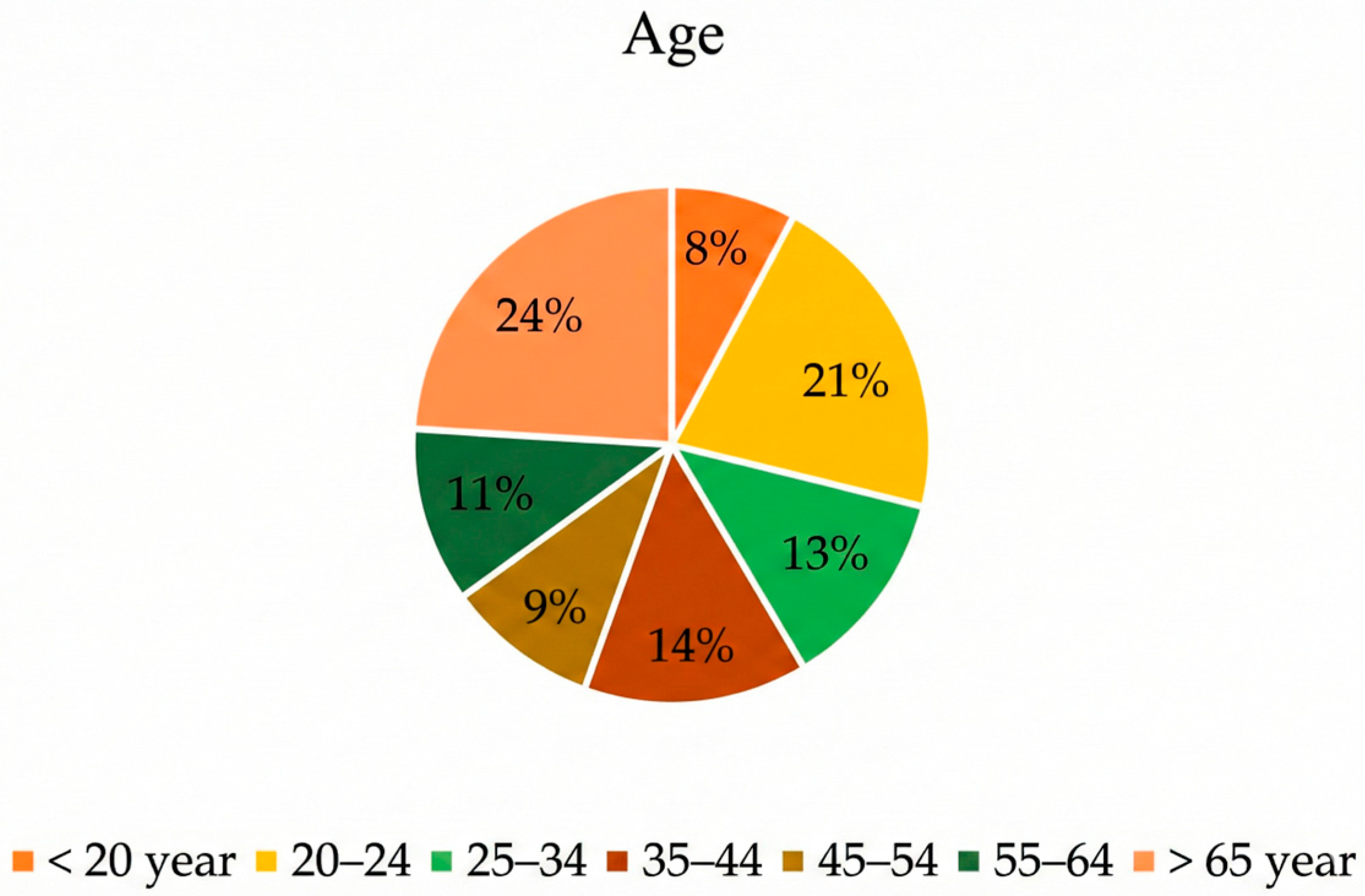
Čačak is a city in Serbia located 140 km south of Belgrade (the capital of Serbia), and the city itself has an area of 636 km2, with mostly residential areas. According to the latest population census from 2022, it has 105,612 inhabitants, of which 7.9% are people with limited mobility [1]. Figure 3 shows the age structure of the population. It is clear that in cities with a higher percentage of children, the elderly, and other persons with limited mobility, the quality and existence of pedestrian infrastructure play an important role, and this index (DWI) would be of great importance for adapting the environment to the needs of all users.
Pedestrian traffic, as the most common form of movement in Čačak, is favored through more intensive construction and reconstruction of pedestrian infrastructure (sidewalks, footpaths, pedestrian zones). When it comes to public transport, 9 city and 43 suburban bus lines are registered in the system of public transport. Depending on the transport requirements, vehicles of different capacities operate on the mentioned lines. An analysis of the coverage of the urban area has determined that about 64% of the populated urban area is located within a distance of 250 m from the nearest bus stop, and 95% of the populated urban area is located within a distance of 500 m from the nearest bus stop.
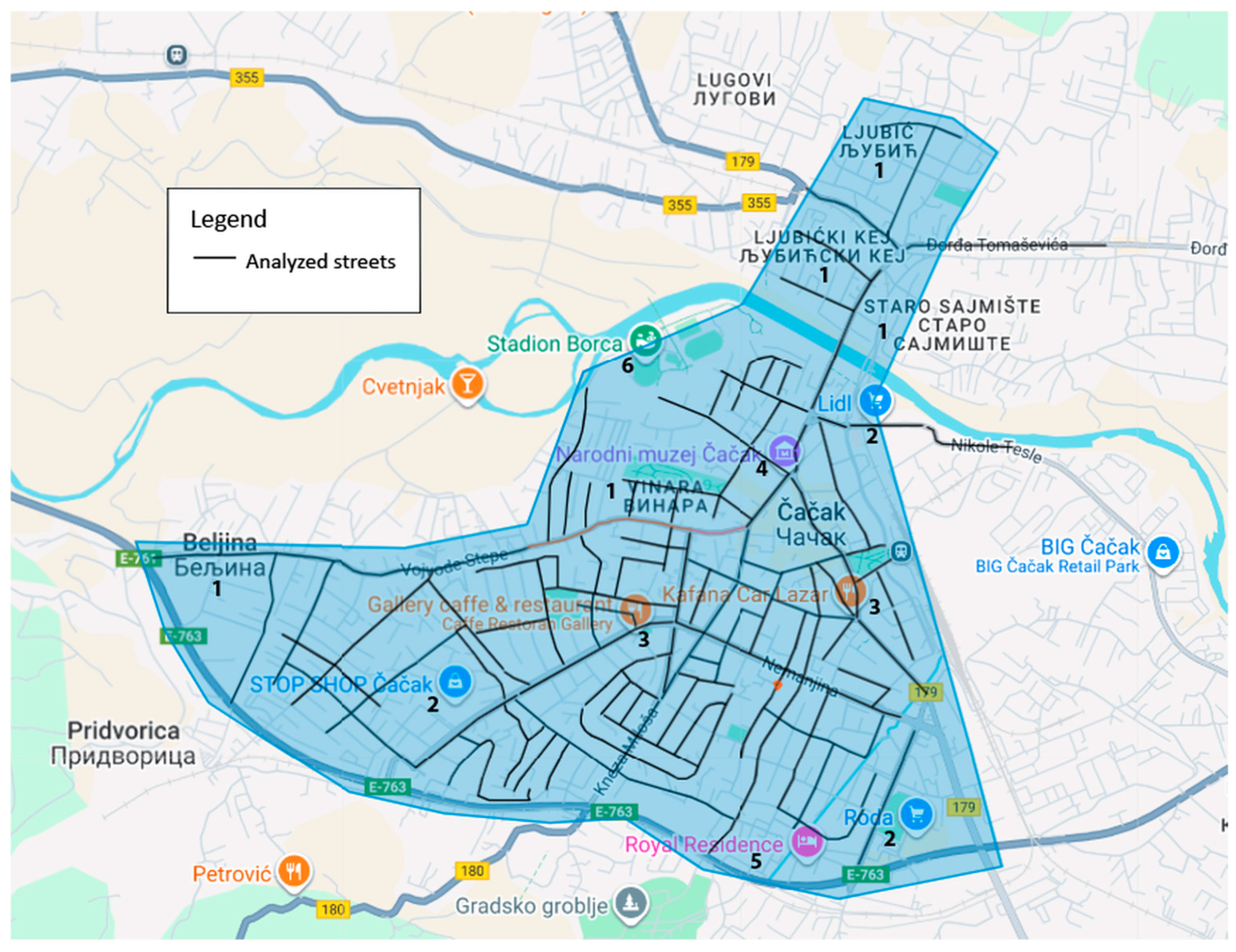
The traffic network of the city of Čačak is characterized by a primary radial structure (first- and second-rank streets, which also serve as entry and exit routes). The research is focused on the city center and the secondary network of lower-rank streets, ranging from third- to fifth-rank. This irregular network forms a structure of larger, predominantly elongated, rectangular blocks in the traditional city core. In this study, the primary unit of analysis is the street segment, defined as a homogeneous section of a street with uniform technical and operational characteristics. The study examines a total of 183 street segments.
This research includes streets/segments with different technical and operational characteristics, for which photo documentation was created and all parameters necessary for calculating the dynamic index of walkability were revised and recorded.
Figure 4 shows the analyzed area, marked in blue, while the analyzed roads are in black.

3.2. Survey Results—Application of DWI for Čačak—Development of the Model

The results of the user survey were used to obtain the relative weights of each criterion, based on their importance ranking. After that, a scale of the level of the dynamic index of walkability was formed, obtained from the survey results, field research, and the existing literature, as presented in the Section 2.2.
Table 3 shows the average scores for each criterion, in relation to the type of user.
The table shows that the highest average scores were obtained for the criterion “existence of pedestrian infrastructure”, which was expected. Bearing in mind that there are certain roads in Čačak where there is no pedestrian infrastructure, it was important to include this parameter in the calculation. For example, the width of the sidewalk has an important influence on the segment walkability (especially for people with limited mobility), where values ≥ 2 m consistently supported uninterrupted movement, while narrower paths increased detours and user discomfort. The binary treatment of width simplified the index formulation, yet future iterations should introduce continuous weighting to better capture localized capacity and comfort effects.
The lowest average scores, regardless of user category, were obtained for criteria related to the urban environment: greenery, esthetics of buildings, existence of street furniture, etc. These results were also expected, bearing in mind that the mentioned parameters do not have a direct impact on the functionality of the street itself, that is, the movement of users.
What deviated from the expected results in a certain sense were the lower average scores of persons with limited mobility regarding the existence of audible pedestrian signals and the existence of tactile paving. This result can be explained by the fact that different categories of users with limited mobility were not considered in the paper, but all people were observed together within the group. In this sense, it may not be as important for deaf people or people with reduced mobility to have tactile paving and audible signals as it is for blind people.
To demonstrate that the survey criterion weights remain numerically reliable under sampling variability, we applied a bootstrap uncertainty check to the complete respondent dataset. The resulting weight distributions and confidence intervals are summarized in Table 4 below.
The bootstrap results confirm that the normalized criterion weights remain centered around the original values, with low standard errors and compact 95% confidence intervals across 5000 resamples. This indicates that the weighting scheme is numerically stable and suitable for subsequent DWI classification and network-level prioritization, without requiring additional assumptions or repeated field audits.
Table 5 shows the proposed scale for the dynamic walkability index, which was used in the street/segment inspection. The scale was formed based on existing street/segment characteristics (field research), as well as a literature review [4,21,28]. A four-step approach was used in this case to split the DWI scale, for facilitating the interpretation of the results (i.e., a 5-level DWI would lead to “neither moderate nor satisfactory walkability” for the middle level) and visual presentation (i.e., less coloring on maps), and be in line with similar research studies; for example, [21].
The DWI is bounded in [0,1] because each criterion score xsij ∈ [0,1] and all weights are normalized to sum to one within groups and across groups (Equations (1)–(3)). Therefore, level A was defined as DWI = 1.0, representing the theoretical best-case segment where all audited criteria meet recommended conditions. For levels B-D, threshold values were selected to reflect increasing degrees of deviation from technical standards and to ensure an interpretable four-class scale suitable for mapping and decision support. The resulting cut points were subsequently checked against an independent user-based street classification survey, which showed high agreement between perceived and model-based DWI classes, supporting the practical adequacy of the chosen thresholds.
What is important to note at this point is that the technical–operational characteristics may differ in different parts of the same street. For this reason, during the field research, each street was divided into segments in order to separate parts with different characteristics. These segments differ in length, depending on the technical and operational characteristics of each street.
In the continuation of the paper, the practical application of the DWI in the city of Čačak is presented and discussed.

DWI Application on Local Level (The Proposed Model)

This section presents the results of the practical application of the proposed model in the city of Čačak. Table 6 shows the number and percentage share of the street/segment category in relation to the formed scale.
Table 6 shows that the streets/segments are almost evenly distributed in relation to the level of walkability. It is a worrying fact that 50% of the street network in Čačak is unsuitable for walking (levels C and D are recorded). It is interesting to note that the obtained results do not differ significantly from the situation in other world cities such as Barcelona, London [29,30], Bogotá [21], or Athens [4]. Although a different methodology was used for the mentioned cities, the final results show that similar percentages of the networks (compared to Čačak) are not suitable for walking.
If we look at the streets/segments that fall into the category of fully walkable (level A), we can see that their percentage is only 22.4% in relation to the total number of streets/segments analyzed. This means that less than one quarter of the city network is adapted to the requirements of pedestrians.
These results clearly indicate the need for urgent interventions, namely on around 50% of the network, of which more than a half require complete reconstruction.
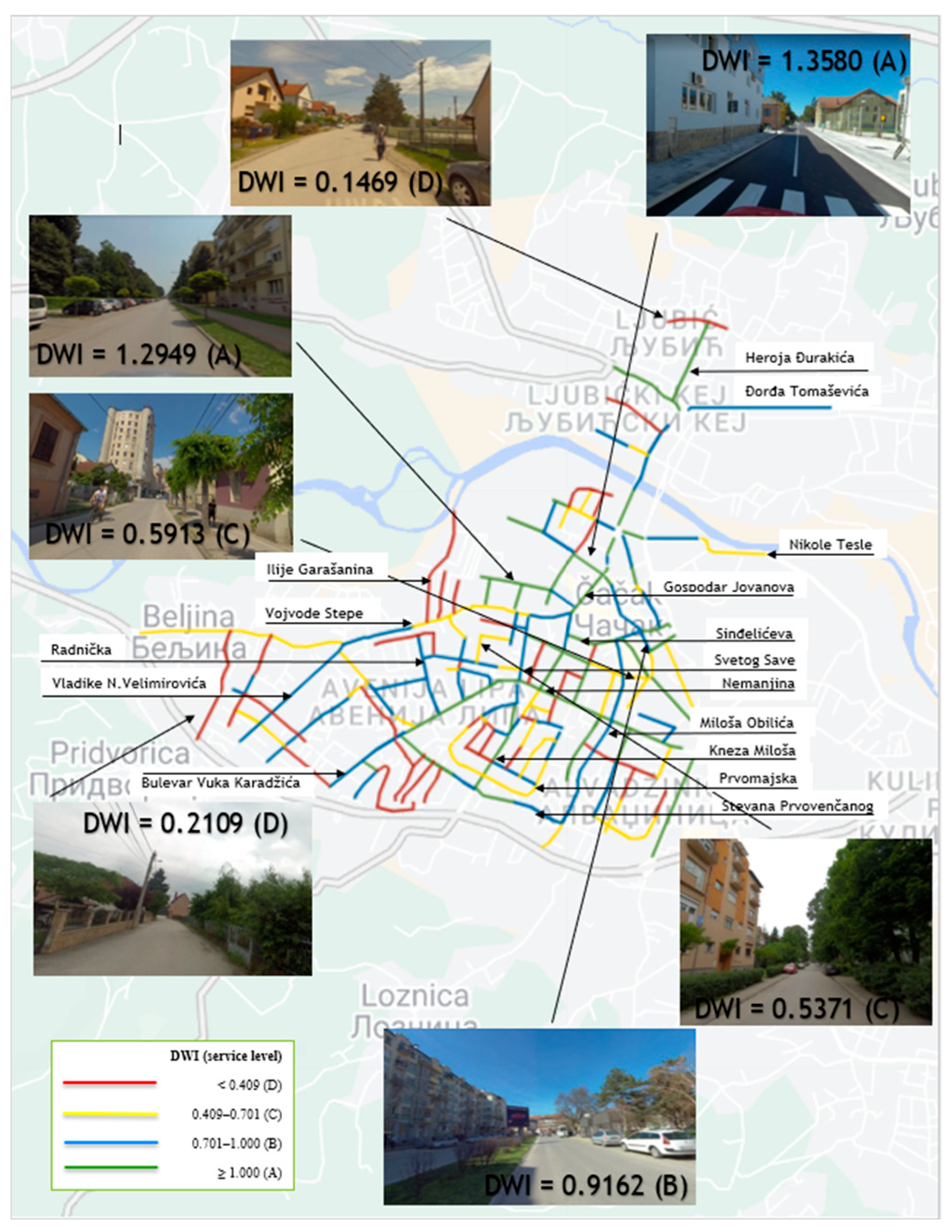
Figure 5 shows some of the selected street segments in the city of Čačak and the value of the DWI indicator.
Figure 5 shows the differences regarding the defined levels of walkability on the network. For example, level D usually includes segments that do not have sidewalks, pedestrian crossings, or other pedestrian infrastructure, while level C usually includes segments that have a high percentage of obstructions to pedestrian communications, poor path condition, one-sided sidewalk streets/segments, etc. Similar problems have been recorded in other cities that deal with the aspect of walkability, with a special emphasis on the safety and security of users [4,21]. On the other hand, level A includes fully walkable streets/segments with all the necessary design elements of pedestrian infrastructure for safe and comfortable walking. On the basis of the walkability indicator shown in this way, it is possible to rank all analyzed streets/segments in the city, according to the urgency for reconstruction. In this way, an adequate and fast tool is provided for assessing the (in)efficiency of the network and its need for reconstruction, according to the aspects of walkability.
What makes this model specific and unique is its dynamic component. Namely, with the change in the share of different categories of users in the average daily movements, the importance/representation of their “participation” in the proposed model will also change. This actually means that with the increase in the number of people with limited mobility in daily movements, greater importance should be given to their requests, needs, and opinions, therefore enabling the redesign of the infrastructure based on their demands and needs.
According to the above, additional testing of the model was performed. Namely, in the first case, it was assumed that the share of daily movements between the two analyzed groups was 95–5%. In a new hypothetical scenario, an increase in daily movements of persons with limited mobility in Čačak was proposed to be 92–8%. In this way, it was assumed that all persons with limited mobility (according to official records from the last republican census) would participate in daily movements, as a consequence of the previously improved infrastructure and urban environment. Table 7 shows a comparison of the results for the defined scenarios.
The hypothetical scenarios were designed to illustrate the operational mechanism of the dynamic component rather than to predict large numerical changes. The limited variation in DWI outcomes reflects the current infrastructure conditions in Čačak and the relatively small change in user shares. The key value of the DWI lies in its ability to update walkability assessments over time without repeating field audits, enabling continuous monitoring and scenario testing as demographic structures evolve.
The table shows that there is no significant change in the number of streets/segments by DWI levels. Although it might have been expected that the number of streets/segments with a worse level of walkability would increase, this did not happen. The reasons for this may be different. First of all, a certain number of criteria that may have an impact on people with limited mobility were analyzed only in a binary way in this research (exists/does not exist). This is the case with tactile pavement, pedestrian ramps, and audible pedestrian traffic signals. If the quality of this infrastructure, the way in which it was implemented, designed, etc., were to be considered, the authors believe that it could have a positive impact on the final outcome.
Also, the importance of the user category was not evaluated in the model, only the answer given by the user. Bearing in mind the specific requirements and needs of people with limited mobility, for the purposes of urban design, in certain situations, greater importance can be given to this category of users, compared to people without mobility difficulties. This can be achieved by assigning different weights to these two categories of users, which will be the subject of future research, bearing in mind the complexity and specificity of that process.
What is important to emphasize here is the fact that the model is formulated in a way that is easy to modify, which will certainly facilitate future changes and improvements.

3.3. DWI Validation—Model Validation Through Field Testing

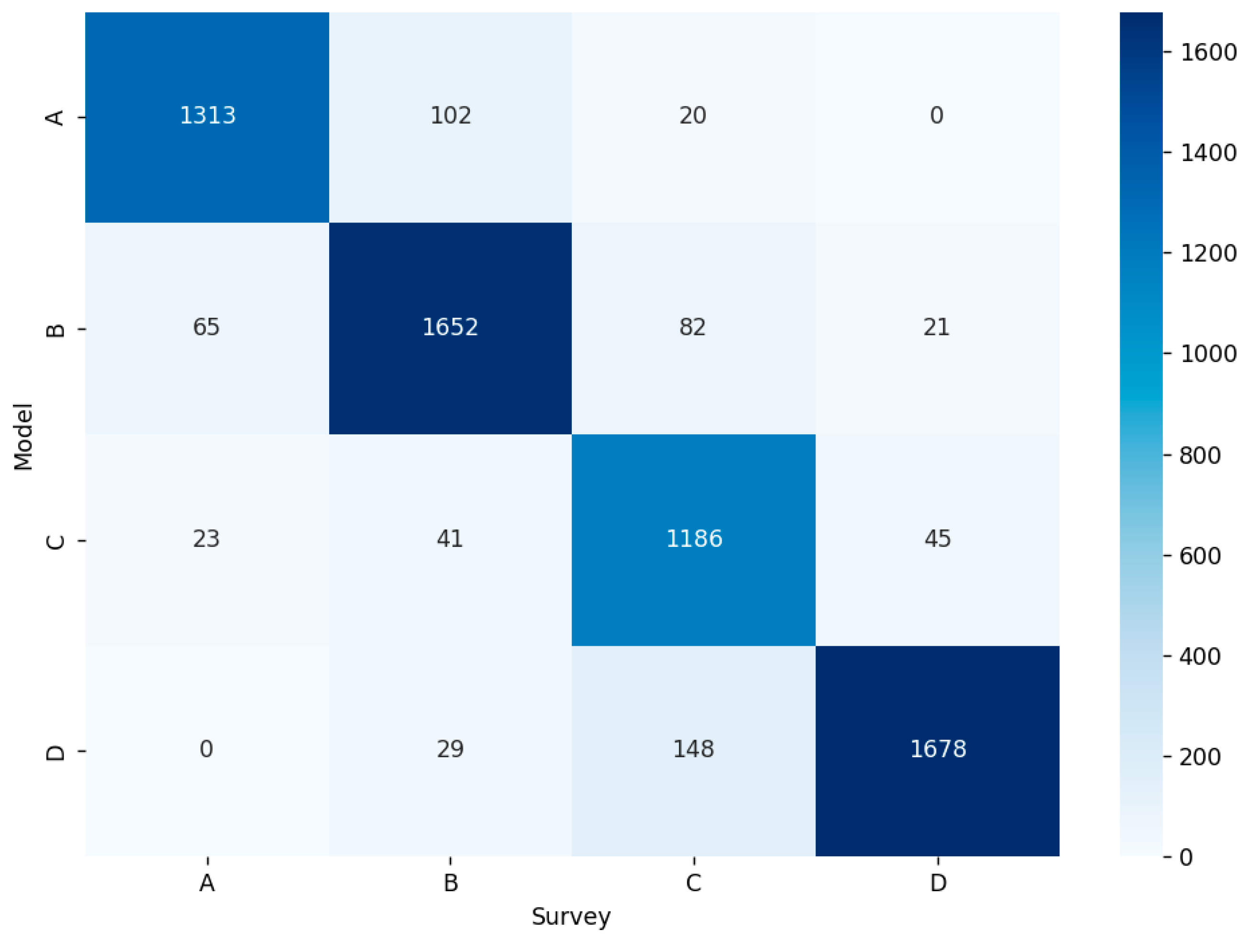
For the purpose of DWI validation, a user survey was conducted in the area of Čačak. The overall sample was 35 respondents, of which 5 were people with limited mobility. The respondents had the task of determining the level of walkability for each street/segment according to the four-level scale defined in this paper (A–D). This method was chosen as suitable because it is based on comparing the obtained results with the perception of the street/segment as the user actually sees and “feels” it. The results of the comparison in a form of a confusion matrix are shown on Figure 6, while in-class metrics are given in Table 8.
The results demonstrate classification consistency at the level of individual street-respondent ratings, confirming that model performance remains stable and ordinally coherent. The model achieves approximately 91% agreement with human ratings, while most disagreements occur between adjacent severity levels (A–B, B–C, and C–D), reflecting realistic perceptual uncertainty rather than model bias. Importantly, extreme misclassification jumps (e.g., A–D) are absent, indicating that the model preserves the intended ordinal structure of the DWI risk scale. Per-class metrics further support balanced performance across categories, with the lowest precision and F1-score observed for class C, suggesting moderate ambiguity in mid-severity streets rather than model instability, which is consistent with expectations for subjective safety ratings.
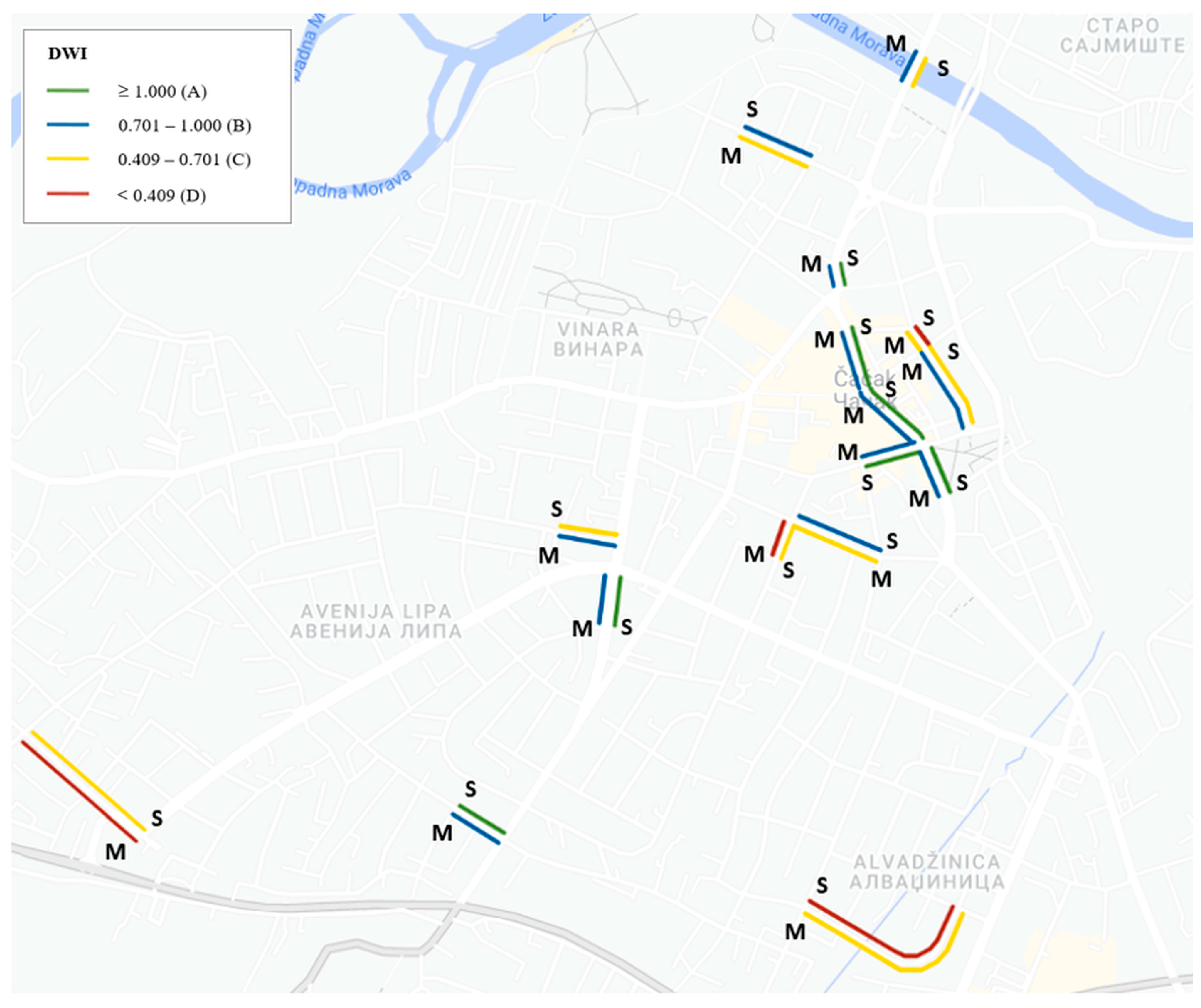
Later on in the paper (Figure 7), the results of one of the respondents are shown. Interestingly, the street segments displayed in Figure 7 coincide with the locations where the greatest discrepancies were consistently observed between the survey ratings and the model-derived results.
These locations are primarily mid-severity or visually complex segments, where respondents appear to perceive higher risk than the model predicts. The absence of extreme rating reversals and the dominance of adjacent-class disagreements suggest that differences arise from visual cues rather than inconsistent scoring. A likely explanation is that these streets contain localized features, such as partially faded edge lines, irregular pavement texture, subtle cross slope variations, or constrained lateral clearance near intersections, that may influence perceived safety but are not fully captured by the model’s input variables or cluster-level scoring assumptions. This underscores that respondents incorporate micro-contextual signals, including informal conflict points and perceived maneuvering difficulty, which can be challenging to quantify through geometric and exposure proxies alone. The result is not a failure of model validity, but an expected limitation of segment-level perception modeling, reinforcing the importance of per-class validation and qualitative interpretation when strengthening black spot reporting.
The pedestrian infrastructure in Čačak is generally of poor quality, as half of the streets do not meet the requirements of good walkability. The worst-rated streets, or their segments, do not have a sidewalk, or they have only one sidewalk, which is in a bad condition, with many holes and cracks, broken pavement, or cracked asphalt, and thus they do not provide continuity. The best-rated segments are located near high-ranked streets, where there are mostly commercial activities but also residential housing. The worst-rated segments are located in the lowest-ranking streets, mostly in lower-quality residential areas.
The best grade, level A, implies completely walkable streets/segments containing all the necessary design elements, with possibly minimal imperfections, requiring no measures for walkability improvement, while level D is the worst rating, and implies completely unwalkable streets/segments that require complete reconstruction. Level C requires the redesign of a certain part in order to make it walkable, and level B requires no immediate measures. In the case of levels D and C, in the first phase, complete reconstruction of the pedestrian infrastructure is needed. This implies the introduction of sidewalks (if the spatial conditions do not allow it, then the introduction of a sidewalk at least on one side), repairing existing sidewalks by closing cracks and holes in the pavement, designing curbs in such a way that they are adapted to the walking of people with limited mobility, and introducing tactile surfaces and sound signalization for blind and deaf people. Reconstruction also means changing the profile of the street (or the street segment) in order to achieve the desired width of the sidewalk. Benches, and urban furniture in general, ensuring uninterrupted movement in relation to possible obstacles (removal of obstacles), planting trees, and lighting represent a need that can be fulfilled in subsequent phases. The feeling of personal safety is one of the important factors that needs to be achieved for good walkability, and it is based on measurable elements, as well as on personal feeling. For level B, some small corrections should be introduced in the direction of improving the quality of the walking surface, safety, and urban furniture.

4. Conclusions, Limitations and Future Directions

The dynamic walkability index (DWI) proposed and validated in this study provides a reproducible metric that links normalized micro street characteristics with time-varying pedestrian mobility shares. The structure of the index allows for direct implementation in code or different tools and supports rapid scenario testing after initial field inspection, without requiring repeated data collection. Although the limited mobility subgroup reflects the proportional structure of the local population, its smaller absolute size introduces quantifiable uncertainty in weight estimation, which we addressed through independent validation and sensitivity checks that demonstrated stable class allocations and high consistency with user-perceived walkability levels. The four-class threshold scale (A–D) was anchored to the theoretical upper bound of the index and to classification behavior observed during validation, prioritizing interpretability for network diagnostics rather than asserting fixed inter-group importance rankings.
A limitation of this study is the small sample size of persons with limited mobility, which may affect the representativeness of this subgroup. Additionally, the heterogeneous nature of mobility limitations within this sample (e.g., wheelchair users, visually impaired, elderly with reduced mobility) may not adequately capture the diverse needs of all persons with disabilities. Due to the challenges in recruiting persons with limited mobility within the study time-frame and geographic constraints, expanding the sample was not feasible for this study. However, we acknowledge this limitation and recommend that future implementation of this method in different contexts should consider adapting the weights based on local demographics and disability profiles. Additionally, participatory approaches that actively engage disability advocacy organizations in the research process should be employed to ensure comprehensive representation. However, the bootstrap analysis confirms methodological reliability, showing stable results despite the small sample size.
A suggestion for improving the DWI could be adding more factors (in the existing literature there are factors like user safety, security, noise impact, air pollution, etc. [31,32]), that can also be included in the DWI calculation, which would further improve the quality of the model itself.
Key limitations arise from partial binarization of certain criteria and from applying equal factor–group weighting, as the survey emphasized criterion-level importance within groups, while group-level ranking is reserved for future refinement. This choice slightly reduces granularity, but it does not affect the formulation logic or the practical applicability of the DWI for network diagnostics and infrastructure prioritization. Future research should expand the model by introducing continuous weighting for infrastructure elements, disaggregating mobility impairments into functional subgroups, and calibrating group-level contributions through expert gradation approaches (e.g., quantiles, natural breaks, or optimization-based calibration). Directions of future research also cover plans to extend spatial coverage to larger and cross-border urban networks, incorporating cyclists and micromobility users as additional traffic participants of the street network.
Future research directions can be focused on the application of modern AI tools, which would improve the methodology and the DWI (dynamic walkability index) itself as a synthetic quality index, making it more operational, reliable, and precise as an indicator of pedestrian infrastructure condition, ready for integration into smart urban network management systems. Furthermore, through advanced software solutions, the application of AI methods would enable more efficient continuous monitoring and analysis of conditions, support for intelligent prioritization of interventions, and improvement of network planning and management processes while achieving the desired level of quality.

Author Contributions

Conceptualization, A.T., S.J. and N.M.; methodology, A.T., S.J. and N.M.; software, S.J. and N.M.; validation, A.T., S.J. and N.M.; formal analysis, A.T., S.J. and N.M.; investigation A.T., S.J. and N.M.; resources, N.M.; data curation, S.J. and N.M.; writing—original draft preparation, A.T., S.J. and N.M.; writing—review and editing, A.T., S.J., N.M., R.G. and S.B.; visualization, S.J., N.M. and S.B.; supervision, A.T.; project administration, R.G. and S.B. All authors have read and agreed to the published version of the manuscript.

Funding

This research received no external funding.

Institutional Review Board Statement

The study was conducted in accordance with the Declaration of Helsinki, and approved by the Ethics Committee of University of Belgrade, Faculty of Transport and Traffic Engineering, Republic of Serbia.(protocol code 2512 and 12 January 2026 of approval).

Informed Consent Statement

Informed consent was obtained from all subjects involved in the study.

Data Availability Statement

Data is contained within the article.

Conflicts of Interest

Author Nevena Marinković was employed by the company “Gradac”, based in Čačak, Serbia. The remaining authors declare that the research was conducted in the absence of any commercial or financial relationships that could be construed as a potential conflict of interest.

References

  1. Statistical Office of the Republic of Serbia. Population Aged Two and Over by Disability Status, Sex, Age and Type of Settlement. 2022. Available online: https://data.stat.gov.rs/Home/Result/3104020901?languageCode=en-US (accessed on 5 December 2025).
  2. Ewing, R.; Handy, S. Measuring the Unmeasurable: Urban Design Qualities Related to Walkability. J. Urban Des. 2009, 14, 65–84. [Google Scholar] [CrossRef]
  3. Gajić, R.; Golubovic-Matić, D.; Mitrović, B.; Batarilo, S.; Kordić, M. The Methodology for Supporting Land Use Management in Collective Housing towards Achieving Energy Efficiency: A Case Study of New Belgrade, Serbia. Land 2021, 10, 42. [Google Scholar] [CrossRef]
  4. Mitropoulos, L.; Karolemeas, C.; Tsigdinos, S.; Vassi, A.; Bakogiannis, E. A composite index for assessing accessibility in urban areas: A case study in Central Athens, Greece. J. Transp. Geogr. 2023, 108, 103566. [Google Scholar] [CrossRef]
  5. Wang, X.; Peng, Z.; Yang, X. Multimodal Data-Driven Hourly Dynamic Assessment of Walkability on Urban Streets and Exploration of Regulatory Mechanisms for Diurnal Changes: A Case Study of Wuhan City. Land 2025, 14, 1551. [Google Scholar] [CrossRef]
  6. Bedi, C.; Kansal, A.; Mukheibir, P. A conceptual framework for the assessment of and the transition to liveable, sustainable and equitable cities. Environ. Sci. Policy 2023, 140, 134–145. [Google Scholar] [CrossRef]
  7. Fruin, J. Designing for Pedestrians: A Level-Of-Service Concept, Pdf. Available online: https://onlinepubs.trb.org/Onlinepubs/hrr/1971/355/355-001.pdf (accessed on 11 January 2026).
  8. Wey, W.-M.; Chiu, Y.-H. Assessing the walkability of pedestrian environment under the transit-oriented development. Habitat Int. 2013, 38, 106–118. [Google Scholar] [CrossRef]
  9. Paul, D.; Moridpour, S.; Venkatesan, S.; Withanagamage, N. Evaluating the pedestrian level of service for varying trip purposes using machine learning algorithms. Sci. Rep. 2024, 14, 2813. [Google Scholar] [CrossRef]
  10. Arellana, J.; Alvarez, V.; Oviedo, D.; Guzman, L.A. Walk this way: Pedestrian accessibility and equity in Barranquilla and Soledad, Colombia. Res. Transp. Econ. 2021, 8, 101024. [Google Scholar] [CrossRef]
  11. Habibian, M.; Hosseinzadeh, A. Walkability index across trip purposes. Sustain. Cities Soc. 2018, 42, 216–225. [Google Scholar] [CrossRef]
  12. Hino, K.; Baba, H.; Kim, H.; Shimizu, C. Validation of a Japanese walkability index using large-scale step count data of Yokohama citizens. Cities 2022, 123, 103614. [Google Scholar] [CrossRef]
  13. Wali, B.; Frank, L.D.; Saelens, B.E.; Young, D.R.; Meenan, R.T.; Dickerson, J.F.; Keast, E.M.; Fortmann, S.P. Associations of walkability, regional and transit accessibility around home and workplace with active and sedentary travel. J. Transp. Geogr. 2024, 116, 103776. [Google Scholar] [CrossRef]
  14. Gorrini, A.; Presicce, D.; Messa, F.; Choubassi, R. Walkability for children in Bologna: Beyond the 15-minute city framework. J. Urban Mobil. 2023, 3, 100052. [Google Scholar] [CrossRef]
  15. Khatun, F.; Gühnemann, A. Exploring the Built Environment of Walking through Walkability Index: A Study on Two Different Districts of the United Kingdom. J. Transp. Health 2019, 14, 100742. [Google Scholar] [CrossRef]
  16. Kwon, K.; Akar, G. People with disabilities and use of public transit: The role of neighborhood walkability. J. Transp. Geogr. 2022, 100, 103319. [Google Scholar] [CrossRef]
  17. Rahman, A. A GIS-based, microscale walkability assessment integrating the local topography. J. Transp. Geogr. 2022, 103, 103405. [Google Scholar] [CrossRef]
  18. Ki, D.; Chen, Z.; Lee, S.; Lieu, S. A novel walkability index using google street view and deep learning. Sustain. Cities Soc. 2023, 99, 104896. [Google Scholar] [CrossRef]
  19. Lanza, G.; Pucci, P.; Carboni, L. Measuring accessibility by proximity for an inclusive city. Cities 2023, 143, 104581. [Google Scholar] [CrossRef]
  20. Lee, S.; Lee, C.; Nam, J.W.; Abbey-Lambertz, M.; Mendoza, J.A. School walkability index: Application of environmental audit tool and GIS. J. Transp. Health 2020, 18, 100880. [Google Scholar] [CrossRef]
  21. Guzman, L.A.; Arellana, J.; Castro, W.F. Desirable streets for pedestrians: Using a street-level index to assess walkability. Transp. Res. Part D Transp. Environ. 2022, 111, 103462. [Google Scholar] [CrossRef]
  22. Muhammad Mulyadi, A.; Verani Rouly Sihombing, A.; Hendrawan, H.; Vitriana, A.; Nugroho, A. Walkability and importance assessment of pedestrian facilities on central business district in capital city of Indonesia. Transp. Res. Interdiscip. Perspect. 2022, 16, 100695. [Google Scholar] [CrossRef]
  23. Labdaoui, K.; Mazouz, S.; Acidi, A.; Cools, M.; Moeinaddini, M.; Teller, J. Utilizing thermal comfort and walking facilities to propose a comfort walkability index (CWI) at the neighbourhood level. Build. Environ. 2021, 193, 107627. [Google Scholar] [CrossRef]
  24. Andrade, A.; Escudero, M.; Parker, J.; Bartolucci, C.; Seriani, S.; Aprigliano, V. Perceptions of people with reduced mobility regarding universal accessibility at bus stops: A pilot study in Santiago, Chile. Case Stud. Transp. Policy 2024, 16, 101190. [Google Scholar] [CrossRef]
  25. Public Enterprise “Roads of Serbia”. Road Design Manual of the Republic of Serbia—Road Design Elements JP Putevi Srbije. 2012. (Priručnik za Projektovanje Puteva u Republici Srbiji—Projektni Elementi Puta). Available online: https://bit.ly/45rOOnB (accessed on 5 December 2025). (In Serbian)
  26. Official Gazette of the Republic of Serbia 22/2015. Rulebook on Technical Standards for the Planning, Design and Construction of Facilities Ensuring Unimpeded Movement and Access for Persons with Disabilities, Children and the Elderly. 2015. (Sl. glasnik RS no 22/2015. Pravilnik o Tehničkim Standardima Planiranja, Projektovanja i Izgradnje Objekata Kojima se Osigurava Nesmetano Kretanje i Pristup Osobama sa Invaliditetom, Deci i Starim Osobama). Available online: https://bit.ly/4pwZata (accessed on 5 December 2025). (In Serbian)
  27. Official Gazette of the Republic of Serbia 50/11. Rulebook on the Traffic Safety Requirements for Road Structures and Other Elements of Public Roads. 2011. (Sl. Glasnik RS no 50/11. Pravilnik o Uslovima Koje sa Aspekta Bezbednosti Saobraćaja Moraju da Ispunjavaju Putni Objekti i Drugi Elementi Javnog Puta). Available online: https://bit.ly/4aPOH8L (accessed on 5 December 2025). (In Serbian)
  28. Transportation Research Board. Highway Capacity Manual 6th Edition: A Guide for Multimodal Mobility Analysis; The National Academies Press: Washington, DC, USA, 2016. [Google Scholar] [CrossRef]
  29. Healthy Streets. Tranquil City. UCL. Explore the Healthy Streets Index for Barcelona. 2024. Available online: https://www.healthystreets.com/maps/barcelona (accessed on 5 December 2025).
  30. Healthy Streets. Tranquil City. UCL. Explore the Healthy Streets Index for Central London. 2024. Available online: https://www.healthystreets.com/maps/london (accessed on 5 December 2025).
  31. da Schio, N.; Boussauw, K.; Sansen, J. Accessibility versus air pollution: A geography of externalities in the Brussels agglomeration. Cities 2019, 84, 178–189. [Google Scholar] [CrossRef]
  32. Morawetz, U.B.; Klaiber, H.A.; Zhao, H. The impact of traffic noise on the capitalization of public walking area: A hedonic analysis of Vienna, Austria. J. Environ. Manag. 2024, 353, 120060. [Google Scholar] [CrossRef]
Figure 1. Research methodology steps.
Urbansci 10 00059 g001
Figure 2. Groups of influencing factors used in the research.
Urbansci 10 00059 g002
Figure 3. Age structure of the population.
Urbansci 10 00059 g003
Figure 4. City of Čačak—Research Area (blue-shaded): 1—City district; 2—Shopping mall; 3—Restaurant; 4—Museum; 5—Hotel; 6—Stadium.
Urbansci 10 00059 g004
Figure 5. Street segments by DWI (arrows indicate local street names in Serbian).
Urbansci 10 00059 g005
Figure 6. Confusion matrix: model to survey results.
Urbansci 10 00059 g006
Figure 7. Results of one of the respondents: segments where different DWI results were obtained in the survey compared to the model; S—Survey, M—Model (district names in Čačak are shown in Serbian).
Urbansci 10 00059 g007
Table 1. Questionnaire structure.
1. Gender(a) Male (b) Female (c) Other (d) Do not want to declare
2. Age(a) under 18 years old (b) 19–25 (c) 26–35 (d) 36–45 (e) 46–55 (f) 56–65 (g) above 65 years old
3. Do you have any kind
of disability?
(a) Yes (b) No
If you have, please specify which one
4. Do you use any kind
of aids?
(a) Yes (b) No
If you do, please specify which one
5. Rate the following criteria according to their importance/significance for your normal and safe movement through the city streets

1—completely unimportant
5—completely important
(a) Existence of pedestrian infrastructure (sidewalks, paths);
(b) Good condition of pedestrian infrastructure;
(c) Existence of obstacles on the pedestrian infrastructure (poles, parking vehicles, greenery);
(d) Adequate width of pedestrian infrastructure for comfort and safe walking;
(e) Adequate slope of pedestrian infrastructure;
(f) Existence of tactile paving;
(g) Existence of pedestrian crossings;
(h) Existence of ramps at the pedestrian crossings;
(i) Existence of audible pedestrian traffic signals;
(j) Adequate street/segment and intersection lighting;
(k) Existence of parking space reserved for people with disabilities;
(l) Adequate design of bus stops;
(m) Existence of bench/street/segment furniture;
(n) Existence of greenery;
(o) Adequate street/segment landscape (esthetics of buildings).
Table 2. Micro-characteristics of the analyzed criteria.
FactorSourceMeasurement VariableRange Value
Existence of pedestrian infrastructureField researchBoth sides of the street/segment1
One side of the street/segment0.5
No infrastructure0
Condition of pedestrian infrastructureField researchGood condition on both sides of the street/segment1
One side is in good condition0.5
Both sides are in bad condition0
Existence of obstacles on pedestrian infrastructureField researchLow level of obstruction1
Medium level of obstruction0.5
High level of obstruction0
Adequate width of pedestrian infrastructureField research≥2.0 m1
<2.0 m0
Adequate slope of pedestrian infrastructureGIS database ≤5%1
>5%0
Existence of tactile pavingField researchYes1
No0
Existence of pedestrian crossingsField researchYes1
No0
Existence of pedestrian rampsField researchYes1
No0
Existence of audible pedestrian traffic signals on intersectionField researchYes1
No0
Adequate lightingField researchExcellent lighting1
Presence of lighting but with deficiencies0.5
No lighting0
Existence of parking space for people with limited mobilityField researchYes (by technical standards)1
No0
Adequate design of bus stopsField researchYes (with all required design elements)1
Partially (with one design element omitted)0.5
No (with more than one design element omitted)0
Existence of street furnitureField researchYes1
No0
Existence of greeneryField researchYes1
No0
Building estheticsField researchGood condition1
Average condition0.5
Bad condition0
Table 3. Average scores by criteria (PnLM *—People without mobility difficulties, PLM **—People with limited mobility).
CriteriaAverage Score
PnLM *PLM **
Existence of pedestrian infrastructure4.464.82
Condition of pedestrian infrastructure4.104.33
Existence of obstacles on pedestrian infrastructure3.774.03
Adequate width of pedestrian infrastructure3.694.32
Adequate slope of pedestrian infrastructure3.384.08
Existence of tactile paving1.773.36
Existence of pedestrian crossings4.174.33
Existence of pedestrian ramps3.404.14
Existence of audible pedestrian traffic signals2.113.32
Adequate lighting4.114.31
Availability of parking space for people with limited mobility2.444.28
Adequate design of bus stops3.754.22
Existence of street furniture3.712.31
Existence of greenery3.362.97
Building esthetics2.812.33
Table 4. Bootstrapped weight stability for DWI criteria.
Factor GroupCriterionOriginal WeightBootstrap MeanSE95% CI
Pedestrian infrastructureExistence of pedestrian infrastructure0.2110.2120.0060.201–0.223
Pedestrian infrastructureCondition of pedestrian infrastructure0.1930.1930.0040.185–0.202
Pedestrian infrastructureObstacles on pedestrian infrastructure0.1860.1870.0050.176–0.196
Pedestrian infrastructureSidewalk width adequacy0.1770.1780.0050.167–0.185
Pedestrian infrastructureSidewalk slope adequacy0.1530.1520.0090.135–0.171
Pedestrian infrastructureTactile paving0.0810.0820.0090.063–0.099
IntersectionsPedestrian crossings0.2950.2950.0090.278–0.311
IntersectionsCurb ramps at crossings0.2670.2680.0120.243–0.290
IntersectionsAudible signals0.1460.1480.0170.113–0.181
IntersectionsLighting0.2920.2930.0140.265–0.320
Bus stops and parkingReserved parking0.4300.4300.0240.380–0.475
Bus stops and parkingBus stop design0.5700.5730.0240.525–0.620
Urban environmentStreet furniture0.3780.3790.0150.348–0.409
Urban environmentGreenery0.3460.3440.0130.321–0.372
Urban environmentBuilding esthetics0.2760.2740.0150.243–0.304
Table 5. DWI scale.
Table 5. DWI scale.
DWIRangeComment
A≥0.000Completely walkable streets/segments that contain all the necessary design elements, especially for people with limited mobility. Only minimal to no deviations from the technical standards are possible.
B0.701–1.000Increased number of deviations from the technical standards, but no immediate measures for reconstruction are needed. Occasional need to adjust movement path.
C0.409–0.701Streets/segments that require redesigning a certain part to become walkable. Frequent need to adjust or change movement path.
D<0.409Completely unwalkable streets/segments, for all users, which require complete reconstruction.
Table 6. Street/segment percentage by DWI range.
DWIni%Total
A4122.4183
B5228.4183
C3720.2183
D5329.0183
Table 7. Result comparison from the defined scenarios.
DWIRangeScenario
Base (95/5)Hypothetical (92/8)
A ≥1.0004140
B0.701–1.0005253
C0.409–0.7013736
D<0.4095354
Table 8. Class metrics for comparison of model and survey results.
ClassPrecisionRecallF1-Score
A93.7291.5092.60
B90.5790.7790.67
C82.5991.5886.86
D96.2290.4693.25
Overall accuracy 91.01
Disclaimer/Publisher’s Note: The statements, opinions and data contained in all publications are solely those of the individual author(s) and contributor(s) and not of MDPI and/or the editor(s). MDPI and/or the editor(s) disclaim responsibility for any injury to people or property resulting from any ideas, methods, instructions or products referred to in the content.