Built Environment and Elderly Safety Risks in Old Residential Communities Under Urban Renewal




Abstract
1. Introduction
- How built environment characteristics are associated with the safety and comfort of elderly outdoor activities, including mobility, resting, and exercise behaviors.
- How outdoor space conditions in aging residential communities relate to accessibility, inclusiveness, and safety for older residents.
- How community-scale environmental features and management conditions are associated with elderly quality of life within the context of urban renewal.
2. Literature Review
2.1. Urban Renewal and Aging Residential Communities
2.2. Built Environment and Governance Factors Related to Elderly Safety
2.2.1. Environmental Conditions and Elderly Safety Risks
2.2.2. Community Governance and Elderly Safety
2.2.3. Environmental Dimensions Relevant to Elderly Safety
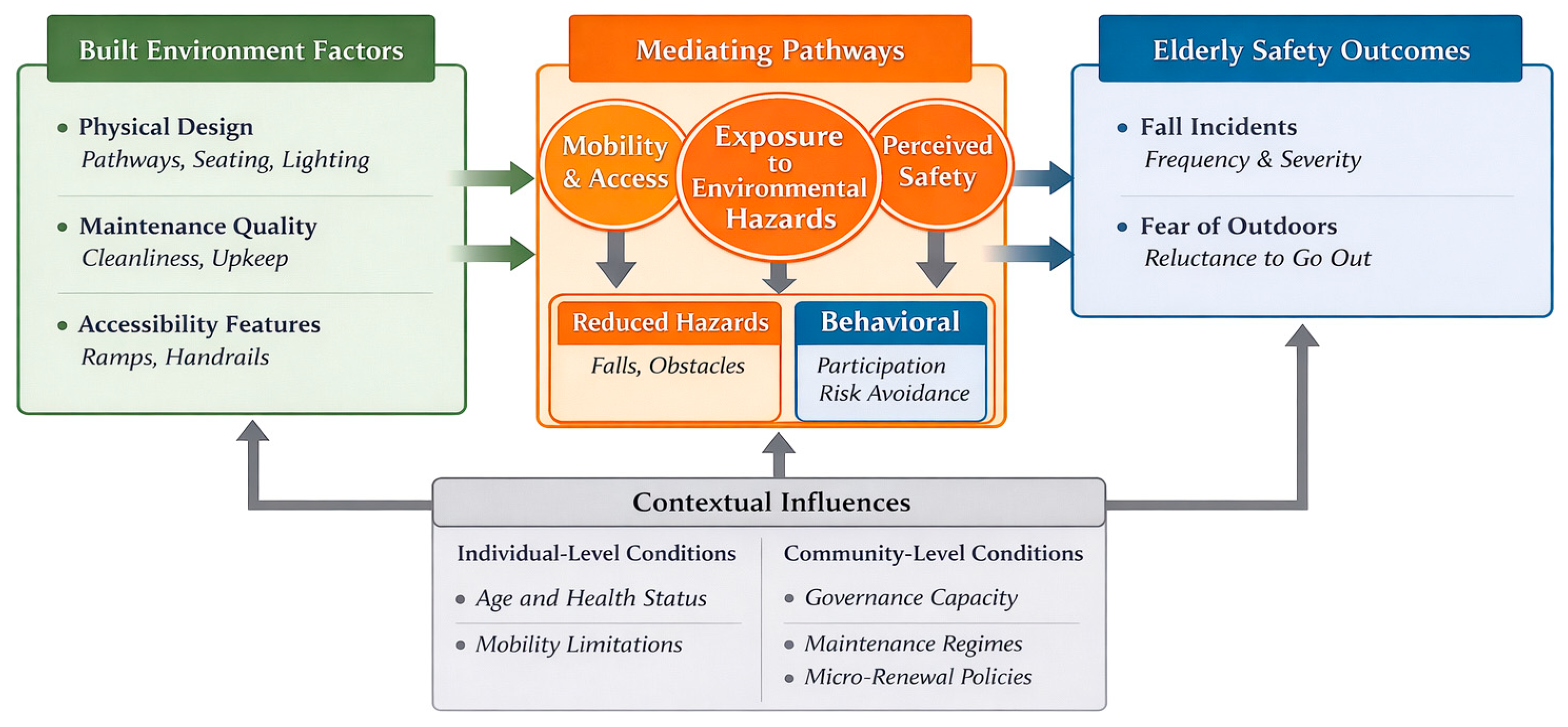
2.3. Conceptual Framework Linking Built Environment to Elderly Safety Outcomes
3. Research Method
3.1. Survey Design
3.2. Sampling and Data Collection
3.3. Data Analysis
4. Results
4.1. Reliability and Validity Analysis
4.2. Correlation Analysis
4.3. Regression Analysis Results
4.4. Subtype Analysis of Specific Risk Events
5. Discussion
5.1. Summary of Key Findings
5.2. Practical and Policy Implications
6. Conclusions
Author Contributions
Funding
Institutional Review Board Statement
Informed Consent Statement
Data Availability Statement
Conflicts of Interest
Appendix A

| Section 1. Basic Information | |||
| 1. Gender | □ Male □ Female | ||
| 2. Age | □ 60–70 □ 70–80 □ 80–90 □ 90+ | ||
| 3. Education Level | □ Illiterate □ Primary □ Middle School □ High School □ Bachelor’s □ Master’s+ | ||
| 4. Monthly Income (RMB) | □ <2000 □ 2000–5000 □ 5000–10,000 □ >10,000 | ||
| 5. Marital Status | □ Never Married □ Married □ Divorced □ Widowed | ||
| 6. Living Arrangement | □ Live alone □ Live with spouse □ Live with children | ||
| 7. Health Conditions (Multiple choices allowed) | □ Hypertension □ Diabetes □ Osteoporosis □ Visual/Hearing loss □ Arthritis □ Cataract □ Use cane □ Wheelchair/Walker | ||
| Section 2. Assessment of Outdoor Environment Please rate the following using the scales below: - Satisfaction: 1 = Very dissatisfied, 3 = Neutral, 5 = Very satisfied - Safety Impact: 1 = No impact, 3 = Moderate impact, 5 = Strong impact | |||
| Category | Evaluation Item | Satisfaction (1–5) | Safety Impact (1–5) |
| F1. Residential Staircase | Stair slope is comfortable | ○1 ○2 ○3 ○4 ○5 | ○1 ○2 ○3 ○4 ○5 |
| Handrail height is appropriate | ○1 ○2 ○3 ○4 ○5 | ○1 ○2 ○3 ○4 ○5 | |
| Handrails are non-slip | ○1 ○2 ○3 ○4 ○5 | ○1 ○2 ○3 ○4 ○5 | |
| Steps are even and consistent | ○1 ○2 ○3 ○4 ○5 | ○1 ○2 ○3 ○4 ○5 | |
| F3. Public Seating | Enough seats are available | ○1 ○2 ○3 ○4 ○5 | ○1 ○2 ○3 ○4 ○5 |
| Seat height is comfortable | ○1 ○2 ○3 ○4 ○5 | ○1 ○2 ○3 ○4 ○5 | |
| Seat structure is stable | ○1 ○2 ○3 ○4 ○5 | ○1 ○2 ○3 ○4 ○5 | |
| F5. Lighting System | Adequate lighting at night | ○1 ○2 ○3 ○4 ○5 | ○1 ○2 ○3 ○4 ○5 |
| Timely repair of damaged lights | ○1 ○2 ○3 ○4 ○5 | ○1 ○2 ○3 ○4 ○5 | |
| F11. Pedestrian Pathways | Path surface is flat and even | ○1 ○2 ○3 ○4 ○5 | ○1 ○2 ○3 ○4 ○5 |
| Path is barrier-free | ○1 ○2 ○3 ○4 ○5 | ○1 ○2 ○3 ○4 ○5 | |
| No obstructions on pathway | ○1 ○2 ○3 ○4 ○5 | ○1 ○2 ○3 ○4 ○5 | |
| F9. Standing Water | No water pooling after rain | ○1 ○2 ○3 ○4 ○5 | ○1 ○2 ○3 ○4 ○5 |
| F10. Landscaping | Vegetation is well-maintained | ○1 ○2 ○3 ○4 ○5 | ○1 ○2 ○3 ○4 ○5 |
| F12. Outdoor Animals | Pets are controlled (leashed) | ○1 ○2 ○3 ○4 ○5 | ○1 ○2 ○3 ○4 ○5 |
| F4. Exercise Equipment | Equipment is safe to use | ○1 ○2 ○3 ○4 ○5 | ○1 ○2 ○3 ○4 ○5 |
| Section 3. Perceived Safety in Daily Activities (C1) | |||
| Scenario | Rating (1–5) | ||
| Walking alone at night | ○1 ○2 ○3 ○4 ○5 | ||
| Walking in the daytime | ○1 ○2 ○3 ○4 ○5 | ||
| Using stairs | ○1 ○2 ○3 ○4 ○5 | ||
| Passing through community entrance | ○1 ○2 ○3 ○4 ○5 | ||
| Walking during rainy weather | ○1 ○2 ○3 ○4 ○5 | ||
| Using outdoor exercise equipment | ○1 ○2 ○3 ○4 ○5 | ||
| Section 4. Frequency of Safety Incidents in the Past Two Years (C2) | |||
| Incident Type | Number of Occurrences (0–10+) | ||
| Falls | □0 □1 □2 □3 □4 □5 □6 □7 □8 □9 □10+ | ||
| Near-falls | □0 □1 □2 □3 □4 □5 □6 □7 □8 □9 □10+ | ||
| Collisions | □0 □1 □2 □3 □4 □5 □6 □7 □8 □9 □10+ | ||
| Near-collisions | □0 □1 □2 □3 □4 □5 □6 □7 □8 □9 □10+ | ||
| Abrasions | □0 □1 □2 □3 □4 □5 □6 □7 □8 □9 □10+ | ||
| Animal bites | □0 □1 □2 □3 □4 □5 □6 □7 □8 □9 □10+ | ||
| Getting lost | □0 □1 □2 □3 □4 □5 □6 □7 □8 □9 □10+ | ||
| Dizziness episodes | □0 □1 □2 □3 □4 □5 □6 □7 □8 □9 □10+ | ||
| Walking fatigue | □0 □1 □2 □3 □4 □5 □6 □7 □8 □9 □10+ | ||
| Section 5. Satisfaction with Outdoor Activities | |||
| Item | Satisfaction (1–5) | ||
| Quality of sleep | ○1 ○2 ○3 ○4 ○5 | ||
| Social interaction with neighbors | ○1 ○2 ○3 ○4 ○5 | ||
| Participation in group exercise (e.g., square dancing) | ○1 ○2 ○3 ○4 ○5 | ||
| Finding seating when tired | ○1 ○2 ○3 ○4 ○5 | ||
| Cleanliness and maintenance of pathways | ○1 ○2 ○3 ○4 ○5 | ||
References
- Guo, Y.; Zhong, W. How Urbanization Shapes Rural Ageing in China? Evidence from Spatial Durbin and Threshold Regression Models. Habitat Int. 2025, 163, 103487. [Google Scholar] [CrossRef] [Scilit]
- van Tilburg, T.G.; Klok, J.; Fokkema, T. The Overlooked Role of Place Attachment in Loneliness: An Investigation among Old People. Health Place 2025, 95, 103529. [Google Scholar] [CrossRef] [Scilit]
- Gao, F.; Zheng, H.; Qin, B. Using Multi-Source Big Data to Identify “Double-Aging” Neighborhoods for Urban Retrofitting: A Case Study of Beijing. Appl. Geogr. 2025, 180, 103658. [Google Scholar] [CrossRef] [Scilit]
- Dalecká, A.; Kšiňan, A.; Szabó, D.; Čapková, N.; Pikhart, H.; Bobák, M. Neighborhood Environment and Cognitive Functioning in Middle-Aged and Older Population: A Mediating Role of Physical Activity. Int. J. Hyg. Environ. Health 2025, 264, 114521. [Google Scholar] [CrossRef] [Scilit]
- Molaei, P.; Alidadi, M.; Badland, H.; Gunn, L. Associations between the Urban Neighbourhood Built and Social Environment Characteristics with Physical Functioning among Mid- and Older-Aged Adults: A Systematic Review. Soc. Sci. Med. 2024, 362, 117412. [Google Scholar] [CrossRef] [Scilit]
- Klicnik, I.; Riad Andrawes, R.; Bell, L.; Manafo, J.; Meens Miller, E.; Sun, W.; Widener, M.; Dogra, S. Insights from Neighbourhood Walking Interviews Using the Living Environments and Active Aging Framework (LEAAF) in Community-Dwelling Older Adults. Health Place 2024, 89, 103339. [Google Scholar] [CrossRef] [Scilit]
- Mu, Y.; Li, Z. Indoor Housing Conditions, Neighborhood Environment Satisfaction, and Mental Health among Older Adults in China: Urban-Rural Differences. Cities 2025, 167, 106392. [Google Scholar] [CrossRef] [Scilit]
- Jian, I.Y.; Mo, K.H.; Ng, E.; Chen, W.; Jim, C.Y.; Woo, J. Age-Friendly Spatial Design for Residential Neighbourhoods in a Compact City: Participatory Planning with Older Adults and Stakeholders. Habitat Int. 2025, 161, 103428. [Google Scholar] [CrossRef] [Scilit]
- Shen, C.; Wang, Y.; Xu, Y.; Li, X. Unveiling Citizen-Government Interactions in Urban Renewal in China: Spontaneous Online Opinions, Reginal Characteristics, and Government Responsiveness. Cities 2024, 148, 104857. [Google Scholar] [CrossRef] [Scilit]
- Liu, Y.; Li, Y.; Wu, M.; Lu, Y. Neighbourhoods for Healthy Ageing: Examining the Nonlinear Effect of Neighbourhood Environments on Older Adults’ Functional Ability. Environ. Impact Assess. Rev. 2026, 116, 108115. [Google Scholar] [CrossRef] [Scilit]
- Hazbei, M.; Yesayan, T.; Yu, N.; Hutt-Taylor, K.; Ziter, C.D. Lessons from Exploring the Relationship between Livability and Biodiversity in the Built Environment. Urban For. Urban Green. 2025, 113, 129110. [Google Scholar] [CrossRef] [Scilit]
- Maksoud, A.; Hussien, A.; Mushtaha, E.; Alawneh, S.I.A.R. Computational Design and Virtual Reality Tools as an Effective Approach for Designing Optimization, Enhancement, and Validation of Islamic Parametric Elevation. Buildings 2023, 13, 1204. [Google Scholar] [CrossRef] [Scilit]
- Zheng, Y.; Chen, X.; Zhang, M.; Zhu, R.; Jin, Y. Darker Nights, Happier Lives? The Impact of Urban Green Space Night-Time Accessibility on Residents’ Subjective Happiness: A Case Study of the Main Urban Area of Hangzhou. Cities 2026, 169, 106510. [Google Scholar] [CrossRef] [Scilit]
- Garcia, M.F.; Mangold, M.; Johansson, T. Examining Property and Neighborhood Effects on Perceived Safety in Urban Environments: Proximity to Square and Heights of Buildings. Cities 2024, 150, 105069. [Google Scholar] [CrossRef] [Scilit]
- Xu, Y.; Liu, H.; Su, S.; Mao, P. Ageing Suitability Evaluation of Residential Districts Based on Active Ageing Theory. Buildings 2023, 13, 1041. [Google Scholar] [CrossRef] [Scilit]
- Liu, Z.; Chen, J.; Wang, Q. Construction of a Comprehensive Evaluation Model for Old Community Renewal in Suzhou Based on Smart City Concepts. Front. Archit. Res. 2025, 14, 1364–1379. [Google Scholar] [CrossRef] [Scilit]
- Li, H.; Yang, X.; Niu, S. What Nudges Residents’ Funding-Participation Behavior in Urban Settlement Regeneration? A Perspective of Evolving Social Network. Environ. Impact Assess. Rev. 2025, 112, 107813. [Google Scholar] [CrossRef] [Scilit]
- Kasula, P.; Dedekorkut-Howes, A.; Shearer, H.; Baum, S. Social Inclusion of Urban Villages: A Systematic Review of Global Urban Planning Practices. Cities 2026, 169, 106509. [Google Scholar] [CrossRef] [Scilit]
- Cordeiro, T.A.A.; Ferreira, F.A.F.; Spahr, R.W.; Sunderman, M.A.; Ferreira, N.C.M.Q.F. Enhanced Planning Capacity in Urban Renewal: Addressing Complex Challenges Using Neutrosophic Logic and DEMATEL. Cities 2024, 150, 105006. [Google Scholar] [CrossRef] [Scilit]
- Elshabshiri, A.; Ghanim, A.; Hussien, A.; Maksoud, A.; Mushtaha, E. Integration of Building Information Modeling and Digital Twins in the Operation and Maintenance of a Building Lifecycle: A Bibliometric Analysis Review. J. Build. Eng. 2025, 99, 111541. [Google Scholar] [CrossRef] [Scilit]
- Llewellyn, J.; Katzeff, C.; Pargman, D.; Johansson, F. Citizen Perceptions and Interactions towards Self-Sufficiency, Community Plot Ratio and Civic Generosity within Sustainable Neighbourhoods. City Environ. Interact. 2024, 24, 100180. [Google Scholar] [CrossRef] [Scilit]
- Tiwari, R.; Babb, C.; Tye, M.; Hussein, F. The Wharf Street Smart Park Story: A Guide to Navigating Multi-Stakeholder Innovation in Smart Cities. Sustainability 2024, 16, 503. [Google Scholar] [CrossRef] [Scilit]
- Wasserman, R.; Barrie, H.; Dikken, J.; van Hoof, J.; Soebarto, V. Validating the Age-Friendly Cities and Communities Questionnaire in Australia: Revealing Five Distinct Groups of Older People in Greater Adelaide. Habitat Int. 2025, 156, 103278. [Google Scholar] [CrossRef] [Scilit]
- Horgan, S.; Prorok, J.; Ellis, K.; Mullaly, L.; Cassidy, K.-L.; Seitz, D.; Checkland, C. Optimizing Older Adult Mental Health in Support of Healthy Ageing: A Pluralistic Framework to Inform Transformative Change across Community and Healthcare Domains. Int. J. Environ. Res. Public Health 2024, 21, 664. [Google Scholar] [CrossRef] [Scilit]
- Pan, Z.; Liu, Y.; Liu, Y.; Huo, Z.; Han, W. Age-Friendly Neighbourhood Environment, Functional Abilities and Life Satisfaction: A Longitudinal Analysis of Older Adults in Urban China. Soc. Sci. Med. 2024, 340, 116403. [Google Scholar] [CrossRef] [Scilit] [PubMed]
- Chen, M.; Bolt, G.; Hooimeijer, P. The Impact of Residential Environment on Older People’s Capabilities to Live Independently: A Survey in Beijing. BMC Public Health 2024, 24, 843. [Google Scholar] [CrossRef] [Scilit] [PubMed]
- Yu, S.; Guo, N.; Zheng, C.; Song, Y.; Hao, J. Investigating the Association between Outdoor Environment and Outdoor Activities for Seniors Living in Old Residential Communities. Int. J. Environ. Res. Public Health 2021, 18, 7500. [Google Scholar] [CrossRef] [Scilit]
- dos Santos Ferreira, L.; da Silva, T.E.M.; Batista dos Santos, E.; Fank, F.; Neto, J.A.B.; Menezes, E.C. The Influence of the Built Environment and Perceived Neighborhood on Physical Frailty and Sarcopenia in Older Adults: A Systematic Review. Arch. Gerontol. Geriatr. 2025, 137, 105910. [Google Scholar] [CrossRef] [Scilit] [PubMed]
- Kumar, S.; Cruz, F.; Yates, Z.; Amin, Q.; Awan, M.U.; Lee, P.; Kumar, S.; Elkbuli, A. Falls among Older Adults: An Exploration of Trends, Clinical Outcomes, Predisposing Risk Factors, and Intervention Strategies. Am. J. Surg. 2025, 245, 116385. [Google Scholar] [CrossRef] [Scilit]
- Veeroja, P.; Foliente, G.; McCrea, R.; Badland, H.; Pettit, C. The Role of Neighbourhood Social and Built Environments—Including Third Places—In Older Adults’ Social Interactions. Urban Policy Res. 2024, 42, 184–203. [Google Scholar] [CrossRef] [Scilit]
- Lis, A.; Zienowicz, M.; Błachnio, A. Lighting Features Affecting the Well-Being of Able-Bodied People and People with Physical Disabilities in the Park in the Evening: An Integrated and Sustainable Approach to Lighting Urban Green Areas. Sustainability 2024, 16, 8871. [Google Scholar] [CrossRef] [Scilit]
- Zuo, Y.; Zhou, J. Reducing Younger and Older Adults’ Spatial Disorientation during Indoor-Outdoor Transitions: Effects of Route Alignment and Visual Access on Wayfinding. Behav. Brain Res. 2024, 465, 114967. [Google Scholar] [CrossRef] [Scilit]
- He, S.Y.; Jiang, Y.; Mo, K.H. Planning for Healthy Ageing: Addressing Older Adults’ Travel Behaviour and Mobility Needs. Transp. Rev. 2025, 45, 643–649. [Google Scholar] [CrossRef] [Scilit]
- Colón-Emeric, C.S.; McDermott, C.L.; Lee, D.S.; Berry, S.D. Risk Assessment and Prevention of Falls in Older Community-Dwelling Adults: A Review. JAMA 2024, 331, 1397–1406. [Google Scholar] [CrossRef] [Scilit]
- Dodds, L.; Brayne, C.; Siette, J. Associations between Social Networks, Cognitive Function, and Quality of Life among Older Adults in Long-Term Care. BMC Geriatr. 2024, 24, 221. [Google Scholar] [CrossRef] [Scilit]
- Miakhel, M.; Abdulrahimzai, A.A.; Habib, A.; Behsoodi, M.M. Urban Green Infrastructures and Its Impacts on the Urban Environment: A Review. J. Environ. Clim. Ecol. 2024, 1, 9–15. [Google Scholar] [CrossRef] [Scilit]
- Aguome, N.M.; Ewurum, N.I.; Ifeanacho, K.P.; Abaa-Okorie, L.C.; Ugwu, C.G. Public Recreational Facilities as Catalyst for Urban Aging-in-Place Decision in Developing Countries. Cities 2024, 155, 105448. [Google Scholar] [CrossRef] [Scilit]
- Wang, C.; Liao, L.; Zhang, X.; Lin, L.; Chen, B. The Health and Welfare Effects of Environmental Governance: Evidence from China. Environ. Int. 2024, 185, 108579. [Google Scholar] [CrossRef] [Scilit] [PubMed]
- Najafi, P.; Mohammadi, M. Redefining Age-Friendly Neighbourhoods: Translating the Promises of Blue Zones for Contemporary Urban Environments. Int. J. Environ. Res. Public Health 2024, 21, 365. [Google Scholar] [CrossRef] [Scilit] [PubMed]
- Wu, S.; Chen, X.; Ma, C.; Wu, D.; Xu, Y.; Xiong, Y. Vertical Transportation and Age-Friendly Urban Renewal: A Systematic Framework for Sustainable and Inclusive Communities. Sustainability 2025, 17, 9594. [Google Scholar] [CrossRef] [Scilit]
- Ghosh, M. Age-Friendly Cities Enhancing Ageing: Accelerating Digital Inclusion for India’s Elderly. Work. Older People 2024, 29, 233–242. [Google Scholar] [CrossRef] [Scilit]
- van Hoof, J.; Marston, H.R. The Need for Measurable Evidence-Based Design Recommendations for Age-Friendly Cities and Communities. J. Urban Des. 2025, 30, 170–174. [Google Scholar] [CrossRef] [Scilit]
- Samora-Arvela, A.; Montalvão, M.; Marques, S.; Eloy, S. Towards an Age-Friendly Neighbourhood Index in a Changing Climate: A Methodological Contribution. In Sustainability in Aging: Challenges and Opportunities for an Integrated Society; Moreira, M.J.G., Carvalho, L.S.A., Simões, Â., de Jesus Candeias, M., Tomás, H.M., Eds.; Springer Nature Switzerland: Cham, Switzerland, 2025; pp. 14–32. ISBN 978-3-031-77282-5. [Google Scholar]
- Ali, M.A.; Kamraju, M. The Role of Community Participation in Sustainable Integrated Water Resources Management: Challenges, Opportunities, and Current Perspectives. In Integrated Management of Water Resources in India: A Computational Approach: Optimizing for Sustainability and Planning; Yadav, A.K., Yadav, K., Singh, V.P., Eds.; Springer Nature Switzerland: Cham, Switzerland, 2024; pp. 325–344. ISBN 978-3-031-62079-9. [Google Scholar]
- Parappallil Mathew, B.; Bangwal, D. People Centric Governance Model for Smart Cities Development: A Systematic Review, Thematic Analysis, and Findings. Res. Glob. 2024, 9, 100237. [Google Scholar] [CrossRef] [Scilit]
- Bressane, A.; Loureiro, A.I.S.; Almendra, R. Community Engagement in the Management of Urban Green Spaces: Prospects from a Case Study in an Emerging Economy. Urban Sci. 2024, 8, 188. [Google Scholar] [CrossRef] [Scilit]
- Wu, S.; Kong, L.; Ma, C.; Wu, D.; Xu, Y.; Xiong, Y. Collaborative Enhancements of Community Walking Environments for Low-Carbon Development and Age-Friendly Objectives: A Systematic Review. Buildings 2025, 15, 3873. [Google Scholar] [CrossRef] [Scilit]
- Jia, Y.; Lee, S.; Kanda, M.; Park, P.; Edwards, S.J.; Gao, J.; Zhou, W.; Ji, J.S. Sustainable Age-Friendly Cities and Communities in China: A Scoping Review and Narrative Assessment of National Policies. Lancet Reg. Health-West. Pac. 2025, 64, 101723. [Google Scholar] [CrossRef] [Scilit]
- Forsyth, A.; Lyu, Y. Making Communities Age-Friendly: Lessons From Implemented Programs. J. Plan. Lit. 2024, 39, 3–24. [Google Scholar] [CrossRef] [Scilit]
- Wang, D.; Wang, Y. Design Strategies for Age-Friendly Communities in the Context of Population Ageing. Des. J. 2025, 28, 722–741. [Google Scholar] [CrossRef] [Scilit]
- Wu, P.; Liu, H.; Zou, Y.; Yi, C.; Du, P.; Song, Y. Exploring the Influence Factors and Operating Mechanisms of Age-Friendly Communities in Urban Fringe Areas from the Resilience Perspective: A Case Study in Shangjie Township, Southeast China. Front. Public Health 2025, 13, 1624641. [Google Scholar] [CrossRef] [Scilit] [PubMed]
- van Hoof, J.; Dikken, J. Revealing Sustainable Mindsets among Older Adults Concerning the Built Environment: The Identification of Six Typologies through a Comprehensive Survey. Build. Environ. 2024, 256, 111496. [Google Scholar] [CrossRef] [Scilit]
- Finlay, J.; Westrick, A.C.; Guzman, V.; Meltzer, G. Neighborhood Built Environments and Health in Later Life: A Literature Review. J. Aging Health 2025, 37, 3–17. [Google Scholar] [CrossRef] [Scilit]
- Zhang, Y.; Koene, M.; Chen, C.; Wagenaar, C.; Reijneveld, S.A. Associations between the Built Environment and Physical Activity in Children, Adults and Older People: A Narrative Review of Reviews. Prev. Med. 2024, 180, 107856. [Google Scholar] [CrossRef] [Scilit]
- Castilla, N.; Blanca-Giménez, V.; Pérez-Carramiñana, C.; Llinares, C. The Influence of the Public Lighting Environment on Local Residents’ Subjective Assessment. Appl. Sci. 2024, 14, 1234. [Google Scholar] [CrossRef] [Scilit]
- Levinger, P.; Dreher, B.L.; Dow, B.; Batchelor, F.; Hill, K.D. Older People’s Views and Usage of Recreational Spaces in Parks with Age-Friendly Outdoor Exercise Equipment. Int. J. Environ. Health Res. 2025, 35, 81–93. [Google Scholar] [CrossRef] [Scilit] [PubMed]
- Liu, J.; Wei, Y.; Lu, S.; Wang, R.; Chen, L.; Xu, F. The Elderly’s Preference for the Outdoor Environment in Fragrant Hills Nursing Home, Beijing: Interpreting the Visual-Behavioural Relationship. Urban For. Urban Green. 2021, 64, 127242. [Google Scholar] [CrossRef] [Scilit]
- Priya, U.K.; Senthil, R. Framework for Enhancing Urban Living Through Sustainable Plant Selection in Residential Green Spaces. Urban Sci. 2024, 8, 235. [Google Scholar] [CrossRef] [Scilit]
- Mansouri, Y.; Matallah, M.E.; Attar, A.; Mahar, W.A.; Attia, S. An Investigation of Microclimatic Influences on Pedestrian Perception and Walking Experience in Contrasting Urban Fabrics: The Case of the Old Town and the Lower City of Béjaïa, Algeria. Urban Sci. 2025, 9, 243. [Google Scholar] [CrossRef] [Scilit]
- Mushtaha, E.; Alsyouf, I.; Hamad, R.; Elmualim, A.; Maksoud, A.; Yahia, M.W. Developing Design Guidelines for University Campus in Hot Climate Using Quality Function Deployment (QFD): The Case of the University of Sharjah, UAE. Archit. Eng. Des. Manag. 2022, 18, 593–613. [Google Scholar] [CrossRef] [Scilit]
- Meulenbroeks, I.; Mercado, C.; Gates, P.; Nguyen, A.; Seaman, K.; Wabe, N.; Silva, S.M.; Zheng, W.Y.; Debono, D.; Westbrook, J. Effectiveness of Fall Prevention Interventions in Residential Aged Care and Community Settings: An Umbrella Review. BMC Geriatr. 2024, 24, 75. [Google Scholar] [CrossRef] [Scilit]
- Hao, J.L.; Yu, S.; Tang, X.; Wu, W. Determinants of Workers’ pro-Environmental Behaviour towards Enhancing Construction Waste Management: Contributing to China’s Circular Economy. J. Clean. Prod. 2022, 369, 133265. [Google Scholar] [CrossRef] [Scilit]
- Guo, X.; Wu, Y.; Wang, Y.; Shen, H.; Yang, Y.; Fan, Y. Prediction of Population Aging Trend and Analysis of Influencing Factors Based on Grey Fractional-Order and Grey Relational Models: A Case Study of Jiangsu Province, China. BMC Geriatr. 2025, 25, 197. [Google Scholar] [CrossRef] [Scilit]
- Guo, N.; Hao, J.L.; Zheng, C.; Yu, S.; Wu, W. Applying Social Cognitive Theory to the Determinants of Employees’ Pro-Environmental Behaviour Towards Renovation Waste Minimization: In Pursuit of a Circular Economy. Waste Biomass Valor. 2022, 13, 3739–3752. [Google Scholar] [CrossRef] [Scilit]
- Luparelli, A.; Papadopoulos, P.; Kyprianou, I.; Erba, S.; Ingrosso, A.; Carlucci, S. Design and Validation of Thermal Comfort Questionnaire Using Exploratory and Confirmatory Factor Analyses. Energy Build. 2025, 337, 115676. [Google Scholar] [CrossRef] [Scilit]
- Naeem, M.K.H.; Nadezhda, B.; Wang, Y. Service Failure Is Bound to Happen: Unraveling the Impact of Dissatisfaction, Complaint Behavior and Re-Travel Intention in Travel and Tourism Industry. Acta Psychol. 2024, 248, 104343. [Google Scholar] [CrossRef] [Scilit] [PubMed]
- Nuuyandja, H.; Pisa, N.; Masoumi, H.; Chakamera, C. The Relationships Between Land Use Characteristics, Neighbourhood Perceptions, Socio-Economic Factors and Travel Behaviour in Compact and Sprawled Neighbourhoods in Windhoek. Urban Sci. 2025, 9, 431. [Google Scholar] [CrossRef] [Scilit]
- Chen, Y.; Wang, J.; Wu, J.; Li, Y.; Lu, J.; Zhang, L. The Impact of Residential Neighbor Noise on Cognitive Health in Chinese Cities. Build. Environ. 2026, 287, 113901. [Google Scholar] [CrossRef] [Scilit]
- Yang, J.; Wu, Y.; Chen, X.; Luo, B.; Wu, R.; Lin, R. Evaluation of Walkability Index for Embedded Community Services from an Age-Friendly Perspective: A Case Study of Mapple Community in Chengdu, China. Land 2025, 14, 1189. [Google Scholar] [CrossRef] [Scilit]
- Lv, J.; Hou, J.; Wang, T.; Li, D.; Liu, Y.; Xue, S.; Chen, G.; Guan, B. Impact of Modeling Methods on Urban Flood Processes at Community Scale. Urban Clim. 2024, 58, 102209. [Google Scholar] [CrossRef] [Scilit]
- Awoniyi, A.M.; Barreto, A.M.; Argibay, H.D.; Santana, J.O.; Palma, F.A.G.; Riviere-Cinnamond, A.; Dobigny, G.; Bertherat, E.; Ferguson, L.; Belmain, S.; et al. Systematic Surveillance Tools to Reduce Rodent Pests in Disadvantaged Urban Areas Can Empower Communities and Improve Public Health. Sci. Rep. 2024, 14, 4503. [Google Scholar] [CrossRef] [Scilit] [PubMed]
- Mulliner, E.; O’Brien, T.D.; Maliene, V.; Maganaris, C.N.; Mason, R. Older Adults’ and Professionals’ Attitudes Towards Stair-Fall Prevention Interventions. Healthcare 2025, 13, 1324. [Google Scholar] [CrossRef] [Scilit]
- Zhu, J. Public Space and Its Publicness in People-Oriented Urban Regeneration: A Case Study of Shanghai. J. Urban Aff. 2025, 47, 2319–2338. [Google Scholar] [CrossRef] [Scilit]
- Zhuge, J.; Wan Mohamed, W.S.; Abdul Shukor, S.F. Predicting Leisure Walking Intentions Among Older Adults in Urban Residential Areas: Extended Theory of Planned Behavior and Health Belief Model. HERD 2025, 19, 48–71. [Google Scholar] [CrossRef] [Scilit] [PubMed]

| Items | Category | Number of Observations | Percentage (%) |
|---|---|---|---|
| Gender | Male | 68 | 46.6 |
| Female | 78 | 53.4 | |
| Age | 60–70 years | 57 | 39.0 |
| 70–80 years | 59 | 40.4 | |
| 80–90 years | 29 | 19.9 | |
| Above 90 years | 1 | 0.7 | |
| Education Level | Illiteracy | 11 | 7.5 |
| Primary school | 74 | 50.7 | |
| Junior high school | 48 | 32.9 | |
| Senior high school | 13 | 8.9 | |
| Monthly Income (RMB) | <2000 | 18 | 12.3 |
| 2000–5000 | 72 | 49.3 | |
| 5000–10,000 | 53 | 36.3 | |
| >10,000 | 3 | 2.1 | |
| Marital Status | Never married | 3 | 2.1 |
| Married | 81 | 55.5 | |
| Divorced | 22 | 15.1 | |
| Widowed | 40 | 27.4 | |
| Living Situation | Living alone | 43 | 29.5 |
| Living with spouse | 80 | 54.8 | |
| Living with children | 23 | 15.8 |
| Dimension Code | Dimension Name | Example Items | Number of Items | Cronbach’s α | Reference |
|---|---|---|---|---|---|
| F1 | Residential Staircase | Step uniformity, handrail availability | 7 | 0.834 | [8,54] |
| F2 | Noise | Disturbing sounds, noise intensity | 3 | 0.781 | [5,68] |
| F3 | Public Seating | Seating quantity, spatial distribution | 4 | 0.802 | [10,57] |
| F4 | Exercise Equipment | Equipment integrity, safety of use | 3 | 0.758 | [37,56] |
| F5 | Lighting | Illumination uniformity, brightness adequacy | 4 | 0.793 | [31,55] |
| F6 | Community Entrance and Exit | Entrance layout, accessibility and order | 5 | 0.817 | [50,69] |
| F7 | Traffic Safety | Vehicle-pedestrian conflicts, traffic calming | 4 | 0.768 | [29,40] |
| F8 | Security | Patrol, monitoring, perceived protection | 2 | 0.742 | [8,25] |
| F9 | Standing Water | Surface runoff, ponding after rain | 3 | 0.773 | [34,70] |
| F10 | Residential Landscaping | Vegetation arrangement, visual comfort | 3 | 0.806 | [11,58] |
| F11 | Pedestrian Pathways | Pavement flatness, continuity, absence of obstacles | 9 | 0.785 | [30,35] |
| F12 | Outdoor Animals | Presence of stray animals, disturbance or threat | 3 | 0.764 | [59,71] |
| F13 | Road Signs | Clarity of signage, wayfinding support | 3 | 0.772 | [32,33,72] |
| C1 | Sense of Security in Daily Activities | Feeling of safety during routine outdoor activities | 6 | 0.829 | [26,27,73] |
| C2 | Safety Risks for the Elderly | Frequency of falls, collisions, abrasions, dizziness, etc. | 11 | 0.788 | [34,61] |
| Overall | Questionnaire | -- | 70 | 0.812 | - |
| Variables | Daily Activities | Safety Risk | Falls | Collisions | Lost Ways | Abrasions | Animal Bites | Dizziness |
|---|---|---|---|---|---|---|---|---|
| Residential Staircase | −0.332 ** | 0.377 ** | 0.089 | 0.333 ** | 0.218 ** | 0.128 | −0.055 | 0.336 ** |
| Noise | 0.036 | 0.007 | 0.015 | 0.130 | −0.069 | 0.166 * | 0.141 | 0.003 |
| Public Seating | −0.312 ** | 0.391 ** | 0.113 | 0.210 * | 0.127 | −0.059 | −0.029 | 0.363 ** |
| Exercise Equipment | −0.157 | 0.219 ** | −0.004 | 0.134 | −0.049 | 0.259 ** | 0.186 * | 0.160 |
| Lighting | −0.433 ** | 0.230 ** | −0.025 | 0.174 * | 0.099 | 0.079 | −0.022 | 0.277 ** |
| Entrance/Exit | −0.222 ** | 0.280 ** | −0.007 | 0.281 ** | 0.085 | 0.143 | 0.127 | 0.192 * |
| Traffic Safety | −0.143 | 0.050 | −0.003 | 0.192 * | 0.101 | −0.043 | −0.112 | 0.129 |
| Security | −0.120 | 0.222 ** | 0.085 | 0.090 | −0.021 | 0.131 | −0.050 | 0.209 * |
| Standing Water | −0.255 ** | 0.271 ** | 0.213 ** | 0.274 ** | 0.038 | 0.127 | 0.004 | 0.068 |
| Landscaping | −0.227 ** | 0.365 ** | 0.154 | 0.188 * | 0.071 | −0.008 | 0.075 | 0.207 * |
| Pedestrian Pathways | −0.386 ** | 0.368 ** | 0.174 * | 0.346 ** | −0.029 | 0.238 ** | 0.127 | 0.126 |
| Outdoor Animals | −0.160 | 0.312 ** | 0.108 | 0.104 | 0.225 ** | 0.095 | 0.321 ** | 0.150 |
| Road Signs | −0.139 | 0.150 | −0.068 | 0.313 ** | 0.402 ** | 0.018 | −0.085 | 0.178 * |
| Variables | Safety Risk | Daily Security |
|---|---|---|
| Residential Staircase (F1) | 0.281 (0.102) ** | −0.167 (0.063) ** |
| Public Seating (F3) | 0.346 (0.100) *** | - |
| Lighting (F5) | - | −0.300 (0.059) *** |
| Residential Landscaping (F10) | 0.282 (0.103) ** | - |
| Pedestrian Pathways (F11) | 0.342 (0.136) * | −0.363 (0.084) *** |
| Outdoor Animals (F12) | 0.199 (0.088) * | - |
| R | 0.600 | 0.579 |
| R2 | 0.360 | 0.335 |
| Model Sig. | <0.001 | <0.001 |
| Variables | Falls | Collisions | Abrasions | Walking Fatigue |
|---|---|---|---|---|
| Residential Staircase (F1) | - | 0.447 (0.163) ** | - | - |
| Public Seating (F3) | 0.329 (0.164) * | 0.415 (0.161) * | - | 1.201 (0.270) *** |
| Exercise Equipment (F4) | - | - | 0.336 (0.134) * | - |
| Standing Water (F9) | 0.367 (0.158) * | - | - | - |
| Landscaping (F10) | 0.344 (0.168) * | 0.324 (0.163) * | - | - |
| Pedestrian Pathways (F11) | - | 0.514 (0.214) * | 0.544 (0.237) * | 1.043 (0.357) ** |
| R | 0.343 | 0.490 | 0.334 | 0.445 |
| R2 | 0.118 | 0.240 | 0.112 | 0.198 |
| Model Sig. | <0.001 | <0.001 | <0.001 | <0.001 |
Disclaimer/Publisher’s Note: The statements, opinions and data contained in all publications are solely those of the individual author(s) and contributor(s) and not of MDPI and/or the editor(s). MDPI and/or the editor(s) disclaim responsibility for any injury to people or property resulting from any ideas, methods, instructions or products referred to in the content. |
© 2026 by the authors. Licensee MDPI, Basel, Switzerland. This article is an open access article distributed under the terms and conditions of the Creative Commons Attribution (CC BY) license.
Share and Cite
Wen, Z.; Zheng, C.; Hao, J.L.; Yu, S. Built Environment and Elderly Safety Risks in Old Residential Communities Under Urban Renewal. Urban Sci. 2026, 10, 54. https://doi.org/10.3390/urbansci10010054
Wen Z, Zheng C, Hao JL, Yu S. Built Environment and Elderly Safety Risks in Old Residential Communities Under Urban Renewal. Urban Science. 2026; 10(1):54. https://doi.org/10.3390/urbansci10010054
Chicago/Turabian StyleWen, Ziying, Caimiao Zheng, Jian Li Hao, and Shiwang Yu. 2026. "Built Environment and Elderly Safety Risks in Old Residential Communities Under Urban Renewal" Urban Science 10, no. 1: 54. https://doi.org/10.3390/urbansci10010054
APA StyleWen, Z., Zheng, C., Hao, J. L., & Yu, S. (2026). Built Environment and Elderly Safety Risks in Old Residential Communities Under Urban Renewal. Urban Science, 10(1), 54. https://doi.org/10.3390/urbansci10010054