Article

Study on Right-Turning Vehicles’ Yielding Behavior for Crossing E-Bikes at Signalized Intersections

1
School of Civil Engineering, Suzhou University of Science and Technology, Suzhou 215009, China
2
College of Transport & Communications, Shanghai Maritime University, Shanghai 201306, China
*
Author to whom correspondence should be addressed.
Urban Sci. 2026, 10(1), 55; https://doi.org/10.3390/urbansci10010055
Submission received: 30 November 2025 / Revised: 8 January 2026 / Accepted: 9 January 2026 / Published: 16 January 2026
(This article belongs to the Special Issue Urban Traffic Control and Innovative Planning)

Abstract

This study aimed to explore the factors influencing right-turning vehicles’ yielding behavior for crossing e-bikes at signalized intersections to improve safety for crossing e-bikes. Videos of different intersections were obtained through manual video recording and drone aerial photography. Spatiotemporal information data for right-turning vehicles and straight-through e-bikes were extracted through Tracker 6.0 software. Right-turning vehicle yielding decisions were categorized into three types: no yielding, decelerating to yield, and stopping to yield. Five potential variables influencing yielding decisions were selected: personal attributes of e-bike riders, traffic characteristics of e-bikes, traffic characteristics of right-turning vehicles, road characteristics, and right-turning vehicle–e-bike interaction influence characteristics. A multiple ordered logistic regression model was established to predict right-turn vehicle yielding decisions. Simultaneously calculating the OR (Odds Ratio) value reveals the likelihood of increased yielding probability under varying factors. For every one-unit increase in the number of crossing e-bikes, the yielding probability increases to 1.002 times the original value; for every one-unit increase in the average speed of right-turning vehicles, the yielding probability decreases to 0.406 times the original value; for every one-unit increase in the average crossing speed of e-bikes, the yielding probability increases to 1.737 times the original value. Compared with the straight + right-turn lane, a dedicated right-turning lane increases the yielding probability of right-turning vehicles to 4.2 times, and compared with not occupying a crosswalk, illegally occupying a crosswalk decreases the yielding probability of right-turning vehicles to 0.356 times. These findings offer valuable insights for enhancing the safety of e-bikes crossing signal-controlled intersections.

1. Introduction

E-bikes have become an important means of transportation for short- and medium-distance travel due to their advantages such as low price, flexible mobility, fast travel, and the ability to achieve “door-to-door” travel. As a major producer and consumer of e-bikes, China has social ownership of 400 million vehicles, far exceeding the number of private cars [1]. With the further promotion of green and low-carbon travel concepts, the proportion of e-bikes in slow traffic modes is still increasing. However, due to the poor driving stability and the limited protection in terms of safety of e-bikes, they are prone to traffic crashes, and the casualty rate of e-bike riders in crashes is extremely high. According to the World Health Organization (2023), about 1.19 million die in road crashes every year, with 90 percent of traffic deaths occurring in low- and middle-income countries and cities, and powered two- and three-wheeler users accounting for 21% of global traffic fatalities [2]. In 2023, there were 38,685 non-motorized vehicle incidents (not including bicycles) in China, resulting in 5252 fatalities and 44,099 injuries, with direct property damage of up to RMB 78 million [3]. On the premise of a decrease in the number of deaths in other modes of transportation, the number of electric bicycle traffic crashes and deaths still shows an upward trend year by year, with an average annual growth rate of 5.85%.
Statistical analysis of e-bike crashes indicates that crashes occurring at intersections are 1.89 times more frequent than those occurring on road sections, with 38.7% of e-bike fatalities occurring at intersections [4,5]. This is mainly due to the low speed limit, high density of regulatory equipment, and more cautious traffic participants at intersections, resulting in a smaller proportion of fatalities than on road sections. But overall, there is a significant positive correlation between the number of e-bike crashes and intersection density [6]. At intersections, due to the shared space between motor vehicles, non-motorized vehicles, and pedestrians, there is a game in the process of mixed traffic flow interaction. Road users often ignore the priority-to-the-right rule and rely on who arrives first to pass first. This usually results in more frequent traffic conflicts and crashes in the intersection [7,8].
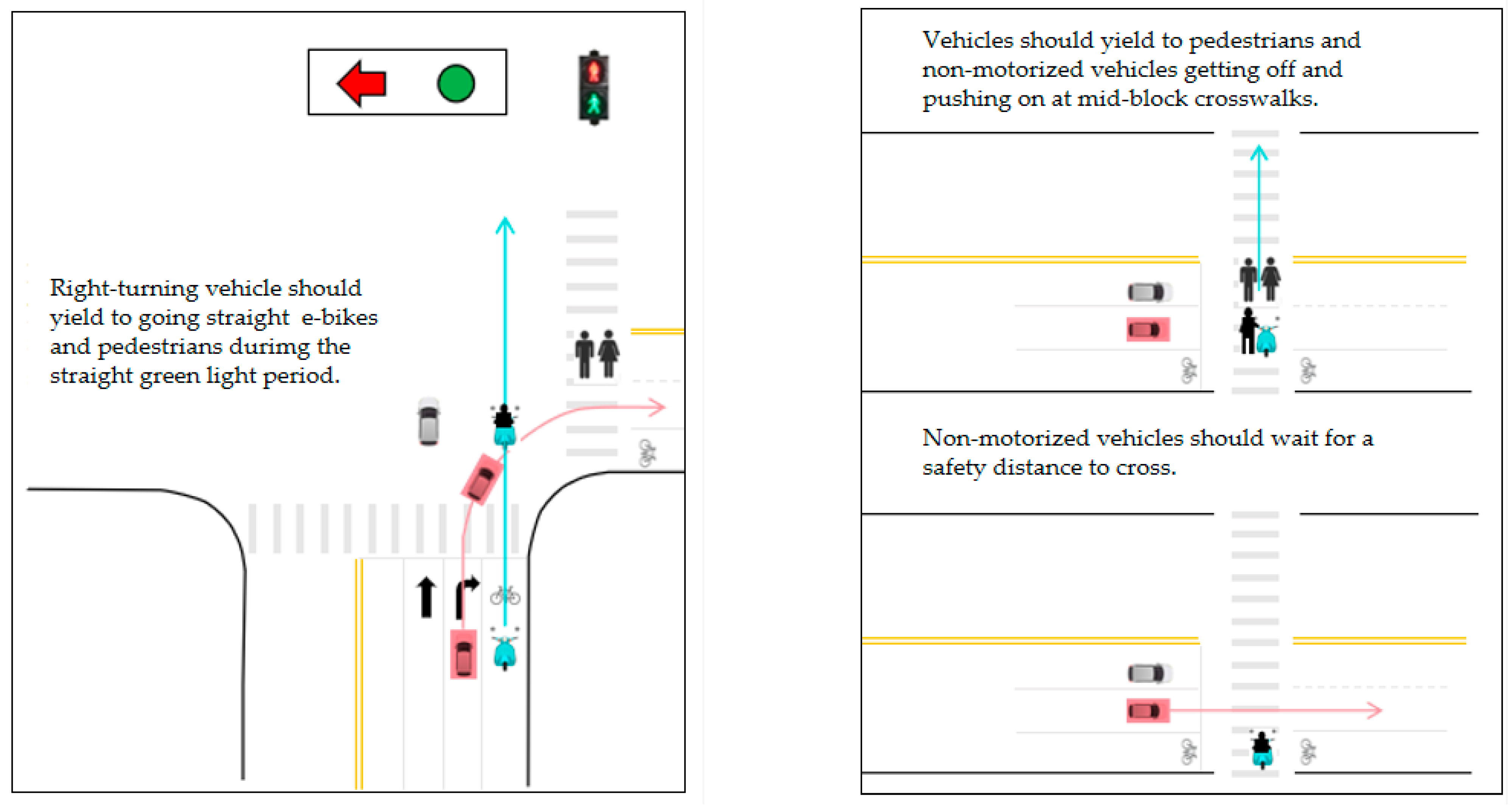
According to Article 38 of the Road Traffic Safety Law of the People’s Republic of China, when the green light is on, vehicles are allowed to pass, but right-turning vehicles must not obstruct the passage of straight vehicles or pedestrians that have been cleared; at intersections where non-motorized vehicle signal lights are not installed, non-motorized vehicles should pass according to the indications of the motor vehicle signal lights. Article 47 stipulates that when a motor vehicle passes through a crosswalk, it should slow down; if pedestrians are passing through a crosswalk, they should stop and give way. On roads without traffic signals, motor vehicles should yield to pedestrians crossing the segment. During the period when the straight signal light at the intersection is green, right-turning vehicles must give way at this time. At the intersection of a road without a signal or at mid-block crosswalks, e-bike drivers get off and push on the sidewalk, equivalent to pedestrians, and vehicles need to give way at this time. If crossing the street on an e-bike, the e-bike driver needs to wait for a safe gap to cross, as shown in Figure 1.
According to Article 47 of the Road Traffic Safety Law, motor vehicles have the obligation to yield to pedestrians, and violators will be punished according to law. People who failed to yield to pedestrians will be fined CNY 200, and deducted three penalty points from the driving license; in some cases, a fine of CNY 20–200 will be imposed. Continuous photos of vehicles approaching pedestrian crossings, not stopping to yield, and passing through pedestrian crossings captured through monitoring can serve as evidence. The above regulations are currently in use at mid-block crosswalks, and there is currently a lack of corresponding measures at intersections for right-turning vehicles. Usually, after an accident occurs, if the other party has engaged in no illegal or irregular behavior, the right-turning vehicle will bear full or primary responsibility for the accident.
Setting traffic signals can regulate the priority of intersection traffic from a temporal dimension, effectively reducing traffic conflicts at intersections [9]. However, right-turning vehicles are generally not subject to traffic signal control when passing through an signalized intersection. Right-turning vehicles, straight non-motorized vehicles, and pedestrians share the right-of-way during permitted signal phases. Although the law generally stipulates that straight non-motorized vehicles and pedestrians have the right-of-way, right-turning vehicles should slow down and yield; in practice, the willingness to yield is often low when conflicts arise between right-turning vehicles and pedestrians or non-motorized vehicles [10,11,12]. When passing through intersections, e-bike riders rarely dismount to push along the crosswalk, and the yielding behavior of right-turning vehicles toward e-bikes is unclear within the intersection area. Research has found that cyclists are more likely to disregard the “priority-to-the-right” rule than motorists; at this point, the yielding behavior of right-turning vehicles largely determines the safety of non-motorized vehicles and pedestrians crossing the intersection [13]. Traffic crashes between right-turning vehicles and straight non-motorized vehicles account for nearly 50% of all non-motorized vehicle crashes at the intersection [14], while failure to yield according to regulations is the main cause of e-bike traffic fatalities [4].
Some studies have attempted to investigate and establish interactions between vehicles and pedestrians or non-motorized vehicles to reduce conflict and improve safety. Yielding behavior refers to the act of traffic participants giving up their right-of-way during an interactive process in order to avoid conflicts or enhance safety. This includes vehicles reducing their speed or stopping to yield to pedestrians or non-motorized vehicles, and pedestrians or non-motorized vehicles slowing down or waiting for vehicles to pass. The yielding behavior is influenced by various factors such as the characteristics of traffic participants, vehicle factors, road layout and control methods, environmental characteristics, etc. [15,16,17,18]. Research has found that the number of pedestrians crossing the street is the most important factor affecting drivers’ yielding [19,20,21], and drivers sometimes stop and wait until all pedestrians have passed. Right-turn configurations at intersections and the crossing locations also affect drivers’ yielding behaviors: compared to a non-channelized right-through lane, a non-channelized right-only lane is generally safer [22,23], while a channelized right-turn lane reduces the awareness of right turning vehicles to yield [24]. And right-turning vehicles usually have a lower yielding rate and higher risk during the secondary interaction with pedestrians when exiting the intersection [25].
Drivers of right-turning vehicles not only need to pay attention to the motor vehicles on the left side during the right-turn process but also have limited vision and blind spots. Right-turning vehicles tend to slow down and remain alert when entering an intersection, but often accelerate and turn when exiting the intersection. The interaction process between right-turning vehicles and crossing e-bikes often occurs later than the first interaction with pedestrians and earlier than the second interaction with pedestrians. At this point, the right-turning vehicle accelerates out of the intersection, while the e-bikes accelerate into the intersection. The two are prone to conflict and are more severely affected by speed than pedestrians. A large amount of studies have been conducted on the interaction between right-turning vehicles and pedestrians crossing the street at intersections, as well as the yielding behavior in unsignalized mid-block sections. However, there is relatively little research on the interaction and yielding behavior between right-turning vehicles and e-bikes. Therefore, there is an urgent need to explore yielding behaviors of right-turning vehicles to e-bikes at intersections to enhance safety.
Therefore, this study aims to systematically investigate the decision-making behavior and influencing factors of yielding during the interaction between right-turning vehicles and crossing e-bikes at intersections. The specific research objectives are as follows:
(1)
To identify the key factors that significantly affect the yielding behavior of right-turning vehicles. These factors include the personal attributes of e-bike riders (e.g., gender, age), traffic characteristics of e-bikes (e.g., crossing traffic volume, illegal occupation of crosswalks), traffic characteristics of right-turning vehicles (e.g., average speed), roadway characteristics (e.g., type of right-turn lane), and interaction characteristics (e.g., individual or group crossing).
(2)
To examine the influence of these factors on the yielding behavior of right-turning vehicles.
Based on existing research, this study proposes the following hypotheses:
H1. 
The higher the volume and average speed of e-bikes crossing the street, the higher the probability of right-turning vehicles yielding.
H2. 
The lower the average speed of right-turning vehicles, the higher the probability of yielding.
H3. 
Compared to a right-turn lane, a “straight + right turn” lane can significantly increase the probability of right-turning vehicles yielding.
To achieve the objectives, continuous video data at the intersection was obtained based on on-site research and drone aerial photography to collect relevant variables, including personal attributes of e-bike riders, traffic characteristics of e-bikes, traffic characteristics of right-turning vehicles, road characteristics, and interaction characteristics. Additionally, a multiple ordered logistic regression method was applied to establish a decision-making behavior model for right-turning vehicles to yield, and the main influencing factors affecting the yielding behavior of right-turning vehicles and e-bikes were identified.

2. Data Acquisition and Extraction

2.1. Data Collection

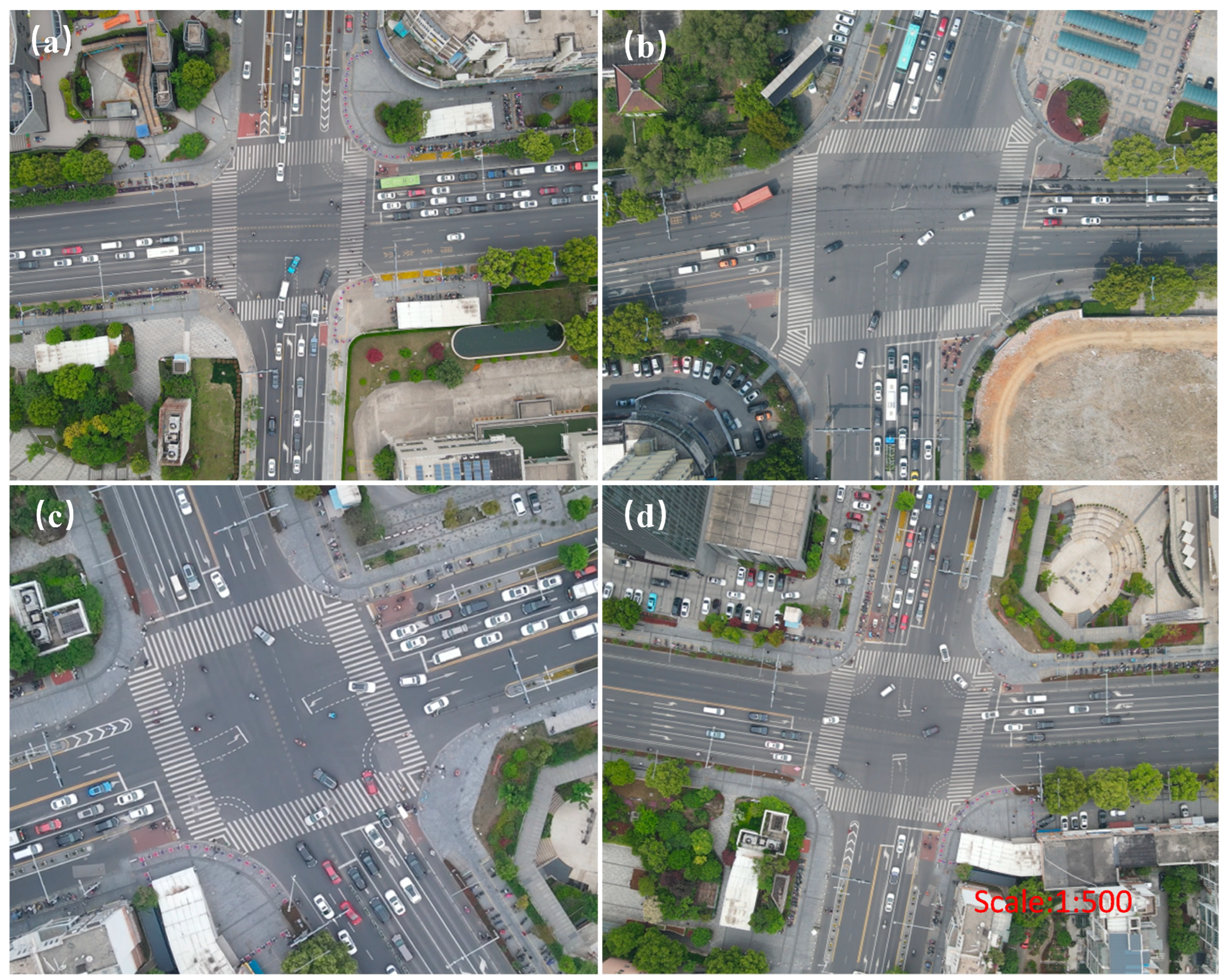
In order to study the interaction process between right-turning vehicles and straight crossing e-bikes at signalized intersections, four intersections, namely, Binhe Road and Dengwei Road, Binhe Road and Heshan Road, Heshan Road and Tayuan Road, and Tayuan Road and Dengwei Road, were selected for data collection in Suzhou. The four intersections were all cross, signal control, while right-turning vehicles were not signal controlled. Intersecting roads were all urban arterial roads, with a certain amount of motorized and non-motorized traffic. The specific characteristics of the intersections are shown in Table 1, and the geometric layout of the intersections is shown in Figure 2.
DJI Mavic Air 2 UAV was used to obtain continuous video of the intersection, and roadside manual photography was synchronized to obtain the relevant attributes of the pedestrians and the interaction between the right-turning vehicles and the straight e-bikes. In order to mitigate the impact of interference between pedestrians, right-turning vehicles, and straight e-bikes, a time period with a larger flow of straight e-bikes was selected, and after trial research and screening, the shooting time periods were 2–3 pm in the afternoon peak and 5–6 pm in the afternoon peak from the 26th of April to the 29th of April, 2022, respectively.
The e-bikes referred to in this study were electric bicycles that complied with the national standard GB17761-2018 (maximum speed ≤ 25 km/h, motor power ≤ 400 W) in China [26]. These e-bikes were characterized by a robust frame structure, which allowed them to carry passengers (usually one child). In our sample, 82% of e-bike riders wore helmets, which was a result of mandatory helmet laws implemented under the Road Traffic Safety Law of the People’s Republic of China. Compared with e-bikes in Europe, the e-bikes in our study had a higher speed and heavier weight, which made their movement characteristics more similar to light motorcycles and thus increased the collision risk with right-turning vehicles.

2.2. Data Extraction and Preprocessing

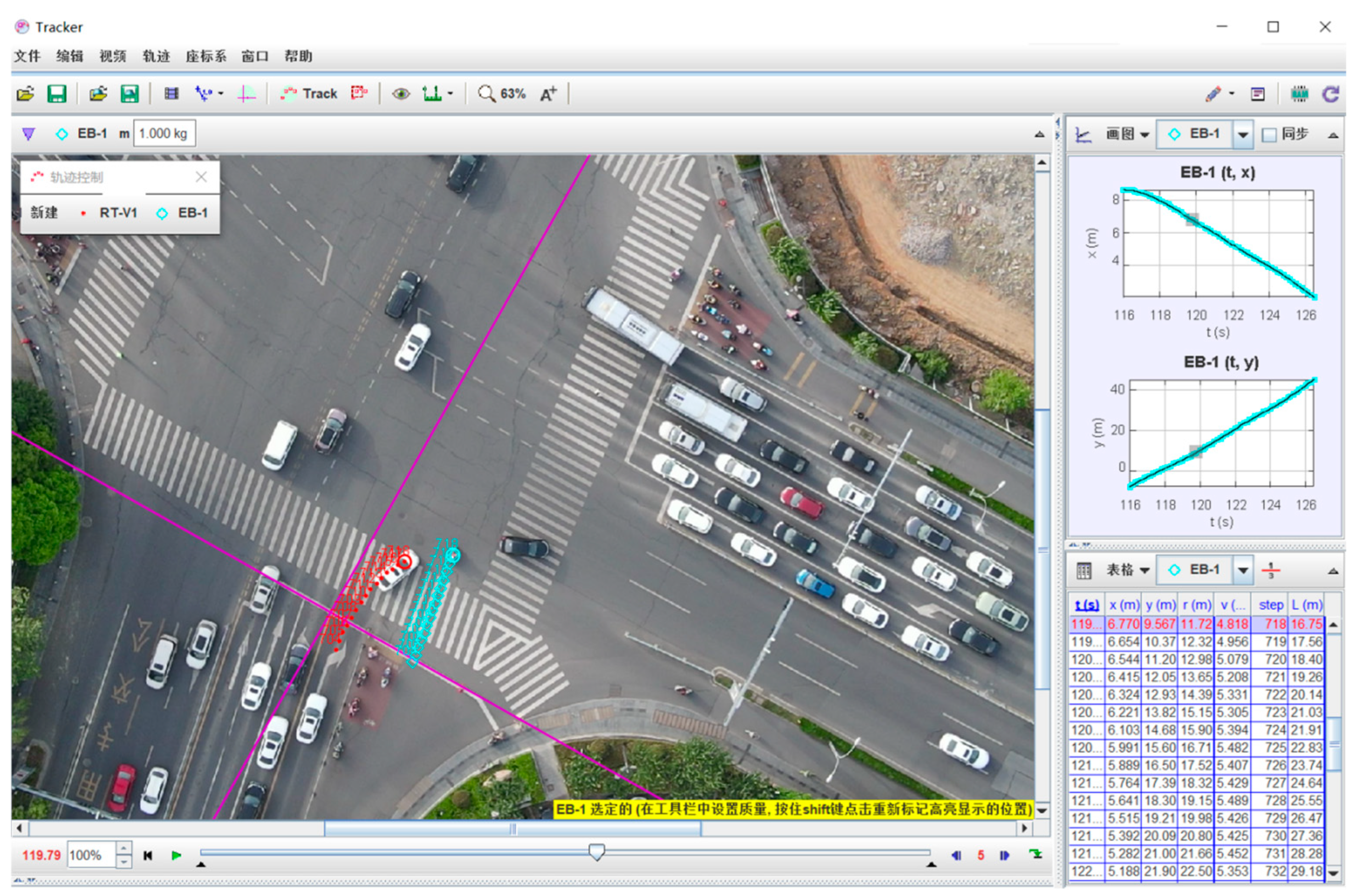
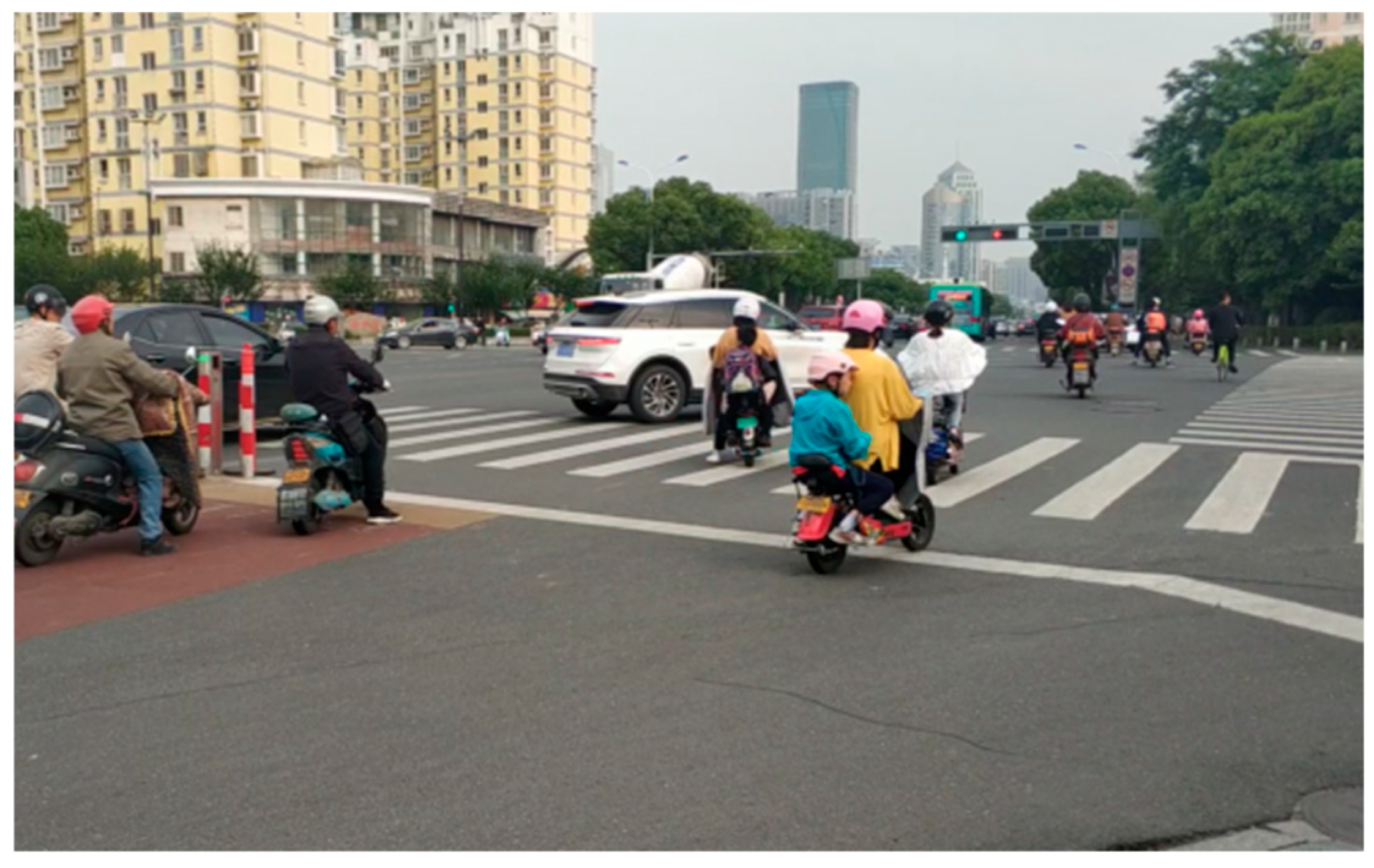
Tracker is a free video-analysis and modeling tool based on the Open Source Physics (OSP) Java framework, which can track object position, velocity, and acceleration in real time and is currently widely used in the extraction of parameters related to UAV aerial videos [20,21]. The Tracker 6.0 software was used to extract the spatiotemporal information data of the right-turning vehicle and the straight-line e-bike, and the extraction process is shown in Figure 3, where a coordinate system was established along the intersection, and the dimensions were calibrated according to the actual measured width of the crosswalk; the extracted data include the speed, acceleration, and trajectory coordinates of the right-turning vehicle, as well as the speed, acceleration, and trajectory coordinates of the straight-line e-bike. Combined with the artificial roadside video in Figure 4, it further clarified the gender, age, occupation, and other relevant parameters of the e-bike riders.

3. Variable Description

3.1. Behavioral Analysis of Right-Turning Vehicles’ Yielding Decisions

This study extracted 706 valid sets of right-turning vehicle data. Only about 6% of the non-motorized vehicles crossing the street were bicycles, and these bicycles were excluded from the data analysis. All valid data extracted correspond to e-bikes. Kinematic information was obtained using Tracker software to analyze vehicle speed changes. Three patterns emerged in the speed variations of right-turning vehicles passing through intersections:
  • Right-turning vehicles maintained a constant speed or accelerated through the intersection.
  • Right-turning vehicles first decelerated before maintaining a constant speed or accelerating through the intersection.
  • Right-turning vehicles first stopped before accelerating through the intersection.
Based on these three velocity patterns observed during interactions between right-turning vehicles and straight-moving e-bikes, right-turn yielding decisions at road intersections can be categorized into three types: non- yielding, decelerating yielding, and stopping yielding:
  • No yielding: right-turning vehicles proceed directly at a constant speed or accelerating through the intersection without yielding to nearby crossing e-bikes. The right-turning vehicle maintains a constant speed or accelerates through the intersection, causing the e-bike to decelerate or stop abruptly.
  • Decelerating to yield: right-turning vehicles detect a nearby crossing e-bike and, to avoid collision, first decelerate before proceeding at constant speed or accelerating through the intersection.
  • Stopping to yield: right-turning vehicles completely halt upon detecting approaching e-bikes, waiting for them to pass before accelerating. Their speed curve shows a zero segment during this phase.
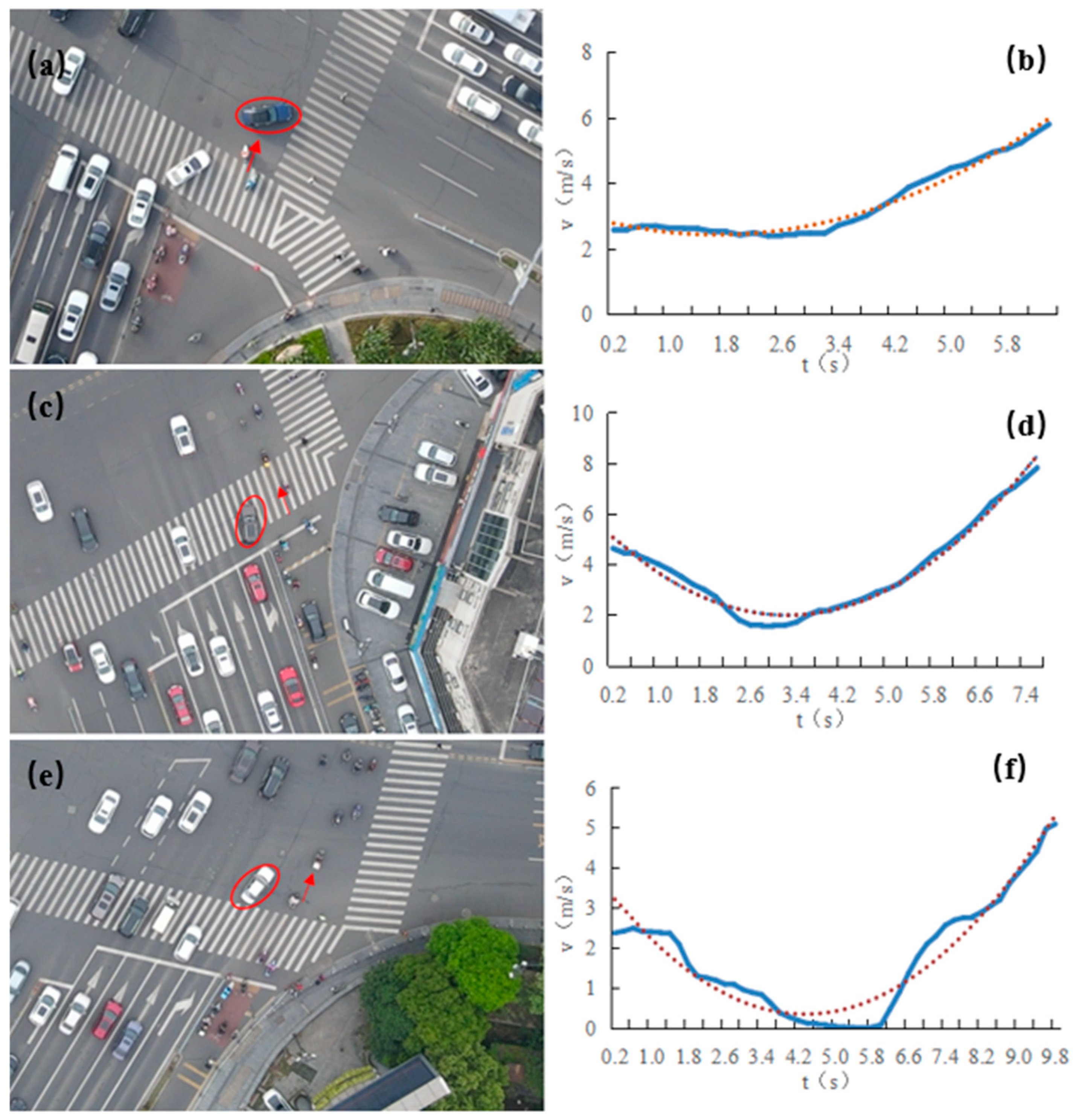
Figure 5 illustrates the corresponding speed patterns for these three yielding behaviors. Ordered variables represent yielding decisions during interactions between right-turning vehicles and straight-moving e-bikes, coded as follows: 0—no yielding, 1—decelerating to yield, 2—stopping to yield. Among these, samples of right-turning vehicles not yielding numbered 230 (32.6%); samples of decelerating to yield numbered 432 (61.2%); and samples of stopping to yield numbered 44 (6.2%).

3.2. Selection of Independent Variables

The yielding behaviors of right-turning vehicles to crossing e-bikes are analyzed from five aspects: personal attributes of e-bike riders, traffic characteristics of e-bikes, traffic characteristics of right-turning vehicles, road characteristics, and right-turning vehicle–e-bike interaction influence characteristics. According to the characteristics of each variable, combined with the actual observation, these five types of variables are further refined into 21 secondary independent variables.
For the personal attributes of e-bike riders, e-bike drivers were categorized into three age groups: 18–44 years old, 45–59 years old, and ≥60 years old. This classification was based on the “China Road Traffic Safety Blue Book (2023)” and international traffic behavior research conventions [27,28]. It aligns with the age structure characteristics of urban e-bike riding groups in China and effectively distinguishes differences in risk perception, reaction speed, and riding behavior among different age groups. This provided a reliable foundation for analyzing the age-related impacts on the behavior of right-turning vehicles yielding to e-bikes.
For right-turning vehicle–e-bike interaction influence characteristics, group crossing was explicitly defined as “two or more e-bikes entering the crosswalk within a 2-s time interval and with a lateral distance of less than 5 m between adjacent e-bikes”.
The specific descriptions and definitions of each variable are shown in Table 2. The descriptive statistical analysis results of continuous variables are shown in Table 3.

4. Ordered Logistic Regression Model

4.1. Multiple Ordered Logistic Regression Models

The multiple ordered logistic regression model is a regression analysis method designed to handle ordered categorical data as the dependent variable. Based on the concept of latent variables, this model assesses the influence of independent variables on the levels of the dependent variable by fitting the cumulative probability function. The independent variables in this paper include categorical and continuous variables, and the dependent variable is the yielding decision-making behavior of right-turning vehicles in the process of interacting with straight-line e-bikes, which is an ordered multi-categorical variable suitable for analyzing the influence of each variable on the yielding decision-making behavior of right-turning vehicles by using the multiple ordered logistic regression model. The specific models are as follows:
l n p 0 1 p 0 = β 01 + i 1 n β i x i
l n p 0 + p 1 1 p 0 p 1 = β 02 + i 1 n β i x i
where p q is the probability of category q of yielding decision-making behavior in the interaction process between right-turning vehicles and straight e-bikes,   q = 0 , 1 , 2 ; x i is the category i significant factor affecting the yielding of right-turning vehicles, i = 1 , 2 , L , n ; β 01 ,   β 02 is the regression intercept; and β i is the corresponding coefficient value of the respective variable.
The probability of the right-turning vehicle’s category yielding decision behavior can be obtained through the following transformation:
p j = q x 1 , x 2 , L , x n = e x p β 0 q + i 1 n β i x i 1 + e x p β 0 q + i 1 n β i x i

4.2. Correlation Analysis

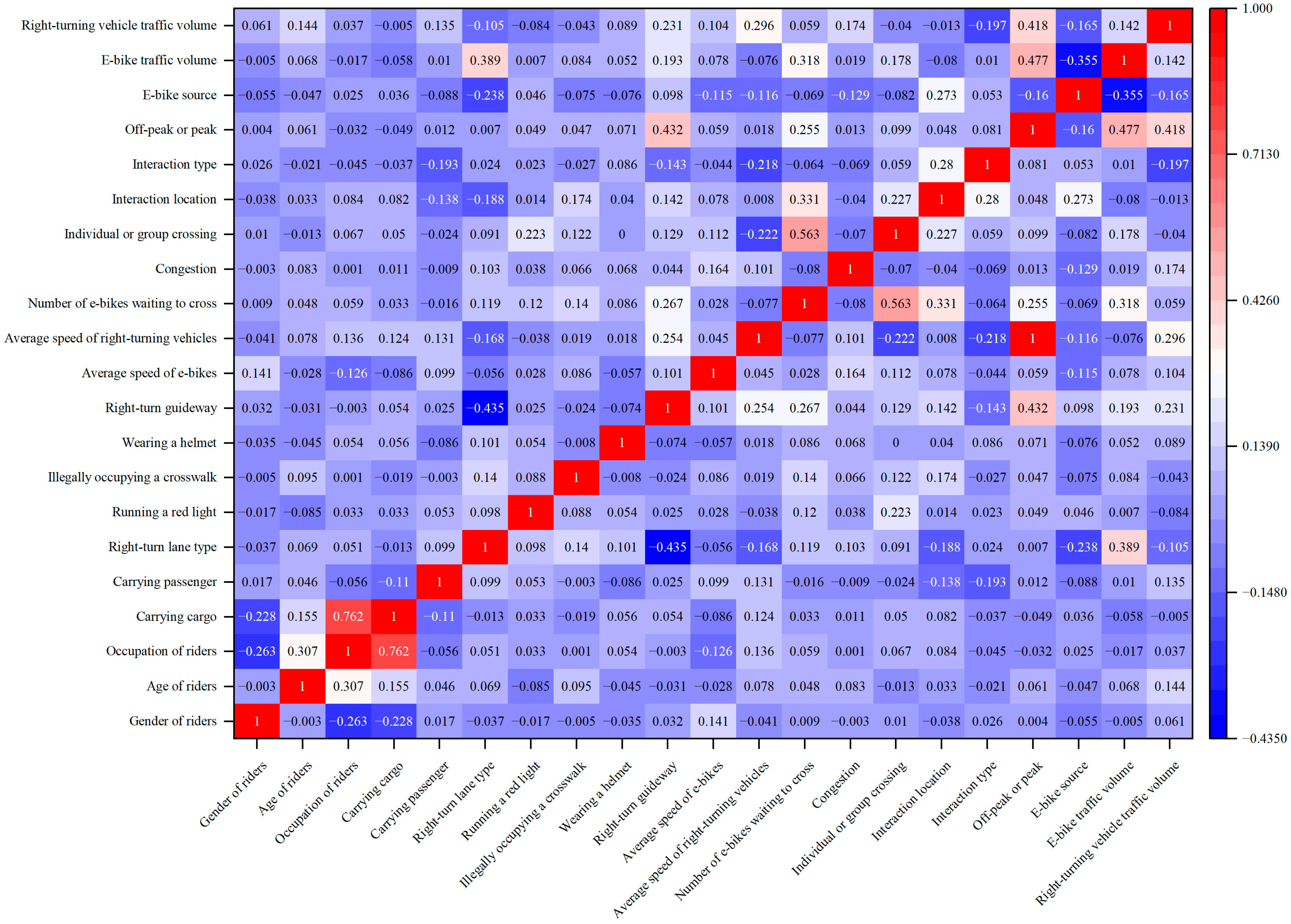
Correlation analysis was performed on the selected independent variables, and the results are shown in Figure 6. This study used the correlation coefficient to determine correlation, generally being defined as the following: (1) |r| ≥ 0.8 as highly correlated; (2) 0.5 ≤ |r| < 0.8 as moderately correlated; (3) 0.3 ≤ |r| < 0.5 as lowly correlated; and (4) |r| < 0.3 as basically uncorrelated. The correlation results showed that the occupation of e-bike riders and carrying cargo are moderately to highly correlated (r = 0.762 > 0.7); the number of e-bikes waiting to cross and crossing alone or in groups are moderately correlated (r = 0.563 > 0.5), both significant at the 0.01 level. To avoid affecting model accuracy, one variable from each correlated pair was removed. Considering that “carrying cargo” can be indirectly reflected by “occupation of e-bike riders” (delivery workers often carry cargo), and that there is a logical relationship between “number of e-bikes waiting to cross” and “individual or group crossing”, “carrying cargo” and “number of e-bikes waiting to cross” were removed. The correlation coefficients of the remaining variables are less than 0.45, indicating that there is no significant correlation between most of the independent variables for regression analysis.

4.3. Model Estimation

To quantify the intra-group correlation degree at the intersection/time period level, this study calculated the intra-group correlation coefficient (ICC) based on an empty model (only including grouping variables, without any explanatory variables), and obtained an ICC of 0.053 at the intersection level and 0.028 at the time-period level. The results showed that before controlling for other variables, the similarity of observed values within different intersections was only 5.3%, and the similarity of observed values within different time periods was only 2.8%. The intra-group correlation was at a low level (far below the critical value of 0.1). According to existing research findings, when ICC < 0.1, the bias effect of nested structure on the estimation results of traditional regression models can be ignored. Therefore, the use of traditional ordered logistic regression models in this study is reasonable.
SPSS software (version 26.0.0.0) was used to analyze the data by multiple ordered logistic regression analysis, and a parallel-line test was conducted; the results of the parallel-line test are shown in Table 4. The significance of the model is 0.307, which indicates that the established multi-categorical ordered logistic model is statistically significant.
Table 5 shows the results of the variable analysis of the model. Stop and yield, slow down and yield, and do not yield were compared two by two. After analysis, model significance < 0.05 indicates that the inclusion of at least one independent variable in the model plays an important role in influencing the change of the dependent variable.
Table 6 shows the significance test results of the regression equation. The probability p value of the model was 0.000, indicating that there is a significant linear relationship between the independent variable and the connection function, and that this model can be used for analysis.
Table 7 shows the statistical results of the model’s goodness of fit. Cox and Snell and Nagelkerke are commonly used indexes for a goodness-of-fit test in regression analysis, which represent the explanatory degree of the regression equation to the change of independent variables. The closer the value of Nagelkerke is to 1, the higher the goodness of fit of its equation. The value of McFadden is between 0.3 and 0.5, which indicates that the goodness of fit of the model is very ideal. Therefore, the values of the three indexes obtained in this paper meet the requirements, indicating that the fitting effect of this model is ideal.
The results in Table 4 indicate that the p -values for e-bike traffic volume, average speed of right-turning vehicles, average speed of e-bikes, right-turn lane type, and illegally occupying a crosswalk are all less than 0.05, and these five factors are significant influences.

5. Result Analysis and Discussion

In a multiple ordered logistic regression model, the odds ratio (OR) serves as the core metric for interpreting the direction and strength of the influence exerted by independent variables on the dependent variable. The OR ratio is a ratio statistic used in the study of classification problems and is often used to compare the relative risk between two events. By comparing the OR values between different factors, it can be clarified which factors have a greater influence on the occurrence of an event. If the OR value is greater than 1, it means that there is a positive correlation between the two events; i.e., the occurrence of one event increases the probability of the other event. If the OR value is less than 1, it means that there is a negative correlation between the two events; i.e., the occurrence of one event decreases the probability of the other event. If the OR value is equal to 1, it means that there is no correlation between the two events; i.e., the occurrence of one event is not related to the probability of the other event. Occurrence probability is irrelevant. According to Table 4, the formula O R = e x p β is used to calculate the OR value, and the results are shown in Table 8 to understand the impact of different influencing factors on the yielding behavior of right-turning vehicles.
The p -values for the continuous variables—e-bike traffic volume, average speed of right-turning vehicles, and average speed of e-bikes—were all less than 0.05. This indicates that e-bike traffic volume, average speed of right-turning vehicles, and average speed of e-bikes are significantly associated with right-turning vehicles yielding to e-bikes.
The core behavior of this study is the yielding behavior of right-turning vehicles—drivers determine the extent of yielding by assessing roadway characteristics, their own traffic characteristics, traffic characteristics of e-bikes, and the personal attributes of e-bike riders. The specific extent of yielding and the analysis of the influence mechanisms of various factors on yielding behavior are as follows:
(1)
The OR value for e-bike traffic volume was 1.002, indicating a positive correlation between yielding behavior and crossing volume. Specifically, for every one-unit increase in the number of crossing e-bikes, the yielding probability increases to 1.002 times the original value, suggesting higher yielding rates with greater e-bike crossing volume. Given the collective nature of crossing e-bikes, once a certain scale is reached, right-turning vehicles are compelled to yield, stopping to wait until all e-bikes have cleared before proceeding. Compared with the relevant research results on yielding to pedestrians, the number of pedestrians crossing the street is the most important factor affecting drivers’ yielding [19,20,21]. This study further verifies that group travel has a stronger intention to pass, thereby increasing the probability of yielding.
(2)
The OR value for the average right-turning vehicle speed was 0.406, with a negative coefficient, indicating a negative correlation between yielding probability and average speed. Specifically, for every one-unit increase in the average speed of right-turning vehicles, the yielding probability decreases to 0.406 times the original value. This suggests that lower average speeds correlate with higher yielding rates. When right-turning vehicles approach the intersection at higher speeds, drivers may be unable to decelerate quickly or may be less inclined to slow down, resulting in lower yielding rates. When the speed of the right-turning vehicle is high, its willingness to yield is low. E-bike riders will conduct a comprehensive risk assessment and take actions such as slowing down or waiting, which may cause a decrease in the speed of the e-bike and further reduce the willingness of right-turning vehicles to yield.
(3)
The OR value for the average speed of e-bikes was 1.737, indicating a positive correlation between the degree of yielding by right-turning vehicles and the average crossing speed of e-bikes. Specifically, for every one-unit increase in the average crossing speed of e-bikes, the yielding probability increases to 1.737 times the original value. This demonstrates that the higher the average crossing speed of e-bikes, the more likely right-turning vehicles are to yield. Higher crossing speeds correlate with stronger crossing intent among e-bikes, leading to greater yielding by right-turning drivers. The faster an e-bike crosses the street, the smaller the relative speed difference between it and right-turning vehicles, and the longer the braking distance, resulting in a higher impact intensity in the event of a crash. This indicates a stronger intention to cross, so right-turning vehicle drivers are more likely to yield.
For categorical variables—right-turn lane type and whether e-bikes illegally occupy a crosswalk—the p-values were less than 0.05. This indicates significant associations between these variables and yielding behavior by right-turning vehicles.
(4)
Among right-turn lane types, the OR value for dedicated right-turn lanes was 4.200, indicating a positive correlation between yielding probability and lane type. Compared with the straight + right turn lane, a dedicated right-turning lane increases the yielding probability of right-turning vehicles to 4.2 times. This indicates that dedicated right-turn lanes exhibit higher yielding rates than combined straight + right-turn lanes. This may be related to right-turning vehicles avoiding interference with the normal flow of straight-through traffic during green light cycles. In the “straight + right-turn” lane, drivers need to pay attention to both motor vehicles going straight in front and behind, as well as e-bikes crossing the street, which reduces their risk perception due to conflicts regarding right-of-way. In contrast, in a dedicated “right-turn” lane, drivers only need to focus on the passage of non-motorized vehicles, with clear right-of-way perception, making yielding decisions more decisive. Compared with previous studies on right-turn lane separation [23,24], this study further confirms that clearer right-of-way delineation enhances drivers’ risk perception and, consequently, increases the likelihood of yielding.
(5)
Regarding e-bikes illegally occupy a crosswalk, the OR value for e-bikes occupying a crosswalk was 0.356, with a negative coefficient. This indicates a negative correlation between yielding by right-turning vehicles and e-bikes illegally occupy a crosswalk. Compared with not occupying a crosswalk, illegally occupying a crosswalk decreases the yielding probability of right-turning vehicles to 0.356 times. When e-bikes comply with traffic rules, right-turning motorists are more inclined to recognize their right-of-way priority and thus voluntarily yield to e-bikes. When e-bikes violate traffic rules, drivers making right turns tend to downplay their perception of having the right-of-way, believing that they are not responsible if a conflict occurs. This lowers their risk perception and consequently reduces the likelihood of yielding to e-bikes going straight.
In addition, based on the correlation analysis results, this study excluded the variable “carrying cargo”. The core reason is that there is a medium to high correlation (r = 0.762) between “carrying cargo” and “occupation of e-bike riders”. The behavior of delivery person riding e-bikes differs from that of ordinary riders, mainly due to the time pressure brought by the delivery industry’s timeliness assessment. Time pressure will prompt a delivery person to ride faster, making more dangerous decisions when crossing the intersection, and thus affecting the judgment of right-turning vehicles to yield.

6. Conclusions

6.1. Main Conclusions

The main conclusions obtained in this paper are as follows:
(1) The yielding behavior of right-turning vehicles was divided into three categories: not yielding, slowing down to yield, and stopping to yield, according to the speed change of right-turning vehicles. The survey data showed that at a signal intersection right-turning vehicles give way to the highest proportion, in which the deceleration and stopping to give way are 61.2% and 6.2%, respectively; but still 32.6% of the right-turning vehicles did not give way to e-bikes crossing the street, whether at a uniform speed or even accelerating through the intersection.
(2) This paper established a right-turning vehicle yielding model based on a multiple ordered logistic regression model based on five aspects: personal attributes of e-bike riders, traffic characteristics of e-bikes, traffic characteristics of right-turning vehicles, roadway characteristics, and interaction influence characteristics. The right-turning vehicles are more likely to yield when the e-bike crossing traffic volume is large, the average speed of crossing is high, and the farther the parking spot is from the crosswalk; the right-turning vehicles have a higher willingness to yield when the average speed of passing through the intersection is low; and the right-turning vehicles are more likely to yield when the right-turn-only lane is compared with the straight + right lane. These laws can provide a theoretical basis for prevention, control, and optimization measures for intersections with large right-turn and e-bike flows.
(3) In the actual operation of the intersection, the yielding behavior of right-turning vehicles and crossing e-bikes is complex and variable, and it is difficult to comprehensively obtain all the factors. This paper only analyzed the conditions of right-turn and straight + right turn lanes in conventional intersections, did not consider the conditions of intersection channelization, and did not analyze the interaction and safety impacts of right-turning vehicles and crossing e-bikes. The research work needs to be further improved and will be deepened further in the future.
Based on the research model and the identified influencing factors and behavioral mechanisms, the following specific suggestions are proposed for the safe interaction between right-turning vehicles and straight electric bicycles at signalized intersections:
(1) At intersections with high traffic volume, a dedicated “right-turn” lane is used, and the length of the right turn lane is appropriately extended to provide deceleration time and space for right-turning vehicles, which can effectively improve the probability of yielding.
(2) Provide safety education to electric bicycle riders, prohibit occupying pedestrian crossings, and prevent conflicts caused by high-speed cycling through intersections in order to enhance their perception of risks. Promote the rules of yielding to drivers of right-turning motor vehicles. Set up an “Attention Non-motorized Vehicle” sign near the intersection on the right-turn lane to enhance the risk perception of motor vehicle drivers and increase their willingness to give way.

6.2. Limitations

Although this study has drawn some meaningful conclusions, there are also certain limitations, which are mainly as follows.
The data for this study came from four typical intersections in Suzhou city. As a developed city in the east, Suzhou city has differences in the number of motor vehicles and electric bicycles, traffic flow, and other characteristics compared to other cities. The data collection only includes peak and off-peak periods during the day, without considering adverse weather conditions, such as rainy and snowy days, as well as nighttime periods. The model did not take into account the differences in the types of right-turning vehicles, and large vehicles such as trucks may have different yielding decisions from small cars due to their blind spots and longer braking distances. Finally, pedestrians also have an impact on yielding to right-turning vehicles, but this study did not consider it.
Future research can collect data from more scenarios and consider more influencing factors. We should comprehensively consider the types of right-turning vehicles and autonomous driving vehicles to construct a more comprehensive yielding decision model. Subsequent research can use driving simulation experiments to construct more complex scenarios to improve the safety level of intersections.


Author Contributions

Conceptualization, X.W. and T.G.; methodology, X.W. and T.G.; formal analysis, T.G., T.H., and S.C.; investigation, T.H. and S.C.; writing—original draft preparation, T.G., T.H., S.C., and X.W.; writing—review and editing, T.G., T.H., S.C., and X.W.; visualization, T.H. and S.C.; supervision, X.W.; project administration, X.W. and T.G.; funding acquisition, X.W. and T.G. All authors have read and agreed to the published version of the manuscript.

Funding

This research was funded by the National Natural Science Foundation of China, grant number 51808370; the Key Laboratory of Road and Traffic Engineering of the Ministry of Education, Tongji University, grant number K201806; the Soft Science Research Program of Shanghai Science and Technology Commission, grant number 25692104000; the Holographic Perception-Based Risk Assessment and Safety Management Technology for Plateau Freight Road Traffic, Qinghai Transportation Construction Management Co., Ltd., and the Natural Science Foundation of the Jiangsu Higher Education Institutions of China, grant number 21KJB580021.

Institutional Review Board Statement

Not applicable.

Informed Consent Statement

Not applicable.

Data Availability Statement

The data that support the findings of this study are available on request from the corresponding author, [X.W.], upon reasonable request.

Acknowledgments

We sincerely thank the four anonymous reviewers for their rigorous comments and constructive suggestions, which have significantly enhanced this manuscript. We also extend our gratitude to the editorial team for their patient guidance and efficient handling of the submission process.

Conflicts of Interest

The authors declare that this study receive funding from Qinghai Provincial Transportation Construction Management Co., Ltd. and Qinghai Provincial Transportation Holdings Group Co., Ltd. The funders were not involved in the study design, collection, analysis, interpretation of data, the writing of this article or the decision to submit it for publication.

References

  1. Ma, S.; Lu, Y.; Dong, C.; Li, P.; Ma, J. Severity analyses and prediction of e-bikes violated behaviors. China Saf. Sci. J. 2024, 34, 172–178. [Google Scholar] [CrossRef]
  2. World Health Organization. Global Status Report on Road Safety 2023; World Health Organization: Geneva, Switzerland, 2023. [Google Scholar]
  3. Ma, J. National Bureau of Statistics of China. In China Statistical Yearbook 2024; Statistics Press: Beijing, China, 2024. [Google Scholar]
  4. Zhu, J.A.; Dai, S.; Zhu, X. Characteristics of Electric Bike Accidents and Safety Enhancement Strategies. Urban Transp. China 2018, 16, 15–20. [Google Scholar] [CrossRef]
  5. Ma, J.; Ren, G.; Li, H.; Cao, Q.; Du, J. Analysis on Contributing Factors Influencing Severity of E-Bicycle and Motor Vehicle Crashes. J. Transp. Syst. Eng. Inf. Technol. 2022, 22, 337–348. [Google Scholar] [CrossRef]
  6. Petzoldt, T.; Schleinitz, K.; Heilmann, S.; Gehlert, T. Traffic conflicts and their contextual factors when riding conventional vs. electric bicycles—ScienceDirect. Transp. Res. Part F Traffic Psychol. Behav. 2017, 46, 477–490. [Google Scholar] [CrossRef]
  7. Liu, J.; Chen, X. Analysis of pedestrian-two-wheeler conflicts at green light digital countdown signals: A random parameter ordered logit model approach. Accid. Anal. Prev. 2024, 206, 107716. [Google Scholar] [CrossRef] [PubMed]
  8. Iryo-Asano, M.; Alhajyaseen, W.K.M. Modeling pedestrian crossing speed profiles considering speed change behavior for the safety assessment of signalized intersections. Accid. Anal. Prev. 2017, 108, 332–342. [Google Scholar] [CrossRef]
  9. Haleem, K.; Alluri, P.; Gan, A. Analyzing pedestrian crash injury severity at signalized and non-signalized locations. Accid. Anal. Prev. 2015, 81, 14–23. [Google Scholar] [CrossRef]
  10. Jiao, P.; Zhang, Y.; Sun, B. Effect of intervention model on avoidance of pedestrians by right-turning vehicles. China J. Highw. Transp. 2020, 33, 42–53. [Google Scholar] [CrossRef]
  11. Li, Y.; Cheng, Z.; Lu, J.; Zhang, L. A Mixed-Flow Cellular Automaton Model for Vehicle Nonstrict Priority Give-Way Behavior at Crosswalks. J. Adv. Transp. 2020, 2020, 5073023. [Google Scholar] [CrossRef]
  12. Chen, X.; Li, S.; Yang, W.; Chen, Y.; Wang, H. Enhanced microsimulation framework for right-turning vehicle-pedestrian interactions at signalized intersection. Simul. Model. Pract. Theory 2024, 134, 102930. [Google Scholar] [CrossRef]
  13. Zhang, M.; Theisen, M. Do cyclists disregard ‘priority-to-the-right’ more often than motorists? Transp. Res. Part F Traffic Psychol. Behav. 2024, 107, 413–423. [Google Scholar] [CrossRef]
  14. Zhao, N.; Ma, J. Conflict analysis and optimization of right-turn vehicles and non-motorized vehicles at intersections. In Proceedings of the 2023 World Transport Conference (WTC2023), Wuhan, China, 14–17 June 2023; p. 7. [Google Scholar]
  15. Abushattal, M.; Alhomaidat, F.; El-Yabroudi, M. Effects of intersection control types on driver yielding behavior to cyclists using mixed logit modeling. Sci. Rep. 2025, 15, 33928. [Google Scholar] [CrossRef] [PubMed]
  16. Deliali, K.; Christofa, E.; Knodler, M., Jr. The role of protected intersections in improving bicycle safety and driver right-turning behavior. Accid. Anal. Prev. 2021, 159, 106295. [Google Scholar] [CrossRef] [PubMed]
  17. Malenje, J.O.; Zhao, J.; Li, P.; Han, Y. Vehicle yielding probability estimation model at unsignalized midblock crosswalks in Shanghai, China. PLoS ONE 2019, 14, e0213876. [Google Scholar] [CrossRef]
  18. Wu, J.; Xu, H. Driver behavior analysis for right-turn drivers at signalized intersections using SHRP 2 naturalistic driving study data. J. Saf. Res. 2017, 63, 177–185. [Google Scholar] [CrossRef]
  19. Alhajyaseen, W.K.M.; Asano, M.; Nakamura, H. Left-turn gap acceptance models considering pedestrian movement characteristics. Accid. Anal. Prev. 2013, 50, 175–185. [Google Scholar] [CrossRef]
  20. Sucha, M.; Dostal, D.; Risser, R. Pedestrian-driver communication and decision strategies at marked crossings. Accid. Anal. Prev. 2017, 102, 41–50. [Google Scholar] [CrossRef] [PubMed]
  21. Kumar, A.; Paul, M.; Ghosh, I. Analysis of Pedestrian Conflict with Right Turning Vehicles at Signalized Intersections in India. J. Transp. Eng. Part A Syst. 2018, 145, 04019018. [Google Scholar] [CrossRef]
  22. Chen, P.; Zeng, W.; Yu, G. Assessing right-turning vehicle-pedestrian conflicts at intersections using an integrated microscopic simulation model. Accid. Anal. Prev. 2019, 129, 211–224. [Google Scholar] [CrossRef]
  23. Jiang, C.; Qiu, R.; Fu, T.; Fu, L.; Xiong, B.; Lu, Z. Impact of right-turn channelization on pedestrian safety at signalized intersections. Accid. Anal. Prev. 2020, 136, 105399. [Google Scholar] [CrossRef]
  24. Feng, M.; Zhao, J.; Hou, C.; Nie, C.; Hou, J. Investigating the safety influence path of right-turn configurations on vehicle–pedestrian conflict risk at signalized intersections. Accid. Anal. Prev. 2025, 211, 107910. [Google Scholar] [CrossRef] [PubMed]
  25. Fu, T.; Yu, X.; Xiong, B.; Jiang, C.; Wang, J.; Shangguan, Q.; Xu, W. A method in modeling interactive pedestrian crossing and driver yielding decisions during their interactions at intersections. Transp. Res. Part F Traffic Psychol. Behav. 2022, 88, 37–53. [Google Scholar] [CrossRef]
  26. GB 17761-2018; Safety Technical Specification for Electric Bicycle. Standards Press of China: Beijing, China, 2018.
  27. Road Traffic Safety Research Center of the Ministry of Public Security, PRC. Blue Book of Road Traffic Safety in China (2023); People’s Communications Press: Beijing, China, 2023. [Google Scholar]
  28. Haustein, S.; Møller, M. Age and attitude: Changes in cycling patterns of different e-bike user segments. Int. J. Sustain. Transp. 2016, 10, 836–846. [Google Scholar] [CrossRef]
Figure 1. The relevant road rules in China.
Urbansci 10 00055 g001
Figure 2. Signalized intersections’ floor plans. (a) Intersection of Binhe Road and Dengwei Road; (b) intersection of Binhe Road and Heshan Road; (c) intersection of Heshan Road and Tayuan Road; (d) intersection of Tayuan Road and Dengwei Road.
Urbansci 10 00055 g002
Figure 3. Schematic diagram of data extraction using Tracker software.
Urbansci 10 00055 g003
Figure 4. Schematic diagram of manual video recording.
Urbansci 10 00055 g004
Figure 5. Trend chart of speed changes corresponding to different yielding behaviors of right-turn vehicles. (a) No-yielding; (b) no-yielding speed variation; (c) decelerating to yield; (d) decelerating to yield speed variation; (e) stopping to yield; (f) stopping to yield speed variation. Note: The red circles in sub-figures (a,c,e) correspond to examples of right-turn vehicles no-yielding, decelerating to yield, and stopping to yield, respectively. The red arrows indicate the direction of travel of the e-bike, which is going straight. In sub-figures (b,d,f), the blue solid lines represent the real-time speed variation curves corresponding to different yielding behaviors of right-turning vehicles, while the red dashed lines are the trend fitting curves for the corresponding speed variation data.
Urbansci 10 00055 g005
Figure 6. Distribution diagram of correlation coefficients between variables.
Urbansci 10 00055 g006
Table 1. Description of signalized intersection information.
IntersectionIntersecting RoadRoad ClassNumber of LanesRight Turn Lane TypePhase
Intersection of Binhe Road and Dengwei RoadRiverside RoadArterial road6 lanes in both directionsRight turn lane3 phases
Dengwei RoadCollector road4 lanes in both directionsRight turn lane
Intersection of Binhe Road and Heshan RoadBinhe RoadArterial road6 lanes in both directionsRight turn lane4 phases
Heshan RoadArterial road6 lanes in both directionsRight turn lane
Intersection of Heshan Road and Tayuan RoadHeshan RoadArterial road6 lanes in both directionsStraight + right lane4 phases
Tayuan RoadCollector road4 lanes in both directionsRight turn lane
Intersection of Tayuan Road and Dengwei RoadTayuan RoadCollector road4 lanes in both directionsRight turn lane4 phases
Dengwei RoadCollector road4 lanes in both directionsStraight + right lane
Table 2. Variable description.
Variable ClassificationVariable NameSymbolVariable TypeVariable Description and Assignment
Personal attributes of e-bike ridersGender of riders x 1 Categorical variables0—female; 1—male
Age of riders x 2 Categorical Variables0—young (18–44 years old); 1—middle—aged (45–59 years old); 2—elderly (60 years old and above)
Occupation of riders x 3 Categorical variables0—delivery person; 1—other
Traffic characteristics of e-bikesCarrying cargo x 4 Categorical variables0—carrying cargo; 1—not carrying cargo
Carrying passenger x 5 Categorical variables0—carrying; 1—not carrying
Running a red light x 6 Categorical variables0—running a red light; 1—not running a red light
Illegally occupying a crosswalk x 7 Categorical variables0—occupying; 1—not occupying
Wearing a helmet x 8 Categorical variables0—wearing helmet; 1—not wearing helmet
Average speed of e-bikes x 9 Continuous variableAverage speed of e-bikes from entering the intersection to exiting the intersection
E-bike traffic volume x 10 Continuous variableAverage hourly traffic volume of e-bikes crossing the intersection
E-bike source x 11 Categorical variables0—proximal; 1—distal
Number of e-bikes waiting to cross x 12 Continuous variableNumber of e-bikes stopped at intersections waiting to cross the intersection
Traffic characteristics of right-turning vehiclesAverage speed of right-turning vehicles x 13 Continuous variableAverage speed of right-turning vehicles from entering the intersection to exiting the intersection
Right-turning vehicle traffic volume x 14 Continuous variableAverage hourly traffic volume of right-turning vehicles
Roadway characteristicsRight-turn lane type x 15 Categorical variables0—right turn; 1—straight + right turn
Right-turn guideway x 16 Categorical variables0—with; 1—without
Right-turning vehicle-e-bike interaction influence characteristicsCongestion x 17 Categorical variables0—congested; 1—not congested
Individual or group crossing x 18 Categorical variables0—individual crossing; 1—group crossing
Interaction location x 19 Categorical variables0—pedestrian crossing; 1—other
Interaction type x 20 Categorical variables0—primary interaction; 1—secondary interaction
Off-peak or peak x 21 Categorical variables0—off—peak; 1—peak
Table 3. Descriptive statistics for continuous variables.
Continuous VariablesMean ValueStandard DeviationMaximum ValueMinimum Value
Average speed of e-bikes (m/s)4.931.339.611.75
E-bike crossing traffic volume (veh/h/ln)1061.00416.502040.00240.00
Number of e-bikes waiting to cross (veh)7.774.9922.001.00
Average speed of right-turning vehicles (m/s)3.231.277.201.11
Right-turning vehicle traffic volume (veh/h/ln)256122.00540.0090.00
Table 4. Parallel-line test of regression model.
Model: −2 Log-Likelihood−2 Log-LikelihoodCovarianceDegree of FreedomSignificance
Original hypothesis454.606
Conventional 1 b 431.9622.645 c200.307
Table 5. Variable analysis results of the initial model.
EstimationStandard ErrorWaldDegree of FreedomSignificance95% Confidence Interval
Lower LimitUpper Limit
[Right-turning vehicles yielding or not = 0]1.3361.2811.08910.0160.4724.541
[Right-turning vehicles yielding or not = 1]5.8501.34218.99310.0003.2198.481
Number of crossing e-bikes0.0020.00010.50310.0010.0010.003
Right-turning vehicle traffic volume0.0000.0010.01410.906−0.0030.003
Average speed of right-turning vehicles−0.9020.12453.36510.000−1.144−0.660
Average speed of e-bikes0.5520.10627.18110.0000.3440.759
[Right-turn lane type = 0]1.4350.40412.64010.0000.6442.226
[Right-turn lane type = 1]Ref.------
[Illegally occupying a crosswalk = 0]−1.0340.4086.43010.011−1.834−0.235
[Illegally occupying a crosswalk = 1]Ref.------
[Off-peak vs. peak = 0]0.3510.3540.98510.321−0.3431.045
[Off-peak vs. peak = 1]Ref.------
[Interaction type = 0]0.6350.3313.67810.055−0.0141.284
[Interaction type = 1]Ref.------
[Gender of riders = 0]0.0200.2540.00610.937−0.4770.517
[Gender of riders = 1]Ref.------
[Occupation of riders = 0]0.0880.3540.06610.614−0.5810.677
[Occupation of riders = 1]Ref.------
[Age of riders = 0]0.0780.3480.05010.823−0.6050.761
[Age of riders = 1]0.2370.3410.48410.487−0.4320.906
[Age of riders = 2]Ref.------
[Carrying passenger = 0]−0.1810.3370.28910.591−0.8430.480
[Carrying passenger = 1]Ref.------
[Wearing a helmet = 0]−0.5200.3112.79710.094−1.1290.089
[Wearing a helmet = 1]Ref.------
[E-bike source = 0]−0.2760.4360.40210.526−1.1300.578
[E-bike source = 1]0.1160.4460.06810.794−0.7580.991
[E-bike source = 2]Ref.------
[Congestion = 0]−0.5300.5720.85910.354−1.6500.591
[Congestion = 1]Ref.------
[Right-turn guideway = 0]0.6550.3683.16910.075−0.0661.375
[Right-turn guideway = 1]Ref.------
[Interaction location = 0]0.5510.3043.29410.070−0.0441.146
[Interaction location = 1]Ref.------
[Individual or group crossing = 0]0.4550.2843.11910.065−0.0341.121
[Individual or group crossing = 1]Ref.------
[Running a red light = 0]−0.1400.7480.03510.852−1.6071.327
[Running a red light = 1]Ref.------
Table 6. Significance test results of regression model.
Model−2 Log LikelihoodChi-SquareFreedomSignificance
Intercept only590.017
finally454.606135.411twenty0.000
Correlation function: fractional logarithm
Table 7. Statistical table of goodness of fit.
Pseudo-R Square
Cox and Snell0.619
Nagelkerke0.693
McFadden0.310
Correlation function: fractional logarithm
Table 8. OR results analysis summary table.
Influencing Factors β O R p O R  95%  C I
Intercept 1[Right-turning vehicles yielding or not = 0]1.2813.6000.0161.603–93.785
Intercept 2[Right-turning vehicles yielding or not = 1]5.85347.2340.00025.003–4822.27
Traffic characteristicsE-bike crossing traffic volume 0.0021.0020.0011.001–1.003
Average speed of right-turning vehicles−0.9020.4060.0000.319–0.517
Average speed of e-bike0.5521.7370.0001.411–2.136
Right turn lane typeRight turn1.4354.2000.0011.904–9.263
Straight + right turn1.000---
Illegally occupying a crosswalkOccupying−1.0340.3560.0110.16–0.791
Not occupying1.000---
Disclaimer/Publisher’s Note: The statements, opinions and data contained in all publications are solely those of the individual author(s) and contributor(s) and not of MDPI and/or the editor(s). MDPI and/or the editor(s) disclaim responsibility for any injury to people or property resulting from any ideas, methods, instructions or products referred to in the content.