
Transformative Urban Resilience and Collaborative Participation in Public Spaces: A Systematic Review of Theoretical and Methodological Insights

 ,
,  ,
,  , and
, and 
Abstract
1. Introduction
1.1. Concept of Transformative Urban Resilience
1.2. Collaborative Participation and Public Spaces
1.3. Positioning This Review Within the Existing Literature
1.4. Objectives and Research Questions
- ˗
- Identify the participatory strategies and green public-space interventions most commonly employed in recent empirical research;
- ˗
- Examine how these strategies contribute to resilience outcomes;
- ˗
- Analyze the theoretical and methodological approaches—including resilience dimensions, indicators, and instruments—used to evaluate these initiatives;
- ˗
- And synthesize cross-regional trends and innovations into an integrative framework that clarifies the pathways through which participatory interventions drive structural transformation in urban contexts.
- (1)
- What types of collaborative participation strategies and green public-space interventions are most common in recent empirical studies, and how do these initiatives relate to transformative urban resilience outcomes across diverse urban contexts?
- (2)
- What theoretical perspectives and research methods—including resilience dimensions, indicators, and data collection instruments—characterize recent studies on participatory public-space initiatives, and how can these insights be synthesized into an integrative framework to guide future research and practice?
2. Materials and Methods
- The Mixed Methods Assessment Tool (MMAT, 2018 version): Each article was reviewed independently and scored accordingly, giving greater weight to findings from the highest-rated studies.
- The GRADE-CERQual criteria: Used to assess confidence in the main qualitative findings of this review.
- Authors’ roles:The range, inclusion/exclusion criteria, and clear research questions were defined according to PRISMA guidelines. Each author participated in the selection of studies or data, which involved collaborative work that enhanced methodological rigor. Relevant data were extracted systematically and transparently. Each article was reviewed independently and assigned a corresponding score. The quality of the studies was assessed independently by two reviewers.
- Discrepancy resolution:When discrepancies arose in the selection or extraction process, these were resolved through direct discussion or by involving a third reviewer to mediate and make the final decision, ensuring consensus.
2.1. Search Strategy
- Community participation—terms such as “community participation”, “social participation”, “civic engagement”.
- Urban or socio-ecological resilience—terms such as “urban resilience”, “socioecologic(al) resilience”, “community resilience”.
- Green or sustainable public spaces—terms such as “green spaces”, “public space(s)”, “parks”, “boulevard”, “sustainable spaces”.
- Collaborative approaches and collective participation—terms such as “collaboration”, “collaborative participation”.
2.2. Eligibility Criteria
2.2.1. Inclusion Criteria
- Presented empirical studies (qualitative, quantitative, or mixed methods), i.e., research based on evidence derived from fieldwork, direct observation, surveys, interviews, spatial analysis, or documented case studies.
- Explicitly analyzed the influence of social or collaborative participation on urban resilience, either as the central object of study or as a key variable in the design, management, or evaluation of urban interventions in green public spaces.
- Focused on green public spaces in urban contexts [50], primarily urban public parks, but also considers other categories such as floodable parks, community gardens, agro-urban parks, ecological corridors, vegetated squares, nature-based solutions (NbSs), urban green infrastructure, cultural park, pocket park, academic green spaces (university campus), urban gardens, green schoolyards, public terraces, green coverage. This inclusion of other types of spaces is key to obtaining a more comprehensive view of urban green infrastructure and capturing all the functions and benefits that vegetation and green space provide in the city.
- Were conducted in intermediate or large cities, within consolidated or expanding urban contexts, explicitly excluding rural environments or diffuse urban fringes that do not have a notable urban consolidation.
2.2.2. Exclusion Criteria
- Theoretical or conceptual works without concrete empirical application, such as reviews, essays, or analytical frameworks without a case study.
- Focused on natural or rural non-urban spaces, such as nature reserves, rural forests, or protected areas outside the urban system.
- Addressed participation solely in terms of consultation or information, without evidence of co-management, co-responsibility, or genuine collaborative governance.
- Were duplicate articles or articles that do not present original contributions.
- Were articles that have not submitted a formal peer-review process to ensure their validity and academic quality.
- Editorials, opinion pieces, conference proceedings without formal peer review, or preprints (preliminary versions) that lack confirmed scientific recognition.
2.3. Selection Process
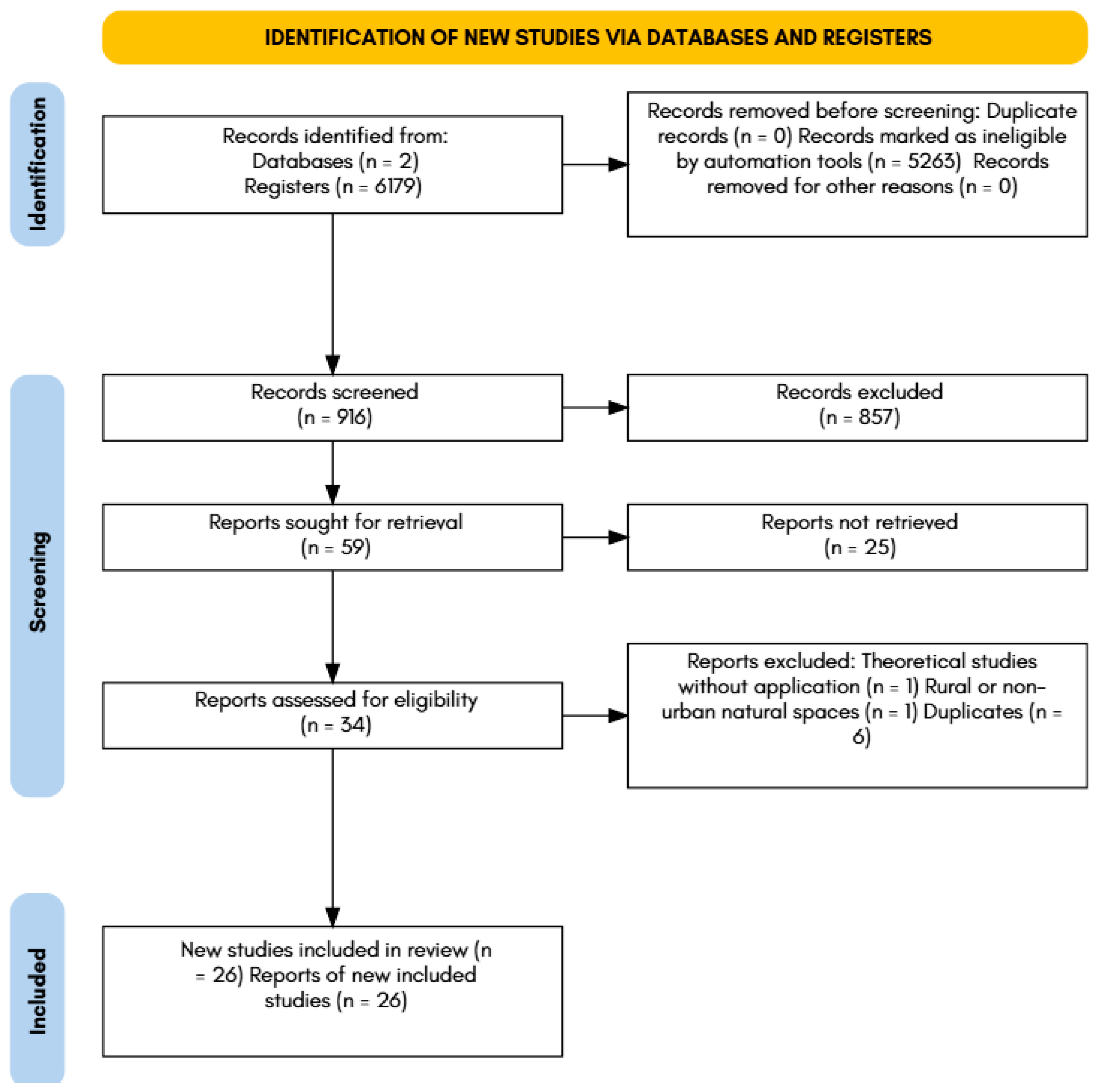
2.3.1. Phase 1: Identification
2.3.2. Phase 2: Screening
- Publication period (2021–2025),
- Document type (research articles),
- Subject areas related to urban sciences (according to the selected academic databases, only social sciences and environmental sciences are considered as related),
- Open access or open archive,
- Availability via subscription,
- Relevance assessed through title and abstract screening.
2.3.3. Phase 3: Eligibility Assessment
2.3.4. Phase 4: Final Inclusion
2.4. Quality Assessment
2.4.1. Critical Appraisal Using the Mixed Methods Appraisal Tool (MMAT)
2.4.2. Confidence Assessment of Synthesized Findings
2.5. Data Extraction and Analysis
2.5.1. Data Extraction
- Internal code.
- Author(s) of the publication.
- Article title.
- DOI.
- Year of publication.
- Country or region of study.
- Type or strategy of participation promoted.
- Theoretical approaches to urban resilience.
- Unit of analysis (type of green public space): Nature-based Solutions (NbSs), Urban green infrastructure, Cultural park, Pocket park, Floodable park, Urban public park, Academic green spaces (university campus), Agro-urban public park, Urban gardens, Green schoolyards, Public terraces, Green coverage.
- Scale of incidence: region, metropolitan, intermediate city, municipality, neighborhood, local community, peri-urban community.
- Objective.
- Main results or findings.
- Types of research methods.
- Nature of the intervention.
- Predominant dimensions of urban resilience.
- Most frequently applied sub-dimensions of urban resilience.
- Most frequently used indicators of urban resilience or participation.
- Types of urban resilience or participation instruments applied.
- Relevant questions of applied instruments.
- Measurement scale of applied instruments.
- Availability of applied instrument.
2.5.2. Analytical Framework
2.5.3. Interpretive Synthesis
2.6. Protocol Registration
2.7. Limitations
3. Results
3.1. Theoretical Codes
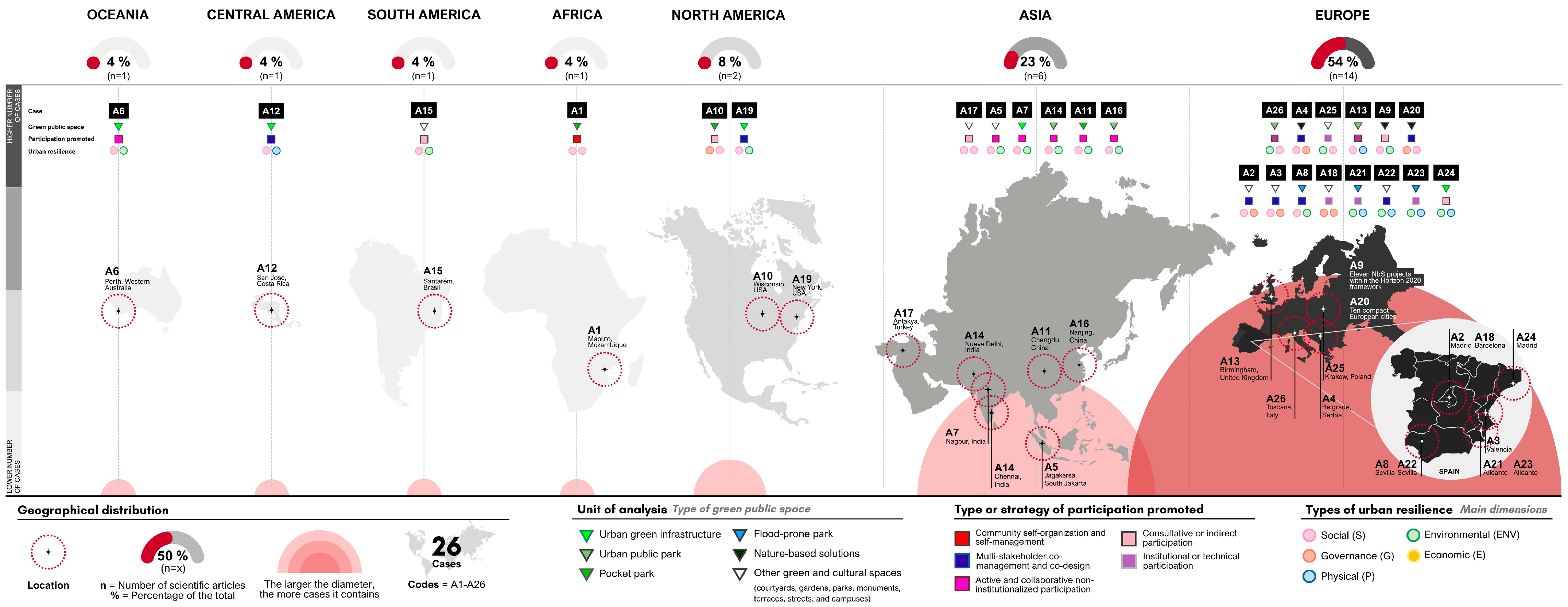
3.1.1. Type or Strategy of Participation Promoted
3.1.2. Type of Green Public Space
3.1.3. Scale of Incidence
3.1.4. Objectives
3.1.5. Theoretical Approach to Urban Resilience
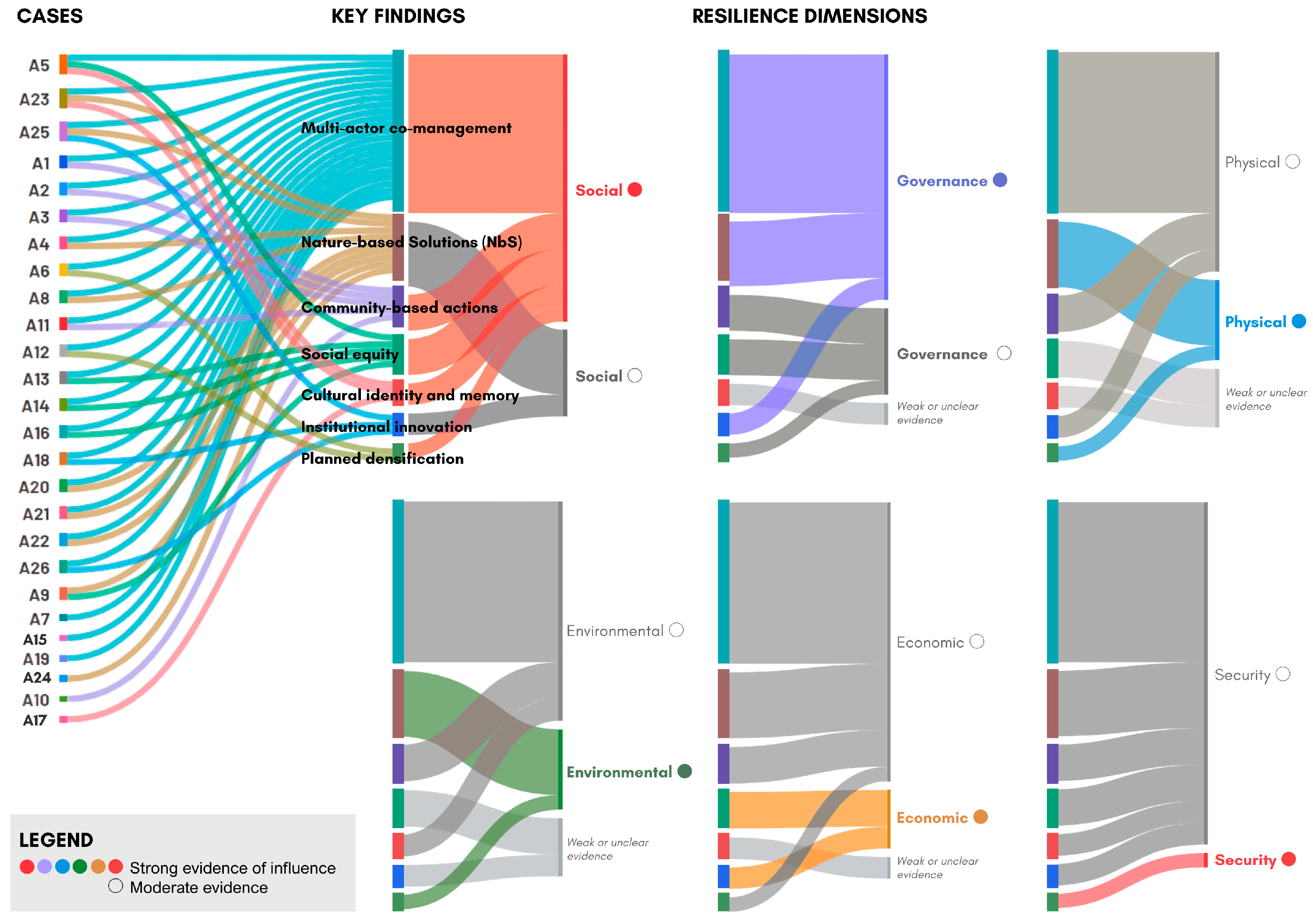
3.1.6. Key Findings
- Multi-actor co-management and co-design strengthen collaborative governance in urban resilience and generate innovation in planning: A large body of evidence (n = 22) underscores the centrality of multi-actor co-management and co-design practices in fostering collaborative urban governance. These approaches, documented across diverse contexts (e.g., A1, A3, A13, A18), promote inclusive planning and adaptive resilience by integrating stakeholders from government, civil society, academia, and local communities. The consistency of these findings across methodological and geographical variations indicates high coherence and adequacy of data. While most studies employed qualitative approaches without formal bias appraisal, their conceptual clarity and convergence justify a high overall confidence in this finding.
- Nature-based Solutions (NbSs) are widely implemented, delivering ecological benefits for urban resilience, despite institutional barriers: NbS strategies are featured prominently in nine studies (e.g., A4, A9, A21, A25), which document benefits such as flood control, urban cooling, and enhanced water quality. Despite varied institutional settings, findings are remarkably coherent in demonstrating the effectiveness of NbSs in building ecological and social resilience. Institutional or governance barriers—though present—are discussed as contextual constraints rather than contradictory evidence. The methodological consistency and relevance of these cases support a high confidence assessment of this review finding.
- Community self-organization and local initiatives build social capital and adaptive capacity in public-space resilience: Evidence from five studies (A1, A2, A3, A10, A11) emphasizes the vital role of grassroots initiatives, community gardens, and self-managed public spaces in enhancing urban resilience. These locally driven actions foster social cohesion, adaptability, and citizen empowerment. Although findings are consistent and thematically coherent, the qualitative nature and variable depth of the studies—combined with a lack of formal bias assessments—suggest methodological limitations. As such, the overall confidence is moderate, despite the strong thematic presence of community-based strategies.
- Social equity is a cross-cutting theme in participatory resilience, with persistent access and inclusion gaps: This theme emerged in five studies (A5, A9, A13, A14, A16), which discuss the dual outcomes of participatory planning: while many interventions enhance social well-being and cohesion, they also risk exclusion or displacement, particularly through processes like gentrification. The recurrence of these concerns across multiple contexts lends coherence and relevance to the finding. However, as equity was often a secondary focus rather than the primary object of analysis, and due to methodological diversity and limited bias evaluation, the overall confidence is moderate.
- Cultural identity and collective memory act as resilience resources, aiding recovery and cohesion: Although only three studies (A5, A17, A23) directly explore the cultural dimensions of resilience, they provide compelling insights into how place-based memory, heritage, and symbolic landscapes support community recovery and cohesion. These findings are coherent and conceptually rich but suffer from low data adequacy, limiting generalizability. As such, this thematic axis—while promising—carries low overall confidence in terms of evidence strength across the full sample.
- Institutional innovations support resilience through novel governance mechanisms: Select cases (A18, A25, A26) highlight the role of institutional innovation in resilience-building, showcasing public–private partnerships, interdisciplinary urban labs, and academic-civic collaborations. These models reveal governance adaptability and new participatory pathways. While consistent in thematic scope, the low number of supporting studies and heterogeneity of institutional formats yield moderate coherence and adequacy, resulting in moderate overall confidence.
- Planned densification can enhance green-space use and social cohesion when paired with participation: Two studies (A6, A12) demonstrate that compact urban development—such as transit-oriented design—can yield social and ecological benefits when grounded in community participation. Though these examples consistently show positive outcomes, the limited sample size and lack of comparative analysis reduce confidence in the generalizability of the finding. Thus, despite good thematic alignment, the overall confidence is low, primarily due to low adequacy of data.
3.2. Methodological Codes
3.2.1. Types of Research Methods
3.2.2. Nature of the Intervention
3.2.3. Most Frequently Used Dimensions of Urban Resilience
3.2.4. Most Frequently Used Sub-Dimensions of Urban Resilience
3.2.5. Most Frequently Used Participation and Urban Resilience Indicators
- Frequency of use of public spaces (54%) (A5, A14),
- Participation in community activities (50%) (A2, A12),
- Emotional attachment to place (38%) (A2),
- Perception of safety (38%) (A3),
- Satisfaction with infrastructure and services (36%) (A1).
3.2.6. Types of Instruments Applied
- Semi-structured interviews (57%) (A1, A8, A26),
- Structured questionnaires (50%) (A5, A12),
- Direct and participant observation (42%) (A8, A14),
- Focus groups (34%) (A17),
- Participatory mapping tools (27%).
3.2.7. Relevant Questions from Applied Instruments
- The degree of use and evaluation of green spaces (54%) (A5, A14),
- The perception of social and environmental benefits (42%) (A6, A8),
- The willingness to participate in management or governance (39%) (A2, A12).
3.2.8. Measurement Scales of Applied Instruments
3.2.9. Availability of Applied Instruments
- An investigation of socio-spatial equality in blue-green space at the Setu Babakan Area, Jakarta;
- (Re)designing the rules: Collaborative planning and institutional innovation in schoolyard transformations in Madrid;
- Improving urban resilience and habitability by an effective regeneration of the streets: A comprehensive approach step-by-step validated in a real case;
- Designing age-friendly communities: Exploring qualitative perspectives on urban green spaces and ageing in two Indian megacities;
- (Re)greening transition of academic green spaces as a response to social and environmental challenges: The role of bottom-up initiatives.
3.2.10. Synthesis of Findings: Participation and Methodological Perspectives
4. Discussion
5. Conclusions
Supplementary Materials
Author Contributions
Funding
Institutional Review Board Statement
Informed Consent Statement
Data Availability Statement
Conflicts of Interest
Abbreviations
| NbSs | Nature-based Solutions |
| UGI | Urban green infrastructure |
| TUPPs | Tactical urban pocket parks |
| TOD | Transit-Oriented Development |
References
- Grogan, A.; Grist, G.; Barcena, A. Strengthening Urban Resilience in Informal Settlements: The SECURe Framework in Practice; IIED: London, UK, 2025; Available online: https://www.iied.org/22655iied (accessed on 3 November 2025).
- Urban Resilience Hub. Building Urban Economic Resilience During and After COVID-19: Latin America and the Caribbean Region; Case Study; Lima City Council: Lima, Peru, 2021. Available online: https://urbanresiliencehub.org/wp-content/uploads/2021/02/case-study-lima.pdf (accessed on 15 October 2025).
- Oliver Wyman Forum. The Cities Shaping the Future: Introducing Our Index Ranking the Business Attractiveness of 1500 Cities Across Asia, Africa, Latin America, and the Middle East. 2025. Available online: https://www.oliverwymanforum.com/content/dam/oliver-wyman/ow-forum/template-scripts/emerging-cities/PDF/OWF_Emerging_Cities_Report.pdf (accessed on 15 October 2025).
- Ministerio de Vivienda, Construcción y Saneamiento del Perú (MVCS). Informe de Evaluación de Resultados 2021: Política Nacional de Vivienda y Urbanismo al 2030; Ministerio de Vivienda, Construcción y Saneamiento: Lima, Peru, 2022. Available online: https://ww3.vivienda.gob.pe/transparencia/documentos/Informe-Anual-Seguimiento-PNVU-2021.pdf (accessed on 10 June 2025).
- Sharifi, A.; Yamagata, Y. Resilience-oriented urban planning. In Resilience-Oriented Urban Planning; Yamagata, Y., Sharifi, A., Eds.; Springer: Cham, Switzerland, 2018; pp. 1–27. Available online: https://www.researchgate.net/publication/323281125_Resilience-Oriented_Urban_Planning (accessed on 10 June 2025).
- Meerow, S.; Newell, J.P.; Stults, M. Defining urban resilience: A review. Landsc. Urban Plan. 2016, 147, 38–49. Available online: https://www.sciencedirect.com/science/article/abs/pii/S0169204615002418 (accessed on 10 June 2025). [CrossRef]
- Datola, J. Implementación de la resiliencia urbana en la planificación urbana: Un marco integral para la evaluación de la resiliencia urbana. Sustain. Cities Soc. 2023, 98, 104821. [Google Scholar] [CrossRef]
- Moghadas, M.; Rajabifard, A.; Fekete, A.; Kötter, T. A Framework for Scaling Urban Transformative Resilience through Utilizing Volunteered Geographic Information. ISPRS Int. J. Geo-Inf. 2022, 11, 114. [Google Scholar] [CrossRef]
- Urban Resilience Hub. Powering Resilient Urban Environments Through Public Spaces. Available online: https://urbanresiliencehub.org/articles/redefining-public-spaces-as-essential-for-a-good-and-resilient-urban-environment/ (accessed on 16 October 2025).
- Parés, M.; Blanco, I.; Fernández, C. Facing the Great Recession in Deprived Urban Areas: How Civic Capacity Contributes to Neighborhood Resilience. City Community 2018, 17, 65–86. Available online: http://asanet.org/wp-content/uploads/attach/journals/mar18ccfeature.pdf (accessed on 11 June 2025). [CrossRef]
- Abdul-Rahman, M.; Soyinka, O.; Adenle, Y.A.; Chan, E.H.W. Comparative study of the critical success factors (CSFs) for community resilience assessment (CRA) in developed and developing countries. Int. J. Disaster Risk Reduct. 2022, 77, 103060. [Google Scholar] [CrossRef]
- Athanassiou, E. Participation as a Global Urban Strategy Towards Resilience: A Case of ‘Benevolent Urbanism. J. Public Space 2023, 8, 45–60. [Google Scholar] [CrossRef]
- Kapuku, N.; Ge, Y.; Rott, E.; Isgandar, H. Urban resilience: Multidimensional perspectives, challenges and prospects for future research. Urban Gov. 2024, 4, 162–179. [Google Scholar] [CrossRef]
- Andrade Suárez, M.J.; Docampo García, M.; Leiras, A. Sociological perspectives on urban green infrastructure: Identifying research gaps and advancing future directions. Urban For. Urban Green. 2025, 95, 128873. [Google Scholar] [CrossRef]
- Bueno, S.; Bañuls, V.A.; Gallego, M.D. Is urban resilience a phenomenon on the rise? A systematic literature review for the years 2019 and 2020 using textometry. Int. J. Disaster Risk Reduct. 2021, 53, 102588. [Google Scholar] [CrossRef]
- Song, K.; Chen, Y.; Duan, Y.; Zheng, Y. Urban governance: A review of intellectual structure and topic evolution. Urban Gov. 2023, 2, 71–84. [Google Scholar] [CrossRef]
- Castaldo, A.G.; Gori Nocentini, M.; Lemes de Oliveira, F.; Mahmoud, I.H. Nature-based solutions and urban planning in the Global South: Challenge orientations, typologies, and viability for cities. Land Use Policy 2024, 133, 107439. [Google Scholar] [CrossRef]
- Tapia, F.; Ochoa-Peralta, D.; Reith, A. From design to action: Service design tools for enhancing collaboration in nature-based solutions implementation. J. Environ. Manag. 2025, 346, 124739. [Google Scholar] [CrossRef] [PubMed]
- Zhao, Z.; Shaw, R. Nature-based ESG solutions: An analytical overview. Nat.-Based Environ. Risk Policy Sci. J. 2025, 1, 100015. [Google Scholar] [CrossRef]
- Babí Almenar, J.; Elliot, T.; Rugani, B.; Philippe, B.; Navarrete Gutierrez, T.; Sonnemann, G.; Geneletti, D. Nexus between nature-based solutions, ecosystem services and urban challenges. Land Use Policy 2020, 96, 104898. [Google Scholar] [CrossRef]
- Page, M.J.; McKenzie, J.E.; Bossuyt, P.M.; Boutron, I.; Hoffmann, T.C.; Mulrow, C.D.; Shamseer, L.; Tetzlaff, J.M.; Akl, E.A.; Brennan, S.E.; et al. The PRISMA 2020 statement: An updated guideline for reporting systematic reviews. BMJ 2021, 372, 71. [Google Scholar] [CrossRef]
- Open Science Framework. 2025. Available online: https://osf.io/ (accessed on 7 November 2025).
- Aydin, N.Y.; Celik, K.; Gecen, R.; Kalaycioglu, S.; Duzgun, S. Rebuilding Antakya: Cultivating urban resilience through cultural identity and education for post-disaster reconstruction in Turkey. Int. J. Disaster Risk Reduct. 2025, 117, 105196. [Google Scholar] [CrossRef]
- Wang, K.; Ke, Y. Social sustainability of communities: A systematic literature review. Sustain. Prod. Consum. 2024, 47, 585–597. [Google Scholar] [CrossRef]
- MDPI in 2024: Research Integrity, Expanding Global Reach, and Strengthening Open Access. EurekAlert! [Internet]. 2024. Available online: https://www.eurekalert.org/news-releases/1078258 (accessed on 7 November 2025).
- Chilaule, R.; Mottelson, J. Informal infrastructure provision: Self-organized street paving in Maputo, Mozambique. Habitat Int. 2025, 161, 103405. [Google Scholar] [CrossRef]
- Alméstar, M.; Romero-Muñoz, S. (Re)designing the Rules: Collaborative Planning and Institutional Innovation in Schoolyard Transformations in Madrid. Land 2025, 14, 1174. Available online: https://www.mdpi.com/2073-445X/14/6/1174 (accessed on 15 June 2025). [CrossRef]
- Fernandez-Salido, N.; Gallego-Valadés, A.; Serra-Castells, C.; Garcés-Ferrer, J. Cultivating Bonds: On Urban Allotment Gardens and Their Relationship with Social Capital. Agriculture 2025, 15, 1048. [Google Scholar] [CrossRef]
- Mitić-Radulović, A.; Lalović, K. Multi-Level Perspective on Sustainability Transition towards Nature-Based Solutions and Co-Creation in Urban Planning of Belgrade, Serbia. Sustainability 2021, 13, 7576. [Google Scholar] [CrossRef]
- Aristyowati, A.; Ellisa, E.; Gamal, A. An investigation of socio-spatial equality in blue-green space at the Setu Babakan Area, Jakarta. City Environ. Interact. 2024, 22, 100137. [Google Scholar] [CrossRef]
- Bolleter, J.; Edwards, N.; Cameron, R.; Hooper, P. Density my way: Community attitudes to neighbourhood densification scenarios. Cities 2024, 145, 104596. [Google Scholar] [CrossRef]
- Lahoti, S.A.; Dhyani, S.; Saito, O. Exploring the Factors Shaping Urban Greenspace Interactions: A Case Study of Nagpur, India. Land 2024, 13, 1576. [Google Scholar] [CrossRef]
- Lara, A.; Del Moral, L. Nature-Based Solutions to Hydro-Climatic Risks: Barriers and Triggers for Their Implementation in Seville (Spain). Land 2022, 11, 868. [Google Scholar] [CrossRef]
- Ricart, S.; Berizzi, C.; Saurí, D.; Terlicher, G.N. The Social, Political, and Environmental Dimensions in Designing Urban Public Space from a Water Management Perspective: Testing European Experiences. Land 2022, 11, 1575. [Google Scholar] [CrossRef]
- Rosso, F.; Pioppi, B.; Pisello, A.L. Tactical urban pocket parks (TUPPs) for subjective and objective multi-domain comfort enhancement. J. Environ. Manag. 2024, 349, 119447. [Google Scholar] [CrossRef]
- Zhang, J.; Li, Z.; Zhong, J. From Health Risks to Environmental Actions: Research on the Pathway of Guiding Citizens to Participate in Pocket-Park Governance. Land 2024, 13, 1612. [Google Scholar] [CrossRef]
- Valle Pilia, M.; Ramírez Fonseca, F. The influence of the urban model on civic involvement and public time. A study applied to the commuting population of the Greater Metropolitan Area of San José, Costa Rica. Cities 2024, 148, 104849. [Google Scholar] [CrossRef]
- Wood, G.E.R.; Pykett, J.; Banchoff, A.; King, A.C.; Stathi, A. Employing citizen science to enhance active and healthy ageing in urban environments. Health Place 2023, 79, 102954. [Google Scholar] [CrossRef]
- Adlakha, D.; Chandra, M.; Krishna, M.; Smith, L.; Tully, M.A. Designing Age-Friendly Communities: Exploring Qualitative Perspectives on Urban Green Spaces and Ageing in Two Indian Megacities. Int. J. Environ. Res. Public Health 2021, 18, 1491. [Google Scholar] [CrossRef]
- Vieira, T.A.; Panagopoulos, T. Urban agriculture in Brazil: Possibilities and challenges for Santarém, eastern Amazonia. Land Use Policy 2024, 139, 107082. [Google Scholar] [CrossRef]
- Rui, J. Green disparities, happiness elusive: Decoding the spatial mismatch between green equity and the happiness from vulnerable perspectives. Cities 2025, 163, 106063. [Google Scholar] [CrossRef]
- Cambra-Fierro, J.; López-Pérez, M.E.; Perez, L.; Tejada-Tejada, M. Managing public-private partnerships for urban design and regeneration: Lessons learned from the Hermitage Museum Barcelona odyssey. Cities 2025, 158, 105714. [Google Scholar] [CrossRef]
- Herreros-Cantis, P.; Hoffman, L.; Kennedy, C.; Kim, Y.; Charles, J.; Gillet, V.; McPhearson, T. Co-producing research and data visualization for environmental justice advocacy in climate change adaptation: The Milwaukee Flood-Health Vulnerability Assessment. Cities 2024, 155, 105474. [Google Scholar] [CrossRef]
- Sánchez-Almodóvar, E.; Olcina-Cantos, J.; Martí-Talavera, J. Adaptation Strategies for Flooding Risk from Rainfall Events in Southeast Spain: Case Studies from the Bajo Segura, Alicante. Water 2022, 14, 146. [Google Scholar] [CrossRef]
- Montero-Gutiérrez, P.; Palomo Amores, T.; Guerrero Delgado, M.; Molina Félix, J.L.; Sánchez Ramos, J.; Álvarez Domínguez, S. Improving urban resilience and habitability by an effective regeneration of the streets: A comprehensive approach step-by-step validated in a real case. Build. Environ. 2024, 256, 111471. [Google Scholar] [CrossRef]
- Sánchez-Almodóvar, E.; Olcina-Cantos, J.; Martí-Talavera, J.; Prieto-Cerdán, A.; Padilla-Blanco, A. Floods and Adaptation to Climate Change in Tourist Areas: Management Experiences on the Coast of the Province of Alicante (Spain). Water 2023, 15, 807. [Google Scholar] [CrossRef]
- Suárez, M.; Rieiro-Díaz, A.M.; Alba, D.; Langemeyer, J.; Gómez-Baggethun, E.; Ametzaga-Arregi, I. Urban resilience through green infrastructure: A framework for policy analysis applied to Madrid, Spain. Landsc. Urban Plan. 2024, 241, 104923. [Google Scholar] [CrossRef]
- Działek, J.; Jarecka-Bidzińska, E.; Staniewska, A.; Téoule, F. (Re)greening transition of academic green spaces as a response to social and environmental challenges: The role of bottom-up initiatives. Urban For. Urban Green. 2025, 105, 128692. [Google Scholar] [CrossRef]
- Fanfani, D.; Battisti, F.; Agosta, B. Assessing the Public Peri-Urban Agricultural Park as a Tool for the Sustainable Planning of Peri-Urban Areas: The Case Study of Prato. Sustainability 2024, 16, 7946. [Google Scholar] [CrossRef]
- Liu, Z.; Chen, X.; Cui, H.; Ma, Y.; Gao, N.; Li, X.; Meng, X.; Lin, H.; Abudou, H.; Guo, L.; et al. Green space exposure on depression and anxiety outcomes: A meta-analysis. Environ. Res. 2023, 231, 116303. [Google Scholar] [CrossRef]
- Hong, Q.N.; Pluye, P.; Fàbregues, S.; Bartlett, G.; Boardman, F.; Cargo, M.; Dagenais, P.; Gagnon, M.-P.; Griffiths, F.; Nicolau, B.; et al. Mixed Methods Appraisal Tool (MMAT), Version 2018; Canadian Intellectual Property Office, Industry Canada: Gatineau, QC, Canada, 2018. Available online: http://mixedmethodsappraisaltoolpublic.pbworks.com/w/file/fetch/127916259/MMAT_2018_criteria-manual_2018-08-01_ENG.pdf (accessed on 3 November 2025).
- Lewin, S.; Booth, A.; Glenton, C.; Munthe-Kaas, H.; Rashidian, A.; Wainwright, M.; Bohren, M.A.; Tunçalp, Ö.; Colvin, C.J.; Garside, R.; et al. Applying GRADE-CERQual to qualitative evidence synthesis findings: Introduction to the series. Implement. Sci. 2018, 13 (Suppl. S1), 2. [Google Scholar] [CrossRef] [PubMed]
- Zyoud, S.; Zyoud, A. Revealing global trends on nature-based solutions: Mapping and visualizing research landscapes. Nat.-Based Solut. 2025, 7, 100229. [Google Scholar] [CrossRef]
- Fastiggi, M.; Meerow, S.; Miller, T.R. Governing urban resilience: Organisational structures and coordination strategies in 20 North American city governments. Urban Stud. 2020, 58, 49–67. [Google Scholar] [CrossRef]
- Fainstein, S.S. Resilience and justice: Planning for New York City. Urban Geogr. 2018, 39, 612–627. [Google Scholar] [CrossRef]
- Lakhina, S.J.; Sutley, E.J.; Wilson, J. How Do We Actually Do Convergence for Disaster Resilience? Cases from Australia and the United States. Int. J. Disaster Risk Sci. 2021, 12, 299–311. [Google Scholar] [CrossRef]
- Coulson, G.; Moores, J.; Waa, A.; Kearns, R.; Witten, K.; Batstone, C.; Howden-Chapman, P. Toward a Framework for Resilience Assessments: Working Across Cultures, Disciplines, and Scales in Aotearoa/New Zealand. Front. Sustain. Cities 2020, 2, 11. [Google Scholar] [CrossRef]
- Dianat, H.; Wilkinson, S.; Williams, P.; Khatibi, H. Planning the resilient city: Investigations into using “causal loop diagram” in combination with “UNISDR scorecard”. Int. J. Disaster Risk Reduct. 2021, 62, 102561. [Google Scholar] [CrossRef]
- Sabri, S.; Kurnia, S. Digital Transformation of Urban Planning in Australia: Influencing Factors and Key Challenges. arXiv 2025, arXiv:2506.13333. [Google Scholar] [CrossRef]
- Sharifi, A.; Yamagata, Y. Principles and criteria for assessing urban energy resilience: A literature review. Renew. Sustain. Energy Rev. 2016, 60, 1654–1677. [Google Scholar] [CrossRef]
- Keen, M.; Sanderson, D.; Osborne, K.; Deo, R.; Faith, J.; Ride, A. Area-based approaches and urban recovery in the Pacific: Lessons from Fiji, Solomon Islands and Vanuatu. Environ. Urban. 2022, 34, 151–169. [Google Scholar] [CrossRef]
- Lowe, M.; Bell, S.; Briggs, J.; McMillan, E.; Morley, M.; Grenfell, M.; Sweeting, D.; Whitten, A.; Jordan, N. A researche-based, practice-relevant urban resilience framework for local government. Local Environ. 2024, 29, 886–901. [Google Scholar] [CrossRef]
- Ma, L.; Ye, R.; Ettema, D.; van Lierop, D. Role of the neighborhood environment in psychological resilience. Landsc. Urban Plan. 2023, 235, 104761. [Google Scholar] [CrossRef]
- Trundle, A. Resilient cities in a Sea of Islands: Informality and climate change in the South Pacific. Cities 2020, 97, 102496. [Google Scholar] [CrossRef]
- Chen, Y.; Zhu, M.; Zhou, Q.; Qiao, Y. Research on spatiotemporal differentiation and influence mechanism of urban resilience in China based on MGWR model. Int. J. Environ. Res. Public Health 2021, 18, 1056. [Google Scholar] [CrossRef] [PubMed]
- Zhao, R.; Fang, C.; Liu, J.; Zhang, L. The evaluation and obstacle analysis of urban resilience from the multidimensional perspective in Chinese cities. Sustain. Cities Soc. 2022, 86, 104160. [Google Scholar] [CrossRef]
- Zhou, Q.; Zhu, M.; Qiao, Y.; Zhang, X.; Chen, J. Achieving resilience through smart cities? Evidence from China. Habitat Int. 2021, 111, 102348. [Google Scholar] [CrossRef]
- Chen, X.; Yu, L.; Lin, W.; Yang, F.; Li, Y.; Tao, J.; Cheng, S. Urban resilience assessment from the multidimensional perspective using dynamic Bayesian network: A case study of Fujian Province, China. Reliab. Eng. Syst. Saf. 2023, 238, 109469. [Google Scholar] [CrossRef]
- Jamali, A.; Robati, M.; Nikoomaram, H.; Farsad, F.; Aghamohammadi, H. Urban Resilience and Climate Change: Developing a Multidimensional Index to Adapt against Climate Change in the Iranian Capital City of Tehran. Urban Sci. 2023, 7, 7. [Google Scholar] [CrossRef]
- Chirisa, I.; Chigudu, A. Resilience and Sustainability in Urban Africa Context: Facets and Alternatives in Zimbabwe; Springer: Singapore, 2021; ISBN 978-981-16-3287-7. [Google Scholar] [CrossRef]
- Birhanu, Z.; Ambelu, A.; Berhanu, N.; Tesfaye, A.; Woldemichael, K. Understanding Resilience Dimensions and Adaptive Strategies to the Impact of Recurrent Droughts in Borana Zone, Oromia Region, Ethiopia: A Grounded Theory Approach. Int. J. Environ. Res. Public Health 2017, 14, 118. Available online: https://www.mdpi.com/1660-4601/14/2/118 (accessed on 12 June 2025). [CrossRef] [PubMed]
- Council of Europe Development Bank. From Community Vulnerability to Resilience: The Experience of European Cities. 2023. Available online: https://coebank.org/media/documents/Technical_Brief_From_Community_Vulnerability_to_Resilience.pdf (accessed on 11 June 2025).
- URBACT. Making Resilient Cities Through Experimentation in Urban Living Labs. 2023. Available online: https://urbact.eu/sites/default/files/2023-04/final_report-making_resilient_cities_through_experimentation_pdf.pdf (accessed on 11 June 2025).
- Reyes Olivares. Evaluación de la Resiliencia Urbana en Reynosa, Tamaulipas; UAEMex: Toluca, Mexico, 2020; Available online: https://www.lareferencia.info/vufind/Record/MX_9f49a34054583a65e72cb45e5f52f801/Details (accessed on 12 June 2025).
- Revista EURE. Resiliencia Urbana Multidimensional En Contextos De Riesgo: Estrategias Para el Programa “Quiero Mi Barrio”. 2024. Available online: https://www.scielo.cl/scielo.php?script=sci_arttext&pid=S0250-71612024000100010 (accessed on 12 June 2025).
- Bressane, A.; Loureiro, A.I.S.; Medeiros, L.C.d.C.; Moruzzi, R.; Formiga, J.K.S.; Negri, R.G.; Saraiva, A.C.V. Intelligent nature-based solutions in the 1st smart sustainable Brazilian City: Insights and lessons learned. Solutions 2024, 6, 100161. [Google Scholar] [CrossRef]



| Database | 1. Identification | Count | 2. Screening | 3. Eligibility | 4. Included | |||||
|---|---|---|---|---|---|---|---|---|---|---|
| 1st Filter | 2nd Filter | 3rd Filter | 4th Filter | 5th Filter | 6th Filter | |||||
| Science Direct | “community participation”, “socioecologic resilience”, “boulevard” | 0 | 0 | 0 | 0 | 0 | 0 | 0 | 0 | 0 |
| Science Direct | “community participation”, “socioecologic resilience” | 1 | 0 | 0 | 0 | 0 | 0 | 0 | 0 | 0 |
| Science Direct | “community participation”, “boulevard” | 157 | 51 | 35 | 27 | 11 | 6 | 4 | 3 | 2 |
| Science Direct | “socioecologic resilience”, “boulevard” | 0 | 0 | 0 | 0 | 0 | 0 | 0 | 0 | 0 |
| MDPI | “community participation”, “socioecologic resilience”, “boulevard” | 0 | 0 | 0 | 0 | 0 | 0 | 0 | 0 | 0 |
| MDPI | “community participation”, “socioecologic resilience” | 10 | 7 | 7 | 7 | 7 | 7 | 0 | 0 | 0 |
| MDPI | “community participation”, “boulevard” | 1 | 1 | 1 | 1 | 1 | 1 | 1 | 0 | 0 |
| MDPI | “socioecologic resilience”, “boulevard” | 0 | 0 | 0 | 0 | 0 | 0 | 0 | 0 | 0 |
| Science Direct | “social participation”, “resilience”, “green spaces” | 167 | 137 | 99 | 70 | 33 | 21 | 3 | 2 | 2 |
| Science Direct | “collaboration”, “urban resilience”, “green spaces” | 567 | 567 | 335 | 235 | 127 | 78 | 4 | 5 | 3 |
| Science Direct | “social participation”, “resilience”, “public space” | 165 | 126 | 99 | 76 | 41 | 22 | 2 | 2 | 1 |
| MDPI | “social participation”, “resilience”, “green spaces” | 16 | 14 | 12 | 12 | 11 | 11 | 7 | 5 | 4 |
| MDPI | “collaboration”, “urban resilience”, “green spaces” | 12 | 11 | 8 | 8 | 8 | 8 | 4 | 4 | 3 |
| MDPI | “social participation”, “resilience”, “public space” | 13 | 10 | 8 | 8 | 8 | 8 | 5 | 2 | 2 |
| Science Direct | “urban resilience”, “public spaces”, “collaborative participation” | 1 | 1 | 1 | 1 | 1 | 1 | 0 | 0 | 0 |
| Science Direct | “urban resilience”, “public spaces” | 669 | 526 | 400 | 284 | 144 | 97 | 3 | 4 | 3 |
| Science Direct | “urban resilience”, “collaborative participation” | 6 | 5 | 5 | 3 | 1 | 1 | 0 | 0 | 0 |
| Science Direct | “publics spaces”, “collaborative participation” | 26 | 16 | 13 | 11 | 7 | 3 | 0 | 0 | 0 |
| MDPI | “urban resilience”, “public spaces”, “collaborative participation” | 5 | 3 | 2 | 2 | 2 | 2 | 2 | 2 | 1 |
| MDPI | “urban resilience”, “public spaces” | 152 | 121 | 95 | 94 | 94 | 94 | 0 | 0 | 0 |
| MDPI | “public spaces”, “collaborative participation” | 40 | 28 | 26 | 23 | 23 | 23 | 0 | 0 | 0 |
| MDPI | “urban resilience”, “collaborative participation” | 22 | 16 | 12 | 12 | 12 | 12 | 0 | 0 | 0 |
| Science Direct | “collaboration”, “urban resilience”, “sustainable spaces” | 0 | 5 | 4 | 2 | 1 | 0 | 0 | 0 | 0 |
| Science Direct | “collaboration”, “urban resilience” | 1440 | 1105 | 783 | 561 | 272 | 102 | 2 | 2 | 2 |
| Science Direct | “collaboration”, “sustainable spaces” | 275 | 167 | 110 | 41 | 18 | 12 | 1 | 1 | 1 |
| MDPI | “collaboration”, “urban resilience”, “sustainable spaces” | 24 | 23 | 17 | 17 | 17 | 17 | 0 | 0 | 0 |
| MDPI | “collaboration”, “urban Resilience” | 157 | 131 | 96 | 93 | 93 | 80 | 0 | 0 | 0 |
| MDPI | “collaboration”, “sustainable spaces” | 270 | 215 | 150 | 143 | 143 | 143 | 0 | 0 | 0 |
| Science Direct | “civic engagement”, “community resilience”, “parks” | 93 | 64 | 52 | 45 | 14 | 9 | 0 | 0 | 0 |
| Science Direct | “civic engagement”, “community resilience” | 211 | 137 | 107 | 87 | 32 | 22 | 4 | 0 | 0 |
| Science Direct | “civic engagement”, “parks” | 1660 | 693 | 575 | 432 | 170 | 127 | 15 | 1 | 1 |
| MDPI | “civic engagement”, “community resilience”, “parks” | 0 | 0 | 0 | 0 | 0 | 0 | 0 | 0 | 0 |
| MDPI | “civic engagement”, “community resilience” | 16 | 14 | 9 | 8 | 8 | 8 | 1 | 0 | 0 |
| MDPI | “civic engagement”, “parks” | 3 | 1 | 1 | 1 | 1 | 1 | 1 | 1 | 1 |
| Summations | 6179 | 4195 | 3062 | 2304 | 1300 | 916 | 59 | 34 | 26 | |
| Code | Authors | Title of Publication |
|---|---|---|
| A1 | Chilaule, R. & Mottelson, J., et al. [26] | Informal infrastructure provision: Self-organized street paving in Maputo, Mozambique |
| A2 | Alméstar, M. & Romero-Muñoz, S. [27] | (Re)designing the Rules: Collaborative Planning and Institutional Innovation in Schoolyard Transformations in Madrid |
| A3 | Fernandez-Salido, N., et al. [28] | Cultivating Bonds: On Urban Allotment Gardens and Their Relationship with Social Capital |
| A4 | Mitić, A., et al. [29] | Multi-Level Perspective on Sustainability Transition towards Nature-Based Solutions and Co-Creation in Urban Planning of Belgrade, Serbia |
| A5 | Aristyowati A., et al. [30] | An investigation of socio-spatial equality in blue-green space at the Setu Babakan Area, Jakarta |
| A6 | Bolleter, J., et al. [31] | Density my way: Community attitudes to neighbourhood densification scenarios |
| A7 | Lahoti, S., et al. [32] | Exploring the Factors Shaping Urban Greenspace Interactions: A Case Study of Nagpur, India |
| A8 | Lara, A. & Del Moral, L. [33] | Nature-Based Solutions to Hydro-Climatic Risks: Barriers and Triggers for Their Implementation in Seville (Spain) |
| A9 | Ricart, S., et al. [34] | The Social, Political, and Environmental Dimensions in Designing Urban Public Space from a Water Management Perspective: Testing European Experiences |
| A10 | Rosso, F., et al. [35] | Tactical urban pocket parks (TUPPs) for subjective and objective multi-domain comfort enhancement |
| A11 | Zhang, J., et al. [36] | From Health Risks to Environmental Actions: Research on the Pathway of Guiding Citizens to Participate in Pocket-Park Governance |
| A12 | Valle, P., et al. [37] | The influence of the urban model on civic involvement and public time. A study applied to the commuting population of the Greater Metropolitan Area of San José, Costa Rica |
| A13 | Wood, et al. [38] | Employing citizen science to enhance active and healthy ageing in urban environments |
| A14 | Adlakha, D., et al. [39] | Designing Age-Friendly Communities: Exploring Qualitative Perspectives on Urban Green Spaces and Ageing in Two Indian Megacities |
| A15 | Vieira, T.A. & Panagopoulos, T. [40] | Urban agriculture in Brazil: Possibilities and challenges for Santarém, eastern Amazonia |
| A16 | Rui, J. [41] | Green disparities, happiness elusive: Decoding the spatial mismatch between green equity and the happiness from vulnerable perspectives |
| A17 | Aydin, N.Y., et al. [23] | Rebuilding Antakya: Cultivating urban resilience through cultural identity and education for post-disaster reconstruction in Turkey |
| A18 | Cambra-Fierro, J., et al. [42] | Managing public-private partnerships for urban design and regeneration: Lessons learned from the Hermitage Museum Barcelona odyssey |
| A19 | Herreros-Cantis et al. [43] | Co-producing research and data visualization for environmental justice advocacy in climate change adaptation: The Milwaukee Flood-Health Vulnerability Assessment |
| A20 | Tapia, F., et al. [20] | From design to action: Service design tools for enhancing collaboration in nature-based solutions implementation |
| A21 | Sánchez-Almodóvar, E., et al. [44] | Adaptation Strategies for Flooding Risk from Rainfall Events in Southeast Spain: Case Studies from the Bajo Segura, Alicante |
| A22 | Montero-Gutiérrez, P., et al. [45] | Improving urban resilience and habitability by an effective regeneration of the streets: A comprehensive approach step-by-step validated in a real case |
| A23 | Sánchez-Almodóvar, E., et al. [46] | Floods and Adaptation to Climate Change in Tourist Areas: Management Experiences on the Coast of the Province of Alicante (Spain) |
| A24 | Suárez, M., et al. [47] | Urban resilience through green infrastructure: A framework for policy analysis applied to Madrid, Spain |
| A25 | Działek, J., et al. [48] | (Re)greening transition of academic green spaces as a response to social and environmental challenges: The role of bottom-up initiatives |
| A26 | Fanfani, D., et al. [49] | Assessing the Public Peri-Urban Agricultural Park as a Tool for the Sustainable Planning of Peri-Urban Areas: The Case Study of Prato |
| Code | Screening Quest. | 1. Quantitative Descriptive Studies | 2. Qualitative Studies | 3. Mixed Methods Studies | Score | Comments | |||||||||||||
|---|---|---|---|---|---|---|---|---|---|---|---|---|---|---|---|---|---|---|---|
| S1 | S2 | 1.1 | 1.2 | 1.3 | 1.4 | 1.5 | 2.1 | 2.2 | 2.3 | 2.4 | 2.5 | 3.1 | 3.2 | 3.3 | 3.4 | 3.5 | |||
| A6 | Yes | Yes | Yes | Yes | Yes | Can’t tell | Yes | _ | _ | _ | _ | _ | _ | _ | _ | _ | _ | 80% | Survey-based analysis with clear sampling design; however, limited detail on response rate. |
| A7 | Yes | Yes | Yes | Yes | Yes | Yes | Yes | _ | _ | _ | _ | _ | _ | _ | _ | _ | _ | 100% | Stratified sampling and validated wellbeing indicators ensure reliability and representativeness. |
| A11 | Yes | Yes | Yes | Yes | Yes | Yes | Yes | _ | _ | _ | _ | _ | _ | _ | _ | _ | _ | 100% | PLS-SEM model accurately fits large-sample survey data with adequate reporting of assumptions. |
| A12 | Yes | Yes | Yes | Can’t tell | Yes | Can’t tell | Yes | _ | _ | _ | _ | _ | _ | _ | _ | _ | _ | 60% | Civic engagement survey uses suitable tools, though representativeness and nonresponse details are limited. |
| A16 | Yes | Yes | Yes | Yes | Yes | Yes | Yes | _ | _ | _ | _ | _ | _ | _ | _ | _ | _ | 100% | Robust spatial and statistical methods applied to a well-defined urban sample. |
| A22 | Yes | Yes | Yes | Yes | Yes | Yes | Yes | _ | _ | _ | _ | _ | _ | _ | _ | _ | _ | 100% | Microclimatic field data analyzed using appropriate regression and validation methods. |
| A1 | Yes | Yes | _ | _ | _ | _ | _ | Yes | Yes | Yes | Yes | Yes | _ | _ | _ | _ | _ | 100% | The ethnographic, community-based design effectively captures self-organization dynamics in informal settlements. |
| A2 | Yes | Yes | _ | _ | _ | _ | _ | Yes | Yes | Yes | Yes | Yes | _ | _ | _ | _ | _ | 100% | Participatory planning workshops are well matched to the goal of assessing multi-actor cooperation. |
| A3 | Yes | Yes | _ | _ | _ | _ | _ | Yes | Yes | Yes | Yes | Yes | _ | _ | _ | _ | _ | 100% | Semi-structured interviews and thematic analysis are consistent with qualitative rigor. |
| A4 | Yes | Yes | _ | _ | _ | _ | _ | Yes | Yes | Yes | Yes | Yes | _ | _ | _ | _ | _ | 100% | Co-creation and design-charrette methods are suitable for exploring collaborative governance. |
| A8 | Yes | Yes | _ | _ | _ | _ | _ | Yes | Yes | Yes | Yes | Yes | _ | _ | _ | _ | _ | 100% | The combination of interviews and policy review supports robust triangulation. |
| A9 | Yes | Yes | _ | _ | _ | _ | _ | Yes | Yes | Yes | Yes | Yes | _ | _ | _ | _ | _ | 100% | Comparative case analysis demonstrates clear derivation of findings from empirical evidence. |
| A14 | Yes | Yes | _ | _ | _ | _ | _ | Yes | Yes | Yes | Yes | Yes | _ | _ | _ | _ | _ | 100% | Grounded analysis of elderly users’ perceptions is coherent and adequately supported by data. |
| A15 | Yes | Yes | _ | _ | _ | _ | _ | Yes | Yes | Yes | Yes | Yes | _ | _ | _ | _ | _ | 100% | The interpretative approach aligns with the study of social inclusion in Brazilian neighborhoods. |
| A17 | Yes | Yes | _ | _ | _ | _ | _ | Yes | Yes | Yes | Yes | Yes | _ | _ | _ | _ | _ | 100% | Post-disaster qualitative fieldwork and focus groups provide strong empirical grounding. |
| A18 | Yes | Yes | _ | _ | _ | _ | _ | Yes | Yes | Yes | Yes | Yes | _ | _ | _ | _ | _ | 100% | Documentary review and interviews ensure validity in assessing institutional governance. |
| A20 | Yes | Yes | _ | _ | _ | _ | _ | Yes | Yes | Yes | Yes | Yes | _ | _ | _ | _ | _ | 100% | Systematic qualitative synthesis appropriately addresses questions of collaborative resilience. |
| A23 | Yes | Yes | _ | _ | _ | _ | _ | Yes | Yes | Yes | Yes | Yes | _ | _ | _ | _ | _ | 100% | Multi-case municipal comparison reveals coherent analytical interpretation. |
| A24 | Yes | Yes | _ | _ | _ | _ | _ | Yes | Yes | Yes | Yes | Yes | _ | _ | _ | _ | _ | 100% | Policy-focused qualitative evaluation exhibits internal consistency between data and interpretation. |
| A5 | Yes | Yes | _ | _ | _ | _ | _ | _ | _ | _ | _ | _ | Yes | Yes | Yes | Can’t tell | Yes | 80% | The rationale for combining perception surveys with ethnographic observation is clear; integration is strong, though divergences are not explicitly discussed. |
| A10 | Yes | Yes | _ | _ | _ | _ | _ | _ | _ | _ | _ | _ | Yes | Yes | Yes | Yes | Yes | 100% | The microclimatic quantitative results and qualitative user feedback are effectively combined to assess comfort; full coherence achieved. |
| A13 | Yes | Yes | _ | _ | _ | _ | _ | _ | _ | _ | _ | _ | Yes | Yes | Yes | Can’t tell | Yes | 80% | Participatory mobile data collection and collective interpretation are integrated, but discrepancies between qualitative narratives and numeric trends are not detailed. |
| A19 | Yes | Yes | _ | _ | _ | _ | _ | _ | _ | _ | _ | _ | Yes | Yes | Yes | Yes | Yes | 100% | The iterative co-production process successfully merges spatial mapping with participatory storytelling; well-justified and consistent. |
| A21 | Yes | Yes | _ | _ | _ | _ | _ | _ | _ | _ | _ | _ | Yes | Yes | Yes | Can’t tell | Yes | 80% | Documentary analysis and field validation are complementary, but limited reflection on potential inconsistencies. |
| A25 | Yes | Yes | _ | _ | _ | _ | _ | _ | _ | _ | _ | _ | Yes | Yes | Yes | Yes | Yes | 100% | The design justifies combining qualitative and quantitative student surveys; integration and validation are well described. |
| A26 | Yes | Yes | _ | _ | _ | _ | _ | _ | _ | _ | _ | _ | Yes | Yes | Yes | Yes | Yes | 100% | Mixed-method triangulation (co-design, community meetings, and financial analysis) is coherent and robustly interpreted. |
| Parameters | Categories | Subcategories/Items | |||
|---|---|---|---|---|---|
| Descriptive parameters | Code | A1, A2, A3, A4, A5, A6, A7, A8, A9, A10, A11, A12, A13, A14, A15, A16, A17, A18, A19, A20, A21, A22, A23, A24, A25, A26 | |||
| Authors | According to each case and its applicable code (Table 3) | ||||
| Article title | According to each case and its applicable code (Table 3) | ||||
| DOI | According to each case and its applicable code (Table 3) | ||||
| Year | 2021–2025, according to each case (Table 3) | ||||
| Country or region of study | Oceania | ||||
| Asia | |||||
| Africa | |||||
| Europe | |||||
| North America | |||||
| Central America | |||||
| South America | |||||
| Analytical parameters | Theoretical codes | Type or strategy of participation promoted | - Community self-organization and self-management | ||
| - Multi-stakeholder co-management and co-design | |||||
| - Active and collaborative non-institutionalized participation | |||||
| - Consultative or indirect participation | |||||
| - Institutional or technical participation | |||||
| Theoretical approaches to urban resilience | According to each case | ||||
| Unit of analysis (Type of green public space) | - Nature-based Solutions (NbSs) | ||||
| - Urban green infrastructure | |||||
| - Cultural park | |||||
| - Pocket park | |||||
| - Floodable park | |||||
| - Urban public park | |||||
| - Academic green spaces (university campus) | |||||
| - Agro-urban public park | |||||
| - Urban gardens | |||||
| - Academic garden courtyards (school) | |||||
| - Public terraces | |||||
| - Green coverage | |||||
| Scale of incidence | - Region | ||||
| - Metropolitan | |||||
| - Intermediate city | |||||
| - Municipality | |||||
| - Neighborhood | |||||
| - Town | |||||
| - Local (community) | |||||
| - Local peri-urban | |||||
| Objective | According to each case | ||||
| Main results or findings | According to each case | ||||
| Methodological codes | Applied methodology | - Qualitative | |||
| - Quantitative | |||||
| - Mixed | |||||
| Nature of the intervention | - Program | ||||
| - Participatory project | |||||
| - Policy | |||||
| - Case study | |||||
| Dimensions (primary/secondary) and subdimensions of prevailing urban resilience (SGPENVE Framework) | Social (S) | S1 | Cooperation and partnerships | ||
| S2 | Citizen participation | ||||
| S3 | Social inclusion | ||||
| S4 | Social cohesion | ||||
| S5 | Risk management | ||||
| Governance (G) | G1 | Cooperation and partnerships (Neighborhood promoters) | |||
| G2 | Cooperation and partnerships (Government agents) | ||||
| G3 | Cooperation and partnerships (Private agents) | ||||
| Physical (P) | P1 | Comprehensive infrastructure | |||
| P2 | Mobility and connectivity | ||||
| Environmental (ENV) | EN1 | Biodiversity and ecosystem services | |||
| EN2 | Water resources | ||||
| Economic (E) | E1 | Economic stability | |||
| Predominant urban resilience subdimensions used | Subdim. 1–5 | According to each case | |||
| Indicators of participation and urban resilience used | Indicator 1–5 | According to each case | |||
| Types of instruments applied | - Structured interview | ||||
| - Semi-structured interview | |||||
| - In-depth interview | |||||
| - Online questionnaire | |||||
| - Mixed methodology based on GIS | |||||
| - Face-to-face survey | |||||
| - Participant observation | |||||
| - Focus group | |||||
| - Document analysis | |||||
| - Observation/Photographic | |||||
| Nature of the instrument | According to each case | ||||
| Relevant item or question | According to each case | ||||
| Measurement scale | - Nominal (categories without order, e.g., gender, type of park) | ||||
| - Ordinal (categories with order, e.g., frequency of use) | |||||
| Code | Keywords | Continent | ||||||
|---|---|---|---|---|---|---|---|---|
| Oceania | Asia | Africa | Europe | North America | Central America | South America | ||
| A5 | “community participation”, “boulevard” | Jagakarsa | ||||||
| A6 | Australia | |||||||
| A16 | “collaboration”, “urban resilience”, “green spaces” | China | ||||||
| A15 | Brazil | |||||||
| A11 | China | |||||||
| A7 | India | |||||||
| A21 | Spain | |||||||
| A14 | India | |||||||
| A25 | “collaboration”, “urban resilience”, “public spaces” | Poland | ||||||
| A19 | United States | |||||||
| A20 | Several countries | |||||||
| A3 | Spain | |||||||
| A2 | Spain | |||||||
| A23 | Spain | |||||||
| A13 | “social participation”, “resilience”, “public space” | United Kingdom | ||||||
| A9 | Several countries | |||||||
| A8 | Spain | |||||||
| A24 | “urban resilience”, “public spaces” | Spain | ||||||
| A22 | Spain | |||||||
| A10 | United States | |||||||
| A26 | “urban resilience”, “public spaces”, “collaborative participation” | Italia | ||||||
| A17 | “collaboration”, “urban resilience” | Turkey | ||||||
| A18 | Spain | |||||||
| A1 | “collaboration”, “sustainable spaces” | Mozambique | ||||||
| A12 | “civic engagement”, “parks” | Costa Rica | ||||||
| A4 | Serbia | |||||||
| Summatory and percentage | 1 4% | 6 23% | 1 4% | 14 54% | 2 8% | 1 4% | 1 4% | |
| Code | Participation | Type of Green Public Space (Unit of Analysis) | Scale | Objective (Short) | Theoretical Approach | Key Findings |
|---|---|---|---|---|---|---|
| A1 | Self-organization | Pocket park | Neighborhood | Informal/community infrastructure | Community & Adaptive resilience | Informal street management; need coordination |
| A2 | Co-management | Schoolyards | Neighborhood | Collaboration in schoolyards | Integral & Participatory resilience | Institutional reconfiguration, co-production |
| A3 | Co-management | Urban gardens | Metropolitan | Strengthen local social capital | Social & Participatory resilience | Cohesion, intergenerational ties, shared governance |
| A4 | Co-management | NbSs | Intermediate city | Urban co-creation | Participatory resilience | Co-creation labs (Belgrade) foster engagement |
| A5 | Active-collaborative | Cultural park | Town | Blue-green use (Setu Babakan) | Socio-ecological & Community resilience | Equity challenges; regulation needed |
| A6 | Active-collaborative | UGI | Neighborhood | TOD densification benefits | Socio-ecological & Participatory resilience | Community supports TOD & green models |
| A7 | Active-collaborative | UGI | Intermediate city | Use of green spaces (Nagpur) | Socio-ecological resilience | Proximity ↑ use; low elder participation |
| A8 | Co-management | Floodable park | Metropolitan | Barriers/facilitators for NbSs | Participatory & Integral resilience | Institutional barriers; citizen-driven NbSs |
| A9 | Consultative | NbSs | Metropolitan | Integration: social, political, environmental | Integral urban resilience | Social/env. gains; exclusion persists |
| A10 | Consultative | TUPPs | Neighborhood | Urban comfort (objective/subjective) | Socio-ecological resilience | Perceived comfort ↑ despite limited physical gains |
| A11 | Active-collaborative | Pocket park | Local | Citizen motivation post-crisis | Transformative & Integral resilience | Norms & perceptions drive governance |
| A12 | Co-management | UGI | Metropolitan | Urban model & civic participation | Transformative & Integral resilience | Compact cities ↑ civic use & cohesion |
| A13 | Active-collaborative | Urban park | Metropolitan | Active ageing (Birmingham) | Social & Participatory resilience | Multilevel action framework (WHO aligned) |
| A14 | Active-collaborative | Urban park | Metropolitan | Healthy ageing (India) | Integral urban resilience | Green spaces ↑ well-being; access inequity |
| A15 | Consultative | Agro-urban park | Municipality | Urban agriculture policy (Brazil) | Multilevel governance & planning | Food security ↑; policies & financing needed |
| A16 | Active-collaborative | Urban park | Metropolitan | Green equity & happiness | Resilience with social justice | Inequitable access ↓ happiness of vulnerable |
| A17 | Consultative | Community monuments | Metropolitan | Post-disaster reconstruction (Antakya) | Transformative & Integral resilience | Recovery through education & cultural identity |
| A18 | Institutional/technical | Public terraces | Metropolitan | PPP lessons (Barcelona) | Multilevel governance | Alignment & conflict management essential |
| A19 | Co-management | UGI | Metropolitan | Health impacts of floods (Milwaukee) | Social, participatory & adaptive resilience | Vulnerability mapping; role of justice orgs |
| A20 | Co-management | NbSs | Metropolitan | Tools for NbSs implementation | Social & participatory resilience | 10 challenges, 17 service-design tools |
| A21 | Institutional/technical | Floodable park | Municipality | Stormwater management (Bajo Segura) | Adaptive & Integral resilience | Runoff ↓, water quality ↑, sustainable planning |
| A22 | Co-management | Street | Neighborhood | Thermal comfort methodology | Integral urban resilience | Thermal comfort ↑; validated co-simulation |
| A23 | Institutional/technical | Floodable park | Municipality | Rainwater & adaptation (tourism) | Adaptive & Integral resilience | Flood risk ↓; safety ↑; need socialization |
| A24 | Consultative | UGI | Metropolitan | Green infra policy evaluation | Collaborative & Socio-ecological resilience | Green infra ↑ resilience in vulnerable areas |
| A25 | Institutional/technical | Academic green spaces | Local | University activism (transition) | Socio-ecological & Participatory resilience | Re-vegetation, ecosystem services ↑, eco-centric shift |
| A26 | Active-collaborative | Peri-urban agro-park | Local-periurban | Sustainable planning tool (Prato) | Socio-ecological & Participatory resilience | Peri-urban agro-park ↑ multifunctionality |
| Review Finding | Dimension | Studies Supporting Key Findings | Methodological limitations | Coherence | Adequacy of Data | Relevance | Overall Confidence |
|---|---|---|---|---|---|---|---|
| Multi-actor co-management and co-design strengthen collaborative governance in urban resilience and generate innovation in planning. | Multi-actor co-management | A1, A2, A3, A4, A5, A6, A7, A8, A11, A12, A13, A14, A15, A16, A18, A19, A20, A21, A22, A23, A25, A26 (n = 22) | Moderate | High | High | High | High |
| Nature-based Solutions (NbSs) are widely implemented, delivering ecological benefits (e.g., flood control, cooling, water quality) for urban resilience, despite institutional barriers. | Nature-based Solutions (NbSs) | A4, A8, A9, A20, A21, A22, A23, A24, A25 (n = 9) | Moderate | High | High | High | High |
| Community self-organization and local initiatives build social capital and adaptive capacity in public-space resilience, through self-organization, gardens, and pocket parks. | Community-based actions | A1, A2, A3, A10, A11 (n = 5) | Moderate | High | Moderate | High | Moderate |
| Social equity is a cross-cutting theme: interventions often improve well-being/cohesion, but leave persistent inequalities (access gaps, exclusion, gentrification risks). | Social equity (cross-cutting axis) | A5, A9, A13, A14, A16 (n = 5) | Moderate | High | Moderate | High | Moderate |
| Cultural identity and collective memory act as resilience resources, aiding recovery and social cohesion post-disturbance. | Cultural identity and memory | A5, A17, A23 (n = 3) | Moderate | High | Low | Moderate | Low |
| Institutional innovations (e.g., public–private partnerships, academic activism, multifunctional agro-urban projects) provide novel governance models supporting resilience. | Institutional innovation | A18, A25, A26 (n = 3) | Moderate | High | Moderate | Moderate | Moderate |
| Planned urban densification (e.g., TOD, compact city design) is associated with higher civic use/cohesion alongside green systems, can enhance green-space use and social cohesion when supported by community engagement. | Planned densification | A6, A12 (n = 2) | Moderate | Moderate | Low | Moderate | Low |
| Key Findings/Participatory Strategy | Transformative Resilience Outcomes (Dimensions) | |||||
|---|---|---|---|---|---|---|
| Social | Governance | Physical | Environmental | Economic | Security | |
| Multi-actor co-management | ● | ● | ○ | ○ | ○ | ○ |
| Nature-based Solutions (NbSs) | ○ | ● | ● | ● | ○ | ○ |
| Community-based actions | ● | ○ | ○ | ○ | ○ | ○ |
| Social equity interventions | ● | ○ | – | – | ● | ○ |
| Cultural identity/memory | ● | – | – | ○ | – | ○ |
| Institutional innovation | ○ | ● | ○ | – | ● | ○ |
| Planned urban densification | ● | ○ | ● | ● | ○ | ● |
| Methodological Code | Type or Category | Frequency % |
|---|---|---|
| Types of Research Methods (%) n = 26 | Mixed | 27% |
| Qualitative | 50% | |
| Quantitative | 26% | |
| Nature of the intervention (%) n = 26 | Case study | 80% |
| Participatory project | 12% | |
| Policy | 4% | |
| Program | 4% | |
| Most frequently priority dimension and subdimension according to SGPENVE Framework (%) n = 26 | Social (S2—Citizen Participation) | 19% |
| Social (S4—Social Cohesion) | 19% | |
| Environmental (EN1—Biodiversity and Ecosystem Services) | 19% | |
| Social (S1—Cooperation and Alliances) | 11% | |
| Social (S3—Social Inclusion) | 11% | |
| Governance (G2—Cooperation and Alliances—Government Agents) | 11% | |
| Social (S5—Risk Management) | 3% | |
| Environmental (EN2—Water Resources) | 4% | |
| Most frequently dimensions (considering first and second) in each case according to SGPENVE Framework (%) n = 52 | Environmental (EN1—Biodiversity and Ecosystem Services) | 26% |
| Social (S2—Citizen Participation) | 13% | |
| Social (S4—Social Cohesion) | 13% | |
| Physical (P1—Integrated Infrastructure) | 9% | |
| Governance (G2—Government Agents) | 7% | |
| Governance (G2—Government Agents) | 7% | |
| Social (S5—Risk Management) | 5% | |
| Social (S1—Cooperation and Alliances) | 5% | |
| Social (S3—Social Inclusion) | 5% | |
| Governance (G1—Community Promoters) | 3% | |
| Environmental (EN2—Water Resources) | 3% | |
| Physical (P2—Mobility and Connectivity) | 2% | |
| Governance (G3—Private Agents) | 2% | |
| Most frequently used subdimensions according to each case of study (%) n = 26 | Citizen and community participation | 73% |
| Sense of belonging and social cohesion | 58% | |
| Perceived safety | 46% | |
| Accessibility | 42% | |
| Social inclusion | 39% | |
| Institutional trust | 27% | |
| Governance | 27% | |
| Shared values | 23% | |
| Ecological connectivity | 19% | |
| Green infrastructure | 15% | |
| Ecological resilience | ≤11% | |
| Perception of climate risk | ≤11% | |
| Economic feasibility | ≤11% | |
| Most frequently used indicators according to each case of study (%) n = 26 | Frequency of public space use | 54% |
| Participation in community activities | 50% | |
| Emotional attachment to place | 38% | |
| Perception of safety | 38% | |
| Satisfaction with infrastructure and services | 36% | |
| Physical accessibility | 27% | |
| Perceived quality of maintenance | 19% | |
| Air quality | 19% | |
| Temperature | 19% | |
| Physical and mental well-being | 19% | |
| Relative humidity | 15% | |
| Citizen involvement in decision-making | 15% | |
| Biodiversity | 15% | |
| Vegetation cover | 11% | |
| Types of instruments applied (%) n = 26 | Semi-structured interviews | 57% |
| Structured questionnaires | 50% | |
| Direct/participant observation | 42% | |
| Focus groups | 34% | |
| Participatory mapping | 27% | |
| GIS | 23% | |
| Sensors/on-site measurements | 15% | |
| Citizen science/digital platforms | 11% | |
| Relevant questions (%) n = 26 | Use and appreciation of green spaces | 54% |
| Social and environmental benefits | 42% | |
| Participation in management/governance | 39% | |
| Measurement scales (%) n = 26 | Nominal | 73% |
| Ordinal | 69% | |
| Interval | 26% | |
| Likert | 23% | |
| Open categories | 34% |
Disclaimer/Publisher’s Note: The statements, opinions and data contained in all publications are solely those of the individual author(s) and contributor(s) and not of MDPI and/or the editor(s). MDPI and/or the editor(s) disclaim responsibility for any injury to people or property resulting from any ideas, methods, instructions or products referred to in the content. |
© 2026 by the authors. Licensee MDPI, Basel, Switzerland. This article is an open access article distributed under the terms and conditions of the Creative Commons Attribution (CC BY) license.
Share and Cite
Castañeda Rodriguez, L.d.R.; Galvez-Nieto, A.; Aguilar Chunga, Y.A.; Ccalla Chusho, J.A.; Salinas Romero, M.E. Transformative Urban Resilience and Collaborative Participation in Public Spaces: A Systematic Review of Theoretical and Methodological Insights. Urban Sci. 2026, 10, 51. https://doi.org/10.3390/urbansci10010051
Castañeda Rodriguez LdR, Galvez-Nieto A, Aguilar Chunga YA, Ccalla Chusho JA, Salinas Romero ME. Transformative Urban Resilience and Collaborative Participation in Public Spaces: A Systematic Review of Theoretical and Methodological Insights. Urban Science. 2026; 10(1):51. https://doi.org/10.3390/urbansci10010051
Chicago/Turabian StyleCastañeda Rodriguez, Lorena del Rocio, Alexander Galvez-Nieto, Yuri Amed Aguilar Chunga, Jimena Alejandra Ccalla Chusho, and Mirella Estefania Salinas Romero. 2026. "Transformative Urban Resilience and Collaborative Participation in Public Spaces: A Systematic Review of Theoretical and Methodological Insights" Urban Science 10, no. 1: 51. https://doi.org/10.3390/urbansci10010051
APA StyleCastañeda Rodriguez, L. d. R., Galvez-Nieto, A., Aguilar Chunga, Y. A., Ccalla Chusho, J. A., & Salinas Romero, M. E. (2026). Transformative Urban Resilience and Collaborative Participation in Public Spaces: A Systematic Review of Theoretical and Methodological Insights. Urban Science, 10(1), 51. https://doi.org/10.3390/urbansci10010051