
Article

Tiered Evolution and Sustainable Governance of High-Quality Development in Megacities: A System Dynamics Simulation of Chinese Cases

School of Economics and Management, Beijing Jiaotong University, Beijing 100044, China
*
Author to whom correspondence should be addressed.
Urban Sci. 2026, 10(1), 49; https://doi.org/10.3390/urbansci10010049
Submission received: 27 November 2025 / Revised: 30 December 2025 / Accepted: 9 January 2026 / Published: 14 January 2026
(This article belongs to the Special Issue Social Evolution and Sustainability in the Urban Context)

Abstract

Against the backdrop of rapid urbanization, megacities have become crucial drivers of development. As the country with the largest number of megacities (seven in total), China is confronted with significant challenges such as population–resource–environment conflicts, which render high-quality development an imperative pursuit. This study employs a system dynamics approach to assess high-quality development in China’s megacities. It analyzes interactions among economic growth, technological innovation, environmental quality, and livelihood security under policy regulation, clarifying their evolutionary mechanisms and constructing a model to project the high-quality development index (HQDI) and coupling coordination degree (CCD) among subsystems. Findings reveal an upward trend in both HQDI and CCD across the seven megacities, with notable stratification. Beijing, Shanghai, and Shenzhen form the top echelon, leveraging financial and technological resources, driven by science and green development. Guangzhou and Chongqing constitute the second tier, supported by regional integration and industrial clusters, while Chengdu and Tianjin form the third echelon via regional strategic transformations. In coordinated development, Shanghai, Beijing, Shenzhen, and Guangzhou lead with multi-link synergy, whereas Chengdu, Chongqing, and Tianjin advance industry–ecology–livelihood coordination through regional strategies. This study offers insights for overcoming development bottlenecks, optimizing policies, and enhancing urban governance to foster a coordinated, high-quality development pattern.

1. Introduction

With the continuous advancement of urbanization, population continues to concentrate in cities, and megacities with a permanent population exceeding 10 million have gradually emerged. As a prominent form of urbanization, megacities have risen rapidly worldwide. According to the United Nations’ “World Urbanization Prospects 2025” [1], as of 2025, there were 33 megacities with a permanent population exceeding 10 million globally; by 2050, it is expected that there will be 37 megacities around the world. As a strong engine for economic development, an important incubator for technological innovation, and a key node for cultural exchanges, megacities, with their unparalleled scale and influence, have become a crucial force driving national and even global development [2]. China is the country with the largest number of megacities. According to the results of China’s “Seventh National Population Census” [3] in 2021, the population of seven cities including Beijing, Chengdu, Chongqing, Guangzhou, Shanghai, Shenzhen, and Tianjin has exceeded 10 million. These seven megacities cover only 0.16% of China’s land area but carry 10.84% of China’s population and contribute 22.71% of the national gross domestic product (GDP). It can be seen that megacities play the role of a power source and growth pole in China’s economic and social development, and also assume the historical mission of taking the lead in scientific and technological innovation, industrial upgrading, ecological governance and other fields. However, the development of megacities is not without challenges. With the expansion of urban scale, a series of problems have gradually emerged [4]: the contradictions between population, resources and environment, the unstable foundation of economic development, the imbalance between supply and demand of public service resources, and the insufficient stability of the ecosystem have become increasingly prominent. For example, severe air pollution has become a major threat to the health of local residents; the pressure behind the “four mountains” of medical care, education, employment, and housing has overwhelmed people, affecting social stability. These problems have become a huge obstacle to the development of China’s megacities. To this end, the Chinese government has put forward the concept of “high-quality development”, aiming to resolve the complex contradictions between population, resources, environment, and economic society by transforming the traditional development model. High-quality development emphasizes the coordinated development of economy, society, and environment, requiring the improvement of economic development quality, the emphasis on social benefits and environmental protection, and is a comprehensive, coordinated, and sustainable development model. The emergence of the high-quality development model can effectively solve various existing problems and make megacities more livable and suitable for business. The report of the 20th National Congress of the Communist Party of China [5] clearly points out that it is necessary to “build a coordinated development pattern of large, medium, and small cities based on urban agglomerations and metropolitan areas, and promote urbanization with counties as an important carrier”, which puts forward higher requirements for the high-quality development of megacities. Therefore, in-depth analysis of the interactive relationships among core links such as economic development, technological progress, environmental quality, and people’s livelihood security under government regulation, and accurate grasp of the dynamic evolution laws of high-quality development are not only the basic work for scientifically measuring the development level, predicting future trends, and exploring the coupling coordination degree among various links, but also an urgent task for solving the development bottlenecks of megacities and identifying the direction of policy optimization. It is of imminent practical significance for promoting megacities to achieve the transformation of quality, efficiency, and motivation, and improving the modernization level of urban governance.
To address the aforementioned research needs, this study focuses on two pivotal questions: (1) how can a system dynamics model that incorporates the role of government regulation be constructed to simultaneously and dynamically forecast both the high-quality development index and the coupling coordination degree among subsystems within megacities? (2) What hierarchical development patterns will China’s major megacities exhibit during their high-quality development process, and what are the key driving factors that shape these distinct pathways of coordinated evolution?
This study makes three primary contributions to the literature on megacity development. First, it constructs a system dynamics model that integrates economic, environmental, and livelihood subsystems, with government regulation embedded within the feedback loops. Second, it achieves the dual objectives of dynamically forecasting the high-quality development index and the coupling coordination degree within a unified framework, bridging a critical methodological gap. Third, through empirical simulation of China’s seven megacities, it identifies distinct hierarchical development patterns and reveals the underlying drivers of coordinated progress, thereby offering evidence-based insights for policy formulation.

2. Literature Review

2.1. Research Status of High-Quality Development

High-quality development (HQD) is a multi-dimensional paradigm shift from speed-prioritized growth to integrated sustainability, aligning with global frameworks like SDGs, urban complex systems, and resilient governance [6,7]. Its connotation encompasses economic viability, social equity, ecological sustainability, and technical feasibility, with spatial heterogeneity and inter-system coordination as core attributes [8,9]. The theoretical framework is anchored in multi-dimensional assessment (e.g., the SYNERGISE+ framework [8]). HQD emphasizes synergies between urban resilience, resource carrying capacity, and SDG attainment, requiring integrative policies to balance economic growth with environmental and social objectives across scales from city clusters to mega-regions [10]. International academic research on urban sustainable development has shown a shift from static evaluation to dynamic simulation. The United Nations Department of Economic and Social Affairs (2019) [11] proposed that urban systems should achieve nonlinear coordination of SDG goals, but their model still has deficiencies in depicting the feedback mechanism among subsystems. This limitation has been overcome in the system dynamics method founded by Forrester (1969) [12]. Its advantage of revealing the causal relationship of complex systems through stock and flow diagrams provides tool support for multi-dimensional urban development modeling.
Whether it is the ongoing refinement of theoretical frameworks for high-quality development within domestic academia or international research exploring urban system coordination and dynamic modeling, both provide crucial theoretical guidance and methodological support for subsequent empirical studies. Building upon this foundation, as the new urbanization and sustainable development strategies advance in depth, scholars have begun to focus on the specific measurement issues of urban high-quality development, with related research gradually forming a multidisciplinary research paradigm. Existing achievements mainly proceed along three paths: indicator system construction, spatial difference analysis, and driving mechanism exploration. In terms of indicator system construction, scholars generally adopt the “Pressure-State-Response (PSR)” framework for multi-dimensional evaluation. Li and Li (2021) [13] constructed an evaluation system including 18 indicators in three dimensions: economic vitality, ecological quality, and people’s livelihood well-being through the entropy method, and measured the development level of the Yangtze River Delta urban agglomeration from 2014 to 2018. This study pioneered the introduction of a three-dimensional ecological footprint method to measure sustainability levels, effectively capturing the spatiotemporal evolution characteristics of ecological sustainability. Similarly, Yang et al. (2025) [14] utilized the TOPIS model to measure the high-quality development indexes of Chinese cities. The six-dimensional indicator system they constructed (innovation, coordination, openness, sharing, culture, and economy) revealed that the high-quality development indexes of these cities exhibited an upward trend during the study period, with significant spatial heterogeneity observed within the research area. These studies provide a methodological basis for high-quality development measurement, but it is difficult to reveal the dynamic evolution laws of the system through their static evaluation attribute. In the field of spatial difference analysis, the application of spatial econometric methods has significantly improved the research depth. Chen et al. (2022) [15] measured the green total factor productivity of 285 prefecture-level cities in China based on the Spatial Durbin Model (SDM), and found that the technology spillover effect has significant spatial heterogeneity. This study broke through the limitation of the traditional geographical distance weight matrix and innovatively constructed an economic-ecological composite weight matrix, providing a new perspective for analyzing the regional coordinated development mechanism. However, most of these studies focus on cross-sectional data analysis, and the capture of dynamic interaction effects in the time dimension is still insufficient.

2.2. Research Status of Urban System Dynamic Evolution

Current research on the dynamic evolution of urban systems has shifted comprehensively toward detailed simulations of multidimensional process coupling and the emergence of spatiotemporal patterns within the framework of complex systems theory. This trend manifests as a research perspective transitioning from single-factor analysis to multi-system interactions. For instance, An et al. (2025) [16] used the Haken model to identify phase transitions of order parameters from the energy subsystem to the social subsystem within the urban energy–economy–environment–society system, revealing the dynamic succession of subsystem dominance. Zhang et al. (2024) [17] employed a coupling efficiency model to analyze the constraints and regulatory relationships within the water–energy–food nexus. Regarding driving mechanism analysis, studies consistently emphasize the central role of multi-factor interactions. Wang et al. (2024)’s [18] analysis of urban resilience in the Guangdong–Hong Kong–Macao Greater Bay Area and Wei et al. (2024)’s [19] research on the “three-life” spatial evolution in ecologically fragile areas of the upper Yangtze River both confirm that the combined effects of social and ecological factors far exceed those of any single factor. Methodologically, dynamic simulation and spatial analysis are deeply integrated. Yang et al. (2024) [20] and Tong et al. (2025) [21], respectively, employed exploratory spatiotemporal data analysis and geospatially weighted regression models to precisely depict the spatial differentiation and convergence trends of green resilience and green low-carbon development levels in Chinese cities. Crucially, Li et al. (2025) [22] explicitly proposed shifting from an “element-based paradigm” to a “dynamic paradigm.” By constructing a six-stage urban evolution model grounded in steady-state and trend characteristics, they provided a universal theoretical framework for understanding the complex nonlinear interactions between urbanization and economic growth. This marks a transition in the field from descriptive analysis to revealing intrinsic dynamic patterns.

2.3. Method Innovation of Coupling Coordination Degree Analysis

The concepts of “coupling” and “coordination” originate from physics and ecology and were later introduced into regional economics to describe the degree of interaction and mutual influence between two or more systems (where coordination development emphasizes the level of positive interaction) [23]. Currently, research on the coupling and coordination relationships among urban subsystems has significantly expanded beyond the traditional “economy–environment” dualistic framework. It now encompasses comprehensive investigations of multi-composite systems such as “society-economy-resources-environment” [24], “population-water-ecology-economy” [25], “urbanization-ecological resilience” [26], “urban development-green manufacturing” [27], and “urban resilience-low-carbon transition” [28]. The core objective is to uncover the evolutionary patterns of interdependence and synergistic advancement among these systems. A relatively mature research paradigm has emerged in this field: scholars commonly employ objective weighting methods such as the entropy weight method and CRITIC method to construct integrated evaluation indicator systems. They utilize coupling coordination degree models to quantitatively measure and conduct spatiotemporal differentiation analysis of interactions among systems [29,30]. Numerous case studies consistently indicate that the coordination levels of subsystems in most Chinese cities and urban agglomerations show a general upward trend over time [31]. However, regional development imbalances remain prominent, often manifesting as “eastern leadership and western lag” [28] or “radiation-driven development by core cities and peripheral development depressions” [30].
Overall, existing research has yielded substantial outcomes in defining the connotation of high-quality development in megacities, constructing measurement indicators, applying system dynamics, and analyzing coupling coordination relationships. However, three key research gaps remain: first, measurement methods predominantly rely on static analysis, failing to reveal the dynamic evolution patterns of high-quality development. Second, there has been no integration between high-quality development index forecasting and coupling coordination analysis. Third, studies on coupling coordination predominantly focus on static evaluations, failing to deeply dissect the driving mechanisms of subsystem interactions on the evolution of coordination levels.
Based on this, this study positions itself to address the deficiencies in dynamism and integration within existing research by adopting system dynamics as its core methodology. Specifically: first, it constructs a system dynamics model for high-quality development in megacities, encompassing four subsystems—economic development, technological evolution, environmental quality, and livelihood security—incorporating government regulation as an endogenous variable within feedback loops; second, it achieves dual objectives through model simulation: predicting the high-quality development index and forecasting subsystem coupling coordination levels. Third, it combines the empirical analysis of seven major cities to reveal the hierarchical characteristics and driving mechanisms of high-quality development and coordinated development, providing theoretical support for optimizing megacity policies. This research not only enriches dynamic measurement methods for high-quality development but also offers new insights into the integrated application of system dynamics and coupling coordination theory.

3. Construction of System Dynamics Model for Megacities

3.1. Model Construction

Urban development is the development of a social and economic system involving different subjects engaged in economic activities such as production, distribution, exchange, and consumption. The traditional social and economic system has been abstracted by scholars as an Energy–Economy–Environment system (referred to as the 3E system), which is mostly used to study how to achieve the coordinated development of economic development, energy consumption, and environmental pollution. On this basis, scholars have expanded the social and economic system into systems including environment–food–energy–water resources, society–biology–climate–economy–energy, government–economy–technology–environment–energy, etc., combined with different research perspectives such as sustainable development, climate change, and green innovation. The urban development system has the basic characteristics of the social and economic system, but its specific connotation and involved fields are more abundant than the traditional social and economic system. Since the proposal of high-quality development in 2017, the traditional development model that unilaterally pursues the rapid expansion of economic aggregate without considering the impact of environmental pollution and people’s pursuit of a better life has become a thing of the past. The urban development system that meets the requirements of high-quality development should be a complex giant system centered on people, including multiple fields such as production, science and technology, energy consumption, people’s livelihood, and environment.

3.1.1. Subsystem Analysis

On this basis, this paper draws on existing research and considers the development characteristics of megacities to construct the following subsystems.
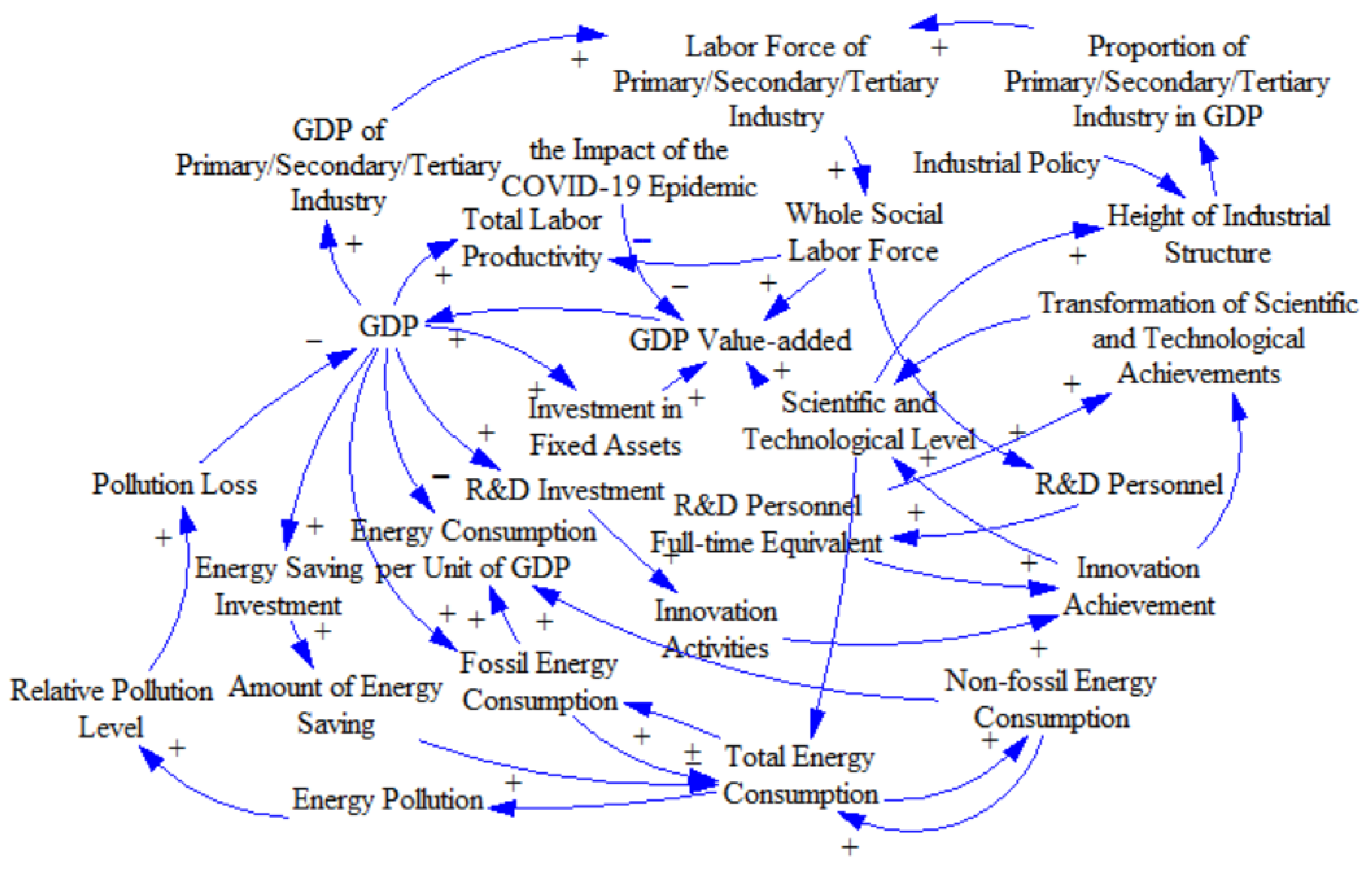
The regional economic subsystem contains elements such as GDP, fixed asset investment, science and technology level, fossil energy consumption, and so on. People generate economic linkages through production, consumption, exchange, distribution, and other activities. This subsystem mainly studies the impact of energy consumption, industrial development, scientific and technological development, labor force change, environmental pollution, and others on the change in economic aggregate. At the same time, the economic subsystem also improves residents’ living standards and environmental quality by providing funds and technologies to the residents’ life subsystem and the ecological protection subsystem. The Vensim PLE 7.3.5 software is used to portray the positive and negative feedback relationships among elements and factors in the regional economic subsystem as well as the causal relationships with other subsystems, and the causal loop diagram of the regional economic subsystem is shown in Figure 1. The arrows in the diagram indicate the driving relationships between variables, meaning that changes in the dependent variable trigger changes in the independent variable.
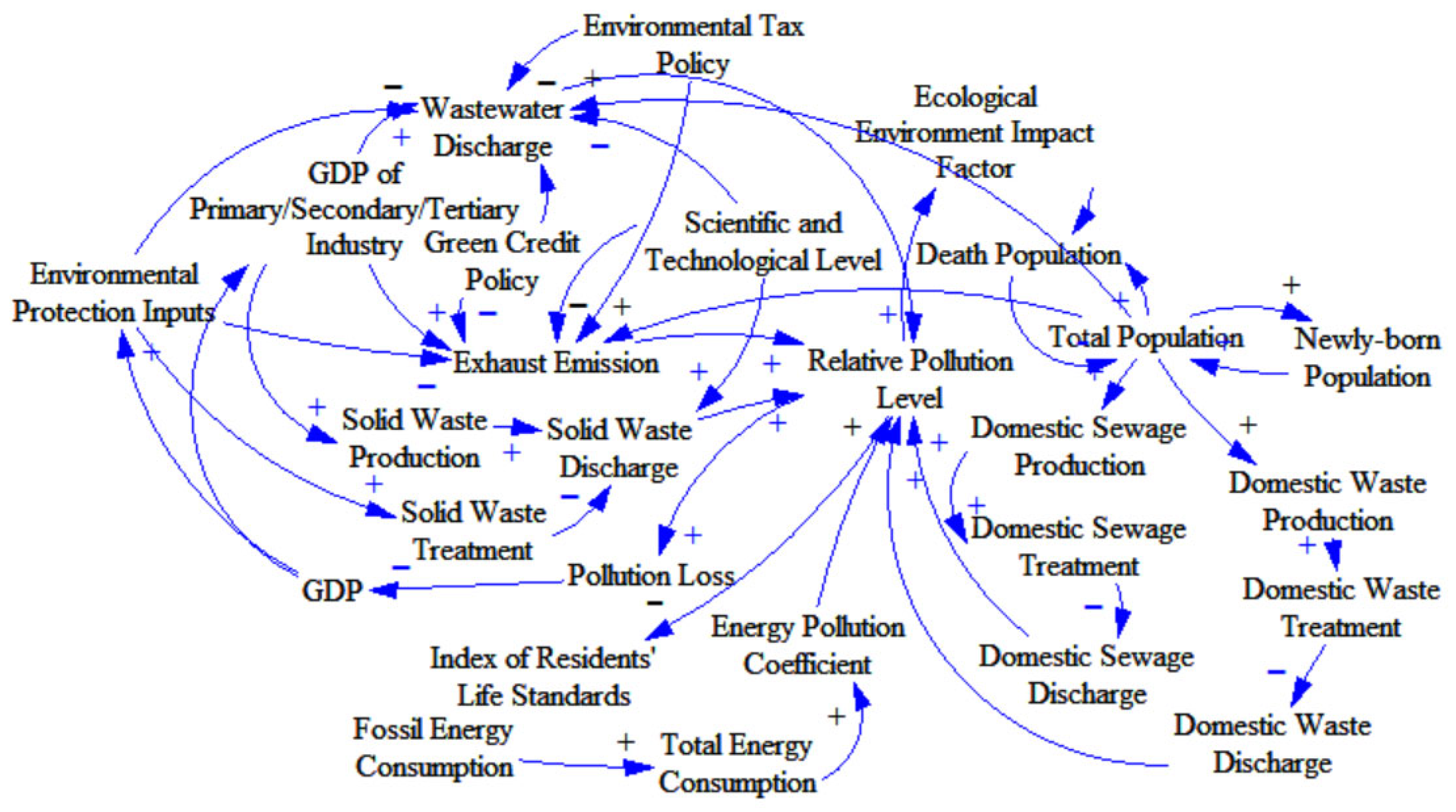
The ecological protection subsystem contains elements such as environmental protection input, gross product, relative pollution level, and others. This subsystem mainly reflects the changes in ecological and environmental carrying level and their impact on socio-economic development and residents’ life standard under specific conditions in economy, technology, and population. The causal loop diagram of the environmental protection subsystem is shown in Figure 2.
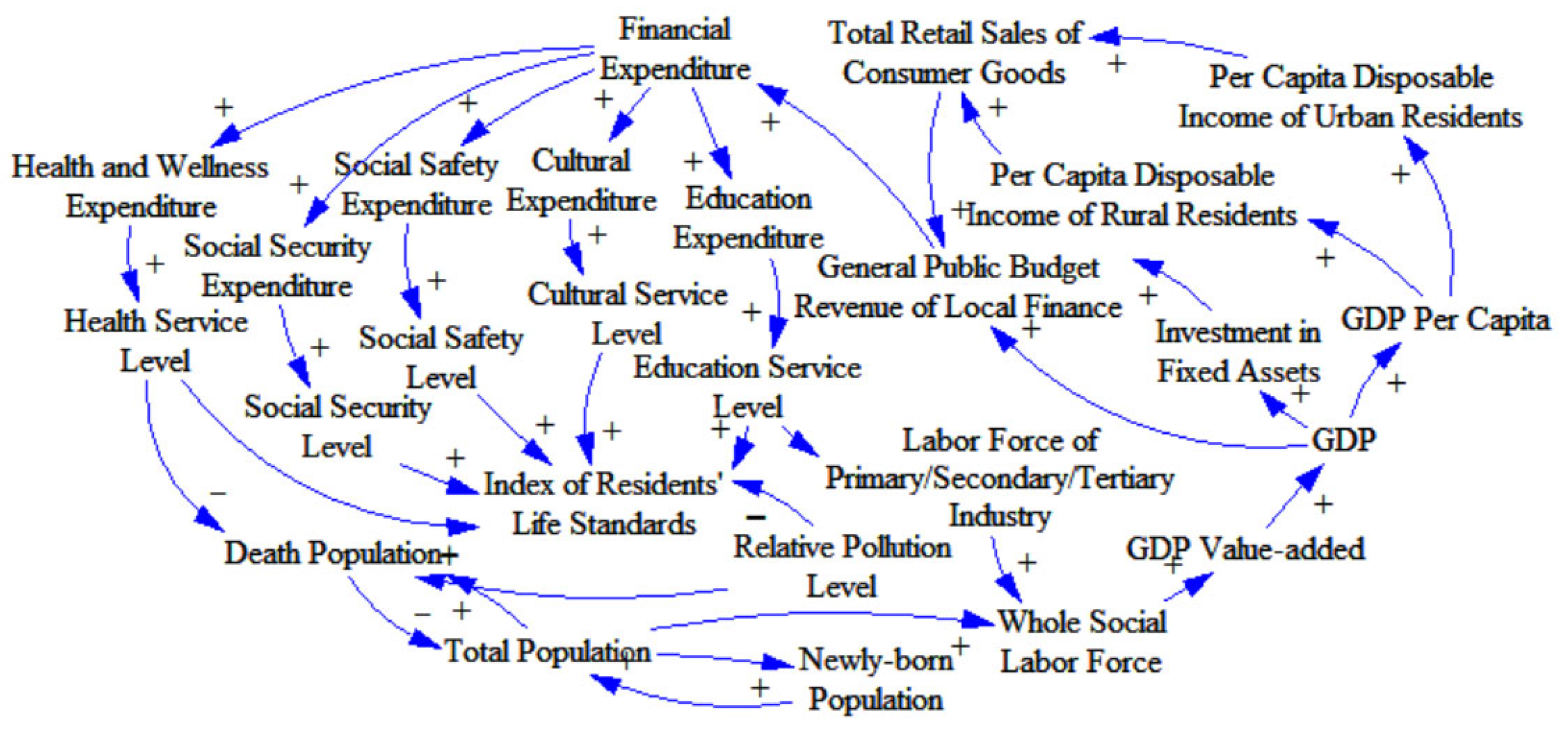
The residents’ life subsystem comprises the elements of the total population, financial expenditure, residents’ life standards, etc. People’s livelihood is the basis of people’s happiness and the foundation of social harmony. The development and improvement of people’s livelihood is the fundamental purpose of social development as well as an important prerequisite for the steady development of the economy, and the residents’ life standards are correspondingly improved while the economic level is enhanced; this subsystem examines the change in population and the conditions in culture, education, safety, health, social security under a certain level of economic level and environmental quality. The causal loop diagram of the residents’ life subsystem is shown in Figure 3.
As the core of the megacity development system, the government regulating subsystem can grasp the general direction of economic development, improve residents’ life standards, and improve the level of environmental pollution by means and functions such as the propagation of ideas and the promulgation and revision of policies, etc. Each element in different subsystems is directly or indirectly influenced by different kinds of policies. Meanwhile, the level of economic development, the degree of residents’ happiness, and the quality of the ecological environment will also have an influence on the government’s governing philosophy. The government regulation subsystem mainly involves various policies that affect the development of the regional economic subsystem, the residents’ life subsystem, and the ecological protection subsystem. See Table 1 for details.

3.1.2. The System Dynamics Model of a Megacity Development System

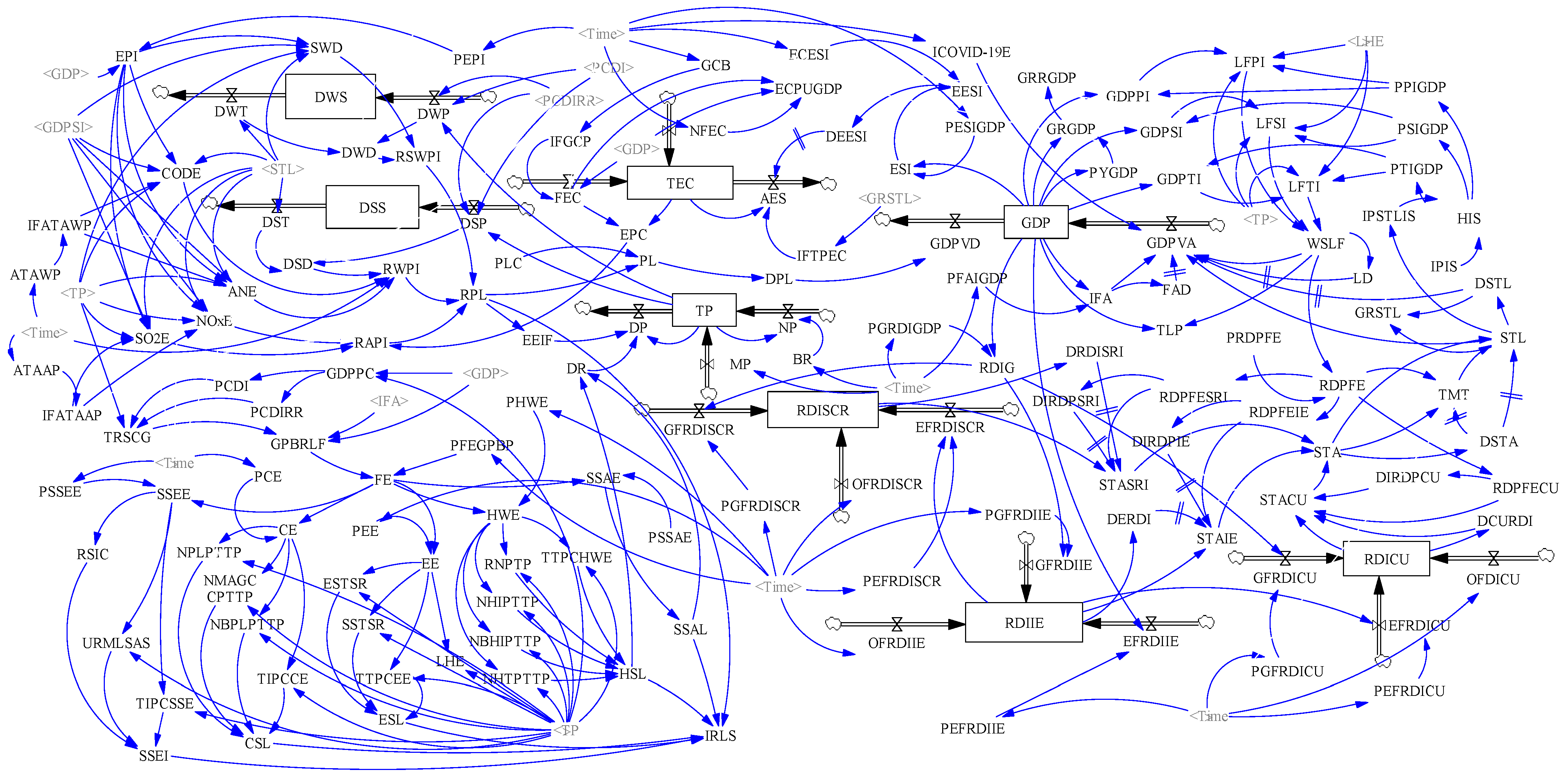
After elaborating the different elements in each subsystem into specific variables, the interrelationships among the variables were complemented according to the causal relationships among the elements in the causal loop diagram, and finally, a flow diagram that can comprehensively portray the system composition, behavior, and elemental interaction mechanisms was obtained, namely, the system dynamics model of megacity development system, as shown in Figure 4.

3.1.3. Model Validation

Following the establishment of the model by obtaining the equations of all variables, the reliability of the model needs to be verified in order to make the internal operation mechanism of the model consistent with the realistic development laws. In this study, we mainly use the methods of intuitive test, structural test, and historical data test to test whether the model can basically reflect the reality of urban development.
(1) Intuitive test and structural test. This study carries out the intuitive test and structural test through further analysis of the literature and data related to urban development and further examination of the model to check whether the set of variables in the model is reasonable, whether the causal relationship between variables is correct, whether the magnitudes match, and whether the equations are properly formulated, etc. The results show that the current model has no problems in the above aspects, so the model passes the intuitive test and structural tests.
(2) Historical data test. The historical data test is mainly used to observe the degree of discrepancy between the model simulation and the real situation, which is generally expressed by the relative error between the real data and the simulation data. Since the system dynamics model of megacity development system is a complex and large model, any small discrepancy between one variable and the real situation may aggravate the error of the output variables through a series of variable transmissions and then lead to the low reliability of the model. Therefore, it is necessary to continuously debug and verify the model by using the real data and control the relative error of each variable data in the model through evolutionary simulation within ±10% to ensure the scientific and reliable nature of the model. Due to space constraints, only the historical data test results of some variables of the Beijing Model are listed in the paper. See Table 2 for details. The results show that the relative errors of the variables are all controlled within ±10%, which indicates that the model fits well, and the trend of the model is consistent with the real data, which can reflect the real process of urban development accurately and can be used for further simulation prediction.

3.2. Research Objects and Data Sources

This paper selects China’s megacities—Beijing, Chengdu, Chongqing, Guangzhou, Shanghai, Shenzhen, and Tianjin as the research objects to explore the high-quality development of China’s megacities. The research time span is from 2009 to 2035, with a simulation step size of 1 year. Among them, 2009–2023 is the period for simulating reality, which is mainly used to verify whether the operation laws of the model are consistent with the actual situation; 2024–2035 is the period for predicting the future. The data involved in the model are mainly collected and sorted out through the statistical yearbooks of the seven cities (2010–2024), “China Statistical Yearbook (2010–2024)”, “China Environmental Statistical Yearbook (2010–2024)”, “China Labor Statistical Yearbook (2010–2024)”, “China Science and Technology Statistical Yearbook (2010–2024)” and other yearbooks. For the missing data in the yearbooks, expert estimation method, regression analysis method, interpolation method, etc., are mainly used to supplement it.

3.3. Formula Calculation

The system dynamics model essentially replaces the continuous model reflecting the system dynamics with a series of discrete models to simulate the continuous system. Therefore, to reflect the dynamic evolution process within the system, it is necessary to use mathematical methods to establish equations for all variables in the flow diagram to reflect the quantitative relationship between variables. There are five basic equations in the system dynamics model: the Level equation (L) is an equation for calculating the stock accumulation value, expressed in the form of integration; the Rate equation (R) is an equation describing the inflow and outflow in the Level equation per unit time, that is, an equation describing the quantitative relationship of flow; the Auxiliary equation (A) is usually an equation describing the quantitative relationship between auxiliary variables introduced to simplify the Rate equation; the Constant equation (C) is mainly used to describe the constants in the model; the Initial value equation (N) is an equation for assigning initial values to stocks and some auxiliary variables at the start of simulation.
Therefore, after qualitatively analyzing the causal relationship and logical relationship of variables in the system to obtain the system dynamics model of megacity development, this study uses methods such as linear regression, formula derivation, curve fitting, and expert estimation (the specific calculation methods for the main variables are detailed in Table A1 in Appendix A) to fit and calculate the quantitative relationship of variables, and the time series data of individual variables are processed by the exponential smoothing method. For nonlinear variables with large changes and irregular changes in the system, table functions are mainly used to represent them.

4. Simulation and Prediction Results of a Megacity Development System

To deeply explore the high-quality development index of China’s megacities, this study extracts and infers the specific values of policy variables in accordance with the spirit of a series of documents, and conducts dynamic simulation and prediction on the evolution of the megacity development system with Beijing, Chengdu, Chongqing, Guangzhou, Shanghai, Shenzhen, and Tianjin as the research objects. For further observation, this study selects model variables such as GDP, GDP growth rate, technological level, total factor productivity, energy consumption per unit GDP, relative pollution level, per capita disposable income, and residents’ living index to conduct a comparative analysis of the development of the seven megacities in terms of economy, science and technology, energy, environment, and people’s livelihood, and takes the “high-quality development index” as the final output variable of the model. Among them, the data from 2009 to 2023 are the simulation of actual data, and the data from 2024 to 2035 are the predicted data.
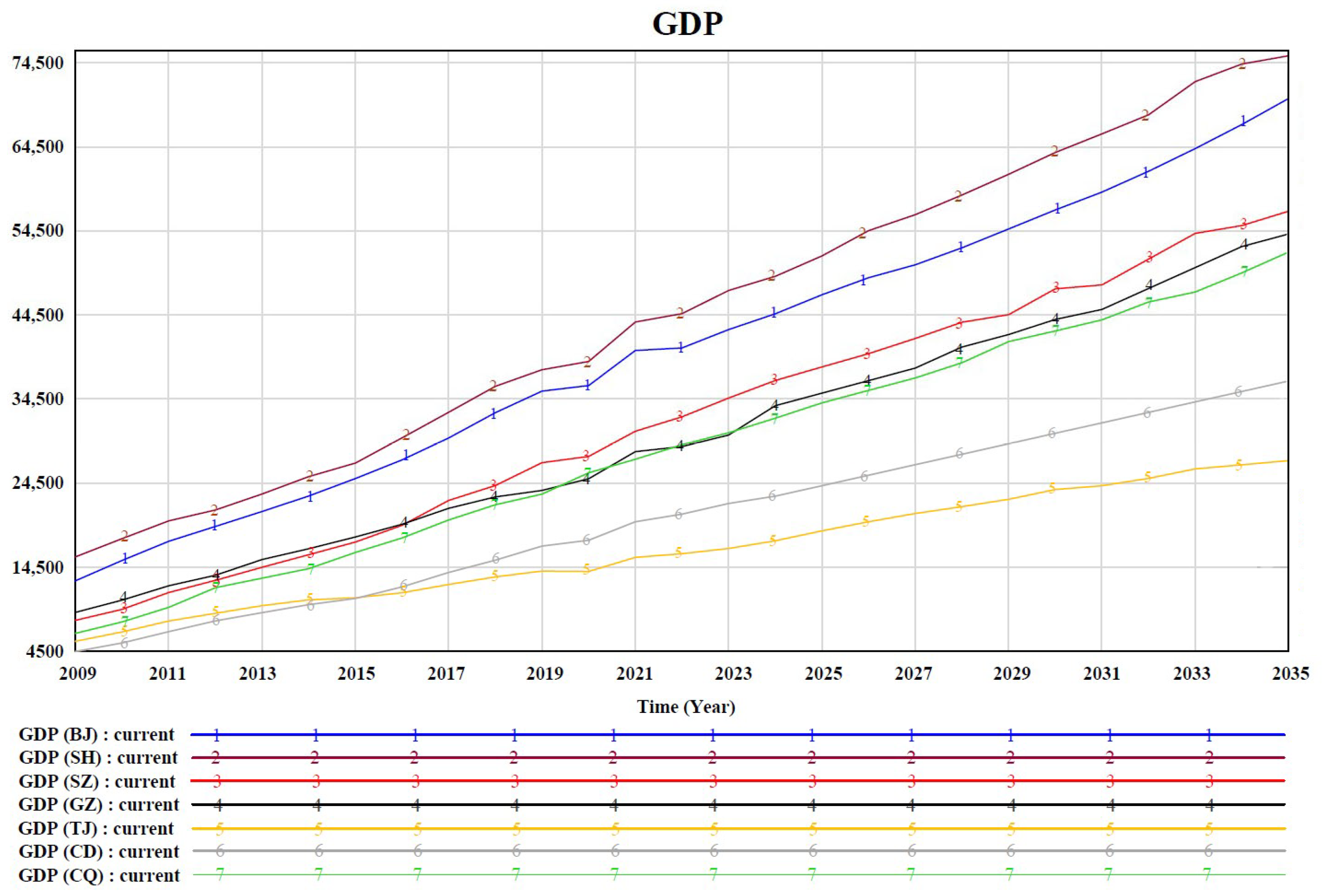
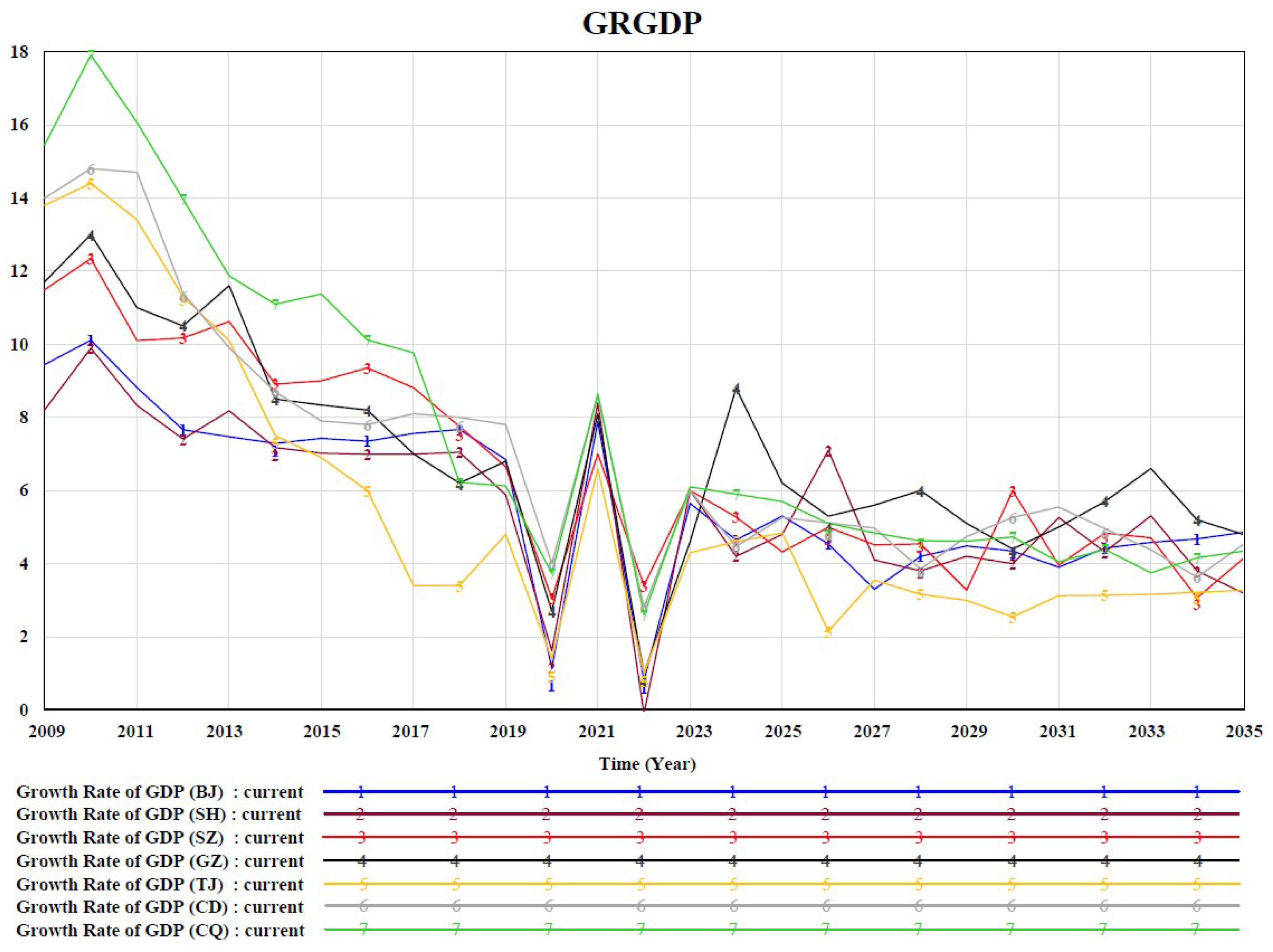
From the perspective of economic development, from 2024 to 2035, there will be significant differences in GDP scale among the seven megacities (As shown in Figure 5). As the core engines of China’s economic development, Shanghai and Beijing will continue to lead the country in total GDP. Relying on its position as a center of finance, shipping, and science and innovation, Shanghai’s total GDP will continue to rank first in the country, while Beijing, driven by the “dual engines” of the new generation of information technology and the medical and health industry, will rank second in total GDP; the cities in the second echelon in terms of total GDP are Shenzhen, Guangzhou, and Chongqing. As a city with a high proportion of digital economy and strategic emerging industries, Shenzhen has strong economic vitality, but there is still a certain gap with Shanghai and Beijing. Chengdu and Tianjin are in the third echelon. With the implementation of the western development policy, Chengdu’s economic development has maintained momentum, and the gap between Chengdu and Tianjin in terms of GDP has gradually widened. In terms of economic growth rate (As shown in Figure 6), it can be found that Guangzhou’s economic growth momentum is strong. The GDP growth rates of Beijing, Chengdu, Chongqing, Shanghai, and Shenzhen are basically stable at around 4%, while Tianjin’s growth rate is relatively lagging due to industrial transformation pressure, with a GDP growth rate of less than 4% and insufficient economic development vitality.
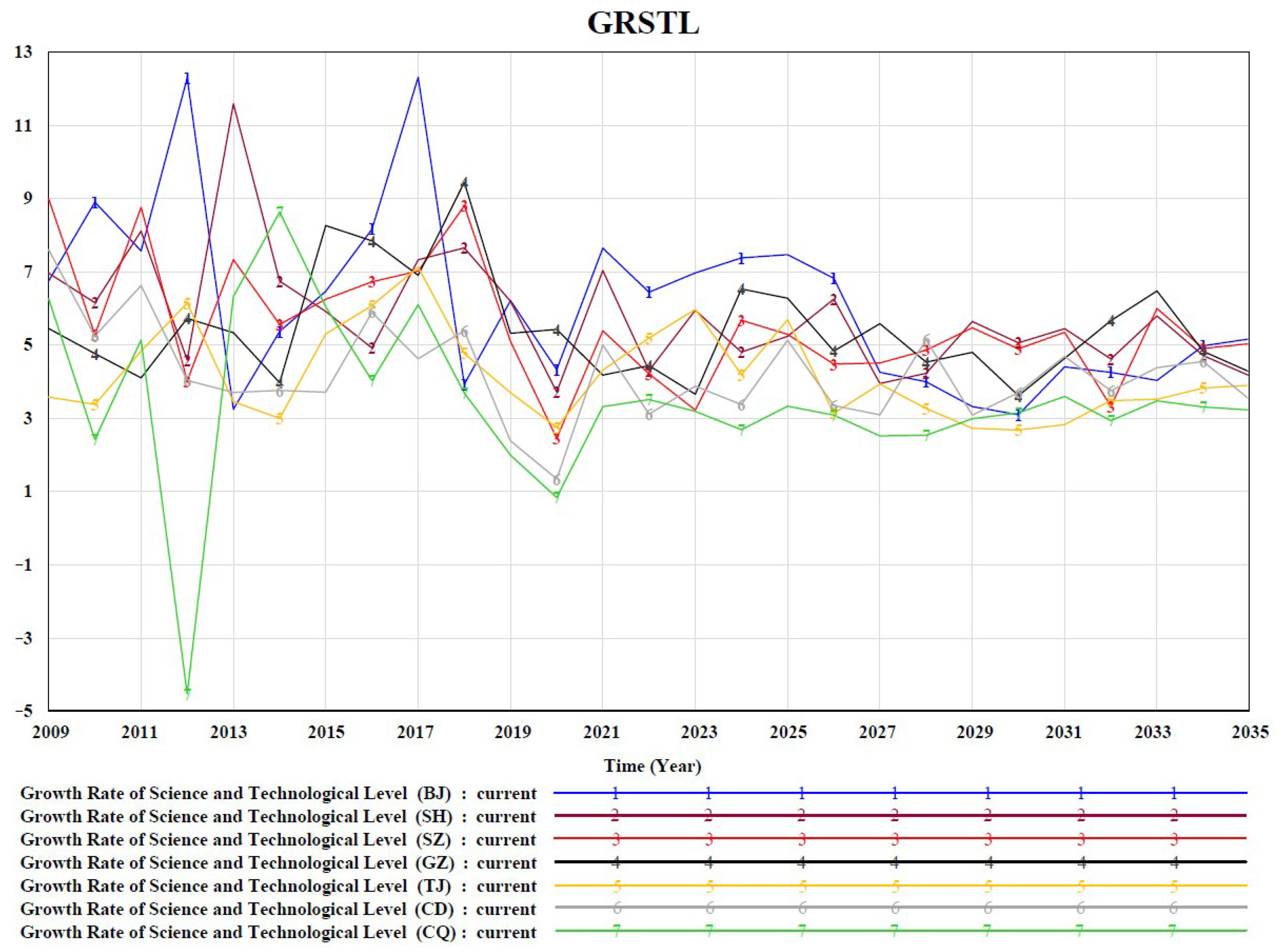
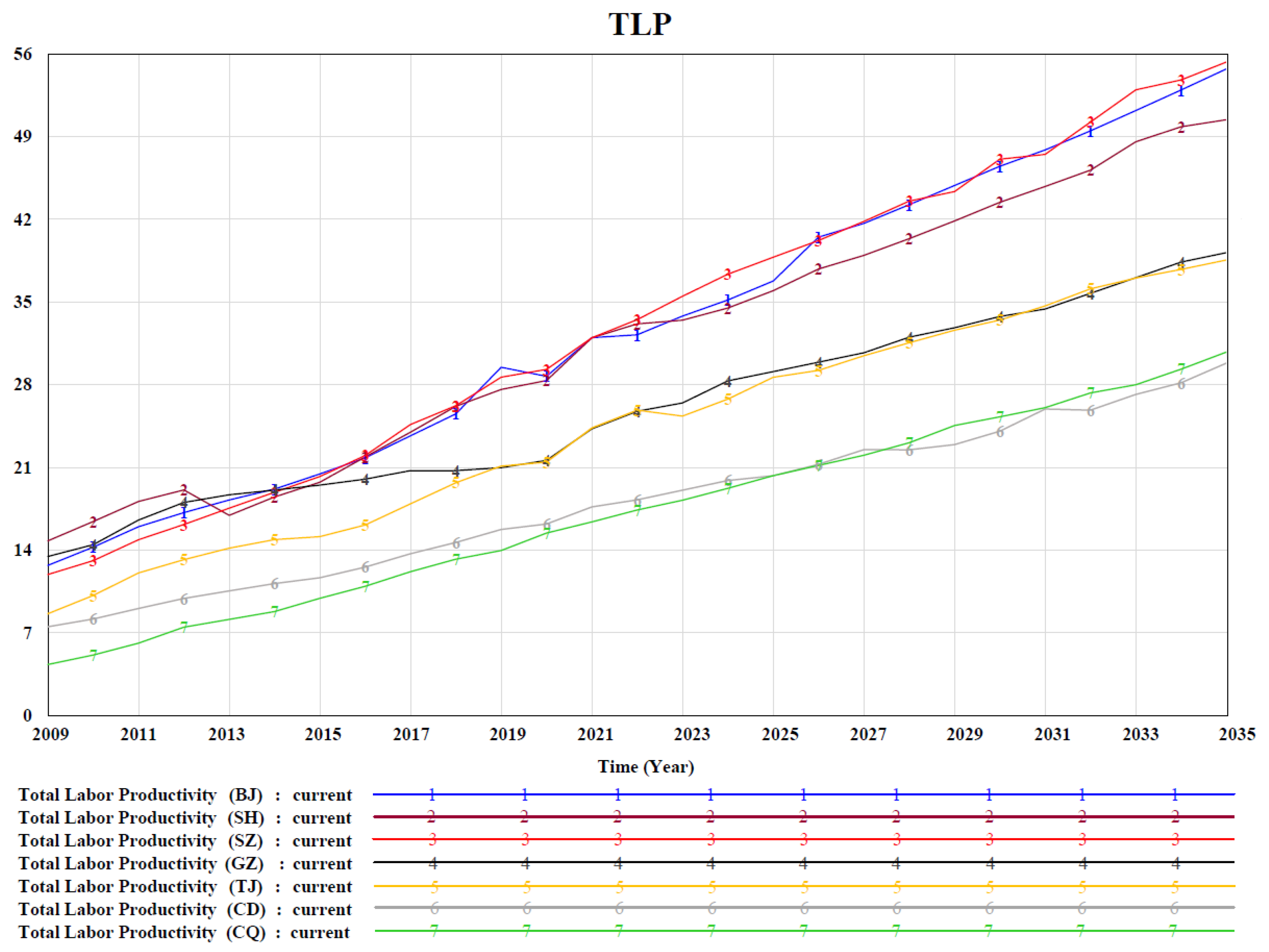
From the perspective of technological development, by 2035, the technological level and total factor productivity of China’s seven megacities will show a differentiated development pattern (As shown in Figure 7). Relying on the construction of the world-leading Zhongguancun Science Park, Beijing will form a global source of original innovation in fields such as artificial intelligence and medical and health care, and the total factor productivity is expected to exceed CNY 500,000 per person, becoming a key hub of the global innovation network (As shown in Figure 8). Shanghai’s digital governance and green technology innovation will form a dual-drive, and the technological level will continue to lead. Shenzhen’s model with enterprises as the main body of innovation will continue to deepen, further building advantages in digital technology and high-end manufacturing fields, and the total factor productivity is expected to exceed CNY 550,000 per person, becoming a global benchmark for intelligent manufacturing. Guangzhou will promote the accelerated agglomeration of the artificial intelligence and biomedicine industries, but still needs to break through the shortcomings of basic research. Tianjin will continue to make efforts in marine science and technology, aerospace fields, and the innovation ecosystem will be gradually optimized, but the process of industrial structure adjustment is relatively slow. Relying on the development of the Western Science City and advanced manufacturing, Chengdu and Chongqing will continue to catch up through regional coordination and characteristic industries, and the labor productivity will approach the level of developed eastern cities.
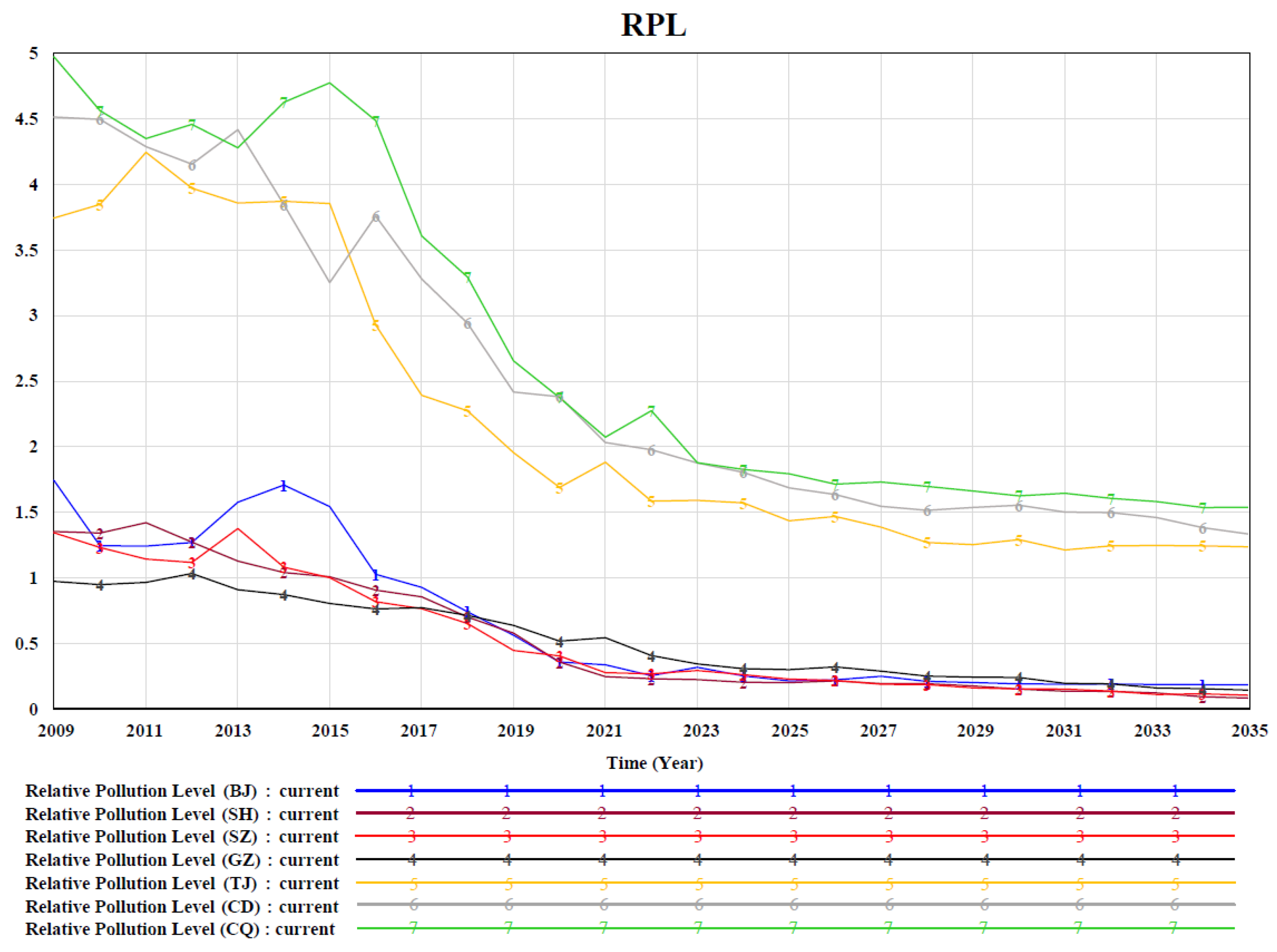
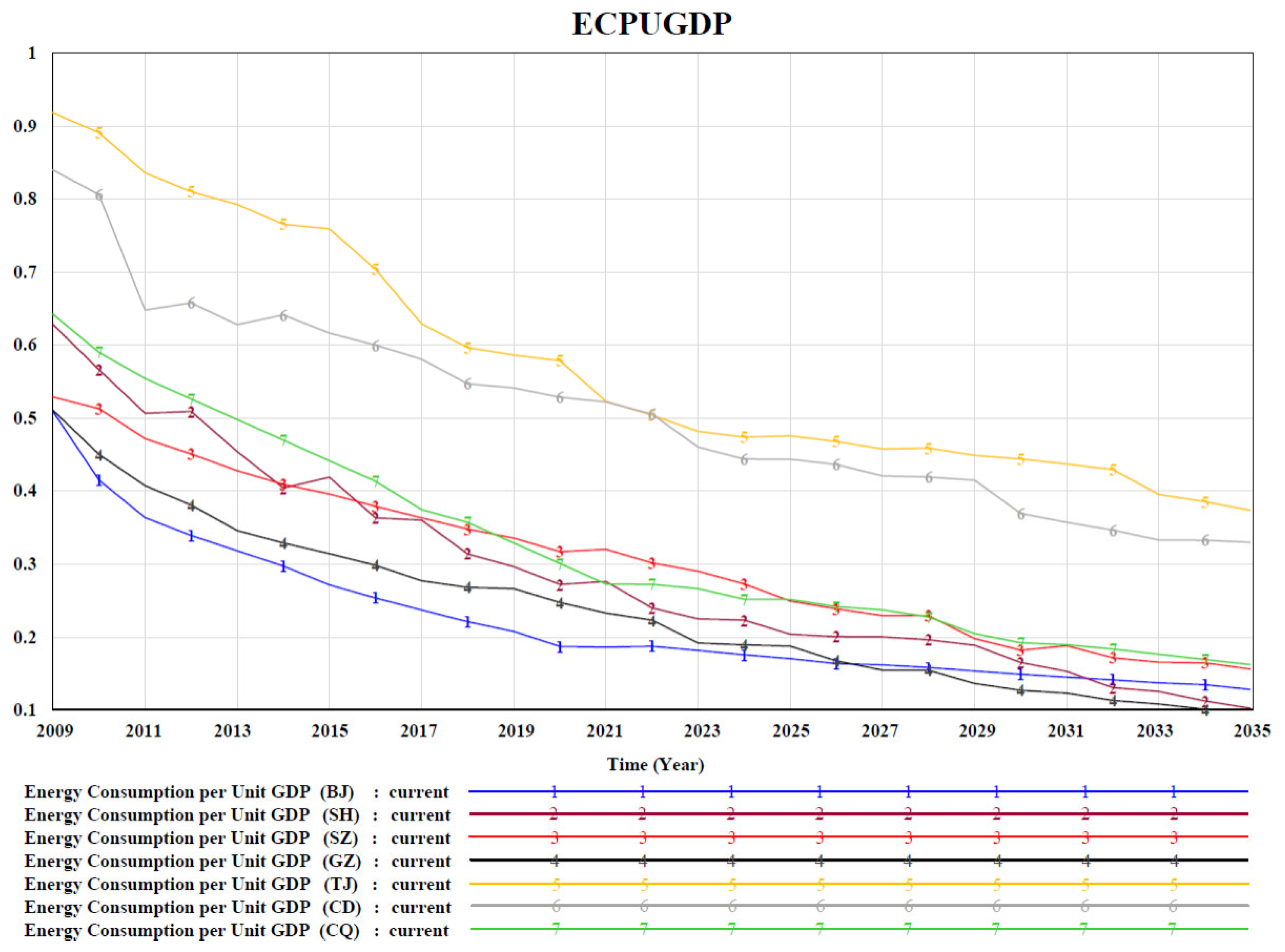
It can be seen from Figure 9 that the relative pollution level of the seven megacities shows an overall downward trend; environmental pollution has been alleviated to a certain extent, air quality has been improved, and the pressure on water resources and land resources has been relieved. Among them, Beijing, Guangzhou, Shanghai, and Shenzhen have relatively low relative pollution levels and are in the first echelon, indicating that these cities have maintained a high degree of attention to pollution prevention and ecological protection in the future and have actively taken measures to maintain and improve environmental quality. However, due to severe early pollution, Chengdu, Chongqing, and Tianjin have relatively high relative pollution levels and still need to strengthen the further control of environmental pollution. At the same time, it can be seen from Figure 10 that the energy consumption per unit GDP of the seven megacities will continue to decline during the prediction period, indicating that with the support and control of energy conservation and environmental protection policies and measures, more industrial enterprises and high-energy-consuming enterprises in various cities have introduced, developed, and used more advanced energy-saving and emission-reduction technologies, the total energy consumption has been effectively controlled, and the energy utilization rate has been further improved. It also indicates that the economic growth of China’s megacities is further less dependent on energy. However, relatively speaking, the energy consumption per unit GDP of Tianjin and Chengdu still has a certain gap with other cities, and it is still necessary to take measures such as accelerating the green transformation of traditional industries and optimizing energy allocation through regional coordination to ensure rapid economic development while achieving a continuous decline in energy consumption intensity.
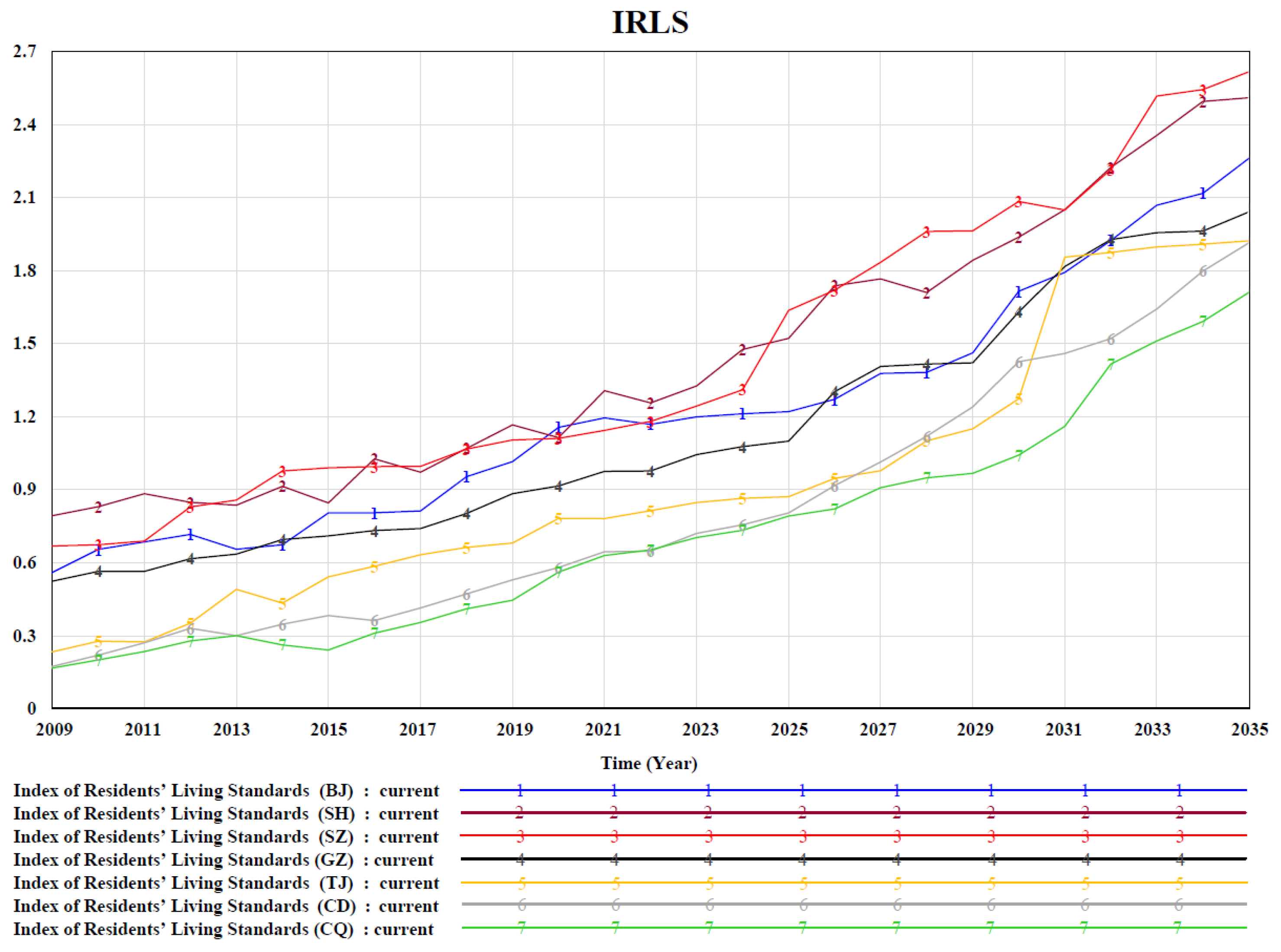
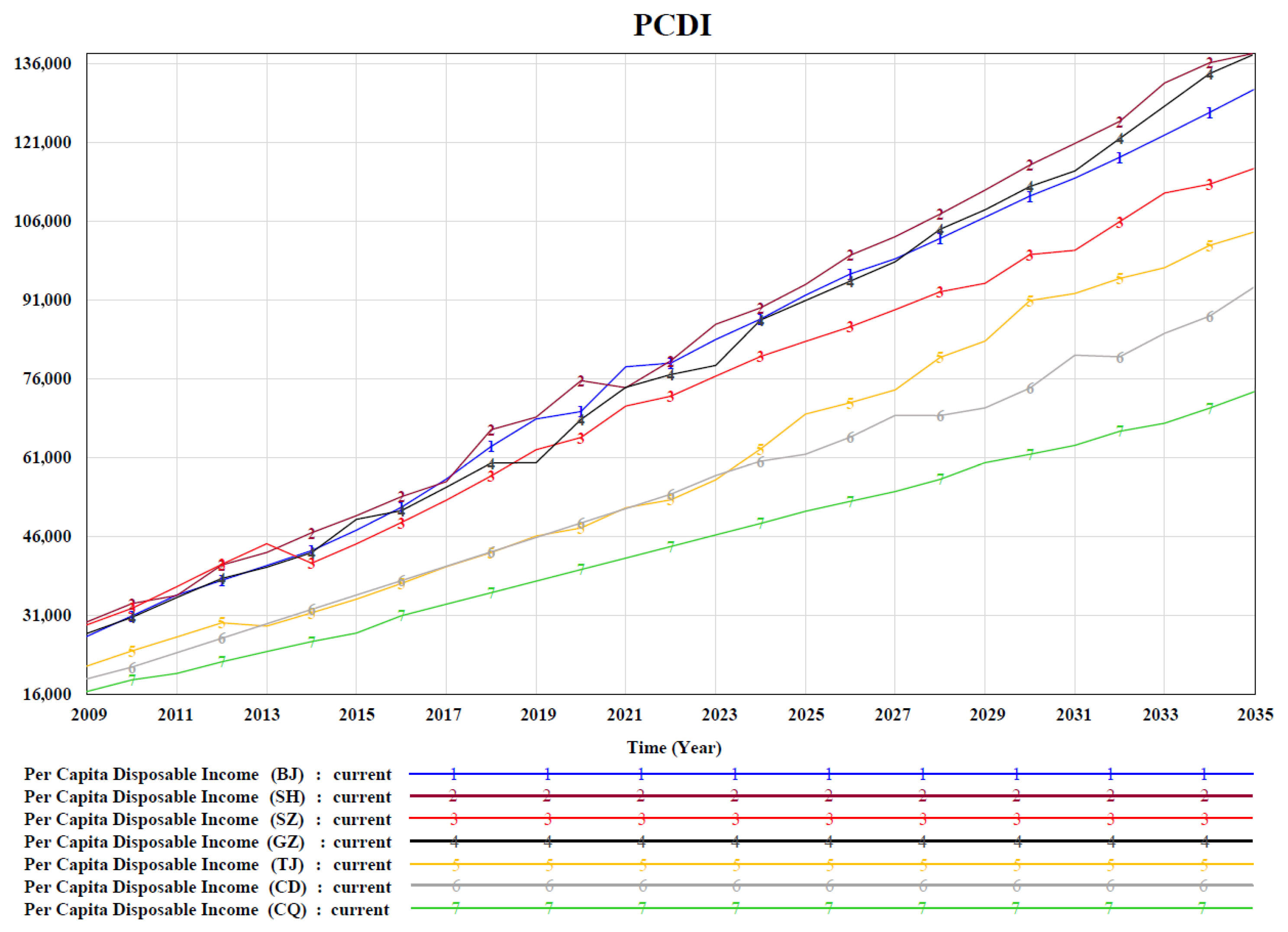
It can be seen from the simulation results (As shown in Figure 11) that with the government’s increasing attention to people’s livelihood, the government’s fiscal expenditure on various public service undertakings has also increased, the residents’ living standards of China’s megacities have been greatly improved, the basic public service system has been further improved, and the process of achieving social equity in China has been promoted; the per capita disposable income of residents (As shown in Figure 12) will grow rapidly between 2024 and 2035, and the continuous improvement of the economic situation has filled residents’ “wallets”; the residents’ living index has fluctuated slightly but shown an overall upward trend. Overall, the people’s livelihood situation of the four megacities of Beijing, Shanghai, Guangzhou, and Shenzhen is still better than that of Tianjin, Chengdu, and Chongqing.
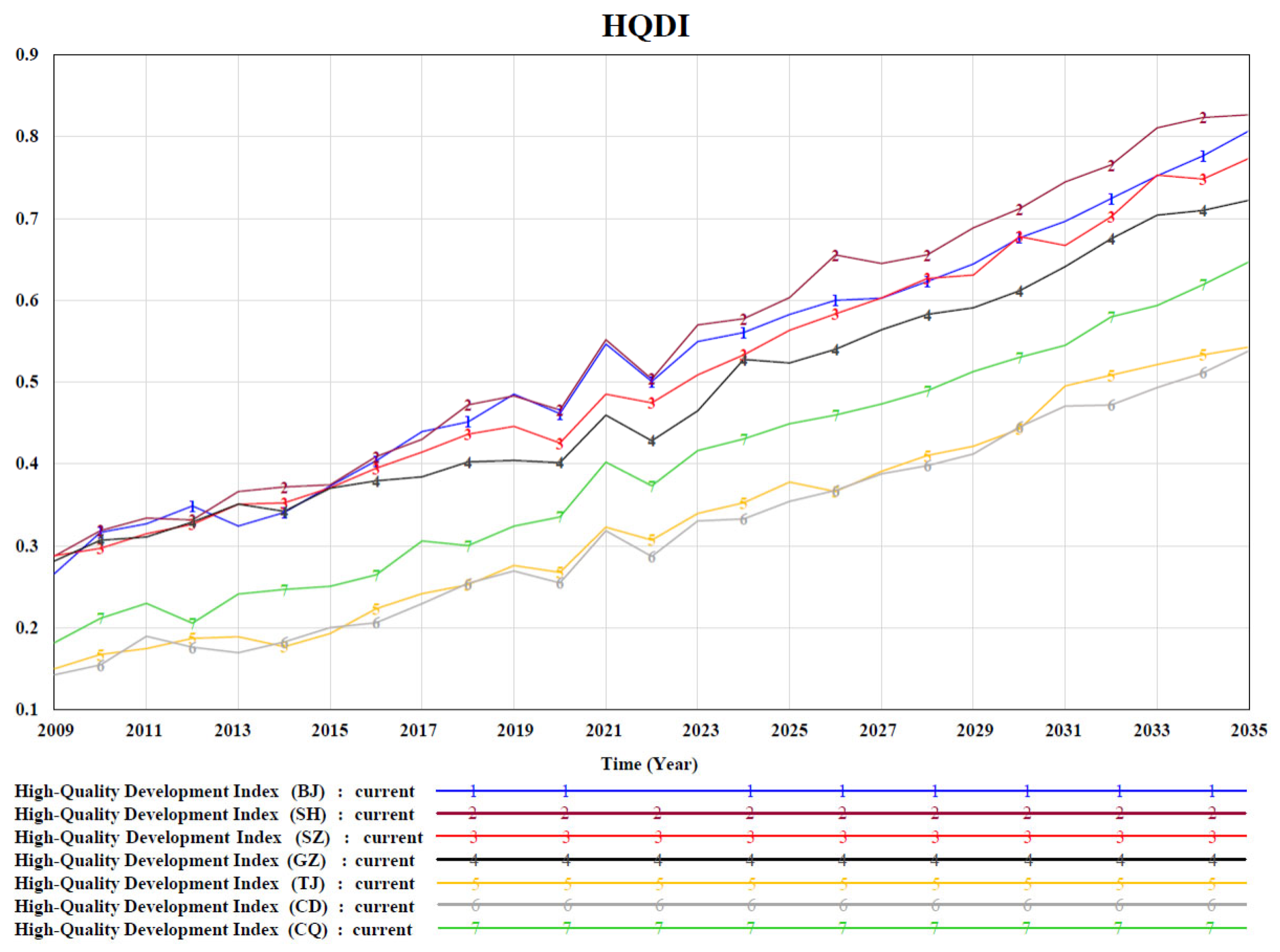
From the change trend of the high-quality development index of the seven cities from 2009 to 2035 shown in Figure 13, Beijing, Chengdu, Chongqing, Guangzhou, Shanghai, Shenzhen, and Tianjin all show a continuous upward development trajectory, but there are obvious differences in their development speed, phased characteristics, and competitive advantages, forming a hierarchical development pattern.
Beijing, Shanghai, and Shenzhen, as the first echelon, have always maintained a leading advantage in high-quality development. Shanghai’s high-quality development index has long been ranked first. Relying on the resource agglomeration effect of its international financial center and scientific and technological innovation center, it continues to make efforts in high-end industrial layout and global resource allocation capacity. Both the in-depth development of the financial service industry and the breakthroughs in hard-core technology fields such as integrated circuits and biomedicine in Zhangjiang Science City have injected strong momentum into its high-quality development, making it further widen the gap with some cities after 2030. Relying on its strategic positioning as the capital, Beijing focuses on the dual-drive of scientific and technological innovation and green development. The original innovation capacity of Zhongguancun Science City is transformed into industrial upgrading momentum, and the green and low-carbon construction of the urban sub-center optimizes the development quality. The high-quality development index is steadily rising, gradually narrowing the gap with Shanghai. As an innovation benchmark city, Shenzhen takes enterprise innovation as the core driving force, seizes opportunities in fields such as artificial intelligence, new energy vehicles, and digital economy. The high-quality development index curve has always maintained a high growth rate, especially accelerating after 2025, reflecting the strong support of scientific and technological innovation for high-quality development.
Guangzhou and Chongqing form the second echelon, showing a steady development trend. Relying on its position as a core engine of the Guangdong–Hong Kong–Macao Greater Bay Area, Guangzhou promotes the in-depth integration of the digital economy and the real economy. The construction of Nansha Science City has accelerated the agglomeration of emerging industries. Its high-quality development index curve has risen steadily. Although it has not reached the height of Beijing, Shanghai, and Shenzhen, it has continued to make breakthroughs in high-end manufacturing and modern service industries relying on a solid industrial foundation and regional coordination advantages, and the development quality has been steadily improved. Based on the positioning of “intelligent manufacturing town” and “smart city”, Chongqing promotes the development of trillion-level industrial clusters such as intelligent connected new energy vehicles and the new generation of electronic information manufacturing industry, improves the level of opening-up relying on the New International Land–Sea Trade Corridor in the West, and promotes the coordinated development of ecological governance and industrial upgrading. The high-quality development index has risen sharply in the later period, demonstrating the development resilience and potential of western cities under the support of national strategies.
Chengdu and Tianjin, as the third echelon, show a strong catching-up momentum. The construction of the Chengdu–Chongqing Twin-City Economic Circle has injected new development momentum into Chengdu. Guided by the construction of a park city demonstration area, Chengdu has achieved clustered development in industries such as electronic information and biomedicine, and at the same time coordinated urban–rural integration to improve development balance. Its high-quality development index has continued to grow rapidly from a relatively low level in the early stage, especially accelerating after 2025. Restricted by the traditional industrial structure in the early stage, the growth rate of Tianjin’s high-quality development index is relatively flat. However, with the industrial transformation of the Binhai New Area and the layout of marine economy and new energy industries, the slope of the curve has increased significantly in the later period, releasing development potential through the transformation of old and new kinetic energy and gradually narrowing the gap with the top cities.
Overall, the high-quality development of the seven cities presents a pattern of “echelon advancement and coordinated progress”. Relying on first-mover advantages and resource endowments, Beijing, Shanghai, and Shenzhen continue to make breakthroughs in high-end links of the global industrial chain and cutting-edge fields of scientific and technological innovation, leading the direction of national high-quality development; Guangzhou and Tianjin rely on regional strategies and industrial foundations to achieve steady improvement through structural optimization; Chengdu and Chongqing activate endogenous motivation with the help of national regional coordinated development strategies to narrow regional development gaps. This differentiated development not only reflects the strategic choices of each city based on its own positioning, but also reflects the process of China’s megacities promoting the overall improvement of high-quality development index through industrial upgrading, scientific and technological innovation, regional coordination and other paths under different development stages and resource conditions, providing diversified demonstration samples for national urban development and laying a solid foundation for building a modern urban system with coordinated development.

5. Analysis of High-Quality Coordinated Development of Megacities

Coordinated development is the evaluation criterion for high-quality development in the new era. The high-quality development index measured in the previous research reflects the degree of high-quality development of megacities, but cannot quantify coordinated development. In the system dynamics model, the government regulating subsystem is constructed as a regulatory and feedback module. It directly influences the three substantive subsystems—economy, environment, and people’s livelihood—through decision variables, fund allocation, and institutional rules, rather than serving as an independent, directly quantifiable “output” dimension. Therefore, in calculating the coupling coordination degree, a process of logical mapping and indicator reconstruction was undertaken: the regional economic subsystem from the system dynamics model was decoupled into two separate integrated indicators for the coupling coordination model—economic development and technological progress. This approach is justified by the understanding that technology and innovation are not only endogenous drivers of economic growth but also critical enablers for enhancing environmental governance efficiency and the quality of livelihood services, thus necessitating independent evaluation of their pathways and contributions. Concurrently, the environment and people’s livelihood subsystems maintain a direct correspondence between the two models, serving as the bottom-line constraints and ultimate goals of development. The performance of the policy subsystem is consequently not represented by a standalone indicator but is indirectly and comprehensively reflected through the composite status and synergistic level of the four indicators: economic development, technological progress, environmental quality, and people’s livelihood security. Therefore, this paper selects the coupling coordination index to reflect the coordinated development of the four subsystems: economic development, technological progress, environmental quality, and people’s livelihood security. On the basis of existing research and combined with the simulation results of the aforementioned system dynamics model of megacity development, this paper quantifies and predicts the coordination degree of the high-quality development index of China’s megacities from 2009 to 2035.
To measure the coupling coordination index, this paper selects different indicators to represent each subsystem based on existing research findings and the functional roles of core dimensions within the subsystems as analyzed earlier. The specific indicators are as follows.
In the economic development subsystem, indicators are divided into two groups: those measuring economic performance (per capita GDP, per capita disposable income, the proportion of fiscal revenue in GDP, and per capita fixed asset investment) and those reflecting economic structure (the proportion of the primary industry in GDP, the proportion of the secondary industry in GDP, and the proportion of the tertiary industry in GDP), ensuring both output efficiency and industrial composition are captured.
For the technological development subsystem, indicators distinguish between innovation environment (scientific and technological expenditure, employees in scientific research and technical service industries, the number of college students in school, and the number of in-service teachers in higher education) and innovation output (the number of patent authorizations), reflecting both input conditions and result-based technological advancement.
Within the environmental quality subsystem, energy intensity (energy consumption per unit GDP) represents resource efficiency, while relative pollution level reflects environmental pressure, together covering both resource use and pollution outcomes.
In the people’s livelihood security subsystem, income and living conditions (per capita disposable income and the index of residents’ living standards) are selected as direct proxies for material well-being and quality of life.
This structured grouping ensures that each subsystem is evaluated through both input (condition indicators) and output (performance metrics), facilitating a comprehensive and balanced assessment of coupling coordination.
The indicator system comprises both positive and negative indicators [39]. A higher value for a positive indicator reflects better performance, whereas a lower value is more desirable for a negative indicator. To eliminate differences in dimension, scale, and characteristics among the indicators, the range standardization method was applied to render the original data dimensionless [40].
Positive indicators : y i j = ( x i j min x i ) / ( max x i min x i )
Negative indicators : y i j = ( max x i x i j ) / ( max x i min x i )
For determining indicator weights, the entropy method was adopted for objective weighting [41]. This approach assesses the relative importance of each indicator based on the information entropy inherent in the data [42], thereby effectively mitigating the influence of subjective judgment on weight allocation [43]. After performing dimensionless processing on the corresponding indicators, we obtained the standardized matrix Y m × n .
Y m × n = y 11 y 12 y 1 n y 21 y 22 y 2 n y m 1 y m 2 y mn m × n
To objectively determine the weights of each indicator, we employ the entropy weight method for calculation. The specific calculation methods are detailed in Equations (4)–(6), where f i j represents the proportion of indicator i for city j; E i denotes the information entropy of indicator i; w i signifies the weight of each indicator.
f ij = y ij j = 1 n y ij
E i = 1 ln n j = 1 n f i j ln f i j
w i = 1 E i m i = 1 m E i
Subsequently, the comprehensive development indices for the four subsystems were calculated by integrating the entropy weights and the standardized indicator values [44]. Specifically, the levels of socio-economic development, resource utilization efficiency, and environmental quality were derived through weighted aggregation.
O t , r = i = 1 o w i o   ×   y i j o
P t , r = i = 1 p w i p   ×   y i j p
Q t , r = i = 1 q w i q   ×   y i j q
R t , r = i = 1 r w i r   ×   y i j r
To quantitatively assess the synergistic interactions among subsystems within the high-quality development system of megacities, this study introduces the coupling coordination degree (CCD) index as a measurement tool [45]. This index effectively captures the coordinated development status among the four key dimensions—economic development, technological progress, environmental quality, and social welfare—over a specific period. Following the established procedures of the coupling coordination degree model [46], the CCD values were systematically calculated.
C t , r = 4 × O ( t , r ) × P ( t , r ) × Q ( t , r ) × R ( t , r ) O t , r + P t , r + Q t , r + R ( t , r ) 4 1 / 4
T t , r = α × O t , r + β × P t , r + δ × Q t , r + θ × R ( t , r )
C C I = T ( t , r ) × C ( t , r )
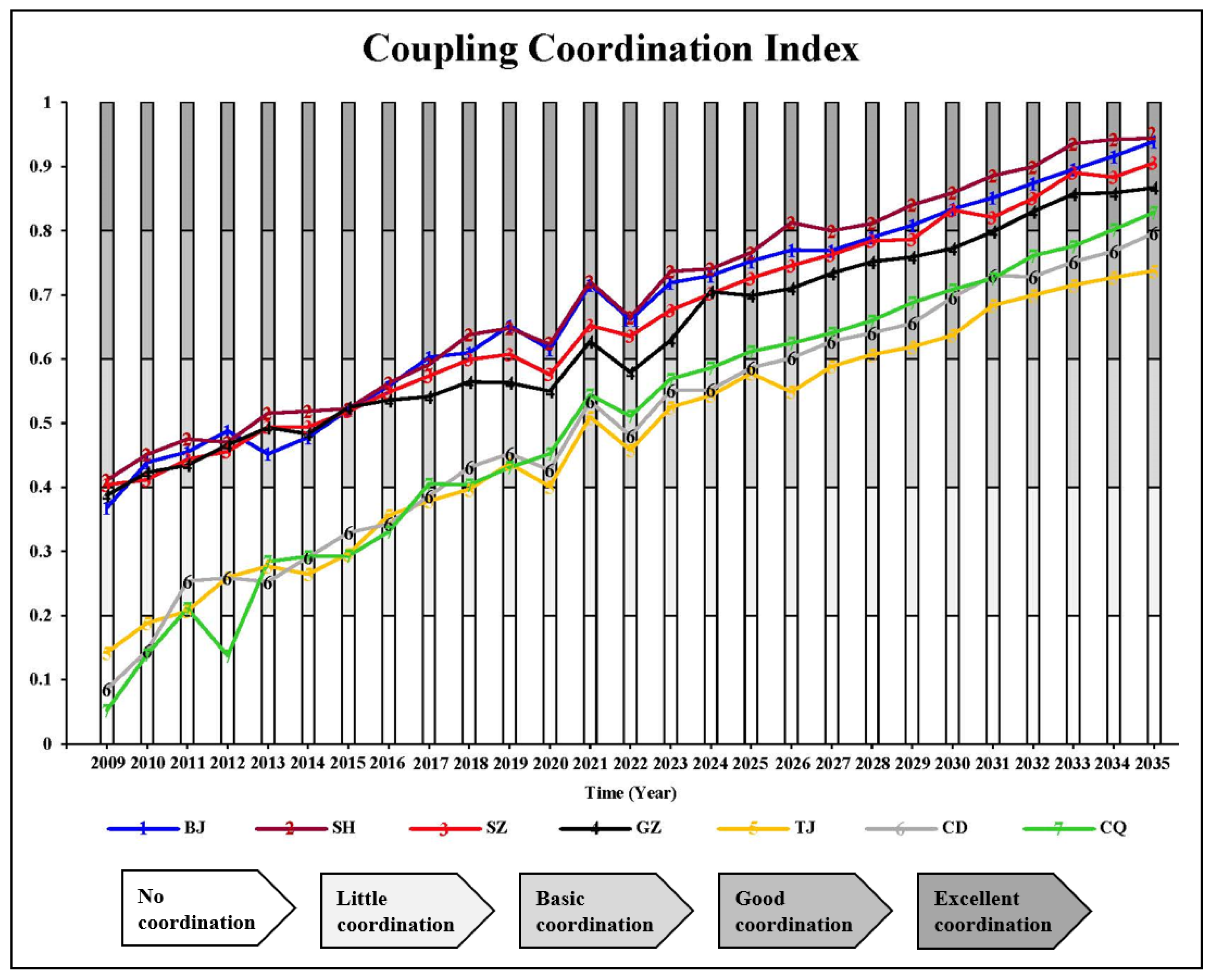
Here, C t , r denotes the coordination degree of high-quality development in China’s megacities, scaled between 0 and 1, with adjustment coefficient k = 4 for the four subsystems studied. T t , r represents the comprehensive development index, weighted by coefficients α , β , δ , θ —each set to 1/4 following an equal-weight approach [47]—subject to 0 < α < 1 , 0 < β < 1 , 0 < γ < 1 , 0 < θ < 1   and α + β + δ + θ = 1 . The resulting CCI (Equation (13)) quantifies the holistic coordinated development across the subsystems. Table 3 presents the classification criteria of the CCI, with the numerical values for high-quality coordinated development of different megacities shown in Figure 14.
From the change trend of the coupling coordination index of the seven cities from 2009 to 2035, the high-quality coordinated development level of Beijing, Chengdu, Chongqing, Guangzhou, Shanghai, Shenzhen, and Tianjin shows an overall upward trend. Based on the development foundation, coordination efficiency, and improvement speed, it can be divided into two echelons.
Shanghai, Beijing, Shenzhen, and Guangzhou form the first echelon, with significantly leading coordinated development levels. Relying on the advantages of international resource allocation and industrial innovation, Shanghai has a profound early coordination foundation and will accelerate into the “high-quality coordination” stage after 2025, with a high degree of coordination among economic, technological, environmental, people’s livelihood and other links. Relying on its strategic functions as the capital, Beijing promotes the integration of innovation, green development, and people’s livelihood through policy guidance. The growth rate of the coordination index has accelerated after 2020, and it will approach Shanghai’s high-quality coordination level in the later period. With scientific and technological innovation as the core, Shenzhen leverages multi-link linkage, with a rapid growth rate in the early stage and a continuous high climb in the later period, showing outstanding advantages in the coupling of science, technology and economy, and the coordination of ecology and people’s livelihood. Relying on the construction of the Guangdong–Hong Kong–Macao Greater Bay Area, Guangzhou accelerates industrial upgrading and regional coordination, and the coordination index rises steadily, moving from “basic coordination” to “high-quality coordination”, forming a leading echelon together with Shanghai, Beijing, and Shenzhen.
Chengdu, Chongqing, and Tianjin form the second echelon, showing a strong catching-up momentum. Chengdu’s coordination level was relatively low in the early stage, in the “serious imbalance” stage. With the construction of the Chengdu–Chongqing Twin-City Economic Circle, the coordination effect of government regulation, economic development, science and technology, and environment has been released, the index growth has accelerated, and it will transition to “high-quality coordination” in the later period. Chongqing had a weak initial foundation. Through the coordinated efforts of industrial upgrading, ecological governance, and people’s livelihood investment, especially breakthroughs in the field of intelligent industry and green transformation, the coupling coordination index has continued to rise, with a significant catching-up momentum in the later period. Restricted by the industrial structure in the early stage, Tianjin’s coordinated development was relatively slow. In the later period, through the green transformation of traditional industries and strengthening the linkage between innovation and people’s livelihood, the index slope increased, and the coordination level continued to rise.
Overall, the first echelon cities, relying on resource agglomeration and strategic leading advantages, take the lead in multi-link coordination and set a benchmark for high-quality coordinated development; the second echelon cities, relying on regional strategies and industrial transformation, accelerate the release of development potential and narrow the gap with leading cities. In the future, all cities need to further strengthen the in-depth coupling of economy–technology–ecology–people’s livelihood, the first echelon should give play to the radiation-driven role, and the second echelon should deepen collaborative innovation, so as to jointly promote the high-quality coordinated development of megacities towards a more balanced and efficient direction and build a development pattern of complementary advantages and coordinated progress.

6. Discussion

Based on the above findings, this paper first puts forward targeted suggestions for promoting the high-quality development of China’s megacities, and further explores the broader implications of China’s practice for global urban development policies and its reference value for other countries, so as to provide insights for the sustainable development of megacities around the world.

6.1. Suggestions for High-Quality Development of China’s Megacities

In view of the echelon differences in high-quality development, the first echelon cities (Beijing, Shanghai, Shenzhen) should be based on the high-end of the global industrial chain and deepen the integration of scientific and technological innovation and industry [48]; Shanghai should consolidate its hard-core technological advantages relying on Zhangjiang Science City, Beijing should strengthen the transformation of original innovation in Zhongguancun, and Shenzhen should focus on cutting-edge fields such as artificial intelligence to build a global benchmark. The second and third echelon cities need to leverage national strategies: Guangzhou should deepen industrial coordination in the Guangdong–Hong Kong–Macao Greater Bay Area and accelerate the integration of the digital economy and the real economy [49]; Chongqing and Chengdu should rely on the Chengdu–Chongqing Twin-City Economic Circle to strengthen the construction of industrial clusters in electronic information and biomedicine and improve the level of urban–rural integration; Tianjin should accelerate the industrial transformation of the Binhai New Area, tap the potential of the marine economy and new energy, and narrow the gap through the transformation of old and new kinetic energy.
Deepen the coordinated development of the system and improve the efficiency of link coupling. All cities need to take coordinated development as the core and strengthen the in-depth linkage of government regulation, economy, science and technology, environment, and people’s livelihood [50]. The first echelon cities (Shanghai, Beijing, Shenzhen, Guangzhou) should give play to the benchmark role of multi-link coordination, such as Shanghai optimizing resource allocation to promote the coordination of economy, science and technology, and ecology, and Beijing promoting the integration of innovation, green development, and people’s livelihood through policy guidance. The second echelon cities (Chengdu, Chongqing, Tianjin) should accelerate the connection between industrial upgrading and ecological governance and people’s livelihood security: Chengdu should coordinate industry and environment with the construction of a park city [51], Chongqing should drive the coordination of ecology and people’s livelihood through the upgrading of intelligent industry [52], and Tianjin should strengthen the linkage between innovation and people’s livelihood with the help of the green transformation of traditional industries, so as to jointly improve the system coupling coordination degree [53].
Strengthen regional strategic linkage and build a coordinated development pattern [54]. Relying on national regional strategies, deepen urban agglomeration coordination. In the Guangdong–Hong Kong–Macao Greater Bay Area, Guangzhou, Shenzhen, and Hong Kong should strengthen scientific and technological industrial cooperation and jointly build an international science and technology innovation center [55]; in the Chengdu–Chongqing Twin-City Economic Circle, Chengdu and Chongqing should strengthen industrial complementarity and ecological co-governance; in the Beijing–Tianjin–Hebei region, Beijing should drive the industrial transformation of cities such as Tianjin to form a regional coordination network [56], solve development bottlenecks through urban agglomeration linkage, and improve the efficiency of high-quality development of megacities nationwide.
Improve classified policy support and accurately optimize the development path. The government should formulate differentiated policies according to the characteristics of urban echelons [57]: for the leading echelon, increase support for gathering global innovative resources to help them participate in international competition; for the catching-up echelon, give inclination in industrial upgrading, scientific and technological innovation, ecological governance [58], etc., such as supporting the construction of industrial clusters in Chengdu and Chongqing, and supporting special policies for the green transformation of traditional industries in Tianjin. Through precise policy guidance, promote cities to give full play to their strengths and make up for their weaknesses, achieve the transformation of quality, efficiency, and motivation, improve the modernization level of urban governance, and consolidate the foundation of the national new urbanization strategy.

6.2. Broader Implications for Global Urban Development and Reference Value for Other Countries

China’s practice in promoting the high-quality development of megacities provides important reference for global urban development, especially for countries facing challenges such as unbalanced urban development, insufficient industrial-technological integration, and weak regional coordination. The specific implications are as follows.
Firstly, the gradient development strategy based on urban endowment differences has universal reference significance for the coordinated development of global urban agglomerations. Many countries in the world, whether developed or developing, have obvious development gaps between core megacities and surrounding cities [59]. For developing countries experiencing rapid urbanization (such as India, Brazil, etc.) [60], which are facing problems such as over-concentration of resources in a single core city and backward development of surrounding areas, China’s experience of positioning different echelon cities according to their resource endowments and promoting complementary advantages can help them avoid the risk of unbalanced urban development [61]. For example, core cities can focus on high-end industrial clusters and innovative resource agglomeration, while surrounding cities can develop supporting industries based on their own advantages, forming a rational division of labor and cooperative development pattern. For developed countries with mature urban systems (such as the United States, Germany, etc.), the gradient development concept can provide ideas for the upgrading and transformation of declining industrial cities in urban agglomerations, helping to realize the rebalancing of urban development within the agglomeration.
Secondly, the system of coordinated development focusing on multi-linkage of economy, technology, ecology and people’s livelihood provides a new path for improving global urban governance efficiency. With the deepening of global urbanization, problems such as environmental pollution, traffic congestion, and inadequate livelihood security have become common challenges faced by megacities around the world [62]. China’s practice of taking coordinated development as the core and strengthening the linkage of multiple fields such as government regulation, economy, science and technology, and environment shows that breaking the fragmented governance model and promoting integrated governance is an effective way to solve urban problems [63,64]. For developing countries with relatively weak urban governance capacity, they can learn from China’s experience of taking government guidance as the lead and promoting the linkage of multiple subjects and fields, so as to improve the systematicness and effectiveness of urban governance. For developed countries, the integration of innovation, green development and people’s livelihood in China’s first-tier cities can provide reference for their urban renewal and sustainable development, helping to realize the organic combination of urban economic development and social and ecological benefits.
Thirdly, the regional strategic linkage model based on urban agglomerations provides a solution for breaking the development bottleneck of global megacities. Many megacities in the world are restricted by factors such as limited land resources and environmental carrying capacity [65,66], and it is difficult to achieve sustainable development by relying solely on their own strength. China’s practice of relying on regional strategies such as the Guangdong–Hong Kong–Macao Greater Bay Area and the Chengdu–Chongqing Twin-City Economic Circle to promote inter-city industrial complementarity and ecological co-governance shows that integrating individual urban advantages into regional development can effectively expand the development space of megacities [67]. This experience is particularly valuable for countries with scattered urban distribution and weak inter-city links. By strengthening regional strategic planning and promoting inter-city infrastructure connectivity and industrial cooperation, they can form a synergy effect of regional development and help megacities break through resource and environmental constraints.
Fourthly, the classified policy support model based on urban characteristics provides a reference for precise governance of global megacities. The development stages and challenges of megacities in different countries and regions are quite different, and it is difficult to achieve effective results through a one-size-fits-all policy model. China’s experience of formulating differentiated policies according to the characteristics of urban echelons (increasing support for leading echelons to participate in international competition, and inclining to catching-up echelons in industrial upgrading and ecological governance) shows that precise policy guidance based on local conditions is the key to promoting high-quality urban development. For developing countries with large differences in urban development levels, this model can help them focus limited resources on key areas and promote balanced and coordinated urban development. For developed countries, it can provide ideas for targeted policy formulation for different types of cities (such as technological leading cities, industrial transformation cities, etc.), further improving the quality of urban development.
It should be noted that the reference of China’s experience needs to be combined with the specific national conditions of different countries. Factors such as institutional environment, economic development level, and cultural background will affect the effectiveness of the experience. Therefore, other countries should adapt and adjust China’s experience according to their own actual conditions when learning from it, so as to form an urban development path suitable for themselves.

7. Conclusions

This paper studies the high-quality development index of China’s megacities from 2009 to 2035. The research shows that the high-quality development index and coordinated development level of the seven cities both show an upward trend, presenting a stratified development characteristic. At the level of high-quality development index, a three-echelon pattern is formed: Beijing, Shanghai, and Shenzhen are the first echelon, Shanghai leads relying on financial and technological resources, Beijing focuses on scientific innovation and green development, and Shenzhen takes the lead in innovative industries; Guangzhou and Chongqing form the second echelon, Guangzhou promotes industrial upgrading through the integration of the Greater Bay Area, and Chongqing makes efforts in the later period relying on industrial clusters and opening-up strategies; Chengdu and Tianjin are the third echelon, Chengdu achieves the coordinated development of industry and urban–rural areas through the twin-city economic circle, and Tianjin releases potential through the transformation of the Binhai New Area. In terms of coordinated development, Shanghai, Beijing, Shenzhen, and Guangzhou form the first echelon, leading in the coordination of economic, technological, ecological and other links, while Chengdu, Chongqing, and Tianjin form the second echelon, accelerating the coordination of industry, ecology, and people’s livelihood relying on regional strategies. In general, cities develop differently based on their resource endowments and strategic positioning, and promote the improvement of high-quality development index through industrial upgrading, scientific and technological innovation, and regional coordination. In the future, it is necessary to further strengthen the in-depth coupling of economy–technology–ecology–people’s livelihood and build a coordinated development pattern with complementary advantages.

Author Contributions

Conceptualization, Z.H., L.S., M.Q. and X.Y.; methodology, L.S., X.Y., and M.Q.; software, L.S. and M.Q.; investigation, Z.H., L.S., X.Y., and M.Q.; resources, L.S. and M.Q.; data curation, L.S. and M.Q.; writing—original draft, L.S. and M.Q.; writing—review and editing, L.S. and M.Q.; supervision, Z.H. During the research process of this paper, authors L.S. and M.Q. made equal contributions and should be listed as co-second authors. All authors have read and agreed to the published version of the manuscript.

Funding

This research received no external funding.

Institutional Review Board Statement

Not applicable.

Informed Consent Statement

Not applicable.

Data Availability Statement

The data used to support the findings of this study are available from the corresponding author upon request.

Acknowledgments

The authors sincerely thank the reviewers and editor for their constructive feedback, which significantly improved the quality and clarity of this manuscript.

Conflicts of Interest

The authors declare no conflicts of interest.

Appendix A

Table A1. The type, abbreviation and calculation method of main variables.
TypeNameAbbreviationCalculation Method
LGross Domestic ProductGDPlinear regression
AGrowth rate of GDPGRGDPformula derivation
AGrowth rate of real GDPGRRGDPformula derivation
AThe Impact of the COVID-19 EpidemicICOVID-19Eexpert estimation
AGDP of primary industryGDPPIlinear regression
AGDP of secondary industryGDPSIlinear regression
AGDP of tertiary industryGDPTIlinear regression
AWhole Social Labor ForceWSLFlinear regression
ALabor growth rateLGRformula derivation
ATotal labor productivityTLPlinear regression
AInvestment in Fixed AssetsIFAcurve fitting
AFixed assets growth rateFAGRformula derivation
AR&D investment in governmentRDIGlinear regression
AR&D personnel full-time equivalentRDPFEcurve fitting
AScientific and technological achievementsSTAformula derivation
AScientific and technological levelSTLlinear regression, formula derivation
AGrowth rate of scientific and technological levelGRSTLformula derivation
AInfluence factor of science and technology level on industrial structureIFSTLISexpert estimation
AHeight of Industrial StructureHISformula derivation, curve fitting
AIndustrial policy implementation strengthIPISexpert estimation
LTotal PopulationTPlinear regression
AEcological Environment Impact FactorEEIFexpert estimation
LTotal Energy ConsumptionTECformula derivation
RFossil Energy ConsumptionFEClinear regression
RNon-fossil Energy ConsumptionNFEClinear regression
AEnergy consumption per unit of GDPECPUGDPlinear regression
AImpact factor of technological progress on energy consumptionIFTPECexpert estimation
AEnergy saving investmentESIformula derivation
AEffect of energy saving investmentEESIformula derivation
AEfficiency coefficient of energy saving investmentECESIexpert estimation
CEnergy pollution coefficientEPCformula derivation
AImpact factor of green credit policyIFGCPexpert estimation
ACOD emissionsCODElinear regression
ASO2 emissionsSO2Elinear regression
ANOx emissionsNOxElinear regression
ARelative solid waste pollution intensityRSWPIformula derivation
ARelative water pollution intensityRWPIformula derivation
ARelative air pollution intensityRAPIformula derivation
ARelative pollution levelRPLformula derivation
AGDP Per CapitaGDPPClinear regression
ASocial security levelSSELlinear regression
ASocial safety levelSSALlinear regression
AHealth service levelHSLlinear regression
ACultural service levelCSLlinear regression
AEducation service levelESLlinear regression
AIndex of residents’ life standardsIRLSformula derivation, expert estimation

References

  1. United Nations Department of Economic and Social Affairs, Population Division (UN DESA PD). World Urbanization Prospects. 2025. Available online: https://www.un.org/development/desa/pd/sites/www.un.org.development.desa.pd/files/undesa_pd_2025_wup2025_summary_of_results.pdf (accessed on 20 October 2025).
  2. Turner, M.; Weil, D.N. Are Big Cities Important for Economic Growth? (NBER Working Paper No. w33334); National Bureau of Economic Research: Cambridge, MA, USA, 2025. [Google Scholar] [CrossRef]
  3. National Bureau of Statistics of China, Leading Group Office of the Seventh National Population Census of the State Council. Communiqué of the Seventh National Population Census of China (No. 1): Basic Information on the Seventh National Population Census. 2021. Available online: https://www.stats.gov.cn/sj/pcsj/rkpc/7rp/zk/html/fu03a.pdf (accessed on 20 October 2025).
  4. Prateeppornnarong, D. Cities and Sustainability: Exploring Contributions, Opportunities and Challenges of Smart City Implementation towards Social Sustainability. Urban Gov. 2025, 5, 69–78. [Google Scholar] [CrossRef]
  5. Xinhua News Agency. Xi Jinping: Hold High the Great Banner of Socialism with Chinese Characteristics and Unite in Struggle to Build a Modern Socialist Country in All Respects—Report to the 20th National Congress of the Communist Party of China. Available online: https://www.gov.cn/xinwen/2022-10/25/content_5721685.htm (accessed on 20 November 2025).
  6. Du, Y.; Cardoso, R.V.; Rocco, R. The challenges of high-quality development in Chinese secondary cities: A typological exploration. Sustain. Cities Soc. 2024, 103, 105266. [Google Scholar] [CrossRef]
  7. Luo, S.; Yu, M.; Dong, Y.; Hao, Y.; Li, C.; Wu, H. Toward urban high-quality development: Evidence from more intelligent Chinese cities. Technol. Forecast. Soc. Change 2024, 200, 123108. [Google Scholar] [CrossRef]
  8. Dragović Matosović, M.; Cerović, L. Drivers of sustainability: Economic vs. Environmental priorities in SDG performance. Sustain. Futures 2025, 9, 100639. [Google Scholar] [CrossRef]
  9. Li, Q.; Yang, Z.; Tian, Z.; Yin, Q. Multidimensional measurement of the High-Quality development of city Clusters: Dynamic Evolution, regional differences and trend forecasting--based on the basic connotation of Chinese-style modernization. Ecol. Indic. 2024, 161, 111989. [Google Scholar] [CrossRef]
  10. Yang, Y.; Jing, T.; Wang, H.; Zhong, Y.; Yu, W.; Zhou, H. Causal network of high-quality development and urban resilience in Chinese cities based on transfer entropy: Structure and determinants. Sustain. Cities Soc. 2025, 133, 106875. [Google Scholar] [CrossRef]
  11. United Nations Department of Economic and Social Affairs (UN DESA). The Future Is Now: Science for Achieving Sustainable Development (Global Sustainable Development Report 2019). 2019. Available online: https://sdgs.un.org/gsdr/gsdr2019 (accessed on 20 November 2025).
  12. Forrester, J.W. Industrial Dynamics: A Major Breakthrough for Decision Makers. Harv. Bus. Rev. 1958, 26, 37–66. [Google Scholar] [CrossRef]
  13. Li, F.; Li, M. Research on Comprehensive Evaluation of High-Quality Development in the Yangtze River Delta Urban Agglomeration. West. China Econ. Manag. Forum 2021, 32, 36–48. (In Chinese) [Google Scholar]
  14. Yang, B.; Ma, X.; Li, J.; Yu, H.; Sui, H.; Chen, F.; Tan, L. The Relationship between High-Quality Development and Ecosystem Health in China’s Urban Agglomerations. J. Environ. Manag. 2025, 377, 124720. [Google Scholar] [CrossRef]
  15. Chen, K.; Guo, F.; Xu, S. The Impact of Digital Economy Agglomeration on Regional Green Total Factor Productivity Disparity: Evidence from 285 Cities in China. Sustainability 2022, 14, 14676. [Google Scholar] [CrossRef]
  16. An, M.; Xu, W.; Wang, X.; He, W.; Fang, X.; Song, M.; Wang, B. Synergetic Evolution of Energy-Economy-Environment-Society System: A Case Study of Chengdu-Chongqing Urban Agglomeration, China. Energy Strategy Rev. 2025, 59, 101755. [Google Scholar] [CrossRef]
  17. Zhang, Y.; Wu, Y.; Lu, Z.; Li, L.; Wang, P. Coupling Efficiency and Spatial Dynamic Evolution of Urban Water–Energy–Food in China—A Case of Evidence from 94 Cities. Heliyon 2024, 10, e33187. [Google Scholar] [CrossRef]
  18. Wang, H.; Xue, H.; He, W.; Han, Q.; Xu, T.; Gao, X.; Liu, S.; Jiang, R.; Huang, M. Spatial-Temporal Evolution Mechanism and Dynamic Simulation of the Urban Resilience System of the Guangdong-Hong Kong-Macao Greater Bay Area in China. Environ. Impact Assess. Rev. 2024, 104, 107333. [Google Scholar] [CrossRef]
  19. Wei, W.; Wang, N.; Yin, L.; Guo, S.; Bo, L. Spatio-Temporal Evolution Characteristics and Driving Mechanisms of Urban–Agricultural–Ecological Space in Ecologically Fragile Areas: A Case Study of the Upper Reaches of the Yangtze River Economic Belt, China. Land Use Policy 2024, 145, 107282. [Google Scholar] [CrossRef]
  20. Yang, Z.; Zhang, S.; Li, F. The Spatio-Temporal Dynamic Evolution and Variability Pattern of Urban Green Resilience in China Based on Multi-Criteria Decision-Making. Sustain. Cities Soc. 2024, 116, 105887. [Google Scholar] [CrossRef]
  21. Tong, X.; Li, K. The Measurement, Spatial-Temporal Evolution and Influencing Factors of Urban Green and Low-Carbon Development Level. Sustain. Futures 2025, 10, 101237. [Google Scholar] [CrossRef]
  22. Li, X.; Yang, T.; Wu, Z.S. From Element Paradigm to Dynamic Paradigm: Urban Evolution Research Based on Fundamental Dynamic Models. City Environ. Interact. 2025, 28, 100258. [Google Scholar] [CrossRef]
  23. Liao, C. Quantitative Evaluation and Classification System for Coordinated Environmental and Economic Development: A Case Study of the Pearl River Delta Urban Agglomeration. Trop. Geogr. 1999, 2, 76–82. (In Chinese) [Google Scholar] [CrossRef]
  24. Zhang, Y.; Zhu, T.; Guo, H.; Yang, X. Analysis of the Coupling Coordination Degree of the Society-Economy-Resource-Environment System in Urban Areas: Case Study of the Jingjinji Urban Agglomeration, China. Ecol. Indic. 2023, 146, 109851. [Google Scholar] [CrossRef]
  25. Zhu, C.; Fang, C.; Zhang, L. Analysis of the Coupling Coordinated Development of the Population–Water–Ecology–Economy System in Urban Agglomerations and Obstacle Factors Discrimination: A Case Study of the Tianshan North Slope Urban Agglomeration, China. Sustain. Cities Soc. 2023, 90, 104359. [Google Scholar] [CrossRef]
  26. Wang, L.; Yuan, M.; Li, H.; Chen, X. Exploring the Coupling Coordination of Urban Ecological Resilience and New-Type Urbanization: The Case of China’s Chengdu–Chongqing Economic Circle. Environ. Technol. Innov. 2023, 32, 103372. [Google Scholar] [CrossRef]
  27. Zhang, X.; Jie, X.; Ning, S.; Wang, K.; Li, X. Coupling and Coordinated Development of Urban Land Use Economic Efficiency and Green Manufacturing Systems in the Chengdu-Chongqing Economic Circle. Sustain. Cities Soc. 2022, 85, 104012. [Google Scholar] [CrossRef]
  28. Peng, B.; Gao, F.; Chen, H.; Wei, G. From Fragmentation to Synergy: Exploring the Coordinated Development of Urban Resilience and Urban Low-Carbon Transformation. Sustain. Cities Soc. 2025, 131, 106748. [Google Scholar] [CrossRef]
  29. Sun, J.; Zhai, N.; Mu, H.; Miao, J.; Li, W.; Li, M. Assessment of Urban Resilience and Sub-System Coupling Coordination in the Beijing-Tianjin-Hebei Urban Agglomeration. Sustain. Cities Soc. 2024, 100, 105058. [Google Scholar] [CrossRef]
  30. Wu, S.; Wang, D.; Yan, Z.; Wang, X.; Han, J. Coupling or Contradiction? The Spatiotemporal Relationship between Urbanization and Urban Park System Development in China. Ecol. Indic. 2023, 154, 110703. [Google Scholar] [CrossRef]
  31. Xia, R.; Wei, D.; Jiang, H.; Ding, Y.; Luo, X.; Yin, J. Research on the Coordinated Development and Convergence Characteristics of China’s Urban Competitiveness and Green Total Factor Productivity. Ecol. Indic. 2024, 161, 111954. [Google Scholar] [CrossRef]
  32. Xia, Q.-H.; Tan, M.-Q. How does industrial policy affect corporate innovation? —Based on the analysis of China’s information technology industry. Soft Sci. 2022, 36, 9–17. [Google Scholar] [CrossRef]
  33. Wang, F.; Feng, L.; Li, J.; Wang, L. Environmental Regulation, Tenure Length of Officials, and Green Innovation of Enterprises. Int. J. Environ. Res. Public Health 2020, 17, 2284. [Google Scholar] [CrossRef]
  34. Guo, Y.; Xia, X.; Zhang, S.; Zhang, S. Environmental regulation, government R&D funding and green technology innovation: Evidence from China provincial data. Sustainability 2018, 10, 940. [Google Scholar] [CrossRef]
  35. Borrás, S.; Edquist, C. The choice of innovation policy instruments. Technol. Forecast. Soc. Change 2013, 80, 1513–1522. [Google Scholar] [CrossRef]
  36. Zhou, X.Y.; Xu, Z.D.; Xi, Y.Q. Energy conservation and emission reduction (ECER): System construction and policy combination simulation. J. Clean. Prod. 2020, 267, 121969. [Google Scholar] [CrossRef]
  37. Zhang, B.; Yang, Y.; Bi, J. Tracking the implementation of green credit policy in China: Top-down perspective and bottom-up reform. J. Environ. Manag. 2011, 92, 1321–1327. [Google Scholar] [CrossRef] [PubMed]
  38. Zhang, Y.Y.; Zhang, X.H.; Li, X.H. Construction and comprehensive evaluation of economic development quality index system. World Surv. Res. 2019, 307, 11–18. [Google Scholar] [CrossRef]
  39. Han, H.; Guo, L.; Zhang, J.; Zhang, K.; Cui, N. Spatiotemporal Analysis of the Coordination of Economic Development, Resource Utilization, and Environmental Quality in the Beijing-Tianjin-Hebei Urban Agglomeration. Ecol. Indic. 2021, 127, 107724. [Google Scholar] [CrossRef]
  40. Li, C.; Gao, X.; He, B.-J.; Wu, J.; Wu, K. Coupling Coordination Relationships between Urban-Industrial Land Use Efficiency and Accessibility of Highway Networks: Evidence from Beijing-Tianjin-Hebei Urban Agglomeration, China. Sustainability 2019, 11, 1446. [Google Scholar] [CrossRef]
  41. Chen, Y.; Yu, J.; Khan, S. The Spatial Framework for Weight Sensitivity Analysis in AHP-Based Multi-Criteria Decision Making. Environ. Model. Softw. 2013, 48, 129–140. [Google Scholar] [CrossRef]
  42. Xie, T.; Wang, M.; Su, C.; Chen, W. Evaluation of the Natural Attenuation Capacity of Urban Residential Soils with Ecosystem-Service Performance Index (EPX) and Entropy-Weight Methods. Environ. Pollut. 2018, 238, 222–229. [Google Scholar] [CrossRef]
  43. Yang, D.; Mak, C.M. An Assessment Model of Classroom Acoustical Environment Based on Fuzzy Comprehensive Evaluation Method. Appl. Acoust. 2017, 127, 292–296. [Google Scholar] [CrossRef]
  44. Wang, S.; Fang, C.; Wang, Y.; Huang, Y.; Ma, H. Quantifying the Relationship between Urban Development Intensity and Carbon Dioxide Emissions Using a Panel Data Analysis. Ecol. Indic. 2015, 49, 121–131. [Google Scholar] [CrossRef]
  45. Wang, X.; Dong, Z.; Xu, W.; Luo, Y.; Zhou, T.; Wang, W. Study on Spatial and Temporal Distribution Characteristics of Coordinated Development Degree among Regional Water Resources, Social Economy, and Ecological Environment Systems. Int. J. Environ. Res. Public Health 2019, 16, 4213. [Google Scholar] [CrossRef]
  46. Zhao, Y.; Wang, S. The Relationship between Urbanization, Economic Growth and Energy Consumption in China: An Econometric Perspective Analysis. Sustainability 2015, 7, 5609–5627. [Google Scholar] [CrossRef]
  47. Lu, J.; Chang, H.; Wang, Y.B. Dynamic evolution of provincial energy economy and environment coupling in China’s regions. Chin. J. Popul. Resour. Environ. 2017, 27, 60–68. (In Chinese) [Google Scholar]
  48. Wang, H.; Peng, G.; Du, H. Digital economy development boosts urban resilience—Evidence from China. Sci. Rep. 2024, 14, 2925. [Google Scholar] [CrossRef] [PubMed]
  49. Luo, D.; Liang, L.; Wang, Z.; Chen, L.; Zhang, F. Exploration of coupling effects in the Economy–Society–Environment system in urban areas: Case study of the Yangtze River Delta Urban Agglomeration. Ecol. Indic. 2021, 128, 107858. [Google Scholar] [CrossRef]
  50. He, J.; Hu, S. Ecological efficiency and its determining factors in an urban agglomeration in China: The Chengdu-Chongqing urban agglomeration. Urban Clim. 2022, 41, 101071. [Google Scholar] [CrossRef]
  51. Li, W.; Wang, Y.; Xie, S.; Cheng, X. Coupling coordination analysis and spatiotemporal heterogeneity between urbanization and ecosystem health in Chongqing municipality, China. Sci. Total Environ. 2021, 791, 148311. [Google Scholar] [CrossRef]
  52. Cui, X.; Fang, C.; Liu, H.; Liu, X. Assessing sustainability of urbanization by a coordinated development index for an Urbanization-Resources-Environment complex system: A case study of Jing-Jin-Ji region, China. Ecol. Indic. 2019, 96, 383–391. [Google Scholar] [CrossRef]
  53. Han, S.; Wang, B.; Ao, Y.; Bahmani, H.; Chai, B. The coupling and coordination degree of urban resilience system: A case study of the Chengdu–Chongqing urban agglomeration. Environ. Impact Assess. Rev. 2023, 101, 107145. [Google Scholar] [CrossRef]
  54. Ma, S.; Ding, J.; Huang, Z.; Guo, R. Evaluation of the Urban Industrial Coupling Strategy Based on the Global Production Networks Theory: A Case Study of the Smart Phone Industry in the Guangdong-Hong Kong-Macao Greater Bay Area. PLoS ONE 2024, 19, e0300588. [Google Scholar] [CrossRef]
  55. Li, J.; Peng, H.; Chen, Y.; Zhang, S.; He, P.; Yang, L.; Si, M.; Yang, Y. Dynamic evolution of urban resilience and its coupling mechanism with EF3D-driven natural capital utilization: Case study in three typical urban agglomerations of China. Environ. Impact Assess. Rev. 2024, 106, 107518. [Google Scholar] [CrossRef]
  56. Jiang, N.; Jiang, W. How does regional integration policy affect urban resilience? Evidence from urban agglomeration in China. Environ. Impact Assess. Rev. 2024, 104, 107298. [Google Scholar] [CrossRef]
  57. Yang, L.; Ma, Z.; Xu, Y. How does the digital economy affect ecological well-being performance? Evidence from three major urban agglomerations in China. Ecol. Indic. 2023, 157, 111261. [Google Scholar] [CrossRef]
  58. Shahraki, A.A. Regional Development Assessment: Reflections of the Problem-Oriented Urban Planning. Sustain. Cities Soc. 2017, 35, 224–231. [Google Scholar] [CrossRef]
  59. Goswami, A.; Kapoor, H.S.; Jangir, R.K.; Ngigi, C.N.; Nowrouzi-Kia, B.; Chattu, V.K. Impact of Economic Growth, Trade Openness, Urbanization and Energy Consumption on Carbon Emissions: A Study of India. Sustainability 2023, 15, 9025. [Google Scholar] [CrossRef]
  60. Fang, C.L.; Zhou, C.H.; Wang, Z.B. Sustainable Development Strategy and Hierarchical Gradient Development Priorities of Urban Agglomerations in the Yangtze River Economic Belt: Issues and Focus. Prog. Geogr. 2015, 34, 1398–1408. (In Chinese) [Google Scholar]
  61. Zhao, Y.; Yang, S.; Zhu, Z. Managing Risks for Urban Sustainable Development: A Multidimensional SDG11 Assessment Based on Dynamic Bayesian Networks. Sustain. Cities Soc. 2025, 134, 106957. [Google Scholar] [CrossRef]
  62. Xie, X.Y.; Huang, Y.Z. Modernization of Urban Governance: Theoretical Expectations, Practical Issues, and Improvement Pathways. Res. Dev. 2022, 6, 84–93. (In Chinese) [Google Scholar] [CrossRef]
  63. Chen, Y.; Yu, P.; Wang, L. Exploring the Relationship between Urban Polycentric Structure and Green Total Factor Productivity in China: Insights from Urban Development Patterns and Scale Borrowing. Struct. Change Econ. Dyn. 2026, 76, 237–250. [Google Scholar] [CrossRef]
  64. Ruan, F.; Li, X. The Role of the Environmental Subsystem in Sustainable Urban Development: Evidence from Megacities in China. Heliyon 2024, 10, e24880. [Google Scholar] [CrossRef]
  65. Wu, D.; Zheng, L.; Wang, Y.; Gong, J.; Li, J.; Chen, Q. Characteristics of Urban Expansion in Megacities and Its Impact on Water-Related Ecosystem Services: A Comparative Study of Chengdu and Wuhan, China. Ecol. Indic. 2024, 158, 111322. [Google Scholar] [CrossRef]
  66. Zhang, Z.Q.; Xiong, Y.L. Thoughts and Suggestions on the Integrated Development of the Chengdu-Chongqing Twin-City Economic Circle. West. China 2020, 02, 1–12+2. (In Chinese) [Google Scholar]
  67. Chen, Z.; Zhuansun, G. Research on the Coupling Coordination Between Scientific and Technological Innovation and High-Quality Economic Development in the Guangdong-Hong Kong-Macao Greater Bay Area. Yunnan Soc. Sci. 2021, 4, 92–100. (In Chinese) [Google Scholar]
Figure 1. The causal loop diagram of the regional economic subsystem.
Urbansci 10 00049 g001
Figure 2. The causal loop diagram of the environmental protection subsystem.
Urbansci 10 00049 g002
Figure 3. The causal loop diagram of the residents’ life subsystem.
Urbansci 10 00049 g003
Figure 4. System dynamics model of a megacity development system.
Urbansci 10 00049 g004
Figure 5. Simulation results of GDP.
Urbansci 10 00049 g005
Figure 6. Simulation results of the growth rate of GDP.
Urbansci 10 00049 g006
Figure 7. Simulation results of the growth rate of the science and technological level.
Urbansci 10 00049 g007
Figure 8. Simulation results of total labor productivity.
Urbansci 10 00049 g008
Figure 9. Simulation results of relative pollution level.
Urbansci 10 00049 g009
Figure 10. Simulation results of energy consumption per unit of GDP.
Urbansci 10 00049 g010
Figure 11. Simulation results of index of residents’ living standards.
Urbansci 10 00049 g011
Figure 12. Simulation results of per capita disposable income.
Urbansci 10 00049 g012
Figure 13. Simulation results of the high-quality development index.
Urbansci 10 00049 g013
Figure 14. Coupling coordination index of the seven cities.
Urbansci 10 00049 g014
Table 1. Policy variables of megacity development system.
Policy TargetPolicy TypePolicy VariablesTheoretical Source
Government regulation subsystemRegional economic subsystemIndustrial PolicyIndustrial policy implementation strengthXia & Tan (2022) [32]
Science and Technology PolicyProportion of government R&D investment in GDPWang et al. (2020) [33]
Guo et al. (2018b) [34]
Proportion of enterprise funds of R&D investment in industrial enterprises
Environmental protection subsystemEnvironmental Protection InputProportion of environmental protection inputs in GDPBorrás and Edquist (2013) [35]
Proportion of energy saving investment in GDPZhou et al. (2020) [36]
Environmental TaxAir pollution taxChinese government document 1
Water pollution tax
Green CreditGreen credit balanceZhang et al. (2011) [37]
Residents’ life subsystemPublic Service PolicyProportion of health and wellness in financial expenditureZhang et al. (2019) [38]
Proportion of social security expenditure in financial expenditure
Proportion of social safety expenditure in financial expenditure
Proportion of cultural expenditure in financial expenditure
Proportion of education expenditure in financial expenditure
1 Refer to the Beijing Municipal Bureau of Justice. Decision on the Applicable Tax Amount of Environmental Protection Tax for Taxable Air Pollutants and Water Pollutants in Beijing. October 2019.
Table 2. Historical data test results.
YearGDPTotal Population
Historical ValueSimulation ValueRelative ErrorHistorical ValueSimulation ValueRelative Error
200912,900.912,900.90186018600
201014,96415,2570.01958 1961.91961.84−0.00003
101117,188.817,262.70.00430 2023.82023.880.00004
201219,204.718,992.1−0.01107 2077.52077.570.00003
201321,134.620,764.9−0.01749 2125.42125.21−0.00009
201422,92622,561−0.01592 2171.12170.92−0.00008
201524,779.124,595.2−0.00742 2188.32188.16−0.00006
201627,041.226,728.9−0.01155 2195.42195.22−0.00008
201729,88329,255.4−0.02100 2194.42194.27−0.00006
201833,10632,186.6−0.02777 2191.72191.63−0.00003
201935,445.134,773.5−0.01895 2190.12190.30.00009
202035,943.335,430.4−0.01862 21892189.050.00002
202141,045.639,822.0 −0.029812188.62188.47 −0.00006
202241,540.942,906.3 0.032872184.32184.41 0.00005
202343,760.745,333.0 0.035932185.82185.82 0.000009
YearHeight of Industrial Structure (HIS)Scientific and technological level
Historical valueSimulation valueRelative errorHistorical valueSimulation valueRelative error
20090.33425 0.34209 0.02346 76.0478.55690.03310
20100.40765 0.40532 −0.00572 82.8181.6376−0.01416
10110.47974 0.45150 −0.05888 89.0887.746−0.01498
20120.52297 0.52845 0.01048 100.0397.9233−0.02106
20130.58397 0.57386 −0.01732 103.28103.9220.00622
20140.63261 0.63183 −0.00123 108.83111.5910.02537
20150.68517 0.69174 0.00959 115.87119.4880.03122
20160.74071 0.74675 0.00815 125.33126.7920.01167
20170.81634 0.81216 −0.00511 140.76135.492−0.03743
20180.835490.83575 0.000315146.29141.461−0.03301
20190.872960.87401 0.0012155.38158.7430.02164
20200.8804280.88272 0.0026162.11167.9410.03597
20210.92160.85662−0.07052168.91171.865 0.01752
20220.988910.98661−0.00232176.86181.840 0.02811
20230.999391.055950.05659184.83186.439 0.008702
YearDomestic waste productionIndex of residents’ life standards
Historical valueSimulation valueRelative errorHistorical valueSimulation valueRelative error
2009678.147669.10.013520.56009 0.57669 0.02964
2010626.61634.9−0.013060.65482 0.65477 −0.00008
1011640.448634.40.009530.68579 0.69356 0.01133
2012657.155648.30.013660.71710 0.73977 0.03160
2013686.796671.70.022470.65571 0.67253 0.02565
2014725.806733.8−0.010890.67469 0.69585 0.03138
2015774.198790.3−0.020370.80530 0.82069 0.01911
2016821.682872.6−0.058350.80579 0.83923 0.04150
2017871.346924.8−0.057800.81334 0.86120 0.05884
2018920.855975.7−0.056210.95369 1.01708 0.06647
2019956.5611011.2−0.054031.01574 1.06368 0.04719
2020764.748797.5−0.041071.15630 1.17411 0.01540
2021860.593828.4 −0.037381.16331.19843 0.0302
2022894.031909.6 0.017451.23081.19191 −0.0316
2023947.469993.1 0.048161.26821.28798 0.0156
Table 3. Classification criteria of the CCI.
Coupling Coordination LevelCCI Value
No coordination0.00–0.20
Little coordination0.21–0.40
Basic coordination0.41–0.60
Good coordination0.61–0.80
Excellent coordination0.81–1.00
Disclaimer/Publisher’s Note: The statements, opinions and data contained in all publications are solely those of the individual author(s) and contributor(s) and not of MDPI and/or the editor(s). MDPI and/or the editor(s) disclaim responsibility for any injury to people or property resulting from any ideas, methods, instructions or products referred to in the content.