
Why Don’t You Wanna Live Vertically? A Perspective from Gen-Z in Surabaya Metropolitan Area, Indonesia



Abstract
1. Introduction and Background
1.1. Definition and Typology of Vertical Housing
1.2. Contemporary Indonesian Family Structure
1.3. Gen-Z Housing Preferences
1.3.1. Theoretical Foundation
1.3.2. Cultural Dimensions of Housing Preferences
1.3.3. Social Dimensions of Community Dynamics
1.3.4. Economics Considerations and Financial Reality
1.3.5. Psychological Dimensions and Well-Being
1.3.6. Physical Environment and Design Preferences
2. Materials and Methods
2.1. Research Approach
2.2. Population and Sampling Method
2.3. Data Collection Instruments
2.4. Data Analysis Methods
3. Analysis and Results
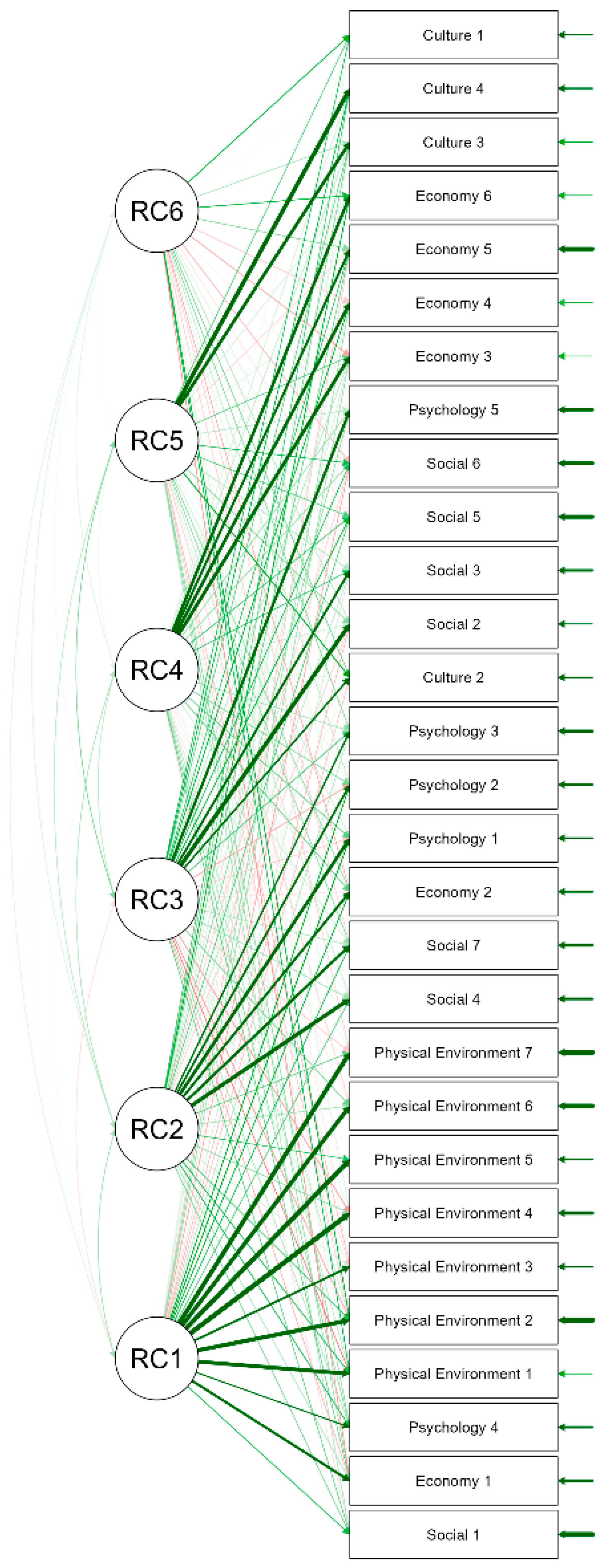
3.1. Results of Exploratory Factor Analysis
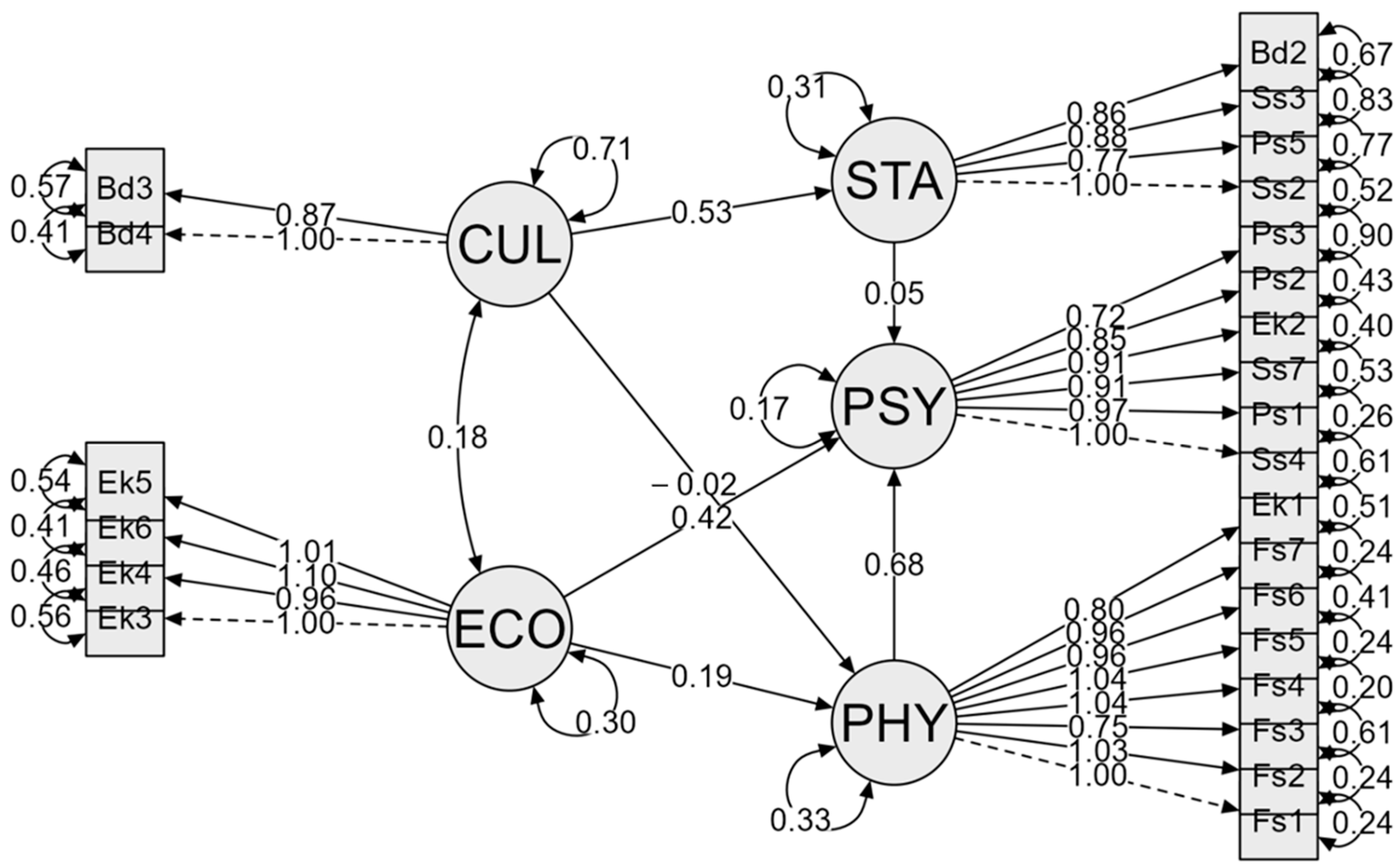
3.2. Results of Structural Equation Modeling
3.3. Results of Content Analysis
4. Findings and Discussion
4.1. Multidimensional Housing Preference Framework
4.2. The Physical Environment as Critical Mediator
4.3. Economic Considerations: Direct and Indirect Effects
4.4. Economic and Cultural Considerations: Analysis by Life Stage
4.5. Psychological Authenticity and Home Concept
4.6. Implication for Urban Development and Policy
- Graduated Ownership Schemes: Implement rent-to-own programs where monthly payments transition from rental to equity accumulation over 5–10 years, addressing Generation Z’s preference for flexibility while building long-term investment value.
- Cooperative Housing Models: Adapt European cooperative models [101] to Indonesian contexts, allowing collective ownership that provides affordability, control, and community, addressing economic, psychological, and social concerns simultaneously.
- Intergenerational Housing Incentives: Provide tax incentives or subsidized loans for vertical housing projects incorporating multi-generational design features (e.g., adjoining units for parents, ground-floor commercial for family businesses).
- Transparent Total Cost of Ownership Disclosure: Mandate developers to provide lifetime cost projections, including maintenance fees, sinking funds, and utility estimates, reducing information asymmetry that fuels economic anxiety.
- Lifestyle enablement: “Vertical living frees your time for what matters” rather than “convenient location”.
- Family accommodation: Showcase how vertical developments facilitate family gatherings and intergenerational visits.
- Investment security: Provide transparent data on resale values, rental yields, and long-term appreciation.
- Community building: Highlight social programming and resident associations that create authentic neighborhood connections.
4.7. Limitations and Future Research Directions
5. Conclusions
Author Contributions
Funding
Institutional Review Board Statement
Informed Consent Statement
Data Availability Statement
Acknowledgments
Conflicts of Interest
References
- Roberts, M.; Gil Sander, F.; Tiwari, S. Time to ACT: Realizing Indonesia’s Urban Potential; World Bank: Washington, DC, USA, 2019; ISBN 978-1-4648-1389-4. [Google Scholar]
- Fadillah, P.; Adianto, J. Reasons for Freehold Homeownership of the Younger Generations to Live in Vertical Housing in the Greater Jakarta Metropolitan Area, Indonesia. Int. J. Built Environ. Sci. Res. 2024, 8, 45. [Google Scholar] [CrossRef]
- Al-Kodmany, K. Sustainability and the 21st Century Vertical City: A Review of Design Approaches of Tall Buildings. Buildings 2018, 8, 102. [Google Scholar] [CrossRef]
- Vala Pardede, G.D.; Qastharin, A.R. Designing Social Media Marketing Strategies Targeting Generation Z for Subsidized Housing in Indonesia (A Case Study of Pt. Graha Putra Asido). Int. J. Curr. Sci. Res. Rev. 2024, 7, 5659–5666. [Google Scholar] [CrossRef]
- Ul Jannah, A.; Adianto, J. Getting a Home for Urban Young Adult: A Preliminary Study of Intergenerational Housing Transitions in Indonesia. Int. J. Built Environ. Sci. Res. 2024, 8, 123. [Google Scholar] [CrossRef]
- Ismail, H.; Nawawi, A.H.; Saat, Z.M. Property Development: The Influence of Demographic Changes on the Actors and the Malaysian Housing Demand (Preferences)—Preliminary Findings (Housing Consumers). In Proceedings of the 2012 IEEE Business, Engineering & Industrial Applications Colloquium (BEIAC), Kuala Lumpur, Malaysia, 7–8 April 2012; IEEE: New York, NY, USA, 2012; pp. 334–341. [Google Scholar]
- Mulyano, Y.; Rahadi, R.A.; Amaliah, U. Millennials Housing Preferences Model in Jakarta. Eur. J. Bus. Manag. Res. 2020, 5. [Google Scholar] [CrossRef]
- Prativi, F.P.; Yuniarti, N.A.; Kamara, I.S. Millennial Generation (Gen-Y) Preferences Towards Landed House Ownership in Yogyakarta Urban Agglomeration Using Logistic Regression. JAMPE (J. Asset Manag. Public Econ.) 2024, 3, 31–43. [Google Scholar] [CrossRef]
- Subagyo, A.; Syari’udin, A.; Yunani, A. Determinant Residential Real Estate of Millennial Generation in Adapting Housing Microfinance Case Indonesia Chapter. Int. J. Hous. Mark. Anal. 2023, 16, 1007–1020. [Google Scholar] [CrossRef]
- Ratu Sonya Mentari Haerdy. PEMENUHAN HUNIAN LAYAK DAN TERJANGKAU MILENIAL DI KOTA BANDUNG MELALUI PENERAPAN TEKNOLOGI PREFABRIKASI RISHA. Tesa Arsit. 2023, 20, 148–157. [Google Scholar] [CrossRef]
- Sagala, Y.K.; Damayanti, R.; Sunaryo, R.G. CORRIDOR AS A SUSTAINABLE SOCIAL SPACE IN HIGH-RISE RESIDENTIAL BUILDING. Adv. Civ. Eng. Sustain. Archit. 2022, 4, 12–25. [Google Scholar] [CrossRef]
- Abdi, F. Understanding the Impact of High-Rise Buildings on Environmental Quality and Sustainable Urban Development. J. Art Archit. Stud. 2019, 8, 13–18. [Google Scholar] [CrossRef]
- Forys, I. Municipal Housing Resource Management System: Element of Polish City Management Strategy or Housing Policy? IOP Conf. Ser. Mater. Sci. Eng. 2019, 471, 112078. [Google Scholar] [CrossRef]
- Apriani, K.; Sukoharsono, E.G.S.; Adib, N. Quintuple Helix in Public Private Partnership (Ppp) Projects (Case Study—PPP’s Housing Project in Surabaya). Marg. J. Manag. Account. Gen. Financ. Int. Econ. Issues 2024, 3, 874–885. [Google Scholar] [CrossRef]
- Adianto, J.; Rahman, M.F.; Gabe, R.T.; Christina, A. The Complexity of Contextuality: A Case Study on Vertical Housing Facilities in Surabaya, Indonesia. Environ. Urban. ASIA 2022, 13, 99–112. [Google Scholar] [CrossRef]
- Vialita, E.; Rahmawati, D. How Liveable Is Living in Public Housing? A Liveability Measurement at Low-Income Apartment of Kompleks Rumah Susun Sombo, Surabaya. IOP Conf Ser Earth Environ. Sci. 2020, 452, 012129. [Google Scholar] [CrossRef]
- Sulistyarini, D.; Kumorotomo, W.; Rajiyem, R. Javanese Cultural Content and Identity Construction: Study on Javanese Transmigrant Descendants in Lampung, Indonesia. J. Komun. Malays. J. Commun. 2024, 40, 448–464. [Google Scholar] [CrossRef]
- BPS. Statistical Yearbook of Indonesia 2023; BPS-Statistics Indonesia: Jakarta, Indonesia, 2023; pp. 83–141. [Google Scholar]
- Ajija, S.R.; Siddiqui, A.I. Impact of Joining Rotating Savings and Credit Association (Rosca) on Household Assets in Indonesia. J. Dev. Areas 2021, 55, 205–216. [Google Scholar] [CrossRef]
- Hermaleni, T.; Setiyawati, D.; Defrain, J. A Strong Family System From The Perspective Of Minangkabau Women; Qualitative Interviews With Ethnic Minang Wives And Bundo Kanduang. Proc. 1st Int. Conf. Soc. Sci. (ICSS) 2025, 4, 509–523. [Google Scholar] [CrossRef]
- Schröder-Butterfill, E. The Impact of Kinship Networks on Old-Age Vulnerability In Indonesia. Ann. Demogr. Hist. 2005, 110, 139. [Google Scholar] [CrossRef]
- Jansen, S.J.T.; Coolen, H.C.C.H.; Goetgeluk, R.W. (Eds.) The Measurement and Analysis of Housing Preference and Choice; Springer: Dordrecht, The Netherlands, 2011; ISBN 978-90-481-8893-2. [Google Scholar]
- Szymkowiak, A.; Melović, B.; Dabić, M.; Jeganathan, K.; Kundi, G.S. Information Technology and Gen Z: The Role of Teachers, the Internet, and Technology in the Education of Young People. Technol. Soc. 2021, 65, 101565. [Google Scholar] [CrossRef]
- Hartig, T.; Staats, H. The Need for Psychological Restoration as a Determinant of Environmental Preferences. J. Environ. Psychol. 2006, 26, 215–226. [Google Scholar] [CrossRef]
- Thwe, S.M.; Lim, W.M.; Koay, K.Y.; Ong, D. Consumers’ Motivation to Purchase Electric Vehicles: A Mixed-Methods Belief Elicitation Study Using Theory of Planned Behavior. Acta Psychol. 2025, 258, 105185. [Google Scholar] [CrossRef]
- Pisman, A.; Allaert, G.; Lombaerde, P. Urban and Suburban Lifestyles and Residential Preferences in a Highly Urbanized Society. Belgeo 2011, 1, 89–104. [Google Scholar] [CrossRef]
- Collen, H.; Hoekstra, J. Values as Determinants of Preferences for Housing Attributes. J. Hous. Built Environ. 2001, 16, 285–306. [Google Scholar] [CrossRef]
- Kamalipour, H.; Zaroudi, M. Sociocultural Context and Vernacular Housing Morphology: A Case Study. Curr. Urban Stud. 2014, 2, 220–232. [Google Scholar] [CrossRef][Green Version]
- Kusno, A. Middling Urbanism: The Megacity and the Kampung. Urban Geogr. 2020, 41, 954–970. [Google Scholar] [CrossRef]
- Gentina, E.; Parry, E. (Eds.) The New Generation Z in Asia: Dynamics, Differences, Digitalisation; Emerald Publishing Limited: Leeds, UK, 2020; ISBN 978-1-80043-221-5. [Google Scholar]
- Nguyen, N.T.; Bui, H.T.H.; Cao, D.T.K. Residential Zones of Students around a University in Ho Chi Minh City: Characteristics and Preferences. Int. J. Built Environ. Sustain. 2023, 11, 49–58. [Google Scholar] [CrossRef]
- Zhou, M.; Kan, M.-Y.; He, G. Intergenerational Co-Residence and Young Couple’s Time Use in China. Chin. Sociol. Rev. 2022, 54, 401–431. [Google Scholar] [CrossRef]
- Hoolachan, J.; McKee, K. Inter-Generational Housing Inequalities: ‘Baby Boomers’ versus the ‘Millennials’. Urban Stud. 2019, 56, 210–225. [Google Scholar] [CrossRef]
- Boyd, D. It’s Complicated; Yale University Press: London, UK, 2020; ISBN 9780300166439. [Google Scholar]
- Wang, S.; Song, Y. A Study on the Aesthetic Tendency of the YZ Generation in China Toward the Façade Design of Coffee Shop Buildings. Buildings 2025, 15, 608. [Google Scholar] [CrossRef]
- Moos, M.; Revington, N.; Wilkin, T.; Andrey, J. The Knowledge Economy City: Gentrification, Studentification and Youthification, and Their Connections to Universities. Urban Stud. 2019, 56, 1075–1092. [Google Scholar] [CrossRef]
- Irviana, L.; Feranita, F.; Ge, B. Family Values, Emotions and Succession Intentions among Asian Gen Z: A Qualitative Multi-Country Exploration. J. Entrep. Emerg. Econ. 2025, 17, 1533–1561. [Google Scholar] [CrossRef]
- Youssef, E.; Medhat, M.; Abdellatif, S.; Babiker Yousif, N. Analyzing the Impact of Metaverse Technology on Social Development: A Field Study on Generation Z in the United Arab Emirates. Soc. Sci. 2024, 13, 446. [Google Scholar] [CrossRef]
- Twenge, J.M. Generations: The Real Differences between Gen Z, Millennials, Gen X, Boomers, and Silents—And What They Mean for America’s Future. Perspect. Sci. Christ. Faith 2023, 75, 212–214. [Google Scholar] [CrossRef]
- Turner, P.; Zepeda, E.M. Navigating White Waters: Generation Z Untraditional College Transition Amid Unprecedented Social, Health, and Academic Crisis. High. Educ. Stud. 2023, 13, 87. [Google Scholar] [CrossRef]
- Arundel, R.; Doling, J. The End of Mass Homeownership? Changes in Labour Markets and Housing Tenure Opportunities across Europe. J. Hous. Built Environ. 2017, 32, 649–672. [Google Scholar] [CrossRef]
- Jayatissa, K.A.D.U. Generation Z—A New Lifeline: A Systematic Literature Review. Sri Lanka J. Soc. Sci. Humanit. 2023, 3, 179–186. [Google Scholar] [CrossRef]
- Nwoke, J.U.C. Bridging Generational Wealth Gaps: Financial Planning Innovations for Millennials and Gen Z Clients. Int. J. Res. Publ. Rev. 2025, 6, 5904–5917. [Google Scholar] [CrossRef]
- Clapham, D.; Mackie, P.; Orford, S.; Thomas, I.; Buckley, K. The Housing Pathways of Young People in the UK. Environ. Plan. A Econ. Space 2014, 46, 2016–2031. [Google Scholar] [CrossRef]
- Twenge, J.M.; Cooper, A.B.; Joiner, T.E.; Duffy, M.E.; Binau, S.G. Age, Period, and Cohort Trends in Mood Disorder Indicators and Suicide-Related Outcomes in a Nationally Representative Dataset, 2005–2017. J. Abnorm. Psychol. 2019, 128, 185–199. [Google Scholar] [CrossRef]
- Hartig, T.; Evans, G.W.; Jamner, L.D.; Davis, D.S.; Gärling, T. Tracking Restoration in Natural and Urban Field Settings. J. Environ. Psychol. 2003, 23, 109–123. [Google Scholar] [CrossRef]
- Seemiller, C.; Grace, M. Generation Z; Routledge: Oxfordshire, UK, 2018; ISBN 9780429442476. [Google Scholar]
- Mutiara Cipta, D.; Alvin, S. Safeguarding Personal Information: Communication Privacy Management By Gen-Z Influencers. Int. J. Educ. Res. Soc. Sci. 2023, 4, 465–471. [Google Scholar] [CrossRef]
- Evans, G.W. The Built Environment and Mental Health. J. Urban Health 2003, 80, 536–555. [Google Scholar] [CrossRef]
- Pihkala, P. Anxiety and the Ecological Crisis: An Analysis of Eco-Anxiety and Climate Anxiety. Sustainability 2020, 12, 7836. [Google Scholar] [CrossRef]
- Malik, A.; Gulzar, A.; Khan, M.A.; Siddique, N. Mapping Global Research on Generation Z: A Bibliometric Analysis. Glob. Knowl. Mem. Commun. 2024, 72, 138–159. [Google Scholar] [CrossRef]
- Tarigan, S.G.; Mannan, K.A.; Uddin, N. The Future of Workplace in Greater Jakarta: Hybrid Office in the Post Covid-19 Pandemic. IOP Conf. Ser. Earth Environ. Sci. 2023, 1218, 012026. [Google Scholar] [CrossRef]
- Dzhambov, A.M.; Lercher, P.; Browning, M.H.E.M.; Stoyanov, D.; Petrova, N.; Novakov, S.; Dimitrova, D.D. Does Greenery Experienced Indoors and Outdoors Provide an Escape and Support Mental Health during the COVID-19 Quarantine? Environ. Res. 2021, 196, 110420. [Google Scholar] [CrossRef]
- Lulewicz-Sas, A.; Kinowska, H.; Zubek, M.; Danilewicz, D. Examining the Impacts of Environmental, Social and Governance (ESG) on Employee Engagement: A Study of Generation Z. Cent. Eur. Manag. J. 2025. [Google Scholar] [CrossRef]
- Kamenidou, I.C.; Mamalis, S.A.; Pavlidis, S.; Bara, E.-Z.G. Segmenting the Generation Z Cohort University Students Based on Sustainable Food Consumption Behavior: A Preliminary Study. Sustainability 2019, 11, 837. [Google Scholar] [CrossRef]
- Noaime, E.; Alalouch, C.; Mesloub, A.; Hamdoun, H.; Gnaba, H.; Alnaim, M.M. Urban Centrality as a Catalyst for City Resilience and Sustainable Development. Land 2025, 14, 1333. [Google Scholar] [CrossRef]
- Vivek, R.; Nanthagopan, Y.; Piriyatharshan, S. Beyond Methods: Theoretical Underpinnings of Triangulation in Qualitative and Multi-Method Studies”. SEEU Rev. 2023, 18, 105–122. [Google Scholar] [CrossRef]
- Adianto, J.; Gabe, R.T.; Farraz, M.A. The Influence of Family Relations on the Housing Preferences of Millennials in Depok, Indonesia. J. Urban. Int. Res. Placemaking Urban Sustain. 2023, 16, 84–100. [Google Scholar] [CrossRef]
- Varjakoski, H.; Koponen, S.; Kouvo, A.; Tiilikainen, E. Age Diversity in Neighborhoods—A Mixed-Methods Approach Examining Older Residents and Community Wellbeing. Int. J. Env. Res. Public Health 2023, 20, 6574. [Google Scholar] [CrossRef]
- Cerna, J.T.; Dela, C.; Sonido, J.M.; Mae Rubio, D.K.; V. Sisles, L.F. Analyzing Gen Z’s Travel Influence in the Digital Age: The Correlational Effect of Social Media. Int. J. Multidiscip. Res. Anal. 2024, 7, 4580–4586. [Google Scholar] [CrossRef]
- Brown, E.D.; Williams, B.K. The Potential for Citizen Science to Produce Reliable and Useful Information in Ecology. Conserv. Biol. 2019, 33, 561–569. [Google Scholar] [CrossRef]
- Salim, E.; Ali, H. Yulasmi Modeling Interest in Visiting Through Expected Values in Tourism at Solok Regency, Indonesia. Int. J. Prof. Bus. Rev. 2023, 8, e0986. [Google Scholar] [CrossRef]
- Sarstedt, M. Revisiting Hair Et al.’s Multivariate Data Analysis: 40 Years Later. In The Great Facilitator; Springer International Publishing: Cham, Switzerland, 2019; pp. 113–119. [Google Scholar]
- Suminar, L.; Astuti, W.; Sunjaya, N.I.; Kusumaputri, A.N.; Margareta, L.A.; Pamungkas, P.B. Local Wisdom in Housing and Settlement Planning: A Case Study of Sudiroprajan Chinatown, Surakarta. ETHOS J. Penelit. Dan Pengabdi. Kpd. Masy. 2024, 12, 71–80. [Google Scholar] [CrossRef]
- Tan, T.H.; Lee, J.H. Assessing the Determinants of Retirement Home Ownership among Malaysian Young-Old Seniors. Int. J. Hous. Mark. Anal. 2018, 11, 687–700. [Google Scholar] [CrossRef]
- Latif, A.; Apriani, E.; Afandi, D.R.; Sabilla, A.R. Financial Management Behavior: Case Study of Gen Z and Millennial Gen Bekasi Regency. Riwayat Educ. J. Hist. Humanit. 2025, 8, 448–456. [Google Scholar] [CrossRef]
- Safuwan, A.M. Personal Construct Experience of Tionghoa Community in Aceh Reality; Emerald Publishing: Leeds, UK, 2018; pp. 193–198. [Google Scholar]
- Yohanes, K.N.; Hamumpuni, H.S.; Utami, M.P.P. The Middle-Income Trap Problem Faced by Millennials and Gen z in Jakarta: Challenges and Mitigating Strategies. Crit. Issue Sustain. Future 2025, 2, 45–65. [Google Scholar] [CrossRef]
- Sumathy, M.; Kesawaraj, P.K. Thrift Economy: Why Gen Z Prefers Second Hand Over Fast Fashion. Int. J. Adv. Res. Sci. Commun. Technol. 2025, 5, 258–259. [Google Scholar] [CrossRef]
- Farasa, N.; Kusuma, H.E. Housing Preferences of Young Adults in Indonesia: Housing Attributes and Consequences. IOP Conf. Ser. Earth Environ. Sci. 2018, 126, 012184. [Google Scholar] [CrossRef]
- McCartney, S.; Rosenvasser, X. Affordability Is King–with Private Bedroom: Exploring the Mismatch of Students’ Housing Preferences in Constrained Housing Markets. Hous. Stud. 2024, 39, 2806–2826. [Google Scholar] [CrossRef]
- Khogali, M.M.E.; Mohamed Ali, E.A.; Ramdani, A. Integrating Behavioral Science into Urban Planning: A Framework for Human-Centered Spatial Design. Front. Psychol. 2025, 16, 1632523. [Google Scholar] [CrossRef]
- Gladysheva, A. Psychological Aspects of Human Perception of the Urban Environment in the Context of Sustainable Development. Appl. Psychol. Pedagog. 2025, 10, 12–25. [Google Scholar] [CrossRef]
- Eßwein, S. Generation Z. WzS Wege Zur Sozialversicherung; Erich Schmidt Verlag GmbH & Co. KG.: Berlin, Germany, 2025; Volume 10, p. 9. [Google Scholar] [CrossRef]
- Napiórkowska-Baryła, A.; Świdyńska, N.; Witkowska-Dąbrowska, M. Owning versus Renting a Home—Prospects for Generation Z. Sustainability 2024, 16, 4715. [Google Scholar] [CrossRef]
- Kennedy, Ü. Exploring YouTube as a Transformative Tool in the “The Power of MAKEUP!” Movement. M/C J. 2016, 19. [Google Scholar] [CrossRef]
- Kaniah; Budihastuti, E.; Suharja, A.A.; Maemunah, E.; Parwati, S.A.P.E.; Mulyanah, A.; Sariah; Widiastuti, R.; Kusnanto, E.A. The Utilization of Social Media and the Reinforcement of National Identity in Generation Z. Southeast Asian Lang. Lit. Stud. 2025, 1, 116–122. [Google Scholar] [CrossRef]
- Esteve, A.; Reher, D.S. Rising Global Levels of Intergenerational Coresidence Among Young Adults. Popul. Dev. Rev. 2021, 47, 691–717. [Google Scholar] [CrossRef]
- Syufa’at, S.; Zaidi, S.M.S.; Mutholaah, M. Sandwich Generation in Contemporary Indonesia: Determining Responsibility in Caring for Elderly under Islamic Law and Positive Law. Al-Manahij J. Kaji. Huk. Islam 2023, 17, 167–182. [Google Scholar] [CrossRef]
- Nasr, R.; Nasr, N.; Haddad, C.; Saab, S.A.; Ibrahim, S.A.; Karam, J.; Rahman, A.A. Financial Insecurity and Mental Well-Being: Experiences of Parents amid the Lebanese Economic Crisis. BMC Public Health 2024, 24, 3017. [Google Scholar] [CrossRef]
- Naim, M.F. Managing Generation Z in Gig Economy: Towards an Integrative Framework of Talent Management. In Sustainability in the Gig Economy; Springer Nature: Singapore, 2022; pp. 293–303. [Google Scholar]
- Lomas, C.D. A Thematic Analysis of British Rehabilitation Centers Clients Reviews 2020–2024. Alcohol Treat Q 2025, 43, 167–187. [Google Scholar] [CrossRef]
- Addison, H.A.; Richmond, T.S.; Lewis, L.M.; Jacoby, S. Mental Health Outcomes in Formerly Incarcerated Black Men: A Systematic Mixed Studies Review. J. Adv. Nurs. 2022, 78, 1851–1869. [Google Scholar] [CrossRef]
- Li, Q.; Zeng, J.; Zhao, B.; Perrin, N.; Wenzel, J.; Liu, F.; Pang, D.; Liu, H.; Hu, X.; Li, X.; et al. Nurses’ Preparedness, Opinions, Barriers, and Facilitators in Responding to Intimate Partner Violence: A Mixed-methods Study. J. Nurs. Scholarsh. 2024, 56, 174–190. [Google Scholar] [CrossRef]
- Wang, D.; Li, S.-M. Housing Preferences in a Transitional Housing System: The Case of Beijing, China. Environ. Plan. A Econ. Space 2004, 36, 69–87. [Google Scholar] [CrossRef]
- Opoku, R.A.; Abdul-Muhmin, A.G. Housing Preferences and Attribute Importance among Low-Income Consumers in Saudi Arabia. Habitat Int. 2010, 34, 219–227. [Google Scholar] [CrossRef]
- Tan, C. A Study of Boundedly Rational Behaviour in Housing Choice: Evidence from Malaysia. Int. J. Hous. Mark. Anal. 2022, 15, 1259–1274. [Google Scholar] [CrossRef]
- Ekstam, H. Residential Crowding in a “Distressed” and a “Gentrified” Neighbourhood—Towards an Understanding of Crowding in “Gentrified” Neighbourhoods. Hous. Theory Soc. 2015, 32, 429–449. [Google Scholar] [CrossRef]
- Wang, X.; Liu, T. Home-Made Blues: Residential Crowding and Mental Health in Beijing, China. Urban Stud. 2023, 60, 461–482. [Google Scholar] [CrossRef]
- Liu, Y. House vs. Home: Two Case Studies of Rural Migrant Workers’ Residences. Cult. Pedagog. Inq. 2025, 16, 128–154. [Google Scholar] [CrossRef]
- Kumar Chaudhary, M.; Dhungana, M.; Subedi, M.; Singh, H.; Mani Ghimire, D. Resilience of Gen Z to Socioeconomic Challenges: The Interconnection of Family Financial Socialization, Attitudes Towards Money and Financial Well-Being. Socioecon. Chall. 2025, 9, 1–20. [Google Scholar] [CrossRef]
- Yung, E.H.K.; Wang, S.; Chau, C. Thermal Perceptions of the Elderly, Use Patterns and Satisfaction with Open Space. Landsc Urban Plan 2019, 185, 44–60. [Google Scholar] [CrossRef]
- Tocchioni, V.; Berrington, A.; Vignoli, D.; Vitali, A. The Changing Association Between Homeownership and the Transition to Parenthood. Demography 2021, 58, 1843–1865. [Google Scholar] [CrossRef]
- Howard, A.; Hochstenbach, C.; Ronald, R. Understanding Generational Housing Inequalities beyond Tenure, Class and Context. Econ. Soc. 2024, 53, 135–162. [Google Scholar] [CrossRef]
- Lafi, M.W.; Alkhalifa, H.E.; Jiwane, A.V. Identifying the Issues Leading to Residents’ Modifications in Bahraini Subsidized Housing Units. Front. Built. Environ. 2023, 9, 1154546. [Google Scholar] [CrossRef]
- Verderber, S.; Koyabashi, U.; Cruz, C.D.; Sadat, A.; Anderson, D.C. Residential Environments for Older Persons: A Comprehensive Literature Review (2005–2022). HERD Health Environ. Res. Des. J. 2023, 16, 291–337. [Google Scholar] [CrossRef] [PubMed]
- Kulangara, S.; Prakash, A.V.P. Boundaries of Privacy: A Reevaluation of Spatial Dynamics in Traditional Kerala Homes. Int. J. Sci. Res. Eng. Manag. 2024, 8, 1–13. [Google Scholar] [CrossRef]
- Jin, C.; Li, B.; Jansen, S.J.T.; Boumeester, H.J.F.M.; Boelhouwer, P.J. Understanding the Housing Pathways and Migration Plans of Young Talents in Metropolises–A Case Study of Shenzhen. Hous. Theory Soc. 2023, 40, 435–462. [Google Scholar] [CrossRef]
- Oyesomo, O.C.; Seun, O.J.; Bolayemi, A.K. Housing Affordability in Nigeria; an Analysis of Lagos State Government Rent to Own Scheme. Int. J. Res. Innov. Soc. Sci. 2023, VII, 272–289. [Google Scholar] [CrossRef]
- Hagbert, P.; Larsen, H.G.; Thörn, H.; Wasshede, C. Contemporary Co-Housing in Europe; Routledge: London, UK, 2019; ISBN 9780429450174. [Google Scholar]
- Larsen, H.G. Property Relations between State and Market: A History of Housing Cooperatives in Denmark. Hous. Stud. 2025, 40, 2142–2164. [Google Scholar] [CrossRef]
- Murooka, T.; Shimizu, H.; Taniguchi, M. Networked Compact City Policy Status and Issues—Hierarchy and Human Mobility in Tokyo, Japan. Sustainability 2021, 13, 13107. [Google Scholar] [CrossRef]



| Characteristic | Students (n = 156) | Early Career (n = 184) | Total (N = 340) |
|---|---|---|---|
| Age range | 18–22 | 23–27 | 18–27 |
| Financial independence | 12% | 74% | 45% |
| Current housing tenure | With parents: 39% | With parents: 45% | With parents: 39.41% |
| Intention to live in vertical housing | 19.57% | 30.76% | 24.41% |
| Dimension | Observed Variables | Sources |
|---|---|---|
| Cultural |
| [28,29,30,31,32] |
| Social |
| [33,34,35,36,37,38] |
| Economic |
| [39,40,41,42,43,44] |
| Psychological |
| [45,46,47,48,49,50] |
| Physical Environment |
| [51,52,53,54,55,56] |
| Hypothesized Relationships Between Latent Variables | Theoretical Justification | |
|---|---|---|
| 1 | H1: Cultural accommodation requirements positively influence physical environment preferences in housing selection. | Research on Asian housing markets demonstrates that cultural values significantly shape spatial requirements [64,65]. For Indonesian Gen-Z, the need for multi-generational living and cultural celebrations necessitates specific physical configurations [66,67]. |
| 2 | H2: Economic Considerations compromise Physical Environment Preferences. | For Gen-Z, who face unprecedented housing affordability challenges globally, economic constraints act as a reality filter [68,69]. Research on young adults’ housing pathways shows that financial limitations force compromises on physical housing attributes, creating a gap between preferences and choices [70,71]. |
| 3 | H3: Unmet physical environment preferences intensify psychological-social concerns about vertical housing. | Environmental psychology literature establishes that physical space characteristics directly impact psychological well-being [72,73]. For Gen-Z, who report higher rates of anxiety and mental health concerns, the physical limitations of vertical housing may exacerbate psychological stress [2,74]. |
| 4 | H4: Social status concerns and psychological stress amplify overall psychological-social concerns about vertical housing. | For Gen-Z in emerging economies, homeownership represents social mobility and success [75]. The “Instagram generation” particularly values lifestyle presentation, making housing choices crucial for social media identity construction [76,77]. |
| 5 | H5: Stronger cultural accommodation needs increase social status concerns and psychological stress regarding vertical housing. | Studies on Indonesian urban youth show that modern housing forms create intergenerational tension, as young adults navigate between traditional expectations and contemporary urban realities [78,79]. |
| 6 | H6: Economic constraints have a direct positive effect on psychological-social concerns about housing. | Financial stress theory indicates that economic insecurity directly impacts psychological well-being [80]. Gen-Z faces unique economic challenges including gig economy participation, student debt, and delayed wealth accumulation [43,81]. |
| Factor 1 | Factor 2 | Factor 3 | Factor 4 | Factor 5 | Uniqueness | |
|---|---|---|---|---|---|---|
| Physical Environment 4 | 0.775 | 0.349 | ||||
| Physical Environment 5 | 0.753 | 0.382 | ||||
| Physical Environment 7 | 0.727 | 0.418 | ||||
| Physical Environment 2 | 0.710 | 0.300 | ||||
| Physical Environment 6 | 0.697 | 0.464 | ||||
| Physical Environment 1 | 0.678 | 0.329 | ||||
| Economic 1 | 0.549 | 0.594 | ||||
| Physical Environment 3 | 0.514 | 0.717 | ||||
| Psychology 4 | 0.428 | 0.681 | ||||
| Social 4 | 0.674 | 0.479 | ||||
| Psychology 1 | 0.616 | 0.420 | ||||
| Social 7 | 0.569 | 0.559 | ||||
| Economic 2 | 0.544 | 0.522 | ||||
| Psychology 2 | 0.507 | 0.563 | ||||
| Psychology 3 | 0.461 | 0.688 | ||||
| Social 2 | 0.692 | 0.467 | ||||
| Psychology 5 | 0.570 | 0.628 | ||||
| Social 3 | 0.528 | 0.648 | ||||
| Culture 2 | 0.479 | 0.574 | ||||
| Economic 3 | 0.632 | 0.512 | ||||
| Economic 4 | 0.606 | 0.504 | ||||
| Economic 6 | 0.596 | 0.434 | ||||
| Economic 5 | 0.536 | 0.596 | ||||
| Culture 4 | 0.710 | 0.363 | ||||
| Culture 3 | 0.617 | 0.540 | ||||
| Culture 1 | 0.787 | |||||
| Social 1 | 0.838 | |||||
| Social 5 | 0.754 | |||||
| Social 6 | 0.803 |
| Additional Fit Indices | |||||
|---|---|---|---|---|---|
| RMSEA | RMSEA 90% confidence | SRMR | TLI | CFI | BIC |
| 0.070 | 0.066–0.074 | 0.034 | 0.814 | 0.887 | −272.462 |
| Regression Coefficients | |||||||||
|---|---|---|---|---|---|---|---|---|---|
| 95% Confidence Interval | Standardized | ||||||||
| Outcome | Predictor | Estimate | Std. Error | z-Value | p | Lower | Upper | All | LV |
| Physical | Cultural | −0.016 | 0.052 | −0.303 | 0.762 | −0.118 | 0.086 | −0.023 | −0.023 |
| Economic | 0.189 | 0.084 | 2.253 | 0.024 | 0.025 | 0.354 | 0.177 | 0.177 | |
| Psysoc | Physical | 0.678 | 0.077 | 8.759 | <0.001 | 0.527 | 0.830 | 0.611 | 0.611 |
| Economic | 0.417 | 0.083 | 5.052 | <0.001 | 0.255 | 0.579 | 0.351 | 0.351 | |
| Status | 0.050 | 0.052 | 0.979 | 0.328 | −0.051 | 0.151 | 0.056 | 0.056 | |
| Status | Cultural | 0.526 | 0.076 | 6.896 | <0.001 | 0.377 | 0.676 | 0.620 | 0.620 |
| Dimension | Most Spoken Thematic Keywords | Sentiment | Frequency |
|---|---|---|---|
| Culture | “tidak cocok untuk tinggal bersama keluarga besar” “Not suitable for living with a large family.” | Negative | 23 |
| Social | “…membutuhkan privasi sehingga hunian vertikal kurang cocok” “…requires privacy, making vertical housing less suitable.” | Negative | 30 |
| Social | “…menyukai hunian vertikal karena menawarkan gaya hidup yang praktis/cepat/modern/digital” “…likes vertical housing because it offers a practical, fast, modern, and digital lifestyle.” | Positive | 16 |
| Economic | “harga beli hunian vertikal mahal” “The purchase price of vertical housing is expensive.” | Negative | 36 |
| Economic | “harga hunian vertikal yang sesuai/terjangkau daripada rumah tapak” “Vertical housing prices are more reasonable/affordable compared to landed houses.” | Positive | 9 |
| Psychology | “kurang mencerminkan kenyamanan rumah yang sesungguhnya” “It does not fully reflect the comfort of an actual home.” | Negative | 30 |
| Physical Environment | “menghindari hunian vertikal karena keterbatasan ruang” “Avoids vertical housing due to limited space.” | Negative | 21 |
| Physical Environment | “menyukai hunian vertikal karena praktis, modern, dan fasiltasnya lengkap.” “Likes vertical housing because it is practical, modern, and has complete facilities.” | Positive | 44 |
| Factor Addressed | Design Strategy | Implementation |
|---|---|---|
| Cultural Accommodation | Flexible guest rooms and communal gathering spaces | Convertible study/guest rooms; rooftop or ground-floor function halls for family events |
| Psychological Authenticity | Personalization, outdoor access, and biophilic design | Balconies with planting space; modular interior walls; unit-specific entrance designs |
| Privacy-Community Balance | Graduated public–private transitions and cluster designs | Skip-floor corridors; semi-private lift lobbies serving 4–6 units; internal courtyards |
| Economic Anxiety | Transparent cost structures; flexible ownership pathways | All-inclusive maintenance packages; rent-to-own schemes; cooperative ownership models |
Disclaimer/Publisher’s Note: The statements, opinions and data contained in all publications are solely those of the individual author(s) and contributor(s) and not of MDPI and/or the editor(s). MDPI and/or the editor(s) disclaim responsibility for any injury to people or property resulting from any ideas, methods, instructions or products referred to in the content. |
© 2026 by the authors. Licensee MDPI, Basel, Switzerland. This article is an open access article distributed under the terms and conditions of the Creative Commons Attribution (CC BY) license.
Share and Cite
Harun, I.; Navitas, P. Why Don’t You Wanna Live Vertically? A Perspective from Gen-Z in Surabaya Metropolitan Area, Indonesia. Urban Sci. 2026, 10, 28. https://doi.org/10.3390/urbansci10010028
Harun I, Navitas P. Why Don’t You Wanna Live Vertically? A Perspective from Gen-Z in Surabaya Metropolitan Area, Indonesia. Urban Science. 2026; 10(1):28. https://doi.org/10.3390/urbansci10010028
Chicago/Turabian StyleHarun, Ilman, and Prananda Navitas. 2026. "Why Don’t You Wanna Live Vertically? A Perspective from Gen-Z in Surabaya Metropolitan Area, Indonesia" Urban Science 10, no. 1: 28. https://doi.org/10.3390/urbansci10010028
APA StyleHarun, I., & Navitas, P. (2026). Why Don’t You Wanna Live Vertically? A Perspective from Gen-Z in Surabaya Metropolitan Area, Indonesia. Urban Science, 10(1), 28. https://doi.org/10.3390/urbansci10010028