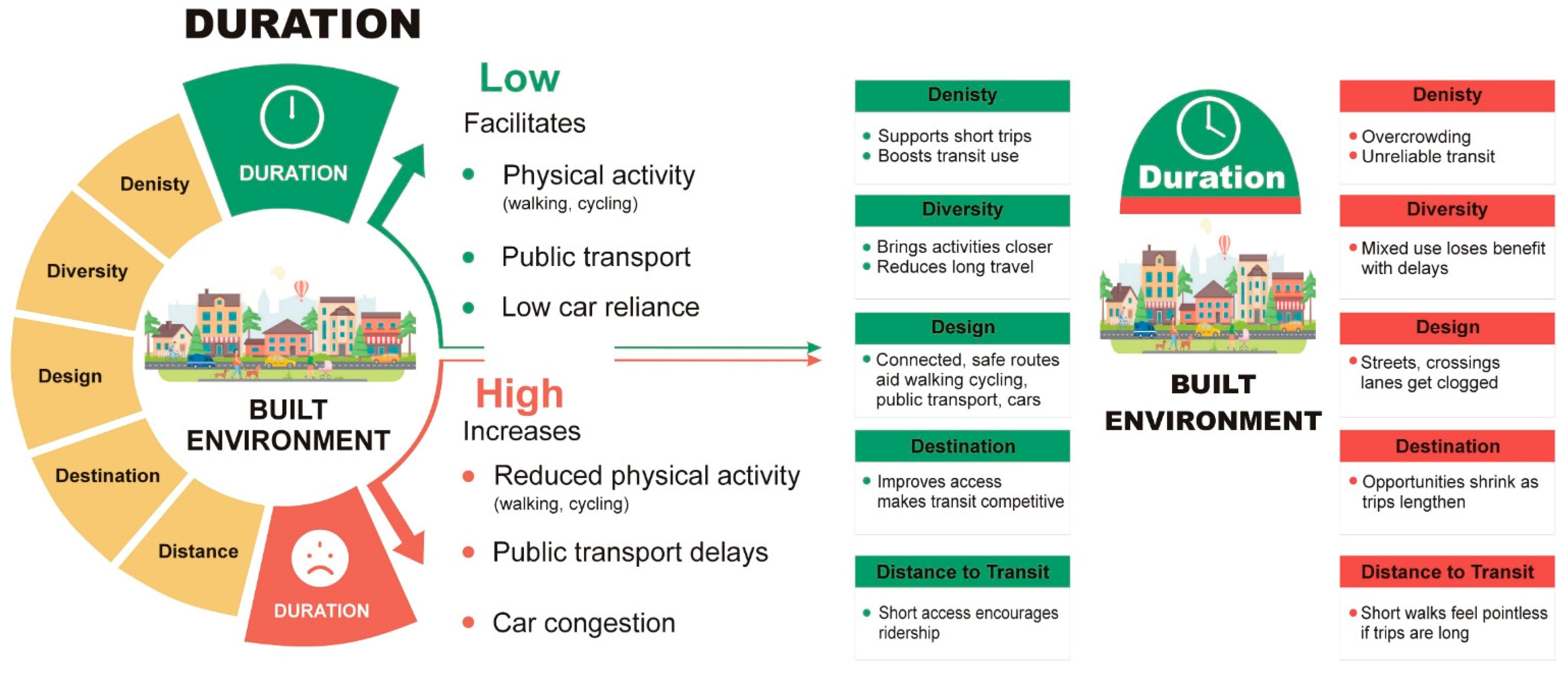

Duration as the Sixth Dimension of the Built Environment Travel Behaviour Framework



Abstract
1. Introduction
- To review the extant literature on the BE, PA, and AT to identify how temporal variability, including traffic fluctuations and commuting duration, remains unaccounted for in conventional 5D frameworks of the BE.
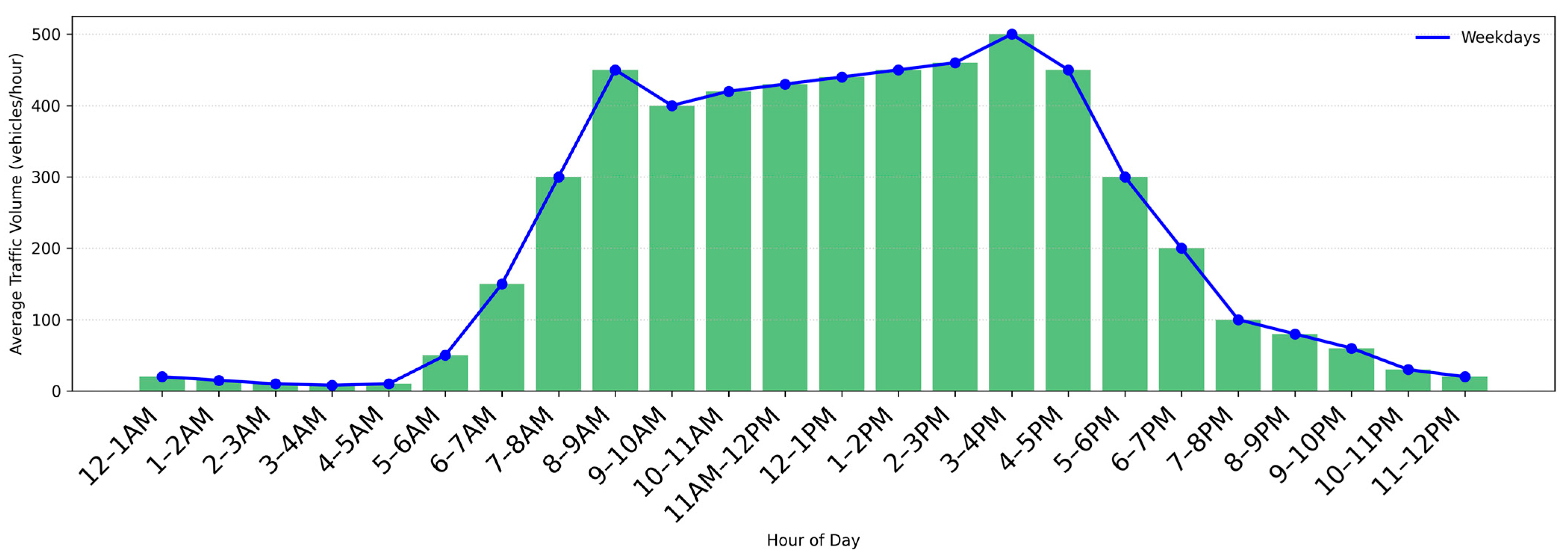
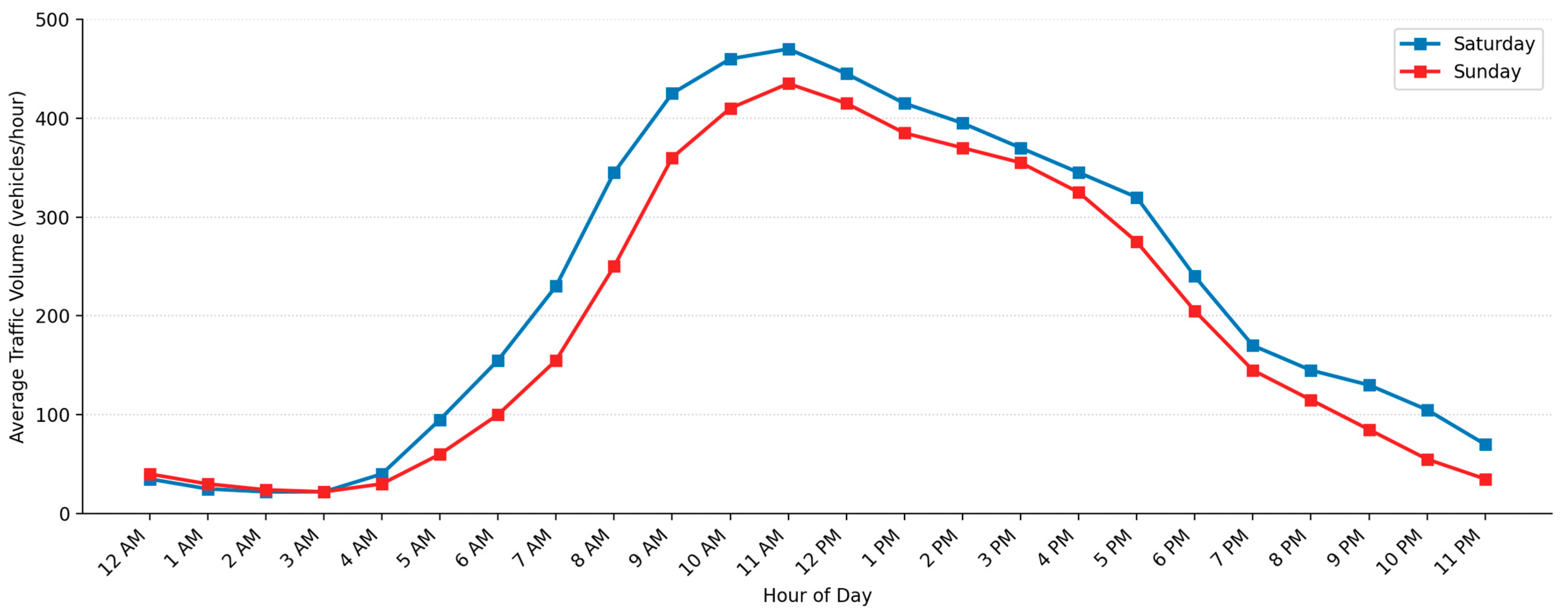
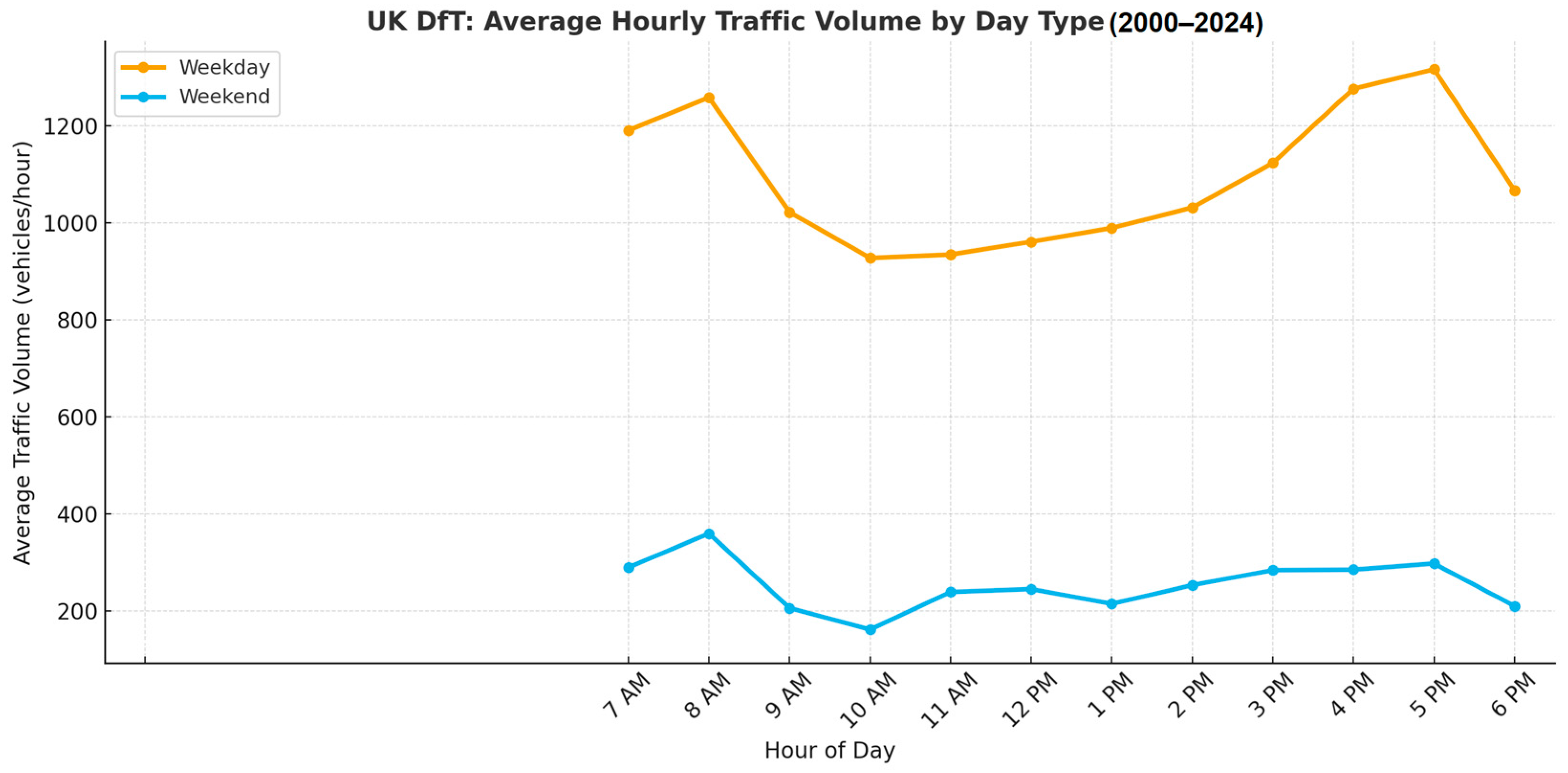
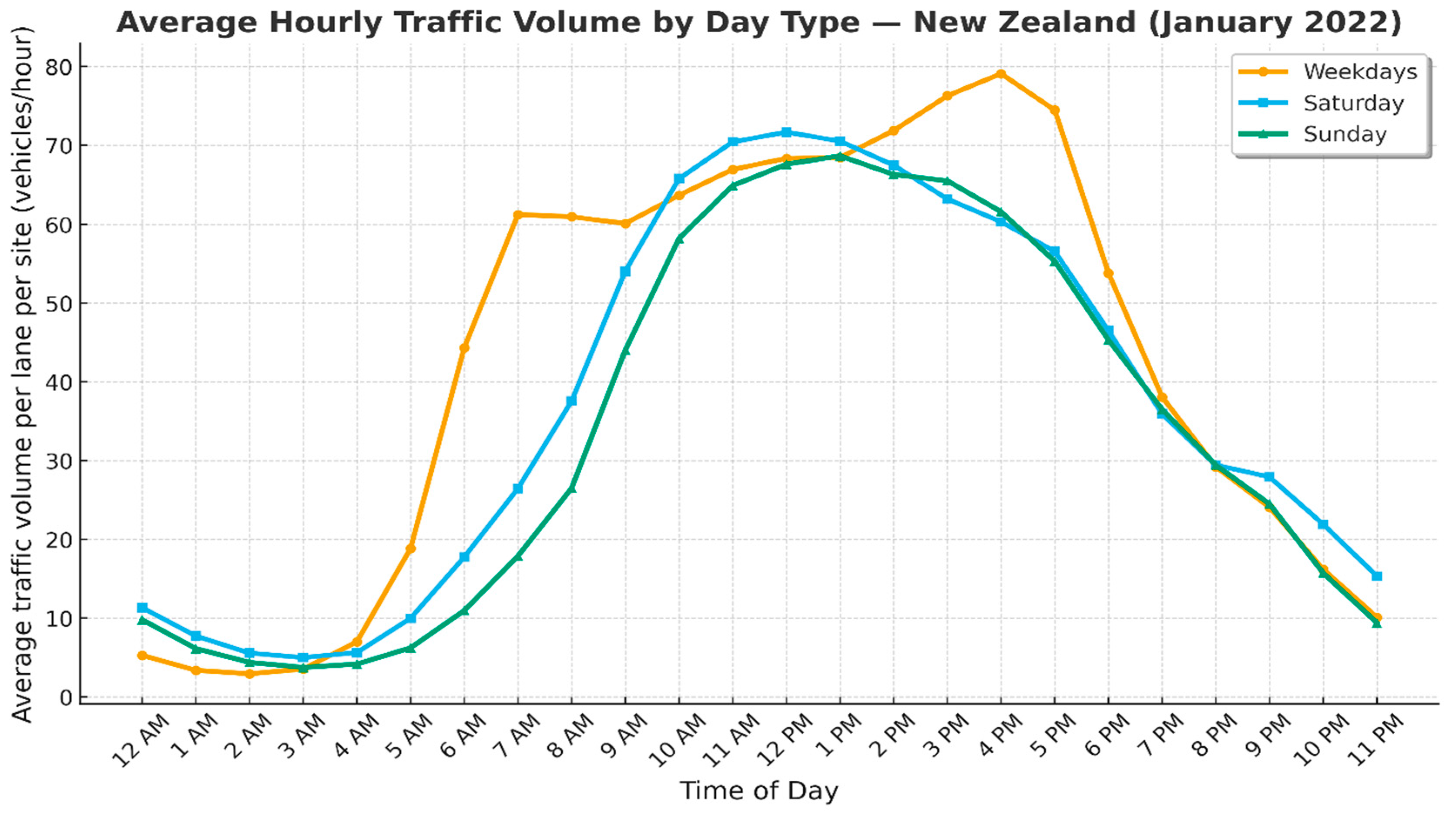
- To synthesise published evidence from multidisciplinary studies spanning BE, transport planning, and public health domains, together with real-world traffic datasets (Queensland (QLD), Australia, the United Kingdom (UK), and New Zealand), to justify the introduction of Duration as the 6th dimension of the BE framework.
2. Methodology
2.1. Search Strategy and Database Coverage
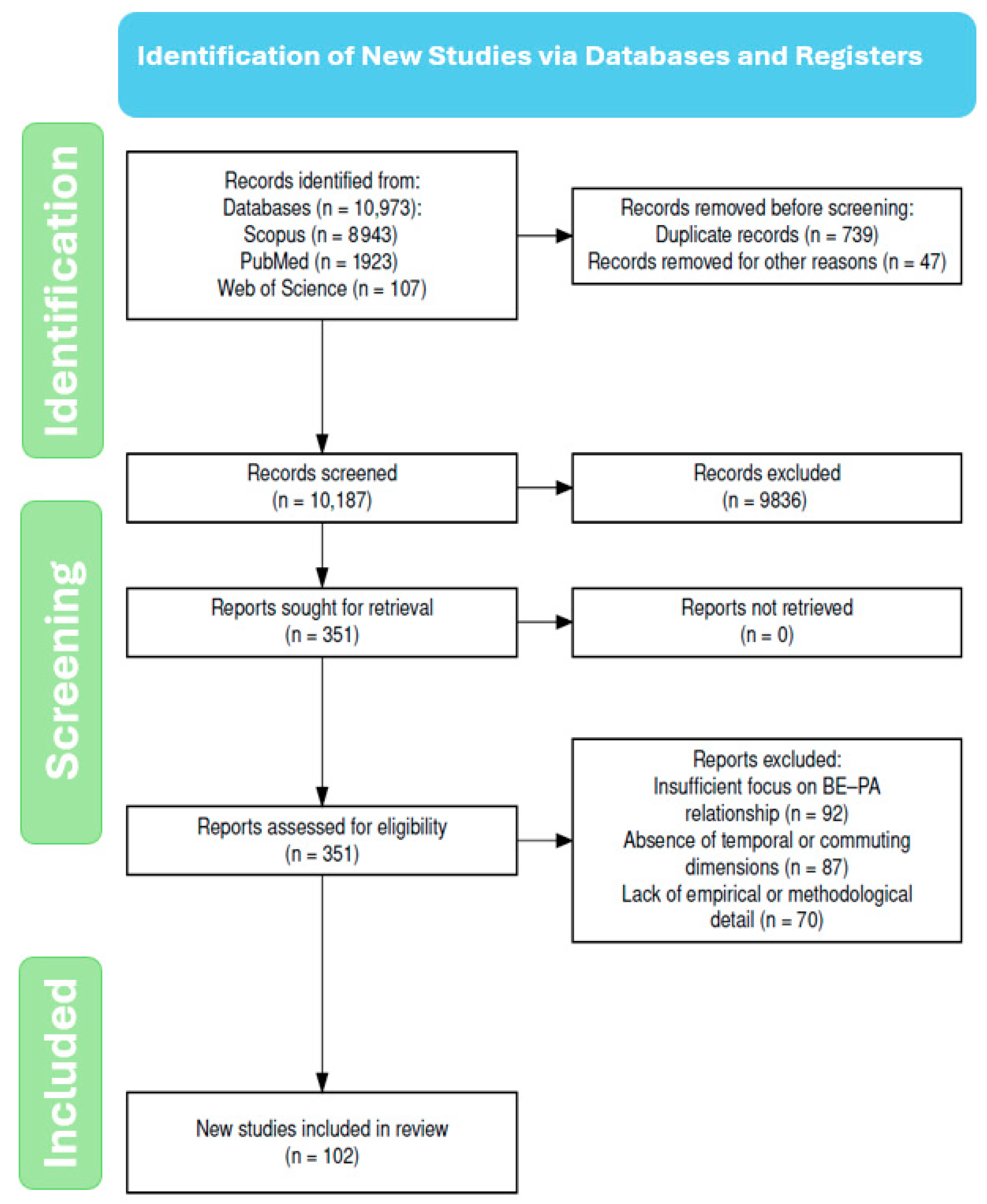
2.2. Study Selection and Eligibility Criteria
2.3. Supplementary Open Data Sources
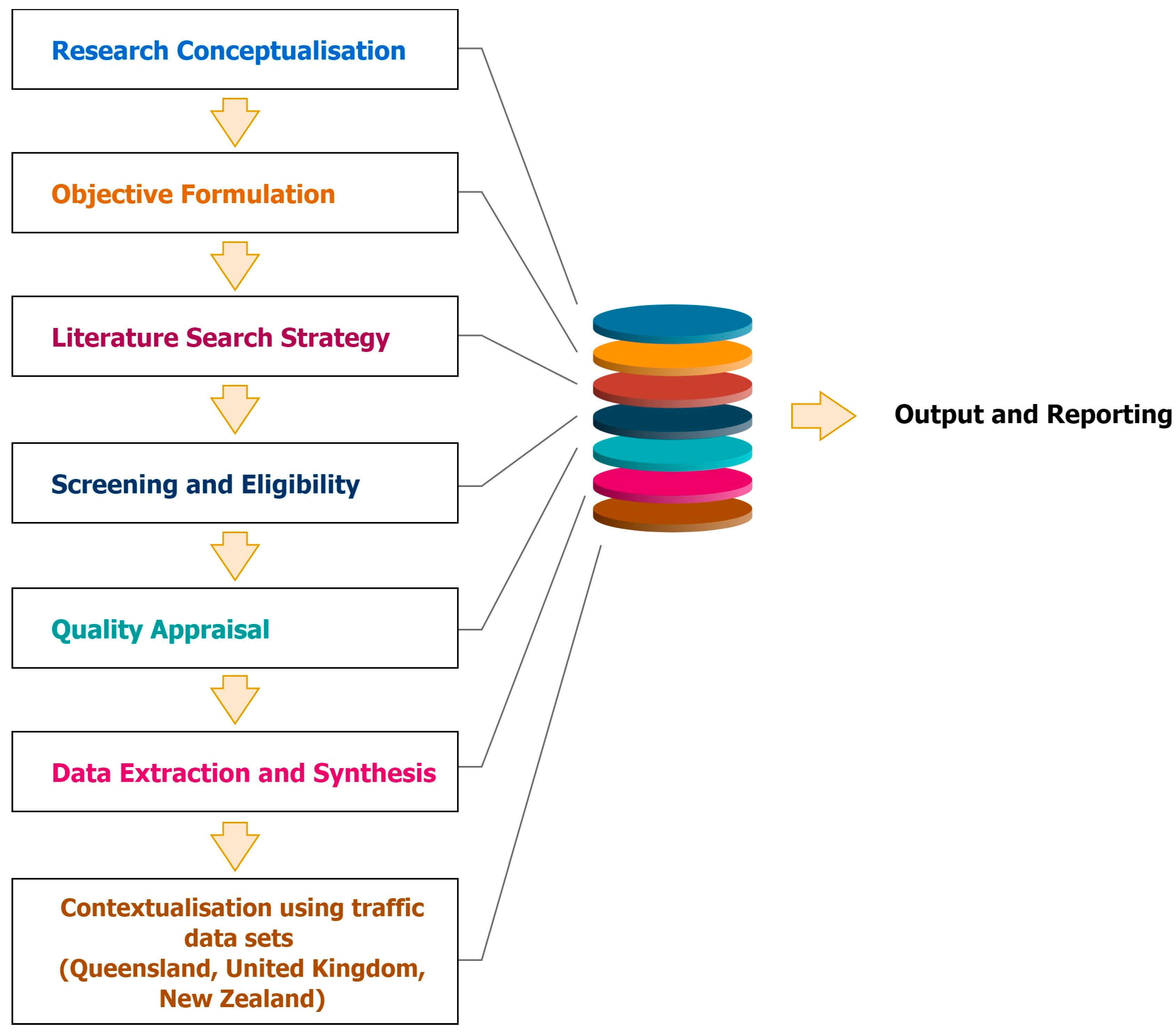
2.4. Data Synthesis and Analysis
2.5. Characteristics of Included Studies
3. Results and Analysis
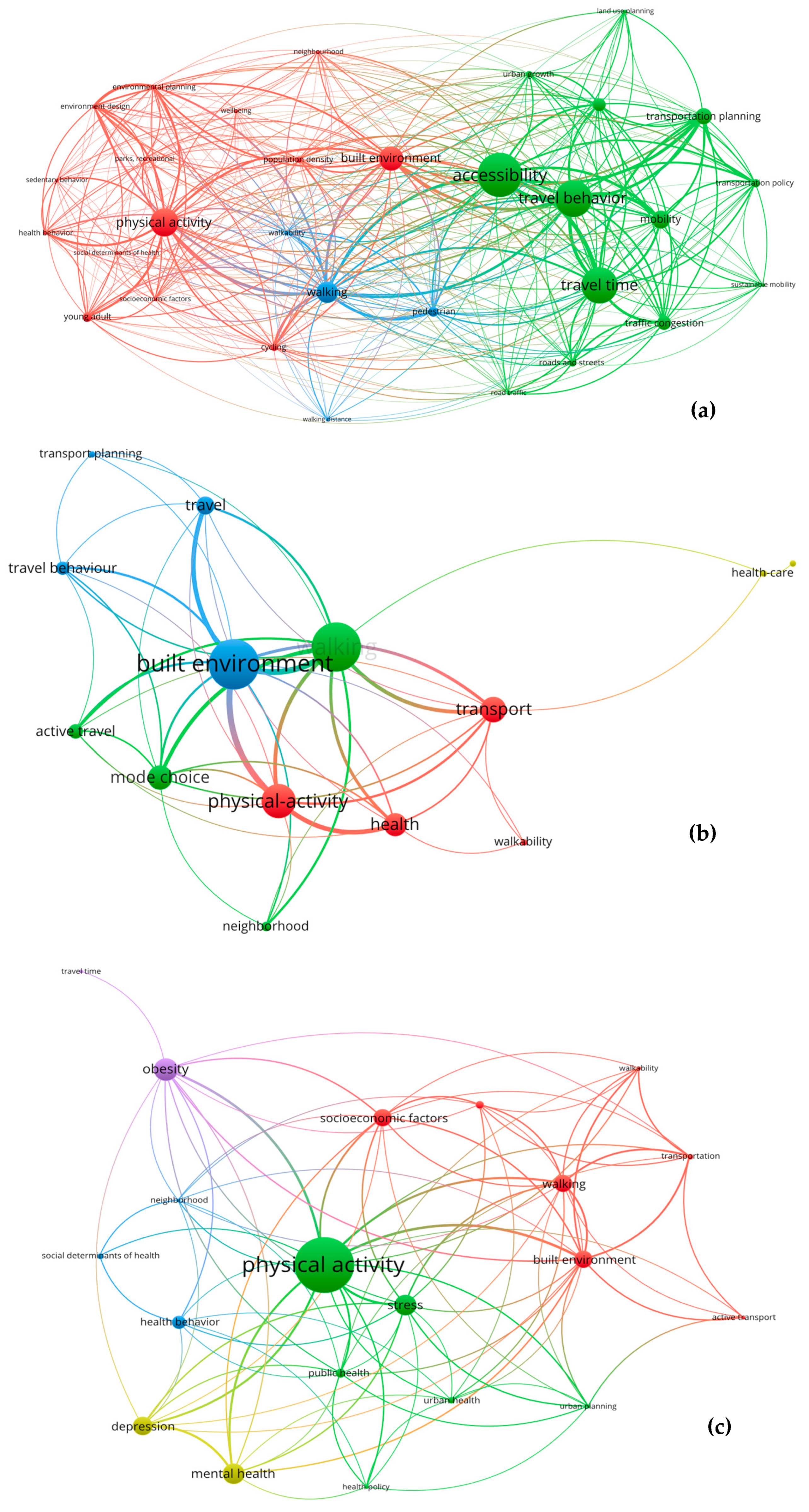
3.1. Bibliometric Network Analysis Across Databases
3.2. Foundational and Integrative Perspectives on Stress Frameworks
3.2.1. Classical Frameworks: Emergence of the 3Ds and 5Ds
3.2.2. Established Stress Constructs
3.2.3. Integrating Perspectives Across Disciplines
3.3. Developmental Phases of Built Environment and Physical Activity Research
3.3.1. Early Developments: Descriptive and Correlational Studies
3.3.2. Global Growth and Diversification (2000–2010)
3.3.3. Consolidation and Policy Alignment (2010–2020)
3.3.4. Transformative Trends and Temporal Turn (2020–2025)
3.4. Evidence Necessitating Duration as the Sixth Dimension
3.4.1. Theoretical Justification of Sixth D of BE
3.4.2. Transport and Health Integration
3.4.3. Policy and Planning Implications
3.4.4. Temporal Variability in Accessibility Across Different Countries
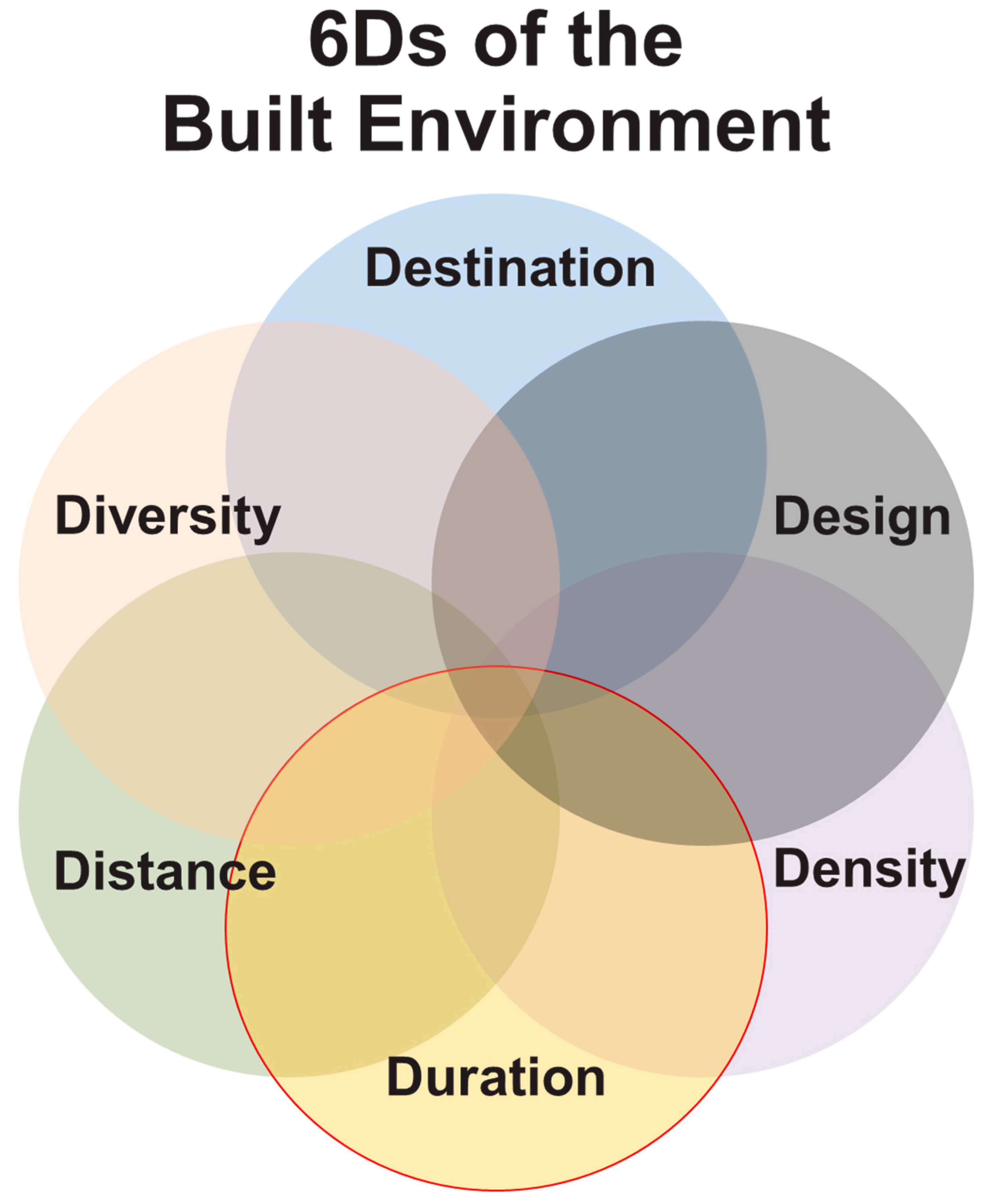
3.4.5. How Duration Interacts with the Other Ds
4. Discussion
5. Conclusions, Practical Implications, and Limitations
Supplementary Materials
Author Contributions
Funding
Institutional Review Board Statement
Informed Consent Statement
Data Availability Statement
Conflicts of Interest
Abbreviations
| AT | Active Transport |
| BE | Built Environment |
| DTS | Daily Traffic Stress |
| GIS | Geographic Information Systems |
| JBI | Joanna Briggs Institute |
| LTS | Level of Traffic Stress |
| PA | Physical Activity |
| PIA | Physical Inactivity |
| PRISMA | Preferred Reporting Items for Systematic Reviews and Meta-Analyses |
| SEM | Socio-Ecological Model |
| TMS | Temporal Mobility Stress |
| TPB | Theory of Planned Behaviour |
| TS | Traffic Stress |
| WHO | World Health Organization |
| 3Ds | Density, Diversity, Design |
| 5Ds | Density, Diversity, Design, Distance, Destination |
| 6Ds | Density, Diversity, Design, Distance, Destination, Duration |
Appendix A

| Name of Journal | Year | Authors | Title | Study Design/Scope | Methodological Quality | Key Findings |
|---|---|---|---|---|---|---|
| Sustainability | 2025 | Irfan Arif; Fahim Ullah | Impact of Traffic Stress, Built Environment, and Socioecological Factors on Active Transport Among Young Adults | Systematic review | High | Traffic stress reduces active transport among young adults; supportive environments mitigate this effect, addressing temporal gaps |
| The Lancet | 2025 | Thomas Rouvard | Effects of workplace interventions on sedentary behaviour and physical activity: an umbrella review with meta-analyses and narrative synthesis | Umbrella review | High | Workplace interventions reduce sedentary time and increase light physical activity, but do not consistently increase moderate-to-vigorous physical activity |
| The Lancet Public Health | 2025 | Ding Ding; Binh Nguyen; Tracy Nau; Mengyun Luo; Borja del Pozo Cruz; Paddy C. Dempsey; Zachary Munn; Barbara J. Jefferis | Daily steps and health outcomes in adults: a systematic review and dose-response meta-analysis | Systematic review and meta-analysis | High | Around 7000 daily steps reduce mortality risk, with limited benefit beyond moderate levels |
| Journal of Computational Social Science | 2025 | Yunhan Du; Takaaki Aoki; Naoya Fujiwara | A review of human mobility: Linking data, models, and real-world applications | Narrative review | High | Human mobility is regular and predictable, but models rarely capture both individual and aggregate temporal patterns |
| Transportation | 2025 | Alex Karner; Rafael H. M. Pereira; Steven Farber | Advances and pitfalls in measuring transportation equity | Narrative review | High | Standard equity metrics can misrepresent inequity under service changes |
| Communications in Transportation Research | 2025 | Alessandro Nalin; Nir Fulman; Emily Charlotte Wilke; Christina Ludwig; Alexander Zipf; Claudio Lantieri; Valeria Vignali; Andrea Simone | Evaluation of accessibility disparities in urban areas during disruptive events based on transit real data | Spatio-temporal observational study | High | Scheduled GTFS data overestimate accessibility during disruptions; real-time data show greater inequities, especially in peripheral areas. |
| Expert Systems with Applications | 2025 | Mahmoud Owais | How to incorporate machine learning and microsimulation tools in travel demand forecasting in multi-modal networks | Narrative review | High | Integrating machine learning and microsimulation improves forecasting under time-varying congestion conditions. |
| BMC Public Health | 2025 | Katherine Pérez; Laia Palència; Maria José López; Brenda Biaani León-Gómez; Anna Puig-Ribera; Anna Gómez-Gutiérrez; Mark Nieuwenhuijsen; Glòria Carrasco-Turigas; Carme Borrell | Environmental and health effects of the Barcelona superblocks | Natural experiment | High | Superblocks improved well-being and air quality, with uneven effects across neighbourhoods. |
| Human Relations | 2025 | Wladislaw Rivkin; Fabiola H Gerpott; Dana Unger | There and back again: The roles of morning- and evening commute recovery experiences for daily resources across the commute-, work-, and home domain | Longitudinal diary study | High | A relaxed morning commute supports work vitality and later recovery, with commute duration shaping how recovery processes unfold across the day. |
| Multimodal Transportation | 2025 | Siavash Saki; Mohsen Soori | Artificial Intelligence, Machine Learning and Deep Learning in Advanced Transportation Systems, A Review | Narrative review | High | Artificial intelligence applications enhance traffic safety, efficiency, and sustainability, particularly when real-time and spatiotemporal data are used, though implementation challenges persist. |
| Journal of Transport and Land Use | 2025 | Harry Schukei; Dana Rowangould | Planning beyond the metro: Rural travel behavior and the built environment | Cross-sectional observational study | High | Travel behaviour responds differently to the built environment in rural and urban settings, with regional access playing a role in rural contexts |
| Journal of Urban Mobility | 2025 | Ali Shkera; Domokos Esztergár-Kiss | Applying machine learning to decode built environment thresholds for public and active transport distances in the global south | Observational modelling study | High | Built environment characteristics explain travel distances more effectively than socio-demographic factors, with threshold effects that differ by transport mode. |
| Applied Mobilities | 2025 | Adam Stražovec; Jan Daniel | Daily rhythm of the population mobility: the importance of public transport in functionally specific parts of the city | Spatio-temporal observational study | High | Public transport use follows clear daily patterns, with distinct temporal profiles across land uses; accessibility in hospital and retail areas relies heavily on public transport. |
| Smart Cities | 2025 | Katarzyna Turoń | Sustainable Urban Mobility Transitions—From Policy Uncertainty to the CalmMobility Paradigm | Conceptual policy analysis | Not applicable | Weak temporal alignment can limit the effectiveness of mobility policies; CalmMobility proposes a more gradual and inclusive transition approach. |
| Building and Environment | 2025 | Wako Golicha Wako; Tom Clemens; Scott Ogletree; Andrew James Williams; Ruth Jepson | Validity, reliability and acceptability of wearable sensor devices to monitor personal exposure to air pollution and pollen: A systematic review of mobility-based exposure studies | Systematic review | High | Wearable sensor devices show acceptable reliability, but accuracy varies by pollutant, device, and temporal resolution. |
| Environment International | 2025 | Lai Wei; Marco Helbich; Benjamin Flückiger; Youchen Shen; Jelle Vlaanderen; Ayoung Jeong; Nicole Probst-Hensch; Kees de Hoogh; Gerard Hoek; Roel Vermeulen | Variability in mobility-based air pollution exposure assessment: Effects of GPS tracking duration and temporal resolution of air pollution maps | Longitudinal methodological study | High | Short-term GPS data (7–14 days) can represent long-term mobility-based air pollution exposure, but validity depends on temporal and indoor–outdoor adjustment. |
| Frontiers in Sustaina-ble Cities | 2025 | Syafieq Fahlevi Almas-sawa; Ernan Rusti-adi; Akhmad Fauzi; Ridwan Sutriadi | The relationship between regional development, smart mobility and transportation planning: a bibliometric analysis | Bibliometric analysis | Not applicable | Smart mobility–regional planning re-search is growing but remains weakly integrated and conceptually fragmented |
| Cities | 2024 | Avital Angel; Achituv Cohen; Trisalyn Nelson; Pnina Plaut | Evaluating the relationship between walking and street characteristics based on big data and machine learning analysis | Observational spatial study | High | Walking changes by time of day, not just by street design |
| Journal of Sport and Health Science | 2024 | Ulf Ekelund; Miguel Adriano Sanchez-Lastra; Knut Eirik Dalene; Jakob Tarp | Dose–response associations, physical activity intensity and mortality risk: A narrative review | Narrative review | High | Physical activity is linked to reduced mortality in a non-linear manner; light activity is beneficial at higher volumes, while small amounts of vigorous activity offer notable gains. |
| Transportation Research Part A: Policy and Practice | 2024 | Attiya Haseeb; Raktim Mitra | Travel behaviour changes among young adults and associated implications for social sustainability | Longitudinal observational study | High | Young adults show increasing reliance on private cars over time, while urban relocation supports continued use of public and active transport; reduced active travel may increase social exclusion. |
| Journal of Transport Geography | 2024 | Changyeon Lee | Quantifying urban sprawl and investigating the cause-effect links among urban sprawl factors, commuting modes, and time: A case study of South Korean cities | Cross-sectional modelling study | High | Higher density reduces car use but may increase commute time under congestion, while land-use mix and connectivity help shorten commuting duration. |
| International Journal of Behavioral Nutrition and Physical Activity | 2024 | Carina Nigg; Shaima A. Alothman; Abdullah F. Alghannam; Jasper Schipperijn; Reem AlAhmed; Reem F. Alsukait; Severin Rakic; Volkan Cetinkaya; Hazzaa M. Al-Hazzaa; Saleh A. Alqahtani | A systematic review on the associations between the built environment and adult’s physical activity in global tropical and subtropical climate regions | Systematic review | High | Built environment features are consistently associated with higher physical activity, though evidence on climate-adaptive design remains limited and context-specific. |
| The Lancet Global Health | 2024 | Tessa Strain; Seth Flaxman; Regina Guthold; Elizaveta Semenova; Melanie Cowan; Leanne M. Riley; Fiona C. Bull; Gretchen A. Stevens; | National, regional, and global trends in insufficient physical activity among adults from 2000 to 2022: a pooled analysis of 507 population-based surveys with 5·7 million participants | Pooled global surveillance analysis | High | Globally, many adults are insufficiently physically active, increasing population-level risk of non-communicable diseases |
| Travel Behaviour and Society | 2024 | Yinhua Tao; Maarten van Ham; Ana Petrović | Changes in commuting mode and the relationship with psychological stress: A quasi-longitudinal analysis in urbanizing China | Quasi-longitudinal study | High | Longer commutes, particularly by private motorised modes, are associated with higher psychological stress, while active commuting shows protective effects that vary by urban context. |
| Sustainability | 2024 | Sai-Zu Wang; Chang-Gyu Choi | Is Development Type a Determinant of College and Graduate Students’ Commute Time to School? The Case of Seoul Metropolitan Area | Cross-sectional observational study | High | Students in suburban new towns experience longer commutes, with development type exerting more influence than individual characteristics, raising social sustainability concerns. |
| Transportation Research Interdisciplinary Perspectives | 2023 | Marco Garrido-Cumbrera; Olta Braçe; David Gálvez-Ruiz; Enrique López-Lara; José Correa-Fernández | Can the mode, time, and expense of commuting to work affect our mental health? | Cross-sectional observational study | High | Longer commute times are linked to poorer mental health, whereas public and active transport users report better outcomes. |
| The Lancet Global Health | 2023 | Peter T. Katzmarzyk | Expanding our understanding of the global impact of physical inactivity | Expert commentary | High | Despite growing evidence, physical inactivity remains prevalent; increasing physical activity significantly enhances health. |
| Journal of Geographical Systems | 2023 | Luyu Liu; Adam Porr; Harvey J. Miller | Realizable accessibility: evaluating the reliability of public transit accessibility using high-resolution real-time data | Methodological study | High | Scheduled and retrospective accessibility measures often overestimate achievable access; user-centred measures highlight greater unreliability during peak periods. |
| Accident Analysis & Prevention | 2023 | Marcus Skyum Myhrmann; Stefan Eriksen Mabit | Assessing bicycle crash risks controlling for detailed exposure: A Copenhagen case study | Observational risk study | High | Bicycle crash risk changes by time of day, day of week, and weather conditions, with peak periods presenting higher risk that aggregated analyses may overlook. |
| Travel Behaviour and Society | 2023 | Andreas Nikiforiadis; Eirini Chatzali; Vasileios Ioannidis; Konstantinos Kalogiros; Maria Paipai; Socrates Basbas | Investigating factors that affect perceived quality of service on pedestrians-cyclists shared infrastructure | Cross-sectional observational study | High | Perceived service quality for cyclists depends more on infrastructure quality and behaviour than on density-based measures. |
| HBRC Journal | 2023 | Dina M. A. Noseir; Marwa A. Khalifa; Yehya M. Serag; Mohamed A. El Fayoumi | Investigating the influence of land use mix and built environment elements on travel time perception and subjective wellbeing | Mixed-methods study | High | Built environment and land-use mix influence perceived travel time and wellbeing, highlighting the experiential role of time in daily travel. |
| Sustainable Cities and Society | 2023 | Md Mokhlesur Rahman; Sharfan Upaul; Jean-Claude Thill; Mahinur Rahman | Active transportation and the built environment of a mid-size global south city | Cross-sectional observational study | High | Built environment characteristics exert a stronger influence on walking than cycling, with compactness and sidewalk quality supporting longer and more frequent walking. |
| J Sport Health Sci | 2023 | Y. Sun; C. Chen; Y. Yu; H. Zhang; X. Tan; J. Zhang; L. Qi; Y. Lu; N. Wang | Replacement of leisure-time sedentary behavior with various physical activities and the risk of dementia incidence and mortality: A prospective cohort study | Prospective cohort study | High | Replacing sedentary time with physical activity reduces dementia risk, with benefits influenced by how daily time is reallocated and age at exposure. |
| International Journal of Environmental Research and Public Health | 2023 | Yiyu Wang; Bert Steenbergen; Erwin van der Krabben; Henk-Jan Kooij; Kevin Raaphorst; Remco Hoekman | The Impact of the Built Environment and Social Environment on Physical Activity: A Scoping Review | Scoping review | High | Physical activity is shaped jointly by built and social environments, with perceived conditions often outweighing objective measures. |
| Land | 2023 | Muxia Yao; Bin Yao; Jeremy Cenci; Chenyang Liao; Jiazhen Zhang | Visualisation of High-Density City Research Evolution, Trends, and Outlook in the 21st Century | Bibliometric analysis | Not applicable | Research on high-density cities has grown rapidly but remains fragmented, with limited integration of human-centred theoretical frameworks. |
| Cities | 2022 | Long Chen; Yi Lu; Yu Ye; Yang Xiao; Linchuan Yang | Examining the association between the built environment and pedestrian volume using street view images | GIS-based observational study | High | Pedestrian volume is positively associated with both micro-scale streetscape features and macro-scale-built environment factors. |
| Journal of Transport Geography | 2022 | Eunae Jin; Danya Kim; Jangik Jin | Commuting time and perceived stress: Evidence from the intra- and inter-city commuting of young workers in Korea | Quasi-longitudinal panel study | High | The relationship between commute time and stress varies by mode; public transport may buffer stress through productive time use, whereas car commuting intensifies stress as duration increases. |
| Travel Behaviour and Society | 2022 | Jiakun Liu; Dick Ettema; Marco Helbich | Systematic review of the association between commuting, subjective wellbeing and mental health | Systematic review | High | Long commuting durations are generally linked to poorer wellbeing, particularly beyond certain thresholds, while active commuting is most consistently associated with positive outcomes. |
| Health & Place | 2022 | Stephanie A. Prince; Samantha Lancione; Justin J. Lang; Nana Amankwah; Margaret de Groh; Alejandra Jaramillo Garcia; Katherine Merucci; Robert Geneau | Examining the state, quality and strength of the evidence in the research on built environments and physical activity among adults: An overview of reviews from high income countries | Overview of reviews | High | Evidence linking the built environment to adult physical activity relies largely on cross-sectional studies, with limited temporally explicit or causal research. |
| Sustainability | 2022 | Jiankun Yang; Min He; Mingwei He | Exploring the Group Difference in the Nonlinear Relationship between Commuting Satisfaction and Commuting Time | Cross-sectional empirical study | High | Commuting satisfaction declines once travel time exceeds individual tolerance thresholds. Preferences and tolerance differ across population groups. |
| International Journal of Health Geographics | 2022 | Jingjing Li | Comparing effects of Euclidean buffers and network buffers on associations between built environment and transport walking: the Multi-Ethnic Study | Cross-sectional observational study | High | Euclidean buffers underestimate walking associations; network buffers provide more accurate results. |
| Sensors | 2022 | Pamela Zontone; Antonio Affanni; Alessandro Piras; Roberto Rinaldo | Exploring Physiological Signal Responses to Traffic-Related Stress in Simulated Driving | Experimental study | High | Traffic stress occurs in brief, time-specific intervals and varies across time. Machine learning approaches allow stress detection at fine temporal scales. |
| Progress in Cardiovascular Diseases | 2021 | Amy Bantham; Sharon E. Taverno Ross; Emerson Sebastião; Grenita Hall | Overcoming barriers to physical activity in underserved populations | Narrative review | High | Underserved populations face barriers to physical activity at individual, community, and policy levels. Community-led, culturally appropriate, and place-based interventions are most effective for long-term behaviour change. |
| Computers, Environment and Urban Systems | 2021 | Gregory Dobler; Jordan Vani; Trang Tran Linh Dam | Patterns of urban foot traffic dynamics | Spatio-temporal observational study | High | Urban pedestrian activity follows regular daily patterns shaped by work schedules. Deviations from these patterns reflect disruptions and location-specific events linked to urban form. |
| Journal of Transport Geography | 2021 | José Ignacio Giménez-Nadal; José Alberto Molina; Jorge Velilla | Two-way commuting: Asymmetries from time use surveys | Observational time-use study | High | Commutes to work are typically longer and more time-concentrated than return trips. These differences vary by country, gender, and travel mode, and treating commutes as time-symmetric hides important behavioural patterns |
| Int J Environ Res Public Health | 2021 | M. P. Jimenez; N. V. DeVille; E. G. Elliott; J. E. Schiff; G. E. Wilt; J. E. Hart; P. James | Associations between Nature Exposure and Health: A Review of the Evidence | Narrative review | High | Health benefits depend on the duration, frequency, and timing of nature exposure. Sustained exposure is linked to longer-term mental and physical health benefits |
| Transportation | 2021 | Teppei Kato; Kenetsu Uchida; William H. K. Lam; Agachai Sumalee | Estimation of the value of travel time and of travel time reliability for heterogeneous drivers in a road network | Analytical modelling study | High | Travel time reliability provides benefits beyond average travel time. Ignoring variability leads to underestimation of welfare and planning benefits. |
| Int. J. Environ. Res. Public Health | 2021 | Donglin Hu | Factors That Influence Participation in Physical Activity in School-Aged Children and Adolescents: A Systematic Review from the Social Ecological Model Perspective | Systematic review | High | Physical activity participation is influenced by multiple socio-ecological factors. Interpersonal and organisational support strongly affect how much time people can allocate to activity. |
| The Lancet | 2012 | Dr Pedro C Hallal | Global physical activity levels: surveillance progress, pitfalls, and prospects | Surveillance synthesis | High | Global physical inactivity remains high. Occupational physical activity has declined over time, and active transport remains insufficiently adopted, with limited temporal monitoring. |
| Frontiers in Public Health | 2021 | Mary N. Woessner; Alexander Tacey; Ariella Levinger-Limor; Alexandra G. Parker; Pazit Levinger; Itamar Levinger | The Evolution of Technology and Physical Inactivity: The Good, the Bad, and the Way Forward | Narrative review | High | Technology use has reduced incidental physical activity and increased sedentary behaviour. Short-term digital interventions can help, but long-term success depends on sustained engagement. |
| Int J Environ Res Public Health | 2021 | T. Zhu; Z. Zhu; J. Zhang; C. Yang | Electric Bicyclist Injury Severity during Peak Traffic Periods: A Random-Parameters Approach with Heterogeneity in Means and Variances | Observational crash study | High | Injury severity varies by time of day and traffic conditions. Lighting, visibility, and roadside features increase risk during peak and low-light periods. |
| Br J Sports Med | 2020 | F. C. Bull; S. S. Al-Ansari; S. Biddle; K. Borodulin; M. P. Buman; G. Cardon; C. Carty; J. P. Chaput; S. Chastin; R. Chou; P. C. Dempsey; L. DiPietro; U. Ekelund; | World Health Organization 2020 guidelines on physical activity and sedentary behaviour | Clinical guideline | High | Health benefits from physical activity are observed even below recommended thresholds. |
| PLOS ONE | 2020 | Sarah Elshahat; Michael O’Rorke; Deepti Adlakha | Built environment correlates of physical activity in low- and middle-income countries: A systematic review | Systematic review and meta-analysis | High | Built environment effects on activity are weaker in low- and middle-income countries. Safety from crime, especially at night, is the most consistent factor. |
| Occup Environ Med | 2020 | J. I. Halonen; A. Pulakka; J. Vahtera; J. Pentti; H. Laström; S. Stenholm; L. M. Hanson | Commuting time to work and behaviour-related health: a fixed-effect analysis | Longitudinal fixed-effects study | High | Long commuting times combined with long working hours reduce physical activity and sleep. Commuting acts as a constraint on daily time allocation. |
| Sustainability | 2020 | Jae Min Lee | Exploring Walking Behavior in the Streets of New York City Using Hourly Pedestrian Count Data | Spatio-temporal observational study | High | Walking behaviour follows daily, weekly, and seasonal patterns shaped by land use and microclimate. Thermal comfort thresholds influence route choice, showing that walking responds to system-level temporal conditions. |
| International Journal of Transportation Science and Technology | 2020 | Seyedmirsajad Mokhtarimousavi; Jason C. Anderson; Atorod Azizinamini; Mohammed Hadi | Factors affecting injury severity in vehicle-pedestrian crashes: A day-of-week analysis using random parameter ordered response models and Artificial Neural Networks | Observational crash study | High | Pedestrian injury severity differs between weekdays and weekends, with higher severity during evening and night-time periods. Alcohol use, lighting, and traffic patterns show time-dependent effects. |
| Environment International | 2020 | Natalie Mueller; David Rojas-Rueda; Haneen Khreis; Marta Cirach; David Andrés; Joan Ballester; | Changing the urban design of cities for health: The superblock model | Health impact assessment | High | Full implementation of the Superblock model in Barcelona could prevent substantial premature mortality through reduced pollution, noise, heat, and increased transport-related physical activity. |
| Journal of Exercise Science & Fitness | 2022 | Kylie D. Hesketh | Results from the Australian 2022 Report Card on physical activity for children and young people | Population surveillance synthesis | Moderate | Physical activity levels among children and young people remain low, with limited active transport participation. Supportive built environments alone have not translated into behaviour change. |
| The Lancet | 2020 | Christopher J. L. Murray; Aleksandr Y. Aravkin; Peng Zheng; Cristiana Abbafati; Kaja M. Abbas; Mohsen Abbasi-Kangevari; | Global burden of 87 risk factors in 204 countries and territories, 1990–2019: a systematic analysis for the Global Burden of Disease Study 2019 | Global comparative assessment | High | Despite improvements in some environmental risks, many behavioural and metabolic risk factors have worsened. Policy action has been insufficient to reduce population exposure. |
| Journal of Transport Geography | 2020 | Konstantina Bimpou, Neil S. Ferguson | Dynamic accessibility: Incorporating day-to-day travel time reliability into accessibility measurement | Methodological modelling study | High | Dynamic accessibility measures show that static approaches overestimate actual access. Accessibility varies strongly by time of day and reliability, with equity implications. |
| International Journal of Sustainable Transportation | 2019 | Myung-Jin Jun; Ki-Hyun Kwon; Ji-Eun Jeong | An evaluation of the value of time for commuting in Seoul: A life satisfaction approach | Longitudinal observational study | High | Longer commuting time is associated with lower life satisfaction. The value of commuting time is substantial and varies by gender, income, and household structure. |
| Int J Behav Nutr Phys Act | 2017 | D. W. Barnett; A. Barnett; A. Nathan; J. Van Cauwenberg; E. Cerin | Built environmental correlates of older adults’ total physical activity and walking: a systematic review and meta-analysis | Systematic review and meta-analysis | High | Very strong evidence shows that walkable, service-rich environments with public transport, greenery, and pedestrian infrastructure support higher physical activity in older adults. |
| International Journal of Behavioral Nutrition and Physical Activity | 2017 | Ester Cerin; Andrea Nathan; Jelle van Cauwenberg; David W. Barnett; Anthony Barnett; Environment on behalf of the Council on; group Physical Activity–Older Adults working | The neighbourhood physical environment and active travel in older adults: a systematic review and meta-analysis | Systematic review and meta-analysis | High | Strong evidence links walkability, density, connectivity, destination access, and perceived safety to transport walking among older adults, while evidence for cycling is limited. |
| Transportation Research Record | 2016 | Peter G. Furth; Maaza C. Mekuria; Hilary Nixon | Network Connectivity for Low-Stress Bicycling | Applied network analysis | High | Cycling feasibility depends on low-stress network connectivity rather than facility length. Fragmented networks create repeated stress barriers. |
| The Lancet | 2016 | Billie Giles-Corti; Anne Vernez-Moudon; Rodrigo Reis; Gavin Turrell; Andrew L. Dannenberg; Hannah Badland; Sarah Foster; Melanie Lowe; James F. Sallis; Mark Stevenson; Neville Owen | City planning and population health: a global challenge | Narrative policy review | High | Integrated city and transport planning influences population health through cumulative daily travel exposure. Compact, mixed-use cities reduce car dependence and support routine physical activity. |
| American Journal of Public Health | 2016 | Adela Hruby; JoAnn E. Manson; Lu Qi; Vasanti S. Malik; Eric B. Rimm; Qi Sun; Walter C. Willett; Frank B. Hu | Determinants and Consequences of Obesity | Narrative synthesis | High | Adult weight gain increases long-term disease risk. Sustained physical activity and walkable environments reduce this risk over time. |
| BMJ | 2016 | Hmwe H Kyu; Victoria F Bachman; Lily T Alexander; John Everett Mumford; Ashkan Afshin; Kara Estep; J Lennert Veerman; Kristen Delwiche; Marissa L Iannarone | Physical activity and risk of breast cancer, colon cancer, diabetes, ischemic heart disease, and ischemic stroke events: systematic review and dose-response meta-analysis for the Global Burden of Disease Study 2013 | Systematic review and meta-analysis | High | Health benefits are observed at moderate physical activity levels across all physical activity domains. |
| Journal of Transport & Health | 2016 | Myriam Langlois; Rania A. Wasfi; Nancy A. Ross; Ahmed M. El-Geneidy | Can transit-oriented developments help achieve the recommended weekly level of physical activity? | Cross-sectional observational study | High | Residents of transit-oriented developments often meet physical activity guidelines through daily travel alone. Repeated trips produce cumulative health benefits. |
| Transp Policy (Oxf) | 2016 | R. J. Lee; I. N. Sener | Transportation Planning and Quality of Life: Where Do They Intersect? | Mixed-methods policy analysis | High | Transport-related quality of life is unevenly addressed in long-term planning. Mental and social wellbeing receive less attention than physical and economic outcomes, despite cumulative effects of long commutes and stress. |
| The Lancet | 2016 | James F. Sallis; Ester Cerin; Terry L. Conway; Marc A. Adams; Lawrence D. Frank; Michael Pratt; Deborah Salvo; Jasper Schipperijn; | Physical activity in relation to urban environments in 14 cities worldwide: a cross-sectional study | Multicountry observational study | High | Urban environments that support activity are consistently linked to higher objectively measured physical activity across cities worldwide. |
| Journal of Environmental Psychology | 2015 | Mei-Fang Chen | Self-efficacy or collective efficacy within the cognitive theory of stress model: Which more effectively explains people’s self-reported proenvironmental behavior? | Cross-sectional analytical study | High | Collective efficacy explains pro-environmental behaviour better than individual self-efficacy. Behaviour emerges through shared stress appraisal and coping over time. |
| Transportation Research Part F: Traffic Psychology and Behaviour | 2015 | Alexander Legrain; Naveen Eluru; Ahmed M. El-Geneidy | Am stressed, must travel: The relationship between mode choice and commuting stress | Observational study | High | Commuting stress is highest for car travel and lowest for walking. Unpredictability and buffer time contribute more to stress than average travel time. |
| Annual review of psychology | 2014 | Robert Gifford | Environmental psychology matters | Narrative review | High | Behaviour is shaped by temporally structured environments. Long-term change requires structural, not short-term, interventions. |
| International Journal of Behavioral Nutrition and Physical Activity | 2014 | Paul Kelly; Sonja Kahlmeier; Thomas Götschi; Nicola Orsini; Justin Richards; Nia Roberts; Peter Scarborough; Charlie Foster | Systematic review and meta-analysis of reduction in all-cause mortality from walking and cycling and shape of dose response relationship | Systematic review and meta-analysis | High | Walking and cycling reduce all-cause mortality, with the greatest benefits occurring at low to moderate exposure levels. |
| Research in Transportation Economics | 2013 | Darío Hidalgo; Liliana Pereira; Nicolás Estupiñán; Pedro Luis Jiménez | TransMilenio BRT system in Bogota, high performance and positive impact–Main results of an ex-post evaluation | Natural experiment | High | The TransMilenio system delivered major peak-period time savings and health benefits, although long-term overcrowding reduced user satisfaction. Temporal performance is critical to system success. |
| Transportation Research Part A: Policy and Practice | 2012 | Carlos Carrion; David Levinson | Value of travel time reliability: A review of current evidence | Systematic review and meta-analysis | High | Travel time reliability is a distinct and important temporal factor shaping behaviour, stress, and welfare beyond average travel time. |
| Health Place | 2012 | D. Ding; K. Gebel | Built environment, physical activity, and obesity: what have we learned from reviewing the literature? | Review of reviews | High | Evidence remains inconsistent due to weak temporal alignment and reliance on cross-sectional studies. Stronger longitudinal and quasi-experimental designs are needed. |
| The Lancet | 2012 | I. Min Lee; Eric J. Shiroma; Felipe Lobelo; Pekka Puska; Steven N. Blair; Peter T. Katzmarzyk | Effect of physical inactivity on major non-communicable diseases worldwide: an analysis of burden of disease and life expectancy | Comparative risk assessment | High | Physical inactivity is widespread worldwide and substantially increases the burden of major non-communicable diseases and premature mortality |
| Medicine & Science in Sports & Exercise | 2012 | JOHN C. SIEVERDES; BILLY M. RAY; XUEMEI SUI; DUCK-CHUL LEE; GREGORY A. HAND; MEGHAN BARUTH; STEVEN N. BLAIR | Association between Leisure Time Physical Activity and Depressive Symptoms in Men | Cross-sectional observational study | High | Moderate weekly physical activity levels are associated with substantially lower depressive symptoms |
| Journal of Physical Activity and Health | 2011 | Ebonee N. Butler; A. M. H. Ambs; Jill Reedy; Heather R. Bowles | Identifying GIS measures of the physical activity built environment through a review of the literature | Systematic methodological review | High | GIS-based built environment measures vary widely and lack standardisation. Temporal misalignment limits reliable interpretation. |
| International Journal of Behavioral Nutrition and Physical Activity | 2011 | Gavin R. McCormack; Alan Shiell | In search of causality: a systematic review of the relationship between the built environment and physical activity among adults | Systematic review | High | Built environment effects remain after controlling for self-selection but are weaker. Duration and behavioural adaptation are under-measured pathways. |
| The Lancet | 2011 | Chi Pang Wen; Jackson Pui Man Wai; Min Kuang Tsai; Yi Chen Yang; Ting Yuan David Cheng; Meng-Chih Lee; Hui Ting Chan; Chwen Keng Tsao; Shan Pou Tsai; Xifeng Wu | Minimum amount of physical activity for reduced mortality and extended life expectancy: a prospective cohort study | Prospective cohort study | High | Even short daily physical activity durations reduce mortality and increase life expectancy. Repeated daily exposure is key. |
| Transportation Research Part F: Traffic Psychology and Behaviour | 2011 | Richard E. Wener; Gary W. Evans | Comparing stress of car and train commuters | Cross-sectional observational study | High | Car commuters experience higher stress than train commuters. Stress is driven by unpredictability and effort rather than travel time alone. |
| International Journal of Behavioral Nutrition and Physical Activity | 2010 | Janne Boone-Heinonen; David K. Guilkey; Kelly R. Evenson; Penny Gordon-Larsen | Residential self-selection bias in the estimation of built environment effects on physical activity between adolescence and young adulthood | Longitudinal study | High | Some built environment effects persist after accounting for self-selection, particularly during young adulthood. |
| Journal of the American Planning Association | 2010 | Reid Ewing; Robert Cervero | Travel and the Built Environment | Meta-analysis | High | Built environment effects on travel are modest but consistent. Destination accessibility shows the strongest association. |
| British journal of sports medicine | 2010 | Lawrence D Frank; James F Sallis; Brian E Saelens; Lauren Leary; Kelli Cain; Terry L Conway; Paul M Hess | The development of a walkability index: application to the Neighborhood Quality of Life Study | Measurement development study | Moderate | Walkability index was developed and validated, showing that higher walkability is linked to higher physical activity. |
| Am J Public Health | 2010 | J. Pucher; R. Buehler; D. R. Bassett; A. L. Dannenberg | Walking and cycling to health: a comparative analysis of city, state, and international data | Ecological observational study | Moderate | Higher levels of walking and cycling at the population level are associated with lower obesity and diabetes prevalence across different spatial scales. |
| International Journal of Sustainable Transportation | 2009 | Robert Cervero; Olga L. Sarmiento; Enrique Jacoby; Luis Fernando Gomez; Andrea Neiman | Influences of Built Environments on Walking and Cycling: Lessons from Bogotá | Multilevel observational study | High | Street design and access to Ciclovía programs influence walking and cycling more than land-use mix in compact cities |
| Transportation Research Part A: Policy and Practice | 2009 | Jonas Eliasson; Lars Hultkrantz; Lena Nerhagen; Lena Smidfelt Rosqvist | The Stockholm congestion–charging trial 2006: Overview of effects | Natural experiment | High | Time-based congestion pricing reduced traffic, improved reliability, and lowered emissions, with behavioural responses occurring rapidly and varying by time of day |
| Transportation Research Record | 2008 | Kate Lyman; Robert L. Bertini | Using Travel Time Reliability Measures to Improve Regional Transportation Planning and Operations | Applied planning study | High | Reliability measures reveal congestion patterns not captured by averages. These measures can change planning priorities. |
| Med Sci Sports Exerc | 2008 | B. E. Saelens; S. L. Handy | Built environment correlates of walking: a review | Narrative review | High | Transport-related walking is linked to density, land-use mix, and destination proximity. Causal inference remains limited by temporal mismatch. |
| American Journal of Preventive Medicine | 2008 | Ken R. Smith; Barbara B. Brown; Ikuho Yamada; Lori Kowaleski-Jones; Cathleen D. Zick; Jessie X. Fan | Walkability and Body Mass Index: Density, Design, and New Diversity Measures | Cross-sectional observational study | High | Higher walkability is associated with lower body mass index and reduced obesity risk. Cumulative exposure matters more than short-term environmental features. |
| Social Science & Medicine | 2007 | Lawrence Douglas Frank; Brian E. Saelens; Ken E. Powell; James E. Chapman | Stepping towards causation: Do built environments or neighborhood and travel preferences explain physical activity, driving, and obesity? | Cross-sectional observational study | High | Walkability remains associated with increased walking and reduced driving even after accounting for residential self-selection. Preferences influence behaviour but do not fully explain built environment effects. |
| Obesity Reviews | 2007 | W. Wendel-Vos; M. Droomers; S. Kremers; J. Brug; F. Van Lenthe | Potential environmental determinants of physical activity in adults: a systematic review | Systematic review | High | Strong evidence exists for only a limited number of environmental determinants of activity. Effects are clearer when outcomes are measured with time-specific indicators. |
| Journal of the American Planning Association | 2006 | Lawrence D. Frank; James F. Sallis; Terry L. Conway; James E. Chapman; Brian E. Saelens; William Bachman | Many Pathways from Land Use to Health: Associations between Neighborhood Walkability and Active Transportation, Body Mass Index, and Air Quality | Observational integrative study | High | Walkable environments increase active travel time and are associated with lower obesity and emissions, thereby shaping how land-use characteristics translate into health outcomes. |
| Journal of the American Planning Association | 2006 | Susan Handy; Xinyu Cao; Patricia L. Mokhtarian | Self-Selection in the Relationship between the Built Environment and Walking: Empirical Evidence from Northern California | Quasi-longitudinal observational study | High | Built environment changes often occur prior to changes in walking behaviour, and environmental effects persist even after controlling for self-selection. |
| Journal of Travel Research | 2005 | Yvette Reisinger; Felix Mavondo | Travel Anxiety and Intentions to Travel Internationally: Implications of Travel Risk Perception | Cross-sectional analytical study | High | Travel anxiety links risk perception to future travel behaviour. Anxiety operates as a time-sensitive behavioural mechanism. |
| BMJ | 2004 | David Ogilvie; Matt Egan; Val Hamilton; Mark Petticrew | Promoting walking and cycling as an alternative to using cars: systematic review | Systematic review | High | Behaviour-change programmes can shift a small proportion of trips. Evidence of large population-level modal change remains limited. |
| J Sports Sci | 2004 | J. Waterhouse; T. Reilly; B. Edwards | The stress of travel | Narrative physiological review | High | Travel-related stress follows daily temporal patterns. Disruption of circadian rhythms affects performance and wellbeing. |
| American Journal of Preventive Medicine | 2002 | Susan L. Handy; Marlon G. Boarnet; Reid Ewing; Richard E. Killingsworth | How the built environment affects physical activity: Views from urban planning | Narrative conceptual review | High | The built environment shapes physical activity by influencing travel time and the experience of walking and cycling. |
| Transportation Research Part E: Logistics and Transportation Review | 2001 | John Bates; John Polak; Peter Jones; Andrew Cook | The valuation of reliability for personal travel | Analytical synthesis study | High | Travel time reliability has independent value beyond mean travel time. Ignoring reliability leads to incomplete assessment of transport benefits. |
| Transportation Research Part D: Transport and Environment | 1997 | Robert Cervero; Kara Kockelman | Travel demand and the 3Ds: Density, diversity, and design | Cross-sectional observational study | High | Density, diversity, and design jointly reduce vehicle travel and increase non-motorised trips. These effects are strongest for non-work travel. |
References
- Yao, M.; Yao, B.; Cenci, J.; Liao, C.; Zhang, J. Visualisation of High-Density City Research Evolution, Trends, and Outlook in the 21st Century. Land 2023, 12, 485. [Google Scholar] [CrossRef]
- Pernice, R. Sustainability, Creativity, and Livability in Great East Asian Megacities: Insights from Twenty-First Century Tokyo, Seoul, and Chinese Creative Clusters. J. Urban. Hist. 2025, 00961442251343517. [Google Scholar] [CrossRef]
- Wang, Y.; Steenbergen, B.; van der Krabben, E.; Kooij, H.-J.; Raaphorst, K.; Hoekman, R. The Impact of the Built Environment and Social Environment on Physical Activity: A Scoping Review. Int. J. Environ. Res. Public Health 2023, 20, 6189. [Google Scholar] [CrossRef]
- Woessner, M.N.; Tacey, A.; Levinger-Limor, A.; Parker, A.G.; Levinger, P.; Levinger, I. The Evolution of Technology and Physical Inactivity: The Good, the Bad, and the Way Forward. Front. Public Health 2021, 9, 655491. [Google Scholar] [CrossRef]
- Caspersen, C.J.; Powell, K.E.; Christenson, G.M. Physical activity, exercise, and physical fitness: Definitions and distinctions for health-related research. Public Health Rep. 1985, 100, 126–131. [Google Scholar]
- Sallis, J.F.; Cerin, E.; Conway, T.L.; Adams, M.A.; Frank, L.D.; Pratt, M.; Salvo, D.; Schipperijn, J.; Smith, G.; Cain, K.L.; et al. Physical activity in relation to urban environments in 14 cities worldwide: A cross-sectional study. Lancet 2016, 387, 2207–2217. [Google Scholar] [CrossRef] [PubMed]
- Bull, F.C.; Al-Ansari, S.S.; Biddle, S.; Borodulin, K.; Buman, M.P.; Cardon, G.; Carty, C.; Chaput, J.-P.; Chastin, S.; Chou, R.; et al. World Health Organization 2020 guidelines on physical activity and sedentary behaviour. Br. J. Sports Med. 2020, 54, 1451–1462. [Google Scholar] [CrossRef]
- Arif, I.; Ullah, F. Impact of Traffic Stress, Built Environment, and Socioecological Factors on Active Transport Among Young Adults. Sustainability 2025, 17, 9159. [Google Scholar] [CrossRef]
- Giles-Corti, B.; Vernez-Moudon, A.; Reis, R.; Turrell, G.; Dannenberg, A.L.; Badland, H.; Foster, S.; Lowe, M.; Sallis, J.F.; Stevenson, M.; et al. City planning and population health: A global challenge. Lancet 2016, 388, 2912–2924. [Google Scholar] [CrossRef] [PubMed]
- Cerin, E.; Nathan, A.; van Cauwenberg, J.; Barnett, D.W.; Barnett, A.; on behalf of the Council on Environment and Physical Activity (CEPA)—Older Adults working group. The neighbourhood physical environment and active travel in older adults: A systematic review and meta-analysis. Int. J. Behav. Nutr. Phys. Act. 2017, 14, 15. [Google Scholar] [CrossRef]
- Katzmarzyk, P.T. Expanding our understanding of the global impact of physical inactivity. Lancet Glob. Health 2023, 11, e2–e3. [Google Scholar] [CrossRef]
- Hallal, P.C.; Andersen, L.B.; Bull, F.C.; Guthold, R.; Haskell, W.; Ekelund, U. Global physical activity levels: Surveillance progress, pitfalls, and prospects. Lancet 2012, 380, 247–257. [Google Scholar] [CrossRef] [PubMed]
- Hesketh, K.D.; Booth, V.; Cleland, V.; Gomersall, S.R.; Olds, T.; Reece, L.; Ridgers, N.D.; Straker, L.; Stylianou, M.; Tomkinson, G.R.; et al. Results from the Australian 2022 Report Card on physical activity for children and young people. J. Exerc. Sci. Fit. 2023, 21, 83–87. [Google Scholar] [CrossRef]
- Rouyard, T.; Yoda, E.; Akksilp, K.; Dieterich, A.V.; Kc, S.; Dabak, S.V.; Müller, A.M. Effects of workplace interventions on sedentary behaviour and physical activity: An umbrella review with meta-analyses and narrative synthesis. Lancet Public Health 2025, 10, e295–e308. [Google Scholar] [CrossRef]
- Strain, T.; Flaxman, S.; Guthold, R.; Semenova, E.; Cowan, M.; Riley, L.M.; Bull, F.C.; A Stevens, G.; Raheem, R.A.; Agoudavi, K.; et al. National, regional, and global trends in insufficient physical activity among adults from 2000 to 2022: A pooled analysis of 507 population-based surveys with 5·7 million participants. Lancet Glob. Health 2024, 12, e1232–e1243. [Google Scholar] [CrossRef]
- World Health Organization. Global recommendations on physical activity for health. In Global Recommendations on Physical Activity for Health; World Health Organization: Geneva, Switzerland, 2010; p. 60. [Google Scholar]
- Lee, I.M.; Shiroma, E.J.; Lobelo, F.; Puska, P.; Blair, S.N.; Katzmarzyk, P.T. Effect of physical inactivity on major non-communicable diseases worldwide: An analysis of burden of disease and life expectancy. Lancet 2012, 380, 219–229. [Google Scholar] [CrossRef]
- Murray, C.J.L.; Aravkin, A.Y.; Zheng, P.; Abbafati, C.; Abbas, K.M.; Abbasi-Kangevari, M.; Abd-Allah, F.; Abdelalim, A.; Abdollahi, M.; Abdollahpour, I.; et al. Global burden of 87 risk factors in 204 countries and territories, 1990–2019: A systematic analysis for the Global Burden of Disease Study 2019. Lancet 2020, 396, 1223–1249. [Google Scholar] [CrossRef] [PubMed]
- World Health Organization. WHO Guidelines on Physical Activity and Sedentary Behaviour; World Health Organization: Geneva, Switzerland, 2020. [Google Scholar]
- Hruby, A.; Manson, J.E.; Qi, L.; Malik, V.S.; Rimm, E.B.; Sun, Q.; Willett, W.C.; Hu, F.B. Determinants and Consequences of Obesity. Am. J. Public Health 2016, 106, 1656–1662. [Google Scholar] [CrossRef]
- Kelly, P.; Kahlmeier, S.; Götschi, T.; Orsini, N.; Richards, J.; Roberts, N.; Scarborough, P.; Foster, C. Systematic review and meta-analysis of reduction in all-cause mortality from walking and cycling and shape of dose response relationship. Int. J. Behav. Nutr. Phys. Act. 2014, 11, 132. [Google Scholar] [CrossRef]
- Wen, C.P.; Wai, J.P.M.; Tsai, M.K.; Yang, Y.C.; Cheng, T.Y.D.; Lee, M.-C.; Chan, H.T.; Tsao, C.K.; Tsai, S.P.; Wu, X. Minimum amount of physical activity for reduced mortality and extended life expectancy: A prospective cohort study. Lancet 2011, 378, 1244–1253. [Google Scholar] [CrossRef] [PubMed]
- Kyu, H.H.; Bachman, V.F.; Alexander, L.T.; Mumford, J.E.; Afshin, A.; Estep, K.; Veerman, J.L.; Delwiche, K.; Iannarone, M.L.; Moyer, M.L.; et al. Physical activity and risk of breast cancer, colon cancer, diabetes, ischemic heart disease, and ischemic stroke events: Systematic review and dose-response meta-analysis for the Global Burden of Disease Study 2013. BMJ 2016, 354, i3857. [Google Scholar] [CrossRef]
- Sieverdes, J.C.; Ray, B.M.; Sui, X.; Lee, D.-C.; Hand, G.A.; Baruth, M.; Blair, S.N. Association between Leisure Time Physical Activity and Depressive Symptoms in Men. Med. Sci. Sports Exerc. 2012, 44, 260–265. [Google Scholar] [CrossRef]
- Ewing, R.; Cervero, R. Travel and the Built Environment. J. Am. Plan. Assoc. 2010, 76, 265–294. [Google Scholar] [CrossRef]
- Cervero, R.; Sarmiento, O.L.; Jacoby, E.; Gomez, L.F.; Neiman, A. Influences of Built Environments on Walking and Cycling: Lessons from Bogotá. Int. J. Sustain. Transp. 2009, 3, 203–226. [Google Scholar] [CrossRef]
- Elshahat, S.; O’Rorke, M.; Adlakha, D. Built environment correlates of physical activity in low- and middle-income countries: A systematic review. PLoS ONE 2020, 15, e0230454. [Google Scholar] [CrossRef] [PubMed]
- Prince, S.A.; Lancione, S.; Lang, J.J.; Amankwah, N.; de Groh, M.; Jaramillo Garcia, A.; Merucci, K.; Geneau, R. Examining the state, quality and strength of the evidence in the research on built environments and physical activity among adults: An overview of reviews from high income countries. Health Place. 2022, 77, 102874. [Google Scholar] [CrossRef] [PubMed]
- Nigg, C.; Alothman, S.A.; Alghannam, A.F.; Schipperijn, J.; AlAhmed, R.; Alsukait, R.F.; Rakic, S.; Cetinkaya, V.; Al-Hazzaa, H.M.; Alqahtani, S.A. A systematic review on the associations between the built environment and adult’s physical activity in global tropical and subtropical climate regions. Int. J. Behav. Nutr. Phys. Act. 2024, 21, 59. [Google Scholar] [CrossRef]
- Queensland Government. Traffic Data Average by Hour by Day—2023. Available online: https://www.data.qld.gov.au/dataset/queensland-traffic-data-averaged-by-hour-of-day-and-day-of-week/resource/d2428b1b-8e3c-4850-828a-f356c5387a0b (accessed on 20 September 2025).
- NZ Transport Agency Waka Kotahi. Daily Traffic Volumes. Available online: https://opendata-nzta.opendata.arcgis.com/search?tags=traffic (accessed on 19 October 2025).
- Dobler, G.; Vani, J.; Dam, T.T.L. Patterns of urban foot traffic dynamics. Comput. Environ. Urban. Syst. 2021, 89, 101674. [Google Scholar] [CrossRef]
- Lee, J.M. Exploring Walking Behavior in the Streets of New York City Using Hourly Pedestrian Count Data. Sustainability 2020, 12, 7863. [Google Scholar] [CrossRef]
- Zhu, T.; Zhu, Z.; Zhang, J.; Yang, C. Electric Bicyclist Injury Severity during Peak Traffic Periods: A Random-Parameters Approach with Heterogeneity in Means and Variances. Int. J. Environ. Res. Public Health 2021, 18, 11131. [Google Scholar] [CrossRef]
- Myhrmann, M.S.; Mabit, S.E. Assessing bicycle crash risks controlling for detailed exposure: A Copenhagen case study. Accid. Anal. Prev. 2023, 192, 107226. [Google Scholar] [CrossRef]
- Mokhtarimousavi, S.; Anderson, J.C.; Azizinamini, A.; Hadi, M. Factors affecting injury severity in vehicle-pedestrian crashes: A day-of-week analysis using random parameter ordered response models and Artificial Neural Networks. Int. J. Transp. Sci. Technol. 2020, 9, 100–115. [Google Scholar] [CrossRef]
- Pranckutė, R. Web of Science (WoS) and Scopus: The Titans of Bibliographic Information in Today’s Academic World. Publications 2021, 9, 12. [Google Scholar] [CrossRef]
- AlRyalat, S.A.S.; Malkawi, L.W.; Momani, S.M. Comparing Bibliometric Analysis Using PubMed, Scopus, and Web of Science Databases. J. Vis. Exp. 2019, 152, e58494. [Google Scholar] [CrossRef] [PubMed]
- Broman, K.W.; Woo, K.H. Data Organization in Spreadsheets. Am. Stat. 2018, 72, 2–10. [Google Scholar] [CrossRef]
- Godino, L. How to structure Microsoft Excel documents for systematic reviews. Nurse Res. 2023, 31, 40–46. [Google Scholar] [CrossRef] [PubMed]
- Munn, Z.; Barker, T.H.; Moola, S.; Tufanaru, C.; Stern, C.; McArthur, A.; Stephenson, M.; Aromataris, E. Methodological quality of case series studies: An introduction to the JBI critical appraisal tool. JBI Evid. Synth. 2020, 18, 2127–2133. [Google Scholar] [CrossRef]
- Page, M.J.; McKenzie, J.E.; Bossuyt, P.M.; Boutron, I.; Hoffmann, T.C.; Mulrow, C.D.; Shamseer, L.; Tetzlaff, J.M.; Akl, E.A.; Brennan, S.E.; et al. The PRISMA 2020 statement: An updated guideline for reporting systematic reviews. BMJ 2021, 372, n71. [Google Scholar] [CrossRef]
- Ullah, F. A beginner’s guide to developing review-based conceptual frameworks in the built environment. Architecture 2021, 1, 5–24. [Google Scholar] [CrossRef]
- Petticrew, M.; Knai, C.; Thomas, J.; Rehfuess, E.A.; Noyes, J.; Gerhardus, A.; Grimshaw, J.M.; Rutter, H.; McGill, E. Implications of a complexity perspective for systematic reviews and guideline development in health decision making. BMJ Glob. Health 2019, 4, e000899. [Google Scholar] [CrossRef]
- Petticrew, M.; Roberts, H. Systematic Reviews in the Social Sciences: A Practical Guide; Blackwell Publishing: Malden, MA, USA, 2006. [Google Scholar] [CrossRef]
- Tricco, A.C.; Lillie, E.; Zarin, W.; O’Brien, K.K.; Colquhoun, H.; Levac, D.; Moher, D.; Peters, M.D.; Horsley, T.; Weeks, L. PRISMA extension for scoping reviews (PRISMA-ScR): Checklist and explanation. Ann. Intern. Med. 2018, 169, 467–473. [Google Scholar] [CrossRef]
- Department for Transport, UK Government. Road Traffic Statistics. Available online: https://storage.googleapis.com/dft-statistics/road-traffic/downloads/data-gov-uk/dft_traffic_counts_raw_counts.zip (accessed on 23 December 2025).
- Ministry of Transport Singapore Government. Land Transport Master Plan 2040. Available online: https://www.lta.gov.sg/content/dam/ltagov/who_we_are/our_work/land_transport_master_plan_2040/pdf/LTA%20LTMP%202040%20eReport.pdf? (accessed on 4 September 2025).
- Economic Development Queensland. Northshore Hamilton. Available online: https://www.yoursay.edq.qld.gov.au/northshore (accessed on 3 September 2025).
- Burd, C.; Burrows, M.; McKenzie, B. Travel Time to Work in the United States: 2019. Available online: https://www.census.gov/content/dam/Census/library/publications/2021/acs/acs-47.pdf (accessed on 12 December 2025).
- European Union. Main Place of Work and Commuting Time—Statistics. Available online: https://ec.europa.eu/eurostat/statistics-explained/index.php?title=Main_place_of_work_and_commuting_time_-_statistics (accessed on 13 December 2025).
- Department of Infrastructure and Regional Development, Australian Government. Lengthy Commutes in Australia. Available online: https://www.bitre.gov.au/sites/default/files/rr_144.pdf (accessed on 13 December 2025).
- Angel, A.; Cohen, A.; Nelson, T.; Plaut, P. Evaluating the relationship between walking and street characteristics based on big data and machine learning analysis. Cities 2024, 151, 105111. [Google Scholar] [CrossRef]
- Cervero, R.; Kockelman, K. Travel demand and the 3Ds: Density, diversity, and design. Transp. Res. Part D Transp. Environ. 1997, 2, 199–219. [Google Scholar] [CrossRef]
- Chen, L.; Lu, Y.; Ye, Y.; Xiao, Y.; Yang, L. Examining the association between the built environment and pedestrian volume using street view images. Cities 2022, 127, 103734. [Google Scholar] [CrossRef]
- Schukei, H.; Rowangould, D. Planning beyond the metro: Rural travel behavior and the built environment. J. Transp. Land Use 2025, 18, 503–523. [Google Scholar] [CrossRef]
- Furth, P.G.; Mekuria, M.C.; Nixon, H. Network Connectivity for Low-Stress Bicycling. Transp. Res. Rec. 2016, 2587, 41–49. [Google Scholar] [CrossRef]
- Nikiforiadis, A.; Chatzali, E.; Ioannidis, V.; Kalogiros, K.; Paipai, M.; Basbas, S. Investigating factors that affect perceived quality of service on pedestrians-cyclists shared infrastructure. Travel. Behav. Soc. 2023, 31, 323–332. [Google Scholar] [CrossRef]
- Olaniyan, A.; Isiguzo, C.; Hawk, M. The Socioecological Model as a framework for exploring factors influencing childhood immunization uptake in Lagos state, Nigeria. BMC Public Health 2021, 21, 867. [Google Scholar] [CrossRef]
- Hu, D.; Zhou, S.; Crowley-McHattan, Z.J.; Liu, Z. Factors That Influence Participation in Physical Activity in School-Aged Children and Adolescents: A Systematic Review from the Social Ecological Model Perspective. Int. J. Environ. Res. Public Health 2021, 18, 3147. [Google Scholar] [CrossRef]
- McLeroy, K.R.; Bibeau, D.; Steckler, A.; Glanz, K. An Ecological Perspective on Health Promotion Programs. Health Educ. Q. 1988, 15, 351–377. [Google Scholar] [CrossRef]
- Ajzen, I. The theory of planned behavior. Organ. Behav. Hum. Decis. Process. 1991, 50, 179–211. [Google Scholar] [CrossRef]
- Zontone, P.; Affanni, A.; Piras, A.; Rinaldo, R. Exploring Physiological Signal Responses to Traffic-Related Stress in Simulated Driving. Sensors 2022, 22, 939. [Google Scholar] [CrossRef]
- Koslowsky, M.; Kluger, A.N.; Reich, M. Commuting Stress: Causes, Effects, and Methods of Coping; Springer: Berlin/Heidelberg, Germany, 1995. [Google Scholar]
- Waterhouse, J.; Reilly, T.; Edwards, B. The stress of travel. J. Sports Sci. 2004, 22, 946–965. [Google Scholar] [CrossRef] [PubMed]
- Reisinger, Y.; Mavondo, F. Travel Anxiety and Intentions to Travel Internationally: Implications of Travel Risk Perception. J. Travel. Res. 2005, 43, 212–225. [Google Scholar] [CrossRef]
- Legrain, A.; Eluru, N.; El-Geneidy, A.M. Am stressed, must travel: The relationship between mode choice and commuting stress. Transp. Res. Part F Traffic Psychol. Behav. 2015, 34, 141–151. [Google Scholar] [CrossRef]
- Tao, Y.; van Ham, M.; Petrović, A. Changes in commuting mode and the relationship with psychological stress: A quasi-longitudinal analysis in urbanizing China. Travel. Behav. Soc. 2024, 34, 100667. [Google Scholar] [CrossRef]
- Liu, J.; Ettema, D.; Helbich, M. Systematic review of the association between commuting, subjective wellbeing and mental health. Travel. Behav. Soc. 2022, 28, 59–74. [Google Scholar] [CrossRef]
- Lee, R.J.; Sener, I.N. Transportation Planning and Quality of Life: Where Do They Intersect? Transp. Policy 2016, 48, 146–155. [Google Scholar] [CrossRef]
- Garrido-Cumbrera, M.; Braçe, O.; Gálvez-Ruiz, D.; López-Lara, E.; Correa-Fernández, J. Can the mode, time, and expense of commuting to work affect our mental health? Transp. Res. Interdiscip. Perspect. 2023, 21, 100850. [Google Scholar] [CrossRef]
- Gifford, R. Environmental psychology matters. Annu. Rev. Psychol. 2014, 65, 541–579. [Google Scholar] [CrossRef]
- Chen, M.-F. Self-efficacy or collective efficacy within the cognitive theory of stress model: Which more effectively explains people’s self-reported proenvironmental behavior? J. Environ. Psychol. 2015, 42, 66–75. [Google Scholar] [CrossRef]
- Armaş, I.; Cretu, R.Z.; Ionescu, R. Self-efficacy, stress, and locus of control: The psychology of earthquake risk perception in Bucharest, Romania. Int. J. Disaster Risk Reduct. 2017, 22, 71–76. [Google Scholar] [CrossRef]
- Ekelund, U.; Sanchez-Lastra, M.A.; Dalene, K.E.; Tarp, J. Dose–response associations, physical activity intensity and mortality risk: A narrative review. J. Sport. Health Sci. 2024, 13, 24–29. [Google Scholar] [CrossRef]
- Jimenez, M.P.; DeVille, N.V.; Elliott, E.G.; Schiff, J.E.; Wilt, G.E.; Hart, J.E.; James, P. Associations between Nature Exposure and Health: A Review of the Evidence. Int. J. Environ. Res. Public Health 2021, 18, 4790. [Google Scholar] [CrossRef]
- Bantham, A.; Taverno Ross, S.E.; Sebastião, E.; Hall, G. Overcoming barriers to physical activity in underserved populations. Prog. Cardiovasc. Dis. 2021, 64, 64–71. [Google Scholar] [CrossRef]
- Handy, S.; Cao, X.; Mokhtarian, P.L. Self-Selection in the Relationship between the Built Environment and Walking: Empirical Evidence from Northern California. J. Am. Plan. Assoc. 2006, 72, 55–74. [Google Scholar] [CrossRef]
- Frank, L.D.; Saelens, B.E.; Powell, K.E.; Chapman, J.E. Stepping towards causation: Do built environments or neighborhood and travel preferences explain physical activity, driving, and obesity? Soc. Sci. Med. 2007, 65, 1898–1914. [Google Scholar] [CrossRef] [PubMed]
- Handy, S.L.; Boarnet, M.G.; Ewing, R.; Killingsworth, R.E. How the built environment affects physical activity: Views from urban planning. Am. J. Prev. Med. 2002, 23, 64–73. [Google Scholar] [CrossRef]
- Wendel-Vos, W.; Droomers, M.; Kremers, S.; Brug, J.; Van Lenthe, F. Potential environmental determinants of physical activity in adults: A systematic review. Obes. Rev. 2007, 8, 425–440. [Google Scholar] [CrossRef]
- Ogilvie, D.; Egan, M.; Hamilton, V.; Petticrew, M. Promoting walking and cycling as an alternative to using cars: Systematic review. BMJ 2004, 329, 763. [Google Scholar] [CrossRef]
- Frank, L.D.; Sallis, J.F.; Saelens, B.E.; Leary, L.; Cain, K.; Conway, T.L.; Hess, P.M. The development of a walkability index: Application to the Neighborhood Quality of Life Study. Br. J. Sports Med. 2010, 44, 924–933. [Google Scholar] [CrossRef]
- Frank, L.D.; Sallis, J.F.; Conway, T.L.; Chapman, J.E.; Saelens, B.E.; Bachman, W. Many Pathways from Land Use to Health: Associations between Neighborhood Walkability and Active Transportation, Body Mass Index, and Air Quality. J. Am. Plan. Assoc. 2006, 72, 75–87. [Google Scholar] [CrossRef]
- Smith, K.R.; Brown, B.B.; Yamada, I.; Kowaleski-Jones, L.; Zick, C.D.; Fan, J.X. Walkability and Body Mass Index: Density, Design, and New Diversity Measures. Am. J. Prev. Med. 2008, 35, 237–244. [Google Scholar] [CrossRef]
- Pucher, J.; Buehler, R.; Bassett, D.R.; Dannenberg, A.L. Walking and cycling to health: A comparative analysis of city, state, and international data. Am. J. Public Health 2010, 100, 1986–1992. [Google Scholar] [CrossRef]
- Saelens, B.E.; Handy, S.L. Built environment correlates of walking: A review. Med. Sci. Sports Exerc. 2008, 40, S550–S566. [Google Scholar] [CrossRef]
- Boone-Heinonen, J.; Guilkey, D.K.; Evenson, K.R.; Gordon-Larsen, P. Residential self-selection bias in the estimation of built environment effects on physical activity between adolescence and young adulthood. Int. J. Behav. Nutr. Phys. Act. 2010, 7, 70. [Google Scholar] [CrossRef] [PubMed]
- Ding, D.; Gebel, K. Built environment, physical activity, and obesity: What have we learned from reviewing the literature? Health Place 2012, 18, 100–105. [Google Scholar] [CrossRef] [PubMed]
- Barnett, D.W.; Barnett, A.; Nathan, A.; Van Cauwenberg, J.; Cerin, E. Built environmental correlates of older adults’ total physical activity and walking: A systematic review and meta-analysis. Int. J. Behav. Nutr. Phys. Act. 2017, 14, 103. [Google Scholar] [CrossRef]
- McCormack, G.R.; Shiell, A. In search of causality: A systematic review of the relationship between the built environment and physical activity among adults. Int. J. Behav. Nutr. Phys. Act. 2011, 8, 125. [Google Scholar] [CrossRef]
- Butler, E.N.; Ambs, A.M.H.; Reedy, J.; Bowles, H.R. Identifying GIS measures of the physical activity built environment through a review of the literature. J. Phys. Act. Health 2011, 8, S91–S97. [Google Scholar] [CrossRef]
- Nations, U. The 2030 Agenda for Sustainable Development. Available online: https://sdgs.un.org/goals (accessed on 24 September 2025).
- World Health Organization. Global Action Plan on Physical Activity 2018–2030: More Active People for a Healthier World. Available online: https://www.who.int/publications/i/item/9789241514187 (accessed on 3 September 2025).
- Du, Y.; Aoki, T.; Fujiwara, N. A review of human mobility: Linking data, models, and real-world applications. J. Comput. Soc. Sci. 2025, 8, 90. [Google Scholar] [CrossRef]
- Almassawa, S.F.; Rustiadi, E.; Fauzi, A.; Sutriadi, R. The relationship between regional development, smart mobility and transportation planning: A bibliometric analysis. Front. Sustain. Cities 2025, 7, 1424859. [Google Scholar] [CrossRef]
- Wako, W.G.; Clemens, T.; Ogletree, S.; Williams, A.J.; Jepson, R. Validity, reliability and acceptability of wearable sensor devices to monitor personal exposure to air pollution and pollen: A systematic review of mobility based exposure studies. Build. Environ. 2025, 277, 112931. [Google Scholar] [CrossRef]
- Wei, L.; Helbich, M.; Flückiger, B.; Shen, Y.; Vlaanderen, J.; Jeong, A.; Probst-Hensch, N.; de Hoogh, K.; Hoek, G.; Vermeulen, R. Variability in mobility-based air pollution exposure assessment: Effects of GPS tracking duration and temporal resolution of air pollution maps. Environ. Int. 2025, 198, 109454. [Google Scholar] [CrossRef] [PubMed]
- Ding, D.; Nguyen, B.; Nau, T.; Luo, M.; Cruz, B.d.P.; Dempsey, P.C.; Munn, Z.; Jefferis, B.J.; Sherrington, C.; A Calleja, E.; et al. Daily steps and health outcomes in adults: A systematic review and dose-response meta-analysis. Lancet Public Health 2025, 10, e668–e681. [Google Scholar] [CrossRef]
- Owais, M. How to incorporate machine learning and microsimulation tools in travel demand forecasting in multi-modal networks. Expert. Syst. Appl. 2025, 262, 125563. [Google Scholar] [CrossRef]
- Saki, S.; Soori, M. Artificial Intelligence, Machine Learning and Deep Learning in Advanced Transportation Systems, A Review. Multimodal Transp. 2025, 5, 100242. [Google Scholar] [CrossRef]
- Turoń, K. Sustainable Urban Mobility Transitions—From Policy Uncertainty to the CalmMobility Paradigm. Smart Cities 2025, 8, 164. [Google Scholar] [CrossRef]
- Yang, J.; He, M.; He, M. Exploring the Group Difference in the Nonlinear Relationship between Commuting Satisfaction and Commuting Time. Sustainability 2022, 14, 8473. [Google Scholar] [CrossRef]
- Carrion, C.; Levinson, D. Value of travel time reliability: A review of current evidence. Transp. Res. Part A Policy Pract. 2012, 46, 720–741. [Google Scholar] [CrossRef]
- Nalin, A.; Fulman, N.; Wilke, E.C.; Ludwig, C.; Zipf, A.; Lantieri, C.; Vignali, V.; Simone, A. Evaluation of accessibility disparities in urban areas during disruptive events based on transit real data. Commun. Transp. Res. 2025, 5, 100160. [Google Scholar] [CrossRef]
- Rivkin, W.; Gerpott, F.H.; Unger, D. There and back again: The roles of morning- and evening commute recovery experiences for daily resources across the commute-, work-, and home domain. Hum. Relat. 2025, 78, 312–348. [Google Scholar] [CrossRef]
- Giménez-Nadal, J.I.; Molina, J.A.; Velilla, J. Two-way commuting: Asymmetries from time use surveys. J. Transp. Geogr. 2021, 95, 103146. [Google Scholar] [CrossRef]
- Liu, L.; Porr, A.; Miller, H.J. Realizable accessibility: Evaluating the reliability of public transit accessibility using high-resolution real-time data. J. Geogr. Syst. 2023, 25, 429–451. [Google Scholar] [CrossRef]
- Stražovec, A.; Daniel, J. Daily rhythm of the population mobility: The importance of public transport in functionally specific parts of the city. Appl. Mobilities 2025, 10, 417–436. [Google Scholar] [CrossRef]
- Bimpou, K.; Ferguson, N.S. Dynamic accessibility: Incorporating day-to-day travel time reliability into accessibility measurement. J. Transp. Geogr. 2020, 89, 102892. [Google Scholar] [CrossRef]
- Halonen, J.I.; Pulakka, A.; Vahtera, J.; Pentti, J.; Laström, H.; Stenholm, S.; Hanson, L.M. Commuting time to work and behaviour-related health: A fixed-effect analysis. Occup. Env. Med. 2020, 77, 77–83. [Google Scholar] [CrossRef]
- Haseeb, A.; Mitra, R. Travel behaviour changes among young adults and associated implications for social sustainability. Transp. Res. Part A Policy Pract. 2024, 187, 104189. [Google Scholar] [CrossRef]
- Karner, A.; Pereira, R.H.M.; Farber, S. Advances and pitfalls in measuring transportation equity. Transportation 2025, 52, 1399–1427. [Google Scholar] [CrossRef]
- Bates, J.; Polak, J.; Jones, P.; Cook, A. The valuation of reliability for personal travel. Transp. Res. Part E Logist. Transp. Rev. 2001, 37, 191–229. [Google Scholar] [CrossRef]
- Kato, T.; Uchida, K.; Lam, W.H.K.; Sumalee, A. Estimation of the value of travel time and of travel time reliability for heterogeneous drivers in a road network. Transportation 2021, 48, 1639–1670. [Google Scholar] [CrossRef]
- Lyman, K.; Bertini, R.L. Using Travel Time Reliability Measures to Improve Regional Transportation Planning and Operations. Transp. Res. Rec. 2008, 2046, 1–10. [Google Scholar] [CrossRef]
- Noseir, D.M.A.; Khalifa, M.A.; Serag, Y.M.; El Fayoumi, M.A. Investigating the influence of land use mix and built environment elements on travel time perception and subjective wellbeing. HBRC J. 2023, 19, 563–587. [Google Scholar] [CrossRef]
- Hidalgo, D.; Pereira, L.; Estupiñán, N.; Jiménez, P.L. TransMilenio BRT system in Bogota, high performance and positive impact—Main results of an ex-post evaluation. Res. Transp. Econ. 2013, 39, 133–138. [Google Scholar] [CrossRef]
- Eliasson, J.; Hultkrantz, L.; Nerhagen, L.; Rosqvist, L.S. The Stockholm congestion—Charging trial 2006: Overview of effects. Transp. Res. Part A Policy Pract. 2009, 43, 240–250. [Google Scholar] [CrossRef]
- Mueller, N.; Rojas-Rueda, D.; Khreis, H.; Cirach, M.; Andrés, D.; Ballester, J.; Bartoll, X.; Daher, C.; Deluca, A.; Echave, C.; et al. Changing the urban design of cities for health: The superblock model. Environ. Int. 2020, 134, 105132. [Google Scholar] [CrossRef]
- Pérez, K.; Palència, L.; López, M.J.; León-Gómez, B.B.; Puig-Ribera, A.; Gómez-Gutiérrez, A.; Nieuwenhuijsen, M.; Carrasco-Turigas, G.; Borrell, C. Environmental and health effects of the Barcelona superblocks. BMC Public Health 2025, 25, 634. [Google Scholar] [CrossRef] [PubMed]
- Jun, M.-J.; Kwon, K.-H.; Jeong, J.-E. An evaluation of the value of time for commuting in Seoul: A life satisfaction approach. Int. J. Sustain. Transp. 2019, 13, 703–709. [Google Scholar] [CrossRef]
- Lee, C. Quantifying urban sprawl and investigating the cause-effect links among urban sprawl factors, commuting modes, and time: A case study of South Korean cities. J. Transp. Geogr. 2024, 121, 104009. [Google Scholar] [CrossRef]
- Wang, S.-Z.; Choi, C.-G. Is Development Type a Determinant of College and Graduate Students’ Commute Time to School? The Case of Seoul Metropolitan Area. Sustainability 2024, 16, 3909. [Google Scholar] [CrossRef]
- Levinson, D.; Wu, Y. The rational locator reexamined: Are travel times still stable? Transportation 2005, 32, 187–202. [Google Scholar] [CrossRef]
- Delclòs-Alió, X.; Miralles-Guasch, C. Suburban travelers pressed for time: Exploring the temporal implications of metropolitan commuting in Barcelona. J. Transp. Geogr. 2017, 65, 165–174. [Google Scholar] [CrossRef]
- Hägerstrand, T. What about people in Regional Science? Pap. Reg. Sci. Assoc. 1970, 24, 6–21. [Google Scholar] [CrossRef]
- Li, J.; Peterson, A.; Auchincloss, A.H.; Hirsch, J.A.; Rodriguez, D.A.; Melly, S.J.; Moore, K.A.; Diez-Roux, A.V.; Sánchez, B.N. Comparing effects of Euclidean buffers and network buffers on associations between built environment and transport walking: The Multi-Ethnic Study of Atherosclerosis. Int. J. Health Geogr. 2022, 21, 12. [Google Scholar] [CrossRef]
- Peeta, S.; Ziliaskopoulos, A.K. Foundations of Dynamic Traffic Assignment: The Past, the Present and the Future. Netw. Spat. Econ. 2001, 1, 233–265. [Google Scholar] [CrossRef]
- Miller, H.J. Measuring Space-Time Accessibility Benefits within Transportation Networks: Basic Theory and Computational Procedures. Geogr. Anal. 1999, 31, 187–212. [Google Scholar] [CrossRef]
- Lyu, J.; Liao, F.; Rasouli, S. Visit probability and accessibility within space–time prism of activity program. Int. J. Geogr. Inf. Sci. 2025, 39, 1076–1099. [Google Scholar] [CrossRef]
- Ryan, J.; Pereira, R.H.M.; Andersson, M. Accessibility and space-time differences in when and how different groups (choose to) travel. J. Transp. Geogr. 2023, 111, 103665. [Google Scholar] [CrossRef]
- Bowman, J.L.; Ben-Akiva, M.E. Activity-based disaggregate travel demand model system with activity schedules. Transp. Res. Part A Policy Pract. 2001, 35, 1–28. [Google Scholar] [CrossRef]
- Axhausen, K.W.; Gärling, T. Activity-based approaches to travel analysis: Conceptual frameworks, models, and research problems. Transp. Rev. 1992, 12, 323–341. [Google Scholar] [CrossRef]
- Dianin, A.; Gidam, M.; Hauger, G.; Ravazzoli, E. Measuring public transport accessibility to fixed activities and discretionary opportunities: A space–time approach. Eur. Transp. Res. Rev. 2024, 16, 9. [Google Scholar] [CrossRef]
- Handley, J.C.; Fu, L.; Tupper, L.L. A case study in spatial-temporal accessibility for a transit system. J. Transp. Geogr. 2019, 75, 25–36. [Google Scholar] [CrossRef]
- Ni, J.; Wang, Z.; Li, H.; Chen, J.; Long, Q. Spatial accessibility and equity of community healthcare: Unraveling the impact of varying time and transport mode. Front. Public Health 2024, 12, 1380884. [Google Scholar] [CrossRef]
- Jin, E.; Kim, D.; Jin, J. Commuting time and perceived stress: Evidence from the intra- and inter-city commuting of young workers in Korea. J. Transp. Geogr. 2022, 104, 103436. [Google Scholar] [CrossRef]
- Wener, R.E.; Evans, G.W. Comparing stress of car and train commuters. Transp. Res. Part F Traffic Psychol. Behav. 2011, 14, 111–116. [Google Scholar] [CrossRef]
- Ettema, D.; Friman, M.; Gärling, T.; Olsson, L.E.; Fujii, S. How in-vehicle activities affect work commuters’ satisfaction with public transport. J. Transp. Geogr. 2012, 24, 215–222. [Google Scholar] [CrossRef]
- Stokols, D.; Novaco, R.W.; Stokols, J.; Campbell, J. Traffic congestion, Type A behavior, and stress. J. Appl. Psychol. 1978, 63, 467–480. [Google Scholar] [CrossRef] [PubMed]
- Lazarus, R.S. Stress, Appraisal, and Coping; Springer: Berlin/Heidelberg, Germany, 1984; Volume 445. [Google Scholar]
- Cohen, S.; Kamarck, T.; Mermelstein, R. A Global Measure of Perceived Stress. J. Health Soc. Behav. 1983, 24, 385–396. [Google Scholar] [CrossRef]
- Langlois, M.; Wasfi, R.A.; Ross, N.A.; El-Geneidy, A.M. Can transit-oriented developments help achieve the recommended weekly level of physical activity? J. Transp. Health 2016, 3, 181–190. [Google Scholar] [CrossRef]
- Rahman, M.M.; Upaul, S.; Thill, J.-C.; Rahman, M. Active transportation and the built environment of a mid-size global south city. Sustain. Cities Soc. 2023, 89, 104329. [Google Scholar] [CrossRef]
- Shkera, A.; Esztergár-Kiss, D. Applying machine learning to decode built environment thresholds for public and active transport distances in the global south. J. Urban. Mobil. 2025, 8, 100143. [Google Scholar] [CrossRef]
- Sun, Y.; Chen, C.; Yu, Y.; Zhang, H.; Tan, X.; Zhang, J.; Qi, L.; Lu, Y.; Wang, N. Replacement of leisure-time sedentary behavior with various physical activities and the risk of dementia incidence and mortality: A prospective cohort study. J. Sport Health Sci. 2023, 12, 287–294. [Google Scholar] [CrossRef] [PubMed]
- Department of Infrastructure, Transport, Regional Development, Communications and the Arts, Canberra, Australia. Australian Infrastructure and Transport Statistics Yearbook. 2024. Available online: https://www.bitre.gov.au/sites/default/files/documents/australian-infrastructure-and-transport-statistics--yearbook-2024--january-2025.pdf? (accessed on 5 August 2025).


| Database | Search String Used | Coverage | Filters | Count |
|---|---|---|---|---|
| Scopus | (((“built environment” OR “urban form” OR “urban design” OR neighbourhood * OR walkabil * OR “land use” OR densit * OR diversit * OR “destination accessibility” OR “distance to transit” OR “street connectivity” OR “transport planning” OR “sustainable mobility” OR accessibility) AND (“physical activity” OR “active transport” OR “active travel” OR walking OR cycling OR commuting) AND (“traffic stress” OR “daily traffic stress” OR “commuting stress” OR “travel stress” OR “psychological stress” OR “travel anxiety” OR “commute time” OR “commuting burden” OR “temporal variability” OR “travel time” OR duration) AND ((“machine learning” OR “artificial intelligence” OR “big data” OR microsimulation OR GIS) AND (transport * OR mobility OR “built environment” OR “physical activity”)))) | 1991–2025 | English, peer-reviewed journal articles only | 8943 |
| PubMed | ((“built environment” [Title/Abstract] OR “urban form” [Title/Abstract] OR “urban design ” [Title/Abstract] OR neighborhood * [Title/Abstract] OR walkabil * [Title/Abstract] OR “land use ” [Title/Abstract] OR densit * [Title/Abstract] OR diversit * [Title/Abstract] OR “destination accessibility” [Title/Abstract] OR “distance to transit” [Title/Abstract] OR “street connectivity” [Title/Abstract]) AND (“physical activity” [Title/Abstract] OR “active transport” [Title/Abstract] OR “active travel” [Title/Abstract] OR walking [Title/Abstract] OR cycling [Title/Abstract] OR commuting [Title/Abstract] OR “machine learning” [Title/Abstract] OR “artificial intelligence” [Title/Abstract]) AND (stress [Title/Abstract] OR anxiety [Title/Abstract] OR “commute time” [Title/Abstract] OR “travel time” [Title/Abstract] OR “transport planning” [Title/Abstract] OR “sustainable mobility” [Title/Abstract])) | 1991–2025 | English, peer-reviewed journal articles only | 1923 |
| Web of Science | Topic [“built environment” OR “urban design” OR “urban form” OR neighborhood * OR neighbourhood * OR walkabil * OR “land use” OR densit * OR diversit * OR “street connectivity” OR “destination accessibility” OR “distance to transit”] AND Topic [“physical activity” OR “active transport” OR “active travel” OR walking OR cycling OR commuting OR “sustainable mobility”] AND Topic [“traffic stress” OR “commuting stress” OR “travel stress” OR “psychological stress” OR “commute time” OR “travel time” OR “temporal variability” OR “daily traffic”] AND Topic [“machine learning” OR “artificial intelligence” OR “big data” OR microsimulation OR GIS OR “geographic information systems” OR “transport planning” OR “mobility planning”] | 1991–2025 | English, peer-reviewed journal articles only | 107 |
| Subtotal | 10,973 | |||
| Irrelevant records excluded | Unrelated articles identified through title and abstract screening, removal of duplicates, and methodological quality appraisal | 10,871 | ||
| Final records included | Studies conceptually aligned with BE, PA, AT, Stress, Behaviour, and Commuting. | 102 | ||
| Inclusion Criteria | Exclusion Criteria |
|---|---|
| Peer-reviewed journal articles published between 1991 and 2025. | Non–peer–reviewed publications. |
| Studies examining BE, PA, AT, TS, SEM, or related determinants of mobility behaviour. | Studies unrelated to BE, PA, AT, TS, or SEM (e.g., laboratory psychology, animal studies, or stress research unrelated to transport or mobility). |
| Research exploring Temporal Variability, Commuting Behaviour, or Travel-Time and Accessibility Metrics within the context of active or sustainable mobility. | Studies focusing solely on clinical, occupational, or cognitive stress without transport, temporal, or built-environment relevance. |
| Articles applying Machine Learning, Artificial Intelligence, GIS, or Big Data Analytics to mobility, accessibility, transport planning, or AT analysis. | Modelling or simulation studies unrelated to transport, accessibility, or PA outcomes. |
| Studies addressing Urban Design, Transport Planning, Mobility Planning, Accessibility, or Sustainable Mobility transitions. | Papers limited to land-use economics, logistics, or freight-transport research without behavioural, accessibility, or public-health relevance. |
| Studies examining Psychological Stress or Travel Stress in relation to daily travel, commuting, or BE conditions. | Studies on psychological or physiological stress unconnected to mobility or travel context. |
| Articles written in English and accessible through Scopus, Web of Science, or PubMed. | Non-English publications or inaccessible sources. |
| Publications providing complete methodological and analytical detail suitable for bibliometric or systematic synthesis. | Grey literature (e.g., reports, working papers, theses, and conference proceedings). |
| Focus Area | Brief Description | Count |
|---|---|---|
| Global Trends in PA and Health Risks | Examines global surveillance of PA, sedentary behaviour, and their links to chronic disease, mortality, and psychosocial determinants of health across populations. | 26 |
| Evolution of Transport and BE Frameworks (3Ds, 5Ds, and Extensions) | Focuses on the development and application of BE frameworks. Such as density, diversity, design, destination, and distance frameworks to explain mobility, accessibility, and AT behaviours. | 23 |
| Behavioural and Commuting-Related Stressors Influencing Travel Mode and Wellbeing | Investigates psychological, temporal, and experiential stressors associated with commuting; explores relationships between travel mode, satisfaction, wellbeing, and behavioural intention. | 24 |
| Technological and Policy Innovations (GIS, GPS, Sensors, Big Data, bus rapid transit systems, Congestion Charging, transit-oriented developments) | Encompasses technological and governance-driven advances, including AI, ML, GIS, and big data analytics, as well as infrastructure and policy innovations that support sustainable, low-stress mobility. | 29 |
| Total | 102 | |
| Dimension (D) | Conceptual Definition | References |
|---|---|---|
| Density | Concentration of population, employment, or dwellings within a given area; higher density generally supports walking, cycling, and public transport. | [54] |
| Diversity | Mix of land uses (e.g., residential, commercial, recreational) within a neighbourhood; greater diversity reduces travel distances and promotes PA and AT. | [54] |
| Design | Street network characteristics such as connectivity, intersection density, and pedestrian infrastructure influence route choice and walkability. | [54] |
| Destination Accessibility | Ease of reaching desired destinations (e.g., jobs, shops, schools) within a region; often measured by proximity or travel time to key activity centres. | [25,26] |
| Distance to Transit | Proximity to public transport stops or stations; shorter distances increase the likelihood of walking or cycling to transit. | [25,26] |
| Field/ Discipline | Construct or Variable | Conceptual Focus/Explanation | References |
|---|---|---|---|
| Transport Planning | Congestion | Traffic volume exceeding road capacity, leading to delays and frustration. | [70,71] |
| Time loss | Reduced travel-time reliability and perceived inefficiency of the network. | [70,71] | |
| Reduced utility | Decrease in perceived trip satisfaction and overall mobility benefit. | [70,71] | |
| Environmental Psychology | Perception | Individual appraisal of safety, comfort, and environmental cues during travel. | [72,73,74] |
| Safety | A sense of physical and social security while moving through environments. | [72,73,74] | |
| Self-efficacy | Confidence in one’s ability to navigate or overcome travel-related barriers. | [72,73,74] | |
| Control | The degree to which individuals feel they can manage or predict travel conditions. | [72,73,74] | |
| Public Health | Exposure | Duration and intensity of contact with physical or psychosocial stressors during mobility. | [75,76,77] |
| Dose–response | Relationship between level of exposure and health outcome (e.g., cardiovascular or mental health effects). | [75,76,77] | |
| Vulnerability/Inequity | Differential susceptibility to stress based on socioeconomic or demographic factors. | [75,76,77] |
Disclaimer/Publisher’s Note: The statements, opinions and data contained in all publications are solely those of the individual author(s) and contributor(s) and not of MDPI and/or the editor(s). MDPI and/or the editor(s) disclaim responsibility for any injury to people or property resulting from any ideas, methods, instructions or products referred to in the content. |
© 2026 by the authors. Licensee MDPI, Basel, Switzerland. This article is an open access article distributed under the terms and conditions of the Creative Commons Attribution (CC BY) license.
Share and Cite
Arif, I.; Ullah, F.; Qayyum, S. Duration as the Sixth Dimension of the Built Environment Travel Behaviour Framework. Urban Sci. 2026, 10, 26. https://doi.org/10.3390/urbansci10010026
Arif I, Ullah F, Qayyum S. Duration as the Sixth Dimension of the Built Environment Travel Behaviour Framework. Urban Science. 2026; 10(1):26. https://doi.org/10.3390/urbansci10010026
Chicago/Turabian StyleArif, Irfan, Fahim Ullah, and Siddra Qayyum. 2026. "Duration as the Sixth Dimension of the Built Environment Travel Behaviour Framework" Urban Science 10, no. 1: 26. https://doi.org/10.3390/urbansci10010026
APA StyleArif, I., Ullah, F., & Qayyum, S. (2026). Duration as the Sixth Dimension of the Built Environment Travel Behaviour Framework. Urban Science, 10(1), 26. https://doi.org/10.3390/urbansci10010026