

Toward Circular and Sustainable Urban Wastewater Treatment: Integrating Adsorption and Advanced Oxidation Processes

 ,
,  , ,
, ,  and
and 
Abstract
1. Introduction
Methodology of the Literature Review
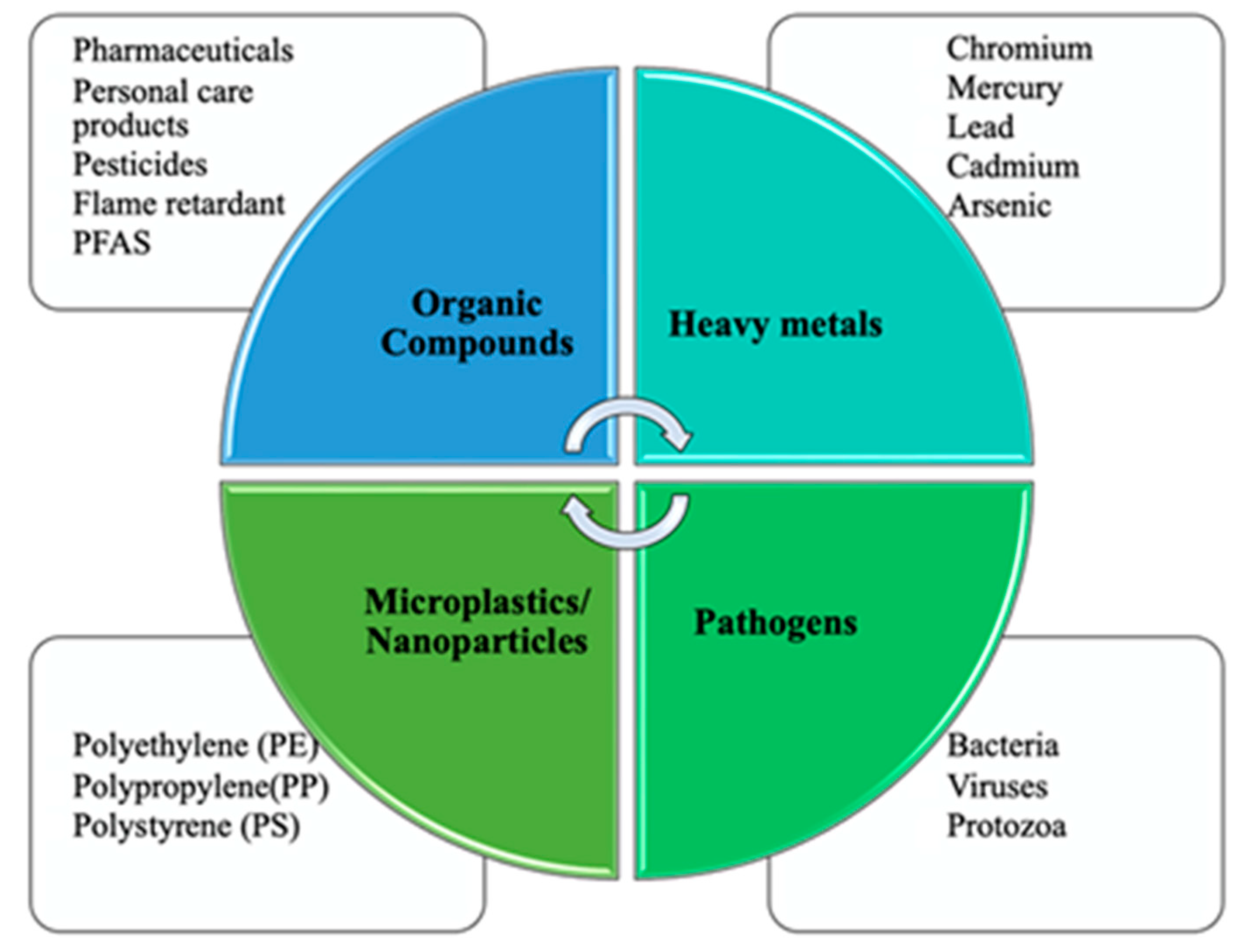
2. Urban Wastewater Pollutant Types
2.1. Organic Compounds
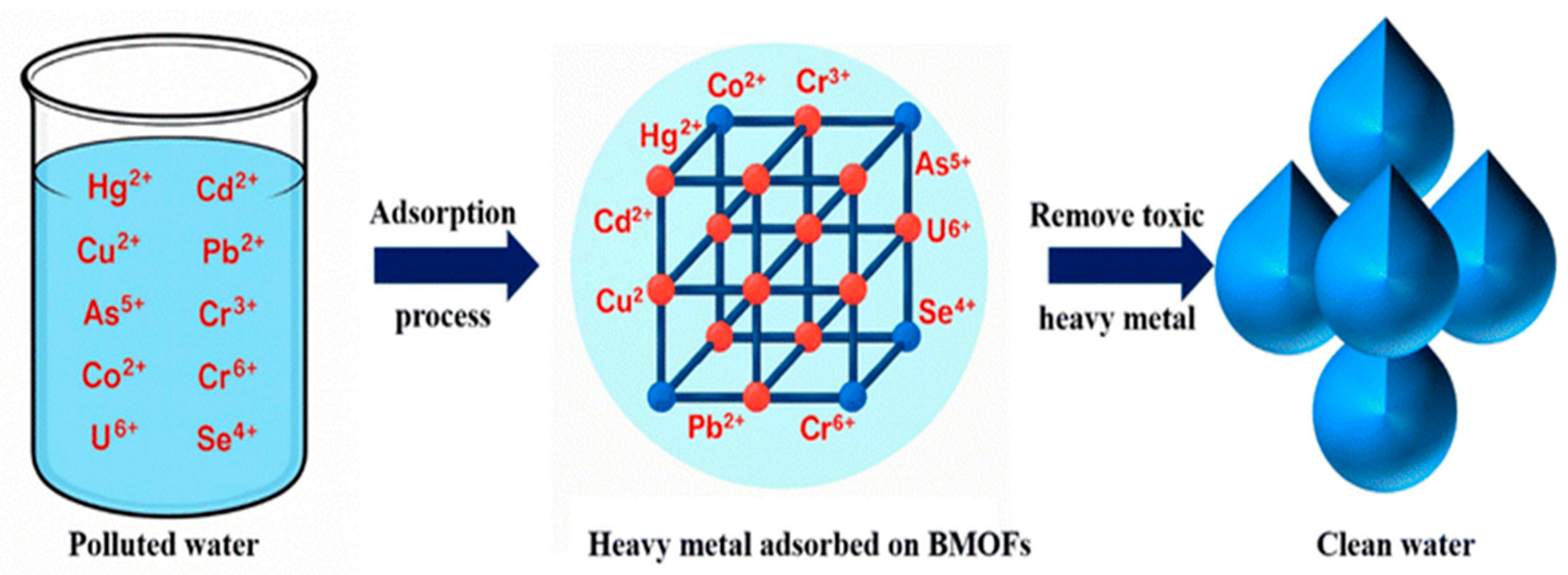
2.2. Heavy Metals
2.3. Microplastics & Nanoparticles
2.4. Pathogens
3. Conventional Methods of Treating Urban Wastewater and Challenges
- Primary treatment involves screening to remove large materials such as wood, cloth, and paper, thereby preparing the water for subsequent biological and advanced processes while preventing operational failures.
- Secondary treatment relies on microbial activity to reduce biological oxygen demand.
- Tertiary treatment provides further purification and is critical for determining the final water quality.
Assessing Treatment Challenges and Reuse Opportunities Across Urban Wastewater Streams
4. Adsorption Process
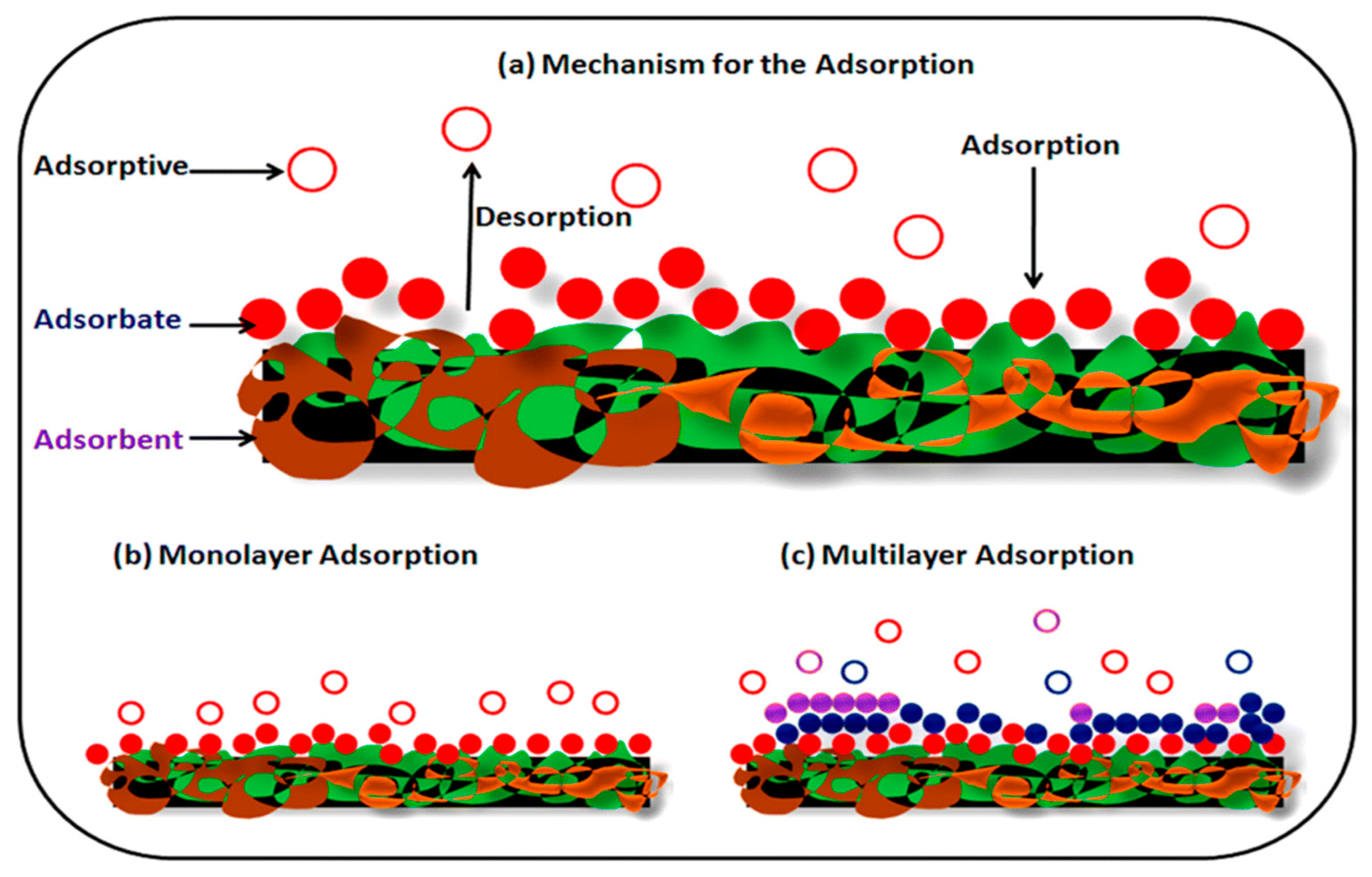
4.1. Mechanism
4.2. Batch vs. Column Experiments
4.3. Adsorption Isotherms
4.4. Adsorption Kinetics
4.5. Adsorbents
4.6. Factors Controlling Adsorption Efficiency
4.7. The Factor of Cost in the Adsorption Equation
4.8. Adsorptive Removal of Pollutants from Urban Wastewater

| Adsorbent | Adsorbate | pH | Operating Conditions | Equilibrium Time | Performance (Removal Efficiency%, Adsorption Capacity mg/g) | Ref |
|---|---|---|---|---|---|---|
| Biogenic calcium carbonate from industrial eggshell | Phosphorus | 7.33 | 5, 10, and 20 g/L at 25 °C | 120 min | 4.57 mg/g | [62] |
| Zeolite (0.5–1.0 mm) filled columns | Ammonium | 7.6 | flow rate (2.4 L h−1) | 30 min | 9.23 mg/g | [147] |
| Rice husk biochar RHBHCl | Fe, Mn, and Se | 7.6 | 0.25 g biochar and 50 mL wastewater under agitation at 200 rpm | 540 min | 0.071 mg/g Fe 0.032 mg/g Mn 0.011 mg/g Se | [98] |
| Rice husk biochar RHBNaOH | Fe, Mn, and Se | 7.6 | 0.25 g biochar and 50 mL wastewater under agitation at 200 rpm | 540 min | 0.198 mg/g Fe 0.077 mg/g Mn 0.022 mg/g Se | [98] |
| Red oak activated carbon | Methylene Blue | 10 | dosage = 0.25 g/50 mL, initial dye concentration = 10.0 mg L−1, temperature = 45 °C, mixing rate = 175 rpm | 120 min | 97.18% | [148] |
4.9. Limitations
5. Advanced Oxidation Process (AOPs)
5.1. Categorization of AOPs
5.1.1. Chemical Processes
- Fenton
- Ozone-Based (O3) processes
5.1.2. Photochemical Processes
- Photocatalysis
- UV/H2O2 (Ultraviolet/Hydrogen peroxide processes)
- Photo-assisted Fenton-like processes
5.1.3. Electrochemical Processes
- Electrochemical Oxidation
- Anodic oxidation
- -
- Certain anodes, such as platinum or graphite, perform soft oxidation, leading to polymer and refractory by-products. These anodes have a low oxygen evolution potential (OEP).
- -
- For anodes with high OEP, hydroxyl radicals are weakly adsorbed on the surface, enabling them to react more freely with pollutants, promoting degradation and complete mineralization.
5.1.4. Sonochemical Processes
- Sonochemical oxidation
- Sonocatalysis
5.1.5. Other Processes
- Sulfate radical (SR)-based advanced oxidation processes
- Catalytic wet air oxidation process
- Supercritical water oxidation
5.2. Pollutants Removal from Urban Wastewater Through AOPS
- No single technique achieves high removal for all contaminants,
- Each compound was removed by at least one treatment,
- Most laboratory studies fail to predict kinetic behavior in complex wastewater.
| AOPs | Pollutants | Catalyst/Electrode | Findings | Ref |
|---|---|---|---|---|
| Ozonation/Photocatalysis with TiO2/Electrooxidation | 17 cytostatic compounds | TiO2 AEROXIDE-powder/Boron-doped diamond (BDD/Si NeoCoat) electrode | Ozonation removed over 90% of 10 compounds but less than 60% of 7, photocatalysis achieved over 90% removal for 4 compounds but under 75% for the rest, and electrooxidation effectively removed 14 of 17 compounds with an average removal of 75% and 94% for 8 compounds. | [178] |
| Electrochemical oxidation—Sodium persulfate process | Ampicillin | Boron-doped diamond anode | Combining EO/SLR/SPS enhanced AMP degradation in wastewater was limited and toxicity was not fully eliminated. Anodic oxidation generated high hydroxyl radical concentrations, promoting pharmaceutical mineralization in the effluent. | [179] |
| Anodic Oxidation | 30 pharmaceuticals | BDD (anode) | The combined EO/SLR/SPS process accelerated AMP removal in wastewater, while anodic oxidation promoted mineralization, though complete detoxification was not achieved. | [180] |
| Electrochemical oxidation | 17β-estradiol, 17α-ethinylestradiol, sulfamethoxazole, bisphenol A, oxybenzone, diclofenac, triclosan, caffeine, carbamazepine | MMO/Ti or Pt/Ti (anodes), MMO/Ti (cathode) | Using MMO electrodes improved CEC removal by 20–50%, achieving over 90% removal of CECs and E. coli within 2 h. Current intensity had little impact, and EO proved eco-friendly with low treatment costs (~1.1 €/m3). | [181] |
5.3. Limitations
6. Catalyzing Circular Urban Wastewater Management: The Rising Role of Adsorption and AOPs
6.1. Comparative Role Between Adsorption and AOPs in the Regulatory Context
6.2. Redefining Urban Wastewater Treatment Toward a Circular and Sustainable Future
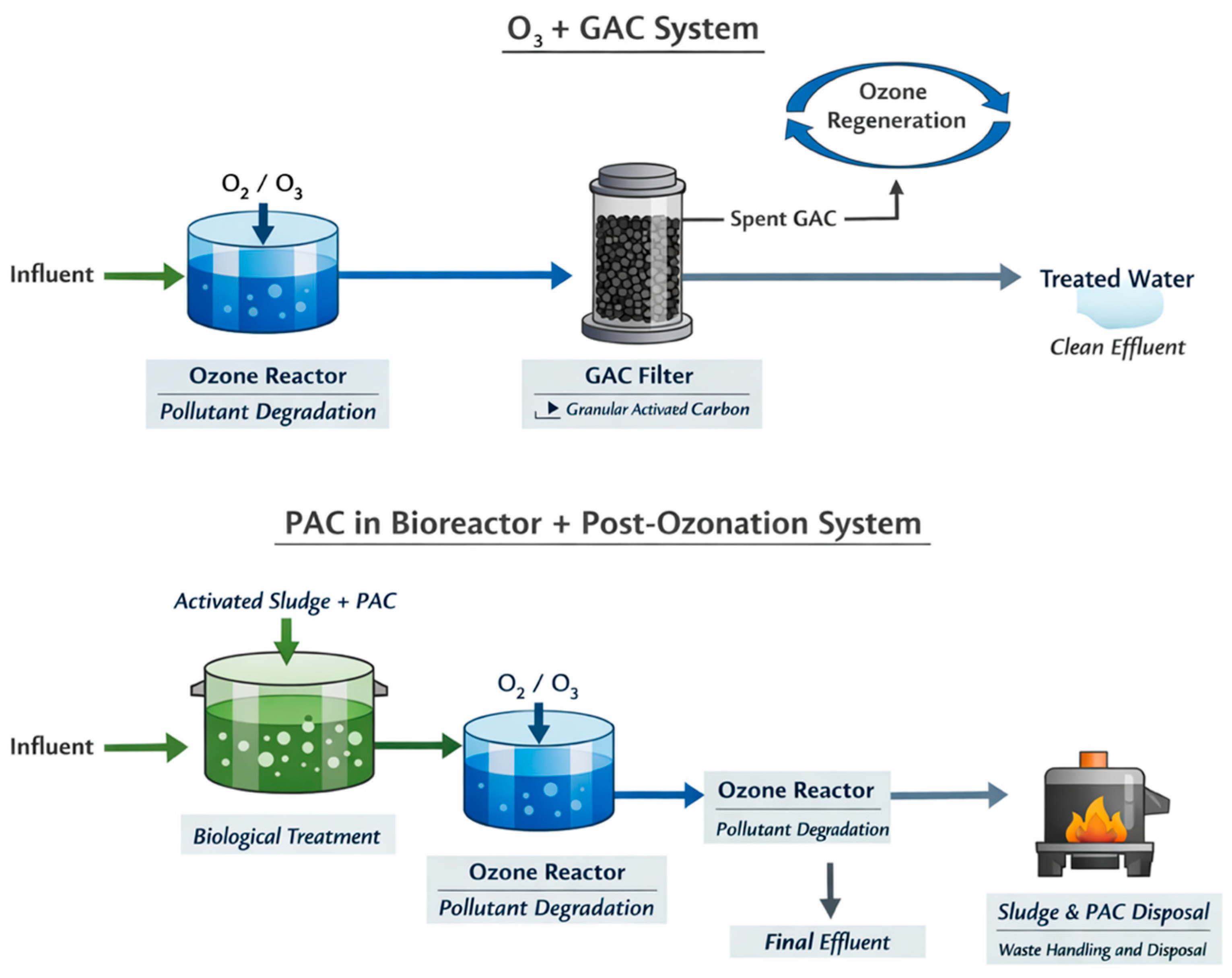
6.3. Adsorption–AOP Hybrids
| Adsorption/AOPs Synergistic Treatment | Pollutants | Performance | Operational Conditions | Scalability | Ref |
|---|---|---|---|---|---|
| Adsorption-ozonation | Carbamazepine (CBZ, antiepileptic) | Ozonation Ozonation rapidly removed CBZ and SMX, achieving 90% elimination within 5 min and complete removal by 15 min. In contrast, MBTR and BTR required 30 min and 60 min, respectively, to reach 50% reduction. To achieve an 80% removal target and mitigate ozonation by-products, a subsequent adsorption step is recommended following ozonation. | PAC C0 = 505 ng/L Matrix = tertiary effluent GAC PICACTIF TE (PICA) C0 = 1 µg/L Matrix = WW T = 23 °C; pH = 7.5–7.9 DOC: 3.0–5.4 mg/L GAC Calgon Filtrasorb 400 (F400) C0 = 1 µg/L Matrix = WW T = 23 °C; pH = 7.5–7.9 DOC: 3.0–5.4 mg/L GAC C0 = 1.00 mg/L Matrix = deionized water | The results, obtained at laboratory scale, need adaptation for full-scale applications, considering wastewater characteristics and treatment setup. Potential risks, especially toxic by-product formation during ozonation, require further evaluation, as only one test addressed this in the study. | [23] |
| Adsorption-ozonation | Sulfamethoxazole (SMX, antibiotic) | Ozonation Ozonation rapidly removed CBZ and SMX, with 90% reduction achieved within 5 min and complete removal by 15 min. In contrast, MBTR and BTR reached only 50% reduction after 30 and 60 min, respectively. To meet the 80% removal target and manage ozonation by-products, it is recommended to follow ozonation with an adsorption step. | Core shell AC C0 = 5–10–30–50–100 mg/L Matrix = water T = 25 °C; pH = 5.6 PAC C0 = 5–10–30–50–100 mg/L Matrix = water T = 25 °C pH = 5.6 PAC C0 = 269 ng/L Matrix = tertiary effluent alfalfa-derived biochar C0 = 10–100 mg/L Matrix = deionized water pH = 5 Activated biochar C0 = 5–50 mg/L Matrix = distilled water T = 30 °C – T = 50 °C pH = 5.4 | [23] | |
| Adsorption-ozonation | 1H-Benzotriazole (BTR) and 5-Methyl-1H-Benzotriazole (MBTR) | Ozonation Ozonation rapidly removed CBZ and SMX, achieving 90% elimination within 5 min and complete removal by 15 min. In contrast, MBTR and BTR required 30 and 60 min, respectively, to reach a 50% reduction. To attain the 80% removal target and mitigate ozonation by-products, a subsequent adsorption step is recommended. | PAC C0 = 100 μg/L Matrix = deionized water PAC C0 = 5.28–6.7–9.8–7.5 μg/L Matrix = WW GAC C0 = 1.00 mg/L Matrix = deionized water | [23] | |
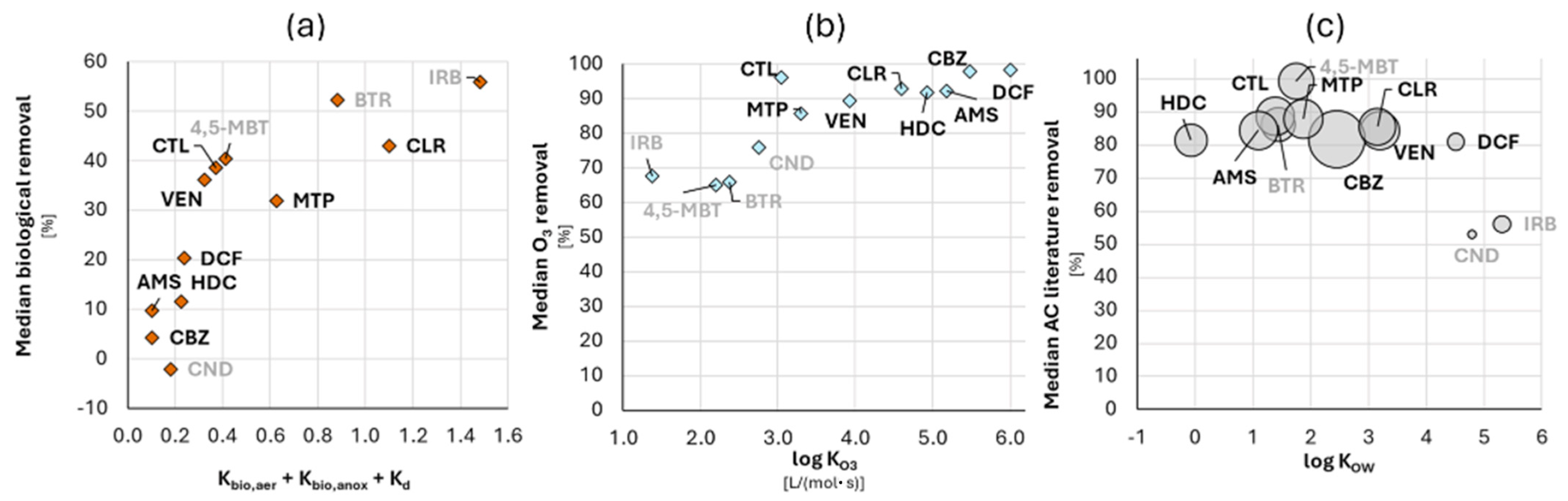
| Adsorption-ozonation | 12 MPs | Quaternary treatment combining ozonation and activated carbon adsorption significantly enhances micropollutant removal in WWTPs, achieving median efficiencies exceeding 80% for all target compounds, with candesartan remaining the most persistent. | - | [220] | |
| Adsorption-photocatalysis | Cr(VI) | Cr(VI) removal reached 99.9% under sunlight, while TBC-3 retained around 93% efficiency after four cycles, indicating excellent stability and reusability. | Under sunlight irradiation for 25 min | - | [223] |
| Adsorption-in situ AOPs | antibiotics, phenolics, and dyes | Under optimal conditions, the integrated Fe-NC/CAG process achieves over 90% removal of antibiotics, phenolics, and dyes, while maintaining stable performance over six consecutive cycles. | T: 25 °C, SMX: 100 mg/L, adsorbent: 2.5 g/L. | - | [224] |
| Aspect | Reported Advantages | Reported Limitations |
|---|---|---|
| Removal efficiency | Over 90% removal of antibiotics, phenolics, and dyes; stable performance across six cycles | - |
| Adsorption capacity | Maximum adsorption capacities: 137.7 mg g−1 (SMX), 103.3 mg g−1 (BPA), 129.2 mg g−1 (AR1) | Improvement of adsorption capacity remains a challenge |
| pH applicability | Effective over a wide pH range (1–12) | - |
| Effect of inorganic ions | Effective in the presence of various inorganic ions | - |
| Material characterization | SEM, BET (518.7 m2/g), XRD confirmed highly porous structure with Fe0 and Fe3O4 phases | - |
| Regeneration capability | Adsorbed pollutants degraded in situ by immersion in PMS, enabling catalyst regeneration | Improvement of catalytic oxidation ability remains a challenge |
| Reactive species generation | •OH, SO4•−, O2•−, and 1O2 identified in the Fe-NC/CAG/PMS system | - |
| Real wastewater treatment | COD removal efficiency up to 92.7% in actual sewage after four cumulative adsorption cycles | - |
| Integration advantage | Combines adsorption and in situ AOPs, maintaining stable performance even after six cycles | - |
6.4. Limitations
6.5. Adsorption and Advanced Oxidation Processes for Nutrient and Energy Recovery
6.6. Economic Considerations and Barriers in Urban Wastewater Treatment and Reuse
7. Knowledge Gaps and Future Recommendations
8. Conclusions
Author Contributions
Funding
Data Availability Statement
Acknowledgments
Conflicts of Interest
References
- Abujder Ochoa, W.A.; Torrico Arce, A.G.; Iarozinski Neto, A.; Munaro, M.R.; Calabokis, O.P.; Ballesteros-Ballesteros, V.A. Interlinking Urban Sustainability, Circular Economy and Complexity: A Systematic Literature Review. Sustainability 2025, 17, 7118. [Google Scholar] [CrossRef]
- Spiliotopoulou, M.; Roseland, M. Urban Sustainability: From Theory Influences to Practical Agendas. Sustainability 2020, 12, 7245. [Google Scholar] [CrossRef]
- Michalopoulos, S.M.; Kalavrouziotis, I.K. Treated Wastewater Reuse Practices, under a Holistic Approach at the City Scale. Oper. Res. Int. J. 2025, 25, 65. [Google Scholar] [CrossRef]
- Segovia-Hernández, J.G.; Contreras-Zarazúa, G.; Ramírez-Márquez, C. Sustainable Design of Water–Energy–Food Nexus: A Literature Review. RSC Sustain. 2023, 1, 1332–1353. [Google Scholar] [CrossRef]
- Peydayesh, M.; Mezzenga, R. The Circular Economy of Water across the Six Continents. Chem. Soc. Rev. 2024, 53, 4333–4348. [Google Scholar] [CrossRef] [PubMed]
- Du, J.; Kuang, B.; Yang, Y. A Data-Driven Framework for Smart Urban Domestic Wastewater: A Sustainability Perspective. Adv. Civ. Eng. 2019, 2019, 6530626. [Google Scholar] [CrossRef]
- Kundu, D.; Dutta, D.; Samanta, P.; Dey, S.; Sherpa, K.C.; Kumar, S.; Dubey, B.K. Valorization of Wastewater: A Paradigm Shift towards Circular Bioeconomy and Sustainability. Sci. Total Environ. 2022, 848, 157709. [Google Scholar] [CrossRef]
- Yusuf, A.; O’Flynn, D.; White, B.; Holland, L.; Parle-McDermott, A.; Lawler, J.; McCloughlin, T.; Harold, D.; Huerta, B.; Regan, F. Monitoring of Emerging Contaminants of Concern in the Aquatic Environment: A Review of Studies Showing the Application of Effect-Based Measures. Anal. Methods 2021, 13, 5120–5143. [Google Scholar] [CrossRef]
- Rizzo, L. Addressing Main Challenges in the Tertiary Treatment of Urban Wastewater: Are Homogeneous Photodriven AOPs the Answer? Environ. Sci. Water Res. Technol. 2022, 8, 2145–2169. [Google Scholar] [CrossRef]
- Capodaglio, A.G. Urban Wastewater Mining for Circular Resource Recovery: Approaches and Technology Analysis. Water 2023, 15, 3967. [Google Scholar] [CrossRef]
- Thiebault, T.; Boussafir, M. Adsorption Mechanisms of Psychoactive Drugs onto Montmorillonite. Colloid Interface Sci. Commun. 2019, 30, 100183. [Google Scholar] [CrossRef]
- Gosset, A.; Wiest, L.; Fildier, A.; Libert, C.; Giroud, B.; Hammada, M.; Hervé, M.; Sibeud, E.; Vulliet, E.; Polomé, P.; et al. Ecotoxicological Risk Assessment of Contaminants of Emerging Concern Identified by “Suspect Screening” from Urban Wastewater Treatment Plant Effluents at a Territorial Scale. Sci. Total Environ. 2021, 778, 146275. [Google Scholar] [CrossRef]
- Rizzo, L.; Krätke, R.; Linders, J.; Scott, M.; Vighi, M.; De Voogt, P. Proposed EU Minimum Quality Requirements for Water Reuse in Agricultural Irrigation and Aquifer Recharge: SCHEER Scientific Advice. Curr. Opin. Environ. Sci. Health 2018, 2, 7–11. [Google Scholar] [CrossRef]
- Deksissa, T.; Trobman, H.; Zendehdel, K.; Azam, H. Integrating Urban Agriculture and Stormwater Management in a Circular Economy to Enhance Ecosystem Services: Connecting the Dots. Sustainability 2021, 13, 8293. [Google Scholar] [CrossRef]
- Verhoest, P.; Bauwens, J.; Gao, Y.; Elskens, M.; Huysmans, M. The Resonance of Messages about Wastewater Reuse: Recommendations for Environmental Communication. Environ. Sci. Adv. 2025, 4, 1267–1278. [Google Scholar] [CrossRef]
- Hiz, H.G.; Arslan, H. Comparison Study of Urban Wastewater Treatment Using Conventional Biologic Treatment and Submerged Membrane Bioreactor Processes. Water 2025, 17, 1810. [Google Scholar] [CrossRef]
- Preisner, M.; Neverova-Dziopak, E.; Kowalewski, Z. An Analytical Review of Different Approaches to Wastewater Discharge Standards with Particular Emphasis on Nutrients. Environ. Manag. 2020, 66, 694–708. [Google Scholar] [CrossRef]
- Preisner, M.; Neverova-Dziopak, E.; Kowalewski, Z. Analysis of Eutrophication Potential of Municipal Wastewater. Water Sci. Technol. 2020, 81, 1994–2003. [Google Scholar] [CrossRef]
- Bernal, S.; Drummond, J.; Castelar, S.; Gacia, E.; Ribot, M.; Martí, E. Wastewater Treatment Plant Effluent Inputs Induce Large Biogeochemical Changes during Low Flows in an Intermittent Stream but Small Changes in Day-Night Patterns. Sci. Total Environ. 2020, 714, 136733. [Google Scholar] [CrossRef]
- The European Parliament; The Council of the European Union. DIRECTIVE (EU) 2024/3019 OF THE EUROPEAN PARLIAMENT AND OF THE COUNCIL of 27 November 2024 Concerning Urban Wastewater Treatment. Available online: https://eur-lex.europa.eu/eli/dir/2024/3019/oj (accessed on 1 November 2025).
- Sei, L.K.; Belle, J.; Mshelia, Z.; Dirwai, T. Exploring the Significance of Treated Wastewater Reuse in Urban Agriculture and Resilient Cities: A Bibliometric Analysis. Water Reuse 2025, 15, 157–177. [Google Scholar] [CrossRef]
- Kardos, M.K.; Patziger, M.; Jolánkai, Z.; Clement, A. The New Urban Wastewater Treatment Directive from the Perspective of the Receiving Rivers’ Quality. Environ. Sci. Eur. 2025, 37, 10. [Google Scholar] [CrossRef]
- Chiavola, A.; Marcantonio, C.D.; Noè Porretti, A.; Scagnetti, S.; Ciuchi, V.; Boni, M.R.; Micoli, S.; Lazzazzara, M.; Leoni, S.; Frugis, A.; et al. Application of Adsorption and Ozonation as Quaternary Treatment of WWTP Effluent for the Removal of Contaminants of Emerging Concern: Results from Laboratory Scale Experiments. J. Hazard. Mater. Adv. 2025, 18, 100665. [Google Scholar] [CrossRef]
- Fedorov, K.; Dinesh, K.; Sun, X.; Darvishi Cheshmeh Soltani, R.; Wang, Z.; Sonawane, S.; Boczkaj, G. Synergistic Effects of Hybrid Advanced Oxidation Processes (AOPs) Based on Hydrodynamic Cavitation Phenomenon—A Review. Chem. Eng. J. 2022, 432, 134191. [Google Scholar] [CrossRef]
- Ma, D.; Yi, H.; Lai, C.; Liu, X.; Huo, X.; An, Z.; Li, L.; Fu, Y.; Li, B.; Zhang, M.; et al. Critical Review of Advanced Oxidation Processes in Organic Wastewater Treatment. Chemosphere 2021, 275, 130104. [Google Scholar] [CrossRef]
- Bai, X.; Li, C.; He, S.; Zhou, J.; Hu, J. Combining Advanced Oxidation Processes with Biological Processes in Organic Wastewater Treatment: Recent Developments, Trends, and Advances. Desalination Water Treat. 2025, 323, 101263. [Google Scholar] [CrossRef]
- Rizzo, L.; Malato, S.; Antakyali, D.; Beretsou, V.G.; Đolić, M.B.; Gernjak, W.; Heath, E.; Ivancev-Tumbas, I.; Karaolia, P.; Lado Ribeiro, A.R.; et al. Consolidated vs New Advanced Treatment Methods for the Removal of Contaminants of Emerging Concern from Urban Wastewater. Sci. Total Environ. 2019, 655, 986–1008. [Google Scholar] [CrossRef]
- Choubert, J.M.; Penru, Y.; Mathon, B.; Guillon, A.; Esperanza, M.; Crétollier, C.; Dherret, L.; Daval, A.; Masson, M.; Lagarrigue, C.; et al. Elimination de Substances Prioritaires et Émergentes des Eaux Résiduaires Urbaines par Ozonation: Évaluations Technique, Énergétique, Environnementale; Internal Revenue Service (IRS): Washington, DC, USA, 2017. [Google Scholar]
- Fischer, A.; Van Wezel, A.P.; Hollender, J.; Cornelissen, E.; Hofman, R.; Van Der Hoek, J.P. Development and Application of Relevance and Reliability Criteria for Water Treatment Removal Efficiencies of Chemicals of Emerging Concern. Water Res. 2019, 161, 274–287. [Google Scholar] [CrossRef]
- Song, J.; Zhu, L.; Yu, S.; Li, G.; Wang, D. The Synergistic Effect of Adsorption and Fenton Oxidation for Organic Pollutants in Water Remediation: An Overview. RSC Adv. 2024, 14, 33489–33511. [Google Scholar] [CrossRef]
- Petersen, K.; Vakkalanka, S.; Kuzniarz, L. Guidelines for Conducting Systematic Mapping Studies in Software Engineering: An Update. Inf. Softw. Technol. 2015, 64, 1–18. [Google Scholar] [CrossRef]
- Kong, X.; Mao, M.; Jiang, H.; Yu, S.; Wan, L. How Does Collaboration Affect Researchers’ Positions in Co-Authorship Networks? J. Informetr. 2019, 13, 887–900. [Google Scholar] [CrossRef]
- Gusenbauer, M.; Haddaway, N.R. Which Academic Search Systems Are Suitable for Systematic Reviews or Meta-analyses? Evaluating Retrieval Qualities of Google Scholar, PubMed, and 26 Other Resources. Res. Synth. Methods 2020, 11, 181–217. [Google Scholar] [CrossRef]
- Nishmitha, P.S.; Akhilghosh, K.A.; Aiswriya, V.P.; Ramesh, A.; Muthuchamy, M.; Muthukumar, A. Understanding Emerging Contaminants in Water and Wastewater: A Comprehensive Review on Detection, Impacts, and Solutions. J. Hazard. Mater. Adv. 2025, 18, 100755. [Google Scholar] [CrossRef]
- Undeman, E.; Rasmusson, K.; Kokorite, I.; Leppänen, M.T.; Larsen, M.M.; Pazdro, K.; Siedlewicz, G. Micropollutants in Urban Wastewater: Large-Scale Emission Estimates and Analysis of Measured Concentrations in the Baltic Sea Catchment. Mar. Pollut. Bull. 2022, 178, 113559. [Google Scholar] [CrossRef]
- Oteng-Peprah, M.; De Vries, N.K.; Acheampong, M.A. Greywater Characterization and Generation Rates in a Peri Urban Municipality of a Developing Country. J. Environ. Manag. 2018, 206, 498–506. [Google Scholar] [CrossRef]
- Boyjoo, Y.; Pareek, V.K.; Ang, M. A Review of Greywater Characteristics and Treatment Processes. Water Sci. Technol. 2013, 67, 1403–1424. [Google Scholar] [CrossRef]
- Zhao, F.; Yu, Q.; Zhang, X.-X. A Mini-Review of Antibiotic Resistance Drivers in Urban Wastewater Treatment Plants: Environmental Concentrations, Mechanism and Perspectives. Water 2023, 15, 3165. [Google Scholar] [CrossRef]
- Hattab, S.; Alaya, C.; Banni, M. Emerging Pollutants in Wastewater: A Challenge for Water Reuse. In Emerging Pollutants; Zandaryaa, S., Fares, A., Eckstein, G., Eds.; Advances in Water Security; Springer Nature: Cham, Switzerland, 2025; pp. 297–313. ISBN 978-3-031-71757-4. [Google Scholar]
- Fan, S.; Wang, B.; Liu, H.; Gao, S.; Li, T.; Wang, S.; Liu, Y.; Liu, X.; Wan, Y. Trophodynamics of Organic Pollutants in Pelagic and Benthic Food Webs of Lake Dianchi: Importance of Ingested Sediment As Uptake Route. Environ. Sci. Technol. 2017, 51, 14135–14143. [Google Scholar] [CrossRef]
- Parida, V.K.; Saidulu, D.; Majumder, A.; Srivastava, A.; Gupta, B.; Gupta, A.K. Emerging Contaminants in Wastewater: A Critical Review on Occurrence, Existing Legislations, Risk Assessment, and Sustainable Treatment Alternatives. J. Environ. Chem. Eng. 2021, 9, 105966. [Google Scholar] [CrossRef]
- Syafrudin, M.; Kristanti, R.A.; Yuniarto, A.; Hadibarata, T.; Rhee, J.; Al-onazi, W.A.; Algarni, T.S.; Almarri, A.H.; Al-Mohaimeed, A.M. Pesticides in Drinking Water—A Review. Int. J. Environ. Res. Public Health 2021, 18, 468. [Google Scholar] [CrossRef]
- Krlovic, N.; Saracevic, E.; Derx, J.; Gundacker, C.; Krampe, J.; Kreuzinger, N.; Zessner, M.; Zoboli, O. Exploring the Variability of PFAS in Urban Sewage: A Comparison of Emissions in Commercial versus Municipal Urban Areas. Environ. Sci. Process. Impacts 2024, 26, 1868–1878. [Google Scholar] [CrossRef]
- Gallen, C.; Eaglesham, G.; Drage, D.; Nguyen, T.H.; Mueller, J.F. A Mass Estimate of Perfluoroalkyl Substance (PFAS) Release from Australian Wastewater Treatment Plants. Chemosphere 2018, 208, 975–983. [Google Scholar] [CrossRef]
- Müller, V.; Kindness, A.; Feldmann, J. Fluorine Mass Balance Analysis of PFAS in Communal Waters at a Wastewater Plant from Austria. Water Res. 2023, 244, 120501. [Google Scholar] [CrossRef]
- Ogolla Wanjeri, V.W.; Okuku, E.; Ngila, J.C.; Waiyaki, E.; Nyingi, J.K.; Ndungu, P.G. Occurrence and Distribution of Selected Pharmaceuticals in Fresh Fish along the Kenyan Coast and Assessment of Potential Human Health Risks. Environ. Sci. Adv. 2025, 4, 938–951. [Google Scholar] [CrossRef]
- Michael, I.; Rizzo, L.; McArdell, C.S.; Manaia, C.M.; Merlin, C.; Schwartz, T.; Dagot, C.; Fatta-Kassinos, D. Urban Wastewater Treatment Plants as Hotspots for the Release of Antibiotics in the Environment: A Review. Water Res. 2013, 47, 957–995. [Google Scholar] [CrossRef]
- Van Bergen, T.J.H.M.; Schipper, A.M.; Mooij, D.; Ragas, A.M.J.; Kuiper, M.W.; Hendriks, A.J.; Huijbregts, M.A.J.; Van Zelm, R. Removal Rate Constants Are Not Necessarily Constant: The Case of Organic Micropollutant Removal in Wastewater Treatment Plants. Environ. Sci. Water Res. Technol. 2024, 10, 2243–2252. [Google Scholar] [CrossRef]
- Mustafa, S.A.; Al-Rudainy, A.J.; Salman, N.M. Effect of Environmental Pollutants on Fish Health: An Overview. Egypt. J. Aquat. Res. 2024, 50, 225–233. [Google Scholar] [CrossRef]
- Andrady, A.L. The Plastic in Microplastics: A Review. Mar. Pollut. Bull. 2017, 119, 12–22. [Google Scholar] [CrossRef]
- Bhat, Z.M.; Gani, K.M. Microfiber Pollution from Dhobi Ghats (Open Air Laundry Centers) and Commercial Laundries in a North Indian City. Environ. Sci. Pollut. Res. 2024, 31, 12161–12173. [Google Scholar] [CrossRef]
- Franzellitti, S.; Canesi, L.; Auguste, M.; Wathsala, R.H.G.R.; Fabbri, E. Microplastic Exposure and Effects in Aquatic Organisms: A Physiological Perspective. Environ. Toxicol. Pharmacol. 2019, 68, 37–51. [Google Scholar] [CrossRef]
- Enfrin, M.; Dumée, L.F.; Lee, J. Nano/Microplastics in Water and Wastewater Treatment Processes—Origin, Impact and Potential Solutions. Water Res. 2019, 161, 621–638. [Google Scholar] [CrossRef]
- Bundschuh, M.; Englert, D.; Rosenfeldt, R.R.; Bundschuh, R.; Feckler, A.; Lüderwald, S.; Seitz, F.; Zubrod, J.P.; Schulz, R. Nanoparticles Transported from Aquatic to Terrestrial Ecosystems via Emerging Aquatic Insects Compromise Subsidy Quality. Sci. Rep. 2019, 9, 15676. [Google Scholar] [CrossRef]
- Gonsioroski, A.; Mourikes, V.E.; Flaws, J.A. Endocrine Disruptors in Water and Their Effects on the Reproductive System. Int. J. Mol. Sci. 2020, 21, 1929. [Google Scholar] [CrossRef]
- Tiwari, A.; Kurittu, P.; Al-Mustapha, A.I.; Heljanko, V.; Johansson, V.; Thakali, O.; Mishra, S.K.; Lehto, K.-M.; Lipponen, A.; Oikarinen, S.; et al. Wastewater Surveillance of Antibiotic-Resistant Bacterial Pathogens: A Systematic Review. Front. Microbiol. 2022, 13, 977106. [Google Scholar] [CrossRef]
- Muoghalu, C.; Kaboggoza, H.C.; Semiyaga, S.; Lebu, S.; Liu, C.; Niwagaba, C.; Nansubuga, F.; Manga, M. Antibiotic Resistant Bacteria (ARB) and Genes (ARGs) in Urban Wastewater Treatment Plants: Influencing Factors, Mechanisms, and Removal Efficiency. Environ. Pollut. 2025, 383, 126851. [Google Scholar] [CrossRef]
- Ghimire, U.; Sarpong, G.; Gude, V.G. Transitioning Wastewater Treatment Plants toward Circular Economy and Energy Sustainability. ACS Omega 2021, 6, 11794–11803. [Google Scholar] [CrossRef]
- Guillossou, R.; Le Roux, J.; Brosillon, S.; Mailler, R.; Vulliet, E.; Morlay, C.; Nauleau, F.; Rocher, V.; Gaspéri, J. Benefits of Ozonation before Activated Carbon Adsorption for the Removal of Organic Micropollutants from Wastewater Effluents. Chemosphere 2020, 245, 125530. [Google Scholar] [CrossRef]
- Aldeguer Esquerdo, A.; Sentana Gadea, I.; Varo Galvañ, P.J.; Prats Rico, D. Efficacy of Atrazine Pesticide Reduction in Aqueous Solution Using Activated Carbon, Ozone and a Combination of Both. Sci. Total Environ. 2021, 764, 144301. [Google Scholar] [CrossRef]
- Zhang, T.; Zheng, L.; Yang, X.; Li, Y.; Mol, Z.; Demeestere, K.; Van Hulle, S.W.H. Combining Ozonation and Powdered Activated Carbon Adsorption for Organic Micropollutants Removal in Municipal Wastewater Treatment Plants: Single versus Two-Reactor Systems. Water Res. 2025, 284, 124035. [Google Scholar] [CrossRef]
- Shamshad, J.; Ur Rehman, R. Innovative Approaches to Sustainable Wastewater Treatment: A Comprehensive Exploration of Conventional and Emerging Technologies. Environ. Sci. Adv. 2025, 4, 189–222. [Google Scholar] [CrossRef]
- Krzeminski, P.; Tomei, M.C.; Karaolia, P.; Langenhoff, A.; Almeida, C.M.R.; Felis, E.; Gritten, F.; Andersen, H.R.; Fernandes, T.; Manaia, C.M.; et al. Performance of Secondary Wastewater Treatment Methods for the Removal of Contaminants of Emerging Concern Implicated in Crop Uptake and Antibiotic Resistance Spread: A Review. Sci. Total Environ. 2019, 648, 1052–1081. [Google Scholar] [CrossRef]
- European Commission. Proposal for a DIRECTIVE OF THE EUROPEAN PARLIAMENT AND OF THE COUNCIL Concerning Urban Wastewater Treatment (Recast); European Commission: Brussels, Belgium, 2022. [Google Scholar]
- Ding, G.K.C. Wastewater Treatment and Reuse—The Future Source of Water Supply. In Encyclopedia of Sustainable Technologies; Elsevier: Amsterdam, The Netherlands, 2017; pp. 43–52. ISBN 978-0-12-804792-7. [Google Scholar]
- Tasselli, S.; Marziali, L.; Guzzella, L.; Valsecchi, L.; Palumbo, M.T.; Salerno, F.; Copetti, D. Impact of Wastewater Treatment Plant Discharge on Water Quality of a Heavily Urbanized River in Milan Metropolitan Area: Traditional and Emerging Contaminant Analysis. Water 2025, 17, 3276. [Google Scholar] [CrossRef]
- Vymazal, J. Constructed Wetlands for Wastewater Treatment. In Encyclopedia of Ecology; Elsevier: Amsterdam, The Netherlands, 2019; pp. 14–21. ISBN 978-0-444-64130-4. [Google Scholar]
- Choi, Y.-J.; Kim, L.-H.; Zoh, K.-D. Removal Characteristics and Mechanism of Antibiotics Using Constructed Wetlands. Ecol. Eng. 2016, 91, 85–92. [Google Scholar] [CrossRef]
- Panja, S.; Sarkar, D.; Datta, R. Removal of Tetracycline and Ciprofloxacin from Wastewater by Vetiver Grass (Chrysopogon zizanioides (L.) Roberty) as a Function of Nutrient Concentrations. Environ. Sci. Pollut. Res. 2020, 27, 34951–34965. [Google Scholar] [CrossRef]
- Rizzo, L.; Gernjak, W.; Krzeminski, P.; Malato, S.; McArdell, C.S.; Perez, J.A.S.; Schaar, H.; Fatta-Kassinos, D. Best Available Technologies and Treatment Trains to Address Current Challenges in Urban Wastewater Reuse for Irrigation of Crops in EU Countries. Sci. Total Environ. 2020, 710, 136312. [Google Scholar] [CrossRef]
- Kaviya, S. Chapter 17—Recent Advances in Water Treatment Facilities for Wastewater Reuse in the Urban Water Supply. In Urban Water Crisis and Management; Strategies for Sustainable Development; Current Directions in Water Scarcity Research; Elsevier: Amsterdam, The Netherlands, 2022; Volume 6, pp. 361–379. [Google Scholar]
- Campisano, A.; Gnecco, I.; Modica, C.; Palla, A. Designing Domestic Rainwater Harvesting Systems under Different Climatic Regimes in Italy. Water Sci. Technol. 2013, 67, 2511–2518. [Google Scholar] [CrossRef]
- Rajabi, S.; Derakhshan, Z.; Maleky, S.; Nasiri, A.; Ahmadi, B.; Feilizadeh, M.; Mohammadpour, A.; Samaei, M.R.; Hashemi, M. Innovative Grey Water Treatment Using Eco-Friendly Bio-Photocatalyst AgCuFe2O4@chitosan in the Presence of Synergistic Effects of Persulfate Activation: Optimization and Mechanisms. Int. J. Biol. Macromol. 2025, 286, 138375. [Google Scholar] [CrossRef]
- Poblete, R.; Pérez, N.; Cortes, E.; Chacana, J. Treatment of Greywater Coming from a Food Court Using Adsorption and Advanced Oxidation Processes. J. Water Process Eng. 2024, 64, 105653. [Google Scholar] [CrossRef]
- Xu, J.; Yang, L.; Zhou, X. A Systematical Review of Blackwater Treatment and Resource Recovery: Advance in Technologies and Applications. Resour. Conserv. Recycl. 2023, 197, 107066. [Google Scholar] [CrossRef]
- Xu, S.; Wang, J.; Wang, D.; Liao, P.; Hu, X.; Yang, Y.; Chen, J. Effective Removal of Nitrogen and Phosphorus from a Black-Odorous Water by Novel Oxygen-Loaded Adsorbents. Chem. Eng. J. 2023, 466, 143146. [Google Scholar] [CrossRef]
- Kurniawan, S.B.; Roziqin, A.; Ahmad, A.; Ahmad, M.M.; Alfanda, B.D.; Pambudi, D.S.A.; Said, N.S.M.; Abdul, P.M.; Imron, M.F. Tackling Marine Pollution in the Blue Economy: Synergies between Wastewater Treatment Technologies and Governmental Policies. Mar. Pollut. Bull. 2026, 222, 118627. [Google Scholar] [CrossRef]
- Gawande, G.; Chougule, S.; Bangar, S.; Dethe, A.; Rathod, A.; Kulkarni, A. Hydrodynamic Cavitation and Its Hybridization with Fenton Process as a Promising AOP for Dairy Wastewater Treatment. Mater. Today Proc. 2024; in press. [Google Scholar] [CrossRef]
- Eriksson, E.; Auffarth, K.; Henze, M.; Ledin, A. Characteristics of Grey Wastewater. Urban Water 2002, 4, 85–104. [Google Scholar] [CrossRef]
- Mustafa, M.; Epelle, E.I.; Macfarlane, A.; Cusack, M.; Burns, A.; Yaseen, M. Innovative Approaches to Greywater Micropollutant Removal: AI-Driven Solutions and Future Outlook. RSC Adv. 2025, 15, 12125–12151. [Google Scholar] [CrossRef]
- Al-Husseini, T.H.; Al-Anbari, R.H.; AL-Obaidy, A.H.M.J. Greywater Environmental Management: A Review. IOP Conf. Ser. Earth Environ. Sci. 2021, 779, 012100. [Google Scholar] [CrossRef]
- Khan, S.; Ali, J. Chemical Analysis of Air and Water. In Bioassays; Elsevier: Amsterdam, The Netherlands, 2018; pp. 21–39. ISBN 978-0-12-811861-0. [Google Scholar]
- Oteng-Peprah, M.; Acheampong, M.A.; deVries, N.K. Greywater Characteristics, Treatment Systems, Reuse Strategies and User Perception—A Review. Water Air Soil Pollut. 2018, 229, 255. [Google Scholar] [CrossRef]
- Dutta, S.; Gupta, B.; Srivastava, S.K.; Gupta, A.K. Recent Advances on the Removal of Dyes from Wastewater Using Various Adsorbents: A Critical Review. Mater. Adv. 2021, 2, 4497–4531. [Google Scholar] [CrossRef]
- Şenol, Z.M.; El Messaoudi, N.; Ciğeroglu, Z.; Miyah, Y.; Arslanoğlu, H.; Bağlam, N.; Kazan-Kaya, E.S.; Kaur, P.; Georgin, J. Removal of Food Dyes Using Biological Materials via Adsorption: A Review. Food Chem. 2024, 450, 139398. [Google Scholar] [CrossRef]
- Jang, H.M.; Kan, E. Engineered Biochar from Agricultural Waste for Removal of Tetracycline in Water. Bioresour. Technol. 2019, 284, 437–447. [Google Scholar] [CrossRef]
- Georgin, J.; Franco, D.S.P.; Manzar, M.S.; Meili, L.; El Messaoudi, N. A Critical and Comprehensive Review of the Current Status of 17β-Estradiol Hormone Remediation through Adsorption Technology. Environ. Sci. Pollut. Res. 2024, 31, 24679–24712. [Google Scholar] [CrossRef]
- El Messaoudi, N.; Franco, D.S.P.; Gubernat, S.; Georgin, J.; Şenol, Z.M.; Ciğeroğlu, Z.; Allouss, D.; El Hajam, M. Advances and Future Perspectives of Water Defluoridation by Adsorption Technology: A Review. Environ. Res. 2024, 252, 118857. [Google Scholar] [CrossRef]
- Alkhaldi, H.; Alharthi, S.; Alharthi, S.; AlGhamdi, H.A.; AlZahrani, Y.M.; Mahmoud, S.A.; Amin, L.G.; Al-Shaalan, N.H.; Boraie, W.E.; Attia, M.S.; et al. Sustainable Polymeric Adsorbents for Adsorption-Based Water Remediation and Pathogen Deactivation: A Review. RSC Adv. 2024, 14, 33143–33190. [Google Scholar] [CrossRef]
- Gupta, A.; Sharma, V.; Sharma, K.; Kumar, V.; Choudhary, S.; Mankotia, P.; Kumar, B.; Mishra, H.; Moulick, A.; Ekielski, A.; et al. A Review of Adsorbents for Heavy Metal Decontamination: Growing Approach to Wastewater Treatment. Materials 2021, 14, 4702. [Google Scholar] [CrossRef]
- Salami, O.S.; Sihlahla, M.; Dladla, B.S.; Mketo, N. Adsorptive Removal of Additive Potent Organic Toxicants from Beverages and Contaminated Waters: A Critical Review of Adsorbent Materials, Kinetics, Isotherms, Thermodynamics, Mechanisms, and Future Prospects. Sep. Purif. Technol. 2026, 380, 135453. [Google Scholar] [CrossRef]
- Murtaza, G.; Ahmed, Z.; Dai, D.-Q.; Iqbal, R.; Bawazeer, S.; Usman, M.; Rizwan, M.; Iqbal, J.; Akram, M.I.; Althubiani, A.S.; et al. A Review of Mechanism and Adsorption Capacities of Biochar-Based Engineered Composites for Removing Aquatic Pollutants from Contaminated Water. Front. Environ. Sci. 2022, 10, 1035865. [Google Scholar] [CrossRef]
- Ahmed, H.R.; Ghafoor, D.D.; Agha, N.N.M.; Muhamad, G.A.; Husamadin, P.; Ali, T.M. Advanced Strategies for the Removal of Venlafaxine from Aqueous Environments: A Critical Review of Adsorption and Advanced Oxidation Pathways. RSC Adv. 2025, 15, 38889–38905. [Google Scholar] [CrossRef]
- Ali Redha, A. Removal of Heavy Metals from Aqueous Media by Biosorption. Arab J. Basic Appl. Sci. 2020, 27, 183–193. [Google Scholar] [CrossRef]
- Parida, S.K.; Dash, S.; Patel, S.; Mishra, B.K. Adsorption of Organic Molecules on Silica Surface. Adv. Colloid Interface Sci. 2006, 121, 77–110. [Google Scholar] [CrossRef]
- Szabelski, P. Extended Surface Chirality for Enantiospecific Adsorption. Chem. A Eur. J. 2008, 14, 8312–8321. [Google Scholar] [CrossRef]
- Dong, X.; Chu, Y.; Tong, Z.; Sun, M.; Meng, D.; Yi, X.; Gao, T.; Wang, M.; Duan, J. Mechanisms of Adsorption and Functionalization of Biochar for Pesticides: A Review. Ecotoxicol. Environ. Saf. 2024, 272, 116019. [Google Scholar] [CrossRef]
- Collivignarelli, M.C.; Illankoon, W.A.M.A.N.; Milanese, C.; Calatroni, S.; Caccamo, F.M.; Medina-Llamas, M.; Girella, A.; Sorlini, S. Preparation and Modification of Biochar Derived from Agricultural Waste for Metal Adsorption from Urban Wastewater. Water 2024, 16, 698. [Google Scholar] [CrossRef]
- Shahzad, K.; Hasan, A.; Hussain Naqvi, S.K.; Parveen, S.; Hussain, A.; Ko, K.-C.; Park, S.H. Recent Advances and Factors Affecting the Adsorption of Nano/Microplastics by Magnetic Biochar. Chemosphere 2025, 370, 143936. [Google Scholar] [CrossRef]
- Hussein, E.B.; Rasheed, F.A. Sustainable Removal of Methylene Blue from Wastewater Using Silica Sand Coated with Al2O3 Nanoparticles: A Comparative Study of Batch and Fixed Bed Column Reactors. RSC Adv. 2025, 15, 50829–50843. [Google Scholar] [CrossRef]
- Sahu, D.; Pervez, S.; Karbhal, I.; Tamrakar, A.; Mishra, A.; Verma, S.R.; Deb, M.K.; Ghosh, K.K.; Pervez, Y.F.; Shrivas, K.; et al. Applications of Different Adsorbent Materials for the Removal of Organic and Inorganic Contaminants from Water and Wastewater—A Review. Desalination Water Treat. 2024, 317, 100253. [Google Scholar] [CrossRef]
- Ansari, A.; Silva Jacovone, R.M.; Nadres, E.T.; Đỗ, M.; Rodrigues, D.F. Optimization of Batch and Packed-Bed Column Cr(VI) Adsorption of an Amine-Rich Chitosan/Polyethyleneimine Composite: Application in Electroplating Wastewater Treatment. Environ. Sci. Water Res. Technol. 2024, 10, 1572–1585. [Google Scholar] [CrossRef]
- Mudhoo, A.; Chu, K.H.; Mondal, P. Attrition Resistance, a Sporadically Studied Factor in Aqueous Adsorption: Status Quo and Research Outlook towards Creating Better Adsorbents. Particuology 2023, 77, 71–78. [Google Scholar] [CrossRef]
- Eniola, J.O.; Kumar, R.; Barakat, M.A. Adsorptive Removal of Antibiotics from Water over Natural and Modified Adsorbents. Environ. Sci. Pollut. Res. 2019, 26, 34775–34788. [Google Scholar] [CrossRef] [PubMed]
- Langmuir, I. The Evaporation, Condensation and Reflection of Molecules and the Mechanism of Adsorption. Phys. Rev. 1916, 8, 149–176. [Google Scholar] [CrossRef]
- Freundlich, H. Über Die Adsorption in Lösungen. Z. Für Phys. Chem. 1907, 57U, 385–470. [Google Scholar] [CrossRef]
- Tempkin, M.J.; Pyzhev, V. Kinetics of Ammonia Synthesis on Promoted Iron Catalysts. Acta Physicochim. U.R.S.S. 1940, 12, 217–222. [Google Scholar]
- Tóth, J. State Equation of the Solid-Gas Interface Layers. Acta Chem. Acad. Hung. 1971, 69, 311–317. [Google Scholar]
- Fritz, W.; Schluender, E.-U. Simultaneous Adsorption Equilibria of Organic Solutes in Dilute Aqueous Solutions on Activated Carbon. Chem. Eng. Sci. 1974, 29, 1279–1282. [Google Scholar] [CrossRef]
- Bayuo, J.; Rwiza, M.J.; Choi, J.W.; Mtei, K.M.; Hosseini-Bandegharaei, A.; Sillanpää, M. Adsorption and Desorption Processes of Toxic Heavy Metals, Regeneration and Reusability of Spent Adsorbents: Economic and Environmental Sustainability Approach. Adv. Colloid Interface Sci. 2024, 329, 103196. [Google Scholar] [CrossRef]
- Georgin, J.; Franco, D.S.P.; Ramos, C.G.; Piccilli, D.G.A.; Lima, E.C.; Sher, F. A Review of the Antibiotic Ofloxacin: Current Status of Ecotoxicology and Scientific Advances in Its Removal from Aqueous Systems by Adsorption Technology. Chem. Eng. Res. Des. 2023, 193, 99–120. [Google Scholar] [CrossRef]
- Antonelli, R.; Martins, F.R.; Malpass, G.R.P.; da Silva, M.G.C.; Vieira, M.G.A. Ofloxacin Adsorption by Calcined Verde-Lodo Bentonite Clay: Batch and Fixed Bed System Evaluation. J. Mol. Liq. 2020, 315, 113718. [Google Scholar] [CrossRef]
- Lima, E.C.; Gomes, A.A.; Tran, H.N. Comparison of the Nonlinear and Linear Forms of the van’t Hoff Equation for Calculation of Adsorption Thermodynamic Parameters (∆S° and ∆H°). J. Mol. Liq. 2020, 311, 113315. [Google Scholar] [CrossRef]
- Dehmani, Y.; Ba Mohammed, B.; Oukhrib, R.; Dehbi, A.; Lamhasni, T.; Brahmi, Y.; El-Kordy, A.; Franco, D.S.P.; Georgin, J.; Lima, E.C.; et al. Adsorption of Various Inorganic and Organic Pollutants by Natural and Synthetic Zeolites: A Critical Review. Arab. J. Chem. 2024, 17, 105474. [Google Scholar] [CrossRef]
- Georgin, J.; Franco, D.S.P.; Da Boit Martinello, K.; Lima, E.C.; Silva, L.F.O. A Review of the Toxicology Presence and Removal of Ketoprofen through Adsorption Technology. J. Environ. Chem. Eng. 2022, 10, 107798. [Google Scholar] [CrossRef]
- Debnath, S.; Das, R. Strong Adsorption of CV Dye by Ni Ferrite Nanoparticles for Waste Water Purification: Fits Well the Pseudo Second Order Kinetic and Freundlich Isotherm Model. Ceram. Int. 2023, 49, 16199–16215. [Google Scholar] [CrossRef]
- Cruz-Quesada, G.; García-Ruíz, C.; López-Ramón, M.V.; Fernández-Poyatos, M.D.P.; Velo-Gala, I. Carbon-Based Metal Oxide Nanocomposites for Water Treatment by Photocatalytic Processes. Environ. Res. 2025, 279, 121724. [Google Scholar] [CrossRef]
- Kayani, K.F.; Mohammed, S.J. Heavy Metal Pollution in Aquatic Environments and Removal Using Highly Efficient Bimetallic Metal–Organic Framework Adsorbents. RSC Adv. 2025, 15, 35756–35769. [Google Scholar] [CrossRef] [PubMed]
- Mahdavi, P.; Siol, A.; Thöming, J. Adsorption-Based Removal of Pharmaceutical from Water: A Critical Review on Adsorbent Performance. J. Environ. Chem. Eng. 2025, 13, 117520. [Google Scholar] [CrossRef]
- Chai, W.S.; Cheun, J.Y.; Kumar, P.S.; Mubashir, M.; Majeed, Z.; Banat, F.; Ho, S.-H.; Show, P.L. A Review on Conventional and Novel Materials towards Heavy Metal Adsorption in Wastewater Treatment Application. J. Clean. Prod. 2021, 296, 126589. [Google Scholar] [CrossRef]
- Ahmed, H.R.; Kayani, K.F.; Ealias, A.M.; Aziz, K.H.H. A Comprehensive Review of Forty Adsorption Isotherm Models: An In-Depth Analysis of Ten Statistical Error Measures. Water Air Soil Pollut. 2025, 236, 346. [Google Scholar] [CrossRef]
- Iftekhar, S.; Ramasamy, D.L.; Srivastava, V.; Asif, M.B.; Sillanpää, M. Understanding the Factors Affecting the Adsorption of Lanthanum Using Different Adsorbents: A Critical Review. Chemosphere 2018, 204, 413–430. [Google Scholar] [CrossRef] [PubMed]
- Wang, L.; Shi, C.; Wang, L.; Pan, L.; Zhang, X.; Zou, J.-J. Rational Design, Synthesis, Adsorption Principles and Applications of Metal Oxide Adsorbents: A Review. Nanoscale 2020, 12, 4790–4815. [Google Scholar] [CrossRef] [PubMed]
- Edefell, E.; Svahn, O.; Falås, P.; Bengtsson, E.; Axelsson, M.; Ullman, R.; Cimbritz, M. Digging Deep into a GAC Filter—Temporal and Spatial Profiling of Adsorbed Organic Micropollutants. Water Res. 2022, 218, 118477. [Google Scholar] [CrossRef]
- Moona, N.; Holmes, A.; Wünsch, U.J.; Pettersson, T.J.R.; Murphy, K.R. Full-Scale Manipulation of the Empty Bed Contact Time to Optimize Dissolved Organic Matter Removal by Drinking Water Biofilters. ACS EST Water 2021, 1, 1117–1126. [Google Scholar] [CrossRef]
- Kårelid, V.; Larsson, G.; Björlenius, B. Pilot-Scale Removal of Pharmaceuticals in Municipal Wastewater: Comparison of Granular and Powdered Activated Carbon Treatment at Three Wastewater Treatment Plants. J. Environ. Manag. 2017, 193, 491–502. [Google Scholar] [CrossRef]
- Margot, J.; Kienle, C.; Magnet, A.; Weil, M.; Rossi, L.; De Alencastro, L.F.; Abegglen, C.; Thonney, D.; Chèvre, N.; Schärer, M.; et al. Treatment of Micropollutants in Municipal Wastewater: Ozone or Powdered Activated Carbon? Sci. Total Environ. 2013, 461–462, 480–498. [Google Scholar] [CrossRef]
- Hussein, E.B.; Rasheed, F.A.; Mohammed, A.S.; Kayani, K.F. Emerging Nanotechnology Approaches for Sustainable Water Treatment and Heavy Metals Removal: A Comprehensive Review. RSC Adv. 2025, 15, 41061–41107. [Google Scholar] [CrossRef]
- Wen, J.; Hu, X. Metal Selectivity and Effects of Co-Existing Ions on the Removal of Cd, Cu, Ni, and Cr by ZIF-8-EGCG Nanoparticles. J. Colloid Interface Sci. 2021, 589, 578–586. [Google Scholar] [CrossRef]
- Yang, Z.; Cao, J.; Chen, Y.; Li, X.; Xiong, W.; Zhou, Y.; Zhou, C.; Xu, R.; Zhang, Y. Mn-Doped Zirconium Metal-Organic Framework as an Effective Adsorbent for Removal of Tetracycline and Cr(VI) from Aqueous Solution. Microporous Mesoporous Mater. 2019, 277, 277–285. [Google Scholar] [CrossRef]
- Li, L.-L.; Feng, X.-Q.; Han, R.-P.; Zang, S.-Q.; Yang, G. Cr(VI) Removal via Anion Exchange on a Silver-Triazolate MOF. J. Hazard. Mater. 2017, 321, 622–628. [Google Scholar] [CrossRef]
- Rápó, E.; Tonk, S. Factors Affecting Synthetic Dye Adsorption; Desorption Studies: A Review of Results from the Last Five Years (2017–2021). Molecules 2021, 26, 5419. [Google Scholar] [CrossRef]
- Singh, S.; Anil, A.G.; Khasnabis, S.; Kumar, V.; Nath, B.; Adiga, V.; Kumar Naik, T.S.S.; Subramanian, S.; Kumar, V.; Singh, J.; et al. Sustainable Removal of Cr(VI) Using Graphene Oxide-Zinc Oxide Nanohybrid: Adsorption Kinetics, Isotherms and Thermodynamics. Environ. Res. 2022, 203, 111891. [Google Scholar] [CrossRef]
- Shi, Q.; Guo, S.; Tang, J.; Lyu, H.; Ri, C.; Sun, H. Enhanced Removal of Aged and Differently Functionalized Polystyrene Nanoplastics Using Ball-Milled Magnetic Pinewood Biochars. Environ. Pollut. 2023, 316, 120696. [Google Scholar] [CrossRef]
- Lyu, H.; Zhang, H.; Dong, J.; Shen, B.; Cheng, Z.; Yu, J.; Li, R.; Shao, N.; Tang, J. Pyrolysis Temperature Matters: Biochar-Derived Dissolved Organic Matter Modulates Aging Behavior and Biotoxicity of Microplastics. Water Res. 2024, 250, 121064. [Google Scholar] [CrossRef]
- Wang, X.; Dan, Y.; Diao, Y.; Liu, F.; Wang, H.; Sang, W.; Zhang, Y. Transport Characteristics of Polystyrene Microplastics in Saturated Porous Media with Biochar/Fe3O4-Biochar under Various Chemical Conditions. Sci. Total Environ. 2022, 847, 157576. [Google Scholar] [CrossRef] [PubMed]
- Gkika, D.A.; Tolkou, A.K.; Poulopoulos, S.G.; Kalavrouziotis, I.K.; Kyzas, G.Z. Cost-Effectiveness of Regenerated Green Materials for Removal of Pharmaceuticals from Wastewater. Waste Manag. 2025, 204, 114952. [Google Scholar] [CrossRef] [PubMed]
- Wu, J.; Yang, C.; Zhao, H.; Shi, J.; Liu, Z.; Li, C.; Song, F. Efficient Removal of Microplastics from Aqueous Solution by a Novel Magnetic Biochar: Performance, Mechanism, and Reusability. Environ. Sci. Pollut. Res. 2022, 30, 26914–26928. [Google Scholar] [CrossRef]
- Gkika, D.A.; Tolkou, A.K.; Katsoyiannis, I.A.; Kyzas, G.Z. The Adsorption-Desorption-Regeneration Pathway to a Circular Economy: The Role of Waste-Derived Adsorbents on Chromium Removal. Sep. Purif. Technol. 2025, 368, 132996. [Google Scholar] [CrossRef]
- Liakos, E.V.; Gkika, D.A.; Mitropoulos, A.C.; Matis, K.A.; Kyzas, G.Z. On the Combination of Modern Sorbents with Cost Analysis: A Review. J. Mol. Struct. 2021, 1229, 129841. [Google Scholar] [CrossRef]
- Steiger, B.G.K.; Bui, N.T.; Babalola, B.M.; Wilson, L.D. Eggshell Incorporated Agro-Waste Adsorbent Pellets for Sustainable Orthophosphate Capture from Aqueous Media. RSC Sustain. 2024, 2, 1498–1507. [Google Scholar] [CrossRef]
- Amaku, J.F.; Amadi, O.K.; Mtunzi, F.M.; Greener, J. Adsorption Capacity of Nanocomposite Synthesized Using Biochar Sourced from Telfairia Occidentalis Stem and Titanium Oxide for the Removal of Acetaminophen. Biomass Convers. Biorefinery 2025, 15, 30827–30840. [Google Scholar] [CrossRef]
- Aniagor, C.O.; Aly, A.A.; Mohamed, L.A.; Hashem, A. Removal of Methylene Blue Dye from Contaminated Wastewater Using Lignocellulosic Biomasses: A Comparative Study. Waste Manag. Bull. 2024, 2, 213–225. [Google Scholar] [CrossRef]
- Mihajlović, I.; Hgeig, A.; Novaković, M.; Gvoić, V.; Ubavin, D.; Petrović, M.; Kurniawan, T.A. Valorizing Date Seeds into Biochar for Pesticide Removal: A Sustainable Approach to Agro-Waste-Based Wastewater Treatment. Sustainability 2025, 17, 5129. [Google Scholar] [CrossRef]
- Ngoc, D.M.; Hieu, N.C.; Trung, N.H.; Chien, H.H.; Thi, N.Q.; Hai, N.D.; Chao, H.-P. Tetracycline Removal from Water by Adsorption on Hydrochar and Hydrochar-Derived Activated Carbon: Performance, Mechanism, and Cost Calculation. Sustainability 2023, 15, 4412. [Google Scholar] [CrossRef]
- Shah, J.A.; Butt, T.A.; Mirza, C.R.; Shaikh, A.J.; Khan, M.S.; Arshad, M.; Riaz, N.; Haroon, H.; Gardazi, S.M.H.; Yaqoob, K.; et al. Phosphoric Acid Activated Carbon from Melia Azedarach Waste Sawdust for Adsorptive Removal of Reactive Orange 16: Equilibrium Modelling and Thermodynamic Analysis. Molecules 2020, 25, 2118. [Google Scholar] [CrossRef]
- Bulacio Fischer, P.T.; Di Trapani, D.; Laudicina, V.A.; Mineo, A.; Muscarella, S.M.; Mannina, G. Adsorption and Desorption of Ammonium from Treated Wastewater by Zeolite Filled Columns: An Experimental Study at the Water Resource Recovery Facility of Palermo University—Italy. J. Environ. Manag. 2025, 375, 124241. [Google Scholar] [CrossRef] [PubMed]
- Rahman, M.S. Adsorption of Methyl Blue onto Activated Carbon Derived from Red Oak (Quercus Rubra) Acorns: A 26 Factorial Design and Analysis. Water Air Soil Pollut. 2021, 232, 1. [Google Scholar] [CrossRef]
- Kanakaraju, D.; Glass, B.D.; Goh, P.S. Advanced Oxidation Process-Mediated Removal of Pharmaceuticals from Water: A Review of Recent Advances. Environ. Sci. Pollut. Res. 2025, 32, 14316–14350. [Google Scholar] [CrossRef]
- O’Shea, K.E.; Dionysiou, D.D. Advanced Oxidation Processes for Water Treatment. J. Phys. Chem. Lett. 2012, 3, 2112–2113. [Google Scholar] [CrossRef]
- Rayaroth, M.P.; Aravindakumar, C.T.; Shah, N.S.; Boczkaj, G. Advanced Oxidation Processes (AOPs) Based Wastewater Treatment—Unexpected Nitration Side Reactions—A Serious Environmental Issue: A Review. Chem. Eng. J. 2022, 430, 133002. [Google Scholar] [CrossRef]
- Jurík, J.; Jankovičová, B.; Zakhar, R.; Šoltýsová, N.; Derco, J. Quaternary Treatment of Urban Wastewater for Its Reuse. Processes 2024, 12, 1905. [Google Scholar] [CrossRef]
- Mahbub, P.; Duke, M. Scalability of Advanced Oxidation Processes (AOPs) in Industrial Applications: A Review. J. Environ. Manag. 2023, 345, 118861. [Google Scholar] [CrossRef]
- Kumari, P.; Kumar, A. ADVANCED OXIDATION PROCESS: A Remediation Technique for Organic and Non-Biodegradable Pollutant. Results Surf. Interfaces 2023, 11, 100122. [Google Scholar] [CrossRef]
- Lupu, G.-I.; Orbeci, C.; Bobirică, L.; Bobirică, C.; Pascu, L.F. Key Principles of Advanced Oxidation Processes: A Systematic Analysis of Current and Future Perspectives of the Removal of Antibiotics from Wastewater. Catalysts 2023, 13, 1280. [Google Scholar] [CrossRef]
- Arifin, M.N.; Jusoh, R.; Abdullah, H.; Ainirazali, N.; Setiabudi, H.D. Recent Advances in Advanced Oxidation Processes (AOPs) for the Treatment of Nitro- and Alkyl-Phenolic Compounds. Environ. Res. 2023, 229, 115936. [Google Scholar] [CrossRef] [PubMed]
- Ortiz, I.; Rivero, M.J.; Margallo, M. Advanced Oxidative and Catalytic Processes. In Sustainable Water and Wastewater Processing; Elsevier: Amsterdam, The Netherlands, 2019; pp. 161–201. ISBN 978-0-12-816170-8. [Google Scholar]
- Rashid, R.; Shafiq, I.; Akhter, P.; Iqbal, M.J.; Hussain, M. A State-of-the-Art Review on Wastewater Treatment Techniques: The Effectiveness of Adsorption Method. Environ. Sci. Pollut. Res. 2021, 28, 9050–9066. [Google Scholar] [CrossRef]
- Rekhate, C.V.; Srivastava, J.K. Recent Advances in Ozone-Based Advanced Oxidation Processes for Treatment of Wastewater- A Review. Chem. Eng. J. Adv. 2020, 3, 100031. [Google Scholar] [CrossRef]
- Kehrein, P.; Van Loosdrecht, M.; Osseweijer, P.; Garfí, M.; Dewulf, J.; Posada, J. A Critical Review of Resource Recovery from Municipal Wastewater Treatment Plants—Market Supply Potentials, Technologies and Bottlenecks. Environ. Sci. Water Res. Technol. 2020, 6, 877–910. [Google Scholar] [CrossRef]
- Schindler Wildhaber, Y.; Mestankova, H.; Schärer, M.; Schirmer, K.; Salhi, E.; Von Gunten, U. Novel Test Procedure to Evaluate the Treatability of Wastewater with Ozone. Water Res. 2015, 75, 324–335. [Google Scholar] [CrossRef]
- Rueda-Márquez, J.J.; Levchuk, I.; Manzano, M.; Sillanpää, M. Toxicity Reduction of Industrial and Municipal Wastewater by Advanced Oxidation Processes (Photo-Fenton, UVC/H2O2, Electro-Fenton and Galvanic Fenton): A Review. Catalysts 2020, 10, 612. [Google Scholar] [CrossRef]
- Pistocchi, A.; Andersen, H.R.; Bertanza, G.; Brander, A.; Choubert, J.M.; Cimbritz, M.; Drewes, J.E.; Koehler, C.; Krampe, J.; Launay, M.; et al. Treatment of Micropollutants in Wastewater: Balancing Effectiveness, Costs and Implications. Sci. Total Environ. 2022, 850, 157593. [Google Scholar] [CrossRef]
- Tarpani, R.R.Z.; Azapagic, A. Life Cycle Costs of Advanced Treatment Techniques for Wastewater Reuse and Resource Recovery from Sewage Sludge. J. Clean. Prod. 2018, 204, 832–847. [Google Scholar] [CrossRef]
- Oturan, M.A.; Aaron, J.-J. Advanced Oxidation Processes in Water/Wastewater Treatment: Principles and Applications. A Review. Crit. Rev. Environ. Sci. Technol. 2014, 44, 2577–2641. [Google Scholar] [CrossRef]
- Zhang, Q.; Zheng, D.; Bai, B.; Ma, Z.; Zong, S. Insight into Antibiotic Removal by Advanced Oxidation Processes (AOPs): Performance, Mechanism, Degradation Pathways, and Ecotoxicity Assessment. Chem. Eng. J. 2024, 500, 157134. [Google Scholar] [CrossRef]
- Mierzwa, J.C.; Rodrigues, R.; Teixeira, A.C.S.C. UV-Hydrogen Peroxide Processes. In Advanced Oxidation Processes for Waste Water Treatment; Elsevier: Amsterdam, The Netherlands, 2018; pp. 13–48. ISBN 978-0-12-810499-6. [Google Scholar]
- Hama Aziz, K.H.; Mustafa, F.S.; Karim, M.A.H.; Hama, S. Pharmaceutical Pollution in the Aquatic Environment: Advanced Oxidation Processes as Efficient Treatment Approaches: A Review. Mater. Adv. 2025, 6, 3433–3454. [Google Scholar] [CrossRef]
- Hübner, U.; Spahr, S.; Lutze, H.; Wieland, A.; Rüting, S.; Gernjak, W.; Wenk, J. Advanced Oxidation Processes for Water and Wastewater Treatment—Guidance for Systematic Future Research. Heliyon 2024, 10, e30402. [Google Scholar] [CrossRef]
- Feijoo, S.; Yu, X.; Kamali, M.; Appels, L.; Dewil, R. Generation of Oxidative Radicals by Advanced Oxidation Processes (AOPs) in Wastewater Treatment: A Mechanistic, Environmental and Economic Review. Rev. Environ. Sci. Biotechnol. 2023, 22, 205–248. [Google Scholar] [CrossRef]
- Duan, X.; Yang, S.; Wacławek, S.; Fang, G.; Xiao, R.; Dionysiou, D.D. Limitations and Prospects of Sulfate-Radical Based Advanced Oxidation Processes. J. Environ. Chem. Eng. 2020, 8, 103849. [Google Scholar] [CrossRef]
- Song, H.; Yan, L.; Wang, Y.; Jiang, J.; Ma, J.; Li, C.; Wang, G.; Gu, J.; Liu, P. Electrochemically Activated PMS and PDS: Radical Oxidation versus Nonradical Oxidation. Chem. Eng. J. 2020, 391, 123560. [Google Scholar] [CrossRef]
- Giannakis, S.; Lin, K.-Y.A.; Ghanbari, F. A Review of the Recent Advances on the Treatment of Industrial Wastewaters by Sulfate Radical-Based Advanced Oxidation Processes (SR-AOPs). Chem. Eng. J. 2021, 406, 127083. [Google Scholar] [CrossRef]
- Vadillo, V.; Sánchez-Oneto, J.; Portela, J.R.; Martínez De La Ossa, E.J. Supercritical Water Oxidation. In Advanced Oxidation Processes for Waste Water Treatment; Elsevier: Amsterdam, The Netherlands, 2018; pp. 333–358. ISBN 978-0-12-810499-6. [Google Scholar]
- Taoufik, N.; Boumya, W.; Achak, M.; Sillanpää, M.; Barka, N. Comparative Overview of Advanced Oxidation Processes and Biological Approaches for the Removal Pharmaceuticals. J. Environ. Manag. 2021, 288, 112404. [Google Scholar] [CrossRef]
- Kaswan, V.; Kaur, H. A Comparative Study of Advanced Oxidation Processes for Wastewater Treatment. Water Pract. Technol. 2023, 18, 1233–1254. [Google Scholar] [CrossRef]
- Bertanza, G.; Canato, M.; Laera, G. Towards Energy Self-Sufficiency and Integral Material Recovery in Waste Water Treatment Plants: Assessment of Upgrading Options. J. Clean. Prod. 2018, 170, 1206–1218. [Google Scholar] [CrossRef]
- Corpa, C.; Nieto, G.; Monte, M.C.; Balea, A.; Lopez-Heras, I.; Blanco, A. Leveraging Insights into Advanced Oxidation Processes for Quaternary Treatments. J. Water Process Eng. 2025, 78, 108711. [Google Scholar] [CrossRef]
- Frontistis, Z.; Mantzavinos, D.; Meriç, S. Degradation of Antibiotic Ampicillin on Boron-Doped Diamond Anode Using the Combined Electrochemical Oxidation—Sodium Persulfate Process. J. Environ. Manag. 2018, 223, 878–887. [Google Scholar] [CrossRef] [PubMed]
- Calzadilla, W.; Espinoza, L.C.; Diaz-Cruz, M.S.; Sunyer, A.; Aranda, M.; Peña-Farfal, C.; Salazar, R. Simultaneous Degradation of 30 Pharmaceuticals by Anodic Oxidation: Main Intermediaries and by-Products. Chemosphere 2021, 269, 128753. [Google Scholar] [CrossRef] [PubMed]
- Ferreira, A.R.; Guedes, P.; Mateus, E.P.; Ribeiro, A.B.; Couto, N. Removal of Contaminants of Emerging Concern and Escherichia Coli from Effluent Using an Optimized Electrochemical Reactor. J. Environ. Chem. Eng. 2023, 11, 110175. [Google Scholar] [CrossRef]
- Leontieff, D.A.; Ikehata, K.; Inanaga, Y.; Furukawa, S. Ozone for Industrial Wastewater Treatment: Recent Advances and Sector Applications. Processes 2025, 13, 2331. [Google Scholar] [CrossRef]
- Takács, F.; Jurík, J.; Nováková, P.; Vojs Staňová, A.; Jankovičová, B.; Bodík, I. Pilot-Scale Quaternary Treatment of Municipal Wastewater for Agricultural Reuse: Removal of Pharmaceuticals and Compliance with EU Regulation 2020/741. ACS Agric. Sci. Technol. 2025, 5, 2575–2584. [Google Scholar] [CrossRef]
- Fielding, K.S.; Dolnicar, S.; Schultz, T. Public Acceptance of Recycled Water. Int. J. Water Resour. Dev. 2019, 35, 551–586. [Google Scholar] [CrossRef]
- Núñez-Tafalla, P.; Salmerón, I.; Pérez Rodríguez, J.; Rodríguez-Chueca, J.; Venditti, S.; Hansen, J. Environmental Impacts and Economic Assessment of a Large-Scale Pilot Plant for Micropollutants Removal: Granular Activated Carbon vs. Coupled Advanced Oxidation Process-Granular Activated Carbon Treatments. J. Environ. Chem. Eng. 2026, 14, 120644. [Google Scholar] [CrossRef]
- Ahmadi, S.; Quimbayo, J.M.; Yaah, V.B.K.; De Oliveira, S.B.; Ojala, S. A Critical Review on Combining Adsorption and Photocatalysis in Composite Materials for Pharmaceutical Removal: Pros and Cons, Scalability, TRL, and Sustainability. Energy Nexus 2025, 17, 100396. [Google Scholar] [CrossRef]
- Kosek, K.; Luczkiewicz, A.; Fudala-Książek, S.; Jankowska, K.; Szopińska, M.; Svahn, O.; Tränckner, J.; Kaiser, A.; Langas, V.; Björklund, E. Implementation of Advanced Micropollutants Removal Technologies in Wastewater Treatment Plants (WWTPs)—Examples and Challenges Based on Selected EU Countries. Environ. Sci. Policy 2020, 112, 213–226. [Google Scholar] [CrossRef]
- Núñez-Tafalla, P.; Salmerón, I.; Venditti, S.; Hansen, J. Exploring Large Pilot-Scale Applications of Advanced Oxidation and GAC Filtration for Removing Micropollutants: Assessment of Elimination Efficiency and Risk Reduction. Process Saf. Environ. Prot. 2025, 197, 106956. [Google Scholar] [CrossRef]
- Alameddine, M.; How, Z.T.; Gamal El-Din, M. Advancing the Treatment of Primary Influent and Effluent Wastewater during Wet Weather Flow by Single versus Powdered Activated Carbon-Catalyzed Ozonation for the Removal of Trace Organic Compounds. Sci. Total Environ. 2021, 770, 144679. [Google Scholar] [CrossRef] [PubMed]
- Eddy, N.O.; Garg, R.; Garg, R.; Ukpe, R.A.; Abugu, H. Adsorption and Photodegradation of Organic Contaminants by Silver Nanoparticles: Isotherms, Kinetics, and Computational Analysis. Environ. Monit. Assess. 2024, 196, 65. [Google Scholar] [CrossRef]
- Bello, M.M.; Raman, A.A.A. Synergy of Adsorption and Advanced Oxidation Processes in Recalcitrant Wastewater Treatment. Environ. Chem. Lett. 2019, 17, 1125–1142. [Google Scholar] [CrossRef]
- Wu, J.; Li, Q.; Huang, X.; Yang, L.; Shen, N.; Li, W.; Ma, Z.; Xie, C.; Fan, Z.; Wang, G. Synergistic Ozonation–Ion Exchange Strategy for Nutrient Recovery from Algal Filtrate. Water Res. X 2025, 29, 100407. [Google Scholar] [CrossRef]
- Wu, L.; Wei, W.; Wang, D.; Ni, B.-J. Improving Nutrients Removal and Energy Recovery from Wastes Using Hydrochar. Sci. Total Environ. 2021, 783, 146980. [Google Scholar] [CrossRef]
- Bui, X.T.; Vo, T.P.T.; Ngo, H.H.; Guo, W.S.; Nguyen, T.T. Multicriteria Assessment of Advanced Treatment Technologies for Micropollutants Removal at Large-Scale Applications. Sci. Total Environ. 2016, 563–564, 1050–1067. [Google Scholar] [CrossRef]
- Arzate, S.; Pfister, S.; Oberschelp, C.; Sánchez-Pérez, J.A. Environmental Impacts of an Advanced Oxidation Process as Tertiary Treatment in a Wastewater Treatment Plant. Sci. Total Environ. 2019, 694, 133572. [Google Scholar] [CrossRef]
- Li, Y.; Zhang, S.; Zhang, W.; Xiong, W.; Ye, Q.; Hou, X.; Wang, C.; Wang, P. Life Cycle Assessment of Advanced Wastewater Treatment Processes: Involving 126 Pharmaceuticals and Personal Care Products in Life Cycle Inventory. J. Environ. Manag. 2019, 238, 442–450. [Google Scholar] [CrossRef]
- Fundneider, T.; Acevedo Alonso, V.; Abbt-Braun, G.; Wick, A.; Albrecht, D.; Lackner, S. Empty Bed Contact Time: The Key for Micropollutant Removal in Activated Carbon Filters. Water Res. 2021, 191, 116765. [Google Scholar] [CrossRef] [PubMed]
- Bukva, M.; Soares, L.C.; Maia, L.C.; Costa, C.S.D.; Gurgel, L.V.A. A Review on the Design and Application of Bi-Functionalized Adsorbents to Remove Different Pollutants from Water. J. Water Process Eng. 2023, 53, 103636. [Google Scholar] [CrossRef]
- Asheghmoalla, M.; Mehrvar, M. Integrated and Hybrid Processes for the Treatment of Actual Wastewaters Containing Micropollutants: A Review on Recent Advances. Processes 2024, 12, 339. [Google Scholar] [CrossRef]
- Irani, R.; Khoshfetrat, A.B.; Forouzesh, M. Real Municipal Wastewater Treatment Using Simultaneous Pre and Post-Ozonation Combined Biological Attached Growth Reactor: Energy Consumption Assessment. J. Environ. Chem. Eng. 2021, 9, 104595. [Google Scholar] [CrossRef]
- Mathon, B.; Coquery, M.; Liu, Z.; Penru, Y.; Guillon, A.; Esperanza, M.; Miège, C.; Choubert, J.-M. Ozonation of 47 Organic Micropollutants in Secondary Treated Municipal Effluents: Direct and Indirect Kinetic Reaction Rates and Modelling. Chemosphere 2021, 262, 127969. [Google Scholar] [CrossRef]
- Fakioglu, M.; Golovko, O.; Baresel, C.; Ahrens, L.; Ozturk, I. Combination of Ozonation with GAC, AIX and Biochar Post-Treatment for Removal of Pharmaceuticals and Transformation Products from Municipal WWTP Effluent. Environ. Sci. Water Res. Technol. 2024, 10, 3249–3262. [Google Scholar] [CrossRef]
- Van Gijn, K.; Van Dam, M.R.H.P.; De Wilt, H.A.; De Wilde, V.; Rijnaarts, H.H.M.; Langenhoff, A.A.M. Removal of Micropollutants and Ecotoxicity during Combined Biological Activated Carbon and Ozone (BO3) Treatment. Water Res. 2023, 242, 120179. [Google Scholar] [CrossRef]
- Tisler, S.; Mrkajic, N.S.; Reinhardt, L.M.; Jensen, C.M.; Clausen, L.; Thomsen, A.H.; Albrechtsen, H.-J.; Christensen, J.H. A Non-Target Evaluation of Drinking Water Contaminants in Pilot Scale Activated Carbon and Anion Exchange Resin Treatments. Water Res. 2025, 271, 122871. [Google Scholar] [CrossRef]
- Liu, S.; Chen, Z.; Shen, Y.; Chen, H.; Li, Z.; Cai, L.; Yang, H.; Zhu, C.; Shen, J.; Kang, J.; et al. Simultaneous Regeneration of Activated Carbon and Removal of Adsorbed Atrazine by Ozonation Process: From Laboratory Scale to Pilot Studies. Water Res. 2024, 251, 121113. [Google Scholar] [CrossRef]
- Nabavi, E.; Sabour, M.; Dezvareh, G.A. Ozone Treatment and Adsorption with Granular Activated Carbon for the Removal of Organic Compounds from Agricultural Soil Leachates. J. Clean. Prod. 2022, 335, 130312. [Google Scholar] [CrossRef]
- Koseoglu-Imer, D.Y.; Oral, H.V.; Coutinho Calheiros, C.S.; Krzeminski, P.; Güçlü, S.; Pereira, S.A.; Surmacz-Górska, J.; Plaza, E.; Samaras, P.; Binder, P.M.; et al. Current Challenges and Future Perspectives for the Full Circular Economy of Water in European Countries. J. Environ. Manag. 2023, 345, 118627. [Google Scholar] [CrossRef]
- Sukmana, H.; Bellahsen, N.; Pantoja, F.; Hodur, C. Adsorption and Coagulation in Wastewater Treatment—Review. Progress 2021, 17, 49–68. [Google Scholar] [CrossRef]
- Adeoye, J.B.; Lau, S.Y.; Tan, Y.H.; Tan, Y.Y.; Chiong, T.; Mubarak, N.M.; Anbuchezhiyan, G.; Khalid, M.; Ng, J.T.W. A Comprehensive Review on Adsorption Technologies for Methylene Blue Elimination: Efficiency, Mechanisms, and Future Perspectives. Discov. Appl. Sci. 2025, 7, 1285. [Google Scholar] [CrossRef]
- Ali, I.; Asim, M.; Khan, T.A. Low Cost Adsorbents for the Removal of Organic Pollutants from Wastewater. J. Environ. Manag. 2012, 113, 170–183. [Google Scholar] [CrossRef]
- Bayuo, J.; Rwiza, M.J.; Mtei, K.M. Adsorption and Desorption Ability of Divalent Mercury from an Interactive Bicomponent Sorption System Using Hybrid Granular Activated Carbon. Environ. Monit. Assess. 2023, 195, 935. [Google Scholar] [CrossRef] [PubMed]
- Saravanan, A.; Deivayanai, V.C.; Kumar, P.S.; Rangasamy, G.; Hemavathy, R.V.; Harshana, T.; Gayathri, N.; Alagumalai, K. A Detailed Review on Advanced Oxidation Process in Treatment of Wastewater: Mechanism, Challenges and Future Outlook. Chemosphere 2022, 308, 136524. [Google Scholar] [CrossRef]
- Satyam, S.; Patra, S. The Evolving Landscape of Advanced Oxidation Processes in Wastewater Treatment: Challenges and Recent Innovations. Processes 2025, 13, 987. [Google Scholar] [CrossRef]
- Mahmoodi, N.M.; Keshavarzi, S.; Oveisi, M.; Rahimi, S.; Hayati, B. Metal-Organic Framework (ZIF-8)/Inorganic Nanofiber (Fe2O3) Nanocomposite: Green Synthesis and Photocatalytic Degradation Using LED Irradiation. J. Mol. Liq. 2019, 291, 111333. [Google Scholar] [CrossRef]
- Alver, A.; Baştürk, E.; Kılıç, A.; Altınışık Tağaç, A. Catalyst-Driven Strategies for Organic Matter and Disinfection Byproduct Removal: Comparing Adsorption, Ozonation, and Catalytic Ozonation. J. Environ. Chem. Eng. 2025, 13, 118714. [Google Scholar] [CrossRef]
- Luukkonen, T.; Teeriniemi, J. Is There Progress in the Adsorbent Development for Water Treatment? iScience 2025, 28, 112993. [Google Scholar] [CrossRef]
- Bai, B.; Xu, X.; Li, C.; Xing, J.; Wang, H.; Suo, Y. Magnetic Fe3O4 @Chitosan Carbon Microbeads: Removal of Doxycycline from Aqueous Solutions through a Fixed Bed via Sequential Adsorption and Heterogeneous Fenton-Like Regeneration. J. Nanomater. 2018, 2018, 5296410. [Google Scholar] [CrossRef]
- Nieto-Sandoval, J.; Morabet, F.E.; Munoz, M.; Lopez-Arago, N.; De Pedro, Z.M.; Casas, J.A. In-Situ Regeneration of a Novel Fe3O4/GAC Adsorbent for Micropollutants Removal in a Continuous Fixed-Bed. J. Hazard. Mater. Adv. 2023, 10, 100267. [Google Scholar] [CrossRef]
- Pandey, A.K. Sustainable Water Management through Integrated Technologies and Circular Resource Recovery. Environ. Sci. Water Res. Technol. 2025, 11, 1822–1846. [Google Scholar] [CrossRef]
- Ianes, J.; Piraldi, S.; Cantoni, B.; Antonelli, M. Micropollutants Removal, Residual Risk, and Costs for Quaternary Treatments in the Framework of the Urban Wastewater Treatment Directive. Water Res. X 2025, 29, 100334. [Google Scholar] [CrossRef]
- Yang, Y.; Li, X.; Zhou, C.; Xiong, W.; Zeng, G.; Huang, D.; Zhang, C.; Wang, W.; Song, B.; Tang, X.; et al. Recent Advances in Application of Graphitic Carbon Nitride-Based Catalysts for Degrading Organic Contaminants in Water through Advanced Oxidation Processes beyond Photocatalysis: A Critical Review. Water Res. 2020, 184, 116200. [Google Scholar] [CrossRef]
- Lai, M.; Li, J.; Li, H.; Gui, Y.; Lü, J. Adsorption-Reduction of Fe(III) by Different Biochars and Their Co-Activation of H2O2 for Oxidation of Refractory Pollutants. Catal. Commun. 2023, 176, 106626. [Google Scholar] [CrossRef]
- Du, Y.; Ye, X.; Hui, Z.; Jiao, D.; Xie, Y.; Chen, S.; Ding, J. Synergistic Effect of Adsorption-Photocatalytic Reduction of Cr(VI) in Wastewater with Biochar/TiO2 Composite under Simulated Sunlight Illumination. Phys. Chem. Chem. Phys. 2024, 26, 15891–15901. [Google Scholar] [CrossRef]
- Yan, S.; Lai, X.; Fan, L.; Wang, T.; Yao, Y.; Wang, W. Integrating Adsorption and in Situ Advanced Oxidation for the Treatment of Organic Wastewater by 3D Carbon Aerogel Embedded with Fe-Doped Carbonitrides. Environ. Sci. Pollut. Res. 2023, 30, 1386–1398. [Google Scholar] [CrossRef]
- Pecchi, M.; Baratieri, M. Coupling Anaerobic Digestion with Gasification, Pyrolysis or Hydrothermal Carbonization: A Review. Renew. Sustain. Energy Rev. 2019, 105, 462–475. [Google Scholar] [CrossRef]
- Rufí-Salís, M.; Brunnhofer, N.; Petit-Boix, A.; Gabarrell, X.; Guisasola, A.; Villalba, G. Can Wastewater Feed Cities? Determining the Feasibility and Environmental Burdens of Struvite Recovery and Reuse for Urban Regions. Sci. Total Environ. 2020, 737, 139783. [Google Scholar] [CrossRef] [PubMed]
- Bohra, V.; Ahamad, K.U.; Kela, A.; Vaghela, G.; Sharma, A.; Deka, B.J. Energy and Resources Recovery from Wastewater Treatment Systems. In Clean Energy and Resource Recovery; Elsevier: Amsterdam, The Netherlands, 2022; pp. 17–36. ISBN 978-0-323-90178-9. [Google Scholar]
- Sani, S.; Dashti, A.F.; Adnan, R. Applications of Fenton Oxidation Processes for Decontamination of Palm Oil Mill Effluent: A Review. Arab. J. Chem. 2020, 13, 7302–7323. [Google Scholar] [CrossRef]
- Mousset, E.; Loh, W.H.; Lim, W.S.; Jarry, L.; Wang, Z.; Lefebvre, O. Cost Comparison of Advanced Oxidation Processes for Wastewater Treatment Using Accumulated Oxygen-Equivalent Criteria. Water Res. 2021, 200, 117234. [Google Scholar] [CrossRef]
- Mainardis, M.; Ferrara, C.; Cantoni, B.; Di Marcantonio, C.; De Feo, G.; Goi, D. How to Choose the Best Tertiary Treatment for Pulp and Paper Wastewater? Life Cycle Assessment and Economic Analysis as Guidance Tools. Sci. Total Environ. 2024, 906, 167598. [Google Scholar] [CrossRef]
- Calaixo, M.R.C.; Ribeirinho-Soares, S.; Madeira, L.M.; Nunes, O.C.; Rodrigues, C.S.D. Catalyst-Free Persulfate Activation by UV/Visible Radiation for Secondary Urban Wastewater Disinfection. J. Environ. Manag. 2023, 348, 119486. [Google Scholar] [CrossRef]
- Duckett, D.; Troldborg, M.; Hendry, S.; Cousin, H. Making Waves: Promoting Municipal Water Reuse without a Prevailing Scarcity Driver. Water Res. 2024, 249, 120965. [Google Scholar] [CrossRef]
- Dev, A.; Dilly, T.C.; Bakhshipour, A.E.; Dittmer, U.; Bhallamudi, S.M. Optimal Implementation of Wastewater Reuse in Existing Sewerage Systems to Improve Resilience and Sustainability in Water Supply Systems. Water 2021, 13, 2004. [Google Scholar] [CrossRef]
- Silva, J.A. Wastewater Treatment and Reuse for Sustainable Water Resources Management: A Systematic Literature Review. Sustainability 2023, 15, 10940. [Google Scholar] [CrossRef]
- Acampa, G.; Giustra, M.G.; Parisi, C.M. Water Treatment Emergency: Cost Evaluation Tools. Sustainability 2019, 11, 2609. [Google Scholar] [CrossRef]
- Beck, S.E.; Suwan, P.; Rathnayeke, T.; Nguyen, T.M.H.; Huanambal-Sovero, V.A.; Boonyapalanant, B.; Hull, N.M.; Koottatep, T. Woven-Fiber Microfiltration (WFMF) and Ultraviolet Light Emitting Diodes (UV LEDs) for Treating Wastewater and Septic Tank Effluent. Water 2021, 13, 1564. [Google Scholar] [CrossRef]
- Gao, H.; Yuan, P.; Liu, R.; Han, L.; Song, Y. Nationwide Assessment of Urban Surface Water Environment Status in China. E3S Web Conf. 2019, 81, 01003. [Google Scholar] [CrossRef]


| Detected Compounds | Concentration Range |
|---|---|
| TSS [36]. | 190–537 mg/L |
| Nitrogen [37]. | 4 and 74 mg/L |
| Phosphates [37]. | 4–14 mg/L |
| Organophosphates, fluorescent whitening agents, phthalates, phenolic substances [35]. | ~10–1000 ng/L |
| (PAHs) and UV filters [35]. | >10 ng/L |
| Per- and polyfluoroalkyl substances (PFAS) [35]. | 0.1 to 5 ng/L |
| Metals [38]. | Copper 19.8 to 541 µg/L, |
| Nickel 2.4 to 17 µg/L, | |
| 0.41 to 4.60 µg/L Cobalt | |
| 38 to 670 µg/L Zinc | |
| 18 to 24 µg/L Cadmium | |
| 1.07 to 10 µg/L Lead | |
| 0.05 to 6.5 µg/L Silver | |
| 0.20 to 0.86 µg/L Gold | |
| 0.08 to 11 µg/L Mercury | |
| Antibiotics [38]. | 1.66–1.38 × 10⁴ µg/L Beta-lactam antibiotics |
| 6.4 × 10⁴ µg/L cephalosporins, | |
| 6 × 10³–7 × 10³ µg/L streptomycin, | |
| 0.46–5.6 × 10³ µg/L sulfonamides, | |
| 0.74–7.9 × 10³ µg/L quinolones, | |
| 3.16 × 10⁻³–2.2 × 10³ µg/L tetracyclines, | |
| 0.13–1.0 × 10⁴ µg/L macrolides, | |
| 1.4 × 10³–2.9 × 10³ µg/L ciprofloxacin, | |
| 6.5 × 10²–7.3 × 10² µg/L norfloxacin, | |
| 4.2 × 10²–6.5 × 10² µg/L ofloxacin and | |
| 0.06–7.9 × 10³ µg/L metronidazole | |
| Non-antibiotic pharmaceuticals [38]. | 0.1–3.0 µg/L ketoprofen, |
| 0.7–344 µg/L acetaminophen | |
| 60–389 µg/L caffeine, | |
| 0.04–0.96 µg/L metoprolol, | |
| 0.04–1.4 µg/L N, | |
| N-diethylaniline, | |
| 0.06–2.5 µg/L carbamazepine, | |
| 0.8–0.7 µg/L domperidone, | |
| 0.03–2.8 µg/L benzotriazole | |
| 0.01–0.2 µg/L gatifloxacin, | |
| 0.8–1.3 µg/L irbesartan, | |
| 16–19 µg/L valsartan, | |
| 3.6–9.2 µg/L metformin | |
| 0.2–4.1 µg/L fexofenadine | |
| MP [38]. | 0.1 to 0.5 mm |
| Wastewater Stream | Main Contaminants | Key Treatment Challenges | Reported Removal Efficiencies | Reuse Suitability | Ref |
|---|---|---|---|---|---|
| Greywater | Biodegradable organics, nutrients (N, P), pharmaceuticals, health & beauty products, aerosols, pigments, heavy metals (Pb, Ni, Cd, Cu, Hg, Cr), faecal coliforms, Salmonella | Highly variable composition; emerging contaminants; pathogens; reuse-specific quality standards differ regionally | COD removal: 73.7–82.9% (bio-photocatalyst) | Non-potable applications (irrigation, toilet flushing) after moderate treatment | [73,74] |
| Blackwater | High COD (~50% of domestic wastewater), N (~91%), P (~78%), suspended solids, pathogens (E. coli, Salmonella, Shigella, enterovirus, hepatitis A) | Extremely high organic/nutrient load; pathogenic microorganisms; requires multi-barrier treatment (anaerobic digestion + aerobic treatment + membranes + electrochemical/adsorption) | Phosphate: reduced from 0.27 mg/L to <0.05 mg/L; ammonia & total N reduced >50% (oxygen-loaded adsorbents) | Restricted non-potable reuse; resource recovery (biogas, fertilizers) after intensive treatment | [75,76] |
| Marine/Industrial effluents | Nutrients, heavy metals, plastics/microplastics, chemicals, oil, pathogens | Complex pollutant mix; large spatial scale; integrated treatment required; diverse pollutants require physical, chemical, and biological treatment | A combined Fenton and hydrodynamic cavitation treatment of dairy effluent achieved 89% COD degradation in 60 min, increasing to 93% after 2 h. | Limited direct reuse; mainly treated for safe discharge or industrial applications | [77,78] |
| Adsorbent | Adsorbate | Cost ($/Kg) | Cost Analysis | Ref |
|---|---|---|---|---|
| Eggshell incorporated agro-waste adsorbent pellets (C72 composite system) | Orthophosphate | 3.15 | The cost analysis accounts for the direct cost of the raw materials, but it does not account for other unit operations in the process (e.g., labour, energy inputs, drying, etc.). | [141] |
| TiO2/ZnO nanocomposite-modified biochar | Acetaminophen | 170 | The cost was estimated using the material and operational costs | [142] |
| Lupine seed (Lu-SP) biomass | Methylene Blue | 0.92 | Material costs, energy costs, overhead costs | [143] |
| Pumpkin seed shells (PSSP) biomass | Methylene Blue | 0.87 | Material costs, energy costs, overhead costs | [143] |
| Date seed biochar (DSBC) | Pesticides | 1.16 | Accounting for all major inputs and operational expenses associated with the production process. | [144] |
| Oxidized hydrochar | Tetracycline | 4.71 | The production cost of adsorbent (collection of samples, size reduction, and preparation of adsorbent, carbonization, activation, and reusability) | [145] |
| Hydrochar-derived activated carbon | Tetracycline | 3.47 | The production cost of adsorbent (collection of samples, size reduction, and preparation of adsorbent, carbonization, activation, and reusability) | [145] |
| Melia azedarach-derived phosphoric acid-treated AC (MA-AC400) | Reactive Orange 16 | 8.36 | Cost analysis based on activities | [146] |
| Criterion | Ozonation (O3) | Activated Carbon (GAC) |
|---|---|---|
| Recovered resources | Nutrient recovery [192]. | Nutrient recovery [193]. |
| Energy demand | ~0.3 kWh/m3 total (0.05 kWh/m3 for ozone generation + ~0.25 kWh/m3 for oxygen preparation) [27]; alternatively 0.05–0.08 kWh/m3 excluding liquid oxygen production [177]. | 0.040 kWhel m−3 [194] |
| GHG emissions | 0.2 and 0.3 kg CO2-eq/m3 [195]. | 0.15–0.3 kg CO2e/m3 treated wastewater [196] |
| Treatment cost | 0.1–0.2 €/m3 [28]. | 0.2–0.3 €/m3 [28] |
| Contact time/HRT | 10–14 min recommended at low ozone dosage [163]. | EBCT 20–30 min for effective MP removal [62]. 5–20 min for effective pesticide removal [62]. |
| Operational constraints | Reactor configuration and applied ozone dosage play a critical role in determining treatment performance [163] | Requires low DOC and suspended solids (<20 mg/L) to avoid clogging and excessive backwashing [197] |
| TRL | Operates between Technology readiness level (TRL) 1–5 [198]. |
| Micropollutant/CEC | Technology | Dose | Removal Efficiency | Ref |
|---|---|---|---|---|
| μP in secondary effluent | O3 + PAC | O3 0.54 mg/mg DOC + PAC polishing | 80% | [61] |
| Selected CECs | O3 | 0.3–1.5 g O3/g DOC | >80% | [201] |
| Pharmaceuticals and transformation products | O3 + GAC | 0.28 g O3/mg DOC + GAC | For pharmaceuticals (>99%) and for oxidation transformation products (>60%). | [202] |
| Parameters/Technology | Mechanism | Efficiency | Cost | In Keeping with the Tenets of the Circular Economy | Sustainability | Key Milestone: The Evolving Research Direction |
|---|---|---|---|---|---|---|
| Adsorption | Simple design [208]. Regenerable adsorbent [209]. | Reported removal efficiencies reaching up to 99.9% [210]. | Low-cost approach [137] | Dynamic operation enabling recycling and reuse of spent adsorbents [211]. | Regeneration ensures economic and environmental sustainability [139]. | Regenerated adsorbents as a resource reuse strategy [139]. |
| AOPs | AOPs exhibit high oxidation efficacy and do not produce any secondary pollutants [212]. | Effective and emerging approaches for pollutant degradation and mineralization [168]. | Many advanced oxidation processes (AOPs) are complex and costly, with photocatalysis being relatively cost-effective, Fenton-like systems moderately economical, and electrochemical oxidation and ozonation considered high-cost [168]. | AOPS supports circular-economy principles via catalyst recycling, the use of waste-derived materials, and resource recovery [213]. | Heterogeneous Fenton technologies offer high catalyst stability and reusability [214]. Sustainable catalysts are characterized by renewability, low energy demand, recyclability, non-toxicity, strong activity and selectivity, water compatibility, and cost-effectiveness [168]. | AOPs enable the adoption of a waste-to-resource approach using low-cost and sustainable catalysts [168]. |
Disclaimer/Publisher’s Note: The statements, opinions and data contained in all publications are solely those of the individual author(s) and contributor(s) and not of MDPI and/or the editor(s). MDPI and/or the editor(s) disclaim responsibility for any injury to people or property resulting from any ideas, methods, instructions or products referred to in the content. |
© 2026 by the authors. Licensee MDPI, Basel, Switzerland. This article is an open access article distributed under the terms and conditions of the Creative Commons Attribution (CC BY) license.
Share and Cite
Gkika, D.A.; Toubanaki, D.K.; Thysiadou, A.A.; Kyzas, G.Z.; Tolkou, A.K. Toward Circular and Sustainable Urban Wastewater Treatment: Integrating Adsorption and Advanced Oxidation Processes. Urban Sci. 2026, 10, 25. https://doi.org/10.3390/urbansci10010025
Gkika DA, Toubanaki DK, Thysiadou AA, Kyzas GZ, Tolkou AK. Toward Circular and Sustainable Urban Wastewater Treatment: Integrating Adsorption and Advanced Oxidation Processes. Urban Science. 2026; 10(1):25. https://doi.org/10.3390/urbansci10010025
Chicago/Turabian StyleGkika, Despina A., Dimitra K. Toubanaki, Anna A. Thysiadou, George Z. Kyzas, and Athanasia K. Tolkou. 2026. "Toward Circular and Sustainable Urban Wastewater Treatment: Integrating Adsorption and Advanced Oxidation Processes" Urban Science 10, no. 1: 25. https://doi.org/10.3390/urbansci10010025
APA StyleGkika, D. A., Toubanaki, D. K., Thysiadou, A. A., Kyzas, G. Z., & Tolkou, A. K. (2026). Toward Circular and Sustainable Urban Wastewater Treatment: Integrating Adsorption and Advanced Oxidation Processes. Urban Science, 10(1), 25. https://doi.org/10.3390/urbansci10010025