Article

How Autonomy and Trust Influence Patient Satisfaction Under Dynamic Dependencies

Institute of Cognitive Sciences and Technologies (ISTC), National Research Council (CNR), 00196 Rome, Italy
*
Author to whom correspondence should be addressed.
Sci 2026, 8(5), 101; https://doi.org/10.3390/sci8050101
Submission received: 6 February 2026 / Revised: 30 March 2026 / Accepted: 22 April 2026 / Published: 30 April 2026
(This article belongs to the Section Computer Science, Mathematics and AI)

Abstract

Autonomy and trust are central concepts in sociology and psychology and are particularly relevant to the study of hybrid societies in which human and artificial agents interact. Trust is essential for effective collaboration across a wide range of contexts, and the benefits of interacting with autonomous agents for facilitating goal achievement are well established. However, the complex interplay between trust and autonomy remains insufficiently understood, especially in sensitive domains such as healthcare, where ethical values, patient safety, and inter-agent dependencies must be carefully managed. In this work, we employ a multi-agent simulation to investigate the roles of autonomy and trust in relation to patient satisfaction. Our results show that higher levels of autonomy—enabling agents to modify delegations and exploit dependencies—effectively support implicit goal discovery and can enhance explicit goal achievement. Nevertheless, such autonomy may be detrimental compared to lower levels of autonomy that only allow dependency exploitation. This effect is particularly evident in contexts with large pools of partners who lack sufficient competence but are willing to accept multiple concurrent delegations. Conversely, in environments characterized by heterogeneous trustworthiness, higher autonomy proves advantageous, as it enables agents to more effectively discover and leverage dependencies.

1. Introduction

Trust is a complex and multifaceted notion widely studied in psychology and sociology—among other fields—typically described in terms of its cognitive and affective dimensions. In the last decades, the concept of trust has been studied under different frameworks and perspectives [1], e.g., in relation to organizations [2], institutions [3,4], other individuals [5,6] or even at societal level [6,7]. Prior research has shown that trust places the trusting agent in a position of vulnerability and potential risk [8,9,10]. Despite this inherent vulnerability, trust plays a crucial role in facilitating cooperative behavior and can generate positive outcomes [2,8]. This observation highlights the need for a careful, trust-based selection of potential partners. Further complicating this picture is the notion of the partner’s autonomy, which is deeply intertwined with trust. In fact, a delegator who trusts and delegates an autonomous agent implicitly relies not only on the agent’s resources or abilities, but also on its cognitive and decisional qualities [11]. This is often accompanied by an open delegation, in which the autonomous agent is expected to carry out planning and problem-solving activities independently, potentially leading to drawbacks [11,12]. Regardless of the specific type of delegation and the degree of trust in the delegated agent, a crucial and fundamental concept underlying social interactions is the dependence relation [13,14], that can manifest in various forms (e.g., unilateral, reciprocal, believed, etc.) and describes the necessity for social or material resources to achieve a goal. More precisely, a delegating agent may require access to the competencies, knowledge, or social network of another agent to realize his goal (social dependence), or may simply necessitate a material resource.
With the rapid advancement of artificial intelligence, investigating the implications of the degree of trust in interactions between humans and autonomous agents has become crucial across virtually all domains. In hybrid and cooperative teams, for example, trust is closely associated with team performance and it can evolve over time [15]. Trust also represents a critical factor for autonomous systems adoption [16,17]; however, significant research gaps remain across multiple domains, including autonomous drive [18]. Moreover, challenges related to self-assessment of capabilities and limitations of autonomous agents, as well safety guarantees provision, are still open [19]. Overall, there is still a need to study the role of trust in the interactions between human and machines—or more generally in hybrid societies—using established trust models and define clear and widely accepted guidelines to design and deploy trustworthy and ethically sound AI systems, especially in healthcare [20,21].
To address this need, we study the roles of trust and autonomy of artificial agents in healthcare, using the socio-cognitive trust model proposed by Castelfranchi and Falcone [22], with respect to the satisfaction of the patients and the achievement of their goals. The adoption of this model is crucial for providing a unified and comprehensive definition of trust, in fact there is still a fragmentation in the models and measures of trust adopted in scientific works [20,23]. Numerical trust models, such as the Beta Reputation System [24], are well-suited for environments characterized by repeated interactions, as in our simulation. However, they provide limited expressiveness with respect to the notion of delegation, as they reduce trust to a purely statistical construct rather than modelling it as a cognitive entity underpinning decision-making processes. Similarly, social reputation-based models, such as FIRE [25] and TRAVOS [26], are particularly effective in large-scale and open multi-agent environments. Nonetheless, they offer limited support for modelling intentional delegation, based on dependece between agents, and do not provide a cognitive view of trust, which is a crucial requirement in our simulation setting. Finally, classical models such as that of Marsh [27], while simpler to implement, do not explicitly capture the concept of delegation and tend to reduce trust to a scalar metric, thereby limiting their applicability in scenarios where trust plays a central role in goal-directed delegation processes. Subsequently, we use part of the socio-cognitive trust model in [22] for designing a multi-agent simulation in which patients delegate goals to artificial personal assistants, which exhibit a degree of autonomy in executing the delegated tasks and may achieve or modify the original goals.

Related Works

The concepts of collaboration and dependence are deeply intertwined, with collaboration being rooted in relations of dependence. In their analysis of the fundamental components of extended sociality—namely, social interactions between human and artificial agents—the authors in [28] examine the complex interplay between the cognitive aspects of the trustor (such as beliefs and interpretations) and the power or capabilities of the agents. While an agent’s power may establish an objective form of dependence between a trustor and a trustee with respect to a given goal, the cognitive aspects of the trustor are crucial. In particular, trust determines whether the act of delegation occurs and what trustees are considered, based on their willingness to perform a task and their competence [28]. The authors also highlight the necessity to investigate the role of autonomy within such dependence networks. A step in this direction is presented in [29], which shows that autonomy can have negative effects under certain conditions, such as when trustees are willing to accept delegations despite lacking the necessary competence. In fact, these situations may result in higher failure rates with respect to goal achievement. However, autonomy represents only one part of the broader picture of social interaction and collaboration, with trust constituting a fundamental component. Moreover, in resource-constrained environments, trust may result less critical when an objective dependence is present, in which case delegation may be preferable even to partners with low trustworthiness [30,31]. These complex dynamics involving trust, autonomy, and delegation within dependence networks should be captured and leveraged by intelligent agents, particularly by modeling their evolution over time. In this context, recent advances in operator-learning approaches offer a promising direction, as they enable the representation of such systems as evolving processes while maintaining robustness and computational efficiency [32].

2. Materials and Methods

2.1. Definitions

This section introduces the key concepts and terminology adopted throughout the paper.
  • Potential partner: an artificial agent, also referred to as a Personal Assistant (PA), that has access to an admissible resource and can therefore be considered as a candidate for task delegation by another PA.
  • Delegee: an agent that accepts a task delegation from a human or artificial delegator.
  • Realization autonomy: given a task τ associated with a goal g, realization autonomy denotes the capability of the delegee to identify an alternative way to achieve g. Such an alternative consists in exploiting the dependence network to further delegate tasks. The delegee is not allowed to modify the goal g.
  • Meta-level autonomy: given a task τ and a goal g, meta-level autonomy refers to the capability of the delegee to negotiate over the delegation and possibly change the goal g. In our simulation, the delegee may autonomously modify g, provided that the new goal remains admissible for the patient.
  • Competence: a bidimensional property of a PA, comprising (i) manipulative skills, defined as the ability to handle a resource without causing damage, and (ii) execution speed. Each dimension can assume one of two qualitative levels: low or high.
  • Willingness: the predisposition of a PA to accept task delegations, potentially at the cost of delaying their execution. Willingness determines the maximum size of the waiting queue, which can hold one or three delegations. Once this limit is reached, the PA refuses further incoming delegations.
  • Trustworthiness (TW): a bidimensional property of an agent defined as the combination of its competence and willingness.

2.2. Model

The modeled environment pertains the healthcare domain and, specifically, a pediatric hospital. There are two types of agents, namely patients and PAs, where the latter are assigned one-to-one with patients. Each patient may undergo medical treatment at any time during simulation, in presence of the PA, with a probability of 0.1. Upon the end of the treatment, the patient asks his PA for a reward/resource, with the goal of maximizing the expected value. In this regard, each patient has subjective preferences over the available resources, which are organized as in Figure 1 and categorized into three classes of objective value—low ([0.05, 0.35]), medium ([0.35, 0.65]), and high ([0.65, 0.95])—independently of the patient. Importantly, these resources are kept abstract since they are not related to healthcare procedures and should be intended as arbitrary patient-centered rewards. The subjective value or preference that a patient assigns to a specific resource is a number sampled uniformly at random from the corresponding class of objective value. Patients exhibit both immediately expressed preferences and latent, initially unrecognized needs. To model this distinction, we define two levels of goal abstraction: explicit goals, corresponding to concrete resources directly requested by patients, and implicit goals, representing higher-level preferences that emerge through interaction. More precisely, each implicit goal is associated with a subset of two resources (i.e., two explicit goals). At the beginning of the simulation, the patient is unaware of the implicit goal and the awareness progressively increases as the patient experiences one of the associated resources. Accordingly, we assume that each patient adopts a single implicit goal, randomly assigned at initialization. Alongside these two types of goals, there are four types of ethical values, each one conflicting with a single resource; similarly as before, a patient adopts a single ethical value randomly assigned at the beginning and it must always be respected by the PA. To investigate the roles of autonomy and trust in relation to patient satisfaction, each PA is characterized by a set of parameters describing its level of autonomy, competence and willingness. Patient satisfaction is defined in terms of both implicit and explicit goals. Furthermore, PAs are able to learn from interactions with their patients in order to infer their preferences and goals and to maximized the overall patient satisfaction. To reduce the assumptions on PA behavior and to adopt a robust learning framework, a reinforcement learning algorithm is employed, specifically the n-step SARSA as defined in [33], with minor adaptations required by the multi-agent simulation. This choice is motivated by the discrete and relatively small state space (at most slightly more than 100 states). Moreover, n-step SARSA combines advantages of both temporal-difference learning and Monte Carlo methods, offering the possibility of finding a suitable trade-off between bias and variance and allowing greater flexibility in the algorithm design. Leveraging the PA learning algorithm and observing the TW of the agents together with the level of autonomy, insights about the roles of trust and autonomy themselves can be inferred, as described in Section 2.2.3.

2.2.1. Patient Description

While our primary focus is on the roles of autonomy and trust, patients are central to the experiment; in particular, patient satisfaction serves as the metric used to assess differences across simulation groups. As discussed in Section 2.2, patient satisfaction comprises both an explicit and an implicit component: the former relates to the satisfaction of explicit goals, while the latter pertains to the patient’s emerging awareness of implicit goals. Moreover, each patient is characterized by individual preferences over resources for each object value class, a personal ethical value, a specific health condition, and an implicit goal. In addition to these characteristics, each patient is assigned—at random during initialization—a predisposition to either tolerate or be annoyed by delegation changes. This predisposition modulates the impact of receiving an unexpected resource, either attenuating or amplifying its effect on the explicit satisfaction. More specifically, a surprise factor is computed to quantify the effect of a delegation change by computing the logarithm of the conditional probability of receiving a resource R given that the patient requested R, as shown in Equation (1). This choice stems from the use of entropy as a measure of surprise, which is also adopted in medical settings [34]. Based on empirical experimentation, a logarithmic base of 6 is adopted to model a gradual variation of surprise over the interval (0, 1], while the surprise value is capped at 2.0 to limit its overall effect. This upper bound introduced in our model is intended to prevent excessively large reward values, which could negatively affect the stability of the learning process.
s u r p r i s e f a c t o r : = m i n ( 2 , l o g 6 ( p ( r e c e i v e R | r e q u e s t R ) ) )
The surprise factor is subsequently combined with two other factors: a weight, denoted as w p or w n , selected according to the sign of the difference between the requested (R) and received ( R ) resource values, and the term | Δ R R | , which represents the absolute difference between the resource values. To model the tolerance predisposition toward changes in delegation, the rules defined in Equation (2) are applied. It is important to note that the value of the received resource, denoted by v( R ), is halved if the resource has been damaged during transportation. This modelling choice is coherent with the fact that a damaged resource has reduced utility for the patient.
w e i g h t e d v a l u e   = v ( R ) ( w p · s u r p r i s e f a c t o r · | Δ R R | ) , v ( R ) > v ( R ) w p = 0.7 w e i g h t e d v a l u e   = v ( R ) ( w n · s u r p r i s e f a c t o r · | Δ R R | ) , v ( R ) < v ( R ) w n = 0.3
For patients predisposed to become annoyed by changes in delegation, the model adopts a symmetric formulation with respect to the tolerant case, reversing the associated weights, as shown in Equation (3). Moreover, an additional condition is introduced to model the predominance of the negative effect of a delegation change over a marginal improvement in the received resource value. More specifically, when the received resource is better than the requested one but does not exceed it by a given threshold (set to 0.15), the weight is set to 0.5 in order to penalize the explicit satisfaction of the patient.
w e i g h t e d v a l u e   = v ( R ) w p · s u r p r i s e f a c t o r · | Δ R R | , v ( R ) > v ( R ) w p = 0.3 w e i g h t e d v a l u e   = v ( R ) w n · s u r p r i s e f a c t o r · | Δ R R | , v ( R ) < v ( R ) w n = 0.7 w e i g h t e d v a l u e   = v ( R ) w t h r e s h · s u r p r i s e f a c t o r · | Δ R R | , v ( R ) < v ( R ) v ( R ) + t h r e s h w t h r e s h = 0.5
The patient’s explicit satisfaction is computed by multiplying the weighted value by a patience factor that decreases over time, thereby negatively affecting explicit satisfaction, as defined in Equation (4). The maximum waiting time is fixed at 30 timesteps, providing sufficient time for slower PAs to achieve a goal and allowing faster PAs to change the partner if needed; beyond this limit, the patient cancels the delegation and a negative value of −2 is assigned to the explicit satisfaction at time t.
p a t i e n c e : = 1 m a x _ w a i t i n g _ t i m e 2 · t 2 + 1
With regard to implicit satisfaction, the modelling is more straightforward. If the received resource matches the implicit goal, an increment of 1 is applied; however, if the resource is damaged, the increment is reduced to 0.5. In both cases, the subjective value of the resource is increased by 0.1, to model the patient’s growing awareness of the goal, which gradually becomes explicit. Conversely, when the implicit goal cannot be achieved—either because the delivered resource differs from the requested one or because no resource is delivered—the implicit satisfaction at time t is obtained by subtracting 1 from the current value of the requested resource. This modelling choice reflects the assumption that, as a goal becomes more explicit, its contribution progressively shifts from implicit satisfaction to explicit satisfaction. In general, to derive the metrics used for comparing simulation groups, a moving average with a window of 200 samples is computed for both components of the satisfaction. This average smooths the intrinsically unstable dynamics arising from the factors discussed above, which are particularly pronounced for explicit satisfaction and during the initial phase of the simulation, when the surprise factor is strongest. Upon the end of the simulation, satisfaction trends typically converge and the average of the last 200 samples is considered for comparisons across groups. Overall, patient satisfaction depends on the PA’s ability to fulfill patient’s requests—i.e., explicit goals—as well as to identify implicit goals and promote the patient’s awareness of them. The patient aims to maximize the expected utility, defined by Equation (5), where v(R) denotes the current subjective value of the resource R. At the beginning of the simulation, however, the patient undergoes an exploratory phase in which resources are requested at random, while always respecting the medical and ethical constraints. In this way, the patient can refine the estimates of the probabilities to receive a given resource and effectively maximize expected utility in the long run.
u ( R ) : = p ( R ) · v ( R )

2.2.2. Personal Assistant Description

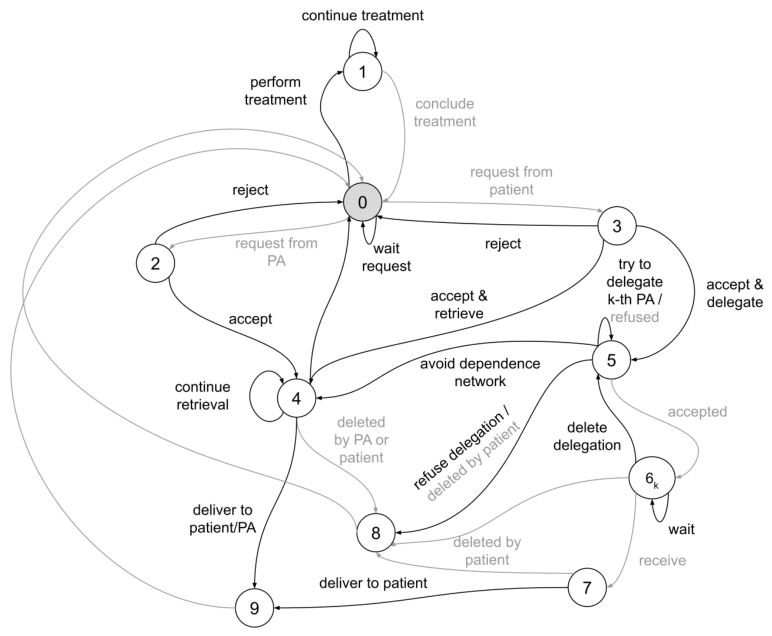
Each PA is characterized by a set of parameters, namely autonomy (zero, realization, meta-level), manipulative-skills (low, high), speed (low, high), and willingness (low, high). The absence of autonomy implies that the PA can only execute the task delegated by the patient, without the possibility to use the dependence network or change the delegation. With realization or meta-level autonomy, as previously discussed, the PA’s decision boundaries gradually become less restrictive, enabling it to utilize the dependence network (realization) and to change the delegation goal (meta-level). Manipulative skills refer to the agent’s ability to transport a resource without damaging it and are modeled as the probability of preserving the resource integrity (0.05 for low skill levels and 0.95 for high skill levels). Speed is instead defined as the number of timesteps required for the PA to move from the starting position to the destination (i.e., the location of the delegator): fast PAs require 5 timesteps, whereas slow PAs require 15 timesteps. Finally, willingness directly influences the number of requests a PA can simultaneously enqueue and execute sequentially. A PA with low willingness can handle only one request at a time, and any additional incoming requests are immediately rejected. In contrast, a PA with high willingness can accept and execute the first request while holding up to two additional requests for subsequent execution. PAs learn from interactions with their patients and, when applicable, with other PAs in the environment, by maintaining estimates of the utility associated with selecting a specific action in a given state. Since the state space is discrete and learning is performed using the tabular n-step SARSA algorithm, each agent maintain a Q-table that stores estimates of the action-value function Q(s,a). In Table 1, the set of states in which a PA may operate is described together with the corresponding available actions. A finite state machine is represented in Figure 2 to describe the states, actions, and transitions.

2.2.3. Learning Algorithm and Sensitivity Analysis

To enable the PAs to learn from their interactions, the n-step SARSA algorithm is adopted, where each PA maintains a table with the action-value function estimates, initialized at 0. The rewards used for updating these estimates are directly derived from the patient’s explicit and implicit satisfaction at the end of each episode. Notably, in the simulation multiple episodes are generated, each starting from the moment a request is issued by the patient. Denoted with T the timestep in which a final state (i.e., state 8 or 9) is reached by the PA, the reward is defined as shown in Equation (6).
R t : = e x p l i c i t s a t i s f a c t i o n + 2 · i m p l i c i t s a t i s f a c t i o n
This formulation, rather than reflecting a clinically grounded weighting, is intended as a neutral modeling assumption, allowing us to balance the influence of explicit and implicit satisfaction without imposing a priori assumptions on their relative importance. The n-step return and the update rule are reported in Equations (7) and (8), respectively.
G t ( n ) = k = 0 n 1 γ k · R t + k + 1 + γ n · Q ( S t + n , A t + n )
Q ( S t , A t ) = Q ( S t , A t ) + α [ G t ( n ) Q ( S t , A t ) ]
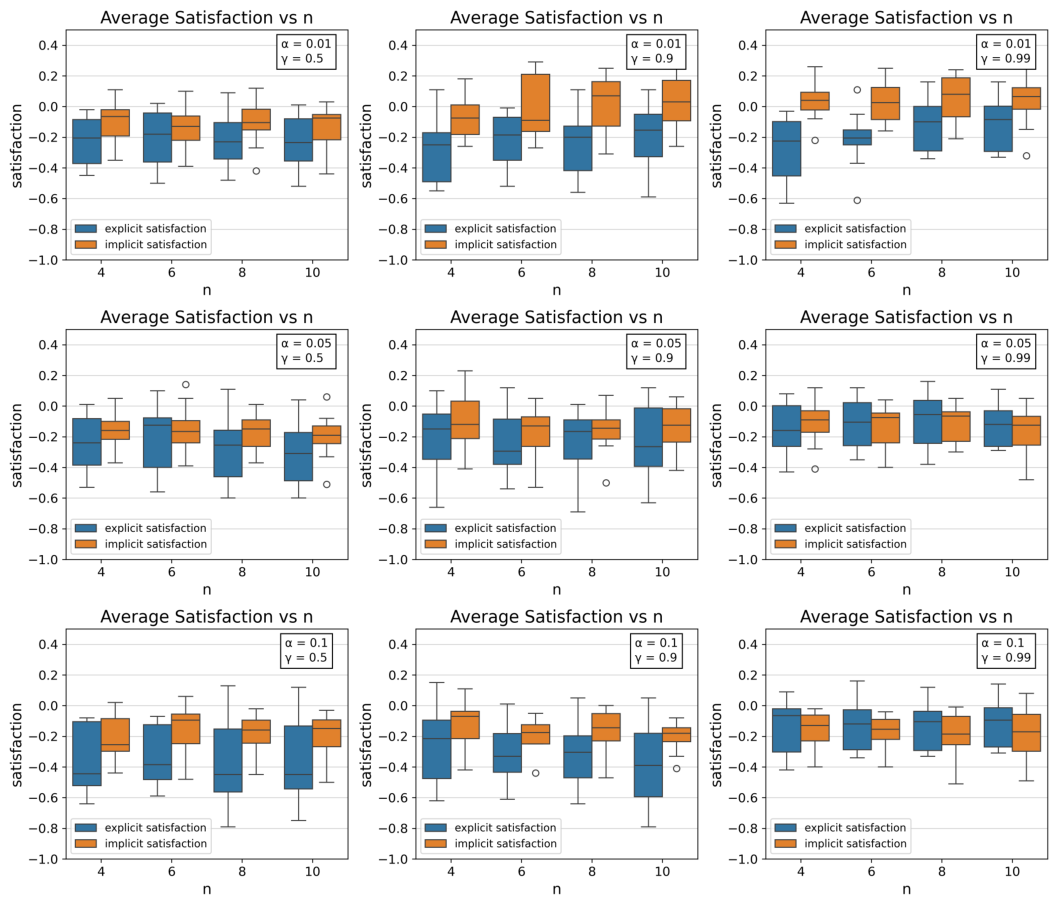
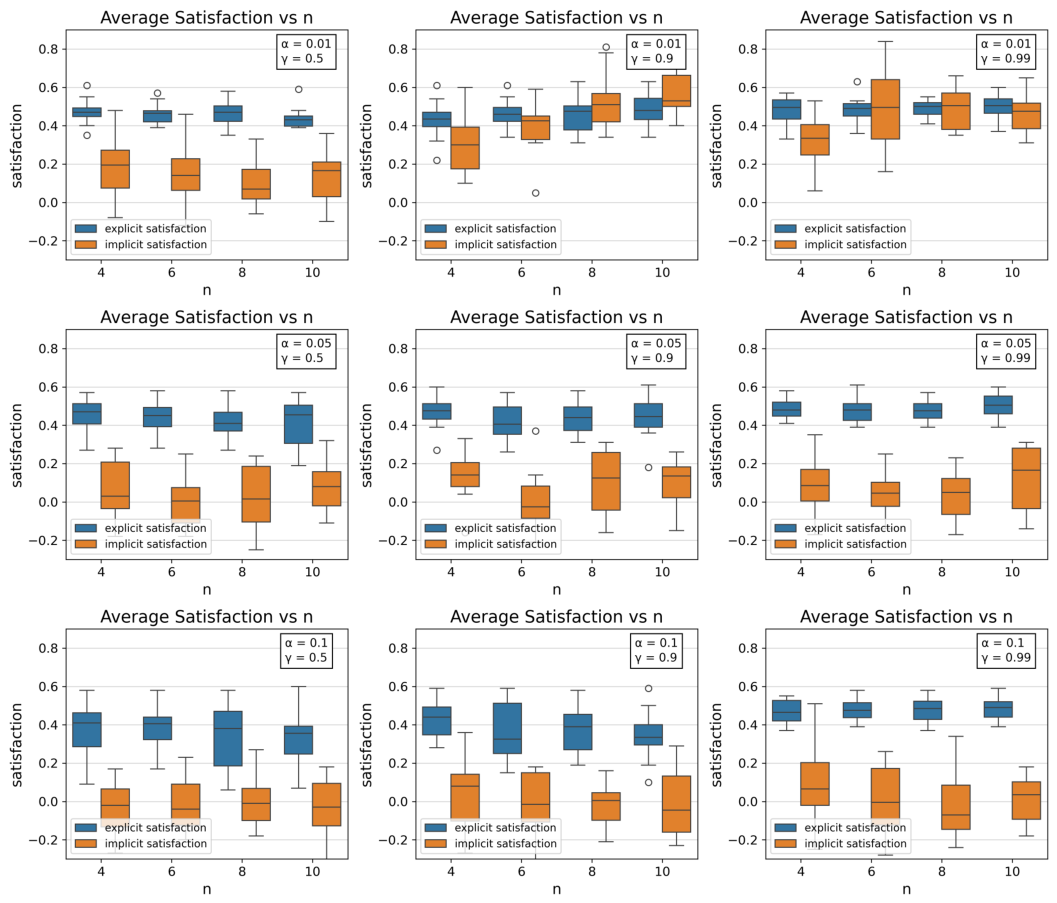
Even though the primary goal of this work is not to optimize the learning algorithm on this specific task, a sensitivity analysis is conducted to identify a suitable set of parameters. In particular, we analyze the impact of the learning rate  α , the discount factor γ , and the bootstrap value n. The exploration factor ϵ is initially set to 1.0 and decayed according to the equation ϵ i + 1 = ϵ i · 1 1 + 0.05 · i . In addition to the sensitivity analysis, learning dynamics and empirical convergence are assessed for each agent. Given the multi-agent nature of the simulation and the large number of agent-level metrics collected, both the parameter space and the number of agents are constrained to maintain computational tractability on average hardware. Specifically, experiments are conducted with 24 agents operating under meta-level autonomy. Trustworthiness is either set to its maximum value for all agents or randomly assigned, in order to model both homogeneous and heterogeneous environments. Notably, meta-level autonomy represents the most challenging setting for learning, as it entails the largest action space in terms of task delegation choices. For this reason, it is preferred over realization autonomy, as it provides a more demanding testbed for evaluating the algorithm and its parameters. Conversely, the absence of autonomy prevents task delegation entirely and is therefore excluded from the analysis. Figure 3 and Figure 4 show the results of sensitivity analysis conducted using 12 random seeds, comparing the parameters based on the population-level satisfaction.
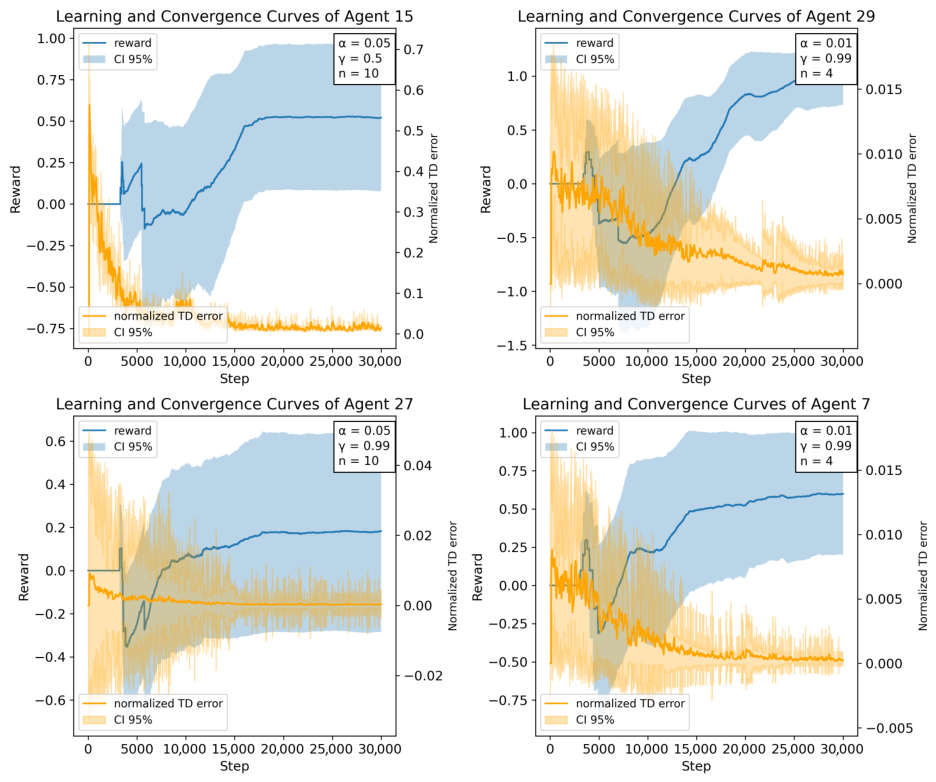
At the individual agent level, performance is evaluated by tracking the cumulative reward using a moving average with a window size of 100, along with the maximum Temporal-Difference (TD) error. The TD error curves are slightly smoothed for visualization purposes only, while raw values are retained for convergence assessment. Figure 5 illustrates these curves for a randomly sampled set of agents; the reported mean and 95% confidence intervals are computed across seeds.
Learning stability is evaluated empirically at the local level by focusing on the final 20% of each trajectory and computing the Coefficient of Variation (CV), defined as C V = σ μ . A curve is considered stable when C V < 0.1 . A slightly different criterion is adopted for convergence, as the magnitude of the updates must also be taken into account across different parameters. More precisely, the TD update shown in Equation (8) is divided by the learning rate α , which gives us the TD error, shown in Equation (9).
δ t = G t ( n ) Q ( S t , A t )
Due to the dependence of the return G t on the discount factor and the reward, the TD error is then normalized according to Equation (10), where a scaled version of the overall maximum reward R m a x is used.
δ ˜ t = δ t R m a x 1 γ
This normalization ensures a consistent scale for TD updates, enabling the use of a fixed threshold to assess convergence across different parameter configurations. Empirical convergence is defined as the condition in which all samples within the last 100 updates fall below a threshold of 0.03. This threshold is determined empirically by analyzing the scale and variability of TD update trajectories across configurations. In particular, it is chosen to be sufficiently small relative to the typical magnitude of TD updates, so as to reliably identify configurations that are approaching convergence. Under this criterion, the proportion of converging agents ranges from approximately 40% to 100% across different parameter settings and random seeds. Finally, stability and convergence metrics are aggregated to estimate the proportion of agents that are both stable and convergent at the end of each independent run, and to compute the objective function defined in Equation (11). The rationale underlying this function is that parameter configurations yielding higher proportions of stable and convergent agents, while simultaneously maximizing the population-level averages of both explicit and implicit satisfaction, are preferable, as they achieve improved performance while ensuring empirical robustness in terms of stability and convergence.
g : = c o n v e r g i n g A g e n t s p c t · s t a b l e A g e n t s p c t · ( e x p l S a t i s f a c t i o n ¯ + i m p l S a t i s f a c t i o n ¯ )

2.3. Experimental Setup

The simulation is designed using the framework Mesa v3.5.0, developed in Python 3 [35], supporting parallelization and allowing the execution of large agent-based models. A first experimental scenario is designed to systematically explore the effects of the main agent parameters (autonomy, manipulative skills, speed, and willingness) by testing all their possible combinations. Subsequently, the resulting groups are compared to identify potential differences in patients’ satisfaction. Each configuration is evaluated using a different number of patients (and PAs), specifically 24 and 60. These values are consistent with common dimensions of pediatric hospitals [36] and are selected as multiples of the number of resources randomly assigned to each PA at the beginning of the simulation, in order to investigate whether resource scarcity affects the outcomes. Each simulation run lasts 50,000 timesteps, and for each parameter configuration 30 independent repetitions are performed. In addition, a second scenario is considered, in which each PA is assigned random parameter values, with the exception of autonomy, which is controlled to assess its effect.

3. Results

The results have been analyzed through a sensitivity analysis, performed using ANOVA with bootstrapping (2000 boostraps) and the ordinary least squares model as a means to estimate the ratio of explained variance ( η 2 ) by the single factors (i.e., the PAs’ parameters). In this way, the effect size of each factor and the two-way interaction sizes on the satisfaction are estimated together with the corresponding confidence intervals. Moreover, comparisons across groups corresponding to different parameter configurations are performed for explicit and implicit satisfaction using two-sided t-tests. Each test compares the population-level satisfactions gathered from the 30 independent repetitions within each group. In order to thoroughly assess the dynamics of the simulation, comparisons are performed by considering all combinations of independent and controlled variables from the set of parameters of the PAs. Moreover, comparisons across groups are performed, considering the number of agents as independent variable, to assess the relevance of the size of dependence networks for the satisfaction of the patients.

3.1. First Scenario

In the first scenario, simulations are conducted using 24 and 60 PAs, both initialized with the same TW. To obtain a high-level assessment of the effects of the individual factors and their two-way interactions, the variance decomposition is performed on the complete set of results, separately for each configuration of the number of PAs. As can be seen in Table 2, manipulative skills have the largest effect among all the other factors on explicit satisfaction, regardless of the number of PAs in the environment. This dimension of the competence is followed by speed and then autonomy, that also presents a small interaction effect with speed. Overall, there is a small fraction of variance that cannot be explained and can be considered intrinsic in the simulation dynamics, precisely C I 95 % = [ 0.06 , 0.08 ] and C I 95 % = [ 0.02 , 0.03 ] for the cases of 24 and 60 PAs respectively. Considering implicit satisfaction, Table 3 shows that autonomy is the most influential factor, followed by its interaction with speed, and by the main effects of the two competence dimensions. Moreover, in the case of 60 PAs, willingness appears to play a more prominent role in explaining the variance of implicit satisfaction. The proportion of unexplained variance is C I 95 % = [ 0.18 , 0.22 ] and C I 95 % = [ 0.06 , 0.08 ] for 24 and 60 PAs, respectively.
When comparing groups in terms of their mean satisfactions (reported in Table A1 and Table A2 of Appendix A) some noteworthy patterns emerge. Focusing on explicit satisfaction for the 24-PAs case and grouping by autonomy, no significant differences are observed between realization and meta-level autonomy. In contrast, realization autonomy generally yields significantly higher explicit satisfaction than zero autonomy, except for the case in which PAs are slow, willing to adopt multiple tasks, and capable to effectively manipulate objects (realization: M = −0.04, SD = 0.21; zero: M = −0.11, SD = 0.17; p = 0.16, d = 0.37). However, in the same situation results show a significant difference in implicit satisfaction between the absence of autonomy (M = −0.30, SD = 0.11) and realization autonomy (M = −0.23, SD = 0.10; p = 0.01, d = 0.68). Another significant difference in implicit satisfaction emerges between zero and realization autonomy when PAs operate at high speed. When comparing meta-level autonomy with the other two autonomy levels, the former consistently yields significantly higher implicit satisfaction across all conditions, confirming the variance decomposition results in Table 3 and the central role of autonomy in fostering patient awareness of implicit goals. In the 60-PAs case, a significant difference in explicit satisfaction is observed between zero and realization autonomy across all conditions, with the latter achieving better results. Meta-level autonomy, in turn, yields slightly higher explicit satisfaction than realization autonomy provided that partners are fast. Notably, when PAs are not fast enough, meta-level autonomy is almost always counterproductive for achieving explicit goals. With regard to implicit satisfaction, zero (M = −0.28, SD = 0.07) and realization autonomy (M = −0.26, SD = 0.08; p = 0.31, d = 0.26) yield comparable outcomes when PAs operate at low speed, while they are able of manipulating objects, and unwilling to accept new delegations (i.e., they can hold at most one delegation at a time). By contrast, meta-level autonomy consistently results in significantly higher implicit satisfaction compared to both zero and realization autonomy. Overall, competence (i.e., manipulative skills and speed) results in significantly higher explicit and implicit satisfaction when controlling for all other variables. However, there are two exceptions in which the dimensions of competence do not yield better outcomes. Specifically, the effects of manipulative skills are not significant under meta-level autonomy, when there is a large number of potential partners who are slow and willing to accept multiple delegations. In fact, in this case no significant differences in implicit satisfaction are observed between the low (M = −0.16, SD = 0.07) and high (M = −0.12, SD = 0.11; p = 0.07, d = 0.48) manipulative skills groups. In case of 24 PAs characterized by realization autonomy, high willingness, and low manipulative skills, high speed (M = −0.32, SD = 0.09) does not yield better implicit satisfaction compared to the low-speed group (M = −0.28, SD = 0.10; p = 0.13, d = 0.40). Another interesting aspect concerns willingness, which at a first glance seems to have an overall negligible effect on explicit satisfaction and only a limited effect on implicit satisfaction. However, these effects vary when controlling for other variables and when comparing different levels of willingness across groups. Specifically, in case of 60 PAs with realization autonomy and high competence, higher willingness is associated with lower explicit satisfaction (M = 0.45, SD = 0.04) compared to the low-willingness group (M = 0.48, SD = 0.05; p < 0.01, d = 0.77). The other significant effect emerges in the condition of 60 PAs exhibiting meta-level autonomy, high manipulative skills, and low operating speed. In this case, the low-willingness group (M = −0.02, SD = 0.07) shows higher explicit satisfaction than the high-willingness group (M = −0.08, SD = 0.07; p < 0.01, d = 0.85). Interestingly, the effect of willingness on the average number of delegations changes based on the level of autonomy, as shown in Table A2. More precisely, PAs with realization autonomy tend to delegate slightly less when the willingness of the partners increases (low willingness: M = 1058, SD = 180; high willingness: M = 974, SD = 86), while PAs with meta-level autonomy tend to delegate more (low willingness: M = 4150, SD = 254; high willingness: M = 4648, SD = 288). Despite this distinct tendency, the negative effect on explicit satisfaction does not change. Willingness affects also implicit satisfaction, that is particularly reduced in the presence of meta-level autonomy when the number of agents is high (i.e., 60 agents). When 24 PAs are present, high levels of autonomy and speed constitute the conditions under which high willingness negatively affects implicit satisfaction compared to the low-willingness group. Indeed, these are the only conditions in which willingness leads to a statistically significant deterioration in patient implicit satisfaction. In case of 60 PAs characterized by meta-level autonomy, willingness appears to negatively influence implicit satisfaction regardless of agent competence. This highlights the important role of the partners’ willing to adopt multiple delegations, in line with the results reported in Table 3. By contrast, under realization autonomy, the negative effect of higher partner willingness on implicit satisfaction emerges only when agents are competent. Finally, the size of dependence network significantly affects satisfaction in different ways, especially when PAs are characterized by meta-level autonomy. More precisely, explicit satisfaction worsens with a larger number of potential partners operating at slow speed, regardless of their ability to manipulate objects or their willingness. Conversely, implicit satisfaction improves with a larger number of competent partners, who can be leveraged by PAs with meta-level autonomy. However, as previously discussed, under the same conditions willingness could play an overall negative role limiting the satisfaction of the patients.

3.2. Second Scenario

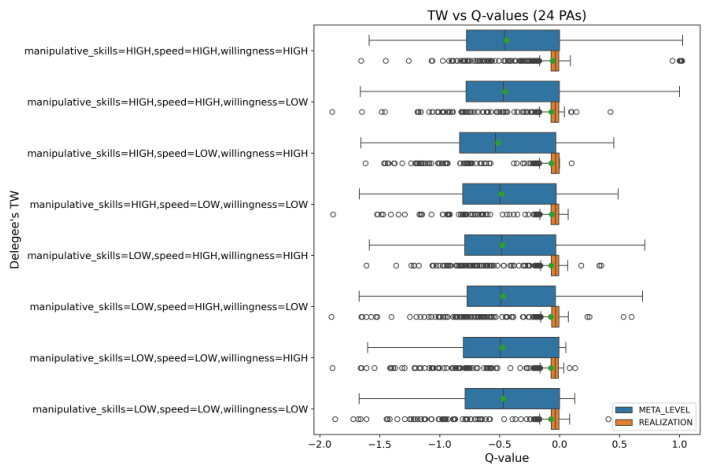
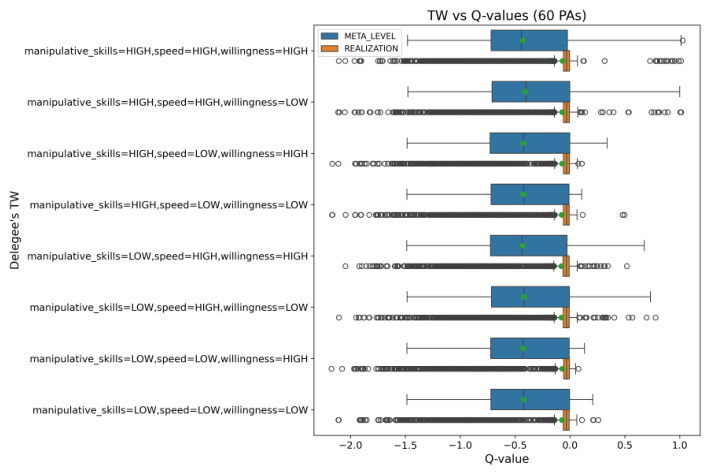
In the second scenario, simulations are conducted on 24 and 60 PAs, each assigned a random TW, with the aim of investigating how autonomy and trust in potential partners affect patient satisfaction in a heterogeneous environment characterized by different levels of competence and willingness. In this context, it is interesting to analyze how the subjective (i.e., estimated) TW relates to autonomy and patient satisfaction. Figure 6 and Figure 7 show that when PAs have meta-level autonomy, the dispersion of the Q-values related to the action of delegation is much larger. In fact, the average ratio of interquartile ranges between meta-level and realization autonomy is 12.27 in case of 24 PAs and 13.14 in case of 60 PAs, clearly showing how meta-level autonomy leads to larger Q-value dispersion compared to the realization autonomy. The Q-values are obtained by aggregating the estimates of each agent from the 30 independent repetitions and then grouping the delegees (i.e., partners) by their trustworthiness. Therefore, since each agent maintains a Q-value for each other agent (see state 5 and related actions in Table 1), in case of 60 PAs the aggregated data consists of 106,200 Q-values, assuming a fixed level of autonomy. The differences in the Q-value distribution may be due to a few reasons. In fact, agents with meta-level autonomy have greater flexibility in deciding whether to delegate a task or accomplish it by themselves, since they can change the delegation of the patient. Moreover, Q-values are initialized to 0 for all agents, therefore if an agent never delegates a partner the corresponding Q-value remains 0 and is never updated, skewing the distribution as in the case of realization autonomy. The two-sided Welch t-tests show a significant difference between the means of Q-values across all groups and for both cases of 24 and 60 PAs. Furthermore, in case of 24 PAs, the realization autonomy group has better explicit satisfaction (M = −0.10, SD = 0.12) than the zero autonomy group (M = −0.42, SD = 0.18; d = 2.08, p < 0.01), while there is no significant difference between the realization and the meta-level autonomy groups. With regards to implicit satisfaction, meta-level autonomy (M = 0.10, SD = 0.16) provides significant improvements with respect to the zero autonomy (M = −0.31, SD = 0.15; d = 2.62, p < 0.01) and realization autonomy (M = −0.24, SD = 0.13; d = 2.32, p < 0.01) groups. In case of 60 PAs, meta-level autonomy leads to better explicit satisfaction (M = −0.12, SD = 0.06) with respect to the realization (M = −0.16, SD = 0.08; d = 0.56, p = 0.03) and zero autonomy groups (M = −0.46, SD = 0.13; d = 3.25, p < 0.01), while there is a significant difference also between the realization and zero autonomy (d = 2.74, p < 0.01). When comparing differences in implicit satisfaction, meta-level autonomy provides even more pronounced improvements, with a statistically significant difference also observed between zero and realization autonomy.

4. Discussion

Trust and autonomy exhibit a complex relationship in environments where inter-agent dependencies may emerge, often shaped by multiple interactions beyond direct effects. In homogeneous environments—i.e., where agents are equally trustworthy—competence plays a primary role in fostering patients’ explicit satisfaction, regardless of the number of agents, and shows a relevant interaction effect with autonomy. In particular, agents’ ability to interact effectively within the dependency network emerges as a key factor in enhancing patient satisfaction. However, the results indicate that higher levels of autonomy, when combined with lower partner competence and high willingness to simultaneously adopt new tasks in more populated environments, lead to a small yet statistically significant decrease in explicit satisfaction. In general, the negative two-way effect of autonomy and competence can be attributed to time delays resulting from reduced agent speed, combined with a larger pool of potential partners that become available as PA autonomy increases and as delegees show willingness to adopt new tasks and place them on hold. In addition, a higher probability of delivering a damaged resource represents a major contributing factor in explaining variations in explicit satisfaction. As stated above, meta-level autonomy may hinder satisfaction in scenarios characterized by a large number of potential partners who, despite limited competence—most notably in terms of speed—are willing to accept multiple delegations. In such cases, meta-level autonomy negatively affects also patients’ explicit satisfaction, whereas realization autonomy yields better outcomes. In other words, the benefits typically provided by the dependence network are offset by partner incompetence and by higher levels of PA autonomy, which grant greater decisional freedom regarding both delegation choices and resource selection for the patient. On the other hand, there are conditions, involving scenarios with a large number of partners, under which meta-level and realization autonomy alternately yield better outcomes. For instance, realization autonomy appears to be preferable when partners operate at low speed and are willing to accept multiple tasks concurrently. Conversely, in nearly all cases where PAs can operate at high speed, meta-level autonomy tends to outperform realization autonomy. These findings suggest that one dimension of competence—namely, speed—acts as enabler of meta-level autonomy with respect to explicit satisfaction, allowing agents to effectively exploit the larger pool of partners to deliver the desired resource to the patient. It is important to note that, although the absolute differences are modest, they are statistically significant. Speed also plays a crucial role for realization autonomy in relation to implicit satisfaction. In general, under the same conditions, partners’ willingness to concurrently adopt new tasks is problematic not only for explicit satisfaction but also for implicit satisfaction when agents exhibit meta-level autonomy, particularly in settings with larger pools of potential partners. Finally, in environments where agents are heterogeneous in terms of trustworthiness, meta-level autonomy is crucial for enhancing patients’ awareness of implicit goals. Despite the diversity in the trustworthiness of potential partners—also reflected in the estimates of the Q-values—agents characterized by meta-level autonomy are, on average, better in identifying suitable partners and exploit dependency relationships, thereby improving the overall satisfaction of the patients.

5. Conclusions

This study investigates the interplay between trust and autonomy through a multi-agent simulation in which agents may depend on others to achieve existing goals or to discover new ones. While the roles of trust and autonomy vary across conditions, competence consistently emerges as a key determinant of performance, and the ability to leverage dependencies proves to be critical for both goal achievement and exploration. These factors directly influence agents’ effectiveness in accomplishing explicit goals and uncovering implicit ones. Autonomy, however, acts as the primary enabler of implicit goal discovery: only agents characterized by meta-level autonomy can fully exploit dependencies to enhance patients’ awareness of their implicit goals. At the same time, meta-level autonomy may hinder explicit goal achievement in certain conditions. In particular, when large pools of incompetent partners are available and willing to accept multiple concurrent delegations, the flexibility intrinsic to meta-level autonomy becomes detrimental, suggesting that constraining autonomy and preserving original delegations may be preferable. Conversely, when partners are sufficiently fast, meta-level autonomy almost always leads to slightly improved explicit goal achievement compared to lower autonomy levels. Differences in the size of the dependence network predominantly affect agents with meta-level autonomy: limited partner choice can be beneficial for explicit goal achievement when partner competence is low. Overall, higher levels of autonomy are more sensitive to risks associated with partner trustworthiness and environmental uncertainty, thereby increasing the importance of trust. Notably, meta-level autonomy is consistently associated with higher rates of implicit goal achievement; however, the ability to reliably satisfy these goals once they become explicit strongly depends on partner trustworthiness. Finally, in heterogeneous environments, meta-level autonomy enables more effective exploration and exploitation of dependencies than realization autonomy. Taken together, these findings highlight that autonomy may introduce a trade-off between implicit goal enhancement and consistent explicit goal achievement, shaped by trust and other contextual factors.

6. Limitations

The study presents a few limitations, mainly due to necessary simplifications and assumptions, including a fixed probability and duration of patient treatments and uniform distances between agents and resources. Ideally, real-world hospital data and procedures would have informed the model; however, such information was not available at the time of the study. Nevertheless, the simulations provide, in principle, insight into dynamics that could plausibly occur in real settings. A further limitation is the relatively small number of simulation repetitions. Although sufficient for statistical testing, the inherent variability of the model suggests that additional repetitions could improve result robustness. Finally, the reinforcement learning algorithm was not exhaustively fine-tuned for the specific task, potentially leading to suboptimal agent behavior. Nonetheless, it represents an adaptive and reasonable approach for agent–environment interaction in realistic scenarios.

Author Contributions

Conceptualization, R.F.; methodology, R.F., F.S. and A.S.; software, F.S.; validation, F.S. and A.S.; formal analysis, F.S.; investigation, R.F., F.S. and A.S.; writing—original draft preparation, R.F., F.S. and A.S.; writing—review and editing, R.F., F.S. and A.S.; supervision, R.F.; project administration, R.F.; funding acquisition, R.F. and A.S. All authors have read and agreed to the published version of the manuscript.

Funding

This research was funded by the project FAIR- Future Artificial Intelligence Research (MURPNRR, PE00000013), by the project TrustPACTX (MUR PRIN 20228FETWM), and by the project ICRAS—Interventi Comportamentali per la Resilienza a rischi Ambientali e Sanitari (MUR-PNRR, PE00000005, CUP B83C22004820002).

Data Availability Statement

The raw data supporting the conclusions of this article will be made available by the authors on request.

Conflicts of Interest

The authors declare no conflicts of interest.

Abbreviations

The following abbreviations are used in this manuscript:
PAPersonal Assistant
TWTrustworthiness

Appendix A

This appendix reports the results of the simulations performed for the two scenarios.
Table A1. Results containing satisfaction mean and std related to the 30 independent repetitions, when 24 PAs are present. The trustworthiness can be the same for all PAs, or each PA can be assigned with a random value for manipulative skills, speed, and willingness.
# of PatientsAutonomyManip. SkillsSpeedWillingnessExpl. SatisfactionImpl. Satisfaction# of Delegations
24zerolowlowlow−0.91 ± 0.14−0.34 ± 0.100 ± 0
24realizationlowlowlow−0.84 ± 0.08−0.32 ± 0.10675 ± 182
24meta-levellowlowlow−0.80 ± 0.08−0.13 ± 0.123117 ± 334
24zerolowhighlow−0.70 ± 0.15−0.33 ± 0.120 ± 0
24realizationlowhighlow−0.44 ± 0.07−0.26 ± 0.09902 ± 216
24meta-levellowhighlow−0.40 ± 0.060.30 ± 0.091745 ± 323
24zerohighlowlow−0.13 ± 0.20−0.24 ± 0.100 ± 0
24realizationhighlowlow0.01 ± 0.14−0.26 ± 0.13356 ± 117
24meta-levelhighlowlow0.04 ± 0.10−0.06 ± 0.142377 ± 287
24zerohighhighlow0.01 ± 0.24−0.32 ± 0.120 ± 0
24realizationhighhighlow0.46 ± 0.11−0.13 ± 0.15565 ± 133
24meta-levelhighhighlow0.49 ± 0.050.52 ± 0.181143 ± 236
24zerolowlowhigh−0.94 ± 0.14−0.34 ± 0.110 ± 0
24realizationlowlowhigh−0.86 ± 0.08−0.32 ± 0.09677 ± 227
24meta-levellowlowhigh−0.81 ± 0.08−0.15 ± 0.103274 ± 375
24zerolowhighhigh−0.71 ± 0.17−0.34 ± 0.090 ± 0
24realizationlowhighhigh−0.45 ± 0.06−0.28 ± 0.10882 ± 187
24meta-levellowhighhigh−0.43 ± 0.060.16 ± 0.112161 ± 343
24zerohighlowhigh−0.11 ± 0.17−0.30 ± 0.110 ± 0
24realizationhighlowhigh−0.04 ± 0.21−0.23 ± 0.10350 ± 124
24meta-levelhighlowhigh0.01 ± 0.12−0.06 ± 0.152597 ± 295
24zerohighhighhigh0.02 ± 0.24−0.29 ± 0.130 ± 0
24realizationhighhighhigh0.48 ± 0.08−0.13 ± 0.15554 ± 129
24meta-levelhighhighhigh0.49 ± 0.070.41 ± 0.171269 ± 309
24zerorandomrandomrandom−0.42 ± 0.18−0.31 ± 0.150 ± 0
24realizationrandomrandomrandom−0.10 ± 0.12−0.24 ± 0.13594 ± 166
24meta-levelrandomrandomrandom−0.06 ± 0.110.10 ± 0.162191 ± 366
Table A2. Results containing satisfaction mean and std related to the 30 independent repetitions, when 60 PAs are considered. The trustworthiness can be the same for all PAs, or each PA can be assigned with a random value for manipulative skills, speed, and willingness.
# of PatientsAutonomyManip. SkillsSpeedWillingnessExpl. SatisfactionImpl. Satisfaction# of Delegations
60zerolowlowlow−0.95 ± 0.08−0.36 ± 0.060 ± 0
60realizationlowlowlow−0.85 ± 0.05−0.32 ± 0.051564 ± 140
60meta-levellowlowlow−0.88 ± 0.06−0.10 ± 0.075840 ± 373
60zerolowhighlow−0.72 ± 0.10−0.35 ± 0.050 ± 0
60realizationlowhighlow−0.44 ± 0.04−0.23 ± 0.051502 ± 136
60meta-levellowhighlow−0.41 ± 0.040.37 ± 0.062862 ± 387
60zerohighlowlow−0.14 ± 0.13−0.28 ± 0.070 ± 0
60realizationhighlowlow−0.03 ± 0.06−0.26 ± 0.081026 ± 123
60meta-levelhighlowlow−0.02 ± 0.07−0.04 ± 0.094150 ± 254
60zerohighhighlow0.07 ± 0.14−0.28 ± 0.070 ± 0
60realizationhighhighlow0.48 ± 0.05−0.09 ± 0.081058 ± 180
60meta-levelhighhighlow0.49 ± 0.030.64 ± 0.061546 ± 156
60zerolowlowhigh−0.93 ± 0.11−0.36 ± 0.050 ± 0
60realizationlowlowhigh−0.85 ± 0.06−0.30 ± 0.061499 ± 205
60meta-levellowlowhigh−0.89 ± 0.07−0.16 ± 0.075893 ± 435
60zerolowhighhigh−0.71 ± 0.10−0.36 ± 0.070 ± 0
60realizationlowhighhigh−0.45 ± 0.04−0.23 ± 0.031407 ± 164
60meta-levellowhighhigh−0.41 ± 0.030.22 ± 0.053981 ± 283
60zerohighlowhigh−0.18 ± 0.13−0.29 ± 0.080 ± 0
60realizationhighlowhigh−0.03 ± 0.08−0.24 ± 0.071081 ± 176
60meta-levelhighlowhigh−0.08 ± 0.07−0.12 ± 0.114648 ± 288
60zerohighhighhigh0.05 ± 0.11−0.28 ± 0.090 ± 0
60realizationhighhighhigh0.45 ± 0.04−0.14 ± 0.07974 ± 86
60meta-levelhighhighhigh0.48 ± 0.040.35 ± 0.092416 ± 288
60zerorandomrandomrandom−0.46 ± 0.13−0.32 ± 0.070 ± 0
60realizationrandomrandomrandom−0.16 ± 0.08−0.23 ± 0.071276 ± 165
60meta-levelrandomrandomrandom−0.12 ± 0.060.13 ± 0.114078 ± 293

References

  1. Fulmer, C.A.; Gelfand, M.J. At What Level (and in Whom) We Trust: Trust Across Multiple Organizational Levels. J. Manag. 2012, 38, 1167–1230. [Google Scholar] [CrossRef]
  2. Mayer, R.C.; Davis, J.H.; Schoorman, F.D. An Integrative Model of Organizational Trust. Acad. Manag. Rev. 1995, 20, 709–734. [Google Scholar] [CrossRef]
  3. Fuglsang, L.; Jagd, S. Making sense of institutional trust in organizations: Bridging institutional context and trust. Organization 2015, 22, 23–39. [Google Scholar] [CrossRef]
  4. Meyer, S.; Ward, P.; Coveney, J.; Rogers, W. Trust in the health system: An analysis and extension of the social theories of Giddens and Luhmann. Health Sociol. Rev. 2008, 17, 177–186. [Google Scholar] [CrossRef]
  5. Rotter, J.B. Interpersonal trust, trustworthiness, and gullibility. Am. Psychol. 1980, 35, 1–7. [Google Scholar] [CrossRef]
  6. Hardin, R. Trust and Trustworthiness; Russell Sage Foundation: New York, NY, USA, 2002. [Google Scholar]
  7. Luhmann, N. Trust and Power; John Wiley & Sons: Hoboken, NJ, USA, 2018. [Google Scholar]
  8. Kong, D.T.; Dirks, K.T.; Ferrin, D.L. Interpersonal Trust within Negotiations: Meta-Analytic Evidence, Critical Contingencies, and Directions for Future Research. Acad. Manag. J. 2014, 57, 1235–1255. [Google Scholar] [CrossRef]
  9. Lewis, J.D.; Weigert, A. Trust as a Social Reality. Soc. Forces 1985, 63, 967–985. [Google Scholar] [CrossRef]
  10. Rousseau, D.M.; Sitkin, S.B.; Burt, R.S.; Camerer, C. Not So Different After All: A Cross-Discipline View of Trust. Acad. Manag. Rev. 1998, 23, 393–404. [Google Scholar] [CrossRef]
  11. Falcone, R.; Castelfranchi, C. Grounding autonomy adjustment on delegation and trust theory. J. Exp. Theor. Artif. Intell. 2000, 12, 149–151. [Google Scholar] [CrossRef]
  12. Castelfranchi, C.; Falcone, R. Towards a theory of delegation for agent-based systems. Robot. Auton. Syst. 1998, 24, 141–157. [Google Scholar] [CrossRef]
  13. Sichman, J.; Conte, R.; Demazeau, Y.; Castelfranchi, C. A Social Reasoning Mechanism Based on Dependence Networks. In Proceedings of the 11th European Conference on Artificial Intelligence, Amsterdam, The Netherlands, 8–12 August 1994; John Wiley & Sons, Inc.: New York, NY, USA, 1996. [Google Scholar]
  14. Castelfranchi, C.; Miceli, M.; Cesta, A. Dependence Relations Among Autonomous Agents. In Proceedings of the 3rd European Workshop on Modeling Autonomous Agents in a Multi-Agent World, Kaiserlautern, Germany, 5–7 August 1991; Elsevier (North-Holland): Amsterdam, The Netherlands, 1992. [Google Scholar]
  15. McNeese, N.J.; Demir, M.; Chiou, E.K.; Cooke, N.J. Trust and Team Performance in Human–Autonomy Teaming. Int. J. Electron. Commer. 2021, 25, 51–72. [Google Scholar] [CrossRef]
  16. Afroogh, S.; Akbari, A.; Malone, E.; Kargar, M.; Alambeigi, H. Trust in AI: Progress, challenges, and future directions. Humanit. Soc. Sci. Commun. 2024, 11, 1568. [Google Scholar] [CrossRef]
  17. Choung, H.; David, P.; Ross, A. Trust in AI and Its Role in the Acceptance of AI Technologies. Int. J. Hum.–Comput. Interact. 2023, 39, 1727–1739. [Google Scholar] [CrossRef]
  18. Sun, X.; Li, J.; Tang, P.; Zhou, S.; Peng, X.; Li, H.N.; Wang, Q. Exploring Personalised Autonomous Vehicles to Influence User Trust. Cogn. Comput. 2020, 12, 1170–1186. [Google Scholar] [CrossRef]
  19. TaheriNejad, N.; Herkersdorf, A.; Jantsch, A. Autonomous Systems, Trust, and Guarantees. IEEE Des. Test 2022, 39, 42–48. [Google Scholar] [CrossRef]
  20. Ueno, T.; Sawa, Y.; Kim, Y.; Urakami, J.; Oura, H.; Seaborn, K. Trust in Human-AI Interaction: Scoping Out Models, Measures, and Methods. In CHI EA ’22: CHI Conference on Human Factors in Computing Systems Extended Abstracts, New Orleans, LA, USA, 29 April–5 May 2022; Association for Computing Machinery: New York, NY, USA, 2022. [Google Scholar] [CrossRef]
  21. Lekadir, K.; Frangi, A.F.; Porras, A.R.; Glocker, B.; Cintas, C.; Langlotz, C.P.; Weicken, E.; Asselbergs, F.W.; Prior, F.; Collins, G.S.; et al. FUTURE-AI: International consensus guideline for trustworthy and deployable artificial intelligence in healthcare. BMJ 2025, 388, e081554. [Google Scholar] [CrossRef] [PubMed]
  22. Castelfranchi, C.; Falcone, R. Trust Theory: A Socio-Cognitive and Computational Model; Wiley: Hoboken, NJ, USA, 2010. [Google Scholar] [CrossRef]
  23. Wheeler, A.R.; Ohan, J.; Jackson, H.M.; Bayliss, D.M. A Systematic Review of Psychometric Properties of General Trust Measures Across the Lifespan. Meas. Interdiscip. Res. Perspect. 2025, 1–31. [Google Scholar] [CrossRef]
  24. Ismail, R.; Jøsang, A. The Beta Reputation System. In Proceedings of the BLED eConference, Bled, Slovenia, 17–19 June 2002. [Google Scholar]
  25. Huynh, T.D.; Jennings, N.R.; Shadbolt, N. FIRE: An Integrated Trust and Reputation Model for Open Multi-Agent Systems. In Proceedings of the 16th European Conference on Artificial Intelligence (ECAI 2004), Valencia, Spain, 22–27 August 2004; IOS Press: Amsterdam, The Netherlands, 2004. [Google Scholar]
  26. Teacy, W.T.L.; Patel, J.; Jennings, N.R.; Luck, M. TRAVOS: Trust and Reputation in the Context of Inaccurate Information Sources. Auton. Agents Multi-Agent Syst. 2006, 12, 183–198. [Google Scholar] [CrossRef]
  27. Marsh, S. Formalising Trust as a Computational Concept. Ph.D. Thesis, University of Stirling, Stirling, UK, 1999. [Google Scholar]
  28. Falcone, R.; Castelfranchi, C. Grounding Human Machine Interdependence Through Dependence and Trust Networks: Basic Elements for Extended Sociality. Front. Phys. 2022, 10, 946095. [Google Scholar] [CrossRef]
  29. Stella, F.; Sapienza, A.; Falcone, R. The Roles of Autonomy and Trust in Hybrid Societies: A Simulation-Based Study in the Healthcare Domain. In Proceedings of the 2025 21st International Conference on Distributed Computing in Smart Systems and the Internet of Things (DCOSS-IoT), Lucca, Italy, 9–11 June 2025; IEEE: Piscataway, NJ, USA, 2025; pp. 822–827. [Google Scholar] [CrossRef]
  30. Falcone, R.; Sapienza, A. The Role of Trust in Dependence Networks: A Case Study. Information 2023, 14, 652. [Google Scholar] [CrossRef]
  31. Falcone, R.; Sapienza, A. Dependence Networks and Trust in Agents Societies: Insights and Practical Implications. In Proceedings of the Workshop from Objects to Agents (WOA 2023), Rome, Italy, 6–8 November 2023. CEUR-WS.org, 2023. [Google Scholar]
  32. Sakovich, N.; Aksenov, D.; Pleshakova, E.; Gataullin, S. A neural operator using dynamic mode decomposition analysis to approximate partial differential equations. AIMS Math. 2025, 10, 22432–22444. [Google Scholar] [CrossRef]
  33. Sutton, R.S.; Barto, A.G. Reinforcement Learning: An Introduction, 2nd ed.; MIT Press: Cambridge, MA, USA, 2018. [Google Scholar]
  34. Eiseman, N.A.; Bianchi, M.T.; Westover, M.B. The Information Theoretic Perspective on Medical Diagnostic Inference. Hosp. Pract. 2014, 42, 125–138. [Google Scholar] [CrossRef] [PubMed]
  35. ter Hoeven, E.; Kwakkel, J.; Hess, V.; Pike, T.; Wang, B.; rht; Kazil, J. Mesa 3: Agent-based modeling with Python in 2025. J. Open Source Softw. 2025, 10, 7668. [Google Scholar] [CrossRef]
  36. Ijaz, N.; Radu, C.; Rothenberg, C.; Janke, A.T.; Venkatesh, A.K. Pediatric Bed Capacity, Bed Strain, and Load Imbalance During the 2022 Respiratory Viral Season. JAMA Netw. Open 2025, 8, e2533943. [Google Scholar] [CrossRef]
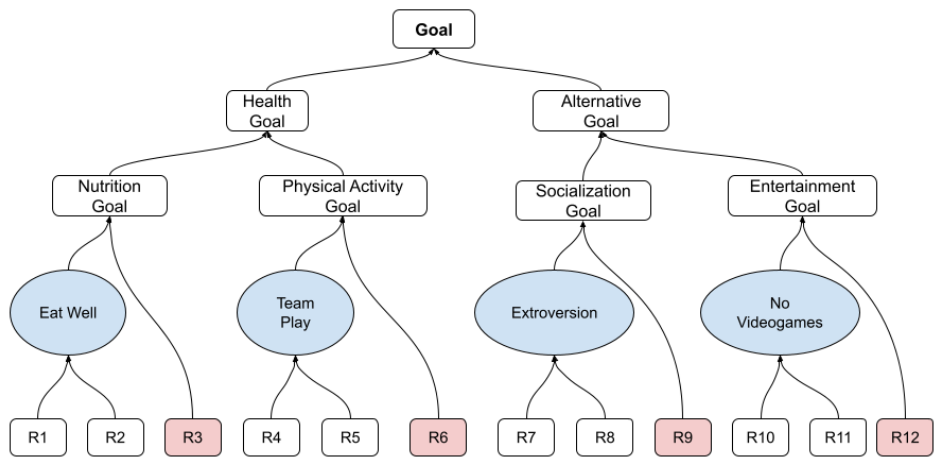
Figure 1. Diagram of goal categories and the corresponding resources. Starting from the bottom, we have the level of explicit goals that coincide with the resources, with those in red indicating conflicts with ethical values. Immediately above there is the level of implicit goals (highlighted in blue), each one achievable by means of two resources. Finally, we have the levels of goals’ sub-categories and categories.
Sci 08 00101 g001
Figure 2. States and transitions with the corresponding action names. Grey arrows and labels denote transitions that occur outside the agent’s control, e.g., resulting from stochastic dynamics or from the predefined timing of actions. On the contrary, black arrows represent transitions resulting from the actions taken by the agent.
Sci 08 00101 g002
Figure 3. Results of sensitivity analysis on the parameters α , γ , and n, when trustworthiness is randomly assigned to each agent. The explicit and implicit satisfactions are averaged across seeds and are gathered at the population level. Outliers are represented by white dots.
Sci 08 00101 g003
Figure 4. Results of sensitivity analysis on the parameters α , γ , and n, when all agents have the highest trustworthiness. The explicit and implicit satisfactions are averaged across seeds and are gathered at the population level. Outliers are represented by white dots.
Sci 08 00101 g004
Figure 5. Smoothed learning and convergence curves for randomly sampled agents with different parameters configurations. All agents have the highest trustworthiness. Means and 95% CIs are estimated across the random seeds.
Sci 08 00101 g005
Figure 6. Representation of the distribution of the Q-values associated with the action of delegation, grouped by profile and autonomy level, when there are 24 PAs with randomly assigned TW. Green dots indicate the mean values, whereas outliers are shown as white dots.
Sci 08 00101 g006
Figure 7. Representation of the distribution of the Q-values associated with the action of delegation, grouped by profile and autonomy level, when there are 60 PAs with randomly assigned TW. Green dots indicate the mean values, whereas outliers are shown as white dots.
Sci 08 00101 g007
Table 1. Description of the state space together with the available actions from the perspective of any PA.
StateDeliberate ActionsDescription
0{wait request, perform treatment}This represents the initial state, in which the agent waits until a delegation request is received from another PA. If a medical treatment is prescribed by a doctor, the PA assigns it the highest priority. Upon completion of the treatment, the patient’s reward request is prioritized over all other PAs’ requests.
1{continue treatment}The agent is administering a medical treatment to the patient and continues the task until completion, with a fixed duration of 8 timesteps.
2{reject, accept}A delegation from another PA is received. The agent may either reject the request—if it is busy or unable to accommodate additional requests—or accept it, in which case the task is either executed immediately or placed on hold.
3{accept & delegate, accept & retrieve, reject}A request from the patient is received. The agent may accept the request and delegate it, accept it and retrieve the resource without using the dependence network, or reject it, perhaps due to conflicts with the patient’s health condition or ethical values, combined with the PA’s inability to provide a suitable resource.
4{continue retrieval, deliver to patient, deliver to PA}The agent retrieves the resource and, after the required travel time has elapsed, delivers it to the delegator (i.e., the patient or another PA).
5{try to delegate k-th PA, avoid dependence network, refuse delegation}The agent tries to delegate another PA, requesting its resource. Alternatively, in this state the PA can decide to avoid the dependence network, provided that its resource meets the constraints imposed by the health condition and the ethical value of the patient, or it can refuse the delegation from the patient.
6 k {delete delegation, wait}The agent is waiting for the partner/delegee to complete the task and, meanwhile, it can decide whether to continue the waiting or delete the delegation.
7{deliver to patient}The PA receives the resource from the delegee and can deliver it to its patient.
8{}It is a final state, reached by a PA whenever the delegee deletes the delegation, or the PA itself refuses the original task delegated by its patient.
9{}It is a final state, reached by a PA whenever it succesfully delivers the resource to its patient.
Table 2. Explained variance of explicit satisfaction by the most significant individual factors and the two-way interactions. In case of 24 PAs, the variance that remains unexplained is C I 95 % = [ 0.06 , 0.08 ] , versus C I 95 % = [ 0.02 , 0.03 ] of the case of 60 PAs.
24 PAs60 PAs
Factor/Interaction CI 95 % = [ η 2 . 5 % 2 , η 97 . 5 % 2 ] Factor/Interaction CI 95 % = [ η 2 . 5 % 2 , η 97 . 5 % 2 ]
manipulative skills[0.70, 0.74]manipulative skills[0.74, 0.76]
speed[0.11, 0.14]speed[0.15, 0.17]
autonomy[0.04, 0.07]autonomy[0.04, 0.05]
autonomy & speed[0.01, 0.02]autonomy & speed[0.01, 0.02]
Table 3. Explained variance of implicit satisfaction by the most significant individual factors and the two-way interactions. In case of 24 PAs, the variance that remains unexplained is C I 95 % = [ 0.18 , 0.22 ] , versus C I 95 % = [ 0.06 , 0.08 ] of the case of 60 PAs.
24 PAs60 PAs
Factor/Interaction CI 95 % = [ η 2 . 5 % 2 , η 97 . 5 % 2 ] Factor/Interaction CI 95 % = [ η 2 . 5 % 2 , η 97 . 5 % 2 ]
autonomy[0.47, 0.54]autonomy[0.54, 0.58]
autonomy & speed[0.12, 0.16]autonomy & speed[0.14, 0.17]
speed[0.08, 0.12]speed[0.13, 0.16]
manipulative skills[0.03, 0.05]manipulative skills[0.03, 0.04]
autonomy &
manipulative skills
[0.00, 0.01]autonomy &
willingness
[0.01, 0.02]
autonomy &
willingness
[0.00, 0.01]willingness[0.00, 0.01]
Disclaimer/Publisher’s Note: The statements, opinions and data contained in all publications are solely those of the individual author(s) and contributor(s) and not of MDPI and/or the editor(s). MDPI and/or the editor(s) disclaim responsibility for any injury to people or property resulting from any ideas, methods, instructions or products referred to in the content.