
Chemical Composition, Antioxidant Potential, and Standardized Antimicrobial Activity of Lavandula angustifolia Mill. Essential Oil: An In Vitro and In Silico Study


 , , and
Abstract
1. Introduction
2. Materials and Methods
2.1. Plant Material
2.2. Hydrodistillation
2.3. Investigation of Chemical Composition
2.4. Investigation of Antimicrobial Activity
2.4.1. Preparation of Lavender Oil Test Emulsions
2.4.2. Microbial Suspensions
2.4.3. Test Procedure
2.4.4. Verification of Methodology
2.4.5. Calculation of Bactericidal and Yeasticidal Activity
- –
- log R is the reduction (log10 CFU/mL),
- –
- N0 is the number of microorganisms in the test microbial suspension, representing the actual concentration of microorganisms present in the reaction mixture (CFU/mL),
- –
- Xsr is the average of viable microorganisms on the two plates after a contact time of 5 min
- –
- n is decimal dilution (n = 1, 2, 3, 4).
2.5. Molecular Docking
2.6. Investigation of Antioxidant Potential
- –
- As is the absorbance of the sample (ethanolic LEO solution mixed with DPPH)
- –
- AB is the absorbance of the “blank” (ethanolic LEO solution without DPPH),
- –
- AC is the absorbance of the control (ethanolic solution with DPPH).
3. Results and Discussion
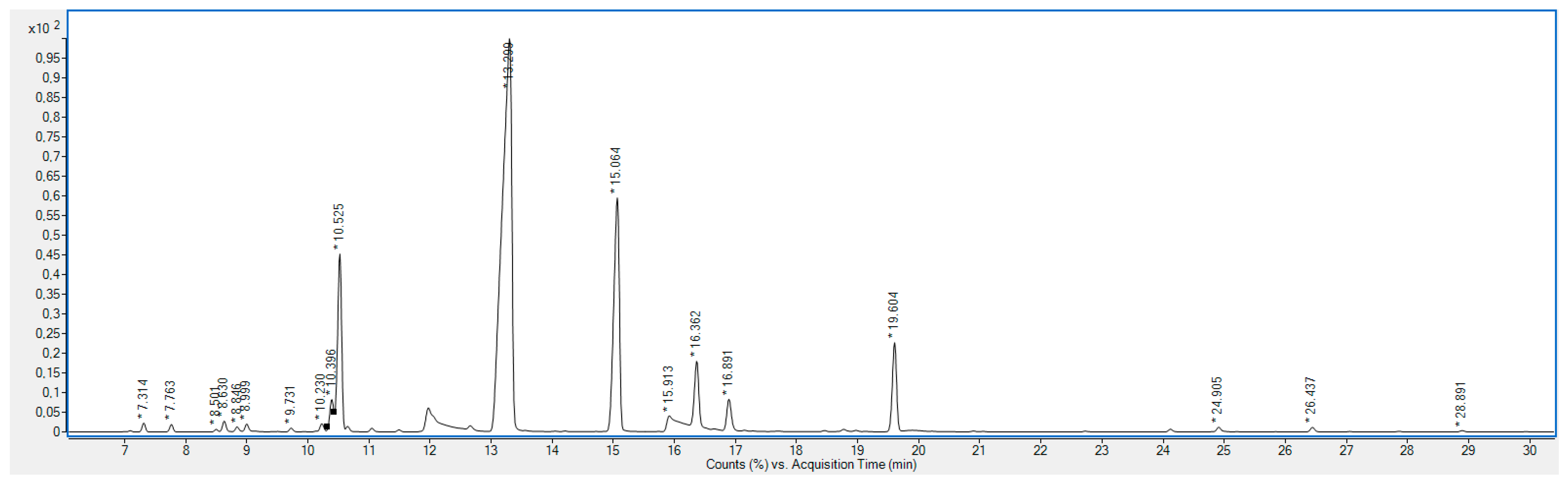
3.1. Chemical Composition
3.2. Antimicrobial Activity
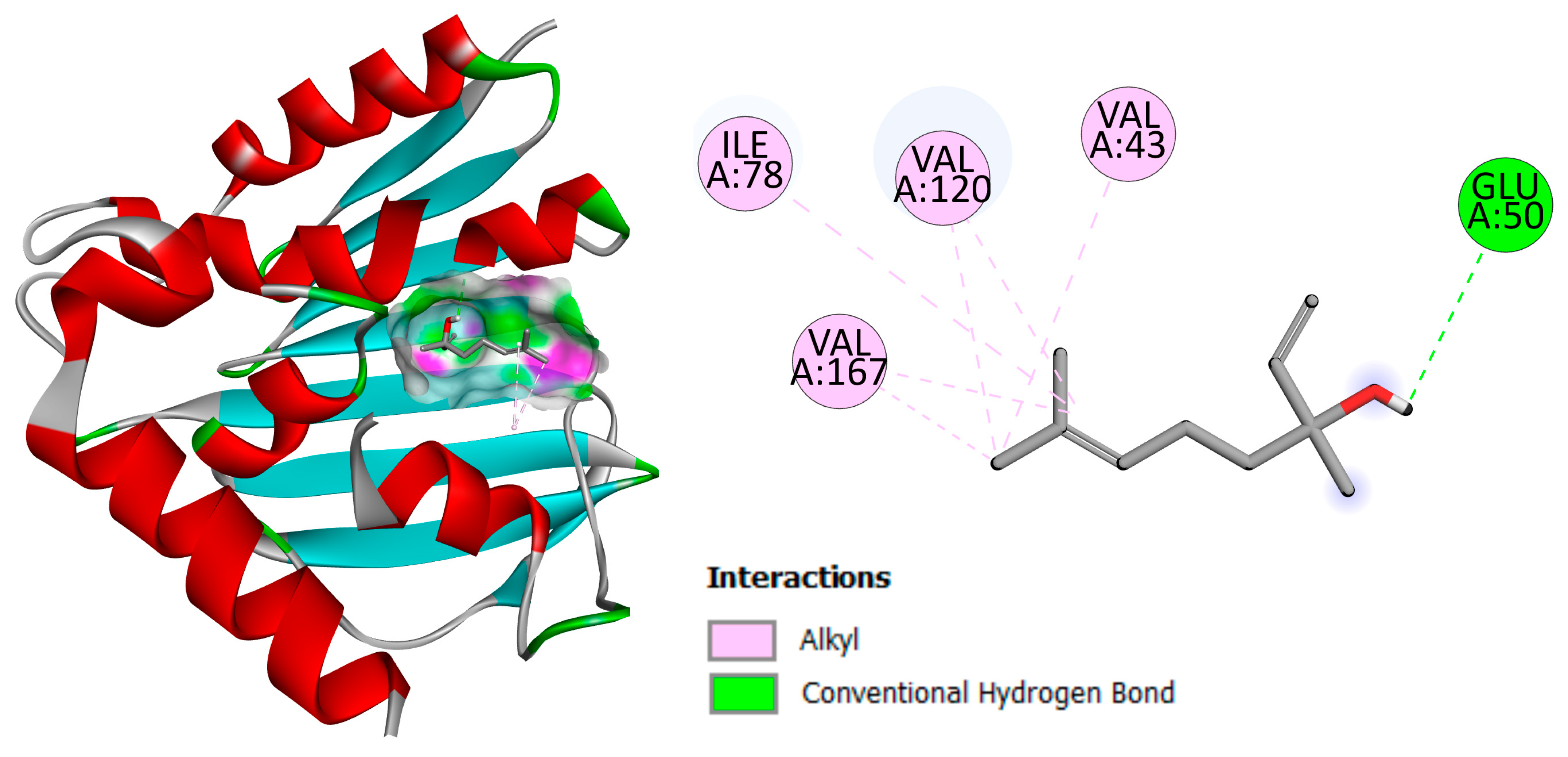
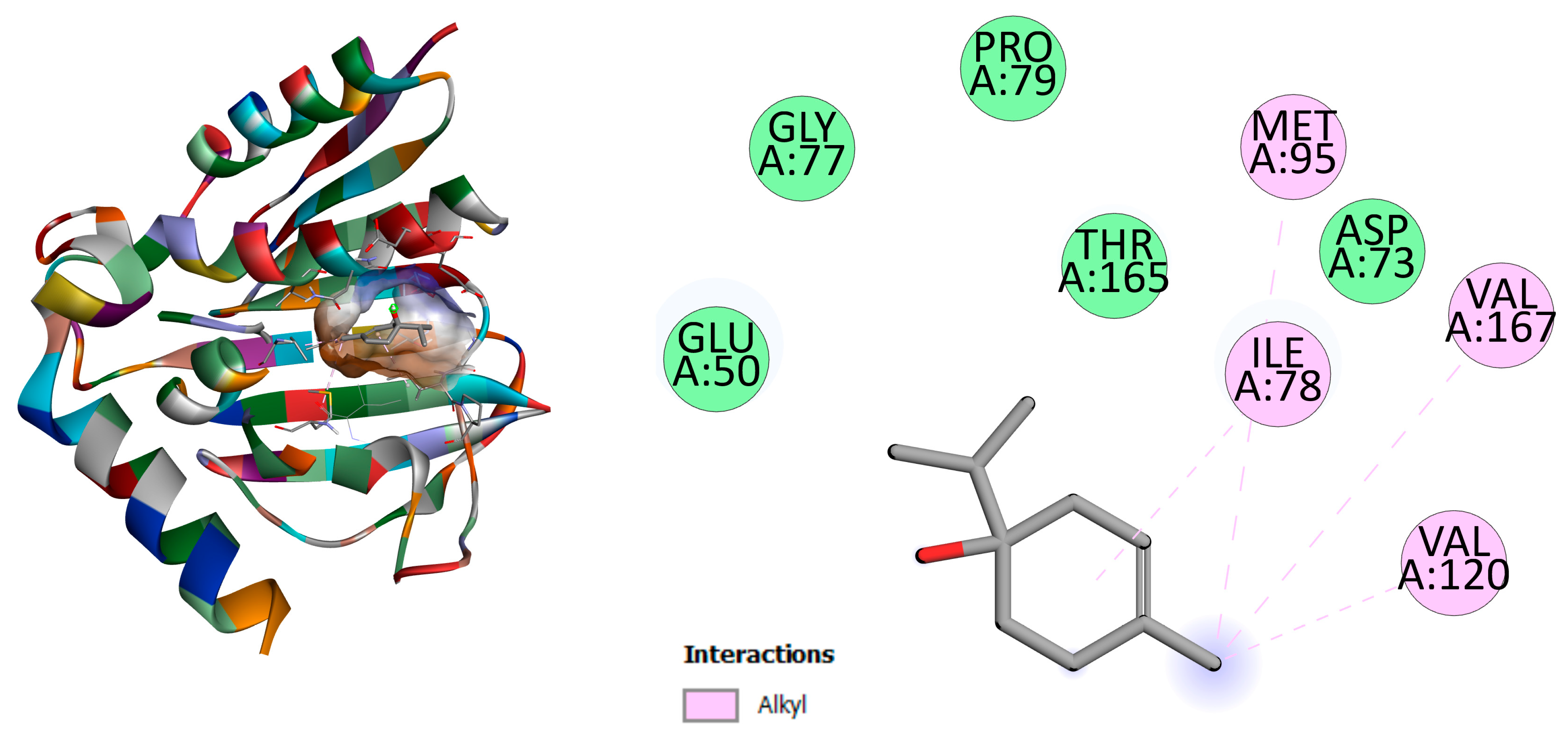
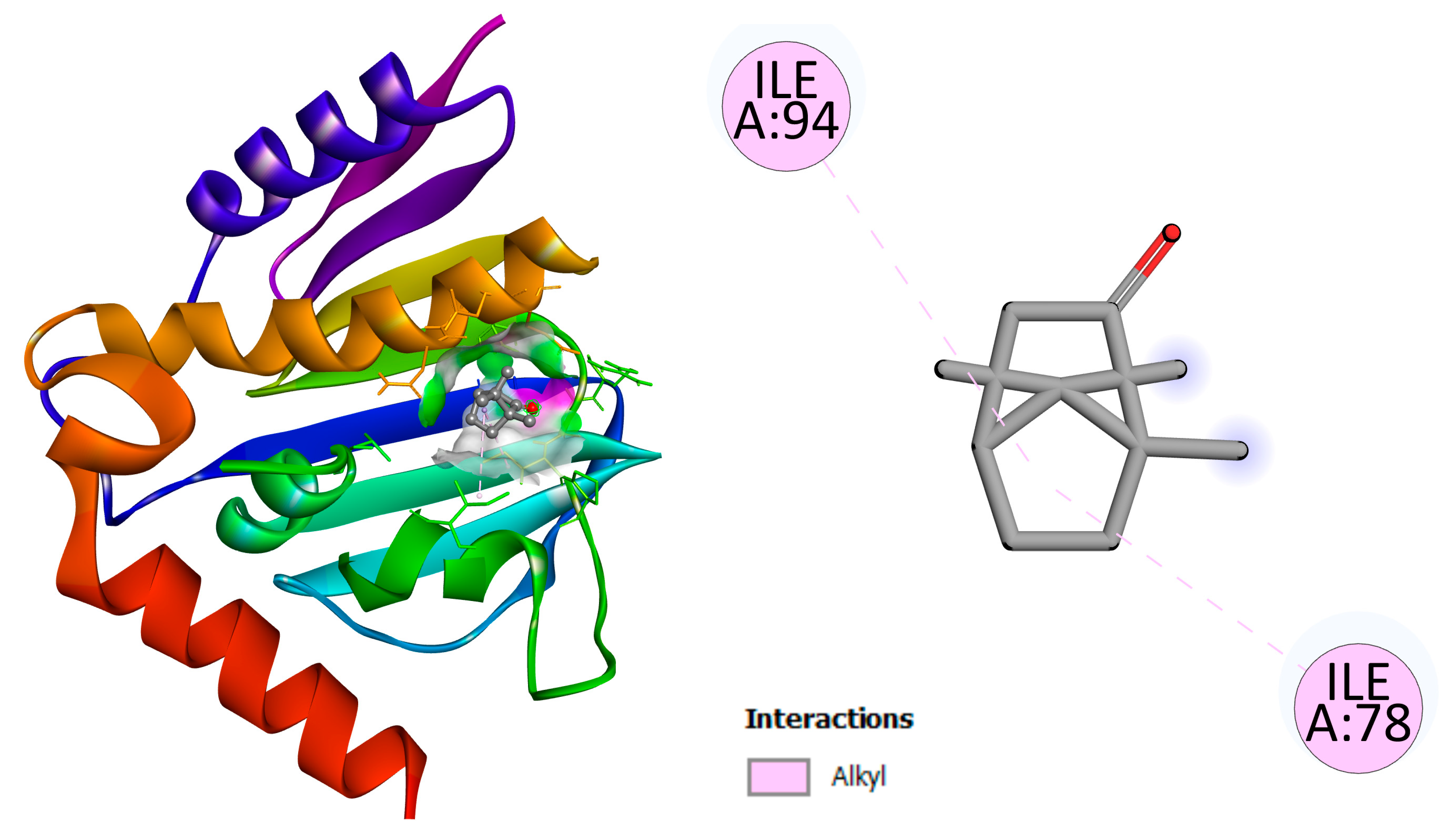
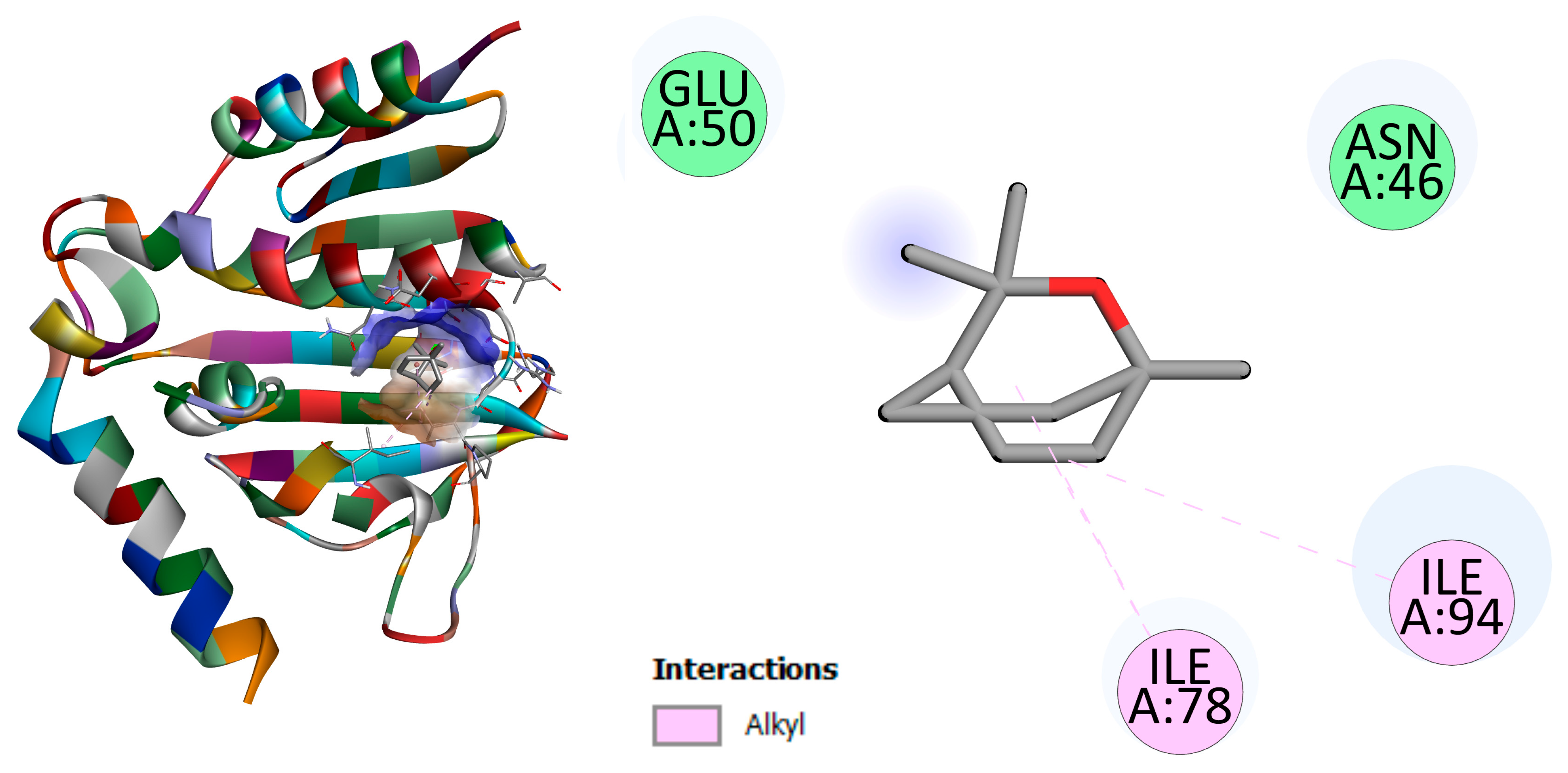
3.3. Molecular Docking Study of the Principal Components of Lavender Essential Oil with DNA Gyrase B
3.4. Antioxidant Activity
4. Conclusions
Supplementary Materials
Author Contributions
Funding
Institutional Review Board Statement
Informed Consent Statement
Data Availability Statement
Conflicts of Interest
Abbreviations
| ATCC | American Type Culture Collection |
| CFU | colony-forming units |
| DPPH | 2,2-diphenyl-1-picrylhydrazyl |
| EU | European Union |
| IC50 | the concentration required to achieve 50% inhibition of the DPPH radical |
| GC–MS | gas chromatography–mass spectrometry |
| LEO | lavender essential oil |
| MIC | minimum inhibitory concentration |
| MBC | minimum bactericidal concentration |
| MEA | malt extract agar |
| MFC | minimum fungicidal concentration |
| TSA | tryptone soya agar |
References
- Tanasă, F.; Nechifor, M.; Teacă, C.-A. Essential Oils as Alternative Green Broad-Spectrum Biocides. Plants 2024, 13, 3442. [Google Scholar] [CrossRef] [Scilit]
- Falcó, I.; Verdeguer, M.; Aznar, R.; Sánchez, G.; Randazzo, W. Sanitizing food contact surfaces by the use of essential oils. Innov. Food Sci. Emerg. Technol. 2019, 51, 220–228. [Google Scholar] [CrossRef] [Scilit]
- Santos, M.I.S.; Marques, C.; Mota, J.; Pedroso, L.; Lima, A. Applications of Essential Oils as Antibacterial Agents in Minimally Processed Fruits and Vegetables—A Review. Microorganisms 2022, 10, 760. [Google Scholar] [CrossRef] [Scilit]
- Nazzaro, F.; Fratianni, F.; De Martino, L.; Coppola, R.; De Feo, V. Effect of Essential Oils on Pathogenic Bacteria. Pharmaceuticals 2013, 6, 1451–1474. [Google Scholar] [CrossRef] [Scilit]
- Sateriale, D.; Forgione, G.; De Cristofaro, G.A.; Continisio, L.; Pagliuca, C.; Colicchio, R.; Salvatore, P.; Paolucci, M.; Pagliarulo, C. Eco-Friendly Sanitization of Indoor Environments: Effectiveness of thyme essential oil in controlling bioaerosol levels and disinfecting surfaces. BioTech 2024, 13, 12. [Google Scholar] [CrossRef] [Scilit]
- Lopez, V.; Nielsen, B.; Solas, M.; Ramirez, M.J.; Jager, A.K. Exploring Pharmacological Mechanisms of Lavender (Lavandula angustifolia) Essential Oil on Central Nervous System Targets. Front. Pharmacol. 2017, 8, 280. [Google Scholar] [CrossRef] [Scilit]
- Santana de Oliveira, M.; Vostinaru, O.; Rigano, D.; de Aguiar Andrade, E.H. Editorial: Bioactive compounds present in essential oils: Advances and pharmacological applications. Front. Pharmacol. 2023, 14, 1130097. [Google Scholar] [CrossRef] [Scilit]
- Dobros, N.; Zawada, K.; Paradowska, K. Phytochemical Profile and Antioxidant Activity of Lavandula angustifolia and Lavandula × intermedia Cultivars Extracted with Different Methods. Antioxidants 2022, 11, 711. [Google Scholar] [CrossRef] [Scilit]
- Aguerd, O.; Elhrech, H.; El Omari, N.; Benali, T.; Akhazzane, M.; Mostakim, M.; Ouma, S.; Khattabi, L.; Amanullah, M.; Menyiy, N.E.; et al. Chemical composition and biological effects of Lavandula angustifolia Mill., essential oils. AMB Express 2025, 15, 164. [Google Scholar] [CrossRef] [Scilit]
- de Elguea-Culebras, G.O.; Herraiz-Peñalver, D.; Prieto-Blanco, D.; Cerro-Ibáñez, N.; Sánchez-Vioque, R.; Navarro-Rocha, J.; Sanz, M.A.; Asensio-S.-Manzanera, M.C.; Pérez-Magariño, S.; Herrero, B.; et al. Essential oils of lavandin (Lavandula × intermedia Emeric ex Loisel.) of Spain: A case study on clones ‘Grosso’ and ‘Super’. J. Appl. Res. Med. Aromat. Plants 2024, 41, 100550. [Google Scholar] [CrossRef] [Scilit]
- Danh, L.T.; Han, L.N.; Triet, N.D.A.; Zhao, J.; Mammucari, R.; Foster, N. Comparison of chemical composition, antioxidant and antimicrobial activity of lavander (Lavandula angustifolia L.) essential oils extracted by supercritical CO2, hexane and hydrodistillation. Food Bioprocess Technol. 2012, 6, 3481–3489. [Google Scholar] [CrossRef] [Scilit]
- Marin, I.; Sayas-Barbera, E.; Viuda-Martos, M.; Navarro, C.; Sendra, E. Chemical Composition, Antioxidant and Antimicrobial Activity of Essential Oils from Organic Fennel, Parsley, and Lavender from Spain. Foods 2016, 5, 18. [Google Scholar] [CrossRef] [Scilit]
- Massoud, R.I.; Bouaziz, M.; Abdallah, H.; Zeiz, A.; Flamini, G.; El-Dakdouki, M.H. Comparative Study on the Chemical Composition and Biological Activities of the essential oils of Lavandula angustifolia and Lavandula × intermedia cultivated in Lebanon. ACS Omega 2024, 9, 30244–30255. [Google Scholar] [CrossRef] [Scilit]
- Pljevljakusic, D.; Kostadinovic Velickovska, S.; Mihajlov, L.; Cherepnalkoski, A. Chemical composition and biological activity of lavandin and lavender essential oils. Riv. Ital. Sostanze Grasse 2023, 100, 91–103. [Google Scholar]
- Stamova, S.; Ermenlieva, N.; Tsankova, G.; Georgieva, E. Antimicrobial activity of lavender essential oil from Lavandula angustifolia Mill.: In Vitro and in silico evaluation. Antibiotics 2025, 14, 656. [Google Scholar] [CrossRef] [Scilit]
- Betlej, I.; Andres, B.; Cebulak, T.; Kapusta, I.; Balawejder, M.; Jaworski, S.; Lange, A.; Kutwin, M.; Pisulewska, E.; Kidacka, A.; et al. Antimicrobial properties and assessment of the content of bioactive compounds Lavandula angustifolia Mill. cultivated in Southern Poland. Molecules 2023, 28, 6416. [Google Scholar] [CrossRef] [Scilit]
- Perovic, S.; Pantovic, S.; Scepanovic, V.; Perovic, A.; Zivkovic, V.; Damjanovic Vratnica, B. Evaluation of antimicrobial activity and activity on the autonomic nervous system of the lavender essential oils from Montenegro. Prog. Nutr. 2019, 21, 584–590. [Google Scholar]
- Hossain, S.; Heo, H.; De Silva, B.C.J.; Wimalasena, S.H.M.P.; Pathirana, H.N.K.S.; Heo, G.-J. Antibacterial activity of essential oil from lavender (Lavandula angustifolia) against pet turtle-borne pathogenic bacteria. Lab. Anim. Res. 2017, 33, 195–201. [Google Scholar] [CrossRef] [Scilit]
- Imane, M.M.; Houda, F.; Amal, A.H.S.; Kaotar, N.; Mohammed, T.; Imane, R.; Farid, H. Phytochemical Composition and Antibacterial Activity of Moroccan Lavandula angustifolia Mill. J. Essent. Oil-Bear. Plants 2017, 20, 1074–1082. [Google Scholar]
- European Chemical Agency (ECHA). Guidance on the Biocidal Products Regulation. Volume II: Efficacy. Parts B + C: Assessment and Evaluation. Version 6.0. Helsinki, Finland, 2023. Available online: https://echa.europa.eu/documents/10162/2324906/bpr_guidance_assessment_evaluation_part_vol_ii_part_bc_en.pdf/ae2e9a18-82ee-2340-9354-d82913543fb9?t=1691738248873 (accessed on 9 March 2026).
- EN 1276; Chemical Disinfectants and Antiseptics—Quantitative Suspension Test for the Evaluation of Bactericidal Activity of Chemical Disinfectants Used in Food, Industrial, Domestic and Institutional Areas—Test Method and Requirements (Phase 2, Step 1). European Committee for Standardisation: Brussels, Belgium, 2009.
- EN 1650; Chemical Disinfectants and Antiseptics—Quantitative Suspension Test for the Evaluation of Fungicidal or Yeasticidal Activity of Chemical Disinfectants Used in Food, Industrial, Domestic and Institutional Areas—Test Method and Requirements (Phase 2, Step 1). European Committee for Standardisation: Brussels, Belgium, 2009.
- Kovačić, S.; Nikolić, T.; Ruščić, M.; Milović, M.; Stamenković, V.; Mihelj, D.; Jasprica, N.; Bogdanović, S.; Topić, J. Flora Jadranske obale i Otoka: 250 Najčešćih Vrsta; Školska Knjiga: Zagreb, Croatia, 2008. [Google Scholar]
- Adams, R.P. Identification of Essential Oil Components by Gas Chromatography/Mass Spectrometry, 5th ed.; Texensis Publishing: Gruver, TX, USA, 2017; pp. 46–52. [Google Scholar]
- ISO 7218; Microbiology of the Food Chain—General Requirements and Guidance for Microbiological Examinations. International Organization for Standardization: Geneva, Switzerland, 2024.
- Mensor, L.L.; Menezes, F.S.; Leitao, G.G.; Reis, A.S.; dos Santos, T.C.; Coube, C.S.; Leitao, S.G. Screening of Brazilian plant extracts for antioxidant activity by the use of DPPH free radical method. Phytother. Res. 2001, 15, 127–130. [Google Scholar] [CrossRef] [Scilit]
- Ciocarlan, A.; Lupascu, L.; Aricu, A.; Dragalin, I.; Popescu, V.; Geana, E.I.; Ionete, R.E.; Vornicu, N.; Duliu, O.G.; Hristozova, G.; et al. Chemical composition and assessment of antimicrobial activity of Lavandula angustifolia essential oil and some by-products. Plants 2021, 10, 1829. [Google Scholar] [CrossRef] [Scilit]
- Kozuharova, E.; Simeonov, V.; Batovska, D.; Stoycheva, C.; Valchev, H.; Benbassat, N. Chemical composition and comparative analysis of lavender essential oil samples from Bulgaria in relation to the pharmacological effects. Pharmacia 2023, 70, 395–403. [Google Scholar] [CrossRef] [Scilit]
- Smigielski, K.; Raj, A.; Krosowiak, K.; Gruska, R. Chemical Composition of the Essential Oil of Lavandula angustifolia Cultivated in Poland. J. Essent. Oil-Bear. Plants 2013, 12, 338–347. [Google Scholar] [CrossRef] [Scilit]
- European Pharmacopoeia Commission. European Pharmacopoeia, 10th ed.; Council of Europe: Strasbourg, France, 2020. [Google Scholar]
- Lane, W.A.; Mahmoud, S.S. Composition of essential oil from Lavandula angustifolia and L. intermedia varieties grown in British Columbia, Canada. Nat. Prod. Commun. 2008, 3, 1235–1238. [Google Scholar] [CrossRef] [Scilit]
- Reverchon, E.; Porta, G.D.; Senatore, F. Supercritical CO2 extraction and fractionation of lavender essential oil and waxes. J. Agric. Food Chem. 2002, 43, 1654–1658. [Google Scholar] [CrossRef] [Scilit]
- Viuda-Martos, M.; Mohamady, M.A.; Fernández-López, J.; Abd ElRazik, K.A.; Omer, E.A.; Pérez-Alvarez, J.A.; Sendra, E. In vitro antioxidant and antibacterial activities of essential oils obtained from Egyptian aromatic plants. Food Control 2011, 22, 1715–1722. [Google Scholar] [CrossRef] [Scilit]
- Belhadj Mostefa, M.; Kabouche, A.; Abaza, I.; Aburjai, T.; Touzani, R.; Kabouche, Z. Chemotypes investigation of Lavandula essential oils growing at different North African soils. J. Mater. Environ. Sci. 2014, 5, 1896–1901. [Google Scholar]
- Gonzalez-Rivera, J.; Duce, C.; Falconieri, D.; Ferrari, C.; Ghezzi, L.; Piras, A.; Tine, M.R. Coaxial microwave assisted hydrodistillation of essential oils from five different herbs (lavender, rosemary, sage, fennel seeds and clove buds): Chemical composition and thermal analysis. Innov. Food Sci. Emerg. Technol. 2016, 33, 308–318. [Google Scholar] [CrossRef] [Scilit]
- Cai, Z.M.; Peng, J.Q.; Chen, Y.; Tao, L.; Zhang, Y.Y.; Fu, L.Y.; Long, Q.D.; Shen, X.C. 1,8-Cineole: A review of source, biological activities, and application. J. Asian Nat. Prod. Res. 2021, 23, 938–954. [Google Scholar] [CrossRef] [Scilit]
- Gorgini Shabankareh, H.; Khorasaninejad, S.; Soltanloo, H.; Shariati, V. Physiological response and secondary metabolites of three lavender genotypes under water deficit. Sci. Rep. 2021, 11, 19164. [Google Scholar] [CrossRef] [Scilit]
- Betlej, I.; Andres, B.; Cebulak, T.; Kapusta, I.; Balawejder, M.; Żurek, N.; Jaworski, S.; Lange, A.; Kutwin, M.; Pisulewska, E.; et al. Phytochemical composition and antimicrobial properties of new Lavandula angustifolia ecotypes. Molecules 2024, 29, 1740. [Google Scholar] [CrossRef] [Scilit]
- Schelz, Z.; Molnar, J.; Hohmann, J. Antimicrobial and antiplasmid activities of essential oils. Fitoterapia 2006, 77, 279–285. [Google Scholar] [CrossRef] [Scilit]
- Walasek-Janusz, M.; Grzegorczyk, A.; Zalewski, D.; Malm, A.; Gajcy, S.; Gruszecki, R. Variation in the antimicrobial activity of essential oils from cultivars of Lavandula angustifolia and L. × intermedia. Agronomy 2022, 12, 2955. [Google Scholar] [CrossRef] [Scilit]
- Diogo Gonçalves, S.; Paiva-Cardoso, M.d.N.; Caramelo, A. Green preservation strategies: The role of essential oils in sustainable food preservatives. Sustainability 2025, 17, 7326. [Google Scholar] [CrossRef] [Scilit]
- Mith, H.; Duré, R.; Delcenserie, V.; Zhiri, A.; Daube, G.; Clinquart, A. Antimicrobial activities of commercial essential oils and their components against food-borne pathogens and food spoilage bacteria. Food Sci. Nutr. 2014, 2, 403–416. [Google Scholar] [CrossRef] [Scilit] [PubMed]
- U.S. Environmental Protection Agency (EPA). LT1ESWTR Disinfection Profiling and Benchmarking. Technical Guidance Manual; EPA 816-R-03-004; Office of Water: Washington, DC, USA, 2003. Available online: https://books.google.co.jp/books/about/Lt1eswtr_Disinfection_Profiling_and_Benc.html?id=cr-fpwAACAAJ&redir_esc=y (accessed on 10 March 2026).
- Reece, R.J.; Maxwell, A. DNA gyrase: Structure and function. Crit. Rev. Biochem. Mol. Biol. 1991, 26, 335–375. [Google Scholar] [CrossRef] [Scilit]
- Collin, F.; Karkare, S.; Maxwell, A. Exploiting bacterial DNA gyrase as a drug target: Current state and perspectives. Appl. Microbiol. Biotechnol. 2011, 92, 479–497. [Google Scholar] [CrossRef] [Scilit]
- Liu, X.; Cai, J.; Chen, H.; Zhong, Q.; Hou, Y.; Chen, W.; Chen, W. Antibacterial activity and mechanism of linalool against Pseudomonas aeruginosa. Microb. Pathog. 2020, 141, 103980. [Google Scholar] [CrossRef] [Scilit]
- Guo, F.; Chen, Q.; Liang, Q.; Zhang, M.; Chen, W.; Chen, H.; Yun, Y.; Zhong, Q.; Chen, W. Antimicrobial activity and proposed action mechanism of linalool against Pseudomonas fluorescens. Front. Microbiol. 2021, 12, 562094. [Google Scholar] [CrossRef] [Scilit]
- Duda-Madej, A.; Viscardi, S.; Grabarczyk, M.; Topola, E.; Kozłowska, J.; Mączka, W.; Wińska, K. Is camphor the future in supporting therapy for skin infections? Pharmaceuticals 2024, 17, 715. [Google Scholar] [CrossRef] [Scilit]
- Huang, W.; Wang, Y.; Tian, W.; Cui, X.; Tu, P.; Li, J.; Shi, S.; Liu, X. Biosynthesis investigations of terpenoid, alkaloid, and flavonoid antimicrobial agents derived from medicinal plants. Antibiotics 2022, 11, 1380. [Google Scholar] [CrossRef] [Scilit] [PubMed]
- Izmest’ev, E.S.; Pestova, S.V.; Kolesnikova, A.I.; Baidamshina, D.R.; Kayumov, A.R.; Rubtsova, S.A. Terpene/functionalized fluoroquinolones as potential antimicrobials: Synthesis and properties. ChemMedChem 2023, 18, e202300358. [Google Scholar] [CrossRef] [Scilit] [PubMed]
- Gharib, F.A.; Badr, S.E.A.; Al-Ghazali, B.A.S.; Zahran, M.K. Chemical composition, antioxidant and antibacterial activities of lavender and marjoram essential oils. Egypt. J. Chem. 2013, 56, 1–24. [Google Scholar] [CrossRef] [Scilit]
- Nikšić, H.; Kovač-Bešović, E.; Makarević, E.; Durić, K.; Kusturica, J.; Muratović, S. Antiproliferative, antimicrobial, and antioxidant activity of Lavandula angustifolia Mill. essential oil. J. Health Sci. 2026, 7, 35–43. [Google Scholar]
- Blažeković, B.; Yang, W.; Wang, Y.; Li, C.; Kindl, M.; Pepeljnjak, S.; Vladimir-Knežević, S. Chemical composition, antimicrobial and antioxidant activities of essential oils of Lavandula × intermedia ‘Budrovka’ and L. angustifolia cultivated in Croatia. Ind. Crop. Prod. 2018, 123, 173–182. [Google Scholar] [CrossRef] [Scilit]
- Miguel, M.G. Antioxidant activity of medicinal and aromatic plants. A review. Flavour. Frag. J. 2010, 25, 291–312. [Google Scholar] [CrossRef] [Scilit]
- Wojtunik, K.A.; Ciesla, L.M.; Waksmundzka-Hajnos, M. Model studies on the antioxidant activity of common terpenoid constituents of essential oils by means of the 2,2-diphenyl-1-picrylhydrazyl method. J. Agric. Food Chem. 2014, 62, 9088–9094. [Google Scholar] [CrossRef] [Scilit]
- Guo, Y.; Baschieri, A.; Amorati, R.; Valgimigli, L. Synergic antioxidant activity of gamma-terpinene with phenols and polyphenols enabled by hydroperoxyl radicals. Food Chem. 2021, 345, 128468. [Google Scholar] [CrossRef] [Scilit]
- Hafsa, B.A.; Javier, Q.-G.J.; Ahmad, A.; Marina, V.-M. The Natural Disinfectant Role of Essential Oils in Improving Radical Scavenging Activity and Total Phenolic Compounds in Fresh Vegetables. Antioxidants 2025, 14, 1458. [Google Scholar] [CrossRef] [Scilit]
- Sengun, I.Y.; Senturk, S.; Gul, S.; Kilic, G. Potential of essential oil combinations for surface and air disinfection. Lett. App. Microbiol. 2021, 72, 526–534. [Google Scholar] [CrossRef] [Scilit]



| Constituents | RI | Content (%) |
|---|---|---|
| α-pinene | 7.321 | 0.4 |
| Camphene | 7.775 | 0.36 |
| β-phellandrene | 8.507 | 0.12 |
| β-pinene | 8.640 | 0.57 |
| 3-octanone | 8.851 | 0.33 |
| β -myrcene | 9.008 | 0.41 |
| γ-terpinene | 9.735 | 0.21 |
| p-cymene | 10.236 | 0.48 |
| D-limonene | 10.400 | 1.84 |
| Eucalyptol | 10.536 | 10.98 |
| Linalool | 13.321 | 49.19 |
| Camphor | 15.079 | 16.96 |
| endo-Borneol | 15.917 | 2.93 |
| Terpinen-4-ol | 16.378 | 5.14 |
| α-terpineol | 16.901 | 2.18 |
| Linalyl-acetate | 19.615 | 4.97 |
| Geranyl acetate | 24.916 | 0.3 |
| Caryophyllene | 26.452 | 0.31 |
| Germacrene D | 28.902 | 0.11 |
| Microorganisms | Test Microbial Suspension N0 (log10 CFU/mL) | Logarithmic Reduction R (log10 CFU/mL) | |
|---|---|---|---|
| 1.0% LEO | 0.1% LEO | ||
| Pseudomonas aeruginosa ATCC 15442 | 7.40 ± 0.02 | 0.77 ± 0.10 | 0.66 ± 0.10 |
| Escherichia coli ATCC 10536 | 7.30 ± 0.03 | 1.97 ± 0.01 | 1.96 ± 0.01 |
| Staphylococcus aureus ATCC 6538 | 7.31 ± 0.01 | 1.96 ± 0.07 | 1.90 ± 0.07 |
| Enterococcus hirae ATCC 10541 | 7.30 ± 0.02 | 0.59 ± 0.06 | 0.19 ± 0.05 |
| Candida albicans ATCC 10231 | 7.31 ± 0.03 | 0.15 ± 0.05 | 0.09 ± 0.04 |
| Microorganisms | Test Microbial Suspension N0 (log10 CFU/mL) | Logarithmic Reduction R (log10 CFU/mL) |
|---|---|---|
| Pseudomonas aeruginosa ATCC 15442 | 7.43 ± 0.06 | <4.21 ± 0.06 |
| Escherichia coli ATCC 10536 | 7.34 ± 0.06 | >5.19 ± 0.06 |
| Staphylococcus aureus ATCC 6538 | 7.33 ± 0.04 | >5.18 ± 0.04 |
| Enterococcus hirae ATCC 10541 | 7.34 ± 0.06 | <4.12 ± 0.06 |
| Candida albicans ATCC 10231 | 7.30 ± 0.03 | >4.15 ± 0.03 |
| Compound | Binding Energy (kcal/mol) |
|---|---|
| linalool | −5.5 |
| camphor | −4.8 |
| eucalyptol | −5.0 |
| terpinen-4-ol | −5.9 |
| ciprofloxacin | −7.0 |
| Time | Inhibition of DPPH (%) | ||
|---|---|---|---|
| 3 mg/mL LEO | 5 mg/mL LEO | 10 mg/mL LEO | |
| 0 min | 22.0 ± 1.13 | 33.8 ± 0.68 | 50.6 ± 1.75 |
| 30 min | 31.7 ± 0.89 | 62.8 ± 1.04 | 89.3 ± 1.14 |
| Country of Origin | IC50 (mg/mL) | References |
|---|---|---|
| Spain | 31.30 | Marin et al. [12] |
| Lebanon | 5.24 | Massoud et al. [13] |
| Egypt | 34.92 | Viuda-Martos et al. [33] |
| Bosnia and Herzegovina | 0.421 | Nikšić et al. [52] |
| Croatia | 27.67 | Blaženković et al. [53] |
| Bosnia and Herzegovina | 4.2 | This paper |
Disclaimer/Publisher’s Note: The statements, opinions and data contained in all publications are solely those of the individual author(s) and contributor(s) and not of MDPI and/or the editor(s). MDPI and/or the editor(s) disclaim responsibility for any injury to people or property resulting from any ideas, methods, instructions or products referred to in the content. |
© 2026 by the authors. Licensee MDPI, Basel, Switzerland. This article is an open access article distributed under the terms and conditions of the Creative Commons Attribution (CC BY) license.
Share and Cite
Antunović, V.; Marjanović-Balaban, Ž.; Gagić, Ž.; Kladar, N.; Gojković Cvjetković, V.; Kalaba, V.; Đurđević-Milošević, D. Chemical Composition, Antioxidant Potential, and Standardized Antimicrobial Activity of Lavandula angustifolia Mill. Essential Oil: An In Vitro and In Silico Study. Sci 2026, 8, 102. https://doi.org/10.3390/sci8050102
Antunović V, Marjanović-Balaban Ž, Gagić Ž, Kladar N, Gojković Cvjetković V, Kalaba V, Đurđević-Milošević D. Chemical Composition, Antioxidant Potential, and Standardized Antimicrobial Activity of Lavandula angustifolia Mill. Essential Oil: An In Vitro and In Silico Study. Sci. 2026; 8(5):102. https://doi.org/10.3390/sci8050102
Chicago/Turabian StyleAntunović, Vesna, Željka Marjanović-Balaban, Žarko Gagić, Nebojša Kladar, Vesna Gojković Cvjetković, Vesna Kalaba, and Dragica Đurđević-Milošević. 2026. "Chemical Composition, Antioxidant Potential, and Standardized Antimicrobial Activity of Lavandula angustifolia Mill. Essential Oil: An In Vitro and In Silico Study" Sci 8, no. 5: 102. https://doi.org/10.3390/sci8050102
APA StyleAntunović, V., Marjanović-Balaban, Ž., Gagić, Ž., Kladar, N., Gojković Cvjetković, V., Kalaba, V., & Đurđević-Milošević, D. (2026). Chemical Composition, Antioxidant Potential, and Standardized Antimicrobial Activity of Lavandula angustifolia Mill. Essential Oil: An In Vitro and In Silico Study. Sci, 8(5), 102. https://doi.org/10.3390/sci8050102