
Photocatalytic Performance of Modified TiO2: A Comparative Analysis of Doping and Co-Doping Process on Methylene Blue Discoloration



Abstract
1. Introduction
1.1. Heterogeneous Photocatalysis
1.2. TiO2 and the Doping Process
1.3. Kinetic and Performance Metric in Photocatalytic Processes
1.4. Experimental Factors That Affect the Rate of the Photocatalytic Process
2. Materials and Methods
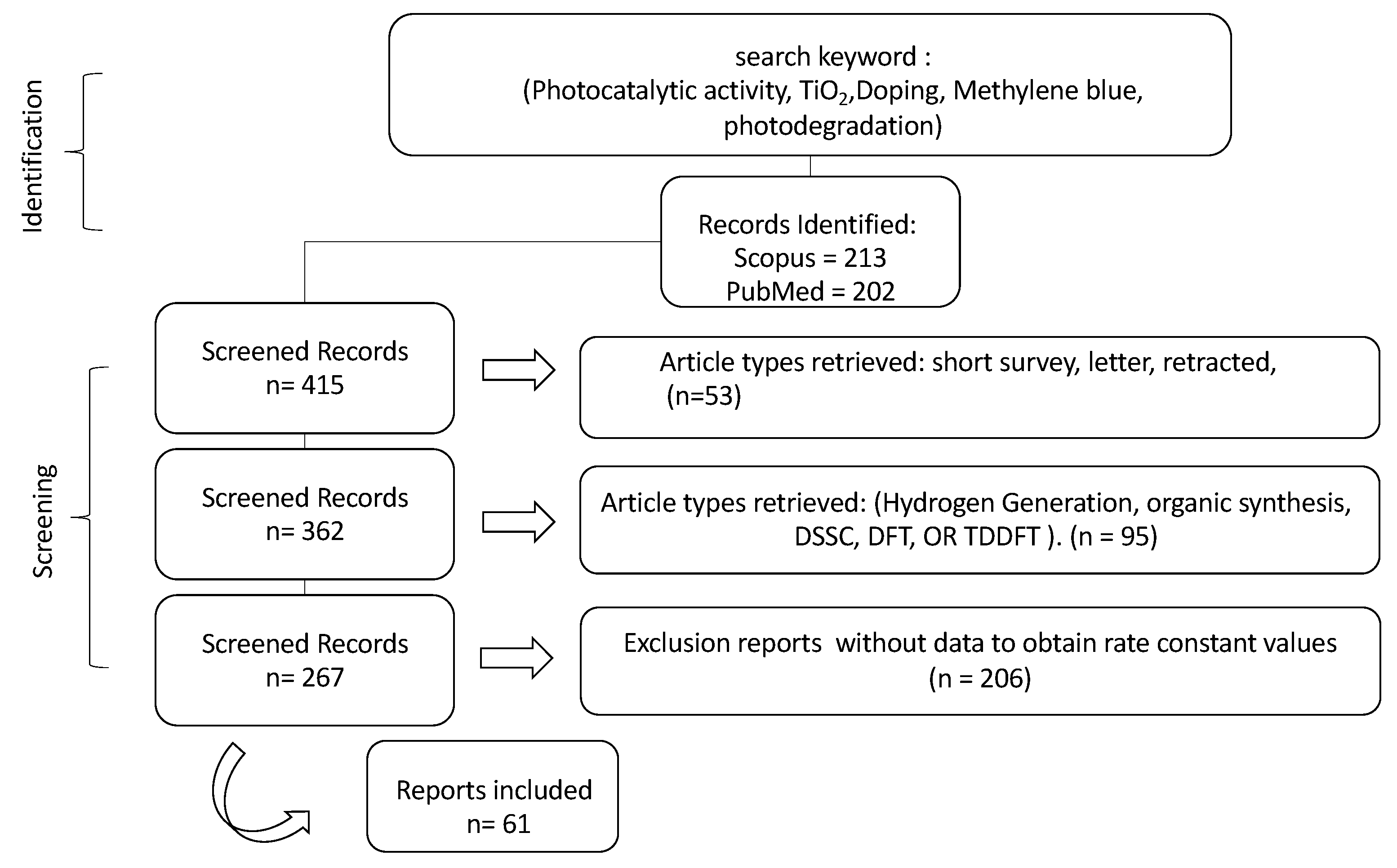
Systematic Comparative Study
3. Results and Discussion
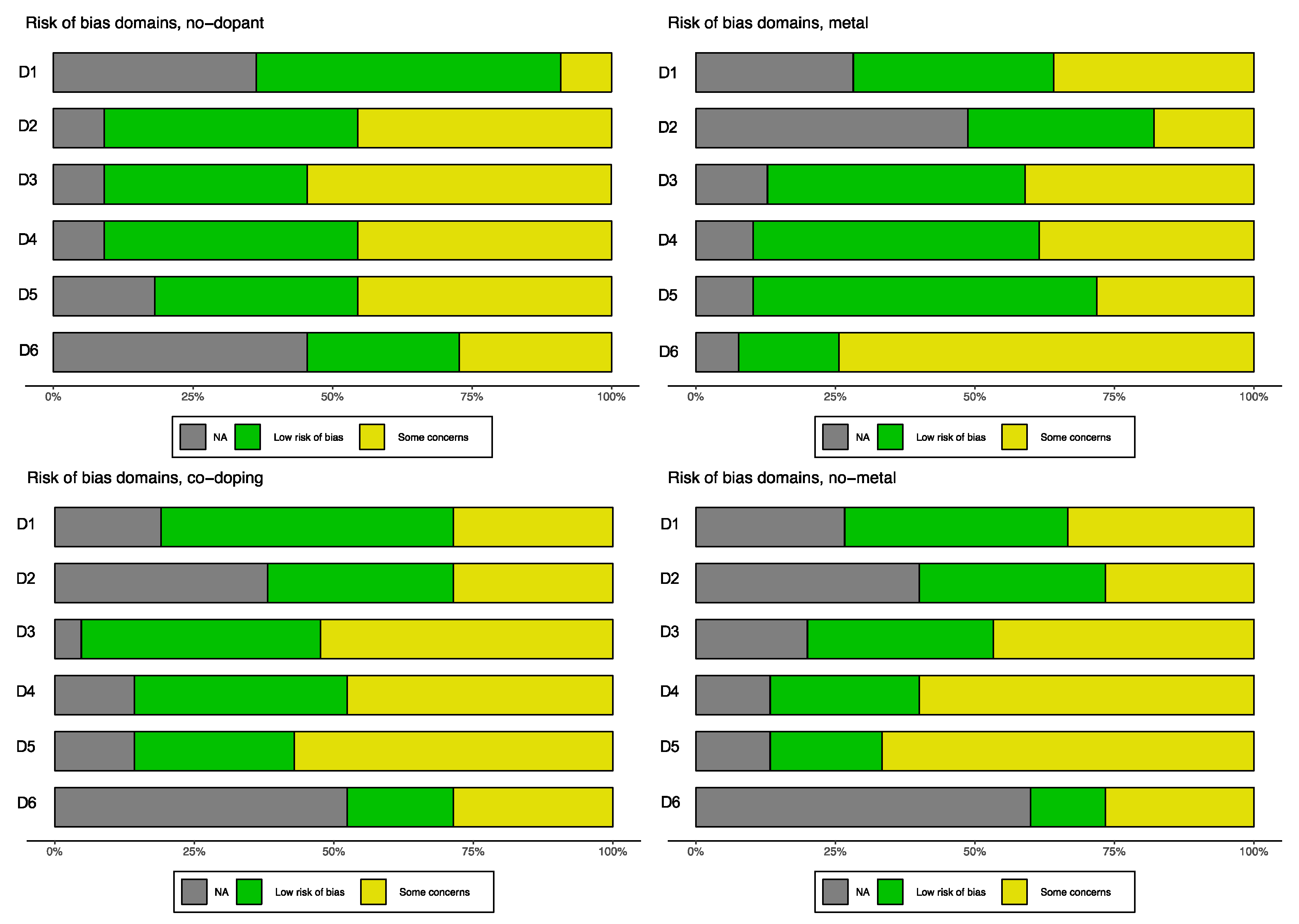
3.1. Structured Risk-of-Bias-Inspired Assessment Adapted for Experimental Photocatalysis Studies
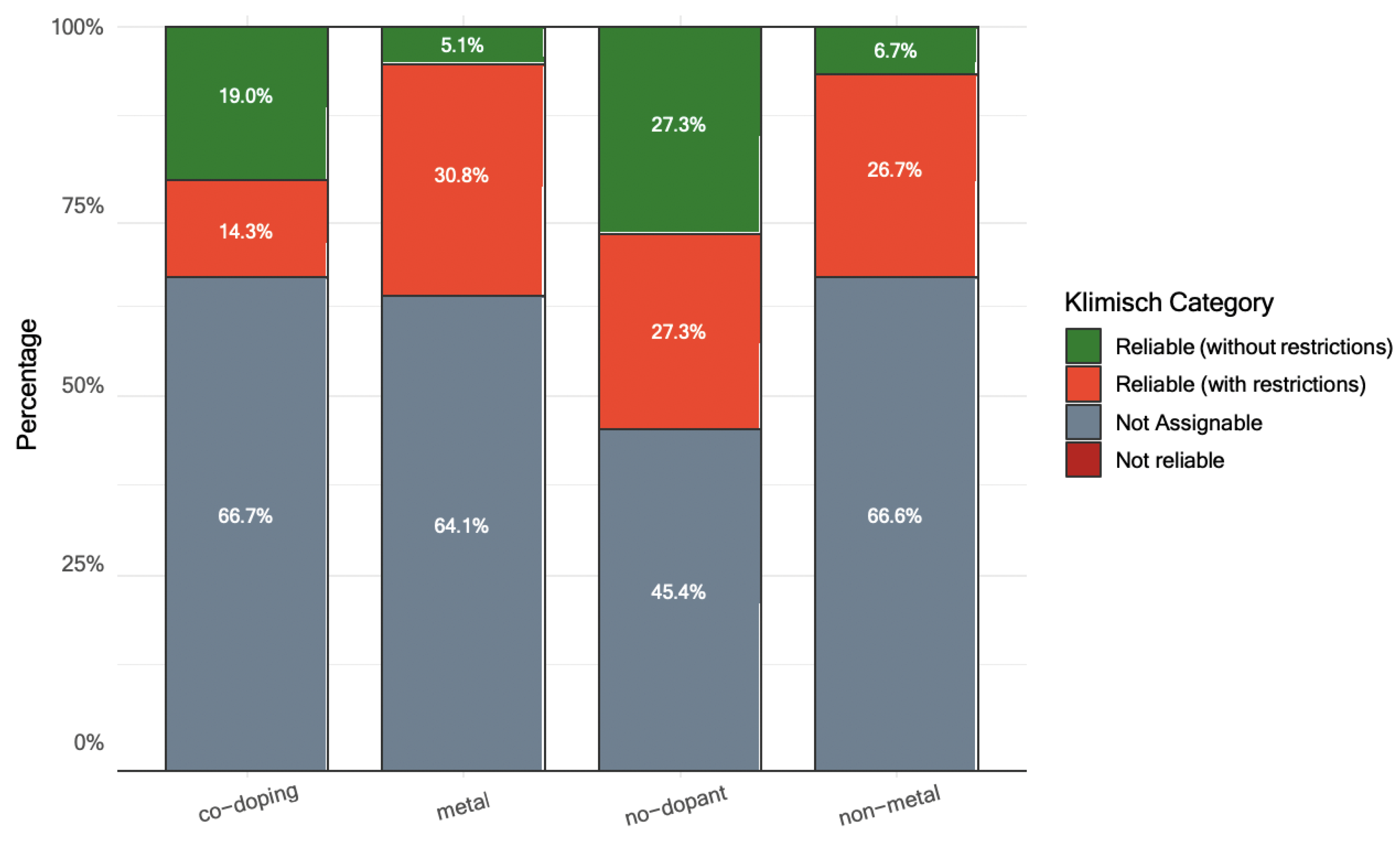
3.2. Klimisch Score
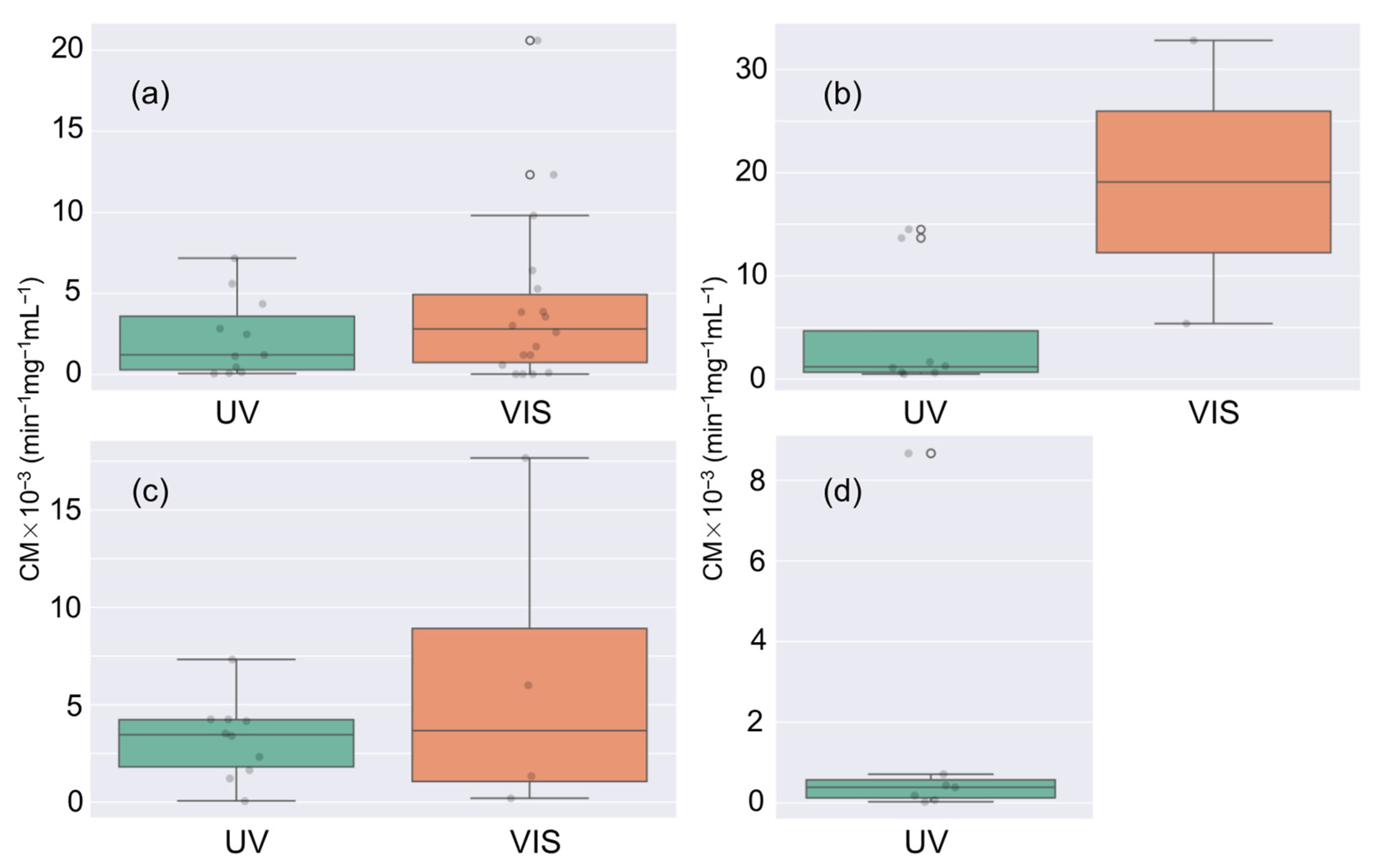
3.3. Data Reporting and Photocatalytic Performance Metrics
3.4. Trends and Perspectives on Heterogeneous Photocatalysis
4. Conclusions
- Photocatalytic systems continue to expand as part of environmental technological developments based on renewable energy sources. These systems represent a promising alternative for the treatment of recalcitrant pollutants, especially considering their potential to utilize solar radiation as a primary and sustainable energy source.
- The doping process improves the photocatalytic activity of TiO2 due to several mechanisms: (i) the formation of intra-gap energy states, (ii) enhanced separation of photogenerated charge carriers, and (iii) reduced charge-carrier recombination rates.
- C and N are the most investigated non-metallic dopants of TiO2. The enhancement in the photocatalytic performance is attributed to band gap reduction caused by generation of impurities above the valence band of TiO2.
- Although the noble-metal doping of TiO2 reduces both the band gap value and recombination rates, these materials can exhibit the surface plasmon resonance phenomena, which further enhance the photocatalytic performance.
- Doping is one of the most effective strategies to improve the photocatalytic response of TiO2 under visible light irradiation, making it a key approach for developing more sustainable and solar-driven treatment processes.
- Significant variations in photocatalytic efficiency arise from differences in experimental conditions, including catalyst synthesis methods, pH, light intensity, pollutant concentration, and catalyst loading. Currently, there is no standardized methodology for reporting photocatalytic performance beyond degradation efficiency and the reaction rate constant. Special attention should therefore be given to establishing a minimum set of parameters that must be reported to enable simple and reliable comparisons among studies.
- The scientific community should prioritize the explicit reporting of all experimental conditions in photocatalytic tests in their publications, as these are essential for ensuring reproducibility, enabling comparability among studies, and promoting the development of robust scientific evidence.
Supplementary Materials
Author Contributions
Funding
Data Availability Statement
Acknowledgments
Conflicts of Interest
References
- Shemer, H.; Wald, S.; Semiat, R. Challenges and Solutions for Global Water Scarcity. Membranes 2023, 13, 612. [Google Scholar] [CrossRef] [Scilit] [PubMed]
- Lu, M.; Zhou, C.; Wang, C.; Jackson, R.B.; Kempes, C.P. Worldwide Scaling of Waste Generation in Urban Systems. Nat. Cities 2024, 1, 126–135. [Google Scholar] [CrossRef] [Scilit]
- Shamshad, J.; Ur Rehman, R. Innovative Approaches to Sustainable Wastewater Treatment: A Comprehensive Exploration of Conventional and Emerging Technologies. Environ. Sci. Adv. 2024, 4, 189–222. [Google Scholar] [CrossRef] [Scilit]
- Qi, Y.; He, K. Science and Technology for Water Purification: Achievements and Strategies. Water 2025, 17, 91. [Google Scholar] [CrossRef] [Scilit]
- Gao, Y.; Tang, Y.; Zhao, M.; Zheng, X.; Jin, H. A Comprehensive Review of Riverbank Filtration Technology for Water Treatment. Water 2025, 17, 371. [Google Scholar] [CrossRef] [Scilit]
- Hama Aziz, K.H.; Mustafa, F.S.; Karim, M.A.H.; Hama, S. Pharmaceutical Pollution in the Aquatic Environment: Advanced Oxidation Processes as Efficient Treatment Approaches: A Review. Mater. Adv. 2025, 6, 3433–3454. [Google Scholar] [CrossRef] [Scilit]
- Hublikar, L.V.; Nivedhitha, K.S.; Chikkatti, B.S.; Sajjan, A.M.; Banapurmath, N.R.; Palaniswamy, D.; Beena, T.; Hegde, P.; Mishra, S.K.; Ravulapati, K. Functionalized Biochar–Metal Oxide Nanocomposites for the Catalytic Degradation of Recalcitrant Pollutants in Wastewater Treatment. RSC Adv. 2026, 16, 12186–12214. [Google Scholar] [CrossRef] [Scilit]
- Bai, X.Y.; Chao, L.; He, S.; Zhou, J.P.; Hu, J. Combining Advanced Oxidation Processes with Biological Processes in Organic Wastewater Treatment: Recent Developments, Trends, and Advances. Desalination Water Treat. 2025, 323, 101263. [Google Scholar] [CrossRef] [Scilit]
- Zheng, T.H.; Zhang, Z.Z.; Liu, Y.; Zou, L.H. Recent Progress in Catalytically Driven Advanced Oxidation Processes for Wastewater Treatment. Catalysts 2025, 15, 761. [Google Scholar] [CrossRef] [Scilit]
- Doerffler, W.; Hauffe, K. Heterogeneous Photocatalysis I. The Influence of Oxidizing and Reducing Gases on the Electrical Conductivity of Dark and Illuminated Zinc Oxide Surfaces. J. Catal. 1964, 3, 156–170. [Google Scholar] [CrossRef] [Scilit]
- Doerffler, W.; Hauffe, K. Heterogeneous Photocatalysis II. The Mechanism of the Carbon Monoxide Oxidation at Dark and Illuminated Zinc Oxide Surfaces. J. Catal. 1964, 3, 171–178. [Google Scholar] [CrossRef] [Scilit]
- Fujishima, A.; Honda, K. Electrochemical Photolysis of Water at a Semiconductor Electrode. Nature 1972, 238, 37–38. [Google Scholar] [CrossRef] [Scilit] [PubMed]
- Meng, S. Photocatalytic Materials and Photocatalytic Reactions. Molecules 2025, 30, 269. [Google Scholar] [CrossRef] [Scilit] [PubMed]
- Králik, M.; Koóš, P.; Markovič, M.; Lopatka, P. Research and Developments of Heterogeneous Catalytic Technologies. Molecules 2025, 30, 3279. [Google Scholar] [CrossRef] [Scilit]
- Serpone, N.; Emeline, A.V. Suggested Terms and Definitions in Photocatalysis and Radiocatalysis. Int. J. Photoenergy 2002, 4, 91–131. [Google Scholar] [CrossRef] [Scilit]
- Fouad, K.; Bassyouni, M.; Alalm, M.G.; Saleh, M.Y. Recent Developments in Recalcitrant Organic Pollutants Degradation Using Immobilized Photocatalysts. Appl. Phys. A 2021, 127, 612. [Google Scholar] [CrossRef] [Scilit]
- Wang, S.; Yun, J.-H.; Luo, B.; Butburee, T.; Peerakiatkhajohn, P.; Thaweesak, S.; Xiao, M.; Wang, L. Recent Progress on Visible Light Responsive Heterojunctions for Photocatalytic Applications. J. Mater. Sci. Technol. 2017, 33, 1–22. [Google Scholar] [CrossRef] [Scilit]
- Chakravorty, A.; Roy, S. A Review of Photocatalysis, Basic Principles, Processes, and Materials. Sustain. Chem. Environ. 2024, 8, 100155. [Google Scholar] [CrossRef] [Scilit]
- Arunachalam, P.; Nagai, K.; Amer, M.S.; Ghanem, M.A.; Ramalingam, R.J.; Al-Mayouf, A.M. Recent Developments in the Use of Heterogeneous Semiconductor Photocatalyst Based Materials for a Visible-Light-Induced Water-Splitting System—A Brief Review. Catalysts 2021, 11, 160. [Google Scholar] [CrossRef] [Scilit]
- Cavallo, C.; Di Pascasio, F.; Latini, A.; Bonomo, M.; Dini, D. Nanostructured Semiconductor Materials for Dye-Sensitized Solar Cells. J. Nanomater. 2017, 2017, 5323164. [Google Scholar] [CrossRef] [Scilit]
- Nguyen, H.L. Metal–Organic Frameworks for Photocatalytic Water Splitting. Solar RRL 2021, 5, 2100198. [Google Scholar] [CrossRef] [Scilit]
- Doghmane, H.E.; Touam, T.; Chelouche, A.; Challali, F.; Djouadi, D. Synthesis and Characterization of TiO2 Thin Films for Photovoltaic and Optoelectronic Applications; Springer: Singapore, 2020; pp. 311–317. [Google Scholar] [CrossRef] [Scilit]
- Peiris, S.; de Silva, H.B.; Ranasinghe, K.N.; Bandara, S.V.; Perera, I.R. Recent Development and Future Prospects of TiO2 Photocatalysis. J. Chin. Chem. Soc. 2021, 68, 738–769. [Google Scholar] [CrossRef] [Scilit]
- Sari, Y.; Gareso, P.L.; Armynah, B.; Tahir, D. A Review of TiO2 Photocatalyst for Organic Degradation and Sustainable Hydrogen Energy Production. Int. J. Hydrogen Energy 2024, 55, 984–996. [Google Scholar] [CrossRef] [Scilit]
- Min, K.S.; Kumar, R.S.; Lee, J.H.; Kim, K.S.; Lee, S.G.; Son, Y.A. Synthesis of New TiO2/Porphyrin-Based Composites and Photocatalytic Studies on Methylene Blue Degradation. Dye. Pigment. 2019, 160, 37–47. [Google Scholar] [CrossRef] [Scilit]
- Vallejo, W.; Navarro, K.; Díaz-Uribe, C.; Schott, E.; Zarate, X.; Romero, E. Zn(II)-Tetracarboxy-Phthalocyanine-Sensitized TiO2 Thin Films as Antimicrobial Agents under Visible Irradiation: A Combined DFT and Experimental Study. ACS Omega 2021, 6, 13637–13646. [Google Scholar] [CrossRef] [Scilit]
- Diaz-Uribe, C.; Vallejo, W.; Romero, E.; Villareal, M.; Padilla, M.; Hazbun, N.; Muñoz-Acevedo, A.; Schott, E.; Zarate, X. TiO2 Thin Films Sensitization with Natural Dyes Extracted from Bactris Guineensis for Photocatalytic Applications: Experimental and DFT Study. J. Saudi Chem. Soc. 2020, 24, 407–416. [Google Scholar] [CrossRef] [Scilit]
- Díaz-Uribe, C.; Vallejo, W.; Campos, K.; Solano, W.; Andrade, J.; Muñoz-Acevedo, A.; Schott, E.; Zarate, X. Improvement of the Photocatalytic Activity of TiO2 Using Colombian Caribbean Species (Syzygium cumini) as Natural Sensitizers: Experimental and Theoretical Studies. Dye. Pigment. 2018, 150, 370–376. [Google Scholar] [CrossRef] [Scilit]
- Rawat, J.; Dwivedi, C.; Sharma, P. Photocatalytic Degradation of Methylene Blue and Tetracycline under Visible Light by Fabricated Carbon Quantum Dot Decorated TiO2 Nanotubes. Nanocomposites 2025, 11, 137–150. [Google Scholar] [CrossRef] [Scilit]
- Sultana, M.; Mondal, A.; Islam, S.; Khatun, M.A.; Rahaman, M.H.; Chakraborty, A.K.; Rahman, M.S.; Rahman, M.M.; Nur, A.S.M. Strategic Development of Metal Doped TiO2 Photocatalysts for Enhanced Dye Degradation Activity under UV–Vis Irradiation: A Review. Curr. Res. Green Sustain. Chem. 2023, 7, 100383. [Google Scholar] [CrossRef] [Scilit]
- Nur, A.S.M.; Sultana, M.; Mondal, A.; Islam, S.; Robel, F.N.; Islam, A.; Sumi, M.S.A. A Review on the Development of Elemental and Codoped TiO2 Photocatalysts for Enhanced Dye Degradation under UV–Vis Irradiation. J. Water Process Eng. 2022, 47, 102728. [Google Scholar] [CrossRef] [Scilit]
- Shah, R.; Khan, D.; Al-Anazi, A.; Ahmad, W.; Ullah, I.; Shah, N.S.; Khan, J.A. Non-Metal Doped ZnO and TiO2 Photocatalysts for Visible Light Active Degradation of Pharmaceuticals and Hydrogen Production: A Review. Appl. Catal. O Open 2025, 204, 207043. [Google Scholar] [CrossRef] [Scilit]
- Piątkowska, A.; Janus, M.; Szymański, K.; Mozia, S. C-,N- and S-Doped TiO2 Photocatalysts: A Review. Catalysts 2021, 11, 144. [Google Scholar] [CrossRef] [Scilit]
- Saeedi, S.N.; Rasoulifard, M.H.; Dorraji, M.S.S.; Douroudgari, H.; Sehati, N. Enhanced Photocatalytic Degradation of Organic Pollutants Using a TiO2–Clay Nanocomposite in a Rotary Photoreactor with Experimental and Theoretical Insights. Sci. Rep. 2025, 15, 38193. [Google Scholar] [CrossRef] [Scilit] [PubMed]
- Quiñones, C.; Posada, M.; Hormiga, A.; Peña, J.; Diaz-Uribe, C.; Vallejo, W.; Muñoz-Acevedo, A.; Roa, V.; Schott, E.; Zarate, X. Antimicrobial Activity against Fusarium oxysporum f. Sp. Dianthi of TiO2/ZnO Thin Films under UV Irradiation: Experimental and Theoretical Study. ACS Omega 2024, 9, 31546–31555. [Google Scholar] [CrossRef] [Scilit]
- Song, C.; Xiao, L.; Chen, Y.; Yang, F.; Meng, H.; Zhang, W.; Zhang, Y.; Wu, Y. TiO2-Based Catalysts with Various Structures for Photocatalytic Application: A Review. Catalysts 2024, 14, 366. [Google Scholar] [CrossRef] [Scilit]
- Barmaki, M.; Noroozi Pesyan, N.; Alamgholiloo, H.; Şahin, E. Design of a Pd/SWCNTs/TiO2 Photocatalyst for Enhancing Cross-Coupling Reactions by Assistance of Surface Plasmon Resonance. Inorg. Chem. 2025, 64, 18411–18420. [Google Scholar] [CrossRef] [Scilit]
- Wach, A.; Zou, X.; Wojtaszek, K.; Kayser, Y.; Garlisi, C.; Palmisano, G.; Jacinto, S.; Szlachetko, J. Towards Understanding the TiO2 Doping at the Surface and Bulk. X-Ray Spectrom. 2023, 52, 261–268. [Google Scholar] [CrossRef] [Scilit]
- Erfan, N.A.; Mahmoud, M.S.; Kim, H.Y.; Barakat, N.A.M. Synergistic Doping with Ag, CdO, and ZnO to Overcome Electron-Hole Recombination in TiO2 Photocatalysis for Effective Water Photo Splitting Reaction. Front. Chem. 2023, 11, 1301172. [Google Scholar] [CrossRef] [Scilit]
- Asahi, R.; Morikawa, T.; Ohwaki, T.; Aoki, K.; Taga, Y. Visible-Light Photocatalysis in Nitrogen-Doped Titanium Oxides. Science 2001, 293, 269–271. [Google Scholar] [CrossRef] [Scilit]
- Guo, Q.; Zhou, C.; Ma, Z.; Yang, X. Fundamentals of TiO2 Photocatalysis: Concepts, Mechanisms, and Challenges. Adv. Mater. 2019, 31, 1901997. [Google Scholar] [CrossRef] [Scilit]
- Zaleska, A. Doped-TiO2: A Review. Recent Pat. Eng. 2008, 2, 157–164. [Google Scholar] [CrossRef] [Scilit]
- Raes, A.; Minja, A.C.; Ag, K.R.; Verbruggen, S.W. Recent Advances in Metal-Doped Defective TiO2 for Photocatalytic CO2 Conversion. Curr. Opin. Chem. Eng. 2024, 44, 101013. [Google Scholar] [CrossRef] [Scilit]
- Mezzat, F.; Zaari, H.; El Kenz, A.; Benyoussef, A. Effect of Metal and Non Metal Doping of TiO2 on Photocatalytic Activities: Ab Initio Calculations. Opt. Quantum Electron. 2021, 53, 86. [Google Scholar] [CrossRef] [Scilit]
- Matsubara, M.; Saniz, R.; Partoens, B.; Lamoen, D. Doping Anatase TiO2 with Group V-b and VI-b Transition Metal Atoms: A Hybrid Functional First-Principles Study. Phys. Chem. Chem. Phys. 2017, 19, 1945–1952. [Google Scholar] [CrossRef] [Scilit]
- Haider, A.J.; Jameel, Z.N.; Al-Hussaini, I.H.M. Review on: Titanium Dioxide Applications. Energy Procedia 2019, 157, 17–29. [Google Scholar] [CrossRef] [Scilit]
- Liyanaarachchi, H.; Thambiliyagodage, C.; Liyanaarachchi, C.; Samarakoon, U. Efficient Photocatalysis of Cu Doped TiO2/g-C3N4 for the Photodegradation of Methylene Blue. Arab. J. Chem. 2023, 16, 104749. [Google Scholar] [CrossRef] [Scilit]
- Shan, S.; Liu, Z.; Tian, J.; Sha, J.; Li, L.; Yang, Y.; Zhang, Z. Mn-N Codoped TiO2 Nanotubes with Enhanced Photocatalytic Activity: An Integrated Experimental and Theoretical Investigation. Mater. Lett. 2024, 373, 137074. [Google Scholar] [CrossRef] [Scilit]
- Kunnamareddy, M.; Rajendran, R.; Sivagnanam, M.; Rajendran, R.; Diravidamani, B. Nickel and Sulfur Codoped TiO2 Nanoparticles for Efficient Visible Light Photocatalytic Activity. J. Inorg. Organomet. Polym. Mater. 2021, 31, 2615–2626. [Google Scholar] [CrossRef] [Scilit]
- Lv, T.; Zhao, J.; Chen, M.; Shen, K.; Zhang, D.; Zhang, J.; Zhang, G.; Liu, Q. Boosted Visible-Light Photodegradation of Methylene Blue by V and Co Co-Doped TiO2. Materials 2018, 11, 1946. [Google Scholar] [CrossRef] [Scilit]
- Shaban, M.; Ahmed, A.M.; Shehata, N.; Betiha, M.A.; Rabie, A.M. Ni-Doped and Ni/Cr Co-Doped TiO2 Nanotubes for Enhancement of Photocatalytic Degradation of Methylene Blue. J. Colloid Interface Sci. 2019, 555, 31–41. [Google Scholar] [CrossRef] [Scilit]
- Kunnamareddy, M.; Diravidamani, B.; Rajendran, R.; Singaram, B.; Varadharajan, K. Synthesis of Silver and Sulphur Codoped TiO2 Nanoparticles for Photocatalytic Degradation of Methylene Blue. J. Mater. Sci. Mater. Electron. 2018, 29, 18111–18119. [Google Scholar] [CrossRef] [Scilit]
- Schneider, J.; Matsuoka, M.; Takeuchi, M.; Zhang, J.; Horiuchi, Y.; Anpo, M.; Bahnemann, D.W. Understanding TiO2 Photocatalysis: Mechanisms and Materials. Chem. Rev. 2014, 114, 9919–9986. [Google Scholar] [CrossRef] [Scilit]
- Kumar, K.V.; Porkodi, K.; Rocha, F. Langmuir–Hinshelwood Kinetics—A Theoretical Study. Catal. Commun. 2008, 9, 82–84. [Google Scholar] [CrossRef] [Scilit]
- Turchi, C.S.; Ollis, D.F. Photocatalytic Degradation of Organic Water Contaminants: Mechanisms Involving Hydroxyl Radical Attack. J. Catal. 1990, 122, 178–192. [Google Scholar] [CrossRef] [Scilit]
- Petit, M.; Michez, L.; Raimundo, J.M.; Malinowski, T.; Dumas, P. An Introduction to Photocatalysis through Methylene Blue Photodegradation. Eur. J. Phys. 2016, 37, 065808. [Google Scholar] [CrossRef] [Scilit]
- Ollis, D.F. Kinetics of Photocatalyzed Reactions: Five Lessons Learned. Front. Chem. 2018, 6, 386289. [Google Scholar] [CrossRef] [Scilit] [PubMed]
- Khan, I.; Saeed, K.; Zekker, I.; Zhang, B.; Hendi, A.H.; Ahmad, A.; Ahmad, S.; Zada, N.; Ahmad, H.; Shah, L.A.; et al. Review on Methylene Blue: Its Properties, Uses, Toxicity and Photodegradation. Water 2022, 14, 242. [Google Scholar] [CrossRef] [Scilit]
- ISO 10678; Fine Ceramics (Advanced Ceramics, Advanced Technical Ceramics)—Determination of Photocatalytic Activity of Surfaces in an Aqueous Medium by Degradation of Methylene Blue. 2nd ed. International Organization for Standardization: Vernier, Switzerland, 2014. Available online: https://www.iso.org/standard/86490.html (accessed on 31 March 2026).
- Kramm, U.I.; Marschall, R.; Rose, M. Pitfalls in Heterogeneous Thermal, Electro- and Photocatalysis. ChemCatChem 2019, 11, 2563–2574. [Google Scholar] [CrossRef] [Scilit]
- Binjhade, R.; Mondal, R.; Mondal, S. Continuous Photocatalytic Reactor: Critical Review on the Design and Performance. J. Environ. Chem. Eng. 2022, 10, 107746. [Google Scholar] [CrossRef] [Scilit]
- Kanakaraju, D.; Natashya, P.P.; Lim, Y.C.; Tan, I.A.W. Functionalized TiO2-Waste-Derived Photocatalytic Materials for Emerging Pollutant Degradation: Synthesis and Optimization. Environ. Monit. Assess. 2025, 197, 983. [Google Scholar] [CrossRef] [Scilit]
- Wachs, I.E.; Phivilay, S.P.; Roberts, C.A. Reporting of Reactivity for Heterogeneous Photocatalysis. ACS Catal. 2013, 3, 2606–2611. [Google Scholar] [CrossRef] [Scilit]
- Welter, E.S.; Kött, S.; Brandenburg, F.; Krömer, J.; Goepel, M.; Schmid, A.; Gläser, R. Figures of Merit for Photocatalysis: Comparison of Nio/La-Natao3 and Synechocystis sp. Pcc 6803 as a Semiconductor and a Bio-Photocatalyst for Water Splitting. Catalysts 2021, 11, 1415. [Google Scholar] [CrossRef] [Scilit]
- Reiß, B.; Hu, Q.; Riedle, E.; Wagenknecht, H.A. The Dependence of Chemical Quantum Yields of Visible Light Photoredox Catalysis on the Irradiation Power. ChemPhotoChem 2021, 5, 1009–1019. [Google Scholar] [CrossRef] [Scilit]
- Wang, J.; Liao, W.; Tan, Y.; Henrotte, O.; Kang, Y.; Liu, K.; Fu, J.; Lin, Z.; Chai, L.; Cortes, E.; et al. Transfer Dynamics of Photo-Generated Carriers in Catalysis. Chem. Soc. Rev. 2025, 54, 6553–6596. [Google Scholar] [CrossRef] [Scilit]
- Ahmad, M.; Rasool, S.; Khitab, F.; Ahmad, N.; Ahmad, F.; Khan, A.S.; Jamila, N. Nickel-Impregnated ZnO Catalysts: A Promising Catalyst for Efficient Methylene Blue Dye Degradation via Photocatalysis and Sonocatalysis. Environ. Sci. Pollut. Res. 2025, 32, 23054–23067. [Google Scholar] [CrossRef] [Scilit]
- Serpone, N.; Salinaro, A. Terminology, Relative Photonic Efficiencies and Quantum Yields in Heterogeneous Photocatalysis. Part I: Suggested Protocol (Technical Report). Pure Appl. Chem. 1999, 71, 303–320. [Google Scholar] [CrossRef] [Scilit]
- Herrmann, J.M. Fundamentals and Misconceptions in Photocatalysis. J. Photochem. Photobiol. A Chem. 2010, 216, 85–93. [Google Scholar] [CrossRef] [Scilit]
- Gossard, A.; Frances, F.; Aloin, C. Rheological Properties of TiO2 Suspensions Varied by Shifting the Electrostatic Inter-Particle Interactions with an Organic Co-Solvent. Colloids Surf. A Physicochem. Eng. Asp. 2017, 522, 425–432. [Google Scholar] [CrossRef] [Scilit]
- Chen, Y.; Ma, D.; He, G.; Pan, S. Effects of PH on the Photocatalytic Activity and Degradation Mechanism of Rhodamine B over Fusiform Bi Photocatalysts under Visible Light. Water 2024, 16, 2389. [Google Scholar] [CrossRef] [Scilit]
- Konstantinou, I.K.; Albanis, T.A. TiO2—Assisted Photocatalytic Degradation of Azo Dyes in Aqueous Solution: Kinetic and Mechanistic Investigations A Review. Appl. Catal. B Environ. 2004, 49, 1–14. [Google Scholar] [CrossRef] [Scilit]
- Ollis, D.F.; Pelizzetti, E.; Serpone, N. Photocatalyzed Destruction of Water Contaminants. Environ. Sci. Technol. 2002, 25, 1522–1529. [Google Scholar] [CrossRef] [Scilit]
- Martín-Sómer, M.; Vega, B.; Pablos, C.; van Grieken, R.; Marugán, J. Wavelength Dependence of the Efficiency of Photocatalytic Processes for Water Treatment. Appl. Catal. B Environ. 2018, 221, 258–265. [Google Scholar] [CrossRef] [Scilit]
- Page, M.J.; McKenzie, J.E.; Bossuyt, P.M.; Boutron, I.; Hoffmann, T.C.; Mulrow, C.D.; Shamseer, L.; Tetzlaff, J.M.; Akl, E.A.; Brennan, S.E.; et al. The PRISMA 2020 Statement: An Updated Guideline for Reporting Systematic Reviews. Int. J. Surg. 2021, 88, 105906. [Google Scholar] [CrossRef]
- Canese, K.; Weis, S. PubMed: The Bibliographic Database. In The NCBI Handbook, 2nd ed.; National Center for Biotechnology Information: Bethesda, MD, USA, 2013. [Google Scholar]
- Vallejo, W.; Lerma, M.; Díaz-Uribe, C. Dye Sensitized Solar Cells: Meta-Analysis of Effect Sensitizer-Type on Photovoltaic Efficiency. Heliyon 2025, 11, e41092. [Google Scholar] [CrossRef] [Scilit] [PubMed]
- Frampton, G.; Whaley, P.; Bennett, M.; Bilotta, G.; Dorne, J.L.C.M.; Eales, J.; James, K.; Kohl, C.; Land, M.; Livoreil, B.; et al. Principles and Framework for Assessing the Risk of Bias for Studies Included in Comparative Quantitative Environmental Systematic Reviews. Environ. Evid. 2022, 11, 12. [Google Scholar] [CrossRef] [Scilit]
- Higgins, J.P.T.; Thomas, J.; Chandler, J.; Cumpston, M.; Li, T.; Page, M. Cochrane Handbook for Systematic Reviews of Interventions Version 6.5 (Updated August 2024); Cochrane: Singapore, 2024. [Google Scholar]
- Sterne, J.A.C.; Savović, J.; Page, M.J.; Elbers, R.G.; Blencowe, N.S.; Boutron, I.; Cates, C.J.; Cheng, H.Y.; Corbett, M.S.; Eldridge, S.M.; et al. RoB 2: A Revised Tool for Assessing Risk of Bias in Randomised Trials. BMJ 2019, 366, l4898. [Google Scholar] [CrossRef] [Scilit]
- Higgins, J.P.T.; Sterne, J.A.C.; Savović, J.; Page, M.J.; Hróbjartsson, A.; Boutron, I.; Reeves, B.E.S. Cochrane Methods. In Cochrane Database of Systematic Reviews 2016; John Wiley & Sons, Ltd.: Hoboken, NJ, USA, 2016. [Google Scholar]
- Klimisch, H.J.; Andreae, M.; Tillmann, U. A Systematic Approach for Evaluating the Quality of Experimental Toxicological and Ecotoxicological Data. Regul. Toxicol. Pharmacol. 1997, 25, 1–5. [Google Scholar] [CrossRef] [Scilit]
- Buriak, J.M.; Kamat, P.V.; Schanze, K.S. Best Practices for Reporting on Heterogeneous Photocatalysis. ACS Appl. Mater. Interfaces 2014, 6, 11815–11816. [Google Scholar] [CrossRef] [Scilit]
- Díaz-Uribe, C.; Viloria, J.; Cervantes, L.; Vallejo, W.; Navarro, K.; Romero, E.; Quiñones, C. Photocatalytic Activity of Ag-TiO2 Composites Deposited by Photoreduction under UV Irradiation. Int. J. Photoenergy 2018, 2018, 6080432. [Google Scholar] [CrossRef] [Scilit]
- Yamani, Z.H. Comparative Study on Photocatalytic Degradation of Methylene Blue by Degussa P25 Titania: Pulsed Laser Light Versus Continuous Broad Spectrum Lamp Irradiation. Arab. J. Sci. Eng. 2017, 43, 423–432. [Google Scholar] [CrossRef] [Scilit]
- Zulmajdi, S.L.N.; Ajak, S.N.F.H.; Hobley, J.; Duraman, N.; Harunsani, M.H.; Yasin, H.M.; Nur, M.; Usman, A. Kinetics of Photocatalytic Degradation of Methylene Blue in Aqueous Dispersions of TiO2 Nanoparticles under UV-LED Irradiation. Am. J. Nanomater. 2017, 5, 1–6. [Google Scholar] [CrossRef]
- Mahmoud, H.A.; Ali, T.T.; Nasr, S.A.E.; Mahmoud, E.A.A.; Nassr, L.A.E.; Mohamed, I.M.A. Physicochemical and Structural Characterization of Novel Praseodymium and Neodymium-Incorporated TiO2 for Photocatalytic Application. J. Korean Ceram. Soc. 2025, 62, 460–471. [Google Scholar] [CrossRef] [Scilit]
- Matos, J.; Ocares-Riquelme, J.; Poon, P.S.; Montaña, R.; García, X.; Campos, K.; Hernández-Garrido, J.C.; Titirici, M.M. C-Doped Anatase TiO2: Adsorption Kinetics and Photocatalytic Degradation of Methylene Blue and Phenol, and Correlations with DFT Estimations. J. Colloid Interface Sci. 2019, 547, 14–29. [Google Scholar] [CrossRef] [Scilit] [PubMed]
- Gohr, M.S.; Hafez, H.S.; Saif, M.M.; Soliman, H.M.A.; Abdel-Mottaleb, M.S.A. Facile Hydrothermal Synthesis of Sm and Eu Doped TiO2/Graphene Oxide Nanocomposites for Photocatalytic Applications. Egypt. J. Chem. 2020, 63, 1359–1382. [Google Scholar] [CrossRef] [Scilit]
- Reda, S.M.; Khairy, M.; Mousa, M.A. Photocatalytic Activity of Nitrogen and Copper Doped TiO2 Nanoparticles Prepared by Microwave-Assisted Sol-Gel Process. Arab. J. Chem. 2020, 13, 86–95. [Google Scholar] [CrossRef] [Scilit]
- Thakur, S.; Gaur, J.; Somvanshi, A.; Ballal, S.; Kumar, K.; Abass, K.S.; Kumar, P.; Kaushal, S.; Kumar, S. EGCG/ECG-Controlled Mesoporous and Ultrafine TiO2 Nanoparticles for UV-Driven Pollutant Mineralization and Radical Scavenging. Sci. Rep. 2025, 15, 40768. [Google Scholar] [CrossRef] [Scilit]
- Faryad, S.; Azhar, U.; Tahir, M.B.; Ali, W.; Arif, M.; Sagir, M. Spinach-Derived Boron-Doped g-C3N4/TiO2 Composites for Efficient Photo-Degradation of Methylene Blue Dye. Chemosphere 2023, 320, 138002. [Google Scholar] [CrossRef] [Scilit]
- Galata, E.; Georgakopoulou, E.A.; Kassalia, M.E.; Papadopoulou-Fermeli, N.; Pavlatou, E.A. Development of Smart Composites Based on Doped-TiO2 Nanoparticles with Visible Light Anticancer Properties. Materials 2019, 12, 2589. [Google Scholar] [CrossRef] [Scilit]
- Song, Y.S.; Cho, N.I.; Lee, M.H.; Kim, B.Y.; Lee, D.Y. Photocatalytic Activity of W-Doped TiO2 Nanofibers for Methylene Blue Dye Degradation. J. Nanosci. Nanotechnol. 2016, 16, 1831–1833. [Google Scholar] [CrossRef] [Scilit]
- Saeed, M.; Muneer, M.; Khosa, M.K.K.; Akram, N.; Khalid, S.; Adeel, M.; Nisar, A.; Sherazi, S. Azadirachta Indica Leaves Extract Assisted Green Synthesis of Ag-TiO2 for Degradation of Methylene Blue and Rhodamine B Dyes in Aqueous Medium. Green Process. Synth. 2019, 8, 659–666. [Google Scholar] [CrossRef] [Scilit]
- Ali, I.; Kim, J.O. Visible-Light-Assisted Photocatalytic Activity of Bismuth-TiO2 Nanotube Composites for Chromium Reduction and Dye Degradation. Chemosphere 2018, 207, 285–292. [Google Scholar] [CrossRef] [Scilit] [PubMed]
- Chaudhari, S.M.; Gawal, P.M.; Sane, P.K.; Sontakke, S.M.; Nemade, P.R. Solar Light-Assisted Photocatalytic Degradation of Methylene Blue with Mo/TiO2: A Comparison with Cr- and Ni-Doped TiO2. Res. Chem. Intermed. 2018, 44, 3115–3134. [Google Scholar] [CrossRef] [Scilit]
- Bayan, E.M.; Lupeiko, T.G.; Pustovaya, L.E.; Volkova, M.G. Synthesis and Photocatalytic Properties of Sn–TiO2 Nanomaterials. J. Adv. Dielectr. 2020, 10, 2060018. [Google Scholar] [CrossRef] [Scilit]
- Singh, I.; Birajdar, B. Synthesis, Characterization and Photocatalytic Activity of Mesoporous Na-Doped TiO2 Nano-Powder Prepared via a Solvent-Controlled Non-Aqueous Sol–Gel Route. RSC Adv. 2017, 7, 54053–54062. [Google Scholar] [CrossRef] [Scilit]
- Nguyen, C.H.; Fu, C.C.; Juang, R.S. Degradation of Methylene Blue and Methyl Orange by Palladium-Doped TiO2 Photocatalysis for Water Reuse: Efficiency and Degradation Pathways. J. Clean. Prod. 2018, 202, 413–427. [Google Scholar] [CrossRef] [Scilit]
- Mondal, A.; Islam, S.; Zaman, S.M.; Sultana, M.; Abedin, M.M.; Chakraborty, A.K.; Rahman, M.M.; Rahaman, M.H.; Sumi, M.S.A.; Nur, A.S.M. Fabrication of Ca-Doped TiO2 for Enhanced Methylene Blue Degradation under UV-Vis Irradiation. Next Mater. 2025, 7, 100392. [Google Scholar] [CrossRef] [Scilit]
- Guodong, L.; Mamat, M.; Xiaerding, F.; Zhen, W. Photocatalytic Degradation of Methylene Blue by Nd-Doped Titanium Dioxide Thin Films. Nanotechnol. Rev. 2024, 13, 20240071. [Google Scholar] [CrossRef] [Scilit]
- Lei, M.; Zhang, L.; Li, Q. Degradation of Methylene Blue by Sol-Gel One-Step Method with B-W Co-Doped TiO2. J. Macromol. Sci. Part B Phys. 2024, 63, 1149–1165. [Google Scholar] [CrossRef] [Scilit]
- Kanjana, N.; Maiaugree, W.; Laokul, P. Photocatalytic Activity of Nanocrystalline Fe3+-Doped Anatase TiO2 Hollow Spheres in a Methylene Blue Solution under Visible-Light Irradiation. J. Mater. Sci. Mater. Electron. 2022, 33, 4659–4680. [Google Scholar] [CrossRef] [Scilit]
- Umar, K.; Aris, A.; Ahmad, H.; Parveen, T.; Jaafar, J.; Majid, Z.A.; Reddy, A.V.B.; Talib, J. Synthesis of Visible Light Active Doped TiO2 for the Degradation of Organic Pollutants—Methylene Blue and Glyphosate. J. Anal. Sci. Technol. 2016, 7, 29. [Google Scholar] [CrossRef] [Scilit]
- Zhang, J.; Xu, L.J.; Zhu, Z.Q.; Liu, Q.J. Synthesis and Properties of (Yb, N)-TiO2 Photocatalyst for Degradation of Methylene Blue (MB) under Visible Light Irradiation. Mater. Res. Bull. 2015, 70, 358–364. [Google Scholar] [CrossRef] [Scilit]
- Widiyandari, H.; Nashir, M.; Parasdila, H.; Almas, K.F.; Suryana, R. Ag-TiO2 for Efficient Methylene Blue Photodegradation Under Visible Light Irradiation. Bull. Chem. React. Eng. Catal. 2023, 18, 593–603. [Google Scholar] [CrossRef] [Scilit]
- Gareso, P.L.; Heryanto, H.; Suryani, S.; Tahir, D.; Taba, P.; Aryanto, D.; Artasasta, M.A. TiO2 Nanoparticles with Mixed Anatase–Rutile Phase Structure Doped with Different Concentrations of Iron for Photocatalytic Activity in Degrading Methylene Blue. Korean J. Chem. Eng. 2025, 42, 2951–2966. [Google Scholar] [CrossRef] [Scilit]
- Vargas Hernández, J.; Coste, S.; García Murillo, A.; Carrillo Romo, F.; Kassiba, A. Effects of Metal Doping (Cu, Ag, Eu) on the Electronic and Optical Behavior of Nanostructured TiO2. J. Alloys Compd. 2017, 710, 355–363. [Google Scholar] [CrossRef] [Scilit]
- Li, Y.; Wang, Y.; Kong, J.; Wang, J. Synthesis and Photocatalytic Activity of TiO2 Nanotubes Co-Doped by Erbium Ions. Appl. Surf. Sci. 2015, 328, 115–119. [Google Scholar] [CrossRef] [Scilit]
- Koh, P.W.; Yuliati, L.; Lee, S.L. Kinetics and Optimization Studies of Photocatalytic Degradation of Methylene Blue over Cr-Doped TiO2 Using Response Surface Methodology. Iran. J. Sci. Technol. Trans. A Sci. 2017, 43, 95–103. [Google Scholar] [CrossRef] [Scilit]
- Mingmongkol, Y.; Trinh, D.T.T.; Phuinthiang, P.; Channei, D.; Ratananikom, K.; Nakaruk, A.; Khanitchaidecha, W. Enhanced Photocatalytic and Photokilling Activities of Cu-Doped TiO2 Nanoparticles. Nanomaterials 2022, 12, 1198. [Google Scholar] [CrossRef] [Scilit]
- Karuppasamy, P.; Ramzan Nilofar Nisha, N.; Pugazhendhi, A.; Kandasamy, S.; Pitchaimuthu, S. An Investigation of Transition Metal Doped TiO2 Photocatalysts for the Enhanced Photocatalytic Decoloration of Methylene Blue Dye under Visible Light Irradiation. J. Environ. Chem. Eng. 2021, 9, 105254. [Google Scholar] [CrossRef] [Scilit]
- Özçelık, G.; CiVan Çavuşoğlu, F.; Bayazıt, Ş.S.; Özkara Aydinoğlu, Ş. Photocatalytic Degradation of Methylene Blue Using Cu2+-Modified Bimetallic Titanium-Based Metal Organic Framework (MIL-125) Photocatalyst with Enhanced Visible Light Activity. Turk. J. Chem. 2024, 48, 756–769. [Google Scholar] [CrossRef] [Scilit]
- Nguyen Thi Thu, T.; Nguyen Thi, N.; Tran Quang, V.; Nguyen Hong, K.; Nguyen Minh, T.; Le Thi Hoai, N. Synthesis, Characterisation, and Effect of PH on Degradation of Dyes of Copper-Doped TiO2. J. Exp. Nanosci. 2016, 11, 226–238. [Google Scholar] [CrossRef] [Scilit]
- Zakir, O.; Ait-Karra, A.; Idouhli, R.; Khadiri, M.; Dikici, B.; Zegzouti, A.; Abouelfida, A.; Outzourhit, A. A Study on the Influence of Metal Ag, Cu, and Fe Doping on the Morphological, Structural, and Photocatalytic Activity of TiO2 Nanostructures. J. Alloys Compd. 2025, 1010, 177141. [Google Scholar] [CrossRef] [Scilit]
- Jaihindh, D.P.; Verma, A.; Chen, C.C.; Huang, Y.C.; Dong, C.L.; Fu, Y.P. Study of Oxidation States of Fe- and Co-Doped TiO2 Photocatalytic Energy Materials and Their Visible-Light-Driven Photocatalytic Behavior. Int. J. Hydrogen Energy 2019, 44, 15892–15906. [Google Scholar] [CrossRef] [Scilit]
- Rescigno, R.; Sacco, O.; Venditto, V.; Fusco, A.; Donnarumma, G.; Lettieri, M.; Fittipaldi, R.; Vaiano, V. Photocatalytic Activity of P-Doped TiO2 Photocatalyst. Photochem. Photobiol. Sci. 2023, 22, 1223–1231. [Google Scholar] [CrossRef] [Scilit] [PubMed]
- Duran, F.; Díaz-Uribe, C.; Vallejo, W.; Vargas, X.; Romero Bohorquez, A.R.; Schott, E.; Zarate, X. Thermodynamic Study of Mehtylene Blue Adsorption and Photocatalytic Degradation on The N-Doped TiO2 Thin Films: A DFT and Experimental Study. ChemistrySelect 2024, 9, e202401559. [Google Scholar] [CrossRef] [Scilit]
- Ghafoor, S.; Aftab, F.; Rauf, A.; Duran, H.; Kirchhoff, K.; Arshad, S.N. P-Doped TiO2 Nanofibers Decorated with Ag Nanoparticles for Enhanced Photocatalytic Activity under Simulated Solar Light. ChemistrySelect 2020, 5, 14078–14085. [Google Scholar] [CrossRef] [Scilit]
- Li, W.; Liang, R.; Zhou, N.Y.; Pan, Z. Carbon Black-Doped Anatase TiO2 Nanorods for Solar Light-Induced Photocatalytic Degradation of Methylene Blue. ACS Omega 2020, 5, 10042–10051. [Google Scholar] [CrossRef] [Scilit]
- Díez, A.M.; Núñez, I.; Pazos, M.; Sanromán, M.Á.; Kolen’ko, Y.V. Fluoride-Doped TiO2 Photocatalyst with Enhanced Activity for Stable Pollutant Degradation. Catalysts 2022, 12, 1190. [Google Scholar] [CrossRef] [Scilit]
- Gohi, B.F.C.A.; Zhu, X.; Zhao, S.; Liao, N.; Li, A.; Yu, H.; Zhang, Y. Photocatalytic Removal of Methylene Blue Dye from Aqueous Solution via F-TiO2 Dispersed on Layered Double Oxide. J. Mol. Struct. 2025, 1344, 142561. [Google Scholar] [CrossRef] [Scilit]
- Moya, A.; Sánchez-Fuente, M.; Linde, M.; Cepa-López, V.; del Hierro, I.; Díaz-Sánchez, M.; Gómez-Ruiz, S.; Mas-Ballesté, R. Enhancing Photocatalytic Performance of F-Doped TiO2 through the Integration of Small Amounts of a Quinoline-Based Covalent Triazine Framework. Nanoscale 2025, 17, 8880–8891. [Google Scholar] [CrossRef] [Scilit]
- Klaysri, R.; Preechawan, V.; Thammachai, N.; Praserthdam, P.; Mekasuwandumrong, O. Photocatalytic Activity of Nitrogen and Silica Doping on TiO2 Nanocatalyst and Grafted onto PMMA Film. Mater. Chem. Phys. 2018, 211, 420–427. [Google Scholar] [CrossRef] [Scilit]
- Habibi, S.; Jamshidi, M. Sol–Gel Synthesis of Carbon-Doped TiO2 Nanoparticles Based on Microcrystalline Cellulose for Efficient Photocatalytic Degradation of Methylene Blue under Visible Light. Environ. Technol. 2020, 41, 3233–3247. [Google Scholar] [CrossRef] [Scilit]
- Khan, R.; Rahman, N.; Prasannan, A.; Ganiyeva, K.; Chakrabortty, S.; Sangaraju, S. Phase Transition and Bandgap Modulation in TiO2 Nanostructures for Enhanced Visible-Light Activity and Environmental Applications. Sci. Rep. 2025, 15, 20309. [Google Scholar] [CrossRef] [Scilit]
- Verma, V.; Singh, S.V. Augmentation of Photocatalytic Degradation of Methylene Blue Dye Using Lanthanum and Iodine Co-Doped TiO2 Nanoparticles, Their Regeneration and Reuse; and Preliminary Phytotoxicity Studies for Potential Use of Treated Water. J. Environ. Chem. Eng. 2023, 11, 111339. [Google Scholar] [CrossRef] [Scilit]
- Mishra, S.; Chakinala, N.; Chakinala, A.G.; Surolia, P.K. Photocatalytic Degradation of Methylene Blue Using Monometallic and Bimetallic Bi-Fe Doped TiO2. Catal. Commun. 2022, 171, 106518. [Google Scholar] [CrossRef] [Scilit]
- Kunnamareddy, M.; Natchimuthu, K.; Tangavelu, K.; Palanisamy, S.; Diravidamani, B.; Arumugam, P.; Rajendran, R. Enhanced Visible Light Photocatalytic Degradation of Methylene Blue Dye Using Efficient Mg/S Co-Doped TiO2 Nanoparticles. Biomass Convers. Biorefinery 2023, 14, 21913–21923. [Google Scholar] [CrossRef] [Scilit]
- Wang, R.; Wang, F.; An, S.; Song, J.; Zhang, Y. Y/Eu Co-Doped TiO2: Synthesis and Photocatalytic Activities under UV-Light. J. Rare Earths 2015, 33, 154–159. [Google Scholar] [CrossRef] [Scilit]
- Liu, X.; Chen, Y.; Cao, C.; Xu, J.; Qian, Q.; Luo, Y.; Xue, H.; Xiao, L.; Chen, Y.; Chen, Q. Electrospun Nitrogen and Carbon Co-Doped Porous TiO2 Nanofibers with High Visible Light Photocatalytic Activity. New J. Chem. 2015, 39, 6944–6950. [Google Scholar] [CrossRef] [Scilit]
- Zolfagharia, A.; Riazian, M.; Ashjari, M. Photodegradation of Methylene Blue and Evans Blue by Iron and Sulphur Doped TiO2 Nanophotocatalyst under Ultraviolet and Visible Light Irradiation. J. Mex. Chem. Soc. 2021, 65, 357–375. [Google Scholar] [CrossRef] [Scilit]
- Laghrib, S.; Bouchikhi, N.; Gherdaoui, C.E.; Hamroun, M.S.E.; Belgherbi, O.; Alaoui, C.; Djamaa, Z. Strontium and Manganese Co-Doped TiO2 Nanoparticles for the Enhanced Photocatalytic Degradation of Methylene Blue Dye. React. Kinet. Mech. Catal. 2024, 137, 2899–2916. [Google Scholar] [CrossRef] [Scilit]
- Kallel, W.; Chaabene, S.; Bouattour, S. Novel (Ag,Y) Doped TiO2 Plasmonic Photocatalyst with Enhanced Photocatalytic Activity under Visible Light. Physicochem. Probl. Miner. Process. 2019, 55, 745–759. [Google Scholar] [CrossRef]
- Fatima, R.; Kadhem, A.A.; Sajjad, A.; Noman, H.M.; Kiran, K.S.; Kumar, S.; Sunitha, S.; Ray, S.; Sariyevich, X.X.; Fozil, X.; et al. Optimized Cu/Zr Co-Doped TiO2 Nanocomposites as High Performance Photocatalyst for Visible Light Induced Methylene Blue Degradation. J. Alloys Compd. 2025, 1042, 184031. [Google Scholar] [CrossRef] [Scilit]
- Bindhu, M.R.; Willington, T.D.; Hatshan, M.R.; Chen, S.M.; Chen, T.W. Environmental Photochemistry with Sn/F Simultaneously Doped TiO2 Nanoparticles: UV and Visible Light Induced Degradation of Thiazine Dye. Environ. Res. 2022, 207, 112108. [Google Scholar] [CrossRef] [Scilit] [PubMed]
- Mottola, S.; Mancuso, A.; Sacco, O.; De Marco, I.; Vaiano, V. Photocatalytic Performance Assessment of Fe-N Co-Doped TiO2/β-Cyclodextrin Hybrid Systems Prepared by Supercritical Antisolvent Micronization for Organic Dyes Removal. J. Supercrit. Fluids 2023, 201, 106005. [Google Scholar] [CrossRef] [Scilit]
- Kamalesh, R.; Saravanan, A.; Ragini, Y.P.; Vickram, A.S. A Review on Optimizing Photocatalytic Performance for Effective Removal of Emerging Pollutants: Approaches and Applications. J. Water Process Eng. 2025, 69, 106883. [Google Scholar] [CrossRef] [Scilit]
- Constantino, D.S.M.; Dias, M.M.; Silva, A.M.T.; Faria, J.L.; Silva, C.G. Intensification Strategies for Improving the Performance of Photocatalytic Processes: A Review. J. Clean. Prod. 2022, 340, 130800. [Google Scholar] [CrossRef] [Scilit]
- Le Na Vo, T.; Ta, D.K.; Duong, A.T.; Nguyen, D.L.; Nguyen, T.H.; Nguyen, H.T. Evaluation of the Photocatalytic Efficiency of Ce, Ce-Mg-, and Ce-Ni-Codoped TiO2 Nanomaterials for Dye Degradation under UV Light. J. Mater. Sci. Mater. Electron. 2025, 36, 1435. [Google Scholar] [CrossRef] [Scilit]
- Basavarajappa, P.S.; Patil, S.B.; Ganganagappa, N.; Reddy, K.R.; Raghu, A.V.; Reddy, C.V. Recent Progress in Metal-Doped TiO2, Non-Metal Doped/Codoped TiO2 and TiO2 Nanostructured Hybrids for Enhanced Photocatalysis. Int. J. Hydrogen Energy 2020, 45, 7764–7778. [Google Scholar] [CrossRef] [Scilit]
- Hua, L.; Yin, Z.; Cao, S. Recent Advances in Synthesis and Applications of Carbon-Doped TiO2 Nanomaterials. Catalysts 2020, 10, 1431. [Google Scholar] [CrossRef] [Scilit]
- Bessekhouad, Y.; Robert, D.; Weber, J.V.; Chaoui, N. Effect of Alkaline-Doped TiO2 on Photocatalytic Efficiency. J. Photochem. Photobiol. A Chem. 2004, 167, 49–57. [Google Scholar] [CrossRef] [Scilit]
- Choi, W.; Termin, A.; Hoffmann, M.R. Effects of Metal-Ion Dopants on the Photocatalytic Reactivity of Quantum-Sized TiO2 Particles. Angew. Chem. Int. Ed. Engl. 1994, 33, 1091–1092. [Google Scholar] [CrossRef] [Scilit]
- Koh, P.W.; Yuliati, L.; Lee, S.L. Effect of Transition Metal Oxide Doping (Cr, Co, V) in the Photocatalytic Activity of TiO2 for Congo Red Degradation under Visible Light. J. Teknol. Sci. Eng. 2014, 69, 45–50. [Google Scholar] [CrossRef] [Scilit]
- Kumar, A.; Choudhary, P.; Kumar, A.; Camargo, P.H.C.; Krishnan, V. Recent Advances in Plasmonic Photocatalysis Based on TiO2 and Noble Metal Nanoparticles for Energy Conversion, Environmental Remediation, and Organic Synthesis. Small 2022, 18, 2101638. [Google Scholar] [CrossRef] [Scilit] [PubMed]
- Qian, R.; Zong, H.; Schneider, J.; Zhou, G.; Zhao, T.; Li, Y.; Yang, J.; Bahnemann, D.W.; Pan, J.H. Charge Carrier Trapping, Recombination and Transfer during TiO2 Photocatalysis: An Overview. Catal. Today 2019, 335, 78–90. [Google Scholar] [CrossRef] [Scilit]
- Govindasamy, G.; Arjunan, B.P. Advanced Oxidation Processes Driven by Heterogeneous Photocatalysis: A Critical Review of Challenges and Perspectives. Eng. Res. Express 2025, 7, 042001. [Google Scholar] [CrossRef] [Scilit]
- Morshedy, A.S.; El-Fawal, E.M.; Zaki, T.; El-Zahhar, A.A.; Alghamdi, M.M.; El Naggar, A.M.A. A Review on Heterogeneous Photocatalytic Materials: Mechanism, Perspectives, and Environmental and Energy Sustainability Applications. Inorg. Chem. Commun. 2024, 163, 112307. [Google Scholar] [CrossRef] [Scilit]
- Wang, H.; Li, X.; Zhao, X.; Li, C.; Song, X.; Zhang, P.; Huo, P. A Review on Heterogeneous Photocatalysis for Environmental Remediation: From Semiconductors to Modification Strategies. Chin. J. Catal. 2022, 43, 178–214. [Google Scholar] [CrossRef] [Scilit]
- Kozuch, S.; Martin, J.M.L. “Turning Over” Definitions in Catalytic Cycles. ACS Catal. 2012, 2, 2787–2794. [Google Scholar] [CrossRef] [Scilit]
- Enesca, A.; Isac, L. The Influence of Light Irradiation on the Photocatalytic Degradation of Organic Pollutants. Materials 2020, 13, 2494. [Google Scholar] [CrossRef] [Scilit]
- Hoque, M.A.; Guzman, M.I. Photocatalytic Activity: Experimental Features to Report in Heterogeneous Photocatalysis. Materials 2018, 11, 1990. [Google Scholar] [CrossRef] [Scilit]
- Sain, M.; Dey, D.; Sen, R.; Chowdhury, S. Unlocking the Carbon Dioxide Photoreduction Potential of Graphene-Derived Catalysts: Mechanisms, Product Selectivity, and Challenges. RSC Sustain. 2025, 3, 2733–2749. [Google Scholar] [CrossRef] [Scilit]
- Qi, Y.; Sun, H.; She, P.; Qin, J.S.; Rao, H. Molecular Heterogeneous Photocatalysts for Visible-Light-Driven CO2 Reduction. Chem. Rec. 2025, 25, e202400202. [Google Scholar] [CrossRef] [Scilit] [PubMed]
- de Araujo, L.G.; Farrusseng, D. Artificial Intelligence-Driven Advances in Photocatalytic Hydrogen Production. New J. Chem. 2025, 49, 6888–6913. [Google Scholar] [CrossRef] [Scilit]
- Rehan, M.A.; Li, G.; Liang, H.; Ali, M. Recent Advances in Hybrid Photocatalysts for Efficient Solar Photocatalytic Hydrogen Production. Int. J. Hydrogen Energy 2025, 97, 920–949. [Google Scholar] [CrossRef] [Scilit]
- Verma, S.; Kumar, N.; Kim, K.H.; Park, J. Photocatalytic Efficacy of Air Purifiers Equipped with Self-Cleaning Titanium Dioxide Xerogel Coatings against Gaseous Formaldehyde: A Study Using DRIFTS and DFT Analysis. Chem. Eng. J. 2024, 486, 150269. [Google Scholar] [CrossRef] [Scilit]
- He, F.; Jeon, W.; Choi, W. Photocatalytic Air Purification Mimicking the Self-Cleaning Process of the Atmosphere. Nat. Commun. 2021, 12, 2528. [Google Scholar] [CrossRef] [Scilit]
- Muscetta, M.; Ganguly, P.; Clarizia, L. Solar-Powered Photocatalysis in Water Purification: Applications and Commercialization Challenges. J. Environ. Chem. Eng. 2024, 12, 113073. [Google Scholar] [CrossRef] [Scilit]
- Paiu, M.; Lutic, D.; Favier, L.; Gavrilescu, M. Heterogeneous Photocatalysis for Advanced Water Treatment: Materials, Mechanisms, Reactor Configurations, and Emerging Applications. Appl. Sci. 2025, 15, 5681. [Google Scholar] [CrossRef] [Scilit]
- Gouveia, A.F.; de Assis, G.C.; Ribeiro, L.K.; Mascaro, L.H.; Calatayud, M.; Teixeira, A.C.S.C. Heterogeneous Photocatalysis as an Efficient Process for Degrading MPs/NPs in Aqueous Media: A Systematic Review. J. Environ. Chem. Eng. 2025, 13, 117878. [Google Scholar] [CrossRef] [Scilit]
- Beil, S.B.; Bonnet, S.; Casadevall, C.; Detz, R.J.; Eisenreich, F.; Glover, S.D.; Kerzig, C.; Næsborg, L.; Pullen, S.; Storch, G.; et al. Challenges and Future Perspectives in Photocatalysis: Conclusions from an Interdisciplinary Workshop. JACS Au 2024, 4, 2746–2766. [Google Scholar] [CrossRef] [Scilit]
- Deng, H.; Xiao, P.; Yang, L.; Luo, J.; He, M.; Wang, P.; Jiang, B.; Xiao, B. Enhanced Properties of TiO2-Based Self-Cleaning Films through Surface Modification with Silane/Maleic Anhydride. J. Sol-Gel Sci. Technol. 2025, 114, 679–690. [Google Scholar] [CrossRef] [Scilit]
- Zhang, C.; Zhang, X.; Shen, H.; Shuai, D.; Xiong, X.; Wang, Y.; Huang, H.; Li, Y. Superior Self-Cleaning Surfaces via the Synergy of Superhydrophobicity and Photocatalytic Activity: Principles, Synthesis, Properties, and Applications. J. Clean. Prod. 2023, 428, 139430. [Google Scholar] [CrossRef] [Scilit]
- Martin, M.G.; Clavero, L.R.; Gomez, C.S.; Aiassa, V.; Lázaro-Martínez, J.M.; Martín, S.E.; Uberman, P.M.; Budén, M.E. Design of Aminoanthraquinone-Based Heterogeneous Photocatalysts for Visible-Light-Driven Reactions and Antibacterial Applications. RSC Adv. 2025, 15, 24393–24405. [Google Scholar] [CrossRef] [Scilit]
- Chen, K.; Dong, W.; Huang, Y.; Wang, F.; Zhou, J.L.; Li, W. Photocatalysis for Sustainable Energy and Environmental Protection in Construction: A Review on Surface Engineering and Emerging Synthesis. J. Environ. Chem. Eng. 2025, 13, 117529. [Google Scholar] [CrossRef] [Scilit]




| Performance Metric | Equation | Reference |
|---|---|---|
| Reaction rate (r) | [61] | |
| Normalized reaction rate: reaction rate/catalyst load | [62] | |
| Turn over Frequency (TOF) | [63] | |
| Space Time Yield (STY) * | [64] | |
| Quantu Yield (φ) | [65] |
| Catalyst | Light | Dopant (%) | Band Gap (eV) | Load Catalyst (mg) | Vsolution (mL) | Radiant Flux (W) | [MB] ppm | Time (min) | Removal (%) | kapp × 10−3 (min−1) | kapp × 10−3/ (VR. mcat¨) (mg−1 min−1 mL−1) | Reference |
|---|---|---|---|---|---|---|---|---|---|---|---|---|
| +P-25 | UV | *Nr | Nr | 10 | 15 | Nr | 10 | 180 | 20 | 1.3 | 8.7 | [84] |
| P-25 | UV | Nr | Nr | 100 | 100 | 450 | 11 | 120 | 55 | 4.3 | 0.43 | [85] |
| ++TiO2 | UV | Nr | Nr | 20 | Nr | Nr | 10 | 100 | Nr | 6.0 | 30 | [86] |
| TiO2 | UV | Nr | Nr | 100 | 100 | Nr | 10 | 180 | 86 | 7.1 | 0.71 | [87] |
| TiO2 | UV | Nr | 3.14 | 62.5 | 200 | Nr | 25 | 60 | Nr | 4.8 | 0.38 | [88] |
| TiO2 | UV | Nr | 3.2 | 50 | 100 | 3.0 | Nr | 50 | 20 | 3.3 | 0.66 | [89] |
| TiO2 | UV | Nr | Nr | 100 | Nr | 30 | 9.6 | 300 | 55 | 2.5 | NC ** | [90] |
| TiO2 | UV | Nr | 3.2 | 100 | 250 | 10 | 50 | 25 | 7.1 | 0.18 | [91] | |
| TiO2 | UV | Nr | 3.04 | 50 | Nr | Nr | Nr | 270 | 43 | 3.3 | NC | [92] |
| P25 | UV | Nr | 3.2 | 5 | 5 | 60 | 1.6 | 150 | Nr | 2.65 | 106 | [93] |
| TiO2 | UV | Nr | Nr | 100 | 500 | Nr | 200 | 120 | 88 | 1.1 | 0.022 | [94] |
| Dopant | Light | Dopant (%) | Band Gap (eV) | Load Catalyst (mg) | Vsolution (mL) | Radiant Flux (W) | [MB] ppm | Time (min) | Removal (%) | kapp × 10−3 (min−1) | kapp × 10−3/ (VR. mcat¨) (mg−1 min−1 mL−1) | Reference |
|---|---|---|---|---|---|---|---|---|---|---|---|---|
| Cu | UV | 1.7 | 2.67 | 200 | 100 | 100 | 100 | 250 | 19 | 1.1 | 0.055 | [47] |
| Ni | VIS | 5 | 3 | 50 | 100 | Nr | 30 | 180 | 70 | 6 | 1.2 | [49] |
| Co | VIS | *Nr | 2.77 | 200 | 50 | Nr | 10 | 60 | 78 | 35.7 | 0.004 | [50] |
| V | VIS | Nr | 2.91 | 200 | 50 | Nr | 10 | 60 | 87 | 26 | 0.003 | [50] |
| Pr | UV | Nr | Nr | 100 | 100 | Nr | 10 | 180 | 93 | 12.1 | 1.2 | [87] |
| Nd | UV | Nr | Nr | 100 | 100 | Nr | 10 | 180 | 86 | 11.2 | 1.1 | |
| Cu | UV | Nr | Nr | 100 | Nr | 30 | 9.6 | 300 | 98 | 8.6 | NC ** | [90] |
| W | UV | 2 | Nr | 100 | 500 | Nr | 10 | 120 | 45 | 3.5 | 0.070 | [94] |
| Ag | UV | 6 | nr | 100 | 50 | Nr | 100 | 120 | 95 | 14.1 | 2.8 | [95] |
| Bi | VIS | 10 | 2.82 | 100 | 35 | Nr | 5 | 150 | 64 | 6 | 1.7 | [96] |
| Mo | UV | Nr | 2.74 | 100 | 100 | Nr | 10 | 60 | 98 | 56 | 5.6 | [97] |
| Mo | VIS | Nr | 2.74 | 100 | 100 | 125 | 10 | 120 | 95 | 30.1 | 3.0 | |
| Sn | VIS | 5 | Nr | 1000 | Nr | 125 | 20 | 120 | 77 | 12.3 | NC | [98] |
| Na | UV | 8 | 3.3 | 60 | 100 | 300 | 5 | 60 | 92.6 | 43 | 72 | [99] |
| Pd | UV | 0.5 | Nr | 1000 | 100 | Nr | 20 | 120 | 99.4 | 44 | 0.44 | [100] |
| Ca | UV | 1.0 | 3.17 | 20 | 100 | 100 | 20 | 180 | 79.6 | 8.7 | 4.4 | [101] |
| Nb | UV | 1.0 | 2.6 | 10 | Nr | 350 | 5 | 720 | 68 | 1.6 | NC | [102] |
| W | VIS | 2.65 | 3.5 | 50 | 50 | 75 | 40 | 120 | 91 | 13.2 | 5.3 | [103] |
| Fe | UV | 0.25 | 2.66 | 50 | 100 | 32 | 1.5 | 120 | 86.7 | 12.4 | 25 | [104] |
| Fe | VIS | 0.25 | 2.66 | 50 | 100 | 60 | 1.5 | 360 | 86.7 | 5.95 | 1.2 | |
| Fe | VIS | Nr | Nr | 5 | 5 | 60 | 1.6 | 150 | 40 | 3.5 | NC | [93] |
| Mn | VIS | 0.6 | 2.72 | 1000 | 250 | 500 | 160 | 300 | 80 | 4.5 | 0.018 | |
| Ce | VIS | 0.6 | 2.74 | 1000 | 250 | 500 | 160 | 300 | Nr | 3.8 | 0.015 | [105] |
| La | VIS | 0.6 | 2.76 | 1000 | 250 | 500 | 160 | 300 | Nr | 3.5 | 0.014 | |
| Yb | VIS | Nr | 2.47 | 150 | 50 | 30 | 10 | 300 | 72 | 4.4 | 0.58 | [106] |
| Ag | VIS | 1.3 | 2.89 | 100 | 50 | Nr | 10 | 120 | 90 | 19.2 | 3.8 | [107] |
| Fe | UV | 1 | Nr | 200 | 100 | 300 | 400 | 120 | 33 | 2.7 | 0.14 | [108] |
| Eu | UV | 3 | 3.13 | Nr | Nr | 200 | 6.5 | 60 | Nr | 37.2 | NC | [109] |
| Er | UV | 2.9 | 2.9 | Nr | Nr | 160 | 12 | 240 | 95 | 16.7 | NC | [110] |
| Cr | VIS | 1 | Nr | 100 | 50 | 150 | 15 | 1200 | 50 | 0.52 | 0.10 | [111] |
| Cu | UV | 0.1 | 3.15 | 100 | Nr | Nr | 3.2 | 30 | 98 | 9.11 | NC | [112] |
| Zn | VIS | 0.01 | 2.8 | 100 | 50 | Nr | 20 | 60 | Nr | 19.3 | 3.9 | |
| Zr | VIS | 0.01 | 3.3 | 100 | 50 | Nr | 20 | 60 | 81.9 | 61.6 | 12.3 | [113] |
| Cu | VIS | 0.01 | 3.7 | 100 | 50 | Nr | 20 | 60 | Nr | 32.1 | 6.4 | |
| Cu | VIS | 2 | 3.07 | 10 | 100 | 105 | 5 | 300 | 92.3 | 9.8 | 9.8 | [114] |
| Cu | UV | 0.15 | Nr | Nr | Nr | 4.8 | 15 | 360 | 99 | 28.9 | NC | [115] |
| Cu | UV | 5 | Nr | 40 | Nr | Nr | 10 | 120 | 92.3 | 10.1 | NC | [116] |
| Co | VIS | Nr | Nr | 10 | 50 | 35 | 20 | 210 | 90.1 | 10.3 | 20.6 | [117] |
| Dopant | Light | Dopant (%) | Band Gap (eV) | Load Catalyst (mg) | Vsolution (mL) | Radiant Flux (W) | [MB] ppm | Time (min) | Removal (%) | kapp × 10−3 (min−1) | kapp × 10−3/ (VR. mcat¨) (mg−1 min−1 mL−1) | Reference |
|---|---|---|---|---|---|---|---|---|---|---|---|---|
| P | VIS | 1.25 | 2.9 | 225 | 75 | 32 | 5 | 180 | 61 | 8 | 0.47 | [118] |
| S | VIS | 5 | 2.93 | 50 | 100 | Nr | 30 | 180 | 73 | 6.4 | 1.3 | [49] |
| C | UV | *Nr | 2.94 | 62.5 | Nr | Nr | 25 | 60 | Nr | 7.8 | NC ** | [88] |
| N | VIS | Nr | Nr | 5 | 5 | 60 | 1.6 | 150 | 95 | 22.2 | NC | [93] |
| N | VIS | Nr | 1.95 | 150 | 50 | 30 | 10 | 300 | 74 | 5.0 | 0.66 | [106] |
| N | VIS | Nr | 2.8 | 100 | 50 | 17 | 10 | 10 | 78 | 8.3 | 1.7 | [119] |
| P | VIS | 2 | 2.95 | 200 | 10 | 100 | 5 | 90 | 90 | 29 | 14.5 | [120] |
| C | UV | Nr | 2.4 | 20 | 50 | 400 | 10 | 40 | Nr | 32.8 | 32.8 | [121] |
| F | VIS | Nr | Nr | 800 | 50 | 4.8 | 10 | 60 | 80 | 25 | 0.63 | [122] |
| F | VIS | Nr | Nr | 10 | 30 | 150 | 150 | 300 | 98.7 | 4.1 | 13.7 | [123] |
| F | VIS | Nr | Nr | 2.5 | 2.5 | 10 | 10 | 50 | 98 | 25 | NC | [124] |
| N | VIS | Nr | 2.97 | 30 | 200 | 16 | 20 | 180 | Nr | 6.6 | 1.1 | [125] |
| N | UV | Nr | 2.97 | 30 | 200 | 16 | 20 | 180 | Nr | 32.2 | 5.4 | [125] |
| C | UV | 5.6 | 2.71 | 10 | Nr | 40 | 10 | 300 | 56.3 | 2.3 | NC | |
| C | VIS | 5.6 | 2.71 | 10 | Nr | 88 | 10 | 300 | 51.2 | 1.8 | NC | [126] |
| Dopant | Light | Dopant (%) | Band Gap (eV) | Load Catalyst (mg) | Vsolution (mL) | Radiant Flux (W) | [MB] ppm | Time (min) | Removal (%) | kapp × 10−3 (min−1) | kapp × 10−3/ (VR. mcat¨) (mg−1 min−1 mL−1) | Reference |
|---|---|---|---|---|---|---|---|---|---|---|---|---|
| Mn-N | UV | *Nr | 2.81 | 100 | Nr | Nr | Nr | 180 | 31 | 3.3 | NC ** | [48] |
| Mn-N | VIS | Nr | 2.81 | 100 | Nr | Nr | Nr | 180 | 25 | 5.5 | NC | |
| Ni-S | VIS | 5 | 2.87 | 50 | 100 | Nr | 30 | 180 | 84 | 8.2 | 1.6 | [49] |
| Co-V | VIS | Nr | 2.56 | 200 | 50 | Nr | 10 | 60 | 92.1 | 42.5 | 0.004 | [50] |
| Ni-Cr | VIS | 5 | 2.45 | 100 | 50 | Nr | 5 | 90 | 95.6 | 36.6 | 7.3 | [51] |
| Ag-S | VIS | 2.5 | 2.89 | 100 | Nr | Nr | Nr | 180 | 95 | 18.4 | NC | [52] |
| B-W | VIS | 2.85 | 3 | 50 | 50 | 75 | 30 | 120 | 82.3 | 10.4 | 4.2 | [103] |
| Fe-N | VIS | Nr | Nr | 5 | 5 | 60 | 1.6 | 150 | 47 | 4.8 | NC | [93] |
| Yb-N | VIS | Nr | 2.07 | 150 | 50 | 30 | 10 | 300 | 93.5 | 9.1 | 1.2 | [106] |
| Al-S | VIS | 10 | 1.98 | 40 | 100 | 200 | 30 | 150 | 96 | 17 | 4.3 | [127] |
| La-I | UV | 3 | 2.68 | 100 | 100 | 64 | 30 | 60 | 98 | 60 | 6.0 | [128] |
| La-I | VIS | 3 | 2.68 | 100 | 100 | 64 | 30 | 60 | 80 | 34 | 3.4 | |
| Bi-Fe | UV | 4 | 3.25 | 100 | 500 | 250 | 50 | 120 | 55 | 67 | 1.3 | [129] |
| Mn-S | VIS | Nr | 2.78 | 50 | 100 | 500 | 30 | 150 | 94.8 | 0.3 | 0.060 | [130] |
| Y-Eu | UV | 1.0 | 2.86 | 2000 | Nr | 15 | 20 | 120 | 87 | 18.4 | NC | [131] |
| N-C | VIS | Nr | 2.72 | 80 | 80 | 300 | 6.5 | 120 | 95 | 22.5 | 3.5 | [132] |
| S-Fe | UV | Nr | 2.84 | 800 | 100 | 40 | 10 | 120 | 88 | 16.2 | 0.20 | [133] |
| Sr-Mn | UV | Nr | 3.05 | 12 | 100 | Nr | 30 | 120 | 90 | 21.2 | NC | [134] |
| Ag-Y | VIS | 4 | Nr | 50 | 50 | 42 | 30 | 720 | 98 | 5.8 | 2.3 | [135] |
| Cu-Zr | VIS | 1.5 | 2.74 | 100 | Nr | Nr | 40 | 120 | 92 | 20.8 | NC | [136] |
| Sn-F | VIS | 4 | 3.28 | Nr | Nr | Nr | Nr | 90 | 94 | 34.5 | NC | [137] |
| Fe-N | VIS | Nr | 2.7 | 200 | Nr | Nr | 7 | 60 | Nr | 20 | NC | [138] |
Disclaimer/Publisher’s Note: The statements, opinions and data contained in all publications are solely those of the individual author(s) and contributor(s) and not of MDPI and/or the editor(s). MDPI and/or the editor(s) disclaim responsibility for any injury to people or property resulting from any ideas, methods, instructions or products referred to in the content. |
© 2026 by the authors. Licensee MDPI, Basel, Switzerland. This article is an open access article distributed under the terms and conditions of the Creative Commons Attribution (CC BY) license.
Share and Cite
Vallejo, W.; Diaz-Uribe, C.; Mosquera-Vargas, E. Photocatalytic Performance of Modified TiO2: A Comparative Analysis of Doping and Co-Doping Process on Methylene Blue Discoloration. Sci 2026, 8, 86. https://doi.org/10.3390/sci8040086
Vallejo W, Diaz-Uribe C, Mosquera-Vargas E. Photocatalytic Performance of Modified TiO2: A Comparative Analysis of Doping and Co-Doping Process on Methylene Blue Discoloration. Sci. 2026; 8(4):86. https://doi.org/10.3390/sci8040086
Chicago/Turabian StyleVallejo, William, Carlos Diaz-Uribe, and Edgar Mosquera-Vargas. 2026. "Photocatalytic Performance of Modified TiO2: A Comparative Analysis of Doping and Co-Doping Process on Methylene Blue Discoloration" Sci 8, no. 4: 86. https://doi.org/10.3390/sci8040086
APA StyleVallejo, W., Diaz-Uribe, C., & Mosquera-Vargas, E. (2026). Photocatalytic Performance of Modified TiO2: A Comparative Analysis of Doping and Co-Doping Process on Methylene Blue Discoloration. Sci, 8(4), 86. https://doi.org/10.3390/sci8040086