

Artificial Neural Networks in Membrane Bioreactors: A Comprehensive Review—Overcoming Challenges and Future Perspectives



Abstract
1. Introduction
2. Fundamentals of Membrane Bioreactors (MBR)
2.1. Basic Principles of MBR Systems and Types of Configurations
2.2. Challenges in MBR Operation and Maintenance
3. Overview of Neural Networks
3.1. A Short Introduction to Artificial Neural Networks (ANN)
3.2. Different Types of ANN Architectures
3.3. Supervised and Unsupervised Learning
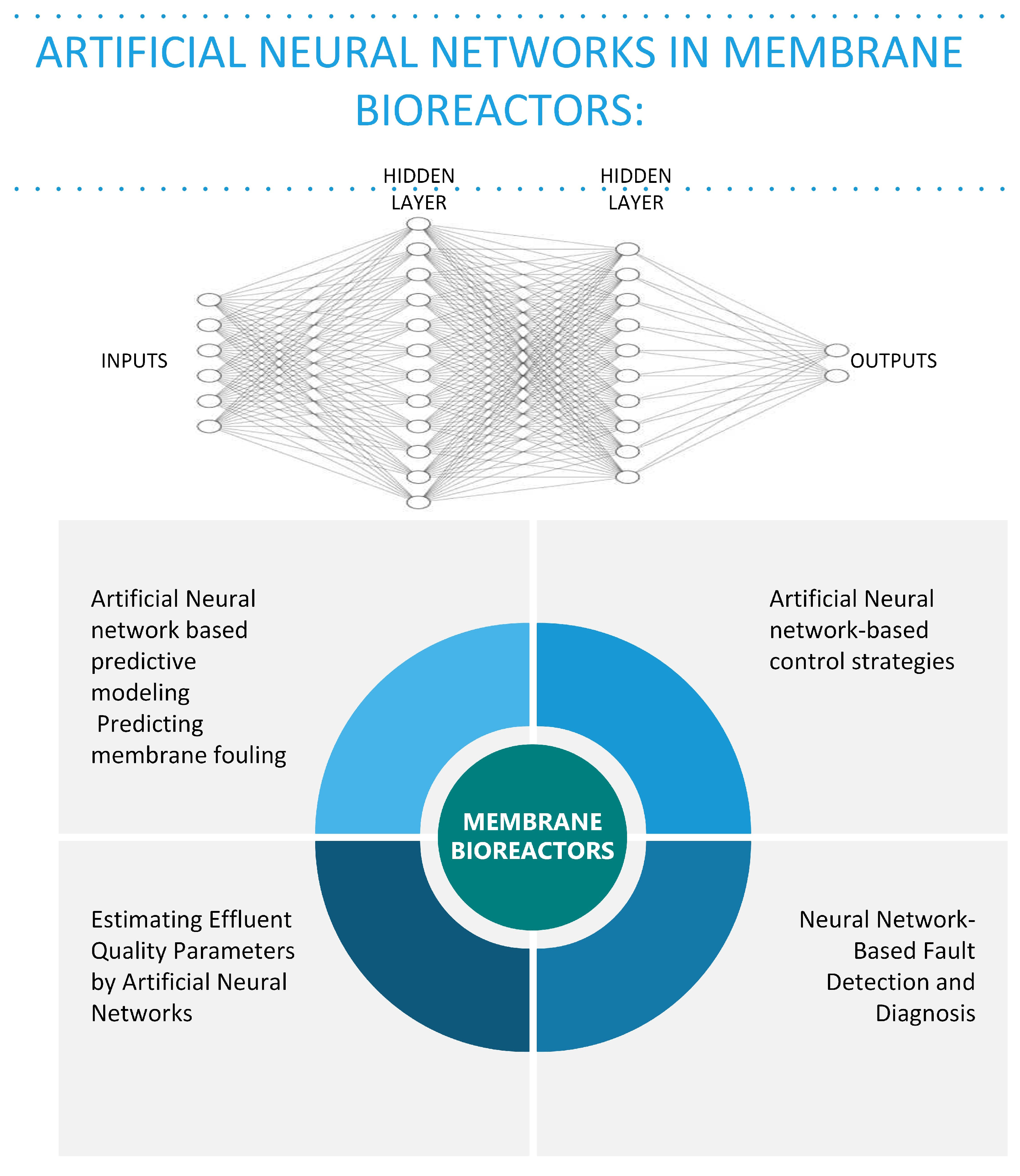
3.4. Applications of Neural Networks in MBR Wastewater Treatment
- (i)
- Neural network-based predictive modeling—Predicting membrane fouling
- (ii)
- Estimating Effluent Quality Parameters
- (iii)
- Neural-network-based control strategies
- (iv)
- Neural Network-Based Fault Detection and Diagnosis
3.5. Integration of Neural Networks with Other Advanced Techniques
- (i)
- Hybrid modeling and control approaches
- (ii)
- Exploitation of Deep Learning
3.6. Case Studies of Neural Network Implementation in MBR Systems
- (i)
- Case study 1: Modeling of transmembrane pressure
- (ii)
- Case study 2: Nutrient Removal Optimization
- (iii)
- Case Study 3: Fault Detection and Diagnosis in an MBR System
4. Challenges and Limitations of ANN in MBR Applications
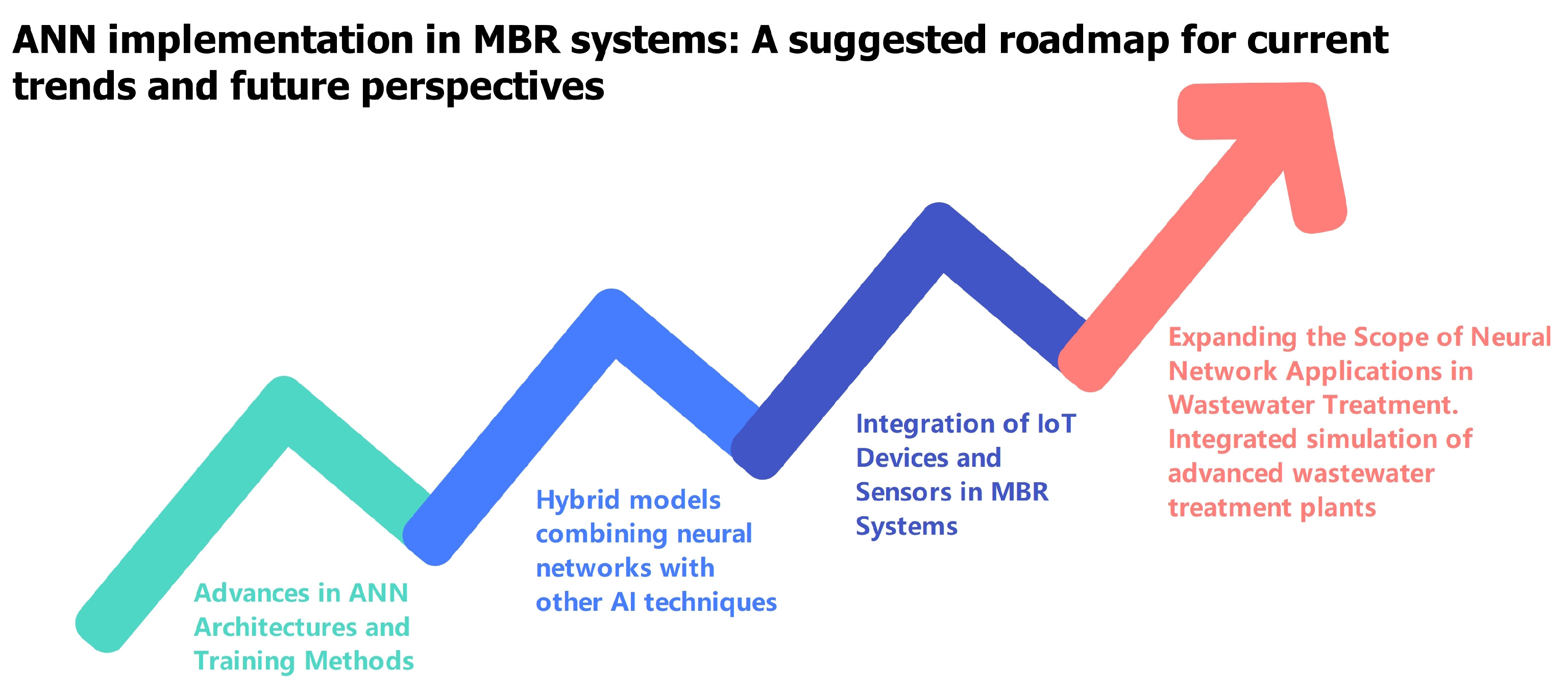
5. Future Directions
- (i)
- Hybrid models combining neural networks with other AI techniques
- (ii)
- Advances in ANN Architectures and Training Methods
- (iii)
- Integration of IoT Devices and Sensors in MBR Systems
- (iv)
- Expanding the Scope of Neural Network Applications in Wastewater Treatment
6. Conclusions
Author Contributions
Funding
Institutional Review Board Statement
Informed Consent Statement
Data Availability Statement
Conflicts of Interest
References
- Bijekar, S.; Padariya, H.D.; Yadav, V.K.; Gacem, A.; Hasan, M.A.; Awwad, N.S.; Yadav, K.K.; Islam, S.; Park, S.; Jeon, B.H. The State of the Art and Emerging Trends in the Wastewater Treatment in Developing Nations. Water 2022, 14, 2537. [Google Scholar]
- Kesari, K.K.; Soni, R.; Jamal, Q.M.S.; Tripathi, P.; Lal, J.A.; Jha, N.K.; Siddiqui, M.H.; Kumar, P.; Tripathi, V.; Ruokolainen, J. Wastewater Treatment and Reuse: A Review of its Applications and Health Implications. Water Air Soil Pollut. 2021, 232, 208. [Google Scholar]
- Cecconet, D.; Callegari, A.; Hlavínek, P.; Capodaglio, A.G. Membrane bioreactors for sustainable, fit-for-purpose greywater treatment: A critical review. Clean Technol. Environ. Policy 2019, 21, 745–762. [Google Scholar]
- Chen, F.; Qian, Y.; Cheng, H.; Shen, J.; Qin, Y.; Li, Y.Y. Recent developments in anammox-based membrane bioreactors: A review. Sci. Total Environ. 2023, 857, 159539. [Google Scholar]
- Vinardell, S.; Astals, S.; Peces, M.; Cardete, M.A.; Fernández, I.; Mata-Alvarez, J.; Dosta, J. Advances in anaerobic membrane bioreactor technology for municipal wastewater treatment: A 2020 updated review. Renew. Sustain. Energy Rev. 2020, 130, 109936. [Google Scholar]
- Song, W.; Xie, B.; Huang, S.; Zhao, F.; Shi, X. Aerobic membrane bioreactors for industrial wastewater treatment. In Current Developments in Biotechnology and Bioengineering; Advanced Membrane Separation Processes for Sustainable Water and Wastewater Management—Aerobic Membrane Bioreactor Processes and Technologies; Elsevier: Amsterdam, The Netherlands, 2020; pp. 129–145. [Google Scholar]
- Judd, S. The status of membrane bioreactor technology. Trends Biotechnol. 2008, 26, 109–116. [Google Scholar]
- Melin, T.; Jefferson, B.; Bixio, D.; Thoeye, C.; De Wilde, W.; De Koning, J.; van der Graaf, J.; Wintgens, T. Membrane bioreactor technology for wastewater treatment and reuse. Desalination 2006, 187, 271–282. [Google Scholar]
- Judd, S.J. The status of industrial and municipal effluent treatment with membrane bioreactor technology. Chem. Eng. J. 2016, 305, 37–45. [Google Scholar]
- Abiodun, O.I.; Jantan, A.; Omolara, A.E.; Dada, K.V.; Mohamed, N.A.E.; Arshad, H. State-of-the-art in artificial neural network applications: A survey. Heliyon 2018, 4, e00938. [Google Scholar]
- Poznyak, A.; Chairez, I.; Poznyak, T. A survey on artificial neural networks application for identification and control in environmental engineering: Biological and chemical systems with uncertain models. Annu. Rev. Control 2019, 48, 250–272. [Google Scholar]
- Kamali, M.; Appels, L.; Yu, X.; Aminabhavi, T.M.; Dewil, R. Artificial intelligence as a sustainable tool in wastewater treatment using membrane bioreactors. Chem. Eng. J. 2021, 417, 128070. [Google Scholar]
- Frontistis, Z.; Lykogiannis, G.; Sarmpanis, A. Machine Learning Implementation in Membrane Bioreactor Systems: Progress, Challenges, and Future Perspectives: A Review. Environments 2023, 10, 127. [Google Scholar]
- Jawad, J.; Hawari, A.H.; Javaid Zaidi, S. Artificial neural network modeling of wastewater treatment and desalination using membrane processes: A review. Chem. Eng. J. 2021, 419, 129540. [Google Scholar]
- Basheer, I.A.; Hajmeer, M. Artificial neural networks: Fundamentals, computing, design, and application. J. Microbiol. Methods 2000, 43, 3–31. [Google Scholar]
- Chen, Y.; Song, L.; Liu, Y.; Yang, L.; Li, D. A Review of the Artificial Neural Network Models for Water Quality Prediction. Appl. Sci. 2020, 10, 5776. [Google Scholar]
- Moayedi, H.; Mosallanezhad, M.; Rashid, A.S.A.; Jusoh, W.A.W.; Muazu, M.A. A systematic review and meta-analysis of artificial neural network application in geotechnical engineering: Theory and applications. Neural Comput. Appl. 2019, 32, 495–518. [Google Scholar]
- Chu, H.; Long, L.; Guo, J.; Yuan, H.; Deng, L. Implicit function-based continuous representation for meticulous segmentation of cracks from high-resolution images. In Computer-Aided Civil and Infrastructure Engineering; Wiley: Hoboken, NJ, USA, 2023. [Google Scholar]
- Mildenhall, B.; Srinivasan, P.P.; Tancik, M.; Barron, J.T.; Ramamoorthi, R.; Ng, R. NeRF. Commun. ACM 2021, 65, 99–106. [Google Scholar]
- Dosovitskiy, A.; Beyer, L.; Kolesnikov, A.; Weissenborn, D.; Zhai, X.; Unterthiner, T.; Dehghani, M.; Minderer, M.; Heigold, G.; Gelly, S.; et al. An Image is Worth 16x16 Words: Transformers for Image Recognition at Scale. arXiv 2020, arXiv:2010.11929. [Google Scholar]
- Chu, H.; Wang, W.; Deng, L. Tiny-Crack-Net: A multiscale feature fusion network with attention mechanisms for segmentation of tiny cracks. Comput. Civ. Infrastruct. Eng. 2022, 37, 1914–1931. [Google Scholar]
- Vaswani, A.; Brain, G.; Shazeer, N.; Parmar, N.; Uszkoreit, J.; Jones, L.; Gomez, A.N.; Kaiser, Ł.; Polosukhin, I. Attention is All you Need. Adv. Neural Inf. Process. Syst. 2017, 30, 5998–6009. [Google Scholar]
- Zhao, Z.; Lou, Y.; Chen, Y.; Lin, H.; Li, R.; Yu, G. Prediction of interfacial interactions related with membrane fouling in a membrane bioreactor based on radial basis function artificial neural network (ANN). Bioresour. Technol. 2019, 282, 262–268. [Google Scholar] [CrossRef] [Scilit]
- Chen, Y.; Yu, G.; Long, Y.; Teng, J.; You, X.; Liao, B.Q.; Lin, H. Application of radial basis function artificial neural network to quantify interfacial energies related to membrane fouling in a membrane bioreactor. Bioresour. Technol. 2019, 293, 122103. [Google Scholar] [CrossRef] [Scilit] [PubMed]
- Schmitt, F.; Banu, R.; Yeom, I.T.; Do, K.U. Development of artificial neural networks to predict membrane fouling in an anoxic-aerobic membrane bioreactor treating domestic wastewater. Biochem. Eng. J. 2018, 133, 47–58. [Google Scholar] [CrossRef] [Scilit]
- Mirbagheri, S.A.; Bagheri, M.; Bagheri, Z.; Kamarkhani, A.M. Evaluation and prediction of membrane fouling in a submerged membrane bioreactor with simultaneous upward and downward aeration using artificial neural network-genetic algorithm. Process Saf. Environ. Prot. 2015, 96, 111–124. [Google Scholar] [CrossRef] [Scilit]
- Niu, C.; Li, X.; Dai, R.; Wang, Z. Artificial intelligence-incorporated membrane fouling prediction for membrane-based processes in the past 20 years: A critical review. Water Res. 2022, 216, 118299. [Google Scholar]
- Hamedi, H.; Ehteshami, M.; Mirbagheri, S.A.; Zendehboudi, S. New deterministic tools to systematically investigate fouling occurrence in membrane bioreactors. Chem. Eng. Res. Des. 2019, 144, 334–353. [Google Scholar]
- Hazrati, H.; Moghaddam, A.H.; Rostamizadeh, M. The influence of hydraulic retention time on cake layer specifications in the membrane bioreactor: Experimental and artificial neural network modeling. J. Environ. Chem. Eng. 2017, 5, 3005–3013. [Google Scholar]
- Wang, Z.; Wu, X. Mathematical and Artificial Neural Network Models to Predict the Membrane Fouling Behavior of an Intermittently-Aerated Membrane Bioreactor Under Sub-Critical Flux. CLEAN—Soil Air Water 2015, 43, 1002–1009. [Google Scholar]
- Giwa, A.; Daer, S.; Ahmed, I.; Marpu, P.R.; Hasan, S.W. Experimental investigation and artificial neural networks ANNs modeling of electrically-enhanced membrane bioreactor for wastewater treatment. J. Water Process Eng. 2016, 11, 88–97. [Google Scholar] [CrossRef] [Scilit]
- Bagheri, M.; Mirbagheri, S.A.; Kamarkhani, A.M.; Bagheri, Z. Modeling of effluent quality parameters in a submerged membrane bioreactor with simultaneous upward and downward aeration treating municipal wastewater using hybrid models. Desalination Water Treat. 2015, 57, 8068–8089. [Google Scholar] [CrossRef] [Scilit]
- Yaqub, M.; Lee, W. Modeling nutrient removal by membrane bioreactor at a sewage treatment plant using machine learning models. J. Water Process Eng. 2022, 46, 102521. [Google Scholar] [CrossRef] [Scilit]
- Abba, S.I.; Elkiran, G. Effluent prediction of chemical oxygen demand from the wastewater treatment plant using artificial neural network application. Procedia Comput. Sci. 2017, 120, 156–163. [Google Scholar] [CrossRef] [Scilit]
- Algoufily, Y.; Hong, P.; Kirati, T.M.L. Membrane Bioreactor control and Fouling Monitoring using Artificial Neural Network-Based Approach. IFAC-PapersOnLine 2022, 55, 66–71. [Google Scholar] [CrossRef] [Scilit]
- Alnaizy, R.; Aidan, A.; Abachi, N.; Jabbar, N.A. Neural Network Model Identification and Advanced Control of a Membrane Biological Reactor. J. Membr. Sep. Technol. 2013, 2, 231–244. [Google Scholar]
- Chen, J.; Luo, R.; Mu, S.; Zhang, Z.; Andersen, M.; Jørgensen, P.E. Membrane Bioreactor Process Modeling and Optimization by Artificial Neural Network and Integrated Bioprocess Models. Proc. Water Environ. Fed. 2011, 2011, 666–677. [Google Scholar] [CrossRef] [Scilit]
- Sohail, N.; Riedel, R.; Dorneanu, B.; Arellano-Garcia, H. Prolonging the Life Span of Membrane in Submerged MBR by the Application of Different Anti-Biofouling Techniques. Membranes 2023, 13, 217. [Google Scholar] [CrossRef] [Scilit]
- Wahab, N.A.; Mahmod, N.; Vilanova, R. Permeate Flux Control in SMBR System by Using Neural Network Internal Model Control. Processes 2020, 8, 1672. [Google Scholar] [CrossRef] [Scilit]
- Meng, F.; Chae, S.R.; Shin, H.S.; Yang, F.; Zhou, Z. Recent Advances in Membrane Bioreactors: Configuration Development, Pollutant Elimination, and Sludge Reduction. Environ. Eng. Sci. 2012, 29, 139–160. [Google Scholar] [CrossRef] [Scilit]
- He, B.; Si, Y. Application of Artificial Neural Network in Optimal Design of Reactor. Asian J. Res. Comput. Sci. 2022, 14, 1–7. [Google Scholar] [CrossRef] [Scilit]
- Wu, X.L.; Han, H.G.; Zhang, H.J.; Qiao, J.F. Intelligent Warning of Membrane Fouling Based on Robust Deep Neural Network. Int. J. Fuzzy Syst. 2022, 24, 276–293. [Google Scholar] [CrossRef] [Scilit]
- Zhao, B.; Chen, H.; Gao, D.; Xu, L.; Zhang, Y. Cleaning decision model of MBR membrane based on Bandelet neural network optimized by improved Bat algorithm. Appl. Soft Comput. 2020, 91, 106211. [Google Scholar] [CrossRef] [Scilit]
- Shi, Y.; Wang, Z.; Du, X.; Ling, G.; Jia, W.; Lu, Y. Research on the membrane fouling diagnosis of MBR membrane module based on ECA-CNN. J. Environ. Chem. Eng. 2022, 10, 107649. [Google Scholar] [CrossRef] [Scilit]
- Xiao, H.; Huang, D.; Pan, Y.; Liu, Y.; Song, K. Fault diagnosis and prognosis of wastewater processes with incomplete data by the auto-associative neural networks and ARMA model. Chemom. Intell. Lab. Syst. 2017, 161, 96–107. [Google Scholar] [CrossRef] [Scilit]
- Patnaik, P.R. Artificial Intelligence as a Tool for Automatic State Estimation and Control of Bioreactors. Inc. Lab Robot. Autom. 1997, 9, 297–304. [Google Scholar] [CrossRef] [Scilit]
- Hosseinzadeh, A.; Zhou, J.L.; Altaee, A.; Baziar, M.; Li, X. Modeling water flux in osmotic membrane bioreactor by adaptive network-based fuzzy inference system and artificial neural network. Bioresour. Technol. 2020, 310, 123391. [Google Scholar] [CrossRef] [Scilit]
- Yusuf, Z.; Wahab, N.A.; Abusam, A. Neural Network-based Model Predictive Control with CPSOGSA for SMBR Filtration. Int. J. Electr. Comput. Eng. 2017, 7, 1538–1545. [Google Scholar] [CrossRef] [Scilit]
- Wang, Z.; Zeng, J.; Shi, Y.; Ling, G. MBR membrane fouling diagnosis based on improved residual neural network. J. Environ. Chem. Eng. 2023, 11, 109742. [Google Scholar] [CrossRef] [Scilit]

| Neural Network Architecture | Implementation into MBR Systems | Strengths | Limitations | Ref. |
|---|---|---|---|---|
| Feedforward neural networks (FNNs) | Suitable for modeling static relationships between inputs and outputs | Easy implementation and training, widely used in MBR systems, good for revealing and simulating non-linear relationships | Unable to capture temporal dependencies in time series data | [11,12,13,14] |
| Recurrent neural networks (RNNs) | Capable of modeling dynamic relationships between inputs and outputs in time-series data | Can decrypt temporal dependencies, useful for the prediction of membrane fouling and aeration control | More complex than FNNs. Usually longer training time and more training data are needed | [12,13,14] |
| Implicit neural representation methods | Can implicitly represent complex geometries and functions, required for modeling complex structures and processes such as MBR systems | Better generalization and compact representations | Limited interpretability. Training and tuning are challenging | [18,19] |
| Transformer architectures | Able to capture long-range dependencies and patterns in sequential data and spatially distributed data | Parallelizable architecture, useful for large-scale MBR systems and the process of big data | Significant computational resources are required. May need extensive hyperparameter tuning | [20,21,22] |
| Convolutional neural networks (CNNs) | Can process spatially structured data, such as images or spatially distributed sensor data | Can identify/simulate local spatial dependencies, useful for fouling detection and analysis | Spatial data are rarely available. Limited applications in MBRs | [11,12,13] |
| Deep Learning, (deep feedforward networks, deep RNN) | Capable of modeling complex, high-dimensional relationships between input and output | Can capture higher-order interactions. Improved accuracy and performance | Large dataset needed, high computational cost, and longer training time. | [12,13,14] |
| AI Technique | Advantages | Disadvantages | Ref. |
|---|---|---|---|
| Neural networks | Suitable to reveal and model complex non-linear relationships; has demonstrated superior efficiency for various MBR applications (fouling prediction, control, fault detection) | A significant amount of representative data for training is required. Sensitive to noise and overfitting | [10,11,12] |
| Fuzzy logic | Decision-making via a more human-like approach. Can handle uncertainly and inaccurate data | Expert knowledge is required for the design of fuzzy rules. Possibly low performance for very complex systems | [10,11,12,13] |
| Genetic algorithms | Well-known and high-performance optimization. Applicability to multi-objective optimization problems. Can adapt to dynamic conditions | Usually, a large number of iterations is required, slow convergence, and high computational cost. | [11,13,14] |
| Model predictive control (MPC) | Suitable to handle multivariable systems with several constraints, and estimated optimal solutions for control. | A mathematical model of the system is required. Usually has high computational cost. Maybe not be efficient for dynamic systems. | [12,13,14] |
| Scope | Model Used | Input | Output | Results | Ref. |
|---|---|---|---|---|---|
| Efficient quantification of interfacial energy related to membrane fouling | Radial basis function (RBF) artificial neural network | Three probe liquid contact angles, zeta potential of sludge foulants, and separation distance | Interfacial energy | RBF ANN demonstrated high regression coefficient and accuracy with a lower computational cost that XDLVO approach | [24] |
| Prediction of membrane fouling in an anoxic–aerobic MBR | Back propagation artificial neural network | pH, alkalinity, MLSS, COD, (TN), (NH4-N), (NO3-N), and TP | TMP | Satisfactory performance. From all variables examined the use of TNin–TNeff, TPin–TPan, and Nitratembr–Nitrateeff exhibited high correlation | [25] |
| Evaluation and prediction of membrane fouling in a submerged MBR | Multi-layer perceptron and radial basis function artificial neural networks (MLPANN and RBFANN) combined with genetic algorithms | Time, TSS, CODin, SRT, MLSS | TMP and membrane permeability | LPANN and RBFANN showed superior efficiency towards the simulation of TMP and permeability The GA-optimized ANN increased the ANN accuracy | [26] |
| Prediction of membrane fouling resistance in MBRs. | Artificial neural network (ANN), gene expression programming (GEP), and least square support vector machine (LSSVM) | MLSS, TMP, permeate flux, and temperature | filtration resistance (Rt) | LSSVM demonstrated higher performance. The transmembrane pressure and permeate flux were the most important inputs affecting the membrane fouling resistance. | [28] |
| Simulation of the membrane fouling under sub-critical flux conditions | Back propagation artificial neural network optimized by genetic algorithms | Q, aeration ratio A/O, concentration of EPSS, concentration of EPS, initial TMP, and operating time | TMP | ANN performance was not as stable as that of the mathematical model; however, it had better accuracy under intermittent aeration conditions | [30] |
Disclaimer/Publisher’s Note: The statements, opinions and data contained in all publications are solely those of the individual author(s) and contributor(s) and not of MDPI and/or the editor(s). MDPI and/or the editor(s) disclaim responsibility for any injury to people or property resulting from any ideas, methods, instructions or products referred to in the content. |
© 2023 by the authors. Licensee MDPI, Basel, Switzerland. This article is an open access article distributed under the terms and conditions of the Creative Commons Attribution (CC BY) license (https://creativecommons.org/licenses/by/4.0/).
Share and Cite
Frontistis, Z.; Lykogiannis, G.; Sarmpanis, A. Artificial Neural Networks in Membrane Bioreactors: A Comprehensive Review—Overcoming Challenges and Future Perspectives. Sci 2023, 5, 31. https://doi.org/10.3390/sci5030031
Frontistis Z, Lykogiannis G, Sarmpanis A. Artificial Neural Networks in Membrane Bioreactors: A Comprehensive Review—Overcoming Challenges and Future Perspectives. Sci. 2023; 5(3):31. https://doi.org/10.3390/sci5030031
Chicago/Turabian StyleFrontistis, Zacharias, Grigoris Lykogiannis, and Anastasios Sarmpanis. 2023. "Artificial Neural Networks in Membrane Bioreactors: A Comprehensive Review—Overcoming Challenges and Future Perspectives" Sci 5, no. 3: 31. https://doi.org/10.3390/sci5030031
APA StyleFrontistis, Z., Lykogiannis, G., & Sarmpanis, A. (2023). Artificial Neural Networks in Membrane Bioreactors: A Comprehensive Review—Overcoming Challenges and Future Perspectives. Sci, 5(3), 31. https://doi.org/10.3390/sci5030031

