Article

A Lightweight Real-Time Pavement Distress Detection Network with Multi-Scale Coordinate Attention and Multi-Granularity Knowledge Distillation

1
Hebei Expressway Group Co., Ltd., Shian Branch, Shijiazhuang 050000, China
2
School of Highway, Chang’an University, Xi’an 710064, China
3
Hebei Expressway Group Engineering Consulting Co., Ltd., Shijiazhuang 050000, China
*
Author to whom correspondence should be addressed.
Infrastructures 2026, 11(9), 308; https://doi.org/10.3390/infrastructures11090308
Submission received: 5 June 2026 / Revised: 12 August 2026 / Accepted: 20 August 2026 / Published: 31 August 2026

Abstract

Automated pavement distress detection is essential for transportation infrastructure maintenance and road asset management. In practice, however, such detectors often need to run on embedded devices mounted on inspection vehicles, and two challenges hinder real-world deployment: (1) cracks and potholes possess markedly different geometric priors—thin, elongated topology versus blob-like shapes—so a generic backbone tends to under-represent at least one class, and (2) accuracy-oriented detectors are typically too heavy for the embedded GPUs commonly mounted on inspection platforms. To address these issues, this paper proposes a lightweight real-time pavement distress detection network. First, a multi-scale coordinate attention (MSCA) module is embedded in the neck so that long-range row/column-wise dependencies are encoded together with multi-scale local context, which is helpful for slender cracks while remaining computationally efficient. Second, a slender-aware detection head (SADH) couples a 1 × k/k × 1 asymmetric branch with the standard square branch, giving the head an explicit inductive bias for elongated objects. Third, a multi-granularity knowledge distillation (MGKD) scheme is designed, which transfers teacher knowledge from a heavier teacher to the proposed student at three complementary granularities—pixel-level attention-masked features, instance-pair relations, and decoupled class-prior logits—thereby covering the three distinct levels of information that a multi-class dense detector relies on. The network is trained and evaluated on the public RDD2022 benchmark together with a supplementary in-house set of asphalt potholes. Under the fixed-seed, single-run evaluation used in this study, the proposed method achieves an mAP@0.5 of 71.65% on the author-defined test split, which is not directly comparable with evaluations on the official RDD2022 test set, with the comparison restricted to seven representative baselines evaluated under the same protocol, and runs at 72.5 FPS on an NVIDIA Jetson Orin Nano. Although its latency is modestly higher than that of YOLOv8s, it retains real-time inference capability for on-vehicle pavement inspection.

1. Introduction

Roads constitute vital infrastructure for the national economy, and their surface service condition directly affects driving safety, ride comfort, and operational cost. Under the coupled effects of long-term vehicle loading, temperature cycling, and water infiltration, asphalt pavements progressively develop various forms of distress, including cracks, potholes, ruts, and raveling [1]. Among these, cracks and potholes are the two most frequent surface distresses on highways and urban arterials and the two that exert the most significant impact on traffic safety: if cracks are not identified and treated in time, they may further develop into raveling, potholes, and even structural failure, while potholes can directly cause bumps, tire blow-outs, and even single-vehicle traffic accidents. Therefore, high-frequency, automated distress inspection of asphalt pavements is of great importance for extending pavement service life and optimizing maintenance decisions.
Conventional manual inspection is labor-intensive, subjective, and entails certain safety hazards, making it difficult to meet the efficiency requirements of modern road-network maintenance [1,2]. Over the last decade, with the rapid development of convolutional neural networks (CNNs) and object detection algorithms, intelligent distress detection methods based on vehicle-mounted cameras or unmanned aerial vehicle imagery have become mainstream [3,4]. Such methods typically formulate distress detection as either an object detection or a semantic segmentation problem: detection-oriented methods output bounding boxes and are convenient for road-segment statistics and localization [3,5], whereas segmentation-oriented methods produce pixel-level masks and are more suitable for measuring the geometric parameters of cracks [6,7]. Given that maintenance decisions in engineering practice rely more on the rapid statistics of distress location and severity than on pixel-level fine geometry, recent research has increasingly favored single-stage detectors as a general solution [8,9].
The YOLO family of models [8,9,10,11,12,13], with their end-to-end training strategies and favorable accuracy–speed trade-off, has been widely adopted for pavement distress detection [4]. Transformer-based real-time detectors such as RT-DETR [14] have also demonstrated strong global modeling capability. Nevertheless, when such general-purpose detectors are directly transferred to multi-class distress detection on asphalt pavements, two key issues remain to be addressed:
First, the substantial inter-class differences in geometric priors render the feature-modeling capacity of a single backbone insufficient. Cracks exhibit a thin, elongated, anisotropic topology with aspect ratios that can reach several tens or more, and have low color contrast with the background; potholes, in contrast, present an approximately blob-like two-dimensional distribution with complex texture and pronounced shadows. In mixed pavement distress detection tasks, when feature aggregation relies solely on generic multi-scale necks such as FPN [15] or PANet [16], the model tends to bias toward the scale prior of one target class, leading to a higher miss-detection rate for the other class. Attention mechanisms [17,18,19,20] have been shown to significantly enhance the local-detail-capturing capability of CNNs, yet most existing works directly transplant a particular attention module to detectors and lack a tailored design that targets the geometric priors of multi-class distresses.
Second, real-world deployment imposes stringent lightweight-design requirements. Pavement distress detection systems usually run on vehicle-mounted or UAV platforms; constrained by power consumption and form factor, they commonly use NVIDIA Jetson series embedded devices for inference. However, the parameter count and computational cost of most high-accuracy detection models make it difficult to satisfy real-time requirements on embedded platforms. To this end, existing works mitigate this tension through lightweight backbone designs [21,22,23] and knowledge distillation (KD) [24,25,26,27]. However, conventional logit distillation is of limited effectiveness on dense prediction tasks; pure feature distillation [28], although introducing a spatial attention mask to focus on foregrounds, still struggles to convey the relational structure between different distress instances; decoupled logit distillation [29] models the probability distributions of target and non-target classes separately to better handle class imbalance. How to jointly transfer teacher knowledge at the three different granularities of pixel-level features, inter-instance relations, and class-level probabilities to a student model in multi-class pavement distress detection remains an open and underexplored problem.
To address the above issues, this paper proposes a lightweight, real-time pavement distress detection network oriented to edge deployment. The main contributions are summarized as follows:
  • A multi-scale coordinate attention (MSCA) module is developed based on coordinate attention [20]. MSCA introduces multi-scale asymmetric directional convolutions and learnable cross-scale fusion to enhance the representation of elongated cracks while preserving positional information.
  • A slender-aware detection head (SADH) is designed based on asymmetric convolution [30]. It combines a square branch and a slender asymmetric branch through feature-level channel-wise gating, enabling adaptive representation of both cracks and potholes.
  • A multi-granularity knowledge distillation (MGKD) framework is constructed by integrating feature-, relation-, and logit-level distillation. These complementary objectives jointly transfer foreground features, inter-instance relationships, and class-probability knowledge to the lightweight student detector.
The principal contribution of this work lies in the task-specific extension and coordinated integration of these components for unified crack–pothole detection and embedded deployment, rather than in claiming the underlying attention, asymmetric convolution, or distillation principles as independently new.
Experiments are conducted on the publicly available RDD2022 multi-country pavement distress dataset [4] and a supplementary in-house asphalt pothole collection. The results show that the proposed network achieves a competitive mAP@0.5 against seven mainstream single-stage and two-stage detectors, and is capable of running at real-time frame rates on the NVIDIA Jetson Orin Nano, verifying its engineering applicability.
The remainder of this paper is organized as follows. Section 2 reviews related work on pavement distress detection, attention mechanisms, and knowledge distillation. Section 3 details the overall framework of the proposed network and the design of each module. Section 4 presents the datasets, experimental setup, and comprehensive comparison and ablation experiments. Section 5 discusses the limitations of the proposed method and potential directions for improvement. Section 6 concludes the paper.

2. Related Work

This section reviews existing studies from four related directions: deep-learning-based pavement distress detection, attention mechanisms in dense prediction, knowledge distillation for detection tasks, and lightweight network design for edge deployment.

2.1. Deep-Learning-Based Pavement Distress Detection

Early pavement distress detection methods primarily relied on image processing and traditional machine learning. Shi et al. [31] used Random Structured Forests to classify crack/non-crack pixels from local texture statistics, which constitutes one of the representative works in this field. Koch and Brilakis [32] proposed an unsupervised detection method for asphalt potholes based on morphology and gradient statistics. These methods can achieve acceptable accuracy under simple, uniform pavement backgrounds, but their robustness against interferences such as shadows, oil stains, and paint markings is limited.
With the development of deep learning, the research focus has progressively shifted toward data-driven end-to-end methods. Cha et al. [2] were the first to systematically apply CNNs to crack recognition, demonstrating the strong discriminative ability of convolutional features for texture-type distresses. Subsequently, Maeda et al. [3] adopted single-stage detection networks such as SSD on self-collected smartphone images for end-to-end recognition, and constructed a landmark multi-category road damage dataset. Zou et al. [6] and Liu et al. [7] concurrently proposed a multi-scale convolutional feature architecture called DeepCrack, which achieved significant improvements on pixel-level crack segmentation through hierarchical supervision. Fan et al. [33] further combined an encoder–decoder architecture with adaptive thresholding to validate the network’s sensitivity to fine cracks on public crack datasets. Maeda et al. [34] explored the use of generative adversarial networks (GANs) to synthesize pavement distress samples in order to augment training data and alleviate the high cost of manual collection.
Public datasets have been crucial for advancing this field. Arya et al. [4,35] successively released the RDD2020 and RDD2022 datasets, which cover pavement distress images from multiple countries and climatic zones, including India, Japan, the Czech Republic, Norway, the United States, and China, and provide unified annotations for categories such as longitudinal cracks, transverse cracks, alligator cracks, and potholes; they have become some of the most representative multi-class benchmarks in this direction [1]. Regarding the transfer of general object detectors, Xu et al. [5] systematically compared the accuracy–speed trade-off between Faster R-CNN [36] and Mask R-CNN on the crack detection task; the results indicated that two-stage methods are marginally superior in accuracy but their inference speed has difficulty meeting online detection requirements. Nevertheless, most of these works focus on the single class of cracks, and unified modeling for the two target categories, i.e., cracks and potholes, which exhibit markedly different geometric priors, has not yet been thoroughly discussed.

2.2. Attention Mechanisms in Dense Prediction

Attention mechanisms originated in neural machine translation [37] and have subsequently been widely transferred to dense prediction tasks in computer vision. The Squeeze-and-Excitation (SE) module proposed by Hu et al. [17] markedly enhances channel discriminability by performing a global re-weighting along the channel dimension. Woo et al. [18] further cascaded channel and spatial attention, giving rise to the widely adopted CBAM module. Wang et al. [19] replaced the original multi-layer perceptron with a one-dimensional convolution, resulting in the more lightweight ECA-Net. The coordinate attention proposed by Hou et al. [20] decomposes the global pooling of channel attention into two directional pooling operations along the horizontal and vertical axes, thereby preserving positional information, which is particularly suitable for targets with directional priors. This design principle also serves as an important reference for the MSCA module proposed in this paper.
Vision Transformers [38], on the other hand, model global long-range dependencies through self-attention and have demonstrated strong representational capability on large-scale data. However, their computational cost grows quadratically with resolution, which is unfriendly to edge deployment scenarios. Therefore, for resource-constrained pavement distress detection, combining CNNs with lightweight attention remains a more competitive compromise.

2.3. Knowledge Distillation for Object Detection

Knowledge distillation was first proposed by Hinton et al. [24], originally intended to have small models mimic the softened outputs of large ones. Its success on classification tasks promoted its transfer to detection tasks. Romero et al. [25] proposed FitNets, which uses intermediate-layer hints to supervise student-network features. Park et al. [26] proposed Relational Knowledge Distillation (RKD), in which the student no longer mimics the features of individual samples but instead the distances and angles between sample pairs, thereby introducing inter-instance relational information. Tian et al. [27] further proposed Contrastive Representation Distillation (CRD), which unifies feature distillation and relational distillation under a contrastive learning objective.
Addressing the foreground/background imbalance problem characteristic of dense detection, Yang et al. [28] proposed FGD (Focal and Global Distillation), which concentrates distillation weights on foreground key regions through dual spatial–channel attention masks. Zhao et al. [29] proposed Decoupled KD, in which the logit distillation of target and non-target classes is treated separately. Together with the aforementioned RKD [26], these three types of methods design distillation losses from three different entry points, i.e., feature maps, instance pairs, and class probabilities, but in existing reports they are typically used in the form of a single loss or pairwise combinations. The MGKD design proposed in this paper integrates the distillation objectives corresponding to the above three entry points into the same framework for joint optimization, and applies it to the specific scenario of multi-class pavement distress detection.

2.4. Lightweight Networks for Edge Deployment

To support deployment on mobile and vehicle-mounted platforms, a variety of lightweight backbones have been proposed. The MobileNet series [21,22,39] introduces depthwise separable convolutions, inverted residual structures, and neural architecture search; EfficientNet [23] jointly adjusts depth, width, and input resolution through compound scaling. On the detector side, the YOLOv5–YOLOv10 series [10,11,12,13] and real-time DETR variants [14] provide nano/tiny configurations whose parameter counts are at the million scale.
Recent studies have further shifted from generic lightweight backbones toward task-specific and resource-efficient road damage detection systems. Pan et al. [40] proposed DAPONet, which combines dual local–global attention, partially over-parameterized multi-scale feature processing, and efficient downsampling to improve real-time road damage detection while maintaining a compact computational budget.
More directly related to edge-deployable crack inspection, Chen et al. [41] synergized GAN-based crack-image synthesis with the lightweight MCANet-tiny detector. Their study shows that synthetic-data augmentation and compact network design can be jointly optimized to improve crack recognition while satisfying the real-time inference requirements of resource-constrained inspection platforms. This work is particularly relevant to the present study because it explicitly considers both crack-specific feature learning and practical edge inference.
Recent YOLOv11-based frameworks have also been investigated for pavement and infrastructure defect inspection. Lin et al. [42] proposed YOLO11-WLBS, which integrates wavelet-transform convolution, lightweight adaptive extraction, bi-directional feature-pyramid fusion, and a simple attention mechanism to improve pavement-defect representation while reducing model complexity. Huang et al. [43] proposed YOLOv11-KW-TA-FP, a multi-task concrete-crack detection and segmentation framework that integrates dynamic KernelWarehouse convolution, triple attention, and an FP-IoU regression loss to strengthen small-crack representation under complex backgrounds. Tsai et al. [44] developed YOLO-AMC by introducing multiple attention mechanisms into the multi-scale feature-fusion layers of YOLOv11 for building-crack detection. Their evaluation on a Raspberry Pi 5 further demonstrated the practical accuracy–efficiency trade-off of YOLOv11-based crack detection on a resource-constrained edge platform.
Overall, recent lightweight YOLO-based studies mainly improve general road damage or crack-only detection through attention mechanisms, lightweight components, or data augmentation. In contrast, the present framework jointly addresses the markedly different geometries of slender cracks and blob-like potholes. Specifically, MSCA performs multi-scale directional aggregation in the neck, SADH introduces morphology-oriented dual-branch regression, and MGKD transfers complementary knowledge at the feature, relation, and logit levels. Their coordinated design distinguishes the proposed method from studies that modify only an individual YOLO component, while supporting real-time inference on an NVIDIA Jetson Orin Nano.

3. Methodology

3.1. Overall Framework

The overall framework of the proposed network is illustrated in Figure 1. Overall, the classical “backbone–neck–detection head” paradigm of a single-stage detector is adopted: the input pavement distress RGB image is first fed through a CSP-style lightweight backbone to extract multi-scale features {C3, C4, C5}; the neck employs a PANet [16]-style bi-directional feature pyramid (which augments the top-down pathway of FPN [15] with an additional bottom-up pathway), and the proposed multi-scale coordinate attention (MSCA) module is inserted after each level to strengthen directional structures; the detection head adopts the proposed slender-aware detection head (SADH) and simultaneously outputs classification, confidence, and bounding-box regression. During training, a homogeneous teacher–student pair is adopted. The teacher network uses CSPDarknet-l following the YOLOv8-l scaling configuration, with depth and width multipliers of 1.00 and 1.00, respectively, whereas the student network uses CSPDarknet-s following the YOLOv8-s scaling configuration, with corresponding multipliers of 0.33 and 0.50. Both networks employ the same MSCA-enhanced PANet neck and SADH detection head, while differing in the depth and width scaling factors of their backbones. The proposed multi-granularity knowledge distillation (MGKD) transfers teacher knowledge of the teacher at the three granularities of pixel-level features, instance-pair relations, and decoupled class probabilities to the student network; at inference, only the student network is retained to guarantee real-time performance on embedded platforms.

3.2. Multi-Scale Coordinate Attention (MSCA)

Cracks present a thin and directional morphology. Plain global channel attention modules such as SE [17] or ECA [19] compress the spatial information along both horizontal and vertical directions through global average pooling, thereby discarding directional cues. Coordinate attention [20] preserves positional information by means of two directional poolings, but its feature aggregation relies on a single-scale 1 × 1 convolution alone, which struggles to simultaneously model the thin-line texture of cracks and the medium-scale texture of potholes.
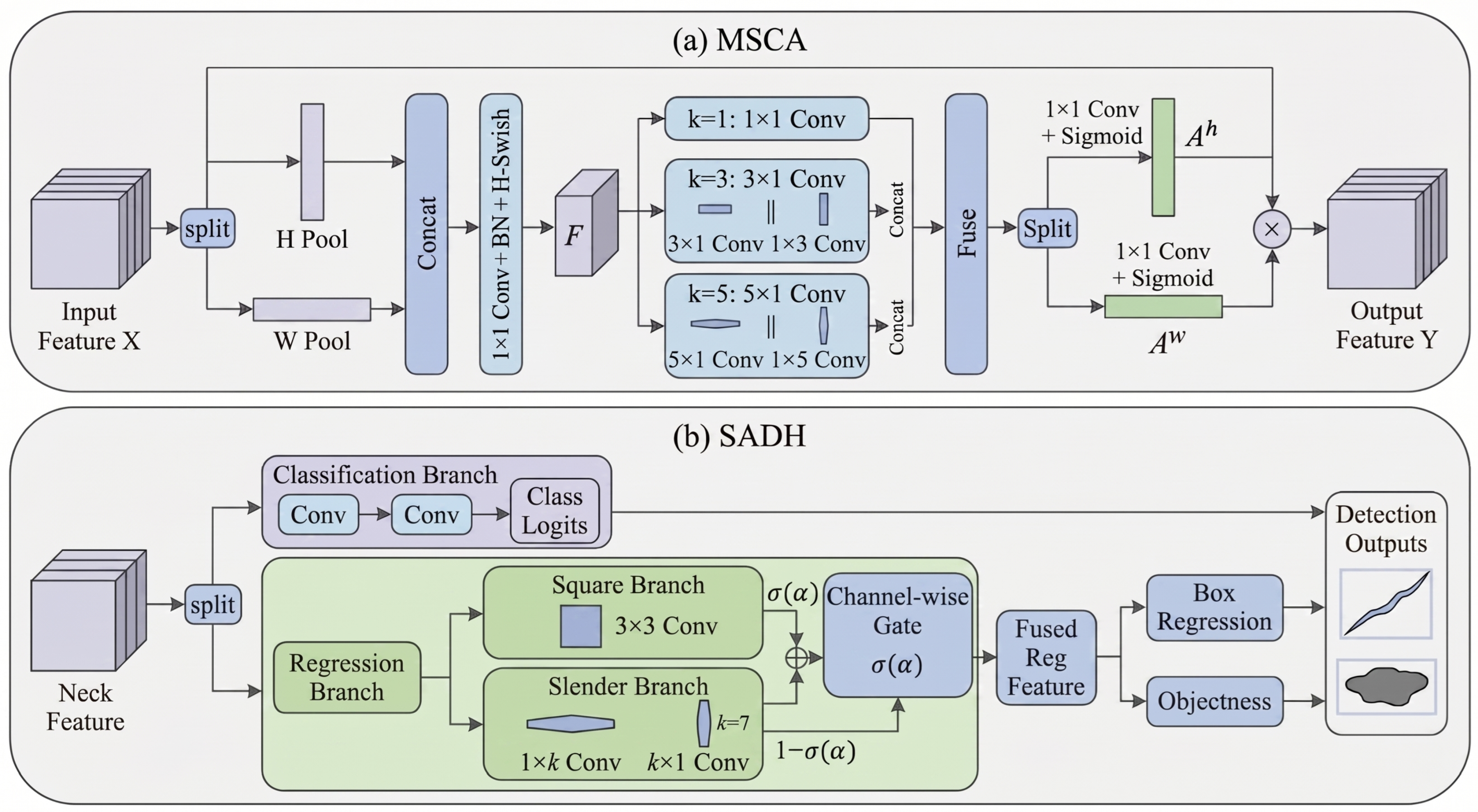
To this end, this paper proposes the multi-scale coordinate attention (MSCA) module, whose structure is depicted in Figure 2a. Given an input feature X R C × H × W , average pooling is first performed along the width and height directions, respectively,
z c h ( h ) = 1 W 0 w < W X c ( h , w ) , z c w ( w ) = 1 H 0 h < H X c ( h , w ) ,
yielding the directional features Z h R C × H × 1 and Z w R C × 1 × W . The two are then concatenated and passed through a shared 1 × 1 convolution for channel reduction, together with BatchNorm and Hard-Swish activation, producing the intermediate representation F. Unlike the original coordinate attention, MSCA employs three parallel directional convolution scales with kernel parameter k { 1 , 3 , 5 } . This compact scale set follows the mixed-kernel principle that different receptive fields provide complementary feature responses in lightweight networks [45]. Specifically, the k = 1 branch uses a single 1 × 1 pointwise convolution as a low-cost baseline. The k = 3 branch consists of paired 3 × 1 and 1 × 3 asymmetric convolutions, whereas the k = 5 branch consists of paired 5 × 1 and 1 × 5 asymmetric convolutions. The latter two branches progressively capture local and broader directional contexts, respectively, while avoiding the computational overhead of excessively large kernels. Their directional outputs are concatenated along the channel dimension
F k = Conv 1 × 1 ( F ) , k = 1 , Conv k × 1 ( F ) Conv 1 × k ( F ) , k { 3 , 5 } ,
where ‖ denotes concatenation along the channel dimension. The three parallel scales use 1 × 1, 3 × 1/1 × 3, and 5 × 1/1 × 5 kernel configurations, respectively. Following the lightweight feature-transformation pattern of coordinate attention [20], the scale-specific outputs F 1 , F 3 , and F 5 are concatenated along the channel dimension and subsequently fused by a learnable 1 × 1 convolution, followed by BatchNorm and Hard-Swish activation:
F fuse = HSwish BN Conv 1 × 1 F 1 F 3 F 5 .
The pointwise convolution performs learnable cross-scale channel mixing and projects the concatenated representation back to the channel dimension of F. Therefore, the fusion is learned rather than implemented as a fixed summation or averaging operation, and no additional attention-weighted aggregation is applied at this stage. The fused feature is then split into horizontal and vertical branches, which are passed through 1 × 1 convolutions and a sigmoid function to obtain the directional attention maps A h [ 0 , 1 ] C × H × 1 and A w [ 0 , 1 ] C × 1 × W .
The final output is obtained by re-modulating the original feature according to Equation (4):
Y c ( h , w ) = X c ( h , w ) · A c h ( h ) · A c w ( w ) .
Intuitively, the multi-scale directional convolutions enable MSCA to model horizontal and vertical structural information under different receptive fields. Under this design, transverse and longitudinal crack structures can be emphasized through horizontal and vertical directional modeling, respectively, while the combination of the two directions also supports the representation of the spatially extended texture patterns of potholes. As quantified by the ablation results in Section 4.4, adding MSCA to the baseline increases the parameter count from 11.2 M to 11.6 M and the FLOPs from 28.6 G to 29.4 G, corresponding to relative increases of approximately 3.6% and 2.8%, respectively. Meanwhile, mAP@0.5 increases from 66.81% to 67.95%. Therefore, MSCA provides a favorable accuracy–complexity trade-off and introduces only limited additional complexity in the evaluated network configuration.

3.3. Slender-Aware Detection Head (SADH)

Following the decoupled-head design used in modern YOLO detectors such as YOLOX [46], each neck feature is processed by separate classification and regression branches. The classification branch independently produces class logits, whereas SADH is embedded in the regression branch to generate geometry-aware features for both bounding-box regression and objectness prediction.
Mainstream YOLO detection heads commonly use stacked 3 × 3 convolutions in the regression branch. Such isotropic kernels suffer from a receptive-field shape mismatch when handling targets with extreme aspect ratios: to cover a transverse crack, a square receptive field is either too large, thereby introducing background noise, or too small, leading to missed detections. Inspired by asymmetric convolution [30], this paper designs the slender-aware detection head (SADH) illustrated in Figure 2b.
SADH places two parallel branches on the feature map at each scale:
  • Square branch: Retains the original 3 × 3 convolution and is used to model blob-like targets such as potholes;
  • Slender branch: Consists of two asymmetric convolutions, 1 × k and k × 1, to capture horizontal and vertical long-range dependencies, respectively. A fixed kernel size of k = 7 is adopted in the slender branch, motivated by prior large-kernel and orthogonal band-convolution studies showing that directional receptive fields can be enlarged while avoiding the full computational cost of a large two-dimensional kernel [47,48].
The outputs of the two branches, F sq , F slim R C × H × W , are then fused through a per-channel learnable gating weight α R C :
F out = σ ( α ) F sq + ( 1 σ ( α ) ) F slim ,
where σ ( · ) denotes the sigmoid function and ⊙ denotes a channel-wise broadcasted multiplication. The gating parameters are learned independently for each feature level and each channel, i.e., α l R C l for the l-th feature level. Consequently, although the same k = 7 kernel is used at all detection feature levels, the contribution of the slender branch can be adjusted according to scale-specific feature semantics.
SADH does not alter the anchor-free assignment logic of YOLOv8. The standard Task-Aligned Assigner and candidate-point generation are retained; SADH only changes the feature representation used by the regression and objectness predictors after neck-feature extraction.

3.4. Multi-Granularity Knowledge Distillation (MGKD)

Under embedded-deployment constraints, the student model must remain compact owing to limitations on parameter count and memory. To compensate for the accuracy loss caused by the reduced model capacity, this paper designs the multi-granularity knowledge distillation (MGKD) framework.
In the proposed MGKD framework, the teacher adopts CSPDarknet-l following the YOLOv8-l scaling configuration, with depth and width multipliers of 1.00 and 1.00, respectively, whereas the student adopts CSPDarknet-s following the YOLOv8-s scaling configuration, with depth and width multipliers of 0.33 and 0.50, respectively. Both networks employ the same MSCA-enhanced PANet neck and SADH detection head, while differing in the depth and width scaling factors of their backbones. This homogeneous configuration is adopted to simplify intermediate-feature alignment, since a large teacher–student discrepancy can hinder the effectiveness of detector distillation [49], and to focus the present evaluation on the proposed multi-granularity distillation objectives.
The core idea is to constrain the student simultaneously at three granularities with distinct levels of action: the pixel-level feature granularity operates on convolutional feature maps and describes local texture details; the instance-pair relation granularity operates between pairs of instance-level feature vectors and describes the relative structure among distress instances; and the decoupled class probability granularity operates on the classification output of the detection head and describes the probability distributions of target and non-target classes. As the three objects of action are mutually disjoint, jointly using them can cover the three levels of teacher knowledge corresponding to “feature points—instance pairs—output probabilities”. Let the outputs of the teacher and student at the l-th feature level be denoted by F l T and F l S , and let the corresponding detection predictions be { p i T , b i T } and { p i S , b i S } , where p denotes the classification probability and b denotes the bounding box.
For clarity, the main symbols used in MGKD are summarized as follows: ϕ l denotes the channel-alignment adapter at the l-th feature level; M l denotes the spatial attention mask; D i j denotes the normalized distance between the i-th and j-th instance features; τ denotes the distillation temperature; β denotes the weight of the non-target-class distillation term; and λ 1 , λ 2 , and λ 3 denote the weights of the feature-level, relational, and logit-level distillation losses, respectively.
Granularity I: Pixel-level attention-masked feature distillation.
To concentrate the distillation weights on the foreground, the idea of [28] is followed: a spatial attention mask M l [ 0 , 1 ] H l × W l is used to weight the feature discrepancy
L feat = l L 1 N l h , w M l ( h , w ) ϕ l ( F l S ) F l T 2 2 ,
where ϕ l is a 1 × 1 convolutional adapter used to align the channel numbers of the student and the teacher; M l is obtained by combining the teacher’s ground-truth mask with the channel-wise mean of the teacher’s feature map; N l is a normalization constant; and L denotes the set of feature levels participating in distillation, taken in this paper as {C3, C4, C5}.
Granularity II: Instance-pair relational distillation. Plain feature distillation cannot directly convey relations between instances, such as the prior that “two adjacent transverse cracks should possess similar features”. Following [26], up to N = 32 positive instances are sampled from each mini-batch. If more than 32 positive instances are available, 32 are randomly selected without replacement; otherwise, all available positive instances are used. Let N b = min ( 32 ,   N pos ) denote the actual number of selected instances. No background instances or hard-negative mining are used. The value N = 32 balances the diversity of instance-pair relations and the computational cost of constructing the pairwise distance matrix. A smaller N provides fewer pairwise constraints and may weaken relational supervision, whereas a larger N provides richer relational information but increases computational cost and may introduce redundant instance pairs. Therefore, N = 32 is used to maintain sufficient relational supervision with moderate computational overhead. For each selected instance, average pooling is performed within the ground-truth box region on the corresponding teacher and student feature maps to obtain the instance-level feature vectors { r i T } i = 1 N b and { r i S } i = 1 N b , with the student’s channels aligned to the teacher’s dimensions via ϕ l .
For N b 2 , the pairwise distance matrix is defined as
D i j ( ) = r i ( ) r j ( ) 2 1 N b ( N b 1 ) p q r p ( ) r q ( ) 2 , { T , S } .
The relational distillation loss is given by
L rel = 1 N b ( N b 1 ) i j l δ D i j S , D i j T .
where l δ denotes the Huber loss. When N b < 2 , no valid instance pair can be formed, and L rel is therefore set to zero for the current mini-batch.
Granularity III: Decoupled class-probability distillation. At the classification output [29], the classification logits are split into two parts: the target class (denoted z tc ) and the non-target classes (denoted z ntc ), with { T , S } and z representing the logits prior to the softmax of the classification head. KL divergence is then applied to constrain the temperature-softened outputs of the student and the teacher under temperature τ :
L logit = KL σ τ ( z tc S ) σ τ ( z tc T ) + β · KL σ τ ( z ntc S ) σ τ ( z ntc T ) ,
where σ τ ( z ) = softmax ( z / τ ) denotes the temperature-controlled softmax, and β is the weight assigned to the non-target-class distillation term. In all experiments, the temperature parameter τ and the non-target-class weight β are fixed at 1.0 and 0.25, respectively. At τ = 1 , the logit term matches the teacher’s native class-probability distribution, including the non-target-class probabilities, without additional temperature softening. The parameter β controls the contribution of the non-target-class distillation term.
Total loss. The total loss for training the student is defined as
L total = L det + λ 1 L feat + λ 2 L rel + λ 3 L logit ,
where L det denotes the basic detection loss (CIoU regression loss [50] plus BCE classification loss). The coefficients λ 1 , λ 2 , and λ 3 control the contributions of the feature-level, relational, and logit-level distillation losses, respectively, and were fixed at 0.5, 0.5, and 1.0 in all reported experiments. Equal moderate weights were assigned to the feature-level and relational terms to balance the two intermediate-representation constraints, whereas the logit-level term retained unit weight because it directly constrains the output class-probability distributions.

3.5. Implementation Details

The student network adopts CSPDarknet-s following the YOLOv8-s scaling configuration, with depth and width multipliers of 0.33 and 0.50, respectively. The teacher network adopts CSPDarknet-l following the YOLOv8-l scaling configuration, with depth and width multipliers of 1.00 and 1.00, respectively. Both networks employ the same MSCA-enhanced PANet neck and SADH detection head, while using different depth and width scaling factors for their backbones.
The teacher is independently trained for 150 epochs and then frozen as the fixed knowledge source for distillation. The student subsequently undergoes 300 epochs of distillation training, consistent with the training protocol of all comparison baselines in Section 4.2. All experiments are implemented in PyTorch and optimized with SGD, with an initial learning rate of 10−2 that is decayed to 10−4 via cosine annealing, a weight decay of 5 × 10⁻⁴, a batch size of 16, and an input resolution of 640 × 640. The data augmentation includes Mosaic [9], HSV jittering, and random affine transformations. For reproducibility, the random seed was fixed to 42 for model initialization, data shuffling, and stochastic data augmentation in all reported experiments.

4. Experiments

4.1. Datasets

RDD2022 [4] is a multi-country pavement distress detection benchmark released by Arya et al. Its images were collected from urban and highway scenes in six countries (India, Japan, the Czech Republic, the United States, Norway, and China). Vehicle-mounted smartphone cameras were used along the driving direction, covering varied conditions such as daytime, overcast weather, and light post-rain. The original dataset contains multiple labels such as D00 (longitudinal crack), D10 (transverse crack), D20 (alligator crack), and D40 (pothole). Considering that the label nomenclature differs across subsets, the categories are unified in this paper into four classes: longitudinal cracks, transverse cracks, alligator cracks, and potholes. Since the official test set annotations are not publicly available, this paper filters and re-splits images from the publicly released training subset at a ratio of 8:1:1, resulting in approximately 18,000 training images, 2500 validation images, and 2500 test images. The category-wise instance quantities and proportions of the filtered RDD2022 dataset used in this study are summarized in Table 1. Accordingly, all reported results are based on this author-defined split and are not directly comparable with leaderboard results evaluated on the official RDD2022 test set.
In-house pothole collection. To supplement the relatively limited pothole samples in RDD2022, an additional set of approximately 1200 asphalt pothole images was collected using a 1080p dashcam on urban roads. All images were manually reviewed and re-annotated in PASCAL VOC format, partitioned at a 7:1:2 ratio into training, validation, and test sets, and merged with the main collection for unified training. Table 1 reports the filtered RDD2022 subset only, whereas the supplementary collection contains pothole images and is incorporated into the corresponding training, validation, and test splits. Accordingly, the reported pothole result is evaluated on the combined test split.
Evaluation metrics. The COCO-standard metrics of mAP@0.5, mAP@0.5:0.95, precision, and recall are adopted as accuracy indicators; the parameter count (Params), FLOPs, and frames per second (FPS) serve as efficiency indicators. The FPS is measured on the NVIDIA Jetson Orin Nano 8GB with TensorRT FP16 precision at an input resolution of 640 × 640, averaged over 500 repetitions.

4.2. Comparison with Representative Baselines

To objectively evaluate the performance of the proposed network, comparisons are made against seven representative object detectors, including five YOLO-series models (YOLOv5s, YOLOv6s [10], YOLOv7-tiny [11], YOLOv8s, and YOLOv10s [13]), a Transformer-based real-time detector RT-DETR-R18 [14], and a classical two-stage baseline Faster R-CNN with ResNet-50 [36]. All models were retrained for 300 epochs on the same dataset split and evaluated on the same test set. Accordingly, the numerical comparison is restricted to the representative detectors evaluated under this unified protocol.
As shown in Table 2, the proposed method achieves a relative improvement in mAP@0.5 over YOLOv8s (a same-generation baseline of comparable scale to the proposed student model); the aggregated crack mAP increases from 65.13% to 70.53%. Faster R-CNN, although architecturally complex, does not exhibit a clear accuracy advantage on this benchmark and its inference speed further hinders embedded deployment. RT-DETR exhibits strong global modeling capability but achieves lower overall accuracy than the proposed method under the present unified protocol.
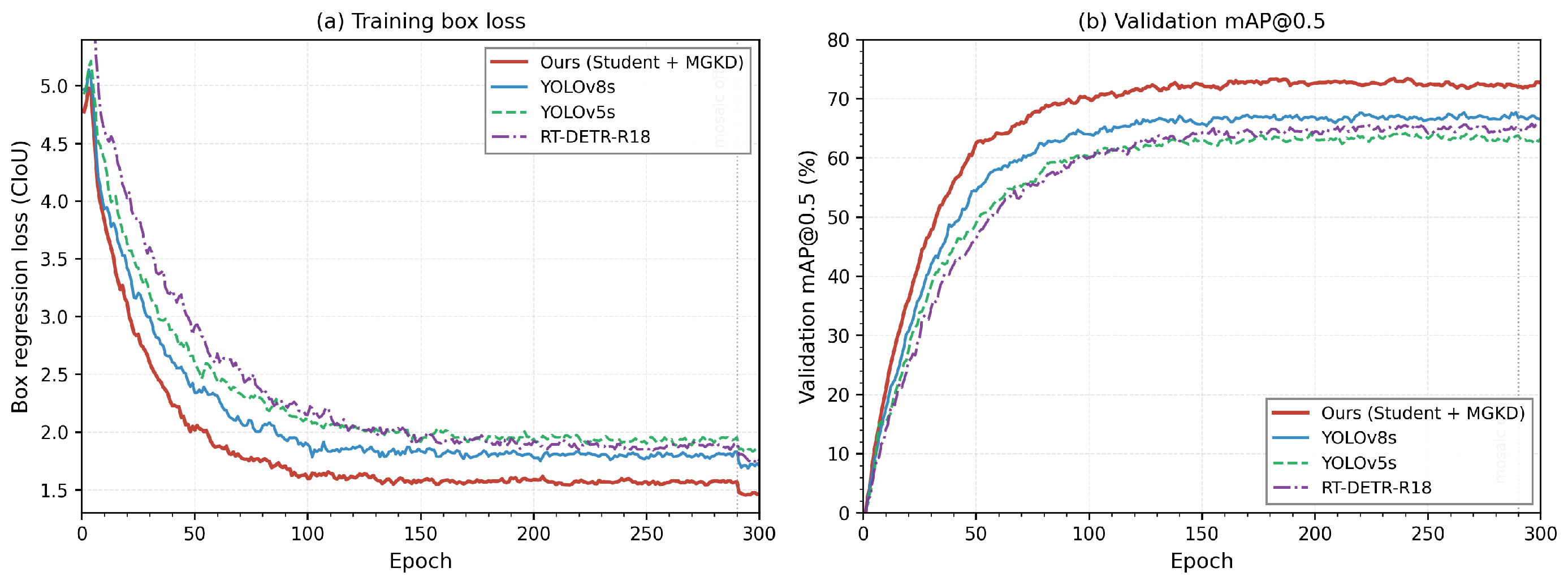
Figure 3 presents the box regression loss and validation mAP@0.5 curves of the proposed method and three representative baselines (YOLOv8s, YOLOv5s, and RT-DETR-R18) under the unified training settings.
As can be seen from the training loss curves in Figure 3a, the proposed method drives the CIoU loss from the initial value of approximately 5.0 down to approximately 2.0 within the first 50 epochs, whereas YOLOv8s, YOLOv5s, and RT-DETR-R18 remain at approximately 2.4, 2.6, and 2.7 at the same epoch, respectively; by the end of training, the box loss of the proposed method stabilizes at approximately 1.50, which is about 0.25–0.40 lower than that of the three baselines (around 1.75, 1.85, and 1.90, respectively). Meanwhile, the local fluctuation of the curve of the proposed method is markedly smaller than that of the three baselines throughout the training process, indicating a smoother overall optimization process under the combined supervision of MGKD. This behavior reflects the joint regularization effect of the pixel-level, instance-relation, and logit-level constraints rather than the isolated effect of the decoupled logit distillation term.
From the validation mAP@0.5 curves in Figure 3b, it can be observed that during the early training stage (roughly the first 50 epochs) the ramp-up slope of the proposed method is larger than that of the baselines: by epoch 30, its mAP@0.5 has already reached approximately 50%, whereas YOLOv8s, YOLOv5s, and RT-DETR-R18 are around 40%, 38%, and 33% at the same point; by epoch 50, the gap further widens to approximately 7–12 percentage points. This early-stage gain mainly stems from the directional geometric prior introduced by MSCA and SADH, which enables the network to stably capture directional textures of elongated targets even during the heavy-augmentation Mosaic phase. After approximately epoch 120, all methods gradually saturate: the proposed method stabilizes at approximately 72%, YOLOv8s at approximately 67%, RT-DETR-R18 at approximately 65%, and YOLOv5s at approximately 63%; the gap of the proposed method relative to YOLOv8s is approximately 5 percentage points, which is consistent with the test set gap reported in Table 2 (71.65% vs. 66.81%, about 4.84 pp).
At the tail of the curves, a slight loss rebound and mAP drop can be observed across all methods after Mosaic augmentation is disabled (around epoch 290), but the fluctuation of the proposed method in this transition region is markedly smaller than that of the baselines, indicating a smaller fluctuation during this transition stage.

4.3. Visualization

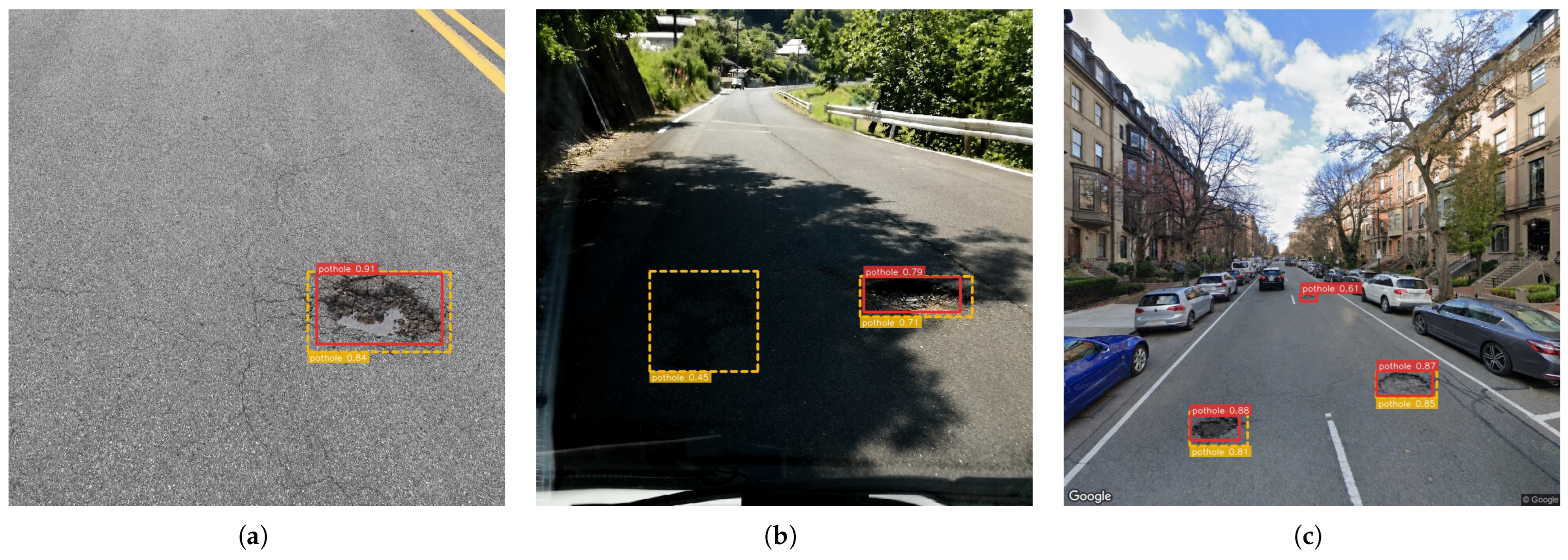
To more intuitively analyze the detection characteristics of the proposed network, this section presents qualitative visualizations of detection results on the test set. Figure 4 shows pothole detection results under different illumination and surface texture conditions. It can be observed that, in comparison with the YOLOv8s baseline, which is prone to false alarms at shadow boundaries, the proposed method, thanks to the enhancement of foreground directional textures by MSCA, suppresses the relative response of background shadows and clearly reduces false alarms under shaded regions. For small-scale potholes at long range, the multi-scale directional aggregation in MSCA preserves the fine responses that are easily lost during downsampling, so that distant potholes which the baseline misses are still steadily recalled.
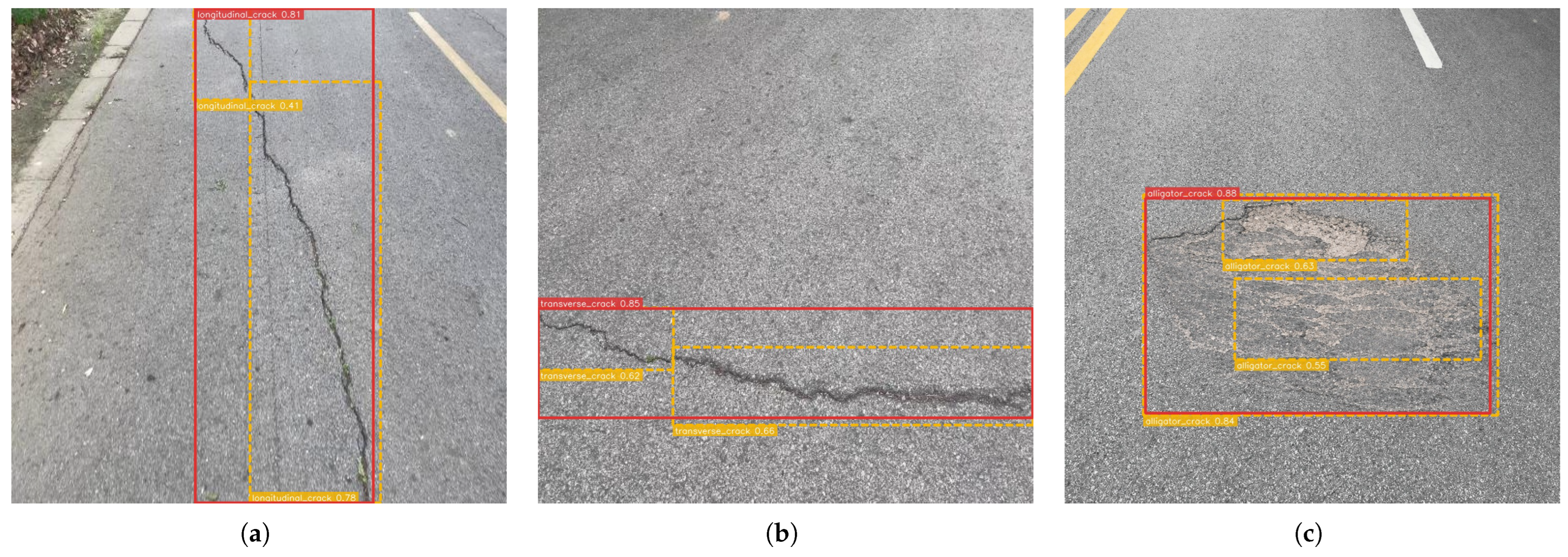
Figure 5 presents the detection results for three typical crack morphologies. The proposed method produces relatively complete bounding boxes for transverse cracks, longitudinal cracks, and alligator cracks; in particular, for transverse cracks with extreme aspect ratios (Figure 5b), the directional receptive field provided by the SADH branch enables the bounding box to extend along the orientation of the crack, thereby avoiding the phenomenon, common in baseline methods, where a single long crack is split into multiple short boxes.

4.4. Ablation Study

To validate the independent contribution of the three proposed components, MSCA, SADH, and MGKD, this section enables each module separately on a unified baseline (the equivalent YOLOv8s student model with all three components removed) and reports mAP@0.5, parameter count, and FLOPs. The results are listed in Table 3.
As shown in Table 3, each of the three components independently brings an mAP improvement:
  • MSCA increases mAP@0.5 from 66.81% to 67.95%, corresponding to a gain of 1.14 percentage points. Meanwhile, the parameter count increases from 11.2 M to 11.6 M (+0.4 M, approximately 3.6%), and the FLOPs increase from 28.6 G to 29.4 G (+0.8 G, approximately 2.8%). These results indicate that MSCA improves detection accuracy with a limited increase in model complexity;
  • SADH increases mAP@0.5 from 66.81% to 67.78%, while increasing the parameter count from 11.2 M to 11.8 M and the FLOPs from 28.6 G to 30.1 G. Under tighter computational budgets, SADH can therefore be treated as an optional accuracy- oriented component;
  • MGKD increases the student’s mAP@0.5 from 66.81% to 68.40% while leaving the inference architecture and model size unchanged, because the distillation constraints are applied only during training;
  • Combining MSCA, SADH, and MGKD yields the best mAP@0.5 of 71.65%, indicating that the three components provide complementary benefits. Relative to the 66.81% baseline, the three individual gains sum to 3.70 percentage points, whereas the complete configuration provides a gain of 4.84 percentage points, corresponding to a positive non-additive gain of 1.14 percentage points. This result is consistent with the complementary roles of the three components discussed in Section 5.1.

4.5. Edge Deployment

To evaluate the feasibility of embedded deployment, this section benchmarks the proposed network against representative lightweight detectors end-to-end on the NVIDIA Jetson Orin Nano 8GB, with the results summarized in Table 4. All models are exported with TensorRT 8.6 + FP16 precision at an input resolution of 640 × 640.
As shown in Table 4, the proposed network achieves 72.5 FPS with a latency of 13.8 ms on the NVIDIA Jetson Orin Nano, exceeding the 30 Hz real-time requirement of typical vehicle-mounted cameras. Compared with YOLOv8s, the proposed model increases the latency by only 0.7 ms and reduces the throughput from 76.3 to 72.5 FPS, while improving mAP@0.5 from 66.81% to 71.65%. It also exhibits markedly lower latency than RT-DETR-R18. As reported in Table 3, introducing MSCA or SADH increases the FLOPs of the baseline model from 28.6 G to 29.4 G and 30.1 G, respectively, indicating that the additional computational cost remains limited. Accordingly, Table 3 identifies the relative computational contributions of the individual modules in terms of FLOPs, while Table 4 reports the resulting end-to-end latency of the complete deployed model. Therefore, the main advantage of the proposed method is not a higher inference speed than YOLOv8s, but a substantial improvement in detection accuracy while retaining real-time edge-deployment capability. These results demonstrate a favorable accuracy–efficiency trade-off and strong potential for practical pavement distress inspection.

5. Discussion

5.1. Effectiveness of Component Combination

The ablation results in Section 4.4 indicate that the three proposed components, MSCA, SADH, and MGKD, are functionally complementary. Both MSCA and SADH are designed around geometric priors, but they operate at different levels: MSCA performs directional re-weighting on multi-scale features at the neck and is closer to a “soft attention” mechanism, whereas SADH introduces an explicit shape inductive bias at the detection head through asymmetric convolutions. The two can be regarded as a “coarse-to-fine” hierarchical directional modeling scheme: each component used in isolation already yields mAP gains, and their combination produces an even larger benefit. MGKD operates only during training; when combined with MSCA and SADH, it further improves the student accuracy under the reported homogeneous teacher–student setting.
It should be noted that the literature [28,29] has shown that combining feature distillation with logit distillation in generic detection usually outperforms either one alone. Building upon this finding, the present work additionally incorporates the instance-pair-based relational distillation (RKD), so that the student model is supervised by the teacher network at three different positions: the convolutional feature maps, the instance feature pairs, and the classification outputs. The accuracy contribution of MGKD as a whole relative to the no-distillation baseline has been reported as a separate ablation item in Table 3.

5.2. Practical Considerations and Limitations

From a practical perspective, the proposed network provides an accuracy–efficiency trade-off suitable for vehicle-mounted pavement inspection. It achieves an mAP@0.5 of 71.65% and runs at 72.5 FPS with a latency of 13.8 ms on the NVIDIA Jetson Orin Nano, enabling real-time localization and classification of multiple pavement distress types. Under the same training and evaluation protocol, it improves mAP@0.5 by 4.84 and 4.23 percentage points over the lightweight YOLOv8s and YOLOv10s detectors, respectively. This unified quantitative comparison highlights the effectiveness of the task-specific MSCA, SADH, and MGKD designs for lightweight pavement distress detection. The resulting detections can support rapid road-condition screening, distress statistics, and subsequent maintenance planning while reducing the workload and safety risks associated with manual inspection. Nevertheless, several limitations remain:
  • Robustness and generalization. Thin or low-contrast cracks may be missed under contamination, shadows, or uneven illumination, whereas joints, repair traces, and strong boundaries may cause false positives or category confusion. Generalization to unseen pavement materials, viewpoints, acquisition devices, nighttime scenes, and different object scales has not been systematically evaluated.
  • Comparative validation. SADH was compared only with the standard detection head, without matched comparisons against deformable, dilated, or conditionally parameterized convolutions. MGKD was evaluated only with a homogeneous CSPDarknet-l/CSPDarknet-s teacher–student pair sharing the same neck and head topology, and teacher-error propagation was not quantitatively analyzed. Its cross-architecture applicability and sensitivity to inaccurate teacher guidance therefore remain uncertain.
  • Engineering integration. The current model provides distress locations and categories but does not directly estimate distress severity or support network-level maintenance decisions. A complete inspection system would require integration with odometry, geographic information systems, tracking, severity assessment, and statistical analysis.
  • Statistical reliability. Each configuration was trained once with the random seed fixed to 42; therefore, run-to-run variability and the statistical significance of the reported improvements remain unquantified.
Future work will address these limitations through more diverse data, cross-domain and scale-wise evaluation, broader architectural comparisons, error-aware distillation, downstream system integration, and multi-seed experiments.

6. Conclusions

The main conclusions of this study are summarized as follows:
  • MSCA strengthens multi-scale directional feature aggregation while preserving positional information, thereby improving the representation of elongated pavement cracks.
  • SADH adaptively combines square and asymmetric convolutional branches, introducing complementary shape priors for crack and pothole detection.
  • MGKD transfers teacher knowledge through attention-masked feature, instance-pair relational, and decoupled logit distillation, providing complementary supervision for the lightweight student.
  • On the evaluated test split, the proposed model achieves an mAP@0.5 of 71.65%. It runs at 72.5 FPS with a latency of 13.8 ms on the NVIDIA Jetson Orin Nano. Compared with YOLOv8s, it improves mAP@0.5 by 4.84 percentage points with a 0.7 ms latency increase, demonstrating a favorable accuracy–efficiency trade-off while retaining real-time inference capability.
  • Future work will focus on cross-domain validation under more diverse pavement and environmental conditions, integration with distress-severity assessment and maintenance decision-making systems, and reducing dependence on manual annotation through self-supervised or semi-supervised learning.

Author Contributions

Conceptualization, D.C., J.Z. and T.F.; methodology, D.C., J.Z. and T.F.; software, D.C.; validation, D.C., J.Z., Z.D. and W.X.; formal analysis, D.C., J.Z. and H.F.; investigation, Z.D., W.X., H.F. and Z.Q.; resources, X.W., Z.D. and T.F.; data curation, D.C., J.Z. and Z.Q.; writing—original draft preparation, D.C., J.Z. and T.F.; writing—review and editing, T.F., X.W., Z.D. and X.Y.; visualization, D.C. and J.Z.; supervision, T.F. and X.W.; project administration, T.F., X.W. and Z.D. All authors have read and agreed to the published version of the manuscript.

Funding

This research received no external funding.

Institutional Review Board Statement

Not applicable.

Informed Consent Statement

Not applicable.

Data Availability Statement

The RDD2022 dataset analyzed in this study is publicly available at https://figshare.com/articles/dataset/RDD2022_-_The_multi-national_Road_Damage_Dataset_released_through_CRDDC_2022/21431547 (accessed on 19 August 2026). The supplementary in-house pothole image dataset is not publicly available due to privacy and institutional restrictions, but may be made available from the corresponding author upon reasonable request.

Acknowledgments

The authors thank the editors and anonymous reviewers for their constructive comments.

Conflicts of Interest

The authors declare no competing interests. The authors Dongpo Chen, Jiaxing Zou and Xinghua Wang were employed by the company Hebei Expressway Group Co., Ltd. The authors Zhong Dai, Wenjun Xing, Hao Feng, and Zelin Qin were employed by the company Hebei Expressway Group Engineering Consulting Co., Ltd. There is no conflict of interest between any of the authors and the company.

Abbreviations

The following abbreviations are used in this manuscript:
CNNConvolutional Neural Network
KDKnowledge Distillation
MSCAMulti-Scale Coordinate Attention
SADHSlender-Aware Detection Head
MGKDMulti-Granularity Knowledge Distillation
RKDRelational Knowledge Distillation
mAPmean Average Precision
FPSFrames Per Second
FLOPsFloating-Point Operations
RDD2022Road Damage Dataset 2022

References

  1. Cao, W.; Liu, Q.; He, Z. Review of Pavement Defect Detection Methods. IEEE Access 2020, 8, 14531–14544. [Google Scholar] [CrossRef] [Scilit]
  2. Cha, Y.-J.; Choi, W.; Büyüköztürk, O. Deep Learning-Based Crack Damage Detection Using Convolutional Neural Networks. Comput.-Aided Civ. Infrastruct. Eng. 2017, 32, 361–378. [Google Scholar] [CrossRef] [Scilit]
  3. Maeda, H.; Sekimoto, Y.; Seto, T.; Kashiyama, T.; Omata, H. Road Damage Detection and Classification Using Deep Neural Networks with Smartphone Images. Comput.-Aided Civ. Infrastruct. Eng. 2018, 33, 1127–1141. [Google Scholar] [CrossRef] [Scilit]
  4. Arya, D.; Maeda, H.; Ghosh, S.K.; Toshniwal, D.; Sekimoto, Y. RDD2022: A Multi-National Image Dataset for Automatic Road Damage Detection. Geosci. Data J. 2024, 11, 846–862. [Google Scholar] [CrossRef] [Scilit]
  5. Xu, X.; Zhao, M.; Shi, P.; Ren, R.; He, X.; Wei, X.; Yang, H. Crack Detection and Comparison Study Based on Faster R-CNN and Mask R-CNN. Sensors 2022, 22, 1215. [Google Scholar] [CrossRef] [Scilit] [PubMed]
  6. Zou, Q.; Zhang, Z.; Li, Q.; Qi, X.; Wang, Q.; Wang, S. DeepCrack: Learning Hierarchical Convolutional Features for Crack Detection. IEEE Trans. Image Process. 2019, 28, 1498–1512. [Google Scholar] [CrossRef] [Scilit] [PubMed]
  7. Liu, Y.; Yao, J.; Lu, X.; Xie, R.; Li, L. DeepCrack: A Deep Hierarchical Feature Learning Architecture for Crack Segmentation. Neurocomputing 2019, 338, 139–153. [Google Scholar] [CrossRef] [Scilit]
  8. Redmon, J.; Farhadi, A. YOLOv3: An Incremental Improvement. arXiv 2018, arXiv:1804.02767. [Google Scholar] [CrossRef] [Scilit]
  9. Bochkovskiy, A.; Wang, C.-Y.; Liao, H.-Y.M. YOLOv4: Optimal Speed and Accuracy of Object Detection. arXiv 2020, arXiv:2004.10934. [Google Scholar] [CrossRef] [Scilit]
  10. Li, C.; Li, L.; Jiang, H.; Weng, K.; Geng, Y.; Li, L.; Ke, Z.; Li, Q.; Cheng, M.; Nie, W.; et al. YOLOv6: A Single-Stage Object Detection Framework for Industrial Applications. arXiv 2022, arXiv:2209.02976. [Google Scholar] [CrossRef] [Scilit]
  11. Wang, C.-Y.; Bochkovskiy, A.; Liao, H.-Y.M. YOLOv7: Trainable Bag-of-Freebies Sets New State-of-the-Art for Real-Time Object Detectors. In Proceedings of the IEEE/CVF Conference on Computer Vision and Pattern Recognition (CVPR), Vancouver, BC, Canada, 17–24 June 2023; pp. 7464–7475. [Google Scholar]
  12. Wang, C.-Y.; Yeh, I.-H.; Liao, H.-Y.M. YOLOv9: Learning What You Want to Learn Using Programmable Gradient Information. In Proceedings of the European Conference on Computer Vision (ECCV), Milan, Italy, 29 September–4 October 2024. [Google Scholar]
  13. Wang, A.; Chen, H.; Liu, L.; Chen, K.; Lin, Z.; Han, J.; Ding, G. YOLOv10: Real-Time End-to-End Object Detection. In Proceedings of the Advances in Neural Information Processing Systems (NeurIPS), Vancouver, BC, Canada, 10–15 December 2024. [Google Scholar]
  14. Zhao, Y.; Lv, W.; Xu, S.; Wei, J.; Wang, G.; Dang, Q.; Liu, Y.; Chen, J. DETRs Beat YOLOs on Real-Time Object Detection. In Proceedings of the IEEE/CVF Conference on Computer Vision and Pattern Recognition (CVPR), Seattle, WA, USA, 17–21 June 2024; pp. 16965–16974. [Google Scholar]
  15. Lin, T.-Y.; Dollár, P.; Girshick, R.; He, K.; Hariharan, B.; Belongie, S. Feature Pyramid Networks for Object Detection. In Proceedings of the IEEE Conference on Computer Vision and Pattern Recognition (CVPR), Honolulu, HI, USA, 21–26 July 2017; pp. 2117–2125. [Google Scholar]
  16. Liu, S.; Qi, L.; Qin, H.; Shi, J.; Jia, J. Path Aggregation Network for Instance Segmentation. In Proceedings of the IEEE Conference on Computer Vision and Pattern Recognition (CVPR), Salt Lake City, UT, USA, 18–22 June 2018; pp. 8759–8768. [Google Scholar]
  17. Hu, J.; Shen, L.; Sun, G. Squeeze-and-Excitation Networks. In Proceedings of the IEEE Conference on Computer Vision and Pattern Recognition (CVPR), Salt Lake City, UT, USA, 18–22 June 2018; pp. 7132–7141. [Google Scholar]
  18. Woo, S.; Park, J.; Lee, J.-Y.; Kweon, I.S. CBAM: Convolutional Block Attention Module. In Proceedings of the European Conference on Computer Vision (ECCV), Munich, Germany, 8–14 September 2018; pp. 3–19. [Google Scholar]
  19. Wang, Q.; Wu, B.; Zhu, P.; Li, P.; Zuo, W.; Hu, Q. ECA-Net: Efficient Channel Attention for Deep Convolutional Neural Networks. In Proceedings of the IEEE/CVF Conference on Computer Vision and Pattern Recognition (CVPR), Seattle, WA, USA, 14–19 June 2020; pp. 11534–11542. [Google Scholar]
  20. Hou, Q.; Zhou, D.; Feng, J. Coordinate Attention for Efficient Mobile Network Design. In Proceedings of the IEEE/CVF Conference on Computer Vision and Pattern Recognition (CVPR), Nashville, TN, USA, 20–25 June 2021; pp. 13713–13722. [Google Scholar]
  21. Howard, A.G.; Zhu, M.; Chen, B.; Kalenichenko, D.; Wang, W.; Weyand, T.; Andreetto, M.; Adam, H. MobileNets: Efficient Convolutional Neural Networks for Mobile Vision Applications. arXiv 2017, arXiv:1704.04861. [Google Scholar] [CrossRef] [Scilit]
  22. Sandler, M.; Howard, A.; Zhu, M.; Zhmoginov, A.; Chen, L.-C. MobileNetV2: Inverted Residuals and Linear Bottlenecks. In Proceedings of the IEEE Conference on Computer Vision and Pattern Recognition (CVPR), Salt Lake City, UT, USA, 18–22 June 2018; pp. 4510–4520. [Google Scholar]
  23. Tan, M.; Le, Q. EfficientNet: Rethinking Model Scaling for Convolutional Neural Networks. In Proceedings of the International Conference on Machine Learning (ICML), Long Beach, CA, USA, 9–15 June 2019; pp. 6105–6114. [Google Scholar]
  24. Hinton, G.; Vinyals, O.; Dean, J. Distilling the Knowledge in a Neural Network. arXiv 2015, arXiv:1503.02531. [Google Scholar] [CrossRef] [Scilit]
  25. Romero, A.; Ballas, N.; Kahou, S.E.; Chassang, A.; Gatta, C.; Bengio, Y. FitNets: Hints for Thin Deep Nets. In Proceedings of the International Conference on Learning Representations (ICLR), San Diego, CA, USA, 7–9 May 2015. [Google Scholar]
  26. Park, W.; Kim, D.; Lu, Y.; Cho, M. Relational Knowledge Distillation. In Proceedings of the IEEE/CVF Conference on Computer Vision and Pattern Recognition (CVPR), Long Beach, CA, USA, 16–20 June 2019; pp. 3967–3976. [Google Scholar]
  27. Tian, Y.; Krishnan, D.; Isola, P. Contrastive Representation Distillation. In Proceedings of the International Conference on Learning Representations (ICLR), Online, 26 April–1 May 2020. [Google Scholar]
  28. Yang, Z.; Li, Z.; Jiang, X.; Gong, Y.; Yuan, Z.; Zhao, D.; Yuan, C. Focal and Global Knowledge Distillation for Detectors. In Proceedings of the IEEE/CVF Conference on Computer Vision and Pattern Recognition (CVPR), New Orleans, LA, USA, 19–24 June 2022; pp. 4643–4652. [Google Scholar]
  29. Zhao, B.; Cui, Q.; Song, R.; Qiu, Y.; Liang, J. Decoupled Knowledge Distillation. In Proceedings of the IEEE/CVF Conference on Computer Vision and Pattern Recognition (CVPR), New Orleans, LA, USA, 19–24 June 2022; pp. 11953–11962. [Google Scholar]
  30. Ding, X.; Guo, Y.; Ding, G.; Han, J. ACNet: Strengthening the Kernel Skeletons for Powerful CNN via Asymmetric Convolution Blocks. In Proceedings of the IEEE/CVF International Conference on Computer Vision (ICCV), Seoul, Republic of Korea, 27 October–2 November 2019; pp. 1911–1920. [Google Scholar]
  31. Shi, Y.; Cui, L.; Qi, Z.; Meng, F.; Chen, Z. Automatic Road Crack Detection Using Random Structured Forests. IEEE Trans. Intell. Transp. Syst. 2016, 17, 3434–3445. [Google Scholar] [CrossRef] [Scilit]
  32. Koch, C.; Brilakis, I. Pothole Detection in Asphalt Pavement Images. Adv. Eng. Inform. 2011, 25, 507–515. [Google Scholar] [CrossRef] [Scilit]
  33. Fan, Z.; Li, C.; Chen, Y.; Wei, J.; Loprencipe, G.; Chen, X.; Di Mascio, P. Automatic Crack Detection on Road Pavements Using Encoder-Decoder Architecture. Materials 2020, 13, 2960. [Google Scholar] [CrossRef] [Scilit] [PubMed]
  34. Maeda, H.; Kashiyama, T.; Sekimoto, Y.; Seto, T.; Omata, H. Generative Adversarial Network for Road Damage Detection. Comput.-Aided Civ. Infrastruct. Eng. 2021, 36, 47–60. [Google Scholar] [CrossRef] [Scilit]
  35. Arya, D.; Maeda, H.; Ghosh, S.K.; Toshniwal, D.; Sekimoto, Y. RDD2020: An Annotated Image Dataset for Automatic Road Damage Detection Using Deep Learning. Data Brief 2021, 36, 107133. [Google Scholar] [CrossRef] [Scilit] [PubMed]
  36. Ren, S.; He, K.; Girshick, R.; Sun, J. Faster R-CNN: Towards Real-Time Object Detection with Region Proposal Networks. IEEE Trans. Pattern Anal. Mach. Intell. 2017, 39, 1137–1149. [Google Scholar] [CrossRef] [Scilit] [PubMed]
  37. Vaswani, A.; Shazeer, N.; Parmar, N.; Uszkoreit, J.; Jones, L.; Gomez, A.N.; Kaiser, Ł.; Polosukhin, I. Attention Is All You Need. In Proceedings of the Advances in Neural Information Processing Systems (NeurIPS), Long Beach, CA, USA, 4–9 December 2017; pp. 5998–6008. [Google Scholar]
  38. Dosovitskiy, A.; Beyer, L.; Kolesnikov, A.; Weissenborn, D.; Zhai, X.; Unterthiner, T.; Dehghani, M.; Minderer, M.; Heigold, G.; Gelly, S.; et al. An Image Is Worth 16×16 Words: Transformers for Image Recognition at Scale. In Proceedings of the International Conference on Learning Representations (ICLR), Online, 3–7 May 2021. [Google Scholar]
  39. Howard, A.; Sandler, M.; Chen, B.; Wang, W.; Chen, L.-C.; Tan, M.; Chu, G.; Vasudevan, V.; Zhu, Y.; Pang, R.; et al. Searching for MobileNetV3. In Proceedings of the IEEE/CVF International Conference on Computer Vision (ICCV), Seoul, Republic of Korea, 27 October–2 November 2019; pp. 1314–1324. [Google Scholar]
  40. Pan, W.; Kang, J.; Wang, X.; Chen, Z.; Ge, Y. DAPONet: A Dual Attention and Partially Overparameterized Network for Real-Time Road Damage Detection. arXiv 2024, arXiv:2409.01604. [Google Scholar] [CrossRef] [Scilit]
  41. Chen, J.; Chen, S.; Jiang, Z.; Que, Y.; Chen, Y.; Wang, J. Edge-Deployable Crack Detection: Synergizing GAN-Based Synthesis with MCANet-Tiny for Real-Time Inspection. Expert Syst. Appl. 2026, 328, 132915. [Google Scholar] [CrossRef] [Scilit]
  42. Lin, J.; Wang, P.; Ruan, Y.; Sun, Y. YOLO11-WLBS: An Efficient Model for Pavement Defect Detection. Sci. Rep. 2026, 16, 5284. [Google Scholar] [CrossRef] [Scilit] [PubMed]
  43. Huang, S.; Liu, Q.; Chen, C.; Chen, Y. A Real-Time Concrete Crack Detection and Segmentation Model Based on YOLOv11. arXiv 2025, arXiv:2508.11517. [Google Scholar] [CrossRef] [Scilit]
  44. Tsai, C.-Y.; Lin, C.-M.; Yang, C.-H.; Wang, Y.-C.; Chiang, J.-S. YOLO-AMC: An Improved YOLO Architecture with Attention Mechanisms for Building Crack Detection. arXiv 2026, arXiv:2606.12958. [Google Scholar] [CrossRef] [Scilit]
  45. Tan, M.; Le, Q.V. MixConv: Mixed Depthwise Convolutional Kernels. arXiv 2019, arXiv:1907.09595. [Google Scholar] [CrossRef] [Scilit]
  46. Ge, Z.; Liu, S.; Wang, F.; Li, Z.; Sun, J. YOLOX: Exceeding YOLO Series in 2021. arXiv 2021, arXiv:2107.08430. [Google Scholar] [CrossRef] [Scilit]
  47. Liu, Z.; Mao, H.; Wu, C.-Y.; Feichtenhofer, C.; Darrell, T.; Xie, S. A ConvNet for the 2020s. In Proceedings of the IEEE/CVF Conference on Computer Vision and Pattern Recognition (CVPR), New Orleans, LA, USA, 19–24 June 2022; pp. 11976–11986. [Google Scholar] [CrossRef] [Scilit]
  48. Yu, W.; Zhou, P.; Yan, S.; Wang, X. InceptionNeXt: When Inception Meets ConvNeXt. In Proceedings of the IEEE/CVF Conference on Computer Vision and Pattern Recognition (CVPR), Seattle, WA, USA, 17–21 June 2024; pp. 5672–5683. [Google Scholar] [CrossRef] [Scilit]
  49. Li, G.; Wang, W.; Li, X.; Li, Z.; Yang, J.; Dai, J.; Qiao, Y.; Zhang, S. Distilling Knowledge from Large-Scale Image Models for Object Detection. In Proceedings of the 18th European Conference on Computer Vision (ECCV), Milan, Italy, 29 September–4 October 2024; pp. 142–160. [Google Scholar] [CrossRef] [Scilit]
  50. Zheng, Z.; Wang, P.; Liu, W.; Li, J.; Ye, R.; Ren, D. Distance-IoU Loss: Faster and Better Learning for Bounding Box Regression. In Proceedings of the AAAI Conference on Artificial Intelligence, New York, NY, USA, 7–12 February 2020; Volume 34, pp. 12993–13000. [Google Scholar]
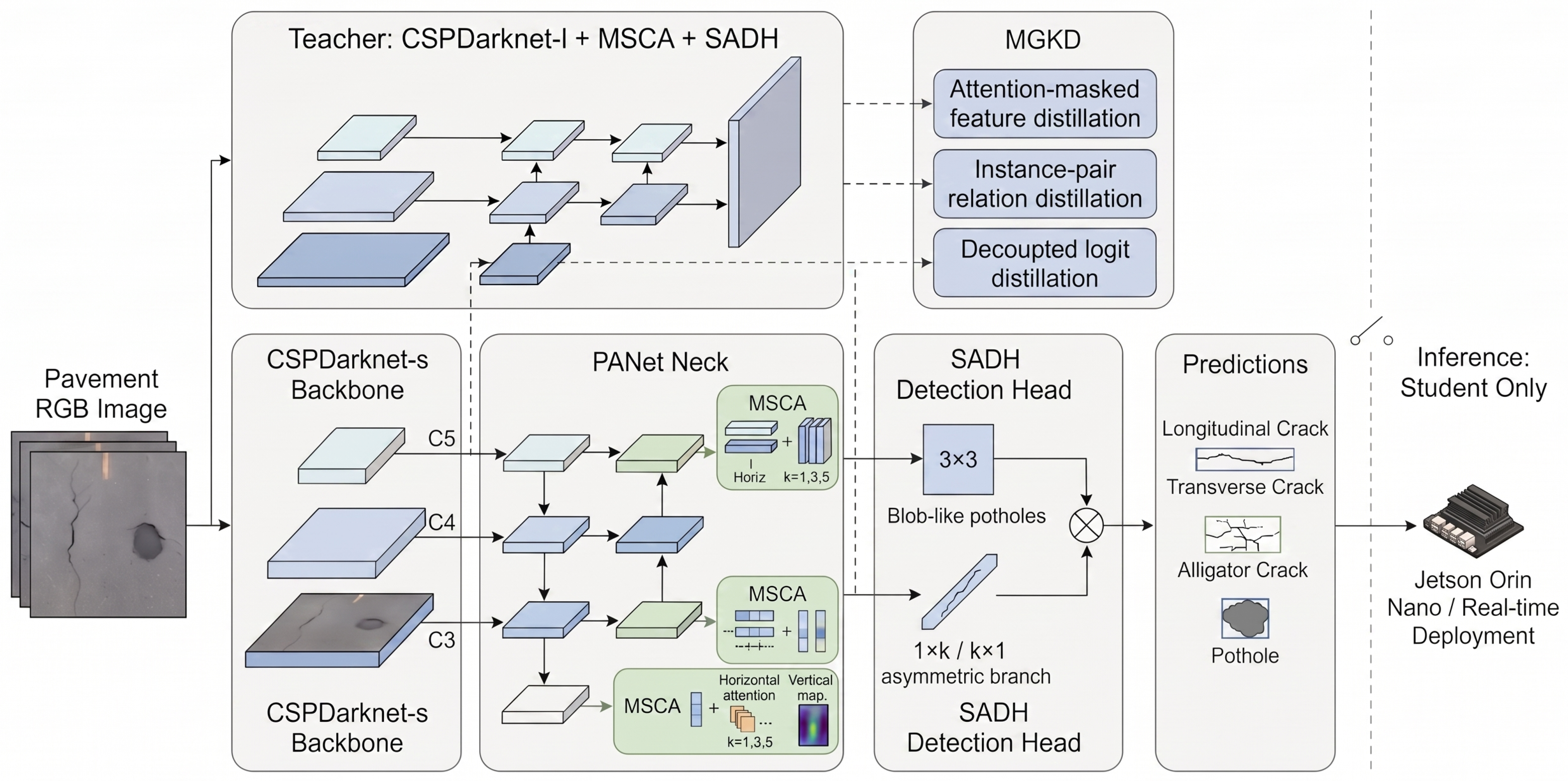
Figure 1. Overall framework of the proposed network. The student model contains a CSP-style backbone, an MSCA-enhanced PANet neck, and a slender-aware detection head (SADH). During training, a homogeneous CSPDarknet-l teacher following the YOLOv8-l scaling configuration guides the CSPDarknet-s student. The teacher and student share the same MSCA-enhanced PANet neck and SADH detection head but differ in backbone depth and width. The multi-granularity knowledge distillation (MGKD) scheme acts at three complementary granularities: pixel-level features, instance-pair relations, and decoupled class-prior logits. At inference time, only the student is deployed on the edge device.
Infrastructures 11 00308 g001
Figure 2. Internal structure of the proposed detection network. (a) Multi-scale coordinate attention (MSCA) module: directional pooling is followed by three parallel convolution scales using 1 × 1, 3 × 1/1 × 3, and 5 × 1/1 × 5 kernels. Their scale-specific outputs are concatenated along the channel dimension and fused by a learnable 1 × 1 convolution followed by BatchNorm and Hard-Swish activation. The fused representation is subsequently split to generate the horizontal and vertical attention maps. (b) Slender-aware detection head (SADH): a square 3 × 3 branch and a slender 1 × k/k × 1 branch are gated channel-wise.
Infrastructures 11 00308 g002
Figure 3. Training curves on the unified RDD2022 training/validation split. (a) Box regression loss versus epochs; (b) validation mAP@0.5 versus epochs. The proposed method converges faster and saturates at a higher level than the baselines. The curves characterize the overall optimization behavior of the complete MGKD framework rather than the isolated effect of an individual distillation term.
Infrastructures 11 00308 g003
Figure 4. Pothole detection results under different interference conditions. (a) Clean asphalt surface; (b) strong shadow-boundary interference; (c) small potholes under long-distance and multi-target conditions. Red boxes denote the proposed method’s predictions, whereas yellow boxes denote the YOLOv8s baseline predictions. The proposed method suppresses shadow-induced false positives and improves the recall of small distant potholes.
Infrastructures 11 00308 g004
Figure 5. Crack detection results under different morphological conditions. (a) Longitudinal crack with a narrow directional structure; (b) transverse crack with an extreme aspect ratio; (c) intersecting and fragmented alligator crack. The proposed method improves directional continuity and produces more complete bounding boxes along the crack orientation, particularly for elongated cracks.
Infrastructures 11 00308 g005
Table 1. Category-wise instance distribution of the filtered RDD2022 dataset used in this study. The aggregate total row is highlighted in bold.
CategoryDamage TypeInstancesPercentage
D00Longitudinal crack20,82443.73%
D10Transverse crack10,24221.51%
D20Alligator crack918919.30%
D40Pothole736215.46%
Total47,617100.00%
Table 2. Detection performance on the evaluated test split. The best result in each column is highlighted in bold. “Crack mAP” is the mean of the three crack categories (longitudinal, transverse, alligator); “Pothole mAP” lists results for the pothole class only.
MethodBackbonemAP@0.5 (%)mAP@0.5:0.95 (%)P (%)R (%)Crack mAP (%)Pothole mAP (%)
Faster R-CNN [36]ResNet-5064.1232.4570.8362.1862.9567.62
YOLOv5sCSPDarknet62.8931.2771.5560.0461.4267.30
YOLOv6s [10]EfficientRep64.7132.8472.1661.0963.5268.28
YOLOv7-tiny [11]E-ELAN61.3530.1870.9258.8160.0565.25
YOLOv8sCSPDarknet66.8134.1373.0762.7465.1371.85
YOLOv10s [13]CSPDarknet67.4234.7773.4163.1865.8472.16
RT-DETR-R18 [14]ResNet-1865.6233.2072.1862.0563.9670.60
Ours (Student)CSPDarknet-s71.6537.4176.8366.9270.5375.01
Table 3. Ablation study of the three proposed components on the evaluated test split. “Baseline” is the student model without any of MSCA, SADH or MGKD. A checkmark indicates that the corresponding component is enabled, whereas “−” indicates that it is disabled. The best value in each metric column is highlighted in bold.
MSCASADHMGKDmAP@0.5 (%)mAP@0.5:0.95 (%)Params (M)FLOPs (G)
66.8134.1311.228.6
67.9534.6111.629.4
67.7834.5211.830.1
68.4034.8811.228.6
69.1235.2712.130.8
69.8835.7411.629.4
69.6535.6211.830.1
71.6537.4112.130.8
Table 4. Inference performance on NVIDIA Jetson Orin Nano 8 GB (TensorRT FP16, 640 × 640, batch size 1). “Mem.” denotes peak GPU memory occupied by the engine. The best result in each column is highlighted in bold.
MethodParams (M)FLOPs (G)Latency (ms)FPSMem. (MB)
YOLOv5s7.216.511.090.9482
YOLOv6s [10]17.244.017.557.1758
YOLOv7-tiny [11]6.213.79.5105.3411
YOLOv8s11.228.613.176.3583
YOLOv10s [13]7.221.612.381.3514
RT-DETR-R18 [14]20.060.022.843.9877
Ours (Student)12.130.813.872.5615
Disclaimer/Publisher’s Note: The statements, opinions and data contained in all publications are solely those of the individual author(s) and contributor(s) and not of MDPI and/or the editor(s). MDPI and/or the editor(s) disclaim responsibility for any injury to people or property resulting from any ideas, methods, instructions or products referred to in the content.