Review

From Flood Hazard to Bridge Decisions Under Uncertainty: A Critical Review of the Scour Monitoring–Prediction–Decision Chain


by
Fabrizio Scozzese
School of Architecture and Design, University of Camerino, Viale della Rimembranza 3, 63100 Ascoli Piceno, Italy
Infrastructures 2026, 11(7), 218; https://doi.org/10.3390/infrastructures11070218
Submission received: 18 April 2026 / Revised: 23 May 2026 / Accepted: 23 June 2026 / Published: 26 June 2026

Abstract

Flood-induced scour remains one of the leading causes of bridge failure, yet the chain linking flood hazard to bridge decisions is still commonly treated as a sequence of disconnected tasks. This review examines that chain using uncertainty as a unifying interpretive framework, synthesizing the recent literature on non-stationary flood hazard assessment, bridge-scale hydraulics, scour processes and predictive models, scour monitoring, monitoring-informed forecasting, structural vulnerability, and risk-informed decision-making. The review synthesizes the state of the art across all these stages of the chain, highlighting how the dominant uncertainty changes along it: climate and hydrologic variability upstream; model-form, sediment, and parameter uncertainty in scour prediction; measurement noise and inverse-inference uncertainty in monitoring; and threshold and consequence uncertainty in closure, retrofit, and network-level decisions. Although major advances have been achieved in probabilistic modelling, machine learning, hybrid physics-informed methods, and multimodal sensing, most published frameworks still transfer deterministic outputs from one stage to the next. As a result, uncertainty is rarely propagated consistently to the decision level. The main value of this review lies in making the chain’s weak interfaces explicit, in showing how uncertainty propagation can serve as a unifying framework across otherwise disconnected literatures, and in identifying which methodological directions are most promising for connecting prediction, monitoring, and decision support into a coherent end-to-end probabilistic chain supporting climate-resilient bridge management.

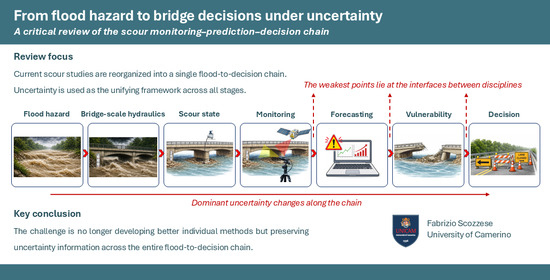
Graphical Abstract

1. Introduction

Bridges crossing rivers and floodplains are increasingly exposed to a combination of ageing, hydraulic loading, and climate-driven extremes. Among the hydraulic mechanisms that compromise bridge safety, scour remains one of the most recurrent and insidious because it acts directly on foundation capacity and develops silently until it attains near-critical values. Historical evidence confirms the scale of the problem. Xiong et al. [1] show, from a broad database of hydraulic bridge failures, that scour and related hydraulic mechanisms remain dominant causes of collapse. Event-based evidence from the 2021 flood in Germany further demonstrates that flood damage to bridges is strongly conditioned by bridge typology and by the interaction between scour and other hydraulic actions, as documented by Pucci et al. [2]. Moreover, freely accessible evidence from a recent Italian bridge-collapse survey [3] indicates that hydraulic issues were identified as the predominant cause of documented collapses, accounting for 80.5% of the 246 cases collected for the period 2000–2023. Together, these studies confirm that hydraulic loading and its consequences, including scour-related instability, remain central to bridge safety assessment under extreme events.
The consequences of scour are, however, highly variable and depend not only on hydraulic loading but also on foundation conditions, structural typology, and load redistribution mechanisms. Figure 1 highlights this point by providing field-based evidence of scour effects under real flood conditions, showing how similar erosion processes may result in very different outcomes, ranging from local foundation-soil exposure without collapse (Figure 1a) to partial or complete structural failure (Figure 1c,d), or even temporary (total or partial) survival due to favourable subsoil conditions or structural robustness (Figure 1a,b).
Despite this well-established threat, the path from flood hazard characterization to bridge management decisions is rarely handled as a single analytical chain. Hydrologic and hydraulic analyses, scour prediction, structural assessment, monitoring, and operational management are still commonly treated as separate tasks, with limited feedback between them. This fragmentation matters because bridge decisions are only as reliable as the weakest interface in the chain. Errors in flood characterization affect estimates of local flow depth and velocity at the bridge; these, in turn, affect scour predictions, which then condition vulnerability assessments, warning thresholds, and traffic management actions.
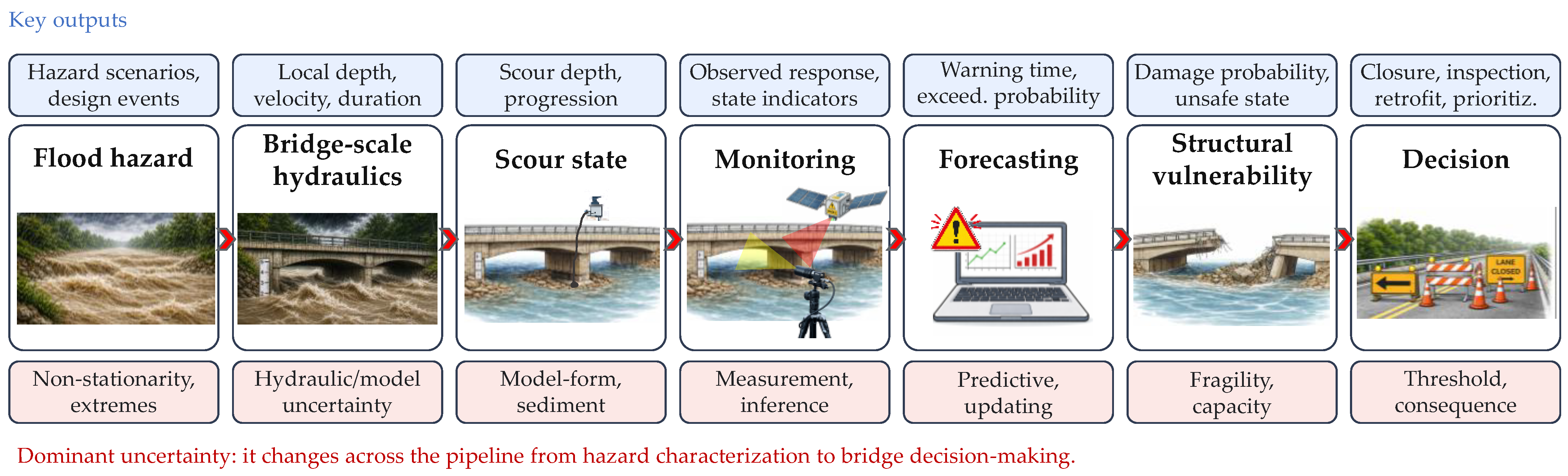
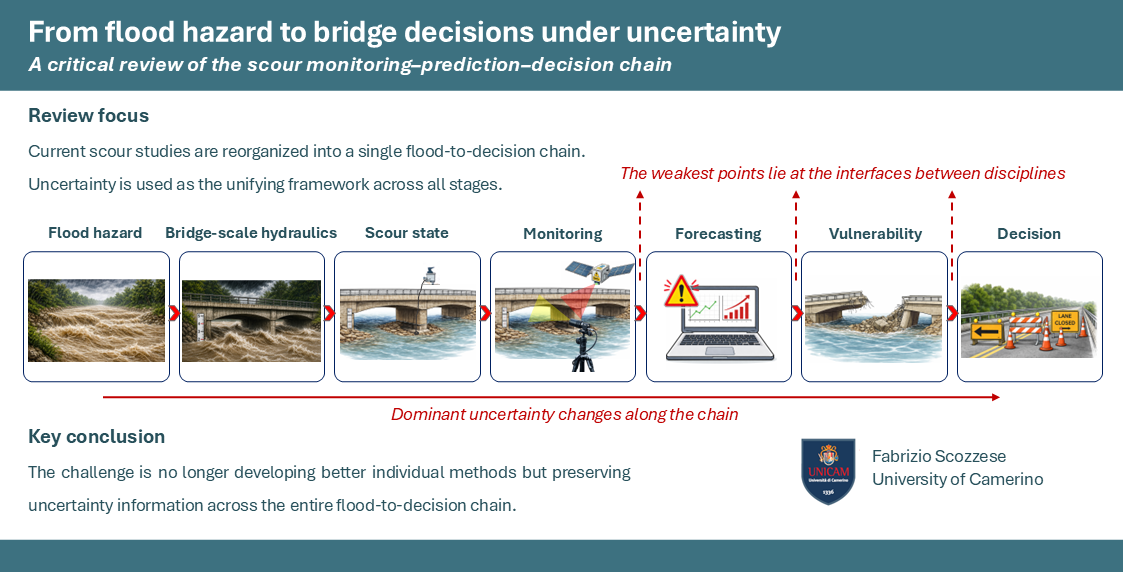
This flood-to-decision chain, together with the quantities exchanged between stages and the dominant sources of uncertainty, is schematically summarized in Figure 2.
The literature has advanced rapidly within individual subfields. Reviews have addressed scour physics and predictive equations, vibration-based scour monitoring, and risk-based bridge scour management. The most important benchmarks remain the holistic review by Pizarro et al. [5], the critical synthesis of scour equations by Baranwal and Das [6], the review of monitoring technologies by Kazemian et al. [7], and the comparison of risk-based scour-management methods by Pregnolato et al. [8]. However, what remains less developed is a cross-stage synthesis that treats the hazard-to-decision chain itself as the object of analysis.
Accordingly, this paper reviews bridge scour through the lens of an integrated monitoring–prediction–decision pipeline (Figure 2). The analysis covers upstream flood hazard characterization and climate non-stationarity, bridge-scale hydraulics, scour processes and predictive models, direct and indirect monitoring technologies, monitoring-informed forecasting, structural vulnerability, and risk-informed bridge decisions. Rather than cataloguing methods in isolation, the paper asks four linked questions: where uncertainty is generated, how it is transformed from one stage to the next, where it can be reduced through monitoring or updating, and how much of the residual uncertainty is actually carried into decisions.
The contribution of the paper is therefore twofold. First, it reorganizes a fragmented literature into a single end-to-end pipeline relevant to bridge management under flood risk. Second, it proposes uncertainty propagation as the main interpretive framework for comparing methods, identifying interface failures, and defining research priorities.

2. Review Scope and Framework

2.1. Review Questions

This review is structured as a critical narrative synthesis focused on the chain linking flood hazard to bridge decisions under scour risk. The analysis is guided by four review questions: (i) how is uncertainty characterized at each stage of the flood-to-decision pipeline; (ii) how do current methods transform or reduce uncertainty when passing from hazard to scour, from scour to monitoring, and from monitoring to decisions; (iii) which interfaces remain weak or poorly coupled; and (iv) what methodological developments are needed to support end-to-end probabilistic bridge management under climate non-stationarity?

2.2. Literature Identification and Classification

The literature was identified through iterative searches in major bibliographic databases, complemented by backward and forward analysis from key review papers and seminal applications. Search strings combined terms related to flood hazard, bridge hydraulics, scour, monitoring, forecasting, fragility, risk-informed decisions, vibration-based detection, time–frequency analysis, Bayesian updating, and value of information. The focus was placed on the last 10–15 years, while older studies were retained where they provided foundational concepts, benchmark datasets, or methods still widely used in current practice.
The review does not aim to be exhaustive in a PRISMA sense; rather, it provides a structured and critical synthesis of the literature most relevant to bridge-scale decision support. Studies were classified according to their dominant position in the pipeline: (a) flood hazard and bridge-scale hydraulics; (b) scour processes and predictive modelling; (c) scour monitoring and state inference; (d) forecasting and early warning; and (e) structural vulnerability and decision frameworks.
Studies were further organized in section-specific synthesis tables to support cross-comparison within each stage of the flood-to-decision pipeline. In these tables, each paper is identified by its reference number, its main thematic location within the review, and a compact typological label describing its dominant contribution. The typological classification is used pragmatically rather than rigidly: some studies span multiple domains, but each was assigned to the category that best reflects its primary role in the present review.
The column Tag distinguishes, in simplified form, between review papers (Review), field applications based on real bridge data or observations (Field), laboratory or scaled experimental investigations (Laboratory), analytical or numerical developments (Modelling), data-driven or machine learning approaches (Data-driven), hybrid physics-informed or combined approaches (Hybrid modelling), remote-observation studies (Remote sensing), Bayesian or probabilistic updating frameworks (Bayesian), fragility- or vulnerability-oriented studies (Fragility/Modelling), decision-support or management-oriented studies (Decision support), value-of-information analyses (Value of information), network-level optimization studies (Network/Optimization), asset-management frameworks (Asset management), failure-mechanism studies (Failure analysis), and design-oriented practice or code-development studies (Design). Where a paper combines multiple aspects, the label refers to the dominant contribution emphasized in the discussion.
For transparency and ease of navigation, a consolidated master table of all reviewed studies is provided in Appendix A. This appendix complements the section-specific synthesis tables by showing, for each paper, its primary placement in the review, any secondary cross-sectional relevance, and its specific role in the overall flood-to-decision pipeline.

2.3. Uncertainty Nomenclature Used in This Review

To maintain consistency across disciplines, the review adopts five recurring categories of uncertainty:
  • Aleatory uncertainty, associated with the natural variability of rainfall, flood occurrence, hydrographs, and sediment response;
  • Epistemic uncertainty, associated with incomplete knowledge, such as limited field data, unknown foundation details, or poorly characterized bed material;
  • Model-form uncertainty, associated with the structure of the selected model, for example equilibrium versus time-dependent scour formulations;
  • Measurement uncertainty, including sensor noise, missing data, indirect observability, and uncertainty introduced when converting measured quantities into inferred scour states;
  • Decision uncertainty, concerning threshold definition, consequence modelling, and the trade-off between false alarms and missed failures.
In each section, uncertainty is examined in terms of whether it is generated, transformed, reduced, or ignored before being handed downstream.

3. Flood Hazard, Bridge-Scale Hydraulics, and Climate Non-Stationarity

The first stage of the pipeline concerns the characterization of the hydraulic forcing that ultimately drives scour at bridge foundations. This stage begins well upstream of the bridge itself, with rainfall variability, catchment response, and flood frequency analysis, and ends with local hydraulic quantities such as water depth, velocity, flow contraction, and flood duration at the bridge site. Climate change and land-use change are treated here as upstream drivers because they alter the statistical properties of flood extremes and challenge the stationarity assumptions on which many bridge assessments still rely.

3.1. Flood Extremes and Non-Stationary Hazard Characterization

Flood hazard characterization itself is a major source of uncertainty that conditions all downstream stages. Flood hazard is better understood as a distribution that changes over time, where flood magnitude, duration, seasonality, and sequencing are all affected by climate non-stationarity. Francois et al. [9] provide the broader hydrologic basis for this shift, arguing that river flood design under climate change must move beyond stationary assumptions. Byun and Hamlet [10] take the next step by translating non-stationary flood behaviour into a risk-based framework for infrastructure standards, which is particularly useful because it turns climate uncertainty into a design problem rather than a purely statistical one.
In a bridge-specific context, Yang and Frangopol [11] link climate change directly to long-term regional bridge scour risk, making clear that the hazard is not only changing in intensity but also in its spatial and temporal relevance for specific bridge assets. Sasidharan et al. [12] are especially important because they explicitly place scour management under an uncertain climate future and connect hazard characterization to management choices. Bhatkoti et al. [13] demonstrate that climate-driven changes in precipitation can materially alter bridge flood risk, while Solan et al. [14] show how increased flow rates can amplify scour vulnerability in masonry arch bridges.
Historical failure analyses by Xiong et al. [1] and D’Angelo et al. [3] reinforce why this matters: scour and flood remain dominant contributors to bridge failure, but their recurrence is filtered through a hazard regime that is no longer stable in the statistical sense.
A second important point is that uncertainty is layered rather than singular. Climate-scenario uncertainty interacts with hydrologic-model uncertainty and with uncertainty in rare-event estimation from short records. Habeeb and Bastidas-Arteaga [15] make this point in a bridge case study that combines stochastic flood occurrence and climate scenarios, whereas Mondoro et al. [16] place these issues in the wider context of bridge adaptation planning under climate uncertainty.
The key implication is that flood hazard should not be transmitted downstream as a single design event, but as a family of plausible loading scenarios whose probabilities evolve over time. That framing is crucial for the rest of the review, because it means the scour problem begins with uncertainty about the flood itself, before any bridge-scale hydraulics are considered.

3.2. From Catchment Discharge to Bridge-Scale Hydraulic Actions

The passage from catchment-scale discharge to bridge-scale hydraulic actions is a second filtering stage at which uncertainty can either be preserved or suppressed. Even when discharge estimates are available, the quantities that actually drive scour are local velocity, flow depth, contraction, turbulence structure, event duration, and the interaction of flow with the bridge opening and surrounding morphology.
Bridge-failure databases show that collapse sites are associated not only with extreme flows but also with anthropogenic and geomorphic conditions that modify how flood energy is expressed locally, as shown by Ashraf et al. [17]. Large-scale experimental studies further clarify why this interface is difficult to idealize. Yang et al. [18] document highly dynamic morphological behaviour in bridge-contracted compound channels during extreme floods, while Yang et al. [19] show that severe contraction regimes can induce scour patterns not adequately represented by standard design simplifications. Arora and Banerjee [20] strengthen this bridge-scale perspective by explicitly coupling flood hydraulics, scour, and structural vulnerability within a numerical framework.
These studies are valuable because they move the discussion from basin-scale hazard to structure-specific hydraulic action. The same flood hydrograph can produce different local scour outcomes depending on channel contraction, sediment transport capacity, approach flow conditions, and foundation configuration. Bridge-scale hydraulics is therefore not a separate topic from hazard; it is the mechanism through which hazard becomes a structural problem.

3.3. Uncertainty Handed Downstream

At the end of this stage, the main output passed downstream is not discharge alone but a probabilistic description—explicit or implicit—of bridge-scale hydraulic demand.
The dominant uncertainty is primarily aleatory, associated with flood variability and climate non-stationarity, combined with epistemic uncertainty related to limited hydrologic data and model assumptions. When these uncertainties are compressed into a single deterministic design discharge, subsequent stages inherit an artificially narrow view of risk.
The literature reviewed in this section shows that uncertainty is already substantial before scour is estimated, because it emerges both from non-stationary flood characterization and from the translation of catchment-scale forcing into bridge-scale hydraulic demand. To complement the narrative discussion, Table 1 synthesizes the studies reviewed in this section according to their role within each subsection as primary or secondary; for secondary entries, the subsection of primary placement in the review is indicated in parentheses. The table is intended to support a compact cross-comparison of flood-hazard and hydraulic studies that frame the upstream boundary conditions of the scour problem.
A compact visual summary of the upstream cascade from climate and hydrologic forcing to bridge-scale hydraulic demand is provided in Figure 3.

4. Scour Processes and Predictive Models

Scour is the central physical process linking hydraulic demand to foundation exposure and structural vulnerability. For review purposes, it is useful to distinguish between two questions that are often conflated: what physical mechanisms govern scour development, and how those mechanisms are represented in operational predictive models. This distinction matters because practical bridge decisions depend not only on physical realism, but also on whether a model is time-dependent, transferable, uncertainty-aware, and compatible with monitoring data.

4.1. Local, Contraction, and Long-Term Scour

The physical description of scour still begins with the classical distinction between local scour, contraction scour, and longer-term bed degradation, but the literature increasingly shows that these mechanisms cannot be treated as independent categories. Pizarro et al. [5] remain the benchmark review because they frame scour as a coupled hydraulic–morphodynamic process rather than as a single design depth to be extracted from a formula.
The coupling of scour mechanisms becomes particularly important under extreme floods and bridge-contracted sections. Yang et al. [18,19] provide important experimental evidence in this respect, by showing that flood-induced sediment scour in bridge-contracted channels depends on the hydraulic regime, which means that local and contraction scour should not be treated as isolated textbook categories.
Consistently with this view, Baranwal and Das [6] show that no single empirical formulation performs robustly across all regimes, because they compare a large number of scour-depth equations for clear-water and live-bed conditions, and thereby show how the predictive literature is still organized around formula performance even when the underlying process is highly dynamic.
Hong and Abid [21] add that scour around riprap-protected abutments is itself time-dependent and that the protection system can follow its own failure trajectory. Cheng et al. [22] reinforce the same message from a scaling-analysis perspective by deriving the well-known exponential time-development law for scour from first principles.
Taken together, these papers argue for a process-based interpretation of scour. Scour is not a single depth value measured at one moment; it is an evolving interaction between flow, sediment, and structural geometry, often shaped by prior events and by mitigation measures already in place.

4.2. Equilibrium Versus Time-Dependent Scour

The equilibrium-versus-time-dependent distinction is not a minor modelling preference; it is one of the main reasons why scour risk estimates diverge across studies. Equilibrium approaches remain attractive because they are simple and codified, but they implicitly assume that the flood lasts long enough for the scour hole to approach a limiting depth. For event management, this assumption is often poorly aligned with reality.
Pizarro and Tubaldi [23] show this clearly using a Markovian framework for scour risk under multiple flood events. Their key result is that the uncertainty associated with the choice of the time-dependent scour model can exceed the uncertainty associated with the equilibrium formula itself. In other words, uncertainty is not only in the inputs; it is embedded in the temporal representation of the process. Cheng et al. [22] help explain why time dependence cannot be treated as a simple correction factor, because the temporal law emerges from scaling arguments tied to the governing physics.
Rathod and Manekar [24] show that parameter uncertainty in the HEC-RAS CSU scour model can materially alter predictions, which means that even within the empirical paradigm the result is sensitive to assumptions and calibration.

4.3. Empirical, Computational Fluid Dynamics, Machine Learning, and Hybrid Models

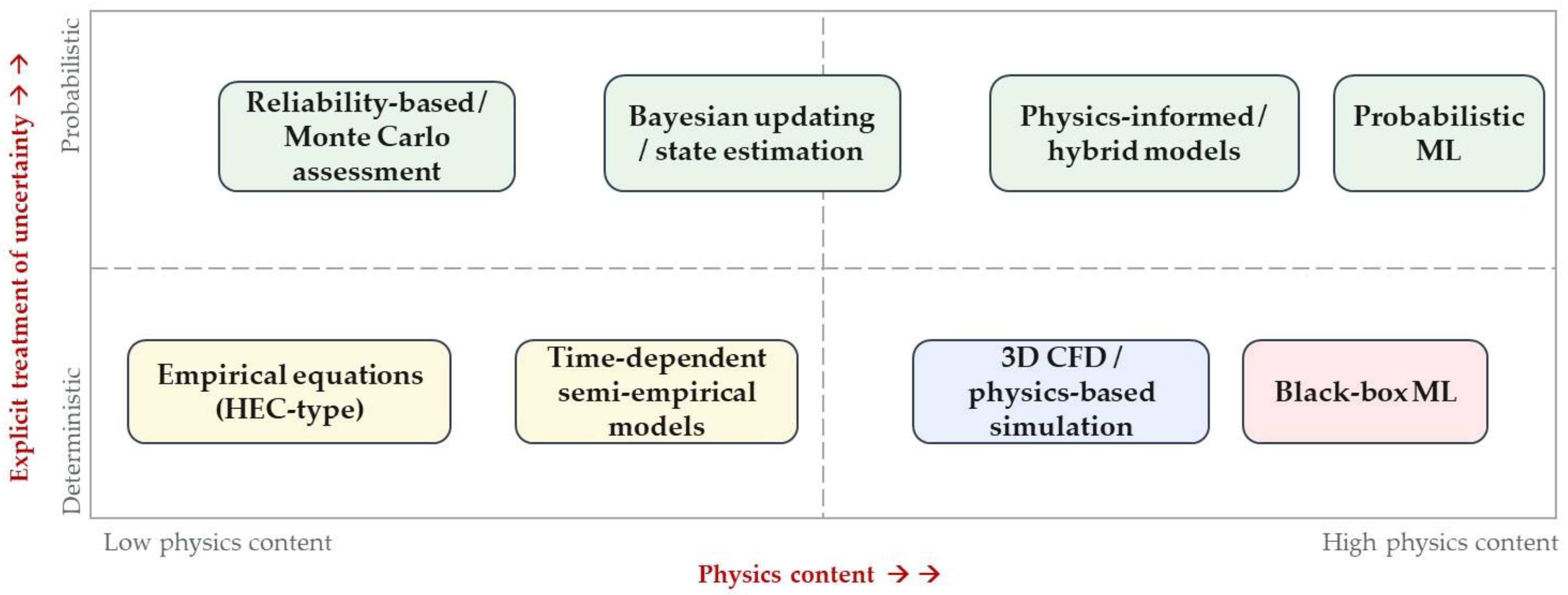
The modelling landscape can be read as a spectrum between operational simplicity and physical richness. Empirical equations remain the baseline for design and screening [6,25,26] because they are embedded in guidance and can be applied quickly, but their limitations are well known; Computational Fluid Dynamics (CFD) and three-dimensional numerical models offer richer physical resolution [27,28], while machine learning (ML) and hybrid approaches extend prediction toward site-specific forecasting and probabilistic output [29,30,31,32,33,34,35]. More in detail, Benedict and Knight [25], using both laboratory and field data, show that the HEC-18 pier-scour equation exhibits systematic conservatism and variable performance across conditions. Shan et al. [26] show, through the Federal Highway Administration (FHWA) NextScour (next-generation scour) programme, that the profession itself recognizes the need to modernize this modelling base.
Lai et al. [27] provide a clear state-of-the-art review of three-dimensional numerical modelling of local scour, and their main contribution is to show both what CFD can capture well and where it remains calibration-sensitive or computationally expensive. Yu et al. [28] then demonstrate a 3D local scour model based on an improved wall shear stress formulation, illustrating how numerical modelling can still be refined at the physics level.
At the other end of the spectrum, data-driven and hybrid approaches are increasingly used to improve both predictive performance and uncertainty treatment.
Machine-learning studies push the field in a different direction. Yousefpour et al. [30] introduce three ML methodologies for scour prediction based on monitoring data and show that bed elevation and water level can be forecast several days ahead, while Yousefpour and Wang [31] develop physics-inspired deep learning models that improve both site-specific performance and transferability. Choi et al. [32] use interpretable ML for probabilistic local scour prediction, and Khan and Ismael [33] connect interpretable ML to flood resilience, which is important because it makes the predictive output easier to use in decision contexts. Khan et al. [34] compare empirical and AI techniques for abutment scour, and Murtaza et al. [35] provide a broader review of AI and hybrid models for bridge-abutment scour depth prediction.
The literature therefore suggests that the question is not which model class is best in the abstract, but which model is fit for the purpose at hand. Empirical methods are still efficient for screening, CFD is valuable for understanding mechanisms, and ML or hybrid methods become most attractive when the goal is forecasting from monitoring data, uncertainty quantification, or transferability across sites.

4.4. Uncertainty Handed Downstream

The uncertainty at this stage of the chain comes from several sources at once: incomplete understanding of scour physics, parameter sensitivity in empirical formulas, numerical approximation in CFD, limited training data in ML, and weak transferability across sites and events. At this stage, uncertainty is dominated by model-form and epistemic components, arising from the representation of scour processes, parameter sensitivity, and the choice between empirical, numerical, and data-driven modelling approaches.
These uncertainties are handed downstream to monitoring and forecasting, where the relevant issue becomes not only the predicted scour depth, but the confidence attached to that prediction and its utility for real-time management.
The studies reviewed in this section confirm that scour prediction is affected not only by input uncertainty, but also by major differences in physical assumptions, temporal representation, and modelling strategy.
Figure 4 provides a visual synthesis of the modelling overview across physics content and uncertainty treatment. Complementing that overview, Table 2 summarizes the literature discussed in this section and provides a structured comparison of how empirical, time-dependent, CFD-based, and data-driven approaches contribute to scour-state estimation and uncertainty propagation.

5. Scour Monitoring and State Inference

Monitoring occupies a pivotal position in the pipeline because it is the first stage at which uncertainty can, in principle, be reduced rather than merely propagated. Yet scour monitoring is inherently difficult: the quantity of interest develops below water, under turbulent and debris-laden conditions, and often during the very period in which direct inspection is least feasible.

5.1. Direct Sensing

Direct sensing aims to observe scour or near-scour quantities as close as possible to the foundation, thereby reducing the interpretative distance between measurement and physical state.
Reviews and comparative assessments of monitoring methods [7,45,46,47,48] show why direct sensing remains attractive: if the sensor can interrogate the bed or a close scour-related proxy, the bridge manager does not need to infer scour only indirectly from structural response.
Maroni et al. [49] propose electromagnetic sensors for underwater scour monitoring, Liu et al. [50], Hatley et al. [51] and Lin et al. [52] explore and develop distributed fibre-optic approaches, and Rogers et al. [53] use underwater sonar scanning to measure the geometry of a developing scour hole.
These studies collectively show that direct sensing offers the cleanest state estimate, but also the hardest field deployment. Access, installation cost, maintenance, and survivability during floods all constrain operational use. For that reason, direct sensing is best understood as a reference standard for scour state inference rather than as a universally feasible option.

5.2. Indirect Vibration-Based Sensing

Indirect monitoring methods infer scour from changes in the dynamic response of the bridge–soil system rather than from direct observation of the riverbed. These approaches are attractive because sensors can be installed above water level and remain operational during flood events.
Prendergast et al. [54] provide a foundational framework by linking changes in modal properties to scour-induced loss of foundation support through vehicle–bridge–soil interaction modelling. Kariyawasam et al. [55] show, through centrifuge testing, that significant frequency shifts can occur under embedment loss, while Malekjafarian et al. [56] extend the methodology using mode shapes for multi-span bridges. Antonopoulos et al. [57] further improve interpretability by deriving impedance functions for scoured soil–foundation systems, and Boujia et al. [58] demonstrate how scour-sensitive sensing concepts can be combined with modelling for state inference.
Some authors test scour-evaluation methods based on ambient vibration measurements of the superstructure on cable-stayed bridges, showing (e.g., Chen et al. [59]) that frequency-based indicators can be linked to foundation conditions, or (e.g., Xiong et al. [60]) that lower-order vibration modes, particularly those associated with the pylon, are highly sensitive to scour.
More recently, Lin et al. [61] proposed a passive vibration-based approach validated through both flume experiments and in situ monitoring, showing that measured predominant natural frequencies can be correlated with time-dependent pier scour and can also provide warning information.
The recent full-scale work by Tubaldi et al. [62] is particularly valuable because it connects field evidence, structural response, and numerical interpretation in a soil–foundation–structure system directly affected by scour.
However, the sensitivity of modal properties to scour may vary across structural typologies. For instance, Scozzese et al. [63] show that, in masonry arch bridges, scour-induced shifts in natural frequencies may become appreciable only at relatively advanced stages of excavation, whereas transverse mode shapes may already exhibit detectable changes during the early stages of scour development. Long-term monitoring of masonry bridges may thus represent a valuable strategy, as evidenced by Borlenghi et al. [64], who show that direct measurements can be embedded into an operational monitoring workflow.
A limitation of indirect vibration-based sensing, however, is that dynamic response is not governed by scour alone. Traffic, temperature, water level, and soil variability all affect the measured signal. This is why the probabilistic treatment by Prendergast and Gavin [65] is important: detection capability itself is uncertain and depends on soil variability and threshold selection. Indirect sensing is therefore valuable not because it eliminates uncertainty, but because it provides informative evidence when coupled with an inference model.

5.3. Time–Frequency and Non-Stationary Signal-Processing Methods

Recent research (e.g., [40,54,55,62]) has highlighted the limitations of relying solely on global modal parameters for scour detection, because the modal changes may be small, foundation-dependent, and masked by operational variability, particularly under non-stationary loading conditions. Time–frequency and non-stationary signal-processing methods represent potentially more refined approaches for tracking the evolution of dynamic features over time.
A more advanced branch of this literature uses explicit time–frequency representations and trend detection. Xiong and Cai [66] propose a time–frequency-based scour-identification method coupled with trend-change detection, with the specific aim of separating scour-induced changes from interference-driven variability. O’Brien et al. [67] develop a wavelet-based operating-deflection-shape approach to locate scour-related stiffness losses in multi-span bridges, while Zhang et al. [68] propose a statistical wavelet-energy framework for scour detection using indirect measurements from a passing vehicle.
These methods are important because they move the field beyond the simple comparison of modal frequencies between healthy and scoured states. They aim instead to extract indicators that are more robust to non-stationary excitation and environmental variability. From a pipeline perspective, they also form a natural bridge toward forecasting and early warning, because they provide time-evolving indicators rather than static condition labels.

5.4. Remote and Non-Contact Multimodal Monitoring

Remote sensing contributes a different type of value to the scour problem: spatial reach. Gagliardi et al. [69] investigate the combination of InSAR with unsupervised machine learning clustering techniques for bridge monitoring; Selvakumaran et al. [70] show that InSAR stacking techniques can reveal precursor deformation associated with scour-induced instability, while Tonelli et al. [71] demonstrate the value of long-term satellite monitoring for interpreting bridge behaviour against environmental variables. Hou et al. [72] combine sonar with deep convolutional networks for underwater inspection of bridge substructures. At a broader level, Buka-Vaivade et al. [48] review monitoring technologies for flood-prone infrastructure and reinforce the value of multimodal monitoring strategies. Perugini and Tubaldi [73] complement this perspective by showing how low-cost remote sensing can support indirect bridge-scour monitoring through river-flow characterization in pilot applications.
However, the broader advantage of remote and other non-contact observation methods is not limited to spatial coverage alone. These approaches also enable the monitoring of bridge and river conditions without direct installation at the foundation, which is especially attractive under flood conditions. Within this broader class, vision-based systems occupy a distinct position. Rather than measuring structural effects of scour directly (see [74] for a typical structural monitoring application not specifically related to scour), they are more commonly used to track hydraulic or scour-related proxies such as water level, debris accumulation, exposed bed or foundation conditions, and other visually detectable changes. In this sense, vision-based monitoring is better interpreted as a tool for local situational awareness and event support than as a stand-alone method for structural inference of scour effects.
Remote sensing and vision-based methods therefore share an important characteristic: neither typically measures scour depth directly, but both can provide complementary evidence that helps contextualize bridge condition and constrain the interpretation of other measurements. Their main value lies in screening, contextualization, and multi-source observation across different spatial scales. This is also why multimodal monitoring is likely to be more useful than any single technology: different sensing modalities constrain different parts of the state-estimation problem.

5.5. Uncertainty Handed Downstream

Monitoring does not eliminate uncertainty; it reshapes it. Direct sensors reduce state uncertainty locally but may suffer from survivability or spatial sparsity. Indirect and remote methods increase spatial coverage and operational flexibility, but they introduce inverse-model uncertainty because measured vibration, tilt, or displacement must be translated into scour-relevant states. The downstream value of monitoring therefore depends on whether measurements are assimilated formally into predictive models and decision rules.
To sum up, at the monitoring stage, uncertainty is mainly measurement- and inference-related, as sensor noise, indirect observability, and model-based interpretation affect the reliability of the inferred scour state.
Table 3 provides a technology-oriented synthesis of the main scour monitoring modalities, focusing on what they measure, where they are typically deployed, and what type of inference they require before scour state can be assessed.
Complementing this overview, Table 4 provides an extended literature map of the studies discussed in this section. Together, the two tables show that no single monitoring modality provides complete and robust information under all flood conditions. Direct systems are generally closer to the physical scour state but are more exposed to installation and survivability constraints, whereas indirect and remote methods offer greater operational flexibility at the cost of stronger inference requirements.

6. From Monitoring to Forecasting

The operational value of monitoring depends on whether observed states can be converted into forecasts that are relevant to action. In bridge scour management, the central forecasting questions are not limited to current scour depth; they concern how fast scour may evolve, how much warning time remains before a critical condition is reached, and how uncertain that forecast is.

6.1. Model Updating and Data Assimilation

The transition from monitoring to forecasting depends on whether observations are used merely as alarms or are assimilated formally into predictive models. Maroni et al. [75] are important here because they frame scour management explicitly as a Bayesian updating problem using Bayesian networks for underwater scour assessment. Maroni et al. [76] extend this logic into a structural-health-monitoring-based classification system for bridge scour risk management.
A similar idea appears in the work of Yousefpour et al. [30], who use monitoring data not only for direct prediction but also for Bayesian calibration of empirical scour relationships. This is a crucial step because it turns monitoring into a mechanism for posterior uncertainty reduction rather than a purely descriptive add-on.

6.2. Early Warning and Forecast Horizons

Forecasting for bridge scour is valuable only if it is expressed over a decision-relevant horizon. Yousefpour and Correa [77] address this directly with an AI-based early-warning framework built on long-term field monitoring records, demonstrating that short-term scour evolution can be forecast with useful skill. Azhari and Loh [78] make the managerial relevance even clearer by reformulating the problem in terms of warning time: instead of asking only how deep scour is, they ask how much time remains before a critical threshold is reached. Lin et al. [79] move the literature toward explicit warning-time frameworks and operational early warning systems.
The literature on time–frequency and trend detection also contributes to this stage. Xiong and Cai [66] are particularly relevant because their trend-based formulation moves naturally toward early warning: the point is not merely to classify a scoured state, but to identify the onset and progression of a change trend that can inform intervention before a critical threshold is crossed.

6.3. Probabilistic Outputs and Validation

A recurring weakness in the literature is that sophisticated predictive models often produce outputs that are still used deterministically. Choi et al. [32] are particularly relevant because they provide calibrated prediction intervals and connect them to a reliability interpretation. Yousefpour and Wang [31] point in the same direction by showing that hybrid physics-informed models can improve robustness while remaining forecasting-oriented, while Kumar et al. [29] show that ensemble ML can predict time-dependent scour depth around circular piers. Khan and Ismael [33] improve interpretability, but field transferability remains an open issue.
The main lesson is that probabilistic output is a necessary condition for risk-informed bridge decisions, but not yet a sufficient one. Forecasting models must still demonstrate robustness under real hydrologic variability, sensor noise, missing data, and cross-site transfer.

6.4. Uncertainty Handed Downstream

The uncertainty in this section is passed forward in a particularly important way.
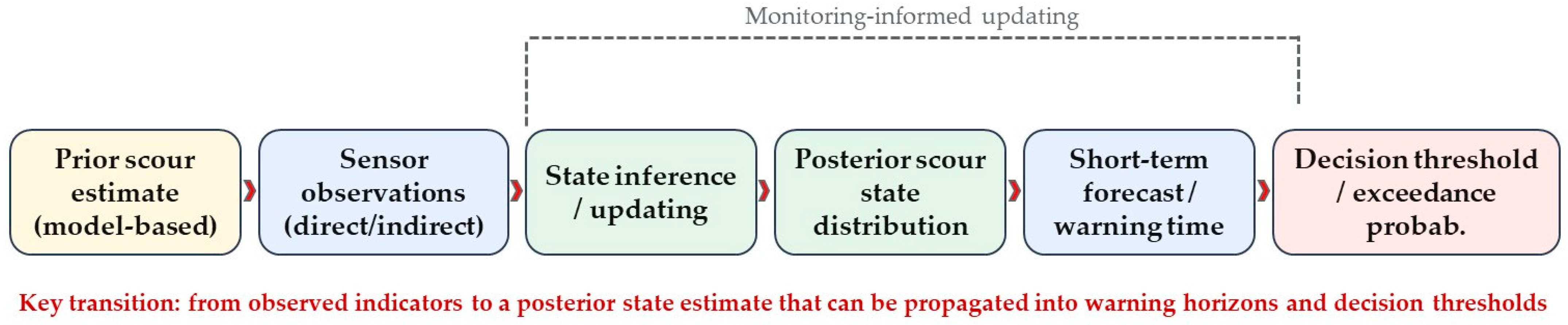
Uncertainty is transformed into predictive uncertainty, combining epistemic and data-driven components, and is expressed in terms of forecast reliability, lead time, and probability of threshold exceedance. Hence, uncertain state estimates become uncertain forecasts, and uncertain forecasts become uncertain trigger decisions. If monitoring data are sparse, noisy, or indirect, then the forecast must propagate that imperfection into the lead time and the probability of threshold exceedance. Early warning is therefore an uncertainty-management problem as much as a prediction problem. The quantity that should be handed to the decision stage is therefore not a forecasted state alone, but a probability of exceedance together with the expected warning time and its confidence bounds.
Figure 5 schematically summarizes the logic of monitoring-informed updating from measurements to warning thresholds. Complementing this schematic, Table 5 synthesizes the studies reviewed in this section and highlights how current approaches differ in their ability to support monitoring-informed forecasting and early warning under uncertainty.

7. Structural Vulnerability and Risk-Informed Bridge Decisions

7.1. From Scour State to Structural Consequences

A bridge management framework becomes decision-relevant only when scour estimates are translated into structural consequences. This step is essential because equal scour depths do not imply equal risk across bridge typologies, foundation systems, boundary conditions, or flood contexts.
Pucci et al. [2] derive fragility from bridges damaged during the 2021 flood in Germany, which is valuable because it ties observed damage directly to flood loading.
Argyroudis and Mitoulis [80] show that bridge vulnerability under flooding is shaped not only by scour depth but by the interaction between scour, hydrodynamic actions, and bridge typology, especially when multiple hazards are considered. Ahamed et al. [81] deepen this point by developing fragility surfaces that combine flow and scour intensity measures while considering geotechnical uncertainty. Kazantzi et al. [82] move toward a unified probabilistic flood-fragility framework in which different scour-severity scenarios are embedded explicitly.
Part of the literature focuses on masonry bridges, which are both widespread and vulnerable to scour-induced support loss. Scozzese et al. [63] and Zampieri et al. [83] contribute to the understanding and characterization of failure mechanisms in masonry arch bridges subject to local pier scour, while Scozzese et al. [84] identify damage descriptors and metrics that are directly applicable to fragility analysis.
Mendoza Cabanzo et al. [85] provide a fragility-oriented complement for in-plane bridge response under flood-induced scour, while Dhir et al. [86] show how robustness assessment under multiple traffic-load models can enrich the interpretation of scour-induced damage. George and Menon [87] add a kinematic perspective for scour analysis in masonry arch bridges.
Taken together ([80,81,82,83,84,85,86,87]), these studies show that fragility and structural consequence are the stages at which hydraulics, geotechnics, and structure finally meet, and that this meeting is inherently probabilistic.

7.2. Operational Decisions

Operational decisions are short-term actions taken during or immediately before hazardous events. They include warning issuance, traffic restriction, speed limitation, lane closure, and full bridge closure. These actions are inherently asymmetric: a false negative may lead to collapse or severe damage, whereas a false positive may cause unnecessary disruption and user costs.
Maroni et al. [76,88] and Azhari and Loh [78] are especially relevant because they connect monitoring to thresholds and operational triggers. In particular, Maroni et al. [76] provide an important step by aggregating heterogeneous sensing information into a real-time scour-risk classification, and then [88] move one step closer to management by translating updated information into adaptive water-level thresholds for bridge operation. Azhari and Loh [78] support the same logic from a warning-time perspective, because the operational usefulness of any threshold depends on how much time it leaves for traffic control, inspection, or emergency response.
The practical meaning of this literature is that operational decisions are probabilistic threshold decisions. The manager acts under uncertainty, and the monitoring system is valuable precisely because it reduces that uncertainty enough to justify a threshold crossing.

7.3. Tactical and Strategic Decisions

Not all bridge decisions occur during flood events. Tactical decisions concern targeted inspection, temporary protection, monitoring deployment, or post-event mitigation. Strategic decisions concern retrofit prioritization, budget allocation, and network-level adaptation under climate change.
Pregnolato et al. [8] make this problem explicit by comparing risk-based scour management methods, while Liu et al. [89] exemplify the network-level perspective by optimizing bridge adaptation management under scour and climate-change scenarios. Sasidharan et al. [90] extend this toward risk-informed asset management across transport networks by incorporating disruption and whole-life implications into scour management. Abdel-Mooty et al. [91] provide a complementary prioritization framework through strategic susceptibility assessment at network scale. Brighenti et al. [92] further enrich this perspective by proposing a risk-based decision-support system for ranking operational scenarios through probabilistic reliability, deterioration modelling, exposure, and cost.
These studies show that tactical and strategic decisions require not just better physical models, but better integration between risk representation, consequence modelling, and portfolio priorities. The key question is not only whether one bridge is vulnerable, but which combination of monitoring, mitigation, and intervention yields the greatest risk reduction per unit cost across the network.

7.4. Decision Uncertainty and Value of Information

Decision uncertainty is the final and often least explicit stage of the pipeline. It includes uncertainty in threshold definition, in the consequences assigned to failure or closure, and in acceptable residual-risk levels. It also includes institutional uncertainty, because two agencies may respond differently to the same posterior scour estimate.
Giordano et al. [93] provide the foundational framework by asking whether additional monitoring information actually improves decisions for scoured bridges compared with a no-monitoring baseline. Giordano et al. [94] extend this by quantifying the value of structural-health-monitoring information for bridges under flood-induced scour. Giordano and Limongelli [95] add that the benefit of informed risk-based management depends strongly on how the decision problem is framed. Pregnolato et al. [8] provide a useful meta-level comparison of risk-based scour-management methods and therefore help place value-of-information approaches within the broader landscape of decision support. Taken together, this work and that of Sasidharan et al. [12] are important because they show that decision uncertainty is not a side issue, but it is rather the quantity that monitoring is intended to reduce.
The resulting message is clear: decision support for bridge scour should move beyond threshold checking toward value-aware probabilistic decision frameworks. In such frameworks, the relevant output is not simply whether a bridge is currently safe, but how different actions compare when residual uncertainty, action costs, and failure consequences are considered jointly.

7.5. Uncertainty Handed Downstream

By the time the pipeline reaches the decision layer, uncertainty has changed its form several times. It begins upstream as climate and flood variability, is transformed into scour-state uncertainty through hydraulic and morphodynamic models, is partially reshaped by monitoring and forecasting, and finally appears at this stage as decision-related uncertainty, reflecting ambiguity in threshold definition, consequence modelling, and acceptable levels of residual risk.
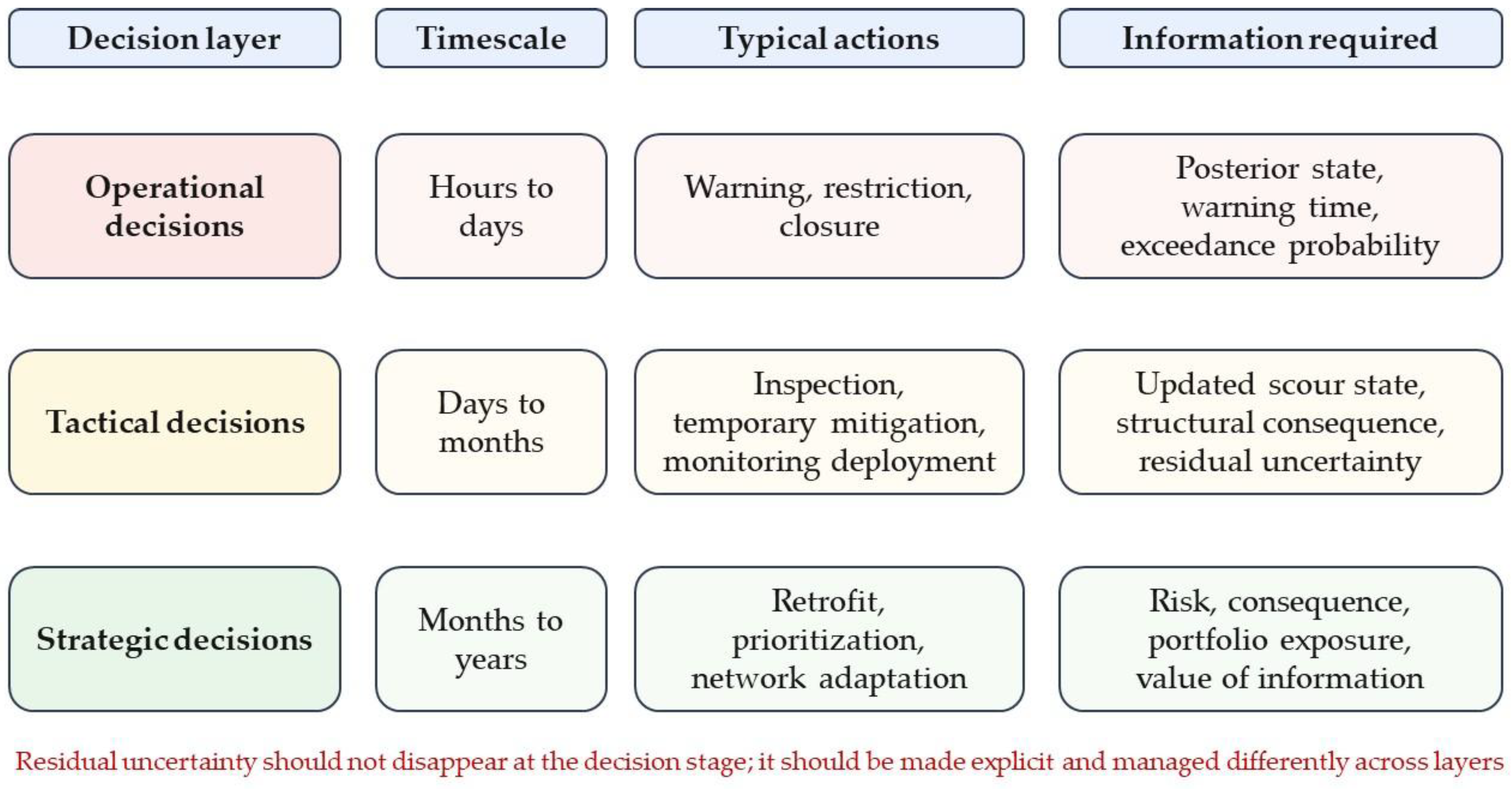
The decision stage should not be treated as the place where uncertainty disappears, but as the stage where residual uncertainty must be made explicit and managed.
The studies reviewed in this section show that the final translation from scour state to bridge decision depends on fragility representation, decision logic, consequence modelling, and the explicit valuation of information. Figure 6 summarizes this idea by distinguishing operational, tactical, and strategic decision layers. Complementing that framework, Table 6 provides a structured overview of how vulnerability, operational decision-making, strategic management, and value-of-information analyses are currently addressed.

8. Discussion: Cross-Stage Gaps and Research Agenda

This section discusses the main cross-stage implications emerging from the reviewed literature. The aim is to interpret the gaps identified in the previous sections jointly and to clarify where the current bridge-scour literature remains fragmented when viewed as a flood-to-decision chain.
Within this perspective, uncertainty is not treated as a stand-alone problem to be eliminated, but as the descriptive thread used in this review to connect the different stages of the chain and to examine how information is generated, transformed, reduced, or lost from hazard characterization to bridge decisions. The main discussion point emerging from the review is that important methodological advances already exist within individual subfields, whereas the weakest points still lie at the interfaces between them.
This discussion is structured as follows: Section 8.1 identifies the main cross-stage gaps emerging from the reviewed literature; Section 8.2 discusses the methodological directions that already emerge from the studies reviewed in this paper; and, on this basis, Section 8.3 outlines the main priorities for next-generation flood-to-decision workflows.

8.1. Evidence from the Reviewed Literature on Weak Interfaces

A central finding of this review is that the main weakness of the current literature lies less in the sophistication of individual methods than in the weak coupling between them.
As shown by the literature reviewed in this paper, the flood-to-decision chain contains several recurrent interfaces at which uncertainty information is compressed, simplified, or lost before it reaches the next stage.

8.1.1. Hazard Characterization Versus Bridge-Scale Hydraulics

The reviewed flood-hazard literature already shows that hydraulic demand should be treated as non-stationary, scenario-dependent, and probabilistic rather than as a single design discharge. Francois et al. [9] provide the broad hydrologic argument for moving beyond stationarity, Byun and Hamlet [10] translate this into a risk-based framework for infrastructure standards, and Yang and Frangopol [11] explicitly connect changing hazard regimes to regional scour risk. Sasidharan et al. [12], Habeeb and Bastidas-Arteaga [15], and Mondoro et al. [16] further show that bridge exposure and management decisions are already conditioned by climate uncertainty. However, when the discussion moves downstream to bridge-scale hydraulics, the quantities that actually drive scour—local depth, contraction, turbulence structure, and event duration—are still often transferred as nominal values rather than as probabilistic descriptors [17,18,19,20]. The interface is therefore weak because upstream hazard variability is acknowledged but not consistently preserved when translated into local hydraulic demand.

8.1.2. Bridge-Scale Hydraulics Versus Scour Prediction

The second weak interface appears when hydraulic demand is converted into scour estimates. The reviewed literature makes clear that the resulting scour depth is not a unique consequence of the hydraulic input, but depends strongly on the model class, temporal representation, and embedded assumptions. Baranwal and Das [6] show that no single empirical formulation performs robustly across all regimes, while Cheng et al. [22] demonstrate that time dependence is not an empirical correction but a consequence of the governing physics. Pizarro and Tubaldi [23] show that the uncertainty associated with the temporal representation of scour may exceed that associated with the equilibrium formula itself, and Rathod and Manekar [24] confirm that parameter uncertainty can materially alter predictions even within standard empirical workflows. The reviewed work therefore shows that the hydraulics-to-scour interface remains weak because detailed hydraulic descriptions are still too often channelled into single-model or single-scenario scour estimates.

8.1.3. Scour State Versus Monitoring Inference

A third discontinuity emerges between scour prediction and monitoring-based state inference. Direct sensing studies show that scour or near-scour quantities can be measured close to the foundation [49,50,51,52,53], while indirect vibration-based approaches show that structural response contains useful information on support loss and embedment changes [54,55,56,57,58,62,65]. However, most monitoring studies still demonstrate correlation or sensitivity rather than performing explicit probabilistic state estimation. The distinction is important. Prendergast et al. [54] and Antonopoulos et al. [57] provide interpretive frameworks linking dynamic features to scour-related support loss, and Maroni et al. [75] go further by embedding monitoring information into a Bayesian network. Yet these examples remain exceptions rather than the norm. The literature therefore suggests that the main weakness at this interface is not the lack of sensing capability, but the lack of explicit observation models that translate measured quantities into posterior scour-state distributions.

8.1.4. Monitoring Versus Forecasting

The reviewed literature also reveals a persistent gap between state estimation and prediction. Several studies now show that observations can inform short-term forecasting and warning-time assessment. Yousefpour et al. [30] combine monitoring data with Bayesian calibration of predictive relationships; Yousefpour and Correa [77] show that short-term scour evolution can be forecast with useful skill; Azhari and Loh [78] recast the problem in terms of warning time; and Lin et al. [79] demonstrate an AIoT-based operational early-warning architecture. In parallel, hybrid and probabilistic forecasting studies [29,30,31,32,33] indicate that predictive skill, uncertainty treatment, and interpretability are improving. Nevertheless, most forecasting applications remain bridge-specific, trained on limited data, or only partially validated under real flood conditions. The interface is therefore weak because forecasting is emerging, but not yet sufficiently generalized, benchmarked, or validated across sites and events.

8.1.5. Forecasts Versus Decisions

The final weak interface lies between probabilistic prediction and management action. This is the stage at which the literature becomes the most unbalanced: uncertainty is increasingly treated upstream, but decisions are still often made through deterministic trigger rules. Maroni et al. [76] show how monitoring outputs can be aggregated into an SHM-based scour-risk classification, Azhari and Loh [78] demonstrate that warning logic is meaningful only when expressed in terms of available warning time, and Maroni et al. [88] show how adaptive water-level thresholds can be derived for bridge operation. At a broader level, Pregnolato et al. [8] compare risk-based scour-management methods, Brighenti et al. [92] rank intervention scenarios through a predictive DSS, and Giordano et al. [93,94,95] demonstrate how value-of-information reasoning can translate residual uncertainty into decision value. The reviewed literature therefore indicates that the forecast-to-decision interface is weak not because no decision frameworks exist, but because probabilistic outputs are still only partially connected to trigger design, the asymmetric consequences of false alarms and missed alarms, and value-based management.
Taken together, these studies show that the weakest points of the flood-to-decision chain are not located within single disciplinary domains, but at the interfaces between them.

8.2. Methodological Directions Already Emerging from the Reviewed Studies

The reviewed literature not only exposes the gaps outlined above, but also suggests several methodological directions for reducing them. These directions are still partial and unevenly developed, but they already point toward a more coherent probabilistic treatment of bridge scour across stages.

8.2.1. Toward Explicit Uncertainty Propagation Across Stages

One of the clearest methodological directions is the replacement of deterministic stage-to-stage hand-offs with probabilistic transfers. Non-stationary hazard frameworks [10,11,12,14,15] already suggest that bridge loading should be treated as a family of plausible future scenarios rather than as a single event. Probabilistic scour-risk modelling under multiple events [23] shows how this logic can be extended into the morphodynamic stage, while value-of-information-based decision studies [93,94,95] demonstrate that decision support becomes more informative when uncertainty is preserved up to the final stage. What remains missing is not the conceptual basis, but the systematic integration of these elements into a consistent end-to-end chain in which the output of one stage is passed forward as a distribution, ensemble, or posterior state rather than as a nominal scalar.

8.2.2. Probabilistic Updating and State Estimation

A second methodological direction concerns the formal use of monitoring data for posterior updating. The most relevant examples reviewed in this paper are those of Yousefpour et al. [30], who combine monitoring data with Bayesian calibration of scour relationships, and Maroni et al. [75,76], who show how probabilistic updating and classification can be used to support scour management. These studies point toward state-space or Bayesian-network-type formulations in which the scour condition is treated as a hidden state updated through observations. The practical implication is that future work should move beyond simple sensitivity studies and formulate the following more explicitly: (i) a process model for scour evolution; (ii) an observation model linking measured quantities to state variables; and (iii) a posterior update rule producing uncertainty-aware state estimates.

8.2.3. Monitoring-Informed Forecasting

A third clear direction is the emergence of monitoring-informed forecasting as a bridge between state estimation and decision-making. Yousefpour et al. [30], Yousefpour and Correa [77], Azhari and Loh [78], and Lin et al. [79] collectively show that forecasting should not be reduced to predicting scour depth alone. Instead, the more decision-relevant outputs are warning time, threshold exceedance probability, and confidence bounds on short-term evolution. Xiong and Cai [66] reinforce this trend by showing how trend-change detection can support early recognition of dangerous evolution rather than a posteriori classification. The operational implication is that forecasting frameworks should be evaluated not only in terms of prediction error, but also in terms of lead time, false-alarm rate, missed-warning rate, and robustness under sparse or noisy monitoring conditions.

8.2.4. Field Validation of ML and Hybrid Models

The reviewed forecasting literature also points to a major methodological direction that remains only partially developed: systematic field validation of data-driven and hybrid models. Ensemble ML [29], physics-informed deep learning [31], interpretable probabilistic ML [32], interpretable resilience-oriented ML [33], and newer hybrid or augmented-data approaches [41,42,43] all improve predictive capability in different ways. However, their validation is still typically limited by bridge specificity, restricted event sets, or partial transferability tests. In contrast, full-scale and long-term field studies such as Tubaldi et al. [62] and Borlenghi et al. [64] provide the kind of real-world monitoring evidence that future predictive models should increasingly exploit. This suggests that the next methodological step is not simply improving algorithms, but embedding them in shared field-validation protocols based on real event sequences, site transfer, and long-duration observation records.

8.2.5. Multimodal and Multi-Scale Sensing

A further direction already visible in the reviewed literature is the move from single-sensor strategies to multimodal monitoring. Reviews of scour monitoring methods [46,47,48] consistently show that no single sensing strategy can fully resolve the scour state under all flood conditions. Direct sensors [49,50,51,52,53] provide local state information; indirect vibration-based approaches [54,55,56,57,58,62,65,66,67,68] provide operationally attractive proxies; InSAR, sonar, and other remote/non-contact strategies [69,70,71,72,73] extend observation in space and scale. Maroni et al. [76] show how heterogeneous information can already be combined into a decision-oriented classification framework. The methodological implication is that future monitoring architectures should be designed explicitly as data-fusion systems, in which direct, indirect, and remote observations are combined through probabilistic updating rather than evaluated as isolated alternatives.

8.2.6. Threshold Design and Trigger Optimization

The reviewed decision-oriented literature also points toward a more rigorous treatment of thresholds. Warning-time formulations [78], adaptive threshold frameworks [88], and SHM-based risk classification [76] indicate that threshold design should be treated as a model-based problem rather than as a conventional rule adopted by the managing authority. What remains insufficiently developed is the optimization of thresholds under different penalties for false alarms and missed alarms, lead-time constraints, and uncertainty in both state estimation and consequences. The key methodological direction, therefore, is to treat warning classes, closure triggers, and intervention rules as decision variables informed by exceedance probability, warning time, and residual uncertainty.

8.2.7. Value-of-Information-Based Decision-Making

Finally, the reviewed literature already shows that value-of-information approaches provide one of the most mature methodological directions for closing the final interface in the chain. Pregnolato et al. [8] provide the broader management comparison, while Giordano et al. [93,94] and Giordano and Limongelli [95] show that monitoring value can be formulated explicitly in terms of economic benefit, risk reduction, and improved decision quality. The practical implication is that monitoring should increasingly be justified not only by technical detectability, but by its contribution to better decisions relative to its cost. This is especially important for network-level management, where monitoring deployment, inspection, temporary mitigation, and retrofit compete for limited resources.
Overall, the reviewed studies already provide many of the methodological building blocks needed for a more integrated probabilistic treatment of bridge scour. What remains lacking is their systematic combination into workflows that preserve uncertainty, update it through observations, and translate it into action-relevant metrics.

8.3. Priorities for Next-Generation Flood-to-Decision Workflows

Based on the evidence reviewed above, several operational priorities emerge for next-generation bridge scour workflows.

8.3.1. Priority 1: Event-Based Benchmark Datasets

A major barrier to integration is the lack of shared datasets linking flood forcing, bridge-scale hydraulics, scour evolution, monitoring records, and observed structural or operational outcomes. Existing studies tend to illuminate single stages or single assets. Future progress therefore requires benchmark datasets in which hydrologic, hydraulic, sensing, and consequence information are co-documented over real events. This is particularly important for validating monitoring-informed and ML/hybrid approaches under field conditions.

8.3.2. Priority 2: Probabilistic State Representations

Future workflows should pass forward not a single discharge, scour depth, or warning class, but a probabilistic representation of system state. This means treating hydraulic demand as scenario ensembles, scour as a probabilistically evolving state, monitoring as an updating mechanism, and decision thresholds as functions of exceedance probability and consequences. Bayesian or state-space formulations are the most natural candidates for this transition [30,75,76]. Moreover, recent developments in interpretable AI for physical-systems data further suggest that future predictive frameworks may benefit from probabilistic and interpretable representations that combine uncertainty quantification with transparent model behaviour [97].

8.3.3. Priority 3: Field and Cross-Event Validation for Forecasting Models

Field validation should become a design requirement rather than an optional component. This means testing ML and hybrid models not only on bridge-specific records, but across different structures, river regimes, monitoring architectures, and event severities. Cross-site transferability, event-to-event generalization, and robustness to missing or noisy observations should become standard validation dimensions [29,30,31,32,33,62,64,77].

8.3.4. Priority 4: Multimodal Data Fusion

The future challenge is not simply to deploy more sensors, but to fuse measurements from direct, indirect, and remote modalities into coherent posterior state estimates. This requires explicit observation models, synchronization strategies, and probabilistic data-fusion architectures capable of weighting information according to quality, spatial representativeness, and uncertainty [46,47,48,69,70,71,72,73,74,75,76].

8.3.5. Priority 5: Warning-Threshold Optimization

Operational decision-making should move beyond fixed trigger levels. Thresholds should be calibrated in relation to warning time, the asymmetric consequences of false alarms and missed alarms, traffic disruption costs, and residual uncertainty. This implies closer coupling between forecasting outputs, operational classification, and consequence models [76,78,88,92].

8.3.6. Priority 6: Value-of-Information-Based Decision Design

The choice to monitor, inspect, close, protect, or retrofit should increasingly be assessed in terms of expected value rather than only technical feasibility. Value-of-information methods provide a rigorous way to compare action alternatives under uncertainty and to quantify whether additional information is worth acquiring before a decision is made [8,93,94,95].

8.3.7. Priority 7: Modular End-to-End Workflows

The literature already contains strong methods at many single stages, but the main future gain will come from connecting them. The next generation of bridge scour research should therefore prioritize modular workflows in which hazard characterization, scour modelling, monitoring, forecasting, and decision support are interoperable and uncertainty-aware by construction.
Taken together, these priorities suggest a shift in emphasis. The next advances in bridge scour management are unlikely to come from isolated gains in predictive accuracy alone; they will come from making the entire flood-to-decision chain more coherent, more readily updated, and more decision-relevant.

9. Conclusions

This review has examined bridge scour not as an isolated hydraulic or structural problem, but as an end-to-end uncertainty chain linking flood hazard, bridge-scale hydraulics, scour processes, monitoring, forecasting, structural vulnerability, and bridge decisions. The first original contribution of the manuscript is therefore organizational: it reorganizes a fragmented literature into a single flood-to-decision framework that is directly relevant to bridge management under flood risk, using uncertainty as a unifying element across the stages of the flood-to-decision chain.
A second scientific insight is that the dominant uncertainty changes systematically along this chain. Upstream, uncertainty is largely associated with non-stationarity, climate variability, and imperfect hazard characterization. In scour prediction, it is dominated by process representation, temporal modelling, and parameter sensitivity. In monitoring, it is reshaped by indirect observability, sensor limitations, and inference assumptions. At the decision stage, uncertainty becomes primarily threshold-, consequence-, and value-related. One of the clearest results of the review is that these forms of uncertainty are still too often compressed into deterministic outputs before reaching the final management stage.
A third scientific insight is that the weakest points of the literature are not located within individual subfields, but at the interfaces between them. The most critical discontinuities arise in the transfer from non-stationary hazard assessment to bridge-scale hydraulic demand, from hydraulic demand to scour prediction, from scour state to monitoring inference, from monitoring to forecasting, and from probabilistic forecasts to decisions. These are precisely the stages at which uncertainty is most often simplified, rather than propagated, updated, or translated into action-relevant terms.
At the same time, the review shows that the methodological building blocks needed to improve this situation already exist. Scenario-based hazard formulations and climate-aware bridge-risk studies already point toward more explicit upstream uncertainty representation. Probabilistic scour modelling under multiple events shows how temporal and model-form uncertainty can be carried further downstream. Bayesian updating and monitoring-informed forecasting demonstrate that observations can be used to produce posterior state estimates and warning-relevant forecasts rather than merely descriptive indicators. Multimodal sensing studies indicate that no single monitoring technology is sufficient under all flood conditions, while value-of-information-based decision frameworks show how residual uncertainty can be translated into management value rather than suppressed at the final stage.
The resulting message is not simply that bridge scour remains a major source of bridge vulnerability. Rather, it is that bridge scour management remains limited by deterministic hand-offs between disciplines, even when probabilistic methods are already available within individual stages. The main value of this review lies in making those weak interfaces explicit, in showing how uncertainty propagation can serve as a unifying framework across otherwise disconnected literatures, and in identifying which methodological directions are most promising for connecting prediction, monitoring, and decision support into a coherent chain.
The most promising next step is therefore the development of modular, end-to-end probabilistic workflows in which uncertainty is preserved across interfaces, updated through observations, and translated into decision-relevant metrics such as warning time, exceedance probability, asymmetric consequences of false alarms and missed alarms, and value of information. This is the condition required for bridge management to move from reactive inspection toward predictive, risk-informed, and climate-resilient practice.

Funding

This research received no external funding.

Data Availability Statement

No new data were created or analyzed in this study. Data sharing is not applicable to this article.

Acknowledgments

This research was supported by the FABRE Research Consortium for the Assessment and Monitoring of Bridges, Viaducts, and Other Structures (https://www.consorziofabre.it/en). During the preparation of this manuscript, the author used ChatGPT (OpenAI), based on the GPT-5.4 model, to generate some individual visual components used in Figure 2; the conceptual design of the figure, its structure, and its scientific meaning were entirely defined by the author, and the final composition was assembled manually.

Conflicts of Interest

The author declares no conflicts of interest.

Abbreviations

The following abbreviations are used in this manuscript:
AIArtificial intelligence
AIoTArtificial intelligence of things
CFDComputational fluid dynamics
FHWAFederal Highway Administration
HEC-18Hydraulic Engineering Circular No. 18
HEC-RASHydrologic Engineering Center’s River Analysis System
InSARInterferometric Synthetic Aperture Radar
MLMachine learning
OMAOperational modal analysis
PRISMAPreferred Reporting Items for Systematic Reviews and Meta-Analyses
SHMStructural health monitoring
SSISoil–structure interaction
VoIValue of information

Appendix A

This appendix provides a consolidated classification of the reviewed literature across the full flood-to-decision pipeline. For each reference, the table reports its main location in the review, additional secondary placements where relevant, a concise typological tag, the dominant type of uncertainty addressed, and a one-line statement of its specific contribution to the present synthesis. The appendix is intended as a reading aid and cross-navigation tool, complementing the section-specific tables presented in the main text.
Table A1. Master table of all studies reviewed in this paper.
Ref.StudyI-SubII-Sub(s)Short DescriptionRole in the ReviewDominant
Uncertainty
[1]Xiong et al. (2023)3.17.1Historical review of hydraulic bridge failures, including scour, floods, and failure mechanisms.Opening context; failure statistics.Aleatory
[2]Pucci et al. (2023)7.13.1Empirical fragility evidence from bridges damaged during the 2021 German flood.Flood-to-damage link.Epistemic
[3]D’Angelo et al. (2025)3.17.1, 7.3Statistical survey of bridge collapses in Italy, linking failures to hydraulic and extreme-event context.Collapse statistics and hazard context.Aleatory
[4]Perugini et al. (2025)Intro./
Figure 1 context
Post-flood survey dataset related to the 2022 Marche flood.Contextual field evidence motivating the review.Measurement
[5]Pizarro et al. (2020)4.14.2, 4.3Holistic review of bridge scour physics, modelling, monitoring, and assessment.Backbone scour review.Model-form
[6]Baranwal and Das (2024)4.34.1, 4.2Comparative benchmark of scour-depth equations across clear-water and live-bed regimes.Empirical-model benchmark.Model-form
[7]Kazemian et al. (2023)5.15.2, 5.3Review of bridge-scour-monitoring techniques, with emphasis on vibration-based developments.Monitoring overview.Measurement
[8]Pregnolato et al. (2023)7.37.4Comparative assessment of risk-based methods for bridge scour management.Decision-framework benchmark.Decision
[9]François et al. (2019)3.18.1Review of flood estimation under climate non-stationarity and implications for design.Flood-hazard context.Aleatory
[10]Byun and Hamlet (2020)3.18.1Risk-based analytical framework for non-stationary flood hazards and infrastructure standards.Non-stationary hazard quantification.Aleatory
[11]Yang and Frangopol (2019)3.18.1Physics-based hydrologic modelling linking climate change to long-term regional bridge scour risk.Climate-driven scour-risk framing.Aleatory
[12]Sasidharan et al. (2023)7.33.1, 7.4, 8.1Climate-aware scour-risk management framework propagating uncertainty through the hazard chain.Strategic adaptation under climate uncertainty.Decision
[13]Bhatkoti et al. (2016)3.1Quantifies how projected changes in flood magnitude alter bridge flood risk.Hazard projection.Aleatory
[14]Solan et al. (2019)3.17.1Shows that flow choking and increased discharges amplify scour vulnerability in masonry arch bridges.Bridge between climate hazard and structural vulnerability.Aleatory
[15] Habeeb and Bastidas-Arteaga (2023)3.18.1Bridge-focused assessment of climate change and flooding using scenario-based analysis.Bridge hazard exposure.Epistemic
[16]Mondoro et al. (2018)7.33.1, 8.1Review of bridge adaptation and management strategies under climate-change uncertainty.Adaptation strategy.Decision
[17]Ashraf et al. (2022)3.23.1, 7.1Analysis of flood behaviour at documented bridge-collapse sites to explain local hydraulic actions.Hydraulic action at failure sites.Epistemic
[18]Yang et al. (2021)3.24.1Large-scale experiments on dynamic morphology in bridge-contracted channels during extreme floods.Bridge-scale hydraulics.Epistemic
[19]Yang et al. (2024)4.13.2Experimental delineation of scour processes, patterns, and depths in bridge-contracted channels.Scour mechanism.Model-form
[20]Arora and Banerjee (2024)3.2Coupled hydraulic–structural framework linking flood hydraulics, scour, and bridge vulnerability.Structural consequences under flood loading.Model-form
[21]Hong and Abid (2019)4.14.2Time evolution of scour around a riprap-protected erodible abutment.Abutment scour process.Model-form
[22]Cheng et al. (2016)4.24.1Scaling-based derivation of the exponential law for time-dependent pier scour.Equilibrium/time-dependent scour anchor.Model-form
[23]Pizarro and Tubaldi (2019)4.27.4, 8.2Quantifies modelling uncertainty in scour risk assessment under multiple flood events.Probabilistic scour evolution.Model-form
[24]Rathod and Manekar (2020)4.24.3Quantifies parameter uncertainty and sensitivity in the HEC-RAS CSU scour model.Model uncertainty.Model-form
[25]Benedict and Knight (2017)4.3Evaluation of the HEC-18 pier-scour equation against laboratory and field data.Empirical benchmark.Model-form
[26]Shan et al. (2020)4.34.2Describes the NextScour initiative for improving bridge scour design practice.Design-method revision.Model-form
[27]Lai et al. (2022)4.34.1State-of-the-art review of 3D numerical modelling of local scour.CFD/numerical anchor.Model-form
[28]Yu et al. (2024)4.34.13D numerical model of local scour around bridge foundations using improved wall shear stress.Numerical modelling example.Model-form
[29]Kumar et al. (2023)4.26.3, 8.2Ensemble ML models for time-dependent scour prediction around circular piers.Data-driven forecasting bridge.Epistemic
[30]Yousefpour et al. (2021)6.14.3, 6.3, 8.2Monitoring-informed scour forecasting and Bayesian calibration of empirical models.Monitoring-to-forecast updating.Epistemic
[31]Yousefpour and Wang (2025)4.36.3, 8.2Physics-inspired deep learning for site-specific and transferable scour prediction.Hybrid prediction model.Epistemic
[32]Choi et al. (2025)4.36.3, 7.4, 8.2Probabilistic and interpretable ML for local scour prediction with reliability-oriented outputs.Uncertainty-aware prediction.Epistemic
[33]Khan and Ismael (2026)4.36.3, 7.4, 8.2Interpretable ML framework for bridge-pier scour prediction linked to resilience-oriented use.Prediction-to-decision usability.Epistemic
[34]Khan et al. (2024)4.34.1Comparative study of empirical and AI methods for bridge-abutment scour prediction.Method comparison.Model-form
[35]Murtaza et al. (2025)4.34.1Review of AI and hybrid models for bridge-abutment scour prediction.ML/hybrid synthesis.Model-form
[36]Harasti et al. (2021)4.14.2Review of scour at piers protected by riprap, showing how countermeasures alter flow field and erosion patterns.Scour mechanisms with countermeasures.Model-form
[37]Solan et al. (2020)4.17.1Highlights the exposure and vulnerability of short-span masonry arch bridges to localized scour processes.Typological vulnerability context.Epistemic
[38]Hamidifar et al. (2021)4.24.3Evaluates hybrid scour models combining depth equations and critical velocity, highlighting parameter sensitivity.Hybrid modelling and parameter sensitivity.Model-form
[39]Bento et al. (2023)4.24.3CFD model validated against experiments for scour at oblong piers with high predictive accuracy.CFD validation against laboratory data.Model-form
[40]Kosić et al. (2025)4.25.2Shows that scour-hole geometry affects soil stiffness and should be included in SSI modelling.Improved SSI modelling of scour effects.Model-form
[41]Li (2025)4.34.1, 8.2Physics-informed ML linking turbulence, drag, and scour depth through symbolic regression.Bridge between process physics and ML.Epistemic
[42]Chou and Nguyen (2022)4.36.3, 8.2Metaheuristic-optimized ensemble ML model outperforming single predictors and empirical methods.Ensemble learning for scour prediction.Epistemic
[43]Wang et al. (2025)4.36.3, 8.2LightGBM model enhanced with CGAN-based data augmentation for improved scour prediction.Data augmentation for ML robustness.Epistemic
[44]Froehlich (2025)4.34.2Field-based quantile regression for scour in coarse-bed streams, extending beyond laboratory conditions.Field-based generalization of scour laws.Epistemic
[45]Vardanega et al. (2021)5.15.4Comparative forensic assessment of the suitability of bridge-scour-monitoring devices.Device suitability and deployment.Measurement
[46]Tang et al. (2025)5.15.2, 5.4, 8.2Critical review of bridge-scour-monitoring methods across direct, indirect, and remote approaches.Monitoring taxonomy.Measurement
[47]Tola et al. (2023)5.35.1, 5.2Review of scour detection methods combined with machine learning algorithms.Detection-method synthesis.Measurement
[48]Buka-Vaivade et al. (2025)5.45.1, 5.2, 8.2Review of monitoring technologies for flood-prone bridge infrastructure.Monitoring landscape review.Measurement
[49]Maroni et al. (2020)5.16.1, 8.1Electromagnetic sensors for direct underwater scour monitoring.Direct sensing.Measurement
[50]Liu et al. (2022)5.16.1Distributed fibre-optic sensing for bridge scour estimation.Direct fibre sensing.Measurement
[51]Hatley et al. (2023)5.16.1High-resolution fibre-optic DTS proof-of-concept for scour monitoring.Direct sensor development.Measurement
[52]Lin et al. (2025)5.16.1Distributed fibre-optic vibration sensing for scour monitoring.Direct sensing innovation.Measurement
[53]Rogers et al. (2019)5.15.4Underwater sonar scanning for high-resolution measurement of developing scour-hole geometry.Direct non-contact geometry measurement.Measurement
[54]Prendergast et al. (2016)5.25.3, 8.1Vehicle–bridge–soil interaction framework for indirect scour detection.Indirect sensing anchor.Measurement
[55]Kariyawasam et al. (2020)5.25.3Centrifuge-based demonstration of bridge-frequency sensitivity to scour.Vibration proxy.Measurement
[56]Malekjafarian et al. (2020)5.25.3Mode-shape-based scour monitoring method for multi-span bridges.Indirect structural proxy.Measurement
[57]Antonopoulos et al. (2022)5.27.1, 8.1Dynamic behaviour and impedance functions for soil–foundation–structure systems under scour.Proxy plus consequence interpretation.Measurement
[58]Boujia et al. (2019)5.25.1Scour-depth sensor exploiting frequency response of an embedded rod.Indirect sensing device.Measurement
[59]Chen et al. (2014)5.27.1Ambient-vibration-based scour evaluation for a cable-stayed bridge foundation.In-service indirect diagnosis.Measurement
[60]Xiong et al. (2019)5.26.2Bridge scour identification from ambient vibration measurements of superstructures.Operational indirect proxy.Measurement
[61]Lin et al. (2026)5.26.2Passive vibration technique for bridge-pier scour assessment with warning capability.Field-ready indirect sensing.Measurement
[62]Tubaldi et al. (2023)5.27.1, 8.2Full-scale field tests and numerical analysis of scour effects on a soil–foundation–structure system.Field validation.Measurement
[63]Scozzese et al. (2019)7.15.2, 4.1Modal-property variation and collapse assessment of masonry arch bridges under scour.Structural consequence in masonry bridges.Epistemic
[64]Borlenghi et al. (2024)7.15.2, 8.2Long-term monitoring of a masonry arch bridge to evaluate scour effects.Field evidence of scour effects.Measurement
[65]Prendergast and Gavin (2017)5.25.3Probabilistic examination of eigenfrequency change under progressive scour with soil variability.Uncertainty in vibration proxy.Measurement
[66]Xiong and Cai (2022)5.36.2, 8.2Time–frequency-based scour identification by trend-change detection.Non-stationary signal processing.Measurement
[67]O’Brien et al. (2023)5.36.2Wavelet-based operating deflection shapes for locating scour-related stiffness losses.Signal-processing localization.Measurement
[68]Zhang et al. (2022)5.35.2Statistical-wavelet indirect scour detection from passing-vehicle measurements.Drive-by signal processing.Measurement
[69]Gagliardi et al. (2021)5.45.3, 8.2Demonstrates MT-InSAR combined with clustering for bridge monitoring and damage detection.Remote sensing and non-contact monitoring.Measurement
[70]Selvakumaran et al. (2018)5.46.2, 8.2InSAR-based remote monitoring of precursor deformation associated with scour failure.Remote sensing.Measurement
[71]Tonelli et al. (2023)5.46.1Satellite InSAR interpretation of bridge response for SHM purposes.Remote non-contact SHM.Measurement
[72]Hou et al. (2022)5.45.1Underwater inspection of bridge substructures using sonar and deep convolutional networks.Sonar plus data-driven inspection.Measurement
[73]Perugini and Tubaldi (2025)5.43.2, 6.1, 8.2Low-cost remote sensing for indirect bridge scour monitoring via river-flow characterization.Multimodal non-contact monitoring.Measurement
[74]Micozzi et al. (2023)5.45.2Vision-based structural monitoring example adjacent to non-contact scour-related observation.Adjacent vision-based reference.Measurement
[75]Maroni et al. (2021)6.17.4, 8.1, 8.2Bayesian-network framework for underwater scour assessment in road and railway bridges.Model updating and data fusion.Epistemic
[76]Maroni et al. (2022)6.17.2, 7.4, 8.1, 8.2SHM-based classification system for bridge scour risk management.Data-to-decision updating.Decision
[77]Yousefpour and Correa (2022)6.26.3, 8.1, 8.2AI-based early-warning system for bridge scour using long-term monitoring records.Forecasting and warning.Epistemic
[78]Azhari and Loh (2020)6.27.2, 8.2Warning-time-based framework for bridge scour monitoring.Operational forecast horizon.Decision
[79]Lin et al. (2021)6.25.1, 8.1, 8.2AIoT sensing system for real-time bridge-scour-monitoring and early warning during floods.Operational early warning.Measurement
[80]Argyroudis and Mitoulis (2021)7.13.1Multi-hazard vulnerability of bridges under floods and earthquakes, including scour-related effects.Multi-hazard vulnerability.Epistemic
[81]Ahamed et al. (2021)7.13.2, 4.2Flood-fragility analysis of instream bridges considering hydraulics, geotechnical uncertainty, and variable scour depth.Fragility surfaces.Epistemic
[82]Kazantzi et al. (2025)7.17.4Unified probabilistic framework for flood fragility of bridges with variable scour severity.Probabilistic vulnerability.Epistemic
[83]Zampieri et al. (2017)7.14.1Failure analysis of masonry arch bridges subject to local pier scour.Mechanism-to-collapse link.Epistemic
[84]Scozzese et al. (2023)7.17.4Damage metrics for masonry bridges under scour scenarios.Consequence quantification.Decision
[85]Mendoza Cabanzo et al. (2022)7.14.2In-plane fragility and parametric analyses of masonry arch bridges under flood-induced scour.Fragility modelling.Epistemic
[86]Dhir et al. (2025)7.17.2Robustness assessment of masonry arch bridges under scour-induced damage and traffic loading.Decision-relevant consequence.Decision
[87]George and Menon (2022)7.14.1Kinematic approach for scour analysis of masonry arch bridges.Simplified consequence sequence.Epistemic
[88]Maroni et al. (2023)7.26.2, 7.4, 8.2Monitoring-based adaptive water-level thresholds for bridge scour risk management.Adaptive operational decision rule.Decision
[89]Liu et al. (2020)7.33.1, 7.4Network-level risk-based framework for optimal bridge adaptation management under scour and climate change.Strategic network planning.Decision
[90]Sasidharan et al. (2022)7.33.1, 7.4Risk-informed asset management for tackling bridge scour across transport networks.Strategic prioritization.Decision
[91]Abdel-Mooty et al. (2024)7.37.2Strategic assessment of bridge susceptibility to scour at network scale.Network screening.Decision
[92]Brighenti et al. (2025)7.38.2Risk-based DSS ranking intervention scenarios using reliability, Markov chains and cost.Decision support and scenario rankingDecision
[93]Giordano et al. (2020)7.46.1, 7.2, 8.2Framework for assessing the value of information of health monitoring for scoured bridges.Value-of-information study.Decision
[94]Giordano et al. (2022)7.46.1, 7.3, 8.2Quantifies the value of SHM information for bridges under flood-induced scour.Value-of-information study.Decision
[95]Giordano and Limongelli (2022)7.47.3, 8.2Shows how informed risk-based management changes the benefit of monitoring.Decision-value analysis.Decision
[96]Antonopoulos et al. (2025)7.15.2Shows how scour affects dynamic behaviour and seismic response of bridge piers.Multi-hazard and dynamic consequence link.Epistemic
[97]Zhao et al. (2025)8.24.3, 6.3Probabilistic and interpretable AI framework for physical-system data, used here as cross-disciplinary support for future uncertainty-aware scour prediction models.Methodological support for future applications.Epistemic
Note: Ref. = reference number in the manuscript; Study = authors and year; I-Sub = primary subsection in which the paper is discussed in the review; II-Sub(s) = additional subsection(s) in which the paper is mentioned for cross-sectional relevance; Short description = concise one-line summary of the paper’s main contribution as interpreted in the present review; Role in the review = brief indication of the specific function the paper serves within the overall flood-to-decision narrative; Dominant uncertainty = main category of uncertainty addressed (aleatory, epistemic, model-form, measurement, or decision), as defined in Section 2.3.

References

  1. Xiong, W.; Cai, C.S.; Zhang, R.; Shi, H.; Xu, C. Review of hydraulic bridge failures: Historical statistic analysis, failure modes, and prediction methods. J. Bridge Eng. 2023, 28, 03123001. [Google Scholar] [CrossRef]
  2. Pucci, A.; Eickmeier, D.; Sousa, H.S.; Giresini, L.; Matos, J.C.; Holst, R. Fragility analysis based on damaged bridges during the 2021 flood in Germany. Appl. Sci. 2023, 13, 10454. [Google Scholar] [CrossRef]
  3. D’Angelo, M.; Civera, M.; Giordano, P.F.; Borlenghi, P.; Ballio, F.; Limongelli, M.P.; Chiaia, B. Bridge collapses in Italy across the 21st century: Survey and statistical analysis. Struct. Infrastruct. Eng. 2025, 1–23. [Google Scholar] [CrossRef]
  4. Perugini, E.; Darvini, G.; D’Angelo, M.; Tubaldi, E.; Scozzese, F.; Zanini, M.A.; Voltolina, D.; Zazzeri, M.; Valerio, A.; Polidoro, B.; et al. MARCHE 2022—Bridge Post-Flood Inspection (v 1.0) [Data Set]; Zenodo: Geneva, Switzerland, 2025. [Google Scholar] [CrossRef]
  5. Pizarro, A.; Manfreda, S.; Tubaldi, E. The science behind scour at bridge foundations: A review. Water 2020, 12, 374. [Google Scholar] [CrossRef]
  6. Baranwal, A.; Das, B.S. Scouring around bridge pier: A comprehensive analysis of scour depth predictive equations for clear-water and live-bed scouring conditions. AQUA Water Infrastruct. Ecosyst. Soc. 2024, 73, 235–268. [Google Scholar]
  7. Kazemian, A.; Yee, T.; Oguzmert, M.; Amirgholy, M.; Yang, J.; Goff, D. A review of bridge scour monitoring techniques and developments in vibration-based scour monitoring for bridge foundations. Adv. Bridge Eng. 2023, 4, 81. [Google Scholar]
  8. Pregnolato, M.; Giordano, P.F.; Prendergast, L.J.; Vardanega, P.J.; Limongelli, M.P. Comparison of risk-based methods for bridge scour management. Sustain. Resilient Infrastruct. 2023, 8, 514–531. [Google Scholar] [CrossRef]
  9. Francois, B.; Schlef, K.E.; Wi, S.; Brown, C. Design considerations for riverine floods in a changing climate: A review. J. Hydrol. 2019, 574, 557–573. [Google Scholar] [CrossRef]
  10. Byun, K.; Hamlet, A.F. A risk-based analytical framework for quantifying non-stationary flood risks and establishing infrastructure design standards. J. Hydrol. 2020, 584, 124575. [Google Scholar]
  11. Yang, D.Y.; Frangopol, D.M. Physics-based assessment of climate change impact on long-term regional bridge scour risk using hydrologic modeling. J. Bridge Eng. 2019, 24, 04019059. [Google Scholar]
  12. Sasidharan, M.; Parlikad, A.K.; Schooling, J.; Hadjidemetriou, G.M.; Hamer, M.; Kirwan, A.; Roffe, S. A bridge scour risk management approach to deal with uncertain climate future. Transp. Res. Part D Transp. Environ. 2023, 114, 103567. [Google Scholar]
  13. Bhatkoti, R.; Moglen, G.E.; Murray-Tuite, P.; Triantis, K. Changes to bridge flood risk under climate change. J. Hydrol. Eng. 2016, 21, 04016031. [Google Scholar] [CrossRef]
  14. Solan, B.; Nowroozpour, A.; Clopper, P.; Watters, C.; Ettema, R. Scour-Induced Failure of Masonry Arch Bridges: Causes and Countermeasures. In Proceedings of the 38th IAHR World Congress, Panama City, Panama, 1–6 September 2019. [Google Scholar] [CrossRef]
  15. Habeeb, B.; Bastidas-Arteaga, E. Assessment of the impact of climate change and flooding on bridges and surrounding area. Front. Built Environ. 2023, 9, 1268304. [Google Scholar] [CrossRef]
  16. Mondoro, A.; Frangopol, D.M.; Liu, L. Bridge adaptation and management under climate change uncertainties: A review. Nat. Hazards Rev. 2018, 19, 04017016. [Google Scholar] [CrossRef]
  17. Ashraf, F.U.; Tyralis, H.; Papacharalampous, G. Explaining the flood behavior for the bridge collapse sites. J. Mar. Sci. Eng. 2022, 10, 1241. [Google Scholar] [CrossRef]
  18. Yang, Y.; Xiong, X.; Melville, B.W.; Sturm, T.W. Dynamic morphology in a bridge-contracted compound channel during extreme floods. J. Hydrol. 2021, 592, 125930. [Google Scholar]
  19. Yang, Y.; Xiong, X.; Melville, B.W.; Sturm, T.W. Delineating flood-induced sediment scour in bridge-contracted channels: Processes, patterns, and scour depth under various scour regimes. J. Hydraul. Eng. 2024, 150, 04024003. [Google Scholar]
  20. Arora, R.K.; Banerjee, S. Flood vulnerability of inland bridges with foundation scour. Struct. Infrastruct. Eng. 2024, 1–17. [Google Scholar] [CrossRef]
  21. Hong, S.; Abid, I. Scour around an erodible abutment with riprap apron over time. J. Hydraul. Eng. 2019, 145, 04019016. [Google Scholar] [CrossRef]
  22. Cheng, N.S.; Chiew, Y.M.; Chen, X. Scaling analysis of pier-scouring processes. J. Eng. Mech. 2016, 142, 04016056. [Google Scholar] [CrossRef]
  23. Pizarro, A.; Tubaldi, E. Quantification of modelling uncertainties in bridge scour risk assessment under multiple flood events. Geosciences 2019, 9, 445. [Google Scholar] [CrossRef]
  24. Rathod, P.; Manekar, V. Parameter uncertainty in HEC-RAS 1D CSU scour model. Curr. Sci. 2020, 118, 1227–1234. [Google Scholar] [CrossRef]
  25. Benedict, S.; Knight, T. Use of laboratory and field data to evaluate the pier scour equation from HEC-18. Transp. Res. Rec. 2017, 2638, 107–117. [Google Scholar]
  26. Shan, H.; Pagenkopf, J.; Kerenyi, K.; Huang, C. NextScour for improving bridge scour design in the United States. Forensic Eng. 2020, 173, 126–136. [Google Scholar] [CrossRef]
  27. Lai, Y.G.; Liu, X.; Bombardelli, F.A.; Song, Y. Three-Dimensional Numerical Modeling of Local Scour: A State-of-the-Art Review and Perspective. J. Hydraul. Eng. 2022, 148, 03122002. [Google Scholar]
  28. Yu, P.; Xu, S.; Chen, J.; Zhu, L.; Zhou, J.; Yu, L.; Sun, Z. Three-Dimensional Numerical Modeling of Local Scour Around Bridge Foundations Based on an Improved Wall Shear Stress Model. J. Mar. Sci. Eng. 2024, 12, 2187. [Google Scholar] [CrossRef]
  29. Kumar, S.; Goyal, M.; Deshpande, V.; Agarwal, M. Estimation of time dependent scour depth around circular bridge piers: Ensemble machine-learning methods. Ocean Eng. 2023, 270, 113611. [Google Scholar]
  30. Yousefpour, N.; Downie, S.; Walker, S.; Perkins, N.; Dikanski, H. Machine learning solutions for bridge scour forecast based on monitoring data. Transp. Res. Rec. 2021, 2675, 310–320. [Google Scholar] [CrossRef]
  31. Yousefpour, N.; Wang, B. Physics-inspired deep learning for bridge scour prediction: Site-specific and transferable models. Georisk 2025, 19, 966–989. [Google Scholar]
  32. Choi, J.; Kim, J.; Kwon, S.; Kim, T. Probabilistic prediction of local scour with interpretable machine learning. Water 2025, 17, 3574. [Google Scholar]
  33. Khan, A.; Ismael, D. Interpretable machine learning for bridge-pier scour prediction and flood resilience. Front. Built Environ. 2026, 11, 1731114. [Google Scholar] [CrossRef]
  34. Khan, Z.U.; Khan, D.; Murtaza, N.; Pasha, G.A.; Alotaibi, S.; Rezzoug, A.; Benzougagh, B.; Khedher, K.M. Advanced Prediction Models for Scouring Around Bridge Abutments: A Comparative Study of Empirical and AI Techniques. Water 2024, 16, 3082. [Google Scholar] [CrossRef]
  35. Murtaza, N.; Khan, D.; Rezzoug, A.; Khan, Z.U.; Benzougagh, B.; Khedher, K.M. Scour depth prediction around bridge abutments: A comprehensive review of artificial intelligence and hybrid models. Phys. Fluids 2025, 37, 021306. [Google Scholar] [CrossRef]
  36. Harasti, A.; Gilja, G.; Poto0dki, K.; Lacko, M. Scour at Bridge Piers Protected by the Riprap Sloping Structure: A Review. Water 2021, 13, 3606. [Google Scholar] [CrossRef]
  37. Solan, B.; Ettema, R.; Ryan, D.; Hamill, G. Scour Concerns for Short-Span Masonry Arch Bridges. J. Hydraul. Eng. 2020, 146, 06019019. [Google Scholar] [CrossRef]
  38. Hamidifar, H.; Zanganeh-Inaloo, F.; Carnacina, I. Hybrid Scour Depth Prediction Equations for Reliable Design of Bridge Piers. Water 2021, 13, 2019. [Google Scholar] [CrossRef]
  39. Bento, A.M.; Peago, J.P.; Viseu, T.; Couto, L. Scour Development Around an Oblong Bridge Pier: A Numerical and Experimental Study. Water 2023, 15, 2867. [Google Scholar] [CrossRef]
  40. Kosič, M.; Prendergast, L.J.; Anželin, A. A Practical Method to Incorporate Scour Hole Shape Effects in Winkler-Type Pile Foundation Models for Bridges. Structures 2025, 82, 110648. [Google Scholar] [CrossRef]
  41. Li, S. Integrated Turbulence and Machine Learning Models Explain Pier Scour in Erodible Channels. Water Resour. Res. 2025, 61, e2024WR039088. [Google Scholar] [CrossRef]
  42. Chou, J.-S.; Nguyen, N.-M. Scour depth prediction at bridge piers using metaheuristics-optimized stacking system. Autom. Constr. 2022, 140, 104297. [Google Scholar] [CrossRef]
  43. Wang, R.; Ming, Y.; Feng, G.; Cao, X. Prediction of local scour depth in bridge piers: Physical information and machine learning based modeling. Adv. Struct. Eng. 2025, 28, 2341–2355. [Google Scholar] [CrossRef]
  44. Froehlich, D.C. Quantifying local scour at bridge piers in coarse-bed streams: Insights from on-site measurements and nonlinear quantile regression. J. Appl. Water Eng. Res. 2025, 14, 22–47. [Google Scholar] [CrossRef]
  45. Vardanega, P.J.; Gavriel, G.; Pregnolato, M. Assessing the suitability of bridge-scour-monitoring devices. Forensic Eng. 2021, 174, 105–117. [Google Scholar]
  46. Tang, Y.; Wu, Z.; Sneed, L.H. A critical review of bridge scour monitoring methods. J. Civ. Struct. Health Monit. 2025, 15, 2679–2703. [Google Scholar] [CrossRef]
  47. Tola, S.; Tinoco, J.; Matos, J.C.; O’Brien, E. Scour Detection with Monitoring Methods and Machine Learning Algorithms—A Critical Review. Appl. Sci. 2023, 13, 1661. [Google Scholar] [CrossRef]
  48. Buka-Vaivade, K.; Nicoletti, V.; Gara, F. Advancing bridge resilience: A review of monitoring technologies for flood-prone infrastructure. Open Res. Eur. 2025, 5, 26. [Google Scholar] [CrossRef] [PubMed]
  49. Maroni, A.; Tubaldi, E.; Ferguson, N.; Tarantino, A.; McDonald, H.; Zonta, D. Electromagnetic sensors for underwater scour monitoring. Sensors 2020, 20, 4096. [Google Scholar] [CrossRef] [PubMed]
  50. Liu, W.; Zhou, W.; Li, H. Bridge scour estimation using unconstrained distributed fiber optic sensors. J. Civ. Struct. Health Monit. 2022, 12, 775–784. [Google Scholar] [CrossRef]
  51. Hatley, R.; Shehata, M.; Sayde, C.; Castro-Bolinaga, C. High-Resolution Monitoring of Scour Using a Novel Fiber-Optic Distributed Temperature Sensing Device: A Proof-of-Concept Laboratory Study. Sensors 2023, 23, 3758. [Google Scholar] [CrossRef] [PubMed]
  52. Lin, Y.; Zheng, D.; Ran, C. A new method for scour monitoring based on distributed fiber optic vibration sensing. Measurement 2025, 254, 117254. [Google Scholar]
  53. Rogers, A.; Manes, C.; Tsuzaki, T. Measuring the geometry of a developing scour hole in clear-water conditions using underwater sonar scanning. J. Hydro-Environ. Res. 2019, 25, 24–38. [Google Scholar]
  54. Prendergast, L.J.; Hester, D.; Gavin, K. Determining the presence of scour around bridge foundations using vehicle-induced vibrations. J. Bridge Eng. 2016, 21, 04016057. [Google Scholar] [CrossRef]
  55. Kariyawasam, K.D.; Middleton, C.R.; Madabhushi, G.; Haigh, S.K.; Talbot, J.P. Assessment of bridge natural frequency as an indicator of scour using centrifuge modelling. J. Civ. Struct. Health Monit. 2020, 10, 909–928. [Google Scholar] [CrossRef]
  56. Malekjafarian, A.; Kim, C.W.; O’Brien, E.; Prendergast, L.; Fitzgerald, P.; Nakajima, S. Experimental demonstration of a mode shape-based scour monitoring method for multi-span bridges with shallow foundations. J. Bridge Eng. 2020, 25, 04020049. [Google Scholar]
  57. Antonopoulos, C.; Tubaldi, E.; Carbonari, S.; Gara, F.; Dezi, F. Dynamic behaviour of soil-foundation-structure systems subjected to scour. Soil Dyn. Earthq. Eng. 2022, 152, 106969. [Google Scholar]
  58. Boujia, N.; Schmidt, F.; Chevalier, C.; Siegert, D.; Bang, D. Effect of scour on the natural frequency responses of bridge piers: Development of a scour depth sensor. Infrastructures 2019, 4, 21. [Google Scholar] [CrossRef]
  59. Chen, C.C.; Wu, W.H.; Shih, F.; Wang, S.W. Scour evaluation for foundation of a cable-stayed bridge based on ambient vibration measurements of superstructure. NDT E Int. 2014, 66, 16–27. [Google Scholar] [CrossRef]
  60. Xiong, W.; Cai, C.S.; Kong, B.; Zhang, X.; Tang, P. Bridge scour identification and field application based on ambient vibration measurements of superstructures. J. Mar. Sci. Eng. 2019, 7, 121. [Google Scholar] [CrossRef]
  61. Lin, Y.H.; Chen, C.H.; Peng, H.Y.; Shih, D.S. Applying a passive vibration detection technique to assess bridge pier scour. J. Hydraul. Eng. 2026, 152, 04025067. [Google Scholar] [CrossRef]
  62. Tubaldi, E.; Antonopoulos, C.; Mitoulis, S.A.; Argyroudis, S.; Gara, F.; Ragni, L.; Carbonari, S.; Dezi, F.; Vratsikidis, A.; Pitilakis, D.; et al. Field tests and numerical analysis of the effects of scour on a full-scale soil–foundation–structural system. J. Civ. Struct. Health Monit. 2023, 13, 1461–1481. [Google Scholar] [CrossRef]
  63. Scozzese, F.; Ragni, L.; Tubaldi, E.; Gara, F. Modal properties variation and collapse assessment of masonry arch bridges under scour action. Eng. Struct. 2019, 199, 109665. [Google Scholar] [CrossRef]
  64. Borlenghi, P.; Gentile, C.; D’Angelo, M.; Ballio, F. Long-term monitoring of a masonry arch bridge to evaluate scour effects. Constr. Build. Mater. 2024, 411, 134580. [Google Scholar] [CrossRef]
  65. Prendergast, L.; Gavin, K. Probabilistic examination of eigenfrequency change under progressive scour incorporating soil spatial variability. Mar. Struct. 2017, 56, 212–226. [Google Scholar]
  66. Xiong, W.; Cai, C.S. Time-frequency-based bridge scour identification by trend-change detection. J. Bridge Eng. 2022, 27, 04022086. [Google Scholar]
  67. O’Brien, E.J.; McCrum, D.P.; Khan, M.A.; Prendergast, L.J. Wavelet-based operating deflection shapes for locating scour-related stiffness losses in multi-span bridges. Struct. Infrastruct. Eng. 2023, 19, 238–253. [Google Scholar] [CrossRef]
  68. Zhang, B.; Zhao, H.; Tan, C.; O’Brien, E.J.; Fitzgerald, P.C.; Kim, C.W. Laboratory investigation on detecting bridge scour using the indirect measurement from a passing vehicle. Remote Sens. 2022, 14, 3106. [Google Scholar] [CrossRef]
  69. Gagliardi, V.; Bianchini Ciampoli, L.; Alani, A.; Tosti, F.; Benedetto, A. Monitoring of bridges by MT-InSAR and unsupervised machine learning clustering techniques. In Earth Resources and Environmental Remote Sensing/GIS Applications XII; SPIE: Bellingham, WA, USA, 2021. [Google Scholar] [CrossRef]
  70. Selvakumaran, S.; Plank, S.; Geib, C.; Rossi, C. Remote monitoring to predict bridge scour failure using interferometric synthetic aperture radar stacking techniques. Int. J. Appl. Earth Obs. Geoinf. 2018, 73, 463–470. [Google Scholar]
  71. Tonelli, D.; Caspani, V.F.; Valentini, A.; Rocca, A.; Torboli, R.; Vitti, A.; Perissin, D.; Zonta, D. Interpretation of bridge health monitoring data from satellite InSAR technology. Remote Sens. 2023, 15, 5242. [Google Scholar] [CrossRef]
  72. Hou, S.; Jiao, D.; Dong, B.; Wang, H.; Wu, G. Underwater inspection of bridge substructures using sonar and deep convolutional network. Adv. Eng. Inform. 2022, 52, 101545. [Google Scholar] [CrossRef]
  73. Perugini, E.; Tubaldi, E. Two pilot case studies for indirect bridge scour monitoring using low-cost remote sensing for river flow characterisations. Open Res. Eur. 2025, 4, 274. [Google Scholar] [CrossRef] [PubMed]
  74. Micozzi, F.; Morici, M.; Zona, A.; Dall’Asta, A. Vision-Based Structural Monitoring: Application to a Medium-Span Post-Tensioned Concrete Bridge under Vehicular Traffic. Infrastructures 2023, 8, 152. [Google Scholar] [CrossRef]
  75. Maroni, A.; Tubaldi, E.; Val, D.V.; McDonald, H.; Zonta, D. Using Bayesian networks for the assessment of underwater scour for road and railway bridges. Struct. Health Monit. 2021, 20, 2446–2460. [Google Scholar] [CrossRef]
  76. Maroni, A.; Tubaldi, E.; McDonald, H.; Zonta, D. An SHM-based classification system for risk management of bridge scour. Proc. Inst. Civ. Eng. Smart Infrastruct. Constr. 2022, 175, 87–101. [Google Scholar] [CrossRef]
  77. Yousefpour, N.; Correa, O. Towards an AI-based early warning system for bridge scour. Georisk 2022, 17, 274–292. [Google Scholar]
  78. Azhari, F.; Loh, K.J. Warning time-based framework for bridge scour monitoring. J. Bridge Eng. 2020, 25, 04020041. [Google Scholar]
  79. Lin, Y.B.; Lee, F.Z.; Chang, K.C.; Lai, J.S.; Lo, S.W.; Wu, J.H.; Lin, T.K. The AIoT sensing system of real-time bridge scour monitoring for early warning during floods. Sensors 2021, 21, 4942. [Google Scholar] [PubMed]
  80. Argyroudis, S.; Mitoulis, S.A. Vulnerability of bridges to individual and multiple hazards—Floods and earthquakes. Reliab. Eng. Syst. Saf. 2021, 210, 107564. [Google Scholar]
  81. Ahamed, T.; Duan, J.G.; Jo, H. Flood-fragility analysis of instream bridges—Consideration of flow hydraulics, geotechnical uncertainties, and variable scour depth. Struct. Infrastruct. Eng. 2021, 17, 1494–1507. [Google Scholar]
  82. Kazantzi, A.; Bakalis, K.; Mitoulis, S.A. Flood fragility assessment of bridges—Unified framework. Reliab. Eng. Syst. Saf. 2025, 258, 111196. [Google Scholar]
  83. Zampieri, P.; Zanini, M.A.; Faleschini, F.; Hofer, L.; Pellegrino, C. Failure analysis of masonry arch bridges subject to local pier scour. Eng. Fail. Anal. 2017, 79, 371–384. [Google Scholar] [CrossRef]
  84. Scozzese, F.; Tubaldi, E.; Dall’Asta, A. Damage metrics for masonry bridges under scour scenarios. Eng. Struct. 2023, 296, 116914. [Google Scholar] [CrossRef]
  85. Mendoza Cabanzo, S.; Sousa, H.S.; Matos, J.C.; Tinoco, J. In-Plane Fragility and Parametric Analyses of Masonry Arch Bridges Subjected to Flood-Induced Scour. Appl. Sci. 2022, 12, 1886. [Google Scholar] [CrossRef]
  86. Dhir, P.; Losanno, D.; Tubaldi, E.; Parisi, F. Performance and robustness assessment of roadway masonry arch bridges to scour-induced damage using multiple traffic load models. Eng. Struct. 2025, 325, 119441. [Google Scholar] [CrossRef]
  87. George, J.; Menon, A. Kinematic approach for scour analysis of masonry arch bridges. Eng. Fail. Anal. 2022, 142, 106769. [Google Scholar]
  88. Maroni, A.; Tubaldi, E.; McDonald, H.; Zonta, D. Monitoring-based adaptive water level thresholds for bridge scour risk management. Reliab. Eng. Syst. Saf. 2023, 238, 109473. [Google Scholar] [CrossRef]
  89. Liu, L.; Yang, D.Y.; Frangopol, D.M. Network-level risk-based framework for optimal bridge adaptation management considering scour and climate change. J. Infrastruct. Syst. 2020, 26, 04019040. [Google Scholar]
  90. Sasidharan, M.; Parlikad, A.K.; Schooling, J. Risk-informed asset management to tackle scouring on bridges across transport networks. Struct. Infrastruct. Eng. 2022, 18, 1300–1316. [Google Scholar]
  91. Abdel-Mooty, M.N.; Sasidharan, M.; Herrera, M.; Parlikad, A.K.; Schooling, J.; El-Dakhakhni, W.; Coulibaly, P. Strategic assessment of bridge susceptibility to scour. Reliab. Eng. Syst. Saf. 2024, 251, 110334. [Google Scholar] [CrossRef]
  92. Brighenti, F.; Bado, M.F.; Romeo, F.; Rebellato, A.; Zonta, D. Ranking bridge intervention scenarios with a risk-based predictive decision support system. Autom. Constr. 2025, 180, 106553. [Google Scholar] [CrossRef]
  93. Giordano, P.F.; Prendergast, L.J.; Limongelli, M.P. A framework for assessing the value of information for health monitoring of scoured bridges. J. Civ. Struct. Health Monit. 2020, 10, 485–496. [Google Scholar] [CrossRef]
  94. Giordano, P.F.; Prendergast, L.J.; Limongelli, M.P. Quantifying the value of SHM information for bridges under flood-induced scour. Struct. Infrastruct. Eng. 2022, 19, 1471–1488. [Google Scholar] [CrossRef]
  95. Giordano, P.F.; Limongelli, M.P. The benefit of informed risk-based management of civil infrastructures. Infrastructures 2022, 7, 165. [Google Scholar] [CrossRef]
  96. Antonopoulos, C.; Tubaldi, E.; Carbonari, S.; Gara, F.; Dezi, F. Dynamic Behaviour and Seismic Response of Scoured Bridge Piers. Infrastructures 2025, 10, 75. [Google Scholar] [CrossRef]
  97. Zhao, H.; Zhang, X.; Ding, Y.; Guo, T.; Li, A.; Soh, C.K. Probabilistic mixture model driven interpretable modeling, clustering, and predicting for physical system data. Eng. Appl. Artif. Intell. 2025, 160, 112069. [Google Scholar] [CrossRef]
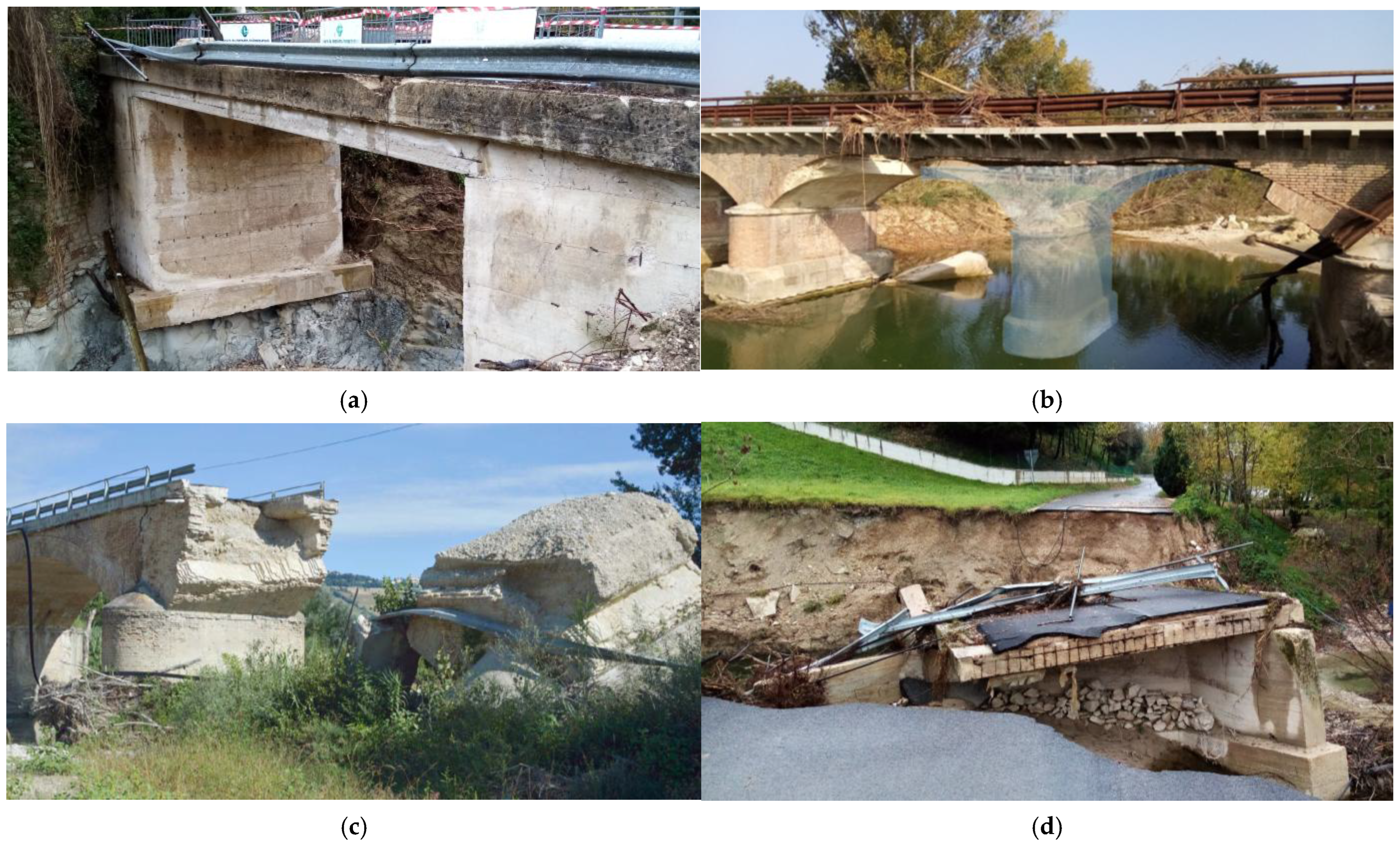
Figure 1. Representative effects of scour on bridge systems under different structural and geotechnical conditions. (a) Abutment scour with exposed foundation but no collapse due to the presence of bedrock; (b) loss of a central pier due to local scour, with the missing support schematically reconstructed for clarity, showing how load redistribution may temporarily preserve deck continuity; (c) partial collapse of a masonry bridge associated with scour at the pier foundations; (d) displacement of a reinforced-concrete bridge due to the combined effects of scour and hydrodynamic forces. Photographs used for illustrative purposes were taken by the author or during post-flood surveys in which the author participated; see dataset [4] (MARCHE 2022—Bridge Post-flood inspection).
Infrastructures 11 00218 g001
Figure 2. Flood-to-decision pipeline under uncertainty. For each stage, the dominant uncertainty and key outcomes are highlighted in red and blue boxes, respectively.
Infrastructures 11 00218 g002
Figure 3. Upstream cascade from climate to bridge-scale hydraulics.
Infrastructures 11 00218 g003
Figure 4. Overview of scour prediction models across physics content and uncertainty treatment.
Infrastructures 11 00218 g004
Figure 5. From measurements to forecasts: monitoring-informed updating of scour state and forecast generation.
Infrastructures 11 00218 g005
Figure 6. Decision layers for bridge scour management under uncertainty: operational, tactical, and strategic decisions require different information and absorb different residual uncertainties.
Infrastructures 11 00218 g006
Table 1. Extended literature map for flood hazard, bridge-scale hydraulics, climate non-stationarity.
Ref.StudySub.RoleTagMain Contribution
[1]Xiong et al. (2023)3.1PrimaryReviewHistorical bridge-failure evidence showing the dominant role of hydraulic causes, used here to frame the flood-hazard problem.
[2]Pucci et al. (2023)3.1Secondary
(Primary role in 7.1)
Fragility/
Modelling
Event-based evidence from the 2021 German flood showing how hydraulic actions and bridge typology influence damage patterns.
[3]D’Angelo et al. (2025)3.1PrimaryFieldStatistical survey of bridge collapses in Italy, supporting the broader hazard context and the relevance of hydraulic drivers.
[9]François et al. (2019)3.1PrimaryReviewReviews flood estimation under climate non-stationarity and its implications for infrastructure design.
[10]Byun and Hamlet (2020)3.1PrimaryModellingRisk-based framework for quantifying non-stationary flood hazards and updating design standards.
[11]Yang and Frangopol (2019)3.1PrimaryModellingLinks climate projections, hydrologic modelling, and long-term regional bridge scour risk.
[12]Sasidharan et al. (2023)3.1Secondary
(Primary role in 7.3)
ModellingIllustrates how uncertainty in climate and hydraulic forcing propagates downstream into scour-risk management.
[13]Bhatkoti et al. (2016)3.1PrimaryModellingQuantifies how projected changes in flood magnitude alter bridge flood risk.
[14]Solan et al. (2019)3.1Secondary (Primary role in 7.1)ModellingShows how increased flow rates and climate change amplify scour vulnerability in masonry arch bridges under choked flow conditions.
[15] Habeeb and Bastidas-Arteaga (2023)3.1PrimaryModellingAssesses bridge hazard exposure under climate change and flooding using scenario-based analysis.
[16]Mondoro et al. (2018)3.1Secondary
(Primary role in 7.3)
ReviewProvides adaptation-oriented context for bridge management under climate uncertainty.
[17]Ashraf et al. (2022)3.2PrimaryFieldAnalyses flood behaviour at documented bridge-collapse sites to clarify the hydraulic conditions acting locally at bridges.
[18]Yang et al. (2021)3.2PrimaryLaboratoryLarge-scale experiments on dynamic morphology in bridge-contracted compound channels during extreme floods.
[19]Yang et al. (2024)3.2PrimaryLaboratoryClarifies scour processes and depth patterns in bridge-contracted channels under different hydraulic regimes.
[20]Arora and Banerjee (2024)3.2PrimaryModellingCouples flood hydraulics and structural response, showing how local hydraulic demand and scour translate into bridge vulnerability.
Note: Ref. = reference number in the manuscript; Study = authors and year; Sub. = subsection in which the paper is discussed within the present section; Role = role of the paper in the section, indicated as Primary or Secondary (with the subsection of primary placement in the review reported in parentheses for secondary entries); Tag = concise typological label of the dominant contribution (e.g., Review, Modelling, Field, Fragility/Modelling, etc.); Main contribution = brief statement of the relevance of the paper in the specific subsection considered.
Table 2. Extended literature map for scour processes and predictive models.
Ref.StudySub.RoleTagMain Contribution
[5]Pizarro et al. (2020)4.1PrimaryReviewHolistic review of bridge scour physics, predictive approaches, monitoring, and assessment, used here as the main conceptual reference for scour processes.
[6]Baranwal and Das (2024)4.1Secondary
(Primary role in 4.3)
ReviewComparative benchmark of scour-depth equations, relevant here because it shows how process interpretation and predictive performance vary across regimes.
[18]Yang et al. (2021)4.1Secondary
(Primary role in 3.2)
LaboratoryExperimental evidence that contraction, local scour, and broader morphological adjustment interact under extreme floods.
[19]Yang et al. (2024)4.1PrimaryLaboratoryLarge-scale experiments clarifying scour processes, patterns, and depth in bridge-contracted channels under different hydraulic regimes.
[21]Hong and Abid (2019)4.1PrimaryLaboratoryExperimental analysis of time-dependent scour around a riprap-protected erodible abutment.
[22]Cheng et al. (2016)4.2PrimaryModellingPhysics-based derivation of the exponential law for time-dependent pier scour development.
[23]Pizarro and Tubaldi (2019)4.2PrimaryModellingQuantifies epistemic uncertainty in bridge scour risk assessment under multiple consecutive flood events.
[24]Rathod and Manekar (2020)4.2PrimaryModellingShows that parameter uncertainty materially affects scour estimates, which is critical when time-dependent predictions are used operationally.
[25]Benedict and Knight (2017)4.3PrimaryFieldEvaluation of the HEC-18 pier-scour equation against large laboratory and field datasets.
[26]Shan et al. (2020)4.3PrimaryDesignDescribes the NextScour initiative to improve bridge scour design practice beyond current HEC-18 limitations.
[27]Lai et al. (2022)4.3PrimaryReviewState-of-the-art review of 3D numerical modelling for local scour.
[28]Yu et al. (2024)4.3PrimaryModellingThree-dimensional numerical modelling of local scour around bridge foundations using an improved wall-shear-stress model.
[29]Kumar et al. (2023)4.2PrimaryData-drivenEnsemble machine learning prediction of time-dependent scour depth around circular piers.
[30]Yousefpour et al. (2021)4.3Secondary
(Primary role in 6.1)
Data-drivenMonitoring-informed ML forecasting and Bayesian calibration of empirical scour models, relevant here as a bridge from prediction to updating.
[31]Yousefpour and Wang (2025)4.3PrimaryHybrid modellingPhysics-inspired deep learning for site-specific and transferable bridge scour prediction.
[32]Choi et al. (2025)4.3PrimaryData-drivenProbabilistic and interpretable machine learning for local scour prediction with reliability-oriented outputs.
[33]Khan and Ismael (2026)4.3PrimaryData-drivenInterpretable ML framework for bridge-pier scour prediction with practical resilience-oriented use.
[34]Khan et al. (2024)4.3PrimaryData-drivenComparative study of empirical and AI techniques for scour prediction around bridge abutments.
[35]Murtaza et al. (2025)4.3PrimaryReviewReview of AI and hybrid models for scour-depth prediction around bridge abutments.
[36]Harasti et al. (2021)4.1PrimaryReviewShows how riprap countermeasures alter flow fields and shift scour zones around bridge piers.
[37]Solan et al. (2020)4.1PrimaryReviewHighlights vulnerability mechanisms of short-span masonry arch bridges to localized scour.
[38]Hamidifar et al. (2021)4.2PrimaryHybrid modellingDemonstrates sensitivity of hybrid scour models to critical velocity formulations.
[39]Bento et al. (2023)4.2PrimaryModellingCFD model calibrated against experiments achieving high accuracy in scour depth prediction.
[40]Kosić et al. (2025)4.2PrimaryModellingShows that scour-hole geometry affects soil stiffness and should be included in SSI modelling.
[41]Li (2025)4.3PrimaryHybrid modellingCombines turbulence physics and symbolic regression for physically interpretable scour prediction.
[42]Chou & Nguyen (2022)4.3PrimaryData-drivenDemonstrates superior performance of metaheuristic-optimized ensemble ML models.
[43]Wang et al. (2025)4.3PrimaryData-drivenUses CGAN-based data augmentation to improve ML prediction accuracy.
[44]Froehlich (2025)4.3PrimaryFieldProvides field-based scour relationships for coarse-bed rivers using quantile regression.
Table 3. Technology-oriented synthesis of scour monitoring modalities and technologies.
StrategyMeasurement PrincipleMeasured QuantityImplementationPros (P) and Cons (C)Inference
Methods
Ref. *
Embedded and direct-contact scour sensorsLocal sensing at the sediment–water interface via electromagnetic/embedded devicesLocal bed level, sediment presence, direct scour-depth proxyInstalled close to bridge foundations for local continuous monitoringP: Direct local measurement under submerged and poor-visibility conditions
C: Calibration drift, durability, local representativeness, survivability during floods
Threshold-based interpretation, time-series tracking, local state updating[7,45,49]
Fibre-optic sensingDistributed optical temperature, strain, or vibration sensing along buried or attached sensing linesBed change, direct or indirect scour-depth proxies, strain redistribution, soil–structure interaction indicatorsBuried near foundations or attached to structural/geotechnical componentsP: High sensitivity, distributed measurements, attractive for permanent deployment
C: Installation complexity, dependence on sensor layout and calibration, interpretation often indirect
Distributed sensing interpretation, inverse analysis, model-based state inference[50,51,52]
Sonar-based direct monitoringAcoustic ranging and sonar imaging of submerged geometryBed profile, scour-hole geometry, submerged foundation surroundingsNear-pier/abutment submerged monitoring, temporary or permanentP: Direct geometric observation of bed evolution and scour-hole morphology
C: Performance degradation in turbulent, turbid, debris flows; maintenance/survivability issues
Image processing, segmentation, geometric reconstruction, automated interpretation[53,72]
Vibration-based fixed monitoringDynamic response of the bridge–soil system under ambient or traffic excitationNatural frequencies, mode shapes, damping, impedance-related dynamic indicatorsSensors installed on superstructure or accessible substructure above water levelP: No need for direct underwater installation; suitable for continuous monitoring during floods
C: Dynamic response is affected by traffic, temperature, water level, soil variability, and other environmental factors
Modal identification, OMA, impedance-based inference, damage-sensitive feature extraction[54,55,56,57,58,62,65]
Time–frequency/non-stationary signal-processing Extraction of time-evolving features from vibration signals under non-stationary excitationTrend changes, wavelet-energy indicators, localized scour-sensitive dynamic featuresApplied to fixed-monitoring or indirect vibration datasetsP: More robust than static modal indicators under evolving and non-stationary conditions
C: Interpretation remains feature- and model-dependent; sensitivity to preprocessing choices
Time-freq. transforms, trend detection, wavelet-based localization, statistical feature extraction[47,59,60,61,66,67,68]
Satellite InSAR and remote sensingInterferometric radar observation of bridge displacement or deformation proxiesStructural displ. trends and instability precursors indirectly associated with scourBridge-scale or network-scale remote observation, usually periodicP: Wide spatial reach, retrospective analysis, useful for inaccessible sites or network screening
C: Indirect relationship with scour state; line-of-sight, and decorrelation constraints
Time-series displacement analysis, anomaly screening, contextual structural interpretation[69,70,71]
Multimodal monitoring frameworksJoint use of direct, indirect, and remote sensing modalitiesCombined evidence on scour state, structural response, hydraulic forcingBridge-level or network-level monitoring frameworksP: Reduces dependence on a single sensing principle; strengthens state inference through complementary observations and integrated warning support
C: Requires coherent data architecture, synchronization, and updating logic
Data fusion, Bayesian updating, state estimation, multi-source decision support[7,45,46,47,48,72,73]
* Ref. = References selected as representative.
Table 4. Extended literature map for scour monitoring and state inference.
Ref.StudySub.RoleTagMain Contribution
[7]Kazemian et al. (2023)5.1PrimaryReviewReviews bridge-scour-monitoring techniques and the development of vibration-based scour monitoring for bridge foundations.
[45]Vardanega et al. (2021)5.1PrimaryReviewComparative forensic assessment of the suitability of bridge-scour-monitoring devices for practical deployment.
[46]Tang et al. (2025)5.1PrimaryReviewCritical review of bridge-scour-monitoring methods across direct, indirect, and remote approaches.
[47]Tola et al. (2023)5.3PrimaryReviewCritical review of scour detection methods combined with machine learning algorithms, with relevance to signal interpretation and detection logic.
[48]Buka-Vaivade et al. (2025)5.4PrimaryReviewReview of monitoring technologies for flood-prone bridge infrastructure, emphasizing multimodal and resilience-oriented monitoring.
[49]Maroni et al. (2020)5.1PrimaryFieldElectromagnetic sensors for direct underwater scour monitoring at bridge foundations.
[50]Liu et al. (2022)5.1PrimaryFieldDistributed fibre-optic sensing for bridge scour estimation.
[51]Hatley et al. (2023)5.1PrimaryLaboratoryProof-of-concept high-resolution scour monitoring using fibre-optic distributed temperature sensing.
[52]Lin et al. (2025)5.1PrimaryLaboratoryDistributed fibre-optic vibration sensing method for scour monitoring.
[53]Rogers et al. (2019)5.1PrimaryFieldUnderwater sonar scanning for high-resolution measurement of developing scour-hole geometry.
[54]Prendergast et al. (2016)5.2PrimaryModellingFoundational vehicle–bridge–soil interaction framework for indirect scour detection.
[55]Kariyawasam et al. (2020)5.2PrimaryLaboratoryCentrifuge validation of natural-frequency sensitivity to scour.
[56]Malekjafarian et al. (2020)5.2PrimaryFieldMode-shape-based scour monitoring for multi-span bridges.
[57]Antonopoulos et al. (2022)5.2PrimaryModellingImpedance-based dynamic interpretation of soil–foundation–structure systems under scour.
[58]Boujia et al. (2019)5.2PrimaryLaboratoryRod-based scour-depth sensor based on frequency-response changes.
[59]Chen et al. (2014)5.2PrimarySignal
processing
Ambient-vibration-based scour evaluation for a cable-stayed bridge foundation.
[60]Xiong et al. (2019)5.2PrimaryFieldBridge scour identification from ambient vibration measurements of superstructures of cable-stayed bridge.
[61]Lin et al. (2026)5.2PrimaryFieldPassive vibration detection for bridge pier scour with a revised frequency-based formula.
[62]Tubaldi et al. (2023)5.2PrimaryFieldFull-scale field tests and numerical analysis of scour effects on a soil–foundation–structure system.
[63]Scozzese et al. (2019)5.2Secondary (Primary role in 7.1)Fragility/ModellingShows that scour-induced changes in masonry arch bridges may affect dynamic indicators differently depending on structural typology and damage stage.
[64]Borlenghi et al. (2024)5.2Secondary (Primary role in 7.1)FieldLong-term monitoring of a masonry arch bridge, relevant here as evidence of how scour effects can be tracked through structural response.
[65]Prendergast and Gavin (2017)5.2PrimaryModellingProbabilistic examination of scour detection under soil spatial variability.
[66]Xiong and Cai (2022)5.3PrimarySignal
processing
Time–frequency-based scour identification using trend-change detection.
[67]O’Brien et al. (2023)5.3PrimarySignal
processing
Wavelet-based operating-deflection-shape method for locating scour-related stiffness loss.
[68]Zhang et al. (2022)5.3PrimarySignal
processing
Statistical-wavelet indirect scour detection from a passing vehicle.
[69]Gagliardi et al. (2021)5.4PrimaryRemote
sensing
Demonstrates MT-InSAR combined with clustering for bridge monitoring.
[70]Selvakumaran et al. (2018)5.4PrimaryRemote
sensing
InSAR-based remote monitoring of precursory deformation linked to scour failure.
[71]Tonelli et al. (2023)5.4PrimaryRemote
sensing
Satellite InSAR interpretation of bridge response for SHM purposes.
[72]Hou et al. (2022)5.4PrimaryData-drivenSonar-based underwater inspection of bridge substructures with deep learning interpretation.
[73]Perugini and Tubaldi (2025)5.4PrimaryRemote
sensing
Low-cost remote sensing for indirect bridge scour monitoring via river-flow characterization.
Table 5. Extended literature map for monitoring-informed forecasting.
Ref.StudySub.RoleTagMain Contribution
[29]Kumar et al. (2023)6.3PrimaryData-drivenEnsemble machine learning models for time-dependent scour prediction, relevant here as forecasting-oriented models with potential probabilistic use.
[30]Yousefpour et al. (2021)6.1PrimaryData-drivenUses monitoring data not only for direct scour prediction but also for Bayesian calibration of empirical scour relationships, thereby framing monitoring as a mechanism for posterior uncertainty reduction.
[31]Yousefpour and Wang (2025)6.3PrimaryHybrid modellingPhysics-inspired deep learning for bridge scour prediction, relevant here because it combines forecasting capability with improved robustness and transferability.
[32]Choi et al. (2025)6.3PrimaryData-drivenProbabilistic local-scour prediction with calibrated prediction intervals and reliability-oriented interpretation.
[33]Khan and Ismael (2026)6.3PrimaryData-drivenInterpretable machine learning framework for bridge-pier scour prediction, highlighting the role of explainability in forecasting-oriented models.
[66]Xiong and Cai (2022)6.2PrimarySignal processingTrend-change detection framework that supports early warning by identifying the onset and progression of scour-related dynamic changes.
[75]Maroni et al. (2021)6.1PrimaryBayesianBayesian-network framework for underwater scour assessment, explicitly formulating scour management as a probabilistic updating problem.
[76]Maroni et al. (2022)6.1PrimaryDecision supportSHM-based classification system for bridge scour risk management, extending monitoring into probabilistic state updating and risk classification.
[77]Yousefpour and Correa (2022)6.2PrimaryData-drivenAI-based early-warning framework built on long-term field monitoring records, demonstrating useful short-term scour forecasts.
[78]Azhari and Loh (2020)6.2PrimaryDecision supportWarning-time-based framework linking sensor observations to the estimated time remaining before critical scour depth is reached.
[79]Lin et al. (2021)6.2PrimaryFieldAIoT-based real-time scour monitoring and early-warning system, relevant here because it moves the literature toward explicit operational warning frameworks.
Table 6. Extended literature map for structural vulnerability and risk-informed bridge decisions.
Ref.StudySub.RoleTagMain Contribution
[2]Pucci et al. (2023)7.1PrimaryFragility/modellingEmpirical fragility evidence from bridges damaged during the 2021 German flood, linking observed damage directly to flood loading and bridge typology.
[8]Pregnolato et al. (2023)7.3PrimaryReviewComparative assessment of risk-based bridge scour management methods, relevant here as a reference for tactical and strategic decision frameworks.
[12]Sasidharan et al. (2023)7.4Secondary (Primary role in 3.1)ModellingShows how uncertainty propagates through the hazard-to-risk chain, reinforcing the idea that decision uncertainty is the quantity monitoring is ultimately meant to reduce.
[63]Scozzese et al. (2019)7.1PrimaryFragility/modellingShows how scour affects modal properties and collapse behaviour in masonry arch bridges, clarifying structural consequences under support loss.
[76]Maroni et al. (2022)7.2PrimaryDecision supportSHM-based real-time classification system for bridge scour risk management, connecting monitoring outputs to operational decisions.
[78]Azhari and Loh (2020)7.2PrimaryDecision supportWarning-time-based framework linking sensor observations to operational intervention timing.
[80]Argyroudis and Mitoulis (2021)7.1PrimaryFragility/modellingMulti-hazard fragility framework showing how scour, hydraulic actions, and bridge typology jointly shape vulnerability.
[81]Ahamed et al. (2021)7.1PrimaryFragility/modellingFlood-fragility framework incorporating flow hydraulics, geotechnical uncertainty, and variable scour depth.
[82]Kazantzi et al. (2025)7.1PrimaryFragility/modellingUnified probabilistic flood-fragility framework with explicit treatment of different scour-severity scenarios.
[83]Zampieri et al. (2017)7.1PrimaryFailure analysisFailure analysis of masonry arch bridges subjected to local pier scour, clarifying collapse mechanisms.
[84]Scozzese et al. (2023)7.1PrimaryFragility/modellingDefines damage metrics and descriptors for masonry bridges under scour scenarios, with direct relevance for fragility analysis.
[85]Mendoza Cabanzo et al. (2022)7.1PrimaryFragility/modellingIn-plane fragility and parametric analyses of masonry arch bridges subjected to flood-induced scour.
[86]Dhir et al. (2025)7.1PrimaryModellingRobustness assessment of masonry arch bridges under scour-induced damage and multiple traffic-load models.
[87]George and Menon (2022)7.1PrimaryFailure analysisKinematic approach for scour analysis of masonry arch bridges, emphasizing collapse mechanisms with limited geometric input.
[88]Maroni et al. (2023)7.2PrimaryDecision supportMonitoring-based adaptive water-level thresholds for bridge scour risk management, translating updated information into operational triggers.
[89]Liu et al. (2020)7.3PrimaryNetwork/optimizationNetwork-level risk-based framework for optimal bridge adaptation management under scour and climate change.
[90]Sasidharan et al. (2022)7.3PrimaryAsset managementRisk-informed asset-management framework for tackling bridge scour across transport networks.
[91]Abdel-Mooty et al. (2024)7.3PrimaryModellingStrategic susceptibility assessment framework for bridge scour prioritization at network scale.
[92]Brighenti et al. (2025)7.3PrimaryDecision supportRisk-based DSS for ranking intervention scenarios under reliability and cost constraints.
[93]Giordano et al. (2020)7.4PrimaryValue of informationFoundational framework for assessing whether monitoring information improves decisions for scoured bridges.
[94]Giordano et al. (2022)7.4PrimaryValue of informationQuantifies the value of SHM information for bridges under flood-induced scour.
[95]Giordano and Limongelli (2022)7.4PrimaryValue of informationShows that the benefit of informed risk-based management depends strongly on how the decision problem is framed.
[96]Antonopoulos et al. (2025)7.1PrimaryModellingShows how scour affects dynamic response and seismic demand, linking hydraulic damage to multi-hazard behaviour.
Disclaimer/Publisher’s Note: The statements, opinions and data contained in all publications are solely those of the individual author(s) and contributor(s) and not of MDPI and/or the editor(s). MDPI and/or the editor(s) disclaim responsibility for any injury to people or property resulting from any ideas, methods, instructions or products referred to in the content.