Article

Field Performance of a Pile-Cap Ground Improvement System for High-Speed Railway Embankments in Karst Terrain


1
Department of Geomatics, Faculty of Architecture and Planning, King Abdulaziz University, Jeddah 21589, Saudi Arabia
2
Department of Civil and Environmental Engineering, Faculty of Engineering at Rabigh, King Abdulaziz University, Rabigh 21911, Saudi Arabia
3
Structural Engineering Department, Zagazig University, Zagazig P.O. Box 44519, Egypt
4
General Authority for Roads, Bridges, and Land Transport (GARBLT), Ministry of Transportation, Cairo P.O. Box 11511, Egypt
*
Author to whom correspondence should be addressed.
Infrastructures 2026, 11(7), 217; https://doi.org/10.3390/infrastructures11070217 (registering DOI)
Submission received: 26 May 2026 / Revised: 17 June 2026 / Accepted: 23 June 2026 / Published: 25 June 2026

Abstract

High-speed railway embankments constructed over karst-prone ground conditions are often challenged by weak soils and subsurface cavities, which can lead to instability and excessive settlement. This study presents a full-scale field investigation conducted in the El-Gharbaniyat area, west of Alexandria, Egypt, where a pile–cap ground improvement system was implemented to support a high-speed railway embankment founded on clayey and silty soils overlying fractured limestone. A comprehensive site investigation program was performed, including 28 boreholes and integrated geophysical surveys using Electrical Resistivity Tomography (ERT) and Seismic Tomography (ST), enabling improved identification of weak zones and cavity-prone formations. Based on these findings, a pile–cap system was designed using reinforced concrete piles of 0.60 m diameter and an average length of 29 m, arranged in a 4 × 4 m grid and capped with reinforced concrete footings to ensure efficient load transfer to deeper competent strata. The system performance was validated through laboratory testing and full-scale in situ pile load tests. The average 28-day compressive strength of 122 tested piles reached approximately 50 MPa, exceeding the design value by approximately 30%. Load test results showed settlements ranging from 1.08 to 2.76 mm at the working load (2200 kN) and 2.16 to 5.10 mm at the maximum load (3300 kN), all well below allowable limits. Comparative evaluation indicated that the proposed system achieves significant material savings (>90%), lower treatment cost (150 USD/m2), reduced carbon emission (5.7 t per pile), and shorter construction duration (7 h per pile). These findings confirm that the pile–cap system provides a robust, cost-effective, and environmentally efficient solution for ground improvement in karst environments.

1. Introduction

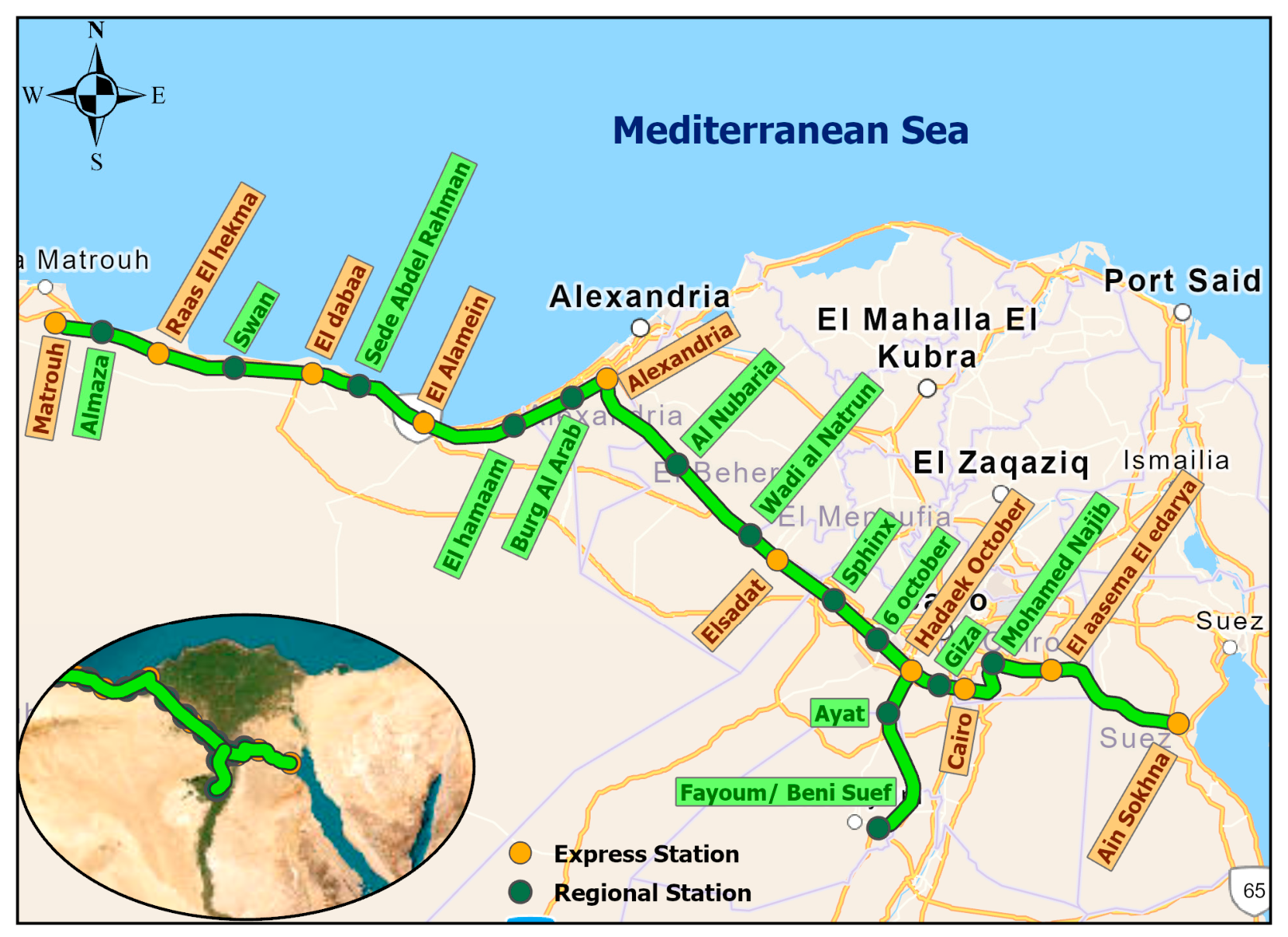
Over the past decade, Egypt has embarked on an ambitious program to modernize and expand its national transportation system. Among the most significant projects currently underway is the construction of the first high-speed railway line, extending approximately 660 km and connecting to Ain Sokhna city on the Red Sea and Marsa Matruh city on the Mediterranean coast, which is often regarded as a New Suez Canal on rails. This project represents one of the country’s major national infrastructure initiatives, designed to provide a new mode of fast, reliable, and sustainable mass transportation. With a design speed of up to 250 km/h, the new railway marks a substantial leap in Egypt’s railway sector, introducing electric traction technology on a large scale and establishing a modern transport corridor between the Red Sea and the Mediterranean. In addition to enhancing passenger mobility, the railway is expected to create a new logistical axis connecting industrial production zones, such as Ain Sokhna, 6th of October, and Borg El-Arab, with major export ports including Sokhna and Alexandria. According to the Ministry of Transportation, the first line of high-speed railway will be completed by the year 2027.
Despite these remarkable benefits, the construction of the first high-speed railway infrastructure in Egypt faces considerable geotechnical challenges, particularly in areas underlain by weak soils and cavities. Such subsurface conditions can cause severe ground instability, differential settlements, and even sinkhole hazards, threatening the safety and durability of embankments and bridge foundations [1,2]. Recent developments in ground improvement techniques have shown the effectiveness of integrated reinforcement systems for the improvement of bearing capacity, reduction in settlement and enhancement of the long-term stability of infrastructure constructed over problematic ground conditions. However, the applicability of these techniques in highly heterogeneous karst environments still depends on local geological characteristics and construction constraints [3]. Thus, selection of appropriate foundation solutions requires detailed geological investigation and project-specific engineering evaluation. Pile foundations are widely used for high-rise buildings, bridges, industrial structures, and offshore structures due to their high integrity, ability to improve foundation strength, and ease of construction [4,5,6]. Additionally, they allow for speedier embankment construction without waiting for the consolidation of the compressible layer; the piled embankment approach with geosynthetic basal reinforcement is frequently used to design structures on soft soils. Also, the construction requires relatively little maintenance, and the environmental impact is reduced due to the volume decrease in material utilized (in comparison to other methods) [7,8].
Several investigations have been conducted to study using piles to improve problematic soils under high loads. Huang et al. [9] examined how saturated soft clay deforms cumulatively under various loading scenarios in undrained cyclic triaxial testing. El-Ghaffar et al. [10] examined, speculatively, using static pile load test results, the load-settling behavior of CFA piles in several locations around the Gharbia governorate in Egypt. Wan et al. [11] used bored cast in situ piles to adapt to changes in the strata; they are less impacted by groundwater and are frequently utilized in karst-developed locations. Liu and Novak [12] used finite and infinite elements to examine soil-pile static interaction analysis on axially loaded single piles and single piles with caps subjected to monotonic loading. According to the Drucker–Prager yield criterion, the soil is assumed to be either elastic or elastic–perfectly plastic, and the pile is supposed to be linearly elastic. The pile reaction was significantly impacted by monotonic loading, according to the results. Both the interaction between the piles and the cap and the impact of the pile placement technique have a major impact on the interaction between the piles [13]. In Ma et al. [14], concrete piles joined by beams had their bending behavior examined statistically, and the results showed that the beams’ presence changed the piles’ failure modes. Tran et al. [15] utilized Plaxis software Version 2.0 to show that ultimate bearing capacity rose in both undrained and drained conditions when pile spacing was raised from two times to four times the pile diameter. Magade and Ingle [16] assessed whether the clear edge distance for pile caps was sufficient. The results showed that, when there were minimum clear edge distances, a sizable quantity of tensile stresses developed at the pile cap’s edge, which would not be acceptable. The clear edge distances of 100 mm, 150 mm, or 250 mm that are advised by most codes have been found to be insufficient. The clean-edge distance should be at least half the width of the employed pile to account for the stresses generated at the edge. Furthermore, both the pile cap resistance and the pile shaft resistance rise with the pile cap’s dimension [17].
Karst is a geological formation resulting from the dissolution of soluble rocks combined with mechanical weakening processes driven by water action [18]. Karst terrains are characterized by a highly heterogeneous subsurface due to dissolution processes, resulting in cavities, irregular rockhead profiles and weak zones that significantly increase the risk of differential settlement and foundation instability [19]. In recent years, there has been a significant expansion in underground engineering projects within karst regions [20,21]. However, the concealed and highly complex hydrogeological conditions prevailing in karst regions [22,23] significantly complicate subsurface characterization. The presence of karst cavities and underground voids, including those induced by mining activities, introduces substantial challenges to pile foundation construction [24,25]. To mitigate the challenges associated with cavities and underground voids (goafs) during pile construction in karst regions, several effective techniques have been developed over the past decade, including backfilling, grouting, and the use of follow-up steel casing [26,27,28]. Diagne et al. [29] introduced a technique for treating karst cavities in highway pile foundation projects, whereby the cavities are filled with cement slurry following the drilling process. Xing et al. [30] used the backfill technique, which involves a 1:1:0.5 ratio of bagged cement, clay soil, and rubble, to rehabilitate karst caves while building ultra-large-diameter piles based on the China–Laos railway’s pile foundation construction. Li and Qin [31] suggested that small karst caves use the backfill method, while medium and large karst caves use a mix of the backfill method and steel casing follow-up.
Although existing techniques have proven effective in treating karst cavities and facilitating pile foundation construction in karst regions, they still exhibit notable limitations. In practice, accurately identifying the location, orientation, and extent of karst cavities remains challenging. For instance, advanced drilling methods, commonly employed in geotechnical investigations, provide information only at the borehole location, leaving the surrounding subsurface conditions within the pile zone largely uncertain [32,33]. Consequently, conventional techniques such as backfilling and grouting are often inadequate for treating complex karst features, especially interconnected cave systems and conduits [34]. Research indicates that when the height of a karst cavity reaches approximately six times the pile diameter, the bearing capacity can decrease by about 15% compared to conditions without karst influence [35]. With modern engineering practice increasingly prioritizing sustainability, efficiency, and environmental considerations [36], there is a pressing need to develop cost-effective, efficient, widely applicable, and environmentally sustainable solutions for pile construction in karst regions. Although various techniques have been developed for foundation construction in karst terrains, most previous studies have focused on numerical analyses, laboratory investigations, or isolated treatment methods. Comprehensive field-scale studies that integrate detailed site investigation, geophysical characterization, foundation design, construction quality control, and performance validation for high-speed railway embankments remain limited, particularly under the heterogeneous karst conditions encountered in Egypt. This study addresses this gap by presenting a full-scale field validation of an integrated investigation–design–verification framework for a pile–cap foundation system constructed over karst terrain.
The novelty of this study lies not in the pile–cap system itself, which is an established engineering solution, but in its integrated field-scale implementation and validation for a high-speed railway embankment constructed over heterogeneous karst terrain in Egypt. By combining detailed site investigation, geophysical characterization, foundation design, construction monitoring, and full-scale load testing, the study provides a comprehensive engineering framework for evaluating the performance of pile–cap foundations under complex geological conditions. The methodology is supported by an extensive site investigation program, including 28 boreholes reaching depths of up to 40 m, in addition to geophysical surveys, which enabled improved identification of weak zones and cavity-prone formations. Based on these findings, the foundation system was optimized in terms of pile diameter, length, spacing, and pile–cap configuration to ensure efficient load transfer to deeper competent strata. A comprehensive validation framework was adopted, incorporating laboratory testing of construction materials and full-scale in situ pile load tests performed on working piles. The measured load–settlement responses demonstrated consistent performance, limited variability, and predominantly elastic behavior with controlled residual deformation. Furthermore, the study integrates a comparative assessment of material efficiency, treatment cost, carbon emissions, and construction duration, demonstrating that the proposed system achieves a favorable balance between structural performance, economic feasibility, and environmental impact. The findings provide a robust and practical framework for the design and implementation of pile-supported embankments in karst conditions, offering a reliable solution for minimizing settlement and ensuring the long-term stability of high-speed railway infrastructure.

2. Materials and Methods

2.1. Site Description

The project under investigation is the Electric High-Speed Train, one of Egypt’s largest national infrastructure initiatives. The master plan comprises the construction of four lines designed to connect major cities across the country and enhance nationwide mobility. The first line extends from Al-Ain Al-Sokhna on the Red Sea coast, passing through the New Administrative Capital, 6th of October City, and Borg El-Arab City. Beyond Borg El-Arab, the route diverges into two branches: one terminating in Alexandria and the other in New Alamein City on the Mediterranean coast, Fgypt. This line includes 15 stations along a total length of approximately 660 km. Figure 1 illustrates the general alignment of this line.
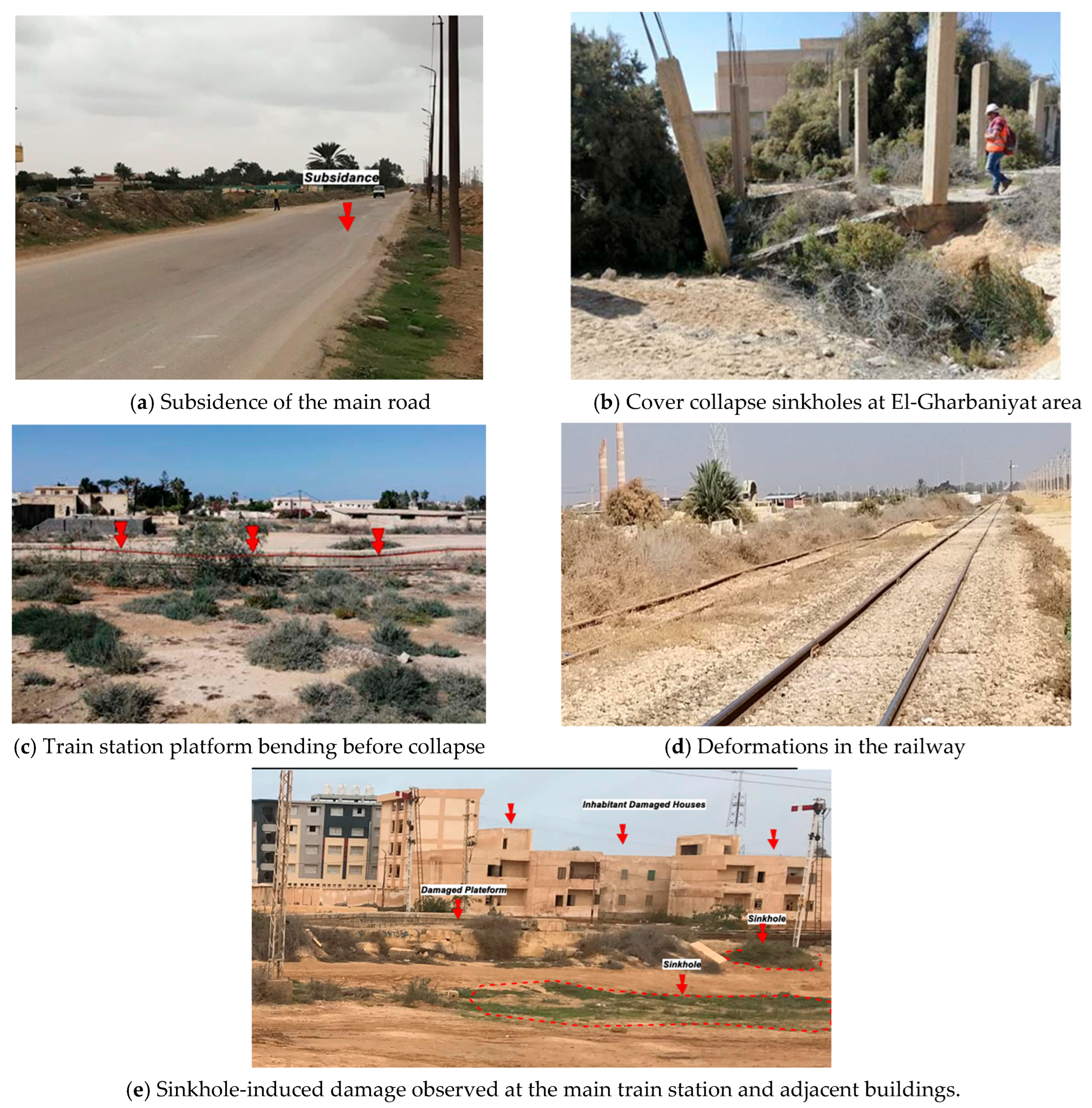
Soil subsidence was observed along the El-Gharbaniyat section of the High-Speed Rail alignment, particularly between stations 340+500 and 341+400, where combined geophysical and geological investigations identified the presence of cover-subsidence sinkholes. These sinkholes formed as ponded and infiltrating water dissolved the highly porous oolitic limestone, generating subsurface cavities and fractures that led to the gradual downward migration of overlying silty clay and sandy silt soils. Continuous water inflow from agricultural activities, drainage systems, leaking pipelines, rainfall, and surface runoff further accelerates the dissolution process. This condition is exacerbated by the lower ground elevation of the alignment compared with adjacent farmlands and the presence of wetlands to the north, resulting in elevated groundwater levels and increased subsurface flow. Consequently, the limestone progressively loses strength, promoting the development of voids and potential ground collapse. Based on geological surveys, the zone extending between stations 340+500 and 341+400 was classified as a high-risk area prone to future sinkhole formation. Figure 2a–e illustrates the severity of the geological features identified during the survey conducted. These features include subsidence of the main road, collapsed sinkholes, train station platform bending, deformations in the railway, and sinkhole-induced damage.

2.2. Boreholes

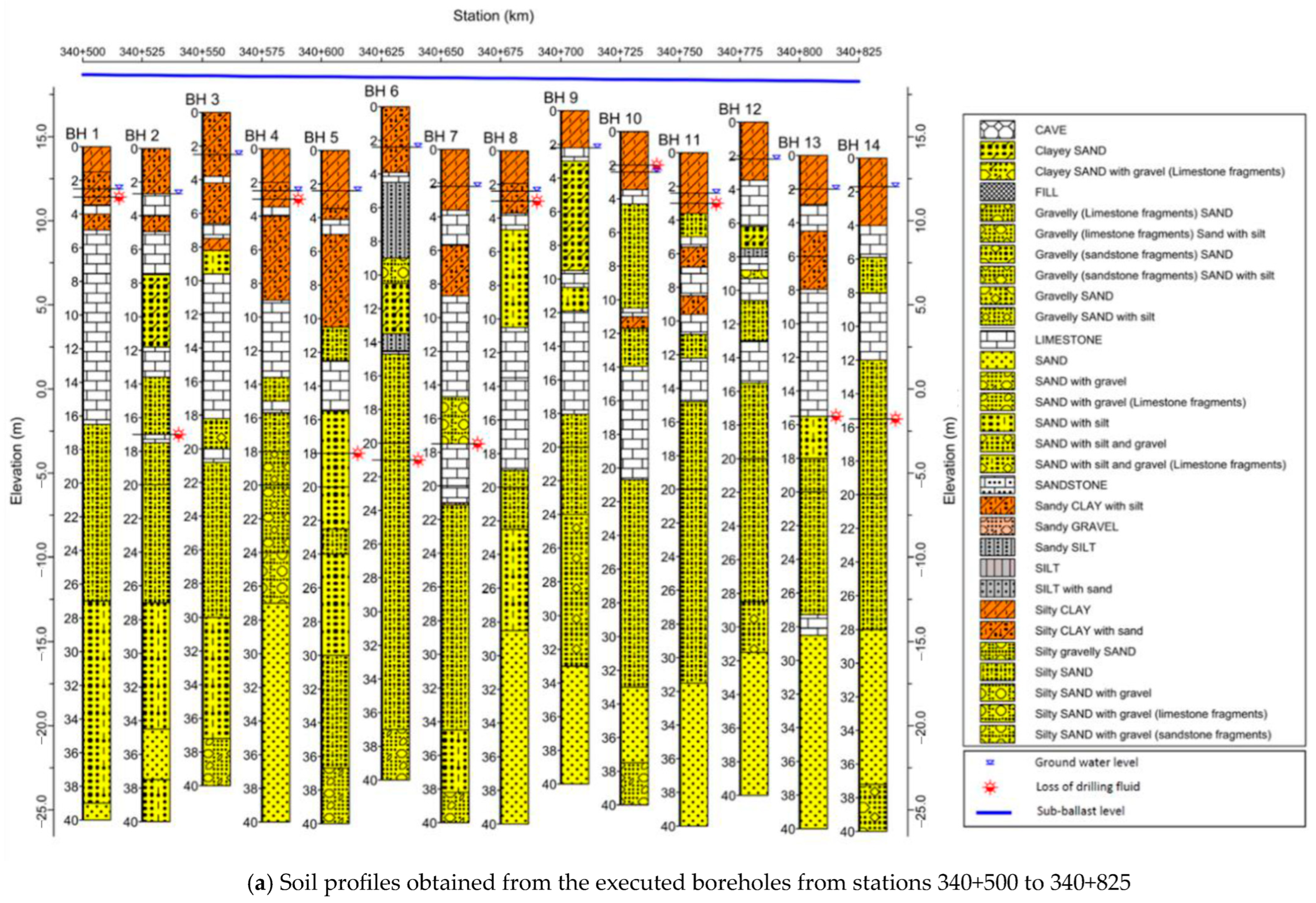
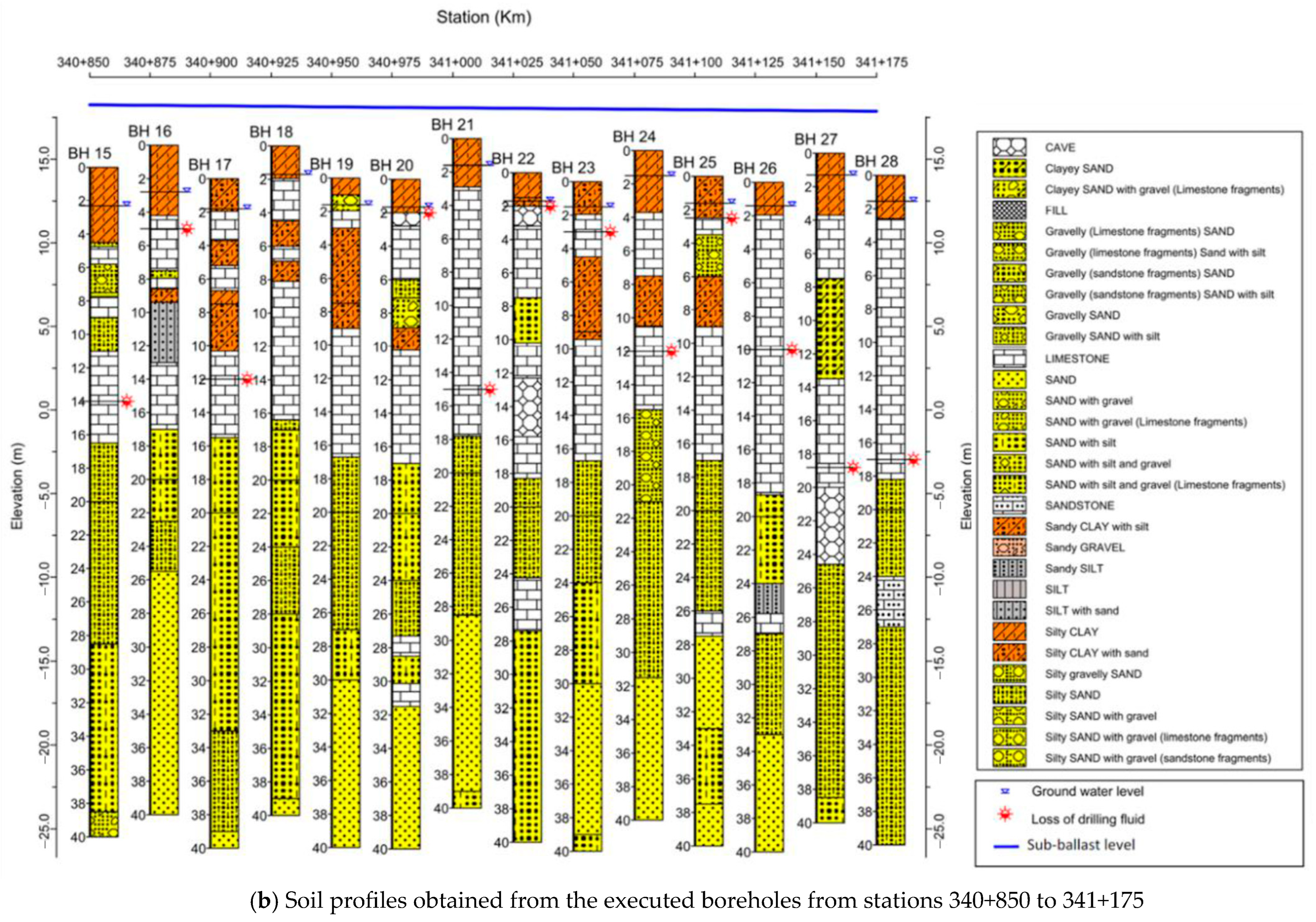
A total of twenty-eight (28) boreholes were executed within the critical study section extending from station 340+500 to 341+400, as illustrated in Figure 3. The interpreted soil profiles reveal highly complex and heterogeneous subsurface conditions, governed by the interaction between unconsolidated soils and underlying karstified limestone formations. The stratigraphy is dominated by upper layers of silty clay and sandy silt, underlain by dense sand deposits and weak, highly fractured limestone exhibiting advanced stages of karstification. The limestone units are characterized by pronounced discontinuities, including vugs, cavities, and irregular infill zones, reflecting ongoing dissolution processes and structural degradation. Subsurface exploration identified multiple cavities across several boreholes at depths ranging from approximately 2 m to 20 m, with thicknesses varying between 0.8 m and 4.5 m. These features were consistently associated with significant drilling fluid losses, indicating the presence of open or partially filled voids within the subsurface. In addition, groundwater was encountered at shallow depths (approximately 1.1 m to 4.8 m below ground surface), suggesting a high degree of saturation and active hydrogeological conditions that may further accelerate karst development and soil weakening. The marked variability observed between adjacent boreholes, combined with the irregular distribution of cavities and weak zones, highlights a highly discontinuous and spatially unpredictable subsurface environment. Such conditions introduce considerable uncertainty in the assessment of ground behavior and significantly increase the risk of differential settlement and localized instability [24,37].

2.3. Electrical Resistivity Tomography (ERT) and Seismic Interpretation (SI)

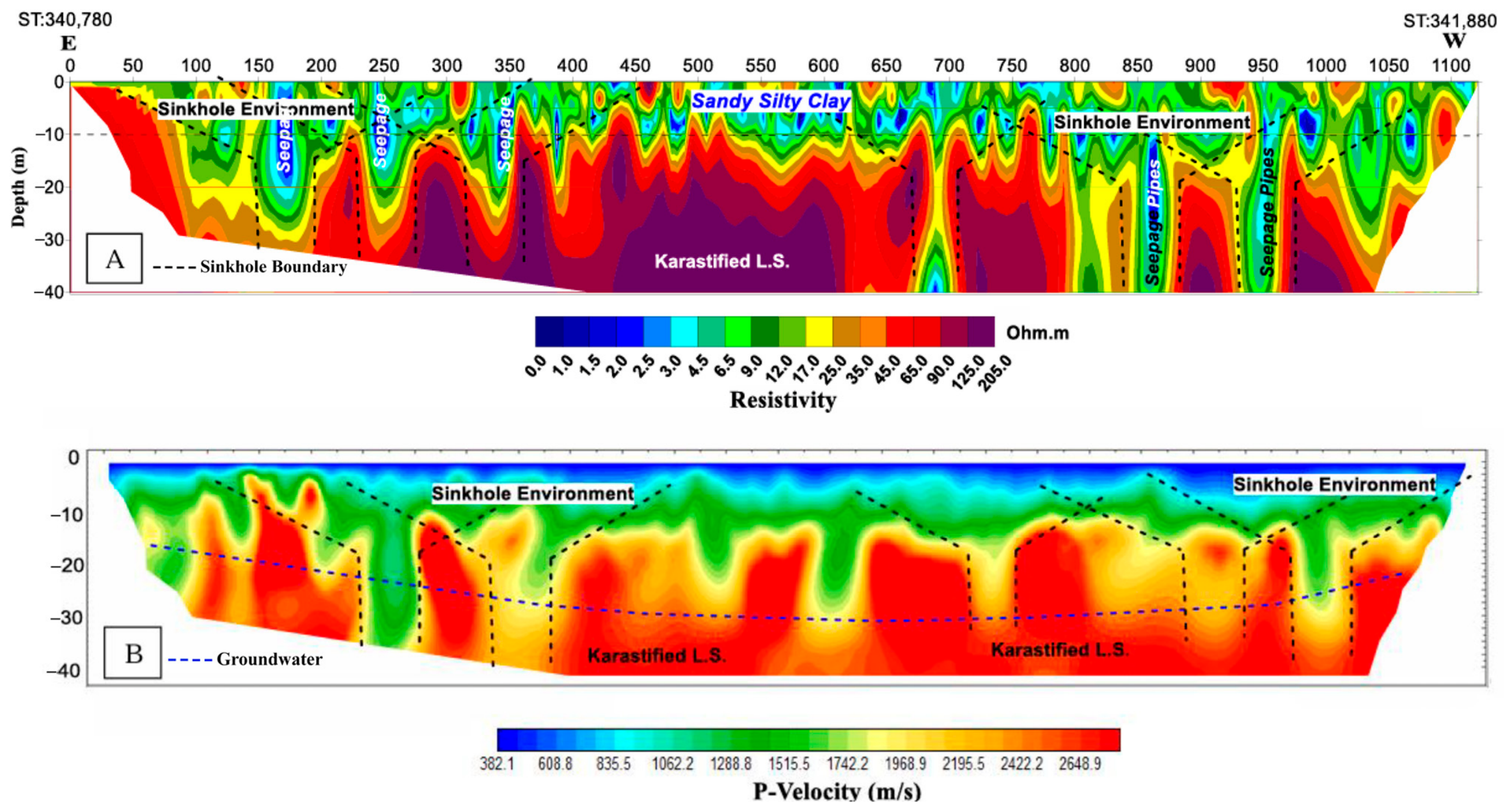
The integrated interpretation of Electrical Resistivity Tomography (ERT) and P-wave Seismic Tomography (ST) along the area is presented in Figure 4. They give continuous subsurface imaging and significantly improve the delineation of probable cavity-prone and weak zones. However, these methods are based on indirect measurements of physical properties, and thus their interpretation should be supported by borehole verification and geological observations to reduce uncertainty [38]. The ERT model highlights several vertical low-resistivity anomalies extending from near-surface levels down to the limestone layer. These anomalies are interpreted as seepage pathways or soil-filled conduits, likely formed due to progressive dissolution processes within the carbonate formation. The low resistivity values suggest the presence of saline water and/or fine-grained infill materials, indicating zones of increased saturation and reduced material competence (see Figure 4A). In this study, resistivity values below approximately 5 Ω·m associated with P-wave velocities between 400 and 1500 m/s were interpreted as weak, highly weathered, saturated, or partially voided materials. The final interpretation was validated using borehole data to reduce uncertainty associated with geophysical inversion results.
The Seismic Tomography results show a strong correlation with the ERT findings, where these anomalous zones correspond to low P-wave velocities (approximately 400–1500 m/s), reflecting weak, highly weathered, or partially voided materials. This consistency between geophysical methods confirms the presence of mechanically weak vertical zones embedded within the karstified limestone matrix. The geometry of these anomalies is predominantly conical to pipe-like, which is characteristic of sinkhole development and subsurface karst activity. The karstified limestone layer, encountered at relatively shallow depths (approximately 20 m in this segment), appears to be interrupted by multiple vertical weak zones, indicating an advanced stage of karstification and structural degradation (see Figure 4B).
These findings demonstrate that the investigated section is located within an integrated interpretation of Electrical Resistivity Tomography (ERT) and P-wave Seismic Tomography (ST) along stations 340+780 to 341+880 in an active sinkhole-prone environment, where the combined effects of karst dissolution, groundwater seepage, and soil infilling contribute to significant subsurface instability.
The combined interpretation of borehole data, ERT, and P-wave ST provides a comprehensive and consistent understanding of the subsurface conditions within the investigated section. The borehole records revealed a highly variable stratigraphy dominated by weak soils overlying karstified limestone formations with localized cavities and zones of infilled materials. However, due to the discrete nature of boreholes, the spatial continuity of these features could not be fully captured. The geophysical investigations significantly enhanced the subsurface characterization by providing continuous profiles along the study area. The ERT results identified low-resistivity vertical anomalies, while the Seismic Tomography revealed corresponding low-velocity zones, both indicating the presence of weak, highly weathered, or partially voided materials.
The strong spatial correlation between these anomalies confirms the existence of vertical seepage pathways and soil-filled conduits associated with karst dissolution processes. The integration of these datasets demonstrates that the subsurface is characterized by a highly heterogeneous and discontinuous karst system, where competent limestone layers are interrupted by multiple weak zones of varying geometry and extent. This complex geological setting, supported by both direct (borehole) and indirect (geophysical) evidence, indicates a sinkhole-prone environment with significant potential for differential ground behavior. These findings highlight the importance of integrating multiple investigation techniques to accurately assess subsurface conditions in karst terrains, where relying on a single method may lead to incomplete or misleading interpretations.

2.4. Ground Improvement

The integrated geotechnical and geophysical investigations revealed that the studied section (stations 340+500 to 341+400) is characterized by a highly heterogeneous karst formation, including cavities, sinkholes, and dissolution-prone limestone extending to depths of approximately 2–20 m. Such conditions classify the site as a high-risk zone for ground instability and potential sinkhole development. Several previous ground improvement techniques commonly used in karst environments, such as grouting, backfilling, and raft foundations, were considered [24,26,27,28,39,40]. However, these methods exhibit significant limitations under the investigated conditions. Grouting [29] and backfilling [30] are often ineffective in controlling interconnected cavities and may lead to unpredictable material loss or groundwater flow alteration [39]. Raft systems, although capable of bridging small voids, become structurally inefficient and uneconomical when dealing with large or irregular cavities due to excessive deformation and bending demands. In contrast, deep foundation systems provide a more reliable solution by transferring loads beyond the disturbed karst zone into competent strata [11]. The decision to use a deep foundation system was based on the presence of highly heterogeneous karstic limestone, with unpredictable cavities down to depths of approximately 20 m. Other methods like grouting and deep soil mixing were considered less reliable due to the potential for loss of grout in large voids and limited effectiveness of mixing in rock formations. Micro piles were not economical for the required load capacity, and geosynthetic reinforced embankments alone could not bridge large voids sufficiently. Directly transferring loads to competent bearing strata minimizes differential settlement and provides superior long-term reliability. Based on this principle, a cast in situ bored pile-supported system was adopted, consisting of reinforced concrete piles penetrating through the critical zone into stable layers. These piles serve to bypass weak and voided zones while ensuring controlled load transfer. To further enhance system performance, a rigid load distribution platform was constructed above the piles in the form of a pile–cap system. This configuration enables effective bridging of potential sinkhole zones and accommodates the spatial variability of subsurface conditions, resulting in improved structural integrity and reduced sensitivity to localized ground anomalies [24,37].

Piles and Pile Caps

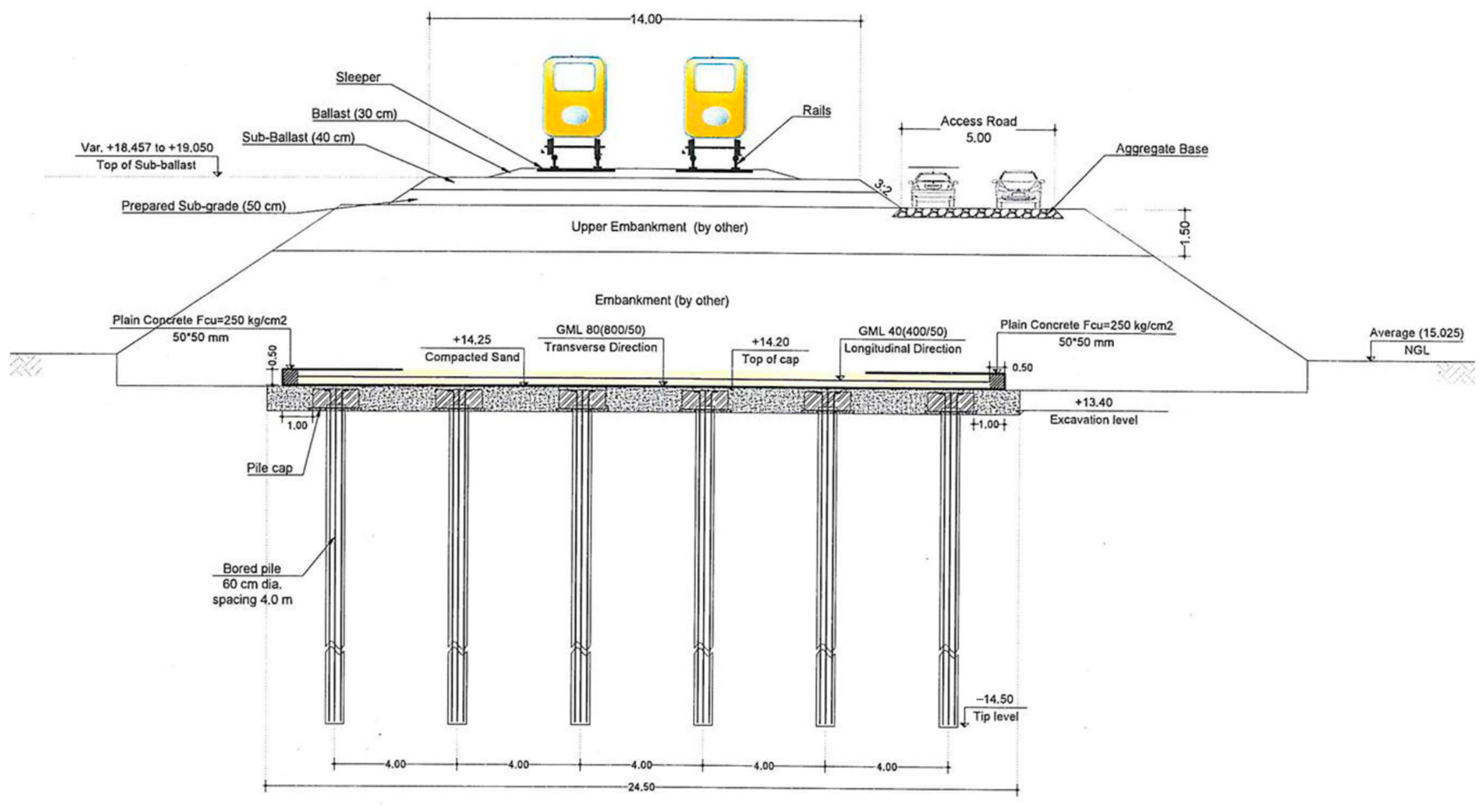
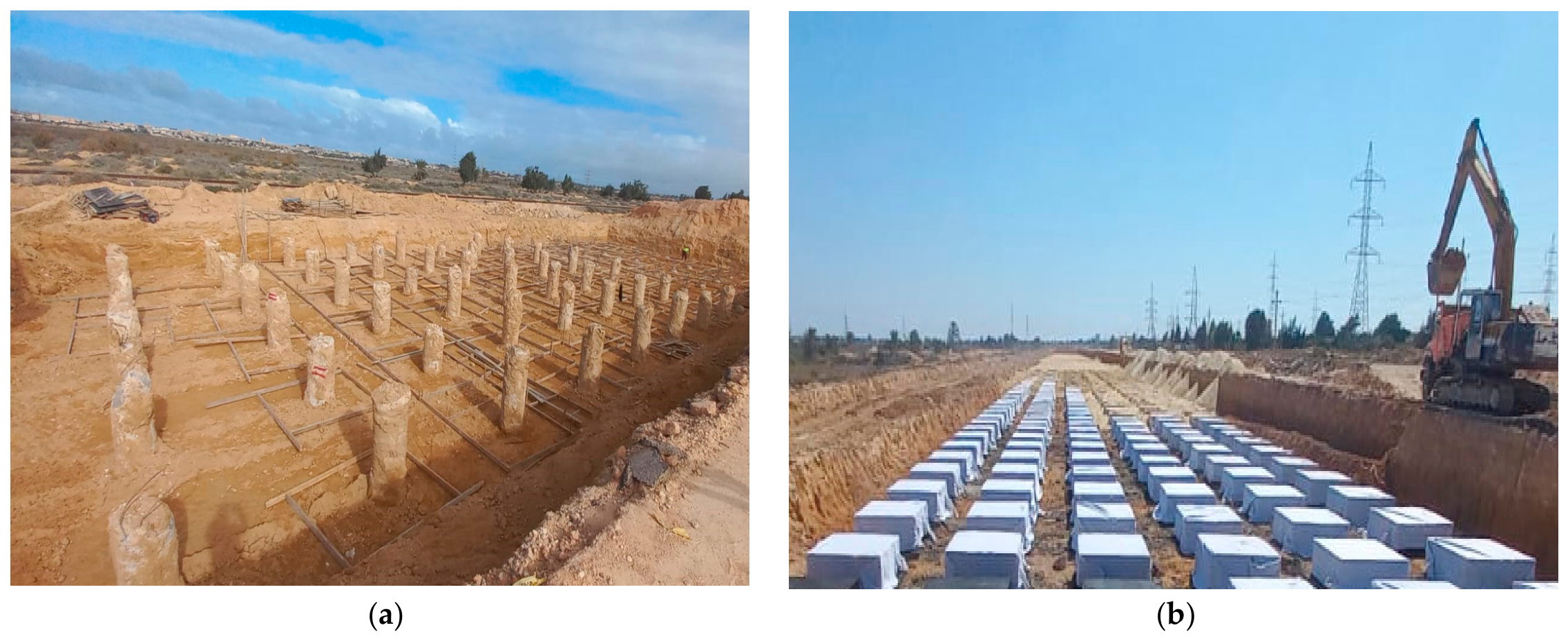
The adopted ground improvement system consists of reinforced concrete piles with a diameter of 0.60 m and lengths ranging between 26 m and 31.5 m, with an average length of approximately 29 m. Each pile is designed to sustain an allowable axial capacity of 2200 kN, ensuring adequate load transfer to the underlying competent strata beyond the karst-affected zone. The piles are arranged in a uniform grid pattern with a center-to-center spacing of 4.0 m in both longitudinal and transverse directions, as shown in Figure 5 and Figure 6a, providing efficient load distribution and minimizing differential settlement. This spacing was selected to achieve an optimal balance between structural performance and economic feasibility while ensuring adequate coverage of potential voided zones. Each group of piles is capped with square reinforced concrete caps measuring 2.0 m × 2.0 m with a minimum thickness of 0.60 m, as presented in Figure 5 and Figure 6b. These pile caps act as a rigid load transfer platform, distributing the embankment loads to the underlying piles and enhancing the overall stiffness of the foundation system. The combined pile–cap system provides an effective bridging mechanism over potential cavities and weak zones, thereby improving the stability, serviceability, and long-term performance of the railway embankment under complex karst conditions [11,41].

2.5. Reliability and Limitations Investigation Methods

The subsurface conditions were characterized through the integrated interpretation of borehole investigations, ERT, and ST, with each method providing complementary information. ERT and ST provided continuous imaging of probable weak zones and cavity-prone formations throughout the study area, while boreholes provided direct verification of lithology and karst features but were limited to discrete locations. Geophysical methods rely on indirect physical measurements, and the interpretations are inherently uncertain and subject to weathering, fracturing and groundwater conditions. Thus, the geophysical results were systematically compared with the borehole observations in order to increase the reliability of the interpretation and to reduce the uncertainty. The combined use of these investigation techniques provided a robust basis for delineating subsurface conditions and optimizing the design of the pile–cap foundation system.

3. Design of a Single Pile

3.1. Pile Behavior Under Vertical Loads

Reinforced concrete piles with a diameter of 0.60 m were adopted, using concrete with a characteristic compressive strength of 40 MPa and reinforcement steel with a yield strength of 400 MPa. Based on the geotechnical and geophysical investigations, the upper subsurface layers were found to consist of weak, cavity-prone limestone extending to depths of approximately 20 m. Accordingly, the piles were designed to penetrate beyond this critical zone and terminate within competent bearing strata to ensure reliable load transfer and minimize the influence of voided formations. The pile tip levels were selected based on the site-specific subsurface conditions along the alignment, varying between −12.30 m and −18.20 m from the mean sea level, ensuring that all piles are founded within stable soil or rock layers. The axial capacity of each pile was evaluated considering both end-bearing resistance and shaft friction mobilized below the cavity-affected zone. To account for the uncertainty associated with karst conditions, conservative safety factors were adopted for both components. The design resulted in an ultimate pile capacity of approximately 4700 kN, with an allowable working load of 2200 kN, providing an adequate margin of safety against failure. Table 1 summarizes the geotechnical design parameters and computed vertical load capacity for a single pile.
The adopted pile–cap ground improvement system was selected through an iterative geotechnical and structural design process considering bearing capacity, settlement control, constructability, and the stringent serviceability requirements of high-speed railway infrastructure. A pile diameter of 0.60 m was selected to provide the required axial load capacity while maintaining construction efficiency and economic feasibility. The pile spacing of 4.0 m was determined in accordance with the design requirements for load transfer, settlement reduction, and geosynthetic reinforcement performance, consistent with the provisions of BS 8006 [42]. Pile lengths ranging from 26.0 to 31.5 m were established based on the subsurface conditions encountered at the site to ensure penetration through the weak overburden and karst-affected strata and adequate embedment within competent bearing layers. The 2.0 m × 2.0 m reinforced concrete pile caps were designed to ensure effective load distribution from the embankment to the pile system and to promote uniform settlement behavior. The adequacy of the adopted design was verified using AllPile version 6.0 [43] analyses and subsequently confirmed through full-scale static pile load tests, which demonstrated settlements significantly below the allowable limits for high-speed railway embankments under both working and maximum test loads.
The ultimate pile capacity was determined in accordance with EC Part 4 as the sum of the ultimate end-bearing resistance and ultimate shaft resistance (Pu = Pub + Pus). The shaft resistance was calculated using the effective overburden stress, lateral earth pressure coefficient, and pile–soil interface friction parameters, while the end-bearing resistance was evaluated using the bearing-capacity factor (Nq) corresponding to the bearing layer properties. For bored piles, the pile–soil interface friction angle was taken as 0.75φ, and a lateral earth pressure coefficient of Kc = 1.2 was adopted for the dense sand layers. The friction contribution was intentionally considered only below elevation −5.0 m as a conservative design assumption. This approach was adopted because the upper strata include karst-affected formations, where future cavity development cannot be completely excluded. Therefore, the design ignored any shaft resistance contribution from the potentially unstable upper layers and relied only on shaft resistance developed within the deeper competent strata together with end-bearing resistance. This represents an extreme-case design scenario and provides an additional margin of safety for the high-speed railway embankment.

3.2. Pile Behavior Effect of Lateral Loads

According to BS 8006-1:2010 [42], piles should be designed to resist a minimum lateral load equivalent to 10% of the tensile design strength (Tds) of the geosynthetic reinforcement, multiplied by the longitudinal pile spacing, and distributed proportionally among the piles located beneath the sloping edge of the embankment. A high-strength biaxial polymer geogrid was incorporated into the load-transfer platform to improve the mechanical performance of the pile–cap foundation system. The geogrid was installed horizontally within the reinforced granular layer immediately above the reinforced concrete pile caps, forming a continuous reinforcement layer across the treated area. The primary function of the geogrid was to enhance load distribution from the embankment to the pile caps, mobilize membrane action, and reduce stress concentrations between adjacent piles. The tensile design strength of the geosynthetic reinforcement was estimated to be approximately 150 kN/m (equivalent to 15 t/m). Considering a pile spacing of 4.0 m, the corresponding lateral load acting at the pile head is therefore calculated to be approximately 60 kN per pile, ensuring adequate stability against lateral soil movements induced by embankment loading conditions. The allowable lateral load of a pile is defined as the minimum load that satisfies the following governing criteria: (i) structural safety of the pile section, ensuring that stresses in both concrete and reinforcement steel do not exceed their allowable limits; (ii) geotechnical stability of the surrounding soil, with an adequate factor of safety against failure; and (iii) serviceability requirements in terms of allowable lateral displacement.
The lateral response of the piles was evaluated using the software package AllPile [43] to evaluate the straining actions of the piles, including lateral deflection, shear force, and bending moment, under an applied lateral load of 60 kN, which is based on the p–y curve method. Both fixed-head and free-head conditions were analyzed to simulate the actual boundary conditions of the pile–cap system.

3.3. Structural Design of Working Piles and Reinforcement

The analysis of piles subjected to lateral forces indicates that the bending moment diminishes and effectively vanishes at depths between 6.0 m and 8.0 m below the natural ground level. For structural design purposes, the maximum bending moment is considered as 1.5 times the working bending moment to ensure an adequate safety margin. The pile reinforcement has been selected in the range of 0.81% of the pile cross-sectional area, and the design against bending moments is evaluated using an interaction diagram to verify the adequacy of the steel section. For conservative design and complete safety, the influence of axial compression load is neglected in the assessment. Table 2 summarizes the ultimate bending moments and the corresponding adopted steel reinforcement for each pile alternative, providing a clear reference for pile design under lateral loading conditions.
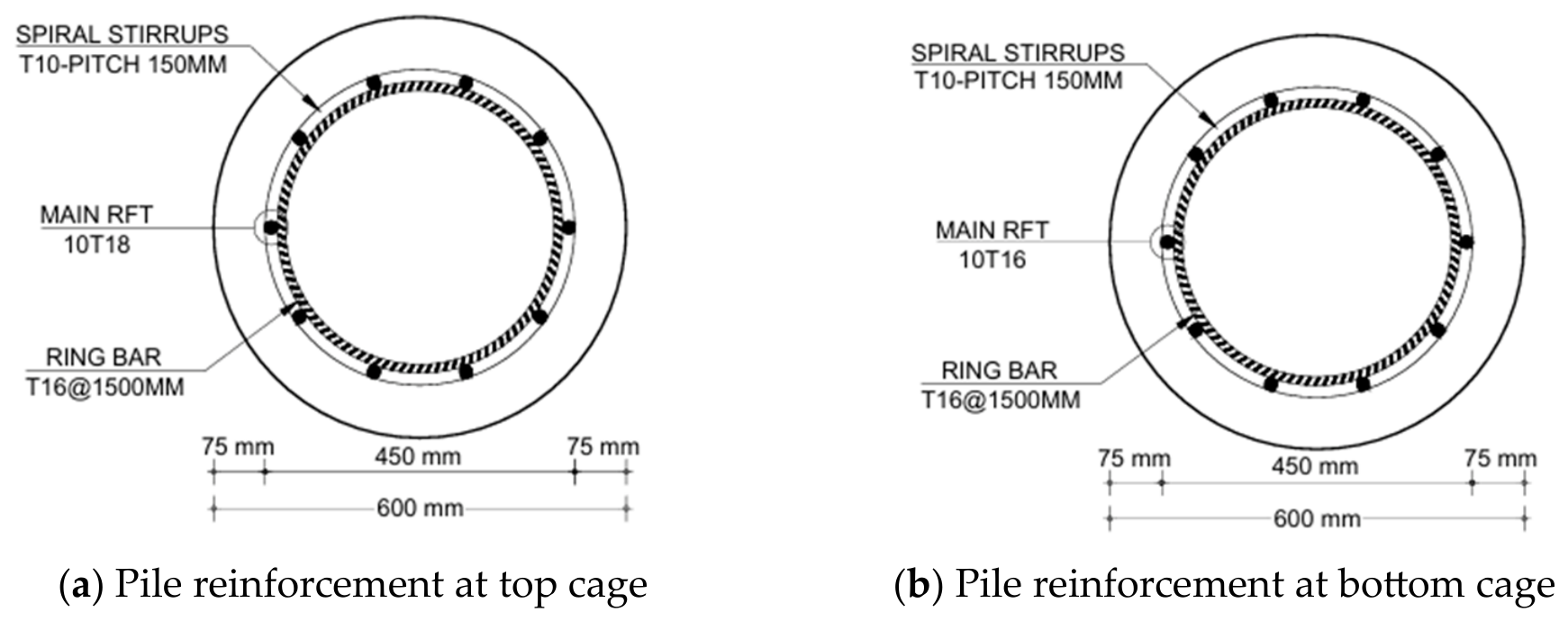
As the bending moment diminishes at depths of approximately 6.0 to 8.0 m below the natural ground level, in the upper cage of the piles, which is subjected to higher bending and shear stresses due to interaction with the pile cap and superstructure loads, the reinforcement cage was provided with 10 longitudinal bars of diameter 18 mm (10T18), confined by 10 mm diameter spiral stirrups at a pitch of 150 mm. Additionally, ring bars with a 16 mm diameter and 1500 mm spacing were incorporated to enhance confinement and structural integrity (see Figure 7a). In the lower cage of the piles, where axial compression is the dominant load, a slightly reduced reinforcement cage was adopted. This configuration consisted of 10 longitudinal bars of diameter 16 mm (10T16), confined by 10 mm spiral stirrups at a pitch of 150 mm, together with 16 mm diameter ring bars at 1500 mm spacing (Figure 7b).

3.4. Material Properties of Pile and Pile Cap Concrete

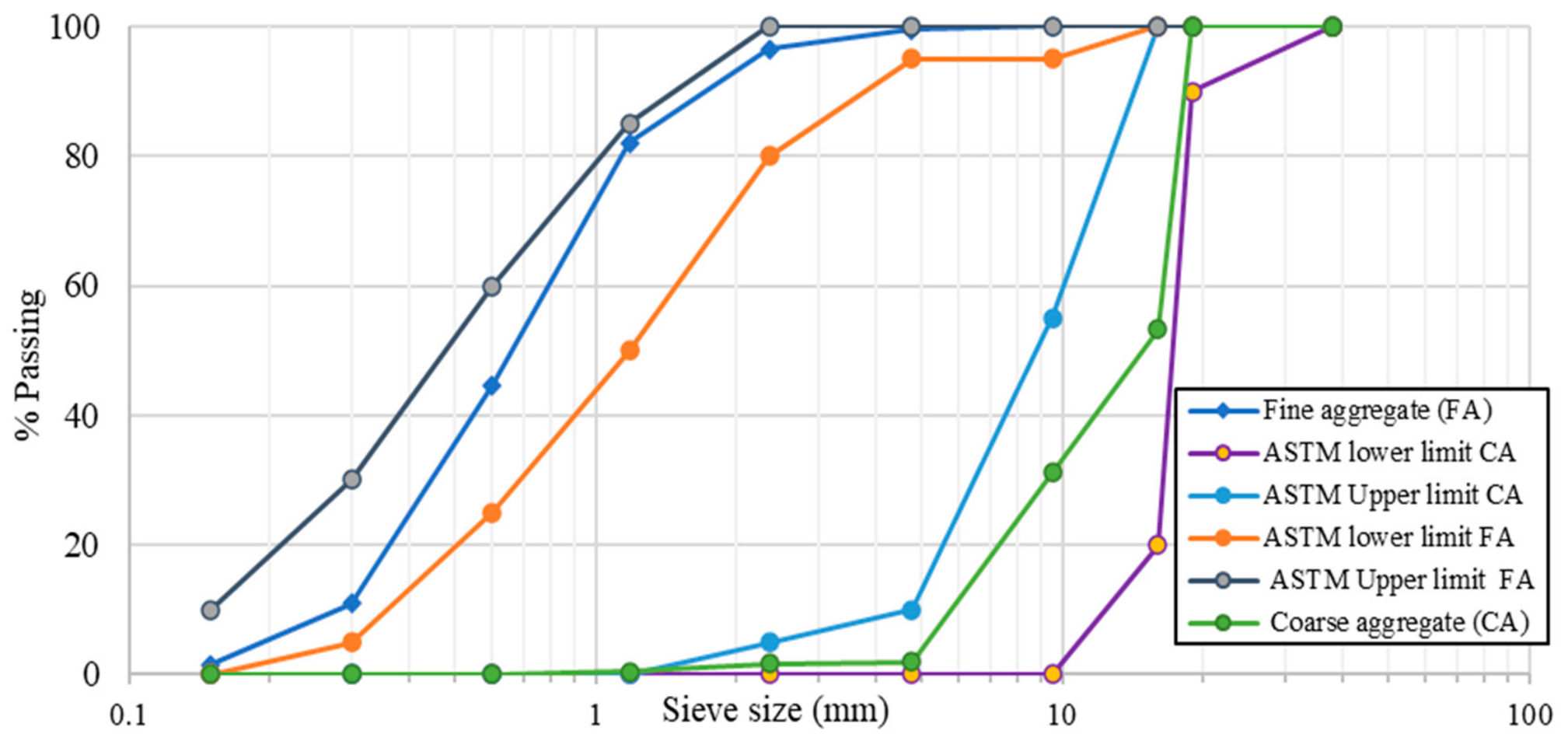
The concrete used for pile construction was designed using locally available materials that conform to the Egyptian Code of Practice (ECP 203) [44]. Ordinary Portland Cement (OPC, Type II) with a nominal compressive strength of 42.5 MPa at 28 days and a specific gravity of 3.15 g/cm3 was used as the primary binder. The physical and chemical properties of the cement are summarized in Table 3. Well-graded crushed coarse aggregate, with a maximum nominal size of 20 mm and a specific gravity of 2.66, was employed. Natural desert sand with a fineness modulus of approximately 2.6 and a specific gravity of 2.61 served as the fine aggregate. Both coarse and fine aggregates were free from clay, silt, and organic impurities. The particle size distribution of the aggregates is illustrated in Figure 8. Potable water, free of salts and deleterious materials, was used for mixing and curing, ensuring a pH not less than 7. To improve the fresh properties and workability of the concrete, a superplasticizer (BASF Egypt [45]) was incorporated. The concrete mix was proportioned to achieve adequate strength, durability, and workability suitable for deep foundation applications, particularly piles subjected to both axial and lateral loads.

3.5. Mixture Proportions of Concrete

In this study, the reference mixture (plain concrete) was designed to achieve a target compressive strength of 40 MPa at 28 days according to ECP 203 [44]. A water-to-cement ratio of 0.36 was adopted. Following several preliminary trials, the dosage of the superplasticizer (MasterRheobuild 850), a naphthalene sulphonate-based admixture that improves the properties of concrete. It increases workability and reduces the amount of water needed in concrete mixtures, was fixed at 2.5% by weight of cement, as this proportion provided the desired workability. The final mix design adopted in this study is presented in Table 4.

3.6. Construction Quality Assurance and Quality Control

To ensure the reliability and consistency of the adopted pile–cap foundation system, a comprehensive quality assurance and quality control (QA/QC) program was implemented throughout the construction process. Drilling operations were continuously monitored to verify compliance with the specified pile locations, diameters, and depths, while the excavation records were reviewed to identify any unexpected geological conditions associated with karst cavities or weak zones. Reinforcement cages were inspected prior to installation to ensure conformity with the design specifications, and concrete quality was controlled through routine compressive strength testing of representative samples in accordance with the project quality plan. In addition, pile construction activities were supervised to verify proper concrete placement and continuity, and representative piles were subjected to full-scale static load testing to confirm the design assumptions and construction quality. The integration of these quality-control procedures with geological investigations and field performance verification enhanced the reliability of the installed foundation system and ensured consistent construction quality across the project despite the highly heterogeneous karst conditions.

3.7. Field Static Pile Load Testing

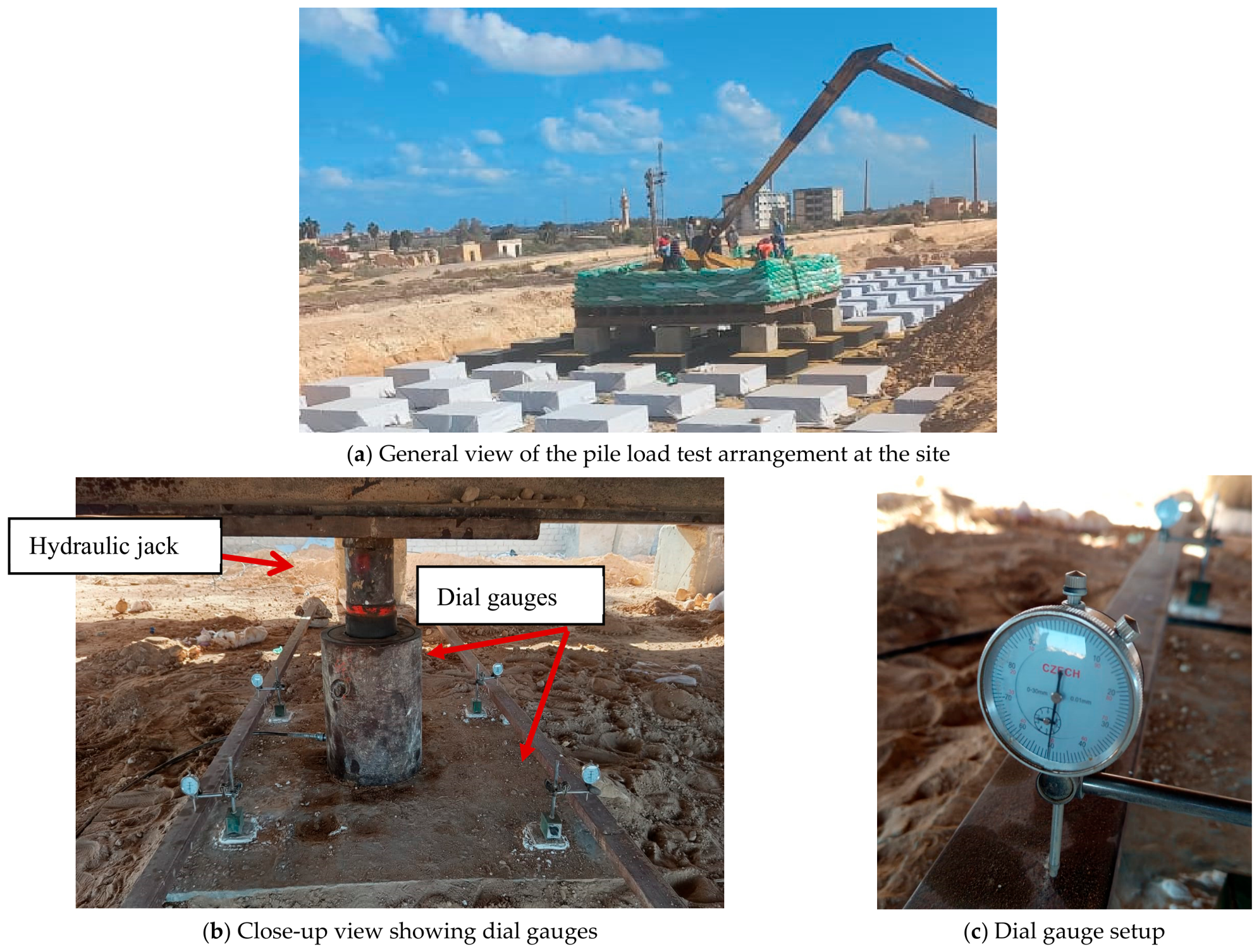
Static pile load tests were conducted in the El-Gharbaniyat area on seven test piles out of a total of 1377 working piles constructed as part of the ground improvement system beneath the alignment of the High-Speed Electric Train Project. The tests were performed in accordance with the Egyptian Code for Deep Foundations [46] and ASTM D1143 standards [47]. Test piles were strategically distributed along the alignment to represent different geological conditions identified from the extensive borehole and geophysical investigations. The purpose of the load tests was to verify the design assumptions rather than perform a statistical characterization of all installed piles. Each pile was loaded up to 1.5 times the working load, and the vertical settlement was precisely measured using dial gauges with high accuracy. During the test, the load was applied incrementally in stages of 25%, 50%, 75%, 100%, 125%, and 150% of the design working load. At each loading stage, the applied load was maintained until the rate of settlement stabilized, and the corresponding vertical displacement was recorded using high-precision dial gauges. Upon reaching the maximum load, the piles were unloaded in successive stages, and the elastic rebound of the pile head was measured to evaluate the recoverable deformation and the overall stiffness of the pile–soil system.
Figure 9 illustrates the general arrangement of the static pile load test. The loading system consists of a reaction frame supported by reaction piles, a hydraulic jack used to apply the axial load, and four dial gauges mounted on an independent reference frame to accurately measure the vertical displacement of the pile head. Each test pile was loaded up to 1.5 times the design working load (3300 kN) in accordance with the adopted testing standards. The allowable settlement (S0) was evaluated based on the provisions of the Egyptian Code [46], considering both the magnitude of settlement and the load–settlement response behavior.

4. Results and Discussion

4.1. Geotechnical Results for Boreholes

The subsurface investigation for boreholes, located within the El-Gharbaniyat area, was performed to characterize the ground conditions and evaluate their suitability for the deep foundation system adopted in the high-speed railway project.

4.1.1. Unconfined Compressive Strength Test (UCS)

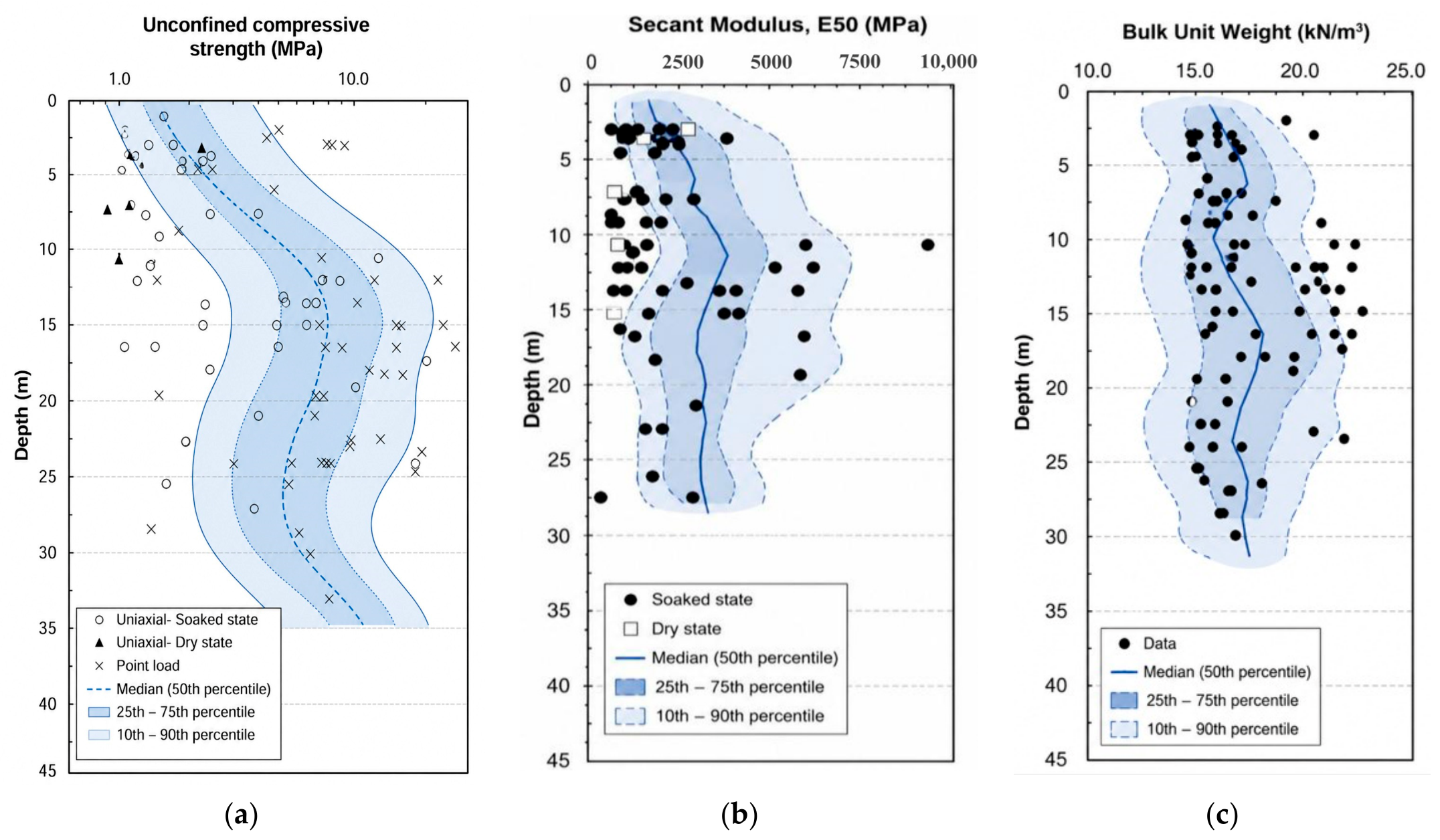
The UCS was carried out according to ASTM D7012-13 [48]. The variation in UCS with depth indicates a general increase in rock strength with increasing depth, reflecting a transition from weak to moderately strong limestone. The reduction in strength under soaked conditions confirms the sensitivity of the upper layers to moisture. The wide range of UCS values (0.2–39.5 MPa) highlights the heterogeneity of the limestone formation, particularly in the shallow zones, as shown in Figure 10a. This behavior indicates that the upper layers are relatively weak and variable, while deeper layers provide more reliable and competent bearing conditions. These results support the adoption of deep foundation systems to transfer loads to deeper, more stable strata.

4.1.2. Secant Stiffness Modulus (E50)

E50 was estimated from the stress–strain response obtained from the unconfined compressive strength tests. The calculated values range from approximately 130 to 9800 MPa (See Figure 10b), indicating a significant variation in stiffness along the depth. The relatively low E50 values in the upper layers reflect weak and more deformable material, while the higher values at greater depths indicate stiffer and more competent rock formations. This increasing trend in stiffness with depth is consistent with the observed improvement in rock quality and strength.

4.1.3. Bulk Unit Weight and Water Absorption

The bulk unit weight of the encountered limestone formations ranges from 15.1 to 23.6 kN/m3 (Figure 10c), indicating noticeable variability in material density with depth. A considerable number of measurements fall below 20 kN/m3, which is consistent with the presence of voids, cavities, and vuggy structures within the rock mass. The water absorption values range from 1.9% to 23.6%, reflecting significant variation in porosity and degree of weathering. The relatively high absorption values in some zones indicate weak and porous limestone, while lower values correspond to denser and more intact rock.

4.1.4. Shear Strength

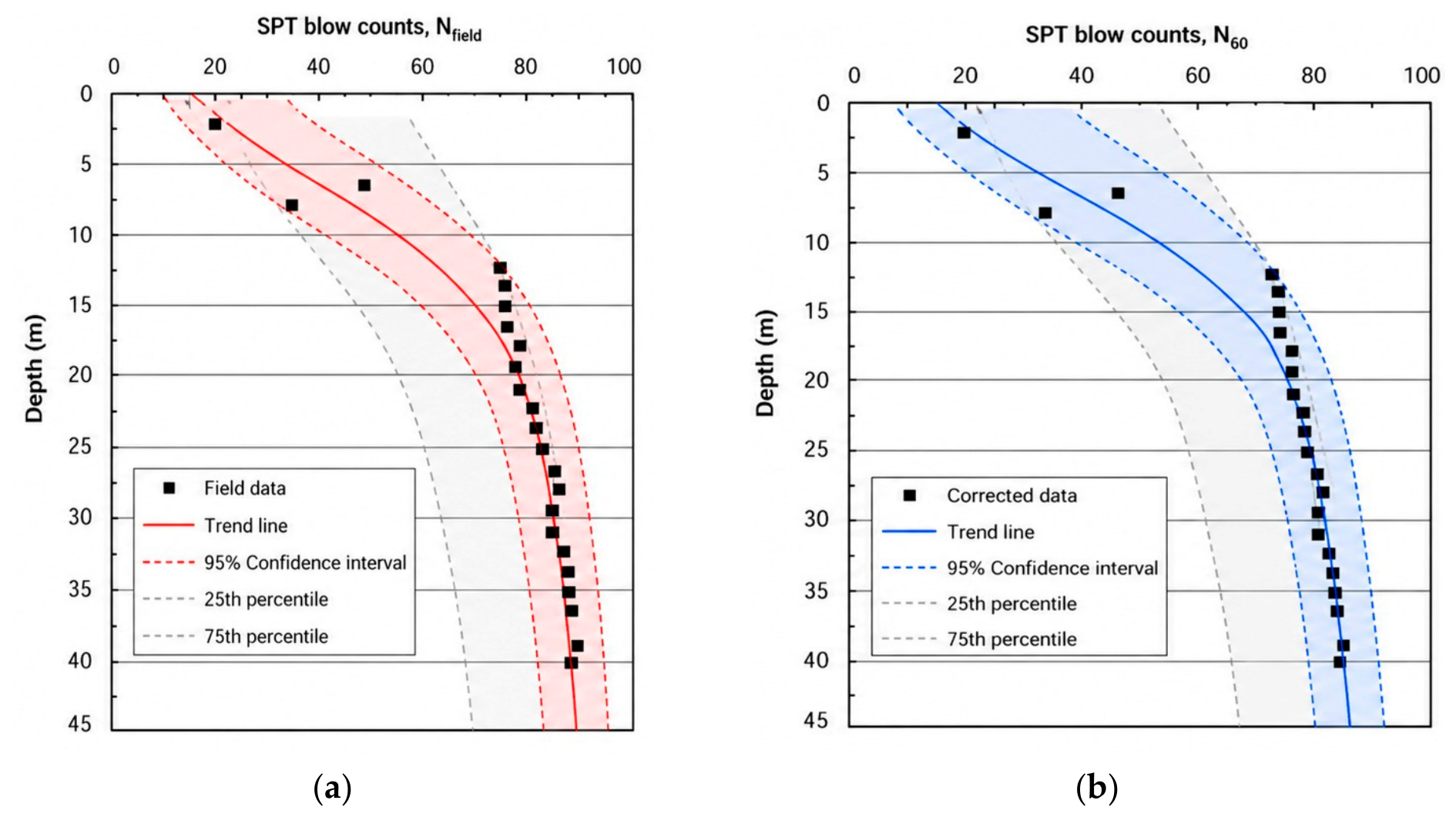
The effective friction angle (φ′) of the sandy layers was estimated based on SPT measurements in accordance with the Egyptian Code of Practice (ECP) [46]. The recorded SPT blow counts (N60) for the silty sand layers at depths between 15.5 m and 28 m generally exceed 50, indicating very dense soil conditions. In contrast, the shallow sandy layers exhibit moderate to high N-values ranging from approximately 22 to 53, as shown in Figure 11. Based on standard correlations, these values correspond to friction angles ranging from 34° to greater than 40°. However, considering the relatively high fine content (9–48%) [49], a reduction of up to 5° was applied, resulting in an estimated φ′ of 30–35° for the shallow silty sand layers and approximately 35° for the deeper layers. The estimated values are consistent with direct shear test results, which yielded friction angles between 33.5° and 35.4°. Accordingly, an average friction angle of 34.5° was adopted for design purposes.

4.1.5. Atterberg Limits

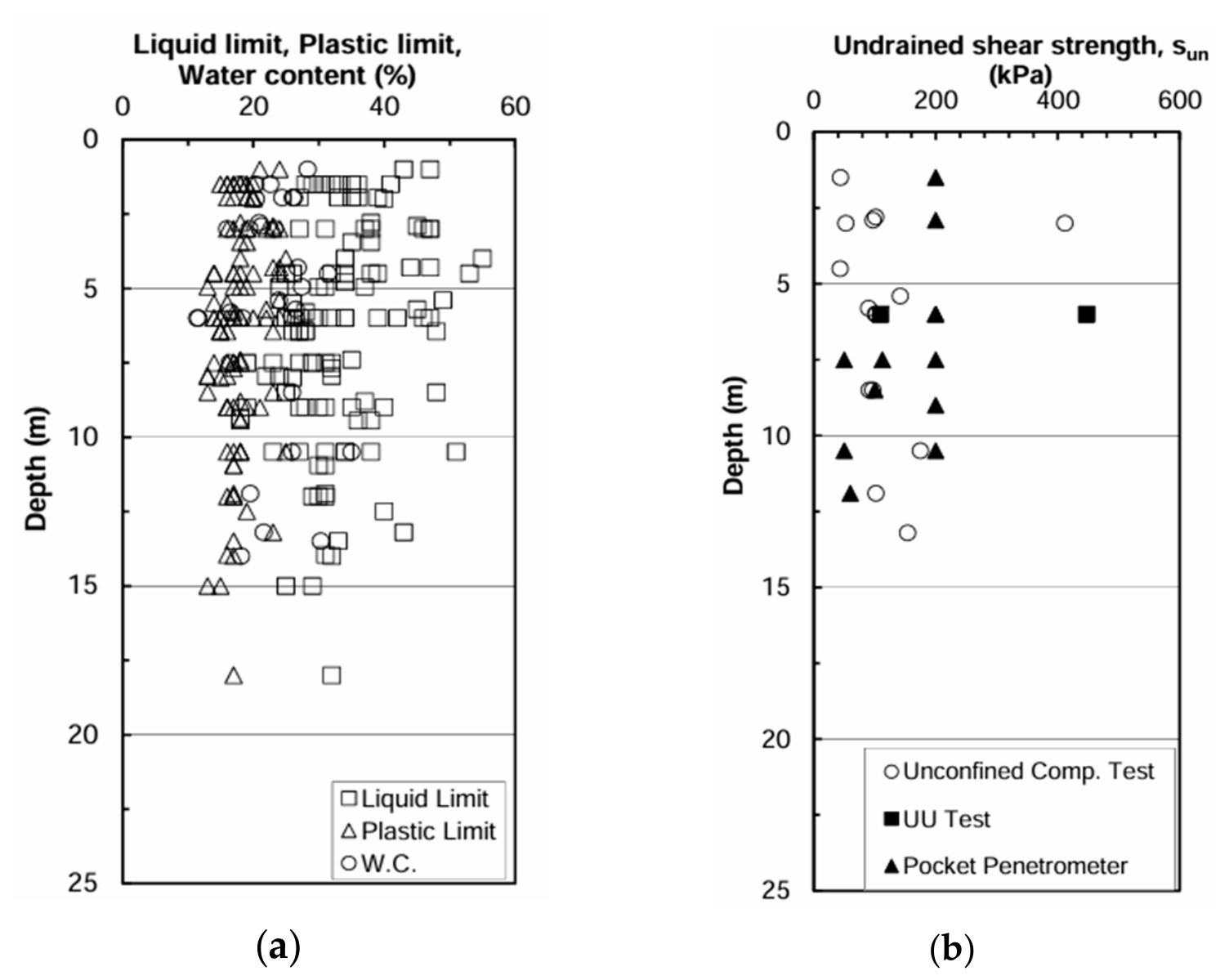
Figure 12 illustrates the variation in liquid limit (LL), plastic limit (PL), and natural water content (w.C) with depth for the clay layers. The LL of the clay layers ranges predominantly between 18% and 55%, with two isolated specimens exhibiting higher values of 76% and 107%. The plastic limit (PL) varies between 13% and 25%, resulting in a plasticity index (PI) ranging from 9% to 30%. These values indicate that the majority of the clay falls within the low to medium plasticity range, while the higher LL values reflect the presence of localized highly plastic zones.

4.1.6. Undrained Shear Strength

The undrained shear strength (Su) of the clay layers was evaluated using unconfined compression tests, pocket penetrometer measurements, and unconsolidated undrained (UU) triaxial tests. The obtained values range from 44 kPa to 447 kPa, indicating a wide variability in soil strength. The pocket penetrometer results generally fall within a narrower range of 50–200 kPa, while the UU triaxial tests yield higher values between 110 kPa and 447 kPa, reflecting more representative in situ conditions. Based on these results, the clay can be classified as medium stiff to hard, with strength generally increasing with depth, as shown in Figure 12b.

4.2. Numerical Analysis of Pile Response Under Lateral Loading

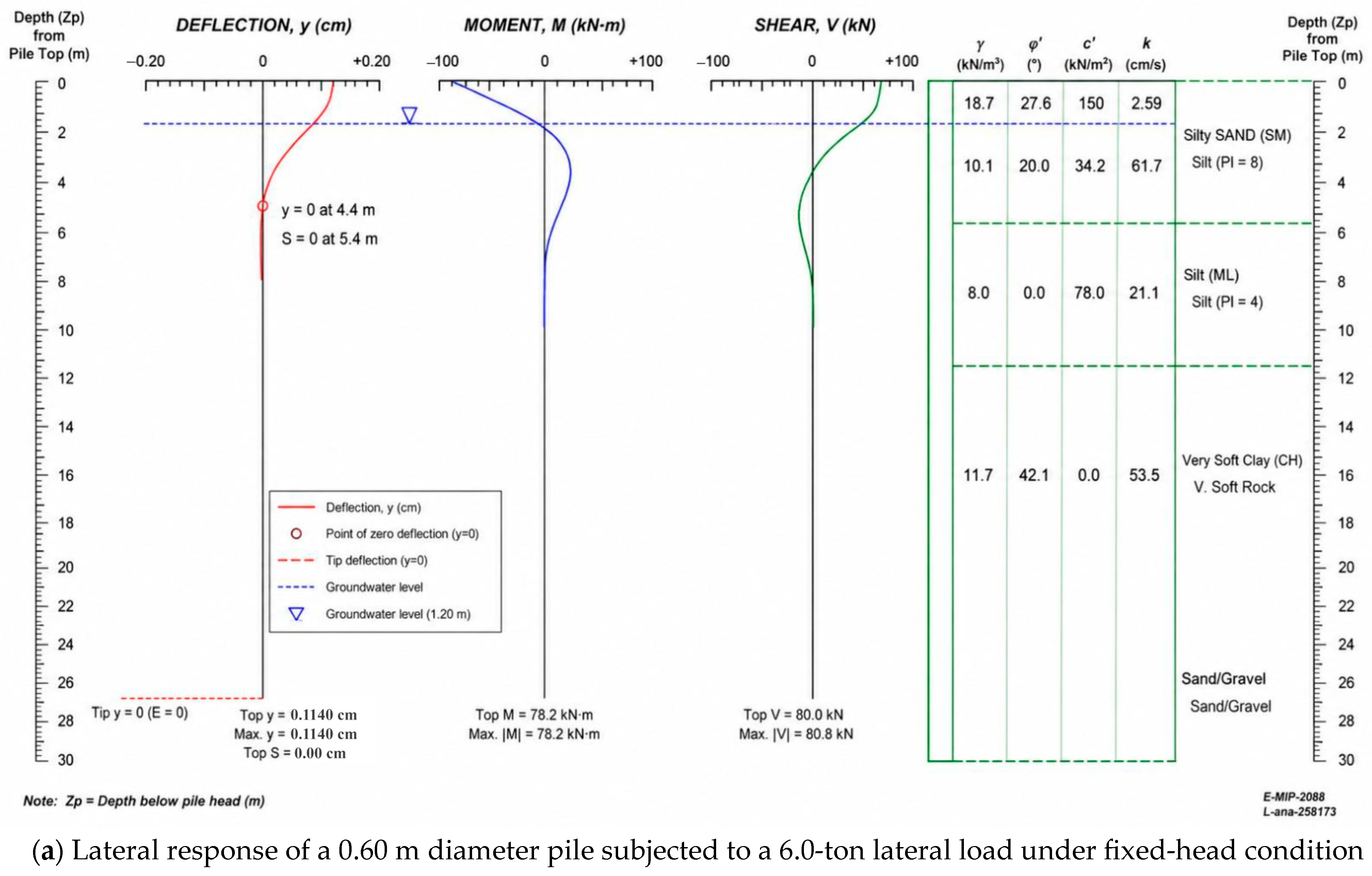
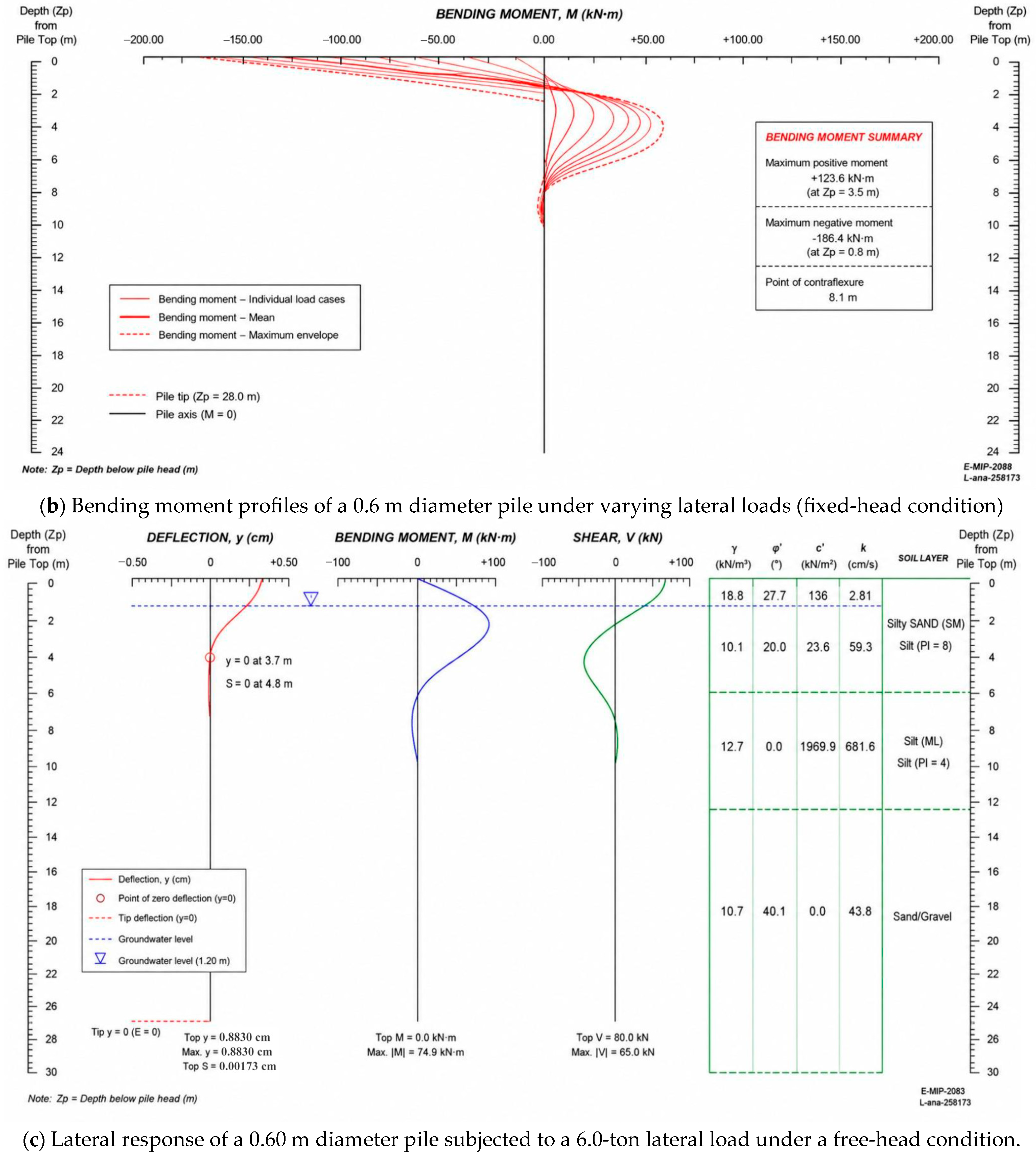
The results of the numerical analysis are presented in Figure 13, illustrating the lateral response of the pile in terms of deflection, bending moment, and shear force distributions along the pile depth. Under fixed-head conditions, the maximum lateral displacement occurs at the pile head, reaching approximately 1.14 mm, and decreases rapidly with depth, becoming negligible at around 4.4 m. The bending moment attains a peak value of 78.2 kN·m at a depth of about 5–6 m, corresponding to the transition between the upper silt layer and the underlying weak rock. Beyond this depth, the bending moment decreases significantly and becomes negligible below approximately 15 m. Similarly, the shear force reaches a maximum of about 60.8 kN near the pile head and diminishes rapidly with depth, approaching zero below 10 m, indicating that lateral load transfer is primarily mobilized within the upper soil layers.
These results demonstrate that the critical structural zone is confined to the upper 6–8 m of the pile, where both maximum bending moment and lateral deformation occur. This justifies concentrating reinforcement within this zone, while deeper sections mainly contribute to axial load transfer and lateral stability.
A comparative analysis of the lateral load response of a 0.60 m diameter pile under fixed-head and free-head conditions reveals significant differences in bending moments, shear forces, and lateral displacements. As depicted in Figure 13 and listed in Table 5, in the fixed-head condition, the maximum bending moment occurs at the pile head with a value of 78.20 kN·m, whereas in the free-head condition, the bending moment at the head is zero and the maximum along the pile is 74.9 kN·m, as shown in Figure 13a,c. This indicates that allowing rotation at the pile top reduces the peak bending moment at the head by 100% and slightly decreases the overall maximum moment by approximately 4.3%. Shear forces show a contrasting pattern: the pile head shear remains 60.0 kN for both conditions, but the maximum shear along the pile changes from 60.8 kN in the fixed-head case to −65.0 kN in the free-head scenario, reflecting a reversal in shear direction and an increase in magnitude by roughly 7%. Lateral displacements are most affected by head conditions, with a maximum deflection of 1.14 cm under a fixed head and 3.38 cm under a free head, indicating a nearly threefold (196%) increase when rotational restraint is removed. These results clearly demonstrate that fixed-head piles, which are used to improve the embankment under high-speed trains, enhance lateral stiffness and concentrate bending and shear near the top, while free-head piles reduce bending demands at shallow depths but allow substantially larger lateral deflections.
These findings indicate that fixed-head conditions enhance lateral stiffness and limit displacements, making them more suitable for high-speed railway embankments where strict serviceability requirements must be satisfied.

4.3. Compressive Strength of Concrete (fcu)

The concrete used in the soil improvement system beneath the high-speed rail embankment in Egypt was evaluated through a detailed compressive strength testing program. A total of 122 piles were randomly selected from the overall 1377 reinforced concrete piles that constitute the foundation system. For each selected pile, three concrete cubes were tested at 7 days and three companion cubes were tested at 28 days to evaluate the early-age and standard-age compressive strengths, respectively. This testing procedure provided a representative and statistically reliable dataset for assessing the performance of the concrete used in pile foundations and pile caps within the El-Gharbaniyat soil improvement zone. The 28-day compressive strength results revealed a mean value of 50 MPa, with a standard deviation of 1.65 MPa, based on 117 valid samples. These results were compared to the design compressive strength requirement of 39.22 MPa specified for the piles in the project’s technical specifications. The analysis shows that the measured mean strength exceeds the design value by approximately 30% (an average margin of 11.77 MPa). The lowest measured 28-day strength was 42.75 MPa, which still surpasses the design target, while the maximum value reached 55.6 MPa. This confirms that all tested samples (100%) met or exceeded the required design compressive strength. The relatively low standard deviation also reflects consistent material quality and effective quality control during production, casting, and curing. Table 6 includes key statistical indicators such as mean, standard deviation, minimum, maximum, and quartile values, which provide insight into the distribution and variability of the measured compressive strengths.

Correlation Between 7-Day and 28-Day Compressive Strengths

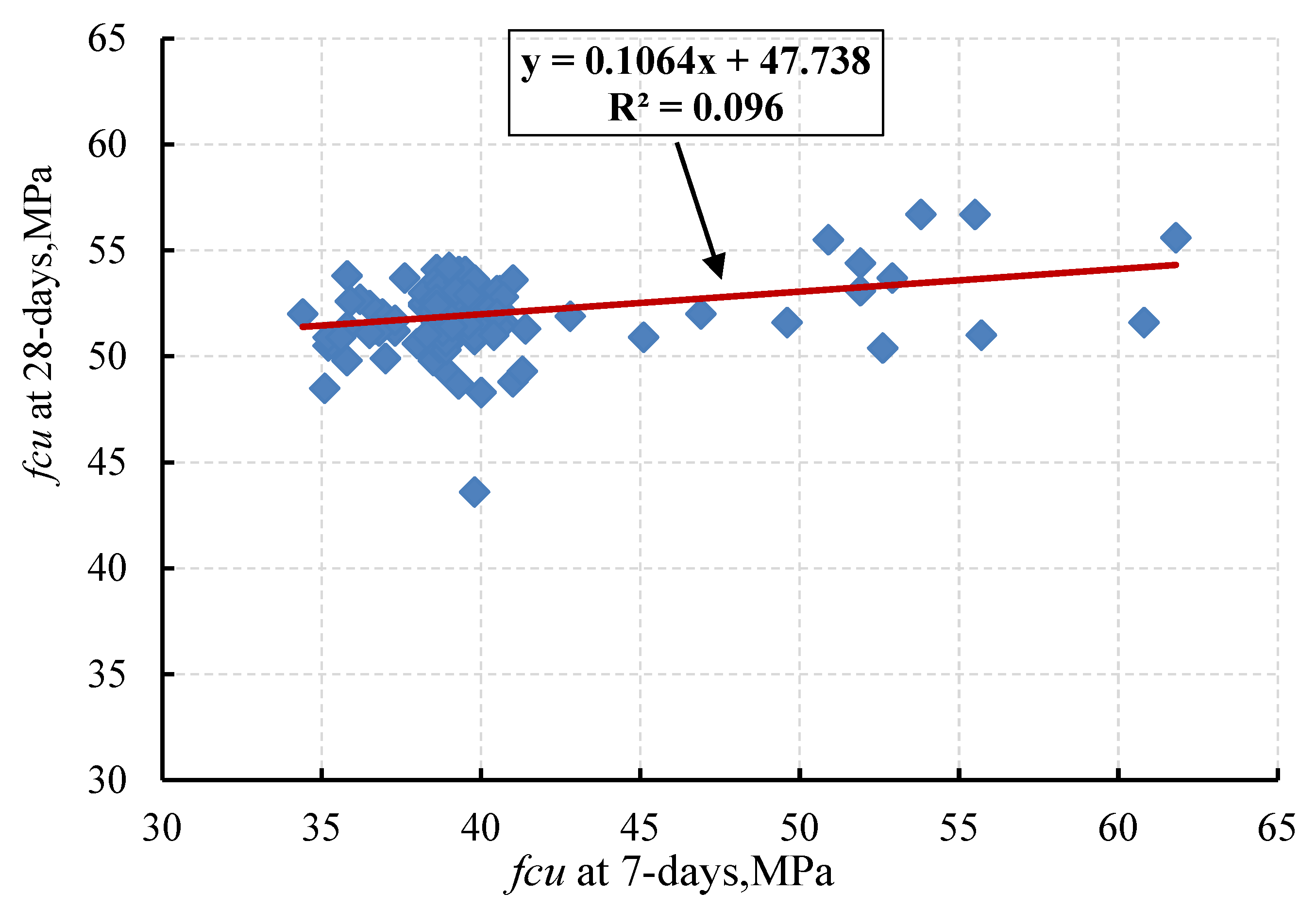
Figure 14 presents the relationship between the 7-day and 28-day compressive strengths of concrete samples obtained from piles and pile caps. The linear regression analysis revealed a weak correlation between the two ages, expressed by the empirical equation: y = 0.1064x + 47.738, where y represents the 28-day compressive strength (MPa) and x represents the 7-day compressive strength (MPa). The coefficient of determination (R2) was approximately 0.096, indicating a weak statistical relationship between the early-age and standard-age strengths, meaning that the 7-day strength cannot reliably predict the 28-day performance for this dataset. Nevertheless, the results clearly show that the 28-day compressive strength values were higher than those at 7 days, which is a normal and expected behavior for concrete. This increase is attributed to the continued hydration of cement and the progressive densification of the cement matrix over time.
Typically, concrete reaches about 70% of its 28-day strength by the age of 7 days under normal curing conditions, which agrees with the general trend observed in this study. The scatter pattern validates the expected relationship between early and final compressive strengths, confirming that the concrete used in the soil improvement works for the Egyptian high-speed rail project achieved stable, predictable, and high-quality performance throughout the tested samples.

4.4. Field Static Pile Load Testing

Table 7 presents the geometric properties and loading conditions of the tested piles, whose lengths range from 26.00 m to 34.70 m, at the El-Gharbaniyat site. All piles have a constant diameter of 0.60 m and were subjected to a working load of 2200 kN and a maximum test load of 3300 kN, with allowable settlements ranging from 22.8 mm to 26.4 mm. Table 8 summarizes the measured settlements at various loading and unloading stages, expressed as percentages of the working load.
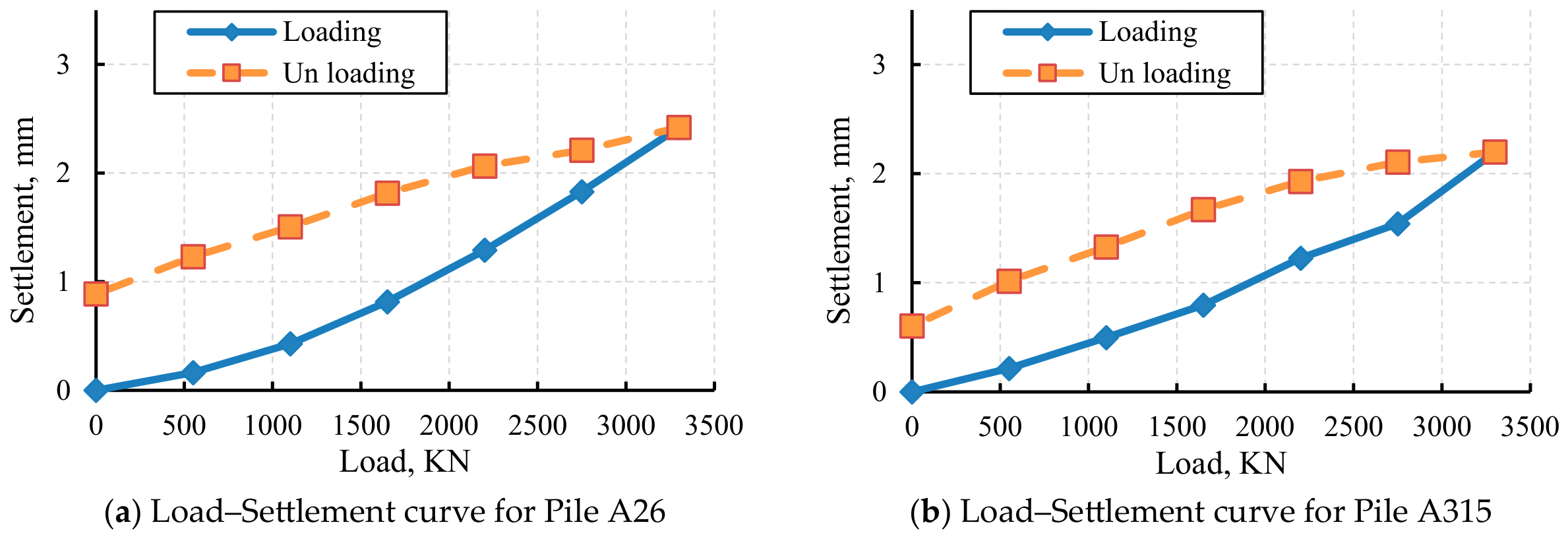
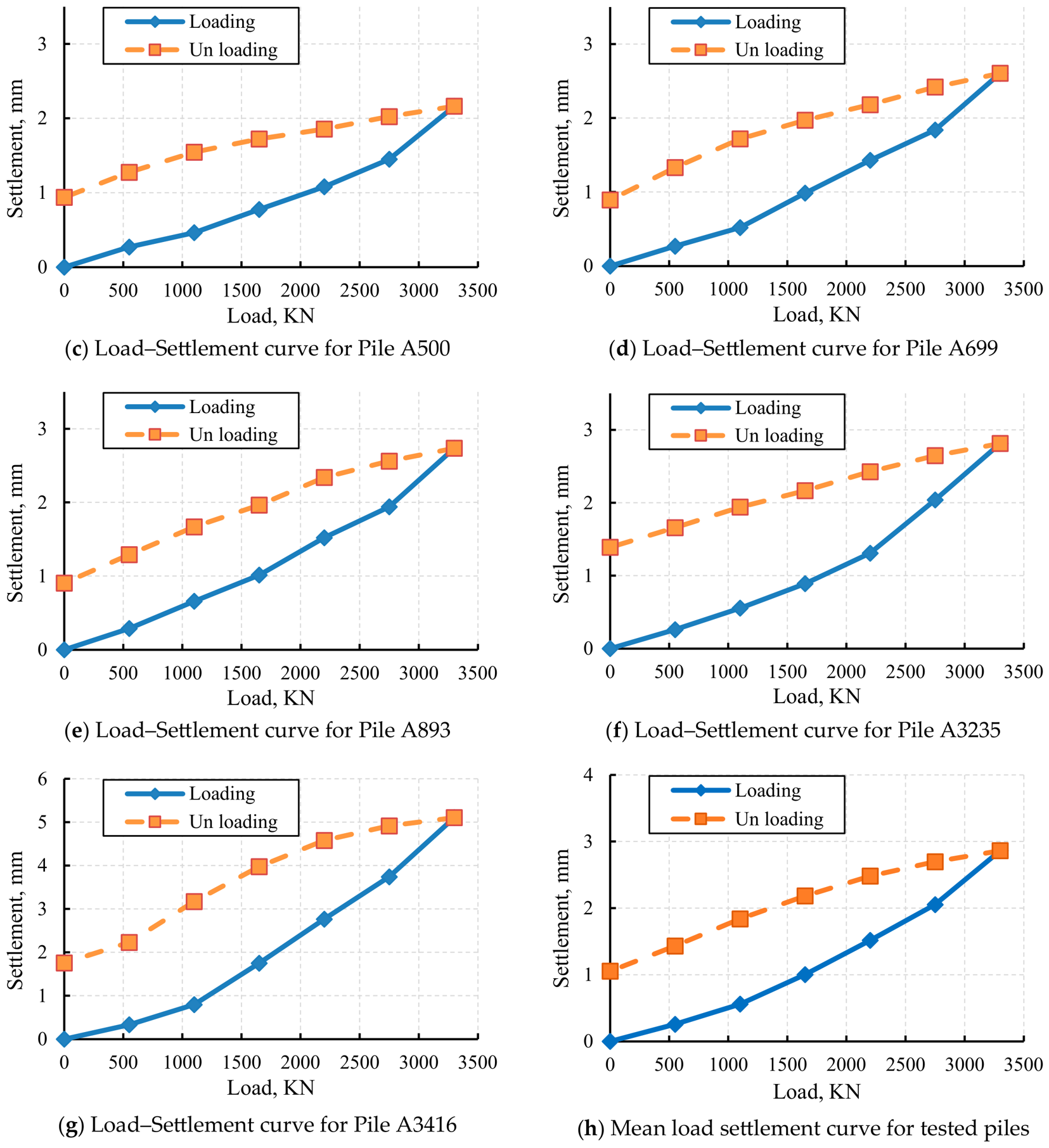
Figure 15 presents the load–settlement curves for the seven tested piles (A26, A315, A500, A699, A893, A3235, and A3416), along with the mean curve. As illustrated, the curves exhibit the expected nonlinear relationship between the applied load and the corresponding settlement.
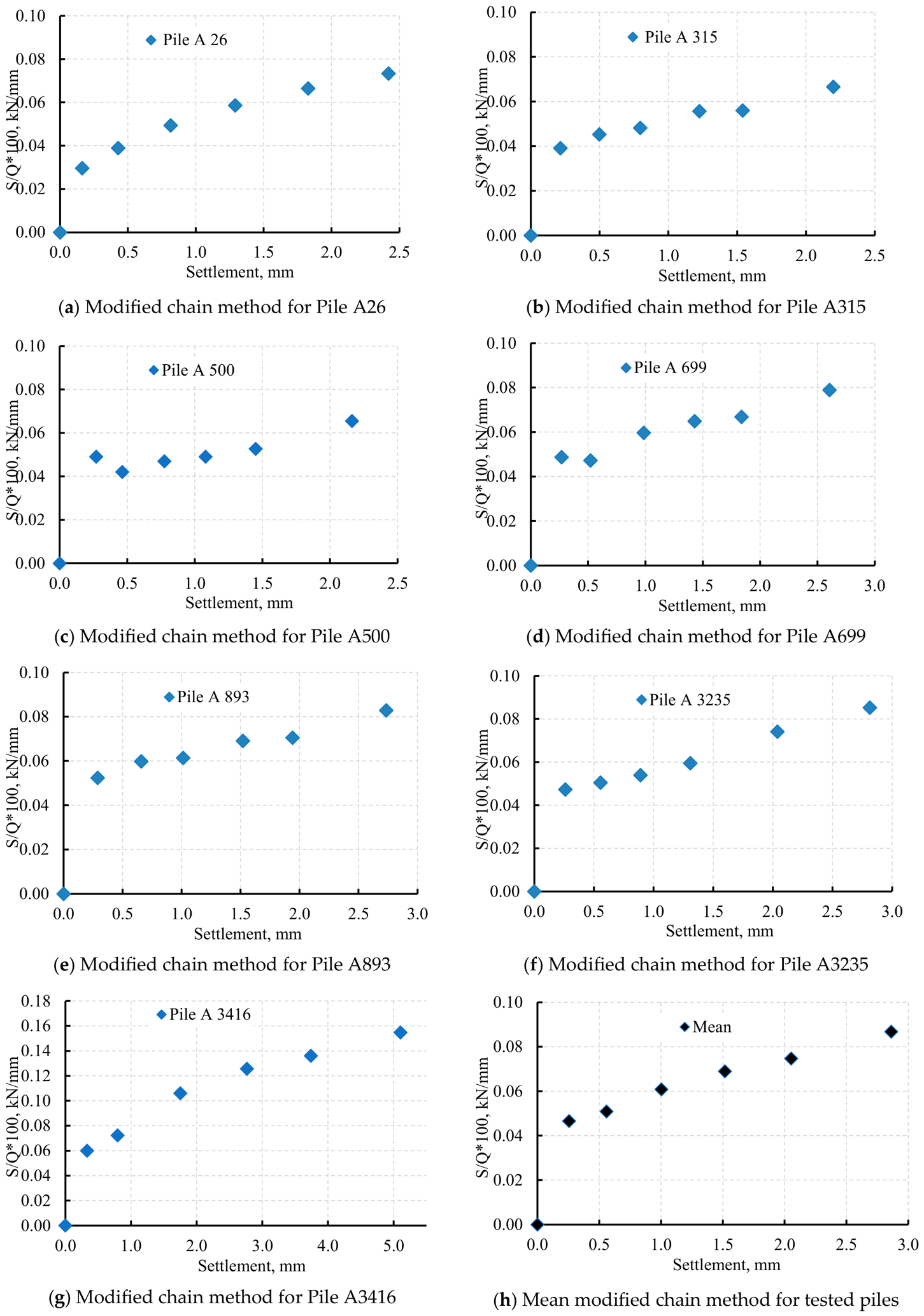
With increasing applied load, the rate of settlement gradually increases, reflecting the progressive mobilization of both shaft friction and end-bearing resistance. At 100% of the working load (2200 kN), the recorded settlements for the tested piles ranged between 1.08 mm and 2.76 mm, with an average value of approximately 1.52 mm. When the load increased to 1.5 times the working load (3300 kN), the settlements increased to between 2.16 mm and 5.10 mm, with an average of 2.86 mm. This corresponds to an average increase in settlement of about 88% compared to the working load condition. Among the tested piles, Pile A3416 (Figure 15g) exhibited the largest settlements at all loading stages. Rather than being attributed solely to pile geometry, this response is considered to reflect local geological variability within the karst terrain, where differences in subsurface stratigraphy, material stiffness, and the presence of localized weak zones or dissolution features may influence pile–soil interaction behavior. In contrast, Piles A500 (Figure 15c) and A315 (Figure 15b) showed comparatively lower settlements under the same loading conditions. During the unloading phase, all piles exhibited partial elastic recovery, with residual settlements ranging between 0.60 mm and 1.75 mm, and an average value of 1.05 mm. The nearly linear rebound trend of the unloading curves confirms that most of the pile deformation was elastic in nature. The mean load–settlement curve provides an overall representation of the pile group’s performance and confirms that the settlement values at maximum load remain well below the allowable limit (approximately 25 mm), ensuring adequate serviceability and structural safety of the tested pile foundations. The modified Chin method was employed as a complementary interpretation tool to the conventional load–settlement curves in order to evaluate the stiffness degradation and load–settlement behavior of the pile group throughout the loading stages. In this method, S represents the measured settlement (mm) and Q represents the applied load (kN). Accordingly, the parameter S/Q × 100 (mm/kN × 100) provides an indicator of settlement per unit of applied load, where increasing values reflect progressive reduction in the stiffness of the pile–soil system.
While conventional load–settlement curves directly describe pile performance under increasing load, the modified Chin method facilitates the identification of changes in system stiffness and provides an additional means of assessing pile response during loading. Therefore, both methods were used to provide a more comprehensive interpretation of the field load test results. During the field static load testing of the pile group, the mean values of the parameter S / Q × 100 exhibited a clear ascending trend with the increase in applied loads, reflecting the progressive deformation within the pile–soil system; the results of this test are presented in Table 9 and Figure 16.
On a stage-by-stage basis, the mean S / Q × 100 value increased by approximately 9.2% as the load rose from 550 to 1100 kN, then showed the highest rate of increase (≈19.5%) between 1100 and 1650 kN. Further increments were recorded at 13.3% (1650 → 2200 kN), 8.4% (2200 → 2750 kN), and 16.0% (2750 → 3300 kN). This pattern indicates the onset of nonlinear behavior after the medium loading range (around 1100 kN), as the stiffness of the soil–pile interaction system progressively decreases with higher load levels. From a geotechnical perspective, this behavior can be explained by several interconnected mechanisms. At lower loads, the system response is nearly linear, dominated by side friction and end-bearing resistance, with the pile carrying most of the applied load without significant settlement. As the load increases, the upper and intermediate soil layers undergo compression and partial stiffness degradation (mobilization of additional settlements), leading to a noticeable rise in S / Q . The variation in the rate of increase across loading stages suggests a redistribution of stresses among the piles in the group (group effect) and local variability in soil stiffness. The higher increment (≈19.5%) reflects the transition to a stress range where pressure distribution in the soil widens, bending moments develop, and local grain slippage begins to occur. Similarly, the sharp increase at high loads (2750 → 3300 kN) may indicate that the stress levels approach local bearing capacity or that relaxation occurs in borehole walls due to preexisting voids or cavities.

4.5. Load Transfer Mechanism of the Pile–Cap System

The satisfactory field performance of the pile–cap foundation system can be attributed to the cooperative interaction between the embankment fill, the load-transfer platform, the pile caps, and the pile group. Under embankment loading, stresses are initially distributed through the reinforced granular platform before being transferred to the reinforced concrete pile caps. The pile caps act as rigid load-distribution elements that promote a more uniform transfer of loads to adjacent piles, thereby reducing stress concentrations and limiting the effects of localized karst cavities or weak zones. The applied loads are subsequently resisted through a combination of shaft friction and end-bearing resistance within the competent limestone strata.
This load-transfer mechanism contributes to improved foundation stiffness and reduced differential settlement by providing a bridging effect over heterogeneous subsurface conditions. The observed differences in settlement among the tested piles are therefore more likely associated with local variations in karst development, weathered rock thickness, and cavity distribution than with pile geometry alone. Although the present study does not include three-dimensional numerical modeling of the pile–soil–cap interaction, the full-scale field performance and load test results provide practical evidence supporting the effectiveness of the adopted foundation system under the investigated geological conditions.

4.6. Comparative Evaluation of Ground Improvement Techniques

To further demonstrate the effectiveness of the proposed method, a comparative analysis was carried out using data from several existing projects in China. The China–Laos railway project adopted the backfilling method, with an average pile length of 14 m and a diameter of 1.25 m [31]. The Nanning Airport project, based on field data, utilized the grouting method with piles approximately 30 m in length and 1.25 m in diameter. In contrast, the Guangzhou North Station project implemented the steel casing method, where piles reached an average length of 45 m with a diameter of 1.2 m [50]. For the high-speed train project in the El-Gharbaniyat area investigated in this study, the proposed pile–cap system was applied using piles with an average length of approximately 29 m and a diameter of 0.60 m, highlighting a more efficient configuration compared to conventional techniques.
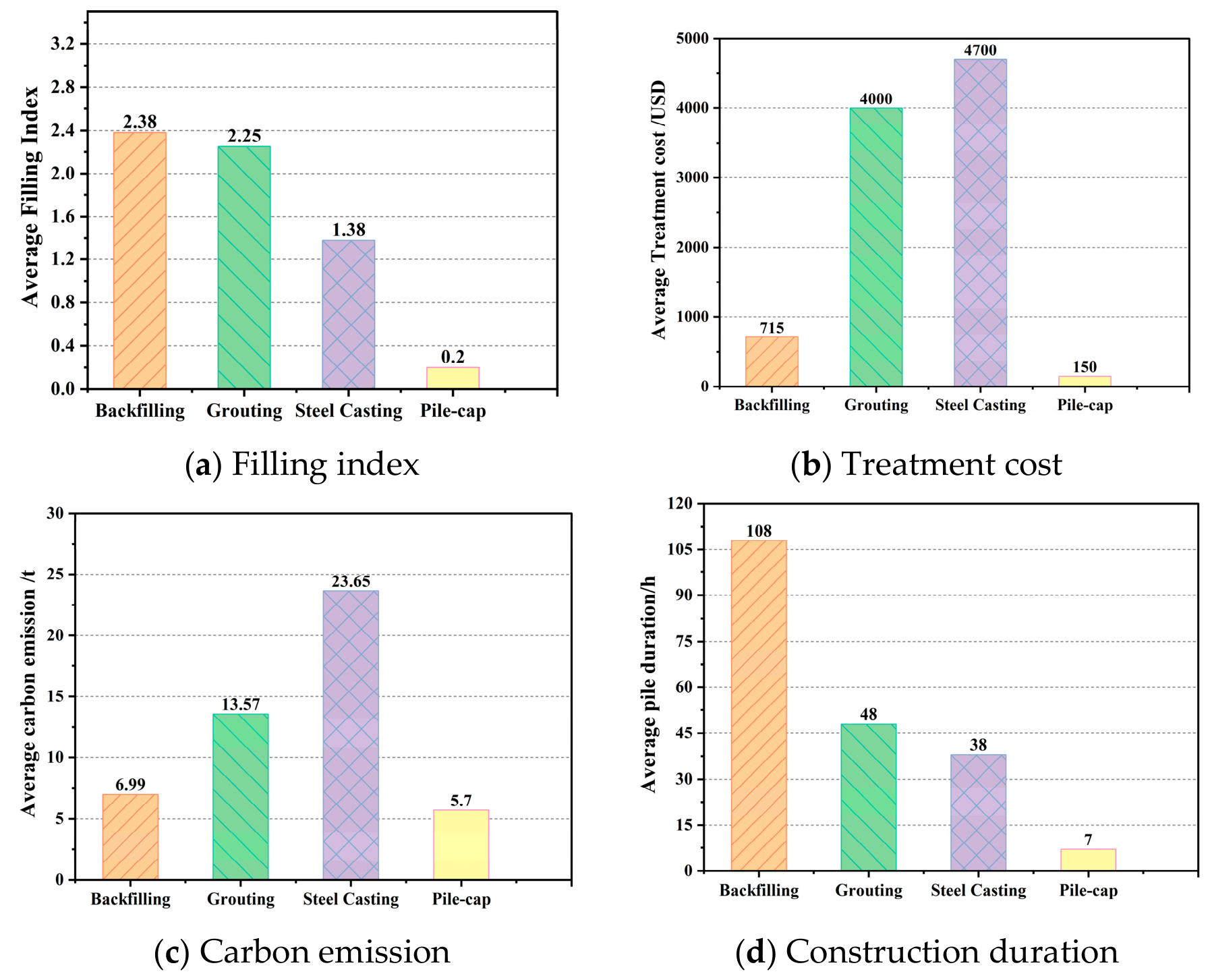
Figure 17a presents a comparison of material usage efficiency among different ground improvement techniques. It is evident that traditional methods such as backfilling and grouting exhibit high filling indices (2.38 and 2.25, respectively), indicating significant material consumption. In contrast, the proposed pile–cap system shows a substantially lower value (~0.20), reflecting a reduction of more than 90% in material usage and demonstrating its superior efficiency.
The average ground treatment cost for different techniques is depicted in Figure 17b, including backfilling, grouting, steel casing, and the proposed pile–cap system. It is evident that grouting and steel casing methods exhibit significantly higher costs, reaching approximately 4000 USD and 4700 USD, respectively. The backfilling method shows a relatively lower cost (715 USD); however, it should be noted that this method represents an engineered filling technique involving a mixture of rubble, clay, and cement rather than conventional earth filling [30]. In contrast, the proposed pile–cap system demonstrates a considerably lower treatment cost of approximately 150 USD, based on full-scale project data from Egypt. It should be noted that cost values vary with regional economic conditions; therefore, the comparison reflects relative cost efficiency rather than absolute values.
Figure 17c shows that steel casing pile results in the highest carbon emission (23.65 t), followed by grouting (13.57 t), while engineered backfilling records a moderate value (6.99 t). In comparison, the proposed pile–cap system exhibits a lower emission of about 5.7 t per pile, making it the most environmentally efficient option among the considered techniques. These findings are consistent with a previous study [39].
The average construction duration of different ground improvement techniques is compared in Figure 17d. Backfilling requires the longest execution time (108 h), followed by grouting (48 h) and steel casing (38 h). In contrast, the proposed pile–cap system shows a significantly shorter duration of approximately 7 h per pile, indicating a more efficient construction process. In addition, the reduction in construction time contributes to lowering the cost of individual piles by minimizing indirect costs associated with labor, equipment operation, and site management, which consequently reduces the overall project cost.
From the previous results, the proposed pile–cap system represents a robust and efficient solution for ground improvement in karst conditions, combining cost-effectiveness, ease of implementation, and reduced environmental impact. The system ensures reliable load transfer to deeper competent strata, significantly reducing settlement of the embankment beneath the high-speed railway. In addition, it minimizes disturbance to subsurface conditions and groundwater while maintaining construction efficiency and long-term structural stability.
The comparison presented in this study is intended to provide a qualitative engineering perspective on the potential benefits of the adopted pile–cap foundation system rather than a direct quantitative benchmark. It is acknowledged that the reference project differs from the present case study in terms of geological conditions, pile dimensions, loading characteristics, and foundation configuration. Consequently, the reported differences in material consumption, construction cost, and estimated carbon emissions should be interpreted as indicative trends rather than normalized performance indicators. A rigorous comparison would require normalization based on parameters such as treated area, foundation bearing capacity, pile volume, or embankment loading, together with a comprehensive life-cycle assessment. Such analyses are beyond the scope of the present field validation study and are recommended for future research.

4.7. Limitations and Future Research

This study presents a field-scale evaluation of a pile–cap composite foundation system for a high-speed railway embankment constructed over karst terrain in Egypt. Although the integrated investigation–design–verification approach demonstrated satisfactory field performance, several limitations should be acknowledged.
The assessment was primarily based on static field load tests and did not consider the long-term dynamic response of the foundation under repeated high-speed train loading. In addition, while borehole investigations were integrated with ERT and ST, geophysical interpretations remain indirect and should be considered as supporting rather than definitive evidence of subsurface conditions. Furthermore, the study focuses on field observations and does not include advanced numerical modeling to investigate pile–group interaction, stress redistribution, or the influence of heterogeneous karst features on the overall behavior of the pile–cap system. The economic and environmental comparisons presented are intended to be engineering-level evaluations, not a complete life-cycle assessment. Moreover, conclusions are drawn from one case study under specific geological and hydrogeological conditions and therefore should be generalized with caution.
The performance and resilience of pile-supported railway embankments in complex karst environments need to be further evaluated by conducting more research on the integration of long-term monitoring, dynamic loading analysis, advanced numerical simulation and life-cycle sustainability assessments. Additional case studies from different geological settings would also contribute to validating the applicability of the proposed investigation–design–verification framework.

5. Conclusions

This study examines the ground improvement approach adopted in the El-Gharbaniyat area of Egypt, where a pile–cap system was implemented beneath the embankment of the high-speed electric railway. The system was selected to enhance the bearing capacity and control the settlement of weak and cavernous subsoil conditions. Based on comprehensive experimental investigation, the following conclusions can be drawn:
  • Integrated geological investigations revealed highly heterogeneous karst conditions characterized by weak clay layers overlying fractured and cavity-prone limestone, with significant variability in rock and soil properties. The adopted pile–cap foundation system effectively transfers loads to competent strata, providing a reliable solution for settlement control and bearing capacity improvement.
  • Numerical analysis indicated that lateral pile behavior is governed primarily by the upper 6–8 m of the ground profile, where maximum bending moments and lateral displacements occur, while shear forces and bending moments decrease rapidly with depth, confirming that lateral load transfer is concentrated within the shallow soil layers.
  • Concrete quality control demonstrated excellent construction consistency, with the 28-day compressive strength of 122 tested piles averaging 50 MPa, approximately 30% higher than the design strength, and exhibiting low variability, reflecting effective quality assurance during construction.
  • Full-scale static load tests confirmed the satisfactory performance of the pile–cap system, with measured settlements remaining well below the allowable limit under both working and maximum test loads. The observed partial elastic recovery during unloading further indicates that the piles behaved predominantly within the elastic range, ensuring adequate stiffness and serviceability.
  • The adopted pile–cap foundation system demonstrated high engineering efficiency by providing reliable load transfer and effective settlement control under complex karst conditions while significantly reducing material consumption and treatment costs compared with conventional ground improvement approaches.
  • The integrated investigation–design–verification framework presented in this study, combining geological and geophysical investigations, optimized foundation design, construction quality control, and full-scale field validation, provides a practical methodology for the design and implementation of high-speed railway embankments in heterogeneous karst environments.

Author Contributions

Conceptualization, M.A.B., H.H. and A.S.E.; methodology, M.A.B., H.H. and A.S.E.; validation, M.A.E.-W., Y.M. and M.A.B.; formal analysis, A.S.E.; investigation, H.H. and M.A.E.-W.; resources, M.A.B.; data curation, H.H.; writing—original draft preparation, M.A.B.; writing—review and editing, Y.M., M.A.E.-W.; visualization, A.S.E.; funding acquisition, Y.M. All authors have read and agreed to the published version of the manuscript.

Funding

The research was funded by KAU Endowment (WAQF) at King Abdulaziz University, Jeddah, Saudi Arabia. The authors, therefore, acknowledge WAQF and the Deanship of Scientific Research (DSR) for technical and financial support.

Data Availability Statement

The original contributions presented in this study are included in the article. Further inquiries can be directed to the corresponding author.

Conflicts of Interest

The authors declare no conflicts of interest.

References

  1. Huang, M.; Jiang, S.; Xu, C.; Xu, D. A New Theoretical Settlement Model for Large Step-Tapered Hollow Piles Based on Disturbed State Concept Theory. Comput. Geotech. 2020, 124, 103626. [Google Scholar] [CrossRef]
  2. Han, J.; Lu, G.; Yang, J. The Risk Assessment of Bridge Pile Foundation Construction in Karst Regions Based on the Fuzzy Analytic Hierarchy Process. Buildings 2025, 15, 1059. [Google Scholar] [CrossRef]
  3. Rauf, A.; Moon, S.-W.; Lim, C.-K.; Satyanaga, A.; Kim, J. Mechanical Characteristics of CSA-Treated Sand Reinforced with Fiber under Freeze-Thaw Cycles. Case Stud. Constr. Mater. 2024, 21, e03875. [Google Scholar] [CrossRef]
  4. Messioud, S.; Okyay, U.S.; Sbartai, B.; Dias, D. Dynamic Response of Pile Reinforced Soils and Piled Foundations. Geotech. Geol. Eng. 2016, 34, 789–805. [Google Scholar] [CrossRef]
  5. Shen, L.; Han, X.; Fei, L.; Ding, R. Case Study on Feasibility and Performance of Embankment over Soft Soils with Beam-Type Capped Piles. KSCE J. Civ. Eng. 2025, 29, 100208. [Google Scholar] [CrossRef]
  6. Basha, A.; Elmorsy, S.; Mansour, W.; Ramadan, B. Effect of the Pile Cap Length and the Soil Relative Density on the Pile Cap—Pile—Dense Soil Interaction: Experimental Investigation. Case Stud. Constr. Mater. 2024, 20, e03169. [Google Scholar] [CrossRef]
  7. Filz, G.; Sloan, J.; McGuire, M.P.; Collin, J.; Smith, M. Column-Supported Embankments: Settlement and Load Transfer. In Geotechnical Engineering State of the Art and Practice: Keynote Lectures from GeoCongress 2012; ASCE: Reston, VA, USA, 2012; pp. 54–77. [Google Scholar] [CrossRef]
  8. Fagundes, D.F.; Almeida, M.S.S.; Thorel, L.; Blanc, M. Load Transfer Mechanism and Deformation of Reinforced Piled Embankments. Geotext. Geomembr. 2017, 45, 1–10. [Google Scholar] [CrossRef]
  9. Huang, M.S.; Li, J.J.; Li, X.Z. Cumulative Deformation Behaviour of Soft Clay in Cyclic Undrained Tests. Yantu Gongcheng Xuebao/Chin. J. Geotech. Eng. 2006, 28, 891–895. [Google Scholar]
  10. El-ghaffar, A.A.; Gabr, A. Behavior of the C.F.A Piles in Gharbia Governorate of Egypt by Using Numerical Simulation. Al-Azhar Univ. Civ. Eng. Res. Mag. (CERM) 2019, 41, 193–207. [Google Scholar]
  11. Wan, Z.H.; Dai, G.L.; Gong, W.M. Field Study on Post-Grouting Effects of Cast-in-Place Bored Piles in Extra-Thick Fine Sand Layers. Acta Geotech. 2019, 14, 1357–1377. [Google Scholar] [CrossRef]
  12. Liu, W.; Novak, M. Soil-Pile-Cap Static Interaction Analysis by Finite and Infinite Elements. Can. Geotech. J. 1991, 28, 771–783. [Google Scholar] [CrossRef]
  13. Lee, S.H.; Chung, C.K. An Experimental Study of the Interaction of Vertically Loaded Pile Groups in Sand. Can. Geotech. J. 2005, 42, 1485–1493. [Google Scholar] [CrossRef]
  14. Ma, H.; Luo, Q.; Wang, T.; Jiang, H.; Lu, Q. Numerical Stability Analysis of Piled Embankments Reinforced with Ground Beams. Transp. Geotech. 2021, 26, 100427. [Google Scholar] [CrossRef]
  15. Tran, T.V.; Kimura, M.; Boonyatee, T. 3D FE Analysis of Effect of Ground Subsidence and Piled Spacing on Ultimate Bearing Capacity of Piled Raft and Axial Force of Piles in Piled Raft. Open J. Civ. Eng. 2012, 02, 206–213. [Google Scholar] [CrossRef]
  16. Magade, S.B.; Ingle, R.K. Influence of Clear Edge Distance and Spacing of Piles on Failure of Pile Cap. Iran. J. Sci. Technol. Trans. Civ. Eng. 2020, 44, 1265–1281. [Google Scholar] [CrossRef]
  17. Zhao, H.; Zhang, J.; Qiu, P.; Ji, S. Hierarchical Modeling Method for DEM Simulation and Its Application in Soil–Pile–Cap Interaction and Impact Case. Int. J. Geomech. 2019, 19, 05024004. [Google Scholar] [CrossRef]
  18. Gutiérrez, F.; Parise, M.; De Waele, J.; Jourde, H. A Review on Natural and Human-Induced Geohazards and Impacts in Karst. Earth Sci. Rev. 2014, 138, 61–88. [Google Scholar] [CrossRef]
  19. Iqbal, K.; Xu, C.; Han, Y.; Motalleb, Q.A.; Ijaz, N.; Dou, P. Numerical Study on Seismic Response of Offshore Wind Turbine Monopile in Multi-Layered Soil Profile of Arabian Sea. Int. J. Struct. Stab. Dyn. 2023, 23, 2350049. [Google Scholar] [CrossRef]
  20. Zhang, C.; Zhou, J.; Zheng, X.; Yang, J.; Zhan, S.; Yang, L. A Novel Water-Swelling Grouting Material Formulation and Its Performance for Water Rushing in Karst Strata. Constr. Build. Mater. 2024, 416, 135245. [Google Scholar] [CrossRef]
  21. Zeng, C.-F.; Powrie, W.; Chen, H.-B.; Wang, S.; Diao, Y.; Xue, X.-L. Ground Behavior Due to Dewatering Inside a Foundation Pit Considering the Barrier Effect of Preexisting Building Piles on Aquifer Flow. J. Geotech. Geoenviron. Eng. 2024, 150, 05024004. [Google Scholar] [CrossRef]
  22. Chalikakis, K.; Plagnes, V.; Guerin, R.; Valois, R.; Bosch, F.P. Contribution of Geophysical Methods to Karst-System Exploration: An Overview. Hydrogeol. J. 2011, 19, 1169–1180. [Google Scholar] [CrossRef]
  23. Song, K.I.; Cho, G.C.; Chang, S.B. Identification, Remediation, and Analysis of Karst Sinkholes in the Longest Railroad Tunnel in South Korea. Eng. Geol. 2012, 135–136, 92–105. [Google Scholar] [CrossRef]
  24. Yang, Y.; Li, J.; Liu, C.; Ma, J.; Zheng, S.; Chen, W. Influence of Deep Excavation on Adjacent Bridge Piles Considering Underlying Karst Cavern: A Case History and Numerical Investigation. Acta Geotech. 2022, 17, 545–562. [Google Scholar] [CrossRef]
  25. Cui, Q.L.; Wu, H.N.; Shen, S.L.; Xu, Y.S.; Ye, G.L. Chinese Karst Geology and Measures to Prevent Geohazards during Shield Tunnelling in Karst Region with Caves. Nat. Hazards 2015, 77, 129–152. [Google Scholar] [CrossRef]
  26. Cui, Q.L.; Shen, S.L.; Xu, Y.S.; Wu, H.N.; Yin, Z.Y. Mitigation of Geohazards during Deep Excavations in Karst Regions with Caverns: A Case Study. Eng. Geol. 2015, 195, 16–27. [Google Scholar] [CrossRef]
  27. Wang, Y.; Li, Z.; Jin, Q.; Zhang, M.; Zhou, Z. High-Efficiency Utilization of Limestone Tailings: Used as Cementitious Materials and Fine Aggregate to Prepare Karst Structure Filling Material. Constr. Build. Mater. 2022, 316, 125841. [Google Scholar] [CrossRef]
  28. Fan, H.; Zhang, Y.; He, S.; Wang, K.; Wang, X.; Wang, H. Hazards and Treatment of Karst Tunneling in Qinling-Daba Mountainous Area: Overview and Lessons Learnt from Yichang–Wanzhou Railway System. Environ. Earth Sci. 2018, 77, 679. [Google Scholar] [CrossRef]
  29. Diagne, M.; Ndiaye, M.C.; Sow, L. Reinforcement of the Ground by Injection of Cement Grout for the Installation of Piles in Karstified Limestone Zone. Case Stud. Constr. Mater. 2020, 12, e00310. [Google Scholar] [CrossRef]
  30. Xing, H.F.; Meng, M.H.; Long, W.X.; Ye, G.B.; He, W.Y. Research on the Construction Technique of Super-Large Diameter Rock-Socketed Piles in Karst Areas. Adv. Mater. Res. 2012, 446–449, 1486–1490. [Google Scholar] [CrossRef]
  31. Li, Q.; Qin, Y. Technologies to Deal with Karst Caves beneath Pile Foundation of the Big Bridge on the Laos-China Railway. Carsologica Sin. 2019, 38, 607–611. [Google Scholar] [CrossRef]
  32. Chen, G.; Zhu, J.; Qiang, M.; Gong, W. Three-Dimensional Site Characterization with Borehole Data—A Case Study of Suzhou Area. Eng. Geol. 2018, 234, 65–82. [Google Scholar] [CrossRef]
  33. Liu, L.; Shi, Z.; Peng, M.; Liu, C.; Tao, F.; Liu, C. Numerical Modeling for Karst Cavity Sonar Detection beneath Bored Cast in Situ Pile Using 3D Staggered Grid Finite Difference Method. Tunn. Undergr. Space Technol. 2018, 82, 50–65. [Google Scholar] [CrossRef]
  34. Fu, S.; Zhang, Y.; Wang, Y.; Wang, S.; Chen, R. A Comprehensive Approach to Karst Identification and Groutability Evaluation—A Case Study of the Dehou Reservoir, SW China. Eng. Geol. 2020, 269, 105529. [Google Scholar] [CrossRef]
  35. Lei, Y.; Li, P.J.; Liu, Z.Y.; Li, J.Z.; Hu, W. Method for Calculation of Buckling Critical Load of Pile Foundation Crossing Karst Cave in Karst Area. Yantu Lixue/Rock Soil Mech. 2022, 43, 3347–3356. [Google Scholar] [CrossRef]
  36. Ding, Y.; Li, S.; Zhu, B.; Lin, H.; Zhang, J.; Tan, J.; Chen, W. Research on the Feasibility of Storage and Estimation Model of Storage Capacity of CO2 in Fissures of Coal Mine Old Goaf. Int. J. Min. Sci. Technol. 2023, 33, 675–686. [Google Scholar] [CrossRef]
  37. Shiau, J.; Chudal, B.; Keawsawasvong, S. Three-Dimensional Sinkhole Stability of Spherical Cavity. Acta Geotech. 2022, 17, 3947–3958. [Google Scholar] [CrossRef]
  38. Arbi, S.J.; Rehman, Z.; Hassan, W.; Khalid, U.; Ijaz, N.; Maqsood, Z.; Haider, A. Optimized Machine Learning-Based Enhanced Modeling of Pile Bearing Capacity in Layered Soils Using Random and Grid Search Techniques. Earth Sci. Inform. 2025, 18, 332. [Google Scholar] [CrossRef]
  39. Xue, T.; Xiao, L.; Zeng, C.; Mei, G. Innovative Flexible Casing for Concrete Loss Mitigation in Cast-in-Situ Piles: Karst Geological Case Study in Guizhou, China. Tunn. Undergr. Space Technol. 2026, 167, 107098. [Google Scholar] [CrossRef]
  40. Zhang, C.; Fu, J.; Yang, J.; Ou, X.; Ye, X.; Zhang, Y. Formulation and Performance of Grouting Materials for Underwater Shield Tunnel Construction in Karst Ground. Constr. Build. Mater. 2018, 187, 327–338. [Google Scholar] [CrossRef]
  41. Xu, M.; Zhang, F.; Ni, P.; Mei, G. Load–Settlement Behaviour of Membrane-Confined Grouted Pile: Experimental and Analytical Study. Acta Geotech. 2023, 18, 2777–2793. [Google Scholar] [CrossRef]
  42. BS 8006-1:2010; Code of Practice for Strengthened/Reinforced Soils and Other Fills—Part 1: General. British Standards Institution: London, UK, 2010.
  43. CivilTech Software. AllPile, v6. Pile Analysis Software. CivilTech Software, Inc.: Houston, TX, USA, 2019.
  44. ECP 203–2018; Egyptian Code of Practice for Design and Construction of Concrete Structures, ‘‘Annex III”, Manual Labor-Atory Tests for Concrete Material. Ministry of Housing, Utilities & Urban Communities: Cairo, Egypt, 2018. Available online: https://www.scribd.com/document/356187110/Egyptian-Code-203-2006-English/ (accessed on 10 May 2026).
  45. Sika Egypt. Available online: https://Egy.Sika.Com/ (accessed on 10 May 2026).
  46. National Housing and Building Research Center (HBRC). Egyptian Code of Practice for Soil Mechanics and Foundations Design and Construction; National Housing and Building Research Center: Cairo, Egypt, 2018. [Google Scholar]
  47. ASTM-D1143; Piles Under Static Axial Compressive Load. ASTM International: West Conshohocken, PA, USA, 1994.
  48. ASTM D7012-13; Test Methods for Compressive Strength and Elastic Moduli of Intact Rock Core Specimens under Varying States of Stress and Temperatures 2013. ASTM International: West Conshohocken, PA, USA, 2013.
  49. Sabatini, P.J.; Bachus, R.C.; Mayne, P.W.; Schneider, J.A.; Zettler, T.E. Geotechnical Engineering Circular No.5—Evaluation of Soil and Rock Properties. Security 2002, 7, 385. [Google Scholar]
  50. Chen, D. Comparison Selection and Case Analysis on Construction Schemes of Thick Sand Layer Covered Pile Foundation in Karst District. Build. Struct. 2022, 52, 139–144. [Google Scholar]
Figure 1. General planning of the first line of the Electric Express train project in Egypt.
Infrastructures 11 00217 g001
Figure 2. Severity of geological features identified during the site investigation.
Infrastructures 11 00217 g002
Figure 3. Soil stratigraphy and borehole logs for the study area.
Infrastructures 11 00217 g003aInfrastructures 11 00217 g003b
Figure 4. Integrated interpretation of (A) Electrical Resistivity Tomography (ERT) and (B) P-wave Seismic Tomography (ST) in the El-Gharbaniyat area (stations 340+780 to 341+880).
Infrastructures 11 00217 g004
Figure 5. Typical cross section of piled embankment.
Infrastructures 11 00217 g005
Figure 6. Construction stages of pile–cap ground improvement system in the project site. (a) Field view of installed pile layout prior to pile cap casting; (b) completed pile cap arrangement beneath the railway embankment.
Infrastructures 11 00217 g006
Figure 7. Reinforcement details of piles.
Infrastructures 11 00217 g007
Figure 8. Grading curves of fine and coarse aggregates compared with ASTM specification limits.
Infrastructures 11 00217 g008
Figure 9. Static Pile Load Test Setup.
Infrastructures 11 00217 g009
Figure 10. Variation in limestone strength, stiffness, and unit weight with depth. (a) Variation in UCS with depth; (b) variation in secant modulus (E50) with depth; (c) variation in bulk unit weight (γ) with depth.
Infrastructures 11 00217 g010
Figure 11. Variation in SPT blow count with depth for cohesionless soil. (a) Field SPT blow count (N (field)) versus depth; (b) corrected SPT blow count (N60) versus depth.
Infrastructures 11 00217 g011
Figure 12. Variation in index and strength properties of clay layers with depth. (a) Variation in Atterberg limits and natural water content with depth; (b) variation in undrained shear strength (Su) with depth.
Infrastructures 11 00217 g012
Figure 13. Lateral response of a 0.60 m diameter pile under fixed-head and free-head conditions.
Infrastructures 11 00217 g013aInfrastructures 11 00217 g013b
Figure 14. Correlation between 7-day and 28-day concrete compressive strength.
Infrastructures 11 00217 g014
Figure 15. Load–Settlement Curves for Tested Piles (ag) and the Mean Curve (h).
Infrastructures 11 00217 g015aInfrastructures 11 00217 g015b
Figure 16. Modified chain method for tested piles (ag) and the mean curve (h).
Infrastructures 11 00217 g016
Figure 17. Comparison of performance indicators for different ground improvement methods.
Infrastructures 11 00217 g017
Table 1. Key design parameters and axial capacity of a single pile under vertical loads.
ParameterUnitValue
Selected pile working load(kN)2200
Pile diameter(m)0.60
Pile Tip level(m)−12.30
Pile cap bottom level(m)+13.60
Pile length from cutoff level(m)25.90
Ultimate end bearing load(kN)3800
Ultimate friction load (from level −5.0 to −12.30)(kN)1000
Total ultimate capacity(kN)4700
Factor of Safety at extreme case ---2.18
Table 2. Ultimate bending moment capacity and adopted reinforcement details.
Pile Dia.
(cm)
Working Bending Moment (ton·m)Ultimate Bending Moment (ton·m)Steel
Reinforcement
Steel Reinf. Area (cm2)
60.07.81210T18 at top cage
10T16 at bottom cage
22.9
Table 3. Chemical and physical analysis of the cement used.
CompoundsOPC
SiO221.56
Fe2O33.43
Al2O35.06
Cao59.52
K2O0.70
MgO1.99
Na2O1.20
SO32.75
Loss on ignition3.86
Fineness(cm2/gm)3360
Soundness (mm)1.0
Specific gravity (g/m3)3.15
Table 4. Design of Concrete Mix for piles and pile caps (Kg/m3).
Item in MixOPCCAFAWaterSPEntrapped Air
Weight40010807301551520
Specific gravity(g/cc)3.152.662.6111.2-
Volume (m3)0.1300.4070.2800.1550.0130.002
CA: Coarse aggregate, FA: Fine aggregate, SP: superplasticizer.
Table 5. Summary of the single-pile design under lateral loading.
ConditionPile Length
Below Cutoff (m)
Lateral Load (ton)Maximum
Defle. (mm)
Bending
Mom. (ton·m)
Depth Where
Mom. Vanishes
Horizontal
Stiffness (ton/m)
Fixed head266.01.147.826.0 to 8.0 m5080
Free head3.87.49-
Table 6. Summary of descriptive statistics of 7-day and 28-day fcu results.
Statisticfcu at 7-dayfcu at 28-day
count117.0117.0
Mean (MPa)40.4052.06
Standard deviation (Sd)4.9661.686
Minimum (MPa)34.4043.60
25th Percentile (MPa)38.5051.10
Median (50%) (MPa)39.3052.00
75th Percentile (MPa)40.4052.90
Maximum (MPa)61.8056.70
Table 7. Summary of tested piles and loading conditions at El-Gharbaniyat site.
Pile IDL (m)D (m)Working Load
(KN)
Test Load
(KN)
Allowable
Settlement (S0) (mm)
A 2626.000.602200330022.80
A 31526.800.602200330023.00
A 50029.000.602200330024.00
A 69932.700.602200330026.00
A 89332.700.602200330026.00
A 323529.500.602200330024.30
A 341634.700.602200330026.40
Table 8. Summary of load–settlement results for all tested piles.
Loading CaseLoading %Load (KN)Settlement of Piles (mm)
A 26A 315A 500A 699A 893A 3235A 3416
Loading0%00000000
25%5500.1630.2150.270.2680.2880.260.33
50%11000.4280.4980.4630.520.6580.5550.795
75%16500.8150.7950.7750.9851.0130.891.75
100%22001.291.2251.081.4281.521.3082.765
125%27501.8281.541.451.8381.942.0383.74
150%33002.422.1982.1632.6052.7352.8135.105
Un loading125%27502.212.1052.0232.4182.562.6454.913
100%22002.0651.9281.8552.182.3382.4254.578
75%16501.8151.671.7231.971.9632.1653.975
50%11001.5051.3281.5451.7181.6681.943.17
25%5501.231.0151.2751.331.291.6582.228
0%00.8880.6050.9380.8930.9051.391.755
Table 9. Summary of modified chain method results for all tested piles.
Load (Q) (KN)Settlement (S) (mm)Mean
(mm)
S/Q × 100Mean S/Q × 100
A 26A 315A 500A 699A 893A 3235A 3416A 26A 315A 500A 699A 893A 3235A 3416
000000000.00.0000.0000.0000.0000.0000.0000.0000.000
5500.1630.2150.270.2680.2880.260.330.2560.0300.0390.0490.0490.0520.0470.0600.047
11000.4280.4980.4630.520.6580.5550.7950.5600.0390.0450.0420.0470.0600.0500.0720.051
16500.8150.7950.7750.9851.0130.891.751.0030.0490.0480.0470.0600.0610.0540.1060.061
22001.291.2251.081.4281.521.3082.7651.5170.0590.0560.0490.0650.0690.0590.1260.069
27501.8281.541.451.8381.942.0383.742.0530.0660.0560.0530.0670.0710.0740.1360.075
33002.422.1982.1632.6052.7352.8135.1052.8630.0730.0670.0660.0790.0830.0850.1550.087
Disclaimer/Publisher’s Note: The statements, opinions and data contained in all publications are solely those of the individual author(s) and contributor(s) and not of MDPI and/or the editor(s). MDPI and/or the editor(s) disclaim responsibility for any injury to people or property resulting from any ideas, methods, instructions or products referred to in the content.