Article

Traffic Operation Resilience of a Wind-Hazard-Affected, Low-Redundancy Desert Expressway Corridor: Mechanism Identification and Evaluation


1
Xinjiang Communications Investment Construction Management Co., Ltd., Urumqi 830000, China
2
School of Traffic and Transportation Engineering, Xinjiang University, Urumqi 830017, China
3
Key Laboratory of Highway Engineering Technology and Transportation Industry in Arid Desert Region, Xinjiang Transportation Science Research Institute Co., Ltd., Urumqi 830000, China
*
Author to whom correspondence should be addressed.
Infrastructures 2026, 11(7), 215; https://doi.org/10.3390/infrastructures11070215 (registering DOI)
Submission received: 23 April 2026 / Revised: 12 June 2026 / Accepted: 16 June 2026 / Published: 24 June 2026

Abstract

Desert expressway corridors exposed to strong wind hazards often rely on single high-grade routes, with limited alternatives, high detour costs, and low network redundancy. These constraints make it difficult to maintain traffic operation resilience through route substitution alone. Taking the Hami–Tuyugou section of the G30 Lianhuo Expressway in Xinjiang, China, as a case study, this study investigates the formation and evaluation of traffic operation resilience in a wind-hazard-affected, low-redundancy desert expressway corridor. A hierarchical indicator system was constructed with four first-level, fourteen second-level, and thirty-one third-level indicators. Fuzzy DEMATEL(Decision Making Trial and Evaluation Laboratory)–ISM(Interpretive Structural Modeling) was used to identify causal relationships and hierarchical transmission paths; fuzzy DANP(DEMATEL-based Analytic Network Process)–AHP(Analytic Hierarchy Process) was applied to determine indicator weights; and a cloud model was employed to evaluate the overall resilience level. The results show that institutional adaptability, organizational learning, monitoring and information support, and multi-actor collaboration are the main upstream drivers. The corridor was evaluated as Grade IV, indicating a relatively high resilience level approaching Grade V. Sensitivity analyses confirm the robustness of the substantive conclusion. The findings suggest that, under low-redundancy conditions, resilience depends less on structural redundancy and more on adaptive governance, information support, and coordinated response.

1. Introduction

Xinjiang is frequently affected by extreme weather hazards such as strong winds, blowing sand and snowstorms. These hazards can reduce visibility, destabilize vehicles under crosswinds, and even trigger temporary road closures, thereby weakening traffic safety, operational efficiency, and corridor connectivity [1,2]. Against this background, transportation research has gradually shifted from a narrow focus on the disturbance resistance of physical infrastructure to a broader concern regarding the ability of systems to maintain function, recover rapidly, and adapt under disturbance, namely, traffic operation resilience [3]. The classic 4R (Robustness, Redundancy, Resourcefulness, Rapidity) framework, emphasizing robustness, redundancy, resourcefulness, and rapidity, provides an important basis for transportation resilience analysis [4].
Considerable progress has been made in transportation resilience assessment. Indicator-based frameworks have been widely used to characterize transportation systems in terms of infrastructure, operational management, and governance support [5,6,7], and have been applied to earthquakes, rainstorm-induced flooding, wind-blown sand hazards, and geological disasters [8,9,10,11,12]. At the methodological level, DEMATEL, ISM, and ANP(Analytic Network Process) have been widely adopted to identify causal relationships and hierarchical structures among influencing factors [13,14,15]. Fuzzy theory and cloud models have also been increasingly used to address the uncertainty inherent in expert judgment and resilience evaluation [16,17].
However, traffic operation resilience in wind-hazard-affected desert expressway corridors with low redundancy remains insufficiently studied. Unlike dense transportation networks with abundant alternative routes, such corridors are characterized by strong dependence on the main passage, limited parallel high-grade routes, and high detour costs. Once capacity is reduced under wind hazards, the system has limited ability to buffer disruption through network substitution; instead, resilience is more likely to depend on traffic control, emergency coordination, information support, and organizational response capacity [18]. Existing studies still show three limitations: limited attention to low-redundancy desert expressway corridors [18], insufficient consideration of soft capacities such as governance, coordination, and long-term adaptation [19,20], and a tendency to separate mechanism identification, weight determination, and resilience grading.
To address these gaps, this study takes the Hami–Tuyugou section of the G30 Lianhuo Expressway in Xinjiang, China, as a representative case and develops an integrated analytical framework for evaluating traffic operation resilience in a wind-hazard-affected desert expressway corridor with low redundancy. A hierarchical indicator system is first established. Fuzzy DEMATEL–ISM is then used to identify causal relationships and hierarchical transmission paths among key resilience factors, fuzzy DANP–AHP is applied to determine indicator weights, and a cloud model is employed to evaluate the overall resilience level of the study corridor.
This study makes three main contributions. First, it extends traffic operation resilience research to wind-hazard-prone, low-redundancy desert expressway corridors, where limited alternative routes and high detour costs weaken conventional redundancy-based explanations. Second, it reveals a mechanism-based resilience formation pathway, showing how resilience emerges through bottom-up transmission from institutional adaptability and organizational learning to monitoring and information support, multi-actor coordination, emergency traffic organization, operational controllability, and recovery outcomes. Third, it develops an integrated analytical chain combining fuzzy DEMATEL–ISM, fuzzy DANP–AHP, and cloud-model evaluation for mechanism identification, indicator weighting, and uncertainty-aware resilience assessment. By doing so, this study moves beyond static resilience grading and explains why and how traffic operation resilience is formed and maintained under recurrent wind hazards.

2. Materials and Methods

2.1. Study Area and Research Framework

The study area is the Hami–Tuyugou section of the G30 Lianhuo Expressway in eastern Xinjiang, China. This corridor is an important part of the national expressway network and serves as one of the major east–west transport passages connecting Xinjiang with inland China. The section extends from the Hami North Exit to the Tuyugou Interchange in Shanshan County, Turpan City, with a total length of approximately 345.209 km. It is currently being reconstructed from a four-lane expressway to an eight-lane fully controlled expressway, with a design speed of 120 km/h. Basic engineering information released by the Xinjiang Department of Ecology and Environment shows that the project includes 16 interchanges, 14 ramp toll stations, 7 service areas, 5 maintenance work areas, and 1 monitoring sub-center, indicating its importance for regional traffic organization and emergency management.
The corridor is characterized by strong wind exposure and limited route redundancy. Part of the section passes through the Baili Wind Zone, where extreme wind, wind-blown sand, low visibility, and wind-blown snow frequently affect traffic safety and operational continuity. According to the local extreme-weather prevention regulation, the Baili Wind Zone highway area includes the G30 K3100–K3225 section and the S328 K111–K250 + 180 section in Hami, while the Turpan section includes the G30 K3225–K3360 section and the S328 K250 + 180–K260 + 723 section. Although G312, S328, and S303 can provide partial diversion functions, their design standards, operating speeds, and traffic capacity are lower than those of the G30 Expressway. Therefore, once the G30 corridor is affected by strong-wind traffic control or closure, the available alternative routes cannot fully absorb diverted traffic demand.
To strengthen the empirical basis of the case study, the main quantitative characteristics of the study corridor are summarized in Table 1. The empirical data used to describe the study corridor were obtained from multiple sources. Engineering and facility information, including corridor length, design speed, interchanges, toll stations, service areas, maintenance work areas, bridges, culverts, and monitoring facilities, was derived from the environmental approval document and project reports of the G30 Hami–Tuyugou reconstruction and expansion project. Wind-related information, including wind-prone sections, annual strong-wind days, dominant wind direction, extreme wind speed, and seasonal patterns, was compiled from local meteorological monitoring records, regional highway regulation documents, and wind-hazard prevention materials. Traffic demand, freight flow, traffic-control events, sand-accumulation locations, and emergency response records were obtained from the project traffic data ledger and operational records provided by the relevant expressway operation and management agencies.
Because some operational data, such as traffic-control notices, emergency response records, and project traffic ledgers, are internal management records rather than publicly archived datasets, they were used only for academic analysis after consistency checks with available public documents, official notices, and project materials. These records were mainly used to support the representativeness of the case corridor and the plausibility of the evaluation context, rather than to calibrate a traffic simulation model. These data provide direct support for selecting the Hami–Tuyugou section as a representative wind-hazard-affected and low-redundancy expressway corridor.
To make the methodological logic explicit, this study establishes a sequential and integrated assessment procedure for traffic operation resilience in wind-hazard-affected, low-redundancy desert expressway corridors. The procedure begins with the definition of the specific resilience problem: under strong wind disturbances, the study corridor has limited capacity to maintain traffic function through alternative routes because of its strong corridor dependence, scarce parallel high-grade roads, and high detour costs. On this basis, a hierarchical indicator system is constructed by combining the 4R resilience framework, the operational characteristics of the Hami–Tuyugou section of the G30 Lianhuo Expressway, relevant literature, and expert consultation. Expert judgment data are then collected to support three connected analytical stages. First, fuzzy DEMATEL–ISM is used to identify the causal relationships and hierarchical transmission paths among the second-level resilience factors, thereby revealing how upstream driving factors, intermediate transmission factors, execution factors, and outcome factors interact under wind hazards. Second, fuzzy DANP–AHP is applied to determine the integrated weights of the indicators by considering both interdependence among upper-level factors and local importance among lower-level indicators. Third, a cloud model is employed to transform expert performance scores into uncertain evaluation clouds and to determine the overall resilience grade of the corridor through comparison with standard resilience clouds. In this way, the proposed framework links mechanism identification, weight determination, and resilience grading into a unified methodological chain.
The originality of this method lies in its adaptation of resilience assessment to a structurally constrained corridor context where conventional network redundancy is inherently weak. Different from general transportation resilience studies that often emphasize physical infrastructure robustness or route substitutability, this framework explicitly incorporates the coupling between recurrent wind hazards and low network redundancy. It therefore pays particular attention to governance adaptability, organizational learning, monitoring and information support, emergency traffic organization, and multi-actor collaboration. By integrating fuzzy DEMATEL–ISM, fuzzy DANP–AHP, and cloud-model evaluation, the method not only quantifies the resilience level of the corridor but also explains why resilience is formed and maintained. This enables the study to identify the dominant resilience logic of wind-exposed desert expressway corridors: under low-redundancy conditions, traffic operation resilience depends less on structural substitution and more on adaptive governance, information-driven response, and coordinated operational recovery.

2.2. Indicator System Development and Expert Data Collection

To develop a context-specific indicator system for evaluating traffic operation resilience under wind hazards, this study combined the classic 4R resilience framework with the structural and operational characteristics of low-redundancy desert expressway corridors [4]. The 4R framework, which consists of robustness, redundancy, resourcefulness, and rapidity, provides the theoretical basis for interpreting the formation mechanisms of transportation resilience. However, the indicator system proposed in this study is not a mechanical reproduction of the original 4R categories. Instead, the framework was contextually extended and operationalized according to the specific conditions of the Hami–Tuyugou corridor, where traffic operations are highly dependent on the main passage, alternative high-grade routes are limited, detour costs are high, and strong wind hazards frequently affect traffic safety and operational continuity.
Accordingly, robustness, redundancy, resourcefulness, and rapidity were translated into four operational dimensions that reflect the resilience mechanisms of wind-hazard-affected, low-redundancy desert expressway corridors. The first dimension, Basic Operational Support Conditions of the Corridor (A), primarily reflects robustness, as it concerns the ability of corridor infrastructure, safety facilities, monitoring systems, and operational support measures to withstand wind-hazard disturbances and maintain basic functionality. The second dimension, Regional Network Support and Substitutability Conditions (B), mainly corresponds to redundancy, emphasizing the availability of alternative routes, regional network connectivity, diversion feasibility, and backup traffic resources when the main corridor is affected. The third dimension, Traffic Organization and Recovery Capacity under Wind Hazards (C), reflects resourcefulness and the short-term aspect of rapidity, focusing on emergency organization, traffic control, information release, rescue coordination, multi-actor collaboration, and recovery efficiency during and after wind-hazard events. The fourth dimension, Long-Term Adaptation and Operational Adjustment Capacity under Wind Hazards (D), further extends the meaning of rapidity from immediate recovery to adaptive improvement, including dynamic operational adjustment, institutional adaptability, emergency plan optimization, monitoring and information support, organizational learning, and closed-loop improvement.
To make the relationship between the 4R framework and the proposed indicator system clearer and more structured, the mapping from the theoretical 4R components to the operational dimensions and corresponding second-level factors is summarized in Table 2. This mapping shows that the proposed indicator system retains the conceptual logic of the 4R framework while adapting it to the specific resilience formation mechanism of a wind-hazard-affected, low-redundancy desert expressway corridor. In particular, robustness and redundancy are mainly reflected in the basic operational support and regional substitutability dimensions, whereas resourcefulness and rapidity are embodied not only in emergency response and operational recovery, but also in long-term adaptation, monitoring support, institutional adaptability, and organizational learning.
Candidate indicators were identified from studies on transportation resilience, extreme-weather disturbance, and emergency traffic management, and were further refined according to the operational characteristics of the case corridor and expert consultation. This procedure ensured that the indicator system retained the conceptual logic of the 4R framework while incorporating the governance, coordination, information, and learning capacities required for resilience assessment in low-redundancy desert expressway corridors. The final hierarchical indicator system comprises four first-level dimensions, fourteen second-level factors, and thirty-one third-level indicators, as shown in Table 3.
Expert judgment was used as the main data source for indicator refinement, mechanism identification, weight determination, and resilience evaluation. A total of 21 experts participated in the study, covering expressway operation management, traffic enforcement, maintenance and emergency response, meteorology and wind-hazard prevention, and academic research in transportation engineering or related fields. All experts had more than five years of relevant professional or research experience. Before each round of evaluation, the research team provided experts with the indicator definitions, scoring criteria, case background, and evaluation instructions to ensure a consistent understanding of the assessment task.
The expert consultation process consisted of four stages. In the first stage, experts reviewed the initial indicator system and provided suggestions for indicator screening, revision, and supplementation. In the second stage, experts evaluated the pairwise direct influence relationships among the fourteen second-level indicators, and the results were used as the input for fuzzy DEMATEL–ISM analysis. In the third stage, experts conducted pairwise comparisons among the third-level indicators within each corresponding criterion group, providing the basis for the subsequent fuzzy DANP and AHP-based weighting procedures. In the fourth stage, experts scored the performance of the thirty-one third-level indicators for the case corridor, and these scores were used for cloud-model-based resilience evaluation.
It should be noted that the expert judgments were collected independently rather than through a deliberative process aimed at forcing a single consensus. Each expert completed the evaluation questionnaires separately. After each round, the research team checked the returned questionnaires for completeness and logical consistency. When missing values, abnormal responses, or unclear judgments were identified, the corresponding expert was contacted for clarification. The final group judgment was obtained through appropriate aggregation procedures, including fuzzy-number aggregation, arithmetic averaging, and geometric means, depending on the requirements of each methodological step. This design preserved the diversity of expert opinions while enabling the construction of a unified quantitative dataset for model calculation.
Fuzzy linguistic evaluation was adopted because several resilience-related judgments in this study were inherently uncertain and difficult to express using precise numerical values. Such uncertainty arises from the suddenness and spatial heterogeneity of wind hazards, the incompleteness of traffic disruption records, the limited redundancy of the corridor network, and the qualitative nature of several resilience capacities, such as emergency coordination, institutional adaptability, and organizational learning. Compared with exact numerical scoring, fuzzy linguistic variables allow experts to express judgments such as “low influence,” “medium influence,” or “high influence” more reliably. These linguistic judgments were then converted into triangular fuzzy numbers for subsequent quantitative analysis, thereby retaining the imprecision of expert cognition while supporting reproducible model calculation.
The collected expert data were applied throughout the proposed assessment framework. The fuzzy DEMATEL–ISM procedure was used to identify causal relationships and hierarchical transmission paths among the second-level indicators. The fuzzy DANP and AHP-based procedures were used to determine indicator weights by considering both interdependence among factors and local priority relationships. The cloud model was then employed to transform expert performance scores into resilience grades and to identify weak links in the corridor resilience system. Through this process, indicator development, expert judgment, causal mechanism analysis, weight determination, and resilience grading were integrated into a unified assessment framework.

2.3. Mechanism Identification Using Fuzzy DEMATEL–ISM

To identify the causal relationships and hierarchical structure among the fourteen second-level indicators under wind hazards, this study employed a fuzzy DEMATEL–ISM approach.
In the context of wind-hazard-affected, low-redundancy desert expressway corridors, expert judgments are subject to considerable uncertainty and imprecision. This uncertainty arises from the temporal variability and spatial heterogeneity of wind hazards, the limited availability of complete operational disturbance data, the qualitative nature of governance- and coordination-related resilience capacities, and differences in expert perceptions across professional backgrounds. Under such conditions, experts may find it difficult to provide precise numerical assessments, whereas linguistic judgments can more naturally reflect their knowledge and experience. Therefore, fuzzy linguistic scales were adopted to represent expert evaluations. By transforming linguistic terms into triangular fuzzy numbers, the approach preserves the vagueness inherent in human cognition while providing a mathematically tractable basis for subsequent analysis.
Fuzzy linguistic evaluation was used to handle the uncertainty of expert judgment, DEMATEL was applied to analyze causal interactions among factors [26], and ISM was used to reveal their hierarchical transmission structure [27].

2.3.1. Fuzzy Direct-Influence Assessment and Defuzzification

The expert panel evaluated the direct influence of factor i on factor j using a five-level linguistic scale, including “no influence”, “low influence”, “moderate influence”, “high influence”, and “very high influence”. Each linguistic term was converted into a corresponding triangular fuzzy number. For the k-th expert, the triangular fuzzy number representing the influence of factor i on factor j is denoted as:
a ~ i j k = ( l i j k , m i j k , u i j k ) ,
where l i j k , m i j k , and u i j k represent the lower, middle, and upper values of the triangular fuzzy number given by the k-th expert, respectively. Therefore, the fuzzy direct-influence matrix provided by the k-th expert can be expressed as:
A ~ k = [ a ~ i j k ] n   ×   n ,
where a ~ i j k denotes the fuzzy influence of factor i on factor j evaluated by the k-th expert, and n = 14 is the number of second-level indicators. The correspondence between the linguistic scale and the triangular fuzzy numbers is shown in Table 4 [28,29,30].
To enable subsequent DEMATEL analysis, the triangular fuzzy numbers provided by each expert were defuzzified using the CFCS(Converting Fuzzy data into Crisp Scores) method. Since expert judgments expressed by triangular fuzzy numbers contain interval uncertainty, CFCS was used to transform the fuzzy direct-influence values into crisp numerical values. For the k-th expert, the minimum lower bound and maximum upper bound among all fuzzy judgments are first identified as:
L m i n k = m i n ( l i j k ) ,
U m a x k = m a x ( u i j k ) ,
The corresponding range is calculated as:
Δ k = U m a x k L m i n k ,
Based on this range, the lower, middle, and upper values of each triangular fuzzy number were normalized as follows:
x l i j k = l i j   k   L m i n k Δ k ,
x m i j k = m i j k L m i n k Δ k ,
x u i j k = u i j k L m i n k Δ k ,
where x l i j k , x m i j k , and x u i j k denote the normalized lower, middle, and upper values of the triangular fuzzy number provided by the k-th expert, respectively. After normalization, the left and right normalized scores are calculated to reflect the relative position of the fuzzy number within the normalized interval:
x l s i j k = x m i j k 1   +   x m i j   k   x l i j k ,
x r s i j k = x u i j k 1 + x u i j k x m i j k ,
where x l s i j k and x r s i j k represent the left and right normalized scores of the k-th expert’s fuzzy judgment, respectively. The total normalized crisp value is then obtained as:
x i j k = x l s i j k ( 1     x l s i j k )   +   ( x r s i j k ) 2 1     x l s i j k   +   x r s i j k ,
Finally, the normalized crisp value is converted back to the original scale to obtain the defuzzified direct-influence value given by the k-th expert:
a i j k = L m i n k + x i j k Δ k ,
where a i j k represents the crisp direct-influence value transformed from the triangular fuzzy number a ~ i j k . After the defuzzified values of all experts are obtained, the final crisp direct-influence value between factor i and factor j is calculated by averaging the crisp values of all experts:
a i j = 1 K k   =   1 K   a i j k ,
where K denotes the total number of experts. Accordingly, the final crisp direct-influence matrix is obtained as:
A = [ a i j ] n × n ,
where a i j is the aggregated crisp value transformed from the fuzzy judgments of all experts. The matrix A was then used as the initial direct-influence matrix for the subsequent DEMATEL analysis.

2.3.2. DEMATEL-Based Causal Analysis

The crisp direct-influence matrix was first normalized to eliminate scale differences. The normalized direct-influence matrix X was calculated as:
X = 1 m a x 1     i     n   j   =   1 n   a i j A ,
where A is the crisp direct-influence matrix and X = [ x i j ] n   × n is the normalized direct-influence matrix.
Based on X, the total relation matrix T was calculated as:
T = X ( I X ) 1 ,
where I is the identity matrix and T = [ t i j   ] n × n denotes the total relation matrix.
Then, the influencing degree D i and influenced degree C i of each factor were calculated as:
D i = j = 1 n   t i j ,   C i = j = 1 n   t j i ,
where D i represents the total influence exerted by factor i on the other factors, and C i the total influence received by factor i from the others.
Based on these two measures, the centrality N i and the cause degree R i were further obtained as:
N i = D i + C i ,   R i = D i C i ,
where N i reflects the overall importance of factor i in the system, and R i distinguishes cause factors from effect factors. A positive R i indicates that the factor mainly acts as a driving source, whereas a negative R i indicates that it mainly behaves as a result factor.

2.3.3. ISM-Based Hierarchical Structure Identification

After obtaining the total relation matrix T through fuzzy DEMATEL, interpretive structural modeling (ISM) was further introduced to identify the hierarchical structure among the second-level resilience indicators. DEMATEL can reveal the strength and direction of influence relationships among indicators, whereas ISM can further transform these influence relationships into a multi-level hierarchical structure. Therefore, the combination of DEMATEL and ISM makes it possible to clarify not only the causal relationships among indicators, but also their structural positions within the resilience evaluation system.
The total relation matrix T = [ t i j ] n   ×   n obtained from DEMATEL was used as the input for ISM analysis, where t i j represents the total influence of indicator i on indicator j, including both direct and indirect effects. Since the elements in T are continuous values, a threshold value is required to distinguish relatively strong and structurally meaningful influence relationships from weak or negligible ones. Therefore, the threshold should not be selected arbitrarily, but should be determined according to the distribution characteristics of the total relation matrix.
In this study, the threshold was determined using the mean-plus-standard-deviation rule. First, the mean value of all elements in the total relation matrix T was calculated as follows:
μ = 1 n 2 i = 1 n   j = 1 n   t i j ,
where μ denotes the average total influence intensity among indicators, t i j is the element of the total relation matrix T, and n = 14 is the number of second-level indicators.
Then, the standard deviation of the elements in T was calculated as follows:
σ = 1 n 2 i = 1 n   j = 1 n   t i j μ 2 ,
where σ represents the dispersion degree of the total influence intensity among indicators. A larger value of σ indicates that the influence relationships among indicators are more unevenly distributed.
The diagonal elements were retained when calculating μ and σ because the total relation matrix includes both direct and indirect effects.
Based on the mean value and standard deviation, the ISM threshold was determined as follows:
λ = μ + σ ,
In this study, the mean value and standard deviation of the total relation matrix T were calculated as:
μ = 0.1130 ,   σ = 0.0846
Therefore, the threshold value used for constructing the ISM reachability matrix was obtained as:
λ = μ + σ = 0.1130 + 0.0846 = 0.1976
where λ is the threshold used to identify effective influence relationships in the ISM analysis.
The use of λ = μ + σ is appropriate for this study because it retains only those influence relationships that are higher than the average influence level by at least one standard-deviation interval. If the threshold were set only as the mean value, many marginal and weak influence links would be retained, resulting in a dense reachability matrix and reducing the interpretability of the hierarchical structure. By contrast, the mean-plus-standard-deviation rule helps filter out weak relationships while preserving relatively strong and structurally meaningful influence paths among resilience indicators. Therefore, this threshold-setting method improves the clarity of the ISM hierarchy and makes the extracted hierarchical relationships more interpretable.
According to the threshold λ , the binary adjacency matrix B = [ b i j ] n   × n was constructed as follows:
b i j = 1 , t i j λ 0 , t i j < λ ,
where b i j = 1 indicates that the influence of indicator i on indicator j is strong enough to be retained in the ISM structure, whereas b i j = 0 indicates that the corresponding influence relationship is relatively weak and is therefore not retained.
Since each indicator is considered reachable from itself in the ISM, the identity matrix I was added to the binary adjacency matrix B to obtain the initial reachability matrix:
R 0 = B + I ,
where R 0 is the initial reachability matrix, B is the binary adjacency matrix, and I is the identity matrix.
Then, Boolean operation was used to obtain the final reachability matrix R. The Boolean power operation was repeated until the matrix reached a stable state:
R = R 0 k = R 0 k   +   1 ,
where R = [ r i j ] n   ×   n is the final reachability matrix, k is the number of Boolean matrix multiplications, and r i j = 1 indicates that indicator j is reachable from indicator i either directly or indirectly. The Boolean operation ensures that both direct and indirect reachability relationships among indicators are included in the ISM structure.
Based on the final reachability matrix R, the reachable set, antecedent set, and intersection set of each indicator were determined. For the i-th indicator, the reachable set P i was defined as the set of indicators that can be reached from indicator i:
P i = { j r i j = 1 } ,
The antecedent set Q i was defined as the set of indicators that can reach indicator i:
Q i = { j r j i = 1 } ,
The intersection set H i was obtained as:
H i = P i Q i ,
where P i represents the reachable set of indicator i, Q i represents the antecedent set of indicator i, and H i represents the intersection between the two sets.
The hierarchical level of each indicator was determined according to the following rule:
P i = H i ,
If the reachable set P i of an indicator is equal to its intersection set H i , the indicator is assigned to the current uppermost level of the ISM hierarchy. After the indicators at this level are identified, they are removed from the matrix, and the same procedure is repeated for the remaining indicators until all indicators are assigned to different hierarchical levels.
Through this process, the complex influence relationships among the fourteen second-level resilience indicators were transformed into a clear multi-level hierarchical structure. Indicators located at the upper levels of the hierarchy are more directly reflected in the operational resilience performance of the expressway corridor, whereas indicators located at the lower levels are deeper driving factors that influence other indicators through direct or indirect paths. Therefore, the ISM results provide structural support for interpreting the formation mechanism of traffic operation resilience in a wind-hazard-affected, low-redundancy desert expressway corridor. The relevant calculations were implemented in MATLAB (R2023a).

2.4. Weight Determination Using Fuzzy DANP–AHP

Because the indicator system is hierarchical and the upper-level factors are interdependent, this study adopted a hybrid fuzzy DANP–AHP strategy. Fuzzy DANP was used to determine the global weights of the first- and second-level indicators [31], while AHP was used to determine the local weights of the third-level indicators [32,33].

2.4.1. Fuzzy DANP for the First- and Second-Level Indicators

Because the first- and second-level indicators in the proposed resilience evaluation system are not independent of one another, this study adopted the DEMATEL-based analytic network process (DANP) to determine their global weights. Different from conventional AHP, which assumes a strictly hierarchical and independent structure among indicators, DANP can incorporate the interdependent influence relationships identified by DEMATEL into the weighting process. Therefore, the total relation matrix obtained from the fuzzy DEMATEL analysis was used as the basis for constructing the DANP supermatrix.
To ensure that the DEMATEL calculation satisfies the convergence requirement, the crisp direct-influence matrix A = [ a i j ] n   ×   n was first normalized. Specifically, the maximum row sum of A was used as the normalization coefficient, and the normalized direct-influence matrix X = [ x i j ] n   ×   n was obtained as follows:
s = m a x 1 i n   j = 1 n   a i j ,
X = A s ,
x i j = a i j s , i , j = 1,2 , , n ,
where s denotes the normalization coefficient, a i j is the direct influence of the i-th indicator on the j-th indicator, x i j is the corresponding normalized direct influence, and n = 14 is the number of second-level indicators. Through this normalization, the maximum row sum of X is less than or equal to one, which provides the basis for calculating the total relation matrix and obtaining convergent DEMATEL–DANP results.
Based on the normalized direct-influence matrix X, the total relation matrix T was calculated as follows:
T = X I X 1 ,
where I is the identity matrix, and T = [ t i j ] n × n is the total relation matrix. The element t i j represents the total influence, including both direct and indirect effects, exerted by the i-th second-level indicator on the j-th second-level indicator. Therefore, T reflects the overall network influence structure among the fourteen second-level resilience indicators and provides the relational foundation for the subsequent DANP weight calculation.
To convert the DEMATEL total relation matrix into a DANP supermatrix, the columns of T were normalized. For the j-th column of T, the column sum was first calculated as follows:
S j = r = 1 n   t r j , j = 1,2 , , n ,
where S j is the total influence received by the j-th indicator from all indicators in the system. The subscript r is used only as the summation index to avoid confusion with the target indicator i.
Then, each element in the j-th column was normalized as follows:
w i j = t i j S j ,
where w i j denotes the normalized influence weight of the i-th indicator with respect to the j-th indicator. Through this column-normalization process, the sum of each column equals one:
i = 1 n   w i j = 1 , j = 1,2 , , n ,
Accordingly, the DANP stochastic supermatrix was constructed as follows:
W = w i j n   ×   n ,
where W is the normalized stochastic supermatrix constructed from the total relation matrix T. In this matrix, each column represents the relative contribution of all influencing indicators to a given influenced indicator. Therefore, the DANP supermatrix not only preserves the direct and indirect influence relationships identified by DEMATEL, but also transforms them into a normalized weight-distribution structure suitable for limit-weight calculation.
In this study, the interdependent and feedback relationships among the fourteen second-level indicators had already been incorporated into the DEMATEL total relation matrix T. Therefore, after column normalization, the stochastic supermatrix W was directly used for the limit operation to obtain stable DANP weights. This treatment keeps the weighting procedure consistent with the DEMATEL-based network structure used in this study and avoids introducing an additional cluster-weighting matrix that was not involved in the actual calculation procedure.
The limit supermatrix was obtained by repeatedly multiplying the stochastic supermatrix until convergence:
W ( ) = l i m k   W k ,
where W ( ) is the converged limit supermatrix, and k denotes the number of matrix multiplications. In the actual calculation, the iteration was continued until the maximum absolute difference between two successive matrices was smaller than 10 10 . This convergence criterion was used to ensure that the influence distribution among indicators reached a stable state. The converged limit supermatrix W ( ) therefore reflects the long-term stable influence weights of the fourteen second-level indicators under the identified network relationship.
After convergence, the stable column vector of W ( ) was extracted as the preliminary weight vector of the second-level indicators:
w ~ ( 2 ) = w ~ 1 ( 2 ) , w ~ 2 ( 2 ) , , w ~ 14 ( 2 ) T ,
where w ~ ( 2 ) is the preliminary second-level weight vector obtained from the limit supermatrix, and w ~ i ( 2 ) is the preliminary weight of the i-th second-level indicator.
To ensure that the final weights satisfy the normalization requirement, the preliminary weight vector was further normalized as follows:
w i ( 2 ) = w ~ i ( 2 ) r = 1 14   w ~ r ( 2 ) , i = 1,2 , , 14 ,
where w i ( 2 ) is the final global weight of the i-th second-level indicator, and r = 1 14   w ~ r ( 2 ) is the sum of the preliminary weights of all fourteen second-level indicators. Here, r is again used only as the summation index to avoid confusion with the target indicator i.
The weights of the four first-level dimensions were then obtained by aggregating the global weights of their corresponding second-level indicators. Specifically, A1, A2, and A3 were aggregated into dimension A; B1, B2, and B3 were aggregated into dimension B; C1, C2, C3, and C4 were aggregated into dimension C; and D1, D2, D3, and D4 were aggregated into dimension D. Therefore, the global weight vectors of the first-level and second-level indicators are denoted as follows:
w ( 1 ) = ( w A , w B , w C , w D ) ,
w ( 2 ) = ( w A 1 , w A 2 , , w D 4 ) ,
where w ( 1 ) denotes the weight vector of the four first-level dimensions, and w ( 2 ) denotes the weight vector of the fourteen second-level indicators. Through this procedure, the final DANP weights reflect both the relative importance of individual indicators and the interdependent causal structure among resilience factors identified by fuzzy DEMATEL.

2.4.2. AHP for the Third-Level Indicators

At the third level, the expert panel conducted pairwise comparisons using the Saaty 1–9 scale, and a judgment matrix was established for each group of third-level indicators [34]. The general form of the judgment matrix is:
P = p i j m   ×   m , p i j > 0 , p j i = 1 p i j , p i i = 1 ,
where P is the pairwise comparison matrix for the m third-level indicators under the same second-level indicator, and p i j denotes the relative importance of indicator i over indicator j. Based on this matrix, the local weight vector was calculated using the geometric mean method and then normalized.
To ensure the consistency of expert judgments, the consistency index (CI) and consistency ratio (CR) were calculated as:
C I = λ m a x m m 1 ,   C R = C I R I ,
where λ m a x is the maximum eigenvalue of the judgment matrix, m is the order of the matrix, and RI is the random consistency index. A judgment matrix is considered acceptable when CR < 0.10. In this study, all judgment matrices satisfied this criterion.

2.4.3. Integrated Global Weights of the Third-Level Indicators

After obtaining the global weights of the first- and second-level indicators and the local weights of the third-level indicators, the global weights of the third-level indicators were calculated as:
w j k ( 3 ) = w j ( 2 ) w j k L ,
where w j ( 2 ) is the global weight of the j-th second-level indicator, w j k L is the local weight of the k-th third-level indicator under the j-th second-level indicator, and w j k ( 3 ) is the resulting global weight of that third-level indicator. This procedure integrates the interdependent structure of the upper levels with the local differentiation of the lower level.

2.5. Cloud-Model-Based Resilience Evaluation

Because traffic operation resilience under wind hazards involves both fuzziness and randomness, a cloud model was used for the final resilience grading [35]. Based on expert scores, the model was used to calculate the cloud characteristics of each indicator, aggregate them across levels, and determine the overall resilience grade of the study corridor.

2.5.1. Construction of the Standard Cloud Model

Traffic operation resilience was classified into five grades. Grade I (very low resilience) was defined over [0, 40], while the interval (40, 100] was divided into four equal subintervals of 15 points each, corresponding to Grades II–V. The grade intervals and standard cloud parameters are shown in Table 5, and the corresponding standard cloud distributions are illustrated in Figure 1.
For a resilience grade with the interval [ V m i n , V m a x ] , the numerical characteristics of the corresponding standard cloud model were calculated as follows:
E x = V m a x + V m i n 2 ,
E n = V m a x V m i n 6 ,
H e = η ,
where E x , E n , and H e denote the expectation, entropy, and hyper-entropy, respectively, and η is the empirical constant. In this study, η = 0.5.

2.5.2. Calculation of Indicator Cloud Characteristics

After the standard cloud models were defined, the 21 experts scored each third-level indicator on a scale from 0 to 100, where a higher score indicates stronger resilience performance. Based on these scores, the cloud characteristics of each third-level indicator were derived using the backward cloud generator. These results served as the basis for the subsequent aggregation of cloud characteristics from the third level to the second level, first level, and overall system level.

2.5.3. Cloud Model Calculation and Hierarchical Aggregation

The cloud model was used to transform expert evaluation scores into quantitative cloud characteristic parameters and to obtain the final resilience evaluation result through hierarchical aggregation. In this study, each cloud is represented by three numerical characteristics: expectation E x , entropy E n , and hyper-entropy H e . The expectation E x reflects the central evaluation level of an indicator, the entropy E n represents the dispersion and fuzziness of the evaluation value, and the hyper-entropy H e reflects the uncertainty of entropy.
For each third-level indicator, the cloud characteristic parameters were first calculated from the expert scoring data using the backward cloud generator. Suppose that n experts provide evaluation scores x 1 , x 2 , , x n for a given third-level indicator. The corresponding cloud parameters are calculated as follows:
E x = 1 n r = 1 n   x r ,
E n = π 2 1 n r = 1 n   | x r E x | ,
S 2 = 1 n 1 r = 1 n   ( x r E x ) 2 ,
H e = | S 2 E n 2 | ,
where E x is the mean value of expert scores, E n is obtained from the mean absolute deviation, S 2 is the sample variance of expert scores, and H e represents the uncertainty degree of E n . The absolute value in the calculation of H e is used to avoid numerical instability caused by small-sample fluctuations when S 2 E n 2 is close to zero or slightly negative.
After obtaining level-3 cloud parameters, hierarchical aggregation was performed. Let P be a parent indicator (level-2 or level-1), and let I 1 , I 2 , , I m denote its subordinate indicators with cloud parameters ( E x i , E n i , H e i ) and local weights w i , satisfying i = 1 m   w i = 1 . The aggregated cloud parameters of P are:
E x P = i = 1 m   w i E x i ,
E n P = i = 1 m   w i ( E n i ) 2 ,
H e P = i = 1   w i H e i ,
Here, E x P is aggregated by linear weighting as it represents the central tendency. E n P is aggregated via weighted quadratic synthesis because entropy reflects dispersion and variance-like properties. H e P is aggregated linearly to preserve subordinate uncertainty contributions without over-compressing the hyper-entropy through multiple levels.
To improve the reproducibility of the hierarchical aggregation procedure, a numerical example is provided using the aggregation of A11, A12, and A13 into the second-level factor A1. According to the AHP results, the local weights of A11, A12, and A13 under A1 are 0.19985, 0.50072, and 0.29943, respectively. The cloud parameters of A11, A12, and A13 are (78.667, 4.902, 0.889), (70.001, 7.687, 2.216), and (67.333, 7.576, 3.272), respectively. Based on Equations (54)–(56), the aggregated cloud parameters of A1 are calculated as follows:
E x A 1 = 0.19985 × 78.667 + 0.50072 × 70.001 + 0.29943 × 67.333 70.934 ,
E n A 1 = 0.19985 × 4.902 2 + 0.50072 × 7.687 2 + 0.29943 × 7.576 2 7.181 ,
H e A 1 = 0.19985 × 0.889 + 0.50072 × 2.216 + 0.29943 × 3.272 2.267 ,
Therefore, the aggregated cloud parameters of A1 are obtained as: A1 = ( E x A 1 , E n A 1 , H e A 1 ) = (70.934, 7.181, 2.267).
This result is consistent with the second-level cloud characteristics reported in Section 3.4.2. The example demonstrates that the expectation and hyper-entropy are aggregated through linear weighting, whereas the entropy is aggregated through weighted quadratic synthesis. The same procedure was applied to all other parent indicators and to the final overall resilience cloud.
The above aggregation rule was applied consistently throughout the entire indicator hierarchy. In the first stage, the cloud parameters of level-3 indicators were aggregated into their corresponding level-2 factors using the local weights within each factor, such as aggregating A11, A12, and A13 into A1, or C41 and C42 into C4. In the second stage, the level-2 factors were aggregated into the corresponding level-1 dimensions, such as A1, A2, and A3 into dimension A, and D1, D2, D3, and D4 into dimension D. In the final stage, the four level-1 dimensions A, B, C, and D were aggregated into the overall corridor resilience evaluation result using their dimension weights W q , where q   =   1 4     W q = 1 . Here, L q denotes the q-th level-1 dimension ( L 1 = A , L 2 = B , L 3 = C , L 4 = D ), and E x L q , E n L q , H e L q are the aggregated cloud parameters of that dimension. The overall cloud parameters are thus:
E x 0 = q = 1 4   W q E x L q ,
E n 0 = q = 1 4   W q ( E n L q ) 2 ,
H e 0 = q = 1 4   W q H e L q ,
All weights used in the above formulas are local to the parent indicator group, ensuring that the aggregation process is hierarchical and consistent with the indicator system. The cloud diagrams in the results section are visualizations based on these calculated parameters; the random generation of cloud droplets does not affect the values of Ex, En, or He.

2.5.4. Resilience Grade Determination

After the integrated cloud characteristics of the study corridor were obtained, the resulting evaluation cloud was compared with the standard grade clouds constructed in Section 2.5.1. The final resilience grade was then determined according to the principle of maximum membership. In this way, the cloud model provides a quantitative resilience grade while preserving the uncertainty of expert judgment [34].

3. Results

3.1. DEMATEL Results: Cause–Effect Characteristics of Second-Level Indicators

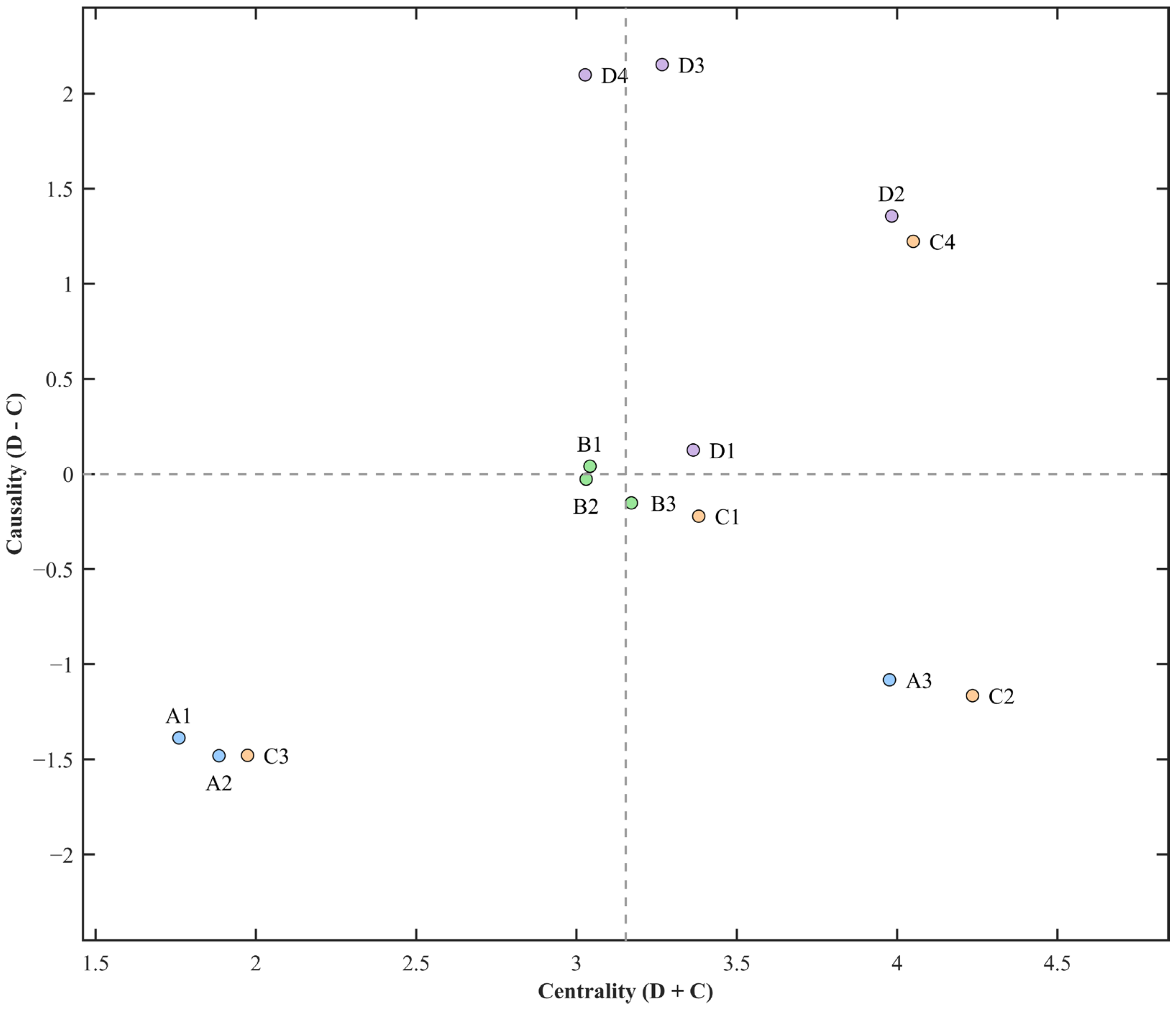
Based on Equations (17) and (18), the influencing degree, influenced degree, centrality, and cause degree of the fourteen second-level indicators were calculated, and the results are shown in Table 6 and Figure 2.
In terms of centrality, C2 (Emergency Traffic Organization and On-Site Execution Capacity under Wind Hazards) ranks first, followed by C4 (Multi-Actor Collaborative Support Capacity), D2 (Monitoring, Sensing, and Information System Support Capacity), and A3 (Traffic Operational Controllability under Wind Hazards). By contrast, A1 (Structural and Facility Safety Level of the Corridor), A2 (Driving Safety Assurance Level under Wind Hazards), and C3 (Operational Recovery Capacity of the Corridor) show relatively low centrality.
In terms of cause degree, D3 (Institutional and Emergency Plan Adaptability) and D4 (Organizational Learning and Closed–Loop Improvement Capacity) are the main driving factors. D2 and C4 also show positive cause degrees and act as important transmission factors. In contrast, A3 and C2 have high centrality but negative cause degrees, indicating that they mainly function at the execution level, while A1, A2, and C3 are downstream outcome factors. Figure 2 shows the same pattern: D3 and D4 lie in the high positive cause-degree region, D2 and C4 occupy the transition zone, and A1, A2, and C3 cluster in the low-centrality, negative-cause region.
These results suggest that traffic operation resilience in the study corridor is shaped mainly by governance, information support, and collaborative capacity, rather than by structural redundancy alone.

3.2. ISM Results: Hierarchical Transmission Structure of Resilience Factors

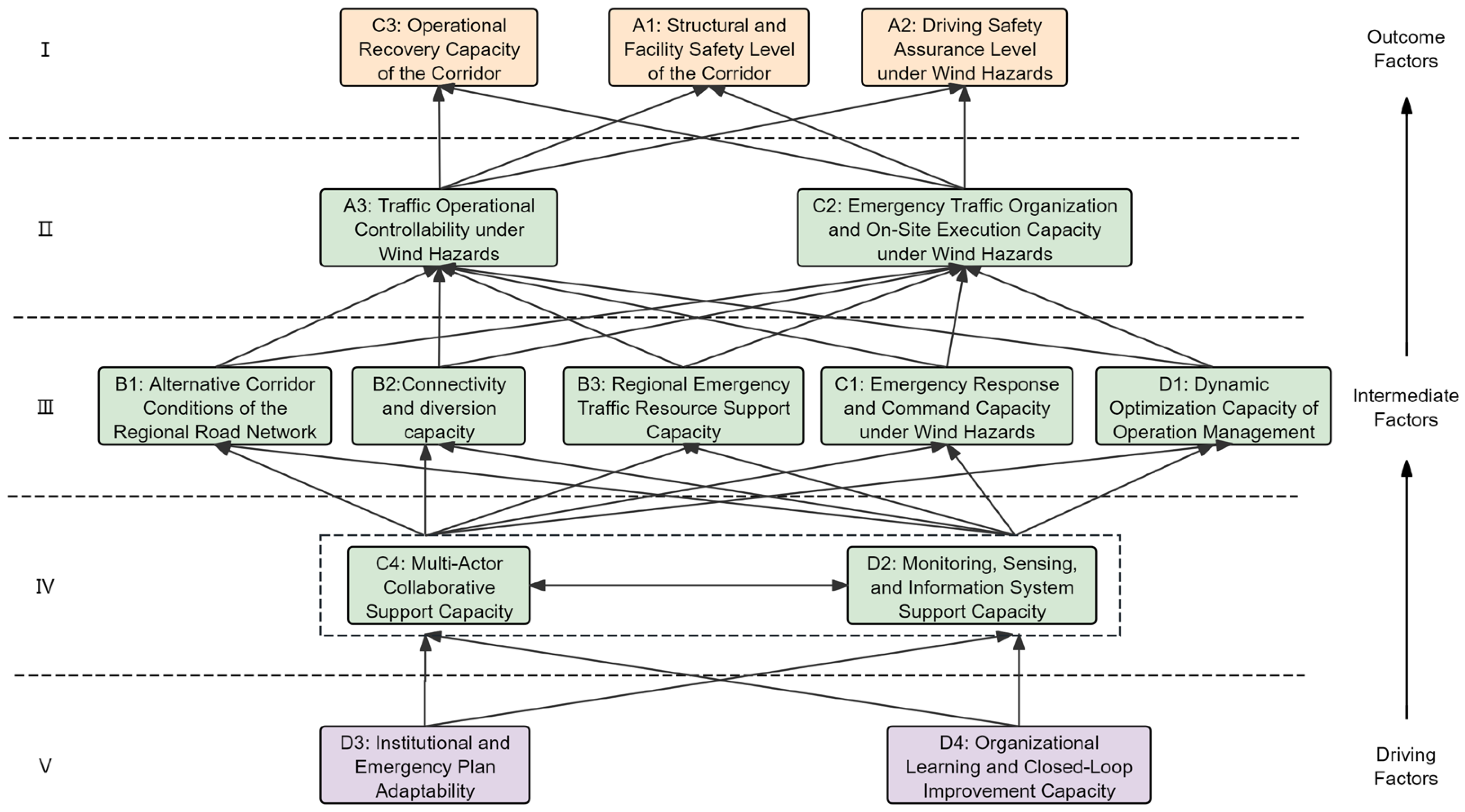
Based on the reachability matrix obtained from the fuzzy DEMATEL–ISM procedure, the fourteen second-level indicators were divided into five hierarchical levels, as shown in Table 7 and Figure 3. In Figure 3, yellow represents Outcome Factors, green represents Intermediate Factors, and purple represents Driving Factors.
At the deepest level, D3 (Institutional and Emergency Plan Adaptability) and D4 (Organizational Learning and Closed-Loop Improvement Capacity) act as the root driving factors. D2 (Monitoring, Sensing, and Information System Support Capacity) and C4 (Multi-Actor Collaborative Support Capacity) form the key transmission layer. B1, B2, B3, C1, and D1 constitute the intermediate support layer, while A3 (Traffic Operational Controllability under Wind Hazards) and C2 (Emergency Traffic Organization and On-Site Execution Capacity under Wind Hazards) form the direct execution layer. At the surface level, C3 (Operational Recovery Capacity of the Corridor), A1 (Structural and Facility Safety Level of the Corridor), and A2 (Driving Safety Assurance Level under Wind Hazards) appear as outcome factors.
This hierarchy indicates that traffic operation resilience in the study corridor follows a clear bottom-up transmission process: from institutional adaptability and organizational learning, through information support and collaboration, to operational execution and observable resilience outcomes. As shown in Figure 3, governance- and information-related factors are located at the lower, driving levels, whereas safety and recovery indicators are located at the upper, resultant levels.
The ISM analysis indicates that resilience in this low-redundancy corridor relies more on the hierarchical transmission of governance, information support, and organizational execution capacities than on structural redundancy.

3.3. Weight Distribution and Structural Characteristics

Based on the fuzzy DANP–AHP results, the integrated weights of the indicators at different levels are shown in Table 8.
At the first level, the weights are ranked as D > C > B > A, indicating that Long-Term Adaptation and Operational Adjustment Capacity under Wind Hazards and Traffic Organization and Recovery Capacity under Wind Hazards contribute more to overall resilience than network support and basic operational conditions.
At the second level, D3 (Institutional and Emergency Plan Adaptability), D4 (Organizational Learning and Closed-Loop Improvement Capacity), D2 (Monitoring, Sensing, and Information System Support Capacity), and C4 (Multi-Actor Collaborative Support Capacity) receive the highest weights, whereas A1, A2, and C3 receive relatively low weights. At the third level, the most important indicators include D31 (Targetedness and Operability of Wind Hazard Prevention and Control Plans), D42 (System Self-Correction Capacity), C41 (Degree of Coordination Smoothness in Multi-Department Emergency Response), and D21 (Completeness of Wind Environment Monitoring).
The weighting results indicate that governance, coordination, and information support play a more critical role in the resilience structure of the study corridor.

3.4. Cloud-Model-Based Evaluation Results

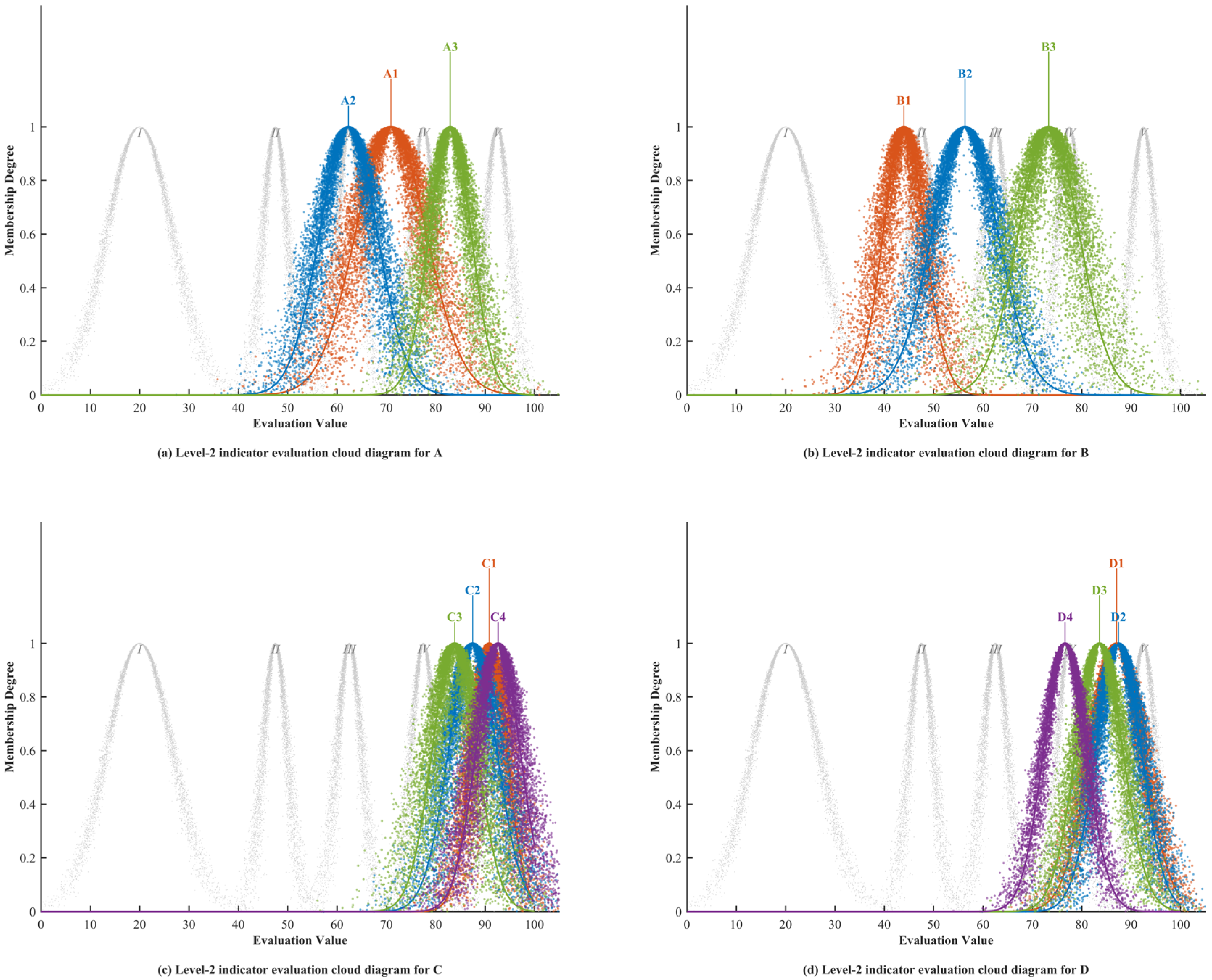
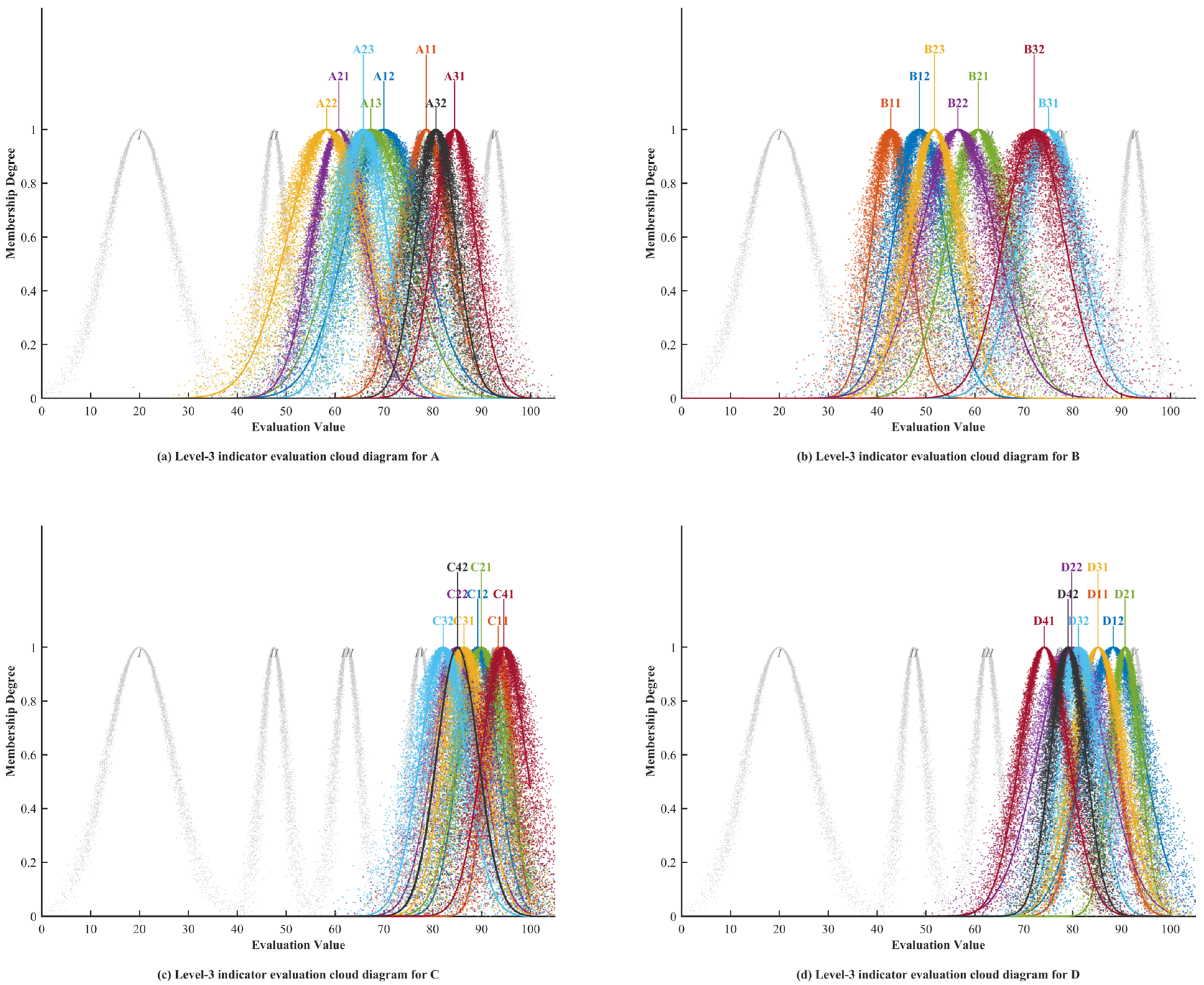
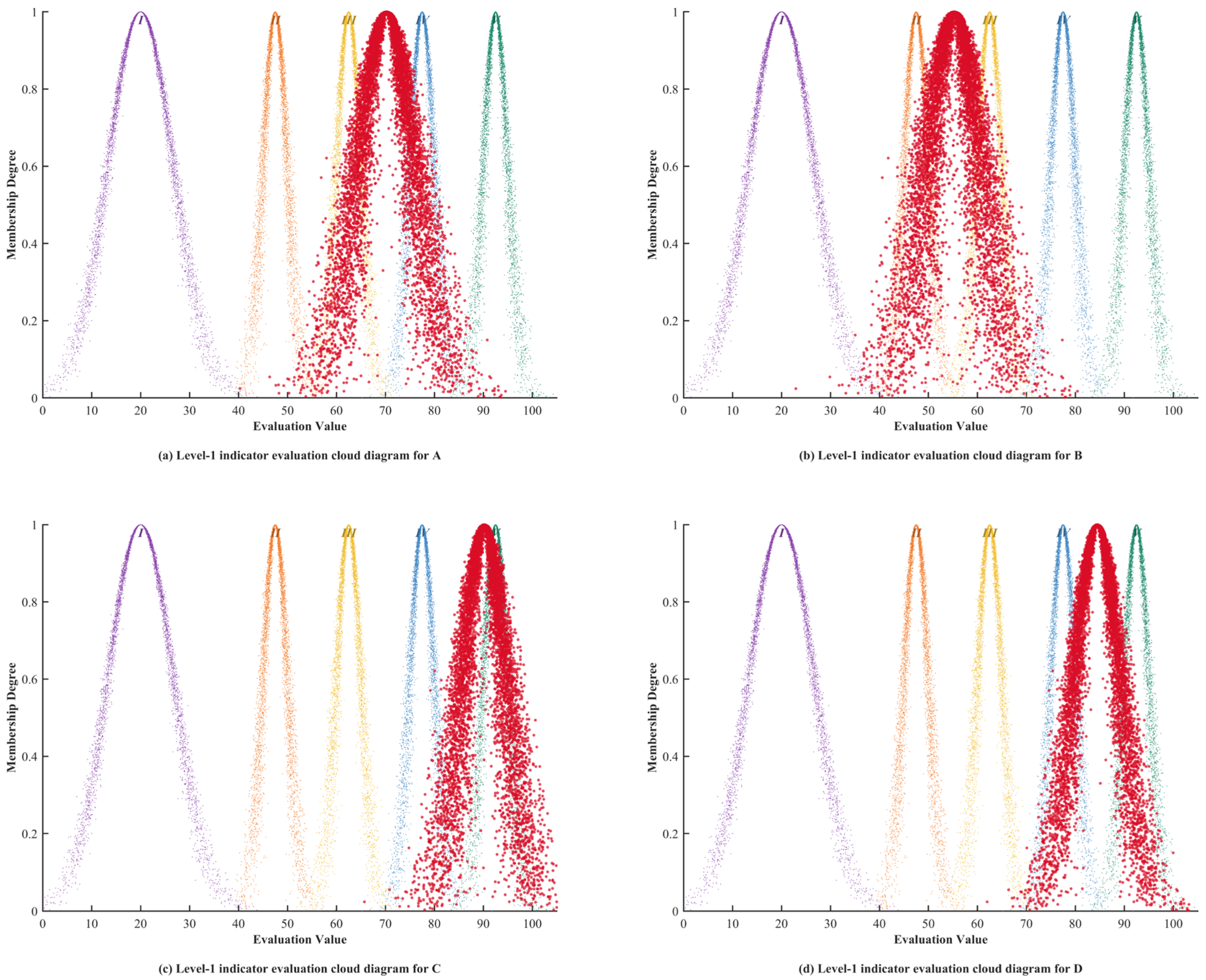
Based on the expert scores and the cloud-model evaluation procedure described in Section 2.5, the cloud characteristics of the third-level indicators were first calculated, and those of the higher-level indicators were then obtained through the weighted aggregation procedure defined in Equations (54)–(56) and (60)–(62). The evaluation results at different levels are presented in Table 9, Table 10 and Table 11 and Figure 4, Figure 5, Figure 6 and Figure 7. Taken together, these results provide a multi-level representation of the resilience performance of the study corridor under wind hazards, including both the average level and the uncertainty characteristics of expert judgments.

3.4.1. Third-Level Indicator Evaluation Results

The cloud characteristics of the thirty-one third-level indicators are shown in Table 9 and Figure 4. Overall, the corridor performs better in coordination, emergency response, and information support than in network support and substitutability.
Table 9. Cloud characteristics of the third-level resilience indicators.
Third-Level IndicatorExEnHeThird-Level IndicatorExEnHe
A1178.6674.9020.889C1289.2013.9441.527
A1270.0017.6872.216C2189.9334.7791.278
A1367.3337.5763.272C2285.0674.9461.724
A2160.8015.3810.801C3186.4014.2111.877
A2258.3338.0211.938C3282.1334.7121.789
A2365.8014.8811.947C4194.5334.4671.683
A3184.4674.3011.341C4285.0674.2330.045
A3280.6674.1221.451D1185.2013.9770.261
B1142.8013.8431.764D1288.3336.1271.519
B1248.6675.3472.121D2190.7333.0310.829
B2160.7336.3281.739D2279.8016.9852.093
B2256.5337.7211.904D3185.2015.1470.778
B2351.7335.3710.973D3281.2013.9771.671
B3175.0676.1161.531D4174.2014.9810.811
B3272.1336.1723.145D4279.0673.5980.861
C1193.4012.7740.751
Figure 4. Cloud-model evaluation results of the third-level resilience indicators.
Infrastructures 11 00215 g004
Among the third-level indicators, C41 (Degree of Coordination Smoothness in Multi-Department Emergency Response), C11 (Efficiency of Translating Wind Hazard Warnings into Traffic Response), and D21 (Completeness of Wind Environment Monitoring) show the highest expectation values. By contrast, B11 (Substitutability of Parallel Routes), B12 (Structural Integrity of the Road Network), and B23 (Impact Scope of Critical Node Failures) show the lowest expectation values, indicating that network-related constraints remain prominent.
In terms of uncertainty, A22 (Risk of Wind-Blown Sand/Snow Intrusion) has relatively high entropy, while A13 (Operational Reliability of Wind-Proof Facilities) and B32 (Cross-Network and Cross-Jurisdiction Diversion Coordination Capacity) show relatively high hyper-entropy. As shown in Figure 4, the higher-value indicators are mainly concentrated in the coordination- and information-support group, whereas the lower-value indicators are concentrated in the network-support group.
Overall, the third-level results indicate that the main resilience strengths of the corridor lie in collaborative response and information support, while weak network substitutability remains the main limitation.

3.4.2. Second-Level Indicator Evaluation Results

The cloud characteristics of the fourteen second-level indicators are shown in Table 10 and Figure 5. Overall, the corridor performs relatively well in collaborative support, emergency response, and operational management, but remains weak in network support.
Table 10. Cloud characteristics of the second-level resilience indicators.
Second-Level IndicatorExEnHeSecond-Level IndicatorExEnHe
A170.9347.1812.267C287.5014.8631.501
A262.3075.8291.487C383.8414.5181.824
A382.9474.2311.385C492.6414.4211.355
B143.9744.1871.835D187.0815.3711.016
B256.3536.6721.575D287.4534.5911.208
B373.3076.1512.499D383.6014.7141.135
C190.8813.5231.217D476.6344.3450.836
Among the second-level indicators, C4 (Multi-Actor Collaborative Support Capacity), C1 (Emergency Response and Command Capacity under Wind Hazards), and D1 (Dynamic Optimization Capacity of Operation Management) show the highest expectation values, while D2 (Monitoring, Sensing, and Information System Support Capacity) and C2 (Emergency Traffic Organization and On-Site Execution Capacity under Wind Hazards) also perform at relatively high levels. By contrast, B1 (Alternative Corridor Conditions of the Regional Road Network) and B2 (Connectivity and Diversion Capacity) show the lowest expectation values, indicating that external network support and diversion capacity remain the main structural constraints.
Indicators related to network support, resource allocation, and basic operational conditions also show greater dispersion, whereas collaborative support and emergency-response indicators are relatively stable.
Overall, the second-level results confirm that the corridor’s resilience is supported mainly by coordination and management capacities rather than by strong network substitutability.
Figure 5. Cloud-model evaluation results of the second-level resilience indicators.
Infrastructures 11 00215 g005

3.4.3. First-Level and Overall Evaluation Results

The cloud characteristics of the four first-level indicators are shown in Table 11 and Figure 6. Among them, C (Traffic Organization and Recovery Capacity under Wind Hazards) and D (Long-Term Adaptation and Operational Adjustment Capacity under Wind Hazards) show relatively high expectation values, whereas A (Basic Operational Support Conditions of the Corridor) and B (Regional Network Support and Substitutability Conditions) perform at relatively lower levels.
Table 11. Cloud characteristics of the first-level resilience indicators.
First-Level IndicatorExEnHe
A: Basic Operational Support Conditions of the Corridor70.2245.7161.612
B: Regional Network Support and Substitutability Conditions55.2515.3871.982
C: Traffic Organization and Recovery Capacity under Wind Hazards90.1984.3431.421
D: Long-Term Adaptation and Operational Adjustment Capacity under Wind Hazards84.4824.6521.101
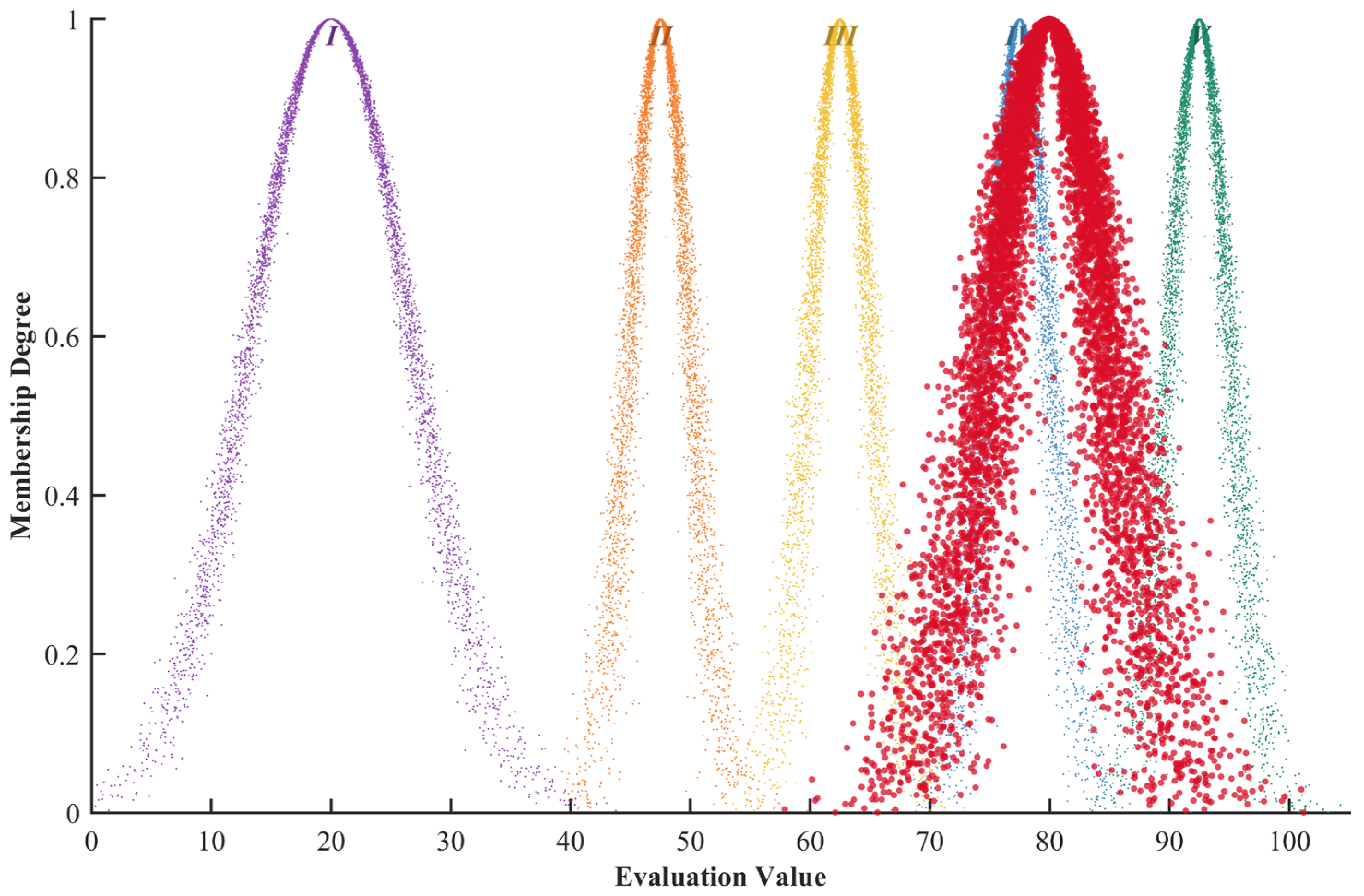
At the system level, the integrated cloud characteristics of the study corridor are ( E x 0 , E n 0 , H e 0 ) = (79.9532, 4.7909, 1.3637). By comparing the integrated evaluation cloud with the standard grade clouds, the corridor is classified as Grade IV, indicating a relatively high level of traffic operation resilience under wind hazards. As shown in Figure 7, this result is associated mainly with strengths in collaborative support, emergency response, information support, and adaptive management, rather than with strong network substitutability.
Figure 6. Cloud-model evaluation results of the first-level resilience indicators.
Infrastructures 11 00215 g006
Figure 7. Integrated cloud-model evaluation result of traffic operation resilience.
Infrastructures 11 00215 g007
Overall, the first-level and overall evaluation results further indicate that the corridor’s resilience is supported mainly by governance- and operation-related capacities, while network support remains the main constraint.

3.5. Sensitivity and Robustness Analysis

3.5.1. Sensitivity Analysis of ISM Threshold Selection

In the DEMATEL–ISM procedure, the threshold value used to transform the total relation matrix into a binary adjacency matrix may affect the number of retained relationships and the resulting hierarchical partition. As described in Section 2.3.3, the mean value and standard deviation of the total relation matrix were calculated as μ = 0.1130 and σ = 0.0846, respectively, and the baseline threshold was determined as λ = μ + σ = 0.1976. To examine whether the ISM results were overly dependent on this single threshold setting, a sensitivity analysis of threshold selection was further conducted.
Four threshold values were tested: λ1 = μ, λ2 = μ + 0.5σ, λ3 = μ + σ, λ4 = μ + 1.5σ. Accordingly, the four threshold values were 0.1130, 0.1553, 0.1976, and 0.2399, respectively. For each threshold value, the binary adjacency matrix was reconstructed, and the ISM hierarchical partitioning procedure was repeated. The number of retained direct links was calculated by counting the non-diagonal elements equal to 1 in the thresholded adjacency matrix. The results are shown in Table 12.
As shown in Table 12, increasing the threshold from 0.1130 to 0.2399 reduced the number of retained direct links from 87 to 20. This result indicates that weak influence relationships were gradually removed as the threshold became stricter. Meanwhile, the number of ISM levels changed from seven under λ1 = 0.1130 to four under λ4 = 0.2399, showing that the exact hierarchical partition was sensitive to the strictness of the threshold. Therefore, the sensitivity analysis does not indicate that the complete layer-by-layer structure remained identical under all threshold settings.
However, the core hierarchical logic was stable. First, D3 and D4 consistently appeared at the deepest driving level under all four threshold settings. This indicates that institutional and emergency-plan adaptability, together with organizational learning and closed-loop improvement capacity, are stable root-driving factors in the resilience system of the low-redundancy desert expressway corridor. Their bottom-level position was not altered by either a relatively relaxed threshold or a relatively strict threshold.
Second, C4 and D2 consistently remained close to the lower transmission layers. Under the baseline threshold, they formed the fourth level immediately above D3 and D4. Under the other threshold settings, they also remained in lower-level positions rather than moving to the surface-result layer. This suggests that multi-actor collaborative support capacity and monitoring, sensing, and information-system support capacity play stable intermediary roles in transmitting deeper institutional and organizational capabilities into operational resilience outcomes.
Third, A1, A2, and C3 remained at the top level under the first three threshold settings, including the baseline threshold λ3 = 0.1976. This indicates that corridor structural and facility safety, driving safety assurance under wind hazards, and operational recovery capacity are mainly reflected as direct outcome factors of the resilience system. When the threshold was further increased to 0.2399, the top layer expanded to include A3, B2, and C2. This change is reasonable because a stricter threshold removes weaker paths and compresses the differentiation among some execution-related and outcome-related factors. Nevertheless, the deepest driving factors remained unchanged.
Overall, the sensitivity analysis shows that the complete ISM hierarchy varies to some extent with threshold selection, especially in the middle and upper layers. However, the root-driving factors and the main driving–transmission–outcome logic remain stable. Therefore, the baseline ISM structure obtained under λ = 0.1976 is not an accidental result of a single threshold value. The results support the robustness of the main conclusion that resilience in the low-redundancy desert expressway corridor is primarily driven by institutional adaptability and organizational learning, transmitted through collaborative and information-support capacities, and ultimately manifested in safety assurance, operational control, and recovery performance.

3.5.2. Sensitivity Analysis of Expert-Opinion Perturbation in Cloud-Model Evaluation

Expert judgments were involved in both the DEMATEL-based relationship identification and the cloud-model-based comprehensive evaluation. The former mainly influenced the causal structure among resilience factors, whereas the latter directly determined the final resilience grade. Since the structural robustness of the DEMATEL–ISM results has been examined in Section 3.5.1 through threshold sensitivity analysis, this subsection further focuses on the influence of expert-opinion perturbation on the final cloud-model evaluation result.
The baseline overall cloud-model evaluation result obtained in this study was E x 0 , E n 0 , H e 0 = (79.9532, 4.7909, 1.3637). According to the predefined evaluation-grade intervals, the overall resilience level of the low-redundancy desert expressway corridor was classified as Grade IV. However, the expectation value Ex = 79.9532 is located very close to the boundary between Grade IV and Grade V. The distance from the upper boundary of Grade IV is 0.0468.
This indicates that the evaluated corridor resilience level is positioned at the upper edge of Grade IV and is very close to Grade V. Therefore, the baseline result should be interpreted as a high-level Grade IV state approaching Grade V, rather than as a mid-range Grade IV state.
To examine whether the substantive evaluation conclusion was sensitive to possible expert-opinion divergence, a perturbation-based sensitivity analysis was conducted around the baseline expectation value. Specifically, the overall expectation value Ex was perturbed within a small range, while the corresponding evaluation grade was re-identified according to the same grade-boundary criterion. The purpose of this analysis was not to prove that the categorical grade remains unchanged under all possible perturbations, but to determine whether the main conclusion regarding the corridor’s resilience level remains stable when the aggregated expert evaluation result fluctuates slightly.
As shown in Table 13, when the overall expectation value was reduced by 0.5 or 1.0, the evaluation result remained within Grade IV. When the expectation value was increased by 0.5 or 1.0, the result crossed the Grade IV–Grade V boundary and entered Grade V. This result shows that the categorical grade is sensitive near the boundary between Grade IV and Grade V. Such sensitivity is mainly caused by the fact that the baseline Ex value is only 0.0468 lower than the Grade V threshold.
Nevertheless, this boundary sensitivity does not change the substantive conclusion of the study. Under negative perturbation, the result remains a high-level Grade IV evaluation. Under positive perturbation, the result moves into Grade V, which indicates an even higher resilience level. Therefore, although the exact categorical label may shift between Grade IV and Grade V under slight positive perturbation, the overall evaluation consistently indicates that the low-redundancy desert expressway corridor is located within a high-resilience range.
The expert-opinion perturbation analysis confirms that the main cloud-model-based evaluation conclusion is robust at the substantive level 6. The evaluated corridor does not fall into a low or medium resilience state under the tested perturbation scenarios. Instead, it remains either at the upper boundary of Grade IV or enters Grade V. Accordingly, the final result should be understood as a high-resilience condition, specifically a high-level Grade IV state approaching Grade V. This interpretation is consistent with the DEMATEL–ISM findings, which indicate that the resilience performance of the corridor is supported by stable root-driving factors and transmitted through key collaborative and information-support capacities.

3.5.3. Sensitivity Analysis of the Standard Cloud Hyper-Entropy Parameter

In the cloud-model-based resilience evaluation, the standard grade clouds provide the reference basis for determining the final resilience grade. Among the three numerical characteristics of a cloud model, hyper-entropy reflects the uncertainty of entropy and affects the dispersion degree of the grade cloud. In this study, the standard cloud model was constructed by setting the hyper-entropy parameter as He = η, with the baseline value η = 0.5. Since η is an empirical parameter, it is necessary to examine whether the final evaluation result is sensitive to its selection.
To test the robustness of the cloud-model-based grade determination, a parameter sensitivity analysis was conducted by changing η in the standard grade clouds. Five η values were selected for comparison: 0.3, 0.4, 0.5, 0.6, and 0.7. The baseline value η = 0.5 corresponds to the standard cloud parameter setting used in this study, while η = 0.3 and η = 0.4 represent lower hyper-entropy settings, and η = 0.6 and η = 0.7 represent higher hyper-entropy settings. A lower η value indicates a more concentrated standard cloud, whereas a higher η value indicates a more dispersed standard cloud and greater uncertainty in the grade boundary.
During the sensitivity analysis, the integrated evaluation cloud of the study corridor remained unchanged as: E x 0 , E n 0 , H e 0 = (79.9532, 4.7909, 1.3637). Only the hyper-entropy parameter of the standard grade clouds was adjusted. Under each η setting, the integrated evaluation cloud was compared with the five standard grade clouds, and the final resilience grade was determined according to the principle of maximum membership. The results are shown in Table 14.
As shown in Table 14, Grade IV consistently had the highest membership degree under all tested η values. When η increased from 0.3 to 0.7, the membership degree of Grade IV changed only slightly, decreasing from 0.421826 to 0.415964. Meanwhile, the membership degree of Grade V increased slightly from 0.034991 to 0.037346, but it remained much lower than that of Grade IV. The membership degrees of Grades I, II, and III were also substantially lower than the membership degree of Grade IV across all scenarios.
These results indicate that changing the hyper-entropy parameter of the standard cloud within the tested range does not alter the final resilience grade. Although a larger η value increases the dispersion of the standard grade clouds and slightly reduces the dominance of Grade IV, the maximum-membership criterion still assigns the integrated evaluation cloud to Grade IV in all scenarios. Therefore, the final cloud-model-based evaluation result is not sensitive to the empirical selection of η.
It should be noted that the integrated expectation value Ex0 = 79.9532 is located in the upper part of the Grade IV interval, indicating that the corridor has a relatively high resilience level within Grade IV. However, the parameter sensitivity results show that this grade determination is not an unstable outcome caused by a specific η setting. Even when the standard cloud hyper-entropy parameter is adjusted upward or downward, the final grade remains Grade IV.
Overall, the sensitivity analysis confirms the robustness of the standard cloud parameter setting. The baseline value η = 0.5 used in this study does not lead to a parameter-dependent grade assignment. Combined with the expert-opinion perturbation analysis, the results further support the conclusion that the Hami–Tuyugou section of the G30 Lianhuo Expressway has a relatively high level of traffic operation resilience under wind hazards, and that the final Grade IV evaluation result is robust with respect to the selection of the standard cloud hyper-entropy parameter.

4. Discussion

4.1. Resilience Formation Mechanism Under Low-Redundancy Conditions

The results suggest that traffic operation resilience in low-redundancy desert expressway corridors is driven primarily by governance and organizational capacities rather than by structural redundancy. Due to limited alternative routes and strong corridor dependence, resilience cannot rely mainly on traffic redistribution when wind hazards occur.
The DEMATEL–ISM results identify Institutional and Emergency Plan Adaptability (D3) and Organizational Learning and Closed-Loop Improvement Capacity (D4) as the fundamental driving factors of the resilience system. Monitoring, Sensing, and Information System Support Capacity (D2) and Multi-Actor Collaborative Support Capacity (C4) act as key transmission factors linking governance arrangements to operational implementation. Together, these factors form a resilience pathway from adaptive governance and organizational learning to information support, collaborative response, operational control, and functional recovery. This finding indicates that resilience in low-redundancy corridors is essentially a process of adaptive governance under uncertainty.

4.2. Theoretical Implications for Transportation Resilience Research

Transportation resilience research has traditionally emphasized robustness and redundancy, particularly in highly connected transportation networks [36]. However, the present study shows that in corridors with limited route substitutability, governance adaptability, information support, and collaborative response play a more significant role in resilience formation.
This finding suggests that resilience should be understood not only as a structural property of transportation infrastructure but also as a dynamic capability embedded in institutions, organizations, and information systems. This does not imply that redundancy is unimportant; rather, it shows that the relative contribution of redundancy is constrained by network structure and hazard context. It therefore extends existing resilience research by highlighting the importance of governance-related capacities in structurally constrained transportation corridors.

4.3. Practical Implications for Desert Expressway Management

The findings provide several implications for resilience-oriented management. First, priority should be given to improving emergency planning, institutional adaptability, and post-event learning mechanisms. Second, investment in monitoring, sensing, and warning systems should be strengthened to support timely risk identification and operational decision-making. Third, effective coordination and information sharing among transportation agencies, traffic police, meteorological departments, and emergency management organizations are essential for rapid response and recovery.
Overall, resilience enhancement in low-redundancy desert expressway corridors should follow a governance–information–coordination pathway. Compared with expanding physical redundancy alone, strengthening adaptive management and collaborative response mechanisms may provide a more effective approach to improving resilience under recurrent wind hazards.

5. Conclusions

This study examined traffic operation resilience in a wind-hazard-affected desert expressway corridor with low network redundancy, using the Hami–Tuyugou section of the G30 Lianhuo Expressway in Xinjiang, China, as a representative case. To address the limitations of existing studies that often separate mechanism identification, weight determination, and resilience evaluation, an integrated assessment framework combining fuzzy DEMATEL–ISM, fuzzy DANP–AHP, and cloud-model evaluation was developed. The framework was applied to identify resilience mechanisms, determine indicator importance, and evaluate the overall resilience level of the study corridor. The main conclusions are summarized as follows:
(1)
Traffic operation resilience in low-redundancy desert expressway corridors exhibits a hierarchical transmission mechanism consisting of driving factors, transmission factors, execution factors, and outcome factors. Institutional and Emergency Plan Adaptability (D3), Organizational Learning and Closed-Loop Improvement Capacity (D4), Monitoring, Sensing, and Information System Support Capacity (D2), and Multi-Actor Collaborative Support Capacity (C4) were identified as the dominant factors shaping the resilience system.
(2)
The results indicate that governance capability, information support, and organizational coordination contribute more significantly to resilience formation than structural redundancy. Under recurrent wind hazards, resilience is maintained primarily through adaptive management, coordinated response, information-enabled decision making, and continuous organizational improvement rather than through alternative route substitution alone.
(3)
The cloud-model evaluation results show that the Hami–Tuyugou section of the G30 Lianhuo Expressway achieves a Grade IV resilience level, indicating a relatively high level of traffic operation resilience under wind hazards. Sensitivity analysis indicates that although the categorical grade may shift near the Grade IV–Grade V boundary under slight positive perturbation, the substantive conclusion remains robust: the corridor consistently falls within a high-resilience range.
The study contributes to transportation resilience research by extending resilience assessment to structurally constrained expressway corridors characterized by strong corridor dependence and limited network redundancy. The proposed framework provides a systematic approach for identifying resilience mechanisms and evaluating resilience performance under extreme weather disturbances, and may offer practical support for resilience-oriented operation management and adaptive governance of desert expressway corridors.
Several limitations should also be acknowledged. First, the study relies primarily on expert judgment, which may introduce subjective uncertainty despite the use of fuzzy methods. Second, the analysis is based on a single corridor case, and the transferability of the findings to other regions requires further verification. Future research may incorporate traffic operation data, meteorological monitoring data, and multi-corridor comparative analyses to support dynamic resilience assessment and improve the generalizability of the proposed framework.

Author Contributions

M.C.: Resources. W.R.: Funding acquisition, Supervision, Resources. J.Z.: Resources. L.C.: Supervision, Investigation, Methodology, Validation. Q.Q., L.J.: Resources, Data curation. Y.S.: Writing—original draft. All authors have read and agreed to the published version of the manuscript.

Funding

This research was financially supported by the Technology Project of Xinjiang Transportation Investment Group Co., Ltd. (XJJTZKX-FWCG-202411-0738; XJJTZKX-FWCG-202401-0043).

Data Availability Statement

The public documents used in this study, including project approval materials, regulatory documents, and relevant policy documents, are available from the corresponding official sources. Some traffic operation data, including project traffic ledgers, traffic-control notices, emergency response records, and maintenance records, were provided by the relevant expressway operation and management agencies and are not publicly available due to operational management restrictions. These data were used only for academic analysis in this study. Aggregated and anonymized information may be made available from the corresponding author upon reasonable request and with permission from the relevant data-providing agencies.

Acknowledgments

The authors would like to thank the experts and practitioners who participated in the consultation and evaluation process for their valuable suggestions and professional support. During the preparation of this manuscript, the authors used DeepSeek-V4-Pro only for language polishing. The authors carefully reviewed and edited the output and take full responsibility for the content of this publication.

Conflicts of Interest

Author Mengjun Chen was employed by Xinjiang Communications Investment Construction Management Co., Ltd. Authors Jing Zhang, Qianqian Qiu and Linkun Jia were employed by Xinjiang Transportation Science Research Institute Co., Ltd. The remaining authors declare that the research was conducted in the absence of any commercial or financial relationships that could be construed as a potential conflict of interest.

Abbreviations

The following abbreviations are used in this manuscript:
AHPAnalytic Hierarchy Process
DEMATELDecision Making Trial and Evaluation Laboratory
DANPDecision Making Trial and Evaluation Laboratory-based Analytic Network Process
ISMInterpretive Structural Modeling

References

  1. Liu, D.; Jing, T.; Yan, M.; Gultepe, I.; Bao, Y.; Wang, H.; Zu, F. A new method for calculating highway blocking due to high-impact weather conditions. Nat. Hazards Earth Syst. Sci. 2025, 25, 493–513. [Google Scholar] [CrossRef]
  2. Huang, B.; Ma, S.; Ciren, P.; Tong, D. Temporal variations in dust occurrence frequency and dust-related traffic fatalities in Southwestern United States (2007–2022): Insights from satellite retrieval, dust storm data, and FARS records. Atmos. Environ. 2025, 361, 121461. [Google Scholar] [CrossRef]
  3. Wan, C.; Yang, Z.; Zhang, D.; Yan, X.; Fan, S. Resilience in transportation systems: A systematic review and future directions. Transp. Rev. 2018, 38, 479–498. [Google Scholar] [CrossRef]
  4. Bruneau, M.; Chang, S.E.; Eguchi, R.T.; Lee, G.C.; O’Rourke, T.D.; Reinhorn, A.M.; Shinozuka, M.; Tierney, K.; Wallace, W.A.; von Winterfeldt, D. A framework to quantitatively assess and enhance the seismic resilience of communities. Earthq. Spectra 2003, 19, 733–752. [Google Scholar] [CrossRef]
  5. Pan, S.; Yan, H.; He, J.; He, Z. Vulnerability and resilience of transportation systems: A recent literature review. Phys. A Stat. Mech. Its Appl. 2021, 581, 126235. [Google Scholar] [CrossRef]
  6. Yang, Z.; Barroca, B.; Bony-Dandrieux, A.; Dolidon, H. Resilience Indicator of Urban Transport Infrastructure: A Review on Current Approaches. Infrastructures 2022, 7, 33. [Google Scholar] [CrossRef]
  7. Nickdoost, N.; Shooshtari, M.J.; Choi, J.; Smith, D.; AbdelRazig, Y. A composite index framework for quantitative resilience assessment of road infrastructure systems. Transp. Res. Part D Transp. Environ. 2024, 131, 104180. [Google Scholar] [CrossRef]
  8. Wang, L.; Yang, X.; Wu, J.; Xu, X.; Qu, Y.; Lee, D.-H. Dual-assessment of resilience and recovery strategies of road networks under rainstorm-induced waterlogging disasters. Transp. A Transp. Sci. 2024, 1–32. [Google Scholar] [CrossRef]
  9. Ma, F.; Fu, R.; Ren, W.; Lu, Q.C.; Liu, Q.; Yang, Z.; Ma, Z. Assessing road network resilience to extreme rainstorms: A percolation and hydrodynamic approach. Transp. Res. Part D Transp. Environ. 2026, 152, 105192. [Google Scholar] [CrossRef]
  10. Li, L.; Lv, L.; Tao, Z.; Yin, W.; Li, Q.; Wang, Z. Windblown sand hazards risk assessment along the highways based on GIS-game theory combination weight. PLoS ONE 2024, 19, e0292263. [Google Scholar] [CrossRef] [PubMed]
  11. Han, F.; Wang, C.; Liu, Z.; Liu, Z. Assessment of sand accumulation hazard on desert highway based on variable weight-cloud model theory. Front. Earth Sci. 2023, 11, 1208416. [Google Scholar] [CrossRef]
  12. Xie, S.; Yang, Z.; Wang, M.; Xu, G.; Bai, S. Evaluating the resilience of mountainous sparse road networks in high-risk geological disaster areas: A case study in Tibet, China. Appl. Sci. 2025, 15, 2688. [Google Scholar] [CrossRef]
  13. Liu, W.; Hu, Y.; Huang, Q. Research on critical factors influencing organizational resilience of major transportation infrastructure projects: A hybrid fuzzy DEMATEL-ISM-MICMAC approach. Buildings 2024, 14, 1598. [Google Scholar] [CrossRef]
  14. Liu, J.; Wan, L.; Wang, W.; Yang, G.; Ma, Q.; Zhou, H.; Zhao, H.; Lu, F. Integrated fuzzy DEMATEL-ISM-NK for metro operation safety risk factor analysis and multi-factor risk coupling study. Sustainability 2023, 15, 5898. [Google Scholar] [CrossRef]
  15. Villalba, P.; Sánchez-Garrido, A.J.; Yepes-Bellver, L.; Yepes, V. A hybrid fuzzy DEMATEL-DANP-TOPSIS framework for life cycle-based sustainable retrofit decision-making in seismic RC structures. Mathematics 2025, 13, 2649. [Google Scholar] [CrossRef]
  16. Liu, Y.; Eckert, C.M.; Earl, C. A review of fuzzy AHP methods for decision-making with subjective judgements. Expert Syst. Appl. 2020, 161, 113738. [Google Scholar] [CrossRef]
  17. Liu, H.; He, Y. Comprehensive evaluation of resilience for Qinling tunnel group operation safety system based on combined weighting and cloud model. Sustainability 2024, 16, 3937. [Google Scholar] [CrossRef]
  18. Ahmed, S.; Dey, K. Resilience modeling concepts in transportation systems: A comprehensive review based on mode, and modeling techniques. J. Infrastruct. Preserv. Resil. 2020, 1, 8. [Google Scholar] [CrossRef]
  19. Liu, H.J.; Love, P.E.; Zhao, J.; Lemckert, C.; Muldoon-Smith, K. Transport infrastructure asset resilience: Managing government capabilities. Transp. Res. Part D Transp. Environ. 2021, 100, 103072. [Google Scholar] [CrossRef]
  20. National Academies of Sciences, Engineering, and Medicine. Incorporating Resilience into Transportation Networks; The National Academies Press: Washington, DC, USA, 2024. [Google Scholar]
  21. Serdar, M.Z.; Koç, M.; Al-Ghamdi, S.G. Urban transportation networks resilience: Indicators, disturbances, and assessment methods. Sustain. Cities Soc. 2022, 76, 103452. [Google Scholar] [CrossRef]
  22. Zhang, X.; Lu, Y.; Wang, J.; Qi, Y. Enhancing highway transportation safety resilience during emergencies: A network-based analysis and assessment. PLoS ONE 2024, 19, e0307233. [Google Scholar] [CrossRef] [PubMed]
  23. Bergantino, A.S.; Gardelli, A.; Rotaris, L. Assessing transport network resilience: Empirical insights from real-world data studies. Transp. Rev. 2024, 44, 834–857. [Google Scholar] [CrossRef]
  24. Tang, J.; Wu, S.; Yang, S.; Shi, Y. Resilience assessment of urban road transportation in rainfall. Remote Sens. 2024, 16, 3311. [Google Scholar] [CrossRef]
  25. Nickdoost, N.; Jalloul, H.; Choi, J.; Smith, D. Identification and prioritization of multidimensional resilience factors for incorporation in coastal state transportation infrastructure planning. Nat. Hazards 2024, 120, 1603–1663. [Google Scholar] [CrossRef]
  26. Jassbi, J.; Mohamadnejad, F.; Nasrollahzadeh, H. A fuzzy DEMATEL framework for modeling cause and effect relationships of strategy map. Expert Syst. Appl. 2011, 38, 5967–5973. [Google Scholar] [CrossRef]
  27. Warfield, J.N. Societal Systems: Planning, Policy, and Complexity; Wiley: New York, NY, USA, 1976. [Google Scholar]
  28. Wang, M.J.J.; Chang, T.C. Tool steel materials selection under fuzzy environment. Fuzzy Sets Syst. 1995, 72, 263–270. [Google Scholar] [CrossRef]
  29. Roostaie, S.; Nawari, N. The DEMATEL approach for integrating resilience indicators into building sustainability assessment frameworks. Build. Environ. 2022, 207, 108113. [Google Scholar] [CrossRef]
  30. Bu, Z.; Liu, J.; Zhang, X. Factors affecting the resilience of subway operations under emergencies—Using improved DEMATEL model. Kybernetes 2024, 53, 4323–4358. [Google Scholar] [CrossRef]
  31. Ma, X.; Wang, Y.; Tang, Z.; Li, S. Urban flood risk assessment based on DEMATEL-ANP hybrid fuzzy evaluation and hydrodynamic model. Water 2025, 17, 1494. [Google Scholar] [CrossRef]
  32. Yüksel, İ.; Dağdeviren, M. Using the analytic network process (ANP) in a SWOT analysis—A case study for a textile firm. Inf. Sci. 2007, 177, 3364–3382. [Google Scholar] [CrossRef]
  33. Tran, T.G.; Nguyen, T.A.; Nguyen, H.M.V.; Quyen, H.A.; Nguyen, N.A.; Truong, V.H.; Thi, T.D.B. Application of the fuzzy DEMATEL–ANP VIKOR method to rank loads for load shedding in microgrids. Eng. Technol. Appl. Sci. Res. 2024, 14, 16727–16735. [Google Scholar] [CrossRef]
  34. Saaty, R.W. The analytic hierarchy process—What it is and how it is used. Math. Model. 1987, 9, 161–176. [Google Scholar] [CrossRef]
  35. Li, D.; Liu, C.; Gan, W. A new cognitive model: Cloud model. Int. J. Intell. Syst. 2009, 24, 357–375. [Google Scholar] [CrossRef]
  36. Ganin, A.A.; Kitsak, M.; Marchese, D.; Keisler, J.M.; Seager, T.; Linkov, I. Resilience and efficiency in transportation networks. Sci. Adv. 2017, 3, e1701079.36. [Google Scholar] [CrossRef] [PubMed]
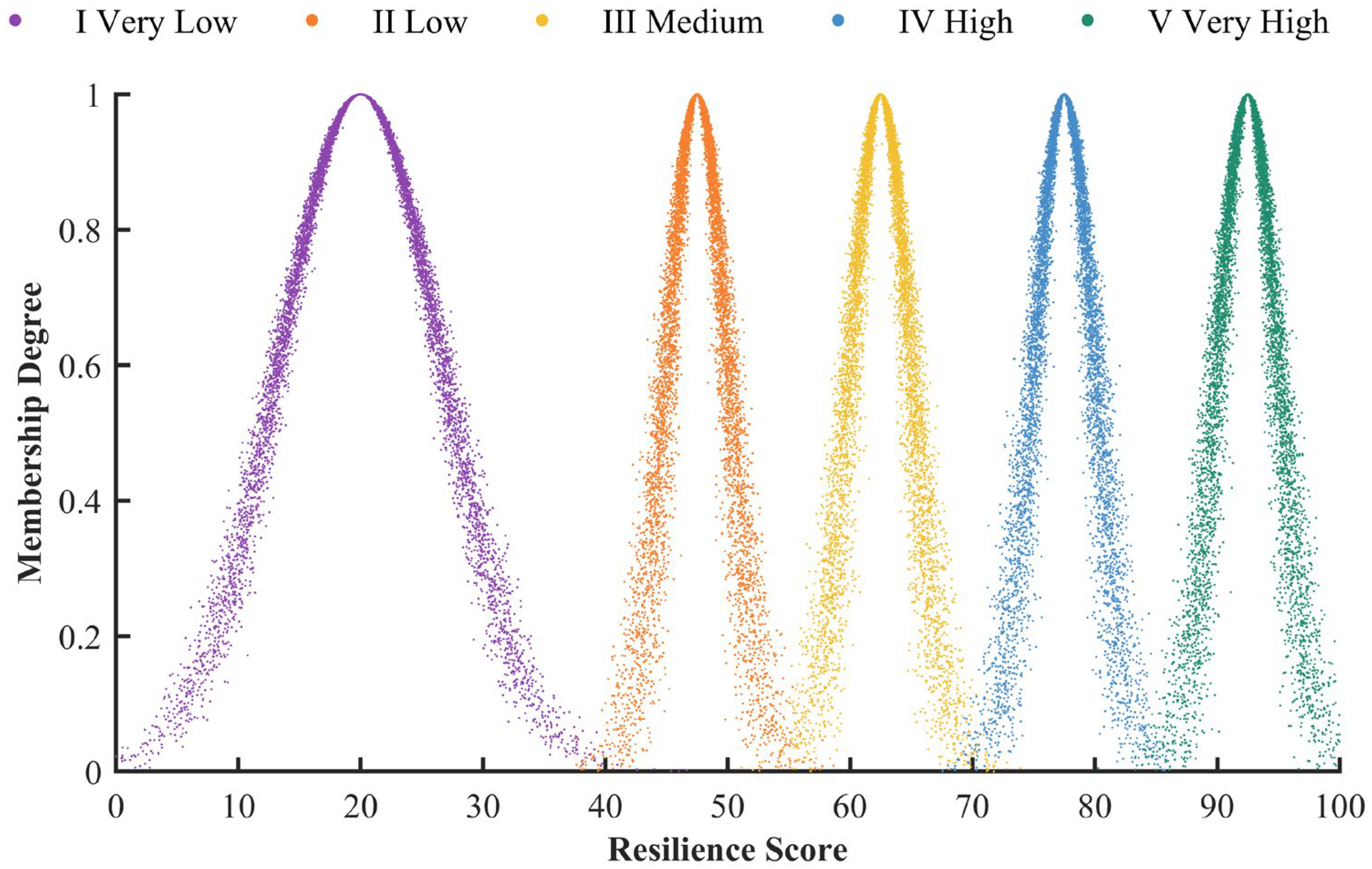
Figure 1. Standard clouds for highway traffic operation resilience grades.
Infrastructures 11 00215 g001
Figure 2. Cause–effect diagram of the second-level resilience indicators.
Infrastructures 11 00215 g002
Figure 3. Multi-level hierarchical structure of the second-level resilience factors.
Infrastructures 11 00215 g003
Table 1. Empirical characteristics of the Hami–Tuyugou section of the G30 Lianhuo Expressway.
CategoryIndicatorValue/DescriptionData Source
Corridor locationStart pointHami North Exit, approximately K3016 + 000/K3017 + 000Environmental approval document of the G30 Hami–Tuyugou reconstruction and expansion project; project traffic data ledger
Corridor locationEnd pointTuyugou Interchange, Shanshan County, Turpan City, approximately K3362 + 105Environmental approval document; project traffic data ledger
Corridor lengthTotal length345.209 kmEnvironmental approval document; Turpan municipal project report
Road standardReconstruction standardFour-lane expressway reconstructed into an eight-lane fully controlled expresswayEnvironmental approval document; Turpan municipal project report
Road standardDesign speed120 km/hEnvironmental approval document; Turpan municipal project report
Roadbed structureIntegral/separated roadbedIntegral roadbed: 127.081 km; separated roadbed: 218.128 kmEnvironmental approval document
Engineering facilitiesBridges and culverts2 major bridges, 15 medium bridges, 195 small bridges, and 648 culvertsEnvironmental approval document
Operational facilitiesInterchanges and toll stations16 interchanges and 14 ramp toll stationsEnvironmental approval document
Emergency facilitiesService areas and maintenance work areas7 service areas and 5 maintenance work areasEnvironmental approval document
Monitoring facilitiesMonitoring center1 monitoring sub-centerEnvironmental approval document
Wind-prone sectionBaili Wind Zone, Hami sectionG30 K3100–K3225 and S328 K111–K250 + 180Regulations on Prevention and Response to Extreme Weather on Highways in the Baili Wind Zone of Hami
Wind-prone sectionBaili Wind Zone, Turpan sectionG30 K3225–K3360 and S328 K250 + 180–K260 + 723Regional collaborative regulation report
Wind exposureAnnual strong-wind daysApproximately 150–160 days/yearLocal meteorological monitoring data; project traffic data ledger
Extreme wind intensityMaximum instantaneous wind speedMore than 60 m/sLocal meteorological monitoring data; project traffic data ledger
Main wind directionDominant directionNorthwest and north windsLocal meteorological monitoring data; project traffic data ledger
Seasonal patternMain windy seasonSpring and autumn, especially March–MayLocal meteorological monitoring data; project traffic data ledger
Wind-related hazardsMain hazard typesCrosswind, wind-blown sand, reduced visibility, wind-blown snow, and pavement sand accumulationProject traffic data ledger; highway operation records
Weather recordsDusty weather days79 days from 2011 to 2026Hami historical weather statistics; project traffic data ledger
Weather recordsSnowfall days71 days from 2011 to 2026Hami historical weather statistics; project traffic data ledger
Traffic demandAverage daily traffic volumeApproximately 20,000 vehicles/day for the Xingxingxia–Hami–Tuyugou corridorProject opening report quoting Xinjiang Communications Investment Group
Freight trafficInbound freight vehiclesApproximately 2807 trucks/day at the Xingxingxia gateway2021 Xinjiang interregional road freight survey; project traffic data ledger
Freight trafficOutbound freight vehiclesApproximately 3400 trucks/day at the Xingxingxia gateway2021 Xinjiang interregional road freight survey; project traffic data ledger
Alternative routesMain substitute roadsG312, S328, and S303Road network data; local extreme-weather regulation; S12 project environmental report
Route redundancySubstitution capacityAlternative routes exist but have lower design standards, lower operating speeds, and limited capacityRoad network data; project traffic data ledger
Historical disruption30 August 2024 eventWind-induced one-way control near K3359 + 650–K3362 for container trucks, box trucks, buses, and high-profile trucksHighway traffic-control notice; project traffic data ledger
Historical disruption5 November 2025 eventWind-induced one-way control near K3359 + 650; related control at Putao Gou and Daheyan rampsHighway traffic-control notice; project traffic data ledger
Historical disruption23 November 2025 eventWind-induced traffic control for container trucks, high-profile trucks, and box trucks near K3359 + 650Highway traffic-control notice; project traffic data ledger
Historical disruption12–13 March 2026 eventExtreme wind caused traffic obstruction; more than 300 vehicles and nearly 500 people were strandedEmergency response record; project traffic data ledger
Sand accumulationAffected locationsG30 K2940–K2945 and K3093–K3095Highway maintenance and emergency clearance records; project traffic data ledger
Emergency responseMonitoring and warningMeteorological monitoring, traffic control, variable message signs, traffic broadcasting, SMS, and Xinjiang Road Network platformHami extreme-weather regulation; project traffic data ledger
Interdepartmental coordinationCollaborative mechanismMeteorology, public security, transport, emergency management, and related departments share warning and response informationHami extreme-weather regulation; regional collaborative regulation report
The environmental approval document and municipal project reports refer to official project documents for the G30 Hami–Tuyugou reconstruction and expansion project. The project traffic data ledger refers to internal operational records provided by the expressway operation and management agency, including traffic demand, traffic-control notices, disruption events, sand-accumulation records, and emergency response information. Local meteorological monitoring data and historical weather statistics were used to describe wind exposure and weather-related hazards. Where internal operational records were used, the data were cross-checked with available official notices, regulatory documents, and project reports to ensure consistency.
Table 2. Mapping between the 4R framework and the proposed indicator system.
4R ComponentInterpretation in This StudyCorresponding Level-1 DimensionMain Corresponding Level-2 Factors
RobustnessAbility of the corridor to withstand wind-hazard disturbances and maintain basic operational functionality.A: Basic Operational Support Conditions of the CorridorA1: Structural and Facility Safety Level of the Corridor; A2: Driving Safety Assurance Level under Wind Hazards; A3: Traffic Operational Controllability under Wind Hazards
RedundancyAvailability of alternative routes, regional network connectivity, diversion feasibility, and backup traffic resources when the main corridor is affected.B: Regional Network Support and Substitutability ConditionsB1: Alternative Corridor Conditions of the Regional Road Network; B2: Connectivity and Diversion Capacity; B3: Regional Emergency Traffic Resource Support Capacity
ResourcefulnessAbility to mobilize emergency command, traffic organization, information release, rescue coordination, and collaborative resources during wind-hazard events.C: Traffic Organization and Recovery Capacity under Wind HazardsC1: Emergency Response and Command Capacity under Wind Hazards; C2: Emergency Traffic Organization and On-Site Execution Capacity under Wind Hazards; C4: Multi-Actor Collaborative Support Capacity
RapidityAbility to restore traffic function quickly after disturbance and to improve response capacity through long-term adaptation and learning.C: Traffic Organization and Recovery Capacity under Wind Hazards; D: Long-Term Adaptation and Operational Adjustment Capacity under Wind HazardsC2: Emergency Traffic Organization and On-Site Execution Capacity under Wind Hazards; C3: Operational Recovery Capacity of the Corridor; D1: Dynamic Optimization Capacity of Operation Management; D2: Monitoring, Sensing, and Information System Support Capacity; D3: Institutional and Emergency Plan Adaptability; D4: Organizational Learning and Closed-Loop Improvement Capacity
Table 3. Evaluation indicator system of traffic operation resilience for a wind-hazard-affected desert expressway corridor with low redundancy.
Level-1 DimensionLevel-2 FactorLevel-3 IndicatorsReference
A: Basic Operational Support Conditions of the CorridorA1: Structural and Facility Safety Level of the CorridorA11: Wind Resistance Stability of Subgrade and Pavement;
A12: Adequacy of Wind-Proof Engineering Facility Configuration;
A13: Operational Reliability of Wind-Proof Facilities
[5,21]
A2: Driving Safety Assurance Level under Wind HazardsA21: Vehicle Stability under Crosswinds;
A22: Risk of Wind-Blown Sand/Snow Intrusion;
A23: Safety Risk Identification and Assessment Capability
[22,23]
A3: Traffic Operational Controllability under Wind HazardsA31: Effectiveness of Traffic Control under Strong Winds;
A32: Rationality of Wind Speed/Visibility Control Thresholds
[7,22]
B: Regional Network Support and Substitutability ConditionsB1: Alternative Corridor Conditions of the Regional Road NetworkB11: Substitutability of Parallel Routes;
B12: Structural Integrity of the Road Network
[21,22]
B2: Connectivity and Diversion CapacityB21: Expressway–Conventional Road Connectivity;
B22: Feasibility of Regional Traffic Diversion Organization;
B23: Impact Scope of Critical Node Failures
[23,24]
B3: Regional Emergency Traffic Resource Support CapacityB31: Allocation Capacity of Emergency Traffic Resources;
B32: Cross-Network and Cross-Jurisdiction Diversion Coordination Capacity
[7,25]
C: Traffic Organization and Recovery Capacity under Wind HazardsC1: Emergency Response and Command Capacity under Wind HazardsC11: Efficiency of Translating Wind Hazard Warnings into Traffic Response;
C12: Decision-Making Efficiency and Procedural Standardization of Traffic Control under Wind Hazards
[22,25]
C2: Emergency Traffic Organization and On-Site Execution Capacity under Wind HazardsC21: Capacity to Maintain Traffic Order;
C22: Adequacy and Suitability of Traffic Organization Measures
[22,24]
C3: Operational Recovery Capacity of the CorridorC31: Efficiency of Post-Event Clearance and Repair;
C32: Timeliness of Functional Recovery
[21,23]
C4: Multi-Actor Collaborative Support CapacityC41: Degree of Coordination Smoothness in Multi-Department Emergency Response;
C42: Effectiveness of Information Release and Travel Guidance
[25]
D: Long-Term Adaptation and Operational Adjustment Capacity under Wind HazardsD1: Dynamic Optimization Capacity of Operation ManagementD11: Capacity for Experience Accumulation and Post-Event Review;
D12: Dynamic Adjustment Capacity of Corridor Operation Strategies
[5,21]
D2: Monitoring, Sensing, and Information System Support CapacityD21: Completeness of Wind Environment Monitoring;
D22: Level of Information-Based Operational Support
[23,24]
D3: Institutional and Emergency Plan AdaptabilityD31: Targetedness and Operability of Wind Hazard Prevention and Control Plans;
D32: Completeness and Adaptability of Management Regulations
[5,25]
D4: Organizational Learning and Closed-Loop Improvement CapacityD41: Frequency of Plan and Technology Updates;
D42: System Self-Correction Capacity
[5,21]
Table 4. Linguistic scale and corresponding triangular fuzzy numbers.
Linguistic TermScoreCorresponding TFN (Triangular Fuzzy Number)
No influence0(0, 0, 0.25)
Low influence1(0, 0.25, 0.5)
Medium influence2(0.25, 0.5, 0.75)
High influence3(0.5, 0.75, 1)
Very high influence4(0.75, 1, 1)
Table 5. Resilience grade intervals and standard cloud parameters.
Resilience GradeScore Interval ( E x , E n , H e ) Description
Very low resilience[0, 40](20.0, 6.6667, 0.5)Severe functional loss; almost unable to resist wind-hazard disturbance; extremely difficult to recover.
Low resilience(40, 55](47.5, 2.5000, 0.5)Marked functional impairment; weak resistance; requires substantial external resources for recovery.
Moderate resilience(55, 70](62.5, 2.5000, 0.5)Degraded operation can be maintained; some resistance exists, but recovery is relatively slow.
Relatively high resilience(70, 85](77.5, 2.5000, 0.5)Limited disturbance impact; strong adaptability; can quickly return to normal operation.
Very high resilience(85, 100](92.5, 2.5000, 0.5)Nearly unaffected; excellent adaptability and self-recovery capability.
Table 6. DEMATEL results of the second-level resilience indicators.
Code D i C i N i Rank (by N i ) R i Type
A10.1871.5741.76014−1.387Effect
A20.2021.6831.88513−1.481Effect
A31.4472.5293.9764−1.082Effect
B11.5421.5003.04290.041Cause
B21.5021.5283.03010−0.027Effect
B31.5091.6623.1718−0.152Effect
C11.5791.8023.3815−0.222Effect
C21.5352.7004.2351−1.165Effect
C30.2471.7261.97412−1.479Effect
C42.6361.4144.05021.223Cause
D11.7451.6193.36460.126Cause
D22.6691.3143.98331.356Cause
D32.7100.5573.26772.152Cause
D42.5620.4643.027112.098Cause
Table 7. Hierarchical partitioning of the second-level resilience factors based on ISM.
LevelResilience Factors
IC3, A1, A2
IIA3, C2
IIIB1, B2, B3, C1, D1
IVC4, D2
VD3, D4
Table 8. Integrated weights of the resilience indicator system based on fuzzy DANP–AHP.
First-Level IndicatorWeightSecond-Level IndicatorWeightThird-Level IndicatorWeightFirst-Level IndicatorWeightSecond-Level IndicatorWeightThird-Level IndicatorWeight
A0.0668A10.0089A110.0015C0.2453C10.0623C110.0208
A120.0048C120.0415
A130.0026C20.0529C210.0353
A20.0102A210.0055C220.0176
A220.0017C30.0116C310.0039
A230.0030C320.0077
A30.0477A310.0318C40.1185C410.0948
A320.0159C420.0237
B0.1703B10.0569B110.0427D0.5175D10.075D110.0250
B120.0142D120.0500
B20.0546B210.0162D20.1212D210.0909
B220.0295D220.0303
B230.0089D30.1654D310.1240
B30.0588B310.0147D320.0413
B320.0441D40.1559D410.0520
D420.1039
Table 12. Sensitivity analysis of ISM hierarchical structure under different threshold settings.
Threshold SettingThreshold ValueRetained Direct LinksISM Hierarchical StructureStability Judgment
λ1 = μ0.113087L1: A1, A2, C3; L2: A3, C2; L3: B3, C1; L4: B1, B2; L5: D1; L6: C4, D2; L7: D3, D4Root-driving factors unchanged; middle layers are more finely differentiated
λ2 = μ + 0.5σ0.155359L1: A1, A2, C3; L2: A3, C2; L3: B1, B2, B3, C1; L4: D1; L5: C4, D2; L6: D3, D4Root-driving factors unchanged; transmission structure remains clear
λ3 = μ + σ0.197645L1: A1, A2, C3; L2: A3, C2; L3: B1, B2, B3, C1, D1; L4: C4, D2; L5: D3, D4Baseline structure used in this study
λ4 = μ + 1.5σ0.239920L1: A1, A2, A3, B2, C2, C3; L2: B1, B3, C1, D1; L3: C4, D2; L4: D3, D4Root-driving factors unchanged; upper layers become compressed
Table 13. Sensitivity analysis of the overall cloud-model evaluation result under expert-opinion perturbation.
ScenarioPerturbed ExEvaluation GradeInterpretation
Baseline result79.9532Grade IVHigh-level Grade IV, close to Grade V
Ex − 0.579.4532Grade IVThe result remains within Grade IV
Ex − 1.078.9532Grade IVThe result remains within Grade IV
Ex + 0.580.4532Grade VThe result crosses the Grade IV–Grade V boundary
Ex + 1.080.9532Grade VThe result remains within Grade V
Table 14. Sensitivity analysis of standard-cloud hyper-entropy parameter η on cloud-model evaluation results.
η/Heμ (Grade I)μ (Grade II)μ (Grade III)μ (Grade IV)μ (Grade V)Maximum Membership
0.31.2695 × 10−91.1943 × 10−50.00588660.4218260.0349910.421826
0.45.1050 × 10−101.1458 × 10−50.00603390.4211990.0352960.421199
0.51.9474 × 10−91.1632 × 10−50.00611530.4191280.0359280.419128
0.64.0609 × 10−91.0665 × 10−50.00623620.4169810.0367720.416981
0.78.5578 × 10−101.5058 × 10−50.00667320.4159640.0373460.415964
Disclaimer/Publisher’s Note: The statements, opinions and data contained in all publications are solely those of the individual author(s) and contributor(s) and not of MDPI and/or the editor(s). MDPI and/or the editor(s) disclaim responsibility for any injury to people or property resulting from any ideas, methods, instructions or products referred to in the content.