


Abstract
Non-destructive testing (NDT) methods are widely used to evaluate the performance of concrete, but their accuracy can be influenced by external factors such as curing temperature. Temperature not only modifies hydration kinetics and strength development but may also change the correlation between NDT measurements and compressive strength. However, no prior research has systematically examined how different curing temperatures influence the reliability of various NDT techniques. This study evaluates three curing temperatures and their effect on the correlation between NDTs and compressive strength at various ages (1, 3, 7, 28, and 90 days). Both simple regression analysis and artificial neural networks (ANNs) were employed to predict strength from NDT measurements. Results show that NDT sensitivity to curing temperature is most pronounced at early ages, and that linear regression models cannot adequately capture the complexity of these relationships. In contrast, ANNs demonstrated superior predictive capability, though initial training with limited data led to overfitting and instability. By applying Gaussian Noise Augmentation (GNA), model accuracy and generalization improved substantially, achieving R2 values above 0.95 across training, validation, and test sets. These findings highlight the potential of non-linear models, supported by data augmentation, to improve prediction reliability, lower experimental costs, and more accurately capture the role of curing temperature in NDT–strength correlations for concrete.
1. Introduction
Concrete is the most widely used construction material in the world. One of its main components, cement, is a major contributor to global carbon dioxide (CO2) emissions, making the reduction of cement content in concrete mix designs a top priority [1,2,3,4]. As environmental concerns grow, researchers in various fields are seeking sustainable solutions. Within materials research, this includes developing techniques to extend the materials’ performance [5,6].
One of the most effective strategies in this context is the adoption of non-destructive techniques (NDT) methods to assess the mechanical and durability properties of concrete [7,8]. Unlike traditional methods, such as core sampling, which involve drilling into the concrete and risk compromising the structural integrity, especially in slender or stressed regions, NDT methods provide a safer alternative [9,10]. Coring also limits data collection to specific locations, which may not accurately represent the overall condition of the structure.
In contrast, NDT methods offer a broader and more practical means of structural evaluation [7,11]. Because they do not damage the structure or interrupt its function, they can be used to assess various sections of a structure with minimal limitations. Beyond structural integrity, their use can significantly reduce repair costs and extend service life [12,13,14,15]. Moreover, by minimizing the number of test specimens needed, NDTs can help reduce the overall consumption of cement in both research and industrial projects. Utilizing a single sample over multiple time intervals also improves data consistency and reduces the margin of error [16,17].
NDTs have been extensively applied in structural health monitoring (SHM) to detect signs of damage such as cracking, void formation, deformation, or corrosion, often caused by structural loads, fatigue, or harsh environmental conditions [18,19,20,21]. Among these techniques, ultrasonic pulse velocity (UPV) and rebound hammer (RH) tests are widely recognized for their reliability in evaluating compressive strength, including in fire-damaged concrete [22]. Other methods, such as electrical resistivity testing has also shown strong potential in predicting compressive strength, as previous research demonstrated [23,24,25,26]. In critical applications such as the assessment of historic reinforced concrete buildings, advanced NDT techniques, including acoustic emission, infrared thermography, and ground-penetrating radar, are preferred due to their non-invasive nature. These methods have proven particularly effective in preserving such irreplaceable structures while providing meaningful diagnostic insights [27].
Despite their benefits, the accuracy of NDT methods can be influenced by external factors such as surface conditions, curing practices, and temperature fluctuations. These factors may affect the correlation between NDT results and the actual performance of concrete structures [28,29]. Among these external variables, temperature plays a key role in both the mechanical properties and durability of concrete. It directly affects the hydration process, which in turn impacts compressive strength and long-term durability. For example, high curing temperatures accelerate hydration and lead to higher early-age strength but often result in a coarser microstructure and lower long-term strength [30,31]. Shen et al. [32] found that at elevated curing temperatures (~45 °C), autogenous shrinkage increased while cracking resistance decreased, compared to conventional curing at 20 °C. Similarly, Pichler et al. [33] reported that although high-temperature curing (up to 70 °C) enhances early strength, it adversely affects long-term strength and microstructural stability. On the other hand, lower curing temperatures slow down hydration, allowing for more gradual strength development and improved durability over time [34,35,36]. In contrast, Mao et al. [37] studied extremely low-temperature curing (–10 °C) and observed significantly delayed hydration, reduced early-age strength, and increased pore size. Additionally, Velay-Lizancos et al. [34] demonstrated that curing temperature not only affects strength development but also modifies the correlation between UPV and compressive strength in concrete.
To the best of the authors’ knowledge, this study is the first to systematically apply four non-destructive testing methods, UPV, RH, resonant frequency, and surface electrical resistivity, at the same time to investigate how curing temperature modifies the relationship between NDT indicators and compressive strength in performance-based concrete mixtures. Since different non-destructive inspection methods rely on different physical principles, their sensitivity to temperature may vary.
The novelty of this work lies in (i) the combined assessment of multiple NDT techniques under controlled curing temperatures representative of practical field conditions (5, 25, and 40 °C), (ii) the identification of which NDTs are most influential and most sensitive for strength prediction through systematic importance and sensitivity analyses, and (iii) the evaluation of data augmentation strategies to improve strength prediction while reducing experimental effort. Together, these contributions advance the interpretation and application of NDTs for temperature-dependent strength assessment in functional concrete mixtures.
For this purpose, four performance-based concrete mixtures were prepared using two types of cement (ordinary Portland cement (OPC) and Portland limestone cement (PLC)) and two sizes of coarse aggregate, with a fixed water-to-cementitious ratio of 0.35. Cylindrical specimens (15.24 cm × 30.48 cm) were cured under three temperatures representative of Texas conditions (5, 25, and 40 °C) and tested at five ages (1, 3, 7, 28, and 90 days). A series of non-destructive tests (UPV, RH, resonant frequency, and surface electrical resistivity) were performed alongside standard compressive strength tests to evaluate correlations under different curing conditions. Both linear regression and artificial neural network (ANN) models were applied to predict compressive strength from the NDT results. The ANN model further incorporated data augmentation to improve prediction accuracy. This experimental program provides a comprehensive framework to assess the influence of curing temperature on the reliability of NDT methods and their effectiveness for strength estimation in functional concrete mixtures.
2. Materials and Methods
2.1. Materials
In this study, two sizes of coarse aggregate and one type of fine aggregate were used. Table 1 presents their sources, specific gravity in saturated surface dry (SSD) condition, and water absorption capacity (determined according to ASTM C127 [38] and ASTM C128 [39]).
Table 1.
Aggregates characterization.
Two types of cement commonly used for concrete overlays were utilized in this study. These include OPC, sourced from Texas Lehigh Cement (Buda, TX, USA), and Type IL (10) MS (Moderate sulfate resistance) PLC, obtained from Capitol (San Antonio, TX, USA). Both cements complied with the applicable ASTM specifications [40,41]. High-range water reducer (HRWR) Sika ViscoCrete 4100 and air-entrained admixture Sika AIR, source from Sika (Dallas, TX, USA) were added since these mixtures were designed for a minimum of 6% air and enough workability to be placed. Both admixtures complied with the applicable ASTM specifications [42].
2.2. Methods
2.2.1. Mixture Design and Proportioning
Table 2 shows the mixture proportions for the four different performance-based concrete mixtures made with different types of cement and aggregate. Water to cementitious (w/cm) ratio was kept fixed at 0.35. Aggregate content was different depending on the size of the coarse aggregate, since there was an optimization of the modified void ratio suggested by Taylor et al. [43].
Table 2.
Mixtures proportions.
During mixing, both admixtures were incorporated after adding half of the mixing water to the mixer to pre-wet the aggregates. The remaining water was then added, and the aggregates were mixed for 2–3 min. Subsequently, the cement was introduced, followed by the final portion of water one minute later. The entire mixture was then blended for an additional 3–4 min to ensure uniform consistency, at which point the concrete was ready for use.
2.2.2. Laboratory Methods
This study involved a series of NDT tests to understand how the curing temperature modifies the correlation between NDT and compressive strength values. All tests were conducted on cylindrical concrete specimens (15.24 cm × 30.48 cm) cured three temperature conditions representative of typical Texas ambient environments (5 °C), room temperature (25 °C) and warm (40 °C), and testing was performed at five different ages: 1, 3, 7, 28, and 90 days. For each temperature condition and testing age, three samples were tested in each test to account for potential disparities. This resulted in a total of 180 specimens tested across all mixtures, temperatures, and ages.
All samples were cured at room temperature for the first day. After the first day, samples were placed in water baths at their respective curing temperatures for 28 days. After 28 days, all remaining specimens were transferred to ambient temperature water and stored there until testing at 90 days.
Four NDT methods (UPV, RH, resonant frequency, and surface electrical resistivity) were selected because they are the most widely used techniques in concrete research and are sensitive to different physical and mechanical properties of concrete. Together, they provide a comprehensive assessment of concrete quality and performance:
- UPV is commonly used to evaluate internal uniformity and elastic properties by measuring the propagation velocity of ultrasonic waves through concrete. Testing followed ASTM C597 [44].
- RH, also known as the Schmidt or Swiss Hammer test, estimates the surface hardness and provides an approximate measure of the concrete’s compressive strength. The rebound hammer test was performed following ASTM C805/C805M [45].
- Resonant Frequency measures the dynamic response of concrete specimens and is effective for detecting internal defects such as cracking or microstructural damage. This test was performed following ASTM C215 [46].
- Surface electrical resistivity evaluates the electrical resistivity of water-saturated concrete, which is related to pore structure connectivity and durability-related properties such as resistance to ion penetration. Testing followed AASHTO T358 [47].
All these NDT methods were performed to correlate with compressive strength values. The compressive strength test, a destructive method, is one of the most widely used techniques to determine concrete strength. It was performed according to ASTM C39 [48] using a calibrated compression testing machine. An axial load was applied gradually until failure, and the maximum load recorded was used to calculate compressive strength. The Supplementary Material contains photographs of the experimental setups and all raw/augmented data tables (Figures S1–S6 and Tables S1–S3).
2.2.3. Linear Regression
The main objective of this study is to evaluate how curing temperature affects the correlation between traditional compressive strength testing methods and NDTs, and to identify the most reliable and effective testing approach. To achieve this, regression analysis was conducted.
Linear regression was the initial method employed for identifying correlations. The analysis was performed using Excel and was based on raw, augmented data. Multiple linear regression was used to evaluate the combined effect of different NDT methods and curing temperatures (5 °C, 25 °C, and 40 °C) on compressive strength at different ages. This method, implemented in Excel without the need for coding or machine learning tools, produces coefficient tables that clearly show the contribution of each variable. These coefficients can be used to construct predictive formulas, assess the statistical significance of variables, and create linear plots to evaluate the model’s predictive power.
2.2.4. Artificial Neural Network (ANN)
To further analyze the impact of curing temperature and identify the most effective NDT method for estimating compressive strength, an ANN model was developed. ANNs are computational models inspired by the structure and function of biological neural networks. They are particularly effective for learning complex, nonlinear relationships between inputs and outputs. In this study, the input data included results from various NDT methods and curing temperatures, while the target output was the compressive strength of concrete samples. The network was trained to learn the relationship between these variables.
Based on previous research and optimization [49,50], the ANN was configured with 10 hidden layers. The dataset was split into 70% for training, 15% for validation, and 15% for testing. Once trained, the ANN’s performance was evaluated using regression analysis and error histogram plots to assess how well the model could predict compressive strength.
3. Results and Discussion
3.1. Compressive Strength
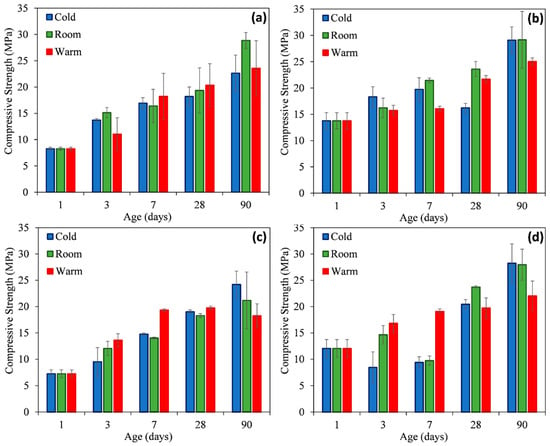
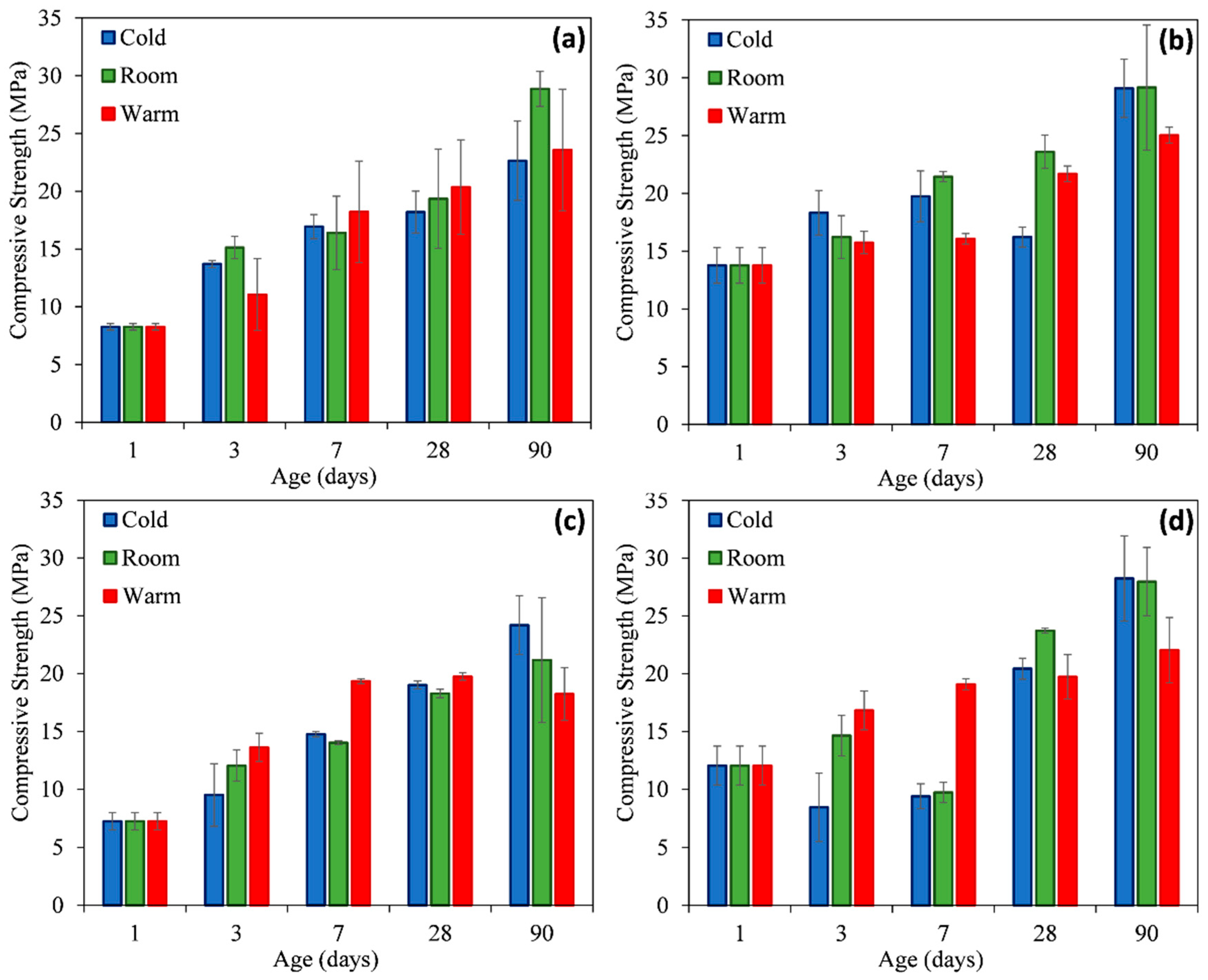
Figure 1 shows the compressive strength of concrete samples with two coarse aggregate sizes (12.7 and 9.5 mm) and two cement types (OPC and PLC) at different curing temperatures within the 1- to 90-day period. As expected, warm curing accelerated early strength (up to ~19% higher than cold curing at 3 days), but the effect was less pronounced over time. Cold- and room-cured specimens, which developed strength more slowly, generally possessed higher strength than warm-cured samples after 28 days. This effect was more noticeable in PLC mixes, where cold curing had the highest 90-day strength (~22–25% higher than warm curing).
Figure 1.
Compressive strength under different curing temperatures. (a) OPC-12.7 mm. (b) PLC-12.7 mm. (c) OPC-9.5 mm. (d) PLC-9.5 mm.
Warm curing generally resulted in higher compressive strength within the first 7 days. By 90 days, however, due to the crossover effect of curing temperature, cold curing typically exhibited the highest strength values [51]. For example, the PLC–9.5 mm mix showed the largest difference: at 7 days warm curing was ~103% stronger than cold, yet by 90 days cold curing improved warm and room curing by up to 22%. Overall, cold curing, despite slower early-age development, had improved long-term strength compared to warm curing.
3.2. Ultrasonic Pulse Velocity (UPV)
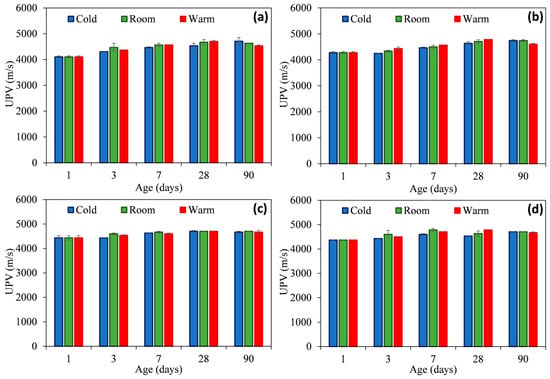
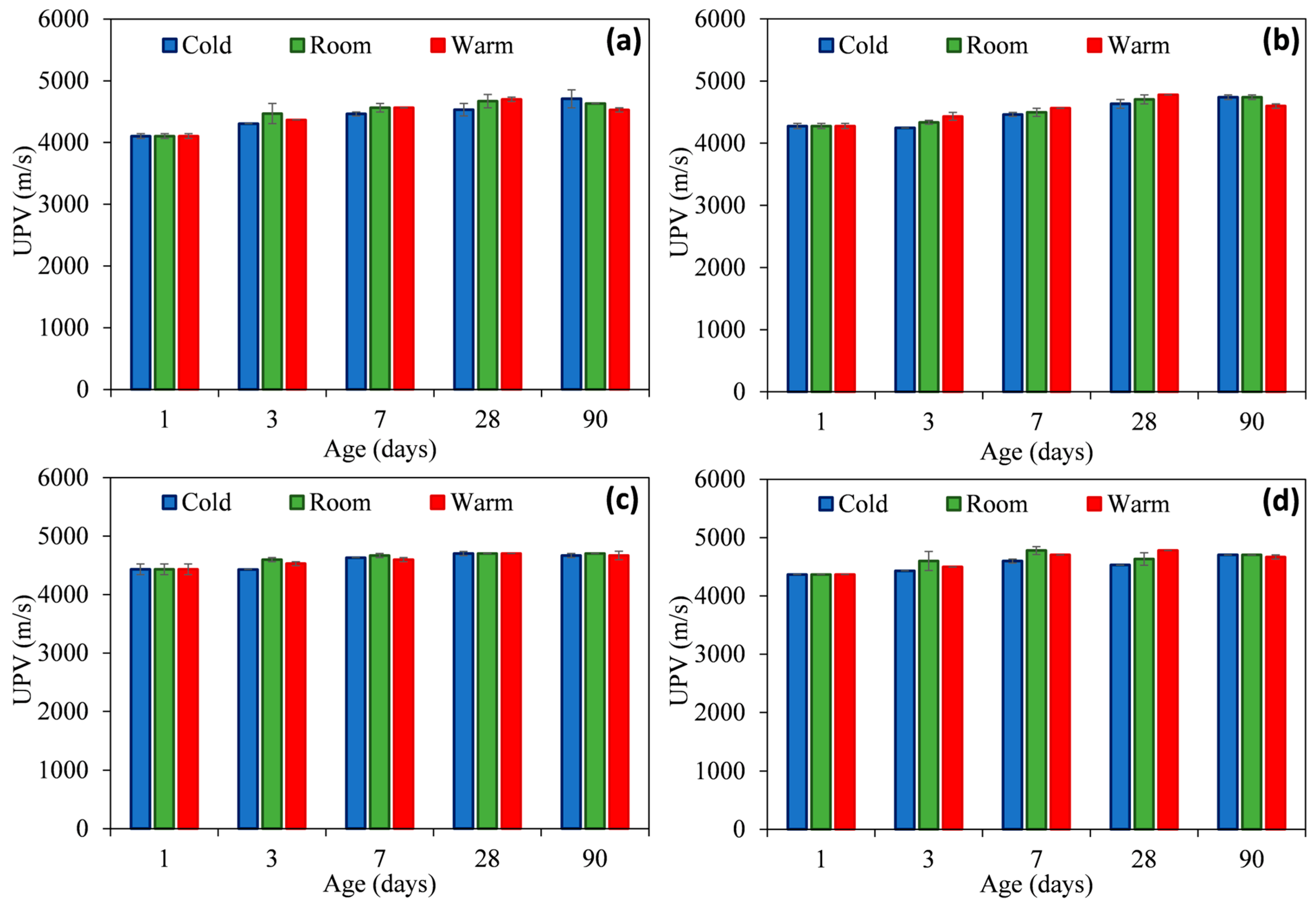
Figure 2 presents the UPV results for concrete samples subjected to different temperatures cured over a 90-day period. UPV test results highlight the influence of curing temperature on concrete quality over time. Cold curing consistently resulted in lower UPV values during the first 3 days. This early age reduction in pulse velocity was observed across all mixes, regardless of cement type or aggregate size. For instance, in the OPC–12.7 mm mixture, the cold cured sample had a UPV 3.7% lower than the room temperature specimens.
Figure 2.
UPV values under different curing temperatures. (a) OPC-12.7 mm. (b) PLC-12.7 mm. (c) OPC-9.5 mm. (d) PLC-9.5 mm.
Although the differences among all curing temperatures were relatively small, surprisingly, warm curing did not always lead to the highest UPV values, contrary to prior studies [52,53,54,55]. The only exception was the OPC-9.5 mm mixture, where the warm-cured sample showed a UPV that was 4.2% higher than the cold-cured sample and 2.1% higher than the room temperature-cured sample.
3.3. Rebound Hammer (RH)
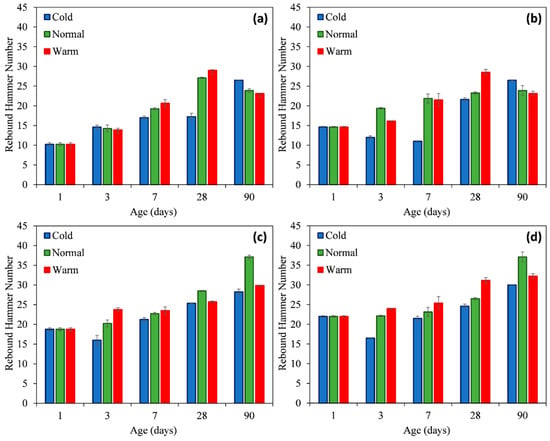
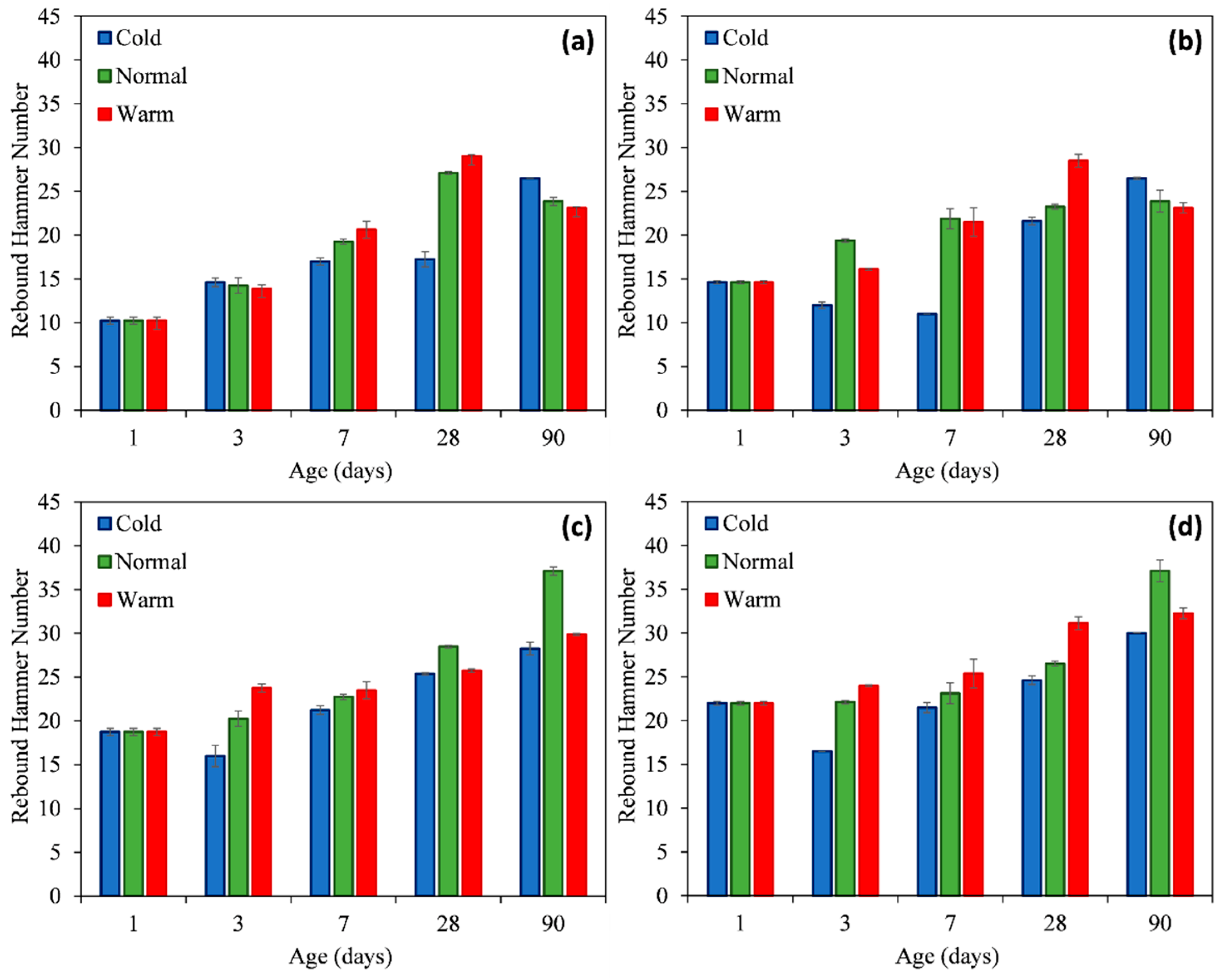
Figure 3 presents the RH results of concrete samples cured under different temperature conditions. It can be observed that although the general trend aligns with compressive strength results and curing temperature remains a key influencing factor, some inconsistencies appear in specific mixtures and curing conditions. For instance, in the OPC-12.7 mm mix at 90 days, the highest values were recorded for cold curing, followed by room and warm curing. However, the same cold-cured samples showed the lowest compressive strength at 90 days compared to those cured in warm conditions.
Figure 3.
Rebound Hammer results under different curing temperatures. (a) OPC-12.7 mm. (b) PLC-12.7 mm. (c) OPC-9.5 mm. (d) PLC-9.5 mm.
3.4. Resonant Frequency
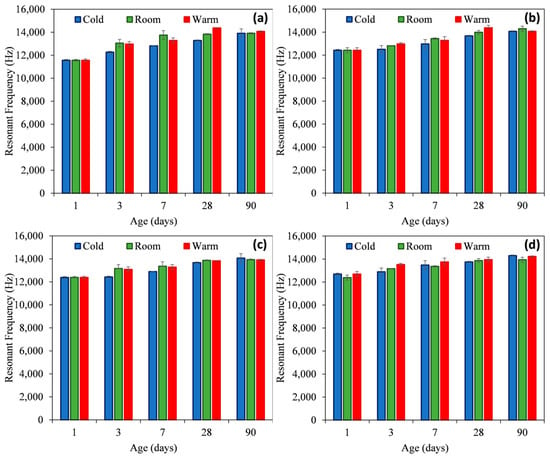
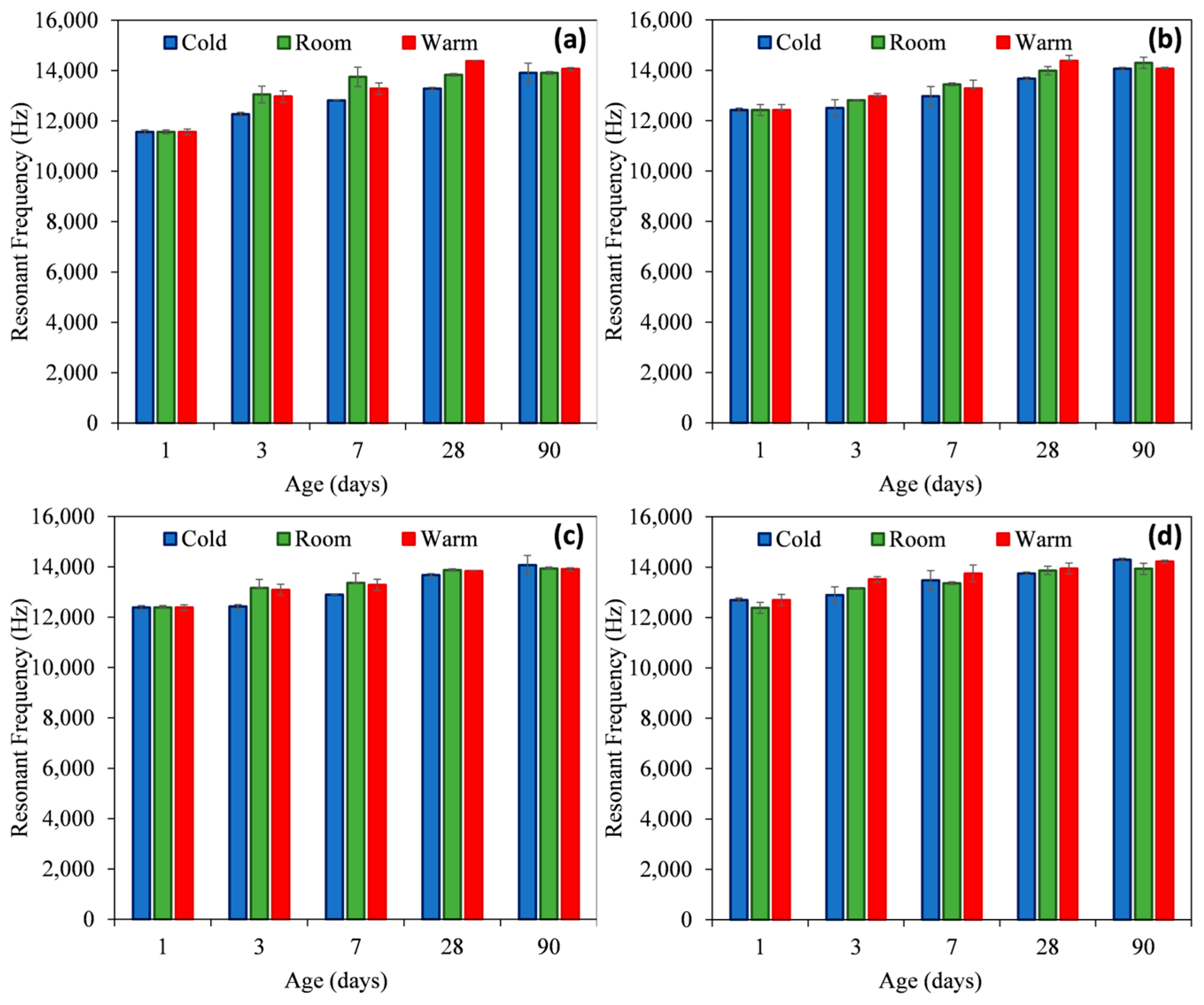
Figure 4 presents the resonant frequency results obtained on the same concrete samples previously evaluated for compressive strength. Results agree with compressive strength trends. Among all samples, those made with PLC cement showed greater sensitivity to curing temperature, particularly the PLC-12.7 mm mixture, with rapid increases in resonant frequency under warm curing conditions at early ages. However, after 28 days, this trend reversed, with cold curing resulted in higher values at later ages.
Figure 4.
Resonant frequency values under different curing temperatures. (a) OPC-12.7 mm. (b) PLC-12.7 mm. (c) OPC-9.5 mm. (d) PLC-9.5 mm.
Resonant frequency was strongly correlated with compressive strength, particularly at early ages. As reported in prior studies [56,57,58,59], frequency increases with material stiffness, and early pore densification raises electrical resistivity, especially in PLC mixes where porosity decreases more rapidly. Accordingly, higher resonant frequencies were observed at 3 days in warm-cured samples with 12.7 mm aggregates, closely agreeing with compressive strength trends. Performance under room curing was nearly equivalent to warm curing at this age.
From 28 to 90 days, resonant frequency trends generally agree with compressive strength, with warm and room curing producing the highest values. There are some exceptions in PLC mixes at 90 days, where cold curing produced slightly higher resonant frequencies than both warm and room curing. However, warm curing samples still showed higher compressive strength at 90 days, with only marginal differences (≤1.2%) compared to cold and room conditions.
3.5. Surface Resistivity (SR)
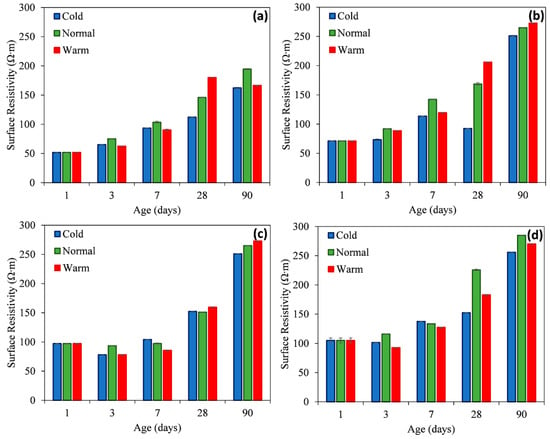
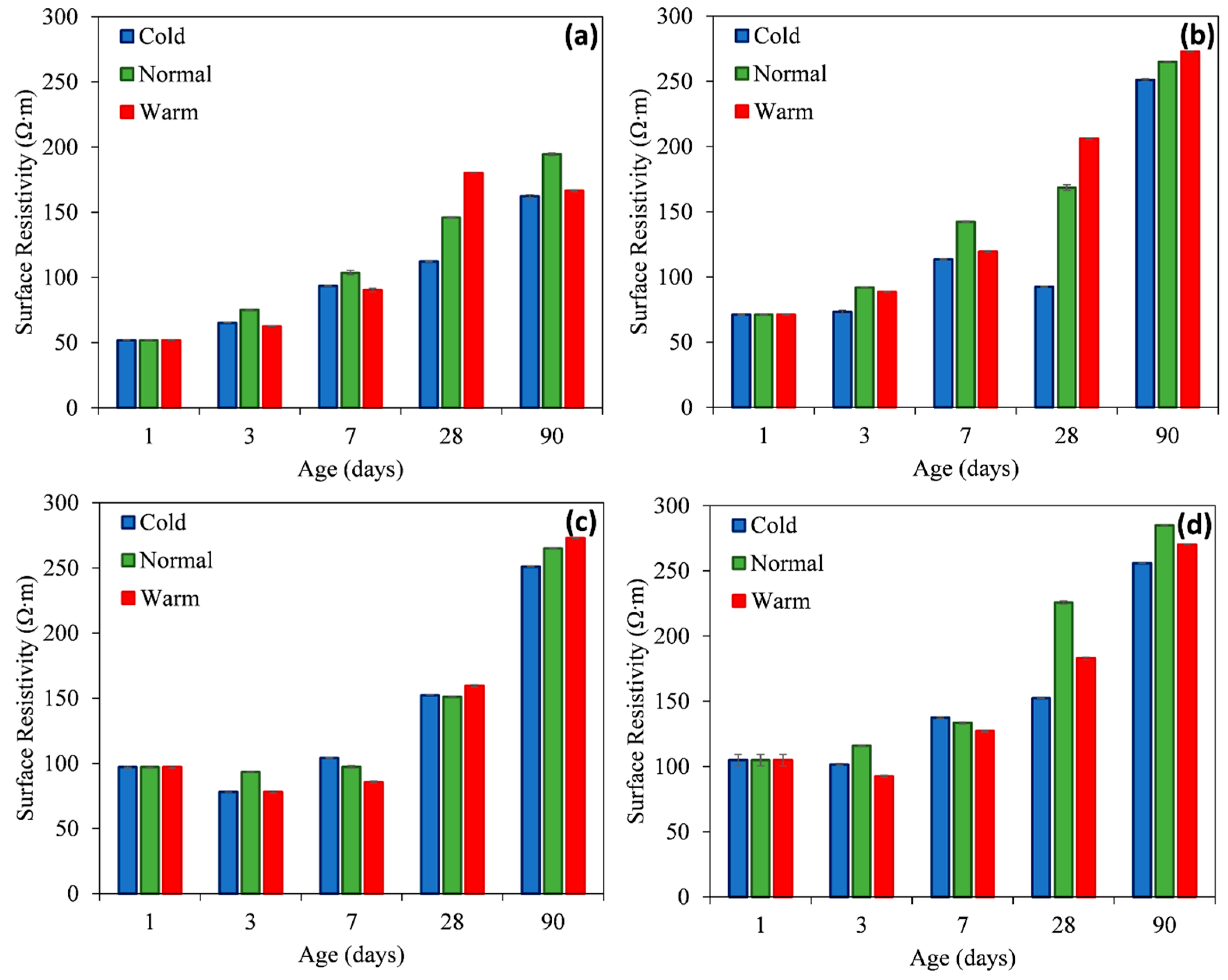
Figure 5 presents the influence of curing temperature on the SR of concrete mixes prepared with two types of cement (OPC and PLC) and two sizes of river gravel (9.5 mm and 12.7 mm), under cold, room, and warm curing conditions. In general, SR followed a similar trend to compressive strength across mixtures and ages. However, some discrepancies appeared. For example, in the PLC-9.5 mm mix at 90 days, SR was lower under cold curing than under warm curing, contrary to compressive strength results, where cold curing produced the highest values. A similar discrepancy appears at 28 days in the same mix, where surface resistivity was lowest in cold curing and highest in room curing, even though compressive strength peaked under cold conditions. Likewise, in the OPC-9.5 mm mix at 90 days, warm curing produced the highest SR but the lowest compressive strength.
Figure 5.
Surface resistivity results under different curing temperatures. (a) OPC-12.7 mm. (b) PLC-12.7 mm. (c) OPC-9.5 mm. (d) PLC-9.5 mm.
3.6. Regression Method
After analyzing the strength and NDT techniques results, the main goal of the study was to find the influence of curing temperature of the correlation of those experiments. To achieve this goal, different linear and non-linear options will be considered.
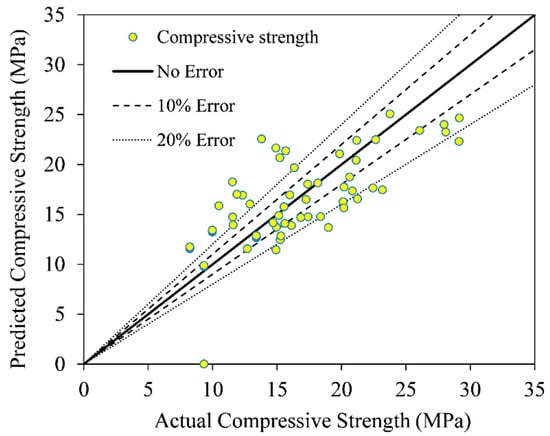
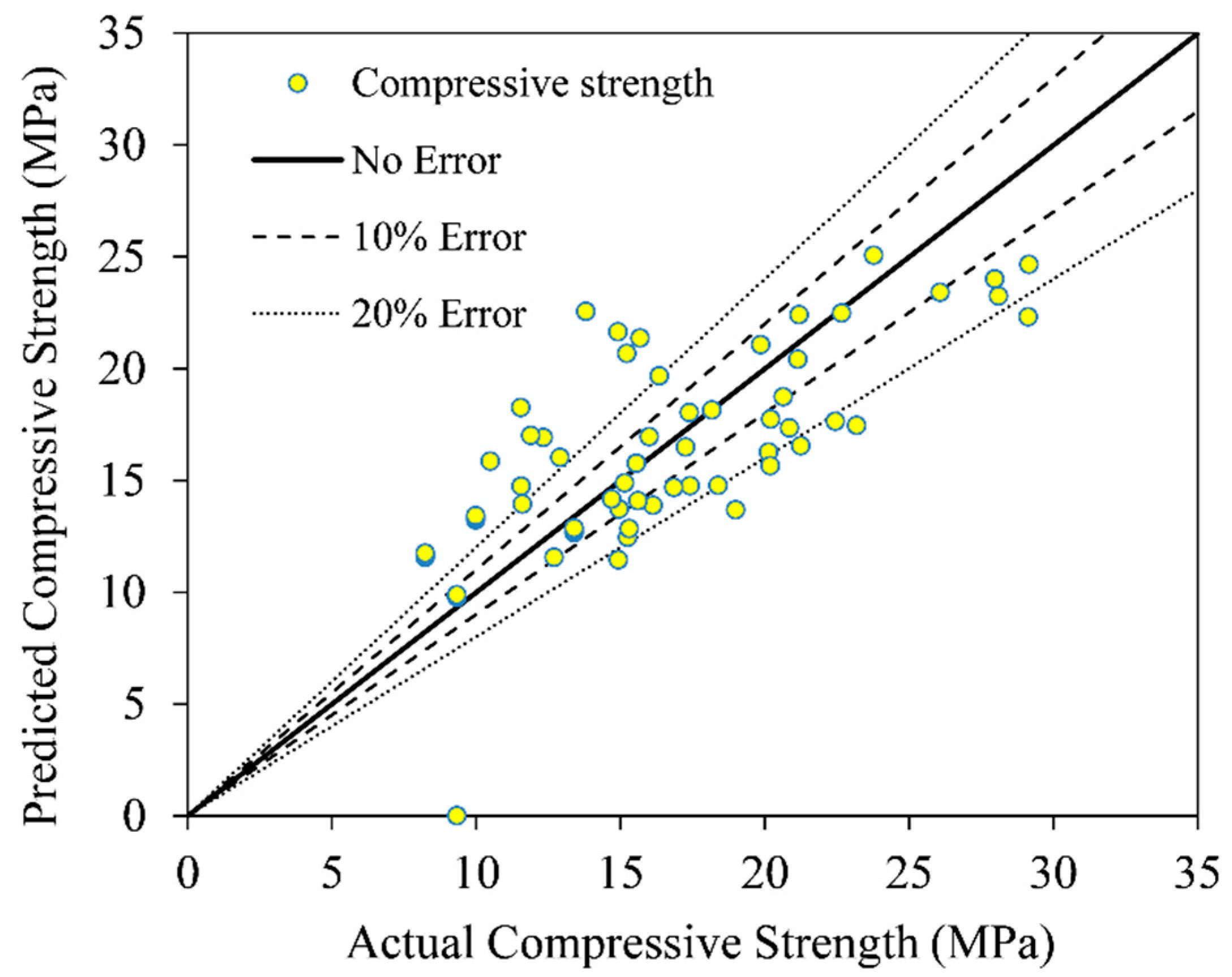
First, a simple linear regression method is employed to check if curing temperature influences the correlation, as suggested by prior research [60,61]. Figure 6 represents the actual versus predicted compressive strength values obtained from the linear regression analysis. The developed equation is presented in (1). In this model, all NDTs and temperature were used as input features, while compressive strength was the dependent variable.
where PCS is the predicted compressive strength; T is the temperature (°C); RF is the resonant frequency (Hz); SR is the surface resistivity (kΩ·cm); UPV is the ultrasonic pulse velocity (m/s); and RH is the rebound hammer index (dimensionless).
PCS = −19.40 + 0.01∙T + 0.01∙RF + 0.04∙SR − 0.01∙UPV − 0.20∙RH
Figure 6.
Actual vs. predicted compressive strength using the linear regression method.
This analysis aimed to (1) assess the predictive capability of different NDTs and (2) evaluate the extent to which curing temperature impacts strength development. However, the performance of the simple regression model was limited. The R2 value obtained was 0.56, indicating only moderate predictive accuracy. Moreover, a detailed examination of the scatter plot shows that several data points have prediction errors exceeding 30%, with some nearing 40%.
In other studies, such as the one conducted by Haque et al. [62], only two factors, UPV and RH, were used to predict compressive strength, with all samples tested at 28 days. While reducing the number of input variables can enhance performance in simple regression models, this typically requires restricting the dataset to a fixed age, limiting its generalizability.
To address these limitations, more robust and nonlinear models, such as machine learning techniques, can capture the different influences of all the factors included. Although previous studies have demonstrated the effectiveness of ANNs in predicting compressive strength from multiple factors [49,63,64,65,66], none have investigated whether including curing temperature as an input can improve the correlation between NDT results and strength predictions. This gap presents an opportunity for the current study to extend beyond conventional regression models and explore the added value of machine learning techniques in this context.
3.7. Artificial Neural Network
3.7.1. Raw Data from Experiments
In this study, an ANN was employed due to its proven ability to train complex models, non-linear relationships [67,68]. The initial modeling phase used only experimental data shown in the previous sections. The performance metrics from three different training attempts are presented in Table 3. The model performance showed notable variability across training, validation, and test sets. For example, in Trial 1, while the training accuracy was relatively high (R2 = 0.92), the validation accuracy dropped significantly (R2 = 0.57), indicating potential overfitting. Similar disparities were observed in the other trials, suggesting that the model was learning patterns specific to the training data and struggling to generalize to not used data.
Table 3.
Performance of ANN using raw data.
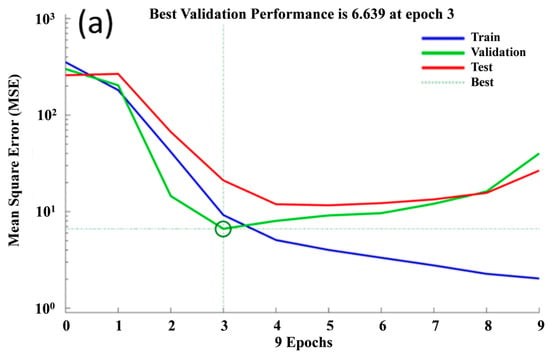
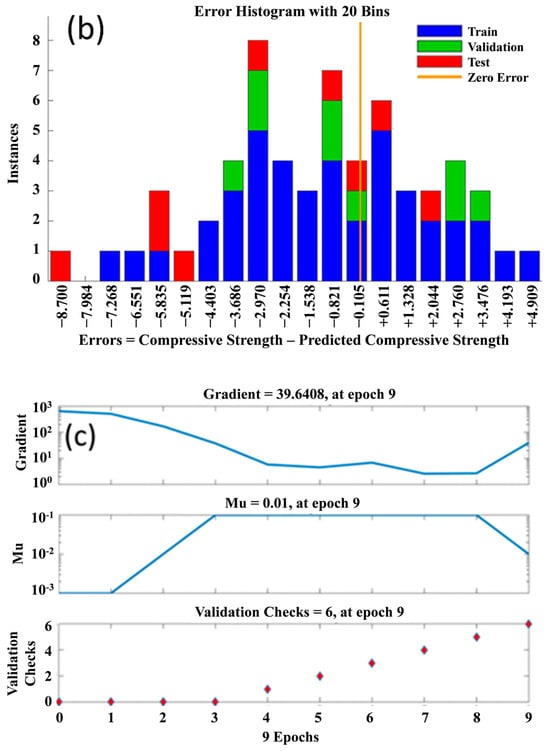
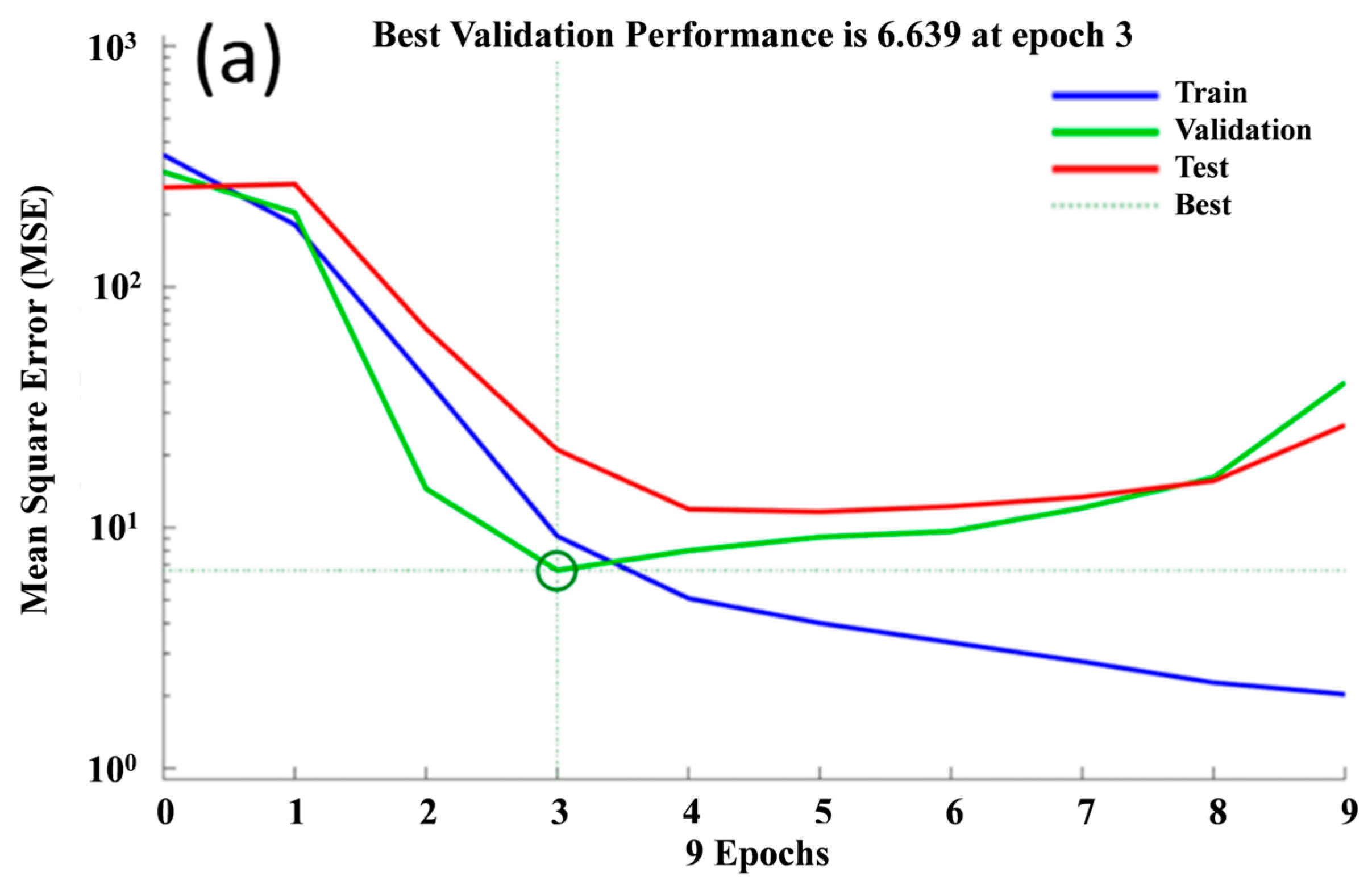
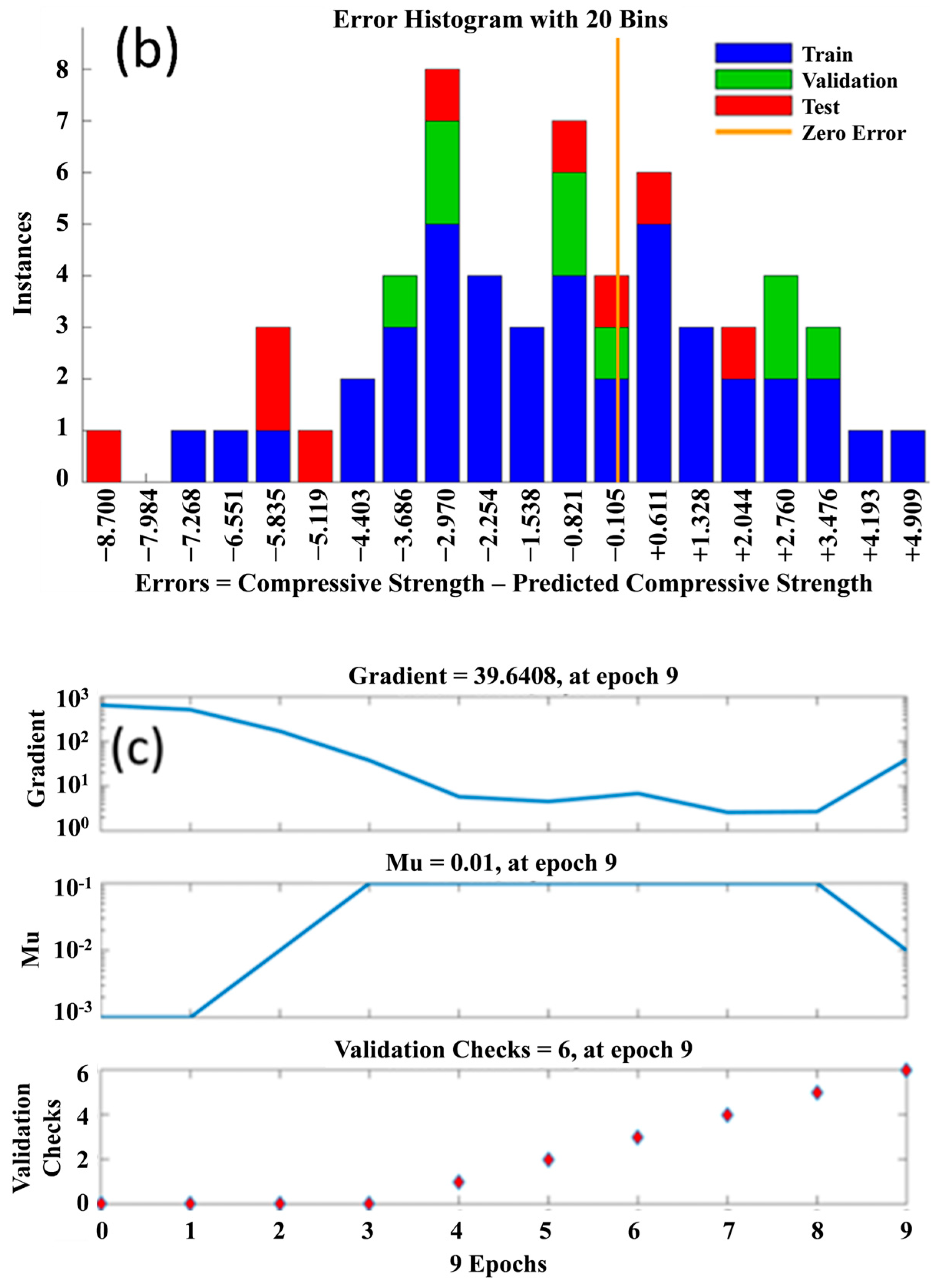
Further insights can be drawn from the errors in the histogram and training and validation performance plots shown in Figure 7. As shown in Figure 7a, the best validation performance occurred at epoch 3, with a value of 6.64. However, after this point, the validation error continuously increased, while the training performance continued to improve. This divergence indicates overfitting, as the model began to memorize the training data rather than learning generalizable patterns.
Figure 7.
(a) Training and validation performance. (b) Error histogram and plots. (c) Training state diagram when using raw data.
The error histogram also reveals further weaknesses in the model’s performance. The training and validation errors span a wide range, with many samples exhibiting large positive or negative error values. This uneven distribution across errors suggests the model struggles with generalization, lacks prediction stability, and does not maintain adequate accuracy.
Additionally, Figure 7c shows the training state diagram further confirms these limitations. Although the gradient value initially shows a decreasing trend, indicating learning progress, it starts to increase again after epoch 8. This appears to be an ineffective attempt at improving the validation error. Moreover, the adaptive learning rate (μ) remains fixed at 0.01, a relatively high value that hinders effective optimization during training. Notably, from epoch 4 onward, the number of validation failures (denoted as validation fail b) gradually increases, another clear sign of the model’s poor generalization and the need to stop training.
3.7.2. Optimization of Layer Design and Inclusion of Data Augmentation Methods
To improve the model’s robustness and address overfitting, data augmentation techniques were introduced to expand the training dataset. This approach was necessary due to the limited size of the original dataset, which led to high variability in model performance across training trials and reduced the consistency of the results. There are different data augmentation methods available in previous literature, such as Generative Adversarial Networks (GAN) [69,70,71], Gaussian Noise Augmentation (GNA) [69,70,71,72,73,74], and Synthetic Minority Oversampling Technique (SMOTE) [72,75,76]. Among these, GNA and SMOTE demonstrated more consistent results for similar applications [75].
In this study, GNA and SMOTE were employed. MATLAB (version R2025a) scripts were developed to generate additional data using each method. Although the primary goal of this article, based on previous studies [49,50], was to use a 10-neuron hidden layer, the results of training after applying GNA and SMOTE methods are presented in Table 4 for determining the optimal network architecture and the most effective augmentation technique. These results include training, validation, test, and overall performance metrics across different network configurations (ranging from 8 to 16 neurons in a single hidden layer).
Table 4.
Comparison of different network architectures and augmentation techniques aimed at identifying the most effective combination.
After analyzing the results across different network configurations, it was found that GNA consistently provided higher prediction accuracy compared to SMOTE. The 12-neuron architecture achieved the best overall performance, with an R2 of 0.97 and individual set performances all above 0.90. However, the 10-neuron configuration also performed very close to the 12-neuron network, confirming that the initial selection (10 neurons) used in the raw data was sufficiently accurate. These results demonstrate that GNA is an effective approach for improving ANN prediction accuracy, particularly when working with limited experimental data.
This approach, though not commonly applied in studies involving concrete materials and structural prediction, shows promising potential. As supported by recent research [69,73], GNA method helps simulate realistic variability in input data, thereby improving the generalization ability of neural networks.
3.7.3. Comparative Performance: Raw vs. Augmented Data
To quantify the impact of data augmentation, the model was retrained using 120 samples (increased from the original 60), with the GNA method applied. The same 12-neuron layer network architecture was used for consistency. Table 5 compares model performance before and after augmentation. As seen in Table 5, the model trained with augmented data significantly outperformed the one trained with raw data, particularly in the validation and test phases. The use of the GNA method clearly enhanced the ANN’s ability to capture the nonlinear relationships between curing temperature, NDT results, and compressive strength. This result aligns with findings from previous studies. For instance, Nguyen et al. [74] reported a similar performance increase after applying the GNA method, with R2 values improving from 0.88 to 0.91. Ziolkowski et al. [77] also applied data augmentation techniques to strengthen their ANN model for concrete strength prediction, addressing limitations due to small and unbalanced datasets.
Table 5.
Comparison of model performance before and after using augmentation.
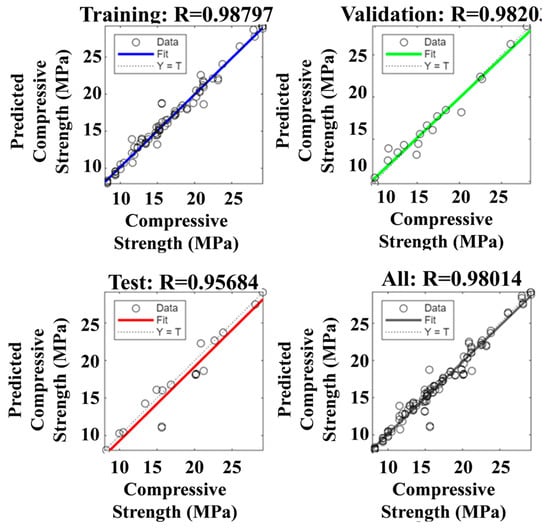
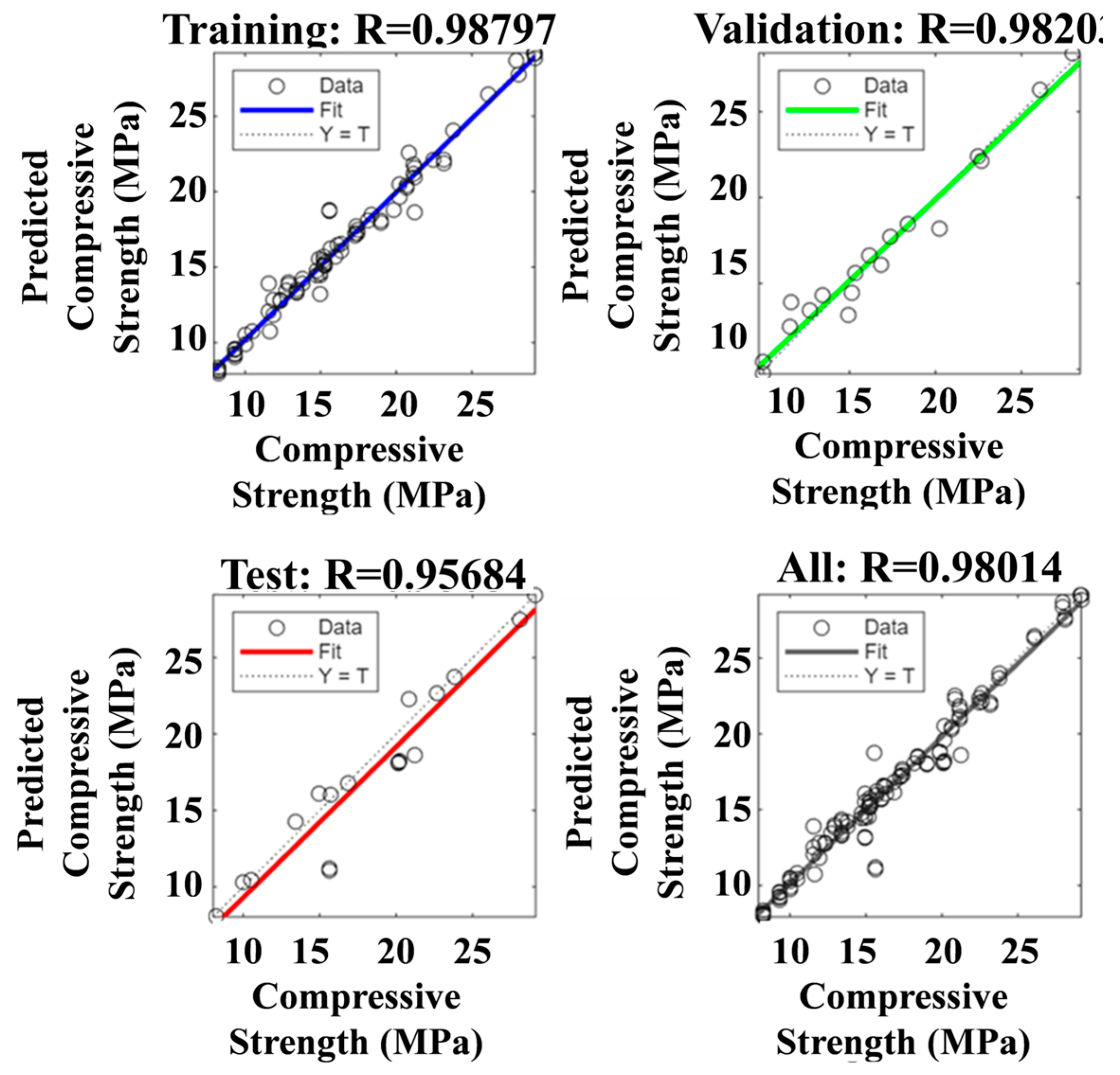
Figure 8 illustrates the results of ANN training after using the GNA method. In the present study, results showed that the GNA method effectively addressed overfitting and instability by simulating real-world variability. The model’s R2 increased from 0.80 to 0.89, while the root means square error (RMSE) decreased, indicating a more reliable and stable prediction performance. These outcomes support the conclusion that the GNA method is a valuable technique for improving ANN-based models in material science, particularly when dealing with limited data [69,77,78,79].
Figure 8.
ANN results using the GNA method.
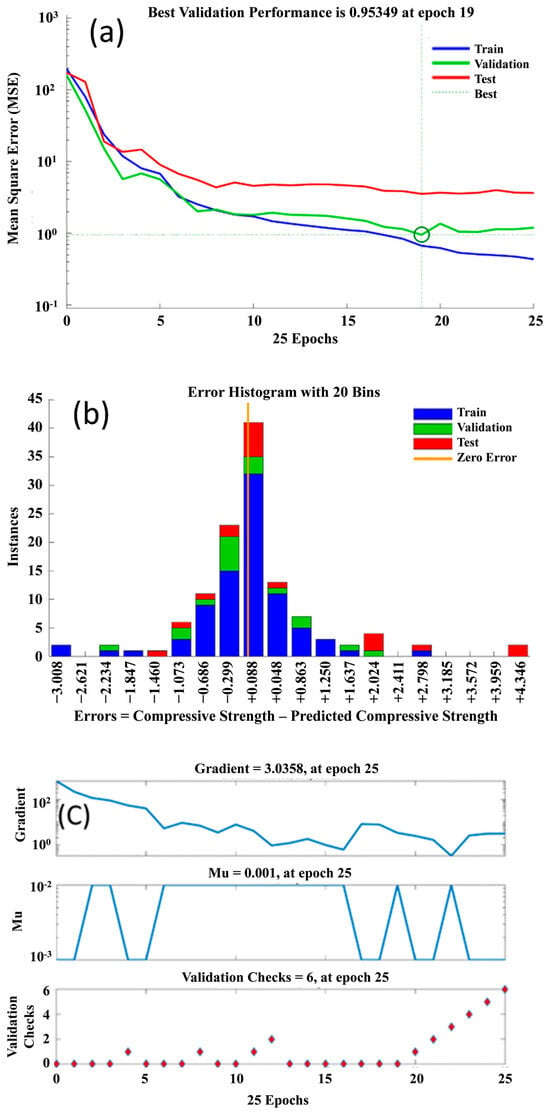
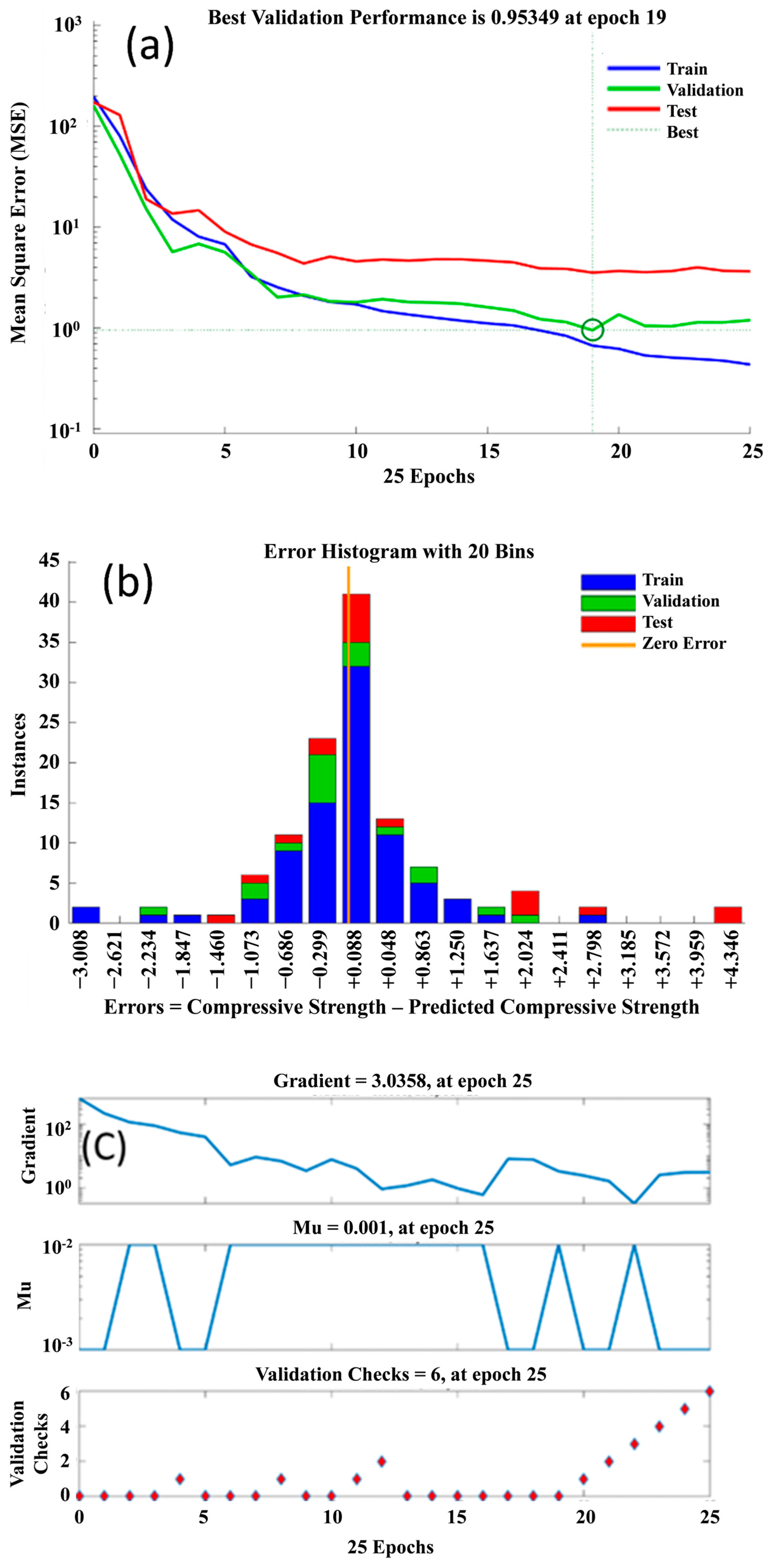
Based on Table 5, it is evident that the data significantly improved, and the model’s accuracy increased. Figure 9 further supports this observation by illustrating how the previous errors and issues, such as instability and overfitting, have been effectively addressed.
Figure 9.
(a) Training and validation performance. (b) Error histogram and plots. (c) Training state diagram when using augmentation methods.
As shown in Figure 9a,c, the training performance and training state diagram indicate that increasing the number of data points significantly reduced the validation error, which reached 0.95 in the optimized model (OPECH19). This reduction is notable compared to the earlier state, where the validation error was around 6. Such a decrease reflects a substantial improvement in the model’s predictive accuracy.
Moreover, the continuous decline and convergence of the training, validation, and test curves further support the model’s improved accuracy and suggest stable learning behavior without signs of overfitting.
The error histogram shows a clear reduction in prediction error, with values now concentrated around zero. Unlike the initial model, which exhibited a wide error distribution, the improved model maintains error values mostly within the narrow range of 0.3 to +0.3, indicating high precision and strong capability in predicting values close to actual results.
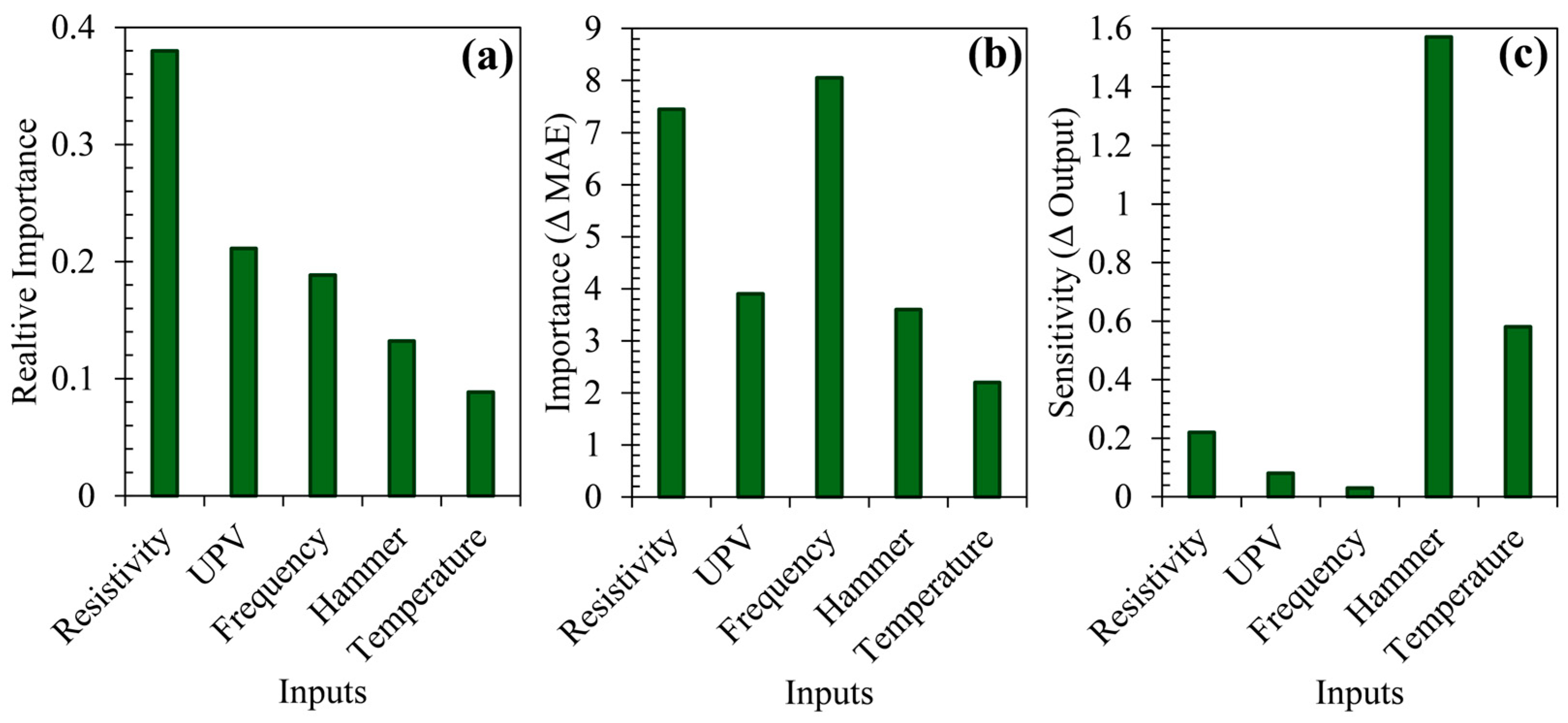
To assess the contribution of each NDT, three methods were used: Garson’s algorithm, permutation importance, and sensitivity analysis. Figure 10a presents the relative contribution of each input parameter based on Garson’s algorithm. Figure 10b shows permutation importance based on error increase after variable shuffling. Figure 10c presents sensitivity analysis results. The sensitivity analysis indicates that the rebound hammer test exhibits the highest sensitivity, meaning that small measurement errors can lead to large variations in predicted compressive strength.
Figure 10.
(a) Garson’s algorithm. (b) Permutation importance. (c) Sensitivity analysis when using augmentation methods and ANN.
As shown in Figure 10, Garson’s algorithm indicates that electrical resistivity has the largest contribution to the ANN output, followed by UPV and frequency. Permutation importance confirms that frequency and electrical resistivity have the greatest effect on model accuracy, as changing these inputs produces the largest increase in prediction error.
In practical experiments, human error often introduces additional variability in results. When research involves producing large numbers of concrete samples, the absence of data augmentation can significantly increase time, material usage, and overall costs. The data augmentation approach adopted in this study reduces experimental demand and associated costs while also limiting material and cement consumption.
4. Discussion
Compressive strength results confirm that elevated curing temperatures enhance early-age compressive strength due to accelerated hydration. However, this early advantage is often offset by long-term drawbacks, such as the development of microcracks induced by rapid hydration. Similar findings have been reported by Luo and Luo [80], Lin et al. [81], and Kim et al. [82]. Notably, Lin et al. [81] further emphasized that the rate of compressive strength development in concrete samples cured at higher temperatures decreases over time, ultimately falling behind that of concrete cured at lower temperatures. This phenomenon typically becomes evident after 28 days.
Regarding the UPV values, previous studies have shown that higher curing temperatures accelerate hydration and improve early-age UPV values [52,53,54,55]. However, the results suggest that at higher curing temperatures, rapid hydration can cause internal microcracking and increased porosity due to dehydration of calcium silicate hydrate (C-S-H) and release of absorbed water [83,84,85]. These microstructural changes primarily affect stiffness and density rather than strength directly, both of which influence UPV measurements. An important point to highlight is that UPV does not show a general inverse relationship with compressive strength. For each mixture, both UPV and compressive strength generally increase with age, but the effect of curing temperature is much more pronounced on compressive strength than on UPV. For example, in the PLC-12.7 mm mix at 90 days, cold-cured specimens have higher compressive strength than warm-cured specimens, yet their UPV values are very similar. This indicates that UPV is relatively insensitive to the curing temperatures considered, while compressive strength is strongly affected.
For the RH, some studies report strong correlations with compressive strength in both lab and in situ cores [86,87,88]. However, concerns exist regarding RH reliability, as it can overestimate or underestimate strength [78,89]. RH showed limited reliability at early ages, particularly under warm curing conditions. In some cases, RH values underestimated compressive strength, for example 24% lower in OPC–12.7 mm at 3 days. In other cases, they greatly overestimated it, up to 91% higher in OPC–9.5 mm at 28 days. These discrepancies are attributed to surface effects, such as the formation of a soft paste layer under warm curing, which reduces the accuracy of hammer impacts [78,90]. Overall, RH is less reliable than other NDT methods, particularly at early ages.
Furthermore, the results confirm that resonant frequency is a reliable indicator of strength development and is sensitive to curing temperature. Elevated curing temperatures accelerate hydration, densify the microstructure, and enhance stiffness at early ages, while long-term differences between curing regimes tend to diminish. These findings are consistent with previous studies [56,57,58]. This confirms resonant frequency as one of the most robust NDT indicators for tracking strength development across different curing regimes.
Surface resistivity was highly sensitive to curing temperature during the first 3 days [91,92]. Samples cured at room temperature generally showed the highest SR due to stable conditions, while cold- and warm-cured samples exhibited lower values. This highlights that SR measurements are particularly sensitive to curing conditions at early ages. Over longer periods, curing temperature continued to influence SR results. In some mixes (e.g., OPC 9.5 mm and PLC 12.7 mm), warm curing still produced higher SR values (approximately 8% above cold curing) despite lower compressive strength at 28 and 90 days. Conversely, cold-cured samples sometimes achieved the highest compressive strength but exhibited lower SR, such as in the PLC 12.7 mm mix at 90 days, where SR was approximately 20% lower than room temperature curing. Overall, SR is a temperature-sensitive metric, particularly at early ages, and discrepancies between SR and compressive strength should be carefully considered when interpreting results.
These material-dependent and temperature-sensitive behaviors help explain the limitations observed when applying simple linear regression models to the dataset. The linear regression model revealed a temperature coefficient of only 0.01 and a rebound hammer coefficient of −0.2. The positive temperature coefficient aligns with the expected trend of increasing compressive strength at higher curing temperatures, while the negative RH coefficient contradicts experimental observations, as higher RH generally corresponds to higher strength. These inconsistencies indicate that a simple linear model cannot fully capture the complexity and multivariable nature of the dataset. In particular, RH is not reliable at early ages, and the apparent inverse relationship in the linear model reflects the limitations of linear regression when applied to weakly correlated and interacting variables.
Comparing the ANN results with the linear analysis results illustrated in (1), along with the age and temperature dependent trends shown in Figure 1, Figure 2, Figure 3, Figure 4 and Figure 5, highlights the differences in modeling capability between the two approaches. The linear model assumes a simple additive relationship between the input variables (NDT measurements and curing temperature) and compressive strength. However, in reality, the effect of curing temperature on strength development is nonlinear and interacts differently with each NDT method. For instance, results show that UPV and electrical resistivity correlate differently with temperature and age, and their influence on strength is not proportional across the range of measurements. As a result, the linear model can lead to misleading interpretations, identifying electrical resistivity as ineffective and assigning a negative influence to UPV, which contradicts the experimental trends observed in Figure 1, Figure 2, Figure 3, Figure 4 and Figure 5.
In contrast, the ANN can capture these complex, nonlinear relationships. By using multiple hidden layers and nonlinear activation functions, the ANN learns how each NDT measurement interacts with temperature and age, accurately reflecting their combined effects on compressive strength. This allows the ANN to produce reliable predictions even under varying curing conditions and to account for interactions that linear regression cannot represent. As shown in the results, the ANN closely matches the experimental trends across all temperatures and ages, demonstrating its suitability for modeling temperature-dependent, nonlinear behavior in functional concrete mixtures.
Overall, the study confirms that both the assessment and predictive modeling of concrete performance are strongly influenced by curing temperature and data quality. NDTs remain valuable noninvasive tools, but their temperature sensitivity requires advanced data-driven approaches. Data-augmented ANNs provide a powerful and sustainable solution, offering accurate and efficient predictions of concrete properties even with limited experimental datasets.
5. Limitations and Future Research
- The authors acknowledge that the experimental data generated in this study is limited. However, when other researchers apply all these NDTs simultaneously, larger datasets will be produced, leading to more reliable results with the ANN method and reducing the need for data augmentation. This approach should be further explored in future research.
- All tests were conducted under controlled laboratory conditions. In real construction environments, additional factors such as moisture fluctuations, carbonation, and microcracking from service loads may influence NDT results and compressive strength correlations.
- The experimental dataset was relatively small and limited to specific cement types (OPC and PLC), aggregate sizes, and curing temperatures (5 °C, 25 °C, 40 °C). Broader datasets with different binders, admixtures, and aggregate types would strengthen generalizability.
- The authors acknowledge the limited number of laboratory samples used in this study. This limitation is primarily attributable to practical constraints associated with producing concrete specimens in quantities exceeding 60. Unlike mortar, the preparation of concrete samples in numbers greater than requires significantly greater laboratory resources, equipment, and personnel.
- The authors further recognize that limited datasets in ANN-based modeling may increase the risk of overfitting. To mitigate this issue, the GNA method was adopted in this study, as it effectively enlarges the dataset and improves the generalization capability of the model.
6. Conclusions
Based on the experimental program and models explained before, the following conclusions can be drawn:
- NDTs showed inconsistent reliability in predicting compressive strength, particularly at early ages and under extreme curing temperatures. Reliance on a single NDT method can lead to significant errors, with RH over- or underestimating strength by up to 91% at 3 days.
- Simple linear regression was inadequate to capture the complex, nonlinear interactions among NDT results, curing temperature, and compressive strength, obtaining only moderate accuracy (R2 = 0.56) with large prediction errors.
- ANNs trained on raw data had overfitting and poor generalization; however, the use of GNA significantly improved performance, achieving R2 values above 0.97 and enabling accurate, stable modeling of NDT and curing temperature effects.
- In conclusion, this study demonstrates that curing temperature and data quality are critical factors in evaluating and modeling concrete performance. By addressing the limitations of temperature-sensitive NDTs, data-augmented ANNs can be used as a reliable and sustainable solution, providing accurate predictions even with limited datasets and reducing the need for extensive experimental campaigns.
Supplementary Materials
The following supporting information can be downloaded at: https://www.mdpi.com/article/10.3390/infrastructures11020046/s1, Figure S1: Curing rooms for the three different temperatures (a) Warm. (b) Room temperature. (c) Cold. Figure S2: Experimental setup and procedure used to measure UPV. (a) Calibration. (b) Testing. Figure S3: Experimental setup and procedure used to measure electrical resistivity. (a) Calibration. (b) Testing. Figure S4: Experimental setup and procedure used to measure RH (a) Device overview. (b) and (c) Testing. Figure S5: Compressive strength test setup. Figure S6: Experimental setup and procedure used to measure resonant frequency. (a) Setup. (b) Testing. (c) Detail of the results. Table S1: Summary of input parameters used in the raw data analyses. Table S2: Summary of input parameters used in the GNA method. Table S3: Summary of input parameters used in the SMOTE method.
Author Contributions
Conceptualization, G.G.H.A. and C.M.; methodology, G.G.H.A., K.A., M.U.S. and C.M.; validation, G.G.H.A.; formal analysis, G.G.H.A. and C.M.; investigation, G.G.H.A., K.A. and M.U.S.; resources, C.M.; data curation, G.G.H.A., K.A. and M.U.S.; writing—original draft preparation, G.G.H.A.; writing—review and editing, K.A., M.U.S. and C.M.; supervision, C.M.; project administration, C.M.; funding acquisition, C.M. All authors have read and agreed to the published version of the manuscript.
Funding
This research was funded by Texas State University, start-up grant number 9-2960 and Texas Department of Transportation, grant number 0-7172.
Data Availability Statement
The data that support the findings of this study are available upon reasonable request. Researchers interested in accessing the data can contact the corresponding author (carlosmoro@txstate.edu). Due to privacy and ethical considerations, certain restrictions may apply to the release of sensitive or confidential data. However, efforts will be made to provide the data in a format that ensures anonymity and adheres to relevant regulations and guidelines. Please note that any data provided should be used strictly for the purposes of academic research, with appropriate acknowledgment and citation of the original study.
Acknowledgments
We acknowledge Texas State University for the lab equipment and operations. The experiments reported in this study were performed in the Laboratory for Concrete Materials Research at Texas State University.
Conflicts of Interest
The authors declare no conflicts of interest. The funders had no role in the design of the study; in the collection, analyses, or interpretation of data; in the writing of the manuscript; or in the decision to publish the results.
Abbreviations
The following abbreviations are used in this manuscript:
| ANNs | Artificial neural networks |
| GAN | Generative adversarial networks |
| GNA | Gaussian noise augmentation |
| HRWR | High-range water reducer |
| MS | Moderate sulfate resistance |
| NDT | Non-destructive techniques |
| OPC | Ordinary portland cement |
| PLC | Portland limestone cement |
| RF | Resonant frequency |
| RMSE | Root mean square error |
| RH | Rebound hammer |
| SMOTE | Synthetic minority oversampling technique |
| SSD | Saturated surface dry |
| UPV | Ultrasonic pulse velocity |
| w/cm | Water-to-cementitious ratio |
References
- Miller, S.A.; Habert, G.; Myers, R.J.; Harvey, J.T. Achieving net zero greenhouse gas emissions in the cement industry via value chain mitigation strategies. One Earth 2021, 4, 1398–1411. [Google Scholar] [CrossRef] [Scilit]
- Belaïd, F. How does concrete and cement industry transformation contribute to mitigating climate change challenges? Resour. Conserv. Recycl. Adv. 2022, 15, 200084. [Google Scholar] [CrossRef] [Scilit]
- Gagg, C.R. Cement and concrete as an engineering material: An historic appraisal and case study analysis. Eng. Fail. Anal. 2014, 40, 114–140. [Google Scholar] [CrossRef] [Scilit]
- Ezzedine El Dandachy, M.; Hassoun, L.; El-Mir, A.; Khatib, J.M. Effect of Elevated Temperatures on Compressive Strength, Ultrasonic Pulse Velocity, and Transfer Properties of Metakaolin-Based Geopolymer Mortars. Buildings 2024, 14, 2126. [Google Scholar] [CrossRef] [Scilit]
- Firoozi, A.A.; Firoozi, A.A.; Oyejobi, D.O.; Avudaiappan, S.; Flores, E.S. Emerging trends in sustainable building materials: Technological innovations, enhanced performance, and future directions. Results Eng. 2024, 24, 103521. [Google Scholar] [CrossRef] [Scilit]
- Tazmeen, T.; Mir, F.Q. Sustainability through materials: A review of green options in construction. Results Surf. Interfaces 2024, 14, 100206. [Google Scholar] [CrossRef] [Scilit]
- Eslamlou, A.D.; Ghaderiaram, A.; Schlangen, E.; Fotouhi, M. A review on non-destructive evaluation of construction materials and structures using magnetic sensors. Constr. Build. Mater. 2023, 397, 132460. [Google Scholar] [CrossRef] [Scilit]
- Revilla-Cuesta, V.; Skaf, M.; Serrano-López, R.; Ortega-López, V. Models for compressive strength estimation through non-destructive testing of highly self-compacting concrete containing recycled concrete aggregate and slag-based binder. Constr. Build. Mater. 2021, 280, 122454. [Google Scholar] [CrossRef] [Scilit]
- Yang, J.; Guo, H.; Yang, C.; Zhang, G.; Pan, Y. Experimental investigation and evaluation of shear performance of hollow slab beams strengthened by cavity grouting method. Case Stud. Constr. Mater. 2024, 20, e03184. [Google Scholar] [CrossRef] [Scilit]
- Suratkar, A.; Sajjadi, A.Y.; Mitra, K. 25-Non-destructive evaluation (NDE) of composites for marine structures: Detecting flaws using infrared thermography (IRT). In Non-Destructive Evaluation (NDE) of Polymer Matrix Composites; Karbhari, V.M., Ed.; Woodhead Publishing: Cambridge, UK, 2013; pp. 649–668e. [Google Scholar]
- Tefera, B.; Tarekegn, A. Non-Destructive Testing Techniques for Condition Assessment of Concrete Structures: A Review. Am. J. Civ. Eng. 2025, 13, 10–31. [Google Scholar] [CrossRef] [Scilit]
- Daihao, S.; Min, W.; Yanjun, L.; Lei, X.; Zhichao, L. Research progress of non-destructive testing techniques in moisture content determination. Smart Agric. Technol. 2025, 11, 100878. [Google Scholar] [CrossRef] [Scilit]
- Mevissen, F.; Meo, M. A Review of NDT/Structural Health Monitoring Techniques for Hot Gas Components in Gas Turbines. Sensors 2019, 19, 711. [Google Scholar] [CrossRef] [Scilit] [PubMed]
- Kot, P.; Muradov, M.; Gkantou, M.; Kamaris, G.S.; Hashim, K.; Yeboah, D. Recent Advancements in Non-Destructive Testing Techniques for Structural Health Monitoring. Appl. Sci. 2021, 11, 2750. [Google Scholar] [CrossRef] [Scilit]
- Taylor, T.; Counsell, J.; Gill, S. Combining thermography and computer simulation to identify and assess insulation defects in the construction of building façades. Energy Build. 2014, 76, 130–142. [Google Scholar] [CrossRef] [Scilit]
- Larrabure, G.; Batchelor, A.; Salinas-Farran, L.; Neethling, S.J.; Brito-Parada, P.R. Assessing surface-level processes during column leaching: A spatiotemporal and multilevel approach combining XPS and SEM-EDS. Miner. Eng. 2025, 228, 109359. [Google Scholar] [CrossRef] [Scilit]
- Ghafoorian Heidari, S.I.; Safehian, M.; Moodi, F.; Shadroo, S. Predictive modeling of the long-term effects of combined chemical admixtures on concrete compressive strength using machine learning algorithms. Case Stud. Chem. Environ. Eng. 2024, 10, 101008. [Google Scholar] [CrossRef] [Scilit]
- Aseem, A.; Baloch, W.; Khushnood, R.; Mushtaq, A. Structural Health Assessment of Fire Damaged Building using Non-Destructive Testing and Micro-Graphical Forensic Analysis: A Case Study. Case Stud. Constr. Mater. 2019, 11, e00258. [Google Scholar] [CrossRef] [Scilit]
- Abd-Al-Naser, M.; Harba, I.S.I. Strengthening of Reinforced Concrete Beams with Textile-Reinforced Concrete. Civ. Environ. Eng. 2023, 19, 596–609. [Google Scholar] [CrossRef] [Scilit]
- Shiotani, T.; Ogura, N.; Okude, N.; Watabe, K.; Van Steen, C.; Tsangouri, E.; Lacidogna, G.; Czarnecki, S.; Chai, H.K.; Yang, Y.; et al. Non-destructive inspection technologies for repair assessment in materials and structures. Dev. Built Environ. 2024, 18, 100443. [Google Scholar] [CrossRef] [Scilit]
- Bolborea, B.; Baeră, C.; Gruin, A.; Vasile, A.-C.; Barbu, A.-M. A review of non-destructive testing methods for structural health monitoring of earthen constructions. Alex. Eng. J. 2025, 114, 55–81. [Google Scholar] [CrossRef] [Scilit]
- Udhaya Kumar, T.; Vinod Kumar, M.; Salunkhe, S.; Cep, R. Evaluation of non-destructive testing and long-term durability of geopolymer aggregate concrete. Front. Built Environ. 2024, 10, 1454687. [Google Scholar] [CrossRef] [Scilit]
- de Grazia, M.T.; Deda, H.; Sanchez, L.F.M. The influence of the binder type & aggregate nature on the electrical resistivity of conventional concrete. J. Build. Eng. 2021, 43, 102540. [Google Scholar] [CrossRef] [Scilit]
- Cosoli, G.; Mobili, A.; Tittarelli, F.; Revel, G.M.; Chiariotti, P. Electrical Resistivity and Electrical Impedance Measurement in Mortar and Concrete Elements: A Systematic Review. Appl. Sci. 2020, 10, 9152. [Google Scholar] [CrossRef] [Scilit]
- Sang, Y.; Yang, Y.; Zhao, Q. Electrical resistivity of plain cement-based materials based on ionic conductivity: A review of applications and conductive models. J. Build. Eng. 2022, 46, 103642. [Google Scholar] [CrossRef] [Scilit]
- Wei, X.; Xiao, L.; Li, Z. Prediction of standard compressive strength of cement by the electrical resistivity measurement. Constr. Build. Mater. 2012, 31, 341–346. [Google Scholar] [CrossRef] [Scilit]
- Boccacci, G.; Frasca, F.; Bertolin, C.; Siani, A. Diagnosis of Historic Reinforced Concrete Buildings: A Literature Review of Non-Destructive Testing (NDT) Techniques. Procedia Struct. Integr. 2024, 55, 160–167. [Google Scholar] [CrossRef] [Scilit]
- Yılmaz, B.; Jasiūnienė, E. Advanced ultrasonic NDT for weak bond detection in composite-adhesive bonded structures. Int. J. Adhes. Adhes. 2020, 102, 102675. [Google Scholar] [CrossRef] [Scilit]
- Inês Silva, M.; Malitckii, E.; Santos, T.G.; Vilaça, P. Review of conventional and advanced non-destructive testing techniques for detection and characterization of small-scale defects. Prog. Mater. Sci. 2023, 138, 101155. [Google Scholar] [CrossRef] [Scilit]
- Xu, D.; Tang, J.; Hu, X.; Yu, C.; Han, F.; Sun, S.; Deng, W.; Liu, J. The influence of curing regimes on hydration, microstructure and compressive strength of ultra-high performance concrete: A review. J. Build. Eng. 2023, 76, 107401. [Google Scholar] [CrossRef] [Scilit]
- Emmanuel, A.C.; Krishnan, S.; Bishnoi, S. Influence of curing temperature on hydration and microstructural development of ordinary Portland cement. Constr. Build. Mater. 2022, 329, 127070. [Google Scholar] [CrossRef] [Scilit]
- Shen, D.; Jiang, J.; Shen, J.; Yao, P.; Jiang, G. Influence of curing temperature on autogenous shrinkage and cracking resistance of high-performance concrete at an early age. Constr. Build. Mater. 2016, 103, 67–76. [Google Scholar] [CrossRef] [Scilit]
- Pichler, C.; Schmid, M.; Traxl, R.; Lackner, R. Influence of curing temperature dependent microstructure on early-age concrete strength development. Cem. Concr. Res. 2017, 102, 48–59. [Google Scholar] [CrossRef] [Scilit]
- Velay-Lizancos, M.; Lage, I.; Azenha, M.; Vázquez-Burgo, P. Influence of temperature in the evolution of compressive strength and in its correlations with UPV in eco-concretes with recycled materials. Constr. Build. Mater. 2016, 124, 276–286. [Google Scholar] [CrossRef] [Scilit]
- Zhao, Y.; Zhao, Y.; Zhu, Z.; Chen, G.; Wu, H.; Liu, C.; Gao, J. Effect of a novel negative temperature early-strength agent in improving concrete performance under varying curing temperatures. Case Stud. Constr. Mater. 2024, 21, e03748. [Google Scholar] [CrossRef] [Scilit]
- Kjellsen, K.O.; Detwiler, R.J.; Gjørv, O.E. Development of microstructures in plain cement pastes hydrated at different temperatures. Cem. Concr. Res. 1991, 21, 179–189. [Google Scholar] [CrossRef] [Scilit]
- Mao, J.; Xia, Y.; Li, H.; Dai, F.; Guan, S.; Ren, J. Feasibility and application of novel electrical curing method for constant-temperature hardening of concrete at cold regions. J. Build. Eng. 2024, 97, 110899. [Google Scholar] [CrossRef] [Scilit]
- ASTM C127; Standard Test Method for Relative Density (Specific Gravity) and Absorption of Coarse Aggregate. ASTM International: West Conshohocken, PA, USA, 2015.
- ASTM C128; Standard Test Method for Relative Density (Specific Gravity) and Absorption of Fine Aggregate. ASTM International: West Conshohocken, PA, USA, 2015.
- ASTM C150/C150M; Standard Specification for Portland Cement. ASTM International: West Conshohocken, PA, USA, 2020.
- ASTM C595/C595M; Standard Specification for Blended Hydraulic Cements. ASTM International: West Conshohocken, PA, USA, 2024.
- ASTM C494/C494M; Standard Specification for Chemical Admixtures for Concrete. ASTM International: West Conshohocken, PA, USA, 2019.
- Talor, P.; Yurdakul, E.; Wang, X.; Wang, X. Concrete Pavement Mixture Design and Analysis (MDA): An Innovative Approach to Proportioning Concrete Mixtures FHWA Pooled Fund Study TPF-5(205). 2015. Available online: https://dr.lib.iastate.edu/ (accessed on 19 February 2025).
- ASTM C597; Standard Test Method for Pulse Velocity through Concrete. ASTM International: West Conshohocken, PA, USA, 2022.
- ASTM C805/C805M; Standard Test Method for Rebound Number of Hardened Concrete. ASTM International: West Conshohocken, PA, USA, 2025.
- Sajid, S.; Chouinard, L.; Carino, N. Robustness of Resonant Frequency Test for Strength Estimation of Concrete. Adv. Civ. Eng. Mater. 2019, 8, 451–462. [Google Scholar] [CrossRef] [Scilit]
- AASHTO T358-22; Standard Method of Test for Surface Resistivity Indication of Concrete’s Ability to Resist Chloride Ion Penetration. AASHTO: Washington, DC, USA, 2022. Available online: https://standards.globalspec.com/std/13344862/aashto-t-358 (accessed on 14 March 2024).
- ASTM C39/C39M; Standard Test Method for Compressive Strength of Cylindrical Concrete Specimens. ASTM International: West Conshohocken, PA, USA, 2020.
- Khademi, F.; Behfarnia, K. Evaluation of Concrete Compressive Strength using Artificial Neural Network and Multiple Linear Regression Models. Int. J. Optim. Civ. Eng. 2016, 6, 423–432. [Google Scholar]
- Sah, A.K.; Hong, Y.-M. Performance Comparison of Machine Learning Models for Concrete Compressive Strength Prediction. Materials 2024, 17, 2075. [Google Scholar] [CrossRef] [Scilit]
- Jaya, R.P. 14-Porous concrete pavement containing nanosilica from black rice husk ash. In New Materials in Civil Engineering; Samui, P., Kim, D., Iyer, N.R., Chaudhary, S., Eds.; Butterworth-Heinemann: Oxford, UK, 2020; pp. 493–527. [Google Scholar]
- Almasaeid, H. Ultrasonic pulse velocity and artificial neural network prediction of high-temperature damaged concrete splitting strength. Discov. Appl. Sci. 2024, 6, 4. [Google Scholar] [CrossRef] [Scilit]
- Selcuk, L.; Gökçe, H.S.; Kayabali, K.; Simsek, O. A non-destructive testing technique: Nail penetration test. ACI Struct. J. 2012, 109, 245. [Google Scholar]
- Kirchhof, L.; Lorenzi, A.; Silva Filho, L.C. Assessment of concrete residual strength at high temperatures using ultrasonic pulse velocity. E J. Nondestruct. Test. 2015, 20, 1–9. [Google Scholar]
- Almasaeid, H.H.; Suleiman, A.; Alawneh, R. Assessment of high-temperature damaged concrete using non-destructive tests and artificial neural network modelling. Case Stud. Constr. Mater. 2022, 16, e01080. [Google Scholar] [CrossRef] [Scilit]
- Leung, H.; Balendran, R.; Nadeem, A.; Maqsood, T.; Rana, T. Resonant Frequency in Fibre Reinforced Concrete: Effect of Pozzolans and Curing Conditions. In Proceedings of the International Conference on the Performance of Construction Materials in the New Millenium, Cairo, Egypt, 8–20 February 2003. [Google Scholar]
- Daneshvar, D.; Deix, K.; Robisson, A. Effect of casting and curing temperature on the interfacial bond strength of epoxy bonded concretes. Constr. Build. Mater. 2021, 307, 124328. [Google Scholar] [CrossRef] [Scilit]
- Ridengaoqier, E.; Hatanaka, S. Prediction of porosity of pervious concrete based on its dynamic elastic modulus. Results Mater. 2021, 10, 100192. [Google Scholar] [CrossRef] [Scilit]
- Cantero, B.; Sainz-Aja, J.; Yoris, A.; Medina, C.; Thomas, C. Resonance Fatigue Behaviour of Concretes with Recycled Cement and Aggregate. Appl. Sci. 2021, 11, 5045. [Google Scholar] [CrossRef] [Scilit]
- Ogah, O.; Abubakar, J.; Sheidu, A. Linear Regression Model Based on Accelerated Curing Method to Predict the 28-Day Strength of Concrete. Afr. J. Environ. Sci. Renew. Energy 2023, 10, 188–196. [Google Scholar]
- Kubba, Z.; Fahim Huseien, G.; Sam, A.R.M.; Shah, K.W.; Asaad, M.A.; Ismail, M.; Tahir, M.M.; Mirza, J. Impact of curing temperatures and alkaline activators on compressive strength and porosity of ternary blended geopolymer mortars. Case Stud. Constr. Mater. 2018, 9, e00205. [Google Scholar] [CrossRef] [Scilit]
- Haque, M.A.; Rasel-Ul-Alam, M. Non-linear models for the prediction of specified design strengths of concretes development profile. HBRC J. 2018, 14, 123–136. [Google Scholar] [CrossRef] [Scilit]
- Kairu, W.M.; Mumenya, S.W.; Njoroge, K.D.; Kaniu, I.M. Application of schmidt hammer and ultrasonic pulse velocity for structural integrity assessment in water dams. J. Infrastruct. Preserv. Resil. 2025, 6, 11. [Google Scholar] [CrossRef] [Scilit]
- Moro, C.; El-Fil, H.; Francioso, V.; Velay-Lizancos, M. Influence of water-to-binder ratio on the optimum percentage of nano-TiO2 addition in terms of compressive strength of mortars: A laboratory and virtual experimental study based on ANN model. Constr. Build. Mater. 2020, 267, 120960. [Google Scholar] [CrossRef] [Scilit]
- Eilbeigi, S.; Tavakkolizadeh, M.; Masoodi, A.R. Nonlinear Regression Prediction of Mechanical Properties for SMA-Confined Concrete Cylindrical Specimens. Buildings 2023, 13, 112. [Google Scholar] [CrossRef] [Scilit]
- Deshpande, N.; Londhe, S.; Kulkarni, S. Modeling compressive strength of recycled aggregate concrete by Artificial Neural Network, Model Tree and Non-linear Regression. Int. J. Sustain. Built Environ. 2014, 3, 187–198. [Google Scholar] [CrossRef] [Scilit]
- Liu, X.; Tao, F.; Yu, W. A neural network enhanced system for learning nonlinear constitutive law and failure initiation criterion of composites using indirectly measurable data. Compos. Struct. 2020, 252, 112658. [Google Scholar] [CrossRef] [Scilit]
- Thomas, D.; Li, Y.; Ukwuoma, C.C.; Dossa, J. Explainability of artificial neural network in predicting career fulfilment among medical doctors in developing nations: Applicability and implications. Soc. Sci. Med. 2024, 360, 117329. [Google Scholar] [CrossRef] [Scilit]
- Qu, H.; Hu, T.; Qu, J.; Taffese, W.Z. A machine learning model based on GAN-ANN data augmentation for predicting the bond strength of FRP-reinforced concrete under high-temperature conditions. Compos. Struct. 2025, 369, 119321. [Google Scholar] [CrossRef] [Scilit]
- Dunphy, K.; Sadhu, A.; Wang, J. Multiclass damage detection in concrete structures using a transfer learning-based generative adversarial networks. Struct. Contr. Health Monit. 2022, 29, e3079. [Google Scholar] [CrossRef] [Scilit]
- Jeon, D.; Han, S.; Jung, S.; Moon, J. Hybrid machine learning framework for predicting pozzolanic reactivity: Integration of R3 test and GAN-augmented data. Constr. Build. Mater. 2025, 485, 141959. [Google Scholar] [CrossRef] [Scilit]
- Chen, N.; Zhao, S.; Gao, Z.; Wang, D.; Liu, P.; Oeser, M.; Hou, Y.; Wang, L. Virtual mix design: Prediction of compressive strength of concrete with industrial wastes using deep data augmentation. Constr. Build. Mater. 2022, 323, 126580. [Google Scholar] [CrossRef] [Scilit]
- Abdellatief, M.; Elsafi, M.; Murali, G.; ElNemr, A. Comparative evaluation of hybrid machine learning models for predicting the strength of metakaolin-based geopolymer concrete enhanced with Gaussian noise augmentation. J. Build. Eng. 2025, 111, 113302. [Google Scholar] [CrossRef] [Scilit]
- Nguyen, H.A.; Pham, D.H.; Ahn, Y. Effect of Data Augmentation Using Deep Learning on Predictive Models for Geopolymer Compressive Strength. Appl. Sci. 2024, 14, 3601. [Google Scholar] [CrossRef] [Scilit]
- Soomro, A.A.; Mokhtar, A.A.; Muhammad, M.B.; Saad, M.H.M.; Lashari, N.; Hussain, M.; Palli, A.S. Data augmentation using SMOTE technique: Application for prediction of burst pressure of hydrocarbons pipeline using supervised machine learning models. Results Eng. 2024, 24, 103233. [Google Scholar] [CrossRef] [Scilit]
- Udu, A.G.; Salman, M.T.; Ghalati, M.K.; Lecchini-Visintini, A.; Siddle, D.R.; Dong, H. Emerging SMOTE and GAN Variants for Data Augmentation in Imbalance Machine Learning Tasks: A Review. IEEE Access 2025, 13, 113838–113853. [Google Scholar] [CrossRef] [Scilit]
- Ziolkowski, P.A.-O. Influence of Optimization Algorithms and Computational Complexity on Concrete Compressive Strength Prediction Machine Learning Models for Concrete Mix Design. Materials 2025, 18, 1386. [Google Scholar] [CrossRef] [Scilit]
- Kumavat, H.R.; Chandak, N.R.; Patil, I.T. Factors influencing the performance of rebound hammer used for non-destructive testing of concrete members: A review. Case Stud. Constr. Mater. 2021, 14, e00491. [Google Scholar] [CrossRef] [Scilit]
- Golafshani, E.; Khodadadi, N.; Ngo, T.; Nanni, A.; Behnood, A. Modelling the compressive strength of geopolymer recycled aggregate concrete using ensemble machine learning. Adv. Eng. Softw. 2024, 191, 103611. [Google Scholar] [CrossRef] [Scilit]
- Luo, B.; Luo, Z. Influence of curing regimes on the mechanical properties and microstructure of ultra-high-performance concrete blended with gold mine tailings. Mater. Lett. 2022, 311, 131527. [Google Scholar] [CrossRef] [Scilit]
- Lin, L.; Wang, S.; Zhang, P.; Li, J.; Wang, S.; Zhong, J.; Zeng, L.; Qiu, X. Effect of curing regime on the strength development and microstructure evolution of high strength concrete. J. Build. Eng. 2023, 78, 107750. [Google Scholar] [CrossRef] [Scilit]
- Kim, J.-K.; Moon, Y.-H.; Eo, S.-H. Compressive Strength Development of Concrete with Different Curing Time and Temperature. Cem. Concr. Res. 1998, 28, 1761–1773. [Google Scholar] [CrossRef] [Scilit]
- Wang, D.; Sas, G.; Das, O. Concrete with sustainable fillers at elevated temperatures: A review. Cem. Concr. Compos. 2025, 164, 106232. [Google Scholar] [CrossRef] [Scilit]
- Janotka, I.; Nürnbergerová, T. Effect of temperature on structural quality of the cement paste and high-strength concrete with silica fume. Nucl. Eng. Des. 2005, 235, 2019–2032. [Google Scholar] [CrossRef] [Scilit]
- Gallucci, E.; Zhang, X.; Scrivener, K. Effect of temperature on the microstructure of calcium silicate hydrate (C-S-H). Cem. Concr. Res. 2013, 53, 185–195. [Google Scholar] [CrossRef] [Scilit]
- Sethy, S.; Kishore, V.M.; Garg, V.; Raja; Kumar, V. Comparison of Compressive Strength of Hardened Concrete Using Schmidt Rebound Hammer and Conventional Testing Method. In Advances in Industrial Safety; Springer: Berlin/Heidelberg, Germany, 2020; pp. 203–211. [Google Scholar]
- Chen, J.; Jin, Q.; Dong, B.; Dong, C. Research on the Rebound Hammer Testing of High-Strength Concrete’s Compressive Strength in the Xinjiang Region. Buildings 2023, 13, 2905. [Google Scholar] [CrossRef] [Scilit]
- Kocáb, D.; Misák, P.; Cikrle, P. Characteristic Curve and Its Use in Determining the Compressive Strength of Concrete by the Rebound Hammer Test. Materials 2019, 12, 2705. [Google Scholar] [CrossRef] [Scilit]
- Debbakh, S.; Chaibeddra, S.; Benidir, A. On the Assessment of the In-Place Concrete Quality: Rebound Hammer and Pull-Off Tests Reliability. Procedia Struct. Integr. 2024, 64, 130–136. [Google Scholar] [CrossRef] [Scilit]
- Zhang, H. (Ed.) 4-Cement. In Building Materials in Civil Engineering; Woodhead Publishing: Cambridge, UK, 2011; pp. 46–423. [Google Scholar]
- Xue, J.; Wang, X.; Wang, Z.; Xu, S.; Liu, H. Investigations on influencing factors of resistivity measurement for graphite tailings concrete. Cem. Concr. Compos. 2021, 123, 104206. [Google Scholar] [CrossRef] [Scilit]
- Badr, J.; Mahfoud, E.; Villain, G.; Balayssac, J.-P.; Palma Lopes, S.; Fargier, Y.; Yven, B. Temperature Effect on Electrical Resistivity Measurement Using an Embedded Sensor to Estimate Concrete Water Content. Appl. Sci. 2022, 12, 9420. [Google Scholar] [CrossRef] [Scilit]

Disclaimer/Publisher’s Note: The statements, opinions and data contained in all publications are solely those of the individual author(s) and contributor(s) and not of MDPI and/or the editor(s). MDPI and/or the editor(s) disclaim responsibility for any injury to people or property resulting from any ideas, methods, instructions or products referred to in the content. |
© 2026 by the authors. Licensee MDPI, Basel, Switzerland. This article is an open access article distributed under the terms and conditions of the Creative Commons Attribution (CC BY) license.