
Traffic Operation Resilience of a Wind-Hazard-Affected, Low-Redundancy Desert Expressway Corridor: Mechanism Identification and Evaluation

 ,
,
Abstract
1. Introduction
2. Materials and Methods
2.1. Study Area and Research Framework
2.2. Indicator System Development and Expert Data Collection
2.3. Mechanism Identification Using Fuzzy DEMATEL–ISM
2.3.1. Fuzzy Direct-Influence Assessment and Defuzzification
2.3.2. DEMATEL-Based Causal Analysis
2.3.3. ISM-Based Hierarchical Structure Identification
2.4. Weight Determination Using Fuzzy DANP–AHP
2.4.1. Fuzzy DANP for the First- and Second-Level Indicators
2.4.2. AHP for the Third-Level Indicators
2.4.3. Integrated Global Weights of the Third-Level Indicators
2.5. Cloud-Model-Based Resilience Evaluation
2.5.1. Construction of the Standard Cloud Model
2.5.2. Calculation of Indicator Cloud Characteristics
2.5.3. Cloud Model Calculation and Hierarchical Aggregation
2.5.4. Resilience Grade Determination
3. Results
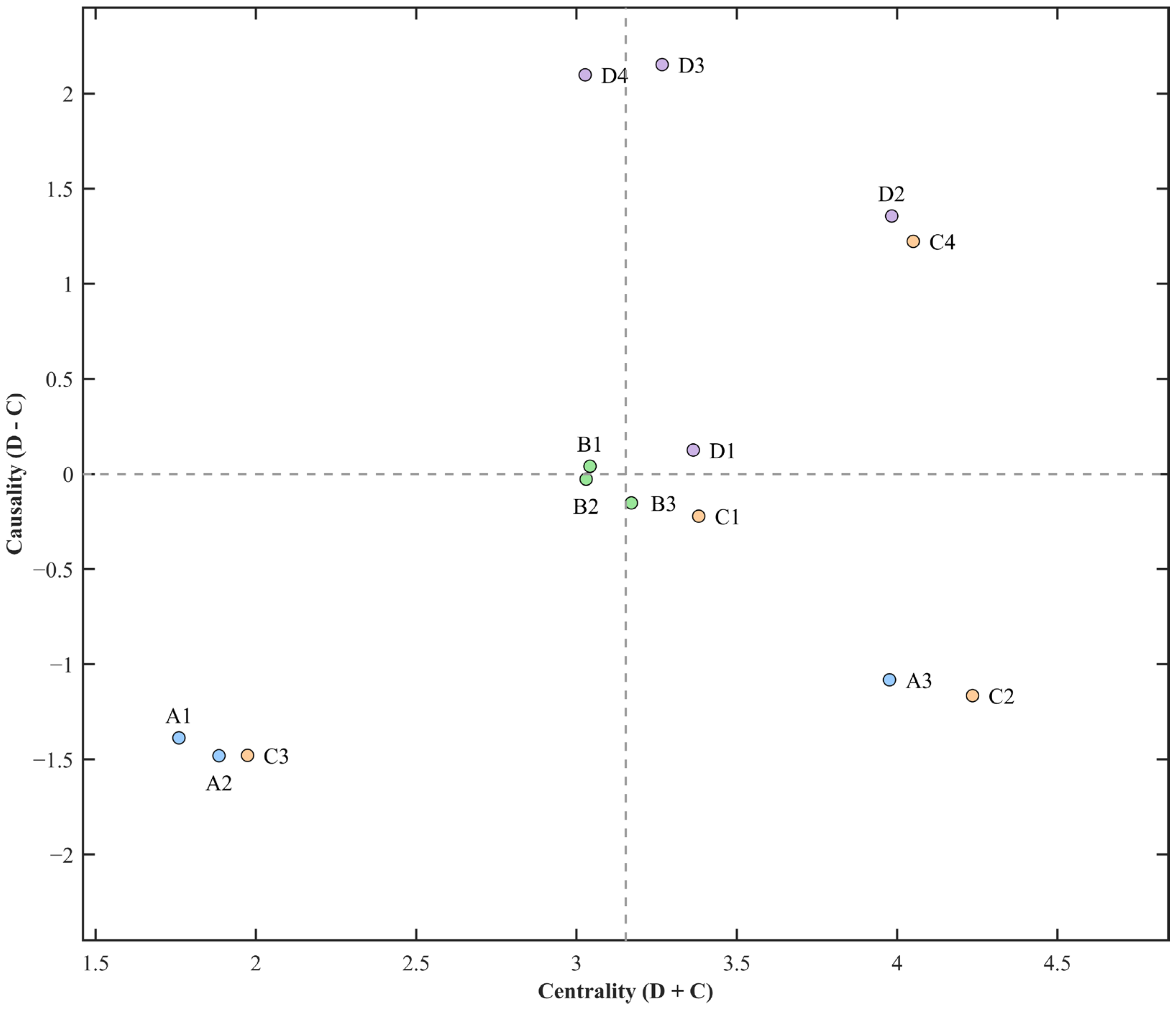
3.1. DEMATEL Results: Cause–Effect Characteristics of Second-Level Indicators
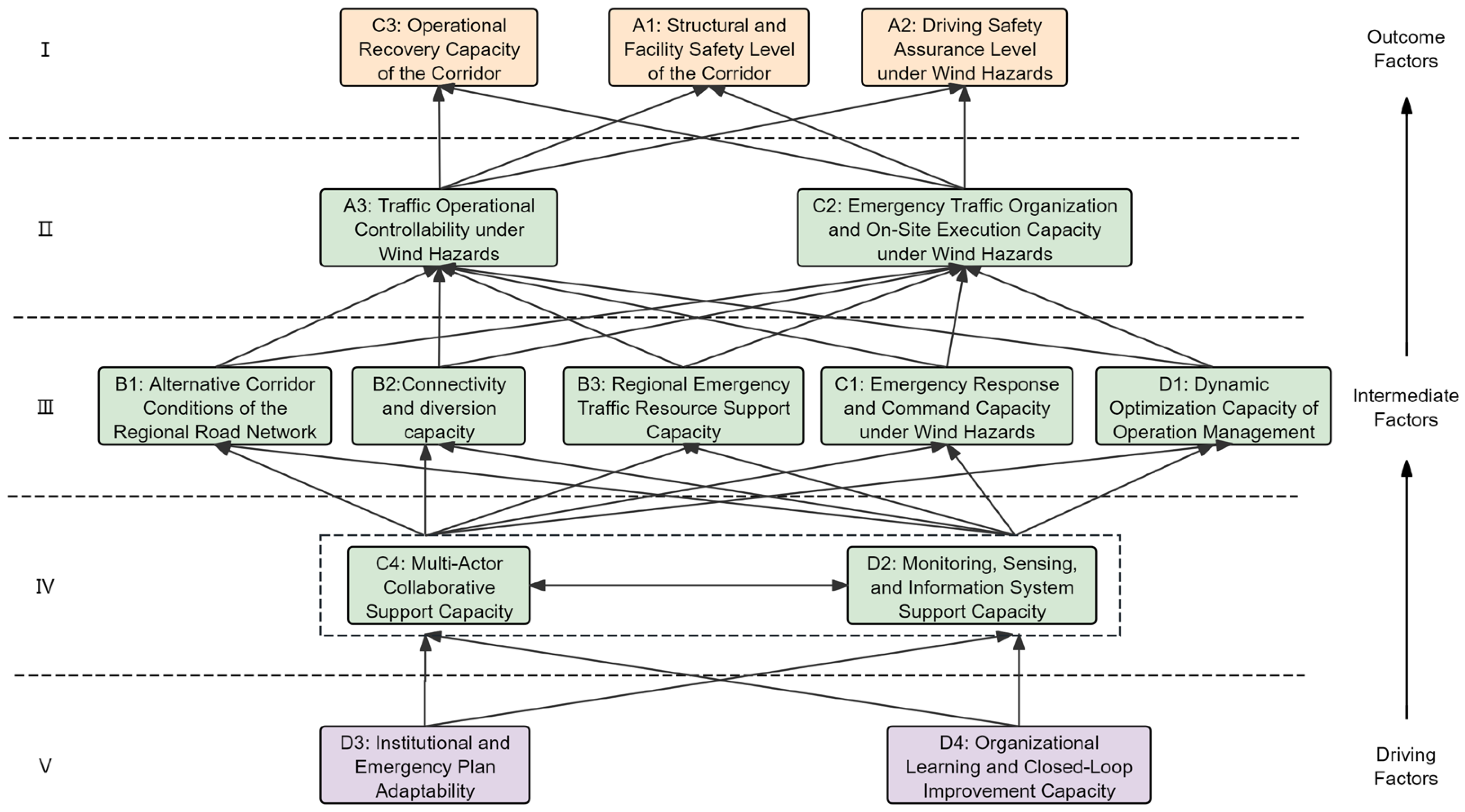
3.2. ISM Results: Hierarchical Transmission Structure of Resilience Factors
3.3. Weight Distribution and Structural Characteristics
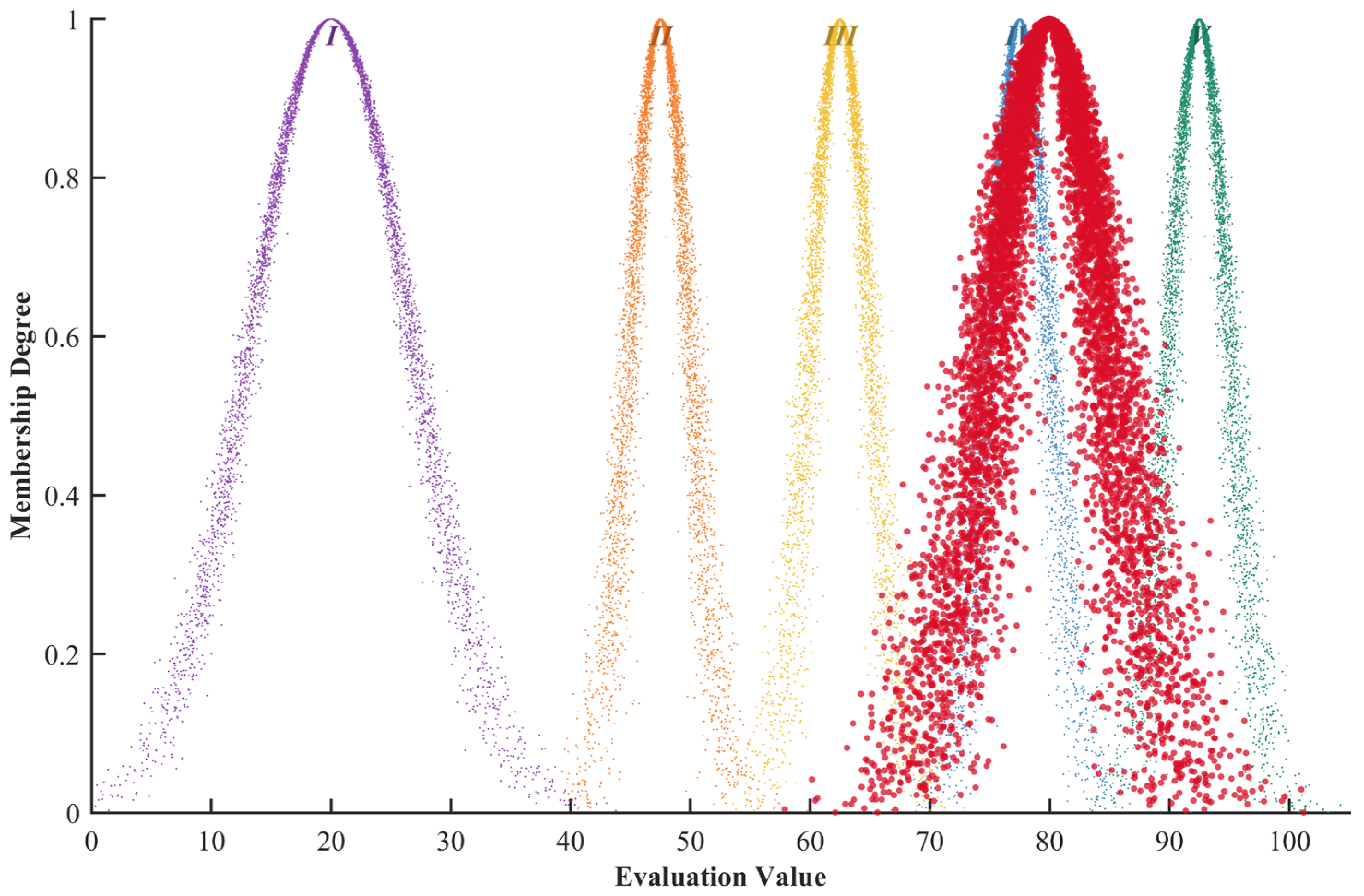
3.4. Cloud-Model-Based Evaluation Results
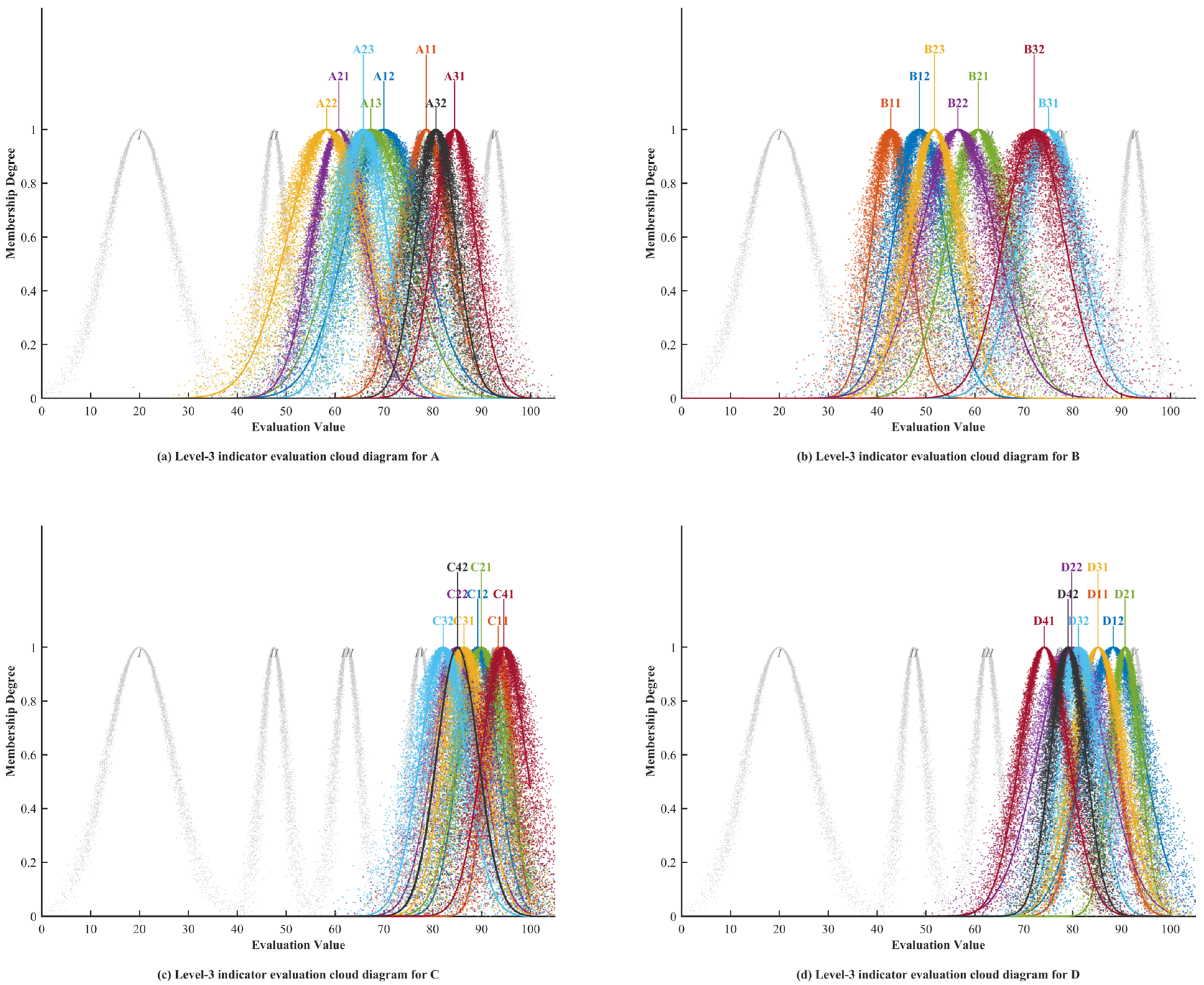
3.4.1. Third-Level Indicator Evaluation Results

| Third-Level Indicator | Ex | En | He | Third-Level Indicator | Ex | En | He |
|---|---|---|---|---|---|---|---|
| A11 | 78.667 | 4.902 | 0.889 | C12 | 89.201 | 3.944 | 1.527 |
| A12 | 70.001 | 7.687 | 2.216 | C21 | 89.933 | 4.779 | 1.278 |
| A13 | 67.333 | 7.576 | 3.272 | C22 | 85.067 | 4.946 | 1.724 |
| A21 | 60.801 | 5.381 | 0.801 | C31 | 86.401 | 4.211 | 1.877 |
| A22 | 58.333 | 8.021 | 1.938 | C32 | 82.133 | 4.712 | 1.789 |
| A23 | 65.801 | 4.881 | 1.947 | C41 | 94.533 | 4.467 | 1.683 |
| A31 | 84.467 | 4.301 | 1.341 | C42 | 85.067 | 4.233 | 0.045 |
| A32 | 80.667 | 4.122 | 1.451 | D11 | 85.201 | 3.977 | 0.261 |
| B11 | 42.801 | 3.843 | 1.764 | D12 | 88.333 | 6.127 | 1.519 |
| B12 | 48.667 | 5.347 | 2.121 | D21 | 90.733 | 3.031 | 0.829 |
| B21 | 60.733 | 6.328 | 1.739 | D22 | 79.801 | 6.985 | 2.093 |
| B22 | 56.533 | 7.721 | 1.904 | D31 | 85.201 | 5.147 | 0.778 |
| B23 | 51.733 | 5.371 | 0.973 | D32 | 81.201 | 3.977 | 1.671 |
| B31 | 75.067 | 6.116 | 1.531 | D41 | 74.201 | 4.981 | 0.811 |
| B32 | 72.133 | 6.172 | 3.145 | D42 | 79.067 | 3.598 | 0.861 |
| C11 | 93.401 | 2.774 | 0.751 |

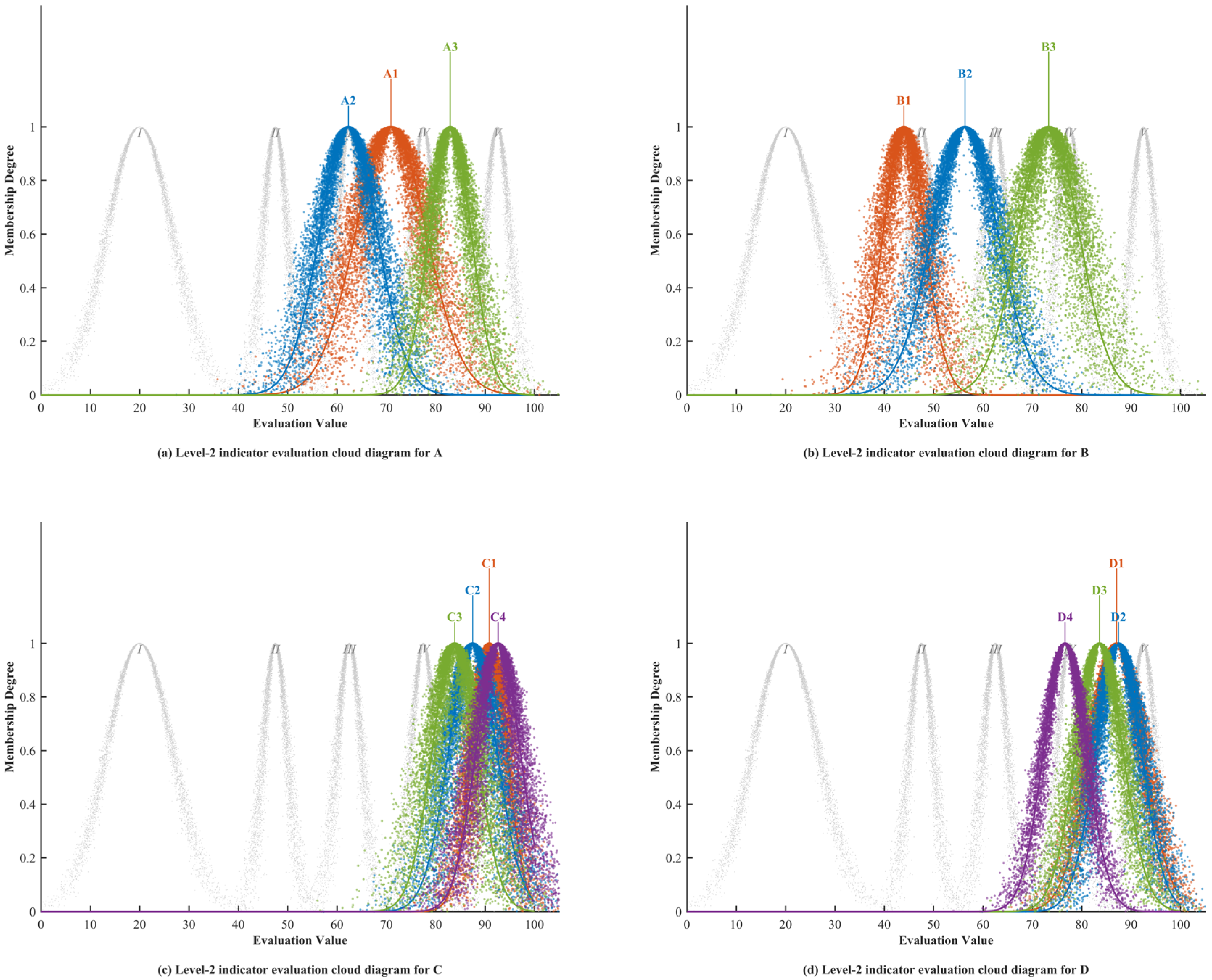
3.4.2. Second-Level Indicator Evaluation Results
| Second-Level Indicator | Ex | En | He | Second-Level Indicator | Ex | En | He |
|---|---|---|---|---|---|---|---|
| A1 | 70.934 | 7.181 | 2.267 | C2 | 87.501 | 4.863 | 1.501 |
| A2 | 62.307 | 5.829 | 1.487 | C3 | 83.841 | 4.518 | 1.824 |
| A3 | 82.947 | 4.231 | 1.385 | C4 | 92.641 | 4.421 | 1.355 |
| B1 | 43.974 | 4.187 | 1.835 | D1 | 87.081 | 5.371 | 1.016 |
| B2 | 56.353 | 6.672 | 1.575 | D2 | 87.453 | 4.591 | 1.208 |
| B3 | 73.307 | 6.151 | 2.499 | D3 | 83.601 | 4.714 | 1.135 |
| C1 | 90.881 | 3.523 | 1.217 | D4 | 76.634 | 4.345 | 0.836 |
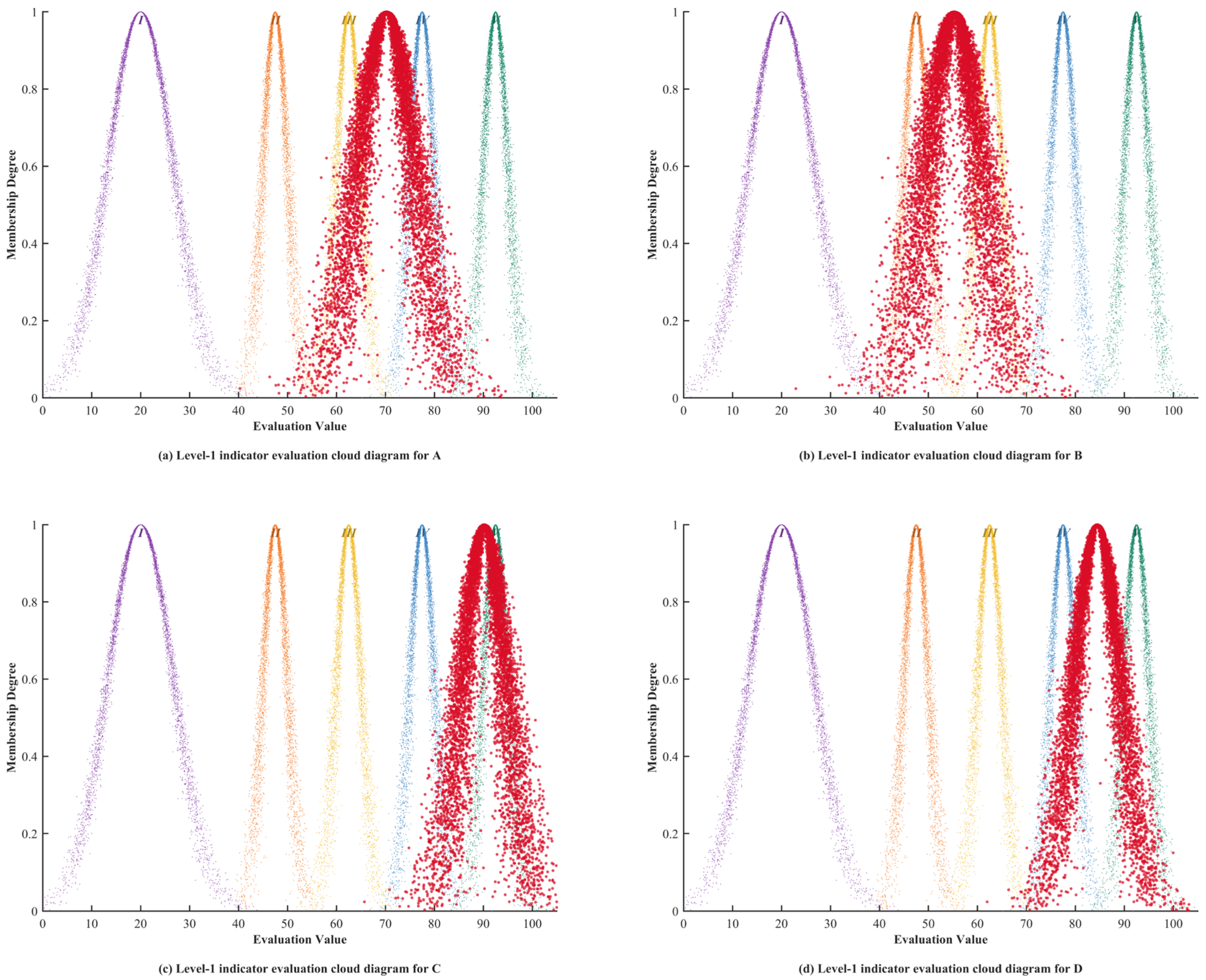
3.4.3. First-Level and Overall Evaluation Results
| First-Level Indicator | Ex | En | He |
|---|---|---|---|
| A: Basic Operational Support Conditions of the Corridor | 70.224 | 5.716 | 1.612 |
| B: Regional Network Support and Substitutability Conditions | 55.251 | 5.387 | 1.982 |
| C: Traffic Organization and Recovery Capacity under Wind Hazards | 90.198 | 4.343 | 1.421 |
| D: Long-Term Adaptation and Operational Adjustment Capacity under Wind Hazards | 84.482 | 4.652 | 1.101 |


3.5. Sensitivity and Robustness Analysis
3.5.1. Sensitivity Analysis of ISM Threshold Selection
3.5.2. Sensitivity Analysis of Expert-Opinion Perturbation in Cloud-Model Evaluation
3.5.3. Sensitivity Analysis of the Standard Cloud Hyper-Entropy Parameter
4. Discussion
4.1. Resilience Formation Mechanism Under Low-Redundancy Conditions
4.2. Theoretical Implications for Transportation Resilience Research
4.3. Practical Implications for Desert Expressway Management
5. Conclusions
- (1)
- Traffic operation resilience in low-redundancy desert expressway corridors exhibits a hierarchical transmission mechanism consisting of driving factors, transmission factors, execution factors, and outcome factors. Institutional and Emergency Plan Adaptability (D3), Organizational Learning and Closed-Loop Improvement Capacity (D4), Monitoring, Sensing, and Information System Support Capacity (D2), and Multi-Actor Collaborative Support Capacity (C4) were identified as the dominant factors shaping the resilience system.
- (2)
- The results indicate that governance capability, information support, and organizational coordination contribute more significantly to resilience formation than structural redundancy. Under recurrent wind hazards, resilience is maintained primarily through adaptive management, coordinated response, information-enabled decision making, and continuous organizational improvement rather than through alternative route substitution alone.
- (3)
- The cloud-model evaluation results show that the Hami–Tuyugou section of the G30 Lianhuo Expressway achieves a Grade IV resilience level, indicating a relatively high level of traffic operation resilience under wind hazards. Sensitivity analysis indicates that although the categorical grade may shift near the Grade IV–Grade V boundary under slight positive perturbation, the substantive conclusion remains robust: the corridor consistently falls within a high-resilience range.
Author Contributions
Funding
Data Availability Statement
Acknowledgments
Conflicts of Interest
Abbreviations
| AHP | Analytic Hierarchy Process |
| DEMATEL | Decision Making Trial and Evaluation Laboratory |
| DANP | Decision Making Trial and Evaluation Laboratory-based Analytic Network Process |
| ISM | Interpretive Structural Modeling |
References
- Liu, D.; Jing, T.; Yan, M.; Gultepe, I.; Bao, Y.; Wang, H.; Zu, F. A new method for calculating highway blocking due to high-impact weather conditions. Nat. Hazards Earth Syst. Sci. 2025, 25, 493–513. [Google Scholar] [CrossRef]
- Huang, B.; Ma, S.; Ciren, P.; Tong, D. Temporal variations in dust occurrence frequency and dust-related traffic fatalities in Southwestern United States (2007–2022): Insights from satellite retrieval, dust storm data, and FARS records. Atmos. Environ. 2025, 361, 121461. [Google Scholar] [CrossRef]
- Wan, C.; Yang, Z.; Zhang, D.; Yan, X.; Fan, S. Resilience in transportation systems: A systematic review and future directions. Transp. Rev. 2018, 38, 479–498. [Google Scholar] [CrossRef]
- Bruneau, M.; Chang, S.E.; Eguchi, R.T.; Lee, G.C.; O’Rourke, T.D.; Reinhorn, A.M.; Shinozuka, M.; Tierney, K.; Wallace, W.A.; von Winterfeldt, D. A framework to quantitatively assess and enhance the seismic resilience of communities. Earthq. Spectra 2003, 19, 733–752. [Google Scholar] [CrossRef]
- Pan, S.; Yan, H.; He, J.; He, Z. Vulnerability and resilience of transportation systems: A recent literature review. Phys. A Stat. Mech. Its Appl. 2021, 581, 126235. [Google Scholar] [CrossRef]
- Yang, Z.; Barroca, B.; Bony-Dandrieux, A.; Dolidon, H. Resilience Indicator of Urban Transport Infrastructure: A Review on Current Approaches. Infrastructures 2022, 7, 33. [Google Scholar] [CrossRef]
- Nickdoost, N.; Shooshtari, M.J.; Choi, J.; Smith, D.; AbdelRazig, Y. A composite index framework for quantitative resilience assessment of road infrastructure systems. Transp. Res. Part D Transp. Environ. 2024, 131, 104180. [Google Scholar] [CrossRef]
- Wang, L.; Yang, X.; Wu, J.; Xu, X.; Qu, Y.; Lee, D.-H. Dual-assessment of resilience and recovery strategies of road networks under rainstorm-induced waterlogging disasters. Transp. A Transp. Sci. 2024, 1–32. [Google Scholar] [CrossRef]
- Ma, F.; Fu, R.; Ren, W.; Lu, Q.C.; Liu, Q.; Yang, Z.; Ma, Z. Assessing road network resilience to extreme rainstorms: A percolation and hydrodynamic approach. Transp. Res. Part D Transp. Environ. 2026, 152, 105192. [Google Scholar] [CrossRef]
- Li, L.; Lv, L.; Tao, Z.; Yin, W.; Li, Q.; Wang, Z. Windblown sand hazards risk assessment along the highways based on GIS-game theory combination weight. PLoS ONE 2024, 19, e0292263. [Google Scholar] [CrossRef] [PubMed]
- Han, F.; Wang, C.; Liu, Z.; Liu, Z. Assessment of sand accumulation hazard on desert highway based on variable weight-cloud model theory. Front. Earth Sci. 2023, 11, 1208416. [Google Scholar] [CrossRef]
- Xie, S.; Yang, Z.; Wang, M.; Xu, G.; Bai, S. Evaluating the resilience of mountainous sparse road networks in high-risk geological disaster areas: A case study in Tibet, China. Appl. Sci. 2025, 15, 2688. [Google Scholar] [CrossRef]
- Liu, W.; Hu, Y.; Huang, Q. Research on critical factors influencing organizational resilience of major transportation infrastructure projects: A hybrid fuzzy DEMATEL-ISM-MICMAC approach. Buildings 2024, 14, 1598. [Google Scholar] [CrossRef]
- Liu, J.; Wan, L.; Wang, W.; Yang, G.; Ma, Q.; Zhou, H.; Zhao, H.; Lu, F. Integrated fuzzy DEMATEL-ISM-NK for metro operation safety risk factor analysis and multi-factor risk coupling study. Sustainability 2023, 15, 5898. [Google Scholar] [CrossRef]
- Villalba, P.; Sánchez-Garrido, A.J.; Yepes-Bellver, L.; Yepes, V. A hybrid fuzzy DEMATEL-DANP-TOPSIS framework for life cycle-based sustainable retrofit decision-making in seismic RC structures. Mathematics 2025, 13, 2649. [Google Scholar] [CrossRef]
- Liu, Y.; Eckert, C.M.; Earl, C. A review of fuzzy AHP methods for decision-making with subjective judgements. Expert Syst. Appl. 2020, 161, 113738. [Google Scholar] [CrossRef]
- Liu, H.; He, Y. Comprehensive evaluation of resilience for Qinling tunnel group operation safety system based on combined weighting and cloud model. Sustainability 2024, 16, 3937. [Google Scholar] [CrossRef]
- Ahmed, S.; Dey, K. Resilience modeling concepts in transportation systems: A comprehensive review based on mode, and modeling techniques. J. Infrastruct. Preserv. Resil. 2020, 1, 8. [Google Scholar] [CrossRef]
- Liu, H.J.; Love, P.E.; Zhao, J.; Lemckert, C.; Muldoon-Smith, K. Transport infrastructure asset resilience: Managing government capabilities. Transp. Res. Part D Transp. Environ. 2021, 100, 103072. [Google Scholar] [CrossRef]
- National Academies of Sciences, Engineering, and Medicine. Incorporating Resilience into Transportation Networks; The National Academies Press: Washington, DC, USA, 2024. [Google Scholar]
- Serdar, M.Z.; Koç, M.; Al-Ghamdi, S.G. Urban transportation networks resilience: Indicators, disturbances, and assessment methods. Sustain. Cities Soc. 2022, 76, 103452. [Google Scholar] [CrossRef]
- Zhang, X.; Lu, Y.; Wang, J.; Qi, Y. Enhancing highway transportation safety resilience during emergencies: A network-based analysis and assessment. PLoS ONE 2024, 19, e0307233. [Google Scholar] [CrossRef] [PubMed]
- Bergantino, A.S.; Gardelli, A.; Rotaris, L. Assessing transport network resilience: Empirical insights from real-world data studies. Transp. Rev. 2024, 44, 834–857. [Google Scholar] [CrossRef]
- Tang, J.; Wu, S.; Yang, S.; Shi, Y. Resilience assessment of urban road transportation in rainfall. Remote Sens. 2024, 16, 3311. [Google Scholar] [CrossRef]
- Nickdoost, N.; Jalloul, H.; Choi, J.; Smith, D. Identification and prioritization of multidimensional resilience factors for incorporation in coastal state transportation infrastructure planning. Nat. Hazards 2024, 120, 1603–1663. [Google Scholar] [CrossRef]
- Jassbi, J.; Mohamadnejad, F.; Nasrollahzadeh, H. A fuzzy DEMATEL framework for modeling cause and effect relationships of strategy map. Expert Syst. Appl. 2011, 38, 5967–5973. [Google Scholar] [CrossRef]
- Warfield, J.N. Societal Systems: Planning, Policy, and Complexity; Wiley: New York, NY, USA, 1976. [Google Scholar]
- Wang, M.J.J.; Chang, T.C. Tool steel materials selection under fuzzy environment. Fuzzy Sets Syst. 1995, 72, 263–270. [Google Scholar] [CrossRef]
- Roostaie, S.; Nawari, N. The DEMATEL approach for integrating resilience indicators into building sustainability assessment frameworks. Build. Environ. 2022, 207, 108113. [Google Scholar] [CrossRef]
- Bu, Z.; Liu, J.; Zhang, X. Factors affecting the resilience of subway operations under emergencies—Using improved DEMATEL model. Kybernetes 2024, 53, 4323–4358. [Google Scholar] [CrossRef]
- Ma, X.; Wang, Y.; Tang, Z.; Li, S. Urban flood risk assessment based on DEMATEL-ANP hybrid fuzzy evaluation and hydrodynamic model. Water 2025, 17, 1494. [Google Scholar] [CrossRef]
- Yüksel, İ.; Dağdeviren, M. Using the analytic network process (ANP) in a SWOT analysis—A case study for a textile firm. Inf. Sci. 2007, 177, 3364–3382. [Google Scholar] [CrossRef]
- Tran, T.G.; Nguyen, T.A.; Nguyen, H.M.V.; Quyen, H.A.; Nguyen, N.A.; Truong, V.H.; Thi, T.D.B. Application of the fuzzy DEMATEL–ANP VIKOR method to rank loads for load shedding in microgrids. Eng. Technol. Appl. Sci. Res. 2024, 14, 16727–16735. [Google Scholar] [CrossRef]
- Saaty, R.W. The analytic hierarchy process—What it is and how it is used. Math. Model. 1987, 9, 161–176. [Google Scholar] [CrossRef]
- Li, D.; Liu, C.; Gan, W. A new cognitive model: Cloud model. Int. J. Intell. Syst. 2009, 24, 357–375. [Google Scholar] [CrossRef]
- Ganin, A.A.; Kitsak, M.; Marchese, D.; Keisler, J.M.; Seager, T.; Linkov, I. Resilience and efficiency in transportation networks. Sci. Adv. 2017, 3, e1701079.36. [Google Scholar] [CrossRef] [PubMed]


| Category | Indicator | Value/Description | Data Source |
|---|---|---|---|
| Corridor location | Start point | Hami North Exit, approximately K3016 + 000/K3017 + 000 | Environmental approval document of the G30 Hami–Tuyugou reconstruction and expansion project; project traffic data ledger |
| Corridor location | End point | Tuyugou Interchange, Shanshan County, Turpan City, approximately K3362 + 105 | Environmental approval document; project traffic data ledger |
| Corridor length | Total length | 345.209 km | Environmental approval document; Turpan municipal project report |
| Road standard | Reconstruction standard | Four-lane expressway reconstructed into an eight-lane fully controlled expressway | Environmental approval document; Turpan municipal project report |
| Road standard | Design speed | 120 km/h | Environmental approval document; Turpan municipal project report |
| Roadbed structure | Integral/separated roadbed | Integral roadbed: 127.081 km; separated roadbed: 218.128 km | Environmental approval document |
| Engineering facilities | Bridges and culverts | 2 major bridges, 15 medium bridges, 195 small bridges, and 648 culverts | Environmental approval document |
| Operational facilities | Interchanges and toll stations | 16 interchanges and 14 ramp toll stations | Environmental approval document |
| Emergency facilities | Service areas and maintenance work areas | 7 service areas and 5 maintenance work areas | Environmental approval document |
| Monitoring facilities | Monitoring center | 1 monitoring sub-center | Environmental approval document |
| Wind-prone section | Baili Wind Zone, Hami section | G30 K3100–K3225 and S328 K111–K250 + 180 | Regulations on Prevention and Response to Extreme Weather on Highways in the Baili Wind Zone of Hami |
| Wind-prone section | Baili Wind Zone, Turpan section | G30 K3225–K3360 and S328 K250 + 180–K260 + 723 | Regional collaborative regulation report |
| Wind exposure | Annual strong-wind days | Approximately 150–160 days/year | Local meteorological monitoring data; project traffic data ledger |
| Extreme wind intensity | Maximum instantaneous wind speed | More than 60 m/s | Local meteorological monitoring data; project traffic data ledger |
| Main wind direction | Dominant direction | Northwest and north winds | Local meteorological monitoring data; project traffic data ledger |
| Seasonal pattern | Main windy season | Spring and autumn, especially March–May | Local meteorological monitoring data; project traffic data ledger |
| Wind-related hazards | Main hazard types | Crosswind, wind-blown sand, reduced visibility, wind-blown snow, and pavement sand accumulation | Project traffic data ledger; highway operation records |
| Weather records | Dusty weather days | 79 days from 2011 to 2026 | Hami historical weather statistics; project traffic data ledger |
| Weather records | Snowfall days | 71 days from 2011 to 2026 | Hami historical weather statistics; project traffic data ledger |
| Traffic demand | Average daily traffic volume | Approximately 20,000 vehicles/day for the Xingxingxia–Hami–Tuyugou corridor | Project opening report quoting Xinjiang Communications Investment Group |
| Freight traffic | Inbound freight vehicles | Approximately 2807 trucks/day at the Xingxingxia gateway | 2021 Xinjiang interregional road freight survey; project traffic data ledger |
| Freight traffic | Outbound freight vehicles | Approximately 3400 trucks/day at the Xingxingxia gateway | 2021 Xinjiang interregional road freight survey; project traffic data ledger |
| Alternative routes | Main substitute roads | G312, S328, and S303 | Road network data; local extreme-weather regulation; S12 project environmental report |
| Route redundancy | Substitution capacity | Alternative routes exist but have lower design standards, lower operating speeds, and limited capacity | Road network data; project traffic data ledger |
| Historical disruption | 30 August 2024 event | Wind-induced one-way control near K3359 + 650–K3362 for container trucks, box trucks, buses, and high-profile trucks | Highway traffic-control notice; project traffic data ledger |
| Historical disruption | 5 November 2025 event | Wind-induced one-way control near K3359 + 650; related control at Putao Gou and Daheyan ramps | Highway traffic-control notice; project traffic data ledger |
| Historical disruption | 23 November 2025 event | Wind-induced traffic control for container trucks, high-profile trucks, and box trucks near K3359 + 650 | Highway traffic-control notice; project traffic data ledger |
| Historical disruption | 12–13 March 2026 event | Extreme wind caused traffic obstruction; more than 300 vehicles and nearly 500 people were stranded | Emergency response record; project traffic data ledger |
| Sand accumulation | Affected locations | G30 K2940–K2945 and K3093–K3095 | Highway maintenance and emergency clearance records; project traffic data ledger |
| Emergency response | Monitoring and warning | Meteorological monitoring, traffic control, variable message signs, traffic broadcasting, SMS, and Xinjiang Road Network platform | Hami extreme-weather regulation; project traffic data ledger |
| Interdepartmental coordination | Collaborative mechanism | Meteorology, public security, transport, emergency management, and related departments share warning and response information | Hami extreme-weather regulation; regional collaborative regulation report |
| 4R Component | Interpretation in This Study | Corresponding Level-1 Dimension | Main Corresponding Level-2 Factors |
|---|---|---|---|
| Robustness | Ability of the corridor to withstand wind-hazard disturbances and maintain basic operational functionality. | A: Basic Operational Support Conditions of the Corridor | A1: Structural and Facility Safety Level of the Corridor; A2: Driving Safety Assurance Level under Wind Hazards; A3: Traffic Operational Controllability under Wind Hazards |
| Redundancy | Availability of alternative routes, regional network connectivity, diversion feasibility, and backup traffic resources when the main corridor is affected. | B: Regional Network Support and Substitutability Conditions | B1: Alternative Corridor Conditions of the Regional Road Network; B2: Connectivity and Diversion Capacity; B3: Regional Emergency Traffic Resource Support Capacity |
| Resourcefulness | Ability to mobilize emergency command, traffic organization, information release, rescue coordination, and collaborative resources during wind-hazard events. | C: Traffic Organization and Recovery Capacity under Wind Hazards | C1: Emergency Response and Command Capacity under Wind Hazards; C2: Emergency Traffic Organization and On-Site Execution Capacity under Wind Hazards; C4: Multi-Actor Collaborative Support Capacity |
| Rapidity | Ability to restore traffic function quickly after disturbance and to improve response capacity through long-term adaptation and learning. | C: Traffic Organization and Recovery Capacity under Wind Hazards; D: Long-Term Adaptation and Operational Adjustment Capacity under Wind Hazards | C2: Emergency Traffic Organization and On-Site Execution Capacity under Wind Hazards; C3: Operational Recovery Capacity of the Corridor; D1: Dynamic Optimization Capacity of Operation Management; D2: Monitoring, Sensing, and Information System Support Capacity; D3: Institutional and Emergency Plan Adaptability; D4: Organizational Learning and Closed-Loop Improvement Capacity |
| Level-1 Dimension | Level-2 Factor | Level-3 Indicators | Reference |
|---|---|---|---|
| A: Basic Operational Support Conditions of the Corridor | A1: Structural and Facility Safety Level of the Corridor | A11: Wind Resistance Stability of Subgrade and Pavement; A12: Adequacy of Wind-Proof Engineering Facility Configuration; A13: Operational Reliability of Wind-Proof Facilities | [5,21] |
| A2: Driving Safety Assurance Level under Wind Hazards | A21: Vehicle Stability under Crosswinds; A22: Risk of Wind-Blown Sand/Snow Intrusion; A23: Safety Risk Identification and Assessment Capability | [22,23] | |
| A3: Traffic Operational Controllability under Wind Hazards | A31: Effectiveness of Traffic Control under Strong Winds; A32: Rationality of Wind Speed/Visibility Control Thresholds | [7,22] | |
| B: Regional Network Support and Substitutability Conditions | B1: Alternative Corridor Conditions of the Regional Road Network | B11: Substitutability of Parallel Routes; B12: Structural Integrity of the Road Network | [21,22] |
| B2: Connectivity and Diversion Capacity | B21: Expressway–Conventional Road Connectivity; B22: Feasibility of Regional Traffic Diversion Organization; B23: Impact Scope of Critical Node Failures | [23,24] | |
| B3: Regional Emergency Traffic Resource Support Capacity | B31: Allocation Capacity of Emergency Traffic Resources; B32: Cross-Network and Cross-Jurisdiction Diversion Coordination Capacity | [7,25] | |
| C: Traffic Organization and Recovery Capacity under Wind Hazards | C1: Emergency Response and Command Capacity under Wind Hazards | C11: Efficiency of Translating Wind Hazard Warnings into Traffic Response; C12: Decision-Making Efficiency and Procedural Standardization of Traffic Control under Wind Hazards | [22,25] |
| C2: Emergency Traffic Organization and On-Site Execution Capacity under Wind Hazards | C21: Capacity to Maintain Traffic Order; C22: Adequacy and Suitability of Traffic Organization Measures | [22,24] | |
| C3: Operational Recovery Capacity of the Corridor | C31: Efficiency of Post-Event Clearance and Repair; C32: Timeliness of Functional Recovery | [21,23] | |
| C4: Multi-Actor Collaborative Support Capacity | C41: Degree of Coordination Smoothness in Multi-Department Emergency Response; C42: Effectiveness of Information Release and Travel Guidance | [25] | |
| D: Long-Term Adaptation and Operational Adjustment Capacity under Wind Hazards | D1: Dynamic Optimization Capacity of Operation Management | D11: Capacity for Experience Accumulation and Post-Event Review; D12: Dynamic Adjustment Capacity of Corridor Operation Strategies | [5,21] |
| D2: Monitoring, Sensing, and Information System Support Capacity | D21: Completeness of Wind Environment Monitoring; D22: Level of Information-Based Operational Support | [23,24] | |
| D3: Institutional and Emergency Plan Adaptability | D31: Targetedness and Operability of Wind Hazard Prevention and Control Plans; D32: Completeness and Adaptability of Management Regulations | [5,25] | |
| D4: Organizational Learning and Closed-Loop Improvement Capacity | D41: Frequency of Plan and Technology Updates; D42: System Self-Correction Capacity | [5,21] |
| Linguistic Term | Score | Corresponding TFN (Triangular Fuzzy Number) |
|---|---|---|
| No influence | 0 | (0, 0, 0.25) |
| Low influence | 1 | (0, 0.25, 0.5) |
| Medium influence | 2 | (0.25, 0.5, 0.75) |
| High influence | 3 | (0.5, 0.75, 1) |
| Very high influence | 4 | (0.75, 1, 1) |
| Resilience Grade | Score Interval | Description | |
|---|---|---|---|
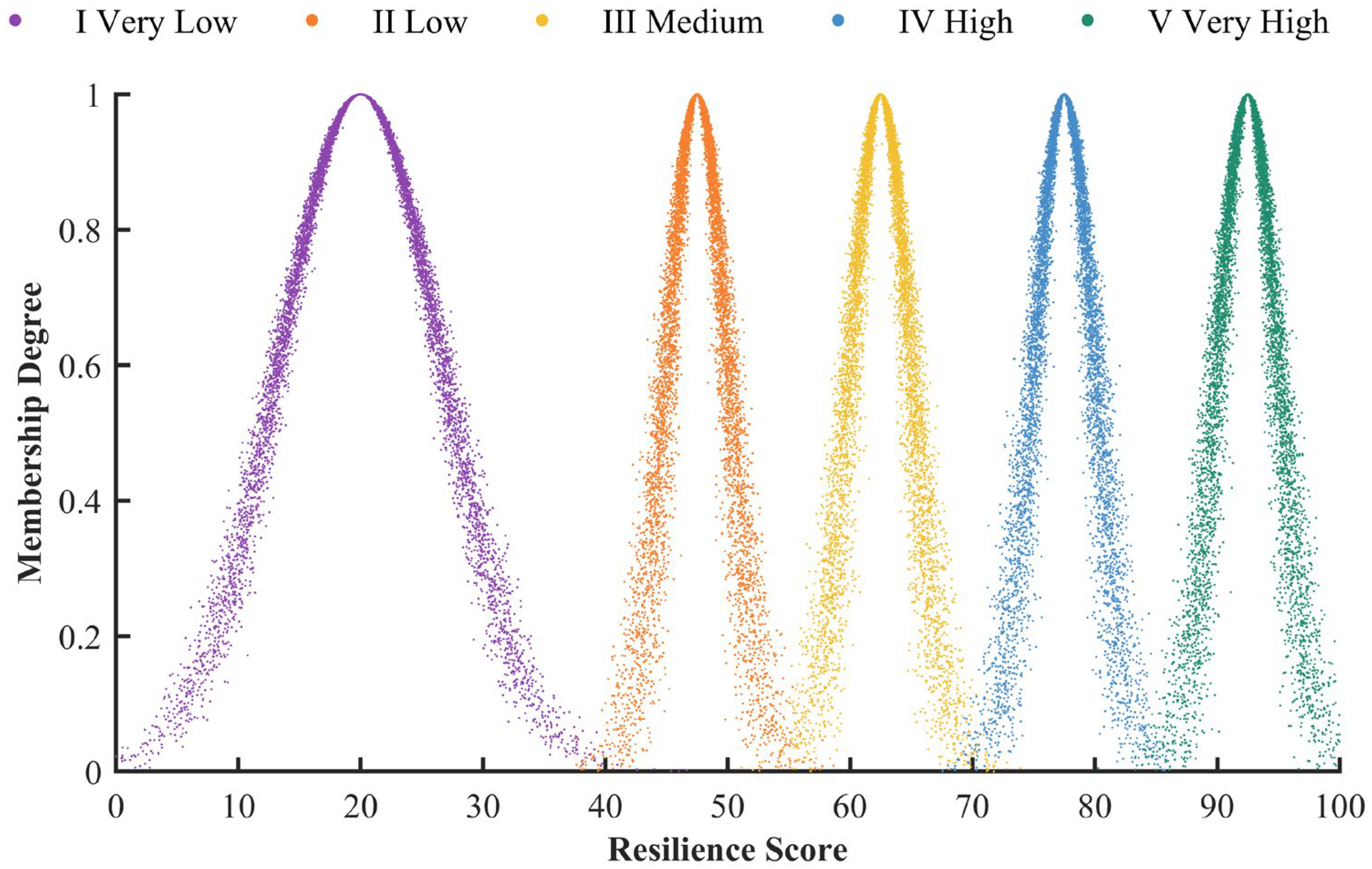
| Very low resilience | [0, 40] | (20.0, 6.6667, 0.5) | Severe functional loss; almost unable to resist wind-hazard disturbance; extremely difficult to recover. |
| Low resilience | (40, 55] | (47.5, 2.5000, 0.5) | Marked functional impairment; weak resistance; requires substantial external resources for recovery. |
| Moderate resilience | (55, 70] | (62.5, 2.5000, 0.5) | Degraded operation can be maintained; some resistance exists, but recovery is relatively slow. |
| Relatively high resilience | (70, 85] | (77.5, 2.5000, 0.5) | Limited disturbance impact; strong adaptability; can quickly return to normal operation. |
| Very high resilience | (85, 100] | (92.5, 2.5000, 0.5) | Nearly unaffected; excellent adaptability and self-recovery capability. |
| Code | Rank (by ) | Type | ||||
|---|---|---|---|---|---|---|
| A1 | 0.187 | 1.574 | 1.760 | 14 | −1.387 | Effect |
| A2 | 0.202 | 1.683 | 1.885 | 13 | −1.481 | Effect |
| A3 | 1.447 | 2.529 | 3.976 | 4 | −1.082 | Effect |
| B1 | 1.542 | 1.500 | 3.042 | 9 | 0.041 | Cause |
| B2 | 1.502 | 1.528 | 3.030 | 10 | −0.027 | Effect |
| B3 | 1.509 | 1.662 | 3.171 | 8 | −0.152 | Effect |
| C1 | 1.579 | 1.802 | 3.381 | 5 | −0.222 | Effect |
| C2 | 1.535 | 2.700 | 4.235 | 1 | −1.165 | Effect |
| C3 | 0.247 | 1.726 | 1.974 | 12 | −1.479 | Effect |
| C4 | 2.636 | 1.414 | 4.050 | 2 | 1.223 | Cause |
| D1 | 1.745 | 1.619 | 3.364 | 6 | 0.126 | Cause |
| D2 | 2.669 | 1.314 | 3.983 | 3 | 1.356 | Cause |
| D3 | 2.710 | 0.557 | 3.267 | 7 | 2.152 | Cause |
| D4 | 2.562 | 0.464 | 3.027 | 11 | 2.098 | Cause |
| Level | Resilience Factors |
|---|---|
| I | C3, A1, A2 |
| II | A3, C2 |
| III | B1, B2, B3, C1, D1 |
| IV | C4, D2 |
| V | D3, D4 |
| First-Level Indicator | Weight | Second-Level Indicator | Weight | Third-Level Indicator | Weight | First-Level Indicator | Weight | Second-Level Indicator | Weight | Third-Level Indicator | Weight |
|---|---|---|---|---|---|---|---|---|---|---|---|
| A | 0.0668 | A1 | 0.0089 | A11 | 0.0015 | C | 0.2453 | C1 | 0.0623 | C11 | 0.0208 |
| A12 | 0.0048 | C12 | 0.0415 | ||||||||
| A13 | 0.0026 | C2 | 0.0529 | C21 | 0.0353 | ||||||
| A2 | 0.0102 | A21 | 0.0055 | C22 | 0.0176 | ||||||
| A22 | 0.0017 | C3 | 0.0116 | C31 | 0.0039 | ||||||
| A23 | 0.0030 | C32 | 0.0077 | ||||||||
| A3 | 0.0477 | A31 | 0.0318 | C4 | 0.1185 | C41 | 0.0948 | ||||
| A32 | 0.0159 | C42 | 0.0237 | ||||||||
| B | 0.1703 | B1 | 0.0569 | B11 | 0.0427 | D | 0.5175 | D1 | 0.075 | D11 | 0.0250 |
| B12 | 0.0142 | D12 | 0.0500 | ||||||||
| B2 | 0.0546 | B21 | 0.0162 | D2 | 0.1212 | D21 | 0.0909 | ||||
| B22 | 0.0295 | D22 | 0.0303 | ||||||||
| B23 | 0.0089 | D3 | 0.1654 | D31 | 0.1240 | ||||||
| B3 | 0.0588 | B31 | 0.0147 | D32 | 0.0413 | ||||||
| B32 | 0.0441 | D4 | 0.1559 | D41 | 0.0520 | ||||||
| D42 | 0.1039 |
| Threshold Setting | Threshold Value | Retained Direct Links | ISM Hierarchical Structure | Stability Judgment |
|---|---|---|---|---|
| λ1 = μ | 0.1130 | 87 | L1: A1, A2, C3; L2: A3, C2; L3: B3, C1; L4: B1, B2; L5: D1; L6: C4, D2; L7: D3, D4 | Root-driving factors unchanged; middle layers are more finely differentiated |
| λ2 = μ + 0.5σ | 0.1553 | 59 | L1: A1, A2, C3; L2: A3, C2; L3: B1, B2, B3, C1; L4: D1; L5: C4, D2; L6: D3, D4 | Root-driving factors unchanged; transmission structure remains clear |
| λ3 = μ + σ | 0.1976 | 45 | L1: A1, A2, C3; L2: A3, C2; L3: B1, B2, B3, C1, D1; L4: C4, D2; L5: D3, D4 | Baseline structure used in this study |
| λ4 = μ + 1.5σ | 0.2399 | 20 | L1: A1, A2, A3, B2, C2, C3; L2: B1, B3, C1, D1; L3: C4, D2; L4: D3, D4 | Root-driving factors unchanged; upper layers become compressed |
| Scenario | Perturbed Ex | Evaluation Grade | Interpretation |
|---|---|---|---|
| Baseline result | 79.9532 | Grade IV | High-level Grade IV, close to Grade V |
| Ex − 0.5 | 79.4532 | Grade IV | The result remains within Grade IV |
| Ex − 1.0 | 78.9532 | Grade IV | The result remains within Grade IV |
| Ex + 0.5 | 80.4532 | Grade V | The result crosses the Grade IV–Grade V boundary |
| Ex + 1.0 | 80.9532 | Grade V | The result remains within Grade V |
| η/He | μ (Grade I) | μ (Grade II) | μ (Grade III) | μ (Grade IV) | μ (Grade V) | Maximum Membership |
|---|---|---|---|---|---|---|
| 0.3 | 1.2695 × 10⁻⁹ | 1.1943 × 10⁻⁵ | 0.0058866 | 0.421826 | 0.034991 | 0.421826 |
| 0.4 | 5.1050 × 10⁻¹⁰ | 1.1458 × 10⁻⁵ | 0.0060339 | 0.421199 | 0.035296 | 0.421199 |
| 0.5 | 1.9474 × 10⁻⁹ | 1.1632 × 10⁻⁵ | 0.0061153 | 0.419128 | 0.035928 | 0.419128 |
| 0.6 | 4.0609 × 10⁻⁹ | 1.0665 × 10⁻⁵ | 0.0062362 | 0.416981 | 0.036772 | 0.416981 |
| 0.7 | 8.5578 × 10⁻¹⁰ | 1.5058 × 10⁻⁵ | 0.0066732 | 0.415964 | 0.037346 | 0.415964 |
Disclaimer/Publisher’s Note: The statements, opinions and data contained in all publications are solely those of the individual author(s) and contributor(s) and not of MDPI and/or the editor(s). MDPI and/or the editor(s) disclaim responsibility for any injury to people or property resulting from any ideas, methods, instructions or products referred to in the content. |
© 2026 by the authors. Licensee MDPI, Basel, Switzerland. This article is an open access article distributed under the terms and conditions of the Creative Commons Attribution (CC BY) license.
Share and Cite
Chen, M.; Ran, W.; Zhang, J.; Cheng, L.; Qiu, Q.; Jia, L.; Su, Y. Traffic Operation Resilience of a Wind-Hazard-Affected, Low-Redundancy Desert Expressway Corridor: Mechanism Identification and Evaluation. Infrastructures 2026, 11, 215. https://doi.org/10.3390/infrastructures11070215
Chen M, Ran W, Zhang J, Cheng L, Qiu Q, Jia L, Su Y. Traffic Operation Resilience of a Wind-Hazard-Affected, Low-Redundancy Desert Expressway Corridor: Mechanism Identification and Evaluation. Infrastructures. 2026; 11(7):215. https://doi.org/10.3390/infrastructures11070215
Chicago/Turabian StyleChen, Mengjun, Wuping Ran, Jing Zhang, Long Cheng, Qianqian Qiu, Linkun Jia, and Yaohan Su. 2026. "Traffic Operation Resilience of a Wind-Hazard-Affected, Low-Redundancy Desert Expressway Corridor: Mechanism Identification and Evaluation" Infrastructures 11, no. 7: 215. https://doi.org/10.3390/infrastructures11070215
APA StyleChen, M., Ran, W., Zhang, J., Cheng, L., Qiu, Q., Jia, L., & Su, Y. (2026). Traffic Operation Resilience of a Wind-Hazard-Affected, Low-Redundancy Desert Expressway Corridor: Mechanism Identification and Evaluation. Infrastructures, 11(7), 215. https://doi.org/10.3390/infrastructures11070215