Article

A Design Model for Urban Single-Lane Roundabouts with Offset Approaches

by
Ivica Stančerić
1,*,
Saša Ahac
1,
Šime Bezina
2 and
Tamara Džambas
1
1
Faculty of Civil Engineering, University of Zagreb, Fra Andrije Kačića-Miošića 26, 10000 Zagreb, Croatia
2
TPA Gesellschaft für Qualitätssicherung und Innovation GmbH (Croatia), Petra Hektorovića 2, 10000 Zagreb, Croatia
*
Author to whom correspondence should be addressed.
Infrastructures 2026, 11(5), 179; https://doi.org/10.3390/infrastructures11050179
Submission received: 20 April 2026 / Revised: 13 May 2026 / Accepted: 16 May 2026 / Published: 20 May 2026
(This article belongs to the Special Issue Sustainable Road Design and Traffic Management)

Abstract

The roundabout design procedures specified in current standards and guidelines presuppose that the centrelines of the approach legs intersect at right angles at the geometric centre of the roundabout. In urban areas, this requirement cannot always be met due to fixed structural constraints along the approaches. Here, a lateral or radial offset of the approach legs from the roundabout’s geometric centre is required. This offset plays an important role in roundabout design, as it affects the roundabout’s ability to control vehicle speed. This study investigates the effects of a lateral approach leg offset on the geometric design of urban single-lane roundabouts and the driving speeds through them. Accordingly, speed analyses were conducted for numerous theoretical roundabouts with outer radii between 15 and 25 m, designed based on swept path analysis results, were conducted. The research results showed that it is possible to offset approaches laterally on roundabouts with outer radii between 15 and 25 m, depending on the design vehicle, and that the allowable offset values increase proportionally with the roundabout outer radius. The analysis results were used to create a design model for urban single-lane roundabouts with lateral approach leg offsets enabling their adaptation to spatial constraints while maintaining safe operating speeds.

1. Introduction

The main advantages of single-lane roundabouts in road networks, compared to conventional intersections, are increased traffic safety, lower air pollution, and lower maintenance costs. Previous studies have reported that roundabouts, compared to signalised intersections, reduce the emissions of carbon monoxide by 21–42%, emissions of carbon dioxide by 16–59%, emissions of oxides of nitrogen by 20–48%, emissions of hydrocarbons by 18–65%, and the noise emission from 1 to 4 dB(A) [1,2,3,4,5,6,7,8,9,10,11,12,13,14,15,16]. Safety benefits of single-lane roundabouts stem from their reduced number of potential conflict points between vehicles compared to conventional intersections, and from their geometry, which results in deflected vehicle trajectories that force drivers to reduce their speed, thereby lowering both crash probability and severity [17,18]. A meta-analysis [19] of the impact of converting conventional unsignalised intersections to single-lane roundabouts on safety found that such conversions are associated with a reduction of about 65% in fatal accidents and about 40% in accidents with injuries. According to a Danish study [20], converting intersections to roundabouts led to reductions in of 27% crashes and 60% in injuries. The number of fatal accidents fell by 87%, and the number of crashes with property damage fell by 16%. The number of bicycle crashes and injured cyclists increased by 65% and 40%, respectively. According to studies conducted in the US, converting conventional intersections to single-lane roundabouts reduced the number of fatal and serious-injury accidents by over 80% [21]. It led to a 51% reduction in the total number of crashes [18]. The studies focused on the conversion of unsignalised intersections and have shown a significant reduction in the number and severity of accidents. The aim of the studies [20,22,23,24,25] was to close this gap by evaluating the safety effectiveness of converting signalised intersections into roundabouts. Despite the safety benefits that roundabouts offer, accidents still occur. A study [26] conducted in Italy at 15 urban roundabouts concluded that the factors contributing to accidents were primarily related to the roundabout’s geometric design, markings, and signage. This study emphasised the role of a moderate deflection radius and a large deviation angle in the design of new roundabouts, as improving these factors in existing roundabouts can be quite costly. Another study from Italy [27] was carried out to determine the geometric characteristics of roundabouts that influence the perception of safety during typical driving manoeuvres (entry, circulation, exit). The study concluded that users clearly prefer single-lane roundabouts. This can be described by the fact that users perceive the highest level of safety in configurations with one entry, one exit and one roundabout lane.
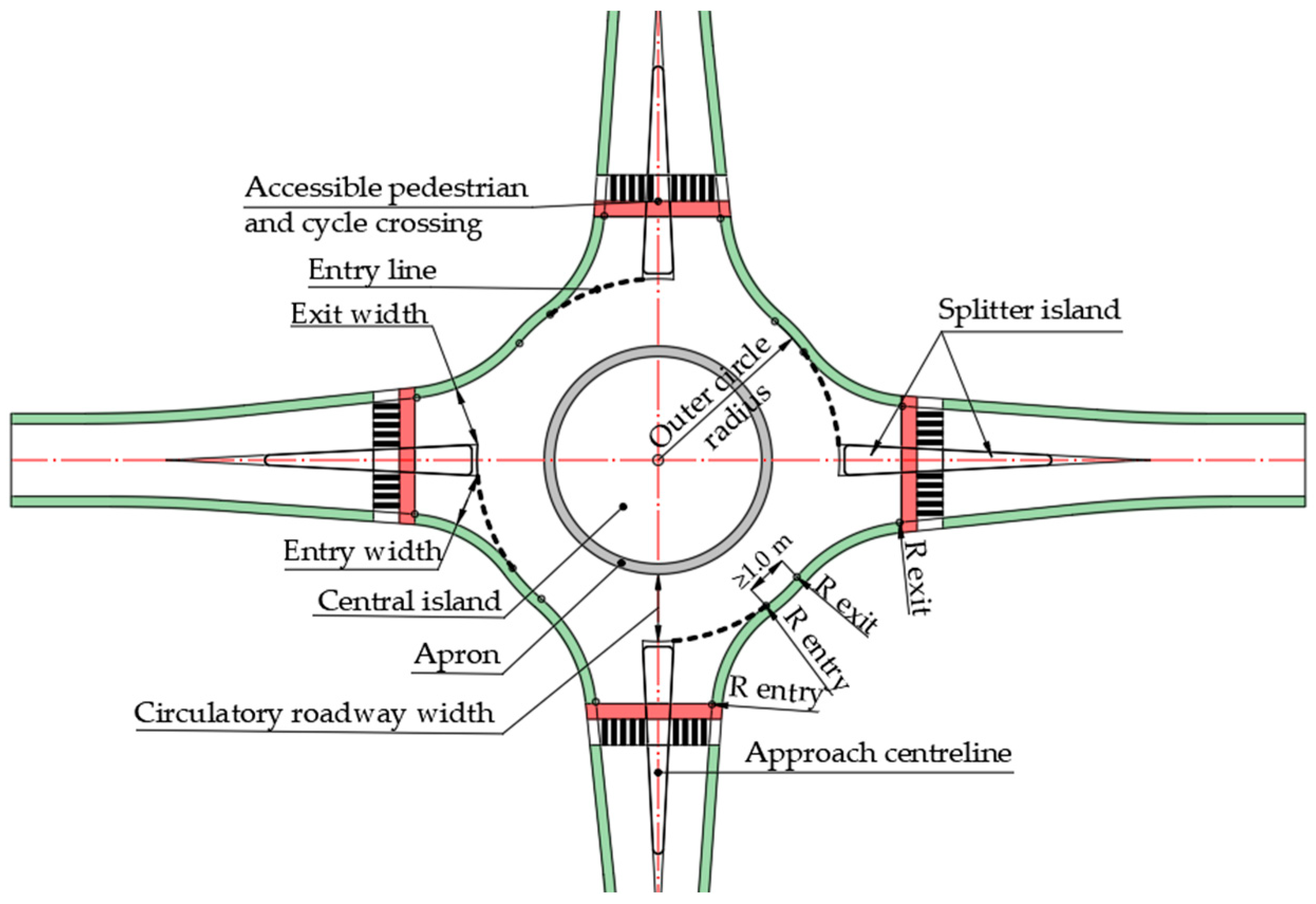
The roundabout design process is specified by national guidelines, standards, and recommendations [28,29,30,31,32,33,34,35,36,37,38,39]. As shown in Figure 1, the key elements of an urban single-lane roundabout are the splitter islands, pedestrian and cycle crossings, entry and exit radii, entry and exit widths, central island, apron, and circulatory roadway width.
The roundabout design process is highly iterative and consists of the initial design, performance checks (swept path analysis for the design vehicle movements, speed analysis, and visibility tests), and the final design of the elements. Swept path analysis is needed to ensure that design vehicles can safely navigate the roundabout. This analysis, usually conducted using specialised software, yields the required entry, exit, and circulatory lane widths based on the characteristics of the selected design vehicle.
Speed analysis is usually conducted by measuring the roundabout geometric characteristics and checking the obtained deflection [31,32,37,38], by measuring the geometric characteristics of the roundabout and calculating the path radii and vehicle speeds [30,39], or by drawing the fastest vehicle path, measuring the path radii and estimating the vehicle speed based on the radii [28,29,33,34,35,36]. If the initial roundabout geometric design does not meet the requirements of the selected design vehicle and required vehicle speed, the initial design is revised. Predicting speeds at roundabouts in urban areas, where severe spatial and environmental constraints dictate layouts that do not conform to design standards, is challenging and can lead to inconsistent speed analysis results. As a result, standardised speed prediction models have been tested in several studies. For instance, design and operating speeds were evaluated for several urban roundabouts in the Municipality of Cuneo, Italy [40]. The observed speeds were comparable to those derived from the US guidelines’ speed model [34], despite certain discrepancies that arose from local driver behaviour, vehicle performance, and design practices. Only one roundabout presented in this study strictly adhered to the Italian design standards [38]. Consequently, this was the only case in which the variance between observed speeds and those predicted by the US guidelines [34] remained below 10%. According to the findings of a study [41] conducted on urban roundabouts in Zagreb, Croatia, deviations between design speeds calculated using US guidelines [33] and measured speeds ranged from −45.69% to +13.07%. As in the Italian study, these deviations were attributed to various factors, including intersection geometry, vehicle characteristics, and driver behaviour. Another recent study [42] analysed connected vehicle (CV) trajectory speeds at 56 roundabouts in Carmel, Indiana. Comparing passenger vehicle speeds with theoretical models revealed that certain aspects of the US guideline speed model [36] require updating. Specifically, future models should account for lower entry speeds and higher speeds within the circulatory and departure sections for vehicles approaching slowly. Notably, however, deceleration and acceleration values remained consistent across both the theoretical approach and the sampled data, suggesting that current modelling of speed change rates remains accurate.
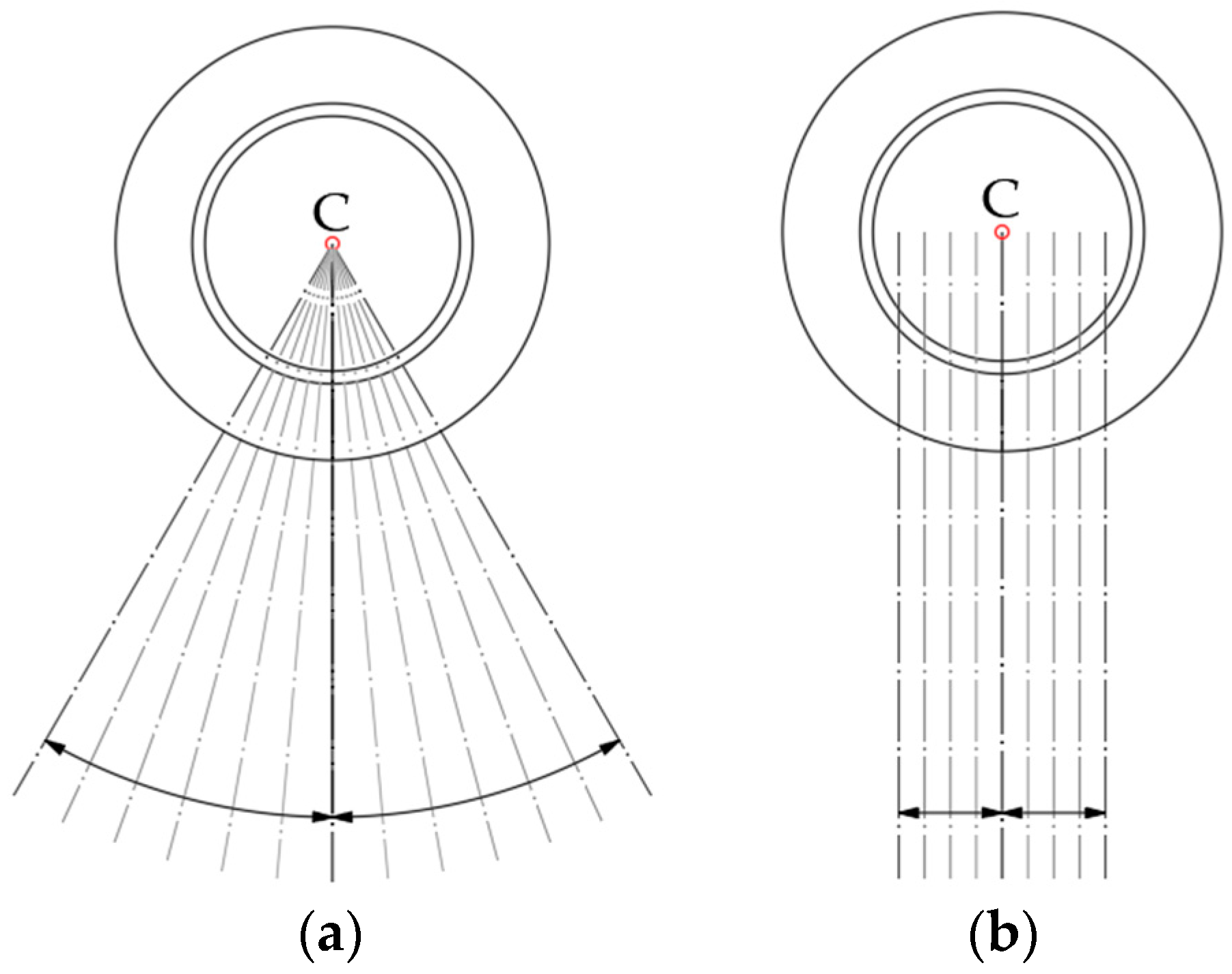
The initial geometric design of the roundabout elements begins with the horizontal alignment of the approaches (Figure 2, dash-dot lines) relative to the geometric centre of the intersection, i.e., the centre of the central island (Figure 2, point (C)). In real-life scenarios, this alignment can be radial or offset laterally [36,39]. With radial alignment, the centerline of each leg crosses the geometric centre of the roundabout, i.e., the centre of the central island, as shown in Figure 2a. Lateral alignment offset, shown in Figure 2b, can be applied to the left or right relative to the geometric centre. The approach centreline alignment influences vehicle paths through the intersection and is therefore an important input for swept path analyses. It also influences the deflection of the central island, providing the required vehicle speeds on entry, around the central island, and on the exit.
According to the analysed roundabout design guidelines, standards, and recommendations [28,29,30,31,32,33,34,35,36,37,38,39], optimal roundabout design requires that the centrelines of all approaches intersect at right angles at the roundabout’s geometric centre. In the design practice, this alignment cannot always be achieved due to spatial restrictions, especially in urban areas. In these cases, approach centrelines are offset; offset placement provides flexibility in roundabout design, allowing engineers to adapt the roundabout geometry to specific site conditions and traffic patterns. Approach offset should not result in a tangential entry and exit. A slight left offset is suitable, as it increases vehicle path deflection, thereby reducing vehicle speed. Still, a right offset could result in a tangential entry and a high entry speed. Tangential entry increases entry vehicle speed and crash severity between vehicles in the roundabout and those entering it. Generally, offsetting the approach centerline to the right should be avoided. Still, it can be applied if the correct entry speed can be achieved and other geometric elements of the roundabout can be formed [28,29,35,36,39]. The Croatian guidelines [39] recommend that the maximum offset be 15% of the outer roundabout radius and that the angle between two consecutive approach centrelines should allow the right carriageway edge to be designed with three distinct consecutive arcs, as shown in Figure 1.
Recently, multi-objective optimisation models for the design of single-lane roundabouts have been proposed in studies [43,44]. They yield optimal roundabout geometric dimensions, thereby reducing the number of design iterations. Nevertheless, the aforementioned performance checks should always be conducted, as these models have not yet been included in guidelines or standards, and their effectiveness still needs to be tested.
Design limits for intersection angles between approach legs are described in [45], while the influence of the radial offset on the geometric design of roundabouts is described in [46]. This investigation of radial offset was based on the analysis of the design vehicle path and the fastest vehicle path, and the results showed that it is possible to radially offset roundabout approaches to the right and left without compromising safety. The lateral offset of the approach was also analysed using predefined roundabout geometry in the study [47]. In this study, a model was developed for the geometric design of single-lane roundabouts with offset approaches. The presented optimisation methodology was intended to determine balanced minimum design values among the correlated parameters and rather than to identify an optimal roundabout design [47].
In this paper, the methodology and results of an investigation into the effects of the approach centreline offset on the geometric design and safety performance of urban single-lane roundabouts are presented. This research aimed to define the maximum lateral offset as a function of the design vehicle swept path and fastest path analyses, and to develop a model for the design of urban single-lane roundabouts with varying outer radii and approach centreline offsets to eliminate numerous iterations in the roundabout design process. As the influence of the approach offset on the geometric design of single-lane roundabouts is particularly problematic in urban and suburban locations due to spatial constraints, the analyses conducted in this research were focused on theoretical examples of four-legged single-lane roundabouts with geometric elements whose dimensions are in line with values given in roundabout design guidelines, standards, and recommendations [28,29,30,31,32,33,34,35,36,37,38,39] for urban and suburban roundabouts. This approach fills a gap in the fields of civil and transport engineering by eliminating the need for time-consuming, numerous iterations of swept path and fastest path analyses. These models enable the selection of outer roundabout radii or offsets beyond those specifically presented in this paper, with a high degree of certainty in the results. While most current guidelines merely suggest avoiding offset approaches without providing supporting numerical data, this study provides the specific parameters required for informed design to prevent inconsistent results, offers a clear design methodology, and shortens the time needed for quality roundabout design.
Following this introduction, Section 2 outlines the research methods and highlights considerations regarding approach alignment, the geometric design of roundabout elements based on swept path analyses, and the safety performance assessment. Section 3 presents the results of the analysis, i.e., maximum allowable lateral offsets of the approaches, a proposed model for the design of urban single-lane roundabouts with various lateral offsets of the approach alignments, and model validation. Section 4 discusses the results, highlights the key findings, and provides directions for future research and applications.

2. Materials and Methods

The roundabout design process is typically governed by national guidelines, standards, and recommendations, and it requires several iterations of geometric design based on the results of the operational analysis and safety assessment, such as the fastest paths and speeds, natural travel paths, sight distances, and visibility angles [35].
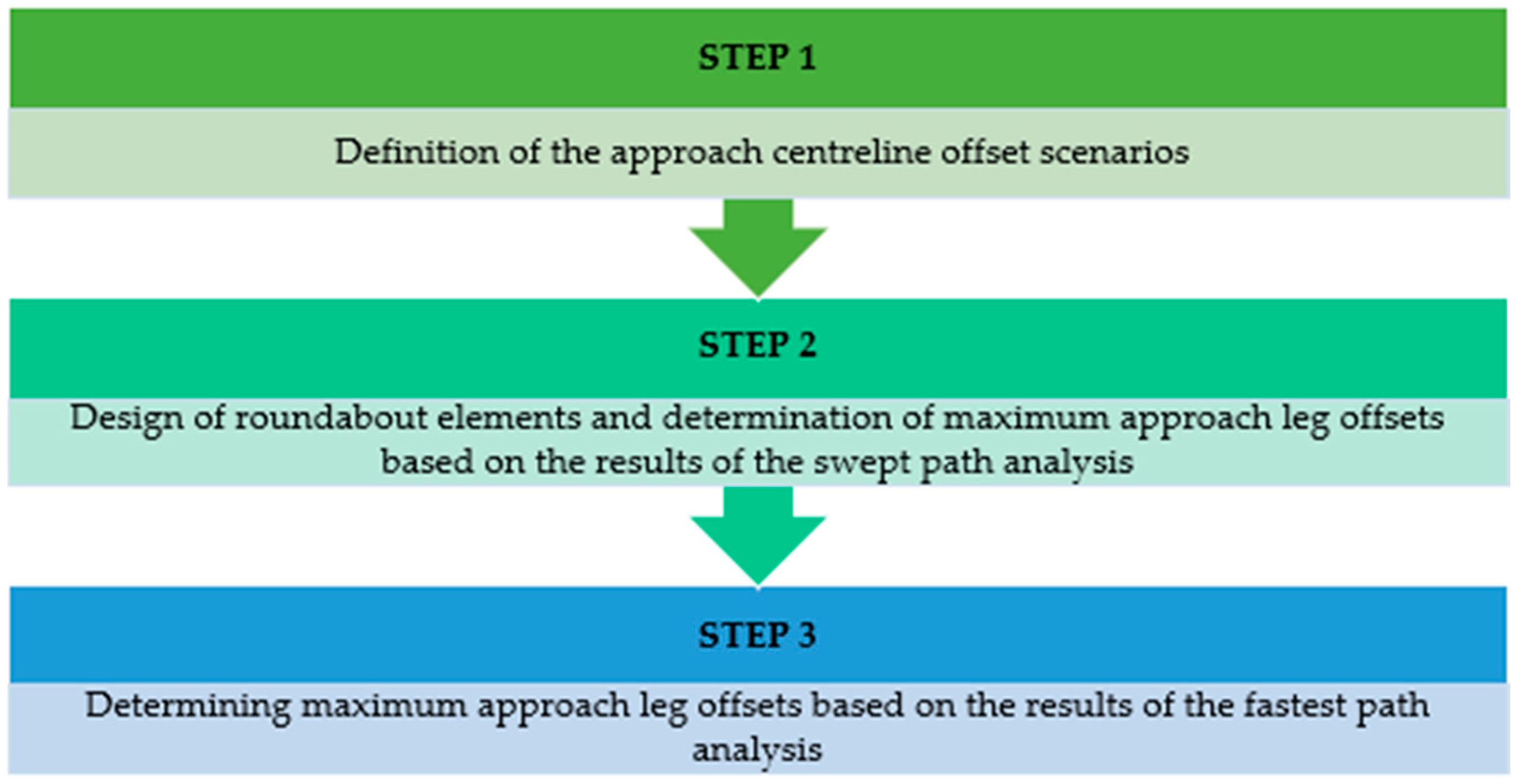
In this section, the approach alignment considerations, the geometric design of roundabout elements based on swept path analyses, and the fastest path analysis methods used in this research are described in detail. Key steps in the investigation process are shown in Figure 3.

2.1. The Approach Alignment

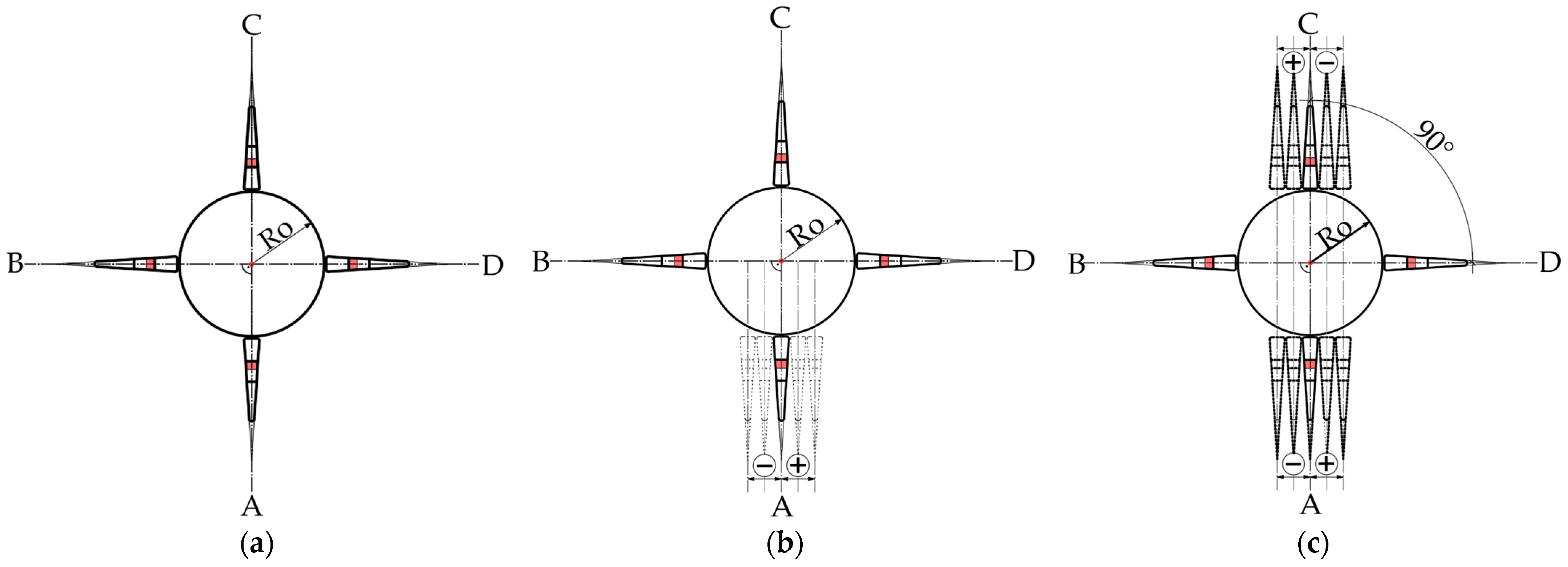
The approach centreline offset offers flexibility in roundabout design, enabling engineers to adapt the geometry to specific site conditions and traffic patterns. In this investigation, examples of single-lane, four-legged roundabouts with the angle between the centrelines of the approaches set at 90° and with various outer circle radii (Ro) of 15.0, 17.5, 20.0, 22.5 and 25.0 m (Figure 3) were constructed via AutoCAD 2025 software.
The first design step was to define the approach centreline offset. This was carried out in several stages. In the first stage (Figure 4a), roundabouts with an offset of 0, i.e., with approach centrelines intersecting at the roundabout centre, were investigated. In the second stage (Figure 4b), the approach (A) centreline was offset to the left (−) and right (+) in increments of 1 m. In the third stage (Figure 4c), the approach (A) and (C) centrelines were offset to the left (−) and right (+) in increments of 1 m. The above-mentioned increments were chosen to capture the dispersion of the results and to create a sample that is representative, manageable, and easy to present. From a geometric perspective, the maximum offset was linked to the distance between the entry (Rentry) and exit (Rexit) roadway edge curves of adjacent approaches, measured on the outer circle of the roundabout. This distance had to be at least 1 m (Figure 1). From a safety perspective, the maximum offset was determined by the fastest path analysis results, i.e., the optimal driving speed, which was set to 40 km/h.

2.2. Geometric Design of Roundabout Elements Based on Swept Path Analysis

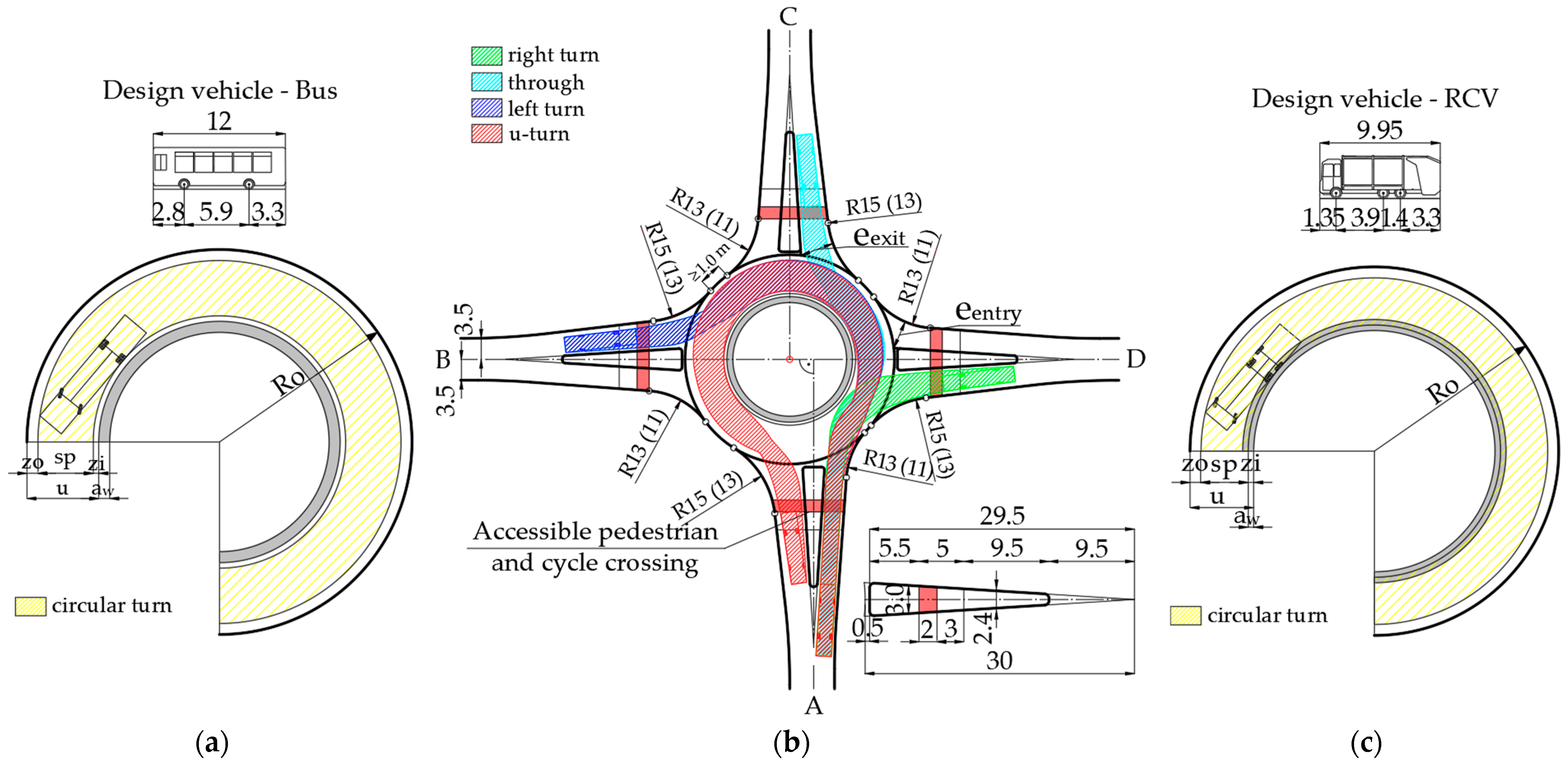
The second step in the design process applied in this investigation involved the design of the following roundabout elements: outer radii (Ro), circulatory roadway width (u), entry and exit widths (eentry, eexit), entry and exit radii (Rentry, Rexit), apron width (aw) and triangular splitter islands on each approach. The design was based on the results of the swept path analyses, while the initial dimensions of roundabout elements were in line with the values recommended by Croatian, Dutch, German, French and US guidelines, as well as Swiss standards [29,30,31,32,33,34,35,36,37,38,39].
Swept path analysis simulates the trajectories of a vehicle’s outermost points, including the wheels and body, as it turns or moves through a defined area. This process determines the space required for the vehicle to manoeuvre and identifies potential design issues. In this way, designers can optimise the geometry of a roundabout and ensure that design vehicles can move smoothly and efficiently. Modern swept path analysis uses specialised software, such as Autodesk Vehicle Tracking, although Autodesk disclaims responsibility for any potential errors or damage resulting from its use [48]. The reliability of Autodesk Vehicle Tracking 2019 software was verified in a study [49] through real drives of a two-axle truck with a three-axle semitrailer at the test site. The test vehicle performed a critical manoeuvre (a 270° left turn) 10 times, and its swept path widths were measured at 32 cross-sections using a precise GPS device (Two-frequency GNSS (GPS + GLONASS) device Trimble R8 with TSC3 controller, Trimble Inc., Westminster, CO, USA). The situation at the test site was then simulated using Autodesk Vehicle Tracking software. The accuracy of the simulation results was evaluated using a t-test at a 95% confidence interval to assess the significance of the differences between the means of two independent samples: real and simulated swept path widths. The t-test showed that the swept path widths determined by field measurements and those determined by vehicle simulation are, from a statistical point of view, the same.
Accordingly, all design vehicle trajectories in the roundabout were drawn using Autodesk Vehicle Tracking 2025 software [48] for all directions of movement: right turn, through movement, left turn, U-turn, and circular turn (Figure 5). The selected design vehicles were a 12.0 m long, 2.55 m wide two-axle bus and a 9.95 m long, 2.55 m wide three-axle refuse collection vehicle (RCV) with a self-steering last axle for improved manoeuvrability, as described in [50]. These vehicle types are common on the European road networks, particularly in urban areas. To ensure passenger comfort when navigating the roundabout, the bus was not permitted to use the traversable part of the central island (apron), whereas the RCV was. The RCV was selected to bridge the gap between various outer circle radii (Ro) of 15 and 20 m, where roundabouts designed solely for the bus would be too restrictive. The distance between the vehicles’ outermost points (trajectories) from the edges of the approaches and the circulatory roadway was in accordance with the applied lateral clearances.
In the investigation presented in this paper, the theoretical examples of urban four-legged single-lane roundabouts were designed following the previously mentioned guidelines, standards and recommendations [29,30,31,32,33,34,35,36,37,38,39], and using the following assumptions and input values (Figure 5):
  • The selected outer radii (Ro) were between 15 m and 25 m, and the selected increment was 2.5 m.
  • The selected triangular splitter islands on each approach were 29.5 m long, and the width of the cut-through islands, on which the pedestrian and cyclist crossings are located was 2.4–3.0 m. The pedestrian and cyclist crossings within the splitter islands were 5 m wide.
  • The selected roadway lane widths at the beginning of the approaches were 3.5 m.
  • The circulatory roadway width (u) was determined based on the swept path width (sp) by adding the selected lateral (inner and outer) clearances (zo was set to 1 m, and zi was set to 0.5 m) according to the procedure described in [39]. The width was rounded to 0.1 m.
  • The entry and exit widths (eentry, eexit) were determined based on the swept path width of the selected design vehicle (sp) by adding a lateral clearance of 0.5 m on both sides of the path. The widths were rounded to 0.1 m.
  • Based on the preliminary analysis, for roundabouts where the bus was the design vehicle, the entry radii (Rentry) and exit radii (Rexit) were set to 13 m and 15 m, respectively. In cases where the RCV was the design vehicle, the entry radii were 11 m, and the exit radii were 13 m.
  • The outer edges of the entry and exit lanes were flared, i.e., they were not parallel to the edges of the splitter islands. The widened entry and exit began at the cross-section where the splitter island begins. In this way, the roadway edges follow the swept path of a design vehicle as closely as possible.
  • The selected apron width (aw) was 1 m.
As mentioned earlier, the crucial parameter governing the possibilities for lateral offsets of the approaches in the roundabout geometric design based on swept path analysis was the distance between the entry (Rentry) and exit (Rexit) roadway edge curves of adjacent approaches, measured along the outer circle of the roundabout, which had to be at least 1 m (Figure 5b). The resulting lengths of pedestrian and cyclist crossings over the entry and exit lanes were also checked, as excessive lengths can increase the time required for users to cross.

2.3. Fastest Path and Speed Analyses

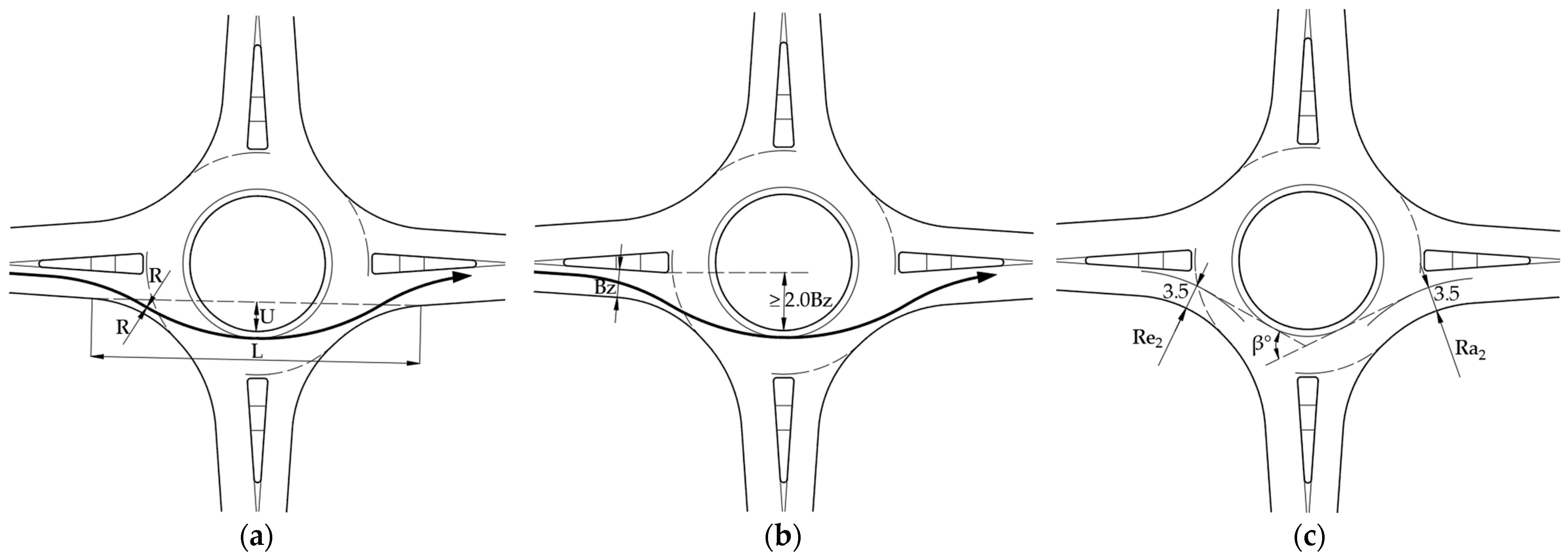
The safety performance of a roundabout is often assessed using four distinct methods described in various design standards, guidelines [29,30,31,32,33,34,35,36,37,38,39], and practices [40,41,42,51,52]. The first method involves measuring the geometric characteristics of the roundabout and calculating the path radii and vehicle speeds, as outlined in the Dutch [30] and Croatian [39] guidelines and illustrated in Figure 6a. The radius of the vehicle’s fastest path is calculated using the following equation:
R   =   ( 0.25 · L ) 2   +   ( 0.5 · ( U   +   2 ) ) 2 U   +   2
where R (m) is the radius of the vehicle’s fastest path, L (m) is the distance between the tangent of the entry radius and the tangent of the exit radius, and U (m) is the distance between the edge of the central island and the right side of the lane of the approach road, measured at the tangent point (see Figure 6a). The design of the roundabout is considered correct if the radius of the driving path is between 22 and 23 m. According to the Dutch guidelines [30], the acceptable vehicle speed through the roundabout should be between 30 and 35 km/h, while the Croatian guidelines [39] specify a maximum of 40 km/h. The speed is calculated using the following equation:
V   =   7.4 · R
where V (km/h) is the vehicle speed and R (m) is the radius of the vehicle’s fastest path.
The second method includes measuring the geometric characteristics of the roundabout and checking the achieved deflection (as described in the German guidelines [31,32] and shown in Figure 6b). The deflection of the vehicle path while traversing around the central island should not be less than twice the lane width (Bz) measured on the roundabout approach.
The third method includes measuring the achieved deflection by the deviation angle (as described in the Swiss standards [36] and shown in Figure 6c), where deviation angle (β) must be at least 45°.
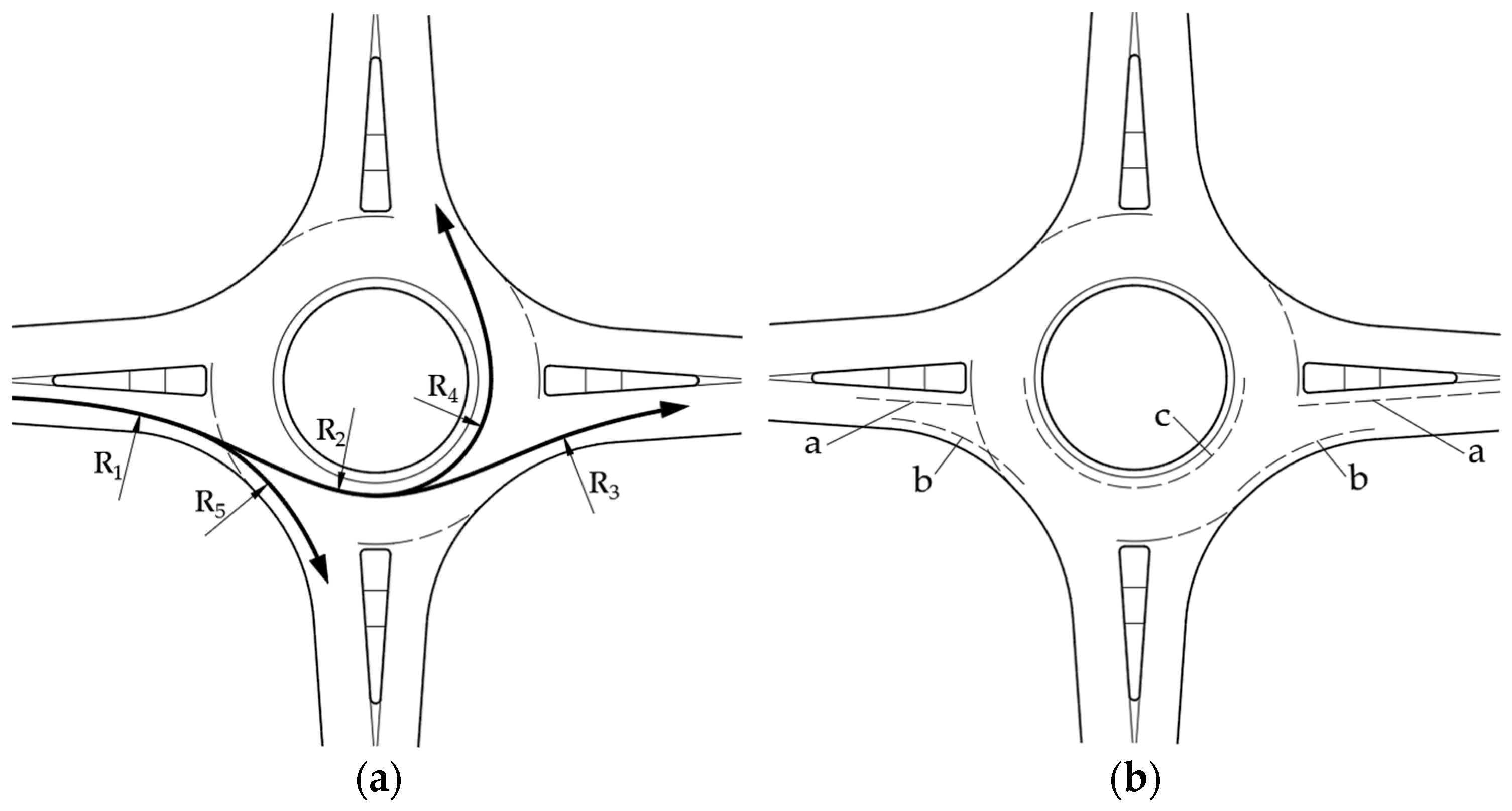
The fourth method includes drawing the fastest paths through the roundabout and measuring the path radii, as described in the French guidelines [29], and then calculating the vehicle speed, as described in the US guidelines [36] (Figure 7). According to [36], the fastest paths for all approaches and all movements (Figure 7a), including left turns, must be drawn (usually CAD-based), and the roundabout must be designed for vehicle speeds (e.g., 25 km/h to 40 km/h) throughout the roundabout. The acceptable entry vehicle speed is 40 km/h [35]. The construction of the fastest path should begin at least 50 m before the entry line, accounting for distances to geometric features [35]. It is assumed that a vehicle is 1.8 m wide [36]. The centreline of the vehicle path is drawn at the following distances from the geometric features (Figure 6a): a = 1.5 m, b = 1.5 m and c = 1.5 m (Figure 7b). According to [36], R1 is the entry path radius, R2 is the circulating path radius, R3 is the exit path radius, R4 is the left-turn path radius, and R5 is the right-turn path radius. The R1 radius should be measured as the smallest best-fit circular curve over a distance of at least 20 to 25 m near the entry line [35].
The relationship between travel speed and horizontal curvature is documented in the AASHTO “Green Book” [53]. Equation (3) provides a simplified relationship between speed and radius for any superelevation rate that incorporates the AASHTO [53] side friction factors:
V   =   127 · R · ( f   ±   e )
where V (km/h) is the predicted speed, R (m) is radius of the vehicle’s fastest path, f (-) is the side friction factor, and e (m/m) is the superelevation rate. The US [36] and French [29] guidelines differ in the distances of the fastest path from the geometric features (Figure 5).
According to the French guidelines [29], the distances are a = 2.0 m, b = 1.5 m, and c = 2.0 m from a painted edge line (Figure 7b). Furthermore, according to the French guidelines [29], speed estimation is not conducted: appropriate vehicle speed is achieved by limiting the fastest path radii for vehicles travelling through the roundabout to 100 m.
Based on the above, the optimal driving speed through a roundabout is typically 25–40 km/h, with 40 km/h set as the limit in this study. Relative speeds between conflicting traffic streams and between consecutive geometric elements should be minimised so that the maximum speed differential between movements does not exceed approximately 15 to 25 km/h. This speed range is generally recommended to maintain safety and control when navigating the roundabout.
In this study, the safety performance assessment (deflection and speed analysis) for the offsets of approaches (A) and (C) was conducted in accordance with the Dutch [30], Croatian [39], German [31,32] and US [36] guidelines and Swiss [37] standards. The speed analysis for the US guidelines was carried out using superelevation values of +0.025 for entry and exit curves and −0.025 for curves around the central island, along with Formula (3). The French guidelines [29] were not used in the continuation of this research, as a 100 m radius results in a speed over 50 km/h. The most restrictive guidelines were selected for the final investigation of the maximum approach offset for both approaches (A) and (C).

3. Results

Following the iterative process of roundabout design, the results of the analysis, i.e., maximum allowable lateral offsets of the approaches, a model for the design of roundabouts with various lateral offsets of the approach alignments, and model evaluation results are given in this section.

3.1. Maximum Offset of the Approach (A)

The research results for the 12.0 m long bus, presented in Table 1 and Table 2 show that the offset of approach (A), from a geometric point of view, is proportional to the outer radius (Ro). The entry and exit widths (eentry, eexit) depend on the approach offset side and the value of the outer radii (Ro), as shown in Table 1 and Table 2.
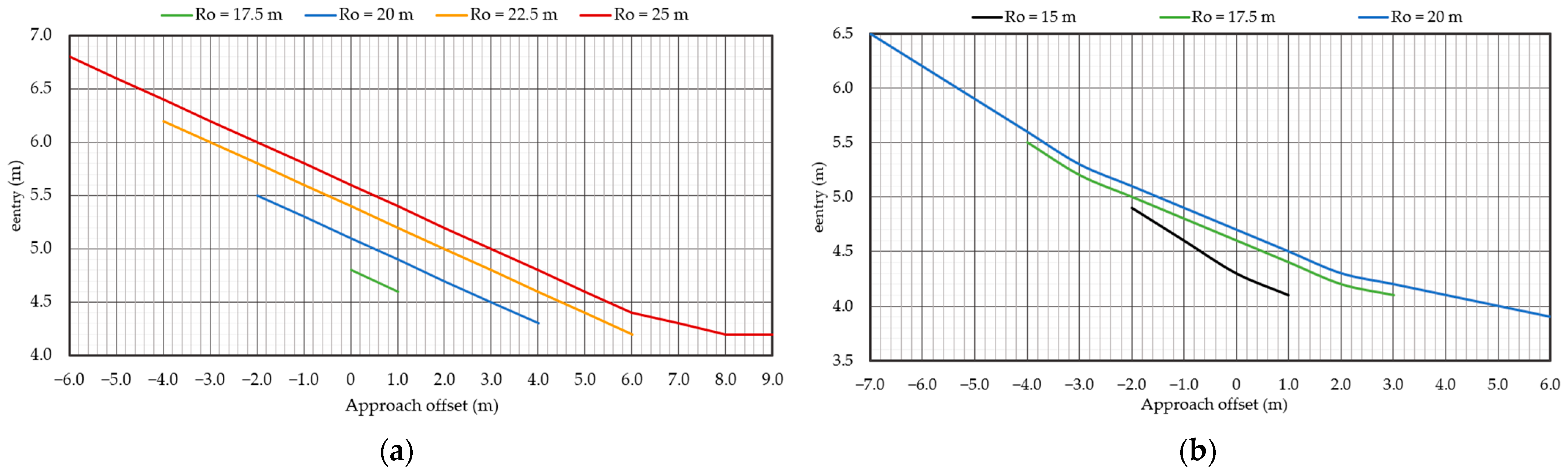
These widths are proportional to the outer radius size (Ro). Larger entry widths are needed for offsets to the left (up to 8.9 m for the offset of 12 m to the left), while larger exit widths are needed for the offsets to the right (up to 9.9 m for the offset of 12 m to the right).
The results of the investigation, given in Table 3, show that the required circulatory roadway width (u), which depends on the outer radius (Ro) and the swept path width (sp) (Figure 5), is inversely proportional to the outer radius. The values for the circulatory roadway width (u) range from 5.8 to 7.1 m.
Roundabouts with an outer radius Ro = 15.0 m were excluded from further investigation (Table 2) when the bus was used as a design vehicle, as it was not possible to offset the approach due to the overlap of right carriageway arcs (Rentry and Rexit).
After the maximum offset of approach (A) has been determined (based on the 64 combinations), the speed and deflection analyses were conducted in accordance with Croatian [39], Dutch [30], German [31,32], and US [36] guidelines, and Swiss [37] standards. The results for the roundabouts designed for the bus, presented in Figure 8 and Appendix A.1 (Table A1, Table A2, Table A3, Table A4, Table A5 and Table A6), show that the limit values for the approach offset varied depending on the procedure applied. For all analysed roundabouts, the US guidelines [36] were the most restrictive, followed by the German guidelines [31,32]. The differences between the speeds calculated according to the Croatian [39] and Dutch [30] guidelines for different approach offsets in one direction of travel (A-C or C-A) are small; the largest difference was only 5 km/h, with the highest calculated speed being 38 km/h and the lowest 32 km/h. Values above 35 km/h would limit the offset in the Netherlands, but not in Croatia, where only values above 40 km/h would set the limit. German guidelines [31,32] indicate that, in some cases, a right offset is not applicable. The right-turn speed values determined in accordance with the US guidelines [36] are not relevant to determining the maximum approach offset, as the approach centrelines intersect at a 90° angle.
The research results for the 9.95 m long RCV, presented in Table 4, show that the offset of approach (A) from a geometric point of view, is proportional to the outer radius (Ro). The entry and exit widths (eentry, eexit) depend on the approach offset side and the value of the outer radii (Ro), as shown in Table 4. These widths are proportional to the outer radius size (Ro). Larger entry widths are needed for the offsets to the left (up to 6.8 m for the offset of 8 m to the left), while larger exit widths are needed for the offsets to the right (up to 7.5 m for the offset of 8 m to the right).
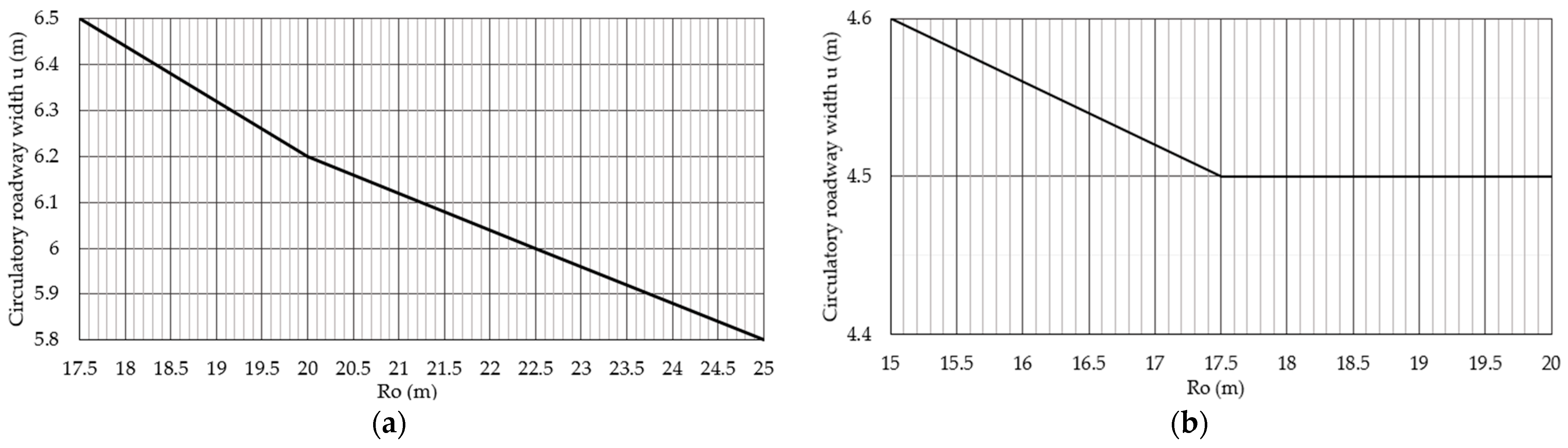
Circulatory roadway widths (u) for different outer radii (Ro) are derived from the swept path (sp) and lateral clearances (zo) and (zi), as shown in Figure 5c. Table 5 indicates that the (sp) for the 9.95 m long RCV is inversely related to the outer radius (Ro) and is notably narrower than the bus’s swept path (Table 3). Relying strictly on the (sp) values from Table 5 for radii of 17.5 m and 20.0 m would result in an insufficiently wide roadway. This is because the RCV is permitted to traverse the apron by 0.5 m, and the (zi) clearance is measured directly from the edge of the central island (Figure 5c). Consequently, a width of 4.5 m was adopted for these cases, as recommended by the Croatian guidelines [39].
After the maximum offset of the approach (A) was determined (based on 31 combinations), the speed and deflection analyses were conducted in accordance with Croatian [39], Dutch [30], German [31,32], and US [36] guidelines and Swiss [37] standards. The results for the RCV, presented in Figure 9 and Appendix A.1 (Table A7, Table A8, Table A9 and Table A10), show that the limit values for the approach offset varied depending on the procedure applied.
For all analysed roundabouts, the German guidelines [31,32] were the most restrictive, followed by the US guidelines [36], while the Croatian [39], Dutch [30], and Swiss [37] standards were not restrictive at all. The German guidelines [31,32] were particularly restrictive regarding the right-side offset. The differences between the speeds calculated according to the Croatian [39] and Dutch [30] guidelines for various approach offsets in a single direction of travel (A–C or C–A) were minor; the largest difference was only 4 km/h, with the highest calculated speed being 33 km/h and the lowest 29 km/h. In this instance, the US guidelines [36] proved to be the most restrictive only for the roundabout with an outer radius (Ro) of 20 m and a left-side approach offset of 8 m.
The investigation results for both design vehicles show that the outer radius (Ro) and the approach offset influence the design of roundabout geometric elements and roundabout speeds. Increasing the approach offset to the left results in the following (Table 1, Table 2, Table 3, Table 4, Table 5, Table A1, Table A2, Table A3, Table A4, Table A5, Table A6, Table A7, Table A8, Table A9 and Table A10):
  • Entry: Required entry width (eentry), deflection angle βA-C, and the deflection increase, while path radii (R and R1) and speeds (VA-C and V1A-C) decrease.
  • Exit: Required exit width (eexit) and deflection angle βA-C decrease, deflection remains constant, while path radii (R and R3) and speeds (VC-A and V3C-A) increase.
  • Circulatory roadway: Variations in the outer radius (Ro) influence the passing-through speeds (V2A-C and V2C-A). Specifically, the bus-based roundabout speeds range between 20 and 25 km/h (V2A-C) and 22–29 km/h (V2C-A). Conversely, the RCV-based roundabout speeds remain nearly uniform, varying only between 20 and 21 km/h.
Increasing the approach offset to the right results in the following (Table 1, Table 2, Table 3, Table 4, Table 5, Table A1, Table A2, Table A3, Table A4, Table A5, Table A6, Table A7, Table A8, Table A9 and Table A10):
  • Entry: Required entry width (eentry), deflection angle (βA-C) and deflection decrease, while path radii (R and R1) and speeds (VA-C and V1A-C) increase.
  • Exit: Required exit width (eexit) and deflection increase, deflection angle (βA-C) decrease, while path radii (R and R3) and speeds (VC-A and V3C-A) decrease.
  • Circulatory roadway: Outer radius (Ro) variations have a minimal impact on passing-through speeds (V2A-C and V2C-A). Both speeds range from 21 to 24 km/h for bus-based designs and from 19 to 21 km/h for RCV-based roundabouts.

3.2. Maximum Offset of the Approaches (A) and (C)

To determine the maximum offset for approaches (A) and (C) on the bus-based roundabouts, their centrelines were shifted to the right and left in various combinations. Design elements and the maximum initial offset values were taken from research results shown in Table 1, Table 2 and Table 3, and Appendix A.1 (Table A1, Table A2, Table A3, Table A4, Table A5 and Table A6), following speed and deflection restrictions obtained from the US [36] and German [31,32] guidelines. As the deflection on the roundabout does not change regardless of the combination of approach offsets, no further investigation of deflection was necessary for those cases; consequently, roundabouts with maximum offsets were designed and tested solely for speed according to US guidelines [36].
The research results, given in Appendix A.2 (Table A11), show that the offset limits defined during the investigation of the maximum offset of approach (A) remain unchanged, even when combined with the maximum offsets of approaches (C). These roundabouts met all requirements for entry, exit, and circulatory roadway widths, as well as speeds and deflection according to the US [36] and German [31,32] guidelines. Larger offsets than those shown in Table A11 resulted in unacceptable speeds or deflections on the roundabout. The combinations with maximum offsets are as follows:
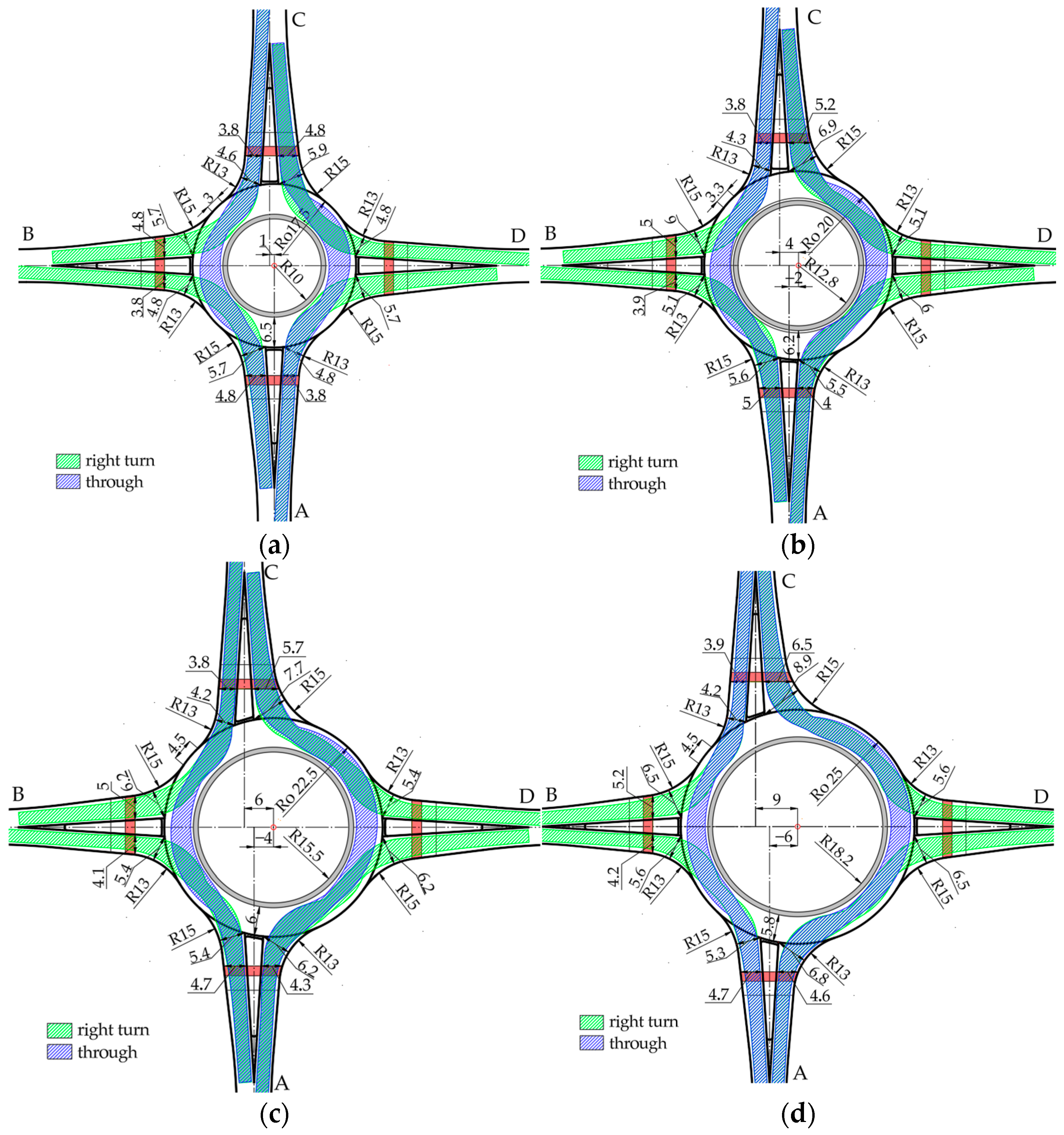
  • For Ro = 17.5 m (Figure 10a), the centreline was offset 1 m to the right for only one approach (approach (A) or approach (C)).
  • For Ro = 20 m (Figure 10b), the centreline was offset 2 m to the left for approach (A) and 4 m to the right for approach (C), and vice versa.
  • For Ro = 22.5 m (Figure 10c), the centreline was offset 4 m to the left for approach (A) and 6 m to the right for approach (C), and vice versa.
  • For Ro = 25 m (Figure 10d), the centreline was offset 6 m to the left for approach (A) and 9 m to the right for approach (C), and vice versa.
The maximum offsets for approaches (A) and (C) on the RCV-based roundabouts were determined in the same way as for the bus-based roundabouts, but using Table 4 and Table 5, and Appendix A.1 (Table A7, Table A8, Table A9 and Table A10). The research results, given in Appendix A.2 (Table A12), show that the offset limits defined during the investigation of the maximum offset of approaches (A) remain unchanged, even when combining the maximum offsets on approaches (C). These roundabouts met all requirements for entry, exit, and circulatory roadway widths, as well as speeds and deflection according to the US [36] and German [31,32] guidelines. Larger offsets than those shown in Table A12 resulted in unacceptable speeds or deflections on the roundabout. The combinations with maximum offsets are as follows:
  • For Ro = 15 m (Figure 11a), the centreline was offset 2 m to the left for approach (A) and 1 m to the right for approach (C), and vice versa.
  • For Ro = 17.5 m (Figure 11b), the centreline was offset 4 m to the left for approach (A) and 3 m to the right for approach (C), and vice versa.
  • For Ro = 20 m (Figure 11c), the centreline was offset 7 m to the left for approach (A) and 6 m to the right for approach (C), and vice versa.
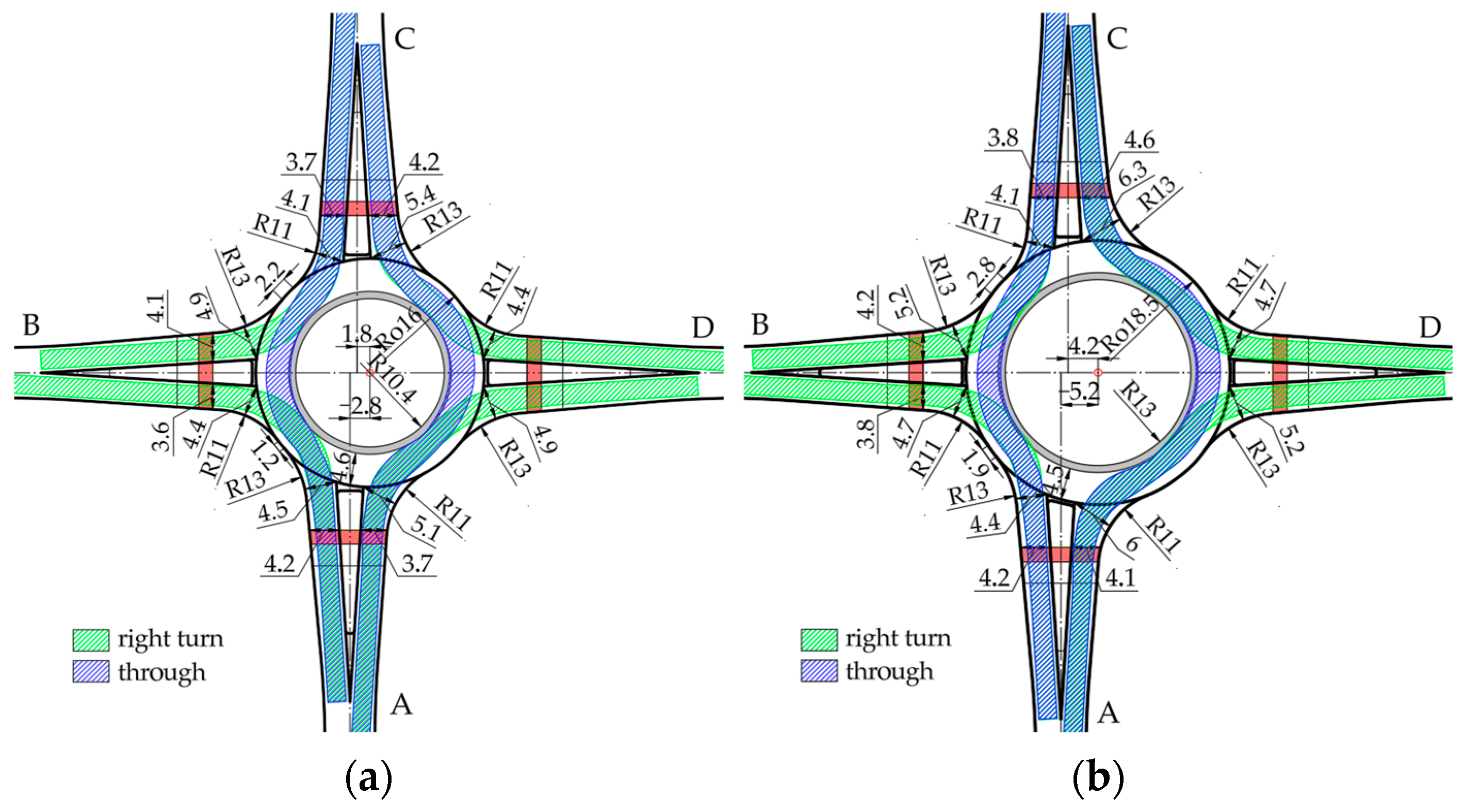
The lengths of the pedestrian and cycle crossings were measured at the longest point and varied (Figure 10 and Figure 11). For the bus-based roundabouts the maximum value on the entry lane ranges between 3.8 m and 4.6 m, while the maximum value on the exit lane is between 4.7 m and 6.5 m, depending on the outer radii (Ro) and approach offset. For the RCV-based roundabouts the maximum value on the entry lane ranges between 3.8 m and 4.2 m, while the maximum value on the exit lane is between 4.1 m and 4.7 m, depending on the outer radii (Ro) and approach offset. The main reason for the different crossing widths is the use of widened (flared) entries and exits, i.e., the outer edges of the entry and exit lanes are not parallel to the edges of the splitter islands. It can also be seen (Figure 10 and Figure 11) that the maximum possible offset ensured that the distance (measured on the outer circle of the roundabout) between the entries and exits of the adjacent approaches is not less than 1.0 m.

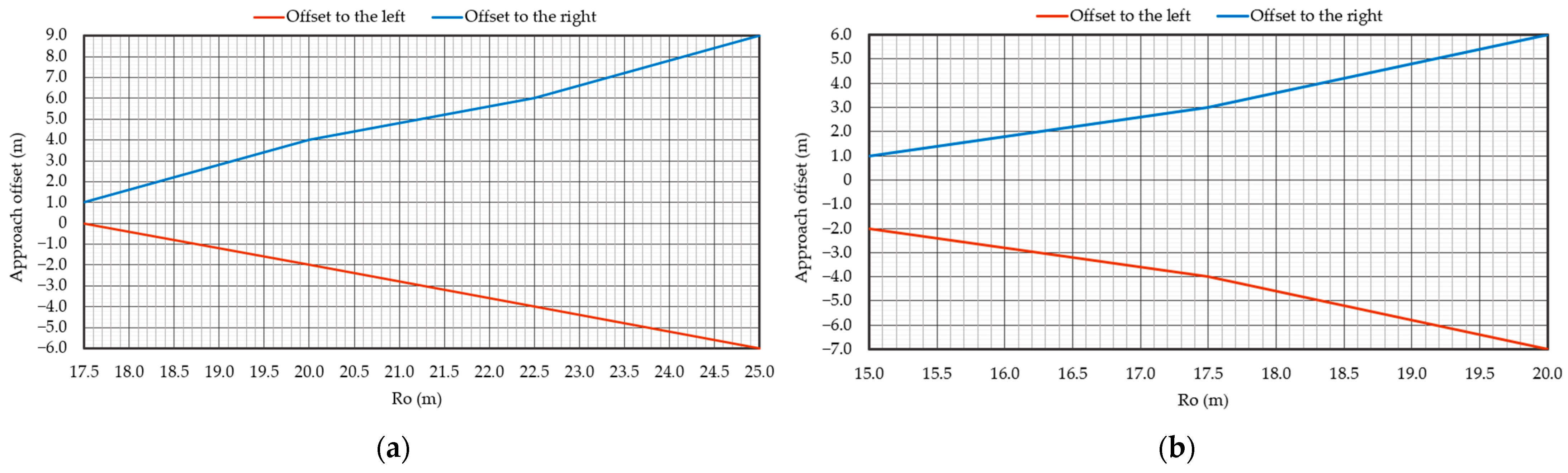
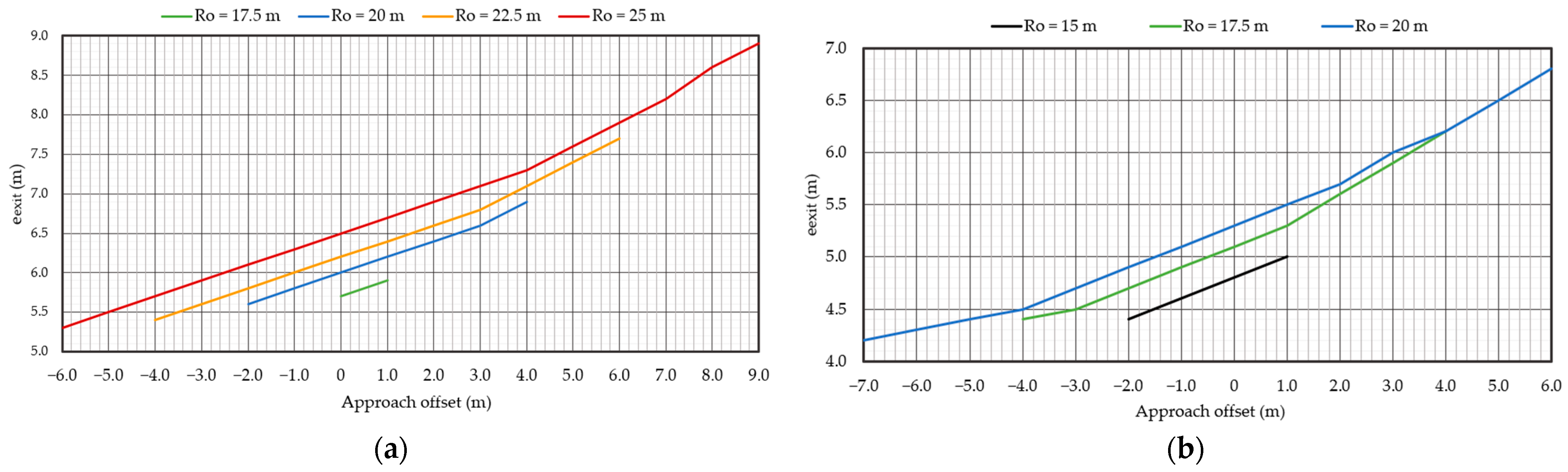
3.3. Roundabout Design Model

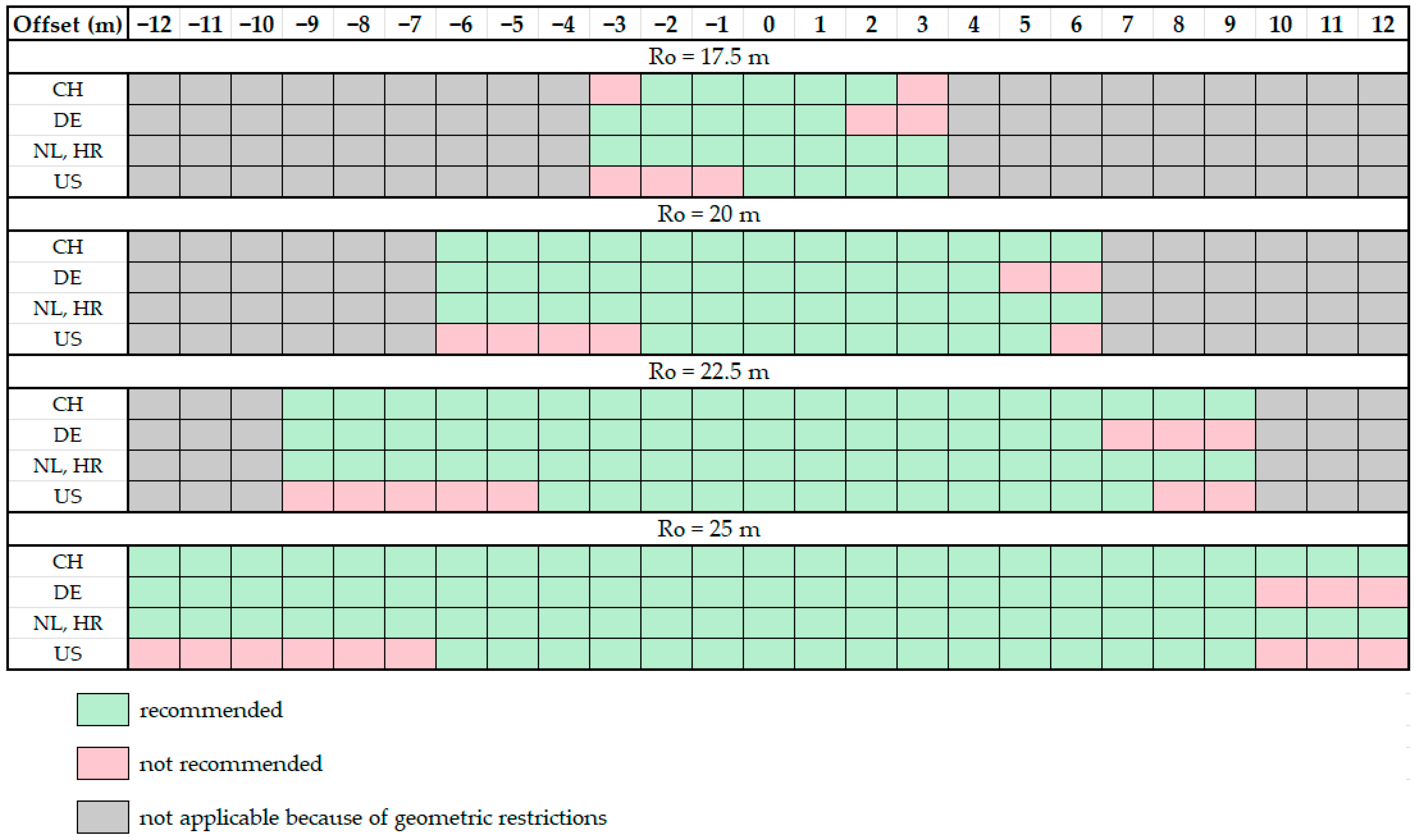
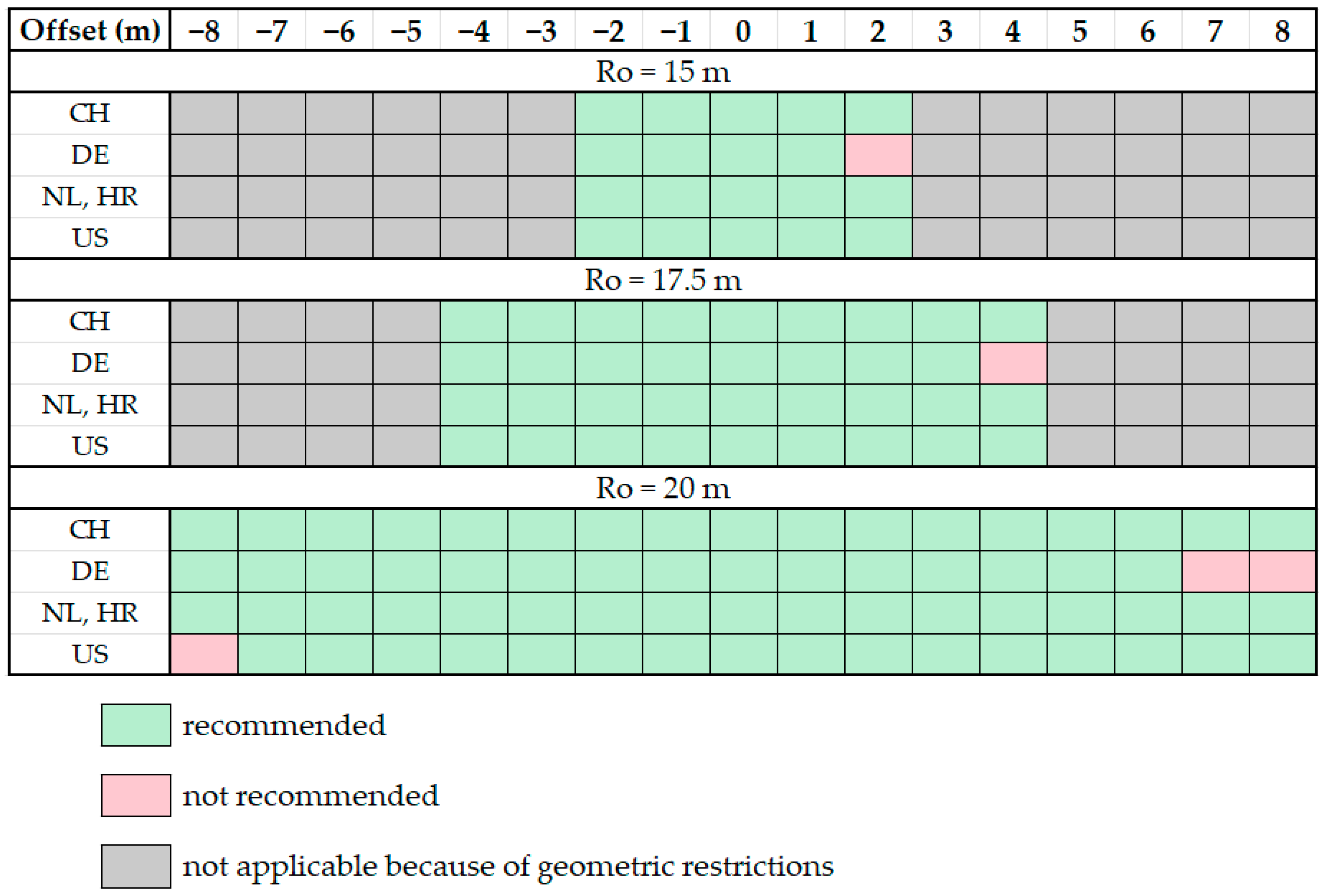
Utilising the research findings and diagrams from Figure 12, Figure 13, Figure 14, Figure 15 and Figure 16, the proposed design model is tailored for single-lane roundabouts featuring approach offsets (A) and/or (C). Developed around a two-axle bus and an RCV as the primary design vehicles, the model covers outer radii (Ro) from 15 to 25 m (15–20 m for RCVs; 17.5–25 m for buses) with perpendicular approach centrelines. Specific geometric elements comprise flared entries with radii of 11 m (RCVs) and 13 m (buses); flared exits with radii of 13 m (RCVs) and 15 m (buses); and the splitter island configurations detailed in Figure 4 and Figure 5b. It is critical to note that if a roundabout is designed specifically for RCVs, buses will experience significant traversing difficulties negotiating it; conversely, a bus-orientated design will seamlessly accommodate RCVs. Therefore, designers must comprehensively understand the local vehicle fleet structure. The proposed modelling steps are as follows (Figure 12, Figure 13, Figure 14, Figure 15 and Figure 16):
  • The centre of the selected outer radius (Ro) is placed depending on spatial constraints.
  • The circulatory roadway width (u) is selected depending on the outer radius (Ro) and the design vehicle, according to the diagram shown in Figure 13 (rounded up to the nearest 0.1 m).
  • The approach centrelines are placed according to the spatial constraints and the design vehicle. Offset values must be within the limits shown in Figure 14. If they are not, the procedure is repeated from step 1.
    • The splitter islands (shown in Figure 4 and Figure 5b) are placed along the centrelines.
    • The entry and exit widths (eentry, eexit) are selected according to the offsets from Figure 15 and Figure 16 and the design vehicle (rounded up to the nearest 0.1 m).
    • Flared entries and exits with an entry radius of 11 or 13 m and exit radius of 13 or 15 m depending on the design vehicle, are drawn.

3.4. Roundabout Design Model Validation

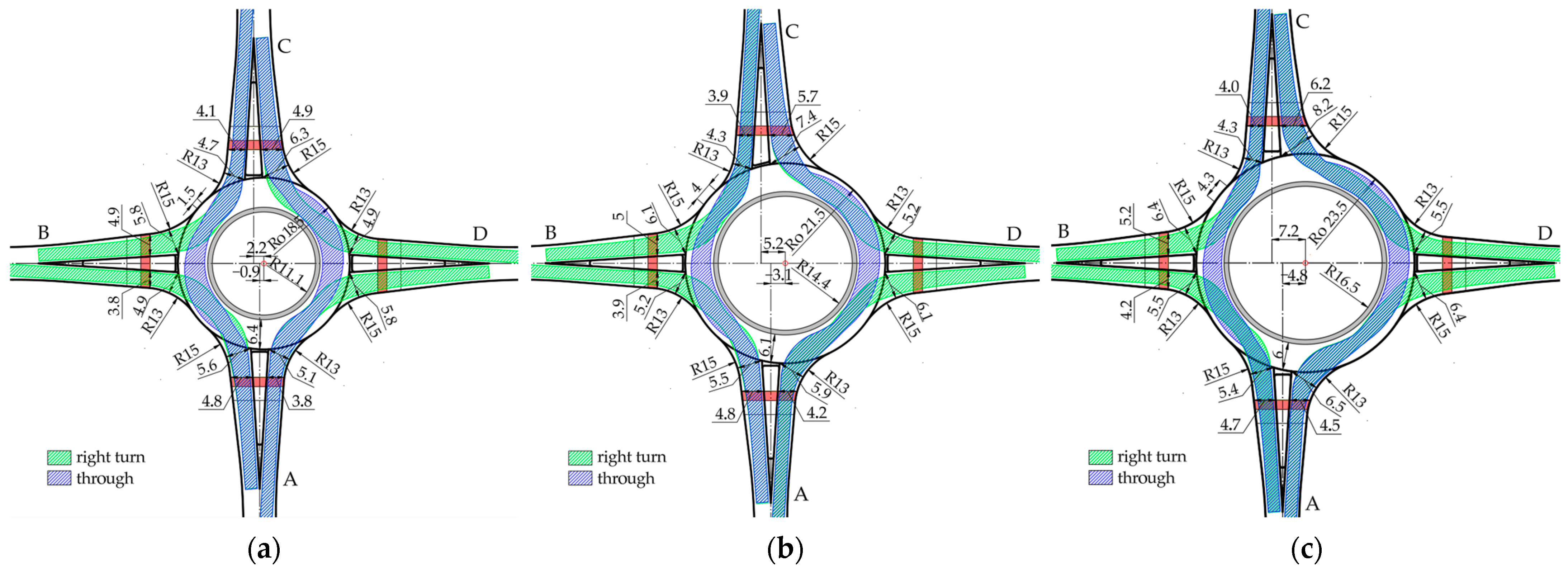
To validate the proposed roundabout design models, roundabouts with different outer radii (Ro) were randomly selected within the limits shown in Figure 13 and tested. These roundabouts were not included in the first part of the study. For the bus-based designs, the selected Ro values were 18.5, 21.5, and 23.5 m, while for the RCV-based designs, the selected values were 16 and 18.5 m. For these outer radii (Ro) values, the maximum offset values were interpolated from the diagrams in Figure 14. The design elements for these roundabouts were then selected from the diagrams in Figure 13, Figure 14, Figure 15 and Figure 16 and are listed in Table 6 and Table 7. The final roundabout designs are shown in Figure 17 and Figure 18. These roundabouts were tested, and the evaluation included swept path, speed and deflection analyses.
The results of the swept path analysis showed that all approaches were correctly designed, and all lateral clearances were met. Namely, the roundabouts designed using this method satisfied all criteria for unobstructed vehicle movement, including the specified lateral clearances and the speed–deflection requirements according to the US [36] and German guidelines [31,32] (Appendix A.3, Table A13 and Table A14). The results of the speed and deflection analyses indicate that the roundabout design model is applicable within the limits shown in Figure 14. Furthermore, a separation of over 1.0 m between adjacent entry and exit roadway edges (Rentry) and (Rexit), was maintained, thereby ensuring that no overlap occurred (Figure 17 and Figure 18).

4. Discussion

This study establishes a unique design model for roundabouts with offset approaches and outer radii ranging from 15 to 25 m using two design vehicles; a bus and a refuse collection vehicle RCV. The model is based on an analysis of 95 single-approach offsets (64 for the bus and 31 for the RCV) and up to 377 dual-approach offset combinations (229 for the buses and 148 for the RCV), using 1.0 m increments. The results indicate that approach legs (A) and (C) can be offset further to the right and left for the RCV compared to the bus for identical outer radii. This is due to the fact that the RCV features a shorter front overhang and wheelbase, as well as a self-steering rear axle. Consequently, utilising the RCV as the design vehicle yielded larger approach offset limits for roundabouts with outer radii between 15 and 20 m, which are most prevalent in urban areas.
This study addresses a critical gap in civil and transport engineering by eliminating the requirement for time-consuming iterations of swept path and fastest path analyses. The proposed model allows for the selection of roundabout radii and offsets beyond the specific study combinations with high confidence in the outcomes. Unlike existing guidelines, which often discourage the use of offset approaches, this research provides the definitive numerical data necessary for informed design. By establishing specific parameters to prevent inconsistent results, this work represents a significant scientific advancement in the area of civil and transport engineering and offers a transparent, replicable methodology.
The approach offset values determined in this study are considerably higher for the outer radius (Ro) of 17.5–25 m than those recommended by the Croatian guidelines [39], which set the maximum offset at 0.15 Ro. These findings are based on speed and deflection analyses conducted in accordance with the US [36] and German guidelines [31,32], which are the most restrictive among the documents analysed in this research and provided the most comprehensive results by considering entry, through, and exit speeds and deflection. Additionally, the speed at the exit of the roundabout increases more rapidly when the approach is shifted to the left than the entry speed increases when the approach is shifted to the right, even though shifting the approach to the left reduces the required exit width. The design vehicle swept path naturally influences the determination of entry, exit, and circulatory roadway widths, and thus the driving speed. The aim was to design entry and exit widths to be as narrow as possible, with lateral clearances sufficient to ensure smooth movement of the chosen design vehicle.
Given that no single model perfectly predicts roundabout speeds, our study employed established European and US guidelines that have remained industry standards for over two decades. This study found the German [31,32] and US guidelines [36] to be robust indicators for bus and RCV related restrictions. Furthermore, this research provides the specific parameters required for the prevention of inconsistent design outcomes.
The results of the investigation presented in this paper could not be compared with the results of a similar study given in [47], because it used a predefined roundabout geometry and had the following limitations: the analysed roundabouts were designed without splitter islands, the design vehicle swept path was not considered, the safety performance was not tested, and the two adjacent approach edges at entry and exit could touch each other, i.e., there was no outer circular arc.
The design vehicle’s manoeuvres and swept paths at entry and exit are not identical, which directly affects the shape of the roadway edges. Because the rear wheels do not follow the front wheels, the vehicle requires a longer distance to realign upon exit; therefore, a larger roadway curvature radius is necessary. The applied entry radii of 11 or 13 m and exit radii of 13 or 15 m, depending on the design vehicle, combined with flared entries and exits, ideally follow the swept path with lateral clearances, aligning with results from previous studies [45,46].
In this study, roundabouts were designed so that the design vehicle, a two-axle, 12-metre-long bus, does not traverse the apron. This ensured passenger comfort, as recommended by the US guidelines [35]. For the analysed roundabouts with an outer radius of 15 m designed for this bus, swept path analyses showed that the adjacent approach roadway edges (entry and exit) were less than 1.0 m apart. When a shorter and more manoeuvrable refuse collection vehicle (RCV) was introduced, which could traverse the apron by 0.5 m, the roundabout entries and exits became narrower. Consequently, the potential for approach offsets in roundabouts with an outer radius (Ro) of 15 to 20 metres increased. Designers must choose between the two vehicles depending on the location and local vehicle fleet composition. If a roundabout is designed specifically for RCVs, buses will experience significant traversing difficulties negotiating it; conversely, a bus-oriented design will seamlessly accommodate RCVs.
The crossing lengths for pedestrians and cyclists across entry and exit lanes were evaluated (Figure 10 and Figure 11). At the entry lane, crossing lengths decrease when the approach offset is to the right and increase when it is to the left; for the exit lane, the opposite is true. The greatest variance was observed between roundabouts, designed for the bus, with no offset and those with a 9.0 m offset to the right at a 25 m outer radius. Specifically, with a 9.0 m offset, the entry crossing length decreases by 0.3 m, while the exit crossing length increases by 1.3 m. Similar trends were observed for other radii: for an outer radius of 17.5 m with a 3.0 m offset, crossings were 0.1 m shorter at the entry and 0.1 m longer at the exit. At a roundabout with an outer radius of 20 m with a 5.0 m offset, crossings were 0.2 m shorter at the entry and 0.4 m longer at the exit. In comparison, at a 22.5 m radius with a 7.0 m offset, the entry decreases by 0.3 m and the exit crossing increases by 0.9 m. Based on the previous research, a pedestrian crossing at a roundabout with offset approaches that is up to 2.0 m longer than at a standard roundabout layout would not pose a problem even for the slowest pedestrians, as it would require only approximately 2 extra s for them to cross. Namely, according to Giannoulaki and Christoforou [54], the slowest measured walking speeds range from 1.2 m/s to 1.4 m/s, while for seniors, the speed drops to 0.9 m/s. Furthermore, Gates et al. [55] analysed 1947 crossing events across eleven intersections in Wisconsin and recommended a walking speed of 0.88 m/s for areas where nearly all pedestrians are over age 65. They suggest that 1.2 m/s is only appropriate for locations with very few older or disabled pedestrians, such as college campuses, while 1.15 m/s is the general recommendation for timing clearance intervals. Consequently, an additional 1.5 to 2.0 m of crossing distance would only require approximately 2 extra seconds for even the slowest pedestrians. To reduce pedestrian and cyclist exposure, crossings can be positioned further back from, but not too far away from roundabout exits (splitter island should not be narrower than 2 m in that place) or supplemented with road markings such as ‘shark’s teeth’ (triangular yield markings). Widely used in the Netherlands, these markings legally prioritise vulnerable road users by requiring exiting motorists to slow down and yield to those crossing their path. For the roundabouts designed for the RCV, the maximum difference in crossing lengths on the entry lane is 0.4 m, while the maximum difference on the exit lane is 0.6 m, depending on the outer radius (Ro) and the approach offset. Consequently, there are no significant changes in crossing lengths between approaches with and without an offset.
The limitations of this study were that it was not conducted on real examples of urban single-lane roundabouts with offset approaches, that the approach axes on the analysed roundabouts were all positioned at right angles, and only the triangular splitter island was evaluated. To help identify potential shortcomings in the roundabout design model, future research will include analysis of roundabout schemes with approach angles ranging from 70° to 90° in 5° increments, as well as one-approach offsets, two design vehicles, and other splitter island types. Furthermore, the model will be applied to a real-world roundabout experiencing safety or operational issues due to an offset alignment, and the real-world parameters will be compared with those suggested by the model.

5. Conclusions

High-quality geometric design of intersections is essential for safe and uninterrupted traffic flow and for maintaining an adequate level of service. The study presented in this paper focuses on the geometric design of urban four-leg single-lane roundabouts, specifically the possibilities of offsetting the approaches and modifying the shapes of roundabout design elements (entry and exit widths, circulatory roadway width) to accommodate different offset values. The motivation for this study was the need to construct roundabouts with offset approaches, especially in urban and suburban road networks. This study aimed to determine the influence of approach offset on the geometric design of roundabouts. The research was conducted using theoretical roundabout examples with outer radii (Ro = 15, 17.5, 20, 22.5, and 25 m) designed to accommodate a 12 m long two-axle bus and 9.95 m long three-axle refuse collection vehicles (RCV). The results showed that offsetting an approach is possible for roundabouts with outer radii ranging from 15 to 25 m, depending on the design vehicle, and that this offset affects entry and exit widths. Offsetting the approach leg to the left increases the required entry width and decreases the required exit width. Offsetting the approach leg to the right decreases the required entry width and increases the required exit width. The offset value is proportional to the roundabout outer radius. The speed analysis results further restricted the approach leg offsets.
This study and the new model contribute to the consistent design of roundabouts, particularly in the redesign of standard four- and three-legged intersections, by providing a model that does not require swept path and speed analyses. The efficiency of roundabouts designed using the new model is demonstrated by the smooth and unobstructed movement of the design vehicle, ensuring sufficient lateral clearances.
Future research should focus on the effects of varying splitter island widths on the fastest path or deflection, as well as the combined effects of radial and lateral approach offsets in urban roundabout design. In addition, the results obtained in this study should be compared with those from real examples of roundabouts with approach offsets to reach conclusions. This study provides researchers, practitioners involved in roundabout design, and decision-makers with valuable insights into the impact of approach offset on roundabout design.


Author Contributions

Conceptualisation, I.S. and Š.B.; methodology, I.S., Š.B., S.A. and T.D.; validation, I.S. and Š.B.; formal analysis, I.S. and Š.B.; investigation, I.S. and Š.B.; resources, I.S., Š.B., S.A. and T.D.; writing—original draft preparation, I.S.; writing—review and editing, Š.B., S.A. and T.D.; visualisation, I.S. and Š.B.; supervision, I.S. All authors have read and agreed to the published version of the manuscript.

Funding

This research received no external funding.

Data Availability Statement

The original contributions presented in this study are included in the article. Further inquiries can be directed to the corresponding author.

Conflicts of Interest

Author Šime Bezina was employed by the company TPA Gesellschaft für Qualitätssicherung und Innovation GmbH, Croatia. The remaining authors declare that the research was conducted in the absence of any commercial or financial relationships that could be construed as potential conflicts of interest.

Abbreviations

The following abbreviations are used in this manuscript:
aDistance from the splitter island
awApron width
bDistance from the entry roadway edge
BzLane width measured on the roundabout approach
cDistance from the apron
esuperelevation rate
eentryEntry width
eexitExit width
fSide friction factor
LDistance between the tangent of the entry radius and the tangent of the exit radius
RRadius of the vehicle’s fastest path
R1Entry path radius
R2Circulating path radius
R3Exit path radius
R4Left-turn path radius
R5Right-turn path radius
RentryEntry radii
RexitExit radii
RoRoundabout outer radii
spSwept path width
uCirculatory roadway width
UDistance between the edge of the central island and the right side of the lane of the approach road
VVehicle speed
V1Vehicle speed at the roundabout entry
V2Vehicle passing-through speed
V3Vehicle speed at the roundabout exit
ziInner lateral clearance
zoOuter lateral clearance
βDeviation angle

Appendix A

Appendix A.1

Table A1. Speed and deflection analysis for roundabouts designed for the 12.0 m long bus with radii Ro = 17.5 m and different approach offsets (values marked in red indicate excessive deflection or vehicle speed).
Ro = 17.5 m
Offset (m)−3−2−10123
CHβA-C (°)59575452494744
βC-A (°)43464952555759
DEDeflection A-C3.4 Bz2.9 Bz2.7 Bz2.5 Bz2.1 Bz1.9 Bz1.6 Bz
Deflection C-A2.5 Bz2.5 Bz2.5 Bz2.5 Bz2.5 Bz2.5 Bz2.5 Bz
NL,
HR
VA-C (km/h)32333333343535
VC-A (km/h)36353433333332
USV1A-C (km/h)31323333353738
V2A-C (km/h)22222223232424
V3A-C (km/h)39404040404040
V1C-A (km/h)34343433343434
V2C-A (km/h)25242323222222
V3C-A (km/h)53454140393835
Table A2. Speed and deflection analysis for roundabouts designed for the 12.0 m long bus with radii Ro = 20 m and different approach offsets (values marked in red indicate excessive deflection or vehicle speed).
Ro = 20 m
Offset (m)−6−5−4−3−2−10123456
CHβA-C (°)75737169676563605856535148
βC-A (°)47505356586063656769717375
DEDA-C4.7 Bz4.4 Bz4.2 Bz3.7 Bz3.7 Bz3.3 Bz3.1 Bz2.8 Bz2.5 Bz2.3 Bz2.1 Bz1.8 Bz1.5 Bz
DC-A3.1 Bz3.1 Bz3.1 Bz3.1 Bz3.1 Bz3.1 Bz3.1 Bz3.1 Bz3.1 Bz3.1 Bz3.1 Bz3.1 Bz3.1 Bz
NL, HRVA-C (km/h)32323232333333333434343435
VC-A (km/h)36353433333333333332323232
USV1A-C (km/h)27282930313233343536373943
V2A-C (km/h)22222222222222222223232425
V3A-C (km/h)37374040393937383838383838
V1C-A (km/h)32323232333333333333333332
V2C-A (km/h)25252424232222222221212122
V3C-A (km/h)55494441403937373634343432
Table A3. Speed and deflection analysis for roundabouts designed for the 12.0 m long bus with radii Ro = 22.5 m and different approach offsets between −9 and 0 m (values marked in red indicate excessive deflection or vehicle speed).
Ro = 22.5 m
Offset (m)−9−8−7−6−5−4−3−2−10
CHβA-C (°)88878583817977757371
βC-A (°)50535659616365676971
DEDA-C6.2 Bz6.1 Bz5.8 Bz5.6 Bz5.2 Bz4.8 Bz4.4 Bz4.2 Bz3.8 Bz3.6 Bz
DC-A3.6 Bz3.6 Bz3.6 Bz3.6 Bz3.6 Bz3.6 Bz3.6 Bz3.6 Bz3.6 Bz3.6 Bz
NL, HRVA-C (km/h)32323233333333333333
VC-A (km/h)37363535343434343333
USV1A-C (km/h)26262626272828292930
V2A-C (km/h)23232323232323232323
V3A-C (km/h)35363536353636363636
V1C-A (km/h)31323233323232323230
V2C-A (km/h)28272524232322222223
V3C-A (km/h)66554843414039383836
Table A4. Speed and deflection analysis for roundabouts designed for the 12.0 m long bus with radii Ro = 22.5 m and different approach offsets between 0 and 9 m (values marked in red indicate excessive deflection or vehicle speed).
Ro = 22.5 m
Offset (m)0123456789
CHβA-C (°)71696765636159565451
βC-A (°)71737577798182848687
GERDA-C3.6 Bz3.3 Bz3.1 Bz2.9 Bz2.7 Bz2.5 Bz2.2 Bz1.9 Bz1.6 Bz1.3 Bz
DC-A3.6 Bz3.6 Bz3.6 Bz3.6 Bz3.6 Bz3.6 Bz3.6 Bz3.63.63.6
NL, HRVA-C (km/h)33333434343435353637
VC-A (km/h)33333333333332323232
USV1A-C (km/h)30333435353638394145
V2A-C (km/h)23222222232323242425
V3A-C (km/h)36373737373737373737
V1C-A (km/h)30303030303030303030
V2C-A (km/h)23232323232423242424
V3C-A (km/h)36353433333030292928
Table A5. Speed and deflection analysis for roundabouts designed for the 12.0 m long bus with radii Ro = 25 m and different approach offsets between −12 and 0 m (values marked in red indicate excessive deflection or vehicle speed).
Ro = 25 m
Offset (m)−12−11−10−9−8−7−6−5−4−3−2−10
CHβA-C (°)98979594939189888684828179
βC-A (°)53555861646668707173757779
DEDA-C6.8 Bz6.7 Bz6.6 Bz6.6 Bz6.7 Bz6.4 Bz6.0 Bz5.6 Bz5.2 Bz5.0 Bz4.6 Bz4.4 Bz4.1 Bz
DC-A4.1 Bz4.1 Bz4.1 Bz4.1 Bz4.1 Bz4.1 Bz4.1 Bz4.1 Bz4.1 Bz4.1 Bz4.1 Bz4.1 Bz4.1 Bz
NL, HRVA-C (km/h)33333333333333333333343534
VC-A (km/h)38373636353535343434343534
USV1A-C (km/h)26262626262626272728292929
V2A-C (km/h)25252525252424242524242425
V3A-C (km/h)33333333333434333434333433
V1C-A (km/h)29292929292929292929292929
V2C-A (km/h)29262626252524242524242425
V3C-A (km/h)62524844414139393737353533
Table A6. Speed and deflection analysis for roundabouts designed for the 12.0 m long bus with radii Ro = 25 m and different approach offsets, between 0 and 12 m (values marked in red indicate excessive deflection or vehicle speed).
Ro = 25 m
Offset (m)0123456789101112
CHβA-C (°)79777573727068666361585552
βC-A (°)79818284868789919293959798
DEDA-C4.1 Bz3.9 Bz3.7 Bz3.5 Bz3.3 Bz3.2 Bz2.9 Bz2.6 Bz2.4 Bz2.1 Bz1.7 Bz1.5 Bz1.2 Bz
DC-A4.1 Bz4.1 Bz4.1 Bz4.1 Bz4.1 Bz4.1 Bz4.1 Bz4.1 Bz4.1 Bz4.1 Bz4.1 Bz4.1 Bz4.1 Bz
NL, HRVA-C (km/h)34343434343435353536363738
VC-A (km/h)34333333333333333333333333
USV1A-C (km/h)29303131323435363840424649
V2A-C (km/h)25242424242424252526262727
V3A-C (km/h)33333333333333333333333333
V1C-A (km/h)29292929292929292929292929
V2C-A (km/h)25252424252525252525252525
V3C-A (km/h)33323231303029292929282827
Table A7. Speed and deflection analysis for roundabouts designed for 9.95 m long RCV with radii Ro = 15 m and different approach offsets (values marked in red indicate excessive deflection or vehicle speed).
Ro = 15 m
Offset (m)−2−1012
CHβA-C (°)6563605761
βC-A (°)5457606373
DEDeflection A-C2.6 Bz2.4 Bz2.2 Bz2.0 Bz1.8 Bz
Deflection C-A2.2 Bz2.2 Bz2.2 Bz2.2 Bz2.2 Bz
NL,
HR
VA-C (km/h)2930303130
VC-A (km/h)3131303029
USV1A-C (km/h)3132333434
V2A-C (km/h)2020202120
V3A-C (km/h)3534343433
V1C-A (km/h)3232333232
V2C-A (km/h)2121202020
V3C-A (km/h)3837353332
Table A8. Speed and deflection analysis for roundabouts for the 9.95 m long RCV with radii Ro = 17.5 m and different approach offsets (values marked in red indicate excessive deflection or vehicle speed).
Ro = 17.5 m
Offset (m)−4−3−2−101234
CHβA-C (°)878583807775726966
βC-A (°)667072757780828487
DEDA-C4.2 Bz4.1 Bz3.7 Bz3.4 Bz3.1 Bz2.9 Bz2.6 Bz2.2 Bz1.9 Bz
DC-A3.1 Bz3.1 Bz3.1 Bz3.1 Bz3.1 Bz3.1 Bz3.1 Bz3.1 Bz3.1 Bz
NL, HRVA-C (km/h)292929292929303030
VC-A (km/h)313030302930292929
USV1A-C (km/h)252627303131323335
V2A-C (km/h)202020202020202020
V3A-C (km/h)323232323232323233
V1C-A (km/h)313131313131303030
V2C-A (km/h)202020202019202020
V3C-A (km/h)363534333231292828
Table A9. Speed and deflection analysis for the RCV-based roundabouts with radii Ro = 20 m and different approach offsets between −8 and 0 m (values marked in red indicate excessive deflection or vehicle speed).
Ro = 20 m
Offset (m)−8−7−6−5−4−3−2−10
CHβA-C (°)10210098969492818886
βC-A (°)646871747679908386
DEDA-C5.8 Bz5.4 Bz5.2 Bz5.0 Bz4.8 Bz4.6 Bz4.3 Bz4.1 Bz3.8 Bz
DC-A3.8 Bz3.8 Bz3.8 Bz3.8 Bz3.8 Bz3.8 Bz3.8 Bz3.8 Bz3.8 Bz
NL, HRVA-C (km/h)303030303030303030
VC-A (km/h)323233313131313130
USV1A-C (km/h)232425242525262631
V2A-C (km/h)212122212121212120
V3A-C (km/h)323231323132323132
V1C-A (km/h)303030303030313131
V2C-A (km/h)212121212020202020
V3C-A (km/h)424038373534333332
Table A10. Speed and deflection analysis for the RCV-based roundabouts with radii Ro = 20 m and different approach offsets between 0 and 8 m (values marked in red indicate excessive deflection or vehicle speed).
Ro = 20 m
Offset (m)012345678
CHβA-C (°)868381787673706764
βC-A (°)86889092949698100102
DEDA-C3.8 Bz3.5 Bz3.2 Bz2.9 Bz2.6 Bz2.2 Bz2.0 Bz1.8 Bz1.5 Bz
DC-A3.8 Bz3.8 Bz3.8 Bz3.8 Bz3.8 Bz3.8 Bz3.8 Bz3.8 Bz3.8 Bz
NL, HRVA-C (km/h)303130313131323233
VC-A (km/h)303030303030303030
USV1A-C (km/h)313131323335363740
V2A-C (km/h)202020202021212121
V3A-C (km/h)323233323232323232
V1C-A (km/h)313030303030303030
V2C-A (km/h)202020202121212121
V3C-A (km/h)322928272626262525

Appendix A.2

Table A11. Speed analysis for bus-based roundabouts with radii Ro from 17.5 to 25 m and maximum approach offsets.
Ro (m)17.52022.525
Approach offset (m)A = 0
C = 1
A = −2
C = 4
A = −4
C = 6
A = −6
C = 9
V1A-C (km/h)31312828
V2A-C (km/h)20202426
V3A-C (km/h)32343029
V1C-A (km/h)31373740
V2C-A (km/h)19242625
V3C-A (km/h)31403939
Table A12. Speed analysis for RCV-based roundabouts with radii Ro from 15 to 20 m and maximum approach offsets.
Ro (m)1517.520
Approach offset (m)A = −2
C = 1
A = −4
C = 3
A = −7
C = 6
V1A-C (km/h)302524
V2A-C (km/h)192123
V3A-C (km/h)313126
V1C-A (km/h)333436
V2C-A (km/h)222325
V3C-A (km/h)373740

Appendix A.3

Table A13. Speed and deflection analysis for bus-based roundabouts with different radii Ro = 18.5, 21.5 and 23.5 m and maximum approach offsets.
Ro (m)18.521.523.5
Offset (m)A = −0.9
C = 2.2
A = −3.1
C = 5.2
A = −4.8
C = 7.2
DEDA-C2.9 Bz4.2 Bz5.1 Bz
DC-A2.0 Bz2.1 Bz2.0 Bz
DB-D,D-B2.7 Bz3.5 Bz3.7 Bz
USV1A-C (km/h)322827
V2A-C (km/h)222325
V3A-C (km/h)353130
V1C-A (km/h)383739
V2C-A (km/h)252525
V3C-A (km/h)404040
V1B-D,D-B (km/h)333233
V2B-D,D-B (km/h)232222
V3B-D,D-B (km/h)383737
Table A14. Speed and deflection analysis for RCV-based roundabouts with different radii Ro = 16 and 18.5 m and maximum approach offset.
Ro (m)1618.5
Offset (m)A = −2.8
C = 1.8
A = −5.2
C = 4.2
DEDA-C3.4 Bz4.5 Bz
DC-A2.1 Bz2.0 Bz
DB-D,D-B2.6 Bz3.2 Bz
USV1A-C (km/h)2625
V2A-C (km/h)2023
V3A-C (km/h)3127
V1C-A (km/h)3335
V2C-A (km/h)2223
V3C-A (km/h)3738
V1B-D,D-B (km/h)3134
V2B-D,D-B (km/h)2019
V3B-D,D-B (km/h)3232

References

  1. Hydén, C.; Várhelyi, A. The effects on safety, time consumption and environment of large scale use of roundabouts in an urban area: A case study. Accid. Anal. Prev. 2000, 32, 11–23. [Google Scholar] [CrossRef]
  2. Mensah, S.; Eshragh, S.; Faghri, A. Modern Roundabouts and Sustainable Intersection Design. In Proceedings of the 3rd International Conference on Roundabouts, TRB, Carmel, IN, USA, 18–20 May 2011. [Google Scholar]
  3. Guerrieri, M.; Corriere, F.; Casto, B.L.; Rizzo, G. A model for evaluating the environmental and functional benefits of ‘‘innovative’’ roundabouts. Transp. Res. Part D 2015, 39, 1–16. [Google Scholar] [CrossRef]
  4. Guerrieri, M.; Corriere, F.; Rizzo, G.; Casto, B.L.; Scaccianoce, G. Improving the Sustainability of Transportation: Environmental and Functional Benefits of Right Turn By-Pass Lanes at Roundabouts. Sustainability 2015, 7, 5838–5856. [Google Scholar] [CrossRef]
  5. Distefano, N.; Leonardi, S. Experimental investigation of the effect of roundabouts on noise emission level from motor vehicles. Noise Control Eng. J. 2019, 67, 282–294. [Google Scholar] [CrossRef]
  6. Bérengier, M. Acoustical impact of traffic flowing equipments in urban area. In Proceedings of the Forum Acusticum, Sevilla, Spain, 16–20 September 2002. [Google Scholar]
  7. Mandavilli, S.; Russell, E.R.; Rys, M.J. Impact of Modern Roundabouts on Vehicular Emissions. In Proceedings of the 2003 Mid-Continent Transportation Research Symposium, Ames, IA, USA, 21–22 August 2003. [Google Scholar]
  8. Bendtsen, H.; Haberl, J.; Litzka, J.; Pucher, E.; Sandberg, U.; Watts, G. Traffic Management and Noise Reducing Pavements—Recommendations on Additional Noise Reducing Measures; Report 137; Danish Road Institute: Roskilde, Denmark, 2004. [Google Scholar]
  9. Annecke, R.; Berge, T.; Crawshaw, S.; Ellebjerg, L.; Mårdh, S.; Pullwitt, E.; Steven, H.; Wiberg, A.; Zimmermann, U. Noise Reduction in Urban Areas from Traffic and Driver Management; EU Project Silence, Deliverable No. H.D2; Ellebjerg, H., Ed.; European Commission: Brussels, Belgium, 2005. [Google Scholar]
  10. Desarnaulds, V.; Monay, G.; Carvalho, A. Noise reduction by urban traffic management. In Proceedings of the Journées d’Automne 2004—Société Suisse d’Acoustique, Jona, St. Gallen, Switzerland, 4–5 November 2004; Available online: https://www.sga-ssa.ch/docs/events/desarnaulds_ica04_137ko.pdf (accessed on 14 May 2026).
  11. Makarewicz, R.; Golebiewski, R. Modeling of the roundabout noise impact. J. Acoust. Soc. Am. 2007, 122, 860–868. [Google Scholar] [CrossRef] [PubMed]
  12. Decký, M. Noise pollution from roundabout traffic in the outer environment of built-up areas of towns. Perner’s Contacts 2009, 4, 53–68. Available online: https://pernerscontacts.upce.cz/index.php/perner/article/view/1183 (accessed on 4 March 2026).
  13. Fernandes, P.M.; Fontes, T.; Neves, M.; Pereira, S.R.; Bandeira, J.; Rouphail, N.; Coelho, M. Assessment of Corridors with Different Types of Intersections. Transp. Res. Rec. 2015, 2503, 39–50. [Google Scholar] [CrossRef]
  14. Gardziejczyk, W.; Motylewicz, M. Noise level in the vicinity of signalized roundabouts. Transp. Res. Part. D 2016, 46, 128–144. [Google Scholar] [CrossRef]
  15. Meneguzzer, C.; Gastaldi, M.; Arboretti Giancristofaro, R. Before-and-After Field Investigation of the Effects on Pollutant Emissions of Replacing a Signal-Controlled Road Intersection with a Roundabout. J. Adv. Transp. 2018, 2018, 3940362. [Google Scholar] [CrossRef]
  16. Jandacka, D.; Decky, M.; Durcanska, D. Traffic Related Pollutants and Noise Emissions in the Vicinity of Different Types of Urban Crossroads. IOP Conf. Ser. Mater. Sci. Eng. 2019, 661, 012152. [Google Scholar] [CrossRef]
  17. Pratelli, A.; Souleyrette, R.R. Visibility, perception and roundabout safety. In Urban Transport XV. WIT Transactions on The Built Environment; WIT Press: Southampton, UK, 2009; Volume 107, pp. 577–588. [Google Scholar]
  18. Wang, J.; Cicchino, J.B. Safety effects of roundabout conversions in Carmel, Indiana, the Roundabout City. J. Saf. Res. 2022, 82, 159–165. [Google Scholar] [CrossRef]
  19. Elvik, R. Road safety effects of roundabouts: A meta-analysis. Accid. Anal. Prev. 2017, 99, 364–371. [Google Scholar] [CrossRef]
  20. Jensen, S. Safety Effects of Converting Intersections to Roundabouts. Transp. Res. Rec. J. Transp. Res. Board 2013, 2389, 22–29. [Google Scholar] [CrossRef]
  21. Leuer, D. A Study of the Traffic Safety at Roundabouts in Minnesota. In Office of Traffic, Safety, and Technology Minnesota Department of Transportation Executive Summary; Minnesota Department of Transportation (MnDOT): Saint Paul, MN, USA, 2017. [Google Scholar]
  22. Gross, F.; Lyon, C.; Persaud, B.; Srinivasan, R. Safety effectiveness of converting signalized intersections to roundabouts. Accid. Anal. Prev. 2013, 50, 234–241. [Google Scholar] [CrossRef]
  23. Persaud, B.N.; Retting, R.A.; Garder, P.E.; Lord, D. Safety Effect of Roundabout Conversions in the United States: Empirical Bayes Observational Before-After Study. Transp. Res. Rec. J. Transp. Res. Board 2001, 1751, 01-0562. [Google Scholar] [CrossRef]
  24. Elvik, R. Effects on Road Safety of Converting Intersections to Roundabouts: Review of Evidence from Non-U.S. Studies. Transp. Res. Rec. J. Transp. Res. Board 2003, 1847, 03-2106. [Google Scholar] [CrossRef]
  25. Abolhassani, M.; Hassan, Y.; Kassim, A. Safety Impacts of Converting Stop-Controlled Intersections in Ottawa to Roundabouts. In Proceedings of the 8th International Conference on Civil Structural and Transportation Engineering (ICCSTE’23), Ottawa, ON, Canada, 4–6 June 2023; p. 150. [Google Scholar]
  26. Montella, A. Identifying crash contributory factors at urban roundabouts and using association rules to explore their relationships to different crash types. Accid. Anal. Prev. 2011, 43, 1451–1463. [Google Scholar] [CrossRef]
  27. Distefano, N.; Leonardi, S.; Pulvirenti, G. Factors with the greatest influence on drivers’ judgment of roundabouts safety. An analysis based on web survey in Italy. IATSS Res. 2018, 42, 265–273. [Google Scholar] [CrossRef]
  28. Aménagement des Carrefours Interurbains sur les Routes Principales. Carrefours Plans–Guide Technique; SETRA (Service d’Etudes sur les Transports. les Routes et leurs Aménagements): Bagneux Cedex, France, 1998.
  29. Carrefours Urbains: Guide; Auteur Edité par CERTU (Centre d’Etudes sur les Réseaux, les Transports, l’Urbanisme et les constructions publiques): Lyon, France, 2010.
  30. CROW: Eenheid in Rotondes; CROW Publication No.126; CROW: Ede, The Netherlands, 1998.
  31. Merkblatt fur die Anlage von Kreisverkehren; FGSV (Forschungsgesellschaft für Straßen und Verkehswesen): Köln, Germany, 2006.
  32. Richtlinien für die Anlage von Stadtstraßen (RASt); FGSV (Forschungsgesellschaft für Straßen und Verkehswesen): Köln, Germany, 2006.
  33. Roundabouts: An Informational Guide; Publication FHWA-RD-00-067; U.S. Department of Transportation: Washington, DC, USA, 2000.
  34. Lee, R.; Blogg, M.; Myers, E.; Kyte, M.; Dixon, M.; List, G.; Flannery, A.; Troutbrck, R.; Brilon, W.; Werner, B.; et al. National Cooperative Highway Research Program (NCHRP) Report 572; Transportation Research Board of the National Academics: Washington, DC, USA, 2007; Volume 9. [Google Scholar]
  35. Rodegerdts, L.; Bansen, J.; Tiesler, C.; Knudsen, J.; Myers, E.; Johnson, M.; Moule, M.; Persaud, B.; Lyon, C.; Hallmark, S. NCHRP Report 672: Roundabouts: An Informational Guide, 2nd ed.; Transportation Research Board: Washington, DC, USA, 2010. [Google Scholar]
  36. NCHRP, Research Report 1043: Guide for Roundabouts; Transportation Research Board: Washington, DC, USA, 2023.
  37. SN 640 263; Knoten, Knoten mit Kreisverkehr. Vereinigung Schwiezerischer Strassenfachleute (VSS): Zürich, Switzerland, 2000.
  38. Italian Ministry of Infrastructures and Transports. Decree 19 April 2006: Guidelines for the Design of Road Intersections; No. 170/2006; Official Journal of Italian Republic: Rome, Italy, 2006.
  39. Smjernice za Projektiranje Kružnih Raskrižja na Državnim Cestama, Hrvatske Ceste. 2014. Available online: https://hrvatske-ceste.hr/hr/stranice/tehnicka-dokumentacija/dokumenti/45-smjernice-za-projektiranje-kruznih-raskrizja (accessed on 16 June 2025).
  40. Bassani, M.; Sacchi, E. Investigation into speed performance and consistency of urban roundabouts: An Italian case study. In Proceedings of the TRB 3rd International Roundabout Conference, Carmel, IN, USA, 18–20 May 2011. [Google Scholar]
  41. Pilko, H.; Brčić, D.; Šubić, N. Study of vehicle speed in the design of roundabouts. Građevinar 2014, 66, 407–416. [Google Scholar] [CrossRef]
  42. Saldivar-Carranza, E.D.; Overall, M.W.; Bullock, D.M. An Update on Passenger Vehicle Speeds at Roundabouts. Smart Cities 2024, 7, 932–945. [Google Scholar] [CrossRef]
  43. Pilko, H.; Mandžuka, S.; Barić, D. Urban single-lane roundabouts: A new analytical approach using multi-criteria and simultaneous multi-objective optimization of geometry design, efficiency and safety. Transp. Res. Part C 2017, 80, 257–271. [Google Scholar] [CrossRef]
  44. Ahmed, H.; Easa, S.M. Multi-Objective Evaluation Model of Single-Lane Roundabouts. Transp. Res. Rec. 2021, 2675, 395–410. [Google Scholar]
  45. Bezina, Š.; Dragčević, V.; Stančerić, I. Approach Alignment Impact on the Geometric Design of Urban Roundabouts. Transp. Res. Procedia 2020, 45, 700–707. [Google Scholar] [CrossRef]
  46. Stančerić, I.; Ahac, S.; Bezina, Š.; Vlaović, F. Design limits for intersection angles between approach legs of suburban roundabouts. Građevinar 2019, 71, 389–399. [Google Scholar] [CrossRef]
  47. Easa, S.M.; You, Q.C. Geometric Characteristics of Roundabouts with Offset and Skewed Approaches. J. Transp. Eng. Part A Syst. 2023, 149, 7. [Google Scholar] [CrossRef]
  48. Vehicle Tracking: Swept Path Analysis and Design Software, Version 1.0; Autodesk Inc.: San Francisco, CA, USA, 2013. Available online: https://www.autodesk.com/products/vehicle-tracking/overview (accessed on 28 November 2025).
  49. Džambas, T.; Dragčević, V.; Bezina, Š.; Grgić, M. Reliability of vehicle movement simulation results in roundabout design procedure based on the rules of design vehicle movement geometry. In Road and Rail Infrastructure VI, Proceedings of the Conference, 6th International Conference on Road and Rail Infrastructure (CETRA 2020*), Zagreb, Croatia, 20–21 May 2021; University of Zagreb: Zagreb, Croatia, 2021. [Google Scholar]
  50. Richtlinien für Bemessungsfahrzeuge und Schleppkurven zur Überprüfung der Befahrbarkeit von Verkehrsflächen (RBSV); Technische Regelwerke, Ausgabe 2020, FGSV-Nr.: 287; FGSV Verlag GmbH: Köln, Germany, 2020.
  51. Ahac, S.; Džambas, T.; Dragčević, V. Review of fastest path procedures for single-lane roundabouts. In Road and Rail Infrastructure IV, Proceedings of the Conference-4th International Conference on Road and Rail Infrastructure, Šibenik, Croatia, 23–25 May 2016; University of Zagreb: Zagreb, Croatia, 2016. [Google Scholar]
  52. Gallelli, V.; Vaiana, R.; Iuele, T. Comparison between simulated and experimental crossing speed profiles on roundabout with different geometric features. Procedia–Soc. Behav. Sci. 2014, 11, 117–126. [Google Scholar] [CrossRef]
  53. AASHTO (American Association of State Highway and Transportation Officials). A Policy of Geometric Design of Highways and Streets, 7th ed.; AASHTO: Washington, DC, USA, 2018; pp. 3-22–3-25. [Google Scholar]
  54. Giannoulaki, M.; Christoforou, Z. Pedestrian Walking Speed Analysis: A Systematic Review. Sustainability 2024, 16, 4813. [Google Scholar] [CrossRef]
  55. Gates, T.J.; Noyce, D.A.; Bill, A.R.; Van Ee, N. Recommended Walking Speeds for Timing of Pedestrian Clearance Intervals Based on Characteristics of the Pedestrian Population. Transp. Res. Rec. 2006, 1982, 38–47. [Google Scholar] [CrossRef]
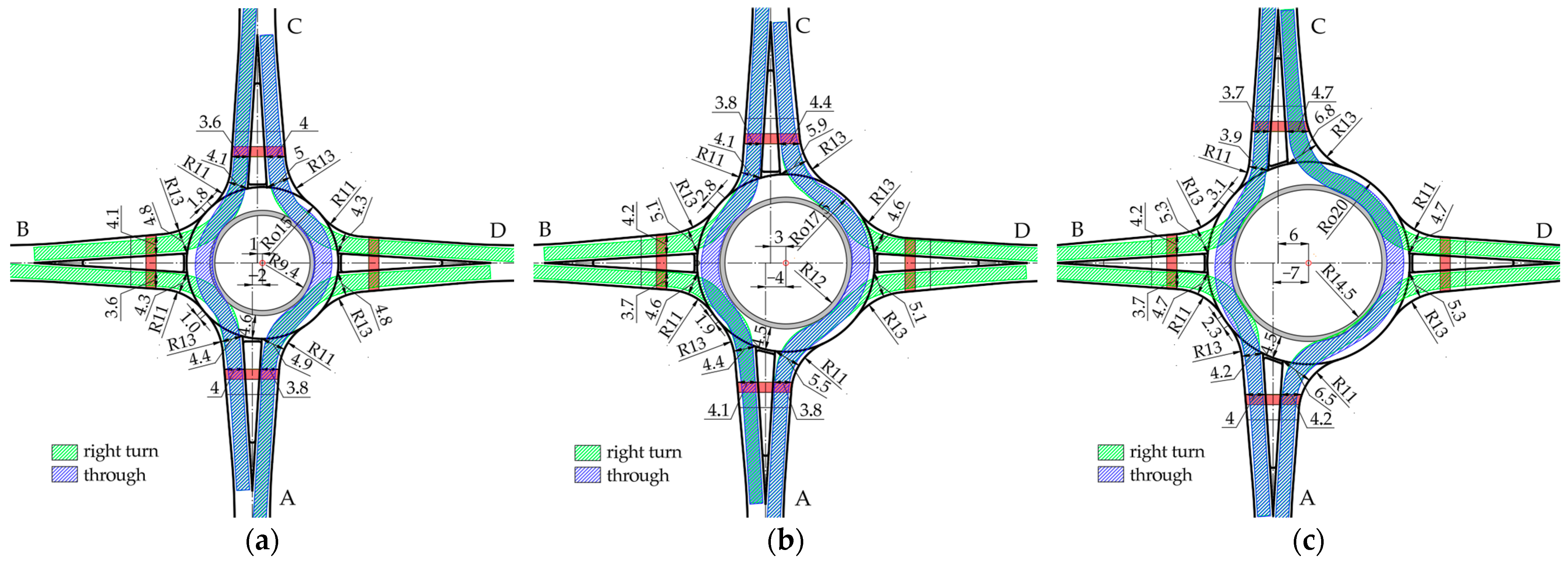
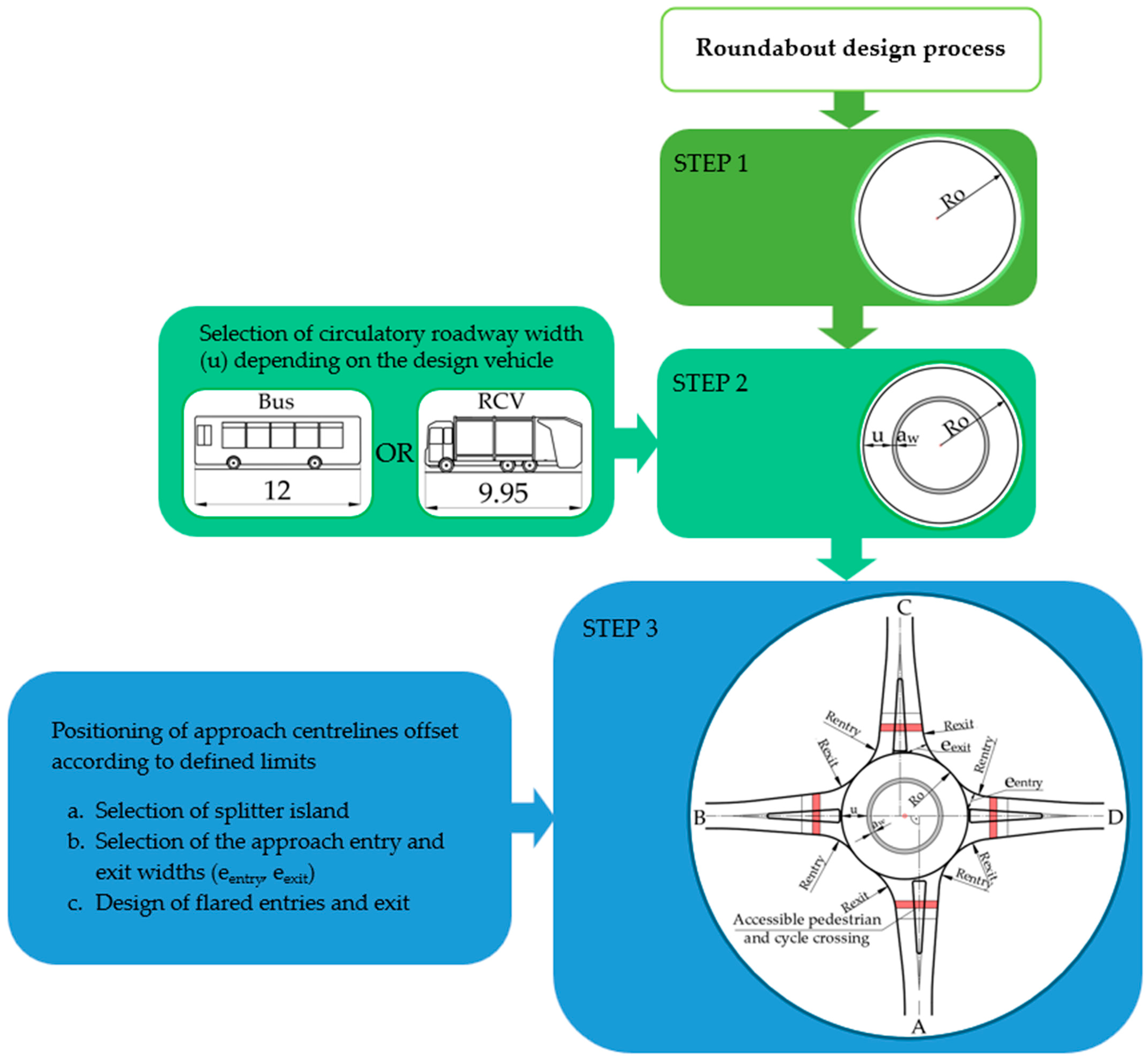
Figure 1. Geometric elements of urban single-lane roundabouts.
Infrastructures 11 00179 g001
Figure 2. Approach alignment alternatives: (a) Radial alignment; (b) Lateral alignment offset.
Infrastructures 11 00179 g002
Figure 3. Key steps in the investigation process.
Infrastructures 11 00179 g003
Figure 4. Different stages of the approach centreline offset: (a) Stage 1: No approach offset; (b) Stage 2: Approach (A) centreline offset; (c) Stage 3: Approach (A) and (C) centreline offsets. (Red coloured areas represents cycle crossings).
Infrastructures 11 00179 g004
Figure 5. Roundabout design process: (a) Design vehicle—Bus and determination of circular roadway width; (b) Swept path analysis for the determination of entry and exit widths; (c) Design vehicle—RCV and determination of circular roadway width. (red coloured areas represents cycle crossings, the letters A, B, C, and D represent the four roundabout approaches.).
Infrastructures 11 00179 g005
Figure 6. Measuring the achieved deflection of the roundabout: (a) According to the first method; (b) According to the second method; (c) According to the third method.
Infrastructures 11 00179 g006
Figure 7. Fastest path radii according to the fourth method: (a) Fastest paths; (b) Distances of the fastest path from the geometric features.
Infrastructures 11 00179 g007
Figure 8. Summary of speed and deflection analysis for bus-based roundabouts, with outer radii (Ro) ranging from 17.5 to 25 m and various approach offsets.
Infrastructures 11 00179 g008
Figure 9. Summary of speed and deflection analyses for roundabouts designed for the 9.95 m long RCV, with outer radii (Ro) ranging from 15 to 20 m and various approach offsets.
Infrastructures 11 00179 g009
Figure 10. Roundabouts with maximum approach offsets designed for the 12.0 m long bus for different outer radii: (a) Ro = 17.5 m; (b) Ro = 20 m; (c) Ro = 22.5 m; (d) Ro = 25 m.
Infrastructures 11 00179 g010
Figure 11. Roundabouts with maximum approach offsets for different outer radii designed for the 9.95 m long RCV: (a) Ro = 15 m; (b) Ro = 17.5 m; (c) Ro = 20 m.
Infrastructures 11 00179 g011
Figure 12. Roundabout design process scheme according to the created model.
Infrastructures 11 00179 g012
Figure 13. Roundabout circulatory roadway width depending on the outer radii Ro: (a) For the 12.0 long bus; (b) For the 9.95 m long RCV.
Infrastructures 11 00179 g013
Figure 14. Maximum roundabout approach offset depending on the outer radii Ro: (a) For the 12.0 long bus; (b) For the 9.95 m long RCV.
Infrastructures 11 00179 g014
Figure 15. Roundabout entry width (eentry) depending on the outer radii Ro and approach offset: (a) For the 12.0 long bus; (b) For the 9.95 m long RCV.
Infrastructures 11 00179 g015
Figure 16. Roundabout exit width (eexit) depending on the outer radii Ro and approach offset: (a) For the 12.0 long bus; (b) For the 9.95 m long RCV.
Infrastructures 11 00179 g016
Figure 17. Roundabouts with maximum approach offsets for different outer radii: (a) Ro = 18.5 m; (b) Ro = 21.5 m; (c) Ro = 23.5 m.
Infrastructures 11 00179 g017
Figure 18. Roundabouts with maximum approach offsets for different outer radii: (a) Ro = 16 m; (b) Ro = 18.5 m.
Infrastructures 11 00179 g018
Table 1. Entry and exit widths for bus-based roundabouts with various approach centreline offsets, from −12 to 0 m, and for different outer radii Ro.
Offset (m)−12−11−10−9−8−7−6−5−4−3−2−10
Ro = 15.0 m
eentry (m)------------4.5
eexit (m)------------5.6
Ro = 17.5 m
eentry (m)---------5.55.35.04.8
eexit (m)---------5.45.45.55.7
Ro = 20 m
eentry (m)------6.56.36.05.85.55.35.1
eexit (m)------5.25.25.25.45.65.86.0
Ro = 22.5 m
eentry (m)---7.67.26.96.66.46.26.05.85.65.4
eexit (m)---5.15.15.15.15.25.45.65.86.06.2
Ro = 25.0 m
eentry (m)8.98.58.17.77.37.06.86.66.46.26.05.85.6
eexit (m)5.05.05.05.05.05.15.35.55.75.96.16.36.5
Table 2. Entry and exit widths for bus-based roundabouts with various approach centreline offsets, from 0 to 12 m, and for different outer radii Ro.
Offset (m)0123456789101112
Ro = 15 m
eentry (m)4.5------------
eexit (m)5.6------------
Ro = 17.5 m
eentry (m)4.84.64.44.2---------
eexit (m)5.75.96.16.4---------
Ro = 20 m
eentry (m)5.14.94.74.54.34.14.1------
eexit (m)6.06.26.46.66.97.27.6------
Ro = 22.5 m
eentry (m)5.45.25.04.84.64.44.24.14.14.1---
eexit (m)6.26.46.66.87.17.47.78.08.48.7---
Ro = 25 m
eentry (m)5.65.45.25.04.84.64.44.34.24.24.24.24.2
eexit (m)6.56.76.97.17.37.67.98.28.68.99.19.59.9
Table 3. Circulatory roadway width for a 12.0 m long bus depending on the outer radii (Ro).
Ro (m)1517.52022.525
sp (m)5.65.04.74.54.3
u (m)7.16.56.26.05.8
Table 4. Entry and exit widths for RCV-based roundabouts with various approach centreline offsets, from −8 to 8 m, and for different outer radii Ro.
Offset (m)−8−7−6−5−4−3−2−1012345678
Ro = 15.0 m
eentry (m)------4.94.64.34.13.9------
eexit (m)------4.44.64.85.05.3------
Ro = 17.5 m
eentry (m)----5.55.25.04.84.64.44.24.14.1----
eexit (m)----4.44.54.74.95.15.35.65.96.2----
Ro = 20 m
eentry (m)6.86.56.25.95.65.35.14.94.74.54.34.24.14.03.93.83.7
eexit (m)4.24.24.34.44.54.74.95.15.35.55.76.06.26.56.87.17.5
Table 5. Circulatory roadway width for a 9.95 m long RCV depending on the outer radii (Ro).
Ro (m)1517.520
sp (m)4.13.53.3
u (m)4.64.54.5
Table 6. Design elements for bus-based roundabouts with various radii Ro and a maximum approach offset.
Ro (m)18.521.523.5
u (m)6.46.16
Approach offset (m)A B/DCA B/DCA B/DC
−0.902.2−3.105.2−4.807.2
eentry (m)5.14.94.75.95.24.36.55.54.3
eexit (m)5.65.86.35.56.17.45.46.48.2
Table 7. Design elements for RCV-based roundabouts with various radii Ro and a maximum approach offset.
Ro (m)1618.5
u (m)4.64.5
Approach offset (m)A B/DCA B/DC
−2.801.8−5.204.2
eentry (m)5.14.44.16.04.74.1
eexit (m)4.54.95.44.45.26.3
Disclaimer/Publisher’s Note: The statements, opinions and data contained in all publications are solely those of the individual author(s) and contributor(s) and not of MDPI and/or the editor(s). MDPI and/or the editor(s) disclaim responsibility for any injury to people or property resulting from any ideas, methods, instructions or products referred to in the content.