
Article

Optimizing Asphalt Modifications: Interactions Between SBS and PPA Modifiers

by
Petr Veselý
1,*,
Ondřej Dašek
1 and
Martin Jasso
2
1
Institute of Road Structures, Brno University of Technology, 602 00 Brno, Czech Republic
2
Schulich School of Engineering, University of Calgary, Calgary, AB T2N 1N4, Canada
*
Author to whom correspondence should be addressed.
Infrastructures 2026, 11(4), 140; https://doi.org/10.3390/infrastructures11040140
Submission received: 25 February 2026 / Revised: 13 April 2026 / Accepted: 16 April 2026 / Published: 19 April 2026

Abstract

This study investigates the synergistic effects of combining polyphosphoric acid (PPA) and styrene–butadiene–styrene (SBS) as modifiers in asphalt binders to enhance their performance. The research focuses on optimizing the concentrations of PPA and SBS to improve the resistance to permanent deformation, cracking at intermediate and low temperatures, and resistance to aging. A series of empirical and rheological tests, including penetration, softening point, elastic recovery, dynamic shear rheometer (DSR), multiple stress creep recovery (MSCR), and bending beam rheometer (BBR), were conducted to evaluate the rheological and engineering properties of the modified binders. The results indicate that PPA can partially replace SBS, offering comparable improvements in high-temperature performance and creep resistance. The MSCR test revealed a statistically significant synergistic effect between PPA and SBS, resulting in improved recovery and reduced non-recoverable compliance. However, PPA alone shows limited effectiveness at low temperatures and in properties that are governed by elastic response. This study highlights the potential for optimizing asphalt modifiers by leveraging the complementary properties of PPA and SBS in hybrid systems, particularly regarding high-temperature properties and dynamic loading.

1. Introduction

Asphalt mixture is the most used pavement structure all around the world. With the consequences of climate change, pavement is negatively affected by many factors, such as temperature, precipitation, humidity and solar radiation [1,2]. One of the damaging global trends is the continual increase in traffic loading. Traffic load intensification, combined with climate change effects, accelerate pavement deterioration and, as a result, increase the frequency of maintenance [3]. From this perspective, there is an increased need for paving materials with improved engineering properties that may offer additional advantages, such as a reduction in carbon emissions and economic costs. Tiancheng, Shu, Bo and Enshuo speculate in the scenario of RCP 8.5 (Representative Concentration Pathway 8.5), which is a high-emission climate scenario referred to as “business-as-usual,” projecting significant warming by 2100 due to high emissions. With an annual traffic load growth of 4%, carbon emissions by the year 2050 could increase by about 72 million tons compared to current levels, which represents a 180.7% increase [4].
To make pavements more durable and efficient, new asphalt technologies are being developed and used worldwide [5]. While the elemental composition of asphalts from various sources and produced by different technologies is largely similar, their complexity in chemical species generally leads to different responses to modification technologies. Asphalt binder is a bituminous substance with very complex chemical structures that prelude any precise molecular identification [6]. This has led to a different approach to analyzing asphalt binder based on families of compounds. These families are known as saturates (S), aromatics (A), resins (R), and asphaltenes (A), which are jointly called SARA analysis [7]. The order of SARA analysis reflects an increase in the molecular weight and polarity of the compounds [8].
Various modification techniques have been adopted to improve the properties of the asphalt binder. Most methods rely on the dispersion of a polymer under high or low shear conditions in hot asphalt. Many factors come into consideration when creating polymer-modified asphalt, including thermo-rheological and engineering properties, storage stability at high temperatures, and economic and environmental costs. Polymer modifications can be divided into three main categories: elastomers, plastomers and reactive polymers [9,10]. Common plastomer modifiers are polyolefins such as polyethylene and ethylene-vinyl acetate (EVA), which help the binder resist deformation by improving its stiffness. However, the modifications using polyolefins have inferior low-temperature flexibility, thus limiting their use in cold climates [11]. Among common elastomer modifiers belong styrene–butadiene–rubber (SBR) and copolymers of styrene and butadiene (SB or SBS). The use of an SBS triblock copolymer as an asphalt modifier was developed by the Shell Chemical Company [12]. The drawbacks of SBS modification include, for example, the coalescence of dispersed polymer particles leading to phase separation, and thus limited the transfer of properties to asphalt, and poor resistance to aging. To help with these drawbacks, a combination of different modifications may provide a solution.
To overcome the many disadvantages of SBS modification, a process called sulfur crosslinking is commonly implemented. The addition of sulfur to SBS-modified asphalt leads to the formation of a three-dimensional polymer network, which significantly enhances the thermo-rheological and engineering properties of asphalt. Improvement in relation to low-temperature properties through vulcanization of SBS is relatively limited [13] when compared to the significant enhancements in performance at high temperatures. However, Feng Zhang found that SBS+S-modified asphalt is more prone to aging compared to the corresponding binder without the addition of sulfur as a crosslinking agent [14]. Crosslinking is believed to link polymer molecules through sulfide and/or polysulfide bonds, which leads to chemical bonds between polymer chains [15]. Gui’an Wen studied the rheological properties of SBS+S-modified asphalts. The importance of the content of sulfur and SBS and the architecture of SBS were linked to morphological changes and the stability of modified asphalts at high temperature [16,17]. Jasso et al. investigated the impact of crosslinking of SBS-modified asphalt using elemental sulfur and a sulfur-based crosslinking agent. Their findings indicated that the optimum content of sulfur in SBS-modified asphalt should be between 0.12% and 0.16%, as lower concentrations were insufficient to form a fully developed polymer network. Conversely, sulfur contents exceeding 0.16% resulted in over-crosslinking, which led to a significant drop in the maximum service temperature after aging in the Rolling Thin Film Over Test (RTFOT), as well as in a deterioration of performance at low temperatures [18]. Crosslinking with sulfur is especially important at lower concentrations of SBS, as binders with less than 3.0% of SBS show the highest improvement in high-temperature properties. The use of sulfur can reduce the SBS amount in the final blend without compromising high-temperature performance [19].
Modification with polyphosphoric acid (PPA) limits the rutting potential of asphalt binder, suggesting a possible enhancement when used in combination with polymer-modified asphalt [20,21,22]. PPA is an oligomer of H3PO4, obtained through dehydration of H3PO4 at high temperatures or by dissolving P2O5 in H3PO4 at a higher temperature [23]. In the case of PPA, the origin of crude oil plays an even more significant role in determining the properties of the final product than in polymer-modified asphalt [24]. PPA interactions with individual SARA components is the topic of debate in many papers. Orange et al. suggested that PPA protonates basic sites, resulting in a loss of hydrogen bonds resulting in a breaking of asphaltenes. This results in a dispersion of smaller asphaltene domains. He also maintained the view that PPA does not induce any reaction with asphaltenes [25]. On the contrary, different papers suggested that the addition of PPA alters binders’ chemical composition, specifically the conversion of some portion of aromatics to resins and resins to asphaltenes [26]. Shahriar and Zahid hypothesized that asphaltene content increases linearly with PPA content, which would correspond with one of the proposed mechanisms mentioned above [27].
When comparing the chemical modification of asphalt by PPA to traditional polymer modifications, we can point to a few apparent benefits of PPA. These advantages include a lower dosage (compared to polymer modification), a reduced mixing temperature, which reduces greenhouse emissions, and a simpler mixing and modification process [28]. Thermo-rheological advantages of PPA modification are mostly highlighted by the improvement of high-temperature properties of asphalt binder, which leads to better rutting resistance [29,30]. At low temperatures, the addition of PPA improves creep stiffness but at the same time decreases the m-value, thus worsening performance at low temperatures [31]. The decrease in the m-value by PPA impairs the ability of the binder to dissipate applied stress, thus lowering its relaxation properties [32]. As mentioned before, PPA modification is heavily dependent on binder origin, which manifested itself in Hongying’s study where the Burgers model was applied for multiple nonlinear analysis. It was reported that the addition of PPA to asphalt may result in a better resistance to deformation at low temperatures, and stress relaxation was improved by adding PPA [33]. Some studies on the effects of PPA suggest that chemical modification by PPA alone may weaken the performance of the original binder. The PPA content proposed by Ge, Yan and Lou is 1.0% maximum to guarantee the low-temperature properties of the original binder [34]. This value could, of course, be changed when used in combination with other modifications.
Hao et al. investigated the performance of asphalt binders modified by a combination of SBR and PPA at high and low temperatures. It was found that the addition of PPA improves resistance to rutting, while the low-temperature properties were not significantly affected [35]. There is a proven linear relationship in the PPA/SBS ratio and their rheological properties at high temperature. Behnood and Olek found that 2% SBS was equivalent to 0.6% PPA and 4% SBS was equivalent to 1.2% PPA in the tested binder [36]. Liu, Li and Zhang replaced 1% SBS with 0.5% PPA and found that the difference in the stiffness of the modified asphalt was very small, but the m-value worsened. More testing needs to be done to draw general conclusions on the replacements of SBS with PPA. However, results indicate that PPA could be used to potentially replace a small amount of SBS to reduce viscosity and mixing temperature without affecting other properties. The addition of PPA into polymer-modified asphalt could negatively affect storage stability at hot temperatures and promote the transformation of asphalt from sol to gel. Storage stability at hot temperatures can be further improved through chemical crosslinking induced by sulfur [13]. Yalon tested the SBR- and PPA-modified asphalt in relation to adhesion strength on an aggregate-binder scale and found independent statistically significant improvement with both used modifications. Although both modifications improved adhesion individually, any additional benefits based on combining modifiers remain unclear [37].
The scope of this work is to formulate modified asphalts that cannot be achieved by PPA or (SBS+S) alone, i.e., PPA can stiffen asphalt further than SBS modification alone, while SBS will maintain the low-temperature properties of the final blend. Additionally, the paper aims to determine whether the (SBS+S) and PPA relationship is only additive or if there is any interaction between them. The paper does not simply focus on the rate of replacement of SBS by PPA but more on the synergistic properties of the combined system. If a statistically significant synergistic effect is established by the paper, it could lead to a more efficient modification process in specific cases of use. The developed relationship will allow formulations suitable for extreme conditions or potentially allow formulations with a reduced concentration of modifiers without sacrificing the performance.

2. Materials and Methods

Straight-run asphalt manufactured by Cenovus Energy (Lloydminster, AB, Canada) of a penetration grade of 80/100 was selected as a base binder for the modification process in this study. Table 1 shows all the tested properties of the base binder to demonstrate the positive effects of separate modifications.
Kraton D1101, a thermoplastic elastomer defined as a linear triblock medium-molecular-weight copolymer of styrene and butadiene with an average content of styrene of 31 wt.%, was used as the polymer modifier. This product was supplied by Kraton Performance Polymers, Inc. (Houston, TX, USA). Technical sulfur, with solubility in CS2 in the range from 95.5 to 96.5% (Cenovus Energy, Calgary, AB, Canada), was used as a crosslinking agent. Selected crosslinked PMAs were further modified by PPA 115 (containing 83.3% of phosphorus pentoxide) from Innophos Inc. (Cranbury, NE, USA). PPA for the preparation of modified asphalts was used as received.

2.1. Sample Preparation

A Face-Centered Factorial Design of Experiments (DOE) was used to evaluate the statistical effects of selected factors on the selected properties of the studied system, which was interpreted within the framework of response surface methodology (RSM), including interaction effects between variables. The first factor was represented by the concentration of SBS in the blend, ranging from 2% to 4% by weight of asphalt, while the second factor was the concentration of PPA, ranging from 0.25% to 0.75% by weight of asphalt. The concentration of SBS covered the formation of a weak and fully developed crosslinked polymer network. A center block, consisting of 3% SBS with 0.5% of PPA, was replicated 3 times to identify errors during preparation and measurements. In total 11 blends of modified asphalt were created for this study.
The selected PPA dosage range (0.25–0.75% by weight of asphalt) was chosen based on commonly reported application ranges and practical considerations. Previous studies and industry guidelines indicate that PPA is typically used within approximately 0.25–1.0 wt.% (up to 1.5 wt.% in some cases), depending on the required level of modification. The lower bound (0.25 wt.%) represents a minimal effective dosage, while the upper limit (0.75 wt.%) was selected in accordance with commonly applied practical limits in North America and to avoid excessive increases in viscosity and potential processing issues. The selected range therefore allows for evaluation of the modification effect while remaining within technologically relevant and safe application limits [38,39].
It should be noted that, in practical applications, higher PPA dosages may also be limited by factors such as potential corrosion effects. One of the most significant concerns with PPA is proper storage. PPA is highly hygroscopic; thus, an absorption of moisture by PPA increases its corrosivity. This also poses safety risks, such as splashing and foaming, during modification of oil-based materials such as asphalt at very high temperatures.
All asphalt blends were prepared following the same blending procedure. In the first step, a specific amount of PPA was incorporated into asphalt under high shear conditions until it was properly dissolved. In the second step, SBS was added to modified asphalts under high shear conditions and blended until no separate particles of polymer were observed. The last step was the crosslinking of prepared modified asphalts with 0.12% of sulfur by weight of PMA. The method used for preparation of modified asphalts, originally developed by the Bituminous Materials Chair at the University of Calgary, was adapted in this study. Detailed information about the modification method is provided in [40].
The order of addition (PPA → SBS → sulfur) was selected intentionally. The pre-treatment of asphalt with PPA may alter the colloidal structure of the binder and influence the subsequent swelling and dispersion of SBS. As a result, the interaction between PPA and SBS in this study reflects this specific processing sequence. It should be noted that different blending orders could lead to different morphological and rheological outcomes and were not investigated within the scope of this work.
For easier comparison of samples, labeling of S2, S3, and S4 and P25, P50 and P75 was used. For example, sample S2P75 has a concentration of 2% SBS and 0.75% PPA by weight. In the case of the repeating center block, designations of S31P50, S32P50 and S33P50 were used. For the clarity of the conclusions, the mean values of samples S31, S32, and S33 were calculated and designated as S3P50. All information regarding the DOE is shown in Table 2.
Samples of asphalt were collected in all blending stages and were analyzed by transillumination microscopy and FTIR spectroscopy.

2.2. Aging of Asphalt

During the mixing process, volatile components of asphalt evaporate due to high temperatures. To simulate this short-term aging in a laboratory, the RTFOT in accordance with AASHTO T240 [41] was performed. As the organic compounds present in asphalt react with atmospheric oxygen, the overall composition of asphalt changes, resulting in an increased stiffness. During the service life of a pavement, asphalt binder gradually ages and becomes stiffer, resulting in brittle asphalt that is prone to cracking. Long-term aging was simulated in a laboratory in a Pressure Aging Vessel (PAV) in accordance with AASHTO R28 [42].
All prepared modified asphalts were exposed to short-term and long-term aging through these laboratory tests (RTFOT aging at 163 °C for 88 min, adjusted from 85 min due to the high altitude of Calgary and PAV aging for 20 h with a 2.10 MPa air pressure and 100 °C temperature).

2.3. Testing of Modified Asphalt

The physical and mechanical properties of prepared modified asphalts were evaluated through a series of different methods. These included measurements of penetration at 25 °C, softening point, and elastic recovery at 25 °C, performed in accordance with ASTM D5 [43], ASTM D36 [44], and ASTM D6084 [45], respectively. The measurement of viscosity at 135 °C was conducted with the Brookfield viscometer in accordance with AASHTO T316 [46].
Several rheological tests were conducted to measure the relevant rheological properties. Temperature sweep and Multiple Stress Creep and Recovery (MSCR) tests were performed using a Kinexus rheometer equipped with parallel plates 25 mm in diameter and with a 1 mm gap to evaluate the rheological behavior of unaged and RTFOT-aged binders at high temperatures. A temperature sweep test was performed at 10 rad/s with temperature increments of 6 °C between measurements in accordance with the AASHTO T315 [47].
For PAV-aged binders, an 8 mm plate geometry with a 2 mm gap was used due to the significantly higher stiffness of the binder. This geometry allows for more accurate measurement by maintaining the torque within the optimal range of the rheometer and improving strain resolution. The use of a smaller plate diameter for stiff, aged binders is consistent with standard rheological practice to ensure the reliable measurement of high-modulus materials. Testing conditions for temperature sweep tests are presented in Table 3.
The MSCR test in accordance with AASHTO TP 70 [48] was used to determine the creep and recovery behavior of modified binders by applying stresses of 0.1 kPa and 3.2 kPa. The testing temperature for all samples was 70 °C. The test consisted of 1 s of loading cycle followed by 9 s of recovery cycle. Ten of these cycles were performed for both stress values.
Table 3. Test conditions according to AASHTO M320 [49].
BinderShear Strain [%]Condition
Original12|G*|/sinδ ≥ 1.0 kPa
RTFO—aged10|G*|/sinδ ≥ 2.2 kPa
PAV—aged1.0|G*|.sinδ ≤ 5000 kPa
Low-temperature properties of the modified asphalts were evaluated by a Bending Beam Rheometer (BBR) in accordance with AASHTO T313 [50]. The modified binders were exposed to RTFOT and PAV aging processes. Two different low-temperature values were obtained. The first temperature was defined as the temperature at which the creep stiffness (S) of the tested material reached 300 MPa. The second temperature was defined by the m-value equal to 0.3. Minimum service temperature was determined as the higher of these temperatures and subtracted by 10 °C as per AASHTO T313.
Fourier Transform Infrared Spectroscopy (FTIR) was used to analyze the changes in the functional groups of asphalt modified by SBS and PPA. The spectra were recorded in the range of 4000 to 625 cm−1, using 32 scans at a resolution of 4 cm−1 by the attenuated total reflection (ATR) method on a Nicolet iS10 spectrometer from Thermo Fisher Scientific.
The effects of varying concentrations of modifiers on the morphology of prepared modified asphalts were evaluated by a transillumination microscope Zeiss Axioscope 5 equipped with a digital camera Axiocam IC5.

3. Results and Discussion

To evaluate the effects of PPA and SBS on modified asphalt blends, various properties were measured and are presented in Table 4.
Analogously, the results for tested binders with various concentrations of SBS and PPA according to Superpave binder specifications are shown in Table 5. As the effects of PPA on the improvement of low-temperature properties, especially regarding m-value, are heavily debated, the results of the BBR test in Table 5 are divided into two categories.
The impact of SBS and PPA was analyzed through a detailed evaluation of the statistical significance of effects, as represented by the coefficients of the regression equation:
Y ( x 1 , x 2 ) = b 0 + b 1 x 1 + b 2 x 2 + b 11 x 1 2 + b 22 x 2 2 + b 12 x 1 x 2 ,
where Y(xi) represents the evaluated parameter and bi are coded regression coefficients. The first factor, x1, represents the concentration of crosslinked SBS, and the second factor, x2, is the concentration of PPA.
Table 6 summarizes the statistical significance of linear (SBS and PPA), quadratic (SBS2 and PPA2) and interaction (SBS*PPA) effects. It should be noted that the coefficients labeled as bold with a light grey background are statistically significant at the 95% confidence level. Additionally, Table 7 summarizes the Fisher–Snedecor test results FS1 and FS2. These indicate the strength of linear and nonlinear relationships in the data, respectively. The standard deviation of the lack of fit (SLF) reflects the deviations from the predictions of the statistical model.
Based on the results from Table 7, several properties exhibit predominantly nonlinear behavior, as indicated by high FS2 values, particularly viscosity, penetration, elastic recovery, and RTFOT-aged maximum service temperature. This suggests that interaction effects and/or curvature play an important role in describing these responses.
In contrast, properties such as softening point, maximum service temperature (original), and intermediate service temperature (PAV) show relatively low FS2 values, indicating a more linear response within the studied range.
Regarding model adequacy, most properties show an acceptable lack of fit (SLF > 0.05), suggesting that the selected regression models provide a reasonable description of the experimental data.
Overall, these results confirm that the response of the studied system is parameter-dependent, with some properties being well described by relatively simple models, while others exhibit more complex, nonlinear interactions between SBS and PPA.
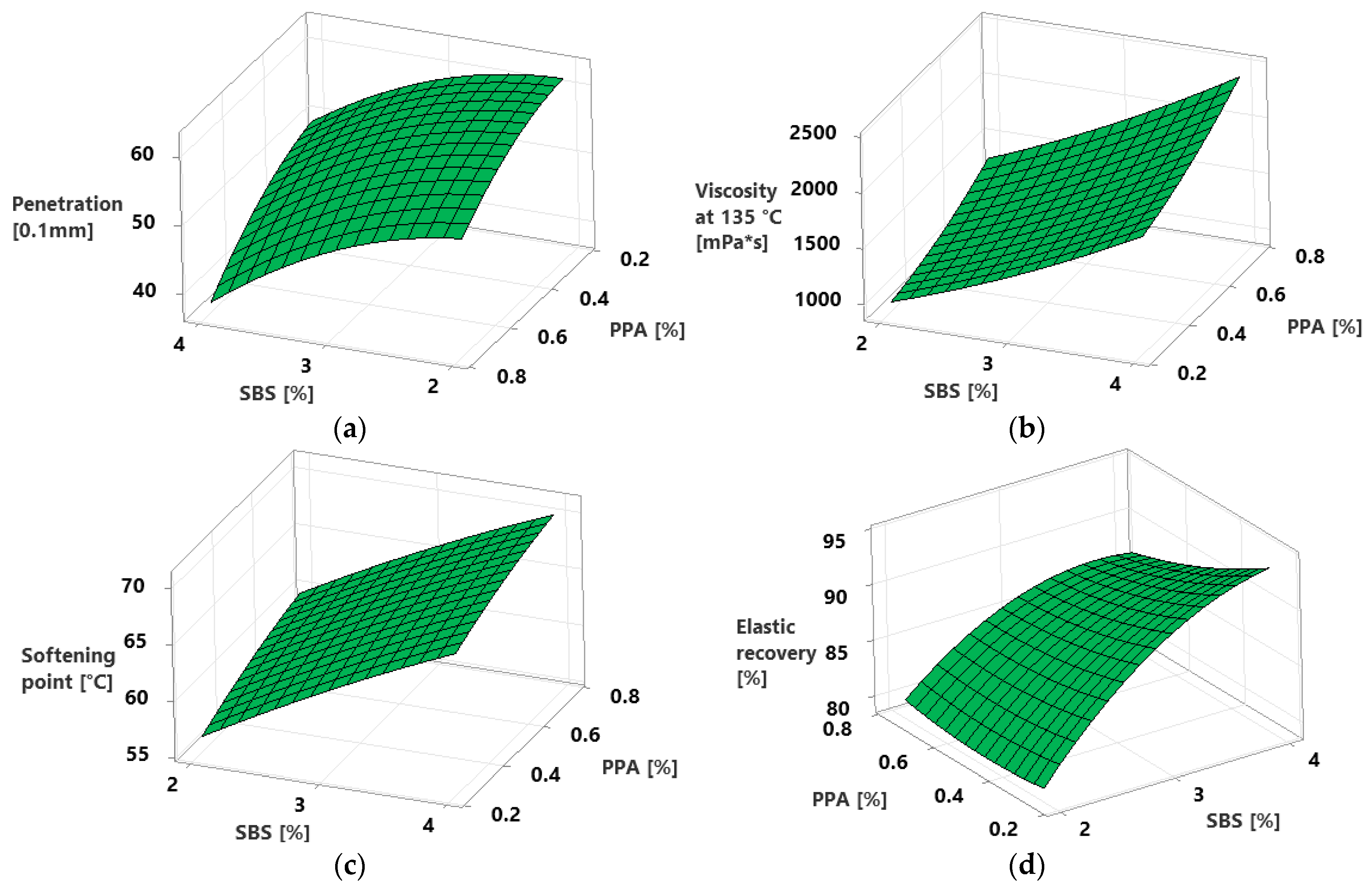
Three-dimensional surface plots were used to better illustrate the individual impact of SBS and PPA modification technologies, as well as their mutual interactions. Figure 1a shows the influence of SBS and PPA on the values of penetration measured at 25 °C in accordance with ASTM D5. From this figure, it is evident that both modification technologies had a significant effect on the resulting penetration values, with increasing concentrations of modifiers leading to lower penetration values. The interaction between PPA and SBS was not found to be statistically significant. Although a slight curvature can be observed in the response surface, this should not be interpreted as a meaningful interaction effect within the studied range.
One of the tests evaluating binders’ suitability in transport, storage and handling is viscosity. According to AASHTO T316, the maximum viscosity at a temperature of 135 °C is limited to 3000 mPa*s. The surface plot for viscosity is shown in Figure 1b. The increasing concentration of each modifier resulted in a linear increase in viscosity. The appearance of a flat surface is consistent with the regression coefficients reported in Table 6 and confirms the absence of interaction between the modifiers. A higher value of viscosity with the addition of modification is an expected result and aligns with the known fact that adding SBS increases stiffness at high temperatures. The mechanism of asphalt modification with PPA suggests a complex alteration of the colloidal system. The combination of this effect with SBS modification would be expected to produce a stronger nonlinear response; however, these effects were completely diminished at the high testing temperature [14].
The softening point temperature, as shown in Table 4 and Figure 1c, increased consistently and almost linearly with both types of modification. Even at higher concentrations, the improvement remained linear, suggesting that the combined effect of the two modifiers does not result in any notable synergistic enhancement of the softening point. This was also supported by the regression coefficients presented in Table 6.
Figure 1d shows the surface plot of elastic recovery, measured at 25 °C, which was the final physical property evaluated. The results indicate that elastic recovery is primarily influenced by the amount of polymer. A higher polymer content leads to stronger elastic recovery. Although the effect of PPA was not shown to be statistically significant, the regression coefficient in Table 6 suggested a reduction in the elastic recovery with an increasing concentration of PPA. This observation was confirmed by the sample S4P75, which exhibited a slight decrease in elastic recovery percentage.
The empirical tests and specifications offered insight into the effects of asphalt modification with PPA and SBS. It is generally understood that the descriptive nature of these tests and the lack of performance-based models do not provide information that can be directly related to in-service performance, particularly at the temperatures asphalt typically experiences during its service life. Furthermore, the ill-defined test conditions of conventional methods do not have to adequately capture the performance characteristics of modified asphalts. From this perspective, the impact of SBS and PPA modification technologies was evaluated according to the Superpave binder specification.
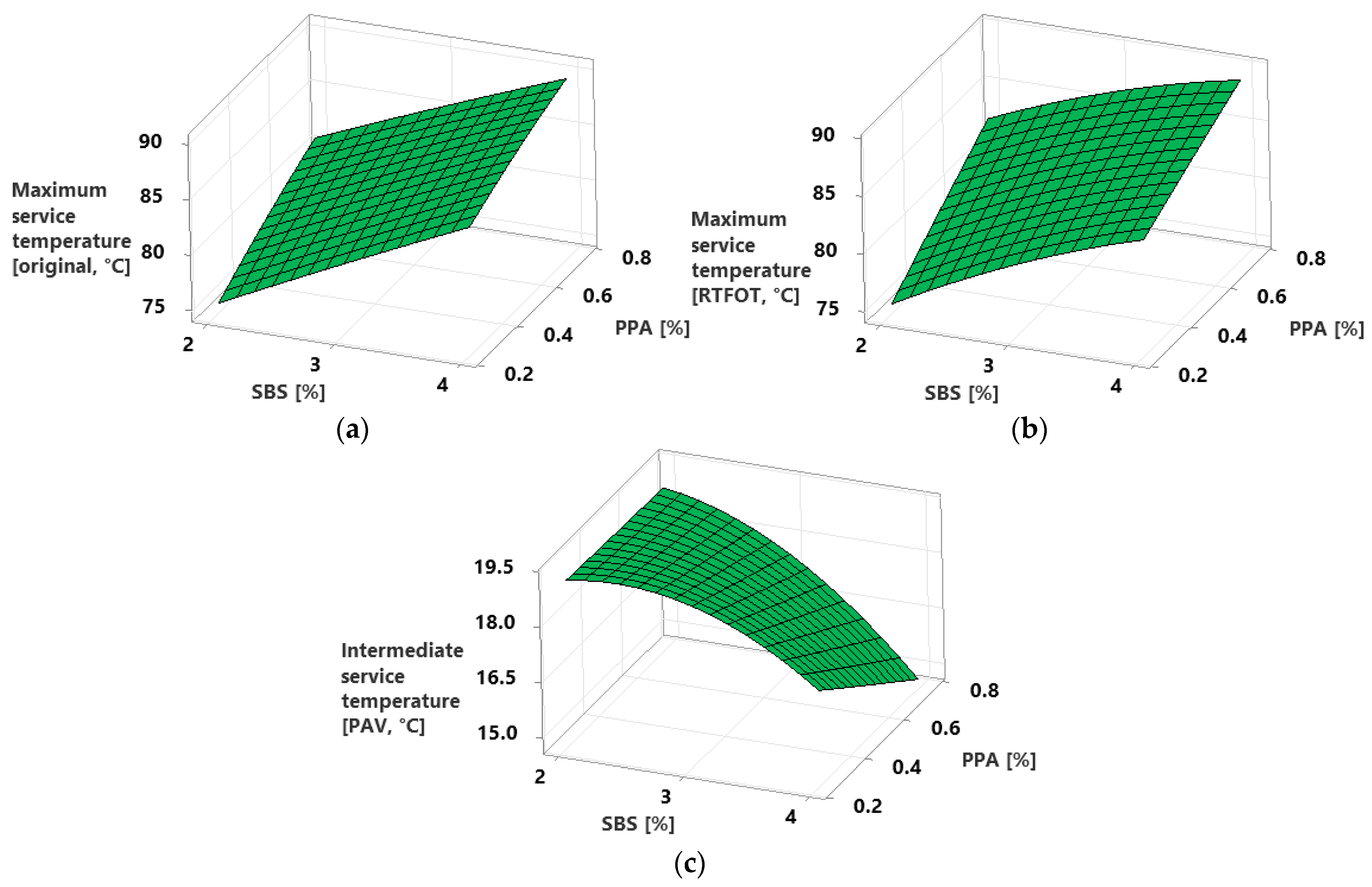
The maximum service temperature of unaged modified asphalts, presented in Table 5 and Figure 2a, demonstrated a clear improvement with the application of both modification technologies. The presented results suggested the potential for partial replacement of SBS with lower amounts of PPA while achieving comparable performance. This suggests that PPA can contribute to the rheological enhancement of asphalt, offering an alternative approach to achieving desirable high-temperature properties. The analysis of the rutting parameter |G*|/sinδ ≥ 1.0 kPa further supports these findings, indicating improved rutting resistance across the modified binders. The maximum service temperature of the modified asphalts reached 89.8 °C at the highest concentrations of both modifiers. This increase suggests that both SBS and PPA contribute to the enhancement of the material’s resistance to deformation at high temperatures. These findings correspond with the discussion in the introduction section of this paper, proving that both modifications contribute to the higher stiffness of the binder. However, regression coefficients in Table 6 indicate that both modifications contribute independently to the improvement rather than exhibiting a synergistic effect.
The results presented in Table 5 and Figure 2b show that the maximum service temperature of modified asphalts after RTFOT aging remained like values obtained for the unaged conditions. However, binders modified with higher concentrations of PPA, particularly in combination with 2% and 3% SBS, showed an increase in the values of maximum service temperature by 1.4 °C and 1.7 °C, respectively. Although this may suggest that higher PPA concentrations improve the binder’s resistance to aging, an alternative scenario should be considered. RTFOT aging is based on the thermo-oxidative aging of a thin film of asphalt, which is continuously renewed by the rotation of the bottles during the test. The increased viscosity of SBS-modified asphalt due to the addition of PPA may hinder the renewal of the asphalt film, thereby reducing the extent of thermo-oxidative aging of asphalt as well as of the crosslinked polymer network. However, this statement is hypothesized, and a full study should be performed to prove or refute the theory. No foaming behavior was observed during the RTFOT procedure for any of the tested binders. The measured mass loss ranged between 0.31 and 0.44 wt.% for all samples, with no clear correlation to the concentration of SBS or PPA. Interestingly, asphalts containing the highest concentration of SBS had slightly lower values of maximum service temperature than those of the original binder. However, it is important to note that the observed deviations were very small, remaining within 1.3 °C, and thus do not present any concerns regarding the binder’s performance or aging resistance. Similarly to the results for the unaged modified asphalts, the impact of modification technologies on the values of maximum service temperature after RTFOT aging did not show any synergistic effects.
In the case of the PAV-aged binder, the results in Table 5 and Figure 2c indicate a trend where the effect of PPA appears more evident at higher concentrations of SBS. However, the regression analysis in Table 6 shows that neither the effect of PPA nor the interaction between PPA and SBS is statistically significant for the intermediate temperature.
This suggests that, within the studied range, the influence of PPA on long-term fatigue-related performance is limited and cannot be meaningfully distinguished from experimental variability. These findings imply that, within the studied range, PPA may not provide meaningful long-term improvements to the binder’s resistance to fatigue cracking. The aging response of PPA-modified binders may differ from that of conventional systems, particularly with respect to oxidative and thermo-mechanical processes. Although standard RTFOT and PAV procedures were used, these methods may not fully reflect the complexity of aging in such systems.
It should be noted that previous research by Kriz et al. showed a significant error and poor repeatability of the measurement of the intermediate service temperature, defined as a |G*|. sinδ [51]. This may affect the reliability and sensitivity of the method when evaluating subtle differences between formulations. Therefore, the results obtained for intermediate temperature should be interpreted with caution and considered as a limitation of the present study.
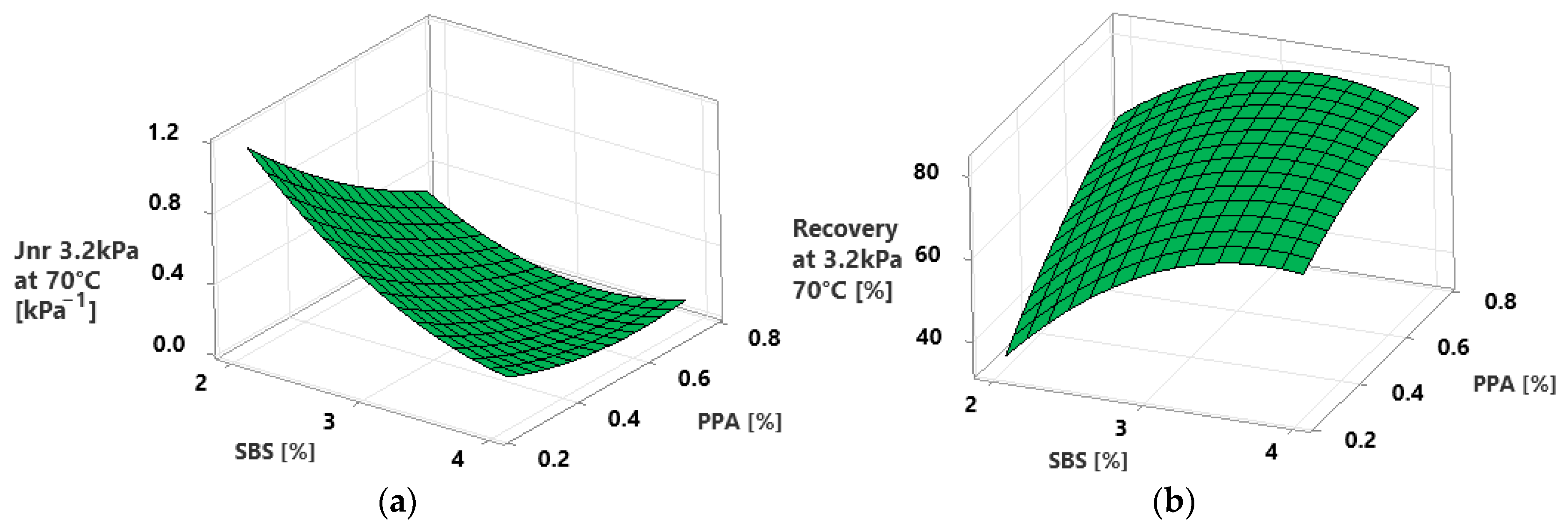
The MSCR test provides critical insights into the creep and recovery behavior of modified asphalt binders, making it a valuable tool for evaluating performance. Due to its effectiveness, many countries have incorporated the MSCR test into their standards, establishing specific requirements for asphalt binders. These requirements are generally unattainable for straight-run asphalt binders, making the use of modifiers necessary to meet performance criteria. Among the tested modification technologies, the combination of PPA and SBS has shown particularly promising results in the MSCR test, as stated in Table 5 and Figure 3a,b. Improvements in non-recovered compliance function (Jnr 3.2 kPa at 70 °C) and a percentage recovery (at 3.2 kPa and 70 °C) were observed with increasing concentrations of both modifiers across all tested binders. Furthermore, the regression coefficients in Table 6 indicated that PPA and SBS do not just contribute to improved performance individually, but their synergy is also statistically significant. Interestingly, while the interaction between PPA and SBS led to lower Jnr values, the statistically significant interaction effect observed in percent recovery resulted in more peculiar behavior. The values of percentage recovery increased with the increasing concentration of SBS. With the introduction of a small concentration of PPA, values of percentage recovery attained a maximum when the content of SBS was about 3%, showing little to no further increase with additional SBS. When a higher concentration of PPA was used, the percent recovery again peaked at approximately 3% SBS. However, further increases in polymer content led to lower percentage recovery values. The nonlinear response surfaces and the curvature observed in the plots indicate that the combined effect of SBS and PPA is not purely additive. This behavior confirms the presence of interaction between the two modifiers.
The MSCR test evaluates the binder’s behavior under repeated stress and recovery cycles, simulating real-world traffic conditions. In general, a lower stress level results in a linear viscoelastic response of the studied modified asphalts, whereas a higher stress level leads to behavior outside of the linear viscoelastic region. However, the actual response depends on the specific binder composition and testing temperature. This allows the evaluation of the individual contributions of modifiers and their synergistic interaction to be manifested more clearly. PPA enhances the binder’s stiffness and thus performance at high temperatures, while SBS introduces rubber-like elasticity. Under the cyclic stresses of the MSCR test, these complementary properties work together to improve Jnr 3.2. This mechanism, however, does not explain the percentage recovery. At the same time, it is possible to assert that the lack of statistical relevance of the interaction factor SBS/PPA on previous tests could be due to the inadequacy of the conventional tests to assess complex rheological materials.
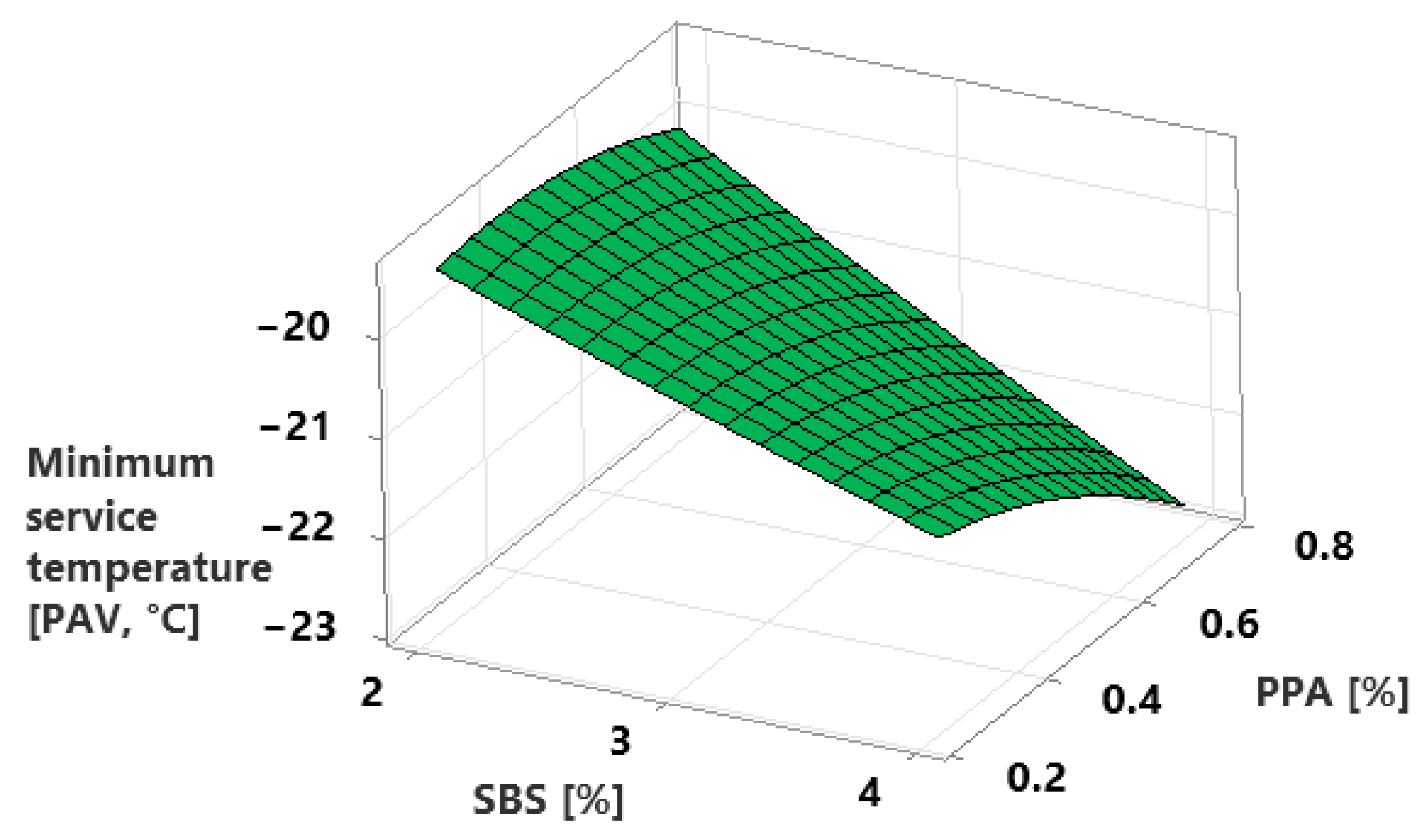
The minimum service temperature of prepared modified asphalts was tested using BBR in accordance with the Superpave binder specification [52]. The results showed improvement with higher concentrations of SBS, whereas the addition of PPA improved behavior at low temperatures only when combined with an increased content of SBS in the blend. The results reported in Table 5 and Figure 4 confirm that the addition of PPA improves the low-temperature properties of prepared modified asphalts when considering stiffness S. The relaxation properties defined by the m-value seem to be influenced predominantly by SBS. This fact is supported by Table 6, stating that the addition of PPA is not statistically significant in the evaluation of the minimum service temperature based on the m-value.
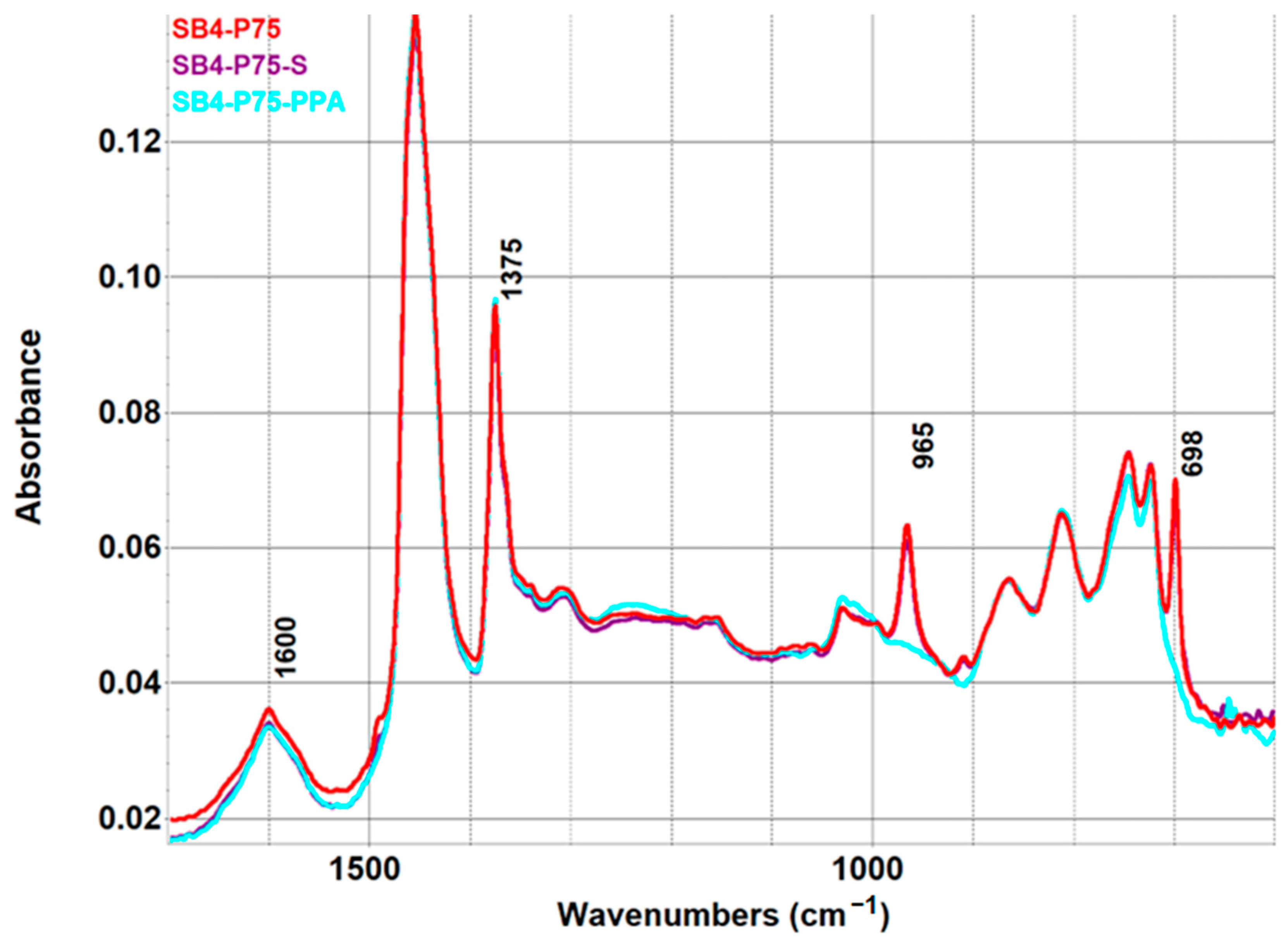
The FTIR spectroscopy was used to evaluate the modification-induced changes in the composition of functional groups of the asphalt. The sample selected for the FTIR analysis contained the highest concentrations of modifiers, specifically 4% SBS crosslinked with sulfur and 0.75% PPA. Figure 5 shows the fingerprint region of the FTIR spectra for the modified asphalt at various stages of modifier addition. The addition of PPA (SB4-P75-PPA) did not result in changes of the functional groups of asphalt. This observation corresponds with the literature [40], which indicates that although phosphorus is not naturally present in asphalt, its detection is challenging and typically requires extensive analytical procedures to confirm its presence. Once SBS was added (SB4-P75), two new peaks appeared. The first peak was located at a wavelength of 965 cm−1 and can be associated with the out-of-plane C=C bending vibration of the polybutadiene chain. The second peak, observed at 699 cm−1, corresponds to the C=C bending vibration characteristic of the polystyrene. In the final step of the modification process, the crosslinking with sulfur took place (SB4-P75-S). The reduction in peak intensity at 965 cm−1 during the initial stage of crosslinking suggests the onset of formation of a three-dimensional polymer network within the asphalt. A quantitative evaluation using carbonyl or sulfoxide indices was not performed, as no significant differences were observed in the FTIR spectra between the tested samples.
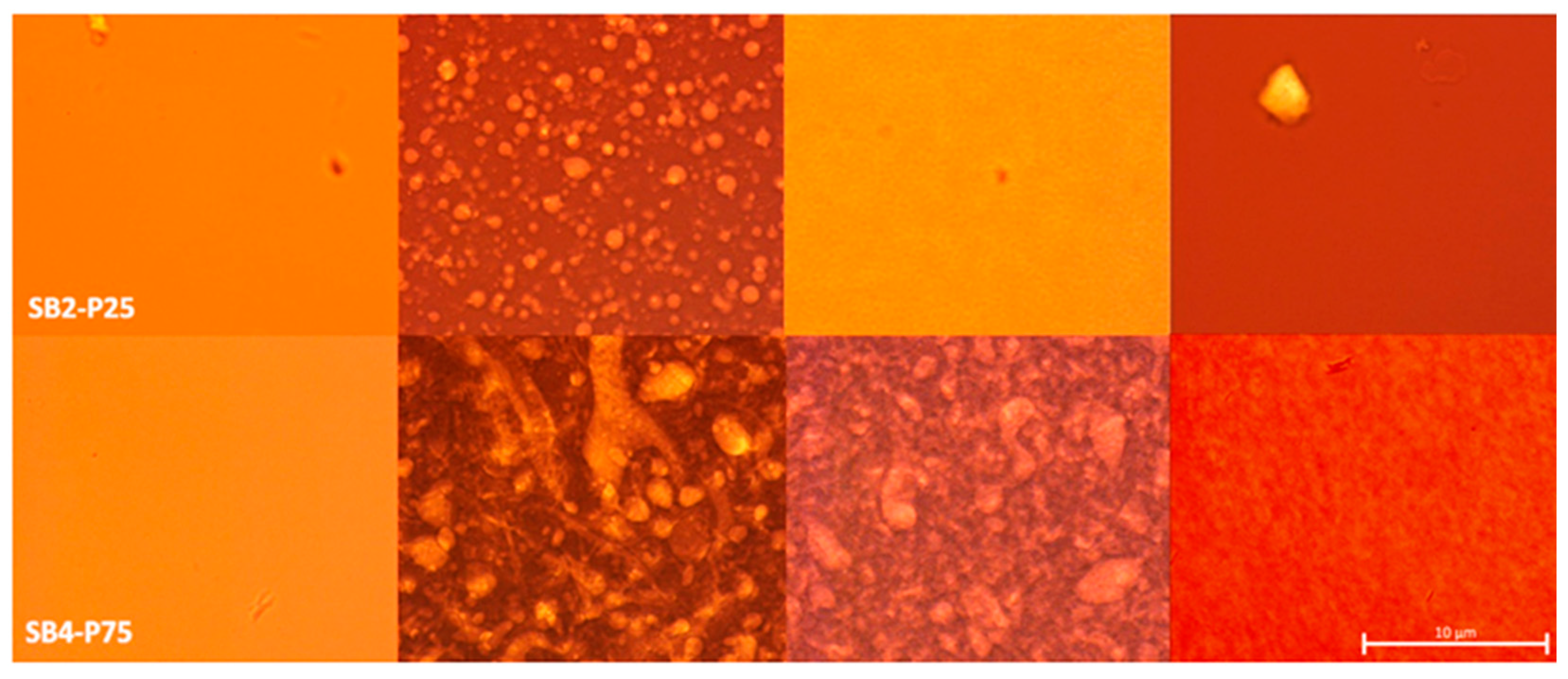
Although the FTIR spectroscopy could be considered a powerful tool for the evaluation of changes in the composition of functional groups in asphalt, it did not provide any information about the potential interactions between PPA and SBS. From this perspective, transillumination microscopy at four stages of blending was used to investigate these interactions: first, after the addition of PPA; second, after the addition of SBS; third, following the addition of sulfur; and finally, at the end of the crosslinking reaction. The change in the morphology of the asphalt blends remained consistent across all blends during their production steps. Therefore, only the samples with the lowest and highest amounts of SBS and PPA are shown in Figure 6.
Modification using PPA is not visible in transillumination microscopy, as it is a chemical modification. This is evident from the images, where even the highest concentration of PPA did not result in noticeable changes in the morphology of the binder.
The incorporation of SBS was done under high shear conditions, resulting in the formation of ultra-fine particles that swell by absorbing the oily phase of the asphalt. In the absence of sulfur, SBS begins to aggregate into larger particles/clusters, which gradually separate from the asphalt. The size of these particles increases with increasing content of SBS in the binder. When sulfur is added to SBS-modified asphalt, the ultra-fine dispersed particles of polymer are stabilized through the formation of mono-, di- and polysulfide bonds, creating a three-dimensional polymer network.
In binders containing 2% SBS and 0.25% PPA, a crosslinked structure formed relatively fast. However, asphalt modified with 4% SBS and 0.75% PPA did not develop a fully crosslinked structure within the same timeframe. Although the polymer domains were generally smaller with the introduction of sulfur, the polymer-rich phase was still clearly observed.
The morphology of prepared samples was examined after additional curing time in a laboratory oven at high temperatures. This extended curing time significantly reduced the size of polymer-rich domains in the sample containing 4% SBS and 0.75% PPA; however, the resultant structure still contained visible polymer fragments, sometimes addressed as “grainy” structure. The morphology of modified asphalts may be used for the evaluation of the hot-storage stability of PMAs. The presented structure after the additional curing time of sulfur-crosslinked PMA samples containing 2% SBS, 0.25% PPA and 4% SBS, 0.25% PPA suggest the formation of a three-dimensional polymer network that will be kinetically stable during isothermal hot storage.
The morphology of modified asphalts illustrated in Figure 6 provides a crucial missing link in understanding the modification mechanism of asphalt modified by PPA and SBS crosslinked with sulfur. As mentioned in the theoretical review, there are two primary mechanisms by which PPA modifies asphalt. The first mechanism, presented by Orange [25], involves the “fragmentation” of asphaltenes into smaller domains. It is assumed that fragmented asphaltenes require a sufficient amount of “oily” fractions (saturates and aromatics) to stabilize the asphaltene micelles. The second mechanism presented by Masson and Baumgardner [26] involves complex chemical reactions that result in the conversion of a portion of aromatics into resins and resins into asphaltenes. While saturates are considered chemically stable in this process, a portion of the aromatics is consumed for formation of higher-molecular-weight polar compounds. The reduced amount of “oily” fractions (saturates and aromatics) is addressed in the literature [40] as “drying” of the colloidal system of asphalt. As the content of PPA increases, drying (reduction) of the oily fractions and subsequent formation of asphaltenes stabilized by resins could lead to the transition from a sol-like state to sol–gel colloidal state and in extreme cases to gel-like asphalt. Lastly, a combination of both mechanisms should not be neglected. The proposed mechanisms may influence the development of the SBS network and thus the performance of modified asphalt.
In the case of a low concentration of SBS and PPA (SB2-P25), it can be hypothesized that the asphalt had a sufficient amount of “oily” fractions to support both the effects of PPA and the swelling of SBS. This assumption is consistent with the observed microstructure.
In the second presented scenario, sample SB4-P75 (Figure 6, second row), a higher concentration of PPA promotes increased conversion of the aromatics into resins and resins into asphaltenes. This shift in fractional composition results in the partial depletion of oily fractions, particularly aromatics, and a higher concentration of asphaltene micelles. As a consequence, PPA-modified asphalt has higher structural stiffness, which significantly improves performance at high temperatures.
The alteration of the colloidal system by a higher concentration of PPA may also influence the subsequent modification with polymers. Firstly, the “dried” colloidal system contains an insufficient amount of aromatics to enable optimum swelling of a higher concentration of SBS. Secondly, the increased concentration of asphaltene micelles combined with reduced oily fractions decrease interparticle spacing. As a result, asphaltene micelles as well as polymer droplets are brought closer together. The combination of both discussed effects is demonstrated in Figure 6, column 2. After crosslinking with sulfur, polymer droplets were smaller; however, they were still visible by transilluminated microscopy (Figure 6, column 3). The presence of distinct polymer structures in such imaging techniques generally indicates limited compatibility between the polymer and asphalt or an insufficient amount of the crosslinking agent. Both effects generally lead to issues with storage stability at high temperatures.
The additional isothermal storage of SB4-P75 at a high temperature significantly reduced the size of the polymer droplets (Figure 6, column 4). As the crosslinked network was likely already formed during the crosslinking step, the reduction in droplet size may be attributed to further swelling of the polymer phase by oily fractions trapped within the structure of asphaltenes and/or to a partial maturation of the polymer network over time.
Based on the proposed mechanism for sample SB4-P75, the complex changes in the colloidal system, combined with a poorly developed polymer network, are expected to result in the inefficient transfer of elastomeric properties. This was evidenced by decreasing values of elastic recovery and MSCR percentage recovery, both measured in the nonlinear viscoelastic region.
Interestingly, despite the reduced elastomeric response, the sample SB4-P75 had significantly improved performance at low temperatures. The “drying” of the asphalt’s colloidal system likely resulted in a “quasi-continuous” polymer phase, which contributed to an improved response at low temperatures. However, this remains a hypothesis that would require further experimental verification. These morphological changes may also be heavily influenced by the order of modifier addition, as pre-treatment with PPA can affect the availability of “oily” fractions and thus the swelling behavior of SBS.
Future research should explore the effect of varying P2O5 concentrations in polyphosphoric acid, as well as the influence of different SBS architecture (e.g., linear versus star-shaped). Given the known binder dependency of PPA, it would be beneficial to also consider this factor in future studies. More detailed molecular analysis could also further clarify synergistic mechanisms. These parameters may significantly affect the final properties and performance of the modified asphalt binders and could provide deeper insight into the observed behavior.

4. Conclusions

  • Elastic recovery impact: The addition of PPA into the SBS-modified binder did not have any positive effect on elastic recovery. In cases with high concentrations of PPA in combination with SBS, the resulting elastic recovery of tested binders proved to be even slightly reduced, indicating that PPA is not suitable in situations where elastic recovery is a critical characteristic.
  • Performance at high and intermediate temperatures: The addition of PPA improves high-temperature performance in unaged and short-term aged (RTFOT) binders. However, for long-term aged (PAV) binders, PPA only shows benefits when combined with higher concentrations of SBS.
  • Low-temperature properties: While SBS was the dominant factor in enhancing low-temperature flexibility, PPA contributed positively to stiffness (S) without significantly affecting relaxation (m-value). Notably, improvements in low-temperature performance due to PPA were only observed when combined with a higher SBS content, confirming its limited independent effect in cold climate conditions.
  • Synergistic effects in MSCR testing: The MSCR test demonstrates a statistically significant synergy between PPA and SBS, particularly in improving shear creep resistance and recovery. This synergy suggests that the combined use of PPA and SBS can achieve superior performance with lower concentrations of each modifier, offering a more efficient approach to asphalt modification.
  • FTIR analysis: FTIR analysis confirmed the presence of SBS through characteristic peaks of polystyrene and polybutadiene. However, the addition of PPA did not lead to observable changes in functional groups in the fingerprint region, supporting literature claims that phosphorus-based modifications require more sensitive methods for detection and do not significantly alter asphalt’s FTIR profile at a molecular level.
  • Coloidal “drying” and its impact: In blends with high concentrations of both PPA and SBS, a significant portion of the oily fractions was consumed in asphaltene micelle stabilization and colloidal transformation. This “drying” effect hindered the proper swelling and network formation of SBS, leading to a reduced elastic recovery and MSCR response. Interestingly, the formation of a quasi-continuous polymer phase in such “dried” systems contributed to improved low-temperature performance, highlighting a complex link between colloidal structure and thermal behavior.
  • Practical implications: The findings suggest that PPA can be used to partially replace SBS in asphalt formulations, particularly for high-temperature applications. The synergistic effects observed in the MSCR test promote the potential to use binders with a combination of PPA and SBS, reducing the overall modifier content while maintaining or enhancing performance.
  • Limitations: For low-temperature performance and elastic recovery, SBS remains the preferred modifier, as the benefit of PPA in these cases is very limited or even negative.

Author Contributions

Conceptualization, P.V. and M.J.; methodology, M.J.; validation, P.V., O.D. and M.J.; formal analysis, P.V.; investigation, P.V.; data curation, P.V.; writing—original draft preparation, P.V.; writing—review and editing, O.D. and M.J.; supervision, O.D.; project administration, M.J.; funding acquisition, M.J. All authors have read and agreed to the published version of the manuscript.

Funding

This research was funded by the Natural Sciences and Engineering Research Council of Canada (NSERC), Cenovus Energy, and the Technology Agency of the Czech Republic within the framework of the National Recovery Plan for the European Recovery and Resilience Facility, project No. CL01000060.

Data Availability Statement

The data presented in this study are available on request from the corresponding author.

Acknowledgments

The authors express their gratitude to the Natural Sciences and Engineering Research Council of Canada, Cenovus Energy and Technology Agency of the Czech Republic for their support of this work.

Conflicts of Interest

The authors declare no conflicts of interest. The funders had no role in the design of the study; in the collection, analyses, or interpretation of data; in the writing of the manuscript; or in the decision to publish the results.

Abbreviations

The following abbreviations are used in this manuscript:
PPAPolyphosphoric acid
SBSStyrene–butadiene–styrene
SBS+SStyrene–butadiene–styrene with added sulfur for crosslinking
MSCRMultiple stress creep recovery test

References

  1. Swarna, S.T.; Hossain, K.; Pandya, H.; Mehta, Y.A. Assessing Climate Change Impact on Asphalt Binder Grade Selection and its Implications. Transp. Res. Rec. J. Transp. Res. Board 2021, 2675, 786–799. [Google Scholar] [CrossRef] [Scilit]
  2. Almeida, A.; Picado-Santos, L. Asphalt Road Pavements to Address Climate Change Challenges—An Overview. Appl. Sci. 2022, 12, 12515. [Google Scholar] [CrossRef] [Scilit]
  3. Albayati, A.H.; Al-Ani, A.F.; Byzyka, J.; Al-Kheetan, M.; Rahman, M. Enhancing Asphalt Performance and Its Long-Term Sustainability with Nano Calcium Carbonate and Nano Hydrated Lime. Sustainability 2024, 16, 1507. [Google Scholar] [CrossRef] [Scilit]
  4. Liu, T.; Yang, S.; Liao, B.; Yang, E.; Jiang, X. Contribution of climate change and traffic load on asphalt pavement carbon emissions. J. Clean. Prod. 2024, 434, 140553. [Google Scholar] [CrossRef] [Scilit]
  5. Zhu, J.; Birgisson, B.; Kringos, N. Polymer modification of bitumen: Advances and challenges: Advances and challenges. Eur. Polym. J. 2014, 54, 18–38. [Google Scholar] [CrossRef] [Scilit]
  6. Masson, J.-F. Brief Review of the Chemistry of Polyphosphoric Acid (PPA) and Bitumen. Energy Fuels 2008, 22, 3560. [Google Scholar] [CrossRef] [Scilit]
  7. Xu, Y.; Zhang, E.; Shan, L. Effect of SARA on Rheological Properties of Asphalt Binders. J. Mater. Civ. Eng. 2019, 31, 04019086. [Google Scholar] [CrossRef] [Scilit]
  8. Corbett, L.W. Composition of asphalt based on generic fractionation, using solvent deasphaltening, elution-adsorption chromatography, and densimetric characterization. Anal. Chem. 1969, 41, 576–579. [Google Scholar] [CrossRef] [Scilit]
  9. Jasso, M.; Perez Jaimes, J.S.; Tellez Vega, E.F. Mechanism and Development of Thermo-Rheological Properties of Asphalts Modified by Reactive Polymer Systems. Materials 2023, 16, 6631. [Google Scholar] [CrossRef] [Scilit]
  10. Yildirim, Y. Polymer modified asphalt binders. Constr. Build. Mater. 2007, 21, 66–72. [Google Scholar] [CrossRef] [Scilit]
  11. Airey, G.D. Rheological evaluation of ethylene vinyl acetate polymer modified bitumens. Constr. Build. Mater. 2002, 16, 473–487. [Google Scholar] [CrossRef] [Scilit]
  12. Holden, G.; Bishop, E.T.; Legge, N.R. Thermoplastic elastomers. J. Polym. Sci. Part C Polym. Symp. 1969, 26, 37–57. [Google Scholar] [CrossRef] [Scilit]
  13. Xiao, H.; Cao, D.; Qin, Z.; Yi, H.; Chen, X. Research on the Effects of SBS Swelling, Thermal-Oxidative Aging, and Sulfur Crosslinking on Chemical Composition and Rheological Properties of SBS-Modified Asphalt. Int. J. Pavement Res. Technol. 2023, 18, 930–950. [Google Scholar] [CrossRef] [Scilit]
  14. Gao, L.; Cai, N.; Fu, X.; He, R.; Zhang, H.; Zhou, J.; Kuang, D.; Liu, S. Influence of PPA on the Short-Term Antiaging Performance of Asphalt. Adv. Civ. Eng. 2021, 2021, 6628778. [Google Scholar] [CrossRef] [Scilit]
  15. Luo, H.; Zheng, C.; Liu, B.; Bao, C.; Tian, B.; Liu, W. Study on SBS modifier of bio-oil/sulfur compound under dry modification mode. Constr. Build. Mater. 2022, 326, 127059. [Google Scholar] [CrossRef] [Scilit]
  16. Wen, G.; Zhang, Y.; Zhang, Y.; Sun, K.; Chen, Z. Vulcanization characteristics of asphalt/SBS blends in the presence of sulfur. J. Appl. Polym. Sci. 2001, 82, 989–996. [Google Scholar] [CrossRef]
  17. Wen, G.; Zhang, Y.; Zhang, Y.; Sun, K.; Fan, Y. Improved properties of SBS-modified asphalt with dynamic vulcanization. Polym. Eng. Sci. 2002, 42, 1070–1081. [Google Scholar] [CrossRef] [Scilit]
  18. Jasso, M.; Lambden, B.; Zanzotto, L. Network formation and properties of asphalt modified with styrene-butadiene-styrene and crosslinked by two different crosslinking agents. In Proceedings of the 63rd Annual Conference and Annual General Meeting; Canadian Technical Asphalt Association: West Kelowna, BC, Canada, 2018. [Google Scholar]
  19. Huang, W.; Tang, N. Characterizing SBS modified asphalt with sulfur using multiple stress creep recovery test. Constr. Build. Mater. 2015, 93, 514–521. [Google Scholar] [CrossRef] [Scilit]
  20. Edwards, Y.; Tasdemir, Y.; Isacsson, U. Rheological effects of commercial waxes and polyphosphoric acid in bitumen 160/220—Low temperature performance. Fuel 2006, 85, 989–997. [Google Scholar] [CrossRef] [Scilit]
  21. Domingos, M.D.I.; Faxina, A.L.; Bernucci, L.L.B. Characterization of the rutting potential of modified asphalt binders and its correlation with the mixture’s rut resistance. Constr. Build. Mater. 2017, 144, 207–213. [Google Scholar] [CrossRef] [Scilit]
  22. Khodadadi, M.; Moghadas Nejad, F.; Khodaii, A. Comparison of Rut Susceptibility Parameters in Modified Bitumen with PPA. AUT J. Civ. Eng. 2017, 1, 129–134. [Google Scholar]
  23. Jameson, R.F. 151. The composition of the “strong” phosphoric acids. J. Chem. Soc 1959, 752–759. [Google Scholar] [CrossRef] [Scilit]
  24. Bukowski, J.; Youtcheff, J.; Harman, T. The Use and Performance of Asphalt Binder Modified with Polyphosphoric Acid (PPA) [Tech Brief]; Federal Highway Administration: Washington, DC, USA, 2012. [Google Scholar]
  25. Orange, G.; Dupuis, D.; Marin, J.V. Chemical modification of bitumen through polyphosphoric acid: Properties-microstructure relationship. In 3Rd Eurasphalt & Eurobitumen Congress; Foundation Eurasphalt: Ermelo, The Netherlands, 2004; pp. 733–745. [Google Scholar]
  26. Baumgardner, G.L.; Masson, J.-F.; Hardee, J.; Menapace, A.M.; Williams, A.G.; Kluttz, R.; Dunning, R.; Scherocman, J.; Puzinauskas, V.; Reinke, G.; et al. Polyphosphoric acid modified asphalt: Proposed mechanisms. In Asphalt Paving Technology: Association of Asphalt Paving Technologists-Proceedings of the Technical Sessions; Association of Asphalt Paving Technologists: St. Paul, MN, USA, 2005; Volume 74, pp. 283–305. [Google Scholar]
  27. Alam, S.; Hossain, Z. Changes in fractional compositions of PPA and SBS modified asphalt binders. Constr. Build. Mater. 2017, 152, 386–393. [Google Scholar] [CrossRef] [Scilit]
  28. Xiao, F.; Amirkhanian, S.; Wang, H.; Hao, P. Rheological property investigations for polymer and polyphosphoric acid modified asphalt binders at high temperatures. Constr. Build. Mater. 2014, 64, 316–323. [Google Scholar] [CrossRef] [Scilit]
  29. Edwards, Y.; Tasdemir, Y.; Isacsson, U. Rheological effects of commercial waxes and polyphosphoric acid in bitumen 160/220—High and medium temperature performance. Constr. Build. Mater. 2007, 21, 1899–1908. [Google Scholar] [CrossRef] [Scilit]
  30. Liang, P.; Liang, M.; Fan, W.; Zhang, Y.; Qian, C.; Ren, S. Improving thermo-rheological behavior and compatibility of SBR modified asphalt by addition of polyphosphoric acid (PPA). Constr. Build. Mater. 2017, 139, 183–192. [Google Scholar] [CrossRef] [Scilit]
  31. Liu, S.; Zhou, S.; Peng, A. Evaluation of polyphosphoric acid on the performance of polymer modified asphalt binders. J. Appl. Polym. Sci. 2020, 137, 48984. [Google Scholar] [CrossRef] [Scilit]
  32. Liu, J.; Yan, K.; You, L.; Ge, D.; Wang, Z. Laboratory performance of warm mix asphalt binder containing polyphosphoric acid. Constr. Build. Mater. 2016, 106, 218–227. [Google Scholar] [CrossRef] [Scilit]
  33. Liu, H.; Zhang, M.; Wang, Y.; Chen, Z.; Hao, P. Rheological properties and modification mechanism of polyphosphoric acid-modified asphalt. Road Mater. Pavement Des. 2020, 21, 1078–1095. [Google Scholar] [CrossRef] [Scilit]
  34. Ge, D.; Yan, K.; You, L.; Wang, Z. Modification mechanism of asphalt modified with Sasobit and Polyphosphoric acid (PPA). Constr. Build. Mater. 2017, 143, 419–428. [Google Scholar] [CrossRef] [Scilit]
  35. Liu, H.; Chen, Z.; Wang, Y.; Zhang, Z.; Hao, P. Effect of poly phosphoric acid (PPA) on creep response of base and polymer modified asphalt binders/mixtures at intermediate-low temperature. Constr. Build. Mater. 2018, 159, 329–337. [Google Scholar] [CrossRef] [Scilit]
  36. Behnood, A.; Olek, J. Rheological properties of asphalt binders modified with styrene-butadiene-styrene (SBS), ground tire rubber (GTR), or polyphosphoric acid (PPA). Constr. Build. Mater. 2017, 151, 464–478. [Google Scholar] [CrossRef] [Scilit]
  37. Han, Y.; Cui, B.; Tian, J.; Ding, J.; Ni, F.; Lu, D. Evaluating the effects of styrene-butadiene rubber (SBR) and polyphosphoric acid (PPA) on asphalt adhesion performance. Constr. Build. Mater. 2022, 321, 126028. [Google Scholar] [CrossRef] [Scilit]
  38. Albayati, A.H.; Al-Kheetan, M.J.; Al-ani, A.F.; Wang, Y.; Mohammed, A.M.; Moudhafar, M.M. Effects of Polyphosphoric Acid on Physical, Rheological, and Chemical Properties of Styrene-Butadiene-Styrene (SBS)-Modified Asphalt Binder. J. Compos. Sci. 2025, 9, 78. [Google Scholar] [CrossRef] [Scilit]
  39. Li, C.; Li, Z.; Guo, T.; Chen, Y.; Liu, Q.; Wang, J.; Jin, L. Study on the Performance of SBS/Polyphosphoric Acid Composite Modified Asphalt. Coatings 2024, 14, 72. [Google Scholar] [CrossRef] [Scilit]
  40. Jasso, M. The Mechanism of Modification and Properties of Polymer Modified Asphalts. Doctoral Thesis, University of Calgary, Calgary, AB, Canada, 2016. [Google Scholar] [CrossRef]
  41. AASHTO T 240; Standard Method of Test for Effect of Heat and Air on a Moving Film of Asphalt Binder (Rolling Thin-Film Oven Test). AASHTO: Washington, DC, USA, 2013.
  42. AASHTO R 28; Standard Practice for Accelerated Aging of Asphalt Binder Using a Pressurized Aging Vessel (PAV). AASHTO: Washington, DC, USA, 2012.
  43. ASTM D5/D5M-20; Standard Test Method for Penetration of Bituminous Materials. ASTM International: West Conshohocken, PA, USA, 2020.
  44. ASTM D36/D36M-14(2020); Standard Test Method for Softening Point of Bitumen (Ring-and-Ball Apparatus). ASTM International: West Conshohocken, PA, USA, 2020.
  45. ASTM D6084/D6084M-21; Standard Test Method for Elastic Recovery of Asphalt Materials by Ductilometer. ASTM International: West Conshohocken, PA, USA, 2021.
  46. AASHTO T 316; Standard Method of Test for Viscosity Determination of Asphalt Binder Using Rotational Viscometer. AASHTO: Washington, DC, USA, 2019.
  47. AASHTO T 315; Standard Method of Test for Determining the Rheological Properties of Asphalt Binder Using a Dynamic Shear Rheometer (DSR). AASHTO: Washington, DC, USA, 2020.
  48. AASHTO TP 70; Standard Method of Test for Multiple Stress Creep Recovery (MSCR) Test of Asphalt Binder Using a Dynamic Shear Rheometer (DSR). AASHTO: Washington, DC, USA, 2013.
  49. AASHTO M 320; Standard Specification for Performance-Graded Asphalt Binder. AASHTO: Washington, DC, USA, 2023.
  50. AASHTO T 313; Standard Method of Test for Determining the Flexural Creep Stiffness of Asphalt Binder Using the Bending Beam Rheometer (BBR). AASHTO: Washington, DC, USA, 2019.
  51. Kriz, P.; Reinke, G.; Anderson, M.; Cooper, W.; Anderson, D. DSR-PAV TF Update ETG Meeting; Asphalt Institute: Lexington, KY, USA, 2018. [Google Scholar]
  52. AASHTO M 320-22; Standard Specification for Performance-Graded Asphalt Binder. American Association of State and Highway Transportation Officials: Washington, DC, USA, 2022.
Figure 1. (a) Surface plot of penetration as a function of varying levels of SBS and PPA modifiers; (b) surface plot of viscosity as a function of varying levels of SBS and PPA modifiers; (c) surface plot of softening point as a function of varying levels of SBS and PPA modifiers; (d) surface plot of elastic recovery as a function of varying levels of SBS and PPA modifiers.
Infrastructures 11 00140 g001
Figure 2. (a) Surface plot of maximum service temperature on unaged binder as a function of varying levels of SBS and PPA modifiers; (b) surface plot of maximum service temperature on RTFOT aged binder as a function of varying levels of SBS and PPA modifiers; (c) surface plot of intermediate service temperature on PAV-aged binder as a function of varying levels of SBS and PPA modifiers.
Infrastructures 11 00140 g002
Figure 3. (a) Surface plot of Jnr 3.2 kPa at 70 °C as a function of varying levels of SBS and PPA modifiers; (b) surface plot of a recovery at 3.2 kPa and 70 °C as a function of varying levels of SBS and PPA modifiers.
Infrastructures 11 00140 g003
Figure 4. Surface plot of minimum service temperature as a function of varying levels of SBS and PPA modifiers.
Infrastructures 11 00140 g004
Figure 5. FTIR spectra of asphalt after the addition of PPA and SBS and crosslinking with sulfur.
Infrastructures 11 00140 g005
Figure 6. Transillumination microscopy images of blends at various steps of production—after mixing of PPA, SBS, and sulfur and after stabilization.
Infrastructures 11 00140 g006
Table 1. Specification of asphalt binder before modification.
BinderViscosity
at 135 °C (MPa*s)
Maximum Service
Temperature
(Original, °C)
Maximum
Service
Temperature
(RTFOT, °C)
Intermediate
Service
Temperature
(PAV, °C)
Jnr 3.2 (64 °C, kPa−1)Recovery at 3.2 kPa
(64 °C, %)
Minimum
Service
Temperature
(°C)
ΔTc
(°C)
80/100409.965.666.020.03.700.90−27.00.05
Table 2. Composition of prepared PMAs in the Design of Experiments.
Number of BlendsCoded LevelsAdditive ContentDesignation
x1x2x1 (SBS)x2 (PPA)
10030.5S31P50
2−1120.75S2P75
3−1−120.25S2P25
40030.5S32P50
51−140.25S4P25
61140.75S4P75
70030.5S33P50
8−1020.5S2P50
91040.5S4P50
100−130.25S3P25
110130.75S3P75
Table 4. Resulting physical properties of tested blends.
DesignationViscosity
at 135 °C
[mPa*s]
Softening Point [°C]Penetration [0.1 mm]Elastic Recovery [%]
Base410X91X
S2P25100856.46379.0
S2P50109657.85779.0
S2P75132260.55480.0
S3P25124262.26091.0
S3P50158164.25586.0
S3P75191565.74987.0
S4P25198466.55091.0
S4P50205870.15092.5
S4P75244170.23585.5
Table 5. Resulting rheological properties of tested blends.
DesignationMaximum Service
Temperature
(Original, °C)
Maximum
Service
Temperature
(RTFOT, °C)
Intermediate
Service
Temperature
(PAV, °C)
Jnr 3.2 kPa
(70 °C, kPa−1)
Recovery at 3.2 kPa
(70 °C, %)
Minimum Service Temperature for S = 300 MPa
(PAV, °C)
Minimum Service Temperature for m-Value = 0.3 (PAV, °C)
Base65.666.020.03.700.90−27.92−27.87
S2P2575.375.719.11.1235.7−29.20−29.86
S2P5078.178.518.70.6849.4−30.00−29.76
S2P7580.882.019.00.2964.7−30.56−30.07
S3P2579.578.819.10.5359.3−30.61−30.00
S3P5083.383.418.10.2172.9−30.07−30.88
S3P7586.187.817.80.0982.4−31.35−30.96
S4P2585.884.516.80.2764.1−31.26−31.22
S4P5087.886.916.50.1377.6−31.27−31.27
S4P7589.888.614.50.1275.2−33.56−33.18
Table 6. Coded regression coefficients and corresponding deviations.
Tested Property b0 (Asphalt)b1
(SBS, %)
b2
(PPA, %)
b11
(SBS2)
b22
(PPA2)
b12
(SBS*PPA)
Viscosity
at 135 °C (MPa*s)
bi1552.200109.500240.70053.30054.80035.700
SE45.10035.70035.70055.10055.10043.800
Softening point (°C)bi64.2565.3671.883−0.396−0.396−0.100
SE0.4420.3500.3500.5390.5390.429
Penetration (0.1 mm)bi55.560−7.000−5.330−2.960−1.960−0.750
SE1.5801.2501.2501.9301.9301.530
Elastic recovery (%)bi87.1565.167−1.417−2.6460.604−1.625
SE0.7550.5980.5980.9220.9220.732
Maximum service temperature
(original, °C)
bi83.1814.8672.683−0.113−0.262−0.375
SE0.2960.2350.2350.3620.3620.287
Maximum service temperature
(RTFOT, °C)
bi83.4003.9673.233−0.667−0.067−0.550
SE0.5800.4590.4590.7080.7080.563
Intermediate service
temperature (PAV, °C)
bi18.262−1.500−0.600−0.7920.008−0.550
SE0.3170.2320.2840.4340.4340.284
Jnr 3.2 (70 °C, kPa−1)bi0.226−0.262−0.2370.1660.0710.170
SE0.0110.0090.0090.0140.0140.011
Recovery at 3.2 kPa
(70 °C, %)
bi73.31011.18010.530−10.180−2.830−4.470
SE1.4101.1201.1201.7301.7301.370
Minimum service temperature
(m-value = 0.3, °C)
bi−30.637−0.997−0.523−0.118−0.086−0.437
SE0.2480.1970.1970.3030.3030.241
Minimum service temperature
(S = 300 MPa, °C)
bi−30.916−1.056−0.7330.131−0.210−0.237
SE0.2560.2030.2030.3130.3130.248
Note: bi—coded regression coefficients; SE—standard deviation.
Table 7. Statistical parameters.
Tested PropertyFS1FS2SLF
Viscosity at 135 °C (MPa*s)42.2346.090.021
Softening point (°C)44.281.810.356
Penetration (0.1 mm)9.2655.250.018
Elastic recovery (%)16.932050.005
Maximum service temperature (original, °C)93.956.340.136
Maximum service temperature (RTFOT, °C)21.0257.420.017
Intermediate service temperature (PAV, °C)8.911.970.295
Jnr 3.2 (70 °C, kPa−1)351.92.930.255
Recovery at 3.2 kPa (70 °C, %)40.9119.250.049
Minimum service temperature (m-value = 0.3, °C)6.530.250.802
Minimum service temperature (S = 300 MPa, °C)7.0915.390.061
Note: FS1—significance of the linear terms; FS2—high-order or interaction effects; SLF—significance of lack of fit.
Disclaimer/Publisher’s Note: The statements, opinions and data contained in all publications are solely those of the individual author(s) and contributor(s) and not of MDPI and/or the editor(s). MDPI and/or the editor(s) disclaim responsibility for any injury to people or property resulting from any ideas, methods, instructions or products referred to in the content.