

Application of Value of Information-Based Approaches in Road Inspection Processes and Asset Management: A Literature Review


Abstract
1. Introduction
2. Background
3. Methodology
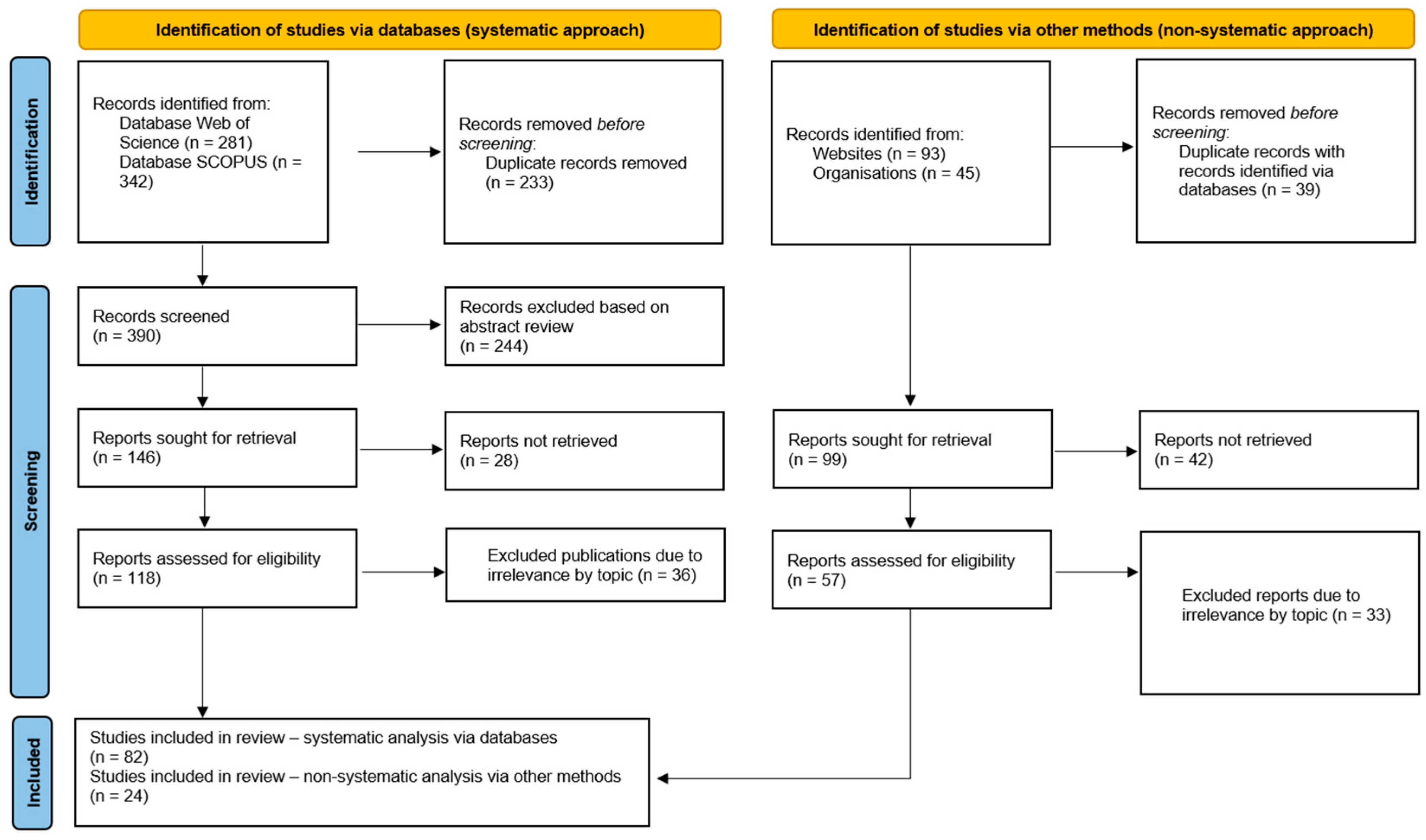
3.1. Systematic Analysis
- Selection of databases, time period and definition of search criteria;
- Data collection through scientific databases;
- Optimization of search strings with an emphasis on the relevance of the outputs;
- Export of the obtained results and their processing into analytical form;
- Analytical and interpretative processing of the results.
3.2. Non-Systematic Analysis
- Monographs and chapters in professional books;
- Review and theoretical studies;
- Significant research with a high citation response;
- Documents from international organizations and professional institutions;
- Relevant national sources and legislative documents, if related to the subject of the research.
4. Results
4.1. Results of the Systematic Analysis
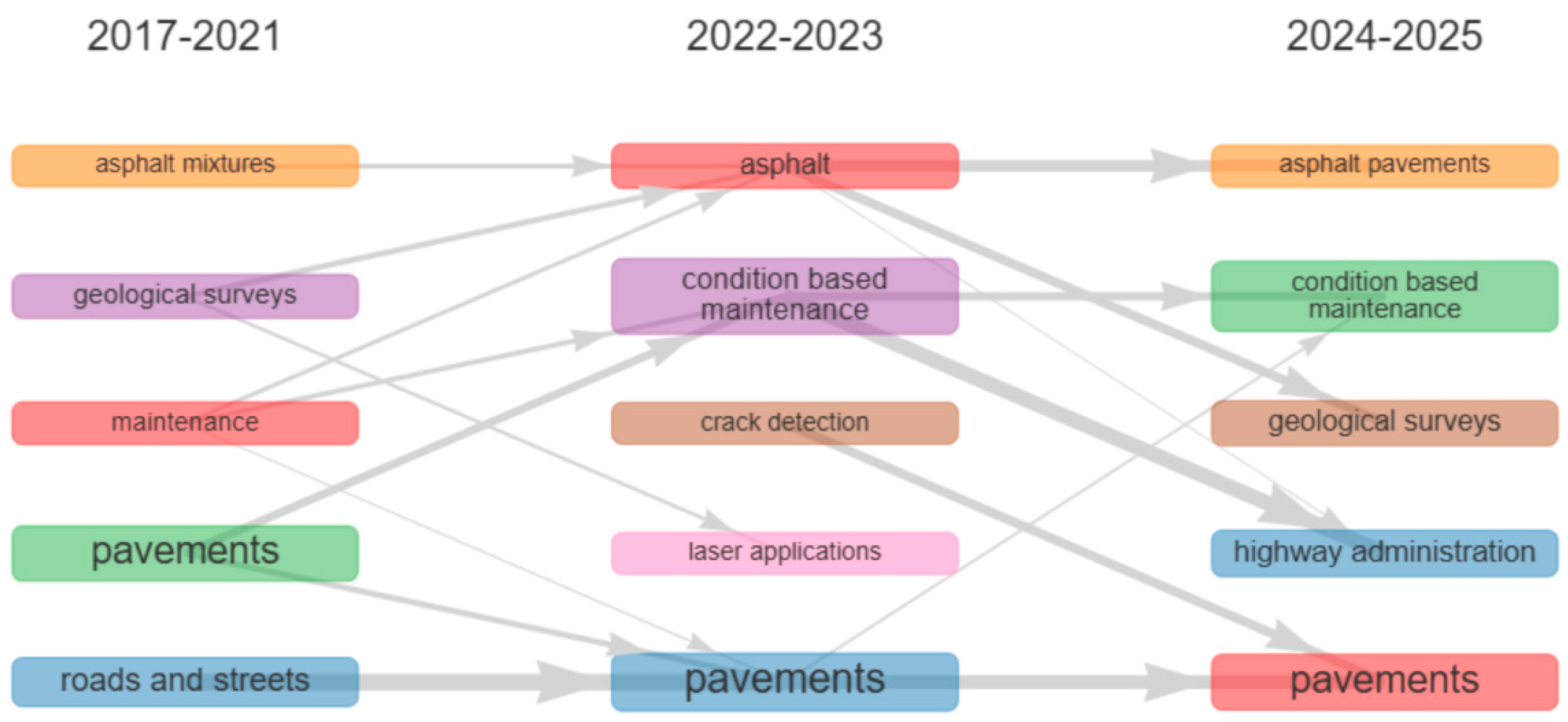
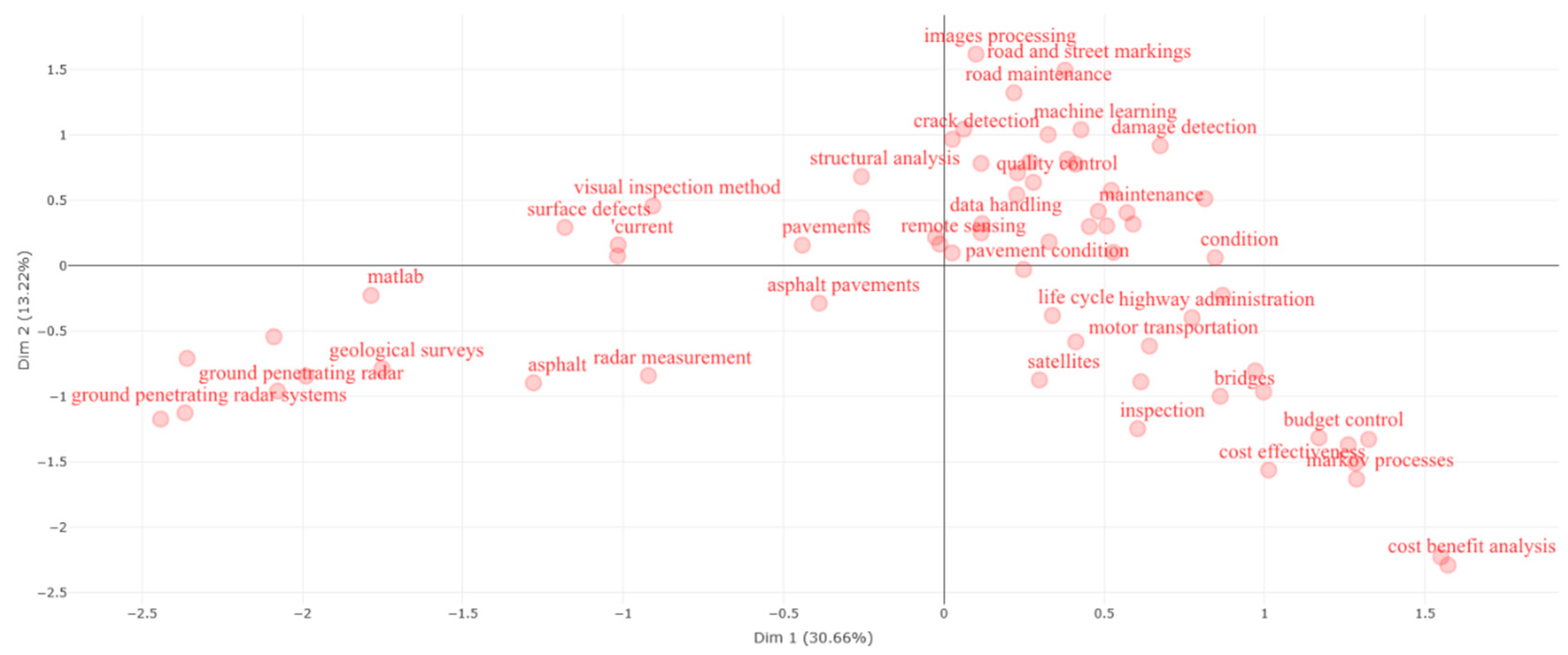
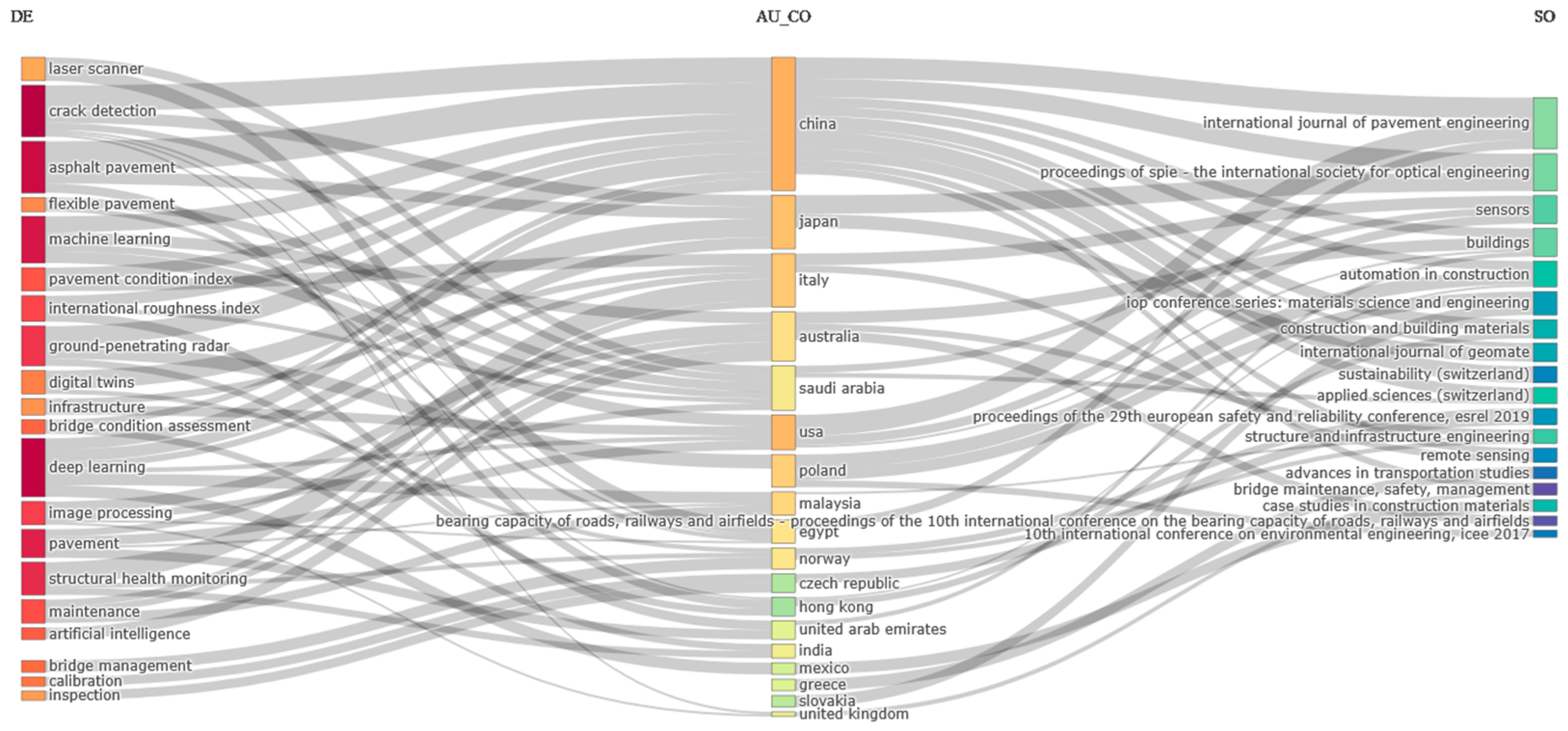
Summary of the Systematic Analysis Results
4.2. Results of the Non-Systematic Analysis
Summary of the Non-Systematic Analysis Results
5. Discussion
6. Conclusions
Author Contributions
Funding
Data Availability Statement
Conflicts of Interest
References
- Best, B. Innovative Approach to Road Infrastructure Asset Management. In IntechOpen Asphalt Materials—Recent Developments and New Perspective; Tahmoorian, F., Ed.; IntechOpen: London, UK, 2025. [Google Scholar] [CrossRef] [Scilit]
- Sinha, K.C.; Labi, S.; Agbelie, B.R.D.K. Transportation Infrastructure Asset Management in the New Millennium: Continuing Issues, and Emerging Challenges and Opportunities. Transp. Transp. Sci. 2017, 13, 591–606. [Google Scholar] [CrossRef] [Scilit]
- Transportation Asset Management: Methodology and Applications. Available online: https://www.routledge.com/Transportation-Asset-Management-Methodology-and-Applications/Li/p/book/9780367657086 (accessed on 14 April 2025).
- Mikolaj, J.; Remek, L’.; Kozel, M. Road Asset Value Calculation Based on Asset Performance, Community Benefits and Technical Condition. Sustainability 2022, 14, 4375. [Google Scholar] [CrossRef] [Scilit]
- Persia, L.; Usami, D.S.; De Simone, F.; De La Beaumelle, V.F.; Yannis, G.; Laiou, A.; Han, S.; Machata, K.; Pennisi, L.; Marchesini, P.; et al. Management of Road Infrastructure Safety. Transp. Res. Procedia 2016, 14, 3436–3445. [Google Scholar] [CrossRef] [Scilit]
- Ehsani, J.P.; Michael, J.P.; MacKENZIE, E.J. The Future of Road Safety: Challenges and Opportunities. Milbank Q. 2023, 101, 613–636. [Google Scholar] [CrossRef] [Scilit]
- Ng, C.P.; Law, T.H.; Jakarni, F.M.; Kulanthayan, S. Road Infrastructure Development and Economic Growth. IOP Conf. Ser. Mater. Sci. Eng. 2019, 512, 012045. [Google Scholar] [CrossRef] [Scilit]
- Curristine, T.; Lonti, Z.; Joumard, I. Improving Public Sector Efficiency. OECD J. Budg. 2007, 7, 161. [Google Scholar] [CrossRef] [Scilit]
- Radopoulou, S.C.; Brilakis, I. Improving Road Asset Condition Monitoring. Transp. Res. Procedia 2016, 14, 3004–3012. [Google Scholar] [CrossRef] [Scilit]
- Le, N.D.; Tran, D.; Harper, C.M.; Sturgill, R.E. Exploring Inspection Technologies for Highway Infrastructure during Construction and Asset Management. Transp. Res. Rec. J. Transp. Res. Board 2024, 2679, 123–135. [Google Scholar] [CrossRef] [Scilit]
- Khan, F.I.; Haddara, M.M. Risk-Based Maintenance (RBM): A Quantitative Approach for Maintenance/Inspection Scheduling and Planning. J. Loss Prev. Process Ind. 2003, 16, 561–573. [Google Scholar] [CrossRef] [Scilit]
- Tan, Z.; Li, J.; Wu, Z.; Zheng, J.; He, W. An Evaluation of Maintenance Strategy Using Risk Based Inspection. Saf. Sci. 2011, 49, 852–860. [Google Scholar] [CrossRef] [Scilit]
- Hassani, S.; Dackermann, U. A Systematic Review of Advanced Sensor Technologies for Non-Destructive Testing and Structural Health Monitoring. Sensors 2023, 23, 2204. [Google Scholar] [CrossRef] [Scilit] [PubMed]
- Tosti, F.; Gagliardi, V.; Luca, B.C.; Benedetto, A.; Threader, S.; Alani, A. Integration of Remote Sensing and Ground-Based Non-Destructive Methods in Transport Infrastructure Monitoring: Advances, Challenges and Perspectives. In Proceedings of the IEEE Asia-Pacific Conference on Geoscience, Electronics and Remote Sensing Technology (AGERS), Jakarta Pusat, Indonesia, 29–30 September 2021; pp. 1–7. Available online: https://repository.uwl.ac.uk/id/eprint/8288/ (accessed on 13 July 2025).
- Alotaibi, M.; Asli, B.H.S.; Khan, M. Non-Invasive Inspections: A Review on Methods and Tools. Sensors 2021, 21, 8474. [Google Scholar] [CrossRef] [Scilit] [PubMed]
- Komljenovic, D.; Abdul-Nour, G.; Boudreau, J.F. Risk-Informed Decision-Making in Asset Management as a Complex Adaptive System of Systems. Int. J. Strateg. Eng. Asset Manag. 2019, 3, 198. [Google Scholar] [CrossRef] [Scilit]
- Chen, L.; Bai, Q. Optimization in Decision Making in Infrastructure Asset Management: A Review. Appl. Sci. 2019, 9, 1380. [Google Scholar] [CrossRef] [Scilit]
- Schepanski, A.; Uecker, W.C. The Value of Information in Decision Making. J. Econ. Psychol. 1984, 5, 177–194. [Google Scholar] [CrossRef] [Scilit]
- Grunig, J.E. The Role of Information in Economic Decision Making; Association for Education in Journalism: Columbia, SC, USA, 1966. [Google Scholar]
- Jansen, C.; Schollmeyer, G.; Augustin, T. Multi-Target Decision Making under Conditions of Severe Uncertainty. arXiv 2022, arXiv:2212.06832. [Google Scholar] [CrossRef] [Scilit]
- Ji, A.; Xue, X.; Wang, Y.; Luo, X.; Xue, W. An Integrated Approach to Automatic Pixel-Level Crack Detection and Quantification of Asphalt Pavement. Autom. Constr. 2020, 114, 103176. [Google Scholar] [CrossRef] [Scilit]
- Munawar, H.S.; Ullah, F.; Shahzad, D.; Heravi, A.; Qayyum, S.; Akram, J. Civil Infrastructure Damage and Corrosion Detection: An Application of Machine Learning. Buildings 2022, 12, 156. [Google Scholar] [CrossRef] [Scilit]
- Al-Mansour, A.I.; Shokri, A.A. Correlation of Pavement Distress and Roughness Measurement. Appl. Sci. 2022, 12, 3748. [Google Scholar] [CrossRef] [Scilit]
- Alqaydi, S.; Zeiada, W.; Llort, D.; Elwakil, A. Using Smart Phones to Assessment Road Roughness in the UAE. Available online: https://nchr.elsevierpure.com/en/publications/using-smart-phones-to-assessment-road-roughness-in-the-uae/ (accessed on 19 July 2025).
- Chen, C.; Seo, H.S.; Zhao, Y.; Chen, B.; Kim, J.W.; Choi, Y.; Bang, M. Pavement Damage Detection System Using Big Data Analysis of Multiple Sensor. In Proceedings of the International Conference on Smart Infrastructure and Construction, Cambridge, UK, 8–10 July 2019. [Google Scholar] [CrossRef] [Scilit]
- Mahlberg, J.A.; Li, H.; Zachrisson, B.; Leslie, D.K.; Bullock, D.M. Pavement Quality Evaluation Using Connected Vehicle Data. Sensors 2022, 22, 9109. [Google Scholar] [CrossRef] [Scilit]
- Mandiartha, P.; Duffield, C.F.; Thompson, R.G.; Wigan, M.R. Measuring Pavement Maintenance Effectiveness Using Markov Chains Analysis. Struct. Infrastruct. Eng. 2016, 13, 844–854. [Google Scholar] [CrossRef] [Scilit]
- Philip, B.; Jassmi, H.A. A Bayesian Approach towards Modelling the Interrelationships of Pavement Deterioration Factors. Buildings 2022, 12, 1039. [Google Scholar] [CrossRef] [Scilit]
- Zafar, M.S.; Shah, S.N.R.; Memon, M.J.; Rind, T.A.; Soomro, M.A. Condition Survey for Evaluation of Pavement Condition Index of a Highway. Civ. Eng. J. 2019, 5, 1367–1383. [Google Scholar] [CrossRef] [Scilit]
- Zhi, S.; Hu, W.; Guo, Y.; Lan, H.; Jing, H. Decision Model of Pavement Maintenance Based on International Roughness Index. J. Eng. Sci. Technol. Rev. 2023, 16, 45–51. [Google Scholar] [CrossRef] [Scilit]
- Amin, N.M.; Kadir, N.; Jamadin, A. Condition Rating System of Bridges in Malaysia: A Case Study. ARPN J. Eng. Appl. Sci. 2017, 12, 787–791. [Google Scholar]
- Apostoleris, K.; Matragos, V.; Krimpas, N.; Mavromatis, S. Methodology for Sectional Risk Ranking of an Existing Two-Lane Rural Highway Alignment for Inspection Purposes. Adv. Transp. Stud. 2020, 51, 19. [Google Scholar]
- Arismendi, R.; Barros, A.; Ahmadi, A.; Vatn, J. Prognostics and Maintenance Optimization in Bridge Management. In Proceedings of the 29th European Safety and Reliability Conference (ESREL); Beer, M., Zio, E., Eds.; Research Publishing: Singapore, 2019; pp. 653–660. [Google Scholar] [CrossRef] [Scilit]
- Bennetts, J.; Webb, G.; Denton, S.; Vardanega, P.J.; Loudon, N. Quantifying Uncertainty in Visual Inspection Data. In Maintenance, Safety, Risk, Management and Life-Cycle Performance of Bridges; CRC Press: Boca Raton, FL, USA, 2018; pp. 2252–2259. [Google Scholar]
- Bertola, N.J.; Brühwiler, E. Risk-Based Methodology to Assess Bridge Condition Based on Visual Inspection. Struct. Infrastruct. Eng. 2021, 19, 575–588. [Google Scholar] [CrossRef] [Scilit]
- Beshr, A.A.A.; Ghazi, Z.; Heneash, U. Condition Assessment and Inspection of Highway Bridges Using Terrestrial Laser Scanner. World J. Eng. 2026, 23, 296–310. [Google Scholar] [CrossRef] [Scilit]
- Dai, D.; Zheng, Y.; Liu, H.; Zou, L.; Alani, A.M. Precise 3D simulations in bridge deck inspections of ground penetrating radar survey. In Bridge Maintenance, Safety, Management, Digitalization and Sustainability; CRC Press/Balkema: Leiden, The Netherlands, 2024. [Google Scholar] [CrossRef] [Scilit]
- Fang, J.; Hu, J.; Elzarka, H.; Zhao, H.; Gao, C. An Improved Inspection Process and Machine-Learning-Assisted Bridge Condition Prediction Model. Buildings 2023, 13, 2459. [Google Scholar] [CrossRef] [Scilit]
- Hagen, A.; Andersen, T.M. Asset Management, Condition Monitoring and Digital Twins: Damage Detection and Virtual Inspection on a Reinforced Concrete Bridge. Struct. Infrastruct. Eng. 2024, 20, 1242–1273. [Google Scholar] [CrossRef] [Scilit]
- Ji, Y.; Qin, Y.; Xu, W. Girder Bridge Apparent Condition Rating Model Based on Machine Learning and Inspection Reports. Sustainability 2024, 16, 10903. [Google Scholar] [CrossRef] [Scilit]
- Jana, M.; Milan, H.; Miroslav, S.; Karel, J. Reliability Assessment of Bridges Based on Monitoring. In Proceedings of the 29th European Safety and Reliability Conference (ESREL); Martorell, S., de la Fuente, F.S., Eds.; Research Publishing Service: Singapore, 2019; pp. 2172–2177. [Google Scholar] [CrossRef] [Scilit]
- Miśkiewicz, M.; Daszkiewicz, K.; Lachowicz, J.; Tysiac, P.; Jaskula, P.; Wilde, K. Nondestructive Methods Complemented by FEM Calculations in Diagnostics of Cracks in Bridge Approach Pavement. Autom. Constr. 2021, 128, 103753. [Google Scholar] [CrossRef] [Scilit]
- Miskiewicz, M.; Lachowicz, J.; Tysiac, P.; Jaskula, P.; Wilde, K. The Application of Non-Destructive Methods in the Diagnostics of the Approach Pavement at the Bridges. IOP Conf. Ser. Mater. Sci. Eng. 2018, 356, 012023. [Google Scholar] [CrossRef] [Scilit]
- Ranjan, A.; Shanker, R.; Singh, S.K. Rating system for bridge condition assessment. Indian J. Environ. Prot. 2022, 42, 1659–1664. Available online: https://www.e-ijep.co.in/wp-content/uploads/2023/12/IJEP-4213-1659-1664-2022.pdf (accessed on 14 July 2025).
- Shi, X.; Wang, Y.; Zhang, M.; Wang, F.; Zhang, P. Pavement Performance Index Differences Among General Pavement, Bridge Deck Pavement, and Tunnel Pavement Based on Inspection Data. 2019. Available online: https://trid.trb.org/View/1656393 (accessed on 24 July 2025).
- Sun, T.; Vatn, J. A Markov-based Bridge Maintenance Optimization Model Considering User Costs Research. In Proceedings of the 32nd European Safety and Reliability Conference (ESREL 2022), Dublin, Ireland, 28 August–1 September 2022. [Google Scholar] [CrossRef] [Scilit]
- Sun, T.; Vatn, J. A Phase-Type Maintenance Model Considering Condition-Based Inspections and Maintenance Delays. Reliab. Eng. Syst. Saf. 2024, 243, 109836. Available online: https://libkey.io/10.1016/j.ress.2023.109836?utm_source=ideas (accessed on 23 March 2026). [CrossRef] [Scilit]
- Tu, Y.; Liang, L. Research and Application of UAV-Based Intelligent Bridge Inspection Methods. In Proceedings Volume 13445, International Conference on Electronics, Electrical and Information Engineering (ICEEIE 2024); SPIE: Bellingham, WA, USA, 2024. [Google Scholar] [CrossRef] [Scilit]
- Yeganehfallah, A.; Avizzano, C.A.; Caprili, S. Automated Crack Identification, to Ease Maintenance of Reinforced Concrete Bridges. Procedia Struct. Integr. 2024, 62, 201–208. [Google Scholar] [CrossRef] [Scilit]
- Bannour, A.; El Omari, M.; Lakhal, E.K.; Afechkar, M.; Benamar, A.; Joubert, P. Optimization of the Maintenance Strategies of Roads in Morocco: Calibration Study of the Degradations Models of the Highway Development and Management (HDM-4) for Flexible Pavements. Int. J. Pavement Eng. 2019, 20, 245–254. [Google Scholar] [CrossRef] [Scilit]
- Li, G.; Xin, Y.; Shen, D.; Wang, B.; Deng, Y.; Zhang, S. Automatic Road Crack Detection and Analysis System Based on Deep Feature Fusion and Edge Structure Extraction. Int. J. Pavement Eng. 2023, 24, 2246096. [Google Scholar] [CrossRef] [Scilit]
- Mahlberg, J.A.; Cheng, Y.-T.; Bullock, D.M.; Habib, A. Leveraging LiDAR Intensity to Evaluate Roadway Pavement Markings. Future Transp. 2021, 1, 720–736. [Google Scholar] [CrossRef] [Scilit]
- Matarneh, S.; Elghaish, F.; Al-Ghraibah, A.; Abdellatef, E.; Edwards, D.J. An Automatic Image Processing Based on Hough Transform Algorithm for Pavement Crack Detection and Classification. Smart Sustain. Built Environ. 2023, 14, 1–22. [Google Scholar] [CrossRef] [Scilit]
- Mishra, S.; Kumar, S.; Roy, L. Automated Road Crack Classification Using a Novel Forest Optimization Algorithm for Otsu Thresholding and Hybrid Feature Extraction. Int. J. Adv. Technol. Eng. Explor. 2024, 11, 219. [Google Scholar] [CrossRef] [Scilit]
- Xie, P.; Wang, H. Prognosis of Reflective Pavement Cracking Development with Bayesian Updating and Surrogate Models. Int. J. Pavement Eng. 2024, 25, 2420255. [Google Scholar] [CrossRef] [Scilit]
- Zhao, Y.; Zhou, L.; Wang, X.; Wang, F.; Shi, G. Highway Crack Detection and Classification Using UAV Remote Sensing Images Based on CrackNet and CrackClassification. Appl. Sci. 2023, 13, 7269. [Google Scholar] [CrossRef] [Scilit]
- Dai, P.; Geng, L. BIM and CCD imaging based visual inspection method for airport road surface defects. In International Conference on Image, Signal Processing, and Pattern Recognition (ISPP 2023); SPIE: Bellingham, WA, USA, 2023; pp. 381–385. [Google Scholar] [CrossRef] [Scilit]
- Ho, M.C. Automatic Image Recognition of Pavement Distress for Improving Pavement Inspection. Int. J. Geomate 2020, 19, 242–249. [Google Scholar] [CrossRef] [Scilit]
- Roman-Garay, M.; Rodriguez-Rangel, H.; Hernandez-Beltran, C.B.; Lepej, P.; Arreygue-Rocha, J.E.; Morales-Rosales, L.A. Architecture for Pavement Pothole Evaluation Using Deep Learning, Machine Vision, and Fuzzy Logic. Case Stud. Constr. Mater. 2025, 22, e04440. [Google Scholar] [CrossRef] [Scilit]
- Iparraguirre, O.; Iturbe-Olleta, N.; Brazalez, A.; Borro, D. Road Marking Damage Detection Based on Deep Learning for Infrastructure Evaluation in Emerging Autonomous Driving. IEEE Trans. Intell. Transp. Syst. 2022, 23, 22378–22385. [Google Scholar] [CrossRef] [Scilit]
- Lee, S.; Koh, E.; Jeon, S.-I.; Kim, R.E. Pavement Marking Construction Quality Inspection and Night Visibility Estimation Using Computer Vision. Case Stud. Constr. Mater. 2024, 20, e02953. [Google Scholar] [CrossRef] [Scilit]
- Azam, A.; Alshehri, A.H.; Alharthai, M.; El-Banna, M.M.; Yosri, A.M.; Beshr, A.A.A. Applications of Terrestrial Laser Scanner in Detecting Pavement Surface Defects. Processes 2023, 11, 1370. [Google Scholar] [CrossRef] [Scilit]
- Bashar, M.; Torres-Machi, C. Quantifying the Value of Satellite-Based Pavement Monitoring in Partially Observable Stochastic Environments. J. Comput. Civ. Eng. 2023, 37, 04023004. [Google Scholar] [CrossRef] [Scilit]
- Beshr, A.A.A.; Heneash, O.G.; Fawzy, H.E.-D.; El-Banna, M.M. Condition Assessment of Rigid Pavement Using Terrestrial Laser Scanner Observations. Int. J. Pavement Eng. 2021, 23, 4248–4259. [Google Scholar] [CrossRef] [Scilit]
- De Blasiis, M.R.; Di Benedetto, A.; Fiani, M. Mobile Laser Scanning Data for the Evaluation of Pavement Surface Distress. Remote Sens. 2020, 12, 942. [Google Scholar] [CrossRef] [Scilit]
- Dudak, J.; Gaspar, G.; Sedivy, S.; Pepucha, L.; Florkova, Z. Road Structural Elements Temperature Trends Diagnostics Using Sensory System of Own Design. IOP Conf. Ser. Mater. Sci. Eng. 2017, 236, 012036. [Google Scholar] [CrossRef] [Scilit]
- Fox-Ivey, R.; Laurent, J.; Petitclerc, B. Using 3D Pavement Surveys to Create a Digital Twin of Your Runway or Highway. Available online: https://trid.trb.org/View/1856966 (accessed on 5 July 2025).
- Gajurel, A.; Puppala, A.J.; Biswas, N.; Chimauriya, H.R. Application of Satellite-Based Remote Sensing for the Management of Pavement Infrastructure Assets. Transp. Res. Rec. J. Transp. Res. Board 2024, 2678, 623–638. [Google Scholar] [CrossRef] [Scilit]
- Han, C.; Zhang, W.; Ma, T. Data Cleaning Framework for Highway Asphalt Pavement Inspection Data Based on Artificial Neural Networks. Int. J. Pavement Eng. 2021, 23, 5198–5210. [Google Scholar] [CrossRef] [Scilit]
- Liu, Z.; Yang, Q.; Gu, X. Assessment of Pavement Structural Conditions and Remaining Life Combining Accelerated Pavement Testing and Ground-Penetrating Radar. Remote Sens. 2023, 15, 4620. [Google Scholar] [CrossRef] [Scilit]
- Luo, X.; He, J.; Zhang, D.; Zhu, J.; Li, M.; Zhang, B.; Li, Q. Evaluating Subsurface Cavities Detection Using Innovative Laser Dynamic Deflectometer for Efficient and Large-Scale Urban Road Network Inspections. Tunn. Undergr. Space Technol. 2025, 159, 106471. [Google Scholar] [CrossRef] [Scilit]
- Fuse, T.; Matsumoto, K. Self-Localization Method by Integrating Sensors. In International Archives of the Photogrammetry, Remote Sensing and Spatial Information Sciences; International Society for Photogrammetry and Remote Sensing: Wabern, Switzerland, 2015; Volume XL-4/W5, pp. 87–92. [Google Scholar] [CrossRef] [Scilit]
- Voordijk, H.; Vahdatikhaki, F.; Hesselink, L. Digital Twin–Based Asset Inspection and User–Technology Interactions. J. Eng. Des. Technol. 2023, 23, 406–422. [Google Scholar] [CrossRef] [Scilit]
- Wang, D.; Luo, C.; Fu, M.; Zhang, W.; Xie, W. Study on Non-Destructive Testing Method of Existing Asphalt Pavement Based on the Principle of Geostatistics. Materials 2025, 18, 1848. [Google Scholar] [CrossRef] [Scilit] [PubMed]
- Wang, S.; Leng, Z.; Zhang, Z.; Sui, X. Automatic Asphalt Layer Interface Detection and Thickness Determination from Ground-Penetrating Radar Data. Constr. Build. Mater. 2022, 357, 129434. [Google Scholar] [CrossRef] [Scilit]
- Yi, L.; Zou, L.; Sato, M. Practical Approach for High-Resolution Airport Pavement Inspection with the Yakumo Multistatic Array Ground-Penetrating Radar System. Sensors 2018, 18, 2684. [Google Scholar] [CrossRef] [Scilit] [PubMed]
- Zhou, W.; Miller-Hooks, E.; Papakonstantinou, K.G.; Hu, P.; Kamranfar, P.; Lattanzi, D.; Stoffels, S.; McNeil, S. Valuing Imperfect Information from Inspection and Sensing in Condition-Based Roadway Pavement Management with Partially Observable Conditions. J. Transp. Eng. Part B Pavements 2025, 151, 04025018. [Google Scholar] [CrossRef] [Scilit]
- Angreni, I.A.A.; Adisasmita, S.A.; Ramli, M.I.; Hamid, S. Evaluating the Road Damage of Flexible Pavement Using Digital Image. Int. J. Integr. Eng. 2018, 10, 24–27. [Google Scholar] [CrossRef] [Scilit]
- Arun, V.; Suresha, S.N. Prediction of Pavement Maintenance Cost for Rural Roads at Network Level. J. Inst. Eng. India Ser. A 2025, 106, 489–509. [Google Scholar] [CrossRef] [Scilit]
- Ashraf, A.; Sophian, A.; Shafie, A.A.; Gunawan, T.S.; Ismail, N.N.; Bawono, A.A. Efficient Pavement Crack Detection and Classification Using Custom YOLOV7 Model. Indones. J. Electr. Eng. Inform. 2023, 11, 119–132. [Google Scholar] [CrossRef] [Scilit]
- Bruno, S.; Colonnese, S.; Scarano, G.; Del Serrone, G.; Loprencipe, G. Pavement Distress Estimation via Signal on Graph Processing. Sensors 2022, 22, 9183. [Google Scholar] [CrossRef] [Scilit]
- Chen, S.-L.; Lin, C.; Tang, C.-W.; Hsieh, H.-A. Evaluation of Pavement Roughness by the International Roughness Index for Sustainable Pavement Construction in New Taipei City. Sustainability 2022, 14, 6982. [Google Scholar] [CrossRef] [Scilit]
- Davidović, M.; Kuzmić, T.; Vasić, D.; Wich, V.; Brunn, A.; Bulatović, V. Methodology for Road Defect Detection and Administration Based on Mobile Mapping Data. Comput. Model. Eng. Sci. 2021, 129, 207–226. [Google Scholar] [CrossRef] [Scilit]
- Feng, X. Construction quality inspection method of permeable concrete pavement in urban landscape engineering based on data mining. In Sixth International Conference on Advanced Electronic Materials, Computers, and Software Engineering (AEMCSE 2023); SPIE: Bellingham, WA, USA, 2023; pp. 148–153. [Google Scholar] [CrossRef] [Scilit]
- Flanigan, K.A.; Lynch, J.P.; Ettouney, M. Quantitatively Linking Long-Term Monitoring Data to Condition Ratings through a Reliability-Based Framework. Struct. Health Monit. 2020, 20, 2376–2395. [Google Scholar] [CrossRef] [Scilit]
- Gao, W.; Xue, K.; Nagayama, T.; Zhao, B.; Su, D. Rut depth estimation by distortion analysis of images taken by an in-vehicle camera. In Life-Cycle of Structures and Infrastructure Systems; CRC Press: Boca Raton, FL, USA, 2023; pp. 3832–3839. [Google Scholar] [CrossRef] [Scilit]
- Heitor, A.; Davis, J.; Tobin, P.; Bogie, K. Road asset valuation system using long term pavement data analysis. In Bearing Capacity of Roads, Railways and Airfields; CRC Press: Boca Raton, FL, USA, 2017; pp. 1013–1019. [Google Scholar] [CrossRef] [Scilit]
- Issa, A.; Samaneh, H.; Ghanim, M. Predicting Pavement Condition Index Using Artificial Neural Networks Approach. Ain Shams Eng. J. 2021, 13, 101490. [Google Scholar] [CrossRef] [Scilit]
- Jin, T.; Ye, X.-W.; Que, W.-M.; Wang, M.-Y. Automatic Detection, Localization and Quantification of Structural Cracks Combining Computer Vision and Crowd Sensing Technologies. Constr. Build. Mater. 2025, 476, 141150. [Google Scholar] [CrossRef] [Scilit]
- Ma, T.; Zhu, L.; Wu, X. Research on pavement crack detection algorithm based on improved Yolov5. In International Conference on Remote Sensing, Mapping, and Image Processing (RSMIP 2024); SPIE: Bellingham, WA, USA, 2024; pp. 378–384. [Google Scholar] [CrossRef] [Scilit]
- Miano, A.; Lobianco, A.L.; Mele, A.; Fiorillo, A.; Di Ludovico, M.; Prota, A. Structural Health Monitoring of Road Systems: From the Network Analysis to the Single Bridge Assessment. In Proceedings of the 10th International Operational Modal Analysis Conference (IOMAC 2024); Lecture Notes in Civil Engineering; Springer Nature: Cham, Switzerland, 2024; pp. 177–184. [Google Scholar]
- Opara, J.N. Defect Detection on Asphalt Pavement by Deeplearning. Int. J. Geomate 2021, 21, 87–94. [Google Scholar] [CrossRef] [Scilit]
- Othman, Z.; Abdullah, A.; Kasmin, F.; Ahmad, S.S.S. Road Crack Detection Using Adaptive Multi Resolution Thresholding Techniques. TELKOMNIKA Telecommun. Comput. Electron. Control. 2019, 17, 1874. [Google Scholar] [CrossRef] [Scilit]
- Pakrashi, V.; Matos, J.; Obrien, E. Challenges around climate resilient road and rail infrastructure management through structural health monitoring. In Life-Cycle Civil Engineering: Innovation, Theory and Practice; CRC Press: Boca Raton, FL, USA, 2021; pp. 1229–1236. [Google Scholar] [CrossRef] [Scilit]
- Sghaier, S.; Krichen, M.; Ben Dhaou, I.; Elmannai, H.; Alkanhel, R. Identification, 3D-Reconstruction, and Classification of Dangerous Road Cracks. Sensors 2023, 23, 3578. [Google Scholar] [CrossRef] [Scilit]
- Sourav, M.A.A.; Ceylan, H.; Brooks, C.N.; Dobson, R.; Kim, S.; Peshkin, D.; Brynick, M. Use of Small Unmanned Aircraft Systems in Airfield Pavement Inspection: Implementation and Potential. Available online: http://worldcat.org/oclc/44544515 (accessed on 28 May 2025).
- Tasaki, Y.; Yoshida, I. Optimal Inspection Planning Based on Value of Information for Airport Runway. In Life Cycle Analysis and Assessment in Civil Engineering: Towards an Integrated Vision; CRC Press: Boca Raton, FL, USA, 2018. [Google Scholar]
- Tsai, Y.-C.; Zhao, Y.; Pop-Stefanov, B.; Chatterjee, A. Automatically Detect and Classify Asphalt Pavement Raveling Severity Using 3D Technology and Machine Learning. Int. J. Pavement Res. Technol. 2020, 14, 487–495. [Google Scholar] [CrossRef] [Scilit]
- Vega, J.; Rodriguez, M.; Alarcon, L. Implementation of a GIS-Based Pilot Application for Roads Management Applied to the Conservation and Maintenance of Unpaved Low Traffic Roads. IOP Conf. Ser. Earth Environ. Sci. 2019, 362, 012024. [Google Scholar] [CrossRef] [Scilit]
- Vemuri, V.; Ren, Y.; Gao, L.; Lu, P.; Song, L. Pavement Condition Index Estimation Using Smartphone Based Accelerometers for City of Houston. Constr. Res. Congr. 2020, 2020, 522–531. [Google Scholar] [CrossRef] [Scilit]
- Wesołowski, M.; Blacha, K.; Barszcz, P. Multi-Criteria Analysis in Assessment of the Degree of Degradation Pavement Elements Functional Airports Made of Cement Concrete. In Proceedings of the 10th International Conference “Environmental Engineering”, Vilnius, Lithuania, 27–28 April 2017. [Google Scholar] [CrossRef] [Scilit]
- Yu, K.; Gao, L. Pavement Missing Condition Data Imputation through Collective Learning-Based Graph Neural Networks. In International Conference on Transportation and Development 2023; American Society of Civil Engineers: Reston, VA, USA, 2023; pp. 416–423. [Google Scholar] [CrossRef] [Scilit]
- Elgamal, E.; Fawzy, H.; Mohamady, A.; Basha, A. Pavement Management System: Condition Assessment, Challenges, and Future Directions. J. Contemp. Technol. Appl. Eng. 2025, 3, 93–102. [Google Scholar] [CrossRef] [Scilit]
- Kumar, A.V. Pavement Surface Condition Assessment: A-State-of-the-Art Research Review and Future Perspective. Innov. Infrastruct. Solut. 2024, 9, 470. [Google Scholar] [CrossRef] [Scilit]
- Ram, P.V.; Thompson, P.D.; Pai, S.; Borthakur, A.; Smadi, O.G.; Smith, K.L.; Zimmerman, K.A.; Allen, B.W.; Mugabe, K.; Bektas, B. Development of Next-Generation Pavement Performance Measures and Asset Management Methodologies to Support MAP-21 Performance Management Objectives. United States. Department of Transportation. Federal Highway Administration. Office of Infrastructure. 2024. Available online: https://rosap.ntl.bts.gov/view/dot/77583 (accessed on 16 May 2025).
- Nipa, T.J.; Kermanshachi, S. Resilience Measurement in Highway and Roadway Infrastructures: Experts’ Perspectives. Prog. Disaster Sci. 2022, 14, 100230. [Google Scholar] [CrossRef] [Scilit]
- Schraven, D.; Hartmann, A.; Dewulf, G. Effectiveness of Infrastructure Asset Management: Challenges for Public Agencies. Built Environ. Proj. Asset Manag. 2011, 1, 61–74. [Google Scholar] [CrossRef] [Scilit]
- Kim, Y.R.; Hummer, J.E.; Gabr, M.; Johnston, D.; Underwood, B.S.; Findley, D.; Cunningham, C.M. Asset Management Inventory and Data Collection. North Carolina Department of Transportation. Research and Analysis Group. 2009. Available online: https://rosap.ntl.bts.gov/view/dot/5731 (accessed on 3 May 2025).
- Adey, B.T.; Jamali, A. On the Role of Inspections and Interventions in Infrastructure Management. Mater. Corros. 2012, 63, 1134–1146. [Google Scholar] [CrossRef] [Scilit]
- Dicdican, R.Y.; Haimes, Y.Y.; Lambert, J.H. Risk-Based Asset Management Methodology for Highway Infrastructure Systems. Available online: https://rosap.ntl.bts.gov/view/dot/19624 (accessed on 25 April 2025).
- Rusu, L.; Taut, D.A.S.; Jecan, S. An Integrated Solution for Pavement Management and Monitoring Systems. Procedia Econ. Financ. 2015, 27, 14–21. [Google Scholar] [CrossRef] [Scilit]
- Ilbeigi, M.; Pawar, B. A Probabilistic Model for Optimal Bridge Inspection Interval. Infrastructures 2020, 5, 47. [Google Scholar] [CrossRef] [Scilit]
- Madanat, S. Optimal Infrastructure Management Decisions under Uncertainty. Transp. Res. Part C Emerg. Technol. 1993, 1, 77–88. [Google Scholar] [CrossRef] [Scilit]
- Durango-Cohen, P.L.; Madanat, S.M. Optimization of Inspection and Maintenance Decisions for Infrastructure Facilities under Performance Model Uncertainty: A Quasi-Bayes Approach. Transp. Res. Part A Policy Pract. 2008, 42, 1074–1085. [Google Scholar] [CrossRef] [Scilit]
- Guillaumot, V.M.; Durango-Cohen, P.L.; Madanat, S. Adaptive Optimization of Infrastructure Maintenance and Inspection Decisions under Performance Model. J. Infrastruct. Syst. 2003, 9, 133–139. [Google Scholar] [CrossRef] [Scilit]
- Smilowitz, K.; Madanat, S. Optimal Inspection and Maintenance Policies for Infrastructure Networks. Comput. Aided Civ. Infrastruct. Eng. 2000, 15, 5–13. [Google Scholar] [CrossRef] [Scilit]
- Sheils, E.; O’Connor, A.; Schoefs, F.; Breysse, D. Investigation of the Effect of the Quality of Inspection Techniques on the Optimal Inspection Interval for Structures. Struct. Infrastruct. Eng. 2010, 8, 557–568. [Google Scholar] [CrossRef] [Scilit]
- Kleiner, Y. Scheduling Inspection and Renewal of Large Infrastructure Assets. J. Infrastruct. Syst. 2001, 7, 136–143. [Google Scholar] [CrossRef] [Scilit]
- Fleming, G.; Thompson, P.D. Integrating NDE with Bridge Asset Management and Its Return on Investment in Complementing Bridge Safety Inspections [TechBrief]. ROSA P 2024, 1–12. [Google Scholar] [CrossRef]
- Nhien, D.L.; Tran, D.; Sturgill, R.; Harper, C. Use of Non-Destructive Testing Technologies for Highway Infrastructure Inspection. Available online: https://trid.trb.org/View/2353245 (accessed on 6 February 2025).
- Glazer, R. Measuring the Value of Information: The Information-Intensive Organization. IBM Syst. J. 1993, 32, 99–110. [Google Scholar] [CrossRef] [Scilit]
- Stenson, J. The Attributes of Information as an Asset. Ph.D. Thesis, Loughborough University, Loughborough, UK, 2006. Available online: https://hdl.handle.net/2134/7792 (accessed on 17 April 2025).
- Faiz, R.B.; Edirisinghe, E.A. Decision making for predictive maintenance in asset information management. Interdiscip. J. Inf. Knowl. Manag. 2009, 4, 23. [Google Scholar] [CrossRef] [Scilit]
- Keisler, J.M.; Collier, Z.A.; Chu, E.; Sinatra, N.; Linkov, I. Value of Information Analysis: The State of Application. Environ. Syst. Decis. 2013, 34, 3–23. [Google Scholar] [CrossRef] [Scilit]
- Repo, A.J. The Value of Information: Approaches in Economics, Accounting, and Management Science. Assoc. Inf. Sci. Technol. 1989, 40, 68–85. [Google Scholar] [CrossRef] [Scilit]
- Zhang, W.-H.; Lu, D.-G.; Qin, J.; Thöns, S.; Faber, M.H. Value of Information Analysis in Civil and Infrastructure Engineering: A Review. J. Infrastruct. Preserv. Resil. 2021, 2, 16. [Google Scholar] [CrossRef] [Scilit]
- Klerk, W.J.; Schweckendiek, T.; den Heijer, F.; Kok, M. Value of Information of Structural Health Monitoring in Asset Management of Flood Defences. Infrastructures 2019, 4, 56. [Google Scholar] [CrossRef] [Scilit]






| Database | Search String |
|---|---|
| Web of Science | ((((TS = (road)) OR TS = (pavement))) AND TS = (inspection)) AND TS = (value) and 2025 or 2024 or 2023 or 2022 or 2021 or 2020 or 2019 or 2018 or 2017 or 2016 or 2015 or 2014 or 2013 or 2011 or 2010 or 2012 (Publication Years) and Article or Proceeding Paper (Document Types) and English (Languages) and Article or Proceeding Paper (Document Types) and Engineering or Construction Building Technology or Materials Science or Transportation or Science Technology Other Topics or Remote Sensing (Research Areas) |
| SCOPUS | (TITLE-ABS-KEY (road) OR TITLE-ABS-KEY (pavement) AND TITLE-ABS-KEY (inspection) AND TITLE-ABS-KEY (value)) AND PUBYEAR > 2009 AND PUBYEAR < 2026 AND (LIMIT-TO (PUBSTAGE, “final”)) AND (LIMIT-TO (DOCTYPE, “ar”) OR LIMIT-TO (DOCTYPE, “cp”)) AND (LIMIT-TO (SUBJAREA, “ENGI”) OR LIMIT-TO (SUBJAREA, “SOCI”) OR LIMIT-TO (SUBJAREA, “MATE”) OR LIMIT-TO (SUBJAREA, “ENVI”)) AND (LIMIT-TO (LANGUAGE, “English”)) AND (LIMIT-TO (SRCTYPE, “j”) OR LIMIT-TO (SRCTYPE, “p”)) |
| SCOPUS | Web of Sciences | ||||||
|---|---|---|---|---|---|---|---|
| Research Area | Nr. of Publications | Publishing House | Nr. of Publications | Research Area | Nr. of Publications | Publishing House | Nr. of Publications |
| Engineering | 280 | Elsevier | 56 | Engineering Civil | 132 | Elsevier | 58 |
| Computer Science | 80 | MDPI | 36 | Construction Building Technology | 62 | MDPI | 42 |
| Social Sciences | 68 | Amer Soc Civil Engineers | 30 | Transportation Science Technology | 49 | Taylor & Francis | 24 |
| Materials Science | 63 | IEEE | 17 | Materials Science Multidisciplinary | 41 | Asce-Amer Soc Civil Engineers | 18 |
| Environmental Science | 52 | Taylor & Francis | 15 | Engineering Multidisciplinary | 39 | Springer Nature | 16 |
| Physics and Astronomy | 41 | SPIE-INTERNATIONAL SOCIETY FOR OPTICAL ENGINEERING | 14 | Engineering Electrical Electronic | 29 | IEEE | 14 |
| Earth and Planetary Sciences | 37 | CRC press | 13 | Transportation | 24 | Amer Soc Civil Engineers | 13 |
| Mathematics | 27 | Sage | 10 | Engineering Mechanical | 18 | SPIE-INTERNATIONAL SOCIETY FOR OPTICAL ENGINEERING | 9 |
| Energy | 21 | Emerald Group Publishing | 6 | Materials Science Characterization Testing | 18 | Emerald Group Publishing | 8 |
| Chemistry | 10 | Springer | 4 | Environmental Sciences | 17 | Sage | 8 |
| Biochemistry, Genetics and Molecular Biology | 9 | Instruments Instrumentation | 15 | Trans Tech Publications Ltd. | 8 | ||
| Business, Management and Accounting | 9 | Remote Sensing | 15 | Iop Publishing Ltd. | 6 | ||
| Article Title | Number of Citations | Rank | ||
|---|---|---|---|---|
| SCOPUS | Web of Sciences | SCOPUS | Web of Sciences | |
| Nhat-Duc, H.; Nguyen, Q.-L.; Tran, V.-D. Automatic Recognition of Asphalt Pavement Cracks Using Metaheuristic Optimized Edge Detection Algorithms and Convolution Neural Network. Automation in Construction 2018, 94, 203–213, doi:10.1016/j.autcon.2018.07.008. | 318 | 269 | 1 | 1 |
| Ji, A.; Xue, X.; Wang, Y.; Luo, X.; Xue, W. An Integrated Approach to Automatic Pixel-Level Crack Detection and Quantification of Asphalt Pavement. Automation in Construction 2020, 114, 103176, doi:10.1016/j.autcon.2020.103176. [21] | 230 | 198 | 2 | 2 |
| Cafiso, S.; Di Graziano, A.; Di Silvestro, G.; La Cava, G.; Persaud, B. Development of Comprehensive Accident Models for Two-Lane Rural Highways Using Exposure, Geometry, Consistency and Context Variables. Accident Analysis & Prevention 2010, 42, 1072–1079, doi:10.1016/j.aap.2009.12.015. | 193 | 166 | 3 | 3 |
| Akagić, A.; Buza, E.; Omanovic, S.; Karabegović, A. Pavement Crack Detection Using Otsu Thresholding for Image Segmentation. 41st international convention on information and communication technology, electronics and microelectronics (MIPRO) 2018 (pp. 1092–1097). IEEE. 10.23919/MIPRO.2018.8400199 | 136 | 108 | 4 | 6 |
| Yılmaz, B.; Asyalı, M.H.; Arıkan, E.; Yetkin, S.; Özgen, F. Sleep Stage and Obstructive Apneaic Epoch Classification Using Single-Lead ECG. BioMedical Engineering OnLine 2010, 9, 39, doi:10.1186/1475-925x-9-39. | 130 | 101 | 5 | 7 |
| Kanafi, M.M.; Kuosmanen, A.; Pellinen, T.K.; Tuononen, A.J. Macro- and Micro-Texture Evolution of Road Pavements and Correlation with Friction. International Journal of Pavement Engineering 2014, 16, 168–179, doi:10.1080/10298436.2014.937715. | 106 | 92 | 6 | 8 |
| Cardellicchio, A.; Ruggieri, S.; Nettis, A.; Renò, V.; Uva, G. Physical Interpretation of Machine Learning-Based Recognition of Defects for the Risk Management of Existing Bridge Heritage. Engineering Failure Analysis 2023, 149, 107237, doi:10.1016/j.engfailanal.2023.107237. | 82 | 75 | 7 | 9 |
| Shahnazari, H.; Tutunchian, M.A.; Mashayekhi, M.; Amini, A.A. Application of Soft Computing for Prediction of Pavement Condition Index. Journal of Transportation Engineering 2012, 138, 1495–1506, doi:10.1061/(asce)te.1943-5436.0000454. | 80 | 68 | 8 | 10 |
| Biçici, S.; Zeybek, M. An Approach for the Automated Extraction of Road Surface Distress from a UAV-Derived Point Cloud. Automation in Construction 2020, 122, 103475, doi:10.1016/j.autcon.2020.103475. | 62 | 47 | 9 | |
| Munawar, H.S.; Ullah, F.; Shahzad, D.; Heravi, A.; Qayyum, S.; Akram, J. Civil Infrastructure Damage and Corrosion Detection: An Application of Machine Learning. Buildings 2022, 12, 156. https://doi.org/10.3390/buildings12020156 [22] | 59 | 10 | ||
| Tsangaratos, P.; Ilia, I.; Hong, H.; Chen, W.; Xu, C. Applying Information Theory and GIS-Based Quantitative Methods to Produce Landslide Susceptibility Maps in Nancheng County, China. Landslides 2016, 14, 1091–1111, doi:10.1007/s10346-016-0769-4. | 158 | 149 | 4 | |
| Okujeni, A.; Van Der Linden, S.; Tits, L.; Somers, B.; Hostert, P. Support Vector Regression and Synthetically Mixed Training Data for Quantifying Urban Land Cover. Remote Sensing of Environment 2013, 137, 184–197, doi:10.1016/j.rse.2013.06.007. | 60 | 131 | 5 | |
| Topic area: Road condition and quality indicators | |
| [23] | The research examines the relationship between different types of pavement damage and their roughness, as measured by the IRI. The strongest influences on the increase in the IRI are network cracks, permanent deformations and transverse cracks. The study also highlights that not all defects that affect the IRI are equally captured by traditional visual inspections or PCI assessments. |
| [24] | This study explores an innovative approach to monitoring road quality using smartphones, specifically through IRI measurement. The results of the analysis showed that the application is able to generate consistent IRI values over repeated passes over the same sections. Moreover, these values showed a strong correlation with data measured by official measurement vehicles. |
| [25] | The article deals with the development and implementation of a complex road damage detection system, which is based on processing a large amount of data obtained from multiple types of sensors. The authors developed a detection algorithm based on the decision tree classification method. |
| [26] | The authors present a method that uses vertical acceleration recorded by sensor systems in connected vehicles. These data reflect the vehicle’s response to surface irregularities such as bumps, deformations or cracks. The classification system was then compared with traditional metrics such as the IRI and verified through visual inspections. The results showed a strong correlation between vehicle data and IRI measurements, confirming that connected vehicles can be a reliable source of information about the technical condition of roads. |
| [27] | The paper deals with the evaluation of the efficiency of road maintenance using Markov chains. The main performance indicator used by the authors is the IRI. The findings show that with exclusively routine interventions, the probability of remaining in the same condition is low, especially in worse condition categories. Periodic maintenance and repairs significantly increase the chance of maintaining the current condition, making them more effective. |
| [28] | The research focuses on using Bayesian network models to understand the relationships between factors that influence road deterioration. The results showed that the most important indicator of overall road condition is the IRI. Bayesian networks have proven to be a suitable tool for such analysis because they allow working with uncertainty, missing data and complex relationships between variables. |
| [29] | The study examines the assessment of pavement condition using the Pavement Condition Index. The research confirmed that the biggest factors in pavement damage are heavy freight traffic and the presence of groundwater. These conditions increase the rate of structural and functional failures. The research also confirms that preventive maintenance in the early stages of deterioration is more economically advantageous. |
| [30] | The research aims to analyze the relationship between the IRI and PCI and propose a new pavement condition classification system based on the IRI that could improve the accuracy of maintenance decision-making. |
| Topic area: Bridges—inspections, diagnostics and maintenance | |
| [31] | This study is devoted to the assessment and classification of the condition of bridge structures in Malaysia based on a standardized assessment system. The BCI assessment system is based on visual inspections of bridge elements, which are classified according to the degree of damage and their impact on the overall functionality of the structure. Individual bridge elements are divided into major and minor components, and each category is assigned a weight according to its importance. |
| [32] | The aim of the study is to assess the vulnerability of existing bridges and propose possible alternatives for their reinforcement according to performance criteria that are analogous to the new bridge design. At the same time, the importance of regular monitoring and inspection of existing bridges, especially those designed according to older standards, is emphasized. |
| [33] | The paper deals with modernizing approaches to bridge maintenance through predictive models and optimization strategies. To this end, they apply a model that allows for more realistic modeling of bridge degradation, taking into account irregular inspections, maintenance time delays, and different levels of damage. The model combines discrete damage states and repair planning with continuous monitoring of the time until the next inspection or repair. |
| [34] | The article deals with the issue of the reliability of data obtained by visual inspection of bridge structures. The authors draw attention to the fact that, despite the widespread use of this method, there is a significant degree of uncertainty resulting from the subjective assessment of inspectors. A comparison of 988 defects showed that only approximately 21% of the assessments completely coincided in the type, severity and extent of the defect. These differences can affect not only the assessment of the condition of specific bridges, but also strategic decision-making in the management of the entire bridge network. |
| [35] | The authors propose a methodology for assessing the condition of bridges based on risk analysis. In the new model, the degradation states of individual elements are linked to the probability and consequences of their failure on the static safety of the bridge. Moreover, the analysis revealed that classic visual inspections often assess the condition of the structure too pessimistically, mainly because they do not distinguish between “appearance” damage and real static hazards. Such exaggerated assessments can lead to unnecessary and costly interventions that are not justified in terms of real risk. |
| [36] | The paper focuses on an integrated monitoring system for assessing the deformation behavior of a bridge. The procedure for creating an accurate observation method using a 3D laser scanner, identifying and quantifying the size of defects and deformation on the road surface, and determining the displacement of monitoring points using the transformation of selected parameters is applied. |
| [37] | This paper deals with improving the accuracy of ground-penetrating radar simulations for bridge deck diagnostics. Traditional GPR simulations often simplify the pavement model as a homogeneous material, which is not realistic, since asphalt concrete is a heterogeneous mixture. This inaccuracy leads to differences between simulations and real measurements. The authors propose a new methodology called Realistic Composite Medium Modeling (RCMM), which creates a detailed 3D model of the bridge deck based on the physical properties of its components. |
| [38] | The article deals with the proposal of a more efficient bridge condition assessment procedure in combination with the use of machine learning methods. The main goal is to improve the accuracy and consistency of bridge condition prediction, thereby strengthening the decision-making process in maintenance planning and extending the service life of these infrastructure elements. |
| [39] | The research describes a modern approach to managing and monitoring the condition of reinforced concrete bridges using digital twins. A digital twin is a virtual 3D model of a real object that is connected to sensory data from the actual bridge. |
| [40] | The aim of the study was to create an objective and adaptive bridge condition assessment model that overcomes the subjectivity of traditional methods. The model uses machine learning techniques to analyze historical inspection data, allowing for more accurate and consistent assessment of the technical condition of bridges. |
| [41] | The research deals with the assessment of bridge reliability using data obtained from structural monitoring. The monitoring results were compared with computational bridge models, and good agreement was achieved between the measured and simulated deformations. |
| [42] | The authors present research based on the combination of GPR, laser scanning and FEM calculations, which represents an effective tool for comprehensive assessment of the condition of the pavement in the bridge transition zone. Such an integrated approach allows not only diagnosing current damage, but also understanding its causes and preventing future failures. |
| [43] | The paper presents the effective use of non-destructive methods, namely ground-penetrating radar and laser scanning, in the diagnosis of pavement damage in bridge transition areas, especially in places where transverse cracks occur at bridge abutments. Invasive tests were also performed to verify the results of non-destructive methods. The conclusion of the article points out that the combination of ground-penetrating radar measurements and laser scanning represents an effective tool for the early diagnosis of pavement defects in the bridge area. |
| [44] | The paper focuses on the design and validation of an evaluation system for assessing the technical condition of bridge structures. The proposed evaluation system is based on a combination of visual observations and quantifiable technical parameters. Specific evaluation indicators are determined for each of the monitored bridge parts, which reflect the extent, type and severity of failures. Subsequently, weight coefficients are assigned to these indicators according to their importance for the overall safety and functionality of the bridge. |
| [45] | In this study, the quality of asphalt pavement was analyzed using the pavement quality index. The aim was to compare the absolute values of the pavement quality index and the differences between them depending on the type of section. The conclusion of the study recommends that these segments, especially large bridges and long tunnels, be considered separately when planning routine maintenance work, determining the amount of necessary interventions, and calculating costs. |
| [46] | The paper presents an advanced model for optimizing bridge maintenance, which includes not only maintenance costs but also user costs. The authors develop the previous Markov model of bridge degradation and take into account imperfect repairs, which have different success rates and impacts on the condition of the bridge. The model allows for multi-level inspections with different intervals depending on the current condition of the structure. The result is not a single solution, but a set of Pareto-optimal strategies, among which the bridge manager can choose according to preferences, for example, to prioritize lower costs for users at the cost of higher investment in maintenance or vice versa. |
| [47] | The proposed model allows for inspections to be performed at different time intervals depending on the current state of the system. This approach is preferable to fixed periodic inspections because it better reflects the actual maintenance needs and can significantly reduce redundant inspection interventions. The results show that the best results in terms of cost and efficiency are achieved by the model that combines PH (phase-type distributions—PH) and condition-dependent inspections. |
| [48] | The paper describes how modern digital technologies, especially drones, are changing the way bridges and roads are inspected and maintained. The result is the design and development of a comprehensive software solution for intelligent bridge inspection. |
| [49] | The paper is devoted to the development of a procedure for identifying cracks in reinforced concrete bridges using semantic segmentation using deep neural networks. The aim is to make bridge maintenance more efficient in terms of time and money. |
| Topic area: Assessment and classification of road damage | |
| [50] | The aim of this study was to propose calibration factors for predicting pavement degradation in Moroccan conditions, specifically for four basic types of damage: structural cracks, surface breakdown, potholes, and resultant unevenness. |
| [21] | The article presents a comprehensive approach to automatic crack detection on asphalt pavements, emphasizing segmentation accuracy at the pixel level and detailed damage quantification. |
| [51] | The aim of the research was to solve the problem of traditional methods for segmenting pavement crack images, which often fail to accurately capture the edge structures of cracks. The authors proposed a flexible system for crack detection and identification that increases segmentation accuracy even in challenging conditions. |
| [52] | The research presents an innovative approach to assessing the condition of road markings using LiDAR technology. It demonstrates the practical use of existing sensor technologies, which are already found in many autonomous vehicles or infrastructure data collection vehicles today. The results can be integrated into road network management systems, which will allow for early identification of the need for marking renewal, reducing costs and increasing safety. |
| [53] | This paper deals with the automatic detection and classification of cracks on pavements using image processing methods, specifically based on the Hough transform. The system achieved high accuracy in both crack detection and classification compared to manual evaluation. |
| [54] | The publication addresses the problem of the automatic classification of cracks on roads, proposing an innovative approach that combines intelligent thresholding optimization with hybrid image data extraction. Experimental results indicate an efficiency of the proposed hybrid model of up to 98.10%. |
| [55] | The paper describes a methodology combining advanced computational modeling, stochastic modeling based on field data, and easily measurable meteorological variables into one integrated forecasting tool with the aim of better predicting the moment of crack formation on the road surface. |
| [56] | The article deals with the automated detection and sorting of cracks on highway surfaces using aerial images from unmanned aircraft and artificial intelligence technologies. |
| Topic area: AI/computer vision—crack and failure detection | |
| [57] | The article deals with the design and verification of a new method for visualizing and detecting damage to airport runways. As a solution, the authors propose a method based on a combination of BIM technology and CCD imaging (Charge-Coupled Device imaging). This combination allows for detailed imaging of airport runway surface defects and at the same time creates space for intelligent processing of these data in an integrated digital model. |
| [58] | The research focuses on the development of fully automated software for recognizing road damage through image data analysis. The author’s goal was to streamline and automate the process of assessing road condition, which is currently in many cases dependent on manual or semi-manual methods. The research focuses on processing video footage from common dashcams installed on vehicles. |
| [59] | Manual inspections are labor-intensive, costly, and error-prone. Existing automated systems also struggle with false positives. Research is focused on architectures for detecting and scoring dents using photographic evidence and AI to improve processes and reduce costs. |
| Topic area: Traffic signs and their quality | |
| [60] | The article focuses on the development of an intelligent system for detecting damage to road markings using deep learning methods. The proposed system uses deep neural networks to process road images in order to detect damage to markings, such as fading, cracks, interruptions or complete disappearance of markings. |
| [61] | The article deals with the assessment of the quality of road marking implementation and its night visibility using computer vision and machine learning technologies. The high potential for automated, accurate and efficient assessment of road marking visibility is confirmed. |
| Topic area: Data, sensors, monitoring, digital twin | |
| [62] | The research presents terrestrial laser scanning as a promising technology for a modern road management system. In combination with appropriate software tools and automation algorithms, it can significantly contribute to the digitalization and streamlining of road condition control processes. |
| [63] | The research focuses on evaluating the use of satellite imagery as an alternative and cost-effective tool for monitoring the technical condition of roads. They showed that the use of satellite data can lead to cost reductions of up to 6.5% over the life cycle of a road, with the greatest savings being seen on roads that have not been regularly monitored. |
| [64] | The article aims to present a practical methodology using a ground-based laser scanner for defect detection and condition assessment of concrete pavements as an alternative to traditional visual inspections. |
| [65] | The research deals with the use of mobile laser scanning as an effective technology for assessing road surface damage. As part of the study methodology, a monitoring unit was installed on a vehicle that moved along selected road sections. The obtained 3D data were subsequently processed using algorithms to calculate micro- and macrotexture parameters, longitudinal and transverse profiles and surface variations. The study also highlights the challenges associated with the use of MLS, such as the need for standardized data processing procedures, solving shading problems when collecting data in urban environments, or integration with other types of sensors. |
| [66] | The article deals with the development and implementation of a custom sensor system for measuring and predicting temperature trends in road construction layers. The aim of this work is to make winter road maintenance more efficient, especially in remote areas where reliable information on current road conditions is lacking. The lack of data often leads to unnecessary trips of gritting vehicles, which causes environmental and economic losses. |
| [67] | The article deals with modern approaches to monitoring the condition of road and airport surfaces. The latest advances in 3D scanning and integration of data from GNSS systems allow these routine inspections to bring much higher added value in the form of creating so-called “3D digital twins”. The outputs from the software can then be transferred to laser measurement systems that control 3D pavers and milling machines. |
| [68] | The aim of the study is to develop an effective, cost-effective and rapid system for assessing the condition of roadways using satellite remote sensing. |
| [69] | The paper focuses on improving the quality of roadway survey data. The authors present a comprehensive data cleaning framework that combines data mining and deep learning techniques. In conclusion, it can be stated that the proposed framework provides an innovative and efficient solution for processing large and heterogeneous datasets from road inspections. |
| [70] | The research deals with advanced assessment of the structural condition of pavements and estimation of their remaining service life through a combination of two modern methods—accelerated load testing and ground-penetrating radar survey. The authors conclude that the combined approach significantly improves the ability of infrastructure managers to accurately determine the current condition of the pavement and predict its development. |
| [71] | Conventional inspection techniques for detecting underground cavities, such as GPR, are effective but expensive and time-consuming. Alternatively, a laser dynamic deflectometer can be applied, but its reliability is unclear and needs to be investigated. |
| [72] | The authors propose a novel autonomous positioning system that combines two laser devices and an image sensor. This hybrid approach should enable accurate positioning even in environments without a GNSS signal, paving the way for the full deployment of digital technologies in infrastructure monitoring and management even in challenging conditions. |
| [73] | The research focuses on monitoring the impact of an interactive digital twin on various forms of interaction between users and monitored objects. The goal is to provide insights into how these interactions can improve infrastructure inspection and maintenance processes. |
| [74] | The study presents that the combination of non-invasive testing and geostatistical analysis is an effective tool for assessing the condition of asphalt pavements. This approach enables efficient maintenance planning, reduces costs, and minimizes the need to damage the pavement during testing. |
| [75] | The research focuses on the automated processing of data obtained using ground-penetrating radar in order to identify the interfaces of asphalt layers and determine their thickness. A significant innovation is the introduction of a fully automated algorithm for identifying these interfaces, which minimizes the need for expert intervention. The system avoids traditional manual marking and uses boundary detection and segmentation procedures of radar signals in the form of B-scans (images created by a series of radar measurements). The process also applies automatic computational determination of the dielectric constant of asphalt. |
| [76] | The article presents a modern and effective method of diagnosing airport pavements using a high-resolution radar system. It allows airport operators to obtain a comprehensive overview of the condition of the structure, identify potential weak spots before they appear on the surface, and thus reduce the risk of accidents and extend the life of expensive infrastructure. |
| [77] | The proposed inspection model, using advanced mathematical and machine learning methods, quantifies how much should be invested in various sources of information and whether these investments will yield the expected benefits. The proposed methodology provides a framework for road maintenance decision-making under conditions of uncertainty and limited resources. |
| Topic area: System approaches/asset management/other | |
| [78] | The paper deals with the possibilities of using digital image processing in assessing road damage as an effective alternative to traditional methods of visual and mechanical inspection. The starting point of the research is the finding that conventional visual inspection is practical and economically available, but at the same time very subjective, prone to errors caused by human factors, such as fatigue or different interpretations between inspectors. More accurate mechanical methods are expensive and often measure only one specific property of the road. Therefore, the authors propose an algorithmic approach based on the processing of digital images of damaged roads. |
| [79] | Road condition prediction models play an important role in predicting road maintenance costs. The study proposes an approach that helps managers predict annual maintenance costs in the context of road quality. |
| [80] | The research shows that using the modified YOLOv7 model in combination with appropriate image processing and high-quality data, a powerful system for automated crack detection and classification can be created that is more accurate, faster, and safer than traditional approaches. |
| [81] | The paper presents a new approach to assessing road damage using a signal processing technique on graphs, where individual nodes represent specific road sections and edges express their spatial or functional connections. The method offers not only higher accuracy and robustness in damage estimation, but also flexibility in incorporating different types of data. |
| [82] | The study proposes a strategy for using the IRI as a basic indicator in planning and monitoring road construction and maintenance. The authors recommend measuring the IRI regularly and using these data as a basis for decisions on prioritizing repairs and investments. |
| [83] | The paper presents a new system for the quality control of concrete pavements based on data mining principles. The aim is to build a multi-purpose and efficient detection structure that would significantly improve the reliability and efficiency of quality assessment through automated data processing. |
| [84] | This study aims to improve the quality control methodology for concrete pavement construction. The author proposes a new quality control method based on data mining techniques, which enables more accurate, faster and multidimensional evaluation of the quality of concrete surfaces. |
| [85] | The article presents a methodology that links long-term monitoring data with condition assessments of infrastructure objects through a reliability framework. The aim is to quantify reliability indices corresponding to the lower limit states described in existing condition assessments. This approach can improve decision-making in the field of maintenance and renewal of infrastructure objects. |
| [86] | The article presents an innovative method for measuring rut depth on roads using a conventional camera installed in a vehicle. The authors use an advanced neural model without the need for keypoint detection, which is able to reliably identify corresponding points even on homogeneous surfaces. Based on the differences in the position of these points between two images, it is possible to reconstruct the shape of the road cross-section and derive the rut depth in pixels. |
| [87] | The study highlights the fact that the actual service life of infrastructure can be significantly different from the theoretical one. The main sources of observations are data on pavement deflections, historical records of pavement layer composition and visual inspections. Factors that could influence this state include, for example, climatic conditions, type of surface treatment and age of the pavement. |
| [88] | The paper focuses on the development of an artificial neural network-based model for predicting the Pavement Condition Index. The model is able to predict the PCI values based on easily accessible technical and geometric parameters such as damage type, damage intensity, pavement dimensions, and operational factors. |
| [89] | The research is focused on developing a complex system that uses mobile devices and computer vision algorithms to automatically detect cracks in structures, determine their exact location, and quantify their size. |
| [90] | The research deals with the design and development of an improved algorithm for detecting cracks in pavements, which aims to increase the accuracy and efficiency of defect identification. The authors proposed a modification of the well-known Yolov5s detection model. |
| [91] | The research deals with the design and development of an improved algorithm for detecting cracks in pavements, which aims to increase the accuracy and efficiency of defect identification. The authors proposed a modification of the well-known Yolov5s detection model. |
| [22] | The authors present that traditional inspection methods, such as visual inspections or manual measurements, are often time-consuming, subjective, and not always reliable. In response, they apply several machine learning algorithms to classify and predict damage based on a database of damage and corrosion defect images. |
| [92] | The study deals with the use of deep learning methods for the automated detection of asphalt pavement damage. The results showed that the model is able to identify different types of damage with high accuracy, even under complex lighting conditions or different asphalt textures. The system was able to work in real time, which allows its integration into mobile platforms, such as vehicles equipped with cameras for continuous monitoring of road infrastructure. |
| [93] | The research aims to improve automatic crack detection in pavements using computer vision methods. The results confirm that multi-resolution adaptive thresholding significantly increases the efficiency of automatic crack detection. |
| [94] | The text is devoted to setting priorities for infrastructure repairs under limited finances. Modern technologies in the field of sensors, communication systems and fault detection algorithms create new opportunities for data-driven decision-making. These approaches allow traditional visual inspection methods to be at least partially, if not completely, replaced by continuous monitoring. However, despite these possibilities, there are several fundamental technical, organizational and practical problems that prevent their widespread deployment in real infrastructure networks. |
| [95] | The aim of the research was to design a comprehensive and efficient system that, using image data processing, can accurately identify cracks on road surfaces, reconstruct their spatial shape, and then classify them by type and risk. In experiments, the system achieved more than 95% classification success and approximately 84% crack detection accuracy, with processing of one image taking approximately two seconds. |
| [96] | The research compared the road condition index calculated from drone data with values obtained from traditional ground inspections. The differences between the two methods ranged from 1.3 to 9.1 points, which is a relatively small difference. Furthermore, the Pearson correlation coefficient R (0.79 to 0.90) showed a strong correlation between the two approaches, confirming the high potential of integrating drone inspections as a complement to traditional inspections. |
| [97] | The study addresses the optimization of airport pavement inspection planning based on the concept of value of information (VoI), a theory of decision-making under uncertainty. This approach allows quantifying the benefit of inspection data as the expected risk reduction or benefit increase resulting from performing measurements before making decisions on infrastructure maintenance or renewal. The authors show that their approach allows for efficient, targeted inspection planning with limited resources. |
| [98] | The paper presents an innovative approach to the detection and classification of asphalt pavement rutting using 3D technology and machine learning. The authors purposefully developed an automated system based on 3D data collected from the pavement surface and the use of machine learning algorithms to classify rutting severity. |
| [99] | The research focuses on the management and maintenance of unpaved roads with low traffic intensity. The results show that the implementation of GIS as a decision support tool in the field of road management is effective, especially in resource-limited environments. An integrated approach combining field data collection, visualization, analytical evaluation and intervention design significantly increases the efficiency of decision-making processes. |
| [100] | The study presents an alternative and low-cost approach that uses accelerometers embedded in smartphones to estimate road condition by measuring vibrations while driving. The research involved the development of an Android application that records vertical acceleration and processes it to estimate road surface quality. The results of this study confirm that vibration data from smartphones represent an effective and affordable way to continuously monitor road condition. |
| [101] | The article focuses on the evaluation of the technical condition of concrete pavements at airports using multi-level criteria analysis. The proposed method consists of quantifying the degree of degradation based on 13 types of damage and repairs that are detected during inventory inspections. The evaluation is carried out by calculating the so-called degradation indicators, which take into account the extent of damage, repairs performed, as well as their impact on the safety of air traffic. The impact of individual parameters is weighted by coefficients determined by experts in the field of airport structure research. |
| [102] | The paper addresses the problem of incomplete road condition data. The authors propose an innovative approach using a Graph Convolutional Network (GCN) based on collective learning. This method combines information about the characteristics of adjacent road sections and the dependencies between their observed conditions to effectively fill in the missing values. |
Disclaimer/Publisher’s Note: The statements, opinions and data contained in all publications are solely those of the individual author(s) and contributor(s) and not of MDPI and/or the editor(s). MDPI and/or the editor(s) disclaim responsibility for any injury to people or property resulting from any ideas, methods, instructions or products referred to in the content. |
© 2026 by the authors. Licensee MDPI, Basel, Switzerland. This article is an open access article distributed under the terms and conditions of the Creative Commons Attribution (CC BY) license.
Share and Cite
Sedivy, S.; Remek, L.; Kozel, M.; Sramek, J.; Mikolaj, J. Application of Value of Information-Based Approaches in Road Inspection Processes and Asset Management: A Literature Review. Infrastructures 2026, 11, 116. https://doi.org/10.3390/infrastructures11040116
Sedivy S, Remek L, Kozel M, Sramek J, Mikolaj J. Application of Value of Information-Based Approaches in Road Inspection Processes and Asset Management: A Literature Review. Infrastructures. 2026; 11(4):116. https://doi.org/10.3390/infrastructures11040116
Chicago/Turabian StyleSedivy, Stefan, Lubos Remek, Matus Kozel, Juraj Sramek, and Jan Mikolaj. 2026. "Application of Value of Information-Based Approaches in Road Inspection Processes and Asset Management: A Literature Review" Infrastructures 11, no. 4: 116. https://doi.org/10.3390/infrastructures11040116
APA StyleSedivy, S., Remek, L., Kozel, M., Sramek, J., & Mikolaj, J. (2026). Application of Value of Information-Based Approaches in Road Inspection Processes and Asset Management: A Literature Review. Infrastructures, 11(4), 116. https://doi.org/10.3390/infrastructures11040116