1. Introduction
Airfield lighting is a core component of the airport command and guidance system. Its guidance function is crucial for aircraft takeoff and landing processes, providing indispensable safety assurance for air navigation [
1]. The airfield lighting system enables pilots to accurately identify airport locations, runway directions, and obstacle distributions under adverse weather or low-visibility conditions. To ensure the reliable operation of navigation lighting systems, regular maintenance and rehabilitation are required throughout the service life of airport pavements [
2]. Therefore, investigating the influences of renovation technologies on airfield lighting systems is crucial for guaranteeing flight safety and airport operational efficiency.
Currently, traditional construction methods are widely used for airfield lighting renovation projects, such as slotting and cutting concrete pavements followed by joint piping installation [
3], and milling and slotting asphalt pavements for pipe burial [
4,
5]. These methods often require extensive pavement cutting and prolonged construction periods, which can disturb the existing pavement structure and lead to operational safety risks and economic losses due to runway closures. Consequently, improving renovation technologies to reduce structural disturbance and operational interruption has become an important engineering challenge.
However, existing renovation technologies often cause damage to the original pavement, which not only poses potential safety hazards but also seriously affects airport operational efficiency [
6,
7]. To address the prominent problem of pavement damage during the renovation of airfield lighting systems, there is an urgent need to further upgrade and optimize the renovation technologies to minimize the induced pavement damage.
As an important branch of trenchless construction technology, Horizontal Directional Drilling (HDD) technology, based on computer-aided design software and GPS positioning technology, can achieve drilling operations with precise depth and real-time positioning, effectively avoiding ground excavation disturbance and reducing potential damage to existing pavement structures [
8,
9,
10]. Compared with conventional trenching methods, HDD can significantly reduce surface excavation and minimize disturbance to existing pavement structures. Due to these advantages, HDD has been widely applied in oil and gas exploration, municipal underground pipeline installation, urban infrastructure construction, and environmental geological engineering [
11,
12,
13,
14].
Despite its widespread application in municipal engineering, the use of HDD in airport pavement systems remains relatively limited. Airport pavements must sustain and maintain strict structural integrity, which introduces unique mechanical challenges for trenchless drilling operations. In particular, drilling holes within stabilized base layers may introduce structural discontinuities that alter stress distribution and potentially induce local stress concentration in the pavement structure [
15,
16,
17,
18]. Similar issues of stress redistribution and structural performance have also been investigated in other civil infrastructure systems, such as the reinforcement of prestressed concrete box girder bridges using concrete-filled steel tube trusses and diaphragms [
19]. However, existing studies mainly focus on drilling process optimization, construction efficiency, and geological adaptability of HDD technology [
20,
21]. Quantitative investigations on the mechanical influence of HDD-induced structural discontinuities in rigid airport pavements are still scarce, especially under representative aircraft loading conditions.
Therefore, a systematic evaluation of the structural response of airport pavements subjected to HDD construction is required to clarify how drilling parameters influence pavement mechanical performance and structural safety. To address the above research gap and provide technical support for efficient airfield lighting renovation, this study combines finite element numerical simulation and full-scale field testing to investigate the influence of small-diameter HDD construction on airport rigid pavements. The novelty of this study lies in integrating mechanical modeling with field verification to quantitatively evaluate the structural disturbance caused by HDD operations in runway pavements. The specific research objectives are as follows:
(1) Establish and validate a finite element model of 4C and 4E class airport runway pavements using field-measured deflection basin data obtained from Heavy Weight Deflectometer (HWD) tests.
(2) Investigate the influence of HDD depth and location on key structural responses of the pavement system, including slab bottom tensile stress and surface deformation under representative aircraft loads.
(3) Evaluate the structural performance of the pavement after drilling and grouting through field tests, and assess the resulting changes in pavement stiffness and bearing capacity.
2. Design of Pavement Test Section
To verify the feasibility and renovation effect of Horizontal Directional Drilling (HDD) construction in a navigation lighting renovation project of civil airports, and to cover the application scenarios of regional small and medium-sized airports as well as trunk line hub airports, two test section runways with airfield technical grades of 4C and 4E respectively and a length of 9 m each were constructed in accordance with the technical requirements for civil aviation runway construction [
22]. Considering that navigation lighting is usually laid at the center line of the runway, to simplify the test process, the width of the test section runway was designed as half of that of a conventional runway, i.e., 22.5 m. The size of the pavement slabs is 4.5 m × 4.5 m.
The pavement of the test section is paved with cement concrete. The design of the pavement structure layer complies with the requirements of the Code for Design of Cement Concrete Pavements of Civil Airports (MH/T 5004-2010) [
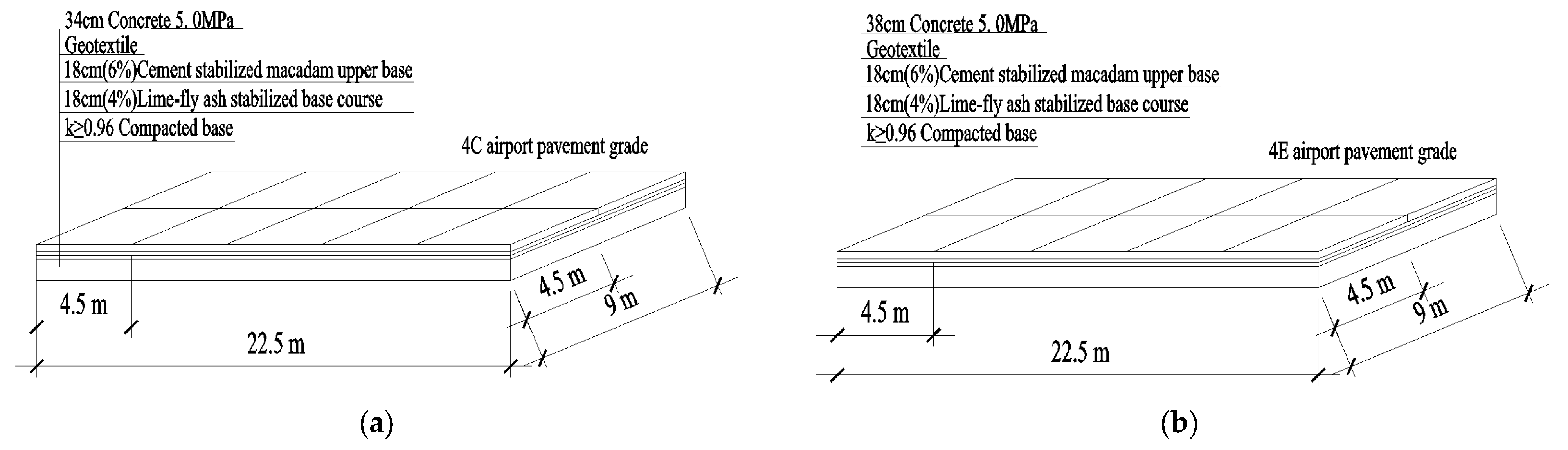
23] and is optimized in combination with the geological conditions of the test site. For the 4C class test section runway, the surface layer is 34 cm thick cement concrete, the base course adopts the combined form of “18 cm thick cement-stabilized macadam upper base course + 18 cm thick lime-fly ash stabilized soil lower base course”, and the shoulder structure is “16 cm thick cement concrete surface layer + 18 cm thick cement-stabilized macadam upper base course”; for the 4E class test section runway, the surface layer is 38 cm thick cement concrete, the base course adopts the combined form of “18 cm thick cement-stabilized macadam upper base course + 18 cm thick cement-stabilized macadam lower base course”, and the shoulder structure is “16 cm thick cement concrete surface layer + 22 cm thick cement-stabilized macadam upper base course”. The structural combination scheme is shown in
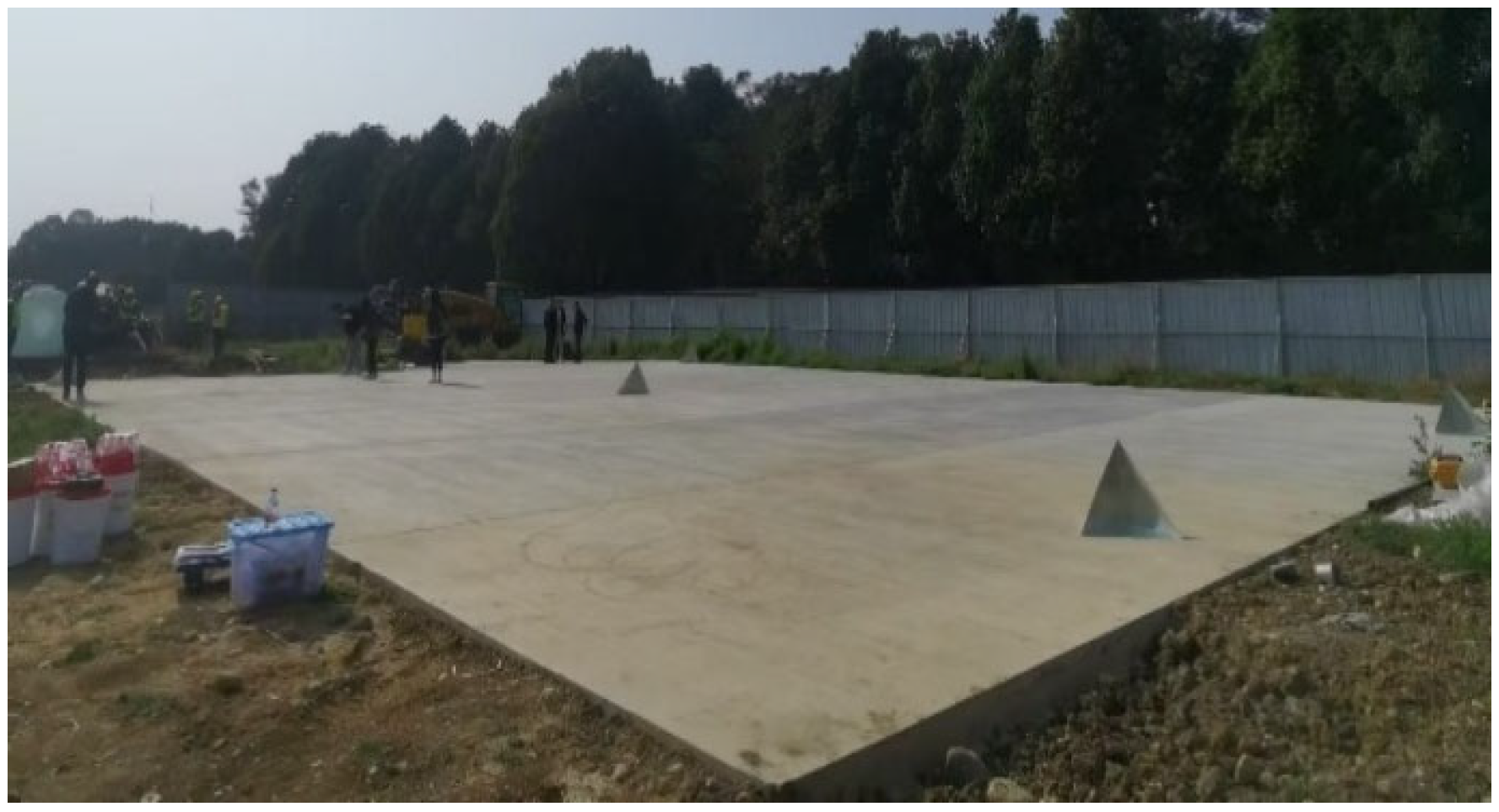
Figure 1. The photos of the test section are shown in
Figure 2.
In addition, the layout of the test section was designed to facilitate both HDD construction and subsequent structural performance evaluation. Measurement points for deflection testing and drilling locations were arranged to represent typical runway centerline lighting installation scenarios. This configuration ensures that the experimental results can effectively reflect the structural response of runway pavements subjected to HDD construction activities.
3. Finite Element Modeling Framework and Validation
3.1. Pavement Structure Model and Parameters
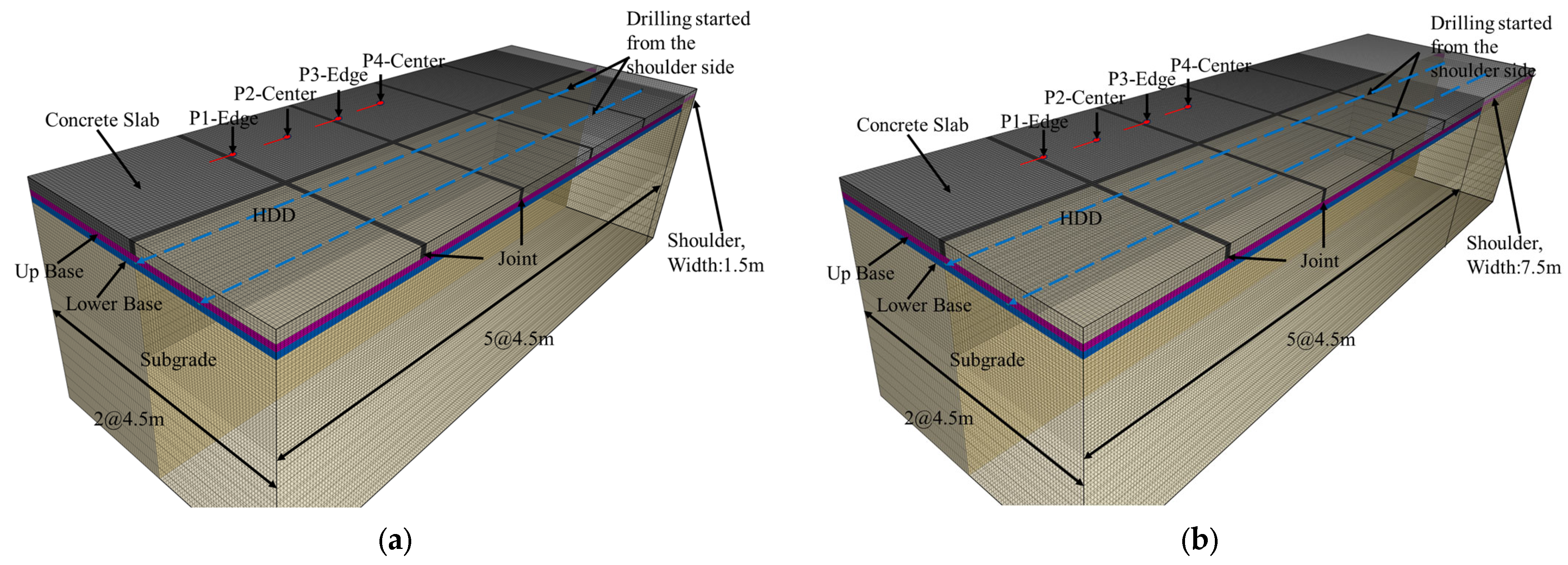
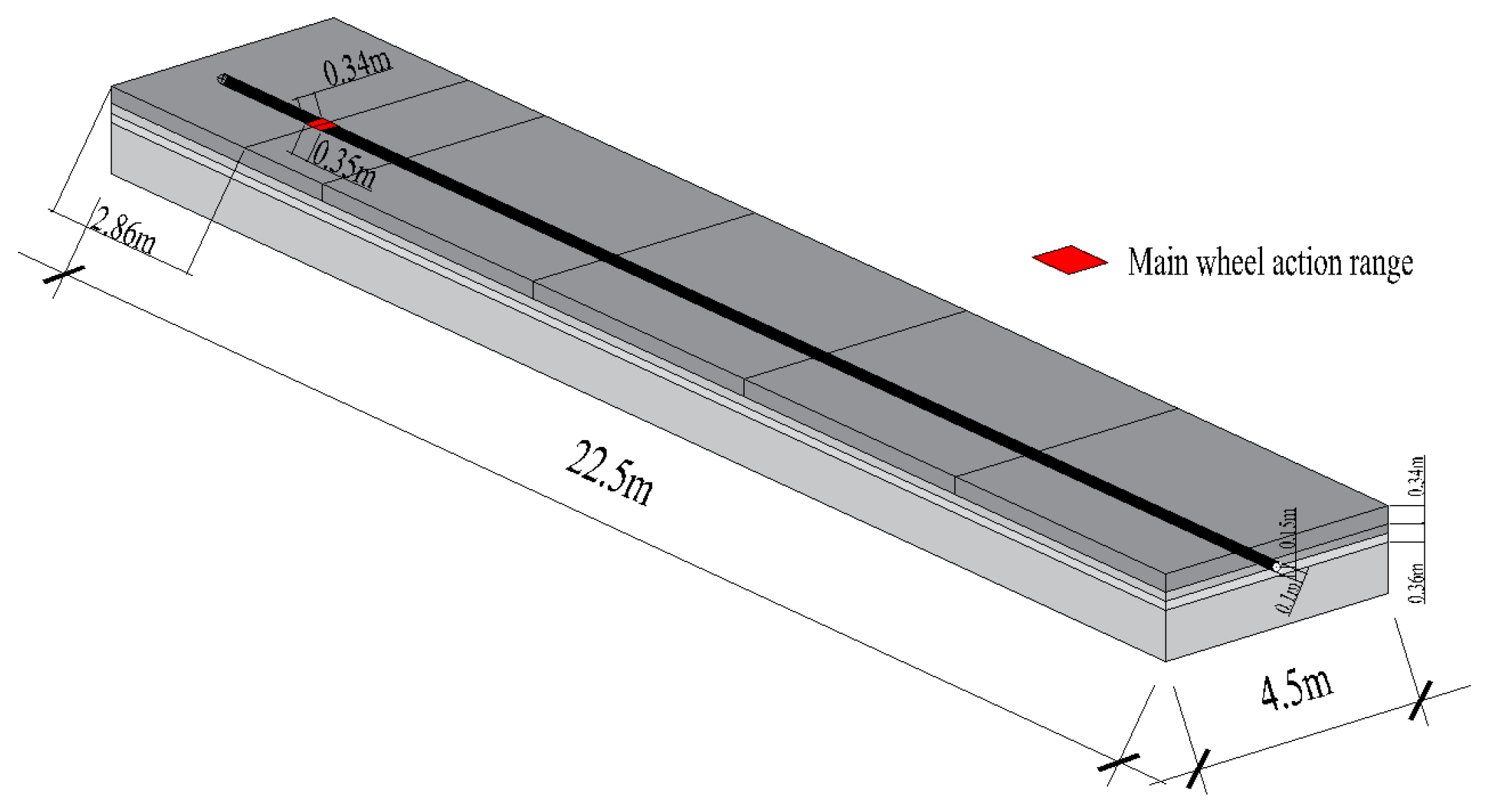
A three-dimensional finite element model (FEM) was established to simulate the structural response of airport pavements under heavy wheel loading. The model geometry was developed based on the field test configuration and is consistent with the structural layout illustrated in
Figure 3. Two pavement classes were considered: a 4C class pavement and a 4E class pavement.
For the 4C pavement, the concrete slab dimensions were 4.5 m × 4.5 m × 0.34 m, while for the 4E pavement, the slab thickness was increased to 0.38 m with the same plan dimensions. Beneath the surface slab, a cement-stabilized base layer composed of two sublayers was modeled, including an upper base and a lower base, each with a thickness of 0.18 m. The total base thickness was therefore 0.36 m for both pavement types.
The subgrade was modeled with a finite depth extending to 4.0 m below the bottom of the base layer to minimize boundary effects. The overall dimensions of the computational domain were selected to ensure that stress and displacement fields induced by loading were not affected by artificial boundary constraints.
All pavement layers were modeled as linear elastic materials. The mechanical properties, including elastic modulus, Poisson’s ratio and layer thickness, were determined by field tests, literature references and design specifications, with detailed values listed in
Table 1. Specifically, the elastic modulus of the cement concrete surface layer was determined via on-site core drilling and laboratory mechanical tests at the airport test field, ensuring it matches the actual pavement stiffness. For the cement-stabilized macadam base and lime-fly ash-stabilized soil subbase, their mechanical parameters were selected based on typical values from authoritative prior studies and airport pavement design codes, which are widely used in related numerical simulations [
24,
25,
26]. Although cement-stabilized base courses and subgrades may exhibit nonlinear mechanical behavior under loading, the present study focuses on the relative influence of HDD depth and position based on actual tested parameters and standard runway structural configurations. The subgrade was represented as a three-dimensional elastic continuum rather than a Winkler-type foundation, with stiffness calibrated to an equivalent subgrade reaction modulus of 80 MPa [
27]. This modeling approach allows realistic representation of stress redistribution and deformation continuity within the soil mass while avoiding the limitations of spring-based foundation models.
It should be noted that the finite element model developed in this study is based on linear elastic material behavior and a three-dimensional elastic continuum representation of the subgrade. This modeling framework is suitable for evaluating the instantaneous structural response of the pavement system under HWD and aircraft loading conditions. However, the model does not account for nonlinear material behavior, progressive cracking, or damage accumulation under repeated loading. In addition, the horizontal drilling process is idealized as a geometric void, without explicitly simulating fracture propagation, grout diffusion, or long-term degradation effects. Therefore, the numerical results are intended to provide a comparative assessment of mechanical response and disturbance sensitivity at different drilling depths, rather than a prediction of long-term pavement performance. Investigation of nonlinear material behavior, damage evolution, and fatigue effects will be addressed in future studies.
The finite element model was discretized using three-dimensional solid elements. A nonuniform meshing strategy was adopted to balance computational efficiency and numerical accuracy. Finer meshes were applied in critical regions, including the concrete surface layer, cement-stabilized base layers, and the vicinity of the horizontal drilling hole, while coarser elements were used in the deeper subgrade. Consistent nodal connectivity was maintained between adjacent layers to ensure displacement compatibility. Boundary conditions were applied to prevent rigid-body motion, with the bottom boundary fully constrained and the lateral boundaries restricted in the horizontal directions but free vertically, simulating semi-infinite ground conditions commonly adopted in pavement analyses.
Transverse and longitudinal joints were represented using weakened joint bands within the surface layer to account for stiffness discontinuities. The slab–base interface was assumed to be fully bonded by enforcing displacement compatibility. Tie bars were explicitly modeled using equivalent solid elements, with material properties de-fined according to JTG D40–2011 [
28], including an elastic modulus of 2.06 × 10
5 MPa, Poisson’s ratio of 0.30, and yield strength of 400 MPa. The horizontal drilling hole was modeled as a cylindrical void located 0.15 m above the top of the subgrade, entirely within the stabilized base layer, consistent with field conditions. The HWD load was applied as a uniformly distributed pressure over a circular area with a diameter of 300 mm, and both slab-center and slab-edge loading positions were considered. The model assumes linear elastic behavior and does not account for cracking, fatigue, or long-term damage evolution; therefore, the results are intended to provide a comparative evaluation of structural response and drilling-induced disturbance rather than long-term performance prediction.
3.2. Validation of Pavement Structure Model
To conduct the impact analysis of directional drilling hole positions, it is necessary to perform on-site tests on the pavement test section using a Heavy Weight Deflectometer (HWD) to obtain actual pavement deformation data, thereby verifying the effectiveness of the finite element model. The HWD device applies an impulse load through a circular loading plate with a diameter of 300 mm, and multiple deflection sensors are arranged at different distances from the load center to measure the pavement surface deflection basin. By applying the same load conditions in the finite element model, the deformation response of the pavement under load is simulated. The reliability of the model establishment is evaluated by comparing the measured values from HWD with the simulated calculation values.
3.2.1. On-Site Measurement of Heavy Weight Deflectometer (HWD) in Test Section
The HWD is an internationally recognized device for evaluating the bearing capacity and on-site structural response of airport pavements. It simulates the aircraft load action process through a heavy hammer impacting the pavement [
29,
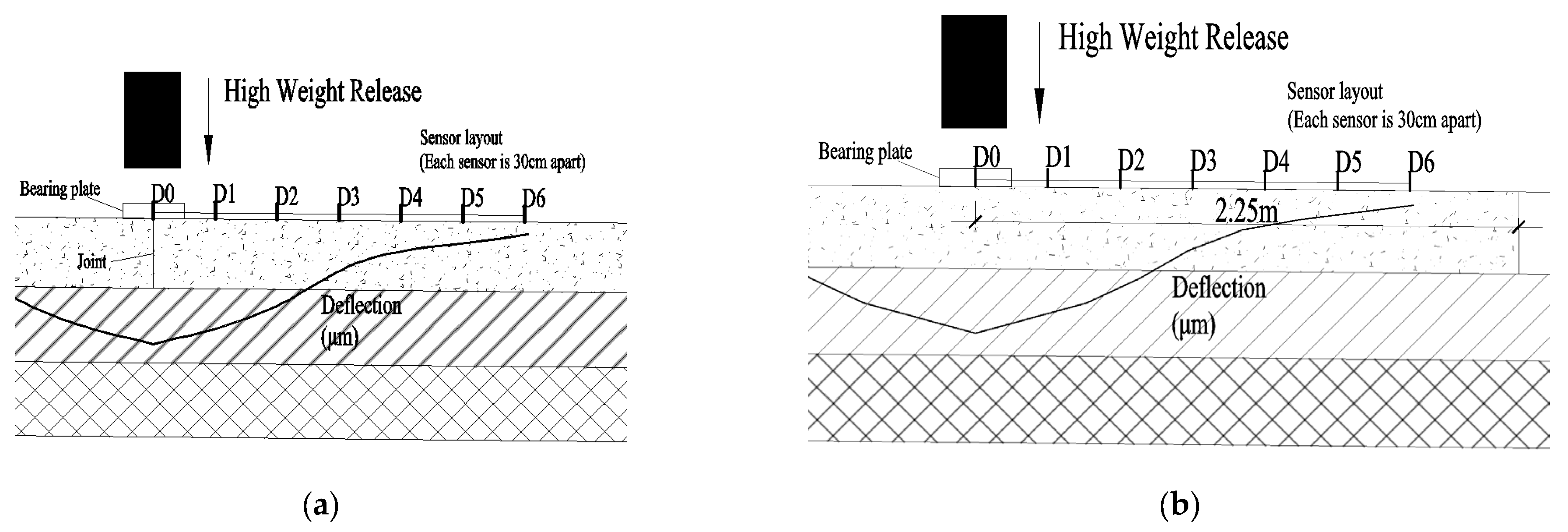
30]. During the test, sensors are arranged at different distances from the load center (every 30 cm) to record the deflection response of the pavement under load, forming a pavement deflection basin. The measured deflection values at each sensor location were used as the primary field data to validate the finite element model by comparing the simulated and measured deflection basin responses. The specific load application position and pavement deflection deformation characteristics are shown in
Figure 4a and b, respectively.
As shown in
Figure 4, for each of the 4C and 4E class pavement test sections, two pavement slabs were selected, and heavy hammer loads were applied at the slab center and slab edge respectively. The measured deflection data are presented in
Table 2.
3.2.2. Finite Element Analysis and Validation
For the finite element models of 4C and 4E class pavements, the same load as in the field test was applied at the slab center and slab edge with static pressure. This simplification allows the numerical model to capture the primary structural response characteristics of the pavement while maintaining computational efficiency. The pavement deformation values within the range of 0 to 180 cm from the load center (at intervals of 30 cm) were calculated, and the results are presented in
Table 3.
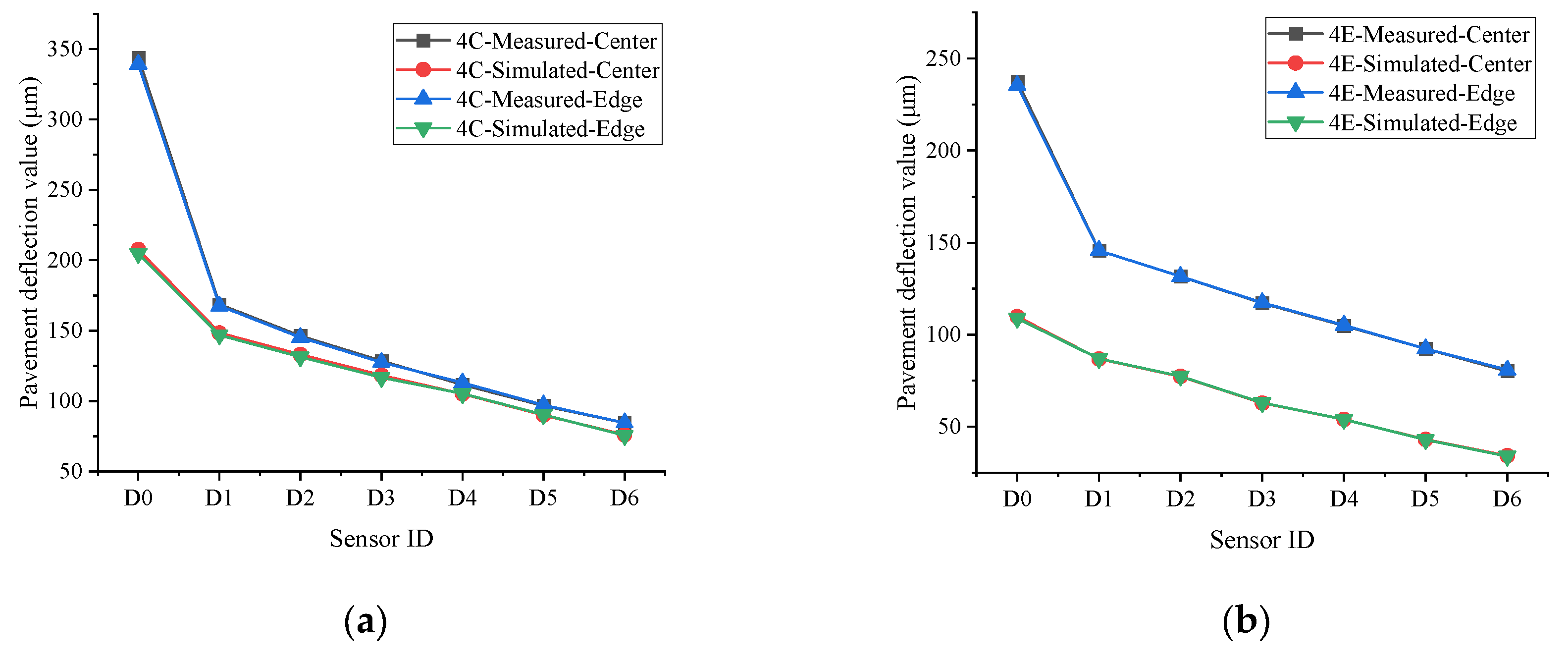
Figure 5 presents a comparison between the measured HWD deflection basins and the corresponding finite element simulation results for both 4C and 4E pavement structures under slab-center and slab-edge loading conditions. Overall, the numerical model reproduces the attenuation characteristics of the measured deflection basins well, indicating that the primary mechanical response of the pavement system is appropriately captured.
For the slab-center loading condition of the 4C pavement, the measured deflection decreases from 342 μm at the load center (D0) to 84.3 μm at the farthest sensor location (D6), while the simulated deflection decreases from 209 μm to 78.2 μm. The attenuation trends of the two curves are highly consistent, and the discrepancy at the far-field region remains within approximately 7%, demonstrating good agreement in the overall deflection profile. At the slab edge, the measured deflection decreases from 339 μm to 8.1 μm, whereas the simulated values decrease from 204.7 μm to 75.5 μm. Although a relatively larger deviation (approximately 30%) is observed near the loading point, the difference gradually diminishes with increasing distance from the load and reduces to within 10% at the far end. This behavior reflects the higher sensitivity of the slab-edge region to local contact conditions, joint behavior, and load transfer mechanisms, which are difficult to fully capture in an idealized numerical model.
For the 4E pavement, similar trends are observed. Under slab-center loading, the measured deflection decreases from 237 μm to 80.1 μm, while the simulated values decrease from 109.4 μm to 34.6 μm. Among all analyzed cases, this condition exhibits the best agreement in terms of attenuation behavior, with a far-field deviation of approximately 6%, indicating that the model effectively captures the global stiffness characteristics of the thicker pavement structure. At the slab edge, the measured deflection decreases from 233 μm to 81.3 μm, and the simulated deflection decreases from 108.7 μm to 33.7 μm. Although discrepancies are evident near the loading point, the deviation progressively decreases with distance and remains within approximately 10% in the far-field region.
To quantitatively evaluate the agreement between measured and simulated responses, the root mean square error (RMSE) was calculated for all loading cases, as listed in
Table 4. The RMSE values range from 51.3 to 54.1 μm for the 4C pavement and from 67.5 to 69.2 μm for the 4E pavement. The slightly higher RMSE values observed for the 4E pavement are mainly attributed to its greater structural stiffness, which reduces surface deflections and increases sensitivity to uncertainties in material parameters and boundary conditions. Nevertheless, the consistency of RMSE values across different loading positions indicates stable model performance and reliable representation of the overall pavement response.
It should be noted that the discrepancies observed near the loading area are primarily associated with simplifications adopted in the numerical model, including the representation of the HWD load as an equivalent static pressure, the assumption of linear elastic material behavior, and the idealization of joint and contact conditions. Despite these limitations, the numerical model successfully reproduces the overall shape and attenuation characteristics of the deflection basins for both pavement types. Therefore, the developed model is considered suitable for comparative analysis of structural response and for evaluating the influence of drilling depth and location on pavement performance.
4. Effect of Drilling Depth on Pavements Under the Action of Different Aircraft Types
4.1. Magnitude and Layout Method of Pavement-Bearing Loads
The mainstream aircraft types of 4C class civil transport airports are the B737 and A320 series. These two types of aircraft have similar requirements for pavement bearing capacity, so the B737-800 aircraft is selected as the analysis model for 4C class airports [
31]. In addition to the B737 and A320 series, 4E class civil transport airports also include large aircraft types such as the A330 and B747. The B747-400 aircraft, which exerts the largest load on pavements, is chosen as the analysis model for 4E class airports [
32]. The key parameters of the two aircraft types are shown in
Table 5 [
33,
34,
35,
36,
37].
4.2. Effect of Different Drilling Depths on Slab Bottom Stress and Deformation at Slab Center
In the finite element model, the thickness of the base course is set to 36 cm, and the diameter of the drilling hole is 10 cm. The HDD borehole is modeled as a horizontal cavity drilled from the side of the runway structure. The centers of the drilling holes are located at depths of 5 cm, 10 cm, 15 cm, 20 cm, 25 cm, and 31 cm below the top surface of the subgrade, respectively. The influence of different borehole depths and drilling positions on the stress and deformation at the bottom of the pavement slab is then analyzed.
Figure 6 is a schematic diagram of the load application when the center of the drilling hole is 15 cm from the bottom of the surface layer for the 4C class pavement under the main wheel load of the B737-800 aircraft.
Using finite element simulations, the data describing variations in slab bottom stress and deformation with drilling depth under the main wheel load were acquired for 4C and 4E class concrete pavements under corresponding aircraft loads, as presented in
Table 6.
4.2.1. Numerical Characteristics of Slab Bottom Mechanical Response Under Different Drilling Depths
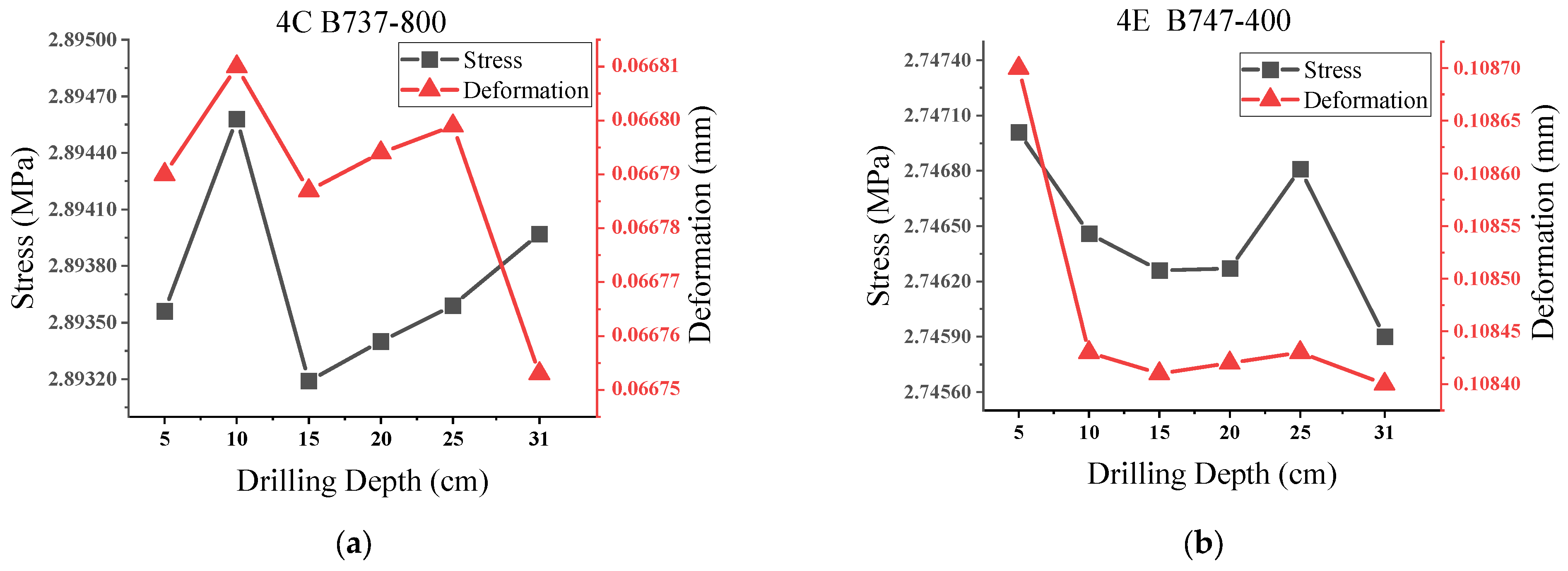
Figure 7 quantifies the fluctuation patterns of horizontal tensile stress and slab bottom deformation for Grade 4C and 4E pavements at drilling depths ranging from 5 to 31 cm.
For Grade 4C pavements, both stress and deformation show negligible fluctuations across all depths. Stress hovers around 2.894 MPa with an absolute fluctuation amplitude of only 0.00139 MPa (relative deviation < 0.05%). Deformation remains near 0.0668 mm with an absolute amplitude of 0.00006 mm (relative deviation < 0.09%).
Grade 4E pavements exhibit even higher stability. Stress stabilizes at approximately 2.746 MPa with an absolute amplitude of 0.00111 MPa (relative deviation < 0.04%). Deformation is steady at about 0.1084 mm with an absolute amplitude of 0.0003 mm (relative deviation < 0.28%).
Overall, mechanical responses at the slab center show extremely small variations and no abnormal trends, indicating that drilling depth imposes only weak disturbance on the central region [
38].
4.2.2. Influence of Drilling Depth on Slab Bottom Mechanical Response
Based on the aforementioned numerical characteristics, the influence law of drilling depth on the mechanical response at the bottom of the pavement slab can be summarized as follows: First, the degree of disturbance of drilling depth on the slab bottom mechanical response is extremely weak. The relative deviations in horizontal tensile stress at the slab bottom of both 4C and 4E class pavements are all controlled within 0.05%, and the relative deviations of deformation are controlled within 0.09% and 0.28% respectively. This result reflects that the interlayer stiffness of the pavement structure has good uniformity [
39,
40]. Drilling depth neither changes the stress transfer path at the slab bottom nor impairs the deformation coordination characteristics of the pavement; therefore, the interference on the overall mechanical state of the pavement is negligible. Second, the mechanical response at the 15 cm depth exhibits structural adaptability of “relative low values” [
41]. Although the fluctuations of the indices are minimal across the entire depth range, the slab bottom stress and deformation corresponding to the 15 cm depth are both relatively low values in the full range: for 4C class pavement, the stress and deformation at the 15 cm depth are the lowest values in the entire range; for 4E class pavement, the stress and deformation at the 15 cm depth fall within the stable low-value interval of the full range. Combined with the force-bearing logic of the pavement structure, the 15 cm depth is located in the stiffness redundancy zone of the base course, where the structural load-bearing reserve is relatively sufficient. Drilling operations at this position will neither damage the uniform distribution state of the slab bottom stress nor aggravate the deformation accumulation effect of the pavement. Therefore, the position 15 cm away from the top surface of the subgrade is the optimal drilling position with the minimal disturbance to the mechanical properties of the pavement structure.
4.3. Effect of Different Drilling Depths on Slab Bottom Stress and Deformation When the Drilling Hole Is Located at the Joint
Due to the existence of slab joints in cement concrete pavements, the slab joint area tends to be a stress-sensitive weak part under aircraft taxiing load [
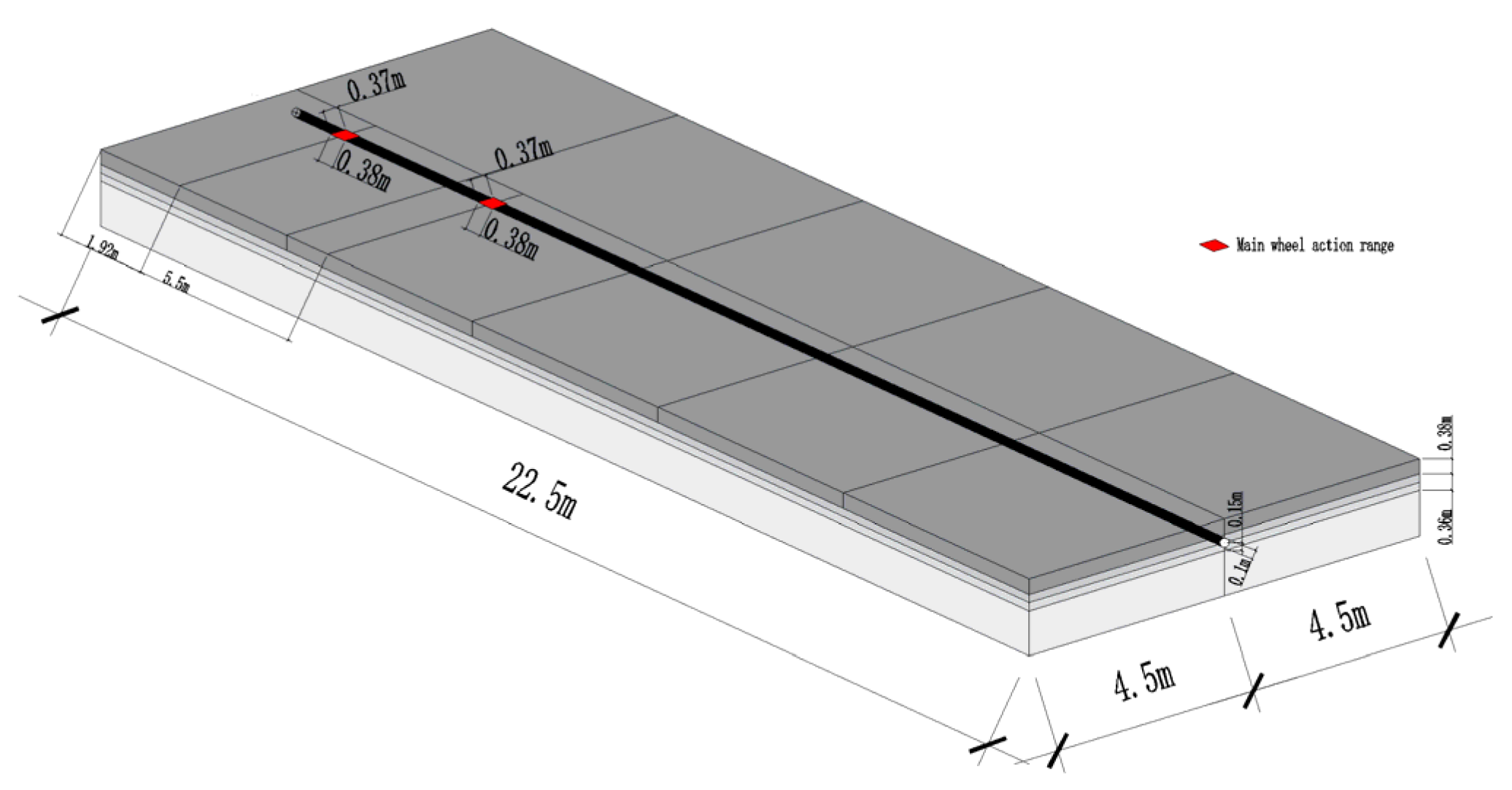
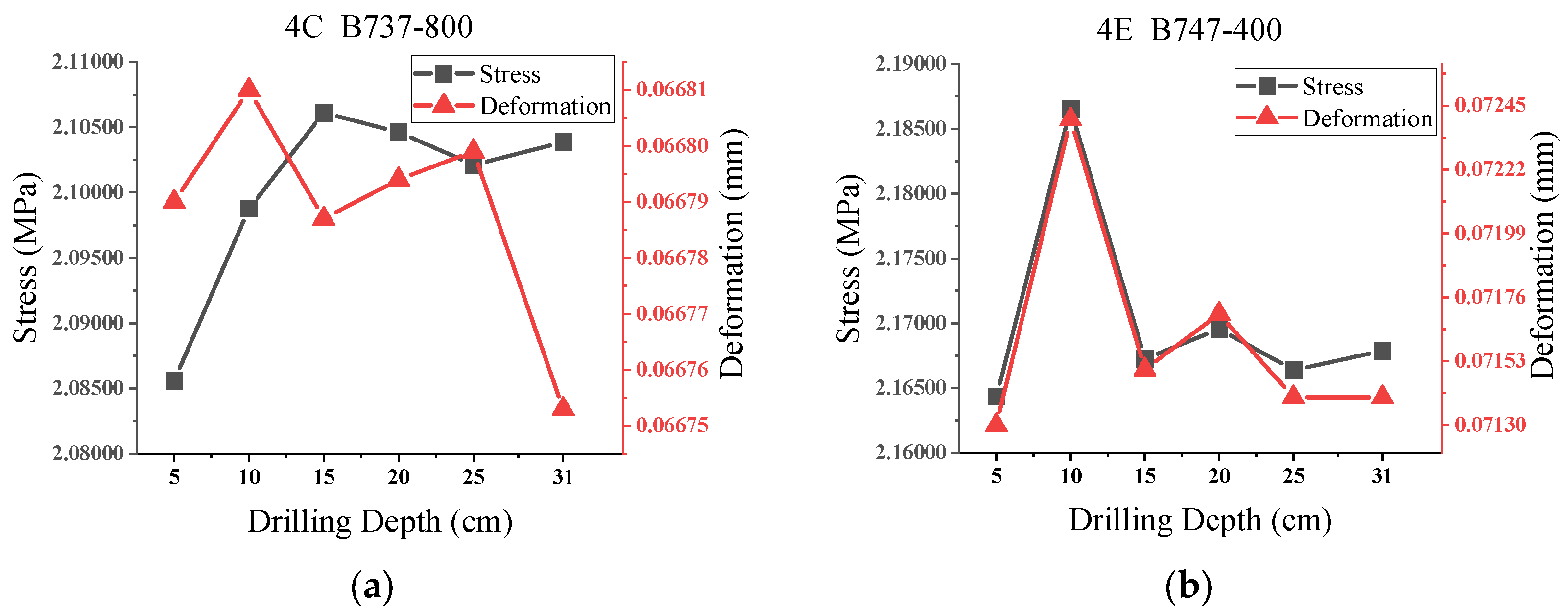
42]. Horizontal Directional Drilling (HDD) technology is widely used in the centerline light densification project of operational airport runways. During construction, drilling holes may be located either in the middle of pavement slabs or at the joints of adjacent slabs. To evaluate the impact of drilling holes located in the slab joint area on the pavement structure, this study focuses on analyzing the influence law of different drilling depths (5 cm, 10 cm, 15 cm, 20 cm, 25 cm, and 31 cm from the top surface of the subgrade) on the horizontal tensile stress and structural deformation at the bottom of the pavement slab.
Figure 8 is a schematic diagram of the load application when the center of the drilling hole is 15 cm from the top surface of the subgrade for the 4E class pavement under the main wheel load of the B747-400 aircraft.
The calculation results of slab bottom stress and deformation for 4C and 4E class pavements under different drilling depths are presented in
Table 7.
4.3.1. Numerical Characteristics of Slab Bottom Mechanical Response Under Different Drilling Depths at the Joint
As shown in
Figure 9, mechanical responses at the joint follow a consistent “rise–fall–mild fluctuation” trend for both pavement grades, with moderate but controlled amplitudes.
For Grade 4C, stress peaks at 15 cm depth and deformation follows the same pattern; the absolute stress amplitude is 0.0205 MPa (<1.0% relative deviation), and deformation amplitude is 0.0014 mm (<2.1% relative deviation).
For Grade 4E, stress and deformation both peak at 10 cm depth before stabilizing with mild oscillations; the absolute stress amplitude is about 0.0222 MPa (<1.0% relative deviation), and deformation amplitude is 0.0011 mm (<1.5% relative deviation).
Mechanical magnitudes at the joint are lower than those at the slab center, attributable to the multi-slab load-sharing effect. Fluctuations remain small and stable across all drilling depths, with no abnormal behavior [
43,
44].
4.3.2. Influence of Drilling Depth on Slab Bottom Mechanical Response
The numerical results show that the pavement mechanical response varies with drilling depth, and the peak response locations differ between pavement classes. For the 4C class pavement, the maximum tensile stress occurs at approximately 15 cm, while the maximum surface deformation appears near 10 cm. For the 4E class pavement, both stress and deformation peaks occur around 10 cm. This difference is mainly related to the variations in slab thickness and tie-bar configuration, which influence load transfer and stress diffusion within the pavement structure. The depth range corresponding to these peak responses represents a critical zone where tie bars and concrete jointly resist external loads; drilling within this region may increase stress concentration.
Despite the presence of local peaks, a drilling depth of approximately 15 cm can be considered a disturbance-mitigation depth for both pavement classes. For the 4C pavement, although tensile stress reaches its maximum at 15 cm, the associated deformation has already decreased to a level comparable to that at shallow depths, and the stress magnitude decreases with increasing depth below this level. For the 4E pavement, the 15 cm depth is clearly separated from the peak disturbance zone at 10 cm, where both stress and deformation are reduced to relatively stable levels.
In general, stress variation with drilling depth is small when the borehole is located beneath the slab center, indicating that HDD depth has a limited influence on the global stress response of the pavement. However, when the borehole is located beneath the slab joint, stress variation becomes more pronounced due to the structural discontinuity and load-transfer mechanisms at the joint. Under this more critical condition, the 15 cm drilling depth consistently produces the lowest stress response among the investigated depths.
Considering both pavement classes, drilling at approximately 15 cm avoids the peak disturbance zone, maintains the load-transfer function of tie bars, and limits stress concentration near joints. Therefore, this depth provides a balanced solution that minimizes structural disturbance while satisfying construction and functional requirements.
5. Analysis of Field Tests
Based on the numerical simulation results discussed above, a drilling depth of 15 cm from the top surface of the subgrade was identified as the optimal location, regardless of whether the drilling hole was positioned at the slab center or near the joint. To further verify the engineering feasibility and structural rationality of this conclusion, a field validation test was conducted at the test section site. The test procedure was designed to evaluate the mechanical response of the pavement before drilling, after drilling, and after grouting.
First, a HWD test was conducted to measure the deflection values at each predetermined test point along the drilling lines. Subsequently, Horizontal Directional Drilling (HDD) was performed at the preset depth of 15 cm above the subgrade within the base course. After completion of drilling, HWD testing was repeated at the same locations to evaluate the influence of drilling on pavement stiffness. Finally, the drilled holes were backfilled using a cement-based grouting material, and HWD testing was conducted again after the grout reached its final setting state (approximately 2 h after grouting) [
45,
46]. Based on the measured deflection data, the Impulse Stiffness Modulus (
ISM) was calculated using Equation (1) (MH/T 5110-2015) [
47], and the variations in
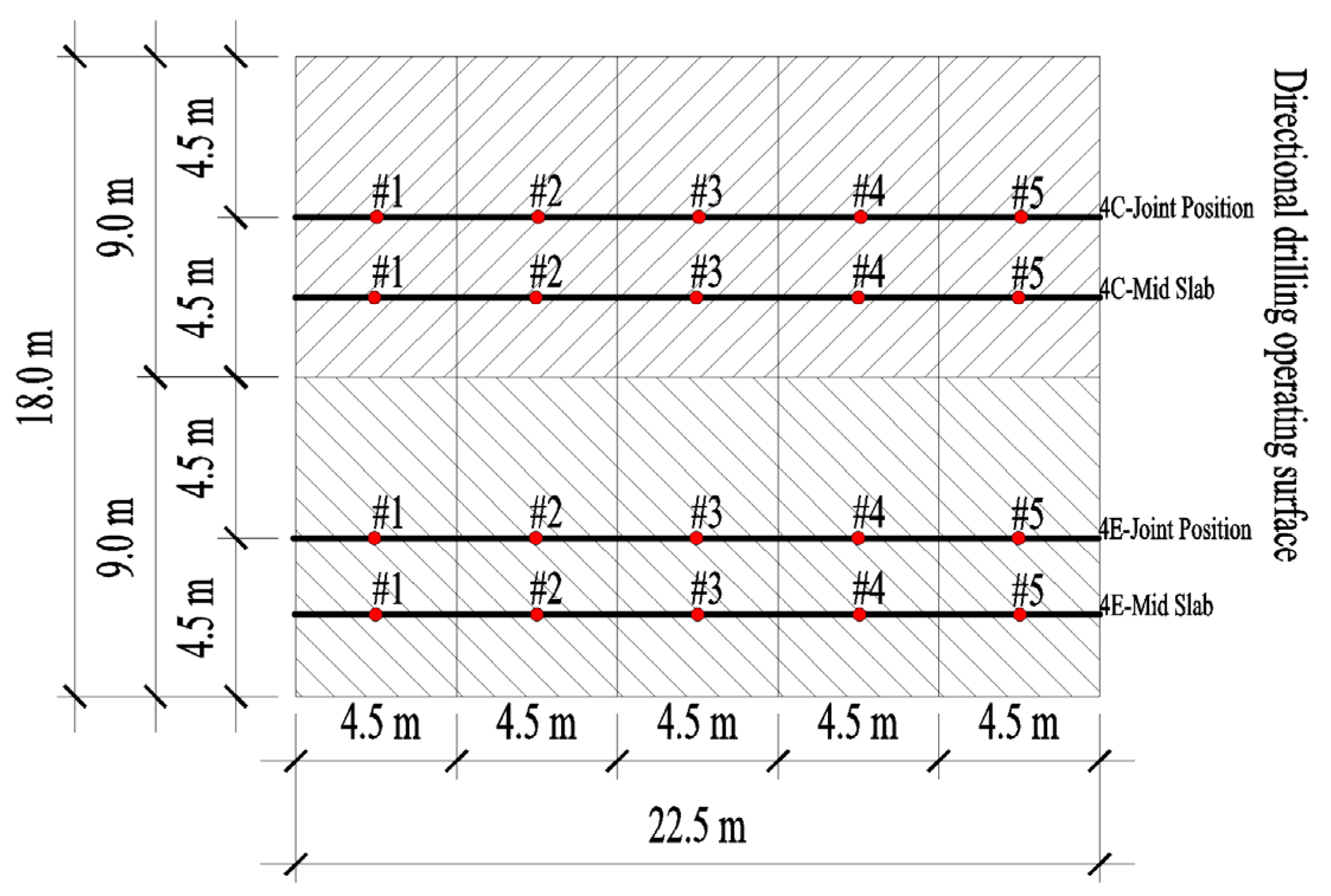
ISM before drilling, after drilling, and after grouting were compared to assess the structural impact of the HDD process. The locations of the measurement points are shown in
Figure 10.
The grouting material consisted of composite Portland cement (P.C 42.5R) and rapid-hardening sulphoaluminate cement (R.SAC 42.5), combined with a polycarboxylate-based high-performance water-reducing agent. Fine manufactured sand with particle size less than 0.5 mm and tap water were used to ensure adequate flowability and penetration. The final setting time of the grout was approximately 118 min. The post-grouting HWD test was therefore intended to evaluate the early-stage mechanical recovery of the pavement structure, which is of practical importance for airport engineering applications where rapid reopening is often required. It should be noted that the results obtained at this stage mainly reflect the early mechanical response after grouting, while the long-term performance and durability of the grouted structure require further investigation.
Calculation Formula of Impulse Stiffness Modulus (
ISM)
where:
ISM = Impulse Stiffness Modulus (Unit: kN/mm);
P = Falling Weight Impact Force (Unit: kN);
= Deflection Value at Load Center (Unit: mm).
The calculation results of Impulse Stiffness Modulus (
ISM) at three stages (before drilling, after drilling without grouting, and after grout final setting) are presented in
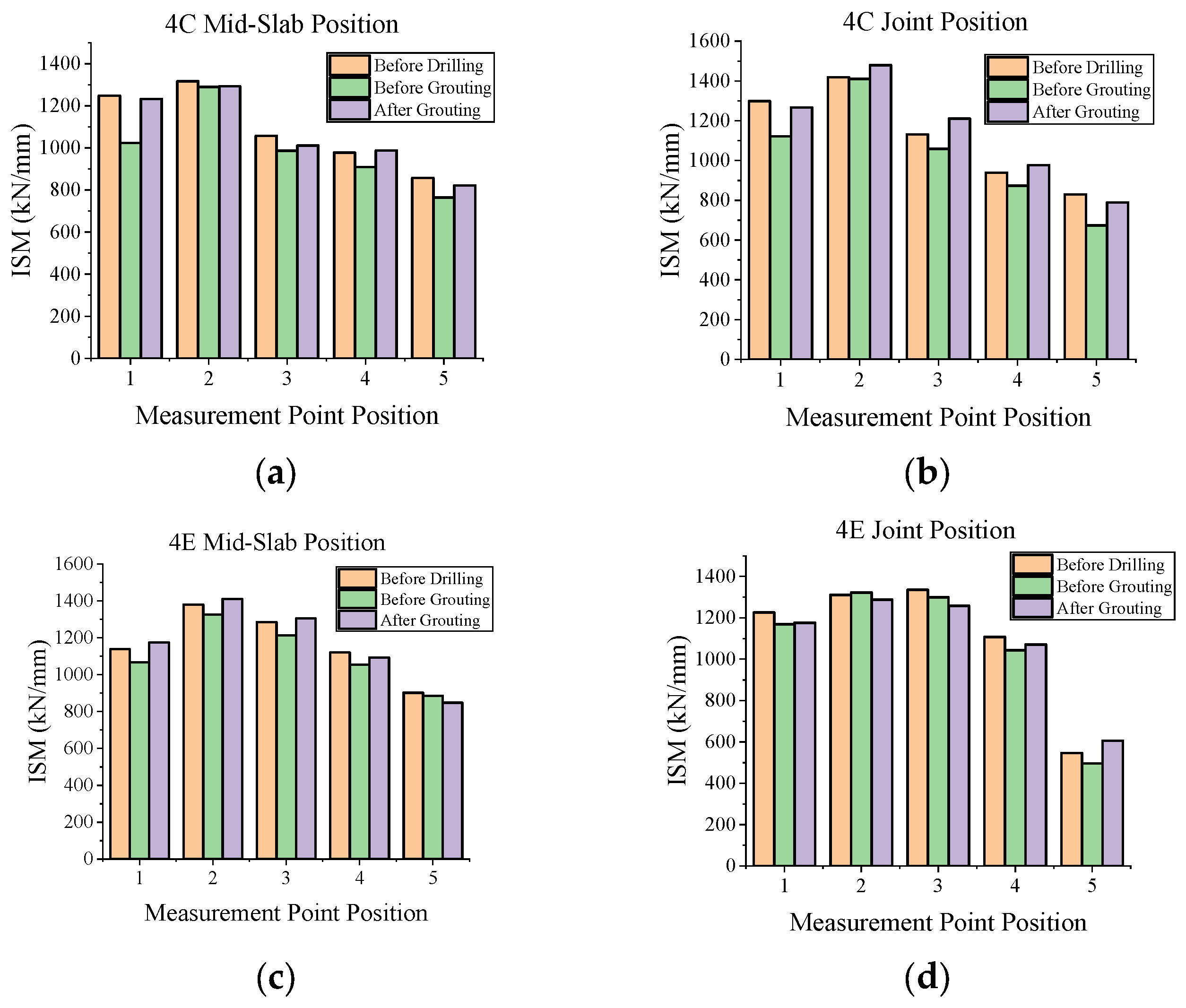
Table 8 and
Figure 11.
Based on the test data, the variation in Impulse Stiffness Modulus (ISM) of 4C and 4E class pavements with construction stages presents significant phased characteristics and local abnormalities under two drilling line positions (slab center and joint). The detailed analysis is as follows:
(1) Variation Law of Modulus of 4C Class Pavement
Slab center position: In the stage after drilling without grouting, the ISM of all measurement points decreases compared with that before drilling (e.g., Measurement Point 1 decreases from 1248.4 kN/mm to 1023.4 kN/mm, with a decrease rate of approximately 18.0%); after grout final setting, the modulus significantly recovers compared with the stage after drilling without grouting. Most measurement points (1–4) recover to a level close to that before drilling (e.g., Measurement Point 2 recovers from 1289.3 kN/mm to 1293.2 kN/mm), and only Measurement Point 5 (821.8 kN/mm) is slightly lower than that before drilling (857.1 kN/mm), showing a good overall recovery effect.
Joint position: In the stage after drilling without grouting, the modulus significantly decreases compared with that before drilling (the decrease rate of Measurement Point 5 reaches 18.9%); after grout final setting, the modulus of all measurement points rebounds sharply, and some measurement points (e.g., Measurement Point 2) even exceed the level before drilling (increases from 1418.1 kN/mm to 1478.9 kN/mm), indicating a significant grouting reinforcement effect.
(2) Variation Law of Modulus of 4E Class Pavement
Slab center position: In the stage after drilling without grouting, the modulus of most measurement points generally decreases compared with that before drilling (the decrease rate of Measurement Point 1 is approximately 6.2%); after grout final setting, the modulus of most measurement points (1–3) rebounds and exceeds the level before drilling (e.g., Measurement Point 3 increases from 1284.5 kN/mm to 1304.4 kN/mm), but Measurement Points 4–5 do not recover to the level before drilling, showing local insufficient recovery, which is presumably related to the differences in pavement structure stiffness distribution and grouting compactness.
Joint position: In the stage after drilling without grouting, the modulus generally decreases compared with that before drilling (the decrease rate of Measurement Point 5 is approximately 9.2%); after grout final setting, the modulus rebounds compared with the stage after drilling without grouting. Among them, Measurement Point 5 (increases from 496.0 kN/mm to 605.4 kN/mm) significantly exceeds the level before drilling (546.5 kN/mm), and most of the remaining measurement points are close to the level before drilling, which generally meets the engineering requirements.
(3) Analysis of Causes of Abnormal Data
During the test, some measurement points (e.g., Measurement Point 5 at the slab center of 4E class pavement) showed deviations in modulus variation from the overall trend, which maybe induced by: inconsistent test positions caused by deviations in the falling weight position of the HWD; deviations between the actual drilling path of Horizontal Directional Drilling and the preset position, resulting in some areas not being disturbed by drilling; the nonlinear relationship between the impact force fluctuation of the heavy hammer and pavement deformation, where small changes in force and deflection lead to deviations in modulus calculation. Despite local abnormalities, most measurement points of the two classes of pavements and two drilling line positions still show a reasonable law of “modulus decrease due to drilling disturbance and modulus recovery promoted by grouting reinforcement”, verifying the reliability of the numerical simulation conclusions [
48,
49].
6. Conclusions
This study combines numerical simulation and field tests to systematically investigate the mechanical characteristics and engineering feasibility of applying small diameter (10 cm) Horizontal Directional Drilling (HDD) technology in the base course of 4C and 4E rigid airport pavements. In recent years, with the rapid development of airport infrastructure retrofitting and the increasing demand for trenchless construction technologies, Horizontal Directional Drilling (HDD) has been widely concerned as an efficient and less disruptive construction method in airport pavement engineering. The state of the art in this field shows that existing studies mainly focus on the application of HDD in airport surface layers or large-diameter pipeline laying, while research on small-diameter HDD (≤10 cm) applied to the base course of rigid airport pavements (especially 4C and 4E grades) is relatively scarce, and there is a lack of systematic integration of numerical simulation and field validation to verify its mechanical safety and engineering feasibility. Against this background, this study carries out targeted research, and the main conclusions are integrated as follows:
(1) A high-precision three-dimensional finite element model consistent with field conditions was established and rigorously validated using HWD field measurement data, which constitutes a robust methodological strength of this research. The simulated deflection distributions fit the measured attenuation trends well, and the far-field deviation between numerical predictions and field test data is satisfied.
(2) Numerical results demonstrate that drilling depth exerts only a minor influence on slab bottom stress and deformation for both pavement grades. Relative deviations of horizontal tensile stress are within 0.05% across all cases. Deformation deviations are within 0.09% and 0.28% at the slab center, and within 1.0% and 1.5% at joints, with no abnormal variations observed. HDD application thus poses no significant adverse effect on pavement structural stability.
(3) The optimal drilling depth is identified as 15 cm above the subgrade surface, which lies within the stiffness-redundant zone of the base course. This placement avoids damaging tie bar load transfer and alleviates stress concentrations at joints, minimizing structural disturbance at both slab center and joint locations.
(4) Field tests reveal that pavement structural stiffness modulus (ISM) temporarily decreases after drilling but recovers to near or above predrilling levels following grout curing. Recovery is more pronounced in 4C pavements, especially at joints, confirming that timely grouting can effectively compensate for stiffness loss and preserve bearing capacity.
This integrated “theoretical analysis–numerical simulation–field validation” framework verifies the safety and rationality of small diameter HDD for navigational lighting retrofits, offering a scientific foundation for standardized application and supporting the advancement of airport pavement trenchless technologies.
However, it should be noted that this study has several limitations that warrant acknowledgement. Firstly, the numerical simulations rely on linear elastic models, which cannot fully capture the nonlinear mechanical behaviors of pavement materials and grout–pavement interface interactions under complex aircraft loading, leading to minor discrepancies between simulated and real-world structural responses. Secondly, the research only evaluates short-term pavement performance, with a lack of long-term performance analysis (including grout durability, fatigue damage under repeated aircraft loads, and environmental adaptability). Additionally, no direct quantitative comparisons between HDD and traditional trenching methods were conducted due to differing construction mechanisms and boundary conditions, and the findings are only applicable to 10 cm diameter HDD and 4C/4E rigid airport pavements, limiting broader generalizability.
Future work will directly address the aforementioned limitations to enhance research rigor and practical value. Specifically, nonlinear constitutive models will replace the current linear elastic models to improve numerical simulation accuracy; long-term field monitoring and performance tracking will be implemented to assess pavement durability, grout stability, and fatigue resistance under sustained aircraft loads and environmental changes. Furthermore, systematic quantitative comparisons of construction efficiency, cost, and structural performance between HDD and conventional trenching methods will be conducted, and the applicability of the technology will be expanded to larger drilling diameters and diverse airport pavement grades to support standardized, reliable engineering deployment.
7. Patents
No patents resulted from the work reported in this manuscript.
Author Contributions
Conceptualization, Y.S. and W.H.; methodology, Y.S. and X.F.; validation, Y.S. and Y.L.; formal analysis, Y.S.; writing—original draft preparation, Y.S.; writing—review and editing, W.H. and Y.L.; supervision, X.F.; project administration, Y.S.; funding acquisition, W.H. All authors have read and agreed to the published version of the manuscript.
Funding
This research was funded by the Fundamental Research Funds for the Central Universities, Grant No. 25CAFUC04038; Sichuan Provincial Engineering Research Center of Smart Operation and Maintenance of Civil Aviation Airports, Grant No. JCZX 2024ZZ04; the Science and Technology Foundation of Civil Aviation Flight University of China, Grant No. 2025DZ05, the Science and Technology Foundation of Civil Aviation Flight University of China (Grant No. J2022-040).
Data Availability Statement
Data will be made available on request.
Acknowledgments
The authors would like to express the sincere gratitude to the fundamental support from the Central Universities (Grant No. 25CAFUC04038), the Sichuan Provincial Engineering Research Center of Smart Operation and Maintenance of Civil Aviation Airports (Grant No. JCZX 2024ZZ04), the Science and Technology Foundation of Civil Aviation Flight University of China (Grant No. TD2025DZ05), and the Science and Technology Foundation of Civil Aviation Flight University of China (Grant No. J2022-040). We also appreciate the constructive collaboration among all co-authors during the research process: the joint efforts in conceptualization, methodology development, validation, and formal analysis laid a solid foundation for this study. Special thanks go to Xuedong Fang for his valuable supervision and Yun Sheng for leading the original draft preparation and project administration. We are grateful to Wei Huang for his contributions to funding acquisition and manuscript review, as well as Yuxing Liu for his efforts in validation and editorial revisions. Additionally, the authors would like to thank the anonymous reviewers and the editorial team of the journal for their insightful comments and careful handling of the manuscript, which significantly improved the quality of this work.
Conflicts of Interest
The authors declare no conflicts of interest.
References
- Amalia, D.; Soleh, A.M.; Febriansyah, A.; Rizko, R.; Salbiah, S.; Suryan, V.; Septiani, V. Development of airfield lighting system digital learning media: An application usability testing. JMKSP (J. Manaj. Kepemimp. Dan Supervisi Pendidik.) 2024, 9, 240–255. [Google Scholar] [CrossRef]
- Qi, G.; Zhengying, W.; Hao, M. Numerical and experimental method to determine the boring diameters of a two-stage TBM cutterhead to prevent rock burst. J. Mech. Sci. Technol. 2014, 28, 4613–4620. [Google Scholar] [CrossRef]
- Jiwa, M.Z.; Kim, D.K.; Mustaffa, Z.; Choi, H. A systematic approach to pipe-in-pipe installation analysis. Ocean Eng. 2017, 142, 478–490. [Google Scholar] [CrossRef]
- Chen, W.F.; Liew, J.Y.R. The Civil Engineering Handbook; CRC Press: Boca Raton, FL, USA, 2002. [Google Scholar]
- Estrada, H. The International Handbook of FRP Composites in Civil Engineering; CRC Press: Boca Raton, FL, USA, 2013. [Google Scholar]
- Zhang, S.; Li, Y.; Shen, B.; Sun, X.; Gao, L. Effective evaluation of pressure relief drilling for reducing rock bursts and its application in underground coal mines. Int. J. Rock Mech. Min. Sci. 2019, 114, 7–16. [Google Scholar]
- Zhao, T.; Guo, W.; Yu, F.; Tan, Y.-L.; Huang, B.; Hu, S.-C. Numerical investigation of influences of drilling arrangements on the mechanical behavior and energy evolution of coal models. Adv. Civ. Eng. 2018, 2018, 3817397. [Google Scholar] [CrossRef]
- Polak, M.A.; Lasheen, A. Mechanical modelling for pipes in horizontal directional drilling. Tunn. Undergr. Space Technol. 2001, 16, 47–54. [Google Scholar] [CrossRef]
- Yan, X.; Ariaratnam, S.T.; Dong, S.; Zeng, C. Horizontal directional drilling: State-of-the-art review of theory and applications. Tunn. Undergr. Space Technol. 2018, 72, 162–173. [Google Scholar]
- Cohen, A.; Ariaratnam, S.T. Developing a Successful Specification for Horizontal Directional Drilling. In Pipelines 2017; American Society of Civil Engineers (ASCE): Reston, VA, USA, 2017; pp. 553–563. [Google Scholar]
- Allouche, E.N.; Ariaratnam, S.T.; Lueke, J.S. Horizontal directional drilling: Profile of an emerging industry. J. Constr. Eng. Manag. 2000, 126, 68–76. [Google Scholar] [CrossRef]
- Wang, H.; Huang, H.; Bi, W.; Ji, G.; Zhou, B.; Zhuo, L. Deep and ultra-deep oil and gas well drilling technologies: Progress and prospect. Nat. Gas Ind. B 2022, 9, 141–157. [Google Scholar] [CrossRef]
- He, J.; Hu, J.; Tang, Q.; Guo, S. Layout optimization of urban underground pipeline based on 3D digital city. Int. Arch. Photogramm. Remote Sens. Spat. Inf. Sci. 2010, 38, 279–283. [Google Scholar]
- Ferrer, A.L.C.; Thomé, A.M.T.; Scavarda, A.J. Sustainable urban infrastructure: A review. Resour. Conserv. Recycl. 2018, 128, 360–372. [Google Scholar] [CrossRef]
- Ziaja, E.J.; Wiśniowski, R.; Jamrozik, A.; Knez, D. Modern construction technologies of gas pipelines and oil pipelines. In International Multidisciplinary Scientific GeoConference: SGEM; STEF92 Technology Ltd.: Sofia, Bulgaria, 2018; Volume 18, pp. 613–620. [Google Scholar]
- Kurt, M.; Bagci, E.; Kaynak, Y. Application of Taguchi methods in the optimization of cutting parameters for surface finish and hole diameter accuracy in dry drilling processes. Int. J. Adv. Manuf. Technol. 2009, 40, 458–469. [Google Scholar] [CrossRef]
- Demir, Z. An Experimental Investigation of the Effect of Depth and Diameter of Pre-drilling on Friction Drilling of A7075-T651. J. Sustain. Constr. Mater. Technol. 2016, 1, 46–56. [Google Scholar] [CrossRef]
- Shon, C.S.; Estakhri, C.K.; Lee, D.; Zhang, D. Evaluating feasibility of modified drilling waste materials in flexible base course construction. Constr. Build. Mater. 2016, 116, 79–86. [Google Scholar] [CrossRef][Green Version]
- Li, P.; Yang, C.; Xu, F.; Li, J.; Jin, D. reinforcement of insufficient transverse connectivity in prestressed concrete box girder bridges using concrete-filled steel tube trusses and diaphragms: A comparative study. Buildings 2024, 14, 2466. [Google Scholar] [CrossRef]
- Kumar, B.S.; Baskar, N.; Rajaguru, K. Drilling operation: A review. Mater. Today Proc. 2020, 21, 926–933. [Google Scholar] [CrossRef]
- Huang, B.W. Dynamic characteristics of a drill in the drilling process. Proc. Inst. Mech. Eng. Part B J. Eng. Manuf. 2003, 217, 161–167. [Google Scholar]
- MH5001-2021; Aerodrome Technical Standards. China Civil Aviation Press Co., Ltd.: Beijing, China, 2021.
- MH/T 5004-2010; Specifications for Airport Cement Concrete Pavement Design. China Civil Aviation Press Co., Ltd.: Beijing, China, 2010.
- Sun, J.; Oh, E.; Chai, G.; Ma, Z.; Ong, D.E.; Bell, P. A systematic review of structural design methods and nondestructive tests for airport pavements. Constr. Build. Mater. 2024, 411, 134543. [Google Scholar] [CrossRef]
- Tamagusko, T.B. Airport Pavement Design. Master’s Thesis, Universidade de Coimbra, Coimbra, Portugal, 2020. [Google Scholar]
- Heymsfield, E.; Tingle, J.S. State of the practice in pavement structural design/analysis codes relevant to airfield pavement design. Eng. Fail. Anal. 2019, 105, 12–24. [Google Scholar] [CrossRef]
- Sun, J.; Oh, E.; Ma, Z.; Bell, P.; Ong, D.E. Impact of HWD dynamic loading on measured deflection basins and back-calculated stiffnesses of flexible airport pavements. Measurement 2025, 243, 116390. [Google Scholar] [CrossRef]
- JTG D40-2011; Code for Design of Highway Cement Concrete Pavements. China Communications Press: Beijing, China, 2011.
- Solanki, U.; Gundalia, P.J.; Barasara, M.D. A review on structural evaluation of flexible pavements using falling weight deflectometer. STM J. 2014, 2, 1–10. [Google Scholar]
- Chou, C.P.; Wang, S.Y.; Tsai, C.Y. Methodology of applying heavy weight deflectometer for calculation of runway pavement classification number. Transp. Res. Rec. 2007, 1990, 57–64. [Google Scholar] [CrossRef]
- Irvayana, I.P.D.; Astor, Y.; Sihombing, A.V.R.; Sundara, A. Analysis of the increasing runway’s PCN value on the growth of aircraft movement (case study: I Gusti Ngurah Rai International Airport). AIP Conf. Proc. 2024, 3077, 050005. [Google Scholar]
- David, C. The impact of new aircraft developments on the design and construction of civil airports. Proc. Inst. Civ. Eng.-Transp. 1995, 111, 59–69. [Google Scholar]
- Durmuş, S. Investigation of Wing, Fuselage and Tail Design Parameters in Boeing and Airbus Aircraft. Avrupa Bilim Teknol. Derg. 2021, 699–705. [Google Scholar] [CrossRef]
- David Lugo, J.; Marcelo Reina, S.; Martínez, N.; Salazar, R.; Vega, J.; Longas, L. Analysis of the influence of air quality on the performance of the Boeing 737-800 evaluated during takeoff at El Dorado Airport. Tecciencia 2023, 18, 27–42. [Google Scholar] [CrossRef]
- Jennions, I.; Ali, F. Evaluation of component level degradation in the Boeing 737-800 air cycle machine. J. Therm. Sci. Eng. Appl. 2023, 15, 031014. [Google Scholar] [CrossRef]
- Elmer, K.; Wat, J.; Gershzohn, G.; Shivashankara, B.; Clarke, J.-P.; Tobias, L.; Lambert, D. A study of noise abatement procedures using Ames B747-400 flight simulator. In Proceedings of the 8th AIAA/CEAS Aeroacoustics Conference & Exhibit, Breckenridge, CO, USA, 17–19 June 2002; p. 2540. [Google Scholar]
- Khan, W.; Khan, N. On the design and characteristics of a sub-optimal observer for boeing-747. Mehran Univ. Res. J. Eng. Technol. 2018, 37, 257–268. [Google Scholar] [CrossRef]
- Geng, J.; Cao, L.; Zhong, C.; Wang, H.; Chen, B. Investigation of dynamic response of drilling parameters and deformation characteristics of coal around borehole during multi-stage reaming in tectonic coal. Int. J. Rock Mech. Min. Sci. 2023, 170, 105540. [Google Scholar] [CrossRef]
- Zhu, H.; Wei, G.; Xu, H.; Yu, X.; Ma, D. The influence of interlayer bonding conditions on the propagation laws of reflective cracks in semi-rigid base pavement based on the DEM and GPR. Constr. Build. Mater. 2024, 442, 137547. [Google Scholar] [CrossRef]
- Lei, Y.; Zhang, L.; Cheng, L.; Zhang, F. Study of Interlayer Shear Effects in the Structure of Asphalt Overlay on Existing Rigid Airfield Pavement Using the Digital Image Correlation Method. J. Mater. Civ. Eng. 2025, 37, 04024504. [Google Scholar] [CrossRef]
- Cai, C.; Wang, J.Y.; Zhu, Y.G.; Shen, Q.; Li, B.; Tong, Y.; Li, Z. Gene structure and expression of the high-affinity nitrate transport system in rice roots. J. Integr. Plant Biol. 2008, 50, 443–451. [Google Scholar] [CrossRef]
- Foxworthy, P.T. Concepts for the Development of a Nondestructive Testing and Evaluation System for Rigid Airfield Pavements. Ph.D. Thesis, University of Illinois at Urbana-Champaign, Champaign, IL, USA, 1985. [Google Scholar]
- Jensen, T.W.; Poulsen, P.N.; Hoang, L.C. Limit analysis of reinforced concrete slabs with construction joints. Eng. Struct. 2020, 205, 110062. [Google Scholar] [CrossRef]
- Das, D.; Paul, A.; Pal, D. Analysis of Doweled Multi-Slab Concrete Pavement System for Critical Stress and Dowel Slab Action. Civ. Eng. Archit. 2024, 12, 391–400. [Google Scholar] [CrossRef]
- Fang, X.; Wei, J.; Feng, Z.; Du, Z.; Quan, Y.; Quan, L. Application Progress of Grouting Materials in Airport Runway Engineering. Bull. Chin. Ceram. Soc. 2023, 42, 3017. [Google Scholar]
- Fang, X.D.; Wei, J.; Liu, Y.X.; Feng, Z.L. Study on Preparation and Performance of Grouting Materials for Horizontal Drilling in Airport Pavements. J. Chongqing Univ. Technol. (Nat. Sci.) 2024, 38, 212–220. [Google Scholar]
- MH/T 5110-2015; In-Situ Measurement Specification for Pavement and Subgrade of Civil Airports. China Civil Aviation Press Co., Ltd.: Beijing, China, 2015.
- Xu, X.; Wu, Z.; Weng, L.; Chu, Z.; Liu, Q.; Wang, Z. Investigating the impacts of reinforcement range and grouting timing on grouting reinforcement effectiveness for tunnels in fault rupture zones using a numerical manifold method. Eng. Geol. 2024, 330, 107423. [Google Scholar] [CrossRef]
- Duddu, S.R.; Kommanamanchi, V.; Chennarapu, H.; Mahopatra, P.K. In-situ assessment of dynamic deformation modulus of pavement layers using light weight deflectometer. Transp. Infrastruct. Geotechnol. 2024, 11, 2023–2045. [Google Scholar] [CrossRef]
Figure 1.
Airport Pavement structure design of test section: (a) 4C class pavement structure; (b) 4E class pavement structure.
Figure 1.
Airport Pavement structure design of test section: (a) 4C class pavement structure; (b) 4E class pavement structure.
Figure 2.
Actual scene view of pavement test section site.
Figure 2.
Actual scene view of pavement test section site.
Figure 3.
Finite element discretization of the runway structure: (a) 4C and (b) 4E, showing layered system, joints, horizontal drilling and HWD positions.
Figure 3.
Finite element discretization of the runway structure: (a) 4C and (b) 4E, showing layered system, joints, horizontal drilling and HWD positions.
Figure 4.
Schematic diagram of load application positions and pavement deformation: (a) slab edge; (b) slab center.
Figure 4.
Schematic diagram of load application positions and pavement deformation: (a) slab edge; (b) slab center.
Figure 5.
Comparison diagram of measured and finite element-simulated pavement deflections: (a) 4C class pavements; (b) 4E class pavements.
Figure 5.
Comparison diagram of measured and finite element-simulated pavement deflections: (a) 4C class pavements; (b) 4E class pavements.
Figure 6.
Schematic diagram of load application and drilling position for 4C class pavement under B737-800 aircraft.
Figure 6.
Schematic diagram of load application and drilling position for 4C class pavement under B737-800 aircraft.
Figure 7.
Distribution Diagram of slab bottom stress and deformation under different drilling depths at slab center: (a) under the B737-800 aircraft load on 4C class pavement; (b)under the B747-400 aircraft load on 4E class pavement.
Figure 7.
Distribution Diagram of slab bottom stress and deformation under different drilling depths at slab center: (a) under the B737-800 aircraft load on 4C class pavement; (b)under the B747-400 aircraft load on 4E class pavement.
Figure 8.
Schematic diagram of load application and drilling position at the joint for 4E class pavement under B747-400 aircraft.
Figure 8.
Schematic diagram of load application and drilling position at the joint for 4E class pavement under B747-400 aircraft.
Figure 9.
Distribution Diagram of slab bottom stress and deformation under different drilling depths at the joint: (a) Under the B737-800 aircraft load on 4C class pavement; (b) under the B737-800 aircraft load on 4C class pavement.
Figure 9.
Distribution Diagram of slab bottom stress and deformation under different drilling depths at the joint: (a) Under the B737-800 aircraft load on 4C class pavement; (b) under the B737-800 aircraft load on 4C class pavement.
Figure 10.
Schematic diagram of layout of measurement points in the test section.
Figure 10.
Schematic diagram of layout of measurement points in the test section.
Figure 11.
Bar chart of pavement Impulse Stiffness Modulus (ISM) at different construction stages: (a) 4C mid-slab position; (b) 4C joint position; (c) 4E mid-slab; (d) 4E joint position.
Figure 11.
Bar chart of pavement Impulse Stiffness Modulus (ISM) at different construction stages: (a) 4C mid-slab position; (b) 4C joint position; (c) 4E mid-slab; (d) 4E joint position.
Table 1.
Types and mechanical parameters of pavement structure materials.
Table 1.
Types and mechanical parameters of pavement structure materials.
| Structure Layer | Material Parameters | Values |
|---|
| Cement Concrete Surface Layer | Elastic Modulus (MPa) | 52,640 |
| Poisson’s Ratio | 0.15 |
| Thickness (cm) | 34/38 |
| Cement-Stabilized Macadam Base Course | Elastic Modulus (MPa) | 2000 |
| Poisson’s Ratio | 0.2 |
| Thickness (cm) | 18/36 |
| Lime-Fly Ash Stabilized Soil | Elastic Modulus (MPa) | 1000 |
| Poisson’s Ratio | 0.25 |
| Thickness (cm) | 18 |
| Subgrade | Subgrade Reaction Modulus (MPa) | 80 |
Table 2.
Measured pavement deflection values at different load application positions.
Table 2.
Measured pavement deflection values at different load application positions.
| Airport Reference Code | Positions | Force
/kN | D0
/μm | D1
/μm | D2
/μm | D3
/μm | D4
/μm | D5
/μm | D6
/μm |
|---|
| 4C | P1-Edge | 196.08 | 345.9 | 168.6 | 146.1 | 127.3 | 111.1 | 96.4 | 84.8 |
| P3-Edge | 196.81 | 342.1 | 168.8 | 146.5 | 129.7 | 112.2 | 96.8 | 84.3 |
| Mean | 196.45 | 344 | 168.7 | 146.3 | 128.5 | 111.6 | 96.6 | 84.5 |
| P2-Center | 196.44 | 338.9 | 167.3 | 145.6 | 128.8 | 112.6 | 97.1 | 84.2 |
| P4-Center | 196.65 | 339.6 | 167.8 | 144.8 | 126.2 | 113.4 | 97.5 | 85.1 |
| Mean | 196.54 | 339.2 | 167.5 | 145.2 | 127.5 | 113 | 97.3 | 84.6 |
| 4E | P1-Edge | 197.31 | 237.1 | 145.2 | 131.6 | 117.2 | 104.7 | 91.9 | 80.1 |
| P3-Edge | 196.56 | 238.1 | 146.2 | 131.8 | 116.9 | 105.1 | 92.6 | 80.1 |
| Mean | 196.93 | 237.6 | 145.7 | 131.7 | 117.0 | 104.9 | 92.25 | 80.1 |
| P2-Center | 197.09 | 233.4 | 145.1 | 131.1 | 117.7 | 105.5 | 92.4 | 80.4 |
| P4-Center | 196.78 | 237.4 | 146.4 | 132.1 | 117.1 | 104.8 | 92.2 | 81.3 |
| Mean | 196.93 | 235.4 | 145.7 | 131.6 | 117.4 | 105.1 | 92.3 | 80.8 |
Table 3.
Simulated pavement deflection values at different load application positions.
Table 3.
Simulated pavement deflection values at different load application positions.
| Airport Reference Code | Positions | Force
/kN | D0
/μm | D1
/μm | D2
/μm | D3
/μm | D4
/μm | D5
/μm | D6
/μm |
|---|
| 4C | P1-Edge | 196.08 | 206.2 | 147.2 | 132.9 | 118.2 | 103.4 | 88.7 | 73.9 |
| P3-Edge | 196.81 | 209.1 | 149.7 | 133.1 | 118.5 | 106.8 | 91.2 | 78.2 |
| Mean | 196.44 | 207.6 | 148.4 | 133 | 118.3 | 105.1 | 89.95 | 76.0 |
| P2-Center | 196.44 | 204.5 | 146.9 | 131.1 | 116.7 | 105.2 | 90.2 | 75.3 |
| P4-Center | 196.65 | 204.7 | 146.9 | 131.3 | 116.8 | 105.3 | 90.3 | 75.5 |
| Mean | 196.54 | 204.6 | 146.9 | 131.2 | 116.7 | 105.2 | 90.25 | 75.4 |
| 4E | P1-Edge | 197.31 | 110.2 | 87.2 | 77.9 | 63.4 | 54.3 | 43.2 | 34.6 |
| P3-Edge | 196.56 | 109.4 | 86.3 | 76.7 | 62.1 | 53.6 | 42.7 | 33.8 |
| Mean | 196.94 | 109.8 | 86.75 | 77.3 | 62.75 | 53.9 | 42.95 | 34.2 |
| P2-Center | 197.09 | 109.1 | 87.1 | 77.5 | 63.1 | 54.0 | 43.1 | 34.1 |
| P4-Center | 196.78 | 108.7 | 86.9 | 77.3 | 63.0 | 53.9 | 42.8 | 33.7 |
| Mean | 196.94 | 108.9 | 87.0 | 77.4 | 63.0 | 53.9 | 42.9 | 33.9 |
Table 4.
RMSE values for deflection simulation.
Table 4.
RMSE values for deflection simulation.
| Pavement Class | Load Position | RMSE (μm) |
|---|
| 4C | P1-Edge | 54.0746 |
| P3-Edge | 51.3483 |
| P2-Center | 52.1231 |
| P4-Center | 52.2562 |
| 4E | P1-Edge | 67.8526 |
| P3-Edge | 69.1547 |
| P2-Center | 67.5013 |
| P4-Center | 69.0038 |
Table 5.
Key mechanical parameters of typical aircraft types.
Table 5.
Key mechanical parameters of typical aircraft types.
| Parameter Item | B737-800 | B747-400 |
|---|
| Maximum taxi weight (kN) | 777.46 | 3899.57 |
| Number of main landing gears (unit) | 2 | 4 |
| Load distribution coefficient of main landing gear | 0.950 | 0.936 |
| Layout type of main landing gear | Dual-wheel strut type | Four-wheel bogie type |
| Distance from single-side main landing gear to runway centerline (m) | 2.86 | Fuselage main landing: 1.92
Wing main landing: 5.5 |
| Tire pressure of main landing gear (MPa) | 1.47 | 1.54 |
| Single-wheel ground load (kN) | 174.93 | 218.79 |
| Single-wheel ground contact area (m2) | 0.1185 | 0.1408 |
| Wheel print dimensions (m) | Length 0.34, Width 0.35 | Length 0.37, Width 0.38 |
Table 6.
Slab bottom stress and deformation values of 4C and 4E class pavements.
Table 6.
Slab bottom stress and deformation values of 4C and 4E class pavements.
| Airport Reference Code | Load Magnitude (kN) | Mechanical Response Index | Drilling Depth (Distance from Subgrade Top: cm) |
|---|
| 5 | 10 | 15 | 20 | 25 | 31 |
|---|
| 4C | 174.93 | Stress (MPa) | 2.89356 | 2.89458 | 2.89319 | 2.89340 | 2.89359 | 2.89397 |
| Deformation (mm) | 0.06679 | 0.06681 | 0.066787 | 0.066794 | 0.066799 | 0.066753 |
| 4E | 218.79 | Stress (MPa) | 2.74701 | 2.74646 | 2.74626 | 274627 | 2.74681 | 2.74590 |
| Deformation (mm) | 0.1087 | 0.10843 | 0.10841 | 0.10842 | 0.10843 | 0.1084 |
Table 7.
Slab bottom stress and deformation values of 4C and 4E class pavements.
Table 7.
Slab bottom stress and deformation values of 4C and 4E class pavements.
| Airport Reference Code | Load Magnitude (kN) | Mechanical Response Index | Drilling Depth (Distance from Subgrade Top: cm) |
|---|
| 5 | 10 | 15 | 20 | 25 | 31 |
|---|
| 4C | 174.93 | Stress (MPa) | 2.08560 | 2.09878 | 2.10610 | 2.10462 | 2.10212 | 2.10387 |
| Deformation (mm) | 0.0653 | 0.0657 | 0.0667 | 0.0664 | 0.0663 | 0.0664 |
| 4E | 218.79 | Stress (MPa) | 2.16433 | 2.18654 | 2.16724 | 2.16956 | 2.16638 | 2.16787 |
| Deformation (mm) | 0.0713 | 0.0724 | 0.0715 | 0.0717 | 0.0714 | 0.0714 |
Table 8.
Test results of pavement impulse stiffness modulus at different construction stages.
Table 8.
Test results of pavement impulse stiffness modulus at different construction stages.
| Drilling Line Position | Construction Stage | ISM Values at Different Positions (kN/mm) |
|---|
| 1# | 2# | 3# | 4# | 5# |
|---|
| 4C Mid-Slab | Before Drilling | 1248.4 | 1316.3 | 1057.4 | 977.1 | 857.1 |
| After Drilling Without Grouting | 1023.4 | 1289.3 | 986.8 | 909.3 | 763.9 |
| After Grout Final Setting | 1232.3 | 1293.2 | 1011.1 | 987.3 | 821.8 |
| 4C Joint Position | Before Drilling | 1298.5 | 1418.1 | 1130.9 | 938.6 | 829.7 |
| After Drilling Without Grouting | 1122.1 | 1410.2 | 1059.5 | 873.3 | 673.1 |
| After Grout Final Setting | 1266.8 | 1478.9 | 1211.2 | 976.4 | 789.3 |
| 4E Mid-Slab | Before Drilling | 1137.5 | 1379.3 | 1284.5 | 1120.1 | 901.9 |
| After Drilling Without Grouting | 1066.9 | 1326.1 | 1213.5 | 1053.2 | 885.6 |
| After Grout Final Setting | 1175.25 | 1408.829 | 1304.4 | 1092.3 | 848.3 |
| 4E Joint Position | Before Drilling | 1225.7 | 1310.8 | 1335.1 | 1107.9 | 546.5 |
| After Drilling Without Grouting | 1167.9 | 1322.2 | 1299.3 | 1044.1 | 496 |
| After Grout Final Setting | 1176.6 | 1288.1 | 1258.8 | 1071.3 | 605.4 |
| Disclaimer/Publisher’s Note: The statements, opinions and data contained in all publications are solely those of the individual author(s) and contributor(s) and not of MDPI and/or the editor(s). MDPI and/or the editor(s) disclaim responsibility for any injury to people or property resulting from any ideas, methods, instructions or products referred to in the content. |