
Effect of Structural Parameters on Pantograph–Catenary Interaction Performance in High-Speed Railways


Abstract
1. Introduction
- (1)
- A comprehensive exploration of the global coupling mechanisms among seven critical structural parameters is conducted, transcending the traditional univariate or narrowly scoped multi-parameter analysis paradigms prevalent in the existing literature.
- (2)
- Through an extensive simulation campaign comprising 2187 independent cases, the nonlinear interdependencies governing pantograph–catenary dynamic behavior at 350 km/h are elucidated.
- (3)
- The relative sensitivities of these parameters are explicitly quantified, establishing a robust scientific framework for the optimal matching and design of high-speed pantograph–catenary systems.
2. Pantograph–Catenary Finite Element Model
2.1. Catenary Model
2.2. Pantograph Model and Pantograph–Catenary Coupling
2.3. Model Validation Against Field Measurements
3. Comprehensive Effect of Pantograph–Catenary Parameters
4. Effect of Pantograph Parameters
5. Effect of Catenary Shape Parameters
6. Effect of Catenary Tension Parameters
7. Conclusions
- (1)
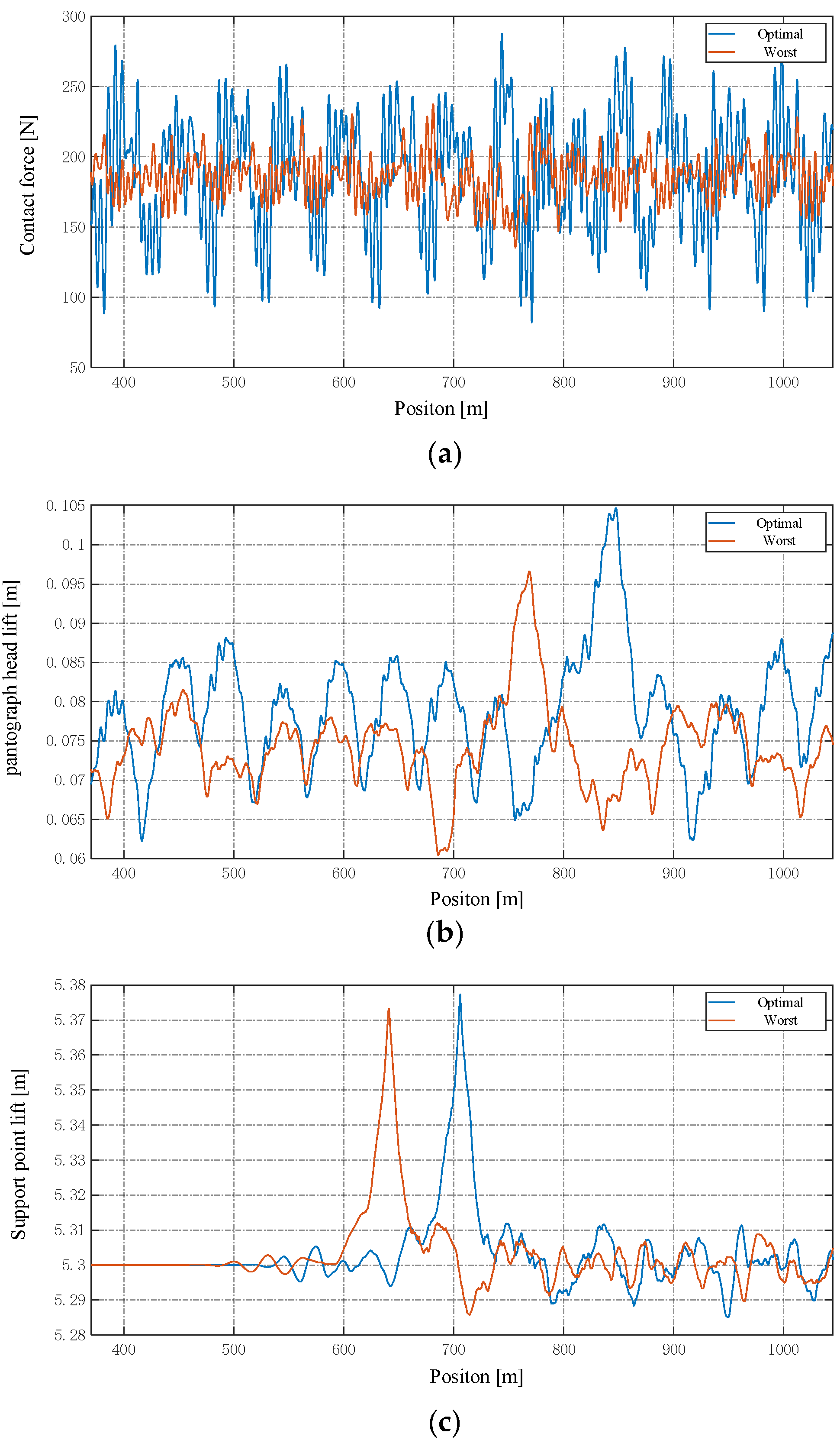
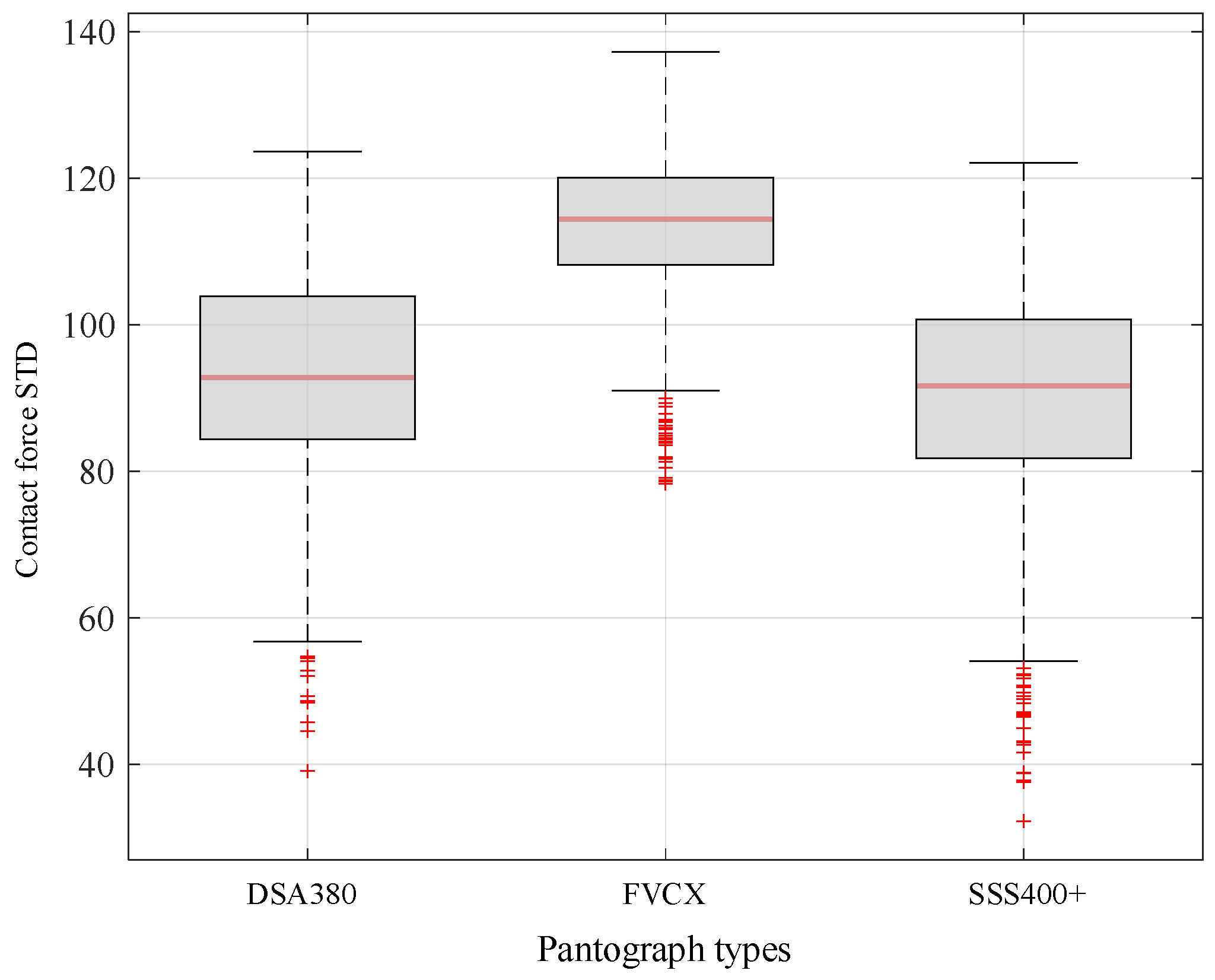
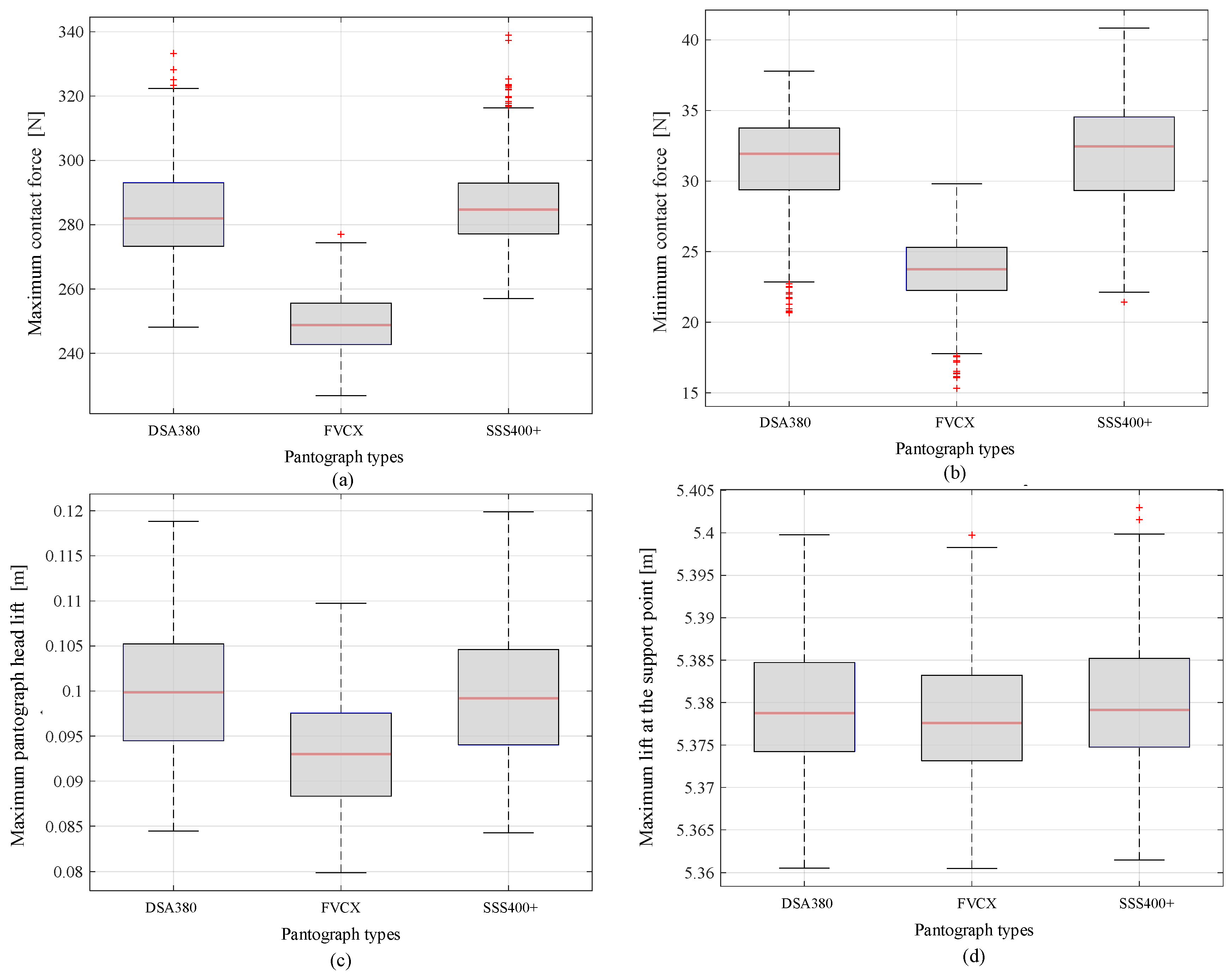
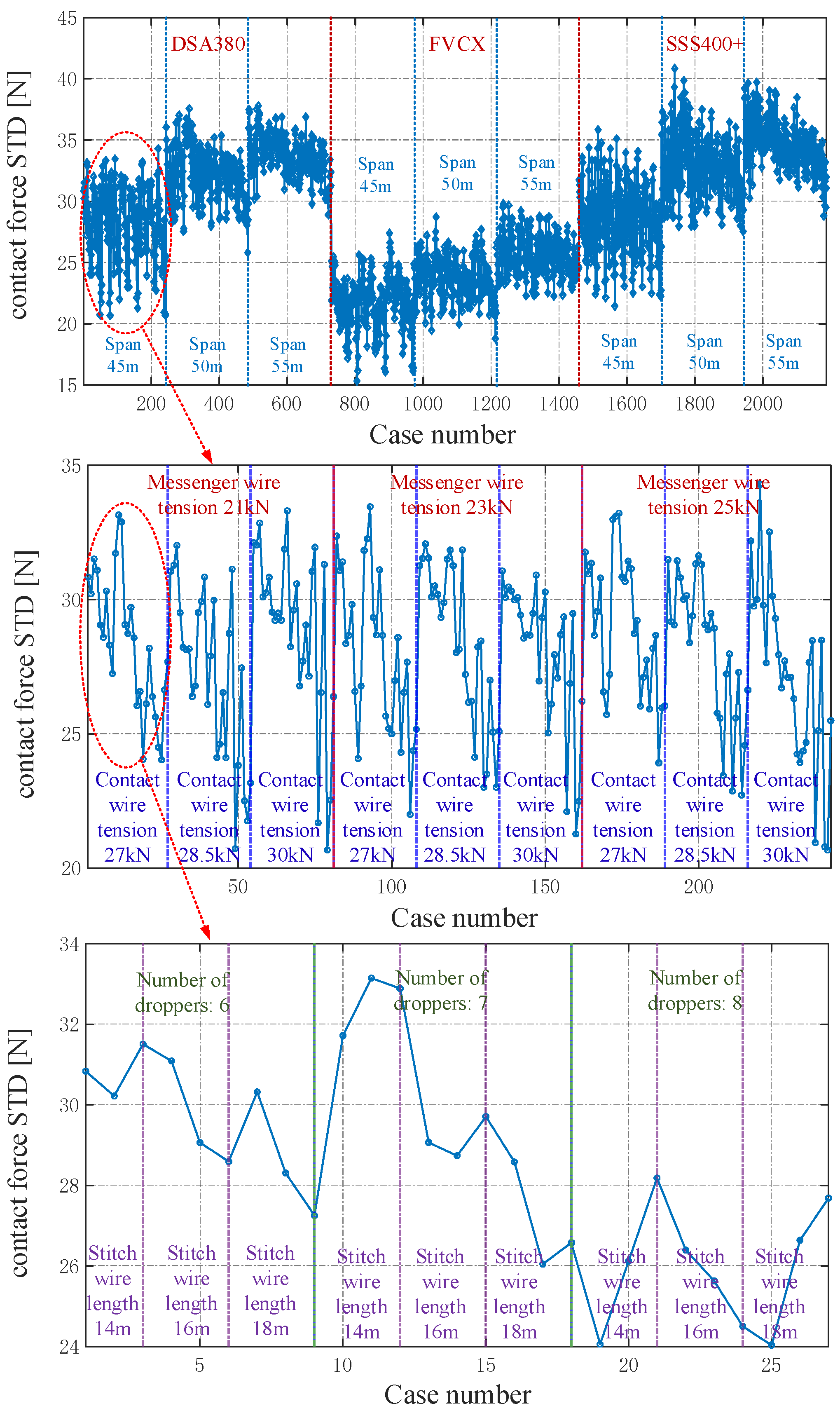
- The relationship between system parameters and dynamic performance is nonlinear. The identified optimal configuration utilizes the FVCX pantograph, a 45 m span, and a 30 kN contact wire tension, achieving a significantly lower contact force STD of 23.69 N compared to the worst-case scenario.
- (2)
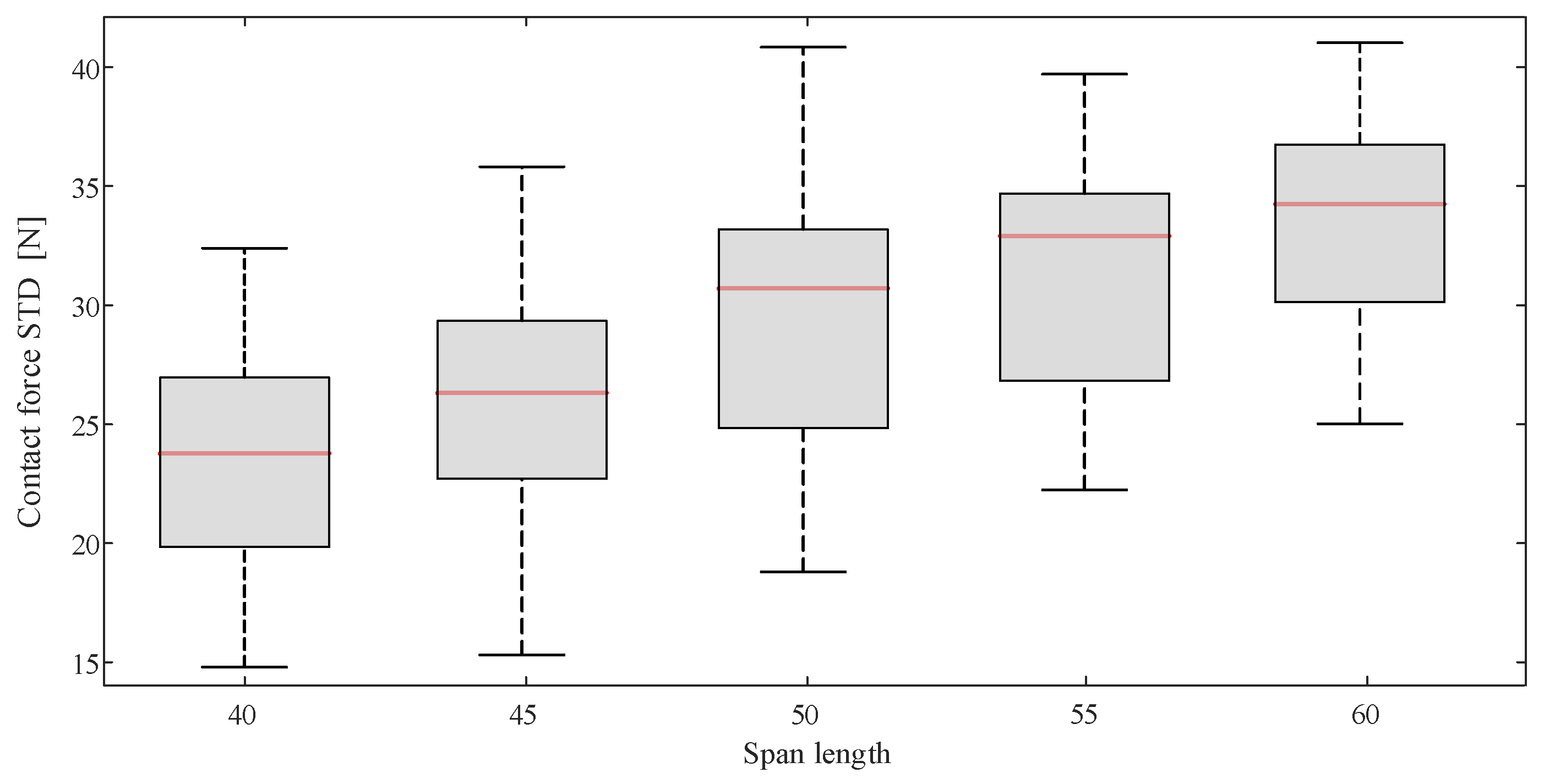
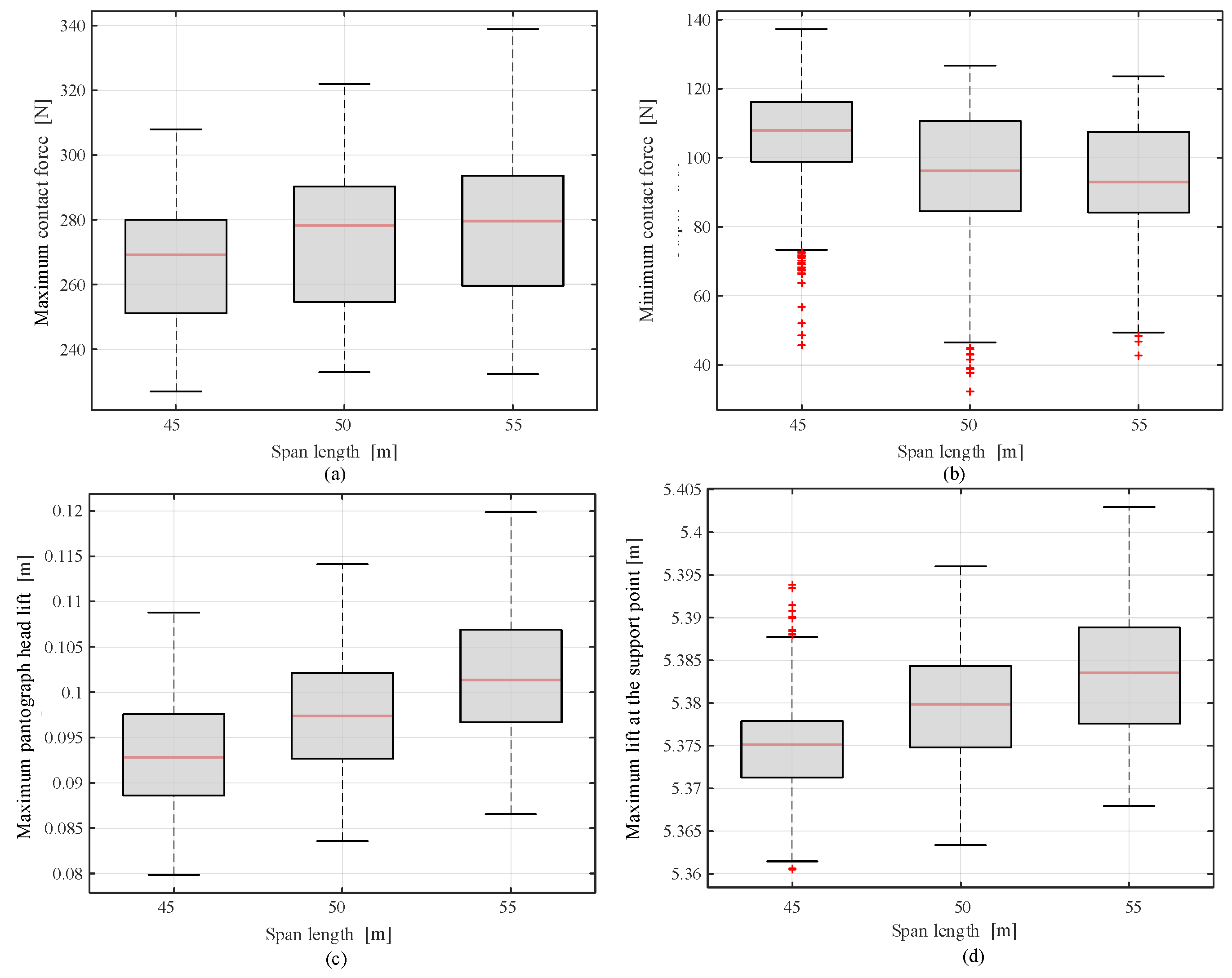
- Span length is the most critical catenary shape parameter at 350 km/h. Increasing the span from 45 m to 55 m resulted in a 16.8% increase in the mean contact force STD. Furthermore, this variation led to a 13.9% decrease in the minimum contact force and respective increases of 8.5% and 10.6% in the maximum PHL and SPL.
- (3)
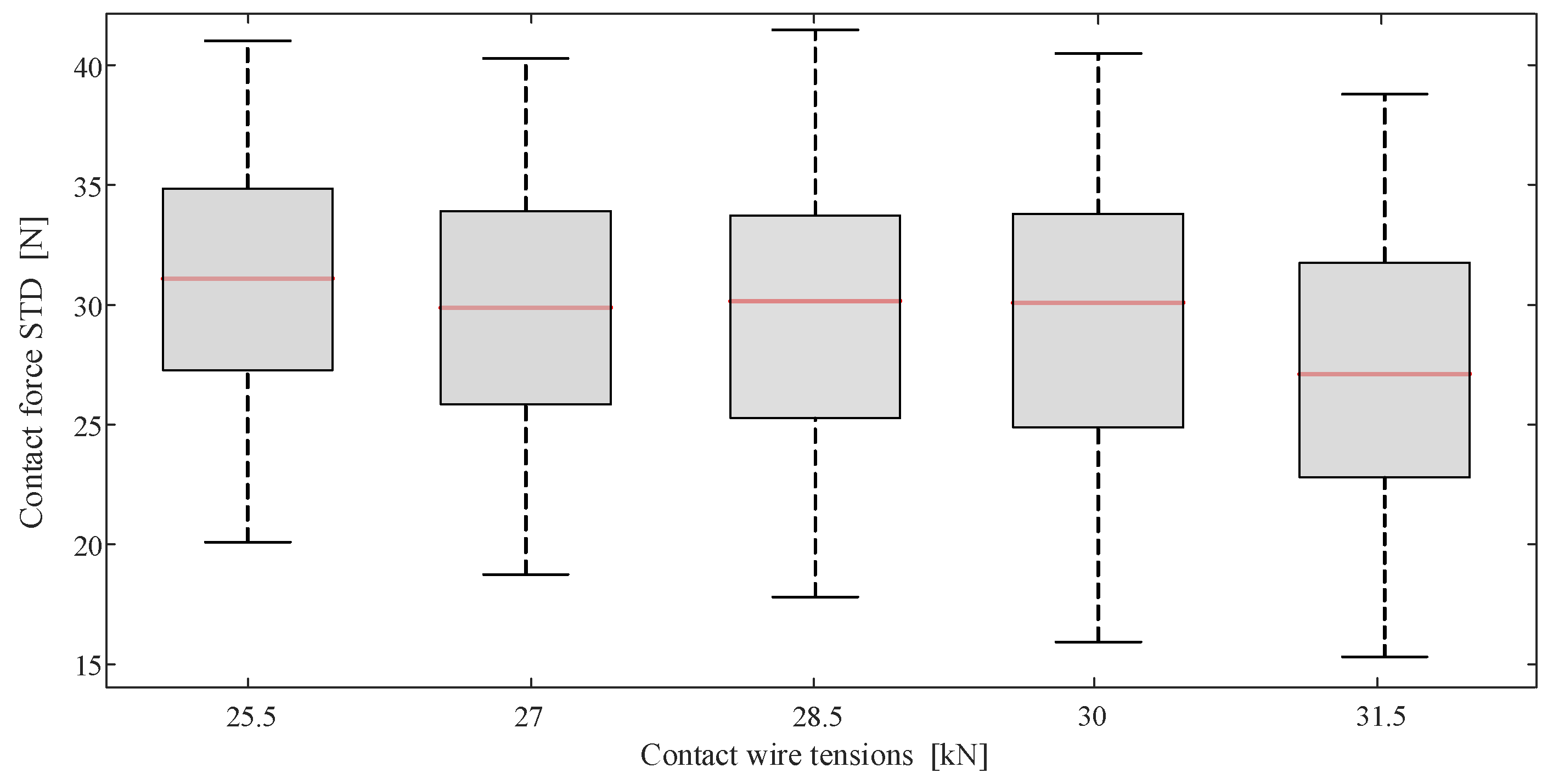
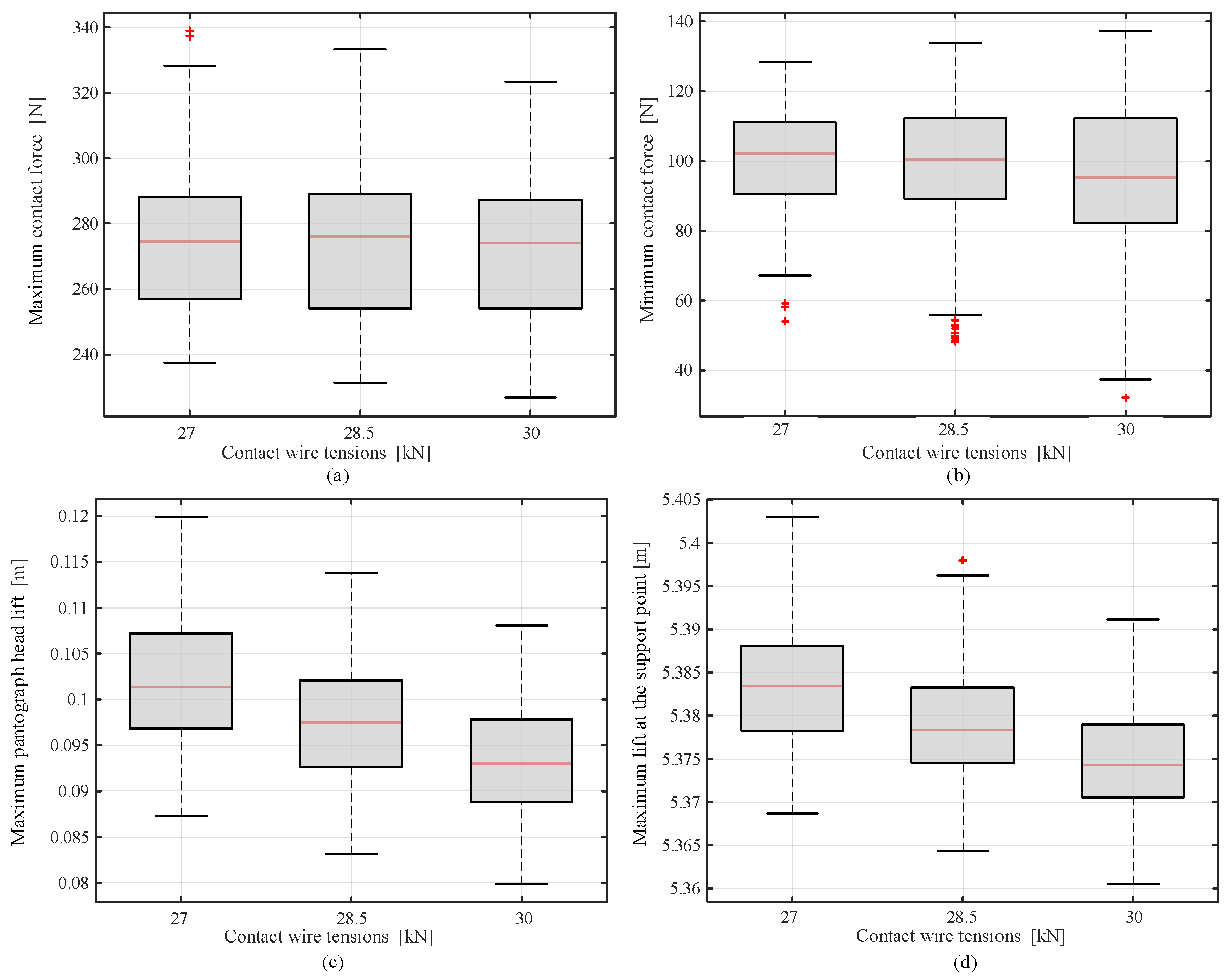
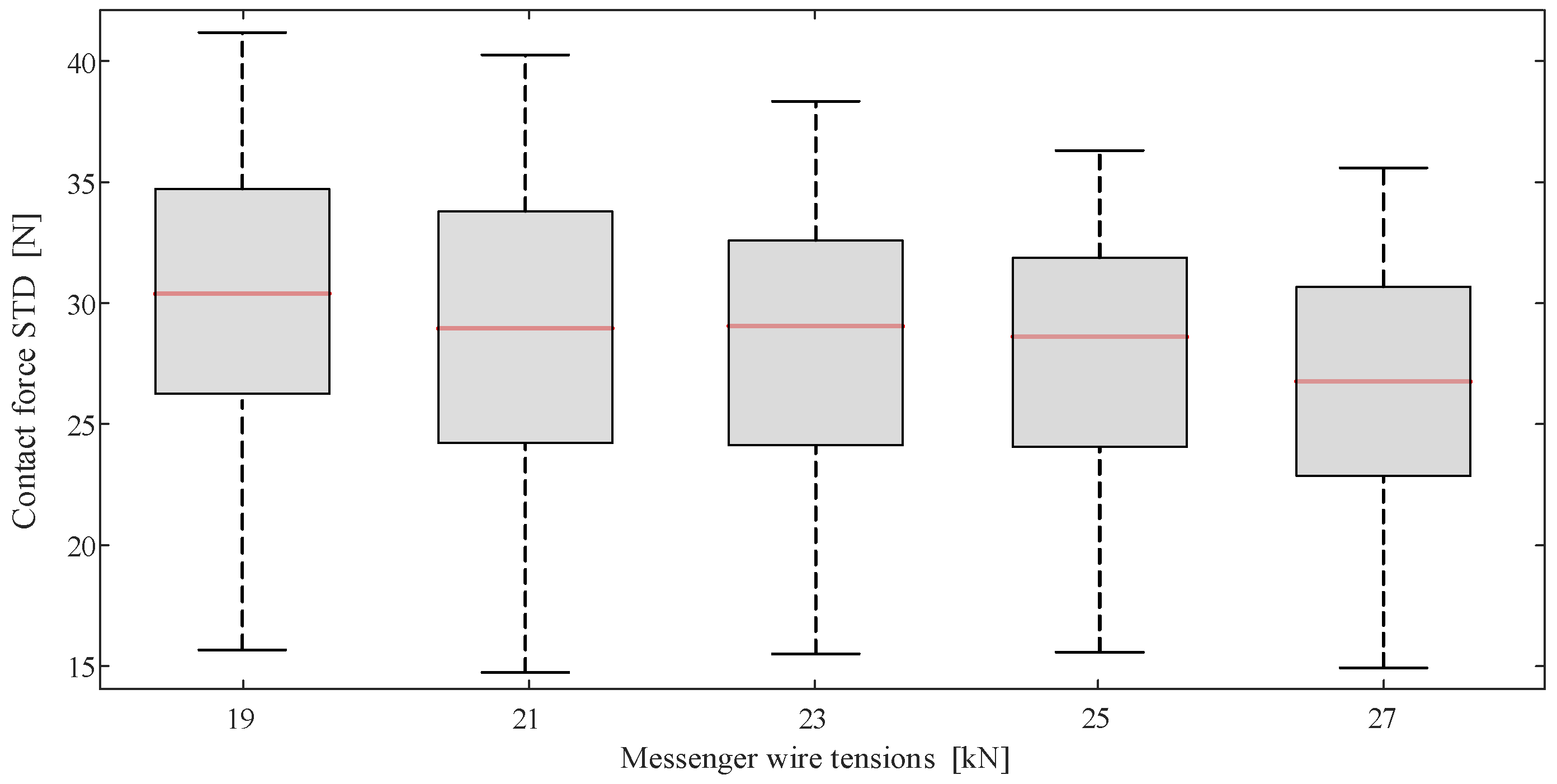
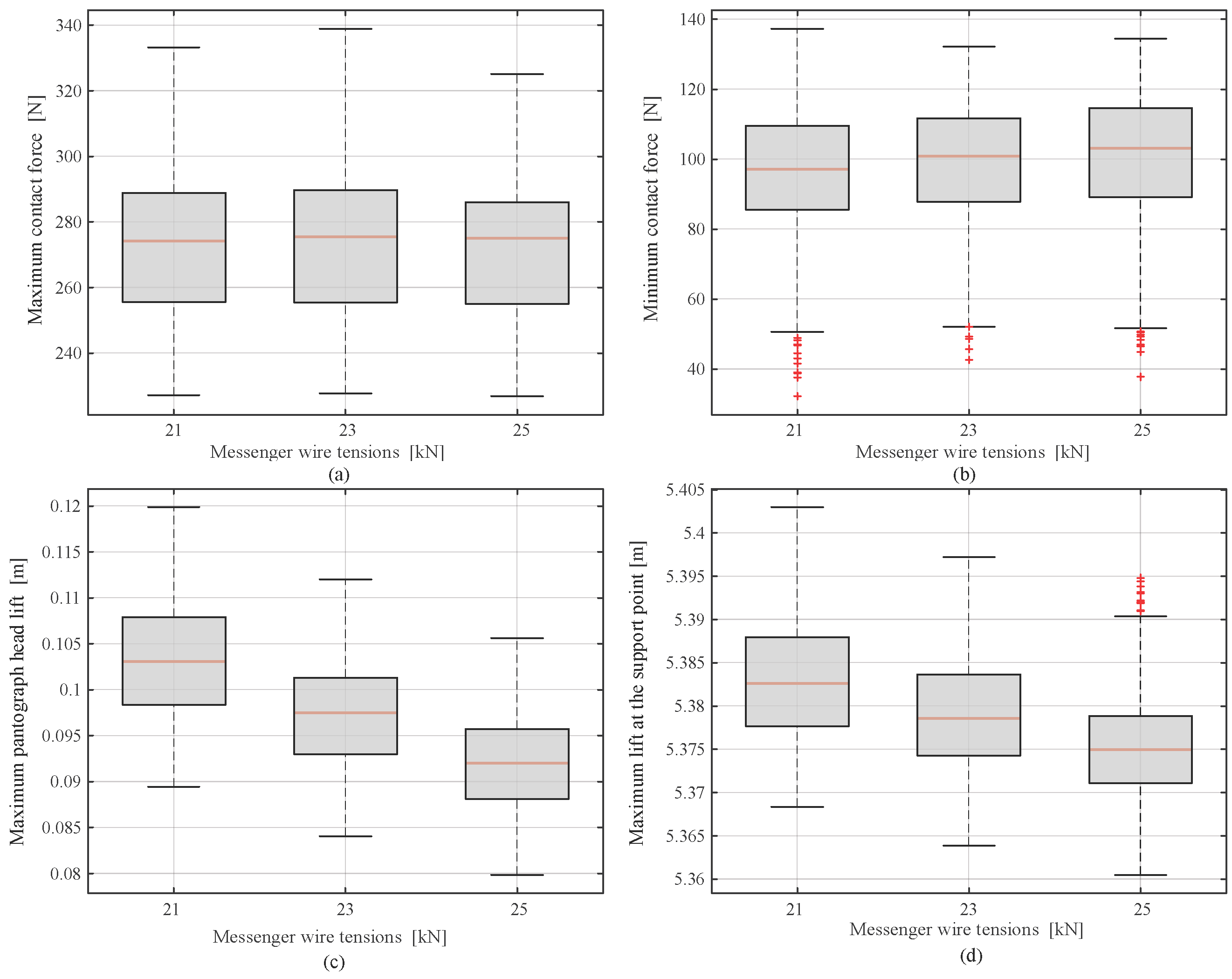
- Increasing contact wire tension from 27 kN to 30 kN improved current collection quality, evidenced by a 3.5% reduction in mean contact force STD. In comparison, increasing messenger wire tension from 21 kN to 25 kN yielded a more marginal improvement of 1.4%.
- (4)
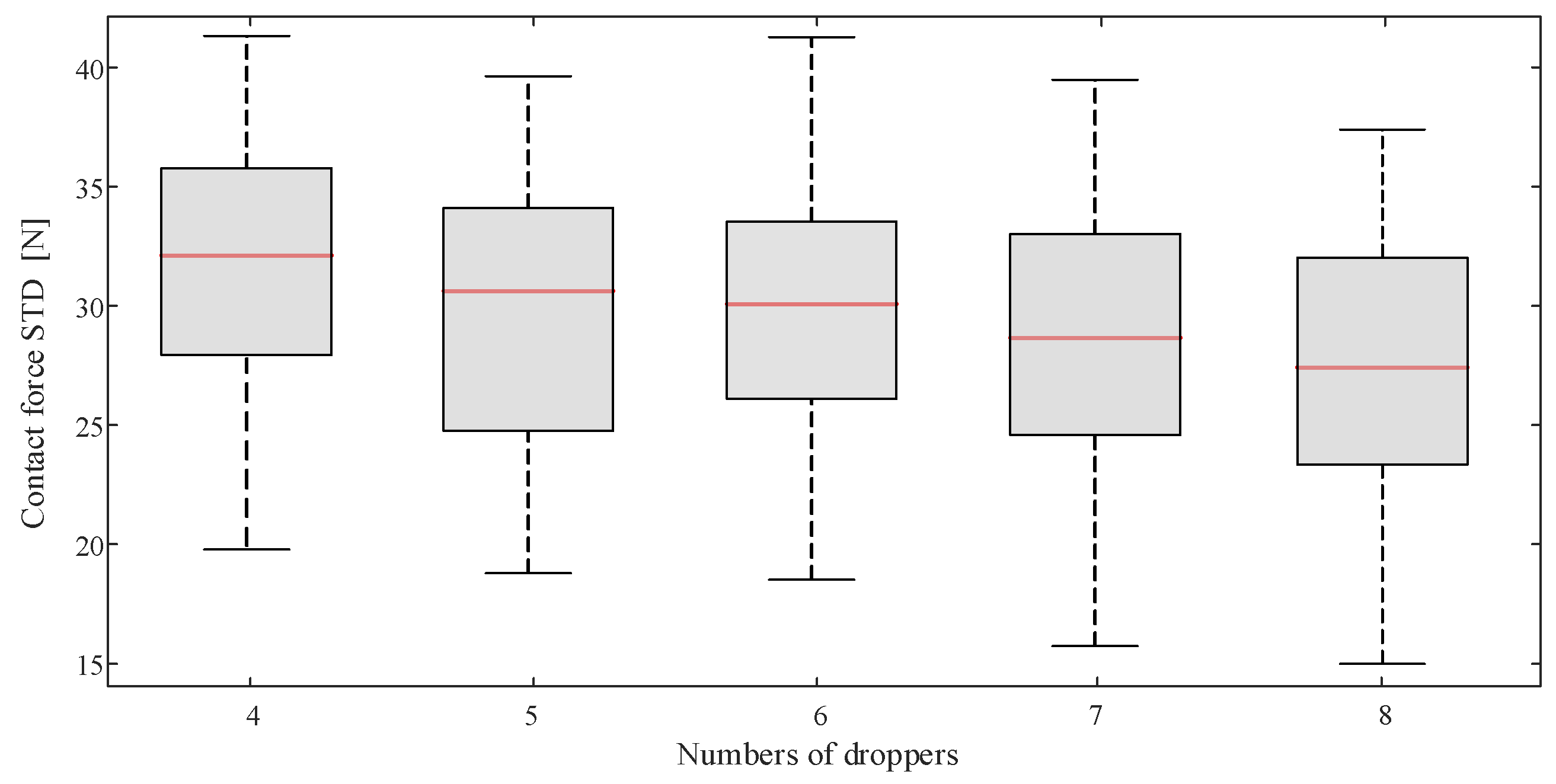
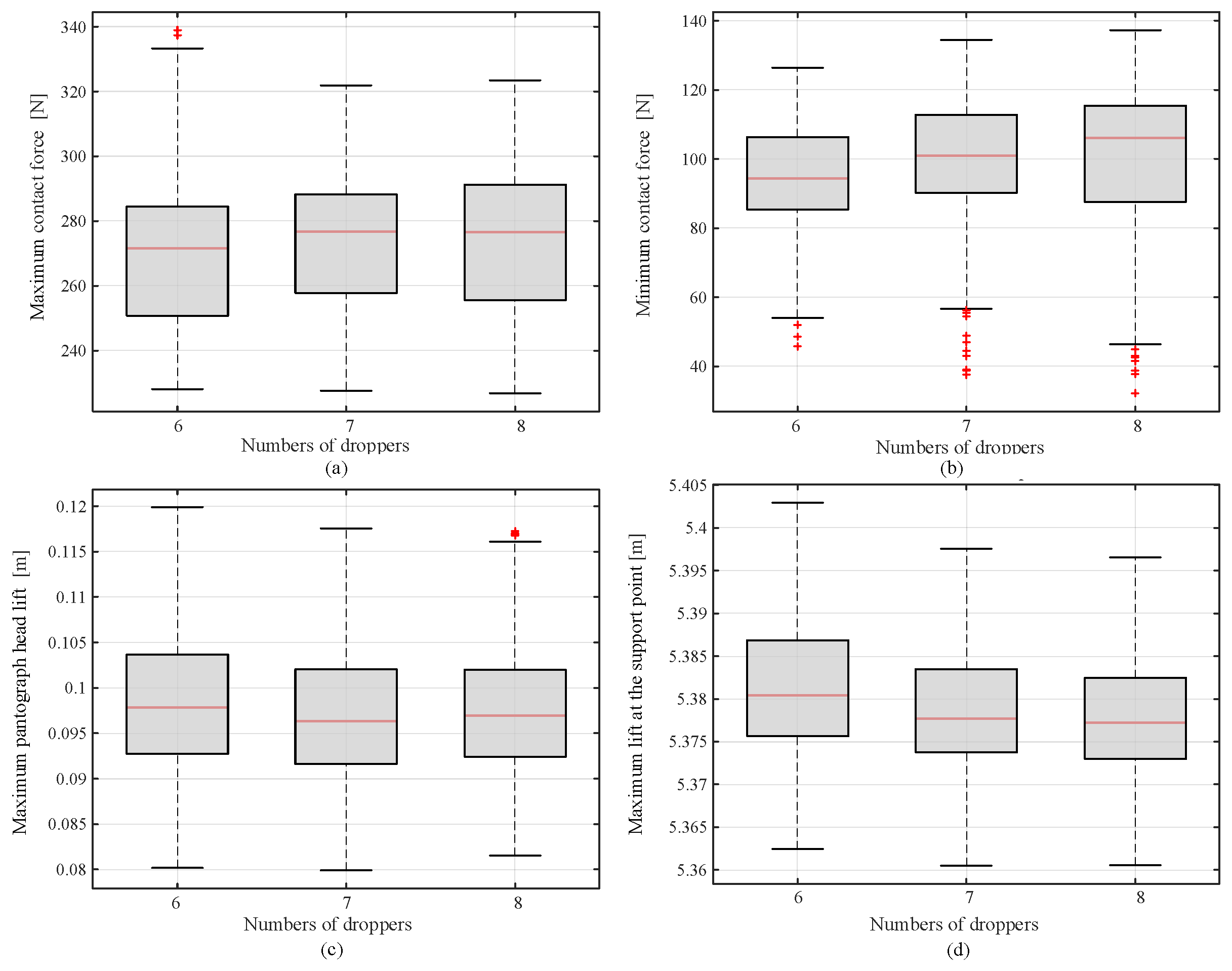
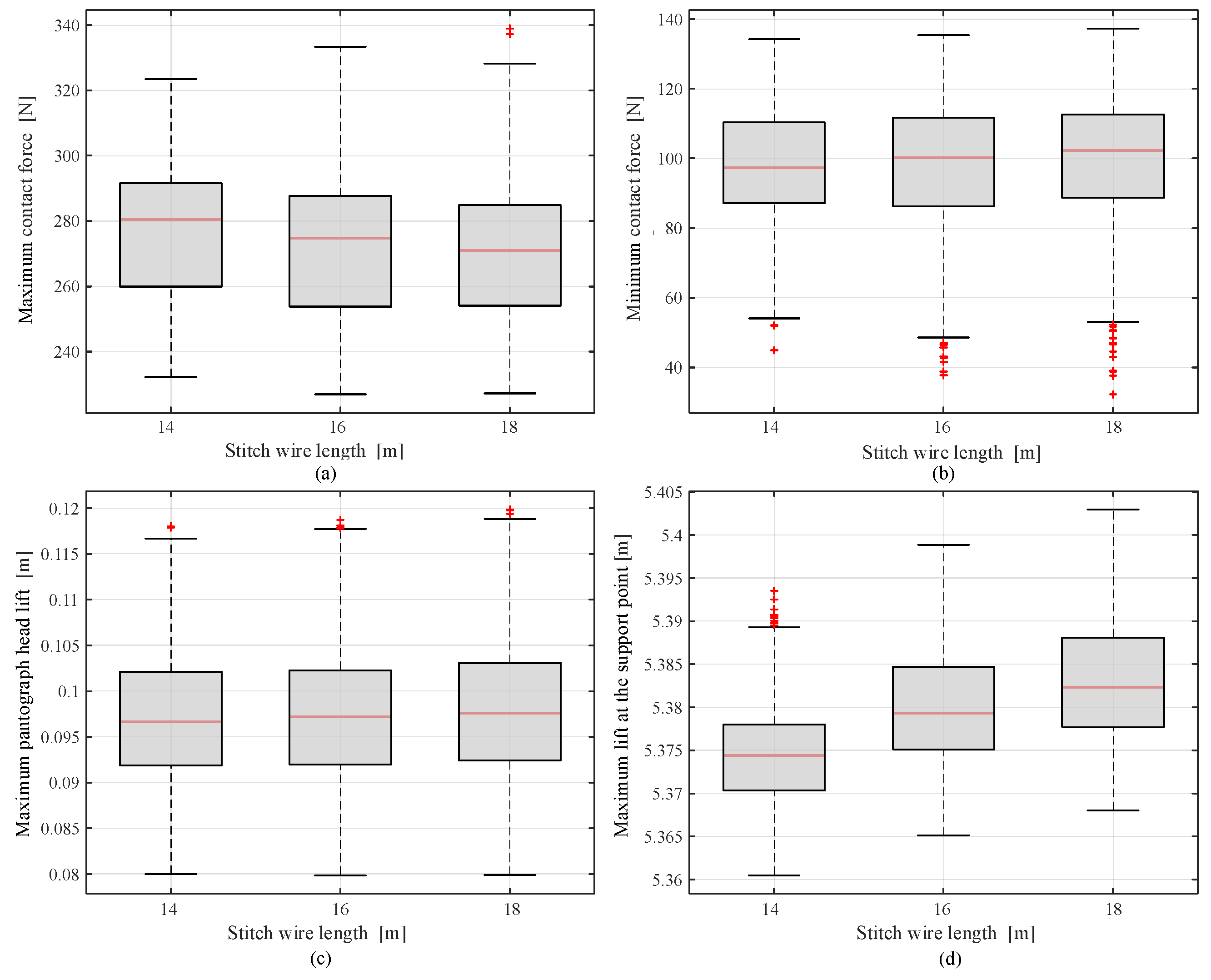
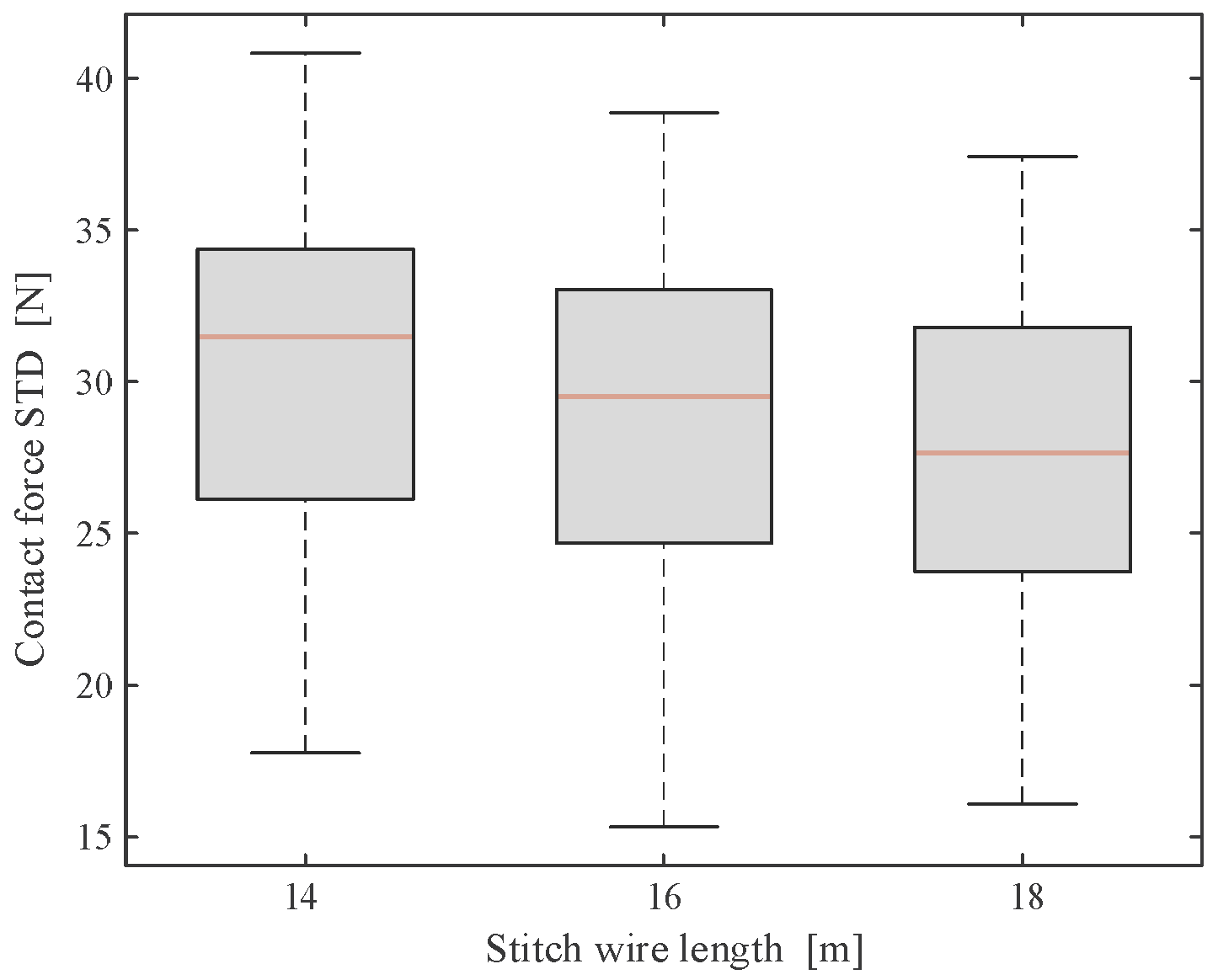
- Increasing the number of droppers from six to eight produced a 3.9% reduction in mean STD. While increasing stitch wire length from 14 m to 18 m reduced the mean contact force STD by 10.2%, it simultaneously increased the maximum SPL, indicating a complex trade-off in structural optimization.
Author Contributions
Funding
Institutional Review Board Statement
Informed Consent Statement
Data Availability Statement
Conflicts of Interest
References
- Bucca, G.; Collina, A.; Manigrasso, R.; Mapelli, F.; Tarsitano, D. Analysis of electrical interferences related to the current collection quality in pantograph–catenary interaction. Proc. Inst. Mech. Eng. Part F J. Rail Rapid Transit 2011, 225, 483–500. [Google Scholar] [CrossRef] [Scilit]
- Zuo, W.; Li, K. Electrification of urban road traffic: A reliability analysis of traction power supply for electric road systems. Transp. Saf. Environ. 2024, 6, tdae003. [Google Scholar] [CrossRef] [Scilit]
- Bruni, S.; Bucca, G.; Facchinetti, A.; Gregori, S.; Pombo, J. Recent developments on pantograph-overhead line interaction. Veh. Syst. Dyn. 2025, 63, 1358–1394. [Google Scholar] [CrossRef] [Scilit]
- Wang, H.; Song, Y.; Yang, H.; Liu, Z. Generalized Koopman Neural Operator for Data-Driven Modeling of Electric Railway Pantograph–Catenary Systems. IEEE Trans. Transp. Electrif. 2025, 11, 14100–14112. [Google Scholar] [CrossRef] [Scilit]
- Wang, X.; Song, Y.; Yang, H.; Wang, H.; Lu, B.; Liu, Z. A time-frequency dual-domain deep learning approach for high-speed pantograph-catenary dynamic performance prediction. Mech. Syst. Signal Process. 2025, 238, 113258. [Google Scholar] [CrossRef] [Scilit]
- Finner, L.; Poetsch, G.; Sarnes, B.; Kolbe, M. Program for catenary–pantograph analysis, PrOSA statement of methods and validation according EN 50318. Veh. Syst. Dyn. 2014, 53, 305–313. [Google Scholar] [CrossRef] [Scilit]
- Wang, X.; Song, Y.; Lu, B.; Wang, H.; Liu, Z. Assessment of Current Collection Performance of Rail Pantograph-Catenary Considering Long Suspension Bridges. IEEE Trans. Instrum. Meas. 2025, 74, 7500714. [Google Scholar] [CrossRef] [Scilit]
- Song, Y.; Liu, Z.; Gao, S. Current Collection Quality of High-Speed Rail Pantograph-Catenary Considering Geometry Deviation at 400 km/h and Above. IEEE Trans. Veh. Technol. 2024, 73, 14415–14424. [Google Scholar] [CrossRef] [Scilit]
- Bruni, S.; Ambrosio, J.; Carnicero, A.; Cho, Y.H.; Finner, L.; Ikeda, M.; Kwon, S.Y.; Massat, J.-P.; Stichel, S.; Tur, M.; et al. The results of the pantograph–catenary interaction benchmark. Veh. Syst. Dyn. 2014, 53, 412–435. [Google Scholar] [CrossRef] [Scilit]
- Song, Y.; Lu, X.; Yin, Y.; Liu, Y.; Liu, Z. Optimization of Railway Pantograph-Catenary Systems for Over 350 km/h Based on an Experimentally Validated Model. IEEE Trans. Ind. Inform. 2024, 20, 7654–7664. [Google Scholar] [CrossRef] [Scilit]
- Bruni, S.; Bucca, G.; Carnevale, M.; Collina, A.; Facchinetti, A. Pantograph–catenary interaction: Recent achievements and future research challenges. Int. J. Rail Transp. 2017, 6, 57–82. [Google Scholar] [CrossRef] [Scilit]
- Simarro, M.; Castillo, J.J.; Cabrera, J.A.; Postigo, S. Evaluation of the influence of the speed, preload and span length on the contact forces in the interaction between the pantograph and the overhead conductor rail. Eng. Struct. 2021, 243, 112678. [Google Scholar] [CrossRef] [Scilit]
- Zhang, J.; Yi, J.; Liu, W. Study of Time-Frequency Characteristics of Contact Force Signal and Parameter Sensitivity of Catenary of High-Speed Railway. IEEE Trans. Instrum. Meas. 2022, 71, 6500611. [Google Scholar] [CrossRef] [Scilit]
- Pombo, J.; Ambrósio, J. Influence of pantograph suspension characteristics on the contact quality with the catenary for high speed trains. Comput. Struct. 2012, 110–111, 32–42. [Google Scholar] [CrossRef] [Scilit]
- Zhou, N.; Zhang, W. Investigation on dynamic performance and parameter optimization design of pantograph and catenary system. Finite Elem. Anal. Des. 2011, 47, 288–295. [Google Scholar] [CrossRef] [Scilit]
- Yu, M.L.; Liu, W.Z.; Zhang, J.; Yan, C.Y. Influence of dropper spacing on quality of pantograph-catenary current collection. Appl. Mech. Mater. 2014, 654, 78–81. [Google Scholar] [CrossRef] [Scilit]
- Cho, Y.H.; Lee, K.; Park, Y.; Kang, B.; Kim, K.-N. Influence of contact wire pre-sag on the dynamics of pantograph–railway catenary. Int. J. Mech. Sci. 2010, 52, 1471–1490. [Google Scholar] [CrossRef] [Scilit]
- Zhang, W.; Liu, Y.; Mei, G. Evaluation of the coupled dynamical response of a pantograph—Catenary system: Contact force and stresses. Veh. Syst. Dyn. 2006, 44, 645–658. [Google Scholar] [CrossRef] [Scilit]
- Zhang, W. The development of China’s high-speed railway systems and a study of the dynamics of coupled systems in high-speed trains. Proc. Inst. Mech. Eng. Part F J. Rail Rapid Transit 2013, 228, 367–377. [Google Scholar] [CrossRef] [Scilit]
- Wu, M.; Xu, X.; Yan, Y.; Luo, Y.; Huang, S.; Wang, J. Multi-parameter joint optimization for double-strip high-speed pantographs to improve pantograph-catenary interaction quality. Acta Mech. Sin. 2022, 38, 521344. [Google Scholar] [CrossRef] [Scilit]
- Wang, J.; Mei, G.; Lu, L. Analysis of the pantograph’s mass distribution affecting the contact quality in high-speed railway. Int. J. Rail Transp. 2022, 11, 529–551. [Google Scholar] [CrossRef] [Scilit]
- Song, Y.; Liu, Z.; Rxnnquist, A.; Navik, P.; Liu, Z. Contact Wire Irregularity Stochastics and Effect on High-speed Railway Pantograph-Catenary Interactions. IEEE Trans. Instrum. Meas. 2020, 69, 8196–8206. [Google Scholar] [CrossRef] [Scilit]
- Bai, Y.; Zhang, J.; Liu, W.; Liu, X. Study on influence of contact wire design parameters on contact characteristics of pantograph-catenary. In Proceedings of the 2013 IEEE International Conference on Intelligent Rail Transportation Proceedings, Beijing, China, 30 August–1 September 2013; pp. 268–273. [Google Scholar]
- Wang, J.; Mei, G.; Lu, L. An improved full Fourier series method approaching the stitched catenary in high-speed railway. Int. J. Rail Transp. 2022, 12, 153–179. [Google Scholar] [CrossRef] [Scilit]
- Song, Y.; Liu, Z.; Wang, H.; Lu, X.; Zhang, J. Nonlinear modelling of high-speed catenary based on analytical expressions of cable and truss elements. Veh. Syst. Dyn. 2015, 53, 1455–1479. [Google Scholar] [CrossRef] [Scilit]
- Jimenez-Octavio, J.R.; Carnicero, A.; Sanchez-Rebollo, C.; Such, M. A moving mesh method to deal with cable structures subjected to moving loads and its application to the catenary–pantograph dynamic interaction. J. Sound Vib. 2015, 349, 216–229. [Google Scholar] [CrossRef] [Scilit]
- Gregori, S.; Tur, M.; Nadal, E.; Aguado, J.V.; Fuenmayor, F.J.; Chinesta, F. Fast simulation of the pantograph–catenary dynamic interaction. Finite Elem. Anal. Des. 2017, 129, 1–13. [Google Scholar] [CrossRef] [Scilit]
- Fomin, O.; Prokopenko, P.; Kara, S.; Píštěk, V.; Kučera, P. Study of the basic criteria of the pantograph and overhead line interaction in operating conditions. Results Eng. 2023, 19, 101336. [Google Scholar] [CrossRef] [Scilit]
- Nåvik, P.; Rønnquist, A.; Stichel, S. Identification of system damping in railway catenary wire systems from full-scale measurements. Eng. Struct. 2016, 113, 71–78. [Google Scholar] [CrossRef] [Scilit]
- Yao, Y.; Zou, D.; Zhou, N.; Mei, G.; Wang, J.; Zhang, W. A study on the mechanism of vehicle body vibration affecting the dynamic interaction in the pantograph–catenary system. Veh. Syst. Dyn. 2020, 59, 1335–1354. [Google Scholar] [CrossRef] [Scilit]
- Cho, Y.H. Numerical simulation of the dynamic responses of railway overhead contact lines to a moving pantograph, considering a nonlinear dropper. J. Sound Vib. 2008, 315, 433–454. [Google Scholar] [CrossRef] [Scilit]
- EN 50318:2018; Railway Applications—Current Collection Systems—Validation of Simulation of the Dynamic Interaction Between Pantograph and Overhead Contact Line. European Committee for Electrotechnical Standardization: Brussels, Belgium, 2018.
- EN 50367:2012/A1:2016; Railway Applications—Current Collection Systems—Technical Criteria for the Interaction B etween Pantograph and Overhead Line. European Committee for Electrotechnical Standardization: Brussels, Belgium, 2016.
- Yang, H.; Liu, Z.; Cui, H.; Ma, N.; Wang, H.; Zhang, C.; Song, Y. An Electrified Railway Catenary Component Anomaly Detection Frame Based on Invariant Normal Region Prototype with Segment Anything Model. IEEE Trans. Transp. Electrif. 2025, 12, 1391–1402. [Google Scholar] [CrossRef] [Scilit]
- Meng, X.; Xie, D.; Lin, H.; Lin, C.; Ge, X.; Liu, Z. Dissipativity-Based Multiport Stability Root-Cause Identification and Mitigation for Solid-State Transformers. IEEE Trans. Ind. Electron. 2026. Early access. [Google Scholar] [CrossRef] [Scilit]









| Model Simulation [N] | Measured Data [N] | Error | Threshold | |
|---|---|---|---|---|
| Maximum value | 258.51 | 271 | −4.6% | / |
| Mean value | 185.24 | 185.5 | −0.26 N | ±2.5 N |
| Standard deviation | 27.371 | 28.1 | −2.6% | ±20% |
| Parameters | |
|---|---|
| Pantograph | DSA380, FVCX, SSS400+ |
| Span length (m) | 45, 50, 55 |
| Messenger wire tension (kN) | 21, 23, 25 |
| Contact wire tension (kN) | 27, 28.5, 30 |
| Number of droppers | 6, 7, 8 |
| Stitch wire length (m) | 14, 16, 18 |
| Stitch wire tension (N) | 2800, 3500, 4200 |
| Parameters | Case Number | Pantograph | Span Length (m) | Messenger Wire Tension (kN) | Contact Wire Tension (kN) | Number of Droppers | Stitch Wire Length (m) | Stitch Wire Tension (N) |
|---|---|---|---|---|---|---|---|---|
| Optimal performance | 805 | FVCX | 45 | 21 | 30 | 8 | 16 | 2800 |
| Worst performance | 1740 | SSS400+ | 50 | 21 | 28.5 | 7 | 14 | 4200 |
| Parameters | Span | Tmw | Tcw | DropNum | StitchL | StitchT | Span × Tmw |
|---|---|---|---|---|---|---|---|
| Contribution (%) | 40.27 | 5.12 | 7.05 | 7.92 | 7.26 | 1.89 | 0.91 |
| Parameters | Span × Tcw | Span × DropNum | Span × StitchL | Span × StitchT | Tmw × Tcw | Tmw × DropNum | Tmw × StitchL |
| Contribution (%) | 0.32 | 4.54 | 2.23 | 0.32 | 3.14 | 0.20 | 0.29 |
| Parameters | Tmw × StitchT | Tcw × DropNum | Tcw × StitchL | Tcw × StitchT | DropNum × StitchL | DropNum × StitchT | StitchL × StitchT |
| Contribution (%) | 0.11 | 1.03 | 0.42 | 0.11 | 0.10 | 2.38 | 0.44 |
| Pantograph 1 | Pantograph 2 | Pantograph 3 | |
|---|---|---|---|
| m1 | 7.12 | 5 | 6.1 |
| m2 | 6 | 9.98 | 10.154 |
| m3 | 5.8 | 9 | 10.3 |
| c1 | 0 | 5 | 10 |
| c2 | 0 | 5 | 0 |
| c3 | 70 | 350 | 120 |
| k1 | 9430 | 6000 | 10,400 |
| k2 | 14,100 | 8971 | 10,600 |
| k3 | 0.1 | 0.5 | 0.1 |
| Pantograph 1 | Pantograph 2 | Pantograph 3 | |
|---|---|---|---|
| Contact force STD | 31.34 | 23.69 | 31.94 |
| Maximum contact force | 283.34 | 249.54 | 285.50 |
| Minimum contact force | 92.71 | 113.44 | 89.58 |
| Maximum PHL | 0.0999 | 0.0931 | 0.0996 |
| Maximum SPL | 5.37944 | 5.37815 | 5.37988 |
Disclaimer/Publisher’s Note: The statements, opinions and data contained in all publications are solely those of the individual author(s) and contributor(s) and not of MDPI and/or the editor(s). MDPI and/or the editor(s) disclaim responsibility for any injury to people or property resulting from any ideas, methods, instructions or products referred to in the content. |
© 2026 by the authors. Licensee MDPI, Basel, Switzerland. This article is an open access article distributed under the terms and conditions of the Creative Commons Attribution (CC BY) license.
Share and Cite
Xing, T.; Wang, X.; Pan, L.; Song, Y.; Zhang, D.; Yu, Q. Effect of Structural Parameters on Pantograph–Catenary Interaction Performance in High-Speed Railways. Infrastructures 2026, 11, 88. https://doi.org/10.3390/infrastructures11030088
Xing T, Wang X, Pan L, Song Y, Zhang D, Yu Q. Effect of Structural Parameters on Pantograph–Catenary Interaction Performance in High-Speed Railways. Infrastructures. 2026; 11(3):88. https://doi.org/10.3390/infrastructures11030088
Chicago/Turabian StyleXing, Tong, Xufan Wang, Like Pan, Yang Song, Dehai Zhang, and Qun Yu. 2026. "Effect of Structural Parameters on Pantograph–Catenary Interaction Performance in High-Speed Railways" Infrastructures 11, no. 3: 88. https://doi.org/10.3390/infrastructures11030088
APA StyleXing, T., Wang, X., Pan, L., Song, Y., Zhang, D., & Yu, Q. (2026). Effect of Structural Parameters on Pantograph–Catenary Interaction Performance in High-Speed Railways. Infrastructures, 11(3), 88. https://doi.org/10.3390/infrastructures11030088