

Digitalised Predictive Maintenance in Railways: A Systematic Review of AI, BIM, and Digital Twins


Abstract
1. Introduction
- Identify and categorize the ML paradigms and algorithms currently applied to railway maintenance.
- Correlate specific digital enablers with distinct maintenance optimization tasks (e.g., defect detection, RUL estimation) to determine technical trends and suitability.
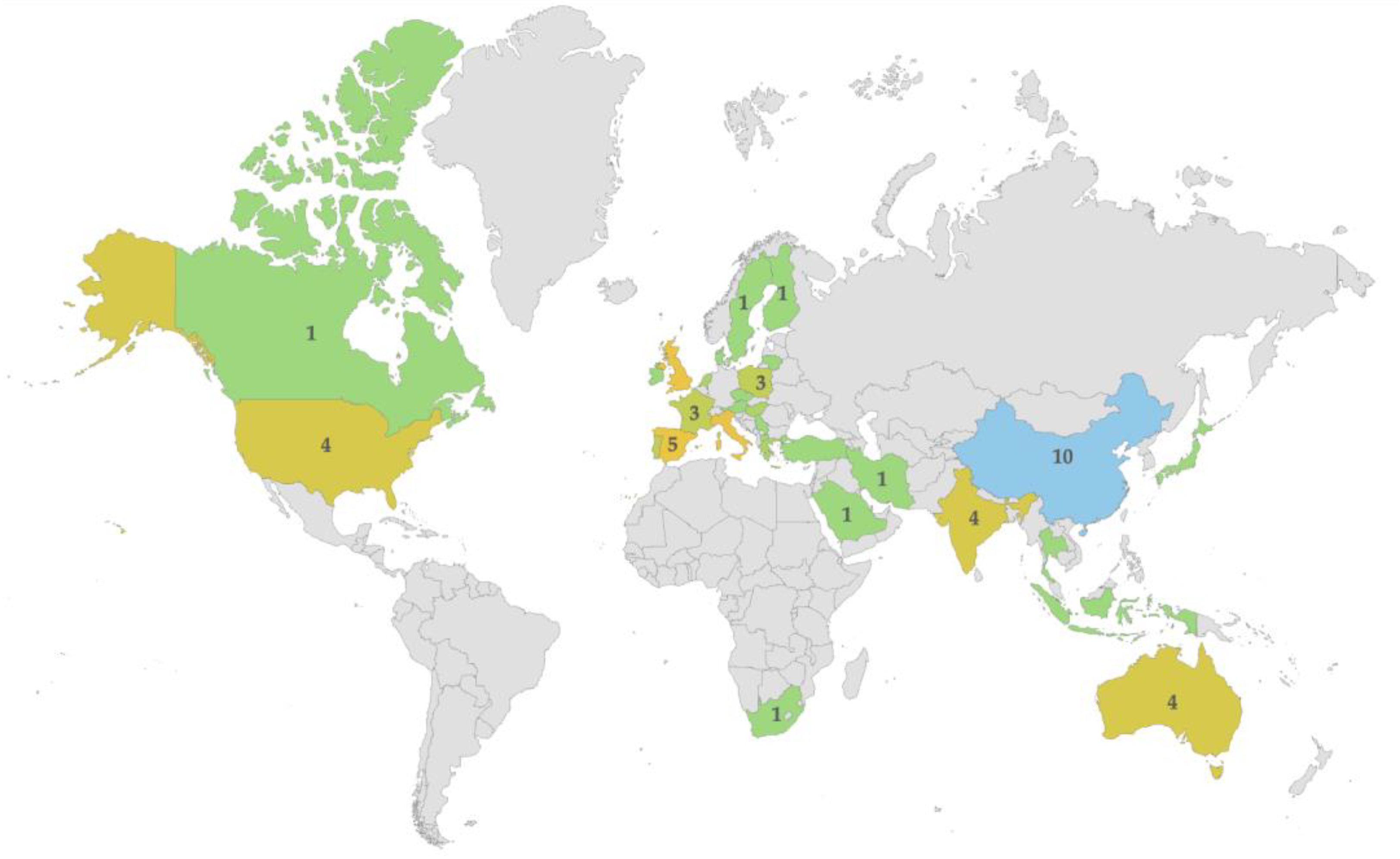
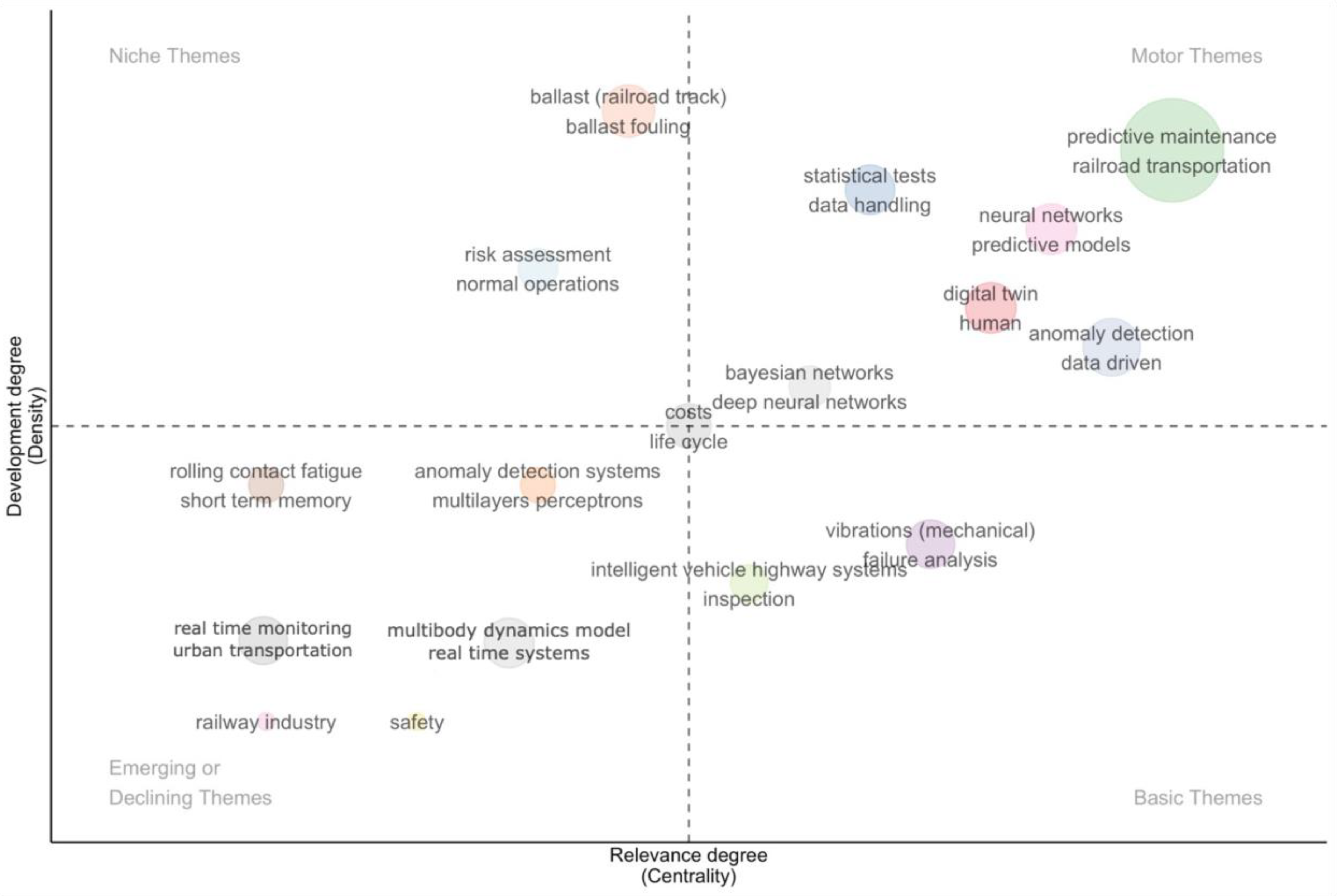
- Analyze the geographical and temporal distribution of research to identify global hubs, “Motor Themes,” and emerging areas of interest.
- Highlight critical gaps to guide future research toward resilient and sustainable railway maintenance.
- Assess how mature the integration of BIM and DT technologies is within predictive maintenance workflows.
- Identify, categorize, and synthesize key empirical findings, applied algorithms, and targeted railway components from the selected literature.
2. Methodology
2.1. Identification of Papers
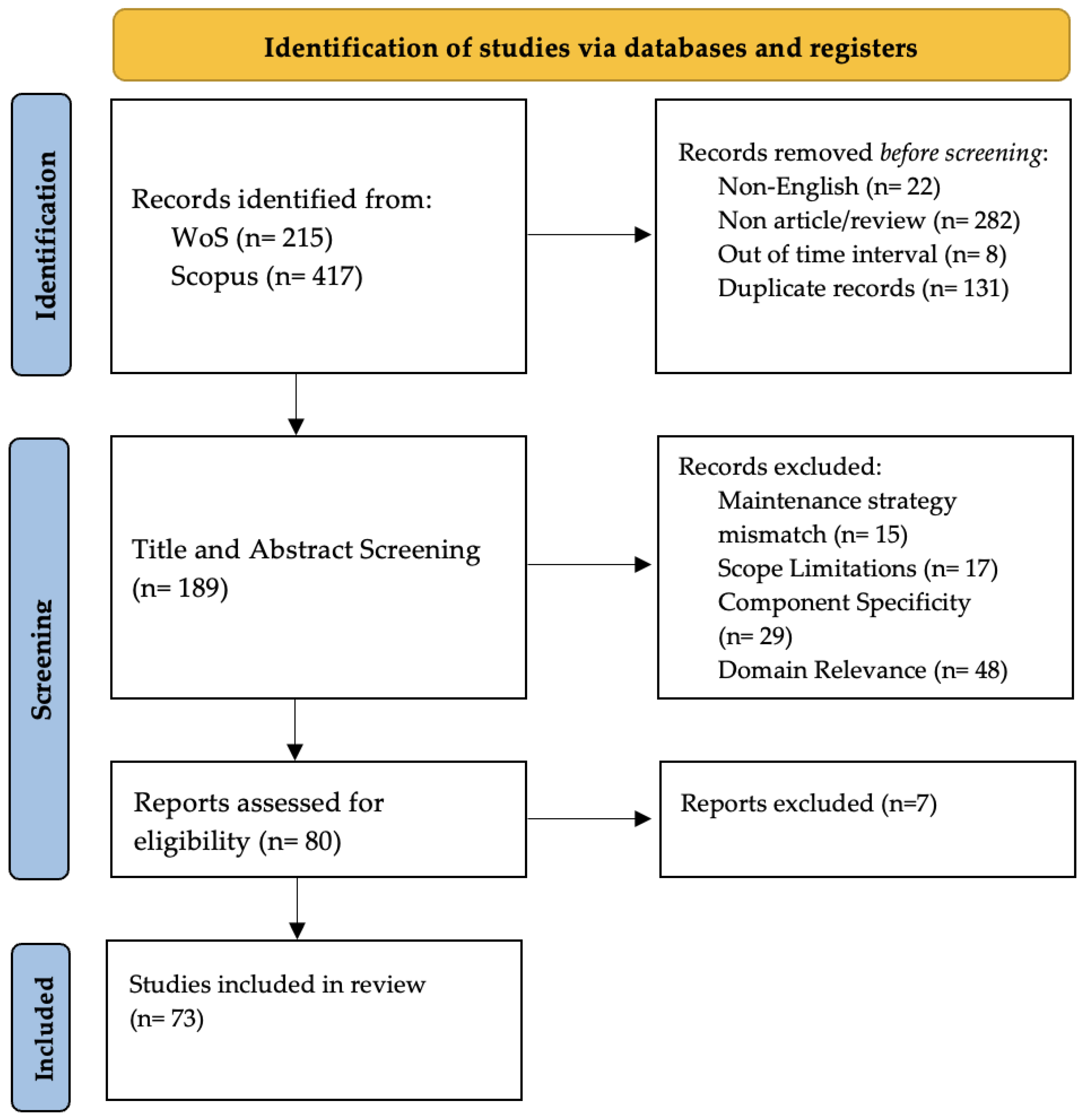
- Language: Papers written in English were included, and others were excluded.
- Document Type: Peer-reviewed journal articles were included; conference papers, book chapters, reports and theses were excluded.
- Time Interval: Papers dated between 2015 and 2026 were included, and others were excluded
2.2. Screening and Eligibility
- Maintenance Strategy Mismatch: Papers focusing exclusively on preventive maintenance strategies or health monitoring only were excluded, as this review specifically targets predictive and optimized maintenance frameworks.
- Scope Limitations: Studies limited to defect detection without broader maintenance implications were removed to ensure a focus on holistic maintenance management.
- Component Specificity: Research concentrating solely on electrical sub-components or large-scale civil structures (e.g., bridges) was excluded to prioritize core railway infrastructure and rolling stock assets.
- Domain Relevance: Papers that were found to be unrelated to the railway sector or those lacking a clear maintenance dimension were discarded.
2.3. Data Extraction
- Mapping the geographical distribution of scholarly contributions to identify global research hubs.
- Correlating specific ML algorithms with distinct maintenance optimization tasks to determine technical trends.
- Evaluating the integration maturity of BIM and DT technologies in upgrading predictive maintenance workflows.
2.4. Use of GenAI
3. Results and Discussion
3.1. Distribution of the Papers
3.2. Thematic Analysis
3.3. ML Algorithms
3.3.1. Supervised Learning
3.3.2. Unsupervised Learning
3.3.3. Reinforcement Learning
3.4. Use of DTs and Building Information Modeling
3.4.1. Unidirectional Architectures
3.4.2. High-Level DT Integration
3.4.3. Architectural Frameworks
3.4.4. High-Level BIM Integration and the Use of IFC
3.5. Cost Perspective
- Prevention of Catastrophic Failures: By addressing the underlying causes of deterioration before they manifest as critical faults, PvM averts severe safety and infrastructure incidents. Derailments and system failures incur massive financial penalties; for example, the literature quantifies the average direct cost of a broken rail at $525,000 per incident, with full derailments costing up to $1.5 million [32].
- Asset Lifespan Extension: Intervening prior to failure physically extends the operational lifespan of railway infrastructure and rolling stock. In the context of railway wheelsets, which degrade progressively due to uniform wear and rolling contact fatigue, corrective turning requires the removal of a significantly larger portion of the tread diameter. This drastic material loss prematurely terminates the wheelset’s lifecycle, forcing a highly expensive total renewal. Fixed-interval preventive turning requires less material removal, thereby extending the component’s usable life and lowering total lifecycle costs.
- Reduction of Unplanned Downtime: Unexpected component failures trigger costly operational downtime, service delays, and penalty fees. An unexpected one-day stoppage for railway machinery can incur massive capital losses, with benchmarks indicating downtime costs reaching 100,000 to 200,000 euros [59]. Furthermore, rolling stock unavailability directly impacts network congestion; empirical data indicates that a 1% increase in unavailability results in a 0.5% increase in annual delay minutes [36]. Scheduled interventions preserve operational availability by preventing these unexpected shutdowns.
- Optimization of Workforce and Logistics: Because preventive maintenance is pre-planned based on predetermined time or mileage intervals, it can be executed during train-free sub-intervals. This allows infrastructure managers to strategically allocate human and material resources, balancing workloads and avoiding inefficient, ad hoc emergency travel across the network. Optimizing these stages for rolling stock traction and braking systems successfully reduced the required technical staff and equipment unavailability by 50% [30].
3.6. Sustainability Perspective
3.7. Challenges, Gaps and Future Research Directions
3.7.1. Data Scarcity, Quality and the Safety Paradox
- Synthetic Data Generation: DTs should be utilized for “fault injection” to safely generate synthetic failure data, acting as offline virtual environments where RL agents can safely explore catastrophic scenarios without real-world consequences.
- Rather than relying solely on data, models should incorporate physical laws. Agustin et al. demonstrate the utility of training Neural Networks (MLP) on data generated by 3D Multibody Dynamics (MBD) simulations, effectively using physics to fill the data void.
- Methodologies must be developed to transfer knowledge from laboratory test rigs or simulations to the field, using domain adaptation techniques to account for environmental noise.
3.7.2. Model Interpretability and the “Black-Box” Nature of Deep Learning
3.7.3. Integration Maturity and Standardized Interoperability
3.7.4. Real-Time Deployment, Operational and Computational Constraints
- Model Compression and Hardware Acceleration: Future efforts must focus on creating lightweight versions of deep learning models suitable for edge deployment.
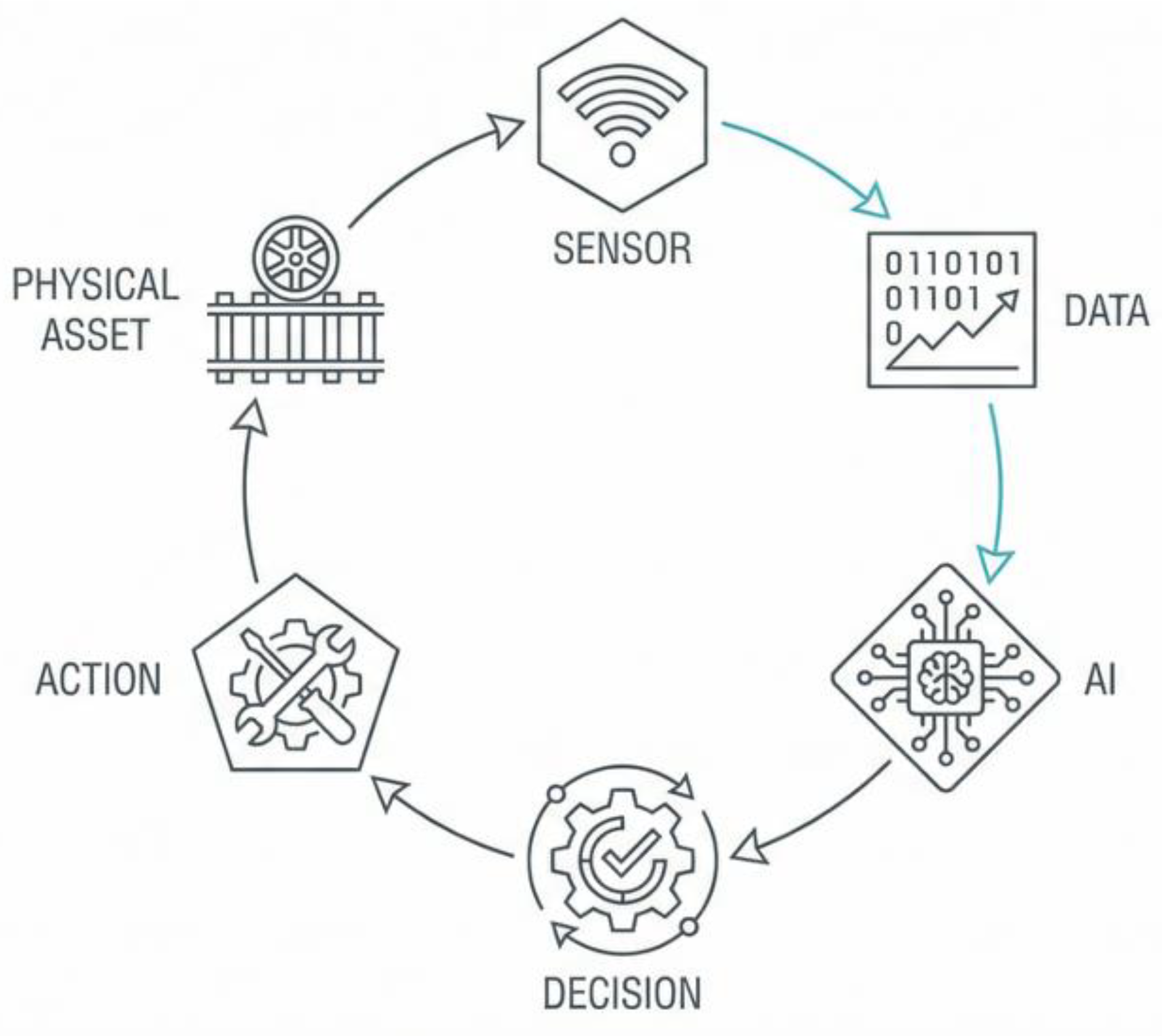
- 5G-Enabled Synchronization: Research should explore the integration of 5G technologies to enable ultra-low latency data synchronization between physical assets and DTs, supporting real-time “perception-prediction-optimization” loops.
- Domain Generalization: Studies should prioritize the development of robust models that can generalize across different railway lines, vehicle types, and varying operational contexts, reducing the need for line-specific recalibration.
- Resilient Sensing for Harsh Environments: Future work must address the impact of adverse environmental factors (e.g., extreme temperatures, wind, and mechanical vibration) on sensor stability and signal isolation to ensure data reliability during real-time deployment.
3.7.5. Quantifying Environmental Impacts: Moving Beyond Qualitative Claims
- Avoided Logistic Emissions (kg CO2e): The reduction in greenhouse gas emissions achieved by eliminating unnecessary physical inspection trips and ad hoc emergency maintenance routing.
- Material Preservation Index (Tonnes): The exact mass of raw materials (e.g., steel from rails and wheelsets, concrete from sleepers) saved from premature scrapping due to the AI-driven extension of the asset’s RUL.
- Operational Energy Optimization (kWh): The energy saved by preventing unplanned train stoppages, idling, and the rerouting of freight/passenger services caused by unexpected infrastructure failures.
- Algorithmic Carbon Footprint (kg CO2e): A critical counter-metric. Researchers must calculate and report the computational energy consumed to train and deploy complex Deep Learning models or run real-time Digital Twin simulations, ensuring the AI’s carbon cost does not outweigh the physical maintenance savings.
3.7.6. The Physical Foundation: High-Fidelity Modeling and Structural Optimization
4. Applications and Limitations of the Study
- Rapid Technological Evolution: The identified algorithms, digital frameworks, and their applications are subject to the rapid evolution of AI. Furthermore, by methodologically restricting this review to peer-reviewed journal articles to ensure high empirical validity, some preliminary or cutting-edge theoretical advancements frequently published in early-stage conference proceedings may have been excluded. As the field of deep learning and DT technology progresses, continuous updates to this review are necessary to ensure the relevance and accuracy of the state of the art.
- Contextual and Data Dependency: The effectiveness of the proposed predictive maintenance solutions is not conclusive across all operational environments, as performance heavily depends on local data availability, the age of the infrastructure, and the quality of installed sensors. The technical viability of specific digital enablers varies by region and operator, necessitating localized research to determine the most feasible solutions for specific assets.
- Specific Asset Focus: This paper primarily focused on core railway track infrastructure and major rolling stock components. However, there is a need to explore other critical railway assets in greater depth, including power supply systems, catenary lines, and complex signaling equipment, which may require specialized sensing and data management frameworks. Furthermore, as this review strictly focused on the technical and operational optimization of maintenance, the critical dimensions of cybersecurity, data privacy, and the ethical management of infrastructure data remain unaddressed and require dedicated systematic investigation in future studies.
SWOT Analysis for Industrial Application
5. Conclusions
- Three primary technological pillars were identified as the foundation for digitalized predictive maintenance: AI, DT and BIM. These pillars rely on diverse data sources, including IoT sensors, track geometry cars, visual inspection data, and maintenance logs.
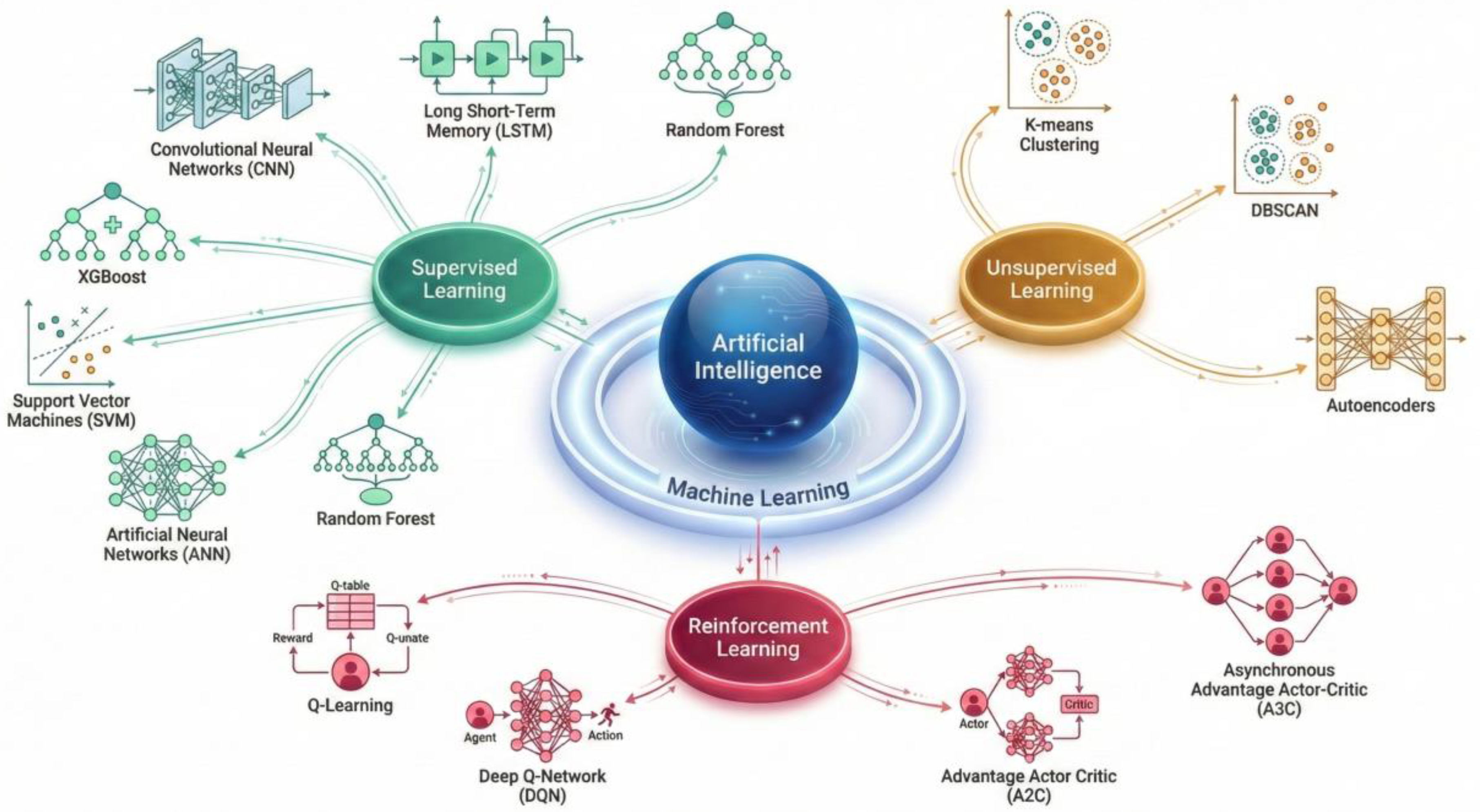
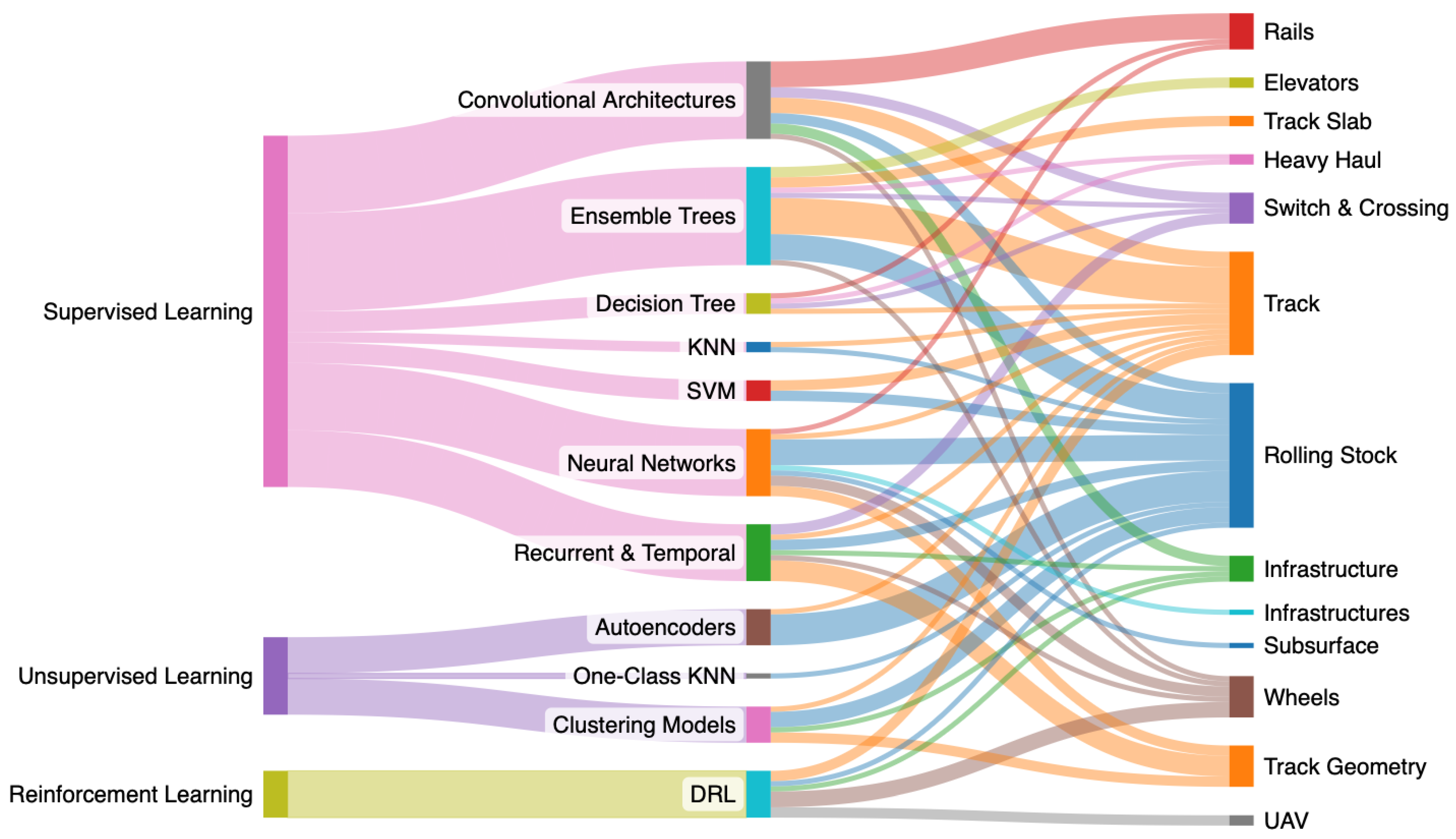
- Three major ML paradigms were identified and categorized to address specific maintenance challenges: Supervised Learning, Unsupervised Learning, and Reinforcement Learning. Supervised Learning is the most dominant paradigm, primarily utilizing tree-based algorithms like RF for tabular maintenance logs and Deep Learning architectures (e.g., CNNs) for unstructured visual data. Unsupervised Learning (e.g., Autoencoders, K-Means) is critical for anomaly detection in the absence of labeled failure data. Reinforcement Learning (e.g., DQN, A2C) is emerging as a key tool for optimizing sequential decision-making tasks such as maintenance scheduling and renewal planning. This classification underscores the specialized utility of each algorithm type within the maintenance hierarchy.
- Predictive maintenance applications were identified and categorized into physical targets and operational outcomes. Physical targets include core infrastructure assets such as rails, sleepers, switches, and rolling stock components like wheels and bearings. Operational outcomes were classified into defect detection, RUL estimation, and maintenance scheduling optimization. These actionable categorizations assist railway managers in selecting the appropriate algorithmic tool for specific asset classes and operational goals.
- The identified digital technologies and algorithms were prioritized based on their occurrence in the literature to highlight well-established versus emerging methods. It was revealed that Supervised Learning, specifically RF and Neural Networks, are the most frequently studied algorithms for defect prediction. In contrast, True DTs with bidirectional control and Reinforcement Learning applications like A2C remain niche but are rapidly growing areas of research. Additionally, predictive maintenance, anomaly detection, and DTs were identified as “Motor Themes,” driving the current research agenda.
- An informative relationship mapping was created to correlate specific ML algorithms with focused railway components. It demonstrated that CNNs are predominantly correlated with visual surface defects in rails and rolling stock, while LSTMs are strongly associated with time-series forecasting of track geometry degradation. The mapping also showed that Reinforcement Learning is most effective for high-level decision support in maintenance planning rather than direct defect detection. These insights facilitate the selection of optimal algorithmic architectures for specific maintenance tasks.
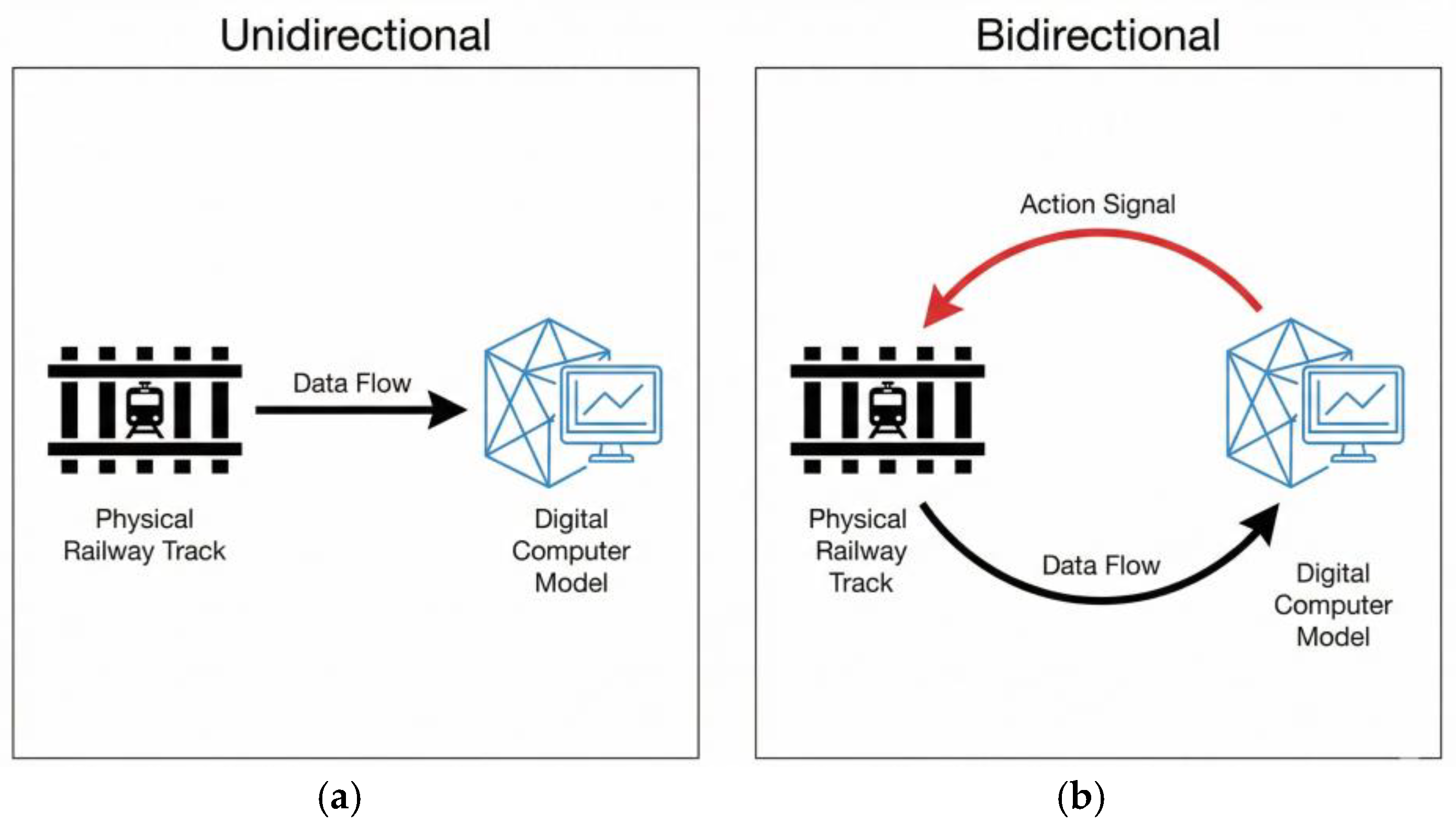
- The complex interplay of digital integration and its limitations was also illustrated, specifically the DT Gap. The analysis revealed a prevalence of unidirectional digital models that only monitor assets, as opposed to bidirectional True DTs capable of autonomous actuation or parameter updates. Furthermore, the study highlighted the critical role of IFC in enabling interoperability between BIM and AI, a standard often neglected in favor of proprietary formats.
- Four distinct levels of digital maintenance maturity were identified and discussed: (1) Visualization using 3D models, (2) Diagnosis using basic alerts and dashboards, (3) Self-correction using recursive model updating, and (4) Autonomous control using closed-loop feedback systems.
- Five critical gaps in the current body of literature were also identified to guide future research. These include the “Safety Paradox” leading to data scarcity, the “Black-Box” nature of deep learning hindering interpretability, the lack of standardized bidirectional control in DTs, computational constraints for real-time edge deployment, and the absence of quantified environmental metrics to validate sustainability claims.
- In complementing the existing literature, this study presents a comprehensive systematic review of the convergence of AI, BIM, and DTs in railway maintenance. It offers a structured classification of algorithms and their component-specific applications, maps the current state of interoperability and data flow, and provides an organized framework of challenges to support the transition toward fully autonomous and sustainable railway infrastructure management.
Supplementary Materials
Author Contributions
Funding
Data Availability Statement
Acknowledgments
Conflicts of Interest
Abbreviations
| A2C | Advantage Actor Critic |
| A3C | Asynchronous Advantage Actor-Critic |
| AI | Artificial Intelligence |
| ANN | Artificial Neural Network |
| BIM | Building Information Modeling |
| CBM | Condition-Based Maintenance |
| CCTV | Closed-Circuit Television |
| CNN | Convolutional Neural Network |
| kg CO2e | Kilograms of Carbon Dioxide Equivalent |
| DBSCAN | Density-Based Spatial Clustering of Applications with Noise |
| DNN | Deep Neural Network |
| DQN | Deep Q-Network |
| DT | Digital Twin |
| ECU | Electronic Control Unit |
| FEM | Finite Element Method |
| GRU | Gated Recurrent Unit |
| IFC | Industry Foundation Classes |
| IoT | Internet of Things |
| KNN | K-Nearest Neighbors |
| kWh | Kilowatt-hour |
| LSTM | Long Short-Term Memory |
| MDP | Markov Decision Process |
| ML | Machine Learning |
| PRISMA | Preferred Reporting Items for Systematic Reviews and Meta-Analyses |
| RF | Random Forest |
| RNN | Recurrent Neural Network |
| RUL | Remaining Useful Life |
| UAV | Unmanned Aerial Vehicle |
Appendix A. List of Reviewed Papers

| Ref. | Aim of Study | Focused Component | Validation | AI Paradigm |
|---|---|---|---|---|
| [27] | Develop optimal renewal and maintenance planning minimizing long-term costs and failure risks. | Track | Real-world Case Study | Deep Reinforcement Learning (DRL), Double Deep Q-Network (DDQN), Cox Hazard Model |
| [46] | Optimize maintenance schedules to enhance operational efficiency and safety. | Track | Real-world Case Study | Graph Convolutional Networks (GCN), GraphSAGE, MLP |
| [47] | Real-time monitoring and fault diagnosis of railway vehicle bogies. | Rolling Stock (Bogies) | Lab Experiment | Convolutional Neural Networks (CNNs) |
| [38] | Predict wear and damage of pantograph sliding strips. | Rolling Stock (Pantograph) | Real-world Case Study | Artificial Neural Networks (ANNs) |
| [42] | Compare ML algorithms for estimating future failure points of tracks. | Track | Real-world Case Study | LSTM, Random Forest, Decision Tree, KNN, SVM |
| [20] | Classify and analyze data-driven approaches for railway PdM. | Track, Rolling Stock | N/A | SVM, RF, CNN, RNN, Autoencoders |
| [53] | Detect failures in advance for Air Production Units. | Rolling Stock (Air Production Unit) | Real-world Case Study | CNN-LSTM (Forecasting), XGBOD, Autoencoders |
| [49] | Real-time condition assessment of rail tracks at turnout areas. | Switch/Crossing | Real-world Case Study | CNN, Sparse Bayesian Extreme Learning Machine (SBELM) |
| [63] | Explore combined use of InSAR and GPR for health monitoring. | Track | N/A | CNN, SVM, RF, XGBoost |
| [92] | Detect damages in gear transmission systems early. | Rolling Stock (Mechanical) | Simulation | Convolutional Neural Networks (CNNs) |
| [81] | Anticipate failures and support maintenance decisions with explainability. | Rolling Stock (Air Production Unit) | Real-world Case Study | Adaptive Random Forest Classifier (ARFC), Hoeffding Trees |
| [93] | Detect traffic anomalies using self-powered sensors. | N/A (General Traffic) | Lab Experiment | Autoencoder, CNN-LSTM, Contrastive Learning |
| [32] | Forecast risk of service failures to improve safety. | Track (Heavy Haul) | Real-world Case Study | Gradient Boosting, Random Forest, Decision Tree, MLP |
| [94] | Automate inspection for safety and efficiency. | Track | Real-world Case Study | Convolutional Neural Networks (CNNs) |
| [69] | Framework for Digital Twin collaboration to diagnose faults. | All | Simulation | Machine Learning (General) |
| [95] | Assessment of track structure condition using monitoring data. | Track | Real-world Case Study | Sparse Bayesian Extreme Learning Machine (SBELM) |
| [34] | Monitor track conditions using car-body vibration. | Track | Real-world Case Study | Support Vector Machine (SVM) |
| [39] | Characterize normal acceleration behavior to detect anomalies. | Rolling Stock (Car Body) | Real-world Case Study | Artificial Neural Networks (ANN) |
| [96] | Monitor conditions leading to high-impact loads. | Rolling Stock (Wheel) | Real-world Case Study | Logical Analysis of Data (LAD), Ant Colony Optimization (ACO) |
| [78] | Support maintenance decisions for degrading assets. | Rolling Stock (Wheelset), Track | Real-world Case Study | Markov Decision Process (MDP) |
| [37] | Detect failures in machinery before critical stages. | Rolling Stock (Air Production Unit) | Real-world Case Study | Half-Space-Trees, One Class K Nearest Neighbor (OCKNN) |
| [15] | Develop efficient inspection and maintenance policies. | Track | Real-world Case Study | Random Forest, Recurrent Neural Networks (RNNs) |
| [61] | Automatically localize track regions with high settlement rates. | Track | Real-world Case Study | Autoencoder, KMeans Clustering |
| [97] | Predict rail useful lifetime and analyze risk. | Track (Rail) | Real-world Case Study | Deep Neural Networks (DNNs), DeepSurv |
| [31] | Monitor lateral and cross-level track irregularities. | Track | Simulation | Random Forest, CNN |
| [60] | Assign health scores to railcars to prioritize maintenance. | Rolling Stock (Railcar) | Real-world Case Study | Random Forest, Decision Tree, DBSCAN, PCA |
| [48] | Detect rail defects, joints, and switches. | Track (Rail, Switch) | Real-world Case Study | Deep Neural Networks (DNNs), CNN |
| [74] | Predict rail surface damage (Rolling Contact Fatigue). | Track (Rail Surface) | Real-world Case Study | N/A (Physics-based simulation) |
| [98] | Review Digital Twin applications in transportation maintenance. | All | N/A | Machine Learning, Deep Reinforcement Learning |
| [73] | Anomaly detection for rail transportation. | Rolling Stock/Track | Lab Experiment | Unsupervised Machine Learning (LSTM Autoencoder) |
| [70] | Design a Digital Twin configuration for CBM applications. | Rolling Stock (Axle Bearings) | Real-world Case Study | Artificial Neural Networks (ANNs), Weibull Analysis |
| [54] | Estimate Remaining Useful Life (RUL) of equipment. | Rolling Stock/Mechanical | Simulation | LSTM Autoencoder |
| [80] | Investigate optimal maintenance strategy under various conditions. | Track | Simulation | AI-based algorithms (general mention) |
| [85] | Implement core PdM functionality using online machine learning. | Rolling Stock (Doors) | Real-world Case Study | LSTM-AE, Clustering (CheMoc) |
| [64] | Optimize UAV-based autonomous inspection. | Track | Simulation | Hybrid Deep Reinforcement Learning, DeepSeek |
| [55] | Manage wheel wear with limited measurement data. | Rolling Stock (Wheel) | Simulation | DNN, Deep Reinforcement Learning (Deep Q-Learning) |
| [82] | Predict track geometry defects using GPR data and explainable QNN. | Track (Subsurface) | Real-world Case Study | Quantum Neural Network (QNN), SHAP |
| [68] | Detect bolt preload conditions in insulated rail joints using a Digital Twin. | Track (Insulated Rail Joints) | Simulation/Lab Experiment | Decision Trees (Coarse/Medium/Fine) |
| [77] | Develop functions to classify track condition and predict service levels. | Track (Geometry) | Real-world Case Study | ANN, Linear/Exponential Regression |
| [45] | Propose a framework (RailCANet) for anomaly detection and maintenance. | Infrastructure/Rolling Stock | Real-world Case Study | RailCANet (GNN, CNN), LSTM, Transformer |
| [51] | Automate rail head wear detection using deep learning computer vision. | Track (Rail Head) | Real-world Case Study | Mask R-CNN, YOLOv8 |
| [52] | Predict wheel–rail dynamic contact forces using a lightweight surrogate model. | Rolling Stock (Wheel-Rail) | Simulation (MBS/FEM) | CNN, LSTM, Transformer, Knowledge Distillation |
| [43] | Predict failures of train traction converter cooling systems. | Rolling Stock (Cooling System) | Real-world Case Study | LSTM |
| [33] | Predict rail track lifetime integrating environmental and operational data. | Track | Real-world Case Study | CATB, XGBoost, Random Forest, Decision Tree |
| [99] | Model degradation rates of track geometry local defects. | Track (Geometry) | Real-world Case Study | Regression Analysis |
| [50] | Detect wheel out-of-roundness using axlebox vibration. | Rolling Stock (Wheels) | Simulation (MBS) | OORNet (Deep Learning), 1DCNN |
| [56] | Determine optimal maintenance limits to minimize costs. | Track (Geometry) | Real-world Case Study | K-Means Clustering |
| [100] | Discuss AI applications for traffic and infrastructure maintenance. | General | N/A | N/A (General AI discussion) |
| [101] | Analyze track parameters’ effect on performance/LCC. | Track (Slab Track) | Simulation (FEM) | Linear Regression, KNN, DT, RF, MLP, Gradient Boosting |
| [102] | Develop TQI prediction model for sections not measured by cars. | Track (Geometry/TQI) | Real-world Case Study | Logit/Linear Regression |
| [103] | Evaluate approaches toward implementing predictive maintenance. | General | N/A | Review (SVM, RF, ANN, LSTM, etc.) |
| [67] | Propose PdM model for switch machines using Digital Twins. | Switch/Crossing | Experiment/Simulation | LSTM, ARIMA |
| [104] | Create a life prediction framework for wheels and rails. | Wheel-Rail Interface | Real-world Case Study | N/A (MBS Simulation) |
| [29] | Predict failure category and maintenance needs of station elevators. | Station Facilities (Elevators) | Real-world Case Study | Decision Tree, Random Forest, Gradient Boosted Tree |
| [30] | Create strategic decision support for rolling stock maintenance. | Rolling Stock (Traction/Braking) | Real-world Case Study | J48 (Decision Tree), M5P (Regression Tree) |
| [28] | Predict maintenance need, activity type, and trigger status. | Switch/Crossing | Real-world Case Study | Decision Tree, Random Forest, Gradient Boosted Trees |
| [41] | Forecast future TQI values using historical measurements. | Track (Geometry/TQI) | Real-world Case Study | General Regression Neural Network (GRNN) |
| [62] | Improve maintenance efficiency using DRL and Digital Twin. | Track (Geometry/Components) | Real-world Case Study | Advantage Actor Critic (A2C) (Deep Reinforcement Learning) |
| [40] | Evaluate track buckling risks using a surrogate ML model. | Track | Simulation | Multilayer Perceptron (MLP) |
| [58] | Predict remaining time to critical fault severity without RTF data. | Rolling Stock (Door Systems) | Real-world Case Study | K-Means Clustering |
| [105] | Predict vehicle defects to optimize maintenance scheduling. | Rolling Stock | Real-world Case Study | MLP, ANFIS, Particle Swarm Optimization (PSO) |
| [106] | Review data analytics techniques for track condition monitoring. | Track (Geometry) | N/A | Review (ANN, Bayesian, SVM, etc.) |
| [79] | Optimize scheduling to reduce costs and failure risk. | Rail Network | Real-world Case Study | N/A (Optimization Models) |
| [57] | Real-time track geometry monitoring using low-cost sensor fusion. | Track (Geometry) | Field Experiment | K-Means Clustering, Fuzzy Logic |
| [59] | Review data-driven models for track predictive maintenance. | Track | N/A | Review (Deep Learning, Ensemble, etc.) |
| [84] | Review SHM and digital tools for rail infrastructure. | Infrastructure | N/A | Review (AI, ML, DL, RL) |
| [36] | Predict system downtime and incident risk levels for CCTV. | Rolling Stock (CCTV) | Real-world Case Study | Bayesian Ridge, SVR, KNN, LSTM, CNN, SARIMAX |
| [107] | Develop a roadmap for data-driven PdM in SA railways. | Railway Industry | Real-world Case Study | N/A |
| [84] | Automated assessment of track bed stratigraphy/fouling. | Track (Ballast/Substructure) | N/A | AI (Specifics not detailed) |
| [75] | Propose guidelines and reference architecture for AI-DTs. | General/Maintenance | N/A | N/A (Architecture) |
| [35] | Develop DT framework for trams using low-cost sensors. | Rolling Stock (Tram) | Real-world Case Study | SVM, Random Forest, Huber Regression |
| [87] | Review predictive diagnostics methods for axle bearings. | Rolling Stock (Axle Bearings) | N/A | Review (Deep Learning, Hybrid) |
| [44] | Predict track geometry using 3D RNN models co-simulated with BIM. | Track (Geometry) | Real-world Case Study | RNN, LSTM, GRU, Attention |
References
- Sun, Q.; Wang, X.; Ma, F.; Han, Y.; Cheng, Q. Synergetic Effect and Spatial-Temporal Evolution of Railway Transportation in Sustainable Development of Trade: An Empirical Study Based on the Belt and Road. Sustainability 2019, 11, 1721. [Google Scholar] [CrossRef]
- Whiteing, T.; Menaz, B. Thematic Research Summary: Rail Transport; Transport Research Knowledge Centre—European Commission: Brussels, Belgium, 2009.
- Souza, E.F.; Bragança, C.; Meixedo, A.; Ribeiro, D.; Bittencourt, T.N.; Carvalho, H. Drive-by Methodologies Applied to Railway Infrastructure Subsystems: A Literature Review—Part I: Bridges and Viaducts. Appl. Sci. 2023, 13, 6940. [Google Scholar] [CrossRef]
- Sharma, S.K.; Kumar, A. A comparative study of Indian and world wide railways. Int. J. Mech. Eng. Robot. Res. 2014, 1, 114–120. [Google Scholar]
- Du, C.; Dutta, S.; Kurup, P.; Yu, T.; Wang, X. A review of railway infrastructure monitoring using fiber optic sensors. Sens. Actuators A Phys. 2020, 303, 111728. [Google Scholar] [CrossRef]
- Dekker, B.; Ton, B.; Meijer, J.; Bouali, N.; Linssen, J.; Ahmed, F. Point Cloud Analysis of Railway Infrastructure: A Systematic Literature Review. IEEE Access 2023, 11, 134355–134373. [Google Scholar] [CrossRef]
- European Environment Agency. Transport and Environment Report 2022; European Environment Agency: Copenhagen, Denmark, 2023; Available online: https://www.eea.europa.eu/en/analysis/publications/transport-and-environment-report-2022 (accessed on 17 November 2025).
- Vieira, J.; Martins, J.P.; de Almeida, N.M.; Patrício, H.; Morgado, J.G. Towards Resilient and Sustainable Rail and Road Networks: A Systematic Literature Review on Digital Twins. Sustainability 2022, 14, 7060. [Google Scholar] [CrossRef]
- Berdica, K. An introduction to road vulnerability: What has been done, is done and should be done. Transp. Policy 2002, 9, 117–127. [Google Scholar] [CrossRef]
- Soleimanmeigouni, I.; Ahmadi, A.; Kumar, U. Track geometry degradation and maintenance modelling: A review. Proc. Inst. Mech. Eng. Part F J. Rail Rapid Transit 2016, 232, 73–102. [Google Scholar] [CrossRef]
- Lidén, T. Railway Infrastructure Maintenance—A Survey of Planning Problems and Conducted Research. Transp. Res. Procedia 2015, 10, 574–583. [Google Scholar] [CrossRef]
- Chandran, P.; Asber, J.; Thiery, F.; Odelius, J.; Rantatalo, M. An Investigation of Railway Fastener Detection Using Image Processing and Augmented Deep Learning. Sustainability 2021, 13, 12051. [Google Scholar] [CrossRef]
- Dobney, K.; Baker, C.J.; Quinn, A.D.; Chapman, L. Quantifying the effects of high summer temperatures due to climate change on buckling and rail related delays in south-east United Kingdom. Meteorol. Appl. 2009, 16, 245–251. [Google Scholar] [CrossRef]
- Sogabe, M.; Asanuma, K.; Nakamura, T.; Kataoka, H.; Goto, K.; Tokunaga, M. Deformation Behavior of Ballasted Track during Earthquakes. Q. Rep. RTRI 2013, 54, 104–111. [Google Scholar] [CrossRef]
- Gerum, P.C.L.; Altay, A.; Baykal-Gürsoy, M. Data-driven predictive maintenance scheduling policies for railways. Transp. Res. Part C Emerg. Technol. 2019, 107, 137–154. [Google Scholar] [CrossRef]
- Sresakoolchai, J.; Kaewunruen, S. Carbon emission reduction in railway maintenance using reinforcement learning. In Life-Cycle of Structures and Infrastructure Systems; CRC Press: Boca Raton, FL, USA, 2023. [Google Scholar]
- Du, G.; Karoumi, R. Life cycle assessment of a railway bridge: Comparison of two superstructure designs. Struct. Infrastruct. Eng. 2013, 9, 1149–1160. [Google Scholar] [CrossRef]
- Kushwaha, D.; Kumar, A.; Harsha, S.P. Advancements and applications of digital twin in the railway industry: A literature review. Int. J. Rail Transp. 2024, 13, 865–890. [Google Scholar] [CrossRef]
- Bryde, D.; Broquetas, M.; Volm, J.M. The project benefits of Building Information Modelling (BIM). Int. J. Proj. Manag. 2013, 31, 971–980. [Google Scholar] [CrossRef]
- Davari, N.; Veloso, B.; de Assis Costa, G.; Pereira, P.M.; Ribeiro, R.P.; Gama, J. A Survey on Data-Driven Predictive Maintenance for the Railway Industry. Sensors 2021, 21, 5739. [Google Scholar] [CrossRef]
- Page, M.J.; Moher, D.; Bossuyt, P.M.; Boutron, I.; Hoffmann, T.C.; Mulrow, C.D.; Shamseer, L.; Tetzlaff, J.M.; Akl, E.A.; Brennan, S.E.; et al. PRISMA 2020 explanation and elaboration: Updated guidance and exemplars for reporting systematic reviews. BMJ 2021, 372, n160. [Google Scholar] [CrossRef]
- Lagap, U.; Ghaffarian, S. Digital post-disaster risk management twinning: A review and improved conceptual framework. Int. J. Disaster Risk Reduct. 2024, 110, 104629. [Google Scholar] [CrossRef]
- Carrera-Rivera, A.; Ochoa, W.; Larrinaga, F.; Lasa, G. How-to conduct a systematic literature review: A quick guide for computer science research. MethodsX 2022, 9, 101895. [Google Scholar] [CrossRef]
- Banihashemi, S.; Meskin, S.; Sheikhkhoshkar, M.; Mohandes, S.R.; Hajirasouli, A.; LeNguyen, K. Circular economy in construction: The digital transformation perspective. Clean. Eng. Technol. 2024, 18, 100715. [Google Scholar] [CrossRef]
- Sheikhkhoshkar, M.; Bril El Haouzi, H.; Aubry, A.; Hamzeh, F. An advanced exploration of functionalities as the underlying principles of construction control metrics. Smart Sustain. Built Environ. 2024, 13, 644–676. [Google Scholar] [CrossRef]
- Haghighi, E.; Kasraei, A.; Famurewa, S.; Strandberg, G.; Sas, G.; Garmabaki, A. Climate change risks on railway infrastructure: A systematic review and analysis. Sustain. Cities Soc. 2025, 129, 106504. [Google Scholar] [CrossRef]
- Mohammadi, R.; He, Q. A deep reinforcement learning approach for rail renewal and maintenance planning. Reliab. Eng. Syst. Saf. 2022, 225, 108615. [Google Scholar] [CrossRef]
- Bukhsh, Z.A.; Saeed, A.; Stipanovic, I.; Doree, A.G. Predictive maintenance using tree-based classification techniques: A case of railway switches. Transp. Res. Part C Emerg. Technol. 2019, 101, 35–54. [Google Scholar] [CrossRef]
- Alothman, A.; Malraj, M.; Vilventhan, A. Predictive Maintenance of Metro Rail Station Facilities Using Tree-Based Machine-Learning Algorithms. J. Perform. Constr. Facil. 2026, 40, 04025074. [Google Scholar] [CrossRef]
- Kalathas, I.; Papoutsidakis, M. Predictive maintenance using machine learning and data mining: A pioneer method implemented to greek railways. Designs 2021, 5, 5. [Google Scholar] [CrossRef]
- Kaviani, N.; Rannquist, A.; Fraseth, G.T.; Lau, A.; Ricci, S.; Rizzetto, L. Detecting lateral track irregularities by onboard measurements of lateral acceleration and displacements and Machine Learning algorithms. Ing. Ferrov. 2024, 79, 633–653. [Google Scholar]
- Ghofrani, F.; Sun, H.; He, Q. Analyzing Risk of Service Failures in Heavy Haul Rail Lines: A Hybrid Approach for Imbalanced Data. Risk Anal. 2021, 42, 1852–1871. [Google Scholar] [CrossRef]
- Ji, K.; Wang, G.H.; Choi, I.; Jeon, J.-S. Machine learning based life prediction of rail tracks using environmental and operational factors. Dev. Built Environ. 2025, 23, 100718. [Google Scholar] [CrossRef]
- Tsunashima, H. Condition Monitoring of Railway Tracks from Car-Body Vibration Using a Machine Learning Technique. Appl. Sci. 2019, 9, 2734. [Google Scholar] [CrossRef]
- Wysocki, O.; Kuziemski, M.; Freitas, A.; Wasilczuk, M.; Czyżewicz, J. Toward Low-Cost Digital Twins for Urban Transportation Systems. IEEE Access 2025, 13, 120277–120292. [Google Scholar] [CrossRef]
- Rahman, M.; Alkali, B.; Jain, A.K.; Parrilla-Gutierrez, J.; Mcneil, C.; Nelson, J. The application of time series predictive maintenance model on rolling stock critical systems. Adv. Mech. Eng. 2025, 17, 16878132251384345. [Google Scholar] [CrossRef]
- Meira, J.; Veloso, B.; Bolón-Canedo, V.; Marreiros, G.; Alonso-Betanzos, A.; Gama, J. Data-driven predictive maintenance framework for railway systems. Intell. Data Anal. 2023, 27, 1087–1102. [Google Scholar] [CrossRef]
- Kuźnar, M.; Lorenc, A. A Method of Predicting Wear and Damage of Pantograph Sliding Strips Based on Artificial Neural Networks. Materials 2022, 15, 98. [Google Scholar] [CrossRef]
- Martínez-Llop, P.G.; de Dios Sanz Bobi, J.; Solano Jiménez, Á.; Sánchez, J.G. Condition-based maintenance for normal behaviour characterisation of railway car-body acceleration applying neural networks. Sustainability 2021, 13, 12265. [Google Scholar] [CrossRef]
- Agustin, D.; Wu, Q.; Bernal, E.; Spiryagin, M.; Cole, C. Railway track buckling evaluation using rigid-flexible multibody dynamic model and machine learning. Mech. Based Des. Struct. Mach. 2025, 53, 4830–4852. [Google Scholar] [CrossRef]
- Nedevska, T.I.; Zafirovski, Z. Predictive modeling of track quality index with neural networks. J. Appl. Eng. Sci. 2025, 23, 735–741. [Google Scholar] [CrossRef]
- Nigam, S.; Kumar, D. A predictive model based on the LSTM technique for the maintenance of railway track system. Int. J. Comput. Sci. Eng. 2025, 28, 10–20. [Google Scholar] [CrossRef]
- De Simone, L.; Caputo, E.; Cinque, M.; Galli, A.; Moscato, V.; Russo, S.; Cesaro, G.; Criscuolo, V.; Giannini, G. LSTM-based failure prediction for railway rolling stock equipment. Expert Syst. Appl. 2023, 222, 119767. [Google Scholar] [CrossRef]
- Sresakoolchai, J.; Kaewunruen, S. Track Geometry Prediction Using Three-Dimensional Recurrent Neural Network-Based Models Cross-Functionally Co-Simulated with BIM. Sensors 2023, 23, 391. [Google Scholar] [CrossRef] [PubMed]
- Quan, L.; Wang, M.; Baihang, L.; Ziwen, Z. Integration of deep learning and railway big data for environmental risk prediction models and analysis of their limitations. Front. Environ. Sci. 2025, 13, 1550745. [Google Scholar] [CrossRef]
- MajidiParast, S.; Monemi, R.N.; Gelareh, S. A graph convolutional network for optimal intelligent predictive maintenance of railway tracks. Decis. Anal. J. 2025, 14, 100542. [Google Scholar] [CrossRef]
- Li, D.; Su, D.; Tang, H.; Yu, D.; Yu, L.; Zhang, H.; Hu, G. A hardware-centered digital twin framework for real-time monitoring of railway vehicle bogies. Proc. Inst. Mech. Eng. Part C J. Mech. Eng. Sci. 2025, 239, 10242–10257. [Google Scholar] [CrossRef]
- Yang, C.; Sun, Y.; Ladubec, C.; Liu, Y. Developing Machine Learning-Based Models for Railway Inspection. Appl. Sci. 2021, 11, 13. [Google Scholar] [CrossRef]
- Zhou, L.; Chen, S.-X.; Ni, Y.-Q.; Liu, X.-Z. Advancement of data-driven SHM: A research paradigm on AE-based switch rail condition monitoring. J. Infrastruct. Intell. Resil. 2024, 3, 100107. [Google Scholar] [CrossRef]
- Ye, Y.; Zhu, B.; Huang, P.; Peng, B. OORNet: A deep learning model for on-board condition monitoring and fault diagnosis of out-of-round wheels of high-speed trains. Measurement 2022, 199, 111268. [Google Scholar] [CrossRef]
- Khan, A.T.; Jahanzaib, A.; Khan, A.R.; Ramzan, M.; Li, S. Intelligent Predictive Maintenance in Urban Rail Systems: Computer Vision Approaches for Enhanced Wear Detection. Transp. Res. Rec. 2025, 2680, 626–638. [Google Scholar] [CrossRef]
- Lin, Z.; Cho, C. Lightweight Knowledge Distillation-Based Surrogate Model for Wheel–Rail Dynamic Contact Force Prediction Using Hybrid CNN–LSTM–Transformer Networks. IEEE Sens. J. 2025, 25, 17239–17251. [Google Scholar] [CrossRef]
- Toribio, L.; Veloso, B.; Gama, J.; Zafra, A. A two-stage framework for early failure detection in predictive maintenance: A case study on metro trains. Neurocomputing 2026, 670, 132506. [Google Scholar] [CrossRef]
- Hu, L.; Dai, G. Estimate remaining useful life for predictive railways maintenance based on LSTM autoencoder. Neural Comput. Appl. 2022, 37, 22967–22978. [Google Scholar] [CrossRef]
- Sresakoolchai, J.; Ngamkhanong, C.; Kaewunruen, S. Hybrid learning strategies: Integrating supervised and reinforcement techniques for railway wheel wear management with limited measurement data. Front. Built Environ. 2025, 11, 1546957. [Google Scholar] [CrossRef]
- Kasraei, A.; Zakeri, J.A.; Bakhtiary, A. Optimal track geometry maintenance limits using machine learning: A case study. Proc. Inst. Mech. Eng. Part F J. Rail Rapid Transit 2020, 235, 876–886. [Google Scholar] [CrossRef]
- Fikri, A.A.; Subhan, M.F.N.; Suryanto, H.; Muhdi, K.D.; Pratama, D.F.; Iqbal, A. Sensor Fusion of Laser and Inertial Units with Kalman-KMeans-Fuzzy Framework for Real-Time Railway Geometry Monitoring. Bul. Ilm. Sarj. Tek. Elektro 2025, 7, 572–594. [Google Scholar] [CrossRef]
- Shimizu, M.; Perinpanayagam, S.; Namoano, B.; Starr, A. Real-Time Prognostics and Health Management Without Run-to-Failure Data on Railway Assets. IEEE Access 2023, 11, 28724–28734. [Google Scholar] [CrossRef]
- Xie, J.; Huang, J.; Zeng, C.; Jiang, S.-H.; Podlich, N. Systematic Literature Review on Data-Driven Models for Predictive Maintenance of Railway Track: Implications in Geotechnical Engineering. Geosciences 2020, 10, 425. [Google Scholar] [CrossRef]
- Ejlali, M.; Arian, E.; Taghiyeh, S.; Chambers, K.; Sadeghi, A.H.; Taghiye, E.; Cakdi, D.; Handfield, R.B. Developing hybrid machine learning models to assign health score to railcar fleets for optimal decision making. Expert Syst. Appl. 2024, 250, 123931. [Google Scholar] [CrossRef]
- Popov, K.; De Bold, R.; Chai, H.-K.; Forde, M.; Ho, C.; Hyslip, J.; Kashani, H.; Kelly, R.; Hsu, S.; Rippin, M. Data-driven track geometry fault localisation using unsupervised machine learning. Constr. Build. Mater. 2023, 377, 131141. [Google Scholar] [CrossRef]
- Sresakoolchai, J.; Kaewunruen, S. Railway infrastructure maintenance efficiency improvement using deep reinforcement learning integrated with digital twin based on track geometry and component defects. Sci. Rep. 2023, 13, 2439. [Google Scholar] [CrossRef]
- Koohmishi, M.; Kaewunruen, S.; Chang, L.; Guo, Y. Advancing railway track health monitoring: Integrating GPR, InSAR and machine learning for enhanced asset management. Autom. Constr. 2024, 162, 105378. [Google Scholar] [CrossRef]
- Wang, C. HTFN: A Hybrid Deep Reinforcement Learning Framework for UAV-Based Railway Inspection With Deepseek Integration. IEEE Access 2025, 13, 196821–196835. [Google Scholar] [CrossRef]
- Tang, R.; De Donato, L.; Bešinović, N.; Flammini, F.; Goverde, R.M.P.; Lin, Z.; Liu, R.; Tang, T.; Vittorini, V.; Wang, Z. A literature review of Artificial Intelligence applications in railway systems. Transp. Res. Part C Emerg. Technol. 2022, 140, 103679. [Google Scholar] [CrossRef]
- Bhadouria, A.S.; Braga, J.A.P.; Mishra, R.P.; Andrade, A.R. Optimizing maintenance in railway wheelsets from freight wagons: What is the most appropriate lifetime variable? Proc. Inst. Mech. Eng. Part F J. Rail Rapid Transit 2025, 09544097251400096. [Google Scholar] [CrossRef]
- Yang, J.; Sun, Y.; Cao, Y.; Hu, X. Predictive Maintenance for Switch Machine Based on Digital Twins. Information 2021, 12, 485. [Google Scholar] [CrossRef]
- Bianchi, G.; Freddi, F.; Giuliani, F.; La Placa, A. Implementation of an AI-based predictive structural health monitoring strategy for bonded insulated rail joints using digital twins under varied bolt conditions. Railw. Eng. Sci. 2025, 33, 703–720. [Google Scholar] [CrossRef]
- Sahal, R.; Alsamhi, S.H.; Brown, K.N.; O’Shea, D.; McCarthy, C.; Guizani, M. Blockchain-Empowered Digital Twins Collaboration: Smart Transportation Use Case. Machines 2021, 9, 193. [Google Scholar] [CrossRef]
- Crespo Marquez, A.; Marcos Alberca, J.A.; Guillén López, A.J.; De la Fuente Carmona, A. Digital twins in condition-based maintenance apps: A case study for train axle bearings. Comput. Ind. 2023, 151, 103980. [Google Scholar] [CrossRef]
- Nasim, M.; Rajabifard, A.; Chen, Y.; Samali, B. A demonstration of a digital twin framework for structural health monitoring: Application to bridge infrastructures. J. Infrastruct. Intell. Resil. 2026, 5, 100184. [Google Scholar] [CrossRef]
- Torzoni, M.; Tezzele, M.; Mariani, S.; Manzoni, A.; Willcox, K.E. A digital twin framework for civil engineering structures. Comput. Methods Appl. Mech. Eng. 2024, 418, 116584. [Google Scholar] [CrossRef]
- Zhao, X.; He, D.; Fang, Z.; Chen, H.; Zhang, Y.; Zeng, L.; Pan, H.; Zhang, Z. Digital twin-enhanced self-powered sensing anomaly detection system for intelligent rail transportation. Nano Energy 2025, 144, 111338. [Google Scholar] [CrossRef]
- Ahmad, S.; Spiryagin, M.; Wu, Q.; Bernal, E.; Sun, Y.; Cole, C.; Makin, B. Development of a Digital Twin for prediction of rail surface damage in heavy haul railway operations. Veh. Syst. Dyn. 2024, 62, 41–66. [Google Scholar] [CrossRef]
- De Donato, L.; Dirnfeld, R.; Somma, A.; De Benedictis, A.; Flammini, F.; Marrone, S.; Saman Azari, M.; Vittorini, V. Towards AI-assisted digital twins for smart railways: Preliminary guideline and reference architecture. J. Reliab. Intell. Environ. 2023, 9, 303–317. [Google Scholar] [CrossRef]
- Kaewunruen, S.; Zhaochen, Z.; Khongsomchit, L.; Lin, Y.-H.; Ndlovu, N.T. BIM-Driven Digital Twin for Climate Change Adaptation and Resilience of Railway Overhead Line System. Sustainabiliy 2026, 18, 1909. [Google Scholar] [CrossRef]
- Nagy, R.; Horvát, F.; Fischer, S. Innovative Approaches in Railway Management: Leveraging Big Data and Artificial Intelligence for Predictive Maintenance of Track Geometry. Teh. Vjesn. 2024, 31, 1245–1259. [Google Scholar] [CrossRef]
- Braga, J.A.P.; Andrade, A.R. Data-driven decision support system for degrading assets and its application under the perspective of a railway component. Transp. Eng. 2023, 12, 100180. [Google Scholar] [CrossRef]
- Consilvio, A.; Di Febbraro, A.; Meo, R.; Sacco, N. Risk-based optimal scheduling of maintenance activities in a railway network. EURO J. Transp. Logist. 2019, 8, 435–465. [Google Scholar] [CrossRef]
- Praticò, F.G.; Fedele, R. Exploring the paradigm of railway predictive maintenance. Struct. Infrastruct. Eng. 2025, 1–12. [Google Scholar] [CrossRef]
- García-Méndez, S.; de Arriba-Pérez, F.; Leal, F.; Veloso, B.; Malheiro, B.; Burguillo-Rial, J.C. An explainable machine learning framework for railway predictive maintenance using data streams from the metro operator of Portugal. Sci. Rep. 2025, 15, 27495. [Google Scholar] [CrossRef]
- Alabintei, D.D.; Attoh-Okine, N. Hybrid Quantum Neural Network and Shapely Additive Explanations in Railway Track Geometry Modeling. ASME J. Risk Uncertain. Eng. Syst. Part B Mech. Eng. 2025, 11, 031206. [Google Scholar] [CrossRef]
- Bianchi, G.; Fanelli, C.; Freddi, F.; Giuliani, F.; La Placa, A. Systematic review railway infrastructure monitoring: From classic techniques to predictive maintenance. Adv. Mech. Eng. 2025, 17, 16878132241285631. [Google Scholar] [CrossRef]
- Mbubia Tchoua, E.; Tissier, J.; Martin, A.; Fargier, Y.; Ihamouten, A. The use of Ground Penetrating Radar and artificial intelligence for automated railway trackbed stratigraphy and Ballast Fouling assessment. Transp. Eng. 2026, 23, 100415. [Google Scholar] [CrossRef]
- Le-Nguyen, M.-H.; Turgis, F.; Fayemi, P.-E.; Bifet, A. Exploring the potentials of online machine learning for predictive maintenance: A case study in the railway industry. Appl. Intell. 2023, 53, 29758–29780. [Google Scholar] [CrossRef]
- Hassija, V.; Chamola, V.; Mahapatra, A.; Singal, A.; Goel, D.; Huang, K.; Scardapane, S.; Spinelli, I.; Mahmud, M.; Hussain, A. Interpreting Black-Box Models: A Review on Explainable Artificial Intelligence. Cogn. Comput. 2024, 16, 45–74. [Google Scholar] [CrossRef]
- Konecny, J.; Ozana, S.; Choutka, J.; Prauzek, M. Towards railways safety: A systematic review on predictive diagnostics for axle bearings. Measurement 2026, 257, 118510. [Google Scholar] [CrossRef]
- Cascino, A.; Meli, E.; Rindi, A. High-Fidelity Finite Element Modelling (FEM) and Dynamic Analysis of a Hybrid Aluminium–Honeycomb Railway Vehicle Carbody. Appl. Sci. 2026, 16, 549. [Google Scholar] [CrossRef]
- Cascino, A.; Meli, E.; Rindi, A. Development of a Methodology for Railway Bolster Beam Design Enhancement Using Topological Optimization and Manufacturing Constraints. Eng 2024, 5, 1485–1498. [Google Scholar] [CrossRef]
- Cascino, A.; Nencioni, L.; Lanzillo, L.; Mazzeo, F.; Strano, S.; Terzo, M.; Delle Monache, S.; Meli, E. Development and Experimental Validation of a Physics-Based Digital Twin for Railway Freight Wagon Monitoring. Sensors 2026, 26, 643. [Google Scholar] [CrossRef]
- Page, M.J.; McKenzie, J.E.; Bossuyt, P.M.; Boutron, I.; Hoffmann, T.C.; Mulrow, C.D; Shamseer, L.; Tetzlaff, J.M.; Akl, E.A.; Brennan, S.E.; et al. The PRISMA 2020 statement: An updated guideline for reporting systematic reviews. BMJ 2021, 372, n71. [Google Scholar] [CrossRef]
- Koutsoupakis, J.; Giagopoulos, D.; Chatziparasidis, I. AI-based condition monitoring on mechanical systems using multibody dynamics models. Eng. Appl. Artif. Intell. 2023, 123, 106467. [Google Scholar] [CrossRef]
- Fang, Z.; Kong, L.; Chen, H.; Zhao, X.; Wang, Y.; Fan, C.; Zhang, Z.; Bai, L. An intelligent traffic anomaly detection system based on self-supervised learning and self-powered hybrid nano-sensor. Adv. Eng. Inform. 2025, 66, 103461. [Google Scholar] [CrossRef]
- Vračar, L.; Marinković, D.; Stojanović, M.; Milovančević, M. Automated Inspection System with GPS and Deep Learning in Urban Rail Safety and Efficiency. ACTA Polytech. Hung 2025, 22, 9–27. [Google Scholar] [CrossRef]
- Wang, S.; Gao, J.; Lin, C.; Li, H.; Huang, Y. Condition assessment of high-speed railway track structure based on sparse Bayesian extreme learning machine and Bayesian hypothesis testing. Int. J. Rail Transp. 2023, 11, 364–388. [Google Scholar] [CrossRef]
- Osman, H.; Yacout, S. Condition-based monitoring of the rail wheel using logical analysis of data and ant colony optimization. J. Qual. Maint. Eng. 2022, 29, 377–400. [Google Scholar] [CrossRef]
- Zeng, C.; Huang, J.; Wang, H.; Xie, J.; Zhang, Y. Deep Bayesian survival analysis of rail useful lifetime. Eng. Struct. 2023, 295, 116822. [Google Scholar] [CrossRef]
- Werbińska-Wojciechowska, S.; Giel, R.; Winiarska, K. Digital Twin Approach for Operation and Maintenance of Transportation System-Systematic Review. Sensors 2024, 24, 6069. [Google Scholar] [CrossRef] [PubMed]
- Rodrigues, P.; Teixeira, P.F. Modelling degradation rates of track geometry local defects: Lisbon-Porto line case study. Struct. Infrastruct. Eng. 2024, 20, 867–882. [Google Scholar] [CrossRef]
- Prasad, C.; Jamuar, S.S. Optimising indian railways infrastructure by AI. J. Mob. Multimed. 2021, 17, 157–174. [Google Scholar] [CrossRef]
- Sainz-Aja, J.A.; Ferreño, D.; Pombo, J.; Carrascal, I.A.; Casado, J.; Diego, S.; Castro, J. Parametric analysis of railway infrastructure for improved performance and lower life-cycle costs using machine learning techniques. Adv. Eng. Softw. 2023, 175, 103357. [Google Scholar] [CrossRef]
- Yudariansyah, H.; Ismiyati, I.; Narendera, A. Prediction Model for Track Quality Index Categories on the Northern and Southern Railway Lines of Java. Period. Polytech. Transp. Eng. 2025, 53, 184–193. [Google Scholar] [CrossRef]
- Binder, M.; Mezhuyev, V.; Tschandl, M. Predictive Maintenance for Railway Domain: A Systematic Literature Review. IEEE Eng. Manag. Rev. 2023, 51, 120–140. [Google Scholar] [CrossRef]
- H-Nia, S.; Flodin, J.; Casanueva, C.; Asplund, M.; Stichel, S. Predictive maintenance in railway systems: MBS-based wheel and rail life prediction exemplified for the Swedish Iron-Ore line. Veh. Syst. Dyn. 2024, 62, 3–20. [Google Scholar] [CrossRef]
- Khalilzadeh, M.; Pamucar, D.; Heidari, A. Reducing Train Delays with Machine Learning-Based Predictive Maintenance for Railways. Decis. Mak. Appl. Manag. Eng. 2025, 8, 265–284. [Google Scholar] [CrossRef]
- Gonzalo, A.P.; Horridge, R.; Steele, H.; Stewart, E.; Entezami, M. Review of Data Analytics for Condition Monitoring of Railway Track Geometry. IEEE Trans. Intell. Transp. Syst. 2022, 23, 22737–22754. [Google Scholar] [CrossRef]
- Nethamba, L.; Grobbelaar, S. The Development of an Action Priority Matrix and Technology Roadmap for the Implementation of Data-Driven and Machine-Learning-Based Predictive Maintenance in the South African Railway Industry. S. Afr. J. Ind. Eng. 2023, 34, 318–335. [Google Scholar] [CrossRef]




| Digital Library | Search Term |
|---|---|
| Web of Science | TS=(rail*) AND TS=(“predictive maintenance” OR “condition-based maintenance” OR “condition based maintenance”) AND (TS=(“digital twin*” OR “building information model*”) OR TS=(“machine learning” OR “artificial intelligence” OR “deep learning” OR “unsupervised learning” OR “reinforcement learning” OR “neural network*”)) |
| Scopus | (TITLE-ABS-KEY (rail*)) AND (TITLE-ABS-KEY (“predictive maintenance” OR “condition-based maintenance” OR “condition based maintenance” OR “preventive maintenance”)) AND (TITLE-ABS-KEY (“digital twin*” OR “building information model*”) OR TITLE-ABS-KEY (“machine learning” OR “artificial intelligence” OR “deep learning” OR “unsupervised learning” OR “reinforcement learning” OR “neural network*”)) |
| AI Architecture | Primary Asset Target | Advantage |
|---|---|---|
| Convolutional Networks (CNNs/GCNs) | Rails, Wheels, Track Surface | Excels at automated spatial feature extraction from complex, unstructured data such as visual images, acoustics, and vibration signals. |
| Recurrent Networks (LSTMs/RNNs) | Track Geometry, Component RUL | Highly effective at capturing long-term temporal dependencies and modeling continuous degradation trajectories over time. |
| Random Forest/Decision Trees (DT) | Switches, Station Facilities | Handles tabular, mixed, and imbalanced maintenance logs well; provides high interpretability, which is crucial for infrastructure managers. |
| Gradient Boosting (XGBoost/CatBoost) | Rail Infrastructure Lifespan, Heavy Haul | Delivers high-precision regression capabilities for complex, multi-source tabular datasets while resisting overfitting. |
| Support Vector Machines (SVM) & ANN | Machinery Components, Car-Body Vibration | Serves as a robust, highly generalizable baseline that maximizes the margin between fault classes; ideal when deep learning might overfit due to data scarcity. |
| Autoencoders (AE) | Track Geometry Faults, Machinery Anomalies | Effectively detects anomalies in entirely unlabeled datasets by learning “normal” operational baselines and identifying high reconstruction errors. |
| Clustering (K-Means/DBSCAN) | Maintenance Limits, Defect Grouping | Groups assets or track sections with similar degradation behaviors, significantly reducing uncertainty in maintenance modeling without requiring human labels. |
| Reinforcement Learning (A2C/DQN) | Maintenance Scheduling, Rail Renewal | Uniquely capable of optimizing sequential decision-making policies in stochastic environments to maximize long-term rewards (e.g., minimizing lifecycle costs). |
| Category | Source | Applied Activity | Baseline for Comparison | Quantified Benefit |
|---|---|---|---|---|
| Infrastructure & Track Geometry | [57] | Track Geometry Inspection | Manual/Analog | 65–75% cost reduction |
| [56] | Track Maintenance | Sub-optimal alert limits | 27–57% cost reduction | |
| [62] | Track Maint. | Field/Historical Data | 21% reduction in activities | |
| [77] | Track Geometry Maint. | Preventive | Up to 30% saving | |
| [15] | Track Inspection & Schedule | Current Policy | 100% Saving | |
| [51] | Rail Head Wear Detection | Manual Graph Paper | Qualitative | |
| Rolling Stock & Components | [30] | Traction & Braking Systems | Visual Control/Fixed Int. | Staff reduced from 4 to 2 |
| [66] | Freight Wagon Wheelsets | Time-based Maintenance | Avoids 12% increase | |
| [35] | Transmission/Suspension | Reactive/Run-to-Failure | Qualitative | |
| [58] | Machinery/Asset Health | Unexpected Failure | Qualitative | |
| [78] | Wheelset Reprofiling | Optimal CBM Policy | 1% Cost Deviation | |
| [70] | Axle Bearings Maint. | Preventive/Corrective | Qualitative | |
| Network Scheduling & Planning | [79] | Network Maint. Routing | Standard Scheduling | 80% work reduction |
| [27] | Tamping, Grinding, Renewal | Conventional Planning | Qualitative | |
| [36] | Rolling Stock Reliability | Rolling Stock Unavailability | Qualitative | |
| General Frameworks & Safety | [32] | Heavy Haul Rail Lines | Contextual Cost of Failure | $525,000 per broken rail |
| [80] | Deep Tech/Sensing | Reactive Maintenance | Qualitative |
| Strengths (Internal) | Weakness (Internal) |
| Cost Reduction: Proven reductions in operational downtime and maintenance expenditures | The Safety Paradox: Severe lack of “run-to-failure” data due to strict safety regulations, hindering AI training |
| Asset Longevity: Maximizes the RUL of physical infrastructure, preventing premature renewals | The “Black-Box” Nature: Lack of interpretability in advanced AI models limits trust among safety certifiers |
| Automated Accuracy: Deep Learning (e.g., CNNs) provides highly accurate, automated defect detection from unstructured data | Computational Constraints: High latency and hardware requirements limit real-time edge deployment |
| Opportunities (External) | Threats (External) |
| Synthetic Data & Physics-Informed ML: Using Digital Twins and Multibody Dynamics to safely simulate failure data | Cybersecurity Risks: Bidirectional Digital Twins acting on critical national infrastructure face severe vulnerability to cyberattacks |
| Standardization (IFC): Using open-source BIM standards to enable interoperability across platforms | Vendor Lock-In: Over-reliance on proprietary, closed-source software ecosystems limits long-term 50+ year asset management. |
| Green KPIs: Integrating environmental cost functions to objectively validate sustainability and carbon reduction. | Harsh Environments: Extreme weather and mechanical vibrations severely disrupt real-world sensor and UAV data quality |
Disclaimer/Publisher’s Note: The statements, opinions and data contained in all publications are solely those of the individual author(s) and contributor(s) and not of MDPI and/or the editor(s). MDPI and/or the editor(s) disclaim responsibility for any injury to people or property resulting from any ideas, methods, instructions or products referred to in the content. |
© 2026 by the authors. Licensee MDPI, Basel, Switzerland. This article is an open access article distributed under the terms and conditions of the Creative Commons Attribution (CC BY) license.
Share and Cite
Mutlu, U.; Kaewunruen, S. Digitalised Predictive Maintenance in Railways: A Systematic Review of AI, BIM, and Digital Twins. Infrastructures 2026, 11, 87. https://doi.org/10.3390/infrastructures11030087
Mutlu U, Kaewunruen S. Digitalised Predictive Maintenance in Railways: A Systematic Review of AI, BIM, and Digital Twins. Infrastructures. 2026; 11(3):87. https://doi.org/10.3390/infrastructures11030087
Chicago/Turabian StyleMutlu, Ugur, and Sakdirat Kaewunruen. 2026. "Digitalised Predictive Maintenance in Railways: A Systematic Review of AI, BIM, and Digital Twins" Infrastructures 11, no. 3: 87. https://doi.org/10.3390/infrastructures11030087
APA StyleMutlu, U., & Kaewunruen, S. (2026). Digitalised Predictive Maintenance in Railways: A Systematic Review of AI, BIM, and Digital Twins. Infrastructures, 11(3), 87. https://doi.org/10.3390/infrastructures11030087