Article

Embankment Fires on Railways—Where and How to Mitigate?

German Centre for Rail Traffic Research (DZSF), Federal Railway Authority (EBA), 01219 Dresden, Germany
*
Author to whom correspondence should be addressed.
Infrastructures 2025, 10(12), 337; https://doi.org/10.3390/infrastructures10120337
Submission received: 15 October 2025 / Revised: 7 November 2025 / Accepted: 10 November 2025 / Published: 8 December 2025
(This article belongs to the Special Issue Nature-Based Solutions and Resilience of Infrastructure Systems)

Abstract

As climate change increases the frequency and unpredictability of natural hazards, adapting critical infrastructure is crucial for long-term resilience. Among these hazards, embankment fires pose a growing threat to railway systems, particularly under rising temperatures and prolonged drought conditions. As part of the Horizon Europe project NATURE-DEMO, this study helps identify fire-prone rail segments and explore nature-based solutions, such as vegetation barriers, that can reduce ignition risk and enhance infrastructure resilience. In a case study, we analysed the risk of embankment fires for a section of the German railway network in detail. Based on an embankment-fire hazard indication map available for the entire German railway network, five hotspots within the study area were identified. Embankments with high fire susceptibility occur in both rural and urban areas, covering 1.1% of the study area. On the basis of published research on technical and nature-based solutions for reducing embankment fire susceptibility, we derived site-specific recommendations for the appropriate implementation of mitigation measures.

1. Introduction

In recent years, climate-induced hazards such as extreme heat, drought and heavy rainfall have increasingly affected railway infrastructure across Germany [1]. One prominent example is the risk of embankment fires, triggered by the ignition of dry vegetation along railway tracks. These fires are caused by various factors, such as sparks generated by braking freight trains [2,3]. Embankment fires can severely disrupt railway operations, lead to economic losses, and damage infrastructure. Moreover, they endanger adjacent areas and, in forested regions, can develop into large-scale wildfires [2]. This issue is particularly relevant in dry areas. Documented incidents highlight the scale and persistence of this hazard: in the drought year 2003, more than 800 embankment fires were recorded in Germany [2]. Between 2014 and 2020, official figures from Deutsche Bahn report between 196 and 502 such fires annually, with associated delays and cancellations [4].
To assess the risk of natural hazards, the German Centre for Rail Traffic Research at the Federal Railway Authority (DZSF) has initiated the development of hazard indication maps for different climate-related natural hazards on railways. These maps are publicly available via the GeoPortal of the Federal Railway Authority (https://geoportal.eisenbahn-bundesamt.de 9 November 2025). They aim to support climate adaptation measures and the prioritisation of measures by identifying vulnerable segments along the railway network. Among the hazards addressed, embankment fires have emerged as a key area of concern due to both the increasing occurrence of vegetation-related incidents and the heightened flammability of specific trackside areas during dry periods.
Once high-susceptibility areas are identified, the challenge remains how to reduce the risk of natural hazards in practice. In addition to technical solutions, nature-based solutions (NbS) are an alternative measure, as they present sustainable and cost-effective solutions for coping with climate-related natural hazards. However, especially within the railway sector, there are, to date, only a limited number of studies investigating the role of NbS [5]. While much of the recent research on NbS for infrastructure resilience originates from European contexts, similar approaches have also been explored internationally. In Australia, Blackwood [6] examined the implementation of NbS on rail infrastructure through a case study in Adelaide’s light rail network, where a vegetated “green track” was introduced as a climate adaptation measure to reduce surface temperatures, control runoff, and integrate biodiversity considerations into rail corridor management. Complementary work by Jeanneau et al. [7] within the Bushfire and Natural Hazards CRC demonstrated how vegetation-based fuel management strategies function as nature-based wildfire mitigation approaches across transport and rural landscapes. Likewise, in the United States, Kim et al. [8] developed a wildfire vulnerability framework for California’s railway network, integrating environmental and operational data to identify high-risk corridors where proximity of flammable vegetation and terrain steepness amplify ignition potential. Collectively, these studies confirm that integrating ecological processes and vegetation management into railway design and maintenance practices represents a growing, globally relevant approach to reducing wildfire hazards and enhancing climate resilience.
Recent research highlights their potential for hazards such as heat, flooding, and slope instability, and outlines options including vegetation shading, natural drainage and hybrid structures. However, implementation has so far been limited by barriers such as lack of standards, limited awareness, and the need for climate risk assessment as an entry point [9,10]. Case studies and frameworks demonstrate that NbS can be adapted to rail infrastructure, with early examples providing evidence of feasibility and guidance for future applications [6]. In addition, recent surveys of infrastructure managers in eight European countries highlight various practical barriers that continue to hamper the wider uptake of NbS, with a general preference for hybrid NbS–grey approaches [11].
Railway lines are often accompanied by vegetation. Long-distance rail networks in particular mainly run through rural areas to connect cities and metropolitan areas. In many European countries, large parts of these areas are forested and/or belong to nature reserves. Due to their ecological value and contribution to achieving climate protection goals, countries such as Germany do not intend to keep a wide corridor on both sides of the track completely free of vegetation. Although there are various vegetation-related risks to railway infrastructure and rolling stock, such as tree fall events, snow breakage of branches or embankment fires [12,13], trackside vegetation also has positive effects. Examples include cooling effects that reduce temperature peaks [5] and slope-stabilisation functions [5,14]. Railway companies have different guidelines regarding vegetation maintenance. In many cases, vegetation close to the track is pruned at least once a year, while more distant areas such as embankments are only cut back when vegetation poses a direct risk to railway traffic [15].
The active promotion of suitable vegetation types within this area may reduce fire risk [16]. In this article, we build on this concept by considering a nature-based approach and presenting a case study that illustrates how the risk and negative consequences of embankment fires along railways can be reduced. We focus on a section of the German railway network that is particularly vulnerable to drought. We analyse the risk distribution across railway segments and identify the most exposed areas. Finally, we propose site-specific, technical and natural mitigation measures. This approach provides a novel example of a nature-based solution aimed at mitigating climate-related threats to railway infrastructure.

2. Methods

2.1. Hazard Indication Map for Embankment Fires

To identify areas with elevated embankment fire susceptibility along the railway network, we used a hazard indication map developed by Frick et al. [17] and further described in Szymczak et al. [13]. The maximum entropy (MaxEnt) method, a statistical model commonly used in ecology for predicting probability distributions based on limited information [18], was used to determine the embankment-fire hazard. In addition, MaxEnt models can achieve sufficient model quality even with a small number of presence points [19,20], and only limited event data from past embankment fires was available for analysis. A MaxEnt model was configured to produce an embankment fire susceptibility map for the German rail network [17]. The selection and weighting of relevant environmental and infrastructure parameters were based on a combination of literature review and two expert workshops conducted during model development. A total of eleven parameters were included: slope gradient, soil moisture index (SMI) of the topsoil during the summer months, slope orientation, distance to residential areas, elevation, surface temperature, distance to curves and operating points, FuelMap classification, angular difference between slope alignment and track alignment, angular difference between prevailing wind direction and track alignment, and average annual wind speed. Model performance was evaluated using the Receiver Operating Characteristic (ROC) curve. The resulting Area-Under-Curve (AUC) value of 0.819 (test dataset) indicates good model discrimination capability and statistical robustness. Further methodological details and validation procedures are provided in Frick et al. [17]. The resulting map shows the susceptibility for the ignition and spread of embankment fires in the area of the rail infrastructure, 50 m on each side of the track for the entire German rail network. The map is aggregated for track segments with a nominal length of approximately 500 m, with shorter segments at curves and junctions. The hazard indication map is publicly available via the GeoPortal of the Federal Railway Authority [21] and classifies railway segments into five susceptibility levels, from very low to very high [13].

2.2. Case Study Site Open Digital Test Field (ODT)

To illustrate the applicability of the national hazard model at a local scale, a spatial analysis was performed within the ODT, a large-scale railway research environment operated by the DZSF. It serves as a living lab for testing innovations and technologies in the rail transport sector under real operating conditions. It is an independent platform for science and industry that provides the space and conditions for the full breadth of rail transport research. Furthermore, it is used as a replication site in the Horizon Europe project NATURE-DEMO to validate hazard models and to test NbS for railway applications [22].
The ODT is located in eastern Germany in the federal states of Saxony, Saxony-Anhalt and Brandenburg (Figure 1). It comprises 350 km of route length. For the Geographic Information System-based (GIS) analysis, however, multi-track sections were counted separately, resulting in ~1569 km of track length (see Table 1). According to the EU-classification of biogeographic regions, the ODT is located in the continental zone [23], which is characterised by hot dry summers and cold winters. The ODT is located in one of the warmest and driest regions of Germany (Figure 1). In the future, the trend towards higher temperatures and less precipitation in summer is expected to continue [24], making the region particularly suitable for analysing embankment fire susceptibility.
To isolate the ODT area, its boundary was manually digitised in QGIS (version 3.12, QGIS Development Team, Open-Source Geospatial Foundation, Beaverton, OR, USA) and used to clip the national embankment-fire segment layer. Prior to clipping, invalid geometries were corrected using the QGIS geometry-repair tool. The resulting subset of segments within the ODT was used to compute both (1) the number of segments per risk class, and (2) the total length of segments within each class. This allowed the identification of hotspots within the ODT.

2.3. Fire Mitigation Measures

To identify methods for reducing the risk of embankment fires, we reviewed scientific literature on measures applied to influence ignitability and fire spread. We primarily referred to technical measures already in use on railway lines. Additionally, we searched for nature-based solutions. As none were available specifically for railway lines, we expanded the search to plant species used in wildfire management in general. To derive novel potential nature-based solutions for embankment fire mitigation, we focused particularly on plant traits that may help reduce the likelihood of ignition.

3. Results

3.1. Embankment Fire Susceptibility Class Distribution Within the Test Field

Within the ODT boundary, 3481 segments were classified and mapped. Figure 2 shows the spatial distribution of classes, including two zoomed insets for an urban site (A) and a rural site (B).
The majority of the network falls into the classes very low and low embankment fire susceptibility (Table 1). High and very high segments account for only 1.1% of the ODT length. In absolute terms, high-susceptibility length is 16.29 km and very-high-susceptibility length is 1.92 km.
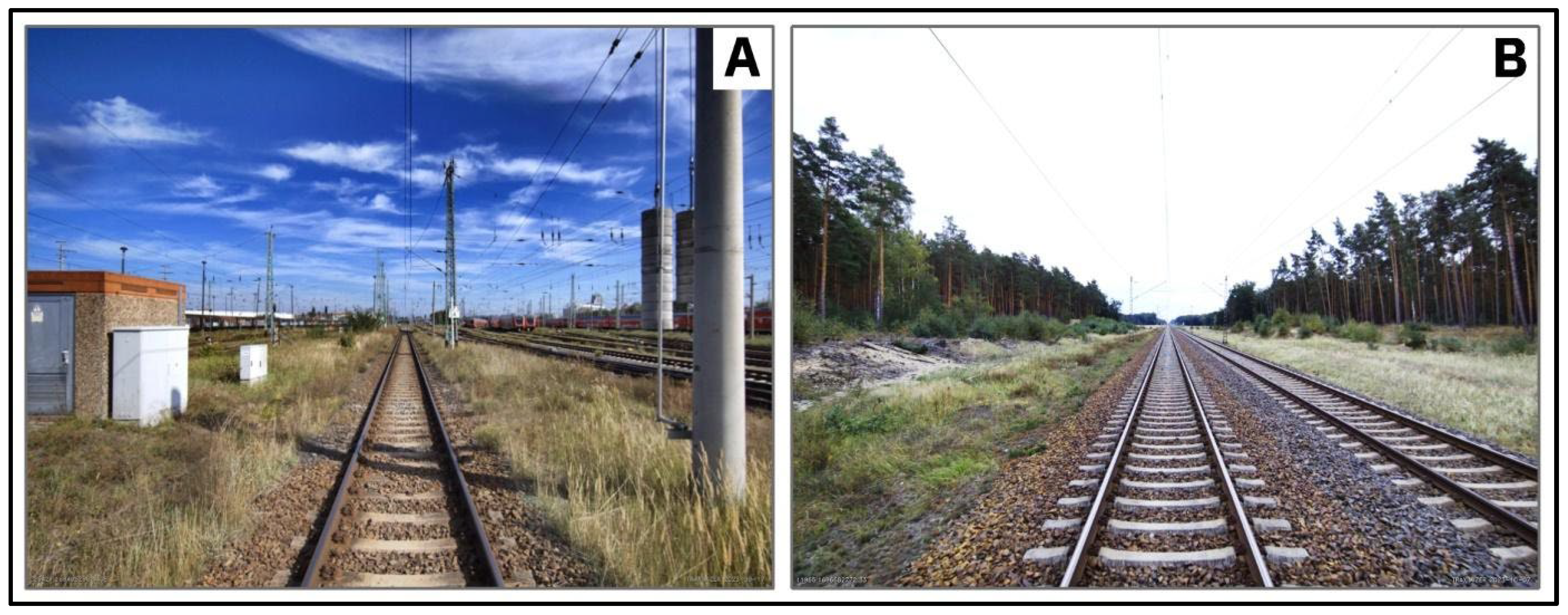
High- and very-high-susceptibility classes occur in five concentrated clusters along specific corridors (hotspots). Four are located in urban areas, while one occurs in a rural area (Figure 2). For operational illustration, we selected two representative locations for further analysis (Figure 3). Site A represents the urban setting; it is part of a large freight area in Cottbus with multiple parallel and crossing tracks and adjacent grass vegetation. Site B represents the rural setting; it was the only rural hotspot identified and extends over a longer corridor surrounded by dry pine forests.

3.2. Technical Solutions to Reduce Embankment-Fire Susceptibility

Building on the susceptibility mapping, we compiled technical solutions from the literature that are applicable to railway embankments. A central principle among these measures is the reduction in fine-fuel loads, particularly dry grass, which can directly decrease fire susceptibility [26,27]. Several technical approaches are applied or have been tested along transport corridors, each with advantages and drawbacks:
  • Mechanical clearance and mowing:
Periodic mowing or brush cutting reduces fine fuels and prevents height increase. This practice has long been standard on German railway verges. However, it is labour-intensive and requires specialised equipment to work safely on steep embankments within the danger zone of rail traffic [2,28].
  • Chemical herbicides:
Chemical vegetation control is cost-effective and efficient, but faces increasing environmental and social restrictions. For instance, Hansen et al. [29] document how pesticide-free strategies were promoted in Denmark due to concerns about groundwater contamination, with political and public pressure to reduce herbicide use. Similar restrictions are increasingly applied in European transport corridors [30].
  • Mineral firebreaks:
Firebreaks consist of exposed soil or strips of very short vegetation maintained by repeated clearance. Technical rules specify construction width, erosion protection, and seasonal upkeep [31]. While effective at removing continuous fuels, they are highly intrusive in railway settings, increase erosion risk, and require frequent maintenance because grasses (fine-fuel loads) quickly recolonise open ground.
  • Prescribed burning:
Prescribed burning of grass verges was historically used in Germany to reduce fuel loads [2]. Under controlled conditions it can be effective in lowering fire risk [28], but application requires strict coordination with train operations and compliance with safety protocols. Risks are especially high in fire-prone landscapes such as forests, where prescribed burning can easily trigger larger wildfires. Ecologically, this method has strong negative short-term impacts, as verge biota are removed by fire, and it can conflict with nature conservation regulations [2]. For these reasons, prescribed burning has rarely been applied in recent decades and is not recommended as a routine measure.
  • Irrigation systems:
Artificial watering has been tested for wildfire protection of assets such as buildings [32]. Applied to linear railway embankments, it would be technically possible but logistically and economically prohibitive due to the length of corridors and the need for water connections across remote areas.

3.3. Vegetation-Based Mitigation

While no nature-based solution has yet been tested on railway tracks, the literature consistently identifies plant traits that influence ignitability and fire spread. Traits such as live fuel moisture content (LFMC) and specific leaf area (SLA) are repeatedly reported as primary predictors of ignition and combustion dynamics [33,34,35,36]. Two traits are consistently associated with reduced ignitability: high LFMC, which delays ignition and lowers ignition probability [33,37,38], and low SLA, which slows ignition and fire spread [34,35,36,39]. Additional factors, including fuel bulk density (BD), fuel packing, and the presence of volatile organic compounds (VOCs), can further modify flammability with context-dependent or species-specific effects. Spread may accelerate at low packing but be suppressed at very high packing due to airflow limitation [40,41,42,43], and VOCs such as terpenes often increase flammability, though effects vary by species [44,45,46].
Several Mediterranean species (e.g., Pistacia lentiscus, Phillyrea angustifolia) have been identified as fire-resistant vegetation, and experimental work shows that living shrubs with high moisture content are less flammable than fine-fuel loads [30]. However, comparable measurements for native Central European shrub species are currently not available. Potential candidates based on the plant traits mentioned above could include moisture-retentive, broad-leaved shrubs such as Cornus sanguinea, Viburnum opulus, or Salix caprea, which are native to Germany and known for high live fuel moisture and relatively low specific leaf area. Nevertheless, targeted flammability testing and field trials are required before these species can be confidently recommended for practical use. As a result, no species-level recommendations are provided here; instead, an indicative potential vegetation is used illustratively to discuss the trait-based approach in Section 4.3.

4. Discussion

The spatial distribution of embankments with increased fire susceptibility in a few concentrated hotspots supports targeted, corridor-based action rather than blanket measures. A similar pattern was observed in the Czech railway network, where only 0.3% of the track length accounted for most vegetation fire incidents [47]. Several mitigation methods exist (see Section 3.2 and Section 3.3). However, the choice of suitable solutions depends strongly on the site context. Overall, technical measures can reduce fire risk, but their ecological impacts, costs, and logistical requirements limit their widespread applicability.

4.1. Site-Specific Implementation Strategy

4.1.1. Urban Hotspot

In urban corridors such as Site A, technical interventions are feasible because access is straightforward, water supply is available, and areas at risk are relatively small in extent. Theoretically, all technical measures described in Section 3.2 could be applied. However, due to disadvantages such as an unfavourable cost-benefit ratio and environmental impacts, many are unlikely to be used. Repeated mowing and mechanical clearance appear to be the most promising options at manageable cost. Where sufficient space is available, and provided that safety requirements are met, nature-based mitigation approaches should be prioritised as the more sustainable option (see Section 4.2).

4.1.2. Rural Hotspot

In rural settings such as Site B, conditions differ. Longer travel distances for firefighting and delayed detection increase the potential consequences of ignition. Furthermore, the high-susceptibility cluster at Site B extends over several kilometres (2.5 km high- and 1.0 km very-high-susceptibility segments), making technical measures costly and time-intensive. Therefore, in rural high-susceptibility sections, vegetation adaptation in the stabilisation zone is a more promising strategy. Before selecting concrete measures, site-specific screening and documentation of implementation constraints can build on the NATURE-DEMO three-stage NbS planning framework, which employs Excel-based templates and GMZ mapping to rate factors such as access, maintenance, water availability, and land tenure, and integrates these into RAMSSHEEP-based evaluation [48]. Continuous shrub belts with favourable fire traits (high LFMC, low SLA, moderate BD, low VOC content) can function as living fire barriers [49,50,51]. While they cannot fully eliminate fine fuels within the safety-relevant area, shrubs can intercept sparks and reduce the likelihood of spread into adjacent forests. To ensure a dense and effective barrier, early establishment should be supported through monitoring and, if necessary, temporary watering. Moreover, management experience from hedgerows indicates that periodic pruning at intervals of roughly 5 to 15 years can maintain dense growth and biomass turnover [52]. In a railway context, pruning helps increase barrier density, removes dead material, and sustains plant vitality [53].
However, any implementation must comply with railway safety standards, clearance envelopes, and vegetation management rules [54,55]. In Germany, comprehensive requirements are imposed on vegetation along railway lines to prevent disruptions to operations [56]. This safety-relevant area is subdivided into a cutting zone and a stabilisation zone (Figure 4). The cutting zone, extending at least 6 m from the track centre, must be cleared at least once per year using mechanical methods. Only low-growing species tolerant of repeated cutting can be maintained here. The adjacent stabilisation zone allows trees and shrubs, provided that vegetation is managed to ensure traffic safety. In this zone, taller fire-resistant vegetation (e.g., shrubs) is acceptable if it does not interfere with railway operations [54,56].

4.2. Nature-Based Solutions to Reduce Embankment Fire Susceptibility

Where technical measures are impractical or ecologically intrusive, long-term vegetation change provides a nature-based option to lower embankment-fire susceptibility. The “green firebreak” approach, which involves establishing bands of lower-flammability vegetation (often shrubs) to interrupt continuous fine fuels and slow spread, has been documented through trait-informed selection and placement [49,50,51]. In the rail sector, NbS frameworks likewise emphasise careful species choice (for example, species with higher moisture and lower volatile oil content in bushfire-prone settings) and integration with operations and maintenance [6,9]. When designed within rail safety constraints, vegetation-based measures can provide benefits beyond reducing fire susceptibility. They can also enhance embankment stability and reduce sediment delivery to drainage structures [57,58,59]. From an ecological perspective, native plants support habitats for pollinators, insects, and birds while also contributing to carbon sequestration and climate change mitigation [52,60].

4.3. Limitations and Research Needs

A recent study emphasises that climatological hazards, including wildfires, are among the most difficult to mitigate through NbS, partly due to the limited availability of suitable measures and knowledge on appropriate plant species [61]. Most published flammability studies and trait datasets originate from Mediterranean ecosystems, particularly Spain, Italy and France [33,50,51,62]. Data on LFMC, SLA and BD for native shrubs typical of Central Europe are scarce, and measurements of VOCs are uneven across taxa [44,45,46]. Experimental work has clearly established the importance of these traits for ignition and fire spread [35,37,38,39,63], but this knowledge has not yet been translated into practical species guidelines for Central European railways.
Mediterranean case studies, such as those using Pistacia lentiscus and Phillyrea angustifolia, are informative in experimental work [33] but not directly transferable to Central Europe. The use of non-native Mediterranean shrubs is not recommended in Germany due to documented invasiveness risks and ecosystem impacts [64]. Consequently, species-level recommendations for the ODT are not yet possible. Targeted testing of native shrubs under local conditions is therefore needed. Laboratory ignition tests, coupled with field trials in embankment environments, should establish trait values for local candidates and verify performance. Infrastructure managers emphasised the lack of standardised safety metrics and approval procedures for NbS, reinforcing the need for controlled field trials to generate rail-specific performance evidence [11].
Beyond traits, cost-effectiveness remains poorly studied. Most evaluations focus on routine mowing and mechanical clearance, while robust comparisons with the establishment and maintenance of shrub barriers are lacking. Systematic cost studies are needed for both urban and rural contexts. Environmental benefits such as climate protection and biodiversity should also be considered in cost-benefit analyses. Comparable findings were reported for the Czech rail network, where Nezval et al. [47] identified spatial hotspots of vegetation fires primarily linked to electrified lines and freight traffic intensity. Their study likewise highlighted the importance of targeted vegetation management as a preventive measure but did not include economic or cost-benefit assessment of such interventions. This supports the observation that reliable cost data for vegetation-based fire prevention along Central European railways remain largely unavailable.
Finally, hazard indication layers prioritise high-susceptibility corridors but indicate susceptibility rather than ignition probability. Directly linking vegetation status to ignition risk, as demonstrated for Mediterranean systems [37,62], is a promising direction to refine railway risk reduction.

5. Conclusions

Embankment fires are an emerging climate-related threat to railway operations in Germany. The clustered distribution of susceptibility justifies targeted, corridor-based interventions. Technical measures can reduce susceptibility but face ecological, economic and logistical limitations. As a complementary approach, nature-based solutions can lower embankment-fire susceptibility by establishing trait-informed shrub belts that interrupt fine fuels and act as living barriers.
At present, the evidence base for native Central European shrubs is insufficient for species-level recommendations. The framework presented here provides a basis for future research rather than prescriptive guidance. Field trials with native shrubs are needed to test ignition thresholds, validate trait performance and assess maintenance requirements. Such evaluations can be embedded in scenario-based decision frameworks such as the extended RAMSSHEEP model, which integrates NbS with grey infrastructure and compares risk reduction across alternative futures [65].
Well-designed green firebreaks provide multiple benefits in railway corridors, including reducing embankment-fire susceptibility, stabilising slopes, moderating runoff and contributing to biodiversity and carbon storage. Hazard indication maps can help prioritise sites and guide site-specific solutions. With targeted research and operational testing, nature-based solutions can become a practical component of railway climate adaptation, complementing technical measures and reducing reliance on ecologically intrusive practices. In practice, the maintenance of fire-resistant vegetation could be scheduled at fixed intervals of approximately ten years, minimising both maintenance effort and associated costs. Although the occurrence of ignitions along railway corridors cannot be ruled out, the lateral spread of fire into adjacent landscapes would be substantially reduced. Consequently, the overall risk of large wildfires originating from railway areas would decrease in the long term.

Author Contributions

Conceptualization, L.S.; methodology, L.S. and S.S.; validation, S.M., L.S. and S.S.; formal analysis, S.M., L.S. and S.S.; investigation, S.M.; resources, L.S. and S.S.; data curation, S.S.; writing—original draft preparation, S.M.; writing—review and editing, L.S. and S.S.; visualization, S.M. and S.S.; supervision, L.S.; project administration, L.S. Funding acquisition,—(funded by the Horizon Europe project NATURE-DEMO, Grant Agreement No. 101157448). All authors have read and agreed to the published version of the manuscript.

Funding

This research was carried out within the project NATURE-DEMO (“Nature-Based Solutions for Demonstrating Climate-Resilient Critical Infrastructure”), funded by the European Union’s Horizon Europe Program under grant agreement No. 101157448.

Data Availability Statement

The data used in this study are openly available in publicly accessible repositories. The hazard indication maps can be accessed via the GeoPortal of the Federal Railway Authority (EBA) at https://geoportal.eisenbahn-bundesamt.de 9 November 2025. Climate data were obtained from the German Weather Service (DWD) Climate Atlas at https://www.dwd.de/DE/klimaumwelt/klimaatlas/klimaatlas_node.html 9 November 2025. Biogeographic information was retrieved from the Federal Agency for Nature Conservation (BfN) at https://www.bfn.de 9 November 2025. No new datasets were generated; all analyses are based on existing, publicly available data.

Acknowledgments

The Authors would like to thank all consortium members of the NATURE-DEMO project for past and ongoing fruitful discussions as well as other colleagues outside the project who were significantly involved in the creation and publication of the of hazard indication maps.

Conflicts of Interest

The authors declare no conflicts of interest.

Abbreviations

The following abbreviations are used in this manuscript:
DZSFDeutsches Zentrum für Schienenverkehrsforschung (German Centre for Rail Traffic Research)
EBAEisenbahn-Bundesamt (Federal Railway Authority)
ODTOpen Digital Test Field
NbSNature-based Solutions
SMISoil Moisture Index
ROCReceiver Operating Characteristic
AUCArea Under Curve
MaxEntMaximum Entropy (model)
LFMCLive Fuel Moisture Content
SLASpecific Leaf Area
BDBulk Density
VOCsVolatile Organic Compounds
BfNBundesamt für Naturschutz (Federal Agency for Nature Conservation)
DWDDeutscher Wetterdienst (German Weather Service)
GISGeographic Information System
RCPRepresentative Concentration Pathway

References

  1. Trinks, C.; Hiete, M.; Comes, T.; Schultmann, F. Extreme Weather Events and Road and Rail Transportation in Germany. Int. J. Emerg. Manag. 2012, 8, 207–227. [Google Scholar] [CrossRef]
  2. Hetzel, G.; Goldammer, J.G. The use of prescribed fire on embankments along railway tracks for reducing wildfire ignition in Germany. Int. For. Fire News (IFFN) 2004, 30, 65–69. Available online: https://gfmc.online/iffn/iffn_30/13-IFFN-30-Germany-Railways.pdf (accessed on 5 September 2025).
  3. Szymczak, S.; Backendorf, F.; Blauhut, V.; Bott, F.; Fricke, K.; Herrmann, C.; Klippel, L.; Walter, A. Heat and Drought Induced Impacts on the German Railway Network. Transp. Res. Procedia 2023, 72, 696–703. [Google Scholar] [CrossRef]
  4. Deutscher Bundestag. Antwort der Bundesregierung auf die Kleine Anfrage der Abgeordneten Matthias Gastel, Lisa Badum, Harald Ebner, weiterer Abgeordneter und der Fraktion BÜNDNIS 90/DIE GRÜNEN—Drucksache 19/32178—Resilienz der Verkehrsinfrastruktur unter Bedingungen der Klimakrise; Deutscher Bundestag: Berlin, Germany, 2021; Available online: https://dserver.bundestag.de/btd/19/321/1932178.pdf (accessed on 6 September 2025).
  5. Blackwood, L.; Renaud, F.G.; Gillespie, S. Nature-based solutions as climate change adaptation measures for rail infrastructure. Nat. Based Solut. 2022, 2, 100013. [Google Scholar] [CrossRef]
  6. Blackwood, L. A framework for the successful application of nature-based solutions for climate change adaptation on rail infrastructure developed through the examination of two case studies. Nat. Based Solut. 2024, 5, 100126. [Google Scholar] [CrossRef]
  7. Jeanneau, A.; Zecchin, A.; van Zelden, H.; Vanhout, R.; McNaught, T.; Wouters, M.; Maier, H. Opportunities for Alternative Fuel Load Reduction Approaches—Summary Report, Mechanical Fuel Load Reduction Utilisation Project; Bushfire and Natural Hazards CRC: Melbourne, Australia, 2022; Available online: https://www.naturalhazards.com.au/crc-collection/downloads/opportunities_for_alternative_fuel_load_reduction_approaches.pdf (accessed on 6 November 2025).
  8. Kim, K.; Spirandelli, D.; Rother, D.; Yamashita, E.; Toner, M. Tracking wildfire risk to California railroads: Integrating environmental data and railway operations. Transp. Res. Interdiscip. Perspect. 2025, 32, 101526. [Google Scholar] [CrossRef]
  9. Blackwood, L.; Renaud, F.G. Barriers and tools for implementing Nature-based solutions for rail climate change adaptation. Transp. Res. Part D Transp. Environ. 2022, 113, 103529. [Google Scholar] [CrossRef]
  10. Blackwood, L.; Renaud, F.G.; Gillespie, S. Rail industry knowledge, experience and perceptions on the use of nature-based solutions as climate change adaptation measures in Australia and the United Kingdom. Environ. Res. Infrastruct. Sustain. 2023, 3, 045011. [Google Scholar] [CrossRef]
  11. Seifert, L.; Heffer Flaata, E.; Conevski, S.; Jessen Graae, B.; Machí Castañer, C.; Canga, E.; Hartl, M.; Wirth, M.; Kuzmanić, T.; Barrios-Crespo, E.; et al. Nature-based solutions for climate-resilient infrastructure: Insights from infrastructure managers across Europe. Infrastructures 2026. submitted. [Google Scholar]
  12. Szymczak, S.; Bott, F.; Babeck, P.; Frick, A.; Stöckigt, B.; Wagner, K. Estimating the hazard of tree fall along railway lines: A new GIS tool. Nat. Hazards 2022, 112, 2237–2258. [Google Scholar] [CrossRef]
  13. Szymczak, S.; Bott, F.; von den Driesch, F. Gefahrenhinweiskarten als Tool der Klimafolgenanpassung im Schienenverkehr. gis.Science 2025, 1, 1–7. [Google Scholar] [CrossRef]
  14. Eisenack, K.; Stecker, R.; Reckien, D.; Hoffmann, E. Adaptation to climate change in the transport sector: A review of actions and actors. Mitig. Adapt. Strateg. Glob. Change 2012, 17, 451–469. [Google Scholar] [CrossRef]
  15. Nolte, R.; Behrendt, S.; Magro, M. UIC Guideline for Integrated Vegetation Management—Part A; International Union of Railways (UIC): Paris, France, 2018; Available online: https://uic.org/IMG/pdf/herbie_project_-_part_a.pdf (accessed on 4 November 2025).
  16. Lindgren, J.; Jonsson, D.K.; Carlsson-Kanyama, A. Climate Adaptation of Railways: Lessons from Sweden. Eur. J. Transp. Infrastruct. Res. 2009, 9, 164–182. [Google Scholar] [CrossRef]
  17. Frick, A.; Wagner, K.; Stöckigt, B. Sensitivitätsanalyse Vegetation Entlang der Bundesverkehrswege Bezüglich Sturmwurfgefahren und Böschungsbränden. In DZSF-Forschungsberichte; Deutsches Zentrum für Schienenverkehrsforschung beim Eisenbahn-Bundesamt: Dresden, Germany, 2023; 127p. [Google Scholar] [CrossRef]
  18. Phillips, S.J.; Anderson, R.P.; Schapire, R.E. Maximum entropy modelling of species geographic distribution. Ecol. Model. 2006, 190, 231–259. [Google Scholar] [CrossRef]
  19. Renner, I.W.; Elith, J.; Baddeley, A.; Fithian, W.; Hastie, T.; Phillips, S.J.; Popovic, G.; Warton, D.I. Point process models for presence-only analysis. Methods Ecol. Evol. 2015, 6, 366–379. [Google Scholar] [CrossRef]
  20. Banerjee, P. Maximum entropy-based forest fire likelihood mapping: Analysing the trends, distribution, and drivers of forest fires in Sikkim Himalaya. Scand. J. For. Res. 2021, 36, 275–288. [Google Scholar] [CrossRef]
  21. Eisenbahn-Bundesamt (EBA). GeoPortal des Eisenbahn-Bundesamtes. 2025. Available online: https://geoportal.eisenbahn-bundesamt.de (accessed on 6 September 2025).
  22. Nature-DEMO Project. Nature-Based Solutions for Demonstrating Climate-Resilient Critical Infrastructure (NATURE-DEMO). In Horizon Europe, Grant Agreement No. 101157448; European Commission: Brussels, Belgium, 2024; Available online: https://nature-demo.eu/ (accessed on 9 September 2025).
  23. Bundesamt für Naturschutz (BfN). Biogeografische Regionen und Naturräumliche Haupteinheiten Deutschlands. 2011. Available online: https://www.bfn.de/daten-und-fakten/biogeografische-regionen-und-naturraeumliche-haupteinheiten-deutschlands (accessed on 7 September 2025).
  24. Brasseur, G.P.; Jacob, D.; Schuck-Zöller, S. (Eds.) Klimawandel in Deutschland: Entwicklung, Folgen, Risiken und Perspektiven, 2nd ed.; Springer Spektrum: Berlin/Heidelberg, Germany, 2023. [Google Scholar] [CrossRef]
  25. Deutscher Wetterdienst (DWD). Climate Atlas. Available online: https://www.dwd.de/DE/klimaumwelt/klimaatlas/klimaatlas_node.html (accessed on 7 September 2025).
  26. Wittich, K.-P.; Böttcher, C.; Stammer, P.; Herbst, M. Calculating Fire Danger of Cured Grasslands in Temperate Climates: The Elements of the Grassland Fire Index (GLFI). Int. J. Wildland Fire 2023, 32, 1212–1225. [Google Scholar] [CrossRef]
  27. Kuppelwieser, H. Vegetation Control as Part of Environment Strategy of Swiss Federal Railways. Jpn. Railw. Transp. Rev. 1998, 16, 48–50. Available online: https://www.ejrcf.or.jp/jrtr/jrtr17/pdf/f08_helmut.pdf (accessed on 8 September 2025).
  28. Bukowski, C.J.; Nowak, C.A.; Engelman, H.M.; Ballard, B.D.; Boley, J.D. Alternatives for Treating Roadside Right-of-Way Vegetation: Literature Review and Annotated Bibliography; Prepared for New York State Department of Transportation; State University of New York, College of Environmental Science and Forestry: Syracuse, NY, USA, 2005. Available online: https://www.dot.ny.gov/divisions/engineering/environmental-analysis/repository/c-02-09-1.pdf (accessed on 9 September 2025).
  29. Hansen, P.K.; Kristoffersen, P.; Kristensen, K. Strategies for non-chemical weed control on public paved areas in Denmark. Pest Manag. Sci. 2004, 60, 600–604. [Google Scholar] [CrossRef]
  30. Archut, C.; Jendrny, N.; Schulte-Marxloh, A.; Eberius, M.; Conrath, U.; Schindler, C. Experimental Comparison of Herbicide-Free Methods for Weed Management on Railway Tracks. Transp. Res. Procedia 2023, 72, 1169–1176. [Google Scholar] [CrossRef]
  31. Tyburski, Ł.; Szczygieł, R. Rules for the construction of firebreaks along public roads in selected European countries. Folia For. Pol. 2023, 65, 199–209. [Google Scholar] [CrossRef]
  32. Green, A. Sprinkler Systems for the Protection of Buildings from Wildfire. Ph.D. Thesis, University of Wollongong, Wollongong, Australia, 2019. Available online: https://hdl.handle.net/10779/uow.27667539.v1 (accessed on 10 September 2025).
  33. Pellizzaro, G.; Duce, P.; Ventura, A.; Zara, P. Seasonal Variations of Live Moisture Content and Ignitability in Shrubs of the Mediterranean Basin. Int. J. Wildland Fire 2007, 16, 633–641. [Google Scholar] [CrossRef]
  34. Grootemaat, S.; Wright, I.J.; van Bodegom, P.M.; Cornelissen, J.H.C.; Cornwell, W.K. Burn or Rot: Leaf Traits Explain Why Flammability and Decomposability Are Decoupled across Species. Funct. Ecol. 2015, 29, 1486–1497. [Google Scholar] [CrossRef]
  35. Schwilk, D.W. Dimensions of plant flammability. New Phytol. 2015, 206, 486–489. [Google Scholar] [CrossRef] [PubMed]
  36. Popović, Z.; Bojović, S.; Marković, M.; Cerdà, A. Tree species flammability based on plant traits: A synthesis. Sci. Total Environ. 2021, 795, 149625. [Google Scholar] [CrossRef] [PubMed]
  37. Jurdao, S.; Chuvieco, E.; Arevalillo, J.M. Modelling Fire Ignition Probability from Satellite Estimates of Live Fuel Moisture Content. Fire Ecol. 2012, 8, 77–97. [Google Scholar] [CrossRef]
  38. Castro, F.X.; Tudela, A.; Sebastià, M.T. Modeling moisture content in shrubs to predict fire risk in Catalonia (Spain). Agric. For. Meteorol. 2003, 116, 49–59. [Google Scholar] [CrossRef]
  39. Burton, J.E.; Cawson, J.G.; Filkov, A.I.; Penman, T.D. Leaf traits predict global patterns in the structure and flammability of forest litter beds. J. Ecol. 2020, 109, 1344–1355. [Google Scholar] [CrossRef]
  40. Marino, E.; Dupuy, J.-L.; Pimont, F.; Guijarro, M.; Hernando, C.; Linn, R. Fuel bulk density and fuel moisture content effects on fire rate of spread: A comparison between FIRETEC model predictions and experimental results in shrub fuels. J. Fire Sci. 2012, 30, 27–51. [Google Scholar] [CrossRef]
  41. Dahale, A.; Ferguson, S.; Shotorban, B.; Mahalingam, S. Effects of Distribution of Bulk Density and Moisture Content on Shrub Fires. Int. J. Wildland Fire 2013, 22, 625–641. [Google Scholar] [CrossRef]
  42. Li, J.; Mahalingam, S.; Weise, D.R. Experimental Investigation of Fire Propagation in Single Live Shrubs. Int. J. Wildland Fire 2017, 26, 58–70. [Google Scholar] [CrossRef]
  43. Plucinski, M.P.; Anderson, W.R. Laboratory Determination of Factors Influencing Successful Point Ignition in the Litter Layer of Shrubland Vegetation. Int. J. Wildland Fire 2008, 17, 628–637. [Google Scholar] [CrossRef]
  44. Ganteaume, A.; Romero, B.; Fernandez, C.; Ormeño, E.; Lecareux, C. Volatile and semi-volatile terpenes impact leaf flammability: Differences according to the level of terpene identification. Chemoecology 2021, 31, 35–46. [Google Scholar] [CrossRef]
  45. Guerrero, F.; Carmona, C.; Hernández, C.; Toledo, M.; Arriagada, A.; Espinoza, L.; Bergmann, J.; Taborga, L.; Yáñez, K.; Carrasco, Y.; et al. Drivers of flammability of Eucalyptus globulus Labill leaves: Terpenes, essential oils, and moisture content. Forests 2022, 13, 908. [Google Scholar] [CrossRef]
  46. Guerrero, F.; Espinoza, L.; Carmona, C.; Blackhall, M.; Quintero, C.; Ocampo-Zuleta, K.; Paula, S.; Madrigal, J.; Guijarro, M.; Carrasco, Y.; et al. Unraveling the chemistry of plant flammability: Exploring the role of volatile secondary metabolites beyond terpenes. For. Ecol. Manag. 2024, 572, 122269. [Google Scholar] [CrossRef]
  47. Nezval, V.; Andrášik, R.; Bíl, M. Vegetation fires along the Czech rail network. Fire Ecol. 2022, 18, 15. [Google Scholar] [CrossRef]
  48. Castañer, L.M.; Bertino, G.; Findlay, S.; Wirth, M.; Canga, E.; Kuzmanić, T.; Mikoš, M.; Seifert, L.; Ionescu, F.D.; Kuschel, E.; et al. Integrated Spatial Planning Design with NbS for Critical Infrastructure Protection against Multiple Hazards Driven by Climate Change. Infrastructures 2026. submitted. [Google Scholar]
  49. Smith, J.D.; Putz, F.E.; Van Holsbeeck, S. Green Firebreaks: Potential to Proactively Complement Wildfire Management. Fire 2025, 8, 352. [Google Scholar] [CrossRef]
  50. Cui, X.; Alam, M.A.; Perry, G.L.W.; Paterson, A.M.; Wyse, S.V.; Curran, T.J. Green firebreaks as a management tool for wildfires: Lessons from China. J. Environ. Manag. 2019, 233, 329–336. [Google Scholar] [CrossRef] [PubMed]
  51. Molina, J.R.; Lora, A.; Prades, C.; Silva, F.R.Y. Roadside vegetation planning and conservation: New approach to prevent and mitigate wildfires based on fire ignition potential. For. Ecol. Manag. 2019, 444, 163–173. [Google Scholar] [CrossRef]
  52. Drexler, S.; Gensior, A.; Don, A. Carbon sequestration in hedgerow biomass and soil in the temperate climate zone. Reg. Environ. Change 2021, 21, 74. [Google Scholar] [CrossRef]
  53. Engel, T.; Kahler, J.; Duthweiler, S.; Winter, S. Schlussbericht FireSafeGreen; Technische Universität München: Munich, Germany, 2025. [Google Scholar] [CrossRef]
  54. Hoerbinger, S.; Obriejetan, M.; Rauch, H.P.; Immitzer, M. Assessment of safety-relevant woody vegetation structures along railway corridors. Ecol. Eng. 2020, 158, 106048. [Google Scholar] [CrossRef]
  55. Powrie, W.; Smethurst, J. Climate and Vegetation Impacts on Infrastructure Cuttings and Embankments. In Proceedings of the 8th International Congress on Environmental Geotechnics (ICEG 2018), Hangzhou, China, 28–30 October 2018; Zhan, L., Chen, Y., Bouazza, A., Eds.; Environmental Science and Engineering. Springer: Singapore, 2019; Volume 1, pp. 128–144. [Google Scholar] [CrossRef]
  56. DB. DB-RIL 882 Landschaftsplanung und Vegetationskontrolle, Version 3.0; Internal guideline, not publicly available; Deutsche Bahn AG: Berlin, Germany, 2024. [Google Scholar]
  57. Bentrup, G. Conservation Buffers—Design Guidelines for Buffers, Corridors, and Greenways; U.S. Department of Agriculture, Forest Service, Southern Research Station: Asheville, NC, USA, 2008. [Google Scholar] [CrossRef]
  58. Punetha, P.; Samanta, M.; Sarkar, S. Bioengineering as an Effective and Ecofriendly Soil Slope Stabilization Method: A Review. In Landslides: Theory, Practice and Modelling; Pradhan, S., Vishal, V., Singh, T., Eds.; Advances in Natural and Technological Hazards Research; Springer: Cham, Switzerland, 2019; Volume 50, pp. 201–224. [Google Scholar] [CrossRef]
  59. Ghosh, C.; Bhattacharya, S. Landslides and Erosion Control Measures by Vetiver System. In Disaster Risk Governance in India and Cross Cutting Issues; Pal, I., Shaw, R., Eds.; Disaster Risk Reduction; Springer: Singapore, 2018; pp. 387–413. [Google Scholar] [CrossRef]
  60. Mohammadzadeh, S.; Scholz, T.; Symmank, L. Bridging Ecology and Infrastructure: Evaluating the Integrated Benefits of Nature-Based Solutions. In Proceedings of the 3rd Conference of the European Association on Quality Control of Bridges and Structures (EUROSTRUCT 2025), Dublin, Ireland, 8 September 2025. [Google Scholar]
  61. Kuschel, E.; Obriejetan, M.; Kuzmanić, T.; Mikoš, M.; Seifert, L.; Conevski, S.; Wirth, M.; Canga, E.; Fernandes, S.; Hübl, J.; et al. Hazard Mitigation Profiling: A Systematic Approach for Strategic Nature-Based Solution Deployment. Manuscript submitted for publication. Special Issue: Nature-Based Solutions and Resilience of Infrastructure Systems. Infrastructures 2025, 10, 318. [Google Scholar] [CrossRef]
  62. Molina, J.R.; Martín, T.; Silva, F.R.Y.; Herrera, M.Á. The ignition index based on flammability of vegetation improves planning in the wildland-urban interface: A case study in Southern Spain. Landsc. Urban Plan. 2016, 158, 129–138. [Google Scholar] [CrossRef]
  63. Grootemaat, S.; Wright, I.J.; van Bodegom, P.M.; Cornelissen, J.H.C. Scaling up flammability from individual leaves to fuel beds. Oikos 2017, 126, 1428–1438. [Google Scholar] [CrossRef]
  64. Pyšek, P.; Hulme, P.E.; Simberloff, D.; Bacher, S.; Blackburn, T.M.; Carlton, J.T.; Dawson, W.; Essl, F.; Foxcroft, L.C.; Genovesi, P.; et al. Scientists’ warning on invasive alien species. Biol. Rev. 2020, 95, 1511–1534. [Google Scholar] [CrossRef]
  65. Fernandes, S.; Strauss, A.; Kuschel, E.; Obriejetan, M.; Stangl, R.; Hübl, J.; Ionescu, F.D.; Bigaj-van Vliet, A.; Matos, J. Resilience-Oriented Extension of the RAMSHEEP Framework to Address Natural Hazards through Nature-Based Solutions: Insights from an Alpine Infrastructure Study. Infrastructures 2025. accepted. [Google Scholar]
Figure 1. Railway network of the Open Digital Test field in eastern Germany (top) and climate characteristics expressed as the number of summer days with maximum temperatures ≥25 °C. (a) Observed reference period 1971–2000 (HYRAS dataset), and (b) climate projections for 2031–2060 under greenhouse gas emission scenario RCP 8.5, shown for the 15th, 50th and 85th percentiles [3]. Black lines represent the German railway network and the rectangle highlights the location of the ODT. Data source: German Weather Service (DWD) [25].
Infrastructures 10 00337 g001
Figure 2. Open Digital Test Field boundary and railway network with embankment-fire susceptibility classes. Insets show zoomed views of an urban location (A) and a rural location (B).
Infrastructures 10 00337 g002
Figure 3. Photographs of the two selected hotspots within the ODT. (A) Urban site with compact corridors and adjacent infrastructure. (B) Rural site surrounded by forested land and continuous high-susceptibility segments.
Infrastructures 10 00337 g003
Figure 4. Cross-section of a typical railway line with indication of the different vegetation management areas. Orange: Safety-relevant area where potential embankment fires can occur. Red: Third-party property at risk from embankment fires. Blue: Potential fire-breaking vegetation.
Infrastructures 10 00337 g004
Table 1. Distribution of embankment-fire susceptibility classes among railway segments in the ODT test field.
Embankment-Fire Susceptibility ClassSegmentsTrack Length (km)% of TotalSite A (km)Site B (km)
Very low1677765.448.85.01.7
Low1335605.238.613.01.5
Medium418180.011.511.14.0
High4316.31.02.52.5
Very high81.90.10.31.0
Disclaimer/Publisher’s Note: The statements, opinions and data contained in all publications are solely those of the individual author(s) and contributor(s) and not of MDPI and/or the editor(s). MDPI and/or the editor(s) disclaim responsibility for any injury to people or property resulting from any ideas, methods, instructions or products referred to in the content.