Review

AI-Driven Electrical Machine Design: From Surrogate-Assisted Optimization to Trustworthy, Manufacturable, and Sustainable Design Workflows


Electrical Machines and Drives Department, Technical University of Cluj-Napoca, 400114 Cluj-Napoca, Romania
Designs 2026, 10(4), 76; https://doi.org/10.3390/designs10040076
Submission received: 30 June 2026 / Revised: 16 July 2026 / Accepted: 20 July 2026 / Published: 24 July 2026

Abstract

Electrical machine design faces growing constraints from power density, wide operating ranges, thermal and mechanical limits, acoustics, manufacturability, cost, and critical material availability. While finite element and multi-physics simulations remain essential, their direct use in population-based or multi-objective optimization is often computationally prohibitive. AI, spanning surrogate modeling, machine learning, deep learning, physics-informed networks, Bayesian optimization, and emerging generative methods, is increasingly used to accelerate analysis, enlarge design spaces, and support inverse or multi-objective tasks. This review examines AI-assisted electrical machine design from a workflow perspective, distinguishing functional approximation, performance prediction, topology-aware learning, physics-informed modeling, active learning, and robust optimization under uncertainty. It highlights current limitations, including narrow topology coverage, reliance on FEM-generated data, weak extrapolation, limited uncertainty reporting, scarce experimental validation, and insufficient attention to manufacturability and sustainability. A design-readiness framework and minimum reporting checklist are proposed to improve trustworthiness and reusability. The review concludes that AI should serve as a physics-aware, validation-dependent accelerator, complementing, not replacing, electromagnetic expertise, multi-physics simulation, and prototype testing.

1. Introduction

Electrical machines (EMs) are central components in electrified transport, industrial automation, renewable energy conversion, robotics, aerospace actuation, and distributed energy systems [1]. Their global relevance is linked not only to energy conversion performance but also to the large share of electricity consumed by EM-driven systems, which has motivated sustained interest in efficiency improvement, loss reduction, and system-level optimization [2,3]. In traction and aerospace applications, the design pressure is especially high because the machine must combine high torque density, high power density, wide speed range, high efficiency over representative duty cycles, thermal robustness, mechanical integrity, low noise and vibration, and competitive cost [4,5,6].
The conventional design process usually begins with specifications and topology selection, followed by analytical sizing, electromagnetic finite element analysis (FEA), loss mapping, thermal analysis, mechanical stress analysis, acoustic and vibration checks, cost evaluation, and prototype testing [7]. The process is iterative and expert-driven [8].
As the number of objectives and constraints increases, the interaction between geometry, material properties, excitation, cooling, manufacturing tolerances, and control strategy makes the design landscape nonlinear and expensive to explore [4,5]. FEA offers high geometric flexibility and accuracy, but it becomes a bottleneck when each candidate in a multi-objective or topology optimization loop requires a field solution, loss computation, and, ideally, multi-physics verification [9].
AI-assisted design has emerged as a response to this computational bottleneck. Surrogate models can replace or partially replace expensive electromagnetic calculations during optimization. Machine learning (ML) models can predict torque, torque ripple, losses, efficiency, flux linkage, inductance, or field quantities from geometry and operating variables. Deep learning (DL) can process image-like geometry representations and therefore support topology optimization with higher design degrees of freedom. Physics-informed models can embed electromagnetic constraints into the learning process, reducing the dependence on purely data-driven correlations. Bayesian optimization (BO) and active learning can guide the selection of new simulations when FEA-based evaluations are expensive [9,10,11].
In this review, the term AI-driven is used in a workflow sense rather than as a claim that every method is a recent DL architecture. Classical surrogate-assisted optimization is treated as an earlier AI-assisted stage when a metamodel accelerates a predefined FEM-based optimization loop. AI-driven closed-loop design is distinguished by additional features: adaptive or active sampling, uncertainty-aware model management, physics or constraint integration, high-fidelity verification, feedback from measurements or manufacturing data, and explicit manufacturability or sustainability filters. This boundary is used throughout the review to separate conventional surrogate acceleration from deployment-oriented AI design workflows.
Recent reviews have already addressed surrogate-assisted multi-objective optimization and data-driven surrogate models for EM design [9,11]. These papers are important foundations, but they also create a clear need for a broader design-oriented synthesis. The central issue is no longer only whether AI can reduce the number of finite element method (FEM) evaluations.
The more important question is how AI can be integrated into a trustworthy, manufacturable, multi-physics, and sustainability-aware EM design workflow [3]. This review therefore positions AI as a design-support technology that must be evaluated in terms of design-readiness, physical validity, robustness, traceability, and practical engineering usefulness.
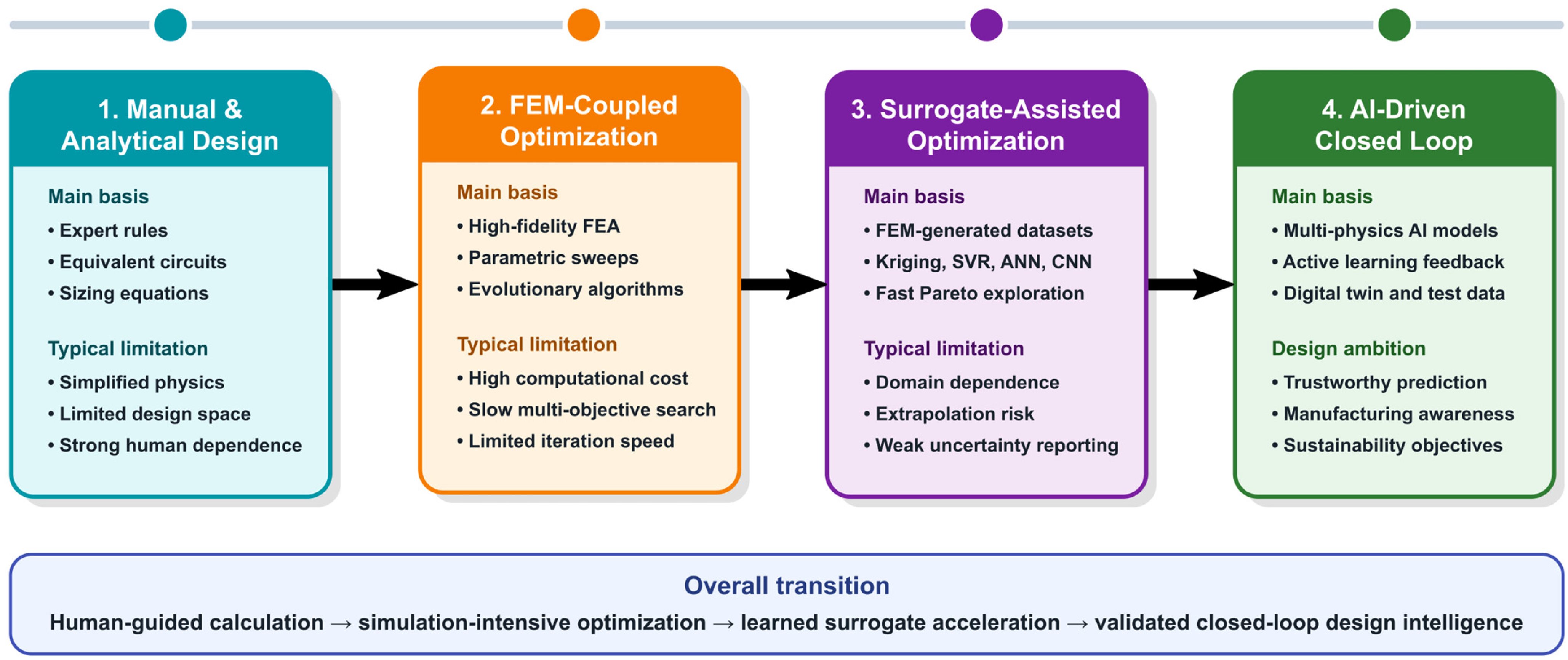
The evolution of EM design workflows can be viewed as a gradual shift from expert-driven analytical sizing toward increasingly automated, data-assisted, and feedback-rich design environments (see Figure 1).
Manual and analytical methods established the initial design foundation; FEM-coupled optimization subsequently enhanced physical fidelity; surrogate-assisted optimization reduced computational burden; and today, AI-driven closed-loop design enables the integration of multi-physics simulation, manufacturing data, experimental feedback, and sustainability-oriented objectives within a unified workflow.
The novelty of this review is therefore not the introduction of another algorithm taxonomy, but the integration of AI-assisted machine design into a design-readiness and deployment-oriented framework. In contrast to reviews centered on data-driven surrogate modeling [9] or surrogate-assisted multi-objective optimization [11], this paper adds five specific contributions:
  • it interprets AI methods across the complete design workflow, from electromagnetic prediction to multi-physics verification and manufacturability;
  • it separates algorithmic accuracy from design readiness;
  • it connects AI-assisted design to uncertainty, traceability, and experimental validation;
  • it includes sustainability, critical materials, lifecycle, and AI-footprint considerations as design criteria;
  • it proposes a minimum reporting checklist and a design-readiness ladder for comparing future studies.
Recent AM-focused reviews, including Zarghani et al. [12], are therefore treated here as complementary background on manufacturing-enabled machine structures, materials, thermal management, scalability and industrialization, not as AI-design evidence. The present review differs from such AM reviews by focusing on how AI methods can be embedded into validated, uncertainty-aware, manufacturable and sustainability-aware electrical machine design workflows.
To clarify the originality of the review, the paper distinguishes between its own interpretative framework and conclusions synthesized from prior studies. The original contribution lies in organizing AI-assisted electrical machine design around workflow transition, method-to-function mapping, trustworthiness, design readiness, reporting requirements, and evidence classification. The findings that PMSM/IPMSM studies dominate the available evidence, that experimental validation remains limited, and that manufacturability and sustainability are still weakly integrated are not presented as new experimental results, but as synthesis conclusions derived from the reviewed literature.

2. Review Scope and Methodology

This manuscript is structured as a critical review rather than as a purely bibliometric survey. The review is intended to identify methodological patterns, design use cases, evidence gaps, and reporting needs in AI-driven EM design. The initial seed corpus was assembled from prior reading and included papers on surrogate-assisted optimization, data-driven surrogate models, DL-assisted topology optimization, physics-informed EM modeling, robust BO, explainable AI, AI carbon-footprint assessment, and AI-enabled manufacturing workflows [9,11].
The seed corpus was complemented by a structured search conducted during 15–30 May 2026 in Web of Science, Scopus, and IEEE Xplore. The bibliographical exploration covered publications from 2000 to May 2026, with older publications retained only when they provided necessary methodological foundations. The final search strings were constructed by combining three groups of terms: electrical machine topology, AI or surrogate modeling, and design, optimization, validation, or sustainability terms. The final generic string was: (“electrical machine design” OR “electric motor design” OR PMSM OR IPMSM OR “synchronous reluctance” OR “switched reluctance” OR “induction machine” OR “axial flux” OR “high-speed machine” OR “flux modulated machine”) AND (“surrogate model” OR “machine learning” OR “deep learning” OR “Bayesian optimization” OR “physics-informed neural network” OR “generative adversarial network” OR “variational autoencoder” OR “topology optimization”) AND (“design” OR “optimization” OR “inverse design” OR “multi-objective” OR “robust design” OR “manufacturability” OR “sustainability” OR “critical materials” OR “lifecycle”). Database-specific syntax was adapted to each platform without changing the conceptual content of the query. Because the aim of the paper is critical synthesis rather than a systematic bibliometric survey, the search was used to ensure methodological and topical coverage rather than to produce a PRISMA-style quantitative map of the field.
The inclusion criteria for the review were: English-language peer-reviewed journal or conference papers; explicit application to EM design, modeling, optimization, inverse design, or design space exploration; use of AI, ML, surrogate modeling, BO, DL, or physics-informed learning; and sufficient methodological information to classify the design target, machine topology, data source, validation level, and limitations. Papers focused only on converter control, fault diagnosis, predictive maintenance, or supply-chain automation were excluded from the core corpus unless they directly informed the machine design workflow. Non-English papers were excluded from the main corpus to ensure consistent technical interpretation and verifiability. Non-recent sources were retained only when they provide necessary methodological foundations, such as BO, Gaussian processes (GPs), non-dominated sorting genetic algorithm II (NSGA-II), generative adversarial networks (GANs), variational autoencoders (VAEs), or conventional EM optimization baselines; the evidence synthesis itself prioritizes recent EM design applications.
Because AI-driven EM design is an emerging application field, the corpus of recent machine design demonstrations remains limited. Therefore, recent EM applications should form the evidence base of the review, while older sources should be retained only where they define foundational methods, such as BO, GPs, NSGA-II, GANs, VAEs, or conventional EM optimization baselines. These older references should not be presented as evidence of current AI-driven EM design maturity.
The review also distinguishes demonstrated progress from forward-looking deployment requirements. Demonstrated progress refers to studies in which an AI or surrogate model is implemented for a defined machine topology and supported by FEM verification, uncertainty analysis, prototype measurements, or another explicit validation step. Forward-looking requirements refer to criteria that are necessary for industrial deployment but are not yet mature across the literature, including full lifecycle assessment, systematic recyclability metrics, AI computational-footprint reporting, production data feedback, and repeatable validation across product families. Consequently, manufacturability, sustainability, lifecycle, and AI-footprint criteria are discussed both as emerging evidence where EM-specific studies exist and as reporting requirements for future design-ready AI workflows.
The review classifies studies according to five dimensions: machine topology, AI method, design function, data source, and validation level. The considered topologies include both special and classical EMs, such as surface-mount permanent magnet (PM) synchronous machine (PMSM), interior PMSM (IPMSM), synchronous reluctance machine (SynRM), PM-assisted synchronous reluctance machine (PMaSynRM), switched reluctance machine (SRM), induction machine (IM), axial flux machine (AFM), high-speed machine (HSM), and flux-modulated machine (FMM) [13]. AI methods include response surface methods, Kriging/GP models, support vector regression (SVR), random forests (RFs), gradient boosting, artificial neural networks (ANNs), convolutional neural networks (CNNs), physics-informed neural networks (PINNs), transfer learning (TL), BO, GANs and VAEs. Design functions include performance prediction, functional approximation, topology screening, inverse design, robust optimization, multi-physics coupling, and material or sustainability trade-off analysis.

3. Conventional Electrical Machine Design Workflow and AI Entry Points

A useful review of AI-driven design must begin with the engineering workflow that AI is intended to support. Conventional EM design typically involves requirements definition, conceptual topology selection, electromagnetic sizing, detailed geometric modeling, FEA, optimization, multi-physics verification, prototype construction, and testing [4,5,9]. Cheng et al. describe this process as a sequence of requirements definition, conceptual design, mechanical design, multidisciplinary analysis, optimization, and prototype testing, with FEA acting as a high-fidelity but expensive element in the analysis and optimization stages [9].
AI can enter the workflow at several levels. At the earliest stage, data-driven expert systems or learned design maps can propose initial geometries from specifications. During electromagnetic design, surrogate models can predict torque, flux linkage, back electromotive force, losses, inductances, and torque ripple. During topology optimization, CNNs can process cross-sectional images or material distributions and screen low-potential candidates before FEM evaluation [14,15]. During multi-physics design, AI can approximate coupled electromagnetic, thermal, mechanical, and acoustic responses. During robust design, BO and uncertainty-aware surrogates can account for geometric tolerances and material variability [16,17,18].
The distinction between “functional approximation” and “performance prediction” is especially useful. Functional approximation models directly approximate the relationship between design variables and objective functions, often for use within an optimizer. Performance prediction models replace specific analysis steps, such as FEA-based torque or flux prediction, and can be coupled with multiple optimization methods [9]. This distinction should be retained in the final review because it separates AI models that approximate an optimization landscape from models that approximate physical EM behavior.
Table 1 summarizes the main AI entry points, the conventional activity they modify, and the evidence needed to support each design claim.

4. AI Methods for Electrical Machine Design

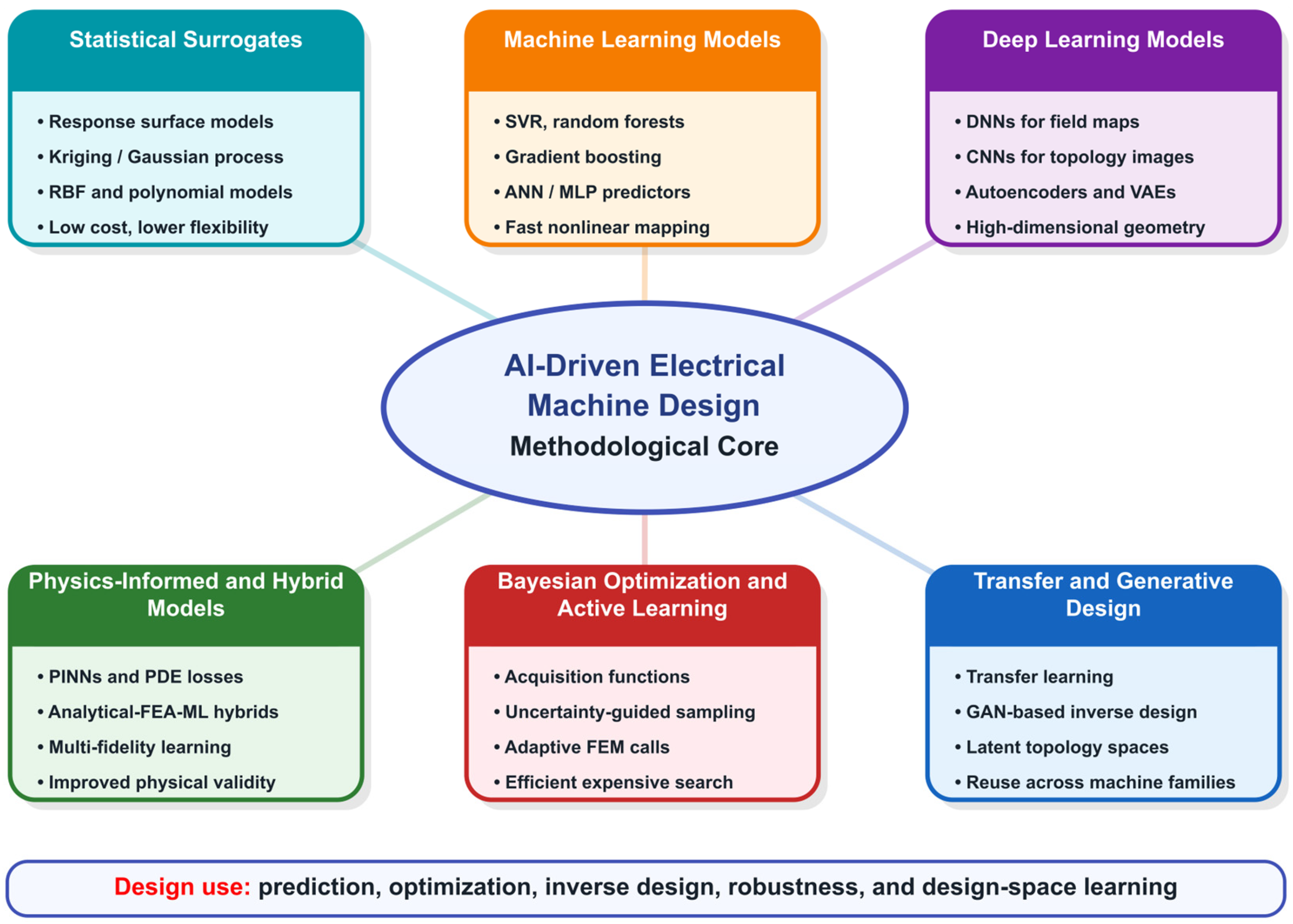
The AI methods currently used in EM design can be grouped according to their role in the design workflow, their data requirements, and their ability to incorporate physical knowledge. The field has evolved from statistical surrogate models and classical ML regressors toward DL models, physics-informed architectures, Bayesian and active learning strategies, and transfer or generative design approaches (see Figure 2).
This taxonomy is useful because these methods do not offer equivalent design value: some primarily accelerate performance prediction, whereas others support uncertainty-aware sampling, topology exploration, inverse design, or physically constrained model development.

4.1. Statistical and Classical Surrogate Models

Statistical surrogate models, including response surface models (RSMs) and Kriging/GP models, have been widely used to reduce the cost of repeated FEM evaluations in EM optimization [9,19]. Their strengths are interpretability, low training cost, and suitability for low-to-moderate-dimensional parameter optimization. Their limitations become evident when the number of design variables increases, when the geometry cannot be represented by a small set of dimensions, or when objectives are highly nonlinear and discontinuous. For this reason, statistical models are most appropriate for structured parametric design problems, not for unconstrained topology search or image-based geometry exploration [9,14].
Kriging and GP models remain central among classical surrogate methods because they provide both a mean prediction and an uncertainty estimate [20]. This makes them especially suitable for BO and active learning, where an acquisition function uses the surrogate posterior to select the next expensive FEM evaluation [10,16,17,19]. In robust design, the same probabilistic structure can also support uncertainty propagation and probability-based constraints, provided that both the underlying uncertainty model and surrogate error are treated explicitly [16].
In EM design, these methods are most effective when the design space is structured and the number of variables is moderate. Choi et al. illustrated how surrogate construction can be embedded within a repeatable multi-objective evolutionary workflow for EMs [21]. Reyes-Reyes et al. further showed that kriging metamodels can be integrated into constrained BO of a PMaSynRM while explicitly accounting for geometric and magnetic-material uncertainty [16]. These examples show that classical surrogates are still highly relevant, especially when they are used as uncertainty-aware components of the optimization loop rather than as static regression tools.

4.2. Machine Learning Models

ML models such as SVR, RFs, gradient boosting, and ANNs are used to map geometric and operating variables to EM performance indicators. Compared with simple response surfaces, they can represent stronger nonlinearities and higher-dimensional parameter spaces, although their validity remains linked to the selected topology, parameterization, and training domain. ML-based surrogates have been applied to several IPMSM design tasks, including consequent-pole asymmetric rotor hybrid IPMSM (CPAR-HIPMSM) torque-performance optimization [22], PM volume minimization [23], efficiency optimization considering control [24], electric vehicle (EV)-oriented IPMSM design [25], demagnetization-constrained PM volume reduction [26], and hybrid ferrite/NdFeB rotor optimization [27].
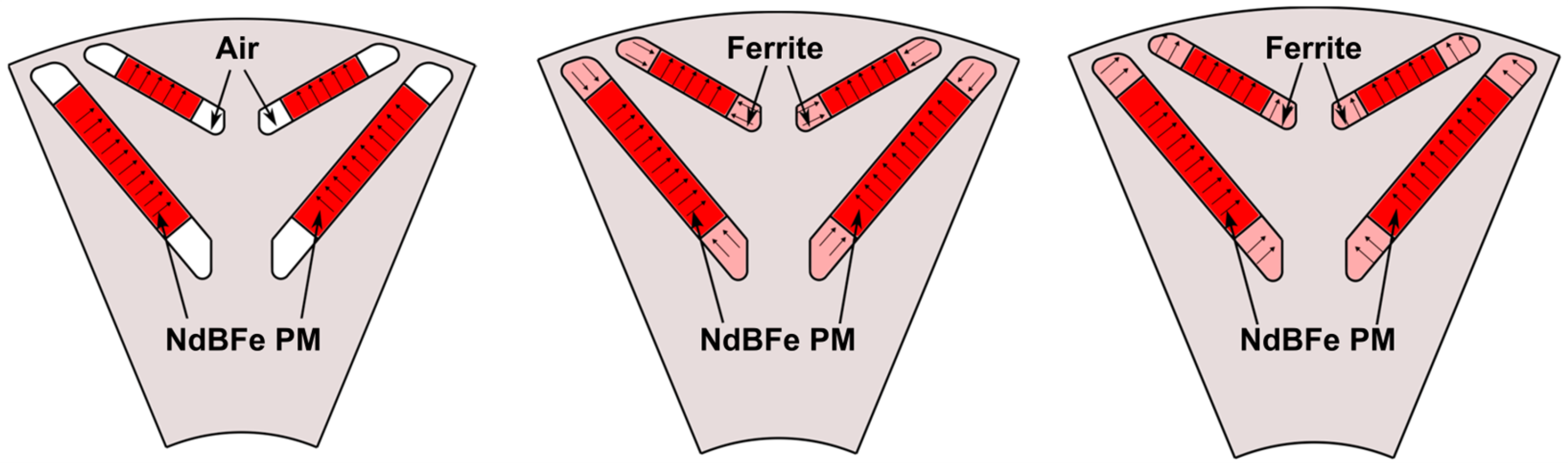
Several ML examples are particularly instructive. Ji et al. combined BO-SVR, Spearman-correlation-based sensitivity analysis, and sequential subspace northern goshawk optimization (SS-NGO) for a CPAR-HIPMSM, reporting improved average torque and reduced torque ripple with FEM and prototype validation [22]. Shimizu et al. used Gaussian process regression to predict apparent permeance coefficients for irreversible demagnetization assessment and then minimized PM volume under demagnetization constraints [26]. Against this material-aware rare-earth-reduction context [28], Guo et al. proposed an EV-oriented IPMSM in which ferrite magnets are added to otherwise unused rotor spaces and evaluated alternative magnet configurations [27]. As illustrated in Figure 3, this case is useful because the ML-assisted workflow is tied to a concrete machine-structure modification rather than only to numerical regression. The surrogate model was trained using fine- and coarse mesh FEA data and then coupled with NSGA-II optimization, linking AI-assisted design with torque improvement, cost considerations, and reduced dependence on rare-earth magnet volume [27].
The central limitation of many ML models is the dependence on predefined scalar design parameters. This is acceptable for rotor dimensions, slot widths, magnet angles, bridge thicknesses, and similar parametric variables, but it constrains geometric freedom. It also means that a surrogate trained for one topology or one parameterization may not generalize to a different topology, even if both are labeled as IPMSMs. Therefore, ML models should be evaluated not only by regression accuracy but also by their domain of validity, extrapolation behavior, and transferability between design families [9,29].

4.3. Deep Learning and Topology-Aware Models

DL extends AI-assisted design by accepting high-dimensional inputs such as images, field maps, or mesh-based representations. This is particularly relevant to topology optimization because CNN-based models can process material distributions and extract local geometric features that are difficult to describe with a small set of scalar design variables [14,15]. Sasaki and Igarashi used CNN-based classification to screen interior permanent magnet (IPM) rotor topologies before FEM re-evaluation within a genetic topology optimization process. In the reported numerical example, the computing time was reduced to about one-tenth of the FEM-only case when aggressive FEM screening was used, while the optimized rotor performance remained comparable [14].
Sato et al. [15] extended image-based DL surrogates toward multi-material IPM topology optimization. Their model predicts d-axis PM flux, d-axis inductance, and q-axis inductance from cross-sectional EM images, allowing average torque to be evaluated for arbitrary current phase angle. This is an important step because it connects image-based geometry learning with physically meaningful dq-axis quantities, but it also illustrates the data burden of DL surrogates: more than twenty thousand usable samples were generated, including more than twelve thousand for training and more than four thousand for validation [15].
Latent space optimization further broadens DL use in EM design. Sato and Igarashi used a VAE to embed PM EM topologies in a latent space and a neural network (NN) with Monte Carlo dropout to reject unreliable latent space solutions, obtaining Pareto solutions in approximately 80 s on a single-thread CPU in the reported example [30]. Taken together, these studies show three complementary DL roles in EM design: image-based topology screening, physically interpretable parameter prediction from geometry, and latent space design exploration.
Recent NN-based optimization studies further broaden the evidence base beyond topology screening. Yuan and Tao used NN-aided multi-objective PMSM design for more-electric-aircraft applications, adding an aerospace-oriented example in which mass, loss, and performance requirements differ from conventional automotive traction studies [31]. Garmut et al. proposed a computationally efficient NN-based multi-objective optimization workflow for an IPMSM, reinforcing the relevance of NN surrogates for rapid Pareto exploration in recent EM design research [32].

4.4. Physics-Informed and Hybrid Models

Purely data-driven surrogates can be accurate within a training domain, but they may violate physical constraints or extrapolate poorly. PINNs address this limitation by embedding governing equations, boundary conditions, or residual constraints into the loss function [33,34]. The strongest EM-specific example identified in this review is the work of Son et al., who proposed a PINN architecture for PMSM electromagnetic modeling with partial differential equation (PDE)-based supervision, rotational coordinate transformation, separate rotor and stator networks, interface loss, and adaptive loss weighting. The model was validated using both measurement and FEA datasets, and the authors reported inference times at least ten times faster than FEA with comparable order of accuracy for dynamic torque estimation [35]. Broader electromagnetic PINN and Maxwell-equation-based learning studies support the methodological potential of physics-informed modeling, but they should not be overinterpreted as complete EM design workflows [36,37,38].
For EM design, physics-informed learning is attractive because it can reduce data requirements, improve interpretability, and enforce compatibility with electromagnetic laws. However, practical deployment remains challenging. EMs contain moving interfaces, nonlinear magnetic materials, saturation, time-harmonic or transient excitation, temperature-dependent properties, and geometry changes. The PINN formulation must therefore be specialized to the EM topology and operating regime. Physics-informed models should not be treated as automatically trustworthy; they require the same scrutiny as other surrogates, including validation outside the training domain and reporting of loss components, boundary assumptions, and material models [34,36].
This interpretation is consistent with the broader physics-guided ML literature, which emphasizes that physical knowledge can be integrated at different levels, including data generation, loss functions, model architecture, constraints, and post-processing. For EM design, this broader view is useful because hybrid physics–ML workflows may be more practical than a strict PINN formulation for some tasks, especially when geometry changes, saturation, and multi-physics coupling make a single governing-equation residual difficult to formulate [39].

4.5. Bayesian Optimization and Active Learning

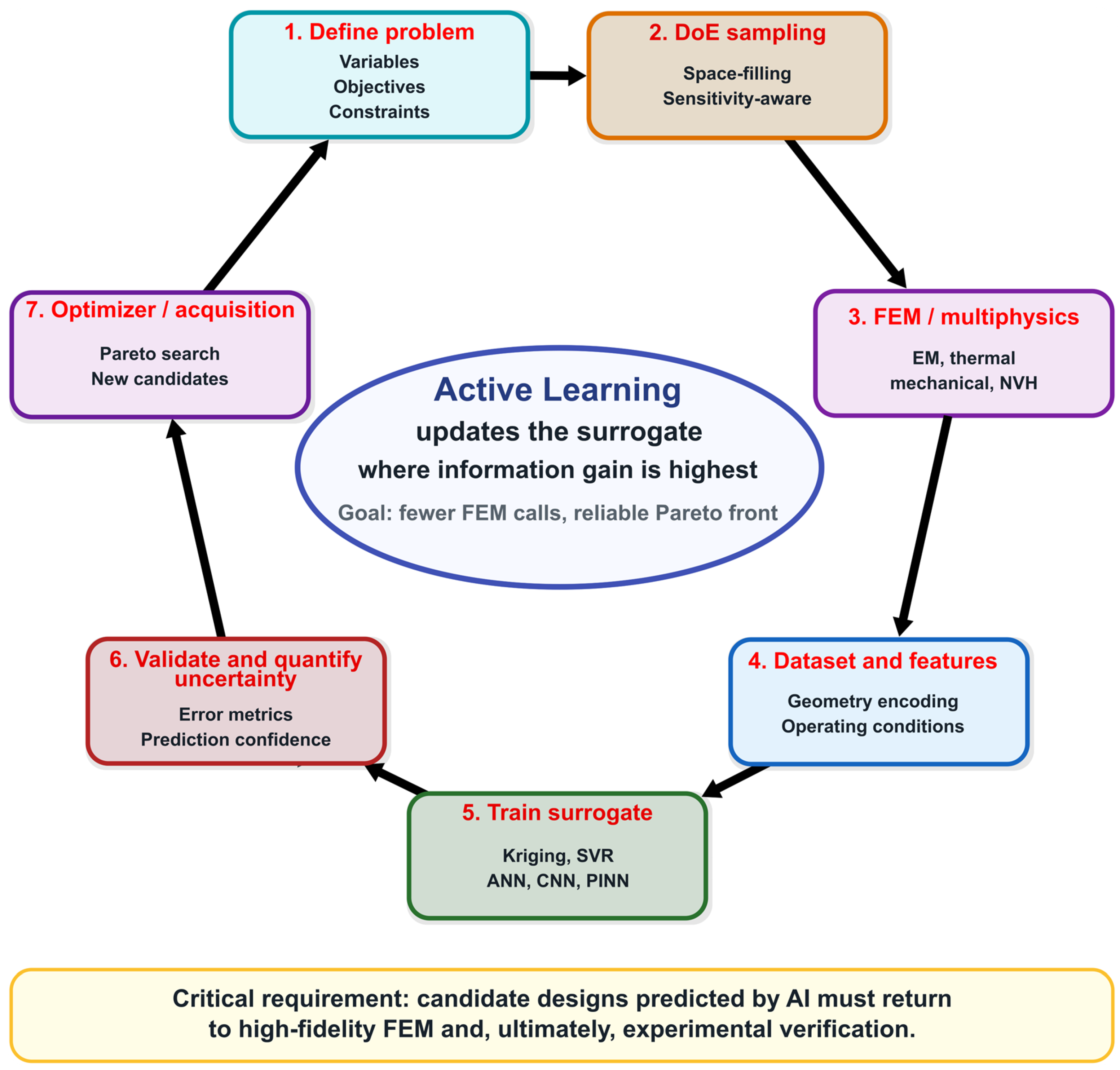
A typical surrogate-assisted design workflow is not limited to replacing FEM calculations with a trained predictor. As shown in Figure 4, the workflow starts with the definition of design variables, objectives, and constraints, followed by design-of-experiments sampling, high-fidelity FEM or multi-physics simulations, surrogate training, validation, uncertainty estimation, and candidate selection. In BO and active learning variants, new simulations are selected through an acquisition function that balances exploitation and exploration, so that each additional FEM or multi-physics evaluation is expected to improve either the model, the constraint description, or the Pareto front [10]. This makes the design process iterative and adaptive rather than a one-time offline regression exercise.
The broader surrogate-assisted evolutionary computation literature also stresses that the surrogate is only one element of the optimization system; model management, update criteria, trust in approximate fitness values, and the balance between exact and approximate evaluations determine whether computational savings lead to reliable optimized designs [40]. This point is directly relevant to EM design because surrogate speedup is useful only if final candidates remain physically valid and are rechecked with high-fidelity simulation or experiment.
Recent EM studies illustrate why BO is attractive when simulations are expensive and the feasible design space is constrained. Reyes-Reyes et al. used a constrained BO framework for a PMaSynRM while accounting for both geometric and magnetic-material uncertainty. Their updated efficient surrogate uncertainty reduction (EFISUR) algorithm used kriging metamodels and required only 235 simulator calls for a 13-dimensional search space; the study also showed that magnetic-material uncertainty had a stronger effect on mean torque than geometric uncertainty in the selected case [16]. This example is especially relevant to design-readiness because it shifts the objective from nominal performance toward robustness under manufacturing and material variability.
Other BO examples broaden the scope of this approach. Asef and Vagg used physics-informed BO to accelerate EM development by combining physical insight with sample-efficient search [41]. Guesmia et al. applied AI-assisted BO to a PMSM for e-bike applications, illustrating its relevance for lightweight traction machines [42]. Taken together, these studies suggest that BO is most valuable when each additional simulation must be selected for maximum design information, rather than generated as part of a large static dataset.

4.6. Generative and Inverse Design Models

Generative models, including GANs and VAEs, are increasingly discussed for inverse and topology design because they can generate candidate geometries rather than only evaluate predefined candidates. In EM design, this shifts AI from performance prediction toward design synthesis, but the field remains at an early stage. Lee and Ha used CNN classification and deep convolutional GAN (DCGAN) generation for IPM rotor-shape design, starting from 56,400 topology optimization images and then verifying selected generated candidates in JMAG [43]. Sato and Igarashi used a VAE to embed PM EM topologies in a latent space and combined it with NN-based optimization and Monte Carlo dropout to penalize unreliable latent space predictions [30]. These examples show that generative AI can broaden the candidate-design space, but the generated geometries still require high-fidelity verification.
For this reason, generative design should be reviewed critically as a candidate-generation tool embedded in a validation loop, not as an autonomous design method. A generated rotor or stator geometry must still satisfy electromagnetic performance, stress limits, insulation and bridge constraints, manufacturability, demagnetization margin, and assembly feasibility. TL may reduce the data burden by reusing geometric features learned from related topology optimization tasks, as suggested by Asanuma et al. [44], but transfer validity must still be verified physically and not only statistically.
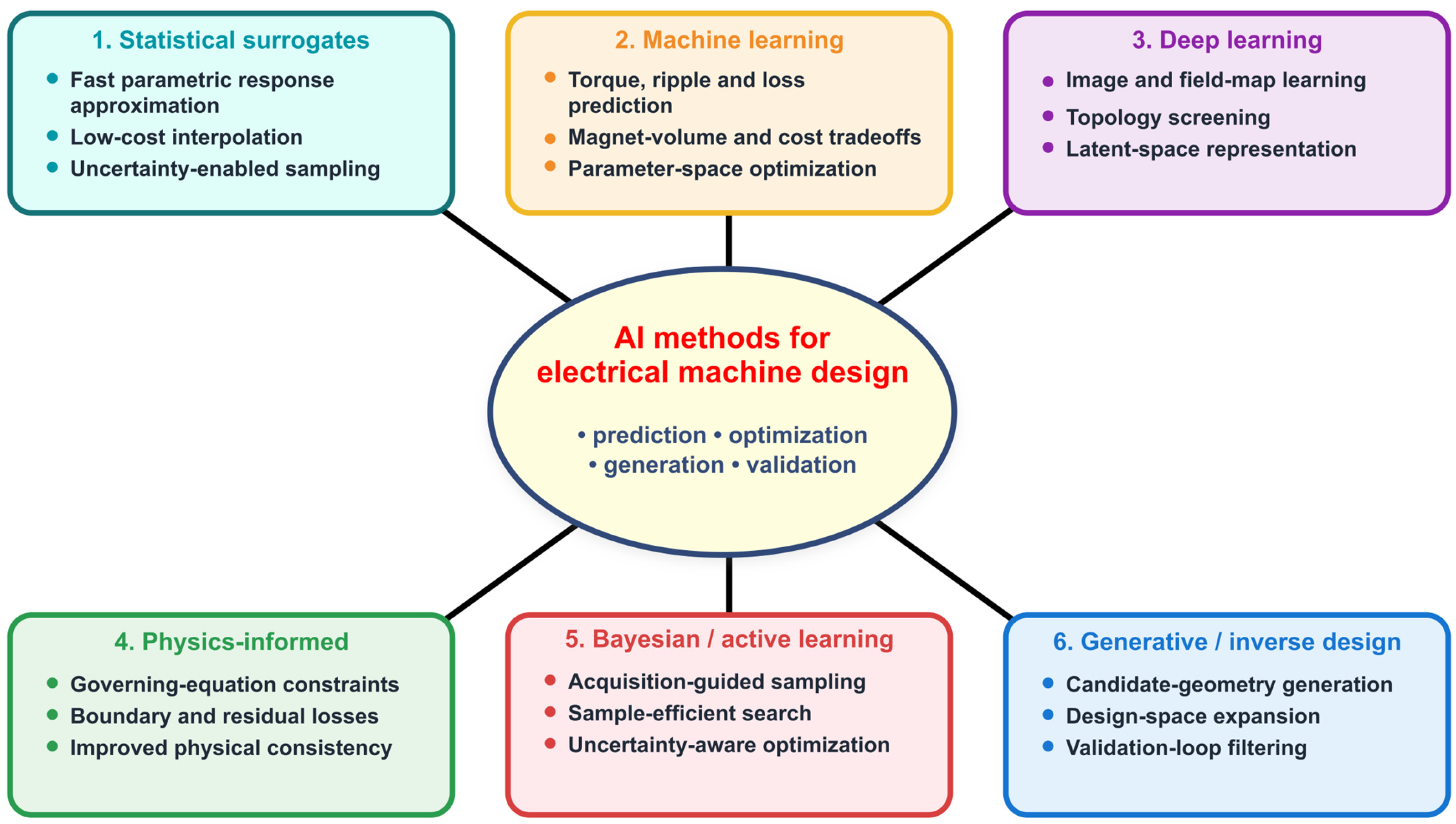
Taken together, the representative examples discussed in Section 4 show that the AI methods differ not only in algorithmic form but also in design function. Figure 5 summarizes this connection by mapping each method family to typical EM design roles without fixing the drawing to a particular reference set.
Table 2 summarizes the main AI method families discussed in this section and compares their typical inputs, outputs, strengths, and limitations for EM design.

5. AI for Electromagnetic Design

The most mature use of AI in EM design remains electromagnetic performance prediction. Typical outputs include average torque, torque ripple, cogging torque, back electromotive force, flux linkage, dq-axis inductances, iron loss, magnet loss, demagnetization risk, and efficiency-related quantities [9,11]. Many studies focus on IPMSMs because they are common in traction applications and because rotor geometry strongly influences torque production, saliency, ripple, demagnetization, and mechanical feasibility.
A key advantage of AI-assisted electromagnetic design is the possibility of separating expensive field calculation from repeated optimization. For example, a surrogate can predict torque or flux quantities for thousands of candidate geometries after an initial FEM-generated dataset has been prepared. In topology optimization, CNN-based screening can reduce the number of FEM calls by avoiding low-potential candidates [14]. In parameter optimization, ML surrogates can be coupled with NSGA-II [45], BO [10], or surrogate-assisted evolutionary algorithms [21]; specific machine design case studies include CPAR-HIPMSM optimization [22], PM volume minimization workflows [23], and EV-oriented IPMSM optimization [25].
The field is, however, unevenly distributed. PMSM and IPMSM cases dominate the literature, while fewer AI-assisted design studies focus on IMs, SRMs, AFMs, FMMs, or HSMs. This creates an important gap. A review article should avoid the impression that AI-driven machine design is equivalent to IPMSM surrogate modeling. Instead, PMSM/IPMSM studies should be presented as the most mature demonstration area, while other topologies should be identified as underrepresented.
This imbalance is also reflected in the representative studies reviewed in this paper. The most complete AI-assisted design workflows are concentrated around PMSM, IPMSM, IPM, and related PM topologies, whereas non-PM machine families appear less frequently as complete AI-assisted design cases. Similarly, much of the available evidence remains simulation- or FEM-validated, while prototype or measurement validation, explicit manufacturing constraints, and sustainability metrics are reported only in a smaller subset of studies. These observations are used here as synthesis evidence for the critical review, not as a claim of systematic bibliometric completeness.
Design targets also remain narrow in many papers. Torque and torque ripple are common because they are directly available from FEA and are important for machine performance. However, a practical machine cannot be accepted based only on these metrics. Electromagnetic designs should also be checked for field weakening, iron and magnet losses, temperature-dependent material behavior, demagnetization, mechanical bridges, rotor stress, insulation limits, and operating-map performance. The review therefore distinguishes between “electromagnetic optimization” and “design-ready optimization”.

6. AI for Multi-Physics, Robustness, and Uncertainty-Aware Design

EM design is intrinsically multi-physics. Electromagnetic performance affects losses; losses drive temperature rise; temperature changes winding resistance and magnet properties; rotor geometry affects mechanical stress, and electromagnetic force harmonics drive vibration and acoustic noise. AI models trained only on electromagnetic objectives may therefore favor geometries that are thermally, mechanically, or acoustically unattractive. Multi-physics design is one of the most important directions for the next stage of AI-assisted EM design [9,11].
This concern is aligned with the broader metamodeling literature in multidisciplinary design optimization, where surrogate accuracy, model management strategy, variable fidelity, and validation of coupled responses are recognized as persistent challenges rather than solved issues [46]. For AI-assisted EM design, this means that a surrogate validated only for electromagnetic response cannot automatically be assumed valid for coupled thermal, mechanical, acoustic, or lifecycle decisions.
Thermal design is particularly important because temperature constraints often limit continuous torque and power density. AI can accelerate thermal network calibration, hotspot prediction, cooling-channel optimization, and efficiency-map evaluation. Nevertheless, thermal AI models require careful reporting of boundary conditions, coolant temperature, flow rates, heat-transfer coefficients, loss separation, winding impregnation, insulation class, and housing assumptions. A model that predicts temperature accurately for one cooling arrangement may not generalize to another.
Mechanical and demagnetization constraints are equally important. In IPMSMs and HSMs, bridge thickness, PM retention, sleeve sizes, centrifugal stress, and PM segmentation can determine whether an optimized rotor is feasible. Magnet volume minimization studies are valuable only when demagnetization constraints are included [23,26]. Robust BO under geometric and material uncertainty is therefore a significant advance because it moves the field from nominal performance toward probability-aware design [16].
NVH remains less developed in AI-driven machine design than torque or efficiency prediction. However, acoustic quality is essential in traction, aerospace, domestic, and industrial applications. Future AI workflows should include radial force harmonics, structural transfer functions, torque ripple, electromagnetic vibration sources, and acoustic metrics. This requires coupling electromagnetic simulation with structural and acoustic models, or building multi-fidelity surrogates that can connect electromagnetic harmonics to measurable vibration and sound-pressure indicators.
Uncertainty reporting is a recurrent weakness. Many studies report root mean square error (RMSE), coefficient of determination (R2), or maximum error on a validation set drawn from the same distribution as the training data. This does not establish design reliability. More useful evidence includes extrapolation tests, independent topology tests, error near Pareto front candidates, uncertainty bands on objective functions, sensitivity to material properties, and FEM or experimental verification of selected optimized designs.

7. Manufacturability-Aware AI Design

A geometry predicted by AI may be electromagnetically attractive but impossible, expensive, or unreliable to manufacture. Manufacturability must therefore be treated as a first-class design constraint. For laminated machines, constraints include bridge thickness, punchability, lamination web integrity, minimum feature size, slot opening limits, insulation clearance, magnet insertion, skew feasibility, and assembly tolerances. For hairpin machines, constraints include bending radius, conductor transposition, weld access, pin height, copper filling, insulation damage, and end-winding packaging. For additively manufactured components, constraints include build orientation, support removal, powder evacuation, thermal distortion, surface roughness, anisotropy, porosity, and post-processing needs.
The current AI design literature often treats manufacturability indirectly through lower and upper bounds on geometric variables. This is not enough. A design-ready AI workflow should encode hard manufacturing constraints, soft cost penalties, and tolerance sensitivity. It should also distinguish between a design that can be simulated and a design that can be manufactured, assembled, insulated, cooled, tested, repaired, and recycled.
Production data can also close the loop between design and manufacturing. AI-based vision inspection of hairpin welding and other production steps is not directly an EM design method, but it illustrates how manufacturing data can inform future design constraints [47]. For example, weld defect distributions, conductor-position variability, slot-fill deviations, and assembly tolerances can be fed back into robust design optimization. This creates a path from AI-assisted inspection to AI-assisted design-rule refinement.
Only a compact set of AM examples is retained here, not as AI-method evidence, but as boundary evidence for manufacturability-aware AI. Printed SRM, IM, axial flux, and SynRM/SynRel prototypes show that AI-generated or AI-optimized geometries must account for printed magnetic-material properties, eddy-current losses, post-processing, mechanical margins, assembly, and machine-level validation before they can be considered design-ready [48,49,50,51,52]. The detailed assessment of AM processes is outside the scope of this review.
EM case studies illustrate why these manufacturing links matter. The CPAR-HIPMSM study of Ji et al. is more design-ready than purely numerical optimizations because FEM-based optimization is followed by prototype validation, which exposes torque ripple and average torque predictions to real manufacturing and assembly effects [22]. The robust BO study of Reyes-Reyes et al. shows a complementary route: geometric and magnetic-material uncertainties are included directly in the optimization of a PMaSynRM, so the selected solution is judged by robustness rather than nominal torque alone [16]. Similarly, demagnetization-constrained PM volume minimization in IPMSMs demonstrates that material reduction is not a manufacturable design objective unless irreversible demagnetization and operating limits are included [26]. These examples show that manufacturability-aware AI design should not be restricted to production data analytics; it must also encode the geometric, material, thermal, and assembly constraints that decide whether an optimized EM can be built and operated reliably.

8. Sustainability and Critical Material-Aware AI Design

Sustainability-aware EM design should be distinguished from simple efficiency maximization. Higher efficiency reduces use-phase losses, but lifecycle performance also depends on material extraction, manufacturing energy, critical material exposure, repairability, recyclability, and end-of-life recovery. A lifecycle-aware AI workflow should therefore specify the system boundary, duty cycle, material inventory, manufacturing assumptions, expected lifetime, recycling scenario, and performance penalty associated with material substitution [53,54,55]. In the context of EMs, the most important sustainability variables include rare-earth PM mass, ferrite substitution, copper mass, aluminum alternatives, electrical steel grade, manufacturing scrap, winding repairability, magnet recovery, and the recyclability of stator, rotor, winding, and housing assemblies.
To avoid shifting the review toward additive manufacturing, the sustainability discussion below focuses on AI-linked EM design examples, such as PM volume reduction, ferrite/NdFeB substitution, hybrid PM optimization, lifecycle boundaries, and AI computational cost, rather than adding a separate AM-manufacturing subsection.
Critical material risk is especially relevant for PM EMs because rare-earth supply chains are exposed to price volatility, geopolitical concentration, and environmental burdens associated with extraction and separation [56,57]. This does not imply that all rare-earth PM machines should be replaced, because torque density, efficiency, demagnetization resistance, and thermal robustness remain application-dependent. Instead, AI-assisted design should enable quantitative comparison between rare-earth-intensive PMSMs/IPMSMs, rare-earth-reduced hybrid ferrite/NdFeB machines, ferrite-assisted PM machines, PMaSynRMs, SynRMs, SRMs, IMs, and modular or fault-tolerant machine concepts [58]. Such a comparison should include not only torque, ripple, and efficiency, but also magnet mass, copper use, cost volatility, recycling pathway, repairability, and end-of-life recovery [3,13,27].
The computational cost of AI should also be reported [59]. In AI-assisted EM design, the main environmental burden may come not from training the final NN, but from generating thousands of FEM or multi-physics samples [60,61]. Future studies should therefore report the number of simulations, solver time, training hardware, training time, and, where possible, an approximate energy or carbon-footprint estimate. AI provides a sustainability benefit only if this computational cost is justified by model reuse, fewer prototype iterations, improved operating-map efficiency, reduced critical material use, or better manufacturability.
Hybrid rare-earth and ferrite machines provide an example of material-aware design [57,62]. Poudel and Amiri used a hybrid PM structure and optimized the magnetic arrangement to reduce harmonic content and cogging torque [63]. Guo et al. proposed an IPMSM design that integrates ferrite magnets with an ML-based surrogate model to improve EV EM performance while addressing material cost considerations [27]. PM volume minimization studies are also relevant, but they should be evaluated together with torque density, efficiency, demagnetization margin, thermal behavior, and manufacturing robustness [23,26].
The sustainability argument is therefore grounded in concrete EM design cases. Shimizu et al. show how ML can reduce PM volume in IPMSMs, but their demagnetization-constrained extension also indicates that material saving must be evaluated together with irreversible demagnetization risk [23,26]. Guo et al. provide a rare-earth-reduction example in which ferrite regions are added to unused rotor spaces and optimized by an ML surrogate, linking topology change, magnet substitution, torque improvement, and material cost reduction [27]. Poudel and Amiri further show that a hybrid PM arrangement can be optimized by a DL workflow for reduced harmonic distortion and cogging torque [63]. These studies support a practical conclusion: sustainability-aware AI cannot be limited to generic lifecycle discussion, but should compare EM-specific trade-offs among torque density, PM mass, demagnetization margin, losses, manufacturability, and recyclability.
AI itself has an environmental footprint because training and inference consume energy. Delanoë et al. propose evaluating AI models for CO2 emission reduction by considering both positive impacts and negative impacts from model training and use [64]. Although that study is not specific to EM design, the logic is useful: AI-assisted design should demonstrate a net engineering benefit. For EMs, the computational cost of generating thousands of FEM samples and training deep models should be justified by design reuse, reduced prototype iterations, improved efficiency maps, or reduced critical material use.
At present, the strongest demonstrated sustainability-related AI evidence in EM design concerns EM-specific material or performance trade-offs, such as PM volume reduction, ferrite/NdFeB substitution, and demagnetization-constrained optimization. Broader lifecycle, recyclability, and AI-footprint metrics are therefore treated as deployment requirements and reporting targets rather than as mature, widely demonstrated evidence across the current EM design literature.
A forward-looking review should therefore frame AI-driven EM design as resource-aware optimization, not only as performance optimization. The objective set should gradually expand from torque, ripple, and efficiency to include magnet mass, copper mass, material criticality, cost volatility, recyclability, repairability, and digital product passport information. Such objectives are harder to model than electromagnetic performance, but they are necessary if AI-assisted design is to support sustainable electrification rather than only faster optimization.

9. Validation, Benchmarking, and Trustworthy AI

Trustworthy AI in EM design requires more than a high validation set R2. The evidence must show that the model is valid for the design decisions it supports. A surrogate used to screen low-performance candidates has different evidence requirements from a surrogate used to replace FEM near the final Pareto front. A generative model used to propose shapes has different evidence requirements from a PINN used to estimate fields. A robust optimizer used to guarantee performance under uncertainty requires still stronger validation because its predictions affect probability-based design decisions.
Several recurring weaknesses can be identified.
First, many datasets are generated from a narrow parametric range and then randomly split into training and validation sets. This tests interpolation, not extrapolation.
Second, some studies report average regression metrics but not worst-case errors near constraint boundaries.
Third, optimized solutions are sometimes validated only by the same simulation environment used to generate training data. Fourth, experimental validation remains scarce relative to FEM validation. Fifth, material properties, thermal boundary conditions, mesh assumptions, and operating points are not always reported in enough detail to reproduce the result.
These weaknesses are not unique to EMs. Cross-disciplinary work on metamodeling and physics-guided ML similarly shows that surrogate accuracy, extrapolation behavior, model-form uncertainty, and the coupling between learned and physics-based components must be reported if the model is used for engineering decisions rather than only for interpolation [39,46].
Explainability is also important. EM designers need to understand whether a model has learned physically meaningful trends or only statistical correlations. Explainable deep NNs for EM design, sensitivity analysis, feature importance, saliency maps, and physics-informed residuals can help connect AI outputs to design reasoning [65,66]. However, explainability should not be decorative. It should be used to identify design rules, detect spurious correlations, and support human-in-the-loop decisions.
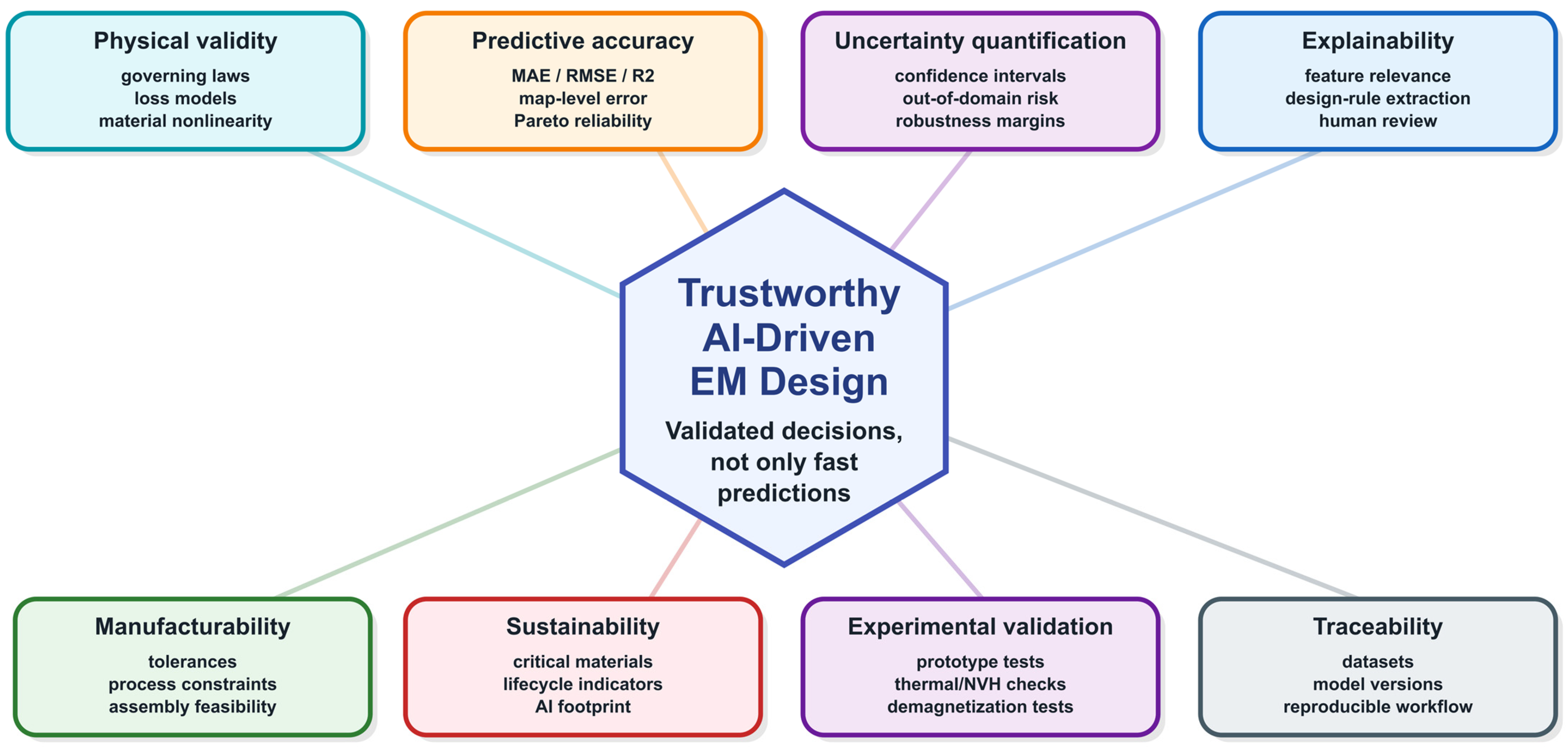
Trustworthy AI-driven EM design requires more than low prediction error on a test dataset. As summarized in Figure 6, trustworthiness depends on physical validity, predictive accuracy, uncertainty quantification, explainability, manufacturability, sustainability, experimental validation, and traceability. These dimensions are mutually dependent: for example, a highly accurate black-box model may still be unsuitable for design deployment if it is not valid outside its training domain, if it ignores manufacturing tolerances, or if its predictions cannot be verified against prototype or test-bench evidence.
Benchmarking is a major gap. The field lacks widely accepted open benchmark machines, geometry parameterizations, operating points, loss models, material datasets, and tolerance scenarios for AI-assisted design comparison. This makes it difficult to compare reported speedups, accuracy, and generalizability across studies. A future community benchmark should include at least one PMSM/IPMSM, one variable reluctance machine, one IM or SRM case, and one AFM or HSM. For each benchmark, the geometry, materials, operating map, loss definitions, thermal boundary conditions, and validation datasets should be openly specified. Table 3 consolidates the minimum reporting checklist proposed for future AI-driven EM design studies.

10. Design-Readiness Framework

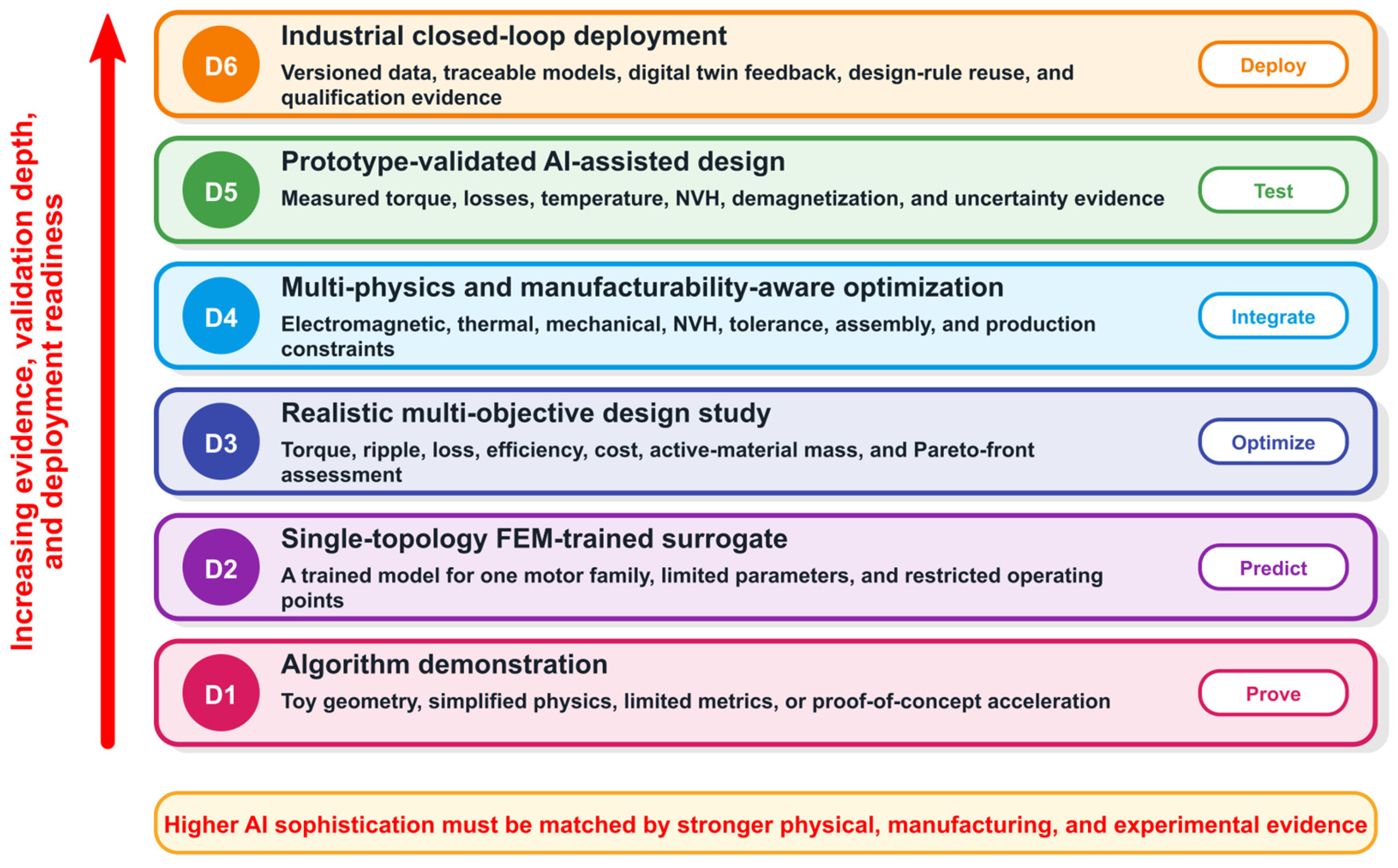
To move beyond algorithm comparison, a design-readiness scale for AI-assisted EM design is proposed. The scale is intended to classify the maturity of evidence behind an AI-assisted design claim.
  • D1, algorithm demonstration: the AI method is demonstrated on a simplified example, without design constraints beyond a small set of electromagnetic quantities.
  • D2, FEM-trained surrogate for one topology: the model predicts selected performance indicators for a fixed topology or parameterization, with validation against held-out FEM data.
  • D3, a multi-objective design study with electromagnetic constraints: the model is embedded in an optimization loop, and selected designs are rechecked by FEM.
  • D4, multi-physics and manufacturability-aware optimization: thermal, mechanical, demagnetization, NVH, or manufacturing constraints are included and verified.
  • D5, prototype-validated AI-assisted design: at least one optimized machine is built and experimentally tested, and model predictions are compared with measurements.
  • D6, industrially deployable workflow: the AI tool includes uncertainty quantification, traceability, versioning, design-rule integration, manufacturability filters, and repeatable validation across multiple designs or product families.
The levels are cumulative and evidence-based. Progression from D2 to D3 requires that the learned model is not only accurate on held-out FEM data but is embedded in an optimization loop and that selected optimum candidates are re-evaluated by high-fidelity FEM. Progression from D3 to D4 requires explicit inclusion and verification of at least one non-electromagnetic constraint family, such as thermal limits, rotor stress, demagnetization, NVH, tolerances, material variability, or manufacturing rules. Progression from D4 to D5 requires prototype or measurement evidence for at least one optimized design, including comparison between predicted and measured quantities under stated operating conditions. Progression from D5 to D6 requires repeatability across more than one design case or product family, traceable datasets and model versions, uncertainty quantification, documented design rules, manufacturability filters, and integration into an industrial design or digital-thread environment.
To compare AI-assisted EM design studies beyond algorithmic accuracy alone, this review proposes the design-readiness ladder shown in Figure 7. The ladder distinguishes between early algorithm demonstrations, single-topology FEM-trained surrogates, realistic multi-objective optimization studies, multi-physics and manufacturability-aware workflows, prototype-validated studies, and industrially deployable closed-loop design environments. This is important because a model that performs well on a narrow FEM-generated dataset may still be far from a reliable design tool if it lacks uncertainty quantification, manufacturing constraints, physical traceability, or experimental validation.
Many published studies currently fall between D2 and D3. Studies with prototype validation, such as the consequent-pole asymmetric rotor hybrid IPMSM work, are more mature because they connect surrogate-assisted optimization with physical testing [22]. Robust BO under uncertainty reaches an important part of D4 because it incorporates manufacturing and material variability, although prototype validation would still be required for D5 [16]. The purpose of the scale is not to rank papers mechanically, but to clarify what type of evidence is needed for a claim such as “AI accelerates design”, “AI improves performance”, or “AI supports industrial deployment”.
Table 4 provides an evidence-oriented classification of the representative studies discussed in this review according to machine topology, AI method, design function, data source, and approximate validation or design-readiness level. The table is arranged from broad review and methodological foundations to application-oriented AI studies, progressing through surrogate and ML examples, DL and generative approaches, physics-informed methods, and Bayesian or robust design workflows. To avoid scope drift, only one compact final row is retained for selected AM EM prototypes; this row is not counted as AI-method evidence and is included only to indicate manufacturability boundary conditions that future AI-assisted workflows must encode.
To make the evidence base more transparent, Table 5 summarizes the distribution of the studies classified in Table 4 according to machine topology, AI method family, design objective, data source, validation level, and consideration of manufacturability or sustainability. The table is not intended as a bibliometric census of the full literature, but as a compact evidence map of the studies used in this critical review. The non-AI AM entries are coded separately as EM design constraint evidence and are not used to inflate the number of AI-driven design studies.
The counts in Table 5 should be read as a coded evidence map of the representative studies reviewed in depth, not as an exhaustive bibliometric distribution. The AM case-study entries are kept separate from the AI-method evidence so that the review remains aligned with its title while still grounding the manufacturability and sustainability discussion in real EM design constraints.

11. Future Research Directions

The first research direction is physics-informed, multi-fidelity learning. Future models should combine analytical models, 2-D FEA, 3-D FEA, thermal networks, high-fidelity multi-physics simulations, and experimental data. Multi-fidelity learning is particularly important because 3-D FEA and prototype measurements are expensive, while 2-D FEA and analytical approximations are cheaper but less complete.
This direction should include not only PINNs but also broader physics-guided and hybrid physics–ML formulations, because EM design often combines analytical models, FEA, reduced-order models, empirical loss models, and measured data rather than a single homogeneous data source [39].
The second direction is uncertainty-aware and robust AI design. Manufacturing tolerances, magnetic-material variability, winding placement, magnetization variation, lamination factor, and temperature-dependent properties should be integrated into optimization objectives and constraints. Robust design should be reported through the probability of constraint satisfaction, sensitivity analysis, and independent verification, not only through nominal Pareto fronts [16].
The third direction is topology transfer and representation learning. CNN, GAN, VAE, and graph-based approaches should be tested across machine families, not only within one fixed topology. TL studies already suggest that reusing learned geometric features may reduce the cost of training new topology models [44]. However, transfer validity must be defined in physical and geometric terms, not only by statistical accuracy.
The fourth direction is manufacturability-aware generative design. AI-generated geometries should be filtered by manufacturing constraints, structural integrity, insulation clearance, assembly feasibility, thermal interface quality, and cost. Generative models should be coupled with rule-based and physics-based validators before FEM resources are spent on candidate evaluation.
The fifth direction is sustainability-aware AI optimization. Future studies should integrate rare-earth content, copper mass, ferrite substitution, aluminum alternatives, recyclability, repairability, and lifecycle indicators. AI models should also report the computational burden of dataset generation and training where sustainability claims are made [64].
The sixth direction is open benchmarking and reproducibility. A field-level benchmark would allow comparison of surrogate accuracy, speedup, generalizability, and design quality. Without benchmark machines and standardized reporting, the literature will continue to consist of isolated case studies that are difficult to compare.

12. Conclusions

AI-driven EM design is moving from isolated surrogate acceleration toward broader design workflow integration. Statistical surrogates and ML models are useful for low-to-moderate-dimensional parameter optimization, while CNNs and other DL models allow topology-aware screening and image-based geometry processing. PINNs provide a promising route to embed electromagnetic laws into learning, and BO supports sample-efficient design exploration and uncertainty-aware robust optimization.
Despite this progress, most studies remain closer to design acceleration than to full design readiness. The evidence base is strongest for PMSM and IPM machine electromagnetic design, especially torque, torque ripple, cogging torque, flux, and inductance prediction. The evidence is weaker for thermal, mechanical, NVH, manufacturability, lifecycle, and sustainability integration. Experimental validation and open benchmarking remain limited. Many studies also lack sufficient reporting of dataset construction, error near constraints, material assumptions, uncertainty, and generalizability.
The central conclusion of this review is that AI should not be presented as a replacement for FEM, multi-physics simulation, expert judgment, or prototype testing. Its most credible role is as a physics-aware, data-assisted, and validation-dependent design accelerator. To become industrially useful, AI-assisted EM design must be traceable, uncertainty-aware, manufacturable, and aligned with sustainability objectives.

Funding

This research received no external funding.

Data Availability Statement

No new data were created or analyzed in this study. Data sharing is not applicable to this article.

Acknowledgments

Linguistic and stylistic enhancements were supported by Microsoft 365 Copilot, contributing to improved clarity, grammatical accuracy, and consistency throughout the manuscript.

Conflicts of Interest

The author declares no conflicts of interest.

Abbreviations

The following abbreviations are used in this manuscript:
AFMAxial flux machine
AMAdditive manufacturing
ANNArtificial neural network
BOBayesian optimization
CNNConvolutional neural network
DCGANDeep convolutional generative adversarial network
DLDeep learning
EMElectrical machine
EVElectric vehicle
FEAFinite element analysis
FEMFinite element method
FMMFlux-modulated machine
GAGenetic algorithm
GANGenerative adversarial network
GPGaussian process
GPRGaussian process regression
HSMHigh-speed machine
IMInduction machine
IPMInterior permanent magnet
IPMSMInterior permanent magnet synchronous machine
MAEMean absolute error
MLMachine learning
NNNeural network
NSGA-IINon-dominated sorting genetic algorithm II
NVHNoise, vibration, and harshness
PINNPhysics-informed neural network
PMPermanent magnet
PMaSynRMPermanent magnet-assisted synchronous reluctance machine
PMSMPermanent magnet synchronous machine
RCGAReal-coded genetic algorithm
RFRandom forest
RMSERoot mean square error
RSMResponse surface method
SRMSwitched reluctance machine
SS-NGOSequential subspace northern goshawk optimization
SVRSupport vector regression
SynRMSynchronous reluctance machine
TLTransfer learning
VAEVariational autoencoder

References

  1. Boldea, I. Electric Drives, 4th ed.; CRC Press: Boca Raton, FL, USA, 2025. [Google Scholar]
  2. Saidur, R. A review on electrical motors energy use and energy savings. Renew. Sustain. Energy Rev. 2010, 14, 877–898. [Google Scholar] [CrossRef] [Scilit]
  3. Buyukbicakci, E. Sustainable electrical machine technologies: A comprehensive review of materials, designs, and integration strategies for future energy systems. Arch. Comput. Methods Eng. 2026, 33, 4533–4565. [Google Scholar] [CrossRef] [Scilit]
  4. Duan, Y.; Ionel, D.M. A review of recent developments in electrical machine design optimization methods with a permanent-magnet synchronous motor benchmark study. IEEE Trans. Ind. Appl. 2013, 49, 1268–1275. [Google Scholar] [CrossRef] [Scilit]
  5. Lei, G.; Zhu, J.; Guo, Y.; Liu, C.; Ma, B. A review of design optimization methods for electrical machines. Energies 2017, 10, 1962. [Google Scholar] [CrossRef] [Scilit]
  6. Bilgin, B.; Liang, J.; Terzic, M.V.; Dong, J.; Rodriguez, R.; Trickett, E.; Emadi, A. Modeling and analysis of electric motors: State-of-the-art review. IEEE Trans. Transp. Electrif. 2019, 5, 602–617. [Google Scholar] [CrossRef] [Scilit]
  7. Pyrhönen, J.; Jokinen, T.; Hrabovcová, V.; Niemelä, H. Design of Rotating Electrical Machines; John Wiley & Sons: Chichester, UK, 2008. [Google Scholar]
  8. Lipo, T.A. Introduction to AC Machine Design; John Wiley & Sons: Hoboken, NJ, USA, 2017. [Google Scholar]
  9. Cheng, M.; Zhao, X.; Dhimish, M.; Qiu, W.; Niu, S. A review of data-driven surrogate models for design optimization of electric motors. IEEE Trans. Transp. Electrif. 2024, 10, 8413–8431. [Google Scholar] [CrossRef] [Scilit]
  10. Shahriari, B.; Swersky, K.; Wang, Z.; Adams, R.P.; De Freitas, N. Taking the human out of the loop: A review of Bayesian optimization. Proc. IEEE 2016, 104, 148–175. [Google Scholar] [CrossRef] [Scilit]
  11. Liu, L.; Li, Z.; Kang, H.; Xiao, Y.; Sun, L.; Zhao, H.; Zhu, Z.Q.; Ma, Y. Review of surrogate model assisted multi-objective design optimization of electrical machines: New opportunities and challenges. Renew. Sustain. Energy Rev. 2025, 215, 115609. [Google Scholar] [CrossRef] [Scilit]
  12. Zarghani, A.; Sergeant, P.; Ibrahim, M.N. Additive manufacturing of electrical machines–A comprehensive review of recent advancements. IEEE Trans. Ind. Appl. 2026, 1–22. [Google Scholar] [CrossRef] [Scilit]
  13. Bíró, K.Á.; Viorel, I.A.; Szabó, L.; Henneberger, G. Special Electrical Machines; Mediamira: Cluj-Napoca, Romania, 2005. [Google Scholar]
  14. Sasaki, H.; Igarashi, H. Topology optimization of IPM motor with aid of deep learning. Int. J. Appl. Electromagn. Mech. 2019, 59, 87–96. [Google Scholar] [CrossRef] [Scilit]
  15. Sato, H.; Igarashi, H. Deep learning-based surrogate model for fast multi-material topology optimization of IPM motor. COMPEL Int. J. Comput. Math. Electr. Electron. Eng. 2022, 41, 900–914. [Google Scholar] [CrossRef] [Scilit]
  16. Reyes-Reyes, A.; Nasr, A.; Sinoquet, D.; Hlioui, S. An adapted constrained multi-objective Bayesian optimization under uncertainties: Application on a permanent magnet assisted synchronous reluctance motor. In Proceedings of the International Conference on Electrical Machines (ICEM ‘2024), Torino, Italy, 1–4 September 2024. [Google Scholar] [CrossRef] [Scilit]
  17. Jones, D.R.; Schonlau, M.; Welch, W.J. Efficient global optimization of expensive black-box functions. J. Glob. Optim. 1998, 13, 455–492. [Google Scholar] [CrossRef] [Scilit]
  18. Kennedy, M.C.; O’Hagan, A. Predicting the output from a complex computer code when fast approximations are available. Biometrika 2000, 87, 1–13. [Google Scholar] [CrossRef] [Scilit]
  19. Forrester, A.; Sobester, A.; Keane, A. Engineering Design via Surrogate Modelling: A Practical Guide; John Wiley & Sons: Chichester, UK, 2008. [Google Scholar]
  20. Wang, J. An intuitive tutorial to Gaussian process regression. Comput. Sci. Eng. 2023, 25, 4–11. [Google Scholar] [CrossRef] [Scilit]
  21. Choi, M.; Choi, G.; Bramerdorfer, G.; Marth, E. Systematic development of a multi-objective design optimization process based on a surrogate-assisted evolutionary algorithm for electric machine applications. Energies 2023, 16, 392. [Google Scholar] [CrossRef] [Scilit]
  22. Ji, Y.; Lu, Q.; Li, Y.; Fang, Y. Surrogate Model-Based Design Optimization of Consequent-Pole Asymmetric Rotor Hybrid Interior Permanent Magnet Synchronous Machine. IEEE Trans. Ind. Appl. 2026, 62, 2535–2548. [Google Scholar] [CrossRef] [Scilit]
  23. Shimizu, Y.; Morimoto, S.; Sanada, M.; Inoue, Y. Using machine learning to reduce design time for permanent magnet volume minimization in IPMSMs for automotive applications. IEEJ J. Ind. Appl. 2021, 10, 554–563. [Google Scholar] [CrossRef] [Scilit]
  24. Shimizu, Y. Efficiency optimization design that considers control of interior permanent magnet synchronous motors based on machine learning for automotive application. IEEE Access 2022, 11, 41–49. [Google Scholar] [CrossRef] [Scilit]
  25. Yu, Y.; Liang, C.; Zeng, D.; Hu, Y.; Yang, J. Multi-objective optimization of IPMSM for electric vehicles based on the combinatorial surrogate model and the hierarchical design method. Int. J. Electr. Power Energy Syst. 2024, 162, 110245. [Google Scholar] [CrossRef] [Scilit]
  26. Shimizu, Y.; Morimoto, S.; Sanada, M.; Inoue, Y. Investigation of irreversible demagnetization constraints in magnet volume minimization design of IPMSM for automotive applications using machine learning. In Proceedings of the IEEE International Electric Machines & Drives Conference (IEMDC ‘2021), Hartford, CT, USA, 17–20 May 2021. [Google Scholar] [CrossRef] [Scilit]
  27. Guo, S.; Su, X.; Zhao, H. Optimal design of an interior permanent magnet synchronous motor for electric vehicle applications using a machine learning-based surrogate model. Energies 2024, 17, 3864. [Google Scholar] [CrossRef] [Scilit]
  28. Popa, D.-C.; Szabó, L. Overcoming Catch-22 for rare earth metals in green transition: Solutions in electrical machine manufacturing. Renew. Sustain. Energy Rev. 2025, 207, 114917. [Google Scholar] [CrossRef] [Scilit]
  29. Tahkola, M.; Keränen, J.; Sedov, D.; Far, M.F.; Kortelainen, J. Surrogate modeling of electrical machine torque using artificial neural networks. IEEE Access 2020, 8, 220027–220045. [Google Scholar] [CrossRef] [Scilit]
  30. Sato, H.; Igarashi, H. Fast topology optimization for PM motors using variational autoencoder and neural networks with dropout. IEEE Trans. Magn. 2023, 59, 8200904. [Google Scholar] [CrossRef] [Scilit]
  31. Gao, Y.; Yang, T.; Bozhko, S.; Wheeler, P.; Dragicevic, T.; Gerada, C. Neural network aided PMSM multi-objective design and optimization for more-electric aircraft applications. Chin. J. Aeronaut. 2022, 35, 233–246. [Google Scholar] [CrossRef] [Scilit]
  32. Garmut, M.; Steentjes, S.; Petrun, M. Computationally efficient multi-objective optimization of an interior permanent magnet synchronous machine using neural networks. Eng. Appl. Artif. Intell. 2025, 160, 111753. [Google Scholar] [CrossRef] [Scilit]
  33. Raissi, M.; Perdikaris, P.; Karniadakis, G.E. Physics-informed neural networks: A deep learning framework for solving forward and inverse problems involving nonlinear partial differential equations. J. Comput. Phys. 2019, 378, 686–707. [Google Scholar] [CrossRef] [Scilit]
  34. Karniadakis, G.E.; Kevrekidis, I.G.; Lu, L.; Perdikaris, P.; Wang, S.; Yang, L. Physics-informed machine learning. Nat. Rev. Phys. 2021, 3, 422–440. [Google Scholar] [CrossRef] [Scilit]
  35. Son, S.; Lee, H.; Jeong, D.; Oh, K.-Y.; Sun, K.H. A novel physics-informed neural network for modeling electromagnetism of a permanent magnet synchronous motor. Adv. Eng. Inform. 2023, 57, 102035. [Google Scholar] [CrossRef] [Scilit]
  36. Khan, A.; Lowther, D.A. Physics informed neural networks for electromagnetic analysis. IEEE Trans. Magn. 2022, 58, 7500404. [Google Scholar] [CrossRef] [Scilit]
  37. Noakoasteen, O.; Wang, S.; Peng, Z.; Christodoulou, C. Physics-informed deep neural networks for transient electromagnetic analysis. IEEE Open J. Antennas Propag. 2020, 1, 404–412. [Google Scholar] [CrossRef] [Scilit]
  38. Zhang, P.; Hu, Y.; Jin, Y.; Deng, S.; Wu, X.; Chen, J. A Maxwell’s equations based deep learning method for time domain electromagnetic simulations. IEEE J. Multiscale Multiphys. Comput. Tech. 2021, 6, 35–40. [Google Scholar] [CrossRef] [Scilit]
  39. Willard, J.; Jia, X.; Xu, S.; Steinbach, M.; Kumar, V. Integrating scientific knowledge with machine learning for engineering and environmental systems. ACM Comput. Surv. 2022, 55, 1–37. [Google Scholar] [CrossRef] [Scilit]
  40. Jin, Y. Surrogate-assisted evolutionary computation: Recent advances and future challenges. Swarm Evol. Comput. 2011, 1, 61–70. [Google Scholar] [CrossRef] [Scilit]
  41. Asef, P.; Vagg, C. A physics-informed bayesian optimization method for rapid development of electrical machines. Sci. Rep. 2024, 14, 4526. [Google Scholar] [CrossRef] [Scilit] [PubMed]
  42. Guesmia, M.A.; Pham, C.; Pan, Y.-J.; Nguyen, K.K.; Al-Haddad, K.; Wang, Q. AI-assisted bayesian optimization of a permanent magnet synchronous motor for e-bike applications. Machines 2026, 14, 160. [Google Scholar] [CrossRef] [Scilit]
  43. Lee, C.; Ha, W. Optimal design of IPM rotor shape using generative adversarial networks. In Proceedings of the 24th International Conference on Electrical Machines and Systems (ICEMS ‘2021), Gyeongju, Republic of Korea, 31 October–3 November 2021; IEEE: New York, NY, USA, 2021; pp. 2440–2444. [Google Scholar] [CrossRef] [Scilit]
  44. Asanuma, J.; Doi, S.; Igarashi, H. Transfer learning through deep learning: Application to topology optimization of electric motor. IEEE Trans. Magn. 2020, 56, 7512404. [Google Scholar] [CrossRef] [Scilit]
  45. Deb, K.; Pratap, A.; Agarwal, S.; Meyarivan, T. A fast and elitist multiobjective genetic algorithm: NSGA-II. IEEE Trans. Evol. Comput. 2002, 6, 182–197. [Google Scholar] [CrossRef] [Scilit]
  46. Viana, F.A.; Simpson, T.W.; Balabanov, V.; Toropov, V. Special section on multidisciplinary design optimization: Metamodeling in multidisciplinary design optimization: How far have we really come? AIAA J. 2014, 52, 670–690. [Google Scholar] [CrossRef] [Scilit]
  47. Ciani, A.; Vallese, M. The role of AI across the welding workflow for enhanced quality. Electr. Mot. Eng. 2024, 32–37. [Google Scholar]
  48. Gargalis, L.; Madonna, V.; Giangrande, P.; Rocca, R.; Hardy, M.; Ashcroft, I.; Galea, M.; Hague, R. Additive manufacturing and testing of a soft magnetic rotor for a switched reluctance motor. IEEE Access 2020, 8, 206982–206991. [Google Scholar] [CrossRef] [Scilit]
  49. Tiismus, H.; Kallaste, A.; Naseer, M.U.; Vaimann, T.; Rassolkin, A. Design and performance of laser additively manufactured core induction motor. IEEE Access 2022, 10, 50137–50152. [Google Scholar] [CrossRef] [Scilit]
  50. Gadiyar, N.; Goodall, A.D.; Todd, I.; Severson, E.L. Characterization of an axial flux machine with an additively manufactured stator. IEEE Trans. Energy Convers. 2023, 38, 2717–2729. [Google Scholar] [CrossRef] [Scilit]
  51. Zhou, Y.; Liu, J.; Meng, F.; Yu, K.; Yang, G.; He, Y.; Lau, D.K.; Wang, P.; Lee, C.H. Development and manufacturing of axial-flux synchronous reluctance motors with 3-D printing technology. IEEE Trans. Ind. Electron. 2025, 73, 1041–1051. [Google Scholar] [CrossRef] [Scilit]
  52. Di Nardo, M.; Gallicchio, G.; Korman, O.; Riccio, J.; Vannini, A.; Degano, M.; Gerada, C.; Hague, R.; Gargalis, L. Experimental assessment of a synchronous reluctance machine featuring an additive manufactured rotor. In Proceedings of the IEEE Workshop on Electrical Machines Design, Control and Diagnosis (WEMDCD ‘2025), Valletta, Malta, 9–10 April 2025; IEEE: New York, NY, USA, 2025; pp. 1–6. [Google Scholar]
  53. Bassey, K.E.; Juliet, A.R.; Stephen, A.O. AI-enhanced lifecycle assessment of renewable energy systems. Eng. Sci. Technol. J. 2024, 5, 2082–2099. [Google Scholar] [CrossRef] [Scilit]
  54. Mangelsdorf, S.; Behan, L. Born electric, buried toxic: The life cycle of generative AI and its environmental impact. Brief 2025, 54, 28. [Google Scholar]
  55. Salla, J.V.E.; de Almeida, T.A.; Silva, D.A.L. Integrating machine learning with life cycle assessment: A comprehensive review and guide for predicting environmental impacts. Int. J. Life Cycle Assess. 2025, 30, 2423–2445. [Google Scholar] [CrossRef] [Scilit]
  56. Jula, P.A.; Mákszem, B.; Gaidamac, T.; Popa, D.-C.; Szabó, L. Tackling risks in the supply chain of rare earth-based permanent magnets used in electrical generators. In Proceedings of the International Conference on Clean Electrical Power (ICCEP ‘2023), Terrasini, Italy, 27–29 June 2023; IEEE: New York, NY, USA, 2023; pp. 852–857. [Google Scholar] [CrossRef] [Scilit]
  57. Popa, D.-C.; Szabó, L. Securing Rare Earth Permanent Magnet Needs for Sustainable Energy Initiatives. Materials 2024, 17, 5442. [Google Scholar] [CrossRef] [Scilit] [PubMed]
  58. Szabó, L. Advancements in electrical machines design brought by the modular construction. In Proceedings of the 10th International Conference on Electrical Power Drive Systems (ICEPDS ‘2018), Novocherkassk, Russia, 3–6 October 2018; IEEE: New York, NY, USA, 2018; pp. 35–41. [Google Scholar] [CrossRef] [Scilit]
  59. Kejriwal, M. AI in practice and implementation: Issues and costs. In Artificial Intelligence for Industries of the Future: Beyond Facebook, Amazon, Microsoft and Google; Springer: Cham, Switzerland, 2023; pp. 25–45. [Google Scholar]
  60. Greene-Dewasmes, G.; Tladi, T. AI’s Energy Dilemma: Challenges, Opportunities, and a Path Forward. Available online: https://www.weforum.org/stories/2025/01/ai-energy-dilemma-challenges-opportunities-and-path-forward/ (accessed on 2 October 2025).
  61. Lakatos, E.S.; Ferenci, S.; Szabó, L. Sustainability paradoxes in AI-enabled decentralized energy systems: Opportunities, risks, and systemic traps. Renew. Sustain. Energy Rev. 2026, 239, 117152. [Google Scholar] [CrossRef] [Scilit]
  62. Tahanian, H.; Aliahmadi, M.; Faiz, J. Ferrite permanent magnets in electrical machines: Opportunities and challenges of a non-rare-earth alternative. IEEE Trans. Magn. 2020, 56, 900120. [Google Scholar] [CrossRef] [Scilit]
  63. Poudel, B.; Amiri, E. Deep learning based design methodology for electric machines: Data acquisition, training and optimization. IEEE Access 2023, 11, 18281–18290. [Google Scholar] [CrossRef] [Scilit]
  64. Delanoë, P.; Tchuente, D.; Colin, G. Method and evaluations of the effective gain of artificial intelligence models for reducing CO2 emissions. J. Environ. Manag. 2023, 331, 117261. [Google Scholar] [CrossRef] [Scilit] [PubMed]
  65. Sasaki, H.; Hidaka, Y.; Igarashi, H. Explainable deep neural network for design of electric motors. IEEE Trans. Magn. 2021, 57, 8203504. [Google Scholar] [CrossRef] [Scilit]
  66. Trivedi, C.; Bhattacharya, P.; Prasad, V.K.; Patel, V.; Singh, A.; Tanwar, S.; Sharma, R.; Aluvala, S.; Pau, G.; Sharma, G. Explainable AI for Industry 5.0: Vision, architecture, and potential directions. IEEE Open J. Ind. Appl. 2024, 5, 177–208. [Google Scholar] [CrossRef] [Scilit]
Figure 1. Evolution of EM design workflows.
Designs 10 00076 g001
Figure 2. Taxonomy of AI methods for EM design.
Designs 10 00076 g002
Figure 3. Example of a material-aware IPMSM rotor design space used in ML-assisted optimization: conventional air-filled cavity, Halbach ferrite filling, and parallel ferrite filling. Reproduced from [27] under the CC BY 4.0 license.
Designs 10 00076 g003
Figure 4. Surrogate-assisted and active learning optimization loop.
Designs 10 00076 g004
Figure 5. Representative AI-assisted EM design functions across the method families.
Designs 10 00076 g005
Figure 6. Trustworthy AI framework for EM design.
Designs 10 00076 g006
Figure 7. Design-readiness ladder for AI-assisted EM design.
Designs 10 00076 g007
Table 1. Representative AI entry points in EM design.
Design StageConventional ActivityAI-Enabled FunctionTypical Evidence Required
Specification and
concept
Manual topology selection and initial sizingLearned initial design maps, expert databases, and preliminary surrogate screeningTraceable dataset, coverage of ratings and topologies, validation against analytical or FEA sizing
Electromagnetic
design
FEA for torque, electromotive force, inductance, losses, rippleSurrogate prediction, physics-informed field estimation, operating-map generationError metrics, comparison with FEA, operating-point coverage, mesh and material assumptions
Topology
optimization
FEM-coupled genetic or gradient-free searchCNN screening, VAE/GAN design, TL across geometriesDataset size, image representation, FEM re-evaluation, Pareto verification
Multi-physics
verification
Thermal, stress, noise, vibration, and harshness (NVH), demagnetization checksCoupled surrogate models, reduced-order models, active learningBoundary conditions, uncertainty bounds, cross-domain validation
Robustness and
manufacturing
Tolerance analysis and prototype iterationRobust BO, uncertainty-aware design, process-data feedbackTolerance model, material variability model, probability of constraint satisfaction, prototype evidence
Sustainability
and cost
Material selection and cost comparisonMaterial-criticality-aware optimization, magnet/copper reduction, lifecycle trade-offsMaterial inventory, cost assumptions, lifecycle boundary, performance penalty analysis
Table 2. AI methods and their role in EM design.
Method FamilyTypical InputTypical OutputStrengthsLimitations
RSM/polynomial modelsFew scalar design variablesObjective approximationSimple, fast, interpretableLimited to nonlinear, high-dimensional, or
topology problems
Kriging/GPScalar variables plus FEM samplesMean and uncertainty estimateUseful for BO and active learningScaling issues and kernel sensitivity
SVR/RF/
boosting
Design variables and operating variablesTorque, loss, ripple, efficiencyFlexible nonlinear predictionUsually tied to predefined parameterization
ANN/Deep neural networkDesign variables, operating points, or sampled fieldsPerformance maps, flux, torque, lossesHandles nonlinear mappings and larger datasetsRequires data and careful generalization testing
CNNImages, field maps, and material distributionsTopology screening, parameter predictionGood for topology optimization and image-like geometryLarge datasets and weak physical guarantees
PINN/
hybrid model
Coordinates, fields, boundary, and
physics residuals
Electromagnetic response or field solutionEmbeds governing equations and can reduce data needsHard to formulate for nonlinear rotating machines
BODesign variables and expensive simulationsSequential selection of promising designsSample-efficient optimizationAcquisition function and surrogate assumptions affect results
GAN/VAELatent variables or design imagesCandidate geometriesSupports inverse and generative designRequires strict validation and manufacturability filtering
Table 3. Minimum reporting checklist for AI-driven EM design studies.
Reporting ItemMinimum InformationImportanceRelevant Study Type
Machine definitionTopology, rating, slot/pole combination, geometry variables, material dataDefines the domain of validityAll studies
Data generationFEA type, mesh, solver, sampling method, sample number, failed/outlier samplesControls surrogate accuracy and biasSurrogate and DL studies
Inputs and outputsDesign variables, operating variables, predicted quantities, unitsPrevents ambiguous model useAll studies
Training protocolSplit strategy, hyperparameters, loss function, normalization, and random seeds if possibleAffects reproducibilityML/DL/PINN studies
Error reportingMean absolute error (MAE)/RMSE/R2, maximum error, error near constraints or Pareto pointsAverage error alone is insufficientAll predictive models
Physical consistencyMaterial limits, saturation, demagnetization, field constraints, boundary conditionsPrevents nonphysical designsElectromagnetic and PINN studies
Multi-physics boundary
conditions
Thermal, mechanical, NVH, and control assumptionsDetermines design-readinessMulti-physics studies
Optimization evidenceAlgorithm, objectives, constraints, number of FEM calls, final verificationSeparates speedup from design qualityOptimization studies
Robustness evidenceTolerance model, material uncertainty, probability constraints, sensitivity analysisSupports manufacturing readinessRobust design studies
Validation levelAnalytical, FEM, multi-physics, prototype, experiment, independent testEstablishes maturityAll studies
Table 4. Classification of selected studies.
ReferenceMachine/
Topology
AI MethodDesign FunctionPreliminary
Readiness
Cheng et al. [9]EMs, broadStatistical, ML, DL, and AI-based
surrogates
Review of data-driven
surrogate models
Review foundation
Liu et al. [11]EMs, broadSurrogate models and multi-objective optimizationReview of the design of
experiments, surrogate
construction and
multi-objective optimization
Review foundation
Forrester et al. [19]Engineering design, broadSurrogate modelingFoundation for
surrogate-based design
optimization
Method foundation
Jin [40]Expensive optimization problems, broadSurrogate-assisted evolutionary computationMethodological foundation for model management and
approximate evaluations
Method foundation
Viana et al. [46]Multidisciplinary design optimization, broadMetamodeling/
surrogate modeling
Validation and use of metamodels in coupled design workflowsMethod foundation
Willard et al. [39]Engineering and environmental systems, broadPhysics-guided ML/
hybrid physics–ML
Taxonomy for integrating scientific knowledge and MLMethod foundation
Deb et al. [45]Multi-objective optimization, broadNSGA-IIMethod foundation for evolutionary multi-objective optimizationMethod foundation
Choi et al. [21]Electric machines, broadSurrogate-assisted evolutionary
optimization
Repeatable multi-objective
design workflow
D3/workflow example
Tahkola et al. [29]PMSMANN surrogateTorque prediction workflowD2
Ji et al. [22]CPAR-HIPMSMBO-SVR + SS-NGOTorque improvement and
ripple reduction
D5 candidate
Shimizu et al. [23]IPMSM for automotive
applications
ML surrogatePM volume minimizationD3
Shimizu [24]IPMSM for automotive applicationsML surrogateEfficiency optimization
considering control
D3
Shimizu et al. [26]IPMSM for automotive applicationsGP regression (GPR) surrogate + real-coded GA (RCGA)Demagnetization-constrained PM volume minimizationD3–D4
Yu et al. [25]IPMSM for EVsCombinatorial surrogate + hierarchical designEV-oriented multi-objective optimizationD3
Guo et al. [27]IPMSM for EVsML surrogate with fine/coarse mesh dataHybrid PM/ferrite design optimizationD3
Garmut et al. [32]IPMSMNNComputationally efficient multi-objective optimizationD3
Yuan and Tao [31]PMSM for aircraftNNMulti-objective aircraft-machine optimizationD3
Sasaki and Igarashi [14]IPM machineCNN + GATopology screening and FEM reductionD2–D3
Sato et al. [15]Multi-material IPM machineCNN surrogatedq parameter prediction and topology optimizationD2–D3
Poudel and Amiri [63]Hybrid PM machineDeep neural networkAir-gap flux prediction and cogging/THD optimizationD2–D3
Sato and Igarashi [30]PM machineVAE + NN + Monte Carlo dropoutLatent space topology optimization and reliability filteringD3
Lee and Ha [43]IPM rotorCNN + DCGANGenerative rotor-shape candidate synthesis and FEM verificationD2–D3
Asanuma et al. [44]EM topology optimizationTLReuse of learned geometric features across optimization tasksD2–D3
Son et al. [35]PMSMPINNElectromagnetic response modelingD2, with measurement comparison
Reyes-Reyes et al. [16]PMaSynRMBO + KrigingRobust optimization under
geometry and material uncertainty
D4 simulation-level
Asef and Vagg [41]Traction EMsPhysics-informed BORapid design developmentD3–D4
Guesmia et al. [42]PMSM for e-bikeAI-assisted BOLightweight traction-machine optimizationD3
Selected AM boundary cases [48,49,50,51,52]SRM, IM, AFM, SynRM/SynRel prototypesNot AI-method evidenceCompact manufacturability boundary evidence for material, loss, post-processing, assembly, and validation constraintsContext only; not counted as AI-method or AI-design evidence
Table 5. Compact evidence distribution derived from the representative studies in Table 4.
Coding
Dimension
Distribution in Representative
Application/Workflow Studies
Critical Interpretation
Topology familyPM/PMSM/IPMSM/IPM-related: dominant majority; PMaSynRM: one robust design example; broad/special EM workflows: several; IM/SRM/AFM/HSM/FMM: mainly identified as underrepresented AI-design evidence.Confirms that the imbalance is a literature feature, not an omission of the review.
AI method familyClassical surrogate/ML methods dominate; CNN/DL, GAN/VAE/TL, PINN, BO and robust BO appear in smaller but methodologically important subsets.Shows the field moving from regression acceleration toward topology learning, uncertainty-aware design, and physics-informed modeling.
Design objectiveTorque, torque ripple, cogging torque, PM volume, efficiency, and topology screening are most frequent; thermal, NVH, manufacturability, recyclability, and lifecycle objectives are much less frequent.Supports the distinction between electromagnetic optimization and design-ready optimization.
Data sourceMost reviewed design studies rely on FEM-generated datasets; fewer combine FEM with measurements or prototype evidence.Explains why the manuscript emphasizes traceability, uncertainty reporting, and prototype validation.
Validation levelMost studies fall around D2–D3; robust uncertainty-aware studies approach D4; only a small subset provides prototype or measurement evidence approaching D5.Quantifies the gap between algorithmic accuracy and design readiness.
Manufacturing and sustainabilityExplicit manufacturing constraints, tolerance models, rare-earth reduction, PM minimization, or lifecycle-oriented criteria appear only in selected AI-assisted studies. A small set of AM EM prototypes is mentioned separately only as manufacturability boundary evidence [48,49,50,51,52].Supports Section 7 and Section 8 without treating AM papers as core AI-method studies.
Disclaimer/Publisher’s Note: The statements, opinions and data contained in all publications are solely those of the individual author(s) and contributor(s) and not of MDPI and/or the editor(s). MDPI and/or the editor(s) disclaim responsibility for any injury to people or property resulting from any ideas, methods, instructions or products referred to in the content.