Review

Sports Injury Surveillance Systems: A Scoping Review of Practice and Methodologies

by
Damien Costello
1,2,
Ed Daly
1,2 and
Lisa Ryan
1,2,*
1
Department of Sport, Exercise and Nutrition, School of Science and Computing, Atlantic Technological University, H91 T8NW Galway, Ireland
2
Irish Concussion Research Centre (ICRC), Atlantic Technological University, H91 T8NW Galway, Ireland
*
Author to whom correspondence should be addressed.
J. Funct. Morphol. Kinesiol. 2024, 9(4), 177; https://doi.org/10.3390/jfmk9040177
Submission received: 19 August 2024 / Revised: 23 September 2024 / Accepted: 25 September 2024 / Published: 26 September 2024
(This article belongs to the Section Kinesiology and Biomechanics)

Abstract

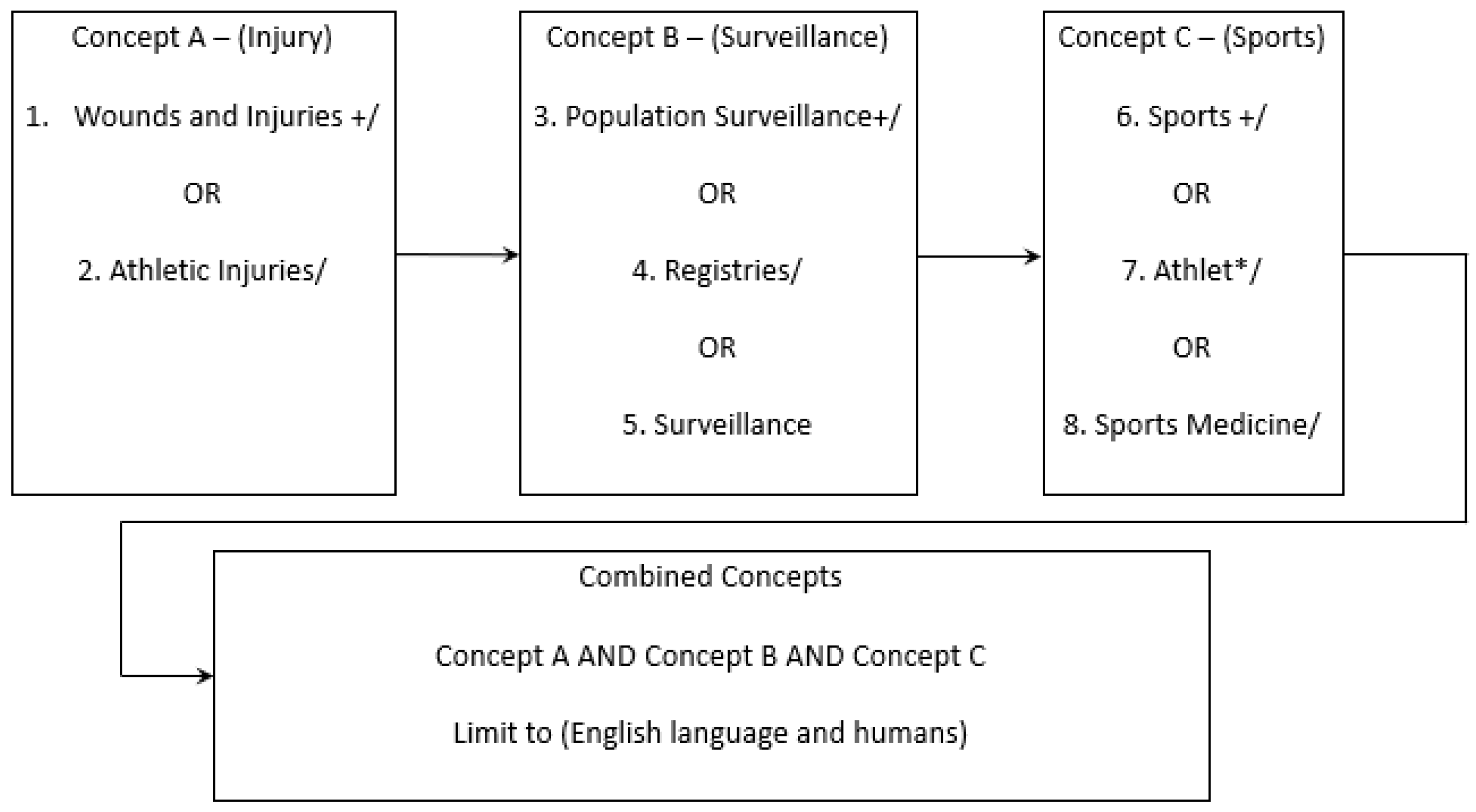
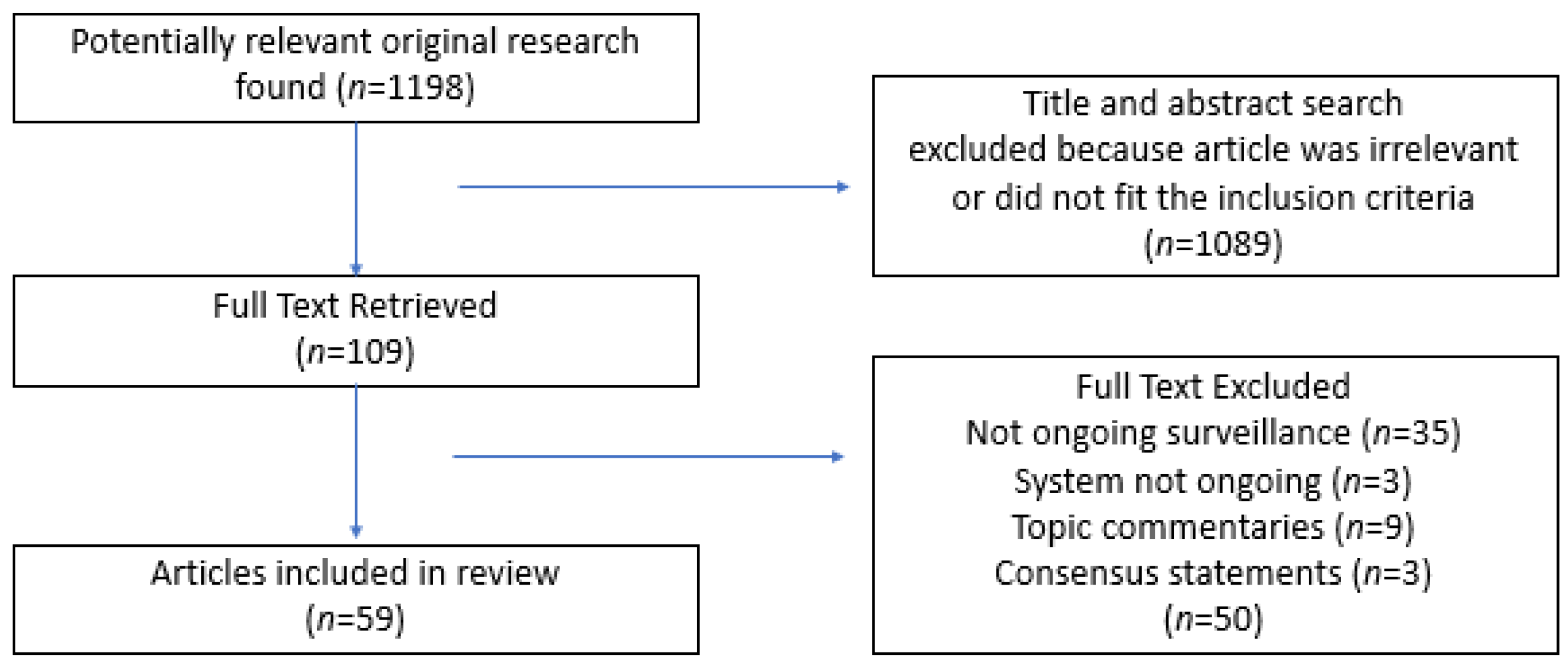
Background: Injury prevention/reduction strategies are driven by data collected through injury surveillance systems. The aim of this review was to describe injury surveillance systems that are used for ongoing surveillance in either a professional or amateur sporting environment. This was an update to a review done in 2015 to determine the gaps in injury surveillance. Methods: A systematic search process of five databases (MEDLINE, CINAHL, EMBASE, SCOPUS and ProQuest) was used to discover published research that presented methodological data about the injury surveillance systems implemented by clubs and organisations for ongoing surveillance. Inclusion criteria centred on the population under surveillance and the ongoing nature of that activity. Data extracted and summarised included the level of athlete under surveillance, the data collection mechanism and the personnel involved, the injury definitions applied and the date and country of origin to provide a comprehensive picture of the systems. Results: A total of 21 systems were documented as being used in ongoing injury surveillance, with 57% of these exclusively in the professional/elite landscapes and 33% at the amateur level. Surveillance systems cater for one sport per athlete entry so there is a gap in research for multi-sport athletes at the amateur level, especially where there is no early specialisation in a multi-sport participation environment. Conclusions: Research in this area will lead to a better understanding of subsequent injury risk for multi-sport athletes who have a higher athlete exposure than single-sport athletes.
Keywords: injury surveillance; mTBI; concussion; sport; multi-sport; injury management injury surveillance; mTBI; concussion; sport; multi-sport; injury management