
Lasting Aftermaths of the First Incitement for High-Temperature Superconductivity


Abstract
1. The History
1.1. The Related Anniversaries
1.2. Search in the Darkness
2. The Electronic Ferroelectricity
2.1. The Origins
2.2. Symmetry-Defined Ways to Build the Electronic Ferroelectrics
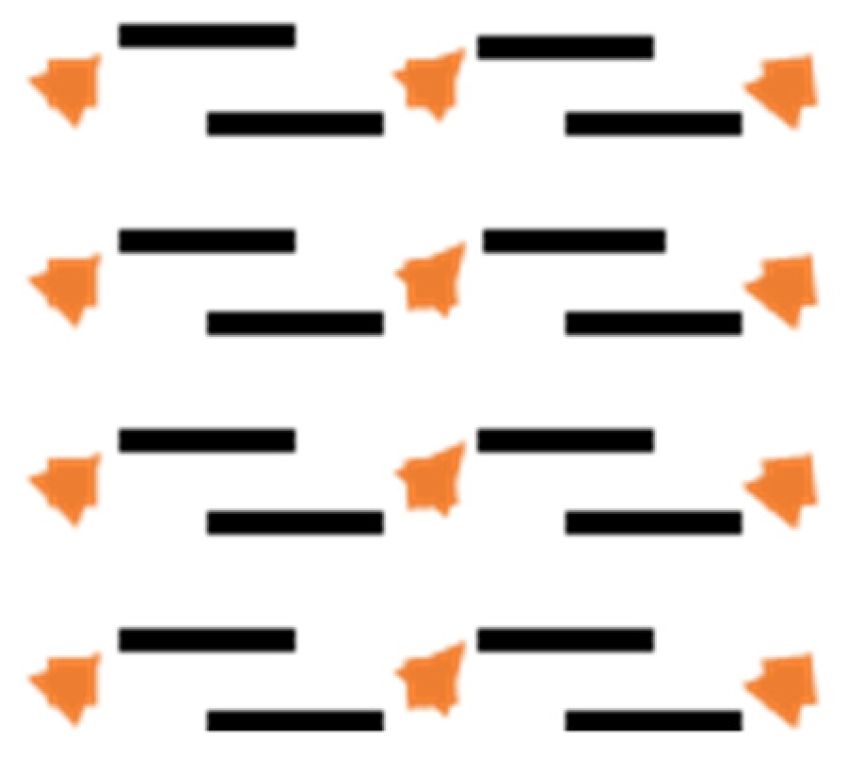
- Dimerization of sites is built in; dimerization of bonds is spontaneous: depending on interactions, there are two possibilities:2a. Under electron–lattice interactions, the Peierls dimerization should take place: that was a proposal for conjugated polymers of the (AB)x type, expected nowadays to be seen in substituted polyacetylenes, whose scheme is shown in Figure 1.2b. For a quasi-one-dimensional chain of alternating spin-carrying molecules, the spontaneous dimerization of bonds appears as the so-called spin-Peierls transition [41] of binding spins into singlets.
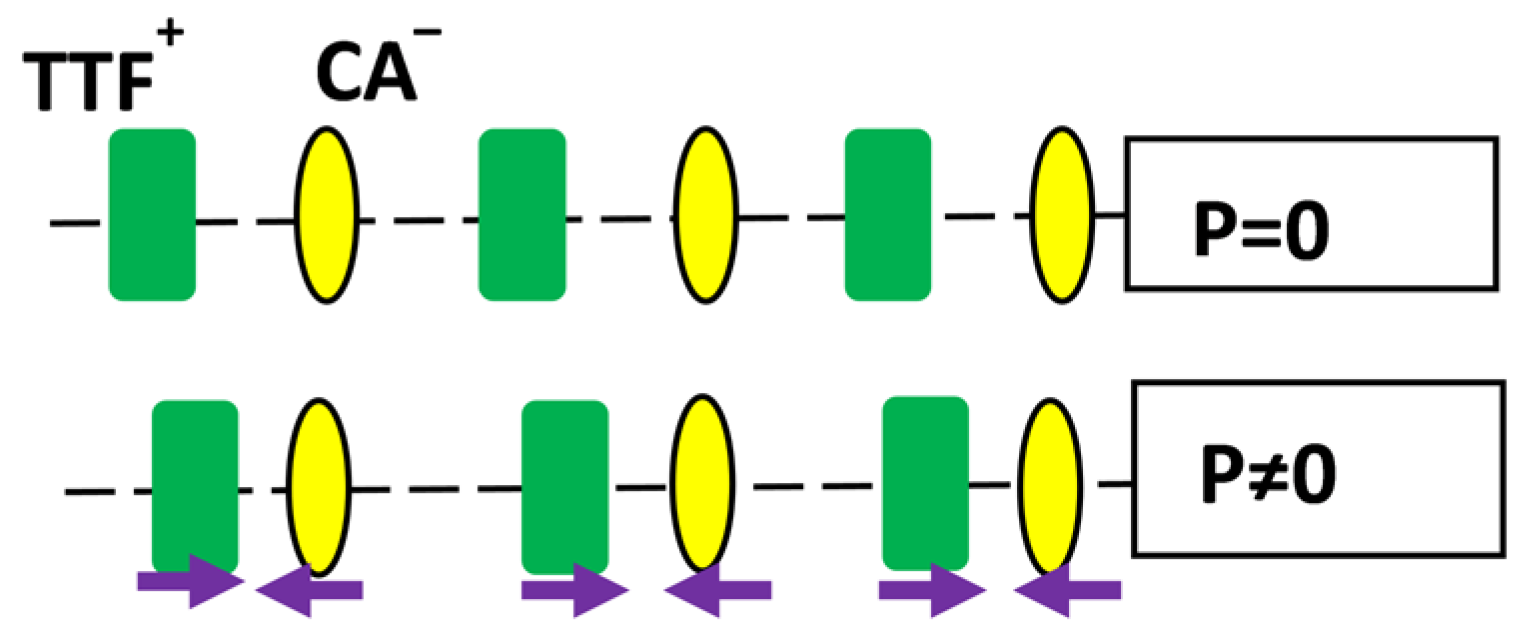
- Both sites’ and bonds’ dimerizations are spontaneous: this corresponds to the 1st order neutral–ionic transition in donor–acceptor stacks like TTF-CA, see [40]. Truly, the site’s non-equivalence is always present, but it is augmented by the spontaneous intermolecular charge transfer.
3. Particular Realizations of the Electronic Ferroelectricity in Quasi-One-Dimensional Systems
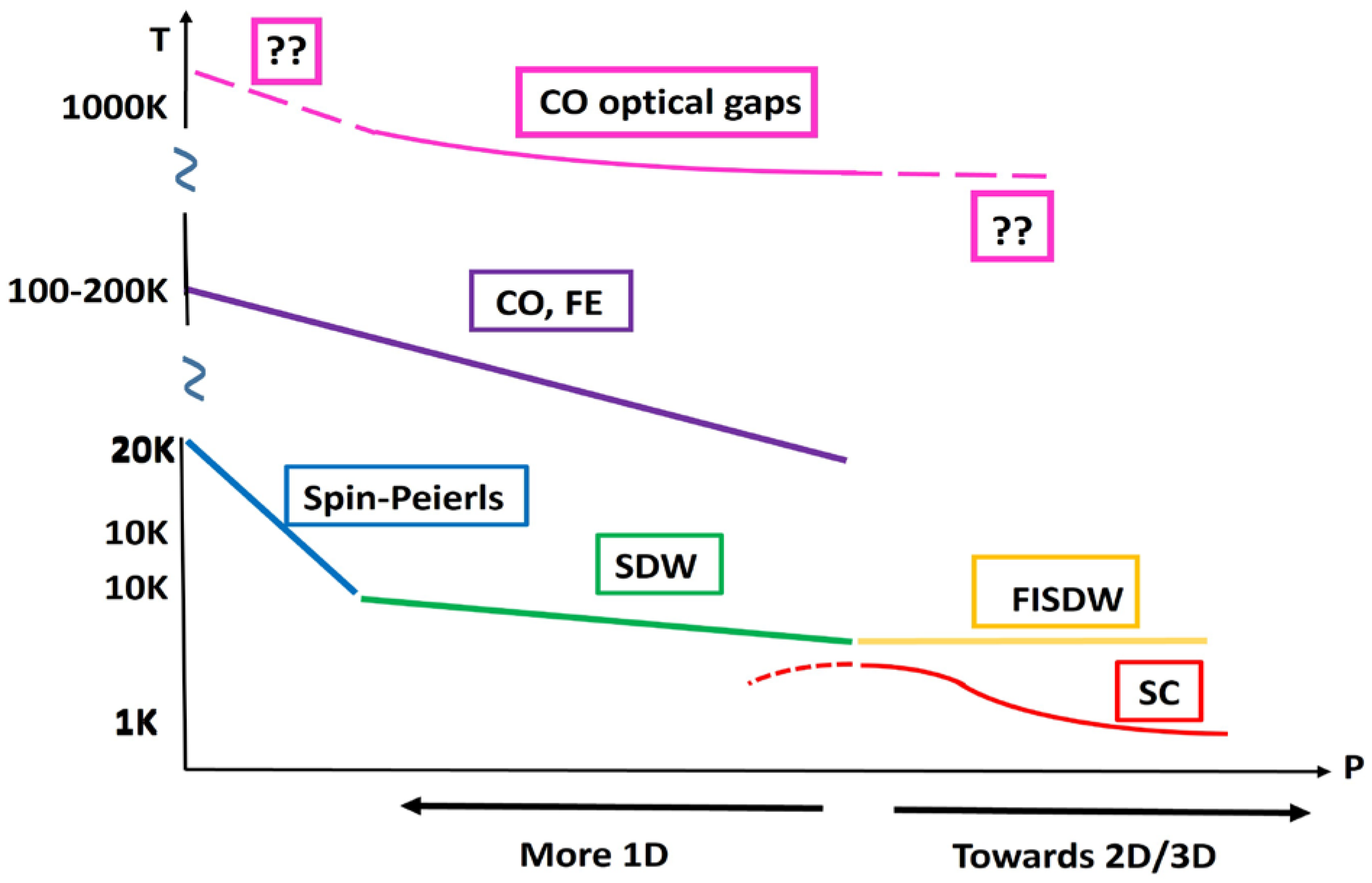
3.1. The Electronic Ferroelectricity in the Context of Studies of Organic Superconductors
3.2. Ferroelectricity in Bi-Molecular Donor–Acceptor Chains
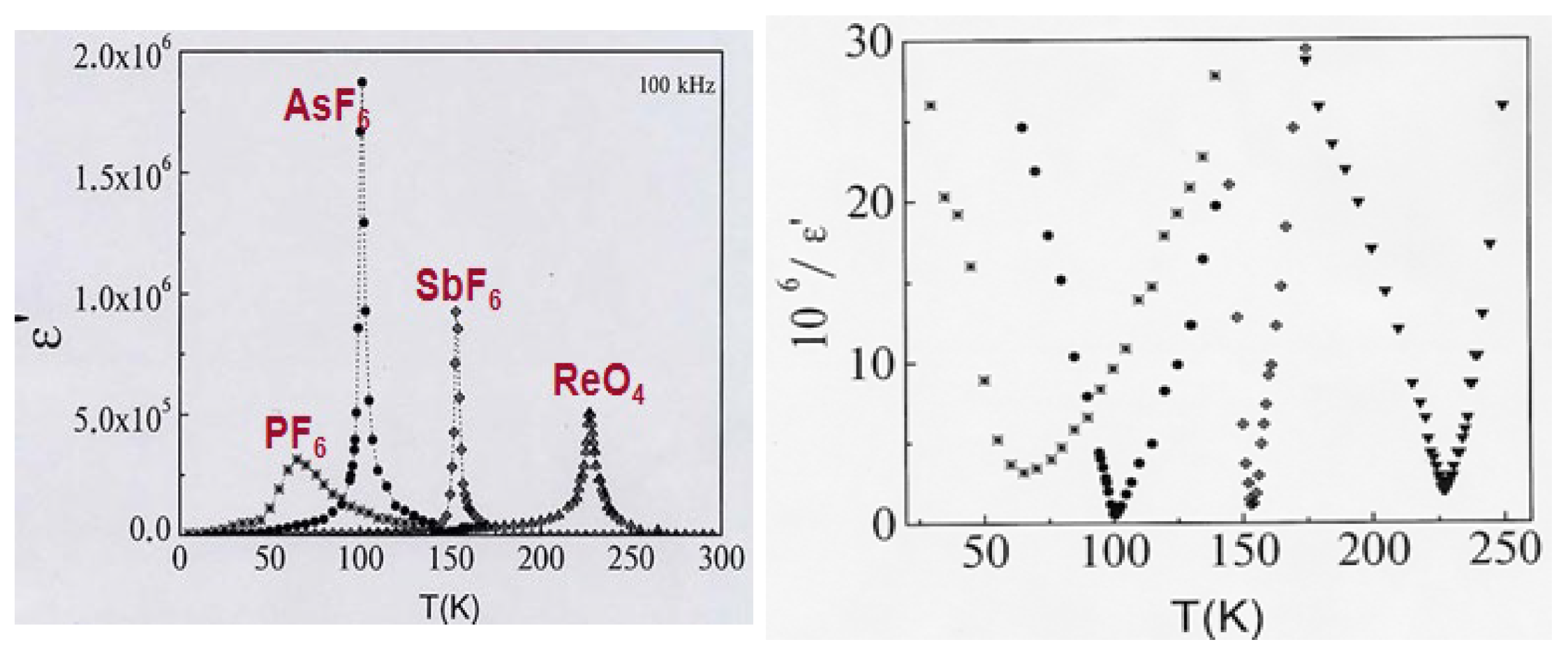
- Ferroelectricity was evidenced by a sharp peak anomaly in the temperature dependence of permittivity [35] and later confirmed by a well-defined hysteresis loop in the polarization curve [40]. The remarkable X-ray diffraction studies [40] in the polar state have shown that the electronic component of the polarization is 20 times (!) higher than the ionic one. Moreover, the electronic and the ionic polarizations point in opposite directions!
3.3. Predicting the Electronic Ferroelectricity in Conjugated Polymers
4. Summary: Interdisciplinary Bridges Through Decades
Author Contributions
Funding
Conflicts of Interest
References
- Available online: https://www.superstripes.net/conferences/superstripes-2025 (accessed on 15 April 2026).
- Kremer, R.; Bussmann-Holder, A.; Keller, H.K. Alex Müller: Science between ferroelectricity and superconductivity. Phys. C 2023, 611, 1354303. [Google Scholar] [CrossRef]
- Little, W.A. Possibility of synthesizing an organic superconductor. Phys. Rev. A 1964, 134, 1416. [Google Scholar] [CrossRef]
- Little, W.A. Superconductivity at Room Temperature. Sci. Am. Mag. 1965, 212, 21. [Google Scholar] [CrossRef]
- Lebed, A. (Ed.) The Physics of Organic Superconductors and Conductors; Springer Series in Materials Science; Springer: Berlin/Heidelberg, Germany, 2008; Volume 110. [Google Scholar]
- Jérome, D. Organic conductors: From charge density wave TTF-TCNQ to superconducting (TMTSF)2PF6. Chem. Rev. 2004, 104, 5565. [Google Scholar] [CrossRef]
- Jérome, D. Historical Approach to Organic Superconductivity. In The Physics of Organic Superconductors and Conductors; Springer: Berlin/Heidelberg, Germany, 2008; pp. 3–16. [Google Scholar] [CrossRef]
- Jérome, D.; Bourbonnais, C. Quasi one-dimensional organic conductors: From Fröhlich conductivity and Peierls insulating state to magnetically-mediated superconductivity, a retrospective. Comptes Rendus. Phys. 2024, 25, 17. [Google Scholar] [CrossRef]
- Jérome, D.; Mazaud, A.; Ribault, M.; Bechgaard, K. Superconductivity in a synthetic organic conductor (TMTSF)2PF6. J. Phys. Lett. 1980, 41, 95–98. [Google Scholar] [CrossRef]
- Kirova, N.; Brazovskii, S. Electronic ferroelectricity in carbon-based materials. Int. J. Synth. Met. 2016, 216, 11. [Google Scholar] [CrossRef]
- Heeger, A.J.; Kivelson, S.; Schrieffer, J.R.; Su, W.-P. Solitons in conducting polymers. Rev. Mod. Phys. 1988, 60, 781. [Google Scholar] [CrossRef]
- Ginzburg, V.L. On surface superconductivity. Phys. Lett. 1964, 13, 101. [Google Scholar] [CrossRef]
- Ginzburg, V.L. Concerning surface superconductivity. J. Exp. Theor. Phys. 1965, 20, 1549. [Google Scholar]
- Ginzburg, V.L. The problem of high temperature superconductivity. Contemp. Phys. 1968, 9, 355. [Google Scholar] [CrossRef]
- Gutfreund, H.; Little, W.A. The Prospects of excitonic superconductivity. In Highly Conducting One-Dimensional Solids; Devreese, J.T., Evrard, R.P., Doren, V.E., Eds.; Plenum: New York, NY, USA, 1979; pp. 305–372. [Google Scholar] [CrossRef]
- Little, W.A. Vitaly Ginzburg and High-Temperature Superconductivity. J. Supercond. 2006, 19, 443. [Google Scholar] [CrossRef]
- Monceau, P. From sliding charge density wave to charge ordering. In The Physics of Organic Superconductors and Conductors; Springer: Berlin/Heidelberg, Germany, 2008; Volume 3, pp. 17–24. [Google Scholar] [CrossRef]
- Ong, N.P.; Monceau, P. Anomalous transport properties of a linear chain metal: NbSe3. Phys. Rev. B 1977, 16, 3443. [Google Scholar] [CrossRef]
- Gruner, G. Density Waves in Solids, 1st ed.; CRC Press: Boca Raton, FL, USA, 2018. [Google Scholar] [CrossRef]
- Monceau, P. Electronic crystals: An experimental overview. Adv. Phys. 2012, 61, 325. [Google Scholar] [CrossRef]
- Bardeen, J.; Tucker, J.R. Charge-density waves in solids. In Lecture Notes in Physics; Hutirary, G., Soyom, J., Eds.; Springer: Berlin/Heidelberg, Germany; New York, NY, USA, 1985; Volume 217, pp. 155–169. [Google Scholar]
- Fröhlich, H. On the theory of superconductivity: The one-dimensional case. Proc. A 1954, 223, 296–305. [Google Scholar] [CrossRef]
- Pouget, J.-P. The Peierls instability and charge density wave in one-dimensional electronic conductors. Comptes Rendus. Phys. 2016, 17, 332. [Google Scholar] [CrossRef]
- Buravov, L.I.; Khidekel, M.L.; Shchegolev, I.F.; Yagubskii, E.B. Superconductivity and dielectric constant of highly conductive complexes of tetracyanoquinodiemethane (TCQM). JEPT Lett. 1970, 12, 90. [Google Scholar]
- Jerome, D. Common Trends in Synthetic Metals and High-Tc Superconductors: I.F. Shchegolev Memorial Volume. J. Phys. I 1996, 6. [Google Scholar]
- Bychkov, Y.A.; Gor’kov, L.P.; Dzyaloshinskii, I.E. Possibility of superconductivity-type phenomena in a one-dimensional system. Sov. Phys. JETP 1966, 23, 489. [Google Scholar]
- Matthias, B.T. Superconductivity versus ferroelectricity. Mat. Res. Bull. 1970, 5, 665. [Google Scholar] [CrossRef]
- Anderson, P.W.; Blount, E.I. Symmetry considerations on martensitic transformations: Ferroelectric metals? Phys. Rev. Lett. 1965, 14, 217. [Google Scholar] [CrossRef]
- Portengen, T.; Östreich, T.; Sham, L. Theory of electronic ferroelectricity. Phys. Rev. B 1997, 54, 17452. [Google Scholar] [CrossRef]
- Ikeda, N.; Ohsumi, H.; Ohwada, K.; Ishii; Inami, K.; Kakurai, T.; Murakami, K.; Yoshii, Y.; Mori, K.; Horibe, S.; et al. Ferroelectricity from iron valence ordering in the charge-frustrated system LuFe2O4. Nature 2005, 436, 1136. [Google Scholar] [CrossRef] [PubMed]
- Monceau, P.; Nad, F.Y.; Brazovskii, S. Ferroelectric Mott-Hubbard phase of organic (TMTTF)2X conductors. Phys. Rev. Lett. 2001, 86, 4080. [Google Scholar] [CrossRef] [PubMed]
- Chow, D.S.; Zamborszky, F.; Alavi, B.; Tantillo, D.J.; Baur, A.; Merlic, C.A.; Brown, S.E. Charge ordering in the TMTTF family of molecular conductors. Phys. Rev. Lett. 2000, 85, 1698. [Google Scholar] [CrossRef]
- Brazovskii, S.; Kirova, N. Excitons, polarons and bipolarons in conducting polymers. Sov. Phys. JETP Lett. 1981, 33, 4. [Google Scholar]
- Rice, M.J.; Mele, E.J. Elementary excitations of a linearly conjugated diatomic polymer. Phys. Rev. Lett. 1982, 49, 1455. [Google Scholar] [CrossRef]
- Okamoto, H.; Mitani, T.; Tokura, Y.; Koshihara, S.; Komatsu, T.; Iwasa, Y.; Koda, T.; Saito, G. Anomalous dielectric response in tetrathiafulvalene-p-chloranil as observed in temperature- and pressure-induced neutral-to-ionic phase transition. Phys. Rev. B 1991, 43, 8224. [Google Scholar] [CrossRef] [PubMed]
- Brazovskii, S. Ferroelectricity and charge ordering in quasi-1D organic conductors. In The Physics of Organic Superconductors and Conductors; Springer: Berlin/Heidelberg, Germany, 2008; Volume 3, pp. 313–356. [Google Scholar] [CrossRef]
- Monceau, P.; Lasjaunias, J.-C.; Biljakovic, K.; Nad, F. Energy and Dielectric Relaxations in Bechgaard–Fabre Salts. In The Physics of Organic Superconductors and Conductors; Springer: Berlin/Heidelberg, Germany, 2008; Volume 3, pp. 277–309. [Google Scholar] [CrossRef]
- Yamamoto, K.; Iwai, S.; Boyko, S.; Kashiwazaki, A.; Hiramatsu, F.; Okabe, C.; Nishi, N.; Yakushij, K. Strong optical nonlinearity and its ultrafast response associated with electron ferroelectricity in an organic conductor. J. Phys. Soc. Jpn. 2008, 77, 074709. [Google Scholar] [CrossRef]
- Yamamoto, K.; Kowalska, A.A.; Yakushi, K. Direct observation of ferroelectric domains created by Wigner crystallization of electrons. Appl. Phys. Lett. 2010, 96, 122901. [Google Scholar] [CrossRef]
- Kobayashi, K.; Horiuchi, S.; Kumai, R.; Kagawa, F.; Murakami, Y.; Tokura, Y. Electronic ferroelectricity in a molecular crystal with large polarization directing antiparallel to ionic displacement. Phys. Rev. Lett. 2012, 108, 237601. [Google Scholar] [CrossRef]
- Kagawa, F.; Horiuchi, S.; Tokunaga, M.; Fujioka, J.; Tokura, Y. Ferroelectricity in a one-dimensional organic quantum magnet. Nat. Phys. 2010, 6, 169. [Google Scholar] [CrossRef]
- Pouget, J.-P. Bond and charge ordering in low-dimensional organic conductors. Phys. B Condens. Matter 2012, 407, 762. [Google Scholar] [CrossRef]
- Pouget, J.P.; Ravy, S. Structural Aspects of the Bechgaard Salts and Related Compounds. J. Phys. I Fr. 1996, 6, 1501. [Google Scholar] [CrossRef]
- Pouget, J.-P. Structural aspects of the Bechgaard and Fabre salts: An Update. Crystals 2012, 2, 466. [Google Scholar] [CrossRef]
- Dressel, M.; Dumm, M.; Knoblauch, T.; Masino, M. Comprehensive optical investigations of charge order in organic chain compounds (TMTTF)2X. Crystals 2012, 2, 528. [Google Scholar] [CrossRef]
- Kang, N.; Salameh, B.; Auban-Senzier, P.; J’erome, D.; Pasquier, C.R.; Brazovskii, S. Domain walls at the spin density wave endpoint of the organic superconductor (TMTSF)2PF6 under pressure. Phys. Rev. B 2010, 81, 100509. [Google Scholar] [CrossRef]
- Brazovskii, S.; Monceau, P.; Nad, F.Y. Critical dynamics and domain motion from permittivity of the electronic ferroelectric (TMTTF)2AsF6. Phys. B 2015, 460, 79. [Google Scholar] [CrossRef]
- Gontia, I.; Frolov, S.V.; Liess, M.; Ehrenfreund, E.; Vardeny, Z.V.; Tada, K.; Kajii, H.; Hidayat, R.; Fujii, A.; Yoshino, K.; et al. Excitation dynamics in disubstituted polyacetylene. Phys. Rev. Lett. 1999, 82, 194058. [Google Scholar] [CrossRef]
- Bussmann-Holder, A.; Keller, H.K. Alex Müller and his important role in ferroelectricity. Ferroelectrics 2023, 613, 4–11. [Google Scholar] [CrossRef]
- Huang, Y.M.; Zhou, F.; Xu, K. Low-temperature lasing action in a metal-backed monosubstituted polyacetylene. Appl. Phys. Lett. 2006, 88, 131112. [Google Scholar] [CrossRef]
- Takahashi, K.; Gabay, M.; Jaccard, D.; Shibuya, K.; Ohnishi, T.; Lippmaa, M.; Triscone, J.-M. Local switching of two-dimensional superconductivity using the ferroelectric field effect. Nature 2006, 441, 195. [Google Scholar] [CrossRef]
- Bégon-Lours, L.; Rouco, V.; Sander, A.; Trastoy, J.; Bernard, R.; Jacquet, E.; Bouzehouane, K.; Fusil, S.; Garcia, V.; Barthélémy, A.; et al. High-temperature superconducting weak link defined by the ferroelectric field effect. Phys. Rev. Appl. 2017, 7, 0640. [Google Scholar] [CrossRef]
- Logvenov, G.; Bonmassar, N.; Christiani, G.; Campi, G.; Valletta, A.; Bianconi, A. The superconducting dome in artificial high-Tc superlattices tuned at the Fano–Feshbach resonance by quantum design. Condens. Matter 2023, 8, 78. [Google Scholar] [CrossRef]
- Bussmann-Holder, A.; Haase, J.; Keller, H.; Kremer, R.K.; Mukhin, S.I.; Menushenkov, A.P.; Ivanov, A.; Kuznetsov, A.; Velasco, V.; Conradson, S.D.; et al. Nanoscale Lattice Heterostructure in High-Tc Superconductors. Condens. Matter 2025, 10, 56. [Google Scholar] [CrossRef]
- Brazovskii, S. Solitons and Their Arrays: From Quasi 1D Conductors to Stripes. J. Supercond. Nov. Magn. 2007, 20, 489. [Google Scholar] [CrossRef]
- Brazovskii, S. Solitons: From Charge Density Waves to FFLO in Superconductors. Phys. B 2009, 404, 482–486. [Google Scholar] [CrossRef]
- Tranquada, J.M. La2−xBaxCuO4 as a superconducting Rosetta Stone. Phys. C Supercond. Its Appl. 2023, 614, 1354371. [Google Scholar] [CrossRef]
- Hayden, S.M.; Tranquada, J.M. Charge Correlations in Cuprate Superconductors. Annu. Rev. Condens. Matter Phys. 2024, 15, 215–235. [Google Scholar] [CrossRef]
- Devereaux, T.P.; Kivelson, S.A. The significance of “stripes” in the physics of the cuprates, the Hubbard model, and other highly correlated electronic systems. Phys. C Supercond. Its Appl. 2025, 2025, 1354683. [Google Scholar] [CrossRef]
- Kumbhakar, S.; Esposito, M.; Kumar, A.; Confalone, T.; Feng, F.; Alam, R.; Lo Sardo, F.; Masarotti, D.; Tafuri, F.; Böhm, T.; et al. Dynamics of Charge-Density-Wave puddles in 2H-NbSe2. arXiv 2026, arXiv:2603.03980. [Google Scholar]
- Gabovich, A.M.; Voitenko, A.I.; Ekino, T.; Li, M.S.; Szymczak, H.; Pekała, M. Competition of Superconductivity and Charge Density Waves in Cuprates: Recent Evidence and Interpretation. Adv. Condens. Matter Phys. 2010, 2010, 681070. [Google Scholar] [CrossRef]
- Nagaev, E. Phase separation in high-temperature superconductors and related magnetic systems. Phys.-Uspekhi 2007, 38, 497. [Google Scholar] [CrossRef]
- Tosatti, E.; Fazekas, P. On the nature of the low-temperature phase of 1T-TaS2. Le J. Phys. Colloq. 1976, 37, C4-165–C4-168. [Google Scholar] [CrossRef]
- Mihailovic, D. Insights into the polaron physics of high temperature superconductors from optical and time-domain spectroscopy. Phys. C 2023, 615, 1354385. [Google Scholar] [CrossRef]
- Mraz, A.; Gerasimenko, Y.A.; Karpov, P.; Vaskivskyi, I.; Brazovskii, S.; Mihailovic, D. Intertwined chiral charge orders and topological stabilization of the light-induced state of a prototypical transition metal dichalcogenide. npj Quantum Mater. 2019, 4, 32. [Google Scholar] [CrossRef]
- Kusmartsev, F.V.; Di Castro, D.; Bianconi, G.; Bianconi, A. Transformation of strings into an inhomogeneous phase of stripes and itinerant carriers. Phys. Lett. A 2000, 275, 118–123. [Google Scholar] [CrossRef]
- Brazovskii, S.; Yakovenko, V. On the superconductivity at the surface of a contact of insulating La2CuO4. JETP Lett. 1988, 48, 171. [Google Scholar]
- Brazovskii, S.; Kirova, N.; Yakovenko, V. On the possible superfluidity of bipolarons at the junction surface. Solid State Commun. 1985, 55, 187. [Google Scholar] [CrossRef]
- Leng, X.; Garcia-Barriocanal, J.; Kinney, J.; Yang, B.; Lee, Y.; Goldman, A.M. Electrostatic tuning of the electrical properties of YBa2Cu3O7−x using an ionic liquid. Eur. Phys. J. Spec. Top. 2013, 222, 1203–1215. [Google Scholar] [CrossRef]


Disclaimer/Publisher’s Note: The statements, opinions and data contained in all publications are solely those of the individual author(s) and contributor(s) and not of MDPI and/or the editor(s). MDPI and/or the editor(s) disclaim responsibility for any injury to people or property resulting from any ideas, methods, instructions or products referred to in the content. |
© 2026 by the authors. Licensee MDPI, Basel, Switzerland. This article is an open access article distributed under the terms and conditions of the Creative Commons Attribution (CC BY) license.
Share and Cite
Brazovskii, S.; Kirova, N. Lasting Aftermaths of the First Incitement for High-Temperature Superconductivity. Condens. Matter 2026, 11, 15. https://doi.org/10.3390/condmat11020015
Brazovskii S, Kirova N. Lasting Aftermaths of the First Incitement for High-Temperature Superconductivity. Condensed Matter. 2026; 11(2):15. https://doi.org/10.3390/condmat11020015
Chicago/Turabian StyleBrazovskii, Serguei, and Natasha Kirova. 2026. "Lasting Aftermaths of the First Incitement for High-Temperature Superconductivity" Condensed Matter 11, no. 2: 15. https://doi.org/10.3390/condmat11020015
APA StyleBrazovskii, S., & Kirova, N. (2026). Lasting Aftermaths of the First Incitement for High-Temperature Superconductivity. Condensed Matter, 11(2), 15. https://doi.org/10.3390/condmat11020015