Opinion

Lasting Aftermaths of the First Incitement for High-Temperature Superconductivity

by
Serguei Brazovskii
1 and
Natasha Kirova
2,3,*
1
CNRS, Laboratoire de Physique Théorique et Modèles Statistiques, Bâtiment Pascal n° 530 Rue André Rivière, University Paris-Saclay, 91405 Orsay, France
2
CNRS, Laboratoire de Physique des Solides, 1 Rue Nicolas Appert, Bât. 510, University Paris-Saclay, 91405 Orsay, France
3
Russian Quantum Center, 143025 Skolkovo, Russia
*
Author to whom correspondence should be addressed.
Condens. Matter 2026, 11(2), 15; https://doi.org/10.3390/condmat11020015
Submission received: 4 March 2026 / Revised: 12 April 2026 / Accepted: 22 April 2026 / Published: 27 April 2026
(This article belongs to the Special Issue Superstripes Physics, 4th Edition)

Abstract

Six decades ago, the scientist from Stanford University, W.P. Little, announced a crusade to search for superconductivity, assumed to be heat-resistant in organic materials. Although such an ambitious goal was never realized in practice, this proposal gave rise to the entire ecosystem of studies on “synthetic metals,” creating a diverse community of material, experimental, and theoretical activities in low-dimensional electronic systems. We shall briefly review some key steps in this history, examine its main branches, and recall the consequences that remain on the agenda today. Particularly, we shall focus on a phenomenon of electronic ferroelectricity, whose roots can be found in the suggestion of a would-be superconducting polymer.

1. The History

1.1. The Related Anniversaries

This article follows the presentation given at the recent conference [1] on “superstripes”, a serial event organized since 1996 by Prof. Bianconi and his colleagues, which now serves as a forum for studies of high-temperature superconductivity and related topics. This year, 2026, the STRIPES community will celebrate the four-decade anniversary of the discovery of a new class of superconductors, which has ushered in the epoch of real high-temperature superconductivity; see a retrospective in [2]. But already in the recent year 2024, the elderly could also honor the six decades since the first crusade was announced [3,4] in search of superconductivity, assumed to be heat-resistant, in “organic conductors” (see the collection of reviews [5] for this notion). It took 15 years of “fishing in the dark” (see the retrospective reviews [6,7,8]) to find the very first organic superconductor [9], whose Tc1K was not impressive, but the richness of physics was unprecedented and may still not be surpassed [5]. Beyond this direct achievement, the entire ecosystem of experimental and theoretical physics of one- and two-dimensional (1D and 2D) electronic systems was established. A mass of new types of materials has been synthesized, belonging to several classes such as organic molecular stacks, conjugated polymers, and inorganic chain- and layered systems. New phenomena included charge/spin density waves and their sliding; Wigner and polaronic crystals; Peierls, Mott, Hubbard, and excitonic insulators; electronic ferroelectricity; the physics of solitons; a fireworks display of phases in high magnetic fields; etc.
This article will offer brief memoirs summarizing the main steps, achievements, and stimulations that can be traced to the present day. Some focused attention will be given to a phenomenon of the electronic ferroelectricity [10], whose roots can be found already in the suggestion [3,4] for a would-be superconductor.

1.2. Search in the Darkness

“In the beginning was the Word, … and without him was not anything made that was made.”
The suggestion for a possibility of reaching the superconductivity at room temperature was misleadingly instructive: “It has not yet been achieved, but … it is possible to synthesize organic materials that … conduct electricity without resistance”. Several Little drawings [3,4] were all based on the principal scheme shown in Figure 1. A conjugated polymer: the polyene backbone with highly polarizable mono-valent ligands—the radicals R. The expected transition temperature to the superconducting state Tc~Eexexp(−1/λ), where λ is the coupling of electrons via the ligands’ excitations, was assumed to be high because of the very high frequency of intra-molecular excitons Eex~104 K. At that time, doping some polymers (see a review [11] and recall the 2000 Nobel prize “for the discovery and development of conductive polymers”) had not yet been achieved or even imagined: all known polymers were strong insulators. Nevertheless, W.P. Little was courageous to say that the superconducting gap will be even higher, thus overcoming the bare insulating gap.
Very soon, V.L. Ginzburg realized [12,13] that the excitonic mechanism [14,15] of superconductivity is not bound to polymeric chains, and he suggested a sandwich design of space-separated exciton-mediating and conducting layers (the relations of the two scientists, resembling by their creative fantasies, were enlightened in the memoirs [16]). This idea promptly gave rise to studies of layered quasi-two-dimensional materials, bringing to life intercalated graphite (the graphene of our days!) and MX2 layered compounds (TaS2, etc.), which are again in strong focus recently. A “mistaken” synthesis of MX3 (NbSe3, etc.) compounds, see a review [17], in which basic elements were the chains rather than planes as in MX2, has brought the unforeseen phenomenon of sliding charge density waves [18], later accompanied by sliding spin density waves (see reviews [19,20]). John Bardeen [21] devoted great enthusiasm in his later years to understanding collective sliding as a realization of Fröhlich’s suggestion [22] for the mechanism of superconductivity (incorrect as such, but prophetic as the undervalued prediction of a sliding charge density wave).
During the first decade, there were only a few groups around the world addicted to the idea of organic superconductivity, or at least of metallic conductivity. A way around the insulating ground state was found by shifting from chains to separate stacks of donor and acceptor organic molecules, which provide the conditions necessary for conductivity: charge transfer that leads to partial band filling. The way of disappointments and successes passed through the stabilization of a metallic state, at room temperature at least, just to find a new obstacle of dielectrization at low temperatures. That was the first appearance of charge density waves as the overwhelming enemies of superconductivity. They were observed in X-rays as the 2KF anomalies or the surprising 4KF anomalies, which were later understood as precursors to Wigner crystallization; see the review [23]. The discovered huge dielectric permittivity [24], only later attributed to the collective response of charge density waves, has provoked a comment by Petr Kapitza: “hunting for a superconductivity, you have faced a super-dielectric”.
In the long run, this pioneering movement led to the discovery of the first, while at low temperature, organic superconductor [9]. Rather than being enhanced, superconductivity was shown to be adaptive to less likely environments, as it was repeated later with cuprates, fullerenes, etc. There are several retrospective reviews that describe this dramatic history in detail [6,7,8], as well as a collection of review articles [5,25].
Altogether, in search of high-Tc superconductivity, scientists created several classes of new synthetic materials showing a plethora of new phenomena: conductors, superconductors, magnets, optically and electronically active polymers, ferroelectrics, Peierls and Mott insulators, Fröhlich conductors, Wigner crystals, Charge and Spin density waves, etc. There was a fast reaction to the little crusade in theory. Interestingly, it provoked the very first publication from the newly born Landau Institute [26]. An immense field of theory of quasi-one-dimensional interacting systems has emerged.

2. The Electronic Ferroelectricity

2.1. The Origins

“It has become evident during the last few years that ferroelectricity and superconductivity are mutually exclusive” [27].
Was “organic superconductivity” the only promised land? Not quite: some of the prophet’s visions actually implied a spontaneous electric polarization, hence would be ferroelectrics. Some drawings (Figure 3 in [3] or the figure on p. 26 of [4]), whose schemes are shown in our Figure 1, depict a hypothetical material that fails as a superconductor but can be a ferroelectric, even a new kind of electronic ferroelectric (by curious coincidence, the same year, an article was published on a hidden ferroelectricity in a polar metal [28]).
In general, there are three forms of ferroelectricity; the most well-known are the conventional dipoles’ ordering type and the ions’ displacive type. Here, we are concerned with the rare case of electronic ferroelectrics in which the dominant electric polarization arises from the electronic rather than the ionic subsystem.
The nickname was born as a theoretical speculation [29] that “an alternative model —electronic ferroelectricity—has been proposed in which the electric dipole depends on electron correlations, rather than the covalency”. The first de facto observation was reported in [30], claiming the “experimental evidence for ferroelectricity arising from electron correlations in … LuFe2O4. The polar ordering arises from the repulsive property of electrons—electron correlations—acting on a frustrated geometry”. Soon after, independently, the ferroelectric phase [31] based on hidden charge ordering [32] was reported for organic (TMTTF)2X conductors, a sister family of organic superconductors (TMTSF)2X.
In retrospect, the ferroelectricity could have been noticed, but was missed, in the theory of “the combined Peierls effect” suggested for conjugated polymers ([33], and then baptized in [34] as (AB)x polymer. The relevant studies of donor–acceptor chain compounds, which began in [35], later provided direct evidence for electronic ferroelectricity. The details of these stories can be found in a review [10]; below, we shall present the principal theses.

2.2. Symmetry-Defined Ways to Build the Electronic Ferroelectrics

Discoveries of electronic ferroelectricity in quasi-one-dimensional conducting organic stacks of (TMTTF)2X [31], see reviews [36,37], and then in layered BEDT-based compounds [38,39], and in donor–acceptor chains like TTF-CA, see [40], have brought to life a new mechanism of the predominantly electronic origin. The phase transition can be driven by electronic correlations, as in organic crystals, by electron–phonon interactions, as in conducting polymers, or by both effects together, as in donor–acceptor chains.
For electronic ferroelectricity, there is a secure design approach based on symmetry-defined effects that has not yet appeared in the earliest suggestions [29,30]. To achieve the ferroelectric state in a crystal, the inversion symmetry has to be lifted, but the double degeneracy of the ground state must be kept; otherwise, the state will be a non-switchable pyroelectric. Consider a chain with double dimerization at both sites and bonds, as shown in Figure 2. The dimerization of sites means the alternation of potentials upon them, or of constituent molecules, or of attached ligands, as in Figure 1. The joint alternation of sites and bonds removes the mirror symmetries; the inversion symmetry is broken, giving rise to the electric polarization.
If both dimerizations are built in, then the material is pyroelectric, and the polarization is frozen. To achieve ferroelectricity with its switchable direction of polarization, at least one of these effects should come as a spontaneous symmetry breaking, i.e., any one of the dimerizations should be produced by a phase transition. These are the following options:
  • Dimerization of bonds is built in; dimerization of sites is spontaneous as it happens in organic conductors (TMTTF)2X. The dimerizing charge ordering is endorsed by the energy gain from the fall of the originally metallic state to the Mott insulator state [31,36].
  • Dimerization of sites is built in; dimerization of bonds is spontaneous: depending on interactions, there are two possibilities:
    2a. Under electron–lattice interactions, the Peierls dimerization should take place: that was a proposal for conjugated polymers of the (AB)x type, expected nowadays to be seen in substituted polyacetylenes, whose scheme is shown in Figure 1.
    2b. For a quasi-one-dimensional chain of alternating spin-carrying molecules, the spontaneous dimerization of bonds appears as the so-called spin-Peierls transition [41] of binding spins into singlets.
  • Both sites’ and bonds’ dimerizations are spontaneous: this corresponds to the 1st order neutral–ionic transition in donor–acceptor stacks like TTF-CA, see [40]. Truly, the site’s non-equivalence is always present, but it is augmented by the spontaneous intermolecular charge transfer.
While the design is symmetrically defined, there is a quantitative constraint for its realization. Recall [10,33] the joint effect of the built-in (extrinsic ∆e) and spontaneous (intrinsic ∆i) contributions to the total dimerization gap 2: Δ = Δ e 2 + Δ i 2 . Here, e.g., e comes from the built-in dimerization of sites, while i comes from the spontaneous dimerization of bonds, the Peierls effect, or vice versa for the Mott–Hubbard effect. Appearance of i is a threshold effect: i will not be spontaneously generated if e already exceeds the targeted optimal Peierls or Hubbard gap 0.
Below, we shall expand a bit on these specific cases. More cases and more detailed speculations on “electronic ferroelectricity in carbon materials” can be found in the review [10].

3. Particular Realizations of the Electronic Ferroelectricity in Quasi-One-Dimensional Systems

3.1. The Electronic Ferroelectricity in the Context of Studies of Organic Superconductors

The discovery of the first organic superconductors also gave rise to several directions that none could have predicted in advance. The most well-known finding is the cascade of the field-induced spin density waves, which followed almost immediately. But the second route, charge disproportionation or ordering, and particularly its striking form of ferroelectricity, was waiting for two decades. Finally, it came to correct the almost reached consensus on the phase diagram and to revise some popular views on the role of electronic correlations.
Actually, there were more than enough warnings over the decades. In the dawn epoch, the structural 4KF anomaly can be viewed, in retrospect, as a precursor to Wigner crystallization and, later, to charge ordering (see the history in [42]). The known but ignored “structureless transitions” have been waiting for revenge since the mid-80s, and just these transitions are of a ferroelectric nature.
Ferroelectricity in carbon-based materials was first discovered [31] in quasi-1D organic conductors M X, where M denotes stacks-forming molecules such as TMTTF or its sister TMTSF. X = AsF6, SbF6, PF6, ReO4 are the counter-ions, whose columns intercalate the molecular stacks, providing the charge transfer, making these stacks conductive (see the reviews [43,44]). Soon, the observation was extended to layered compounds (see [39] and refs. therein), where direct experimental evidence of a ferroelectric state was provided by local measurements of second-harmonic generation [38,39]. In all cases, the ferroelectric subfamily exhibits neighboring superconducting and magnetically ordered phases at much lower temperatures.
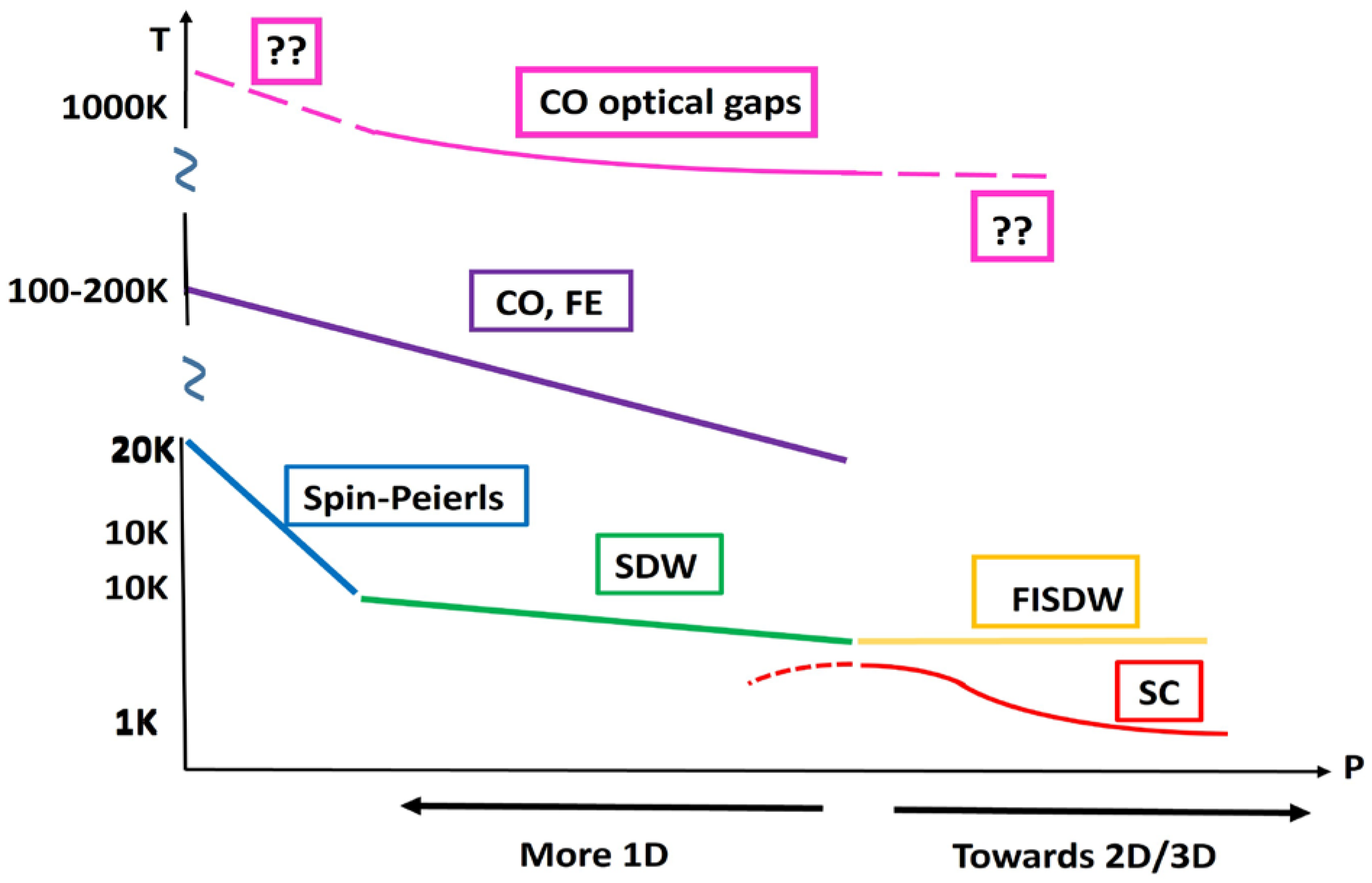
A very rough scheme of the rich phase diagram is drawn in Figure 3. Many detailed and colorful versions can be found in the literature, commonly neglecting ferroelectricity, e.g., [6,7,8,45]. There is a consensus, but we disagree on the interpretation of the high-temperature region.
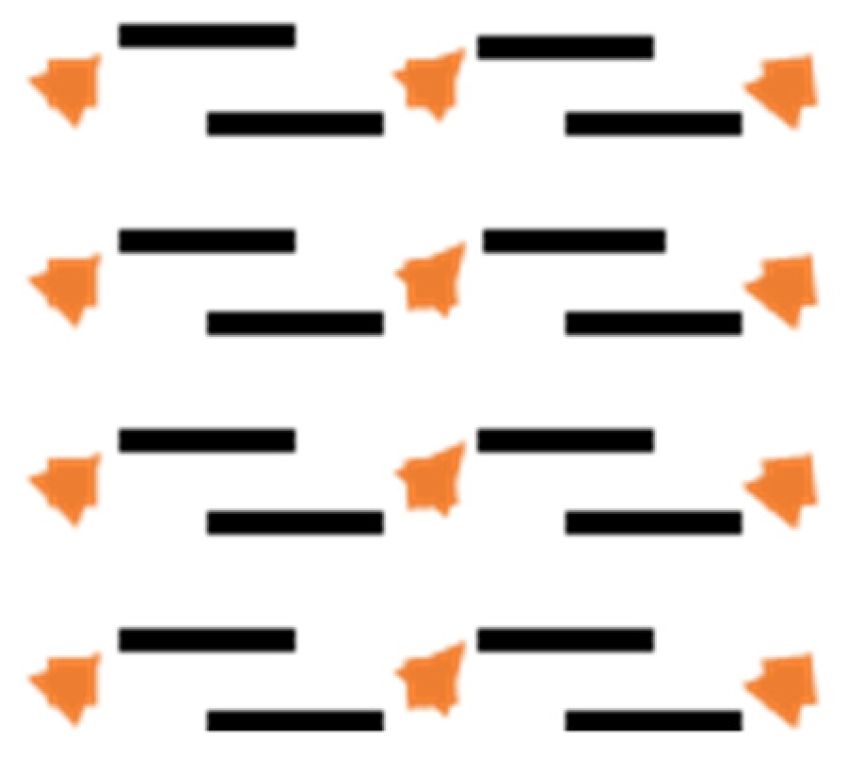
The TMTTF or TMTSF molecules form the stacks intercalated by columns of counter-ions X, which are placed against every second pair of molecules, as shown in Figure 4. The impact of columns on stacks induces a small built-in dimerization of intermolecular bonds, while leaving the molecules equivalent. Below the transition, there is a spontaneous symmetry breaking of the charge ordering visualized by partially compensating displacements of counter-ions (indicated by arrows in Figure 4) [42,43,44]. The spontaneous dimerization of sites was confirmed by the splitting of the NMR line [32] and, subsequently, of the molecular vibrations; see [45] for a review of the optical properties of ferroelectric organic compounds. Altogether, the dimerizations open a small midband gap, thus raising the effective band filling from ¼ to ½. This particular number brings to life the Mott–Hubbard phenomenon, which may open a gap in the charge channel, leading to a narrow-gap correlated insulator with still gapless spin degrees of freedom. The driving energy gain is the Wigner–Mott–Hubbard charge localization. Formula M2X implies 1 electron per 2 molecules, hence the expectation of a ¼-filled metallic band. By charge ordering, the system undergoes self-dimerization to reach ½ filling, thereby gaining the Mott-state energy.
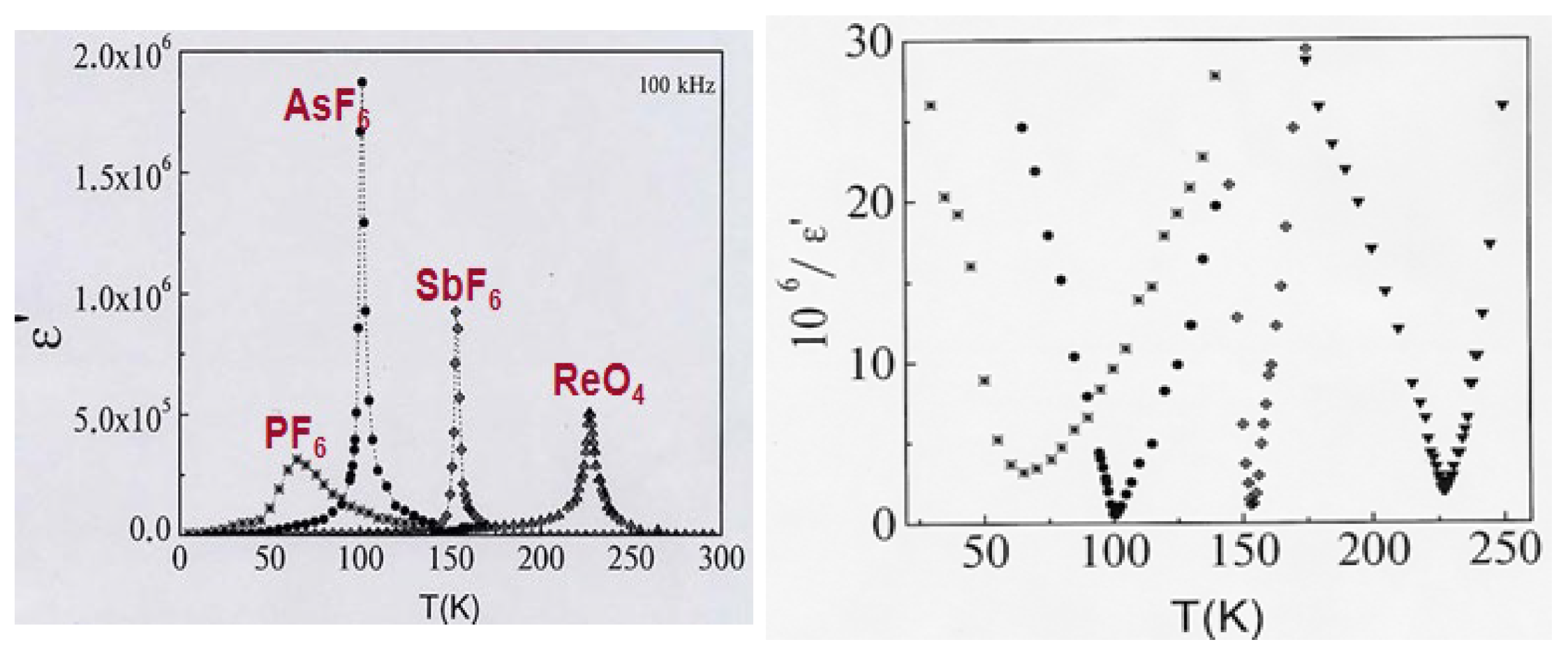
Altogether, this coexistence of the two types of dimerization lifts the mirror and glide symmetries, hence giving rise to ferroelectricity. Near the phase transition temperature (the highest is TFE ≈ 150 K), the dielectric permittivity reaches a gigantic value ε∼106 [31], and even well below TFE, it is as high as ε∼103, see Figure 5, left. Notice the genuine second-order phase transition for all four materials, as confirmed by the perfect Curie law, Figure 4, right, which is not common for conventional ferroelectrics with their tendency to show a weakly first-order transition.
Contrary to traditional ionic ferroelectrics and even other organic ones, the new state keeps a noticeable conductivity and preserves free-spin paramagnetism, giving rise to a “ferroelectric narrow gap Mott semiconductor”, see [36] for a review. The free carriers, which are, curiously, the charge-carrying spinless solitons, screen the surface polarization, preventing the formation of the domain structure, thus allowing a rare monodomain state and leading to fast re-polarization [47] and a huge response.
The ferroelectricity discovered in organic conductors, beyond its intrinsic merits, is a high-precision tool for diagnosing the onset of charge-disproportionation ordering [48]. The wide range of the ferroelectric anomaly (TFE ± 30 K) tells that its development dominates the whole region below and even above these already high temperatures. Even higher are the conduction gaps, up to 2000 K—see Figure 3, forming at lower T (while spin gaps are absent or an order of magnitude lower!). Remember also the ever-present 4KF fluctuations in organic stack metals. All that appears at the “Grand Unification” scale, which knows no differences with respect to interchain couplings, ion orderings, ferro- and antiferroelectric types, or between subfamilies TMTSF and TMTTF lying on different slopes of the superconductivity—Mott insulator divide (see the scheme of Figure 3). Hence, the formation of the Electronic Crystal (however we call it: disproportionation, ordering, localization, or Wigner crystallization of charges; 4KF density wave; etc.) must be the starting point to consider lower phases and the frame for their properties.
The major remaining enigma is the persistence of the charge order and ferroelectricity into the metallic, and even superconducting, state of the phase diagram, as indicated in Figure 3, which is indirectly evidenced by the associated optical gaps. The remarkable richness of the state is augmented by the workshop for solitons—three of their different types can be identified: spinless phase solitons in conductivity, fractionally charged polarization solitons, spin-charge confined solitons [10,36].

3.2. Ferroelectricity in Bi-Molecular Donor–Acceptor Chains

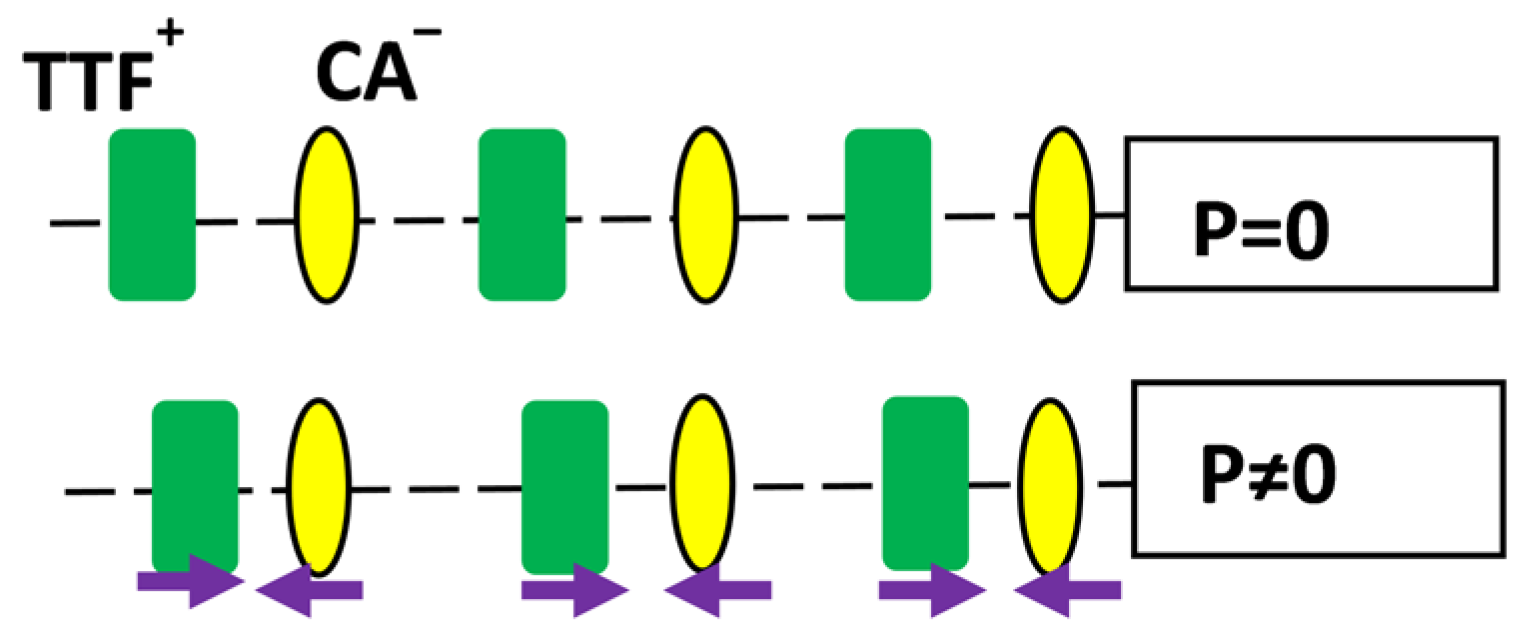
Bimolecular mixed-stack organic crystals like the TTF-CA consist of stacks of alternating donors like D = TTF and acceptors like A = CA, as shown in Figure 6. The ferroelectricity appears as a result of the neutral–ionic transition, which brings to life, or at least sharply increases, both types of dimerizations. Namely, the charged molecules shift, forming alternating dimers, which can be a consequence of a hidden spin-Peierls instability. As all inversion and mirror symmetries become lifted, this state must be ferroelectric.
  • Ferroelectricity was evidenced by a sharp peak anomaly in the temperature dependence of permittivity [35] and later confirmed by a well-defined hysteresis loop in the polarization curve [40]. The remarkable X-ray diffraction studies [40] in the polar state have shown that the electronic component of the polarization is 20 times (!) higher than the ionic one. Moreover, the electronic and the ionic polarizations point in opposite directions!

3.3. Predicting the Electronic Ferroelectricity in Conjugated Polymers

The ferroelectricity in conjugated polymers can be of the electronic origin, i.e., appearing thanks to primary redistribution of π-electronic density rather than to displacement of ligands, which also happens, e.g., in ferroelectric liquid crystals. It is natural to search for the necessary materials within the general class of functionalized polyacetylenes of Figure 1. By now, several laboratories have worked with these materials, which possess interesting optical properties; the LED [48] and even the lasing [49,50] effects have been achieved, but no attempts have yet been made to test for ferroelectricity. Fortunately, the observations on the physics of solitons [48] indicate the necessary conditions for spontaneous dimerization, hence the electronic ferroelectricity. Recall [33,34], see also [39] and the review [36], that the ferroelectric state brings to life the solitons with noninteger variable charges, both with and without spin, which are the walls separating domains with opposite electric polarization. The original method for measuring the optical spectrum under ESR pumping [48] has indeed provided evidence of the electric charge associated with spin-carrying solitons, which signals hidden ferroelectricity.

4. Summary: Interdisciplinary Bridges Through Decades

Half-century stories spanning the 1960s to our day demonstrate breakthroughs inspired by, misleading sometimes, unlimited imagination. That may concern the protagonists, such as magnetic semiconductors and nearly antiferromagnetic superconductors, or the antagonists, such as ferroelectricity from charge ordering and superconductivity, a would-be superconducting polymer, and polymeric semiconductors in reality.
Recall first of all that the conventional ferroelectricity of oxides was a guiding filament for Karl Müller on the way to discovering the true high-temperature superconductivity [49]. Later, the MBE technique enabled the clever co-epitaxy of a ferroelectric oxide and a high-Tc cuprate superconductor, allowing precise control of electrostatic doping and bringing the superconducting valve design to life [51,52]. Recent progress in the nano-fabrication of a tunable high-Tc superconductor has further elucidated the role of internal electric fields [53].
We cannot pass by a provocative correspondence between the phase diagram of the T* line on top of the superconducting dome in high-Tc cuprates and the line of ferroelectric transitions in organic conductors, which lie well above the line of more conventional transitions to superconducting or density-wave states. While the ferroelectric line was ignored, the state above the low-temperature transitions was interpreted as an anomalous, non-Fermi metal, in analogy with an earlier common interpretation of the T* region in cuprates. The discovery of ferroelectricity and the underlying spontaneous charge ordering has shown that the anomalous metal was actually a narrow-gap, self-tuned Mott–Hubbard insulator, from which the low-temperature phases subsequently emerged by ordering the still-dangling spin degrees of freedom. Can it happen that the T* line in cuprate superconductors indicates a true phase transition? Or at least some symmetry breaking is hidden in the fluctuation regime at nanoscales [54].
Indeed, the most common issue is the spontaneous generation of inhomogeneous electronic states. They can be coherent and periodic, as CDWs and SDWs, or stripes in some circumstances (see the short review and references on quasi-1D compounds in [55,56] and, for cuprates, recent reviews [57,58,59]. They can also be local and fluctuating, as rarely in synthetic metals, always in relation to Wigner crystallization, for which charge ordering is almost a synonym: the 4KF anomalies in organic conductors [23] or in polaronic ensembles of MX2 dichalcogenides. The traditional 2KF charge density waves, opening gaps in both charge and spin channels, are always highly coherent in quasi-1D compounds, while in the family of cuprate superconductors, they manifest mostly locally, termed “puddles” [25] (generalized recently to MX2 compounds in [60]) (we do not even touch here the later iron-pnictide family of high-Tc superconductors, where the density waves are omnipresent). The richness of the relationship between superconductivity and spontaneous periodicity is demonstrated by a little-known dedicated review [61] that occupies 40 pages and provides 666 references.
With our leaning to historical curiosities in this review, we cannot pass by the story of electronic self-localization in magnetically ordered media, which started as far back as the late 60 s in application to magnetic semiconductors and was later revived and adapted to cuprate superconductors and the sister families, where conduction starts with the doping of the antiferromagnetic background. We shall refer here only to the last lifetime review [62] by this prophetic author.
Another trans-decade fascinating example is the history of TaS2. Having been synthesized in search for the Little-Ginzburg mechanism for an excitonic superconductivity, it was noticed soon [63] as realization of the Anderson RVB model (brightly while questionably revived in the high-Tc epoch), and then actively studied as a charge density wave system, to finally become the playground for controlled manipulations of polaronic patterns [64,65], jointly with superconducting members of the MX2 family, see [60].
The conducting and/or optically active polymers, briefly mentioned in Section 3.3 and oppositely in the focus of the review [8], share one nickname and one feature with cuprate semiconductors. The nickname is the “polaron” as the self-trapped state of an electron (or of two electrons for a bipolaron, discussed as a step to superconductivity) interacting with lattice deformations [33]. The optical diagnostics of polarons have evolved from polymers to cuprates [64], where their role was also understood to stabilize planar stripe structures relative to droplet-like phase separation and to produce stable or transient nanoscale effects [66]. The common feature is irregular variable doping, in which intrinsic inhomogeneity interferes with the intrinsic ones and obscures regular structures. Still, even such an uncomfortable obstacle has brought a positive impact: the suggestion for a regular “electrostatic doping” formulated first for polymers [67] and then extended in detail to the just appeared cuprate superconductor [68], which was realized indeed, allowing to sweep the phase diagram from hole to electron doping [69].
With this superficial overview, we finish our article, whose primary goal was to share the authors’ observations of historical curiosities in research that we have witnessed over the decades and sometimes participated in.

Author Contributions

S.B. and N.K. contributed equally to the research and the preparation of the article. All authors have read and agreed to the published version of the manuscript.

Funding

This research received no external funding.

Conflicts of Interest

The authors declare no conflicts of interest.

References

  1. Available online: https://www.superstripes.net/conferences/superstripes-2025 (accessed on 15 April 2026).
  2. Kremer, R.; Bussmann-Holder, A.; Keller, H.K. Alex Müller: Science between ferroelectricity and superconductivity. Phys. C 2023, 611, 1354303. [Google Scholar] [CrossRef]
  3. Little, W.A. Possibility of synthesizing an organic superconductor. Phys. Rev. A 1964, 134, 1416. [Google Scholar] [CrossRef]
  4. Little, W.A. Superconductivity at Room Temperature. Sci. Am. Mag. 1965, 212, 21. [Google Scholar] [CrossRef]
  5. Lebed, A. (Ed.) The Physics of Organic Superconductors and Conductors; Springer Series in Materials Science; Springer: Berlin/Heidelberg, Germany, 2008; Volume 110. [Google Scholar]
  6. Jérome, D. Organic conductors: From charge density wave TTF-TCNQ to superconducting (TMTSF)2PF6. Chem. Rev. 2004, 104, 5565. [Google Scholar] [CrossRef]
  7. Jérome, D. Historical Approach to Organic Superconductivity. In The Physics of Organic Superconductors and Conductors; Springer: Berlin/Heidelberg, Germany, 2008; pp. 3–16. [Google Scholar] [CrossRef]
  8. Jérome, D.; Bourbonnais, C. Quasi one-dimensional organic conductors: From Fröhlich conductivity and Peierls insulating state to magnetically-mediated superconductivity, a retrospective. Comptes Rendus. Phys. 2024, 25, 17. [Google Scholar] [CrossRef]
  9. Jérome, D.; Mazaud, A.; Ribault, M.; Bechgaard, K. Superconductivity in a synthetic organic conductor (TMTSF)2PF6. J. Phys. Lett. 1980, 41, 95–98. [Google Scholar] [CrossRef]
  10. Kirova, N.; Brazovskii, S. Electronic ferroelectricity in carbon-based materials. Int. J. Synth. Met. 2016, 216, 11. [Google Scholar] [CrossRef]
  11. Heeger, A.J.; Kivelson, S.; Schrieffer, J.R.; Su, W.-P. Solitons in conducting polymers. Rev. Mod. Phys. 1988, 60, 781. [Google Scholar] [CrossRef]
  12. Ginzburg, V.L. On surface superconductivity. Phys. Lett. 1964, 13, 101. [Google Scholar] [CrossRef]
  13. Ginzburg, V.L. Concerning surface superconductivity. J. Exp. Theor. Phys. 1965, 20, 1549. [Google Scholar]
  14. Ginzburg, V.L. The problem of high temperature superconductivity. Contemp. Phys. 1968, 9, 355. [Google Scholar] [CrossRef]
  15. Gutfreund, H.; Little, W.A. The Prospects of excitonic superconductivity. In Highly Conducting One-Dimensional Solids; Devreese, J.T., Evrard, R.P., Doren, V.E., Eds.; Plenum: New York, NY, USA, 1979; pp. 305–372. [Google Scholar] [CrossRef]
  16. Little, W.A. Vitaly Ginzburg and High-Temperature Superconductivity. J. Supercond. 2006, 19, 443. [Google Scholar] [CrossRef]
  17. Monceau, P. From sliding charge density wave to charge ordering. In The Physics of Organic Superconductors and Conductors; Springer: Berlin/Heidelberg, Germany, 2008; Volume 3, pp. 17–24. [Google Scholar] [CrossRef]
  18. Ong, N.P.; Monceau, P. Anomalous transport properties of a linear chain metal: NbSe3. Phys. Rev. B 1977, 16, 3443. [Google Scholar] [CrossRef]
  19. Gruner, G. Density Waves in Solids, 1st ed.; CRC Press: Boca Raton, FL, USA, 2018. [Google Scholar] [CrossRef]
  20. Monceau, P. Electronic crystals: An experimental overview. Adv. Phys. 2012, 61, 325. [Google Scholar] [CrossRef]
  21. Bardeen, J.; Tucker, J.R. Charge-density waves in solids. In Lecture Notes in Physics; Hutirary, G., Soyom, J., Eds.; Springer: Berlin/Heidelberg, Germany; New York, NY, USA, 1985; Volume 217, pp. 155–169. [Google Scholar]
  22. Fröhlich, H. On the theory of superconductivity: The one-dimensional case. Proc. A 1954, 223, 296–305. [Google Scholar] [CrossRef]
  23. Pouget, J.-P. The Peierls instability and charge density wave in one-dimensional electronic conductors. Comptes Rendus. Phys. 2016, 17, 332. [Google Scholar] [CrossRef]
  24. Buravov, L.I.; Khidekel, M.L.; Shchegolev, I.F.; Yagubskii, E.B. Superconductivity and dielectric constant of highly conductive complexes of tetracyanoquinodiemethane (TCQM). JEPT Lett. 1970, 12, 90. [Google Scholar]
  25. Jerome, D. Common Trends in Synthetic Metals and High-Tc Superconductors: I.F. Shchegolev Memorial Volume. J. Phys. I 1996, 6. [Google Scholar]
  26. Bychkov, Y.A.; Gor’kov, L.P.; Dzyaloshinskii, I.E. Possibility of superconductivity-type phenomena in a one-dimensional system. Sov. Phys. JETP 1966, 23, 489. [Google Scholar]
  27. Matthias, B.T. Superconductivity versus ferroelectricity. Mat. Res. Bull. 1970, 5, 665. [Google Scholar] [CrossRef]
  28. Anderson, P.W.; Blount, E.I. Symmetry considerations on martensitic transformations: Ferroelectric metals? Phys. Rev. Lett. 1965, 14, 217. [Google Scholar] [CrossRef]
  29. Portengen, T.; Östreich, T.; Sham, L. Theory of electronic ferroelectricity. Phys. Rev. B 1997, 54, 17452. [Google Scholar] [CrossRef]
  30. Ikeda, N.; Ohsumi, H.; Ohwada, K.; Ishii; Inami, K.; Kakurai, T.; Murakami, K.; Yoshii, Y.; Mori, K.; Horibe, S.; et al. Ferroelectricity from iron valence ordering in the charge-frustrated system LuFe2O4. Nature 2005, 436, 1136. [Google Scholar] [CrossRef] [PubMed]
  31. Monceau, P.; Nad, F.Y.; Brazovskii, S. Ferroelectric Mott-Hubbard phase of organic (TMTTF)2X conductors. Phys. Rev. Lett. 2001, 86, 4080. [Google Scholar] [CrossRef] [PubMed]
  32. Chow, D.S.; Zamborszky, F.; Alavi, B.; Tantillo, D.J.; Baur, A.; Merlic, C.A.; Brown, S.E. Charge ordering in the TMTTF family of molecular conductors. Phys. Rev. Lett. 2000, 85, 1698. [Google Scholar] [CrossRef]
  33. Brazovskii, S.; Kirova, N. Excitons, polarons and bipolarons in conducting polymers. Sov. Phys. JETP Lett. 1981, 33, 4. [Google Scholar]
  34. Rice, M.J.; Mele, E.J. Elementary excitations of a linearly conjugated diatomic polymer. Phys. Rev. Lett. 1982, 49, 1455. [Google Scholar] [CrossRef]
  35. Okamoto, H.; Mitani, T.; Tokura, Y.; Koshihara, S.; Komatsu, T.; Iwasa, Y.; Koda, T.; Saito, G. Anomalous dielectric response in tetrathiafulvalene-p-chloranil as observed in temperature- and pressure-induced neutral-to-ionic phase transition. Phys. Rev. B 1991, 43, 8224. [Google Scholar] [CrossRef] [PubMed]
  36. Brazovskii, S. Ferroelectricity and charge ordering in quasi-1D organic conductors. In The Physics of Organic Superconductors and Conductors; Springer: Berlin/Heidelberg, Germany, 2008; Volume 3, pp. 313–356. [Google Scholar] [CrossRef]
  37. Monceau, P.; Lasjaunias, J.-C.; Biljakovic, K.; Nad, F. Energy and Dielectric Relaxations in Bechgaard–Fabre Salts. In The Physics of Organic Superconductors and Conductors; Springer: Berlin/Heidelberg, Germany, 2008; Volume 3, pp. 277–309. [Google Scholar] [CrossRef]
  38. Yamamoto, K.; Iwai, S.; Boyko, S.; Kashiwazaki, A.; Hiramatsu, F.; Okabe, C.; Nishi, N.; Yakushij, K. Strong optical nonlinearity and its ultrafast response associated with electron ferroelectricity in an organic conductor. J. Phys. Soc. Jpn. 2008, 77, 074709. [Google Scholar] [CrossRef]
  39. Yamamoto, K.; Kowalska, A.A.; Yakushi, K. Direct observation of ferroelectric domains created by Wigner crystallization of electrons. Appl. Phys. Lett. 2010, 96, 122901. [Google Scholar] [CrossRef]
  40. Kobayashi, K.; Horiuchi, S.; Kumai, R.; Kagawa, F.; Murakami, Y.; Tokura, Y. Electronic ferroelectricity in a molecular crystal with large polarization directing antiparallel to ionic displacement. Phys. Rev. Lett. 2012, 108, 237601. [Google Scholar] [CrossRef]
  41. Kagawa, F.; Horiuchi, S.; Tokunaga, M.; Fujioka, J.; Tokura, Y. Ferroelectricity in a one-dimensional organic quantum magnet. Nat. Phys. 2010, 6, 169. [Google Scholar] [CrossRef]
  42. Pouget, J.-P. Bond and charge ordering in low-dimensional organic conductors. Phys. B Condens. Matter 2012, 407, 762. [Google Scholar] [CrossRef]
  43. Pouget, J.P.; Ravy, S. Structural Aspects of the Bechgaard Salts and Related Compounds. J. Phys. I Fr. 1996, 6, 1501. [Google Scholar] [CrossRef]
  44. Pouget, J.-P. Structural aspects of the Bechgaard and Fabre salts: An Update. Crystals 2012, 2, 466. [Google Scholar] [CrossRef]
  45. Dressel, M.; Dumm, M.; Knoblauch, T.; Masino, M. Comprehensive optical investigations of charge order in organic chain compounds (TMTTF)2X. Crystals 2012, 2, 528. [Google Scholar] [CrossRef]
  46. Kang, N.; Salameh, B.; Auban-Senzier, P.; J’erome, D.; Pasquier, C.R.; Brazovskii, S. Domain walls at the spin density wave endpoint of the organic superconductor (TMTSF)2PF6 under pressure. Phys. Rev. B 2010, 81, 100509. [Google Scholar] [CrossRef]
  47. Brazovskii, S.; Monceau, P.; Nad, F.Y. Critical dynamics and domain motion from permittivity of the electronic ferroelectric (TMTTF)2AsF6. Phys. B 2015, 460, 79. [Google Scholar] [CrossRef]
  48. Gontia, I.; Frolov, S.V.; Liess, M.; Ehrenfreund, E.; Vardeny, Z.V.; Tada, K.; Kajii, H.; Hidayat, R.; Fujii, A.; Yoshino, K.; et al. Excitation dynamics in disubstituted polyacetylene. Phys. Rev. Lett. 1999, 82, 194058. [Google Scholar] [CrossRef]
  49. Bussmann-Holder, A.; Keller, H.K. Alex Müller and his important role in ferroelectricity. Ferroelectrics 2023, 613, 4–11. [Google Scholar] [CrossRef]
  50. Huang, Y.M.; Zhou, F.; Xu, K. Low-temperature lasing action in a metal-backed monosubstituted polyacetylene. Appl. Phys. Lett. 2006, 88, 131112. [Google Scholar] [CrossRef]
  51. Takahashi, K.; Gabay, M.; Jaccard, D.; Shibuya, K.; Ohnishi, T.; Lippmaa, M.; Triscone, J.-M. Local switching of two-dimensional superconductivity using the ferroelectric field effect. Nature 2006, 441, 195. [Google Scholar] [CrossRef]
  52. Bégon-Lours, L.; Rouco, V.; Sander, A.; Trastoy, J.; Bernard, R.; Jacquet, E.; Bouzehouane, K.; Fusil, S.; Garcia, V.; Barthélémy, A.; et al. High-temperature superconducting weak link defined by the ferroelectric field effect. Phys. Rev. Appl. 2017, 7, 0640. [Google Scholar] [CrossRef]
  53. Logvenov, G.; Bonmassar, N.; Christiani, G.; Campi, G.; Valletta, A.; Bianconi, A. The superconducting dome in artificial high-Tc superlattices tuned at the Fano–Feshbach resonance by quantum design. Condens. Matter 2023, 8, 78. [Google Scholar] [CrossRef]
  54. Bussmann-Holder, A.; Haase, J.; Keller, H.; Kremer, R.K.; Mukhin, S.I.; Menushenkov, A.P.; Ivanov, A.; Kuznetsov, A.; Velasco, V.; Conradson, S.D.; et al. Nanoscale Lattice Heterostructure in High-Tc Superconductors. Condens. Matter 2025, 10, 56. [Google Scholar] [CrossRef]
  55. Brazovskii, S. Solitons and Their Arrays: From Quasi 1D Conductors to Stripes. J. Supercond. Nov. Magn. 2007, 20, 489. [Google Scholar] [CrossRef]
  56. Brazovskii, S. Solitons: From Charge Density Waves to FFLO in Superconductors. Phys. B 2009, 404, 482–486. [Google Scholar] [CrossRef]
  57. Tranquada, J.M. La2−xBaxCuO4 as a superconducting Rosetta Stone. Phys. C Supercond. Its Appl. 2023, 614, 1354371. [Google Scholar] [CrossRef]
  58. Hayden, S.M.; Tranquada, J.M. Charge Correlations in Cuprate Superconductors. Annu. Rev. Condens. Matter Phys. 2024, 15, 215–235. [Google Scholar] [CrossRef]
  59. Devereaux, T.P.; Kivelson, S.A. The significance of “stripes” in the physics of the cuprates, the Hubbard model, and other highly correlated electronic systems. Phys. C Supercond. Its Appl. 2025, 2025, 1354683. [Google Scholar] [CrossRef]
  60. Kumbhakar, S.; Esposito, M.; Kumar, A.; Confalone, T.; Feng, F.; Alam, R.; Lo Sardo, F.; Masarotti, D.; Tafuri, F.; Böhm, T.; et al. Dynamics of Charge-Density-Wave puddles in 2H-NbSe2. arXiv 2026, arXiv:2603.03980. [Google Scholar]
  61. Gabovich, A.M.; Voitenko, A.I.; Ekino, T.; Li, M.S.; Szymczak, H.; Pekała, M. Competition of Superconductivity and Charge Density Waves in Cuprates: Recent Evidence and Interpretation. Adv. Condens. Matter Phys. 2010, 2010, 681070. [Google Scholar] [CrossRef]
  62. Nagaev, E. Phase separation in high-temperature superconductors and related magnetic systems. Phys.-Uspekhi 2007, 38, 497. [Google Scholar] [CrossRef]
  63. Tosatti, E.; Fazekas, P. On the nature of the low-temperature phase of 1T-TaS2. Le J. Phys. Colloq. 1976, 37, C4-165–C4-168. [Google Scholar] [CrossRef]
  64. Mihailovic, D. Insights into the polaron physics of high temperature superconductors from optical and time-domain spectroscopy. Phys. C 2023, 615, 1354385. [Google Scholar] [CrossRef]
  65. Mraz, A.; Gerasimenko, Y.A.; Karpov, P.; Vaskivskyi, I.; Brazovskii, S.; Mihailovic, D. Intertwined chiral charge orders and topological stabilization of the light-induced state of a prototypical transition metal dichalcogenide. npj Quantum Mater. 2019, 4, 32. [Google Scholar] [CrossRef]
  66. Kusmartsev, F.V.; Di Castro, D.; Bianconi, G.; Bianconi, A. Transformation of strings into an inhomogeneous phase of stripes and itinerant carriers. Phys. Lett. A 2000, 275, 118–123. [Google Scholar] [CrossRef]
  67. Brazovskii, S.; Yakovenko, V. On the superconductivity at the surface of a contact of insulating La2CuO4. JETP Lett. 1988, 48, 171. [Google Scholar]
  68. Brazovskii, S.; Kirova, N.; Yakovenko, V. On the possible superfluidity of bipolarons at the junction surface. Solid State Commun. 1985, 55, 187. [Google Scholar] [CrossRef]
  69. Leng, X.; Garcia-Barriocanal, J.; Kinney, J.; Yang, B.; Lee, Y.; Goldman, A.M. Electrostatic tuning of the electrical properties of YBa2Cu3O7−x using an ionic liquid. Eur. Phys. J. Spec. Top. 2013, 222, 1203–1215. [Google Scholar] [CrossRef]
Figure 1. A schematic structure of a would-be superconducting polymer, a polyene—a chain of carbon atoms C with mono-valent ligands (radicals R). Each node assumes a carbon atom, whose valence shell provides 4 electrons: three of them (shown in black) form saturated σ-bonds and the fourth (shown in red) delocalized π-electron forms a band with a width of nearly 10 eV. The dimerizations (if present) of sites R1 ≠ R2 and/or of bond lengths open (at the Fermi surface of the otherwise half-filled π band) a gap ≈ 2 eV. Detailed, while speculative, drawings with various specific radicals R have been given in [3,4].
Condensedmatter 11 00015 g001
Figure 2. Instruction for the ferroelectric design—the combined symmetry breaking of joint dimerizations of sites (as indicated by different colors) and of bonds (single and double lines). The vertical line indicates a defect separating two phases with different dimerization sequences. Known generally as a spin-carrying neutral soliton, here, this defect also serves as a wall separating domains with opposite directions of the ferroelectric polarization, hence also acquiring the electric charge, fractional with respect to the electron charge e.
Condensedmatter 11 00015 g002
Figure 3. A very schematic phase diagram of the M2X family of organic conductors. The lines, which are not actually straight, indicate transition temperatures or the gaps shown on the vertical axes. The horizontal axis shows the “effective pressure” P, which also incorporates variations of the chemistry (TMTTF or TMTSF) or the composition X. Physically, the P axis controls the degree of the 1D–2D/3D crossover (from left to right). The dashed parts of the lines indicate intrusions of phases: the proved one for the superconductivity into the SDW domain [46] and the guessed one [36] for charge gaps into the metallic/superconducting part.
Condensedmatter 11 00015 g003
Figure 4. Schematic structure of the ferroelectric (TMTTF)2X. Black lines show side views of planar organic molecules, in which π electrons hybridize along the stack, giving rise to 1D electronic bands with a bandwidth typically ≈ 0.5 eV. The columns of ions X, shown in orange, transfer charge ½e per molecule to the molecular stack, raising the π-band filling from 0 to ¼, which can allow for metallicity and even superconductivity. Actually, with the ions positioned against every second spacing in a stack, the unit cell doubles, which can be accompanied by spontaneous dimerization of sites, as visualized by shifts in the X-ions toward every second TMTTF molecule, shown as arrows.
Condensedmatter 11 00015 g004
Figure 5. Real part of the permittivity ε′ and its inverse in several (TMTTF)2X compounds with different ions X (taken from [28]).
Condensedmatter 11 00015 g005
Figure 6. Scheme of the neutral–ionic transition to a polarized P state in a bi-molecular donor–acceptor chain TTF-CA.
Condensedmatter 11 00015 g006
Disclaimer/Publisher’s Note: The statements, opinions and data contained in all publications are solely those of the individual author(s) and contributor(s) and not of MDPI and/or the editor(s). MDPI and/or the editor(s) disclaim responsibility for any injury to people or property resulting from any ideas, methods, instructions or products referred to in the content.