Article

Evaluation of an Automated Vaccination Strategy Against Aeromonas hydrophila in Grass Carp: A Comparative Study with Conventional Manual Injection


1
College of Biosystems Engineering and Food Science, Zhejiang University, Hangzhou 310000, China
2
Zhejiang Linjia Haoyi Technology Co., Ltd., Hangzhou 311200, China
3
Zhejiang Academy of Agricultural Sciences, Hangzhou 310021, China
4
Pearl River Fisheries Research Institute, Chinese Academy of Fishery Sciences, Guangzhou 510380, China
5
Key Laboratory of Equipment and Informatization in Environment Controlled Agriculture, Ministry of Agriculture, Hangzhou 310058, China
*
Author to whom correspondence should be addressed.
Fishes 2026, 11(7), 406; https://doi.org/10.3390/fishes11070406
Submission received: 31 May 2026 / Revised: 29 June 2026 / Accepted: 8 July 2026 / Published: 9 July 2026
(This article belongs to the Section Welfare, Health and Disease)

Abstract

(1) Background: Vaccination is crucial for Ctenopharyngodon idella, yet the impact of delivery methods on welfare and immunity requires investigation. (2) Methods: This study compared manual (HI-V) and automated (AI-V) injections of inactivated Aeromonas hydrophila vaccine. (3) Results: Both methods induced protective immunity, with AI-V achieving a slightly higher Relative Percent Survival (41.67%) than HI-V (37.84%). AI-V promoted stable erythropoiesis and robust systemic/mucosal IgM responses with elevated HSP70 and IL-6. Conversely, HI-V triggered sharp transient stress and upregulated Gadd45γ, indicating greater genotoxic stress. (4) Conclusions: Automated injection offers comparable immune protection with reduced physiological stress and improved homeostasis, supporting its use for welfare-conscious aquaculture.
Key Contribution: We reveal that automated vaccination induces a robust and coordinated immune response comparable to manual injection but promotes better physiological stability by minimizing systemic stress and genotoxic damage. This establishes automated injection as a viable, welfare-friendly strategy for disease prevention in intensive grass carp farming.

1. Introduction

Grass carp (Ctenopharyngodon idella), one of the most extensively cultured freshwater fish species globally, is widely distributed across Asia, Europe, and North America [1]. In China, grass carp is an important economic fish species, valued for its rapid growth, herbivorous feeding habit, and high market demand, contributing significantly to food security and rural economies [2,3,4,5]. Grass carp are now predominantly cultivated in intensive aquaculture systems, where high stocking densities and controlled environments are employed to maximize production efficiency [5,6]. However, intensive farming practices have rendered grass carp highly susceptible to infectious diseases, among which motile Aeromonas septicemia (MAS) caused by Aeromonas hydrophila represents a major constraint on sustainable production [1,7].
A. hydrophila is a Gram-negative, facultative anaerobic bacterium commonly found in aquatic environments [8,9,10]. It thrives under conditions of elevated water temperature, poor water quality, high stocking density, and host stress—factors frequently encountered in commercial aquaculture settings [11]. Outbreaks of MAS can lead to acute hemorrhagic septicemia, resulting in high mortality rates (up to 70–90% in severe cases), substantial economic losses, and increased reliance on antibiotics for disease control [1,12]. The excessive reliance on antimicrobials leads to issues regarding residues and ecosystem pollution, while simultaneously promoting the development of multidrug-resistant bacterial strains, which endangers both animal and public health [12,13].
Vaccination has emerged as a critical prophylactic strategy to mitigate A. hydrophila infections, offering a sustainable alternative that enhances fish immunity, reduces disease incidence, and minimizes antibiotic usage [14]. In recent years, several commercial vaccines—including inactivated whole-cell vaccines, recombinant subunit vaccines (e.g., based on outer membrane proteins or aerolysin), and nanoparticle-delivered formulations—have been developed and gradually introduced into the grass carp industry in China [15,16,17,18]. While preliminary field trials have demonstrated their efficacy in improving survival rates and immune parameters (such as serum antibody titers, lysozyme activity, and expression of immune-related genes), comprehensive comparative evaluations—particularly concerning vaccine delivery methods—remain limited.
In intensive livestock and poultry production systems—such as those for swine and broilers—innovations like needle-free injection and fully automated vaccine delivery have already been implemented to improve efficiency, animal welfare, and vaccination consistency [19,20]. In stark contrast, aquaculture, particularly for key species such as grass carp, continues to rely predominantly on manual intraperitoneal (IP) injection as the primary vaccination method [21]. Although IP injection remains the most reliable route for delivering effective immune protection in fish, this conventional approach is highly labor-intensive, causes significant stress to the animals, and is prone to inconsistencies in dosing accuracy and operator technique [22,23]. Recognizing these challenges, several countries have begun developing intelligent alternatives to manual vaccination. In Korea, for example, researchers have engineered an automated flatfish vaccination system that uses laser-guided positioning combined with a template-matching algorithm to identify optimal injection sites based on expert-defined criteria, thereby enhancing precision and reproducibility [22]. This momentum is echoed globally by leading animal health companies: Zoetis Japan, through its subsidiary PHARMAQ Fishteq, has launched the FishTech NFT25—an automated injector approved for commercial use in Japan as of February 2025—building on over two decades of successful deployment across salmon, trout, seabass, and tilapia operations in Europe, the Americas, and Asia (https://third-news.com/article/91ab8302-b928-11f0-8235-9ca3ba0a67df, accessed on 5 March 2026). Similarly, the Maskon VX16 system enables a single operator to vaccinate and sort up to 40,000 juvenile fish per hour, supporting simultaneous administration of up to four different vaccines via intraperitoneal or intramuscular routes (https://www.agriculture-xprt.com/products/maskon-model-vx16-fish-vaccination-system-362802, accessed on 25 May 2026). Further advancements are evident in Chile, where Ecosalmon and PHARMAQ recently inaugurated the country’s first automated salmon vaccination center, leveraging NFT technology with sub-millimeter precision (0.3 mm) in injection placement and real-time data logging for traceability and quality control (https://seafood.media/fis/worldnews/worldnews.asp?monthyear=11-2025&day=17&id=136433&l=e&country=216&ndb=1&df=0, accessed on 25 May 2026). Together, these innovations represent a critical step toward bridging the automation gap between terrestrial and aquatic animal health management—offering scalable, precise, and welfare-oriented solutions for the future of sustainable aquaculture.
Accordingly, this study established a standardized A. hydrophila infection model in farmed grass carp and directly compared the protective efficacy, immune responses, and practical feasibility of an automated vaccination strategy against the conventional manual injection method. By evaluating key parameters, including relative percent survival (RPS), humoral and cellular immune markers, and post-vaccination stress indicators, our work aims to provide empirical evidence supporting the adoption of automation in sustainable grass carp aquaculture.

2. Materials and Methods

All vaccination and bacterial challenge procedures were conducted at the Pearl River Fisheries Research Institute, Chinese Academy of Fishery Sciences (PRFRI, CAFS). The inactivated A. hydrophila vaccine was prepared using a strain originally isolated, identified, and maintained by the PRFRI. The bacterial strain was activated in Tryptic Soy Broth (TSB) at 28 °C for 18 h with shaking, followed by scale-up propagation in 500 mL of fresh TSB medium under identical conditions. The resulting culture was inactivated with 3‰ formalin at 28 °C for 72 h. Sterility of the final vaccine preparation was confirmed prior to experimental use. The strain used in this study was isolated from diseased grass carp and is maintained at PRFRI. The experimental protocol, including animal handling, vaccination, and challenge procedures, was reviewed and approved by the Institutional Animal Care and Use Committee of the Pearl River Fisheries Research Institute, Chinese Academy of Fishery Sciences (Approval No. LAECPRFRI-2024-03-43).

2.1. Fish and Maintenance

Healthy grass carp, averaging 21.70 ± 5.33 g in body weight and 12.77 ± 1.08 cm in total length, were procured from a commercial farm located in Guangzhou, China. Upon arrival, the fish were randomly allocated to ten hanging net cages located within an earthen pond at the Pearl River Fisheries Research Institute. Prior to any experimental intervention, a 14-day acclimatization period was implemented under controlled environmental conditions. During this time, fish were fed a commercial pellet diet twice daily and monitored daily for general health, including swimming behavior, feeding response, and external signs of disease or stress. Only individuals exhibiting normal activity and intact integument were retained for the study.
Following acclimatization, the 16 cages were randomly assigned to four experimental groups (n = 4). Each fish received an intraperitoneal injection of 0.2 mL of the respective solution. The groups were defined as automated machine-injected saline (AI-C), automated machine-injected vaccine (AI-V), manually injected saline (HI-C), and manually injected vaccine (HI-V). For each group, 3 large cages containing 40 fish were designated for tissue and blood sampling throughout the trial, while a second, smaller cage holding 40 fish was reserved exclusively for subsequent challenge testing and calculation of RPS.
Prior to the commencement of the formal trial, all experimental fish were subjected to the same pre- and post-vaccination management protocol as described in our previous study [23]. To reduce potential confounding variables, all experimental groups were maintained under identical husbandry and environmental conditions throughout the study. Both machine-assisted and manual intraperitoneal injections were performed using the same protocols and equipment as described in our previous study [23]. All procedural details—including injection volume, needle gauge, fish handling, and operator training—were strictly replicated to ensure methodological consistency. Through rigorous experimental management, we can confidently attribute variations in physiological and immune parameters to the injection modality, effectively ruling out confounding environmental or technical variables.

2.2. Bacterial Challenge

The bacterial challenge was performed at 21 days post-vaccination. Prior to the challenge, fish were fasted for 24 h. From each treatment group, 24 fish with body weights closest to the group mean were randomly selected. Fish were anesthetized with MS-222 (tricaine methanesulfonate; Langbowan, Wuhan, China) and intraperitoneally injected with 0.2 mL of A. hydrophila suspension (3.75 × 10⁷ CFU/mL), corresponding to the lower limit of the 95% confidence interval of the calculated LD50 (Table S1). Following the challenge, fish were maintained under the same husbandry and water quality conditions as during the pre-challenge period. Mortality was recorded daily for 14 days, and dead fish were removed immediately to prevent cross-contamination. RPS is calculated according to the formula: R P S = ( 1 m o r t a l i t y   i n   v a c c i n a t e d   g r o u p   % m o r t a l i t y   i n   c o n t r o l g   r o u p   % ) × 100 % . The research team strictly adhered to the institutional protocols governing the ethical treatment of animals in this study.

2.3. Sample Collection

Plasma and serum samples were collected at 1, 4, 7, 14, and 21 days post-injection. At each time point, three fish from the sampling cage were euthanized, and blood was drawn from the caudal vein. To ensure adequate volume for multiple assays, blood from these three individuals was pooled into a single tube to constitute one biological replicate. Thus, each time point per group represents three independent biological replicates. While serum samples for clinical biochemistry were collected on days 1, 4, 7, 14, and 21, samples for IgM quantification were obtained at all these time points plus an additional time point on day 2.
Gill and spleen tissues were collected at 1, 4, 7, 14, and 21 days post-injection for IgM gene expression analysis. At each time point, one fish per biological replicate was euthanized, and gill arches, along with the spleen, were aseptically excised. Following collection, tissue samples were rapidly frozen in liquid nitrogen and maintained at −80 °C prior to RNA isolation. For each treatment group and time point, three individual fish were used to generate three independent biological replicates. Notably, on day 14, an additional portion of the spleen from each sampled fish was separately preserved under identical conditions and allocated specifically for the analysis of stress- and immune-related genes, including Gadd45γ, HSP70, and IL-6. All procedures followed standardized protocols to minimize inter-sample variability and ensure reproducibility across experimental groups.

2.4. Sample Processing

2.4.1. Hematological and Biochemical Analyses

Hematological indices, comprising white blood cell (WBC) and red blood cell (RBC) counts, hemoglobin (HGB) levels, and differential leukocyte counts (neutrophils [NEU], lymphocytes [LYM], and monocytes [MON]), in grass carp at 1, 4, 7, 14, and 21 days following manual or machine-assisted vaccination. The aforementioned blood indices were assessed utilizing a veterinary hematology analyzer (Mindray BC-2800Vet; Shenzhen Mindray Bio-Medical Electronics Co., Ltd., Shenzhen, China), strictly following the manufacturer’s guidelines.
Blood samples were collected at 14 days post-vaccination from fish in both the HI-V and AI-V groups. Serum samples were obtained via centrifugation and subsequently preserved at −80 °C prior to analysis. The serum levels of albumin (ALB), alkaline phosphatase (ALP), glucose (GLU), calcium (Ca2+), alanine aminotransferase (ALT), aspartate aminotransferase (AST), creatinine (CREA), triglycerides (TG), cholesterol (CHO), and lactate dehydrogenase (LDH) were determined using the Chemray 800 clinical chemistry system (Rayto Life and Analytical Sciences Co., Ltd., Shenzhen, China) in accordance with the manufacturer’s guidelines.
A commercial assay kit (Cat. No. A003-1, Nanjing Jiancheng Bioengineering Institute, Nanjing, China) was employed to determine malondialdehyde (MDA) concentrations following the thiobarbituric acid (TBA) principle. Total superoxide dismutase (T-SOD) activity was measured using another kit from the same manufacturer (Cat. No. A001-1) following the hydroxylamine oxidation inhibition protocol. All spectrophotometric readings for these assays were performed according to the kit manuals, and results were expressed as nmol/mL for MDA and U/mL for T-SOD.

2.4.2. RNA Extraction and Real-Time qPCR Analyses

Total RNA was isolated from aseptically collected gill and spleen tissues using TRIzol® reagent (Invitrogen, Carlsbad, CA, USA) and preserved at −80 °C. Following the manufacturer’s instructions, RNA quality and concentration were verified via an Agilent 2100 Bioanalyzer and a NanoDrop 2000 spectrophotometer (Thermo Fisher Scientific, Waltham, MA, USA), respectively. To prevent genomic DNA interference, samples underwent DNase I treatment (Promega , Madison, WI, USA). Subsequently, 1 μg of the purified RNA was reverse-transcribed into cDNA using SuperScript™ IV Reverse Transcriptase (Thermo Fisher Scientific) primed with oligo(dT)8. Gene expression profiling was conducted on an ABI PRISM 7500 system (Applied Biosystems, Foster City, CA, USA) as detailed previously. The 2−ΔΔCt method was applied to calculate relative expression levels, normalizing data against the endogenous control β-actin. Specific primer information is listed in Table 1.

2.4.3. Statistical Analysis

Statistical computations and graphical illustrations were conducted via SPSS (version 26.0) and Origin 2018, respectively. Following a Shapiro–Wilk evaluation of data normality, a bifurcated analytical approach was adopted. Parameters exhibiting normal distribution were compared between the HI-V and AI-V groups using Student’s t-tests, whereas those violating normality assumptions were analyzed using the non-parametric Mann–Whitney U test. All results are expressed as mean ± SD.

3. Results

3.1. Plasma Biochemical Profiles

In the HI-V group, WBC exhibited a rapid increase, peaking at 7 d post-vaccination before gradually declining toward the end of the observation period. RBC followed a similar acute-phase pattern, showing a sharp rise to a maximum at 7 d and then dropping precipitously to near baseline by 21 d. NEU counts mirrored this transient surge, also reaching their highest level at 7 d. LYM numbers rose progressively, attaining a peak at 14 d, while MON remained elevated throughout, with a notable increase at 7 d. HGB levels displayed mild fluctuation, with a temporary dip at 14 d followed by recovery (Table 2).
By contrast, the AI-V group demonstrated a more stable and sustained hematological response. WBC increased moderately and remained relatively steady over time. RBC showed rising early, slightly decreasing during the middle phase, and then increasing again by 21 d. NEU peaked at 7 d but at a lower magnitude compared to HI-V. LYM steadily accumulated, reaching its highest level at 14 d. Notably, HGB in the AI-V group increased continuously throughout the entire sampling period, indicating consistent erythropoietic activity without disruption (Table 2).

3.2. Serum Biochemical Profiles

At 14 days post-vaccination, the AI-V group exhibited significantly higher levels of Ca2+, CHO, ALT, AST, TG, and LDH compared to the HI-V group, while CREA was significantly lower in AI-V. No significant differences were observed between groups in ALB, ALP, GLU, T-SOD, and MDA (Table 3).

3.3. Quantitative Real-Time PCR Analysis

3.3.1. Quantitative Real-Time PCR Analysis of Immune-Related Gene Expression

The HI-V and AI-V groups exhibited distinct patterns of immune- and stress-related gene expression. Compared to the AI-V group, the HI-V group showed higher relative expression of Gadd45γ, whereas the AI-V group displayed markedly greater upregulation of both IL-6 and HSP70. These results indicate that the two injection methods differentially modulated the transcriptional responses associated with cellular stress and inflammation (Figure 1).

3.3.2. IgM Gene Expression in Gill and Spleen Tissues

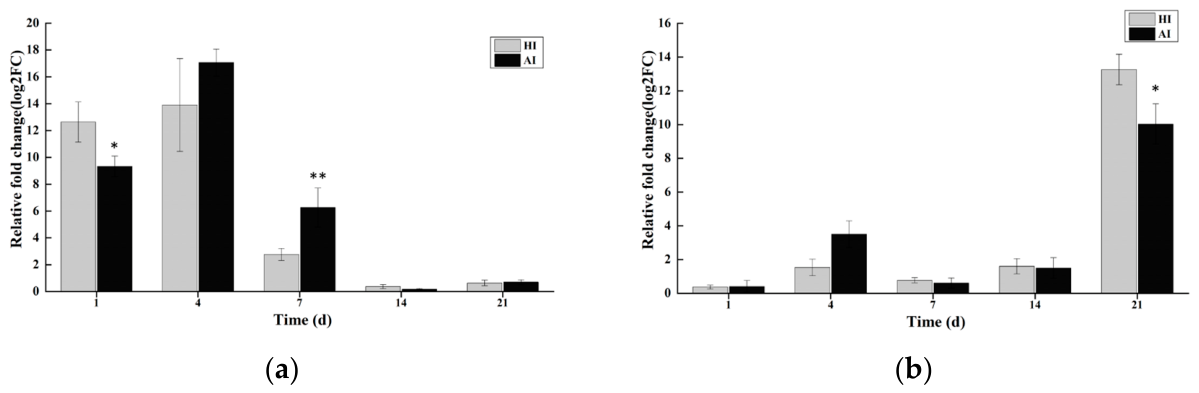
In gill tissue, IgM expression was significantly upregulated in both groups at 1 day and 4 days post-vaccination, with higher levels observed in the AI group compared to the HI group at both time points. Expression declined rapidly thereafter, reaching near baseline levels by day 14 and remaining low at day 21 (Figure 2a). In contrast, in spleen tissue, IgM expression remained low until day 14, after which it increased sharply in both groups, peaking at day 21 (Figure 2b). Notably, the AI group exhibited a significantly higher fold change in IgM expression than the HI-V group at day 21, indicating a delayed but more robust immune response in the spleen following automated injection (Figure 2b).

3.4. Temporal Profile of Serum IgM Concentration

The time-course profile of serum IgM levels is presented in Table 4. Both the HI-V and AI-V groups exhibited a similar trend of increasing IgM concentrations post-vaccination, peaking at 14 days post-vaccination before declining by 21 d. However, distinct differences were observed during the early immune response phase. Specifically, the AI-V group induced a significantly faster humoral response, maintaining significantly higher IgM titers than the HI-V group at 1, 2, and 4 d (p < 0.05). By 7 d, the IgM levels in the HI-V group rose rapidly to match those of the AI-V group, with no significant differences observed between the two groups from day 7 through day 21 (Table 4).

3.5. Vaccine Efficacy Evaluation Through Challenge Test

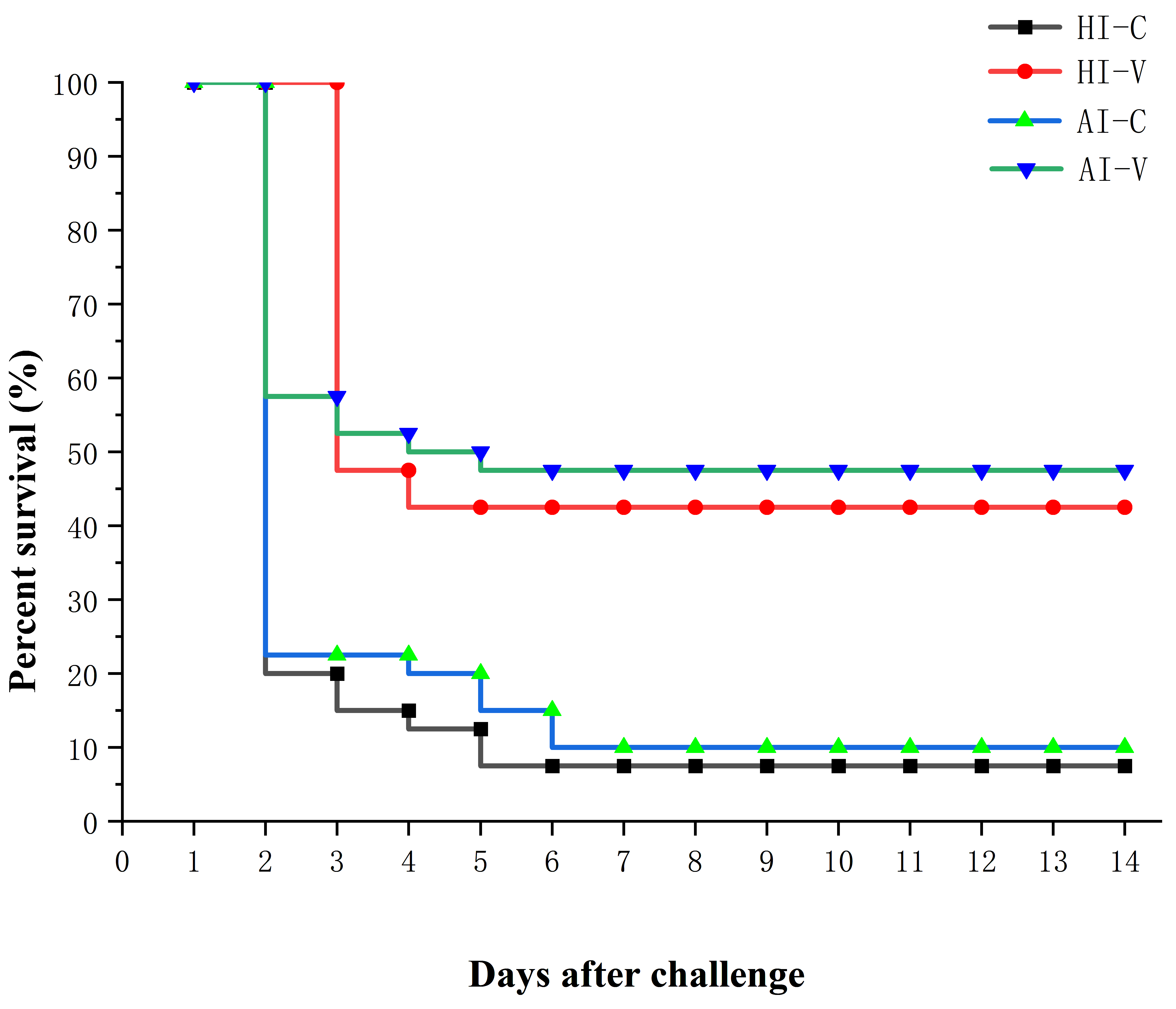
After being exposed to 3.75 × 10⁷ CFU/mL of A. hydrophila, the fish were observed every day for two weeks to assess clinical symptoms and calculate the cumulative mortality rate. As shown in Figure 3, all fish in the HI-C group eventually succumbed by day 6 post-challenge, and mortality plateaued thereafter, stabilizing at 92.5% from day 6 until the end of the observation period. The AI-C group exhibited a similar pattern, with mortality reaching 90% by day 7. In contrast, both vaccinated groups showed significantly improved survival. The HI-V group had a survival rate of 42.5% at day 14, with no further deaths after day 5. The AI-V group maintained a higher survival rate of 47.5% throughout the observation period, with the last death occurring on day 6. RPS was calculated as 37.84% in the HI-V group and 41.67% in the AI-V group compared with their respective controls (Figure 3).

4. Discussion

4.1. Impact of Plasma Biochemical

The sharp, transient surge in WBC, NEU, and RBC in HI-V—followed by a decline in RBC and a dip in HGB—suggests an acute stress response likely induced by manual handling and injection trauma, consistent with catecholamine-mediated splenic contraction and subsequent erythrocyte depletion reported in stressed teleost. In contrast, the stable WBC dynamics, biphasic RBC pattern, and continuous rise in HGB in AI-V indicate minimal procedural stress and sustained erythropoietic activity, supporting better physiological resilience. These findings align with recent work showing that automation reduces handling stress and improves welfare in farmed fish [23], suggesting that machine-based vaccination may offer a more sustainable approach for large-scale grass carp production.

4.2. Impact of Serum Biochemistry

The elevated levels of AST, ALT, and particularly LDH in the AI-V group likely reflect transient cellular perturbation associated with the mechanical action of the automated injector—such as localized tissue compression or microtrauma during rapid vaccine delivery [24,25]. LDH, a cytosolic enzyme released upon membrane disruption, is a sensitive indicator of cell damage [24]. Its marked increase in AI-V fish suggests that the injection process, while minimizing handling, may still induce subtle physical stress that is not evident from behavioral observation. In contrast, the HI-V group showed lower LDH but higher creatinine, possibly indicating greater systemic stress from prolonged manual restraint and air exposure, which can elevate muscle catabolism or reduce renal perfusion [26,27,28].
Notably, AI-V fish exhibited higher Ca2+ and CHO levels, which may support enhanced immune cell signaling and membrane synthesis during early immune activation. The stable levels of ALB, ALP, and GLU across both groups further suggest that neither method caused significant hepatic dysfunction or metabolic imbalance by day 14.
Collectively, these findings indicate that automated injection induces a mild, localized tissue response without compromising overall physiological homeostasis. Given its consistency, speed, and reduced handling burden, machine-assisted vaccination appears well-suited for large-scale grass carp farming, where minimizing labor-induced stress is critical for welfare and productivity.

4.3. Immune-Related Gene Expression

The stronger upregulation of Gadd45γ in HI-V suggests greater activation of DNA damage or cell cycle arrest pathways, likely due to variable handling, needle trauma, or inconsistent injection depth during manual vaccination [29]. In contrast, the significantly higher HSP70 and IL-6 levels in AI-V indicate a more pronounced heat shock and pro-inflammatory response—possibly triggered by the rapid, uniform mechanical action of the injector, which may cause transient tissue perturbation despite reduced handling time [30,31,32,33,34]. From a fish welfare perspective, both injection methods were non-injurious and did not compromise general health status. Critically, automated injection was not associated with worse physiological outcomes compared to manual injection, supporting its suitability as a viable alternative in commercial settings.

4.4. Differential IgM Dynamics in Gill and Spleen

The early and transient upregulation of IgM in gill tissue—particularly elevated in the AI-V group—suggests that automated injection may more effectively stimulate mucosal-associated lymphoid tissue. This is likely attributed to reduced procedural variability and consistent antigen delivery [34,35,36,37]. This aligns with findings in other species, where mechanical stress from handling can suppress local immune activity at barrier surfaces [38,39,40].
In contrast, the delayed but pronounced splenic IgM surge at day 21, especially in AI-V fish, reflects a more robust systemic adaptive response. The spleen serves as a primary site for B-cell maturation and antibody production in fish, and the higher fold change in AI-V indicates superior antigen presentation or enhanced T-B cell coordination over time [25,41,42].
Collectively, these findings suggest that automated injection not only enhances early mucosal immunity but also supports a stronger systemic memory-like response—two key pillars of effective vaccination in farmed fish. Given the scalability and reproducibility of machine-based delivery, this approach holds promise for improving vaccine efficacy while minimizing labor-dependent inconsistencies in commercial settings [23].

4.5. Impact of Vaccination Method on IgM Kinetics

Firstly, both groups mounted a primary IgM response peaking at 14 days post-vaccination—a timeframe consistent with typical teleost antibody responses to inactivated vaccines [37]. However, the AI group exhibited an earlier rise and maintained comparable IgM levels through day 21, whereas the HI group showed a delayed increase followed by a sharper decline prior to peaking. This suggests that automated injection promotes more uniform antigen presentation and B-cell activation, likely due to consistent dosing depth and reduced procedural variability. The modest but persistent elevation of IgM in the AI group during the early phase may reflect lower procedural stress and less tissue damage during vaccination. In teleost fish, acute stress from handling or inconsistent injection can suppress lymphocyte function and impair antibody production via cortisol signaling [43,44].
Although both vaccination methods elicited IgM responses indicative of protective immunity, the earlier onset observed in the AI group highlights its potential advantage over manual injection. While long-term titers were similar, this rapid immune activation is particularly beneficial in high-density aquaculture settings where timely immune activation is critical to prevent disease outbreaks during the vulnerable window post-vaccination.

4.6. Vaccination-Induced Immune Protection

The RPS in both vaccinated groups remained below 50%. This level of protection is consistent with expectations for inactivated vaccines, which typically exhibit lower immunogenicity compared to live-attenuated counterparts. Furthermore, the challenge used a high, standardized LD50 dose under controlled laboratory conditions; such stringent challenges often yield more modest RPS values. Therefore, the primary value of this study lies not only in the absolute protection rate but also in demonstrating that automated delivery is a feasible, effective, and welfare-friendly vaccination strategy.
This study has limitations. The automated grading system was validated only on grass carp of a specific size. Thus, its applicability across different life stages remains uncertain. Additionally, while the system shows promise, its performance in true large-scale farm settings has not yet been demonstrated. Critically, automated injection provided protection comparable to manual injection. These results confirm that fully automated delivery does not weaken vaccine-induced protection. Moreover, for large-scale grass carp production, these features support not only animal welfare but also operational reliability, making automated vaccination a practical and effective alternative to manual methods.

5. Conclusions

This study demonstrates that fully automated vaccination is a viable and effective alternative to manual injection in grass carp. Despite differences in acute stress signatures—manual injection eliciting a stronger innate “shock” and automated injection inducing a more uniform humoral and inflammatory response—both methods conferred significant protection against A. hydrophila. Critically, automation did not weaken vaccine-induced immunity; instead, it promoted more consistent IgM kinetics, better erythropoietic stability, and earlier cessation of mortality post-challenge. The modest RPS values reflect the use of a stringent LD50 challenge model rather than poor vaccine performance. Given its reproducibility, labor efficiency, and reduced handling burden, machine-assisted vaccination offers a practical pathway to improve both animal welfare and operational reliability in commercial grass carp production.

Supplementary Materials

The following supporting information can be downloaded at: https://www.mdpi.com/article/10.3390/fishes11070406/s1. Table S1: Mortality of grass carp following intraperitoneal injection with different doses of Aeromonas hydrophila.

Author Contributions

Conceptualization, L.L., Z.Q., D.Z., and Q.W.; methodology, L.L. and Z.Q.; validation, L.L., Z.Q., and C.L.; formal analysis, L.L., C.L., and Z.Q.; investigation, L.L., Z.Q., and C.L.; resources, L.L., Z.Q., and C.L.; data curation, L.L., C.L., and Z.Q.; writing—original draft preparation, L.L. and Z.Q.; writing—review and editing, Y.R., Q.W., J.Z., S.Z., and Z.Y.; visualization, L.L., C.L., and Z.Q.; supervision, Y.R., Q.W., J.Z., S.Z., and Z.Y.; project administration, L.L., Z.Q., D.Z., and Q.W.; funding acquisition, Z.Y. All authors have read and agreed to the published version of the manuscript.

Funding

This research was funded by the China Agriculture Research System, grant number CARS-45–24, and the Zhejiang Agricultural Machinery Integration System (Automatic Vaccine Injector for Principal Freshwater Aquaculture Species: Ctenopharyngodon idella, Lateolabrax japonicus, and Siniperca chuatsi).

Institutional Review Board Statement

This research was conducted in strict accordance with the guidance for the care and use of laboratory animals in China. The experimental protocol, including animal handling, vaccination, and challenge procedures, was reviewed and approved by the Institutional Animal Care and Use Committee of the Pearl River Fisheries Research Institute, Chinese Academy of Fishery Sciences (Approval No. LAECPRFRI-2024-03-43 and approval date: 22 March 2024).

Data Availability Statement

The original contributions presented in this study are included in the article/Supplementary Material. Further inquiries can be directed to the corresponding author.

Acknowledgments

The authors gratefully acknowledge the Pearl River Fisheries Research Institute, Chinese Academy of Fishery Sciences, for their technical support during sample collection and experimental procedures. We also thank the editors and anonymous reviewers for their insightful comments and constructive suggestions, which significantly improved the manuscript.

Conflicts of Interest

Author Lin Luo was employed by the company Zhejiang Linjia Haoyi Technology. The remaining authors declare that the research was conducted in the absence of any commercial or financial relationships that could be construed as a potential conflict of interest.

Abbreviations

The following abbreviations are used in this manuscript:
LD50Median Lethal Dose
ELISAEnzyme-Linked Immunosorbent Assay

References

  1. Zhang, Y.; Zhou, X.-Q.; Jiang, W.-D.; Wu, P.; Liu, Y.; Ren, H.-M.; Zhang, L.; Mi, H.-F.; Tang, L.; Zhong, C.-B.; et al. Emerging role of vitamin D3 in alleviating intestinal structure injury caused by Aeromonas hydrophila in grass carp (Ctenopharyngodon idella). Anim. Nutr. 2024, 16, 202–217. [Google Scholar] [CrossRef] [PubMed]
  2. Chen, G.; Xu, Y.; Lu, Y.; Pan, J.; Feng, H.; Su, J. High temperatures deteriorate grass carp (Ctenopharyngodon idella) response to GCRV-II infection: Survival rates, viral loads, histopathology, and gene expressions. Aquaculture 2026, 613, 743409. [Google Scholar] [CrossRef]
  3. Xu, Y.; Chen, G.; Wang, P.; Lv, M.; Tang, B.; Li, W.; Su, J. Phenotypic differences between GCRV resistant and susceptible grass carp (Ctenopharyngodon idella) based on tlr19 SNP genotypes. Aquaculture 2026, 612, 743149. [Google Scholar] [CrossRef]
  4. Tang, B.; Cheng, G.; Lu, Y.; Li, W.; Xu, Y.; Yang, C.; Xu, Z.; Kong, W.; Su, J. An oral multivalent fusion vaccine based on antigenic fragment VP56310-500 and FlaC adjuvant confers effective protection against grass carp reovirus. Fish Shellfish Immunol. 2026, 170, 111145. [Google Scholar] [CrossRef] [PubMed]
  5. Wei, X.-F.; Deng, Z.-Y.; Xu, F.-F.; Tang, J.-L.; Chen, L.-Y.; Zhu, B. APC receptor TLR22a-targeted antigen structure optimization enhances immune protection against grass carp reovirus II. Water Biol. Secur. 2025, 5, 100505. [Google Scholar] [CrossRef]
  6. Liu, Z.Y.; Xin, L.Z.; Xu, Y.Y.; Xu, X.Y.; Shen, Y.B.; Jia, L.; Xu, D.; Gui, L. A novel grass carp pathogen induces severe intestinal inflammation. Aquaculture 2025, 609, 742913. [Google Scholar] [CrossRef]
  7. Xu, Z.-Y.; Yang, L.-L.; Feng, L.; Jiang, W.-D.; Wu, P.; Liu, Y.; Zhang, L.; Yang, J.; Zhou, X.-Q. An emerging role of guanidine acetic acid in rescuing immune function injured by Aeromonas hydrophila in grass carp (Ctenopharyngodon idella). Aquac. Rep. 2024, 35, 101950. [Google Scholar] [CrossRef]
  8. Chai, Q.-P.; Wu, P.; Jiang, W.-D.; Liu, Y.; Ren, H.-M.; Jin, X.-W.; Feng, L.; Zhou, X.-Q. Immunomodulation of potassium diformate in juvenile grass carp (Ctenopharyngodon idella) after Aeromonas hydrophila infection: T-cell differentiation and cytokine production. Aquaculture 2024, 581, 740314. [Google Scholar] [CrossRef]
  9. Shohreh, P.; Mousavi, S.; Khoshbakht, R.; Ahmadi, S.; Valizadeh, M.; Azimi, M.; Hijaei, N.; Abdel-Tawwab, M. Immunostimulatory effects of Mazari palm (Nannorrhops ritchiana) leaves extract on the performance, anti-inflammation genes, and resistance of grass carp (Ctenopharyngodon idella) juveniles to Aeromonas hydrophila infection. Anim. Feed. Sci. Technol. 2025, 319, 116189. [Google Scholar] [CrossRef]
  10. Rodrigues, J.; Roméria da Silva, M.; Martins, C.A.; Zuanon, L.A.; Boechat Martins, K.V.; Tótola, P.S.; Pereira Rocha, J.G.; Parma, M.G.; Lima Castro, I.S.; Nascimento, T.F.; et al. Protection and safety of aluminum hydroxide adjuvant and chimeric antigen containing predicted epitopes from bacteria murC gene in Aeromonas hydrophila fish infection. Fish Shellfish Immunol. 2025, 165, 110543. [Google Scholar] [CrossRef] [PubMed]
  11. Dias, M.K.H.M.; Jayathilaka, E.H.T.T.; De Zoysa, M. Isolation, characterization, and immunomodulatory effects of extracellular vesicles isolated from fish pathogenic Aeromonas hydrophila. Fish Shellfish Immunol. 2024, 152, 109787. [Google Scholar] [CrossRef] [PubMed]
  12. Chen, X.; Zhu, Z.Y.; Zhang, L.S.; Zhang, X.W.; Zeng, X.; Liu, M.R.; Shi, J.P.; Yu, Z.H.; Chen, S.Y.; Wang, S.S.; et al. Antimicrobial paeonol modulates efflux pumps and membrane permeability in Aeromonas hydrophila: Proteomic insights and application in grass carp meat preservation. LWT-Food Sci. Technol. 2025, 238, 118871. [Google Scholar] [CrossRef]
  13. Rai, S.; Tyagi, A.; Naveen Kumar, B.T.; Reddy, S.V.K. Isolation and characterization of Aeromonas hydrophila lytic phage, and evaluation of a phage cocktail against A. hydrophila contamination in fish fillet. Food Control 2023, 145, 109460. [Google Scholar] [CrossRef]
  14. Yu, X.; Yang, Q.; Jiang, Y.; Li, Y.; Wu, Z. Enhanced early innate immunity and phagocytosis in grass carp (Ctenopharyngodon idella) induced by Aeromonas hydrophila fermentation broth during initial vaccine response. Aquac. Rep. 2025, 40, 102630. [Google Scholar] [CrossRef]
  15. Zhang, Z.; Liu, G.; Ma, R.; Qi, X.; Wang, G.; Zhu, B.; Ling, F. The immunoprotective effect of whole-cell lysed inactivated vaccine with SWCNT as a carrier against Aeromonas hydrophila infection in grass carp. Fish Shellfish Immunol. 2020, 97, 336–343. [Google Scholar] [CrossRef] [PubMed]
  16. Liu, L.; Gong, Y.-X.; Zhu, B.; Liu, G.-L.; Wang, G.-X.; Ling, F. Effect of a new recombinant Aeromonas hydrophila vaccine on the grass carp intestinal microbiota and correlations with immunological responses. Fish Shellfish Immunol. 2015, 45, 175–183. [Google Scholar] [CrossRef] [PubMed]
  17. Sun, D.; Ding, C.; Wei, X.; Mai, Q.; Jin, Y.; Liu, W.; Wu, Y.; Wang, Y.; Hu, T.; Cui, H.; et al. Evaluation of virulence of Aeromonas veronii strain GZ21-2 and development of a highly effective vaccine for grass carp with the potential for industrial application. Microb. Pathog. 2024, 195, 106913. [Google Scholar] [CrossRef] [PubMed]
  18. Liu, M.; Chen, H.; Zeng, Z.; Mu, G.; Zhang, D.; Huang, Y.; Huang, X.; Qin, Q. Protective effects of inactivated SPIV vaccine in sea perch (Lateolabrax japonicas) by intraperitoneal injection and immersion immunization. Fish Shellfish Immunol. 2025, 167, 110700. [Google Scholar] [CrossRef] [PubMed]
  19. Wu, Y.; Ren, B.; Gao, X.; Li, N.; Lin, L.; Li, Q. Evaluation of the immunization effects of needle-free injection for four common porcine vaccines. Vaccine 2025, 68, 127943. [Google Scholar] [CrossRef] [PubMed]
  20. Shuai, W.; Sun, Q.; Li, J.; Shen, W.; Zhu, J.; Guo, Z.; Luo, M.; Zeng, Y.; Wang, J.; Tong, G.; et al. Needle-free intradermal delivery of a recombinant PRRSV-vectored CSFV E2 vaccine enhances humoral immunity and growth performance in piglets. Vaccine 2026, 75, 128247. [Google Scholar] [CrossRef] [PubMed]
  21. Behera, J.K.; Behera, B.; Bhattacharya, M. The present landscape of both traditional and innovative biotechnology driven vaccines for fish diseases in global aquaculture. Aquac. Fish. 2026, 11, 423–443. [Google Scholar] [CrossRef]
  22. Lee, D.G.; Yang, Y.S.; Kang, J.G. Conveyor belt automatic vaccine injection system (AVIS) for flatfish based on computer vision analysis of fish shape. Aquac. Eng. 2013, 57, 54–62. [Google Scholar] [CrossRef]
  23. Luo, L.; Qin, Z.; Li, C.; Zhang, D.F.; Ren, Y.; Wang, Q.; Zhang, C.Q.; Zhu, S.M.; Ye, Z.Y. Physiological stress and tissue damage response of to artificial and automated injection. Aquac. Int. 2025, 33, 648. [Google Scholar] [CrossRef]
  24. Hu, R.; Wang, S.; Feng, L.; Jiang, W.; Wu, P.; Liu, Y.; Jin, X.; Kuang, S.; Tang, L.; Zhang, L.; et al. Alleviation of hypoxia stress induced oxidative damage, endoplasmic reticulum stress (ERS) and autophagy in grass carp (Ctenopharyngodon idellu) by TTO (Melaleuca alternifolia essential oil). Aquaculture 2023, 564, 739073. [Google Scholar] [CrossRef]
  25. Ren, K.X.; Feng, L.; Wu, P.; Liu, Y.; Ren, H.M.; Jin, X.W.; Zhong, C.B.; Zhou, X.Q.; Jiang, W.D. Mitigation of the toxic effects of nitrite: Role and mechanism of isoleucine in mitigating mitochondrial DNA leakage-induced inflammation in grass carp under nitrite exposure. J. Hazard. Mater. 2025, 491, 138016. [Google Scholar] [CrossRef] [PubMed]
  26. Lu, H.; Su, H.; Liu, Y.; Yin, K.; Wang, D.; Li, B.; Wang, Y.; Xing, M. NLRP3 inflammasome is involved in the mechanism of the mitigative effect of lycopene on sulfamethoxazole-induced inflammatory damage in grass carp kidneys. Fish Shellfish Immunol. 2022, 123, 348–357. [Google Scholar] [CrossRef] [PubMed]
  27. Tu, C.; Yang, S.; Yang, M.; Liu, L.; Tao, J.; Zhang, L.; Huang, X.; Tian, Y.; Li, N.; Lin, L.; et al. Mechanisms of persistent hemolysis-induced middle kidney injury in grass carp (Ctenopharyngodon idella). Fish Shellfish Immunol. 2024, 150, 109603. [Google Scholar] [CrossRef] [PubMed]
  28. Yu, H.; He, Y.; Qin, M.; Wang, L.; Rong, K.; Zhang, X. Dietary creatine promotes creatine reserves, protein deposition, and myofiber hyperplasia in muscle of juvenile largemouth bass (Micropterus salmoides). Aquaculture 2024, 583, 740591. [Google Scholar] [CrossRef]
  29. Chen, Z.-F.; Tian, Y.-S.; Ma, W.-H.; Zhai, J.-M. Gene expression changes in response to low temperatures in embryos of the kelp grouper, Epinephelus moara. Cryobiology 2020, 97, 159–167. [Google Scholar] [CrossRef] [PubMed]
  30. Wu, J.-J.; Li, Y.-L.; Pan, J.-M.; Guo, H.-Y.; Liu, B.-S.; Zhang, N.; Xian, L.; Zhu, K.-C.; Zhang, D.-C. Molecular characterization of HSP70, HSP90a, expression responses and biochemical changes in yellowfin seabream Acanthopagrus latus (Houttuyn 1782) under temperature stress. Comp. Biochem. Physiol. Part B Biochem. Mol. Biol. 2025, 279, 111118. [Google Scholar] [CrossRef] [PubMed]
  31. Li, S.; She, R.; Lin, B.; Li, K.; Bai, Y.; Xiong, X.; Liu, X. Redox imbalance and NF-κB activation drives 1,3-diphenylguanidine (DPG)-induced hepatotoxicity in grass carp (Ctenopharyngodon idella): HSP70 as a protective therapeutic target. Environ. Res. 2026, 294, 123835. [Google Scholar] [CrossRef] [PubMed]
  32. Zhang, A.; Guo, Y.; Zhang, S.; Fan, X.; Wang, X.; Zhou, X.; Yang, K.; Zhou, H. Cytokine effects and cellular signaling pathways of grass carp HSP70 in head kidney leukocytes. Fish Shellfish Immunol. 2015, 46, 550–556. [Google Scholar] [CrossRef] [PubMed]
  33. Wang, Y.; Feng, L.; Jiang, W.-D.; Wu, P.; Liu, Y.; Zhang, L.; Mi, H.-F.; Zhou, X.-Q. The effect of selenium on the intestinal health of juvenile grass carp based on the ERS-autophagy pathway. Fish Shellfish Immunol. 2024, 153, 109808. [Google Scholar] [CrossRef] [PubMed]
  34. Zhao, P.; Jiang, W.-D.; Wu, P.; Liu, Y.; Ren, H.-M.; Jin, X.-W.; Shi, H.-Q.; Feng, L.; Zhou, X.-Q. New perspectives on the mechanism of curcumin in the gill mucosal immune barrier damaged by ochratoxin A in juvenile grass carp (Ctenopharyngodon idella). Aquaculture 2024, 583, 740629. [Google Scholar] [CrossRef]
  35. Campos-Sánchez, J.C.; Cámara-Ruiz, M.; Esteban, M.Á.; Guardiola, F.A. Analysis of immune-related parameters in gill mucus of gilthead seabream (Sparus aurata): Comparing two collection approaches. Fish Shellfish Immunol. 2025, 166, 110591. [Google Scholar] [CrossRef] [PubMed]
  36. Chen, X.; Liu, S.; Ding, Q.; Teame, T.; Yang, Y.; Ran, C.; Zhang, Z.; Zhou, Z. Research advances in the structure, function, and regulation of the gill barrier in teleost fish. Water Biol. Secur. 2023, 2, 100139. [Google Scholar] [CrossRef]
  37. Li, B.; Ouyang, Z.; Zhao, Z.; Miao, L.; Du, Y.; Chen, J. Pathogenic function of the Lafa gene in Vibrio harveyi and its regulatory role in host immune response during infection of large yellow croaker (Larimichthys crocea). Aquaculture 2026, 612, 743186. [Google Scholar] [CrossRef]
  38. Wang, Y.; Kang, Y.; Zhong, Z.; Liu, J.; Wu, J.; Liu, Z. Transcriptomics, antioxidant enzyme activities, and immune-associated parameter analysis reveal the molecular responses of rainbow trout (Oncorhynchus mykiss) to transportation stress. Comp. Biochem. Physiol. Part D Genom. Proteom. 2025, 55, 101455. [Google Scholar] [CrossRef] [PubMed]
  39. Urbinati, E.C.; Zanuzzo, F.S.; Biller, J.D. Stress and immune system in fish. In Biology and Physiology of Freshwater Neotropical Fish; Academic Press: Cambridge, MA, USA, 2020; pp. 93–114. [Google Scholar] [CrossRef]
  40. Li, W.; Li, D.; Yang, Q.; Liu, L.; Liu, J.; Lu, J.; Wang, Y.; Tang, R.; Li, L.; Zhang, X. Long-term crowding stress induces chronic inflammatory response and declines the immunity of grass carp (Ctenopharyngodon idella). Aquaculture 2023, 577, 739976. [Google Scholar] [CrossRef]
  41. Quddos, F.; Zwollo, P. A BCWD-Resistant line of rainbow trout is less sensitive to cortisol implant-induced changes in IgM response as compared to a susceptible (control) line. Dev. Comp. Immunol. 2021, 116, 103921. [Google Scholar] [CrossRef] [PubMed]
  42. Vicente-Gil, S.; Simón, R.; Nogales-Mérida, S.; Nuñez-Ortiz, N.; Fouz, B.; Serra, C.; Ordás, M.C.; Abós, B.; Herranz-Jusdado, J.G.; Morel, E.; et al. Bacillus subtilis supplemented feeding as a method to increase IgM titers and affinity in response to fish vaccination. Fish Shellfish Immunol. 2025, 162, 110335. [Google Scholar] [CrossRef] [PubMed]
  43. Bai, C.; Huang, G.W.; Qi, X.; Wang, J.G.; Qiu, L.; Wang, L.; Liao, T. Impact of Astragalus polysaccharide, chitosan and xylo-oligosaccharide on intestinal physicochemical properties and gut microbiota disorder of caused by transport stress. Int. J. Biol. Macromol. 2025, 321, 146169. [Google Scholar] [CrossRef] [PubMed]
  44. Jiang, H.; Wang, J.; Wang, Z.; Chen, J.; Bai, C.; Xiong, G.; Cai, W.; Cheng, J.; Wang, L.; Liao, T. Temperature acclimation modulates stress, immunity, and apoptosis in juvenile Siberian hybrid sturgeon during simulated transport. Aquaculture 2025, 607, 742641. [Google Scholar] [CrossRef]
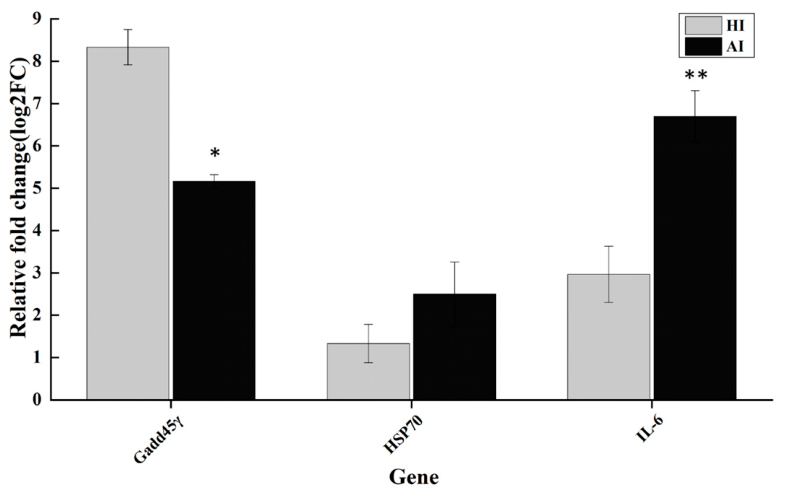
Figure 1. Relative mRNA expression of immune-related genes (Gadd45γ, HSP70, and IL-6) in grass carp after HI-V or AI-V. Data are presented as mean ± SD from three independent biological replicates. Significant differences between groups are indicated by asterisks: * p < 0.05, ** p < 0.01.
Fishes 11 00406 g001
Figure 2. Temporal dynamics of IgM gene expression. (a) Relative IgM mRNA levels in gill tissue. (b) Relative IgM mRNA levels in spleen tissue. Asterisks indicate significant differences between the HI-V and AI-V groups at the same time point (* p < 0.05, ** p < 0.01).
Fishes 11 00406 g002
Figure 3. Survival of grass carp after challenge with A. hydrophila.
Fishes 11 00406 g003
Table 1. Primers used in this study.
PrimerForward Primer (5′-3′)Reverse Primer (5′-3′)
β-actinGCCGTGACCTGACTGACTCAAGACTCCATACCCAAGAA
Gadd45γTGGCGATAGAATGCAGAGGCAGAAGGCTTGAATGAG
HSP70GGATGTGGCTCCTCTGTCAGGTCTGGGTCTGTTTGG
IL-6CAGCCAGTGTTGATAGGTCAAAGGGTTCCAAGGTAT
IgMTCTACCTCCAACTCCACCACCTGTTTATTGTATTTGCCACCTGAT
Abbreviations: Gadd45γ, Growth Arrest and DNA Damage-inducible 45 gamma; HSP70, Heat Shock Protein 70; IL-6, Interleukin-6; IgM, Immunoglobulin M.
Table 2. Hematological parameters at multiple time points post-injection.
GroupsTime Point (d)Hematological Parameters
WBC
(×109/L)
RBC
(×1012/L)
NEU
(×109/L)
LYM
(×109/L)
MON
(×109/L)
HGB
(g/L)
HI-V1140.5 ± 5.212.56 ± 0.248.57 ± 0.2477.56 ± 6.225.48 ± 0.3473.25 ± 4.32
4165.9 ± 4.935.72 ± 0.1712.92 ± 0.3798.71 ± 4.3210.45 ± 0.1385.34 ± 6.20
7196.4 ± 3.7410.4 ± 0.3418.83 ± 0.51115.0 ± 7.3117.70 ± 0.2196.92 ± 4.21
14185.7 ± 6.114.93 ± 0.1813.35 ± 0.28130.1 ± 4.8910.95 ± 0.47110.2 ± 3.89
21174.2 ± 4.469.9 ± 0.2710.31 ± 0.37112.0 ± 4.217.14 ± 0.2293.70 ± 5.23
AI-V1136.9 ± 2.882.48 ± 0.128.35 ± 0.2474.88 ± 3.875.89 ± 0.1767.22 ± 3.43
4153.4 ± 5.835.62 ± 0.5311.82 ± 0.4184.92 ± 4.53 *9.25 ± 0.2389.71 ± 6.21
7185.7 ± 4.35 *9.9 ± 0.3716.56 ± 0.19 **107.1 ± 3.8915.63 ± 0.54 *100.7 ± 4.32 *
14180.1 ± 3.216.03 ± 0.41 *12.81 ± 0.39116.8 ± 6.71 *9.19 ± 0.41 *109.9 ± 7.32
21164.5 ± 4.18 *6.28 ± 0.17 **10.40 ± 0.42124.9 ± 5.387.40 ± 0.16118.8 ± 4.55 **
Abbreviations: WBC, white blood cell count; RBC, red blood cell count; NEU, neutrophil count; LYM, lymphocyte count; MON, monocyte count; HGB, hemoglobin. Note: Data are presented as mean ± SD. Significance of differences between the AI-V and HI-V groups at the same time point is indicated by asterisks: * p < 0.05, ** p < 0.01.
Table 3. Serum biochemical profiles at 14 days post-vaccination.
ParameterHI-VAI-V
ALB (g/L)9.93 ± 1.11 a9.15 ± 1.28 a
ALP (U/L)50.96 ± 19.53 a47.00 ± 8.40 a
GLU (mmol/L)3.76 ± 0.82 a3.67 ± 0.15 a
Ca2+ (mmol/L)1.82 ± 0.24 a2.79 ± 1.32 b
ALT (U/L)1.00 ± 0.83 a3.13 ± 2.48 b
AST (U/L)35.38 ± 6.75 a65.58 ± 50.18 b
CREA (μmol/L)20.14 ± 3.52 a14.28 ± 5.76 b
TG (mmol/L)1.54 ± 0.37 a1.84 ± 0.34 b
CHO (mmol/L)5.17 ± 1.29 a7.00 ± 1.16 b
LDH (U/L)448.31 ± 100.36 a766.87 ± 530.39 b
T-SOD (U/mL)124.82 ± 12.87 a133.45 ± 10.23 a
MOD (nmol/mL)12.75 ± 2.55 a12.03 ± 9.50 a
Abbreviations: ALB, Albumin; ALP, Alkaline Phosphatase; GLU, Glucose; Ca2+, Calcium ion; ALT, Alanine Aminotransferase; AST, Aspartate Aminotransferase; CREA, Creatinine; TG, Triglyceride; CHO, Cholesterol; LDH, Lactate Dehydrogenase; T-SOD, Total Superoxide Dismutase; MOD, Malondialdehyde. Note: Values with different superscript letters (a, b) within the same row are significantly different (p < 0.05).
Table 4. Time-course profile of serum IgM concentration.
Time Point (d)HI-VAI-V
11088.04 ± 109.20 a1488.04 ± 194.13 b
21188.04 ± 79.20 a1511.04 ± 204.12 b
41488.04 ± 129.20 a1740.41 ± 114.18 b
72138.76 ± 289.80 a1941.18 ± 222.00 a
142540.71 ± 144.98 a2477.69 ± 62.62 a
211941.58 ± 207.03 a2215.35 ± 37.52 a
Note: Data are presented as mean ± SD. Values within the same row with different superscript letters (a, b) indicate a significant difference between groups (p < 0.05).
Disclaimer/Publisher’s Note: The statements, opinions and data contained in all publications are solely those of the individual author(s) and contributor(s) and not of MDPI and/or the editor(s). MDPI and/or the editor(s) disclaim responsibility for any injury to people or property resulting from any ideas, methods, instructions or products referred to in the content.