Article

Transcriptome Analysis Reveals Osmoregulation and Low-Salt Adaptation in the Brain and Gills of Eleutheronema tetradactylum

1
College of Fisheries, Guangdong Ocean University, Zhanjiang 524000, China
2
Guangdong Provincial Key Laboratory of Aquatic Animal Disease Control and Healthy Culture, Zhanjiang 524000, China
3
Agro-Tech Extension Center of Guangdong Province, Guangzhou 510000, China
*
Authors to whom correspondence should be addressed.
Fishes 2026, 11(6), 351; https://doi.org/10.3390/fishes11060351 (registering DOI)
Submission received: 20 May 2026 / Revised: 11 June 2026 / Accepted: 12 June 2026 / Published: 15 June 2026
(This article belongs to the Section Physiology and Biochemistry)

Abstract

The molecular coordination between the central nervous system and peripheral organs is fundamental to euryhalinity. This study elucidates the distinct adaptive strategies of the brain and gills in the four-finger threadfin (Eleutheronema tetradactylum), an aquaculture species of growing importance, during long-term (30-day) acclimation to low salinity (5 versus 25 control). A profound dichotomy in tissue-specific plasticity was uncovered: while the brain maintained remarkable transcriptional stability with only 10 differentially expressed genes (DEGs), the gills underwent extensive remodeling with 702 DEGs. Gill DEGs were functionally enriched in ion transport and metabolic remodeling, highlighted by the significant upregulation of the Na+-Cl cotransporter (slc12a10) and the prolactin receptor (prlr), coupled with a profound downregulation (log2FC = −5.97) of aquaporin-1 (aqp1). This indicates a concerted strategy to enhance ion uptake while minimizing water permeability. In contrast, the brain’s subtle response was dominated by the upregulation of key neuroendocrine hormones, including growth hormone (gh), prolactin (prl), and pro-opiomelanocortin (pomc). This suggests a top-down regulatory cascade. Integrative pathway analysis identified the PI3K-Akt and JAK-STAT signaling pathways as the primary conduits linking central hormonal signals to peripheral physiological adjustments. These results demonstrate that the euryhalinity of E. tetradactylum is achieved through a highly efficient strategy: a transcriptionally stable brain provides precise endocrine commands that orchestrate robust peripheral remodeling in the gills. This study deciphers the molecular basis of the brain–gill axis in osmoregulation and provides a rich repository of candidate genes for the genetic improvement of low salinity tolerance in aquaculture.
Key Contribution: The study elucidates the central regulatory role of cerebral neuroendocrine factors of E. tetradactylum, specifically prl, gh, and pomc, in orchestrating the systemic transition to a hypoosmotic state. Furthermore, the study validates the molecular effector mechanism in the gills, demonstrating that the coordinated upregulation of slc12a10 and drastic downregulation of aqp1 are the primary drivers for maintaining serum iono-homeostasis. Crucially, the JAK-STAT and PI3K-Akt signaling pathways were identified as the pivotal molecular bridges integrating central endocrine commands with peripheral osmoregulatory responses, thereby providing a robust theoretical framework for optimizing aquaculture management in variable salinity environments based on the established physiological baseline of this species.

1. Introduction

Salinity is a fundamental abiotic factor that exerts profound influence on the physiology, distribution, and survival of aquatic organisms [1,2]. Euryhaline teleosts, which thrive across a wide spectrum of salinities, have evolved sophisticated osmoregulatory mechanisms to maintain internal homeostasis [3]. This physiological plasticity is energetically demanding and relies on the coordinated action of multiple osmoregulatory organs, including the gills, kidneys, and intestine, which collectively manage ion exchange and water balance with the external environment [3,4,5]. At the molecular level, this adaptation is underpinned by complex networks involving ion transporters (e.g., Na+/K+-ATPase, NKCC), endocrine hormones (e.g., prolactin, growth hormone, cortisol), and intracellular signaling pathways [6].
The gill is the principal interface between the fish and its aqueous environment, serving as the dominant site for gas exchange, nitrogenous waste excretion, acid–base balance, and ion transport [6]. This multifunctional role makes the branchial epithelium exceptionally sensitive to fluctuations in water chemistry [7]. In hypoosmotic environments, such as brackish or fresh water, fish face a dual challenge: the passive efflux of essential ions and the influx of excess water via osmosis [3,8]. To counteract this, a fundamental physiological shift is required, from ion secretion, characteristic of marine environments, to active ion absorption from the dilute external medium. This process involves extensive cellular and molecular remodeling within the gill epithelium.
While peripheral organs like the gills execute the direct physiological work, their function is orchestrated by systemic signals originating from the central nervous and endocrine systems. This hierarchical control constitutes a “brain–gill axis” that is critical for a coordinated response. Key hormones, such as prolactin (prl), are widely recognized as the primary “freshwater-adapting hormone”, promoting ion uptake and reducing epithelial permeability [9,10,11]. Conversely, growth hormone (gh) is often implicated in seawater adaptation, frequently acting in concert with cortisol to enhance ion secretion [9,12]. The dynamic interplay of these hormones, regulated by the brain, dictates the osmoregulatory phenotype of the gills.
Previous transcriptomic studies on salinity adaptation have predominantly focused on a single organ, most often the gills, or have investigated responses to short-term osmotic stress [2,13,14]. Consequently, the molecular dialogue that underpins the chronic, steady-state adaptation of the integrated brain–gill axis remains largely unexplored. A direct, comparative transcriptomic analysis of both the central command center (brain) and a primary peripheral effector (gills) under sustained low-salinity conditions is therefore essential to decipher this integrated control system.
The four-finger threadfin, E. tetradactylum, is a commercially important marine teleost widely cultured in Southeast Asia. Its euryhaline nature makes it a prime candidate for aquaculture expansion into inland brackish waters. Our previous physiological investigation demonstrated that juvenile E. tetradactylum possess a remarkably broad and robust salinity tolerance. Specifically, a 30-day salinity gradient trial revealed that brackish-water environments (salinity 5–10) represent the optimal physiological range for this species, characterized by survival rates exceeding 98% and growth performance comparable to seawater (salinity 25) control groups. Energy metabolism indicators, including serum glucose, lactate, and triglycerides, remained stable in the salinity 5 group, while antioxidant enzyme activities (SOD, GSH-Px) were effectively maintained. Furthermore, the stabilization of serum osmolality and ion concentrations (Na+ and Cl) following a 30-day acclimation confirmed that E. tetradactylum can achieve a state of successful chronic adaptation at salinity 5 [15].
In the present study, based on the established physiological baseline that E. tetradactylum can maintain dynamic equilibrium in serum tonicity and Na+/Cl concentrations even under low-salinity conditions of 5 PSU, we employed RNA-Seq to characterize the divergent transcriptomic responses within the brain–gill axis following a 30-day acclimation to low salinity (5 vs. 25) [15]. We hypothesized that the species’ exceptional euryhalinity is facilitated by a transcriptionally resilient brain that provides precise endocrine commands, coupled with extensive molecular remodeling in the gills to reinforce the iono-regulatory barrier. By deciphering the molecular conduits integrating these two tissues, this study aims to provide a molecular framework for teleostean salinity adaptation and to identify candidate genes for use in breeding low-salinity-tolerant strains.

2. Materials and Methods

2.1. Experimental Design and Tissue Sampling

Juvenile E. tetradactylum (total length: 16.43 ± 0.87 cm; body weight: 35.80 ± 6.3 g) were sourced from a commercial hatchery in Zhanjiang, China. The fish were acclimated for two months in an indoor recirculating aquaculture system (500 L tanks) under controlled conditions: at salinity 25, water temperature at 26–28 °C, a stocking density of 30 fish per tank, and dissolved oxygen above 5 mg/L. Fish were fed a commercial diet (crude protein ≥ 43%, crude fat ≥ 5%, ash ≤ 15%, moisture ≤ 10%) twice daily.
The experiment utilized 120 healthy individuals, randomly divided into a control group and a low-salinity treatment group (60 fish each), with three replicates per group and 20 fish per tank. The control group salinity was maintained at 25, while the low-salinity group was maintained at salinity 5. The salinity for the low-salinity group was gradually reduced from 25 to 5 at a rate of 5 per day using dechlorinated freshwater to prevent acute osmotic shock. Following this gradual reduction, fish were maintained at their respective target salinities for a 30-day acclimation period to investigate chronic adaptive responses. At the conclusion of the experiment, fish were fasted for 24 h. For subsequent analysis, 6 individuals were randomly selected from each salinity group (2 from each replicate tank), euthanized by cold shock on ice, and the entire brain tissue was then quickly removed, ensuring that the pituitary stalk remained intact, along with gill filaments from the right second gill arch as gill tissue samples. These were immediately placed in liquid nitrogen for rapid freezing and stored at −80 °C until RNA extraction. All animal procedures were conducted in accordance with the guidelines for the care and use of laboratory animals and were approved by the Institutional Animal Care and Use Committee of Guangdong Ocean University.

2.2. RNA Extraction, Library Construction, and Sequencing

Six fish were randomly selected from each salinity group (12 fish in total), and gill and brain tissues were collected from each fish for RNA extraction. For each treatment group, 3 tissue samples were pooled into a single sample for sequencing and cDNA library construction, resulting in a total of 8 libraries. Total RNA was extracted using TRIzol reagent (Invitrogen, Carlsbad, CA, USA). RNA purity was assessed using a NanoDrop spectrophotometer (Thermo Fisher Scientific, Wilmington, DE, USA), and RNA integrity was confirmed using an Agilent 2100 Bioanalyzer (Agilent Technologies, Santa Clara, CA, USA), ensuring all samples had an RNA Integrity Number (RIN) > 8.0. Qualified RNA samples were sent to Gene Denovo Biotechnology Co. (Guangzhou, China) for library construction and sequencing. Paired-end sequencing was performed on the Illumina HiSeq 6000 platform (Illumina, Inc., San Diego, CA, USA).

2.3. Bioinformatic Analysis

Raw sequencing reads were filtered using fastp (v0.18.0) [16] to remove adapters, low-quality reads, and reads with high N content, yielding high-quality clean reads. Ribosomal RNA (rRNA) reads were identified and removed by mapping to an rRNA database using Bowtie2 (v2.2.8) [17]. The final clean reads were then aligned to the reference genome (WGS accession: JBLRVW01) using HISAT2 (v2.24) [18] with default parameters. Sequences were obtained from the National Center for Biotechnology Information (NCBI) (https://www.ncbi.nlm.nih.gov/). Gene expression levels were quantified as Fragments Per Kilobase of transcript per Million mapped reads (FPKM) using RSEM software (1.2.19) [19]. Differentially expressed genes (DEGs) between the low-salinity (S5) and control (S25) groups for each tissue were identified using the DESeq2 package in R. Principal component analysis (PCA) was performed on the standardized read count matrix using default scaling settings. Genes with a false discovery rate (FDR) < 0.05 and an absolute log2(Fold Change) ≥ 1 were considered significantly differentially expressed. Heatmaps were also constructed to visualize the expression dynamics of significantly regulated genes across different tissues (brain and gills) and treatment conditions (low-salinity group and control group).

2.4. Functional Annotation and Pathway Enrichment Analysis

To infer the biological functions of the DEGs, Gene Ontology (GO) [3] and Kyoto Encyclopedia of Genes and Genomes (KEGG) [20] pathway enrichment analyses were performed. GO terms and KEGG pathways were considered significantly enriched if the hypergeometric test p-value was less than 0.05.

2.5. Validation by Quantitative Real-Time PCR (qRT-PCR)

To validate the RNA-seq results, a total of 9 genes were randomly selected from the significantly differentially expressed genes for qRT-PCR analysis. Total RNA was extracted from the same tissue samples used for sequencing, and first-strand cDNA was synthesized using the TransScript® All-in-One First-Strand cDNA Synthesis SuperMix (Sangon Biotech, Shanghai, China). Primers were designed using Primer-BLAST (Table 1: Primer sequences used for qRT-PCR validation). The ribosomal protein S17 (Rps17) gene served as the internal reference for normalization. qRT-PCR was performed on a Roche LightCycler 96 system using PerfectStart® Green qPCR SuperMix (TransGen Biotech, Beijing, China). The thermal cycling conditions were pre-denaturation at 94 °C for 30 s, followed by 40 cycles of 94 °C for 5 s, 60 °C for 15 s, and 72 °C for 10 s. All reactions were performed with three independent biological replicates and three technical replicates. Relative gene expression was calculated using the 2−ΔΔCT method. Statistical significance (p < 0.05) was determined by an independent two-sample t-test using SPSS 22.0 (IBM Corp., Armonk, NY, USA).

3. Results

3.1. Sequencing Output and Genome Mapping

A total of eight cDNA libraries from brain and gill tissues of the control (S25) and low-salinity (S5) groups yielded approximately 25.3 Gbp of high-quality clean data. The sequencing quality was consistently high across all samples, with Q30 percentages exceeding 91.5% (Table 2). The clean reads were mapped to the E. tetradactylum reference genome, achieving total mapping rates between 73.40% and 78.02% (Table S1). The high coverage of known genes (89.97%) and a low percentage of newly identified transcripts (5.92%) indicate a comprehensive sequencing depth and a well-annotated reference genome, providing a robust foundation for subsequent analyses (Table S2).

3.2. Divergent Transcriptomic Responses in Brain and Gills

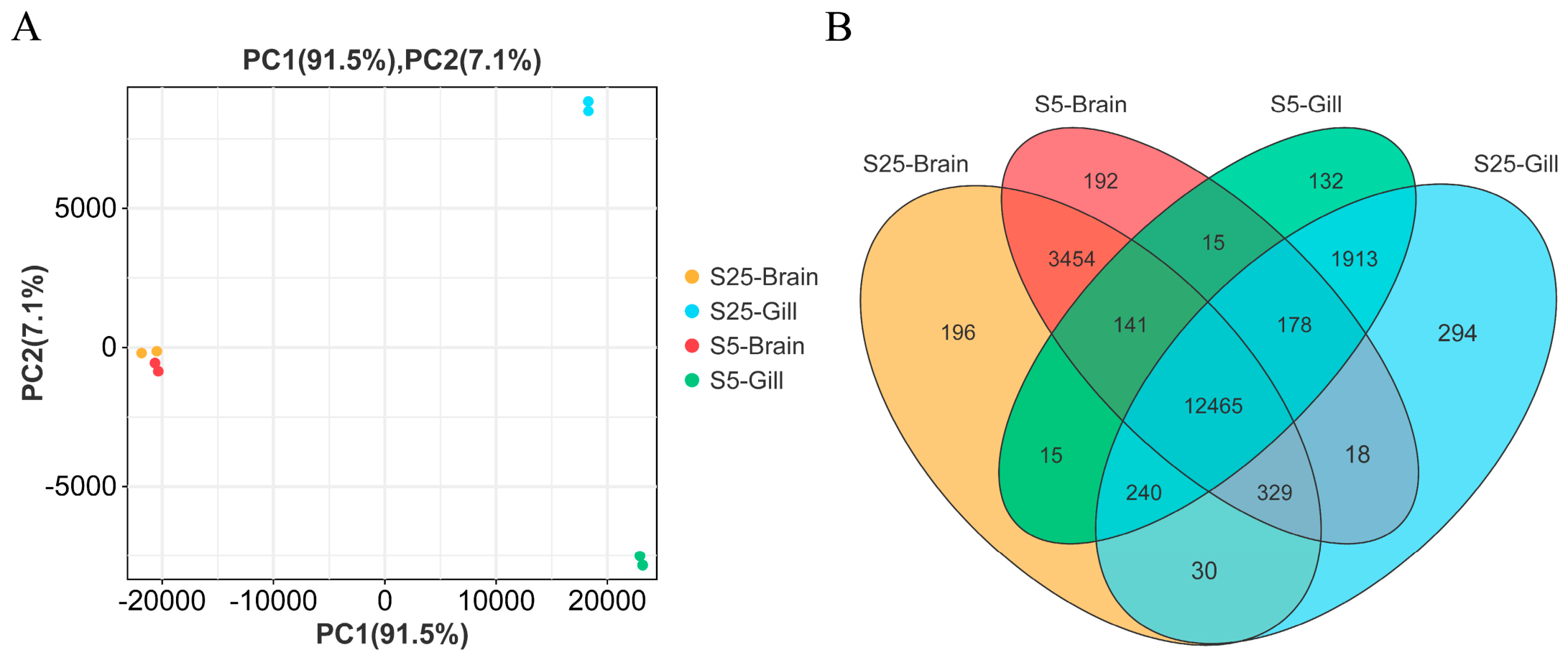
Principal Component Analysis (PCA) of gene expression profiles revealed a clear separation between brain and gill tissues along PC1, which accounted for 91.5% of the total variance, indicating that tissue type is the primary determinant of the transcriptome (Figure 1A). Within each tissue type, biological replicates from the same salinity group clustered tightly, demonstrating high experimental reproducibility. Notably, the gill samples from the two salinity groups (S5-Gill and S25-Gill) showed greater separation than the brain samples, visually suggesting a more pronounced transcriptomic response to salinity changes in the gills.
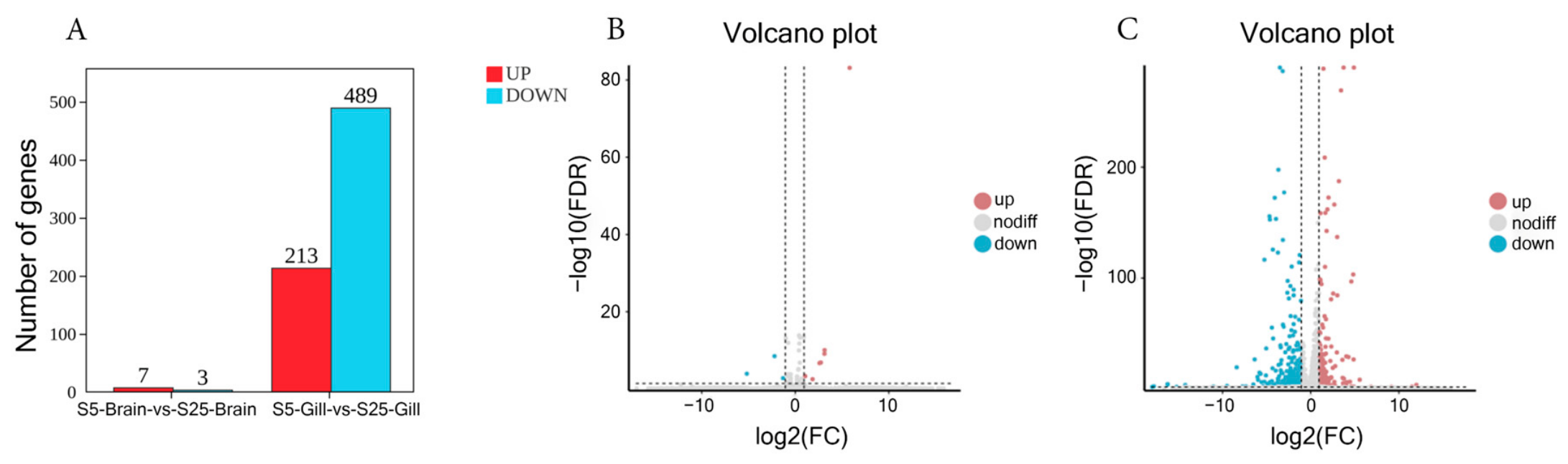
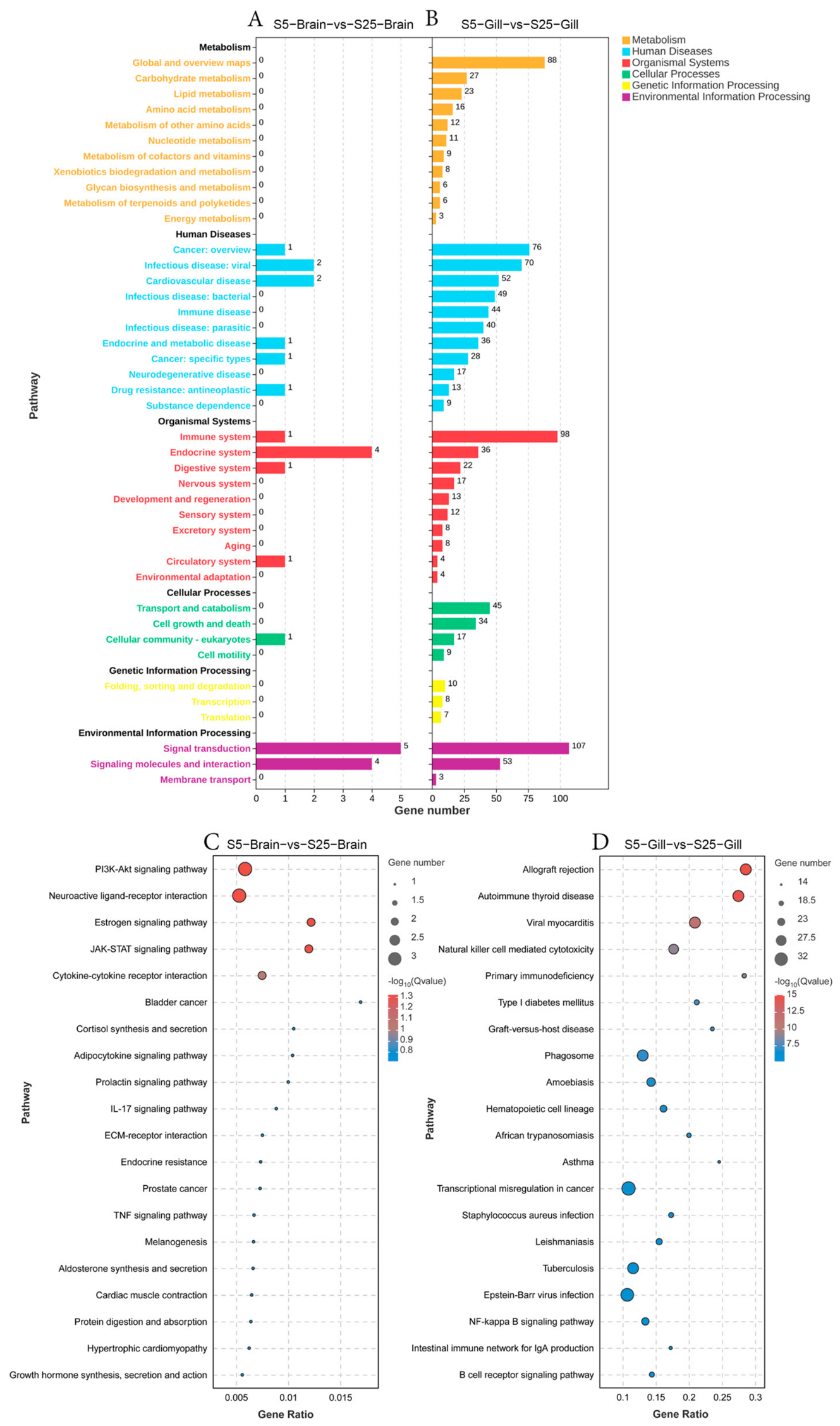
A comparison of gene expression between the S5 and S25 groups revealed a stark contrast in the adaptive response of the two tissues. In the gills, a total of 702 DEGs were identified, comprising 213 upregulated and 489 downregulated genes (Figure 2A,C). In striking contrast, only 10 DEGs were detected in the brain, with 7 upregulated and 3 downregulated (Figure 2A,B). This profound disparity underscores that the gills are the primary site of transcriptomic remodeling during long-term low-salinity adaptation in E. tetradactylum. The most significantly regulated genes in the gills are detailed in Table S3, highlighting key players in ion transport, cellular structure, and metabolism.

3.3. Functional Enrichment Reveals Distinct Biological Roles

To understand the biological implications of these transcriptomic changes, we performed GO (Figure 3) and KEGG (Figure 4) pathway enrichment analyses. In the brain, despite the low number of DEGs, they were significantly enriched in several crucial KEGG signaling pathways, including the PI3K-Akt signaling pathway, neuroactive ligand-receptor interaction, and the JAK-STAT signaling pathway (p < 0.05) (Figure 4C). This suggests that the brain’s adaptation relies on modulating key regulatory cascades rather than broad metabolic shifts.
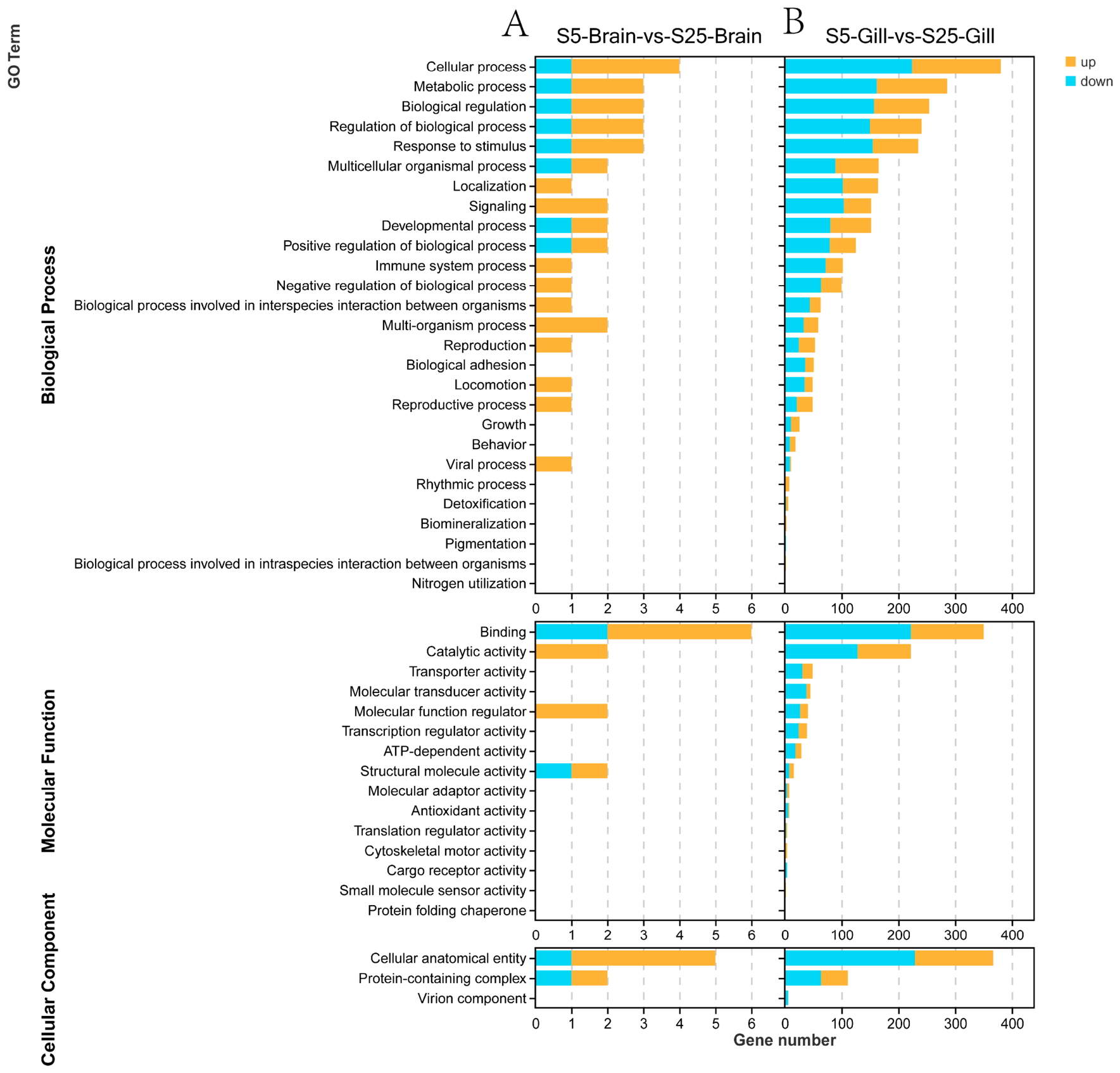
In the gills, the 702 DEGs were enriched in a wide array of GO terms, dominated by fundamental processes such as ‘cellular process’, ‘metabolic process’, ‘binding’, and ‘catalytic activity’ (Figure 3B). This reflects a large-scale physiological and structural remodeling. KEGG analysis of the gill DEGs identified 66 significantly enriched pathways (Figure 4D), suggesting a potential trade-off or a generalized stress response accompanying the osmoregulatory adjustments.
Figure 4. KEGG pathway enrichment analysis of all DEGs. (A,B) KEGG pathway classification of DEGs from the brain (A) and gills (B). (C,D) Bubble plots showing the top significantly enriched KEGG pathways for DEGs in the brain (C) and gills (D). The bubble size represents the number of genes, and the color indicates the q-value significance.
Fishes 11 00351 g004

3.4. Key Osmoregulatory Genes and Pathways Are Modulated by Low Salinity

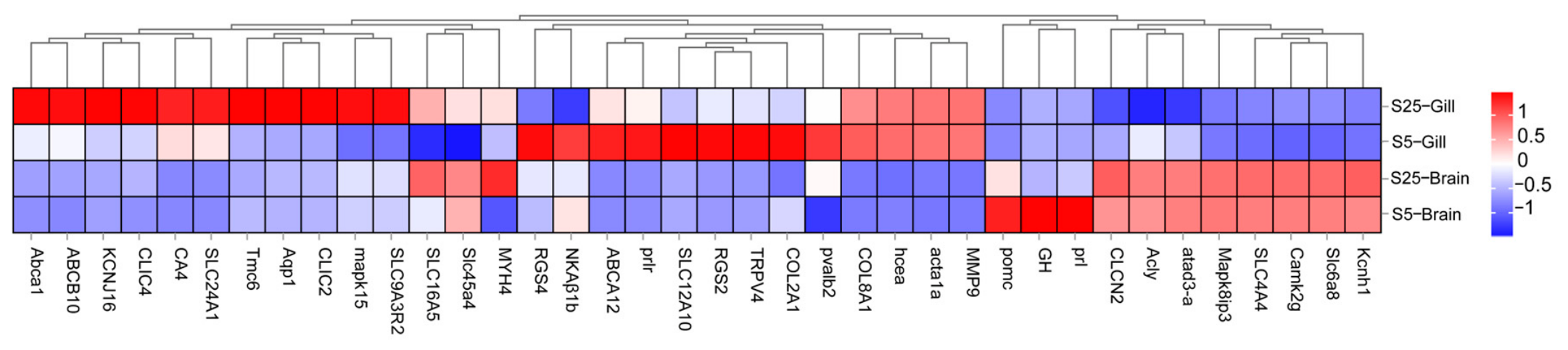
To specifically probe the osmoregulatory machinery, we curated a list of 38 DEGs with known or putative roles in salinity adaptation (Table S4). A heatmap of their expression patterns revealed clear, tissue-specific responses (Figure 5). In the brain, upregulated genes were predominantly neuroendocrine factors, including growth hormone (gh), prolactin (prl), and pro-opiomelanocortin (pomc). In the gills, a clear functional pattern emerged: genes critical for ion uptake, such as the Na+-Cl cotransporter (slc12a10) and the prolactin receptor (prlr), were significantly upregulated. Conversely, genes associated with water permeability, such as aquaporin-1 (aqp1), and various ion channels, including chloride channels (clic2, clic4), and a potassium channel (kcnj16), were significantly downregulated.
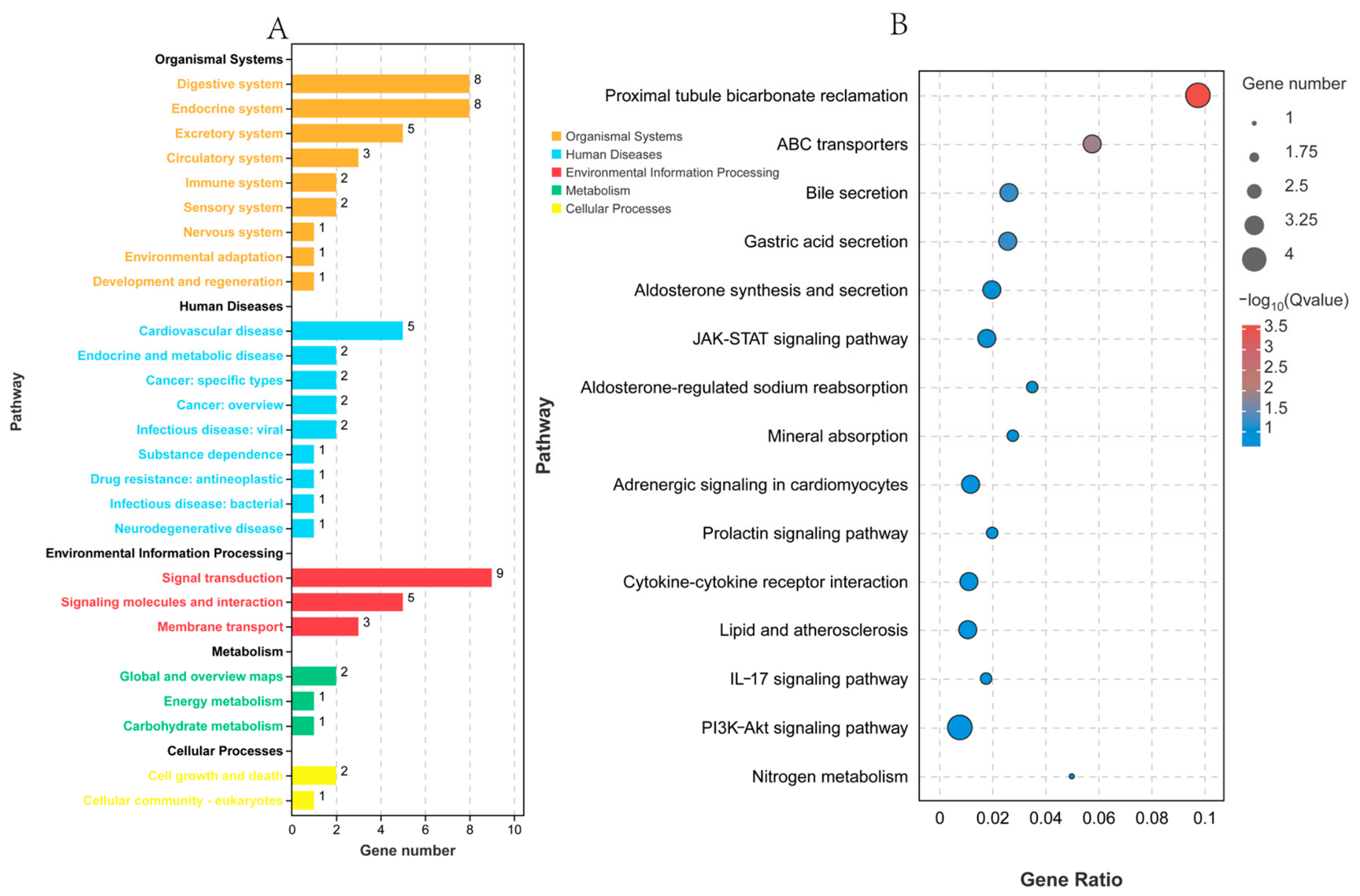
A targeted KEGG analysis performed exclusively on this curated set of 38 genes provided a much clearer view of the core osmoregulatory pathways. This analysis identified 15 significantly enriched pathways (p < 0.05) (Figure 6). Crucially, these included pathways directly involved in ion and water balance (e.g., proximal tubule bicarbonate reclamation, aldosterone-regulated sodium reabsorption, mineral absorption) and the key endocrine signaling cascades that control them (e.g., prolactin signaling pathway, JAK-STAT signaling pathway, PI3K-Akt signaling pathway). This focused analysis confirms that the observed transcriptomic changes are highly relevant to a coordinated osmoregulatory response.

3.5. qRT-PCR Confirms RNA-Seq Expression Patterns

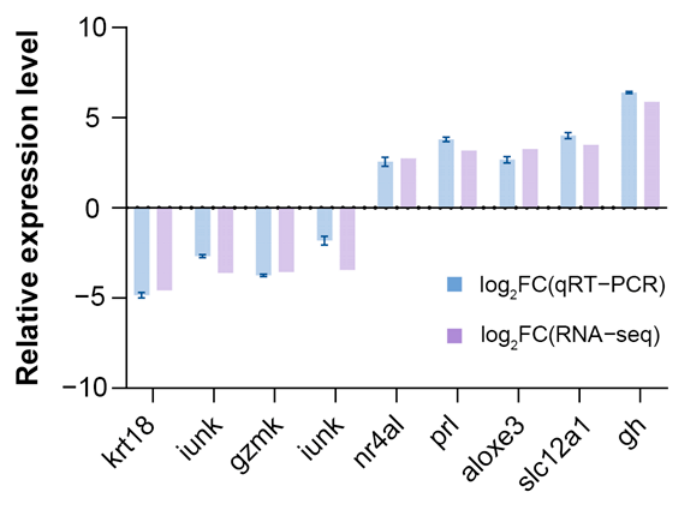
To validate the accuracy of the RNA-seq data, the expression levels of nine randomly selected DEGs were measured using qRT-PCR. The results showed that the expression trends (log2 Fold Change) determined by qRT-PCR were highly consistent with the RNA-seq data for all nine genes (Figure 7). This strong correlation confirms the reliability and reproducibility of our transcriptome sequencing results.

4. Discussion

This study provides the first comprehensive transcriptomic insight into the long-term, low-salinity acclimation of E. tetradactylum, revealing a striking divergence in the adaptive strategies of the brain and gills. The data strongly support a model of a dual regulatory mechanism: the gills act as the primary site for robust physiological and structural remodeling, while the brain maintains transcriptomic stability, orchestrating the systemic response through subtle but critical neuroendocrine signals. This hierarchical system of central command and peripheral execution is a hallmark of efficient physiological adaptation in vertebrates.

4.1. The Gill: Extensive Physiological Remodeling for a Hypoosmotic Environment

Our results unequivocally identify the gill as the primary site of transcriptomic response to chronic low salinity, with over 700 DEGs reflecting a profound functional overhaul. This is consistent with the gill’s role as the frontline organ directly interfacing with the hypoosmotic environment and is a common finding in transcriptomic studies of euryhaline fishes under salinity stress [3,13]. The gill’s adaptation can be deconstructed into two principal, coordinated strategies: enhancing ion uptake and reducing water/ion permeability.

4.1.1. Enhancing Ion Uptake Machinery

A critical adaptation to a low-salinity environment is the switch from net ion secretion to active ion absorption. Our data provide strong molecular evidence for this functional shift. The solute carrier slc12a10, a Na+-Cl cotransporter (NCC), was one of the most significantly upregulated genes in the gills of low-salinity acclimated fish. NCCs are vital for electroneutral ion uptake in freshwater fish, and their increased expression is a classic molecular signature of freshwater acclimation [21]. Furthermore, the significant upregulation of the prolactin receptor (prlr) is of paramount importance. Prolactin (prl) is the quintessential freshwater-adapting hormone, known to stimulate ion-absorbing pathways and decrease epithelial permeability in osmoregulatory surfaces [9,10,21]. The increased abundance of its receptor in the gill tissue indicates an enhanced sensitivity to this crucial endocrine signal, priming the organ for a more robust response to prl released from the pituitary. This mechanism of receptor upregulation has also been observed in other euryhaline species adapting to low salinity [11,22].

4.1.2. Reducing Water Permeability and Passive Ion Loss

In a hypoosmotic environment, fish face a constant osmotic influx of water, which must be excreted by the kidneys at a significant energetic cost [8]. An efficient strategy to mitigate this is to reduce the water permeability of the gills. Our data reveal a powerful molecular mechanism for this: the profound downregulation of aquaporin-1 (Aqp1, log2FC = −5.97). Aquaporins are water channel proteins, and the drastic reduction of Aqp1 expression would substantially decrease passive water influx, thereby conserving energy and preventing over-hydration. This finding aligns with osmoregulatory principles observed in other euryhaline species. Concurrently, the downregulation of several ion channels, such as the potassium channel KCNJ16 and chloride channels CLIC2 and CLIC4, suggests a strategy to “tighten” the epithelium and minimize the passive, diffusive loss of essential ions to the dilute environment. Together, these changes paint a picture of the gill epithelium being remodeled to act as a more effective barrier, selectively taking up necessary ions while staunching the loss of ions and the influx of water.

4.2. The Brain: Subtle Neuroendocrine Control Orchestrates Systemic Adaptation

In stark contrast to the gills, the brain exhibited remarkable transcriptomic stability, with only 10 DEGs. This suggests that during chronic, non-acute osmotic stress, the central nervous system prioritizes maintaining its own internal homeostasis at the transcriptional level. However, the identity of these few DEGs is highly significant, pointing to the brain’s role as the central command center that initiates and directs the systemic osmoregulatory response via hormonal cascades.
The upregulation of prolactin (prl) is the expected and canonical response for freshwater adaptation, confirming the activation of this key hormonal axis [23]. Similarly, the upregulation of pro-opiomelanocortin (pomc), the precursor to Adrenocorticotropic hormone (ACTH), indicates an activation of the hypothalamic–pituitary–interrenal (HPI) axis. This is a classic stress response pathway, suggesting that long-term acclimation to a hypoosmotic environment is perceived as a sustained physiological challenge that requires continuous management.
Intriguingly, we observed a significant upregulation of growth hormone (gh) in the brain. This finding appears paradoxical, as gh is classically considered a “seawater-adapting” hormone in many teleosts, often acting synergistically with cortisol to promote ion secretion by the gills [9,12]. However, the function of gh is pleiotropic. Beyond its direct role in ion transport, gh is a primary regulator of growth and energy metabolism. The extensive physiological remodeling occurring in the gills—including the synthesis of new transporters, receptors, and structural proteins—is an extremely energy-intensive process [3]. Therefore, the upregulation of gh in this low-salinity context may not be directly related to ion transport but rather to its metabolic functions: mobilizing energy reserves (e.g., lipids and glycogen) and stimulating protein synthesis to support the high energetic cost of cellular restructuring in peripheral osmoregulatory organs. This reframes the gh response not as a contradiction, but as a critical component of a sophisticated, multi-faceted adaptation, where the brain anticipates and provides the necessary metabolic fuel for the peripheral response it commands. In summary, the concurrent upregulation of prl, pomc, and gh under low-salinity adaptation supports their involvement in teleost osmoregulation. Furthermore, as all three encode pituitary-secreted hormones, this finding further clarifies the central regulatory role of the pituitary gland in responding to salinity changes [24].

4.3. Integrating the Brain–Gill Axis: The Role of PI3K-Akt and JAK-STAT Signaling

The coordinated response between the brain and gills necessitates robust signaling pathways to transduce hormonal commands into cellular action. Our KEGG enrichment analysis identified the PI3K-Akt and JAK-STAT signaling pathways as the crucial molecular conduits of this brain–gill axis. The JAK-STAT pathway is the canonical signaling cascade for both prolactin and growth hormone receptors [25,26]. When prl and gh, released under the brain’s direction, bind to their respective receptors (like the upregulated prlr) on gill ionocytes, they are known to activate the JAK-STAT cascade, leading to the phosphorylation of STAT transcription factors, which then modulate the expression of target genes, including ion transporters.
The PI3K-Akt pathway is a central hub that regulates fundamental cellular processes such as cell growth, proliferation, survival, and metabolism [27]. Its enrichment in our dataset is significant because osmoregulatory adaptation requires precisely these functions—for example, the proliferation and differentiation of specialized ionocyte cell types in the gills. Furthermore, the PI3K-Akt pathway is known to be responsive to osmotic stress and can be activated by growth factors, including those downstream of gh [27,28,29]. The enrichment of both pathways is therefore not a coincidental finding; it is the molecular fingerprint of the brain–gill axis in action. It provides a plausible mechanistic framework explaining how the neuroendocrine signals from the brain are translated into the sweeping transcriptomic and physiological changes observed in the gills.

4.4. Broader Homeostatic Adjustments: The Nexus of Ion and Acid–Base Regulation

Successful adaptation to a new environment requires more than just adjusting the primary challenged system; it involves recalibrating multiple interconnected physiological processes to achieve a new homeostatic state. A key finding from our targeted pathway analysis was the significant enrichment of “Proximal tubule bicarbonate reclamation”. Although named for its function in the kidney, the genes involved are also critical for acid–base balance in the gills. In fish, ion transport and acid–base regulation are inextricably linked, often utilizing the same transporters and cells [30,31,32].
Our results show a coordinated downregulation of key genes in this pathway within the gills, including carbonic anhydrase 4 (CA4), aquaporin-1 (Aqp1), and the sodium bicarbonate cotransporter SLC4A4. These proteins work in concert to manage bicarbonate and proton flux, which is essential for maintaining blood pH. The downregulation of these components in a low-salt environment likely represents a strategic trade-off. To maximize the energetically expensive uptake of Na+ and Cl, the gill may downregulate other, less critical transport processes to conserve ATP. This fine-tuning of acid–base regulatory machinery highlights that adaptation to low salinity is a holistic process, involving not just the upregulation of ion uptake but also the careful management of other physiological systems to maintain overall homeostasis in an efficient manner.

5. Conclusions

By integrating physiological phenotyping with transcriptomic analysis, this study reveals that E. tetradactylum employs a highly precise and efficient “brain–gill axis” synergistic regulatory strategy during chronic steady-state adaptation to low-salinity acclimation. Our findings confirm that the brain, acting as the neuroendocrine command center, exhibits remarkable transcriptional resilience, issuing regulatory instructions through the targeted upregulation of master regulators such as prl, gh, and pomc. Concurrently, the gills, serving as the primary effector organ, undergo extensive transcriptional remodeling—upregulating slc12a10 to enhance ion uptake and downregulating aqp1 to prevent water loss—thereby reconstructing the peripheral physiological barrier to ensure survival and optimal growth. This profound coupling of central commands and peripheral responses, mediated by signaling pathways such as JAK-STAT and PI3K-Akt, constitutes the molecular logic for maintaining osmoregulatory homeostasis and achieving growth optimization under low-salinity conditions in this euryhaline species. As salinity fluctuation is a major stressor in aquaculture, this research provides a robust foundation for screening low-salt-tolerant populations and offers tangible targets for the selective breeding of superior strains, thereby enhancing the sustainability and resilience of the E. tetradactylum farming industry.

Supplementary Materials

The following supporting information can be downloaded at https://www.mdpi.com/article/10.3390/fishes11060351/s1: Table S1: Summary of read mapping statistics against the E. tetradactylum reference genome; Table S2: Statistics of known and novel gene detection across all samples; Table S3: Top Differentially Expressed Genes in the Gills of E. tetradactylum Following Low-Salinity Acclimation; Table S4: 38 candidate differentially expressed genes (DEGs) selected from the low-salinity adaptation response of E. tetradactylum.

Author Contributions

Conceptualization, W.L. and Z.C.; methodology, J.L. (Jing Li); software, W.L.; validation, W.L., B.T. and J.L. (Jingheng Lu); formal analysis, H.Z.; investigation, B.W.; resources, Z.W.; data curation, J.H.; writing—original draft preparation, W.L.; writing—review and editing, Z.W.; visualization, J.L. (Jingheng Lu); supervision, J.L. (Jing Li); project administration, Z.W.; funding acquisition, Z.W. All authors have read and agreed to the published version of the manuscript.

Funding

This research was funded by the 2025 Research on breeding technology of candidate species for Guangdong modern marine ranching (2025-MRB-00-001), the Guangdong Province Ordinary Colleges and Universities Key Field Special Project (Science and Technology Services for Rural Revitalization) (2023ZDZX4011), Guangdong Ocean University Aquaculture Excellent Young Talent Program (2024), and the Guangdong Province Ordinary Colleges and Universities Innovation Team Projects (2021KCXTD026; 2022KCXTD013).

Institutional Review Board Statement

The animal study protocol was approved by the Guangdong Ocean University Research Council’s guidelines for the care and use of laboratory animals (approval number: GDOU-LAE-2023-015; 4 April 2023).

Informed Consent Statement

Not applicable.

Data Availability Statement

The original contributions presented in this study are included in the article. Further inquiries can be directed to the corresponding authors.

Conflicts of Interest

The authors declare no conflicts of interest.

References

  1. Leprêtre, M.; Hamar, J.; Urias, M.B.; Kültz, D. Comparative Proteomics of Salinity Stress Responses in Fish and Aquatic Invertebrates. Proteomics 2025, 25, 185–205. [Google Scholar] [CrossRef]
  2. Małachowicz, M.; Krasnov, A.; Wenne, R. Diverse Transcriptome Responses to Salinity Change in Atlantic Cod Subpopulations. Cells 2023, 12, 2760. [Google Scholar] [CrossRef] [PubMed]
  3. Vij, S.; Purushothaman, K.; Sridatta, P.S.R.; Jerry, D.R. Transcriptomic Analysis of Gill and Kidney from Asian Seabass (Lates calcarifer) Acclimated to Different Salinities Reveals Pathways Involved with Euryhalinity. Genes 2020, 11, 733. [Google Scholar] [CrossRef] [PubMed]
  4. Mkulo, E.M.; Iddrisu, L.; Yohana, M.A.; Zheng, A.; Zhong, J.; Jin, M.; Danso, F.; Wang, L.; Zhang, H.; Tang, B.; et al. Exploring salinity adaptation in teleost fish, focusing on omics perspectives on osmoregulation and gut microbiota. Front. Mar. Sci. 2025, 12, 1559871. [Google Scholar] [CrossRef]
  5. Silva-Marrero, J.I.; Lai, F.; Handeland, S.O.; Pedrosa, C.; Gelebart, V.; Balseiro, P.; Fuentes, J.; Rønnestad, I.; Gomes, A.S. Integration of Gill and Intestinal Osmoregulatory Functions to Assess the Smoltification Window in Atlantic Salmon. Fishes 2025, 10, 119. [Google Scholar] [CrossRef]
  6. Evans, D.H.; Piermarini, P.M.; Choe, K.P. The multifunctional fish gill: Dominant site of gas exchange, osmoregulation, acid-base regulation, and excretion of nitrogenous waste. Physiol. Rev. 2005, 85, 97–177. [Google Scholar] [CrossRef]
  7. Zimmer, A.M.; Perry, S.F. Physiology and aquaculture: A review of ion and acid-base regulation by the gills of fishes. Fish Fish. 2022, 23, 874–898. [Google Scholar] [CrossRef]
  8. Giffard-Mena, I.; Boulo, V.; Abed, C.; Cramb, G.; Charmantier, G. Expression and Localization of Aquaporin 1a in the Sea-Bass (Dicentrarchus labrax) during Ontogeny. Front. Physiol. 2011, 2, 34. [Google Scholar] [CrossRef]
  9. Sakamoto, T.; McCormick, S.D. Prolactin and growth hormone in fish osmoregulation. Gen. Comp. Endocrinol. 2006, 147, 24–30. [Google Scholar] [CrossRef] [PubMed]
  10. Saha, I.; Chakraborty, A.; Das, S. Prolactin Influences Different Aspects of Fish Biology. Asian J. Biol. Life Sci. 2021, 10, 51–56. [Google Scholar] [CrossRef]
  11. Inokuchi, M.; Yamaguchi, Y.; Moorman, B.P.; Seale, A.P. Age-Dependent Decline in Salinity Tolerance in a Euryhaline Fish. Front. Aging 2021, 2, 675395. [Google Scholar] [CrossRef]
  12. Mccormick, S.D. The Hormonal Control of Osmoregulation in Teleost Fish. Life Sci. 2011, 1, 1466–1473. [Google Scholar]
  13. Maryoung, L.A.; Lavado, R.; Bammler, T.K.; Gallagher, E.P.; Stapleton, P.L.; Beyer, R.P.; Farin, F.M.; Hardiman, G.; Schlenk, D. Differential Gene Expression in Liver, Gill, and Olfactory Rosettes of Coho Salmon (Oncorhynchus kisutch) After Acclimation to Salinity. Mar. Biotechnol. 2015, 17, 703–717. [Google Scholar] [CrossRef]
  14. Sun, Z.; Lou, F.; Zhang, Y.; Song, N. Gill Transcriptome Sequencing and De Novo Annotation of Acanthogobius ommaturus in Response to Salinity Stress. Genes 2020, 11, 631. [Google Scholar] [CrossRef] [PubMed]
  15. Chen, Z.; Liu, W.; Zheng, A.; Jin, M.; Huang, S.; Zhao, L.; Tang, S.; Moses Mkulo, E.; Wang, L.; Zhang, H.; et al. Effects of salinity on growth, survival, tissue structure, osmoregulation, metabolism, and antioxidant capacity of Eleutheronema tetradactylum (Shaw, 1804). Front. Mar. Sci. 2025, 12, 1553114. [Google Scholar] [CrossRef]
  16. Chen, S.; Zhou, Y.; Chen, Y.; Gu, J. fastp: An ultra-fast all-in-one FASTQ preprocessor. Bioinformatics 2018, 34, i884–i890. [Google Scholar] [CrossRef]
  17. Langmead, B.; Salzberg, S.L. Fast gapped-read alignment with Bowtie 2. Nat. Methods 2012, 9, 357–359. [Google Scholar] [CrossRef]
  18. Kim, D.; Langmead, B.; Salzberg, S.L. HISAT: A fast spliced aligner with low memory requirements. Nat. Methods 2015, 12, 357–360. [Google Scholar] [CrossRef] [PubMed]
  19. Li, B.; Dewey, C.N. RSEM: Accurate transcript quantification from RNA-Seq data with or without a reference genome. BMC Bioinform. 2011, 12, 323. [Google Scholar] [CrossRef]
  20. Huckvale, E.; Moseley, H.N.B. kegg_pull: A software package for the RESTful access and pulling from the Kyoto Encyclopedia of Gene and Genomes. BMC Bioinform. 2023, 24, 78. [Google Scholar] [CrossRef] [PubMed]
  21. Breves, J.P.; Keith, P.L.K.; Hunt, B.L.; Pavlosky, K.K.; Inokuchi, M.; Yamaguchi, Y.; Lerner, D.T.; Seale, A.P.; Grau, E.G. clc-2c is regulated by salinity, prolactin and extracellular osmolality in tilapia gill. J. Mol. Endocrinol. 2017, 59, 391–402. [Google Scholar] [CrossRef]
  22. Nagarajan, G.; Aruna, A.; Chang, Y.M.; Alkhamis, Y.A.; Mathew, R.T.; Chang, C.F. Effects of Osmotic Stress on the mRNA Expression of prl, prlr, gr, gh, and ghr in the Pituitary and Osmoregulatory Organs of Black Porgy, Acanthopagrus schlegelii. Int. J. Mol. Sci. 2023, 24, 5318. [Google Scholar] [CrossRef]
  23. Zhang, Y.; Zhang, S.; Xu, S.; Wang, D. Effects of acute low-salinity stress on osmoregulation, antioxidant capacity, and growth of the black sea bream (Acanthopagrus schlegelii). Fish. Physiol. Biochem. 2022, 48, 1599–1617. [Google Scholar] [CrossRef] [PubMed]
  24. Watanabe, T.; Wong, M.K.; Miyahara, A.; Yoshida, S.; Tsuneoka, Y.; Tsukada, T. Multiplex in situ hybridization chain reaction reveals the spatial organization of six pituitary hormone mRNAs in the Japanese eel. Gen. Comp. Endocrinol. 2026, 378, 114899. [Google Scholar] [CrossRef]
  25. Breves, J.P.; Popp, E.E.; Rothenberg, E.F.; Rosenstein, C.W.; Maffett, K.M.; Guertin, R.R. Osmoregulatory actions of prolactin in the gastrointestinal tract of fishes. Gen. Comp. Endocrinol. 2020, 298, 113589. [Google Scholar] [CrossRef] [PubMed]
  26. Iwasaki, Y.; Nishiyama, M.; Corcoran, D.; Araki, T. Biological roles of growth hormone/prolactin from an evolutionary perspective. Endocr. J. 2024, 71, 827–837. [Google Scholar] [CrossRef]
  27. Cui, W.; Ma, A.; Wang, X. Response of the PI3K-AKT signalling pathway to low salinity and the effect of its inhibition mediated by wortmannin on ion channels in turbot Scophthalmus maximus. Aquac. Res. 2020, 51, 2676–2686. [Google Scholar] [CrossRef]
  28. Reindl, K.M.; Kittilson, J.D.; Bergan, H.E.; Sheridan, M.A. Growth hormone-stimulated insulin-like growth factor-1 expression in rainbow trout (Oncorhynchus mykiss) hepatocytes is mediated by ERK, PI3K-AKT, and JAK-STAT. Am. J. Physiol. Regul. Integr. Comp. Physiol. 2011, 301, R236–R243. [Google Scholar] [CrossRef]
  29. Liu, Y.; Li, E.; Xu, C.; Su, Y.; Qin, J.G.; Chen, L.; Wang, X. Brain Transcriptome Profiling Analysis of Nile Tilapia (Oreochromis niloticus) Under Long-Term Hypersaline Stress. Front. Physiol. 2018, 9, 219. [Google Scholar] [CrossRef]
  30. Haswell, M.S.; Randall, D.J.; Perry, S.F. Fish gill carbonic anhydrase: Acid-base regulation or salt transport? Am. J. Physiol. 1980, 238, R240–R245. [Google Scholar] [CrossRef]
  31. Claiborne, J.B.; Edwards, S.L.; Morrison-Shetlar, A.I. Acid-base regulation in fishes: Cellular and molecular mechanisms. J. Exp. Zool. 2002, 293, 302–319. [Google Scholar] [CrossRef] [PubMed]
  32. Hwang, P.P.; Lee, T.H.; Lin, L.Y. Ion regulation in fish gills: Recent progress in the cellular and molecular mechanisms. Am. J. Physiol. Regul. Integr. Comp. Physiol. 2011, 301, R28–R47. [Google Scholar] [CrossRef] [PubMed]
Figure 1. Overview of transcriptome profiles from brain and gill tissues. (A) Principal Component Analysis (PCA) of all samples based on gene expression levels. Samples are colored by tissue and treatment group. (B) Venn diagram showing the overlap of expressed genes among the four experimental groups.
Fishes 11 00351 g001
Figure 2. Identification of differentially expressed genes (DEGs) in response to low salinity. (A) Bar chart summarizing the number of upregulated and downregulated DEGs in the brain and gills. (B,C) Volcano plots showing the distribution of DEGs in the brain (B) and gills (C) between the S5 and S25 groups. Red and blue dots represent significantly up- and down-regulated genes, respectively (|log2FC| ≥ 1, FDR < 0.05).
Fishes 11 00351 g002
Figure 3. Gene Ontology (GO) enrichment analysis of DEGs. The bar charts show the top enriched GO terms for DEGs in the brain (A) and gills (B). The three main GO categories (Biological Process, Molecular Function, and Cellular Component) are displayed. The x-axis represents the number of genes associated with each term.
Fishes 11 00351 g003
Figure 5. Heatmap illustrating the expression patterns of 38 curated osmoregulation-related DEGs across all samples. The color scale represents the z-score normalized FPKM values, with red indicating high expression and blue indicating low expression.
Fishes 11 00351 g005
Figure 6. KEGG pathway enrichment analysis of the 38 curated osmoregulation-related DEGs. (A) KEGG pathway classification of this selected gene subset. (B) Bubble plot showing the significantly enriched pathways. The bubble size and color represent the gene number and q-value, respectively.
Fishes 11 00351 g006
Figure 7. Validation of RNA-seq data by qRT-PCR. The bar chart compares the log2 (Fold Change) values obtained from RNA-seq and qRT-PCR for nine selected DEGs. Error bars on the qRT-PCR data represent the standard deviation of three biological replicates.
Fishes 11 00351 g007
Table 1. Primer sequences used for qRT-PCR validation.
Gene NameSequence (5′–3′)Amplicon Size (bp)
ghGGTTGCTCCACTCCGTGTTGAT160
ACCACCACACCTTGTTCCAGAC
prlGCTTGATGGCACCTCGTCCTT110
GCGAGCCAGCGACAACAGAT
aloxe3TGAAGCAGATTCCAGGAGATGACA180
GCAAGTTACGCAGCAGTGACA
gzmkTCATGGTGCTGACATTGTTGGAG187
TTGGTCGTTACTGATGGAGTGAAC
igheCCACCTCAGCGTCCTTCAGTAT134
GCCTCGTCATCAACAAGCCAAG
iunhTGATTCAGAAGGAAGGTGCTGTTG104
AAGTGCCAGGTTGGTGAGAGG
krt18CTTGGTGAAGGAGGAGCTGGAT152
ACTGGAGGCGGATGTTGTTGA
nr4alGAGTCAGTGCGTCCGAGGTT107
CTGCGAGACAAGAGAAGGAGGAA
slc12a10GCAGGAAGGCATCTCGCTTGA178
GTCGCTCTGTGGCACTGGAA
rsp17GCAACAAAATTGCTGGGTACG153
CCTCAATGAGCTCCTGGTCC
Table 2. Summary of sequencing data quality control for the brain and gill transcriptomes of E. tetradactylum.
SampleRaw DataClean DataClean Reads RatioQ20Q30GC Content
S25-Brain_142,970,05042,659,55699.28%96.95%92.11%47.22%
S25-Brain_243,099,54642,815,08099.34%97.11%92.39%47.61%
S25-Gill_136,236,79236,023,66499.41%97.62%93.53%48.50%
S25-Gill_244,895,01444,581,03699.30%96.68%91.50%48.27%
S5-Brain_144,766,83844,413,74499.21%96.80%91.71%47.55%
S5-Brain_244,443,94844,111,06499.25%96.78%91.65%47.57%
S5-Gill_142,815,64642,567,35099.42%97.11%92.31%48.71%
S5-Gill_244,653,30844,381,76099.39%97.23%92.54%49.13%
Disclaimer/Publisher’s Note: The statements, opinions and data contained in all publications are solely those of the individual author(s) and contributor(s) and not of MDPI and/or the editor(s). MDPI and/or the editor(s) disclaim responsibility for any injury to people or property resulting from any ideas, methods, instructions or products referred to in the content.