Article

Genome Analysis and Reproductive Observations Suggest Allotetraploidy and a Potential Reproduction–Metabolism Association in the Endangered Fish Neolissochilus heterostomus


1
College of Fisheries, Hunan Agricultural University, Changsha 410128, China
2
Yuelushan Laboratory, Changsha 410128, China
3
Hunan Engineering Technology Research Center of Featured Aquatic Resources Utilization, Hunan Agricultural University, Changsha 410128, China
4
Faculty of Animal Science and Technology, Yunnan Agricultural University, Kunming 650500, China
5
Yunnan Circular Agriculture Industry Research Institute, Puer 665000, China
6
Dehong Tropical Region Modern Agricultural Industry Research Institute, Dehong 678400, China
7
Dehong Prefecture Aquatic Technology Extension Station, Dehong 678400, China
*
Authors to whom correspondence should be addressed.
These authors contributed equally to this work.
Fishes 2026, 11(6), 350; https://doi.org/10.3390/fishes11060350
Submission received: 20 April 2026 / Revised: 8 June 2026 / Accepted: 9 June 2026 / Published: 11 June 2026
(This article belongs to the Special Issue Conservation and Population Genetics of Fishes)

Abstract

Neolissochilus heterostomus, a cyprinid fish endemic to Yunnan Province, China, is highly valued for both ornamental and edible purposes, yet its wild populations are currently declining and classified as endangered. In this study, we present a chromosome-level genome assembly of N. heterostomus, utilizing the PacBio HiFi and Hi-C strategies. The assembled genome spans 1793.99 Mb and is anchored to 50 chromosomes, comprising a total of 50,203 genes. Genomic features and chromosomal karyotype data recorded in the present study are consistent with an allotetraploid origin for N. heterostomus. Comparative genomics shows that N. heterostomus shares a close phylogenetic relationship with another allotetraploid fish, the common carp Cyprinus carpio. In total, 4687 expanded and 1365 contracted gene families were identified in N. heterostomus. Further enrichment analyses indicated an overrepresentation of metabolism-related pathways among the expanded and positively selected gene families, whereas the contracted gene families were enriched in reproduction- and embryonic development-related pathways. Reproductive observations further indicate that N. heterostomus produces fewer eggs than other cyprinid species characterized by relatively long embryonic development periods (106.1 h; accumulated temperature: 2260.6 °C·h), including common carp, goldfish (Carassius auratus), grass carp (Ctenopharyngodon idella), pond loach (Misgurnus anguillicaudatus), and blunt snout bream (Megalobrama amblycephala). These findings suggest a potential association between metabolism-related genomic features and reproductive traits, although functional validation remains necessary. Overall, this study may offer insights into the polyploidization, metabolic, and reproductive traits of N. heterostomus, thereby providing genomic and biological resources that may support future studies relevant to the conservation and management of this endangered species.
Key Contribution: This study provided the first chromosome-level genome assembly for the endangered fish Neolissochilus heterostomus. Genomic features and chromosomal karyotype data recorded in the present study are consistent with an allotetraploid origin of N. heterostomus. In addition, genome analysis and reproductive observations suggest a potential reproduction–metabolism association in N. heterostomus.

1. Introduction

Yunnan Province in China is characterized by its intricate landscape, geological features, and varied aquatic environments. Records indicate that Yunnan Province is home to 629 fish species, representing 39.7% of the total freshwater fish diversity in China [1]. This exceptional variety of fish serves as a crucial genetic resource for the sustainable advancement of fisheries in China. Thus, preserving the fish diversity in Yunnan Province is vital for ecological conservation efforts in China and even Southeast Asia [2].
Neolissochilus heterostomus (Blue Gilo), an endemic cyprinid of the Barbinae subfamily, is restricted to the Longchuanjiang and Dayingjiang rivers in Dehong Prefecture, Yunnan Province, China [3]. This fish exhibits both ornamental and nutritional value and inhabits swift-flowing and clean waters [4,5]. However, the construction of hydropower stations significantly degraded the habitat of N. heterostomus, resulting in a sharp decline in its natural populations [6]. Consequently, this species has been classified as Near Threatened in the 2020 China Biodiversity Red List: Vertebrates [7]. To preserve and restore populations, the first successful artificial breeding of N. heterostomus was achieved by the Mangshi Fisheries Station and the Dehong Prefecture Fish Seed Station [8]. Due to the lack of understanding of the basic biological characteristics of this fish, numerous issues have emerged during the artificial breeding process, including a higher parental mortality rate caused by stress-induced injuries, low reproductive rates, and poor hatching rates, which lead to low efficiency in the artificial breeding of N. heterostomus [6]. Therefore, further research on the genetic and biological characteristics of N. heterostomus is essential to enhance the success of artificial breeding and improve germplasm resource conservation.
Whole-genome duplication (WGD) is widely prevalent among cyprinids. It is also an important genetic factor driving the formation of polyploidy [9]. Typical polyploid cyprinids such as the common carp (Cyprinus carpio) [9] and goldfish (Carassius auratus) [10] are considered to have undergone the fourth round of a WGD event. Genome doubling provides the polyploid fish with abundant genetic materials and plays a vital role in driving gene redundancy, functional divergence, and neofunctionalization [9]. Genomic analysis is a core approach for identifying, tracing, and interpreting WGD events in cyprinids. Methods such as collinearity analysis and synonymous substitution rate calculation can determine the occurrence time of WGD events and clarify the evolutionary patterns of duplicated genes [11]. In Schizothorax o’connori, for example, genomic sequencing and bioinformatic analyses show that duplicated genes of this species have undergone remarkable functional divergence in pathways related to high-altitude hypoxia adaptation, DNA repair, and oxidative stress resistance [12]. These changes not only lay a genetic foundation for the typical alpine life history traits of Sc. o’connori, including slow growth, late sexual maturity, long lifespan, and low fecundity, but also provide important evidence for revealing the intrinsic mechanisms underlying polyploidy and adaptation to extreme environments in fishes of the Qinghai–Tibet Plateau [12].
In addition, deciphering and analyzing genomic data helps uncover the basic biological characteristics of fish, greatly promoting research on fish conservation and sustainable utilization [13]. For example, genomic investigation of Acipenser sinensis clarified its polyploid nature, which helps avoid genetic introgression induced by artificial stocking [14]. Stress-related gene families such as hsp70 were also characterized in Ac. sinensis, offering potential molecular targets for protection under climate change [14]. Mushtaq et al. demonstrated that genome profiling can link genetic variations to reproductive traits including fecundity and embryonic development in rare fish species [15]. Liu et al. assembled a high-quality genome of Tachysurus sinensis and detected adaptive variations in energy metabolism and nutrient utilization pathways [16]. These findings suggested genomic signatures associated with feeding adaptation and metabolic pathways in Ta. Sinensis [16]. Wu et al. analyzed the genomic data of grass carp and illustrated the association between feeding preference and metabolism in this species [17].
In this study, we decoded the genome of N. heterostomus using the PacBio HiFi long-read and Hi-C technologies and obtained a chromosome-level genome assembly. By integrating genomic analysis, karyotyping, artificial propagation and embryonic development data, this study suggests an allotetraploid origin and identifies genomic features potentially associated with metabolism-related pathways and reproductive characteristics in N. heterostomus. This study may provide fundamental insights for optimizing breeding strategies and conducting conservation biological research in N. heterostomus, which will be instrumental for the protection and sustainable utilization of this species.

2. Materials and Methods

2.1. Ethical Statement, Sample Preparation, and Whole-Genome Sequencing

All procedures involving animals received approval from the Animal Care and Use Committee at the College of Fisheries, Hunan Agricultural University (Changsha, China). A female N. heterostomus that had reached sexual maturity was sourced from the Dehong Prefecture Fishery Technology Extension Station located in Yunnan Province, China. Around 5 g of muscle tissue was harvested for DNA extraction for sequencing on the BGI (BGI Genomics, Shenzhen, China) and PacBio (Pacific Biosciences, Menlo Park, CA, USA) platforms. Additionally, samples weighing between 1 and 2 g were taken from 14 other tissues (including heart, liver, spleen, kidney, head kidney, muscle, skin, gonad, fin, intestine, gill, brain, eye, and blood) for RNA extraction and sequencing to aid in gene structure annotation [18].
In the BGI sequencing process, suitable DNA was randomly fragmented into pieces measuring 300–500 bp with the help of a Covaris ultrasonicator (Covaris, Inc., Woburn, MA, USA). The creation of a sequencing library involved the following steps: end repair, A-tailing, ligation of adapters, purification, and PCR amplification [19]. Sequencing took place on the BGI MGISEQ-2000 (BGI Genomic, Shenzhen, China) platform. To ensure high-quality data, raw reads that included PCR duplicates, adapter sequences, reads with more than 0.5% undetermined bases, and low-quality paired reads were eliminated using the SOAPnuke (v.2.1.0, optimized parameters: filter -1 fq1 -2 fq2 -M 1 -A 0.5 -l 5 -q 0.5 -n 0.05 -d -S -O 10 -P 0.1 -Q 1 -C cleanFq1 -D cleanFq2) [20] software, resulting in clean reads.
In the PacBio sequencing process, DNA was randomly broken down into approximately 15 kb fragments with the help of a g-TUBE (Woburn, MA, USA). A SMRTbell library was constructed utilizing the SMRTbell Express Template Prep Kit 3.0 (Pacific Biosciences, Menlo Park, CA, USA) and subsequently sequenced on the PacBio Revio system [21].
For RNA sequencing (RNA seq), the total RNA was extracted from the above 14 tissues using TRIzol reagent (Magen Biotechnology, Guangzhou, China). The purity and integrity of RNA were assessed with a NanoDrop 2000 spectrophotometer (NanoDrop Technologies, Wilmington, DE, USA) and an Agilent 2100 Bioanalyzer system (Agilent Technologies, Santa Clara, CA, USA). After quality verification of the RNA samples, strand-specific RNA seq libraries were constructed following standard next-generation sequencing workflows. All libraries were quality-checked using the Agilent 2100 Bioanalyzer before sequencing. Qualified libraries were sequenced on the MGI high-throughput sequencing platform with 150 bp paired-end reads, yielding an average sequencing depth of ≥10 Gb per sample [22].
To acquire chromosome-linked genomic data for N. heterostomus, this study conducted high-throughput chromosome conformation capture (Hi-C) assays. We fixed muscle tissue samples with formaldehyde to create cross-links between DNA and proteins. Following cell lysis, chromatin was treated with the restriction enzyme DpnII (New England Biolabs, Ipswich, MA, USA) and then labeled with biotin-14-dCTP (Invitrogen, Carlsbad, Menlo Park, CA, USA) before undergoing proximity ligation. The purified DNA was used to create the Hi-C library [23], which was later sequenced using the Illumina NovaSeq 6000 system (Illumina, Inc., San Diego, CA, USA). After sequencing, we evaluated the quality of the raw data with FastQC (v.0.11.7) [24]. This assessment included analyzing base frequency distribution, sequencing error rates, and GC content distribution to confirm the reliability of the data for subsequent genome scaffolding and chromosome assembly.

2.2. Genome Survey Analysis

Before assembling the entire genome of N. heterostomus, we performed a genome survey utilizing sequencing data obtained from the BGI platform. This investigation utilized the k-mer frequency (v.1.0; kmerfreq -k 17 -l fq.list > 17mer.freq 2 > 17mer.log) distribution approach [25]. The initial estimation of the genome size was carried out using the Lander–Waterman algorithm [26]. Following this, GCE (v.1.0.2) software [27] was employed for k-mer counting and statistical evaluation to assess important genomic features such as heterozygosity and the content of repetitive sequences.

2.3. Genome Assembly and Completeness Assessment

The initial raw sequencing data underwent processing through CCS (Circular Consensus Sequencing) software (v8.0.0) [28] (with minPasses ≥ 3 and minPredictedAccuracy ≥ 0.99) to produce HiFi reads. These high-accuracy (99.0%) long reads, exceeding 15 kb in length, were then assembled de novo with Hifiasm (v.0.19.5) using the default parameters optimized for haplotype-resolved assembly [29]. To enhance the contiguity and achieve a chromosome-level assembly, we utilized Hi-C-assisted scaffolding. The raw Hi-C reads were subjected to quality control via Trimmomatic (v0.39) [30] with the specific parameters (ILLUMINACLIP: TruSeq3-PE.fa:2:30:10, LEADING:3, TRAILING:3, SLIDINGWINDOW: 4:15, MINLEN: 50) to yield clean reads. After filtering invalid interactions including self-circles, dangling ends, duplicated pairs, trans-chromosomal contacts and low-quality contacts, 12,456,890 valid cis-chromosomal interaction pairs were retained for subsequent scaffolding. Subsequently, these clean reads were aligned to the initial assembly using Juicer (v.1.6) [31], followed by chromosome-scale scaffolding with 3D-DNA (3D de novo assembly) (v.180924) [32] using the default parameters. The contact matrix resolution was set to 500 kb and contigs with linkage density higher than the threshold of 0.05 were retained for chromosome construction. Contigs shorter than 100 kb were excluded from anchoring to avoid assembly noise. Finally, manual curation was performed using Juicebox (v.1.11.08) [33] following the standard 3D-DNA assembly curation pipeline. According to previous studies [9,10], a total of 78 kb heterozygous fragments were removed based on Hi-C heterozygous signals to complete the processing of heterozygous or redundant sequences. The heterozygous alleles, assembly artifacts and duplicated homeologous regions were also distinguished as previously described [9,10].
To assess the quality of the assembled genome, sequencing reads from both second- and third-generation technologies were aligned to the assembly using BWA (v.0.7.17) [34] and Minimap2 (v.2.5) [35] with the default parameters. The mapping rates and coverage were determined for each dataset. The completeness of the assembly was evaluated with BUSCO (v.3.0.2) and the Vertebrata database in OrthoDB [36,37]. Furthermore, Merqury (v.1.3) [38] was utilized to calculate the quality value (QV) of the assembly with the k-mer size set to 21 by analyzing k-mer profiles from the sequenced reads in comparison with the final genome.

2.4. Annotation of Repetitive Sequences, Gene Structure, and Non-Coding RNAs

To annotate repetitive sequences, we adopted a thorough methodology that merges homology-based techniques with de novo prediction methods. Initially, we conducted a homology search utilizing the Repbase database [39] through RepeatMasker (v.4.1.2, nolow -no_is -norna -parallel 2) [40] and RepeatProteinMask (v.1.36, engine ncbi -noLowSimple -p value 0.0001) to detect transposable elements (TEs) [41]. Next, we created de novo repeat libraries with RepeatModeler (v.2.0.1) and Ltrfinder (v.1.0.7) to identify new repetitive elements unique to this species. Tandem repeats were then categorized using the tandem repeats finder (TRF) (v.4.09.1, 2 7 7 80 10 50 2000 -d -h) software [42]. In the final step, all identified repetitive sequences were compiled and processed to eliminate overlapping areas, resulting in a non-redundant collection of repetitive elements for further analysis.
Gene structures were identified through a combination of homology-based, ab initio, and transcriptome-assisted methods. Five cyprinid fish species were selected as closely related references based on phylogenetic relationships, genome assembly integrity, annotation completeness, biological similarity, and public data accessibility: Cy. carpio (common carp), Ca. auratus (goldfish), Ctenopharyngodon idella (grass carp), Misgurnus anguillicaudatus (pond loach), Megalobrama amblycephala (blunt snout bream). The proteins of the above five cyprinids were aligned with the N. heterostomus genome using TBLASTN (v.2.9.0) [43]. Gene structures of BLAST hit regions were then predicted using Exonerate (v.2.4.0) [44]. In the ab initio prediction phase, the tools Augustus (v.3.3.3) [45], Genscan (v.1.0) [46], and GeneID (v 1.4.4) [47] were utilized based on established probabilistic models. The ab initio prediction models were trained based on high-quality genes from homology-based methods to fit the target species intrinsic sequence patterns including codon usage bias and intron splicing sites. RNA seq alignments were produced using HiSat2 (v.2.2.1) [48] and then RNA seq alignments were further assembled into transcripts with genome-guided assembler Stringtie (v.2.1.7) [49]. Additionally, the transcriptome was assembled de novo using Trinity (v2.8.5) [50]. We built a comprehensive transcriptome database using all transcripts from RNA seq and Iso-seq according to the PASA pipeline (v2.4.1) [51]. The results from all predictions were compiled into a comprehensive and high-confidence gene set using MAKER (v.3.0) [52]. Finally, PASA pipeline (v2.4.1) [51] was used to update maker consensus predictions, adding UTR annotations and models for alternatively spliced isoforms. The final gene set underwent functional annotation by aligning it with the key protein databases SwissProt [53], TrEMBL [54], KEGG [55], InterPro [56], GO [57], and NR.
Non-coding RNAs (ncRNAs) were characterized using methods based on structure and homology. The identification of tRNA genes relied on their structural characteristics, utilizing tRNAscan-SE (v.1.3.1) [58]. rRNA sequences were identified by aligning with conserved rRNA sequences from related organisms using BLASTN (v.2.15.0) [59]. Predictions for the miRNA and snRNA sequences were made with the help of Rfam (v.14.1) [60] covariance models, employing INFERNAL (v.1.1.2) software [61].

2.5. Gene Family Clustering, Phylogenetic Analysis, and Divergence Time Estimation

To clarify the evolutionary status and genomic features of N. heterostomus, this study performed comparative genomic studies. We selected eight cypriniform species with well-assembled genomes as the primary group: Ca. auratus (goldfish) [10], Cy. carpio (common carp) [62], Ct. idellus (grass carp) [17], Mi. anguillicaudatus (pond loach) [63], My. asiaticus [64], Me. amblycephala [65], Danio rerio (zebrafish) [66], and Culter erythropterus [67]. Pseudobagrus fulvidraco [68] and Oncorhynchus mykiss [69] were included as outgroup species. We filtered and compared protein sequences from all the selected species using DIAMOND (v.2.0.5.143) [70] to evaluate sequence similarity. Orthologous gene families were then grouped using OrthoFinder2 (v.2.5.4, -M msa -S diamond -os) [71], and the clustering data for N. heterostomus were compiled and displayed in a bar chart. All statistical analyses of gene families were performed after orthogroup filtering. The gene families, single-copy orthogroups, unique paralogs and unique gene families of N. heterostomus were further analyzed according to a previous study [62].
For the purpose of phylogenetic analysis, we extracted shared single-copy orthologous gene families from the clustering outcomes and conducted multiple sequence alignments for each family using MUSCLE (v5.3) [72]. A maximum likelihood phylogenetic tree was constructed with RAxML (v.8.2.12, Randomized Axelerated Maximum Likelihood; -f a -# 100 -m GTRGAMMA) [73] and divergence times were estimated based on the resulting phylogenetic tree. Calibration points were sourced from the TimeTree database and relevant studies [74]. The estimations were carried out using the r8s software (v.1.71, divtime method = lf; algorithm = tn) [75] and the mcmctree program within the PAML (v.4.10.7, Phylogenetic Analysis by Maximum Likelihood) package [76]. For Bayesian dating using mcmctree, the 95% highest posterior density (HPD) intervals were calculated to quantify the posterior uncertainty of each divergence event. Considering that phylogenetic dating based on r8s and MCMCTree relies heavily on rigorous calibration constraints, the key phylogenetic nodes, including the divergence node of Cyprinidae, split node between Carassius and Acrossocheilus, and species differentiation node of N. heterostomus and its closely related species, were calibrated with reliable fossil evidence and authoritative previously reported divergence time data [62,74]. Molecular clock rates were constrained based on these fossil calibration points and reported evolutionary timescale data [74]. Cross-calibration was performed using two independent algorithms to eliminate potential biases from single-method estimation and ensure high credibility of the species divergence time inference [74].

2.6. Analysis of Gene Family Expansion and Contraction

This study utilized the CAFE (v.5.0, Computational Analysis of gene Family Evolution) software [77] with its default likelihood model to analyze the expansion and contraction of gene families, and likelihood ratio tests (LRTs) were performed to verify the significance of family size changes. Gene families that underwent significant statistical expansion or contraction along the evolutionary lineage of the target species were identified. Subsequent to this, functional enrichment analysis was performed, focusing on GO terms and KEGG pathways for the genes within these altered families. The significance of the enrichment was evaluated using Fisher’s exact test, and the p-values were adjusted for multiple comparisons using the false discovery rate (FDR) approach to derive Q-values. GO terms and KEGG pathways with Q-values below 0.05 were deemed significantly enriched [78]. We adopted the Birth–Death Model from CAFE as the diagnostic model for analyzing gene family expansion and contraction [77].

2.7. Positive Selection Analysis

To detect positive selection signals, only single-copy orthologous protein sequences were obtained via filtering to prevent alignment errors and false-positive selection signals and aligned with MAFFT (v7.487, L-INS-i strategy) [79]. The corresponding coding sequence (CDS) alignments were constructed using Pal2Nal (v14) [80]. Ambiguous alignment regions were trimmed using Gblocks (v0.91b) [81] with the default parameters. The nonsynonymous-to-synonymous substitution ratio (Ka/Ks) was calculated to evaluate the selective pressure, where Ka/Ks > 1, =1, and <1 indicate positive, neutral, and purifying selection, respectively. Based on gene family clustering and the species phylogenetic tree, the branch-site model implemented in CodeML (v4.9h) [76] was used to identify positively selected genes (PSGs). Likelihood ratio tests (LRTs) were conducted to compare the alternative (positive selection, fix ω = 0) and null (neutral evolution, fix ω = 1) models, with p-values estimated via chi-square tests. Benjamini–Hochberg (BH) correction was applied to control the false discovery rate, and genes with adjusted p < 0.05 were regarded as PSGs [82]. In this selection analysis, we employed the branch-site model from CodeML as the diagnostic model [76]. Functional enrichment of PSGs was further performed via GO terms and KEGG pathway analyses.

2.8. Synteny Analysis

To evaluate the structural features in the assembled genome of N. heterostomus, this study conducted a synteny analysis involving two closely related species, Cy. carpio and Ca. auratus. We utilized Mummer (v.4.0.0beta2) [83] for whole-genome alignment and sequence arrangement with the parameters of threads, 20; mincluster, 1000; and breaklen, 5000, followed by the use of JCVI (JCVI Utility Libraries) [84] for visualizing collinearity relationships with the parameters of figsize, 15; 10 style dot; minlen, 500; and fontsize, 8 to remove short fragmented alignments and display high-confidence genomic synteny [85].

2.9. Ks Distribution Analysis

To reveal whether N. heterostomus potentially underwent a WGD event, common carp (Cy. carpio) [9] and goldfish (Ca. auratus) [10], which are believed to have undergone WGD events, were selected as references to perform the synonymous substitution rate (Ks) distribution analysis. The homologous gene pairs were identified using BLASTP (v.2.15.0) and OrthoFinder (v3.0.0), and corresponding CDSs were retrieved and aligned at the codon level via MAFFT [79] and Pal2Nal [80]. The Ka and Ks values of each gene pair were calculated with KaKs_Calculator (v2.0.1) based on the YN model [76]. Valid Ks values were collected to construct frequency distribution profiles. The Gaussian mixture model was applied to fit distribution peaks and WGD events were inferred according to peak characteristics [76].

2.10. Artificial Propagation and Embryonic Developmental Observation

Between 12 and 21 March 2025, we carried out three separate trials on the artificial propagation of N. heterostomus. In total, 35 female broodstock were induced to spawn, with 19 of them successfully laying eggs. The water temperature, the weight of each female fish, and the total egg production were recorded. Briefly, unfertilized eggs were placed into a graduated cylinder, and the number of eggs in 1 mL was counted. The eggs produced by each female were then measured using the same cylinder to calculate individual fecundity. In addition, photographs of embryonic developmental stages were obtained as follows: the sampled eggs were observed under a conventional light microscope (Olympus, Tokyo, Japan) and photographed, with approximately 50 replicate images captured for each developmental stage. A new developmental stage was deemed to have commenced when more than 60% of the sampled eggs advanced to the next stage [86]. During each observation, at least 30 eggs were collected for analysis. The timing of this transition and the temperature in the hatching setup were noted concurrently. The accumulated temperature (°C·h) for each stage of development was calculated by multiplying the average temperature (°C) by the time (h) taken to complete that stage [87].

2.11. Karyotype Analysis

Three healthy specimens of N. heterostomus, each weighing approximately 85 g and measuring around 15.8 cm in length, were randomly chosen from the Dehong Fisheries Workstation in Yunnan Province. Chromosome slides were created from head kidney tissues following the technique outlined by Lin Yihao [88]. This process included the preparation of a head kidney cell suspension, treatment with a hypotonic solution, fixation, slide creation, and staining. Metaphase chromosome spreads that exhibited clear morphology were selected for examination under an optical microscope. For each fish, 30 clearly defined and well-distributed metaphase divisions were selected, totaling 90 divisions for chromosome counting. The karyotype analysis was ultimately performed based on a unified imaging magnification, centromere identification criteria, and arm length measurement protocols. The chromosome relative length, arm ratio, and centromeric index were measured using Image software (v.1.53k). Mean values and standard deviations (SDs) were calculated, and chromosome classification was performed following the method described by Levan et al. [89].

3. Results

3.1. Genome Sequencing, Assembly, and Annotation of N. heterostomus

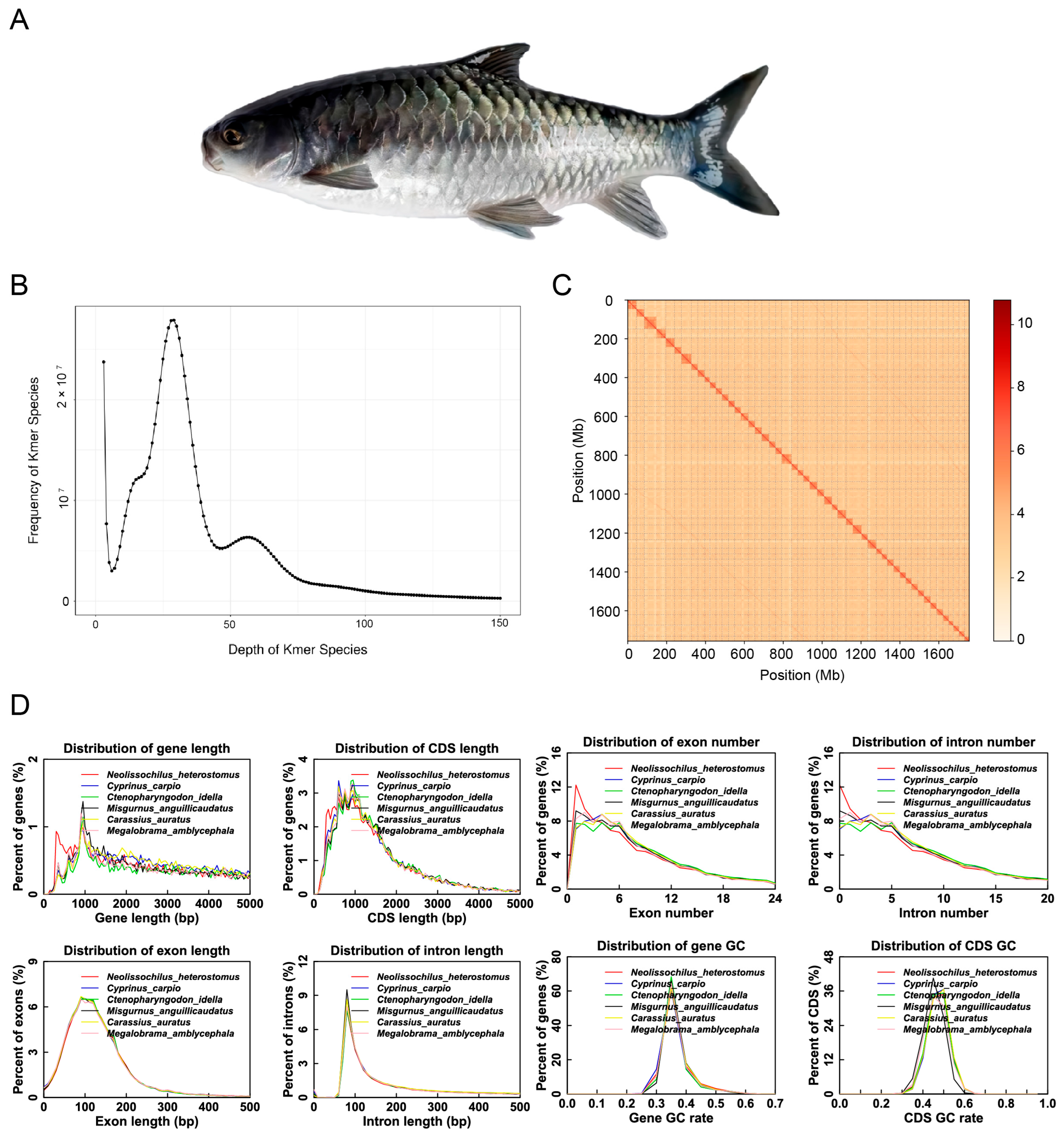
Based on samples of N. heterostomus (Figure 1A) from Dehong Prefecture, Yunnan Province, we obtained a high-quality chromosome-level genome. PacBio HiFi sequencing generated 63.95 Gb of raw data, achieving a sequencing depth of 35.6×, while Hi-C scaffolding produced 184.78 Gb of data at a coverage of 103.0× (Table S1). Quality assessment indicated that the majority of bases attained Q20 or higher scores, with nearly equivalent proportions of A/T and C/G bases. The unimodal distribution of GC content further revealed the absence of exogenous contamination (Figures S1–S3).
Before conducting the formal assembly of the genome, we carried out a genomic survey to assess its characteristics. The k-mer analysis suggested a genome size of roughly 1708.11 Mb, with a heterozygosity rate of 0.5% and a GC content of 37.5% (Figure 1B). The initial assembly, utilizing data from BGI and PacBio HiFi, produced a genome size of 1794.06 Mb and a contig N50 of 32.28 Mb (Table S2). To achieve chromosome-level scaffolding, we employed Hi-C technology, which organized the sequences into 50 chromosomes, resulting in a total length of 1756.25 Mb with a contig N50 of 31.21 Mb and an anchoring rate of 98.0% (Figure 1C and Table S2). The final genome assembly measured 1793.99 Mb, with a contig N50 of 31.11 Mb (Table S3). An evaluation of the assembly quality revealed a BUSCO completeness score of 99.0% and QV score of 51.6 (Table S4).
We also identified a total of 966.88 Mb of repetitive sequences, which constitutes 56.5% of the entire N. heterostomus genome (Table S5). The majority of these sequences were DNA transposons, making up 34.4% of the total. Other significant categories included long interspersed nuclear elements (LINEs, 9.6%), short interspersed nuclear elements (SINEs, 0.8%), and long terminal repeats (LTRs, 10.0%) (Table S6). This initial set was enhanced with transcriptomic information, leading to a final count of 50,587 annotated genes. On average, each gene structure comprised 9.67 exons, with an average exon length of 322.06 bp (Table S7). Comparative analysis of gene structural features (Figure 1D) indicated a high similarity in gene architecture between N. heterostomus and the other five cyprinid species. Out of the predicted genes, 50,203 (99.2%) received functional annotations in at least one of the following databases: SwissProt, NR, GO, KEGG, InterPro, and TrEMBL (Table S8). The non-coding RNA annotation process revealed 1613 miRNAs (0.01%) and 12,973 tRNAs (0.06%) through the use of various prediction tools (Table S9). The thoroughness of gene annotation was evaluated using BUSCO, which returned an impressive score of 99.1%, demonstrating extensive coverage of conserved orthologs (Table S10).

3.2. Genomic Characteristics, Karyotype Analysis, and Ks Distribution

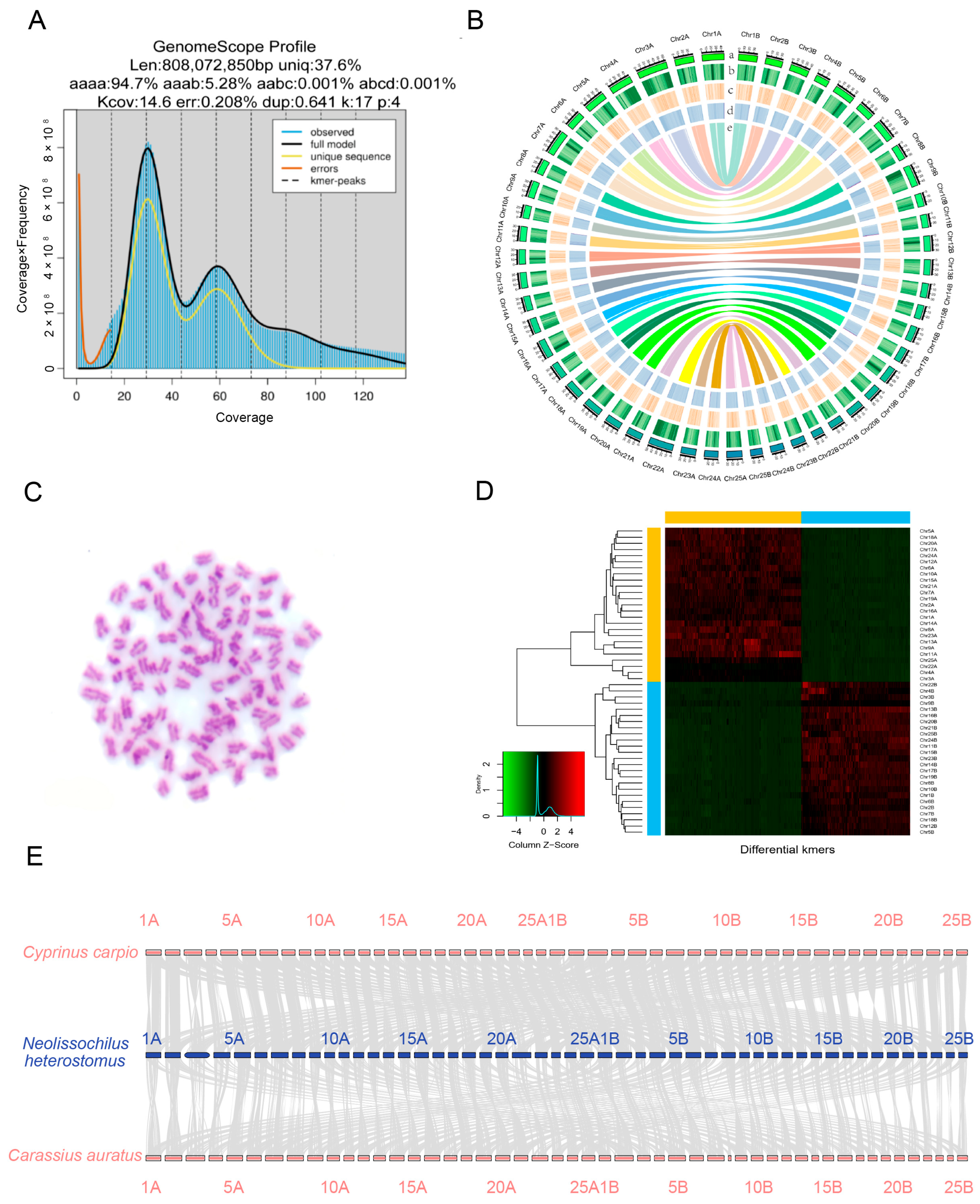
GenomeScope analysis revealed a bimodal coverage distribution, with the first peak at approximately 30× and the second peak at around 60× for the N. heterostomus genome (Figure 2A). Circos plots of genomic architecture showed that the chromosome set of Chr1A-Chr25A exhibited significant synteny with that of Chr1B-Chr25B in N. heterostomus (Figure 2B). Karyotype analysis displayed that N. heterostomus possesses a chromosome number of 2n = 100 (Figure 2C). The karyotype formula of N. heterostomus is 22m + 10sm + 16st + 52t, which bears a high similarity to the karyotypic features of allopolyploids (Figure 2C and Table S11). Two major clusters were observed in the k-mer analysis of the N. heterostomus genome (Figure 2D). Synteny comparisons revealed significant collinearity between the chromosome sets of N. heterostomus and those of the polyploid cyprinids Cy. carpio and Ca. auratus (Figure 2E). In addition, the Ks distribution profile of N. heterostomus displayed a unimodal pattern, consistent with the polyploid cyprinids Cy. carpio and Ca. auratus (Figure S4). The intragenomic Ks peak value from N. heterostomus was 0.106, which was lower than those from Cy. carpio (0.149) and Ca. auratus (0.192) (Figure S4).

3.3. Evolutionary Position and Gene Family Expansion/Contraction in N. heterostomus

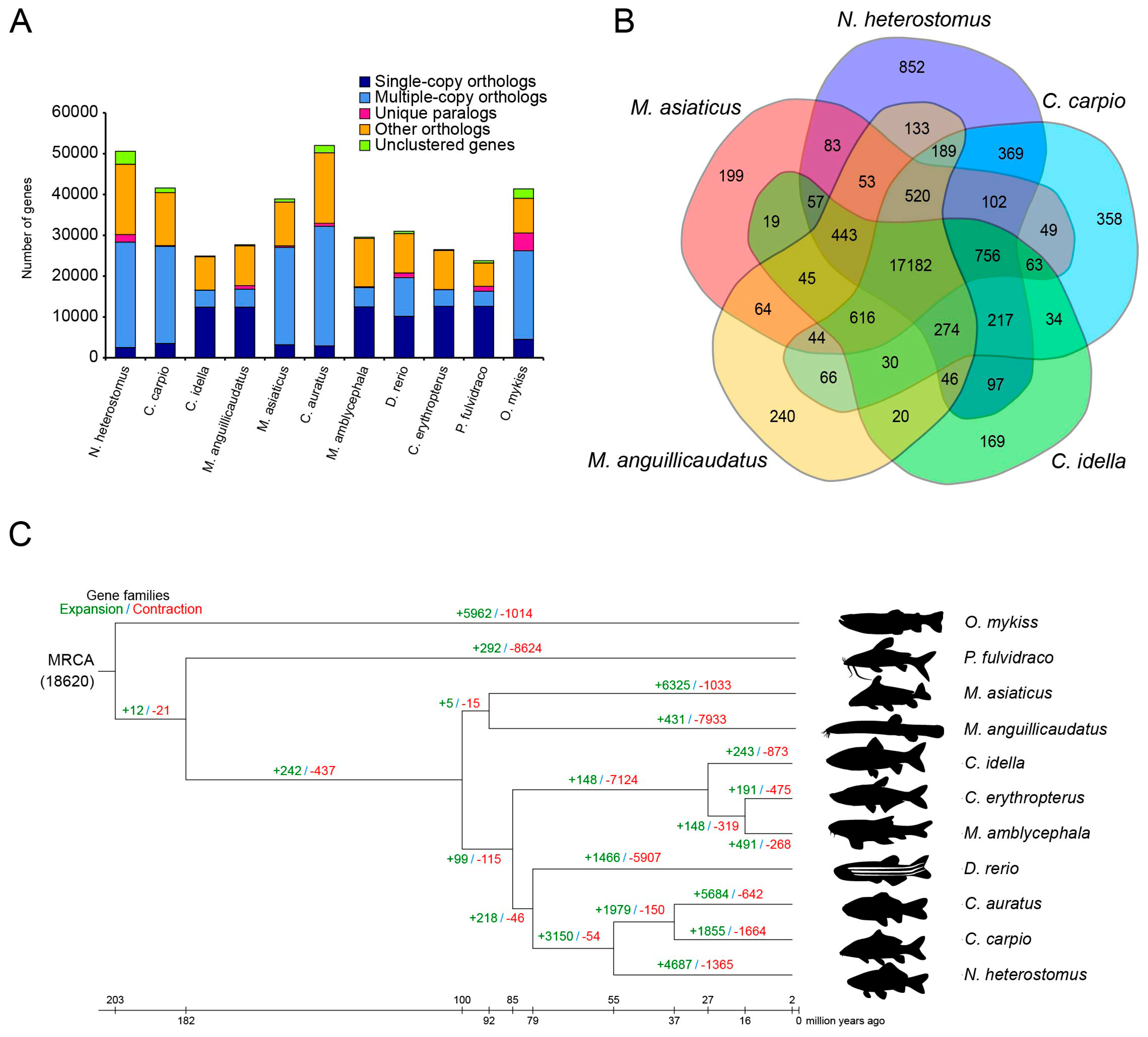
To analyze the evolutionary position and gene family expansion/contraction for N. heterostomus, eight cypriniform species and two outgroup species underwent comparative genomic analysis with the N. heterostomus genome. OrthoFinder orthogroup clustering results revealed that the genome of N. heterostomus comprises 21,373 gene families, among which 133 are single-copy orthogroups, with an average of 2.22 genes per family (Figure 3A and Table S12). In addition, comparative statistics derived from the same orthogroup clustering output identified 474 unique paralogs in the N. heterostomus genome (Figure 3A and Table S12). Venn diagram analysis of gene families was performed across Mi. anguillicaudatus, Ct. idellus, My. asiaticus, Cy. carpio, and N. heterostomus (Figure 3B). The results showed that 17,182 gene families are shared by N. heterostomus and the other four cyprinid species, whereas 852 gene families are unique to N. heterostomus (Figure 3B). Phylogenetic analysis revealed that N. heterostomus shares the closest evolutionary relationship with Cy. carpio and Ca. auratus (Figure S5). Molecular dating estimated the divergence of N. heterostomus from zebrafish at 77.3 Mya (95% HPD: 72.4–82.1 Mya), and separation from the ancestral lineage of Ca. auratus and Cy. carpio at 52.9 Mya (95% HPD: 48.6–57.3 Mya). The narrow 95% HPD intervals supported the reliability of the dating results (Figure S6). Additionally, the analysis of gene family dynamics indicates 4687 gene families that have expanded and 1365 gene families that have contracted in the N. heterostomus genome (Figure 3C).

3.4. Analysis of Expansion of Metabolism-Related Gene Families and Positively Selected Metabolism-Related Genes in N. heterostomus

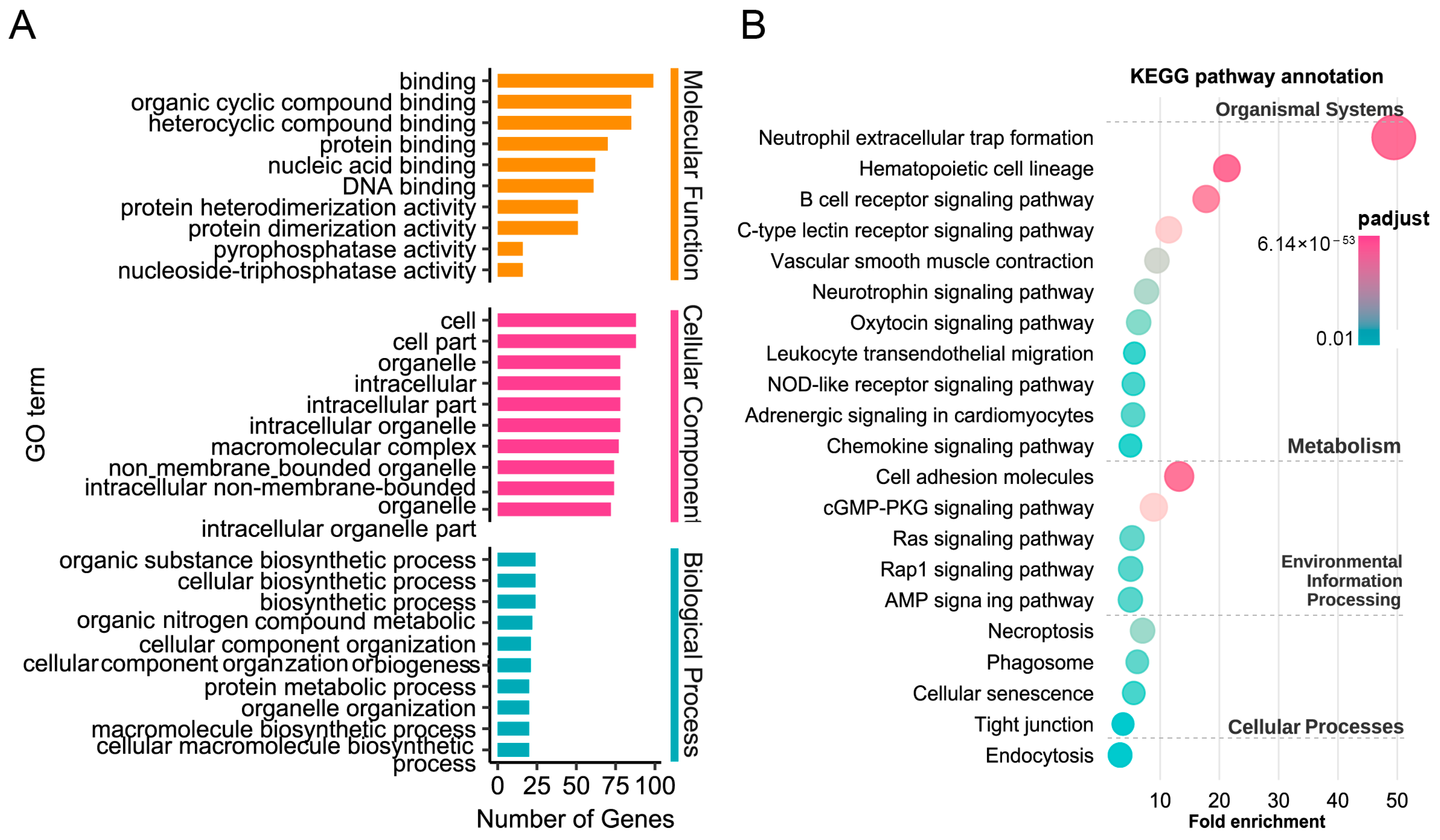
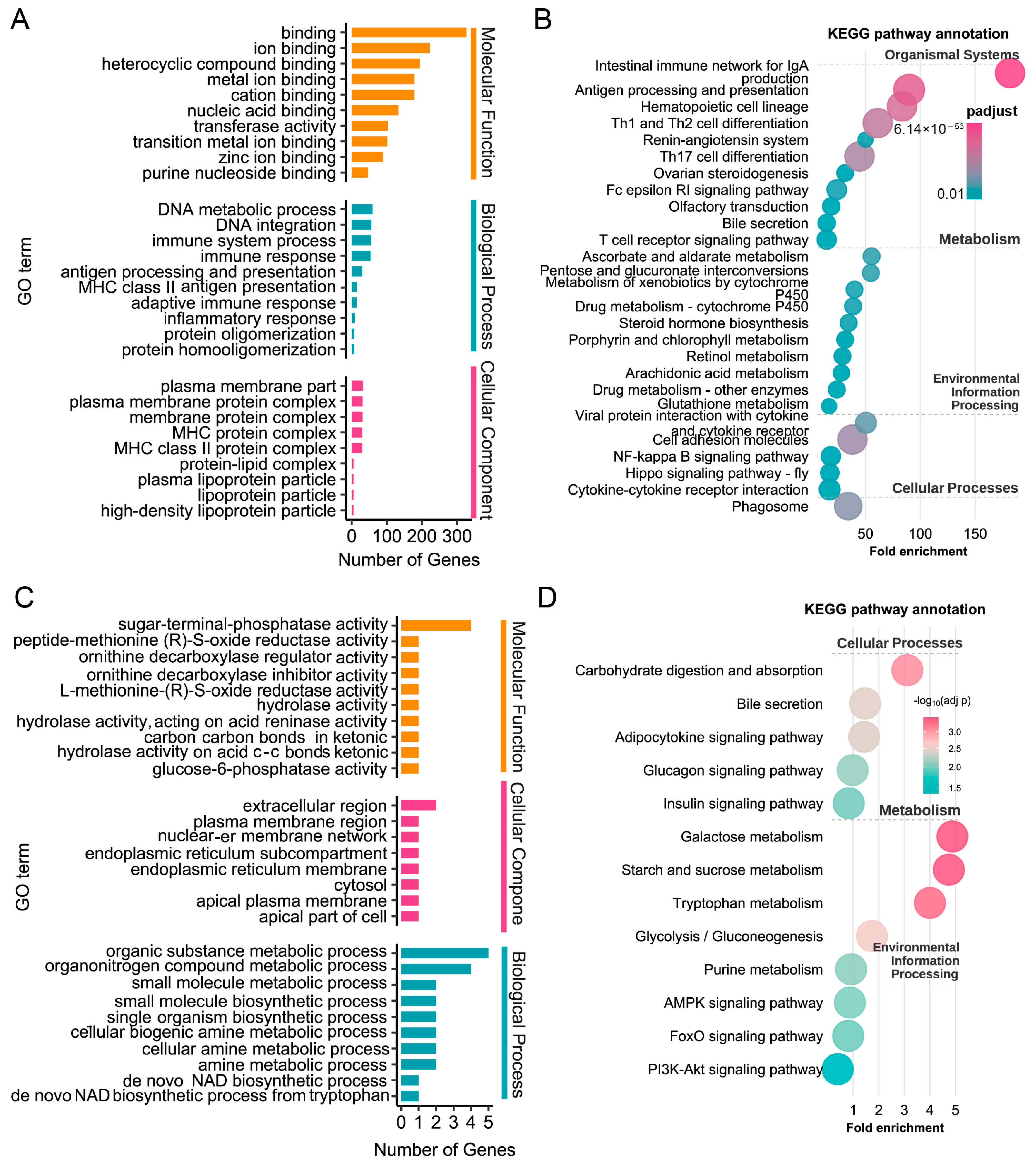
GO enrichment analysis of the expanded gene families indicated that 46 gene families were significantly enriched in processes associated with the positive regulation of biological metabolism, including the phosphate metabolic process, macromolecule metabolic process, cellular metabolic process, protein metabolic process, and RNA metabolic process (Figure 4A and Table S13). Furthermore, KEGG pathway analysis suggested that 13 expanded gene families were significantly enriched in key metabolic pathways such as carbohydrate metabolism, xenobiotic biodegradation and metabolism, oxidoreductase activity, hydrolase activity, and glycosyltransferase activity (Figure 4B and Table S14). Additionally, GO enrichment analysis of PSGs indicated that 56 genes were primarily enriched in organic substance metabolic processes, nitrogen compound metabolic processes, primary metabolic processes, and cellular metabolic processes (Figure 4C and Table S15). KEGG pathway analysis suggested that PSGs were significantly enriched in core metabolic pathways, including amino acid metabolism, carbohydrate metabolism, and nucleotide metabolism (Figure 4D and Table S16).

3.5. Analysis of Contraction of Reproductive Gene Families and Low Fecundity in N. heterostomus

We also conducted GO and KEGG enrichment analyses on contracted gene families (Figure 5). The GO enrichment analysis indicated that the contracted gene families were associated with biological processes such as the positive regulation of reproductive activities, fertilization regulation, reproduction in multicellular organisms, sexual reproduction, and developmental processes associated with reproduction (Figure 5A and Table S17). Meanwhile, the KEGG pathway analysis suggested that the contracted gene families were associated with reproductive signaling pathways, including the GnRH signaling pathway, estrogen signaling pathway, and oocyte meiosis (Figure 5B and Table S18).
From 14 to 23 March 2025, we carried out artificial breeding trials of N. heterostomus. The artificial breeding trials contained three spawning periods of N. heterostomus, and the observation results of egg-laying indicated that the average weight of mature females was 2895 ± 141 g, with a mean fecundity of 3420 ± 197 eggs per female (Table 1). Compared with five other cyprinid species, Ct. idella, My. piceus, Ac. fasciatus, Cy. carpio, and Ca. carassius, a female N. heterostomus laid fewer eggs (Table 2).

3.6. Analysis of Contraction of Gene Families Related to Embryonic Development and Embryonic Development Observation in N. heterostomus

In-depth analysis indicated that contracted gene families were also enriched in embryonic development-related pathways in the N. heterostomus genome. GO enrichment analysis results indicated that the contracted gene families could be associated with biological processes such as embryo development, embryonic morphogenesis, anatomical structure morphogenesis, and neuron development (Figure 5A and Table S17). Furthermore, KEGG pathway analysis suggested significant enrichment of these contracted gene families in signaling pathways closely associated with embryonic development, including the TGF-beta signaling pathway, Wnt signaling pathway, and axon guidance (Figure 5B and Table S18).
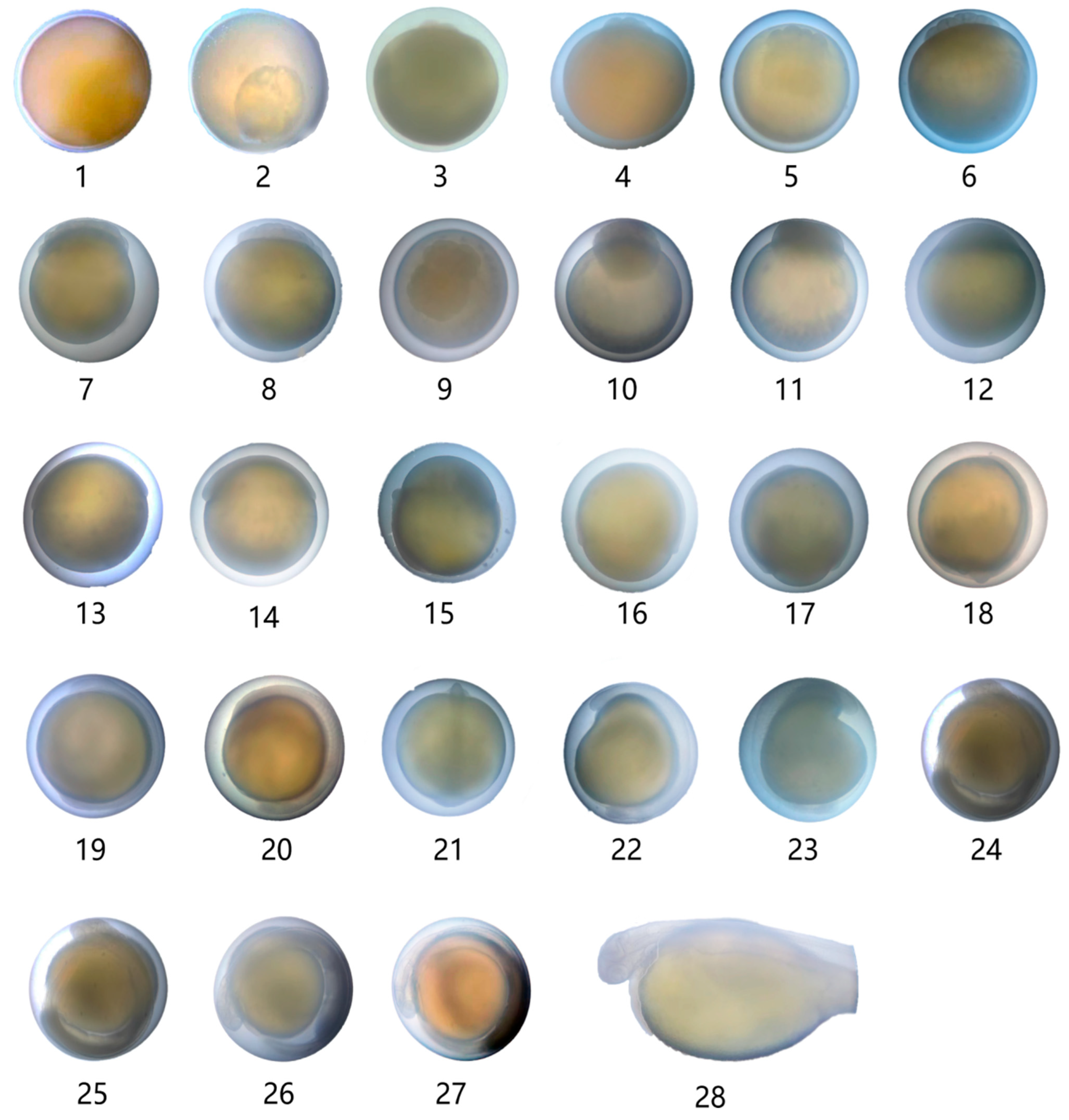
Meanwhile, we systematically analyzed the embryonic development process of N. heterostomus. By engaging in the artificial propagation of this species and thoroughly documenting its embryonic developmental timeline (Figure 6 and Table S19), we compared it with the other four reported cyprinid species. The results indicated that the embryonic development cycle of N. heterostomus (106.1 h; accumulated temperature: 2260.6 °C·h) was significantly longer than that of Acrossocheilus longipinnis (66–74 h; accumulated temperature: 1501.1 °C·h), Spinibarbus sinensis (50.5 h; accumulated temperature: 1261.8 °C·h), Carassius auratus var. Pengze (37.4 h; accumulated temperature: 1050.9 °C·h) and Onychostoma rara (45.5 h; accumulated temperature: 1024.4 °C·h) (Table 3).

4. Discussion

4.1. The Chromosome-Level Genome and Allotetraploid Origin of N. heterostomus

In this study, we successfully constructed a chromosome-level genome assembly of N. heterostomus utilizing PacBio HiFi long-read sequencing in conjunction with Hi-C technology. The results indicated that the genome of N. heterostomus exhibits excellent continuity and completeness: its contig N50 (31.11 Mb) and scaffold N50 (33.24 Mb) are significantly higher than those of Cy. carpio (contig N50: 1.6 Mb; scaffold N50: 29.5 Mb) [9] and Ca. auratus (contig N50: 0.82 Mb; scaffold N50: 22.8 Mb) [10]. Moreover, the genome completeness of N. heterostomus was 99.0%, which was higher than the 98.5% reported in Cy. carpio [9] and equivalent to the reported genome completeness (99.0%) of Ca. auratus [10]. Regarding inconsistencies in genome size, there are primarily three types of data biases. First, the genome size estimated by k-mer analysis was smaller than the total length of the final assembled genome. This discrepancy may result from the differences in sequencing technologies. K-mer estimation relies on second-generation sequencing data. Restricted by the inherent limitations of this sequencing method, it can hardly fully capture repetitive regions, segmental duplications and lineage-specific insertions. In contrast, third-generation sequencing data can retrieve more comprehensive sequence information, which explains why the final assembled genome is larger and more accurate [99]. Second, the total sequence length of the raw draft genome was longer than that of the curated final genome. The initial assembled contigs contained abundant allelic haplotigs and overlapping redundant sequences that had not been removed or filtered, which may make the initial genome length larger than the final version. Subsequent removal of haplotigs and filtering of redundant sequences will reduce the final assembly length compared with the raw draft according to the previous study [29]. Third, the length of preliminary scaffolds was shorter than that of the final scaffolds. This may result from the fact that the preliminary scaffolds had not undergone Hi-C scaffolding. Early scaffold construction may generate false chimeric links between unrelated contigs, leading to inflated total scaffold length and scaffold N50 values. Hi-C scaffolding could correct assembly errors, split invalid chimeric scaffolds and optimize the arrangement of contigs, resulting in a shorter total length of the final scaffolds relative to the preliminary ones [100]. In addition, the identified number of annotated genes was relatively high (>50,000) in this study. This may be partially associated with the polyploidy nature of N. heterostomus. The residual haplotypes, duplicated annotations, TE-associated gene prediction inflation and fragmented gene models may also explain the elevated gene counts. However, the exact causes remain to be determined through more systematic analysis. In this study, the number of annotated tRNAs with 12,973 was also relatively high. Previous studies have reported that genomic duplication events and tRNA subtype diversity may naturally produce high copy numbers, and algorithm misjudgment, assembly artifacts and numerous pseudogenes may partially explain the elevated tRNA counts [9,10]. The phenomenon of a relatively high number of annotated genes and tRNAs also occurred during the assembly of heterozygous tetraploid genomes [9,10]. Nevertheless, the genome assembly with excellent continuity and completeness is sufficient for a series of subsequent analyses of the genetic or biological characteristics of N. heterostomus.
Regarding the ploidy of N. heterostomus, multiple lines of evidence—including genomic features, Hi-C assisted chromosome assembly, k-mer profiling, karyotyping, Ks distribution and the relevant literature—are consistent with an allotetraploid origin for N. heterostomus. Specifically, genomic feature analysis of N. heterostomus revealed the presence of two distinct subgenomes, with a bimodal coverage distribution in the GenomeScope analysis, similar to those of known allotetraploid fishes such as Poropuntius huangchuchieni [101] and Onychostoma barbatula [102]. Noteworthily, k-mer (k = 17) frequency distribution and genome phasing using SubPhaser [103] also displayed a typical AABB-type tetraploid pattern for the N. heterostomus genome. Furthermore, karyotypic analysis indicated that the chromosome number of N. heterostomus is 2n = 100, which is double that of the majority of diploid cyprinids (2n = 50) and consistent with tetraploid traits. The karyotypic pattern (22m + 10sm + 16st + 52t) of N. heterostomus is also highly similar to that of another reported allotetraploid fish, Neolissochilus hexagonolepis (32m + 16sm + 6st + 46t) [104]. In addition, Ks distribution analysis revealed a single Ks peak in the genome of N. heterostomus, similar to two known whole-genome duplicated or polyploid fishes, Ca. auratus and Cy. Carpio. Therefore, we speculate that the WGD event may also take place in N. heterostomus. In this study, however, genomic parameters predicted solely by k-mer analysis lack confidence interval support. The absence of complementary estimation methods undermines the credibility of genomic characteristic inference. Therefore, more methods should be used to improve the reliability of genomic analysis results in the future. Meanwhile, owing to the limited assembly quality of subgenomes acquired from a single N. heterostomus individual, it remains challenging to perform detailed analyses including inter-subgenomic divergence depth and nucleotide distance, as well as to accurately estimate the divergence time of polyploidization. However, our findings may provide valuable insights into genome evolution and polyploidization in Cyprinidae.

4.2. Expansion of Metabolism-Related Gene Families in the N. heterostomus Genome

Enrichment analyses of expanded gene families and PSGs showed overrepresented enrichment in metabolic pathways in N. heterostomus. For instance, expanded gene families were significantly enriched in the positive regulation of phosphate metabolic processes. In Lateolabrax maculatus, dietary phosphorus deficiency impairs intestinal phosphate absorption and decreases serum inorganic phosphate concentrations [105]. The resultant shortage of intracellular phosphate then suppresses phospholipid synthesis in this species [105]. For yellow catfish (Pelteobagrus fulvidraco), elevated intracellular phosphate drives the upregulation of klf4, leading to activation of mitochondrial SIRT3 [106]. Activated SIRT3 then modulates PPARα activity to boost fatty acid β-oxidation and mitochondrial energy production, which serves to coordinate lipid metabolism and whole-body energy homeostasis in yellow catfish [106].
Several PSGs were also enriched in metabolic processes, particularly in the tryptophan metabolic pathway. It has been reported in zebrafish that intestinal-absorbed dietary tryptophan travels to the liver and is sequentially converted into bioactive intermediates by indoleamine 2,3-dioxygenase, the rate-limiting enzyme of the kynurenine pathway [107]. This pathway can produce NAD+ to sustain mitochondrial respiration and energy metabolism [107]. By integrating energy metabolism and antioxidant defense, the tryptophan metabolic pathway plays an indispensable role in maintaining metabolic homeostasis and environmental adaptability in zebrafish [107]. The positive selection of tryptophan metabolism-related genes may suggest adaptive metabolic characteristics of N. heterostomus. However, substantial physiological or ecological validation experiments should be conducted to confirm this hypothesis in the future.

4.3. The Reproductive Characteristics of N. heterostomus

In this study, reproductive observation results indicate that N. heterostomus lays fewer eggs compared to the other five representative cyprinid fishes: Ac. fasciatus, Ct. idella, My. piceus, Cy. carpio, and Ca. carassius. We realize that relative fecundity (eggs per kg body weight) is a more appropriate indicator of fish reproductive characteristics. However, we did not conduct parallel artificial propagation experiments for control fishes in this study; instead, we compared fecundity indirectly based on published data. Due to the limitations of available data, a standardized comparison of relative fecundity across different cyprinid species, including Ct. idella, My. piceus, Ac. fasciatus, Cy. carpio, and Ca. carassius, is not feasible. Therefore, we adopted absolute fecundity for unified comparison based on the data from previous studies [90,91,92,93,94]. We believe that the data can also reflect the differences in reproductive capacity between N. heterostomus and these five representative cyprinid species. In addition, the existing literature reports that sexually mature Ac. fasciatus and Ca. carassius generally have smaller body sizes than N. heterostomus [92,93]. However, our results showed that a sexually mature N. heterostomus produced fewer eggs than Ac. fasciatus and Ca. carassius. This finding indicates that N. heterostomus may possess relatively low fecundity.
Meanwhile, GO and KEGG enrichment analyses revealed that several contracted gene families in the N. heterostomus genome were linked to reproductive biological processes and pathways, including the GnRH signaling pathway. The GnRH signaling pathway is recognized as a fundamental mechanism that regulates the hypothalamic–pituitary–gonadal axis and reproductive activities in fish [108]. Previous studies on goldfish confirmed that GnRH signaling modulates gonadotropin and growth hormone expression and further affects gonadal development [109]. This pathway also participates in primordial germ cell proliferation. In zebrafish, the GnRH3 subtype can activate the MAPK/ERK pathway to promote primordial germ cell proliferation and gene deficiency may reduce germ cell quantity without affecting cell migration [110]. Therefore, we speculate that the contraction of reproduction-related gene families may be associated with the reproductive traits of N. heterostomus. However, subsequent gene loss and gain functional experiments should be performed to confirm this speculation.
Polyploidy may also be correlated with the reproductive traits of N. heterostomus. Polyploid fish generally exhibit strong growth performance and stress tolerance, and some of them (including Carassius gibelio [111] and Scophthalmus maximus [112]) present altered reproductive competence. In these fish species, multiple chromosome sets may disrupt homologous pairing, synapsis, and segregation during meiosis, which causes abnormal gametogenesis and consequently impairs reproduction [113]. In general, autotetraploid fish are more susceptible to reproductive disorders than allotetraploids. Four sets of chromosomes in autotetraploids share identical genetic backgrounds, which tend to form abnormal synaptic configurations such as quadrivalents and univalents during meiosis [114]. This leads to unequal chromosome segregation and the production of numerous aneuploid gametes. Excessive gene dosage and random recombination further exacerbate gamete defects. In contrast, allotetraploids contain two distinctly differentiated subgenomes. Chromosomes only undergo regular pairing within each subgenome, resulting in relatively stable meiotic synapsis and segregation, so their reproductive impairments are generally less severe [114]. Nevertheless, reproductive defects can also be observed in allotetraploids. For example, the allotetraploid hybrids of crucian carp and blunt snout bream exhibit severely impaired male fertility due to substantial divergence between the two subgenomes [115]. Overall, reproductive abnormalities exist in both autopolyploid and allopolyploid fish [116]. However, reproductive capacity is comprehensively shaped by habitat adaptation, body size, and life history strategies rather than polyploidy alone. Further investigations are needed to clarify the factors underlying reproductive variation in N. heterostomus.

4.4. The Embryonic Development Characteristics of N. heterostomus

During reproductive observations, data on hatching duration and accumulated temperature indicated that N. heterostomus may possess a longer embryonic developmental cycle compared to the other four cyprinid fishes: Ac. longipinnis, Sp. sinensis, Ca. auratus var. Pengze, and On. rara. In addition, GO and KEGG analyses also revealed that several contracted gene families in the N. heterostomus genome were associated with embryonic development processes and pathways, such as the TGF-β signaling pathway. In zebrafish embryos, maternal TGF-β signaling controls cell differentiation, germ layer formation and body patterning [117]. Activated by maternal molecules post fertilization, it directs cell fate and mesendoderm development to coordinate germ layer cell dynamics [117]. Impaired TGF-β transduction causes multiple embryonic defects in mesendoderm specification, axis formation and morphology [117]. In short, TGF-β signaling is indispensable for fish early embryonic development. We speculate that the contraction of gene families related to the TGF-β signaling pathway may be associated with the embryonic developmental characteristics of N. heterostomus. However, functional experiments involving subsequent gene loss and gain should be conducted to validate this hypothesis.

4.5. Potential Metabolic–Reproductive Association in N. heterostomus

Due to the complexity of aquatic environments, adaptive trade-offs in fish are very common and such trade-offs can be revealed through genomic analysis. For instance, Liu et al. decoded the high-quality genome of the Chinese longsnout catfish, identifying the association between energy metabolism pathways and nutrient utilization mechanisms [16]. This study reveals the species-specific feeding preferences and the corresponding metabolic strategies adapted to a high-protein carnivorous diet [16]. Wu et al. conducted a genomic data analysis on grass carp, uncovering the association between fish herbivorous preferences and metabolic trade-off strategies [17]. Their findings lay a foundation for understanding dietary variations among fishes [17]. In the present study, the genome analysis results indicated the overrepresentation of metabolism-related pathways among expanded and positively selected gene families, whereas contracted gene families were enriched in reproduction- and embryonic development-related pathways in N. heterostomus. Reproductive observations further supported that N. heterostomus laid fewer eggs compared to the other five representative cyprinid fishes, with a prolonged embryonic development cycle. Therefore, we speculate that there is a potential association between metabolism-related genomic features and reproductive traits in N. heterostomus. However, more direct metabolic measurement, ecological selection analysis, and experimental validation should be carried out to confirm this potential association in N. heterostomus in the future.

5. Conclusions

In summary, this study presents a chromosome-level genome assembly of the endangered fish N. heterostomus, utilizing both PacBio HiFi and Hi-C strategies. Genomic, syntenic, and karyotypic analyses provide evidence consistent with an allotetraploid origin of N. heterostomus. Comparative genomic analysis reveals 4687 expanded and 1365 contracted gene families within N. heterostomus. Enrichment analyses indicate that metabolism-related pathways are overrepresented among the expanded and positively selected gene families, while the contracted gene families exhibit enrichment in pathways related to reproduction and embryonic development. Observational data on reproduction indicate that N. heterostomus lays fewer eggs compared to five other representative cyprinid fish species, accompanied by an extended embryonic development cycle. These findings suggest a potential association between metabolism-related genomic features and reproductive traits, although functional validation is still required. This study provides genomic resources for future investigations of polyploidization and the genetic basis of reproductive and metabolic adaptation in N. heterostomus, providing genomic resources that may support future conservation and management efforts.

Supplementary Materials

The following supporting information can be downloaded at: https://www.mdpi.com/article/10.3390/fishes11060350/s1, Figure S1: Per-base sequence composition of next- and third-generation sequencing data for N. heterostomus; Figure S2: Per-base quality scores of Illumina sequencing data for N. heterostomus; Figure S3: GC content distribution of N. heterostomus sequencing data; Figure S4: Distribution of synonymous substitution rates (Ks) of gene pairs within and among N. heterostomus (Nhe), Ca. auratus (Cau), and Cy. carpio (Cca); Figure S5: Maximum likelihood phylogenetic tree of N. heterostomus and related teleost species; Figure S6: Estimation chart of the divergence time of N. heterostomus; Table S1: Sequencing data statistics; Table S2: Hi-C Assisted Chromosome Assembly Statistics in Aquatic Genomic Studies; Table S3: Assembly result statistics; Table S4: Assembly genome size and various evaluation results statistics; Table S5: Statistics of repeat sequence results obtained by different software; Table S6: Statistics of transposon repeat classification results; Table S7: Statistical results of gene structure of different species; Table S8: Statistics of functional annotation results of genes in different databases; Table S9: Statistics of non-coding RNA annotation results; Table S10: Annotated results evaluation statistics; Table S11: Statistics on Relative Length and Arm Ratio of Chromosomes in N. heterostomus; Table S12: Statistics of Gene Family Clustering in N. heterostomus and Related Species; Table S13: GO Enrichment Analysis of Expanded Gene Families; Table S14: KEGG Enrichment Analysis of Expanded Gene Families; Table S15: GO Enrichment Analysis of Positively Selected Genes; Table S16: KEGG Enrichment Analysis of Positively Selected Genes; Table S17: GO Enrichment Analysis of Contracted Gene Families; Table S18: KEGG Enrichment Analysis of Contracted Gene Families; Table S19: Embryonic Developmental Stages and Characteristics of N. heterostomus.

Author Contributions

T.X.: Resources, Conceptualization, and Supervision; Z.W.: Conceptualization, Investigation, Formal analysis, and Writing—original draft; D.L.: Conceptualization, Investigation, and Formal analysis; B.Q.: Investigation, Formal analysis, Resources, and Methodology; S.T.: Resources and Methodology; C.L.: Resources and Methodology; K.M.: Resources and Methodology; J.Y.: Resources and Methodology; Z.L. (Zhihu Li): Resources and Methodology; H.W.: Methodology, Investigation, and Funding acquisition; Z.L. (Zhao Lv): Conceptualization, Funding acquisition, Supervision, and Writing—review and editing. All authors have read and agreed to the published version of the manuscript.

Funding

This work was financially supported by grants from the Major Science and Technology Special Project of Yunnan Province (202402AE090037) and Natural Science Foundation Excellent Youth Project of Hunan Province (2025JJ40023).

Institutional Review Board Statement

The animal study protocol was approved by the Ethics Committee of Hunan Agricultural University (Approval code: 202401202; Approval date: 27 September 2024).

Informed Consent Statement

Not applicable.

Data Availability Statement

The whole-genome sequencing data generated in this study have been deposited in the Genome Warehouse (National Genomics Data Center, Beijing Institute of Genomics, Chinese Academy of Sciences/China National Center for Bioinformation) under accession number GWHJIFJ00000000.1 and are publicly available at https://ngdc.cncb.ac.cn/gwh (accessed on 1 May 2026). The associated raw sequencing data have been submitted under BioProject accession number PRJCA063140.

Acknowledgments

The authors are grateful to all the laboratory members for continuous technical advice and helpful discussions.

Conflicts of Interest

The authors declare that they have no competing interests.

References

  1. Fricke, R.; Eschmeyer, W.N.; Van, D.L.R. Freshwater fishes of China: Species richness, endemism, threatened species and conservation. Biol. Rev. 2015, 90, 1046–1075. [Google Scholar]
  2. Wang, J.; Tao, J.; Heino, J.; Huang, M.R.; Ding, C.Z. Geodiversity as a surrogate to inform freshwater fish diversity conservation and management. J. Appl. Ecol. 2025, 62, 1364–1377. [Google Scholar] [CrossRef]
  3. Hoàng, H.Đ.; Phạm, H.M.; Durand, J.-D.; Trần, N.T.; Phan, P.Đ. Mahseers genera Tor and Neolissochilus (Teleostei: Cyprinidae) from southern Vietnam. Zootaxa 2015, 4006, 551–568. [Google Scholar] [CrossRef]
  4. He, J.H.; Zhao, C.F.; Guo, Y.Y.; Zhang, H.X.; Zhao, B.; Chu, Z.J. Completely mitochondrial genome of Neolissochilus heterostomus. Mitochondrial DNA Part B 2021, 6, 2708–2709. [Google Scholar] [CrossRef] [PubMed]
  5. Wang, N.M.; Li, L.; Wu, S.; Qin, D.L.; Ma, B.; Jin, X. Study on the nutritional components of muscle of Barbodes medogensis. Biol. Resour. 2019, 41, 363–370. [Google Scholar]
  6. Ma, G.; Xiao, L.; Wan, D.; Li, L.; Dong, Y.; Meng, L.; Yang, Y.; Guo, Y.; Yang, Z.; Shen, A. Artificial breeding and incubation of Neolissochilus heterostomus. Sci. Fish Farm. 2025, 4, 19–20. [Google Scholar]
  7. Ministry of Ecology and Environment; Chinese Academy of Sciences. China Biodiversity Red List: Vertebrates (2020); Science Press: Beijing, China, 2023.
  8. Xian, D.H.; Han, D.; Mao, K.Y.; Lin, C.Y.; Luo, F.Y.; Dong, S.C.; Xu, Z.C. Artificial domestication and breeding experiments of indigenous fish species in Dehong. China Fish. 2014, 5, 61–63. [Google Scholar]
  9. Xu, P.; Xu, J.; Liu, G.J.; Chen, L.; Zhou, Z.X.; Peng, W.Z.; Jiang, Y.L.; Zhao, Z.X.; Jia, Z.Y.; Sun, Y.H.; et al. The allotetraploid origin and asymmetrical genome evolution of the common carp Cyprinus carpio. Nat. Commun. 2019, 10, 4625. [Google Scholar] [CrossRef]
  10. Chen, Z.L.; Omori, Y.; Koren, S.; Shirokiya, T.; Kuroda, T.; Miyamoto, A.; Wada, H.; Fujiyama, A.; Toyoda, A.; Zhang, S.Y.; et al. De novo assembly of the goldfish (Carassius auratus) genome and the evolution of genes after whole-genome duplication. Sci. Adv. 2019, 5, eaav0547. [Google Scholar] [CrossRef]
  11. Li, X.X.; Guo, B.C. Substantially adaptive potential in polyploid cyprinid fishes: Evidence from biogeographic, phylogenetic and genomic studies. Proc. R. Soc. B Biol. Sci. 2020, 287, 20193008. [Google Scholar] [CrossRef]
  12. Gao, K.; He, Z.; Xiong, J.X.; Chen, Q.Q.; Lai, B.L.; Liu, F.; Chen, P.; Chen, M.Q.; Luo, W.J.; Huang, J.J.; et al. Population structure and adaptability analysis of Schizothorax o’connori based on whole-genome resequencing. BMC Genom. 2024, 25, 145. [Google Scholar] [CrossRef]
  13. Andersson, L.; Bekkevold, D.; Berg, F.; Farrell, E.D.; Felkel, S.; Ferreira, M.S.; Fuentes-Pardo, A.P.; Goodall, J.; Pettersson, M. How Fish Population Genomics Can Promote Sustainable Fisheries: A Road Map. Annu. Rev. Anim. Biosci. 2023, 12, 1–20. [Google Scholar] [CrossRef]
  14. Wang, B.Z.; Wu, B.; Liu, X.Q.; Hu, Y.C.; Ming, Y.; Bai, M.Z.; Liu, J.J.; Xiao, K.; Zeng, Q.K.; Yang, J.; et al. Whole-genome sequencing reveals autooctoploidy in Chinese Sturgeon (Acipenser sinensis) and its evolutionary trajectories. Genom. Proteom. Bioinform. 2024, 22, qzad002. [Google Scholar] [CrossRef] [PubMed]
  15. Mushtaq, M.W.; Rather, M.A.; Khan, I.A.; Bhat, H.; Mir, I.N.; Bhat, I.A. From genome to phenome: Omics perspectives on fish reproduction. Front. Aquac. 2026, 4, 1730913. [Google Scholar] [CrossRef]
  16. Liu, Y.L.; Zhai, G.; Su, J.Z.; Gong, Y.L.; Yang, B.Y.; Lu, Q.S.; Xi, L.W.; Zheng, Y.T.; Cao, J.Y.; Liu, H.K.; et al. The Chinese longsnout catfish (Leiocassis longirostris) genome provides novel insights into the feeding preference and corresponding metabolic strategy of carnivores. Genome Res. 2024, 34, 981–996. [Google Scholar] [CrossRef]
  17. Wu, C.S.; Ma, Z.Y.; Zheng, G.D.; Zou, S.M.; Zhang, X.J.; Zhang, Y.A. Chromosome-level genome assembly of grass carp (Ctenopharyngodon idella) provides insights into its genome evolution. BMC Genom. 2022, 23, 271. [Google Scholar] [CrossRef]
  18. Yang, Y.X.; Wang, M.; Wu, X.Y.; Zhou, Y.N.; Qiu, J.; Cai, X.; Li, Z.H. The chromosome-level genome assembly of an endangered herb Bergenia scopulosa provides insights into local adaptation and genomic vulnerability under climate change. Gigascience 2024, 13, giae091. [Google Scholar] [CrossRef]
  19. Huang, J.; Liang, X.M.; Xuan, Y.K.; Geng, C.Y.; Li, Y.X.; Lu, H.R.; Qu, S.F.; Mei, X.L.; Chen, H.B.; Yu, T.; et al. A reference human genome dataset of the BGISEQ-500 sequencer. Gigascience 2017, 6, gix024. [Google Scholar] [CrossRef] [PubMed]
  20. Chen, Y.X.; Chen, Y.S.; Shi, C.; Huang, Z.; Zhang, Y.; Li, S.; Li, Y.; Ye, J.; Yu, C.; Li, Z.; et al. SOAPnuke: A MapReduce acceleration-supported software for integrated quality control and preprocessing of high-throughput sequencing data. Gigascience 2018, 7, gix120. [Google Scholar] [CrossRef]
  21. Wang, B.; Jia, P.; Gao, S.H.; Zhao, H.H.; Zheng, G.Y.; Xu, L.F.; Ye, K. Long and accurate: How HiFi sequencing is transforming genomics. Genom. Proteom. Bioinform. 2025, 23, qzaf003. [Google Scholar] [CrossRef] [PubMed]
  22. Wang, Z.; Gerstein, M.; Snyder, M. RNA-Seq: A revolutionary tool for transcriptomics. Nat. Rev. Genet. 2009, 10, 57–63. [Google Scholar] [CrossRef]
  23. Zhu, W.; Hu, B.; Becker, C.; Doğan, E.S.; Berendzen, K.W.; Weigel, D.; Liu, C. Altered chromatin compaction and histone methylation drive non-additive gene expression in an interspecific Arabidopsis hybrid. Genome Biol. 2017, 18, 157. [Google Scholar] [CrossRef] [PubMed]
  24. Wingett, S.W.; Andrews, S. FastQ Screen: A tool for multi-genome mapping and quality control. F1000Research 2018, 7, 1338. [Google Scholar] [CrossRef] [PubMed]
  25. You, X.X.; Bian, C.; Zan, Q.J.; Xu, X.; Liu, X.; Chen, J.M.; Wang, J.T.; Qiu, Y.; Li, W.J.; Zhang, X.H.; et al. Mudskipper (Periophthalmus spp.) genomes provide insights into the terrestrial adaptation of amphibious fishes. Nat. Commun. 2014, 5, 5594. [Google Scholar] [CrossRef]
  26. Wendl, M.C.; Barbazuk, W.B. Extension of Lander-Waterman theory for sequencing filtered DNA libraries. BMC Bioinform. 2005, 6, 245. [Google Scholar] [CrossRef] [PubMed]
  27. Hesse, U. K-Mer-Based Genome Size Estimation in Theory and Practice. In Plant Cytogenetics and Cytogenomics; Humana; New York, NY, USA, 2023; Volume 2672, pp. 79–113. [Google Scholar]
  28. Wenger, A.M.; Peluso, P.; Rowell, W.J.; Chang, P.-C.; Hall, R.J.; Concepcion, G.T.; Ebler, J.; Fungtammasan, A.; Kolesnikov, A.; Olson, N.D.; et al. Accurate circular consensus long-read sequencing improves variant detection and assembly of a human genome. Nat. Biotechnol. 2019, 37, 1155–1162. [Google Scholar] [CrossRef]
  29. Cheng, H.Y.; Concepcion, G.T.; Feng, X.W.; Zhang, H.W.; Li, H. Haplotype-resolved de novo assembly using phased assembly graphs with hifiasm. Nat. Methods 2021, 18, 170–175. [Google Scholar] [CrossRef]
  30. Bolger, A.M.; Lohse, M.; Usadel, B. Trimmomatic: A flexible trimmer for Illumina sequence data. Bioinformatics 2014, 30, 2114–2120. [Google Scholar] [CrossRef]
  31. Durand, N.C.; Shamim, M.S.; Machol, I.; Rao, S.S.P.; Huntley, M.H.; Lander, E.S.; Aiden, E.L. Juicer provides a one-click system for analyzing loop-resolution Hi-C experiments. Cell Syst. 2016, 3, 95–98. [Google Scholar] [CrossRef]
  32. Dudchenko, O.; Batra, S.S.; Omer, A.D.; Nyquist, S.K.; Hoeger, M.; Durand, N.C.; Shamim, M.S.; Machol, I.; Lander, E.S.; Aiden, A.P.; et al. De novo assembly of the Aedes aegypti genome using Hi-C yields chromosome-length scaffolds. Science 2017, 356, 92–95. [Google Scholar] [CrossRef]
  33. Durand, N.C.; Robinson, J.T.; Shamim, M.S.; Machol, I.; Mesirov, J.P.; Lander, E.S.; Aiden, E.L. Juicebox provides a visualization system for Hi-C contact maps with unlimited zoom. Cell Syst. 2016, 3, 99–101. [Google Scholar] [CrossRef] [PubMed]
  34. Li, H.; Durbin, R. Fast and accurate short read alignment with Burrows-Wheeler transform. Bioinformatics 2009, 25, 1754–1760. [Google Scholar] [CrossRef] [PubMed]
  35. Li, H. Minimap2: Pairwise alignment for nucleotide sequences. Bioinformatics 2018, 34, 3094–3100. [Google Scholar] [CrossRef]
  36. Simão, F.A.; Waterhouse, R.M.; Ioannidis, P.; Kriventseva, E.V.; Zdobnov, E.M. BUSCO: Assessing genome assembly and annotation completeness with single-copy orthologs. Bioinformatics 2015, 31, 3210–3212. [Google Scholar] [CrossRef] [PubMed]
  37. Irie, N.; Satoh, N.; Kuratani, S. The phylum Vertebrata: A case for zoological recognition. Zool. Lett. 2018, 4, 32. [Google Scholar] [CrossRef] [PubMed]
  38. Rhie, A.; Walenz, B.P.; Koren, S.; Phillippy, A.M. Merqury: Reference-free quality, completeness, and phasing assessment for genome assemblies. Genome Biol. 2020, 21, 245. [Google Scholar] [CrossRef]
  39. Jurka, J.; Kapitonov, V.V.; Pavlicek, A.; Klonowski, P.; Kohany, O.; Walichiewicz, J. Repbase Update, a database of eukaryotic repetitive elements. Cytogenet. Genome Res. 2005, 110, 462–467. [Google Scholar] [CrossRef]
  40. Chen, N. Using RepeatMasker to Identify Repetitive Elements in Genomic Sequences. Curr. Protoc. Bioinform. 2004, 5, 4–10. [Google Scholar] [CrossRef]
  41. Teresi, S.J.; Teresi, M.B.; Edger, P.P. TE Density: A tool to investigate the biology of transposable elements. Mob. DNA 2022, 13, 11. [Google Scholar] [CrossRef]
  42. Benson, G. Tandem repeats finder: A program to analyze DNA sequences. Nucleic Acids Res. 1999, 27, 573–580. [Google Scholar] [CrossRef]
  43. Gertz, E.M.; Yu, Y.K.; Agarwala, R.; Schäffer, A.A.; Altschul, S.F. Composition-based statistics and translated nucleotide searches: Improving the TBLASTN module of BLAST. BMC Biol. 2006, 4, 41. [Google Scholar] [CrossRef]
  44. Slater, G.; Birney, E. Automated generation of heuristics for biological sequence comparison. BMC Bioinform. 2005, 6, 31. [Google Scholar] [CrossRef]
  45. Stanke, M.; Keller, O.; Gunduz, I.; Hayes, A.; Waack, S.; Morgenstern, B. AUGUSTUS: Ab initio prediction of alternative transcripts. Nucleic Acids Res. 2006, 34, W435–W439. [Google Scholar] [CrossRef]
  46. Burge, C.; Karlin, S. Prediction of complete gene structures in human genomic DNA. J. Mol. Biol. 1997, 268, 78–94. [Google Scholar] [CrossRef] [PubMed]
  47. Alioto, T.; Blanco, E.; Parra, G.; Guigó, R. Using geneid to Identify Genes. Curr. Protoc. Bioinform. 2018, 64, e56. [Google Scholar] [CrossRef] [PubMed]
  48. Kim, D.; Paggi, J.M.; Park, C.; Bennett, C.; Salzberg, S.L. Graph-based genome alignment and genotyping with HISAT2 and HISAT-genotype. Nat. Biotechnol. 2019, 37, 907–915. [Google Scholar] [CrossRef] [PubMed]
  49. Pertea, M.; Pertea, G.M.; Antonescu, C.M.; Chang, T.-C.; Mendell, J.T.; Salzberg, S.L. StringTie enables improved reconstruction of a transcriptome from RNA-seq reads. Nat. Biotechnol. 2015, 33, 290–295. [Google Scholar] [CrossRef]
  50. Grabherr, M.G.; Haas, B.J.; Yassour, M.; Levin, J.Z.; Thompson, D.A.; Amit, I.; Adiconis, X.; Fan, L.; Raychowdhury, R.; Zeng, Q.; et al. Full-length transcriptome assembly from RNA-Seq data without a reference genome. Nat. Biotechnol. 2011, 29, 644–652. [Google Scholar] [CrossRef]
  51. Haas, B.J. Improving the Arabidopsis genome annotation using maximal transcript alignment assemblies. Nucleic Acids Res. 2003, 31, 5654–5666. [Google Scholar] [CrossRef]
  52. Campbell, M.S.; Holt, C.; Moore, B.; Yandell, M. Genome annotation and curation using MAKER and MAKER-P. Curr. Protoc. Bioinform. 2014, 48, 4–11. [Google Scholar] [CrossRef]
  53. Bairoch, A. The SWISS-PROT protein sequence database and its supplement TrEMBL in 2000. Nucleic Acids Res. 2000, 28, 45–48. [Google Scholar] [CrossRef]
  54. O’Donovan, C.; Martin, M.J.; Gasteiger, E.; Bairoch, A.; Apweiler, R. High-quality protein knowledge resource: SWISS-PROT and TrEMBL. Brief. Bioinform. 2002, 3, 275–284. [Google Scholar] [CrossRef] [PubMed]
  55. Kanehisa, M.; Goto, S. KEGG: Kyoto encyclopedia of genes and genomes. Nucleic Acids Res. 2000, 28, 27–30. [Google Scholar] [CrossRef] [PubMed]
  56. Blum, M.; Chang, H.-Y.; Chuguransky, S.; Grego, T.; Kandasaamy, S.; Mitchell, A.; Nuka, G.; Paysan-Lafosse, T.; Qureshi, M.; Raj, S.; et al. The InterPro protein families and domains database: 20 years on. Nucleic Acids Res. 2020, 49, D344–D354. [Google Scholar] [CrossRef]
  57. Ashburner, M.; Ball, C.A.; Blake, J.A.; Botstein, D.; Butler, H.; Cherry, J.M.; Davis, A.P.; Dolinski, K.; Dwight, S.S.; Eppig, J.T.; et al. Gene Ontology: Tool for the unification of biology. Nat. Genet. 2000, 25, 25–29. [Google Scholar] [CrossRef]
  58. Lowe, T.M.; Eddy, S.R. tRNAscan-SE: A program for improved detection of transfer RNA genes in genomic sequence. Nucleic Acids Res. 1997, 25, 955–964. [Google Scholar] [CrossRef] [PubMed]
  59. Shore, S.F.H.; Ptacek, M.; Steen, A.D.; Fozo, E.M. A simple BLASTn-based approach generates novel insights into the regulation and biological function of type I toxin-antitoxins. mSystems 2024, 9, e01204–e01223. [Google Scholar] [CrossRef]
  60. Kalvari, I.; Nawrocki, E.P.; Ontiveros-Palacios, N.; Argasinska, J.; Lamkiewicz, K.; Marz, M.; Griffiths-Jones, S.; Toffano-Nioche, C.; Gautheret, D.; Weinberg, Z.; et al. Rfam 14: Expanded coverage of metagenomic, viral and microRNA families. Nucleic Acids Res. 2021, 49, D192–D200. [Google Scholar] [CrossRef]
  61. Nawrocki, E.P.; Kolbe, D.L.; Eddy, S.R. Infernal 1.0: Inference of RNA alignments. Bioinformatics 2009, 25, 1335–1337. [Google Scholar] [CrossRef]
  62. Dong, C.; Chen, L.; Feng, J.; Xu, J.; Mahboob, S.; Al-Ghanim, K.; Li, X.; Xu, P. Genome Wide Identification, Phylogeny, and Expression of Aquaporin Genes in Common Carp (Cyprinus carpio). PLoS ONE 2016, 11, e0166160. [Google Scholar] [CrossRef]
  63. Sun, B.; Huang, Y.; Castro, L.F.C.; Yang, S.; Huang, S.; Jin, W.; Zhou, H.; Ijiri, S.; Luo, Y.; Gao, J.; et al. The chromosome-level genome and key genes associated with mud-dwelling behavior and adaptations of hypoxia and noxious environments in loach (Misgurnus anguillicaudatus). BMC Biol. 2023, 21, 18. [Google Scholar] [CrossRef]
  64. Krabbenhoft, T.J.; MacGuigan, D.J.; Backenstose, N.J.C.; Waterman, H.; Lan, T.; Pelosi, J.A.; Tan, M.; Sandve, S.R. Chromosome-Level Genome Assembly of Chinese Sucker (Myxocyprinus asiaticus) Reveals Strongly Conserved Synteny Following a Catostomid-Specific Whole-Genome Duplication. Genome Biol. Evol. 2021, 13, evab190. [Google Scholar] [CrossRef]
  65. Liu, H.; Chen, C.; Lv, M.; Liu, N.; Hu, Y.; Zhang, H.; Enbody, E.D.; Gao, Z.; Andersson, L.; Wang, W. A Chromosome-Level Assembly of Blunt Snout Bream (Megalobrama amblycephala) Genome Reveals an Expansion of Olfactory Receptor Genes in Freshwater Fish. Mol. Biol. Evol. 2021, 38, 4238–4251. [Google Scholar] [CrossRef]
  66. Howe, K.; Howard, C.; McCarthy, S.A.; Wood, J.M.D. The genome sequence of the zebra danio, Danio rerio (Hamilton, 1822) (Cypriniformes: Danionidae). Wellcome Open Res. 2025, 10, 330. [Google Scholar] [CrossRef] [PubMed]
  67. Zhao, S.H.; Yang, X.F.; Pang, B.; Zhang, L.; Wang, Q.; He, S.B.; Dou, H.S.; Zhang, H.H. A chromosome-level genome assembly of the redfin culter (Chanodichthys erythropterus). Sci. Data 2022, 9, 535. [Google Scholar] [CrossRef] [PubMed]
  68. Gong, G.; Dan, C.; Xiao, S.; Guo, W.; Huang, P.; Xiong, Y.; Wu, J.; He, Y.; Zhang, J.; Li, X.; et al. Chromosomal-level assembly of yellow catfish genome using third-generation DNA sequencing and Hi-C analysis. Gigascience 2018, 7, giy120. [Google Scholar] [CrossRef] [PubMed]
  69. Ali, A.; Gao, G.; Al-Tobasei, R.; Youngblood, R.C.; Waldbieser, G.C.; Scheffler, B.E.; Palti, Y.; Salem, M. Chromosome level genome assembly and annotation of the Swanson rainbow trout homozygous line. Sci. Data 2025, 12, 345. [Google Scholar] [CrossRef]
  70. Buchfink, B.; Xie, C.; Huson, D.H. Fast and sensitive protein alignment using DIAMOND. Nat. Methods 2015, 12, 59–60. [Google Scholar] [CrossRef]
  71. Emms, D.M.; Kelly, S. OrthoFinder: Phylogenetic orthology inference for comparative genomics. Genome Biol. 2019, 20, 238. [Google Scholar] [CrossRef]
  72. Edgar, R.C. MUSCLE: Multiple sequence alignment with high accuracy and high throughput. Nucleic Acids Res. 2004, 32, 1792–1797. [Google Scholar] [CrossRef]
  73. Stamatakis, A. RAxML version 8: A tool for phylogenetic analysis and post-analysis of large phylogenies. Bioinformatics 2014, 30, 1312–1313. [Google Scholar] [CrossRef]
  74. Kumar, S.; Stecher, G.; Suleski, M.; Hedges, S.B. TimeTree: A resource for timelines, timetrees, and divergence times. Mol. Biol. Evol. 2017, 34, 1812–1819. [Google Scholar] [CrossRef] [PubMed]
  75. Sanderson, M.J. r8s: Inferring absolute rates of molecular evolution and divergence times in the absence of a molecular clock. Bioinformatics 2003, 19, 301–302. [Google Scholar] [CrossRef] [PubMed]
  76. Yang, Z. PAML 4: Phylogenetic analysis by maximum likelihood. Mol. Biol. Evol. 2007, 24, 1586–1591. [Google Scholar] [CrossRef] [PubMed]
  77. De-Bie, T.; Cristianini, N.; Demuth, J.P.; Hahn, M.W. CAFE: A computational tool for the study of gene family evolution. Bioinformatics 2006, 22, 1269–1271. [Google Scholar] [CrossRef]
  78. Mao, B.; Zheng, Y.; Xiao, Y.L.; Yang, K.X.; Shangguan, J.R.; Shen, M.; Sun, H.; Fang, X.L.; Fu, Y. Genome-wide phylogenetic analysis and expansion of gene families involved in detoxification in Smittia aterrima (Meigen) and Smittia pratorum (Goetghebuer) (Diptera, Chironomidae). BMC Genom. Data 2024, 25, 106. [Google Scholar] [CrossRef]
  79. Katoh, K.; Standley, D.M. MAFFT Multiple Sequence Alignment Software Version 7: Improvements in Performance and Usability. Mol. Biol. Evol. 2013, 30, 772–780. [Google Scholar] [CrossRef]
  80. Suyama, M.; Torrents, D.; Gabaldón, T. PAL2NAL: Robust Conversion of Protein Multiple Sequence Alignments into the Corresponding Codon Alignments. Nucleic Acids Res. 2006, 34, W609–W612. [Google Scholar] [CrossRef]
  81. Talavera, G.; Castresana, J. Improvement of Phylogenies after Removing Divergent and Ambiguously Aligned Blocks from Protein Sequence Alignments. Syst. Biol. 2007, 56, 564–577. [Google Scholar] [CrossRef]
  82. Álvarez-Carretero, S.; Kapli, P.; Yang, Z. Beginner’s Guide on the Use of PAML to Detect Positive Selection. Mol. Biol. Evol. 2023, 40, msad041. [Google Scholar] [CrossRef]
  83. Kiełbasa, S.M.; Wan, R.; Sato, K.; Horton, P.; Frith, M.C. Adaptive seeds tame genomic sequence comparison. Genome Res. 2011, 21, 487–493. [Google Scholar] [CrossRef] [PubMed]
  84. Tang, H.; Krishnakumar, V.; Zeng, X.; Xu, Z.; Taranto, A.; Lomas, J.S.; Zhang, Y.; Huang, Y.; Wang, Y.; Yim, W.C.; et al. JCVI: A versatile toolkit for comparative genomics analysis. iMeta 2024, 3, e211. [Google Scholar] [CrossRef]
  85. Feng, X.; Chen, Q.P.; Wu, W.H.; Wang, J.X.; Li, G.H.; Xu, S.H.; Shao, S.; Liu, M.; Zhong, C.R.; Wu, C.-I.; et al. Genomic evidence for rediploidization and adaptive evolution following the whole-genome triplication. Nat. Commun. 2024, 15, 1635. [Google Scholar] [CrossRef]
  86. Feng, B.; Zhang, T.T.; Wu, F.F.; Chen, S.W.; Xu, A.L. Artificial propagation and embryonic development of Yalu River lamprey (Lampetra morii). Acta Biochim. Biophys. Sin. 2018, 50, 828–830. [Google Scholar] [CrossRef]
  87. Chojnacki, K.A.; Dodson, M.J.; George, A.E.; Candrl, J.S.; DeLonay, A.J. Ontogenetic development of pallid sturgeon (Scaphirhynchus albus) and shovelnose sturgeon (Scaphirhynchus platorynchus) from hatch through yolk absorption. Ecol. Freshw. Fish. 2023, 32, 209–231. [Google Scholar] [CrossRef]
  88. Lin, Y.H. A PHA injection method in vivo for the rapid obtainment of large numbers of metaphase figures from kidney cells of teleosts. J. Fish. China 1982, 6, 201–204. [Google Scholar]
  89. Levan, A.; Fredga, K.; Sandberg, A.A. Nomenclature for centromeric position on chromosomes. Hereditas 2009, 52, 201–220. [Google Scholar] [CrossRef]
  90. Wilson, T.M.; Acre, M.R.; Williams, F.; Calfee, R.D.; Mayer, C.M.; Mapes, R.L.; Kemp, C.M.; Young, R.T.; Byrne, M.E. Reproductive biology of invasive grass carp (Ctenopharyngodon idella) in two North American systems. J. Fish. Biol. 2025, 107, 101–115. [Google Scholar] [CrossRef]
  91. Tessema, A.; Getahun, A.; Mengistou, S.; Fetahi, T.; Dejen, E. Reproductive biology of common carp (Cyprinus carpio Linnaeus, 1758) in Lake Hayq, Ethiopia. Fish. Aquat. Sci. 2020, 23, 16. [Google Scholar] [CrossRef]
  92. Guo, L.L.; Yan, Y.Z.; Xi, Y.L. Preliminary study on age, growth and reproductive characteristics of crucian carp (Carassius carassius) in the Qingyi River Estuary. J. Anhui Norm. Univ. 2008, 31, 168–171. [Google Scholar]
  93. Yu, A.P. Study on individual fecundity and rational utilization of resources of acrossocheilus (Acrossocheilus fasciatus) in Xijin River. China Fish. 2013, 44, 68–69. [Google Scholar]
  94. Zhu, R.C. Study on the Biological Characteristics and Genetic Diversity of the Four Major Chinese Carps in the Ganzhou Section of the Ganjiang River. Master’s Thesis, Nanchang University, Nanchang, China, 2010. [Google Scholar]
  95. Wang, Y.S.; Xu, L.; Yang, Y.; Cheng, R.; Wang, C.; He, D.J.; Li, G.L.; Ma, H.T.; Bi, J.Q.; Chen, F.; et al. Study on artificial propagation and early development of Acrossocheilus longipinnis. South China Fish. Sci. 2024, 20, 63–72. [Google Scholar]
  96. Huang, H.G. Observation on embryonic and larval development of Spinibarbus sinensis. Acta Agric. Univ. Jiangxiensis 2009, 31, 1087–1092. [Google Scholar]
  97. Yao, Y.; Xiao, J.; Wu, W.H.; Long, F.; Fu, Y.L.; Ding, L.Y. Observation on embryonic development of Carassius auratus var. Pengze. Jiangxi Fish. Sci. Technol. 2024, 1, 7–11. [Google Scholar]
  98. Han, L.M.; Liu, M.Q.; Li, C.W.; Xiang, X.; Li, J.C.; Xiao, Y.M.; Zou, L.; Tian, L.; Xie, Z.G.; Liang, Z.Q. Artificial propagation and embryonic development of Onychostoma rara. J. Fish. Sci. China 2024, 31, 662–673. [Google Scholar]
  99. Conte, M.A.; Joshi, R.; Moore, E.C.; Nandamuri, S.P.; Gammerdinger, W.J.; Roberts, R.B.; Carleton, K.L.; Lien, S.; Kocher, T.D. Chromosome-scale assemblies reveal the structural evolution of African cichlid genomes. Gigascience 2019, 8, giz030. [Google Scholar] [CrossRef]
  100. Peichel, C.L.; Sullivan, S.T.; Liachko, I.; White, M.A. Improvement of the Threespine Stickleback Genome Using a Hi-C-Based Proximity-Guided Assembly. J. Hered. 2017, 108, 693–700. [Google Scholar] [CrossRef]
  101. Xu, P.; Wang, Y.; Zhang, L. Genome survey of Poropuntius huangchuchieni provides insights into allotetraploid evolution in Barbinae. Mol. Ecol. Resour. 2022, 22, 2412–2425. [Google Scholar]
  102. Liu, H.; Li, S.; He, S. Chromosome-level genome assembly of Onychostoma barbatula reveals high repetitive content in tetraploid cyprinids. J. Fish Biol. 2023, 103, 789. [Google Scholar]
  103. Jia, K.H.; Wang, Z.X.; Wang, L.X.; Li, G.Y.; Zhang, W.; Wang, X.L.; Xu, F.J.; Jiao, S.Q.; Zhou, S.S.; Liu, H.; et al. SubPhaser: A robust allopolyploid subgenome phasing method based on subgenome-specific k-mers. New Phytol. 2022, 235, 801–809. [Google Scholar] [CrossRef]
  104. Sahoo, P.K.; Nanda, P.; Barat, A. Karyotypic Analysis of Neolissocheilus hexagonolepis (McClelland), Puntius ticto (Ham.) and P. chola (Ham.) (Family: Cyprinidae, Pisces). Cytologia 2007, 72, 409–413. [Google Scholar]
  105. Wu, Z.X.; Guo, J.R.; Lu, K.L.; Song, K.; Wang, L.; Ma, R.J.; Zhang, C.X.; Li, X.S. Dietary phosphorus restriction induced phospholipid deficiency, endoplasmic reticulum stress, inflammatory response and gut microbiota disorders in Lateolabrax maculatus. Front. Immunol. 2025, 16, 1592806. [Google Scholar] [CrossRef]
  106. Yu, A.G.; Xu, Y.C.; Hogstrand, C.; Zhao, T.; Tan, X.Y.; Wei, X.L.; Song, Y.F.; Luo, Z. Klf4-Sirt3/Pparα-Lcad pathway contributes to high phosphate-induced lipid degradation. Cell Commun. Signal. 2023, 21, 5. [Google Scholar] [CrossRef]
  107. Teixeira, C.; Rodrigues, P.; Serrão, P.; Figueira, L.; Guimarães, L.; Teles, L.O.; Peres, H.; Carvalho, A.P. Dietary tryptophan supplementation does not affect growth but increases brain serotonin level and modulates the expression of some liver genes in zebrafish (Danio rerio). Fish Physiol. Biochem. 2021, 47, 1541–1558. [Google Scholar] [CrossRef]
  108. Hughes, A.L.; Friedman, R. Genome size reduction in the chicken has involved massive loss of ancestral protein-coding genes. Mol. Biol. Evol. 2008, 25, 2681–2688. [Google Scholar] [CrossRef]
  109. Klausen, C.; Chang, J.P.; Habibi, H.R. The effect of gonadotropin-releasing hormone on growth hormone and gonadotropin subunit gene expression in the pituitary of goldfish, Carassius auratus. Comp. Biochem. Physiol. Part B Biochem. Mol. Biol. 2001, 129, 511–516. [Google Scholar] [CrossRef]
  110. Feng, K.; Cui, X.F.; Song, Y.L.; Tao, B.B.; Chen, J.; Wang, J.; Liu, S.J.; Sun, Y.H.; Zhu, Z.Y.; Trudeau, V.L.; et al. Gnrh3 regulates PGC proliferation and sex differentiation in developing zebrafish (Danio rerio). Endocrinology 2020, 161, bqz024. [Google Scholar] [CrossRef]
  111. Jacques, F.; Tichopád, T.; Demko, M.; Bystrý, V.; Křížová, K.C.; Seifertová, M.; Voříšková, K.; Fuad, M.M.H.; Vetešník, L.; Šimková, A. Reproduction-associated pathways in females of gibel carp (Carassius gibelio) shed light on the molecular mechanisms of the coexistence of asexual and sexual reproduction. BMC Genom. 2024, 25, 548. [Google Scholar] [CrossRef]
  112. Cal, R.M.; Vidal, S.; Gómez, C.; Álvarez-Blázquez, B.; Martínez, P.; Piferrer, F. Growth and gonadal development in diploid and triploid turbot (Scophthalmus maximus). Aquaculture 2006, 251, 99–108. [Google Scholar] [CrossRef]
  113. Liu, S.J.; Hu, F.; Zhou, G.J.; Zhang, X.J.; He, X.X.; Feng, H.; Liu, Y. Observations on the gonad structure during the breeding season in triploid Xiangyun crucian carp (Carassius auratus triploid). Acta Hydrobiol. Sin. 2000, 24, 301–406. [Google Scholar]
  114. Ren, L.; Gao, X.; Cui, J.I.; Zhang, C.; Dai, H.; Luo, M.X.; He, S.F.; Qin, Q.B.; Luo, K.K.; Tao, M.; et al. Symmetric subgenomes and balanced homoeolog expression stabilize the establishment of allopolyploidy in cyprinid fish. BMC Biol. 2022, 20, 200. [Google Scholar] [CrossRef]
  115. Zhong, H.T. Study on Reproductive Characteristics of Allotetraploid Crucian Carp × Blunt Snout Bream. Master’s Thesis, Hunan Normal University, Changsha, China, 2022. [Google Scholar]
  116. Sun, Y.D. Genetic Characteristics and Gynogenesis as well as Androgenesis of Allotetraploid Crucian Carp (F9–F12). Master’s Thesis, Hunan Normal University, Changsha, China, 2003. [Google Scholar]
  117. Sun, Z.; Jin, P.; Tian, T.; Gu, Y.; Chen, Y.-G.; Meng, A. Activation and roles of ALK4/ALK7-mediated maternal TGFβ signals in zebrafish embryo (Danio rerio). Biochem. Biophys. Res. Commun. 2006, 345, 694–703. [Google Scholar] [CrossRef]
Figure 1. Overview of the genomic architecture of N. heterostomus. (A) The appearance of N. heterostomus. A female N. heterostomus that had reached sexual maturity was sourced from the Dehong Prefecture Fishery Technology Extension Station located in Yunnan Province, China. (B) k-mer frequency distribution of the N. heterostomus genome. The X axis indicates the depth of k-mer species (k = 17) and the Y axis shows the corresponding frequency of k-mer occurrence. (C) Genome-wide self-alignment heatmap of N. heterostomus. The X axis and Y axis both represent the genomic position in megabase pairs (Mb). The color gradient on the right denotes the alignment depth, with values ranging from 0 (white) to 10 (dark red). (D) Comparative analysis of gene structural characteristics between N. heterostomus and five representative cyprinid species. This composite figure consists of eight subplots illustrating the distribution of key gene features: gene length, CDS length, exon length, intron length, exon number, intron number, gene GC content, and CDS GC content. The X axes represent length in base pairs (bp), exon/intron number, or GC content rate (%), while the Y axes represent the percentage of genes, exons, introns, or CDS. The six species analyzed are N. heterostomus (red), Cy. carpio (blue), Ct. Idella (green), Mi. anguillicaudatus (black), Ca. auratus (yellow), and Me. amblycephala (pink).
Fishes 11 00350 g001
Figure 2. Multiple genomic and karyotypic analyses of N. heterostomus. (A) GenomeScope profile of the N. heterostomus genome. The X axis represents the k-mer coverage depth and the Y axis denotes the coverage-weighted k-mer frequency. The blue hatched area indicates the observed k-mer frequency distribution, while the black curve represents the full statistical model fit. The yellow curve shows the distribution of unique genomic sequences and the red curve corresponds to k-mers derived from sequencing errors. (B) Circos plot for chromosomal features of N. heterostomus genome. From the outer circle to the inner circle: chromosomes (scale bar: 10 Mb), transposon density, gene density, GC content, and synteny blocks. Chr, chromosome. (C) Metaphase chromosome spread of N. heterostomus. This image shows a Giemsa-stained metaphase chromosome spread of N. heterostomus, revealing a chromosome number of 100. The chromosomes are well-dispersed and morphologically distinct, providing reliable material for subsequent karyotype analysis and comparative cytogenetic studies with other cyprinid species. (D) Hierarchical clustering heatmap of differential k-mers in N. heterostomus. The heatmap displays the abundance profile of differential k-mers, with rows representing individual k-mer loci (labeled as “Superscaffold” with unique identifiers) and columns representing sample groups (color-coded at the top: yellow and blue). Red indicates high k-mer abundance, while green indicates low abundance. (E) Synteny analysis of N. heterostomus with two representative cyprinid species. The plot displays the collinear relationships between the genomes of N. heterostomus (middle, blue), Cy. carpio (top, red), and Ca. auratus (bottom, red). The X axis represents the chromosome sets (1A–25A and 1B–25B) of the reference genomes.
Fishes 11 00350 g002
Figure 3. Comparative genomic analysis of N. heterostomus with other teleost species. (A) Bar chart showing the classification of gene families across 10 teleost species, including single-copy orthologs, multiple-copy orthologs, unique paralogs, other orthologs, and unclustered genes. (B) Petal diagram about the number of shared and unique gene families between N. heterostomus and the other four carp species. (C) The expansion and contraction map of gene families in N. heterostomus and its closely related species. The green color indicates the number of expanded gene families, while the red color represents the number of contracted gene families.
Fishes 11 00350 g003
Figure 4. Functional enrichment analysis of expanded genes and PSGs in N. heterostomus. (A) GO enrichment analysis of expanded genes, categorized by Molecular Function (orange), Biological Process (blue), and Cellular Component (magenta). (B) KEGG pathway enrichment analysis of expanded genes, with pathways colored by adjusted p-value and sized by fold enrichment. (C) GO enrichment analysis of PSGs, categorized by Molecular Function (orange), Biological Process (blue), and Cellular Component (magenta). (D) KEGG pathway enrichment analysis of PSGs, with pathways colored by −log10 (adjusted p-value) and sized by fold enrichment.
Fishes 11 00350 g004
Figure 5. Functional enrichment analysis of contracted genes in N. heterostomus. (A) GO enrichment analysis of contracted gene families, categorized by Molecular Function (orange), Cellular Component (magenta), and Biological Process (cyan). The X axis represents the number of genes annotated to each GO term. (B) KEGG pathway enrichment analysis of contracted gene families, with pathways colored by adjusted p-value and sized by fold enrichment. Pathways are grouped into Organismal Systems, Metabolism, Environmental Information Processing, and Cellular Processes.
Fishes 11 00350 g005
Figure 6. Timeline of early embryonic development in N. heterostomus; 1–28 represent different embryonic developmental stages of N. heterostomus and the detailed information is shown in Table S19.
Fishes 11 00350 g006
Table 1. Summary of artificial reproduction and spawning in N. heterostomus.
Date (Year–Month–Day)14 March 202519 March 202523 March 2025
Number of Induced Females71216
Mean Body Weight (g)293525793172
Number of Spawning Females298
Induction Rate (%)28.675.050.0
Total Egg Production760031,48023,720
Mean Fecundity per Female380034982965
Table 2. Comparison of fecundity between Neolissochilus heterostomus and other cyprinid species.
SpeciesFecundity Range (Eggs per Female)Mean Fecundity (Eggs per Female)Source
Neolissochilus heterostomus200–10,0003420(this study)
Ctenopharyngodon idella300,000–2,000,000500,000[90]
Cyprinus carpio300,000–1,000,000650,000[91]
Carassius carassius16,460–400,000175,000[92]
Acrossocheilus fasciatus677–14,38913,069[93]
Mylopharyngodon piceus600,000–1,000,000800,000[94]
Notes: Data marked with “this study” are obtained from our own experimental observations, based on 35 mature female N. heterostomus (body weight: 2.5–4.5 kg, age: 2–6 years) collected from the Longchuan River and Daying River in Yunnan Province. Absolute fecundity refers to the total number of eggs per mature female. Values are presented as means for experimental data to reflect data reliability.
Table 3. Comparison of embryonic development in N. heterostomus and the other four fish species.
SpeciesHydrated Egg Diameter (mm)Breeding Temperature (°C)Hatching Time (h)Accumulated Temperature (°C·h)Source
Neolissochilus heterostomus2.8621.3 ± 0.6106.132260.64(this study)
Acrossocheilus longipinnis3.0322~2466~741501.13[95]
Spinibarbussinensis2.7025 ± 0.550.471261.75[96]
Carassius auratus var. Pengze1.6528 ± 0.537.431050.90[97]
Onychostomarara2.88 ± 0.0719.5~25.545.51024.39[98]
Notes: Accumulated temperature was calculated as follows: Breeding Temperature × Hatching Time.
Disclaimer/Publisher’s Note: The statements, opinions and data contained in all publications are solely those of the individual author(s) and contributor(s) and not of MDPI and/or the editor(s). MDPI and/or the editor(s) disclaim responsibility for any injury to people or property resulting from any ideas, methods, instructions or products referred to in the content.