
Article

A Method for Fish Feeding Intensity Assessment Based on Spatial Features and TabNet-DFWL

1
College of Information and Artificial Intelligence, Yangzhou University, Yangzhou 225127, China
2
Jiangsu Province Engineering Research Centre of Knowledge Management and Intelligent Service, Yangzhou 225127, China
3
College of Information and Electrical Engineering, China Agricultural University, Beijing 100083, China
*
Author to whom correspondence should be addressed.
Fishes 2026, 11(6), 313; https://doi.org/10.3390/fishes11060313

Submission received: 29 April 2026 / Revised: 22 May 2026 / Accepted: 22 May 2026 / Published: 24 May 2026
(This article belongs to the Special Issue Computer Vision Applications for Fisheries and Aquaculture)

Abstract

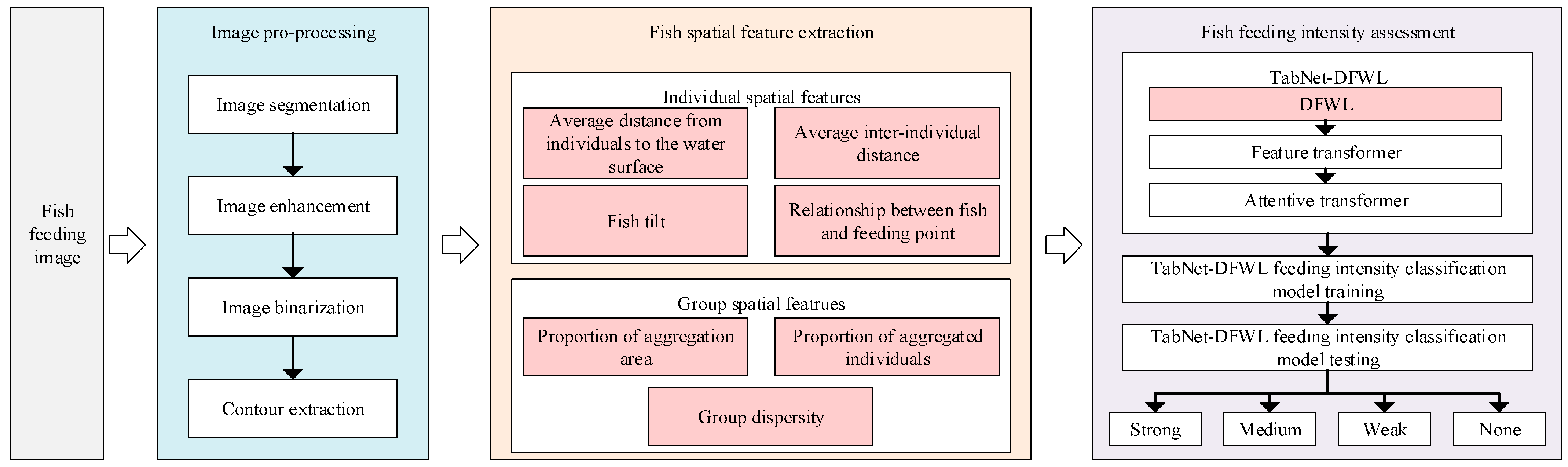
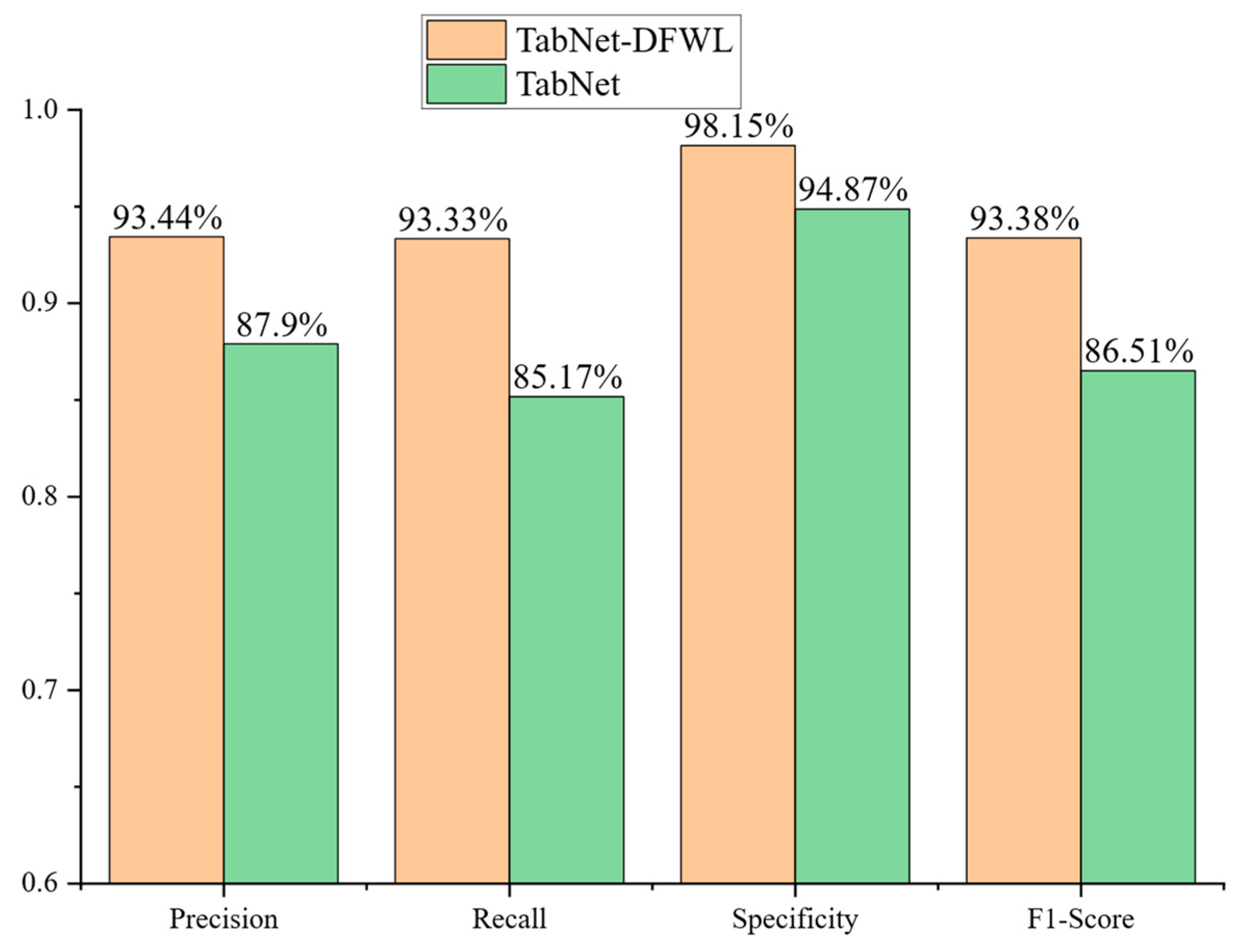
Accurate assessment of fish feeding intensity is significant for the timely understanding of feeding demands, dynamically adjusting feeding strategies, and reducing aquaculture costs. However, existing methods often rely on superficial visual features that fail to capture subtle satiety dynamics, resulting in limited reliability. To address the issue, a method for fish feeding intensity assessment based on spatial features and TabNet model with Dynamic Feature Weighting Layer (TabNet-DFWL) is proposed in this study. Fish body contours are extracted from lateral-view images through a pipeline of segmentation, enhancement, and binarization. Subsequently, spatial features highly correlated with fish feeding mechanisms are proposed to characterize behavioral changes. Based on these, an interpretable model integrating spatial features and TabNet-DFWL is constructed to achieve precise fish feeding intensity assessment. This method explores spatial features related to feeding behavior from the underlying mechanism of fish behavioral changes and establishes a feeding intensity assessment model based on TabNet-DFWL. By doing so, it avoids the black-box risk commonly associated with traditional deep learning models and significantly improves model interpretability and reliability, thereby providing a trustworthy basis for precision feeding in aquaculture. Experiments conducted on a real-world fish feeding dataset demonstrate that the proposed method achieves an accuracy of 95.96%, an average precision of 93.44%, an average recall of 93.33%, an average specificity of 98.15%, and an average F1-score of 93.38%. Compared with comparative algorithms, all evaluation metrics exhibit improvements. These results indicate that the proposed method enables accurate assessment of fish feeding intensity and can effectively support the dynamic adjustment of feeding strategies in aquaculture systems.
Keywords: aquaculture; computer vision; feeding intensity assessment; spatial feature; interpretable model aquaculture; computer vision; feeding intensity assessment; spatial feature; interpretable model