
Article

Comparative Analysis of Growth Patterns and Sexual Dimorphism of Scylla paramamosain in Pond Culture

1
Key Laboratory of Aquacultral Biotechnology (Ningbo University), Chinese Ministry of Education, Ningbo 315211, China
2
Collaborative Innovation Center for Zhejiang Marine High-Efficiency and Healthy Aquaculture, Ningbo 315211, China
3
Key Laboratory of Green Mariculture (Co-Construction by Ministry and Province), Ministry of Agriculture and Rural, Ningbo 315211, China
*
Author to whom correspondence should be addressed.
Fishes 2026, 11(5), 307; https://doi.org/10.3390/fishes11050307

Submission received: 11 April 2026 / Revised: 17 May 2026 / Accepted: 19 May 2026 / Published: 21 May 2026
(This article belongs to the Special Issue Biology and Culture of Marine Invertebrates)

Abstract

To investigate the growth patterns and sexual differences in pond-cultured mud crabs (Scylla paramamosain), this study measured eight growth patterns in pond-cultured S. paramamosain aged 1 to 5 months, including internal carapace width (ICW), abdomen width (AW), body height (BH), carapace length (CL), propodus length (PL), merus length (ML), first periopod merus length (1PML), and body weight (BW), with measurements taken monthly. The growth patterns for females, males, and a mixed-sex group were fitted using the following three growth curve models: Logistic, Gompertz, and von Bertalanffy. The fitting results indicate that the optimal growth model for male S. paramamosain is the Logistic model, while the optimal growth model for female S. paramamosain is the von Bertalanffy model. The predicted growth inflection points and inflection weight for male S. paramamosain are 3.15 months and 155.00 g, respectively; for female S. paramamosain, the predicted growth inflection point and inflection weight are 4.25 months and 228.71 g, respectively; and for mixed-sex S. paramamosain, the growth inflection point and inflection weight are 3.22 months and 151.80 g, respectively. Males achieve a rapid growth period earlier (at 3–4 months of age) than females, with the weight of male crabs significantly greater than that of females at four months of age (p < 0.05). Males exhibit slow weight gain from the fourth to the fifth month, while females demonstrate a rapid weight gain rate during the same period. These results provided a theoretical basis and reference for the refined pond culture of S. paramamosain.
Key Contribution: This study investigates the growth patterns and sexual differences in pond-cultured mud crabs (Scylla paramamosain) and predicts the growth inflection points for male, female and mixed-sex crabs. These results provide a theoretical basis and reference for refining aquaculture management strategies, including feeding protocols and harvest timing in pond-based culture of this species.

1. Introduction

Mud crab (Scylla paramamosain) is a warm-water broad-haline marine crab that is widely distributed in the coastal areas of China and other Indo-Pacific countries [1,2]. According to the China Fisheries Statistical Yearbook 2025, Chinese aquaculture production of S. paramamosain was 162,349 tons, and the fishing output was 68,321 tons, with the vast majority of market demand relying on artificial aquaculture. Pond culture serves as the primary aquaculture mode influencing the yield of artificial mud crab aquaculture [3]. The core of optimizing and upgrading aquaculture technology lies in the precise grasp of the growth characteristics of the cultured species; research on growth models and the related regulation mechanisms can provide a basis for selecting appropriate aquaculture practices. For example, in some aquatic animals, significant growth differences exist between individuals of different sexes, which is known as “sexual dimorphism”. The half-smooth tongue sole (Cynoglossus semilaevis) exhibits this characteristic, with females growing 2 to 4 times faster than males; the female-specific gene rimoc1 has been shown to regulate igf1 and other key genes of the growth axis, thereby affecting the growth and development of the species [4]. Understanding the growth patterns is particularly important for fast-growing species like S. paramamosain. S. paramamosain, recruited to fisheries between September and December in their hatching year [5]. In Vietnam, S. paramamosain could reach the minimum marketable size of 200 g after approximately 102 days of rearing, while achieving the premium size of 300 g after about 144 days rearing, which possesses a comparatively prolonged harvest season [6]. However, the growth patterns S. paramamosain remain poorly understood, making it difficult to develop refined aquaculture strategies for this species.
In the research of culturing economic animals, it is essential to develop a better understanding of their growth under different conditions for formulating breeding plans and feeding strategies. Among them, fitting the growth curve using a nonlinear mathematical model is an important method to understand the growth law of animals [7]. When studying the growth law of aquatic economic animals, three models of Logistic, Gompertz and von Bertalanffy are mostly used [8,9,10]. For example, among the three models, the Gompertz model best represents the growth curves of the length and weight of Lutjanus guttatus [11]; the optimal growth model for juvenile growth traits in Atlantic salmon (Salmo salar) is the von Bertalanffy model [12]; the logistic model emerged as the most suitable growth model for Nile Tilapia (Oreochromis niloticus) in pond culture conditions [13].
Notably, factors affecting the fitting of optimal growth curves also exist within a single species, such as differences in growth traits [14], sex [15], and culture systems [16]. The optimal growth models for the length and weight of the Indo-Pacific squid (Sthenoteuthis oualaniensis) are the von Bertalanffy and Logistic models, respectively [14]; after two years of culture, the body length of female C. semilaevis is almost two times than that of males, and the body weight is four times that of males [15]; the Gompertz model and the Logistic model are the most appropriate models for the body length of Litopenaeus vannamei under pond culture and industrialized aquaculture [16]. Study about the growth pattern of the swimming crab (Portunus trituberculatus) showed that the Logistic model best describes body weight growth (R2 = 0.999), while the von Bertalanffy model is more suitable for other morphometric traits [17]. Sex-specific growth patterns have also been documented in the P. trituberculatus. Studies on pond-cultured P. trituberculatus revealed that males exhibit earlier rapid growth (inflection at 3.24 months), while females show slower but more sustained growth (inflection at 3.92 months) [18].
To our knowledge, no previous study has systematically investigated the growth models of S. paramamosain under pond culture conditions. This study measured eight growth indicators of the pond-cultured mud crab; these indicators were fitted using the Logistic, Gompertz, and von Bertalanffy growth models for female, male, and mixed-sex crabs, respectively. The optimal models for growth traits were selected to predict growth trajectories and identify sex-specific growth inflection points. These results will offer fundamental insights for refining aquaculture management strategies, including feeding protocols and harvest timing in pond-based culture of this species.

2. Materials and Methods

2.1. Experimental Animals

S. paramamosain larvae at the zoea I (ZI) stage were hatched on May 21st and cultured in concrete tanks at a local aquaculture farm (Zhejiang Province, China) until 15 June, at which timepoint they had reached the crablets (stage 1, C1). C1 crablets are defined as the first juvenile crab stage immediately following the megalopa larval stage, characterized by a fully calcified carapace, folded pleon, and typical decapod body plan [19]. Three earth ponds (2600 m2 each) in the Research Academy of Sanmen mud Crab Industrial Technology of Zhejiang Province were used in the experiment, with 4000 crablets (stage I) released for each pond on 15 June.
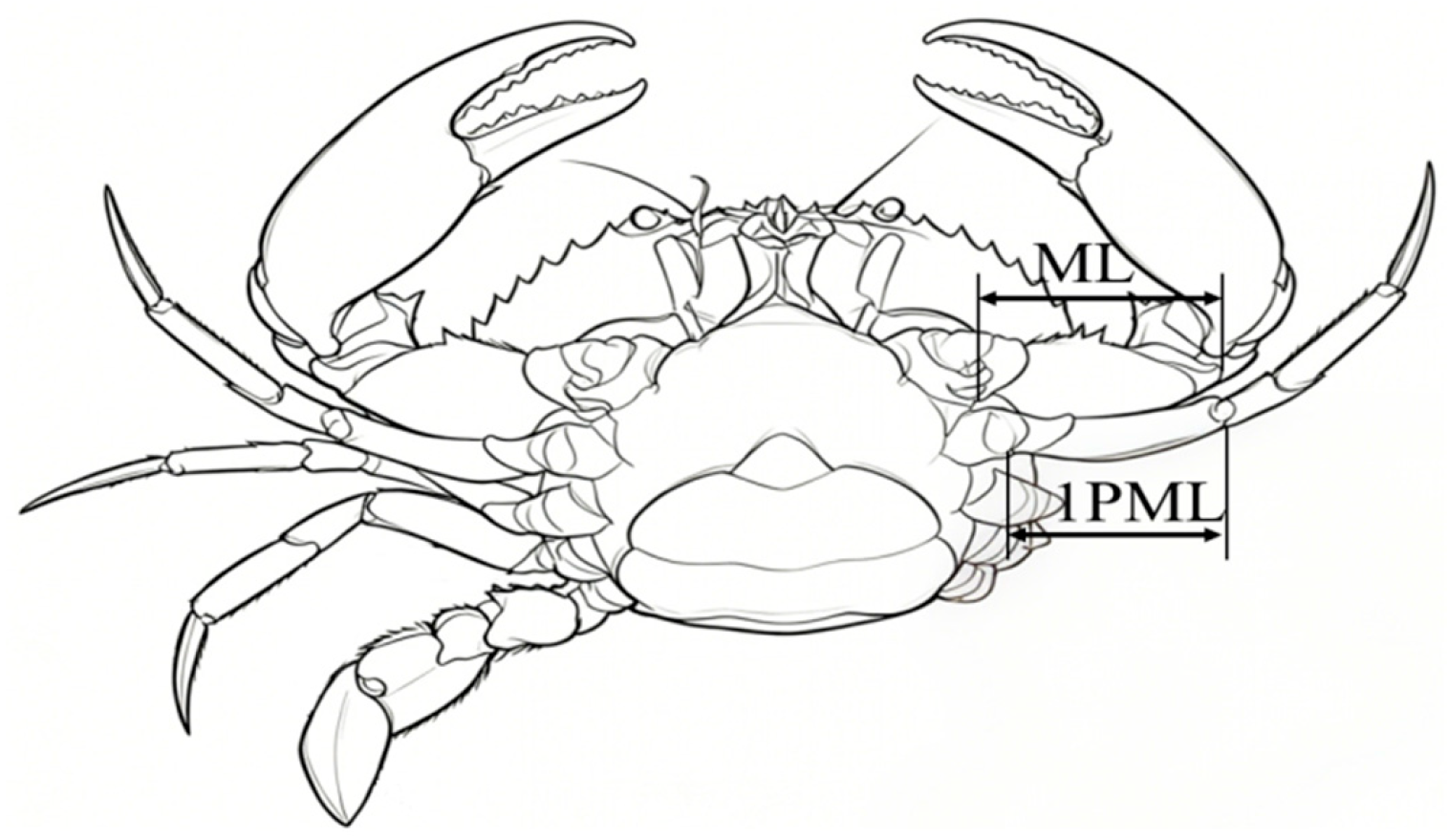
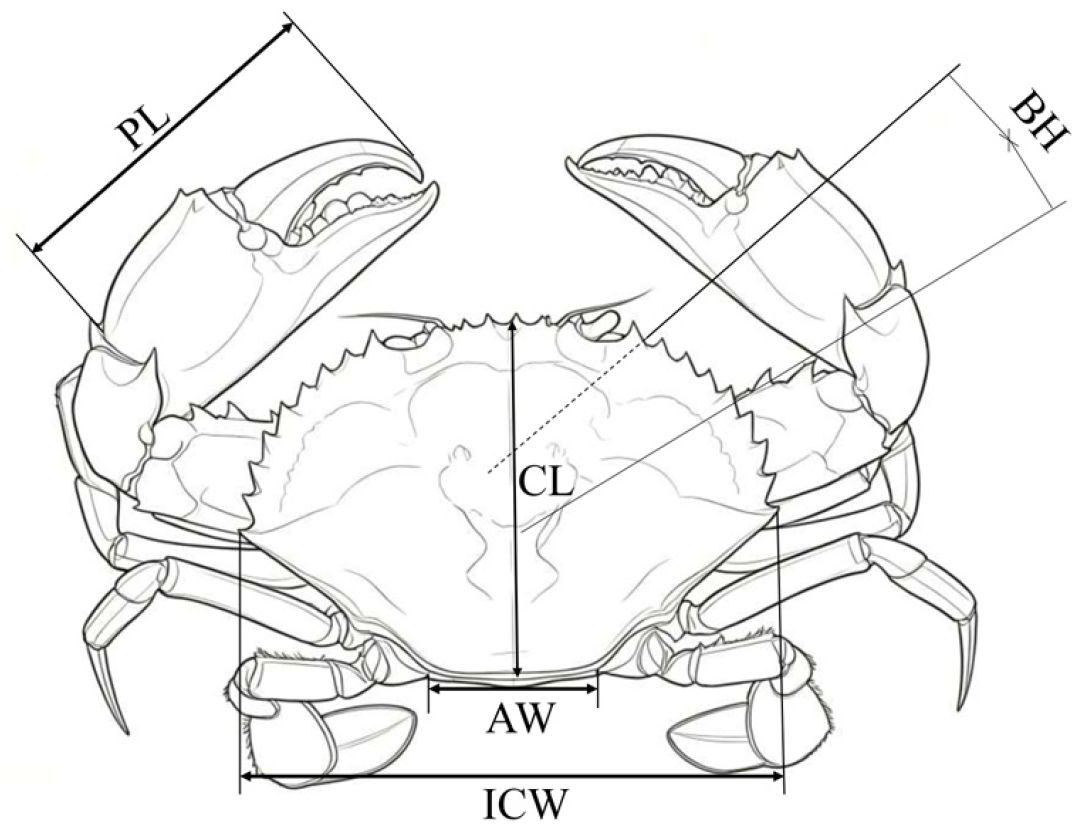
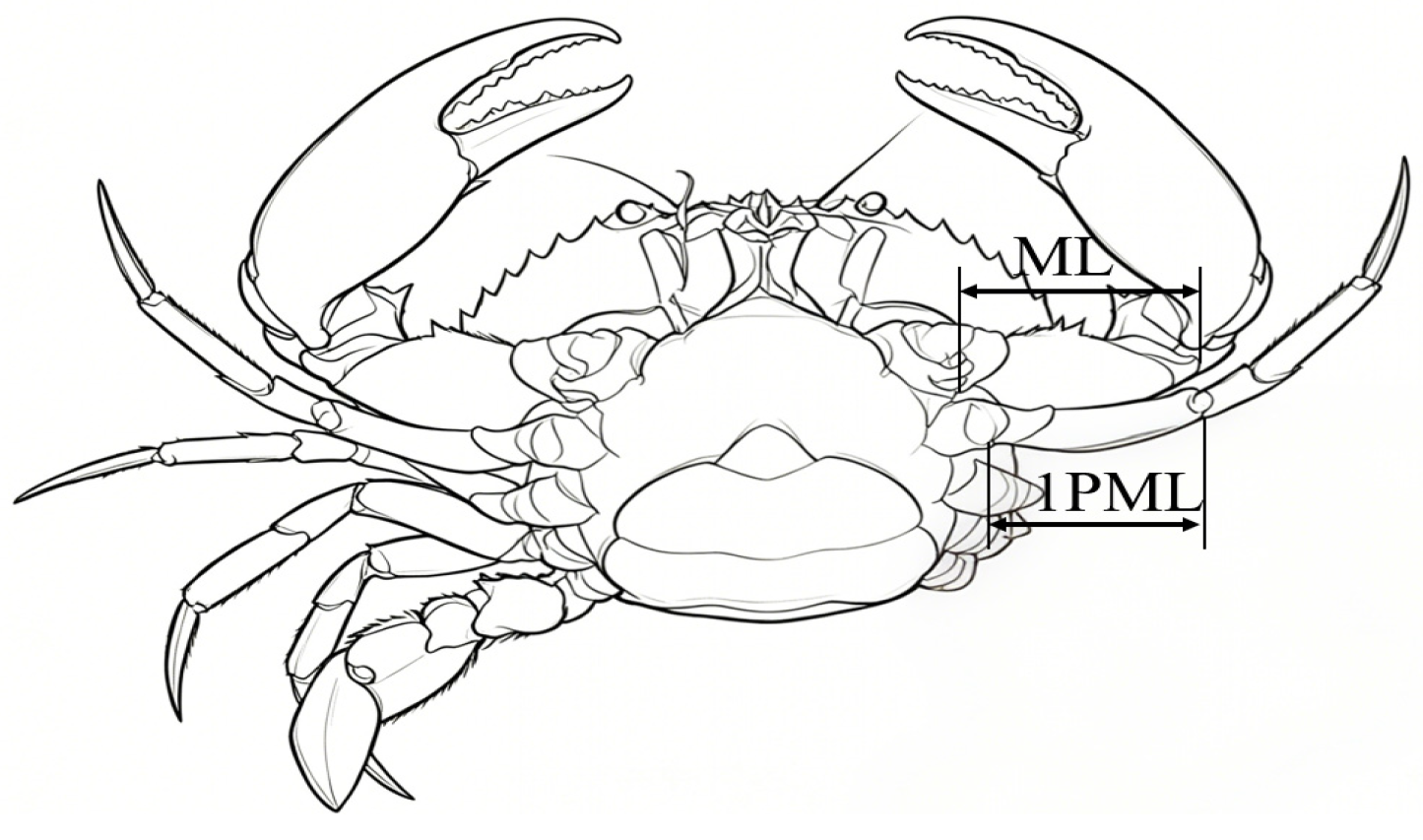
Monthly age was calculated from this date (15 June). In this study, the following three datasets were established for analysis: female crabs, male crabs, and mixed-sex crabs. Mixed-sex crabs refer to individuals sampled from ponds where both male and female crabs were cultured together without separation. For the mixed-sex group, data from males and females were pooled to represent the overall growth pattern under standard mixed-sex culture conditions. Pond culture in this study was conducted from 15 June to November 12th under the following conditions: natural photoperiod, with temperature and salinity at 15–32 °C and 15–33 ppt; water was exchanged 15–20% every month; and quality parameters of the water (pH 7.8–8.6, dissolved oxygen > 6 mg/L) were maintained throughout the study. Crabs were fed at 17:00 with a commercial diet following Chen et al. [20]. Since the crabs were mix-cultured in the ponds, 15 male and 15 female individuals were randomly captured from each pond every 30 days, and the morphological trait indicators were measured with a vernier caliper. These morphological trait indicators included internal carapace width (ICW), abdomen width (AW), body height (BH), carapace length (CL), propodus length (PL), merus length (ML), and 1st periopod merus length (1PML) [21] (Figure 1). All appendage measurements (PL, ML, and 1PML) were taken from the left side of the crab. All measurements of these morphological traits were made accurate to 0.01 mm. Additionally, an electronic balance was employed to measure the body weight (BW) of the sampled crabs, with precision up to 0.01 g.

2.2. Construction and Selection of Growth Models

The three models, namely the Logistic model, the Gompertz model, and the von Bertalanffy model, were respectively used to fit the growth traits. Firstly, based on the non-linear fitting function in the SPSS 22.0 (IBM, Armonk, New York, USA), the values of A, B, and k were predicted, and the optimal values of A, B, and k in the models were obtained through iterative calculations. Then, the fitting accuracy of each morphological trait model was judged according to the magnitude of the goodness of fit R2. Finally, the monthly age at the growth inflection points and the body weight at the growth inflection point of S. paramamosain were calculated according to the estimated values of each pattern. Then, the most suitable growth models were respectively selected to predict the various growth data of female crabs, male crabs, and of both genders at different monthly ages. The patterns contents of each model are shown in Table 1 below:

2.3. Data Analysis

The data were analyzed using SPSS 22.0 (IBM, Armonk, New York, USA). The results are presented as mean ± standard deviation. Because the mixed-sex group shares data that overlap with the female and male groups, it was excluded from statistical comparisons to avoid violating the independence assumption. The Mann–Whitney U test, which was suitable for comparing two independent samples with small sample size, was employed to compare the morphometric traits between female and male crabs. The data of mixed-sex group were used only for descriptive purposes and model fitting. A p value less than 0.05 indicates a statistically significant difference.

3. Results

3.1. Growth Phenotypic Patterns of S. paramamosain

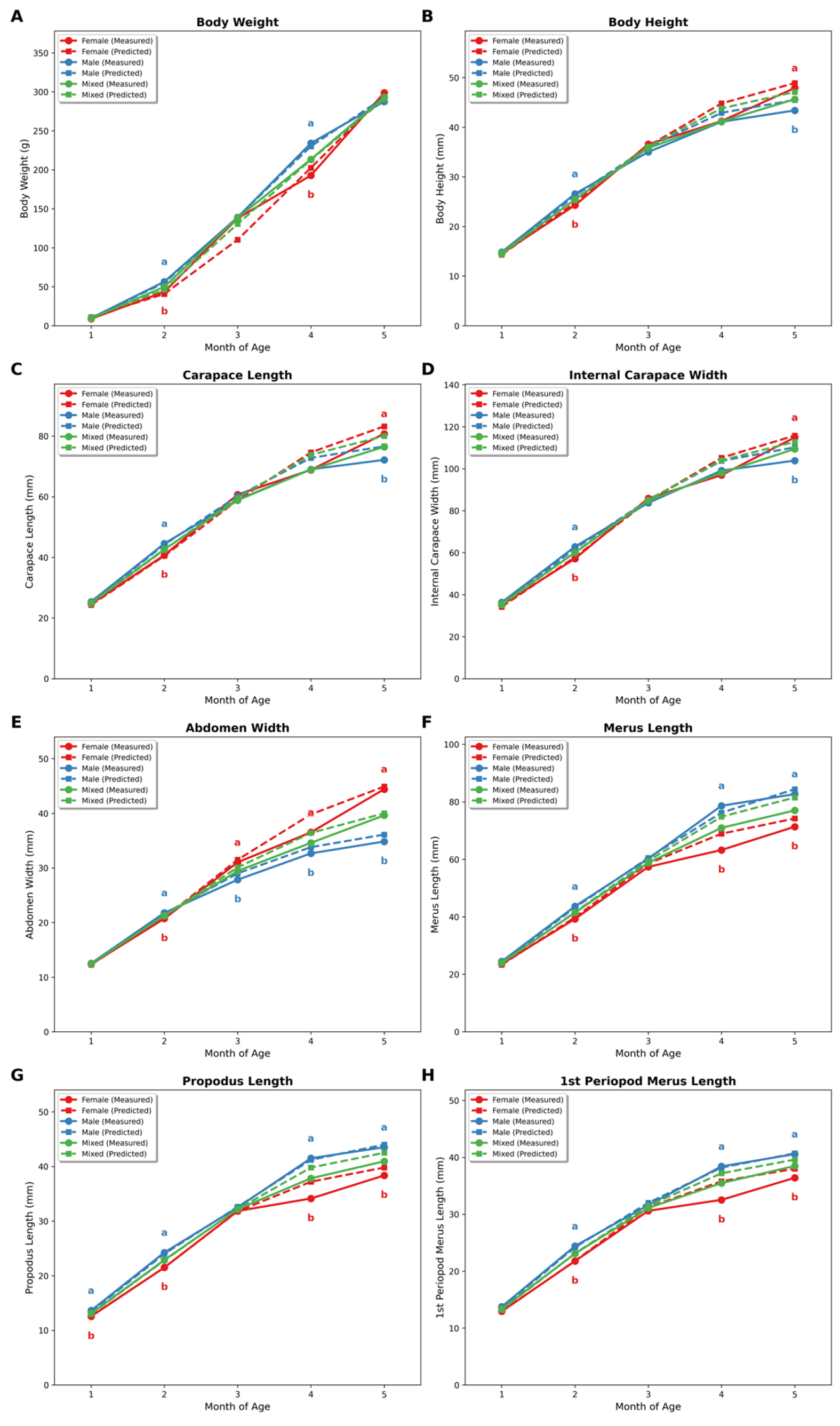
The statistical results of growth indicators show that the phenotypic values of various traits of the S. paramamosain increase with the growth of the number of months (Figure 2). There are different growth trends for female crabs, male crabs, and mixed-sex crabs. The results of the BW growth of female, male, and the mixed-sex S. paramamosain show that there is no significant difference at the first month of age. At the second month of age, the body weight of male crabs is significantly greater than that of female crabs (p < 0.05). After that, S. paramamosain enters a rapid growth period. At the third month of age, there is no significant difference in the BW between female and male crabs. At the fourth month of age, the BW of male crabs is significantly greater than that of female crabs (p < 0.05). During the growth period from the 4th to the 5th month of age, the growth of male crabs slows down, and the growth rate of female crabs accelerates. At the fifth month of age, the body weight of female crabs exceeds that of male crabs, but there is no significant difference.
At the first month of age, only the PL shows a significant difference, where the PL of male crabs is significantly greater than that of female crabs (p < 0.05). At the second month of age, the eight growth traits show the same trend, that is, the values of all traits in male crabs are significantly greater than those in female crabs (p < 0.05). At the third month of age, only the AW of female crabs is greater than that of male crabs (p < 0.05). At the fourth month of age, the BW, ML, PL, and 1PML of male crabs are significantly greater than those of female crabs (p < 0.05), but the AW of female crabs is significantly greater than that of male crabs (p < 0.05). At the fifth month of age, the BH, CL, ICW, and AW of female crabs are significantly greater than those of male crabs (p < 0.05); however, ML, PL, and 1PML of male crabs are significantly greater than those of female crabs (p < 0.05).

3.2. The Fitting Results of the Three Models

The fitting results of the three growth models, namely Logistic, Gompertz, and von Bertalanffy (Table 2), show that these three models have a high degree of fitting for various growth patterns of female, male, and mixed-sex crabs. The range of R2 is from 0.982 to 1.000. All three models provided acceptable fits for all traits and sexes. The lowest degree of fitting is the fitting of the Logistic model to the BW of female crabs. The three growth models have similar fitting accuracy for some growth patterns. The R2 values for all models were high, with no significant differences. Although the differences in R2 were not statistically significant, subtle differences were observed, e.g., the fitting degree of female crabs (R2 = 0.993) was slightly lower than that of male crabs (R2 = 0.999).
Based on these marginal differences and further supported by RMSE and MAE values (Supplementary Table S1), the Logistic model was selected as the optimal model for male crabs, and von Bertalanffy model was selected as the optimal model for female and mixed-sex crabs.

3.3. The Model of Growth Patterns

The results of fitting various growth indices of female, male, and mixed-sex crabs according to the optimal growth model are as follows (Table 3). The growth inflection point of the BW of male crabs is at 3.15 months of age, and at this time, the predicted BW of male crabs is 155.00 g. The results of fitting female crabs with the von Bertalanffy model show that the growth inflection point of female crabs is at 4.25 months of age, and the BW of female crabs at this time is 228.71 g. The results of fitting mixed-sex crabs with the von Bertalanffy model show that the growth inflection point is at 3.22 months of age, and the inflection point BW of mixed-sex crabs is 151.8 g. The growth inflection points of other seven growth indices are all between the 1st and 2nd months of age, except for ML of male crabs (at 2.10 months of age), 1PML of female crabs (at 0.89 months of age) and mixed-sex crabs (at 0.94 months of age). Note that the inflection points for 1PML of female crabs and mixed-sex crabs (0.89 and 0.94 months, respectively) are model extrapolations beyond the first sampling time point (one month). The growth inflection point of ICW of male crabs is at 1.69 months of age, and at this time, the predicted ICW of male crabs is 54.20 mm. The results of fitting female crabs with the von Bertalanffy model show that the growth inflection point of ICW of female crabs is at 1.36 months of age, and the ICW of female crabs at this time is 43.64 mm. The results of fitting mixed-sex crabs with the von Bertalanffy model show that the growth inflection point of ICW is at 1.10 months of age, and the inflection point ICW of mixed-sex crabs is 38.02 mm.

4. Discussion

The present study revealed that male and female S. paramamosain exhibit the following distinct optimal growth models: Logistic for males and von Bertalanffy for females. This sex-specific model fitting is not unique in aquatic animals. In Chinese white prawn (Penaeus chinensis), the growth of males was best fitted by the Pitcher and MacDonald’s formula, while females were best fitted by the Logistic curve [22]. This sex-specific model selection indicates fundamental differences in growth trajectories between sexes. In addition, the optimal model also varies among different growth traits. Different morphometric traits in tilapia followed different optimal growth models (exponential for most traits and von Bertalanffy for body width) [23]. Wang et al. [17] investigated the growth characteristics of P. trituberculatus from 1 to 6 months of age and found that the body weight was best fitted to the Logistic model, while other morphometric traits were best fitted by the von Bertalanffy model. In contrast, no such trait-dependent model variation was observed in the present study; all traits followed the same sex-specific models in S. paramamosain.
Shi et al. [24] observed an age-dependent intensification of sexual dimorphism in S. paramamosain growth, with the number of significantly divergent traits rising from three (two months) to seven (3–4 months). By contrast, all eight growth traits in the present study already exhibited significant sexual dimorphism at two months of age, with males being significantly larger. The observed differences in the onset time of growth dimorphism may be attributable to variations in rearing environments and management practices. For example, feed type exerts a potential significant impact on the growth rates of male and female S. paramamosain. A completely randomized trial of three feeds for S. paramamosain demonstrated that the mixed feed of iced trash fish and Crassostrea iredalei oyster meat enhanced male growth, while a diet of oyster meat alone promoted female growth. For Eriocheir sinensis reared in paddy fields, the optimal dietary protein requirements also differ between sexes as follows: 35% for females and a minimum of 25% for males [25].
In pond-cultured P. trituberculatus, Lu et al. [18] used the Logistic model to fit growth in both sexes, reporting growth inflection points at 3.24 months for males and 3.92 months for females, with inflection weights of 195.91 g and 290.27 g, respectively. In the present study, S. paramamosain males reached the growth inflection point at 3.15 months (155.00 g) and females at 4.25 months (228.71 g). In both species, males reached the growth inflection point earlier than females, while females attained a larger size at the inflection point and continued to grow for a longer period.
In this study, the rapid growth period of females occurred later than that of males. This may be related to the asynchronous sexual maturation between sexes. At the fourth month of age, the average ICW of males reached 99.10 mm, exceeding the 96 mm threshold for sexual maturity in S. paramamosain [26], while the average ICW of females (96.94 mm) remained below the size range for abdominal morphology (102.6–108 mm) [27], indicating that females remained immature and can still maintain a relatively high growth rate. The observed differences in sexual maturation timing are likely driven by differential expression of key sex-determination genes. In the swimming crab P. trituberculatus, the insulin-like androgenic gland hormone gene (IAG) is a core factor in male sex differentiation, with expression upregulating upon testicular development onset [28]. Recent RNA interference (RNAi) studies further demonstrated the dual role of Pt-IAG in regulating both growth and reproduction, as its suppression led to reduced body weight and delayed gonad development in both sexes [29]. In S. paramamosain, Sp-IAG is highly expressed in the androgenic gland and seminal vesicle, with further increases after mating [30]. Expression analysis revealed low Sp-IAG levels during immature and vitellogenic phases, with a significant increase at the mature stage [30]. The vitellogenin gene (VTG) is highly expressed in the hepatopancreas and ovary of female during mature stage, providing nutrients for oocyte maturation and leading to an increase in body weight [31]. This energy allocation toward reproduction may explain the rapid weight gain of females after sexual maturity. However, the regulatory mechanisms of sex-related genes on growth remain to be further elucidated.
Mating behavior may also have an impact on gender differences in growth. During mating season, males search for and clasp immature females until they complete reproductive molting [32]. Mating behavior imposes significant energy costs in males, which was obvious in the monosex culture system. In single-sex cultivation of S. serrata and S. tranquebarica, final body weight of males was significantly greater than that of females [33], while in mixed cultivation, male final body weight was less than that of females, indicating that mating behavior significantly impacts male energy consumption. Before the breeding season, male Homalaspis plana invests up to 40,000 J of energy to store proteins and lipids in the vas deferens, with energy decreasing by 80% after mating [34]. In S. serrata, seminal secretions transferred during mating are rich in proteins, carbohydrates, and lipids [35], with multiple functions including sperm metabolic storage [35], antibacterial properties [36], and sperm plug formation/dissolution [37]. These energy investments may lead to slower weight gain or weight loss in males during later period of growth stage.
Taken together, these findings indicate that the growth differences observed in this study may be influenced by a combination of factors, including sexual maturation timing, energy accumulation strategies, gender regulation mechanism, and behavior.
The sex-specific growth patterns observed in this study provide practical insights for pond culture management of S. paramamosain. Selective harvesting of male crabs can be initiated at approximately three months of age, since males reached the growth inflection point at 3.15 months. While harvesting of female crabs may be delayed until 4–5 months of age, since the growth inflection point for female was at 4.25 months, and female crabs exhibit rapid weight gain during months 4–5. In addition, lipid composition analysis for female S. paramamosain revealed that the ovary consecutively accumulates lipids, mainly phosphatidylcholine (PC), triacylglycerol (TG), and cholesterol during vitellogenesis, which are transferred from the hepatopancreas to support oocyte maturation [38,39]. Furthermore, during ovarian development, the ovary deposits large amounts of neutral lipids, primarily triacylglycerol (TAG), rich in saturated fatty acids [39]. These findings indicate that optimizing lipid composition in feed formulations is essential for supporting the later-stage rapid weight gain in female S. paramamosain. Therefore, for female-dominated or mixed-sex ponds, increasing feed supply and lipid content during months 4–5 could enhance this rapid weight gain for females.
It should be noted that the fitted models in this study were developed using data from a single aquaculture farm and were conducted under environmental conditions reflective of local farming practices (temperature 15–32 °C, salinity 15–33 ppt, pH 7.8–8.6, and DO > 6 mg/L); the model parameters reflect growth patterns under these specific conditions. Environmental factors such as temperature and salinity may influence growth model parameters. The growth patterns of S. paramamosain should be investigated under various scenarios in the future in order to provide a more comprehensive theoretical guidance for aquaculture practice of S. paramamosain.

5. Conclusions

This study systematically analyzed the growth patterns of female, male, and mixed-sex S. paramamosain from 1 to 5 months of age. Model fitting revealed that the Logistic model was most suitable for describing male growth, whereas the von Bertalanffy model best fit female growth and mixed-sex group. Growth inflection point analysis indicated that males reach their rapid growth phase earlier (BW inflection at 3.15 months) than females (4.25 months), after which female growth accelerates. These findings provide valuable insights into sex-specific growth regulation in S. paramamosain and offer a theoretical basis for optimizing aquaculture strategies, including sex-separate culture and precision feeding protocols.

Supplementary Materials

The following supporting information can be downloaded at https://www.mdpi.com/article/10.3390/fishes11050307/s1, Table S1. Goodness-of-fit metrics (R2, RMSE, MAE) for three growth models.

Author Contributions

Conceptualization, R.L. and C.W.; Methodology, J.L., Y.J. and Y.H.; Formal Analysis, J.L. and Z.L.; Investigation, J.L., Q.W., C.M., W.S. and C.S.; Writing—Original Draft Preparation, J.L. and R.L.; Writing—Review and Editing; Funding Acquisition, R.L. and C.W. All authors have read and agreed to the published version of the manuscript.

Funding

This research was supported by Key Scientific and Technological Grant of Zhejiang for Breeding New Agricultural Varieties (2021C02069-6), “Innovation Yongjiang 2035” Key R&D Program of Ningbo (2025Z093), the earmarked fund (CARS-48), and K.C. Wong Magana Fund of Ningbo University.

Institutional Review Board Statement

The study of the protocol was approved by the Ethics Committee of Ningbo University (CARS-48), on 11 March 2022.

Informed Consent Statement

Not applicable.

Data Availability Statement

The original contributions presented in this study are included in the article and Supplementary Material. Further inquiries can be directed to the corresponding author.

Conflicts of Interest

The authors declare no conflicts of interest.

References

  1. Gong, J.; Ye, H.H.; Xie, Y.J.; Yang, Y.N.; Huang, H.Y.; Li, S.J.; Zeng, C.S. Ecdysone receptor in the mud crab Scylla paramamosain: A possible role in promoting ovarian development. J. Endocrinol. 2015, 224, 273–287. [Google Scholar] [CrossRef]
  2. Zhao, M.; Wang, W.; Zhang, F.; Ma, C.; Liu, Z.; Yang, M.-H.; Chen, W.; Li, Q.; Cui, M.; Jiang, K.; et al. A chromosome-level genome of the mud crab (Scylla paramamosain Estampador) provides insights into the evolution of chemical and light perception in this crustacean. Mol. Ecol. Resour. 2021, 21, 1299–1317. [Google Scholar] [CrossRef]
  3. Wang, H.; Tang, L.; Wei, H.L.; Lu, J.K.; Mu, C.K.; Wang, C.L. Transcriptomic analysis of adaptive mechanisms in response to sudden salinity drop in the mud crab, Scylla paramamosain. BMC Genom. 2018, 19, 421. [Google Scholar] [CrossRef]
  4. Sun, Y.; Zhang, M.; Li, L.; Wei, M.; Xu, W. Differential Expression of the rimoc1 Gene in Male and Female Chinese Tongue Sole (Cynoglossus semilaevis). Prog. Fish. Sci. 2024, 45, 34–42. [Google Scholar] [CrossRef]
  5. Hamasaki, K.; Obata, Y.; Dan, S.; Kitada, S. A review of seed production and stock enhancement for commercially important portunid crabs in Japan. Aquac. Int. 2011, 19, 217–235. [Google Scholar] [CrossRef]
  6. Christensen, S.M.; Macintosh, D.J.; Phuong, N.T. Pond production of the mud crabs Scylla paramamosain (Estampador) and S. olivacea (Herbst) in the Mekong Delta, Vietnam, using two different supplementary diets. Aquac. Res. 2004, 35, 1013–1024. [Google Scholar] [CrossRef]
  7. Lugert, V.; Thaller, G.; Tetens, J.; Schulz, C.; Krieter, J. A review on fish growth calculation: Multiple functions in fish production and their specific application. Rev. Aquac. 2016, 8, 30–42. [Google Scholar] [CrossRef]
  8. Fuentes-Andraca, V.H.; Araneda-Padilla, M.E.; Dominguez-May, R.; Gullian-Klanian, M.; Marin-Coria, E.J.; Quintana-Casares, J.C.; Penalosa-Martinell, D.; Ponce-Diaz, G. Modeling Nile tilapia heterogeneous growth under different stocking densities during pre-grow-out stage. Aquac. Res. 2023, 2023, 9347654. [Google Scholar] [CrossRef]
  9. Zarzar, C.A.; Fernandes, T.J.; de Oliveira, I.R.C. Modeling the growth of Pacific white shrimp (Litopenaeus vannamei) using the new Bayesian hierarchical approach based on correcting bias caused by incomplete or limited data. Ecol. Inform. 2023, 77, 102271. [Google Scholar] [CrossRef]
  10. Dominguez-May, R.; Poot-Lopez, G.R.; Hernandez, J.M.; Velazquez-Abunader, I. Optimization of feed ration size in aquatic system according to the optimal control approach: Implications of using the von Bertalanffy growth model. Aquac. Res. 2024, 2024, 6512507. [Google Scholar] [CrossRef]
  11. Castillo-Vargasmachuca, S.G.; Aragón-Noriega, E.A.; Rodríguez-Domínguez, G.; Martínez-Cárdenas, L.; Arámbul-Muñoz, E.; Burgos Arcos, Á.J. The Standard Deviation Structure as a New Approach to Growth Analysis in Weight and Length Data of Farmed Lutjanus guttatus. Fishes 2021, 6, 60. [Google Scholar] [CrossRef]
  12. Bal, G.; Rivot, E.; Prévost, E.; Piou, C.; Baglinière, J.L. Effect of water temperature and density of juvenile salmonids on growth of young-of-the-year Atlantic salmon Salmo salar. J. Fish Biol. 2011, 78, 1002–1022. [Google Scholar] [CrossRef] [PubMed]
  13. Ansah, Y.B.; Frimpong, E.A. Using model-based inference to select a predictive growth curve for farmed tilapia. N. Am. J. Aquac. 2015, 77, 281–288. [Google Scholar] [CrossRef]
  14. Fan, J.T.; Fang, Z.; Ma, S.W.; Zhang, P.; Chen, Z.Z. Age, growth, and population characteristics of Sthenoteuthis oualaniensis in the South China Sea. Reg. Stud. Mar. Sci. 2022, 55, 102517. [Google Scholar] [CrossRef]
  15. Wang, P.P.; Zheng, M.; Liu, J.; Liu, Y.Z.; Lu, J.G.; Sun, X.W. Sexually dimorphic gene expression associated with growth and reproduction of tongue sole (Cynoglossus semilaevis) revealed by brain transcriptome analysis. Int. J. Mol. Sci. 2016, 17, 1402. [Google Scholar] [CrossRef]
  16. Zhang, Y.; Zhuo, H.B.; Fu, S.; Liu, J.Y. Growth performance and growth model fitting of Litopenaeus vannamei cultured in pond and factory modes. Aquac. Rep. 2024, 39, 102483. [Google Scholar] [CrossRef]
  17. Wang, Y.F.; Chen, C.; Bao, X.N.; Mu, C.K.; Song, W.W.; Li, R.H.; Peng, X.M.; Wang, C.L. Morphometric growth of Portunus trituberculatus “Zhongning No.1”. J. Fish. China 2014, 38, 183–192. [Google Scholar]
  18. Lu, J.K.; Zhang, W.R.; Jian, J.L.; Zhang, K.X.; Chen, Q.W.; Li, R.H.; Wang, C.L.; Mu, C.K. Growth characteristics of Portunus trituberculatus cultured in ponds. J. Fish. China 2023, 47, 039612. [Google Scholar] [CrossRef]
  19. Syafaat, M.N.; Azra, M.N.; Waiho, K.; Fazhan, H.; Abol-Munafi, A.B.; Ishak, S.D.; Syahnon, M.; Ghazali, A.; Ma, H.; Ikhwanuddin, M. A Review of the Nursery Culture of Mud Crabs, Genus Scylla: Current Progress and Future Directions. Animals 2021, 11, 2034. [Google Scholar] [CrossRef]
  20. Chen, S.J.; Liu, J.H.; Shi, C.; Migaud, H.; Ye, Y.F.; Song, C.B.; Mu, C.K.; Ren, Z.M.; Wang, C.L. Effect of photoperiod on growth, survival, and lipid metabolism of mud crab Scylla paramamosain juveniles. Aquaculture 2023, 567, 739279. [Google Scholar] [CrossRef]
  21. Keenan, C.P.; Davie, P.J.F.; Mann, D.L. A revision of the genus Scylla de Haan, 1833 (Crustacea: Decapoda: Brachyura: Portunidae). Raffles Bull. Zool. 1998, 46, 217–245. [Google Scholar]
  22. Nakashima, N.; Minagawa, M.; Ito, S. Growth and spawning of hatchery-reared Chinese white prawn Penaeus (Fenneropenaeus) chinensis released in the Ariake Sea, Japan. Fish. Sci. 2000, 66, 1087–1091. [Google Scholar] [CrossRef][Green Version]
  23. Allaman, I.B.; Reis Neto, R.V.; de Freitas, R.T.F.; Freato, T.A.; Lago, A.d.A.; Costa, A.C.; de Lima, R.R. Weight and morphometric growth of different strains of tilapia (Oreochromis sp.). Rev. Bras. De Zootec. 2013, 42, 305–311. [Google Scholar] [CrossRef]
  24. Shi, X.; Lu, J.; Wu, Q.; Waiho, K.; Aweya, J.J.; Fazhan, H.; Zhang, Y.; Li, S.; Zheng, H.; Lin, F.; et al. Comparative analysis of growth performance between female and male mud crab Scylla paramamosain crablets: Evidences from a four-month successive growth experiment. Aquaculture 2019, 505, 351–362. [Google Scholar] [CrossRef]
  25. Liang, X.; Yu, Y.; Mei, J.; Feng, J.; Li, P.; Bai, Y.; Ma, M.; Liu, F.; Qu, Y.; Lang, Y.; et al. Effects of feed protein levels on Chinese mitten crabs (Eriocheir sinensis) under the rice-crab co-culture model: Performance, nutrient composition, antioxidant capacity and immunity. Aquac. Rep. 2024, 35, 101963. [Google Scholar] [CrossRef]
  26. Islam, M.S.; Kurokura, H. Gonad development and size at maturity of the male mud crab Scylla paramamosain (Forsskål, 1755) in a tropical mangrove swamp. J. Fish. 2013, 1, 7–13. [Google Scholar] [CrossRef]
  27. Hamasaki, K.; Matsui, N.; Nogami, M. Size at sexual maturity and body size composition of mud crabs Scylla spp. caught in Don Sak, Bandon Bay, Gulf of Thailand. Fish. Sci. 2011, 77, 49–57. [Google Scholar] [CrossRef]
  28. Jiang, Q.; Xu, D.; Wang, M.; Xie, X.; Zhu, D. Molecular characterization of a male-specific SoxE gene in the swimming crab, Portunus trituberculatus, and transcriptional interaction with insulin-like androgenic gland hormone. Fishes 2023, 8, 351. [Google Scholar] [CrossRef]
  29. Zhang, W.R.; Li, R.; He, C.; Mu, C.; Wang, C.; Shi, C.; Song, W. Effects of RNA Interference-Mediated Silencing of the Insulin-Like Androgenic Gland Hormone Gene on Growth and Gonad Development in the Swimming Crab (Portunus trituberculatus). Animals 2026, 16, 1413. [Google Scholar] [CrossRef]
  30. Zhang, Y.; Qiao, K.; Wang, S.; Peng, H.; Shan, Z.; Wang, K. Molecular identification of a new androgenic gland-specific insulin-like gene from the mud crab, Scylla paramamosain. Aquaculture 2014, 433, 325–334. [Google Scholar] [CrossRef]
  31. Jia, X.; Chen, Y.; Zou, Z.; Lin, P.; Wang, Y.; Zhang, Z. Characterization and expression profile of vitellogenin gene from Scylla paramamosain. Gene 2013, 520, 119–130. [Google Scholar] [CrossRef] [PubMed]
  32. Waiho, K.; Mustaqim, M.; Fazhan, H.; Norfaizza, W.I.W.; Megat, F.H.; Ikhwanuddin, M. Mating behaviour of the orange mud crab, Scylla olivacea: The effect of sex ratio and stocking density on mating success. Aquac. Rep. 2015, 2, 50–57. [Google Scholar] [CrossRef]
  33. Triño, A.T.; Millamena, O.M.; Keenan, C. Commercial evaluation of monosex pond culture of the mud crab Scylla species at three stocking densities in the Philippines. Aquaculture 1999, 174, 109–118. [Google Scholar] [CrossRef]
  34. Pretterebner, K.; Pardo, L.M.; Paschke, K.; Riveros, M.P. Influence of mating strategies on seminal material investment in crabs. Sci. Rep. 2022, 12, 21116. [Google Scholar] [CrossRef]
  35. Jeyalectumie, C.; Subramoniam, T. Biochemistry of seminal secretions of the crab Scylla serrata with reference to sperm metabolism and storage in the female. Mol. Reprod. Dev. 1991, 30, 44–55. [Google Scholar] [CrossRef]
  36. Jayasankar, V.; Subramoniam, T. Antibacterial activity of seminal plasma of the mud crab Scylla serrata (Forskal). J. Exp. Mar. Biol. Ecol. 1999, 236, 253–259. [Google Scholar] [CrossRef]
  37. Jayasankar, V.; Subramoniam, T. Proteolytic activity in the seminal plasma of the mud crab, Scylla serrata (Forskal). Comp. Biochem. Physiol. B-Biochem. Mol. Biol. 1997, 116, 347–352. [Google Scholar] [CrossRef]
  38. Zeng, X.; Li, Z.; Zhang, Z.; Shi, X.; Wang, Y. Variations in lipid composition of ovaries and hepatopancreas during vitellogenesis in the mud crab Scylla paramamosain: Implications of lipid transfer from hepatopancreas to ovaries. Aquac. Rep. 2024, 35, 102008. [Google Scholar] [CrossRef]
  39. Chen, B.; Zheng, J.; Chen, C.; Wu, K.; Lin, F.; Ning, L.; Wen, X. Differences in lipid accumulation and mobilization in the hepatopancreas and ovary of female mud crab (Scylla paramamosain Estampador, 1949) during ovarian development. Aquaculture 2023, 564, 739046. [Google Scholar] [CrossRef]
Figure 1. Schematic diagram of growth index measurement of the S. paramamosain. ICW indicates internal carapace width; AW indicates abdomen width; BH indicates body height; CL indicates carapace length; PL indicates propodus length; ML indicates merus length; 1PML indicates first periopod merus length.
Fishes 11 00307 g001aFishes 11 00307 g001b
Figure 2. Growth curves of female, male, and mixed-sex S paramamosain from 1 to 5 months of age for the following eight morphometric traits: (A) body weight, (B) body height, (C) carapace length, (D) internal carapace width, (E) abdomen width, (F) merus length, (G) propodus length, and (H) 1st periopod merus length. Solid lines with circles represent measured values; dashed lines with squares represent predicted values from the optimal growth models (Logistic for males, von Bertalanffy for females and mixed-sex). Superscript letters (a, b) indicate significant differences between female and male measured values at the same month (p < 0.05, Mann–Whitney U test), where “a” denotes the sex with significantly larger value and “b” denotes the other. The mixed-sex group is shown for descriptive purposes only.
Fishes 11 00307 g002
Table 1. Mathematical expressions and growth inflection points of three nonlinear growth models (Logistic, Gompertz, and von Bertalanffy).
ModelMathematical ExpressionThe Month Age of the
Growth Inflection Point
The Weight of the
Growth Inflection Point
LogisticN = A/(1 + eBkt)B/kA/2
GompertzN = AeBexp(−kt)(lnB)/kA/e
Von BertalanffyN = A (1 − Bekt)3(ln3B)/k8A/27
Note: t: culture month age; N: values of growth traits at different culture month ages; A: environmental limit growth value; B: parameter constant. k: instantaneous growth rate.
Table 2. Estimation values and goodness of fit of three types of fitting curve models.
TraitSexModelParameterR2
ABk
BW/gFemaleLogistic382.5103.8841.0170.982
FemaleGompertz532.6585.8901.8670.988
Femalevon Bertalanffy771.8920.9970.2580.990
MaleLogistic309.9964.2891.3600.999
MaleGompertz363.4527.7180.7050.999
Malevon Bertalanffy415.8491.2810.4860.998
AllLogistic332.0754.0471.1910.994
AllGompertz413.7396.6730.5880.998
Allvon Bertalanffy512.3331.1160.3750.999
BH/mmFemaleLogistic50.9371.7810.8630.993
FemaleGompertz55.4922.3340.5420.993
Femalevon Bertalanffy58.3360.5810.4370.993
MaleLogistic44.8671.6901.0080.999
MaleGompertz46.6592.3250.7070.999
Malevon Bertalanffy47.6160.5940.6090.999
AllLogistic47.7081.7260.9270.999
AllGompertz50.6252.3080.6160.999
Allvon Bertalanffy52.2980.5820.5140.999
CL/mmFemaleLogistic87.0211.7400.8190.993
FemaleGompertz95.6512.2760.5090.994
Femalevon Bertalanffy101.1670.5690.4060.994
MaleLogistic74.7211.6691.0150.999
MaleGompertz77.5662.2980.7150.999
Malevon Bertalanffy79.0670.5890.6180.998
AllLogistic80.9531.6620.8750.999
AllGompertz86.3962.2150.5771.000
Allvon Bertalanffy89.5660.5620.4791.000
ICW/mmFemaleLogistic124.9491.7290.7960.991
FemaleGompertz138.4682.2570.4870.992
Femalevon Bertalanffy147.2950.5640.3860.992
MaleLogistic108.3911.6540.9770.999
MaleGompertz113.0752.2570.6790.999
Malevon Bertalanffy115.5960.5780.5820.998
AllLogistic115.6191.6810.8810.998
AllGompertz123.6242.2320.5770.999
Allvon Bertalanffy128.3240.5650.4780.998
AW/mmFemaleLogistic51.0061.8300.7260.994
FemaleGompertz59.2022.3680.4150.995
Femalevon Bertalanffy65.3330.5820.3100.996
MaleLogistic36.1281.5430.9450.998
MaleGompertz37.5942.1280.6680.999
Malevon Bertalanffy38.3680.5530.5770.999
AllLogistic42.8451.6620.8060.997
AllGompertz46.6082.1940.5130.999
Allvon Bertalanffy48.9330.5550.4160.999
ML/mmFemaleLogistic73.9141.7060.9370.993
FemaleGompertz78.4082.2750.6220.993
Femalevon Bertalanffy80.9460.5750.5200.993
MaleLogistic90.0721.8840.8960.995
MaleGompertz97.4562.4740.5660.993
Malevon Bertalanffy102.1050.6080.4580.992
AllLogistic82.0311.7930.9081.000
AllGompertz87.9052.3710.5880.999
Allvon Bertalanffy91.4290.5910.4830.998
PL/mmFemaleLogistic39.0021.7971.0320.990
FemaleGompertz40.9412.4220.6970.989
Femalevon Bertalanffy41.9940.6080.5900.989
MaleLogistic46.8901.7800.9010.995
MaleGompertz50.0722.3640.5890.994
Malevon Bertalanffy51.9750.5910.4860.993
AllLogistic42.9891.7770.9551.000
AllGompertz45.3962.3790.6360.999
Allvon Bertalanffy46.8280.5970.5320.999
1PML/mmFemaleLogistic36.8481.6361.0180.991
FemaleGompertz38.3622.2350.7100.991
Femalevon Bertalanffy39.1440.5750.6120.991
MaleLogistic42.6531.6420.9320.997
MaleGompertz44.7182.2340.6420.997
Malevon Bertalanffy45.8600.5720.5470.997
AllLogistic39.7261.6340.9690.999
AllGompertz41.5042.2300.6731.000
Allvon Bertalanffy42.4570.5720.5761.000
Table 3. The predicted values of the model were fitted to various growth parameters.
TraitSexModelInflection MonthsInflection Value
BW/gFemale
Male
All
von Bertalanffy
Logistic
von Bertalanffy
4.25
3.15
3.22
228.71 g
155.00 g
151.80 g
BH/mmFemale
Male
All
von Bertalanffy
Logistic
von Bertalanffy
1.27
1.68
1.08
17.28 mm
22.43 mm
15.50 mm
CL/mmFemale
Male
All
von Bertalanffy
Logistic
von Bertalanffy
1.32
1.64
1.09
29.98 mm
37.36 mm
26.54 mm
ICW/mmFemale
Male
All
von Bertalanffy
Logistic
von Bertalanffy
1.36
1.69
1.10
43.64 mm
54.20 mm
38.02 mm
AW/mmFemale
Male
All
von Bertalanffy
Logistic
von Bertalanffy
1.80
1.63
1.23
19.36 mm
18.06 mm
14.50 mm
ML/mmFemale
Male
All
von Bertalanffy
Logistic
von Bertalanffy
1.05
2.10
1.19
23.98 mm
45.04 mm
27.09 mm
PL/mmFemale
Male
All
von Bertalanffy
Logistic
von Bertalanffy
1.02
1.98
1.10
12.44 mm
23.45 mm
13.87 mm
1PML/mmFemale
Male
All
von Bertalanffy
Logistic
von Bertalanffy
0.89
1.76
0.94
11.60 mm
21.33 mm
12.58 mm
Disclaimer/Publisher’s Note: The statements, opinions and data contained in all publications are solely those of the individual author(s) and contributor(s) and not of MDPI and/or the editor(s). MDPI and/or the editor(s) disclaim responsibility for any injury to people or property resulting from any ideas, methods, instructions or products referred to in the content.